Archive for the ‘subterranean-encounter’ Tag
I have finished. While this took three entries just like Temple of Bast, this wasn’t nearly in the same class in terms of complexity and difficulty. I was stumped early by lacking a verb (I was using MAKE rather than BUILD) and here it was even simpler.
Last time I left off a chest I was unable to unlock.
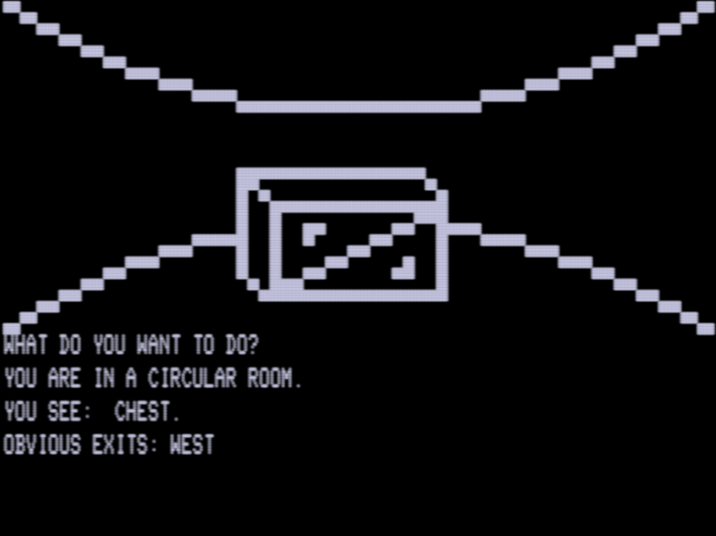
I had discovered a clue I missed before. The coin (normally just treasure) also had writing on it.
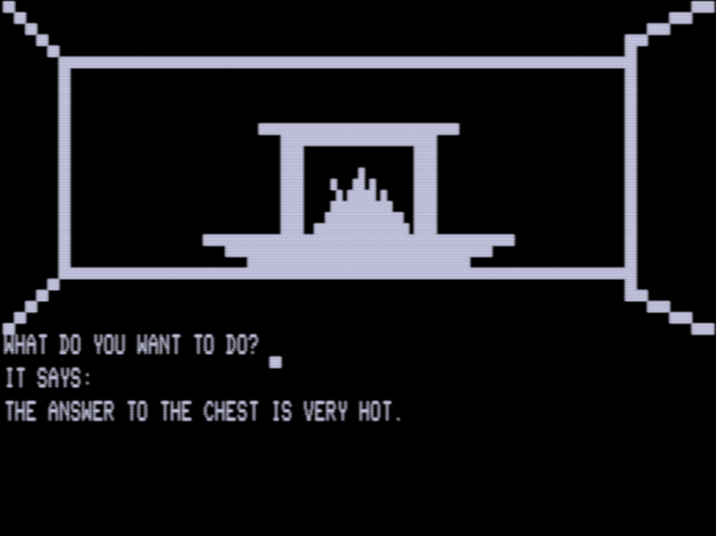
I hence took a long sidetrack trying to get the chest on fire (even though there weren’t any “burn” verbs that worked) with no luck. There’s a piece of wood from elsewhere (with the potential for a portable fire) but it seems to have no method for setting it ablaze.
It turns out the solution was much, much, simpler than I was thinking. The hint is meant to refer to the bowl of fruit on the top of the hearth, and you are supposed to EAT it.
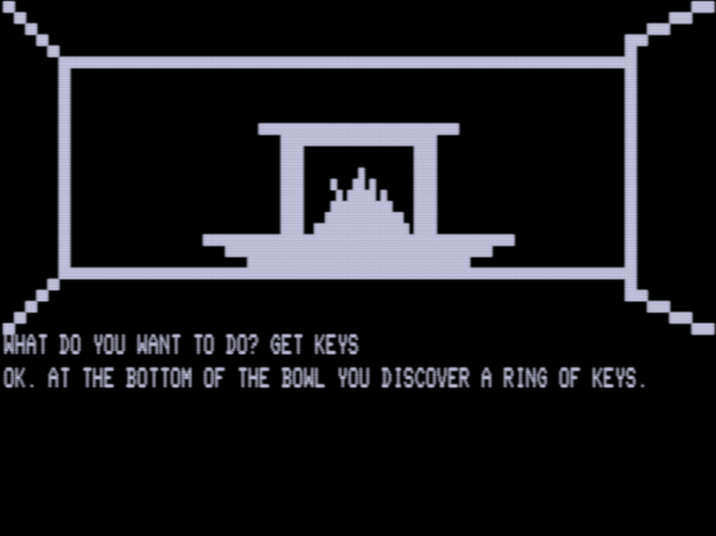
To be fair, I was a little hesitant on chowing down on things after the bottle of acid from the start of the game. I do think I’m a little hesitant about random consumption in general; I’m used to the food from an adventure being fed to someone else, which happens 85% of the time (including in Original Adventure). That 15% of the time still exists where you are intended to just try eating something with no provocation other than to see what happens. (See also: the strength-giving berries in Katakombs where it took me abnormally long to just try them out.)
The keys unlock the chest giving a *piece of paper* (money, it’s just a treasure) but also work on the keyhole in the fountain.
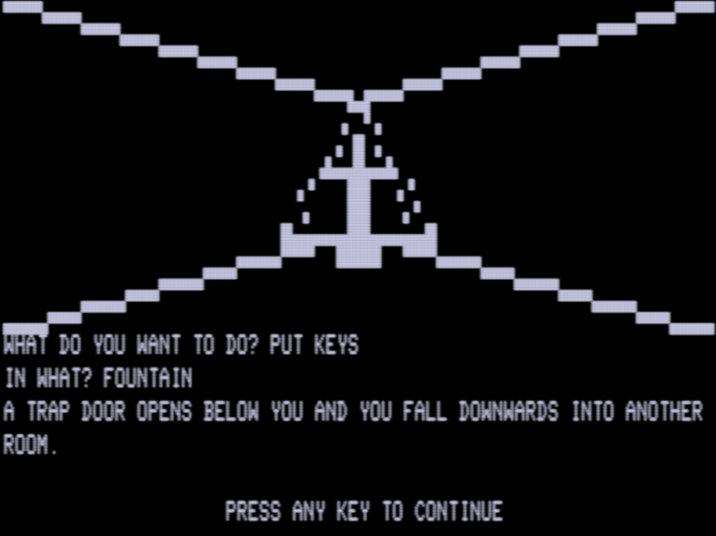
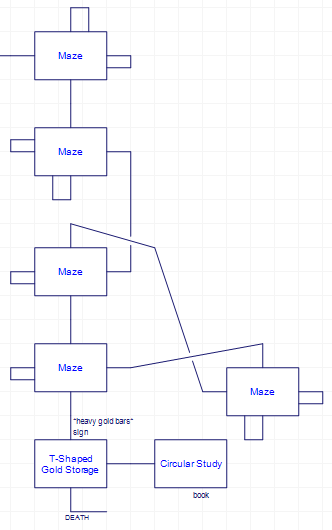
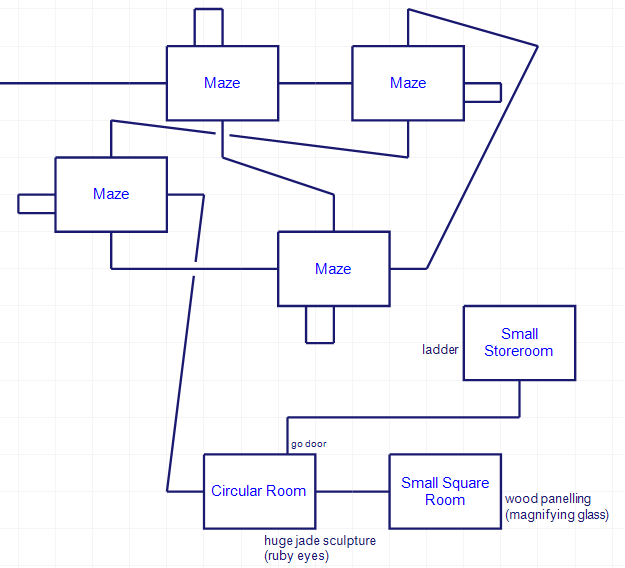
This unlocked the last section of the game. There’s a maze, a small section with a bridge, and another maze.

The location you land from the trapdoor is marked in green.
Before the first maze, there’s a treasure which is also a trap.
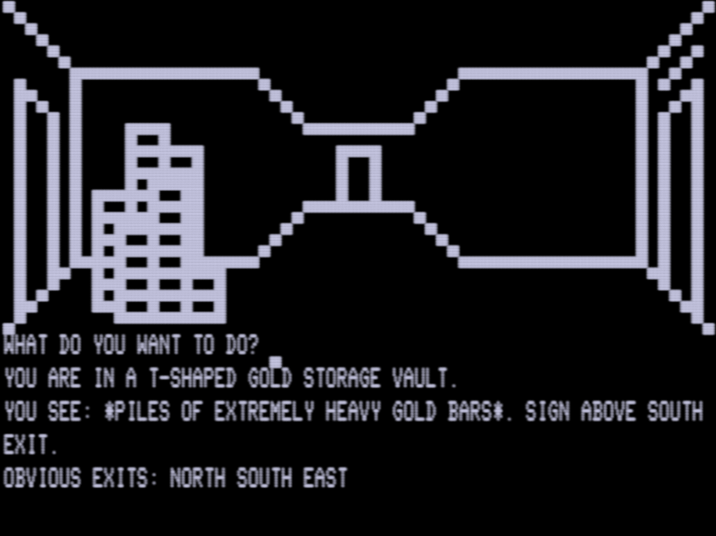
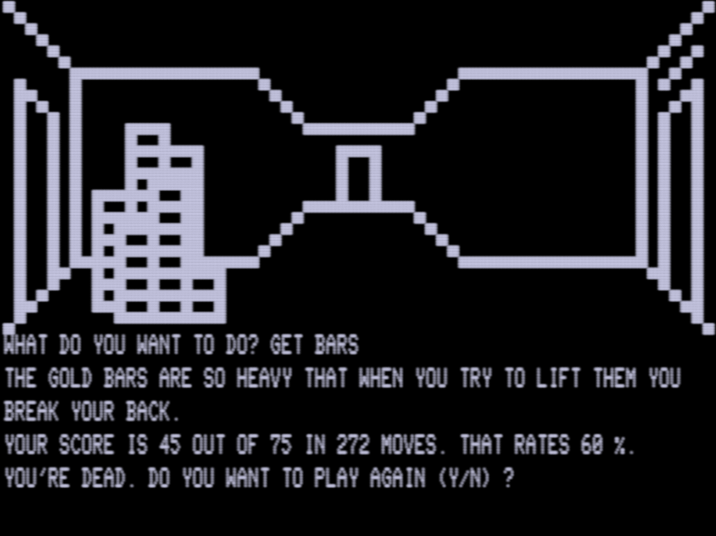
The sign indicates to beware going south, which drops you down a bottomless pit (I imagine most players would know by now to take warnings seriously, but again this seems to be about narrative flavor more than anything tricky). The gold on the other hand had me stumped for a while because the standard for such treasure-gathering games is that asterisks always means a treasure must be taken with you.
The gold is entirely a red herring, even with the asterisks. You get a full score without it, and you cannot take the gold without dying.
To the east there’s a circular study with a book containing half of a clue.
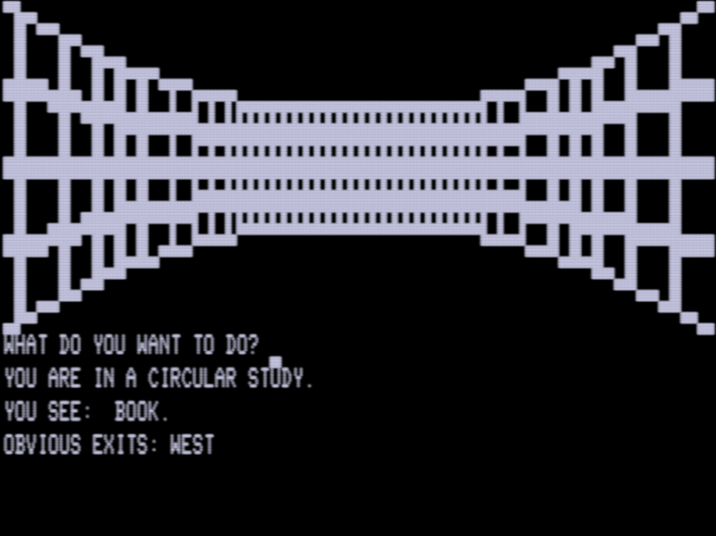
IT SAYS:
THE ANSWER TO THE SECOND LEVEL IS…
After the maze…
…comes a “large cavern” with a pentacle, a slab, and double doors to the north.
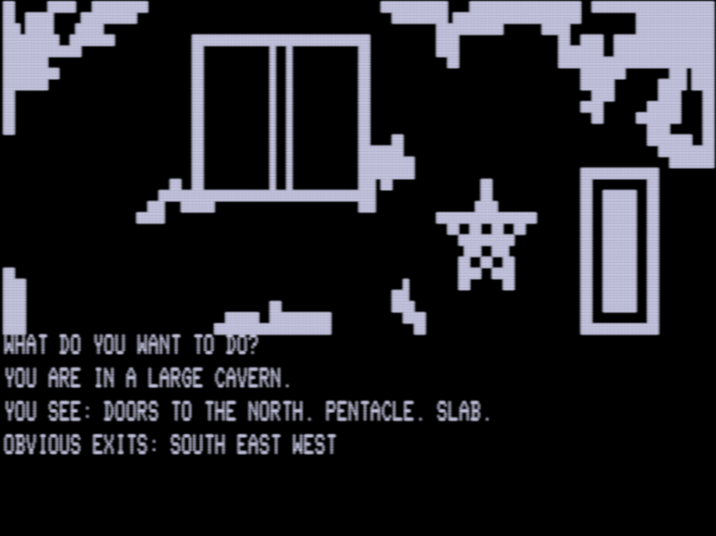
The slab has writing you can’t read, and a crack with a gold medallion hidden in it. The pentacle has writing to tell you to sit inside for protection, which is useful for opening the doors.
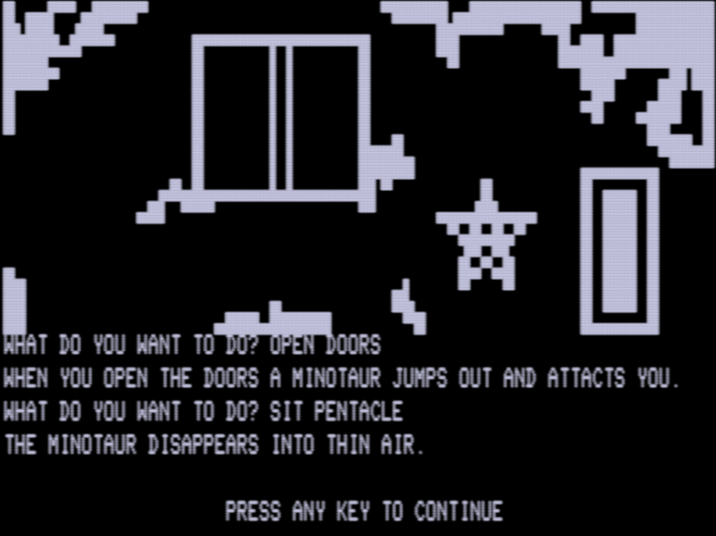
From where the minotaur came you can get another treasure (a gold candelabra).
Just past that to the west is an area with a stream and a bridge…
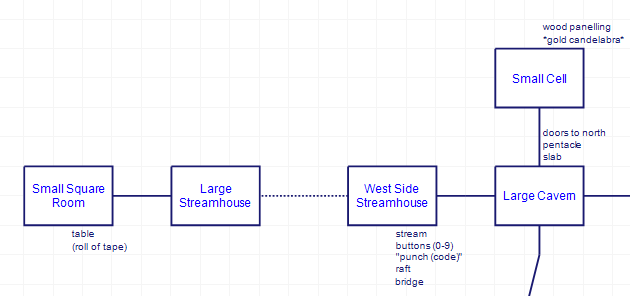
…and there’s a keypad with numbers, where the game says you can PUNCH (number) to input something. There’s a also a raft at a stream that is blocked by some ropes.
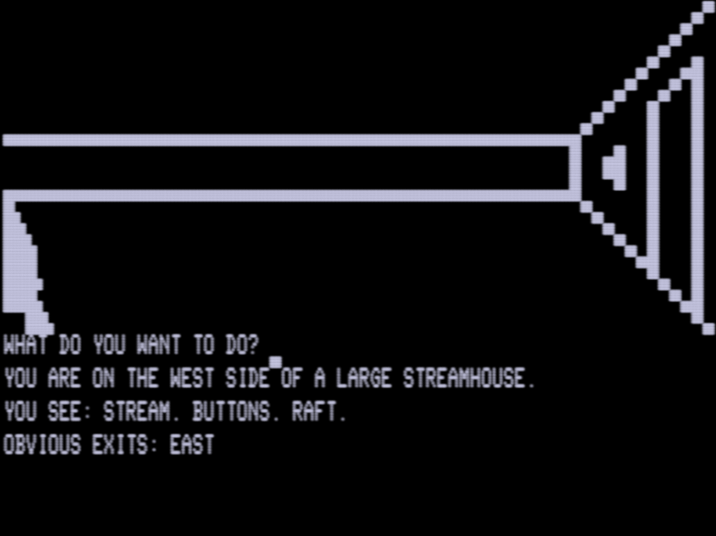
Making further progress requires turning south, to the other maze.

At least the authors here have the excuse they could re-use the art from the maze rooms. Everything else has unique drawings.
There’s a pistol with an ivory handle at a bed (another treasure)…
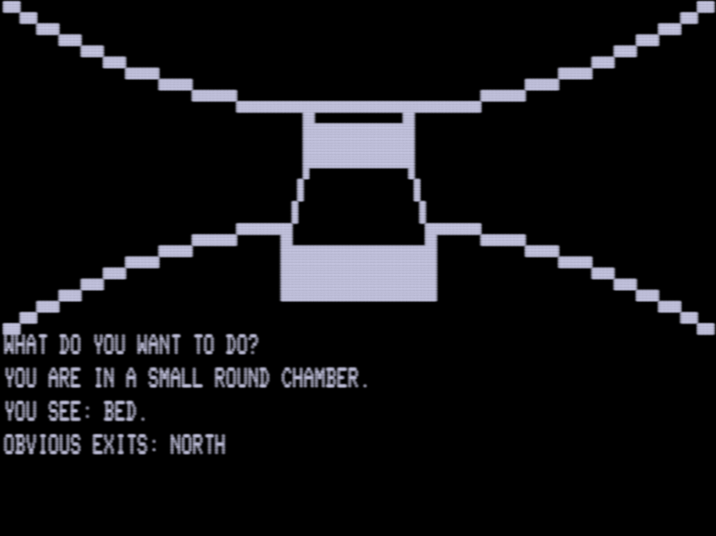
…but also the second half of that clue from the book, written on a random sign in the maze.
IT SAYS: … VERY GROSS.
Putting it all together
THE ANSWER TO THE SECOND LEVEL IS VERY GROSS.
This all lines up to indicate that the keypad needs the number 144 (a gross, that is, a dozen dozen).
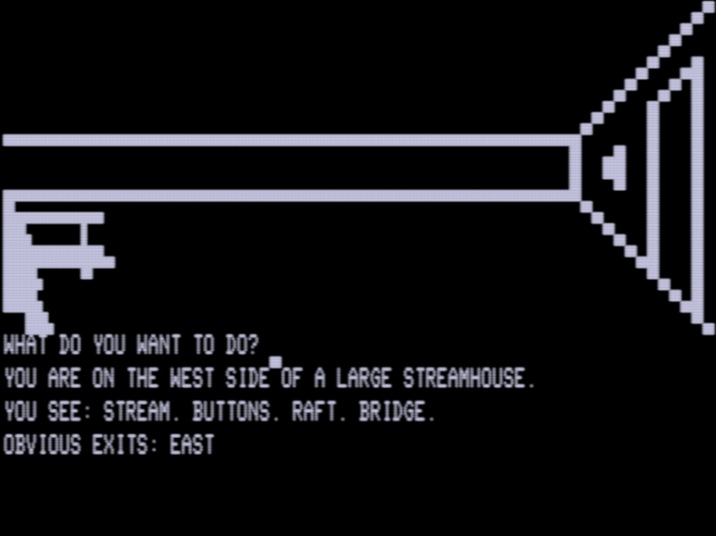
The bridge appears once the keypad number has been entered. On the other side, there’s a PEAR (which when examined, is actually a PAIR of scissors) and a roll of tape.
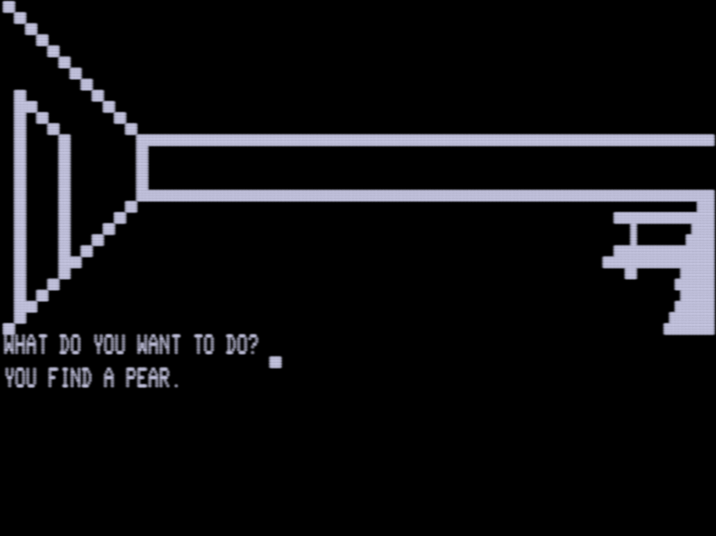
This was the last thing I found while playing, but it’s just LOOK BRIDGE while on the opposite side.
The scissors can free the raft from the ropes, and the tape is needed to be at hand in order to patch a hole.
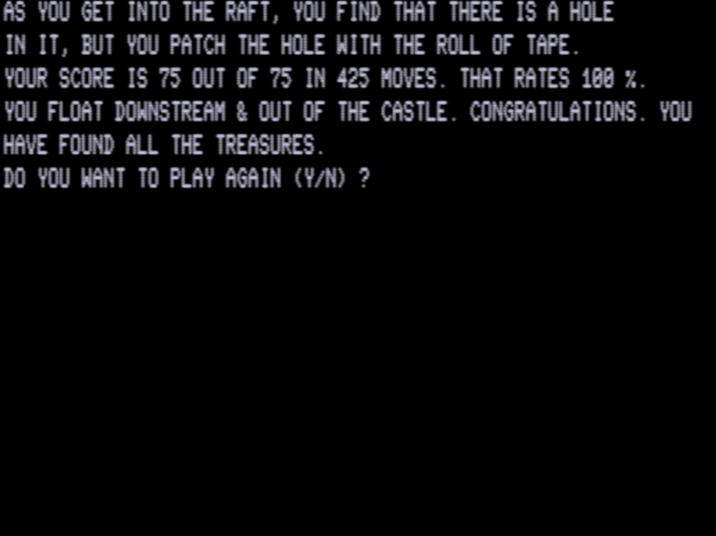
There’s one more death that can happen here, if you’ve been keeping the BAG OF SAND the whole game, which so far, never was useful (and in fact, only serves as a trap).
THE ENORMOUS WEIGHT OF THE BAG OF SAND CAUSES THE LIGHT-WEIGHT RAFT TO SINK TO THE BOTTOM OF THE STREAM. YOU DROWN.
I avoided this during my game just because, weirdly, I had been experimenting with the other trap (the gold you can’t pick up) and had already dumped my inventory (thinking maybe you just needed to be holding nothing and the gold was carryable). I never bothered to pick the sand back up, so I got saved from one trap by another trap.
In the end, this was pretty straightforward and pleasant. I think the difficulty spike at the beginning was a little rude, even though you could resolve the fork issue by typing LOOK FORK; at the very least, there’s a callout of Subterranean Adventure in a Family Computing article circa 1983 that complains quite specifically about that puzzle. The deathtraps, despite showing with some regularity, were all “polite” in that they had some kind of signal. With that tunnel with the poison darts, for instance…
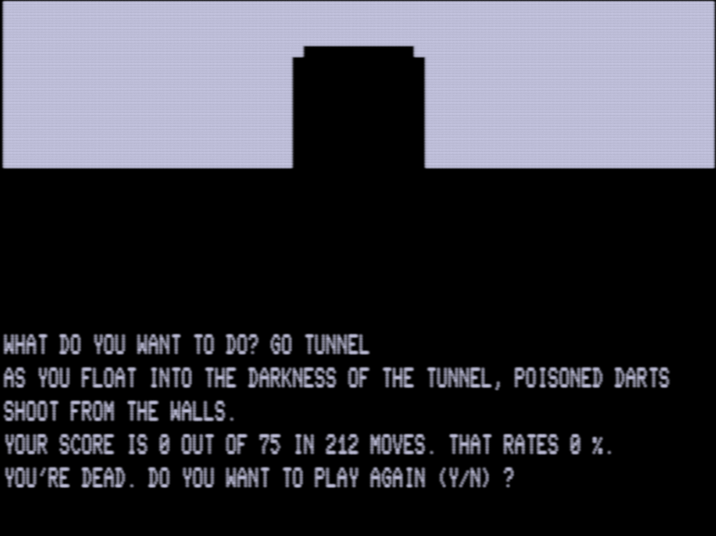
…if you LOOK TUNNEL before going in, the game tells you about the trap.
YOU DISCOVER THAT THERE ARE POISONED DARTS HIDDEN IN THE WALLS.
There are some games where this would just indicate a puzzle to be solved; some of getting in the “flow” was realizing what kind of game this was.
(Design-philosophical aside: for gamebooks especially I tend to mentally sort them into how much they reward thoughtful choice-making. That is, a book may have a left and a right lever to pull, and there is no clue at all which to pull, and you just have to guess — see my compaint on Forest of Doom. Or, it may be, as here, there will always be a signal for what the right choice is, so you can role-play to an extent someone who can’t fall back on a saved game and try to do the right choice the first time. This is a little more pleasant. There can be use to the effect of a “blind choice” but I do find if a game starts using blind choices I make later choices much more at random, even if the author sometimes provides hints for what’s the best option; I’ve lost my feeling of trust that my time won’t be wasted.)
I wish the authors had a further chance to establish an identity and work on more games, and at least they planned it. On the piece of wood (the one that doesn’t set on fire) the whole point of it is to serve as an ad. It has writing and you can READ WOOD:
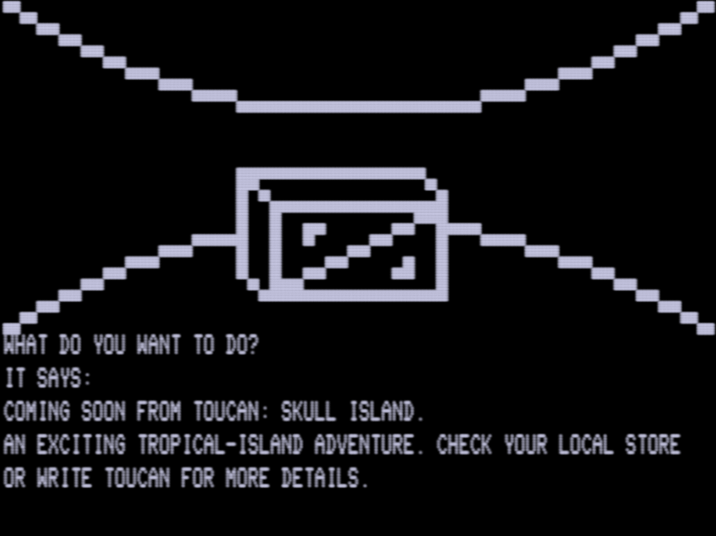
The follow-up game never surfaced.
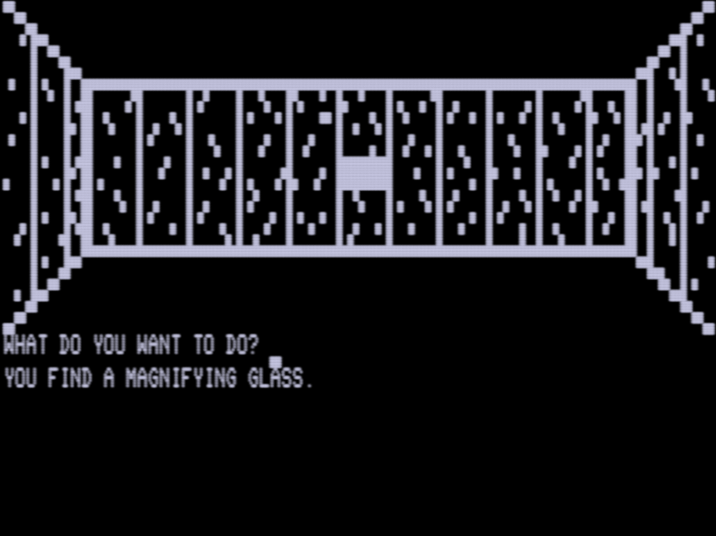
One last comments on the graphics: I’m not sure how much fresh analysis I really can do (since you’ve been seeing them along with me) but they’ve been genuinely pleasant. Compare with Asylum, which was entirely graphical, yes, but always felt like some “programmer art”; that is, it was made functional, enough to give a visual sense of the world, but never had the sort of pixel art one might take seriously as a real style. Here, on the other hand, there was clear effort at style and texture. The perspectives and directions don’t always make sense, but the authors threw themselves into thinking what the TRS-80 was really capable of (like the stylized trees from the start of the game or the wood panel texture shown below).
I’ve had progress on both the informational front and the game front.
Information-wise, I had help from AtariSpot on a Discord server who sleuthed out two stories in the Sacramento Bee. Our intrepid duo of authors were indeed teenagers at the time at Bella Vista High, and a July 18, 1984 story goes into more detail on the founding of the company.

Steve Forrette had his mother design the logo, and (by the news story) had managed to sell 70 copies of the game (perhaps the 500 from the book is an over-estimate for rounding purposes). He got meagre profit due to costs:
I got more than I bargained for in selling it myself. I had to pay for postage, the phone, envelopes, baggies for the disc. But I learned a lot about how businesses work. I didn’t want to just sit back and let a big company sell it.
The company may have also had some sort of afterlife, as Strident tracked down Pelican the company in the comments, although I’m still unclear if the connection with the early-90s company (which was located in Connecticut and created educational “book making” software for classrooms) is accurate or not.
On the game front, I needed to whack at the game’s verbs. I first went through my “standard list”; fortunately the game is quite clear about if a command isn’t understood because of something being out-of-vocabulary or not.

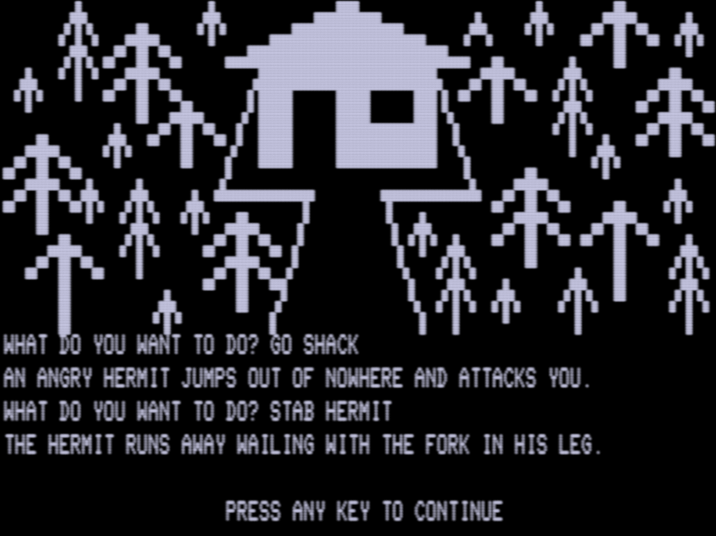
One verb in particular, STAB, ended up being just the thing to take down the hermit, as long as I was holding the fork:
The inside of the shack has a rope. I took it over to the logs, and tried various commands, including MAKE BRIDGE and MAKE RAFT, with no luck. I was worried there was some pun I was missing (like the fork).
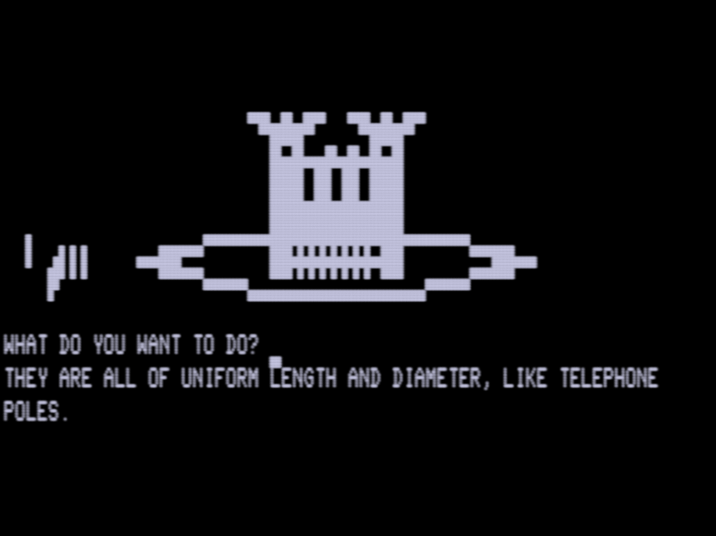
I eventually did a small peek at the BASIC source just to extract the verb list, and came up with BUILD. Argh! Notice I have been testing MAKE for a long time as a verb but not BUILD.
This quickly led me to BUILD RAFT, followed by GO RAFT.
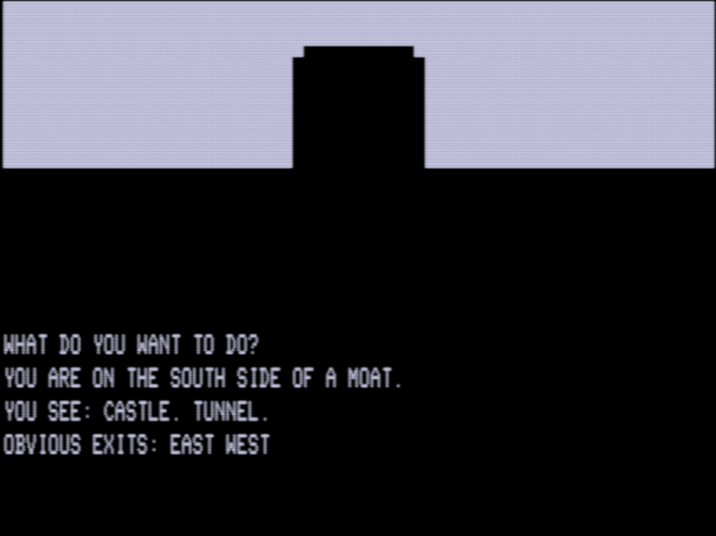
I avoided it the first time around, but I’ll just give the tunnel effect now:
The game has by now established one of its Patterns. Some paths will be deathtraps, and not every deathtrap is a puzzle to solve. Some deathtraps are simply meant to be avoided, and that’s the only “puzzle” in them. (I will say, since I get stuck later, I’m not 100% definitive there’s no safe route through the tunnel, but there are so many circumstances where the player is simply meant to avoid something, I think it really is a red herring.)
In a theoretical sense, this is the most elemental type of puzzle you can have: here are three buttons, pushing the right one leads to victory, which one do you push? However, the fact it is easy to back out with a save game file means it isn’t a puzzle so much as a special effect. Quoting a comment I made on Pyramid of Doom:
I know traditionally the “diegetic plot” of an adventure is the one that goes through without deaths, but I’ve come to think this paints an incomplete picture. This particular death is amusing enough that it’s hard to imagine it won’t be “in the head” of the player, making the environment seem more dangerous. On the surface, the player is walking through a door. Underneath, the player is avoiding a death-trap. Without both branches simultaneously, part of the story is missing.
Skipping the tunnel, you can make your way around the moat to the north side of the castle, where there’s a dock, and a door you can go in.
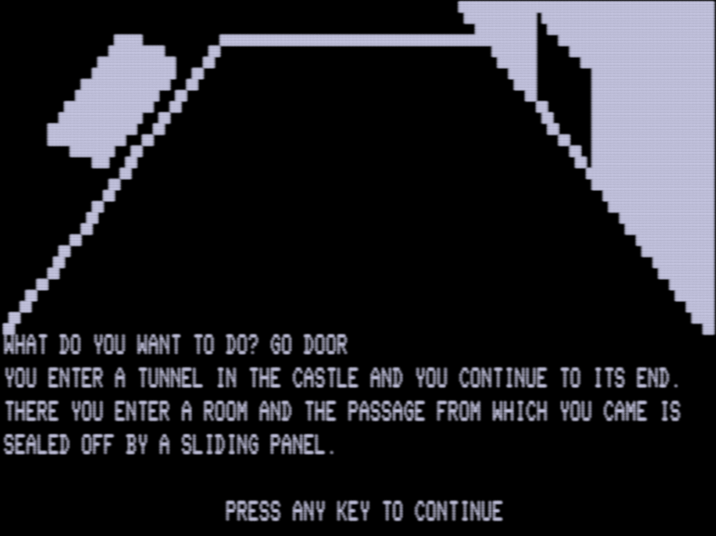
Then there’s another deathtrap, although an announced one.
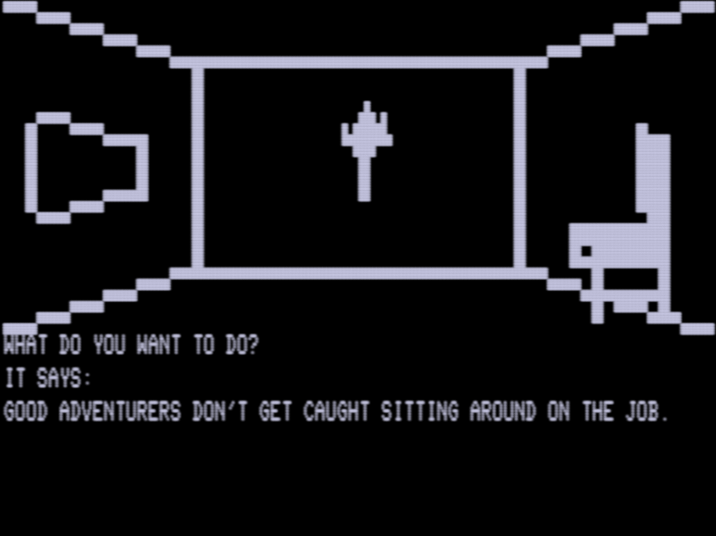
The sign hints adventurers shouldn’t be “sitting around on the job”, so if you SIT CHAIR, it will kill you.
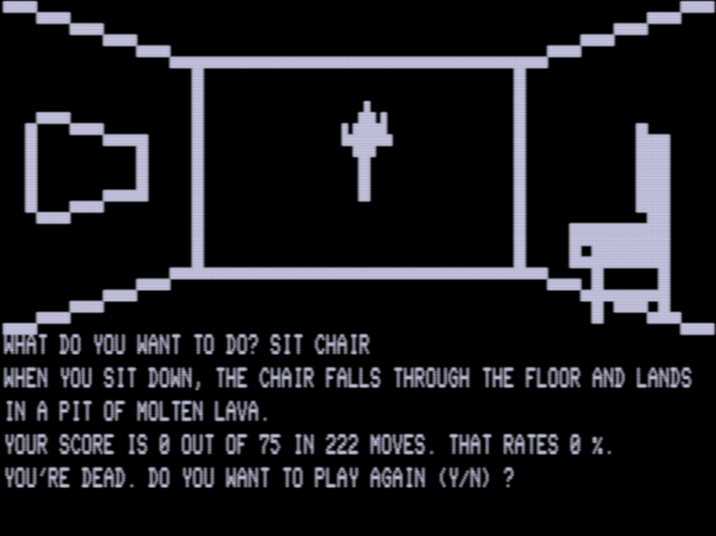
This was more “experimenting for amusement” rather than being tricked. The later deathtraps are also well-signaled.
You’re supposed to ignore the chair entirely and pull the torch instead, opening a door into a new area.
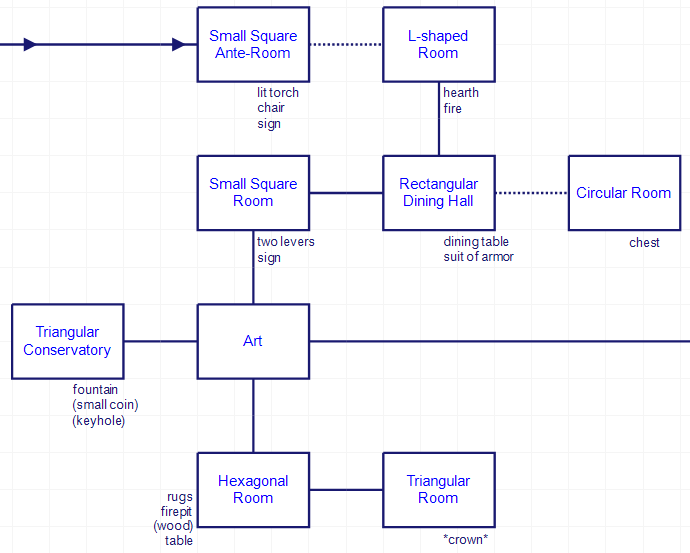
There’s a suit of armor that will chop with you an axe if you try to pass by (again, this was an obvious trap, but I set it off anyway for amusement).

Acid will work to destroy it; past there is a locked chest I have yet to be able to open.
Heading a different direction leads to two levers, and yet another “signaled deathtrap” circumstance.
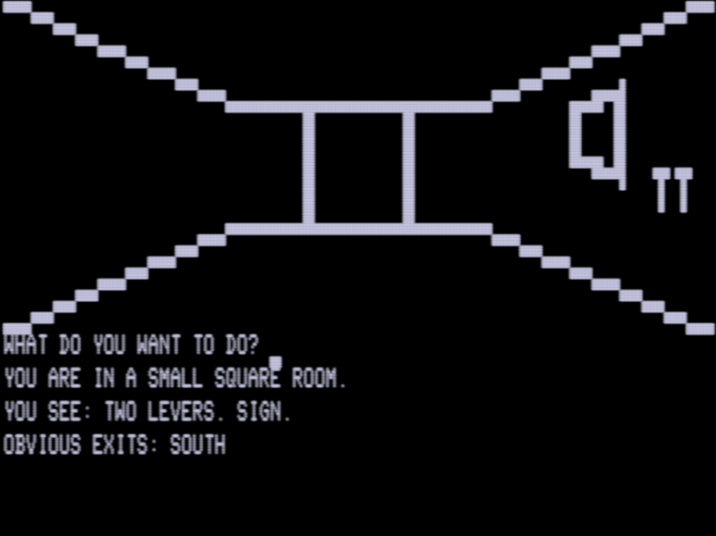
The sign tells you DON’T PICK THE WRONG ONE! You are instead supposed to pick the RIGHT one, that is, PULL RIGHT (or PULL LEVER, then say RIGHT when prompted). PULL LEFT fills the room with water and kills you.

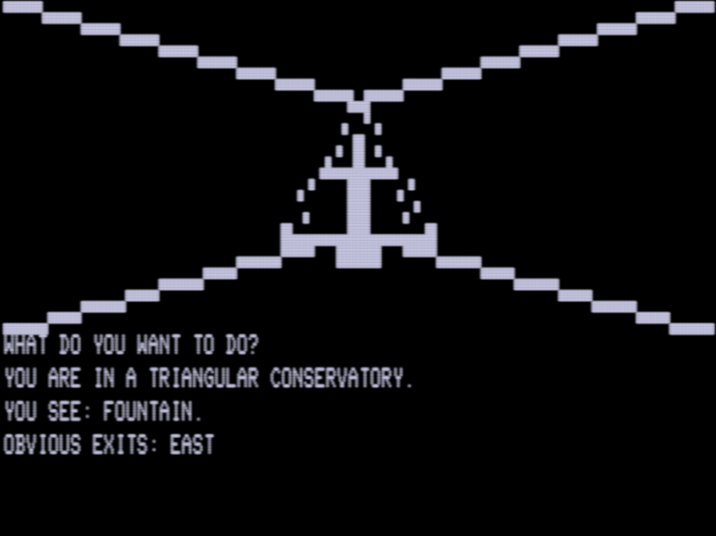
Past that there’s an art gallery with a couple branches; one has a fountain with a *silver coin* and a keyhole, and this was the moment I was sure this was a treasure hunt, even if the game’s ad was coy about the fact we’re here to collect treasure.
Another branch had a *crown* in a side room, some wood in a firepit, and a table full of wizard items (hat, wand, crystal ball, manual). Some writing on a rug warned to “touch only what you can read”. Consequently, most of the items involve death when touched.

Reading the manual gives the clue “the answer may lie to the west, but may also be death”, and I admit I haven’t worked out where to apply this yet.
Finally, there’s a very small side maze:
This all leads to a huge jade sculpture.
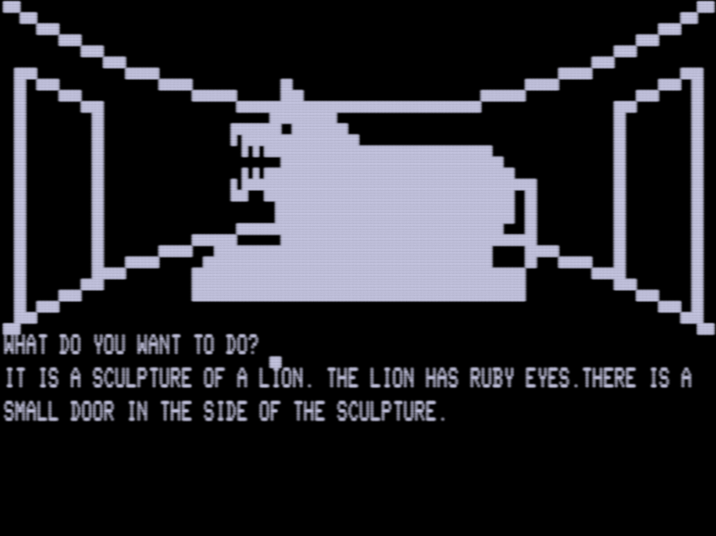
Shockingly, the rubies are not a trap and can be taken straight out. There’s also a ladder and a magnifying glass nearby.
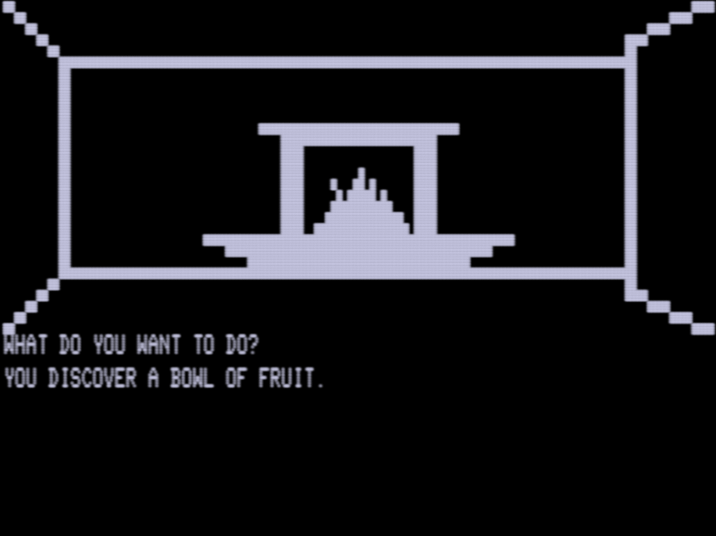
The ladder at least I put to good use, back in a room with a fire and a hearth where the top was too high to see. Applying CLIMB LADDER I was able to find a bowl of fruit.
From here I am stumped, and stumped in the kind of way I don’t even have active puzzles for the most part. I’ve got a locked chest and a keyhole in a fountain but in both cases I’d expect a key that I don’t yet have, so there’s nothing active to deal with there. This indicates I’m probably missing a secret, perhaps using the “answer lies to the west” clue.
Look, the world’s most vague objective!
IN THIS ADVENTURE, SUBTERRANEAN ENCOUNTER, YOUR GOAL IS TO ATTAIN THE HIGHEST SCORE POSSIBLE IN THE FEWEST NUMBER OF MOVES.
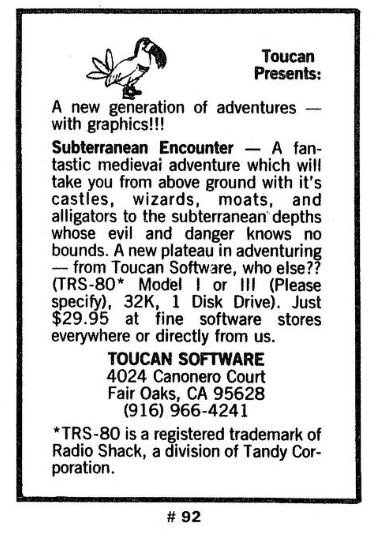
Via 80-U.S., November 1982.
According to the 1985 book Microcomputer Market Place, Toucan Software was owned by Scott Mckenna and Steve Forrette. They only published one game which sold 500 copies. They are about as obscure a company can get; they never filed any official incorporation papers. (There’s another Toucan Software that emerges in the 1990s, but there seems to be no relation.)
Today’s game is a team effort between the aforementioned pair, and I’ve not been able to find either. The closest I got was a reference to a Scott McKenna who went to Bella Vista High School in that time span (in Fair Oaks, 1981-1985), so I’m going to guess the company was another one of the teenaged-entrepreneur larks, but I can’t confirm that with certainty. It does make sense that under such circumstances the authors would only sell 500 copies of one game and disappear after into history.

But it’s an interesting game! We’ve had TRS-80 games with graphics before, but none seem to have been influenced by the growing market for graphic adventures on the Apple II; they formed their own ecosystem with little relation.
I get the sense McKenna and Forrette at least saw a graphical Apple II game.

This games keeps the Scott-Adams style “YOU SEE” and “OBVIOUS EXITS”, but also fills more than half of the top of the screen with an image. We haven’t seen that before with the TRS-80, and the two other graphical TRS-80 games I know of coming up in 1982 don’t follow this pattern.
If the authors got the two-thirds-top-of-screen graphics look from, say, one of the [Sierra] On-Line games, they may also be enamored with the amount of random death. That bottle from the initial shot is acid (don’t drink it! you can POUR BOTTLE and it asks on what, but I have found nothing that works).

Heading east and then north from the starting room arrives at a “shack”.
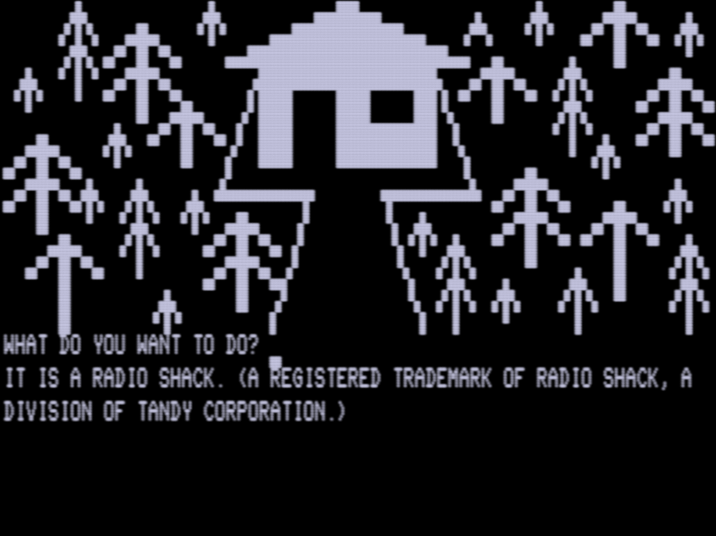
Trying to enter kills you. You have one line where command can technically be typed, but the game seems to be coded to send every reaction to death.
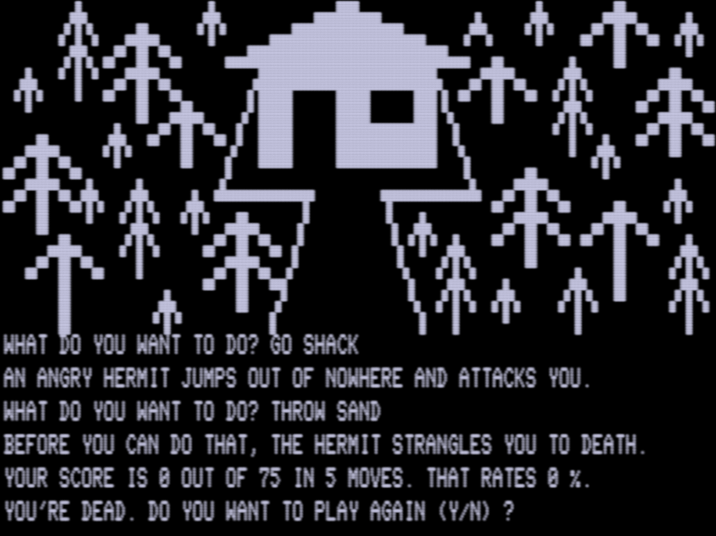
How about a low move count with a low score as the game’s objective?
Heading south rather than north leads you to a castle.
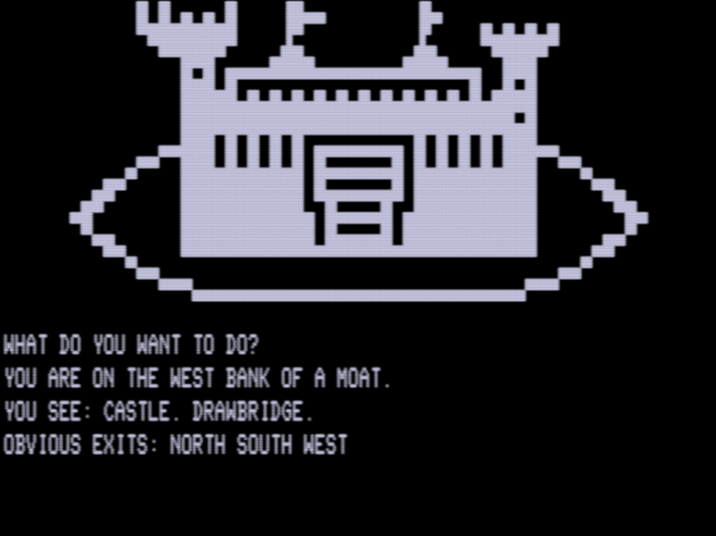
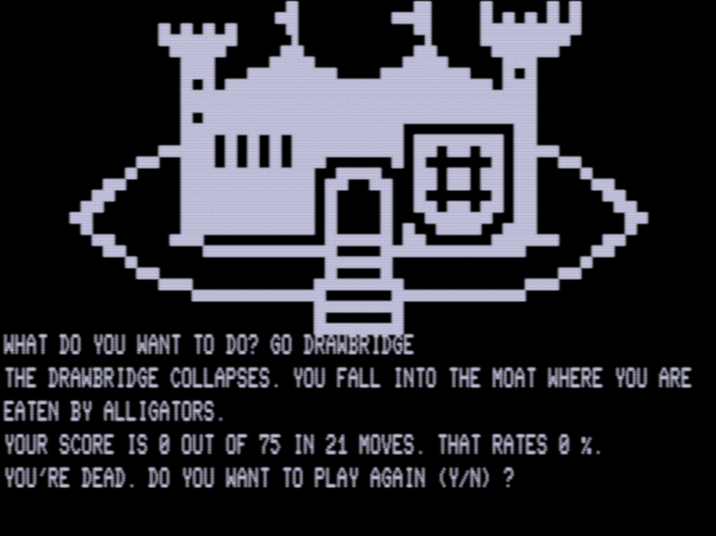
There’s some logs on the south side (that are too heavy to move), while the east side has an open drawbridge.

I’m sure what happens next will shock you.
That’s almost everything I’ve managed so far, but go back at look at where the path splits. The game says there are “two forks in the path” which you could kind of read as a north fork and a south fork, but the way to actually read it is there is a fork and also a fork.
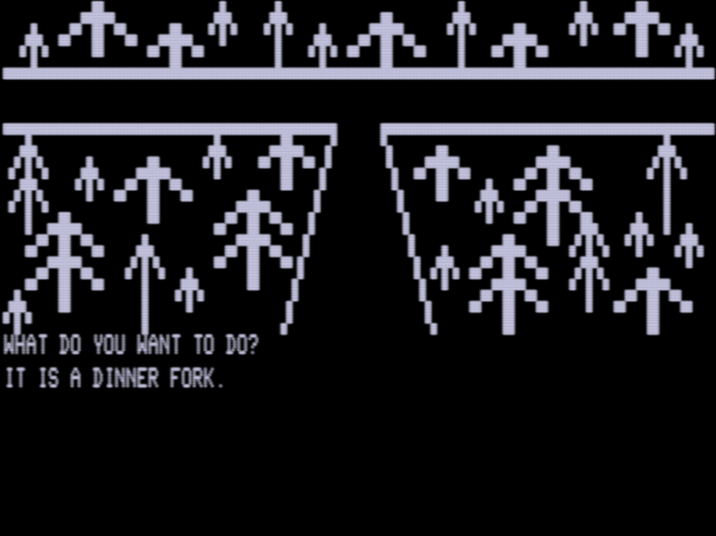
LOOK FORK reveals one of the forks to be a dinner fork, so this isn’t quite the same as Mad Venture where fork referred to both the literal location and the object. This is a joke rather than a mind-bending warp of reality.

I poked around some contemporary material that indicated the game was short (41 rooms) but given what happened last time, that doesn’t mean it will be easy. (At least it’s written in BASIC!) If you’d like to poke around yourself you can find a couple version of the game here, and AUTORUN (under the DISK EMU column) seems to work for the first version.


 Renga in Blue