Also known as Seiko no Adventure or 星子のアドベンチャー; I decided to use the English title given in the game itself.
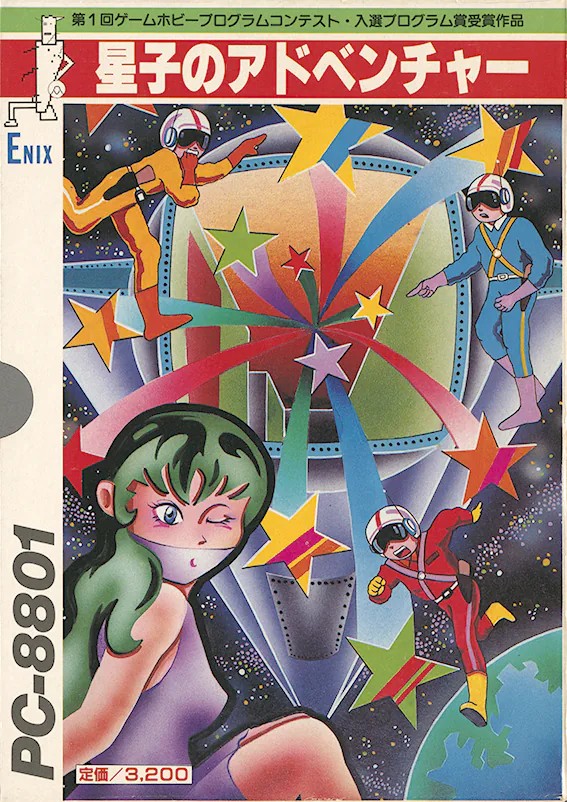
Via Launchbox.
Yasuhiro Fukushima was the child of entrepreneurs (his father: movie theaters and pachinko parlors, his mother: a restaurant) and had his own desire to start a business after graduating from Nihon University in architecture. His first enterprise involved making a monthly magazine dedicated to the shopping complex Nakano Broadway in Tokyo, as there was no central organization by category.
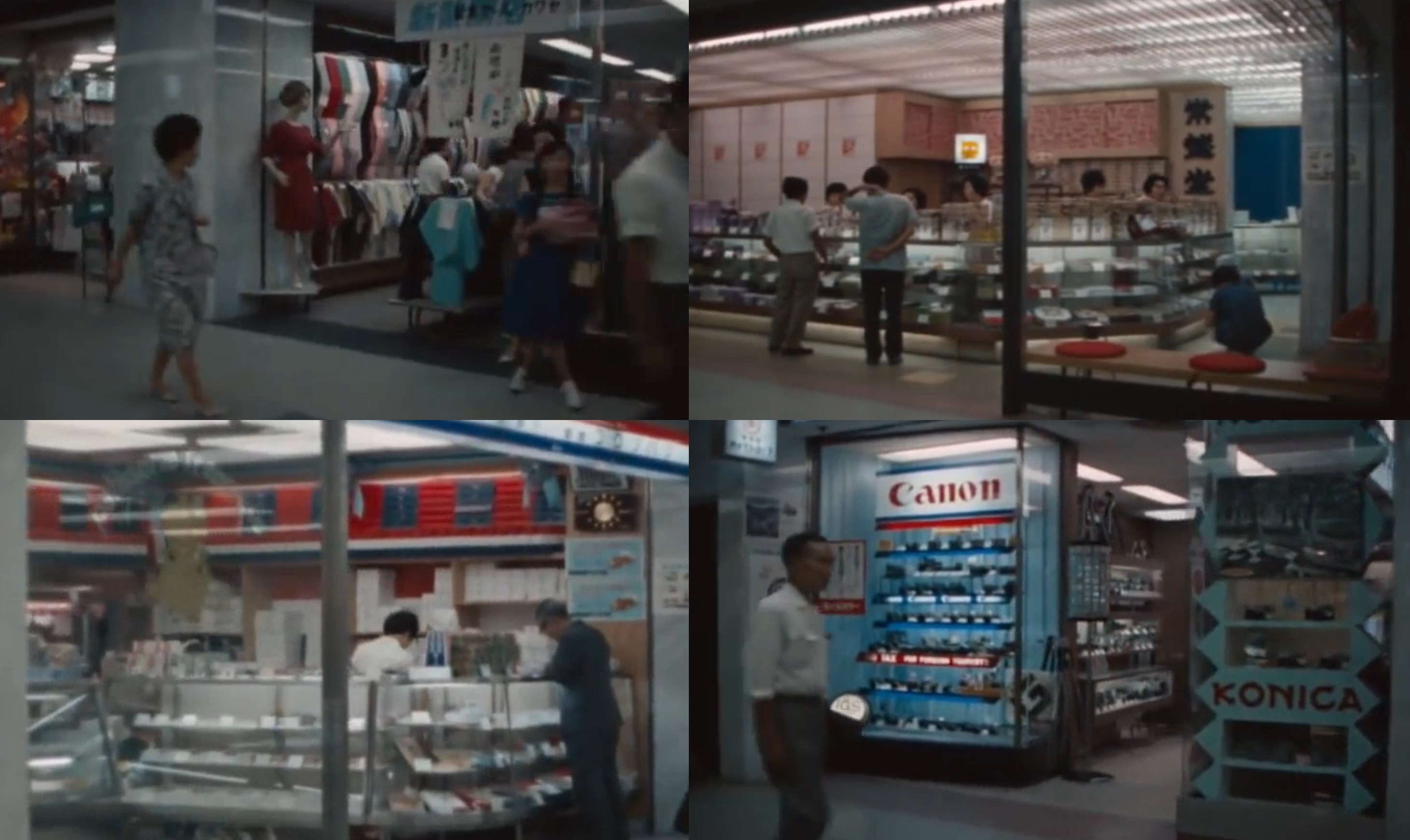
Inside the mall at its launch in 1966. Source. The mall had declined by the 1980s before rebounding as an otaku hotspot.
The idea was to print 50,000 copies and distribute them each month; businesses were interested in the idea, but he ran into trouble with his own “company” not being registered as an official business himself and the project got scuttered.
After a stint of travel abroad (including taking housekeeping jobs in the United States) he returned to Japan, got married, and came across his next entrepreneurial scheme. He was looking for housing; the typical route in Japan was to start with a public housing project and save money for a house. Public housing ads tended to be hard to follow and he found that he needed to track them daily to get a spot; spots were so popular they got sold by lottery from the applicants. With the notion that others were having just as much trouble as he was, in 1975 made a new company called the Eidansha Boshu Service Center, publishing a monthly newspaper which eventually reached a circulation of 30,000 and profit of 70 million yen a year. (In 2026 USD accounting for inflation, that’s roughly around $700k a year.)
While this was respectable enough, Fukushima remained dissatisfied and looked around for another follow-up business. Rather than just brainstorming on his own, he set up a “Conference of the Future” and invited both employees and friends for a series of meetings to discuss business possibilities.
Fukushima tried one idea, an automated sushi shop using technology from the US, aspiring for a national chain, but ended up closing up after three months. (The price was low, but the sushi looked unappetizing.)
The sequence of business shenanigans gets a little complicated from there. Kabushiki-Kaisha Eidansya Fudousan was established in 1980 as “a real estate sales and brokerage company” wholly owned by Eidansha Boshu Service Center…
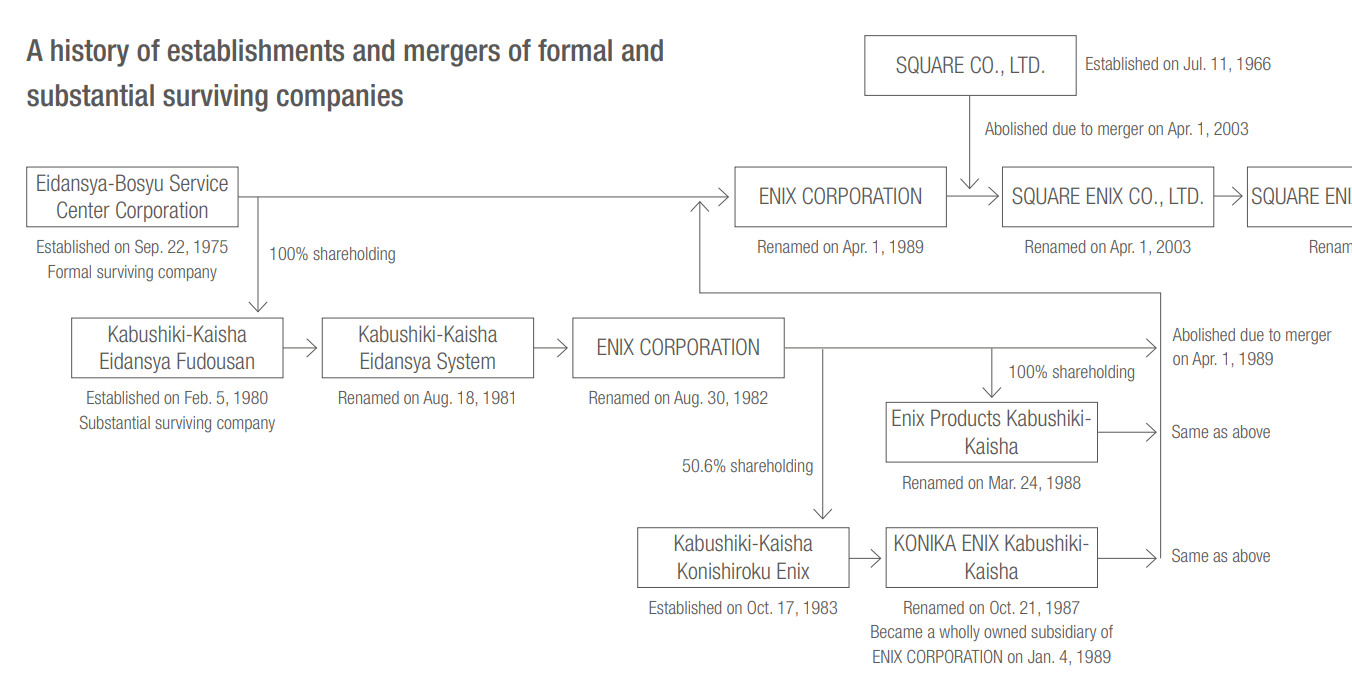
From the 2019 Square-Enix Annual Report.
…but Fukushima decided to pivot not long after. He noticed that personal computers were starting to seep into businesses and that someone could handle creating software for tasks like accounting and customer management. Around this time he also learned of Toshiba’s new line of office computers and was impressed enough to ask to become a sales agent. The company was apparently quite good at it, beating all other sales partners over a 6 month period.
Here we have the one gap in the story and I’ve pulled from every account I can find: why did Fukushima switch from thinking of business software and selling “office machines” to selling games? This was not natural or inevitable (Fukushima even talks about visualizing a price for his application software). My guess would be, based on the company not having any programming experience in-house (this, at least, is documented), Fukushima ran into a problem: business applications only made sense to develop “in house”. He still dreamt of software so to get programmers “on the cheap” the only way was to switch to games instead. This isn’t glamorous so it would explain why sources skip over this part, but it does fit with his serial-entrepreneur-who-tries-things-until-they-stick career arc.
However it happened, the company did one last major pivot, transforming into Enix in August of 1982. (The name comes from a combination of the computer ENIAC and the mythical Phoenix.) Without programmers, they decided to attract authors with a contest. Top prize: one million yen. (Although note the fine print: it was an advance on royalties, not a straight payment.)
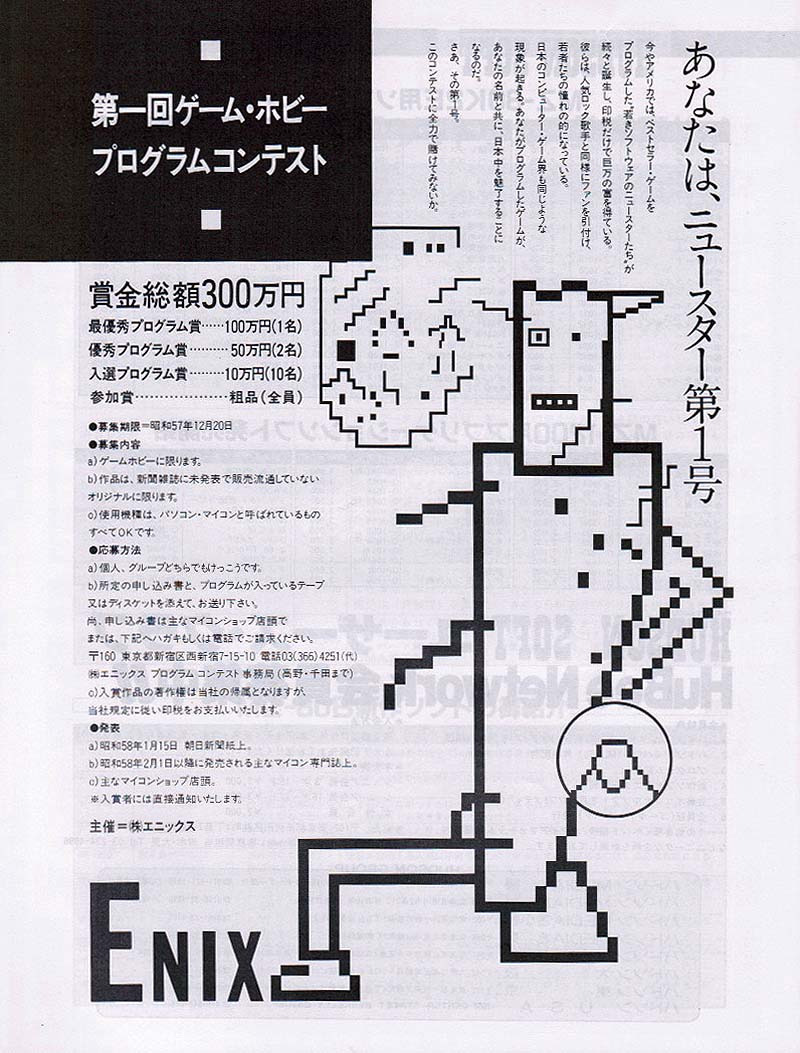
From bowloflentils, via Tumblr. I don’t think this would have worked to solicit accounting software.
There was initially very little interest; as Enix was a brand-new company and it was natural to be suspicious if the contest was even real. He ended up calling stores and visiting clubs and even contacting authors directly throughout Japan, promising they would “give the top award without fail”; in the end they received around 300 entries.
13 of them were chosen as contest winners, although rather than just publishing the games “straight” they had editors check the software and send feedback to the entrants, who then changed their programs before publication. The whole set of 13 was published in February of 1983. The one million yen went to Morita no Battle Field by Kazurou Morita (who founded his own company with the proceeds); the game best remembered now is one of the runner ups (“Excellent Program Award”), Door Door by Koichi Nakamura. (It’s the only one of the games to get a 21st century port for Keitai phones.) Yuji Horii wrote another one of the winners (“Winning Program Award”) and both him and Koichi Nakamura ended up collaborating on the Famicom RPG Dragon Quest. Both authors also worked on one of the most important Japanese adventure games, The Portopia Serial Murder Case, but that’s a story for a different time.
For now, we’re focused on the adventure(s) that came out in February of 1983. The ambiguous “s” is there because I’ve seen the “adult” game Mari-chan’s Close Call also sorted as an adventure (ADV by the Japanese abbreviation system) although I don’t think it counts. It was written by Tadashi Makimura, the author of pioneering erogē game Yakyūken (which I mentioned briefly back in January); while the original game is a straightforward game of strip rock-paper-scissors, Mari-chan’s Close Call adds a plot, where rock-paper-scissors is used to escape various dangerous situations (where the heroine can die via stabbing, electrocution, etc.) and where surviving a scenario causes clothing to be removed.
Seiko’s Adventure admittedly only barely counts too, but you’ll see why in a moment.
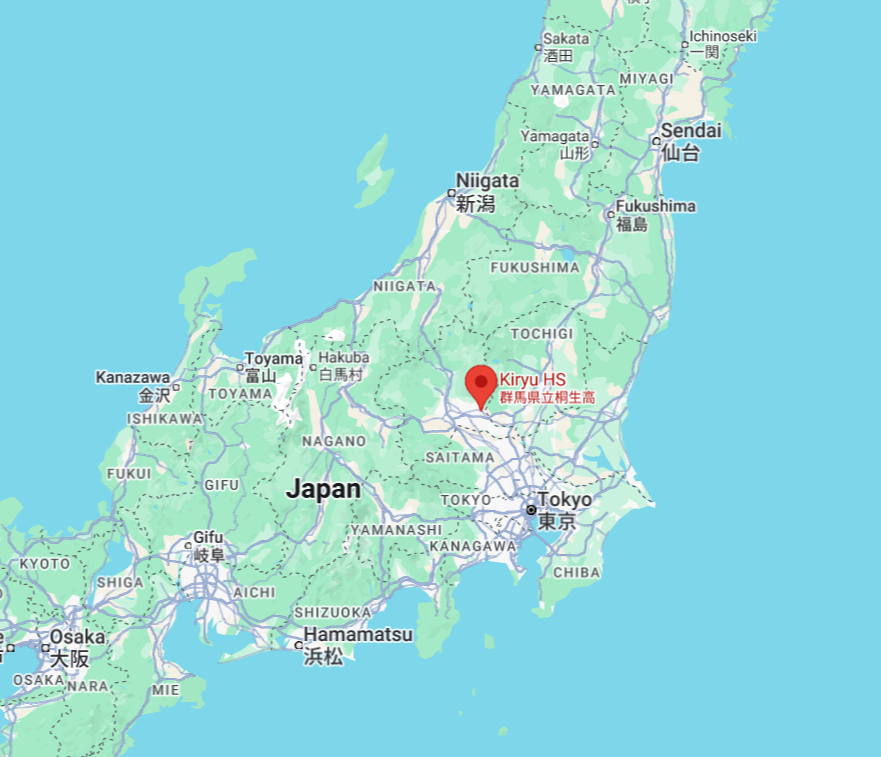
The school of today’s author, at the time he wrote the game.
Seiko’s Adventure was instead written by Toshiyuki Asanuma, a teenager from Gunma Prefecture attending Gunma Prefectural Kiryu High School, who had two years of computer experience. We know this because it says so on the back of the packaging. I do not have any records of what he did after high school.
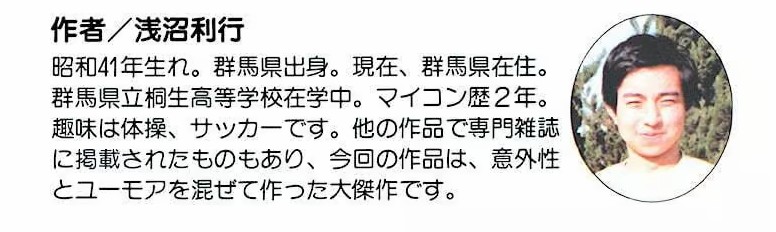
Also into gymnastics and soccer! From the Game Preservation Society.
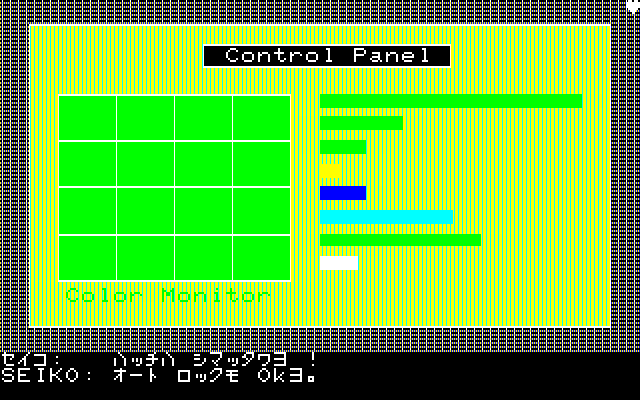
Seiko’s Adventure involves a different hapless heroine situation, although there’s a starting screen before the game explains what’s going on:
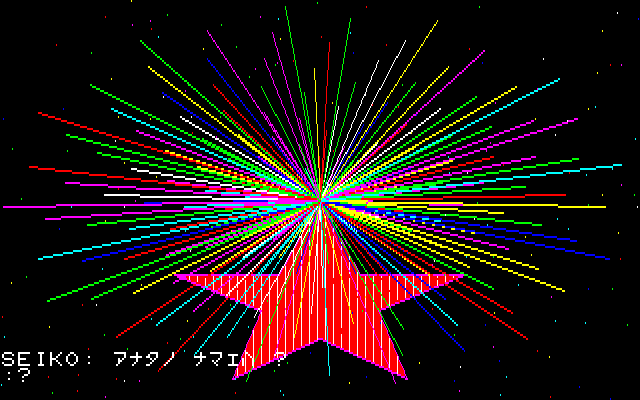
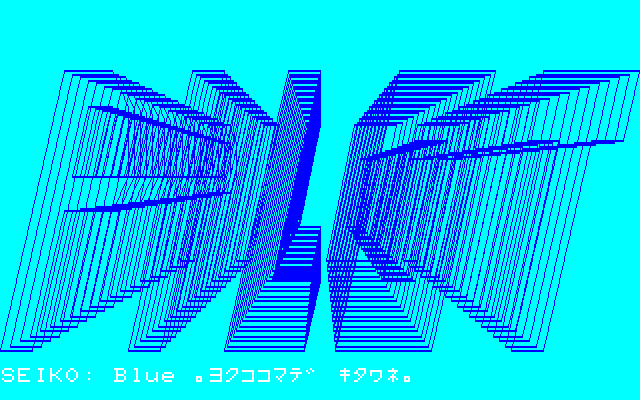
The game (or rather, Seiko directly) is asking what is your name. I responded “Blue”; Seiko responds “nice to meet you” and then the title screen shows up:
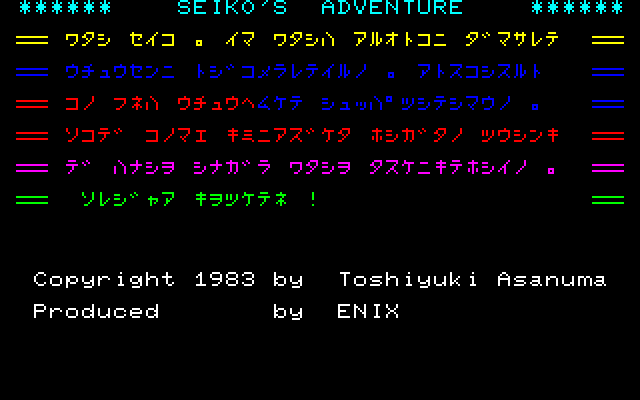
I’m Seiko. Right now, I’ve been tricked by a man and am trapped in a spaceship. In just a little time, this ship will launch into space. Please use the star-shaped communicator I gave you before and talk to me to save me. Please be careful!
We then return to the star (which is the communicator, I assume) and Seiko observes “it’s a big ship, isn’t it.” The game then prompts you to type. You’re supposed to agree with her and you have to use an exact phrasing. After a brief amount of time (real time, only a few seconds) you get prompted with a little more help on that exact phrasing.
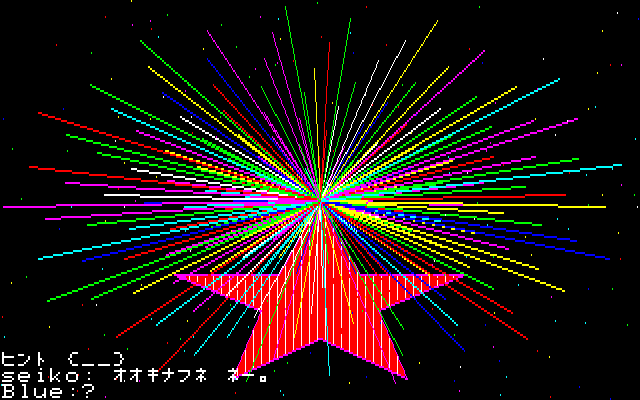
What it is showing above with the { _ _ } is a sort of game of Hangman. If you type the first character correct but not the other it will show up in the position, like
{ ウ _ }.
Assuming you don’t get past this part at all, after enough time (again, real time!) our heroine ends up in a hospital and you get a game over screen.

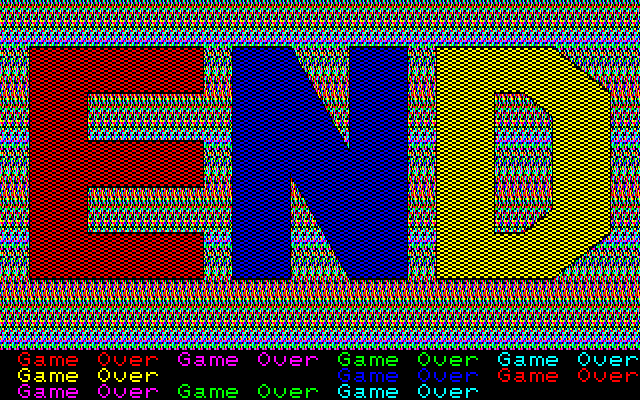
The right response is “ウン” (“un”), a somewhat informal “yes”. It isn’t supposed to be used with strangers (I guess the implication is we know Seiko, given she gave us a communicator.) Even in an informal sense, I would have expected “sou” (it’s not really a direct question, just something we’re agreeing with), but the Hangman is supposed to kick things over to the right answer.
After correctly affirming in the right way, you get a slightly more traditional adventure-view:
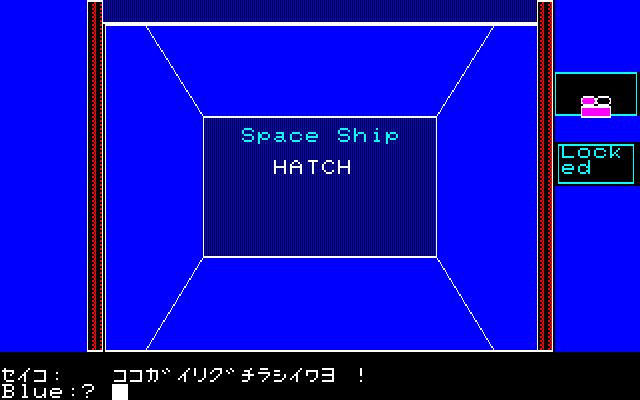
I’m unclear if we’re supposed to be seeing the image (via the communicator) or it gets described somehow, but the text here has Seiko say “it looks like the entrance.” Again, after a pause the game gives a number of spaces to fill in.
_ _ _ _ _ _ _
I tried ロロロロロロロ (7 “ro” symbols, this game just uses the katakana set) and the game responded with:
ロ _ _ _ _ _ ロ
_ _ _ _ _ _ ロ
There are two phrases here, and either one works. One starts and ends with “ro” and one only ends with “ro”. Unfortunately, this kind of brute force doesn’t work with everything, and I’m honestly unclear when it works or does not work. For example, “a” (or “ア”) shows up with both words, but just trying アアアアアアア doesn’t give feedback as far as the correct position goes. I’ve tried applying various types of logic but I don’t know the pattern.
The majority of the game is this way: you get some kind of prompt from Seiko, and then you play a game of guess-the-word/phrase in Japanese to figure out the right response, where if you get a character in the right spot the game will tell you.
The two correct options are ロックヲアケロ (open lock) or ハッチヲアケロ (open hatch).
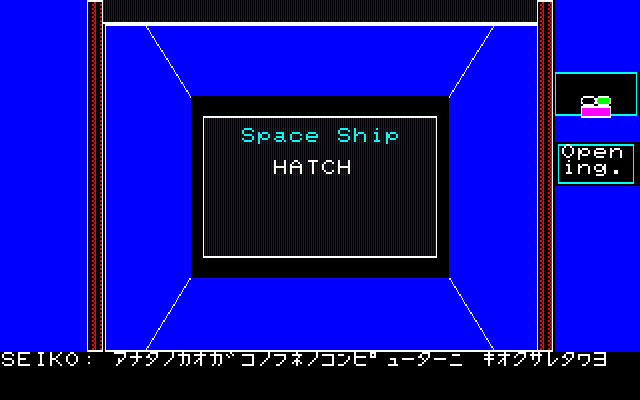
As I was solving this, it wasn’t clear to me how Seiko was supposed to be doing the unlocking. (It’s not a key lock, just a trigger for an airlock, but this only became clear after passing through.) In a normal adventure game I’d check her inventory, ask her to examine things more closely, look in different directions, etc. but that’s not how this works: you are forced at each scene to give the right prompt in a short amount of time or die.
The next part I was baffled enough I needed help from the walkthrough.
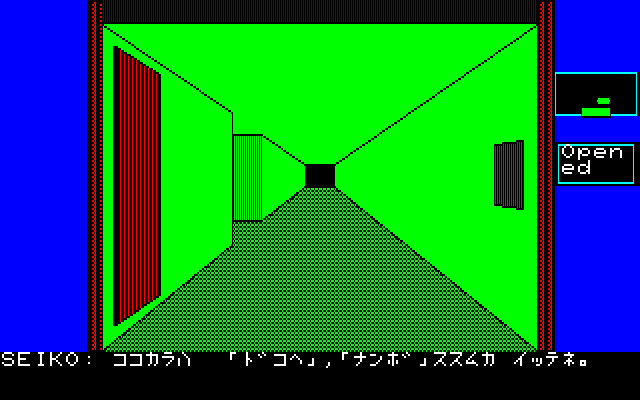
The scene opens to a 3d hall and you’re asked to tell “where” and “how far” Seiko should go. This is followed by a top-down map.
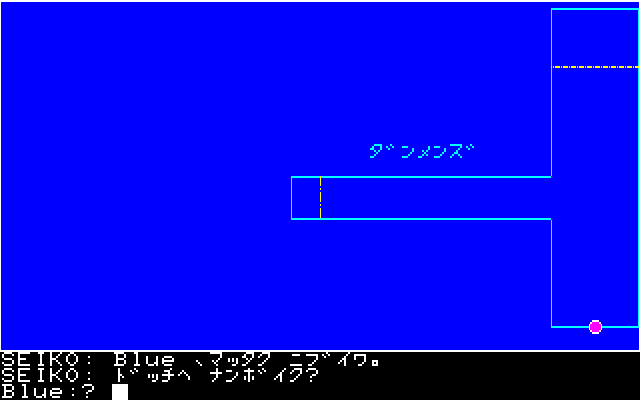
This includes a line complaining about me (Blue) being too slow.
Assuming this is from Seiko’s perspective in 3d, I figured this would involve walking forward by some amount. Or possibly north (assuming the top-down map is something like a traditional adventure map). What I did not expect is ミギヘ1ホ, which is “turn 1 to the right”. Just a little ahead on the right wall of the 3d picture (which you can’t see now because it has gone away) is a thing Seiko can turn and look at.
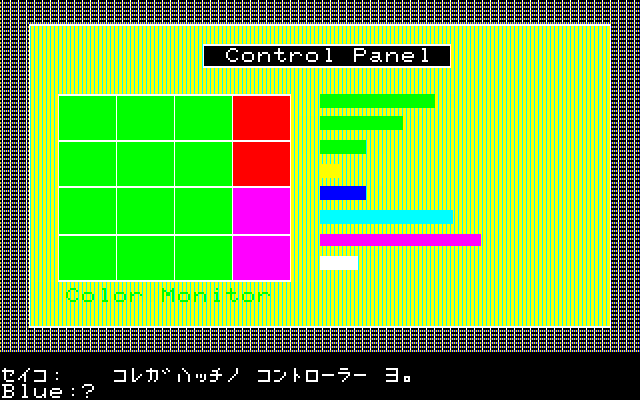
“This is the controller for the hatch.”
I did “all ro” again; seven characters, last character ro:
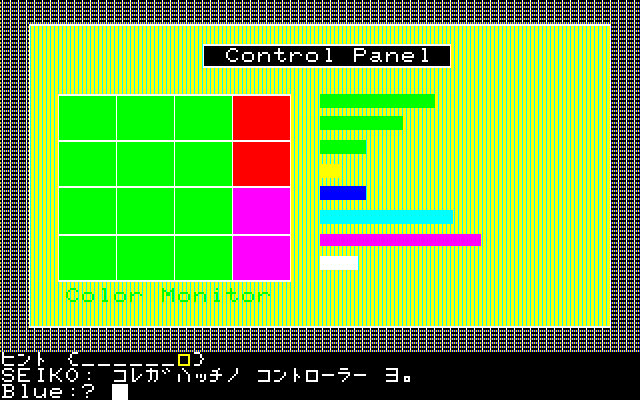
“Close hatch”, I guess? (“ハッチヲシメロ”, hatch is the same, the verb changed from “open” to “close”.) It’s not like there’s an obvious button Seiko’s supposed to be pressing, though. It’s almost more a conceptual command as opposed to, say, PUSH BUTTON; usually CLOSE is applied in adventure games to things like doors where the mechanics are clear.
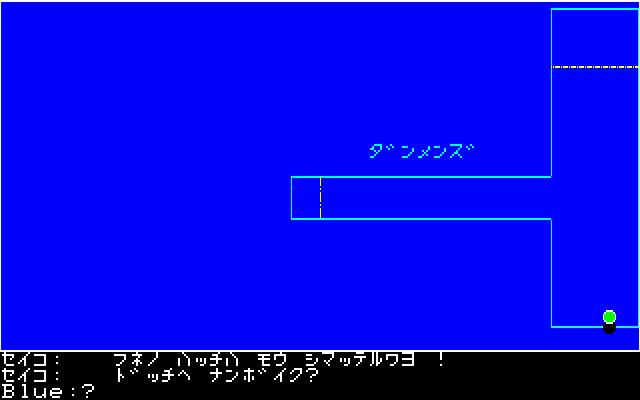
At least the next I could do (ヒダリヘ1ホ, turn 1 to the left) and I tried to do walking forward again but had issues again. The game quickly went straight to END (no hospital, even) if I was typing in wrong. I eventually tried “マエヘ10ホ” (10 meters ahead) and the dot moved on the screen a little bit:
I stepped back and tried the same thing with 50 meters and got the exact same amount of map movement. I randomly tried different number values until the game decided to loop and walk the rest of the way at 250 meters.
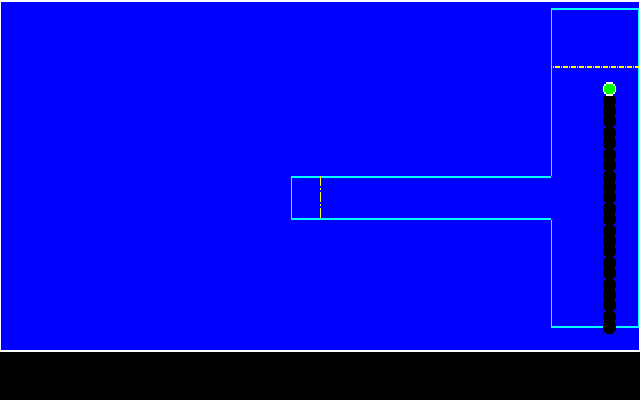
I went back and repeated the sequence and found what happens is the game moves the exact same amount no matter what you put as a distance, and then after enough small moves forward the game automatically travels the rest of the way to the end of the hall. (No idea what’s going on with that branch to the left; you skip that.)
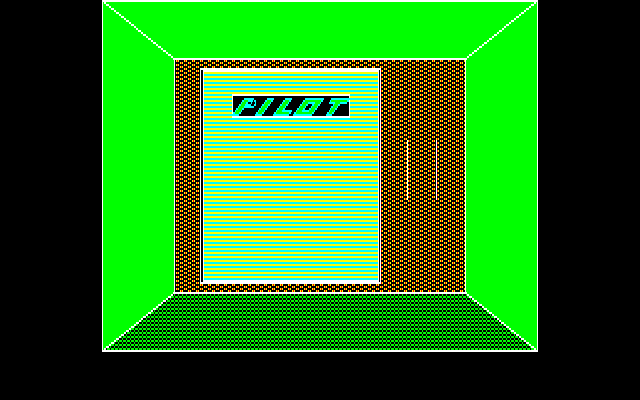
“You have done well to make it this far.” I have?
I might have missed some text, but the game then shifts to asking, and I am not kidding, “how many keys are on this keyboard?” Hope I guess you aren’t using some third party keyboard?
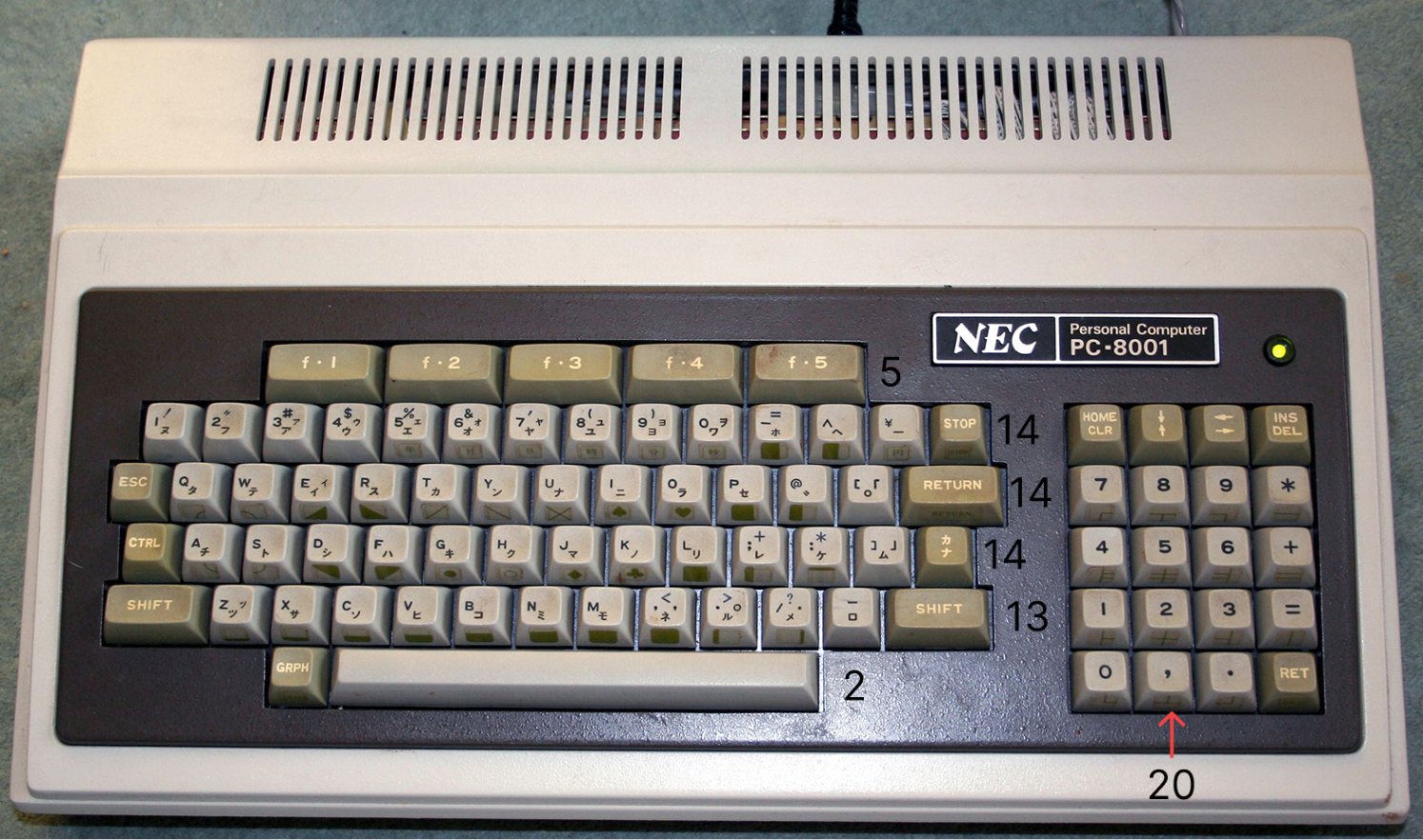
From NEC Retro.
20 + 2 + 13 + 14 + 14 + 14 + 5 = 96. Why are we doing this?
Wait, what? Oops, I was looking at an 8001, the game’s platform is PC-8801, which has 92 keys. Sigh.
With that done, I got an…
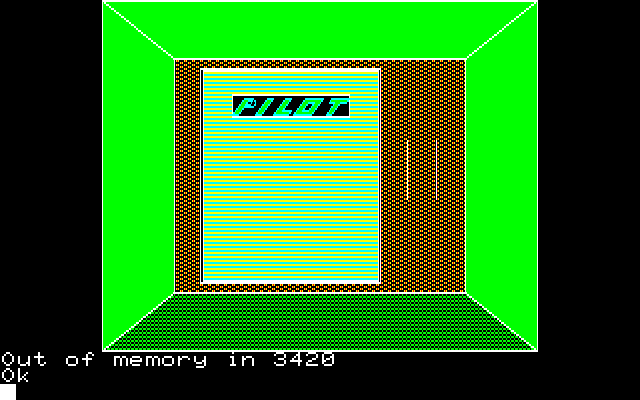
…out of memory glitch. Terrific.
I peeked ahead and everything after this is a minigame. I’m going to just give the screenshots from the walkthrough, so it isn’t “Blue” any more; the author named themselves after a hallucinogenic leafy substance.
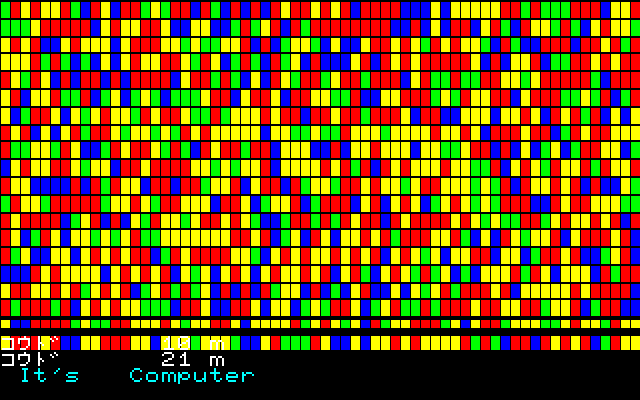
Here, we’re supposed to type all 50 sounds on the Gojūon chart (that is, all the Katakana keys, for some reason).
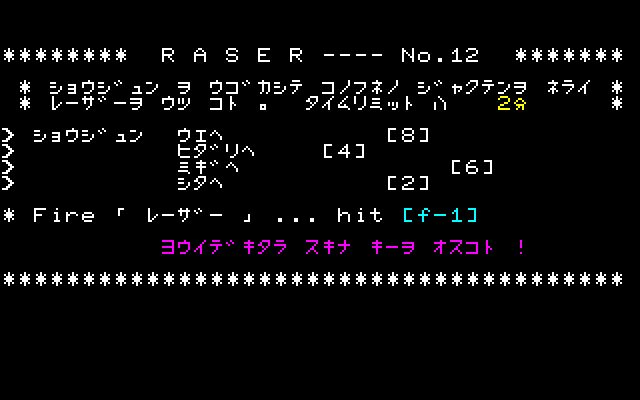
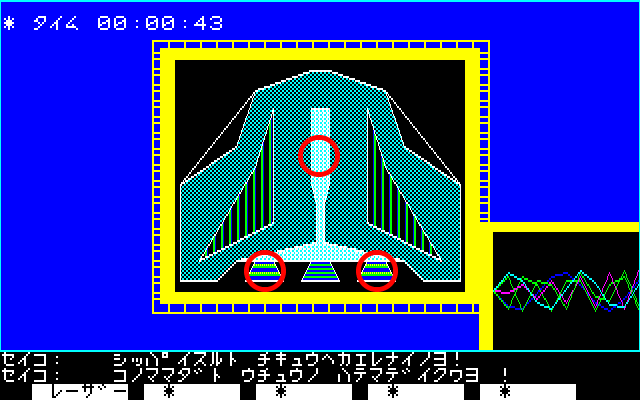
This is followed by a minigame where you aim at three places on a ship.
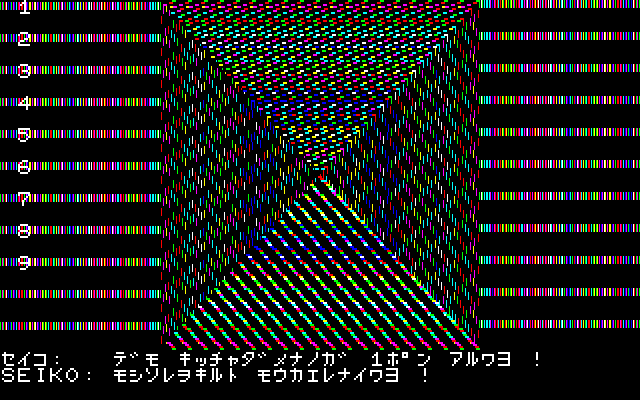
Then there’s a minigame where you need to cut 5 of the 9 parts of the LSI chip, except that some of them (totally at random) will cause you to fail. This is like the switch-choice partway through Cosmo Cross where you can lose at no fault of your own. Also just like Cosmo Cross, there’s no saved game feature.
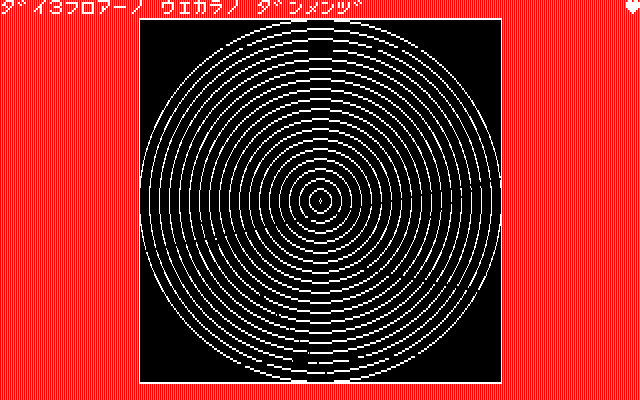
The walkthrough says you don’t need to do anything at this screen.
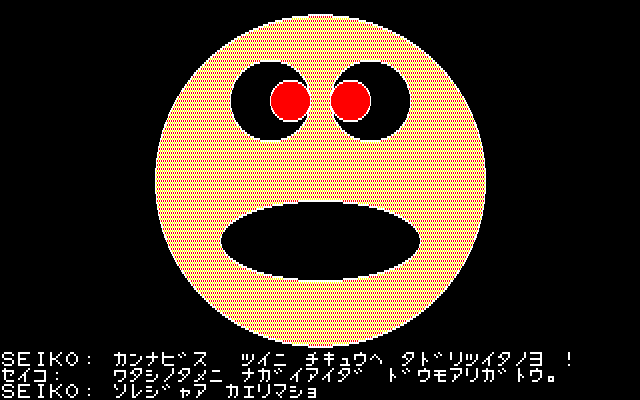
Finally, Seiko — this is her face apparently — manages to return safely to Earth. Good job! How did she get to the hospital if we failed since I presume that’s on Earth too?
Perhaps you are wondering if the Japanese in 1983 were impressed by the inscrutability. At least in the one review I’ve found, not really. This is from long after the game was published (Micom Basic, May 1997) but the author, Akira Yamashita, remembered Seiko’s Adventure because it was his first adventure game.
He had read a feature article about adventures, and how the player will “solve mysteries” and “become the protagonist” of a story; this was appealing to him as he had previously thought of gaming as a “test of reflexes”. He was most interested in the Sierra Hi-Res games, but he owned a PC-88, and there weren’t (at the time) many options available. Even the Micro Cabin Mystery House wasn’t ported to the PC-88 yet.
He came across Seiko’s Adventure, which had the prestige of the Enix contest attached, but he quickly found himself disappointed. He had a “sense of mismatch” with the game where it felt quite different from what he had read about, with no characters to talk to or items to use and the weird semi-Hangman which I described; he calls it (accurately, I think) essentially a series of minigames rather than an adventure.
Seiko’s Adventure really makes me wonder what the 287 or so games that didn’t make the cut were like.
Many thanks to both f_t_b and Alex Smith for their help. My major sources were an article in The Japan Economic Journal, April 20, 1991 (“Road toward Dragon Quest sometimes rocky; Enix Corp. founder encountered setbacks before massive success”), a story in Japan on the Upswing that pulls information from a December 1999 profile in Asahi Shimbum, and a direct interview with Yasuhiro Fukushima on Youtube.


 Renga in Blue
