(If you need to read my previous entries on Prisoner 2, here’s a handy link.)
I’ve reached the ending; really it was a matter of finding the keyhole, as the resolution with the Caretaker is identical with the original game. There are still were some absurd surprises along the way.
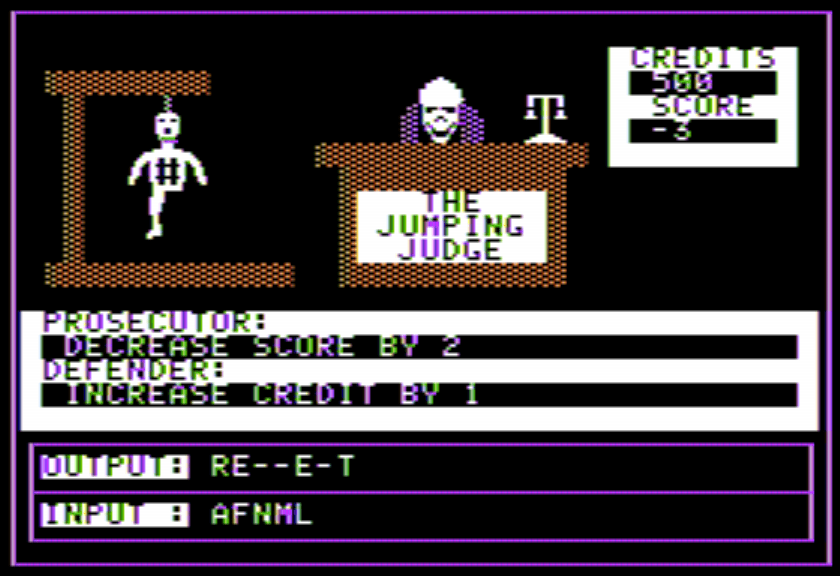
The first came from just returning to the court in order to scrounge up more cash and score. There’s more hangman, and it started with the same words as before, but then things got very strange indeed.
The word is QRBU.
Instead of providing real words, hangman started providing literally random combinations of letters. I know they are random because after finishing I consulted with David Mullich’s original design document, which you can find here.
If a random number between 1 and 2000 is less than the SCORE, then a word of 3 to 8 random letters is constructed, otherwise, one of these words are chosen: FREEDOM, LIBERTY, LICENSE, INDEPENDENT, AUTONOMY, SOVEREIGN, AUTARCHY, LIBERATION, ANARCHY, ESCAPE, RELEASE, HOPE, FREE, DIGNITY, INDIVIDUAL, RESPECT, or PRIVACY.
In other words, the higher your score is, the more likely you will get a gibberish word at the court. Once your score reaches 2000, the court will only provide gibberish words.
The word is XZKDFGQ.
After I had stocked up on as much score and credits as I thought I could pull off, I took a shot revisiting some locations. In the Theater in particular I got met by the Brotherhood, just like the first game.
In the middle of the word VOUCH.
The visual effect is to show text a few letters at a time scrolling across. There’s a whole scene where people are conversing:
DOES ANYONE HERE KNOW #?
I’VE BEEN WATCHING HIM.
They take a vote and you are able to be admitted and be given missions. I was given a mission to sit on a throne and say MARY HAD A LITTLE LAMB. Fortunately in this case I knew it was talking about: the “switchboard” location with one of the two mazes.
Some of the letters suggest directions, but some eventually do not, and I eventually just had to map the whole thing. The rooms are at least unique so you can treat it like an old-school Adventure map.
I will have to say in a way this is even worse than any of the bad ones I’ve mapped before (like the Adventure 500 Crazy Maze) insofar as the map is randomly generated. That is, if you leave and come back, the map will be entirely different. With the opening Castle, it isn’t tedious to map and there is a feeling of some humanity in the algorithm. With the maze here, it’s quite almost literally filling in a spreadsheet with arbitrary values.
To make a more lateral comparison: there are hand-made Sudoku puzzles and computer-generated ones. When the Sudoku craze first hit there were books with pages and pages of the computer generated puzzles, but I could never get engrossed in them like the ones made by humans (anything of the puzzle books published by Nikoli are hand-made puzzles, for instance). Some of this has to do with humans making interesting and creative logic in a way the algorithms were not, but some has to do with: the hand-made ones were pieces of art being sent into the universe, part of a person’s life being experienced. Solving them is like sharing a piece of humanity.
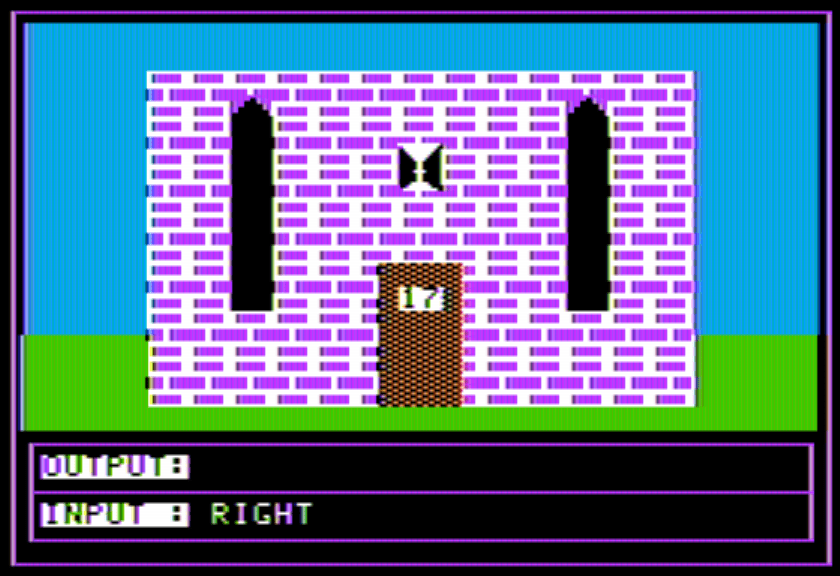
Prisoner 2 making the map-truly-random-maze-by-hand aspect part of the experience bump up against the feeling of inhumanity is part of the Point, of course, just like trying to solve a hangman game with random letters. Akin to the first game, it was a point I could admire more at a meta-level rather than when I was burning hours of my own time trying to baffle over what was going on.
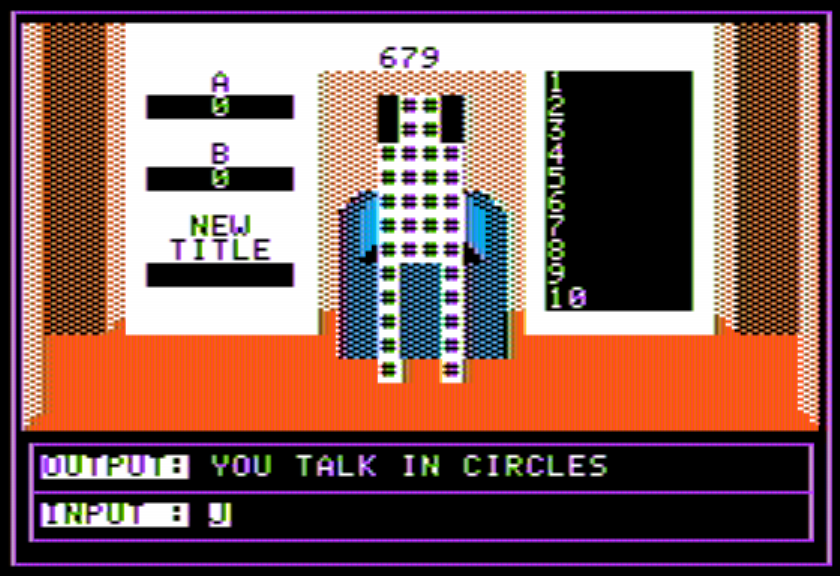
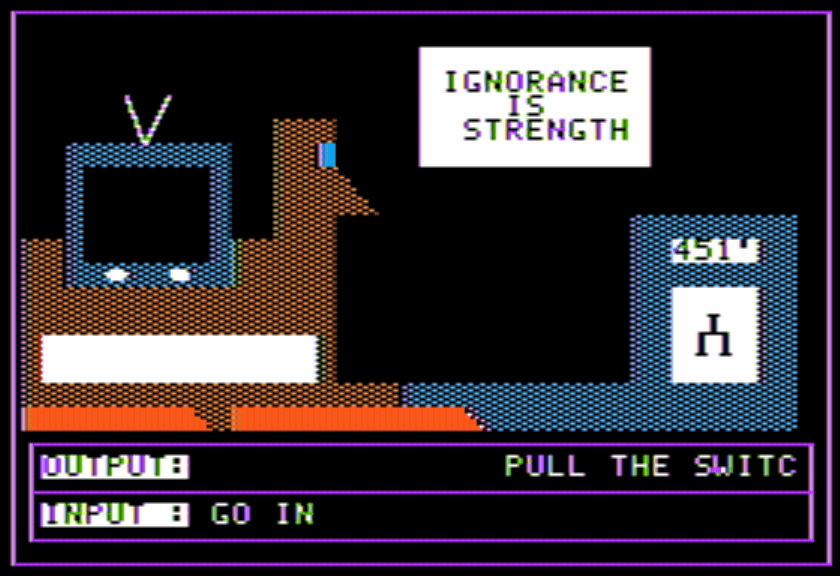
Moving on: the throne (shown above) is in the maze. You can SIT and get the curious display shown (confirming later with the design notes, this is all that happens, the A and B displays mean nothing). Typing MARY HAD A LITTLE LAMB here will fulfill the request of the Brotherhood. You can go back, get the hint AN ISLAND IS NO MAN, and get a new quest. This animation shows the one I got:
For this one (“RUN THE ISLAND”, “TO THE SHRINKS”), you need to go back to the hospital and the bit where you can “break the source code”.
From here, type RUN THE ISLAND. Then the game will respond that the subject has delusions of grandeur, but you’ll also have fulfilled the Brotherhood’s request, and they’ll give you the hint (?) DRINK AND BE MERRY.
From here I got a mission to go to the newspaper and set the headline to DEUS EX MACHINA. The original game made it a puzzle where you had to put in the right ASCII codes. Here it is a little easier; you simply shuffle letters around until the text becomes what you want:
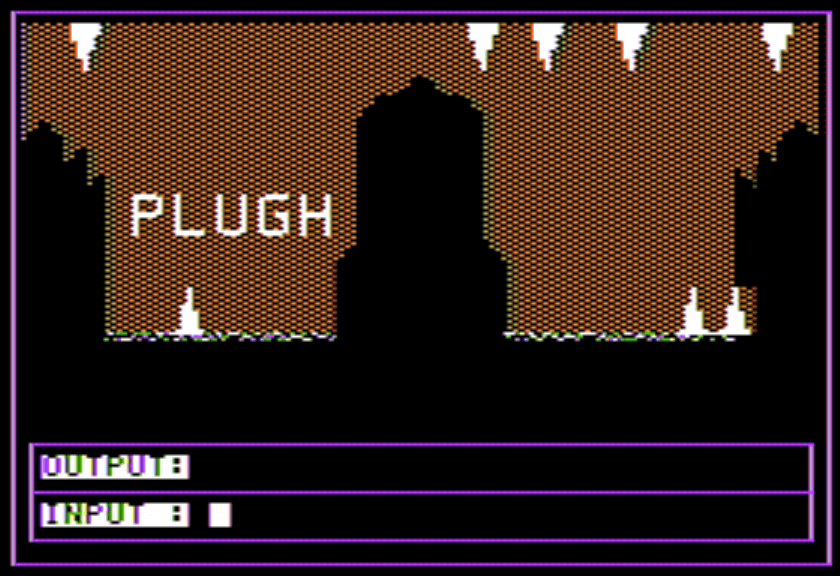
This sends you back to the Castle, but you can then return to the Brotherhood and get the hint “THE TRUTH SHALL REVEAL THE PLUG”.
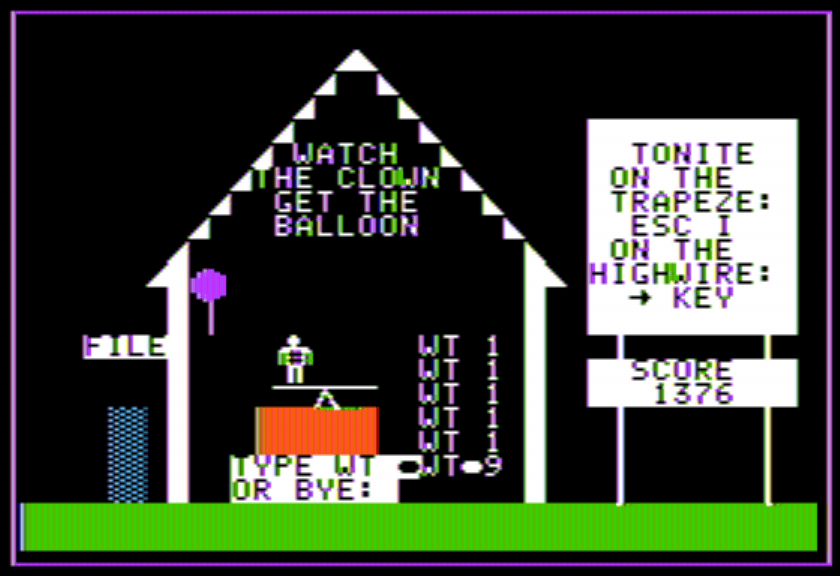
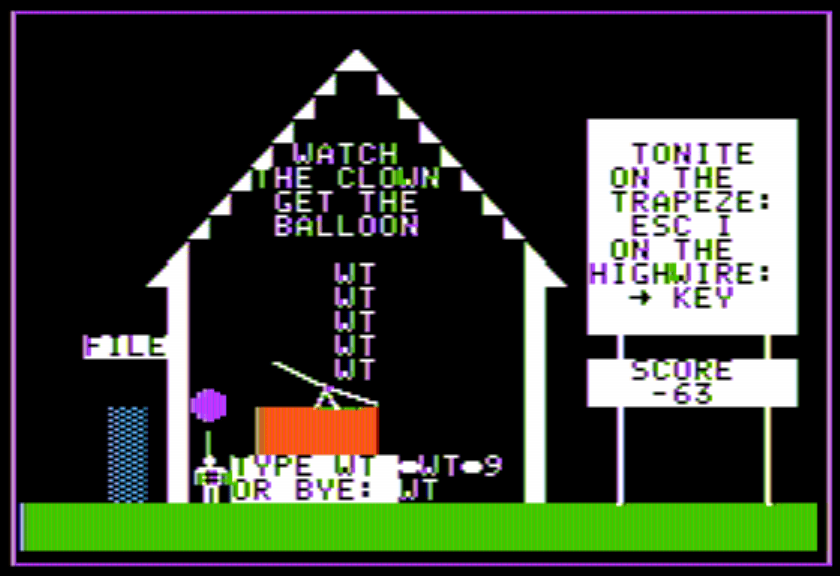
After this I got a mission repeat (shrinks again). Looking over the design doc, there’s only one other mission, to set the file cabinet at the Carnival on fire. You can do that by buying MATCHES, then going to the bit where you can add weights, and typing the commands ESC and I. This moves the cursor one step up (this is just Apple II shenanigans). Then you can tap right-arrow until you get launched out of the carnival. If you have the mission you’ll then set the file cabinet on fire.
After pressing ESC-I, the cursor is to the right of “TYPE WT”.
Yes, that’s a fairly obscure string of text there, but at least in this version of the game I just followed the literal directions on screen over on the right side.
The hint received from the Brotherhood for doing this task is INPUT THE PLUG.
Anyway, as you might have surmised, the Brotherhood doesn’t do anything useful past this point; you can just repeat missions over and over. I still had no keyhole. I did wander and participate in some wacky activities, like math.
The result of typing “4”. According to the design document this whole section does nothing for the credits, score, or overall goal of the game. Except I suppose in a “feeling of despair” sense.
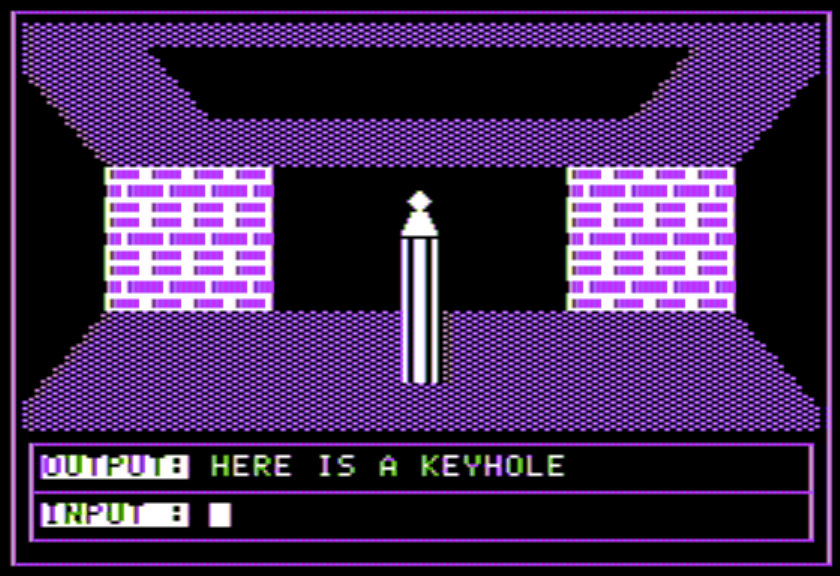
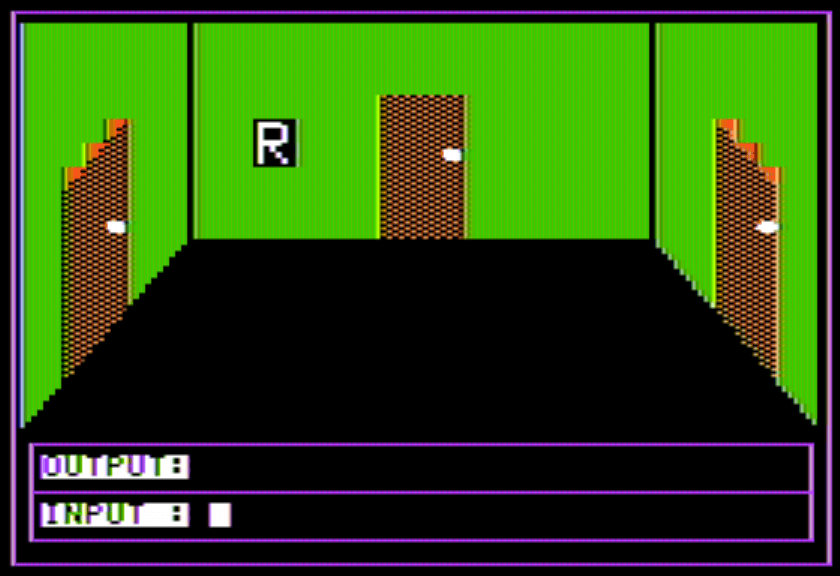
I finally found the keyhole in the other maze, at the Grail Hall, an entirely new building for this version of the Prisoner. It is just … another maze. At least this one was made by hand, but the opening rooms are indistinguishable so I spent a lot of time just wandering around.
Once you get deeper the rooms start to get very curious indeed.
For the last one you get booted back to the Castle at the start, and yes, those are meant to be adventure game references, the last being The Wizard and the Princess from On-Line Systems. There’s also a Mystery House reference (where you get a MURDER flag set on your character if you get in there). The real route to go is FORWARD repeatedly, which is no doubt an intentional tweak by the author. (The most naïve thing a player will do upon finding their first maze is just going the same direction repeatedly, and authors put forward effort to make sure that would never work.)
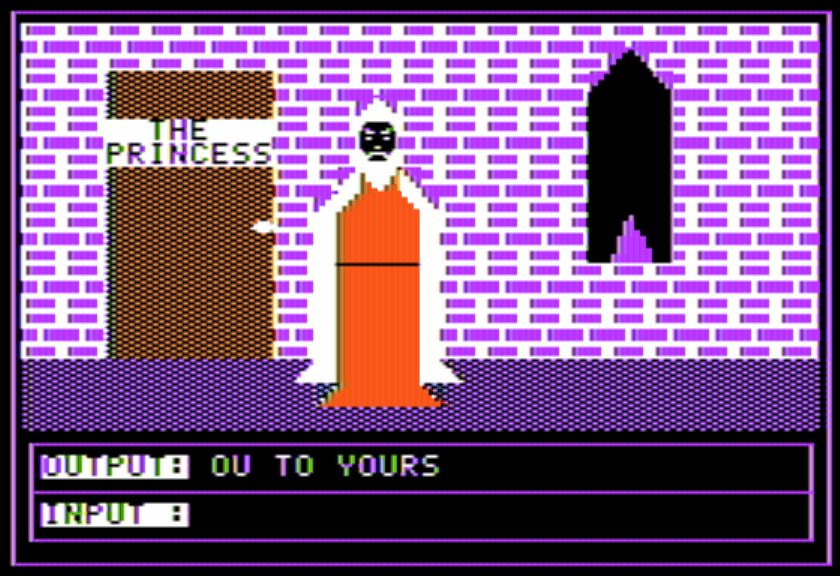
With keyhole in hand I could return to the Caretaker. The same phrase as in the previous game (THE ISLAND IS A COMPUTER GAME) worked, and it gives a setup that will let you “unplug the computer”.
The game references a Master of the Caretaker; here, it implies You were the master all along. This mirrors a bit in the slightly nonsensical troll ending of the original show The Prisoner, where Number 6 finally unmasks Number 1 and finds himself.
In the show, there’s a big goofy shootout and they drive to London and … people were upset. It was meant to be provocative. According to the creator Patrick McGoohan who was happy with the reception: “as long as people feel something, that’s the great thing, it’s when they’re walking around not thinking, not feeling, that’s tough, that’s where all the dangerous stuff is, cause when you get a mob like that, you can turn them in to the sort of gang that Hitler had.”
The Prisoner game ending makes slightly more sense; The Master is yourself, in that The Master really is yourself, you are the one choosing to play this computer game, you are the one that chooses to keep going even when given literally random words in Hangman, and plenty of encounters that make no progress.
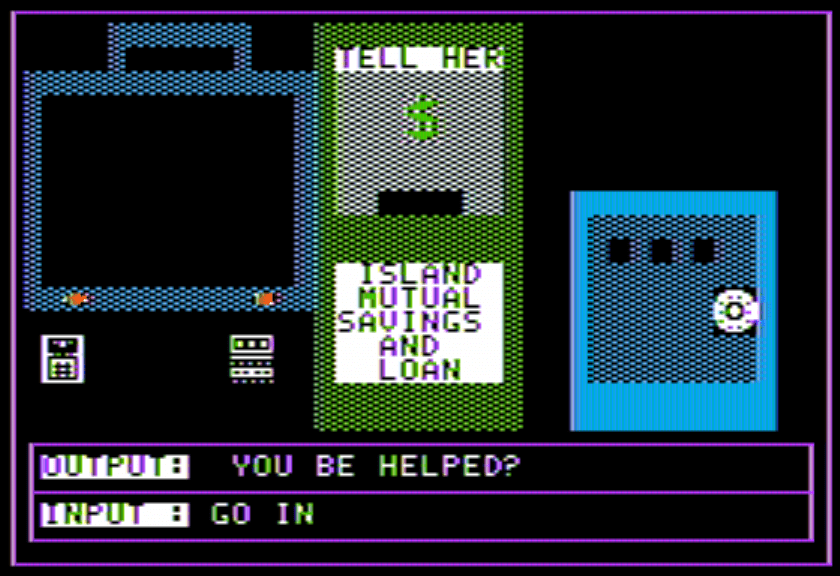
This whole questline is in: where you can get cloned at the diner (by requesting you want ESCAPE rather than anything off the menu), but then you need to pay 10000, which you get via a loan from the bank, which you can get via the items mentioned above. All three take serious work to get. When you finally get yourself cloned a pirate ship appears and kills your clone with a cannonball (seriously!) and you get sent back to the Castle. No progress is made.
Unfortunately, trying to convey the lesson in interactive form — making the player suffer pain to teach about pain — is, again, better to read about than actually try. I’d say the original is superior not because the jank somehow provides some noble reinforcement, but rather, here, there were not only one but two old school mazes. The mapping time taught nothing new and fell into cliché rather than out of it; the adventure references didn’t really imply anything other than the author having a laugh.
But at least it was trying to say something; while I’ve managed to derive interest out of most of games we’ve looked at here, that’s only by contextualization as cultural artifacts (or at least object lessons in game design) rather than as self-contained art.
Still craving more slightly off-kilter Mullich antics? Take a trip over to the CRPG Addict and Mullich’s other Edu-Ware games from this time period:
The graphics share some commonalities with Prisoner 2, like doors with identical placement to the Prisoner 2 mazes and a “casino” that looks very similar.
Every decision is scored. The Island keeps you under constant surveillance and monitors your every movement. The score is set to zero at the start of the game and is incremented or decremented based upon whether or not your actions are those of an individual. The more individualistic you are, the greater your score will be. This score is revealed only upon winning, losing, or suspending the game and is closely linked with your chances of escaping. Many doors will be closed to you until your score reaches a high enough value. Since this score is mostly invisible to you, you must weigh and verify your own decisions to determine if they are in your own best interests. The authorities (i.e., computer) will give you no help.
From the front cover of the original manual.
Prisoner 2 has at least four versions out there, probably more. This ends up being important later.
For Apple II, there’s versions 1.0 and 1.01. I started with 1.0 (which gave me a code of 444 to start) and switched later to 1.01 (which gave me an entirely different code, 314). 1.0 seems to always give 444 as a starting code while 1.01 changes it. There’s also versions for the Atari and MS-DOS. The DOS version is lost, but the v3.0 of the Atari port is available.
Here’s Highretrogamelord playing through the opening on Atari:
The bit at the start with the airport (where you try to type a destination but the game types “THE I” for you before cutting off) is in 1.01 but not 1.0.
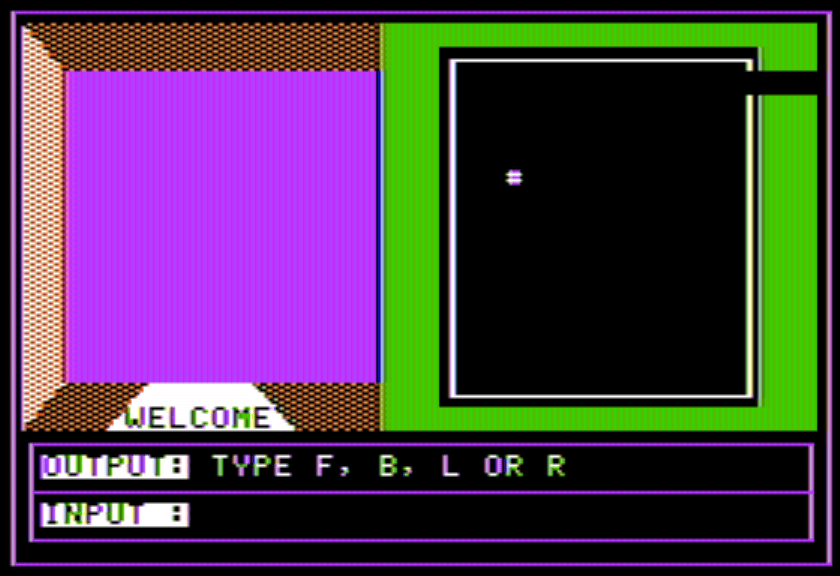
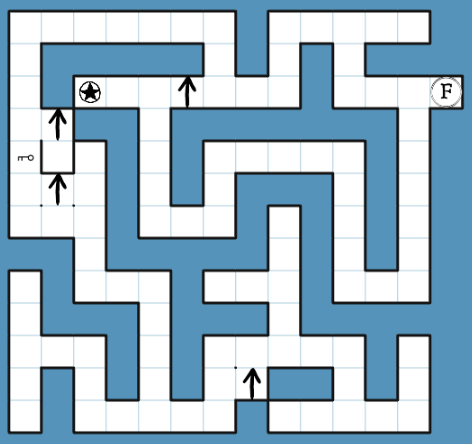
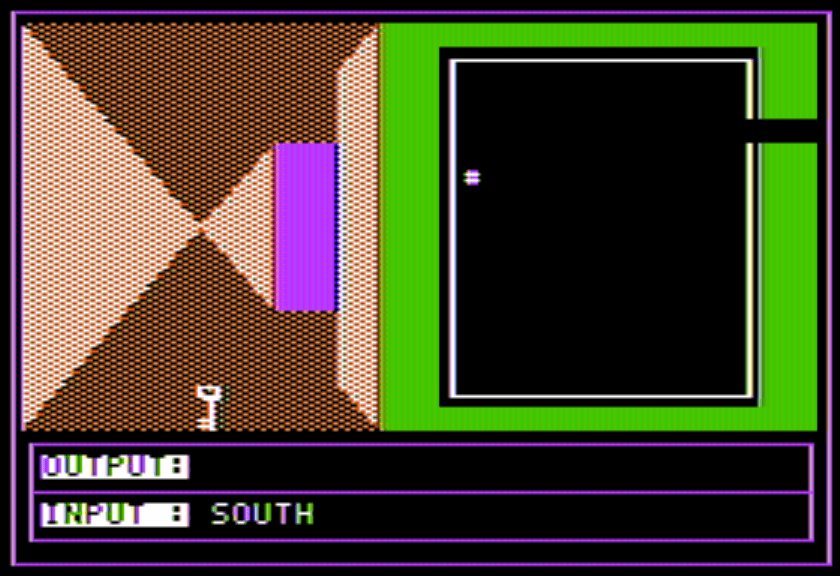
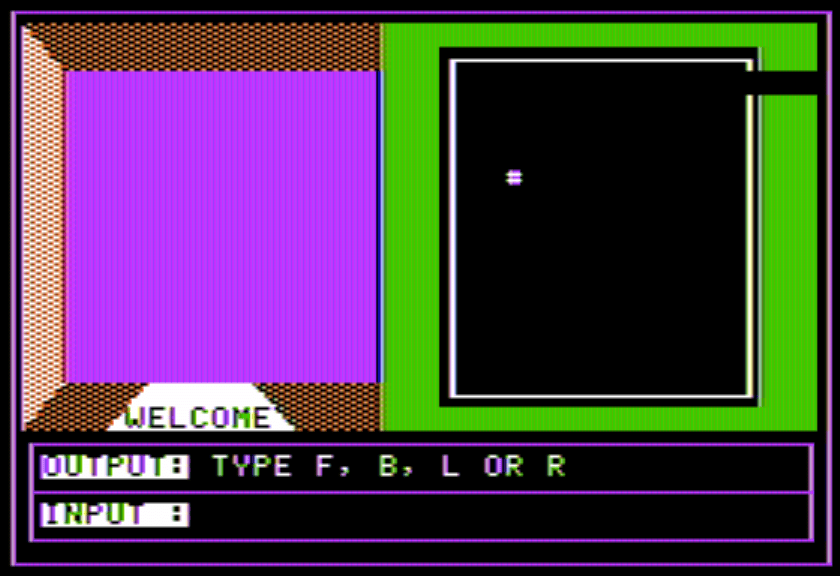
The opening maze was simply a top-down invisible maze in the original The Prisoner, but it is a much odder 3D-maze here. I’ve heard it compared to Wizardry, but Wizardry lets you turn around. In this maze you are always facing north, while using F, B, L, and R to move north, south, west, and east respectively. Here’s my map from playing 1.0:
Star is the start. F is the finish. Up-arrows are teleports that jump you back to start, saying “WHAT COMES UP…”
The weird effect of not being able to turn is that you can move “south” without seeing it, meaning there’s an extra layer of obfuscation to the game. At least with this map you have to discover the issue quite quickly to get anywhere (the third turn goes “south”) but check out this map I got playing 1.01 (note this is generated randomly, so if you play it will be different):
Yes, there’s a key not present in the other version.
With this map, just going straight east will result in getting teleported back to the start. I could see someone getting frustrated thinking there is some trick to skipping the teleport as opposed to realizing you can make a turn.
Also interesting about the new map is that it is more or less a straight shot to the exit, meaning players are likely to miss the key.
I don’t know if that means the key is elsewhere in 1.0, or that feature got removed. I did check the map quite thoroughly so I don’t think there’s a hidden exit.
You exit at 6 (just as the show, and the original game). The map is in four rows, buildings 1-5 on top, 6-10 on the second row, 11-15 on the third, 16-20 on the bottom, and is surrounded by a picket fence.
I mashed together screenshots like one of the old maps from Nintendo Power.
If you attempt to climb the fence, a bouncing ball appears (I assume meant to represent Rover from the original show) and you get warped back to the start.
The bouncing ball is not that menacing in Apple II format, but I’d recommend taking the minute to see the original from the TV show if you haven’t:
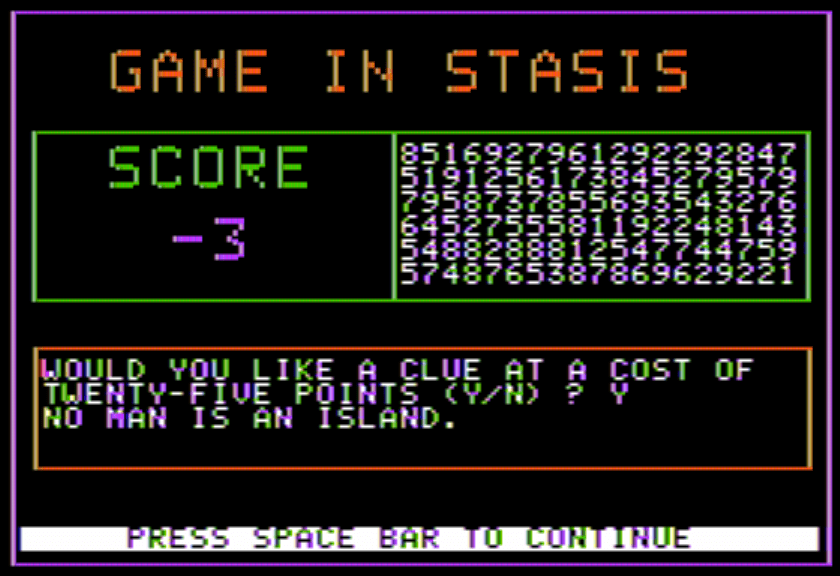
Moving on: you can CTRL-C out to “put the game in stasis” whereupon it will give a score. I started with a score of -3. You can also get a “hint” at a cost of 25 points.
I then tried all 20 locations.
1 — HOSPITAL
There are doors with a choice of Free Association (press L for left), Shock Treatment (F for forward), and Psychomotor Skills (R for right). B exits. I believe these were separate buildings in the old game.
Psychomotor Skills asks you to push the buttons the game asks for.
Shock Treatment asks for … I’m not entirely sure.
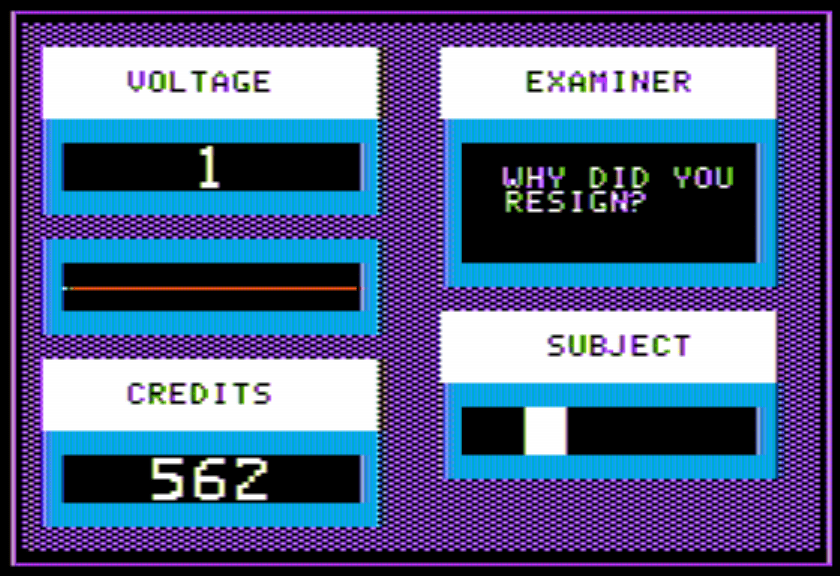
You get asked why did you resign, which I guess you can game over with if you like by typing your code.
However, if you type anything else, you are just told the subject is easily shocked and sent on your way.
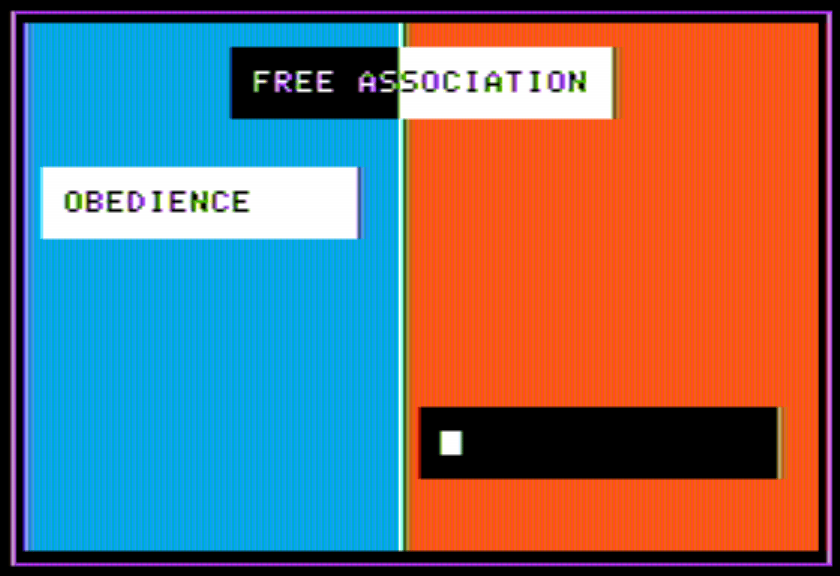
Free Association is a slightly colorful version of the original, where you are supposed to say words in response to other words.
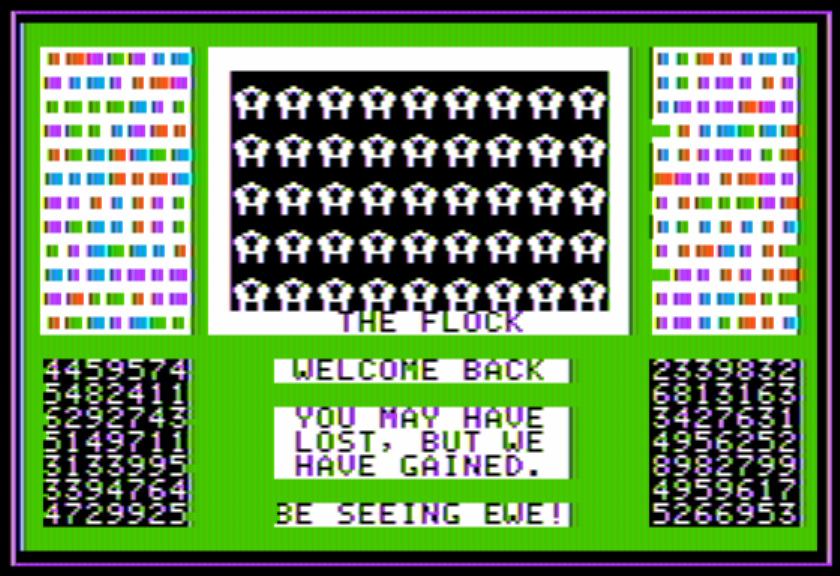
If you type FREEDOM you hit an Easter Egg of sorts.
This shot was taken with v1.0 and the old code.
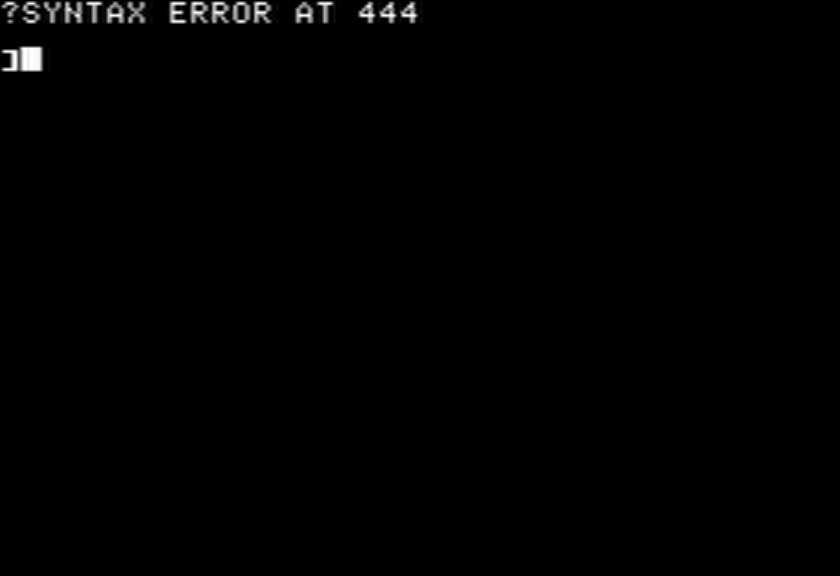
Huzzah! I only found this post-game in the first version. The point is to make you think the game has crashed and you respond with the usual Apple II syntax of LIST 444 to debug the code. It is slightly less believable here, since the game doesn’t feel like it is about to crash otherwise, but I still can see an Apple user from the time being fooled into typing the code.
2 — CARETAKER’S HOME
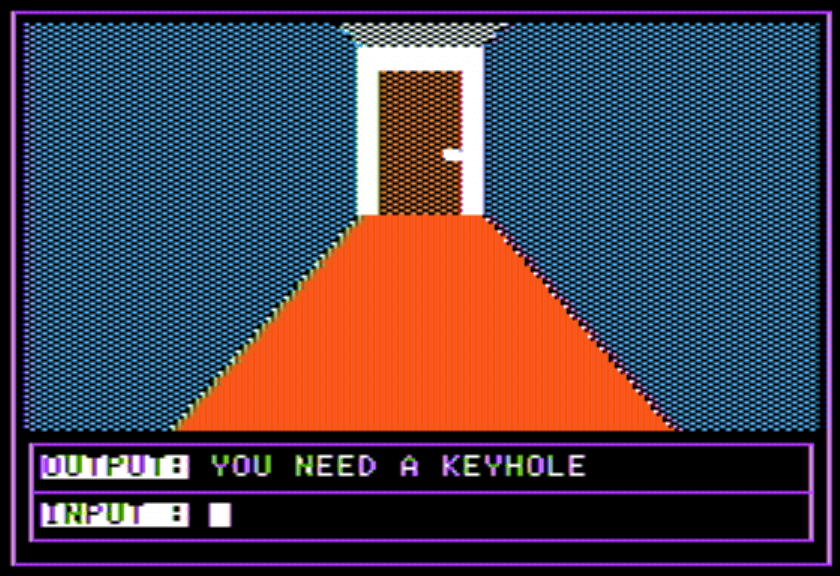
It tells me I need a keyhole.
3 — TOWN HALL
It tells me I need a toga (which can be obtained at the clothing shop at the southwest of the island). Once inside:
I can type one of the number options but nothing happens and I get booted out.
4 — SWITCHYARD
I only found out the name of this thing by buying a MAP from the general store later and doing LOOK while in the room. This also gives the “official” names of all the rooms.
Once entering: there are a series of three doors, and there’s a letter in the middle left.
I don’t know yet what any of these mean. There’s no equivalent to this in the original game.
5 — CARNIVAL
You need a clown suit (again from the clothing store) to enter here. Then you can add weights to cause a clown to go flying and lose some score. This is just as inscrutable as it was in the original game. I seem to remember there was intended some way to “break out” but it didn’t even work for me?
6 — CASTLE
This is where you come out at the start. If you go back in the map resets.
7 — BANK
This asks for an account number. You don’t have one.
8 — COURTHOUSE
You are asked upon entering if you will put yourself on trial. If you do so it starts a game of hangman.
This is the only way I’ve found to increase score (it helps that the score is on the display as you are playing). The score boost seems to be better with less mistakes to the letters. If you lose you get a GUILTY verdict and thrown out and the “doubling” part (DECREASE SCORE BY X, INCREASE SCORE BY Y) gets reset. I’m unclear what relation the prosecution/defense lines have to the game, because I hit “guilty” once with the prosecution being all the way up to “reset to new game” and nothing happened.
Eventually after enough wins there’s a “TILT” message followed by WINNING IS LOSING. You can go back in the courthouse afterwards and repeat the whole process.
9 — THEATER
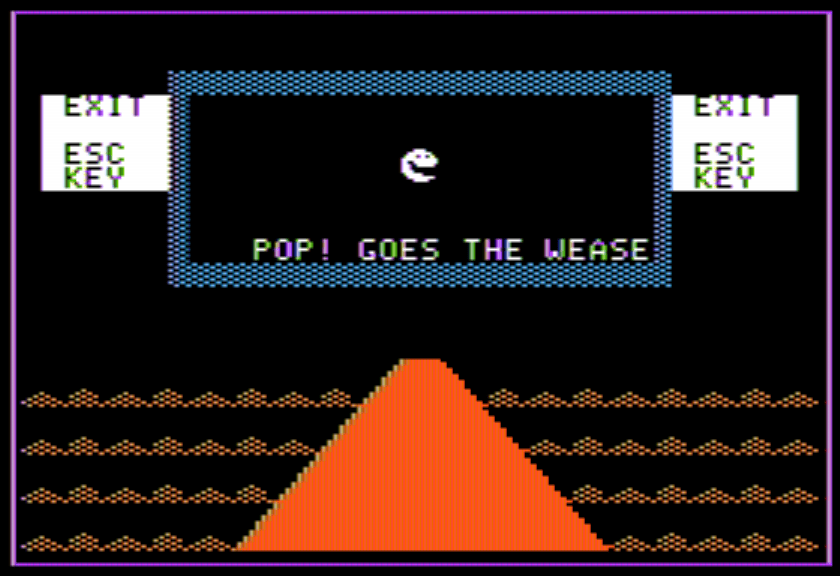
There are slightly unsettling nursery rhymes shown on a loop.
10 — GENERAL STORE
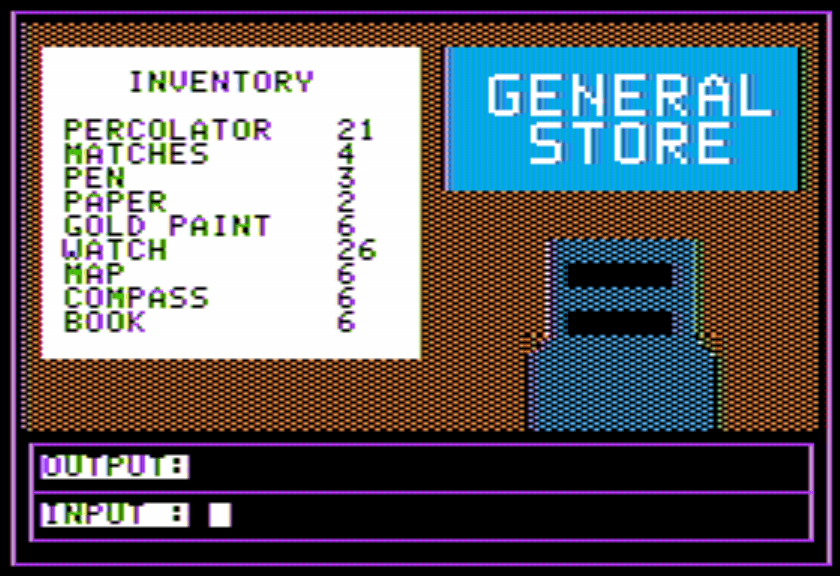
You can buy stuff, including the MAP I mentioned earlier, and a PAPER and BOOK which are useful for the next two places on my list. For some curious reason the shopkeeper will “adjust” their prices when you enter but all they do is increase all of them by one.
11 — NEWS STAND
I can’t get in. First it requests that I have PAPER, but then after it says THEY WON’T LET YOU IN even after holding the PAPER. This is true even when my score is up.
12 — LIBRARY
You buy a book from the general store and go in, where you get to burn books.
13 — SCHOOL
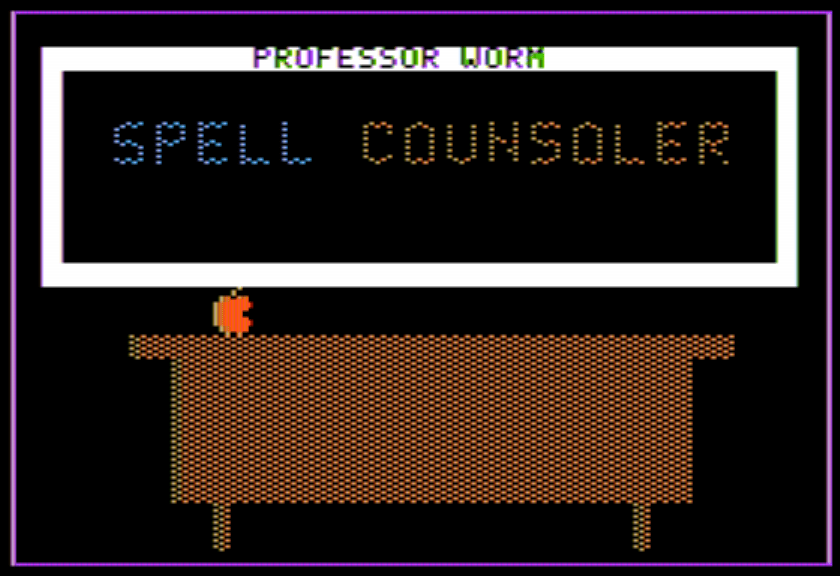
Professor Worm challenges you to spell words. The letters you type don’t always correspond to the letters on your keyboard so this is harder than it sounds. I have yet to get any of the words right.
14 — CAT AND MOUSE BAR
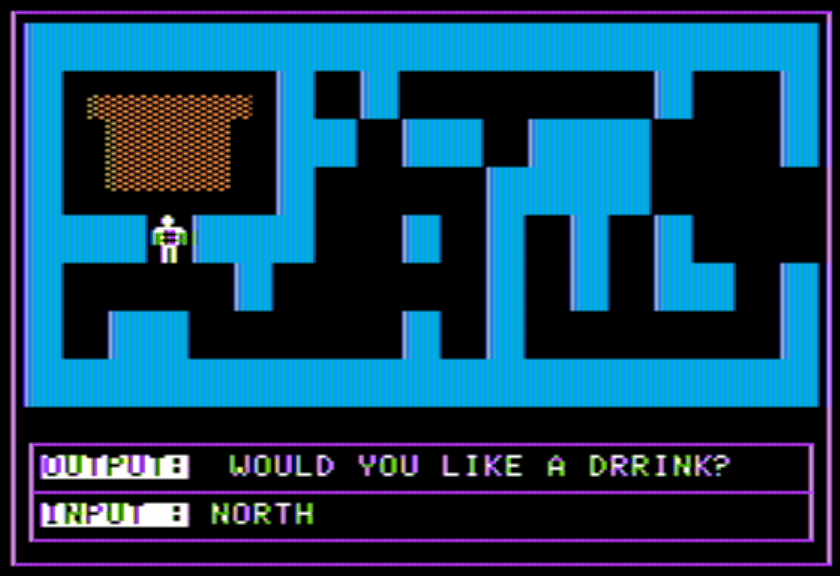
You have an above view where you can move around with U, D, L, and R. You can walk up to the bar and buy a drink, whereupon nothing happens and you reset back to your starting place. You can go to the right to leave.
15 — CHURCH
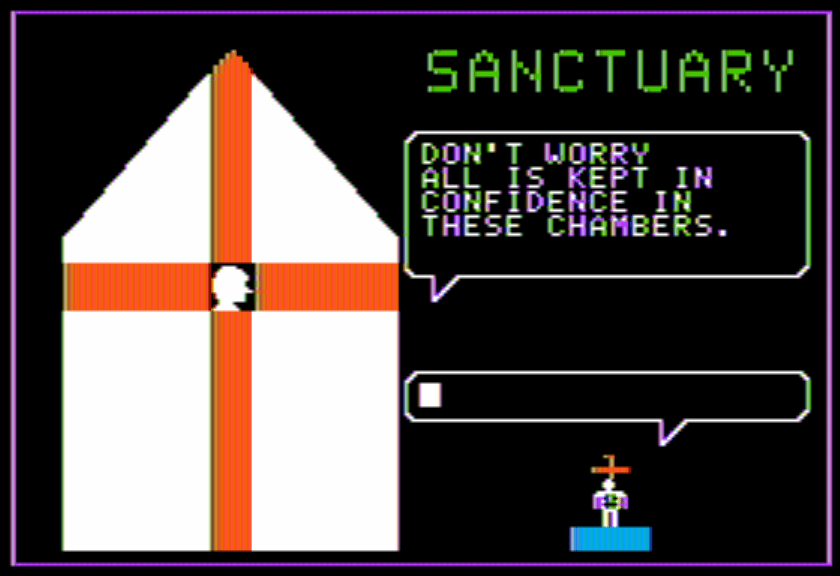
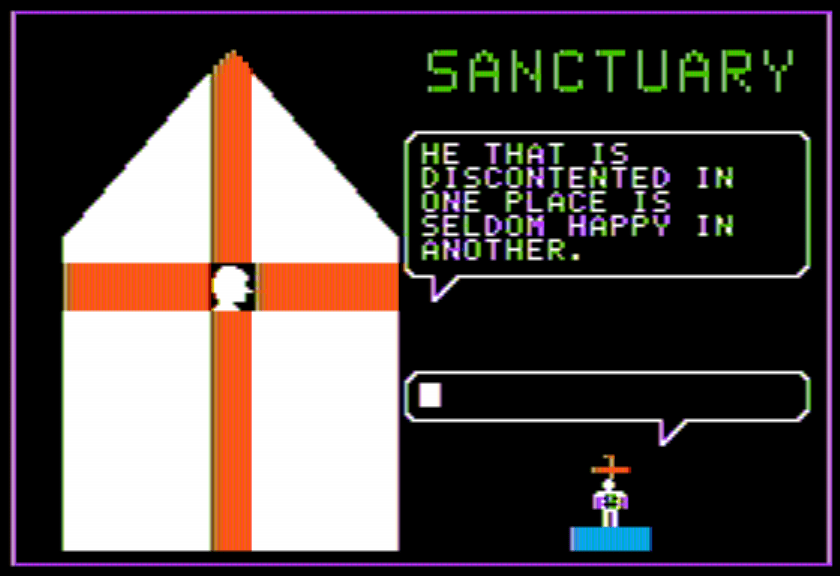
You can confess your sins, or give out your resignation number, or whatever I guess. There’s an open text parser and there’s ambiguous responses. The text parser has a limit to the character count that the original game didn’t have.
16 — CLOTHING STORE
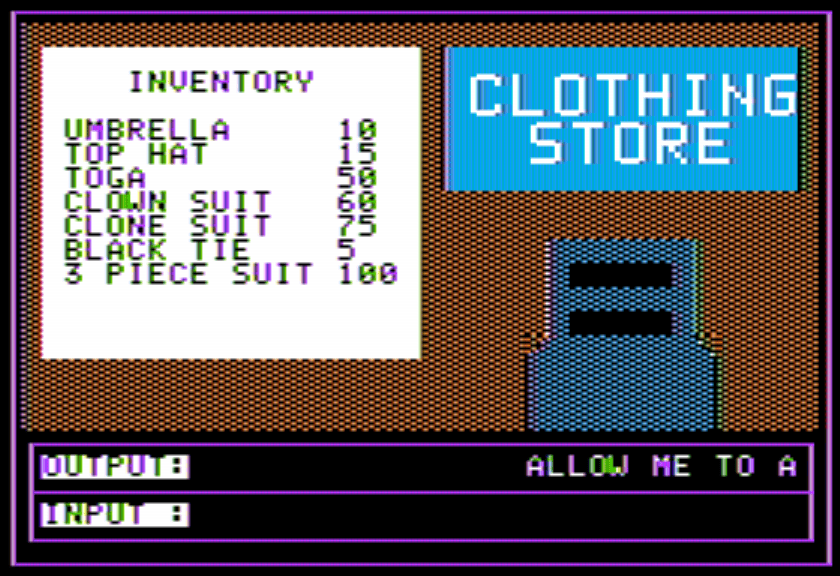
The TOGA and CLOWN SUIT I mentioned earlier are here. I guess you can buy all the rest of the items and find out if any cause an effect somewhere.
The shop-keeper is in the middle of saying ALLOW ME TO ADJUST MY PRICES. Just like the other store all just go up by 1.
17 — GRAIL HALL
More doors like the switchyard.
18 — RECREATION HALL
There’s a pit you can cross by stepping on platforms without falling into a pit. It is fairly tricky and I haven’t managed yet. It seems (based on other locations) like it might take significant effort but only with the result of my score goes up by 5 or something.
19 — GEMINI DINER
There’s a list of items. If you read the menu and try to buy any of the items it says they’re not on the menu.
20 — CASINO
There are three slots. One slot gives vacuous statements that are either from 1984 or are 1984-esque.
Trying to use the second machine gets the response YOU DON’T HAVE THE MAKINGS. You don’t have a dollar, either.
That’s quite a lot to chew on and I’m not sure what I should be messing with. The original game just let you get into various shenanigans that seemed like escaping but weren’t, but the real way to escape was to go to the caretaker and tell him the right phrase. Here, I need a “keyhole” to even make it to the caretaker, and who knows if the phrase has changed. I suppose I should farm hangman a few more times for points (the word list is pretty small) and buy all the gear from both stores to see if they cause any new effects.
One other thing I should do is comb over the manual more, and in fact, I want to talk about it a little, because it is far more “in universe” than the original manual was, which gave straightforward if enigmatic advice. (“7. Above all, this is a game of psychology. While the Island is trying to keep you off balance, you must try to hoodwink the authorities. From your knowledge of the Island, try to guess how their minds must work. Your one hope for escape is to second guess them.”)
For the new manual, it is written as if from a journalist who is writing about the Island, titling it “A Wolf in the Fold: The Conspiracy Behind the Microcomputer”. The supposed journalist rambles about modern life and technology and mentions a journal that appeared as a mysterious text file called BOTTLE:
I tried to meet this Caretaker — I’m told he represents whomever is in charge. His house was easy enough to find, but his door was locked. I’m not so interested in answers that I’m willing to cool my heels until I’m let in. It’s time for me to leave.
Let’s see, if I can’t confront the top, I’ll sneak out through the bottom. My “official” map says there’s just a white picket fence surrounding the place. Yes, I see it there, down the street. Just climb over and . . . What the Hell is that? I’ve run into watchdogs both animal and electronic before, but nothing like this! It’s after me! I can’t outrun it …
A later section called THE KEY TO ESCAPE has the journalist allegedly explaining the secret:
Perhaps it takes an objective eye to see what one is facing, for I believe that I have discovered, from the bits of information I have gathered, the way out of The Island It’s all so deceptively simple. All one needs to do is CANCEL THIS LINE … CANCEL THIS LINE … CANCEL THIS LINE … INTERRUPT … INCOMING MESSAGE … BEGIN
This is followed by some text which is not from the journalist at all.
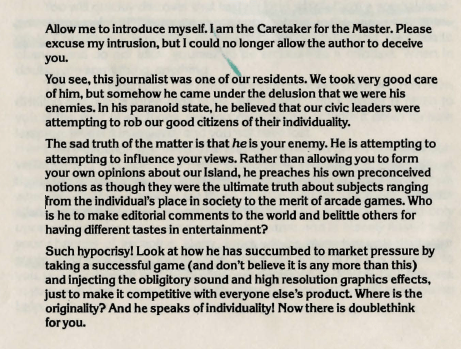
For those who don’t want to read all that (you’re tired and this is a long post, you’re on mobile, I’m happy for you or I’m sorry that happened, etc.) I just want to draw your attention to the fact it comments on how game is a remake and the commercialism implicit therein:
Such hypocrisy! Look at how he has succumbed to market pressure by taking a successful game (and don’t believe it is any more than this) and injecting the obligatory sound and high resolution graphics effects, just to make it competitive with everyone else’s product. Where is the originality? And he speaks of individually! Now there is doublethink for you.
I’ll attempt to bust open a few doors next time, or at least get caught by Rover in a more creative way. In The Prisoner 1 I missed an “ending” where you supposedly escaped and yet you really hadn’t (matching the episode Chimes of Big Ben where Number 2 figures out that he hasn’t made it to London but still is in the village). I’m hoping there’s some equivalent in Prisoner 2. I’ve put the relevant episode below with a time-stamp for the ending:
David Mullich’s work might be one of the most famous Apple II games of 1980 — insofar as Apple II games from that year could get famous — but I found it too janky and difficult to control to really get the experience the author was hoping. Some of this was certainly intentional: the premise has you on an Island trying to escape, with a confusing array of events trying to pry out the reason why you resigned from your top-secret job (rendered in-game as a three-digit code).
I absolutely admire the high concept of having a secret that the game then tries its best to pull out of you. I still can’t think of anything quite like it, and it meshes perfectly with the medium; that is, despite the game being based on a TV show, it does something the TV show could never accomplish.
Just like how I could admire the method of defeating the dragon in Crowther/Woods conceptually while decrying the actual effect in real gameplay, the same happened here: I just had so little congruence with what was going on the end result was more me admiring the meta-structure of the thing rather than getting any Art out of it. I can understand, given the scale being tipped heavily to Craft over Art in this era, lingering for while; additionally the person of Mullich himself is intriguing biographically, and he went on to work on important games like I Have No Mouth, and I Must Scream and Vampire: The Masquerade — Bloodlines.
All this might be moot, because Mullich had a second shot at the same material with Prisoner 2; not the earliest “remake” because you have to count, say, graphics getting added to Goblins, but certainly early. The original was a combination of text and ASCII art coded off-the-cuff in BASIC; this game instead is rendered in attractive Apple II graphics, looking like something that might come out of On-Line Systems were it not for the heavy social awareness and nightmare scenario.
Just like the original you have to navigate out of an initial maze…
…and then try to escape, visiting 30 building sites in the process. But while I’ve run across at least one activity that is identical, the buildings have a much different feel and I expect some activities are different.
Also, the original solution of just walking in to the Caretaker and telling him you’re playing a computer game doesn’t work.
I originally planned to play this simultaneously with the first Prisoner game, being informed it was essentially the same game with graphics, but I discovered quite quickly it was different enough it needed its own posts. That doesn’t mean my playthrough here will necessarily be long — and I can already tell there is some identical content — but I do like having another swing at the universe with some of the rough edges removed. Maybe it will go better this time. (Are the rough edges what made it Art, though?)
I’ll report back at my efforts to get into all the buildings next time. At least some of them don’t let you in at all (which I don’t remember happening much in the original!)
























 Renga in Blue