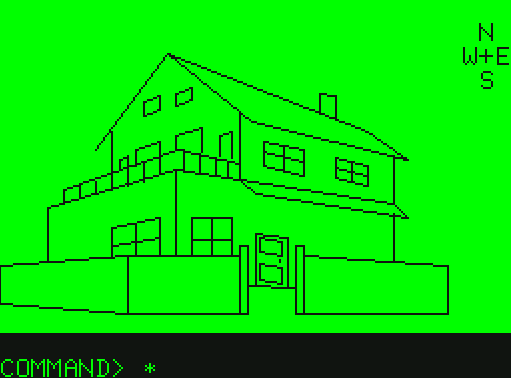
This post is mainly to announce that after an immense amount of work, a group at Gaming Alexandria (mainly gschmidl, ftb1979, bsittler, and eientei) have managed to repair the damage to the NEC PC-6001 version of Mystery House II to the extent that the second part is now playable. I have a version (with emulator) here. Just drag and drop one of the three save states onto the executable to play either part 1, 2, or 3.
The starting screen of the second part.
I did play through parts 2 and 3 but first I need to get some inside baseball out of the way, abstruse enough it won’t make sense unless you’ve read all my previous posts on Mystery House II. So much effort was expended trying to work things out it is at least worth recording as reference, especially because some pieces are still missing (like the first volume of the MZ-2000 version of the game).
Just which versions are out there?
To start, we can put together the information from the I/O Magazine ad I’ve shown already…
The first version, written by Dr. Moritani (the dentist) seems to have been for MZ-80B. The system Sharp sold had cassettes by default with floppy disks an optional purchase. The ad clearly states the “FD” version was by Moritani so that’s likely the original platform, meaning this was written without any kind of volume-splitting. The cassette version was then made by Ohyachi (computer store owner, and collaborator on Mystery House I). This is where there are two volumes that get listed as separate purchases. This is all confirmed by the catalog as well.
The MZ-2000 is extremely close to the MZ-80B so there was likely minimal work done to create a port; we do know they were sold separate, though.
From Giant Bomb, uploaded by bowloflentils.
As shown in an image from one of my earlier posts, the cassettes ended up also packaged together in a later printing, while floppy disk had MZ-80B, MZ-2000, PC-8801, and FM-8 (Fujitsu Micro 8).
There’s also copies of the game for FM-7 (shown below, and the FM-7 came out after the FM-8)…
…PC-6001 (our recovered one, although technically for the Mark II), Epson QC-10 (QX-10 in the West), and MSX. My playing sequence:
1.) I started with the MSX version from ARROW SOFT, which is not only dumped but has a fan translation into English. It is significantly changed from the other versions and can be treated as a different game.
2.) I then moved on to start the PC-6001 version — broken into three parts rather than two, although the “volume 2” tape contains parts 2 and 3. This turned out to have a corrupted tape and some damage over part 2.
3.) Because I had a copy of MZ-200 Vol 2, I switched to that version, starting on the second floor of the house. Unlike the NEC version it ends after part 2 and there are puzzle differences (which I’ll explain a little later).
A chart, just to keep everything straight:
Both the tapes and the program parts are called “volumes” but I tweaked the terminology to keep things clear. I have no idea the differences between the versions I haven’t touched (other than I highly suspect MZ-80B and MZ-2000 are quite close). Did someone care enough about the obscure Epson QC-10 to make a custom port with its own puzzles?
What changes were made in the NEC PC 6001 version?
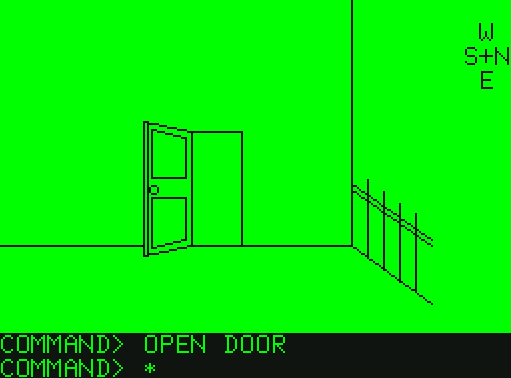
The map looks the same at the start, but if you turn right, while formerly there was a slightly surreal elevator, taking you to a “garden” and a dark area with the safe/key-to-exit…
…the NEC version has a bedroom.
Turning south there’s a part with a floor that looks fragile, and you can KICK FLOOR in order to open it up. This will get used later.
Additionally the bed is next to what the game calls a RACK, which can be searched to find some tobacco and a matchbook (that was in a fireplace in the other version of the game).
The layout otherwise starts out the same, with a memo in a frame in the same position as before.
Different content, though. MZ-2000 here talked about setting a clock to 1 o’clock. We already got a clock setting in part 1 (which said to use 3 o’clock) and this spot has a clue for the safe instead.
The fireplace which previously had matches now has a rope.
Climbing up to the third floor is mostly the same (except the HATCH is now a DOOR). The windows which oddly give numbers when opened (corresponding to the safe) are mostly gone, except for one that just doesn’t open (we already got the code from the memo in the picture).
Still a SCOOP. One of the windows in the MZ-2000 version was straight ahead.
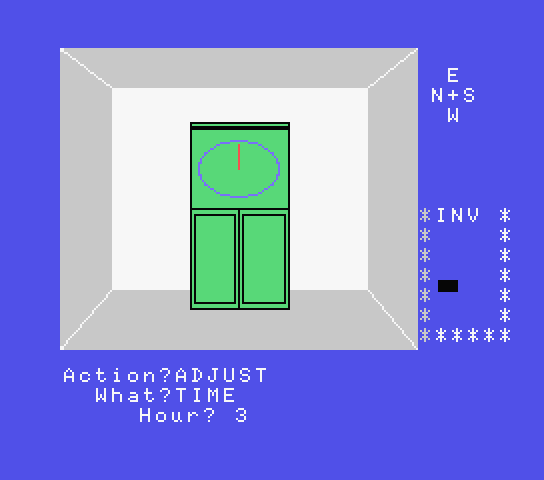
ADJUST TIME to 3 rather than 1.
PUSH BUTTON instead of PLAY MZ2000.
The MEMO at the end gives steps for digging, just like the MZ-2000 port.
However, the way to the garden previously in order to dig was the elevator. There’s no elevator this time. That rope from earlier can be tied to the balcony (which was just scenery before) in order to climb down.
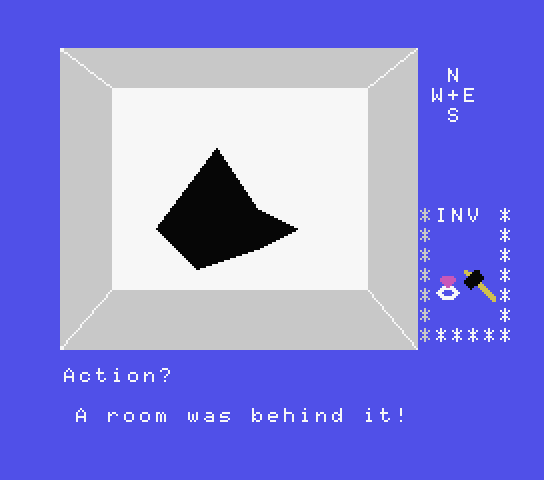
The DIG GROUND mechanics work the same (no Microcabin logo this time) yielding the treasure. In order to escape, you need to take the rope (previously tied to the balcony) now over to the bedroom and the hole, and tie it there. If you try to go down without matches the game will ask if you have any (this is the same “enforce the world-state” trick we saw in part 1). Assuming you have them, you can go down and enter part 3.
Part 3 is very short. You are in the room with a hole and the rope, and need to get down in the cellar to get a key. You can go DOWN, the LIGHT MATCH to see in the darkness. There are five matches and they last a random amount of real time.
You can go west now — one-way trip — to the spot underneath the hole you previously busted way back in part 1. You can move a ladder and climb up to get out, but you need to grab the key first, which you can find by turning to the right to see a safe.
Using the code from memo 3. I assume the game forces you to stay in part 2 if you haven’t gotten the memo yet.
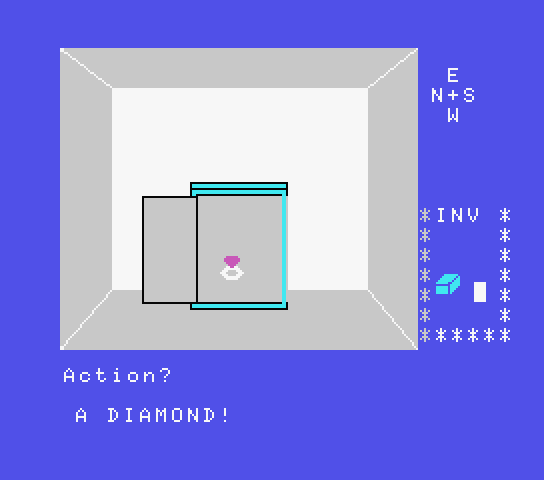
You still have a 2-item limit and you’re holding the box/jewel from the garden, so you need to ditch the matches to take the key. Basically, you need to a.) wait for the match to go out b.) LIGHT MATCH c.) CAST MATCH d.) grab the key and book it to the ladder while you can still see. (In the MZ version, casting the match automatically made it go out.)
This basically says now you’re wealthy, so you should buy more Microcabin software.
Is Isao Harada anybody?
Yes. He also worked for a NEC port of Dream Land, which is Dr. Moritani’s third game (from 1983, so we’ll see it sooner rather than later). His Mobygames list of credits is here although I don’t know how complete it is.
I do think it quite possible he worked on the (disk-based) PC-8801 version first, then had the same split-program issue as other Micro Cabin people did in order to get it onto cassette, except because he fiddled with removing the elevator (too Willy Wonka, I guess?) and giving the game a different ending section the game landed in 3 parts rather than 2.
My first new official update comes next week, as we embark on 1983 once more!
First off, a brief correction: The PC-6001 version I’ve been playing (at least up to a certain point, for reasons I’ll get into) is on tape, not disk, but everything on one tape. The files, found if you CLOAD multiple times, are
AUTO 1
MYS1
AUTO 2
MYS2 2
MYS2 3
where the double-auto files (meant to load on boot) suggest to me that this is the same copy as the two-tape version I mentioned last time, just someone copied everything together.
As far as why there’s MYS2 2 and MYS2 3, that’s because there’s three volumes! Or rather, there’s two tapes (each called a volume) and three program parts (each also called a volume) at the same time. That is…
Volume 1: has volume 1 on it
Volume 2: has volume 2 on it
Volume 2: also has volume 3 on it
…and all this took a long time to detangle. (Implicit thanks everywhere to the Gaming Alexandria discord, which helped out enormously.) I regret to inform you it gets worse, but let’s see what happens in gameplay context.
Disk from the FM-7 version via Oh! FM-7. I do not have access to this version. The screenshots make it look like it’s based on the Sharp/NEC map. I don’t know how the multiple volumes are handled.
Last time I left off with a cryptic message from a stairway about finding the entrance to the basement. Someone with eagle eyes might have spotted what to do next here, but in this case it was Kazuma Satou from the comments realizing that there was a map/hint page on Mobygames.
The basement and third floor are not shown.
The room in the lower left of 1F — where I found the book hiding the memo — also has a CARPET.
That double black line along the wall.
Some noodling about led me to MOVE CARPET, revealing a locked trapdoor.
This still isn’t enough to finish! You also need to USE HAMMER to bust open the door. Then you completely ignore the door for now and can leave up the stairs.
Trying to go down kills you, and I spent a while trying to survive going down before checking the stairs again.
That’s the end of Volume 1! Volume 2 is an entirely different program on an entirely different tape and doesn’t even carry any variables over. The game requests you reset the computer to move on.
The sequence in volume 1 was intended to get you to bust open a trapdoor before moving on. The reason this is important is that in volume 3 you return to the same room from below and the game assumes you’ve already busted the trapdoor (in a different kind of game, this might have a softlock because you didn’t prepare the trapdoor beforehand).
I want to re-iterate how completely odd and bizarre this is. I’ve never seen a game work this way; the closest I can think of is Savage Island (Part 1, Part 2) where there was an item you might be holding at the end of Part 1, and if you are holding the item you get one password, and if you are not holding the item you get a different password. Since the item is required to make progress in Part 2 early you can get softlocked from the previous game.
Earlier I mentioned “it gets worse” as far as the multi-part situation goes. You see, that NEC PC-6001 file? … is also corrupted. While the 3rd part of the game loads (you have found the jewel and are back on the first floor, now escape), there are damaged lines in part 2. In other words, to keep playing I had to switch computer systems over to the Sharp MZ-2000, where I have the second tape but not the first one. You start with no inventory, so the game assumes you’ve used CAST on the hammer or any other objects from the first floor.
(The Volume 1/2/3 situation still has yet another twist but let’s save that for the end.)
At least this version is likely adapted directly from the MZ-80B original.
The controls now go with the original “type verb and noun separate” system. It’s not as bad as I experienced with Mystery House 1 because there’s no screen swapping, although I quickly found reading memos and taking inventory to be cryptic until I got some source code assistance.
15230 IF D$=”モチモノ”THEN12000
This line in the source code (which is protected from LIST and required shenanigans to break open) is the one that jumps to taking inventory. “モチモノ” is Japanese for, essentially “belongings”, and makes a decent synonym for “inventory”, but is the only command in the game delivered in Japanese rather than in English. There is, fortunately, a function key (F3) which will type the same thing.
This screen will show objects on top (except the player isn’t holding any right now) but also is the only screen you can read memos from. You have to hit F4, which types out READ MEMO (as a whole command, not split!) and then pick the number of the memo. F5 types “RETURN” which will exit from this screen.
Now, a map:
I’ll save the elevator for last. Rotating west, going forward, and entering the door to the south, you get to a room with a picture. The picture has a memo.
The memo says the clock needs to be set to 1 o’clock for the door to open. (Remember back in Volume 1 of the NEC version of the game it said 3 o’clock. More on all that later.)
Going back to the starting position and north leads to a room with a fireplace. Searching the fireplace yields a match.
In the same “room” (it’s another 2 by 1 setup where you see across the long room) there’s a “RACK” partly underneath a “HATCH”. You can MOVE RACK so it now is fully underneath the hatch, then OPEN HATCH to get access to the third floor.
The third floor has what the game calls a SCOOP lying on the ground (shovel) and also windows that mysteriously open to reveal a number.
Just to be clear with a map:
To the north of where the shovel is there’s a rectangle on the wall that looks like it should have a door, but it isn’t. After a bit of struggle I came up with PUSH WALL which opens the passage.
The next room has a clock. This is where the first memo (set to 1 o’clock) comes into play, as you can ADJUST CLOCK and then say you want it at 1. This opens yet another secret passage, this time through the tiny door in the clock.
The next room (and last room of floor 3) has a computer, specifically an MZ-2000 in this version of the game.
RUN MZ2000 will print a memo that you can then take.
マイクロキャビン マーク カラ W ニ 2:S ニ 1
This indicates you’re supposed to start at the Microcabin logo and go west by 2 and south by 1. We’ll need this shortly. Let’s go outside by heading to the elevator.
The mechanics here are weird. You need to press and hold W to leave, or press and hold E to approach the buttons. No other keys work; you aren’t typing on a parser prompt. Wild inconsistency is the most consistent thing about this game.
There’s 3 buttons; the second one kills you, the other two are helpful.
One of them takes you to a garden outside. You need to specify DIG GROUND, at which point the game will ask you for how many steps west and south; this is where the memo comes into play.
The inventory limit of 2 still applies, so you need to cast off one of your items after doing this in order to get the BOX, or TRUNK.
If you try to then saunter through the exit — and you can go down the stairs, you just can’t walk around the first floor otherwise — you’ll find it is locked. You also need a key, which is where the other button on the elevator comes into play.
This leads to darkness, which you can dispel with LIGHT MATCH. (According to the source code, the amount of time the match is lit is tracked in real time. This is very rare for a turn based game but we’ve seen it once in a while, like in how Devil’s Island you needed to wait in real time for a guard to show up.)
The safe lets you enter the 7474 from the window (rather, ADJUST / SAFE, 7, 4, 7, 4) revealing a key inside.
Again you might need to worry about your inventory limit. If you got the BOX first you’re in trouble because you can’t discard the match! The best order is to do the key first and then get the box.
With the key and box in and (with possibly some trouble as mentioned in the caption) you can now officially saunter outside to a win.
With scrolling text.
Now, you may be wondering — hey, Mr. Blog Author, didn’t you say something about needing to bash open a hatch with a hammer in volume 1, how did that come into play? And what about the hole with the rope? Yes indeed: it turns out the MZ version of the game only has two volumes and whatever happened in volume 1 must be different from the NEC version, despite it looking like the same game from the video. I could technically try starting in volume 3 of the NEC version and beating it from there, but I am honestly fine passing for now. (The good folks at Gaming Alexandria are still trying to work out how to rescue the data from the tape for NEC volume 2. I’ll keep everyone posted. My theory is a divergence at the very end allowing for the third volume.)
The start of Volume 3.
I think the multi-volume gameplay mess demonstrates a case of “flying too close to the sun” that many of our authors have suffered, where they need to follow-up their previous game with something more ambitious. (As touted in the ad, “the program size has now doubled, making the adventure even more exciting.”) Still, I found it interesting how reasonable the MZ (volume 2) version of the game was relative to everything else I’ve seen: the only hard part is realizing, for example, you’re looking at a HATCH on the screen and need to apply the parser accordingly. I also got stuck a while figuring out how to work the elevator given it doesn’t even use the parser! So our original author-dentist seems to have kept to reasonable ambitions (apart from the volume-splitting) but the later people who made ports started to get unreasonable, like with the carpet puzzle on NEC or the confusing design elements of the MSX version.
Mystery House II running on a Sharp MZ-80B2 (a slight variant of the MZ-80B, the original platform for the game). Via bowloflentils.
Yes, I arise from my slumber for at least a little while. This is the sequel to Japan’s first graphical adventure game, using the same first-person-with-directions view as the previous game. (If this isn’t ringing bells, you probably want to read my posts on the game first. The important thing to emphasize is that despite the name and opening graphic clearly coming via the Roberta Williams Mystery House, the Japanese game entitled Mystery House goes in an entirely different direction in both gameplay and content, and the sequel follows suit.)
I have already technically finished Mystery House II in one of its ports — the MSX version, which has an English translation patch — but I had enough disappointment that I mentioned I would return to tackle the NEC PC-6001 port, which I knew from testing was very different.
The situation turned out to be even more complicated than I expected.
“Mystery House is now 200% more powerful … The program size has now doubled, making the adventure even more exciting.” From I/O Magazine, May 1983.
Parsing the ad above, it mentions versions for cassette selling for 3800 yen and for disk selling for 9800 yen. The big catch is that cassette (due to size) was sold as volume 1 and volume 2. In other words, this game was split originally into two entirely separate parts. Volume 1 involves the ground floor (and possibly the basement below); Volume 2 involves the upper floors. You can’t get to the upper floors without finishing everything below, and the way this is enforced is extremely cryptic (I thought for a while I was running across a bug, for reasons you’ll discover).
The PC-6001 version that I did my playing has all the pieces on one tape, but I also have (with the help of the Gaming Alexandria discord and gschmidl) a copy of Volume 2 (and only Volume 2) for Sharp MZ-2000. The “volume 2” version of the game starts on the upper floor of the House; if you walk down to the ground floor, you can only see the room at the bottom of the stairs (identical to the first part of the game) but can’t walk anywhere.
We have seen a trick like this before, with Robert Arnstein’s Haunted House from way back in 1979, as published by Radio Shack. It was made when 16k wasn’t quite as common for TRS-80 so it was stuffed into 4k instead, meaning to get a little more content there’s a tape swap upon arriving upstairs (and the trip is one-way).
There was a cassette version of PC-6001 as well, except both volumes were sold together. Via eBay.
This is very different from the MSX version which had quite a bit of trekking up and down — made painful by an inventory limit of two. The inventory limit carries on here but there’s less space to travel around in. I’m still quite stuck, though, and this is without a walkthrough to consult this time.
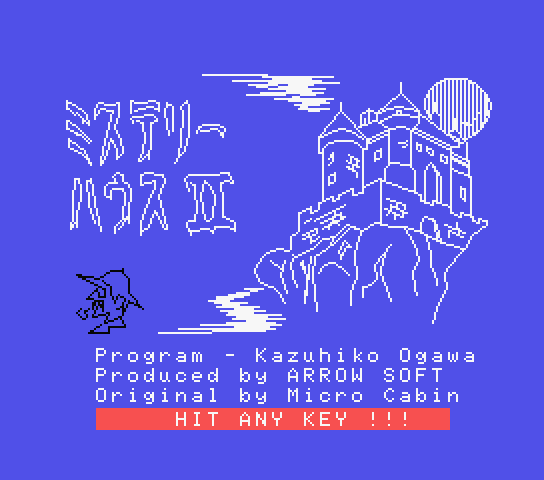
The opening graphic is still essentially cribbed from Roberta Williams.
The NEC PC-6001 version is fortunately like the FM-7 version of Mystery House 1 in how it controls. You type commands in regular English VERB NOUN form; this is unlike the MZ versions which have you type each as a separate line. If you are facing a direction like EAST typing the same direction will move forward; if you aren’t facing that direction it will turn you that way. Chronologically Gaming managed to land a copy of the MZ version with volume 1 so you can watch some of the opening of that version here:
It has a major difference you can see by going NORTH, turning EAST, walking EAST, and then turning NORTH.
That’s a MEMO on the ground, not present in the MZ version. You can TAKE MEMO and then READ MEMO, at which point the game prompts you for a number (there are memos 1 and 2 at least, I think up to 4).
That is
メモをさがせ
ちかしつのいりぐちにきをつけろ !!
2Fへまわれ
Search for the memo.
Be careful of the entrance to the basement!!
Go to the second floor.
Just to reinforce the idea I’ve mentioned before that the “VERB NOUN” form is strange for Japanese, from left to right, the first line メモをさがせ can be parsed literally as メモ (memo) を (is the object of action) さがせ (action is search for, imperative form).
Heading in further…
…the first room is a kitchen. Of the items to the south, the only one I’ve been able to refer to is a REFRIGERATOR which has a CUP. To the north is a CABINET, although rather than OPEN CABINET you’re supposed to type SEARCH CABINET.
Both the CUP and CABINET are part of the later MSX game; the TOWEL was not part of it, but the KNIFE did get used for an identical purpose to this game.
Before going on, I should point out while the CUP was referenced in the Japanese text that went with the picture, the CABINET wasn’t, and of course translations can differ so even when at item gets named like the cup was it can be a pain to figure out the English word to type in the parser. Fortunately, the game has a HELP command that gives a fair amount of the needed words:
The game is written in BASIC so normally a list could also be obtained via the method of listing the source code, but the game has some sort of memory-protection preventing this. There’s an emulator (iP6+) that allows dumping the memory into a file, and I used this while the game was on to get a 100% complete list of understood words.
Moving on, to the west is a 2-section room of the type seen multiple times in the original Mystery House.
Trying to ADJUST CLOCK (like was possible with the MSX game) gets the message that the clock is broken.
Attempting OPEN WINDOW on the first window (the one to the east) just gets the response that it won’t open; the window after is subtly different:
“Because the window latch is so stiff, it’s difficult to open.”
USE KNIFE works here. I complained about this in the MSX version being arbitrary. The text is a strong clue; the text wasn’t quite so explicit in that version.
After this I dropped the knife because of the stringent inventory limit of only 2 items at a time. It goes back to the cabinet (by “magic”) if you need it again. The verb the game uses for dropping items is CAST.
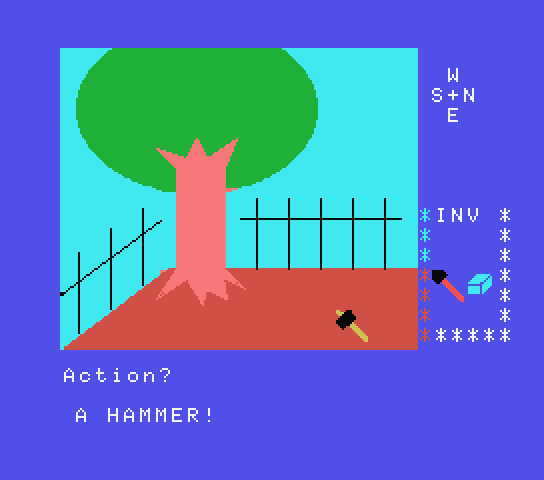
The scene here doesn’t let you turn; you can only go SOUTH which will put you back in the house. The hammer is used in the MSX version to bust a hole in a wall and there’s also a SCOOP (shovel) later which can be used to dig.
Moving on, south of the two-space room with the clock, there’s a four-way door intersection with stairs.
The south is the front door (locked). Trying to go east leads to a hole going down…
…and trying to go down kills you. (I assume the ROPE mentioned in the object list is used later.) Just like the outside section with the hammer the scene here is “locked” and you can’t turn.
Heading west instead leads to a room with windows to the west and south (OPEN WINDOW just gets “NO!”) and some books to the north.
When trying to TAKE BOOK you are prompted with which book you mean; the game wants you to type a digit from 1 through 6.
Being prompted for a digit. My first time through here I had the CUP and HAMMER which was too many inventory objects, and I was confused why the game wasn’t letting me take a book.
Each book is identical except for one (chosen randomly at the start of the game, I’ve had it be book 2 or book 4), which includes an extra surprise.
Memo 2 says to enter a door at 3 o’clock (3時のとびらをくぐれ). I assume this matches the MSX puzzle of setting the clock, but as I indicated earlier, ADJUST CLOCK just says it is broken, so something is different in the sequencing.
Finally let’s get around to those stairs. Trying to go up them right away, the game asks if you’ve found the second memo. Trying to go up them after finding the second gets the message
ちかしつのいりぐ ちを、あつけましたか?
or something like “did you figure out how to get into the basement?” (Maybe? I could use a Japanese expert to confirm here.)
I mentioned earlier I thought maybe this was a bug; I had no idea why going up stairs would provoke these kinds of “hint” messages (first indicating to find a memo, then pointing to the basement). Once I realized this was a “split” game (unlike the MSX version) the logic clicked into place. It also clicked into place why the MSX version might have changed things around; I can say that the “view” still is far superior in this game as you can see what’s going on to the left or right. You can even see changes in the distance; going back to the two-square room, notice how while looking west you can see the window open to the far right, which is not a detail the MSX version had at all.
I’m technically not on the hook for finishing this version of this game; I’m satisfied enough knowing why the different versions came out the way they did. I’m still interested if anyone has any helpful suggestions for progress. I have a copy of the game here; boot the emulator, pick option 2 for BASIC 32k, say you want 2 pages, type CLOAD, right click and pick Tape->Insert followed by the Mystery House file, then type RUN.
Sorry for the delay, everyone! Had a combination of life-things, work-things, and in the end, the actual game I was playing (the MSX version of Mystery House II). I will say it was definitely a slog and I completely understand the author I quoted last time being grouchy about Arrowsoft’s port. Since the earlier versions are much different than the MSX version, I’ll mention right now sometime in the future I will try the NEC PC version (there’s enough changed that it might be akin to The Prisoner versus The Prisoner 2).
I essentially enjoyed the first game, but despite some open aspect it felt fairly linear. Here, the game tries for a bit more non-linear and the fact the player is dealing with slightly ambiguous visual scenes really starts to be a problem. (And weirdly, the puzzles are in a way simpler but worse; I’ll get to that.) The “narrow window” view (where you can’t see anything to your left and right) is also similarly grating; there’s a lot of turning in directions that either having nothing or unimportant as you’re exploring the house.
Also, the two-item limit was not in the first game, and here it means you’re taking circuitous routes just to get the right item in the right place.
Cover of one of the earlier versions, via Giant Bomb.
For example, fairly early on there’s a window in a random room. It would never occur to me just looking that it would be the type of window I’d want to / be able to open, and it especially never occurred to me to get the dinner knife from the cabinet two rooms to the right and USE KNIFE.
In one direction you can find a RACK with a LADDER. In another direction you can find a candle in a RACK (don’t take it, you can’t use it yet) and a secret door in a fireplace. The secret door leads to a safe with an MSX cartridge.
The GREENKEY is off a random table somewhere.
In the same room you can also find a chair if you face south which has the information “door opens at 3’oclock” which is useful later.
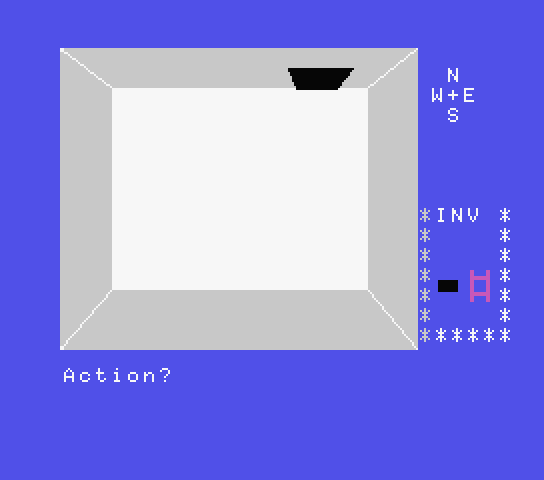
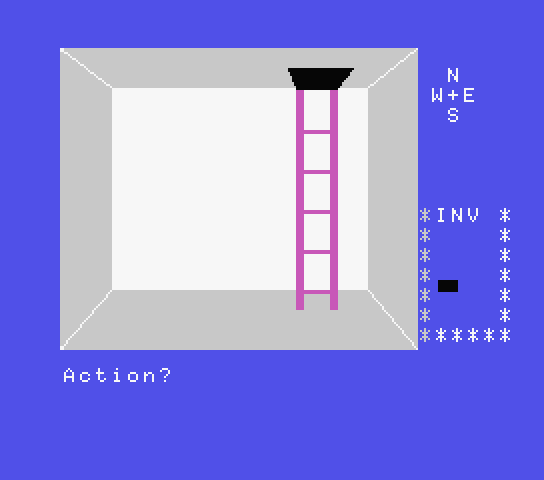
Going back to the ladder, it can be taken to a hole at the start of the game. This is another one of those “confusing visual” spots — it wasn’t clear to me I was dealing with a hole you could climb up through when I first saw it, so the ladder was not the immediate thing that occurred to me (I was originally thinking outside). After the fact, it made sense, but beforehand I wasn’t sure what noun even would apply to what I was looking at.
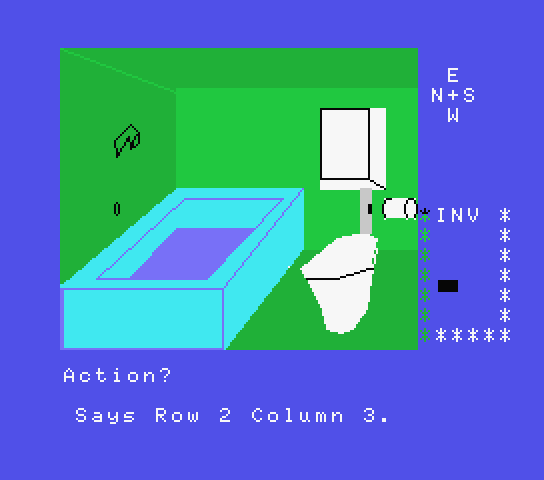
Upstairs there’s a bedroom and a bathroom. The bathroom has toilet paper with secret information. Would your immediately inclination be to TAKE PAPER in this scene?
The code there is for a bookcase.
This is for the safe in the basement.
Also upstairs we can apply the “3 o’clock” hint from earlier…
…and eventually find a secret MSX machine that can be used to run the cartridge. The only thing that happens is the message Break the north wall!
Easy-but-annoying: you get the hammer from outside to bust the wall in the same room. Of course I didn’t have the hammer so had to route all the way there and back.
I found the diamond already in this run. I’ll talk about getting it in a second.
My notes are honestly a bit of a jumble from here (sorry, long play time!) Inside there’s a REDKEY that can be used to get at a secret door in a different fireplace to get a PINKKEY, which can then be used to get a WHITEKEY from yet another safe and then bust outside, but that still doesn’t help with the diamond. For the diamond, you go back to the bedroom and grab some matches, then get the candle I mentioned quite a while ago (your inventory is now maxed) and then grab a shovel from …. oh wait, your inventory is maxed. Ignore the candle, grab the shovel first, then go outside, then dig:
Then get that candle, head down to the basement to find a safe, and use that R-3 L-3 code from the bookcase.
Now with the WHITEKEY I mentioned earlier you can make your way to escape (somehow you can’t just leave the way you came in).
It’s curious how much drudgery this felt like compared to the original. It really does have mostly the same elements, like moving things and finding a whole sequence of keys. But: it lacks
a.) using oil on a cabinet to discover a secret stairway inside
b.) finding a ladder that kills you by bonking your head if you climb, so you need to move it and bust the wall behind
c.) getting a secret code by lighting a fireplace
d.) putting the code in reverse to open the final safe, where the game ends upon getting the treasure and doesn’t have a weird sequence of keys for an escape
These all seem like small moments, but they were collected together in a way that built geographic suspense: what will you find when you get higher? The gameplay in Mystery House II (MSX edition) involved bouncing around the map many, many times in order to juggle the inventory, and in the end all the clues and keys felt randomly scattered and boring.
Or maybe it’s the graphics making me grumpy. There was a thread in my last post discussing the virtue or lack thereof of graphics. Y’all have read me enough to know I like a very wide array of things and am just as happy to play with cutting edge graphics or without, just like I’m fine with both books and film. But graphics can serve as a UI impedance if used badly; the original Mystery House (Roberta Williams, I mean) had some items where I had to guess what they were to pick them up; here, while I didn’t have the same guesswork, I had a lot of trouble getting into the “frame world” of the game. The need to check all directions especially got tiresome.
I’ve still got some hope for redemption from the NEC PC version, but I’m going to take a rest before taking it on.
Either way, I’m happy to be past here for the moment to get into something more traditional. I’ve got something from the Tough Britgame library lined up next. Text only! And probably puns that must be taken literally to solve puzzles! Those wacky British.
Ken and Roberta Williams released Mystery House in 1980, kicking off their Hi-Res Adventures line. These adventures made their way to Japan as imports, as players used dictionaries to help them through. Programmers in Japan started writing their own adventure games, starting with Omotesando Adventure, a text-only game that utilized the ADVEN-80 system published in an American magazine. Tsukasa Moritani, dentist and computer enthusiast, made his own game, Mystery House, very loosely based on the American Mystery House, and worked with computer store owner Naoto Oyachi to make a publishable product, kicking off Micro Cabin’s software line.
Mystery House came out at the start of the summer; by the end there was a sequel, also by Tsukasa Moritani. Based on the fast turnaround time it was roughly the same engine (on Sharp MZ-80B), but with a larger area (three floors) and the exact same quest (find a treasure in the house). Also, a higher price tag (9800 vs. 7800 yen). It eventually made it to a diverse set of systems like the NEC PC-6001, FM-7, and MSX.
From MSX Game World. Notice the price is 3800 yen, cheaper than 9800, but this was released in 1984 when the original was two years old.
The two versions I have access to are NEC PC-6001 and MSX. I have tried both and there are significant difference in at least the opening. The PC-6001 version starts you outside…
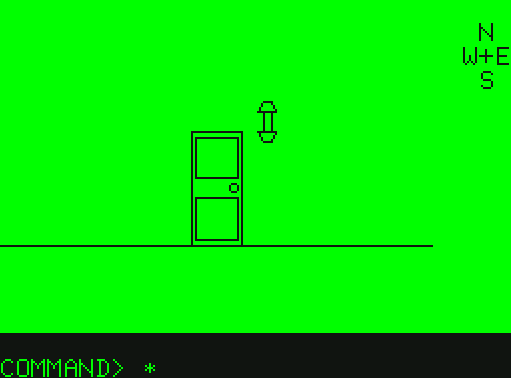
…and has the front door unable to open. You have to walk your way around to a side door.
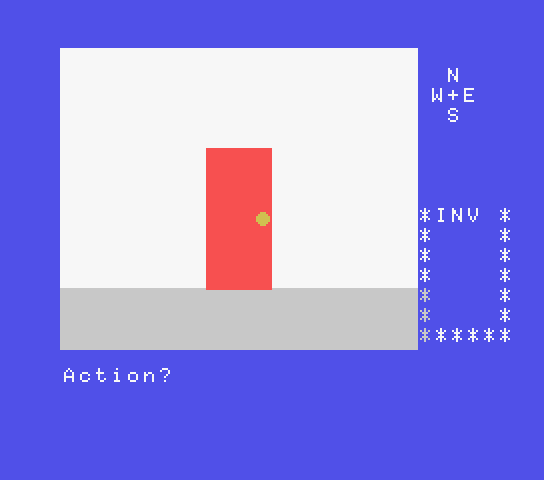
The MSX version, on the other hand, lets you open the front door right away.
The NEC PC-6001 one also lets you type verb and noun as one command, and works more or less like the FM-7 version of Mystery House we played. The MSX version has verb and noun as separate prompts, but importantly does not require also switching to a separate screen to type. Directional commands are given via the parser rather than relational direction keys. That makes playing the MSX version of Mystery House II much more tolerable than Mystery House I.
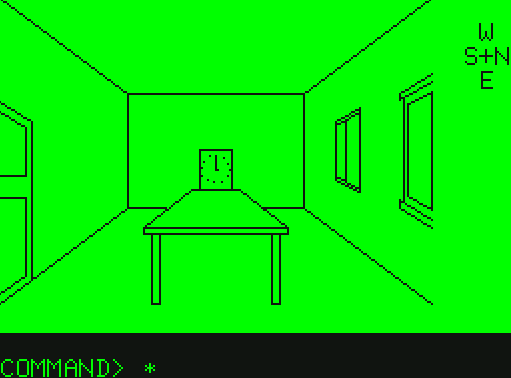
Another contrast is the handling of the 3D-view. The PC-6001 edition allows you to see “left” and “right” in addition to “forward”.
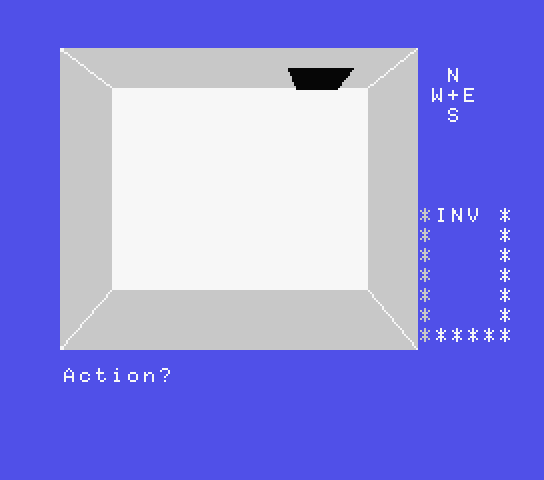
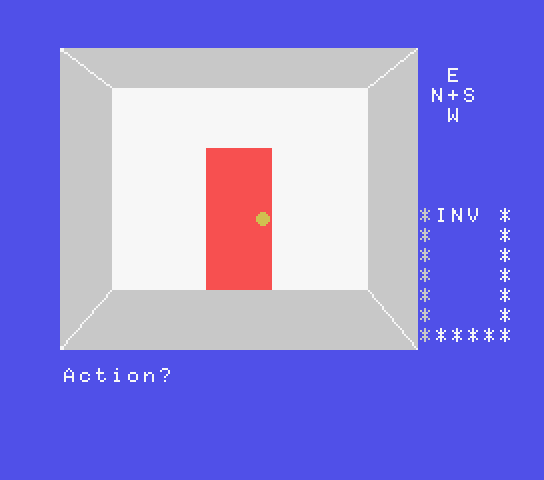
Whereas the MSX 3D view is tunnel vision, where you can only see in the direction you are facing. For example, upon entering the house this is your view:
However, in addition to the door behind you that you entered, there are doors to the east and west.
You are restricted to two items in your inventory at a time, and it looks like the inventory selection is far greater than before.
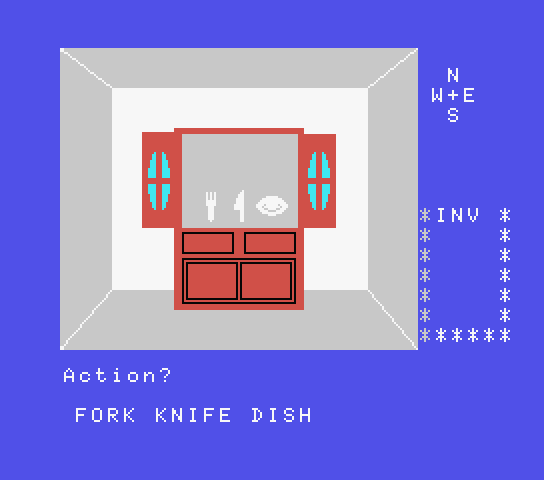
Immediately to the east of the start there’s a cabinet as shown above. You can take two of the items…
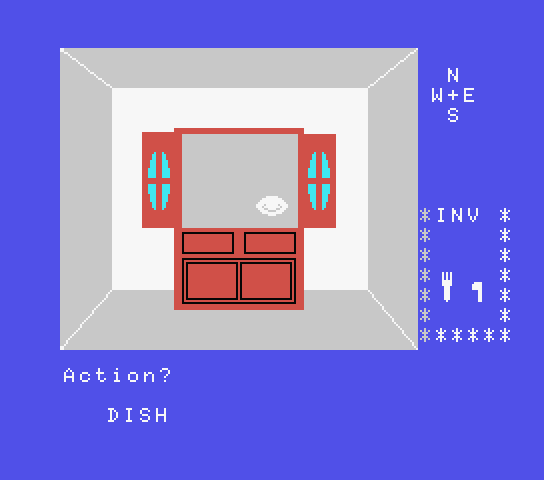
…but now if you also want to take the DISH you are stuck and have to drop something.
There are two other reasons to stick with the MSX version:
1.) As you likely already noticed, the screens are in English. That’s because the MSX version (and only the MSX version) has a translation patch.
2.) Even more importantly, there’s a walkthrough specifically for the MSX version.
However, I reserve the right to vacillate and change my mind back. At least according to this Japanese fan site by “furuiotoko” the MSX version is disappointing compared to the original and was “changed considerably” so I’m going to stay alert.
To finish off for now I want to quote another part of that fan site. Mystery House was — when the author was a child — their first adventure game, so the moment was magical:
From that moment on, I immersed myself in the world of this mystery house … It was a game that was completely new to me. In the virtual space on the computer that appears in front of you, doors open when you open them, items disappear when you take them, new discoveries suddenly unfold in front of you when you examine them … It’s probably because I personally loved this kind of secret exploration of the mansion, but I’m sure there are many other people who were equally impressed by this game.
The author invited two friends over to play, and they were trying to solve the ladder puzzle (the same one I was stuck on, where you can fall and die if you climb). One friend suggested moving the ladder, and another suggested busting open the wall behind. When this successfully made a hole, their excitement reached a “peak” of a kind that would never be duplicated again.










 Renga in Blue