John R. Olsen started writing games as a high school student and we still have quite a lot of his works to go. This is not one of them, despite a few sites stating otherwise.
This is instead by John Olson. Note the vowel. He was originally from Illinois, and after getting a Bachelor’s degree moved to Kansas in 1976 to teach math at Hoxie High School. He eventually also picked up a job teaching at Colby Community College starting with college algebra, then branching into computer science.

Modern aerial view of Colby Community College, from their Facebook page.
In the area of computer science, we were using Radio Shack TRS-80 computers that had a Z-80 microprocessor. The era of personal computers had arrived.
In the fall of 1981 he wrote Island Adventure “For Fun” (as he says in the comments) before it eventually winged its way to CLOAD Magazine to be published in their May 1982 issue. Given the single vowel change, plus TRS-80 as a platform, plus both authors being published in the same tapemag; it is understandable why they’d be lumped together. But (other than them of course being different people) we have a teenager vs. adult enthusiast contrast, and the formats of gameplay themselves are fairly different.
Before getting into the game itself, let’s focus a little back on the CLOAD issue in question, which kicks off with the editor unraveling:
For headache, take aspirin. For tension…
Not another dumb question??!! I’ll have the editorial tomorrow! Ad by Thursday. Oh, no! A bug in a program? Tom, get to work. What do you mean, I’m not a nice guy anymore? My attitude needs a tune-up? I should take a vacation? But I had a REAL one 3 years ago. What do I need another one for? Oh, Robin mentions that I WILL take a vacation. I see. Won’t the shop fall apart without me? No? How will I survive a week without computers? How does it feel to be needed…
Quite often the past gets seen through polished lenses, so it is interesting to see these moments demonstrating: despite most of these objects now being forgotten cultural debris, they were still work for the people that produced them.

How long did it take to copy all the tapes? How long did it take to lay out a 4 page newsletter by hand? How much time was spent making the animated “slot machine” cover?
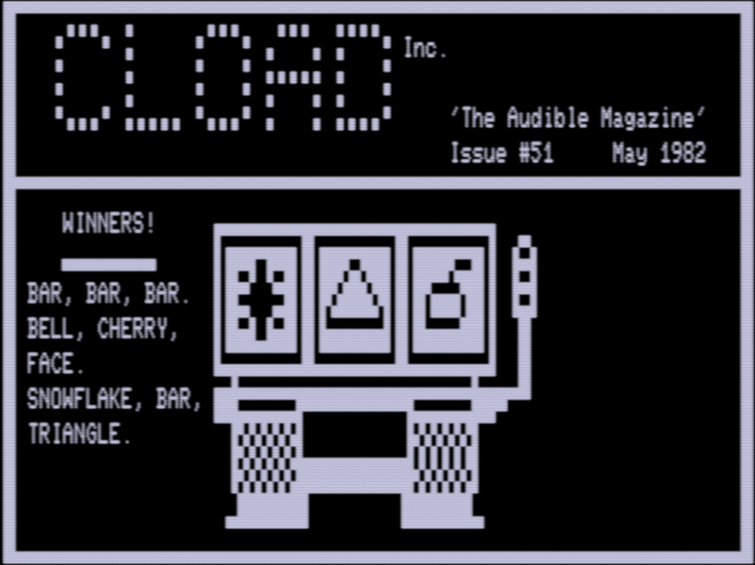
Barring this moment right now when I’m mentioning it, most of these things will fall into historical dust. Adventures were really popular and oftentimes much better preserved than the games they were packaged with; did the people at the time already know Island Adventure might survive at least a bit longer than Math Drill, or (to make a fairer comparison) Destiny, a weirdly elaborate space flight sim by Scott Richmond where you need to destroy a Klingon base?
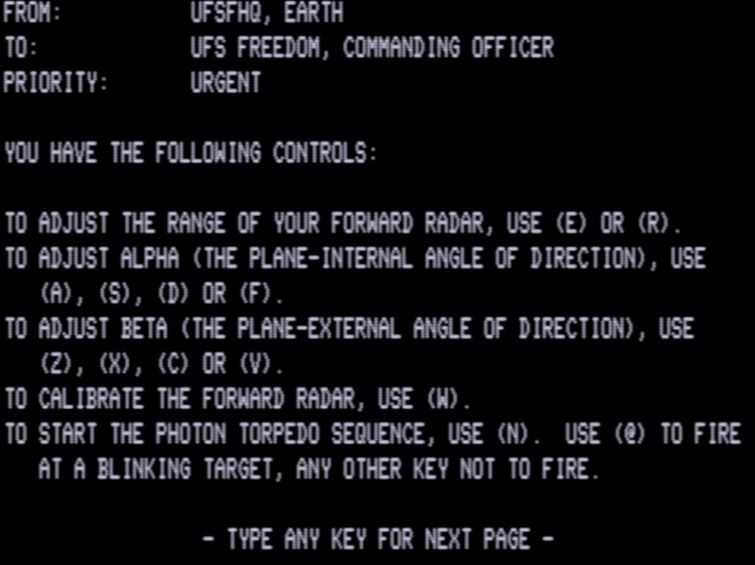

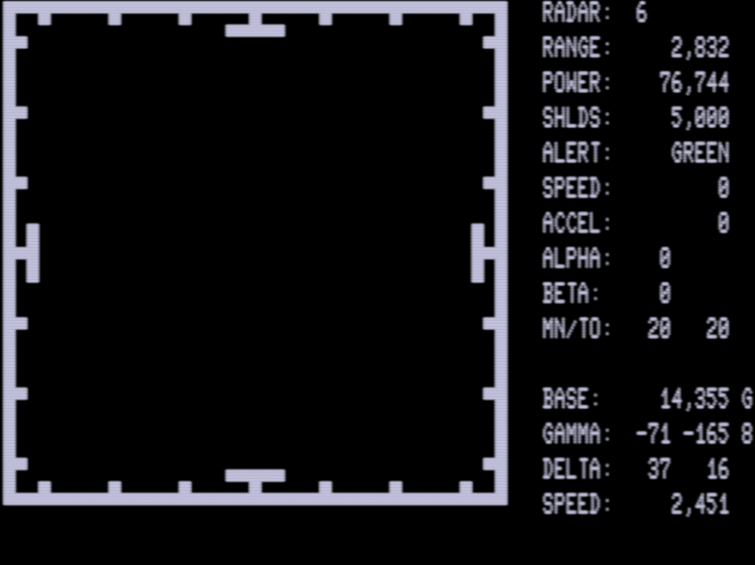
Seriously, what? Also, it is my greatest aspiration someone will be searching for the modern Bungie game and accidentally pull this up instead.
But we have only time for the Island. Maybe a Space Sims Addict will pass through again one day.
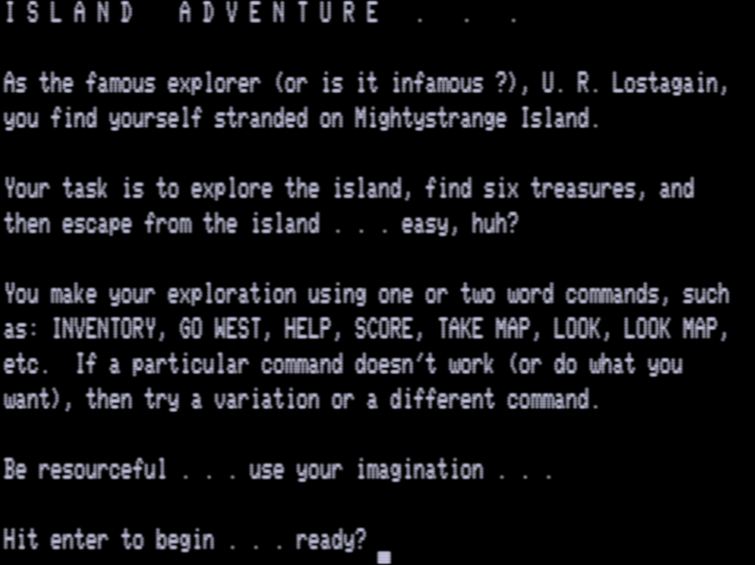
If I didn’t know about the naming confusion, this game would puzzle me; it is much simpler than Frankenstein Adventure, or really almost anything we’ve played lately. I have to go back to the early work of Greg Hassett to make a comparison: very little in the way of puzzles, with most of the treasures in the open. Hassett at least tossed in a few static or random enemies to mix things up, but this is really an abandoned island.
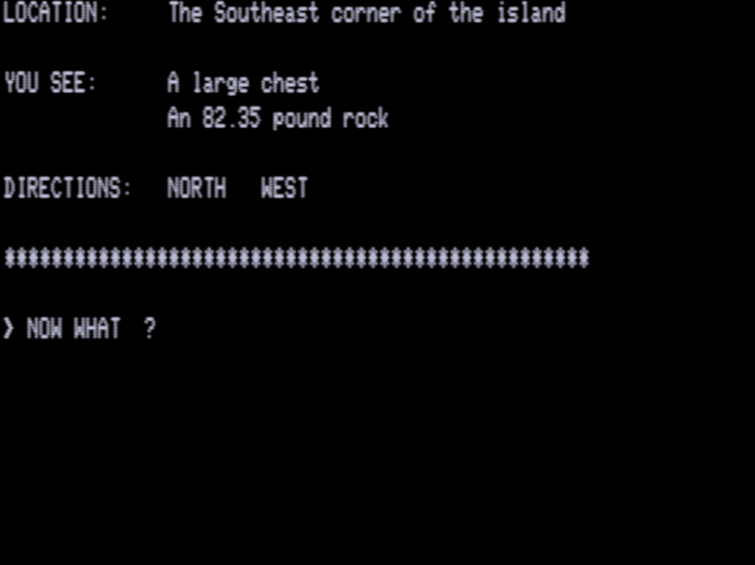
The main interest is a lot of red herrings. For example, trying to OPEN the chest at start says “that’s not allowed / possible”. You can pick up the very specifically measured 82.35 pound rock (we’re an adventurer, I guess we’ve had practice) but it is useful for nothing.
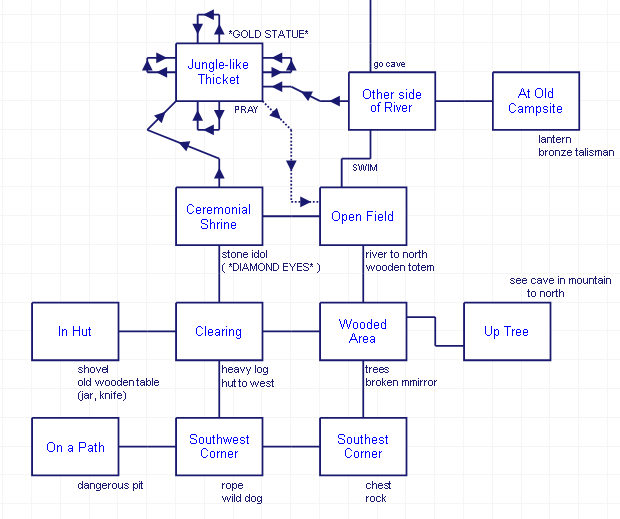
Looking over the map of the south part of the island, to the west there’s a wild dog (a “St. Bernard”), a rope, and a “dangerous looking pit”, all which are red herrings. Heavy log and broken mirror directly to the north? Also red herrings.

Out of the three items in the hut above (shovel, jar, knife) only the knife is useful. DIG isn’t even recognized as a verb. You can’t scoop up any water with the jar even though there’s a river nearby (not like it’d be useful in any puzzles anyway).

Where the knife is useful. I’ve been taught to fear taking eyes out of idols in other adventure games, like how in Acheton doing this would set off an enemy that would chase you the rest of the game.
North of the diamond eyes scene above there is a jungle where all directions (n/s/e/w) loop. There’s a *GOLD STATUE* so you have to go in there. Taking a cue from the nearby religious items our protagonist is looting, I tried PRAY.

This leads the player to safety.
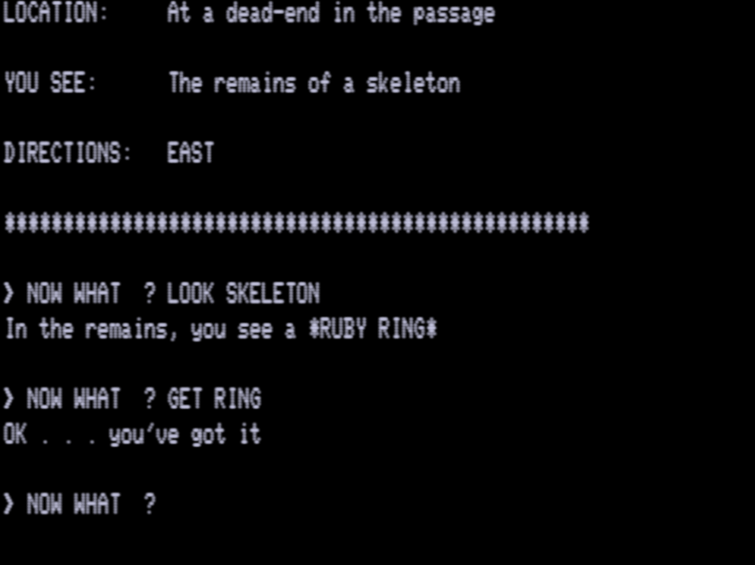
Swimming over a river, you can find a lantern which you need to be holding to enter a cave. There you can find multiple treasures just lying around.

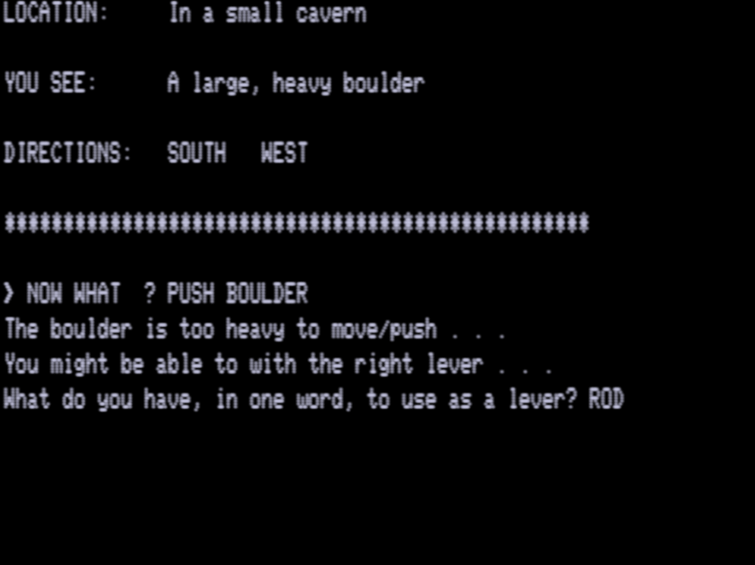
The only obstacle remaining is a boulder too heavy to move, but fortunately immediately adjacent is an iron rod.
Outside there’s one more treasure (a pearl necklace) and a boat, where you can drop all the stuff you’ve scooped up and win. There’s a max inventory limit of five and there are six treasures so it takes at least two trips.


Honestly, I think the red herrings perhaps weren’t meant as red herrings at all; rather, this was just being written “for fun” so at some point the dog etc. got left in and ignored once it was possible to get from the start to the end.
I can’t begrudge this game being written; this is the sort of starter game lots of people from the era tried to make. I’m just a little surprised it got published (unlike the closest comparison game from 1982, Smurf Adventure), but perhaps refer back to the over-worked editor trying to crank out monthly tapes. If nothing else, Olson came back with three more games, and one of them (Gymnasium Adventure, written 1982, published 1983) I’ve played before and I remember being decent. It’s set at a high school, so perhaps a few in-jokes on the part of the author helped.


 Renga in Blue