Archive for the ‘IFComp 2015’ Tag
By Jeremy Pflasterer. Not finished.
I know what is wrong. (At last.) Three seasons of planning has made me all twisted up. It’s not me, it never was. I can’t worry about the pashvod, or the shadows, or the crannies or shapes of the rock. Or the direction, or the destination. There is no rhyme or reason to the direction; if there were, it wouldn’t be my direction. There is no particular destination; if there were, it wouldn’t be my destination. So the plans must go. That is the only way I’ll ever go. Therefore: farewell, journal, at least for now. And Koustrea, whoever you are, if you are still reading this, I’m sorry I couldn’t wait for you. But we will meet yet if everyone is right and the world is as small as they think. I assume we won’t.
I’m not exactly sure what’s happening in Koustrea’s Contentment. Here’s my best go: the main character, Koustrea, has arrived in a strange building with geography that mimics a real house. There’s a series of people that may or may not represent things from Koustrea’s life. The primary feature is a golden door. One of the characters (Draydee) sits on a bench merely waiting for it to open.
I assume the final goal is to open the golden door. It has a series of panels which can be depressed like a code, so I’m guessing (like Myst) once knowing the secret it should be possible to win straight from the opening.
Other than the door and a kitchen one character is blocking (for reasons not disclosed) Koustrea’s Contentment doesn’t seem to have any visible puzzles whatsoever. Back in 2007 I termed the style hidden puzzles. In a traditional large IF game you might come across items that can’t be reached, or clear obstacles, but other than the aforementioned kitchen there seems to be no direction for the player at all.
I spent a lot of time talking with the characters, of which I found five. They are somewhat cardboard. Here’s the liveliest one, Zeolt:
>ask zeolt about jukebox
“How about this jukebox, eh?” you say to Zeolt.
“There’s nothing I enjoy more! And so easy to use,” says Zeolt.
>ask zeolt about zeolt
“How are you?” you ask Zeolt.
“Very well, thank you,” says Zeolt.
>ask zeolt about door
“What are your thoughts on this Golden Door?” you ask.
“My thoughts? Let me try to find them….” says Zeolt. “Well, maybe it opens, maybe not, but in the meantime, it sure does give Draydee something to do, doesn’t it?”
While I did play the entirety of the two hours, my gameplay mainly consisted of asking characters about everything I could think of and getting noncommittal answers.
Spoilers upcoming.
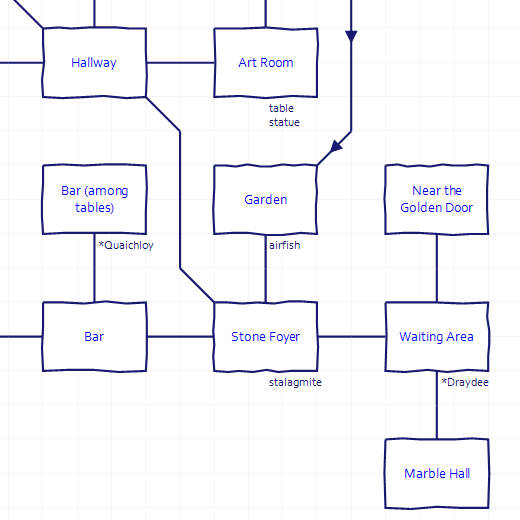
A partial map.
.
.
.
.
.
S
P
O
I
L
E
R
S
.
.
.
.
.
.
There’s one character (Quaichloy) who makes sports references that can be looked up. Those entries mention numbers, and those numbers can be then looked up in a series of journals (the top excerpt is one example). However, the journals are equally cryptic, and the whole process felt like running in circles.
I did, finally, manage to get to a basement by moving an object. There was no particular reason for me to move the object other than it could be moved. Hence I missed the usual tingle that accompanies a puzzle solve, because I was only aware a puzzle was there after I solved it. It’s possible to have pleasing secret puzzles. I remember a well-done secret door in Theatre (from 1995) but the game was careful about setting the expectation that systematically checking things for secret door catches was a useful thing.
I could see a good IF game coming from primarily secret puzzles, but there needs to be an extra motivation to play. Perhaps high writing quality might do the trick, or absorbing layers of philosophical depth, or just having characters that are actually fun to hang around. In the time I spent with Koustrea’s Contentment I could find none of those.
Oddly enough, I do want to try to play more after the competition. There’s certainly some craft here, and it feels like somewhere past the 2 hour mark things might come together.
By Jack Whitham. Completed with two hints.
Dear candidate 27501,
You must be wondering where everyone has gone. Let me explain.
A serious situation has developed, and I have been forced to take emergency steps to isolate the Administration Centre – and ourselves – from the outside
world. This isolation prevents my communicating with you normally, and at present I can only do so via this screen. I will explain more in due course.
Excluding Grandma Bethlinda’s Variety Box (where the minimalism makes it slightly avant-garde) and Darkiss (which has a really dark vibe), Final Exam is the most pure traditional parser puzzle game I’ve played of the competition so far. (It’s even written in old-school Inform 6.)
You’re a candidate for the ambiguously defined Administration (who seem to be something of a world government) and wake up on the day of your final exam to find everyone missing. Sinister events are afoot.
The mechanism of being directed by remote instructions (see the excerpt above) was fairly good at a generating a linear set of puzzle tasks without seeming artificial. There’s a series of technical tasks which have enough of a veneer of realism to feel satisfying and one really good puzzle involving extending a cable.
I had to use hints twice because I rather blindly missed connections on the map. (I was trying to play without making one. It’s doable with this game but my own memory tends to forget things when I multitask.)
I wasn’t expecting prose pyrotechnics or characters of any sort, so I didn’t have any disappointment there, but I did feel like the “world government” background was wasted. All the events that occur could easily happen in another context, and the game never does a good job in conveying what the actual duties of the Administration are or what might happen if outsiders orchestrate an overthrow.
By Bob McCabe. Played to completion.
‘Now is the time of the cleansing. This place is to be forgotten.’
The words lodge in your head, but it takes time to understand — as if it’s a foreign language you barely remember. The words are spoken by many voices, competing and complementary at the same time. They warble and blend as you recover from the message’s, and messenger’s, arrival.
You are on an island fated to be destroyed, and you have just over two hours to explore it.

Everything plays out like a board game of sorts, with a set of 25 locations to travel through and characters with random traits and random items and strange “MacGuffins” about the island that might as well be cardboard disks that get shelved next to the dice.

Exploring an area leads to a longer description and the occasional chance to do more (attempt and try to figure out the code to a safe, say) but in general the atmosphere maintains a sort of solo-strategy-game feel where you are dealing with locations number 1 to 25, not real places.
Eventually murders start occuring, signaled by lightning in the distance. Bodies begin appearing.
As gameplay continues you automatically update a “notebook” with observations.
Eva is slender.
Heather is stylishly dressed, and is passive and meek, avoiding any conflict.
Jacob is tall.
James has large, round eyes.
Jessica is wearing a long jacket.
One of the “special encounters” lets you ask for more detail about a particular person.
Jessica is wearing a long jacket, has freckles,
and smiles frequently for no apparent reason.
Now, at this point (presuming you haven’t played the game any) you might be confused why these facts are useful, but this game is set up like Clue where from specific events you can suss out small details of the killer.
You float through the darkness, adrift at sea, black velvet smothering the heavens, nothing but the sounds of water lapping at your sides. Then you see something. You look closely. You see a shadowy figure who is tall.
Near the end of the game, waves start to destroy various locations in the island before eventually everything is gone.
Some issues I had:
1.) While the notebook is useful, I found it frustrating during special encounters. For example, in the part I mentioned earlier when you are allowed to get detail about a character, you can’t go to your notebook to doublecheck who is still a viable suspect; in fact you can’t go back to check what a viable name to type might even be.
2.) Even with all the information the notebook holds, the thing I really want (have I visited a location before?) is lacking. It tried to just go in sequence but occasionally events happen which confused that.
3.) There’s weird, arbitrary restrictions on what constitutes a “turn” and requires time to pass. For example, you can give MacGuffins to a person to improve their mood towards you and make it possible to ask questions about others (say, if you’re searching for tall people who may be the killer). You aren’t allowed to do both on the same turn, but you are allowed to chat to assess their own disposition in the same turn. Why? I feel like there’s a complex manual of rules that comes in the packaging but got thrown out. It was fun to learn about mysteries like “what does the bunny do” without any prior knowledge, but the basic conditions of interaction need to not be mysterious.
I overall found the experience intriguing and unique but I think before I make another attempt I need some sort of strategy guide. I have no idea if there’s a systematic way to find the killer; I found the system of character interaction hard to deal with and never got any useful information out of it.
I did appreciate at the end there is a “high score” to give this true board game status. An excerpt:
Your Score:
+50 points for meeting the killer and getting to the final turns.
+10 points/Survivor: You earned 100 points since 10 people survived.
By Cha Holland. Played using Firefox.
All in-game imaginary alchemical systems suffer the problem of needing to teach the details “from scratch” — assumptions from the real world do not apply. I’ve generally seen this solved with a recipe manual (given slowly or all at once), so that the player gets some starter recipes and is able to extract some sense about what the bluespan and the whirlbowheel and the whitegrass do in a logical way. There’s still a feel of experiment and the necessity of failure, but at least there’s no rudderless flailing about.

Growbotics is entirely composed of an imaginary system for combining “essences”. There is, as far as I can tell, not enough of a system for a player to work with, so they’re forced into a random clicking method.
After making an object (via the trio combination method above) there’s an epilogue. I’ve seen one involving amusing reactions on social media and another where
As PROFESSOR G you keep the world safe for science, with special powers including particle acceleration and chromatography.
although I’m pretty sure I hadn’t earned it, because I was clicking just as randomly as before.
I did love the presentation and graphics and sound, and I’m not against games playing more like experimental toys, but my experience with GROWBOTICS was so random I just didn’t have fun with it.
By Michael Thomét. Played to completion (sort of) with Firefox.
The interactive nature of games means, on occasion, players can have such wildly different experiences they come across as different games.
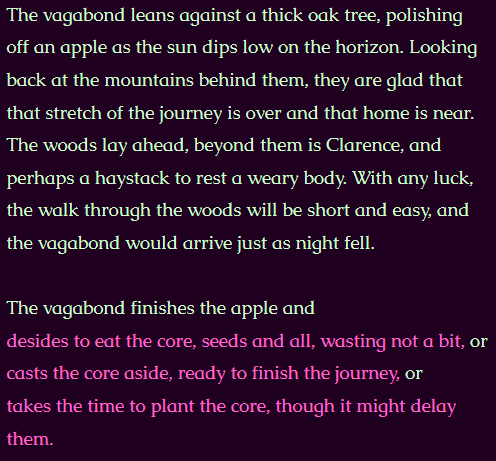
With A Figure Met in a Shaded Wood, I am guessing for some the story went like this: a vagabond was walking to a town through a wood, made some minor moral choices on the way, met a stranger who told his fortune via tarot cards and … disappeared. These players felt satisfied with the mini-fable, and moved on to the next competition entry.
I (and likely many others) decided to restart and see if something different would happen. The same choices were presented, but the tarot cards ended up being exactly the same as before, and things got very, very, weird.
.
.
.
.
.
.
.
.
.
S
P
O
I
L
E
R
S
.
.
.
.
.
.
.
.

Yes, it’s breaking the fourth wall here. The figure is talking to you and giving a challenge: can you somehow make choices so the story does not end in oblivion? Suddenly the game is something of a puzzle-on-repeat, like Rematch or this competition’s Duel.
The repeated choices became mechanical and, in a strange way only conveyable by interactive systems, conveyed the meaningless of choice; I started to click rapidly without even looking at what text was presented.
I was starting to think that the entire setup was a bluff, and in fact there is no way to save the vagabond (“Look, this vagabond is gone from this world. They left it before you even came along.”) when certain choices started to be underlined. After many tries of avoiding or intentional using underlined choices I never was able to get any farther. If Shaded Wood is meant to be a puzzle game rather than an ambiguous philosophical statement, it needs more feedback on failed attempts to win.
UPDATE: Finally broke down and checked the source code. There is only the one ending.
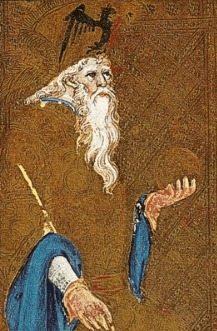
Profile of The Emperor card. I never actually saw this one in the game, but I like it most.
By Marco Vallarino. Played to completion with two hints.
Yours is a bloody, thousand-year-old story. You filled the nights of Europe with nightmares for centuries. Wrapped in your cloak, you spread death and destruction everywhere, ruling as the undisputed prince of darkness. You seduced and enslaved the most beautiful girls on the continent and crushed anyone who dared to oppose your dark supremacy.
Then someone found your hideout and, while you rested defenceless, drove a stake through to your heart, killing you merciless. But now you’re alive again, ready to take your revenge.
Darkiss – Chapter 1: the Awakening (let’s agree to type Darkiss for short) is a parser game that casts you as a weakened vampire who is left for dead after many years, seeking revenge.
The prose is so very, very gothic. I hope you like adjectives.
It’s got an appropriate puzzle spread, because the ones who attempted to kill you also left many other barriers in case the wooden stake wore off.
I did find the puzzles solvable (both of my hints were near the end) although I had a not-insignficant amount of struggle with the parser. For example:
> x door
The solid iron door at the centre of the northern wall seems to be the panel of a giant safe. Without keyhole, in its centre it has four small wheels with numbers from 0 to 9 that, knowing the right combination, should serve to open the door by turning the handle set at their side. Unfortunately you have no idea what the combination could be. You only know that you never succeeded in memorizing it, so it’s possible that you’ve left a hint somewhere to remember it.
The door is closed.
> set combination to 6000
You can’t see any such thing.
> open door with 6000
You can’t use multiple objects with that verb.
> turn wheels to 6000
You can’t see any such thing.
> enter 6000
You can’t use multiple objects with that verb.
After giving up for a while I finally came upon:
> open door
What combination do you want to try to open the door?
> 6000
The door doesn’t open.
One puzzle spoiler and one major plot spoiler follow.
.
.
.
.
.
.
.
S
P
O
I
L
E
R
S
.
.
.
.
.
.
.
Even though I was able to solve most of the puzzles without hints, it doesn’t mean they were all fair. In particular, one puzzle involved using COUNT twice, on the same thing. This violates one of the implicit player contracts, that information given in an unusual command will not be changed. I managed to come across an answer by dumb luck (I didn’t have my notes and needed to recheck the count number). The game also requires using SEARCH twice, but at least this is fairly standard in IF.
Regarding the main character of Darkiss, he isn’t even an “antihero” (who might have some lingering redeeming qualities), just a straight up villain who lingers in describing a torture room. Yet it didn’t bother me here, even though by the end of the plot there is one definite act of evil. Why?
I suppose Darkiss did a good job of establishing the game as playing a role, inhabiting another body as a playactor. There was no implication my personal morals would be invoked. Hence I could roll with the gothic mood and cackle evilly while lusting for the death of the vampire hunters.
By The Marino Family. Played to completion on an iPhone.
One of the things I find enjoyable about reading children’s literature is the prevalence of whimsical narrators. If the narrator in an adult’s story started giving out points for clicking on random factoids or accidentally telling the wrong story, it would seem annoying; in Switcheroo it’s charming.
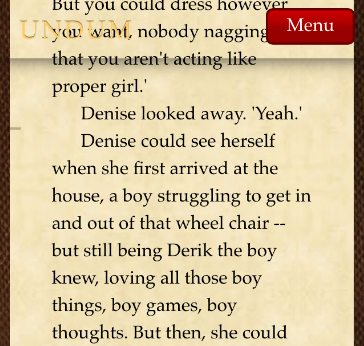
Switcheroo is set in a orphanage run by the magical Mrs. Wobbles. Derek, a boy in a wheelchair, awakes one day to find himself not only able to walk but also transformed into a girl.
He shortly afterwards gets adopted, and tries to cope with both the use of his legs and the change in his identity.
The writing keeps up a rollicking tone and the choices are small but not irritating. (There’s bits of text that could use an editor but I never found the issues severe enough to be distracting.) Also, randomly and hilariously, there’s a mini-game involving The Ana Chrony Doll Trading Card Game where historical figures engage in battle. I picked Sonia Sotomayor. Legal argument attack!
I also found myself rather more invested in the final choice than is typical.
.
.
.
.
.
.
.
.
.
.
.
S
P
O
I
L
E
R
S
.
.
.
.
.
.
.
.
In a prior review I mentioned the “Clue effect” where a series of endings one after the other result in them not being important at all, because the story comes across as a combination of all of them rather than a motivated choice.
In Switcheroo, the only major decision comes at the end, when Derek has to choose if she wants to remain a girl or go back to being a boy. I felt like this choice had heft; while I could go back and pick the other, only one of them was the correct choice for how I was playing the story.
In other words, I actually stopped to think for a while. That’s a good accomplishment.
(In case you’re curious, Derek stayed as Denise. She seemed happy! Who is to say one was more real than the other?)
By Adam Bredenberg. Played to completion (?) with Python 2.7.
SO WE ARE FATED DEATH BY WILLOWS:
We broke with ancient covenant,
grew unthoughtful and wicked,
fell away from worship of our ancestors,
incurred their sudden and mighty wrath.
Their bodies came alive again,
monstrous, hungering for blood,
and we are entirely without hope.
The War of the Willows pits the player in single combat against a tree.
More specifically you get a choice of desire (survival/forgiveness/love/power), recipient of sacrifices (Nyeru/Hobark/Athena/geneus/Vordak) and luck charm (rose/coin/star/locket). Then you enter battle with the choice to strike, advance, retreat, evade, or pray to one’s god.
That’s everything. It’s hence a mini-strategy game nearly like one of the BASIC type-ins of the 70s.
At a mechanical level I found it both too complex and too simple.
It’s too complex in that I didn’t understand all the moving pieces, and especially didn’t understand choices like what advantages a rose has over a star. There was no ratiocrination or planning or tactics. It’s too simple in that even without those things I was able to defeat the living willow in combat with no thoughtfulness at all: just attack, advance, attack, and so forth.
I’m guessing there’s many elements going on “under the hood” but they weren’t transparent enough for the player to use them in play nor complicated enough to stymie a player using a “button mashing technique” in combat.
Despite all that, The War of the Willows has something novel going for it: everything is in poetry form. This has shown up in the competition before; see Graham Nelson’s Shakespeare team-up The Tempest from 1997 or Valentine Kopteltsev’s underrated work A Night Guest from 2001.
In the best places the poetry has a gritty feel, like a a lost companion volume to Beowulf.
A black bull and a red bull,
three calves and a white goat,
burnt live upon Lebanon cedar.
White-green flash of copper powder —
the King of Fire accepts his offering.
Unfortunately the author seems to be running on gut instinct rather than any careful thematic or rhythmic control, because the words occasionally run amuck.
Came they upon the library
ripped each book to shreds,
slept that night in the confetti.
Ancient … confetti? Also, the second and third lines drop like weights and either need rephrasing or some sort of connective word.
Branches enwrap you like muscular snakes,
threatening to bind you entirely
as willow-whips lash your face.
You wriggle between them,
fighting for freedom.
The above stanza comes across more as a sentence with line breaks than a poem. (This is, admittedly, an accusation that can be leveled at much of modern poetry. However, The War of the Willows does not seem to be shooting for modern.)
Still, everything is well-fashioned enough to reward close reading (which I might get to after I finish reviewing the 1000+ games for this competition and my eyes stop bleeding and oh god make the pain stop).
Burned its bones to boil water,
looked from the parapet window
as the great ranks of them
tore stones from the walls,
disassembled the gate
of our last redoubt,
with a cool, solid fury,
fields pink to the sunset
with the arcs of their flowers.
My question mark next to “finished” on the top of this post indicates I’m not sure if I got an optimal ending. The willows still won even after I won the battle. I am suspecting there is a trick I missed (perhaps involving a well-timed prayer) but I wasn’t able to nudge anything out. If someone wants to provide a hint in the comments I’d be appreciative.
By Michael Sterling and Tia Orisney. Played to completion using Firefox.
The late-80s-early-90s included what I might call the Great Sierra-Lucasarts Rivalry, where one of the debates was on player death.
Lucasarts games tended to be Nice, with many of them not having death or even a way to get stuck. Alternately, death was set on a loop that returned the player to right where the death occurred (for example, in Indiana Jones and the Last Crusade, failing to pass one of the deathtraps guarding the Holy Grail simply returned the player to the start of the deathtrap).
Sierra tended to have death early and often. Small errors led to an untimely demise and it was all part of the experience. In some cases — especially in the Space Quest series — amusing death was a highlight of the game.
The main argument in the pro-Sierra camp was that removing death also removes stakes; any sense of danger or tension is undercut by the lack of consequence. Lucasarts proponents cited overall frustration, but also the fact the save/restore cycle made everything moot anyway. Causing a habit of hitting Save like a hyperkinetic rabbit is not the same as creating story tension.
These days, with good reason, the Lucasarts supporters have won; not just in adventure games, but pretty much all gameplay genres. Still, the counter-criticism sounds, tinny but audible: a lack of consequence destroys tension.

The flame of Death is kept alive by the old-school gamebook. Kane County is a choice-based game thoroughly in that style. You have crashed your Jeep in the desert, and need to make your way back to civilization.
When your Stamina reaches 0 you are dead. This can happen in any part of the story Stamina is reduced; there is no attempt to sacrifice the simulation for a cleaner story arc.
At some point you collapse facedown in the sand. You can’t bring yourself to move another inch.
Unfortunately, tomorrow doesn’t come for you.
Want to try again? Reload your browser.
The effect on my own gameplay was to have me angst over each decision. I tried to think like a survivalist and winced whenever my Stamina or Water was reduced unnecessarily.
Minor spoilers ahead.
.
.
.
.
.
.
S
P
O
I
L
E
R
S
.
.
.
.
.
.
.
.
.
I especially liked how carefully the sleeping conditions were weighed to determine if any stamina was gained by rest.
Night 1 Results:
Chose Cave: no stamina loss.
Chose juniper: -1 stamina.
Made a fire: +1 stamina.
Didn’t have a fire: -1 stamina.
Insulated with grass and sticks: no stamina loss.
Dug a shallow pit: no stamina loss.
Dug a deep pit: +1 stamina.
Didn’t improve shelter: -1 stamina.
Had the space blanket: +1 stamina.
I’d like to say my winning run was due to superior observation, but unfortunately it hit the other standard gamebook trope: luck. I happened to pick a route that netted multiple boat parts, so when I reached a river I was able to fix a broken boat to enough an extent I was able to float all the way to the end of the game. I suppose my decision to go the water route was at least somewhat logically motivated by my inventory, but I still didn’t feel like I earned the win in the same manner as solving a puzzle or finessing my way through a tactical battle.
By Brendan Patrick Hennessy. Played to completion using Firefox.
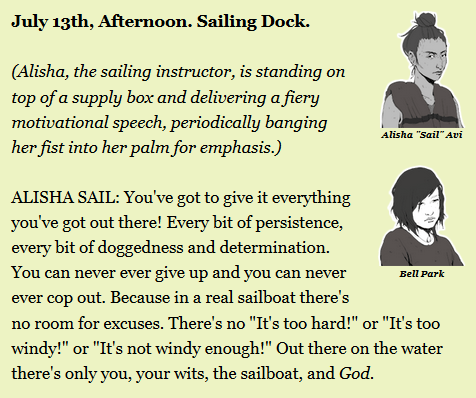
…wow.
I’d be nice if I could just end the review right there, but I suppose you want pesky things like details and reasons. Okay then.
Birdland involves a girl (Bridget Leaside) at summer camp and suffering. She has dreams of birds. The uncanny dreams start to link with reality.
The story is conveyed in “movie script” form, with dialogue taking center stage and all the action happening in parentheses.
Structurally, the most ingenuous part is that the choices of the dreams at night then affect the moods of Bridget during the day (things like “tenacity” and “melancholy”). The moods are the “statistics” and affect whether Bridget can make certain choices. Birdland advertises up front if a choice is available or not due to the moods.
Actions during the day don’t seem to affect the mood statistics, and the moods are generally only temporary conditions that can swing between extremities anyway. This cleanly avoids one of the problems in ChoiceScript games with a “snowball” effect where the only choices one feels safe in making are based on the statistics originally developed; those choices will likely boost the relevant stats further, and not focusing will cause failure later. This leads to the player steering clear of interesting choices they might make otherwise take. (Paradox Corps from last year’s IFComp had this problem.)

An excerpt from one of the dream sequences.
In any case, the plot is great, the characters are great, and the dialogue is so good I had to clip out some more:
…
TAYLOR M: I’ve got a boyfriend.
YOU: Oh yeah. Ambient light.
TAYLOR M: (staring off into space) He’s so great.
…
YOU: I don’t know, I guess it’s like, so we appreciate nature and stuff?
(She grabs you by the shoulders.)
LIZ: WELL I AM NOT APPRECIATIVE.
…
YOU: Just as long as we don’t get eaten by a bear.
BELL: Don’t worry. I’ve seen the bear statistics. We’re fine.
YOU: Have the bears seen the bear statistics?
…
If there’s any con to be had, I don’t think the adult dialogue all works for me (this is pre-{PLOT SPOILER}) and the author spent more time getting the speech patterns of kids down than adults. I’m going to chalk it up to “perspective writing” and not worry. Full marks.




 Renga in Blue