
Back to Scotland! It’s been a while.
Engine Failure is a type-in that first appeared in Personal Computer World (April 1983) and then in the spin-off Personal Computer Games, the same as Adventure in 1K.

Personal Computer World was very business-oriented, so it is understandable they might have needed to scrabble from prior material to have enough to launch a games magazine.

An ad from the same issue showing a typical example of content. Hilderbay made a previous appearance on this blog with the game Gold but otherwise was focused on business and utility software.
The author, Ian Watt, is yet another one of our teen-aged authors (born in 1967). He founded a ZX80/81 club out of Glasgow (“One of the club’s main aims is to encourage computer literacy”) that was a branch of Tim Hartnell’s extended group (see my writeup on The Citadel for more on how that got started). Of his five published games, one was only in magazines (this one), one is part of a book edited by Hartnell, and three are part of a book by Ian Watt with an introduction by Hartnell. Eyeballing dates, it looks like Engine Failure was the first to make print, which is why I’m starting here.

Pollokshaws, where the ZX80/ZX81 club met. Via Rosser1954, CC BY-SA 4.0.
Engine Failure is “tiny” (two pages, along the lines of Arkenstone) but due to some cryptic object interactions took me a while to finish.

Our spaceship has had its engine fail near a planet, and the engine needs to be repaired before the spaceship is destroyed in the atmosphere.

Gameplay starts in a control room with cryptic buttons; pushing the red one right away causes the ship to blow up.

Even after finishing the game I’m unclear what the functions of the buttons are (that is, I know which ones to press to win, but I’m not sure what the user manual would say each one does in a real-world sense).

Just south of the starting control room is “living quarters” with “water” and a medical bay with a “pill”. The game lets you uneventfully drink the water and eat the pill although it isn’t clear what puzzles this solves, or if it even helps solve a puzzle (it does, I’ll mention it when it happens).

To the south are some “computer banks” with a floppy disk — I’ll deal with that later — and then heading eastward leads to a Cargo Hold (with pliers) and an empty Engine Servicing Room (where going any farther is death, due to a “pet origonk”).

The issue here conceptually is that the sparsity makes it unclear if this is just an adjoining room or something useful later; there’s no control panel or circuit board. Hence, for a while I kept trying to go west, but it turns out going west is impossible and always a death.

Heading back to the computer storage banks and west, there’s a shuttlebay, although entering the shuttle kills you with nerve gas.

It is unclear why the shuttle on your own ship would be filled with deadly gas. I assume there’s some unmentioned sabotage in the plot that happened on our last stop.
Going a bit farther west is a spacesuit; wearing it is the solution to the nerve gas.
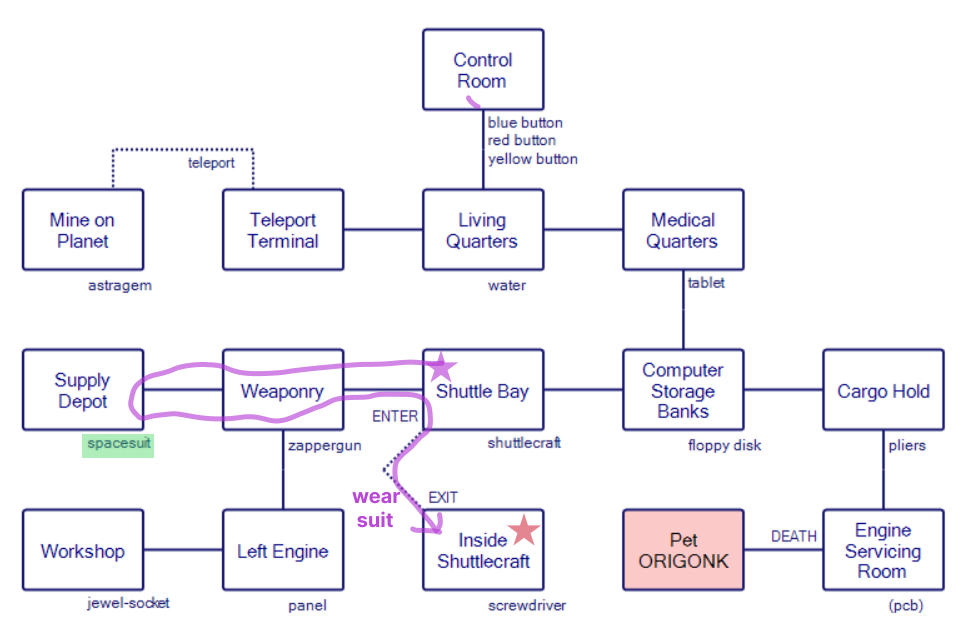
Safe from the nerve gas, you can now find a screwdriver inside the shuttle.

The screwdriver can be used to UNSCREW a panel at a room marked “Left Engine” (Right Engine has the creature and is impossible to reach). The panel has a lever, and pulling it activates a blue light.

It’s time to head back to the control room, but while heading back we should grab a “jewel-socket”, a “zappergun”, and that previously mentioned floppy disk along the way.
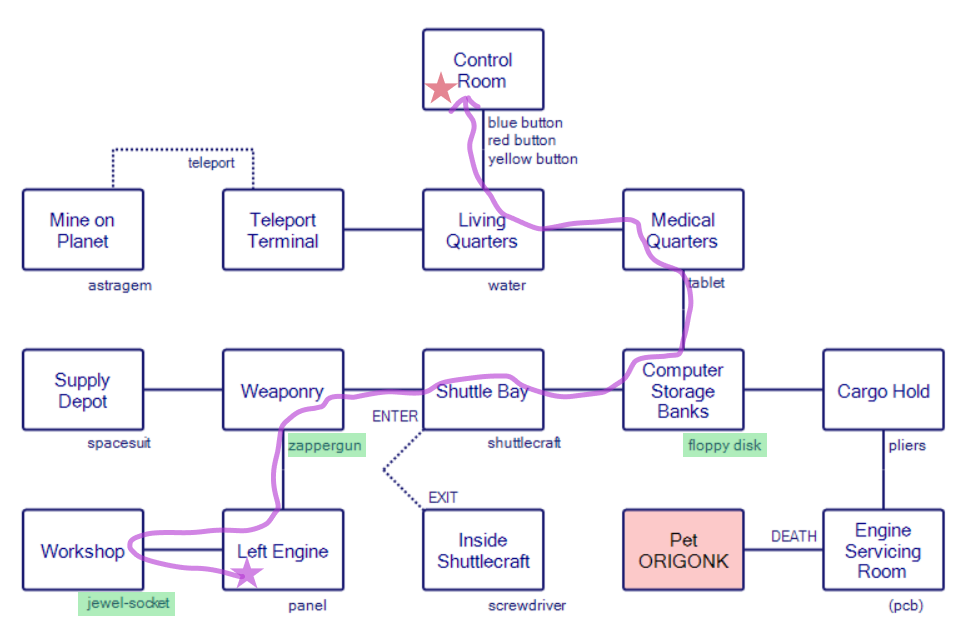
There is a blue light in the control room now, and you’d think that’d mean you just press the blue button, but that kills you. You need to press the yellow button, which turns the light yellow, and while the yellow light is on you press the blue button, which reveals a “pcb” that is “somewhere in the ship”. (Somewhere turns out to be that empty “servicing room”, but we’ll head back there later.)

While we’re at it, we should also INSERT FLOPPY (no description that there’s a place to put the floppy, I just tried INSERT FLOPPY in every single room until it worked). This causes a red light to turn on, and now we can go straight to the put and PRESS RED.

This will activate a “TELEPORT TERMINAL” just to the south and west of here. I spent a long time trying to operate the machine before checking the source code; it’s just the word TELEPORT by itself.
You are safe using the teleport if a.) you’ve drunk the water b.) eaten the pill and c.) are carrying the zappergun. The first two prevent a disease from killing you, while the zappergun prevents guards from killing you. (It’s very weird and passive, since the zappergun doesn’t get shown being used! You might go through all this and not realize there is any opposition at all.)

While holding both the ASTRAGEM and the JEWEL-SOCKET from earlier you can INSERT ASTRAGEM. Then, back where the PCB got revealed (next to the killer pet) you can INSERT JEWEL (as long as you are holding PLIERS) and a red light will turn on. Then to finish the game you just need to run back to the control room (where it starts getting very hot, the time limit is tight) and press the red button again.

Why does red either blow up the ship, activate the teleporter, or activate some kind of gem? Why does the lever causing a blue light mean you should not press the blue button, but the yellow button instead? I know the author was essentially trying to create an “experiment” type puzzle, but it diverged into the sort of messy and unintuitive interaction I associate more with fantasy games.
Incidentally, while trying to solve the above issues, I looked at the room structure data, and it’s very unusual. Most games have data along the lines of Room Name, 4, 5, 1, 0, which indicates a room, and the rooms (by ID) that go north, south, and east respectively. This game instead has a whole data line like this:
0 -1 0 0 0 3 0 0 0 -3 0 0 -2 0 0
These are all the north exits, and furthermore, they give information in a relative sense. That is, if you’re in room 2 (living quarters) and go north, you subtract one from the room ID to find where it goes (room 1, the control room at the start). I’ve never seen anything like this before; almost always the absolute room ID of the destination is given. I’m unclear why the author would use this method of expressing exits. Perhaps his book has some clue, but we’ll save that for a later time.
Coming up: Infocom.


 Renga in Blue