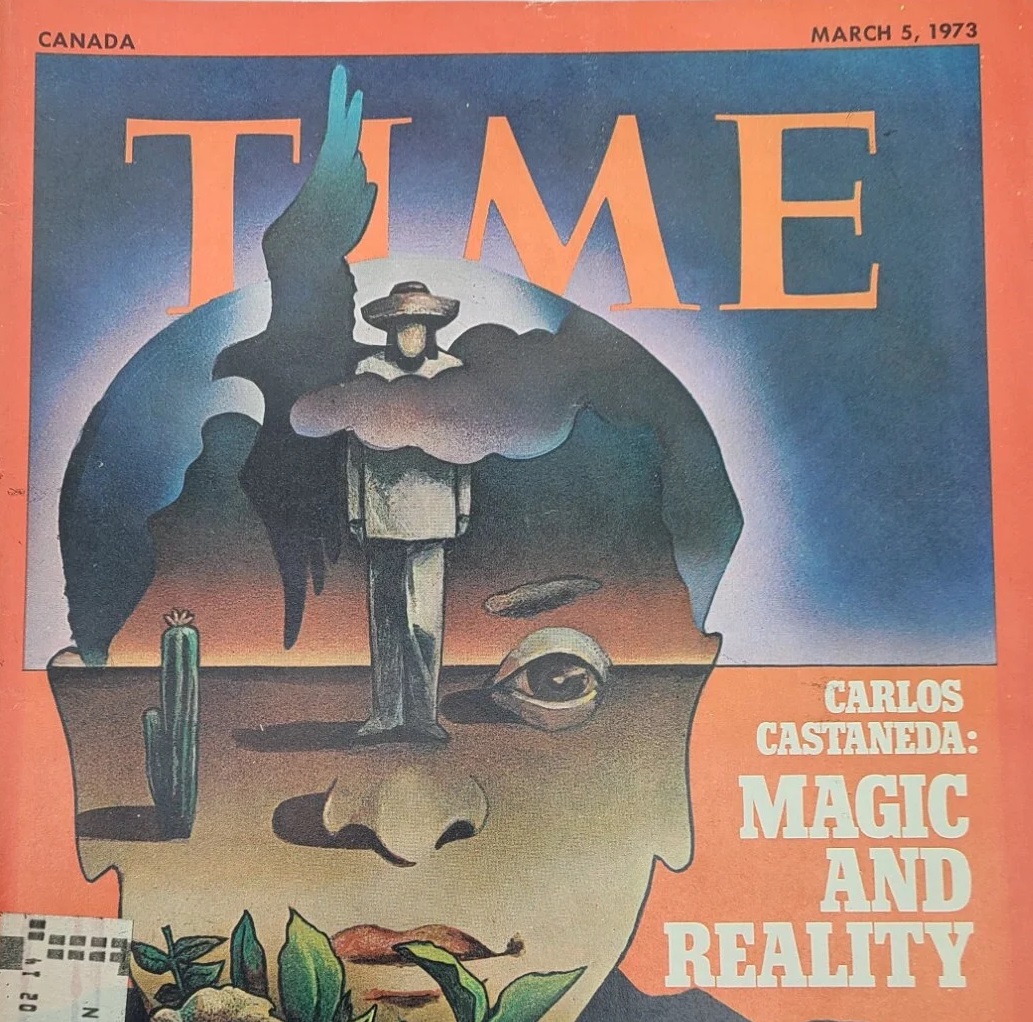
This issue of Time called Castaneda the godfather of New Age. The best article I’ve read on his legacy (and his “cult” of “witches” that cut themselves off from their families) is this one from 2007.
First, let me go over two chunks of contents from before the cave that I had missed. Neither is necessary for the win.
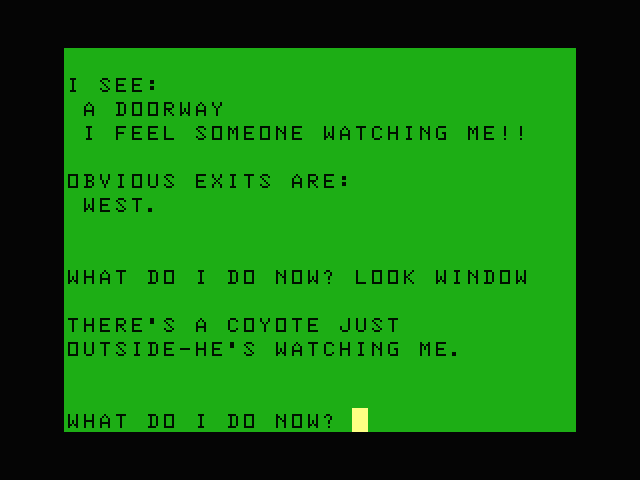
The first moment is right here, at the shack. I had never worked out what being watched meant, and I could swear I tried LOOK WINDOW here. Maybe I misspelled it WIDOW and didn’t notice and moved on.
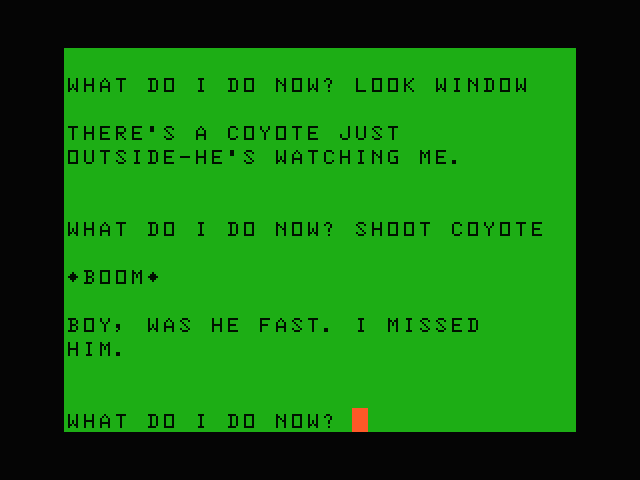
You can shoot the shotgun (which I also had never used) at the coyote.
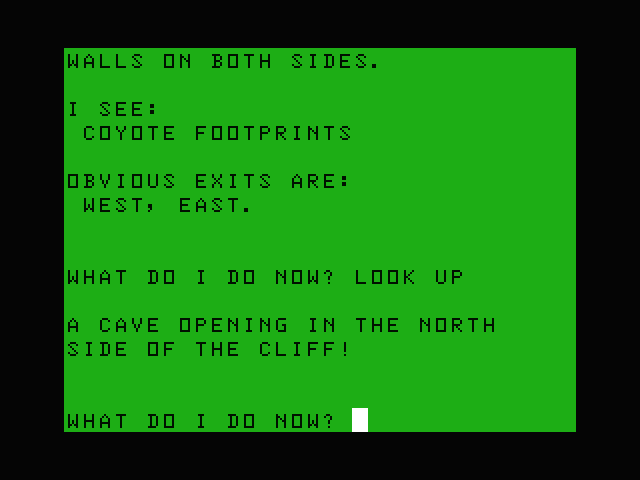
You can then go outside to find footprints, and later, if you go in the canyon, you can see more footprints and LOOK UP to see a cave.
This is how you’re supposed to know about the cave without guessing based on geography.
The other scene I missed involves the place with the machete.
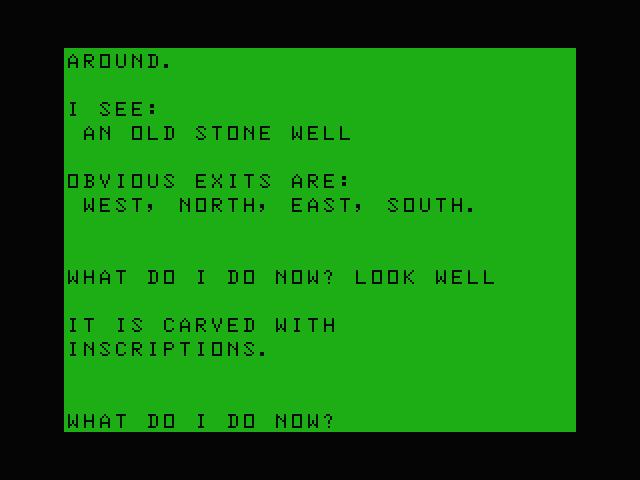
There’s a hole you can climb in and up and it seems to be the bottom of a well (that is, the well seen in the desert) but I had warped out without thinking of it much. If you wrap around on the map there’s a wall you can PUSH, breaking open a passageway, and that allows light to come in so you can see some inscriptions in the southeast corner.
Then if you go down to the bottom of the well and SAY UP you get warped to the top. This is entirely unnecessary, and I had to check a walkthrough because it wasn’t working (it turns out I was trying it while I had already crawled partway up, but you need to use the word at the bottom). However, the inscriptions that explain dreaming aren’t readable until you have the mask, so I understand the author’s sequencing as some players wouldn’t be able to dream-warp yet (and I respect the fact he left open the possibility of an alternate solution).
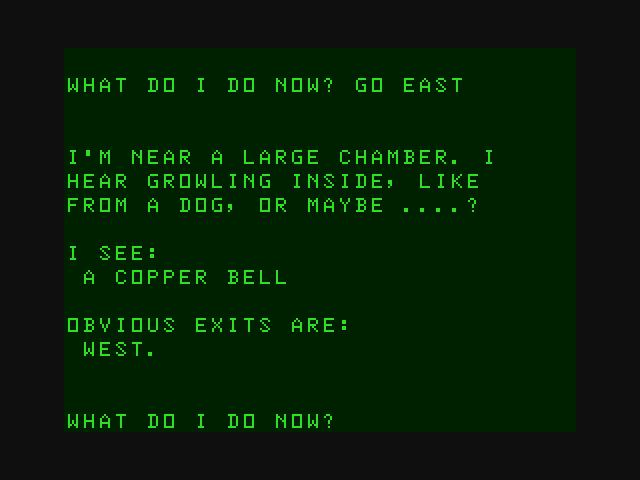
My winning game did neither of these scenes so I can confirm they are not strictly necessary. One last thing before returning to the action: after entering the cave and before riding the beast, I missed an important room. This is back where I found the bell:
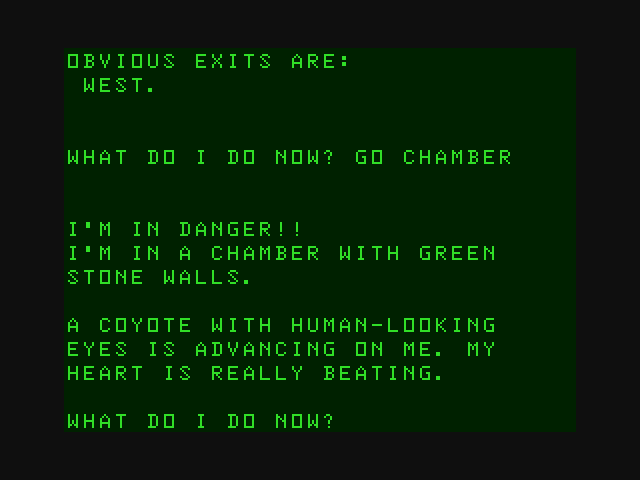
You can GO CHAMBER (somehow, probably because of the sound, I parsed the room as geographically close to the noises but not having a literal door, even given the word “inside”). There you can have a confrontation with the coyote. You’re not ready yet — the twig needs to be dipped in the oil of cactus blossoms, as told us by the lizard. So let’s save that:
Back to where I left off, I had been swimming in a pond and made it to a “block” which referenced a mysterious yellow bull. I was stuck, but I should have been paying more attention to one of the messages while in the water. For the initial dive, if you try to keep using SWIM DOWN to go farther, you get the message
CAN’T GO.
but if you do this at the third lake with the ruins, going down at the “bottom” instead says
I CAN’T SEEM TO GET ANY DEEPER.
These being different messages should have been a red alert: there is a way to go deeper. You need to be holding something heavy.
You need to be holding the granite block.
This lets you go to a fourth pond, leading to a tall pillar by another chasm. You can PUSH PILLAR to knock over the pillar and walk over it.
The path eventually leads to the north side of the same chasm we started at.
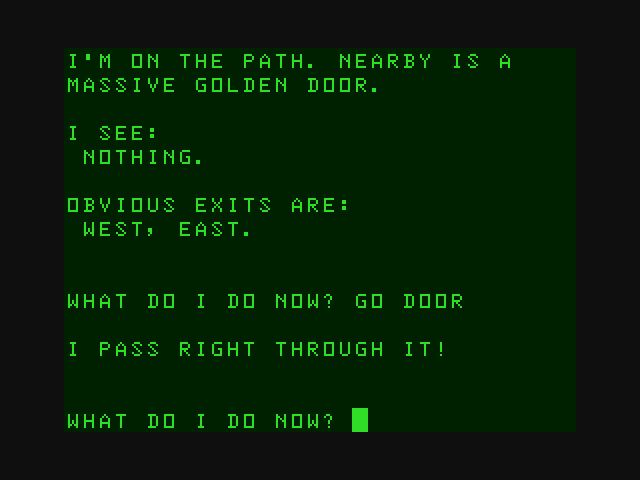
The north side of the chasm, importantly, includes a golden door. Try to open the door, and it proves to be an illusion. You can just walk through.
Lizard buddy! I tried the SAY REVEAL code from before and was told
LISTEN WELL, FOR ONCE YOU BREAK THE YELLOW BULL, THAT WHICH WAS UNREAL BECOMES REAL.
To the west are some clay colored statues of bulls. None of them look yellow normally, but fortunately I had been obsessively trying GAZE on everything in the game, and finally it paid off.
Don’t take and break the figurine right away! As the lizard warns you, unreal things will become real, so the golden door that previously you could just walked through now seals shut.
Yes, this is a softlock, although the player was pretty amply forewarned; I had to set this up on purpose to get the screenshot.
However, this also means the golden bridge and golden statue become real as well! So you can walk across the golden bridge now without falling in, and the golden statue lets you touch it, and more dramatically, push it so it falls into the chasm.
I did something goofy in retrospect here and went through the chasm section again trying to figure out where the golden statue landed, but the smell is coming from the spot the statue was, not where it went. I was just supposed to look, as the room now had a DEPRESSION.
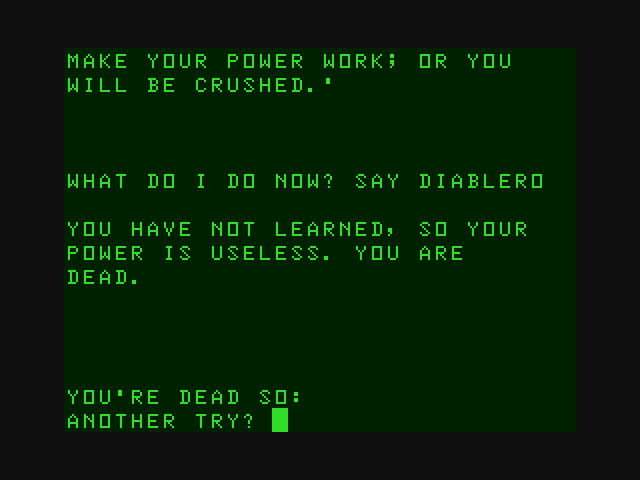
Twig powered up! So now it was time for a confrontation with the coyote, and the game’s final trick. This is yet another moment of participatory plot, where the player themselves needs to figure out what’s going on to get the final revelation.
Pause a moment to breathe, and formulate what you think the answer is.
From World of Dragon.
If the coyote wanted us to lose, why would he tell us what we needed to do to use the magic?
Yes, our teacher was El Diablero the whole time, in some cases putting us in a significant amount of danger. This is not absurd for the Castaneda-verse.
In Castaneda’s fourth book, Tales of Power, he essentially finishes his initial “sorcerer’s journey”. He is ready at the end to take his final test with don Juan and don Genaro, and is taken to the edge of a cliff, where he must jump.
Don Juan and don Genaro stepped back and seemed to merge with the darkness. Pablito held my forearm and we said good-by to each other. Then a strange urge, a force, made me run with him to the northern edge of the mesa. I felt his arm holding me as we jumped and then I was alone.
This works terrifically as literature, but is a bit more sad when it is given as literal, which Castaneda always clung to until the end. I’ll leave the sordid details to the article I linked (but at least one person seems to have died trying to enter the “other world”). I should emphasize none of this was really known to the general public in 1982, when El Diablero came out.
Which is good, since I don’t know how well I’ve conveyed this, but: the game was magnificent.
Not a masterpiece, maybe not even a high scorer if I tried to come up with some acronym (Morpheus Kitami gave it a try). The writing is obviously sparse and one could imagine the brutal reviews if this was turned straight from text to novel form, but in terms of the game’s premise it works: it felt like I was reckoning with nature as intellectual and sparse, and the parts where the words counted they were used effectively.
I AM EVERYWHERE AND NOWHERE AT THE SAME TIME. A STEADY WIND BLOWS AGAINST MY FACE.
Despite the grand cliche at the end, the story was genuine and serious, and it gives the player freedom to do some things out of order while still driving to an ending. There are two moments of participatory plot where the player moves events forward simultaneous with having a revelation about what’s really going on.
Amnesia is definitely old hat by now, but this is the first adventure game we’ve reached that’s had it. Kalish invented the amnesia adventure plot for this game. This is the first time we’ve had “memory unlocking”.
(No, seriously! The other references I’ve made have been sort of a quasi-amnesia. Ferret had amnesia, but it was only tangentially relevant and the game is only sort-of from 1982. Mystery Fun House has come the closest by hiding the player’s objective in their shoe, and that game also did some wonderful moments of participatory plot; the protagonist knew what was going on, just the player had to figure it out.)
The puzzles were rough and could use tweaking, and a couple bugs caused distress (I didn’t even discuss how the inventory count gets messed up by the magic twig, causing your inventory limit to go down permanently by one). But this is the sort of game I was hoping to find through All the Adventures, something known to very few which deserves a more public viewing.
This was Ken Kalish’s only text adventure.
It would have been nice to be able to do more text-only adventures as a way to do story telling, but graphics adventures supplanted the text ones.
Odd comment (since Infocom was just getting started in 1982) but I can understand it being easier in a business-pragmatic sense to do graphical games, especially for a US author that didn’t have a thousand shelves he could toss a ZX Spectrum tape onto.
Next up: Speaking of endless shelves of ZX Spectrum, we’re headed back across the pond to hit one of those games, with a much simpler plot than El Diablero. (Which happens to have graphics! I might instead do one of the other ports, I haven’t decided yet.)
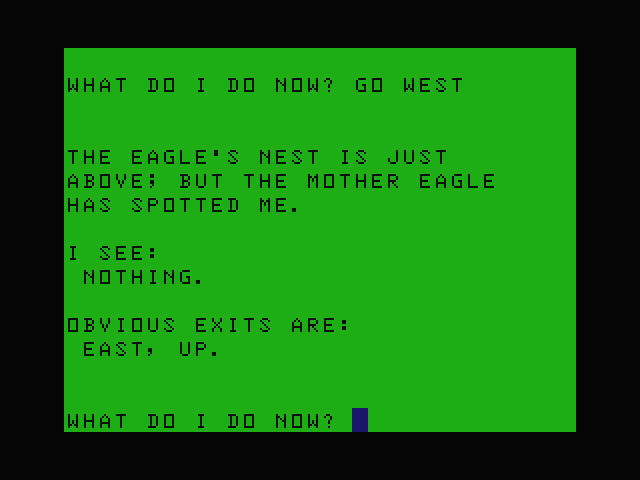
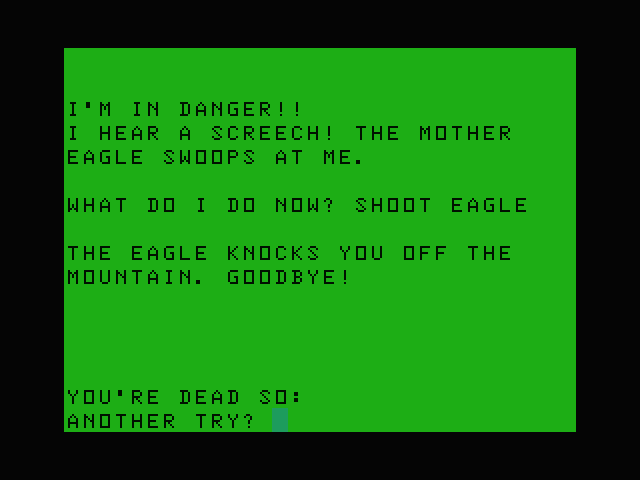
Nearly almost immediately after finishing my last post I made a breakthrough. This is not that uncommon for me. The act of writing sometimes helps me think, and having my tasks laid out with pictures can also help me zero in on what to do. I had listed as task number one to try different teleport destinations, and it occurred to me, regarding the scene with the eagle…
…that I could possibly DREAM my way straight to the nest, avoiding the eagle confrontation that way.
Remember, the mechanics are such that you can DREAM a place to go to it, then AWAKEN to return right where you left off.
I flailed a bit trying to transform with the eagle feather. I should mention I still have no idea how to transform — it isn’t needed for immediate progress — and I’m starting to suspect it is location-specific rather than a new general power.
I then tried a bunch of plausible dream locations — trying to imagine what the author might go for from the Sonoran Desert — and while RIVER and STREAM didn’t work, I hit paydirt with DREAM CAVE:
HIS POWER PREVENTS ME.
I technically was already able to bypass this. It turned out to be the hardest puzzle of the game so far. Let’s save that for a bit later.
I also did some verb-testing on each of my objects in turn; with BREAK, I finally got a hit when I reached my bowl:
The key was the missing item needed to unlock the box, and the box has a blue pebble and paper that gives instructions.
This opens a small area with an “ancient Mayan mask”. Wearing the mask is sufficient to translate the various inscriptions. They essentially already reinforced what I knew about the mechanics of the game, although the second message is subtly different; remember it shortly.
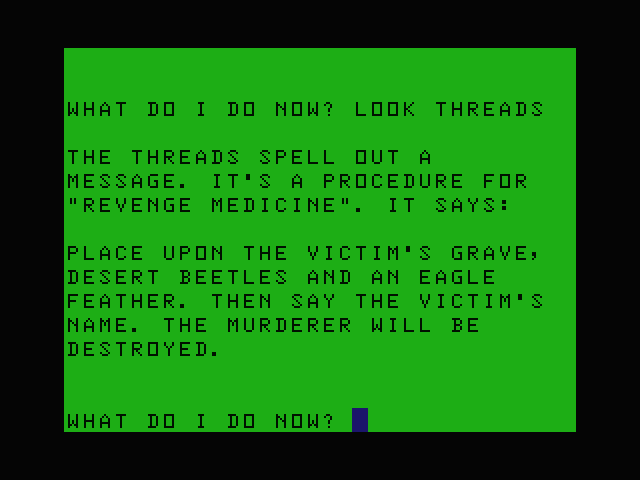
I next had the the tombstone to reckon with. The MAT, woven with blue and white threads, can be examined further. You can LOOK THREADS.
Second-order nouns — where you have to examine something in an description obtained via examining — are pretty rare in this era. I usually miss them and I’d argue in this case it’s unfair you don’t get any sense that there’s more to see from the first description.
I already had everything collected for this. The beetles came from using the machete on the cactus.
From a Computerware ad in Color Computer News, November 1982.
Heading over to Uxmal’s grave, I enacted the revenge medicine:
I absolutely loved this moment; no, we haven’t had our teacher built up as a character that much, but this is still a participatory plot twist rather than one just given to us. (See, relatedly, participatory comedy and participatory deathtraps. See also the “research puzzle” in Anchorhead which leads to one of the biggest plot moments of the game.) If nothing else, I’m pleased that the game actually appears to have a plot, even if a small one?
The next phase simply involved typing REVEAL to all three of the major critters (snake, crow, lizard) and finding the lizard was willing to chat.
I already had a magic bush, so I had a guess I could TAKE TWIG whilst there.
I have not dipped the twig in anything; I don’t think I’ve seen the oil yet, but it is faintly possible I’ve missed something in the initial areas of the game.
With all this reckoned with, I needed to reach the cave still. I was misunderstanding part of the mechanics of dreaming, in a way that feels like Castaneda getting told about some layer of reality he’s missing (or being informed in Journey to Ixtlan that not everyone needs drugs but he wasn’t smart enough to enter altered-reality at first without peyote).
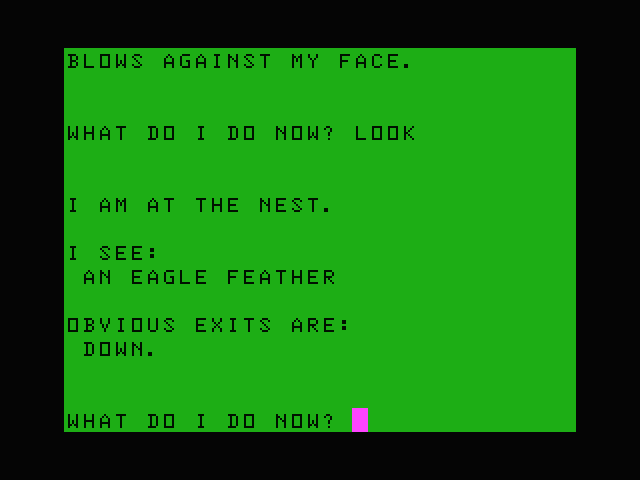
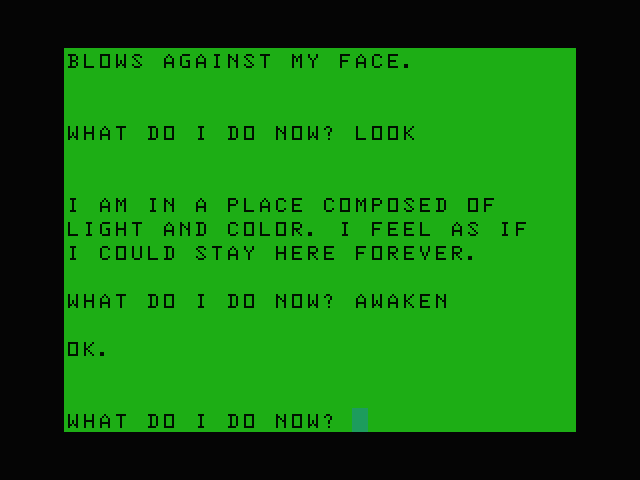
You can DREAM, just on its own…
I AM EVERYWHERE AND NOWHERE AT THE SAME TIME. A STEADY WIND BLOWS AGAINST MY FACE.
…and then AWAKEN, and you’ll be in the same place you started.
You can DREAM (LOCATION), which will take you to a location on the map, and then when you AWAKEN you will land back where you started. El Diablero is preventing dreaming of the cave.
However, you can also DREAM, no set location, and while everywhere and nowhere at the same time, you can AWAKEN (LOCATION). This can be used to arrive at the usual locations (like the well) but also can be used to bypass the power preventing you from arriving at the cave.
(Hence: “As you go, so can you return” doesn’t mean just that awakening is a power, but that awakening can be used just like dreaming with a specified destination.)
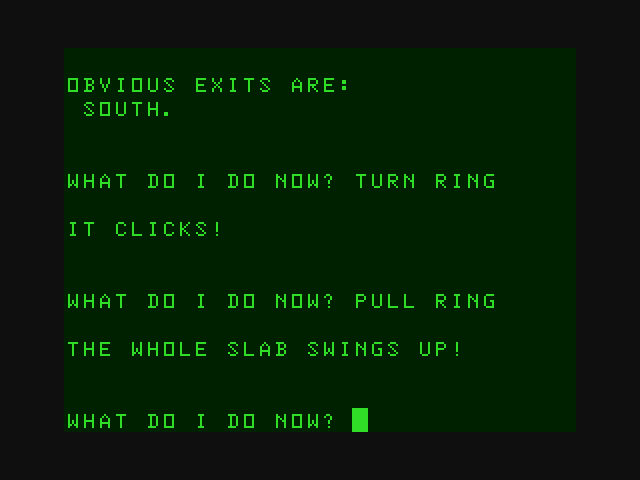
To the north is a ring on the floor which, quite straightforwardly, can be turned and then pulled to open some stairs. (I guess TURN isn’t used for shape-changing after all.)
If you’re wondering about the visual change, I switched to the Dragon version of the game here and switched the color scheme while I was at it.
The reason why is an item that shows up shortly after. You go down the stairs to a long east-to-west section by a chasm.
On the east side there’s a “copper bell”.
Trying to RING BELL caused the screen to clear (and no, that’s not supposed to happen). I was only using the first copy I found at the Tandy Color Computer Archive and likely one of the other copies works, but just in case I had an emulator issue I switched computer systems to the Dragon and found the issue resolved itself.
Going west to the “columns” (which have the message “FOR HE WHO SERVES”) and ringing the bell reveals a beast who is ready to give us a ride.
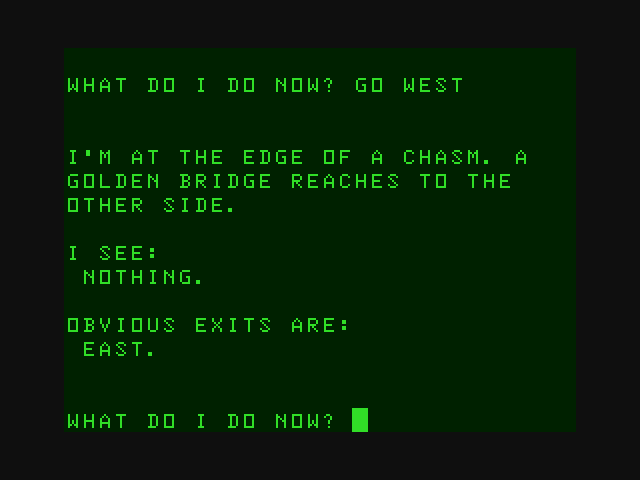
Before journeying deeper into the cave with beast-buddy, let me cover the two extra rooms to the west. One room has a “gold statue” but it seems to be illusionary:
MY HAND PASSES THROUGH IT! AM I IMAGINING THINGS??
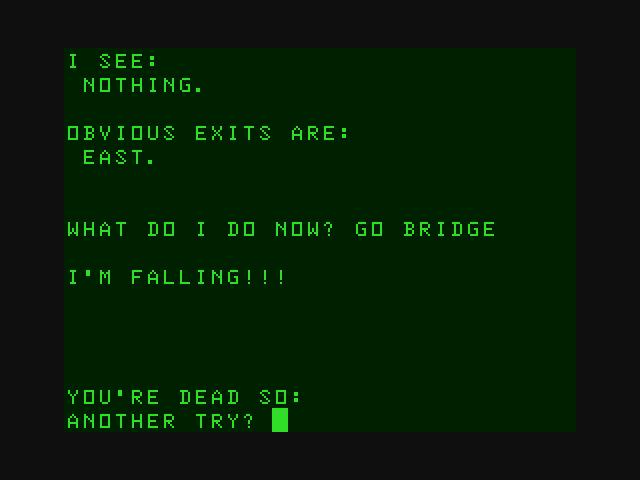
Farther west is a bridge which seems to also be a fake-out.
However, since I’m stuck later, I can’t discard either room entirely.
Back to where we left our ride running:
This leads to another self-contained section where part of it is under water. I’ve marked the water sections in blue:
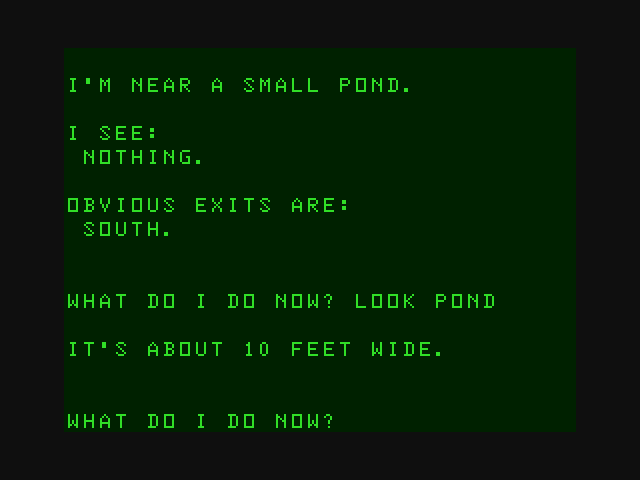
South of where you land there’s a skull; north is a pond. You can jump in the pond and then SWIM DOWN. This goes into darkness, but I realized I could SWIM EAST while underwater to reach a new area.
The first area you can pop your head out on is deadly. The game gives you plenty of forewarning about this, but I tried swimming in all possible directions anyway but I died of poison in all cases. (This is far more polite than the average 1982 game, which would just have the death happen without warning. There was even that mechanic with the blue/yellow shading earlier which was intended to hint at danger level; I suspect the author might have been annoyed at some deathtraps in a different game but still wanted to use them.)
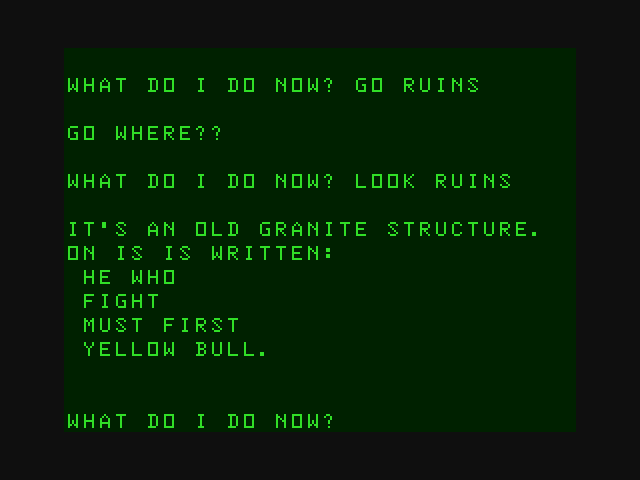
Returning to life again, we can dive even deeper to swim east yet again, finding a safe pond to exit. This leads to a “granite block” adjacent to some “ruins”.
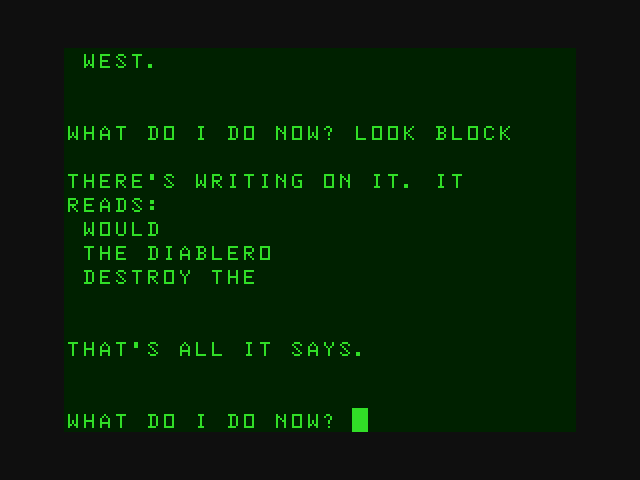
Combining the two hints together gets
HE WHO (WOULD)
FIGHT (THE DIABLERO)
MUST FIRST (DESTROY THE)
YELLOW BULL
with the catch that I have no idea what the yellow bull is, BULL isn’t even a recognized noun in the game, and I’m at a dead end. So I might have missed something in that whole sequence or I might be a few cryptic leaps from victory. (Do also note I haven’t found an appropriate twig-dipping spot yet either.) I’d still like to finish at my next post but I suspect the game will push hard enough back it’ll have to be two.
“A diablero? You are crazy! There are no diableros.”
“Do you mean that there are none today, or that there never were any?”
“At one time there were, yes. It is common knowledge. Everybody knows that. But the people were very afraid of them and had them all killed.”
“Who killed them, Genaro?”
“All the people of the tribe. The last diablero I knew about was S⸻. He killed dozens, maybe even hundreds, of people with his sorcery. We couldn’t put up with that and the people got together and took him by surprise one night and burned him alive.”
“How long ago was that, Genaro?”
“In nineteen forty-two.”
“Did you see it yourself?”
“No, but people still talk about it. They say that there were no ashes left, even though the stake was made of fresh wood. All that was left at the end was a huge pool of grease.”
— From The Teachings of Don Juan
My main key to progress from last time is to realize that I probably should just try anything that might possibly be a verb that is referenced in the game and in the manual. Doesn’t matter if no other game might consider such a thing: this game does not do its magic by SAY BLAHBLAHMAGICWORD (or at least, not so far).
Regarding the manual, I haven’t talked about it yet, as we only have the Dragon version. But Gus Brasil pointed out it was essential for something so I spent some time looking over all the notes.
From Museum of Computer Adventure Games.
When a location description is preceded with the words “I AM IN DANGER!”, there is only one correct response which will prevent you from being killed. There are no second chances, but there are subtle warnings. which can prevent you from getting into situations for which you are not prepared.
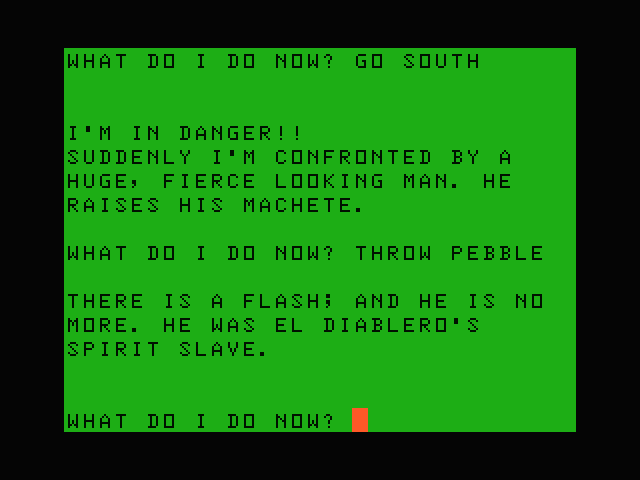
I’ve seen this already with machete man, and we’ll see this again shortly — this is indicating the way the code works, which really requires typing one specific thing in response. “Not prepared” suggests these will not be self-contained (like a puzzle where you have to WRESTLE the enemy but there’s no items or knowledge involved).
The manual also says you remember a poem on waking up:
Remember well the power word,
Remember that which twice you heard.
Awake to that which dwells within.
Throw off the yoke of ignorance.
I spent a long time trying various interpretations, and especially looking for anything early on that indicated something had been encountered twice. The closest was the shack which the game says you recall being familiar.
I still haven’t reckoned with being watched.
I tried using SAY on each one of the words in the poem in case any of them was a trigger: this was close to right. I needed to test each one as a verb. While in the shack:
Oho! This leads to a room with no exits or anything you can interact with, but you can AWAKEN to get out.
I discovered after some mucking about that you can DREAM OBJECT. In particular, at the well you can DREAM WELL. If you LOOK, though, it appears that nothing has changed; however, attempting to type DREAM again, the game says:
NOTHING.
And you are able to AWAKEN — even after wandering away from the well — to jump back to it. If you do something in the “real world” while you are dreaming it still stays.
I hadn’t unearthed the box while in “real world” state, but it stayed here after teleporting back to the well from awakening. This seems too elaborate to be a bug but I’m not sure what’s going on. It’s not the normal world-separation I’m used to with this kind of mechanic.
You can DREAM WELL while not even next to the well, and it’ll jump you over there; this puts you in the “sleeping state”, so awakening will warp you back to where you started dreaming. DREAM CANYON works similarly, taking you over to where the poisonous snake is. It’s almost like a warping “checkpoint” system?
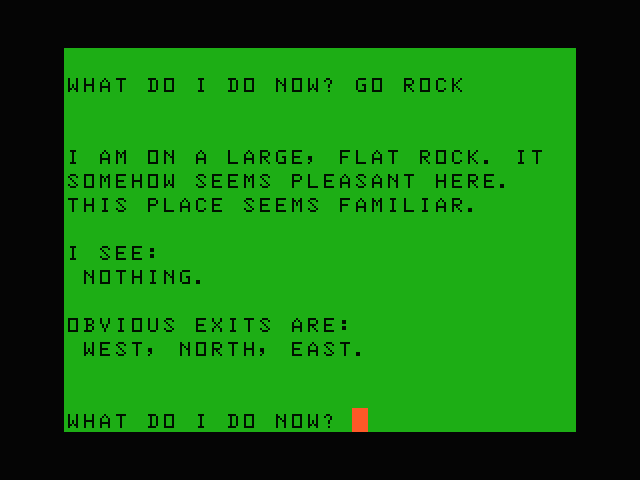
Because you can dream of places you are not even at to travel to them, that lets you warp to a new area. I was able to DREAM ROCK to go to one of the flat rocks I had been seeing in the desert but had been unable to get to.
I found out, after the fact, that I had typed GO ROCK in one of the rooms which describes it being nearby but you aren’t close enough yet. If you are to the west or east of the flat rock, GO ROCK works.
Just to the south of the previous location.
The “looking familiar” means this is a “remember” spot. Using REMEMBER here says
I USED TO PRACTICE THE SORCERY TECHNIQUE OF “GAZING” AT THIS SPOT!
You can GAZE ROCK and find it has a blue shade. This seems to be a hint that blue = safe (the blue pool is safer than the yellow one, that is). There’s another rock you can walk on which is more ominous. You “start to feel anxious”, and gazing upon it gives a yellow glow.
Flat rocks marked with colored squares.
So the end result is I figured out GAZE and DREAM a little out of order, but the game lets you. For the new location with DREAM, you can dream about the mountains in the distance.
At the top of the mountain is another REMEMBER moment.
None of the verbs I might suspect seemed to be understood. I almost thought I had progress by pretending the parser understood more words and typing TAKE FORM OF CROW, but all that’s happening is “FORM” and “OF” get ignored — the game understands that as TAKE CROW, not shapechanging.
This doesn’t work either.
I can at least report two other locations found off the mountain. One is some “rich soil” where it immediately occurred to me to try planting the seeds.
I have been unable to take the bush afterwards, so I don’t know what purpose it serves. LOOKing just says I’ve never seen one like it before; gazing does nothing.
Off in another direction is an eagle’s nest.
I assume shape changing is needed here for progress.
I’m fine with speculation/hints now, although do use ROT13 as usual. I especially want to know if I am missing out on the shape-changing for puzzle reasons (in which case I’m happy to keep whacking on it), or frustrating-parser reasons (in which case I’m happy to spoil). To recap where I am:
1.) I can DREAM in addition to GAZE in order to teleport to other places. (There may still be teleport destinations I can infer, I should make a full list.)
2.) I supposedly can shape-change but I have no idea how.
3.) I’ve planted the seeds, getting a bush, but the bush doesn’t want to be interacted with.
4.) I now have an eagle to get by, in addition to machete man. Regarding the snake that causes death upon being picked up, I’m guessing that’s a non-puzzle and the snake is just a shape-change target. The same might be true for the lizard.
5.) I still haven’t used the bowl, the mat, the shotgun, the debris, or the brush. I still don’t have a rope for getting into the well. I still don’t have any way of helping the blighted cactus.
To perceive energy directly allowed the sorcerers of don Juan’s lineage to see human beings as conglomerates of energy fields that have the appearance of luminous balls. Observing human beings in such a fashion allowed those shamans to draw extraordinary energetic conclusions. They noticed that each of those luminous balls is individually connected to an energetic mass of inconceivable proportions that exists in the universe; a mass which they called the dark sea of awareness. They observed that each individual ball is attached to the dark sea of awareness at a point that is even more brilliant than the luminous ball itself. Those shamans called that point of juncture the assemblage point, because they observed that it is at that spot that perception takes place. The flux of energy at large is turned, on that point, into sensorial data, and those data are then interpreted as the world that surrounds us.
— Carlos Castaneda, from the 30th anniversary edition of The Teachings of Don Juan
Long-time readers of this blog will know one of the tools I deploy when stuck (or even before I am stuck, if I know the game is going to be on the tough side) is a verb list. I plow through a set of verbs I know have worked on games in the past and mark which ones are active.
Sometimes a game’s parser will fight against any attempts to create such a list, but El Diablero helpfully states I DON’T KNOW THAT for any unknown verb, and only uses that phrase for unknown verbs.
I’ve never done anything resembling an exact sort, but for verbs that seem to be appearing more often I have shuffled them to a left column; the result here is that if a verb appears in the third, fourth, or fifth column, it is notable and worth remembering. LIFT just is a synonym for TAKE here; GAZE on the other hand is clearly its own verb, as LOOK on an object with no description gets the response
NOTHING SPECIAL.
while GAZE gives
NOTHING APPARENT.
Usually GAZE has applied to either crystal balls, mirrors, or reflective surfaces like water. The first two have not showed up in the game (yet?) but there has been a pool of yellow water and a pool of blue water, and both allow the use of GAZE. (Gazing is also one of the “powers” mentioned in the Castaneda books, similar to how sorcerers “perceive energy”, but I’ll save discussing that for the end of this post.)
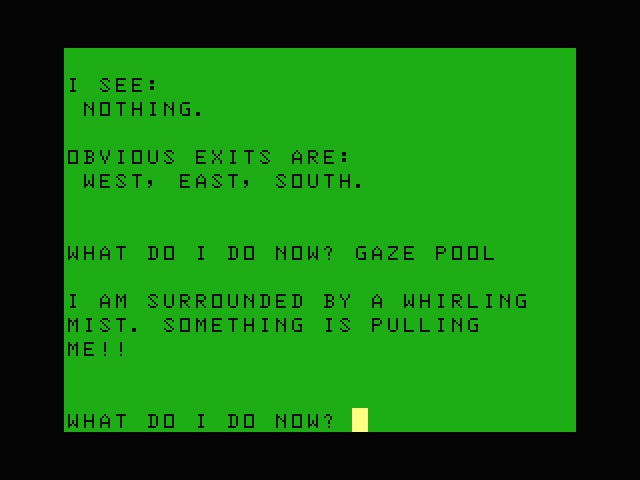
Gazing at the yellow water leads to a tunnel; there is no pool on the other side to travel back. The only way to go is south, where a man with a machete kills you.
I get a loaded shotgun later, but that doesn’t help here either.
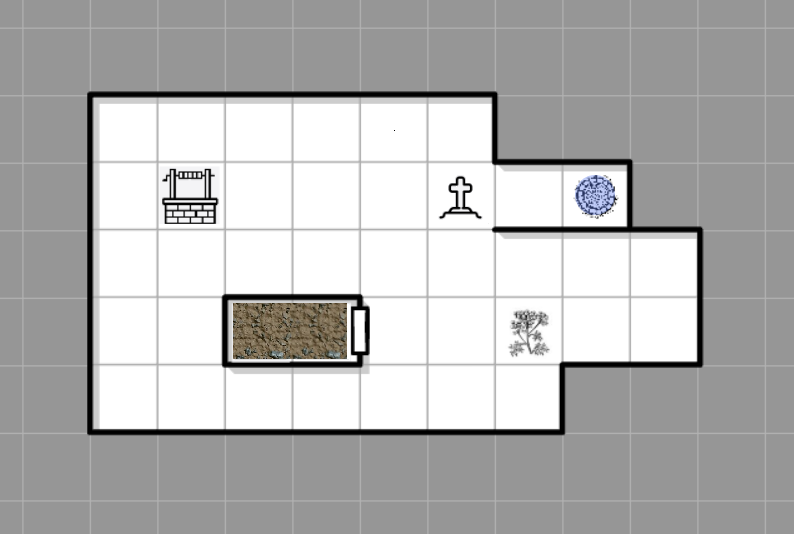
The blue pool is more interesting, as it leads to an entirely new desert area with a map the size of the first one. Again, it is rectilinear, so I have made an RPG-style map.
Well (with no rope), tombstone, blue pool, shack with dirt floor, thick brush.
The well has inscriptions just like the dead-end at the canyon. The game explicitly mentions needing a rope if you try to go in.
The tombstone has the name of your lost teacher. DIG is not a verb the game understands.
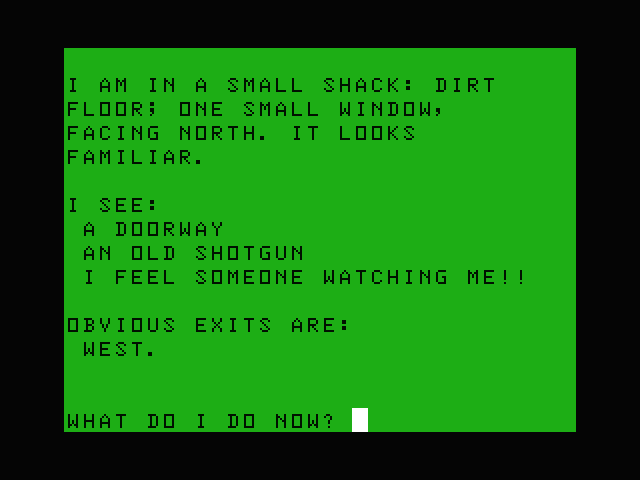
The shack is unlocked and two rooms. On the north side there’s a window where you can look in and see no-one. When you step in the shack, there’s an old shotgun and the feeling like you’re being watched. I have not been able to act on this information.
The shotgun is described as having one round. The game tells you to save it when you try to shoot random things. I don’t know why it doesn’t work on machete man. Is machete man even real? I don’t think it’s the sorcerer; following Castaneda, we’re more likely to encounter El Diablero shapeshifted into an animal.
The shack has (in its other room) a bowl, some seeds, and a mat woven of blue and white threads.
You can PLANT the SEEDS to form a mound of dirt but I haven’t gotten a result yet.
Finally, the shrub, when taken, reveals a tunnel. Going down the tunnel, you find a hardwood box that is locked.
That’s certainly enough to chew on. Listing out my issues:
1.) What do I do with any of the objects: a crow, some debris, the brush (assuming it is more for than hiding the tunnel), the bowl, the mat, the shotgun, the seeds? The seeds can be planted, but where do they go?
(and before you ask, unless I’m missing something in the parser, you can’t fill the bowl with either the yellow or blue water)
2.) What should be done with the snake? It isn’t an obstacle, it just kills you if you take it. My best guess is taking it safely will then allow it to get re-used later (perhaps fending off machete man).
3.) How do you fend off machete man?
4.) What do I do with the inscriptions at the canyon and the well?
5.) Is there a way to get into the well?
6.) What can you do with the blighted cactus?
7.) Is the tombstone important other than giving your teacher’s name?
8.) How do you get the lizard? Or if you don’t get the lizard, what do you do with it?
9.) Is there any other hidden exit? Does gazing work on anything other than the pools?
The last point reflects that gazing is important to the Castaneda-verse. In one his later (and frankly, more bizarre) books, The Second Ring of Power, he goes into the mechanics behind gazing at things, including stating that women have an easier time gazing while they are in their menstrual period because they are not focusing (???).
La Gorda told me then to gaze at the middle part of the canyon until I could spot a very dark brown blotch. She said that it was a hole in the canyon which was not there for the eye that looks, but only for the eye that “sees.” She warned me that I had to exercise my control as soon as I had isolated that blotch, so that it would not pull me toward it. Rather, I was supposed to zoom in on it and gaze into it. She suggested that the moment I found the hole I should press my shoulders on hers to let her know. She slid sideways until she was leaning on me.
I struggled for a moment to keep the four actions coordinated and steady, and suddenly a dark spot was formed in the middle of the canyon. I noticed immediately that I was not seeing it in the way I usually see. The dark spot was rather an impression, a visual distortion of sorts. The moment my control waned it disappeared. It was in my field of perception only if I kept the four actions under control. I remembered then that don Juan had engaged me countless times in a similar activity. He used to hang a small piece of cloth from a low branch of a bush, which was strategically located to be in line with specific geological formations in the mountains in the background, such as water canyons or slopes. By making me sit about fifty feet away from that piece of cloth, and having me stare through the low branches of the bush where the cloth hung, he used to create a special perceptual effect in me. The piece of cloth, which was always a shade darker than the geological formation I was staring at, seemed to be at first a feature of that formation. The idea was to let my perception play without analyzing it. I failed every time because I was thoroughly incapable of suspending judgment, and my mind always entered into some rational speculation about the mechanics of my phantom perception.
There’s also gazing into distant things like clouds; fog is especially difficult and not something most sorcerers can handle. I don’t honestly know if any of this gets woven into El Dialbero (…probably not the menstrual periods…) but poking at the mythology gives me something to do while I’m stuck on the game. The game does allow for GAZE SKY and GAZE MOUNTAIN (and understands the nouns!) so events might eventually go that way.
There are authors from prior centuries that used to be world famous that are now obscure, or at least known more to niche enthusiasts rather than the wider public. The most popular and most prolific author of the mid-19th century was G. M. W. Reynolds, even beating out Dickens.
“Again these awful words!” ejaculated the old man, casting trembling glances around him.
“Yes—again those words,” echoed the mysterious guest, looking with his fierce burning eyes into the glazed orbs of the aged shepherd. “And now learn their import!” he continued, in a solemn tone. “Knowest thou not that there is a belief in many parts of our native land that at particular seasons certain doomed men throw off the human shape and take that of ravenous wolves?”
The best selling poet in all of American history was Rod McKuen, who sold 60 million books and performed to a rapt audience at Carnegie Hall. I won’t expose you to the horror, but I can link a sample at the blog post entitled Slightly Creepy Seventies Bad Poetry.
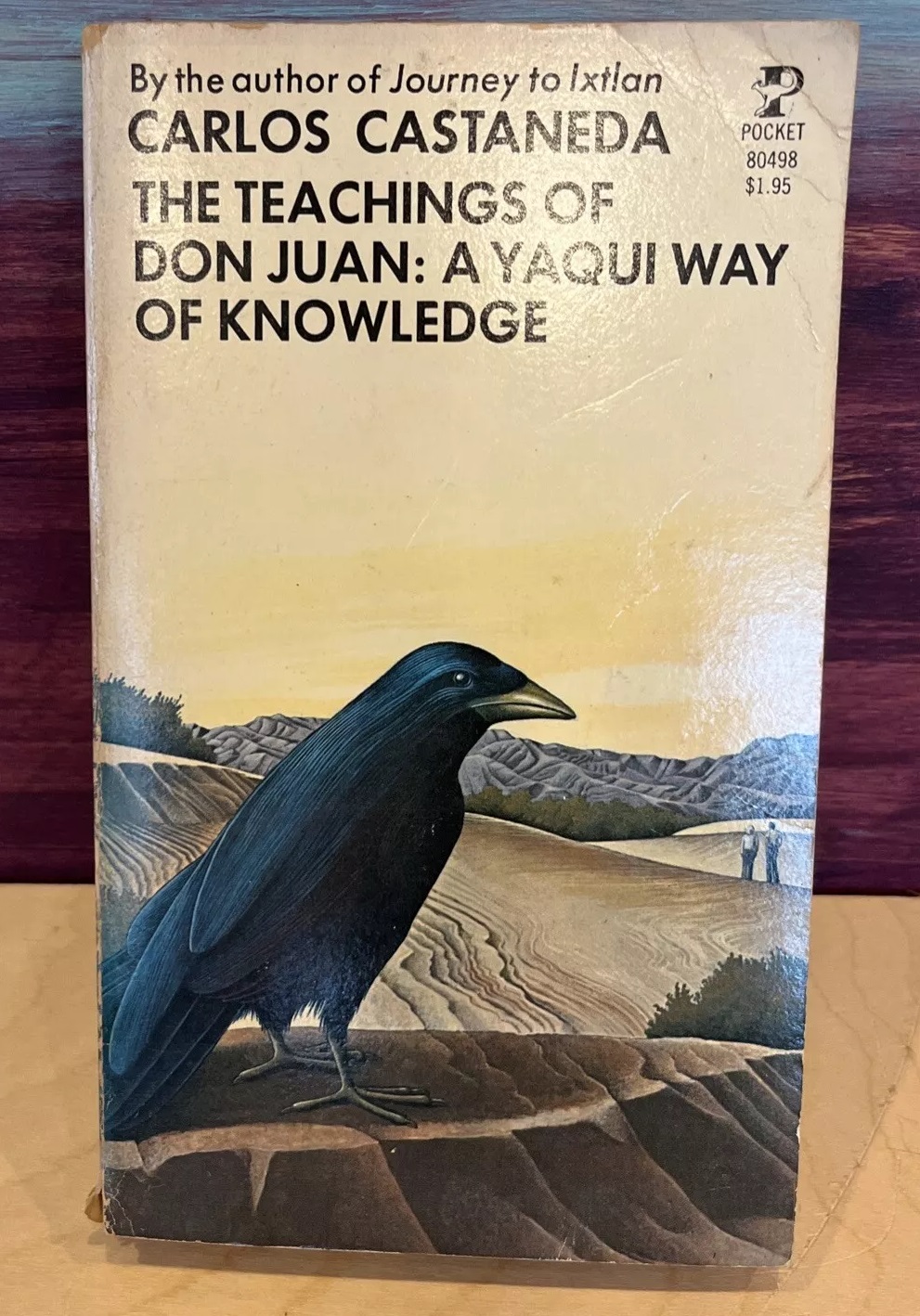
Carlos Castaneda used to be a household name, with his first three books (The Teachings of Don Juan: A Yaqui Way of Knowledge, A Separate Reality, and Journey to Ixtlan) making him a superstar anthropologist; the third book earned him a doctorate from UCLA. They describes his dealings with an indigenous Yaqui sorcerer who used peyote for drug trips and had mystical powers like levitation and teleportation. Castaneda was taught to see the inner workings of the universe, while dispensing 1960s New Age wisdom to us, the readers.
Via eBay. $2.70 or best offer. They printed a lot of these.
While the first book held to strong reviews, critics eventually started to question the veracity of the events — not as in doubting the magic, but doubting Castaneda ever even had dealings with the Yaqui. The Yaqui did not experiment with peyote (to the disappointment of drug enthusiasts who took pilgrimages based on the books) and before Castaneda died in 1998 it was pretty well established he was a fraud.
Ken Kalish, the author of today’s game, El Diablero, does not seem to have been a true believer. He used the novels instead as a sort of fictional background universe.
Carlos Castenada purported to be an anthropologist who found himself apprenticed to a Yaqui Indian ‘sorcerer’ from Northern Mexico, called Don Juan Matus. Although there were unfortunately some things which involved peyote, the basic idea dealt with an underlying reality beneath common perception (which even Aristotle referred to).
This interview was admittedly given long after 1982, but I don’t think the peyote comment would be compatible with him being a superfan at the time. (The word “purported” and quote marks around “sorcerer” also are suggestive.)
After graduating college, Kalish worked in construction for two years. He used some of the money he made to get into stock speculation (he listened to a radio station for market reports). He ended up making a “nice profit” which he used to obtain a computer:
So now, I was walking out of the Radio Shack with a Color Computer, chock full with a whopping 4k of RAM and also with Color Basic from a fairly new company called Microsoft. Before too long, I’d piggybacked two sets of 16k chips with a soldering iron, had bought the Microworks editor/assembler cartridge and was thinking, “hmm, I think I’ll write a game or two myself on this thing. The first step will be to figure out how to clear the screen…”
He became (relatively) famous for his Tandy CoCo work, mainly for his arcade-style games like Starship Chameleon.
El Diablero is his only text adventure.
You awake, dazed and confused, in the middle of a desert. You had been learning the techniques of sorcery from an old man. The old man told you that an evil Sorcerer, a “diablero”, had become his enemy. Now, your teacher is missing and you are alone. Worse still, you cannot remember those spells you had already learnt.
I admit I like the vibes from the setup, even if the actual gameplay effect is to drop us in a large desert.
I played the Tandy CoCo version. There’s also a port of this for the Dragon.
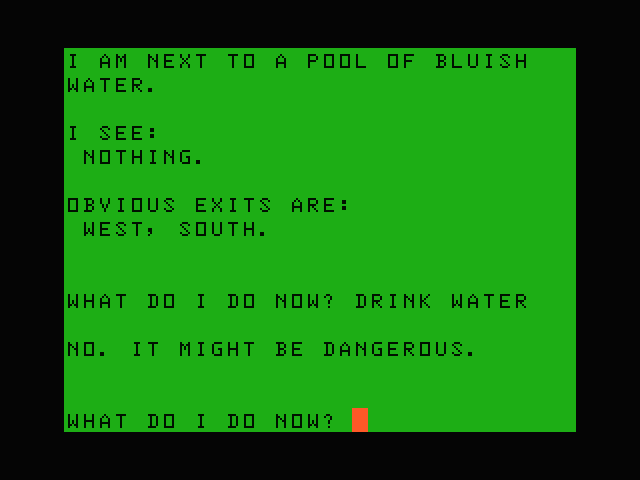
You can’t drink from the yellow pool; you are told it is too dangerous. The same is true for a “bluish” pool at the northeast corner of the map.
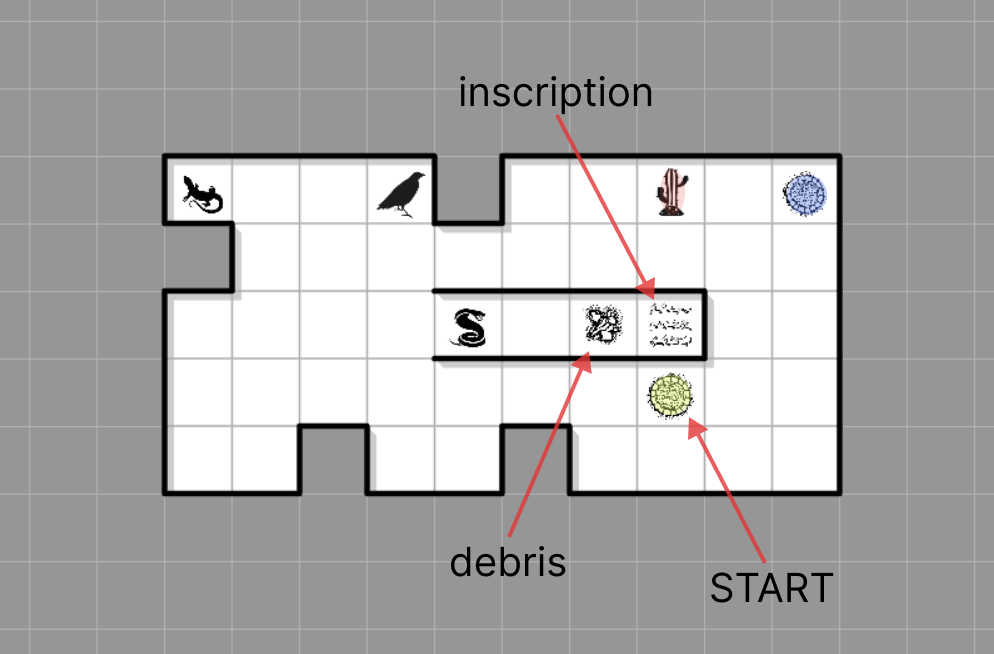
The room descriptions are mostly the same (“I am in a desert, cactus all around.”) with only slight variations (“I am in a desert. There is a large slab of rock nearby.”) and the map is rectilinear, so rather than my usual node-based method I drew things out like they were a tabletop RPG map:
Before taking the tour, I should mention one unusual property of the game: while you can type GO NORTH, GO EAST, etc. to travel around, the usual abbreviations of N, E, W, and S don’t work. The game instead uses the keyboard’s arrow keys, and you don’t have to hit ENTER after pressing, say, right arrow. However, because the author wanted to reserve “left arrow” for deleting text, the symbol @ gets used for autotyping GO WEST. This sort of makes sense if you look at a real keyboard:
The emulator I was using (XRoar) maps the “[” key to “@”, so to keep my sanity I wrote an AutoHotKey script to make the left arrow work normally.
#Requires AutoHotkey v2.0
#Singleinstance
#HotIf WinActive(“XRoar”)
Left::[
(Just in case anyone wants to follow in my footsteps. The game itself is here.)
So back to the map! There’s three animals (lizard, crow, snake). You’re allowed to take the crow…
…the lizard “scampers away” from you…
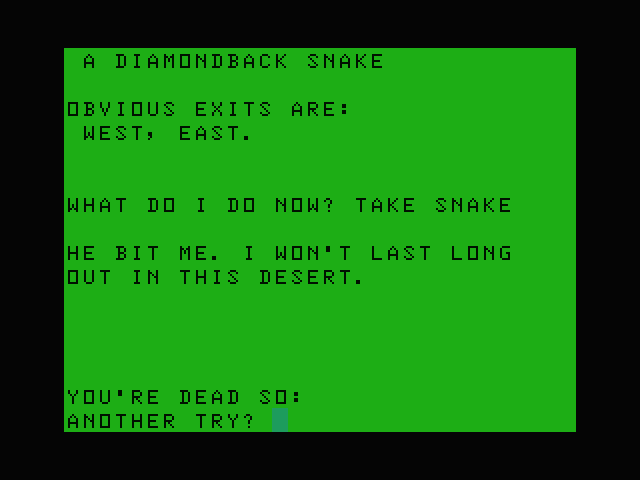
…and trying to take the snake kills you. Fair enough.
The snake marks the entrance to a small canyon section. Here’s a repeat of the map so you don’t have to scroll back:
There’s some “debris” in the canyon you can just take, and a “strange inscription” that is “not understandable” if you try to read it.
Other than the two pools I already mentioned, the only place left of note is a blighted cactus.
I haven’t gotten anything productive to happen, nor have I had any indications of somehow having the ability to cast magic. El Diablero, the nemesis, is out there somewhere; it is unclear if we are meant to defeat him or run away.
This game is allegedly quite hard, as mentioned by both by the interviewer of Ken Kalish and Alastair, who wrote the CASA Solution Archive entry. There’s even a GameFAQs entry (very unusual for an obscure text adventure) which claims the playtime is about 12 hours. I’ve got my week clear just for this game, and I’m even willing to do one of those “well, I haven’t made progress but here’s what I’m pondering” type posts. (It’s been a while, eh? I’m still quite interested in the thought process of solving puzzles, not just plowing through history.) Please hold off both spoilers and speculation for now, I’ll let y’all know when it is time to start piling on.








































 Renga in Blue
