
A 1950s toy car from Mettoy. In 1949 they had opened a new factory at Fforest-fach, Wales and they had steady growth all through the 1950s.
Between 1979 and 1983, two-thirds of the toy manufactures in the UK collapsed. (This is according to The British Toy Business: A History since 1700, which I’ll be referring to for this intro.)
The trade itself blamed changes in age (over the 70s the number of children under ten went from 9.3 million to 7.7 million) but foreign makers under similar conditions didn’t have a struggle with this. The economic situation in general was bad, with heavy inflation across the world map, and only Hong Kong toymakers improving over the span, but still, the collapse was disproportionate. A report from the British toy association in 1983 called the time period “amongst the worst in living memory”.
More locally to blame? Outdated practices both at a financial level and a technological one. An analyst looking at toy firms in 1978 found that 115 of the 360 looked at had financial accounts too old to be helpful. Consumer research was lax to non-existent. Marketing was amateur. One 1970s toy fair held in Britain went so badly that the foreign attendees threatened to stay away permanently.
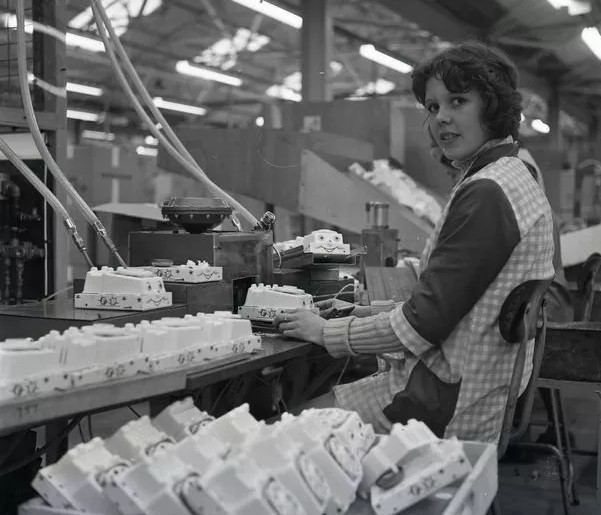
Inside a Mettoy factory, 1973, via WalesOnline.
The CEO of Mettoy, one of the affected companies (headquartered in Wales), had been asked why they hadn’t branched into electronics; the answer was that the Americans and Japanese could simply do it better.
Mettoy in particular was in deep trouble, and threw out in 1982 — as sort of a desperate attempt at staying relevant — the spinoff company Dragon Data, which manufactured the Dragon 32 and Dragon 64. They were essentially Tandy Color Computer clones and software from one could easily be adapted to the other (Madness and the Minotaur, for instance, had a Dragon-adapted version published by Dragon Data).
While the Dragon had some die-hard fans, it wasn’t picked up much by third parties, the major exception being Microdeal. Quoting John Symes, director of Microdeal:
Dragon has been of no help whatsoever to any of the software houses; they didn’t even tell us they had reconfigured the Ram — it meant we had to withdraw two games.
People bought games after playing them in the shop but found they didn’t work on their machines at home — naturally they assumed the machine was at fault — it must have cost Dragon a lot of money in unnecessary repairs.
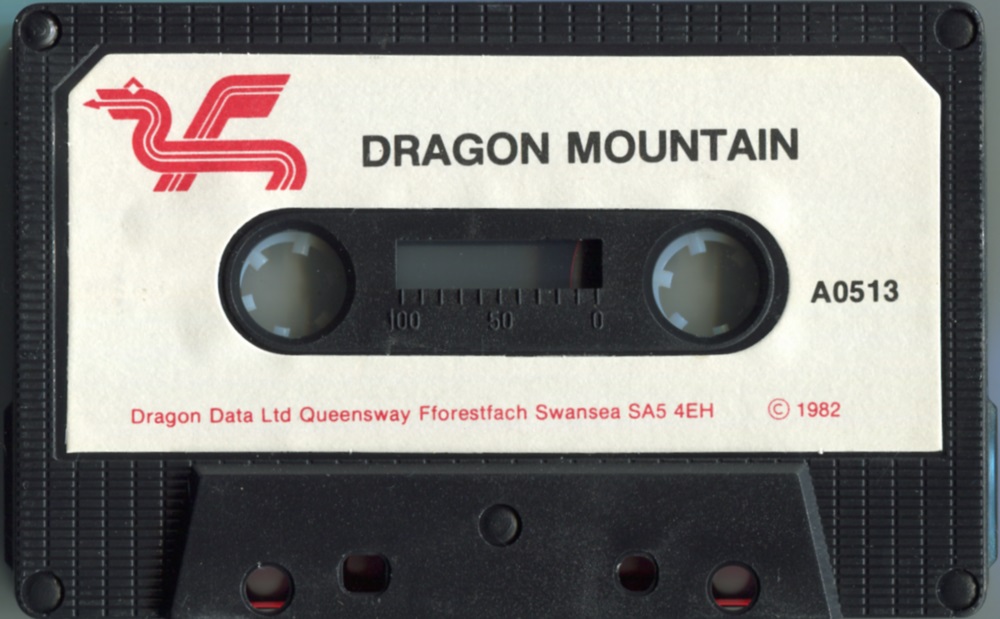
Microdeal published Mansion Adventure and we will be seeing them again on the Dragon, just not here. Instead, we’re playing a first-party game, one published by Dragon Data itself: Dragon Mountain.

From World of Dragon. This is the entire awesome 80s all in one picture, including the dragon-figure to the left who seems to be eating his weapon.
There is no author name, just the company label, and there’s a fairly straightforward premise:
Dragon Mountain is an adventure game with all the action taking place underground, inside a mountain where a ferocious dragon guards his store of treasure. Your aim is to enter the mountain, find your way to the Dragon’s Den and carry away the treasure. However, you will have to deal with a variety of creatures roaming the inside of the mountain before you can accomplish your goal.
We’re in a fantasy world, we’re dealing with fantasy monsters, gotcha.
In historical context, they’re a company against the financial wall trying to build their initial product; they’re not going to stretch the envelope as far as plot goes. Fine. However, I think this is close enough in resemblance to another game there may even have been (let’s say 20% chance) some lifted source code. I’ll get through the game itself first and then I’ll return to the strong resemblance.
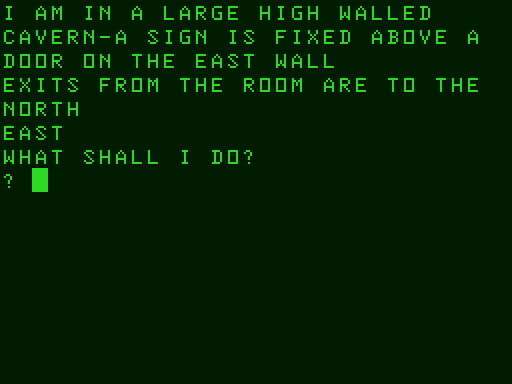
The “classic” Dragon look has black against green but even back in the 80s we had TV settings, so I used the “inverse” feature of XRoar and boosted the brightness a little to get the screen as shown.

The game is essentially divided into two floors. The first floor is almost completely obstacle-free.
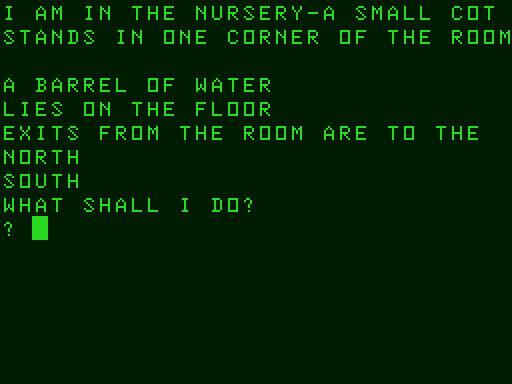
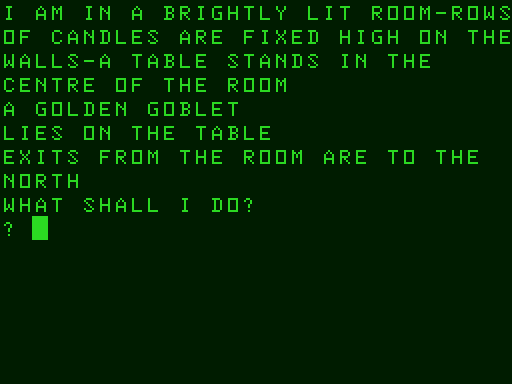

The overall map of the first floor is a five-by-five grid.
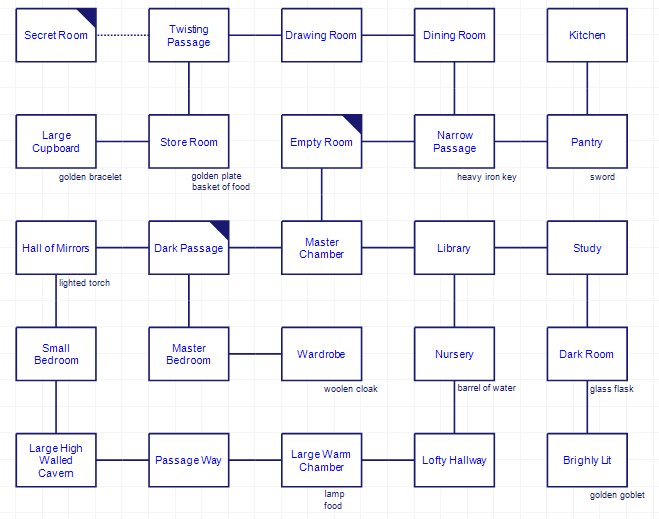
The only exception to the “obstacle-free” aspect is in the upper-left corner, where there’s a locked door that needs a key. However, since the key is laying out in the open (just like everything else) I don’t think I’d call it a puzzle.
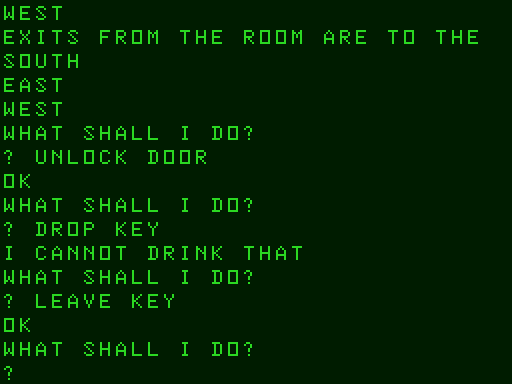
Another UK game which understands LEAVE but not DROP.
While exploring, there are three timers running:
a hunger timer
a thirst timer
a sleep timer

So technically speaking, all three count as puzzles, insofar as you need to EAT FOOD that you’ve found somewhere when the hunger timer hits, and DRINK WATER when the thirst timer hits.
Weirdly enough, there’s multiple food items, and when I ate one, it caused the other one I found in an adjacent room to disappear. I discovered this because my inventory was full — the limit is generous but not unlimited — and the hunger daemon hit, so I ate my food, walked over to pick up the food I had left behind, and found nothing.
Where the “action” starts is in the second floor, which is a three by three grid.
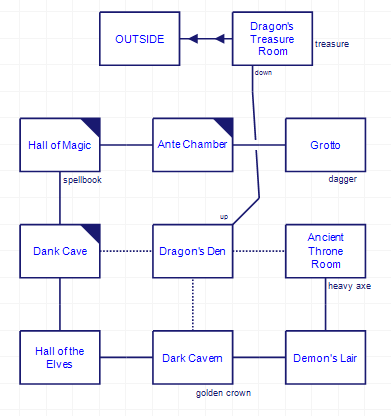
You need a cloak from the first floor to make sure you don’t freeze in the cold.

There’s wandering elves, a demon, and a dragon. You find out methods of defeating all three from that locked-door room on the first floor. Specifically, the demon needs a sword (just laying around on the first floor) and elves can be bribed by gold (also laying around on the first floor). The dragon is marginally trickier: it needs to be killed by a dagger found laying around on the second floor.


After KILL DRAGON. The screen flashes so this is a little dramatic.
Past killing the demon and dragon, and bribing away the elves, there’s only one more obstacle: a door locked by magic.
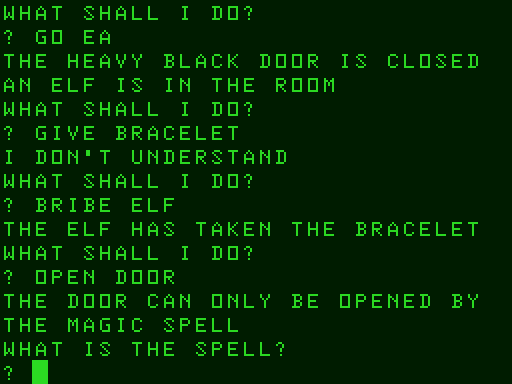
There’s a spellbook which I assumed had the right word to get through but the game kept saying I couldn’t read it. This is the only tricky part of the game. There’s a “grotto” at the upper right of the second floor which (for some reason) makes it so the spellbook is readable while you are standing there.

Using the magic word, you can escape, get the treasure, and win.


Now, I don’t know if you’ve spotted yet what game this resembles, but it might help if I mention that the items on the first floor are randomly scattered. This presents essentially no obstacle whatsoever — with no wandering encounters and the like, the only way to die on the first floor is by not finding the water / food in time — but it does strongly suggest a different game, one also published by Dragon Data.

The screen above is from Madness and the Minotaur, which was one of the most difficult games of 1981; honestly, one of the most difficult adventure games ever. It had so many random elements and obstacles it was nearly impossible to overcome, and Dragon Mountain strikes me as just a (very) lite version of Minotaur. Specifically, the vibe of rectilinear layouts PLUS food and hunger daemons PLUS the fact that Dragon Data also published Minotaur for the Dragon. The company even had source code access (remember they published a Dragon port) and quite possibly did some simplification to make this game; that’s extremely speculative, though. I think it is almost guaranteed that the author(s) at least played Madness and the Minotaur.
While I don’t consider Dragon Mountain an interesting game in itself, the context of a company trying to build up product that likely grabbed from one of their own published products for inspiration is a fascinating one. And if nothing else, this is the first adventure I’ve been able to confirm as coming from Wales.
From World of Dragon.
(OK, in a game design sense there was one interesting thing: you can gather several gold objects from the first floor, but none of them give “score” or count as treasures in the classical sense; they’re only needed to bribe the elves, as the dragon’s treasure is overwhelming enough that’s the only treasure you need.)


 Renga in Blue