A North Star Horizon computer; the original was released 1977. They are notable for having early versions of CP/M and DOS, as well as being one of the first personal computers with an available hard drive. Via the blog Broadbandpig.
This is thanks to Gus Brasil who commented in my last post. I mentioned a 1979 North Star game (Middle Earth) which might be somehow related to Tolkien, although the situation was ambiguous as the game was lost media. I also mentioned Cranston Manor Adventure (North Star Horizon version) being a lost game as well. This was on the basis of my searching in 2022. However, it turns out that late in 2023, a large archive of North Star Horizon software got uploaded. By large, I mean at least 30 disks that haven’t seen daylight for a long time, including the North Star version of Cranston Manor.
Two adventures from the archive I have other copies of in another format (Windmere Estate, Zodiac Castle), but there were two more I had never heard of before: Uncle Harry’s Will (1981) and Whembly Castle (1982). Both are by R.L. Turner. I have added them to my list (and there’s something fascinating about Uncle Harry’s Will, but let’s wait on that until we get there).
Relevant to Cracks of Doom, the archive has the game Middle Earth. Let me quote, in its entirety, the entry from the Chronological list of Tolkien games:
Produced by: Dendron Amusements (?)
Distributor: Dendron Amusements
Year: 1979
System: North Star Horizon
Type: Possibly wargame
Distribution: Commercial
Availability: Out of print
Licensed: No
I am not sure if this is really based on Tolkien’s Middle Earth or if it is just another game that steals the title therefrom. The game was released as part of a series. Other titles in the series included Panzer, Blitzkrieg, Fall of the Third Reich, D-Day, Armorcar, Porkchop Hill, Africa Corps, Waterloo, The Battle of Monmouth, Starship Troopers, Invasion of the Mud People and The Boston Marathon.
Arnold Bogenschutz suggests that this may be somehow connected with a board game published by SPI with the same title. He seems to remember seeing the computer version, but has no further details.
I’m not seeing Dendron mentioned in the source anywhere, but the year and author are:
COPYRIGHT 1979 R A MAGAZZU
I don’t think there’s title stealing. I think the title is just incidentally connected.
The Middle Earth is referring more in a “journey to the center of the Earth” sense.
I did play just a little to confirm; while there are creatures, they are definitely not of Tolkien vintage.
I am not doing All the Wargames (that’d be a certain Scribe) so I am not the best person to parse this, other than to confirm that: as long as you discard The Lord of the Rings (TRS-80, 1981) as a weird trivia quiz, the first commercial Tolkien videogame adaptation we know of is Cracks of Doom.
I have finished the game; you should read part 1 here first.
Before plunging ahead and witnessing Frodo perform judo (really), I want to look a little more at the early history of Tolkien videogames. There are complications in asking “what’s the first Tolkien videogame” along with “what’s the first commercial Tolkien videogame”. It depends on what you think counts.
For any influence at all we might think about 1975 with Moria, one of the early CRPGs on the PLATO system, although that game is really just an adaptation of an earlier PLATO game (neither author was aware of the existence of the tabletop D&D nor had they read Lord of the Rings). Mines of Mordor (1979) similarly just does a namecheck, and seems to be an adaptation of the boardgame Citadel.
Hovering somewhere in the 70s is the game Nazgul, which is mentioned by Christopher Burke in a Quora thread as a “private” game he wrote for an ASR-33 where the player is trying to avoid a bunch of Ns on a grid. It is a re-skin of the game variously known as “Robots” or “Daleks” or “Chase”. I have trouble counting this as an actual Lord of the Rings adaptation.
+-----------+

|N     N    |  812

|           |  703

|           |  654

|    NN     |

|     *     |

|           |

|   N       |

|           |

|      N    |

|    N      |

|   N    N  |

+-----------+

Enter move (0-8):
Staying with 1979, the Tolkien Games chronology lists Ringen, The Shire, and Middle Earth. Ringen was an adventure in Norwegian only preserved by being made into an area on a MUD and you can read about my playthrough on this very blog. The Shire was potentially a mainframe game, maybe on PLATO? Middle Earth is allegedly a wargame for the now-super-obscure North Star system by Dendron Amusements. (Cranston Manor Adventure had a now-lost North Star version, as did the GROW software, but those are the only times the system has appeared here.) That last game was technically commercial but both its existence and its content are ambiguous.
Ringen is solidly enough “real Tolkien” I’d give it credit as first we know of that tries to be a real adaptation, although it doesn’t take the commercial mantle. For a candidate we might try source code dated February 1981, by “P. & M. Hutt” and published by Kansas City Systems.
From the Museum of Computer Adventure Games.
I’ve gone ahead and played it and the gameplay is hard to describe. It’s sort of a cross being the previously mentioned Robots/Chase game and a trivia quiz.
You’re Frodo exploring around Shelob’s lair, and it is divided into floors where you are stumbling in the dark. The floors are represented in ASCII.
As you move around, a “nasty” marked with an N tries to find you (it takes about five moves trying to get to you, and if it gets seriously blocked, it disappears entirely and a new nasty appears). If the nasty gets to you it might be a dwarf, or might be Shelob. If it is Shelob you need to answer the next letter in the “spell”, that is, answer the trivia question appropriately.
There’s various doors that lead up and down floors, and the game implies some sort of final conditions to exit, but I never got that far. The Lord of the Rings credentials are extraordinarily tenuous.
Honestly the best part is this opening screen.
Kansas City Systems incidentally has only previously appeared on this blog in context of illegally re-publishing games from other companies (the case against them ended up being what firmly established software in the UK as being under copyright); although I wouldn’t say the theming is just a cynical ploy to sell copies, I would say it is a game more in the category of Moria with “elements inspired by” Tolkien without really being an adaptation.
Here I prove — by typing in the first letter of the name within 5 seconds — that I know who the “bear-man” in Tolkien is. So Shelob goes away, taking 1 gold piece, rather than killing me.
All this is meant to lead to the fact that — especially since it appeared in a January 1982 issue of Computer and Video Games Magazine, meaning it was really published late 1981 — Cracks of Doom is arguably the first actual adaptation of Lord of the Rings for commercial sale. As already highlighted, caveats are needed. However, even with the odd “alternate reality” of the mission just being Frodo, having to toss 5 treasures into Doom rather than just the One Ring, etc., there’s still some recognizable elements, especially upon picking up the One Ring. The game felt like an attempt to put the player in the part of the story rather than just namecheck Shelob.
The cover of the de-Tolkien-ized edition, from the Museum of Computer Adventure Games. Saruman is now Solbone. Shelob is now Shogra.
Back into the action! Regarding the Palantir that I was unable to cart all the way back to the cracks without Frodo losing it mentally…
…I found you could just pick up the “wolf fur” that was covering the Palantir and you’d be fine. No need to rush. I had noted a lack of “wrap” or whatnot as a verb but I guess you are implicitly covering the Palantir up, matching the lore that it really is only dangerous if you can see into it (and Sauron can see you back).
There’s also something I did right without being clear I was doing something right. There was a “mighty falcon” where I gave it a feather and it broke a “binding spell”. The idea is that you can take the falcon away now; before it says it has a spell and is stuck in place. So the falcon is useful for a confrontation later.
Picking up the falcon suggests something else that Rob mentioned in the comments as an idea: the NPCs aren’t the sort that stay in place and you interact with them, but rather you can simply pick them up. This seemed like an absurd idea (Halfing arms!) but then I was able to just wholesale grab Gollum, giving Frodo a serious workout. Gollum does not stay put but he moves somewhere better for him to be later, anyway.
Gollum cackles Stupid Halfling! Did precious think it could hold Smeagol and runs off.
In fact, I briefly was carrying both Gollum and Saruman the White at the same time. Saruman doesn’t let you just powerlift him. I had missed another aspect to the game, with the third dwarf at the Cave of Crystal Presence. It also wants a crystal cup, just like the dwarf I got a hat from. However, if you give the Crystal Presence dwarf the cup first, he’ll give it back to you along with Gandalf’s staff. If you instead pick the other dwarf first, you’ve softlocked the game.
With the staff in hand, then Saruman is paralyzed, and you can take him. Not only take him, but cart him all the way over to the Cracks of Doom and hurl him down. Yes, he’s one of the 5 anti-treasures. (By the way, the iron fist? Is not useful for anything. It can go down too.)
Shelob tries to catch you again at the cracks, so you need to BRANDISH PHIAL before practicing your judo toss.
Having the discards made is sufficient to trigger that message about the One Ring; in addition, for some mysterious reason, you can defeat the Balrog now. I had previously theorized the green fire would work, and I was absolutely right, but I was doing it at the wrong time. (IF you type HELP at the Balrog room, in addition to the “walkthrough” you get by saying “yes” to Gandalf, you can just get a contextual hint by saying “no” to Gandalf; you’ll be informed to “fight fire with fire”. I was heavily stuck because dropping the green fire did nothing.)
Past the Balrog is some red fog, and then a tower containing Morgoth the Dark Enemy. Here’s a rendition of Morgoth as he is usually depicted:
Via Guillem Pongiluppi.
In Cracks of Doom, your falcon friend is sufficient to scare Morgoth away.
Given the falcon was freed via a magical artifact of the original Eagle Lord, this doesn’t feel too absurd to me.
The falcon flies away, which is unfortunate, because you can find a “gleam” in the tower which is high up and clearly one of the anti-treasures we want. Going down the opposite way you can find Gollum hanging in a cell.
I never got “speak Gandalf” to do anything.
We’ll need Gollum in a moment. To get at the gleam, we need the falcon back; the falcon has wandered all the way back to the room we started the game in. (No clue or anything, we’re just supposed to hope we’ll find him and check the entire map.) With the falcon in hand we can get it to retrieve whatever that gleam might be.
We are now on a strict time limit. This part was really well done; we start feeling “depressed”, and then eventually the baleful eye is cast upon us.
I felt genuinely tense and thought I was going to need to reload a save and optimize my route to avoid being crushed by Sauron.
We need to scoop Gollum along the way to the cracks (he’s a lot easier to get from the cell at the tower than his starting place, this is why I said it was helpful he ran away). Then dropping the ring leads to a canon-adjacent effect:
Despite it suffering an almost equal amount of jank, I enjoyed this a lot more than Hitch Hiker’s Guide. I think, curiously enough, the odd effects and messages add to a general feel of oppression, and that mood fits a lot better hanging out at Mount Doom than it does traversing the universe in the Heart of Gold.
I also really, really enjoyed hurling Saruman the White into Mount Doom, despite the improbability. Maybe it was all that lembas bread.
Greetings, Halfling. I an Gandalf the Grey, your guide. Your task is to find the 5 objects and cast then all (alive or otherwise) into the Cracks of Doom in order to destroy, once and for all, the terrible power of the Dark Lord.
This is not the first or even the second Supersoft game we’ve looked at using an outside franchise. Pythonesque wasn’t licensed (and is a loose enough adaptation of Monty Python it likely didn’t need to be) while The Hitch Hiker’s Guide to the Galaxy was (yet suffered a lawsuit anyway, ending in destruction of product). The Hitch Hiker business clearly would have left Supersoft skittish. Hence, this game is also known as Cracks of Fire, with the Tolkien references torn out. Given the Tolkien Collector Guide was unclear if the Cracks of Doom version even came out (see picture above), it clearly is the rarer of the two.
This is the second adventure game Bob Chappell wrote after The Hitch Hiker’s Guide to the Galaxy. (His first game generally was Nightmare Park.)
The “treasures” you are collecting this time are items “forged of Mordor” and your goal is to tote them over to the “cracks” nearby where you pitch them to their destruction. This is an alternate universe Lord of the Rings where Frodo starts from the center of Mount Doom and works his way out. The alternate reality aspect threw me for a loop; even if you try not to think about it too hard, there are some deeply odd moments, like a weirdly passive Saruman the White hanging out near both Shelob and Gollum. Look, it’s just easier to talk about the game in context–
You (Frodo) start out at the Mountains of Mordor. Two moves to the east lands you at “the very edge of the Cracks of Doom”, where the Evil Artifacts go. Found there are a small sphere where if you drop it you get a key (exactly like Valley of Cesis) and a manuscript.
Regarding “brandish it high”, the game helpfully comes with a verb list (if you just hit ENTER with no prompt) and the verb BRANDISH is on there. We’ll be using it soon.
Also outdoors you can find a “majestic falcon” near a “smooth blood-red pebble”. Just north of that is “the Red Book of Middlearth”.
I don’t know Gollum being bound only by the “.i.” means a three-letter word with an i in the middle, or just some general word with an i in the middle.
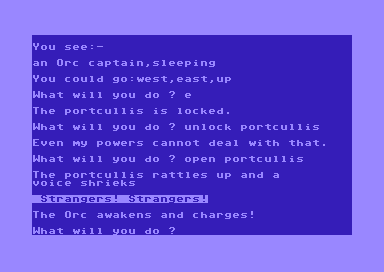
Going down a hole at a “swampy stretch”, reveals a sleeping orc captain near a locked portcullis, and a “rune tablet” in an adjacent room. The tablet says…
Read the rune tablet.
…which I suppose is meta? As I already mentioned I found a key, and it does fit the portcullis, but opening it awakens the guard. With the items seen so far, it doesn’t end well.
Fortunately, even without applying the key, there’s one more place to explore, a very tiny maze.
As usual, despite being small this took a while to get mapped out in a sensible way. Important items lying around are: a brown weed, some rotting orc meat (“looks like meat’s back on the menu, boys!”) and the Phial of Galadrial. Yes, it’s just sitting there. (The phial ends up being essential to carry everywhere.)
There’s also a gargoyle with a missing eye, but the red pebble occurred to me as a good replacement candidate.
Pushing the nose of the gargoyle then drops you to your death. You need to push the eye instead in order to open a passage to the east, but I didn’t discover that until later, so let’s save that bit of exploration for just a moment and head back to the orc captain. Remember the cryptic instructions about using “brandish”?
After this happens, orcs start rushing at you at random through the game. They serve the function of the dwarves of Adventure (or Vogons of Hitch Hiker’s) where you need to be paying attention and BRANDISH PHIAL at the right moments, lest you die. It is surprisingly hard to keep from messing up and sometimes immediately after killing an orc another one would come.
Don’t get excited: we aren’t recruiting an undead army. Rather, we are reading the tablet that said to read the tablet. I did figure this out quite quickly but only in a sense of not having many options. I don’t know how the clues connect.
There is a deep rumble and the east wall slides back.
A harsh voice croaks
The Dead Marshes….
Not much here. First, there’s a troll. Give it the meat to get by. (The screen below shows up simultaneously fending off Orcs.)
Past that you can find a iron fist (“forged in Mordor”) which is our first anti-treasure. I confirmed you can bring it to the Cracks and toss it in for 20 out of 100 points. I am saving it in case it is needed for a puzzle.
Moving on is an “elven crystal cup” (sure, why not) followed by the Balrog, wielding that most dire of weapons, the gosub error.
I don’t know why a weed would help with a Balrog, I was just trying everything I had.
Note also: the Balrog killing you on a give turn is random, and this randomness can trigger when you enter the room. Since you presumably need to enter the room to defeat it (I have not defeated it yet) that means the RNG can just decide to kill you.
With that charming enemy left on the back-burner, let’s proceed to the area past the gargoyle, Minas Morgal.
The sequence is whiplash-inducing. Starting at the far northeast, there’s a dwarf; as the room is titled Crystal Offerings, you’re supposed to GIVE CUP and you get a hat in exchange.
The hat incidentally has a feather that can be removed separately…
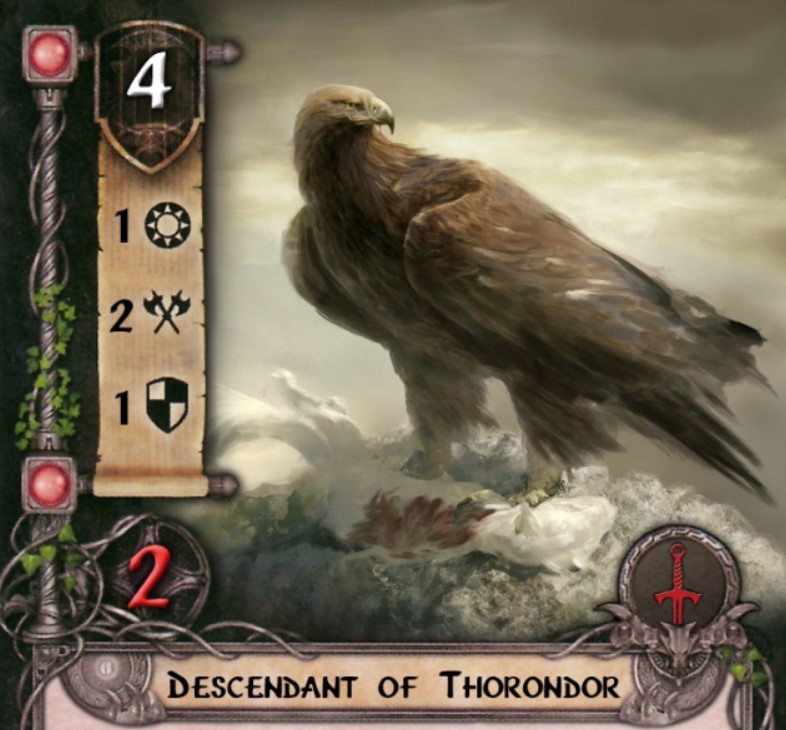
The Feather of Thorondor
…and taking the feather back to the falcon gives the message that the falcon picks up the feather and the binding spell breaks (this doesn’t happen with other items). Is this a good thing or does it softlock the game? In Tolkien, Thorondor is the king of the Eagles in the First Age, but I honestly don’t think it helps to dwell too much on the lore as it might be misleading.
From the Lord of the Rings collectable card game.
Moving on, there’s another dwarf with a pipe. Give him the brown weed and he’ll drop off a globe of green fire.
Past that is yet another dwarf hanging out at a Cave of Crystal Presence. I haven’t found anything useful there.
Once past the three dwarves we get into more hostile country, with a “rock-hewn chamber” and a wolf pelt. Taking the pelt reveals a Palantir.
This feels like it ought to go in the Cracks of Doom, but if you try to carry it around, it’ll eventually “affect your mind” and then “seriously damage your mind” up to where you can’t reach the Cracks in time: the Palantir kills you.
Past that is Shelob. Shelob you can defeat with the phial, but it has the same RNG as the Balrog and can kill you when you enter.
But still, she was there, who was there before Sauron, and before the first stone of Barad-dûr; and she served none but herself, drinking the blood of Elves and Men, bloated and grown fat with endless brooding on her feasts, weaving webs of shadow; for all living things were her food, and her vomit darkness.
(That’s from real Tolkien, not the game.)
Off by a lake you can find Gollum. I have not managed to get him to acknowledge any actions.
Just a little further, Saruman the White is just hanging. He also doesn’t acknowledge your presence.
There’s some “strange fruit” just past that was poisoned by Saruman, so he’s still evil. Finally, the most cryptic room at all in this section:
You can take the slates, but you can’t read them or “inspect” them. I am quite befuddled.
Since that was quite a few random elements, here’s the list of objects so far, excluding already-used items: 7 slates, strange fruit, wolf fur, Palantir, iron fist, globe of green fire, dwarf hat, feather.
Spots of confusion are: the Balrog, the falcon, the dwarf at the Crystal Presence cave, Gollum (with the “.i.” clue), and Saruman.
The inventory limit is four (the game logically says you are “only a Halfling and cannot bear more”) so I haven’t tried every item on every obstacle yet (like the green fire on the Balrog) but nothing strikes me as an immediate obvious combination. I did try the “phial” on Gollum to no effect.
One last element I should highlight is there is a built-in help feature and it works differently than any I’ve played for the Project. Usually such hints have been contextual (based on what room you are in); here, the game asks if you want help from Gandalf, and if you say yes, you get the next hint out of a pre-made list. So there’s X hints behind the scenes that get revealed one by one, and that probably make some kind of walkthrough (I haven’t checked in enough to spoil, but I did check enough to see if this was the kind of game where essential info was in the help command).






 Renga in Blue