(Continued from a post from a year ago. You should probably read that post before this one.)
While I occasionally reach a videogame in the All the Adventures project which is famous enough to have existing interviews and memoirs to pull from (like The Hobbit and The Dark Crystal) oftentimes I have very little to start with. Even when an author gets some attention from later work they may never talk about their adventure game output (like with Stuart Marks’s biography pretending that Pillage Village didn’t exist).
Hence I was gratified when the author of The Colonel’s House (Rob Davis, 14 when he wrote the game) contacted me and not only was he willing to do an interview, he remembered this era well.
The first computer I experienced was a ZX-81 that my Maths teacher showed in the school staff room. I was immediately massively inspired by seeing it, and requested one for my birthday. I learnt to program BASIC on the ZX-81, and very quickly outgrew it and bought a VIC-20 where I continued to program BASIC and learnt Assembler.
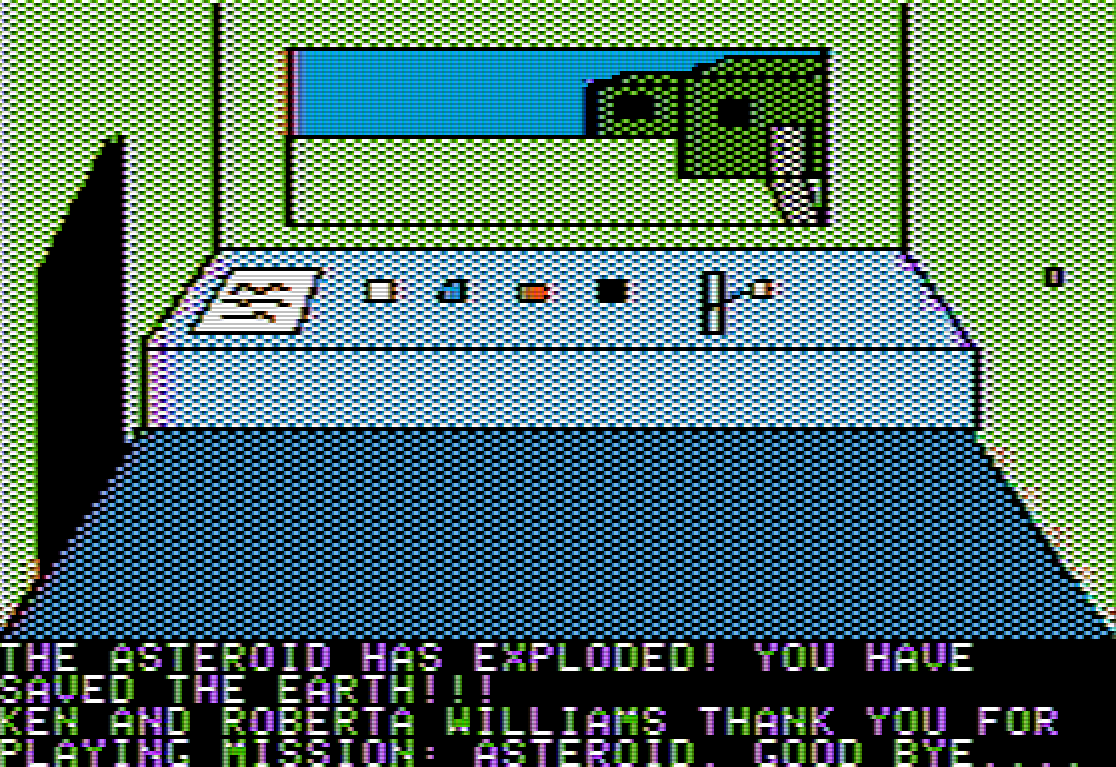
Rob Davis first had contact with adventure games via a visit to a friend’s house; they had an Apple II and were playing Mission: Asteroid, “a really early graphic adventure that I remember involving a spaceship, and you had to work out which buttons to press on a very simple spaceship control panel, and it was a text adventure, but it was graphics, and I found that really exciting.”
He also had exposure to Mystery House (more on that in a moment) but otherwise this brief visit was his only exposure to adventure games (he played lots of games, “especially Jeff Minter ones”, but not adventures); that was enough to make him want to write his own.
I was just doing it in my own from my own inspiration it was just really that one game and really just one hour with that game that was the starting point for me.
He had no exposure to Crowther/Woods Adventure, or Scott Adams, or any of the VIC-20 adventure games coming out at this time.
I did it from scratch. I had read books about coding, but no, I had no guide to making adventure games or anything. I just started and I worked out how to build the engine for the adventure game, which was an engine that was able to kind of store room state, store player state, parse language, render rooms and react to your movements across the rooms and react to the objects changing state and all those kinds of things. So I wrote the engine for that from scratch from my own understanding of coding.
His VIC-20 had memory expansion; he wrote one game as a proof of concept (“a small map and was set on a desert island”) before writing The Colonel’s House.
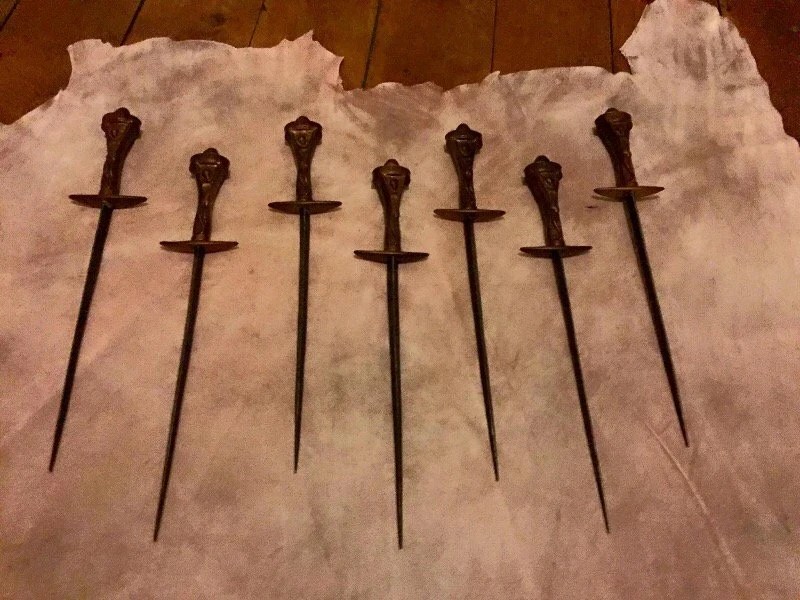
More than games, I was inspired by the Omen movies on TV at that time, which had a set of seven daggers forged to kill the Antichrist.
He’s referring to The Seven Daggers of Megiddo. They are named after the seven churches from Revelation, and each one needs to be placed at a different point of the body to kill the Antichrist.
The Colonel’s House was a “private game” to just share with friends. Sometime after this, he had gone to a computer game show in London, where he found Rabbit Software, and the topic of his game came up:
I got talking to them, and they asked me to send them a tape of my game. I wasn’t going to send it, but a school friend persuaded me that I should, and Rabbit immediately offered to publish it.
They were “chaotic” and actually released the game without telling Davis; a school friend had said they’d seen it at a game store. Rob didn’t believe him but his friend offered to buy a copy.
That was also the first time I saw the cover art, which I didn’t approve at the time, though in hindsight it was OK.
I was able to discuss the content of the game a bit; he had a scene (which I didn’t hit while playing) where you can fall out a window; you’ll be alive, get picked up by an ambulance, but then the ambulance will get in a wreck on the way to the hospital and you’ll die. This comes directly from a death in Mystery House (when you leave the attic). Regarding the amount of the death the game has in general:
I mean, I’m casting myself back now to when I was 14, but I’m not sure that I would know mechanically how I wanted to treat players who had done something unwanted and kind of you know failed in one of the puzzles; like probably death was the only way to handle that. How do you cover the cases of the different failures of the puzzle? That might have been a complexity that I wasn’t sure what to do with … therefore game over seems like quite a kind of neat way to wrap up whatever kind of sequences of actions that haven’t got them (the player) to the right solution.
He did indeed have a grand plan for seven games total:
I had planned to make 7 adventure games, each to recover a different one of the 7 Knives of Eternity. The lore was that the knives were extremely powerful and when joined together, gave the holder ultimate powers. They had been hidden distributed throughout time and space for safety, but their locations had been compromised and others were seeking them. You were an agent who had to recover them and destroy them for good. I did complete the 2nd game, Escape from Detra Five, which had a knife hidden in an alien space station. Unfortunately it was never released because Rabbit went out of business.
He remembers Detra Five being at a computer show once so it is still faintly possible a copy escaped to the wild; he doesn’t have one he can find.
Rob Davis did eventually go on to be a full-time game developer, and there’s even an interview in The Guardian with him back when he was in charge of Solaris Media (“worked with Macromedia Flash for five years to build websites, online games and digital art installations”).
Again, deep thanks to Rob Davis for his time, and of course (if he is the one reading these very words) feel free to drop any additional thoughts in the comments.
Rabbit Software is another case in the UK of a computer shop having a game company as a spin-off. (Previously: Program Power, A & F.) In this case, the shop was Cream Computers from Harrow (part of London), which “started to sell games by mail order” in 1982 with VIC-20 product, having
…very basic packaging — cream colored paper with a rabbit stamped on it and hand written details.
The rabbit name and logo came from the company’s “mascot”, Roland.
Heather Lamont, company director, posing with Roland in Crash February 1984. (By this time they had started selling Spectrum software on top of Commodore.) The other founder (not pictured) was Alan Savage.
Their early software was all written in-house but they eventually took to publishing works sent by outside authors. In the article I’ve been referring to the software director (Terry Grant) refers to “several programs a week sent in”.
For today’s selection (The Colonel’s House) I’m fairly sure it was one of the out-of house games. An ad in the April 1982 issue of the bimonthly publication VIC Computing already mentions soliciting games from authors, and despite giving a “top 10” and list of new releases it doesn’t mention the existence of The Colonel’s House. The February ’84 Crash article claims the company as being “close to two years old” giving it a start month of roughly February 1982.
Thus, today’s author (Robert Davis) likely did not know the people of Rabbit Software personally. The game touts itself as being the first of the seven-part Knives of Eternity series. The follow-up, according to the game’s ending description, was supposed to be called Escape from Detra 5. It does not seem to exist.
This is not quite as super-minimal like some VIC-20 games but rather uses the 16K expansion, giving the author a “normal” memory size to work with. Still, I got the strong impression I was working with a “reduced” parser as I was playing along, and I suspect Davis had exposure to Bruce Hansen’s games which were super-minimal. Rabbit Software even republished Moon Base Alpha and Computer Adventure.
From the Museum of Computer Adventure Games.
The games above were officially from the company (Victory Software); there was allegedly some kerfuffle with faulty tapes and Alan Savage supposedly loaded a van with 4000 tapes and dumped them at Victory’s solicitor in London.
Enough stalling, let’s get on with the game! The lore has us working for FREEDOM INTERNATIONAL as Agent 371 where we need to retrieve the knife in the title from the house of an “old colonel” who as an “electronics expert”, where the house is fitted with “advanced safety equipment”. While the “year” is 1990 it is otherwise unclear what the story behind the knife is, and why there are seven special ones. Do they combine to form the Megaknife of Power, perhaps? Alas, we’ll never know.
I’ve been “normalizing” my VIC-20 screens but just this once, here’s what the original aspect ratio looks like. I find this incredibly hard to read and play with so my apologies if the giant wide text gives off any nostalgia.
You start outside the house with a hammer and ladder nearby. I find it interesting how FREEDOM INTERNATIONAL has decided to outfit the agent on supposedly a vital task with almost nothing.
The door is locked but there is no alarm that triggers if you BREAK WINDOW followed by GO WINDOW to get inside.
Each action in the game (including, it appears, invalid commands the parser doesn’t understand) eats up one minute of time, and the colonel arrives at 10:00 (giving a game over).
The house consists of two floors and is not large.
On the ground floor, right away you can access a wardrobe (with a “protective suit”) and a kitchen (with a “protective lense” and a locked cupboard). One door is closed off due to a card-reader, and another blinds you if you try to enter.
Back where the clock was there’s a “shelf” described as being high up. I admit it did not occur to me to think of a shelf as a location you can put your entire body into, but that’s the right action: GO SHELF (which only works if you’re holding the ladder).
If you examine the card, it says it has writing. If you read the writing, it informs you that you just wasted a minute.
With the card in hand you can swipe your way over to a living room that has a cassette player (which will be usable later) and a projector (which is not terribly useful). While holding the “lense” you can push a button on the projector to use it, but it just warns you about the perils of missing other games by Robert Davis.
Taking care of the blinding hall requires an item from upstairs, so let’s visit up there next:
There’s a book in a bedroom that states “Book 97 is a revealing book”, a room with strange sounds (LISTEN reveals a computer voice repeating TELL ME ACCESS), a hallway with fatal gamma radiation (which we’ll get by in a moment), and a bathroom with dark glasses (guess where they go!) and a medicine bottle which only has “medicine” in a exaggerated sense.
That’s one way to stop having to worry about diseases.
Before we go dark, let’s take out the gamma radiation puzzle. I originally had the protection suit (it gets used “passively”, there’s no WEAR command) but I was baffled at there being no effect. The issue is that while you can EXAMINE some things (like the card with the useless words) there are many items where EXAMINE just repeats the room description. This was irritating me enough it through me off my normal routine so it took me a while before I thought to use EXAMINE on the suit. There’s a dial that needs to be turned, and then the protection is active.
I don’t think that’s how this is supposed to work in real life, but we’ll see some more extreme science later so I guess it fits in with the setting.
Past the radiation room (a “science lab”) there’s a Room (just “Room”) with a china doll, and smashing the doll with the hammer reveals a key.
We’re still not done with the odd computer voice, but going back downstairs, we can use the key and the glasses. First, the key, applied to the locked cupboard in the kitchen:
Again, item use is essentially passive. You can only OPEN the cupboard and the key gets used along the way. Moments like these are what remind me of the Robinson games, that did that because they had to (they used a tiny unexpanded VIC-20) whereas The Colonel’s House required a 16K expansion meaning it ought to be a little more expansive.
Inside the cupboard is a cassette; playing it with the player reveals a voice repeating THIS IS THE COLONEL over and over. This will be useful shortly.
Donning the dark glasses (via doing absolutely nothing, just holding them implies you’re wearing them), it is now safe to enter the hall that causes blinding. To the west is a library with 100 convinently numbered books; taking number 97 reveals a lever, and pulling the lever reveals a secret room.
The secret room contains a message which has the word LOCARI on it (you have to take off, er, drop the glasses first, because it is otherwise too hard to read). If you go back up and say LOCARI at the computer voice room, you’ll be informed the safe combination is “39,4”.
Back to the blinding room, heading north requires getting past a voice recognition door; the tape recorder playing I AM THE COLONEL on loop is enough to get by and find a study with a piano and a time capsule. The piano is on wheels and can roll to reveal a safe.
The time capsule incidentally says RUB ME and if you do that before dealing with the safe, you lose the game.
While you warp back home — convenient this item’s here — the game then informs you that you should have gotten the knife first!
You need to TURN 39 followed by TURN 4 on the safe to bust it open, and get what appears to be a completely unremarkable knife with no special properties whatsoever. Now rubbing the time capsule wins the game.
Alas. I’m sure the pleasure dome would’ve been fun to visit.
The Colonel’s House wasn’t terrible to cope with — most of the difficulty was in making sure to EXAMINE absolutely everything and cope with a passive parser where items get used implicitly. (I neglected to mention another bizarre feature — no room descriptions are given on navigation. You have to LOOK in every new room.)
While this ended up with a C64 port (one that clearly is ported directly enough from the VIC-20 there are word wrap errors) I have found nothing else by this author. The name is unfortunately too common for me to gather any more information. Robert Davis might be this one in Your Sinclair selling his computer in December 1990 but that’s a stretch.
I do have a little more to say about Rabbit Software, but just a little more. While they did well for themselves in the cassette-king heyday despite odd bootleg Frogger (see below) and games like The Colonel’s House, starting 1984 with ~25 members of staff, by the end of the year they had fallen apart. Alan Savage (the co-founder) got into a car accident in May and committed suicide soon after. He had 49% of the company while Heather Lamont had 51%; Ms. Lamont “vowed” that the company “will carry on”; however, by August, Rabbit went into liquidation and was later revealed to have debts exceeding £220,000. The next year they were bought by Virgin Software, leaving two unfinished projects (Jolly Roger and The Pit) dead in progress.
Somehow I’m guessing this isn’t Konami or Sega approved art. Via The Big Gift Shop.



 Renga in Blue
