Archive for the ‘caves-of-olympus’ Tag
I have beaten the game. You can read my posts in order here.

From the Museum of Computer Adventure Games.
I broke through most of the rest of the game myself, but I did have to look up hints on two things.
Essentially the game consists of:
- going through a number of “secret walls”; some of the walls have specific flags and conditions that are cryptic
- evading deathtraps
- gently applying the commands ACTIVATE, PUSH, OPEN, ENTER, and BLAST as needed
If you add TAKE, DROP, WEAR, and REMOVE, that’s essentially all the commands in the game. There are esoteric conditions and fussy spots with verbs that make this non-trivial to handle. For example, one room I was stumped on had a DOORLOCK I couldn’t get through, and after much suffering I finally came across PUSH LOCK (not DOORLOCK) which revealed a bulkhead. Opening the bulkhead is then a deathtrap and kills you, so all that time I spent on the lock was wasted. Good times.
A TRACTORBEAM GRABS YOU FROM INSIDE…. PULLING YOU IN!
THE BULKHEAD SLIDES SHUT.
YOU ARE IN
AN OBSERVATION STATION BELONG TO THE UNITED STARS ORGANIZATION. BUT IT IS OUT OF ORDER. THERE’S NO POSSIBILITY OF RETURN…..
To be fair, maybe not wasted — this sequence is what led me to really grokking what’s going on. PUSH, TOUCH, and OPEN all are mapping to the same action. Given how broken the parser was being overall I made the guess at the highly reduced verb list was all I really needed. (I found out later that the source code behind the scenes is checking the noun first, then the verb, so the verbs PUSH, TOUCH, and OPEN lead to the “I’m confused about everything” message if being applied to anything other than one of the “secret wall” type objects.)
It also led me to test out referring to the HOWALGONIUM-CLIPS just as CLIPS; it still didn’t work, but with a little more testing it worked as long as I tried to WEAR them directly and not pick them up.

That is, you ignore the “HOWALGONIUM” even though it is part of the same word, just like you ignore the DOOR of DOORLOCK.
I had been trying to take the INFO-CUBE everywhere and doing INSERT CUBE and various other “why is there no machine that reads this” maneuvers, but given my newfound zeal to stick with a reduced verb set, I found all I needed was ACTIVATE. (On the word INFO, though, not CUBE. God forbid the nouns be treated with any consistency.) The game then asks which INFO-MODULE I wanted (1 through 9). Each of the 9 represents a hint:
SPACE-SUIT……..1…..2……..DOOR
SUITS COMPLICATE IDENTIFICATION
NOTHING IS AS IT APPEARS TO BE!
ROBOTS DIMINISH CHANCES OF SURVIVAL!
THE INFO-CUBE IS A KEY
BLASTING IS HELPFUL AT TIMES!
CLIPS SECURE ENTRY
ONLY ANSON ARGYRIS MAY SURVIVE
AFTER 2 ACTIVATIONS, THE INFO-CUBE BLOWS-UP!
The last hint is true: you can only use the cube twice before it goes away, but fortunately there’s the magic of saved game states.
One thing you might notice from the list (ACTIVATE, PUSH, OPEN, ENTER, and BLAST) is that there’s no SHOOT on the list. That verb is not understood. So back where I was getting shot by the Laren, all I needed to type was BLAST LAREN (not SHOOT LAREN) and get a little animation of a crosshair moving from the enemy getting vaporized. (I could swear I had tried it, but I must have tried it on other things and not this moment.)


Even though the manual takes pains to say you have a blaster and a disintegrator and they’re different, there is no difference and no reason to do anything other than blast things.
Past the alien led to a new area, with the same one-way exits as before and the same instant death rooms as before:

I marked the room with the Laren in blue.
For example, just past the alien is a “SEEMINGLY UNIMPORTANT” room, with only one exit mentioned: to the north, which tosses you right into a deathtrap. There are “MARKS” indicating the east wall has been tampered with.

Using The Method ™ the right way to proceed is just PUSH WALL.

This leads to a “distribution corridor” where there is a spot where a crystal goes. Ignoring that for now (since we don’t have a crystal) yet you can take a loop around to the north, reaching a large “BIO-POSITRONICON”.

The machine stops you to quiz you who the founders of the Free Traders was (that’s the folks you’re the Robot Emperor of) which essentially counts as copy protection; the name is mentioned in the manual.

I don’t know if they were thinking piracy prevention or they just wanted to incorporate some of the lore.
Moving on you find an “INFORMATION CELL” with the missing crystal and an AMMUNITIONS CLOSET that frustrated me a long time (more on that in a second). If you keep going you get a dire message about everything being doomed, and then a step further kills you.

You’re already Dead Robot Walking when you see this message.

I flailed around here for a bit until I realized the AMMUNITION CLOSET cannot be referred to as a CLOSET (again, wonderful consistency) but instead as AMMUNITION. You’re supposed to BLAST AMMUNITION which reveals an invisible door, and then OPEN DOOR (not OPEN INVISIBILE). This lets you find a one-way door that leads you back to the transporter with the gap needing a crystal.
Before using the crystal, I should mention as an aside you can also find a room nearby with a BULKHEAD that opens to be a GATE. At the time I found it, none of the commands I tried worked, and it turns out I wasn’t supposed to open it yet.

Just remember this room later.
Returning the transporter/crystal combo, DROP CRYSTAL will activate the transporter, and then you can step inside and find yourself … sent to the west side of the map, with the frustrating wall that I could never open.

Even using the standard verbs got nothing this time. All the previous parser suffering had me decide it was time to reach for hints; I used Kim Schuette’s Book of Adventure Games II this time.

The offending room is near the bottom at “Hall Well Hidden Bulkhead”, marked 13.
The hint “THE INFO-CUBE IS A KEY” is supposed to apply here. I admit this occurred to me but I tried to ACTIVATE the cube while in the room with no help. For some reason, dropping the info-cube is the key. Once you’ve dropped it in the room, PUSH WALL then works to reveal a TRANSPORTMODULE.


This has smoke. Art-wise we’ve had nothing like this for the Project.
Moving on (in a one-way circle) is a transmitter station that had an “accident” (ew) a “gravity trap” that crushed some Laren (ouch) and a desert.


I don’t think I’ve seen anything like this and I prowl the “bizarre” tag on itch.io for fun.
The desert has a spacesuit and a key. The key is a trap that will kill you if you take it. You want the spacesuit (and you can only WEAR it, you can’t take it or the game gets confused). The transport doesn’t work, so it appears we’re trapped in a loop again, but I had a clue from the info-cube in mind:
SPACE-SUIT……..1…..2……..DOOR
That is, “when you find the space suit, take two steps, and then there’s a door. That means in the northwest (with the transporter malfunction) the command OPEN DOOR ought to do something, and indeed it does, opening another passage to a computer room, followed by a defense room.


The display shows Laren being killed by the automated defenses.
Past this is a transporter. Now: I had actually been in this section before. It is possible to arrive here from the start of the game, where you are in a dark room, as there is a ROBOT hanging out that normally just lets you pass by. If you pause and try to do some action, the ROBOT catches on and activates a transporter, sending you here. Then entering the transporter kills you. For some cryptic reason, entering the transporter while wearing the spacesuit instead sends you back to the east side of the map, near where you killed the Laren.

Here is the final challenge. Remember the GATE I mentioned? Now you can finally open it.
You have to drop the spacesuit, and drop the mask (or rather REMOVE each), and it works. You might wonder “well, you’re not wearing the spacesuit already, can you drop the mask right away and get into the gate early?” The answer to that is no: the game says
YOU’RE DOING SOMETHING WRONG!
like it has always been doing when conditions are off. I admit this part really doesn’t make sense to me since it is unclear what you would have triggered in that whole jaunt with the spacesuit to make the gate suddenly work! At least, unlike Chinese Puzzle (which this was starting to remind me of) there is technically a hint off the info-cube, namely, “SUITS COMPLICATE IDENTIFICATION”. I guess that means the door can’t identify us for leaving, but why wasn’t the door working before?


I assume setting up a sequel which never happened.

Regarding the art, there’s an assembly routine called FASTDRAW and each of the rooms has a TXT file with the information to draw it. There’s some kind of compression going on because the byte size can vary quite a bit. I still don’t think it’s any kind of vectors; rather, the screen is divided into multi-pixel columns and those chunks are being expressed in the draw data somehow. Whatever is going on has to be very clever because even at authentic speeds it goes fast for an Apple II routine.

I know “outsider art” doesn’t make sense as paradigm for adventure games this time, because nearly everyone was making outsider art. Every company was starting fresh; even the starting-to-be-commercialized Sierra On-Line was just getting out of their “summer camp” period. Still, this was far more outside the curve than normal, but I have a notion as to why: this isn’t an original setting at all. This is based on a book series from Europe.
In the original disk version, there’s a file called DATEN.TXT (that is, “data” in German), and the main basic file is marked:
HOEHLEN VON OLYMP
This is also the name of a 1977 book by Kurt Mahr, Die Höhlen von Olymp. It is one of the many Perry Rhodan books, number 164, which you can read about here.
Perry Rhodan is a space opera book series that’s been around in Germany since the early 60s, with two billion in sales. Some books have been translated but as far as I can tell this one never was — and of course the title is given in German and it was sold only in Europe — so I strongly suspect our pair of authors was from Germany or Austria, maybe with subscriptions to an overseas publication; they saw Wolf’s solicitations and decided to send the game in.
And yes, the Laren come from Perry Rhodan. You can read more about them on the Perrypedia, and you can read a summary of the original Caves of Olympia book here. The plot goes in a very different direction but this was clearly meant to be a sort of fan-fiction. The main character in the book is Sanssouq (a psychic with amnesia) but he meets the game’s protagonist Vario-500 (in one of his masks) as part of the story.
The Hordes of Garbesh, referenced at the end of the story and seemingly setting up a sequel, are from Perry Rhodan book #328.
Coming up: Tolkien, Star Trek, another haunted house, and the glorious return of Infocom.
ADDENDUM
I found the German version of the game. We’ve certainly had multiple languages on our games before due to translation after the fact (there are some ’82 dated translations in German of the old APX text adventures, for instance). This one is marked 19xx so never raised any eyebrows, but given the file names still have German in them, and the source material, what we likely have is the first adventure game written in German. What got published in the US must be a translation made afterwards.


(Continued from my previous post.)

From the Museum of Computer Adventure Games. Both the box art and disk use just “Caves” rather than “The Caves” but I’m giving the title screen priority.
First off, just to make it easier to visualize what I meant regarding the graphics (and how it completely ignores the vectors-with-fill paradigm everyone else was following), here is a portion of the game animated:

When I get closer to the end (or so frustrated at the game I don’t care about spoilers) I’ll poke at the source code, at least some of which is in BASIC, and see if I can decipher what’s going on behind the scenes. For now, let’s worry about the gameplay instead which still is drawing heavily off of paradigms I normally associate with gamebooks.
- Single movement commands sometimes imply a long journey
- Has paths that lead to random death
- Starts the player with weapons and a shield device, includes a running energy counter
I’ll discuss all of these, in order.
First, consider the gamebook Fire on the Water (the second Lone Wolf book, where the player obtains the legendary and overpowered Sommerswerd which lasts for the remainder of the twenty books). Every place on the map marked is included in the story.

Given there are only 350 sections, the game cannot afford to have one “step” between sections represent ten seconds or twenty seconds (as might happen in a traditional adventure game). Sometimes the transition between sections involves travelling many miles. By doing this, the game is also (as is traditional) uni-directional. “240: After three uneventful days at sea, you find shipboard life rather dreary.”: the player wouldn’t have three days of travel, followed by backtracking to the previous section. In one memorable series of travel sections, we’re trying to identify a killer (before the player is required to pick out of the suspects and have a confrontation); it doesn’t make sense to repeat scenes.
Here’s a description from the game:
YOU ARE IN
A SORT OF ANTEROOM.
AHEAD OF YOU – TO THE SOUTH – YOU SEE A 5.23 KILOMETER LONG CORRIDOR. TO YOUR RIGHT THERE IS AN EXIT…
On the map below, the 5.23 km encompasses the “Anteroom” going south to an “Armory”.

I don’t think it’s implied that every exit is in >1 kilometer range, but certainly it means some other exits have to be, and while in most adventures going north-then-south would imply stepping back and forth between a door, here it might indicate an hour of travel. This makes the opening I was puzzled about — where we went straight from the outdoors to past the meteorological station into the caves in one move — make more sense. It also makes the one-way passages you see (like the 5.23 km one) feel a little more palatable at least in a story sense, although in a gameplay sense they still made me grumble.
Second, regarding paths leading to random deaths, all the ones marked in red seem to be instant death with no escape. One of them (the Stasis Field) I originally couldn’t enter because I got blasted by a combat-robot, but I managed (after using an item I’ll mention later) to get by, just hitting a second death! This is a tradition back to regular Choose Your Own Adventure, and is a low-mechanics way to make a narrative seem like it has “challenge”.

Three deaths smooshed into one screen.
Third, regarding the weapons and the shield, here are details from the manual:
As the solitary prototype of the Vario-500 line of robot, you are equipped with a Force Field Generator, a Disintegrator, and a Blaster. The generator will keep all attacking objects or dangerous energy discharges from you, unless it becomes overloaded. Normal physical activities will not be impeded by the presence of the force field. This is due to the intellitroller implanted within the generator housing. This device actively controls the force field and instantaneously adjusts for changes in body position and the number of possessions you are carrying.
Your disintegrator will disrupt the molecular-energy bonds of almost any target. This will cause whatever you are shooting at to be effectively converted to an expanding cloud of gas. The blaster will project a high intensity energy beam, melting most any object in its path. Both of these weapons are very effective. Depending on the result desired, one weapon may be more desirable under given circumstances than the other. Your knowledge and deduction will have to be your guide.
I can theoretically type BLAST (melting) vs. DISINTIGRATE (converting to gas) to get different actions, but I haven’t seen anything happen with either in practice. I might even be using the wrong verbs.
I have the force-field figured out, sort of. ACTIVATE FORCE-FIELD changes a message in your inventory to indicate it is on. I only say sort-of because the one place I’d like to use it I get blasted anyway.

The place I’d love to use it is where there’s a Laren (one of the alien bad guys). Trying to shoot him or move past him results in death in every combination I’ve tried, with the force field both on and off.

He’s quicker to the draw.

I’ve solved two puzzles, at least, one which I alluded to already. In the northwest corner of the map there is a “cocoon center”.


Wearing the mask, colorfully, informs us
YOU HAVE CHANGED BACK TO THE EMPEROR OF THE FREE TRADERS!
which is apparently enough to make robots grovel at our feet. Some lore from the manual to help explain:
Before the Laren invaded the star system, you (Vario 500) had hundreds of different cocoon-masks to enable you to take almost any form you desired. Most of the masks are now hidden all over Olympus, useless to anyone except yourself. The Anson Argyris mask was left in the caves after the Emperor had “officially” fled the planet, as it was necessary as an instrument to penetrate key chambers of the caves, should the robot have need to escape. It should be noted that you are only considered the Emperor (Anson Argyris) when you are wearing this mask.
In other words, we helped build the facility but forgot about the details, yet the robots there will remember us as long as we’re wearing the mask. Other than passing the robot (which allowed us to walk right into another death-trap) I haven’t got any useful result yet.
From the Armory I found a micro-bomb which I was able to use on a suspicious part of wall. This opened up a transmitter that I was able to hop in and go elsewhere, but unfortunately, elsewhere turned out to be that Laren death scene. So two puzzles solved leading directly to death!


I’m also facing a less-deadly foe of (probably) the parser. There’s another “wall” that looks suspicious and it seems like I ought to be pass through, but no verb I’ve attempted works, and I haven’t been able to blast it.
PUSH WALL even has a different message than normal: “YOU’RE DOING SOMETHING WRONG!”
Here’s another parser boss:
I don’t know what the clips are exactly, but based on poking through the manual for clues, they might help fix matter transporters, and one of the transporters (just south of the frustrating wall) is broken and kills you if you try to enter. Hence, I’d like to bring one to the other, but the game won’t let me. Yet another hint indicates wearing the mask ought to be sufficient to take the clips, but again, no dice (“THAT’S IMPOSSIBLE!”)
The Anson Argyris mask is necessary to perform certain tasks within the caverns to make escape possible. Some items may only be picked up if you are wearing the mask. For instance, the hairclips used in some identification procedures.
The general summary is I still don’t understand how to communicate with the game or what its norms are. I assume I already have everything I need to fight the Laren but I can’t. The same is true for getting through the wall or fixing the transmitter. Maybe everything will go smooth once I get the hang of it?
Howard W. Sams — previously employed for Goodyear and General Battery — eventually landed at the battery manufacturer P.R. Mallory during the 1930s (headquarters: Indianapolis, Indiana). While there his responsibilities included sales literature and he got involved with technical printing like with the Mallory Yaxley Radio Service Encyclopedia (1937).
He tried to coax his employer into diversifying into technical publishing in general; being rebuffed, he founded his own company in 1946, named after himself. Howard W. Sams and Co. became prolific in publishing “Photofact” guides and their technical manuals are still valued by people who work with old electronics.
The company Sams eventually became large enough to purchase Bobbs-Merrill Publishing (famous for The Joy of Cooking) and diversified into textbooks in general before selling the company to ITT Corporation in 1967 (while eventually being sold again in 1985 to Macmillan Publishing).
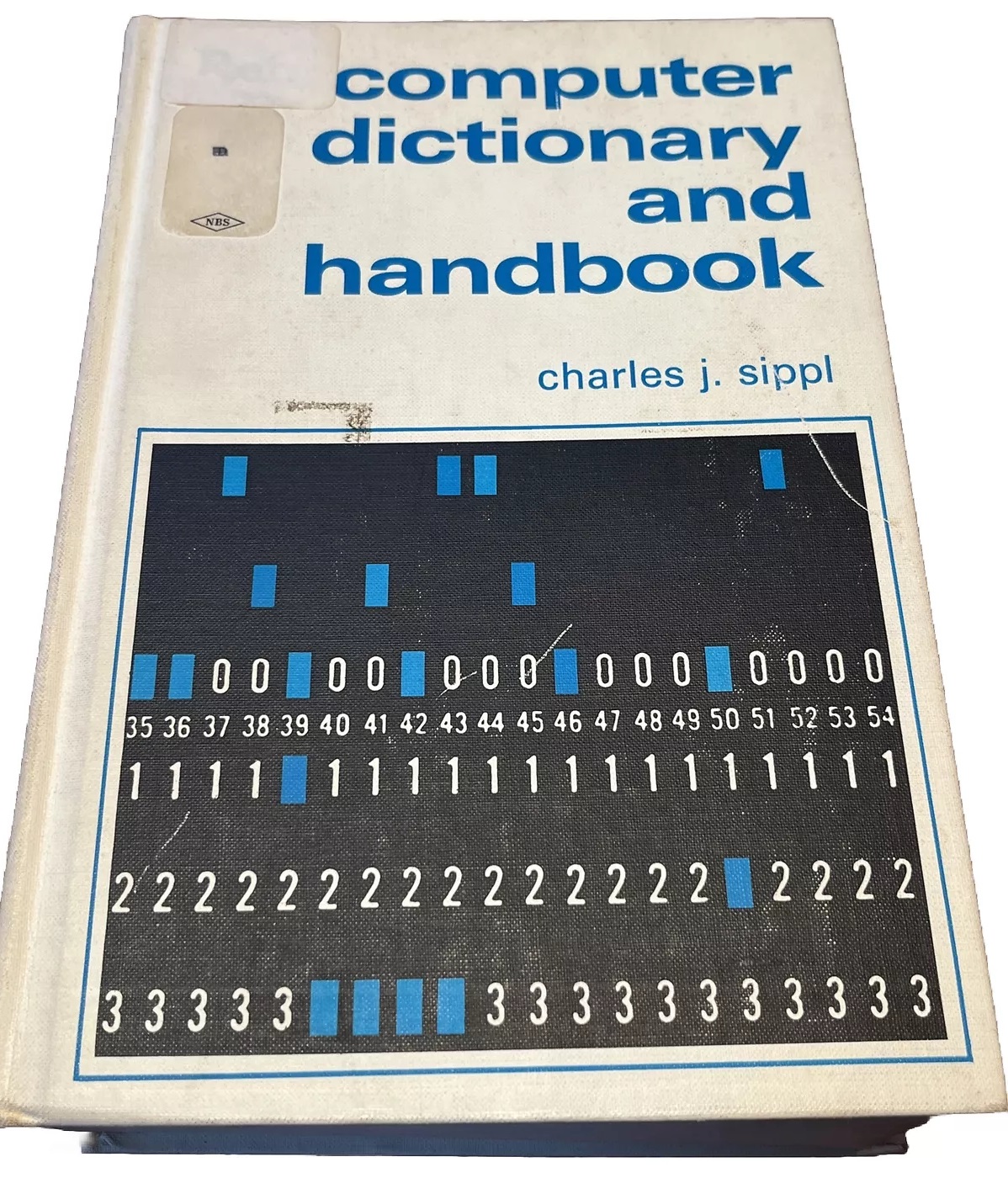
As a technical publisher, they got into computers early, like with the Computer Dictionary & Handbook (Sippl, 1966)…
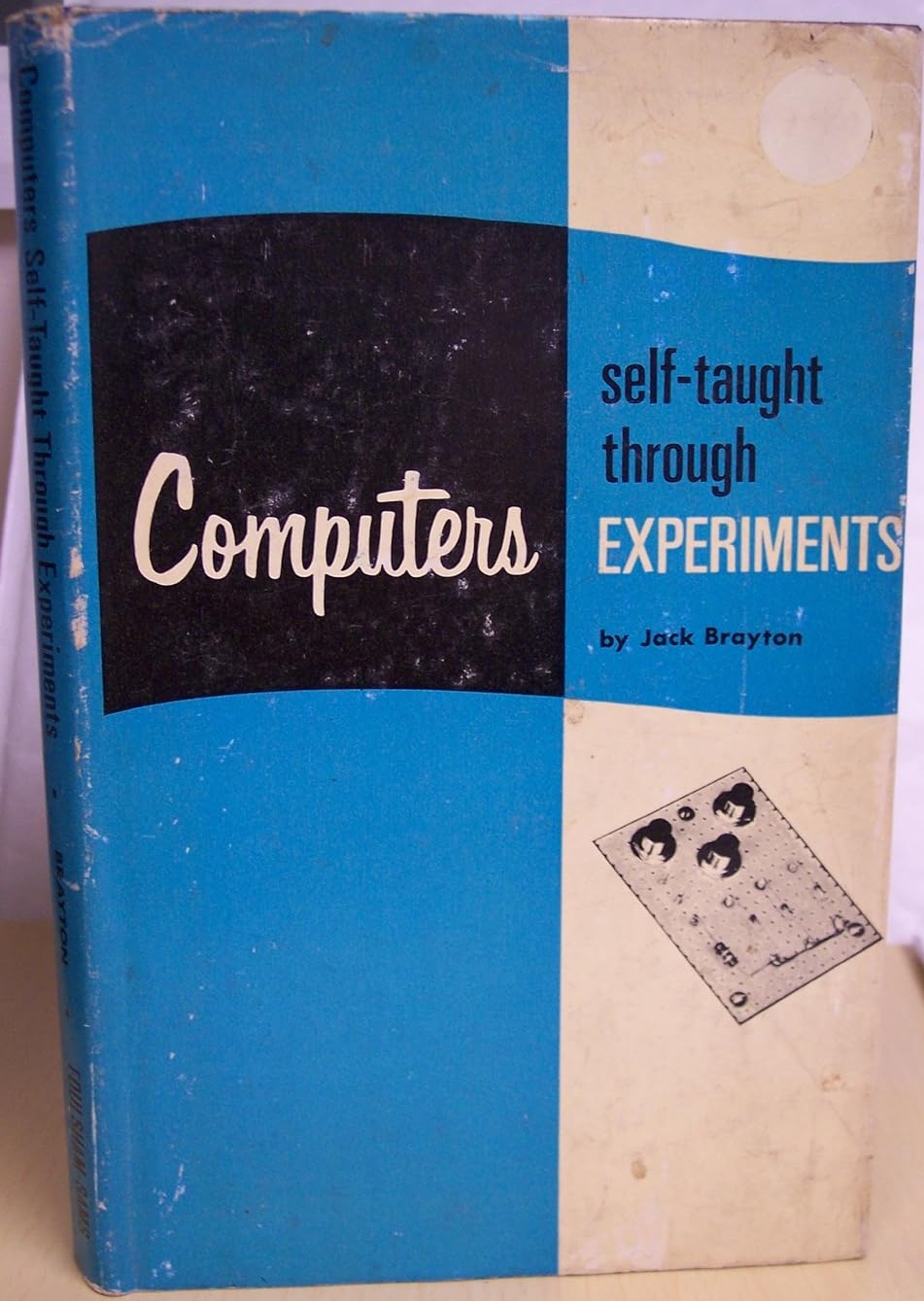
…or the book Computers Self-Taught Through Experiments from the same year. The culmination, Chapter 17, is titled Building a Calculator.
You might assume they would immediately make a natural segue into programming languages when those books started to appear, but their books through the 70s tended to stay at their roots in electronics, aimed the “circuit design” layer. The first book of theirs I’ve been able to find with programming is the 1977 volume How to Program Microcomputers, followed by The Z-80 Microcomputer Handbook from 1979. Both stick solely to assembly language. In 1980 Sams finally broke into the mainstream source code market with the Mostly BASIC book series by Howard Berenbon (an automotive engineer in Michigan who worked on computers in his spare time).

Berenbon, from the second Mostly BASIC book, 1981.
I’ve referenced the first book before as it has an early CRPG, Dungeon of Danger. It is not impressive as a game, but it does represent Sams entering the software industry, in a sense. They soon after entered the software industry proper (with boxes on shelves). But why?
It could be brisk sales of the book (enough for a sequel) gave them favorable thoughts. However, my current best theory has to do with a competitor: in late 1980, the California company Programma was bought out by the Hayden Book Company. The timing is suspicious: in March 1981 Sams formed the spinoff division Advanced Operating Systems, and they hired a former Programma employee, Joe Alinsky, to be in charge of the division.
Unlike Hayden, Advanced Operating Systems planned to build their catalog from scratch. Palmer T. Wolf (previously at Instant Software) was hired as the “Software Acquisition Manager”. Wolf blitzed classified ads in the trades looking for submissions.

InfoWorld, Nov 23, 1981.
In the original 1982 printing of Caves of Olympus, he even included a letter in the manual identical to one from magazines. I haven’t been able to unearth anything about the authors (Thomas and Patrick Noone) and if they had any prior relationship with Sams, but it is possible they simply saw one of the ads and sent their game in. (Wolf claimed “50 submittals” in his first six weeks, so around one game a day.)
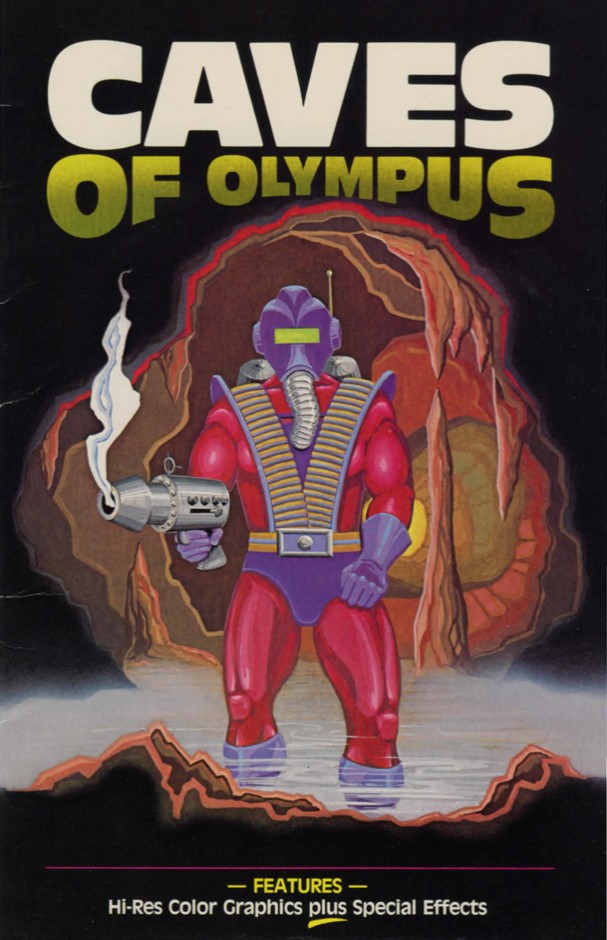
From the Museum of Computer Adventure Games.
The above is the cover from 1982. The survival of Advanced Operating Systems as a separate division from Sams was short-lived; they got wrapped back into the fold in 1983 (without Alinsky and Wolf), so a re-print in 1984 of this game is purely under the Sams label (I’ll show what that cover looks like in a later post).
This is the only adventure game published by Sams and the only game by Thomas and Patrick Noone. (The credits also list a documentation editor, Jim Rounds; shockingly, a company renowned since the 40s for providing documentation for technical devices cares about their documentation.)
On the devastated planet Olympus, beneath the ruined palace of the Emperor, lie the Caves of Olympus, the last fortress to withstand the onslaught of the evil Loren hordes.
You are Anson Argyrus, an advanced Vario-500 robot. Stranded and alone, you must make your way through the caves to safety and freedom. Cunning is your ally, reasoning is you1 weapon, as you battle against the destruction waiting at every turn-false chambers, one way doors, death traps.
But negotiate the caves successfully, and you’ll escape to join the rebel forces gathering to counter the Loren invaders.
We’re a robot! I think the last time we got close to that was Cranston Manor Adventure but that was pretending the “I am your puppet” perspective had a digital avatar in the world conveying information to us. Cyborg from Michael Berlyn united both the the player-avatar and the computer-narrator. Here, we are straight out playing a robot, no human attributes at all. Not only are we a robot, we’re a small robot “a little more than fifty centimeters tall” and who is centuries old. We are in fact old enough to have helped build the Caves of the story, but our “bio memory” has failed us so we don’t remember what’s inside.
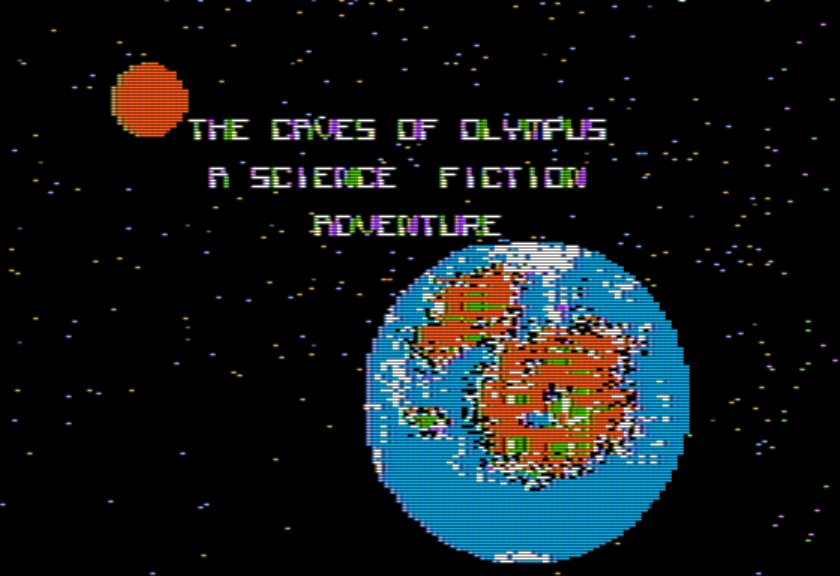
Regarding the graphics, the display uses Jyym Pearson logic where you press enter to swap between text mode and graphics mode, and you pretty much have to keep swapping between the two as you’re walking around as you don’t get enough information conveyed while in graphics mode.
I should also highlight — and it will become more obvious soon — the actual graphical style is very different than anything we’ve seen before. Essentially all the 1980-1982 Apple II games have used some form of vector graphics, like Mystery House; some have looked better, and have incorporated wavy lines and fancy fill effects and the like, but still there’s a sort of basic continuity where it is easy to recognize Apple II graphics as falling within a certain family tree.
No vectors: Caves of Olympus relies heavily on pixels. This is very different from every other adventure game I’ve played in 1982.
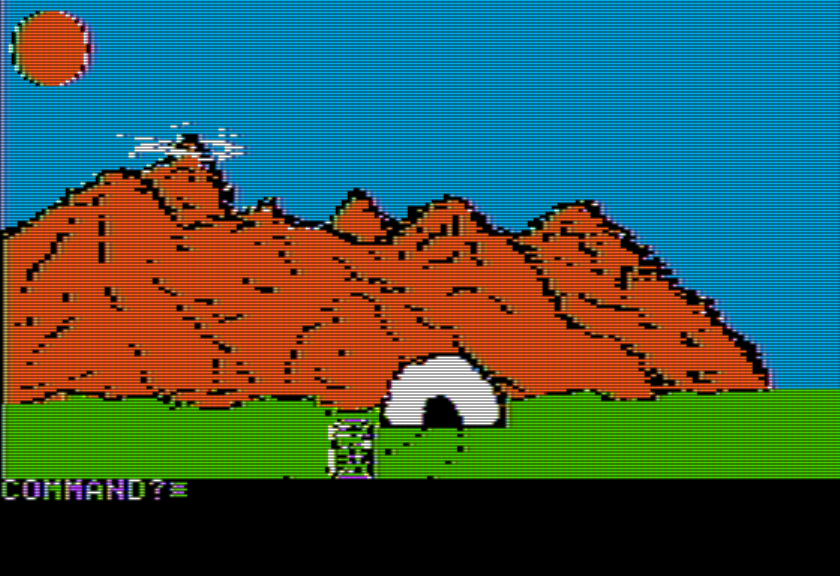
Notice the random break-up of mountain ridges by pixels rather than smooth curves. It’s almost like the authors added “noise” as a stylistic feature. It looks as if at least part of the images are being stored as bitmaps.
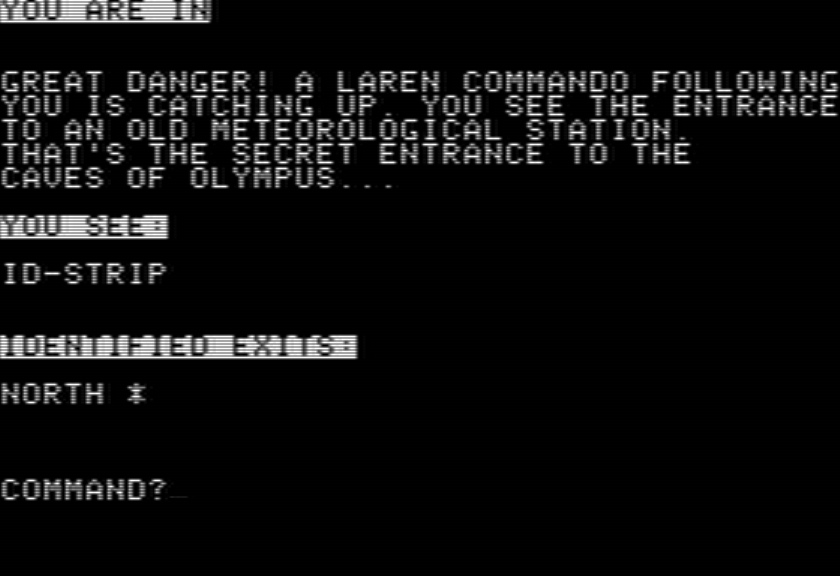
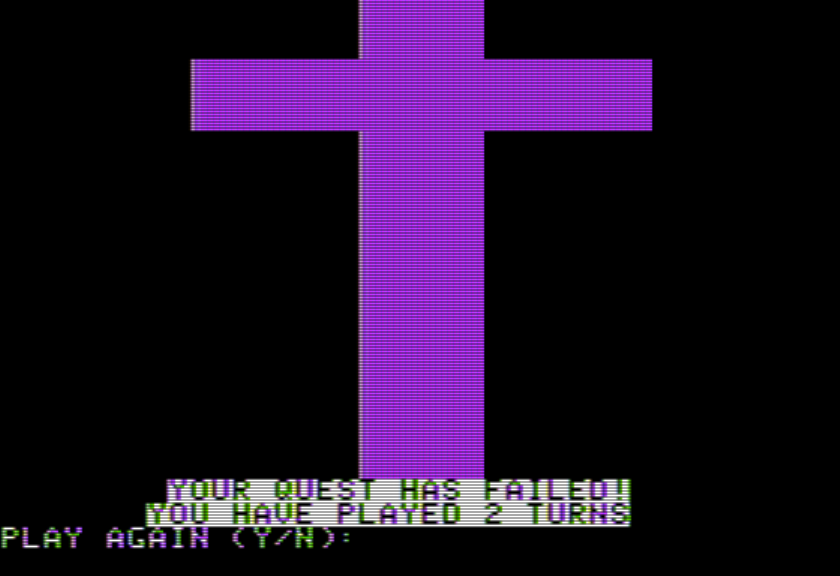
I’m not sure what to do with the ID-STRIP. Trying to TAKE, EXAMINE, etc. just gets the message RESULT: NEGATIVE! and if you waste more than one turn before going inside the meteorological station, you die. So I’m going to assume the strip works automatically for someone travelling north to keep the Bad Guys out.
Going in, we arrive at a “vestibule”.
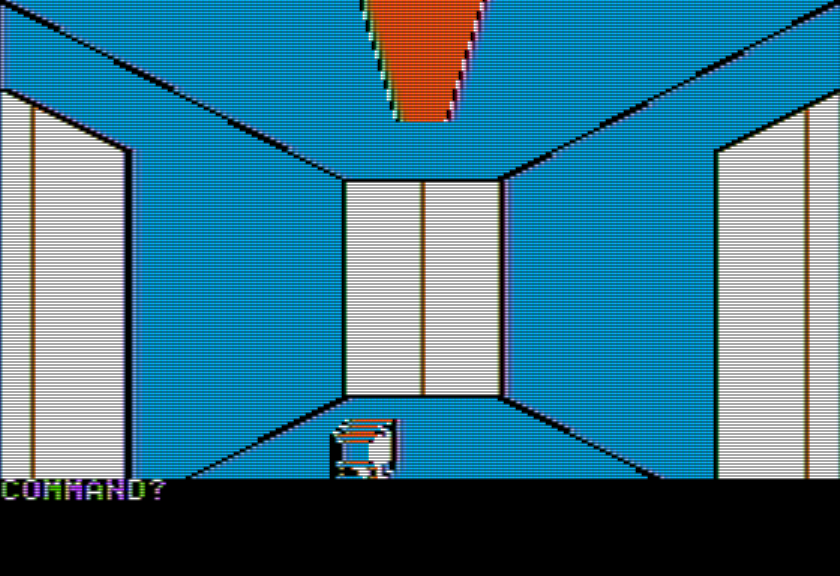
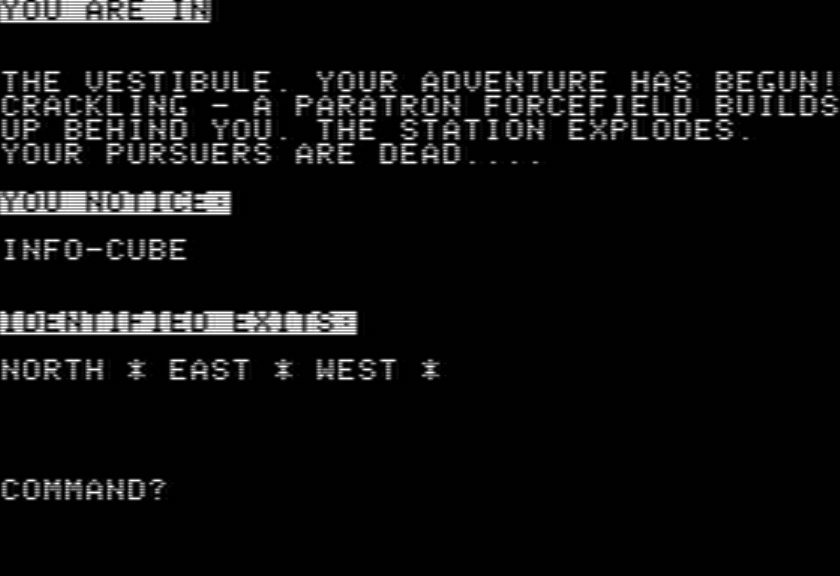
TAKE INFO-CUBE: “THE CUBE GLOWS IN A WARM LIGHT … WHAT INFORMATION MIGHT IT CONTAIN?”
The room description includes some “narrated action” which skips some steps. Rather than going from straight outdoors to the room we’re in, our robot hero goes from the outside to a meteorological station, and from there into the caves. The part in the middle is skipped over, more like a gamebook than a regular adventure game. Not all room descriptions are like this but there are some others which assume action rather than just description.
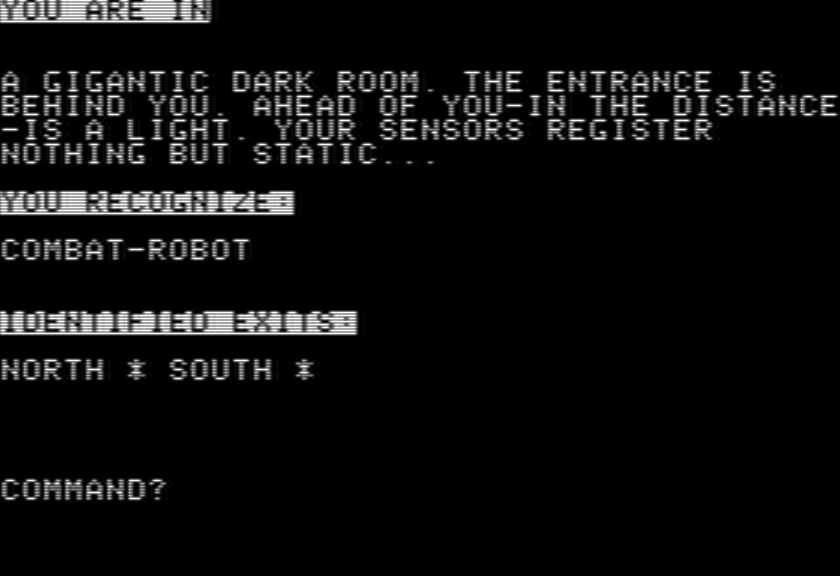
For example, heading north, there is a dark room with a combat-robot (fortunately you can just sneak on by)…
…and the room farther north is both described and depicted quite oddly.
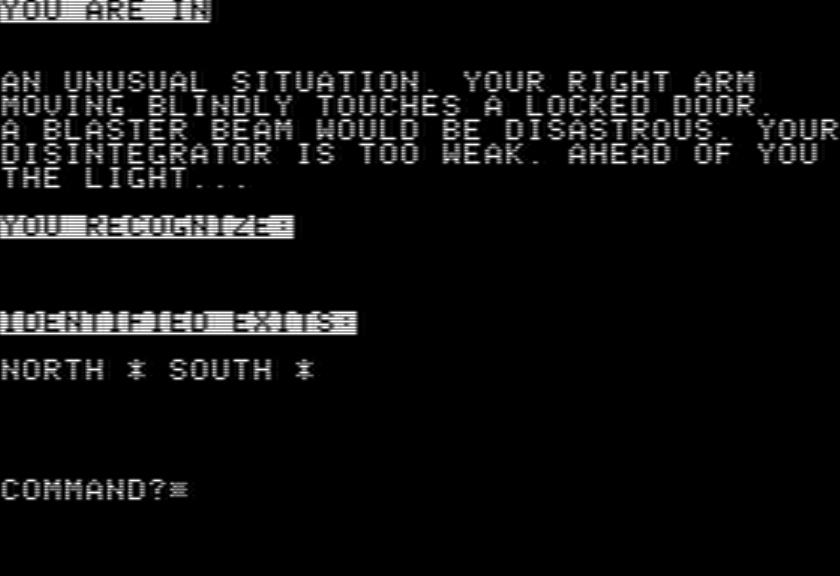
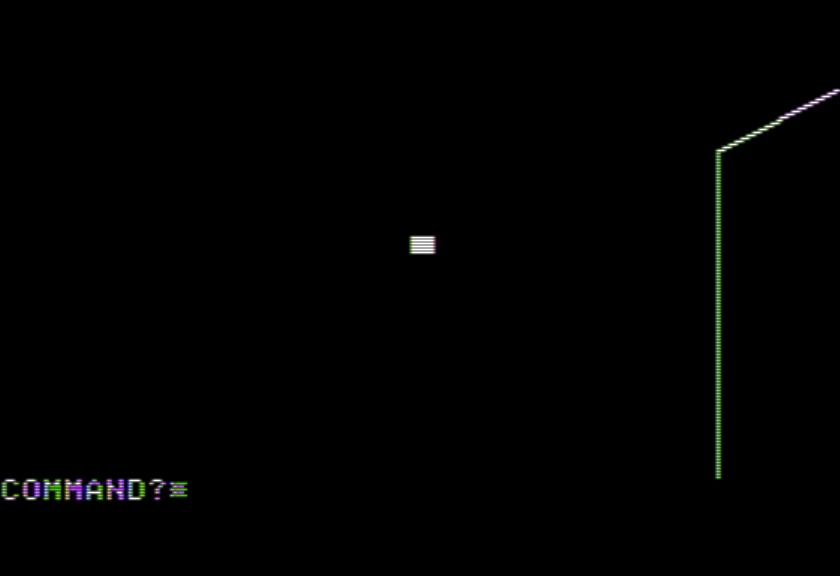
This sort of room description tends to get avoided in modern text adventures, since it doesn’t hold up well to repeated viewings. For example, if you go back to the starting vestibule, you get the same dramatic description as if you just entered the room with the station exploding behind you.
Moving on further, you reach a hall with a dead creature.
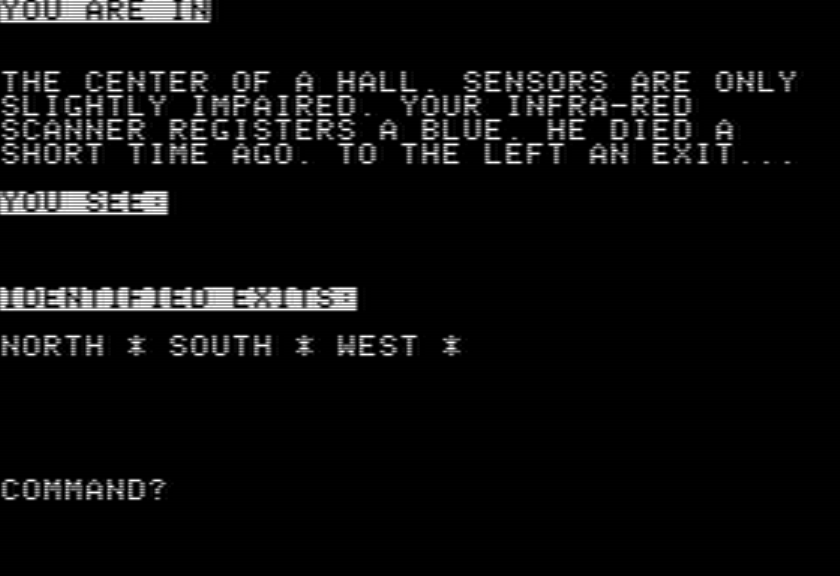
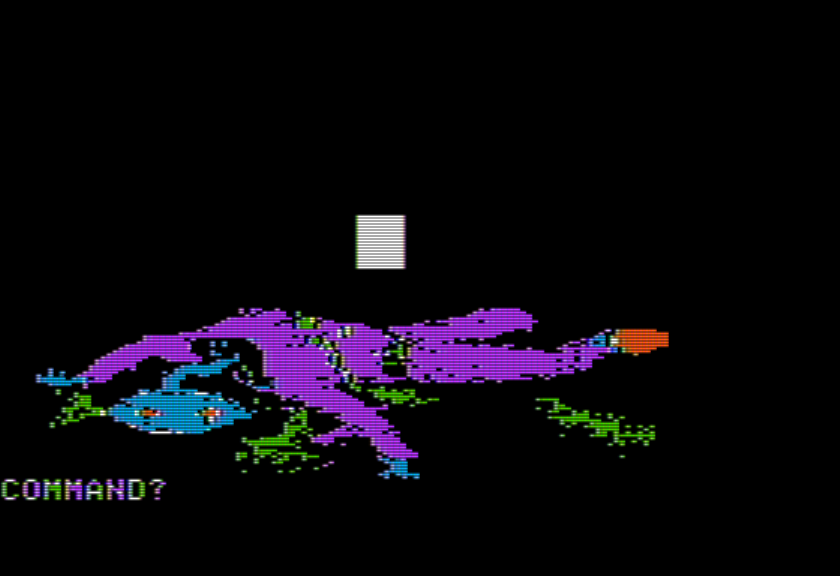
Taking a turn west, there’s a combat robot, and trying to move on further is disasterous.
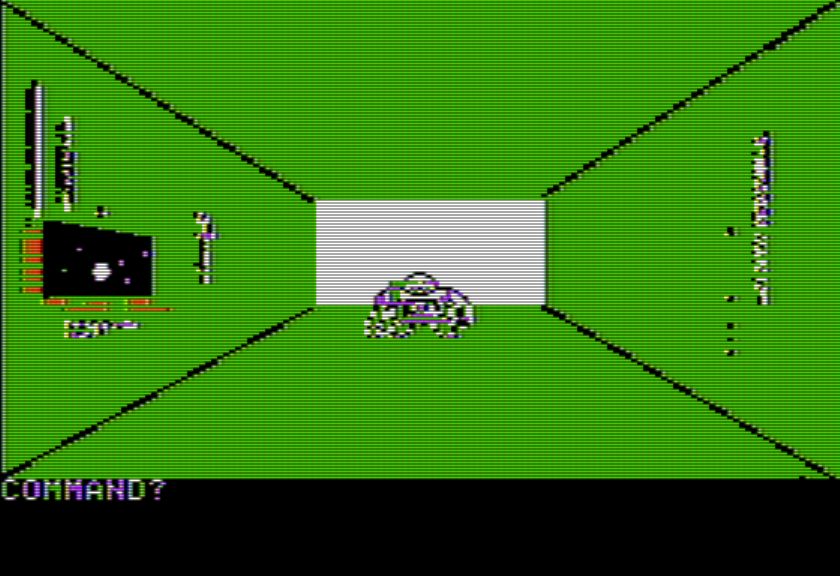
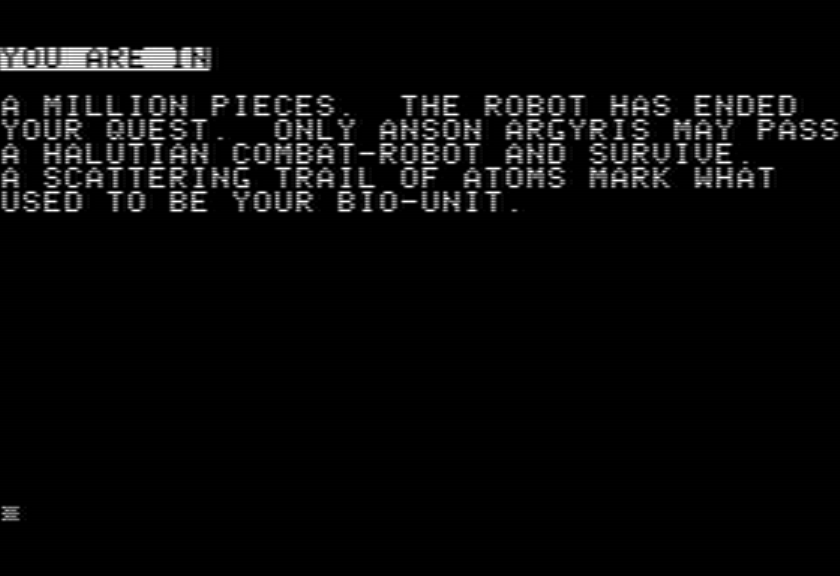
I’ve explored more rooms but I’m still getting a feel for the geography (and what interactions really work) so I’ll save more details for next time.
(And thanks to Allen Wyatt, who has been helpful with the history here, as he worked for Advanced Operating Systems starting in mid-1981. He moved to Michigan City to be closer to AOS in late 1982 but had to move again a few months later to Indianapolis when the operation got wrapped back into the main headquarters location.)



 Renga in Blue