Nearly all the haunted mansions (or castles) that we’ve experienced through All the Adventure have been, at their essence, fan fiction.

Solihull, Birmingham area.
This isn’t necessarily a negative thing for the circumstances, given the tiny space most authors have had to work with. As I’ve observed before, fan fiction is a shortcut of sorts that allows an author to put Spock in their game by just writing
Spock is here.
with all the different associations and abilities Spock has already implied, without having to waste more precious memory space with explanation. Similarly, with spooky games by Morgan or O’Hare or Bassman a stereotypical monster can be implied by just mentioning its name. “Dracula is here” implies not only a visual, but what sort of puzzle elements might be used.

From Morgan’s Haunted House, after using SHOW CROSS, an action hinted at nowhere in the game, but rather applying the “fan fiction” aspect. This allows us to steal Dracula’s chocolate chip cookie. Maybe he’s Count Chocula in disguise.
The is the first of four games at CASA titled Castle Dracula, although the only one from 1983. The author, Paul T. Johnson, has the distinction of most of his games being written later (1996-2004, not counting he was a contributor to Cragne Manor in 2018). He rewrote Castle Dracula twice, first as House of the Midnight Sun and later as Dracula — Prince of Darkness. The first game includes some historical detail about Castle Dracula:
I wrote this text adventure game in 1983. The game, written in BASIC took me a year to program. For its time 1983, the verbose descriptions of the 40 locations impressed even me. “House Of The Midnight Sun” Was based on this early game. Untill recently I had thought the game was lost, however thanks to the work of Simon Hardy and Robert Boyd an early build of this game is once again available to play. The ’83 game was aimed at a younger audience. “House of the Midnight Sun” is a larger and far more complex game. It is also a far darker game.
The author’s web page gives the further detail that the game was mail-order only, sold via ads in magazines, and he “sold copies of the game all over the world including Japan.” He explains the “main problem” was a lack of computer memory (surprise!); out of the list of platforms (Spectrum, MSX, Commodore Plus/4, Atari, Dragon, Texas Instruments TI-99/4A) the TI at least meant it was restricted to 16K.
To help with the games longevity some of the puzzles were as tough as old boots. None of your – ‘need a brass lamp to explore a darkened room’ – These puzzles were mean!
(… blinks, notes that the game we just played here had “need a brass lamp” as the only puzzle …)
It was sold by Mercury Software (Johnson’s house) out of the Birmingham area, not to be confused with the Mercury Software in Manchester (selling “arcade quality games” for the Oric).

Via World of Dragon.
The author implies the difficulty is in the puzzles, whereas I would argue it is in the highly bespoke parser. This is another of the type where everything is implemented “manually”. That is, there is no real “world model”, but rather each room has a custom listing of prompts that will move the game forward. Even dropping inventory items is not allowed!

There’s also some unconventional commands: the only directions are N, S, U and D (no E or W) and typing E is actually short for “examine”. (This is akin to how Robots on Terminus IV had to avoid all words including a Z because Z was being used for backspace.) I admit to misreading things and being confused for a while thinking maybe I was turning my character east to see something, and by coincidence the thing always happened to be the east. The other shortcut is “R” for read; according to the author the E and R notation is used to save memory. (If this was coded “normally” where all the verbs are stored centrally, this wouldn’t be a problem, but there is almost no code re-use in the logic flow at all.)
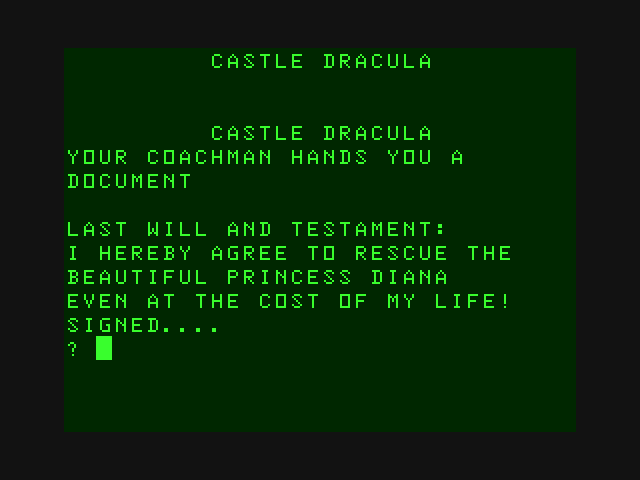
Our goal is to rescue a princess from Dracula. Isn’t the will supposed to say who our possessions go to, not explain how we’ll probably die?

You start approaching a graveyard, and E (for “examine”, remember, not “east”) will reveal a freshly dug grave.

The game is fishing for DIG EARTH specifically to make progress.
750 IF I$=”E” THEN 800
760 IF I$=”R”THEN 820
770 IF I$=”DIG EARTH”THEN 840
780 IF I$=”S” THEN 600
790 GOTO 470
800 E$=”ONE OF THE TOMBSTONES LOOKS NEW.THE EARTH HAS JUST BEEN DUG,YOU SEE SOME WRITING”
810 GOTO 70
820 E$=”THE TOMBSTONE HAS YOUR NAME ON IT!A WARNING OR A CLUE?”
830 GOTO 70
(70 gets the room description and inventory, and is the only part of code that is re-used in the program flow.)

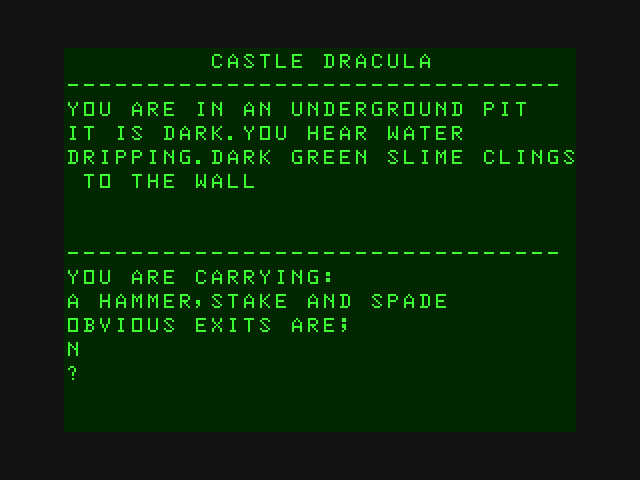
Moving forward is a “guardian” which blocks your way.

This is honestly terrific atmosphere (in the spooky-game-written-by-enthusiastic-kid sense) and has two options: you can either hand over the stake as requested or use HIT SKELETON. (That verb specifically, of course.) Giving the stake almost seems like a softlock:
YOU NO LONGER POSE A THREAT TO MY MASTER. YOU ARE NOW HIS SUPPER THE SKELETON DISAPPEARS BACK INTO THE GROUND
However, you’ll get your items yanked away later, and it isn’t like the game is really keeping track; to remove the stake the game simply changes the string used to print inventory (IN$=”A HAMMER AND SPADE”).

Moving on…

…there’s an underwater waterfall where the game is fishing for ENTER WATERFALL, followed by a Smuggler’s Cave where there’s algae visible if you use the E command; the game specifically wants REMOVE ALGAE.
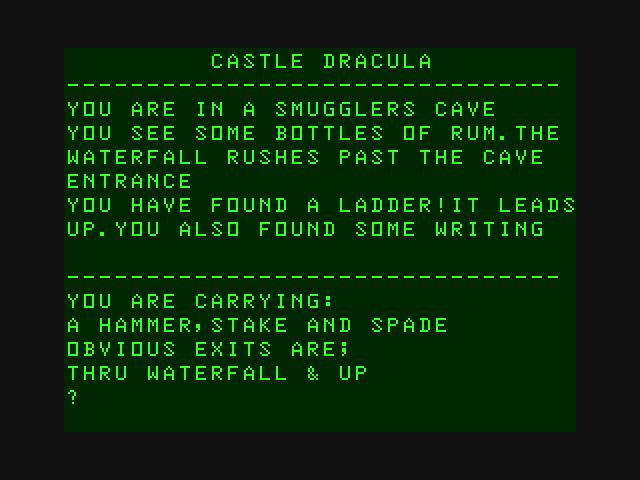
Not TAKE, SCRAPE, GET, etc. because the code is just a line that checks if I$=”REMOVE ALGAE”.
The writing says
I MUST DESTROY THE MONSTER
ITS SIGNED REV.POTS 1817
VAMPIRE KILLER
Onward is a very slight amount of exploration (everything is linear from here on out); you arrive at a “main hall”, can go north to find barred doors and a “letter”…

It’s backwards.
…and go south to find a library.
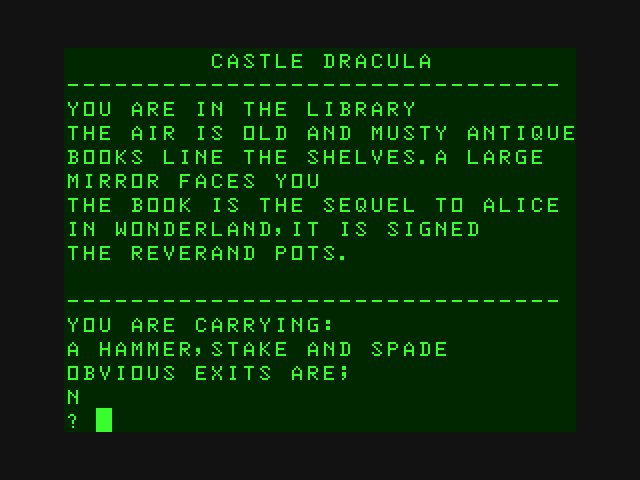
The book is meant to hint you can go into the mirror (or rather, quite specifically, ENTER MIRROR).


The right response here is IGOR. This is hinted at from the backwards text earlier, and note that you need to just type the word IGOR, not SAY IGOR or RESPOND IGOR or anything else like that, elsewise:
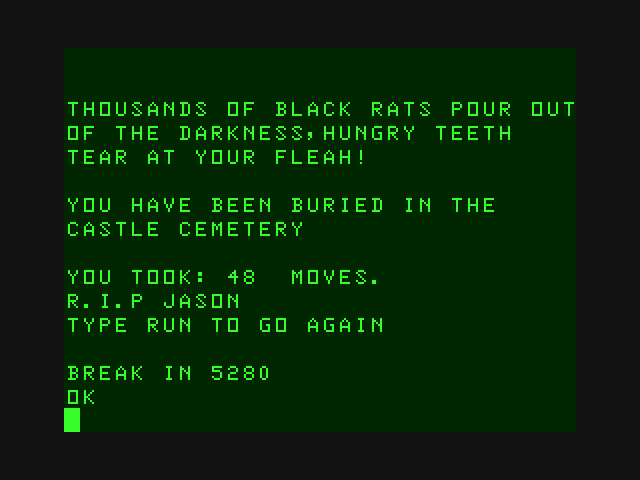
If you IGOR correctly you will still be left to be attacked by rats. Examining reveals a message on the wall from the helpful REV. POTS:

This is a direct letter code (1=A, 2=B, 3=C, etc.) which prompts the player to REMOVE MORTAR.

If it isn’t clear yet: the author sacrificed world model aspects (or more likely, didn’t know at the time how to code them) for the sake of “cinematic” text to describe events. We’ve had this sort of contrast with Peter Kirsch games, which more properly have a world model, but by jettisoning everything the author is laying everything down on the text.
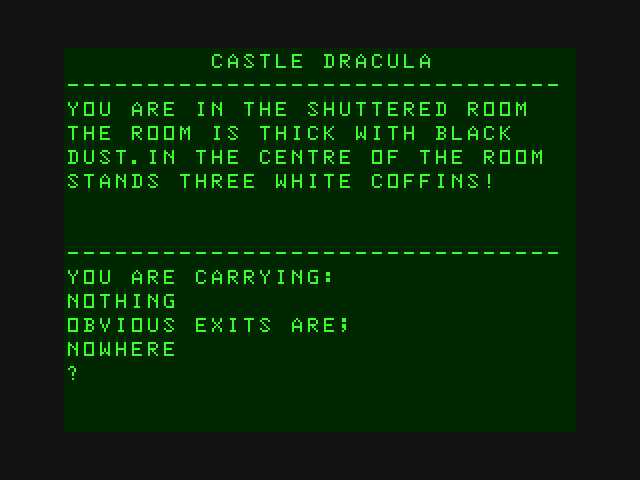
Another timed scene, the coffins start to open. With a better parser (and some clarity that it is in fact daytime) this could have been the best moment of the game. REMOVE SHUTTERS:
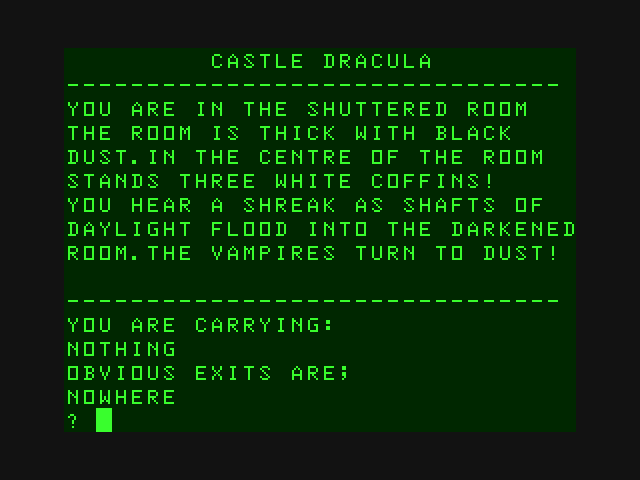
One of the coffins can be entered, revealing a down-staircase to some bones. A stake lies amongst the bones but it is just a fakeout.

You then get confronted by a GUARDIAN OF LOGIC who wants you to prove you exist; now we are on literal guess-the-phrase with I THINK.
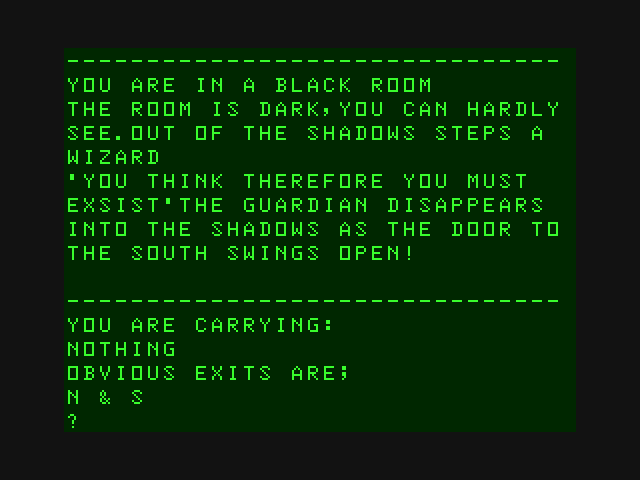
Onward more, there is a chamber of steel with a large rock; this rock gets used immediately, as the room after has a classic crushing trap you can foil with DROP ROCK.

This allows progress to a “haunted bedroom” with a hint I’ll return back to later.
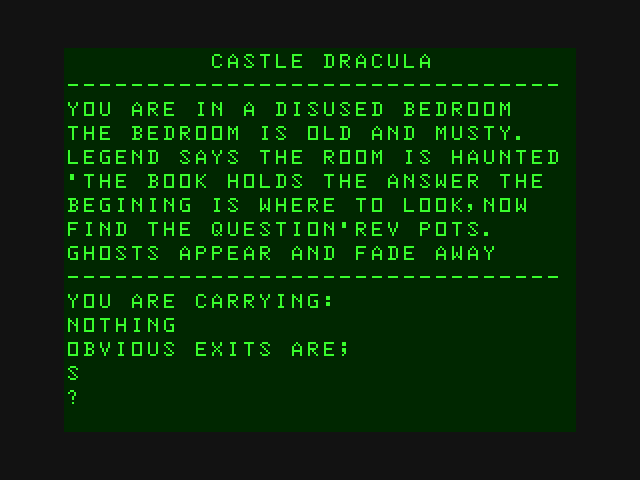
Past here is none other than Reverend Pots himself, who is sleeping in a bed.
ITS POTS ALRIGHT.MAYBE YOU
SHOULD WAKE HIM.
Waking him is a bad idea.

You should instead just ignore him and move forward, whereupon a countdown timer starts.
A GHOSTLY APPARITION STANDS
BEFORE YOU.IT SPEAKS WITH THE
VOICE OF THUNDER’KILL THE
VAMPIRE BEFORE SUNSET OR HE WILL
KILL YOU!’
You now have 10 turns to beat the game.

In a bedroom that follows, there’s some wallpaper to remove opening a passage to a secret vault.

This is where the game’s bragged-about difficulty really kicks in. You have to realize the game is making a pun here and PLAY C, opening a passage to the princess.

I kind of wanted the princess to already be a vampire. It would fit with the plot of the game.
The princess gives you a note which indicates what to do, while Drama happens:
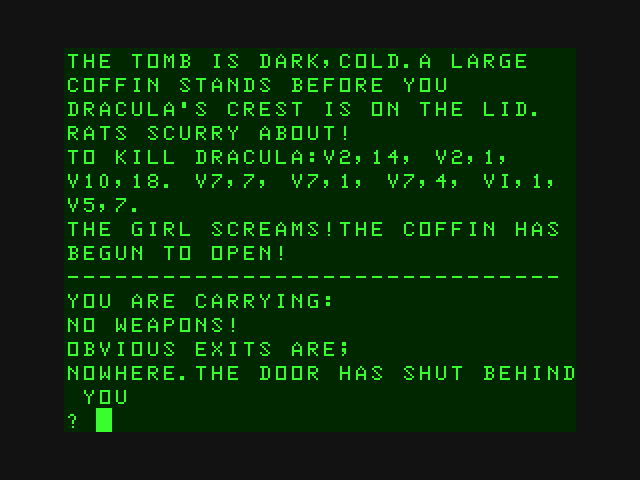
You only get one turn to act. I love the tension, although note this game doesn’t have a saved game feature so there’s a fair chance (especially given the parser) there would be a lot of restarts.
And here I admit I did not figure out the puzzle, but checked a walkthrough. This refers back to the Reverend Pots hint, and suddenly jumps the game to hyper difficulty, because these are references to the book of Genesis, specifically the King James Version. V2,14 means look at Genesis 2:1, letter 14, and I’m guessing most players in the 80s just cracked open the source code.
Thus the heavens and the earth were finished, and all the host of them.
The code comes out to SAY MAGIC.
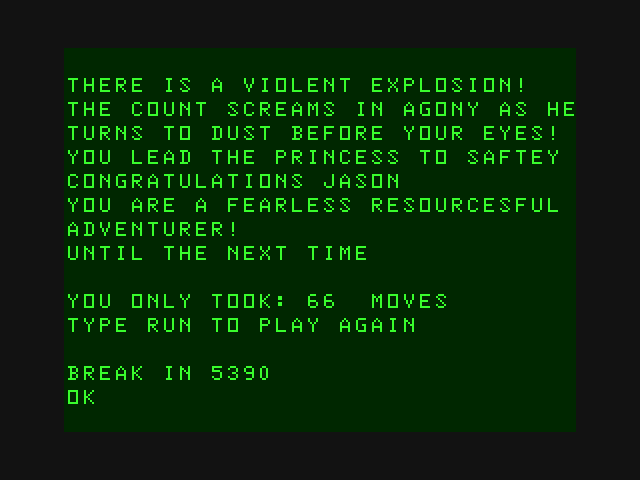
Despite this game fitting into the many haunted houses we’ve seen (and will still see), the focus on scenes with driving tension did make it come across very different and it had a janky charm; I would have just preferred a different parser, but fortunately the future version of the author has already obliged that (twice) as the remakes are written in Inform.

Via World of Dragon.
I am a realist and know it will take an awful long time to get there, so let me finish by quoting the author about his first remake, describing his overall process and using the term “interactive ghost-train ride”:
When I wrote “House of the Midnight Sun” in 2002 I use to work as a paramedic in Birmingham, England, (I have now retired.) I spent my ten hour shifts, waiting for emergency calls on my own in a Paramedic car at Sarehole Mill. There, where Tolkien grew up, and later used as a setting for his novel “Lord of the Rings,” I wrote the game on a tiny Psion Revo. (Today I’m using a Sony Vgn P11Z.) I remember sitting by the stream, next to the mill, writing the ‘nest of rats’ puzzle, a routine with a gruesome solution. I was just wondering if I had gone too far, when I looked up to see that I was being watched. I was not alone, I had been joined by a large brown rat. I took this as a sign, and the rats’ nest stayed. Since then the rat comes round from time to time to check on my progress. I must remember to take him something to eat.


 Renga in Blue