I’ve finished and it was a near thing; I was on the verge of ragequitting for reasons you’ll see in a moment.

Zoomed-in view of the cover.
So, last time I left off I implied I was in for a grind, insofar as the way the middle part of the game works is
a.) find a palace [or turn around at the one you were just at and land again]
b.) find three clues that open secret doors and lead to a the “final room” that lets you charge your ornithopter up using the spell ENCHANT
c.) get any items along the way and USE MAGIC DETECT on them to find the ones that are spells, giving them to the wizards in your party
I’m not going to give all the spell effects, but I will give the names: invisibility, extinguish, reflector, sleep, freeze, ball of fire, jump, flame sword, shrink, spider climb, penetration, part waters, teleport, levitation, rope trick. That’s fifteen spells you need, and if you explore thoroughly enough I think you find six of them on a given run? However, they are a completely randomly chosen six, so if you’re trying to get a full set of spells (as the manual implies you’ll need in the final section of Atlantis) you have the experience akin to open Pokemon deck after Pokemon deck trying to find a shiny Growlithe and failing.
I played through, I am not kidding, 30 times. It started to get very repetitive. It didn’t help at the beginning that I was missing one of my search tools: a command that works, in addition to LOOK ITEM and MOVE ITEM, is LOOK UNDER. Not LOOK UNDER (ITEM), just the phrase LOOK UNDER. I missed it somehow perusing the manual but sometimes that’s how something you need is hidden.

This is just from LOOK, but MOVE and LOOK UNDER are equally likely to find something. The cage is totally useless.
I started to get a pretty good sense of the generation plan the game uses. The game starts with Entrance-Library-Ballroom-Reception, with a clue 1 in one of the rooms, which opens a secret from there. The new section has a clue 2 somewhere in the first couple rooms.

Once entering the last new secret area, there’s a clue 3 again in the first few rooms, and that clue will go to a “Grand Hall”, “Pillared Hall”, or “Windowed Hall”, all which are connected together in some way.

The riddles are all pretty straightforward as long as familiar with a little Western mythology, like “MONSTER WITH ONE EYE” (CYCLOPS) and “A WOODEN HORSE ENDED IT” (TROJAN, referring to the war, not TROY). The rotated-alphabet translated just served to add an extra level of annoyance after about the 4th iteration of the map.
In the midst of all this, you can have people fall in pits or under rubble (use rope or a shovel) some “trogs” which you have to keep shooting (if you turned your “reflex” score up at the start of the game, although I it set to 0 so I could actually ignore them) and enemy warlocks, which were the most annoying of all:

Just like the first part of the game, you can OFFER SPELLNAME to make them happy, but if they refuse your offer, you’ll get in a wizard duel. Then you choose a wizard and a spell to cast, and there’s whole table the game refers to:

I think the intent was to create maybe a rock-paper-scissors sort of game; if you choose EXTINGUISH and they choose to cast a fireball, the attack is canceled. But unless the warlock gets bored (random, sometimes they’ll just let off) that just leads to another round, and there doesn’t really seem to be any real strategy involved, just RNG. I ended up just using save states a lot and restoring if I had an unfriendly wizard so I didn’t have to deal with the duels. I think the one-shot nature of the duels is the main problem; there’s no real accumulation of action that happens that leads to interesting strategic choices.
None of that compares to the fact that I just. could not. get. the last. spells.
Over and over and over and over and over and over and over and over … look, grinding in an RPG I can sometimes find sort of soothing, but this isn’t like that. It is like I had to type the same walkthrough 30 times in a row, except some mild elements were jumbled so I couldn’t even do it on autopilot and also I had to keep saving my game just in case one my wizards got killed and I lost a bunch of my precious spells I was accumulating.
I never did find the spell Shrink. I took the gamble that maybe — due to the random nature of the game — I didn’t really need all the spells, and fortunately I was right. I took off, flew northeast long enough, and eventually found Atlantis.

Now the game enters yet another completely different mode. This is a maze where the walls are invisible, and you have to keep using GO DIRECTION in order to search around.
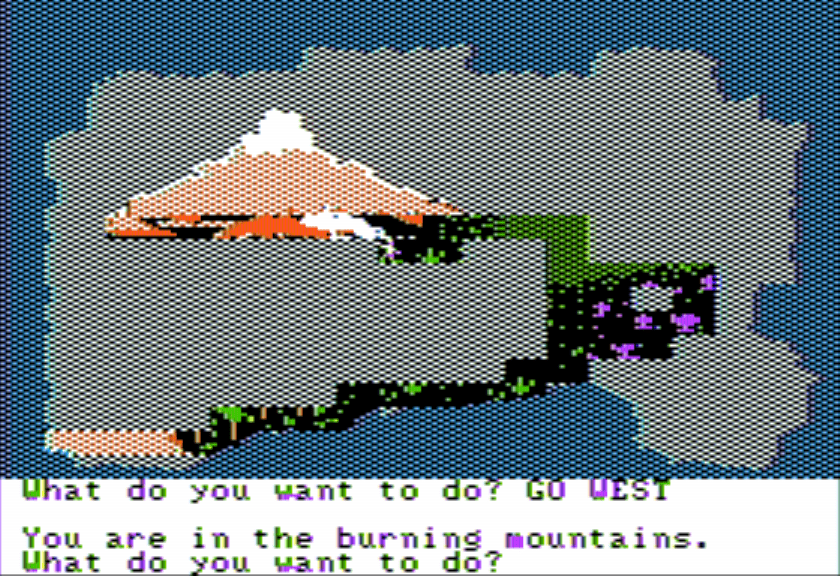
At various spots in the maze you are blocked by obstacles. These obstacles are randomly chosen and placed. The only obstacle that repeats is sometimes you see guards, where you need to use an attack spell (like SLEEP).

Each scene is a sort of puzzle where you have to pick which spell off your collected list works. It is not a highly intense puzzle in that a.) except for the guards which will kill wizards, you can keep going through your spell list until you find the right spell and b.) in some cases it isn’t intuitive anyway which one works so it doesn’t feel encouraged to try to “solve perfectly”.

Why this and not SPIDER CLIMB?
Still, the overall effect was decently novel and fun, with my only problem being the nagging worry that a lack of SHRINK would undo me. It did, once:
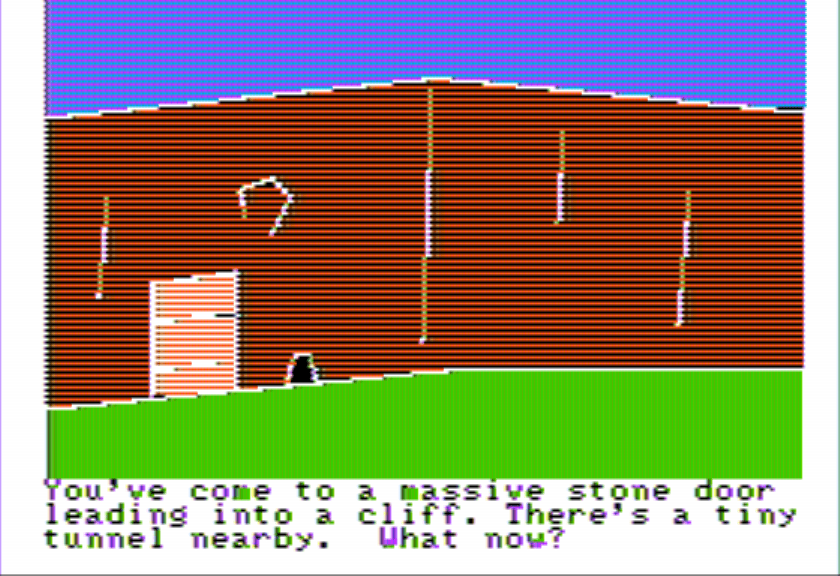
I was curious about the randomization anyway so gave the map a re-roll and had different encounters. I don’t know in reality how much leeway I had.

Probably the most interesting puzzle. You need PANIC HORN here.
I finally wound my way through the maze to a Well of the Worlds, leading to a choice of three exits, only one which let me make progress (left, in my case).


After some more searching and crossing my fingers I didn’t hit a SHRINK point, I came across a Crack of Doom.

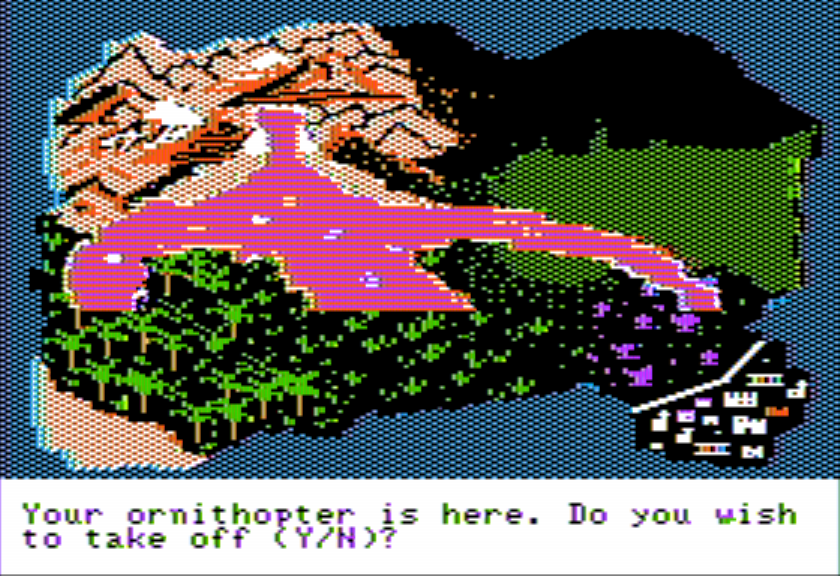
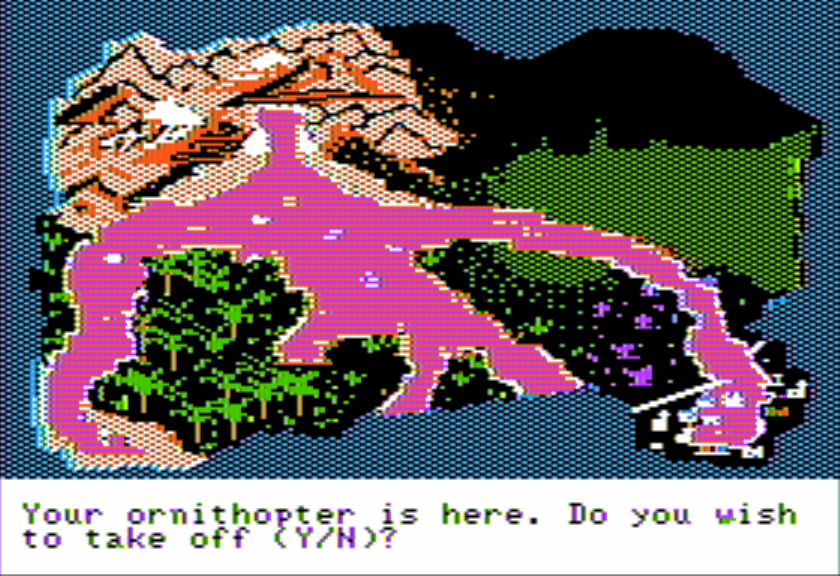
You need to DROP ORB (not USE ORB, that undoes the whole process to the start of landing at the island) and an explosion will start. You then need to book it off the island. A tunnel nearby leads you to near the exit, and then you need to tangle with the maze a little bit longer to make it back to your ride.

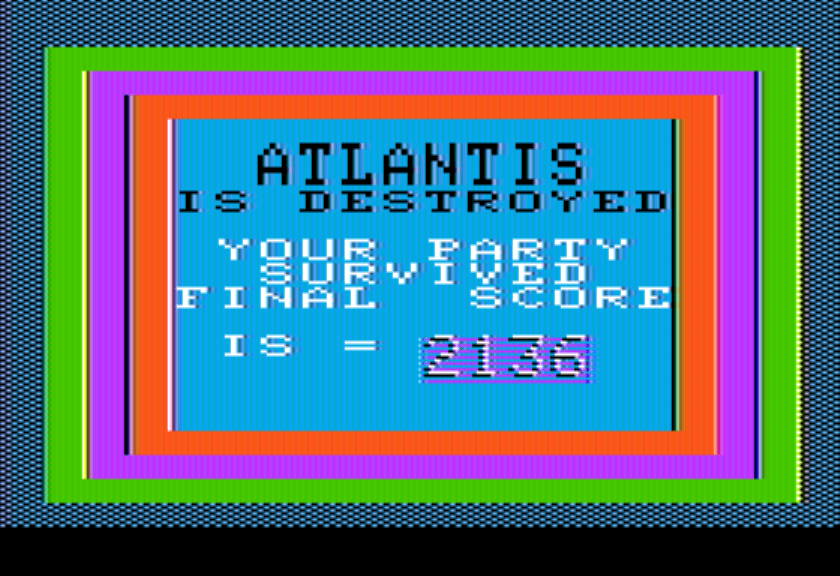
So despite appearances, there was almost no RPG in this game. The adventure aspect was very odd (the single puzzle in part 1, the search-and-solve-riddles in part 2, and use-the-right-spell in part 3) but I’d say it qualifies most squarely in that bracket. I try not to speculate too heavy on what-is-an-RPG or what-is-an-adventure because in the end it is kind of arbitrary but there does seem to be a genuine difference between, say, choosing to use flame because it has a 30′ range and attacks 3 monsters at once, versus using TELEPORT to get past a wall. The spells here are essentially treated as puzzle tools as opposed to strategic options.
This is not the last Clardy we’ll see in 1982. He went on to collaborate on an Atari 8-bit game (dropping the RPG part entirely) which has some similar concepts to this one, except it is science fiction. I’m still going to save that for an entry far into the future in case that one abuses me with the RNG as well.
When we talk about “gameplay genres”, how arbitrary are we being? Are all gameplay genres purely cultural occlusion, where people just mimic what came before, and the possible landscape of combinations of elements is far vaster than we give credit for? One of the things I find fascinating about early games are cases when they pushed into territory nearly unrecognizable by modern categories.
Robert Clardy (picture above) got his start in programming at Rice University in 1970, mashing together classes from electrical engineering and mathematics (as Computer Science didn’t exist as a major yet). As he writes in his autobiography:
There were no classes in computer graphics, animation, computer-aided instruction, or anything to do with entertainment. At that time, those professions did not exist, and there was nothing there to study.
This was the age of punch cards, which Clardy describes as torture (“the CIA was particularly interested in the process, but later switched to waterboarding”) but things improved when Rice got a IBM System/360 (with teletype!) in his junior year. “Video terminals” were added his senior year and as a senior project he made an animated computer movie.
He then went to work for Boeing, while keeping one eye on the personal computer revolution. The Apple 1 was not available near him, the TRS-80 (the first PC he saw) didn’t fully strike his interest, the Apple II’s first release with only 4K memory was too weak, but in 1978 he took the plunge:
16k of RAM, now you’re talking! I bought one with 16k RAM, an RF modulator to enable it to use a TV set as the display device, and a cassette tape drive for storage. And, it only cost $2000. What a deal!
He then took the further step of forming his own company, Synergistic Software, and putting out Dungeon Campaign, inspired by Bob Bishop’s Dragon Maze.

Bob Bishop was a very early adopter of the Apple II (serial number 0013). Dragon Maze came straight out of the Apple II reference manual, along with Rod’s Color Pattern, Pong, Color Sketch, Mastermind, and Biorhythm.
(Dragon Maze incidentally also inspired Beneath Apple Manor, which is sometimes called the first roguelike. Given Dungeon Campaign also generates mazes it likely should be given co-credit?)
This was followed by Wilderness Campaign (1979) and Odyssey: The Compleat Apventure (1980). All of these early games fall into the paradigm of: you’re not controlling a single character, or even a “party” with named characters, but an army. The number of people alive in the army are roughly equivalent to “hit points”. Apventure to Atlantis holds to this same paradigm and is a direct sequel to the prior games.

From the manual, via the Asimov archive.
A group known as the Atlanteans created flying machines and embarked on a campaign of world conquest. A wizard known as a High One (“you” in the prior games) ended up conquering an island taking it as a safe refuge (The Sargalo), creating magical barriers against the marauders. When Apventure picks up, the previous High One has died, and you now play their successor. The original magical barriers are now falling, and you need to address the Atlantean threat.

The opening scene has some animations. The volcano eventually erupts.
The author has taken some leaps since the slow-as-molasses feel of Dungeon Campaign and the animated opening gives the feeling of mid-1980s rather than late-1970s Apple II. (I’m not sure how to describe it, exactly; once Apple II programmers were capable enough, the games eventually all settled on the same sort of feel and aesthetic that I associate with Choplifter and The Oregon Trail.)

The game has you roll statistics for Wisdom, Intelligence, Strength, and Charisma. Wisdom affects spell success, Intelligence affects puzzles, Strength affects combat with monsters, and Charisma affects the ability to attract wizard followers. This is classic D&D first edition style where you just hit a button and hope you get lucky with a number from 8 to 18. For my first attempt (which will fail for reasons I’ll get into) I ended up with 10 Wisdom, 15 Intelligence, 14 Strength and 18 Charisma. The manual goes through some great lengths (including tables) to convince the players these all have great importance, but you don’t have that much control over dice rolls in the end. Here’s the Charisma table, for instance:

I wasn’t above save-state cheating the various rolls that this game does (I am neither the wargaming nor CRPG addict) but in truth the game is fairly generous about the random elements so it doesn’t hurt as much as you might think to fail certain rolls. For example, the way combat works is you gather troops at the throne room you start at (S for Summon, not magic, just the royal guard gives you resources) and then if you lose all your troops you get warped back where you can summon more without any apparent penalty. After leaving the island (to hunt down the Atlanteans) you can’t do any more summoning, but combat isn’t important in that phase of the game as much as magic.
You might be wondering where the adventuring comes in. It will come up organically. The credentials are still not heavy but it does fit I think better than Super Spy did.

Despite the vector graphics being old-style Sierra, I think the lower-case test goes a long way in making it feel like the game is from a later era.
The full list of commands is
GO, READ, TAKE, OFFER, USE, LOOK, INVENTORY, CONDITION, WIZARDS, SUMMON, ENTER/EXIT, QUIT
although you only enter the first letter of each one. You can TAKE NOTE from the table and read it to find your quest…

…although there’s an oracle to the north that explains more or less the same thing.

The other two objects in the throne room are an ORB, which lets you reverse time to undo mistakes, and a BOOK which has some spells: detect aura, magic detect, divination, enchant, panic horn. Detect aura looks at alignment of stats of wizards before you recruit them, magic detect finds the magical nature of objects, divination reveals secrets, enchant “restores levitation plates”, and panic horn infects nearby monsters with “rage and fear”.
Leaving the castle results in a top down view. You can still GO EAST / WEST / etc. although for the most part (with one exception) the physical map isn’t important, because encounters are random.

You can see my little figure having left the castle and two “steps” west.
On the map there are random encounters with monsters. This uses your Strength stat but there’s not much you can do otherwise, and if you lose all your guard you get sent back to the castle for more.

More importantly you can run into wizards. It took me a while to realize (even though we are supposedly a wizard of our own) that what we’re supposed to do is OFFER the spells from our spellbook to the wizards and then they may (based on a Charisma roll) join our party. The problem with all this is it doesn’t always seem to work.

You see, the wisdom is important insofar another wizard won’t join you if their wisdom is higher than yours. I thought the point of underlings is to get them to do the things you can’t?
After enough play (and wizard rejections) this was prevalent enough I clearly needed to do a reboot with a higher wisdom. A couple attempts later I landed on:
Wisdom: 16
Intelligence: 14
Strength: 17
Charisma: 15
So I essentially did stat-scumming. I’m not sure how I feel about that; the era both on tabletop and on computer tried to encourage going forth with whatever poor stats might come about. Fighting Fantasy claimed in their first book (Warlock of Firetop Mountain) that it was possible to beat the book using any stats; this was true for that book (and compensating for a stat being low was somewhat fun!), but most of the subsequent ones a player with substandard stats was clearly going to get trashed. Here, as mentioned earlier, I’m not sure how much low stats really matter — I could just be more patient recruiting and eventually get enough low-wisdom Wizards to join up — but it also doesn’t reflect good gameplay here, since it just forces repetition and not very interesting choices.
With a higher wisdom, I was able in fairly short order recruit five wizards, each with a different spell (detect aura, magic detect, divination, enchant, panic horn). Then there was the matter of: how to get off the island? This was directly an action-graphical puzzle along the lines of something from later Sierra or even Lucasarts games, where you have to time some action to go along with what’s going on.

The Monkey Island II spitting contest, from the Monkey Island Wiki. Part of the puzzle involves simply timing your spit with the wind. It isn’t reflex-based, but it is acknowledging the action in the physical space can differ based on what is going on in visuals of the game’s world.
In Apventure there is an ornithopter that keeps landing and dropping off more monsters. You need to wait for the right moment — and it will tell you it isn’t a good moment if you do it early — and hit U for USE. Then you USE the spell PANIC HORN. This causes the monsters being dropped off to rage and the Atlanteans to get killed, leaving an empty vehicle that you are now able to board.

I do want to emphasize how fascinating a moment this was. I can’t call it the first real time puzzle (we’ve had a stream of action-adventures by now) but this is the first I can think of chronologically that is Sierra-Lucasarts style; where you’re keeping an eye on events and timing an action to solve a puzzle, but you aren’t otherwise involving action-game-physical movement.
This is followed by a more straightforwardly action-game section, so it isn’t like Clardy was trying to discriminate, it was more innovation by accident.

This is the “journey” section of the game. You move your craft around, pick weapons (keys 1 through 5, 3 through 5 are spells) and shoot with the space bar.

The landscape appears to be randomly generated. The main objective at this phase is to look for “palaces” you can land at.


Then the game enters back into “adventure mode”, kind of. The maps of the palaces seem to be generated more or less at random, and you can take off, land, and get a new map if you like.

The same basic rooms (bedroom, library, ballroom, etc.) get mashed together with different sequences and different door placements. I haven’t worked out yet if the map is fully generative or if there’s a fixed set of random maps being drawn from, but I suspect the former.
Your character that’s on the bottom is aiming a weapon, and you can use the joystick to point and shoot at particular enemies.

We just shot a “trog” that seems to be on top of the bookcase.
You might have pit traps appear. If you’ve found rope you can rescue the person who has fallen in, otherwise they are reduced from your fighter forces.

That’s “rubbish” in the corner although it took me a while to find the right word. You can also LOOK WALL or LOOK CORNER to get names of things if you see something that’s ambiguous.
And you might — and here’s where it is actually useful — find items.
Once you have an item, you can LOOK at it to get it “in focus”, then cast MAGIC DETECT in order to find if it has a hidden spell inside. Assuming it does, you can then teach it to one of your wizards (it prompts which wizard you want, so I hope you didn’t forget the names you taught them).

You find through exploring a series of NOTEs. The pattern seems to be the first has “plaintext” while the other two are “encrypted”.

The encryption is just some manner of Caesar cipher (the manual is very explicit about this) and it isn’t terribly interesting to solve, but it does count as kind of a generative puzzle tossed into the mix. The hints all give riddles about words that need to be said in particular places. So the place of rugs is PERSIA and that opens one door. Past that door is a note 2, with a clue about carrying the world (ATLAS) which then opens an area with a note 3 about stones in a circle (STONEHENGE). When I used the last note I ended up in a “mirror area” that required solving a fourth riddle, which just meant I had to type STONEHENGE backwards.

In that dark area I was also able to use the spell ENCHANT, which will cause the ship’s plate levitation to magically start working again.
Once taking off you can turn around and land directly at the same palace to get a newly generated map. I will need to be doing this multiple times in order to find all the spells (ones like “spider climb” and “shrink”), which then get apparently used (in some kind of puzzle sequence) for the grand finale where we find Atlantis. I’ll save that for a second and likely final post after I’m done grinding.

One of my warriors vaporized by a wizard. You’re supposed to send a wizard vs. a wizard in a wizard duel, but that gets complicated so I’ll also save it for next time.


 Renga in Blue