The founders of Artic Computing (Richard Turner and Chris Thornton) made their first adventure game (Adventure A, Planet of Death) themselves.
Richard had a friend (that he “met on a sponsorship programme for Ford”) named Charles Cecil. Adventures B (Inca Curse), C (Ship of Doom), and D (Espionage Island) were all by Charles (and he stayed with Artic essentially until they folded in 1986). Charles later went on to found Revolution Software and produce adventures like Broken Sword, Beneath a Steel Sky, and the forthcoming-for-2020 sequel Beyond a Steel Sky.
(ADD: Gareth in the comments points out an interview which mentions the work process — Charles gave the design on graph paper to Richard who then added his own ideas and implemented the game, so he definitely should be listed as a co-author.)
We’ll get to C and D when we reach 1982, but let’s take a look at Inca Curse.

I went straight for the Spectrum version this time, although the ZX-81 version is slightly less blinky than Planet of Death (the screen flashing only happens when you hit the enter key as opposed to at every single keypress).
IN THIS ADVENTURE YOU FIND YOURSELF IN A SOUTH AMERICAN JUNGLE NEAR AN, AS YET, UNDISTURBED INCA TEMPLE. INSIDE THIS TEMPLE YOU WILL FIND LOTS OF TREASURE, YOUR AIM IS TO GET OUT WITH AS MUCH TREASURE AS YOU CAN. BEWARE, DO NOT LET GREED BE YOUR DOWNFALL.
YOUR ADVENTURE IS COMPLETE WHEN YOU HAVE RETURNED TO THE JUNGLE CLEARING WITH TREASURE.
Yep, we’re back to a Treasure Hunt.
I AM IN A JUNGLE CLEARING
EXITS ARE SOUTH
I CAN ALSO SEE :
A BRANCH
If you try to GET BRANCH the game tells you IT IS HEAVY WITH LOTS OF LEAVES (and you don’t get the branch).
The only other location accessible at the start is some TEMPLE STEPS and a door with a LATCH. If you could bring the branch over you could break the latch.
To get the branch you need to
>CUT LEAVES
OK..
which makes no sense as a verb given the player has no cutting tool! Not only is the player being asked to refer to a “second-level” noun inside the noun, but “GET LEAVES” or “REMOVE LEAVES” don’t work even though they’re more logical verbs for what’s happening.
INTERLUDE
From an interview with Charles Cecil at Gameboomers:
Without doubt the film that profoundly influenced my first games, and many since, is ‘Raiders of the Lost Ark’. My first game for the Sinclair ZX-81 was called ‘Adventure B: Inca Curse’. It started off “You are in a jungle clearing” – that was the extent of the description. In my mind that jungle clearing had huge trees towering above you, dappled light shining through the canopy of leaves, the squawks of parrots, the distant roar of a jaguar. But all I wrote was “You are in a jungle clearing”. And years later when I was the head of development at Activision one of the producers came to talk to me, and he was very impressed that I had written ‘Inca Curse’. He told me that he remembered the game so well – how it started off in a jungle clearing, there were huge trees towering above you, the dappled light shining through the canopy of leaves, the squawks of parrots, the distant roar of a jaguar etc. I realised at that moment the power of interactive narrative – and that he had given me much more credit than I was due!
I’ve somewhat had this effect before, where minimalist descriptions nonetheless convey a much deeper world than depicted in the prose, certainly moreso than the equivalent description in a novel…
…but not on this game! When I played this I never got visualizing past the branch. In the quote, not only is the visualization strong but the memory of it includes extra detail not in the original. I’m wondering if this is a “lost effect” from early games that can’t be recaptured in 2020 the same way — Inca Curse could easily be someone’s first or second adventure game, so it probably had some intrinsic magic to players.
END INTERLUDE
The finangling with the branch was an unfortunate way to start the game, but fortunately, the rest of the was (intentionally) fairly easy. The temple is structured into two layers. Here is the top layer:

The most important section is a FIRE ROOM with a FIRE, a LAMP, and a MAGIC RING EMBEDDED IN FLINT. You can SMOTHER FIRE (as long as you have a MAGIC BLANKET) and take the RING and LAMP along. You can then use a CHISEL on the MAGIC RING to de-embed it.
In the “SLAVES WAITING ROOM” you can find a HYROGLIPHIC TRANSLATOR used to read a sign further on:

Incidentally, if you don’t have the translator, you are told
I CANT READ IT….
IT IS WRITTEN IN SPANISH..
Clearly, this wasn’t a well-researched piece, but just to spell things out: a.) the Inca did not have a writing system, although they did have “talking knot” recording devices called “quipu” and b.) it makes no sense for them to be writing things in Spanish and c.) it definitely makes no sense for Spanish to use “hyrogliphics”.
If you ignore the sign and go down, you find you are in a SAND DUNGEON where a PORTHOLE LEADS DOWNWARDS. You can arrive in the exact same location from a SACRED STONE ROOM which has a sign warning of death if you GO WEST unprepared.
The only way back to the top level is if you have a ROPE and type USE ROPE. Otherwise, you’re stuck. (Well, the game did warn you.)
In order to go down to the next level, you need the MAGIC RING from back in the fire room and a BLUE STONE that happens to just be lying around. (There’s also a RED STONE but it appears to be useless. ADD: Lee Parker mentions in the comments there is a particular passage in the lower level not visible unless you’re holding the red stone. There’s no indication you’re “solving a puzzle” as this is happening and I’m guessing a lot of players missed it.) If you don’t have these items and try to go down the game says YOU ARE NOT CARRYING THE CORRECT POSSESSIONS. Otherwise:

In any of the “Maze” rooms a wrong direction will loop back to the same room.
This is essentially just a big maze. All the treasures are here, and there are no puzzles whatsoever (except for the maze itself). There are eight treasures in total, all golden (golden knives, golden brush, gold coins, golden statue … you get the idea).
Winning requires, simply taking at least some treasure to the jungle clearing at the start.

I was doing the typical thing of having a big pile awaiting liberation, so I was startled because the game ends immediately upon reaching the exit. Also, you can carry at most 6 inventory items, but remember there are 8 treasures, you have to leave some of them behind.
The only reason this works structurally is the upper level-lower level format — if there was a treasure or two “in the open” at the start it would be too easy to end the game with “success!” immediately. (This also makes Inca Curse feels a little bit like an “optimizer” game akin to Mystery Mansion, except the treasures essentially all being “in the open” once the lower section is reached makes it almost more a shopping trip than an optimizable puzzle.)
I did have a much more enjoyable time with Inca Curse compared to Planet of Death insofar as I didn’t get stymied by a parser issue every other turn. The author was clearly trying to build more of an environment than a puzzle game. However, this did result in empty sections…

There are no objects here, or descriptions past the room titles.
…which I think may have heated up the imagination of a 1981-era player, but felt to me kind of meaningless.
Still, I don’t think my time was wasted, and if you’d like to try exploring yourself, the ZX Spectrum version is easy to play online. (There’s also a forthcoming Android version made with permission from copyright holder; I’ll post about it when it goes up.)
…
We’re going to stay in the UK just a bit longer. While the home computer scene was just starting, the mathematicians at Cambridge University were still busy cranking out long and difficult puzzlefests, and in 1981 they produced what is arguably their largest game.
Planet of Death was the first a very long line of games for Spectrum computers, and consequently provokes enough nostalgia that there’s both an Android remake and an iPhone remake.
Planet of Death was a technical miracle straining against its original hardware.
Planet of Death ambitiously included multiple solutions for at least two of its puzzles.
Alas, that still doesn’t stop Planet of Death being a very bad game, at least in its original incarnation.

I switched to the ZX Spectrum version, the blinking in the ZX81 version got to be too much.
Last time, I was stuck trying to get a mirror from a “green man”.
I AM IN A QUIET CAVERN
THERE ARE EXITS WEST,EAST AND SOUTH
I CAN ALSO SEE :
A MIRROR
A SMALL GREEN MAN SLEEPING ON THE MIRROR
I had a failure of visualization here; I was thinking “short” in human terms but it really meant “small enough to just pick up”.
>GET MAN
UGH! HE IS ALL SLIMY
You can then set the man down and get the mirror.
The second issue I had was with a force field.
I AM IN A PASSAGE
THERE IS A FORCE FIELD TO THE SOUTH : BEWARE OF SECURITY
THERE ARE EXITS TO NORTH,EAST AND WEST
I CAN ALSO SEE : A LOUDSPEAKER WITH DANCE MUSIC COMING OUT
I needed a walkthrough. The right action is to be holding the laser gun, and then to…
>SMASH FIELD
IT HAS WEAKENED IT
..not, HIT, SHOOT, BREAK or any other logical alternatives work. Those three verbs are even understood by the game, just not here! Guess-the-verb can be slightly manageable if it’s a matter of “I clearly haven’t communicated my intentions yet, I’ll keep trying” but when the game appears to have understood an action but just ignored it, it makes puzzle-solving almost impossible.
We aren’t done yet!
>S
I CANT GO IN THAT DIRECTION
>GO FIELD
IT HAD NO EFFECT
The right way to get through is to DANCE while holding the MIRROR. If you don’t have the MIRROR you fall over, although this happens if the field has been smashed or not so it’s unclear what function the mirror is having.
>DANCE
I AM IN A LARGE HANGER
THERE IS A LOCKED DOOR TO THE WEST
THERE ARE ALSO EXITS EAST,NORTH AND SOUTH
I CAN ALSO SEE :
A SMALL BUT POWERFULL SPACE SHIP
A SLEEPING SECURITY MAN
This is near the end of the game: the goal is to be able to launch the ship and leave. Unfortunately, entering the ship right away is a trap; the ship can’t launch yet (for unclear reasons) there is no way to leave once entering.
You first need to go west into a “lift control room” with “3 switches” and a sign that says:
5,4 NO DUSTY BIN RULES
Here is an excerpt of my attempt at operating the switches:

It turns out you can just PUSH 1, PUSH 2, and PUSH 3, although they need to be done in the order 3, 2, 1.

If you’re as puzzled as I was what the DUSTY BIN reference has to do with anything, it’s from the old British game show 3-2-1. Dusty Bin is the mascot for the show.
After hitting the switches a lift opens. You can get an engine from another room (where there’s an OUT OF ORDER sign, implying the engine doesn’t work, but I guess it does) and then take it into the ship, and finally launch…

…except make sure you don’t push the MAIN button because the spaceship blows up. The AUX button works:

…
Let’s go back to those two puzzles with alternate solutions. You might notice nowhere above did I mention the ice block from the maze I was puzzling over in my last post. That’s because it’s an entirely optional way of going down, although one I don’t see how anyone at all would ever find in either the original ZX-81 or Spectrum versions. Here is the relevant room:
I AM IN AN ICE CAVERN
THERE IS AN EXIT TO THE EAST
I CAN ALSO SEE :
A BLOCK OF ICE
Although mentioned nowhere in the text, there also to be an exit DOWN;
>DOWN
HOW?
>WITH ICE
I AM IN A QUIET CAVERN
THERE ARE EXITS WEST,EAST AND SOUTH
I CAN ALSO SEE :
A MIRROR
A SMALL GREEN MAN SLEEPING ON THE MIRROR
(Note this only works if you’re holding the ice block — it can’t just be in the room, even though I think you’re supposed to be “riding” the ice.)
This is the same room you reach if you just go down a pit using a rope, which is not exactly a difficult puzzle. So even though the ice block represents an alternate solution, the method of solution it is used for is so obscure it might as well be a red herring instead.
Additionally, I mentioned occasionally being tossed into a prison.
I AM IN A PRISON CELL
I CAN ALSO SEE :
A LOCKED DOOR
A BARRED WINDOW
TELL ME WHAT TO DO
There are two ways to escape. You can LOOK UP (!?) which let you see the bars are loose, and then you can KICK BARS (by some miracle I came up with this verb on my own). Or if you have a gold coin from doing GO LAKE earlier (something I missed in my playthrough) you can USE COIN and that bribes … an invisible guard, I guess?
This is interesting in a theory-of-game-craft sense. Red herrings can be painful (especially when there’s a puzzle like a maze attached to reach them) so what do you do when you have alternate solutions that rely on different objects? — can alternate solutions only use objects that are easy to reach, or is it possible to make them in a way it doesn’t feel like part of the game is wasted? At the Gaming After 40 writeup, Dale Dobson finished the game without knowing what the ice and gold coin did at all, and had the exact same frustrations a real red herring would provide.
I once tried (and failed) to design a small adventure game where each puzzle had 3 or 4 solutions, but it never occurred to me until now that adding solutions, while making a particular puzzle easier, might make a game holistically more difficult. Objects intended as possible solves to early puzzles might never be applied, but the player wouldn’t know that and might fruitlessly try to use those same objects in later puzzles.
…
The authors clearly had a sense of what makes an adventure game interesting; alternate solutions are still pretty rare in our chronological sequence, and they at least attempted to stage “scenes” rather than arbitrary obstacles. However, as early trailblazers, it would have been hard to know how to write scenes that come across to the player in a logical way.
Take the central puzzle with the security barrier — it’s reasonable, on its own, to shoot the barrier with a gun; it’s reasonable, on its own, that dance music might prompt the music DANCE; it’s reasonable, on its own, that a MIRROR might mess with a security system somehow, but when all the parts are jammed together without logic or explanation (and the absurd verb SMASH) it makes for a dreadful puzzle. I don’t think it would have been so obviously dreadful on paper, at its inception; being aware of the effect would require realizing what the implementation would be like (and how hard the verbs would be to find).
We’re not leaving Artic Software just yet, because their next game was also released in 1981. The author is different this time; someone famous enough that there’s a good chance you’ll recognize some of his more recent work.
For All the Adventures, we’ve seen British games with Acheton, Philosopher’s Quest, and Quondam, but they were all based on a single university mainframe. The general public never saw them until later (in the case of Acheton, much later).
Planet of Death is a strong candidate for “first British commercial text adventure” (we’ll reach some more possible games eventually, but there’s not many). Given the absolute flood of UK-authored text adventures that eventually hit the market, this is a significant milestone indeed [1].
One might reasonably wonder why it took so long for the first Britventure to come out, but note the first two fully-assembled UK-manufactured home computers came out in 1980 (the Acorn Atom and the Sinclair ZX80) and both had staggeringly low memory in the base models (2K for the Atom and 1K for the ZX80) [2]. Haunted House from 1978 for the TRS-80 managed to fit in 4K but that’s more or less the required amount to reasonably fit an adventure game.
Richard Turner and Chris Thornton founded Artic Computing in 1980; Richard had a choice between a disco party and a ZX80 for his 18th birthday, and he chose the computer (source). In 1981 the duo released the first of what was to be a series of eight adventures.

Via ZX81stuff. As the cover art implies, a 16K memory expansion was needed for it to work.
The version I played was for the follow-up ZX81, but on both the ZX80 and ZX81 there was the issue of no video card, and … allow me to just have Kevin Gifford take over.
Since the computer’s video signal was generated by the Z80 processor, whenever you overtaxed the system with too resource-intensive a program, you ran the risk of having the screen go all wonky and flickery. Programmers had the option of turning off video output entirely to let the CPU devote all its time to running code instead, which is what Artic Computing seems to have done for this adventure game. A lot. After every single keypress, in fact.
You can experience this yourself with this accurately rendered online version of the game. I had to avert my eyes to play it because I started to get nauseous. I contemplated putting a GIF animation of the effect but I want to be polite to my readers.
…
You’ve crashed on an alien planet, and your job is to escape.

The starting area has a mountain, a lake, and a maze. Of course there’s a maze.

The maze may not look so bad, but I omitted the fact that every exit not included on the map above sends you to the starting room. This is the all-or-nothing structure (as seen in, for instance, Adventure 500) which tries as hard as possible to keep a player from reaching the destination by random luck. On top of that, inside the maze, there’s an ice block, and if you don’t make it directly to the exit as fast as possible, the ice melts. (On top of being on top of that, I have no idea what to do with even the unmelted ice.)
I’m usually fairly zen about the inclusion of mazes in games, but somehow this one actively offended me. Even in slightly deranged maze configurations, there’s often a little bit of verisimilitude and structure; for example, the Zork I maze had a “lower level” and an “upper level” with a skeleton of a past adventurer at the midpoint. This means text adventure mazes are a combination of some bit of puzzle and some bit of world-building (if not outright narrative). However, the all-or-nothing structure is so blatantly anti-realist that the maze is clearly standing just as a puzzle, and since it’s a repeat of one from many, many other games, it’s not even an interesting puzzle.
…ok, enough grumbling about a five-room maze. Adjacent to the starting place there’s a rope; adjacent in another direction is a pit. You can GO DOWN followed by WITH ROPE in to get to a belowground area. I unfortunately got stuck soon after I arrived.

I AM IN A PRISON CELL
I CAN ALSO SEE :
A LOCKED DOOR
A BARRED WINDOW
TELL ME WHAT TO DO
Trying to do anything (including unlocking the door with the key!) just gets the response I CANT. I don’t know if this is meant to be a puzzle or a “trap” that is impossible to escape.
Other than that, I have to deal with
a.) a green man sleeping on a mirror; it’s possible to walk peacefully by, and it’s possible to SHOOT MAN (that breaks the mirror, which implies to me that it’s wrong)
b.) a force field with the message “BEWARE OF SECURITY”
c.) a computer with a keyboard where any command I attempt to type just gets “I CANT”
Other than the melting ice and rope I’ve managed to find BOOTS, a LASER GUN, a PIECE OF SHARP FLINT, SOME STONES, a KEY, and SLIMY GLOVES. The available verbs I’ve found are CUT, CLIMB, BREAK, OPEN, KILL, HIT, UNLOCK, JUMP, PUT, PUSH, TURN, SLEEP, WEAR, KICK, SHOOT, FIX, SAW, STAND, TYPE, CROSS, and USE. I’ve resorted to trying every verb on every item but still no luck.
I’m going to hold out and be patient a little longer, just for the historical status of this one, but I really do typically need a little variety in my parser responses to stay engaged with a game.
Here are all the plot types of adventure games that I’ve been able to play up to 1980. Note that the categorization is in some cases very approximate.
Really the idea for this chart was to get a rough idea of how much the “treasure hunt” style game persisted (that is, just copying the Crowther and Woods concept). You can think of it as an “evolution of creativity” curve, showing how long it took for authors to take the narrative aspect of the game in new directions. Up to 1978 treasure hunts dominated; by 1980 less than half of all adventure games had the format.
When I finished with the 1970s I wrote about some “curious firsts”.
– First use of relative direction: Mystery Mansion
– First use of landmark navigation with no compass: Empire of the Over-Mind
– First defined player character: Aldebaran III
– First use of choice-based interaction in a parser game: Stuga
– First dynamic compass interface: Spelunker
– First dynamic puzzle generation: Mines
– First free-text conversation in an adventure context: Local Call for Death
– First adventure game comedy: Mystery Fun House
As the calendar gets more crowded with games, it gets harder to definitively say any particular game was “first” at something, but there were still some in 1980 worth highlighting; I’ve also added some 1979 games I played since the last list.
– First adventure to use graphics in every room: Atlantean Odyssey by Teri Li
– First Tolkein adventure conversion: Ringen by Hansen, Pål-Kristian Engstad, and Per Arne Engstad
– First Lovecraft game of any type: Kadath by Gary Musgrave
– First graphic adventure with some action solely in the graphics: Mystery House by Roberta Williams
– First adventure written specifically for children: Nellan is Thirsty by Furman H. Smith
– First “stateless” CYOA game written for computer: Mount St. Helens by Victor Albino
– First 3D graphic adventure: Deathmaze 5000 by Frank Corr, Jr.
– First adventure game that involves traveling back through time: Odyssey #3, Journey Through Time by Joel Mick and James Taranto
Now, what I think quite a few people like to see with these things is “but which are the best”? And of course, that’s a wildly subjective question, but I am aware there are very few people that are going to play enough of these games to make a qualified opinion, so I’m going to first grumble a bit (grumble grumble) and then produce four lists:
1. Games everyone should play
Crowther and Woods Adventure, 350 points (1977)
Zork I by Tim Anderson, Marc Blank, Dave Lebling and Bruce Daniels (1980)
Not long, I know; these are the ones I’d pitch as worthy to the general game-playing public; there’s still enough wonky things to deal with amidst this era I’d be hesitant to recommend anything else without knowing more about their interests.
2. For adventure enthusiasts
Assuming you’re more tolerant of the quirks of adventures, there’s a lot more to choose from. I restrained myself to 10 games.
Crowther and Woods Adventure, 350 points (1977)
Voodoo Castle by Alexis Adams (1979)
Local Call For Death by Robert Lafore (1979)
Kadath by Gary Musgrave (1979)
Empire of the Over-Mind by Gary Bedrosian (1979)
Zork I by Tim Anderson, Marc Blank, Dave Lebling and Bruce Daniels (1980)
Wizard and the Princess by Ken and Roberta Williams (1980)
Gargoyle Castle by Kit Domenico (1980)
Deathmaze 5000 by Frank Corr, Jr. (1980)
Will ‘O the Wisp by Mark Capella (1980)
These aren’t the only 10 I could pick, but I did try for a group that was representatively interesting, not too painful to play, and included both type-ins and commercial software. (The roughest experience on there for modern players is probably Deathmaze 5000, but if you download a map beforehand and are willing to spoil the calculator puzzle that mitigates the worst of it.)
3. Things I personally enjoyed quite a bit that didn’t make the above list
I realize untranslated Dutch games or ones reliant on late-1970s in-jokes might be a bit of a push for the average adventurer. (If you do speak Dutch, go play Dracula Avontuur.)
Trek Adventure by Bob Retelle (1980)
Crystal Cave by Anonymous and Kevin O’Gorman (1980)
Dracula Avontuur by Ronald van Woensel (1980)
House of Thirty Gables by Bill Miller (1980)
Odyssey #3, Journey Through Time by Joel Mick and James Taranto (1980)
I should add I really did in some sense enjoy everything, even the bad games, even the ones like Quondam that actively tried to be evil. I almost always regret making a list like this as soon as I have it written. Games, don’t fret not being on the list, you’re just fine the way you are.
4. Some bonus games for historians
The Count by Scott Adams (1979)
The Prisoner by David Mullich (1980)
I had reason to be slightly grouchy while playing both of these, but I recognize they do some stellar things with narrative design.
I have finished the game, so <TRANSLATOR ON> INSERT STANDARD SPOILER WARNING HERE <TRANSLATOR OFF>
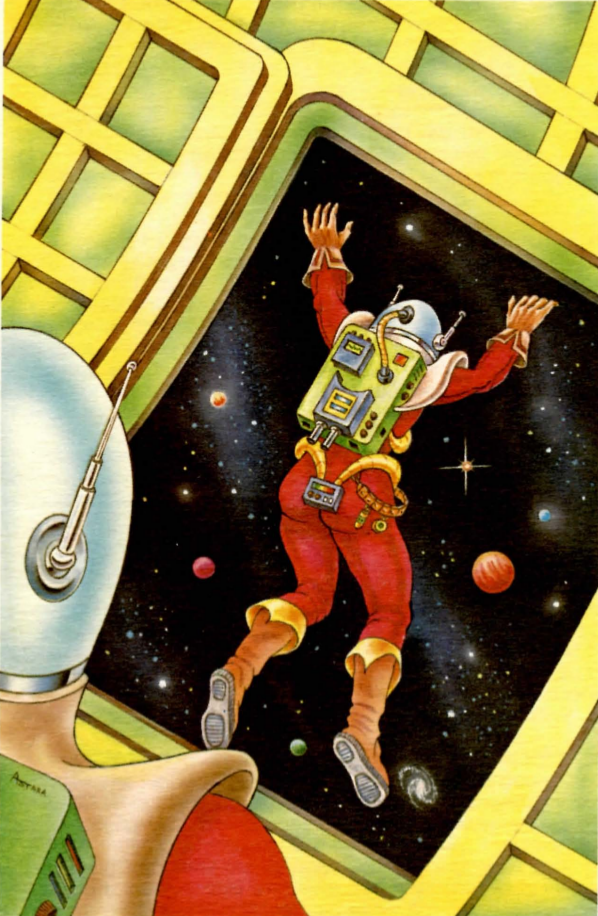
I first must confess: I handled the lore entirely wrong. The start of the “Officer Manual” is meant to be read before playing, but then there is a transition to an “Officer’s Supplement” with “Books” meant to be read only when they are encountered in the game, rather like the paragraphs in a Gold Box game. It’s quite possible to play a long time without seeing the proper “book text” and the revelation of X was not really meant to come until the end. Having said that, I doubt many people really did read things in the “right order” — there’s only 8 “books” and when flipping through the manual so it’s hard to avoid seeing the pertinent information early. (The switch in the manual between “go ahead and read this” and “save this for the game” is also weakly signaled.)
It did mean my assumption that X’s motivation was to avoid being caught was a little off — his paranoia may have still be set off by the racketball incident, but Joe Justin probably didn’t know enough from standard officer training to be aware of X’s existence.

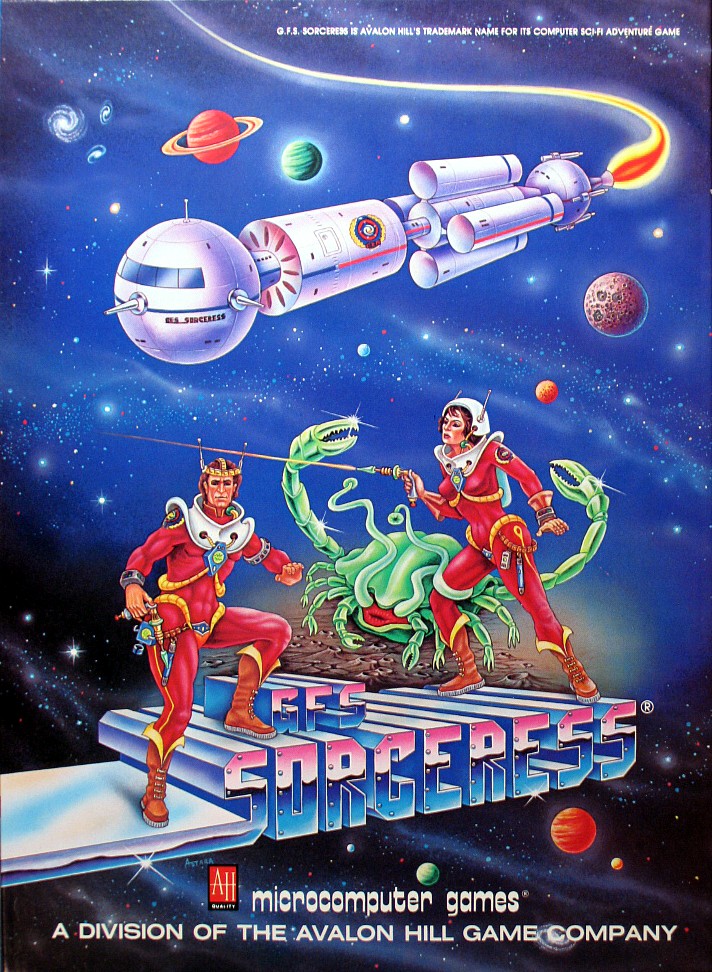
The G.F.S. Sorceress can visit five planets: Altair IV, Tau Ceti III, Sol III, Epsilon Eridani V, and Rigel X. Sol III is Earth and needs to go last (the game is over if you go, and you’ve either won or lost depending on what you found). They can be visited in any order, which is good in a freedom-of-choice way, and bad in a for-the-most-part-you-can’t-solve-out-of order way. I made things even worse for myself by starting with the correct planet (Rigel X, depicted above) and missing a key item, a translator. Without the translator there’s a lot of text like this:
YOU SEE A STONE ARCHWAY CARVED IN ROCK AT THE LOWER END OF THE TUNNEL. AN ANKH SYMBOL IS CARVED ABOVE THE ARCH AND AN INSCRIPTION READS: “CJRJTSL MYJGA MVIY KXVR AMK XQF. DJ, YNL LHNZOKAS, HBGPY FTAY XLYAYS”
That’s not a cryptogram. (Using a cryptogram solver on the first sentence yields such gems as BOROUGH KNOTS KILN YMIR SKY MAW.)
Getting past the translation issue is necessary to solve most of the puzzles in the game, so I had a long period of being stuck wandering the planets until I re-re-visited Rigel X and found a GOLD BOX right in the open that indicated it was a translator.
In the same area, I found a SILVER BOX and a ROBOT as well as a book that was a Robot Mark IX User’s Manual.
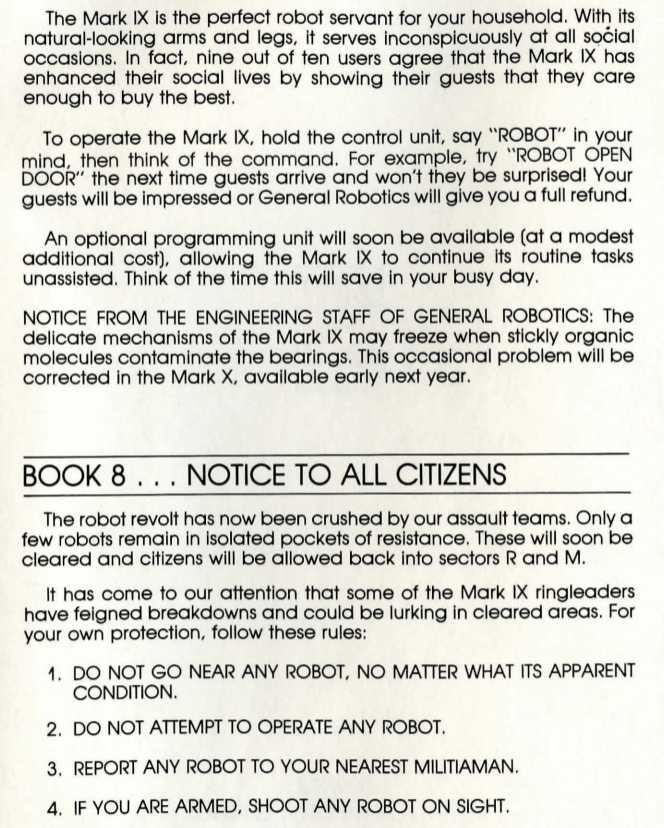
Immediately below the robot instruction manual in the physical game’s manual was “Book 8” which shows up nowhere in the game, but it was hard to avoid seeing warnings like IF YOU ARE ARMED, SHOOT ANY ROBOT ON SIGHT.
The robot is controlled just like the player, only with prefacing all commands with ROBOT. In doing so the player actually “becomes” the robot in the duration, and the display screen is taken over by the robot’s view.
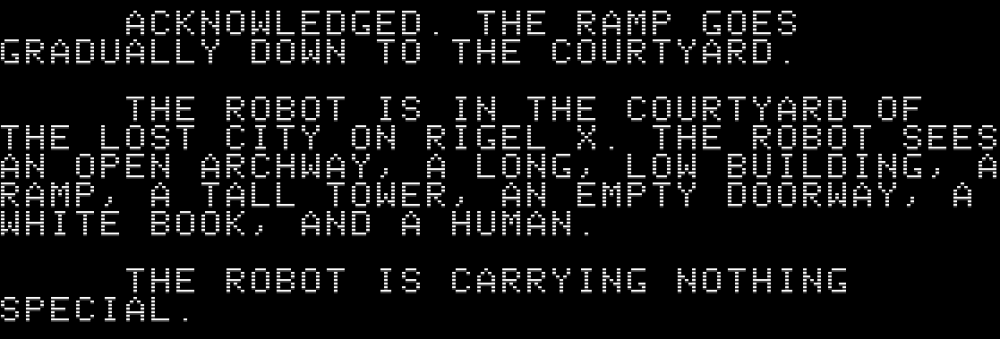
Driving the robot around was my favorite part of the game; it reminded me of Suspended.
The next planet on my quest was the desert planet was Epsilon Eridani V.
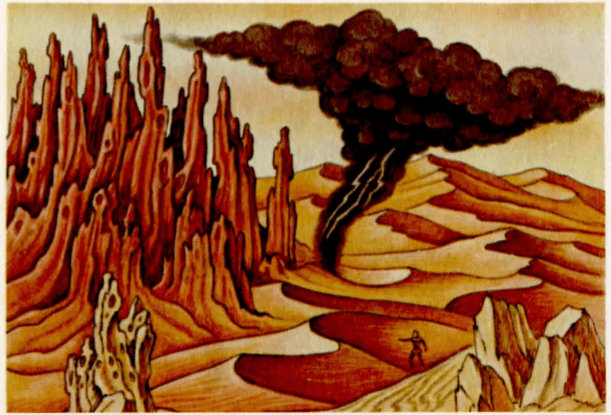
This is where you get swallowed by a sand worm as I hinted in my last post.
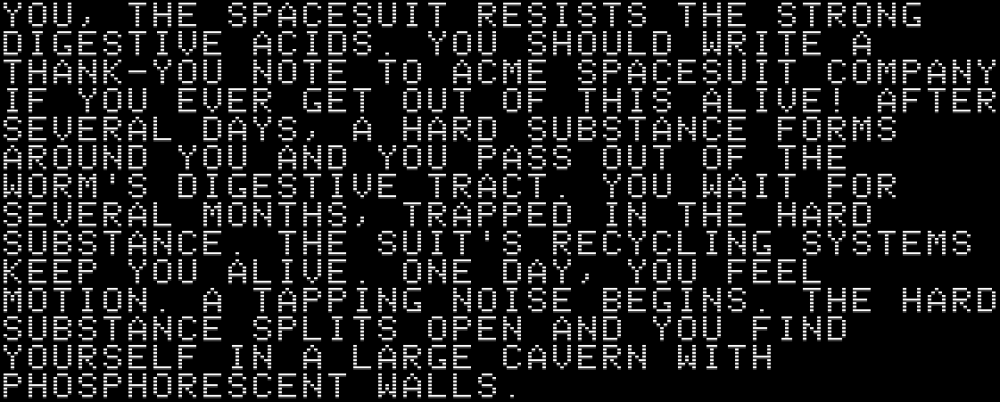
After a while I did get used to the idea of a single command possibly taking days, months, or years of in-game time.
You then get dropped in a cavern with a sand crab. If you have the translator the crab says that YOU SPEAK THE SACRED LANGUAGE ONLY KNOWN TO THE CHOSEN and lets you through, whereupon you find a room with crystals, sleeping gas (your spacesuit protects you), and most importantly, a GOLD NUGGET which is useful later.
You can incidentally blast the crab with your pistol. This makes you stuck and is Yet Another Infamous Adventure Game Softlock, but thematically, I kind of like the idea of having a player who tries to use violence for everything receiving some sort of consequence.
Past the desert planet comes the jungle: Tau Ceti III.
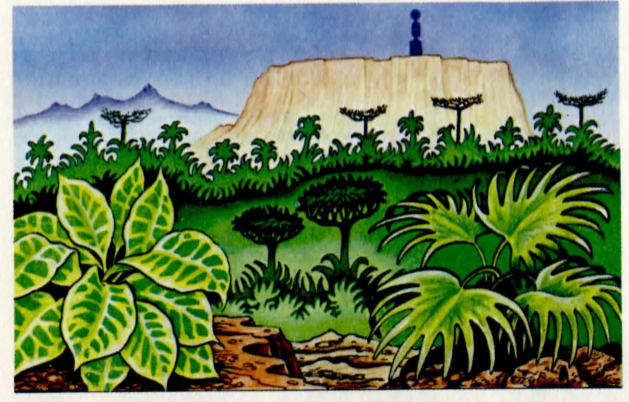
There’s an archway with the message WELCOME, GREAT GODS FROM THE SKY. WE, THE FAITHFUL, WAIT FOR YOUR RETURN. (This is the same as the not-cryptogram above, so if anyone wants to take a crack at what the real encryption is, you’re welcome to try.) Just past the archway is a tablet that reads HONOR WITH THE WATER OF LIFE THE GOD WHO GIVES THE TOKEN OF LIFE – BOOK OF THE SKY GODS, CHAPTER 9, VERSE 21. Just past the tablet is a lizard; if you take a golden ankh that has been on the Sorceress not doing anything, you get sprayed.
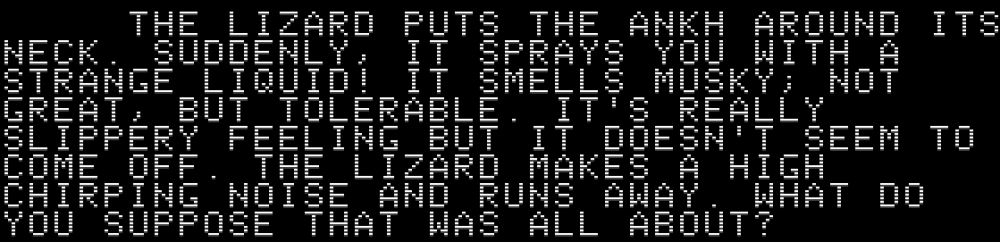
This “slippery” spray helps get you past an ARACHNID later and steal a WEB that’ll you’ll need for the next stop: the temperate planet of Altair IV.

I found an old, abandoned castle after making it through a hidden path in a forest, but was stymied by a concrete wall which clearly was hiding something. I still had my xenon pistol but blasting with the pistol indicated I was just blowing off small chunks and didn’t have enough firepower.
Here is where I needed my robot buddy to make the ultimate sacrifice.
>ROBOT PUSH VIOLET BUTTON
THERE IS A BEEP SOUND FROM THE PISTOL AND A COMPUTER VOICE SAYS: “ARMED”
>ROBOT DROP PISTOL
ACKNOWLEDGED.
THE PISTOL HITS A BIT TOO HARD WHEN DROPPED. IT STARTS TO WHINE. LOOK OUT! THE PISTOL EXPLODES IN A SMALL ROOM. FLASH! ZZZZ POP! A PUFF OF SMOKE APPEARS.
POP! A TINY PUFF OF SMOKE RISES FROM THE SILVER BOX.
sadface
Past the wall was a secret archive with a killer robot (this is where the WEB came in handy) and two books: one with the details about X, and another with legal code information that indicates someone who is ejected into space for mutiny is allowed a retrial if they can make it back to Earth. (It must be one of those abstruse specific-case laws from the old times, like one that gives fines if ducks are wearing sweaters or you eat jam on a Tuesday.)
However, if you just try to cart the books out, you get zapped by a force field! The trick here is to put in two replacement books for the two you are taking. When I hit this I had left the other two books from the game behind on the ice planet. (There’s a pretty right inventory limit, three items plus the spacesuit, and the translator takes up one of the slots already.) This meant to get by a puzzle, I had to fly to a different planet and back which involved the passage of six years of time.
After that moment of narrative whiplash, I took my evidence back to Earth for one final slumber-trip.
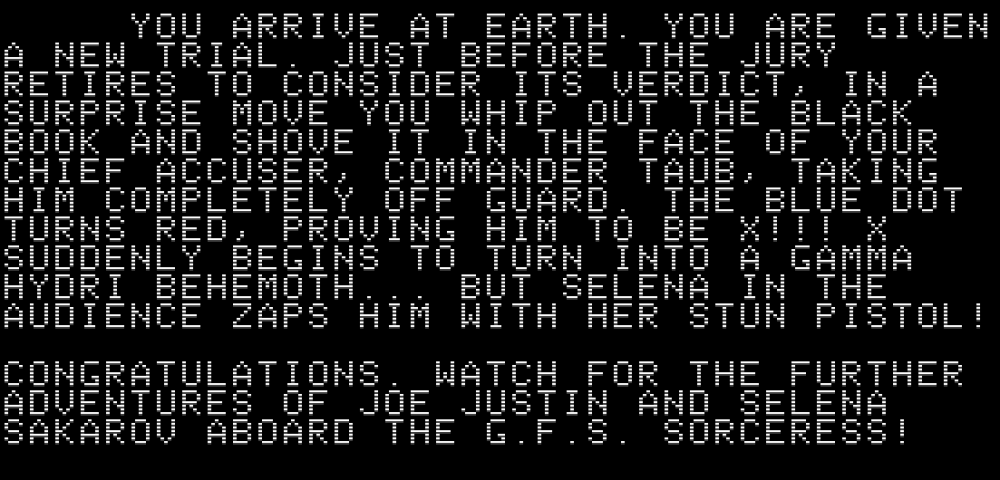
This was a little more ambitious in terms of narrative than Empire of the Over-Mind but it consequently fell down on a few spots; rather than a wide-open design that allowed multiple solutions, it ended up fairly linear. Rather than a cast of characters to help, there was only in essence one (I’m not even counting Selena, who just had the brief cameos at the start and end). There were awkward plot holes and too many improbable situations. (I wouldn’t say they were any more improbable than a typical 1980-era adventure, but this game tried to hold a bit more of a load with its story and thus the issue became much starker.)
Still, there was at least something “natural” in all the puzzle-actions; G.F.S. Sorceress did manage to unite actions and plot such that each propelled the other. Unfortunately, other than the Deluxe version of Empire of the Over-Mind, this is where Gary Bedrosian broke off his adventure-designing career; all three of the games definitely showed original thinking and had aspects (like the time compression and expansion) that would be fresh even for a new game.
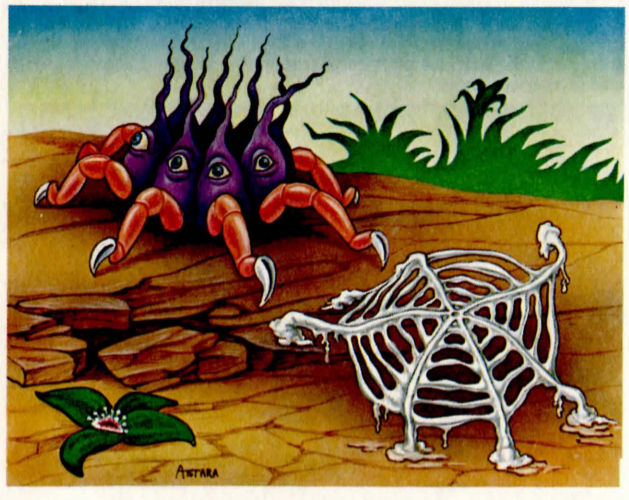
And that’s it for 1980! 1981 brings us a fresh set of 100-or-so games, including …
- Michael Berlyn’s first two games
- Yet another long and difficult Phoenix game
- The first extensive conversion of a book into a text adventure
- Zork II
- More 3-D adventure shenanigans with Med Systems
- What is allegedly one of the most evil Apple II games ever made
… and some more surprises besides. Thanks for reading this far!
It is THE FUTURE. The year NINETEEN NINETY FIVE.

Earth discovers, via radio receivers, a transmission from the center of the galaxy. The transmission continues for thirty years before mysteriously cutting off.
The signals, while never fully decoded, were sufficient to jumpstart giant leaps in technology, including xenon energy storage and magnetic recoil reaction drive. The two together would enable ships to travel to the stars, eventually with ships reaching 87% the speed of light.
…
Noteworthy in the lore for G.F.S. Sorceress is that there is no faster-than-light travel and the distances between star systems are “realistic”, so several (or many!) years may elapse in a single trip. Relativistic effects also apply (so 12 years to observers appear to be 6 years on the ship). This has gameplay ramifications I’ll get back to later.
…
It is THE PAST, roughly around 1500 CE in Earth years, on the planet Epsilon Indii II.
A scientist (whose original name is unknown, and is simply referred to as X) was conducting experiments with organ regeneration when he “accidentally dosed himself with the entire research serum.”
He discovered the next day he suddenly had the power to change his body at will; not only appearance but number of limbs and species. As a consequence of this, he could also heal any physical injury immediately (since he could just reshape the affected body section).
He used this power not for good, but for evil.
X’s typical modus operandi is to infiltrate positions of authority by murdering a superior in front of witnesses while disguised as one of his rivals for the newly vacant post. Preferred targets are military installations whose weapons can be turned against helpless civilian population centers. Over three hundred major cities and five entire planets (including his own) have been conclusively proven to have been destroyed by X.
His shape-shifting and regeneration abilities have made him essentially immortal. He is still at large at the time our story begins.

X’s original, long-discarded appearance.
…
Fast forward to 2582:
The main character of our story is Joe Justin, Weapons Officer on the G.F.S. Rheingold.
This has been one of those weeks that start badly and end worse. I am beginning to doubt either my memory or my sanity — probably my sanity is slipping away as I drift abandoned in interstellar space.
His troubles start with a low-gravity racketball match against the Executive Officer of the Rheingold, Commander Bernard Taub. Amidst a particular tense round, Joe accidentally injures the Commander, but moments later there appears to be no wound and the Commander himself denies anything happened. Afterwards, Joe notices blood on his racket.
Later, the Commander does a surprise inspection of quarters and seemingly ignores the blood still on Joe’s racket.
A week later, Joe has just finished covering a shift for a crewmate when he is dragged out of bed and brought to the brig, and then to a makeshift interstellar court marshal, officiated by the ship’s computer, with Commander Taub as prosecutor.
The ship’s captain had been just murdered, and there was damning evidence: a video clearly showing Joe Justin walking into the command module and shooting the captain, in full view of witnesses.
The punishment for mutiny and murder is ejection into the vacuum of space. This is where the player’s control of the story begins.
…
Commander Taub is of course not really Commander Taub, but X. His inspection of the racket was just confirming that our hero had learned something very dangerous to know, if Joe were to connect the dots. (In fact, one can assume, since we are now controlling Joe Justin, we realize what just happened whilst staring into the blankness of space.)
YOU ARE FLOATING IN SPACE. YOU SEE STARS AND A FAINT ION TRAIL.
YOU ARE WEARING A SPACESUIT. YOU ARE CARRYING NOTHING SPECIAL.
While the Rheingold is now long gone — presumably with X now as its captain — Joe has the almost astronomically lucky fortune of being nearby another ship, the G.F.S. Sorceress which just suffered a collision with a meteor storm as is similarly just floating in space.
…
I left off last time making it inside the ship but getting eaten by an AMOEBOID. I also found a “young woman” in another part of the ship but she shot me immediately upon entering and threw me out of the room.
It turns out to be necessary to defeat the amoeboid first; the lore necessary to solve the puzzle is jammed somewhat awkwardly in the middle of the short story I summarized above.
However, when exposed to the activated xenon gas from a leak in a starship’s fuel tanks, an amoeboid can grow very quickly to an alarming size and become a menace to the safety of the entire ship. When that happens, standard weapons are of no avail because the creatures are able to absorb energy or projectiles. The only solution is for some brave volunteer to duck by the amoeboid (which never goes far from the source of the xenon) and patch the leak or shut the open valve.
The solution here was to SHUT VALVE. I had already tried to TURN and CLOSE the valve with no success so this was almost like a copy-protection check where I had to work out the correct word.
TURN, TURN, TURN. THE VALVE IS TIGHTLY SHUT.
THE AMOEBOID IS SHRINKING… SHRINKING… IT VANISHES!
Once the amoeboid is gone, the woman in the other part of the ship doesn’t shoot you on sight anymore.
SHE SAYS: “I AM CAPTAIN SELENA SAKAROV OF THE G.F.S. SORCERESS. YOU ARE A STRANGER TO ME AND I HAD TO TEST YOUR COURAGE.”
Soon after:
HE SAYS: “PERHAPS WE CAN DEVELOP A SERIOUS RELATIONSHIP AFTER YOU ESTABLISH YOUR INNOCENCE. FOR NOW, YOU HAVE COMMAND OF THE SHIP. I WILL BE IN HYBERNATION UNTIL OUR RETURN TO EARTH.” SHE SASHAYS OFF TO THE HYBERNATION ROOM.
I feel like the conversation is missing a few beats here. We just got ejected from another ship but we’re now given command of this one? I could see “have a conversation about X where Joe Justin is very convincing” might fit the story logic, but as it went I was a little puzzled. (Also, somewhat sad this meant I didn’t have a snarky NPC following around during the adventure.) But at least the premise is now setup: we’ve been framed by a shape-shifter, and before we can return to Earth, we have to prove our innocence.
Story jump aside, we now have a ship that can fly around.

In another game, pushing a button for a planet might cause a little time to pass as the hyperdrive does some magical things, but remember the lore: no faster-than-light travel. So the button locks in a destination, and then you have to go into cold sleep and several years pass. Since this is a planet-hopping type adventure, it means in all likelihood the game will take place over 20+ years.
I’ll get into detail on the planets themselves next time, but I should note the time compression/expansion pattern continues on the planets themselves; a particular action might be just walking from one room to another, or it might involve walking several kilometers, or it might involve spending several weeks inside a space worm.
G.F.S. SORCERESS is a science fiction adventure game which is actually the first part of the continuing saga of Joe Justin and Selena Sakarov aboard the Galactic Federation Starship Sorceress. In the game, you will take the part of Joe Justin as he attempts to clear himself of a false charge of mutiny. Be sure to read the short story which accompanies the game to get the flavor of this adventure, not to mention some useful clues!
As the game begins Lieutenant Joe Justin has just been convicted of mutiny and murder on the G.F.S. Rheingold, and summarily shoved out of the airlock. Equipped with only a standard-issue spacesuit, you, as Joe Justin, must find a way to return to earth with evidence that will unequivocally prove your innocence. To do this, you must first find and repair a starship, then explore strange new worlds.
— From the Instruction Manual for G.F.S. Sorceress
Gary Bedrosian (Lords of Karma, Empire of the Over-Mind) finished his adventure trilogy with G.F.S Sorceress.
I’ve saved this for last in my 1980 sequence because:
1.) I wanted to end with something I knew would be “substantial”; since Empire of the Over-Mind still remains one of the best games I’ve played in this project, I knew the follow-up would at least be interesting.
2.) The packaging came with “lore” including a short story and a “Naval Officer’s Manual” separate from the instructions, so I knew there would be lots of material to draw from.
3.) This is only sort-of a 1980 game; the author states it was written in 1980 and that’s what I’m using, but the opening title screen for the Apple II version I’m playing gives a copyright of 1981 and most physical copies out there give a copyright of 1982.
In general, I’ve been using date of writing rather than release — the Roger M. Wilcox games I just played, for instance, really only make sense in 1980, and some of the mainframe games like Haunt and Warp never had a “release” at all. Despite that, this feels like a game I can use to bridge the gap to 1981.

As the manual text implies, you start floating in space, but nearby a vessel. The vessel is itself stalled in space and appears to have suffered meteor attacks. I went to a hatch in the middle, used the airlock to go inside and …

… was reminded of the big problem with Empire of the Over-Mind, which is that there are no standard north/south/east/west directions and it makes the world confusing to visualize and map. I thought perhaps things would be better with this game — it even makes sense thematically to be lacking standard orientation in space — but this early room description with five different colors of hatches and three different colors of signs disabused me of the notion. I tried the red hatch first.

The text style somewhat buries the lede, and it took me a bit of processing before I noticed the “SPACE AMOEBOID”.

I’m going to have to get myself oriented, and probably study the external material (in Empire of the Over-Mind the poem that came with the game included essential information, basically the first Infocom-style feelie for an adventure game, and I expect this game to have similar circumstances).
Still, the production value is high and I expect good things — the manual lists six testers. Six! Most games from this era were lucky to get one.
Wilcox’s 8th game (after The Vial of Doom) was originally called The Poseidon Adventure, then renamed to The Upsidedown Adventure, then renamed back to The Poseidon Adventure. For those not familiar with the original movie: a cruise ship gets flipped over by a tsunami, and the passengers who survive the disaster need to escape whilst everything is upside down.
The original TRS-80 file had some corruption near the end, so I played the author’s Windows port this time.

From the original 1972 movie poster made by Mort Künstler. The movie is pretty good — I’d say one of the best disaster movies of the 1970s — although I just learned there’s a 1979 sequel called Beyond the Poseidon Adventure which has 0% on Rotten Tomatoes.
Also, a brief reminder, since I dunk on the game pretty hard: this was written when Mr. Wilcox was very young and only distributed when he was much older. (I very much appreciate these are available; there’s no other collection of “private games” I know of from the era.) This was a learning experience for him, but it still can be a learning experience for us: what makes a design go wrong?
…
Mr. Wilcox seemed to have fallen into the same trap as Mr. Hassett with Devil’s Palace: he had ambitions to make a more difficult game, but a difficult game is hard to make fun, especially when there are no persistent, timed, or “cross geography” effects. (This game technically has a timer, but it’s just an overall timer where the Poseidon eventually sinks and you die, forcing a game restart.)
You’re in a room, you have an object, and you can either use it to defeat a particular obstacle, or you can combine it with another object to make a new object. That’s it. In general, the only way to make a game with these limits hard is to a.) add lots of potential death b.) add some hard-to-find verbs and c.) hide things in obscure ways. The Poseidon Adventure goes for all three.
(For contrast, the game The Vial of Doom had the “strength” effect that made objects do different things; normally the player couldn’t win a fight against a cobra, but adding the magical effect beforehand changed the outcome.)
You start alone on the ship Posiedon. There are no dead bodies or the like, and since the game later says you are the sole survivor, I assume everyone else was cut off on a different section of the ship. Going “up” leads to the cargo hold at the “bottom” of the ship.

Going “down” leads to a “hatch at the ship’s top”. I admit to being highly stuck here trying to OPEN HATCH and TURN HATCH and the like but you can just GO HATCH to get to an “underwater pocket”.

OPEN HATCH should have said something like “the hatch is already open!” but the game just says “I don’t see how to open such a thing.” This is your regular reminder that a good parser is more about making intelligent responses than just how many words are understood.
My full object list from “easy to reach” objects was: a plastic bag, a metal rod, long thermal undies, a bottle of some liquid, a metal claw, a nitric acid capsule, a screwdriver, a drill, a saw, and a lighter.
Fortunately, the parser isn’t necessarily picky about if you apply a noun to a verb, so I found one useful combination by accident: typing MAKE will cause the nitric acid and bottle to mix to become a bottle of nitroglycerin. I was able to use it (with the lighter) to blow up a toilet and find a wrench and a closed window, whereupon I was very stuck.
I resorted to checking the walkthrough at Gaming After 40. Apparently CONNECT is another verb (not ATTACH, grr) and if you type CONNECT while holding the metal claw and rod you get a crowbar. This is sufficient to open the window and drown when the water from outside rushes in.
Whoops! Fortunately, in my experimentation, I found I could WEAR the plastic bag, and that it was sufficient to prevent drowning. (!!)
Where things really got “interesting” was at the end in a “propeller room”.

Push the button and the propeller chops you to bits. I am unclear why the designers of the ship would place the button in such close proximity to the propeller that it controls, but since I already used a plastic bag as a scuba device, I let it slide. However, I still had no idea what to do. The only items I hadn’t used yet were a drill and a saw; neither were useful here.
I went back to the walkthrough, where I found out I missed a completely unprompted secret wall back in the tool room where I found the drill and saw in the first place.
>LOOK
The north wall looks like it used to have an exit, but was boarded up some time in the past.
sigh
DRILL followed by SAW led me to a secret room with an AXE. Then I was able to take the AXE back to the Propeller Room (well, not exactly, I had to restart the game and redo the sequence since I ran out of time) and chop a hole to victory.
>chop
You’ve chopped a hole in the ceiling, which has bright, yellowish light pouring through.
>go hole
You crawl through the hole out into daylight.
Fantastic! You’re the sole survivor of this “Disaster”!!
…
There is exactly one (1) game to go before I am finished with 1980. Excitement!
Across all adventure games, one common theme amongst the truly profound, mind-bending puzzles I’ve seen has been the idea of repurposing — taking an item, location, character or verb that seems to be designed for one purpose and using it for another. Essentially, for a player to solve the puzzle, the rules of the universe itself need to be expanded.
Examples amongst the All the Adventures project include the final puzzle of Mystery Fun House (where what normally would be an ordinary “informational” item gets put to essential use) and the Wumpus puzzle of Adventure 501 (where something originally used merely for transport becomes a weapon).

The puzzle game Baba is You is based around this idea. The rules of a particular level can be changed by modifying the sentences in the world itself. “You” are normally the small white creature as expressed by the sentence “BABA IS YOU”, but if you push the word “ROCK” to form “ROCK IS YOU” you switch to controlling the rocks (all of them, at once).
The Vial of Doom has a repurposing puzzle near the end which is astounding and does a trick I’ve never seen before.
…
This is Roger M. Wilcox’s seventh game. Sometime after 1980 he distributed it to Usenet (but much earlier than his other games) and there’s even an Interactive Fiction Database entry.
He based on it off his own 25-page short story he wrote a year before, which was “influenced just a teensy weensy bit by Michael Moorcock’s multiverse.”
In many ways, this game was a watershed in my adventure-game-authoring career, as I originally thought the story was way too complicated to make an adventure game out of … until I read an article about Greg Hassett’s “World’s Edge” adventure and turned green with envy and grim with determination. I considered it my first “good” TRS-80 adventure game; it was the 7th I’d written, and 14 more would follow it (15, if you count that Star Trek adventure where you can’t even pick things up). When the IBM PC became available to me in 1983, I ported this game to GWBASIC.
I played a QBASIC derivative of the GWBASIC source.

There’s no motivation or plot to start; the player is supposed to mess around since there’s nothing else to do. Nearby the starting room you find a shovel, and if you dig here you find an underground pyramid with a portal.

Touching the portal leads to a room with a plastic container and a lead box, and opening the lead box leads to the Vial of the game.

Chaos is the bad guy, Law is the good guy; unlike the usual Dungeons and Dragons alignment charts (where it’s possible to be Lawful Evil or Chaotic Good) the Moorcock-verse is a straight Law vs. Chaos opposition which is intense enough to warrant its own Wikipedia page. We’re tasked with destroying the Vial and are on the hunt for a turquoise gem, a fire opal, cobra venom, a basilisk eye, octopus ink, and an alabaster bowl.
The vial ends up being used quite a few times throughout the game. Right from the start after taking the lead box, a mummy blocks the way, but as long as you WEAR VIAL, you can PUNCH MUMMY:
Baam! You made it fly apart!
To get out of the pyramid area, you need to DIG again but must be wearing the vial to have enough strength to dig straight up. However (as the screenshot above warns) you can’t wear the vial for much longer, because if you try to step much farther while wearing the vial, you get consumed by Chaos.
However, the vial is still useful; if you WAVE VIAL you can distract people or get a burst of strength.
You are in a pawn shop. Visible items:
Store clerk. Large dagger. Turquois gem. Sleeping pill.
Obvious exits: south
The clerk wants money for the items, but you can just WAVE VIAL
The clerk is now hypnotized.
and use the five-finger discount method.
The parser is unfortunately very awkward; the game even states upfront “I know the verbs STICK, SWING, and PLUCK” but it’s hard to know where they get used. STICK turns out to be handy for STICK COBRA
Into where (one word)? CONTAINER
Squirt! The container fills with venom, and just as quickly, the cobra awakes!
I admit not to thinking through the above action at all, but simply running through every verb possible before the event happened.
I got stuck on one parser issue enough I had to poke through the source code. In front of a jewelry store there is a guard with a thermos of coffee, and I knew the sleeping pill that I already had lifted from the pawn shop would be useful, but I could not for the life of me apply one to the other. The right sequence turns out to be SWING GUARD. THROW PILL. (That doesn’t sound terrible, but I had went through many permutations of PUT PILL and INSERT PILL already, and PUT is even an understood verb, just not the one the game wants.)
At least the actions on a story level are fun. It’s as if the author built up a number of set pieces and only worried about if it was possible to communicate after the fact; at least you get to pluck an eyeball directly from a basilisk and suck ink from a sleeping octopus.
Getting away from the aforementioned octopus triggers the final battle, right back at where we started the game.

You’re still able to go back here and mop up any missing ingredients, but I was led astray a long time because I assumed the way to win and stop the giant battle was to finish the ritual, and I had no bowl. Being granted “great strength” by Law was the key. Perhaps a better clue would have been to use a longer phrase, like “enormous strength, more than you’ve ever felt before”.
I’ve given enough clues you can theoretically try solving the puzzle yourself before going on.

Picture here for spoiler space; this is from a parody ad Roger M. Wilcox made for the game.
The right action is to dig back down to the pyramid location (remember, we’re back at the start of the game), but rather than entering the pyramid, pick up the pyramid itself, go back up, and throw the pyramid at the Chaos giant.
Whump! Chaos is down! Law wins the fight, and says: Make the mixture here!
This absolutely boggled me; the game took what normally was an enterable location and turned it into an object you can pick up.
After taking down Chaos, the Vial still needs to be destroyed. You find an alabaster bowl in the rubble, which is enough to finish the ritual.
The vial vibrates, getting ready to explode. Oh, by the way — ** YET ** !!
> RUN
You’re on the side of a mountain. Visible items:
Wishing rock.
Obvious exits: up
The vial goes off in a red, Chaotic mushroom cloud.
you have only six (6) seconds until the fireball reaches you!
One more action leads to safety:

Roger M. Wilcox was a teenaged adventure game developer in 1980, just like many others whose work we’ve looked at in our grand tour. Unlike the other developers we’ve seen, his games were originally only distributed to his family and friends. I played his first three games in one go; all three were 10-minutes-or-less endeavors and I figured the next three might be similar but all of them had extra curveballs which forced me to take more time in solving them.
Note that Mr. Wilcox’s website has the games; he has Windows ports for all of them and TRS-80 versions of most of them, but I was unable to get Space Traveller running in its TRS-80 incarnation. (The other two games I had no such issue with.)
I should also add while games #1, #2, and #3 were all survive-and-escape endeavors, the ones here all are Treasure Hunts where the player is tasked to gather any item marked with asterisks *LIKE THIS* and then type SCORE.
Space Traveller
Wilcox’s game #4 starts you on Planet X, which consists of just two rooms, one where you drop any treasures you find.

Earth isn’t much larger; when I first landed all I could find was an abandoned hat shop and a single hat.
I next flew to Planet Q which consisted entirely of a maze.

Mapping a maze like the one above with only one inventory item is a definite chore; the only way to differentiate rooms is to make a “second-level” connection, like realizing going north from a particular place goes back to the starting room and assume that only is true for one room. The only problem with this technique is the assumption can be wrong (and in fact, it is wrong for this particular maze). After exhaustive mapping and remapping I found nothing, and was truly stumped enough to poke into the source code. (To be fair, the TRS-80 code crashing on me made me suspect I hit a bug rather than a puzzle.)
I found I needed to SHAKE HAT:
INSIDE IT IS A SIX-FOOT SHOVEL!
The remainder of the game involved applying DIG in pretty much every room, and finding things all over the place. This included a DEAD BODY and an OPEN GRAVE and when putting the DEAD BODY in the GRAVE you apparently become the corpse’s buddy and get a PLATINUM SWORD.

Nuclear Submarine
This is the first of the Wilcox set that really seemed to reach past being a programming exercise, and while I finished without any source code dives, I was definitely stumped in a few places.

Unlike Nuclear Sub, there’s no deep attempt at a “realistic” sub environment here, but the game does make the player wear a scuba suit and pass through an airlock before going outside before arriving at a cave where most of the treasure is, so there’s a layer of atmosphere lacking in the previous Wilcox games.

Getting past this puzzle required throwing a trampoline to the bottom of the cliff.
Structurally, the game is also more interesting than #1-#4 in the re-use of objects. You use a speargun early to kill a shark (just SHOOT SHARK and that’s that) but shortly after you need to break a mirror, and the empty gun works as a pummelling device. Rather more oddly, a copper key used early to open a hatch in the sub also gets used to open a gate. There were a few times where I had dropped an item because I thought I was done with it but had to return to get it (there’s an inventory limit just like all the other games of this period — and I really do mean all of them, I can’t think of a single one that omitted having a limit, even just by accident, unless you count games which don’t have an inventory at all).
The gate I just mentioned is also rusty, and the typical solution is to apply some oil, but I had none. I went back and forth many times here before plowing through my Standard Verb List ™, which is a list of verbs I’ve seen many times and use whenever the going gets tough. I hit paydirt with SEARCH and ended up applying the verb to every room until I found a secret room with the predicted oil can.

There’s one extra wrinkle: just finding the treasures isn’t enough.

Maybe two wrinkles, given the treasures are mostly “fake” items.
The ship won’t start, so you need some fuel. Specifically, you need to grab a piece of plutonium (make sure you use tongs!) and take it back to the ship’s reactor.

Nuclear Submarine felt the most solid of the Wilcox adventures #1 to #6, and it’s better than some games from the time that were sold commercially.
India Palace
IN A SMALL TOWN IN INDIA, YOU HAVE HEARD ABOUT A NEARBY PALACE THAT IS DESERTED AND SUPPOSEDLY HAUNTED. IT HAS NOT BEEN CLEARED OF ITS TREASURES, HOWEVER. THAT JOB IS YOURS.

On the screenshot above, OPEN DOOR doesn’t work.
I DON’T KNOW HOW TO “OPEN” SOMETHING.
This threw me for an enormous loop; almost every game from the era has open as a verb, even if it doesn’t work. It felt analogous to having a north/south/east/west direction system where north and south weren’t recognized. Getting by felt less like solving a puzzle and more winning a struggle against the computer’s source code. Eventually, I used my Standard Verb Lists again and KNOCK won out.
CREEEEEEEEK!
During all this, I discovered an unusual property of the parser — the game remembers what object you last typed, so if you type a verb with no object, it continues with the same object. That is, if you try OPEN DOOR (with the failure noted above) you can then run through all the verbs in the game like HIT without bothering with the object.
CAN’T HIT A DOOR!
If you then use a verb intended to have no object, like just typing W for WEST, the game will generally still parse the action just fine.
This nearly sounds like a feature, except the property also triggers when typing an unrecognized word, and then the game will just keep complaining it doesn’t know what a “DOR” is until you fix it (leading to weird situations where you’re just trying to go west but the game keeps saying it doesn’t know what a DOR is).
Inside, there’s a wall with the magic word DAY-OH. Using it sent me to a small area with hiking boots and a flying carpet. I could use DAY-OH again to get back to where I started, but I was (again) massively stuck on a stone wall.

I eventually had to do a source code dive to realize DAY-OH worked in another (completely random and unprompted) location. I got a MINER’S PICK there which let me dig through the wall.
I don’t have a lot of interesting ideas to report here other than a TECHNOLOGICAL PHASER is one of the treasures, and it’s possible to re-use the pick later by tying it to a rope and making a tightrope over some acid. This game otherwise mostly went back to the simplicity of #4.

There’s a novel typo at the end this time, at least? Usually it’s misspelled as CONGRADULATIONS.
One Last General Observation
Notice from the ending screenshots that games #4 and #6 had an “overall point total”, like Adventure, Zork, and pretty much every other adventure game of the day. Game #5 instead simply listed how many treasures you had out of the full count of treasures. The latter seems like a superior method, since it means the player doesn’t have to guess how many treasures are left based on a percentage or other score, yet this is the only place in 1980 I recall seeing it. It’s like the author had a brief flicker of innovation (however minor) that was immediately snuffed out by his next game.
Roger Wilcox has two more games from 1980 (The Vial of Doom and The Poseidon Adventure); I will write about both of them as standalone posts.


 Renga in Blue
/inlays/.Cover.jpg)