To set the mood, here’s a clip from Smokey and the Bandit from 1977. (Basic plot: Burt Reynolds makes an illegal beer run from Georgia to Texas and back whilst being chased by Jackie Gleason.)
It’s been a while since we’ve checked into The Programmer’s Guild (whose wares included Death Dreadnaught and Temple of the Sun) but they kept busy in 1981.
IN THIS ADVENTURE YOU TRY TO DELIVER WHITE-LIGHTNING (MOONSHINE) FROM YOUR FARM IN GEORGETOWN THROUGH THE HILLS AND HOLLOWS TO KNAWBONE — BUT WATCH OUT FOR THE REVENUER’S AND THE SHERIFF. THIS IS YOUR LAST RUN. IF YOU ARE SUCCESSFUL YOU WILL HAVE ENOUGH MONEY TO GO TO COLLEGE. YOU MAY ONE DAY BECOME PRESIDENT. BUT REMEMBER, IF THE LAW DON’T GET YOU THE MOUNTAIN WILL.
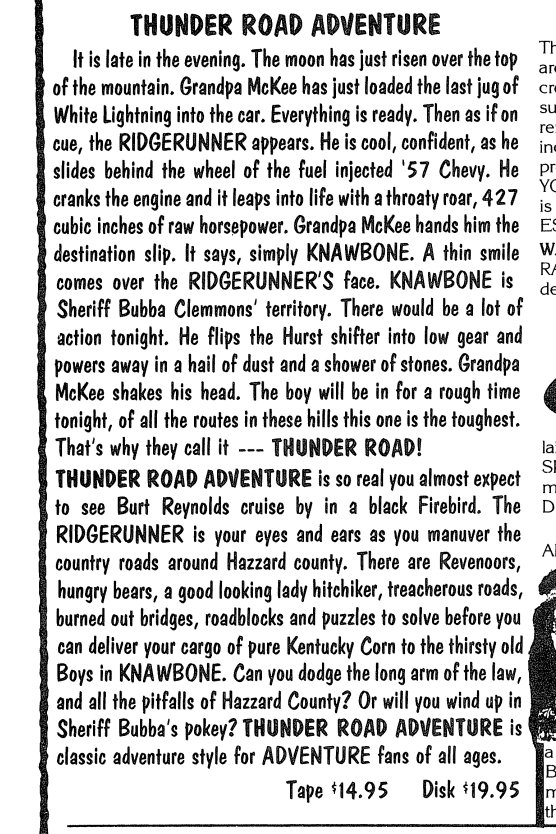
Don and Freda Boner — a father and daughter team from Indianapolis — published four games through them, starting with Thunder Road. I believe the ad below (January 1981) is the first time this game is mentioned in print, but given magazine lag time, I felt it appropriate to include 1980 in the date.
This is an unusual game for more than just the premise. For most of the game, you and the car are essentially equivalent.
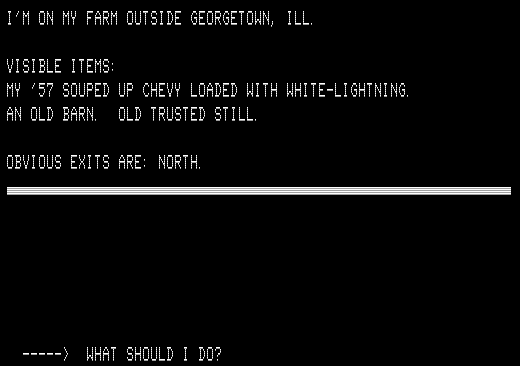
You start by getting some spare tires from the barn, then ENTER CAR at which point all regular directions (NORTH, SOUTH, EAST, WEST) move the car, rather than yourself.
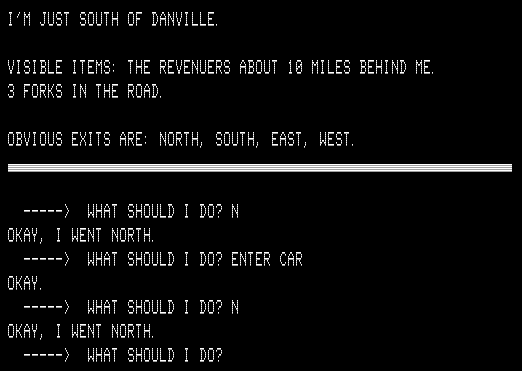
This plays more like a choose-your-own-adventure style rather than a regular adventure game. The branch shown above is the first reached. Going NORTH ends the game, reaching a dead end (where the LONG ARM OF THE LAW gets you), as does going SOUTH, where you crash in FOG at the DEAD MAN’S CURVE.
There’s no puzzle here. You just went the wrong way.
If you go west, you end up at a ROAD BLOCK manned by DUMB OLD DEPUTY ERNEST HARDLEY. You can RUN ROADBLOCK to get through. (I didn’t find any other parser command that worked.)
Other hazards include engine trouble, a A CUTE BLOND LADY HITCHIKING, tire damage, and a missing bridge.
There’s a secret road here you can find by leaving the car and moving the trees.
There’s a church with an organ inside which has KEYS. (I don’t think this is meant as a metatextual in the same way Kidnapped did the joke, where the key from a piano literally turned into a key. The organ has keys, but the organ also just happens to have keys.)
The keys unlock a gate at a bear.
You’re supposed to just ignore the bear; you can fight the bear and “win” but then the law catches up with you.
After the bear, you have one more three-way exit where only one of them is correct.
You knew there had to be a bridge-jumping scene somewhere.
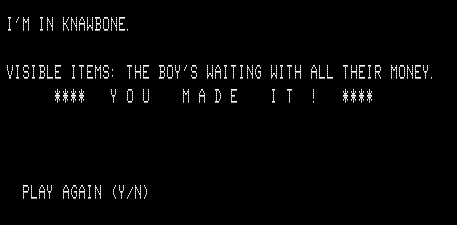
Past the ridge jump is Knawbone, and victory.
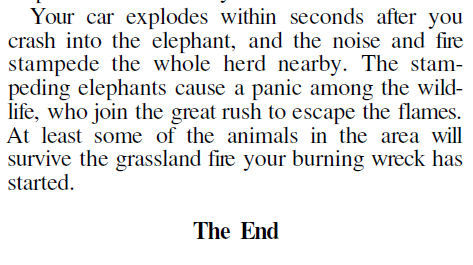
The lack of a save-feature made the game a drag — especially when paired with the worst feature of CYOA books, that of blindly bad endings. There is no way to know whether EAST, SOUTH, or WEST is best at a particular juncture other than trying it and dying.
I’m not sure if a proper UNDO feature (or even a saved game feature) would fix things. When bad endings for CYOA do appeal, it’s in them being amusing and/or theatrically written. There’s even a blog called YOU CHOSE WRONG that ran from 2012 to 2016 dedicated to bad endings.
From Choose Your Own Adventure #17: The Race Forever.
Compare with the “moonshine gone to waste” ending earlier in this post — it aims at the same sort of feel, but Adams-style minimalism isn’t enough to make the death edifying rather than annoying.
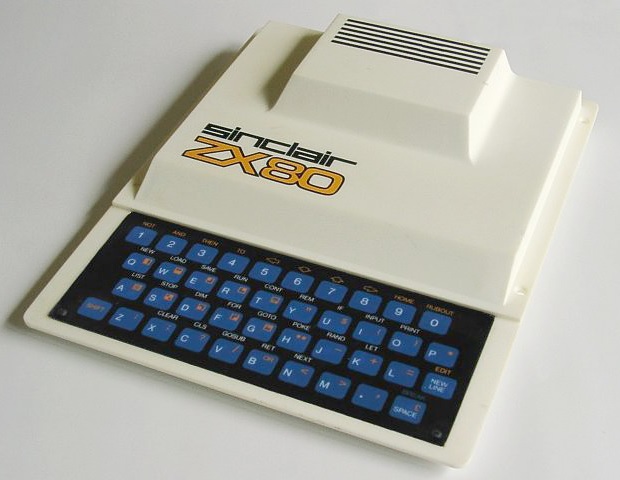
In 1980, after the ZX80 computer came out on the 29th of January and caught the UK market by storm, there was a flood of books including Making the Most of Your ZX80, Learning Basic with Your Sinclair ZX80, The ZX80 Magic Book, and important for our purposes right now, The ZX80 Pocket Book.
The ZX80 Pocket Book, written by Trevor Toms and originally released November 1980 by Phipps Associates, got a revised version after the ZX81 came out, predictably called The ZX81 Pocket Book.
According to The Centre for Computing History, the ZX81 version of the book came out in July 1981 (source). The specific month is important, because the earliest we know of Planet of Death comes a magazine dated August 1981.
Going by standard print lag times, it means that the original ZX80 version of Planet of Death likely came out in July, the same month as the ZX81 book did. The book was even advertised in the exact same issue as the news clipping above.
So, based on what I’ve currently gone through, the title of First Commercially Released Britventure is a tie between Planet of Death and The City of Alzan, a game Trevor Toms included in his book in order to showcase his adventure-writing system.
Being (apparently) released in the same month is not the “odd and unexpected” connection I was referring to earlier. I’ll get back to that after I’ve gone through the game itself.
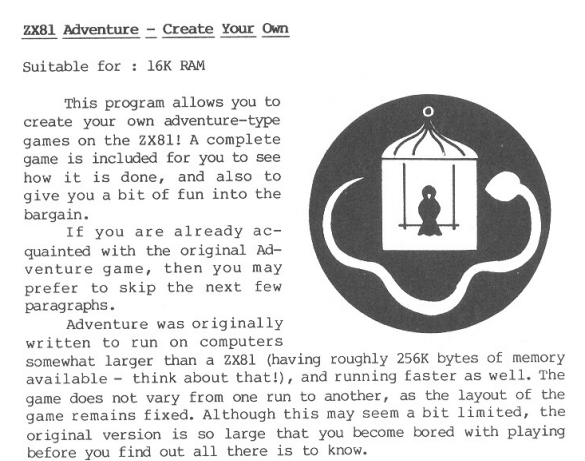
Starting on page 88 of the ZX81 book, Mr. Toms lays out a generalized system for writing adventure games, with a Master program written in BASIC. To write an adventure, the user is supposed to add “room descriptions” and “text messages” with PRINT statements that just continue the code
7010 PRINT “THE DOOR IS SHUT FAST”
7015 RETURN
7020 PRINT “THE DOOR IS OPEN”
7025 RETURN
and then use a “generator” to enter “keywords” and actions linked to them.
13 19 B01. B01 L. (take lamp – object 01
14 19 B01. C01 L. (drop lamp
13 19 B02. B02 E03 L. (take (lit) lamp – object 02 – also sets lamp marker 3
14 19 B02. C02 F03 L. (drop lit lamp – unsets lamp marker 3
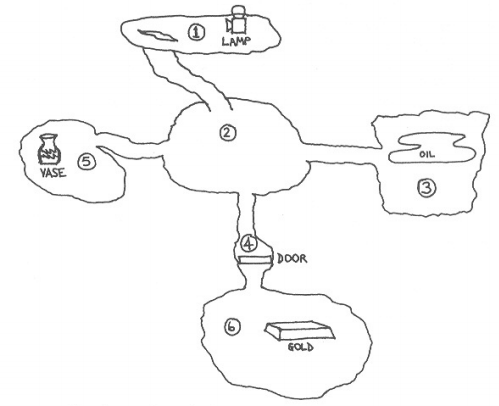
The book then gives a “test adventure” which isn’t worth going in detail on, but here’s the map:
This is followed by the code for City of Alzan itelf.
No treasures to find here. Escape the city, escape the plague.
The ZX81 version is available online, and just like Planet of Death, the screen updates every. single. keystroke. I cranked the speed to maximum and the game became tolerable, albeit needing a flashing warning.
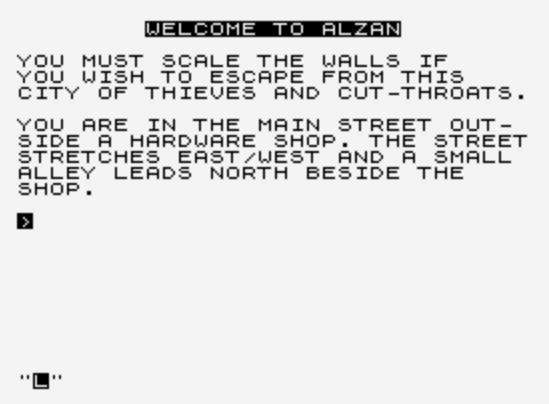
The “L” on the bottom is just the cursor.
The game is both very tiny and very frustrating; I was stumped on things like TAKE being understood but GET just getting a I CANT message.
Perhaps what’s most interesting is that there are (possibly) two methods to escape. Here’s the one I used.
Step 1.) Grab some WOOD from a nearby alley.
Step 2.) Go into the “Cinema” and TAKE TORCH that the usher is holding. (It’s listed as within the description of the usher; I tried GET TORCH and got rebuffed with an I CANT so assumed I couldn’t just grab it out of the usher’s hands, but I was just using the wrong verb.)
Step 3.) Use the torch to go down a manhole and get some NAILS, next to a “tomb” which has a BARLAYCARD.
Step 4.) Buy a HAMMER from a hardware shop. (They have a LADDER too but I wasn’t able to buy it, I’ll come back to that in a moment.)
Step 5.) Die.
OH DEAR. YOU MUST HAVE CAUGHT THE PLAGUE IN THE TOMB. IT SEEMS THAT YOU HAVE DIED.
Oops! There’s a time limit after visiting the tomb.
Step 5b.) Take the NAILS, HAMMER, and WOOD and BUILD LADDER. Use the LADDER to climb out.
Somehow you are magically cured of the plague if you leave fast enough?
There’s another method of obtaining money which involves going in a BANK and coming up with the verb ROB. Mind you, the bank has no description other than having some bored guards.
If you are carting around money you have a random chance of being robbed yourself by “El Grabbo, the local thief”. I tried to BUY LADDER whilst holding the money but I was told I didn’t have enough, so I’m confused if I’ve hit a bug or not; this is potentially an alternate way to escape.
…
Eagle-eyed readers (or at least superfans of Planet of Death) may have noticed I mentioned a I CANT error message. That error message is very distinctive, and we’ve only seen it in one other place: the Artic games. Of course, given Alzan and Death were published the same time, how could they have come up with the same message, other than coincidence? Well, they could have both been at least partially derived from the same original source.
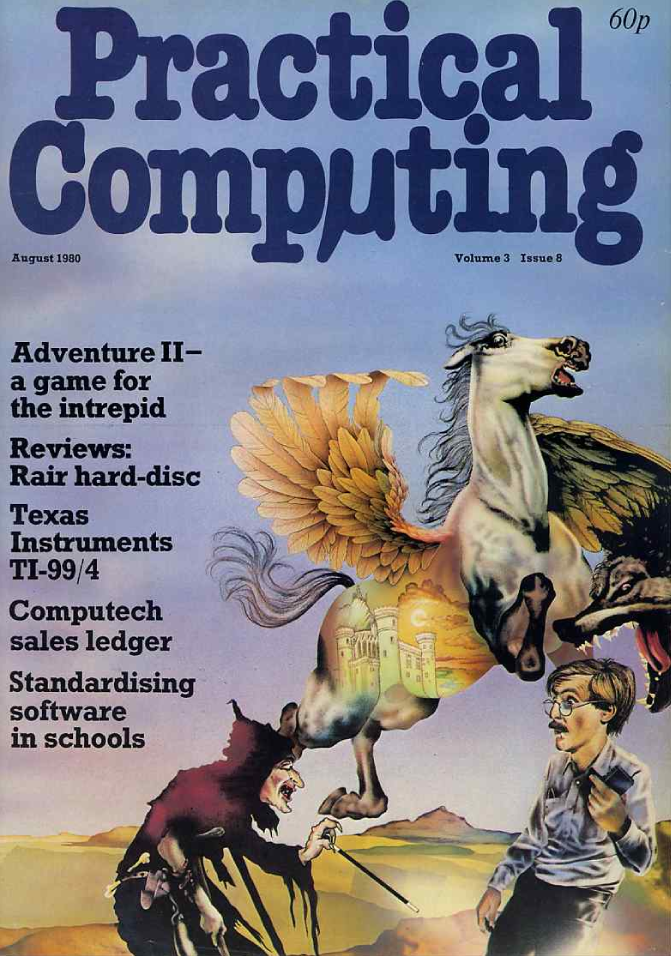
In Practical Computing, August 1980, Ken Reed wrote an article laying out a system (using Z-80 assembler) to write adventures. It includes a database of events akin to Alzan’s.
The way the variables are laid out is quite similar; here’s a code comparison which shows how the non-available-directions are calculated:
The Toms system is in pure basic so had to have at least some originality. What about the Planet of Death? I haven’t got round to decomposing, but no less an authority than Graeme Yeandle, author of The Quill (the most famous adventure-writing system from the 80s) claims that the Artic code is based on the Reed code. So I think it highly probable both UK games sprang from the same source.
You may also be wondering if the August 1980 magazine came with an adventure of its own. It did, sort of.
I have managed to get myself lost in the forest on my quest for the seven golden keys of Waydor and don’t know what to do next. So it is up to you to help me.
Give me your instructions and I will obey. For example, if you want me to go to the north. Type “Go NORTH”, if we should come across some keys and you want me to get them, type “GET THE KEYS”.
There’s a few rooms, a lantern for light, and a part where you get bitten by a vampire and need holy water to cure yourself
Some one has lept out of the shadows and BITTEN MY NECK!!!!
but there’s no proper “ending” and none of the aforementioned golden keys, so this is clearly a partial demo. Hence Reed’s article is the progenitor of the ZX adventure market while not being the actual first game.
If you really want to get fussy and come up with an honorific, Planet of Death may be the first standalone commerical adventure from the UK — City of Alzan was on a compilation tape that could be bought alone or with the book. I find the confluence of games to honestly be more interesting than any kind of title; also we’re still not quite done yet investigating potential candidates for the Britventure throne.
Rather like the word “illogical”, the word “difficult” when used to describe adventure games can do too much heavy lifting. Sure, saying a game is “easy” or “hard” can be useful for determining the best mood for maximum playability, but does a game test lateral thinking? Aptitude at coordinating many events across time? Skill at visualizing geographic relationships? The ability to spot minor word clues?
Or, as the case with Asylum, a willingness to be patient and keep track of everything? (Or, more bluntly: a tolerance for tedium?)
Asylum does have some puzzles that are difficult for general reasons, but it was clear the game wants you to grind through lists. Find a new key? Painstakingly try it on every single door in the game, since the game doesn’t label what goes where. Facing a reticent NPC? Try giving every item in your inventory, then when you’ve tried everything you are carrying, go to your special cache of items and get another set and try giving all of those. There really are circumstances where the lack of clueing is meant as a feature rather than a bug.
So, reversing time a bit, I found a BRASS KEY, a UNIFORM, and some CIGARETTES off a guard. The brass key is useful on … nothing. Absolutely nothing. I tested it on every door twice assuming I missed something, but nope, it’s a key that’s a complete red herring.
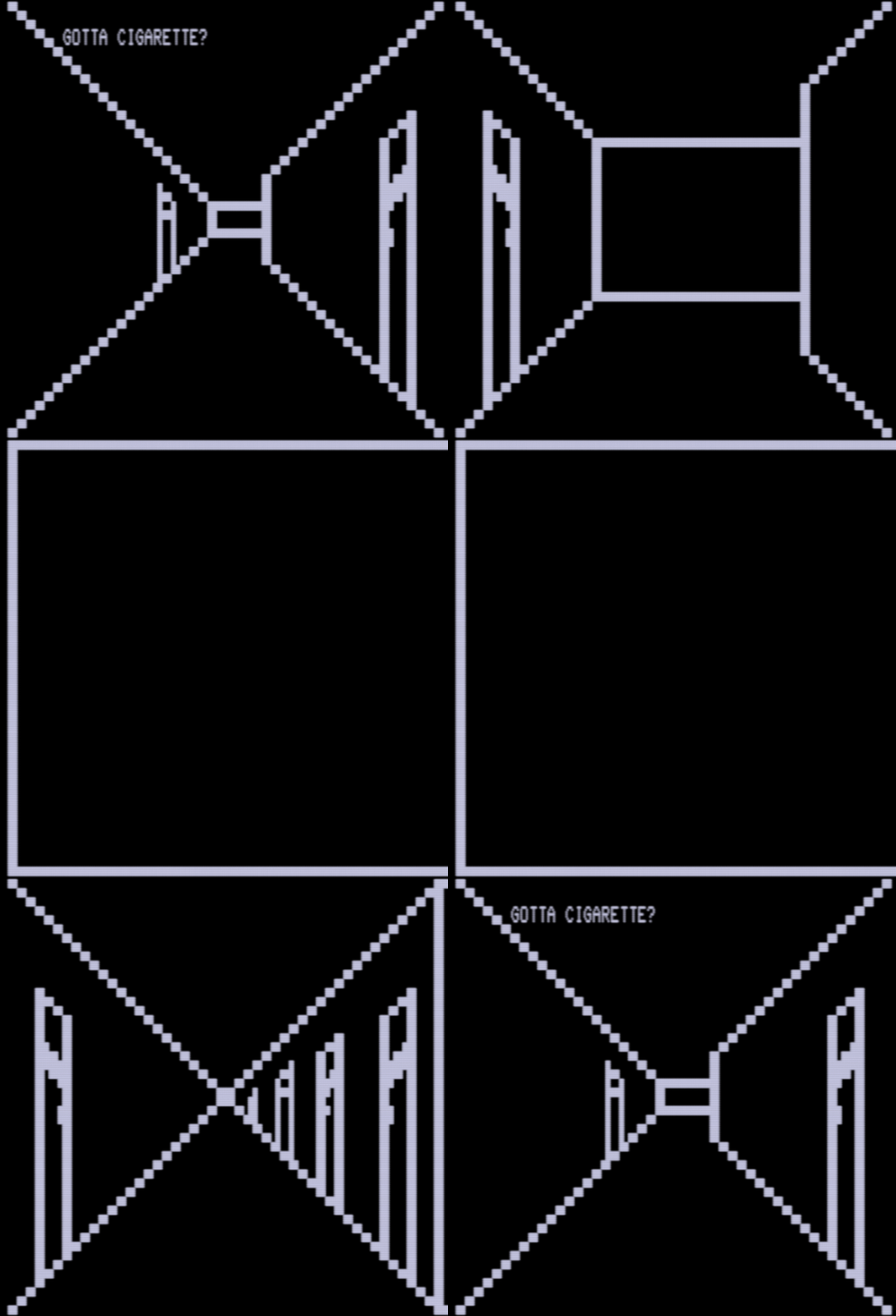
While the key was a dud, the cigarettes were useful. One of the inmates was asking for cigarettes; once I typed GIVE CIGARETTE TO INMATE I got them to follow me in the halls.
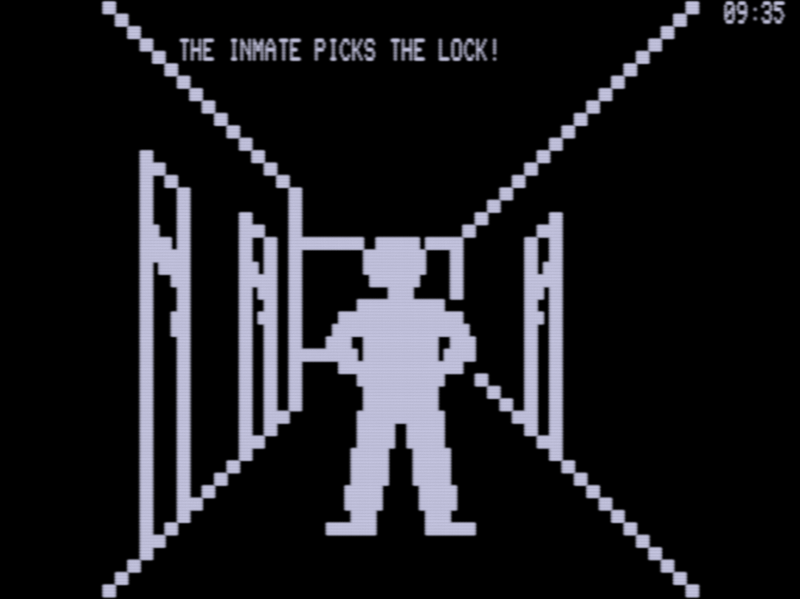
As the inmate followed — and as far as the TRS-80 graphics go, they really did follow — they picked locks on some of the doors. Not all the doors were useful to visit.
I received a round peg from one inmate, and a fake nose from another. The inmate following me also picked the lock on one of the “side” doors of the pentagon, leading to a new large maze.
When you go in, you are “rubbed with vanishing cream”, and shortly after hit what seems to be an invisible wall. It’s a mirror, which you can see by wearing the fake nose. However, in addition to being a reflection, this is also showing a square hole (!?), and you need to INSERT ROUND PEG IN SQUARE HOLE to get by. The word “illogical” might be used too often in describing puzzles but it certainly applies here. I think the intent is a sort of Alice-in-Wonderland effect where the hole doesn’t exist until you see its reflection, except … the fake nose isn’t a square. I just don’t know.
By large, I mean essentially twice the size of one of the mazes from Deathmaze. The word “tedium” again comes to mind. I got very, very, tired mapping things out.
Just part of the map; there are teleports and “revolving” walls.
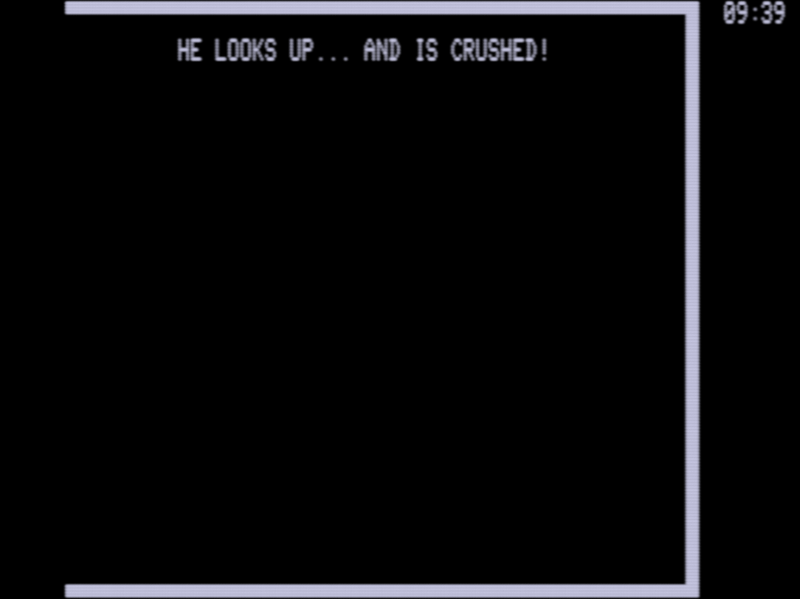
The maze had a BAT (the kind you swing), a HAT, a BALL, some FLIES, and a NOTE (which you saw in my last post). To be clear on the note: it says to LOOK UP, and a piano falls on you if you do, but the note itself is not trapped and typing LOOK UP anywhere in this game will summon the piano.
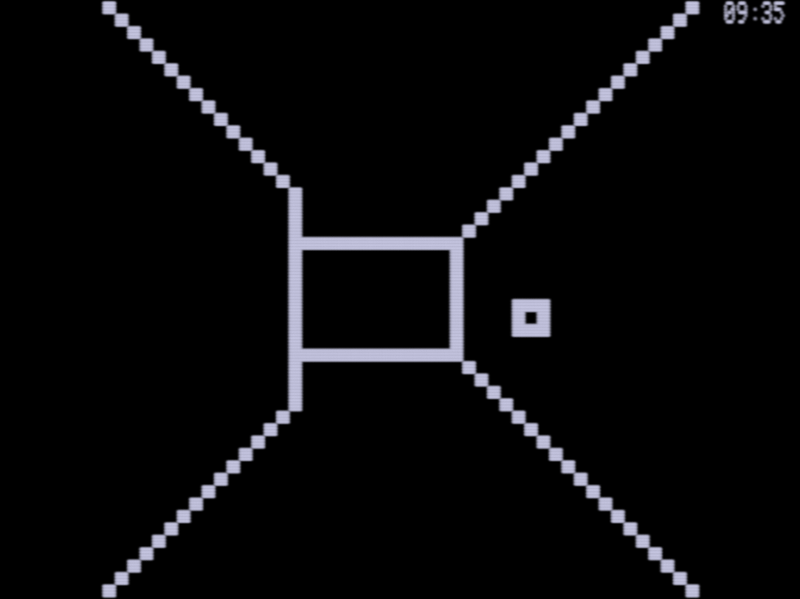
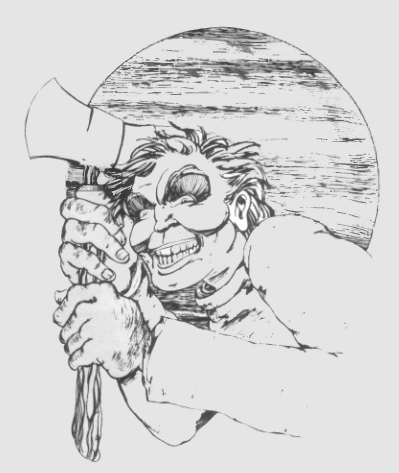
In one small section of the maze, a carpenter builds a wall behind you as you step through a particular spot (essentially a one-way-door) and you start being chased by an axe murderer.
I think this is the best puzzle of the game, and you technically know enough to solve it, so a brief pause for a picture from the manual:
>SHOW NOTE TO INMATE
(alas, not GIVE, Asylum’s parser is still dodgy)
After self-defense via piano, you can take the murderer’s ax and cut your way through the wall the carpenter made. The ax murderer area also has a STEEL KEY you can use to get back to the main asylum pentagon area.
Fortunately, unlike the brass key, the steel key does work in places; after the usual “try everywhere” stratagem I found a fisherman who wanted the FLIES and gave BOOTS, a room full of water that I needed to be wearing the boots to survive, and then a named character…
…who I was able to give the boots to and get a BURRO and LANTERN in exchange.
The BURRO went to a guru who traded me some NAILS, and then I used the steel key again one more time to find a second large maze (20 by 20 again).
The “invisible wall” shtick starts the map again, although this time you get through by using the bat and ball.
I became exhausted. The density of puzzles on the map is just too low; about half is composed of squiggles for no reason other than to fill space. I found some MARBLES, some GOLD, and some annoying puzzles; one of them was a strong candidate for the most tedious puzzle of any adventure I’ve ever played.
The hall above has 20 doors, 10 on each side. Your goal (not spelled out, you just have to be bored enough to try it) is to enter each and every door. Most of them lead to an empty loop and teleport you back to the hall (in a way it’s easy to lose orientation). When you get to door #20 you get “rewarded” with some matches.
I also had some difficulty with a gorilla, especially because the game does not consider DROP MARBLES to be the same as THROW MARBLES (he slips and you can pummel him with the bat), but where I really entered the “start using hints and rely on them for dear life” phase was a long hall where upon reaching the halfway point, I got ran over by a roadster.
The trick here was to light Exodor’s lantern with the matches from the doors-of-tedium. I guess the hallway is too dark for the driver to see you? Except the game doesn’t describe the hall as dark, and there are a few “dark areas” where you can’t see walls (the guru room was one) so really, the interface is implying the hall is well lit.
Once you can get halfway through the hall in safety, you can drop some nails, leave, the roaster comes (even though it previously only came when you were in the hall) and wait for the roadster to wipe out. The screen fades to white (the explosion knocks you out, I reckon) and you wake up after time has passed and it is 5:00 AM. So much for being efficient with previous game actions: you now have 30 in-game minutes (20 minutes real-time) until the guards nab you and you lose the game.
After the “accidental” crash, the hall is filled with car parts, including red herrings like a WINDSHIELD WIPER and TIRE. There’s a VOLTAGE CONVERTER and CRANK that turn out to be useful but it’s very hard to know they’re useful early and you can’t carry everything at once; it’s pretty much guaranteed you’re going to have to restore to a saved game once you know what’s needed.
Past the gorilla (defeated earlier via marbles and baseball bat) was a copper which allow return to the main asylum. The key works on yet more doors in the pentagon, including one with an inmate offering a wire hanger.
I found I could TRADE CIGARETTES FOR HANGAR (and yes, I think it needs to be the verb TRADE, just GIVE CIGARETTE won’t do).
When you examine the hanger after you get it you find out you are literally in the darkest timeline. One quick restore later and the problem is rectified by asking for a PASS KEY as opposed to the hanger, but — again I was both severely annoyed and impressed by the game’s chutzpah. You need to make a wrong choice first to find out what the right choice is; there’s not even a slight pretense of the hero’s continuum being the one where they got lucky.
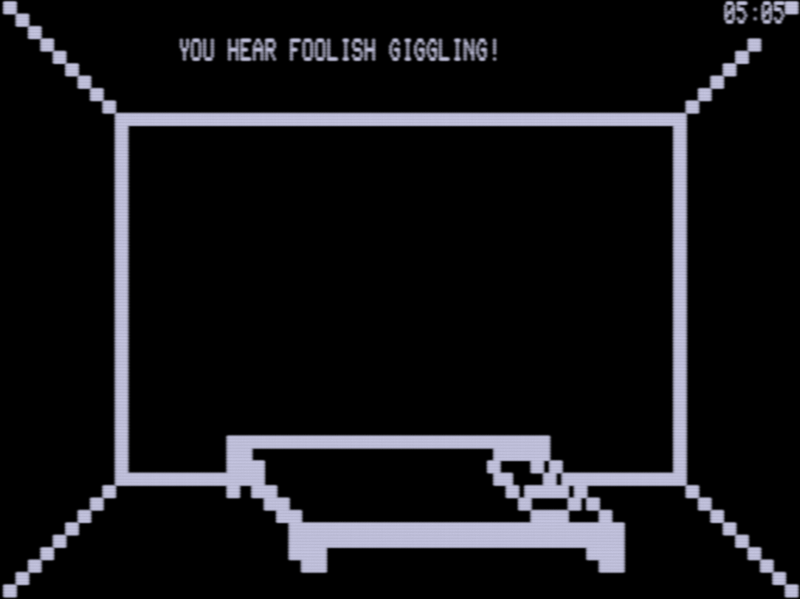
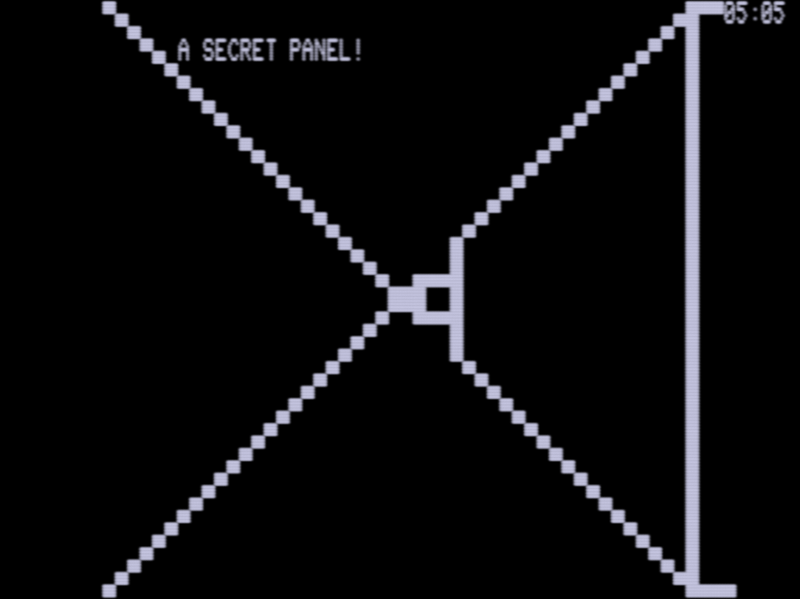
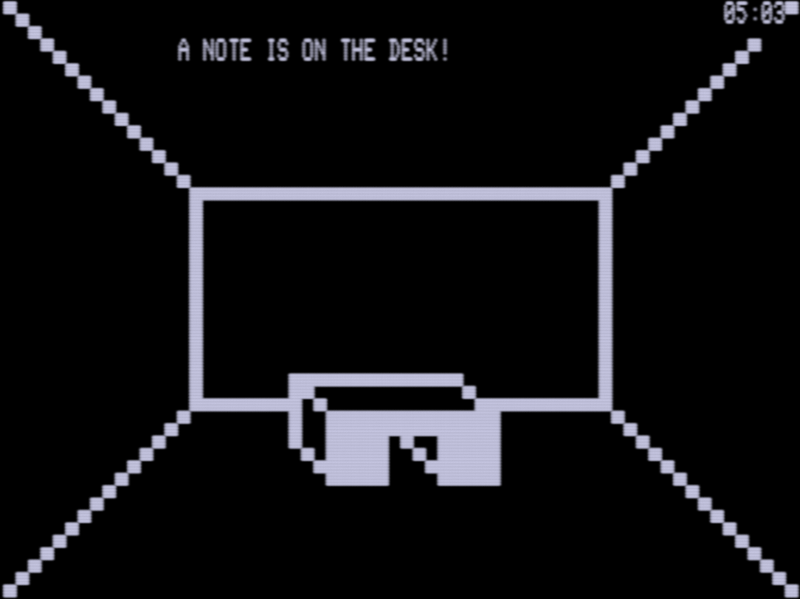
The pass key unlocks a final set of doors, including a room with a desk and a note (that I could never figure out the parser syntax on) and an adjacent room with a computer. The pass key also unlocked the room of an inmate I’ve been hearing “giggling” since the start of the game.
The inmate wants the gold from the second big maze (the description of the gold is “fool’s gold” and the inmate is supposed to be a fool) Then you can … and no, I did not figure this on my own … SIT ON BED, and it will set off an alarm.
To get by the alarm, you have to take the BAT (still handy!), go back to the computer room, and SMASH COMPUTER WITH BAT. (Not HIT COMPUTER WITH BAT, and my hate for Asylum’s parser burns with the heat of a thousand suns.) After disabling the alarm, the secret passage takes you to a final area.
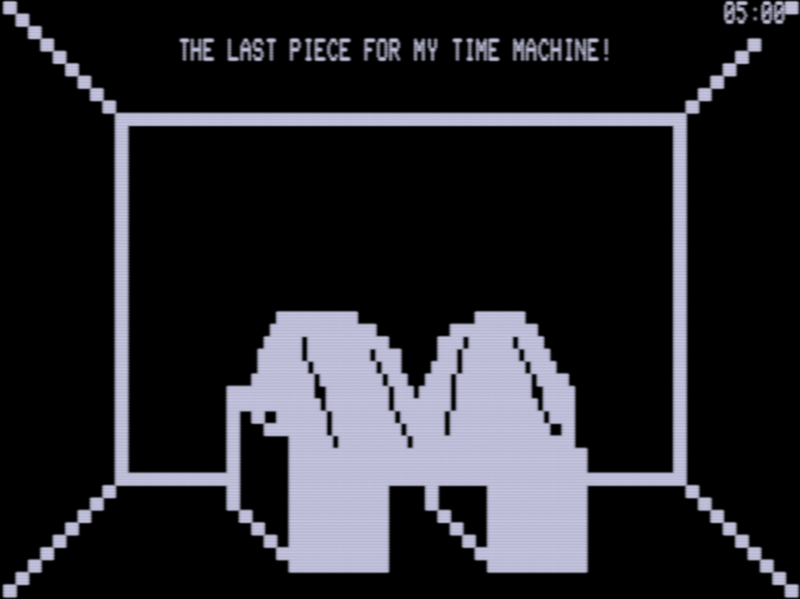
The area has a professor who you can give the VOLTAGE CONVERTER (from the roadster) to…
At least in the 16K version, there’s no hint the converter is the right item. The professor fixing his time machine rewinds the in-game time by a little; remember, after the roadster scene you normally only have 20 minutes left to beat the game.
…and a catapult which is the final challenge, and one I was not up to, because oh god the parser.
SIT ON CATAPULT
WIND CATAPULT WITH CRANK
BURN STRING WITH MATCHES
I appreciated the variety of characters and events (amidst a sea of way-too-large mazes), but by the end my tolerance for frustration had bottomed out. I get the sense the authors got caught into the trap of wanting to make everything Bigger and More Complicated (including the map, the puzzles, and the parser) but a lot of the charm of the earlier games was lost in the process. Labyrinth and Deathmaze 5000 might have had some “meaningless squiggle” sections but for the most part every niche was accounted for and interesting.
On the positive end, the hub structure was essentially satisfying (although it would have been much better had there been some notion what each key did) and the small bit of character movement with the lockpicker was innovative. The Corr/Denman duo clearly did not lack for creativity, but unfortunately, this was to be Frank Corr’s last game; Asylum II (1982) is credited to Denman only (Corr is still listed in the manual as making the “graphics” but I think that’s due to re-use of Asylum I assets).
I was never able to read the note next to the computer room. >READ NOTE — YOU AREN’T CARRYING THE NOTE. >GET NOTE — NOTHING HERE! >GET NOTE FROM DESK — CAN’T BE DONE! >GET NOTE OFF DESK — WHAT IS: OFF >EXAMINE NOTE — IT HAS A MESSAGE ON IT! >GET MESSAGE — NOTHING HERE! >GET ALL FROM DESK — CAN’T BE DONE! Did I say a thousand suns? Maybe up that to a million.
I’m trying to get through a big chunk of game before I write my next major update, but I’ve got a small “feature” to report on that is mind-boggling on its own.
I mapped the original Deathmaze 5000 and Labyrinth on a spreadsheet, as they followed the same pattern as many RPGs of a regular grid; possibly with some teleports or other sneakiness, but a grid nonetheless.
That doesn’t hold for this game. The above picture is entirely wrong. The real map (at least for the starting area) is something like:
So you have five “inward” doors and two “outward” doors in every hall, but even though it appears you are turning 90 degrees to go around halls, you’re turning 72 degrees instead. The real map is a pentagon.
This is one of those times I am intensely irritated by a feature but simultaneously in awe of the chutzpah. The game is essentially lying to the player.
This would have been faster to spot but trying to drop items in a hall causes a janitor to appear and scoop them up. I admit for a long time I assumed I was simply being prey to some teleporter shenanigans (probably I still am — I’m guessing “behind the scenes” in the code there’s still a grid somehow — but it still all comes out functionally to a pentagon).
The only reason this is marginally fair is due to the low-res nature of the graphics; it would essentially be impossible on a modern system (although in a “node” system like Myst you might get close). I am still curious, though, if anyone has been in a pentagonal building before, and if it was possible to “feel” like the turns were at right angles even if they weren’t.
I don’t normally talk about my troubles in emulation; usually, it is as mild as “of the two emulators X and Y I could use for this, X doesn’t work but Y does”.
With Asylum, I’ve had issues that bleed over to the gameplay, so it’s worth a little detail this time.
Asylum’s initial release had both a 16K and a 32K version, and using both cassette and disk. (This refers to the memory capacity of the TRS-80 it loads on — 32K means double the text and code capacity over 16K.) This, combined with … magic, I guess, led to many variant files that currently exist.
My two most reliable TRS-80 emulators (Matthew Reed’s and George Phillips’s) died on almost all of them. I had blank screens, bizarre errors, and unrecognized keyboard inputs. The only exception was ASYLUM1G.CMD — based on the 32K version — which had a different “loader” at the front but also skipped asking if I wanted to restore a save game. It meant I could save but not restore a save file.
I had one other option: a cassette file of the 16K version. I was able to save and load with this version.
This led me to the scenario where I could either
a.) Play the 16K version, with saving and loading working properly.
b.) Play the 32K version, with no game saves, but with more text.
I’m currently going with the former, since the manual claims the gameplay puzzles are the same, just the text is terser. This might seem to be the more difficult game, but the 16K version has advantages. CHARGE from Deathmaze 5000 is retained in the 32K version…
…but is cut from the 16K. So I know CHARGE is a useless red herring and I shouldn’t waste time running into walls looking for secrets.
Of course, sometimes more text is clearer. Last time I mentioned a grenade where you needed to PULL PIN FROM GRENADE. Here is the grenade’s description in the 32K version…
…and the 16K version.
Notice the PULL verb is immediately suggested by the 32K version but not the 16K version. I may just swap back to the 32K version on occasion once I have a clearer idea of my route through the game. As things currently are going, I’m dying too often to go without save files.
…
I’m only made a smidge of progress, so my content update is going to be short. Last time I escaped a second cell with a silver key; I found two more doors that unlocked with the key, including one with the coat and grenade from the start of the game. I was then walled by trying to get past a guard.
I had tried TIPTOE as the game had previously mentioned the verb, but ATTACK GUARD led to me being torn apart. I finally checked hints and found out that PUNCH is considered an entirely different verb! (KILL and ATTACK are mapped together, HIT and PUNCH are considered a different set.)
A brief, general principle I’ve alluded to: if two verbs are understood differently, yet might plausibly seem to a user to be the same action, the text needs to be absolutely clear about what’s going on. It may just be the two verbs should be merged; even if there is technically a difference (punching a guard doesn’t necessarily mean you aim to kill) it isn’t worth the user-end suffering. In this specific case, I imagined ATTACK as using the player character’s fists; I’m not even sure how the game interprets it otherwise since the player doesn’t have a weapon.
I’ve only had a little time to explore past the guard. I found some more locked doors (and had to laboriously try my key on each and every one), some with inmates inside. You can hear giggling from one, see an ugly face from another (both of these are behind still-locked doors).
Two rooms I could unlock and also had inmates inside. One inmate was asking for a cigarette, and when I didn’t have one, called for guards (losing me the game). The other I immediately died via shotgun.
The last thing I did was SEARCH GUARD, yielding a BRASS KEY, a UNIFORM, and CIGARETTES, so next time I should hopefully be off and running with a bigger chunk of the game.
While I polished off the TRS-80 game of this game already, I was poking at John Olsen’s later port (that he titled Frankenstein’s Legacy) and discovered a feature in the z-code version (made by William Stott) I don’t recall ever seeing in any other adventure game.
First, just to note, all the ports generally do is re-format the game’s text to seem more like a more modern text adventure, as opposed to TRS-80 minimalism.
Dirt path
You are on a dirt path. There is an old, rundown mansion to the north, a swamp in the distance to the east, and to the west is an overgrown cemetery.
Compare with:
Honestly, I think I like the original more? The effect is akin to trying to scale up an old 8-bit game into modern graphics but leaving behind jagged edges.
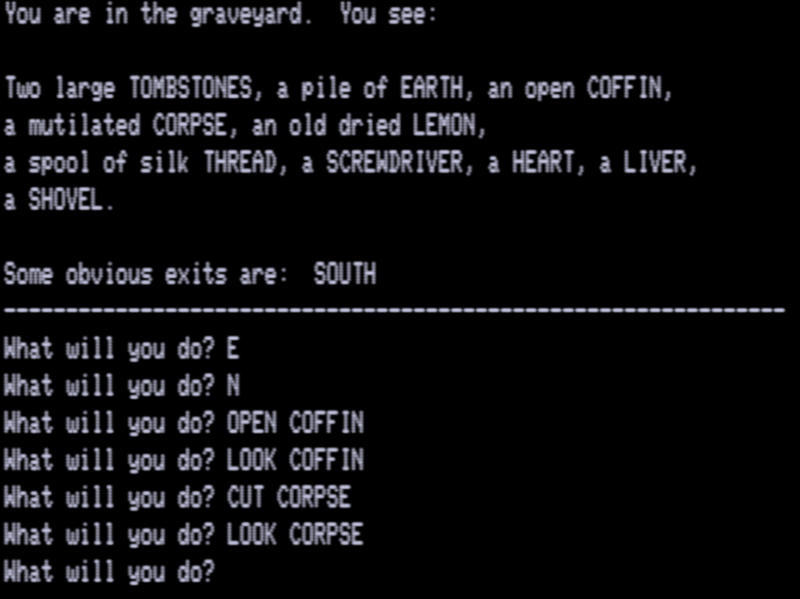
FRANKENSTEIN’S LEGACY’s lack of graphic description is at times comic also. If you order the game to cut open a dead body, you are told “OK.” That’s it, just “OK.”
This event is fine in the TRS-80 version — the appearance of the mutilated corpse in the object list is startling, and the main text is essentially an acknowledgment rather than any kind of atmosphere building. Without the two-window setup, all that’s left is the “OK”.
Now, the new feature.
For fun (and to see how it works), I’ve also implemented a ‘bones file’ (as outlined in ex137 of DM4) to generate the ghosts of the previous 10 player characters killed in the game. This is set ‘off’ by default. To switch on the ghosts, type GHOSTS ON (or HAUNT) near the start of the game.
DM4 is the Designer’s Manual 4 for Inform, the language used to make the port. I reckon someone else must have borrowed this idea since it’s direct from the manual, but I don’t recall ever seeing it re-used — anyone?
When you die in the game, you leave behind a ghost where you died.
>E
Edge of a swamp
You are on the edge of a swamp. There are the distant ruins of an old mill further to the east.
You can see a faint ghost, a sign in the grass and a crowbar here.
>EXAMINE GHOST
The ghost stares at you mournfully. Someone must have died near here once, long ago.
If you die multiple times (quite reasonable to happen on the quicksand and the wolf while you’re solving them) there are multiple ghosts, one for each death. I’ve seen this in puzzle games, RPGs, and even in a multiplayer shooter, but never in adventure games.
In 1980, Med Systems released the graphical 3D adventure games Deathmaze 5000 and Labyrinth. Both were relatively light with graphics — showing walls, boxes, and the occasional extra like a keyhole. William F. Denman, Jr. and Frank Corr, Jr. released Asylum in February of 1981, which ramped up the graphics with openable and closable doors, inmates and guards, beds, and … well, likely other things, but I haven’t gotten very far yet.
The parser now accepts full sentences. This is very much an object lesson in just accepting more words does not mean the parser is better. Guess-the-verb (which Deathmaze definitely had) has been replaced with guess-the-phrase. (I’ll give examples of what I mean in a moment.)
You start, without preamble, imprisoned in the titular Asylum, with the goal to escape in 8 hours. The time is “real-time” except one minute in game time is 40 seconds in real time. I have yet to assess if this is really a problem or just an extra piece of tension; there’s plenty of ways early to lose without worrying about a time limit on top of things.
You start with just a coat; inside your room is a box with a hand grenade. “EXAMINE GRENADE” indicates the grenade has a pin. In order to escape the starting room, you need to PULL PIN FROM GRENADE and then UNLOCK DOOR WITH PIN. (If you GET PIN FROM GRENADE you are told it can’t be done, GET PIN just indicates it isn’t here. A good parser would understand both the four-word and two-word versions; there’s no reason to be picky here about where the pin is coming from.)
Incidentally: Don’t forget to put the pin back in the grenade!
Leaving the cell gets you into a hall with locked doors, none of which succumb to the pin. I ended up getting caught by a guard and being chided that I didn’t TIPTOE. I restarted and tried TIPTOE — the verb gets recognized, but doesn’t seem to do anything. It’s possible the first time you are caught is forced.
I got tossed into a different cell, wearing a straightjacket, which for some reason was on fire. One ROLL later both stops the fire and discards the ruined jacket. The room this time had a newspaper, and I was able to EXAMINE KEYHOLE to find there was a key in the lock. The next part required these exact steps:
SLIDE NEWSPAPER UNDER DOOR
SLIDE KEYHOLE
GET NEWSPAPER FROM DOOR
The last one was particularly frustrating, stumping me for a good 15 minutes. The game doesn’t think the newspaper is in scope otherwise, and code seems to have bespoke-hacked in the ability to retrieve the newspaper with that last phrase, and only that last phrase (not GET NEWSPAPER FROM UNDER DOOR, even).
Leaving the room again, I found an identical-looking hallway (it might be the same one?) but with a silver key that let me get into two new halls; however, trying to walk down either led to an instant game over as guards caught me in their “offices”.
This one’s going to take work, for certain. I’m still optimistic this will get fun once I get into the swing of things.
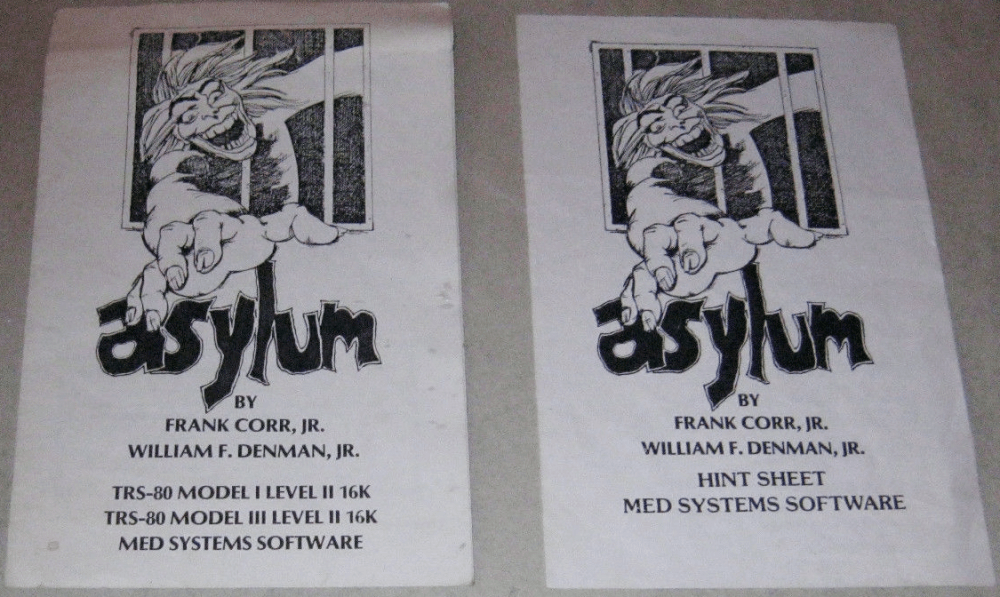
2.) Med Systems followed up Asylum with Asylum II, and then, very confusingly, Asylum, which is just Asylum II with the sequel number dropped (but ported to more systems like the Commodore 64). This means some places (like the Interactive Fiction Database) you will see mention of a game called Asylum which is actually the sequel. As of this writing, Wikipedia’s text mostly refers to the correct game, except the picture is of the cover of the other game.
Also, Frank Corr is left out of the dev credits. Denman is the sole credit on Asylum II, so I’m guessing that’s the reason for the error.
The different accidents of life are not so changeable as the feelings of human nature. I had worked hard for nearly two years, for the sole purpose of infusing life into an inanimate body. For this I had deprived myself of rest and health. I had desired it with an ardour that far exceeded moderation; but now that I had finished, the beauty of the dream vanished, and breathless horror and disgust filled my heart.
In the original Frankenstein, Victor abandons his “monster” as soon as he creates it; the monster doesn’t really get into murder until he finds out the circumstances of his creation, and plans revenge.
More modern takes have varied, but we’re jumping ahead a bit in the plot–
Before I made any progress on the real story, I was fussing about with all my objects, and discovered BURN worked as a verb on things other than just matches and candles. Dutifully testing out every item in my inventory, I found a secret message:
I also knew the painting of Victor I found last time was “screwed to the wall” so I just needed to get a screwdriver over to the painting to check it out, but I was blocked (as I left off last time) by a wolf.
The wolf had previously emerged when I had unearthed a coffin and a corpse.
After trying to fight off the wolf with little success, I went back to the CORPSE and applied my SCALPEL. This got me a mutilated CORPSE, which had a HEART and LIVER.
Grisly! I took the LIVER over to the wolf and it gobbled it down and ran away. Then I went back to the painting and unscrewed it, and applied the previously mentioned combination. This got me a DIARY and a MAP.
…I guess maybe I’ll find a liver somewhere else? Or did I make a mistake?
Plowing ahead, I took the map over to the bog where I previously was falling into quicksand and did FOLLOW MAP. This led me to an old mill with a crypt beneath.
The URN incidentally has ashes but you can POUR URN to also find gold ELECTRODES (as mentioned in the diary). The crypt had a passage leading back to the graveyard, but the wolf was back, and this time there was no liver to feed him. I did, however, have a fancy cane.
Now comes the most interesting dilemma of the game. I was able to return the HEART over to the monster back in the lab, but I had no liver because the wolf ate it. Except now the wolf is dead and in the form of a man… so maybe…
…is that the same liver? (I think at a code level it is, but at a plot level it’s the man’s original liver we cut out.)
With liver in hand, some working with needle and thread, and attaching the gold electrodes from the urn, I was able to come close to bringing life. I just needed to pull the lever. I fully expected a “you win” message, but:
Ah, of course. This is the kind of monster that comes out swinging right away. It chases you around which strongly suggested the solution was geographical. Restoring my game, grabbing the map I used last time to get by the quicksand, I tried pulling the lever again, and escaped to safety.
In the end, no progress was made: while we finished Victor Frankenstein’s wish, we then undid the monster we created just as quickly.
La Créature De Frankenstein by the KLAT group in Geneva. Picture by Guilhem Vellut.
Many games from this era use the tropes of horror, but far fewer have really been horror. That is, various “monsters” have often been interchangeable with fantasy — a mummy might as well be an orc, a ghost might as well be a goblin. Fully-fledged horror shows people in desperate in tragic circumstances doing desperate and tragic things, and I think Frankenstein Adventure qualifies with the, ah, creative use of corpses. I really did have a moment I was stunned when I realized how I could get a second liver. The gameplay finesse of having seen one that gets “used up” — bringing up the specter of softlocks, yet not being one — made the moment more effective.
…
Audible has recently put up some of their material for free (as in actually free, not a free trial). This includes an absolutely stellar reading of Frankenstein by the actor Dan Stevens (from Downton Abbey); it runs for 8 1/2 hours and if you’re looking for distraction I highly recommend it.
If you’re keen on playing Frankenstein Adventure itself, there’s a version you can play online. The display of the online version is slightly glitchy but it still works.
Frankenstein Adventure is yet another TRS-80 game in BASIC, and was released in the October 1981 edition of CLOAD. (This was the same “magazine on tape” that had CIA Adventure.)
The reason I have the date listed as 1980 to 1981 is that, rather unusually for a simple BASIC game from this era, there is an extensive interview with the author, John R. Olsen Jr. from Oregon (not to be confused with John R. Olson from Kansas who was working at the same time).
I decided that I was going to write an adventure game. But I had no idea of how to go about it. There were no adventure authoring languages like Visionary at that time. My only choice was to write in the BASIC language. And that meant that I had to write everything: the parser, the input routines, the output routines, as well as the movement and other logic. But I had a pretty good knowledge of BASIC and so undaunted I began writing my first adventure during my Christmas vacation of 1980. The plot of my inaugural adventure was taken from the old horror movies. Its working title was ‘Frankenstein Adventure’. The plot had you (the player) discovering you were the long lost relative of Dr. Frankenstein. As his only heir, you had inherited his mansion. When you arrived, you found a letter from him telling you that he wanted you to complete his creature and bring it to life.
As the quote above implies, you’re not tasked with looting treasures or defeating evil. You are here to create life.
So far I’ve mostly explored. The map is fairly small; there’s a cemetery, a bog, and the house; other than the typical kitchen and dining room the house has a master bedroom with a “four poster BED” and “a PAINTING” of Victor Frankenstein.
There’s also a library, which (perhaps inevitably) had a secret passageway, leading to a laboratory.
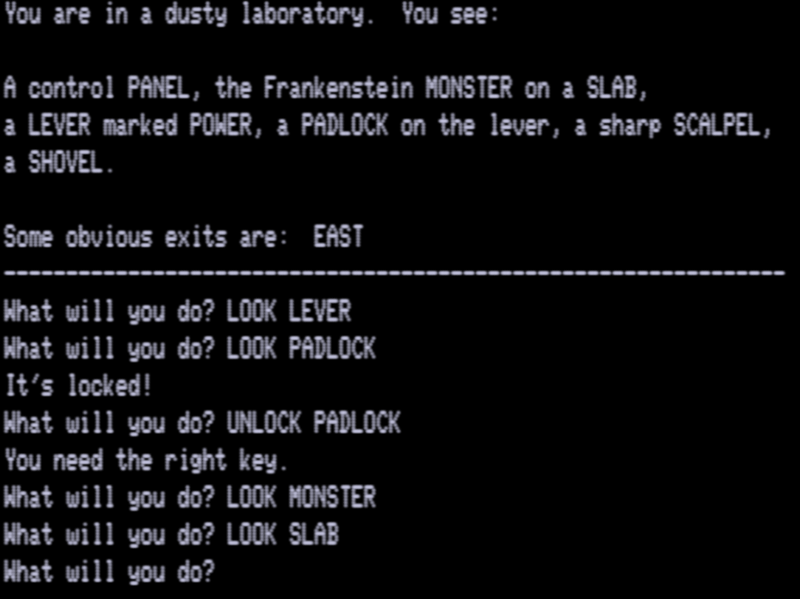
My most immediate obstacle to fulfilling Dr. Frankenstein’s dying wish is the padlock on the power level, but I’m guessing that’s not the only hitch; I suspect the monster itself will need some work, but I don’t know with what yet. What I’m getting stalled on is some quicksand…
…and a wolf, who blocks my way back in the house after I dig up a coffin with a corpse.
I have access to a CANDLE, MATCHES, a SCALPEL, a CROWBAR, an old LEMON, some silk THREAD, a SHOVEL, and a SCREWDRIVER. It’s possible I’m still missing an ordinary secret in the house so I won’t call this comprehensive.
With a simple treasure-hunt TRS-80 game I likely would have dived into hints or source code already, but the premise is compelling enough I’m giving the game a little more effort before I throw in the towel. I like how the protagonist’s quest is not framed as good or evil, but just fulfilling a mission as Frankenstein’s last living relative.





























 Renga in Blue
