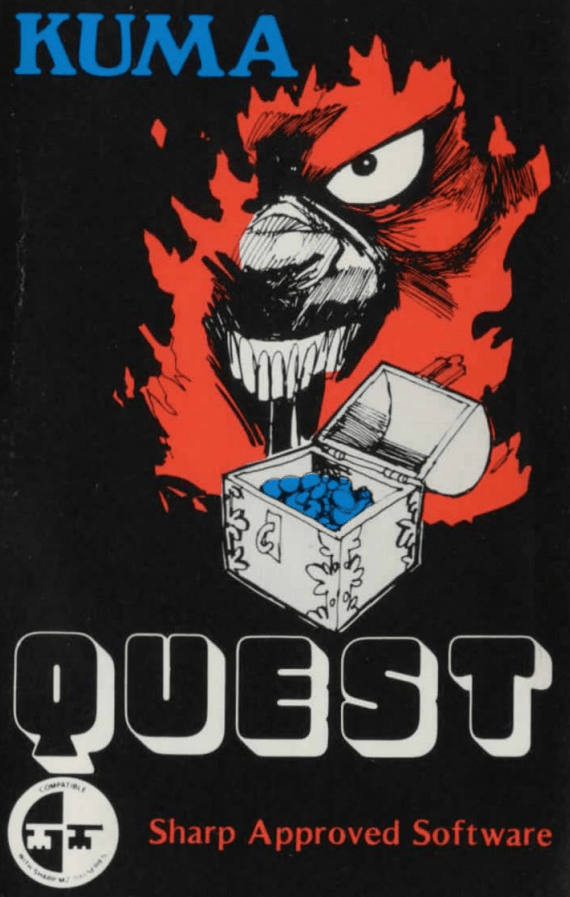
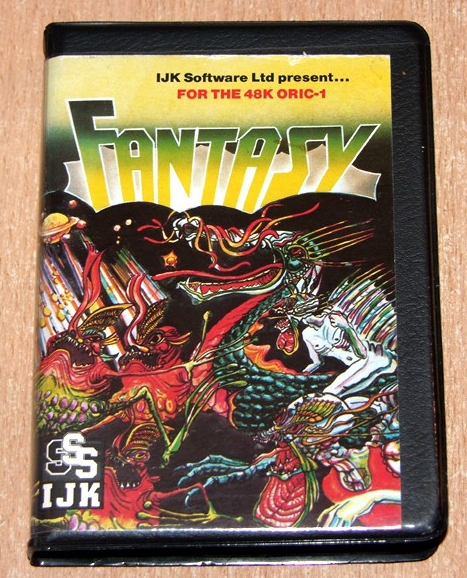
I normally associate the Sharp MZ series of computers with Japan (and while we’ll get to Japanese adventure games, we have to make it to 1982 first); however, it also sold decently in Europe. Quest was originally published in 1981 by Kuma Software for the Sharp MZ-80A and republished in 1983 by the same company; it was additionally republished the same year by IJK for the Oric-1 (Tangerine’s successor to the Microtan 65) as Fantasy Quest. I’m having trouble running the Sharp version, but I’ll link a video of the game running on a real machine just so you can see it.
There was a third version for Tatung Einstein, but I went with the Oric-1 edition.
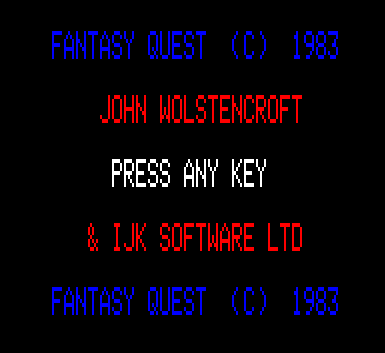
Via Retrogames. I incidentally am going by the title on the main loading screen rather than just “Fantasy”, if for no other reason to distinguish this game from Level 9’s first game Fantasy (1981). Couldn’t think up an easier-to-Google title, early game programmers?
The back of the tape case states our mission is to “find and take the four sectors of the eye of Morpheus to the eternal fires of hell.” This will allow us to cross a “crevasse” and find the “long lost treasures of BORGAN.”
Well, it’s not quite a Treasure Hunt, even though the plot says it is literally a treasure hunt. I’m curious why the author (John Wolstencroft) felt obligated to toss the treasure in there, even though destroying some presumably evil artifact seems motivation enough.
The author also wrote Castle Quest. Clearly, he had a penchant for generic titles.
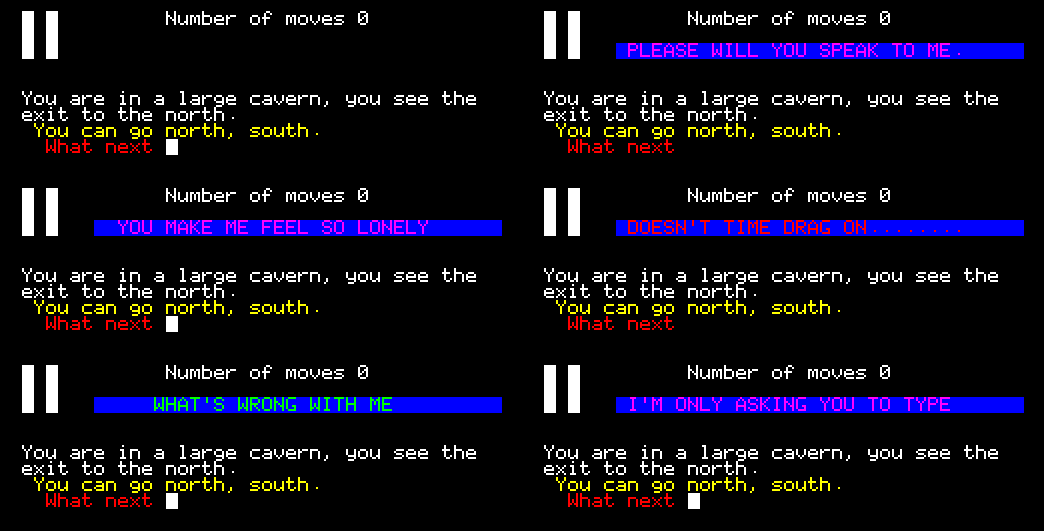
Almost right away, because I had to take notes, set up a map, and so forth, I ran into a feature that I’ve never seen in a text adventure before from any era: the text equivalent of idle animation.
If you haven’t seen it yet, let the image above sit for a moment.
Perhaps a few extra moments. The computer starts to beg. There’s a lot of messages; I cut the file off early just to keep the size reasonable.
You can also peruse, as you’re idling, the spot in the upper left corner: that’s a compass map view, as seen all the way back in Spelunker (1979) although formatted as an above-down view of the environment.
…
A brief pause.
Texts have rhythms to them, sometimes particular and specific ones. Words best read fast, words best read slow. Scenes painted literal, scenes painted as metaphors.
A thief drives to the museum in his black van. The night
watchman says Sorry, closed, you have to come back tomorrow.
The thief sticks the point of his knife in the guard’s ear.
I haven’t got all evening, he says, I need some art.
Art is for pleasure, the guard says, not possession, you can’t
something, and then the duct tape is going across his mouth.
But today, the Rock cries out to us, clearly, forcefully,
Come, you may stand upon my
Back and face your distant destiny,
But seek no haven in my shadow,
I will give you no hiding place down here.
The first excerpt works like an action film, thrusting forward with a similar force. The second is more contemplative, more demanding of reflection. While it’d be possible to swap the reading approaches and get satisfaction, there’s still some sense of optimal approach.
The same extrapolation applies to gameplay. By surface appearances, adventure games of the early era — rooms, objects, a parser — are blended to the point it may appear all games are simply extensions of each other. But for each one of these games I have re-adjust, and sometimes I simply start wrong — reading room descriptions too closely, or not closely enough. Bypassing verbs that search things, or using them at every opportunity.
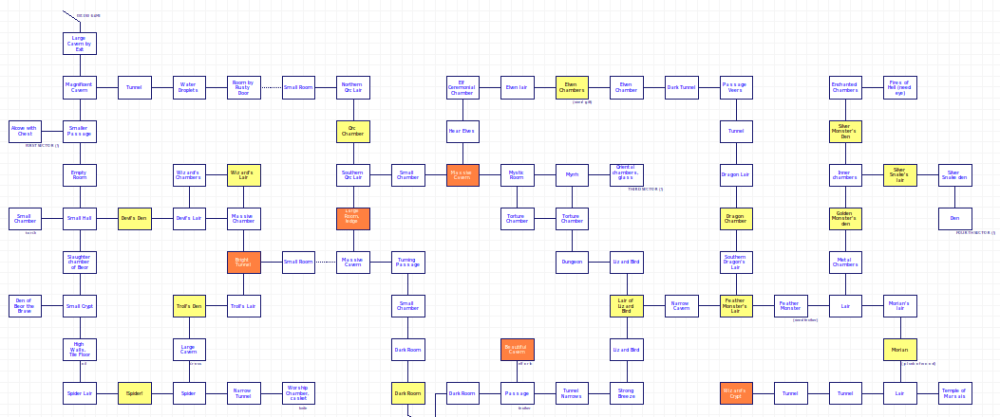
With Fantasy Quest, I diligently started a map with “Large Cavern” mapped out and continued for each room like a traditional Infocom game. This is not the best approach here. Many of the rooms are described as just tunnels, or just turns, or just intersections, and are quite intentionally described in a generic way. The focus here is on dens.
Spots in orange have passages going up.
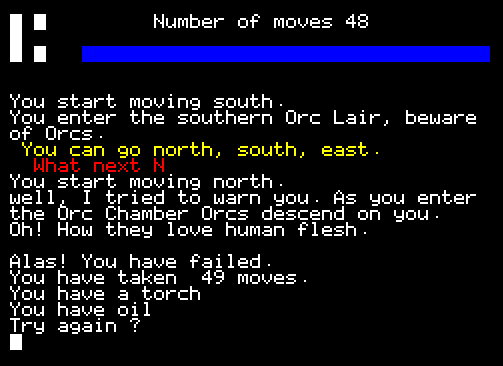
I have marked with color each “den” in yellow, which represents some foe or friend. For example, there’s an orc den you can pass through safely once, but the game explicitly says not to enter again; if you do, you get eaten.
A troll demands money; some nearby coins help to satisfy.
A devil can be driven off with a cross.
The interesting part — and this is where it really did take me a while to catch on — is that the layout forms a logic maze of sorts. Here’s an early example:
A “super-structure” map. This is generally the better way to think about the game, and hits at what I meant by the poetry analogy earlier; I originally wasn’t properly “zooming out” but rather getting annoyed at all the “plain” rooms in between the important parts.
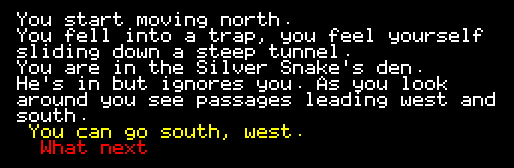
The Opening Area lets you visit a devil early, but you can’t get by because you don’t have a cross yet. There’s also a chest that has the first sector of the eye of Morpheus (remember, the objective is to find all four) but you can’t open it without a key from the second area. So the only way from the opening to the second area is to pass through the orcs, but that’s a one-way trip. But in addition to finding a key in the second area, you can find a cross, so you *can* then get through the demon lair and back, which lets you access the chest in the opening area.
There’s yet another route back to the opening area past a spider, but it only works once, and you use up the cross later (it’s silver, and there’s a creature that wants silver) so this needs to be saved for when you no longer have the cross later in the game.
Another example:
A monster wants a feather. A feather happens to be nearby. However, to take the shortest route back requires passing through a “lizard bird” who normally ignores you; if you’re holding a feather, he attacks and kills you. So to get the feather back to the right place you have to take an alternate route: which passes by a.) a dark area with a pit (that you need to LIGHT a TORCH for) b.) some elves, who require an ORB to get by and c.) a dragon lair, will the dragon will only appear if you visit the place twice — so this is a one-way trip, so you need to make sure you haven’t tried to enter from the other side prior to taking the feather trip.
There’s an entirely different route from the feather to the elf/dragon portion of the route which passes by some gargoyles, but just like the orcs and dragon, you can only pass through once, as the gargoyles will kill you if you enter a second time.
The sequence above is where the setup on the game clicked for me; I had solved the “puzzle” getting the elf orb to the elves but was led to rooms I had already been to, and the dragon lair from the north rather than the south side, but was confused what that accomplished until I realized I need to focus on available paths more than individual rooms.
But not too much focus — while the automap is helpful, there are parts of the game you can GO UP or GO DOWN, and that’s only described in the room text itself.
I really wanted to finish this by reporting victory, but I’ve only managed to get 3 out of the 4 sectors of the Eye. The last map section I managed to arrive at has a wizard satisfied by a gift of a wand, but past the wizard I can only go back to part of the map I’ve been to. I have a plank of wood I haven’t used and there’s two parts nearby where you get dropped a level via traps (one by a burst of water, and one by a trapdoor) but all my attempts at verb use have been stymied. (This is an ultra-minimalist verb set; a lot of the cases you’re just giving gifts to monsters, or applying items automatically like the cross and the devil.)
(If anyone wants to try the game, Fantasy Quest is here. I played it with the Oricutron emulator here. To load the tape you need to type CLOAD”” as a single command.)
It’s been a while since we’ve visited the APX (Atari® Program Exchange) so it’s time to give it another try, with a work by Robert Zdybel who also wrote Alien Egg; I don’t know if Castle or that game came first.
While the gameplay in Alien Egg wasn’t impressive, it had a fun sense of attitude.
This is where the rest of the crew slept before their mysterious and untimely disappearance.
There are several bunks against one of the bulkheads. All of the are neatly made and empty.
>U
CAPTAIN’S BUNK
This is where the Captain used to bunk before HIS mysterious and untimely disappearance.
This one doesn’t quite have the sense of attitude, but it does feel written; there’s at least gesturing towards environment-as-storytelling. For Alien Egg, I also wrote the parser was “suffering” and looking back after finishing, I can’t say anything has changed, but I got a little more used to the particular quirks. (I’ll mark these spots when they come up as Parser Oddities #1 through #5.)
You got a wizard mad for mysterious reasons and you’re now trapped in a magical castle. So this one is Escape rather than Treasure Hunt. The map is sensibly laid out in levels, and feels more modern than a lot of what I’ve seen for 1981; I suspect the author was aiming for easy difficulty which accidentally led to this.
I mentioned environment-as-storytelling; rather than the castle we’ve been teleported to being generic, it gives the impression of having suffered some catastrophe, with snippets of life interrupted.
There’s no “payout” — in a modern game you’d expect some sort of climax where the player discovers What Really Happened, but the mystery remains a mystery even at the end.
Look, a Zork reference! Unless I’m forgetting something, this is the first commercial game we’ve seen where one has appeared.
I suppose if there was a longer windup, this would bother me, but the game is relatively short and clearly focused on just escape. The rough sequence of puzzles is
1.) Find a lamp and a sword clearly codged from Zork, and go down into a gaol.
Parser Oddity #1: The command GET doesn’t work, so GET LAMP is impossible. You have to TAKE LAMP instead.
Parser Oddity #2: The lamp is hard to turn on: LIGHT, ACTIVATE, and SWITCH don’t work. The right command is from the instructions: TURNON, all one word.
Once the room is lit, you see a skeleton there you can destroy.
Parser Oddity #3: ATTACK SKELETON and KILL SKELETON don’t work; you have to SWING SWORD, which shatters the skeleton into pieces.
2.) Find some runes and try to read them; the game, short on details, says YOU HAVEN’T DONE SOMETHING ELSE YET. There aren’t many other objects to play with, but there is a cupcake from elsewhere in the castle.
Parser Oddity #4:The CUPCAKE can only be referred to it as a CAKE. I automatically left the room and went back in once I realized I was having noun trouble to see the “short name” and plowed on through rather than lingering. This is a little like seasoned adventure players ignoring clearly gauche design decisions that non-acolytes baffle over; consider, for example, a player with many saved games and a reflexive ability to rewind time vs. a player who keeps only one save file.
Eat the cupcake by typing (sigh) EAT CAKE and you get an “Elvish feeling” which is sufficient to read the runic script.
SPEAK AND THEN ENTER.
This is a cute variation on the usual puzzle: the right command is SAY AND.
This opens a “potion room” by a vault with a door that is too heavy to open. A helpful potion sits nearby. Drinking the potion gives you strength and you can OPEN VAULT. The vault is empty except for a note mentioning a secret under a mattress.
3.) The king’s chambers have a mattress, where looking underneath reveals an amulet. Typing INSERT AMULET (indicated by the note, and it has to be exactly that) opens a room the chamber of the king’s mistress and a hungry-looking bird. Feeding the bird (with birdseed from elsewhere) gets a magic word. The magic word then opens up another room to a wizard’s tower, with a spellbook.
(It’s incidentally possible to solve #3 early without the note, albeit with more verb trouble on using the amulet, making getting into the vault anticlimactic.)
4.) Trying to type READ BOOK in most places just indicates it is being read in the wrong place. I found my way back to the vault, which had a suspicious looking portrait, and READ BOOK led to…
…my getting very stuck.
Parser Oddity #5: Just like Alien Egg, this game features the occasional vague message when something doesn’t work, like SOMETHING IS IN YOUR WAY, but in most cases with Castle, it isn’t hard to puzzle out what’s going on. Except: on this puzzle in particular, I’m still not even sure how the player character would know they are in the right room. It’s like the computer-narrator is composed of two entities, one for straight narrative, one for meta-narrative error messages given in ALL CAPS. The meta-messages aren’t even intended to be read as “in-game-universe”, I guess, except the messages reflect acts that usually are narrated in-universe, like noting a particular exit is closed? I might be overthinking this one.
This is the only point I needed to reach for hints. The book requires the lamp be turned off (TURNOFF LAMP). Then the book reveals the word XANADU in fiery letters.
The key then opens the front door to the castle and leads to escape.
The game doesn’t “end” here; you just have to assume the victory and quit the game on your own.
You might think the parser oddities would hurt the game more; writing them out, they look pretty bad (and the CUPCAKE isn’t the only object with noun trouble). It really helped that the target was easy rather than hard difficulty; rather than being stuck and mired in place and getting pushed repeatedly with the same puzzle and constantly wondering if the parser was the trouble, I was able to skate through.
You are on holiday in Cornwall and are staying in your aunt’s old house near the sea.
The house lies in an area known as ‘Smuggler’s Den’ and the townfolk will tell stories of clever smugglers hiding their wares in the maze of caves around the coastline.
It is said that one madman who lived in the house in the last century had stored his treasure somewhere and locked it using keys which were themselves locked in boxes!
However, many attempts have been made to recover the treasure and so there may be keys left by previous frustrated explorers– or so it is said: it is probably mostly gossip!
From Tansoft Gazette Issue #3. The picture shows the “full” version of the Microtan 65 with a regular keyboard.
The 6 Keys of Tangrin is the “Adventure 2” mentioned in the Microtanic ad I wrote about last time. It is this blog’s first appearance by Geoff M. Phillips, who we will get to revisit once we start reaching ORIC-1 games in 1983.
Tansoft Gazette Issue #2.
The EACH GAME HAS A DIFFERENT LAYOUT gives the tip-off that this is another entry in the rare roguelike-adventure genre which I’ve defined as “puzzles form the primary gameplay, yet the environment is still highly generative”. Reviewing the previous encounters:
Mines — randomly generated traditional text adventure map, randomly placed puzzles which block parts of the map, puzzle solutions are fixed, objects are placed to be guaranteed to be accessible to solve obstacles, only goal is escape
Lugi — randomly generated map with loose topography, puzzle solutions are fixed although an object for a particular puzzle is not guaranteed to be accessible, multiple routes to ending, multiple goals besides escape kept track of via a scoring system
Kaves of Karkhan — randomly generated 3D map, puzzle solutions are fixed and based on which characters are in the party such that there may be multiple solutions or no solution at all to a puzzle, no objects (except chests with magic vials that allow skipping puzzles), only goal is bier at the end
I’ll also give half-credit to Atom Adventure, which had some randomly-placed items in such a way that the overarching optimization puzzle varied (and was in some random number seeds, impossible to solve); however, it did not have a random environment. (In some of these games, arguably, the item space is the environment, more than the room descriptions, but that doesn’t apply to Atom Adventure.)
You decide to do some exploring on your own. You go down to the sea front and walk to the cliff under the house.
The tide is out. but it will return within a few hours. You are able to hold 3 things in your hands and pockets should the need arise that is.
The 6 Keys of Tangrin is much more chaotic than even Mines. I played using Jim Gerrie’s TRS-80 MC-10 port rather than trying to wrangle the text into a Microtan 65 emulator, partly to avoid the pain in the neck doing that involves, and partly because Mr. Gerrie already did some bug-fixing.
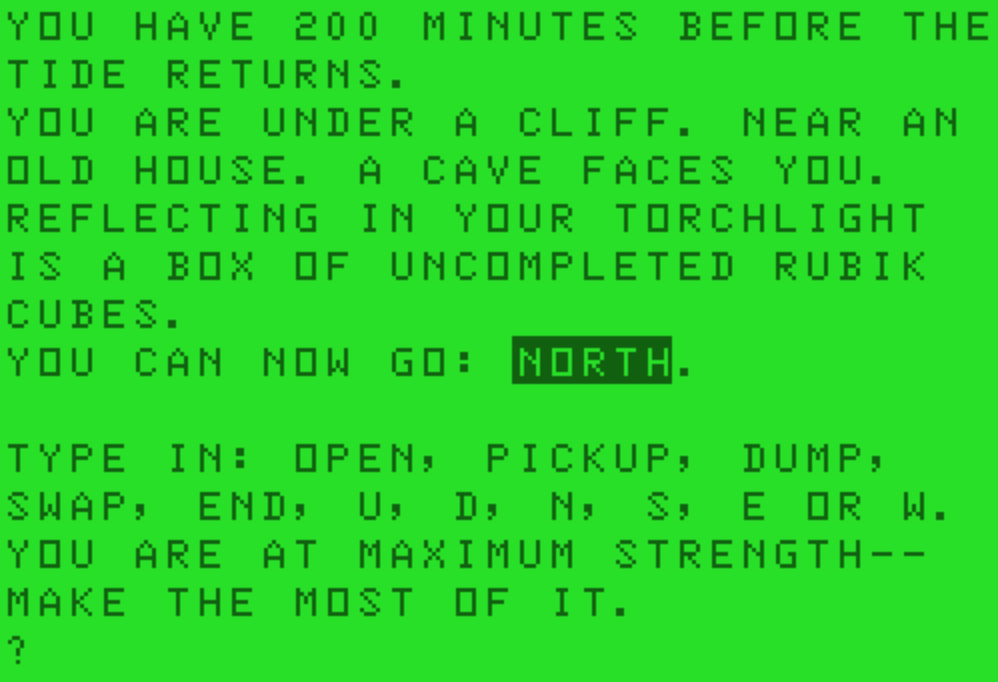
The starting location is constant, every other location is random. The box of uncompleted Rubik cubes being in the first room is also unique to this playthrough.
It qualifies as full roguelike since the map and all item placements are totally random. There are 6 types of keys, that go with various boxes. Which key goes with which box is also random. Sometimes the boxes will contain keys. Sometimes these keys will be new and helpful; sometimes they will be duplicated elsewhere. You have an inventory limit of 3 (even though you’re just toting around keys) so you need to use SWAP on occasion to pick up new keys.
YOU ARE UNDER A CLIFF. NEAR AN OLD HOUSE. A CAVE FACES YOU.
NEXT TO A ROCK IS A PILE OF OLD 78’S.
YOU CAN NOW GO: NORTH.
?N
YOU HAVE 186 MINUTES BEFORE THE TIDE RETURNS
YOU ARE IN A SMALL CAVE WITH FLOURESCENT GREEN WALLS.
AGAINST A WALL IS A SILVER KEY.
YOU CAN NOW GO: NORTH, EAST, SOUTH, DOWN.
?PICKUP KEY
OK, I’VE PICKED UP THE SILVER KEY
?EAST
YOU HAVE 172 MINUTES BEFORE THE TIDE RETURNS.
AHEAD LIES A SMALL OFFICE WITH PAPERS STREWN EVERYWHERE.
AGAINST A WALL IS A TIN OPENER.
YOU CAN NOW GO: NORTH, UP, WEST, DOWN.
?DOWN
YOU HAVE 164 MINUTES BEFORE THE TIDE RETURNS.
YOU ENTER A BROAD LEVEL CHAMBER, WITH A GLOSSY, METALLIC FLOOR.
ON THE GROUND IS A TOURIST’S GUIDE TO THE AMERICAN WEST.
YOU CAN NOW GO: UP, SOUTH, WEST.
Regarding the tide that goes in and out — it’s ok for the tide to return, as it eventually resets, but it means there is a chunk of time where you won’t be able to leave. The main “timer” to the proceedings is health. You start at 100% and slowly degrade. It helps to grab the “tin opener” as seen above because then you can open any tins that show up on the map, which restore your health.
YOU ARE EXTREMELY EXHAUSTED.
YOU HAVE BECOME A VICTIM OF THE CAVES OF TANGRIN.
I was initially somewhat impressed; the rooms cohere together a little better than Lugi or Mines, and the random debris of other treasure hunters felt sufficiently like an adventure to convince me I was in an environment rather than a random number generator.
Unfortunately, the gameplay doesn’t quite follow through; everything is just *too* random. You can have a golden key that you unlock a cabinet to find another golden key. There are lots of objects, like a WWI helmet and the a “PILE OF OLD 78’S” that do nothing. One exception is a French dictionary, which apparently helps you communicate with the ghost of Tangrin who can randomly appear. This lets you warp to the “end” of the game, but this still doesn’t help you get the “winning” treasure (more on that in a second), so it isn’t terribly useful.
While the inventory limit of 3 is intended to force interesting choices, since key-box links are random there’s not much opportunity for rational decisions. You have a pointed key, a silver key, and a nickel key; you see a golden key; do you swap? If you haven’t used any of the keys you’re holding, there’s no real reason (unless you happen to know of a duplicate of one of the keys you’re holding more centrally located on the map).
There’s no “chain” of boxes either. The ultimate goal is a treasure in a treasure chest, but it’s not as if there’s a chain where box 1 lets you unlock box 2 which lets you unlock box 3 and so forth until the culmination at the treasure chest. You might just get randomly lucky. I personally never did, but I did see the treasure chest; the circumstances were kind of hilarious.
Yes, that’s the complete accessible map from one of my playthroughs. There was the treasure chest, no links to anywhere, and no other items. At least this playthrough was honest; I put in a lot more work on other tries (having to make a map from scratch each time) only to find the game impossible to win.
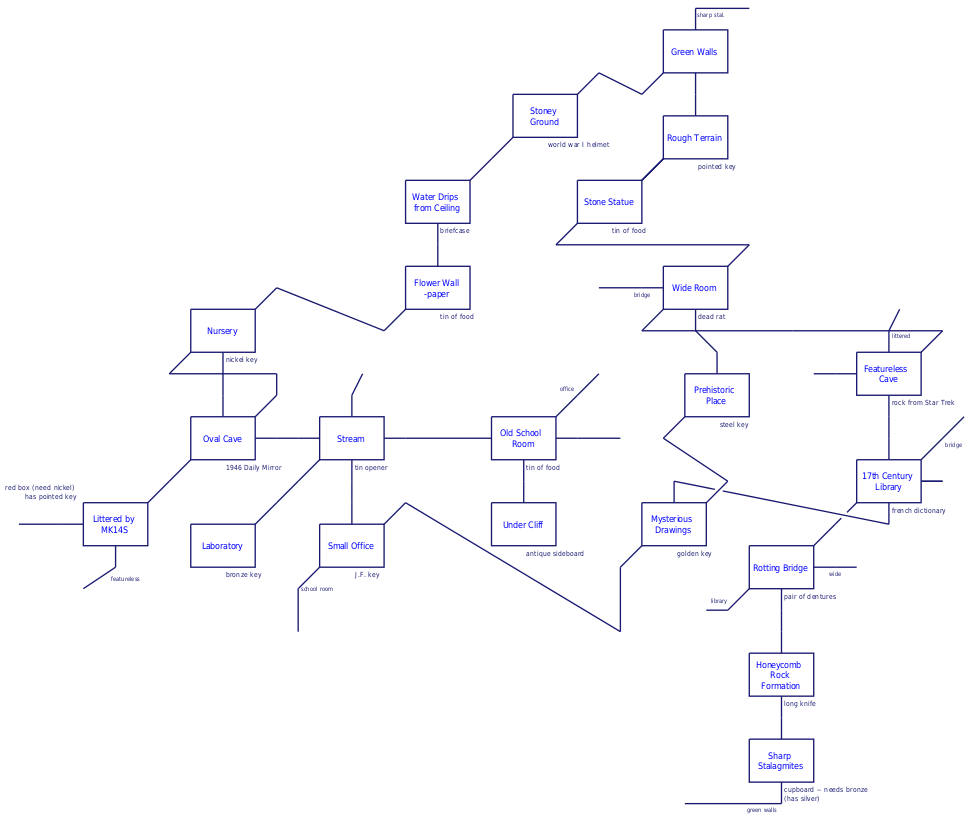
The map above is more typical. You are guaranteed to have no exit mismatches; going north from one place will always connect to the south side of its destination, unless the connection is a one-way passage (and those are fairly rare). The map is complete; I was able to stave off hunger fairly well, especially because items would sometimes randomly transform into food tins. A former WWI helmet, for example, just went poof. However, there was no treasure chest or way to reach one, so the game was a dud.
I get conceptually what the author was aiming at, and it’s interesting; the roguelike-adventure idea is tough to pull off, and keys are mechanical enough they theoretically shouldn’t be hard to code. However, there was almost no way to make rational decisions about anything, It was like playing a slot machine, but with much more work involved.
Another playthrough, although not a complete map this time. The diagonals are “up” and “down”, and no, they don’t have any rational geographic sense to them. Having “levels” might help add some geographic suspense; it could even be set so the treasure chest is always on, say, floor 3, giving at least a vague impression if the player is getting closer to the goal. As a comparison, imagine if Rogue allowed the game-winning Amulet of Yendor to show up literally at any moment in the game, even just past the opening stairs.
We’ve got more roguelike-adventures coming up in the future (most famously, Madness and the Minotaur) so we’ll revisit these concepts; Lugi still is the game that’s come the closest to pulling it off.
(Oh, and in the version I played, there are 7 keys, not 6. I think this was to fix a data table bug. Just be warned for the TRS-80 MC-10 version that the game and title do not match.)
We’ve seen some rare computers here before — mostly notably a fair number of titles for the Ohio Scientific line of computers, thanks to Aardvark — but we have yet to encounter the Tangerine Microtan 65, a system originating from the UK in October of 1979. For any fans of the system who might be scouring the Internet for information, I am sad to say this will be a short visit; there are only seven adventure games (sort of eight) that I know of, and four are currently lost to the winds of digital time. (The system was followed by the much more famous Oric-1, and Casa Solution Archive has over 100 adventures linked to it, so the company will be sticking around, at least.)
While it was possible to buy an “assembled” Microtan 65, the most common form seems to be the “kit” form with just a board and the hex pad shown here (instead of a keyboard). Image from Tansoft Gazette 7.
Just to lay them out, four of the adventure games are mentioned in the Tansoft Gazette #5:
We know from different sources that The Sceptre of Hamloth is #1, The 6 Keys of Tangrin is #2, The Tanland Adventures is #3, and ???? is #4. Adventure #2 is available since the source code was in Tansoft Gazette, issue 1; I’ll be playing that game next (it has an interesting experimental game mechanic). #3 and #4 might be on a dusty tape somewhere, they might be in oblivion. Since #4 is in BASIC the source code may be printed somewhere, and there may even be a known port for another system.
The Tangerine User Group newsletter mentions two more; here’s a clip from issue #17 (these didn’t start showing up in the newsletter until issue #16 in 1982):
House of Death is in Issue #37 and is by A. J. Shepherd, aka The Doppel-Ganger; I don’t know about Hoardes of Chaos. There’s also an ad for Viking Raider in a different issue, but since it’s both for Microtan 65 and Oric-1, I’ll be playing the latter version when I finally get to it in 1983.
TUG News Issue 36.
The sort-of-adventure is a port of the Royal Puzzle from Zork III with BASIC source in an issue of Microtan World; there’s no adventure framework at all so it essentially is a pure puzzle game.
…
The Sceptre of Hamloth, credited to an I. Dickinson, joins the only-8K-of-space club (actually 7K here) including ADV.CAVES, It Takes a Thief, and the early Aardvark games. Just like most of those, it’s pretty short on the verbs; it’s a collect-the-treasure-plot where the majority of the game is moving around, picking up stuff, and trying to finish before lamp light runs out.
The map is relatively substantial, but since making the map is almost the entire game, there is, sadly, the usual tendency to obfuscate exits (*); having, say, east from one room link to north in another. On the positive end: There is technically a “maze” but it’s only two rooms.
There is one puzzle — a vampire that approaches and kills the player if you don’t run away.
This is combined with the obfuscated exits; you go EAST to enter the vampire’s chamber, but SOUTH to get back out; trying to go WEST kills you.
Wrong way! He caught you! Everything is fading into darkness…
There’s a “dusty vase” elsewhere; if you BREAK it you can get a crucifix, which lets you get by. (More on this in a moment, though.)
Three other wrinkles. First, the addition of a SEARCH command. I admit I only discovered late that the verb worked. There’s a trapdoor not mentioned in the room description that SEARCH reveals.
You are in a tiny chamber with marble walls. A narrow corridor leads north and a twisting passage leads east.
SEARCH
You have found a trapdoor in the ceiling
This led to some silver coins, but I had found them already by being thorough and testing exits even if they weren’t in the room description.
Second, the titular Sceptre of Hamloth itself. (Presumably, there’s some manner of instructions giving a backstory, but those are also lost to the digital winds.) It’s easy to clear out the ruins and miss the sceptre, as I did the first time around. I suspected I was lacking something and poked around, using my experience with Dragon-Quest Adventure where I missed a similar exit:
(It didn’t help that GO STREAM and CROSS STREAM don’t work.)
I still didn’t have a BIG WINNER IS YOU message after I collected all the items at the starting location. Now, we get to that third wrinkle.
You see, you don’t have to break the vase.
EMPTY VASE
OK
Something fell to the floor
This gets the crucifix as easily as breaking the vase does, and the vase counts as a treasure. I admit I was sidetracked by the vase being “dusty” and trying to clean it (CLEAN isn’t recognized as a verb), but I also could swear I attempted to empty the vase by conventional means before breaking it.
(*) OK, so you’ve got a game almost entirely composed of navigation, and don’t even have a plot really: how do you make it interesting? Other than some pretty environments, the only thing that can be pulled off in this era is a bit of navigation trouble. (**) So I find the slightly askew directions a little more forgivable here than elsewhere. I’d still call it a case of trying to mimic mainframe Adventure on a platform not intended for it; something has to go, whether it be descriptions (making things Scott-Adams-minimalist) and/or rooms (aiming for a tighter experience). A common trope in speaking of art is that technical restrictions give birth to creativity, but The Sceptre of Hamloth is what happens when an author is more stubborn and doesn’t adapt to the bounds of the medium.
I had swore never to return to America, yet tomorrow I leave by boat. I write this and trust you will not believe me what occurred, but I must tell someone to rest my disquiet mind.
Perhaps you will keep this. Perhaps my words will be burned on arrival. Do what you want.
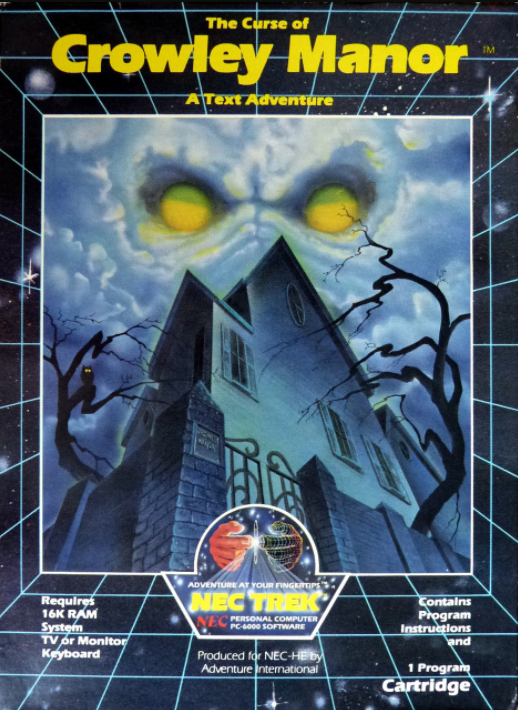
Cover from the 1983 NEC PC-6000 Series version, via Diego Rispoli. The NEC computers were mostly sold in Japan, although there was a 1981 US version called the NEC TREK. Also, you should be seeing this as a picture caption; if whatever reader you’re using removes this, you may want to go to the original post, as all gameplay commentary will be in the picture captions.
As you well know, I managed to obtain a position at Scotland Yard. I’ve now been here for 10 years, and have a plaque reading Inspector Black on my desk.
I received a phone call on April 2, 1913. Officer Strade informed me there was a murder at the Crowley Estate. I had known it by reputation but never set foot inside.
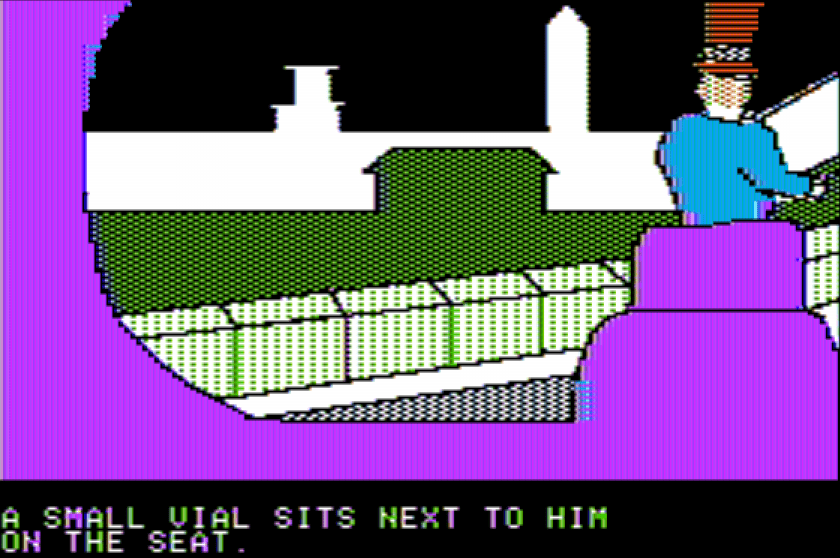
I boarded a hansom cab who struck off a brisk pace for Crowley. I noticed beside him a vial and by some strange intuition took it.
In gameplay, I had passed this moment and been stuck for a long time. I needed a hint. I had already done LOOK DRIVER — the Apple II version requires that in order to get the exact phrasing CLIMB IN for boarding the cab — but doing LOOK DRIVER a second time is necessary after boarding to see the vial. Just LOOK while riding doesn’t work.
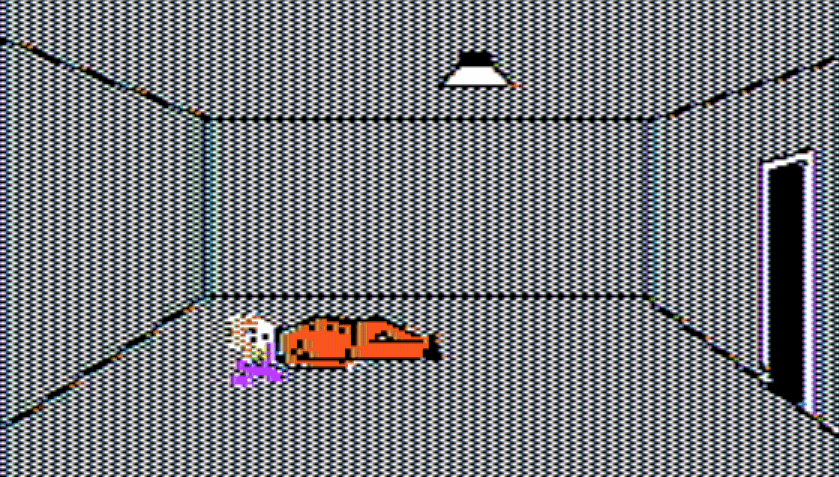
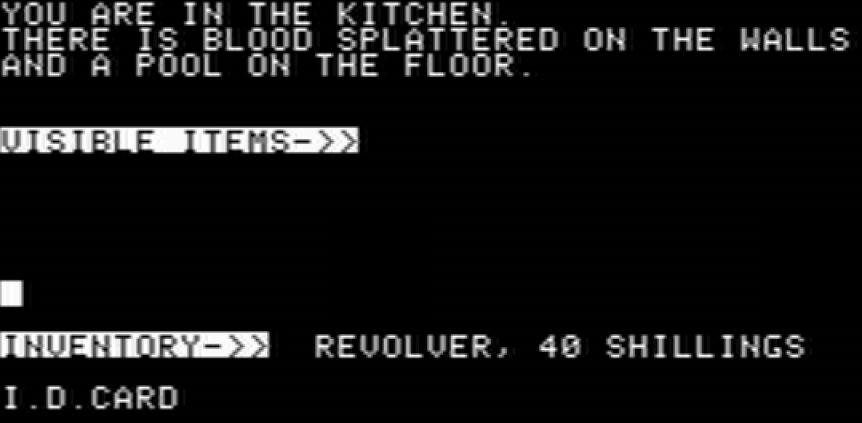
I found Police Inspector Harbour — good chap — at the front waiting for me. He let me know Inspector Strade was inside and the body Strade had called me about was in the kitchen. I went inside and quickly found the kitchen, but the Inspector was nowhere. The kitchen had blood but no corpse.
This reminds me of in Secret Mission being told about a briefcase and map that don’t exist, and you have to infer they were stolen.
One door was boarded up. In further searching, I found a kitchen with an untouched plate, a pantry, and past the pantry, the opposite side of that boarded door. There was a suspicious-looking wall but I was still on the hunt for Strade.
A NAILED SHUT DOOR IS SOUTH, AND A PLYWOOD WALL IS NORTH.
I searched other rooms and found a man, Davonn, lurking in a corner. He warned me, ambiguously, that ‘IT’ was loose.
Stepping in past him, I found a diary and crystal ball. I have the words memorized. People do not often write about generations being infested.
I AM DOOMED TODAY. THE DEMON IS TRAPPED IN THE HOUSE. HE’LL BE HERE LONG AFTER MY DEATH. THE DEMON HAS CORRUPTED MY BLOOD. HE WILL INFEST THE GENERATIONS THAT FOLLOW ME.
I went back to Devonn and found … a corpse! … but not the corpse I was looking for. The poor man had been killed while I was in the next room.
This is a direct example of the type of adventure plot where things don’t happen until the player is ready for them to happen; that is, a “drama timer” rather than one based on the number of turns passed.
He died without a noise, without a scream. What was going on? Who was ‘it’? Where was the Inspector?
Further alarmed, I tried to leave by the front door only to find it jammed behind me. The only other room I could find was a room with a piano and a victrola; the victrola crank seemed to be stuck, and I found a gold key.
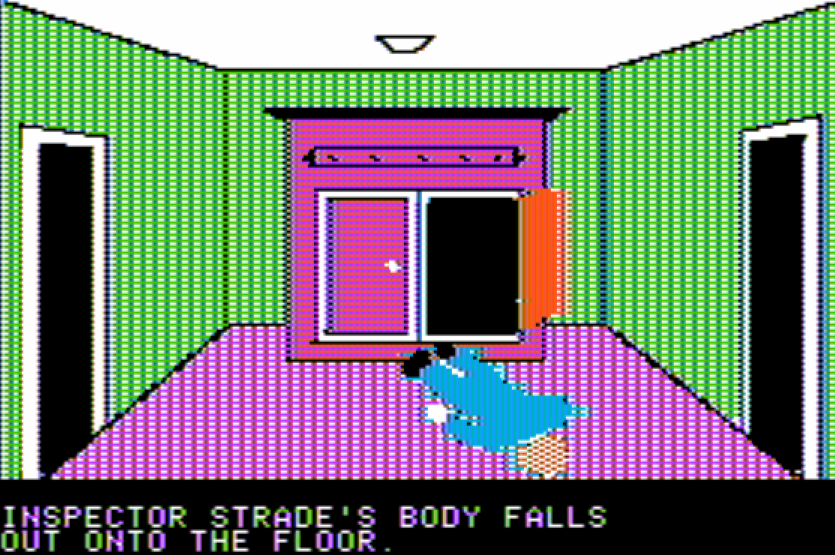
The gold key reminded me there was a cabinet in the entrance hall I recall being locked — by this point I was considering any action at all to be well within police mandate — so I toted the key over, and within…
I love how straightforwardly dramatic this managed to be while still falling in the framework of standard adventure gameplay.
…within, I found the Inspector, his body lurching forward into the light. I imagined thumping in the walls, everything dizzy, ceilings closing in, floors swirling upward. I was in a battle not to solve a mystery, but to save my life.
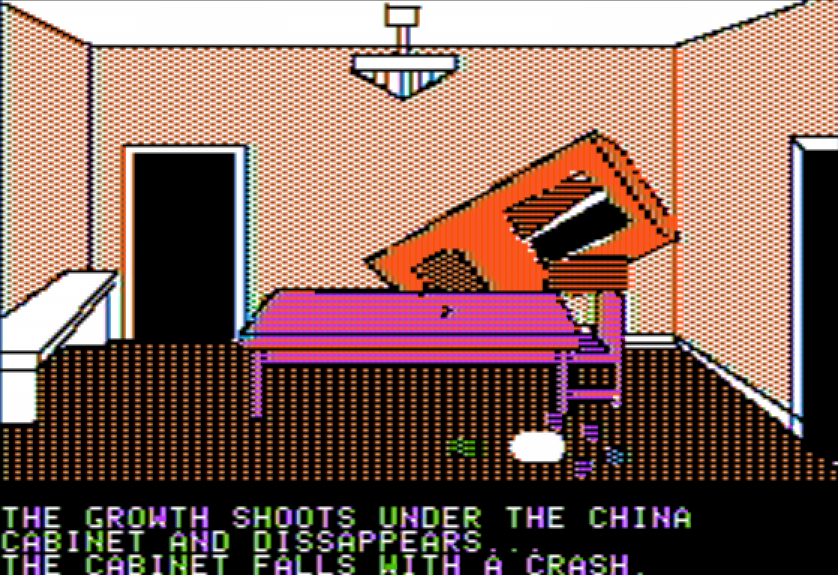
Returning to the kitchen for more clues, I found a brown splotchy creature. With some unknown intuition, I picked it up and carted it to the kitchen, dropping it off to see what would happen.
I figured out how to do this on my own because if you go in the pantry with the growth, it jumps at the food and gets too large and it’s game over. I did not know how to convey knowledge about a death-route in the “story” description other than using intuition. Our hero remembered branches of life not taken, I suppose. 1981 games didn’t care too much about if a “continuous narrative” was truly possible; learning by death was often a feature, not a bug.
It was alive! It went for the plate, and grew to the size of a dog, and fled, knocking over a cabinet in the process. I found a letter opener and an axe.
The letter opener I was able to use to pry open a chest and get at a crucifix and a note — containing just the digits 5271. My thoughts went back to the vial. Was this holy water? Was the cab driver somehow prescient of what would happen? Gazing back at the crystal ball I still had from the desk, I wondered if fortune-telling was real.
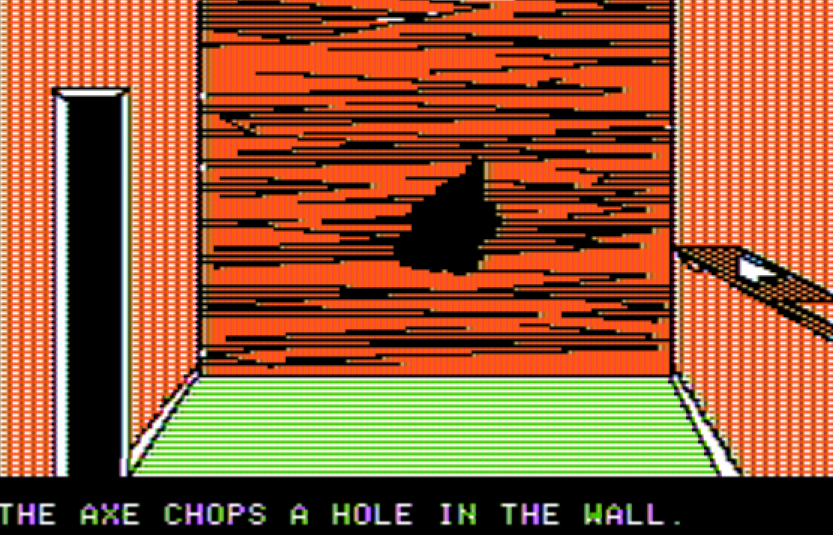
My eyes glazed back to the axe in my other hand, and remembered the thin wall. There were only dead ends otherwise. Now was the time.
Indeed!… within was contained a secret laboratory, where I found an old tome mentioning GAFALA ALONE MAY HELP. Further past, a door with a combination lock, in which I entered 5271. Inside—
A monster — different than this one — appears at the combination door and kills you if you don’t have the holy water vial. The game tries hard to indicate you don’t have enough to win, but it’s hard to tell if the demon’s taunting is “in universe” acting in typical demon fashion or meta-referencing your lack of an inventory item.
–inside, is when true terror started to seep into my bones. I felt myself being pushed to the wall; something invisible was here. Out of frantic desperation, I threw the holy water, and found an apparition before me that shrunk away when I waved my crucifix. I ran away. I ran away as far as I could, which was not far, as I was in a dead-end. My intuition returned: I spoke aloud GAFALA.
Not as absurd as the other intuitions; you (and the main character) are out of options and inventory items.
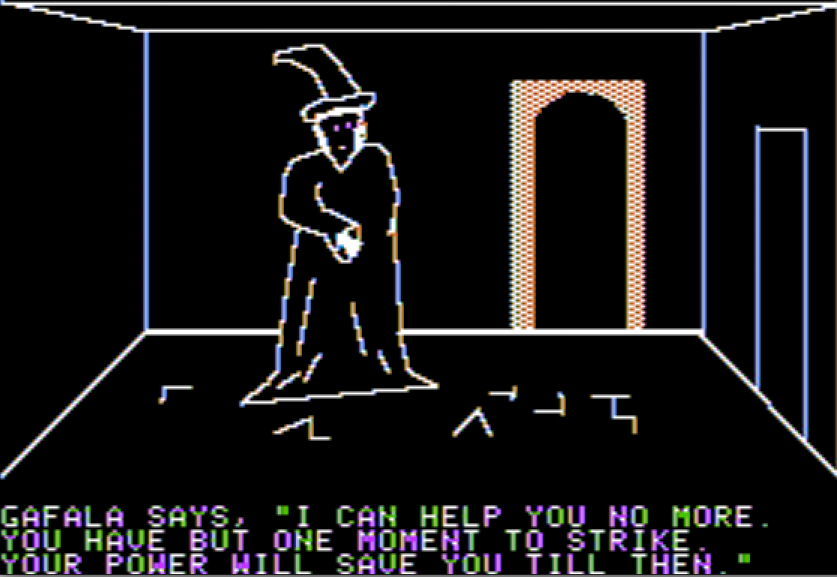
A white wizard appeared before me, informing me that the evil I looked for was his brother, and I would need to prepare to kill him.
A battle against a demon! My dreams have always been pleasant, so I never once thought I was in some shard of unreality, but here was the most unreal moment of all.
I found, searching, a gold shield, and a place with a hole, close to the size of the crystal ball. I put the crystal ball within the hole and saw a vision of a sword and a fountain.
There were numerous points where I struggled with the parser, but this was the worst. You need to DROP CRYSTAL BALL and then LOOK, but DROP doesn’t give any indication the ball went in the hole, so I kept trying PUT CRYSTAL BALL and PLACE CRYSTAL BALL and the like. Also, I needed the walkthrough to realize you can LOOK after the vision is done (and the crystal ball is gone) to have the sword mystically appear.
I paused and looked around some more, and a magic sword appeared before me!
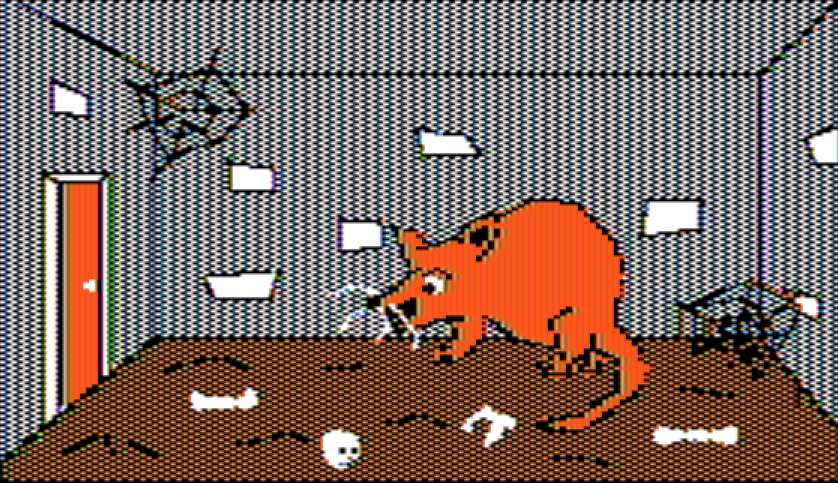
Backtracking to where I first met the wizard and going a different direction, I ran across an ill-tempered giant rat and made use of my revolver. I registered no emotion, nor fear at this — it was nearly the most normal moment of the night, despite the creature’s size.
If you try to enter this room without the sword and shield first, you are torn apart and informed your death is too awful to describe. This is true even though neither object seems to have any effect here since the revolver does the work. This seems to be intended to keep the player from getting too far afield the main plot; I suppose I could see the demon showing up early if you don’t have proper defense.
Further on, I found the fountain in my vision! I dipped the sword in, trying my hardest to believe in prophecy.
I think only CLEANSE SWORD works. The game really did feel fast-paced despite grinding to a halt a few times from the parser.
I also was met by a vision of Gafala, who told me I would only have one moment to strike.
Sword, shield. Into the darkness I went, and before long, I encountered the demon.
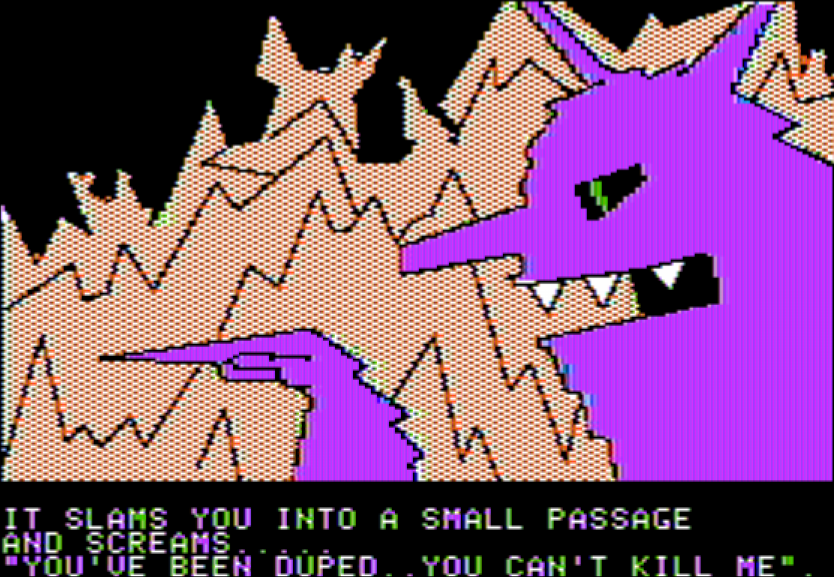
The eyes! The eyes were horrible. I could do nothing but defend myself for a time, as the demon rattled off taunts
Upon contact with the sword, there was a sizzle. There was a weakness! There was hope!
This is where having the sword cleansed is important. The scene otherwise involves WAITing, although it honestly was nicely cinematic, especially given the forewarning there was only one moment to strike.
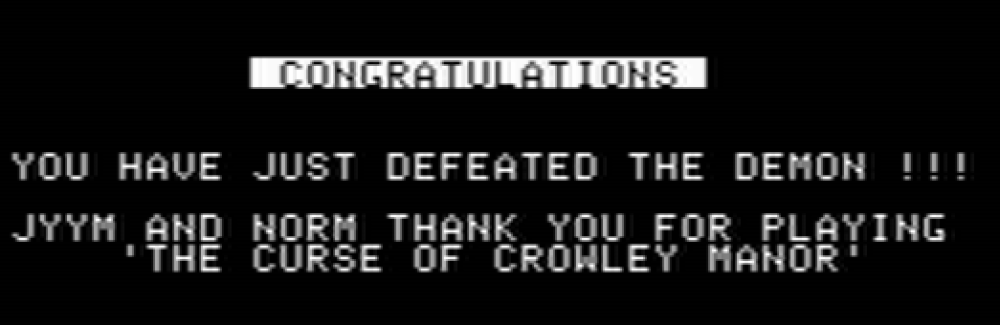
I waited a little longer, then struck, struck hard as my passion could take me, and the demon fell.
I made things seem smoother than they actually played — there were more parser issues than the ones I pointed out, and the way LOOK worked was often painful — but this was still a promising start to the Jyym Pearson library.
I do not even remember how I left the house. But I still had the sword and the shield, and was awash with blood. I spoke to no one. The Yard thinks I am gone with the rest. I have no desire to stay in this country. I must be as far away as I can make it. I intend to strike for California as soon as I can; farther if I must.
It is probably for the best if you do not believe me.
The scene is London, in 1913. Scotland Yard is buzzing with the news — there’s been a murder at the Crowley Estate! What starts out as a simple homicide investigation turns into a trip into the depths of the occult as you try to solve The Curse of Crowley Manor.
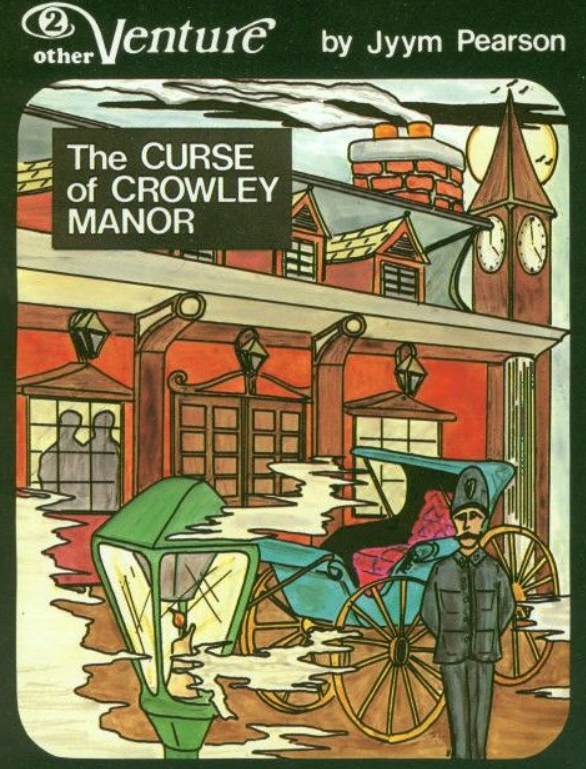
This is our first appearance of the author Jyym Pearson, who was quite active from 1981 to 1983, producing eight adventure games. Besides Crowley, and roughly in chronological order, he wrote Escape From Traam (1981), Earthquake – San Francisco 1906 (1981), Saigon: The Final Days (1981), The Institute (1981), Lucifer’s Realm (1982), Paradise Threat (1982), and The Farvar Legacy (1983). (Three of the games were co-authored with Robyn Pearson.)
From the Museum of Computer Adventure Games. The “Other-Venture” label was a way to distinguish these games from the Scott Adams ones, also published by Adventure International. Other-Venture #1 is just a port of Adventure.
Will Moczarski already tackled this game over at The Adventure Gamer, but he played the TRS-80 version, so I’m going with the Apple II edition instead (which adds Norm Sailer to the credits).
You start in a room with a desk that has a calendar and nameplate. The nameplate reads “Inspector Black … Scotland Yard” and the calendar reads April 2, 1913, but you are otherwise given no details on the main character. This makes a nice reminder there are gradations between a generic anybody and defining the main character entirely. Going by history, the main character would technically have to be male (the first female police officer in England with arrest powers was appointed in 1915) although given the story has extra-historical “supernatural elements”, I say roll with it however you want.
As soon as you try to leave (or wait enough turns) the phone rings, and duty calls. Murder most foul.
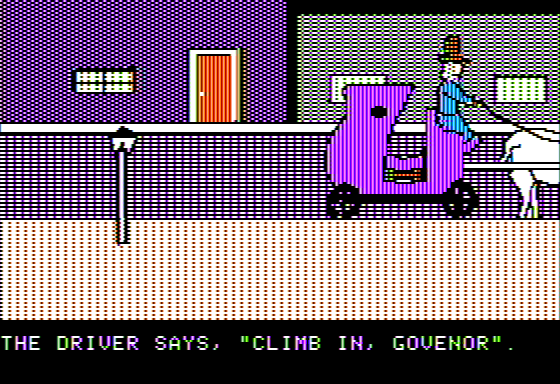
Also, fussy parser most foul. I was stuck for a while until I tried TALK DRIVER (and got the message above) and did the exact command of CLIMB IN. Then I had to type GO CROWLEY followed by WAIT for a few turns.
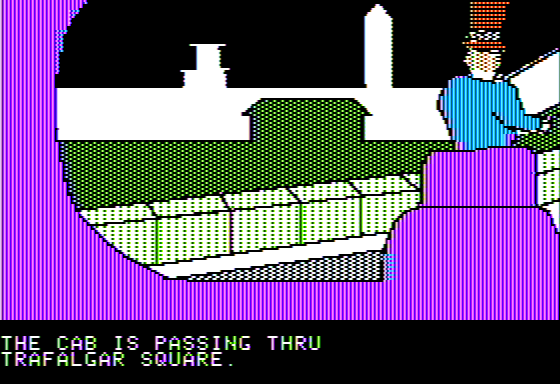
This is a very nice cinematic moment where you WAIT several times and Trafalgar Square and Big Ben before reaching your destination. I have no idea if that’s realistic for London geography.
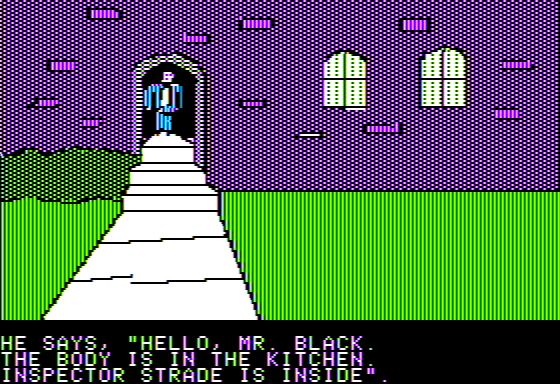
I met Police Inspector Harbour on arrival who informed me of a body in the kitchen.
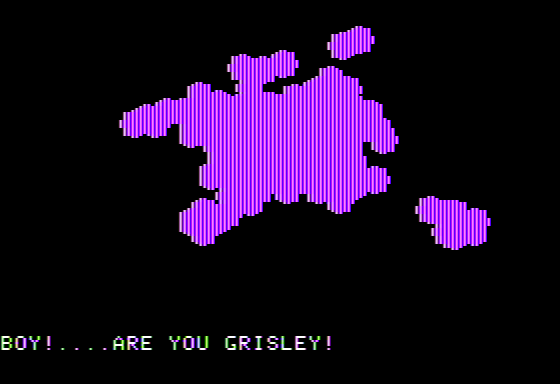
Except … there isn’t one? Just blood.
Blood that you can inspect closely, if you like.
I’ll return next time with more details of my investigation. One last comment, though — this is not quite like Sierra’s Hi-Res games where all the text is on the bottom, objects appear on the screen, and flipping between all-text and text-on-the-bottom is optional. This is more like (but not completely like) a regular text adventure with added illustrations. For each location, you need to flip back and forth between a Scott-Adams-ish style screen and the picture to get a full idea of what’s going on.
In one case (meeting Inspector Harbour) there was no indication in the text there was a person; I had to LOOK MAN before I got any information. In the screenshot above, notice there’s no mention of the nailed-shut door (although oddly, the door is mentioned in text on the image page if you LOOK). So the images still serve a story function; I need to remember to be thorough and try to interact with both things only in text and things only in the image.
I think the TRS-80 version of this game would likely to be easier to play, but the meta-question of “what do the illustrations in an game really do?” is still a fuzzy one at this point in adventure history so I’m willing to suffer for the sake of experiment.
The puzzles that remained ranged from “not really a puzzle” to “one shot command that almost nobody would find”, so let’s dig in.
Not really a puzzle
Last time I wrote about a pink bull that charged and the game’s … narrator? … froze it in a time stasis field, letting you get by; on a second return it would charge you and kill you. RonReg theorized about waving a red cloth or saying “OLE”, but unfortunately, I simply missed you could go DOWN in one of the rooms and never have to return to the bull. The manual does give an entirely unnecessary hint as to an alternate solution where you just turn off the lantern.
Just for the satisfaction, I went back and tried it out:
Almost not a puzzle
I also mentioned a door requesting an ID. There’s a subway station where you can insert a coin to get a subway card, which apparently doubles as an ID.
Going back to the door and typing INSERT CARD led me to a vault with an impressive enough description I was unable to get it in one screenshot. I’ll type it out instead:
OK. There is a short pause, then a whirring sound. The heavy door slides open.
I’m in a large concrete vault. To the north is a huge steel door. In the center of the vault on a chrome pedestal is a PLATINUM SPHERE which pulsates with an inner light. A sign reads * DANGER HIGH VOLTAGE *. Overhead a large wicked looking laser points directly at the platinum sphere. To one side of the vault is a small computer. Standing in front of the computer is the transluscent figure of an old man. The figure is apparently a hologram. The control panel of the computer looks very old, in fact, I can see small cracks in the housing. Through a thick glass wall on the south side of the room I can see small tin soldiers moving around. They walk into the room, stick the butt end of their rifles into a socket on the wall and freeze. After a short while, they leave. A thick armored cable runs from the chrome pedestal through the glass wall into the other room. There is a large PLATINUM SPHERE here.
Despite this impressiveness, you can just nab the PLATINUM SPHERE and go. The game doesn’t let you interact with the computer and cable and so forth (including logical acts like HIT COMPUTER, which gets interpreted as trying to attack the tin soldier) so I assumed that was that and the scene was for flavor, but I found out post-game (from the hints in the manual, again) that you could throw water and sabotage the whole setup.
The hint indicates that just being able to grab the sphere safely is a bug. Perhaps the graphical version of the game (which I’ve got slated on my roster after a gap of five games or so, don’t want to burn myself out) will patch this up.
Aside from the bug, this would be a moderating satisfying puzzle if it was possible to fuss with the computer in some other way. As is, the only thing that gets a reaction is the right command, and the one that works uses a noun which is not linked to the computer. As an analogy, imagine Diablo where the way to attack enemies is to click on your weapon, *not* on the enemies you are fighting. This sort of indirect setup happens in adventure games all the time and is often pleasing, but it’s atypical — and weirdly alienating — not to allow some interaction with the target of the destruction before it happens.
Still the best moment of the game in a plot sense, even if it never happened during “my” story.
Something that counts as a legit puzzle
I mentioned the suits of armors everywhere that prevented you from taking treasure in the same room as they were. I had found a mouse (captured via cheese + a cage) but originally assumed the mouse was intended for some tiny hole somewhere, but no: it’s meant for the other standard use of mice in adventure games, scaring:
So the many suits of armor never really paid off in an ominous plot sense, but it’s very easy to run into the effect shown above by accident via just experimentation. So I still support how they are placed. I still feel like there should have been a hint that armor + mouse = profit; maybe there was and I missed it.
Also a legit puzzle and I feel sheepish that I had trouble
I got distracted thinking the a fountain (with too much water) and the cistern (with no water) were connected, as in, part of the same pipe system and I needed to cause water to transfer from one to the other (that is sort of what happens with the cistern, but in was water-toted-by-hand way).
There’s a raft in a children’s bedroom of the manor, and you’re just supposed to use it to go in.
There’s a cat statue with rubies for eyes; the rubies are a treasure.
I think I also had a visualization problem here; I don’t think of a typical fountain as even having the room for a raft, but it does make sense.
The aforementioned cistern
Now we get to screamingly unfair. There’s a pot you can fill with water (although only outside the fountain with the specific command GET WATER, FILL POT doesn’t work, getting the water while rafting doesn’t work).
I got the idea to put some water in the cistern, but after numerous failures, including a hard game crash, I decided that wasn’t the way to go.
How wrong I was.
To save you the trouble of trying to read this, the money shot command is PRIME PUMP.
Could someone in the comments make up a word for “verb that has only shown up in one text adventure game, ever”? I’m sure PRIME is a prime candidate.
Even worse
The final sticking point was the gold nugget I got past the bull. While the bull itself wasn’t a problem, the gold nugget just past it was.
As hinted, you can’t just cart it outside; if you try, the game teleports you back to the nugget room.
There is a sudden incredible wrench and everything goes black
What to do? Well, the underground has multiple exits (including a door where a “… triangle” works as a key, but you don’t need it going from underground to aboveground; I suspect this is a bug) but it also has a lift.
The lift is interesting, geographically; there’s torches in the master bedroom and servant bedrooms of the house and you can pull them to sneak into the aboveground lift area.
Despite the explicit text mention, the manual does not mention how to use the lift. Is there an “in-game” manual? (Possibly an item I’m missing?) Maybe it was intended to be put in the real manual but the author forgot? Maybe the game really meant the hints part of the manual with the backward text you’ve been seeing? Otherwise, you judge if this is fair to work out:
What action is even happening here? I assume from the “voice command” clue it is meant to be verbal but what doesn’t SAY LIFT work then? While, oddly, PRIME PUMP didn’t leave me grumpy (I’m always sort of impressed when the unusual verbs come out) but this awkward puzzle made me feel grim (although was fortunately the last one I needed to solve).
Thoughts
The Cranston Manor Adventure is primarily a piece of exploratory geography. In that, it did decently; I liked the feeling of discovering yet another secret niche to poke through. I did also like that the house was a character of sorts, and I could start to theorize about what sort of person would have an observatory and a hunting room and a secret spy tower in the library and a weird magical lift.
I don’t think the multiple entrances to the underground were as effective as, say, Zork; in that game there’s good reason to worry about optimizing for lamp life and avoiding the thief, so I was constantly worrying about which method of entry to use next; with Cranston, the tin soldiers are so overpowered it’s better to ignore their induced deaths like pesky mosquitos (or stop them entirely if you can solve the computer puzzle), and the lantern and sleep cycle recharge so that it’s not worth it to be overly concerned about their respective timers.
In one aspect, the game was a victim of my peronal bad timing: midway through gameplay I started getting tired of treasure hunts. Not in a holistic sense, but just a deep abiding need to recharge. This was my fourth in a row. 1981 was an era where authors were going in other directions, with genuine plots starting to appear. Let’s go and pick one of those games for my next entry, shall we?
Two screenshots of the ending placed side-by-side. It appears that Mariner’s Cove never came out.
I’m verging close to the end — a lot of the game falls open once the map is mostly done, although the last pesky puzzles may take a bit of work. I’ll list those out, but first, I need to highlight two annoyances:
1.) SLEEP
You need to sleep regularly or you die.
For a long time, I hadn’t found a bed, so my initial mapping efforts involved sending lots of death-clones. I later discovered, by accident, that SLEEP pretty much works anywhere in the house; while you can’t do it outside, you can do it randomly in the middle of a hall safely; I haven’t checked everywhere, but it looks like every room with one of those black armors works. (We’ll get back to the black armors again in a moment.)
There really doesn’t seem to be a gameplay point other than when going underground it’s wise to rest first, lest you get stuck falling asleep randomly in the middle of the (confusing) map.
2.) TIN SOLDIERS
I talked about those last time; they serve as the “dwarves” of the game, and randomly up to try to shoot you. Their accuracy isn’t that high, unless you try to attack them. Then they come in an endless stream.
Despite initial appearances, original Adventure kept track of specific dwarf locations and had limits to their travel (but also a large enough area you didn’t see them constantly). With Cranston Manor it is possible they do the same thing but functionally there are so many of them the best route seems to be ignore them and then reload every once in a while when they actually hit.
This normally wouldn’t be a problem but the game isn’t great about specifying where exits are, so I find myself losing lives just checking there isn’t some exit to the west I missed.
With that away, let’s talk about
Aboveground
Lots of fairly standard rooms for the imaginings of giant manors; halls, an observatory, a “hunting room”, bedrooms mostly upstairs (which, recall, I only found late), an organ room, servant area, a kitchen, and a chapel.
Puzzle #1: There’s a fountain outside with water I’d like to drain, and a cistern inside with a bottle inside that I’d like to fill with water. There’s even a pump switch in the cistern, but if I try to use it I find it “needs some help starting”.
I have a screwdriver I assume somehow works, but I haven’t found anything to screw or unscrew.
Notice the reference to “solar cells” in the lantern. The lantern can run out but can apparently be recharged when outside.
Puzzle #2: if there’s a treasure sitting in a room with one of the suits of armor, they won’t let you pick it up. Two treasures (SILVER CANDLESTICKS and RARE TEA) start out in such rooms, and any treasures from elsewhere that you drop in a room with armor become part of the same issue.
That’s pretty much it for aboveground. The map tries to go for “hidden puzzles” — there was a fireplace where I could GO FIREPLACE but it wasn’t immediately obvious, and a torch which revealed a secret lift…
but for the most part, the other obstacles weren’t “puzzles” as much as navigational oddities. One exception (which I already saw) was a rope you could climb, and twenty-dollar bills on a shelf out of reach. If you just tried to jump you would fall, but SWING ROPE puts them in reach.
This is one of those “slightly specific physical action” puzzles that can sometimes be awkward (see Hezarin with the surfing scene, and climbing at the end, or Savage Island’s breath control). Still, I solved this fairly quickly and found it satisfying; I’m not sure what the dividing line is between action being too unusual and just right.
That leaves the
Underground
where there is (Puzzle #3) a door which requests an ID — I assume I just have to find it so I’m not doing any active solving — and Puzzle #4, the weirdest of all.
If you try to return back through the room a second time the bull gores you.
Past the bull is a gold nugget, but there doesn’t seem to be a way back except through the bull. This still may just be a situation where I need to solve another geographic oddity and getting by the bull is a one-shot deal.
My (no doubt incomplete and broken) current map of the underground.
Version 9 of Emily Short’s game Counterfeit Monkey was released last week, and it (and many other modern parser games) includes a legacy feature I think very few people use.
> brief
Counterfeit Monkey is now in its “brief” printing mode, which gives long descriptions of places never before visited and short descriptions otherwise.
For example, one of the first locations, Sigil Street, is first described this way:
The buildings here are two and three stories, with shops at ground level and elderly apartments above. The shops are closed for the holiday: a typographer’s office, tourist boutiques of colorful skirts and ethnic bodices (rarely if ever worn by natives) and t-shirts covered with font designs.
The reflective window of a closed shop reflects our synthesized self.
A narrow alley runs between buildings to the south, while the street continues east.
On a revisit with BRIEF mode on:
A narrow alley runs between buildings to the south, while the street continues east.
In old Infocom games, BRIEF mode would just give the room name and any objects. From Sorceror:
Hallway
Rooms lie to the east and west from this north-south corridor. A heavy wooden door, currently closed, leads north.
Tacked to the doorframe of your room is a note, hurriedly scribbled on parchment.
On a revisit:
Hallway
Tacked to the doorframe of your room is a note, hurriedly scribbled on parchment.
From the manual for Sorcerer. SUPERBRIEF makes it so the game never shows long room descriptions, which I assume is only for if you’ve beaten a game and are trying to mess around. It’s very disconcerting to use, like reading a book with alternating pages left blank.
Most modern games use VERBOSE mode (also from Infocom games) which simply displays the full room description each time. I know I always used it as my first command when I played through the Infocom library; I found it too easy to get confused and miss details. Inform now compiles games with VERBOSE as default. Although it is possible, still, to make them start in BRIEF mode, I’m wagering the last game to do so was a long time ago.
The idea of long-initial-description, shorter-revisit-description dates all the way back to original Adventure (Crowther, before even Woods).
YOU ARE STANDING AT THE END OF A ROAD BEFORE A SMALL BRICK
BUILDING . AROUND YOU IS A FOREST. A SMALL
STREAM FLOWS OUT OF THE BUILDING AND DOWN A GULLY.
s
YOU ARE IN A VALLEY IN THE FOREST BESIDE A STREAM TUMBLING
ALONG A ROCKY BED.
n
YOU’RE AT END OF ROAD AGAIN.
No doubt, the fact the game could require being played off a printer was part of the desire to save space; there’s also a bit of narrative finesse in recognizing that a particular scene doesn’t need to be repeated. Every four times a room description is repeated the game gives the long version.
All that long preface is to say The Cranston Manor Adventure uses the Original-Adventure-style brief description behavior, and it’s messing me up in a novel way.
The problem is with making a map — yep, I’m still map-making, it’s a lot of rooms — it isn’t obvious what I should call a particular room.
Paneling is falling off the walls in this room. Immediately to the north is a large hole in the floor. There are doors to the east and west and a large hole in the wall to the south. Standing in one corner is a large black suit of armor.
Later I returned to the room
I’m in the room with the hole in the wall. Standings in one corner is a large black suit of armor.
and my original room title didn’t seem to work anymore. (I’m not even referring to the fact the hole in the floor is no longer mentioned — I called it “falling panels”.) Since The Cranston Manor Adventure has both
a.) a mismatch between long and short descriptions
and
b.) a lot of cases where you re-visit a place from another direction
I had a number of circumstances where I was remapping the same location without realizing I had been there! I started making the habit of leaving a room and coming back to get the “short name” designation before putting it on, but this messed with my mental clue-looking where I would occasionally miss some detail in the long description this way. Another example:
This is a tiny room with stairs winding down on one side. There are windows on all sides. The one to the north has a large hole in it. There is a long, heavy GOLD SPYGLASS lying here.
I’m standing in the lookout. There is a long, heavy GOLD SPYGLASS lying here.
It’s possible after the fact to see the first description and say, yes, that’s a lookout, but that’s not necessarily the word I would pick to initially write on my map.
Admittedly, this is in the scheme of things a trivial complaint, but it struck me as a prime example of interface choices having unintended effects, so I’d thought I’d share.
…
Just to ring out on a positive note, two things:
1.) You know that large black suit of armor in the earlier room description? They show up in nearly every room in the manor I’ve been to so far.
I’m standing in a long room with tall stained glass windows on the west wall. Hard looking wood pews line each side. There are exits to the north and east. Standing in one corner is a large black suit of armor.
They don’t do anything, at least not yet. It didn’t even hit me at first, but as I came across Black Armor #32, the atmospheric effect was quite strong. I don’t know if there’s going to be a payoff, but it comes off as cinematic, like something ominous building in the background of a scene.
2.) I did find an underground part with a cave, and a lovely way to die.
After Roberta and Ken Williams cranked out three titles in 1980 for their new company On-Line Systems (Mystery House, Wizard and the Princess, and Mission: Asteroid), the company embarked on Roberta’s design for the massive Time Zone. While originally targeted at Christmas 1981, it wouldn’t come out until 1982.
In the meantime, On-Line Systems licensed a game originally published by Artworx and written by Larry Ledden, re-publishing it with graphics and calling it Hi-Res Adventure #3. According to Larry:
Sierra On-Line purchased the rights from me to make the illustrated version. I had written the game as a data driven engine so it was quite straightforward to port it to another system. I got royalties from them for a couple years for sales of their version… I was a newbie at software contracts and didn’t know enough to require a credit.
The Hi-Res version is apparently somewhat different, so I’m playing the original first. It came out for CP/M, North Star, and Atari, but only the Atari version currently exists. (We’ve seen the CP/M system with Bilingual Adventure. We’ve never encountered North Star and by my reckoning, we’ll only see it again once; while the North Star Horizon was one of the first computers to include disk drives, it was another flash-in-the-pan computer system that has fallen into obscurity.)
Also, a brief plug for Ahab at Data Driven Gamer who helped me through emulation issues. He played through both versions of Cranston in quick succession; I’m going to take a breather with some other games before the second one.
From the Museum of Computer Adventure Games.
It’s another plunder-the-treasures jaunt, and yes, it seems like I’ve been getting a lot of those lately. Recalculating the number of Treasure Hunts for 1981, and including this game, we’ve seen about 43% of that nature. That’s actually nearly identical to 1980, although I should caution this could change.
Here’s the graph I made after finishing 1980. I’ll wait until I’m further in 1981 before I make an adjusted version of this.
Despite the nondescript opening (shown below), there’s an interesting theoretical bit that pops up.
Not the “deserted mansion where you will find rich treasure” part, which we’ve seen by my scientific estimate eight thousand times; I’m meaning:
Since adventurers of your caliber are very hard to replace, we will send a droid in your place.
One of the central oddities in early adventure game history is that “who are you giving directions to?” is not so straightforward. It is common in modern games to have either a predetermined character or a “designated avatar” that is customizable, but with the computer itself not really considered an intermediary.
With text adventures, there’s enough stubborn-mule effect in trying to deliver commands that often the idea that the computer itself is part of the narrative, and misunderstandings have an element of in-universe to them. Original Adventure started the ball rolling with “I AM YOUR EYES AND HANDS” in the instructions. Scott Adams took the same tack with assuming you were controlling a “puppet” of sorts.
In the game Birth of the Phoenix if you try to examine the Phoenix you are told it “won’t sit still long enough for me to examine it for you” and I wrote, perhaps in one of my odder moods:
…the player’s commands are asking the computer to implement them, but it’s also simultaneously still “you” in the world where things are happening, yet you are not seeing the phoenix with “your” eyes, since the computer has to relay the information. Analogy: imagine the player’s avatar in the world is a blind puppet being led by an invisible computer fairy, and the fairy can help move the player’s limbs and convey what they ought to be seeing.
Sometimes the player avatar and computer narrator were separate; Lost Dutchman’s Gold assumed the computer was controlling “the ghost of Backpack Sam” and customized its responses accordingly.
Despite this disconnect, the person referred to is nearly always “You”. Even Robert Lafore, while writing about Captain Walton in third person establishes at the start of his game His Majesty’s Ship ‘Impetuous’ that you are Captain Walton.
Going back to Cranston, the game quite explicitly situations the player as a droid in the instructions, and even references it later.
Due to habit, I still more or less ignore all the fussy details above and assume I’m typing sentences that begin with “I want to…” and am doing the action “myself” as an actor in a play. This is because of early heavy Infocom exposure, whose manuals directly make statements like
ZORK usually acts as if your sentence begins “I want to…” although you shouldn’t actually type those words.
where I suppose the lesson is, if you’ve got an explicit world model like “it really is a droid body the player is controlling”, the details will get brushed over by players unless they become explicit.
Pink indicates places where any direction but the correct one goes in a loop. The purple rooms are the only two ones with useful items (unless I’m missing something hidden).
Back to the game! I haven’t got far yet because I have spent an enormous amount of time mapping the outside. It’s intended to build up the idea of entering a town…
…but in actual gameplay practice, I found it tedious. There’s nothing to really see other than grabbing two objects (the lamp previously mentioned, and a crowbar from a junkyard). There were lots of bits of maze-without-being-a-maze which led to a lengthy mapping process. Sometimes, when a clear structure useful to the plot is forming, map-making can be satisfying; in this case, a lot of effort went to knowing to take a beeline to find two objects before entering the manor.
I’ve checked a bit inside but haven’t run into any serious puzzles yet, so I’ll report back next time.





















 Renga in Blue