I’ve been mopping up a fair number of easy puzzles, but I’m still stumped by the overarching puzzle of the thunderstorm.
From an old eBay auction.
For the easy puzzles, I’ve found
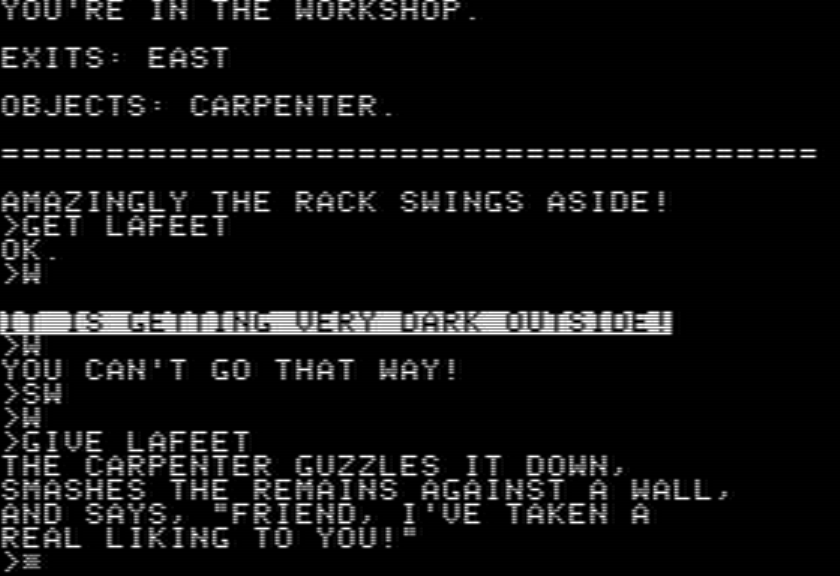
a.) some jugs of strange liquid which substitute for the valuable wine, so I can bring the carpenter to the walrus without blowing one of my treasures; I’m still not sure what to do with the oysters I get as a result.
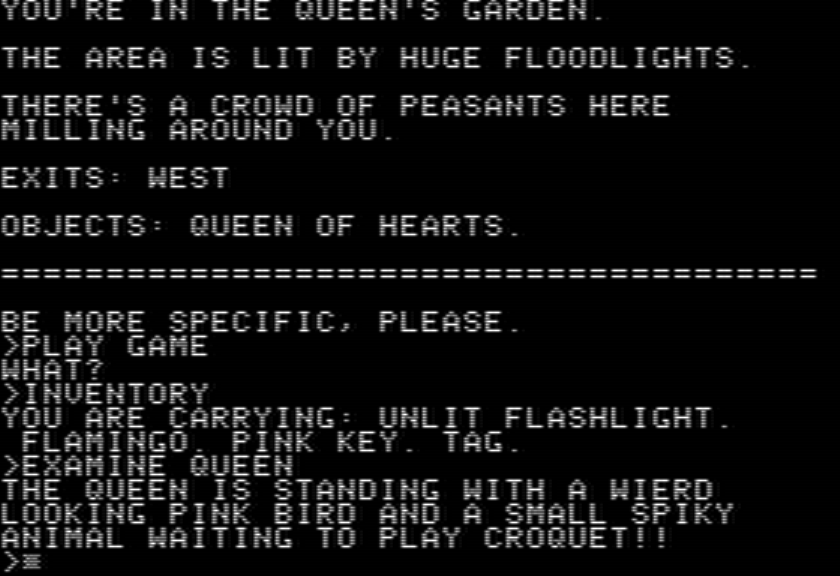
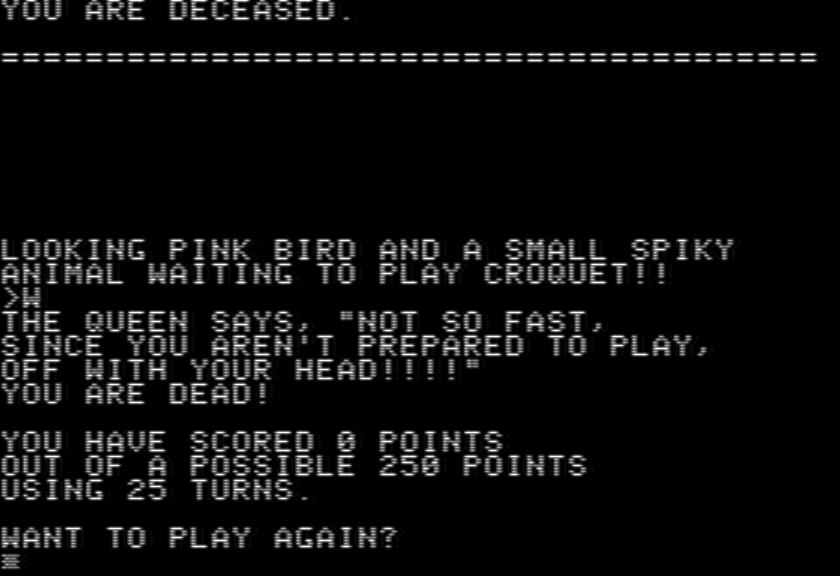
b.) a pink globe, pink drumsticks, a pink featherduster, and a pink prybar can be inserted into a MINGO MENDER to form a flamingo, who is presumably used to play croquet with the Queen of Hearts; I’m still lacking a substitute ball
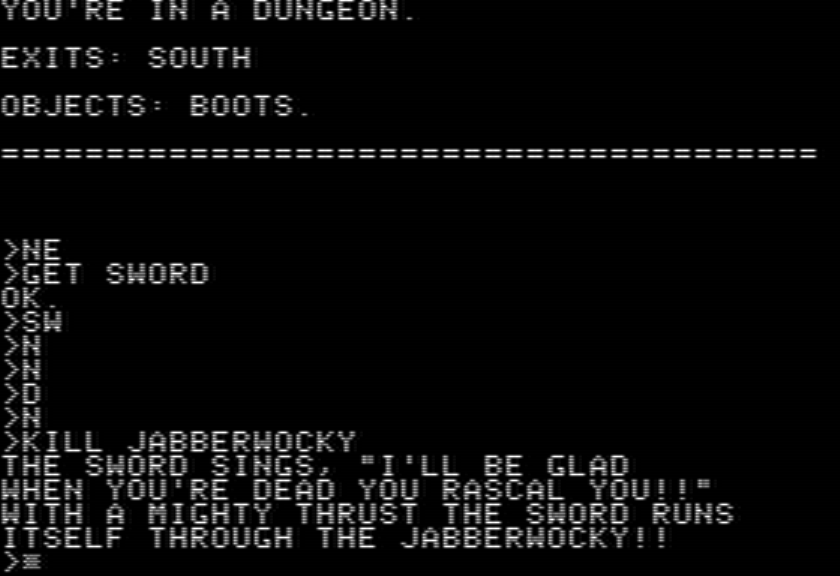
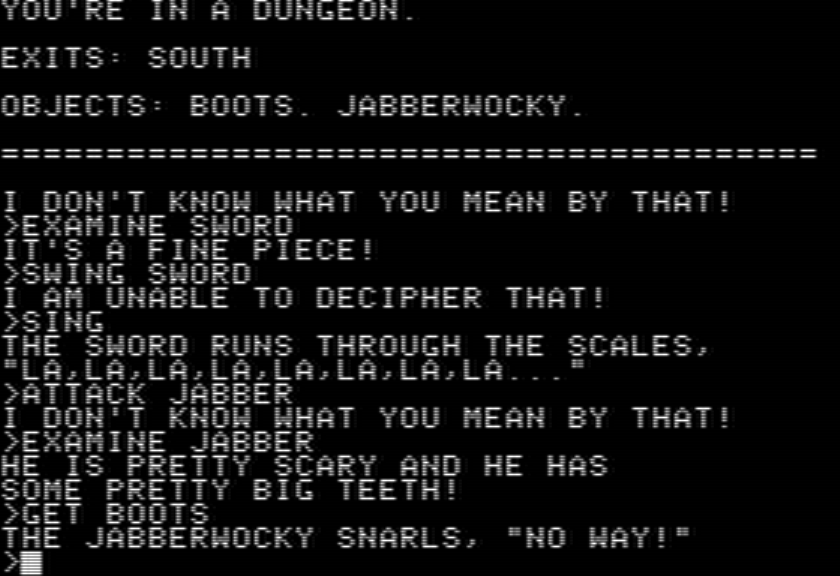
c.) that I can just KILL JABBERWOCKY with the sword (I was apparently doing every verb but the right one) and the singing sword does short work of it
d.) the boots with the Jabberwocky are rubber and allow surviving the blast of thunder, but I’m still missing something in that respect.
Let me give the exact sequence:
20 turns: IT IS GETTING VERY DARK OUTSIDE!
40 turns: IT IS NOW PITCH DARK OUTSIDE!
When this happens, the “outdoor” areas — the garden and the start place — are “lit by huge floodlights”.
60 turns: A NOISY THUNDERSTORM RAGES OUTSIDE!
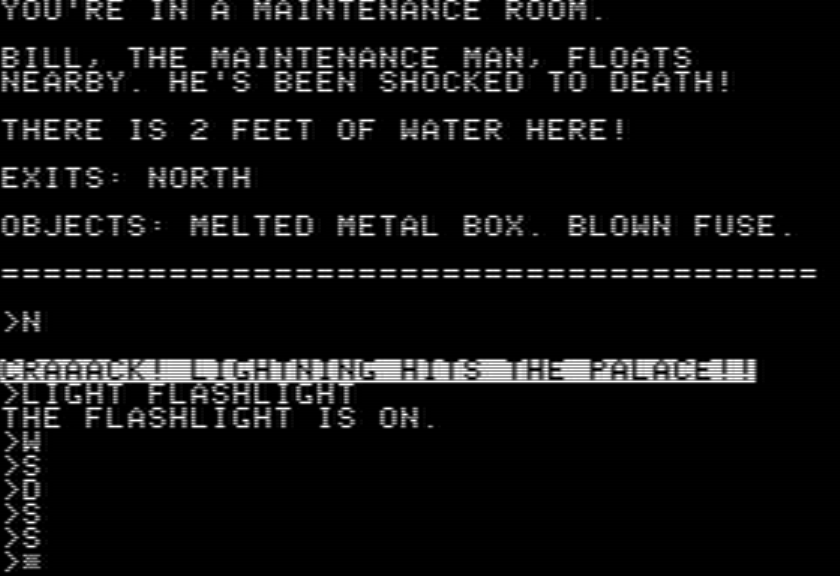
This is sufficient to kill an NPC: Bill, the maintenance man, who was previously fiddling with wires near a fuse box. The box is rusted shut and there’s no way that I can find at the moment to open it.
80 turns: CRAAACK! LIGHTNING HITS THE PALACE!
If you’re indoors when this happens, and you are not wearing the boots, you die. Either way, the power goes out, and the only way to see is with a flashlight, but the flashlight has a very short life (6 turns). Also, the 80-turn mark is when the metal fuse box gets entirely melted.
I’m not sure if I’m supposed to save Bill before the lightning strike somehow, or do something in between turns 60 or 80, or do something after the full strike happens. My suspicion as that the melted box is a “loss state”, but I’m lacking in gear to do much else. I can’t give the boots to Bill (unless I’m missing some verb wrangling) The only items I haven’t used are some pink medicine, two treasures (an ermine robe and a family “hairloom”), and the oysters. I also haven’t wrangled the rattle from Tweedledum and Tweedledee yet (I suspect it might be round enough for croquet but I’m uncertain based on the description), or made the dormouse happy (the dormouse wants butter, and there’s a churn, but I haven’t found a way of using it).
I do find the lightning storm fascinating in a structural way. As I said in my last post, the game starts wide-open; it feels like one of the typical “simulationist” games like Zork or Adventure, but by having a full scripted event that the player can’t control, there’s an imposed plot point overlaid the freeform puzzle-solving at the same time it is happening. This allows for having both simulationist and cinematic ideas running parallel to each other in the same game.
I’d be happier being past the puzzle, of course. I still feel like I’m making forward progress, at least.
It’s time to head back to the Apple II for a big, messy, puzzle-box game.
From the Museum of Computer Adventure Games.
Palace in Thunderland is the sequel to Mad Venture, advertised as coming soon inside the game itself. As a reminder, that game featured a.) collecting treasures for no particular narrative reason b.) a very tight time limit and c.) wordplay-adjacent puzzles, or at least a game where words and the objects they refer to can become detachable. The authors this time are Dale Johnson and Ken Rose instead of Dale Johnson and Christine Johnson.
Mad Venture was quite up-front about the only objective being to collect treasures in a time limit; here’s it’s a little more cryptic.
THE OBJECT OF THE GAME IS TO CORRECTLY DECIPHER THE CLUES GIVEN TO YOU AND EXECUTE THEM APPROPRIATELY.
There really are treasures marked with ! symbols and room indicating to drop the treasures here, and a score that increases as you do so; therefore the instructions might be enigmatic for nothing, but I’m guessing there might be an extra catch.
You can’t interact with the peasants; I’m not sure if they serve any purpose yet, although you can get to the top of the castle and see the same peasants milling around.
The game starts unapologetically wide open, with lots of items to grab (quickly breaking a six-item inventory limit), puzzles to consider, and perhaps most interestingly, NPCs to have minor interactions with. Example, after finding a singing sword elsewhere:
Roughly, the map is divided into a basement, a Great Hall ground floor area, an upper area at a Landing, and an outside garden.
The basement includes the jabberwocky, Bill the maintenance man (hanging out near a rusted metal box I can’t open), a carpenter who states “In vino veritas” and a wine cellar with a hidden bottle which counts as a treasure. You can make friends with the carpenter by giving over the wine bottle …
I’ll be returning to the “getting very dark” message soon.
… but that destroys a treasure. Now, Mad Venture required destroying a treasure (you could get a duplicate) so that might still be right, but I think it’s fair to say I’m not off the hook here yet. The carpenter will then follow you, and you can lead them to a walrus at the upper level who will make friends, leaving some oysters. If you haven’t figured it out yet, the Carroll references are a little more direct in this game than in Mad Venture.
The Walrus and the Carpenter
Walked on a mile or so,
And then they rested on a rock
Conveniently low:
And all the little Oysters stood
And waited in a row.
The ground floor has a white rabbit
HE SAYS, “BE SURE TO VISIT PETER’S CELLAR, WHERE THE SPECIALTY OF THE HOUSE IS A DICKORY DAQUIRI, DOC!”
and a dormouse.
“THAT STUPID RABBIT PROMISED ME BUTTER FOR THE TOAST. THERE ISN’T ANY AROUND HERE ANYHWERE!”
The upper level has a walrus (as already mentioned) and Tweedledee and Tweedledum in toddler form with a rattle. The garden has the Queen of Hearts and a possible game over.
Elsewhere there’s a “MINGO MENDER” and scattered through the map are some pink items (pink drumsticks, a pink globe, a pink prybar) which suggest they connect up to a flamingo-themed mallet, but that takes up time, and I’ve been and busy getting fried by another phenomenon: a very tight time limit.
Remember the message early about it getting dark? Quite quickly in — 60 moves, not long enough to do much significant — there’s a lightning strike.
Ow. I believe one of the first orders of business is surviving the blast? (Will the boots from the jabberwocky help, maybe?) I certainly don’t feel like I’m stuck, just I’ve got a lot of puzzle pieces I haven’t organized by shape yet.
I was near the end, and got to experience a quirky trick which I haven’t experienced for this project outside The Prisoner.
Before I get going, I need to share this screen from earlier in the game I skipped mentioning. Also, this is a fun reminder that “you” are not really there in many of the games of this era, there is a literal computer narrator who is choosing what to share.
The only thing I was missing was I could MOVE CASE and push aside the bookcase I got the sword from.
I’m unclear if the wine bottle needs to be dropped off or if you could have skipped picking it up in the first place, but if you’re holding it still when you try to go in the passage it explodes.
This eventually leads up to a closet which asks for a password.
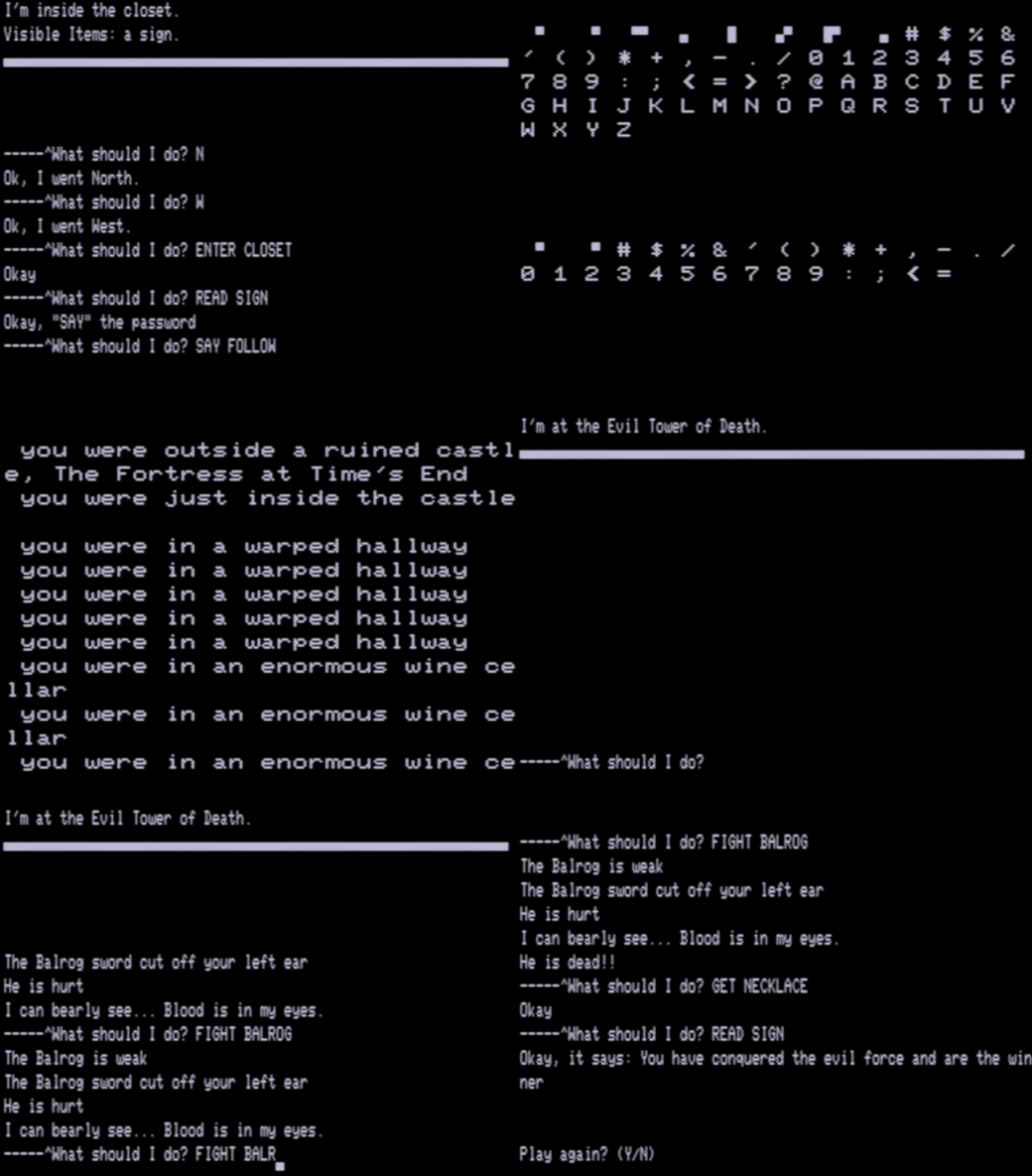
Here is the Balrog sequence in full.
Hideo Kojima, the prototype version. (That link gives a pretty good description of the Psycho Mantis fight from Metal Gear Solid, where Psycho Mantis reads the actual contents of your Playstation memory card and taunts you about how many times you saved in Castlevania; also, since he can read your mind, the only way to defeat him is to unplug your controller from slot 1 and plug it into slot 2.)
Having experienced two trap-based games in a row, I’d like to zoom in on the question: what makes a satisfying trap?
Perhaps the true answer is “none at all”, but even Monkey Island had a trap (as a gag which kept the game going). But going with the premise that we’re going to have a game with traps, then what would work–
On one end is when player agency is taken away almost entirely. In Revenge of Balrog there were a fair number of rooms where going the wrong direction was death; going >WEST sending the player off a cliff. In a Choose-Your-Own-Adventure style game where the choices are as neutral as “left or right door”, I’ve always found it frustrating when there are intentional arbitrary deaths, even when the deaths are well described or silly. There’s nothing quite as extreme in Times-End except for the maze which kills after enough time is spent in it, but at least there is some player movement an action amidst the slow-moving trap.
What seems to work better is a collaborative sort of death. Revenge of Balrog had a gold nugget with a dragon where a sign warned you to beware of the dragon, and being greedy taking the nugget was enough to get fried. Times-End had a chest with gold that was less-signaled but: it was clear the goal was not to collect treasures, and the similar trap in the first part of the duology was sufficient to give warning about the second. (See also: the deaths in Journey where the player hangs themselves by their own rope so to speak.)
In between is something like the exploding wine bottle. It’s not entirely a denial of agency: the player chooses to drop the wine bottle somewhere arbitrary (blowing themselves up) eat the feast with the wine (blowing themselves up) or escape the second level without placing the wine bottle (blowing themselves up) and there’s no real clue that this would happen before it happens. I could see, written on paper, how the puzzle makes sense: you need to place an item in the right place without being overcome by distraction, but I was only able to put this together after finishing the puzzle.
Of course, the function is not just in gameplay terms, but narrative. Above is another trap from Grimtooth’s, designed for Game Masters frustrated by cautious parties who constantly open chests and doors with long poles while standing back. The idea is to take something normally safe and add an element of surprise, and functions more like a narrative twist than anything fair.
I’d argue (again, assuming you’d want to include them) that truly best traps in a game have the mix of surprise and player agency. It’s the difference between telling a joke at the player’s expense, to one where they are part of it; a sort of participatory comedy, even if the general mood is entirely grim. Here’s an example outside regular adventure games entirely to finish my thoughts off —
The platformer La-Mulana has a lot of traps, infused to the point that it seems like every other screen has one. Allow PlayingBoardGames to illustrate:
Witness: the player needs to use the whip to break open the sun at the top of a temple. The walls break; the player needs to keep hitting. The sun suddenly lurches down, dangling. The player keeps hitting, and… the sun lands on their head, and crushes them.
There is plenty of ominous warning that the sun is something heavy. But still, it’s very easy to get tricked here, and it’s surprising and comical that the sun serves as a crushing weapon. In practice, this still can be frustrating, but I personally laughed, so that’s something? Additionally, the unusual trap links to the heft of the location in the narrative, as it is the gate between one world and another (and in gameplay terms, the “Holy Grail” used to teleport around the map no longer works until an additional device is found).
The Fortress was both ancient and new; in the valley of Time-Stands-Still time was not. The sun froze at midday, for there was no night. The battlefields were strewn with freshly slain soldiers of two forgotten armies. Death hovered above the Fortress at Time’s End, and chuckled at the cosmic joke. The dead could not die, because to do so would be to advance in time a kitten’s breath, an instant – and, of course, that could not happen because time was frozen.
This is a direct continuation of Revenge of Balrog, so if you’ve arrived here without reading about that game, you should go there first.
The publisher Bob Lidill (of the Programmer’s Guild, who we’ve seen most of the library of now) also published tabletop roleplaying supplements under the name Rider Fantasy Creations. According to this interview, briefly in 1981 he “inadvertently” owned the character Grimtooth due to a paperwork mix-up. Grimtooth is familiar amongst tabletop-RPG aficionados as the fictional author of Grimtooth’s Traps.
The traps are not tied to any particular system so the books are still used by GMs who are hungry for blood and/or comedy.
Another one of the Programmer’s Guild games — Gauntlet of Death, by Charles Forsythe — was loosely based on Grimtooth. We’ve skipped over it because it isn’t really an adventure game, but here’s a screenshot anyway:
Top down view, you’re the “+” sign.
This is all pertinent for both Revenge of Balrog but especially its follow-up. Fortress at Times-End is trap-heavy in a classic dungeon crawl sort of way that makes me think Don and Freda Boner were also familiar with the ways of Grimtooth.
The game also has a bizarre opening where I was stuck for a good half-hour. You start outside the castle with a closed drawbridge, and the knife, hat, and sword from the previous game in your inventory.
A screenshot of frustration.
I was ready to start perusing source code when I realized I hadn’t tried the meta-commands “HELP” or “HINT”. Deciding I needed to see if there was in-game help first, I tried HELP, which opened the drawbridge.
We’ve had games where HELP/HINT give information that’s been essential (Bilingual Adventure and Alien Egg spring to mind) but this is what normally is a command to the computer with no in-game reference being delivered as sort of a magic word. (SAY HELP incidentally does nothing even though the verb SAY is understood.)
Not far in is a “portrait of Bnai T’ Loth, the Red Warlock of Death” followed by your hat vanishing and your sword turning into a “long pipe”.
The hat shows up not long after in a “hat rack”, followed by a chest of gold which is (of course) a trap.
Progress continues one-way into a wine cellar, and, oddly, a confrontation with the Balrog, who doesn’t do anything and I assume you’re supposed to just skip by.
FIGHT BALROG: “Try something else”
This is followed by yet another trap where the walls are closing in, and the game helpfully says you need to LEAVE an item behind to survive (it’s the long pipe that your sword magically turned into).
Immediately after there’s a very standard maze where all the rooms have helpfully been marked with various torture devices, with the catch that the maze is timed; you die after a set number of turns inside. This is one of the most uninteresting game timers I’ve run across, because there’s no way to “hurry it up” exploring — the connections are all random so there’s no strategic choices where you might suss out the right way to go, you just get lucky or you don’t.
For a timed event to have drama, I have to feel I have failed somehow if I missed the timer (like the ending of Domes of Kilgari). Here it’s more like I’m forced to roll two dice and get double-sixes in a set number of rolls — so what if I didn’t get lucky?
After the maze, I found a key and fumbled my way up to a small “second floor” area with a dining room, living room, library (the book case has a sword, for when a book deserves a really bad review), a dining room, a kitchen, and a breakfast room. The dining room is the most interesting place, but also a trap:
The table doesn’t otherwise react when you drop the wine bottle, and after that only EAT FEAST seems to work. Dropping the bottle anywhere other than the feast just causes the bottle to explode. Dropping the bottle at the feast, leaving, and coming back leads to no reaction that I can find (although I acknowledge I might need to play around with this more).
I’m not sure why I’m being resistant to hints on this one; I suppose the author-vs-player dynamic here is a little more pronounced and I want to win. Also, the bonus feeling of I got past the completely obscure opening, surely I can beat this one. So while my readers like to look in source code ahead of me, if you do, please leave any comments in ROT13; I’m going to keep hacking a bit longer.
From that river came Seerson — as had explorers and Adventurers before him — seeking the key that would unlock the Fortress, releasing the secrets contained within.
The Spirit-of-the-Sky hovered above the valley, as did Death, each waiting to see what would become of Seerson. These two cosmic entities eyed each other warily, while below Seerson tackled the puzzle.
The evil Balrog of Triad has kidnapped Princess Celeste, Granddaughter of the Great White Wizard Wilgus, and took the ancient magical ruby necklace. You must find them!
This is a double-feature, the final pair of games from Don and Freda Boner; the plot ends at a halfway point and continues directly with The Fortress at Time’s End. Both games showed up in The Captain 80 Book of Basic Adventures, a mysterious tapezine called Micro-Fantasy Magazine (*), and a later book of games for C64 called Castles & Kingdoms.
From Castles & Kingdoms.
The Castles & Kingdoms version includes an introduction of a nature I’ve never seen before. Here’s an excerpt; note it is calling the protagonist “Seerson”:
She [Spirit-of-the-Sky] saw Balrog, a dark and evil apparition, looming overhead like a great scavenger bird. She saw the youth collecting the things he would need for his journey. She even saw a glimpse of his destination, a great Fortress in the valley of Time-Stands-Still. But no matter how she stirred the smoke, or how intently she muttered the incantations, she could not cajole the Crystal into revealing the outcome of the battle she knew was inevitable. She could not know if Balrog would slay her child.
The Spirit-of-the-Sky hovered above the Northern Steppes, alien to this world, yet knowing the Law. It would not intercede in combat or change the course of events, even though it possessed absolute power. But it would make the Sword easier for Seerson to find, as he struggled for success on the grass below. The Spirit-of-the-Sky had no vested interest in Seerson’s quest, only a curiosity in events as they unfolded and a distaste for Balrog’s advantage.
In the end, a cosmic dice roll decided Seerson’ s fate. The Spirit-of-the-Sky watched as the battle drew the last ounce of strength from both combatants. Balrog had superior strength, but Seerson had greater agility. Balrog was the most fearsome looking of the Notmen, but Seerson was not intimidated for he had the Sword. Balrog had raw ferocity, Seerson had cunning. The dice rolled.
Seerson slew Balrog and his mother breathed relief over the Crystal, which unfolded the events as they occurred.
This is not a preface exactly as much as a description of what will happen. The only analogy I can think of is with operas, which generally print the plot which is intended to be read before the show starts. I mean, it’s good to know we win eventually? We’ll find the sword, but the Balrog doesn’t actually appear yet, so the preface for this game is also explaining events in the next game. (Even opera plot descriptions in programs tend to only cover the current opera being watched, not any follow-ups!)
This game has what I’d call scene-to-scene navigation rather than standard geography. This opening screen cannot be revisted: if you go north, it is a one-way trip, with the way back is not blocked for any physical reason; it’s just the game doesn’t allow it.
I think one reasonable way to think about it — although the game never makes it explicit — is that various parts of the journey elide a long passage of travel. That is, between heading north and arriving at the sign, maybe an hour passes. This is the sort of structure more common in gamebooks, where a choice of paths is presented with the assumption the location one is at in the book will not be revisited. Here’s an example from Flight from the Dark, the first of the Lone Wolf series:
Just ahead through the tall trees you can see clumps of dark-red gallowbrush, a thorny briar with sharp crimson barbs. The common name for this forest weed is ‘Sleeptooth’, for the thorns are very sharp and can make you feel weak and sleepy if they scratch your skin.
If you have the Kai Discipline of Tracking, turn to 69.
You can avoid the Sleeptooth by returning to the track. Turn to 272.
Or you can push on through the briars, deeper into the forest, by turning to 119.
The plot of Flight from the Dark involves escaping from a massacre to warn the King in the capital city; as the entire trip is an overland trek making forwards progress to that goal, there’s no reason to loop back. The obstacle here also involves a choice with a trade-off (stay hidden and risk the briars, or travel in a more exposed position on the track?) where it really wouldn’t make sense to repeat the same event twice.
Revenge of Balrog has a similar feel at points, although the choice is almost always “which direction do I go?” It’s just sometimes that direction is death with no warning. Here, there’s a bit of warning: you can examine the stream and find a rock, which kill you if you try to touch it…
…a dragon near some gold nuggets, where you die if you linger and try to get the treasure…
The treasure is purely a trap. You aren’t collecting treasures in this game.
…and somewhat obtusely, a north/south path near some trees where proceeding farther south kills you.
So for these obstacles, there’s at least a bit of interest in that careful play can avoid death (“Beware trees, the dragon, and the stream” from the earlier screenshot), but later deaths are just random. You find a knife and a hat in a nearby tent, face off against a storm-giant (who just dies when you FIGHT GIANT as long as you picked up the knife) and then encounter a cave. There’s no warning sign; going in the cave seems the right adventurer thing to do.
Except, the right thing to do is pass and move on. Also problematic is the fact it is impossible to distinguish between direction moves that are one-way and moves that are reversible until you try them; some “ordinary geography” is mixed in with the scene-to-scene navigation. (Analogy: Modern link-based games which have links that show descriptions of things and links that advance plot, but no clear difference between the two.)
The first part of the map, to illustrate.
Eventually, the player arrives at a “Dark Forest” which is a very simple maze (all the rooms are easily distinguishable) followed by a fight with an orc (which you automatically win if you’re holding a letter from earlier reading “To let nature lead you out” — I am not certain what’s going on because the game just says “You seem to have some magic power and killed the orc”). The orc is followed by the somewhat under-described “edge of Time”.
Then there’s yet another bland maze…
…followed by the niftiest scene in the game.
As prophesized by the introduction in the book.
There’s some more insta-death directions, a fight with an “evil soldier” using the sword…
…followed by finding a princess who is tied up (UNTIE PRINCESS) and an abrupt end.
Honestly, not terrible so far? I feel like the authors are on to something; there’s certainly been scene-to-scene games before and since, but this one leans in with a gamebook sensibility a little closer. I think something approaching skills (like the Lone Wolf excerpt above) or at least a more interesting collection of items might make the game work better; I’d also put less instant death in but rather have mistakes punished through some stat-based mechanism (perhaps losing some health points). Infocom’s Journey does run along similar lines and wasn’t successful, but for reasons I think other than the general structural concept. In Journey you need to use exactly the right resources in that game to have the “good ending”; more details here from the CRPG Addict who mentions
Maybe this is par for the course in “adventure games,” but I’m not an Adventure Game Addict.
(Well, I am an Adventure Game Addict, and I can safely assure The CRPG Addict that the ludicrous optimization needed for Journey is not normal.)
Let’s see where this goes! As the plot is unfinished I’ll be playing Fortress at Time’s End next.
(*) The only reference I’ve found is from Don Boner’s IMDB page; he mentions being published by the Programmer’s Guild and Micro-Fantasy Magazine which I had previously never heard of but looks to be another Programmer’s Guild spin-off. It looks like it came from an issue of 80-U.S. Journal but I haven’t worked out which one; the text has been mashed onto what I assume is a spam site.
ADD: Found them. 80-US Journal has ads in both the February and March 1982 issues.
Features as selection one ARCTIC ADVENTURE by fifteen-year-old Harry McCracken, his debut magnetically. Selection two is a classic of early pro-adventure, Teri Li’s SPIDER MOUNTAIN. Selection three, a TRAPMAZE, Charles Forsythe’s GAUNTLET OF DEATH. Finally, as a Micro-Fantasy Bonus, Jake Commander’s acclaimed STAR TREK 4.0.
At commercial prices these programs alone would easily top $60.00 but they are all included as the first installment of MICRO-FANTASY ™ MAGAZINE.
A SIX ISSUE SUBSCRIPTION TO MICRO-FANTASY(tm) MAGAZINE IS ONLY $45.00
WITH BACK ISSUES AT $15.00 EACH. ADD $12.00 FOR SIX ISSUES OF MICRO-FANTASY ON DISK.
Kirsch clearly was trying to maintain his “cinematic” style with a slightly more open setting; the problem is that the parser control still isn’t solid and this leads to some cryptic moments. I was right about the disguise, and this also had an interesting “pre-rig something the villain is using” portion to the plot.
Spoilers follow, and a link to try playing the game yourself is here, but I should go ahead and spoil something now even if you plan on trying it: the thing to ask from the desk seargant is not a WARRANT, but a SEARCH WARRANT. You can’t just say WARRANT. Gaming After 40 lucked into this by trying to SEARCH DESK and having only the first word be needed, but in the TRS-80 version you have to type the whole phrase SEARCH WARRANT to be understood.
Out of the hundreds of letters purporting to be from Jack the Ripper, only one of them came with half a human kidney, the so-called “From Hell” letter.
So! A search warrant it is. Also, it’s a really bad idea when your game is pegged to requiring a specific phrase, as opposed to looking for a noun (warrant) with potential modifiers attached, but only optionally (search).
I needed help twice more after this point.
With the warrant in hand you can raid the various residences (the Atari version you don’t have to be carrying the warrant, but the TRS-80 version makes you have it). Poking through the two residences on Rue Street yield a BLONDE WIG and a BRA. If you combine them together with the RED DRESS I mentioned last time …
… you get most of the disguise, except for one element that’s lacking (as you’ll see later). There are also two more residences nearby on “Pagon Avenue”; one has STARCH and a BOTTLE OF ETHER, and the other is an apparent lair of Jack the Ripper. There’s a “stuck door” you can kick open with a black cape inside, and if you carry the cape outside, things don’t turn out well.
More helpfully, there’s a notepad with a destination that you can tell the taxi driver.
This leads to an ominous warehouse; nearby is a paper with “113” written on it. Inside, our hardy protagonist has a clumsy moment.
This happens if you try to go north or if you try to pick up the lamp, so there’s no way around the event happening. (Another “cinematic” event locked in.) I was able to use the LONG ROPE and the BUCKET from last time together to fish water from the Thames and use it to extinguish the fire. Past is a grisly (but optional!) scene
and a safe.
You need to enter 311 rather than 113 to open the safe. No reason in particular, but this is the nth game I’ve played where a code has to be done backwards.
The doctor bag is the real interesting part — it has a doctor’s scalpel, the weapon of Jack the Ripper. (At least the fictional idea of Jack the Ripper; from what I gather, in real life, there wasn’t strong evidence he used a scalpel as his knife, except the removal of organs from victims imply a doctor’s knowledge.)
I realized I had a play rubber knife from town (from a child I gave candy to) that I could swap in, but I ran across a bug trying to take the scalpel and put in a new one where PUT KNIFE would put in another scalpel, even if the only knife I was holding was the rubber knife. I started to get multiple medical scalpels.
I checked the Gaming After 40 walkthrough; I needed to EXCHANGE the knife as opposed to use the regular TAKE and PUT commands normally offered in text adventures. (Again: the author seems to be scripting in a cinematic sense — here, they’ll trade the knives! — without realizing this clashed with the standard game-interaction level.)
I also closed the bag and put it back in the safe. Leave no trace. (I did this for “role-playing” but I found out later this is necessary for the whole scheme to work — the Ripper will otherwise realize the switch happened. Speaking of doing things for role-playing, while visiting the bodies is optional, on a second playthrough I stopped by anyway; it felt strange narratively not to drop by.)
So: the knife was set up, I had a disguise ready, and I only had two items I hadn’t yet used (starch and a bottle of ether). I got changed and checked the dark alleys for the Ripper to arrive.
It is admittedly not 100% clear until this moment the player is cross-dressing; there aren’t any awkward jokes or the like, except for this moment (which is admittedly delivered by a serial murderer).
I looked up this part: you have to apply starch to the bra. Time to suit up for the big surprise!
I still kept the ether around — I had a sneaking suspicion here is where it would turn up:
There’s one last cinematic moment though. I attempted to drag the body of the Ripper to Scotland Yard, when he woke up while close to the bridge of the Thames.
RIPPER AWAKENS, REGAINS HIS SENSE
AND RUNS TOWARDS THE BRIDGE
This is, based on the source code, the only ending.
I appreciate that Kirsch was trying to make cinematic scenes in a more non-linear environment (compared to Kidnapped and Arabian Adventure), and he might have pulled it off with a little more coding finesse. There’s also one issue of design I sidestepped, but Dale Dobson ran into:
And in the end it comes down to a bit of canned storytelling that’s not easy to guess at. We must have the bottle of ether in hand, to take the Ripper down, and we must have closed both the bag and replaced it in the closed safe before leaving the warehouse, to avoid tipping the Ripper off; otherwise it’s game over.
I had done both things without much prompting, and it felt normal to me to be concerned that the knife ruse needed to be stealthy. But I am highly sympathetic to having a player not realize the issue, and it makes for a curious armchair-designer challenge to try to fix the problem. Being slightly obvious like stating “You feel you did something wrong” upon leaving the bag outside the safe feels forced and still doesn’t give good direction; being bluntly obvious like “put the bag back in the safe, dummy” drains the pleasure of the player’s insight into what is essentially the climax puzzle of the game. I’m still not quite sure how to fix the problem without ruining at least part of the story. Anyone have an idea?
Softside’s Adventure of Month feature dipped into a grab-the-treasures game for August, but returns in September for a more narrative-oriented game, with Peter Kirsch back at the helm.
I’m assuming Jack the Ripper himself — murderer of at least five women in East London in 1888 — needs no introduction.
The series continued to be published for Apple II, TRS-80, and Atari computers. The Apple version is not available anywhere I can find.
TRS-80 opening on the top, Atari on the bottom.
The Atari version had some bugs — I’ll point out where in a moment — so I stuck with the TRS-80 version for this game. As implied by the starting text, you start on a random London street looking for Jack the Ripper. There doesn’t seem to be any attempt at real geography (despite the game tossing the Thames in) as “Rue Street” and “Pagon Avenue” are nearby and neither show up on a real London map. To the west of your starting place are a pub, and inn, and some shops.
In the Pub, you can PLAY DARTS and win a pound.
The pound can be brought into a dress shop to buy a RED DRESS, which you can then wear. (I gather the premise is, given the real-life Ripper preyed on real-life prostitutes, to dress in a way that attracts his attention and then capture him via superior police kung-fu. Yes, this might be cross-dressing, although the gender of the protagonist is unspecified.)
The Atari version lets you just take the red dress without paying. If it was just that bug I wouldn’t be concerned, but there’s also a missing character — there’s a child playing outside the dress shop that you can trade some candy for a plastic knife, and they don’t appear in the Atari version at all. I assume it’s still winnable because Gaming After 40 has a walkthrough and used the Atari version (although I haven’t looked at it … yet).
There’s also an inn where you can check in, via TAKE QUILL, DIP QUILL, and SIGN REGISTER…
…and then go upstairs only to find a LONG ROPE. I don’t know if this was a complicated way to get at an object of there’s some other narrative purpose to the inn.
The other portion of the map has two residential streets, where you get pushed out if you try to enter any of the houses.
There are “side streets” which are interesting — if you wait enough turns, night falls, and if you go at night you can see a glimpse of someone who runs away. (After more waiting night turns back to day; I don’t know if there’s a time limit or anything changes across the days.) Again, my guess is: you disguise yourself enough to look like a potential victim, then go down the side alley and spring the trap. The problem is I’m out of resources for potential disguise creation.
The only other places I’ve been able to go are Scotland Yard, where a desk seargant asks me what I want, and no response I can come up with has been helpful (“Sorry, I can’t help you.”). I’ve tried WARRANT, MONEY, HANDCUFFS, HELP, PARTNER, and ARREST with no luck.
There’s also a nearby taxi who asks where I want to go, and no destination I’ve tried has worked (“Sorry, that’s not on my route”).
I get the impression the author had a “script” in mind for how the game ought to go and what each scene at each location would be like, and didn’t think about leading the player to the same place. (Another gameplay analogy is to when games try to put riddles, and the player is at a complete loss — the result is essentially a complete impasse where any interaction with the world universe grinds to a halt.) I managed to chance upon PLAY DARTS but I could easily see that being a stopping point along similar lines.
I’ll try a good-faith attempt to whack at the game a while longer. Maybe I can just pull up a list of every London location and try it until the taxi driver succumbs?
Kit Domenico has two adventure games to his credit, the first being Gargoyle Castle from last year which was good enough to make my recommended-from-adventures-up-to-1980 list.
Ice World War was a little quicker to finish — it’s got a fairly short and punchy plot and no treasure collection. I’m not sure if there was some manual to find out the backstory, but since I had none I just caught on to things while playing. (It’s quite possible this is intentional — I’ll touch upon why later.)
There’s seven variations of the BASIC file for TRS-80. Of the original versions I did find this one seemed to play fine on-line (just click “DEFAULT TYPE (BASIC)” for it to load) so you’re welcome to poke around on your own before I start spoiling everything.
Just a word of warning about comma weirdness. This is what the game shows in the starting location:
I AM IN THE COCKPIT OF A GROUNDED SHIP. THE PANEL IS BLINKING DIMLY.
I CAN SEE A SURVIVAL KIT, A SHUTTLE ENGINE IGNITER,
THE EXITS ARE NORTH,
I will be “normalizing” the weird non-endings into period marks for the excerpts in this post.
I AM CARRYING NOTHING AT ALL.
I AM WEARING NOTHING BUT MY UNIFORM.
I AM CUT AND BLEEDING.
The major appeal of Gargoyle Castle was the feeling that all items were important (via the “trash” mechanic) and more especially the use of object transformation, like melting something frozen or turning something mundane into a treasure. This added a layer of depth as any current object might secretly be a second object.
Ice World War pulls something of the same trick, kind of. It’s *not* a treasure hunt — the goals are to retrieve a treaty you were transporting, rescue an ambassador, and escape — so it’s not quite as tightly wound, and there are elements which seem to serve no real purpose.
I AM IN A CITY OF SQUALID ICE HUTS ON AN ALIEN WORLD. THERE’S A SHOT UP SHIP TO THE SOUTH & DEBRIS ALL OVER.
I CAN SEE A HEAVY PARKA, A FULLY CHARGED BLASTER, A SEALED PORTFOLIO.
THE EXITS ARE: NORTH, EAST, SOUTH, WEST.
The treaty you are delivering is in the portfolio, so no hunting for that is required. The parka (and a bandage from the survival kit inside the ship) are needed to keep from dying of cold and injury, respectively. The blaster provides “object transformation” of sorts.
I AM IN A GLARING ICE FIELD WITH A CRUMPLED CITY TO THE NORTH.
I CAN SEE A WILD, MEAN SNOWBEAST.
THE EXITS ARE: NORTH.
WHAT SHOULD I DO? SHOOT SNOWBEAST
I AM IN A GLARING ICE FIELD WITH A CRUMPLED CITY TO THE NORTH.
I CAN SEE A PILE OF RUBBLE.
THE EXITS ARE: NORTH.
(You don’t have to shoot the beast — you can feed it some nearby moss and make friends with it.)
Poking around, there’s a OPEN GATE WITH A TRIANGULAR KEYHOLE and a nearby SQUARE ROD. Wrong shape! However, you can also find a RUSTY FILE hanging around and fix that problem; FILE ROD leaves a PILE OF BRASS POWDER and changes the SQUARE ROD into a triangular one. (The brass powder is “useless” but still a nice verisimilitude touch.)
Crossing an ice field, there’s yet another gate, this time with a ROUND KEYHOLE. You can file the rod again to turn the triangle into a circle and get through the second gate.
But wait, there’s more! A third gate has a HEXAGONAL KEYHOLE … except if you try to file the rod down a third time, it turns into a CRUMPLED NEEDLE OF METAL. Whoops. (Somehow, this reminded me of Hadean Lands.) But no problem! You can just use the blaster to reduce the third gate into a pile of rubble instead, nicely sidestepping that problem.
It’s not clear who the ambassador is upon first meeting them
I AM IN THE COCKPIT OF AN ALIEN LANDER. THE PANEL LIGHTS ARE GLOWING DIMLY.
I CAN SEE A MENACING, WOUNDED ALIEN, A PAIR OF RUSTY CUTTERS.
THE EXITS ARE: NORTH.
If you’ve taken a second bandage from the survival kit at your opening crash, you can apply it here.
WHAT SHOULD I DO? BANDAGE ALIEN
This transforms the alien into a A GAUDILY DRESSED, FRIENDLY ALIEN who now follows you around. (I admit, the first time I blasted the poor thing into rubble, and it dawned on me later the “wounded” bit was probably a hint and there was likely a second bandage.)
There’s not much more to the game other than that. You need to make sure the RUSTY CUTTERS from the alien lander get applied to disable a ground laser, but otherwise the puzzles are pretty straightforward. Past the third gate (the one you have to blast) there’s an intact ship:
I AM IN AN ICE FIELD WITH AN UNDAMAGED SHIP.
I CAN SEE A GAUDILY DRESSED, FRIENDLY ALIEN, A SET OF SEALED ORDERS.
THE EXITS ARE: WEST, UP.
The ship still needs an “autopilot” and “igniter” which are lying around elsewhere, and then you and the ambassador can go to safety.
I HAVE DOCKED WITH THE ORBITING SHIP.
CONGRATULATIONS
YOU HAVE SAVED TWO PLANETS AND BILLIONS OF LIVES.
THANK YOU.
The last interesting element of all this — and without knowing if there was a manual I just have to speculate — is the possibility that the backstory I mentioned is not given, and intentionally so. You might notice the undamaged ship is next to some orders, and it is only here that it’s spelled what the mission is:
RETURN THE HASLAN AMBASSADOR AND THE TREATY TO THE ORBITOR
This suggests the game was up to some trickery (akin to a certain Adam Cadre game, which I won’t name due to spoilers) where the plot appears to be something along the lines of
You have crash landed on an alien planet, with your trusty blaster nearby. Can you survive the ICE WORLD WAR???
and essentially tricks the player along what is originally the wrong path. See: me blasting the poor ambassador originally into smithereens. It is only upon later reflection that the venture is turned into a peaceful mission. The plot is instead:
You are carrying a vital peace treaty, and need to find the alien ambassador lost somewhere on the snowy world of ice so you can deliver both and bring peace to the universe. But as you try to land, hostile lasers shoot your ship and you crash land! The planet is due soon to be destroyed in the incoming struggle: can you find the ambassador and a way off the planet in time to stop the ICE WORLD WAR???
So, despite this game being a little less “meaty” than Gargoyle Castle, it makes for a nice addition to the Kit Domenico library of sadly only two games. Jim Gerrie mentions in a review that
Kit Domenico is surely one of the greats of the early 8-bit Basic game phenomenon
and while there’s nothing spectacular here, I can’t disagree with that statement either.
From the cover of the game’s manual, via the Gallery of Undiscovered Entities.
Before approaching the final battle, I needed to get all the weapons in addition to all the treasures.
daggers, potions, swords, spears, darts, maces
Some of these are dependent on if you are holding certain treasures; for example, if you are holding Rexxon’s Arc (that was the one that required doing the USE RING/MAGIC puzzle) you can find the daggers in a random dead end.
This is after the vast majority of people will have everything mapped out. Just to be clear how annoying this is, here is a merged version of all the maps together.
I’m not sure what the expectations of the authors was — that the entire map get combed over again?
The maces are the same way — they are in a random dead end, and you can find them while holding the pendant (it’s more feasible a player would be holding the pendant by the time they first reach this location, but I hadn’t).
There are swords are at yet another random dead end, this time while holding the crown (which is likely one of the last treasures the player would find!)
Oddly enough, another place has swords. It’s in a location with a whole stash: darts, potions, spears, and swords all together.
This is the only “interesting” weapon spot, insofar as reaching it requires going past a slaver raid (there’s no way past it) …
After this I was out of strongmen and elves.
… and down a shaft, where there’s no way to get back up. I hence had one somewhat random puzzle left to solve, although my solution came from taking the magician I happened to have out and trying MAGIC in every room. In one of the rooms you find a bicyclops. (A cyclops with two eyes. Yes.)
From the source code
2917 IF A$ = “” THEN PRINT “YES THAT IS THE CARRIAGE RETURN KEY NOW LETS SEE YOU FIND SOME OTHERS”: GOTO 2910
2920 IF A$ = “SEX” THEN FOR I = 1 TO 5: XDRAW 38 AT 120,60: XDRAW 38 AT 135,60: DRAW 38 AT 120,90: DRAW 38 AT 135,90: XDRAW 38 AT 120,90: XDRAW 38 AT 135,90: DRAW 38 AT 120,60: DRAW 38 AT 135,60: NEXT I: PRINT “OOOGA OOOGA”: GOTO 2910
2925 IF LEFT$(A$,4) = “HELP” THEN PRINT “TELL ME ONLY WHAT YOU NEED HELP WITH”: GOTO 2910
2930 IF LEFT$(A$,4) = “FIND” THEN PRINT “TELL ME ONLY WHAT YOU NEED TO FIND”: GOTO 2910
2940 IF A$ = “EXIT” OR A$ = “ENTRANCE” OR A$ = “LEAVE” THEN GOTO 8140
2950 IF A$ = “GOLD” OR A$ = “TREASURE” OR A$ = “WEAPONS” THEN PRINT “I DON’T SEE ANY”: GOTO 2910
(If you pick SEX the eyes move rapidly up and down, followed by OOOGA OOOGA. I will spare you a screenshot.)
After enough turns have passed the bicyclops helpfully states IF YOU SAY ‘EXIT’ I WILL GET YOU OUT so at least this isn’t a complete guessing game.
With all that taken care of, I first needed to restock my supply of elves and strongmen.
Urgh. This is the only thing money in the game is used for.
Then it was just the Tarturian to worry about. I mentioned I already found it last time. What happened is I had found some food for the yummy yakky (two posts ago, so let me reproduce the picture)…
…who, after USE FOOD, gives you a hint.
BURP THANKS.I TRIED TO EAT A SPIDER HANGING FROM THE CEILING ONCE BUT SOMEBODY MEAN PUSHED IT TOO HIGH FOR ME
Way back in one of the early rooms of the game I remembered a spider.
I tried doing the Strongman’s various maneuvers: MOVE unveiled the passage to the Tarturian.
THIS IS THE ENTRANCE TO THE TARTURIANS LAIR. IF YOU ENTER IT THERE WILL BE NO RETURNING.
DO YOU WISH TO FACE THE TERRIBLE TARTURIAN Y(YES) N(NO)?
This leads to the final showdown, which has no interactivity at all (as long as you’ve brought all the weapons and treasures).
The game then kicks to the Apple II prompt and ends by informing you that GOTO 10 will let you watch the whole sequence again, if you want.
Utterly, utterly, exhausting. Easily 80% of my gameplay was either a.) mapping, where I had to test every room exit since none are listed b.) trawling through the map a second time once I realized what was going on with the how the weapons showed up and c.) the logistics of a decreasing strength meter and losing party members. It was hard to find satisfaction even in the puzzles that had hints to them. But at least I’m done with it.
I found The Tarturian. It didn’t go well. Could I just end the game here?
There’s just something stressful about this game, moreso than Oldorf’s. There’s a decreasing “strength” meter in addition to all the weirdness, and sometimes my party just dies without me understanding why.
To diagnose the problem generally, this seems to be another case of an author (or authors) having an easy game with a parser’s capacity for solving an easy game, followed by a harder game where the parser can’t catch up. Here, there isn’t even really a parser; the game’s method of parsing character commands where objects aren’t needed (except for USE) is not a “feature” as much as a “kludge to cover up the fact every command is bespoke”. Here’s a clip from the source code:
3560 IF LEFT$(A$,4) = “READ” THEN PRINT “I CAN’T IT’S IN GNOMESE”: GOTO 3540
3570 IF LEFT$(A$,9) = “TRANSLATE” THEN PRINT “STRONGBOX HIDES JEWELS”: GOTO 3540
There’s one section that involves three doors; there’s a chance opening open will reveal some gold, but there’s a higher chance opening one will reveal a monster attack.
There’s a switch out in a hall with no indication of what it does. What it does is cause a minotaur to escape its cage on an entirely different part of the map, and if you do this early (you’re going to do this early) you’ve softlocked the game.
Mind you, at least I had a good guess this switch could lead to a softlock. That didn’t make hitting it any more pleasant.
Sometimes slavers come along and just kidnap a bunch of your party. This happens at two fixed points I have found (hopefully no more) and it looks like one spot is avoidable, but the other isn’t.
I did eventually find all ten treasures.
Pendant of Bodil, Ancient Gold, Powerful Ring, Wand of Palx, Rexxon’s Arc, Scholl’s Crown, Marin’s Jewels, Kimmor’s Staff, Platinum Hand, Herc’s Elixir
Your party incidentally also needs weapons (I think?) to take on The Tarturian. They’re listed in the manual
dagger, potion, sword, spear, dart, mace
although I hadn’t found any until this session.
Let’s run through the treasures roughly in the order I found them. I already discussed the Ring last time and Herc’s Elixir.
Treasure #3: I finally found a use for the word WUCI which was randomly written on a wall.
WUCI here will free the spirit and yields the Pendant of Bodil.
Treasure #4: One box in the complex contains nothing except snakes.
If you have the Strongman MOVE the box instead of opening it, you’ll find Marin’s Jewels.
Treasure #5: Another box is also a trap if you try to open it. There’s some message about it being the box the spirit warned you about, which is supposed to be referring to the section earlier with WUCI, except there was no such warning (I checked the source code to be sure). This is supposed to be a hint that the Elf can USE PENDANT here and get another treasure (the Wand of Palx).
Treasure #6: Near those doors which randomly yield either gold or death there is a “magnetic vortex”. Sometimes one of the directions will have Kimmor’s Staff.
Treasure #7: This is where I started trudging over the source code in earnest. There’s a fissure where you can take the traveler’s ring and USE RING to magically jump over.
This was bad enough — the ring doesn’t generally work in most locations, and I didn’t really have an indication until this moment it might do something useful. To top things off, though, while there’s some rooms past the fissure (including that incident with the slavers I posted earlier) there’s no treasure past the fissure. You’re supposed to use MAGIC to jump back to an middle spot between the two sides of the fissure, which lets you walk over to a grave where you can find Rexxon’s Battle Arc.
There is a hint for this elsewhere. How fair it is I’ll let you decide.
Treasure #8: The battle arc is sufficient to defeat the Minotaur (the one you can get softlocked by if you release it too early) which lets you into a lair and a mighty caterpillar. Then you can USE WAND (that’s Treasure #5) to defeat the caterpillar and get a crown, and there is no hint for this part.
Treasure #9: You can then take the crown to an entirely different part of the map to find Scholl’s Bust. USE CROWN yields a Hand.
Treasure #10: Finally, there’s a “Pentagon Room” where using the Wizard’s cast ABILITY shows
A MULTI SIDED PASSAGE DOWN!!!!!!!
and some Ancient Gold, in some ways the most important treasure of all, with an ability I had to check the source code for. While you’re in the same place you find the gold (and only in that place) if you USE GOLD the party’s strength will increase:
This is absolutely necessary for winning the game — there’s no way to optimally get everything without running out of overall strength and dying.
I haven’t even talked about getting weapons yet (dagger, potion, sword, etc.) but I’ll save that for my final (?) post. Two of them are laying out in the open at random, but the other four require you to be holding specific treasures to find them and there’s no particular reason why. Again: stressful!










 Renga in Blue