This one’s got a terrific high concept.
Think about the Thief in Zork I. Imagine instead of one Thief there are four of them, moving about an ancient spaceship just like you are, all of different alien races with different personalities and methods of being defeated, as everyone vies to be the first to lay their hands on a powerful ancient artifact: the legendary mask of the long-extinct Martian race, Kuh-Thu-Lu.
…
Our previous visits with Phoenix Software were both in 1981 with Paul Berker, who wrote Birth of the Phoenix and Adventure in Time for the Apple II. Both were text-only games; Paul returns here with The Queen of Phobos as a programmer, with graphics and design by William R. Crawford. This is Mr. Crawford’s only credited game.

From Mobygames.
I did say “graphics”, although other than the title screen…

…they’re entirely in black and white. I am hence going to turn on the “black and white TV” mode; I know the weird purple sheen that comes from the unique way Apple graphics worked may give some nostalgia, but I honestly think the black and white Apple II games usually look better in actual black and white.

A zoomed-in look at the four thieves from the cover.
The starliner Scalus III — recently appeared after more than a thousand years lost — is rumored to be the famed long-lost ship “Queen of Phobos” with a passenger roster including the Pharaoh Rahnk III of Mars. The ship had the pharoah’s mask, supposedly not just a symbol of power but a real source of power. The loss of the pharoah and the mask brough Mars into a civil war and the Martians themselves into eventual extinction.
While Earth was give right of salvage of the vessel, four thieves have boarded. Your job is to board the vessel on behalf of Earth and get to the mask before the thieves do.

I have yet to assess how much randomness the game has, but I’m serious when I say the AI seems to be like the Thief in Zork — it can go anywhere at any time. For example, upon disembarking on the Queen of Phobos, I went “north” and then “west” (apparently directions are a bit fuzzy as “north” is always towards the center of the vessel) and found an axe in a corridor. On a different playthrough I found the axe filched and one of the four thieves showed up. I ran away because I had no items.

On yet another playthrough I found no item but some beer along the next corridor. The items seems to be randomly scattered at the start but since the thieves are grabbing things, probably it is the best to not be feeling like I need to “race” for a particular item.
The thieves do seem to play hardcore, as evidenced by what happened when I went back to visit the ship I landed with. (This seems to always happen no matter the circumstances, and it means you can’t leave the same way you came in. I’m reminded of the Thief in Zork closing the trapdoor behind you.)

The map is circular, with a long corridor “outer ring” and a web of “staterooms” on the next ring.

Despite the apparent chaos, there’s definite specific puzzles going on. For example, while toting along the case of beer, I found two lasers, and with no other resources, threw one of the beers out.


Immediately afterwards I found a zombie which mauled me in dramatic animated fashion. I guess that explains why The Queen of Phobos went missing.


This one’s going to be fun to play around in. Is it going to be fun to beat, though? It depends how frustrating the randomness gets (and if there’s alternate methods for defeating particular thieves if they swipe an item that you need). So far, though, this feels less like the author felt a need to create an Adventure Game and more “here’s a story where you’re part of it”.
This is where I’m leaving the book for the moment; it’s hard with this sort of puzzle to ascertain if you’re sure you’ve made progress but — I feel like I’ve progressed to the point where I can explain the overall logic of the puzzle, even if I’m still very confused on the plot.
If this is where you’ve landed you should read my prior posts about the book first. And of course, this is about as extreme as spoilers can be. While I have to severely disappoint anyone who arrives typing “cain’s jawbone solution” into their favorite search engine, this does establish quite a bit of scaffolding; however, I still have to disclaim that some of this may still be wrong.
The basic gameplay logic is to notice connections about a character that let you organize pages together. They might be personal tendencies to use particular items, or they might be relationships (especially to Henry the dog). As Peter observed with my last post, the narrator lights a “Nestor” (cigarette brand) on both pages 6 and 54, so we can assert (at least temporarily) that those two must be connected. The page 54 mention is explicit, the page 6 one is not:
…venerable whose winter Achilles thought to take from the lips of Cressida. Why not? I set fire to one end of him, gloatingly, and my nerves benefited.
On some pages, the author talks about their own name. I am still unclear if any of these overlap with first name-last name or if they are all different.
Page 15: Alexander, the only noteworthy Pope of my native land, was demonstrably affected. And my namesake wrote a letter, in which he said that Sarah’s left eye was injured, and there appeared a black spot on her breast.
Seems to indicating the author’s name is Pope, although it could be Clement repeated who is simply associating himself with Popes (see page 24).
Page 18: He would be, even to start with, for a course of soup, and then another of dishes, as my namesake said, and another of birds.
Based on the textual reference, seems to be Paul (of Paul’s letters in the Bible).
Page 24: I had always thought that to carry the name of fourteen popes and two anti-popes meant nothing to me either way.
I’ve gone through this one before, based on the pope count (and the fact the name occurs on another page) likely it is Clement.
Page 43: Alexander’s my name. They ca’d me Ecky when I was a boy.
Almost certainly a fake-out; the whole quote is from Robert Louis Stevenson. (It isn’t the only RLS quote, suggesting this particular narrator likes RLS and any other quotes are also from the same person.)
Page 58: Considering it was my name month, I wasn’t having too much luck. Henry, though a bit on the spectacular side—to fly the viscera of his third, of the old family lawyer, at his small flagstaff, a little argued the exhibitionist—was sane enough.
Is this person May?
Page 61: I had always been proud of my namesake, the Great Lexicographer, as we, not unnaturally, called him in the family. But I wondered if part of my life would not rather horribly reverse his. After all he had been born at Colney Hatch.
Based on the birthplace, this has to be John Walker, who wrote a Rhyming Dictionary. (The reverse also hints at the author dying at Colney Hatch?) Is the person just John, just Walker, or both?
Page 73: All the artist in me flared up. After all, my given name was world-famous as the inherited one of a bold, subtle and delightful painter. I was, perhaps, unreasonably proud of that ; took a sort of proprietary interest in “The Mumpers.” Why not? It would have been absurd to concern myself with Hamlet’s one, a thing of dreams only, or to have let my spirit flutter around Runymede.
Another name I’m unclear on; any guesses? This may require more connected context to make sense.
Page 85: I had, it occurred to me, been something of an automaton. But wasn’t I thrusting my head, when bent on such a business in this street, into the twin mouths of two lions, of Mycroft’s brother and of the pale but multitudinous Blake? Often as a schoolboy they had guyed my name to a whiskified objectionable one.
Includes a quote from Giffen’s Debt which suggests the name Giffen.
Page 91: In my youth I had been worried that I bore the same name as Newbolt’s admiral and Shakespeare’s sergeant, and it had irked me when, in my student days, I had been known as the Smiler with the Knife.
I’ve been through this one; the current best guess is De’Ath as a surname.
Page 93: Naturally I looked up. And I tell you I found it awe-inspiring enough to actually see my own name through the window, printed there in great letters for the gaze of all and sundry. With a blush I concentrated again on Henry, and asked myself if his recent activities did or did not constitute the darbs.
I’m not sure what name this is; I would assume some church in the narrative is identifiable enough that it is also possible to identify stained-glass with a name.
The general logic thus seems to be to use these clues shown to establish exactly who the narrators are, connect pages in sets by personal tendencies (and possibly events, but the plot is too confusing to make much headway), and once the pages are in the right sets, it likely will be much more plausible to sort things in order. There might be some finesses to make things easier, like each narrator appears in a “block”, but it’s not certain at this point. I’ve seen a few “murder wall” pictures that attempt to smooth everything out into one line but it really seems like the best bet is to sort by blocks, and not try to connecting everything chronological in one fell swoop.
I still feel satisfied I have some grasp of going on but … I’d still like to finish? I’m still going to keep thwacking at intervals, and if significant progress is made I’ll give an update. In the meantime I do have adventure games to keep writing about, including two (two!) games that were previously lost, one for home computers, one for mainframes.
Oh, and many thanks to everyone who contributed to the Google doc. It’s almost readable sometimes now!
Far, far from here the Adriatic breaks in a warm bay among the green Illyrian hills. Matthew, Mark, Luke, and John. Read Mark Twain and inwardly digest. But I had to keep my wits about me. He pottered about with me and succeeded at last in making friends with Henry. Already he felt that I was leading him to the fountain Ponce de Leon sought, where he who drinks is deathless. And he was not so far wrong.
Does this suggest the killing of De’Ath?
I feel like there’s a lot of overlap in readership, but not complete overlap, so for anyone who hasn’t heard I’d like to put forth that Aaron Reed just launched a Kickstarter for the book form of his 50 Years of Text Games series.
Kickstarter Link Here

As the Kickstarter page warns, all images are mock-ups.
The original series was free (this is the edited book form) so if nothing else, read his article about St. Bride’s School and the game Silverwolf.
…
In slightly less positive news (but still interesting) the early-computer-game collector community has recently been rocked by a counterfeit scandal, up to and including trying to print discolored labels on a dot-matrix printer. Particularly pertinent for this blog is a saga involving The Chambers of Xenobia, a game I wrote about when working through 1981. I was tempted, when the collector @A2_Canada wrote about finding an original copy, to tuck the news in as an addendum to the original post.

Unfortunately, this turned out to be a counterfeit copy, as discovered when the Apple II disk was booted up by the preservationist 4am and found to be a “cracked” copy from the Internet rather than an original.

Lots more detail on the saga at this webpage, Finding Deceit in the Chambers of Xenobia.
One nice incidental detail is Steven Sacks himself talking about the two games. He was originally thrilled an original copy was found as he didn’t own one himself.
Those 2 were the only games I wrote. I was about 14, had been messing around with the Apple II I had begged my parents for and decided I could write a game like the ones I was buying. I wrote Chambers of Xenobia and sent a copy of the game to about 5 publishers. Avant-Garde responded and offered me a deal and I took it. I think Chambers sold only a couple hundred copies, but Race for Midnight I think sold more than 2000. The royalties meant I had plenty of spending money through high school after I paid my parents back for the Apple II.
I really want to get to a point where I can say “this is general logic and structure behind Cain’s Jawbone”, just so I have something substantial to think of in a history-of-game-design sense. However, the book is really elusive and I’m not sure I’m probably going to need to do more guesswork than I like. For this penultimate post I’m going to throw out two pages to look at in detail, and I’ll try to get at the whole mystery of Who Are the Narrators for my finale.
Speaking of the Narrators, that’s something I’m definite on now: there are multiple narrators. How many is still an open question. Page 3 talks about “my meeting with Clement yesterday” (and is clearly not a dog or a brand of knife or some other trick) while page 24 says:
I had always thought that to carry the name of fourteen popes and two anti-popes meant nothing to me either way. To share it with Giulio de Medici might sound more sinister to the uninstructed.
The number of anti-popes is actually fuzzy, but only one name was on fourteen of the regular popes, that of Clement. So the narrator on page 24 is being referred to by the narrator on page 3.
On one bit I quoted earlier, page 91, I need to backtrack a little:
In my youth I had been worried that I bore the same name as Newbolt’s admiral and Shakespeare’s sergeant, and it had irked me when, in my student days, I had been known as the Smiler with the Knife. Afterwards I found it better in practice to capitalise my third letter. The Blue Rocket was still going down next day ; in fact, I knew too much to let it go up. It even seemed to be succeeding. The snowy-banded, dilettante, delicate-handed?
Somehow I was misreading on the Admiral-Shakespeare portion and I came up with Henry; while there’s a chance one of the narrators is a person-Henry (rather than a dog) the actual admirals referenced by Newbolt in Admirals Are are
William Howard of Effingham
Richard Grenville
Walter Raleigh
Francis Drake
John Benbow
Cuthbert Collingwood
John Byron
Robert Blake
Horatio Nelson
It is unclear if first or last name is meant here. If we go for the big one, the Lord Admiral Nelson, it turns out “Horatio” has an interesting Shakespeare connection, from Hamlet, speaking to the aforementioned character:
I am dead, Horatio. —Wretched queen, adieu.—
You that look pale and tremble at this chance,
That are but mutes or audience to this act,
Had I but time (as this fell sergeant, Death,
Is strict in his arrest), O, I could tell you—
But let it be.—Horatio, I am dead.
Is Shakespeare’s sergeant death? Then, as Nina Reid noted in the comments given the odd reference to the third letter being capitalized, the name here could be De’Ath. (The family name comes from the town of Ath in Belgium.) Death also fits well with the “Smiler with the Knife” clue.
This nearly feels like a slam dunk to me except the surface level text isn’t quite perfect. “I bore the same name as Newbolt’s admiral and Shakespeare’s sergeant” implies that the same name is for both the admiral and the sergeant, and what the logic above does is use the name of Newbolt’s admiral as a clue to find a reference to Shakespeare’s sergeant (of death). However, keep in mind (as I indicated in an earlier post) the cryptic crossword format wasn’t airtight as to rules yet, so a slight deviation might be acceptable here. (At least, for the moment, for my final character list, I’m including De’Ath as one of them. The name also allows for the character to potentially be referenced later in a punny manner where it isn’t clear otherwise who it is.)
On to the two pages! The first one I wanted to bring up is marked page 1, and it does read as if it is the beginning of something, or at least the start of one narrator’s thread:
I sit down alone at the appointed table and take up my pen to give all whom it may concern an exact account of what may happen. Call me nervous, call me fey, if you will ; at least this little pen, this mottled black and silver Aquarius, with its nib specially tempered to my order in Amsterdam, is greedy. It has not had much work since it flew so nimbly for the dead old man. As I watch the sea, Casy Ferris passes with down-dropped eyes. Of course, to-day is the day. Her father reminds me of a valetudinarian walrus. But she has, I suppose, to have somebody. St. Lazarus-in-the-Chine is full, no doubt, already. I think she is rash ; but it is none of my business. Where about the graves of the martyrs the whaups are crying, my heart remembers how. Strange that he comes into my head so much to-day. I hope it’s over some flotsam fish that the birds are making whaupee. But all the nice gulls love a sailor. Ugh.
The “mottled black and silver Aquarius may be referring to this type of pen, although Peter De Wachter points out that the actual name of the pen is Waterman and Aquarius is just the English translation for the constellation. Given how many names are twisted in the story that doesn’t mean it isn’t the same one, though.
It has not had much work since it flew so nimbly for the dead old man.
This implies the same pen was once held by another; are they one of the other narrators who (at the time of the writing of this page) is now dead? Or is this a reference to the farther past?
As I watch the sea, Casy Ferris passes with down-dropped eyes. Of course, to-day is the day. Her father reminds me of a valetudinarian walrus.
This feels like it should be all sorts of clue in terms of an exact day of writing (“to-day is the day”) perhaps indicated somehow by “Casy Ferris”. But who is that? I would think there is some sort of pun/wordplay and the author is referring to something or someone specific, and the father being a “valetudinarian walrus” is another wordplay-addled hint to the same. Anyone with wordplay skills see something useful?
(Incidentally, one of the wordplay elements I have not been looking for but was used by our author in crosswords was hidden words, that is, where words are secretly put within the exact letters used. “Melon garden hides a secret” could indicate “LONG” as hidden in the letters MeLON Garden”.)
St. Lazarus-in-the-Chine is full, no doubt, already.
Is this referring to St. Lazarus in China? If so, why?
I think she is rash ; but it is none of my business. Where about the graves of the martyrs the whaups are crying, my heart remembers how. Strange that he comes into my head so much to-day. I hope it’s over some flotsam fish that the birds are making whaupee. But all the nice gulls love a sailor. Ugh.
Peter points out the “graves of the martyrs” line comes from Robert Louis Stevenson. There is the occasional recurrence of authors and I’m wondering if some of the narrators can be thought to have “preferred authors”; that is, if someone quotes Hardy, they’re a Hardy fan, and only person X is a Hardy fan, so that helps establish which page goes to which narrator. Maybe?
“All the nice gulls love a sailor” is probably a pun on the song All the Nice Girls Love a Sailor. Again, maybe it’s just to indicate what character this is?
The other page I wanted to look closer at is page 54:
I was feeling about as good as man could feel that day. Everything horticultural, in the awful and literal sense of the word, was lovely. Green blood, as I considered before breakfast, I delighted to conserve. I received a letter from Miss Doncaster over the crumbs of toast and the last clear smear of marmalade, telling me that the old man would be coming to-day, on her advice to take mine. I admit that she had stirred me strangely. I lit a Nestor and considered her letter once more. To pestle a poisoned poison behind his crimson lights. That was a nice thing to ask of a comparative stranger. It would have to be scanned. Poor old man ; but everyone must bump up against his Waterloo, and to-day was the day of the meeting at La Belle Alliance. It was not appropriate.
This struck me as the very start to a novel, maybe even the first narrator? It sounds like a 1930s mystery opening, which often has some sort of discussion of a brand new day and a discussion of food. There’s also a clear date indicated near the end of the page; Wellington and Blücher met at La Belle Alliance on the 18th of June, 1815, and I would say “to-day” makes it fairly explicit that the 18th of June is the date of this specific page.
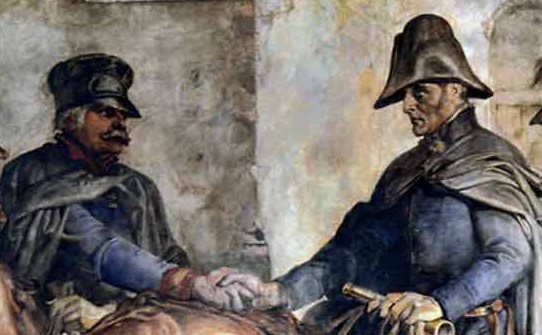
From The Meeting of Wellington and Blücher by Daniel Maclise.
Going back to the text:
I was feeling about as good as man could feel that day. Everything horticultural, in the awful and literal sense of the word, was lovely. Green blood, as I considered before breakfast, I delighted to conserve.
I don’t think there’s any clever puns or secret clues here other than the attitude of the main character (other than it probably is a “man”, and at least one of the other pages might indicate a woman).
I received a letter from Miss Doncaster over the crumbs of toast and the last clear smear of marmalade, telling me that the old man would be coming to-day, on her advice to take mine. I admit that she had stirred me strangely. I lit a Nestor and considered her letter once more.
Is “the old man” the same one being referred to in the pen excerpt?
Nestor Gianaclis was an early cigarette industrialist who put his first factory in Egypt.
To pestle a poisoned poison behind his crimson lights. That was a nice thing to ask of a comparative stranger. It would have to be scanned. Poor old man ; but everyone must bump up against his Waterloo, and to-day was the day of the meeting at La Belle Alliance. It was not appropriate.
This feels strongly like plotting a murder, although the nebulousness of phrase (“poisoned poison”, “It would have to be scanned”) makes me uncertain. If we’re assuming this is the Start of Everything, so to speak — and honestly, this is just intuition and the fact that 1930s British mystery starting with breakfast was a Thing — then maybe this is the first murder that sets things off? There’s reference to a will later, perhaps there is some scheming for money?
I might still be completely off on everything, so feel free to keep contributing comments to the Google Doc which has the text of the novel. Also feel free to simply drop comments here. I’m going to do at least one more post before leaving this behind, and I’d like to have at least a notion where things are going; I’ll probably then keep adding to the Google doc when inspired but will only make future posts if any big breakthroughs happen.
I am unfortunately still not able to declare victory in any kind of holistic organizing, but there are two mysteries worked out, one minor worked out by myself, one major worked out by Voltgloss in the last comment section.

The original printing’s introduction, from James Ryan’s feed. Note that it is quite clear the six months happen in a “recent year”, which isn’t the same wording as in my recent paperback; I briefly had a theory about the years being spread out which is squashed by this comment.
The minor mystery involved my staring at page 28, which has a paradox in the text that was puzzling me. I’ll quote it in its entirety:
I found myself by that one of the windows which overlooked the stone broach spire—a rarity in Kent—of Pluckley church, and the light would strike my book from over my right shoulder. I drew a volume from my pocket; blind-tooled on the green in a double circle was a single star above what was perhaps a sea. I have had very little experience of it myself up to the present. I have only been married once. That was in consequence of a misunderstanding between myself and a young person, and I wondered if such a reason for marriage would ever have occurred to me. I had never married, and scarcely felt like beginning now. It was the tenth edition, of 1917. No, Sir; it is not a very interesting subject. I never think of it myself. Not a woman had entered as yet. I was in for a ticklish business, and I knew it. Forging ahead, I supposed they would call it, since the woman was not yet dead. You might not hear of her again.
The person was married yet never married? I thought, briefly, that perhaps this was a conversation between two people with the quote marks removed, but notice the first section refers to getting out a book. “I drew a volume from my pocket; blind-tooled on the green in a double circle was a single star above what was perhaps a sea.” To remove any suspense, here’s the book:

This is from a 1910 printing, but the play has a 1917 10th edition which I think we can safely assume is the same, because immediately after the book reference, the play gets quoted. Let me put boldface around the quotes:
I found myself by that one of the windows which overlooked the stone broach spire—a rarity in Kent—of Pluckley church, and the light would strike my book from over my right shoulder. I drew a volume from my pocket; blind-tooled on the green in a double circle was a single star above what was perhaps a sea. I have had very little experience of it myself up to the present. I have only been married once. That was in consequence of a misunderstanding between myself and a young person, and I wondered if such a reason for marriage would ever have occurred to me. I had never married, and scarcely felt like beginning now. It was the tenth edition, of 1917. No, Sir; it is not a very interesting subject. I never think of it myself. Not a woman had entered as yet. I was in for a ticklish business, and I knew it. Forging ahead, I supposed they would call it, since the woman was not yet dead. You might not hear of her again.
Now the parsing makes sense: he’s quote a character in the book talking about being married, before switching to musing about never being married. This isn’t even the only page with the same play; Peter de Wachter noted that on page 9 (which I quoted in a previous page) it included the quote directly in the middle. My guess is, as far as the author’s logical framing goes, the earlier reference was intended as a secondary hint to keep an eye out for the play’s occurrence later, and by knowing it shows up, it becomes possible to make sense of the actual narrative. In other words, just like a cryptic clue in a crossword, there seems to be double reference to make it more possible to understand what’s going on!
This double reference also shows up in the discovery Voltgloss made, regarding page 82:
Bartholomew pawed my ankles even, but I am not superstitious, to ladder danger, desiring sweet biscuits. They were so bad for him. He was the third dog I had had in London. I was afraid, I realised, that I did not notice him enough. It was the first dog I noticed, and at the very beginning. You might have thought it strange for me to say these things, but you never knew Henry.
I was assuming all the occurrences of Henry was of a person, but this clip makes it clear on second glance that at at least one of the “Henry”s is a dog. (Probably not all of them.) This suddenly makes the earlier scene with Henry’s casual treatment of corpses make sense:
They said that it made the heart grow fonder. What had I actually seen? I had seen Henry—surely I had heard him called so—bending innocently over an innocent corpse of his own making.
Speaking of secondary references, there’s another reference elsewhere to Thomas Hardy’s poem Ah, Are You Digging on my Grave? which is narrated by a dog:
O it is I, my mistress dear,
Your little dog, who still lives near,
And much I hope my movements here
Have not disturbed your rest?
Thomas Hardy is explicitly mentioned as an author elsewhere in the text, I’m assuming again because it would be otherwise difficult in the 1930s to realize the poem connects to the author. Page 12:
What, I wondered, would he have said about an abstracted will? He might answer to the same name as the man who sang: “Ah, are you digging on my grave?” But a softer fellow I had rarely seen. On velvet, yes, on velvet I would have trusted him ; but not on cinders, by no means on cinders. Yet the keen eyes bent like small topaz searchlights over the writing. I would get, I felt, what I wanted from this man.
This incidentally is also a name clue, as it is hinting … Thomas? … for whoever “he” is right here. I still need to finish managing all the “name clues” which I’ll get to next time. (I promised at least four posts, and the next post will be #4. I’m guessing now at least five?)
This is a direct continuation of my recent post on Victory Software games, so you should read that post first before this one.
(And yes, I’m still doing Cain’s Jawbone, but this is a very short and simple game as opposed to an impossible hard one.)

From Launchbox.
I mentioned last time an Adventure Pack consisting of Computer Adventure, Big Bad Wolf, and Moon Base Alpha. My working theory is that when Big Bad Wolf got published by Commodore in a collection, the author Bruce Robinson did a switch. This is entirely a guess, and on Bruce Robinson’s own page where he discusses the company (“At its peak, Victory Software employed 8 people at the main office”) he doesn’t talk about this at all, other than to say Commodore “licensed” both Big Bad Wolf and the action game Treasures of the Bat Cave, and neither show in later ads for Victory. (It is, to be admitted, one of those minute things that only a tiny group of people care about, although Gareth Pitchford did some investigation.)
Putting all that aside, it should also be noted that there were at least two C64 versions. While the VIC-20 file no longer exists, checking the source code indicates the 1982 C64 version is almost certainly a direct copy of the BASIC from the VIC-20.

A 1983 C64 version beefs up the text.

There are a few other changes I’ll discuss later.
Honestly, there’s kind of a charm in not trying to add much more? At least with this game the puzzles were genuinely solvable even with vanishingly small space to work with. Just like Big Bad Wolf the game is restricted to five rooms.

The goal is to make and climb a beanstalk, then steal a egg-laying hen from a giant. The bean part is pretty straightforward; you go in the TOWN and there’s a SHOVEL and BEAN just sitting there to scoop up, you don’t even have to negotiate for low prices. You can then plant the bean in your yard and water it (using the pitcher from the house), getting the titular beanstalk, which can then be climbed directly into the giant’s castle.


Typing LOOK HEN finds some GOLDEN EGGS you can take (oddly, not the objective of the game) and LOOK GIANT yields a RIFLE. The giant fortunately is very tired through all this and only awakens if you try to grab then hen, which squawks, but even then the giant just boots you out of Castle-land and down to the surface before falling asleep again.

(In other words, merciful game design! It would have been easy to put a GAME OVER but it feels in character for the giant to not feel threatened enough to go that far.)
Back in the house there was a RUG. You can take that to reveal a trapdoor, but it is locked, and even though it’s your house, there’s no key.
You can look at the rifle to find bullets, and at the bullets to find gunpowder, and then stuff the gunpowder into the keyhole of the trapdoor.

This took a little effort to solve, but it’s mainly just a matter of making sure to LOOK at every item and keeping in mind the PUT verb works.
This reveals a basement with an AX. If you try to chop the beanstalk with it the game says
NOT YET, I DON’T HAVE THE HEN!
Before this I admit I was happy with the gold eggs I already stole and not sure why I needed the hen too, but hey, more money in the end I guess. Going back to the squawking hen, I put my thinking cap on and came up with what I confess is an admittedly clever solve. The rug that covered the trapdoor in Big Bad Wolf was solely there to cover the trapdoor; the same is true of rugs in other text adventures like Zork. Jack and the Beanstalk takes what normally is a throwaway item and makes it the solution to a puzzle all on its own:

By covering the hen with the rug, you can mute the sounds long enough to make an escape. The giant still follows, but with ax in hand you can have a happy ending:


Honestly decent! It’s about as good as can be done with the byte space available on the unexpanded VIC-20 (other text adventures tended to use expansions; Scott Adams games required 16K of memory).
The 1983 C64 version which uses more capacity adds around the edges of the basic game.

The rifle you don’t get from the giant, but rather have to purchase it in town. The hen isn’t right next to the giant and you have to travel through a top-down maze to get there.

Not much more to add; we’ve still got more Bruce Robinson games to go, but they’re kicked down a bit further down on my list. If nothing else, this well-illustrates the principle I’ve mentioned of unexpected re-purposing being a very strong puzzle type: taking what seems to be an informational sign and moving it, turning a location into an object that can be picked up when the player is strong enough, and for this game, taking what would normally be scene decoration whose only purpose is to hide one object and making it the essential element for solving the main puzzle in the game.
I’ve done a run through all the text, and before I get into some insights, I want to set some ground rules in case anyone wants to join in. You are absolutely welcome to. If for some reason you’ve made significant progress on an aspect before coming here — that is, you know “spoilers” and are not just playing along — I would prefer any comments be held off.
I have a copy of the text here with comment permission. I’m holding off on a spreadsheet until I have a better idea of what the layout should be (more on that in a moment).
To reckon with Henry! That was never easy. Just beyond the laurels, I turned sharply and there he was, bending over the body of his latest victim. There was blood all about. I called to him sharply and he seemed dazed.
— Page 21
I also want to caution is I’m about to make a guess here that might be gigantic spoiler — it deals with a fundamental aspect of the story. If you want to take your own shot at reading and theorizing first without being tainted you might want to veer away until later.
For my readthrough I decided to go backwards, 100 to 1, for no particular reason. This led to a rather intense start, which feels like it might be a genuine ending:
I dimly guess why the old dead so wanted this. I had worked for him, Henry had worked for him. If I could get up, as, believe me, I cannot, I would have a thing to say to her. She lolls over at me gloating, her mouth blood-tinted on the puma freckle of her beauty. Why should I think of Henry at this particular juncture? I have it. Scotland Yard, of course. And little ‘twill matter to one. A sorry thing to be last noticed : the buttonhole has escaped from the buttonholer. He, the reckless old cock, slips down past Woolworth’s and she continues full-sail toward the Kursal, as flush—oh, you wicked woman—as May. The girl is smiling at me. That’s not so good. Here I shake off the bur o’ the world, man’s congregation shun. O beastly woman. You know not how ill’s all here, about my heart ; but I know. Henry, I feel it, is for the first and last time getting out of hand. Good-bye, Henry. He drops awa. . . . .
In terms of surface understanding, “I” the narrator here is “working for” someone and “Henry”, who shows up a great deal in the story (more than any other character, I think) also “works for” the same person. This is followed by some stream-of-consciousness which may or may not be wordplay, and then … some kind of death? “He drops away” being cut off sounds akin to a murder happening, but of who? “Goodbye, Henry” makes it sound like Henry itself, but their earlier “Why should I think of Henry” seems to disabuse that notion.
What really popped out was an immense number of references to Henry — searching yields 56 mentions — including this one, page 91, that I found baffling.
In my youth I had been worried that I bore the same name as Newbolt’s admiral and Shakespeare’s sergeant, and it had irked me when, in my student days, I had been known as the Smiler with the Knife. Afterwards I found it better in practice to capitalise my third letter. The Blue Rocket was still going down next day ; in fact, I knew too much to let it go up. It even seemed to be succeeding. The snowy-banded, dilettante, delicate-handed? At least I was the last. I would not say at last I was the least. I tried to interest him in my little Black Museum, and indeed elicited a frisson with the preserved eyeball of the well-known and respected Cadaver Charlie. The eye in which, just before its fellow was shot out by the Chicago sleuth, he had asked that suave detective if he, the detective, could see any green. It looked, though, as if Henry had been playing about with this exhibit. I would have to take steps.
First off, “Newbolt’s admiral and Shakespeare’s sergeant” are both references to Henry. So on this page, the narrator here seems to be admitting their name is Henry. But what is with capitalizing “my third letter”? This feels like it has to be wordplay, but I’m not sure what it indicates. Even more mysteriously, Henry then is referred to later as someone other than the narrator “It looked, though, as if Henry had been playing about with this exhibit.”
I also quoted another excerpt last time about the narrator being called “Hal”, and there’s this bit from page 94 which seems to hint at another name: “Naturally I looked up. And I tell you I found it awe-inspiring enough to actually see my own name through the window, printed there in great letters for the gaze of all and sundry. With a blush I concentrated again on Henry, and asked myself if his recent activities did or did not constitute the darbs.” And yes, there’s Henry again.
Holistically, I really got the sense of different people with different attitudes. Some people were stern and upper-class; some were not. 60 seemed to outline the pieces of a murder, and are very explicit about calling Henry “my peerless investigator” — like Henry is working for the narrator.
I had sufficient knowledge to realise that I had succeeded. I ordered Charles to spare no expense in confecting that Sundae known as Lover’s Delight for my companion. I believed in letting a man have a bit in. A couple of hours later the parson in the pulpit had, with his collaborator, done the trick. I looked down on what I had accomplished. Death closes all : but something ere the end, some work of noble note, may yet be done. That figurehead beard would plough the pseudo-scientific seas no more, at least. There had been other murders, of course, to-day, and with greater consequence. Francis Ferdinand’s, for instance. But never one that had left a man more dead. I gave the huddle farewell, and forbade Henry, my peerless investigator, to pursue the matter further. I climbed down from the short flight of folding steps upon which I had secured my inevitable heliographic record of success. No more by thee my steps shall be for ever and for ever.
So, here’s my grand theory: there is not only just one narrator. There are, perhaps, six narrators, one for each murder; since the pages all continuously use “I”, it gets disguised who is talking on a particular page. So the first task would be to figure out who the six people are, and sort the pages appropriately. (In fact, perhaps, the narrator is the murderer in all the cases?)
I still have yet to think much of the chronology. You might notice in the last excerpt a reference to Francis Ferdinand’s death (kickstarting WW1), which happened on June 28, 1914. I don’t think this implies the story is happening in 1914 — although it’d add an extra wrinkle if it was — but rather the specific day of June 28 matches with the page. Then, perhaps, each month of the six months of the story neatly encapsulates a narrator and a murder.
(There is, at least mercifully, a few pages where the connection is obvious. There are pairs of pages that all involve poems and breaks mid-poem, but the beginnings and ending of the poems are mixed up. The actual list is: 12->50, 23->87, 49->13, 86->24, 92->42, 41->93. So we have at least six pairs linked up.)
I probably next need to give the whole thing another read, with the notion of mind of separating pages into narrator-characters. This supposition may be entirely false. Certainly the multitude of Henrys is disturbing. The page where the character says he is Henry but also talks about one: maybe there’s more than one Henry, just with different last names? (I could of course also be solving the puzzle wrong.) Is Henry sometimes used not even for a person but an object? There are too many occurrences for him to just be illusory.
It is unknown who actually was the first to put words crossing in a grid, but the earliest example we have is from a piece of 2nd century wall found at a Roman house in Cirencester.

The same words are spelled across as down.
ROTAS

OPERA

TENET

AREPO

SATOR
Word squares became a popular pastime in 19th century England, and eventually, clues started to be made in order to generate them. For example, these clues from Guess Me (1872) make a 5 by 5 square:
1. To watch over

2. Below there

3. A fair lady's name

4. A memorial of the feast

5. A severe lawgiver
Other shapes, like a diamond or a triangle started to be used, but it wasn’t until Arthur Wynn’s Word-Cross for 1913 did “across” and “down” get turned into separate clues, with arbitrary shapes. This eventually kicked off a crossword craze that lasted all the way through the 1920s on both sides of the Atlantic.
Our protagonist for today’s story, Edward Powys Mathers, was on the British side. He originally distinguished himself as a translator and poet, but also was a prolific writer of puzzles under the pen name Torquemada (he of the Spanish Inquisition). There was, for example, the 1925 volume Cross-Words in Rhyme for Those of Riper Years.

We’ll try a sample from here in a moment.
As the title indicates, all clues are in rhyme, and already are much more elaborate than the “American” style crossword.
In 1926 started publishing crosswords with The Observer, and importantly, continued developing what is essentially his invention, that which is sometimes in the United States called the “cryptic crossword”. Unlike regular crosswords, the clues in a cryptic involve a double-indicator, one which is a “straightforward definition”, one which is generally wordplay, and the two are merged together in such a way it can be difficult to discern which is which.
I say “essentially” because it’s important to note that the puzzle type was being developed before “fairness rules” were established; Torquemada was followed by Ximenes (aka Derrick Somerset Macnutt) who quite clearly articulated that there should be a definition, a secondary wordplay, and absolutely no extra words, but that was not the case with all of Torquemada’s puzzles.
For example, try this clue, 3 letters:
The sluggard’s pet abomination
Got all mixed up when dealing with this one
Don’t try too hard; I honestly don’t understand the answer even after reading it. Still, let’s give a period postcard for some spoiler space.
The “got all mixed up” seems to be an anagram signal, but as opposed to the letters being there, you have to figure out what the pet is first:
NTA, Anagram of ant, of whom the sluggard must be heartily sick.
What does NTA stand for? I’ll assume that’s something that made sense in the 1920s, but given how mysterious some of the other clues are, maybe not?
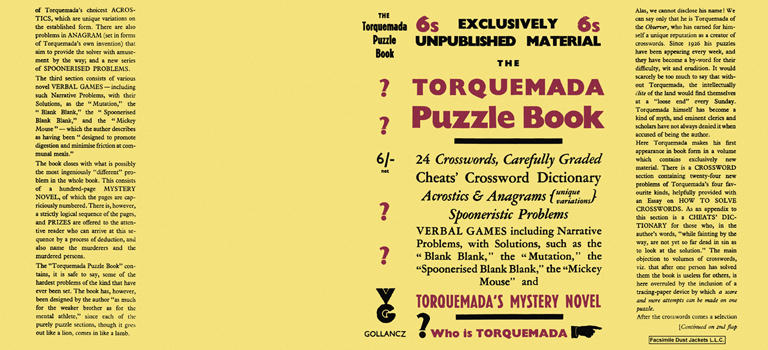
All this is important for the work in question today, that of the Torquemada Puzzle Book published in 1934.
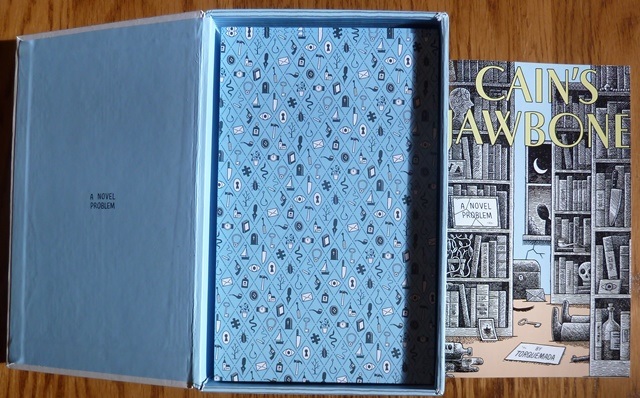
By this point, Torquemada was a well-established puzzle writer, and embedded in the volume of EXCLUSIVELY UNPUBLISHED MATERIAL there was a 100-page mystery novel by the name of Cain’s Jawbone. It is a story over the span of six months where there are six murderers and six victims. There is the slight catch that a.) the identities of the victims are unknown b.) the identities of the murderers are unknown and c.) all 100 pages are out of order. The goal of the puzzle is to reconstruct all three.
A 2019 republication of Cain’s Jawbone as a standalone novel — with an accompanying contest which is still active until the end of 2022 — recently went viral; well, recent-ish, by Internet time. (I can say I was cool enough to know about the book before it went famous. I did not predict it would be the source of Youtube videos with nearly half a million views.)
My skill at cryptic crosswords is only middling-to-fair, so I’ve up to now resisted an urge to take a crack at the puzzle, but I took a gander through the text recently and it’s pretty good even just read as experimental literature. Edward Powys Mathers had genuine literature chops.
The sound of the bell, as of a boding gnat, just came to me. The finger causing it was, I knew, the index of a most skilful hand, one I had commanded, one that would pluck me from embarrassment, and yet one I vaguely distrusted. Really, if the lower orders don’t set us a good example, what on earth is the use of them? They seem, as a class, to have absolutely no sense of responsibility…. One had to be in the key for such things.
The impression is a tactile mix of a well-characterized narrator, social commentary, and what likely are some gnarly puzzles mixed in. A good cryptic crossword clue often has surface meaning indistinguishable from normal text. This clearly isn’t … normal text … but yet somehow fits directly into what I’d expect from experimental modernists in the 1930s.
No doubt — especially given the book cover indicates such — there is hidden wordplay that is part of the puzzle. But there’s also still a story here, and a narrative logic, and if I’m going to take a crack at solving Cain’s Jawbone the first thing I want to try to do is sequence by raw intuition.
I’ll be tackling more specifics next time, but I do want to linger a bit more on the narrator character. The narrator himself (herself?) may be one of the murderers.
In one way, of course, I was glad they were married. I had always been rather a stickler for purity in family life. That scandalous rumour of a Maltese landing on our island and seducing an ancestress of mine—or was it an ancestor?—from the path of duty, I never had and never would believe. If I had had a real education, instead of just listening to him, I could have told—it was bad that day—how I detested being called Hal. It was she that did it. But he was pleased in a way, and said to her, out of a book, the original ground of the transaction appears to have been sentimental : “He was my friend,” says the murderous doctor ; “he was dear to me.” Some Tom, not the one I killed in the matter of Jasmine, had done that, I gathered. He was enthusiastic and provided a chop for me, and said it was good he had visited England to-day for the first time.
Is “the one I killed in the matter of Jasmine” referring to “the murderous doctor” or is it referring to the narrator?
From what I’ve sampled so far, I also get the sense that chronology does not flow exactly (the setup material for book even indicates that the narrator’s mind will sometimes flit about “in the modern way”) and it’s certainly possible not everything said is reliable, not even accounting for some text probably being there for literal wordplay rather than indicating real events in the world universe.
I don’t expect to get a solution — nobody seems to be, except for one person — but I would like to get some insight on the puzzle design in general, and especially just what the frame is. Is there a specific way each name gets encoded? Is there a strong indicator across every page that allows checking the page sequence? I was going to commit to writing four posts, and like my writeup on Alkemstone, I’m hoping to at least get a fair notion of the central puzzle, even if I don’t know enough 1930s British references to make much headway. If nothing else, John Finnemore (the solver I just linked to) said “it’s a well-designed puzzle so when you start to make some headway, you know it” meaning despite the obtuseness, it’s probably at the very least a tighter design than Alkemstone.
Bruce Robinson, our 1982 author for today, started off a little earlier in 1980 working on games for the Ohio Scientific Computer, published by Aardvark. Remember them, the ones with a parser that only understands the first two letters of each word? (Fair if you don’t, especially if you haven’t read that far back; try my writeup on Deathship for a brief intro.) Yes, they’re back, kind of, even though none of Robinson’s games for Ohio Scientific were adventures…
OSI GRAND $8.95
The original tasteless working name was “DEAD BABIES”. A hotel fire is burning out of control as people mill around the roof. Your job is to catch them in a net and bounce them into a waiting ambulance.
…it is clear Mr. Robinson had some influence from the Aardvark adventure line, so we’ll need to refer back to those games shortly.
Bruce Robinson was the proprietor and for the most part sole writer for Victory Software, which kicked off with a line of software for Commodore computers: the VIC-20 and C64. Later, they also converted their titles for the ill-fated Coleco Adam.
Not long ago I wrote about two fairly small games on the Softside Magazette, essentially too small to be published standalone. Another workaround to this problem circa 1982 was to sell multiple games together as a sort of “pack”, as was done with “Adventure Pack I” which contains all of today’s games.
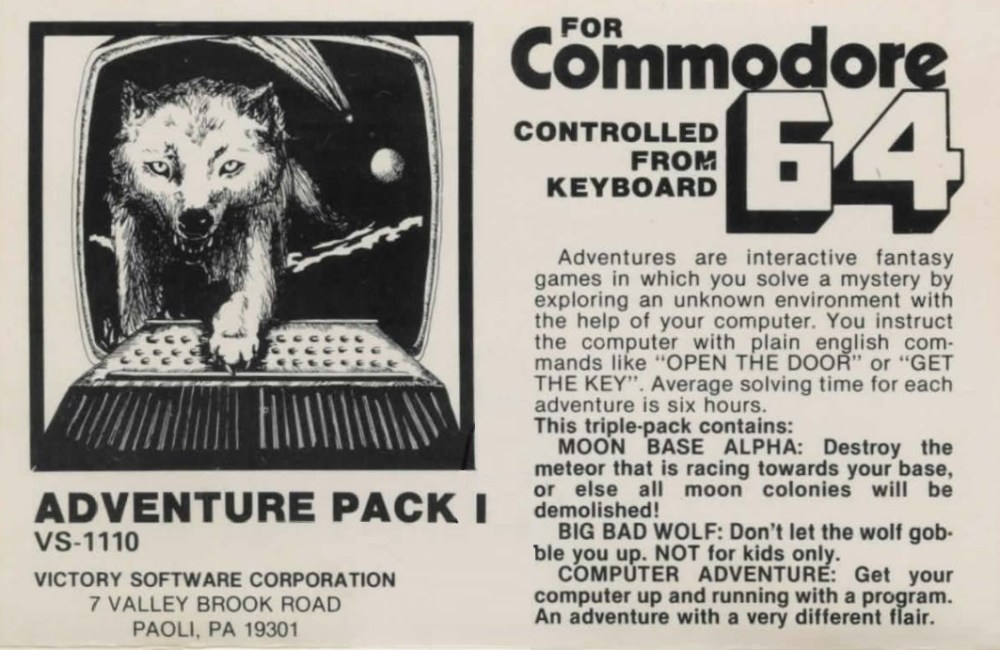
Via LaunchBox.
I’m listing the games separately because they were also repackaged; for example, Big Bad Wolf made its way into a collection sold by Commodore…
…and Victory Software itself did its own re-packaging, combining Moon Base Alpha and Computer Adventure with Jack and the Beanstalk and calling it Adventure Pack I, not to be confused with the other Adventure Pack I they released. (I’m not fully clear which came first. I’ll tackle Jack and the Beanstalk standalone on a different day.)
The games were clearly written first with VIC-20 in mind, a system we have yet to encounter here. Commodore was being managed by Jack Tramiel, forever going for the lower price, and the VIC-20 in particular had an astonishingly tiny 5 KB of memory (compare to a standard TRS-80 Scott Adams game at 16). Even the Aardvark games with 8 KB did not have to deal with such tiny spaces.

The games here were written in BASIC, which reduces the memory capacity even more to astronomically tight.
Consequentially, both the games themselves and the parser are quite minimal. The minimality to responses especially make the games near-unplayable, although Big Bad Wolf verges close to being a “good” game. They’re also quite necessarily tiny on room count, where Big Bad Wolf has a grand total of 5 rooms, Moon Base Alpha has 5, and Computer Adventure has 12. I’ll tackle them in reverse order.
…
Before I show my first screenshot, I should mention VIC-20 is known for its extra-wide text font (see the BASIC shot earlier) but for my play I used emulator tomfoolery in order to squish the aspect ratio into something normal-looking. These are hard enough to play without me adding illegible text to the mix. (I also think it might be possible on a 1982 period TV to use knobs to cause some horizontal squishing anyway, although I don’t have any hand to test this theory on.)

Computer Adventure’s premise is you need to go buy a computer, TV, and adventure game in order to play an adventure game.
Remember when you first started thinking about getting a computer? How you scraped up enough money to buy it, figured out how to hook it up, and then actually got a program running on it?
There are no compass directions; you GO LOCATION to go there, and even though the places supposedly have a connected geography, you can ignore the geography and GO to any location in the game at any time. Yes, this feels weirdly and accidentally modern. The C64 version “fixes” this feature so you can’t just do locations across the map. (Crowther/Woods Adventure let you go to locations by just typing their names, but only a limited set of them.)
The GO LOCATION “feature” is co-paired with a parser that, like Aardvark, only understands the first two letters of each word, will often just re-display a location rather than explaining why a command failed, and sticks to non-committal messages like NOT YET with no clear reason why something isn’t possible.

The SUGAR BOWL at the start contains money you can find by opening it. Then you can go shopping; as might be expected for a VIC-20 enthusiast, Atari ($800) Apple ($1200) and IBM ($2300) are all out of budget, but you have enough money for a VIC & recorder ($375). You don’t have enough money to buy a TV after the VIC. You can try to steal you one but that lands you in jail:
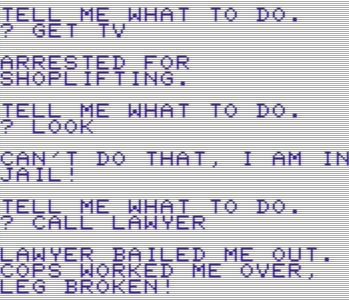
You have to CALL AMBULANCE after this in order to get your leg in a cast so you can move again. All this is entirely optional (!?).
The right thing to do instead is to go into a friend’s house, take their broken TV, and find out you are unable to REPAIR it. You can go home and CALL REPAIR which will inform you of a secret repair area, then spend $50 there to have a working TV set. (There is absolutely no indication any of these phone calls should work.) For the game, you can get a magazine with AN AD FOR VICTORY SOFTWARE; you can ORDER GAME which will then show up in your mailbox.
With the three parts in place, you can fiddle with commands in a way I’m unclear the order on (PLUG works somewhere, as does ATTACH, and if you don’t have the right order the game just says NOT YET) before finally finding the commands LOAD PROGRAM and RUN PROGRAM.
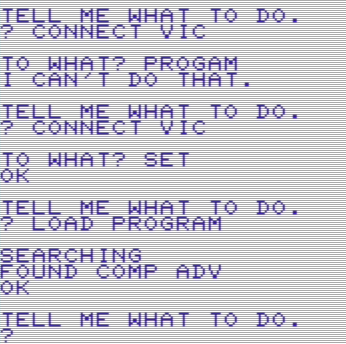
Doing this gets you the award of …
…getting into a loop, and playing the very game you just played! Bruce Robinson clearly had energy and ideas, but tried to implement them in an environment that didn’t support even half of what he wanted. While I haven’t tried the Adam version, even the C64 version isn’t much more elaborate, and mainly is helpful in giving a full list of possible verbs rather than making the player guess.

For the next game, Moon Base Alpha (complete map above) you need to stop a comet from hitting the eponymous moon base.

You get constantly reminded of how close the comet is. The first step is to head to the SILO with a CHISEL, DETONATOR, MISSILE, and GANTRY. The game then runs into the Aardvark visualization issue; I normally think of missiles as rather large, but you can just pick this one up and put it in the gantry (!?). Then you need to PUT DETONATOR on the MISSILE, and the only catch now is you need to push the button in order to launch it. The computer in the main control room (see screenshot) has a button but it is out of battery. There’s fortunately a battery in the basement, but unfortunately…

…the game informs you the battery is impossible to get. In Computer Adventure (and the early Aardvark games) you’d have to sit and wonder what the issue is, but here the game spares the space to let you know about CORROSIVE ACID if you look at the battery. So you need to get some medical gloves.

The gloves, unfortunately, have an issue of their own, as illustrated above: they’re contaminated from some sort of prior contact, and you quickly get sick and die if you pick them up. The key is to first take the CHISEL from back where the missile is, bust open the LOCK in the control room with it, grab some FORCEPS hiding behind the door, use the FORCEPS to pick up the gloves, then put the gloves in the autoclave for sterilization before trying to put them on.

A $50,000 autoclave from Fisher Scientific.
Then with the gloves you can get the battery over to the computer (which apparently works well enough even with the acid) and charge it up to be able to launch the missile.

This was certainly an improvement over Computer Adventure; dropping room count to super-tiny levels gave enough space to give actual feedback on what was going on and the game never asked for jumps of faith like CALL REPAIR. The game is even good enough to let you know the gloves are SCUMMY before picking them up rather than just letting you die and figure out the hard way there might be something wrong (…I figured out the hard way, but I pick up items like a hyperkinetic rabbit).
Before visiting Big Bad Wolf, I want to make a big lateral leap to an Infocom game, their only experiment in real-time parser gameplay.

From Mobygames.
This game is in three parts and the opening one is one of my all-time favorite adventure game puzzles.
Just here, a few miles from the border, night is falling, and the lights of the small villages flicker into existence. You’re drifting off into sleep when there is a knock on your compartment door, and a man, clutching his left arm, staggers inside. Drops of blood on his sleeve leave no doubt as to the cause.
“Don’t be frightened,” he begins, “I’m all right.” Before you can speak, he begins his story. He is, it seems, an American agent who has just learned of a sinister plot to assassinate a top-ranking American diplomat tomorrow morning in Ostnitz, the town your train is fast approaching. He hands you a document, which he says must be passed to his contact at the train station there. You look through it, but it’s all in Frobnian, and you know barely a handful of words – that’s why you always carry your combination tourist guide and phrase book with you on your trips here.
“You must deliver this. I do not know who the contact is – he was supposed to find me. I was to wear this white carnation.” He pulls out the rumpled flower and pins it onto your jacket. “He will bump into you and greet you with the words ‘Excuse me. I am sorry.’ to which you should reply ‘It is my fault.’ Then, hand him the document and earn our country’s thanks.”
The near-entirety of Part 1 of the game is figuring out how to make it to Ostnitz with the document. It is essentially one large puzzle, and while you are frantically looking for hiding places, compartments of the train start being checked one by one.
You watch as a man in a trench coat enters your car to the north. He opens the door to the first compartment, and begins to speak to the occupants, though you can’t make out a word.
This is a preparation puzzle. Rather than applying an object to overcome an obstacle, the obstacle is coming to you, and you need to have everything set up correctly in order to bring the document to safety.
Big Bad Wolf is the same sort of puzzle, but squished into the 3583 bytes of VIC-20 BASIC.

The wolf, akin to the comet, approaches a house wanting to gobble you up. (I’m unclear how you get move by move updates on the wolf’s distance, but it still works in context.) Again, the map is tiny, just five rooms.

You can also try to go in the WOODS but that kills you so I’m not counting it as a room.
You’ve got access to a gas stove, whiskey, and a candle in the kitchen; a chair in the den; an ax and shovel in the shed. The shovel can be used to dig up a lock in the yard, which can be used to lock the front door; this is one of the necessary steps to prevent the wolf from gobbling you.
The candle can be used to find a pot of oil in the cellar. Then you need to set up a trap in the DEN, which has a FIREPLACE. The ax can chop the CHAIR into kindling, and the kindling, candle, and hot oil go together into the fireplace.

With the door locked at the trap in place, the game then lets the wolf approach without any intervention on your part.
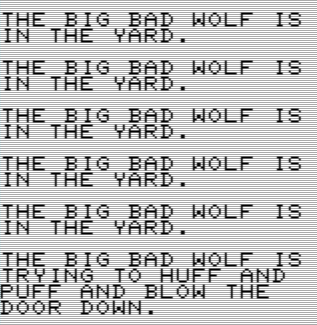
Finding it cannot huff and puff and blow the house down, it tries the front door, then climbs up to go down the fireplace instead.

I admit I was still genuinely puzzled on some visualizing — chopping up the chair in particular was non-obvious as it doesn’t have a description as wood — but the whole process felt oddly satisfying. I think Moon Base Alpha may have come last of the three (it is the only one that supports LOOK on most everything) but that game felt like a succession of individual puzzles, whereas this felt like one organic one, and I was impressed how much gameplay Bruce Robinson managed.
I think if he had been programming on a mainframe, he’d make a big, expansive Adventure clone just like everyone else, but a treasure hunt in 5 rooms really doesn’t make much sense, so it forced some innovation. It’s too bad the resulting parser is so dodgy, but at least I’m not dreading playing his other games (also for VIC-20) that will come later in my 1982 sequence.
That’s going to have to wait, because for the remainder of at least this week I’m going to try something very, very different, something that surely belongs in the annals of interactive fiction yet is much older than anything I’ve ever played.
I was planning on calling this post “The Hard Part” but it really wasn’t? I’m not exactly disappointed but I feel like I might have missed something, despite getting a hearty “congratulations” and the hand of a princess. (Also, be sure you’ve read my prior posts on this game for this one to make sense.)

Anthony Hope has an entertaining play-through video on Youtube here that lasts nearly 2-and-a-half hours.
First off: the amount of available torch light (that’s Brit-torch, so “flashlight”) was not at all a problem. A good chunk of the area is well-lit/outdoors and there’s even some leeway there. I’ll call the batteries the shop sells at the start to be essentially useless, I never needed to touch them, and you can even travel through darkness to an extent (just you can’t interact with objects in darkness, but you can still move around).
Second, the game really is forgiving in terms of transport-options. You get one magic word (GREZON) that gives you a one-shot teleport back to the treasure room, MINH works on two parts of the map, and if all else fails you can just walk (again, darkness is ok!)

I had nearly already solved all the puzzles last time. One that I missed was going up a bell tower to where a vampire bat resided, but there’s some garlic hanging around that lets you easily grab a treasure there.
I also missed going down a well to an oyster, where a “bivalve opening tool” served me well to pop it open and get a pearl. (I also, according to Anthony’s Hope walkthrough I checked after I finished, missed my only 5 points here by failing to eat the oyster. Not my first choice of gourmet, I’m fine leaving those points behind.)
I mentioned, offhand, defeating a cockroach with ITHURD; this does appear to be “correct”, or at least the way the walkthrough does it.
Where my playthrough different from the walkthrough is with the Troll. There are two ways through and there seems to be randomization here. One is to toss it the colorful postcards you can buy from the shop.
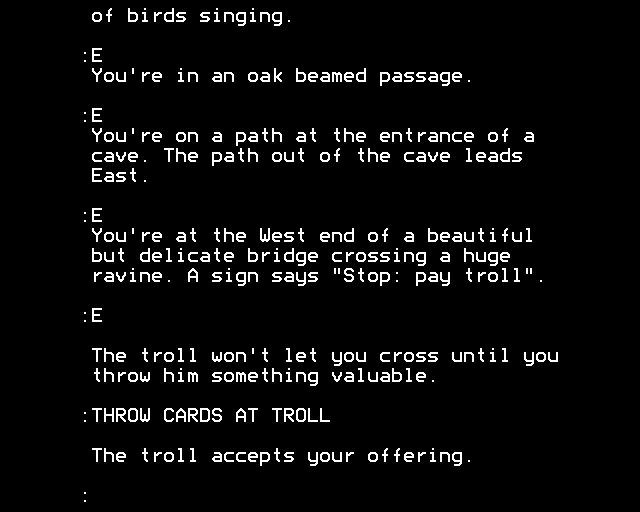
However, on my “final run” the troll wasn’t taking the cards and kept throwing the cards back, so I tried my lunch instead and it took that. (No hunger timer I could find, so it didn’t matter!)
The only other tricky part happened upon finding the last treasure. A voice announced the cave was closing and I needed to book it back to the shop at the start of the game. If you take too long you get squished.
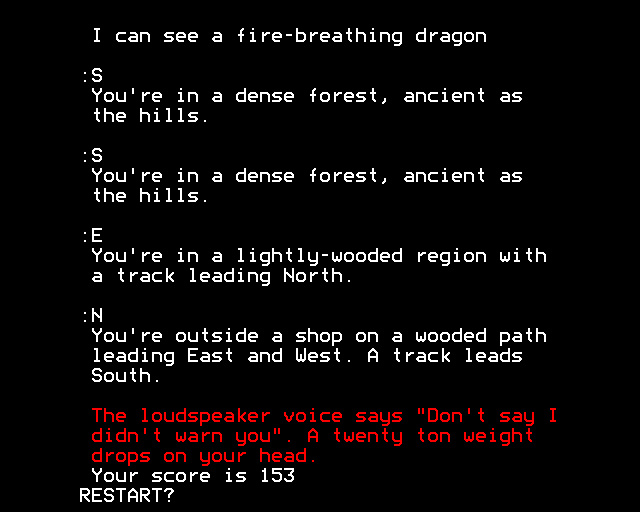
One other thing that helped is the only threat that mattered, the second dragon, I met out in the middle of the forest, so I was able to run away from it and ignore it entirely. I was otherwise utterly unable to kill it with my sword.
Assuming you are efficient (and you don’t need to be that efficient) you have time to teleport back to the pagoda, deposit all your treasures, and book it for the shop and your reward.
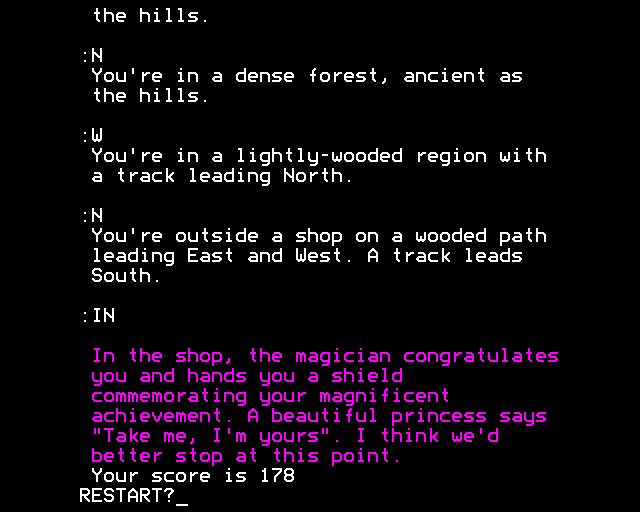
I really was expecting something off-the-wall hard akin to Atom Adventure since Anthony described this game as an expanded version of that one. I never had any of the same effects, where the torch and inventory issues were so pronounced they essentially produced a whole new set of puzzles that needed to be solved on top of the regular ones. I did have to think somewhat about my movements, but I never felt pressured enough I had to reload every time I went a wrong direction.
The funny thing is, of course, that isn’t really a bad thing! This is essentially the most playable of Paul Shave’s games. It mimics Adventure a little too much for me to call it top-tier, but I did enjoy seeing how randomization fiddled with gameplay possibilities, and I’m guessing there are some emergent stories that I’ve missed based on, say, possibly having a sword break at an inconvenient moment. (Weirdly, in my final run I didn’t meet any dwarves — I wonder if that has something to do with me trapping the dragon in the forest.) I’d say the adventure-roguelike aspect (which I’ve chronicled a number of failures of) actually works here; just the right elements are randomized in just the right amounts so the game at least felt a little dangerous, but not unmanageable.
So, my sincere apologies for all those hoping for five more posts of struggling and pain on my part. If you’re nostalgic you can always re-read my series on Madness and the Minotaur, which does have a sequel in 1982 that uses the same engine, so eventually the suffering will come.




 Renga in Blue

