One thing to always keep in mind about very old games is technical restraints in not just what the physical hardware can do, but what tools are available that makes creation easier. A great many of these games have spawned from the fact source code was printed in multiple sources, and the times an author has had to “work from scratch” has had mixed results.
The same is true for graphics, which with the exception of some works that were illustrated after 1982, they’ve nearly all had a general sense of jank; the closest I think we’ve had to “good” game illustrated in 1982 (not a 1982 game illustrated later!) is The Queen of Phobos. The extra hurdle of essentially needing to write one’s own graphics editor was one step too far for many authors.
Mind you, early graphics software did exist; Sierra On-line started advertising their own graphics system in their second print ad. However, it wasn’t until 1982 there was a system advanced enough to be a bona fide hit and work with adventure games: Mark Pelczarski with The Graphics Magician.
The story of Pelczarski has been told well elsewhere (try here first) so I’m not going to do a re-telling, nor will I go into the prior versions which weren’t as famous (he sold Magic Paintbrush in 1979 in a Ziploc); I will say one of the major selling points was that it was fine to use with commercial work as long as The Graphics Magician was credited. (This is similar to Unity’s splash screen requirement.) It ended up being dominant in early 80s graphics.
I’ve seen credited elsewhere that Incrocci used Graphics Magician (with his art like Masquerade, which we recently played) but his games do not credit the program (as is supposed to be required) so I am unclear if that’s what he really used. Other than possibility that we haven’t seen anything of the program (although the graphical version of Oo-topos used it as well as some of the graphical versions of the Scott Adams games — just we didn’t play those versions).
So with those caveats, The Incredible Shrinking Man Adventure is our first game with credit to The Graphics Magician.
It was published in Softdisk in January 1983, but everyone lists it as 1982 because that’s what the copyright notice says.
The diskmags did not have the same rules as printmags in terms of publication delay so it really probably wasn’t publicly available until January, but eh, close enough. (It is faintly possible the game had some circulation beforehand, anyway.)
Softdisk we’ve encountered before (see Planet of the Robots, Space Gorn) and Space Gorn in particular was by Anthony Chiang, who returns in this game as a co-author with Kenneth.
The setup is simply that you have had a science experiment gone wrong and are now very small.
The game at first appears to be simply the On-Line Systems etc. classic view, where you start shrunk under a table…
…but what’s interesting is that the game is trying to render the room you are in as simply multiple perspectives of a real 3D view, and you can view the same thing closer or farther depending on where you are standing. We saw this a little bit in the “dungeon crawler” style games like Asylum and Haunted Palace, but here it still falls within the Sierra style, including only sometimes describing the items that are in view.
You can go in the tackle box and find a hook.
The game is fairly short although not quite as simple as Space Gorn. It is certainly possible to get stuck, although step 1 is fairly clear: take some cheese and give it to a mouse.
On the north side of the big room there’s a door you can squeeze under to find a cat. The cat of course wants the mouse, and you get the string that We Have Garfield at Home the orange cat was playing with.
With the string in hand you can TIE STRING TO HOOK which turns it into a GRAPPLE. The grapple then works on the right spot in the room to be able to hook onto the table and climb to the top.
Having climbed to the top, you can find an antidote for the shrinking, although to get into the vial you need to take a comb from the floor and set it down like a ladder.
the cut text is “THERMAL NUCLEAR WARHEAD. World’s safest science fair!”
Given the context — what is assumingly a fan duo rather than a professional company — the graphics were clear and well-designed, so I appreciate this (if nothing else) for an early example of The Graphics Magician being used by the public. This will also not be the last appearance from the Chiangs (they have two more games on Softdisk, and one in a different publication) but they’ll have to wait until 1983.
As promised, here is the next in the Scott Morgan series. (Previously: Haunted House.)
Here, we start at a ghost town and are meant to recover three treasures from a local mine. The ghost town is straightforward enough; nothing is blocked off.
You can grab a gun, twine, explosives, a backpack, a shovel, a mirror, and a bell just laying out in the open.
The bell is just for atmosphere. The registry book has the hint shown which will come up in just a moment.
The Saloon is a little more interesting. There’s a player piano with a knob you can turn to make music, and a ghost sitting at a bar.
This happens when you LOOK GHOST. I love the moment of meta and this is honestly the most memorable part of the Morgan games so far for me; they’ve mostly been robotic and could use more of this kind of humor.
Trying to head north in the mountains, you find an old hook, followed by the mine. The mine entrance is blocked by a bear who is described as “HUNGRY”.
It wasn’t too hard (given the inventory I had building up) to work out the game intended for me to go fishing at a lake on the far south of the map. It was a little harder to work out you could LOOK MINE to get another object (some poles) — for the most part, look has never applied to the location name in any of the previous Morgan games, it only applied to the objects.
With a pole, hook, and twine in hand, you can TIE TWINE / TO HOOK followed by TIE TWINE / TO POLE while at the lake, and then do the verb CAST in order to go fishing.
Yes, this is still the bespoke-phrases-only parser, and no, I did not figure out CAST on my own: I popped open the binary of the file and looked around for text phrases.
With this sort of game you could say I am playing against the technology, not against any kind of story.
Going into the mine itself, there’s *silver* to the west. (It needs to go into the backpack, you type INTO BACKPACK followed by SILVER, and no, there aren’t any directions in the game or even the manual about this syntax.) To the east there’s a dead end, where I was stuck for a long time. When you look at the explosives they say you can set them for 1 or 2 minutes. The right command is not SET EXPLOSIVES or DROP EXPLOSIVES or anything like that, you are just supposed to type out
1 MINUTE
and then wait and the explosion will happen. You don’t even need to drop the explosives! (Not like the game has a way to drop items, anyway.)
This leaves a BIG HOLE and some more exits. You can get *DIAMONDS* down one passage, a ladder down another, but otherwise the sticking point is a monster.
If you LOOK MONSTER you get turned into stone. Yes, somehow a medusa wandered into our Western adventure. You may recall from the inventory list we had a mirror, yet I haven’t been able to get the mirror to work. SHOW MIRROR is directly in the binary code, but it doesn’t work!
I suspect there’s a literal bug at this point preventing finishing the game. Looks like all I was missing was some gold past the monster which you use the ladder to get to, and then the message:
YOU ARE RICH!!! AND A WINNER
THANKS FOR PLAYING!
GET IN SEARCH OF THE FOUR
VEDAS FROM ASD&D TODAY!
I’ll call this a wrap. Incidentally, having Four Vedas as the next game in the “series” is kind of odd. Here’s the catalog with the order so far:
If we’re going from easier to harder, wouldn’t Stone Age (the last game marked Intermediate) be next? And why are the games not given in order in the catalog?
This may have all parsed as fairly simple to manage, but I did took a fair amount of psychic damage working out both the fishing and the exploding, so despite the intrinsic interest of a game based on Vedic religion, I’ll have to save the rest of the Morgan series for some other time.
Next up: Something that uses The Graphics Magician. Need to keep the Apple II fans from nodding off out there. Then there will be a couple more tiny games followed by the return of Level 9.
As I suspected, I didn’t have far to go, and it was a matter of verbs, really.
I had to deal with a ghost with the given inventory above. Due to some emulator glitch issues (which were bad enough I had to revert to a prior version of Classic99 to get the program running again) I had to replay to this point where I discovered the purpose of the glowing cube was just to give light to the cellar, so I knew it probably wasn’t the solution to the ghost. (This is definitely a one-object-to-one-puzzle sort of game.)
I had already tried THROWing all my various objects with no luck, until I hit upon, even though the visualization doesn’t make any sense to me, POUR LIQUID.
Maybe this would make sense to me if the ghost was preventing me from going down, but it was preventing me from going up. I get the sense the author didn’t visualize the act as much as think “what’s the action that goes with taking liquid out of a container” and rolled with it.
Above the ghost is where the “grab everything” aspect becomes useful; the chair from earlier can be used for a lift, so you can STAND CHAIR to get up to the attic.
This is a pretty interesting moment (at least for me the most interesting one of the game), as if you try to take the ruby and go down, you’ll get teleported back to the attic. In terms of atmosphere it is the best moment of the game. Except: unless there’s a way I’m missing to drop items — and surely there is, right? — this also represents a softlock, if you don’t have the means to teleport out from here.
As long as you have the chocolate chip cookie from the vampire, you can make a great escape.
This last shot I had to get by unusual means. The screen vanishes too quickly for a screenshot or even reading it (probably the emulator’s fault, not the game’s) which meant I had to replay and start OBS to make a recording. Then I freeze-frame advanced until I could see what the text for winning is. Just like how Aqua Base signaled Haunted House as the next game to play in the series, this one tags Miner 49’er (which seems to be Mr. Morgan’s take on Ghost Town/Greedy Gulch).
The ending screen would have been funnier had I reached the attic without having tried eating the cookie yet, since the game doesn’t even describe the teleportation aspect; you just go straight to the win screen, so somehow you have to infer what it is a cookie did to lead to a great escape.
These “bespoke command only” games can be intensely frustrating but at least this one was easy enough to work; I dread eventually getting up to In Search of the Four Vedas which is supposed to be “expert” level. However, I’m going go ahead and stick with Miner as my next game because I’m feeling “in the groove” of the author and it helps with playing other games; even just remembering that LOOK is the only verb for examining things can take a little while to get the hang of. (I should point out the issue from Aqua Base didn’t happen here — that of deceptive “you can’t do that messages” — simply by virtue of almost no verbs getting implemented in a general way at all. One advantage of only accepting bespoke phrases, I suppose.)
So … that’s it. Not much to report this time! Videogames are good, I guess? Anyone been playing any good non-adventures lately? I’ve got a Baldur’s Gate 3 run going (I picked my character with the Random feature and it gave me a Warlock with a patron of the Great Old One, so Cthulhu basically) and I’ve also been struggling through Void Stranger which is like you took the apparently-linear gameplay of a puzzle game but mashed it with La-Mulana type secrets and meta-aspects and came up with something wild on the other end. Nothing is as it seems. Also I’ve embarked on the Japan-only Wizardry Gaiden series and it still doesn’t quite capture the same magic as original Wizardry but I hear it improves as it goes on. The new Proving Grounds of the Mad Overlord remake looks interesting — it literally is using the Apple II version as the “frame code” and you can watch the Apple II version simultaneous with the remake graphics — but I played the game recently enough I’m not itching for another traversal yet.
It’s been a while since we’ve revisited our Spooky Domicile namespace chart, but we’ve had enough new entries I think it’s time:
So the games have been piling into Haunted House, and the only spot left standing without a namespace clash is Haunted Mansion. For today’s game, assuming you’re paying attention to my title line, we’re dealing with Morgan, specifically Scott Morgan, who we saw near the start of our 1982 with Aqua Base, a James Bond-style story with the world’s most ineffective super-villain.
(And more importantly for us, a dodgy parser that pretended to parse things that it didn’t, so PUSH NOUN-THE-GAME-REALLY-DOESN’T-UNDERSTAND says “nothing happens” as if you typed something sensible. Something for me to be alert for.)
His games were all for the TI-99 computer and published by American Software Design and Distribution Co. out in Minnesota. Previously I only had a PO Box (see for example this catalog) but the Haunted House manual links to an actual address in Eden Prarie. It is most definitely a residential area, not a business district.
View of the street via Google, although not at the exact house.
This suggests the business was originally a garage outfit before the proprietor later got a PO Box. I’m not going to say the proprietor is Scott Morgan himself; the catalog lists his name just on the page of adventures, and usually if the owner of one of these distribution outlets that feels like spreading their name around in one place they plaster it everywhere. Still, I get the vibe we’re dealing with a 2 or at most 3 person operation here.
On to the game! Haunted houses, despite not being from the Adventure Ur-text of caves and treasures, lend themselves quite naturally to the adventure game format. It doesn’t take research for an average bedroom coder to fill a house, and having a restricted environment (as adventures usually require) is quite natural for horror. The player has an excuse to get shut in with the general and simple plot concept to just get out. Here, we need to also get a ruby first.
Given the forewarning on the parser, it seemed wise to make a verb list. Here’s how my attempt came out:
This excludes motion verbs, LOOK, and TAKE, but otherwise, that’s really everything: just GO, OPEN and PUSH. DROP doesn’t work. I have not found a mechanism for dropping items.
Unfortunately, it turns out my usual verb-sleuthing method was failing me, because the game has hard-coded phrases. Essentially, rather than understanding individual verbs everywhere, it will them only when given in the right place with the right noun (that is, they’re hard-coded in).
Despite this I managed to get pretty far.
After finding a letter warning you “YOU’LL NEVER FIND IT” and a screwdriver hidden in some bushes, you can go in the open door of the house which vanishes.
The very first thing I found (going west) was a wizard hanging out at a book that he wouldn’t let me read, but where he was otherwise non-threatening. Weird but ok. Wandering elsewhere, I found a glowing cube, some powder, a “door with strange keyhole”, a chair (UNSCREW CHAIR so you can pick it up), and a cellar with a chest containing a “triangle” and a locked door.
Having everything in hand I could manage, I went over to the wizard and noodled with all the objects available. I took the powder and tried to THROW it which caused the wizard to disappear.
(Remember, THROW isn’t understood as a verb generally! Just at the wizard.)
The book doesn’t have any words in it but it does have a key, which I used to unlock a “wine cellar” with an empty bottle. Stuck again, I tried the strange keyhole, and found the triangle was able to unlock it somehow.
Yes, this is a “figure out the arbitrary magic” game.
Past that there was some “pink liquid” I could load up in the bottle, a playroom with “bloodstained walls”…
…a ghost preventing me from going up an exit…
…and a dead body at a guillotine, with a silver cross (if you LOOK BODY).
Silver cross in hand I wandered over to Dracula, in order to steal his chocolate chip cookie.
SHOW CROSS. Again seems to be bespoke-coded for this location.
The cookie, when eaten, teleports the player outside the house. Useful since escape is one of the objectives! But I still don’t have the ruby, and I suspect it is past the ghost, maybe right past the ghost with no more puzzles, but even if I’m just an inch away I can’t get by the inch.
My available inventory. The ghost has no description.
I’ll take suggestions if someone has any. All the other puzzles were “easy” (if involving arbitrary magic) so I suspect I’m overlooking something simple although perhaps with a very specific bespoke verb attached.
Another set of games, another teenaged programmer prodigy. In this case, one in Australia named Brendan Jones. According to this forum post by the author, he was 16 at the time he tried to get his RPG Sorcery for the VIC-20 published (’83 or ’84?), and he describes the process with a quote where I’ll keep the color commentary:
Did try, but this was through two clueless Aussie companies. Ozisoft and Imagineering. Ozisoft gave all their games to some dweeb to evaluate who stuck them in his Dad’s garage and forgot about them. Imagineering sat on it for a year and ignored all my letters until I finally threatened to sue their asses. (I was 16 or something at the time.) Imagineering was owned by a guy called Jodee Rich, who went on to create OneTel = one of Australia’s biggest corporate colllapses. I reckon Richard Garriot with his zip-locked plastic bags had a far better idea.
I have the nagging feeling there’s a one-sided story going on here, but we’re focused more on his text adventures anyway. (*) As they span 1982 to 1983 he was a young teenager at the time. They were written (along with some games by Nigel Dunk) with an Adventure Compiler of the author’s own invention. Quoting the author and again keeping the color commentary:
The compiler prepared the adventure from a specification for use with a machine language library. The library was very fast, handling most of the adventure management. All the programmer need do was specify the behaviour of objects in BASIC. It was a shame that text adventures became extinct, superceded by bloatware adventures that keep stopping to shovel animated cut scenes down your throat.
The author lists the games as being:
1: Marsh Castle (1982)
2: Carnage of Karn (1982)
3: Rocky Island (1982)
4: ?
5: Fatman: Crime and Vice (1982)
6: Spyflight (1983)
7: House of Demons (1983)
What’s number 4? No idea; the author skips the number without mentioning it. Marsh Castle is lost as well; based on the author’s notes it sounds like there was a corrupted tape. Perhaps missing game number 4 was a tape missing entirely.
As the comments above imply, none of these games had commercial releases (that I could find, that doesn’t bar dodgy bootlegs at least) although they did spread a bit past the author’s home, so they don’t count exactly as private games.
I played C64 versions of all three.
You start in a spaceship with access to a spacesuit, a tape recorder, and an airmeter. There are no instructions given for your quest; you need to listen to the recorder to find things out. If you try poking at the buttons first, disaster happens.
The recorder informs you about the “mud-erer” Squeen who you must defeat:
The red button lets you onto the asteroid you are docked at, which is rather small (this is originally VIC-20 remember!)
I get the strongest vibes with games like Death Dreadnaught with horror-ick-in-space. There are various dead bodies:
This is followed by a bit where you need to put on a radiation vest to survive:
(The interesting thing about the above is you can’t put it over your spacesuit, so you need to go back to your original vehicle, take off the suit, put on the vest, then put back on the suit over it. Taking off the spacesuit while on the asteroid gets a messy decompression scene.)
You have to shoot a robot with a laser, then face off against the big bad:
The way to defeat him is to say the word “karn”. Sure, ok? Weirdly, I figured this out because there were also rooms with the words LORADI and HIRADI on them and I thought there was some sort of code word thing going on even if I didn’t fully understand it.
Huzzah we won, we can go back to the spaceship and leave, next game.
Rocky Island has you escaping an island. There’s a fun bit at the start where you try to leave your hut and a parrot insists on coming along.
You pick up a dead passenger pigeon with a note by “Cheryll” about “an island with fathers aircraft” so there’s rescue by (how the pigeon found you but not Cheryll is not explained) and then you have to deal with a lion:
I was close but not quite there. I needed to get some poison back at the “cupbord” (I was using the wrong verb) and then use that to poison the bird.
The lion walks over and eats the pigeon.
The lion then curls up an dies..
There’s also some nearby vines so the next part you’d think would be easy:
You need to SWING VINE. (As the walkthrough I had to check for this said, “don’t think about it too hard”).
There’s there’s the slight opportunity to excitingly fall in a pit, but otherwise you nab some matches, get some sticks, light the sticks at the peak for a fire to get rescued, then crash the game.
There’s a 50% chance this was just a bad transfer so I’m not going to fuss too much, but rather move on to the last game, which has an absolutely garish color scheme on C64 so I switched to black and white.
This is the most gung-ho of the games and the most creative. It is also the worst in terms of interactivity; the old story of taking a very simple system and trying to make something requiring complex action, so the guess-the-verb goes through the roof.
Also, the author doesn’t have the chops yet to write characters and action scenes and so forth.
This is the channeling the same energy from the Death Wish series of movies or the later NARC arcade game: we’ve gotta go clean up the streets. (MOVIE TRAILER VOICE: Dealers are making up their own rules … and no-one is able to stop them!)
So we start by distracting a thug with some whiskey, then going by into a sleazy nightclub and talking to the bartender, who is our inside man.
This gives a gun and gas mask, which it seems like we’d go to a police station for rather than a sleazy bar? Whatever. Next up is a scene with a “junkie” who says “go away, I’m flying!!!” when you try to talk to him, so you need to HIT him and then try talking again, because that’s what happens in the movies:
You can then FRISK YUPPIE and confiscate some cash from them (no crime or anything, you just do it)…
The “vasalene” is meant to GREASE MANHOLE so you can open it in order to get to the Fat Man you’ll find in the sewers.
…and use that to make it into the “massage parlour”. You can then ask for Janine who will try to tell you where the Fat Man is hiding but gets cut off.
Fortunately, because you’re on a crusade to clean up the streets, you can survive the gunfire, step outside, and shoot the car that’s doing a drive-by.
The last bit requires wearing your gasmask in the sewers, meeting a Pusher who you shoot in the neck, before reaching your final destination.
The parser pretty much leaped past impossible (with words like GREASE and FRISK in addition to the general jank) but at least I appreciated the game was trying to a genre not commonly seen in text adventures. No, the rapidly-cranked out output of a 14(-ish) year old is not great, but it still can be fun to read about, and it especially interesting to see an attempt at telling more scene-based stories in the medium; the only other author really going that route for the moment has been Peter Kirsch.
(*) To be fair the author applied for essentially the only two big distributors of software in Australia. If this was the UK there’d be less of a problem. We saw recently how a teen-aged Simon Wadsworth put The Scepter out through Bug-Byte; when the follow-up game led to him being ghosted by the company, he just swapped to another company for his other two games. Here there weren’t as many options. As far as why Australia’s software industry had a slow start, I’m still not sure, but I suspect it may partly have to do with copyright law. Quoting the CEO of Imagineering in 1984 (one of the two companies that Jones sent his RPG to):
“Our business is suffering from the current software copyright situation and it is a problem that has been around for a couple of years well before the Federal Court decision last December which brought it out in the open,” he said. “Computer games on disk have been extensively copied, illegally, for a couple of years now and it has affected a large part of our business. “But our legal advice has always been that it would cost us around $100,000 to mount a test case. It has also occurred in some of the microcomputer business packages as well, but the Federal Court decision last December in the case involving Apple threw doubt on the whole matter of legality of software copyright.” That case, he said, had shaken the whole computer industry in Australia and countries which export business software. “But if there is one thing Justice Beaumont (the Federal Court Judge who made the decision last December) and Albert Langer (Software Liberation) have done, is that they have forced the computer industry to join together, get our own house in order and look at some of the issues involved.”
What the “last December” (December 1983) is referring to was a judicial decision in Australia that software was not under copyright. Apple had brought a lawsuit against a company with a computer called the Wombat that was an exact clone of the Apple II (and copied the internal ROM software). While Apple lost the initial decision they won the a follow-up appeal, yet another appeal (all the way to the highest court) was decided 3-2 against Apple, and this was decided in 1986. Remember, the UK had copyright starting to get settled back in 1980. In order for software copyright to hold Australia needed to pass new law, rather than just interpret existing law.
The upshot is that budding Australian bedroom coders from the early 80s like Brendan Jones didn’t have as many outlets as ones from the UK.
Just a quick mention that since it is October, the next running of the IFComp has kicked off.
75 games with a text-emphasis, about a third of them parser if that’s specifically your thing. Lots of variety including someone finishing the Infocom sequel to Hitchhiker’s Guide to the Galaxy and a ZX Spectrum game that was too large for 1987.
The “other bit of game history news” is a part of an excellent history series by Ethan Johnson on Youtube. He’s just reached Hunt the Wumpus so I thought it would be of interest for the readers of this blog (Wumpus specifically starts around 8:30):
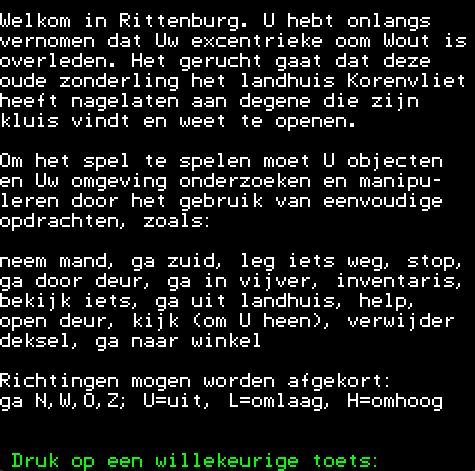
U heeft on langs ver nomen dat Uw exentrieke oom Wout overleden is. Het gerucht gaat dat deze oude zonderling het landhuis Korenvliet heeft nagelaten aan degene die zijn testament weet te vinden.
You recently heard your eccentric uncle Wout has passed away. Rumor is that he left the Korenvliet house to whoever could find his will.
The Dutch company Koninklijke Philips N.V., or just Philips, was founded in the late 19th century making light bulbs. It eventually became an electronics (and electronics appliance) titan. They survived through WWII by managing to move the company’s capital and operations to the United States and the actual listed headquarters to the Netherlands Antilles, moving back to Europe afterwards (leaving the North American Philips Company as a separate company in the US). They were (and still are) large enough that their reach spread throughout all of Europe, with groups in countries like Belgium, Austria, and Sweden.
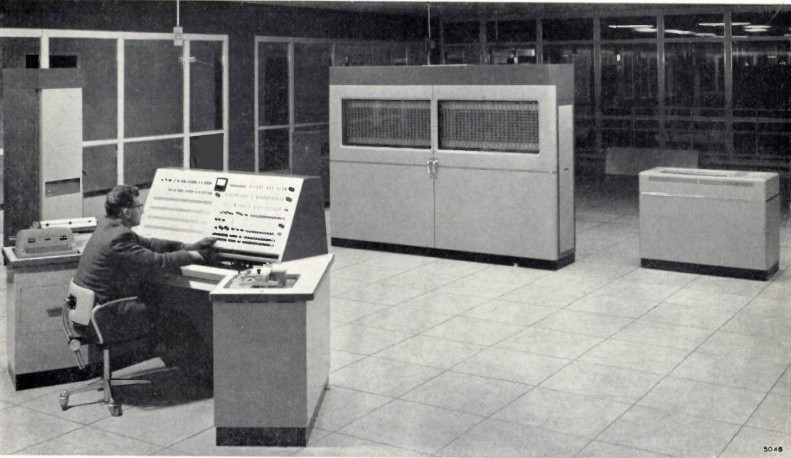
After WWII, they would seem like a natural company to gravitate to computers; however, Philips was used to more “mass” products, and computers at first seemed like something restricted to very large companies. They ended up having more success with components (particularly their Electronic Valves division) and in the mid-50s they made an agreement with IBM to provide them with components while they stayed out of the computer market (and vice versa). This agreement eventually slid apart by the end of the decade, first with the room-scale Philips Akelig Snelle Calculator (PASCAL) which went active starting in 1959.
From the Philips Technical Review 1961.
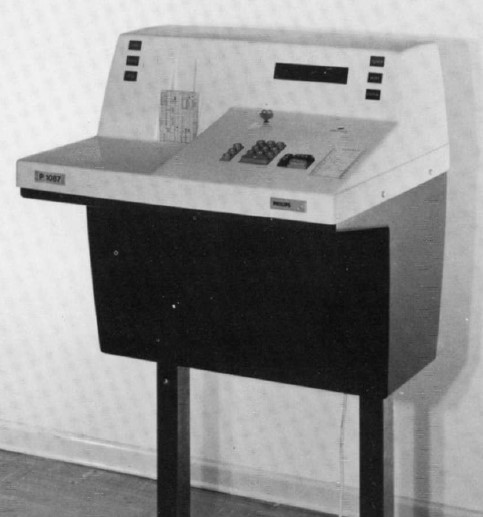
Soon after, Philips started manufacturing computers and related devices for office settings, using the naming format P1xxx. A 1971 catalog lists a P1020 Punched Tape Reader, a P1040 Disc Control Unit, a P1075 Central Machine, and a P1086 Teleprinter, amongst other devices meant for companies.
A P1070 Data Collection Device for feeding punched cards.
They focused on office computers for a long time, and snuck in the home market only sideways in 1975 via a gaming device, one of the first in Europe for homes, the Tele-Spiel ES-2201. It included swappable “cartridges” which were the hardware for a game (rather than stored programs).
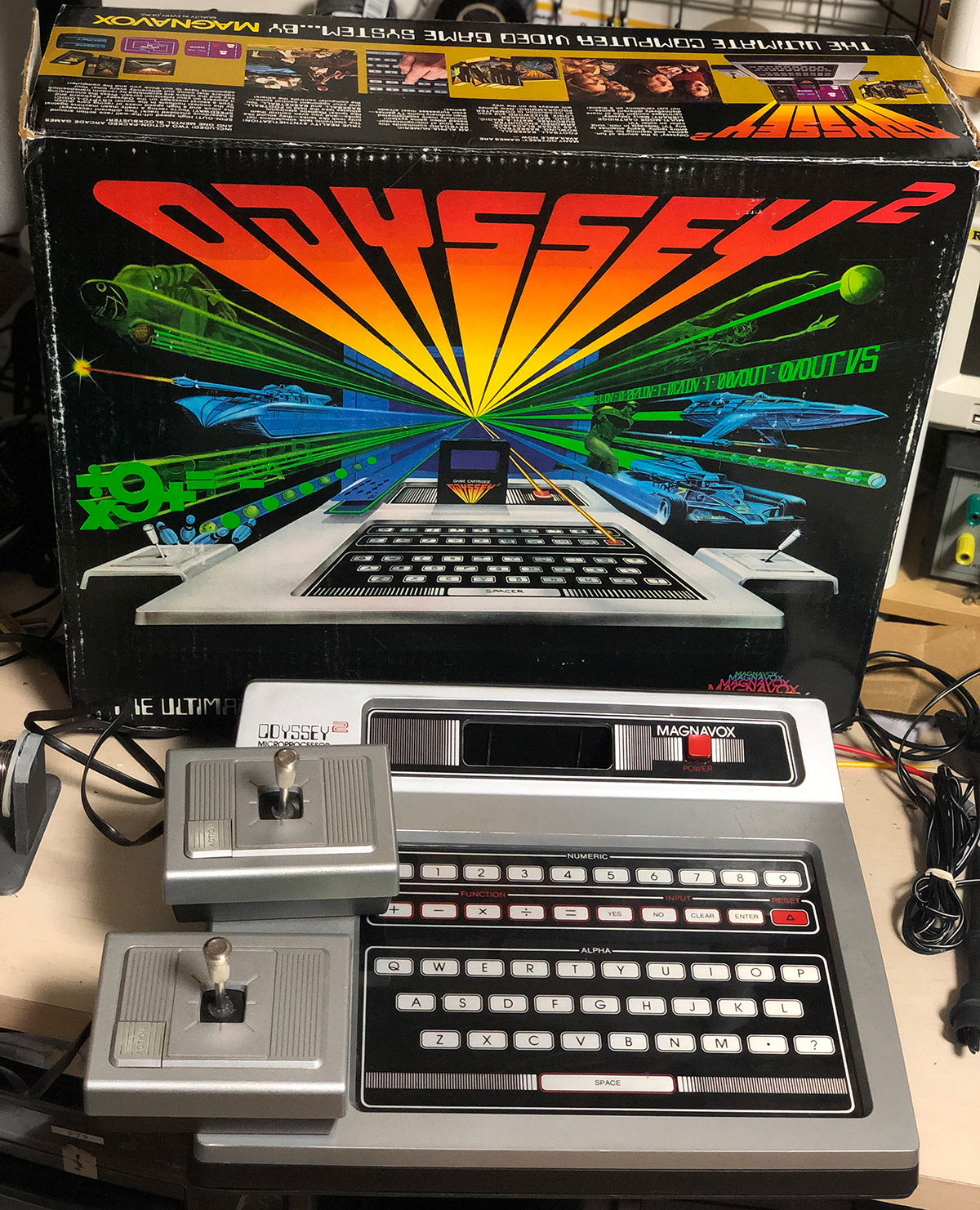
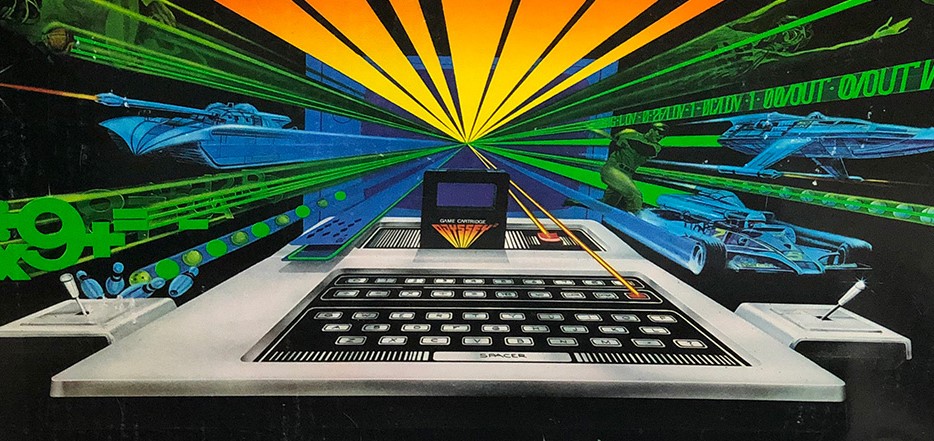
They went on to manufacture the Philips Videopac G7000 (known in the US as the Magnavox Odyssey 2), a regular videogame system with traditional cartridges that was a competitor to the Atari 2600 (amongst other gaming consoles); however, unlike the Atari it came with a full keyboard and was partly in the odd hybrid console/computer state that was in vogue at the time (see also the Bally Astrocade).
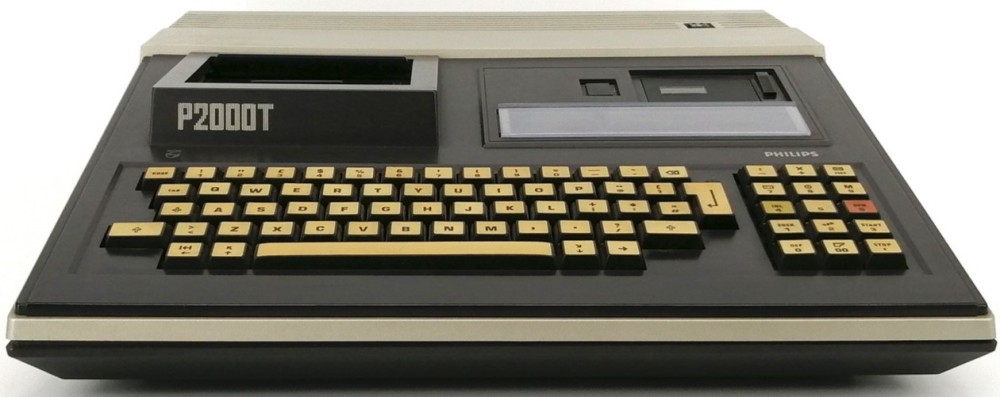
Still, the Videopac wasn’t a proper home computer, and Philips finally entered the market in March 1980 with the P2000. According to this information from a former manager at Philips, the device was originally conceived of in Sweden (using the name P1000) before getting finished in Austria (being redubbed the P2000, since the P1xxx was used for office machines). I will confess I am still nebulous about this and I’ve seen contradictory information in various places but it does seem to be true that the machine was essentially Frankensteined together from various Philips products: an electronic typewriter as the base, tapes via a Philips dictation machine, cartridges via the Videopac. The display used a teletext screen, which made things simpler in manufacturing terms but meant the system was restricted to very low resolution. (The much more successful BBC Micro had a teletext mode but also a higher res mode; the P2000 did not.)
The long association of Philips with business put up a sincere concern amongst the company that people would be turned off, hence the founding of the Philips P2000 Computer Club (P2C2) in 1980 (technically speaking, opening up a closed-membership club founded the year before for research testing purposes). Computer clubs became a strong part of the early computing culture of the Netherlands (the group p2000gg coming a year later, in 1981).
Just like any other computer club, the P2C2 distributed programs, one of them being a port of Pirate Adventure to P2000 (translated into Dutch). What concerns us today is a Dutch original game from 1982, also from the the P2C2 but otherwise with no author.
While (see screenshots above) I do have a copy of the game via the P2000T Preservation Project, and I also have a copy from the late 80s in GW-BASIC, I started by playing the modern translated version:
KORENVLIET
A short adventure by Alexander van Oostenrijk @ Independent Software
(www.independent-software.com), based on the original korenvl.bas (author unknown).
Copyright 2016.
First-time players should type “about”.
Version 1.2
You were recently informed that your eccentric uncle Wout had passed away. There is a persistent rumor that the old crackpot left the Korenvliet estate to whomever manages to locate his will – even you, his least favorite nephew.
Today, you’ve dutifully travelled down to the village where the estate is located to start your search of the grounds.
Main Street
This is the cobbled main street of the village which has grown around the sprawling estate over time. The impressive front door of the stately villa of Korenvliet is to the east, while there is a small supermarket to the west and a village clinic to the southwest. A narrow path leads to a forest to the south, and there seems to be a vacant lot to the north.
One thing I had in the back of my head was that, despite “wacky inheritance” stories eventually becoming a whole category in text adventures, it wasn’t really a thing yet. In particular, the only other game I could think of with such a plot was Stoneville Manor, a completely innocuous game and the only one known by Randy Jensen.
Then I got to mapping, and found a balloon, a boat, a stove (?), a lake with a fish, a snorkel, a book…
> read book
You glean from the book that amateur hot air balloon construction requires a balloon, a stove with some fuel, a gondola and some cable or rope. It also states that one should build that balloon in “a suitable spot”. Well, that would be an interesting if risky project. It’s amazing what old Wout got up to in his old age. Since there has been no news of hot air balloon experiments near the village, he must not have gotten around to actually doing it.
…and then with the book it hit me: this was Stoneville Manor. This is actually a quite direct port.
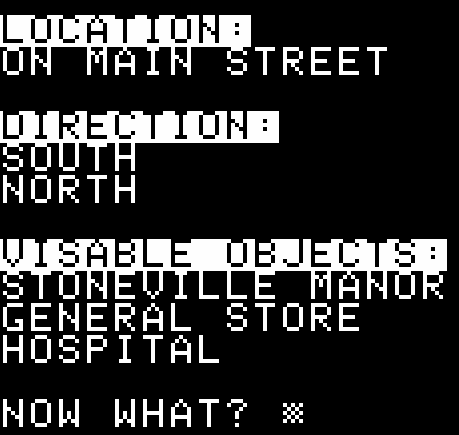
The opening of Stoneville Manor.
The opening of Korenvliet. This is an exact translation into Dutch, other than the name of the manor has changed.
I decided immediately to test one of the most memorable things about the original game, which was going south twice to a forest, climbing a tree, and landing in a hospital. To get out of the hospital you need to type GET WELL.
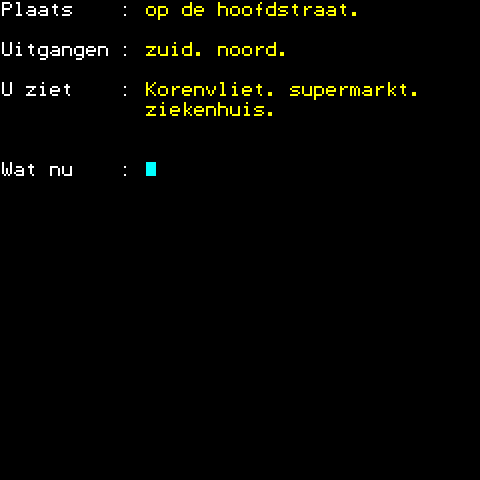
Plaats: in het ziekenhuis
Uitgangen: uit
U ziet:
Wat nu: ga uit
Ik voel me niet goed.
Yes, it’s in! (“Ik voel me niet goed” -> “I don’t feel good”.) Unfortunately, I don’t know what the corresponding pun is in Dutch to escape the hospital, and I was not able to check the source code. (LIST in GW-BASIC upon loading the code gives me “Illegal function call” — something in the code is hacked to prevent listing it, I think? Either that or something in Dutch is confusing the program.)
I did sufficient tests to decide there weren’t any other changes of note, other than the lore of the game as a whole. The original had a Mr. Stone die who was no relation to yourself; in this case, it is your uncle.
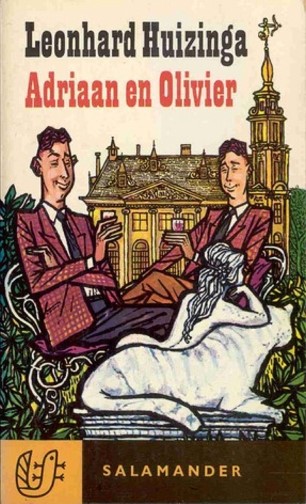
This changes the lore to be based on a Dutch series of books! Specifically the Adriaan and Olivier books, a series of nine from the author Leonhard Huizinga. They kick off when the twins in the title inherit their country house from their previously unknown uncle, the house being, of course, Korenvliet.
So just to be clear about what happened:
Somehow issues of the English magazine Creative Computing ended up in the Netherlands. Specifically, December 1980 (for the Pirate Adventure source code) and August 1981 (for Stoneville Manor). Both games were ported by the Philips Computer Club. Pirate Adventure was always known as a Scott Adams game, but the Jensen one was a bit more obscure, so it was assumed to be originally written in Dutch. This version spread to more ports in the 80s (including GW-BASIC and MSX) and from the GW-BASIC version eventually got translated back to English in TADS 3 format by Alexander van Oostenrijk who was unaware there was an English original and made it “modern” with longer descriptions.
I’ve finished the game, and you can read all my posts in sequence starting here.
A map made by a fan that eventually was packaged with the game, via Stardot.
So from last time, I really had one key puzzle that caused nearly all the rest of the puzzles to fall down easily — we’re talking puzzles like, “bring cheese to a mouse” followed by “use the mouse to scare away an elephant”. Most of what remained was … well, I wouldn’t say “busywork”, exactly, but there was a lot of shuttling things back and forth, and there was one large maze left I that I just threw the towel in on and looked it up (see the upper right corner of the map above; it’s a very long desert maze leading to the Sphinx of the game). I do say “most” as there was one more obnoxious “hidden puzzle” and the final puzzle was genuinely interesting.
(And before I go on, “hidden puzzle”: a puzzle where it is unknown on surface glance to the player there even is a puzzle, and they have to try some act which reveals a secret exit or item or something of that sort.)
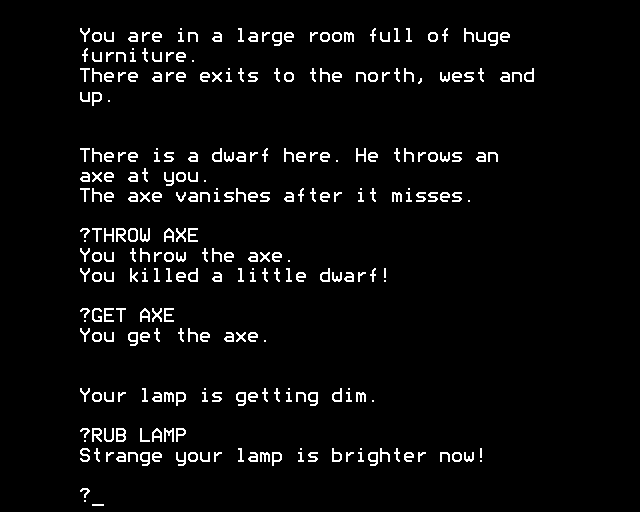
The lamp light issue turned out to be relatively straightforward to resolve once I decided that yes, most definitely there is no way to get through the game fast enough, and that there’s no “vending machine” equivalent. I went back to study my verb list, not terribly long…
KNEEL is still important.
… and found you’re just supposed to RUB LAMP, and only after your lamp starts to lose strength.
Out of the issues I listed last time, I had
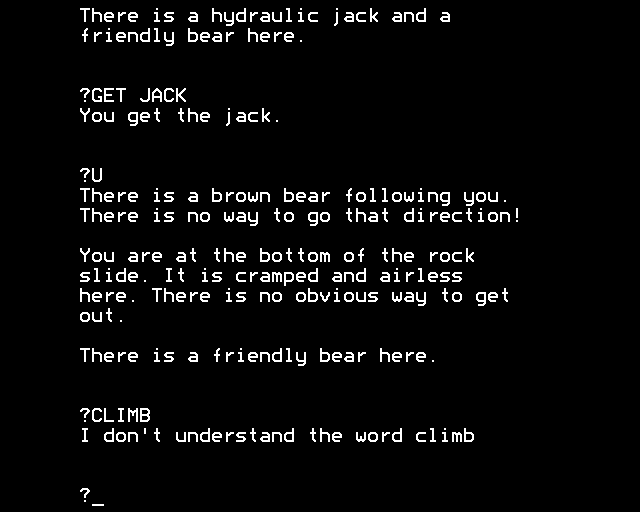
a.) getting the hydraulic jack at the rocks
b.) getting the mouse at the castle
c.) doing something at the fairy grotto, maybe?
d.) doing something with a “friendly rabbit” that follows you around the safe area, you can feed it a carrot but that’s a treasure, and it otherwise seems useless
e.) getting out of the monster at the lake
and let me add f.) the collapsing bridge at the glacier, which I forgot to list even though I had a screenshot of it in the post.
d turned out to be, as I suspected, a red herring — just don’t go into the room with the rabbit, use the carrot as a treasure, and move on with life.
Out of a, b, c, d, and f, I needed to solve c (fairy grotto) first, which was required to solve all the remaining issues.
Yes, just waving the wand did it, the same one that created the bridges. The game is establishing a general pattern here of magical items doing more than one thing, and the ring is no different. You can rub it to teleport (you go back to the Sorcerer’s Room near the lake) or, rather more mysteriously, it lets you walk over the bridge at the glacier.
There’s no good logic to the “physics” here; you’re just supposed to find out it happens.
While I had the fairy area on my to-solve list, having a hidden puzzle be so crucial is a dangerous move in game design. You often will have players see puzzles B, C, and D, and no others, and try hopping between them in an attempt to break through; yet all the time there was puzzle A they didn’t even know about that was the crucial hook. This sort of secret observation can be enjoyable for those who find it and intense frustration for those who don’t.
Wrapping up the other puzzles on my list, the teleportation feature of the rings means it is easy to escape after picking up the hydraulic jack, and it does indeed work on the clam to get a treasure inside.
b (mouse) and d (lake monster) required exploring the area past the glacier bridge, where there’s a “Hall of the Mountain King” (of course).
(The teeth came from killing the dragon. Having powers manifest by throwing the teeth is a fantasy trope that I already had in my head but I’m not remembering from where. Did Ray Harryhausen do something along those lines?)
Other than that hall there are some gnome halls, where I found some cheese, which I could re-direct back to the mouse at the castle (trudge trudge trudge, at least I didn’t have to worry about lamp light any more)…
…and then the mouse I could take back to the Mountain King area (trudging, but with a teleport making the path slightly shorter) where there was also an elephant.
This opened a path to some matches, that I immediately realized (from the bad smell, also the fact this puzzle appeared in Brand X) that they were the solution to the sea monster puzzle.
This leads to a very small area and the annoying hidden puzzle I was mentioning. So the wand has two totally different uses; the ring has two totally different uses; the word diaxos (previously used to open a vault) has two different uses.
Well, not completely different: you’re still opening something. But diaxos elsewhere causes the creaking sound of the safe opening, so I made the perfectly natural assumption that’s exactly the place it affects. I was even prepared to praise the puzzle as having a normal and solvable “physics” to the magic (unlike the ring + glacier bridge) but apparently diaxos is just a general opening spell. If I squint slightly I can see how that works, but I admit I didn’t solve the puzzle myself; I got indirect help from Anthony Hope who wrote a walkthrough. (He hasn’t even commented yet, so I’ll wave and say hi. You may remember him from the video walkthrough of Xanadu Adventure.)
Oh well. There was a bit of mop-up work otherwise but fairly straightforward, like using the keys from way back at the start to unlock a chest with treasure.
I assume this is where you rescue any treasures stolen by the pirate. The funny thing is you don’t have to even meet the pirate; he is in a room that can be stepped around, and he doesn’t “activate” and start doing random stealing until you’ve met him once.
Most of what remained was toting a large pile of treasures over to the sphinx, and this is where I hit my Maze Limit: it’s a long, boring desert. I just looked up the solution.
From Stardot. Yes, it takes that many steps. Yes, there’s a wrong exit near the end that sends you to the start.
I keep in mind with such moments that this was designed one step removed from Adventure, so it isn’t like the author experienced the many wonderful, wonderful games that dispensed with the idea of mazes altogether. Alas. (And in seriousness, it does feel like the author was trying to “recreate the experience” while still being different; the mazes loom large enough in the original game I could see their absence being felt in a tribute.)
And now we are at the final puzzle. There was a message earlier in the game, at the jar of spices, to
be humble in the eyes of the sphinx and use your brains
and I already had kept the verb list in mind, so I tried the long-awaited KNEEL:
You are kneeling down.
And … nothing. One more action!
Re-using the magic wand yet again for a new purpose. Fair enough!
Sphinx Adventure wasn’t exactly hard as much as slow; I’m eliding over “and then I had to make another trip” and my backtracking to optimize a little because it turned out to be less annoying than remembering where everything was scattered.
For its purpose — to introduce some people to adventures for what I believe is the first time, based on reactions — I think it worked. The game never tried to use its simple parser for anything too heavy, avoiding a common trap for early adventure writers. Also, while the “bring every treasure to the sphinx at the very end rather than the building at the start” seems like a minor tweak, it does make for a genuine one: having toted everything across the map felt like an epic journey, so the small change in mechanics affected the narrative significantly.
Coming up next: U heeft on langs ver nomen dat Uw exentrieke oom Wout overleden is. Het gerucht gaat dat deze oude zonderling het landhuis Korenvliet heeft nagelaten aan degene die zijn testament weet te vinden.
(Previous posts on this game in chronological order here.)
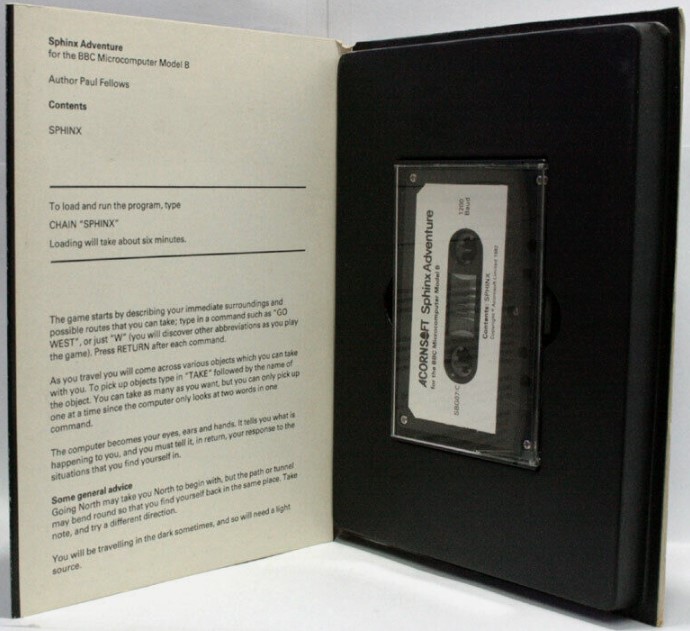
Via eBay.
So despite a few more simple puzzles, this one’s been fighting back a bit. Part of the issue is logistical: the lamp timer is very, very, tight, so tight (given the conditions of where I need to go) that I have a feeling there has to be a way to revive the lamp’s battery. I can’t even find a way to turn the lamp off to conserve power when needed (the usual suspects EXTINGUISH, OFF, TURNOFF, and UNLIGHT don’t work).
Both CROSS and KNEEL immediately stand out as rare. I’ll get into them later.
The other issue — common for these games with lamp-light timers — is logistics. Some places are far away from each other, and my last lingering puzzles are fairly spread out in a way that it is hard to do an immediate test — it may be that item X across the map is needed for puzzle Y, but it takes a while to check the possibility and it may require re-routing my entire sequence (again, given the lamp light timer is tight).
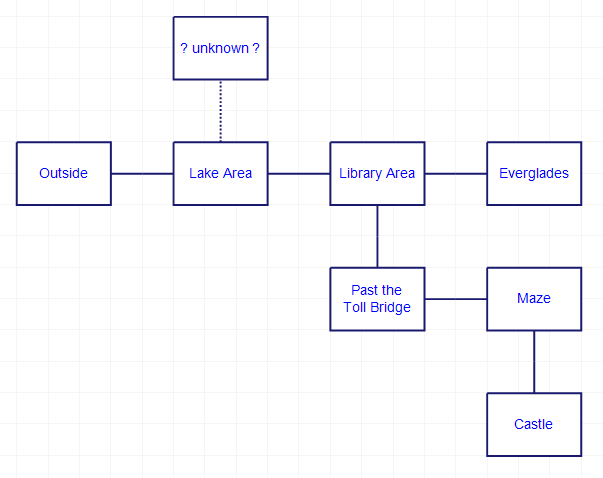
A meta-map showing connectivity, directions are not accurate. I found a method of travel across the lake but I get stuck right away so I don’t know where that goes; it requires an item from the Castle, so that’s at least one big back-and-forth.
If the inventory limit was absolutely unlimited — and it initially appeared that way — it still wouldn’t be much a problem, but there is a limit, and since one of the main gimmicks is that the treasure-destination (the Sphinx) is hard to find I’ve been having to tote all the treasures around. If it turns out, for example, the Sphinx is on the other side of the lake and it is a one-way trip, I need to be carrying every point-valuable object in the game while doing so, which is tricky because even some non-treasure-like items count for points (like the bottle).
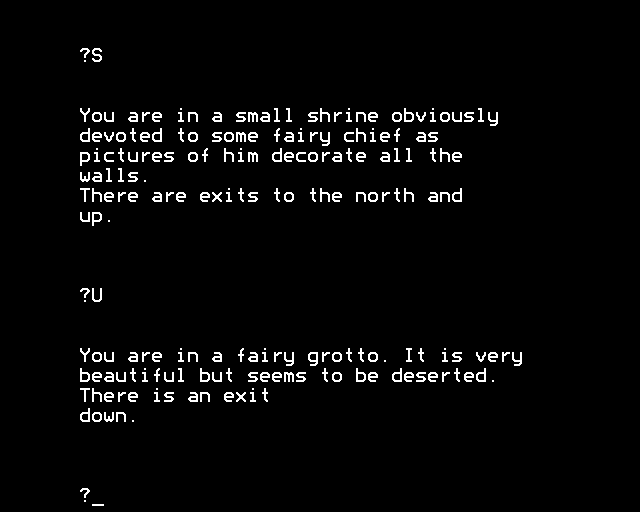
Continuing the action from last time, I had retrieved some items in an area past a crocodile. I had the fairy grotto which may or may not have just been atmosphere; KNEEL doesn’t give any special response other than “You are kneeling down.”
Going off in another direction is an area past the troll:
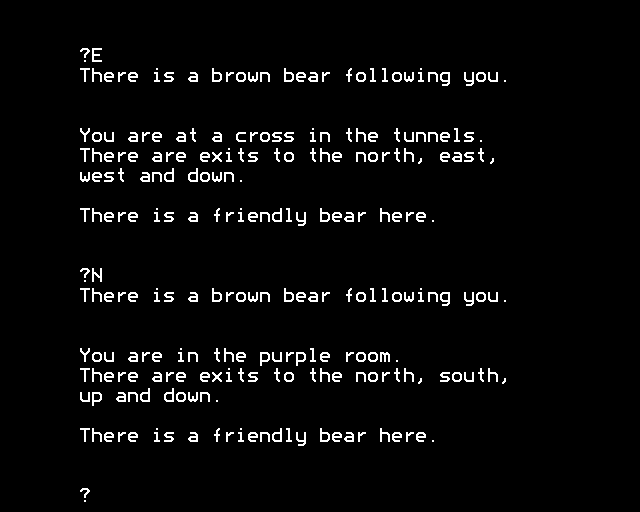
A bit to the west there’s a friendly bear that just starts following (unlike the one in Crowther/Woods, you don’t need to feed it). There’s also a puzzle that I’ve yet to solve, where you tumble down some rocks and get trapped. You need to do this because there’s a hydraulic jack I am 99.999% sure is used to open a clam later (again from Crowther/Woods, in that game you used a trident to open the clam).
To the east there’s an ogre you can take down with a sword, and still the weird interface which asks if you want to use your bare hands first.
This is followed by an orc the bear takes care of (the bear the disappears); as an aside there’s a glacier which the wand works on to make a bridge, but the bridge always collapses when you try to cross, even if you have no inventory items.
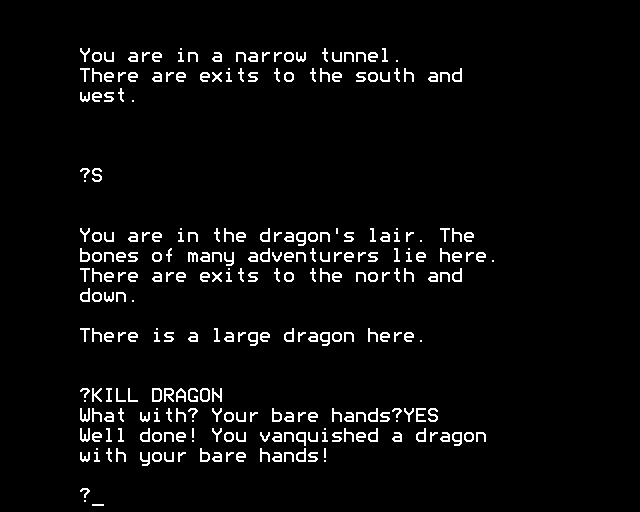
Then there’s a dragon where (unlike everyone else) you say YES when it comes to using your bare hands.
This leaves behind some dragon teeth.
It’s a curious “fix” to the puzzle; certainly there’s no need to mysteriously assume the game will understand YES, but on the other hand, but having it be part of a progression of monsters, it’s confusing that a dragon would be easier to beat in fisticuffs than an ogre.
Moving on further (ignoring the fact the jack is unobtained for now) there’s a maze. Despite it being “fair” (no connections are one-way, diagonals aren’t included, it is technically drawable on paper) it pulls off a mean trick.
Specifically, it appears at first — especially with some “color” rooms — that no special effort is needed to map, and just the names of the rooms are sufficient. However, right away the game gives a “red room” that looks close to what turns out to be a totally different “red room”.
If you look closely the exits are different, but I got myself befuddled by assuming after a sequence of four moves that I landed back in the same red room I started at, when I was in an entirely different red room.
Once I realized the trick I just started dropping items as normal to map the maze. Then it just becomes the usual tedium.
Have any of the direct-imitation-of-Adventure variants we’ve seen — that is, games where the author is only one step removed — dropped having a maze? I don’t recall any.
All this leads to a castle:
Not much of interest here, other than there’s a vampire that requires using a wooden stake found back at the Everglades, so that’s another bit of forced travel sequence (you can try to not open the casket, but upon returning to the courtyard the vampire has opened the casket themselves).
The castle also contains a mouse (runs away so I can’t take it, but I assume there’s a trick) and a wooden boat that you can carry along with everything else. (The item limit is 17, so the visual is kind of hilarious. But you need more than 17 items to keep everything!)
The wooden boat can get toted back to the lake. I was stuck for a while on verbs (just THROW BOAT, GO BOAT didn’t work) until I tried CROSS LAKE, referring to the lake noun rather than the boat itself.
…and here I am stuck. To summarize, I haven’t solved
a.) getting the hydraulic jack at the rocks
b.) getting the mouse at the castle
c.) doing something at the fairy grotto, maybe?
d.) doing something with a “friendly rabbit” that follows you around the safe area, you can feed it a carrot but that’s a treasure, and it otherwise seems useless
e.) getting out of the monster at the lake
All of these might have simple answers but even given a very generous item limit I’m now having to juggle, and even making a very direct beeline for all the items possible I start running out of lamp light around the castle. This still doesn’t feel the same as being stuck on Hezarin, but being unable to make progress looks roughly the same from one game to the other, so it doesn’t matter if the underlying system is much simpler (and by necessity, any puzzle solve will have to be straightforward).
In the past I’ve tried my best to point out how the various text games I’ve played (despite a very common set of elements) nevertheless have strong fingerprints which distinguish them. This game is no different, and I want to do some compare-and-contrast with two sections. This is useful from both a history-of-games standpoint and a theory-of-games standpoint.
Picking up the action from the obligatory troll’s toll bridge, I tried paying the troll and exploring a bit farther.
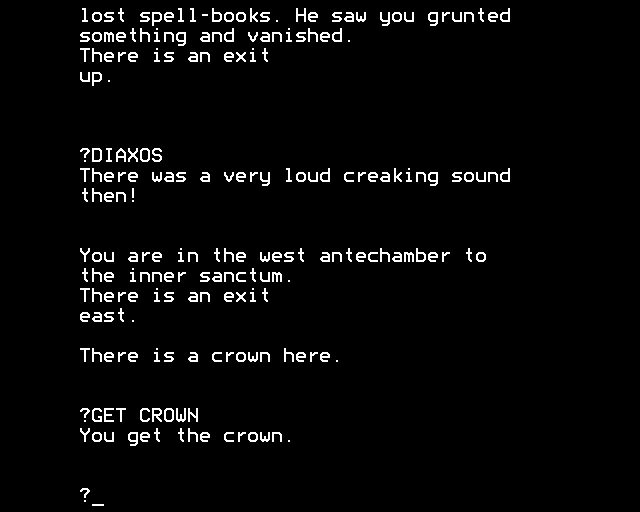
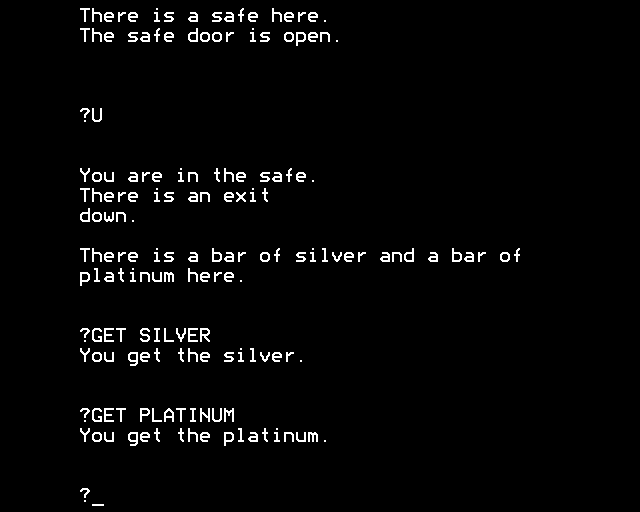
I was given the word “diaxos” in one of the rooms (it gets whispered like “Y2” does in Crowther/Woods). The word “diaxos” give a “very loud creaking sound” no matter where it is used, and the trick is to realize that this is the sound of the safe (back on the other side of the troll bridge, by the library) being opened.
By default there’s a bar of platinum but if you hand something over to the troll beforehand, it also ends up in the safe. So that problem’s resolved: you give up a treasure and you just get it back later.
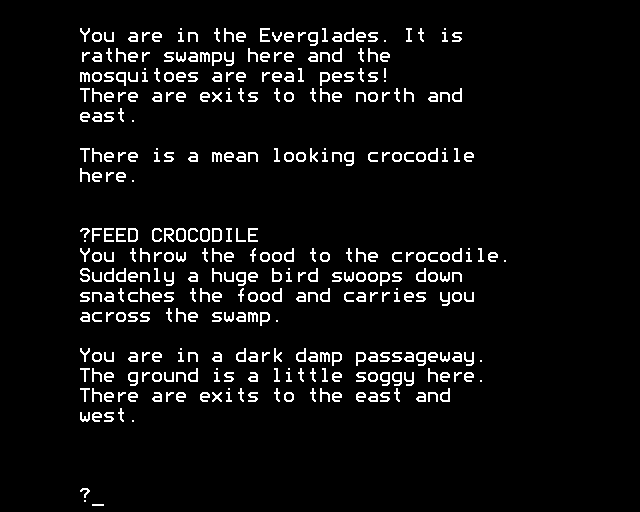
I also had encounters with an ogre, orc, and dragon in that order, but I want to save that for what will hopefully be a final or close to final post, and focus on the Everglades area. I was getting chomped by a crocodile who just needed some food (although the exact sequence of what happens is a bit unexpected).
The upshot of the sequence above is that the trip here is one-time-only. You can safely go back in the Everglades, but the still-hungry crocodile will still chomp you if you try to go by again. Fortunately, there’s no real need for a second trip, because the whole area has no puzzles: just locations with treasures lying around.
Treasure rooms marked with color.
In a sense, this means the game reverts to the type from some early games like Explore or Chaffee’s Quest: just movement and treasures. (Probably. There is one possible secret.) Furthermore, it has the random-placement style of those games; there’s a “yellow brick road” in one spot, some quicksand in another, a treasury, and a fairy grotto.
However, despite just being rooms, there’s some semblance of environmental narrative going on. The quicksand has a plank left by a previous adventurer.
Also, you can safely go “down”, but just end up at a dead-end: “Oh dear you seem to have struggled through that quicksand for nothing”.
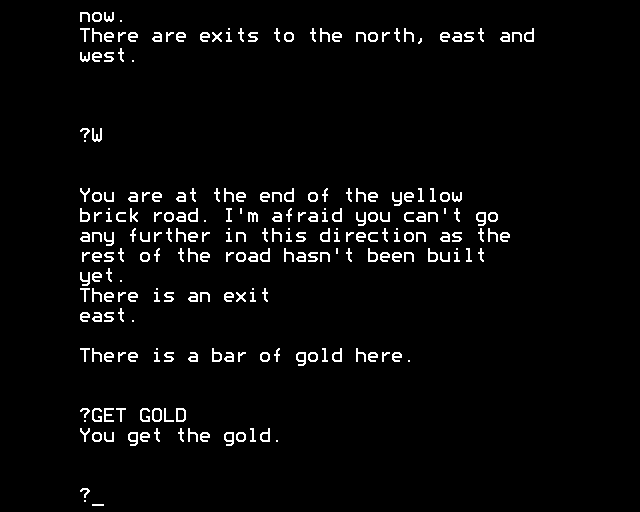
Similarly, the yellow brick road was only previously yellow:
And it is possible to make it to the end of the line where the road stopped being built:
The effect is really light and vignette-based. I did mention one possible secret; the fairy grotto has no treasure and it is highly tempting to think a magic word or something like that goes here. On my “best progress save” I am saving nabbing all the treasures in this area because of the fairy grotto, although it could easily be more environmental storytelling.
One other subtlety I want to point out — and this is true of every area, not just this self-contained one — is how the structure of the text is part of the user interface. If we go back to original Adventure (the only reference for this game) there is one major standard established right away:
YOU ARE INSIDE A BUILDING, A WELL HOUSE FOR A LARGE SPRING.
THERE ARE SOME KEYS ON THE GROUND HERE.
THERE IS A SHINY BRASS LAMP NEARBY.
THERE IS FOOD HERE.
THERE IS A BOTTLE OF WATER HERE.
Namely, that objects that you can pick up are separated from the main text. There is, of course, an easy technical reason for this (it is a lot harder to modify the body text than it is to concatenate a bunch of object-in-room messages) but it also serves to make the player have an easier time. By contrast, consider the ICL game Quest:
You are in a small log cabin in the mountains. There is a door to the north and a trapdoor in the floor. Looking upwards into the cobwebbed gloom, you perceive an air-conditioning duct. Lying in one corner there is a short black rod with a gold star on one end. Hanging crookedly above the fireplace is a picture of Whistler’s mother, with the following inscription underneath: ‘If death strikes and all is lost – I shall put you straight’.
The short black rod which you can pick up is placed in the middle of the text, and furthermore doesn’t have the line-skip to separate it. Despite both cases dealing just with prose, the first example more easily highlights the things a player can interact with, and so the text structure itself provides a UI.
Now consider Sphinx Adventure:
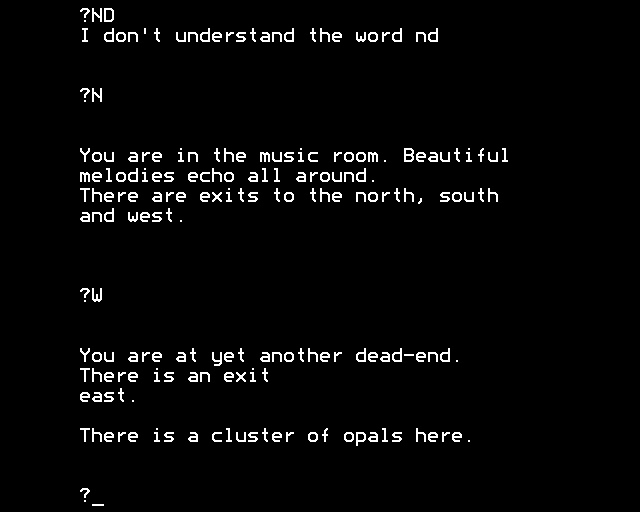
The format is
You are in a music room. [Statement of room name] Beautiful melodies echo all around. [Description of environment]
[Break to next line]
There are exits to the north, south, and west. [Listed description of exits.]
Notice how this easily gets across: the room as a short name (for ease of mapping), and the break between description and interactable parts (in this case the exits). When an object is included there is a further break.
You are at yet another dead end. [Room name, no description.]
[Break to next line]
There is another exit east. [Listed description of exits]
[Break to next line]
[Another line break, meaning the break here is different than the break between room name and exits.]
There is a cluster of opals here.
This conveys quite quickly the one direction you can go and what you can take, and the two kinds of breaks subtlety adds another bit of help in reading what the player needs.
This seems like a small and obvious thing (and it was at least started off in Adventure) but certainly not everyone followed the system so cleanly. (Having windows like the French Colditz game I played recently is another approach, but one with different issues.) One major gameplay consideration is if there’s any important objects sequestered in the “room description” portion. This game the answer seems to be no; you can’t refer to the plank at the quicksand, for example. Many a time I’ve been stuck has been when a game seems to establish this “sequestered room description” setup but then violates it. The biggest thing to remember in UI design is consistency, lest your UI gets mocked like like this chart of all the different ways to go left and right in Starfield. (I especially like how in one case it’s the letters Q and E and in another the letters Q and T and yet another the letters Z and C … why?)





















 Renga in Blue