While I mentioned it last time, let me delineate out carefully the four versions of the game:
1.) Pythonesque, the original 1982 version, released for PET and Commodore 64 (I played this version, on C64). The top of the screen at the start actually reads
PYTHONESQUE or The Cricklewood Incident
but the catalog just calls it by Pythonesque. Either title is appropriate, I suppose.
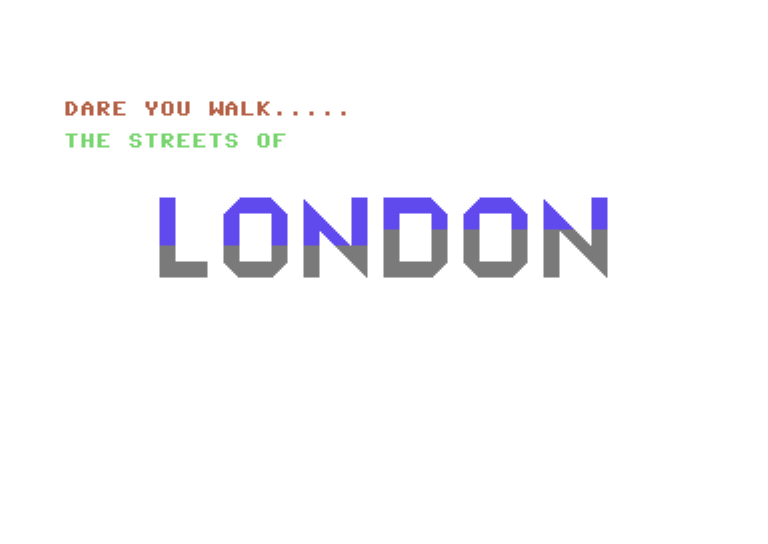
2.) Streets of London, a 1983 version just for C64. The intro screens are different and at least one of the rooms has a different name, so there is some tweaking going on despite the games allegedly being identical.
This is important because the walkthrough I used — and yes I absolutely, completely needed a walkthrough for this game — was for Streets of London (1983), not Pythonesque (1982), and it is possible, likely even, that I played a worse version of the game. This is a type of game where even a small (and non-obvious) change of variable might drastically change the gameplay experience.
This is called “Strip a go-go” in Pythonesque.
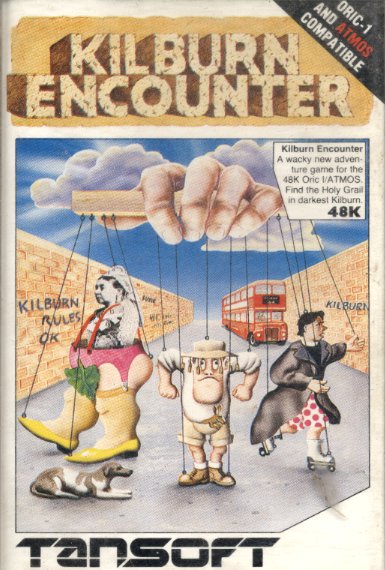
3.) The Kilburn Encounter for Oric. This seems to try to match the original.
4.) The Cricklewood Incident (alone, without the “Pythonesque”) for Electron, Dragon, and Spectrum, with at the very least textual changes.
From the Centre for Computing History. This feels closer to an actual graphic Monty Python would make than Streets of London did.
I have no plans to investigate items 2 through 4 thoroughly because, at least in the incarnation I played, the game was extraordinarily bad. Mind-rendingly bad. I think if I’d been able to follow the walkthrough as written, it might have been okay but still painful; I had to deviate and come up with my own route. It was rewarding in a “I finished something hard” sense but not in a “fun” sense.
To pick up from last time, I was in a scenario where I was occasionally getting money but I didn’t understand why, but I otherwise was either applying a magic word (OH YANGTZE) to move around or waiting to get teleported at random.
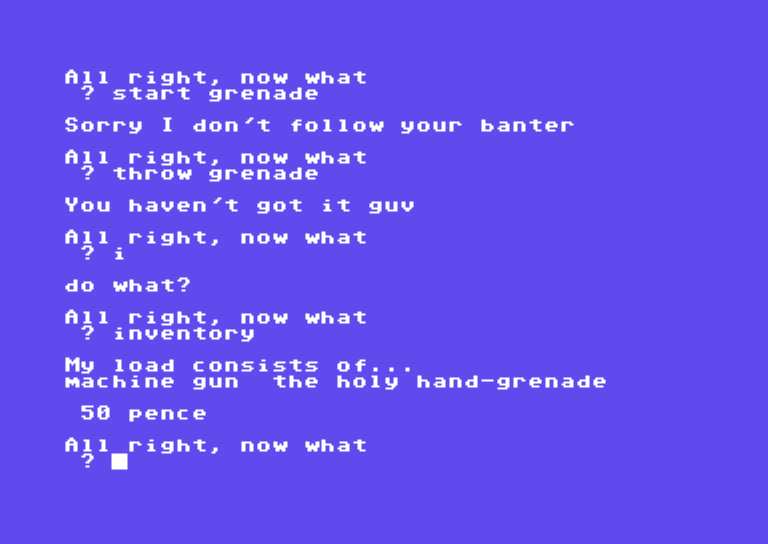
I first discovered that the source of my money was the magic — every time I used it, I would get 50p. However, the word is only usable a maximum of 3 times. The word lets you go almost anywhere in the game, including the second-to-last place you’re supposed to go. Behold:
I also discovered if I had money, and I hung out at the tree-lined lane at the start, I would start to get mugged continuously by the Hell’s Grannies. The amount they take is dependent on the difficulty level at the start of the game (remember I went with easy, which was a wise choice).
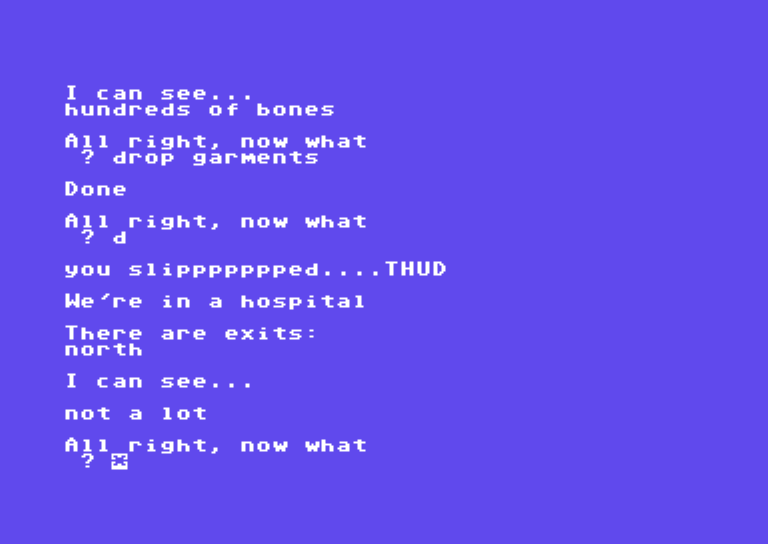
More rarely, this message happens. The flask of meths incidentally is useful once (only once) for a teleport just like the magic word, and subsequent uses send you to the hospital.
One major thing I was missing is that MUG is a word; that is, you can mug the grannies back. Sometimes you’ll just get some money (something like 10 to 110 pence), sometimes she’ll put up a fight.
I just jammed the keys as fast as possible. Your health resets on a hospital visit, which happens if you hit 0 health, but going to the hospital also drops your money by half.
I think an optimal strategy might be to jam the 9 key quickly (run away) and only get money from the “guaranteed” muggings.
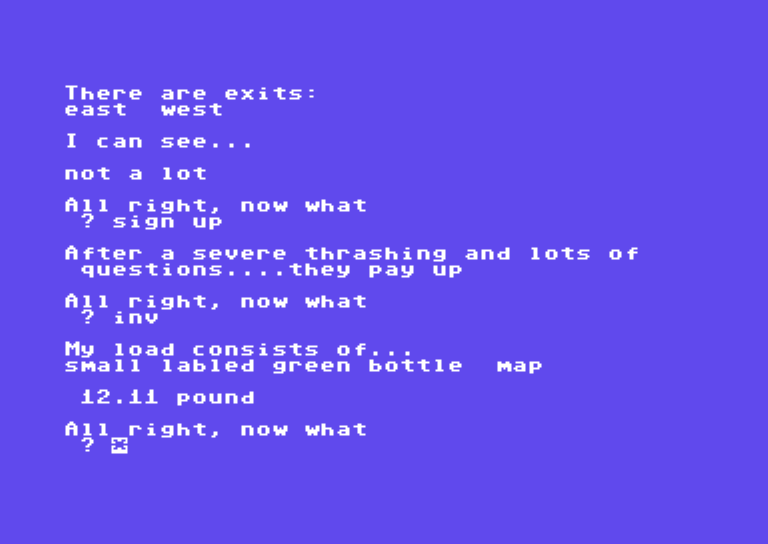
There’s one other method of getting a large chunk of cash (more than 10 pound at once) but it requires an almost absurd leap: at a “squalid DHSS office” you can SIGN ON. (Which I guess means … pick up your pension check, maybe? … they don’t even exist anymore, so I have no idea.)
I also worked out the navigation in general, and this is where the nightmare truly begins. First and most simply, if you “die” for whatever reason, you land in a hospital (which takes half your money) and then you can travel back to the start.
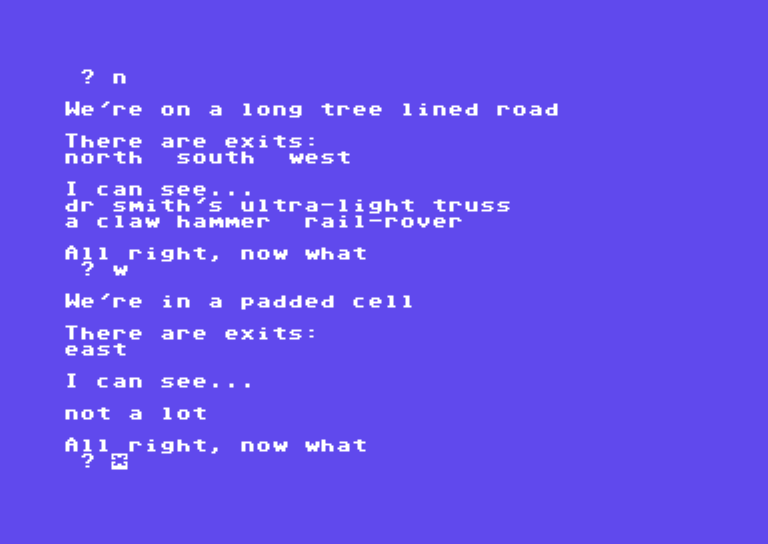
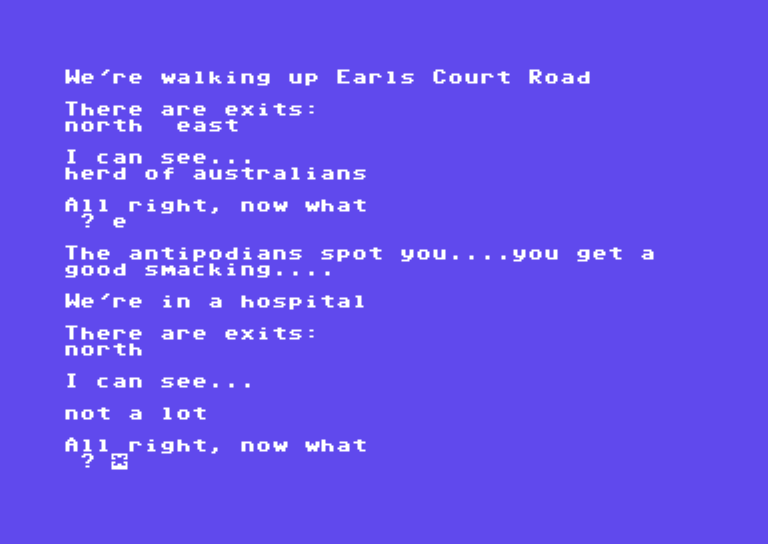
The starting area has a bus stop. You can wait at the bus stop and spend money to ride a bus. This bus will drop you somewhere random off a list of 6 places. If you hang out near the bus stop and just wait for an “incident” to happen you might either land at a bus stop but you might also land at the hospital or just another spot on the tree-lined road.
A random teleport. It happens once every 60 turns or so but it truly is random, so if you are depending on it you might having to wait for 100+ turns.
Then, at one of the bus stop stations, there is also a train station. If you buy a “rail-rover” for 5 pounds (something I never was able to gather until the SIGN ON bit) you can also start riding the rails, and it means you can wait for trains. These trains will also take you to random places off a different list of 7 places.
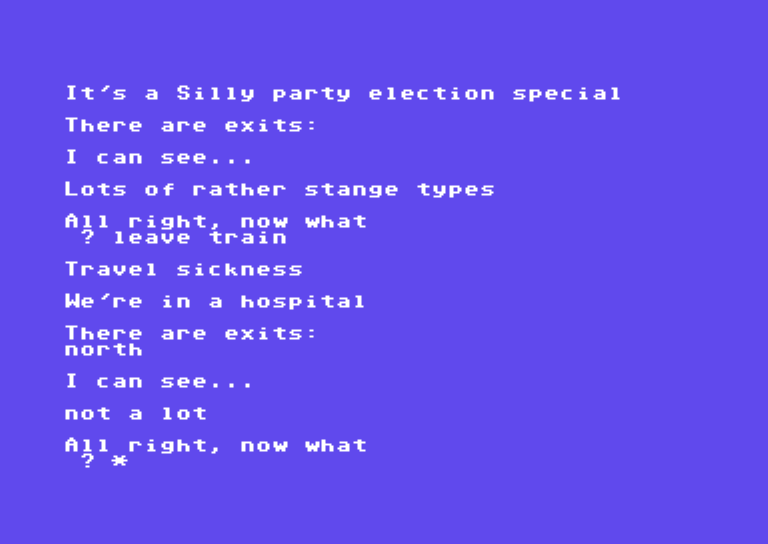
The trains are likely to kill you (at least in Pythonesque). You sometimes are on the train with “skinheads”; if you have the machine gun you can kill them first, although you still are liable to end up with “travel sickness” unless you also have travel pills handy (which can be bought from a shop). I found if I left behind either the gun or the pills I almost always failed to ride the train before landing in the hospital.
One of the trains takes you to the “dark forest” area which is the final portion of the game (and eventually leads to that rabbit cave I showed off earlier).
In a meta sense, it looks like this:
Keep also in mind this game has an inventory limit, and if you’re playing without knowing the solutions first, you don’t know what you’re supposed to be toting around in what order.
Traveling with this structure is the most painful I’ve ever experienced in an adventure game. (This includes sluggish late era 90s CD-ROM stuff that made molasses look fast.) I knew (or prior to me deciding to lean on the walkthrough 100%, thought I knew) the place I wanted to go, but it often took 10 iterations to get there, and in the meantime it wasn’t hard to randomly end up in the hospital or just run out of cash by using the bus too many times. If you end up in the hospital from the train, to get back you have to first luck out and get to the right bus station, and then get back on the train from there. (Also keep in mind I also only discovered the “solution” for skinheads relatively late in my gameplay.)
The magic word, remember, can let you go anywhere, and it is what ended up letting me struggle to the end of the game.
So, here’s how things are supposed to go, and I’m going to give the “no magic word” version:
First, mug enough of the Hell’s Grannies to get money for bus rides and some purchases. That maximum I could get to was roughly 2.50, but I didn’t try doing the run-away strategy when the Grannies fought back.
Second, get the money from the DHSS office; in the meantime nab the machine gun (in the open), a truss from a chemist and some travel pills (the walkthrough ignores the pills, don’t do that), a shrub (maybe, I’ll get back to that). You’ll also find the cheese shop scene…
…but rather than shooting the owner, you need to shoot the person making music instead. The owner will be happy and give you a map. (The map, again, might be optional just like the shrub, I’ll get to that.)
Near where the train platform is you should buy a rail-rover ticket when you can. You should also get a green bottle with some “big boy macho tablets” from that weird coffee table scene I mentioned last time (Voltgloss pointed out it was from a Python sketch involving “Doug and Dinsdale Piranha”).
Note that amidst all this you’re skipping a bunch of items that seem like they might be useful (like a claw hammer and a ferret). Did I say already how mean this game is? I’m also ignoring the fact you don’t have enough inventory slots to carry all that above all at once so you have to ferry things in multiple trips.
You need to then hit the trains. You need to be holding the rail-rover to get on, but also machine gun and travel pills at all times on the trains. Make sure you kill skinheads if you see them, and take the travel pills otherwise.
You need to go to a sex shop to pick a doll (which costs money, hope you haven’t run out from the muggings, the Grannies will mug you on the train platforms too), a holy hand-grenade from a cistern, and a torch just laying out in the open. You will not be able to carry all these at once so multiple trips are required (probably involving trekking all the way from the start to the trains again and doing some more muggings and hoping you don’t land in the hospital).
The most important station is Inverness (I showed a version of this in my last post before it was connected to a station):
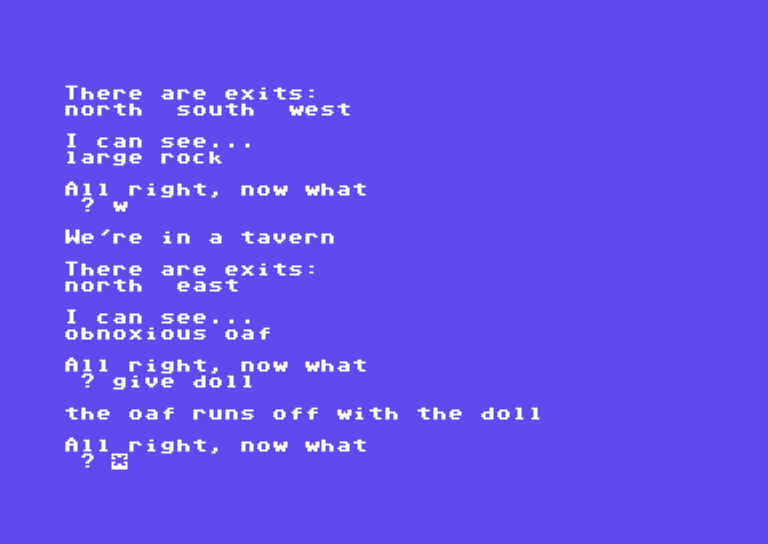
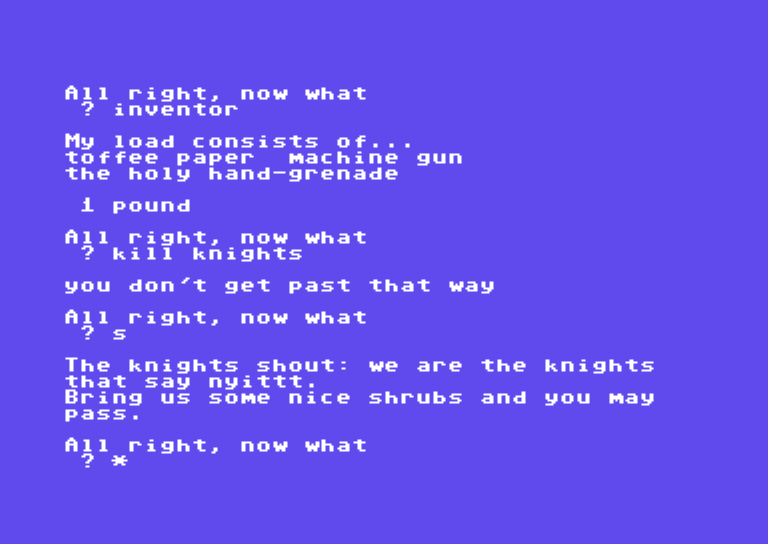
To get past the Dark Forest you need the map (to get by the “maze”) and the shrubs (to get by the Knights). You can then use the doll from the sex shop to distract an “oaf” and open a new path.
North of the oaf is the castle with the virgins, and there’s some garments and a spade there you need. You’ll end up at the hospital with the virgins unless you are holding the green bottle with the Big Boy tablets (but you don’t need to have eaten them … in fact, if you’ve eaten them, there’s some ravenous ladies that will tear you up on the train, so it’s a bad idea).
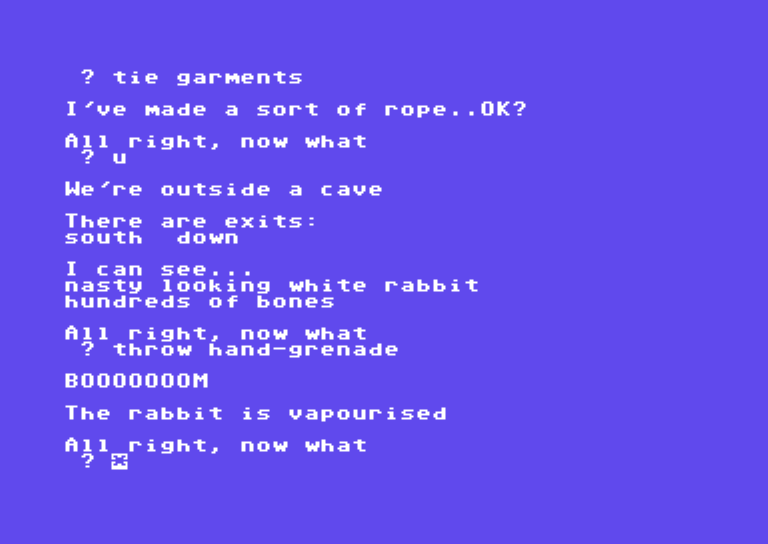
Then you can take the garments and TIE GARMENTS to make a rope for the nearby cliff.
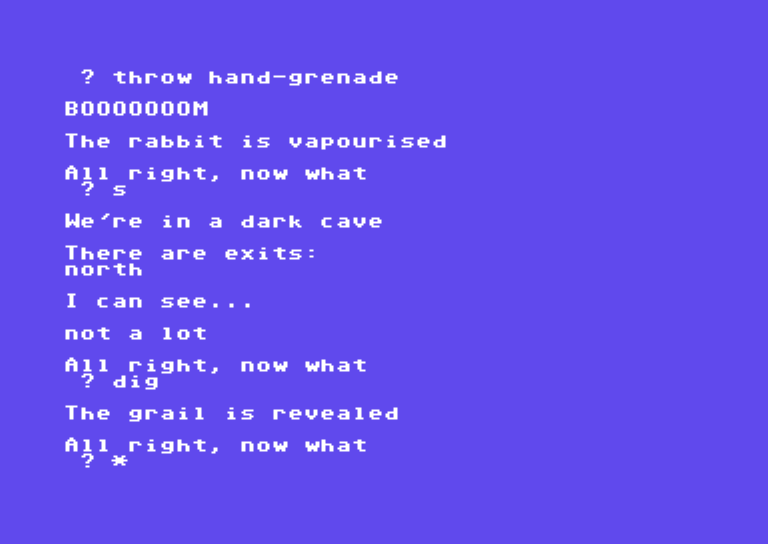
Then you can finally get to the long-awaited killer rabbit, the “non-magic-word” way.
However, THROW GRENADE here is still a dud. You need the Book of Armaments. That’s back at the library, in the bus stop section. Additionally, to get that book, you need a library ticket. To get the library ticket you need to unlock a locker. To unlock the locker you need a key, which you obtain by moving a big rock near the cliff, and to move the big rock you have to be holding the truss.
It’s the hernia-patient thing that goes around your waist.
So you have to get all the way to the cliff area — with the many back and forth trips given you have basically one inventory slot free, and of course perfectly knowing exactly each items you need — and then take the key back to the bus station area, then get back to the train area once you have the book.
I didn’t have a torch the first time through here and wasn’t able to see in the cave.
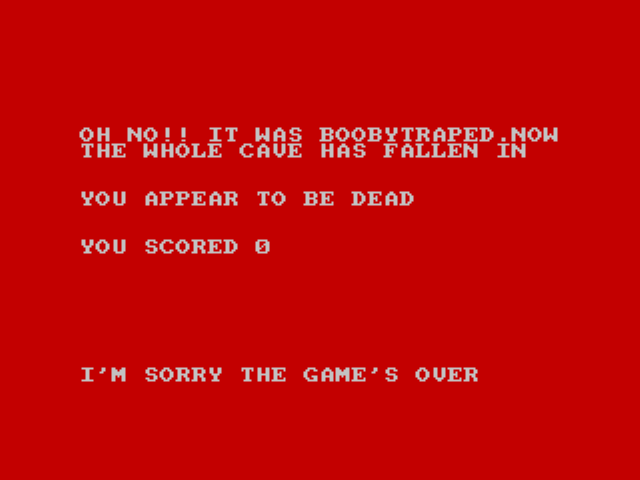
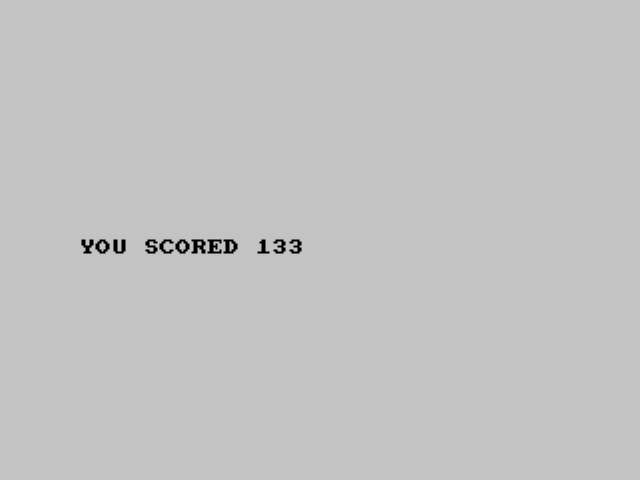
As the above images imply, I was finally able to pull things off, but only with a little magic help in the middle. There’s enough locations in the cliff area that a random teleport gets there without too many attempts; so what I did after getting the truss was to OH YANGTZE my way to the rock and grab the key early. That allowed me to avoid some of the steps. Then when I had the green bottle, book, hand-grenade, doll, and torch (max inventory, notice no room for even the train ticket) I teleported back to the cliff area again trying to figure out how to wrangle the train ride and was able to finish the game. (All this implies the map and shrubs are technically unneeded, since this strategy skips past their use — of course you have to know all about this beforehand!)
Getting back is easy, since you can drop your rope (garments) and fall down the cliff to the hospital, then take two more steps back to home from there.
You know, I would be disappointed by the ending, but … sure. Fine. I was expecting that. After all, the original movie had an anti-climax and then filled the blank part of film after with organ music.
I still feel like I made everything appear smoother than it was. The narrative above assumes the straightforward path of how to do things, but I had so many instances of random jumping around, not having enough money, just having the train go to the wrong place over and over, and even having the train in one instance never stopping (a bug I guess, I was trapped forever) that Pythonesque was a prime example of me suffering so you don’t have to.
I did imply that a slight change of variables would make things better. I think the best single change would be to simply drop inventory limits — let the player carry everything and it would reduce the number of ferrying trips by 5 times. If the game also was more generous with magic word use — despite the fact it could be used to bypass some puzzles — and tweaked some other aspects (like maybe always get 100+ pence from a mugging) Pythonesque would be plausibly playable. It may be that some of the later versions have done those things. The walkthrough, as I’ve already implied, says absolutely nothing about needing a machine gun or travel pills on the train, despite the fact I only safely made a train trip one (1) time without them. This suggests the authors lightened up a little.
Regarding the humor, I don’t have much more to add from what I’ve said: it’s essentially references without punchlines.
Having the killer rabbit, Book of Armaments, and hand-grenade all used together might make someone recall the famous scene and enjoy it for its own sake, but it isn’t telling a joke. You just have to remember the “five is right out” line and “who being naughty in my sight, shall snuffeth” and chuckle internally, I suppose.
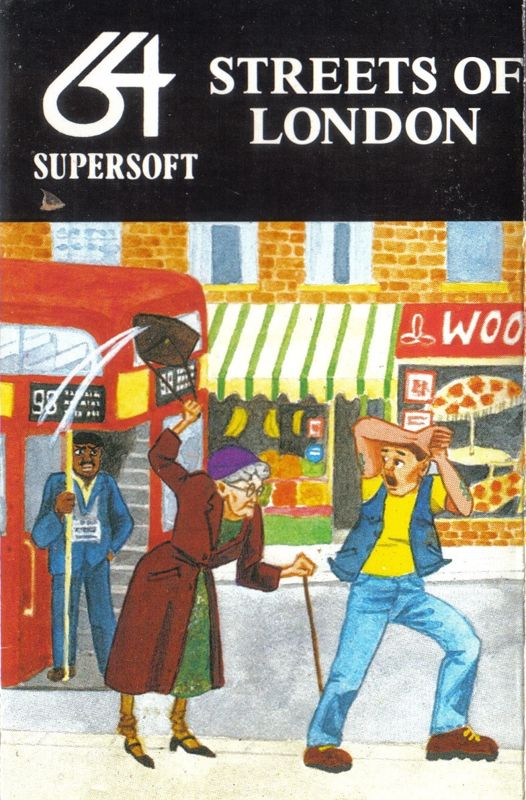
Can you escape the padded cell? Will the old lady hit you with her knitting? How much longer will you have to wait for a 96B bus? These and many other questions will be answered in PYTHONESQUE.
Supersoft we’ve seen twice now before: Brian Cotton’s game Catacombs (for a while lost media, first of a series, we’ll get to the rest sometime) and more relevantly for today, their own version of The Hitch Hiker’s Guide to the Galaxy.
The company received permission from Pan Books to publish Hitch Hiker’s but got in a legal tangle trying to re-publish the game (so re-named it); here, we have a game that started life as Pythonesque — as in the Monty Python comedy troupe — and later again surfaced for the C64 as Streets of London. There was no legal tangle to speak of but perhaps the company was a little nervous.
From Mobygames.
The authors (Allen Webb and Grant Privett) also have credits on The Cricklewood Incident and The Kilburn Encounter which allegedly just rework the elements of Pythonesque on different platforms. They look different enough I’ll keep them separate for now (meaning they’ll wait for a later year).
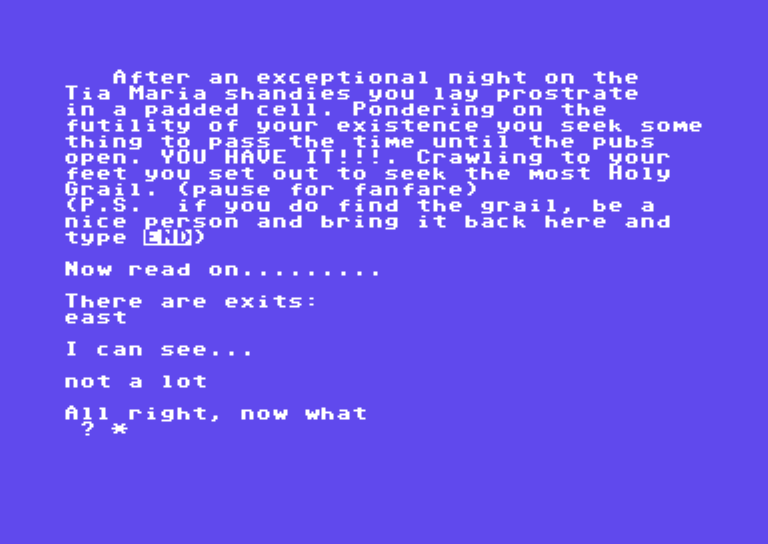
The game starts, oddly enough, with you choosing a difficulty level (1 to 5, I went with easy, usually a wise choice on old adventures where the interest is more in puzzle-solving). You then wake up in a padded cell and decide you need to go locate the Holy Grail.
This one absolutely spins the wheel on random, and draws items from famous Monty Python movies and sketches, like the Holy Hand Grenade. The structure is heavily surreal in a way we have yet to see in this blog.
Namely, the game is spread out amongst many small micro-chunks. You teleport (either via random chance, or using a magic word I’ll show off in a moment) and might be in a one-or-two-room area, and one of the directions will drop you right back in front of the padded cell again.
The magic word comes from a piece of toffee paper just outside the entrance: “OH YANGTZE”. It teleports you to completely at random to one of the micro-chunks I’ve been mentioning.
If you don’t recognize the words (I admit I’ve only seen a couple episodes in whole and the “greatest hits”) they’re from the skit asking the deep question “Why is it that so many of Britain’s top goalies feel moved to write about the Yangtze?”
I’m not sure everything is meant to be a reference, although in the same area where you find the toffee paper is one of the most famous ones, one of Hell’s Grannies.
In game form, she isn’t as threatening, or at least I have yet to have her try to hit me as illustrated at the front cover at the top of this post. As implied, there’s also a bus stop there, but the problem is not getting beaten at the bus stop, but rather lacking in money.
I’ve gone through various runs where my character’s finances go up, but I have no idea why or how they do. Money is important not just for the bus but for the fact some places require you to buy things rather than just letting you take them.
The hand grenade just lands with a thud if you try to throw it and doesn’t explode (you can’t PULL PIN). The machine gun I’ve managed to use on the old lady but that just nets you a dead old lady and no game progress.
If you do have money to ride the bus it works like the magic word — you get on, get off, and find yourself at some new random location. Also, sometimes you randomly just get swiped up for no apparent reason and sent to a new place.
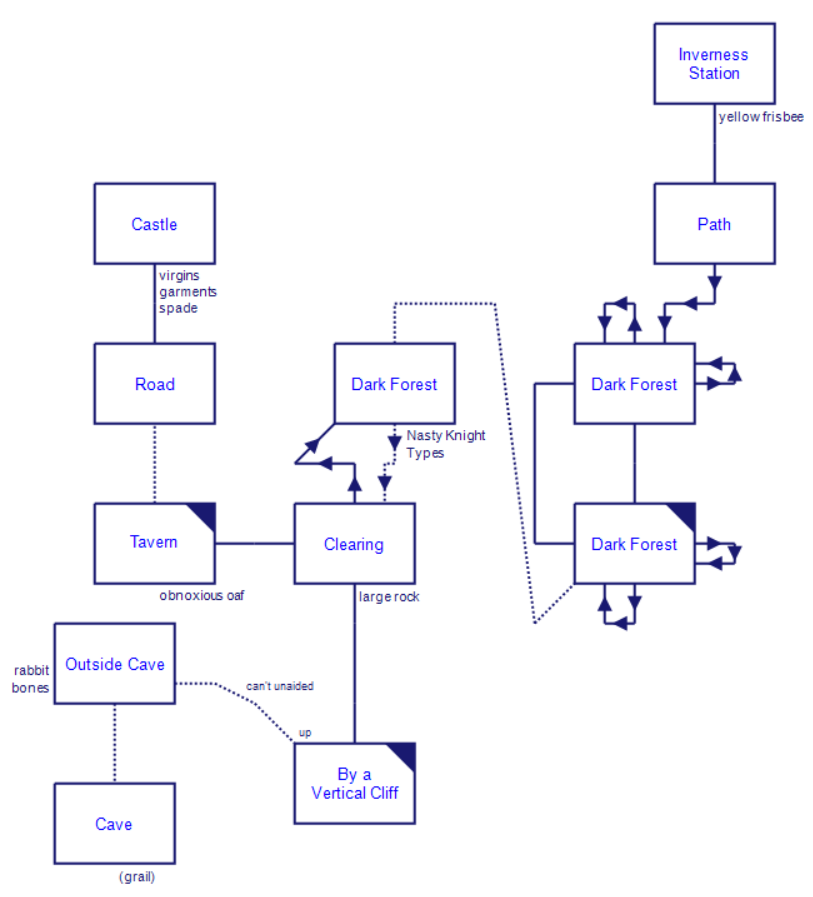
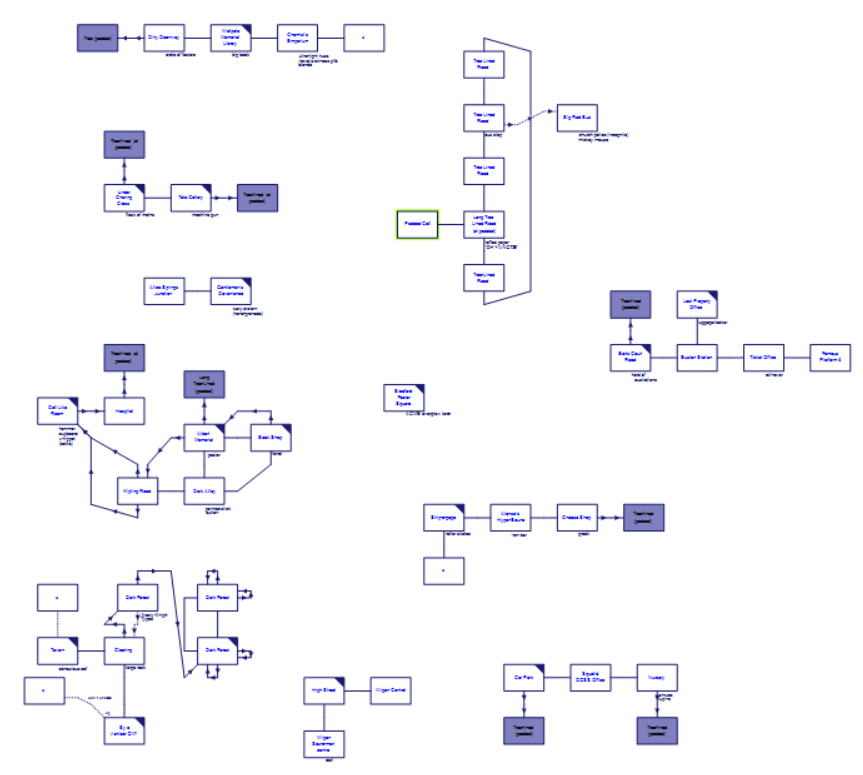
I don’t have anything resembling a complete map yet — the random aspect (and fact some directions will teleport you to the start, and you can’t tell which ones until you try) make my efforts scattershot, and I have some puzzles sticking me in some locations besides. Let me give a far-out view first, just to show general patterns:
Blue marks “teleport back to the start” rooms. The tag in the corner marks possible landing points (sometimes you get more than one in a section). You’ll also notice some rooms are completely closed in, and I’ve gotten myself stuck before, because the only way out seems to be via magic word, and the magic word only has a limited number of uses.
Above is one of the larger contiguous sections. Going “up” at the vertical cliff requires gear, you get stopped by an “oaf” trying to go north at the tavern, and while you can get past the Nasty Knight Types in order to enter the Dark Forest (they want a shrubbery for heading south, but will let you go north), the Dark Forest consists of two rooms where you get stuck in an endless loop.
I know where the shrubbery is — it is for sale elsewhere, but on the run where I had this encounter I didn’t have the shrubbery in hand (again, the only movement is random, and you have a limited uses of the magic word).
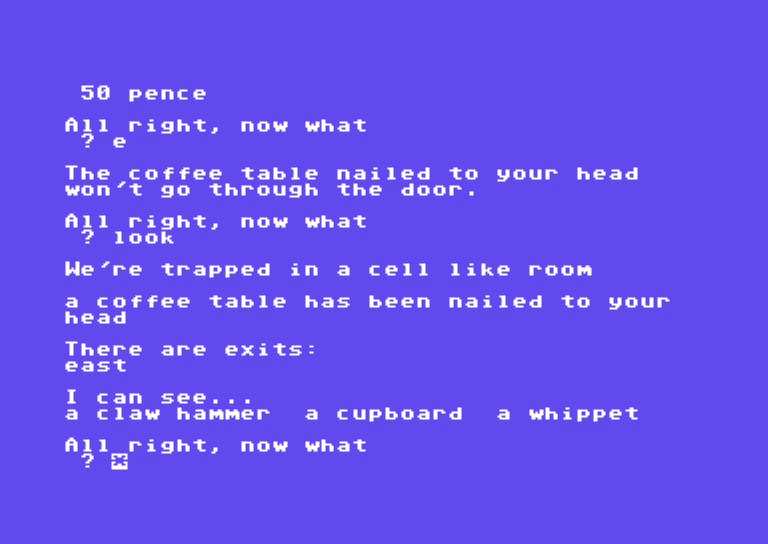
I have a hard time encapsulating all of what’s going on. Some of it is fairly raunchy (that Galahad scene from Holy Grail is in, you end up in the hospital; fortunately the hospital just lets you teleport back to the start). Some of it is plain confusing:
If you take the hammer somehow the table comes off and the whippet runs away. Is this another reference?
I’m not sure yet whether to be positive or negative about the game, although the number of softlocks I’ve hit is starting to tilt to a thumbs-down. Maybe there’s a way to manage the movement I’m not seeing. It’s simply very hard to test objects on things to see if they form solutions when there is very little guarantee I’ll have item X at puzzle Y.
I also don’t think the comedy is hitting, really — it’s so far just been references rather than actually trying to tell jokes — but I’ll reserve judgment on that until I manage to solve some puzzles (or grab for the walkthrough once I get frustrated by the randomness).
Micro Cabin hadn’t technically yet formally incorporated as a software publishing house for their first adventures (they were still just a store) but in November 1982 they took the plunge, and they also published two more adventure games: Takara B. D. Adventure (written by A. Tako) and today’s game, Diamond Adventure (ダイヤモンドアドベンチャー), as written by N. Minami.
A 1983 Spring/Summer NEC PC catalog from Micro Cabin, via Yahoo! Auctions.
In addition to The Spy (seen above) N. Minami also later worked on Ghost Town (from August 1984), and Worry (aka Mystery House: Worry, from December 1984). All three games are more elaborate than Diamond Adventure, which is short in an Eno / Space Gorn sort of way: it has only a handful of rooms. Mind you, they’re illustrated, and the game still took me a while to get through (for reasons I’ll explain shortly).
The entire map of the game, from Retro AVG Strategy Guide, which calls it the easiest of the adventures played for the blog.
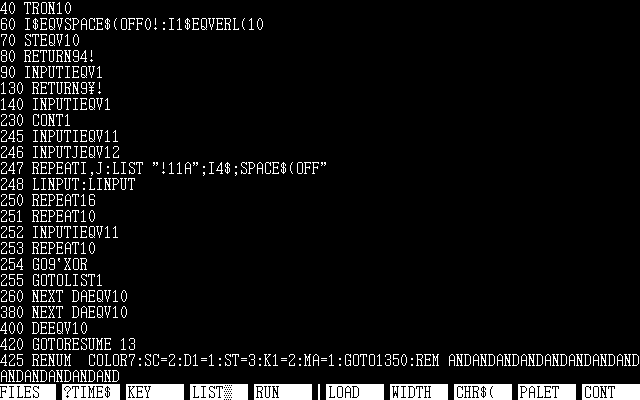
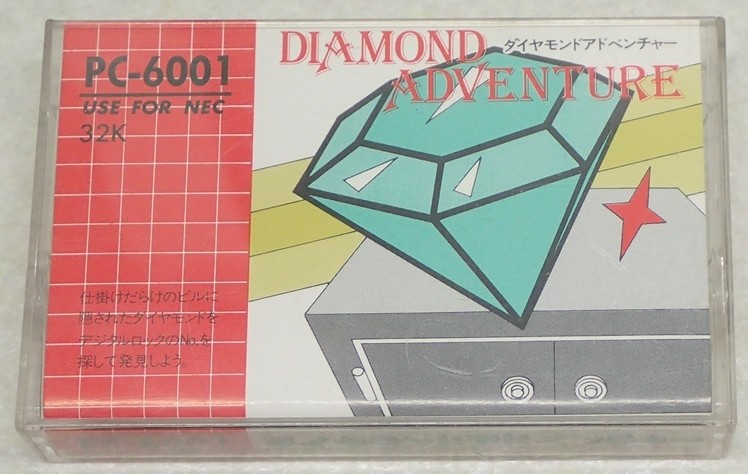
The original version was PC-6001, as shown in the catalog, and there were later versions for X-1 Sharp and MSX. The PC-6001 version is undumped, so I started with the X-1 Sharp version. I was able to load the game using what’s generally “standard” Sharp BASIC (HuBASIC) but I was getting syntax errors.
Part of the source code when viewing in HuBASIC.
After this I tried out the MSX version. The NEC and Sharp versions both — like Mystery House — give images with text in Japanese, but require typing commands in English. First enter a verb, hit ENTER, then enter a noun, then hit ENTER again.
The complete list of words is FORWARD, BACK, LEFT, RIGHT, UP, DOWN, ON, OFF, SEARCH, TAKE, LOOK, UNLOCK, USE, OPEN, MOVE, LIGHT, DOOR, MAT, SHELF, TELEVISION, TABLE, VASE, CHAIR, BOOK, PICTURE, SAFE, CANDLE, MATCH. It makes sense, given the players are Japanese, that the complete list of words would need to be given in-game; the game otherwise is expecting you to recognize things from their pictures, but a player might not even know the English word for “safe”.
The MSX version has one other very important difference from the original: the commands are now typed in Katakana, in Japanese.
This was a pain for me not just because of my inadequate Japanese skills, but my inadequate skills at handling MSX emulators. First off, I could only find the file in “TSX” format and the usual emulators don’t like it, so I had to convert it to WAV format (like a raw audio file) then convert again to CAS (which all emulators are fine with). Then since I’m not on an MSX keyboard, I was essentially typing characters “blind” (pressing right ALT activates the character mode). No emulator I found simply let me translate normal modern Unicode into what it’d look like on the MSX. I ended up making “fake” text. For example, early on you can search a postbox. Postbox is ポスト; with the diacritic symbol º separated as the game needs it you get ホºスト. If you are pasting into an emulator the text to paste is ノミソツ. That is, for example, cutting and pasting “ミ” into the emulator creates a “º”. I had to refer back and forth from tables and essentially make a cut-and-paste dictionary to make real progress.
The thing that makes gameplay slightly easier is that it comes with some built-in verbs. The full list is
F1 = Up
F2 = Left
F3 = Forward
F4 = Right
F5 = Open
Shift-F1 = Back
Shift-F2 = Down
Shift-F3 = Get
Shift-F4 = Search
Shift-F5 = Help
but note this leaves out words like USE which has to be typed on its own.
I managed to get a little ways, but the text issue was painful enough I grinded more on the Sharp problem before finally resolving it. What brought realization was finding a different Micro Cabin catalog just for Sharp products.
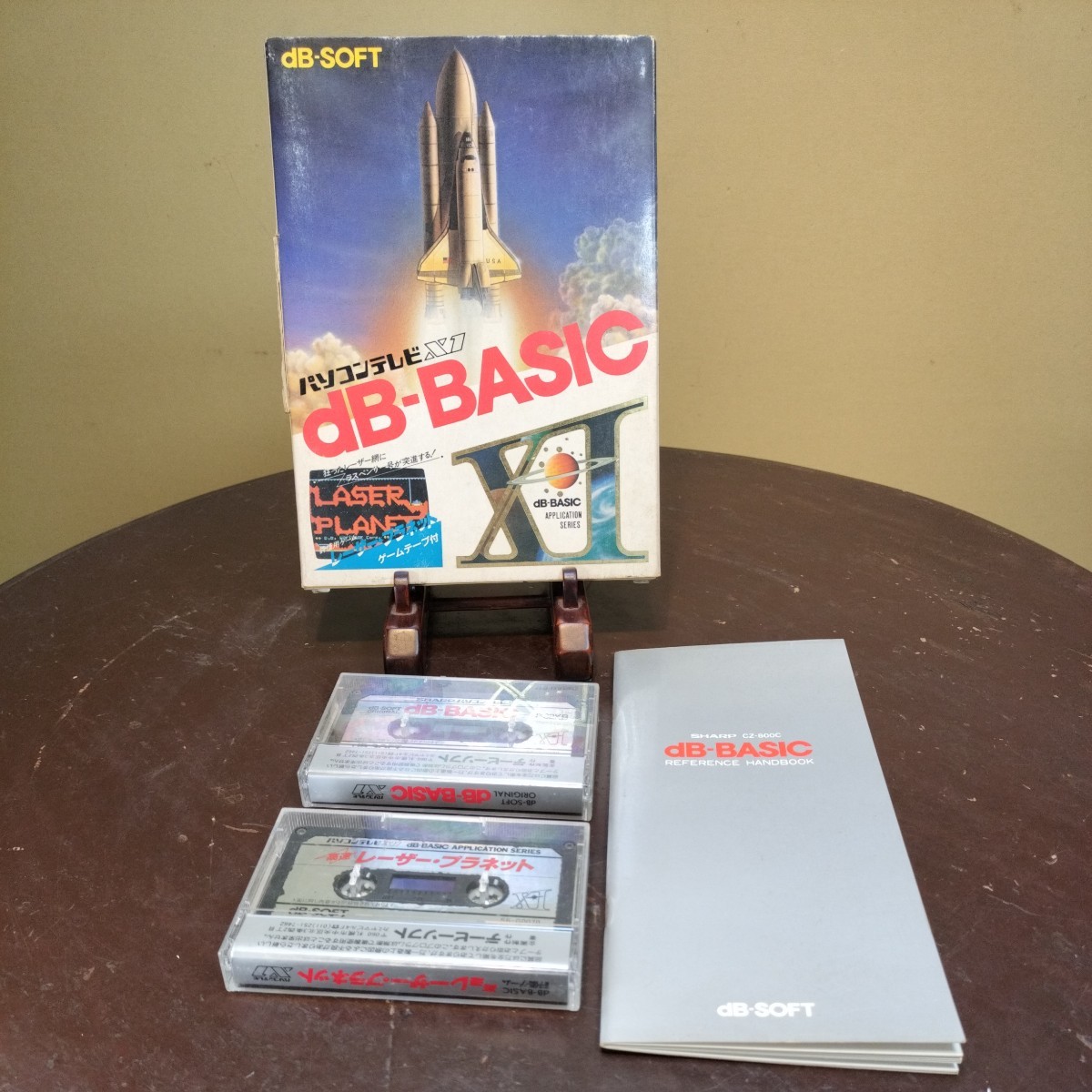
On the right page, under the line that translates to “Diamond Adventure”, it indicates a very specific BASIC interpreter called dB-BASIC is required.
With dB-BASIC loaded the syntax is LOAD”DIA-ADV” with the right tape inserted (despite other BASICs wanting a “CAS:” in front to indicate you’re using a tape, dB-BASIC only can load BASIC games from tape; if you put in the CAS it gets confused and will skip the file you’ve named). To save a lot of suffering to anyone who wants to play I have everything packaged together here, and you can either load save state 0 (right after typing RUN, just hit ENTER) or save state 1 (as the game loads). The reason to use the former is that there’s some random elements to the game which won’t appear with the other save state.
Tape of the Sharp version, via Giant Bomb.
With all that setup, let’s get back to the actual game!
We are quite simply tasked with going to a three-story building — which has a diamond worth 10 million yen — and stealing it. This is essentially a combination of Omotesando Adventure (visit a building with alarms, be sneaky) and Mystery House (nab a diamond). While Crowther/Woods Adventure did make it to Japan it wasn’t the urtext so it makes sense people would be making copies of Omotesando instead. (The other November game from Micro Cabin is even closer to Omotesando, but we’ll save that one for the future.) The practical ramifications for early Japanese adventures are: less treasure hunts with multiple items, less mazes.
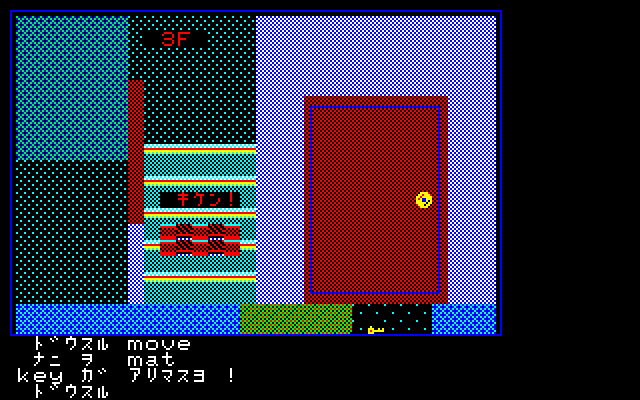
After moving Forward from the starting location towards the building.
You can (in the MSX version), open the first floor door, walk in, and immediately die.
It took about three hours to reach this point.
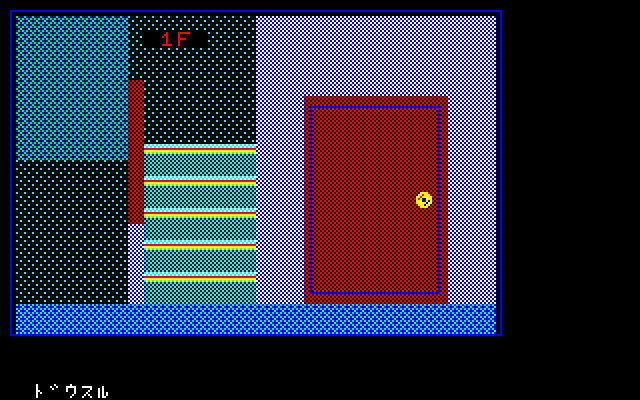
The first-floor door is impossible to open in the Sharp X-1 version. In either version you’re supposed to go UP when you approach to arrive at the third floor.
With the key from moving the mat (see above) you can just walk in.
One thing I neglected to mention when writing about Mystery House (I wasn’t aware at the time) is that many of the early objects are randomly placed. So there’s a set number of places you can search, and a fewer number of items, and those items are scattered; this makes it so each playthrough is slightly different. This game does the same trick, except it is such a small game it takes roughly 4 minutes to find all the objects that can be searched. Here, you can just the vase, table, and “shelf” (even the Japanese player on the MSX walkthrough I watched got confused about that and had to check the help).
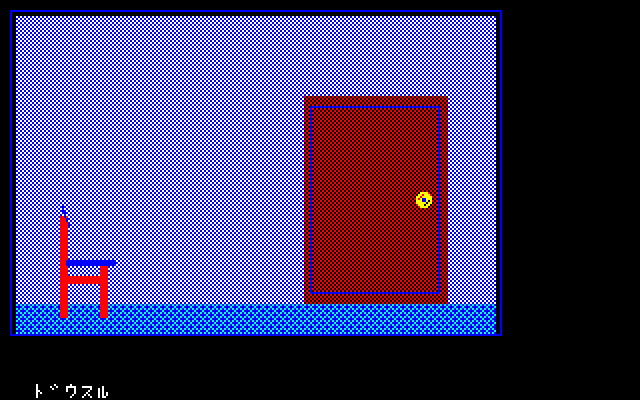
Just to the “right” you can find a chair to search:
And through the door you can find another table and a television:
The items you get (assuming you’ve been thorough) are a candle, a match, and a key. You can move the “picture” here to find a safe, which unlocks with a key. Within the safe is another key.
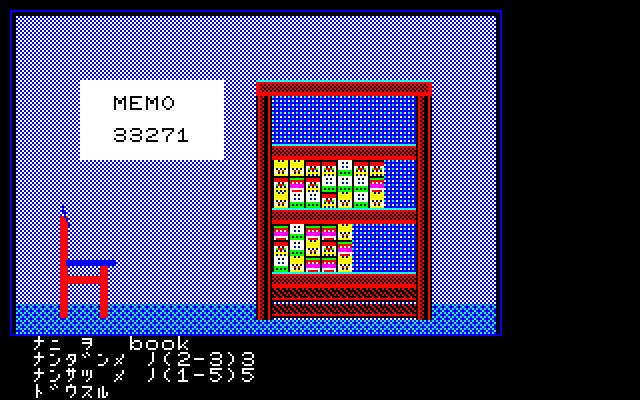
Moving on, you can find a bookcase. You can TAKE BOOK, specify a row (either 2 or 3) and then specify a book (1 through 5).
I think you might also be able to find either the candle or match on the chair.
Randomly, two books are useful. One of them will give you the code which will be used shortly.
This code is randomly generated.
The other will cause the bookcase to swing open revealing a secret room. You can go in to find another “shelf” which unlocks with the key from the safe.
The shelf reveals a stairway inside (very similar to a moment in Mystery House). You can then find a safe which requires the code from downstairs.
“Good job! You did it!”
This wasn’t notable in a gameplay sense — the double-book secret is honestly the only part of the game that counts as a “puzzle”. The emulator was the real boss. This is notable in a history-of-games sense, as an amalgam of Omotesando and Mystery House in the short window where copying was happening. In 1983 things start to get very different (including with the third game from Tsukasa Moritani after the two Mystery Houses); Crowther/Woods Adventure cast a long enough shadow that it still was affecting Western games 5 years later.
We’re back to Softside here (previously: Arrow One) with another Peter Kirsch game.
Something that might not be obvious at this point is that essentially, by this time, Peter Kirsch was one of the most experienced adventure creators in the world, similar in quantity to Scott Adams. He (probably) wrote at least 9 of the games we’ve looked at so far, and he’s edited the other Softside games from outside contributors. The need to output adventures monthly kept the momentum going, even though it also meant the games sometime seem a bit rushed.
While this condition wouldn’t cause every creator to branch out this way, for Kirsch this gave him opportunity to experiment. Magical Journey from early 1980 was his only “gather the treasures” game; by Kidnapped later in the year he had an escape divided into a series of a “mini-adventures” based on the floor you were at. In his Adventures of the Month he’s tried sequences of movie-like scenes (Around the World in 80 Days), turning “saving passengers” into a collectathon (Titanic), collecting ingredients for a potion book (Witches’ Brew) and exploring an alien planet with a language-translation mechanic (Arrow One).
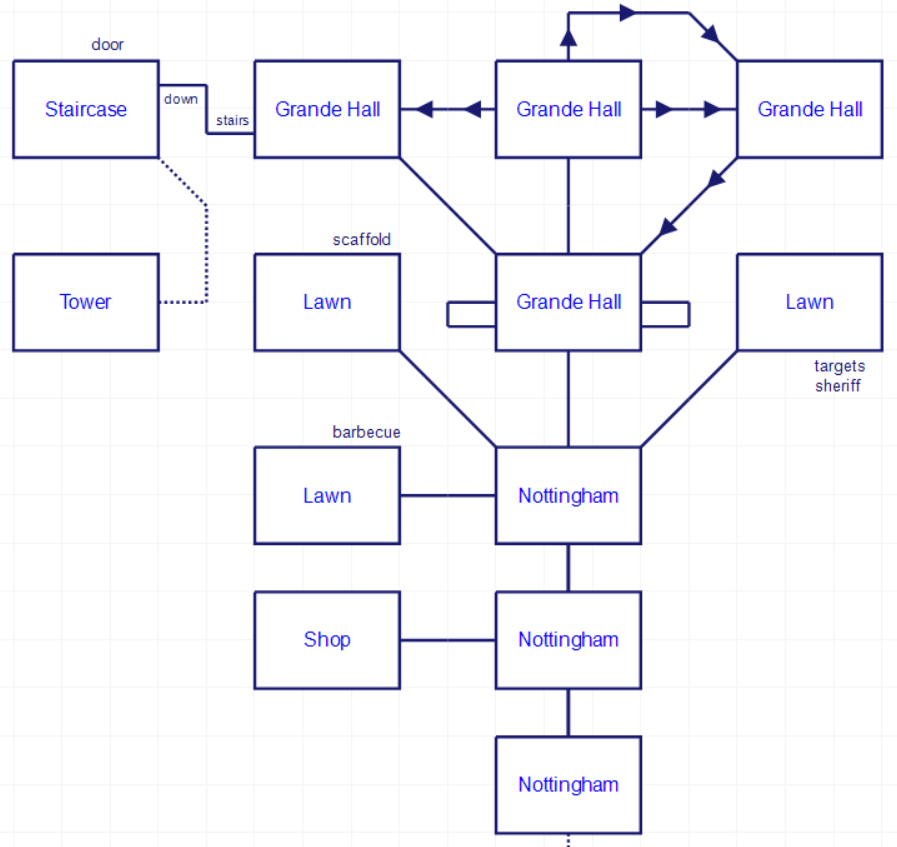
Structurally, Robin Hood shares similarities with an RPG. There are a series of heroic tasks you can accomplish (not always in a specific order), and you can meanwhile rob the rich and build up your “gold” supply. Once you have four tasks done a person will appear allowing you to get task #5 and win the game.
There are, as usual, Atari, Apple II and TRS-80 versions. Due to a bug mentioned by Dave Dobson in the Atari version I steered to Apple. (See here; you need Adventure Pack #2.) The TRS-80 version isn’t up for download; Ira Goldklang has a copy, and has it marked as Peter Kirsch, so I assume his credits show up there just like with Witches’ Brew.
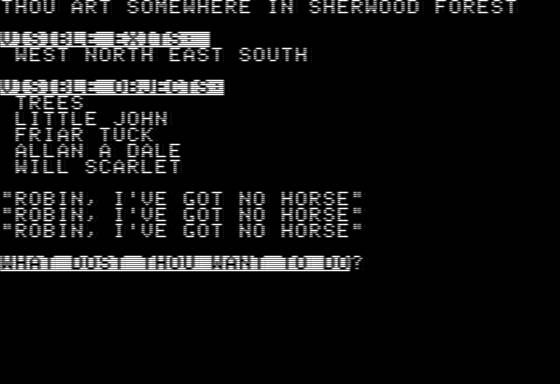
You start fairly lost in Sherwood — despite the map not being much of a maze, I had trouble for while because I couldn’t do any object-dropping. You start with a bow, sword, and 3 arrows, but the game doesn’t let you drop any of those for the purposes of mapping (“LITTER THOU NOT / KEEP THY WEAPONS”).
The “hoofsteps” from that starting room are a random mechanic that runs the entire game. While in Sherwood Forest (the area in the map above, plus a western portion) merchants will constantly pass through the forest. You can climb up a tree, then go down to surprise them.
It took me a long time to get the right parser syntax. I tried, for instance, ROB MERCHANT to no effect.
Specifying what you are robbing turns out to be important; you can steal a horse (only once, although it is unclear why later attempts fail) and you can — and this is very hard to find, and I only found it from the walkthrough long into my game — STEAL CLOTHES. This will give you merchant clothes, and you can swap back and forth between your classic green and your DISGUISE. (Note you need to be wearing the green to steal from merchants, otherwise they just laugh at you.)
This sets up one of the early tasks you want to do, but you need to gather all your merry men first.
Here’s the western side of Sherwood.
It has one of the side-tasks you can do, in order to be classic Robin Hood.
Through the forest you can find Will Scarlet who will just straight up join you (and you can pick up the pole next to him). Everyone else takes a little more work. Little John is waiting on a log for your to do a quarterstaff duel with the aforementioned pole (he wins)…
…Allan Dale needs a harp (which you can find under a “boulder” in the forest, although pushing it requires having found some merry men to help push)…
…and Friar Tuck wants food. This was the hardest one for me to figure out. There is the occasional random sound of GEESE; you’re supposed to SHOOT GEESE with your bow (this uses up an arrow) and you don’t have to cook it.
Once you have all the Merry Men, they start complaining about not having a horse. One can be stolen, as mentioned earlier, but no other merchant falls for the same trick. Fortunately, the remainder of the horses just happen to suddenly appear in Sherwood so you need to wander until you find them.
With everyone on a horse (including you) you can take off for Nottingham (be sure to have on the disguise!)
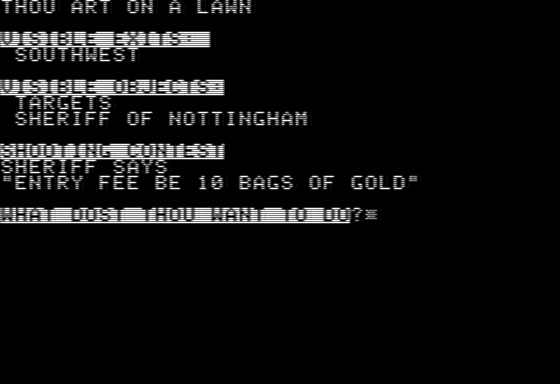
Along the way there is a store that sells new swords (25 gold) new bows (5 gold) and new arrows (1 gold). You’re going to need 3 arrows for the contest (something you will find out only partway through, oops) and you’ll also need 10 gold to enter the contest so I hope you robbed at least one of the merchants!
(Spoiler: later in the game you’re going to need another arrow or two and another sword. So you need at the very least 27 gold total from the merchants. Each merchant has between 0 and 3 gold, and it took me over an hour of grinding to get to what I needed. It didn’t help partway through I had the disguise on instead of the green suit and I couldn’t figure out why my robbing attempts were failing.)
The game will ask what name you want to enter under. I tried ROBOT and apparently that was too close to ROBIN and I got immediately arrested, which was hilarious.
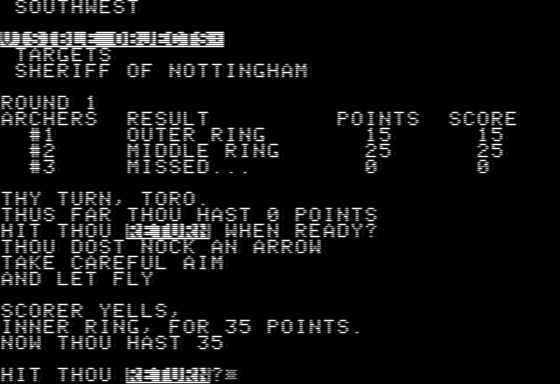
What isn’t hilarious is that the contest is purely based on random luck, and you have to get through to win the game.
On the fifth time I made it through. I’m not sure what the probability is, but that was long enough to wonder if I was supposed to solve a puzzle to “bend the odds” before starting. (You are not. It really is just random.)
After winning, you get a golden arrow, but you also get caught.
The Merry Men will fortunately do a last moment rescue.
Back in the forest (where you’re probably going to need to grind merchants for the next part, make sure to dedicate some time) there’s supposedly some sort of note about rescuing Maid Marian (that Dave Dobson mentions) but I never found one. I instead, being stuck, wandered back into Nottingham to seem if anything changed, and in the castle I found a guard at the foot of a stair which previously wasn’t there.
Trying to attack with a bow causes the bow to break. Trying to attack with a sword also causes the sword to break, but fortunately you get a last moment assist.
However, you’ll need to get both sword and bow back. Fortunately, I used the magic of “save states” to rewind and avoid the bow breaking, but I still had a new sword to buy (25 gold). The sword is needed to kill a second guard at the top of the stairs.
I just want to emphasize how the structure means this is not like one of Kirsch’s cinematic structures. In all likelihood, you likely need to break after defeating the guard to go grind some gold before defeating the second one. So it isn’t like this is a continuous dramatic action. (In practice this is less strong than the cinematic scenes; in theory I see how this is a nice way of making the action feel not-so railroaded.)
Before nabbing Marian, after killing the first guard, the Sheriff of Nottingham will sometimes appear. This is truly the oddest (and frankly, immersion-breaking) aspect of the game, because there’s no confrontation or chase message; the game is waiting for you to do away with the Sheriff. The sword doesn’t work, you need to use the bow.
With the not-well-described victory, your next step is simply to wander around until for some reason the Rightful King of England shows up.
We robbed every merchant in the country, and spent most of our money on a new sword for us and only a little bit on the poor.
I definitely recommend Dobson’s take on the game as he hit the Atari bug I alluded to without first realizing it was a bug, and he narrates the action “straight” like it was meant to happen.
… there aren’t many clues as to what we’re supposed to do — we just have to find things to try and hope some of them count toward victory.
A more complex game might have been able to let you run things as a “Robin Hood simulator” without any concern at all about a specific narrative sequence, and in fact kind of happened already with the classic game Defender of the Crown. Could it also be done while maintaining the adventure-game-ness? The closest I can think of is the Sierra On-Line game Conquests of the Longbow which has, at least, a very versatile score system.
Kirsch found here a way to combine the “cinematic” and “freeform” style play; the unfortunate side effect was having severe grinding and a weirdly undramatic rescue and battle against the Sheriff. I still felt like the game “worked” in an immersive sense but only because it was strictly speaking fan fiction.
While exploring the remote planet Zol 1X you hear rumours of a fabulous treasure. It was buried in a tomb by Zolan, once emperor of the whole cluster, before the Terran conquest many centuries ago. Although many people have searched for it, the missing treasure has never been found. You decide to find it.
Despite the above sounding like we’re about to reach another sci-fi planet (like Forbidden City perhaps) this is really just a very abbreviated version of Adventure.
You’ll see an “adventure” marked on there. We do not possess Gamestape 1 so we are not clear what adventure that might be, but it easily could be The Zolan Adventure as published later that year by the new company Softek.
From World of Spectrum. A cave entrance, I guess? The title screen of the actual game says The Zolan Adventure.
The tape case above advertises itself as “Possibly the only truely playable adventure for the 16K Spectrum” and to be fair this is a very early game for the ZX Spectrum, so maybe if you exclude games ported from other platforms it wins by default. Perhaps the copy-editor couldn’t think of anything else to write other than “this is a game you can play from the beginning to the end”, although it turns out that’s not fully true in that the game has no end condition.
There’s an “instructions” file that seems to be broken (and what manages to pad the tape to be 16K) so I just had to wing it. What I discovered is a brand new way to be bizarrely minimalist.
This shows me moving around the outdoors, with six different moves. So not only are room descriptions reduced to almost short lines, but they get stacked right on top of each other as you move around. The general effect is odd in a way that’s hard to pin down; I got used to it, but at first it felt like moving a piece on a board game rather than an avatar through space. After enough lines the game simply clears to display the next line, but that doesn’t make the effect any less weird.
(This is different than just the overall gimmick of having scrolling text with input on the bottom; Amnesia and My Angel both play with the idea, the latter calling it “novel mode”. However, both have enough text to establish the output as readable prose.)
Part of my mapping the outdoors in progress.
As already mentioned, this is an Adventure derivative, so it starts with a building hut to go in with four items: keys, a bottle of water, a “torch” (referred to elsewhere as a lamp), and a wand. Normally you’d get to scoop all four items up, but this game rather unusually has an inventory limit of three.
Normally that’d be the sign of a lot of suffering to come but the game is so short it works out.
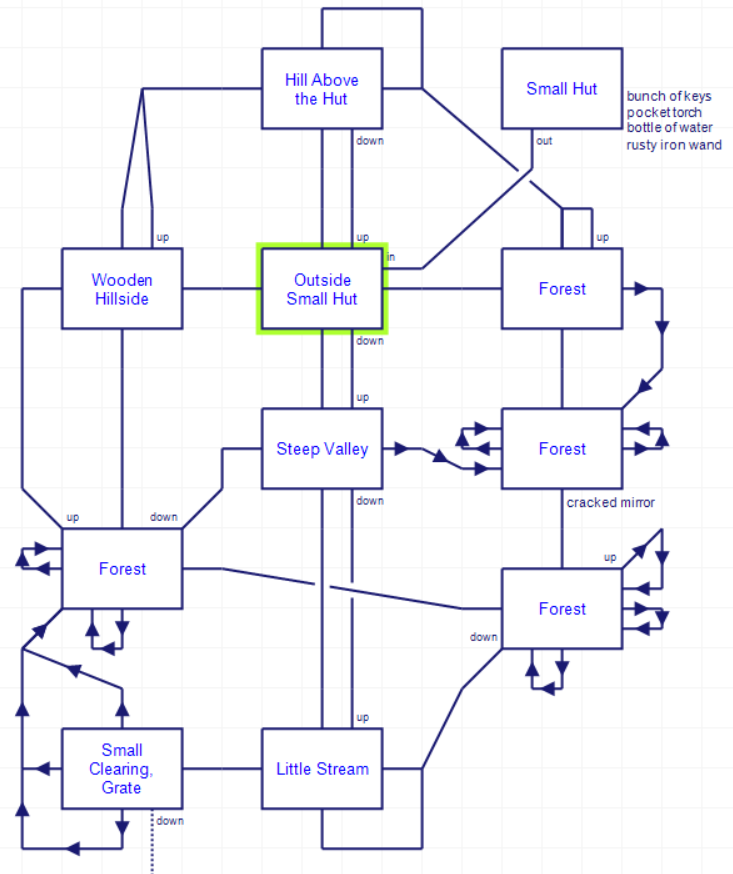
All of outdoors. Making this took more time than playing the rest of the game, and the only thing of interest other than the hut is a “cracked mirror” in the forest.
Going the usual valley to stream to grate route, you can take the keys from the hut and unlock them and go down to find the first of what turns out to be four treasures.
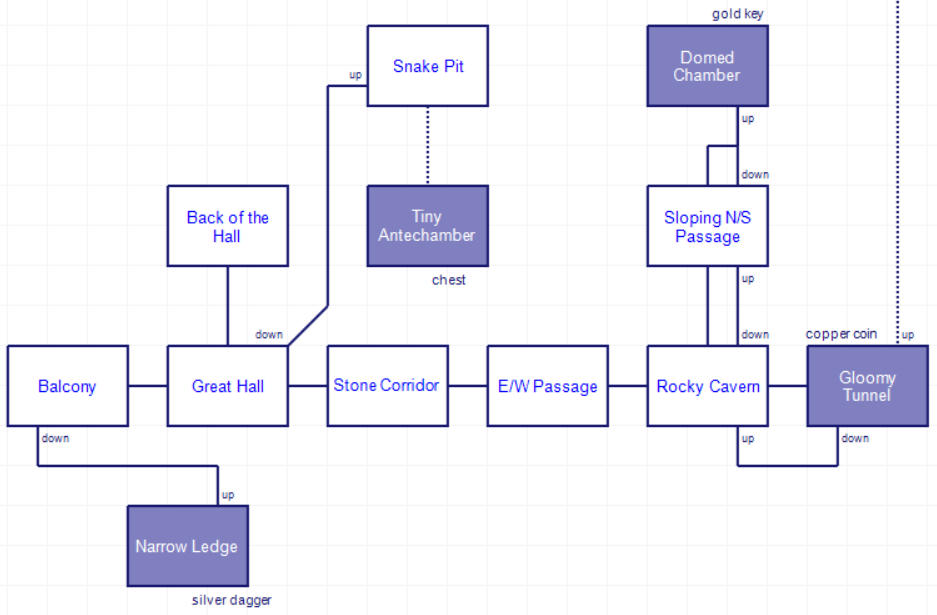
The rest of the game.
Being underground requires having the lamp (torch) on. I fortunately was experienced enough to just try ON on its own since LIGHT doesn’t work. The only items on the verb list other than directions, get/drop, and on/off are OPEN and UNLOCK. For some reason KILL magically works in one location even though it is not understood elsewhere.
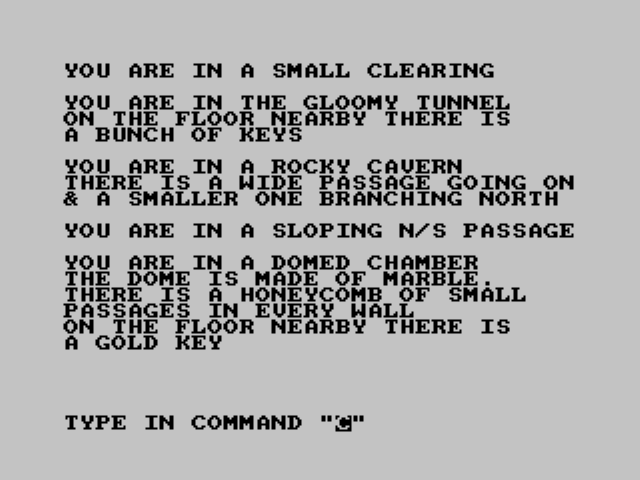
I get the strong impression of an author who wanted to do a lot more but just stopped working and called it done. The honeycomb room suggests multiple exits but you can’t actually take any of them; the sole reason to go in the room is to pick up the gold key (which doesn’t unlock anything, it just is a treasure).
To the far west there’s a ledge with a silver dagger, and if you take more than one turn hanging out you’ll fall and die. Making a typo counts as a turn, so one time I typed GET DAGER (dropped the G by accident) but that was already too much; when I tried to GET DAGGER and go UP I died.
In fact, you need to avoid typos altogether while underground, because the time limit is set to be exactly the number of moves it takes to do everything. We’ve had light ultra-optimization be interesting (see the games of Paul Shave) but that’s been in cases when the game forces the player to do optimizations they might normally not bother with, throwing an item between locations to avoid an extra trip, for example. This is more like “do the steps you normally would do, just don’t make a typo”.
The result of running out of light.
With dagger in hand you can go in a pit with a snake and KILL SNAKE, then go south into a treasure room and the only sci-fi element of the game.
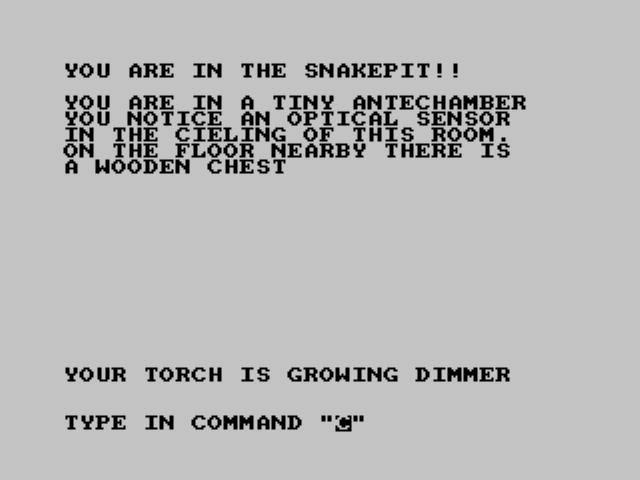
If you try to take the chest the “optical sensor” will trigger and you will die. This presents essentially the only puzzle in the game, and you have enough information you can solve it yourself if you like (otherwise, read on).
The cracked mirror from the aboveground gets dropped here. This is enough to confuse the sensor and get out with the chest. Once the chest is out the cave will start collapsing, so you also have a bonus time limit to travel to the surface.
The chest does not unlock or open. The only thing you can do is take it (and the other treasures) back to the hut and … wait for nothing to happen. I made the executive decision to quit and check my score.
According to this walkthrough I did the correct action; the BASIC source has no end message, and you can consider getting the chest to the hut to be a win.
I’ve always held the standpoint that short does not equal bad (… if nothing else it knocks another entry off my 1982 list quicker …) but that also doesn’t equate to good, either. Eno is a pretty good contrast; that game was set all in one room and centered around one unified puzzle, and there were enough interesting parts (and a sense of humor in the writing) that I enjoyed my short time with it. Here, my time was imbalanced for making a meaningless map (other than it looks pretty for the blog) and my puzzle-solving time was essentially 3%. The strict inventory limit and torch timer seemed to be just trying to cover for a lack of much interest. The wand that doesn’t work and honeycomb cave with no extra exits strongly suggest the author here really did plan a more proper Adventure derivative but didn’t have the chops to pull it off.
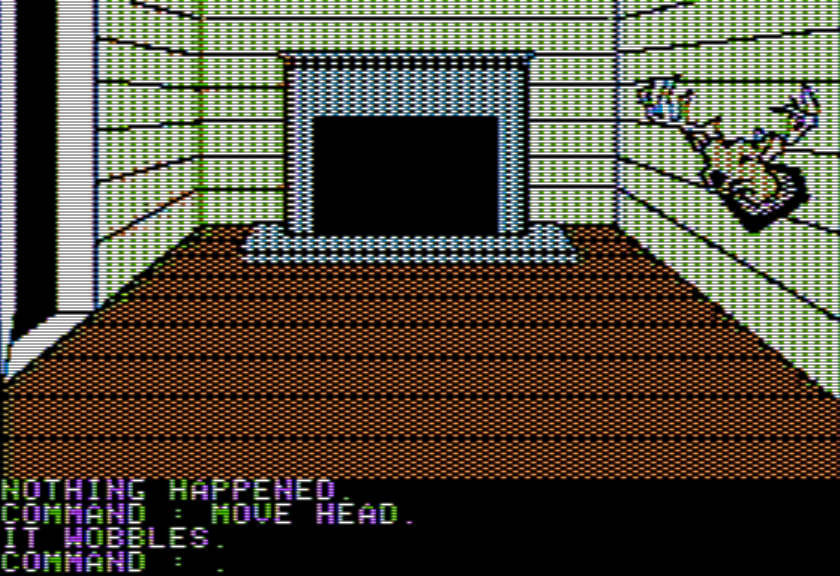
I almost managed the feat of being able to say Transylvania pulled off not having any jank puzzles, but alas, I ended up looking up how to deal with the moose head.
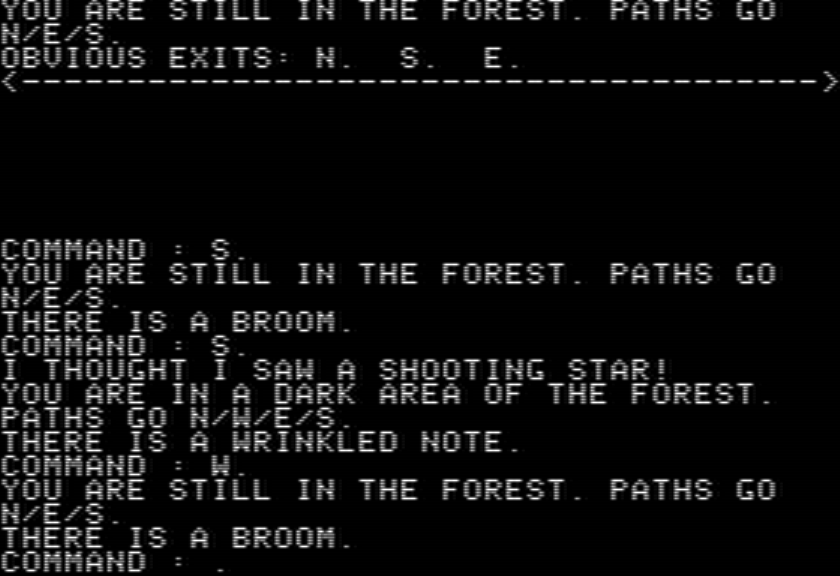
Before doing that, though, I realized I could RIDE BROOM. This results in a colorful description of flying through the air before crashing in a tree.
This is only a hint for the cabin insofar as indicating it is important. This would have been a perfect opportunity for a little more detail, to avoid having the player refer to a second-order object on the moose head itself, and PULL ANTLERS.
I suspect the original text version was just fine, but the author got tempted by not only having the head only be rendered visually but making the player refer to the antlers as an entirely separate object.
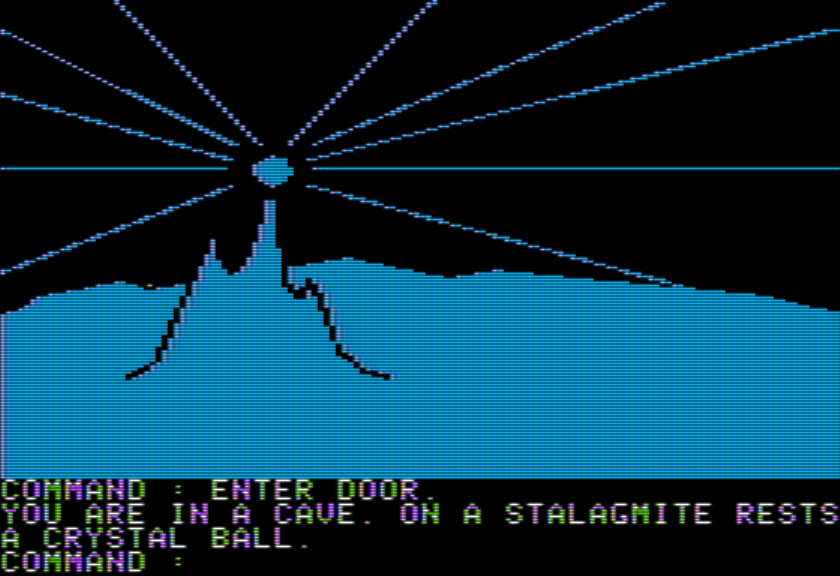
Searching the cloak finds a lock pick. I took that over to the door at the cave (which I suspected might stay closed, but I guess not) and popped it open to find a cave with a crystal ball.
The crystal ball can’t be taken, just looked at. It reveals a figure wearing a wizard’s cloak (check) and a shiny gold ring (check) and waving the ring at the statue. In other words, waving the ring (which I had tried many places) does work, I just needed to be wearing the wizard cloak too (which I had just found) in order for it to activate.
This reveals an alien creature who says he is “deeply indebted” to you and then crushes your ring.
It is possible to get a little stuck from here because now you just need to wait for time to pass. Eventually you see a “shooting star”.
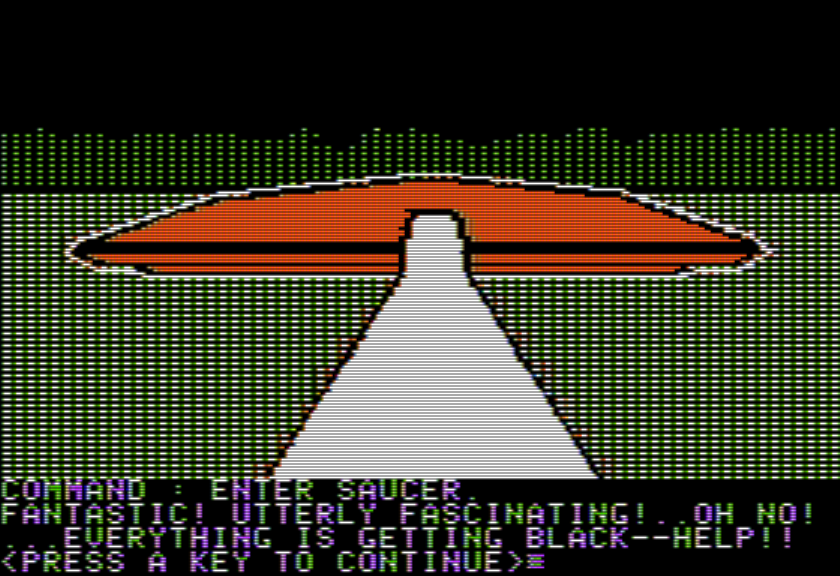
After doing so you can head back to the place with the statue and find a new encounter, a flying saucer.
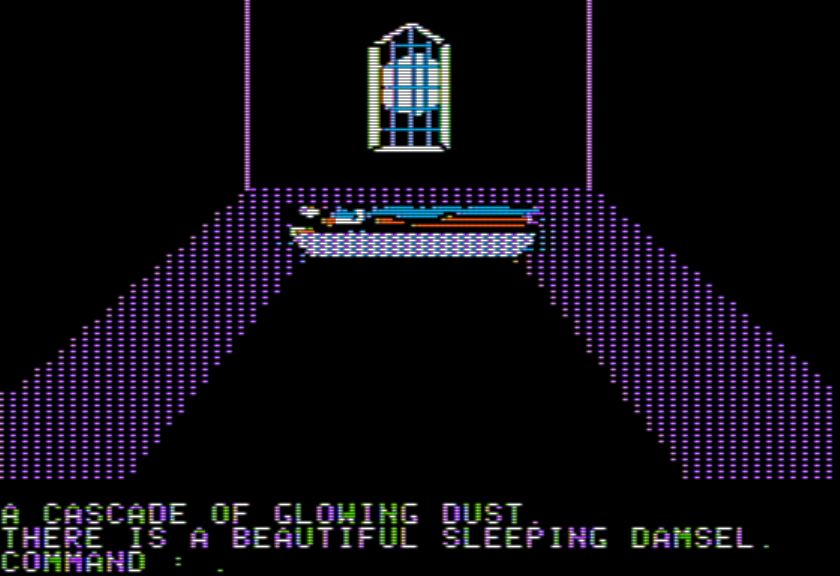
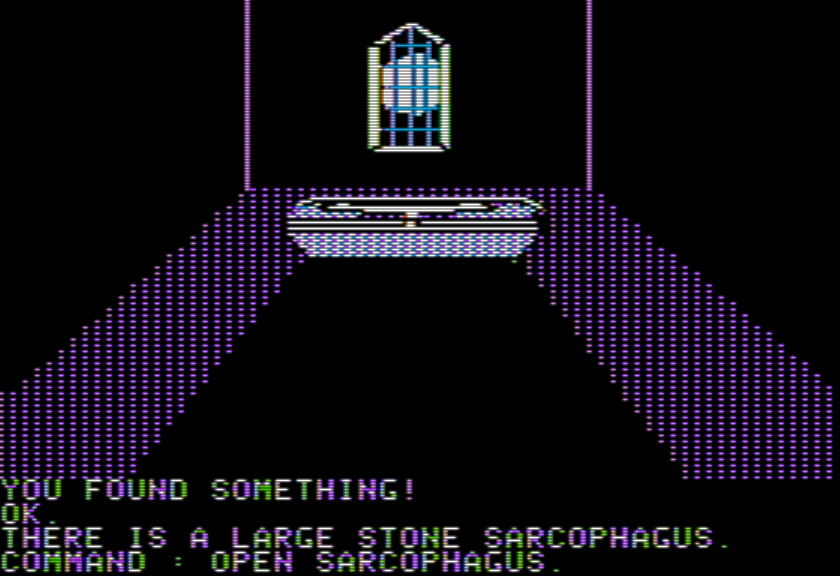
This scene leaves you with a mysterious black box with a button. But this is exactly what you need to win, as the button serves to open the sarcophagus with the princess.
Now winning is just a matter of following the directions from the book: wave elixir, pour elixir, and clap hands.
Before getting to the end, a digression.
I’ve come across many people for whom Transylvania is one of their core childhood memories; Jimmy Maher makes it one of the rare early graphical adventures on his Hall of Fame list. So people certainly remember this one fondly, and…
…actually, I was just fine with it, antlers notwithstanding. This clearly was intended as a romp, and one that had appeal to children (attested by many childhood recollections I’ve read) so I’m not going to ding too much on the simplistic writing.
The game design was curiously open and mostly attempted to be “easy”, but that’s far better than the games we’ve seen (ahem The Mask of the Sun) that try to add very hard elements.
Speaking of The Mask of the Sun, I’d like to go double-meta for a moment, as I found this thread while searching around for reviews at the intfiction forum. It’s about Apple II graphical adventures as a whole.
I couldn’t believe I saw them again. They were all terrible adventure games. The writing is especially awful. The art was mind blowing at the time, especially because I understood the advances in Apple II programming that were producing the art in these games…
I really remembered Mask of the Sun, and I was excited to watch it be played on YouTube, and then, it was really terrible IF. It starts with a story, and then it’s a lot of maze, of roads. Solve maze, go inside, new maze. Almost at random, you get to put a thing from one place to another place.
Especial reward, an animation that was not possible on Apple II. Oh, that’s why I remember it.
— J. Robinson Wheeler
There is the general implication (not just this quote, but elsewhere) that these games are only good for nostalgia. Mask of the Sun indeed had some design issues which I went into, but it’s certainly not true that every game is bad in the same way.
When I write these things, I want to distinguish between things in a old style that you have to grant to move forward, and things that are genuinely bad regardless of style. An inventory limit is an example of the former: there’s nothing technically inherently wrong with one, and not having one means you miss out on puzzles like Magic Mirror or Adventure Quest had. Eventually games started to get so much inventory that they started to obtain a “rucksack” style object, but this is not just good or bad, but a tradeoff.
On the other hand, something like the antlers being separate is a bad design choice overall, even compared to other games of the time (which did not necessarily do such a thing).
One of the ways paradigm shifts in gaming happen is to revive one of the previously “bad” elements with a twist. If I told you about a game that is timed and you have to keep starting from the beginning to win, you might think I meant an NES game, but I also mean the multi-award-winning Outer Wilds. Part of what Dark Souls did was simply restore the idea that the difficulty of a game can push back, and the “troll level” in Mario Maker came from a similar re-think of the rules of game design. We shouldn’t think of our current state of game design as perfected and older design as regressive: there are different expectations and design goals that can be met.
Referring back to Transylvania, the time limit and inventory limit (onerous to modern players) clearly are meant to have a particular effect, and it was on hour 4 that I finally went to triumph with the princess, which made it satisfying in a way that would otherwise be hard to duplicate.
There is a sequel, although it goes in a different direction: the hero from this game, Princess Sabrina, and Prince Erik find a vampire lord has killed King John the Good. You can switch characters while playing. That doesn’t seem to match the ending here, so maybe alternate universe? In any case, we’ll need to wait a while before arriving at The Crimson Crown.
I remember playing this for hours when I was younger. With every move toward a new screen the eerie scratching of the Apple disc drive would scuff along making a sound that added to the suspense!
It had to as the game had no sound effects and no music. This somehow made it even spookier. Every screen rendering (slowly) before your eyes as if some creepy phantasm was programming it just for you.
So my “waterfall” prediction of an easy chain of puzzles was essentially correct. I was misunderstanding a message in one of the rooms.
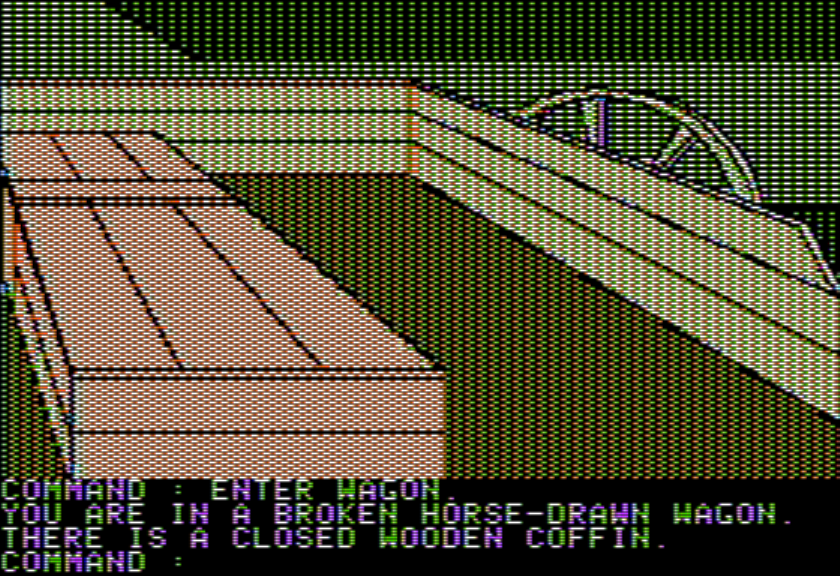
You can see this coffin by doing EXAMINE on the cart, but because the coffin did not respond to any of my actions (OPEN, MOVE, GET, etc.) I thought perhaps it was just scenery. Since I was out of things to try I gave it another go, and then it finally occurred to me that maybe the wagon was considered a location, and I could ENTER WAGON.
Grr. This likely wasn’t even intended as a puzzle.
Opening the coffin reveals a corpse, some hungry mice, and a silver bullet. You can placate the rats with bread and carry them around.
The silver bullet was what I had been waiting for with the werewolf. LOAD PISTOL and then SHOOT WEREWOLF:
Comparing the two deaths (werewolf and vampire) I still would say the werewolf is slightly more difficult to wrangle, since you only need one item (the cross) for the vampire, and showing crosses to fend off vampires has about as much mythological heft as shooting werewolves with silver bullets does.
Getting back into the game, the mice in hand meant I knew where to take them next. The cat will chase after the mice if you drop them down:
Fortunately, the witch never shows up. I think.
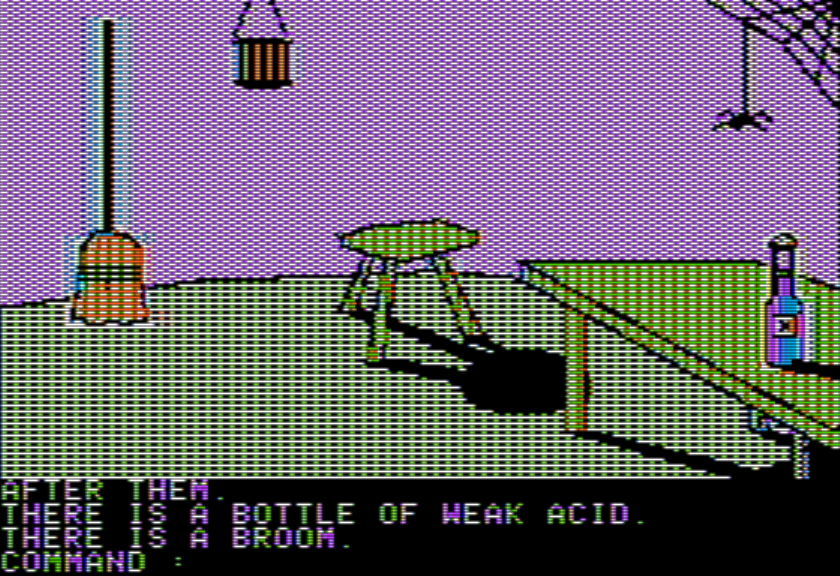
The broom I’ve found no use for (even when attempting to SWEEP every room in the game) but I was able to test my theory about the weak acid revealing the stump’s message.
The knocking teleports you in a cave, I assume the cave previously blocked by rocks. (I think this means the door is never unblocked, although you see it in this picture.)
Again following the waterfall, I could get the flies with the flypaper. Before taking them over to the next logical place (the bullfrog) I tried reading the book.
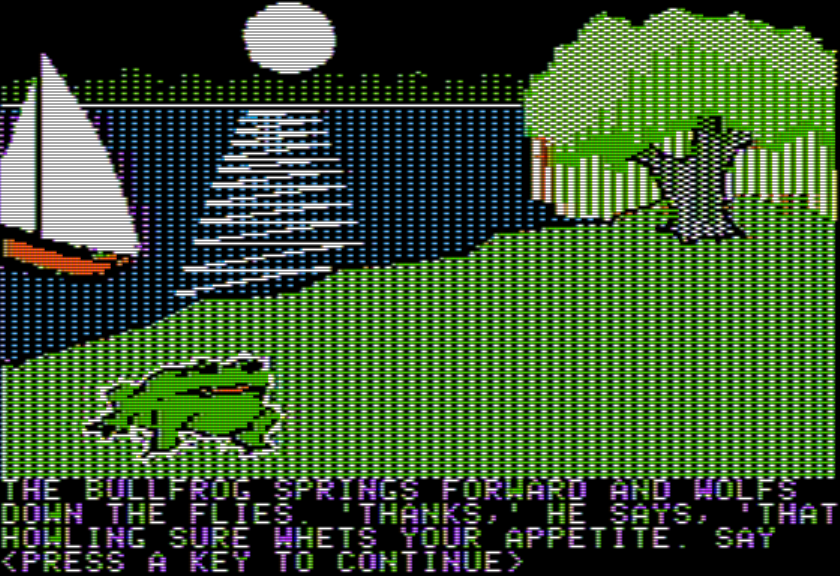
Trying to take the book teleports you out of the cave. It just a couple steps then to feeding a bullfrog some flies:
Again quite direct, even telling us where to go next. Is this game about to fall? Heading to the goblin and saying the magic word causes the goblin to drop the key and run screaming.
I was then able to take the key over to the locked grate and open it, finding an elixir underneath.
And there the waterfall finally ends. The book suggests the sequence SHAKE ELIXIR, POUR ELIXIR, CLAP HANDS, and all three actions work but get NOTHING HAPPENS in the place I’ve tried it — the statue and the sealed sarcophagus. My guess is we need an open sarcophagus and then it will work?
I’m close to out of options though. Other than the elixir I still have yet to use the shiny ring from the castle, and the broom from the witch hut. I tried every verb on my list on both the sarcophagus and statue to no effect, and I’ve tried everything I can think of with the ring. I did make one other discovery, in a log cabin that I previously could get nothing to happen…
…but I haven’t gotten anything more than this to happen. (The head is incidentally not in the text description.) I suspect I’m just looking for one more waterfall and then I’ll be at the end of the game, but it is of course possible there will be a last surprise.
PC-98 Japanese version as sold by Starcraft, via Mobygames.
So I need to emphasize: the structure of this thing is very odd, even taking the span of all videogames from 19xx to 2024 inclusive. Very shortly after writing the last post I killed the big antagonist of the game (at least in a plot sense), the vampire. That’s supposed to happen near the end of your game. The only comparable game I can think of from the All the Adventures Project so far is Castlequest.
You can take the wooden cross (lying out in the open)…
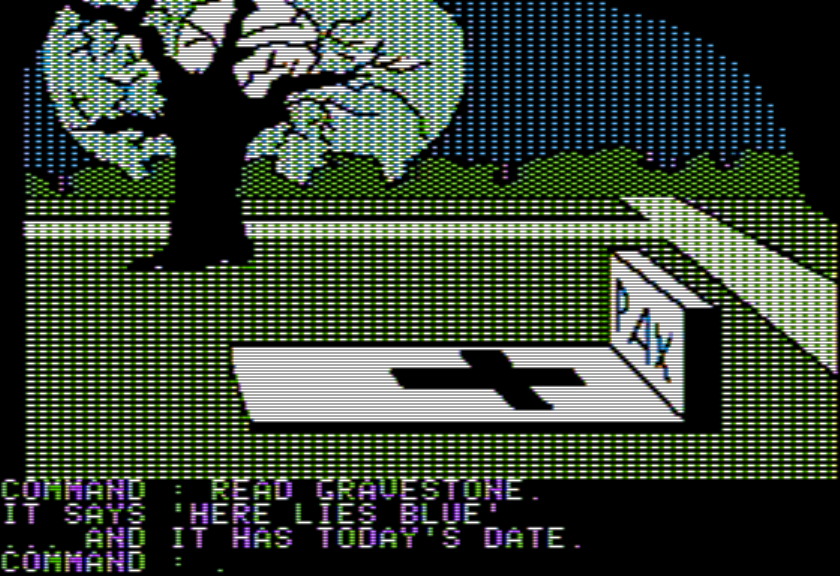
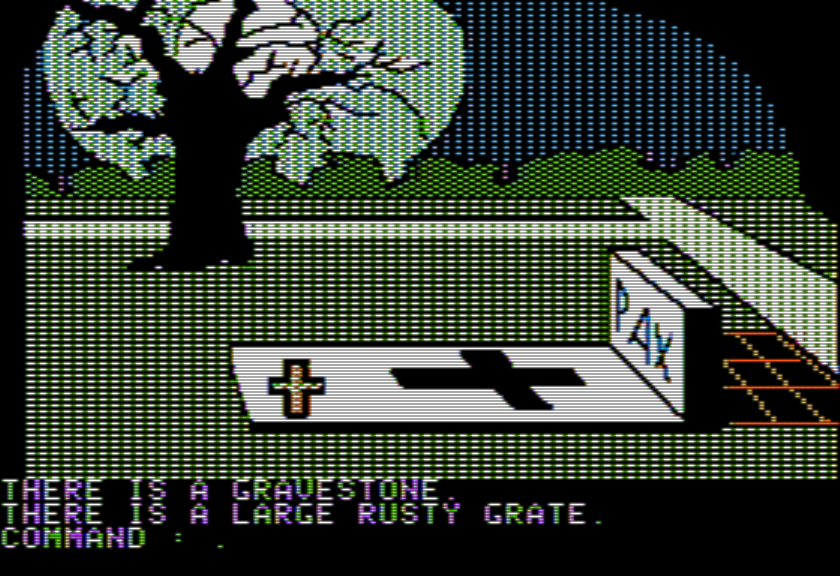
From this room, with the colorful gravestone description.
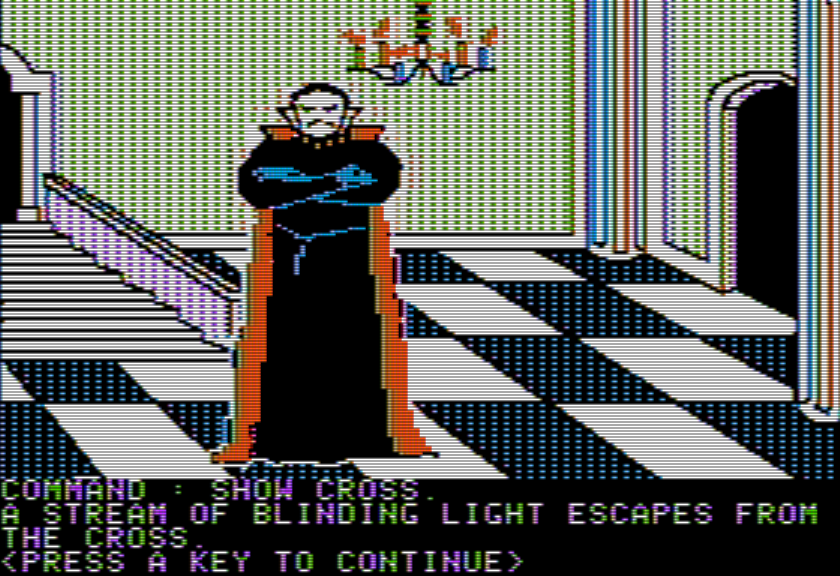
…and SHOW CROSS (a perfectly natural action) to get a blast of sunlight.
A STREAM OF BLINDING LIGHT ESCAPES FROM THE CROSS.
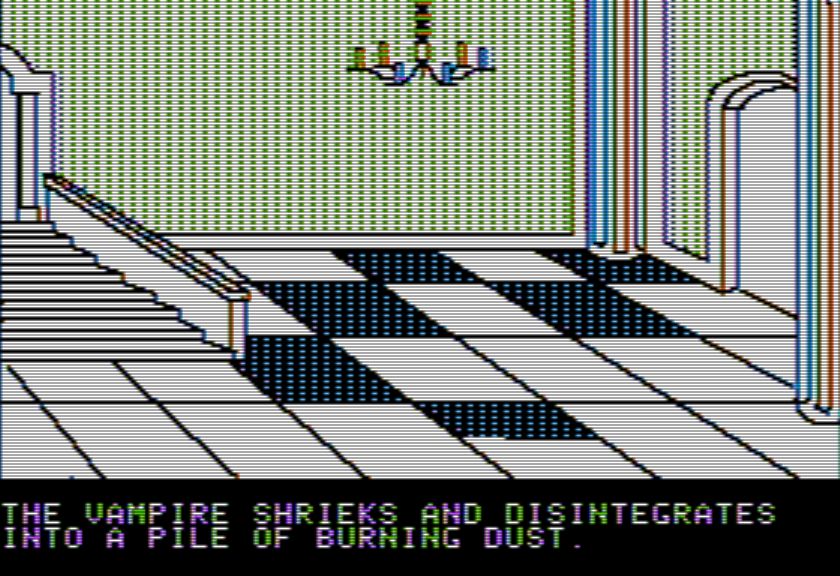
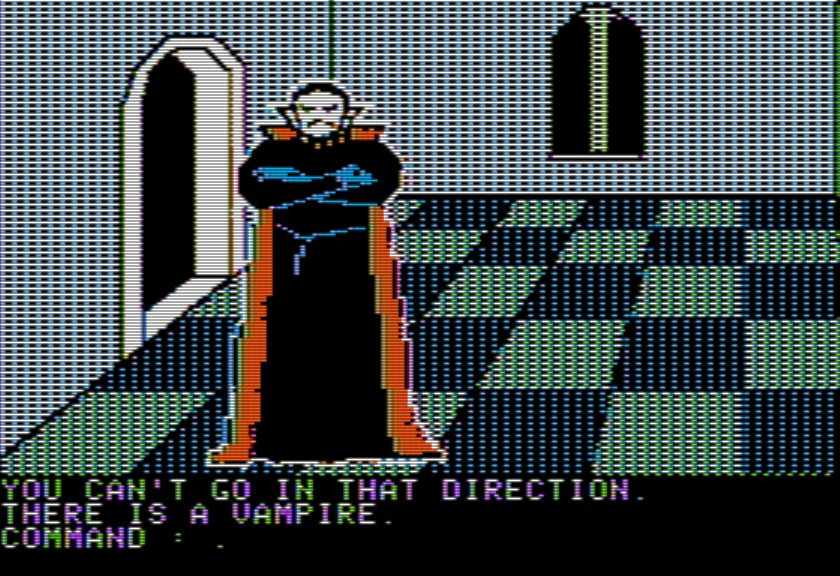
It only takes a little thought to try bringing it to the vampire — you just need to not be holding the garlic. That seems to be the hard part of the whole thing (someone who hoovers up all the items just might not know the vampire is there!)
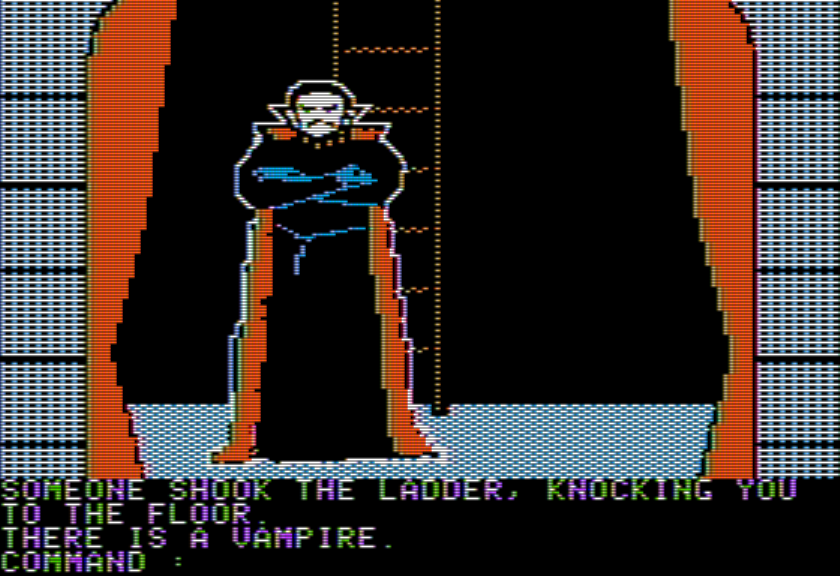
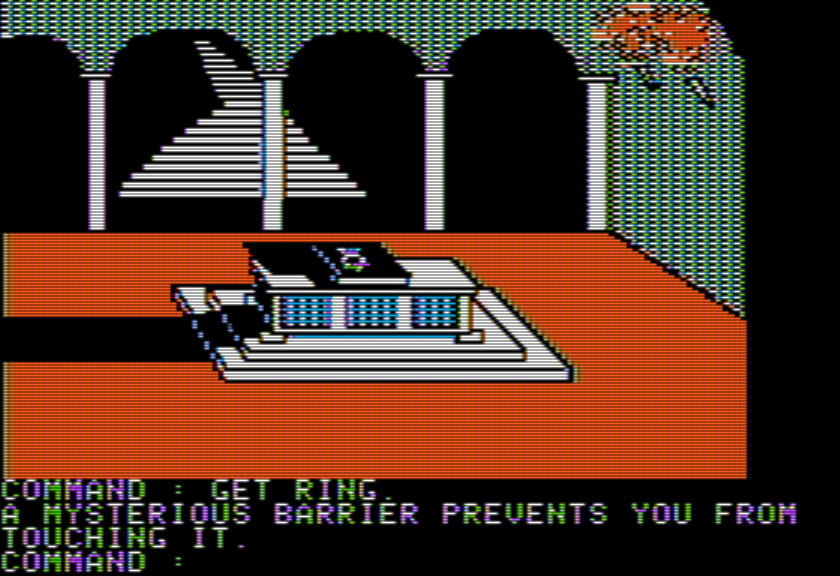
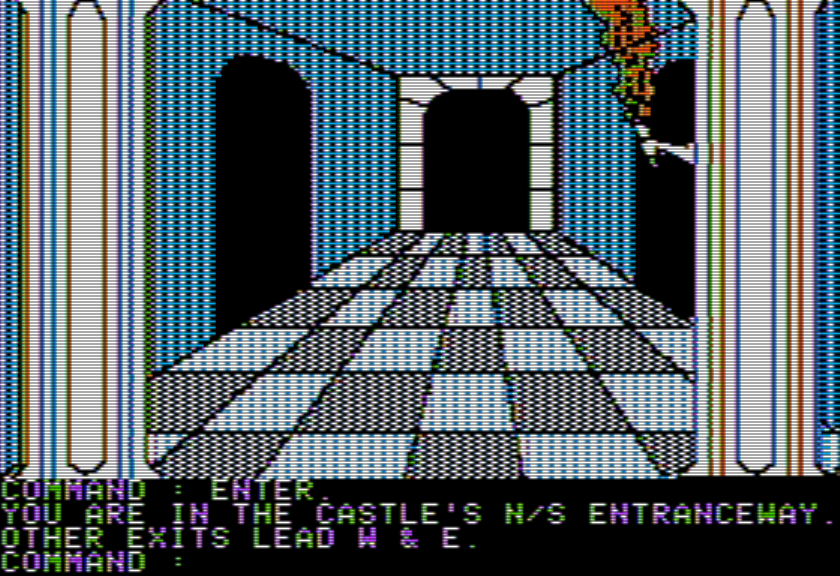
With the vampire dead, you’re able to take the shiny ring that previously had a barrier. (I have no idea what it does.) Another blocked place also opens up. There’s a ladder at the top of the stairs in the castle.
The ladder is not described in the text. I was making the incorrect assumption there would be nothing graphics-only (since the original game was just text). The ladder shaking happens if the vampire is still alive.
Up the ladder is a sarcophagus which just might have our princess, but it is “hermetically sealed”. Magic, then?
And that’s nearly all the progress I’ve been able to make, except I pushed the gravestone and found a locked grate. I assume that’s where the goblin’s key goes.
Being stuck, I made my verb list.
There’s enough verbs that in this situation I generally want to just play “normally” and only consult back in special circumstances. I will at least observe:
It is possible to SAY in a freeform way so there’s surely a magic word somewhere.
SEARCH and EXAMINE have been failures nearly everywhere (“YOU SEE NOTHING UNUSUAL” except for at the creepy statue). TURN seems to map to the same word, oddly enough, suggesting that another (hypothetical) secret will involve that physical action.
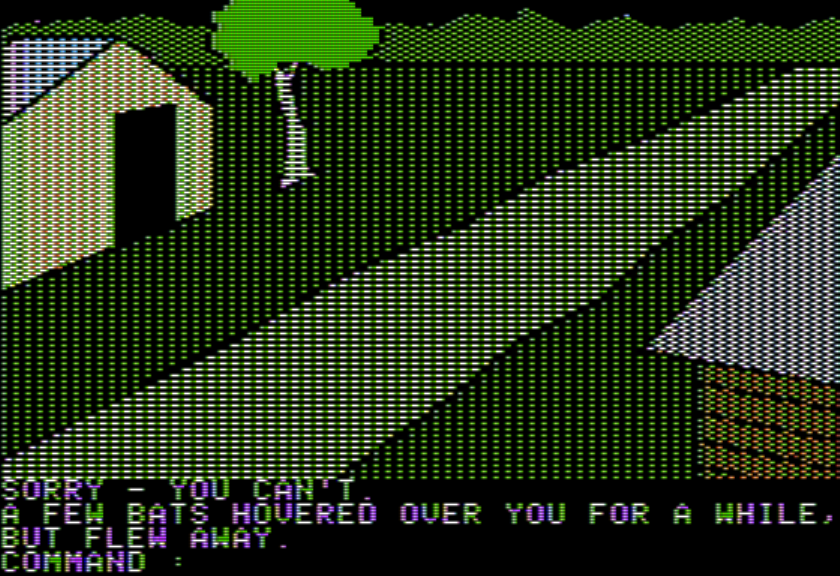
You can PET as a verb, but the black cat doesn’t allow it (“SORRY – YOU CAN’T”).
In terms of movement, JUMP is noteworthy (it asks for a direction) and I haven’t gotten FLY to be recognized but that makes me wonder if we’ll pick up the capability somewhere.
I’ve tried various random things like: feeding the cat bread, moving some giant rocks blocking a cave next to the stump…
I have to wait for an opening where the werewolf isn’t around to test a random action like this. Here he showed up the next turn.
…throwing the flypaper in various places (but not every place yet, the werewolf makes this slow), and trying every word in my entire verb list on the statue while wearing the ring.
I’m not ready for hints yet. I might be if this game had more dubious coding. Also, the fact that the vampire-killing is so simple make me think that somehow all the puzzles are simple, and I just haven’t hit the “waterfall” yet (where the thing you get from puzzle A lets you solve B, which lets you solve C, which lets you solve D, etc.)
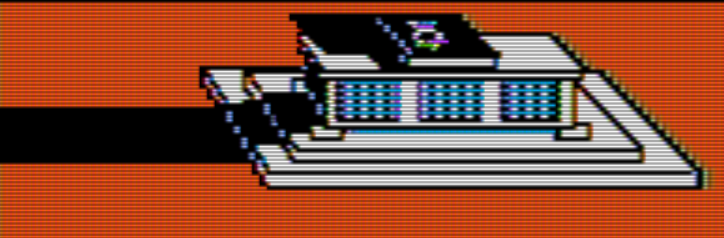
This is a good time to stop and admire the graphics.
Here, let’s compare and contrast:
Let’s be fair: Time Zone had the graphics pumped out and a ludicrous rate, and Transylvania’s author did the graphics over 11 months. So there’s a little more care and love. But it’s still interesting to poke at the specifics.
Both at least attempt at some kind of stylization on the stairs. I would call Transylvania’s geometric shift and slight asymmetry elegant; it conveys the darkness of a long-decrepit castle. The Time Zone picture tries to convey something similar (with an old Pyramid) but it comes off more as a glitch than intentional.
The Transylvania art also tries to convey contrast with light and dark, with the coffer having both lights and shadow. The Time Zone art has no light contrast at all. (This may have been somewhat a result of the tools: Penguin’s graphic tools were likely more advanced than the ones used by On-Line Systems. At the very least, the Penguin graphics seem to have a wider variety of “colors” to pick from, color including intermixed texture possibilities.)
I’m also impressed at how image maintains the 3D structure even with the shadow over it, and the color used at the front.
I have long been the opinion that you can have “good graphics” at every pixel level; it is possible to adopt a style that works within the constraints. While early graphical art often looks janky, we need to consider not only the skill of the artist, but the time they had (production time was very fast back then) and the tools. The Tarturian rendered its graphics as literal lines of BASIC; the authors made a tool for generating them, but there were still hard technical limits to how good they could make a face.
(Jimmy Maher was able to interview today’s author, Antonio Antiochia, in detail. Check that link if you’d like to see more.)
Antonio was a 13-year old in 1979 who was at Eastern Michigan University, where his father worked, and was playing with computer terminals in a lab.
A picture of a computer terminal from Eastern Michigan University circa 1978, via the Aurora ’78 yearbook.
He found he could access games with a guest account and came across Adventure, but due to a lack of any starting instructions was unable to get anywhere. (Jimmy mentions in the comments to his post it might have been Wander instead, because of the lack of a tutorial to start. However, Wander was a lot rarer and there were enough ports of Adventure a rogue one could have the instructions cut off.)
The game still stuck in his head and he was able to return later and make progress all the way to the end. He was then out of adventures to play, and while he was already a capable programmer at age 13, he wrote his own on paper rather than on computer.
I came up with dozens of adventure plots in my spare time (and a few other games), drawing their outlines, their maps, etc., based on a wide variety of themes (a bit heavy on the fantasy genre) — simply out of the joy of creativity and discovery. It was cool.
Antonio later learned about Scott Adams games on home computers and the Ann Arbor Community High School Computer Club, so become a regular there. He wrote his own game on an Apple II (Land of Ghaja, now lost) and distributed it to the club, then later followed with Transylvania. These were essentially private games.
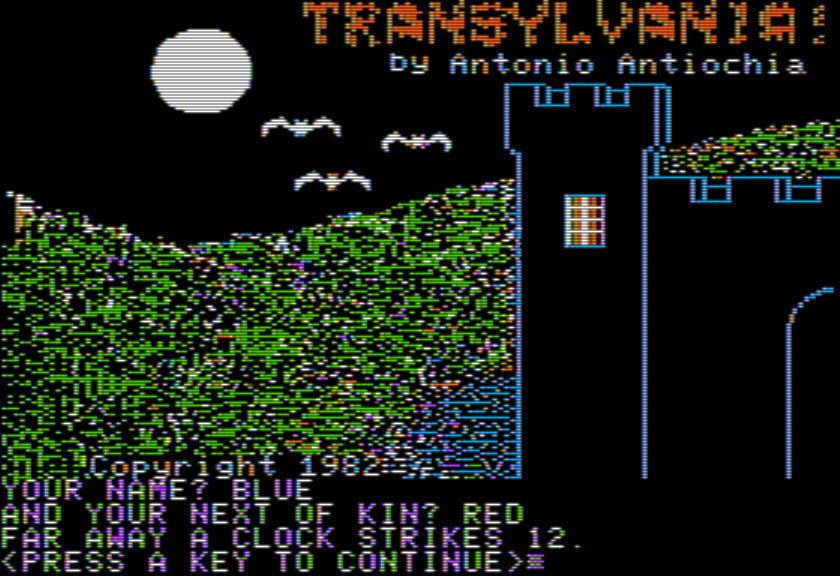
Like with Magic Mirror, getting Mr. Antiochia hooked up with a publisher happened by accident. In 1981 his father was calling Mark Pelczarski to order supplies (the store Micro Co-op) when Mark mentioned starting a publishing company (Co-op Software, but eventually Penguin). The elder Mr. Antiochia mentioned his son had written an adventure game, and Mark said to “send it in”.
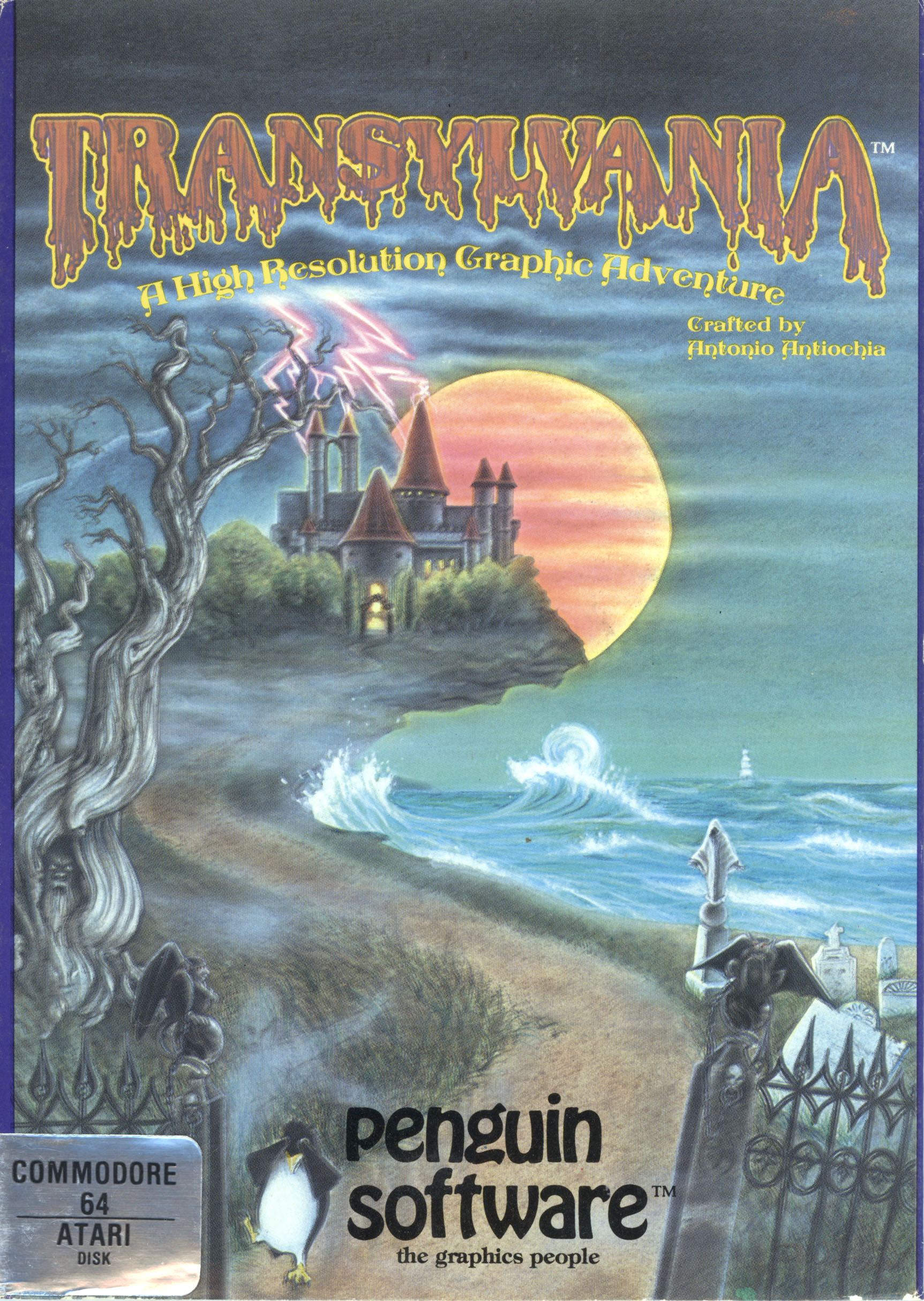
The game was text-only in BASIC. Since not-yet-Penguin were to be known mostly for their graphical software, it seemed wrong to publish without graphics, but Mark was able to give his own software (including not-yet-released portions) to Antonio. Antonio then spent nearly a year making graphics, and the package of BASIC + graphics + assembly language provided by Penguin was put together into Transylvania.
There are incidentally later versions, like a Macintosh black and white version, a “high res” Apple II version, and a larger version with more puzzles published by Polarware. I’m sticking with the 1982 original.
The story begins at midnight, as we have been tasked with the King to rescue the Princess Sabrina, “in the clutches” of a “murderous Vampire”. We have 5 hours.
Reading the stump is a puzzle, as it is “covered with sediment and too fuzzy to read”.
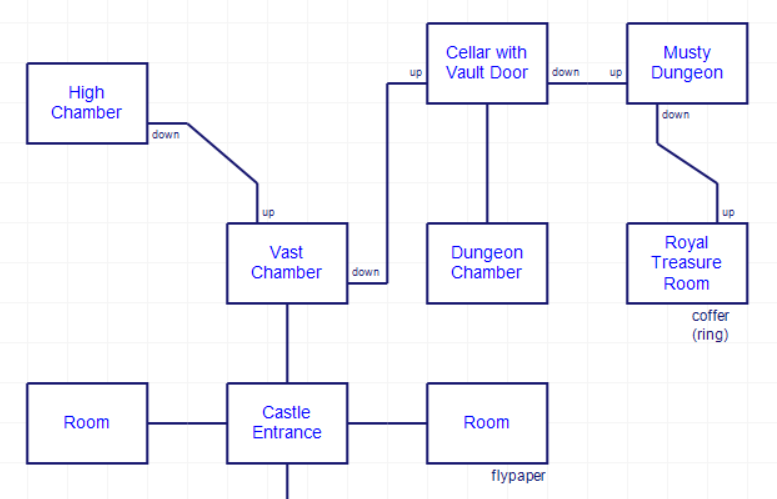
The map is quite open. I was able to get to what I suspect is at least 80% of it from the start, possibly more. There are no locked doors. The puzzles seem to be gating the ability to pick up objects and find information, rather than get into locations.
The note says that Sabrina dies at dawn.
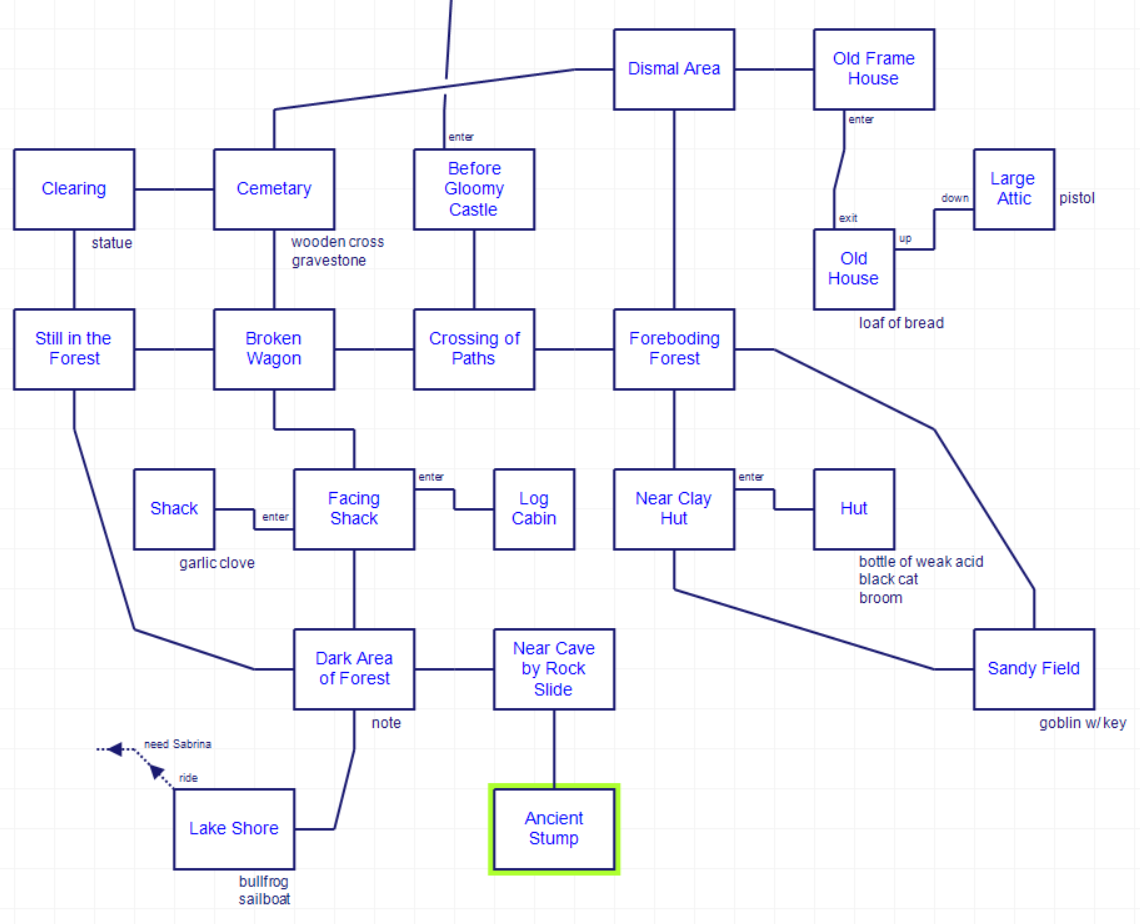
Here’s the first part of the map:
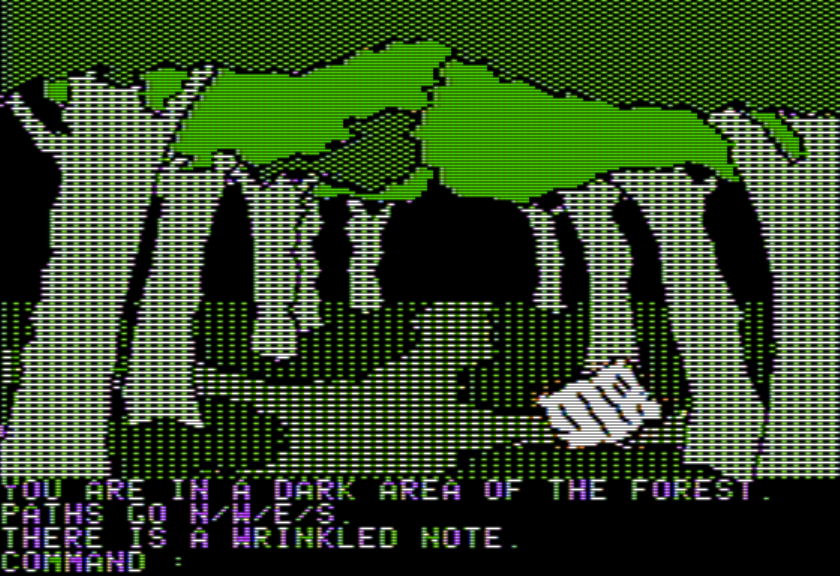
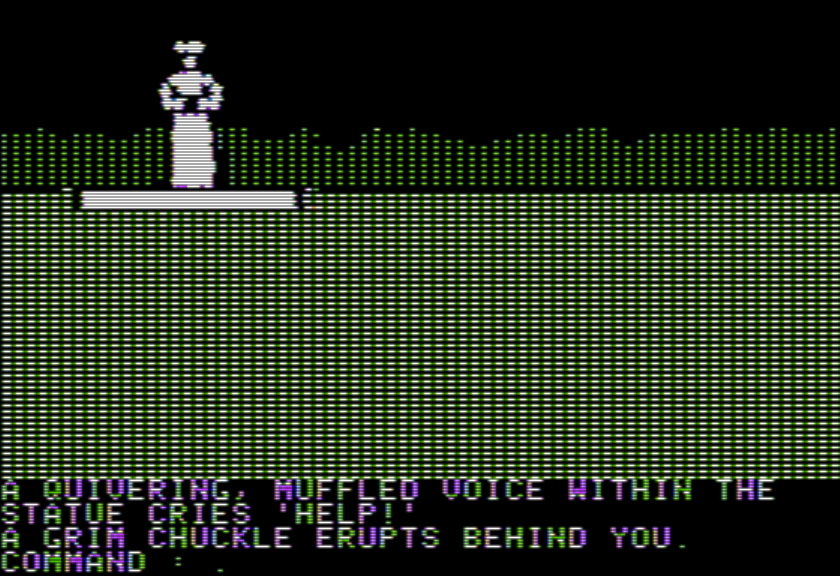
Wandering the map results in a lot of activity, both in terms of sounds and in terms of danger. There might be a “grim chuckle”, or an owl, or the sound of bats.
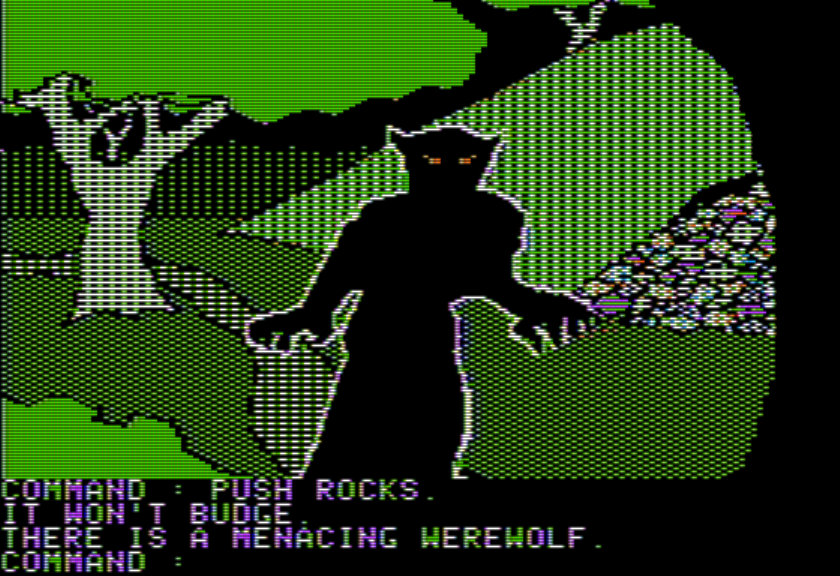
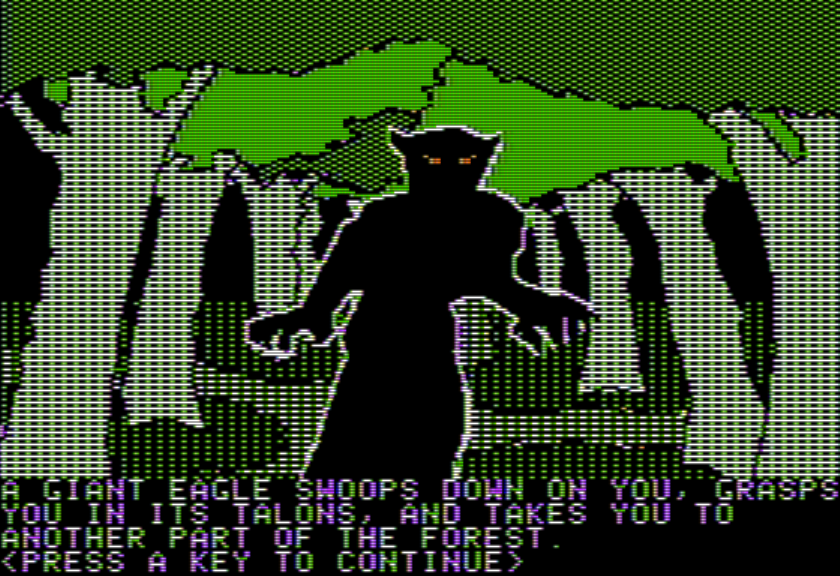
After a set number of turns (I think?) you start to get chased around by a werewolf. If you pause without running while a werewolf is the room you will die. Sometimes it leaves the trail, but not much. (The closest we’ve had to that effect is Masquerade.) You might additionally get picked up by an eagle and dropped in a random spot, which suggests to me the author was familiar with Hunt the Wumpus in addition to Adventure.
Here both are happening simultaneously.
There’s a “small hut” which is clearly a witch’s house, where a black cat hisses at you if you enter and doesn’t let you take either of the items (a broom and some weak acid; I’m guessing the latter helps with reading the stump).
Of items that can be grabbed just lying around, there’s also a garlic clove, a wooden cross, a stale loaf of bread, and a flintlock pistol in various locations (the latter two in an “Old Frame House”), although the werewolf being present means you can’t pick up an item if it is around.
(Also, the gun is not loaded. I’m guessing we find a silver bullet somewhere for the werewolf.)
For non-movable characters / antagonists, there’s a bullfrog, a goblin with a key (there must be at least one locked thing somewhere) and a admittedly unsettling statue.
Trying to break the statue didn’t work, but maybe I need a particular tool.
The werewolf is restricted to this part of the map, because there’s a castle area to the north that is the domain of the vampire instead.
If you are holding the clove of garlic the vampire doesn’t show up at all.
Other than that you can encounter some flypaper (I assume for obtaining a bribe for the bullfrog) and a shiny ring in a coffer, although the ring is protected by a “mysterious barrier”.
I have some ideas I need to test, but the presence of the werewolf makes testing require multiple “runs” (there’s enough time to grab the wooden cross, for instance, but then you have to ignore some other things). This means even if there are no fancy daemons or timers the game isn’t 100% trivial to solve. Mind you, there is an overall timer — death by dawn — so it is possible the timer plays into other events.
Fingers crossed for good progress next time!
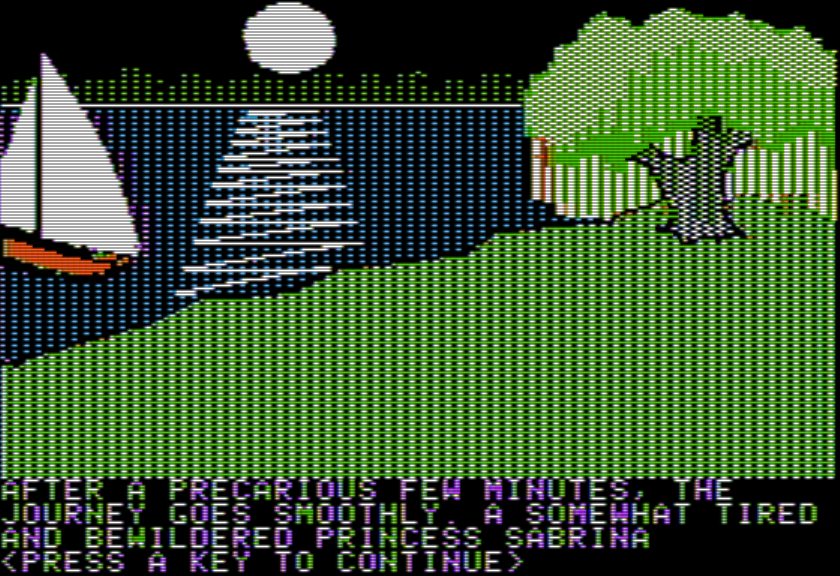
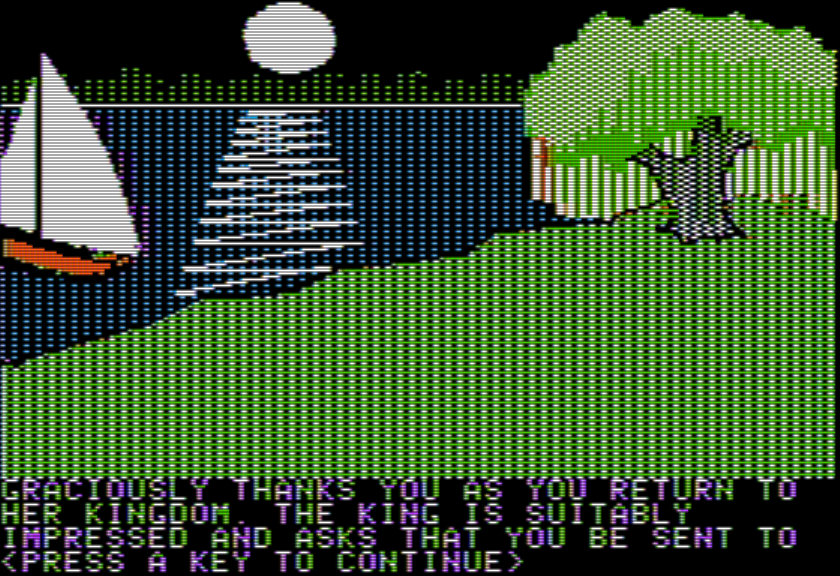
There’s a sailboat you can hop into, but it leads you back to “home” and you can’t go home without Sabrina.
It was a number of things coming together. I’d seen the very original computer game called “Adventure” back in 1977, which was played on mainframe computers (on which my son worked). Then we got involved with a team playing Dungeons and Dragons. I needed a new imaginative idea to replace Vision On which I had been making for some 10 or more years, when I heard The Hitch-hiker’s Guide to the Galaxy on the radio and was knocked out by it! So I met up with Douglas Adams and outlined a general idea to him in the hope I could get him to write it up, but unfortunately he had just agreed to write the TV version of Hitch-hiker … and though he liked the idea didn’t have the time. So I just went at it myself, trying to combine all of the above.
— Interview with Patrick Dowling speaking about the origins of The Adventure Game, via an interview at Off the Telly
I managed to finish the game, although there were parts I didn’t fully comprehend.
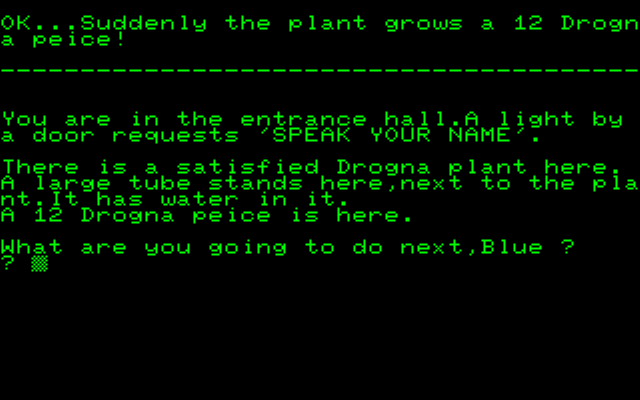
The screen above comes from typing WATER PLANT at the start. Of course, being able to do so requires knowing the verb WATER works (and I can assure you it is very rare compared to “POUR WATER” or the like) but even then it failed in a cryptic way, by asking “How?”. For some games — like the Scott Adams ones — this is a prompt for another parser action. That is (to compensate for it being a two-word parser), you might respond with
WITH TUBE
indicating the thing we do the action with, and that resolves the “how”. Alternately, the command itself might have needed rephrasing, like possibly WATER PLANT WITH TUBE. That wasn’t the case here either.
Here, “how” should be interpreted as “there is no way to do the action you are thinking”. This requires visualizing the game like the author does. The tube and the plant should be thought of as in separate places to the extent that you can’t just tilt the tube over or grab it (TUBE is not a recognized noun, even). Both are fixed in place.
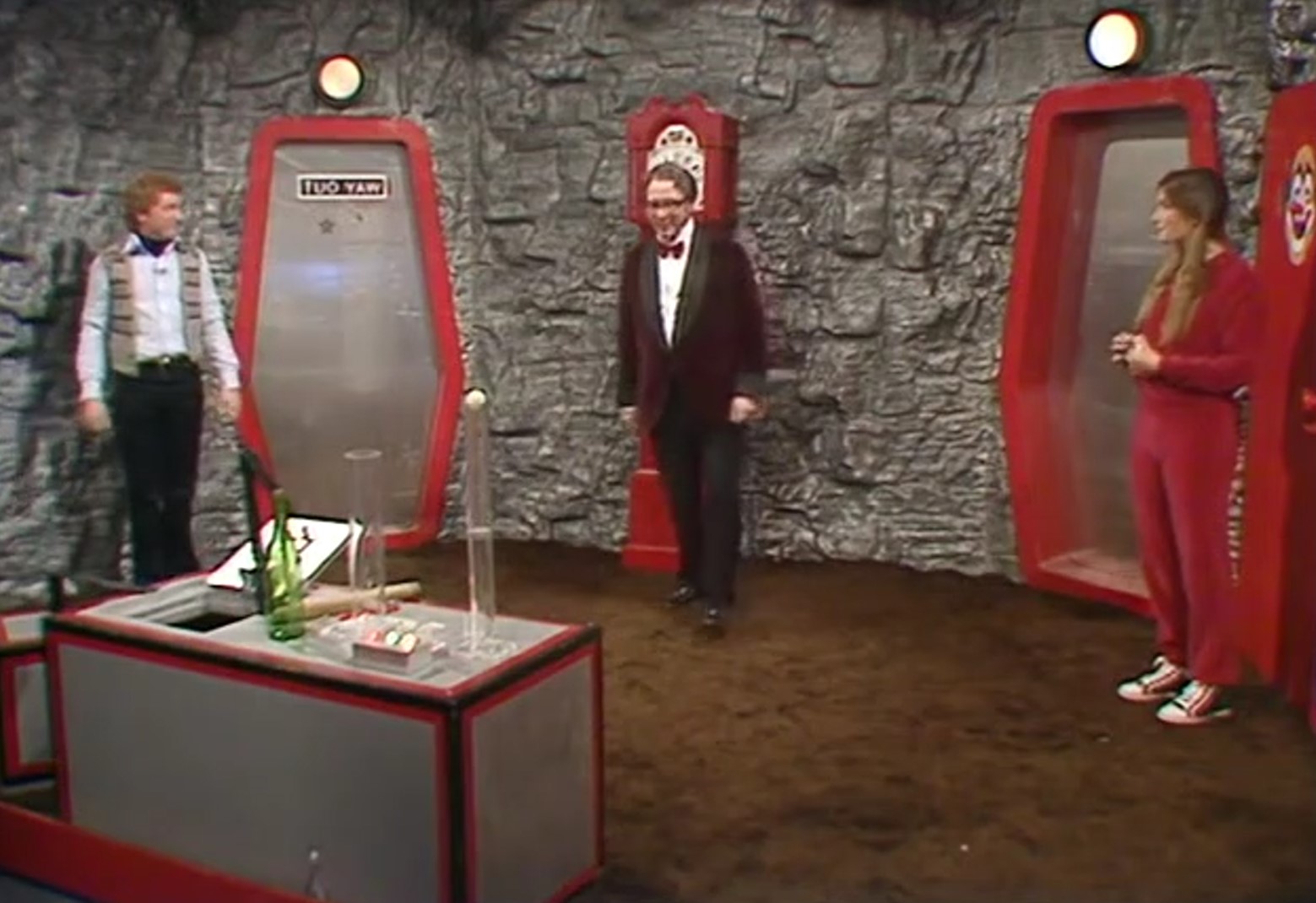
This reflects the television show occasionally have this sort of locational puzzle, where you need to do an action (involving some science trick) which brings together distant things in a room, or at least manages what might first seem an impossibility. For example, the first episode has a ball with a clue that rises to the top of a cylinder if all the players are standing in particular places:
This is showing the aliens explaining the puzzle.
The proper resolution is to put weight down in a spot to substitute for a person.
So the right way to visualize the plant puzzle is as “here’s some water, here’s a plant it needs to be brought to, now bring them together”. I at least guessed something like this early.
In the room to the north (the one with the computer asking for 1 drogna and the closed door requiring 12 drogna) there’s also a button, and pushing the button causes an uninflated balloon to appear. This gave me the idea to fill the balloon with water and use it as a water balloon, but my attempts at FILL BALLOON and the like came to naught (they were technically off my verb list already, but with a parser this dire anything is possible).
I finally came back around to trying WATER PLANT again — even though it had already failed — and was surprised when it worked.
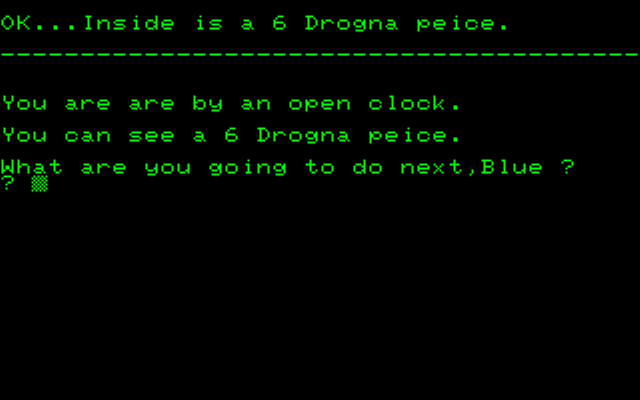
I was so surprised it took me some effort to realize I was doing the implicit actions of filling the balloon, bringing it over, and squeezing. Most adventure games would require the steps in between. As is, the setup is so convoluted I am only 95% certain everything I said above is correct, but at least I’m through the puzzle, and have claimed my 12 drogna “peice”! (You need to refer to it as “12 drogna”, not “piece” or “peice”.)
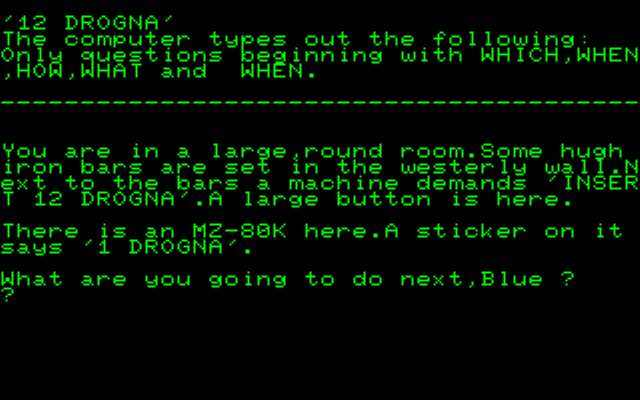
Now, there’s a matter of not being able to INSERT anything in the computer room (see above). The right thing to do is either PAY COMPUTER (to activate the MZ-80K) or PAY MACHINE (to activate the door opening). In neither case are the nouns described that way in the text, so another vibe I need to roll with is that the game is happy to freely modify how a noun should be referenced from how it initially gets described. That is, (as imaginary examples) you might find a BROOMSTICK that needs to be referenced as a STICK or an APPLE II that needs to be referenced as a COMPUTER.
Paying the computer first:
The computer types out the following: WHAT IS YOUR NAME?
Giving your name, and then trying to type something random has the computer give exactly what sort of prompt it needs.
I never — and this is after finishing the game — found any phrases the computer recognized. The computer was even giving messages like I DON’T UNDERSTAND WHERE which is exactly the thing it asked me to type.
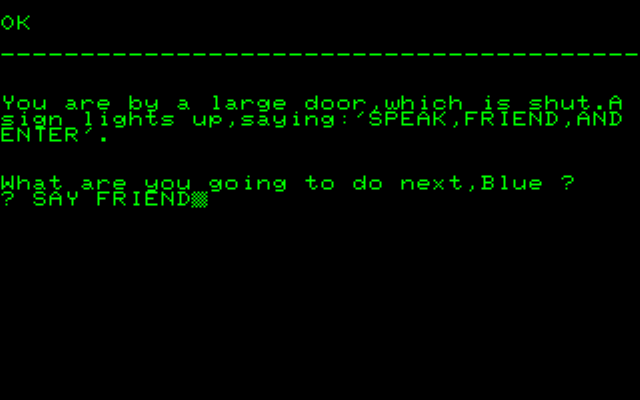
Nevermind that: I could PAY MACHINE in order to open the bars to the west (“Right,the bars slide apart”), and pass through. The bars slide shut behind you but there’s a button in a random spot later you can push that will cause them to open again; this allows later access to the computer, but since I never found a use for the computer it didn’t really matter.
This is the complete map for the game. The first thing encountered past the bars is a random green button with a strange result.
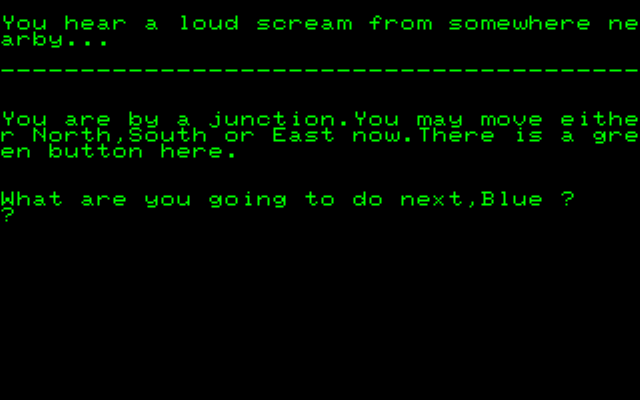
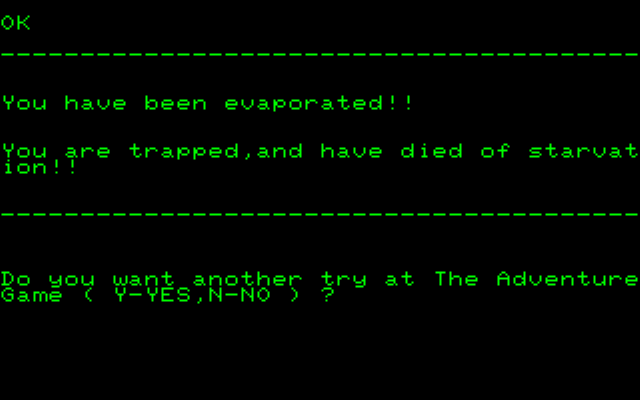
This seems to serve no purpose other than if you go north in a dark section up to where the “monster” is you get “evaporated”.
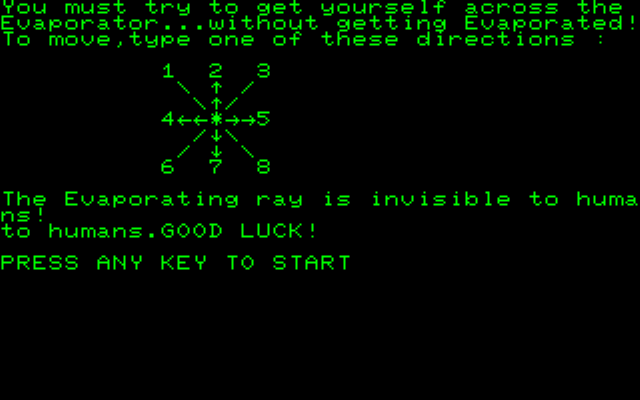
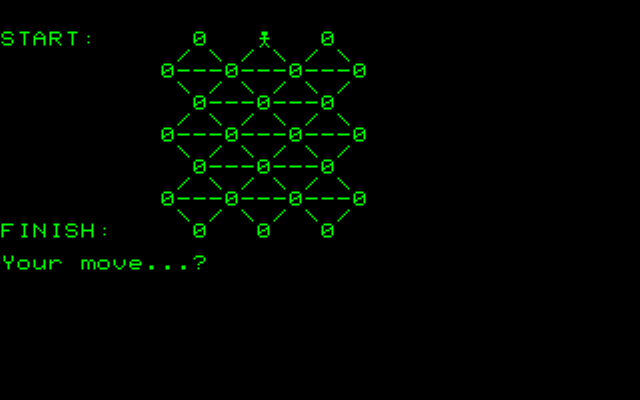
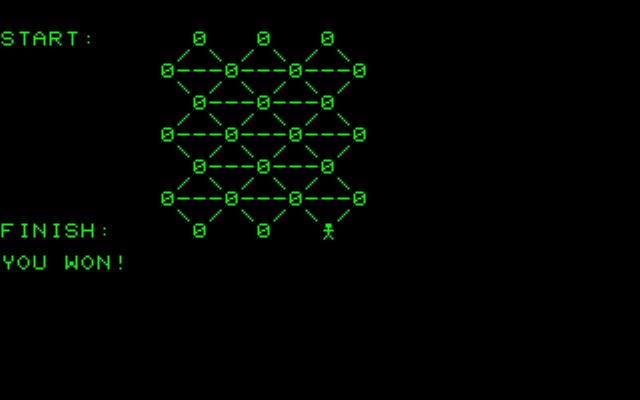
A brief primer on evaporation: it was introduced in the television show during Season 2, as a new “end game” called The Vortex. Players would move from place to place on a triangle grid avoiding an invisible (to them) enemy that was made via computer generated graphics, and if they hit the enemy, they were “evaporated” and had to “walk the galactic highway” to escape as opposed to just leaving. The video below starts about 30 seconds before an evaporation:
I admit I don’t understand the “strategy” of this game, given the enemy is invisible. This seems like just a lottery? It is important past the theoretical because to escape the MZ-80A version of The Adventure Game, you also need to pass through The Vortex (with identical rules). Evaporation in the TV show doesn’t kill you (they needed to accommodate those five-year-olds), evaporation in the computer game does.
But that comes later. For now, we entirely ignore the dark section and go to the south instead.
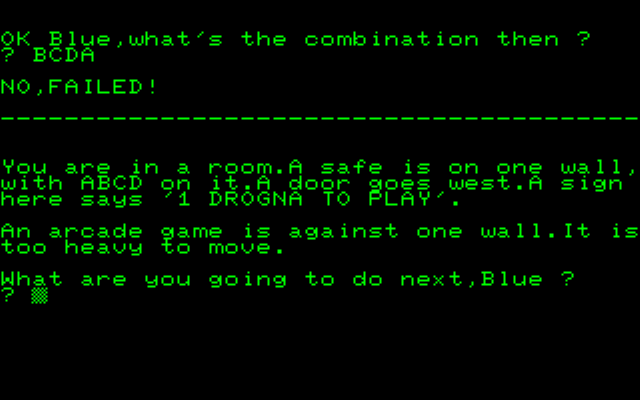
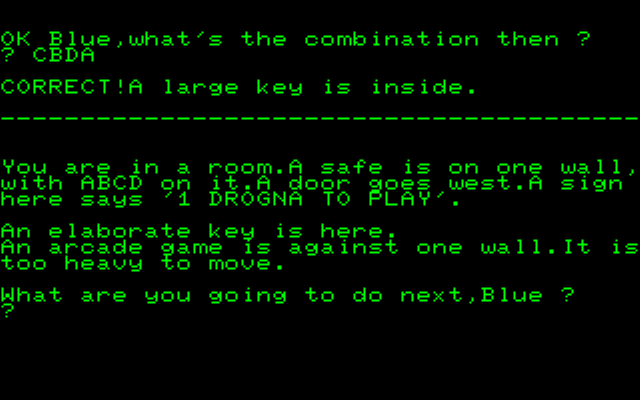
Keeping in mind this was based on an educational show with math puzzles, I figured while there might be a code for the safe somewhere, it was equally likely the game meant for you to brute force list the different permutations of ABCD (as a math exercise) and go through each one. Brute force worked fairly quickly:
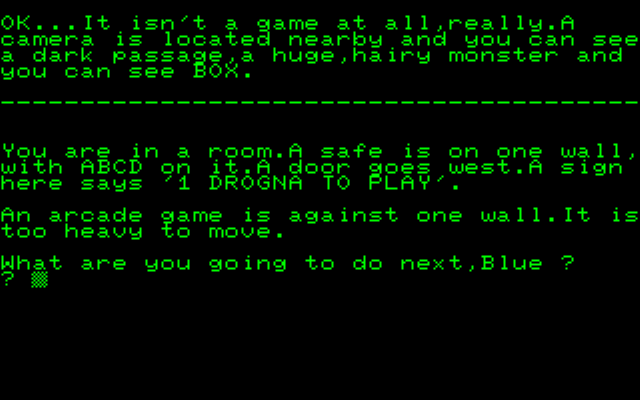
Playing the arcade game is just a matter of ignoring the computer so you can save your 1 drogna for the game instead.
OK…It isn’t a game at all,really.A camera is located nearby and you can see a dark passage,a huge,hairy monster and you can see BOX.
This was highly deceptive, as you’ll see in a moment. Heading west from the arcade gets a riddle:
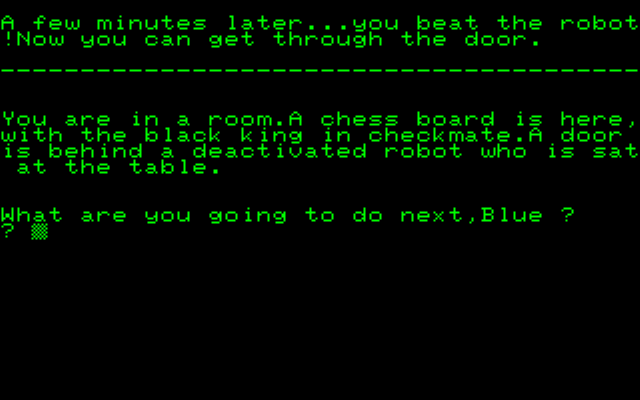
Going further you meet a robot who wants to play chess. You have to beat it to pass, but there’s no trick, it’s just a matter of playing multiple times until you win.
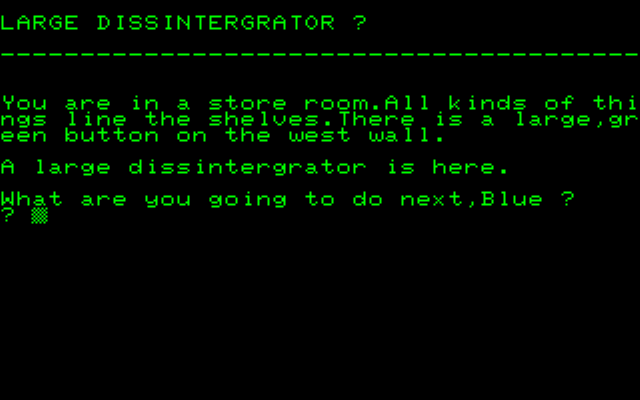
Off a side passage from there is a storeroom with a button (that opens the bars at the start), a torch, and a “dissintergrator”.
You can only refer to it as a GUN. I was never able to use it.
Going back to that message about the monster and the BOX — I tried taking my torch over to the dark place and lighting it, but none of the verbs I came up with worked. I wasn’t able to shoot the monster with the gun either.
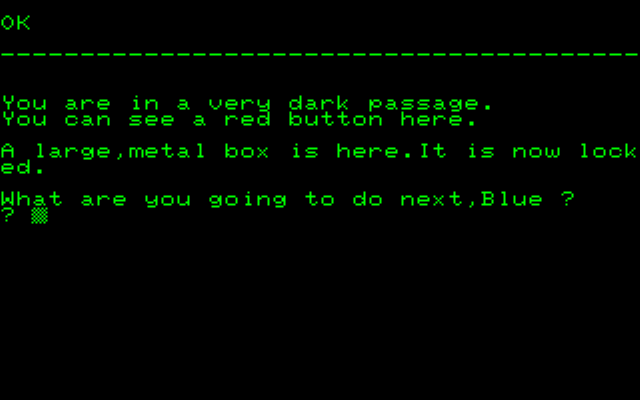
I eventually found that the box is not at the monster at all but a side room, but you can only see it if you are holding a torch. It’s truly the weirdest of implicit actions — I guess the torch is providing light but makes no indication of such?
This room was originally empty. There’s no indication otherwise the torch is doing something.
Pushing the red button just kills you. The box can be opened to find a 1000 drogna piece. And that is that.
Regarding the safe at the arcade game that had the key, that goes to a “grandfather clock” in another side branch back at the chess-playing robot.
And a little bit further someone is taking fares back to Earth, and the 1000 piece works. I have no idea if the 6 also gets used somehow, everything is implicit action.
Now, to escape, we have to go through what this calls the EVAPORATION GAME.
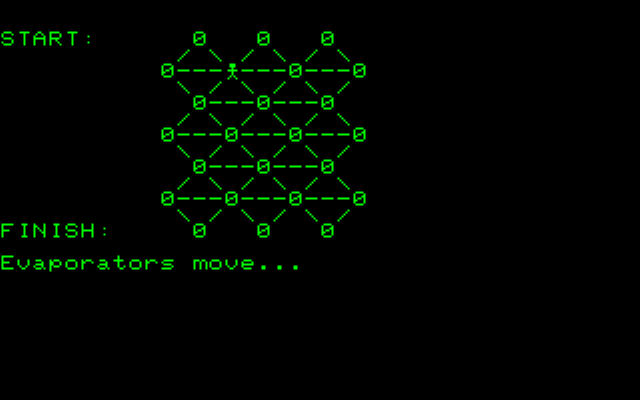
This was incredibly finicky and I suspect the emulator might have been bugged. Sometimes I picked a kosher direction and it didn’t work. In between moves the “evporators” would move, and sometimes then I would get a turn back, and sometimes the game would just lock up in an endless loop.
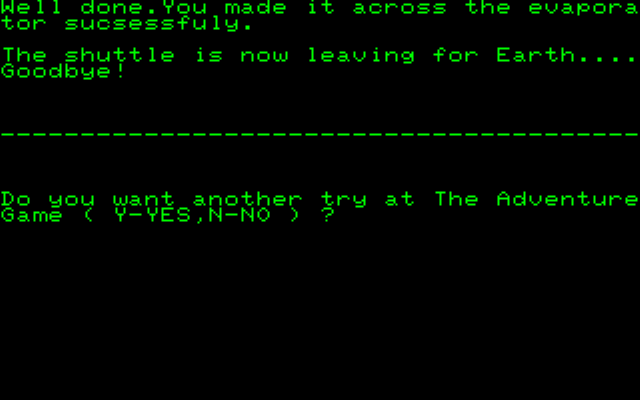
Eventually, by sheer luck, avoiding both the evaporators and the crash (equally deadly) I made it to the end and won everything.
Cryptic things I never worked out:
how to use the computer
how to use the gun
if the safe had another intended method of opening other than brute force
what the whole point of getting the key from the safe and finding the 6 drogna piece was
why pressing the green button makes the monster hostile, and if there’s any way to escape when it is non-hostile
Even when I knew what verbs I should stick to, the parser felt like wading through mud, because so many of the nouns were either not recognized or were described in ways that required me to guess what their “parser equivalent” was (like the gun). The torch was especially cryptic and I only worked out what the game’s intent was after the fact.
The one thing this had going for it is atmosphere; it really did feel like I was on Arg rather than a generic planet. The game might have been stronger had it done more with the game show elements: multiple characters, science puzzles with multiple solutions, and cryptic alien hosts that would sometimes give hints to make sure shooting ended in time. (Ian Oliver, producer: “Many of the ‘hints’ from Chris the butler and company were issued in desperation – we had to be out of the studio by 10pm come hell or high water.”)
This was a little too ambitious for what was likely someone’s first adventure game. Even an advanced parser wasn’t strictly necessary — you can just subsume a lot of action under USE — but there needed to be proper feedback when and why things don’t work, implicit actions needed to be described when they happened, and nouns needed the in-game text to match the name the players use. However, the NPCs required to match the show likely would have strained even Infocom’s resources.
(One last bonus anecdote from TV production before I check out: two of the series were recorded in a studio with no air-conditioning, and because of the structure of the game allowing the players to explore anywhere at any time, it meant most of the sets needed to be lit. On a normal production only one would be lit at a time. This led to the place being more sweltering than normal during a summer shoot.)
Next up: Transylvania for the Apple II. I know some of you have been waiting for this one. It’s finally time.
































































 Renga in Blue
