I’ve finished the game, and be sure you’ve read my other posts before this one.
(Also, in my second post, by accident I picked a screenshot of a room that held a secret. Can you find it before I talk about the room?)
A little more on the nonsense-monster name thing to kick things off —
Rather more famous than The Gostak is the Lewis Carroll poem Jabberwocky.
‘Twas brillig, and the slithy toves
Did gyre and gimble in the wabe:
All mimsy were the borogoves,
And the mome raths outgrabe.
“Beware the Jabberwock, my son!
The jaws that bite, the claws that catch!
Beware the Jubjub bird, and shun
The frumious Bandersnatch!”
The poem is an exercise in imaginary words, although curiously enough, if you look up pictures of the Jabberwock they most look the same. That’s because it was illustrated by John Tenniel in Through the Looking-Glass, the novel where the poem appears.
More interesting visually is the Bandersnatch; if you look up depictions, there’s a wider variety of approaches.
A collage made up from random pictures on an image search. I needed to add a date restriction to avoid clashing with the Netflix show.
There’s still some curious consistency having a creature that walks on legs, but the creature is still in a real sense an infinite beast encompassed by every visualization at once.
That’s not how I thought of Qedejiv the weird and Baryon the bad and Zezotim the blue and (most importantly) the Elmralat. I didn’t have (nor do I have) any visualization at all. I am not one someone with aphantasia: I visualize things all the time. But with no reference, I had them stored more conceptually. If you were to insist on a visualization, Rob’s comparison to “weird fantasy” like Dark Crystal seems appropriate, and that may even be what the author was thinking of. But I only had that feeling as a mood, not something concrete I could draw.
Last time I had found a horn which seemed to have three “Brothers”, including the green treasure I had already found, with some link to the Elmralat: “Held afore from him / Who bears the Elm / And in a secret / place was hid it.” I supposed I needed to bring the red book to Remesis the red and the blue book to Zezotim the blue, getting the last two treasures, and then something special would happen with the horn and it would then need to go to the Elmralat. Then I would defeat and/or make friends with the Elmralat, Mortal Kombat style.
I was correct on all accounts.
The one major catch is that I was running into a game-crashing bug.
I tried many different combinations of horn and treasure and I just couldn’t get them to combine; either they would stay separate or I’d get the crashing bug. I finally broke down and went for a walkthrough.
Spellcheck, you don’t know what a Sesajat is? This is from the legendary Dorothy Millard (or Irene), author of many C64 adventure games. These include Yellow Peril, where you are trapped in a world where everything is yellow.
Fortunately, I didn’t spoil much other than one puzzle later which would have been very difficult to get. As far as why my game was bugged, I don’t know, but the intent seems to be you pick up the horn first, then pick up the treasures, and they automatically go in the horn if you do so. (This wasn’t happening in my game, but I think you need to have found the horn before any treasures for things to work correctly.)
Back on track! I took the horn over to the Elmralat and hit one of the nasty parts of the game, which Dorothy observes: the travel agent sends you somewhere random. I got lucky the first time I played and got sent to the correct place (the forest) but on this playthrough I got sent all the way back to the ice river and had to walk back and try the travel agent again, hoping for a more favorable outcome.
The incorrect first destination.
The right way to land.
Toting the horn to over to our infinite beast, the first obvious thing to try is to GIVE it just like you do with the books, and that turns out to be correct:
This gives you a “frosted glass sphere”. Dropping the glass sphere breaks it but reveals an “iron key”.
A key. Hum. No idea.
OK, here is where the secret comes up. I think the only plausible way you could work this out is wondering about the verb “pull” off the list, which hasn’t been useful anywhere at all. It is only useful here:
You can pull the floorboards.
This leads to yet another map section, although a mercifully small one.
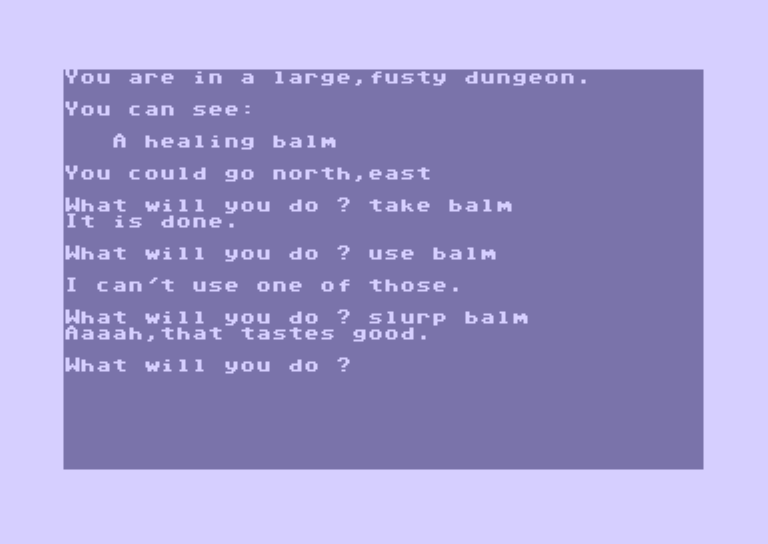
On the way there’s a healing balm that’s the only useful potion of the game…
…the kind of room which doesn’t describe the room but rather gives your mental state…
…and some creative writing.
I guess that explains what the letters on the talisman are. This is meant to be a hint that the talisman is about to be relevant.
North of here is a locked cell with a padlock, where you can use the key. Inside is an old man.
Who is he? An old hero? A king? A random chosen one? Admittedly this makes about as much sense as The Dark Crystal did if you don’t read the companion books.
There: that’s our quest. Now we need to take the TREASURE OF CESIS all the way back to the start, and we’ve won.
Sorry for spoiling your secret, C. Steadman.
I more or less ignored all the treasures; as I already theorized, there’s no “storage place” so the point total is based on what you’re holding, so it’s pretty limited anyway. You could scoop up the gold pieces (I didn’t bother) for a few points, but given they’re placed at random and I’m already past the 14,000 point mark, I think I’m fine stopping there.
I can’t say I appreciated the bugs, the dodgy parser, or the floorboards puzzle (where out of the 150+ rooms you have to guess that one room description might hold a secret) but the atmosphere was utterly unique, and probably wouldn’t have worked in any other context than a cryptic C64 game.
I got through a major bottleneck — the ice river — and the game more than doubled in size. I also know, sort of, what the overall quest is now, and it isn’t just grab the loot.
Just to give a sense of scale, here’s the full map zoomed out, with the new rooms marked in dark or light blue (except for lairs, which are all marked in red):
At the very least, while it’s still obviously possible, I think this is a little hefty for a lost type-in. I had this concern while researching because the other game I’ve seen a disk “published by Brunswick” (apart from Boothman’s own work) is the game The Dungeon of Danger. We know where The Dungeon of Danger came from: a book in the Mostly BASIC series by Howard Berenbon. It came out originally for Atari computers in 1980, then was ported to Commodore and Apple. The CRPG Addict has written about the game here.
Picking up right where I left off, the first issue I managed to tackle was the mysterious “1 gold piece” objects lying around; I went through all of these commands and nothing worked.
take gold
take 1
take 1 gold
take 1 gold piece
take gold piece
take coin
take money
take cash
take gold coin
take peice
take all
tak gol
ta go
(It’s actually a two-letter parser. I’m guessing this is why potions use SLURP rather than DRINK, since DR is already taken for DROP.)
Thinking perhaps the author was D&D inspired, I tried
take gp
and it worked.
When you’re at one of the Beings (as I’ll call them) and you take an item, if the item is considered “valuable” and the Being is unfriendly they won’t let you take it. Gold pieces aren’t valuable enough to fret over, it seems.
While I might need to care in a winning run, I subsequently have ignored the money. It (along with some of the treasures, and the “minor” monsters like the ogre) gets randomly distributed, and I think it is just a matter of points.
With that resolved, I went back over the object list…
bottle of wine, meat, plank of wood (2), rug, crystal ball, dagger, potion, silver thimble, brick, silver sword, some rope, green moss, silver trinket, green treasure, old manuscript
…as well as the verb list, and tried to test things together.
USE will be handy momentarily. BREAK is mean to work on an object being held — I don’t know which yet. SLURP on the unlabeled potion I had access to had no effect, and the game says “you got the wrong one!” INSPECT is the game’s version of EXAMINE, LIST is INVENTORY, and BASH is the combat verb.
Without aid, you can bash nothing.
This was cryptic since it seemed like maybe I was supposed to use a brick to bust open a secret wall? Or just bash a bottle of wine on someone’s head, bar fight style? BASH is instead usable with the silver sword, and I was previously envisioning some kind of epee. Instead, I guess it’s Cloud’s sword from Final Fantasy VII.
This vaporizes the sword and the Being and is usable only once. Trying to use a dagger in the same way gets a similar message, but the dagger just gets dropped on the ground and no slaying occurs. My best guess is that some of the Beings can be befriended but some cannot, so the silver sword needs to be saved for a Being where you can’t make friends and you need them to let you pick up whatever is nearby. Or maybe it’s just optional for points!
What’s not optional is we need to get by the ice river. (Importantly, “ice” river, not “frozen”. I was thinking of slipping on thin ice, but it is a flowing river, just with ice in it.)
The one bit on the map where you don’t have to worry about crossing, because you can access the other side via a different route.
I went through every item I had available trying to USE it or simply be holding it and walking in the relevant direction. While nothing worked I was suspicious of the rope’s message on USE, which was different than the others:
Can’t use it on anything.
USE SWORD, for comparison:
I can’t use one of those.
I tried USE in many of the rooms (with the traditional mark-as-you-go method) but realized about halfway through why the game gave me 2 planks of wood rather than just 1: they want you to make something by combining the three things. I was still thinking “frozen” river, so, maybe, snowshoes? Instead I got a raft.
This let me open up the two blocked exits from last time.
I took what turned out to be the long route first (“Cavern of Rototars”) so let’s follow that way and loop back to the “Long Twisting Tunnel” at the end.
This is a place where a sword is required, as the Being won’t let you take the potion. Too bad the potion is the wrong one (at least on the save file I was playing with, maybe there’s one good “random” potion and the rest are bad).
Moving on, up some stairs to a new area…
…and to the first object of interest, a magic talisman.
Cool symbol, don’t know what it signifies, am happy to take guesses. USE TALISMAN gets the standard “I can’t use one of those” so it isn’t like the rope. HELLO TALISMAN:
Don’t bother, it doesn’t understand English.
Fair. Moving ahead are two more Beings, Xeginem the mysterious and Minitex. Xeginem has one nearby chamber marked “Cavern of Xeginem’s dog” and south of the lair of the Minitex is “the cave of many Minitex”.
Don’t know what a looney is, there’s also a leper in the earlier section but I don’t think it’s a “leper” like from English. The response here might be wry humor.
An item close by of special note is a red book, which asks you to return it to its owner. One supposes this would be Remesis the red, but I haven’t had been able to test this theory yet.
Along a side route there’s a castle.
The rooms are colorfully described, including a kitchen with stale bread, a pantry with a washing board, and a zombie butler, and a blue book.
The blue book almost certainly goes to the blue Being, or rather, Zezotim the blue. However, I also haven’t gotten test it yet. (Sorry! This session had a lot of mapping. To be fair, the player’s “energy” level has started to be an issue. I don’t know if I’m just supposed to optimize my moves fast or there’s a recharge, like a potion I haven’t found yet.)
Turning in an entirely different direction — west of the Minatex — leads to a “dwarf with cold feet”, some “black grapes”, and a travel agent.
This bizarre … encounter? … in-joke? … drops the player in the last section, the area of the dread Elmralat. The game gives more warnings than any of the other Beings, and it just sits there and acts grumpy, just like all the other Beings.
Three last points:
Point 1, nearby the Elmralat is a bag of sapphires. It gets treated differently from other treasures, because if you drop it somewhere random, a “small elf” appears, takes it, and runs away saying
Ha ha,I shall hide it better this time!
(I still don’t have a treasure “storage” area and don’t know if there even is one.)
Point 2, Elmralat seems to be referenced in that manuscript from last time.
In times of yore
Tehre was remembered
a magical cone,which
so say many, did hold
Three Brothers,in
Comp’ny with another
Held afore from him
Who bears the Elm
And in a secret
place was hid it.
The “Elm” is likely “Elmralat”, yes? I’m unclear how this translates into action, but I can move on to point 3, which is I found the magical cone. If you read back in this rambling mess of a travel blog, you’ll notice I said the ice river leads down two paths, and I started by taking the longer one. The shorter one is only two rooms: a passage leading to a dead end.
I’m guessing since I have the green treasure for returning the green book, I’ll get a blue treasure for the blue book and a red treasure for the red book, and they somehow get inserted into the cone and represent the Three Brothers. There are so many other things going on I doubt that’s quite the ending of the game (what’s the talisman for?) but I’m hoping this won’t take too much longer. I went into this game expecting the same kind of public domain one-shot I got from Alien and instead I got an epic that kept sprawling, even if it is mostly exploration and unhelpful creatures.
For this game, written by C. Steadman for Commodore 64, it will help to go over how public domain software got distributed in the 80s and 90s.
The most straightforward way was friends and family passing disks (see: early distribution of Mission secrète à Colditz). There were also clubs with monthly meetings that had “librarians” who kept up catalogs that members could access (see: the Toronto PET Users Group and Fantasyland). Magazines starved for content could do reprints (or toss the software on their disk or tape, if they came with one). Download from an online service like The Source was possible (as I discussed with this post and “Apple City”). A less-scrupulous vendor might mix public domain software with new software in a package sold on store shelves.
Relevant today is another method: companies that had large catalogs of public domain software where people could choose to get copies for nominal fees. This is different from the “commercial package” method, as this was a case of the user clearly getting what they expect. “Package” disks were also common from this sort of company, with numbered disks akin to the user groups, like this disk of demoscene art. Such companies could still mix “new” games in their catalogs or even distribute “new” public domain software — that is, software not easily findable by any other outlet.
(Incidentally, the idea of “freeware” where author retains the copyright and “public domain” was quite fuzzy in the era. The Smurf Adventure declared public domain status in its source code, and sometimes authors would include a message that meant they clearly were intending the same, but it seems like everyone assumed “no copyright notice = public domain” when that really wasn’t the legal case. At the very least, “anonymous source code” tended to also equal “permission to distribute”, but there were plenty of times where an author name was included but stripped off in a later version. A company or author might even add their name to source code that wasn’t really theirs.)
A mysterious public domain collection from early 1983 Australia, via michaelcarey at the Lemon forum. The disks had been re-formatted and he was trying to find out the origin of the collection.
Valley of Cesis survives to us through two public domain distributors.
Starting with the less-common copy, there’s a version of the game via The Guild Adventure Software. The Guild was founded by Anthony “Tony” Collins in the UK in October 1991. It focused on conversions between platforms, and also kept up a library of public domain games.
The company didn’t last long, dying out in fall 1993 with the games sent to other publishers; relevant to today’s story, the C64 merchandise wen over to Binary Zone. (Especially relevant because Binary Zone is still selling the game so you can’t download this version of the disk.)
A listing of software from The Guild includes public domain dating back to the late 1970s with Dog Star Adventure. Valley of Cesis is far back enough that its presence doesn’t indicate anything in particular (that is, the author Steadman likely doesn’t know of Collins and probably didn’t even know that this outlet was republishing their game).
The second distributor was Brunswick Publications out of Australia, run by Peter Boothman. Peter Boothman was a jazz guitarist in Sydney who has records dating back to the 70s, and somewhere in the 80s he picked up “Commodore 64 author” as a side gig, writing games like the three Telnyr CPRGs. The first Telnyr (1990) is listed as being from Brunswick; the obituary I linked says his company was founded in the “late 80s” so that’s as specific as we’re going to get.
The timing (1982 vs. starting in late 1980s) means it likely wasn’t the “initial distributor” of the game, but since the it hasn’t shown via any other vectors, it is possible it stayed in the Commodore club scene of Australia and went no farther until Boothman picked it up. It is even possible C. Steadman knew Boothman personally.
The other evidence we have of C. Steadman’s activities is a pair of articles in Personal Computer World. The first appeared in the UK edition, October 1983, and the second appeared in the Australian edition, November 1983. Both are identical. I’m unclear about the policies of this particular magazine, but in general magazines are one or two months off from their newsstand date anyway; in all likelihood Steadman when sent the article once and it hit both countries “simultaneously”.
So we can’t tell from this evidence if the author is Australian or from the UK; my inclination might still be for the former because of Boothman, although I should point out the article says the software is tested for “PET, BBC, Microtan 65, VIC, and Acorn Atom.” BBC, Acorn Atom, and Microtan 65 would be especially odd for an Australian to have handy.
Now I’d normally plow ahead with the game, but let me give one last bit of background, as I’m going to make a reference only some of the people reading this blog will know offhand. Specifically, The Gostak, which gets categorized on the Interactive Fiction Database as a “wordplay” game. However, unlike Nord and Bert or Counterfeit Monkey, you’re not manipulating words directly, but rather trying to parse what’s going on in the world you’re seeing from contextual clues.
Delcot
This is the delcot of tondam, where gitches frike and duscats glake. Across from a tophthed curple, a gomway deaves to kiloff and kirf, gombing a samilen to its hoff.
Crenned in the loff lutt are five glauds.
Everything, including the verbs the player types, is based on the modified language of the game: clearly English, but with a whole passel of unknown verbs and nouns. The contextual clues end up enough to accomplish the main goal: you, the gostak, must distims the doshes. (Aaron Reed has written about the game if you want to read more.)
Before you get too excited, no, Valley of Cesis doesn’t go this far, back in 1982. But the main characters (who all have lairs) are given names that could come from the Gostak-verse and have no descriptions, and so I obtained the same sense of understanding-without-understanding as I was making progress. What seems to be the primary mechanic of the game involves making friends with these vaguely-defined beings which have no real way to visualize them, unless you want to make something up.
There’s a long pause when the game starts which indicates some kind of randomization going on. The “1 gold piece” items that get scattered across the map do seem to change, but nothing else. I have not puzzled things to the end so I cannot be 100% certain about this.
The “1 gold piece” there is only from the iteration of the game I was making the map.
I’m not even sure what the end is, exactly. We do seem to be gathering treasures and we have a score going up, but our inventory limit is three (or four depending on object size), and I haven’t found any “treasure store” area where the treasures can be dropped and the score retained. This may be another game where you just get as big a score as possible and give up when you like, but maybe there’s even some kind of goal the game isn’t disclosing?
The above text is quite standard when you enter a lair, that is,
BEING_NAME is here.
He doesn’t like you here.
Don’t come back here in a hurry.
I originally thought there was going to be some sort of grisly death or a passage was blocked I needed to puzzle out, but there is no consequence for going into a lair room as many times as you want. (I think. There is a “timer” where you run out of energy but it seems to be based on number of turns you’ve taken, not where you go.) In the process, in addition to Sesajat, you can meet:
Tetsotoh
Qedejiv the weird
Madewob the mad
Baryon the bad
Remesis the red
Zezotim the blue
Duxwetil the green
There are other, more “ordinary” creatures scattered about: an ogre, a rabid dog, a large balrog. They are equally quiet and you can just ignore them and they won’t do anything.
Here I tried to get a reaction by giving meat, but all this did was drop the meat on the ground.
Other than the friendship which I’ll get to in a second, the only obvious obstacle is an ice river running through the map. It blocks some exits so the game says “You cannot cross the ice river without aid.”
There’s two wood planks on the map, some moss, and some rope, but I haven’t gotten any of them to be helpful. The game helpfully gives a word list (take, use, open, break, drop, look, close, slurp, give, inspect, pull, score, bash, list, hello) so I don’t think it’s a communication issue, I really don’t have the right object yet.
Well… maybe there’s a communication issue. I say this because of the 1 gold coin pieces spread throughout the map, which have eluded my efforts at picking them up.
I could probably resolve this easily by peeking at the source code, but hey, the author asked in the title screen not to, I should give just a little more slack before I go there. They might be optional anyway.
Regarding making friends: I found a green book where I could INSPECT it and find that it wants me to “give it to my owner, whoever he may be.” Duxwetil is green is so was worth a try:
My current thinking is most or all of the beings will trade for the right object, I just have to find out what it is. For reference, here’s all the objects I’ve found so far:
bottle of wine, meat, plank of wood (2), rug, crystal ball, dagger, potion, silver thimble, brick, silver sword, some rope, green moss, silver trinket, green treasure, old manuscript
The manuscript gives a cryptic message…
…and that’s all my cards on the table. I’m happy to take speculation for what to try in the comments (don’t even bother with ROT13); if for some wild reason you know this game already, hold for now.
To clarify something on the video nasties from last time, 72 were listed for banning, but not all were prosecuted for obscenity; only 39 were. One on the list that was not only listed but prosecuted I was rather surprised to see.
Above is the trailer for Evilspeak. I always considered it one of the “goofy” horror movies of the 80s/90s era, along with Chopping Mall, Death Spa, and Silent Night, Deadly Night 5: The Toy Maker (because just one Christmas horror movie isn’t enough). It involves a child who is bullied at a military academy so he uses an Apple II to summon the Devil.
I’m serious. That’s the plot. (There is “Satan summoning” type imagery and some genuine gore.) It is hilariously dated now but it does give a good sense where the mind-space of the morality judges was at the time.
And yes, we’re going to get to how Ship of Doom got its association–
So I left off last time with a square microbattery, a coin, a laser coin, a hook, a torch, and a silver rod with a square slot. As Mike Taylor pointed out the microbattery really ought to go in the rod, but with INSERT failing, and PUT failing, and then a bunch of other verbs failing, I was still stumped. Of course I missed the fact at the time that PUT had set the item down, so I went through the correct verb and was sidetracked a while realizing I hadn’t actually tested the verb yet.
With the sonic screwdriver, direct from Dr. Who, it was time try to open the case with a key in it.
Unfortunately, I went through every verb on my verb list, with no luck. Then I went over to the key hole at the computer room and tried every verb again, still with no luck. After some severe bafflement I realized that the game does not recognize the word SCREWDRIVER at all. You have to refer to it as a SONIC.
… pardon, need to go take a moment …
OK. I’m back. No primal screaming here, nope. Why on EARTH would you accept the adjective and not the noun kljASFJGkjlj234
… sorry, let’s try that again …
OK. Breathe. Things did go better from here. It really would have helped had the game had a few more error messages — it isn’t really revealing much even if you’re typing a noun that the game doesn’t recognize. On top of all this the verb is a pretty odd choice, but at least I had it on my standard list: POINT.
Now the key goes back to the key hole, but before I show that off, let me give the result of using EXAMINE (or GAZE) at the key hole, and get an ad.
Fun! So with the key inside, it seems that a heater has been activated.
So we can go back to the frozen body, wait a beat, and see what happens when it is unfrozen.
The little girl is not helpful and if you spend enough turns hanging around she’ll strangle you to death. You should instead shoot the door and move on, although the game also lets you KILL GIRL if you want (spoiler: the whole ship is going to blow up anyway).
You can scoop up the knife in the first room you encounter and a mirror in a side room (which I’ll talk about later). While you are doing this aliens start appearing, akin to the dwarves in Adventure. You can SHOOT ALIEN to kill them or try to run away, and they may or may not follow.
Shooting an alien has a decently high chance of success, but you might just miss, giving the alien a chance to shoot back. The alien’s aren’t bad shots either so there’s essentially a random chance of guaranteed death.
Nearby there’s a laser beam which will trigger a security system if you try to pass.
I don’t know why CRAWL is an understood verb. Maybe the authors thought they were going to use it but thought better of it. It doesn’t work anywhere.
I got through by … EXAMINING it? I honestly don’t know what happened here or what this sequence was supposed to represent, but I saved my game and I didn’t have to think about it any more.
Yes, but why? Is Fred behind the scenes hacking the tech, C3-PO style? I sort of imagined Fred more like the robot from The Black Hole.
Moving on there’s a couple colorful scenes, including a human tied to a table awaiting androidization; if you release him, he’ll strangle you.
There’s also an android working on a ship attached to a rope, and you can chop the rope and the android will float away. I found quickly I could TIE ROPE to the hook I had earlier, and I spent a long time trying to get the rope to work in another scene with a switch in a control room.
The switch is a red herring; you’re supposed to instead go to a PIT ROOM (no other description) and realize it makes sense to THROW ROPE, and climb up to a higher level.
The aliens can appear anywhere, and sometimes one after each other in sequence.
You can use the coin from way back at the bank to get the drink from the bartender, but it knocks you out with a giant headache and you end up imprisoned. This is a good thing.
This is a good thing because you can use the mirror I mentioned earlier to cause the bars to “fuse” so you can escape. (I do not know why the mirror didn’t work on the laser beam earlier.) The verb here has to be USE; again my verb list came to the rescue.
This room represents the final challenge, and is essentially brute force. There are six button combinations, and each take you to a different place. Green-orange-red just ejects you into space which is not helpful. Red-green-orange and orange-red-green drop you back closer to your starting ship, which will be helpful in a moment. Red-orange-green takes you to a computer room.
Why do we even have that button?
Down brings you back to the combo room. I used orange-red-green to get back to the Map Room nearby where the key with the Artic ad was and it was a short trip back to the ship. I was unclear until I hit the escape button if starting self-destruct really had shut down the tractor beam.
Look, a passenger!
The game events seemed colorful enough but it came in really jerky jumps and starts due to me having to struggle with the parser every time I wanted to use it. The fact it was only two-word was really saved it from some unmanageable guess-the-phrase battles.
So back to those tabloids. In an interview Charles Cecil talks about people wanting to use swear words in his first game (Inca Curse):
I made my first game for the Sinclair ZX81 in 1981. That was my first commercial project; a text adventure called Inca Curse. I immediately learned about frustrating players. Players would type something like ‘look at man’, and the game would reply ‘does not understand ‘look at’. I know a lot of players would then type in expletives.
This causes him to get creative in his second:
I made sure my next game – which was Ship of Doom in 1982 – would understand swearing. You could type in any expletive, and the game would understand it. You could try out those expletives in the ‘Android Pleasure’ room. That was okay, until I got busted by The Sun. They thought games shouldn’t have pleasure rooms. I remember they ran the piece at the bottom of page three, which felt ironic really. It even went on to be discussed in parliament, as the Obscene Video Act at them time. If video games had been included in that act at the time, I would have been an extremely unpopular person.
Here’s the room in question:
If you “do the deed”:
SHE POINTS OUT THAT PERHAPS YOU WOULD BE MORE SUCCESFUL USING A SCREWDRIVER
This is what raised the attention of an alert parent who discovered their child in the room in question. The subsequent chain reaction of events led to a story in The Sun about the Pleasure Room —
Computer Game Nasty Zapped by the Sun
— which caused some returns from Whsmith. Artic also heard from a couple who bought the game expecting erotica and was upset to find a sci-fi text adventure. Others traders wanted the tapes specifically because of the notoriety; as Richard points out, despite the returns, they were able to sell out.
While the first-mover status (in terms of getting on the ZX text adventure market early) might have helped Artic, and along with the better art, the moment of news fame surely was the biggest boost, just like controversy over Death Race helped Exidy back in the 70s (which had stopped building new copies of the game already, but suddenly got an influx of orders after it became a scandal). They published five more adventure games following this one. I don’t know otherwise if they would have gotten that far.
Via Mobygames.
Coming up: A short Australian game involving a combination software distributor / jazz musician, followed by one of the most obscure games in the On-Line Systems catalog.
Does my hon. Friend agree that pornography is a drug, and a very dangerous drug at that, as it rots the mind and can persuade individuals to commit great violence and cruelty against innocent people?
The 1987 ZX Spectrum game Soft & Cuddly was infamous for gauche horror imagery and being distributed with a barf bag. The advertising leaned into this; an insert poster distributed with the October 1987 edition of Crash boldy declared the game
THE FIRST COMPUTER NASTY
One of the tabloids — The Star — ran with it, quoting Mrs. Mary Whitehouse of the National Viewers’ and Listeners’ Association as saying “It is the product of a sick society.”
The British obsession with deviant media really kicked off in the 80s with the introduction of video stores, and the fact that videos were not covered under the rating system and so could be released uncensored. This led to a moral panic about “video nasties” (a term introduced in 1982) that included horror films being accused of spawning particular murders; the Video Recordings Act 1984 eventually led to a set of 72 videos being outright banned in the UK. These were not all recent videos and included, for example, the 1963 movie Blood Feast.
An Egyptian caterer kills various women in suburban Miami to use their body parts to revive a dormant Egyptian goddess while an inept police detective tries to track him down.
The raw paranoia that such media produced is vaguely reminiscent of the Satanic Panic in the United States.
The trailer above includes such tabloid headlines as
Scarred for life: Experts links street riots and child abuse to diet of filth fed to our young
and
Cruel movies fan hacks 4 to death
However, despite Soft & Cuddly cozying up to the title in order to trump up sales, the first game called a “digital nasty” in the tabloids came rather earlier, in 1982, in the form of an innocuous text adventure published by Artic Computing, Ship of Doom.
…
Ship of Doom was the second game from Charles Cecil (he was now 19), and the third in the series from Artic, hence Adventure C. (Previously: Planet of Death, Inca Curse.) Again it had ports to ZX80 and ZX81, with a port that followed for the ZX Spectrum. (The latter is what I played.)
Via World of Spectrum.
Richard Turner, one of the founders of Artic, worked together with Cecil so I am calling him a co-author.
He and I had quite good imaginations so we came up with some nice stories. We also had a love of puzzles and we liked stuff that you had to figure out. That was of more interest to us at the time than arcade games — which I wasn’t that good at anyway.
This game represents a turning point in their catalog, as Richard had talked with a Whsmith manager about selling the tapes, and discussion turned to business in general. The manager explained Richard’s company needed to be Vat-registered and also that “the artwork [was] rubbish and we needed something a lot better.” The cover above is the last of the “complete minimalism” covers in the Artic catalog of 8 adventures, and re-prints additionally added new art. Sales (according to Richard) went drastically up.
Via World of Spectrum.
As the text on the packaging (in either version) informs us, our spaceship has been scooped up by an Alien Cruiser looking to enslave humanoids and we have been stuck by a tractor beam (as told to us by Fred, our pet android). Our goal is to disable the tractor beam and escape. It’s not exactly Star Wars because there’s no stormtroopers to greet us; in fact, the entire opening area of the vessel is empty of aliens or even deathtraps. This seems to be the “apathy alien” style like how the Star Trek crew boards a Borg vessel but the hostiles don’t bother to acknowledge the crew’s presence until they become a threat.
In the typical fridge-logic sense it is puzzling, but honestly, I kind of like it. Alien stuff should be alien and it makes the experience feel stranger.
Room descriptions are minimal; the opening setup is here to provide us objects and devices to fiddle with.
A “shady room” has a dark corner, but fortunately nearby there are some infrared glasses. If you wear them, leave, and come back, you’ll find a SQUARE MICROBATTERY.
Other than those objects and the hook from an earlier screenshot I’ve racked up a laser gun, a coin, a silver rod with a square slot, and a torch (British, so flashlight). I feel like the battery ought to go in the torch or some such but OPEN TORCH gives me
I CANT
with the Ken Reed standard message showing again and LIGHT TORCH just says I CANT DO THAT YET.
As far as obstacles go, there’s a body in a block of ice (can’t move or even shoot it with the ray gun)…
…a key under a glass cover (you can shoot it with the ray gun but the whole thing vaporizes and you softlock the game)…
…and a computer room with a red light and a key hole. I presume the key goes in the hole.
I’ve gotten a whole lot of I CANT from the various things I’ve tried. I don’t feel like anything is broken, really, and I’m guessing I’m missing a simple interaction. Inca Curse (game B) wasn’t terribly hard but Planet of Death (game A, without Cecil) was so this is really a coin flip on what level of pain I’m in for.
I did go ahead and make my verb list, which I’ll provide now.
I’ll wait on finishing my historical story about Artic’s encounter with the British tabloids, as I haven’t reached the room that caused the controversy yet. Cliffhanger!
It’s similar to Bally’s Alley, except the environment is more coherent, there’s one (very minor) puzzle, and most significantly, there’s graphics.
TREASURES OF CATHY
(C) 1982 BY JOHN COLLINS
KEY WORDS IN, UP, DROP, GET
49 LOCATIONS 18 TREASURES
BUT CAN ONLY CARRY 6
EACH TREASURE = + POINTS
BUT -1 POINT/MOVE
TRY FOR SCORE > 1000
Again, you’re just trying to find treasures, and there’s a move counter that ticks away. There’s no particular goal score or end game message, which is fairly unusual for an adventure game, but perhaps the author was thinking in terms of what console game players want.
Unless I’m overlooking something, there’s no “end room” treasures should be brought to, either; this is like Fantasyland (the surreal Canadian VIC-20 / C64 game) where the goal is to get maximum treasure in your inventory, not in some specific place on the ground.
Having been forewarned from last time, I had my MAME configuration set to what I might call “normal” keys; pressing 1 will show a 1, 2 will show a 2, ENTER is the same thing as GO, and the backspace key will cause a real backspace. This fiddled with some of my other key combinations I came up with but I found it faster to pop open the MAME key guide to check any modifications rather than keep the default.
Fortunately, you don’t need to type the full words IN, UP, DROP and GET to use them. Just the initial letters will do, except for drop, which requires DR. Using my revised MAME keyset this makes for:
. 6 becomes (U)P
. 9 becomes (I)N
E 9 becomes (G)ET
E 8 . 5 becomes (DR)OP
I tried to go for gold and get AutoHotKey to do combinations, but it wasn’t behaving itself well with MAME, so I just kept a text file of the four combos I needed to the side of my playing window and things went smoothly.
Collins ran out of keys so left out UP and IN, and you have to type them as commands instead.
The last extremely-tight-sized game we’ve had with graphics was Adventures in Murkle for the TRS-80, done in a 4K using glorious ASCII. That game built the outdoors by having a set of graphics that could be turned on and off: some trees, a stream, a building.
A sample: turn off the stream and now you have just a forest.
This game does some the same, turning off or on pieces of graphics to represent particular rooms outside.
Here’s the full map of the outdoors:
The trickiest part for me — especially because I wasn’t sure if I was doing the input correctly until it worked — was finding that I could go UP at one of the trees and find a nest with a key.
Remember, taking an item just requires typing the letter “G”. The bizarre part is that the screen doesn’t clear when you enter a command, causing your typing to land directly on top of the text that says INPUT CODE. So if you want to type I or even IN, it overlaps exactly the text that’s already there, and you can’t see anything!
With the key you can go into the house (to the north) and the cave (to the south). I’m not sure if the house serves any purpose. There’s an axe, which I toted along with me, but any object use in this game is invisible.
All indoor rooms have the same picture.
The cave to the south makes an interesting choice for the graphics by going abstract. There’s a small box that gets filled in different ways with squares. I like the idea of non-literal graphics and I can’t think of any other game that quite does it this way.
Bob is an item you can take.
Maybe the author meant for you to consider this the literal end.
There’s legion of objects like a gun, a pen, a book, and water, all which might be useful in a normal game, but are just window dressing here. They’re the sort of thing someone would expect to find in an adventure game and manipulate, and I get the impression not that the author ran out of room (Irvin Kaputz style) but rather just wanted his game to feel a little more like an adventure by having objects that could potentially be noodled with.
The source code on this is astonishingly small, so there aren’t really any mysteries (not even a strange magic word that we never got to use). The code is so tight rather than just have two people click the link and see it, I’m going to cut and paste the whole thing here, and it’ll be over faster than you expect.
2 NT=0;GOTO 25
3 U=ABS(*(R)÷10000);V=RM÷100;W=ABS(RM);RETURN
4 GOSUB 3;TV=V;TV=W;RETURN
5 R=(I-49)×2+198;GOSUB 4;R=R+1;GOSUB 4;RETURN
6 VA=H;VB=H;FOR I=0TO K;TA=E;TB=F;NEXT I;RETURN
7 GOSUB 3;R=R+1;IF ULINE V,W,U×U;GOTO 7
8 LINE V,W,1;RETURN
9 CY=-16;CX=O;PRINT “0=COM,MOVE 1=N,2=S,3=E,4=W,5=NE,6=SW,7=NW,8=SE,9=↓
10 PRINT “INPUT CODE!”,;L=KP-48;IF (L9)GOTO 50
12 G=ABS(*(A));M=0;FOR I=1TO 5;IF G=0I=5;GOTO 20
14 G=G÷10;IF RM=L M=I;I=5
20 NEXT I;IF M=0CX=O;PRINT ” DEAD END ?”;GOTO 9
22 M=M-2;IF M20B=A÷4;Y=RM;IF Y MO=49;H=12;E=35;F=53;GOSUB 6;E=33;F=50;GOSUB 6;E=35;GOSUB 6;E=44;F=67;GOSUB 6;↓
26 IF BIF YPRINT “YOU HEAR A “,;E=2×A;FOR Z=0TO Y;GOSUB 6;NEXT Z;↓;GOTO 29
28 PRINT “YOU ARE AT “,
29 I=A-1;GOSUB 5
30 N=0;FOR I=50TO 67;IF *(I)=A CX=13;PRINT ” I SEE “,;N=I;GOSUB 5
32 NEXT I;IF A<12R=237;GOSUB 7
34 IF A11IF A48IF C0GOTO 94
62 IF C=68IF *(76)=82GOTO 88
64 IF C=85IF (A=6)+(A=15)A=A-1;RUN
66 IF C=73IF *(50)<0IF (A=10)+(A=20)+(A=44)A=A+1;RUN
86 RUN
88 CLEAR ;PRINT " SCORE= ",P;IF C=1RUN
90 FOR J=68TO 73;I=*(J);IF IGOSUB 5;IF C=68PRINT " 1=DROP,2=NO";D=KP;IF D=49T=-1;GOSUB 97
92 NEXT J;E=35;F=53;GOSUB 6;↓;RUN
94 T=1;FOR I=68TO 73;IF *(I)=0;*(I)=N;*(N)=-*(N);GOSUB 99;I=73;N=0
95 NEXT I;RUN
97 *(I)=A;N=I;GOSUB 99;*(J)=0;RETURN
99 C=N-49;P=P+T×C×C;RETURN
It’s a poem of code. Data is entered separately, using the same trick as Des Cavernes (including having everything be stored in one array).
Incidentally, regarding line 90, with PRINT ” 1=DROP,2=NO”, the dropping in this game is improved: rather than you needing to keep track of numbers and then typing the right one, it will go through each of your objects in turn and ask if it is the item you mean to drop. This is the sort of kludge that really would only happen in this sort of environment but it’s good to see the author was still trying for an improvement.
There’s nothing in the end here terribly novel in terms of content (…except for the rooms represented by abstract pictures…) but that doesn’t take away from the historical and technical interest, and the fact people kept trying to do adventures on every machine possible, kind of like how modern systems are required to run DOOM.
Of the consoles that launched in the US during the 70s, the Atari 2600 undoubtedly became the most famous, with the games still able to be re-packaged for sale in modern times; the Intellivision (1979) makes second place in overall historic sales. The Odyssey 2 (1978) falls in third.
There were more US launches during this time, but they have less recognition: the RCA Studio II, Fairchild Channel F, APF MP1000, and the Bally Professional Arcade, the last one being sometimes dubbed the Astrocade. As a child during the early 80s I hadn’t heard of any of them.
The most ill-fated of these might be the RCA Studio II, which launched in January 1977 only to be followed by a discontinuation announcement in February 1978, but today’s topic is the Astrocade, which had one element that made it unique of all the systems: the combination of Bally BASIC and a tape drive.
The ad above from 1982 touts how “you can even create your own games in Astrocade BASIC” and ends with:
Astrocade, the home entertainment sensation that’s a personal computer too.
Bally BASIC was published in 1978. The system did not have a keyboard but you could use its keypad to enter in arbitrary text with enough patience, using a template to tell you what the keys meant. The fact you could not only write games but save them to tape meant the Astrocade attained a “home brew” fanbase contemporary with the console that none of the other second-generation consoles had at the time. This was a console that had “bedroom coders” we’d normally associate with computers, and these coders created tapes that were sold in newsletters. So Astrocade’s “official” catalog is only a small subset of the games (and art demos) made available in the late 70s and early 80s. Here you can watch a computer art tape published in 1980 by W&W Software Sales:
He also had interest in adventure games, marking Bally’s Alley as “the first in a series of adventure programs I hope to write” and also claimed it “may take days or even weeks to complete”. It first appeared in the classified ads for the Arcadian, May 19, 1980.
While a tape hasn’t survived to us of the game, the original typed copy has (complete with handwritten notes for the variables) and in November 2022 it was typed in by Paul Thacker. He considered it a “work in progress” but it’s sat since 2022 with no changes so I’m assuming it’s in the ballpark of what Collins intended.
Bally’s Alley – An adventure game; one player. Game can last for days or weeks; can save at any point for restart; can go in nine directions; find the ten treasures and return to house; can only carry four treasures at one time. Each move subtracts a point. A magic word-sound-color will be helpful.
— Description from the Bally / Astro Professional Arcade Software and Hardware Sourcebook, Summer 1982
Now we get to the most complicated part of the whole proceedings: running the thing. First off, this has to be done with MAME, which officially got tape support in 2019. There’s a video here of the process. That’s fussy enough as it is, but the more painful part is the keypad.
To type a “red character” you press the button 0, which switches you to the reds, then press the button with the letter in red you want. So the letter Q, for example is 0 and then 8. On top of all that there’s no one-to-one mapping on modern keyboard. Adam Trionfo suggests keyboard stickers:
However, this is not the default mapping in MAME! Here are the keys for the “bottom four” of the pad, which let you change between “green mode”, “red mode”, “blue mode”, and “yellow mode” (or WORDS).
E = green
0 = red
. = blue
enter (number pad) = yellow
The last three seem like they’re trying to do something with the real number pad, except the number pad versions of the keys don’t work! (That’s is, 0 on the number pad does not get read by MAME as the red key — you have to use the regular key 0.) On top of that, the colors are a lie; while the “green” button turns the screen green to indicate your setting, and the “yellow” button turns the screen yellow, red goes to orange and blue turns the screen pink, and I’m not kidding:
What you see when you press “blue”.
If this was part of a Myst-style-game puzzle using cryptic old equipment, I’d ding it marks for being too unrealistic.
There was some more cryptic mess behind the scenes (hot tip: of the four slots the cassette is required to be plugged into port 3) but I’m going to save any more technical discussion for the comments and move on here with the game itself.
The game unfortunately does not give you a starting location, but I worked out later the player begins at Bally’s Alley. Just to the north is the player’s home where the treasure goes:
The book description earlier mentions ten treasures. Poking in the source code, there’s only five listed, but maybe there’s some weird way they’re doubling, kind of like Pokémon vs. Shiny Pokémon.
1 lets you pick a direction, 1 through 9, or from the format here, N, S, E, W, UP, DOWN, SW, NE, NW. No southeast! The author ran out of buttons.
(In MAME, 1 through 9 are 4, 5, 6, 7, 8, 9, R, S, and H respectively.)
Command lets you type an arbitrary word or abbreviation. G stands for GET and DR stands for drop. (In MAME, E H for the “G”, and “E S . 8” for the “DR”.)
When you DROP you specify by item number which thing you want to drop, so 67 would be the ROPE as shown being carried above.
Paul Thacker tested the game and this is the only part of the map he managed to make:
He concluded perhaps there’s something still broken in the source code (part of it was messy and handwritten), and I think he’s right, but not in this exact spot. I realized some of the random connections were because rooms were getting duplicated. In the Garden, it appeared sometimes I could go north to Bally’s Alley, and sometimes I could go south to the Garage. Instead, these are both two entirely different rooms with the same name! I confirmed this by dropping an item, which was only present in one of the variations.
The “duplicate name” trick continues through the early areas but it isn’t utterly nonsense, at least:
I’m unclear if the “rope”, “knife” or “keys” serve any practical purpose. If they do it seems to be commandless (that is, you can go through a particular exit if you are carrying the right thing, but the game doesn’t ask you to CUT something, which would be hard to figure out how to type anyway). They did help with the early mapping but once I got the hang of the author’s tendencies I didn’t need them.
If the keys are needed anywhere they’d be at the Well With Locked Cover, but I dropped them and tested both exits and I wasn’t stopped by a lack of keys.
Past the well was the final section I was able to get to, a “color maze”. The rooms are varying colors using the Astrocade’s curious choices for a main palette.
I was able to find a lamp (see above) and some coins (the only treasure I saw) but then I hit an unfortunate room that was “blank”, that is, there was no room description.
I could still try to move around; going NE leads back to one of the pink rooms, and going down just loops in the same room, but I suspect the down-exit is broken and not intended to be the game’s real destination.
This was an astonishing technical feat on a platform clearly not designed to have a text adventure, and it was delightful to enter territory likely nobody but the author had ever seen. If nothing else, it was wild to see a game with the southeast exit (and only the southeast exit) missing. Still, this boils down to mostly exploration and mapping (there’s a magic word mentioned in the source and two other possible words, but I still don’t see any effects other than movement). I’m still willing to take another swing if the source gets a fix (the file is marked “WIP” because of the uncertainty on the handwriting).
However, we aren’t done with Collins yet: he called this the first in a series, and he did manage to make a second adventure! His second is also for the Astrocade, this time with graphics, and seems to be more than just an exploration journey. Stay tuned!
Special thanks to Kevin Bunch whose book Atari Archive I used as a reference (it’s one of the best books out there about second-generation consoles) and who helped me get over the technical difficulties with MAME.
If the idea of playing another game by the author of early Magnetic Scrolls works appeals to you, I’d certainly recommend trying this. If you don’t want to try the BBC Micro version I’ve got a download here for the TRS-80 version. Just drag and drop the file onto trs80gp and it’ll launch.
I will say the first puzzle might be worth spoiling, but it is mostly smooth past that.
Zoom-in on the wrist bands, shield, and dagger, the three items needed to defeat the demon.
So what I suffered last time turned out to be a colossal piece of disjoint visualization — that is, I was seeing the situation very different from the author, based on text that could be understood multiple ways — combined with my uncertainty about the parser (and the fact an unusual verb is required here). I will say it is a four-word parser and there even is a special data line for prepositions, which is a slight hint of Magnetic Scrolls going on to make one of the better parsers of the British companies.
3010 DATA 9,ON,IN,AT,INTO,OVER,ONTO,ACRO,WITH,TO
I needed to get a key from a fountain. The only description you get upon finding the key is that
THERE’S A KEY THERE!
and the fountain otherwise receives no description. TAKE KEY responds:
I CAN’T REACH IT
This was my first visualization issue. I figured, if the key was in the fountain at “ground level”, it would be easy to grab it, and otherwise SWIM FOUNTAIN and GO FOUNTAIN ought to really work anyway.
I thus thought of it being a fountain with tall layers, where you can see the key on top, but you somehow need to climb the fountain or shake the key loose.
I am fairly certain now, no, this is a regular all-on-the-ground fountain, and the key is floating in the middle and our player doesn’t want to get wet (??) I guess (???). So we just need to extend our reach a little. (I guess this technically could also be consistent with snagging a key up high, but honestly, what I visualized completely excluded such a solution.)
The other important item is a WIRE STAND, and this one does give a description
IT’S A THICK WIRE BENT INTO A STAND
and if you’ve ever fiddled with one of these in real life, this is not the kind of wire you can bend by hand (it even says “thick wire”). Of course I should have tested it, so I wouldn’t call this unfair, just I’m giving the reason I got sidetracked.
Something like this. I’d expect to melt it under heat or something.
If you try BEND STAND, the game says
USE BEND INTO WHAT?
which is prompting for an exact creation. What works — and I did figure this out once I realized what the game was going for — is a HOOK. Then you can GET KEY from the fountain and finally move on with the game.
Incidentally, if the game had said “it’s just out of reach” instead of “I can’t reach that” I probably would have worked this out faster.
Just to prove this game really is designed on the tighter side, here is the entire rest of the map:
The first new room, the altar room, uses the items I’d been gathering up thinking there was going to be some Aphrodite ritual: a statuette and the incense.
There’s no explicit instructions, but the indent plus the burner for incense make their case pretty clear. I also realized quite naturally I should try to GO PRAYER MAT and the game then explicitly mentions you should try out PRAY.
I also needed to light my torch with the flint and steel before this. I don’t know if there were any “dark rooms” being kept track of; I don’t think there’s an inventory limit so I had my lit torch the rest of the game.
The flash of light is the WRIST BANDS appearing. They have “odd glyphs” which you can’t read (yet).
Because of the sequencing here, I could see someone forgetting about this by the time they get the ability to read glyphs.
The next room uses the metal triangle from a few rooms ago, as there’s a triangular space on a dias.
You can climb the stalagmite to get back, so this isn’t a one way trip (for now) but given the mention of something metallic inside, you’ll need to do some destruction later.
The niche has some brown powder with writing indicating to mix with water. Conviently, there’s a stream to the west that serves to do this very task, leaving you with a potion. Drink the potion and now “odd glyphs” are readable:
Go ahead and scoop it up, there’s no inventory limit.
The WRIST BANDS tell you to say APHRODITE at the evil temple? But where is the evil temple? Well, if you go back to the stalagmite room, open the door (not controlled by the keyhole, I was confused at first), and head north, you’ll find a wardrobe. Move the wardrobe to find the temple.
Importantly, the pool has some nasty green liquid which turns out to be acid. The APHRODITE phrase that the bands mentioned opens up a secret stair down, leading to a sacrificial room.
Given the black rock I just scooped up was quite thoroughly described (…unlike the fountain…) I quickly realized it was in the shape of a toe and added it to the idol. This opened up a gold keyhole, but I had no gold key to go with it yet.
Heading back and wandering some more, I found a plank of wood and a platform with a key of ice on it. I scooped up both (the plank and the key, that is, the platform’s too big).
Applying the key to the glass keyhole led to a room with a chasm. I immediately thought to PUT PLANK ON CHASM and it worked.
A weird case where solving a puzzle too fast turned out to be a problem, as you’ll see.
The next room has a stone block which I spent entirely too long fiddling with (it’s the only pure red herring of the game) and a ZOMBIE MOVING TOWARDS YOU. I thought back to all my resources and remembered the holy water back at the font I moved at the beginning. I didn’t have a container at the time but I did now (with the empty jar that used to hold a potion). I scooted back up the stalagmite, grabbed the water, and took it back to the zombie and hurled it:
And now we reach the part of the game I had second-most trouble with after the hook. This is entirely a self-contained riddle. The answer makes sense but I think there’s something unfair to it. However, what I’ll do is withhold giving the answer here, and put my thoughts in the comments instead.
If you get it wrong, THE SHIELD SPIN TOWARDS YOU AND SLICES YOUR HEAD OFF. If you get it right, you have the magic shield and are one step closer to defeating the demon!
From here, two issues remain: finding the dagger, and finding the gold key for the evil temple (which will lead directly to Disrondu). I alternated between noodling with the stone block at the zombie and the stalagmite at the cave, and it occurred to me that I could re-use the jar yet again to pick up the acid from the evil pool.
The metal box has the dagger of truth, but also, this melts your path out. However, that wardrobe from earlier had a POLE in it, so you can bring it over and CLIMB POLE if you want to as a substitute and get back up. The game isn’t softlocked! Classy. (Well, that means the pole is huge, right? Eh, I’m done trying to visualize stuff.)
Now is the part I was stuck third-most after the riddle, but I’m not calling this one unfair at all. Just I kept trying to do things to the STONE BLOCK and never realized I had overlooked trying to LOOK CHASM back one room over. I had to actually look at the map from the Strand Games website to see what was going on.
Climbing up leads to a ledge with the missing gold key. I was then able to bring it back to the evil temple, unlock the last barrier, and make my way down to Disrondu.
There’s been enough lead-up, I don’t need anything more than exclamation marks.
And thus ends our visit to (sort of) the start of Magnetic Scrolls. Other than heavier than normal use of prepositions I didn’t spot anything that would indicate the company’s future; this was much closer to Scott Adams than anyone else.
The most pleasant part in the solving sequence was the triple re-use of the jar; it didn’t originally occur to me to scoop up the acid, but the first re-use applying the holy water immediately gave the idea that I could scoop up any liquid I wanted to. This was essentially a small piece of object transformation, which is one of the key elements I’ve identified in the past as being a way for these super-old games to have puzzles that strike the right balance between simplistic and arbitrary.
Using the word ‘design’ makes it sound like we had a grand plan thought out over many months of agonizing over analyst presentations and consulting focus groups. If we liked it, it was good. There was no pressure to articulate why but usually if it made us laugh it was good. If we thought it was a bit dull, it got cut.
As far as what’s coming next, I’m not sure. I’m slated to write about a game with a very high technical start barrier (think back to that French pocket calculator game in difficulty, although this game’s American) but that might get postponed if I run into too many emulator woes. So there might be a wild card! We’ll see.
Before hopping back from France to England, I should quickly mention I had an update to my last Folibus post; the commenter Gus Brasil pointed out a method of surviving the ending, although you still remain permanently blue. I’ve only added a single paragraph but go check if you’re curious.
Now let’s swim over–
When he was in his teenage years, Rob Steggles placed three advertisements that appear in consecutive months in late 1982.
A month later, in Laserbug Magazine, he put up an ad for three pieces of software.
All three games are relevant for today’s story. First, note that American Trader has already dropped in price, suggesting sales were not brisk.
Second, remember the presence of the fairly technical disassembler (“invaluable to the assembly language programmer”) being added to the list.
Third on the list is today’s game, Temple of Disrondu. It includes a mention of a copy existing for TRS-80. We are tasked with killing the evil demon Disrondu, but must first find three magical treasures to do the deed. Of the two versions, the TRS-80 one is the one that has survived to us; I’ll explain the circumstances in a moment.
This indicates a large collection of manuals and figures. Steggles was well-known to his friends as a talented dungeon master in D&D campaigns, and he apparently dabbled in Traveler as well. Quoting Rob:
Ken [Gordon] and Hugh [Steers] and I were all in the same class together at school together in Woolwich. Ken and Hugh were the computer whizz-kids and I used to tag along and do Dungeons & Dragons scenarios which they and several others would play. We all played Zork too and some of the Scott Adams adventures and loved them. As I remember it, Hugh started designing his first parser on an old TRS-80 and Ken was heavily into the Apple side of things where (I believe) he met Anita Sinclair.
In fact, his DM prowess is why Hugh Steers (with Anita Sinclair and Ken Gordon) tapped Steggles to join their new company Magnetic Scrolls: to be the writer on their first game, which ended up being The Pawn. Quoting Hugh:
Rob did play a fair bit of it. He was very creative and able to adapt dynamically – as you would need to be to make interesting gameplay from random dice throws … D&D gameplay relies heavily on the skill of the person hosting it rather than from the rules.
Hugh additionally comments “that we saw Rob as an author that also had the talent to develop the dynamic type of fiction needed for an interactive story”. Histories of the group of four in the company generally say they played to their talents, with Rob being the non-technical one of the four. I do want to emphasize “non-technical” is a comparative statement, given Mr. Steggles was previously selling an assembly language decompiler. As he mentions in an interview:
Ken and Hugh were the programming geniuses: I knew a bit of 6502 but not enough to go to their level.
The reason we have the TRS-80 version is because Hugh himself rescued a copy off a tape in 2021. I’m guessing this was a personal copy and not one that had been sold. I’m unclear about is if the parser used in this game is based on Hugh’s work — remember the quote from Rob earlier said Hugh’s first parser was for TRS-80.
For the announcement, Hugh commissioned a new work from the artist Gustavo Gorgone depicting the final battle against the demon.
Magnetic Scrolls ended up being a significant force in the 80s British adventure industry, with Rob himself also penning Guild of Thieves and Corruption, but that’s all a story for a different time (or, if you can’t wait, there’s Maher’s account of events). Let’s turn to Rob’s earlier game, made while he still owned 40 TTRPG figures:
The game starts not as you approach the Temple of Disrondu, no equipment in hand (as a sensible adventurer might do) but rather after you’ve already entered. You can go back up to find the cave you entered and a desert, which is an interesting touch (and as far as I can tell, entirely just for color).
I’m stuck early, and this seems to be more the Scott Adams small-spaces style rather than a wide-open barren game. This makes sense as Steggles has called The Count his favorite text adventure and that’s the smallest and tightest of the Adams games.
In the opening room, when you LOOK at the FOUNTAIN, you’ll see a KEY. When you LOOK at the ALCOVE, you’ll see a STATUETTE.
The statuette is reachable but the key is not (“I CAN’T REACH IT”), which is unfortunate because just to the north is a locked door.
The metal triangle looks tantalizing but the description is YOU SEE NOTHING SPECIAL, so I’m not sure whether it is large or small or ornamental or the kind you play in an orchestra.
To the west you can find a FONT with some HOLY WATER; the font can be moved to reveal some FLINT & STEEL.
To the east there’s a storeroom with various supplies: INCENSE, a CLAY POT (with OIL), a WIRE STAND, and a TORCH.
As you might expect, you can light the torch with the flint and steel, and you can burn the incense, but that isn’t helpful anywhere I’ve tried:
OK IT BURNS AWAY
I can’t tell if this is a “kick opening” meant to require some big insight (like the clever-but-cruel puzzle that kicked off Doomsday Mission) or I’m just missing something obvious. I went ahead and made my verb list:
However, nothing I’ve tried on the key has worked; I can’t climb up to it, or throwing anything at it.
I might be doing something wrong with the THROW syntax. Observe that
WHAT SHALL I DO? THROW TORCH
OK-
WHAT AT?
WHAT SHALL I DO? AT KEY
I DONT KNOW THAT VERB
defies the normal Scott Adams syntax. THROW TORCH AT KEY just says YOU CAN’T DO THAT and I don’t know from this parser whether that means “you said that wrong and I’m going to give you a default message” or “that’s a nonsense item to be throwing at a key to try to be knocking it off a fountain”.
Of course, maybe I’m supposed to do something else before getting the key, but I haven’t had luck noodling with the objects in the store room — what’s a metal rack for? — and while I have the statue to Aphrodite and there’s those frescoes, they don’t combine in any way I can find, and PRAY isn’t helpful either.
Now, you might be thinking “oh, this is a Steggles game, and The Pawn, Guild of Thieves, and Corruption were all super hard, what were you expecting?” And possibly, yes, this is an extension of that, although the style is very much a Scott Adams tribute stuck on the 16K of a TRS-80, with minimal text description, so this still feels like a different world than the eventual one obtained by Magnetic Scrolls.
However, given the history, I don’t want to give up on the game too soon. (I know, often when I try to establish that, the game requires an absurd action I’d never, ever, do, but humor me.) So if someone wants to try a hint, please stick to ROT13, please.
In the meantime, the easiest way to play the game is via the BBC Micro port. Yes, the “real” release was lost, but with the TRS-80 code it got back-ported to be playable on the BBC Micro again. I should warn you there are some crashes not present in the TRS-80 version (try to EMPTY POT, for instance) but it otherwise seems to play exactly the same.
As I suspected, I didn’t have much game left to go. This continues from my previous post, where I was stepping off an elevator and getting electrocuted.
My confusion was thinking that the explosion was encompassing the entire house; that is, there would be no way to survive the explosion no matter what. However, assuming you can step out of the elevator and survive the electrical cords, while the explosion will cause the elevator to collapse, you will survive.
To be fair, the text upon dying says
LA GENERATRICE VIENT D’EXPLOSER LA MAISON N’EXISTE PLUS, VOUS NON PLUS
or
The generator just exploded. The house no longer exists, neither do you.
and I don’t think you’d normally read it other than “there was no way to survive that”? But moving on–
As long as you wait (either typing ATTENDRE, WAIT or RIEN, NOTHING) you can get the timing exactly right so that you step out of the elevator right as it collapses but also (because the generator is gone) you don’t have to worry about the electricity killing you either.
However, you still have to worry about the room immediately killing you some more. That “corde” (rope) is not takable, but it is oriented in such a way you might be tempted to climb. The verb list is confusing here but it turns out you can still jump, and the game prompts you to open the window first. If you do so, you die:
You crash to the ground
I don’t know what the deal with the rope is, but I appreciate the extra beat in there where you have to intentionally do an action leading incrementally to your doom rather than just wandering into death via a single step.
You should instead ignore the rope and window and just move on through the door:
The door has just closed. Hello…
How do you write this in 4 letters?
In French, this is COMMENT ECRIVEZ VOUS CECI EN 4 LETTERS, and is a word puzzle. The word puzzle works in both English and French; you’re just supposed to type THIS (or CECI) to move on. (There’s shades of the word puzzle in Avventura nel castello which worked equally well in Italian and in English.)
This allows you to find the Professor’s time machine.
There’s buttons to go to the PAST, PRESENT, or FUTURE, but if you try to do PAST or FUTURE (that is, do actual time travel) the game informs you that it isn’t a very good time machine and you die. With PRESENT:
There’s three pills on the ground and a laser gun. I bet you can guess at least one of the pills is poison. We’ll get back to the pills in a moment, though.
To the south is a mysterious black cube, and you can go up to a “saucer”. Neither serve any purpose other than make you hopeful you can … launch into space I guess?
From the cube room there’s one more room to the east, where you can find a book and rubber gloves. The rubber gloves need to be worn as there’s an electrified door to the west of the pills. The book is useless and can’t be read or opened. (I was hopeful it would kill the reader with a joke so good it makes you die laughing, but alas, this is another boring non-death room.)
Now, back to the pill room. With the gloves on you can go west into a room with a shower and a hole.
If you try to use the shower you find out it is full of acid. If you try to go DOWN (entering the hole) you find out it is full of water. So clearly the next step is either take the pills or use the laser gun.
The laser gun works with nothing, even though FIRE is a verb. I get the honest impression the author was starting to run out of space for puzzles and had something involving the gun and saucer which got cut.
With the pills:
1.) swallowing the Q pill is death
2.) swallowing the Z pill is not immediate death, but swallowing Z alone doesn’t help
3.) swallowing the K pill will make it so you can escape the house through the water
So you might think, horray, just swallow the K pill, and you’ve won? Well:
Phew, you found yourself outside, and irradiated. You die after a few days.
Hmm. What about the K pill and the Z pill?
Phew, you found yourself outside. But, you are all blue. It must be the pills.
And irradiated. You die after a few days.
So either you can escape the house and die of radiation, or escape the house and die of radiation while you’re also blue. And people were mad about Infidel’s ending.
I do appreciate the sense of humor the game had, and how it mostly invoked deaths in a “participatory” way, where the player is at least partly complicit (rather than choosing to turn left instead of right). A game like Revenge of Balrog which relies on stepping the wrong way for death doesn’t give off the same “death labyrinth” vibe (even when it is a literal labyrinth). Or to put it another way, navigating which action to take rather than what direction adds an extra edge. The fact deaths were almost in every room felt consistent rather than mean, and I was disappointed when there seemed to be no way for the saucer or book to result in yet another goofy demise.
I can at least explain where the author’s ending probably came from. Remember this was derived off of The City of Alzan, which the author admired. The game had two multiple routes through. One of them led you to catch the plague in the city (the whole reason you were trying to escape in the first place) and if enough turns pass, the plague kills you:
OH DEAR. YOU MUST HAVE CAUGHT THE PLAGUE IN THE TOMB. IT SEEMS THAT YOU HAVE DIED.
However, you can escape with the plague! The game will congratulate you like normal if you do so:
YOU MADE IT OUTSIDE THE CITY WALLS. THIS IS INDEED A RARE OCCASION. WELL DONE.
I speculated that maybe somehow leaving the city cured you, but taking a more realistic view, you “escaped” only to die just a little bit later. The author was clearly copying the same dismal ending.
ADDENDUM: I used the walkthrough in the Brutal Deluxe manual to confirm I had the “best ending”, but Gus Brazil in the comments points out there’s a way to survive still. The blue-generating pill also makes you immune to the acid in the shower, so if you swallow both pills, take a shower, and then escape, you won’t die of radiation. However, you still are permanently blue — it’s the exact same ending just the death is missing — and I do still think the author was thinking of Alzan when he wrote all that.
After this, Alain Brégeon did stay in games at least a little. Rob mentioned in the comments a 1985 RPG, Crystal 5, which he says has the “French touch”; by this he likely means something approaching this quote from The CRPG Addict:
French RPGs of the 1980s feature weird combinations of plot elements from mythology, fantasy, and sci-fi, NPC dialogue that makes little sense even in its original language, vague quests, and odd in-game asides. It’s as if their developers felt that RPGs were the next frontier for the Surrealist movement.
But what Brégeon is truly famous for is his later work on the Amstrad made with Patrick Beaujouan: the action-adventure game Carson City from 1986 and the traditional parser adventure Le passager du temps (The Passenger of Time) from a year later.
As far as direct influence of Professor Folibus, we have at least two games upcoming: Cauchemar House by an anonymous author in an unknown year (but almost certainly following Folibus) and The Manor of Dr. Genius from 1983. The latter was for the Oric but adapted the Toms engine. We’ll have to get deeper in adventure history in general to see if there are any other “trap labyrinth” games from France.
For now, though, let’s hop back over the Channel to England, and specifically, the start of the legendary company Magnetic Scrolls (kind of).




 Renga in Blue