I’ve finally hit the scene such that this cover (used on later printings of the game) makes sense:
Because when you think “dungeon adventure” your mind naturally goes to weird sideways mushrooms and ants. From Launchbox.
I’m just going to divide areas up by region this time and not bother with sorting out what order I did things (I bounced around a bit using multiple trips and it didn’t resemble a “narrative”).
Region 1: Jelly Central
A Tall Cavern with lots of exits is where I had met carnivorous jellies last time. I was getting eaten trying to go farther.
I clearly needed some kind of “meat” given the carnivorous nature, but there was nothing I could think of from my objects that met the description. Eventually it struck me that the “corpse” that I had found a short bow and orange collar on could maybe be picked up; often this sort of object-dispenser is just “scenery”, but given we’ve been using a belt of super-strength it wouldn’t be that weird to tote around a dead body.
Voila! Many more exits were unveiled:
This led to me getting a hollow stick (that can be blown to make a note), blue collar, rancid fried potato, jar of cold cream, cracked pot (breaks if you drop it), a hammer, and a bag of nails. One thing to be clear about is that the game is quite systematic in mentioning if something is a “treasure” and if something is “enchanted” (in D&D terms, our character has a personal spell of Detect Magic running). I knew from that, for example, that the “jar of cold cream” was enchanted, making it easier to make the connection with this room:
Going west kills you, unless you’ve used the jar of cold cream first. I likely would have tried it anyway (eventually) but the magic amped up the chance that “cold cream” really is enough to protect from getting melted by flame.
Inside the Hot Alcove there is a “sun medallion”, and again the consistent messaging helps: it is described as “valuable” (it counts as a treasure) but not enchanted. Therefore, I don’t have to go around at any point waving the sun medallion around hoping it triggers a light spell or the like.
Relatedly, I was able to cart the “rancid fried potato” over by a “giant rat” and it ran away due to the smell. This gives access to the rat’s nest with a “star pendant”, and again it just is “valuable” as opposed to enchanted. This is essentially text as UI, “coding” things in the world consistently to make it easier to see what their function is.
Before moving to our second region, I should highlight the “yellow pedestal” I have marked there. In addition to the red pedestal from right at the start of the cave, and the yellow on this map, I’ve orange, blue, violet, silver, and black. Each one lets you climb on, but I have yet to be able to cause activation. These are no doubt teleporters but in Adventure Quest it took a while before I could activate them. I’m not sure if that’s really the case here; the game is much more willing to be wider-branching in sequence, and the yellow collar, orange collar, and (later) blue collar I’ve found are suggestive that there is some link. (Only the yellow has been useful for a “security” exit.) I will need to experiment more.
Other than housing one of the pedestals I don’t have any questions about the jelly region, so let’s move on to the next, near where the skeletons were from last time.
Region 2: Undead Antics
To recap from last time, I had entered a room with skeletons while holding a bone staff, and they reacted and left when I waved the staff. This left behind a grateful dwarf who was going to lead me to his treasure.
However, let’s pretend we didn’t save the dwarf yet since that leads to Region 3, and stick with the immediate surroundings.
We get stopped trying to go southeast (or “out”) because we have stones hurled at us; this is an unresolved puzzle. Going SW reaches one of those pedestals I talked about (orange)…
…going down leads to near the front of the cave in a one-way trip (there are multiple exits like this scattered around, likely to save walking time), and going north leads to a vampire. You need to have the jeweled crucifix from outside in your inventory to survive the vampire, or a veneered cross which is just to the west of the vampire, or both.
The passages after seem to have you crawling around the inside of a giant stone face…
…eventually arriving at a “wight house”. Everybody hates wights. In original D&D they’re the ones that drain your levels.
A 1st Edition AD&D wight.
Having a crucifix is sufficient to plow your way through, except the center of the room (with a blue pedestal) where you need the crucifix and a cross. I didn’t realize dual-wielding holy relics was a thing.
On the south side of the wight house there’s a coffin and a trident. If you try to take the trident a zombi comes out and gets you.
I think I know how to solve this but I’m trying to avoid having to make yet another post update so I’ll save my theory for next time.
Let’s get back to that dwarf. If you go “off track” the dwarf will let you know you’re going the wrong way to the treasure. The right way to go is up from the “Stone Nose” to the “Smooth Rock Dome”. It has a goat and “ornate horn” and if you try to take the horn the goat kills you.
This I have arbitrarily designated as part of…
Region 3: Stairs and Bridges
…a place where the map gets stretched vertical, at least the way I was making it.
Since that map is hard to read, I’ll give a meta-version of the same:
As you follow the dwarf up the steps, there’s a sound of a boulder bouncing from above (a similar trap was in Adventure Quest); as you keep falling you get into a “protected gully” in the nick of time.
This is just south of some “ore” which I suppose is the dwarf’s treasure. Heading north further down an aqueduct goes by another pillar (silver) and one side of a locked door which I believe connects to a “Strong Room” you’ll see later. Going yet farther takes a one way trip to a salt cellar which I’m saying is the start of Region 4 (Ramps).
The Ramps area has a highly unusual gimmick but let’s finish off the region we’re in first. Going back to those steps, once they are boulder-free you can keep climbing up to find a gatehouse where you are told to “say the password”, and I really wonder how many times we’re going to see this puzzle.
Going farther leads to everyone’s favorite, Lenslok, which I wrote about with Colossal Adventure. I won’t go into detail again but I should mention the app I’ve been using (LensKey) now is slightly broken in Windows 11 and the area that you select ends up marking a different part of the screen (but the same size). I got around this by moving the emulator window to the center of the screen, marking the Lenslok region, and then shifting the emulator window so the Lenslok area is right under the part the software actually used.
Then the door of the black tower is locked. D’oh. I assume this bit must come later in the game. Heading back instead to the “Steps” adjacent to the Jelly on my meta-map (there are two exits which go back to the Jelly Central region, and they are two-way), there’s also a “rotting bridge” next to it and some “psychedelic mushrooms”. If you try to head north the game asks if you’re joking, but if you eat the mushroom first, everything’s just fine! Welcome to the “magnificent golden pathway”.
I incidentally don’t know yet if there’s an equivalent to the golden eggs from Crowther/Woods that I can get back from the troll; I just picked one to toss away at the moment (the coins) to keep exploring.
Down one path you can find some more mushrooms where eating them makes you small (you drop your inventory). Then you can head north into an area with “giant ants”, and yet farther north again to some more mushrooms. Eat the second set of mushrooms and you grow back to being big, but the problem is the ants are now blocking you.
The small-ness is useful for another spot nearby where there’s a “crack” that you can take into a “Strong Room”. There’s a chest there (too big) and a bolt for a door locking it from the inside (you can reach, and unbolt it). This means, I assume, the sequence is
a.) get small
b.) unbolt the door
c.) deal with the giant ants somehow while small
d.) become big with the other mushrooms, and by having dealt with the ants you can escape
e.) head back to the unbolted door and get the treasure chest
Arriving here, as I already mentioned, is a one-way trip. It almost feels like a self-contained mini-adventure, except there’s no reason that outside items can’t be used to solve puzzles (except I haven’t managed to do that yet). You get trapped on two very very tall ramps, and a variety of rooms, many of which kill you. (This feels like prequel to the movie Cube but with an even lower budget.) Within this area you can find gems like rhinestones and diamonds and there’s a door that asks you to “collect 9 or 10 gems”. This hints at perhaps we need the gems to be able to get out. Gem rooms light purple:
In some cases the gems are in the open or simple to find, like a sculpture you just need to push to open a secret door.
However, a lot of the doors on the ramp just kill you, or have things inside that just kill you.
You can pick up the box, so I assume you give this to an enemy so they get hit by the snake instead.
I’ve managed to resolve a weird series of rooms with buttons:
The “best” is 9, because, well, Level 9. Or you can just skip this room by going west with no consequence.
You want to pick 4 for the mystery object and get a sapphire.
I’ve also managed to sort-of resolve a room at the very top where you get paralyzed by “writing images”.
CLOSE EYES, shockingly, works to get through (I can’t tell you how many times reference to a body part might help with a puzzle but it isn’t allowed!) Unfortunately, there’s a black sphere inside that will start following and then envelop you after enough turns. There’s a second black sphere in a different room and I tried to get them together to be friends but my timing must be off.
The top floor has a shield and a diamond, and I assume the shield is useful for stopping acid and/or spikes (both are also ways to die). There’s additionally a bouncing boulder going down one of the ramps (where you can duck out to avoid it) but there’s a wooden wedge that I think is somehow used to re-direct it. I have yet to play with any of these things much so I’d rather report in next time when I can give a coherent account.
The presence of a black pedestal suggests you can just teleport away after the mechanism is worked out. However, the “9 or 10 gem” door gives off the vibe it is meant as the “escape”, which suggests, in a structural solving sense, that you can’t make the pedestal teleporters work until after you’ve completed the ramps region.
I finally seem to be out of rooms to map, so I’ll have to start testing out theories. Since the inventory limit was increased you can theoretically tote every item around in the entire game with you, but it means logistics are still a pain as you have to drop the case, go in to the right room, take what you need (while dropping items as well), and come back out. I’m up to 172 rooms total on my map, and Level 9 tended to use a max limit of 200 at this time, so I think the only substantial place left is the endgame section (past the black tower, maybe?)
This time around I’ve stopped at a good progress point to give an update rather than getting stopped by the game, so that’s a good sign.
Via the Museum of Computer Adventure Games.
The character of this game is very different from both Colossal Adventure and Adventure Quest. I might even declare it easier than both of them but I know things can always ramp up. For an outside observer not used to adventure games they might seem enormously similar; even the graphics are being rendered from the same set (notice the forest hasn’t changed over three games).
In Adventure Quest the very first biome after the start was a desert with a sandworm puzzle where a player will generally map it out first while being harassed by the sand worm, and only later reach the insight that it was being attracted to the sound of your movement (so stopping would reduce the danger); this represents a “large-scale” puzzle over many rooms. The swimming sections involving keeping track of your breath had me breaking out the paint program (well, vector software) in order to count steps. I had to think holistically about the entire route and plan my object placements accordingly.
Colossal Adventure (really just Crowther/Woods Adventure for most of it) requires complex mapping and dealing with puzzles and solutions that are far apart from each other; especially in the Level 9 incarnation which had a 4-item inventory limit, this ends up making for a large-scale logistics puzzle as you have to coordinate your travels carefully.
Dungeon Adventure is (so far) more compact. It has (again, so far) many more single-room puzzles than Adventure Quest, and gives items and the things they solve not far apart. Even with things a little bit spread out the games seems more focused on small “riddles” more than large-scale coordination. (I described Adventure Quest as approaching the feeling of a time travel game where you keep track of space rather than time.) It also has everything (yet again, so far) packed in, and nothing even resembling a maze or the wild interconnections of Colossal Adventure.
I am of course hedging with “so far” because all this could go awry at any moment. It wouldn’t even be a bad spot of design; perhaps the authors wanted to “bottleneck” with an easier section at the start before things get complicated. Clearly, from the comments on the inventory limit (where they changed it due to popular demand) they were thinking about user feedback; maybe they wanted people to actually enjoy their games a bit before they start bringing out the brain-breakers.
Or maybe the light timers are really tight. I have “finished” the outside section and there’s a sunset going while this is happening, and once darkness hits you’re likely to be eaten by a ghoul. The area is so small it isn’t hard to optimize in such a way that you go in the cave before the sun sets, but maybe the light source you can make (which I’ll get to later) will burn out in the underground section unless you handle things optimally.
With the outdoors, last time, I had a puzzling scene with Rakshasa.
As Andrew Plotkin pointed out in the comments, in conjunction with the “flames of your soul” reference this might have to do with the classic science fiction novel Lord of Light (1967), by Zelanzy.
Art by Jack Kirby, coloring by Englert for a later poster printing. This art was made for a theoretical Lord of Light movie that never happened, but the script ended up getting re-purposed by the CIA in order to rescue US citizens stuck at the Canadian Embassy in Iran. There was a movie about this that won the Best Picture Oscar.
However, the Rakshasa, being from Hindu mythology, entered popular culture through all sorts of vectors. One appeared in the 70s TV show Kolchak: The Night Stalker and that specific episode (where Kolchak used a crossbow) was confirmed by Gary Gygax as the inspiration for D&D’s Rakasha monster type, which requires holy bolts to defeat. On top of that the manual for Dungeon Adventure claims D&D inspriation:
Dungeon Adventure is based around the D&D magic system as modified and used by the Cambridge University Wargames society in the mid 70s. All items and architectural features can be made under this system (or equivalent ones including extensions for demon-produced items), and if you are a D&D player you might like to work out how this can be done.
Still, the “soul” treatment feels very Lord-of-Light-ish, but maybe thinking about the D&D reference in the pencil and paper campaign led to the other one?
The reason the scene was puzzling is I couldn’t get it to trigger again. I ended up trying out the BBC Micro 1982 version (text-only) because I remember from Adventure Quest the RNG working slightly differently. While it wasn’t quite that, what I found is just making a beeline to have the Rakshasa scene first before anything always works.
Saying YES does seem to be a literal RNG die, and you will die if you get 1 to 3 and live if you get 4 to 6. (There is a way to tweak this which I’ll talk about later.) I still don’t know what effect this has.
I theorized the scene might give me a free resurrection, but trying it out failed. The manual mentions anyway how resurrection can work:
Resurrection is possible, and uses a machine which is initially situated very close to where you start the game. By default it only works while you remain close to this machine, and you must register your body pattern for it to work at all.
The “machine” is that button that scans your body inside the case that you can carry around. (Now that I know pieces of this are taken from a D&D campaign, was the Mordenkainen’s magnificent mansion spell in 1st edition? That gives an extradimensional building you can tote around just like this game.)
I had incidentally (in the effort to make my move count as low as possible) tried to nab the driftwood and case before having the Rakasha scene, and while they don’t appear if you make the side trip, clearly something is trying to happen.
This also looks like a scene from Lord of Light. The Atari version of this game seems to be buggier than its predecessors.
With that resolved, what about the other puzzles! Two of them were solved by the same object, specifically, a poppy seed pod that makes loud noises when you drop it. I had kept playing with the BBC version for a bit and noticed the bird on the nest is described as having “large ears”. The same description is in the graphical version but somehow my brain didn’t zero in on the hint in that setting. (This may have been a circumstance that I’ve mentioned before where playing the same section in two different ways — even if there’s no change in text at all — can have my brain approach it “fresh”, like I had a second person helping cooperatively over my shoulder giving advice.)
I also tried the noise out on the siren; while it didn’t get her upset, it made my protagonist deaf long enough to approach.
Heading further north (at the moment) is death because one of the six branches of the tree grabs you; I’ll return to this later.
The mirror left behind is described in the graphical version as “very valuable”, “enchanted”, and “reflects things”. In the BBC version, instead of just “reflects things”, it says
This mirror reflects more than it should
(I don’t remember this much difference in the previous games! I guess they were running out of room on the disk by game number 3?)
This takes care of the sleep spell in the forest (the one which kicked off the story, and the one you can run into later and land elsewhere). This time the BBC version is much clearer about what’s going on. Atari first for contrast:
Now BBC Micro:
Your foot breaks a twig: SNAP! A masked man leaps up and flees
You are in a clump of bushes on the edge of the forest
An assortment of coins is here
A magic wand is here
A dice rests on the ground
So the masked man is omitted in the graphical version. I admit I might be worrying the twig was a puzzle somehow in the Atari version. (And yes, I started thinking maybe I should just swap over to text, but given I’ve been showing off the graphics of the other two games I want to take this to the end. Plus: sometimes having less text can be helpful, because it reduces obsessing over details that are there just for color. One thing I can say is that I have found zero Tolkien references in the original ’82 version except for a Minas Tirith reference in the manual.)
The coins are just “valuable”, the wand is described as having “Z-runes” — I haven’t used it yet, so I don’t know what means — and the dice are described as being weighted. Yes, if you take them over to the Rakasha now you can use them to cheat that die roll so it’s no longer RNG. I was able to test this in the BBC version only. Still no detail on what the result is.
It’s a 6! YOU WIN! The Rakshasa envelop you briefly before leaving
Now, back to that tree with the branches. You can throw things and the tree will grab them. However, the tree is very specifically described as having six branches, so:
Say YES to the Dryad: she will give you a “valuable” carving and make the tree drop all the stuff it is holding. (One thing I should point out that Level 9 has been doing that not many companies have — this puzzle does not care which objects you throw, only that there are six of them. The berry I threw at the giant at my last post can be any item at all. The mere presence of a object sometimes solves things in Level 9 games, without reference to what that object is.)
That’s everything (?) outdoors. There’s nothing going on with the giant tower, although the BBC version includes a reference to it as a “ruined tower” in another description. I think it’s either for decoration or going to be the last place visited in the game. Colossal Adventure had a plot twist once you gathered all the treasures; this might be going for something similar where we still have to defeat some Ancient Evil for the real ending. Still, maybe not, especially because the game lets you flat-out leave whenever you want. Back at the sleep-trap the exit to the east has a “referee” announce that going that way will end the game, and you are welcome to do so and take whatever points (and treasures) you have gathered. The world is not described as ending because of this.
A hollow voice intones: “This is your referee speaking. If you continue on this road you will return safe to civilisation and the game will end Are you sure that you want to?”
Going indoors, my incomplete map so far:
The flame that’s near the trap-treasure room can be used to light the driftwood. The miner’s lamp may be a fake-out (it counts as a treasure, still) or it may be a wick and fuel get found later and the driftwood will run out before we have time to finish our treasure-gathering.
This is an “explore an direction you want” hub, although SW gives the message “archers only” and SE gives the message “not authorised”. Both of those are taken care of by nearby items. For the archers, going west leads to a pillared hall with two rooms. One has a metal cube (that sticks to metal); I haven’t used it yet. The other has a corpse with a bow and an orange collar described as magical.
Holding the bow allows bypassing the “archer” barrier and to some steps with skeletons that kill you. (I have the solution to this, but we’ll come back later.)
East from the hub leads, straightforwardly, to stables and a haystack. The word “needle” is recognized but any type of SEARCH HAYSTACK is for naught, unless you happen to be holding the cube. (There’s been multiple “passive” solutions where the player just needs to be holding an item. This makes the larger inventory kind of interesting since you can luck out into things. I think part of the reason authors of this time were very tight about inventory is to avoid this situation, but the Austin brothers seem to be fine with being more player-friendly with this game.)
Northwest of the hub is a “black room” with an octopus figurine (described as enchanted — this seems to be true of any item that has a magic use so people won’t be waving their coins everywhere). Northeast is a room too dark to see anything, unless you happen to be holding the octopus (passive solution again) in which case you’ll find a staff of bone and a yellow collar.
The yellow collar works on the SE “not authorised” exit. This gives two branches, one leading to some carnivorous jellies I haven’t dealt with yet…
…and a door with three stones. If you PUSH or ROTATE each of the three stones the door will open, as “no stone is left unturned”.
This is part of what I mean about this game being more about “riddles” than the other two games.
This is followed by a room with an exit blocked by a boulder, but the boulder is on moss, and seems to be another proverb reference (“a rolling stone gathers no moss”).
PUSH BOULDER takes care of the issue, leading to a dead end that has a sword in some stones. The sword is marked with a dragon and if you try to drop it the sword talks to you, saying you really should be using it for dragon-slaying instead first.
Finally… if you’ve been watching the items and thinking about the obstacles out there, you might have thought that the bone staff would have something to do with the skeletons, and you’d be right.
Shake the staff after you enter and the skeletons will scutter off and the dwarf will offer to lead you to a treasure. There’s plenty of juicy exits but this seemed like enough info-dump to deposit on everyone at the moment.
Here’s my item list so far:
packing case (the portable house)
axe (use on the tree to summon the Dryad)
ripe berry (tastes bad when you try to eat it, no apparent effect)
resinous driftwood, serving as a torch
a carving (from the Dryad)
metal cube (magnet, used to get needle)
jeweled needle
coins
magical mirror (reflected the sleep spell)
octopus figurine (lit the dark room)
a jade egg (treasure from the nest)
magic wand (unused)
weighted dice (can cheat at soul game)
poppy seed pod (noises, twice)
bone staff (controlling the skeletons)
short bow (hold to get by “archer” exit)
yellow collar (other restricted exit)
orange collar (unused)
sword (magical, wants to slay dragons)
The only obvious obstacles I haven’t resolved yet are the carnivorous jellies I already showed off, and one exit back at the hub; there’s a demon if you go north and you die. This might just be a trap, as there’s a pride of lions over the door (“pride cometh before a fall”, given the two other proverbs). The “red pedestal” in the room is also unused, though.
A day has passed since the success of Adventure Quest and jubilation reigns in Valaii! At sunset yesterday the city was beseiged by a sea of orcs, with more arriving every hour, and it seemed that the defenders were doomed. But at sunrise, the watch looked out over an empty plain – the attackers had given up the assault when on the point of victory.
Initially, the only reaction was stunned amazement. But gradually a rumour began to spread: first whispered in quiet corners, lest the telling should make it untrue, but eventually shouted in every street…
“The Demon Lord is dead!!!”
Dungeon Adventure marks the third of a trilogy that the Austins (Pete, Mike, and Nick) of Level 9 produced in 1982 (previously: Colossal Adventure, Adventure Quest). It was originally (or at least as soon as marketing started on the second game) the Middle-Earth Trilogy but later had Middle Earth references ripped out. To be consistent with my prior playthroughs, I again am playing the non-Tolkien Atari version made with graphics.
I managed to get through Adventure Quest without hints, but to be honest it was a near thing. I have heard this game is harder. I’ll try my best.
From the Museum of Computer Adventure Games.
This continues directly from the previous game, during the celebrations of the Demon Lord’s defeat. It doesn’t seem to be the same character, though! You (not being as heroic as Prior Protaganist) realize the Demon Lord “must have been very rich” and decide to make a beeline for the Black Tower, when about “a mile from the tower itself” you are hit by a sleep spell.
Some time later you wake, cold and wet, on a mudbank below a bridge spanning a wide river. All of your weapons and magic are lost. It seems that you were robbed and then your body was thrown into the river but that, rather than drowning, you have survived long enough to be washed up on the shore.
You clamber soggily up onto the bridge and ponder over your fate. Can you take on the Dungeons of the Demon Lord unaided? It seems you have little choice, as this is where the adventure starts….
Ah, the Metroid reset! You know, where an experienced bounty hunter really ought to have a full armament of gear and all the special suits acquired from previous adventure, but due to early happenstance of the plot has nothing.
This reverts back to a “collect the treasures” plot, which is curious since most companies/people get it out of their system (so to speak) and move on, but we have had games like Ghost Town go back to basics. It does make things a bit more modern because, as the manual indicates, there was popular demand for a way to carry more items (the previous games had a max inventory of four) so there’s now more than one way to exceed that.
You start at the entrance of the suitably grim dungeon of the title, although the earlier BBC version has you in a slightly different position, down from here.
I’m not sure what the deal with the driftwood is yet (described as “resinous” in inventory). The “huge” packing case is large enough to enter.
You can go in yet further and find a “store room” where the treasures go.
The button “scans your body”. I’m not sure yet past that.
Checking out the rest of the layout of the outside, there’s:
a.) Two sleeping giants where you can climb a tree next them. Grab a nearby berry and throw it, and they’ll get mad at each other and run off.
b.) Past that puzzle (the only one I’ve solved) there’s a belt and the berry you just tossed. The belt makes you stronger and that four-item inventory limit is already increased. (I think the “portable treasure room” is the other way the manual was talking about of having more lugging capacity.)
c.) Other oddities include a part of the forest where you get hit by a sleep spell and wake up back at the mud bank; a large bird in an “untidy nest”; an impressive tower that seems to be impossible to refer to; a “seed pod” by some poppies that makes lots of noise when you drop it; a “circle of distorted monoliths”.
I don’t understand how and why I got this scene. I experimented later and it never came up, even after waiting a long time and repeating the same actions.
d.) There’s a siren that kills you. SWIM is not one of the verbs in the game. Oops.
That’s it for outside, for now. If enough time passes the sun eventually sets and a ghoul kills you, so there isn’t unlimited time to hang out without a light source.
Speaking of light sources–
This is as far as I’ve gotten popping into the ugly orc mouth before hitting darkness. Right before the darkness is a jeweled crucifix (counts as a treasure, but might also count to fend off a vampire or some such) and a miner’s hat with a lamp (which has “neither fuel nor wick”, also counts as a treasure).
The only other place worth mentioning is a trap, but at least it is an obvious one.
It’d be fun if the treasures were accessible right away, but you still need more treasures, since our goal is to catch them all.
(a.) I only had a “simulator” and not an “emulator” and it doesn’t handle memory like the original PC-1 (or the equivalent Sharp 1211)
and
(b.) Jim Gerrie had a port but it seemed to be buggy.
Unfortunately, as of this writing nobody has dumped the BIOS for a PC-1 or 1211, so (a.) remains an issue, but Jim Gerrie has fixed his code, and the issue it had is fascinating and reflects on the raw ingenuity of early 80s programmers.
Before getting into that (and how the fixed game plays) I wanted to mention a second article from Trace Issue #2, the same one that Des Cavernes was printed in. There’s a page-long introduction to Crowther/Woods Adventure that gives a good window into the French knowledge of adventures circa April 1982.
A comic that goes with the article. The computer is saying “you are alone in a dark room… what should you do??”, with the responses “Oh… lighting…” and “don’t forget it”.
The article announces that the “famous” game Adventure, originally in FORTRAN for a PDP-10 can now run on a TRS-80. (This is referring to Microsoft Adventure, based on the version Gordon Letwin originally wrote for Heathkit.) It is “enough to entertain you for long hours, but in English”. I am not clear if the author was aware of Bilingual Adventure; probably not given it was written for the CP/M operating system.
The article goes on to say…
La disquette “adventure” inaugure un nouveau type de jeu où le participant tient un rôle et vit des aventures dont le déroulement est fonction de ses actes. Aux Etats-Unis, on achète une “disquette” d’aventures comme nous achèterions un “livre” d’aventures. Les auteurs ne sont plus Stevenson ou Conan Doyle mais Scott Adams et Microsoft … C’est le progrès !
…translating as:
“Adventure” inaugurates a new type of game in which the participant takes on a role and experiences adventures that unfold according to their actions. In the US, we buy an adventure “disk” like we would buy an adventure “book”. The authors are no longer Stevenson or Conan Doyle but Scott Adams and Microsoft … it’s progress!
Then, the publication’s “14 year old tester” named Stéphane (who “perfected his English with this game”) gives some “tips and tricks” for tackling Adventure. One section is on “Phrases magiques, passages secrets, objects énigmatiques” and mentions the magic words XYZZY and LWPI. (LWPI is specifically from Microsoft Adventure, and transports the player to a Software Den that’s only in that version and spinoffs. I really should write about it as a standalone article someday, although the differences are really quite minor.)
So while Folibus had technically just come out in a different publication, it was for an entirely different system and it isn’t like awareness of what an adventure even was would spread out immediately, and Adventure in particular was being played in English, not French, despite the technical existence of one translation.
This means that while Crowther/Woods Adventure was “famous”, Des Cavernes would be for some readers the first real encounter with anything like an adventure game.
Now, I’m hedging with “like” an adventure game because even with fixes in, Les Cavernes is a bit unusual, as it is an adventure-roguelike with everything randomly generated. Other than some language fixes, the big issue Jim Gerrie ran into with his port was with the quasi-random number generator itself.
In a technical sense, there is no such things as a random number generated by a regular computer chip. (It’s possible to hook up radio receivers to use atmospheric noise like the website random.org does, or use some related manner of gizmo; I’m meaning normal traditional computer chips.) The best they can do is apply a mathematical algorithm which provides a sequence which gives the appearance of randomness, and this can sometimes go awry. Usually this randomness gets kicked off by a “seed” of some sort, perhaps taken from the system clock (concatenate hours, minutes, and seconds, for instance, into one number) but it can be given explicitly, as Des Cavernes does.
10 “A”:INPUT “NO.=”;D,”L=”;F : F=4*F
In order to then turn this into something appearing “random”, the original game uses the SIN (sine) function. Quoting from Jim Gerrie:
In the end I realized the problem was also a result of a slightly lower level of mathematical accuracy between the MC-10 and Pocket PC. The game relies heavily on the mathematical accuracy of the Pocket PC and its BASIC. Simply put, it needs 10 decimal digits to come out of SIN, whereas the MC-10 could only give 9. That is because the decimal is multiplied by 100 to give two hole number digits, which are used for combat calculations, plus 8 decimal numbers, which are used to store maze node information for 4 directions of moves. The Pocket PC apparently could give you a number like
90.12345678
Whereas the MC-10 can only give you
90.1234567
The 8 decimal number give 4 groups of 2 numbers which store the node information for the four directions of movement. If the first digit is 4 – 9 then you can go in that direction. If the second digit is odd and there is a monster present, then you will be blocked. If you defeat the monster then you will be allowed to move to a new room by adding one to that digit to make it an even number and then a new SIN number will be generated based on the current number. Since I was missing an 8th decimal digit I made it so that it is simply replaced by a zero.
In other words, using 90.12345678 as an example, it was supposed to give the “random” two digit numbers of
12, 34, 56, 78
but instead was giving
12, 34, 56, 70
due to the pocket computer having one more digit of precision than the desktop computer, and since individual digits matter in terms of generating the rooms, always delivering a 0 was causing an issue.
This put together with other fixes create something resembling a game, although I did find I could still run into a “trap seed”, with a no-win scenario. For example, seed 1111, any difficulty:
Here’s the complete map of the level:
There are 10 rings scattered around (some may start in your inventory). If you have the appropriate ring, you can kill a particular monster. In the seed above, I only had RING #1, which apparently is no good with dragons. (KILL DRAGON just has a response of NO!, or if you prefer the French, NON!)
After mucking about with multiple failures, I found a better seed: 2321234. This starts you with rings 1 and 10, so there are technically 8 more rings to find. I played at difficulty 1 (the choices are 0 through 5); higher difficulties add more monsters so are more opportunities to get stopped.
This comes out to be a mess, but at least it is manageable with some persistence. The important thing is not to treat this like a game of Solitaire where you get one shot at a seed. There are far too many dead-end spots like the dragon room I showed earlier, or long dead-end loops (which I’ll show off in a second). No, what makes this playable (once you find a seed that works) is to keep returning to that same seed and add to the map you made last time.
For the map above (not complete) I “died” around 10 times hitting various impossible spots. The thing to keep in mind is that monsters generally don’t have to be killed (although killing one will get a point), and will only block some of the exits (or maybe even none of them).
Monsters will respawn when you re-enter a room. It may seem at first there is no such thing as re-entering a room — nearly everything is a one-way exit, and the two-ways exits I found I think were by luck only — but the map does create “loops” that will eventually return to sections. This is both good and bad; good in that there is some sort of continuity that makes it feel not like I’m just plotting the output of a spreadsheet, but bad in that the impossible loops I alluded to can happen.
Here I have marked out in yellow one such loop. If you enter into the loop without any way of killing the monsters within (vampire and dragon) you are stuck in a softlock with no way out and need to reset. This is very discouraging if you try a new seed each time, but it feels a little like a “discovery” when repeating multiple attempts on the same seed.
It turns out that this seed does have Ring #6 in a reachable spot, and that ring kills vampires (helpfully — and almost certainly by coincidence — there was a vampire in the same room as the ring so I could test it).
Since monsters respawn and each kill gets you a point, you can technically get an infinite score if you can find a loop that brings you by a monster you are able to kill. I found a perfect such spot, as either ring 1 or 10 (I have no way of knowing which) works on wizards.
Yes, that’s a two-way exit. This seems to be complete coincidence, although I do think the map-making algorithm (which I still don’t fully understand) does have “regions” where it is more likely to loop to a room that’s close than a room that’s far. I might be wrong about that guess, though. Since there are two killable monsters in adjacent rooms, it is possible to get any score at all desired by just hopping back and forth and using the KILL command over and over.
I confess I did not persist to try to get absolutely every ring, but in the end this is only adventure-adjacent; this is more of a strategy game like Wumpus which generates a layout you have to reckon with, and what you reckon with just might be impossible, but there’s nothing more complex than mapping going on (and keeping track of if you’re repeating a room you’ve already visited).
Still, I’m glad I got to play this, as it makes for another terrific example in the roguelike-adventure stash (they all take radically different approaches to how they generate their maps; probably the game most comparable to this one is The 6 Keys of Tangrin) and I got to boggle a bit over the sheer technical achievement: remember, this was on a pocket computer. I could see myself playing this more if the PC-1 was the only computer I had, and it was the only way to get at those new famous “adventures” and experience the “objects énigmatiques” within.
Also, despite the room names being generative off a list of descriptors, some of them briefly felt like real locations. Here, I’ve entered a teenager’s bedroom.
Dykema was in college, aged 21, when he started selling subscriptions from his parents’ basement. Tom notes that he “hired a programming genius down the road” to help with producing content, and he wrote about “four programs a week”. The circumstances mean today’s game (Killer Mansion, on Coco-Cassette #1) may have been from Tom or it may have been from the unnamed programmer or a combination of the two; I haven’t been able to tell.
It is not, as the name might suggest, a horror-themed game set inside an abandoned house featuring supernatural creatures. It is, instead, a horror-themed game set inside an abandoned house featuring “an insane man” who is a killer. Note the difference!
We are a detective who has chased the killer to a house and must go inside, and I’m unclear why we can’t call for backup other than it’s the 80s and this sort of thing happened all the time.
The only goals here are to a.) deal with the killer without getting killed first and b.) find the money that was stolen.
As this is a single game on a multi-game tapemag it is not terribly complicated, especially if you realize one of the main gimmicks. There’s various items where it seems you might want to open them (a desk, trap door, dresser, chest) but the command OPEN will always kill you, even if applied to something that it doesn’t make sense to open.
It says “door” even if you try this on a desk, or a rat.
With that out of the way it is a little more plausible to make progress. There are what are allegedly clues scattered about, but they aren’t important to bother with.
In one room (“Coal Storage” on my map) the killer gets to you and the game informs you that you need to have taken the killer down first before entering that particular room.
Another nearby room (Hiding Room, where you can see a “silver key” before things start up) a fight sequence begins and then the game prompts you for an item to use.
There’s also a “maneating watchdog” who will also start to get testy unless you have the right item; fortunately, there’s a bone not far by it will take. After it will be “friendly”.
Then there is a control panel with three colors of lever, red, blue and yellow. All drop you in a trapdoor. Red kills you, yellow drops you on a bed in a nearby “Guest Room”, and yellow, the helpful one, plops you in a “dungeon”.
To the east of here is a skeleton where using MOVE on the skeleton reveals it is holding a knife. (Really, the only hard part of this game is communicating. Using the levers also takes MOVE, PULL and PUSH aren’t recognized.) To the north there’s an ice pick and a locked door, and of course trying to open the door kills you, but somehow doing USE PICK is a perfectly safe way to handle explosive materials and you get through.
Then you can use the knife to win the fight against the killer.
With the killer dead, you can safely go into Coal Storage, where a paper says “X marks the spot” and there’s a piece of dirt floor. Take the shovel nearby over to the floor, USE SHOVEL, and then USE KEY when a chest is revealed.
This is best compared to a game like Space Gorn; not meant to be a long experience, just a short vignette to fill another slot on a monthly tape. It has about as minimal a parser can be while still working.
The term that comes to mind is “fake facade”. Each room, if you peruse the map, has a couple elements to allegedly interact with, and for a while I was fooled into trying each item checking for deathtraps (I even used skull emojis at first to note each one down). So it gave the impression of a little bit of depth, even if the kind that’s trial-and-error death, but once I realized the gimmick, things came down to figuring out how to implement the parser commands successfully.
But hey, at least it took me 10 minutes to map out rather than 3 hours! (The compass rose helped.) I needed this kind of breather. Especially because, coming up: the final 1982 game of Level 9, which will likely be hard to map and come with at least one maze. Although I’ve got an update to do first on that French game for pocket computer.
The copyright date on this game is 1981 although it may not have been published until 1982 (when it first shows up in the Dynacomp catalog). This is the year of the first Cannonball Run movie, sort of like the Gumball Rally movie but even sillier.
When I left off, I was enormously stuck on either crossing a collapsing bridge or getting by a locked gate. As I guessed, the bridge was just a trap, and the gate was the way to go. What I did not guess is that the locked gate would open more or less by magic.
This was down where there was a volcano erupting and lots of ash. You could PLAY RADIO (as hinted at by a sign nearby) to hear an update on the volcano:
THANKS FOR TUNING KXXX
AND NOW FOR THE NEWS:
MOUNT SAINT TROY ERUPTED TODAY SPEWING ASH AS FAR EAST AS AMIKAY
ROUTE 14 IS COVERED WITH UP TO FOUR FEET OF ASH IN PLACES
BE SURE TO CARRY A SHOVEL IF TRAVELING THAT WAY
MOTORISTS ARE CAUTIONED NOT TO GET TOO CLOSE TO THE VOLCANO
AS FURTHER ERUPTIONS ARE EXPECTED AT ANY TIME
THE NEAREST ACCESS ROAD IS COUNTY ROAD T8
HAVE A NICE TRIP
I had also found to approach further I needed to not be holding the shovel (“YOU ARE ON ROUTE 14 / A GREAT PILE OF ASH BLOCKS THE ROAD HERE”) and for some reason I was able to get by, which was clearly a bug, since holding the shovel means the player is stopped. Playing around with the bug some more I finally was able to SHOVEL ASH and get a message about clearing the ash away, and progress is possible.
Studying the radio message carefully, while I knew I had already checked every exit from every room in the volcano area, I wondered if I had checked any of them before listening to the radio, with the idea that hearing about “COUNTRY ROAD T8” might be the trigger to find such a road in the first place. I tested every exit and while I was at it tested the locked gate, and…
YOU ARE ON COUNTY FIRE ROAD T8
T8 LEADS INTO THE HILLS TO THE WEST
TO THE NORTHWEST IS MOUNT ST. TROY
SMOKE AND ASH POURS FROM THE MOUTH OF THE VOLCANO
THERE IS A LOUD POP! YOU HAVE A FLAT TIRE!
…what? Somehow the radio (plus the shoveling, I think?) was enough to trigger the door being open, which makes no sense at all. I’ve certainly had games with secret passages not revealed until you have the relevant info (as I had been testing here) but I’ve never had that be what triggers a lock to open.
Ugh. My first time through here, I didn’t have the spare tire replacement and had to re-do my steps so I had one before going through the tire-blowing. It happens both east-bound and west-bound so once through you can’t go back the same way.
Next is just a small maze-area of intersections, including a picnic table with a transit coupon you need to get through a toll gate later.
Also, if you like death scenes, there’s a volcano if you go the wrong way.
YOU ARE AT THE BASE OF THE VOLCANO
PLUMES OF SMOKE AND ASH RISE INTO THE AIR ABOVE YOU SUDDENLY, THE VOLCANO ERUPTS! PYROCLASTIC FLOWS POUR OVER THE RIM OF THE CRATER. GREAT BLACK CLOUDS OF ASH AND SMOKE COVER THE AREA. YOU ARE CHOKING! THE TEMPERATURE RISES TO 800 DEGREES. YOU ARE PAR-BROILED.TOO BAD
BETTER LUCK NEXT TIME!
Heading past the maze north runs you into “T5 WESTBOUND THROUGH A FOREST” where going west results in “A LOG BLOCKS YOUR WAY”. Fortunately, I had a chainsaw at the ready (my very first item picked up in the game) and did SAW LOG.
The road then turns south to an ENDLESS TUNNEL and this is a sort of gag to the player who might be wondering “did the code turns this into an infinite loop so it really is endless?
YOU ARE ON THE COAST ROAD
THERE IS A TUNNEL AHEAD TO THE SOUTH
A SIGN READS: ENDLESS TUNNEL
>S
YOU ARE IN THE ENDLESS TUNNEL
>S
YOU ARE IN THE ENDLESS TUNNEL
>S
YOU ARE IN THE ENDLESS TUNNEL
>S
YOU ARE IN THE ENDLESS TUNNEL
>S
It is not literally endless and you end up in the small town of Endless on the other side. The only things to do in Endless are take a toll road east back to Bordertown (using the coupon from the picnic table) or take a ferry ride over to the next town.
You may be thinking, “didn’t we use our ferry ticket already to get at the gas station card and be able to fuel up the car?” You’d be absolutely right. Fortunately, in the throes of being stuck on other things, I combed back over the original towns and found that if you use the ferry ticket up, it (“another one” I mean) magically re-appears back at the dump where it first appears.
YOU ARE AT THE ENDLESS FERRY
A BOAT IS WAITING TO LOAD
HAVE YOUR TICKET READY
>W
YOU ARE ON THE FERRY TO GOLD ISLAND
THE SEA IS ROUGH AND YOU ARE SEASICK
THE FERRY FINALLY DOCKS ON THE SOUTH SIDE OF THE ISLAND
TO THE NORTH CAN BE SEEN A SMALL TOWN
The town of Yellowbar is large, annoying to map out, and a lot of it consists of recently built homes on “Simba Estates”. To be fair this describes my experience sometimes in navigating such communities. Would it kill them to use a grid?
>NW
YOU ARE ON GOLDEN DRIVE
THERE IS A CAR PARKED HERE
A SIGN TO THE NORTH READS:
SIMBA ESTATES
>N
YOU ARE AT THE INTERSECTION OF GOLDEN DRIVE AND ANDERSON
THERE ARE MANY NEW HOMES HERE
>W
YOU ARE AT THE CORNER OF MARCUS AND ANDERSON
>N
YOU ARE AT THE INTERSECTION OF MARCUS AND BARBER
With the “CAR PARKED HERE” I should put up a reminder we’ve been chasing the directions of a poem.
STAY ON THE ROAD OF THE GOLDEN BAR
‘TILL YOU FIND THE PLACE WITH THE PARKED CAR
FOLLOW THE LION ‘TILL YOU FIND THE SCHOOL
I guess Uncle Marcus is highly confident the parked car is just going to stay there forever. In a planned community? Maybe it’s one of the slacker Home Owner Associations. (To be fair, we’re in Imaginary Country Gamma, not the real United States or Canada or whatever.)
I spent a while searching for a “lion” and the general feel was oddly like a real road rally scavenger hunt as I went through the variety of road names (Jones, Miller, Johnson, Adams, Jackson, Barber, Anderson, Murphy, Thorp, Lomac, Todd, Owens…) searching for a potential pun, but no luck. However, I hadn’t tried messing around with the railroad tracks yet.
There are a couple points where there’s a railroad crossing, and trying to go along the railroad says you can’t go in a car. You have to disembark here and walk. Going in a tunnel collects another death.
OK, YOU’RE OUT OF YOUR CAR
>E
YOU ARE ON A W-E SET OF TRACKS
THERE IS A MOUNTAIN TO THE SOUTH
>E
YOU ARE ON THE TRACKS
THERE IS A TUNNEL ENTRANCE TO THE EAST
>E
YOU ARE IN A RAILROAD TUNNEL
IT IS VERY DARK BUT TO THE NORTH
YOU CAN SEE A LIGHT. IT IS GETTING CLOSER AND CLOSER. IT IS A TRAIN!!
YOU ARE RUN OVER. TOUGH LUCK!
However, one part of the tracks leads you to a “roaring” noise that surely is what was meant by the lion.
YOU ARE ON THE TRACKS EAST OF TOWN
THE TRACKS SWING SE AND WEST HERE
>SE
YOU ARE ON THE TRACKS SOUTH OF A LARGE MOUNTAIN
A SIDING TO THE NORTH PARALLELS THE TRACKS HERE
THERE IS A CABOOSE SETTING ON THE SIDING YOU CAN HERE A ROARING SOUND COMING FROM THE OTHER SIDE OF THE CABOOSE
>N
YOU ARE AT THE EAST END OF THE CABOOSE
THERE IS A DOOR INTO THE CABOOSE HERE
THE ROARING SOUND IS LOUDER HERE
>W
YOU ARE IN THE CABOOSE
THERE IS A DOOR AT THE EAST END
THERE IS A SMALL CROWBAR LAYING HERE
The roaring is not a train about to run us over (as the game intentionally seems to indicate) but a waterfall.
YOU ARE ON THE EDGE OF A CLIFF
IN A CANYON BELOW TO THE NORTH IS A RAGING RIVER FILLED WITH ROCKS A HIGH WATERFALL TO THE NE POURS TONS OF WATER INTO THE RIVER
A BOILING CLOUD OF MIST RISES FROM THE BASE OF THE FALLS
THERE IS A TRAIL LEADING INTO THE CANYON TO THE NW
The trail leads to the penultimate section of the game.
A fork in a trail leads one way to Bradley Academy (abandoned) and the other way to a baseball field (also abandoned).
THE TRAIL HERE RUN N-S
TO THE EAST IS THE ROARING RIVER
TO THE WEST A HIGH CLIFF RISES 200 FEET
>N
YOU ARE AT A FORK IN THE TRAIL
THE NW FORK LEADS UP THE SIDE OF THE CLIFF
THE NE FORK CONTINUES ALONG THE WEST BANK OF THE RIVER
A SIGN TO THE NW READS: BRADLEY ACADEMY
A TRAIL LEADS SOUTH
>NW
YOU ARE AT THE TOP OF THE CLIFF
THERE IS AN OLD SCHOOLYARD HERE
THE SCHOOL BUILDING HAS BEEN TORN DOWN
SOME SCATTERED LUMBER LIES ABOUT HERE
TO THE WEST IS A LARGE BOULDER
TO THE EAST IS THE EDGE OF THE CLIFF
A FENCE BORDERS THE OTHER THREE SIDES OF THE YARD
Just a reminder of the last part of the poem:
FOLLOW THE LION ‘TILL YOU FIND THE SCHOOL
CLIMB ON UP AND SEE THE JEWEL
FROM THE TOP YOU CAN SEE REAL GOOD
THE THING YOU WANT’S BENEATH THE WOOD
TAKE THE THING THAT YOU’LL FIND THERE
THEN GO AND SEARCH; YOU’LL KNOW WHERE
“Climb on up” seems to refer to a fir tree that you can climb.
YOU ARE ON THE SOUTH SIDE OF A LARGE POOL
THE POOL IS A CALM BACKWATER OF THE RIVER
THE RIVER BENDS TO THE EAST HERE
THERE ARE MANY FISH IN THE POOL
A SIGN READS: NO FISHING
THE TRAIL TURNS WEST AROUND THE POOL AND TO THE SOUTH
>W
YOU ARE ON THE NORTH SIDE OF THE POOL
THERE IS A LARGE FIR TREE HERE
THE TRAIL LEADS TO THE EAST
AND WEST FROM HERE
>U
YOU ARE AT THE TOP OF THE TREE
YOU CAN SEE A BASEBALL FIELD TO THE NE
ON TOP OF THE CLIFF
THERE IS A TRAIL TO THE NE LEADING UP THE CLIFF
THE BEGINNING OF THE TRAIL IS HIDDEN IN BUSHES
AT THE BASE OF THE CLIFF
Specifically, at right field in the baseball field, you can find a piece of wood and a boulder. At the SW corner of the Bradley Academy, you can also find a piece of wood (a “board”) and a boulder.
YOU ARE AT THE SW CORNER OF THE SCHOOLYARD
THERE IS A LARGE BOULDER HERE
THERE IS A SMALL BOARD LAYING ON THE GROUND HERE
However, despite the crowbar in hand, neither boulder wants to budge (with PULL or PUSH or MOVE) and there is nothing under either piece of wood.
For a time, I felt quite a nice vibe from the game here, as I started searching around both the baseball diamond and the school looking for some way of thinking of “BENEATH THE WOOD” in a less literal way, kind of like the lion. Since I had it mapped out the game felt briefly like a real scavenger hunt.
Unfortunately, yes, “briefly”, especially when I found out what was required. At least I had the right suspicion: home plate at the baseball field.
YOU ARE IN RIGHT FIELD
THERE IS A LARGE BOULDER HERE
THERE IS A PIECE OF WOOD LAYING ON THE GROUND HERE
>W
YOU ARE ON FIRST BASE
>W
YOU ARE AT THE SW END OF THE FIELD
THERE IS A WOODEN PLATE IN THE GROUND HERE
CHALK LINES LEAD TO FIRST AND THIRD BASE
Home plate is made out of wood! The other two pieces of wood were deceptions. This would be classy if the game did not then
a.) require guess the verb
b.) require guess the noun
c.) hard crash upon resolving both a.) and b.)
PUSH PLATE (“NOTHING HAPPENS!”), MOVE PLATE (“I DON’T UNDERSTAND MOVE PLATE”), and LIFT PLATE (“I DON’T UNDERSTAND LIFT PLATE”) don’t work. You also can’t take the item, either. No, the game is fishing for the exact verb and noun LIFT HOME (and yes, it seems like a moment before LIFT isn’t even an understood verb!)
>LIFT PLATE
I DON’T UNDERSTAND LIFT PLATE
>LIFT HOME
THERE IS AN ENVELOPE UNDER HOME
SYNTAX ERROR IN LINE 1730
READY
This could have been the best moment in the game — I really did puzzle the answer out carefully, and the boulder plus crowbar led to enough side-deception to make this work.
1730!V0$\P1=1\X(12)=L\\GOTO300
The double-slash at the end (before GOTO 300) is wrong. There should be only one. This is not the sort of error that would be done by disk corruption; I’m fairly sure this was an authentic author-typo, meaning nobody bothered to test the game to the end (and nobody complained because who would find LIFT HOME?)
Rather than fixing the code (before starting with the RUN command, type that 1730 line but with only one double-slash before GOTO 300) and going through everything again hoping it wouldn’t break, I changed the code to give me the envelope at the very start. The envelope has a ferry ticket (so you can go back across, you can then take the toll road to freeway-country) a latchkey, and a note.
THE NOTE READS: GO SEARCH MY HOUSE IN EASTPORT-WHERE YOU STARTED!
Weirdly, UNLOCK DOOR never works and always claims you don’t have a key, while you’re holding a key. You can just go WEST while at the locked front door with the key in hand, though.
Now we’re in a relatively normal house-searching game! No more driving.
YOU ARE IN THE MASTER BEDROOM
THERE IS AN LARGE OLD BED AND A
SMALL DRESSER HERE
A DOOR LEADS NORTH
>OPEN DRESSER
THERE IS A PAPER WITH NUMBERS ON IT IN THE DRESSER DRAWER
>GET PAPER
OK
>READ PAPER
THE SLIP OF PAPER READS: 22R-12L-45R-7L
In addition to the safe combo in a dresser, there’s a padlock key in a desk. This lets you tromp downstairs through a padlocked door into a storage room and the final challenge of the game: fiddling with the parser, yet again.
YOU ARE IN A STORAGE ROOM
THERE IS MUCH JUNK SETTING AROUND THE ROOM
THERE IS A FRAMED PICTURE OF UNCLE HARRY ON THE NORTH WALL
ON THE EAST WALL IS A LARGE MOOSE HEAD
THERE IS A DOOR TO THE WEST AND SOUTH
I was out of places to go and this came after the locked door and its picture, it ought to be hiding the safe, right? Still, it was infuriatingly hard to come up with the only verb that would work, SLIDE.
>SLIDE PICTURE
THE PICTURE SLIDES TO THE SIDE REVEALING A SAFE IN THE WALL
Fortunately, you do not then have to master a parser syntax for working out how to spin right 22 times etc.
>OPEN SAFE
AS YOU DIAL THE COMBINATION THE SAFE CLICKS OPEN
THERE IS A RUMBLING SOUND
A SECTION OF THE NORTH WALL SLIDES BACK
REVEALING A ROOM UNDER THE OUTSIDE STAIRS
>N
YOU ARE IN A SMALL ROOM UNDER
THE OUTSIDE STAIRWAY TO THE COAL SHUTE
THERE IS A LARGE CHEST HERE
THERE IS A DOOR TO THE SOUTH
>OPEN CHEST
THERE IS A STACK OF TWENTYS AND A LETTER IN THE CHEST
>GET LETTER
I DON’T UNDERSTAND GET LETTER
Sure, let’s give the parser one last quirk. No, just read:
READ LETTER
THE LETTER READS:
CONGRATULATIONS! YOU HAVE PERSERVERED TO THE END OF THE SEARCH! THE MONEY YOU HAVE FOUND IN MY CHEST WILL PAY YOUR WAY TO ENGLAND THERE, YOU’LL FIND YOUR NEXT ADVENTURE. SOMEWHERE IN WHEMBLY CASTLE LIES HIDDEN A HUGE TREASURE OF JEWELS AND GOLD. HIDDEN THERE BY YOUR GREAT, GREAT, GRANDFATHER ALMOST TWOHUNDRED YEARS AGO. MANY HAVE SEARCHED, BUT NO ONE HAS FOUND IT. WITH YOUR LOGIC AND INTELIGENCE I KNOW YOU WILL BE ABLE TO FIND IT! GOOD LUCK!
UNCLE HARRY
“LOGIC AND INTELIGENCE”, eh?
Thus the sequel (published with this game by Dynacomp) is now set up. However, I’m not sure how obvious it was from the size of the maps (and the moments of parser struggle, and the hard game crash): this took a lot of energy to play, so I’m going to kick the sequel (Whembly Castle) further down my 1982 list.
Some aspects had a unique aura. I’ve never seen an attempt (in computer game form) to capture the gimmick rally and while the riddle was not airtight it did give the experience a stronger feel than Just One Map Section After Another. The sheer amount of mapping went far too extreme but I can at least see conceptually what the author was going for. The noble failures of history can be just as useful to look at as the masterworks.
From the Japanese movie poster for Cannonball Run III (aka Speed Zone), via eBay. Cannonball Run (1981) and Cannonball Run II (1984) were followed by one last sequel to make a trilogy in 1989, where the racers all get arrested right before the event starts and the sponsors need to find new drivers.
I did finally get to grips with the monstrous map, and I even included the whole thing so far as a 4143 by 2839 image file, but first a few words on rallies vs. races, and the tradition of “gimmick rallies”.
There’s a very important difference between rallies and races which is best exemplified by the final leg of The Gumball Rally movie:
It looks like Franco’s team loses by just a few seconds (thanks partially due to a stop for Linda Vaughn). In reality, this is a rally, and the thing that counts is overall time. There was a time difference of 10 seconds at the start, meaning he actually won!
Rallies (needing to travel along real roads) are asynchronous and are scored by all sorts of things. I already alluded to the use of puzzles in “gimmick rallies”; they often track ability to navigate more than speed, which is why rallies tend are done in teams (one driver, one navigator). For a recent real life example, here’s a clip from a gimmick rally cued up to some directions being read:
This is all relevant to Uncle Harry’s Will because I think the poem that serves as instructions really does give the vibe of the slightly-corny directions you’d get in a gimmick rally. They were certainly around in 1981; Jean Calvin’s Rallying to Win (still available in an updated edition) was first published in 1974 and mentions different species like the photograph rally (where all directions are in the form of photographs of locations), the scavenger hunt, or what the book calls the “grand old man” of gimmick rallies, the poker rally:
The instructions call out route-following procedure, but ordinarily there is no tight time schedule. There will be an elapsed time for the entire run, and along the route either five or seven checkpoints. Instead of receiving a time at the control, each team draws a card from a standard deck of playing cards. At the finish, the team with the best poker hand is the winner.
Here’s the map I mentioned; click the image to view its high-resolution glory. Dark blue marks positions that hold items, showing how few objects there have been so far.
The freeway took an enormous amount of time to map but it was the kind of map where I wasn’t discovering new things but just figuring out what looped back to where, and then repositioning multiple times to have the map make a modicum of sense. It’s still incredibly messy.
There are two gas stations (marked in orange). It takes much longer to happen than with Gumball Rally Adventure but your car does eventually run out of gas, essentially the equivalent of the lamp in Adventure. It takes so long it no longer has the incessant simulationist feel of the previous game. However, while the gas station lets you buy GAS, OIL, and a TIRE (letting you get by that one road I mentioned last time) it initially tells you that you have no money.
I was able to find a way to get access to the gas station’s services which I’ll show off shortly. Note on the map the Border Crossing on the west side. Just a bit to the east there’s a Passport Office with a border pass you can use:
YOU’RE OUT OF YOUR CAR
YOU ARE IN THE PASSPORT OFFICE
HEAPS OF OLD PAPERS COVER THE COUNTER
THERE IS A BORDER PASS LAYING ON A COUNTER HERE
However, as you can see from the map, the border doesn’t really go anywhere! All you can find is a “BOTTLE OF COKE”, and if you try to take it with you it turns out to be the other kind of coke.
YOU HAVE BEEN CAUGHT WITH A BOTTLE OF COCAINE. YOU GO TO JAIL!
GEE WHIZ! JUST WHEN YOU WERE GETTING SOMEPLACE!
WELL, BETTER LUCK NEXT TIME. AT LEAST YOU’LL KNOW
BETTER THAN TO DO THAT AGAIN!
Turning over to that poem now, the first part of the poem seems to indicate the final destination:
BEHIND THE WALL, BELOW THE RISE,
IN THE ROOM MY TREASURE LIES
IN ALL DIRECTIONS YOU SHOULD DRIVE
TO FIND IT, YOU MUST STAY ALIVE
ON YOUR WAY ACROSS THE NATION
I think this might be the house right at the start; if you go around to the back there’s some stairs down and a second locked door. (“Below the rise”?)
YOU ARE ON THE WALKWAY AT THE BASE OF THE FRONT PORCH
STEPS LEAD WEST TO THE FRONT PORCH
ANOTHER WALKWAY LEADS NORTH AROUND THE SIDE OF THE HOUSE
>N
YOU ARE ON A WALKWAY AT THE NE CORNER OF THE HOUSE
THE WALKWAY CURVES WEST AND SOUTH HERE
THERE IS A WIRE FENCE ALONG THE BORDERS
>W
YOU ARE ON THE NORTH SIDE OF THE HOUSE
STEPS HERE LEAD DOWN TO THE BASEMENT
THE WALKWAY HERE LEADS EAST AND WEST
>D
YOU ARE AT THE BOTTOM OF THE STEPS
A SMALL DOOR IS SET INTO THE NORTH SIDE OF THE HOUSE HERE
THE DOOR IS LOCKED FROM THE INSIDE
The next part of the poem refers to a “station”, presumably a gas station, and says there is a “smoky hill” that will lead the way.
YOU’LL HAVE NEED TO FIND A STATION
THE SMOKEY HILL WILL LEAD THE WAY
I KNOW YOU’LL FIND IT, COME WHAT MAY
The hill in question is visible one of the western towns, Lakecity.
Specifically, at the ferry:
YOU ARE AT A FERRY DOCK
A FERRY IS HERE WAITING TO LOAD
ACROSS THE LAKE SMOKE CAN BE SEEN
RISING BEHIND SOME HILLS
>N
YOU ARE ON THE FERRY CROSSING A LONG LAKE
THE FERRY PULLS INTO A DOCK ON THE EAST SHORE
YOU CAN SEE SMOKE BEHIND SOME HILLS AHEAD
THE DOCK IS TO THE NORTH
This leads to a route which culminates in a “paper bag” by a road which has a card for free service at a gas station. Once you get the car you can BUY OIL, BUY GAS, and BUY TIRES while at one. I’m still puzzling over if the card is meant to be the goal of following the ferry directions, or if there’s something else entirely going on. (Or maybe even if the map is bugged. There’s one road where one part is inexplicably one-way such that I’m almost sure it was unintentional.)
If it wasn’t for the direction that makes your tires go flat, you could go to the paper bag in a much more direct way. It only affects the car going westbound, so if you go east you can land right back at the starting town.
I’m also still unclear about the next part of the poem:
FOLLOW THE SUN AT THE END OF DAY
TO GET ACROSS, YOU’LL FIND A WAY
STAY ON THE ROAD OF THE GOLDEN BAR
“Follow the sun at the end of day” surely means that we’re driving west, but there are only two places on the map where I have the opportunity to drive west and are unable to; everything else is mapped out. First, most straightforwardly, is a “RICKITY” bridge near the Passport Office that collapses. I suspect this is meant as a trap rather than a puzzle.
YOU ARE ON RICKITY ROAD
THERE IS A BRIDGE TO THE WEST
A SIGN READS: RICKITY BRIDGE
>W
YOU ARE ON A RICKITY BRIDGE
THE BRIDGE BEGINS TO SWAY AND ROCK
IT FALLS WITH A CRASH INTO THE RIVER
YOU ARE KILLED! TSK. TSK.
GEE WHIZ! JUST WHEN YOU WERE GETTING SOMEPLACE!
WELL, BETTER LUCK NEXT TIME. AT LEAST YOU’LL KNOW
BETTER THAN TO DO THAT AGAIN!
This even happens if you’re on foot! (By the way, the way the game treats walking on the street while out of your car is repeatedly saying IF YOU’RE GOING TO WALK, IT’LL TAKE FOREVER. If you walk over the spot on the map that pops your tire, the game will still claim the tire-popping happens, but you can walk back to the car and drive off like normal.)
The other more likely possibility for going west is back at the lake. If you drive southwest there’s a sign about tuning into the station KXXX, which is a hint that you should try to PLAY the RADIO:
THANKS FOR TUNING KXXX
AND NOW FOR THE NEWS:
MOUNT SAINT TROY ERUPTED TODAY SPEWING ASH AS FAR EAST AS AMIKAY
ROUTE 14 IS COVERED WITH UP TO FOUR FEET OF ASH IN PLACES
BE SURE TO CARRY A SHOVEL IF TRAVELING THAT WAY
MOTORISTS ARE CAUTIONED NOT TO GET TOO CLOSE TO THE VOLCANO
AS FURTHER ERUPTIONS ARE EXPECTED AT ANY TIME
THE NEAREST ACCESS ROAD IS COUNTY ROAD T8
HAVE A NICE TRIP
Just a bit further, a “great pile of ash” is blocking the way.
YOU ARE ON ROUTE 14
A GREAT PILE OF ASH BLOCKS THE ROAD HERE
However, weirdly enough, if you have the shovel with you, the way is blocked (“YOU CAN’T DO THAT”). The way to get through is to not have the shovel. This is 100% clearly a bug; the author must have swapped a logic statement somewhere. (Or there was a very slight corruption of the file which did the same thing, that has happened here before.)
YOU ARE ON ROUTE 14 A N-S ROAD
A DIRT SIDE ROAD LEADS EAST
>S
YOU ARE AT THE MAIN INTERSECTION IN THE
TOWN OF AMIKAY. MOST OF THE TOWN IS COVERED
WITH A FINE WHITE ASH
Going west you are blocked by a “locked gate” and … that’s it. I’m stuck from here. The map is big enough I’m sure it might be worthwhile to check over everything again, but the shovel bug in particular has lowered my confidence significantly and I might poke in the source code before too long.
Uncle Harry has died! You are called to his house on the east coast of the country to hear the will. The will leaves everything to you! The only problem is that he failed to tell where “everything” is located. Not even a map! The only thing that might help is a poem which gives clues on where to look.
In 1975, Art Walsh and Fred Ruckdeschel were both working at Xerox in the area of Rochester, New York. Fred was Art’s supervisor. In 1975, Ruckdeschel had just bought an Altair:
… it only came in kit form, cost $495, I think. And you you got a a box full of components in a in a shell which look like a big bread basket. And, he put one together.
He said this is neat. And, so that we could use it in our laboratories and have our machines directly input their output, into a computer and do all sorts of image analysis on it. Which we were able to do. And he, he tried getting me interested in the computers, and I’m used to working on mainframes, but, and it was also cheap.
Both Fred and Art got further into computers, writing articles for Byte magazine.
Ruckdeschel’s articles were fairly technical and eventually he wrote a two-part book of over 1000 pages on mathematical algorithms in BASIC. From November 1978 Byte.
Art had a lull between assignments where he programmed his computer to play bridge, and around the same time Fred had made an oil tanker simulator. Ruckdeschel had the notion that they since the pair had two programs already, and they could produce a few more and a start a new company together.
We formed a company, and it was one of the first software companies [1978], and the name is Dynacomp. And we ran ads in Byte Magazine … we started getting an order here and there for our software.
This was all while they were still at Xerox. The pair eventually had a personality conflict and by 1981 decided to split their company (and catalog) in two, with Art going one way with the company Artworx, and Ruckdeschel keeping under the Dynacomp name. (Some titles were kept in both, which is why both had a version of Cranston Manor Adventure.) For our purposes today, Dynacomp is more our target of interest, because Fred Ruckdeschel had a North Star Horizon at home and it was one of his favored computers, meaning his company kept the North Star part of the catalog.
Dynacomp incidentally lasted a bit longer than many other mail-order kings; they got up at least to the early 90s. Artworx had similar longevity, but at least I can explain theirs: their Bridge game was an evergreen product. With Dynacomp, I’m not entirely sure why they lasted so long. It may have been they didn’t focus entirely on the “hip” computers (like Apple and Commodore) but rather went for unusual niches, most with some variant of the CP/M operating system. In addition to their large collection — really the only large collection — for the North Star Horizon, later catalogues list support for:
Osborne, North Star CP/M, SuperBrain, NEC PC 8000 CP/M, KAYPRO II MORROW DESIGNS, HEATH ZENITH Z-100, HEATH ZENITH H-89 8″, CROMEMCO, ALTOS, XEROX 820, IBM PC/PC Jr., SANYO (with MS DOS), PANASONIC, COMPAQ Z or BA, CANON AS-100, DEC RAINBOW 100 (with MS DOS), and other CP/M IBM 3740 systems.
SuperBrain, now that’s a oddball computer. I found a Usenet thread from ’88 with someone trying to locate a commercial C compiler for CP/M and getting a recommendation for Dynacomp (a company that “no one has heard of”).
The SuperBrain came out in 1979. Check out that 70s design aesthetic! From Wikipedia.
The North Star Horizon has only come up here recently due to the discovery of a new cache of software thanks to f15sim, essentially a gigantic chunk of the Dynacomp catalog (given there are disks supposedly still left to upload, maybe the entire Dynacomp catalog). I wanted to try out three games from I hadn’t heard of before: Gumball Rally Adventure, Uncle Harry’s Will, and Windmere Estate, all (probably) by R.L. Turner. They’d been out there in the Dynacomp catalog already (see the Winter ’82 one here) but uncatalogued on Mobygames and elsewhere; the North Star just never has gotten much attention.
I unfortunately have not dredged up any details on R. L. Turner other than he seems to have been a car enthusiast, as his first game in the Dynacomp catalog (probably) is Gumball Rally Adventure. The (probably) is because it is listed as copyright 1980 from Novel Software, but there’s a Turner Motel, and the theming matches quite strongly with Uncle Harry which we’re about to get to, and they’re right next to each other in the catalogue, so–
YOU ARE IN GOOFY’S GARAGE ON THE EAST SIDE OF BIGTOWN. THERE ARE FIVE CARS PARKED HERE. YOU MAY CHOOSE ANY ONE TO DRIVE. EACH CAR HAS BEEN PREPARED FOR RACING AND IS GASSED UP READY TO GO. ALL FIVE CARS HAVE A SPARE TIRE IN THE TRUNK. THERE IS AN EMPTY 1 GALLON CAN HERE. ALONG ONE WALL IS A GAS PUMP, AIR & WATER HOSES, GREASE GUNS, ETC. THE EXIT IS ON THE WEST SIDE OF THE BUILDING AND LEADS ONTO A NORTH-SOUTH STREET. WHICH CAR WILL YOU DRIVE?
This is essentially a simulation game in the vein of Camel, The Oregon Trail, etc. where you are trying to get from point A to point B. Except if you don’t have the map which presumably came with the game, it’s super easy to get to lost trying to get from one coast to the other.
This is based on the ’76 movie and some of the vehicle choices seem to match what’s on the show.
(The trailer references It’s a Mad, Mad, Mad, Mad World from more than a decade before, which is a comedy where people were racing across the country to find a treasure hidden at the Big W. This movie was also part of the trend invoking the brief fame held by Cannonball Runs, getting from one coast to the other coast of the US as fast as possible, like Will Wright did in 1980.)
I have no doubt there’s an “optimal” vehicle choice (they allegedly have different gas consumption and handling) but I wasn’t interested enough in the proceedings to figure out.
The basic idea is:
1. Type START to start your engine, STOP to stop.
2. Type a number to change your speed.
3. If something is a “sharp” curve the car’s speed needs to be fairly low (25, sometimes lower) or the car will slide.
4. You’ll lose a shocking number of tires to flats, you need to CHANGE TIRE when it happens.
5. At various gas stations you can BUY GAS, BUY OIL, or BUY TIRE. Make sure you buy more than one spare because of the aforementioned flats.
6. There’s the occasional police radar speed trap.
7. There’s the occasional other special encounter, like a school bus and a hitchhiker (who will, according to the source code, steal your car if you try to stop, but I was never able to get her to trigger).
YOU STOP FOR THE BLONDE. SHE GETS IN AND PULLS A GUN. SHE TAKES ALL YOUR MONEY AND YOUR CAR. YOU LOSE!
8. There’s a bit where it “goes dark” and you are supposed to type LIGHTS ON. It’s a car, after all, not the middle of a dungeon.
9. I’m not entirely sure if the map is bug-free; I managed to get to one point where it “overlapped” a road in a way that didn’t make sense, and I checked every route going west and all of them dead-ended.
(Orange is a gas station, red is a tire blow-out spot, blue is police radar.)
Despite the very mild gesture to special encounters this is entirely “simulation” gameplay without anything resembling a puzzle. However, it does get at something I’ve wondered, which is the Route to Adventure Without Adventure; that is, if we didn’t have Crowther/Woods or Wander, and we somehow got to an Adventure archetype, by what route would it come? By adding a map a game like Camel gets close to feeling like an adventure, maybe? However, that’s not what happened here as the author is clearly aware of adventures and adds a response to PLUGH:
MAGIC WORDS DON’T WORK HERE
It was worth spending the time here because of Uncle Harry’s Will, which is clearly playing with the same idea, but dumps the speed/gas simulation aspect.
UNCLE HARRY HAS DIED! UNCLE HARRY HASN’T BEEN HEARD FROM IN A NUMBER OF YEARS. HE WAS PRETTY MUCH A RECLUSE AND DIDN’T HAVE MUCH CONTACT WITH THE FAMILY. IT WAS SAID THAT UNCLE HARRY WAS RICH AND HAD HIDDEN A LARGE TREASURE WORTH MILLIONS.
WHEN THE LAWYER CALLED, HE STATED THAT YOU ARE THE LONE BENIFICIARY. HE ASKED THAT YOU COME TO HARRY’S HOUSE FOR A READING OF THE WILL. THE WILL WAS QUITE SIMPLE. IT STATED THAT THE MONEY WAS YOURS IF YOU COULD FIND IT. THE ONLY CLUES TO THE LOCATION WERE IN THE FORM OF A POEM. NO OTHER CLUES! NOT EVEN A MAP. I GUESS YOU’LL HAVE TO MAKE A MAP AS YOU TRAVEL.
Looking at 1981, the only other “rich person dies with an eccentric will” game is Stoneville Manor; the rich person in that game wasn’t technically our relative! So this is arguably the first “claim your inheritance” adventure plot (eventually followed by games like Hollywood Hijinx and The Mulldoon Legacy and…. IFDB lists 14 games and I’m pretty sure it is missing a few).
BEHIND THE WALL, BELOW THE RISE,
IN THE ROOM MY TREASURE LIES
IN ALL DIRECTIONS YOU SHOULD DRIVE
TO FIND IT, YOU MUST STAY ALIVE
ON YOUR WAY ACROSS THE NATION
YOU’LL HAVE NEED TO FIND A STATION
THE SMOKEY HILL WILL LEAD THE WAY
I KNOW YOU’LL FIND IT, COME WHAT MAY
FOLLOW THE SUN AT THE END OF DAY
TO GET ACROSS, YOU’LL FIND A WAY
STAY ON THE ROAD OF THE GOLDEN BAR
‘TILL YOU FIND THE PLACE WITH THE PARKED CAR
FOLLOW THE LION ‘TILL YOU FIND THE SCHOOL
CLIMB ON UP AND SEE THE JEWEL
FROM THE TOP YOU CAN SEE REAL GOOD
THE THING YOU WANT’S BENEATH THE WOOD
TAKE THE THING THAT YOU’LL FIND THERE
THEN GO AND SEARCH; YOU’LL KNOW WHERE
The big difference here between this wacky uncle and his later variants as that this one is asking you to drive cross-country. It’s possible R. L. Turner (and the fictional uncle) are fans of road rallies with a puzzle element. These are road races where the racers need to follow instructions and there are puzzles embedded within.
Here’s an example of an easy gimmick: a misspelled street name. Let’s say that your current Route Instruction is “Turn right at Smith” when you come to Smyth Street. According to the General Instructions, the word “Smith” must appear on a sign where you do this Route Instruction, but the word “Smith” does not appear on the “Smyth St” sign.
I have no idea if Uncle Harry’s Will is really following this tradition (which includes straight puzzle hunts), because I still have yet to get that far. The map alone is a serious time investment; there are multiple connected towns and a freeway to map out, and finally one-way exits make sense. You spend most of the time in your car, although you can LEAVE CAR to enter locations on foot. The only adventure I’ve played that I can think of that’s remotely comparable is Amnesia (1986), which put in every intersection in Manhattan.
Rather like Amnesia, most locations in Uncle Harry’s Will are bare-bones. Amnesia doesn’t make the player map things out, but we have to. Driving onward!
YOU ARE ON MAIN ST. IN THE TOWN OF EASTPORT
MAIN RUNS NORTH-SOUTH
>N
YOU ARE AT THE INTERSECTION OF MAIN AND FIR
>E
YOU ARE AT THE INTERSECTION OF DOCK AND FIR
>N
YOU ARE AT THE CORNER OF DOCK AND PINE
>W
YOU ARE AT THE INTERSECTION OF MAIN AND PINE
>N
YOU ARE AT THE EASTPORT ZOO. THE ZOO IS CLOSED
Before driving away too far I should mention there’s a by-foot location right where you start in the town of Eastport: you can walk up to a house which is locked and the game asks for a key you don’t have.
>LEAVE CAR
OK, YOU’RE OUT OF YOUR CAR
>W
YOU ARE ON THE STEPS LEADING TO A WALKWAY UP TO THE FRONT PORCH THE WALKWAY HAS A WIRE FENCE ALONG BOTH SIDES HERE
TO THE WEST IS THE FRONT PORCH
>W
YOU ARE ON THE WALKWAY AT THE BASE OF THE FRONT PORCH STEPS LEAD WEST TO THE FRONT PORCH ANOTHER WALKWAY LEADS NORTH AROUND THE SIDE OF THE HOUSE
>W
YOU ARE ON THE FRONT PORCH THE FRONT DOOR IS TO THE WEST TO THE EAST STEPS LEAD DOWN TO A FENCED WALKWAY
>W
YOU HAVE NO KEY
I can give the starting town at least, which has no items to nab.
However, the freeway (which you can see a part of) makes things very confusing, as it is possible to have it merge with an existing freeway without it being clear.
YOU ARE ON A NORTHBOUND FREEWAY
>N
YOU ARE ON A NORTHBOUND FREEWAY
THE FREEWAY PASSES THROUGH MOUNTAINS HERE
>N
YOU ARE ON A NORTHBOUND FREEWAY
>N
YOU ARE ON A NORTHBOUND FREEWAY
THERE IS AN EXIT TO THE NE AHEAD
>NE
YOU ARE AT THE CORNER OF PARK AND OAK
(In the clip above, we landed back in the starting town, but it wasn’t clear that’s what was going to happen until I tried the exit, and sometimes exits just lead to more freeways.)
Here are some highway rooms where I’m fairly sure I did a loop and have some duplication:
Taking Route 60 south from Eastport I was able to find a dirt road with a chainsaw, my first item.
YOU AT THE END OF THE ROAD
THERE ARE CUT TREES EVERYWHERE
THIS IS AN OLD LOGGING CAMP
THERE IS A CHAINSAW LAYING NEAR A LOG HERE
Further down there’s the town of Baycity where I was able to find a shovel in an old hardware store and a ferry ticket in the dump. Everything seems to be totally abandoned.
The abandonment (so far) means no police radars, but I did find a spot that clearly invoked Gumball Rally with a flat tire trying to go west from the starting town.
YOU ARE ON FORD ROAD
THERE IS A BRIDGE TO THE WEST
THERE IS A LOUD POP! YOU HAVE A FLAT TIRE!
>CHANGE TIRE
YOU HAVE NO SPARE TIRE
THERE YOU SIT WITH A FLAT TIRE!
AND NO SPARE! NEXT TIME, GET MORE SPARES!
READY
Well. I would buy one if I could find a store with living people! I’m sure they are somewhere. This seems to now be treated more like a puzzle than a simulationist checkbox.
I’ll try my best to get more of a full map next time and maybe reckon with the poem. Even with the abandoned towns this could end up being a neat idea but the number of rooms (over 300, according to the advertising) is overwhelming.
At least the reward ought to be better than a gumball machine! Although I could see the plot having a twist at the end.
For the old-school type readers, only 20 of them are parser this time, although it does include a explicitly Zork-based game. Also the return of C.E.J. Pacian with a survival horror game.
One thing I didn’t comment on last year but I should note — there is allowed the use of artificial intelligence in cover art. The rules require they be labeled (although it is 100% obvious which ones are using it, they have all the same bizarro glossy sheen). Note well, please — this is the one sort of competition where it is totally OK to scrawl something out in Microsoft Paint. It will have much more soul. I’m sure you mean well and I’m not holding it against anyone, but still please consider if you enter in the future to simply not include a piece of cover art. It’ll be fine!
This lists, straightforwardly, the games I know about that are missing, or have some technical barrier to playing them. Most of these were unearthed by people other than myself. Many are from the folks at CASA Solution Archive.
This is no doubt incomplete so feel free to reply with other possibilities. (Note I am not being super-inclusive; if something seems much more like an RPG but maybe-sorta could be an adventure, I am not including it.)
Wander (1974 original, Peter Langston, Mainframe)
I’ve played the modules for these now. This was a system originally made before Adventure, and the modules have a different feel from the normal mainstream of adventures, but people didn’t pay them much notice at the time.
castle: you explore a rural area and a castle searching for a beautiful damsel.
a3: you are the diplomat Retief (A sf character written by Keith Laumer) assigned to save earthmen on Aldebaran III
library: You explore a library after civilization has been destroyed.
tut: the player receives a tutorial in binary arithmetic.
However, these were made in a later port, and the original written in HP Basic is lost.
As I remember I came up with the idea for Wander and wrote an early version in HP Basic while I was still teaching at the Evergreen State College in Olympia, WA (that system limited names to six letters, so: WANDER, EMPIRE, CONVOY, SDRECK, GALAXY, etc.). Then I rewrote Wander in C on Harvard’s Unix V5 system shortly after our band moved to Boston in 1974. I got around to putting a copyright notice on it in 1978.
Underground (1978, Gary Kleppe, Mainframe)
According to David Cornelson, this was on the Milwaukee Public School’s mainframe in PDP Basic. While the original tape is lost it is possible the game made its way elsewhere.
Gary Kleppe himself later has added some details. The full list is in the comments, but here’s a few relevant parts that might help identify the game:
* At the entrance to the caves is a robot, but you have a laser pistol with which you can shoot it.
* There is a chess set locked down by a computer. If you initially play against the computer you will lose, but if you’ve found and read a certain book then you can beat it and it will give you a trophy (a treasure). After that you can blast the computer to take the set which is also a treasure.
* There’s a room where the description is written backwards, as is any message that gets displayed to you while you’re there. You also need to type commands backwards for the parser to understand them.
I first played Adventure at Colorado State University (almost finished the game then the administrators did away with it :-( ). That version had a jeweled “loaf” in a cottage in the forest (evil witch, Hanzel and Gretel type cottage (made of candy)).
There’s also a “700 point” adventure variant apparently written in PL/I, which would make it the only game other than Ferret I know of to use the language; I also find the version from Norway written in NORD-FORTRAN 77 (for NORD computers) to be unique.
World of Odyssey (1979, Powersoft, Apple II)
A new ADVENTURE game utilizing the full power of DISK II, which enables the player to explore 353 rooms on six different levels full of dragons, orcs, dwarves, goblins, gold and jewels.
The same technique is used in programs such as World of Odyssey, from Powersoft, and Journey, from Softape. Their “maps,” however, are different from the original Adventure caves. Journey features some entertaining twists and traps and is written in a tongue-in-cheek style. Odyssey is another complete, complex, computerized cavern.
Discover the floating island and rescue the beautiful princess. To win you must recover the enchanted crown, but you face the threat of magic spells and demons.
This might be a CRPG. This might be an ambiguous hybrid. This is all the information we have.
New Adventure (1979/1980, Mark Niemiec)
Martian Adventure (1979/1980, Brad Templeton and Kieran Carroll)
These were written at the University of Waterloo and it mentions here that “Archive tapes for this mainframe exist and it might prove possible to get at the source code for these games.”
Adventure 751 (1980, David Long, Mainframe)
Written about in detail here. Has the unusual condition of an attempt at a BASIC port made without any access to the source code, but I’ve never been able to get it to run properly. Was on Compuserve, and there was a poster sold of the map; here is a portion that includes the section unique to Adventure 751:
The BASIC port was by Carl Ruby. The source code is up there if anyone wants to give it a try. It was giving me legions of errors.
In April, 1982, Carl Ruby, a junior at California Lutheran college, discovered this game and attempted to write a version in BASIC for the school’s Apple II computers. However, it wasn’t until 1986 when his father bought an Apple IIc that he was able to get any real work done. Learning machine language, and the data compression trick, he almost squeezed the entire program into memory, but in 1994 he discovered Microsoft QBASIC and the Apple Adventure project was abandoned. He completed a Microsoft version in 11 days, and it was completely debugged in October 1996.
The Pits (1980, Jim Walters and Dave Broadhurst, Mainframe)
(Note that one of the lost Adventure variants from the earlier link was also on Prime systems, described as having over 1000 points. It is faintly possible the correspondent was confusing The Pits with Adventure.)
Sinbad (1980, Highland Computer Services, Apple II)
From the folks that brought you The Tarturian. Compute Sep./Oct. 1980 called it a “hires adventure-like game using over 100 pictures.”
This was in the company’s Oldorf/Tarturian phase so I’d expect a game like that.
From The Tarturian.
Spaceship to Nowhere (1981, Algray?, TRS-80)
Mentioned in a 1981 Algray catalog. Controlled with the arrow keys. Algray distributed games from other companies so it may not be the ones who made the game.
A Remarkable Experience (1981, Hoyle & Hoyle, Heathkit/TRS-80)
A Physical Experience (1981, Hoyle & Hoyle, Heathkit/TRS-80)
Discussed in this thread. This is the first and third of a trilogy. We have the second game (I haven’t played it yet) although here’s the cover of that one:
CPS Games Entire Collection (1982, Atari/ZX81/ZX Spectrum)
The Domed City
The Fourth Kind
The Ghost of Radun
Hasha the Thief
The Lord of the Rings: Part 1
Peter Rabbit and Father Willow
Peter Rabbit and the Magic Carrot
Peter Rabbit and the Naughty Owl
The Seven Cities of Cibola
The Tower of Brasht
Tummy Digs Goes Shopping
Tummy Digs Goes Walking in the Forest
The Wizard of Sham
You can check the ad for descriptions (and some wargames which I think are also lost); The Fourth Kind, intriguingly, is all about trying to communicate with extraterrestrials.
Love (1982, Remsoft, ZX81)
A game written “by women for women”. “A 16K ZX81 women’s adventure game set in the riotously funny Poke Hall. Meet the voluptuous Griselda, the rude Sinclair, Indian mystic Mr. Ram Pac, and more.”
An aeroplane carrying UN ambassadors crashes near to a ski lodge where you are staying. For some unknown reason, unknown parties have captured the ambassadors. Your job is to rescue these ambassadors and return them to the ski lodge.
Also weirdly, appears in a legal guide to software copyright notices and gives a copyright of 1984 (rather than 1982).
Cathedral Adventure (1982, Phillip Joy, ZX81)
Mentioned in Sinclair User Issue 3. 15K of Basic, “describes more parts of a cathedral than I ever knew existed—more than 30 in fact. Shortish descriptions are given, sometimes including a cryptic clue—no pun intended—and more than 70 words are recognised.” The writer was stuck on the Mad Monk and couldn’t get farther.
Gods of Mt. Olympus
Marooned in Time
Lunar Mission
although absolutely everything listed in the catalog is gone. The catalog is the only evidence we have of the games or the company even existing.
Some of PAL Creations Catalog (1982, Tandy Color Computer)
They did Eno, Stalag, and Mansion of Doom, which I’ve written about before. They had other games listed in the ad here which are lost. (Space Escape isn’t, but it lands in 1983.) Eyeballing them, I think the adventures are
Isle of Fortune
Scavange Hunt (with that spelling in the ad)
Dark Castle
Witches Knight
Beacon
Evasion (sequel to Stalag)
Funhouse
Scatterbrain
Mother Lode
although they are mixed together with non-adventures so it’s hard to tell. Beacon is “can you signal the ship before it runs aground?” — I could see that easily being almost a mini-board game. Without the game we can’t tell.
Adventure (1982, Simpson Software, ZX81)
Helpful title, eh? Mentioned here in issue 2 of Sinclair User as being “set in a mythical castle containing evidence of an extraordinary mixture of living beings – hobbits, dwarves and pirates, among others. It is a non-graphics adventure with 25 logically-connected locations written in 11/2 K of Basic.”
Fun House (1982, ASD&D, TI-99)
We have the manual. We even have a picture of the disk. We don’t have access to the game, though. I’ve played games from the series before starting with 007: Aqua Base.
Takeda Building Adventure (1982, Micro Cabin, MZ-700/MZ-1200)
The only Japanese game I’m missing for 1982, published the same time as Diamond Adventure. (Totally different author. Diamond Adventure was by N. Minami. This was by Akimasa Tako when he was a junior high student and the game was sent to Micro Cabin by family/friends without his knowledge; he later did an Alice in Wonderland game.) I’ve seen copies come up for this before but they’ve been expensive. Please note there’s a part 1 (from 1982) and a part 2 (from 1983) but they look very similar and some websites confuse them.
Part 1 (red font) on top, part 2 (black font) on bottom. Source.
Weirdly, I have enough I could technically make an entry for this game because more than a decade ago someone made a website re-creating the game in HTML format. It’s essentially a death maze. Unfortunately the website is long gone and only a very small part has been stored at the Internet Archive, but I was able to play for one move.
Glamis Castle (1982, John Bell, Apple II)
This is the sequel to Haunted Palace, by Crystalware, the funky 3d-game that had a mystery attached which wasn’t solved in the game but through a contest.
There’s also an Atari version, and I know who has a disk, but there’s logistical issues in dumping it (please don’t bother with this at the moment).
However, the Apple II version is totally lost, and based on the predecessor (Haunted Palace) it would be different enough from the Atari version to be worth having, plus it will be easier to get a dump.
ICL Quest (1980-1983, Doug Urquhart, Keith Sheppard and Jerry McCarthy, Mainframe)
I’ve written about the Windows 95 version here. It is somewhat buggy, but there’s a version that’s for C which needs technical help porting it to be playable on modern systems. If this sounds like something you’d be interested in, ping me and I’ll re-direct you for access.


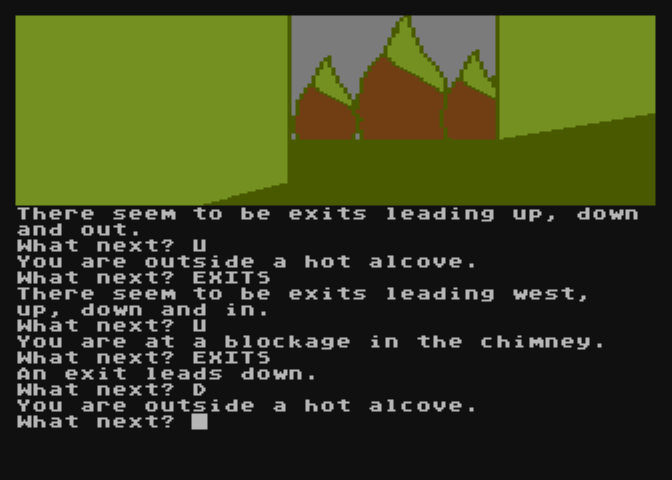
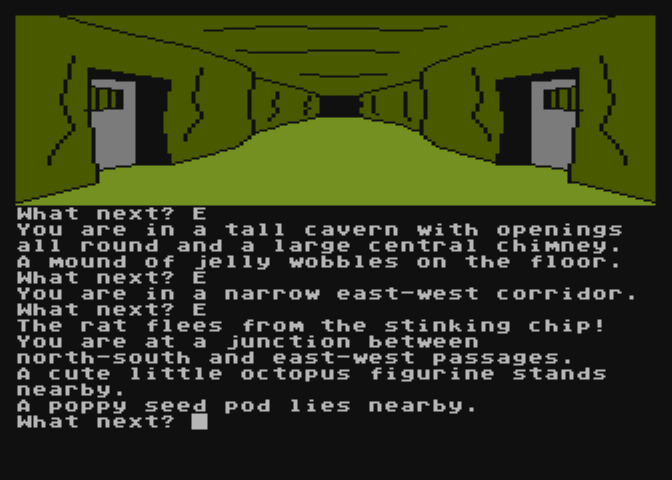
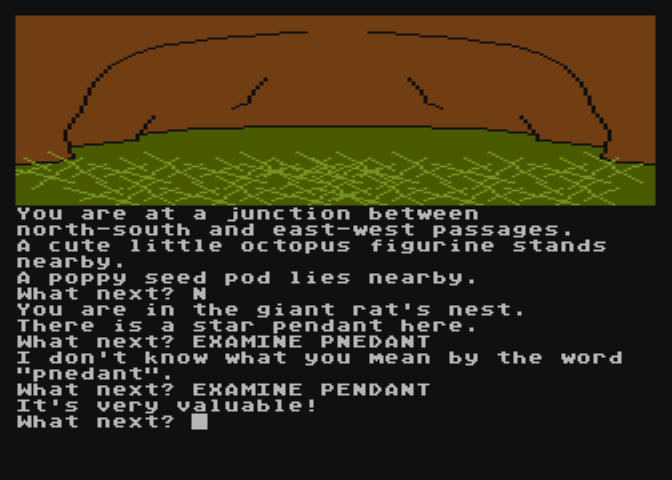
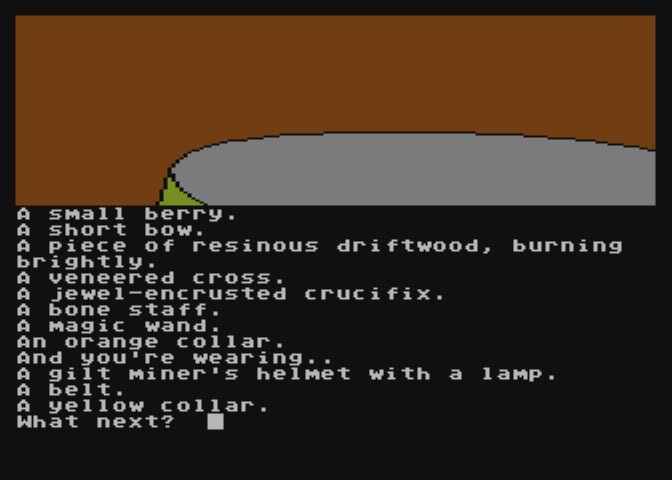


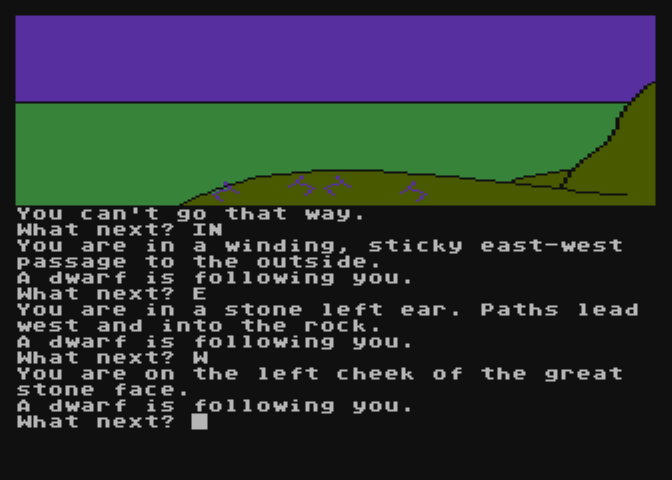


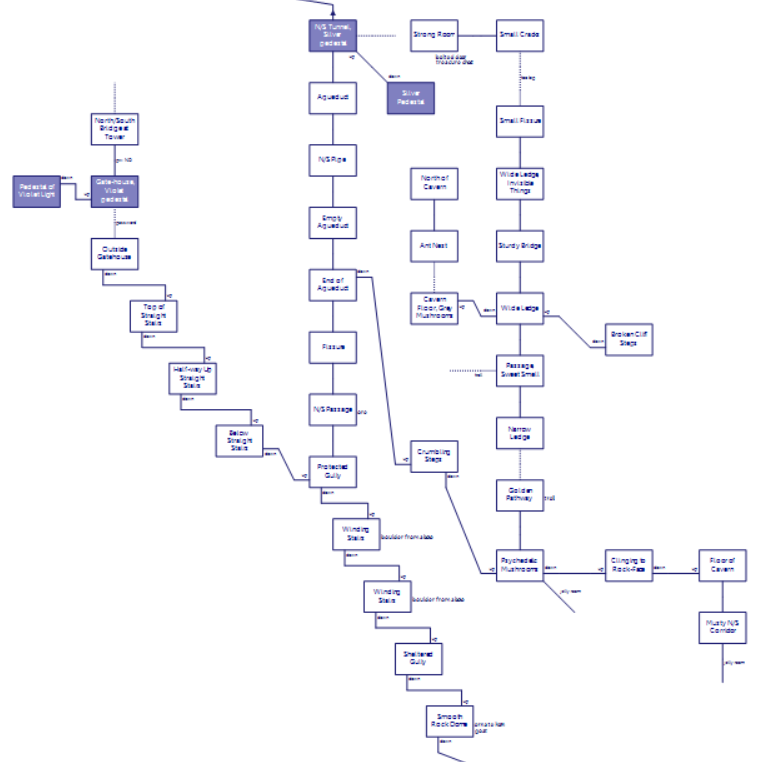


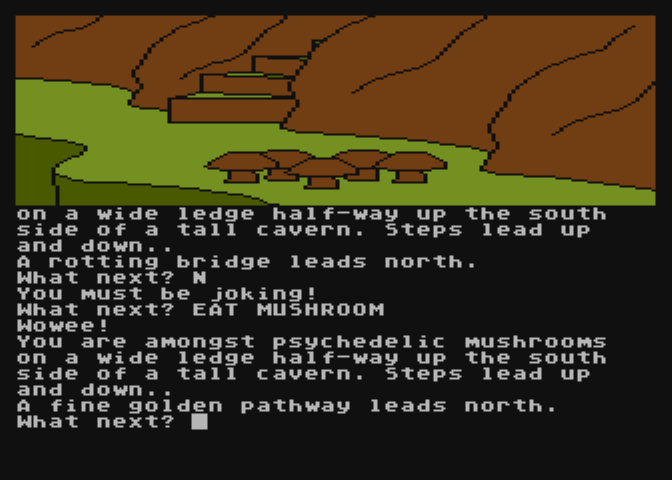
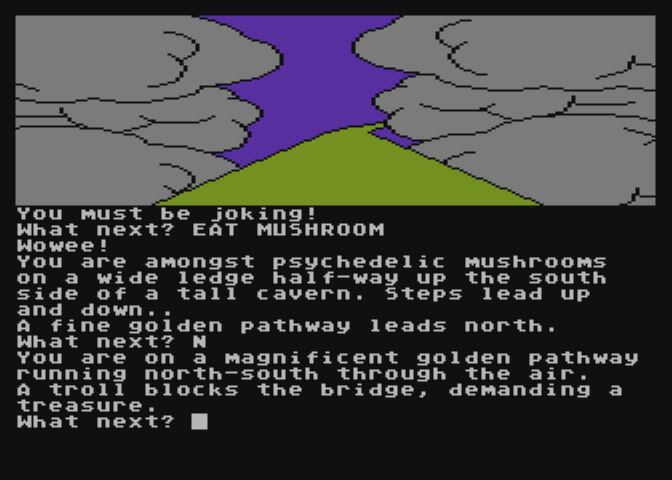

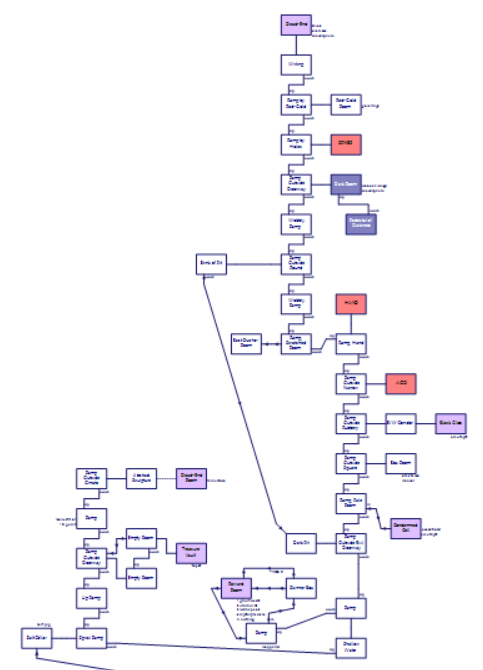


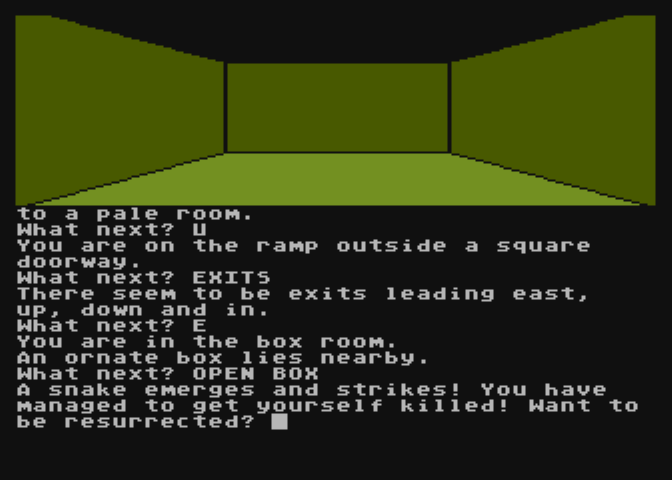


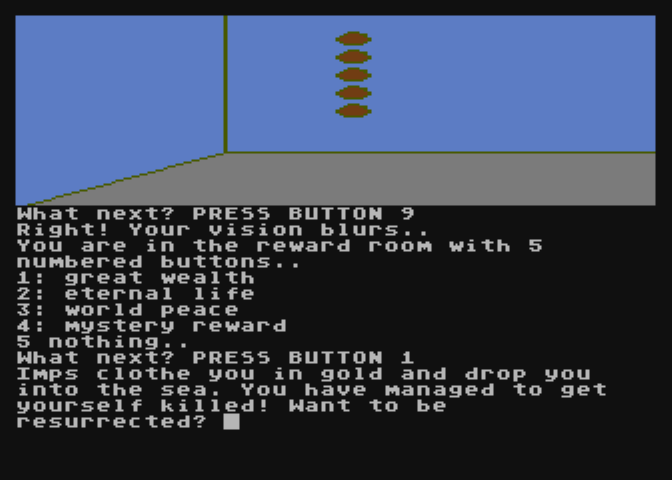


 Renga in Blue

