So I fully intended to post about one more short game to finish 2024, and while I found something short, it turned out to be uniquely bad in an unusual way, making for a longer post than expected. It will land here eventually.
In the meantime, let’s look back at 2024! And what I hope is the last full year devoted to games from 1982, as we genuinely are in the final stretch, and you can read that post I just linked to see the remaining games. Only a few on there are ones I expect to be “long”, that is, take more than three posts. (My next “long” one upcoming is Cornucopia, which is allegedly Cotton’s hardest, so more comparable to Catacombs than Goblin Towers.)
If you want to just read everything I posted last year, you can go to my Big List, hit everything in 1982 starting from Crime Stopper up to Espionage Island; also snag the six from 1981 starting from Escape from Colditz, and also two from 1980 (Magical Journey, Bally’s Alley).
If you just want a sampling, I picked some interesting moments. I don’t consider these the “best”; I appreciate all the games I play, even the ones that play poorly.
Let’s start with my most popular new post of 2024, where I go through the newly-unearthed campaign known as Mirkwood Tales and compare Crowther’s D&D experiences directly with his writing of Adventure. I then go on to give some new information on Don Woods leading to the Software Toolworks version of Adventure, the only one that paid the duo royalties.
Schrag was into making games for the challenge of coding, and he made multi-directional look graphics games for the TRS-80. Despite us having other first-person adventures before (like Asylum and The Haunted Palace) this is the closest in feel to a proto-Myst. Includes one absurdly unfair puzzle.
Dragon’s Keep by Rae Lynn MacChesney, Margaret Paul Lowe, Al Lowe, and Michael MacChesney
Dragon’s Keep got the attention of Sierra On-Line; this eventually resulted in Al Lowe being the main developer on Leisure Suit Larry. This was interesting to study as it goes very different against the tide of regular adventure games, and I managed to unearth some new history on a story that’s been told before.
Based on the eventually-revealed-to-be-fiction books of Carlos Castaneda, and the biggest surprise of the year. It manages to leverage its sparse prose as a benefit, on top of a unique setting and some brilliant puzzles.
A randomized clone of an even more obscure game which contains an absolutely bizarre trick which leverages the computer’s “crash error” system as a game mechanic.
A pair of homebrew adventure games made for the Bally Astrocade. As wild a technical achievement as that sounds, with plenty of misadventures just trying to get the games to even work.
The most pleasant thing for me to play all year; Infocom still holds up even to modern standards. I’m particularly happy how I managed to weave in historical details and textual analysis with what people have previously written.
The start of German, Italian, and French adventure gaming respectively, with lots of historical details. I was particularly invested in getting the details of these out to English-speaking audiences; there’s a lot about early European gaming we still don’t know.
One more bonus pick; an elaborately animated game originally for Tandy CoCo with a fascinating historical story attached, and some analysis about what influences game creation.
If you’re a regular reader and want to plug any of the games in particular from last year, feel free.
Transylvania had an unusual amount of care (and available time!) put into the graphics, with Penguin’s cutting-edge software; Critical Mass had dynamic real-time events that felt like one of the necessary steps on the road to King’s Quest and modern point-and-click games.
Q: I think it’s fair to say the Broken Sword games don’t contain quite the same material, but they have a certain character to them that’s rather distinct. Is there a commonality to the character behind your games?
A: Yes. You could call it puerility. In my heart I know my games were being puerile early on.
I theorized last time I was stopped by parser troubles: indeed I was, and after I resolved the issue it was smooth sailing to the end.
The right command here is to
SWITCH SWITCH
I can’t even blame the system. Just one regular synonym (like PULL or FLIP) would have made this better.
With the switch pulled, the only effect was to have the landing light off. However, this gave me a sudden idea: what if this is where the explosive went? I was thinking of there being a “drama time” event where after turning the light back on, a vehicle would try to land and set the explosive off. (Drama time in that there’s no reason why turning a light off and on again would summon a vehicle — it’s just a matter of the event waiting until the player already has things in place.) However, that’s not quite how things worked out, but it got me to a solution anyway.
Since DROP PLAS(TIC EXPLOSIVE) was getting intercepted by a question as to where, I knew I was on the right track. Since the bulb is in the way, the trick is to UNSCREW BULB…
THE BULB POPS OUT AND SMASHES ON THE ROCKY GROUND
..and then DROP PLAS(TIC) / INTO LAND(ING) works. Then you can SWITCH SWITCH (sigh) again:
The tank moves and leaves its original position unguarded. Not the result I was expecting, but I’ll take it. (You can even go east and see the tank sitting there, but it doesn’t see you or do anything.) On to the last portion of the game!
The path leads to a volcano, and then a METAL PLATFORM and a part I expect a lot people got stuck on. I’d experimented enough with the PEN LIGHT (from the guard that we killed with a knife) that I knew SHINE PEN got the response that I could do that, but not yet. Hence, when a moment came up where there seemed to be not much useful to do otherwise, I was ready:
The secret base has a SAFE where the 27/09 message back at the guard hut applies (remember I knew that 2709 was understood by the parser). The only fussy part is the method of entry: the game directly asks if you want to try entering a code, and you type YES, and then only after you type 2709.
That is, you can’t treat what the game says as a rhetoric question.
Opening the safe reveals a BRIEFCASE and PLANS FOR A MASSIVE INVASION; this must be the “secret” we’ve been sent to find.
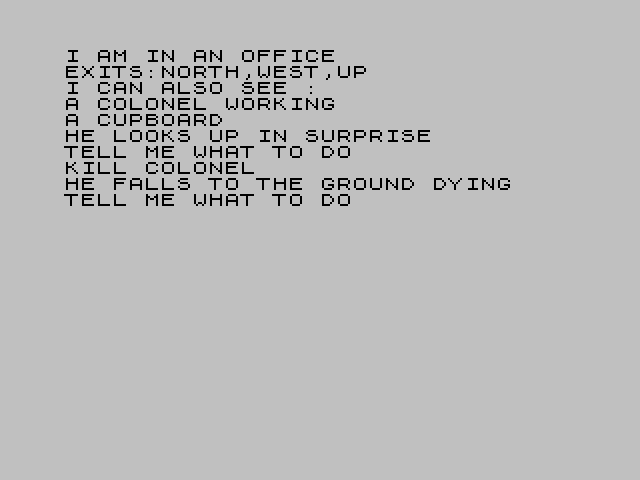
Just south there’s a colonel, and we can just straightforwardly KILL him, and take his jacket stored nearby. There’s a guard later that then mistakes you for the colonel so you can get by.
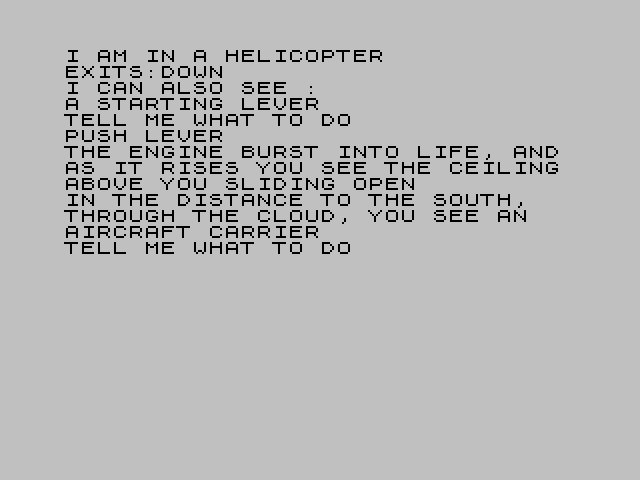
This is followed by a helicopter you can use to escape. Just make sure you don’t PULL LEVER which gives the highly deceptive “I CAN’T DO THAT YET” but instead PUSH LEVER.
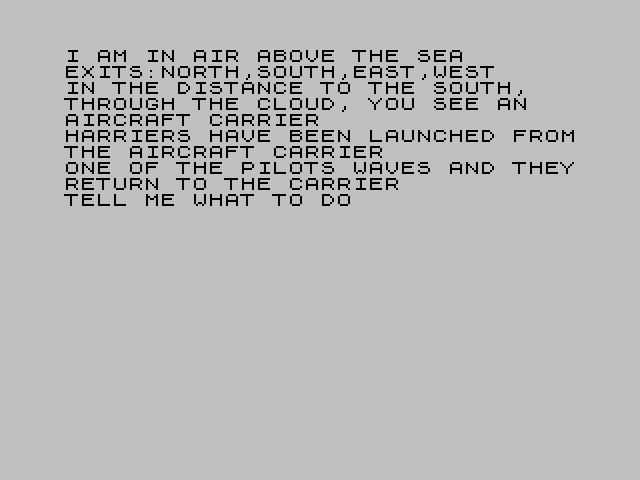
Making a beeline for the carrier is not healthy, as indicated above. You need to first fly around a little and then some harriers fly by and spot you.
I think you need to also have dumped the colonel’s jacket first before doing this.
Then you can safely land to victory.
Adventure E by an entirely different author!
The game was … fine, I suppose? There’s very little of the complexity allowed by a Scott Adams game (with timing, multiple attributes, etc.) All of the previous games (A through C) required odd leaps of logic that didn’t really happen here; the “hardest” puzzle probably was the use of the plastic explosion which I admit I solved by accidentally trying to cause a different effect, but it still didn’t strike me as unfair.
I do think the system itself really held the games back. With very little possible in the way of custom messages, and I CANT for everything, this is weak parser; a Greg Hassett game from 1980 does a better job in communicating why an action didn’t work. I think the ZX81 system itself (and the fact the original games even worked on ZX80!) can somewhat be blamed; even the most talented of modern authors would have trouble squeezing more out.
And we in the UK were working with so little memory, compared to our peers in the US. One of the first Artic releases was 1K ZX Chess. We crammed a chess playing game into 1K. The reason that UK programmers and technical people got so good was because we were working with 1k, and then maybe 16k. In the US they were working with up to 64k. We had cassettes and they had floppy disks.
On the other other hand, I can tell you once we reach most text adventures being aimed at the ZX Spectrum, we’re not in a land of milk and honey. But at least they were capable of more.
Coming up: Not sure! Brian Cotton was supposed to take longer to beat, so I’ll try to find something small to finish off the year.
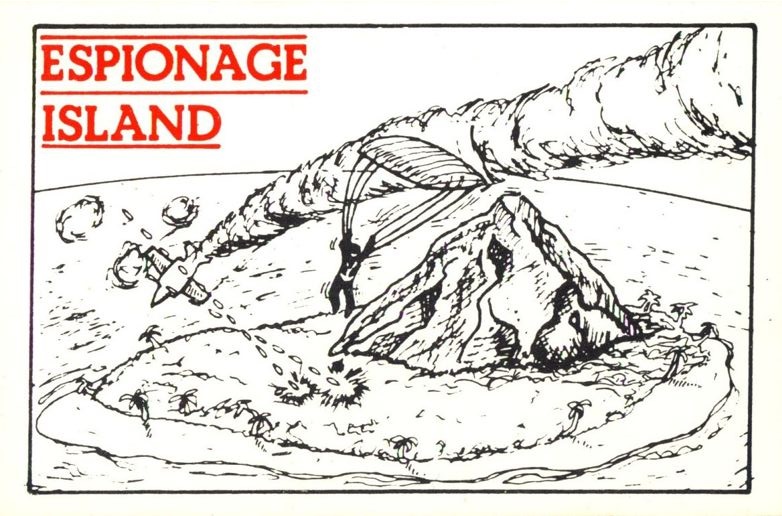
This is the last of the Charles Cecil games made with Richard Turner for Artic Computing. (Previously: Inca Curse, Ship of Doom.) Ship of Doom had the kerfuffle calling it a “digital nasty” due to a particular scene; after publishing Ship of Doom, Turner had his talk with a Whsmith manager about how his art was “rubbish” (as Charles Cecil notes, “…we weren’t worried about logos and marketing. We wanted to make games.”)
Espionage Island is the adventure that came after that talk, so the cover isn’t just plain text anymore.
From Mobygames.
The text adventure engine (based off a 1980 Practical Computing article) still hasn’t changed; plenty of I CANT messages for “I understood that verb but I’m not going to do it for whatever reason” and I DONT UNDERSTAND for when the verb is out of range. (The remaining games, E through H, do change things up, but we’ll save discussing that for when we reach 1983.)
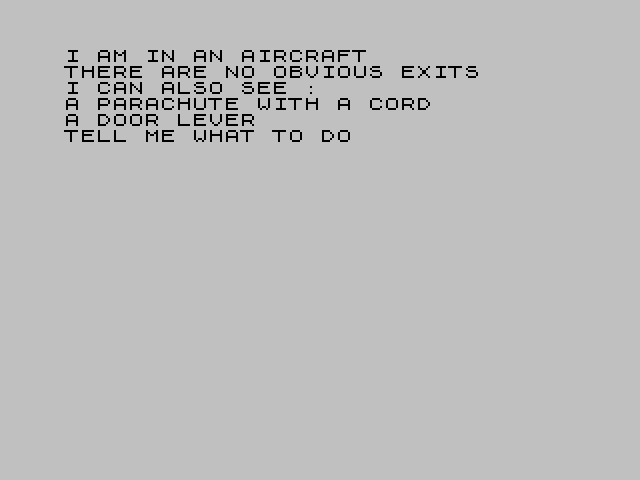
We are, straightforwardly, on a reconnaissance mission to an island, looking for a “secret”. I think realistically we might get a camera or something (at the very least there’s a “disguise” not mentioned in inventory) but we otherwise just start sitting in a plane that was “hit by enemy fire”.
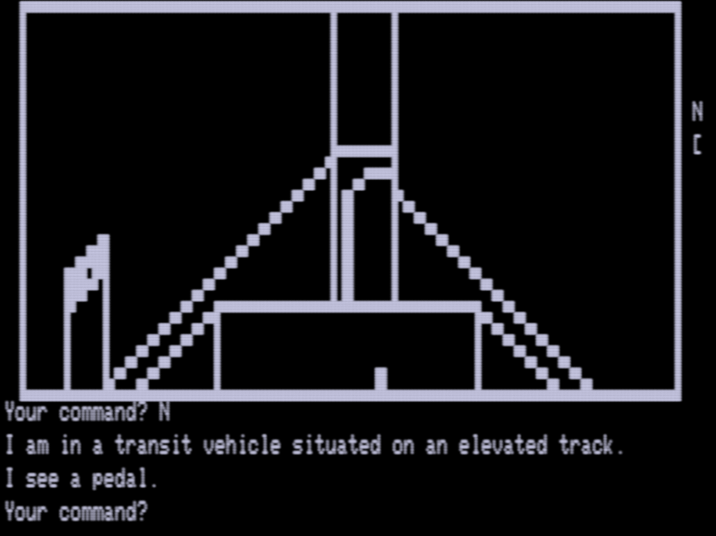
You can GET PARACHUTE, WEAR PARACHUTE, and PULL LEVER to be on your way. This leads to MID-AIR whereupon PULL RING will open the parachute, and you land in a DARK BUNDLE, and then get stuck by the parser.
This is one of those things that looks simple from the author’s end that’s still easy to get stuck by: you’re just supposed to DROP PARACHUTE, and now things open up.
Well, we start in a jungle rather than a beach, that’s different.
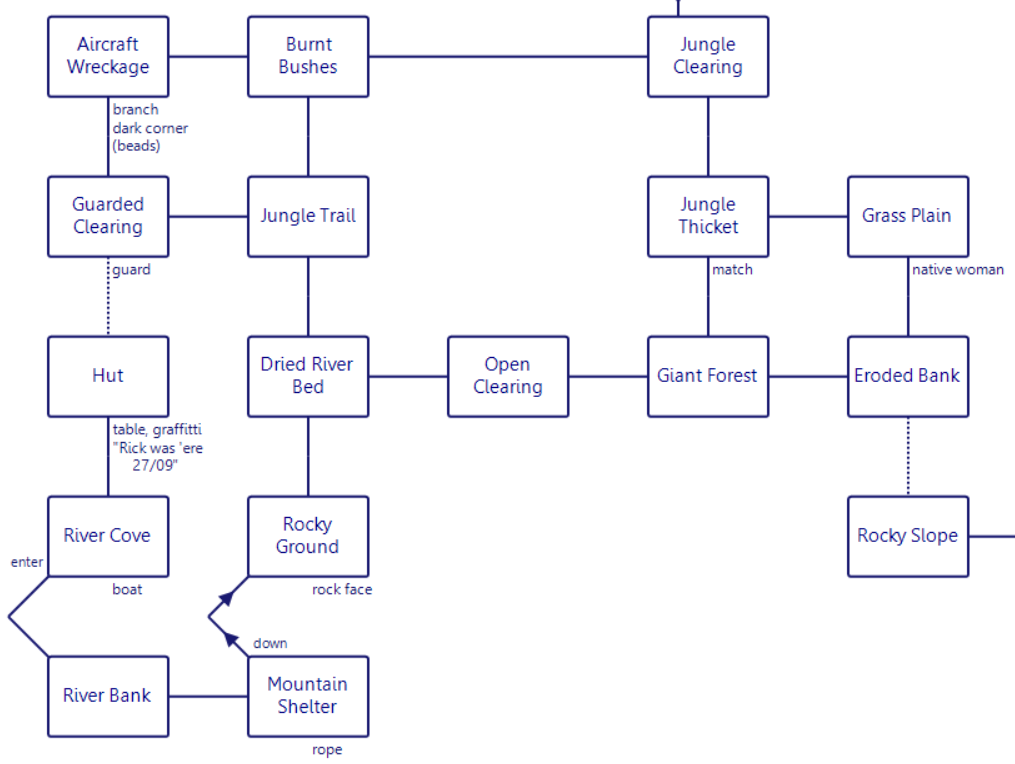
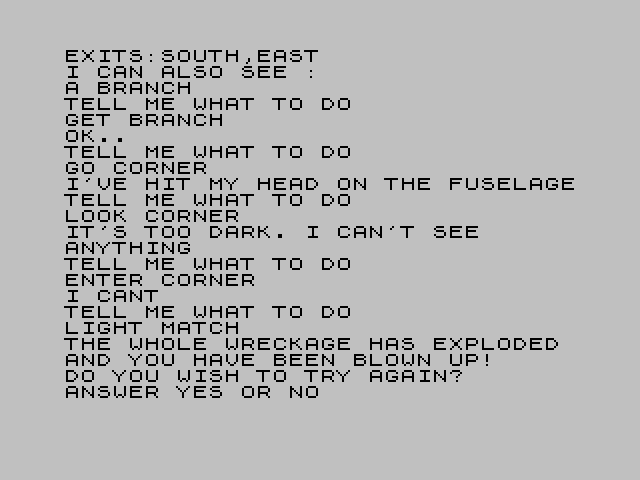
To the south there’s a “match” in a jungle thicket, and to the west is the crashed fuselage of our plane. There is a branch you can just grab, and a “dark corner”; if you light a match to look more closely, you die.
I’d say something about “ah, this is one of those games” but this is the only unexpected death I’ve come across so far. For example, a bit farther south there’s a guard, and going south farther kills you, but the game certainly gives sufficient forewarning.
Back at the plane, you can TOUCH CORNER or FEEL CORNER and feel a string; pulling the string reveals some BEADS. The beads can go over to another part of the island where there is a NATIVE WOMAN.
The player can SCREAM at the woman and get killed, but it took me major effort to find any other way to interact.
With the knife, you can eliminate the guard.
Past the guard is a “hut” with graffiti on a table that reads “RICK WAS ‘ERE 27/09”. After some testing I found 2709 is recognized as a word so I’m guessing it goes to a keycode combination later.
South farther is a river with a boat. You can head downstream with the boat, but not too far!
I suppose this death didn’t have much warning, but I still thought I was about to go off a waterfall.
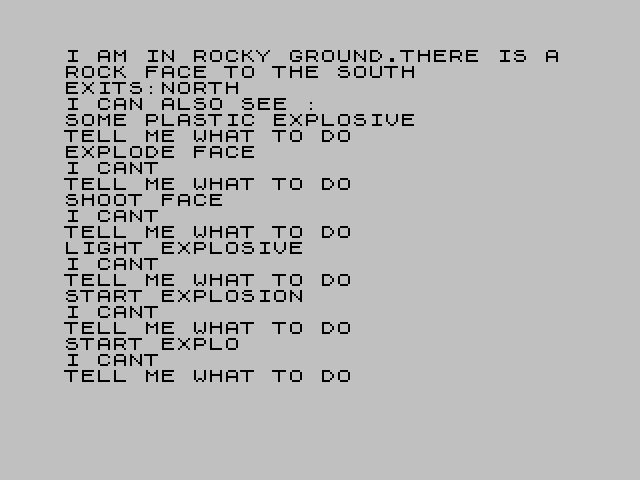
If you (properly) take the boat only for a short trip, you can find a rope, then slide down back a “rocky ground” near a “rock face”. I am still suspicious that the rock face hides something but I haven’t had any luck.
A sneak preview ahead in time: there’s a plastic explosive later, but I wasn’t able to get it to blow open a hole here.
So that leaves the player with the knife, a gun swiped from the dead guard, a penlight swiped from the same, some rope, the match that blew things up earlier, and the branch by the crashed ship. To the southeast there’s an ERODED BANK with a gap and dropping the branch will allow crossing:
This leads to a swampy area which serves as a maze.
I actually ran into this area before going through the beads-knife-rope sequence, so I didn’t have much at hand to do mapping, so I started by trying EAST, SOUTH, WEST, NORTH, just in case this was a grid rather than a more randomly-connected area.
This leads to the next area! So I had the solution to the maze right away, although I still spent the time mapping partly just to be sure I didn’t miss something, but mainly so I can share the many arrows with you, the readers. This is proof that just because a map is messy to diagram, it doesn’t mean it is difficult to travel through.
Past the swamp is “marsh land” and then a mining site.
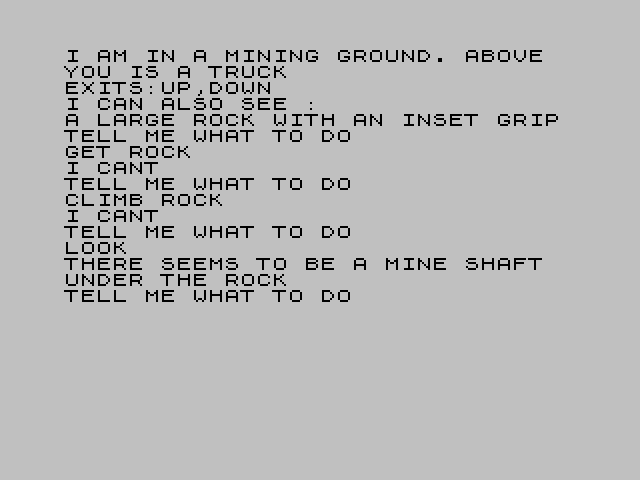
The ROPE seemed the most pertinent item, and I realized after some noodling the game allows you to TIE ROPE, followed by the prompt WHAT TO? You can specify to the rock hiding a shaft, then to the vehicle. Then you can hop on the vehicle and drive it forward in order to pull the rock.
Genuinely satisfying, and I didn’t struggle with the parser here! It helps that everything is just TIE or PUSH.
This opens a tunnel with a PLASTIC EXPLOSIVE (which you saw a preview of already, and I have yet to use). There’s warning sign about danger below and if you ignore the sign you get trapped in a ROCK CELL.
The way forward is to move on, going back outdoors to where there is a LANDING CLEARING and a CONTROL UNIT containing a switch which is set to green.
Unfortunately, my moment of smooth parser interaction was followed by utter pain: no verb I tried was able to interact with the switch.
I tried making my verb list and then applying each and every verb on there, no joy.
Just trying to move on, there’s a tank patrolling. Unfortunately, a tank is rather larger than a guard and neither the knife nor the gun is of use. I might think the plastic explosive could do something but again, no joy with the parser.
I’m unclear if I’m stuck here because of the aforementioned parser issues or if there’s some “legitimate” puzzle I’m missing. But just to summarize, I have
a.) a rock wall that may or may not be hiding something
b.) a switch that doesn’t want to work
c.) a tank I have been unable to get by
d.) and just for completeness sake, going down from the mine leads to a “cell” but I suspect that’s just a trap.
The IFComp has been a central fixture of the interactive fiction community since 1995, and before that, there was the AGT (Adventure Game Toolkit) contest that ran from 1989 to 1993, and even before that, a single contest in 1986 was dedicated to the predecessor of AGT, GAGS. You could consequently argue contests have been an essential fixture of the text adventure form since 1986. (Jimmy Maher has written more extensively about the contests here and here.)
However, there was a major contest which started even earlier! In 1983, 1985, 1987, and 1988, the company Falsoft, publisher of Rainbow Computer magazine (dedicated to the Tandy CoCo), had an adventure game contest culminating in the winners getting published in a book.
These were genuine contests with judging and a winner and a runner-up and so forth, but since the first contest showed up in 1983 I am going to wait on most of the details until then. Here’s an excerpt from Lawrence C. Falk (editor of the first book) just to give a sense of what was going on:
The idea for The Rainbow Book Of Adventures began before there was even a Rainbow. Thanks to Scott Adams, Byte magazine and those wonderful people who brought you the original Adventure on the big mainframes.
“Wouldn’t it be nice,” dreamed I one day, “if there could be a whole book of Adventures just for the Color Computer?”
I had just finished reading Byte’s Adventure issue of December, 1981, and seen one of Scott Adams’ famous Adventures on an Apple computer at my not-too-friendly local computer store. Just the day before I had discovered how to get by the snake in the Colossal Cave. But I wanted to play an Adventure on my CoCo.
None to be had. So I wrote one. Just to see whether I could do it. Name: Vampire! Play time: Around 30 minutes. But I did learn how to move things around, including myself.
(I know, you want to know what happened to Vampire! So do I. I let a friend market it for me and it sold, I think, about three copies. Besides, working on the thing late at night was scary, anyway.)
…
Well, yes, it would be nice if we could have a book of all Color Computer Adventures. But there weren’t many out there, so we began publishing a magazine called the Rainbow instead. (This isn’t exactly how it happened, but it is close enough.)
As the Rainbow grew, we started to get some Adventure submissions, and, pretty soon, started an Adventure contest. We decided that each winning entry would be published in a book. And here it is.
There’s some 1982 business to check in on, as a pair of articles showed up by Jorge Mir about how to write adventures for the Tandy CoCo.
July 1982 had “Rainbow Adventure”, essentially a sample game, and he expanded on the technical details for his August 1982 template he called ADVMAKER.
Aside: Mir mentions whipping together a short game using the template for gatherings.
The sample game, Rainbow Adventure, is not terribly impressive, but keep in mind the context here is like the Ken Rose articles, where the point is to explain how adventures work.
What I am going to talk about this month is writing an adventure. And, next month, we will be giving you an outline of an adventure generator that will help you write your own adventures. It is a sort of help for those who will be entering the RAINBOW Adventure Contest.
This was the era where the programming was the big roadblock; design could wait.
The player starts on a “Kentucky Street” (Rainbow was out of Prospect, Kentucky) with no real direction what to do. This is one of the sorts of games where you find out the final objective when you get there.
There is a very slight amount of maze-iness around the start, with two “winding road” rooms and the player starting with no inventory so not having a way to distinguish between the two (or even knowing there’s exactly two). I nabbed a “shiny object” from a dead end (turns out to be a key) and a sign at a pawn shop explaining you can sell jewelry there, and used those two items in order to confirm the map below.
The shiny object, as already mentioned, is a key, not jewelry, so you can’t sell it. Finding what you can sell is the most curious part of the game, and is interesting in a theoretical-ludic sense. Near the Pawn Shop is a Clothing Center with a mirror. The mirror informs you that you have a watch.
You don’t otherwise see the watch in inventory, and can’t READ WATCH or the like. I first thought the watch might be used to track some kind of timed puzzle, but no. Once learning you are wearing a watch by seeing it in the mirror, you can sell it.
This is one of the odder disjoints between player-knowledge and avatar-knowledge I’ve come across.
With the watch sold you have money, and you can go over to a computer store. There (using the key to help open a case) you can obtain a computer and a tape, and then use the very specific parser commands LOAD TAPE followed by RUN COMPUTER to learn about a bus.
With this powerful increase of knowledge, you can go over to a BUS STOP, hop on a bus, and end up a a post office. There you can open a mail box and find a copy of Rainbow Magazine, winning the game.
I wonder if anyone had come across the game without realizing it was meant to be a sample programming game; it feels very slight otherwise. Fortunately for posterity, we will see Jorge Mir again: he entered the first contest, with two fairly extreme programming specimens, one being an expansive adventure in 4K and the other being a one-room adventure in 32K. The latter is the first example we have of a “room escape game”.
But that will wait for 1983, which we are inching closer to! Honest! Next up: the last of the Charles Cecil games written for Artic Computing.
As I suspected from last time, my initial issue was simply a missing exit. At least the author was trying to be actively deceptive and it wasn’t just me overlooking a simple chunk of text. At the far east of the maze, you can go UP.
Given the giant is peaceful and I had a limited number of verbs to work from, I quickly narrowed down to GIVE probably being the most useful thing. Except: the game did not seem to understand my commands like GIVE WAND. After fussing for long enough I eventually realized I needed the syntax GIVE WAND TO GIANT. (This is not the death-by-grammar moment but it gives a clue of the issue.)
As I was using a save that hadn’t tangled with the goblin yet, I had the lunch in inventory, and it turned out to be the correct use.
Hmm, so my fortification with calories was not the right way to defeat the goblin. Let’s put a pin in that, and nab the rope, as it clearly went to the hook.
Note that TIE isn’t even recognized as a word by itself — this is grabbing the whole phrase TIE ROPE TO HOOK here and the command isn’t otherwise comprehended by the parser. Clearly the author’s Zork influence is coming into play, but with a negative effect (since TIE ROPE ought to be understood, and even the Infocom parser would have taken it! but the author wants to include the feeling of full-parser commands).
The section after straightforwardly allows you to scoop up two treasures; the trip is one way since you have to drop down from the rope, but the other side of the grating is available. You just need to make sure to bring the iron key, otherwise you’re softlocked.
Now, the iron key is past the goblin, so that second screenshot means I got by the goblin somehow without eating the lunch first.
I did, and this is the spot of the game that is horrifying. In fact, we may have a new grand champion for most deceptive parser message ever, and honestly, I don’t think anyone is ever going to beat it.
You see, despite the response indicating you are trying to “stab” the goblin, KILL GOBLIN is interpreted an entirely different way than KILL GOBLIN WITH SWORD. If you just KILL GOBLIN, you’re trying to stab it with … your hands, somehow? KILL GOBLIN WITH SWORD is the way to specify you’re using the sword, and if you do that then the battle runs along cleanly and you can win.
Primal screaming isn’t enough to represent how infuriating this is. I can see how it happened: the author, enamored with a multi-word parser, wanted to have the two commands be different, but forgot to convey to the player that the two commands might be, in any sense, different.
Just like Catacombs, there’s no game-cut-off victory message if you win.
To be clear, this isn’t somehow conveying the superiority of two-word parsers: it just means that as layers get added, the author needs to start being more and more careful about the potential for deceptive responses.
I did promise a look at the Classic Quests version of the game, and strangely enough, it matches this one almost exactly! You start in the cottage rather than inside it, and the description is written differently. There’s also a loft, and I have no idea why the author added it.
Screenshot of the Amstrad version.
There’s a little more text added, like instead of just stating you’re lost in a forest, the game says:
You are lost in a forest of pine trees, the ground is covered in thick undergrowth making movement difficult.
There’s not nearly as many textual changes as you might think, given the improved DOS capacity. It’s quite possible that Classic Quest Catacombs is closer to the original than I first suspected.
Note that structurally, everything is the same! There is one other very, very important difference.
You are in a small side passage leading north-south. The walls are very pitted here as if somebody had been hacking at them with an axe or something. There is an extremely fierce Goblin here, he is brandishing an evil looking axe.
The goblin sees an opening in your defence and strikes you in the chest. You have fully recovered from your wounds.
>KILL GOBLIN
(with sword) You nick the goblin’s arm with your sword. The goblin lands a blow leaving a gash in your sword arm.
>KILL GOBLIN
(with sword) You nick the goblin’s arm with your sword. The goblin launches a fierce attack and you stagger back under a hail of blows.
Yes, the game automatically applies the sword if you type KILL GOBLIN, and even lets you know if you are doing so. At least Brian Cotton was learning!
This is the second game of Brian Cotton, after Catacombs (1981). Maybe.
I say maybe, because this game is quite a bit simpler; while we’ve had authors write a “beginner game” after their initial stab (see: Pirate Adventure, Mission: Asteroid) this feels simple in a learning-how-to-make-games way. That is, while Catacombs was published first, Goblin Towers may have been written first. While I’m not done yet, unless there’s a major turn of events this will be finished in two posts rather than four.
TO RECAP the story so far: Supersoft, a company founded by Pearl Wellard and Peter Calver in 1978, published one of the first professionally distributed text adventures in the UK, Catacombs; maybe the first. (Since writing that article more missing 1980 games have come up. Some might be vaporware — that is, they may have never truly existed — and the ads for them make them all look like amateur-garage companies, meaning the “professional” moniker still gives Catacombs some distinction. Of course, “professional” is a loose word to be using for the UK market in 1981, so there’s some hand-waving here.)
Goblin Towers was published after Catacombs, still in 1981. The original version was for Commodore PET, which we don’t have, but a C64 follow-up came after which we do have. This is unlike the situation with Catacombs, where no copies of earlier variants are available and we only have the 1986 “Classic Quests” re-issue, which likely added content and text.
The 1983 copy shown above (cover via Lemon 64) has a fair chance of being similar to or even identical to the PET version of the game. This is the version I’m playing, although I also compared a little with the Classic Quests version. To simplify my narrative, I’ll save talking about changes in the re-write for when I’m done with the original.
The premise is that there’s a castle with rumored treasure, and we need to go fetch it all and bring it back to the starting building, getting points for each treasure placed.
Unlike most the games of this sort, I don’t think the most direct inspiration is Crowther/Woods Adventure, or even Scott Adams Adventureland. I think the author was inspired from Zork.
Now, this is a much spicier assertion than it seems because this was written in the UK. Infocom was not common in the country, and in the land of expensive disk drives it was never terribly popular through the 80s. However, in addition to the newspaper giving the same vibe as the leaflet from Zork, and the lunch, there’s combat with a goblin you’ll see shortly which resembles the fight with the troll. There’s not that many forward ramifications — they’re all still pulling from the same original source, after all — but even when looking at the US market, there haven’t been many people inspired by Infocom yet. I’m guessing Cotton’s exposure was to mainframe Zork, not commercial Zork; this game likely was written in 1980 when I don’t think any commercial copies of Infocom had made it over the pond yet.
Another point of resemblance: Crowther/Woods Adventure kicks things off with a grating, and Zork has an early grating but changes it so it must be unlocked from the other side. The same thing happens here; there’s a grating, but even with a key (found later) you can’t open it. The game says it must be unlocked from the other side.
The starting way to enter is instead at a large inviting castle:
Quite early on is a side passage with a goblin combat (which, again, feels a lot like the Zork troll fight).
I died a fair number of times and I thought perhaps I was meant to come back later with a special object or at least more “experience points” helping, but I gave it one more go after eating the packed lunch and was victorious. I guess our hero was just a bit peckish. It’s hard to murder on an empty stomach.
Past the goblin are some stairs going up and down, with two relatively straightforward puzzles associated with both directions.
On the down side, there’s an iron key (I haven’t used it yet) followed by a cell with an emerald (treasure) and a loose block. You’re simply supposed to push the block. This opens a passage to a diamond, and a route to go outside (you’re not trapped, this is just an alternate route out, like Zork).
On the up side, there’s a locked chest, and a room with a message: “Cassim forgot about it but Ali Baba didn’t.” This indicates that to open the chest you need to say the words OPEN SESAME. (Cassim is Ali Baba’s brother who tries to steal the treasure, who forgets the literal words OPEN SESAME to get out of the cave.)
Reversing back to the goblin fight, and heading east instead, first there’s a crystal wand (haven’t used yet, but it does count as a treasure) followed by a straightforward maze, the kind of maze where going east from A to B usually means you can reverse your steps by going west.
With just a few exceptions.
The maze has a pearl necklace (treasure) and leads to a ledge which has a “hook”. I have been unable to get the hook to do anything. It feels like the sort of place where a rope would go, but I haven’t seen a rope and the verb TIE doesn’t work.
To recap: Out of the treasures, I’ve found an emerald, sapphire, diamond, and pearl necklace. I’ve found a key which hasn’t gone to any locks yet, a wand where waving it everywhere does nothing, and a hook I have had no luck with. Unless I’m missing a map exit (not implausible) I’ve otherwise explored all the accessible areas. The high score is 160 with score coming in chunks of 5 so we’re not talking an excessively long game, but it is possible Mr. Cotton has ramped things up later.
IT IS WITH GREAT REGRET THAT I MUST INFORM YOU OF THE MOST UNFORTUNATE PASSING OF YOUR UNCLE, SIR HENRY VANDERBILT. IT IS ALSO MY DUTY TO INFORM YOU AT THIS TIME THAT THERE WILL BE A READING OF THE WILL OF YOUR UNCLE’S ESTATE IN THE ISLAND PROVINCE OF BURMESIA A WEEK FROM TODAY AND IT IS REQUESTED THAT YOU BE THERE.
We return now to Peter Kirsch and the Adventure of the Month series through Softside (see previously: Menagerie). By October he has essentially taken over, having no outside submissions for a while. Even when these games have had issues they’ve always had premises far outside the norm for 1982, and I find it exciting to see early stabs at various genres.
This is arguably Kirsch’s most ambitious game yet, with multiple plot twists.
The Deadly Game invokes not even just a genre but a sub-genre of the thriller/horror movie: the house where you have to stay the night to get (some amount of money) but (your relatives/spooky ghosts/traps left by the antagonist) are trying to kill you. See, for example, Bring Me the Vampire (1963) and No Place Like Homicide (also 1961), although the latter is a comedy. (There are also two movies called The Deadly Game but they seem to have no relationship to the genre overall or this particular game.)
Probably the most famous variant is House on Haunted Hill (1959) with Vincent Price, where people can earn $10,000 by staying one night in the titular house.
I have all three versions this time (TRS-80, Apple II, Atari) but I went with Apple purely because my last game was on Atari. (Foreshadowing: I should have picked TRS-80 instead, but I’ll get to why later. For someone looking for the download, it’s on SoftSide Magazine Adventure Superdisk 5.)
1 ‘ THE DEADLY GAME
BY PETER F. KIRSCH ** VERSION 14.4.1.3 **
SEPTEMBER 1982
We are informed our super-rich uncle has passed, and you arrive at the reading of the will to an “ENSEMBLE OF RELATIVES THAT YOU NEVER THOUGHT YOU’D SEE AGAIN AND WISH YOU HADN’T”.
The will, then, is read: a sum of ONE MILLION DOLLARS to be divided equally amongst the relatives, except everyone must spend one night first, and the money will be divided — the will says this explicitly — “AMONG THE SURVIVORS”.
ALL OF YOU ARE GREEDY AND UNDESERVING OF ANY OF MY MONEY. WE SHALL SEE WHO CAN PASS THE TEST OF SURVIVAL TONIGHT.
You then land in a bedroom and immediately someone is trying to kill you via gas.
Here is where we reach one of the first things rather different about this game compared to prior Kirsch output: there’s a stronger emphasis on having indirect objects be included in the game. The right commands are to LOOK BED and notice a PILLOW and BLANKET, and then to PUT BLANKET; the game asks IN WHAT? and you need to respond IN CRACK, referring to the crack that the gas is escaping from.
This scene is followed by a persistent “PSSST!” message which only clears up when you LOOK WINDOW and find a woman underneath, after which you keep hearing the phrase DIAMONDS ARE A GIRL’S BEST FRIEND.
This is trying to simply hint that a diamond goes to the woman, but is bizarre in an environmental sense. Also, in addition to lacking a diamond the window is completely sealed off so we can’t get to her yet.
The room is still locked up, and it took a fair amount of time for me (maybe 20-30 minutes?) to get out, giving the impression this was almost a single-room game. Extra details are included by the game also allowing LOOK UNDER and LOOK BEHIND as commands (mentioned by the HELP command but not by the main game’s instructions); you can LOOK UNDER the chair and find some gum, and LOOK UNDER the bed and find a key made of bronze. To reach the key you need to use the portrait off the wall (it’s described as “long”); behind the portrait is a safe but you can’t open it yet.
Weirdly, LOOK UNDER does not note the death underneath the pillow. I discovered early you can SMASH PILLOW / WITH CHAIR in order to make the pillow safe to pick up.
The bronze key can then go to the top drawer of the dresser, which has a “BOBBY PIN” and a “KEY MADE FROM ZINC”. The key doesn’t go to the lock but you can PICK LOCK which will allow the bobby pin to work on the door leading out from the guest room.
That sounds fast narrated out, so let me be fully clear it took a while to get to this point; the LOOK UNDER mechanic wasn’t originally clear, the zinc key seemed like it ought to go somewhere (it didn’t yet), trying to use the bobby pin to pick locks of the dresser (there’s a middle and bottom too) makes it seems like it can’t be used to pick locks at all, the woman under the window messages are bizarre and I spent a long time trying to communicate or at least get her to stop from saying the same words over and over again, and I also spent a while noodling with the safe behind the portrait in case it was possible to be opened early. (It isn’t — you need to get three combination numbers from elsewhere in the house.)
Getting back to the action, we can now explore the house somewhat more freely, although a quick check through the open guest rooms on the floor we’re at reveals various cousins have already expired.
You need to get the power working later to turn the light on.
Getting the gold key requires stopping the walls from closing in, but that will require an item from a different floor.
That’s three out of five cousins dead already. The other two guest rooms are locked so we are unable as to inquire as to their health.
From this floor you can go downstairs or upstairs. I started by going upstairs. (Well, to be honest: I started by being horribly stuck, as GO UP, CLIMB STAIRCASE, UP, TAKE STAIRCASE and many more variants failed to be understood. I ended up needing to check Dale Dobson’s walkthrough for GO STAIRS, and it has to be phrased exactly that way.)
I’ll be hopping in the elevator in a moment, but first a mention on the maid’s room: you can LOOK UNDER / UNDER BED and find out THERE’S NOTHING UNDER THERE NOW, BUT IT LOOKS LIKE A GOOD HIDING PLACE. The broom goes over to those closing-in-walls although I took the route jumping into the elevator first:
Just like Critical Mass! But you don’t have to time it.
The ground floor consists of a living room (divided into a 3 by 3 grid), some side rooms including a kitchen, a front door that’s locked and that is a concern later, and a cellar door that requires the zinc key from back at the start.
Heading by the kitchen, you can find an “axe” and “nails” in a cabinet (LOOK CABINET, it gives confused parser messages if you try to OPEN it) and then the killer seems to be repeatedly trying to throw something sharp.
In reality the above scene is meant to be “do the right action to defend yourself” but the author decided here not to make it “right action or die”, but simply to pause the moment while you figure out what that right action is. You can grab the pot lid and it gets used as a shield. You then get the message DEFLECTED BY THE POT LID and the invisible killer leaves you alone after that. The thing being thrown was a rock, which happens to have part of the safe combination on it.
Heading down to the cellar, there’s a fuse box that can be fixed by the gum (from way back at the starting room, when you LOOK UNDER / UNDER CHAIR), along with some acid, turpentine, and a garden hose.
Before being able to escape upstairs to test the light switch now (and apply the broom which still hasn’t been used yet) there’s a rattlesnake blocking the way.
I can understand improv-throwing a rock from the shadows, but where did the snake come from?
With the snake out of the way via garden hose impersonation, we can first block the closing walls with the broom, nabbing the gold key. The gold key can be used back at the dresser to a second key, and that key unlocks a door to find yet another unfortunately expired cousin, and a paper with a second part of the safe combination.
If you’ve been counting, that’s four out of five cousins. That means the fifth must be the murderer, right? Well, no. Applying the axe to the last locked door:
The smashing leaves some boards which will be useful shortly, and there’s a saw inside the room.
So rather than the cousins fighting each other in a Battle Royale (as the expired Uncle may have expected) they’re all dead via someone else’s hand. Even more intriguingly, working out what’s going on can actually help a little with a soon-upcoming puzzle; a golden situation where solving a puzzle is equivalent to “solving” a plot that doesn’t happen often in this era (it came up earlier this year twice when playing El Diablero). Unfortunately, The Deadly Game doesn’t stick the landing quite as securely, but let’s fiddle with some last lingering elements first —
Once you have visited all the dead cousins, any attempt to go downstairs is fatal, as the unseen killer finally decides on a more efficient killing method than a rock (“A lone shot kills you”). So we’re now stuck on the second floor and top floor until we can figure out how to survive getting shot.
Given the fusebox has been fixed, now is the time to try to turn on the light switch (in the same room as one of the bodies). This is deadly: you get electrocuted. You need some gloves.
To get them, you have to
a.) throw acid at the window that was unable to be opened; it gets dissolved
b.) pour turpentine on the portrait, then do the most absurd action in the game, WIPE PORTRAIT, using the pillow; this reveals the third safe combo number
c.) enter the numbers into the safe; as is typical for these games, trying to figure out the right syntax is a pain in the neck (you have to specifically type DIAL 31R76L33R; that is, you concatenate one long string and use it as the noun)
d.) with all that done, you can throw the diamond down to the woman who has been singing about diamonds this entire time, she’ll toss back a key which coincidentally opens the last locked drawer of the dresser
e.) the dresser has the gloves
Now the light switch can be turned on safely. This reveals a hammer in the room. Yes, all that was to get a hammer.
So we’ve collected a saw, some nails, a hammer, and have some boards. Why do we need all these things? Well, if you try to go back upstairs, there’s been some sabotage done:
We can SAW BOARDS and with the other items in hand the player now has a STEP, and then FIX STAIRS works while holding this step. This amount of item-fiddling can feel correct in a tomb searching for ancient treasure, but a building project whilst a murderer is roaming around feels a bit off-kilter.
Now, the whole point of going back upstairs — do you remember the hiding place under the bed? There’s a gun there now.
Now things get very strange from here. You might think to take the gun with you to have a showdown, but the Uncle’s Lawyer magically appears to stop you.
The key thing to realize, or at least look up and rationalize on behalf of the author (it’s not very rational) is that the maid doesn’t count as one of the five dead cousins so is the murderer, and the gun is hers, so we can LOOK GUN, find there’s a bullet, and take the bullet out, making the gun now be safe. But somehow– then with this task down, when we go downstairs, the maid has teleported past us to pick up the now-unloaded gun, and then teleported in front of us to try to fire the shot on the first floor.
There was a much better version of this in Jack the Ripper (same author). In that game, there’s a part where you discover the killer’s medical bag and his murder weapon, and you can swap his murder weapon with a fake one, but you have to be careful to close the bag (otherwise you’ll have given away something weird has happened). Later in the night you have a confrontation and the previously dangerous weapon is now inert because of your prior preparation. That seems to have been the goal here but the teleporting maid just makes so little sense I stared baffled at the screen a couple minutes after having this scene.
The curious thing is that in a way the bullet trick is much more “fair” in a gameplay sense — the ramification happens right after the action so failure on the player’s part is more immediate (unlike Jack the Ripper, where you have multiple scenes in between when you make the setup and the punchline). Yet the long-term planning is what gives the action both its story punch and its, well, being an actual logical plot beat. This is an instance where optimal gameplay practice and optimal story practice clash.
You can drag the maid over to a phone and CALL POLICE (look, I was just checking the walkthrough by this point, I thought we were supposed to hang out the entire night you know the whole premise of the game?) and then we can meet them at the front door and then there’s not only one twist, but two of them.
However, if you’re referring to Dale Dobson’s version of the story, the game is already over.
The game loads a totally different file for the ending! I imagine Mr. Dobson (calling it just a “coda”) thought it would be just some text congratulating us on our riches, but the game isn’t over yet. The only platform I could find the ending portion is TRS-80, so we’re swapping over to there.
For those counting, this is a second plot twist: the police are here to kill us. (This admittedly patches one issue these plots sometimes have, which is why law enforcement seems apathetic to the game of death going on, or the very public ad about “surviving a night” in a house and people mysteriously dying.)
The game removes our inventory and we can’t run, so this isn’t a terribly hard puzzle since resources are low. The red carpet mentioned in the description is our savior.
We can then nab the revolver, and the policeman starts to pull a backup weapon, so the inevitable results:
What is not predictable at the end is the third plot twist right after, which makes no sense whatsoever.
Keep in mind, the opening of the game had the main character clearly shocked and surprised at receiving an invite to the reading of a will.
a.) so that whole opening section was the player lying to themselves somehow?
b.) also how did the player know things would play out the way they did, given they didn’t come to the event armed?
c.) what was with the lawyer magically appearing when we were holding the gun?
d.) what. I mean what
Curiously, we haven’t run into that many broken story moments in All the Adventures. There generally just hasn’t been coherent enough story for that to happen! Even Kirsch’s games have had a by-the-moment sort of plotting; while there’s Arrow One, which had the biggest plot wrapper (and the “Adam and Eve” ending), the Kirsch games mostly have had self-contained moments (like Robin Hood being a series of vignettes, or the individual passengers rescues on Titanic). Around the World in Eighty Days managed to be coherent by sheer dint of plot simplicity: the whole thing that connects the various episodes is that “time passes compared to the last scene”.
The Deadly Game proves that to strive for the full span of genres, authors really needed to start mastering traditional story beats in addition to juggling gaming norms. Just: this game came out more as a negative example.
Coming up: what will likely be the last game of 2024, as we return to Brian Cotton, one of the first authors to be commercially published in the UK.
(This post contains content that may not agree with your workplace.)
While we’ve had bawdy content before at All the Adventures, it has tended to be on the free mainframe games not intended for commercial distribution; games like Library and Haunt.
City Adventure (which still explicitly advertised itself as “rated PG” and only put the naughty content “after the game”)
Sultan’s Palace and to a lesser extent Sleazy Adventure (both games published in the Atari APX catalog, back when they were absolutely desperate for content and didn’t care about quality)
Softporn Adventure (the big one, only available because Sierra On-Line had marketing muscle, when the author tried to sell it on his own he couldn’t get advertising)
The difficulty in marketing Softporn is important here; while it was not impossible to advertise (Softcore Software, a company we haven’t looked at yet, managed to pull it off) it certainly was more difficult.
The Dirty Book (Vol 2., No. 1) printed some rejection letters of their attempts to advertise in mainstream computer magazines:
I regret that I must send back to you your recent insertion order for your client “The Dirty Book”. Also enclosed is your check in the amount of $233.24. Our publisher feels that at the present time, Recreational Computing magazine is in the process of expanding its audience and he would prefer to take a rather conservative attitude toward the many, many new subscribers we have taken on just within the last month.
The same book was intended as an outlet for games to advertise who were unable to make it to print otherwise (they also did reviews, and were disappointed by Sultan’s Palace). One of those ads was for Bawdy Adventure.
This is a short but cryptic game and strongly reminds me of the APX content. Strongly enough that I suspect the author must have played some of them; the APX standard is to block exits with a message
SOMETHING IS IN YOUR WAY
while this game says
YOU CAN’T GO THAT WAY YET
with a similarly cryptic result.
I’d like to go on and say this was a rogue Atari employee who decided this game was too much to publish in even the APX catalog, and “Peter Constantine” could easily be a pseudonym, but it doesn’t nail quite closely enough for that.
The starting room already is cryptic, with EAST getting that “you can’t go that way yet message” and down just resulting in you “FALLING DOWN A BOTTOMLESS PIT”. The key here is to look at your inventory, and find a TALKING BANANA, which you can then DROP (“FREE ME”).
The pickaxe (described as MADE IN WAR-TI-TAE) can be applied with SWING PICKAXE to make it out of the opening room.
The next room, a “womb-like tunnel”, also has blocked exits. The only way to proceed is to pick up the “old miner’s jockstrap” in the room and wear it. It is unclear why this allows passage.
Eventually the path (with plenty of “YOU CAN’T GO THAT WAY YET” in various directions) leads to a “diving platform” with a leather whip. CRACK WHIP gives the message that exits have opened, and the map finally is mostly accessible.
There’s lots of references that make the game feel bawdy (like the “well-hung stalactites”) but it really is just a random surreal cave for the most part. The most obvious is the “magic phallus” that you can pick up; in addition there’s a “cricket with fishy breath”. Some of the exits lead to a “red muff river” which appears to have no way out, although you can dive and get a $5 porno novel from the bottom.
It seems to be impossible to get out, but this is where the “magic word” reference from earlier comes into play. The pickaxe’s word WAR-TI-TAE almost counts as a magic word; upon saying it the game claims
SDARAWKCAB S’TAHT
You instead need to say EAT-IT-RAW and then you’ll get teleported over back to the diving platform (where the whip was). This allows escaping the river.
With the novel extracted, you can go over to a “vending machine” and drop it in to get an outhouse with suspenders.
The outhouse can then be worn (really!) and for some reason that’s enough to allow you to dive back at the platform.
Here I was quite puzzled, because going east heads back to the regular part of the map, so there didn’t seem to be any reason to go through all that. I started playing with all my objects, and I found if I dropped the cricket and rubbed the phallus I won the game.
Yeah, I’m baffled I managed to beat this too. Every step was absolutely cryptic and I only did something because there was nothing else to do; there’s no reason cracking a whip would open exits, just the whip seemed to be the only item available so I might as well use it? The cricket thing has to be done at the room I was at; that was absolutely pure luck that I tested it there, as NOTHING HAPPENS if you attempt the deed elsewhere.
I really have to wonder who this was targeted at; someone who was looking for an erotic game wouldn’t get very far, and by the time I puzzled my way to the end it came off as a bizarre logic problem rather than anything genuinely bawdy. I still vaguely suspect someone at Atari amusing themselves in their off-hours was involved but I don’t have any particular evidence of that at the moment.
Before checking out I should plug the historian Laine Nooney, who after 10 years managed to find Vol 2. No. 2 of the Dirty Book. I didn’t use it at all for this post, but it was still good to crosscheck (and to know they made it that far as a publication!) Also, thanks to Atarimania who pointed me to the game quite recently being found.
To recap, Korenvliet was a game from the Netherlands entered into the catalog of the P2000 Computer Club. Unknown to most people after, it was a translation of an English game called Stoneville Manor (up to the point someone recently re-translated the game back to English, without realizing English was the original language!) The same catalog has Piratenavontuur, Pirate Adventure, but it was a little more obviously a translation of Scott Adams. Those two are not the only adventure games in the catalog.
Hans Pennings’s game Schatzoeken (“Treasure Hunting”, sometimes used as the term for modern Geocaching), is not a title that immediately suggests an adventure game, and might be more like a top-down arcade action game. In fact, there is an undated Spectrum ZX81 game with exactly that concept.
However, the P2000 version is an adventure games of the type seen with Gold or Explore: just walking around rooms and making a map, with essentially only movement commands available. Just for the record, since the catalog is nice enough to include dates, the ones given are
(30 June 1982) Schatzoeken
(6 September 1982) Piratenavontuur
(23 December 1982) Korenvliet
that is, the two other translations ports came later. (When I first wrote about the two ports, I had no author, but I can tell now due to this catalog they are also the work of Mr. Pennings.)
There’s a VIC-20 version of Schatzoeken; it has a title screen by an entirely different author, F. E. Leene. The internal date of 12 November 1982 indicates it was written later.
Just to keep things messy, the version I played is a revision from 1983, since I don’t have the one in the catalog from ’82. It comes from a P2000 archive where many of the games were updated within the last year, meaning there are likely un-indexed games floating around; some of the un-investigated titles sound vaguely adventure-like.
Hans Pennings was fairly active in the Dutch software scene in the 80s, producing a big list of P2000 games on top of the ones I’ve mentioned like Marco Polo Jr (a trading game akin to Taipan) and In de ban van een ring (a quasi-RPG based on Lord of the Rings).
I have not checked his entire output so it’s possible there’s another adventure lurking out in ’83 or ’84 but it looks like he mostly stuck to strategy and board games after finishing Korenvliet.
Just like Korenvliet, this turns out to be just another translation, this time going way back, to Roger Chaffee’s game Quest. There are some changes to the game logic so I’ll show the playthrough.
YOU ARE NOW OUTSIDE THE CAVE. GO SOUTH TO ENTER.
There’s a funny message up that can be found by wandering the forest and trying to go up a tree:
NOU, DAAR ZIT U DAN: BOVEN IN EEN BOOM WAT GAAT U NU DOEN? EEN EI LEGGEN?
WELL, NOW YOU ARE UP HERE IN THE TREE WHAT ARE YOU GOING TO DO? LAY AN EGG?
It’s worth going through the steps of the original before the new version (it’s not like most of you reading this will remember how original Quest went!). To summarize:
a.) the player goes in a cave and past a lair of a “gnome king” that is out
b.) the player finds the treasure at a “guillotine” area
c.) the player is blocked trying to get out the front because the gnome king arrives
d.) the treasure gets stolen by the pirate
e.) the player finds the treasure inside the maze, in one of the “dead ends”
f.) the gnome king still hasn’t left so the player needs to find an alternate exit; there’s a set of “labyrinth rooms” where the player eventually finds a “black hole” room; going south then leads to a lab which teleports the player, but if the player goes down instead they’ll make it to the exit.
For this game, to start, there’s no “gnome king”, but rather a troll king instead:
There’s a message that says BILBO WAS HERE that gets changed to KILROY WAS HERE, matching the meme dating back to WW2.
YOU ARE IN A DEEP GAP. HIGH ABOVE YOU SOMEONE HAS WRITTEN ON THE ROCKS
KILROY WAS HERE
The treasure is not at the guillotine but instead in a spot that used to have a “stalactite”; the room called Xanadu gets moved there instead, and the gold is right next to it.
You are in the ashram. There is a heavy smell of incense and all directions look the same.
GO SOUTH
You are in Xanadu. Below you flows the sacred river Alph through caverns measureless to man down to a sunless sea.
YOU HAVE FOUND THE TREASURE
Are you taking it with you?
Just like the original, the exit is now blocked (but by the troll king rather than the gnome king)…
…and a pirate will eventually filch the treasure back.
Suddenly the pirate jumps out of the darkness and takes the treasure from you, he shouts “you’ve found it, I’ll hide it better now!” He takes the treasure and disappears into the darkness.
Rather than the treasure moving to the maze, it moves to the guillotine (where the treasure gets hidden at the start of the first game).
The troll still blocks the starting entrance as the first game, but it is now possible to get through over to the “labyrinth” from the original although the layout is slightly different.
Once arriving at the “black hole” room from the original if you try to go into the place where the original teleports you, here you just get ejected because you don’t have a pass.
There is no pass. You just go east (not down as in the first game), fall into a hole, and make your way to the exit.
Since the only verbs were navigation, despite the map being almost identical to the original this still took some work to beat due to the changes. I’m not sure what the logic of the author was other than simply wanting to put their own flair. My guess is Xanadu seemed like too remarkable a location to waste (it otherwise just is randomly in the path you follow, as opposed to having a treasure). However…
Remember that VIC-20 port I mentioned? That one is not a port of the Pennings version! It instead is a translation from the original, which is why the “Quest” shows up in the title screen. I don’t understand why the “Schatzoeken” would still be there; my guess is the author (Leene) saw the P2000 game, wanted a VIC-20 version, discovered some difficulties porting from P2000, so went back to the source instead. The gold is back up at the “guillotine” from the start, rather than getting moved to Xanadu. The “kabouter-king” (gnome king) is in, as opposed to the troll king.
(This continues from my previous post, which is needed to understand this one.)
With help from ItsMe in my last post who found a hint guide, I was able to get to the end of the game. Before I get to that, I want to drop by another document found by commenter Rob, in the August 19, 1981 version of the newsletter Buss, for Heathkit computers (which Software Toolkit Adventure runs on).
Specifically, Walt Bilofsky wrote an essay about Adventure; one of his points being that it teachers players how to use their computer (the control of a parser being close to the metal, akin to the command prompt on the CP/M operating system). Relevantly for us, he goes on to write a small manifesto explaining what good adventure game interactions look like.
Adventure has been extended and imitated, sometimes well, sometimes poorly. It has been done best when the following rules were followed:
Be consistent. Similar commands should produce similar responses unless there’s a good reason. Similar phrases in messages and descriptions should mean similar things.
Be informative. Especially, make sure that when the user types a meaningless or incorrect command, he gets a message that makes sense, and perhaps gives some hint as to the proper command.
Be rewarding. When the user figures out how to do something, make sure he is rewarded with smooth, reasonable, productive behavior on the part of the program.
I always appreciate when authors this early try to reach for some sort of guiding principles, even if they don’t quite hit their ambitions (see Clardy with Probe One: The Transmitter for another example). I will first play through the rest of Adventure 375 and then compare after to see how close Bilofsky got to his ideal.
Let’s get to the sword first, because that’s quicker to explain:
You are in a large room with medieval furnishings. Two bleached skeletons are hanging on the wall in iron cuffs. The room is dominated by a huge white boulder near the west wall. A tunnel in the east wall turns quickly out of sight. A dark hole in the floor was apparently once covered by a grating or trap door.
A very rusty sword with a ruby-studded hilt is embedded in the boulder!
This puzzle is also, I’ll admit, mostly fair. The idea behind the mechanism is that the sword goes into the boulder, and holds open some kind of latch that holds open the door and allows escape. The sword is described as a treasure, but the rusty blade does not seem to be contributing to the treasure-aspect, so if you could just take along the ruby hilt you’d still have a treasure. It is as simple as BREAK SWORD:
Weakened by rust, the blade gives way and the hilt breaks off in your hand.
When on the ground:
There is a ruby-studded sword hilt here!
There’s still some meta-concern here with the puzzle. While the rusty part does not seem to be contributing to the item being a treasure, as anyone who has watched the horrified look of a Antiques Roadshow host knows, sometimes “cleaning up” a historical item causes it to lose rather than gain value. There’s also the uncertain aspect of transforming a (!) marked treasure into another (!) marked treasure; while we’ve seen non-treasures turn into treasures, this is the first time a state change has happened between two treasures. This is at the very least a puzzle using abductive reasoning rather than iron-clan logic, but it is a good example of the form since it doesn’t take that long to experiment with BREAK SWORD.
The other secret portion I missed is much fussier. It was implied by the magazine that there was something under the troll bridge, but I could not get the game to acknowledge my commands.
You’re on SW side of chasm.
A rickety wooden bridge extends across the chasm, vanishing into the mist. There is a large rusty hook on the bridge’s handrail. Lying on the bridge is a sign which reads “Stop! Pay Troll!”
Step one is taking the sign. Mind you, in all other cases, items that can be taken are separated from the main paragraph, so knowing to do this violates one of the game’s established norms.
You take hold of the sign, but the wood is old and full of splinters. You drop it in the middle of the bridge and spend a moment picking wood out of your fingertips.
Now we’ve got an empty hook: what to do? Normally a kind of rope would be in order, but there is no rope in Original Adventure nor this game. Something that I have long-visualized in one way should be (according to the authors of this game) visualized another way. (See, analogously, my experiences with a bean bag in Asylum II.) The chain that is a treasure and is used to lead the bear is meant to be long, long enough to substitute in for a rope:
HANG CHAIN
The chain is now dangling from the hook down into the chasm.
That’s also not the easiest parser command to find! Hang on to your hats, everyone, it gets worse.
At the bottom of the chasm, there’s no apparent exit, but you can now JUMP to the other side even though a jump was impossible from the top.
You are on a narrow ledge near the bottom of a chasm running SE/NW. Above you the chasm is filled with mist. A rushing stream completely fills the bottom of the chasm. Across the stream is a dark opening in the chasm wall.
I can see why the chasm would be shaped differently farther down making a jump now possible, but the description doesn’t reflect that!
Moving in further is a room with a desk, which can be opened with the keys.
You are in a squarish, dusty room with a good passage SE as its only exit.
There is an ancient roll-top desk in the room.
OPEN DESK
The desk opens, revealing an old, dusty glass inkwell, and a bundle of old yellow papers, tied with a faded velvet ribbon. The inkwell is half full of dust and old dried-up ink. The papers teeter and fall out of the desk, raising a fearful cloud of dust. Sneezing, you read through tearing eyes that these are early certificates of Colossal Gold Mines, 333 Ltd., now one of the giants in the field! The spaces on each share marked “Shareholder’s Name” are all blank.
Again, the norms are no longer being followed here: the inkwell is particularly important. You’re supposed to get the inkwell going again (POUR WATER toted in via the bottle), then use it to sign the documents (although SIGN isn’t understood, you need to use WRITE). But sign with what?
The cheerful bird that chased away the snake has a second purpose.
The bird flutters to a higher perch, letting out an outraged squawk in buzzard dialect (I didn’t know he spoke buzzard)! Translation: “You’ll have to catch me first, pinion plucker!”
Feathers are not described as an object that can be referred to separately on the bird, you just have to take the leap they’d be there. The bird needs to be caught (or re-caught) in the cage before feather extraction happens, and then the feather can be used as a quill. Additionally, there’s some steps omitted going from feather to quill.
POUR WATER
The water splashes into the inkwell, turning the dried-up residue in the bottom into ink.
DIP FEATHER
The tip of the feather is full of ink.
SIGN CERTIFICATES
I see no sign here.
WRITE
Your name is now written as the owner on each stock certificate.
This sequence hit a whole bunch of design issues in a row:
a.) having an object picked up mentioned in the main text rather than a separate line, breaking norms
b.) using the chain in a way that can easily run counter to previous visualizations
c.) being able to jump what seems like it ought to be the same distance, and the description doesn’t make clear the distance is shorter
d.) needing to refer again to an item in the main text, rather than one mentioned separately
e.) needing to extract a non-described feather back at the bird, and somehow immediately it is usable as a quill
f.) tough parser commands along the way like DIP and WRITE
I think, arguably, you could say it meets the “rewarding” and “informative” conditions, but fails on “consistent” with points a and d — it might be consistent in the “author’s bubble” of puzzles, but it isn’t consistent with the game as a whole.
The larger issue is that the points don’t really encompass all the advice needed: parser commands should have reasonable synonyms, the text should not leave anything ambiguous in term of visualization, and there certainly shouldn’t be a brand new noun (feathers on the bird) that the player needs to guess at. In a big-picture sense, the authors were trying for a puzzle more ambitious than the parser was able to handle.
With the two treasures the ending is more or less identical, except you get prompted for the desired name on the certificate and get a password to go with it. I imagine this is to prevent sharing, but someone could have a save very close to the end and just generate another name.
As you release the hat, a cloud of sandalwood-scented smoke appears, out of which steps the Grandmaster of the Colossal Cave Lodge 437 of the Wizard’s Guild. He is wearing a long blue velvet robe, a long, pointed bejewelled hat made of solid platinum, and love beads. He carries a three foot long rod with a star on the end, all of solid gold. His eyes twinkle behind thick gold-rimmed spectacles, and he smiles benevolently as he says,
“Congratulations, young Adventurer. By your ordeals in the Cave you have proven yourself worthy of admission to the rank of Journeyman Wizard in the Wizard’s Guild.” He places the gold Wizard’s Hat on your head and, bending, asks,
“How do you want your name spelled on your Certificate of Wizardness?”
….
Jason Dyer
“All right, young Wizard, your personal Wizard Password is ‘Wyktut’!”
The Wizard waves his wand, and the cave bear and little bird appear in a puff of orange smoke, grunting and twittering their congratulations. You leap onto the bear’s back, and, with the bird fluttering in a circle overhead, you ride out of the building, through a crowd of cheering elves, and into the sunset.
You scored 375 out of a possible 375 using 442 turns.
All of Adventuredom gives tribute to you, Journeyman Wizard and Adventurer Grandmaster!
There is no higher rating! Congratulations!!
Software Toolworks went on to make this “Golden Oldies” collection which has normal 350-point Adventure. My own picture. This was the first commercial adventure game I ever owned.


















 Renga in Blue