So there was indeed one last treasure, and finding it was interesting, but unfortunately when the endgame triggers the game crashes. A glance through the code indicates the endgame is identical to 350-point Adventure, so I’m safe to call this one done.
The giant turned out to be the key, and the puzzle made clever re-use of something in a way that I was hoping I’d see — sort of an overlap of the original structure creating something new.
If you walk into the room with the giant carrying food, he’ll eat the food but complain it is too tiny (but at least not eat you instead). I admit I racked my brain on this one for a long time while missing the obvious, which you’ll see if you study this partial list of the treasures of the game.
THERE ARE RARE SPICES HERE!
THERE IS A JEWEL-ENCRUSTED TRIDENT HERE!
OFF TO ONE SIDE LIES A GLISTENING PEARL!
THERE IS AN EMERALD HERE THE SIZE OF A PLOVER’S EGG!
A SMALL VELVET PILLOW LIES ON THE FLOOR.
THERE IS A LARGE NEST HERE, FULL OF GOLDEN EGGS!
THERE IS A PLATINUM PYRAMID HERE, 8 INCHES ON A SIDE!
THERE ARE DIAMONDS HERE!
THERE IS A PERSIAN RUG SPREAD OUT ON THE FLOOR!
THERE IS PRECIOUS JEWELRY HERE!
THERE ARE BARS OF SILVER HERE!

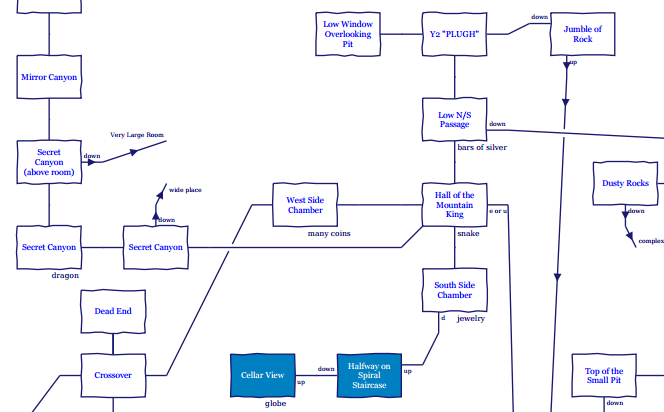
Part of Will and Pat Crowther’s actual map of Colossal Cave, with game map locations superimposed. From Dennis Jerz.
The golden eggs! While they have the nice property of regenerating (allowing them to be used to placate the troll) I somehow never thought of them as a food item, but I can see why a giant might include them in their diet.
“AH….EGG FOO…..YUM YUM”
THE GIANT DRAWLS, AND GRABS THE EGGS LEAVING YOU SHAKEN BUT UNHARMED.
The giant leaving you alone gives access to a new passage, which leads to (unfortunately) another maze.
YOU ARE IN A TANGLED WEB OF INTERSECTING PASSAGES
I lacked the energy to map the entirety of it but fortunately you don’t need to in order to find the important room.
YOU ARE IN A TANGLED WEB OF INTERSECTING PASSAGES
A LARGE UNTIDY SPIDER’S WEB COVERS ONE CORNER OF THE CAVE.
A HUGE BLACK HAIRY SPIDER CROUCHES IN ONE CORNER OF THE WEB.
(From the giant’s room, south then down to reach the spider, west then north to go back.)
The spider presented the second (and apparently, only other) new puzzle of Adventure II.
Again, some overlap of concepts from the original Adventure applied here. A bird is good enough to chase off a snake. What about if an owl met a spider? Remember from my last post that hooting will summon the owl:
off
YOUR LAMP IS NOW OFF.
IT IS NOW PITCH DARK. IF YOU PROCEED YOU WILL LIKELY FALL INTO A PIT.
hoot
A DISTANT OWL CALLS “HOOT”.
IT IS NOW PITCH DARK. IF YOU PROCEED YOU WILL LIKELY FALL INTO A PIT.
hoot
YOU HEAR A FLURRY OF WINGBEATS AND SOUNDS OF A TREMENDOUS BATTLE
(RUSTLE .. RUSTLE .. HISSS .. HOOOT! SCRAPE .. GULP! .. HOOT?)
After defeating the spider you find some documents in the web, which upon bringing them to the giant (unavoidable since you have to go back that way) he’ll give you a ruby for the documents. The ruby was the last treasure I was missing.
…
After studying the source some more what I find most fascinating is the simulationist impulse. Rather than adding a host of new puzzles (as I might expect) there were new rooms (some purely for atmosphere) and a lot of effort put into augmenting systems (like with the tidy dwarves). I derided the thirst timer earlier, but I have to admire the fact it seems to be linked to how many items the player is carrying. The relevant line is boldfaced for emphasis:
203 CONTINUE
LIMIT1=LIMIT2
LIMIT2=LIMIT2+2+HOLDNG
IF(LOC.EQ.126)LIMIT2=440+LIMIT2/2
IF(LIMIT2.LE.800)GOTO 204
IF(LIMIT1.LT.800)SPK=270
IF(LIMIT2.GE.880)SPK=271
IF(LIMIT2.GE.900)SPK=272
IF(IABS(SPK-271).LE.1)CALL RSPEAK(SPK)
IF(SPK.EQ.272)GOTO 99
For a long time adventure games seemed to try very hard to avoid simulation elements, with the few experiments that embraced it (like Disch’s Amnesia) considered cautionary tales rather than models to emulate. Only recently has this been starting to change (see Onaar and Gotomomi from this year’s IFComp).
I think there’s a lot of unexplored territory here to explore. Despite the annoyances I found it interesting when working from a walkthrough (made by myself, recall) but having to improvise anyway; for example, at one point the pirate stole treasure I meant to deliver in such a place that a different route than I had previously written became more efficient (given how tight the lamp timer is, I needed all the efficiency I could get). This sort of flexible thinking might go part of the way to removing the static-set-piece feel a lot of IF has.
While I found Adventure II interesting to write about I unfortunately cannot recommend it as an experience to others. There’s just wasn’t enough novelty to justify the effort, and the balanced experience of 350-point Adventure (still a good game) felt reduced rather than augmented.
For some reason I missed the presence of a really nice online port of Adventure II that comes with a hand-drawn map. (Link here)

The map above alerted me to a treasure I missed for rather silly reasons. I’m not sure if I should blame myself or the game. I’ll let you decide.
You might notice the “chalice” on the map. You find it from here:
YOU ARE IN A MAGNIFICENTLY ORNATE ROOM THAT LOOKS LIKE A PLACE OF WORSHIP FOR SOME OLD AND MYSTERIOUS RELIGION. THERE ARE EXITS TO THE NORTH, WEST AND EAST AND A SPIRAL STAIRCASE LEADING BOTH UP AND DOWN. THE CEILING OF THIS CHAPEL SEEMS TO BE MADE OF LARGE WOODEN BEAMS. HANGING FROM ONE OF THESE BEAMS IS A THICK ROPE.
I assumed UP would go up the rope, but that goes up the staircase instead. There’s an entirely different way to go up:
climb rope
YOU HAVE CLIMBED THE ROPE AND CRAWLED INTO A SMALL RECESS IN THE BEAMS.
A MAGNIFICENT INLAID CHALICE LIES HERE!
To be fair, I might have hit this section first in the z-code version, which has a bug that makes “climb rope” not work and require “climb” instead; I might have got frustrated and assumed I was going up the rope anyway. This is possible because of the odd characteristic of IF to have all forms of travel often “feel” the same, so going up a staircase and going up a rope have the same responsiveness.
I have gathered now what seem to be all the treasures but I still don’t have the endgame triggering. I’m guessing I’m missing one? It might have to do with the cast of the game, which is worth examining in detail.
I. The Wizard
So one of the new puzzles is a room which has a treasure (a crystal orb) but has a slab that closes behind the player when they enter the room. (“AN ENTRANCE LEADS NORTH BUT IT IS BLOCKED BY A LARGE STONE SLAB.”)
With nothing else to do, I messed around with the crystal orb until I tried THROW ORB, and then…
THROUGH THE PORTCULLIS STEPS A TALL WIZARD CLOTHED IN GREY. “BE OFF!” HE COMMANDS, RAISING AN ARM. AS THE SCENE FADES HIS DISTANT VOICE CONTINUES “AND TAKE YOUR BELONGINGS WITH YOU!”.
YOU ARE IN A SECRET N/S CANYON ABOVE A LARGE ROOM.
A CRYSTAL ORB LIES HERE!
…did I solve that, or is it just something that happens?
After a few more attempts, it turns out it doesn’t matter — the wizard ejects you to safety no matter what you do. So this isn’t a puzzle, exactly. You just have to wait.
II. The Giant
“FEE FIE FOE FOO!” THE GIANT THUNDERS, AND AT THE THOUGHT OF FOO’ GREAT SLIVERS OF SALIVA ISSUE FROM THE GIANTS MOUTH AND FURTHER SOIL HIS ALREADY FILTHY SHIRT FRONT.
“STAY IN THERE UNTIL I AM READY TO EAT YOU!!” THE GIANT BELLOWS AND THROWS YOU INTO HIS DUNGEON.
YOU ARE IN A DUNGEON. THE WALLS AND CEILING APPEAR TO BE MADE OF SOLID ROCK AND THE FLOOR IS MADE UP OF TIGHTLY FITTING FLAGSTONES. HIGH ON THE WALLS ARE SOME STANCHIONS FOR CHAINS, BUT THE CHAINS ARE NO LONGER IN PLACE. THE ONLY SOUND, APART FROM YOUR OWN BREATHING, IS THE OCCASIONAL PLOP OF WATER AS IT DRIPS FROM THE CEILING. THE ATMOSPHERE IS DANK AND CLAMMY AND THERE IS AN UNUSUAL SMELL IN THE AIR. A PASSAGE LEADS BACK TO THE SOUTH.
After a little time the giant will grab and eat you, but there is a way out. Unfortunately, it involves abuse of the property that nothing in the descriptions seems to be usable by the parser … except for this:
get flagstone
THE FLAGSTONE LIFTS SUDDENLY AND YOU TOPPLE HEADLONG INTO THE DARKNESS BELOW.
YOU ARE IN A WINDING EARTHEN PASSAGE WHICH SLOPES DOWN TO THE SOUTH. THE LOWER END OF THE PASSAGE BECOMES NARROWER AND DAMP.
III. The Owl
THE LIGHT FROM YOUR LAMP DISTURBS AN ENORMOUS OWL WHICH FLIES OFF WITH A FLURRY OF WINGBEATS (AND A LOUD “HOOT”).
The only way to keep the owl from running away is to have your lamp off, but moving around with your lamp off gives a good chance you will fall in a pit and die. However, I discovered you can HOOT:
hoot
YOU HEAR A FLURRY OF WINGBEATS AND A LOUD “HOOT”.
That is, if you are near enough and you hoot the owl will come to you. If you’re in a room lit from some other source the owl just won’t enter.
IV. The Dwarves
I’ve already discussed the weird neatness habits of the dwarves, but there’s one more novel artifact that a dwarf will eventually drop: a little horn.
Using the horn, however, seems to be always fatal:
blow horn
THE LITTLE HORN EMITS A SURPRISINGLY LOUD SONOROUS NOTE.
AS THE NOTE DIES AWAY THE SOUND OF MANY HURRYING FOOTSTEPS BECOME APPARENT.
THERE ARE 4 THREATENING LITTLE DWARVES IN THE ROOM WITH YOU.
4 OF THEM THROW KNIVES AT YOU!
ONE OF THEM GETS YOU!
Ow? Perhaps blowing the horn at the right moment might make this survivable (I tried summoning the dwarves to the same room as the giant, but to no avail — and if one follows the player into the giant’s room, the giant ignores it anyway).
V. The Pirate
The pirate works exactly the same as classic Adventure — he takes treasures you are holding them and stashes them in the maze. This is required to happen so that his own treasure appears.
VI. The ???
I don’t know much about this one, but:
THERE ARE FAINT RUSTLING NOISES FROM THE DARKNESS BEHIND YOU.
I think whatever it is, it has a movement program like the dwarves do, because I once ran into the sound in adjacent rooms (as if I happened to go the same direction as the thing) but I haven’t seen any in-game effect like items getting stolen. Maybe it’s just for atmosphere?
(ADD: Scott Healey cleared this one up in the comments. It’s a message for when the pirate is close.)
…
I’m sadly suspecting what I’m missing is not some interesting character interaction, but a single pesky room or action (like I was doing with the chalice). I’m going to go finish-or-bust at this point and say if I post about Adventure II again, it’s because I won; otherwise this posting will be the end.

From IGDB.
I posted long ago about what I thought was a general instant-death:
d
YOU ARE IN AN INCLINED SHAFT WHICH STEEPENS AT THIS POINT. THE WALLS ARE COVERED IN A THIN LAYER OF SLIME MAKING IT VERY SLIPPERY. BELOW YOU THE SHAFT IS FILLED WITH DARK WATER WHICH SURGES RHYTHMICALLY. THE SMELL OF THE SEA IS MINGLED WITH AN ALTOGETHER MORE UNPLEASANT ODOUR.
d
YOU HAVE DROWNED HORRIBLY IN A MIXTURE OF SEA-WATER AND SEWAGE!
However, it turns out this fluctuates, and entering and returning can yield something different.
YOU ARE IN AN INCLINED SHAFT WHICH STEEPENS AT THIS POINT. THE WALLS OF THE SHAFT ARE COVERED IN A THIN LAYER OF SLIME MAKING IT VERY SLIPPERY. BELOW YOU THE SHAFT STEEPENS AND ENTERS A N/S CULVERT PARTIALLY FILLED WITH A BRACKISH EVIL SMELLING LIQUID. YOU COULD SLIDE DOWN HERE BUT YOU COULD NOT CLIMB BACK UP.
Entering when the water is lower leads to, alas, another maze. (Click for a larger view.)

I see the authors of Adventure II had sort of a repeated fractal design in mind, which is slightly interesting, but … no, this is not a worthy addition to the 350-point original.
It let me escape with another treasure (an ivory horn), so technically this was a puzzle, but it certainly didn’t feel like I solved one. I wandered into the “low tide” by accident, and mapping the maze didn’t involve any creativity at all; the only new element was that the tide would start to rise and kill the player, forcing a reload of a saved game to continue exploring. This is not would I would call a “feature”.
Unfortunately, I have scooped up all the treasures I can find and my lamp light is running low and I don’t seem to have triggered any sort of endgame. I still have some characters (like a giant and an owl) I haven’t interacted much yet and I’ll discuss them in my next post. If the game goes for too much longer I’ll need to work on optimizing my walkthrough to the limit, though.

(Read the original post for more details on the rules.)
We currently have 32 participants busily working on their entries.
Please note that Phase 2 allows late entrants, so if you are still wanting to participate, let me know and I can send a review set.
While I’ve played many, many adventure games throughout my life, I usually have relied on hintbooks, walkthroughs, or the like to take them to completion. The most difficult adventure game of significant length I’ve ever beaten without hints is Peter Killworth’s Countdown to Doom (from 1982). I am still not sure if it was simply strong puzzle design (it does have some) or some other strange magic that led me to finish hint-free, but one of the things I did that was unusual for me is write a walkthrough while still mid-game. This was out of necessity; the entire game is on a timer and normal exploratory play would not be sufficient to win.
The act of doing so led me to think about every step; what could be optimized, what I might be missing.
If nothing else, on a game like Adventure II where I know how to do a lot (the original Adventure content) but none of the new stuff, making a walkthrough gives me something to do. (The optimizing might be necessary too — I don’t know how many turns I have before lamp power runs out.)
My current walkthrough progress
This is a walkthrough for personal tactical purposes. It’d be terrible for someone trying to understand what’s going on. For instance, I grab items from rooms without light on because I know what’s in there and I don’t need to waste a turn with the lamp on.
I’m using the building extensively as a “home base” not just because the treasures are supposed to go there, but also because the dwarves can swipe the non-treasure items so I only want to be holding what I’m actually using at the time.
Hopefully I’ll solve one of the new puzzles soon? If all else fails I can dive into the source code.
(It has been a while, so you might want to refresh yourself with my previous two posts on Adventure II.)

(Three different commercial release covers. Notice how two of them feature a sword, but there is no sword in the game. Pictures via Pintrest, Ye Olde Infocom Shoppe, and Maximum PC.)
I originally planned to write this post focusing on the content from the original Adventure — which remains intact in Adventure II — but the extra features (including the thirst timer I mentioned in my last post) make the gameplay feel rather different.
What I found most startling is when I found a dwarf carrying an item:
THERE IS A THREATENING LITTLE DWARF IN THE ROOM WITH YOU!
HE SCUTTLES ALONG CLUTCHING HIS BULGING COAT FRONT AND MUTTERING.
Rather like the thief in Zork, the dwarves can now pick up stuff. However, they don’t seem to be necessarily going for treasure and I wasn’t sure what was going on until I came across this old post
Adv440 is unique in that it makes dwarves cumpulsively tidy minded. If in their wanderings around the cave they come across a misplaced object (i.e. an object not in its initial location), they’ll pick it up and carry it around with them, until they happen to walk into the initial location of the object, in which case they drop it there.
The mere presence of a chaotic system on top of exact same content led to changes in my behavior (and by extension, the implicit narrative that is built as I play). I am being much more careful about touching utility items (since if I have to drop them to carry treasures there is a good chance they will disappear) while simultaneously keeping my eye on my water supply and judging my route based on the availability of water at the right time.
Chaotic systems like dwarves that move items are pretty rare in modern IF games, but they add a strategic layer to what would normally be raw puzzle solving (in this case, some puzzles I already know how to solve). It does go a fair way in making the environment feel like it is generating a story, rather than simply providing a mute catalog of obstacles. Maybe it’s a tradition worth a new look.
Entries for the imaginary games from imaginary universes jam are rolling in, but I’d like take a moment to give some general advice. This is the sort of advice that can be gleeful ignored, mind, but if you’re having trouble, this might help.
- Invoking your improbable and maybe impossible dream game is one route. You can even use that idea to get started but take a single chunk of it and run in another direction.
- Read one of the myriad definitions of a game. Then try your hardest to write about a game that breaks that definition.
- Read some of the more fanciful theorists like Peter Molyneux or his doppelganger Peter Molydeux. Take one of their weird ideas and expand it.
- Take some technology from science fiction (or one that exists but just isn’t common) and imagine how you could use it as the peripheral for a game.
- Take some obscure game that hasn’t been developed on by other authors and imagine that it spawns a whole genre (the “dragonpasser” genre mentioned here is a good example — King of Dragon Pass is a unique game which hasn’t really had any imitators — but what if it had?).
Here’s one of my own imaginary games, analyzed with respect to the concepts above.
Dragon Hall (22925)
I have never been a fan of the no-genre movement (that is, labeling games by story genre rather than gameplay genre) simply because it seems like everything I’ve tried has been a weak action-adventure made weaker by the lack of commitment.
In any case “just like the holodeck on Star Trek!” never seems to have happened.
The developers at Tale of Tales once wrote an essay wishful that we couldn’t have interactive story with the same flexibility as the Star Trek holodeck. This never turned into a movement, even by them, but I always wondered what it’d be like if it had.
Dragon Hall … well, didn’t change my mind, but for two hours or so, wow. First off, it’s a third-person corporate thriller (already being different there)
I was thinking here of the old Magnetic Scrolls game Corruption, which as far as I know is the only (actual) game ever written in the corporate thriller genre.
where the interaction you’d think is primarily social, but really there’s so many options at any moment it feels like … ok, obviously I’m having trouble here. Look, in an adventure game, I feel like I’m constantly looking for locks to fit keys; in a strategy game, I’m always optimizing; in an action game, I’m priming my reflexes. Here, all I was thinking what would my character do? and somehow I could do every option I thought of, and for a while I was inhabiting a world rather than playing a game.
Here we’re entering “my dream game” territory — what if there was just story, and you had complete flexibility to do whatever occurred to you? (Again similar to the holodeck idea.)
Then the sheen wore off and I was finding the optimum thing to say to the Twile Sisters so they would turn against the Syndicate and give me the password. But it was great while it lasted.
But since this is a review, I imagined cynically this is what would actually happen if anyone tried to sustain such a game at length.
—
I hadn’t heard of this until after my original game jam post, but these three imaginary game reviews by Alexis Kennedy are terrific.
Remember, deadline for phase 1 is December 13th. I look forward to see what you come up with!
By Joey Jones and Melvin Rangasamy. Now finished, using several hints.
(Continued from previous post)
From where I left off I had some pure puzzle solving to do. I had a pretty strong determination to avoid hints but after 7 hours (including an hour and a half of pure flailing) I broke down and checked, and unfortunately the very first thing I caught a hint on was intensely frustrating.
(spoilers)
.
.
.
.
.
.
.
.
.
.
.
.
.
.
.
.
.
.
.
.
.
.
.
.
.
.
.
.
.
The rug I mentioned in my previous post does hide a secret, but the message received from HANG is a pure red herring. Rather the correct thing to do is “look under rug”, which leads to a “magic hole” situation where you can go underground. I’m afraid it led to me nearly quitting entirely in frustration — I had spent an hour with the rug with no effect.
Here is the crux: the motion of peeling the rug up to look underneath is to my visualization exactly the same as the start of picking it up. The only difference is at the end the rug gets lifted off the floor. There is no reason there shouldn’t have been some kind of feedback going on.
I also had bad times with the “syllable puzzle” (lots of details here) where I got hung up because the game reported a song with a different syllable stressed each line but inexplicably did not report where those stresses where. I am still puzzled at this; while there are the parts of the game where the character has information the player does not, this was not an occasion where it made sense for this to happen.
I finally had probably unique problems with the water closet, which I imagined (and the dictionary defined for me) as a flush toilet. However, it is using the alternate definition (I found out after checking the walkthrough) of “a room with a toilet”, and that crucial distinction made me miss an item. It did not help no verb except the correct one gave any information.
However, having invested enough hours playing, I wanted to persist to the end. There certainly are clever parts later. What I liked most of all was the endgame: after you have found all 7 secrets, you have to clean up all the mess you’ve made so the Confessor isn’t aware you’ve been there. It was a brief, almost open world sort of experience, where I went down a checklist only to realize at the end some small thing I forgot (oh!) but the game is good enough to tell you the parts you missed so you can go back again. Some of these parts are as simple as closing doors, but others require more puzzle solving: for instance, during the secret-finding portion of the game you have to de-age a skull to see what it started as, but to cover your tracks you have to re-age it again.
The overall effect was of complete tension and verisimilitude. This made the final ending quite satisfying.
Phase 1: Write a set of reviews for five games that do not (and possibly, cannot) exist in our universe. Send the list to my email (here) by December 13th, midnight EST. (To be clear, this means the midnight at the end of December 13th, not the beginning.)
Phase 2: You will receive a randomized list of five imaginary games created by other participants in the jam. You are to pick one (or more) and make
a sequel
a prequel
a fan fiction
a critical response game
a sidequel
a remake
a demake
a parody
an artifact of some genre category never before seen by humans
or if you are feeling bold and it is even practical, duplicate the game as described.
Send a link to your creation to my email (again, here) by February 7th, midnight EST.
Phase 3: Games / works / strange shining artifacts will be shared to the authors (not yet to the public) at which point the next phase will begin. In lieu of scores and ranking, you will be given a list of 3 other works to either review or make some other sort of response to. This response can be textual, audiovisual, a card game which reveals your criticisms through play, directions for interpretive dance, whatever you like. You are welcome to respond to more than 3.
On February 24th, all works will be uploaded to if-archive for public enjoyment.
Phase 4: All responses (to the largest extent possible), along with excerpts from the original works chosen by the authors, will be compiled in a physical book. (To be published off Lulu.com, unless there is some better choice decided before then.)
FURTHER DETAILS
The main inspiration for this jam comes from the Tlön posts of Sam Kabo Ashwell. Those posts are good to read for inspiration (you can also read my own set), but do not assume you need to make your imaginings in the same universe. You are encouraged to create your own spaces.
Strong honorable mention goes to that one time immediately after the 1998 IFComp when Dave Coleman-Reese reviewed the 1999 IFComp entries.
You are welcome to think *way* outside the box. This is not a typical interactive fiction competition. Do you want to give directions for a multiplayer game only playable in person? A set of physical items printed via 3D printer which lead to an alternate reality game? A game where words on papers are taped to rocks and arranged carefully? Knock yourself out.
Of course, traditional parser or choice works are also welcome, but be sure to think about how things could be different if we removed all preconceptions from our universe and came from another.
QUESTIONS
Q: How long should the reviews of imaginary games be?
A: I was intending for them to be fairly short — 1 or 2 paragraphs long — but there’s no specific requirement. Given how the reviews are going to be used, leaving some details to the imagination will be helpful.
Q: Can I send game ideas for phase 1 that aren’t interactive fiction?
A: Yes, since the participants aren’t expected to duplicate them, although you should lean in the direction of interactive fiction.
Q: I missed the deadline for phase 1! Can I still enter?
A: Yes. You will still be able to get a list of imaginary games.
Q: Can I send more than 5 imaginary reviews?
A: Yes. I will choose 5 at random to send with the first batch, and any extras will be sent to latecomers (see answer above).
Q: In Phase 3 I received a game to respond to I wasn’t able to play!
A: Ask and I will send a different one.
Q: Can I be in the book from Phase 4 if I didn’t participate otherwise?
A: Maybe? I will let the participants vote on this later.
Q: I have a question you didn’t answer!
A: Ask it in the comments below, or email me if you like.
ACKNOWLEDGEMENTS
Thanks to Doug Orleans for error-checking the draft version of these rules.
By Joey Jones and Melvin Rangasamy. Not yet finished. No hints/walkthrough used.
So while Sub Rosa was entered in a competition where playtime is intended to be 2 hours or less, I could tell I was going to exceed that and I decided it was worth it to treat the game as a whole rather than stop in the middle or rush through a walkthrough.
If I’m finding the puzzles solid enough that I don’t want to ruin them, and that’s a good sign. However, now that I’ve passed the 4 hour mark I figured it was worth checking in. This is therefore only a semi-review and I’m going to do some experiential blogging about my play experience rather than just evaluation.
At last you tip-toe into echo-prone confines of the Destine Mansion, each room carved out of what was once a small mountain. You sacrificed three toes to learn how many secrets would bring the Confessor down. Seven. There are seven deceits you know can be found in these halls and you won’t leave until you know them.
Sub Rosa is set in a completely original world in the “Age of Lead”. After a long, long preparation, you infiltrate the residence of Confessor Destine to steal his secrets.
I’m quite serious about “completely original” — I can’t think of anything to compare it to, even by combining together multiple authors. A lot of the appeal and difficulty is getting a grip on the setting.
The prose manages the delicate trick of conveying an epic and alienlike world without being overbearing.
Every secret heard is an awakening to a fresh world both more explicable and more unpleasant than the one you woke to before. The more the secrets allow you to understand, the worse you feel about the world. Each secret is a dose of pleasure and pain in equal proportions. As your mastery grows so does your despondency. The more you learn the more you realise there is so much that you do not yet know that you do not know. The desire for new secrets grows with each awakening. Eventually you awake to a world where your experience is so far removed from that of others that it is like they are sleepwalking. Where others shuffle, you could stride were the weight upon you not so vast. Knowledge without end. This is the Confessor’s Burden.
The position of the Confessor strikes me a little like the philosopher-king of Plato, but instead of stepping out of the world of form and seeing truth, the Confessor takes truth in the form of secrets from others and attains power by doing so.
The overall strangeness unfortunately does mute the impact of some of the puzzle solves. At one point I got an animal to give me a secret, which I *think* is a creature that can repeat past conversations somehow? — and while I found the actual puzzle solving logically cued and satisfying, I had to scratch my chin a few minutes before I had a grip on what happened. This reduced the satisfying impact somewhat.
Another instance of one of the secrets involves a forbidden food item. However, I was not aware the food was forbidden until after the puzzle was solved and the game told me I had found a dire secret. With no idea of the rules or laws or strictures of the universe I just had to nod my head and move on.
Still, I find the immersiveness satisfying, and it is for this reason I am still plodding with no intent yet of checking the walkthrough.
The remainder of this post I’m going to discuss what I’m stuck on, so there will be even more spoilers than usual.
.
.
.
.
.
.
.
.
.
.
.
.
.
.
.
.
.
.
.
.
.
.
.
.
I’m unfortunately at the scenario I’ve before seen in my All the Adventures jaunt where I need to solve a puzzle but I don’t know where the puzzle is. There are two more secrets of the Confessor I have yet to find. Here are the things I have yet to use:
a rug
a water closet
some beetles in a jar (although I’ve used the jar itself, so the beetles might be nothing)
some books
This isn’t a lot to work with. The rug seems to have the verb ‘ENTER’ attached as well as ‘HANG’ but I have tried to hang the rug on literally every noun I could find in the house with no luck. I was wondering if the rug had some magical property that let me enter a secret.
The water closet is totally unresponsive. I would assume it is just scenery except for the amount of flailing around I’ve done I don’t want to assume anything.
The beetles are so unresponsive (the game seems to keep wanting me to refer to the jar itself) I’d say it’s a bug, but it also means they seem unlikely to be involved in any more secrets.
The game impressively implements a library with 101 books. I’ve already found 2 related secrets, but I haven’t plowed through every book and I return to check a couple every time I feel lost as to what to try next.
I do please ask nobody posts hints in the comments; I’ll ask if I need some but I’m fine for now.
(Part 2 is here)


 Renga in Blue