For reasons unrelated to this project I was browsing 1979 issues of the Apple II magazine Micro and happened upon this one from October:

Here’s a link to the issue in question.
Thomas R. Mimlitch’s Spelunker is not the very first type-in parser adventure (that honor goes to Dog Star Adventure) but I’m guessing it’s the second? (I’m excluding Quest — which appeared in a July magazine — because it doesn’t have a parser.) In any case, this game is so wildly obscure that I’ll be impressed if someone can post a personal story of having tried this before.
Fortunately, the program was featured on a compilation disk (Micro Apple 1) so I don’t have to type in the type-in. However, there’s another catch which you’ll learn about shortly.
Imagine if when computer games were invented the idea of a “stand-alone” game was unknown, and the computer was more of an aid or companion to play:
This is an adventure fantasy series in which you become directly involved in exploration of a mysterious cavern in southwest Kentucky called Devils’ Delve. If you have never played before, you should take a guide along. The guide will read the chamber descriptions as you enter each room for the first time. He can also supply some hints and clues to help you when you are stuck. Only the guide should use the room descriptions, word lists, and the map of the caverns.
Just to be clear:
a.) It’s an adventure game with an inventory and puzzles and map and so forth. However …
b.) All the room descriptions are inside the magazine, rather than the source code. Furthermore …
c.) The room descriptions are supposed to be read by the “guide”, analogous to the Dungeon Master of Dungeons & Dragons. While the room descriptions are numbered, the numbers are not given in the game itself, forcing the guide to check against a table. Not only are the room descriptions not shown in the computer, but the visible objects aren’t shown either; they have to be listed by the guide, again by cross-referencing off a table.

There are four things in this room, three which you can pick up, and they all have to be described by the guide. Update below!
UPDATE: Well, there was a bug in the code from the compilation I found! The line 9320 reads
9320 IF (STA(1) MOD 100)#LOC THEN 9360
but it’s supposed to say
9320 IF (STA(I) MOD 100)#LOC THEN 9360

After changing it appropriately, objects show up in the room description, huzzah! However, the room descriptions themselves are still printed in the magazine only.
In any case, I can’t really “play” this game without help. Also, in order to set things up / check the code’s sanity / realize what was going on I had to spoil a large chunk of content. So I think the most appropriate course of action is for me to be the Guide, and for some of you — yes, I’m speaking to you, the readers — to be the players.
So, quick survey: if you’d be interesting in playing, make a comment to this post. Also let me know which option you’d prefer:
Option 1: We could play-by-post where people put their parser commands into the comments and I provide the screenshots and guide commentary.
Option 2: We could play live. It would likely be sometime during the weekend of March 25th-26th; I would stream the game on Twitch, and y’all could type parser commands in chat.
ADD: We went with option 1. The play-by-post starts here.
We last saw Lance Micklus in Treasure Hunt (1978) which was only sort-of what we’d recognize as an adventure game. This one is a clear Adventure-based game including a parser with the distinction that it is the first of its kind printed in a magazine: the May 1979 issue of SoftSide.

To be clear, this was a “type-in”, meaning it was intended that to play the game you’d have to first type in the source code. I used to do this all the time. When I was young (7 or 8 or so) I spent weeks typing in an adventure game from a book (this one, maybe) but somehow the source code was too large and the entire disk crashed as I was putting in the last lines. I was disconsolate and crying. My mother, being sympathetic, bought me a copy of Zork 1. This was my first Infocom game.
When typing an adventure it tends to be obvious in the process of typing what all the puzzle solutions are. Fortunately, Dog Star Adventure later got published under the Adventures International “Other Ventures” line, and there are plenty of copies besides (8 versions, at least). I do predict at some point in the future I will have type in a type-in, but not today.
Let’s quote the plot directly from the ad copy:
The evil General Doom and his Roche Soldiers are preparing to launch an attack against the forces of freedom led by the beautiful Princess Leya. The Princess has been captured by Doom — and it’s up to you to pull of a daring rescue and save her and the royal treasury!
It’s not even trying to disguise its Star Wars origins, although science fiction adventures are still rare for this time period. Also note, even with a plot that really doesn’t demand it, there’s still a treasure hunt tossed in (at least if it’s the royal treasury you’re not trying to steal it for yourself, right?)
I ended up playing the commercial port; if you really want the classic type-in experience (complete with having to fix a typo in the source code) check out Jimmy Maher’s playthrough. Early on, there is a very significant gameplay difference:

The original supply room just states it has “all kinds of things” and you are literally supposed to just guess what the room contains, and then try to take it. I would call this “breathtakingly unfair”, even compared with games that actively strive to be unfair.
You can’t get that far without the supply room either. There’s no dark rooms, so no time limit as far as a limited light source goes; however, every once in a while a security guard will pop up (in some versions you can call them “stormtroopers”) …

… which you can take down with the blaster from the supply room. The blaster has a limited number of shots (and can only be refilled once, with the ammo that’s also in the supply room).
The game is otherwise fairly straightforward as far as puzzles go; you grab stuff mostly in the open and cart it back to the ship. At two points you need to use “key words” found elsewhere in the game (SECURITY to get into a vault and SESAME to open the space station doors). There’s also an infamous puzzle involving a hamburger:

Much to my own surprise, I figured out what to do with it. There’s an attack robot you find later, who is … hungry? Clearly instead of activating the clones in Star Wars Episode 2 to stop the droid army, the Republic needed to cook up some fast food.

Also of note: if you wait too long the hamburger will get cold, and the attack robot won’t take your offering; it’s game over. This happened to me the first time I played.
In any case, the game ends by the player collecting as many treasures as possible (including Princess Leya, who you pick up like any other item), and then launching the ship to escape. Due to the primary tasks of rescue and escape you don’t need all the treasures to get a “win”, which I found to be a nice design finesse. For games that are pure treasure hunts, this often doesn’t come across as an option.
I still can’t recommend this one for modern players. The puzzles are either too hard (hamburger, original supply room) or too easy (most everything else) and the experience of making it to the end felt more grinding than insightful. Still, it is surely important in being the first readily available source code to people who wanted to write their own adventures. I am curious: does anyone know of any works in particular that specifically mention they were based off the Dog Star source?
ADDENDUM:
Just for historical reference, Dog Star’s first started being sold a month earlier than the May issue mentioned above. Here is a page from the April 1979 issue of Softside:

It also is listed on page 41 as a “new arrival”.
Two years ago I blogged about lost mainframe games, including this one:
LORD (1981, Olli J. Paavola)
I’ve got dual interest in this one, not only from it being a mainframe game from Finland (it was written while Olli was at the Helsinki University of Technology) but also for being allegedly the first interactive fiction book adaptation.
…
With 550 separate locations, this game is huge by most standards. It does not really try to be completely consistent with Tolkien but mixes elements from many other sources. It is clear, however, that it is made with a great love for and knowledge of Tolkien’s books.
I got a couple emails (by both Anthony Hope who helped unearth Wander, and the journalist Jukka O. Kauppinen) letting me know that the source has been found (by Mr. Paavola himself) and is currently at exhibit and playable at the Finnish Museum of Games.

Unfortunately, playing it means physically being in Finland; there’s no general release. Anyone in that neck of the woods?
The museum has on display one more text adventure I’d never heard of before — Aikaetsivä! (1986) by Jukka Tapanimäki:

All the entries are nestled safely at the Interactive Fiction Database.
Please check yours for edits you’d like to make / cover art you’d like to add / errors you’d like to fix where I put 1878 rather than 2016 as the year / etc.

Joel Mick is another young entrepeneur, like Greg Hassett or the trio of Viggo Eriksson, Kimmo Eriksson and Olle Johansson. In all these cases (including Joel himself) the authors were about 13 when they started.
I do wonder if I missed my fame/fortune window by being born 10 years too late. I wrote Night of the Vampire Bunnies at roughly the same age, but by 1990 the market for slightly dodgy text adventures in BASIC was long closed. It’s currently 2 1/2 stars on IFDB, which might be a little overrated, but it’s still much better than Burial Ground Adventure.
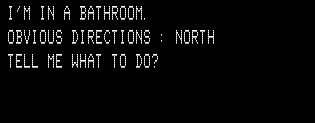
1.) Just like many other games from the era, there is no plot: your only objective is to collect treasures. Also unfortunately like some other games of the era, the setting is pretty random: you’re on an island that happens to have a catacomb and a house with treasure. The house, of course, must include every room possible:
2.) There’s a “pit” you fall into and can’t get out without the right item. This is par for the course for the era, but things ratchet up a level in that even when you *do* have the correct item, it’s difficult to figure out how to use it:
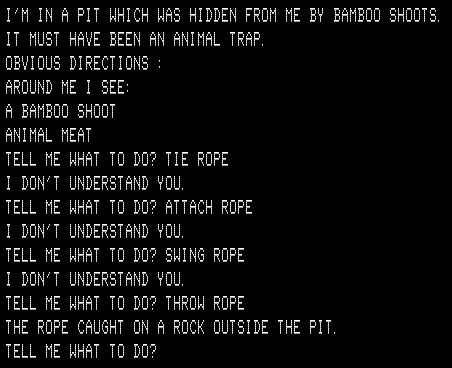
What I think Mr. Mick was running into was the adventure game problem I call “implicit action”. He really seemed to visualize: a.) forming a lasso with the rope b.) throwing the looped end of the rope and c.) catching it on a rock which is not described anywhere in the room. The actions needed to be boiled down to a single two word command (having an intermediate state would have been more complex than the coding here could handle) so he went with THROW ROPE which is puzzling on its own. If you imagine the literal action, it’s just throwing the entire rope; you have to have the other parts to it for the command to make sense.
3.) A portion later suffers the same problem, even worse.
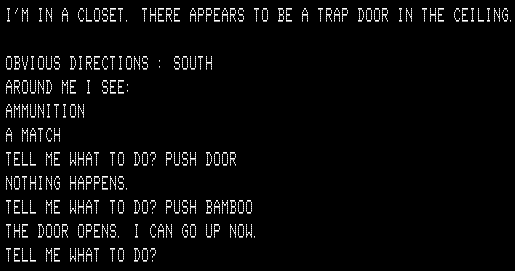
This time I confess to checking Dale Dobson’s walkthrough, but he admits he had to check the source code himself, so it’s faintly possible nobody in the world other than the author figured out this puzzle without help.
Again, implicit action seems to be to blame, although in a different sense. The author seemed to have in mind raising the trapdoor by pushing it up with the bamboo, but couldn’t figure out how to express it in a two word parser. He could have gone the route of PUSH DOOR working as long as the bamboo was in the inventory, but that would allow the implicit action of utilizing the bamboo to do it. This would lead to a puzzle likely being solved without the insight, so he settled on the nonsensical PUSH BAMBOO instead.
So in first case, the puzzle was confusing because it allowed the implicit action; in the second case, it was confusing because it disallowed the implicit action. Implicit action still bedevils adventure games to this day, where in games that involve a single-click interface the character does some action that turns out to be useful but never actually occurred to me until the game did it for me.
4.) After obtaining a key by feeding two types of meat to some dogs, you can break into the catacombs which I presume are the “burial grounds” of the title. The catacombs are connected to a maze which in several directions will inexplicably drop you in the upper rooms of the house. This is an easy contender for the most nonsense piece of geography I’ve seen in an adventure.
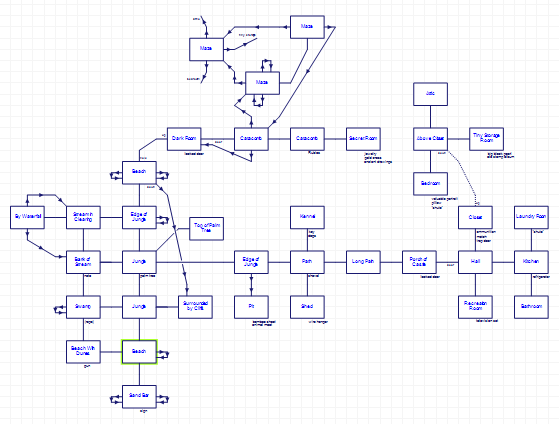
I guess we’ll just say it’s “magic”, right?
There are two elements that I found interesting and different, so I’ll switch from numbering to lettering:
a.) There’s not only a gun object, but ammunition you can find later; when taking the ammunition the gun will automatically be loaded. However, the gun is a complete and utter red herring. You can attempt to use them on the previously mentioned dogs (the ones you feed meat to) but things don’t turn out well.
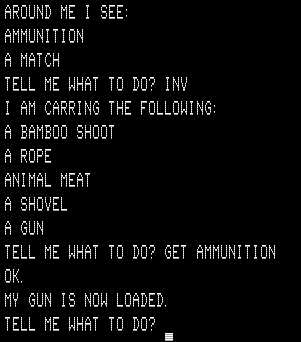
This suggests both a game design finesse (having a weapon be useless really is a nice red herring) and possibly some sort of social commentary on violence.
b.) Right before the catacomb, there’s a dark room. The only light source is a match, but the source lasts very briefly.
There is way to “see” the room, but it turns out to be totally unnecessary. While I’ve played text adventures while fumbling in the dark that mostly due to trying to preserve battery life; here there is a room that is meant to *never* be seen, which makes for a nice moment.
So here, again, I find a common experience for this project: authors still fumbling with a new art form, with faint glimmers of possibility. Did I really need more than that?
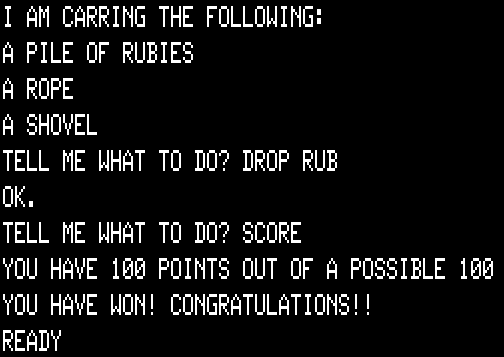

The title screen of the Electron version, via Mobygames.
I’m carrying: * ANCIENT FLASK SAURIAN BRANDY *, * RIGILIAN ICE DIAMOND *, * STRANGE ALIEN BELT *, * RARE ALIEN PAINTING *, * ALIEN SCULPTURE *
WHAT SHALL I DO? drop brandy
WHAT SHALL I DO? drop diamond
WHAT SHALL I DO? drop belt
WHAT SHALL I DO? drop painting
WHAT SHALL I DO? drop sculpture
WHAT SHALL I DO? score
I’ve stored 5 treasures. On a scale from 0 to 100 that rates a 100. Well done.
This adventure is over. Do you want to try this adventure again?
I need to backtrack slightly on what I said in my last post; the treasures are not optional. In fact, my major sticking point which required a glance at hints involved one of the treasures.
But first, let me pick up where I left off last time. I had gotten to the point where I had gotten to the damaged Power Crystal of my ship but hadn’t worked out how to fix it.
This turned out to be a very nice puzzle with some lateral thinking involved. The crystal is described as a “thin rod” but I originally assumed this meant that I had to reshape the crystal in that format.
Then it occurred to me, well, what if I just replaced it? Is there already something that works like a Power Crystal? Indeed there was.

The Hexagonal Room, from the FM-7 version of the game, in Japanese. Via Mobygames.
I realized the “rod” from the Hexagonal Room I had been using to teleport around, is, in fact, a thin rod, and maybe I could use it. After all, once I left the planet, I didn’t need to teleport around any more. After BREAK ROD:
Odd it only required very little force for it to break off in my hand with a CRYSTALLINE snap!
Oho. It fit into the right spot of the ship perfectly. I gathered the treasures I had found so far (ANCIENT FLASK SAURIAN BRANDY, STRANGE ALIEN BELT, RARE ALIEN PAINTING, and ALIEN SCULPTURE) and left. I landed at a “mother ship” which told me to drop treasures and type “score”, just like Adventureland. I dutifully did so, but got the dreaded message:
I’ve stored 4 treasures. On a scale from 0 to 100 that rates a 80.
In other words, I was missing one treasure!
At this point I was extremely stumped. There was a “methane snow storm” location I hadn’t been able to get anything out of, but I assumed it was a red herring (there is also a “black emptiness” location which really is a red herring, so that wasn’t too outrageous an assumption). However, I threw every item and verb I could at it with no success.
I finally succumbed to the peek of a walkthrough, and realized I had fallen to most dreaded of text adventure blocks: missing a room exit entirely.

The “plain with jungle” location, which I previous assumed was there just so you could DIG, let you type “GO JUNGLE” to a new location.
To be fair, this is violation of the implicit rules previously set up; all other exits in the game that describe locations are mentioned in the “object list” (see the curtain in the image below) and anything in the main description of the room was (up to this point) non-interactive.

So in some sense my need to resort to hints was caused purely by a UI issue, but still, I’ve haven’t had a perfect run at Scott Adams game since Pirate Adventure. Sigh. Maybe next time?
Fortunately, the puzzle solving sequence after went smoothly:
– I came across a “Rigalian Dia-Ice Hound” which needed to be stunned by my phaser. (The phaser previously had only been used to vaporize a boulder, so I’m glad it got some more use. The phaser can be set TO STUN or TO DESTROY.)
– I took the Hound over to the “methane snow storm” area. Ice Hound and all that.
– The hound eventually woke up and ran off into the storm. I searched about and a room that previously led to nowhere now had a “mound.”
– Using an ice pick, I was able to dig into the mound. Inside awaited the hound, and a RIGILIAN ICE DIAMOND. I had to stun the hound again, nab the diamond, set the phaser to DESTROY, and the vaporize the entire mound.
– The hound runs off after this sequence and I was able to escape with the treasure.
Really this was an excellent set piece, and I’m glad I went through it for the last treasure. Still, I’m somewhat disappointed that the winning state of the plot did regress to collecting all the treasure, but in a way I suppose it may have been a conservative compromise; perhaps players were getting uncomfortable with the treasure-less uncertainty of Secret Mission, Voodoo Castle and The Count.
I know I tend to be somewhat allergic to ranking things on this blog, but I figured it would be fun to pause for a moment to rank the Scott Adams games I’ve played so far, from worst to best. I’m including the Alexis Adams game as well.
6. Secret Mission by Scott Adams: I loved the use of implicit plot, but the puzzles felt like I was just lurching between improbable sequences rather than figuring anything out.
5. Adventureland by Scott Adams: His first effort, and it shows; some kind of wonky puzzle design, but still a fun setting and certainly an amazing technical achievement for the time.
4. Pirate Adventure by Scott Adams: I liked the parrot, and the pirate who seemed to care more about alcohol than treasure.
3. Strange Odyssey by Scott Adams: This game had some genuinely excellent puzzles and setting, although the plot was strictly mundane.
2. The Count by Scott Adams: Strong connection between gameplay and plot still eludes most authors; The Count nails it about as squarely as possible. There’s too much learn-by-dying for it to rank #1 but otherwise this game is the benchmark to beat. (If I was teaching a class on text adventures, this is probably one of the games I’d use.)
1. Voodoo Castle by Alexis Adams: The ritual that makes up the plot is a little bit arbitrary but there aren’t any puzzles I can complain about, there was a genuine feel of unraveling a mystery, and I still found this as fun as a modern game.
Note that even Secret Mission would rank higher than at least half the games I’ve played so far from this era. I can understand why in this brief sliver of time Adventure International was the company to beat.

If we want to compare this era in electronic games to very early film, most of the adventure game authors are still in the “point a camera and hope something interesting happens” phase, while Scott Adams is experimenting with the actual vocabulary of design.
Strange Odyssey is his first science fiction game, with the popular tack of “you’ve crashed on an alien planet, now try to escape.” There are in fact treasures to collect, but they seem to be optional, so they’re more of a nod to past works than an attempt to backpedal on his plot innovations.
The major experiment here is a “disconnected map” where you teleport between distant places.
I’m in a strange hexagonal room
Obvious exits: NONE
Visible items: Strange flickering curtain of light, Small piece of plastic flush in the wall, Rod jutting straight out of the wall, Strange looking goggles
The hexagonal room above is the central hub. The rod and plastic act as controls the destination of the curtain. Entering the curtain might lead to a methane snow storm, or jungle, or an alien art museum, or a Jovian mining colony with high gravity.
(Spoiler warning: puzzle spoiled below.)
.
.
.
.
.
.
.
.
.
.
.
.
This section really gives the strong feel of gameplay merged with plot with trying to work out the controls to an “alien machine.” The rod can be PULLed and PUSHed at which point the plastic glows:
WHAT SHALL I DO? pull rod
Odd it only required very little force to slide out
WHAT SHALL I DO? push rod
Odd it only required very little force to slide in
The plastic GLOWED briefly 8 times.
WHAT SHALL I DO? touch plastic
OK I feel strangely disoriented for a moment!
The number of times the plastic glows corresponds to the destination of the curtain, although you have to touch the “small piece of plastic” to finalize it. Each time you pull/push the rod the plastic glow count goes up by 1. If you need to go back to a destination with an earlier number you need to “reset” the mechanism by touching the plastic when the rod is pulled.
It took me a good hour to get a hang of what was going on, but after I worked out the mechanism it made perfect logical sense. This is in opposition to mechanisms in some other adventure games (*cough* Myst clones *cough*) which often seem to be obtuse for no reason at all.
There’s no “light source” in this game but the space suit has a set amount of oxygen. It’s a tight enough window that I started writing a walkthrough. I’m not sure 100% how necessary this is (I’ve already found a machine that can refill the space suit, and it might be usable multiple times) but the suit timer is combined with a very tight inventory limit which makes me lose a lot of time just juggling items.
Other than the mechanism I mentioned most of the puzzles have been very straightforward, so I may wrap this one up quickly. I need to be careful about any promises, though, because sometimes the last lingering puzzles in a Scott Adams game are the hardest.
My main obstacle for escape is a damaged Power Crystal, which the game reports was originally in the form of a “thin rod”. I suppose I need to brainstorm ways to create one. I’m suspecting perhaps bringing the pieces the heavy gravity planet can mash them together? I also have an ice pick I’ve haven’t got to use, but other than that it seems like I’ve seen everything. The map below is likely close to complete.

Click for a larger version.

What, what?
This thing from last year. Authors wrote a set of reviews for “five games that do not (and possibly, cannot) exist in our universe,” then received randomly chosen reviews from others, and produced “a sequel, a prequel, a fan fiction, a critical response game, a sidequel, a remake, a demake, a parody, or an artifact of some genre category never before seen by humans.”
It turned out well! All the games can be found here.
Weren’t these supposed to go onto a more permanent archive?
Indeed. All the games are currently sitting at the incoming directory at http://www.ifarchive.org/ and I am sure they will be sorted soon.
As soon as they are settled I was going to add entries for all the games at The Interactive Fiction Database. If you are an author and want to add the entry yourself, please let me know!
What happened to the bit after with the response pieces?
I did receive some very good ones (thank you!) but it turned out the coverage was pretty spotty. Some works had no responses at all, some had in-universe reviews, some had “serious reviews”, and when I laid it all out it felt very weird and imbalanced. I toyed with filling in the gaps myself but it just didn’t work. So I’m going to be putting the responses up still if people are still interested, but they’re not going in the book.
Oh yes, you also promised a book.
Indeed I did. The intent was to put the reviews followed by game excerpts followed by the responses. After a lot of editing it turned out to not work very well.
What I settled on was a compilation of all the original reviews of imaginary games people sent.
You can find this compilation, right now, here. It currently runs at 59 pages although I still have some fixing up to do. It’s extremely good!
Note I also still need to do some formatting standardization, and to that end, I have two questions:
a.) Should I put each imaginary game description on a new page?
b.) Should I put the author credits right before the ones they wrote, or should I just put them as an appendix at the end? I’m inclined for the latter just because it reads smoother, but I can understand why people might want their credit front and center, hence I wanted to solicit comments.
For publishing I was going to go with Lulu unless someone has a better suggestion; I was going to price it to be just the printing costs.
Anything else we should be worried about?
Well, the annual XYZZY Awards are coming up, and it is often the case things from earlier in the year have slipped the mind when nomination time comes around. So consider this a friendly reminder there was some innovative work here! It’s important to get the entries up at The Interactive Fiction Database soon because that’s what determines they’re eligible.
By K.G. Orphanides. Played to completion, and found two different endings.

Eight characters, a number, and a happy ending is a parser game in Quest; it includes a map, just like Night House did, although the play area is much smaller than in that game.
Your medbay AI systems are more than just your trusted personal physician.
Providing full care for mind, body and sprit, a fully functional medbay system is able to assess your mental and physical health and ensure that brain and body retain optimal integration.
In the very latest ships of the line, genetic material tailored to individual crew members is kept in storage in case of serious injury or lethal mishaps.
Please trust medbay examination tables and connected systems to fully care for you, even in degraded AI states. You are a key component of the ship, and redundant systems are in place for your protection and maintenance.
I didn’t have a great first impression; you awake with partial amnesia aboard a spaceship that has lengthy manuals to read. Things quickly turned around for me went I entered “the Archives” and found drawers marked “THE PAST”, “FORGIVENESS”, “DUTY”, and “THE FUTURE”. I don’t want to spoil too much, but I can say it’s quickly revealed what the mission of the ship is and the fact you may not want the mission to be completed.
This ended up being short and fascinating and exactly the sort of game I’d recommend to people who are new to parser; the Quest system where you can click on objects to get a list of actions has its usual user-friendliness, and while you have to use some non-standard actions, they’re hinted at clearly.
My only general criticism is while there is enough backstory to make the important plot-decision, a lot of information is dumped in the end-game text which would have been useful to know beforehand. In a way, though, that’s the point; with a fragmented sense of understanding, the main character needs to put trust in a friend and make do with what they have.
By Xalavier Nelson Jr. Played on desktop, not completed.
SCREW YOU, BEAR DAD! is a fairly linear game in Twine; nearly dynamic fiction but not quite. I am unsure as to length. I was undone by the lack of a bookmark / save game feature when I had to leave the computer, and the Three Issues which I get into shortly made me not desire a replay.
I *really* wanted to like this one, and in fact for the first five minutes or so I did. I mean look at this blurb:
SCREW YOU, BEAR DAD! is a game about puns, rampant drug use, learning to enjoy life despite uncertainty, and elderly women in attack helicopters.
(Disclosure: I don’t read most blurbs in an effort to avoid spoilers, but this one just jumped out at me.)
The opening was indeed glorious, with a bear falling through the sky into a Facility by a volcano. Shortly thereafter you switch from the Bear to some people in the facility, and this happens:
BAILEY: Whoa, wait, what’s going o–
CARLA: THERE IS A BEAR, BAILEY.
BAILEY: Wh–
CARLA: OUTSIDE OF THIS ROOM, AN ACTUAL BEAR, WEARING A MASK OF HUMAN SKIN, IS ROAMING THE HALLS.
Unfortunately, that’s where the game peaked. Three issues:
Issue One, which we’ll theme appropriately as Ursa Minor, was the there was the occasional dramatic pause where you have to wait for things to continue for no good reason.
Issue Two, which we’ll theme Ursa Major, was that the text and plot got much less interesting from the point I just quoted above. Essentially it follows the people and the bear in alternating sequences. The bear is somewhat interesting (and even has a flashback where the title line is delivered) but the people are not. Their text scans like the weak first draft of a 90s sitcom. If the characters were less flat, perhaps the endless bear puns would have been charming / clever, but here I was just waiting for the laugh track.
Issue Three, also known as the Ursa Please Make It Stop, is that the game often. delivered. text. in. short. bursts. where you. would. have to. click. and. click. and. click. and. click. to. read. further. SCREW YOU, BEAR DAD! seems like it went for a “cinematic” experience with the linking, but there’s only so much that can be done with words.




 Renga in Blue
