Today, we move back in time to 1975: personal computers were only starting to become real; the Altair wasn’t out until the very end of the year. This means if you wanted to play a coin-op game like Shark Jaws you could go to an arcade…
…but for a computer game, you’d need access to a large mainframe or minicomputer, likely through a university or a remote terminal connected to one. There were still many people who had no computer access at all.
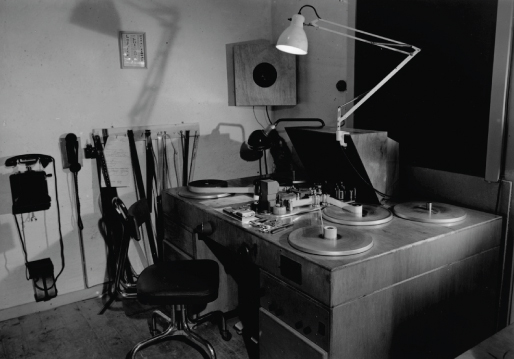
Someone on the con committee had arranged to have some remote terminals tied into some college’s time-share system upon which you could run a primitive version of Star Trek and another, very similar game with a fantasy motif (called HOBBIT). These were printing terminals, not CRTs (the ADM-3a was still about a year and a half away at that point.)
To re-iterate what ends up being a vital point, they were playing on printers, not screens. When someone (not Power) was playing HOBBIT, the game crashed, and Power subsequently got the source code by accident: he “managed to get a listing of it while trying to restart it.”
Power would eventually re-write the original FORTRAN code into his own game, first working on a TRS-80 (“a much cleaner version of the code and played roughly the same as the one I’d played”), then on a Sorcerer that was in a shop, rewriting the game from scratch and adding features based on his playing of Dungeons and Dragons. While he originally got a publishing contract to sell it “by Christmas” of 1979, that fell through, and he ended up sending the code to be printed in the July/August 1980 issue of Recreational Computing magazine.
In that magazine he mentions not only the original author of HOBBIT, but two other people who got the source code.
The article names “Chip Bestler” as the original author, who later transitioned to be Caitlin Bestler, making her the (currently) second known such person in videogame development. Bestler was deeply involved in the fantasy/sci-fi fan scene, being an editor on two zines (Effen Essef, Windyapa) and being part of Chicago’s bid for Worldcon in 1982.
ASIDE: The record is held by Ellen Kuhfeld, who wrote the University of Minnesota version of Spacewar. She wrote an article in Analog (pre-transition) back in 1971 that discusses the two versions; you can play the original MIT version here and a reconstruction of the Minnesota game here. The third known person is Jamie Fenton, who did the arcade games Amazin’ Maze and 280 ZZZap in 1976 (and helped finish work on Sea Wolf when the main developer, Tom McHugh, got sick); Fenton is most famous for the 1981 game Gorf.
Sketches for an unpublished Blackjack game by Fenton. The document dated November 24, 1974 is the same week as the convention. Source.
The excerpt earlier also mentions Kevin Williams and Dana Kaempen, who made a port for HP mainframe. Via “K. Williams” (who I’ve confirmed is Kevin), a version of original HOBBIT showed up for TRS-80 in the tape magazine CLOAD in August 1979. Based on Power’s description of the game, it hews to the original 1975 experience.
IN THIS GAME YOU BECOME A HOBBIT THIEF TRYING TO STEAL THE ORB OF ZOT FROM THE CASTLE OF THE EVIL WIZARD.
To be clear, HOBBIT is not an adventure game. However, the history ends up tying in with an adventure game (which we’ll get to in my next post) in a curious way, such that to do a complete history I needed to see what HOBBIT was like first. If anything, it feels most related to classic mainframe Star Trek mixed with some Wumpus, but let me play the game first, get into comparisons later–
The game is played on a 9 by 9 grid scattered with quite a few “warps” (that teleport the player), as well as gems, amulets, flares, demons (the enemies), and an Oracle. The rooms that don’t have any of those things just have “gems” (which can be used to bribe enemies or ask questions of the oracle). Commands are single letter directions (N/S/E/W) and (W)ait, (M)ap, (F)lare, (L)amp, (T)eleport, (K)ill, and (Q)uit. I ended up using the M key quite a bit, but you can imagine someone playing on a printer would not want the full map printed every step.
An example map. The special items are the same as in Wizard’s Castle.
The overall goal is to first find a Runestaff (which will be in a room that looks like it has a demon when looked into, but that’s a facade); the Runestaff allows teleportation, so the can then try to teleport to the right room (one of the rooms that teleports the player randomly otherwise) to find the Orb of Zot. The game’s instructions explain it like thus:
ALSO HIDDEN IN THE CASTLE ARE THE RUNESTAFF AND THE ORB OF ZOT. THE ORB IS DISGUISED AS A WARP AND THE ONLY WAY TO GET IT IS TO TELEPORT INTO ITS ROOM DIRECTLY. IF YOU TRY TO MOVE INTO ITS ROOM YOU WILL GO PAST IT IN THE SAME DIRECTION. TO TELEPORT YOU MUST USE THE RUNESTAFF WHICH IS DISGUISED AS A DEMON. BE CAREFUL WHEN YOU TELEPORT, HOWEVER, BECAUSE YOU LOSE ALL YOUR AMULETS AND GEMS (NOTE: YOU MAY ALSO DROP SOME GEMS EACH TIME YOU MOVE).
In most games of the Wizard’s Castle line the Lamp gets a lot of use — it can be used to peek in an unexplored room to see what is inside. The big catch here is that if there’s a demon, it can see you if you peek in, and charge.
This reminds me of waking up the Wumpus.
Getting charged seems common on higher difficulties especially. If you have one of the magic items it protects you, so the real reason to use a lamp would be to avoid warps, although I’ve found it better in general just to eat the teleport and resume walking from wherever the landing spot is. (This is especially because of how the Orb of Zot works, which I’ll get to later.)
(K)ill will try to do away with a demon for good, which involves simply invoking one of your items. Use an item enough times and it will run out of charge, meaning you need a different one.
The oracle will tell you — assuming you have the opal eye, or are willing to spend 20 gems — where one item is (except, unless I’m missing something, the runestaff or Orb of Zot, which aren’t given numbers). For example, on this screen I ask about the flares…
…and the map in progress below shows (in the last leg of the route) me going from the oracle to the location specified.
This is on difficulty 7 out of 9.
The flares will show all nearby numbers and are essentially the most powerful item in the game. They will not cause enemies to charge.
For the flare use above, here’s the actual result, with six of the squares revealed at once:
On lower difficulties, unless you get slammed early by a demon you’ll probably win (the lamp is worth using until you get one of the magic items to protect yourself). On higher difficulties, winning is harder, because the main obstacle is time.
This does not feel like Tolkien. It’s more like you’re facing off against Baba Yaga.
Hence why the flares are so useful: they explore the map in the fastest time possible.
As mentioned in the instructions earlier, the Runestaff and Orb of Zot have special conditions for finding them. The Runestaff will be in a room that appears to be a demon when looked at via lamp or flare (but isn’t). You don’t have to fight a demon to get the runestaff — you just walk in the right room and there it is.
The Orb of Zot is at one of the warps. At the Zot-Warp it works in a special way, by “jumping” the player over the square rather than hurtling them across the map. An example:
On the screenshot above, the Orb of Zot is at (5,2), so when you get the Runestaff you should teleport there, which essentially wins the game.
To summarize, the procedure for winning is:
a.) find at least one magic item (Ruby, Norn Stone, etc.) which can be used to resist demons
b.) trudge your way through the map and hope you find the flares; if you see the Oracle, ask about the flares (4), otherwise make sure to hit every demon and warp to check for the Runestaff and Orb of Zot
c.) as soon as you get the Runestaff, focus on entering into every warp until you find the one that has you “jump” to the next square as opposed to making a bigger warp; once you locate that, teleport to that exact square with the Runestaff.
Once you have the Orb of Zot you can still keep playing if you want to mop up more gems for points.
Regarding the Star Trek comparison — I’m not going to do a full history, but you can read through a playthrough here. While the placement on a grid could easily be coincidence, the thing that makes me fairly sure Bestler was making a reference is the flares. The Enterprise is on a large grid, and you activate a “long range scan” to see what happens to be nearby:
While I can’t confirm (Caitlin Bestler died of cancer so I can’t ask her) I get the impression that the original HOBBIT was made separate from Dungeons and Dragons as a concern and is more along the lines of trying to convert the old computer games like Star Trek and Hunt the Wumpus to have a slight bit of fantasy flair. It is only historical inertia that we always associate “fantasy setting” with RPGs; Power, of course, started molding the form to fit that of the CRPG genre.
I incidentally did not bring up HOBBIT last time I talked about Tolkien games, but that’s because the connections are very tenuous and little more than namechecks (given Cthulhu is one of the demons, it’s playing pretty loose with the lore). However (just previewing my next post), imagine someone playing the game and disappointed that the references are so light, so they make their own version which really is Tolkienesque, and then someone else comes along and adds even more and — well, let’s save all that for next time.
Special thanks to Ethan Johnson and Kate Willaert who shared their research on Jamie Fenton and Ellen Kuhfeld. Ethan blogs at History of How We Play and Kate is at A Critical Hit!
Nearly all the haunted mansions (or castles) that we’ve experienced through All the Adventure have been, at their essence, fan fiction.
Solihull, Birmingham area.
This isn’t necessarily a negative thing for the circumstances, given the tiny space most authors have had to work with. As I’ve observed before, fan fiction is a shortcut of sorts that allows an author to put Spock in their game by just writing
Spock is here.
with all the different associations and abilities Spock has already implied, without having to waste more precious memory space with explanation. Similarly, with spooky games by Morgan or O’Hare or Bassman a stereotypical monster can be implied by just mentioning its name. “Dracula is here” implies not only a visual, but what sort of puzzle elements might be used.
From Morgan’s Haunted House, after using SHOW CROSS, an action hinted at nowhere in the game, but rather applying the “fan fiction” aspect. This allows us to steal Dracula’s chocolate chip cookie. Maybe he’s Count Chocula in disguise.
The is the first of four games at CASA titled Castle Dracula, although the only one from 1983. The author, Paul T. Johnson, has the distinction of most of his games being written later (1996-2004, not counting he was a contributor to Cragne Manor in 2018). He rewrote Castle Dracula twice, first as House of the Midnight Sun and later as Dracula — Prince of Darkness. The first game includes some historical detail about Castle Dracula:
I wrote this text adventure game in 1983. The game, written in BASIC took me a year to program. For its time 1983, the verbose descriptions of the 40 locations impressed even me. “House Of The Midnight Sun” Was based on this early game. Untill recently I had thought the game was lost, however thanks to the work of Simon Hardy and Robert Boyd an early build of this game is once again available to play. The ’83 game was aimed at a younger audience. “House of the Midnight Sun” is a larger and far more complex game. It is also a far darker game.
The author’s web page gives the further detail that the game was mail-order only, sold via ads in magazines, and he “sold copies of the game all over the world including Japan.” He explains the “main problem” was a lack of computer memory (surprise!); out of the list of platforms (Spectrum, MSX, Commodore Plus/4, Atari, Dragon, Texas Instruments TI-99/4A) the TI at least meant it was restricted to 16K.
To help with the games longevity some of the puzzles were as tough as old boots. None of your – ‘need a brass lamp to explore a darkened room’ – These puzzles were mean!
It was sold by Mercury Software (Johnson’s house) out of the Birmingham area, not to be confused with the Mercury Software in Manchester (selling “arcade quality games” for the Oric).
Via World of Dragon.
The author implies the difficulty is in the puzzles, whereas I would argue it is in the highly bespoke parser. This is another of the type where everything is implemented “manually”. That is, there is no real “world model”, but rather each room has a custom listing of prompts that will move the game forward. Even dropping inventory items is not allowed!
There’s also some unconventional commands: the only directions are N, S, U and D (no E or W) and typing E is actually short for “examine”. (This is akin to how Robots on Terminus IV had to avoid all words including a Z because Z was being used for backspace.) I admit to misreading things and being confused for a while thinking maybe I was turning my character east to see something, and by coincidence the thing always happened to be the east. The other shortcut is “R” for read; according to the author the E and R notation is used to save memory. (If this was coded “normally” where all the verbs are stored centrally, this wouldn’t be a problem, but there is almost no code re-use in the logic flow at all.)
Our goal is to rescue a princess from Dracula. Isn’t the will supposed to say who our possessions go to, not explain how we’ll probably die?
You start approaching a graveyard, and E (for “examine”, remember, not “east”) will reveal a freshly dug grave.
The game is fishing for DIG EARTH specifically to make progress.
750 IF I$=”E” THEN 800
760 IF I$=”R”THEN 820
770 IF I$=”DIG EARTH”THEN 840
780 IF I$=”S” THEN 600
790 GOTO 470
800 E$=”ONE OF THE TOMBSTONES LOOKS NEW.THE EARTH HAS JUST BEEN DUG,YOU SEE SOME WRITING”
810 GOTO 70
820 E$=”THE TOMBSTONE HAS YOUR NAME ON IT!A WARNING OR A CLUE?”
830 GOTO 70
(70 gets the room description and inventory, and is the only part of code that is re-used in the program flow.)
Moving forward is a “guardian” which blocks your way.
This is honestly terrific atmosphere (in the spooky-game-written-by-enthusiastic-kid sense) and has two options: you can either hand over the stake as requested or use HIT SKELETON. (That verb specifically, of course.) Giving the stake almost seems like a softlock:
YOU NO LONGER POSE A THREAT TO MY MASTER. YOU ARE NOW HIS SUPPER THE SKELETON DISAPPEARS BACK INTO THE GROUND
However, you’ll get your items yanked away later, and it isn’t like the game is really keeping track; to remove the stake the game simply changes the string used to print inventory (IN$=”A HAMMER AND SPADE”).
Moving on…
…there’s an underwater waterfall where the game is fishing for ENTER WATERFALL, followed by a Smuggler’s Cave where there’s algae visible if you use the E command; the game specifically wants REMOVE ALGAE.
Not TAKE, SCRAPE, GET, etc. because the code is just a line that checks if I$=”REMOVE ALGAE”.
The writing says
I MUST DESTROY THE MONSTER
ITS SIGNED REV.POTS 1817
VAMPIRE KILLER
Onward is a very slight amount of exploration (everything is linear from here on out); you arrive at a “main hall”, can go north to find barred doors and a “letter”…
It’s backwards.
…and go south to find a library.
The book is meant to hint you can go into the mirror (or rather, quite specifically, ENTER MIRROR).
The right response here is IGOR. This is hinted at from the backwards text earlier, and note that you need to just type the word IGOR, not SAY IGOR or RESPOND IGOR or anything else like that, elsewise:
If you IGOR correctly you will still be left to be attacked by rats. Examining reveals a message on the wall from the helpful REV. POTS:
This is a direct letter code (1=A, 2=B, 3=C, etc.) which prompts the player to REMOVE MORTAR.
If it isn’t clear yet: the author sacrificed world model aspects (or more likely, didn’t know at the time how to code them) for the sake of “cinematic” text to describe events. We’ve had this sort of contrast with Peter Kirsch games, which more properly have a world model, but by jettisoning everything the author is laying everything down on the text.
Another timed scene, the coffins start to open. With a better parser (and some clarity that it is in fact daytime) this could have been the best moment of the game. REMOVE SHUTTERS:
One of the coffins can be entered, revealing a down-staircase to some bones. A stake lies amongst the bones but it is just a fakeout.
You then get confronted by a GUARDIAN OF LOGIC who wants you to prove you exist; now we are on literal guess-the-phrase with I THINK.
Onward more, there is a chamber of steel with a large rock; this rock gets used immediately, as the room after has a classic crushing trap you can foil with DROP ROCK.
This allows progress to a “haunted bedroom” with a hint I’ll return back to later.
Past here is none other than Reverend Pots himself, who is sleeping in a bed.
ITS POTS ALRIGHT.MAYBE YOU
SHOULD WAKE HIM.
Waking him is a bad idea.
You should instead just ignore him and move forward, whereupon a countdown timer starts.
A GHOSTLY APPARITION STANDS
BEFORE YOU.IT SPEAKS WITH THE
VOICE OF THUNDER’KILL THE
VAMPIRE BEFORE SUNSET OR HE WILL
KILL YOU!’
You now have 10 turns to beat the game.
In a bedroom that follows, there’s some wallpaper to remove opening a passage to a secret vault.
This is where the game’s bragged-about difficulty really kicks in. You have to realize the game is making a pun here and PLAY C, opening a passage to the princess.
I kind of wanted the princess to already be a vampire. It would fit with the plot of the game.
The princess gives you a note which indicates what to do, while Drama happens:
You only get one turn to act. I love the tension, although note this game doesn’t have a saved game feature so there’s a fair chance (especially given the parser) there would be a lot of restarts.
And here I admit I did not figure out the puzzle, but checked a walkthrough. This refers back to the Reverend Pots hint, and suddenly jumps the game to hyper difficulty, because these are references to the book of Genesis, specifically the King James Version. V2,14 means look at Genesis 2:1, letter 14, and I’m guessing most players in the 80s just cracked open the source code.
Thus the heavens and the earth were finished, and all the host of them.
The code comes out to SAY MAGIC.
Despite this game fitting into the many haunted houses we’ve seen (and will still see), the focus on scenes with driving tension did make it come across very different and it had a janky charm; I would have just preferred a different parser, but fortunately the future version of the author has already obliged that (twice) as the remakes are written in Inform.
Via World of Dragon.
I am a realist and know it will take an awful long time to get there, so let me finish by quoting the author about his first remake, describing his overall process and using the term “interactive ghost-train ride”:
When I wrote “House of the Midnight Sun” in 2002 I use to work as a paramedic in Birmingham, England, (I have now retired.) I spent my ten hour shifts, waiting for emergency calls on my own in a Paramedic car at Sarehole Mill. There, where Tolkien grew up, and later used as a setting for his novel “Lord of the Rings,” I wrote the game on a tiny Psion Revo. (Today I’m using a Sony Vgn P11Z.) I remember sitting by the stream, next to the mill, writing the ‘nest of rats’ puzzle, a routine with a gruesome solution. I was just wondering if I had gone too far, when I looked up to see that I was being watched. I was not alone, I had been joined by a large brown rat. I took this as a sign, and the rats’ nest stayed. Since then the rat comes round from time to time to check on my progress. I must remember to take him something to eat.
First, briefly, regarding the verbs: they’re inside the machine code in plain text, but backwards. I don’t know if this is meant as a slight bit of “encryption” or if there’s some technical reason based on how input sequences are treated. It was mainly useful to find that “med” is the word to get inventory (as in “jeg har med”, “I am carrying”) and “dro” as in “drop” lets you drop stuff. (I really need to remember to test English words in foreign games, because sometimes they work.)
I also found “fjolet” and “idiot” on the list, both translating to, er, idiot; essentially this is for insulting the computer, which responds with “Det forstod jeg godt” or “I understood that!”
A book on Treasures and Treasure Hunters. One of my results while using image search for vocabulary. Via GPRIS.DK.
I needed advice from the comments (via Rob) to find one object that was tricky to get, and then the entirety of the rest involved mapping and digging in every room. I never even found the nails to build a ladder; I assume they’re somewhere because I poked at the machine code to list the nouns. The ladder points represent alternate exits from the labyrinth area but neither is needed.
For that one object, it was back in the shed:
That’s listing a shovel, an empty oil barrel (except it has a hammer if you check), a stack of boards, a garden rake, a hoe, a saw, and the door. Everything is takeable except the barrel and door, and knowing a ladder was coming I had automatically grabbed the boards and the saw. Somehow — and it doesn’t exactly make sense why this happens — you can be carting around the boards but be missing an item hidden if you examine them: a lamp. (You can find the lamp while carrying the boards, at least.)
With the lamp and matches in hand I was able to “taend lampe” (“put on the lamp”) and that vanquished the dark areas and any puzzles remaining in the game: as I said, the rest is pure map-making.
Starting with the dark place next to the kitchen, that just leads to a north/south tunnel, where the south opens out to the forest, and the north to the shed. This doesn’t really represent a shortcut, but rather just the author trying to add more connectivity to the world.
The other dark part was next to the shed, leading down to a cellar.
“Skeleton” and “matches” are marked rooms in the labyrinth after this section.
There are four marked rooms, and each has a treasure that is found by digging with the shovel (“grave”). There are five treasures total, so almost the entire rest of the game can be found without entering the labyrinth at all! (Except you are likely to enter by accident as you map things out.)
I incidentally had trouble translating “klipperum”. The pictures that I found were all editing rooms, like this one from a Danish film site…
…and the best I could find digging through dictionaries was “cloakroom” but that also doesn’t make sense to me based on the context. ADD: Petter Sjölund in the comments mentions “klippe” is stone or rock so it could be “room (carved out?) of rock”.
Leaving that behind, and heading into the labyrinth (pardon the mess, I know I’m missing a few exits)…
…it’s a fairly standard “drop items to map scenario”. One passage includes a paper at the end which suggests the treasures be dropped at the starting cottage in order to be scored. This happens to be the otherwise-inaccessible basement of the cottage; a hole is mentioned from the very start of the game, so it is a nice piece of geographic connection to mention it here.
One room also has a skull there (which serves both as decoration and a map-making marker) and another lets you dig up a skeleton of a past treasure-hunter.
The skull and skeleton are the two “sinks” of the maze (that is, random travel will more likely land in one of those two) so it makes for an interesting narrative moment to have a skeleton of a past adventurer dropped in there. However, our long expertise with Dropping Stuff makes it not hard to find the fifth and final treasure, which is right under the giant hole we found earlier outside.
(You know, I didn’t see if the treasure had the nails. I’m too exhausted to go back and check, after a while the Danish was hurting my brain.)
So all that’s left to do is make sure all the treasures are deposited followed by typing SCORE, kicking us back to the operating system prompt.
This was about the joy of exploration with an attempt at verisimilitude in environment, with the massive number of red herrings like a rake in the shed or a bottle cap buried on a random path. The “shortcuts” weren’t really needed but I’m not sure the author even thought of them in a design sense, but more in a sense that it’s logical for a realistic world to have multiple routes passing through it.
In a way this was good for a language-beginner game (that is, for me), as it didn’t in the end make horrendous demands on vocabulary. What I found most interesting was a general lack of puzzles at all; while it is essentially certain the author had experience with at least some standard adventure games, this one also harkens back to the Chaffee Quest, which when translated into Danish also was given the name Skatte Jagt.
Thanks to Mikkel Christensen who did the scans of NASCOMNYT which helped find out the year of the game.
There is allegedly another Danish game from 1983 so we’re not done with the language yet, but I’m not sure where to find it. CASA states the Christmas-themed Juleadventurespil is in the December 1983 issue of Hjemmedata magazine. This is the Norwegian issue but we don’t have the Danish one.
For now, I need to stick with English for a while anyway for a mental breather; coming up there’s one spooky game, one Tolkien game (that hasn’t been discussed here yet), and finally Urban Upstart (for real this time).
While the Sinclair ZX-80 and ZX-81 launched computing “for the people” in Denmark (and a battle with Commodore after), today’s game is from another one of those “hobbyists” separate from the mainstream: Henrik K. Jensen, writing on a Nascom kit computer. While the home origin of the Nascom was the UK (just like the ZX-80) it managed to make inroads in both Denmark and Sweden.
NASCOM kit parts, from a video by GlassTTY. This forms in the end a “proper” computer, rather than something a little more skeletal like the KIM-1.
The “kit” aspect was a definite part of the experience which is part of what allowed the launch of the Nascom 1 in the UK (January 1978) to be at more or less half the price of competitors. However, it was still cheap even for the parts; in fact, it was too cheap, as it had “inadequate profit margins” which led to the company falling into receivership two years later, leading to it being taken over by the company Lucas. A pre-assembled Nascom did not come out until very late, 1981, with the Nascom 3, which was simply the Nascom 2 but now you didn’t have to solder. By this point the industry had already moved on.
… what you got was a keyboard, a circuit board and a number of plastic bags full of resistors, capacitors and integrated circuits.
Yes! You had to build it yourself.
And you have to supply your own power supply (+5V,+12V,-5V,-12V (expensive!)), and a monitor or television for screen. Not to mention a box.
Then came the fun of finding the correct place for all the components and soldering them into place.
1839 component pins!!
I wonder if anyone ever got it to work on the first try.
Enough Danes figured it out that a club was kicked off in late 1979 with a newsletter. 18 members are listed in the second newsletter, and by 1982 the list reached hundreds (note not “thousands” like the ZX80/81 club in the UK had).
Half an “invader” graphic from the October 1980 issue.
Just like most clubs at the time, there was a “library” of software for members; March 1982 includes a mention of “Skattejagt” (“Treasure Hunt”) as entry B13:
You are hunting for treasure that a pirate has hidden in an underground cave system, where secret passages open and close during the game.
This is Chaffee’s Quest, a game we’ve now seen translated into Dutch (twice) based on source code from the July 1979 issue of Byte. It landed in Danish too and probably more languages we haven’t unearthed.
The game we’re instead concerned about is only listed in the later catalog, meaning it first appeared in 1982; prior to my research today’s game only had a date of 19xx.
The program requires 48K and is in machine code; the computer is turned into a robot that you give commands to like “go north”, “take shovel”, and “build ladder”. It “demands a lot of imagination and patience, and it can take a while to find the treasures.”
The catalog states “Adventure” but the title screen of the game itself gives Skatte Jagt, so despite the clash with Chaffee I’m sticking with the more distinctive name.
The instructions mention “tag skovl” (take shovel) and “gaa nord” (go north) but notice it does not mention “lav stige” (build ladder) like the user group catalog does. (Ladder supplies get loaded on the player quickly enough I was quite suspicious, but it’s still good to have the exact phrasing in Danish.) Nord, syd, oest, vest, op, ned are the words for north, south, east, west, up, and down.
I’m in a cottage with a hole in the floor. I can see: stairs, locked door, door, hatch, hatch. I can go: east, up.
I typed hjaelp (help) right away:
For at laase en doer/lem op skriv aaben.
Skatte I igger ofte nedgravet.
Det er en god ide at undersoege alle ting.
To open a door/hatch, put “open”.
Treasures are often buried underground.
It is a good idea to investigate everything.
Incidentally, Danish uses special characters (å, æ, ø) and there is a version of the Nascom system that allows for them, but this one flattens things, so “åben dør” is “aaben doer”. ø is still used once in the game but I think it’s just the “zero” symbol.
Based on the help messages and my experimentation the verbs I’ve found are
tag (take), gaa (go), lave (build), laeg (drop), grave (dig), undersoeg (examine), and aaben (open)
although only the first three letters are needed of each (so it’s useful to “und” all the nouns). “Aab” is particularly quirky as you’ll see in a moment. I didn’t say “I started the game by dumping the verb list, like I normally do with languages I’m not good at”, and that’s not because of being a Danish master, but because after heavy searching through the machine-code file I can’t find where the verbs are stored. I imagine they’re broken up somehow. The upshot is that I’m not done with the game yet:
Heading up via “gaa op” (up the stairs one of the two hatches, or both?) there is an attic with a “rode kasse” (red box). You might think that the verb “aaben” would come into use here, but instead the game wants you to examine the box, which contains a second smaller box. Then examining the smaller box reveals some keys (noegler, or nøgler if special characters were being used).
Jeg er paa er loft. Jeg kan se: Noegler. Lille aeske. Rode kasse. lem. Mulige udgange: ned
I am in an attic. I can see: keys, little box, red box, hatch. I can go: down.
With the keys in hand (“tag noe”) you can then go downstairs to unlock the locked door, and I struggled for a while since no variation of “unlock door” or “open door” worked. I finally hit upon “open” alone. That’s what the help is supposed to indicate, and maybe it’s clearer in Danish, but I was mentally translating that as it requiring a noun, plus it’s common for a separate verb to do the door-unlocking as opposed to the keys being passively used while held.
The unlocked door leads to a kitchen (with a kitchen cabinet that seemingly has nothing) and another door leading further on into darkness. I don’t have any way through the darkness.
This is despite just outside seemingly having a solution:
This is a “courtyard” (or maybe “farmyard”) with a stone trough. Searching the trough reveals a box of matches, but nothing I’ve tried has let me light a match, so the darkness has to be left behind for now. (Sometimes adventure games don’t let you light a match by itself; the matches are just a tool for lighting a lamp. I haven’t found one of those either, though.)
The most fun way I’ve found to do vocabulary is to search on Google Images. This 1895 picture by Fritz Syberg (“An Old Farmyard”) came up looking at the word “gaardsplads”.
To the south is a “graesmark” (meadow) but nothing seems to be there (other than “looping” exits to make it seem bigger than it is) so let’s head north instead.
There’s a branching path with a locked hatch and a shed at the end. (Or rather “udhus”, a literal “out-building”, which could be an “outhouse” except there’s enough stuff inside the game clearly is meaning a shed.)
Inside there’s a shovel, oil barrel (with hammer), stack of boards, saw, rake, and hoe. Those boards and saw and hammer make it tempting to start building a ladder right away but the game says we’re missing something (I assume nails). The shovel, though, can be taken out right away for some digging, and here the game gets interesting in a ludology sense.
Crystal Cave (1977) modified the original Adventure source to start the game with a cave that had “treasures” that were all breakable formations, and park ranger that would kick you out if you caused too much havoc; essentially, a satire of cave-delving that imagined what things really would be like for a treasure-hunter in the real world. In the real world, if you start digging at random, you might find a rusty iron or an old beer bottlecap; such is the same here.
That’s a zero, right? Also this is the beer bottlecap.
I would guess, just like Crystal Caves, we’ll eventually break down to a lower layer with the real treasures.
Digging also reveals a stump in the forest, but I haven’t been able to do anything useful with it; no treasures have revealed themselves. Other than the dig-fest, the north part of the map has a locked hatch leading down to darkness (again, no light) and also what’s just a big hole.
Jeg er ved et huli jorden. Jeg kan se: . Mulige udgange: nord
I am at a hole in the ground. I can see: . I can go: north
(I assume this is where the ladder gets used.)
If anyone wants to take a shot at the game, directions for getting and playing it are here; all I really want is a verb list, if I’m stuck on an actual puzzle I don’t want to hear about it yet.
Many of the British product samples remained at the company. We tested as hard as we could but didn’t dare sell any hardware that was obvious crap. The British were more relaxed about that kind of thing than the Danes.
In late 1980, the Danish journalist Svend Garbarsch made a fateful call to Clive Sinclair, regarding a ZX80 he had seen in a British magazine.
By that time, Denmark certainly had a tradition of computing in general dating back to Regnecentralen (funded directly via Marshall Plan money for reconstructing Europe after WWII) with the companies Christian Rovsing and Danish Data Electronics later big contenders. None really tried to enter the consumer space. Regnecentralen modified a Data General Nova mini-computer to be the RC 7000 in 1970…
…and then transformed it into the RC 3600 as a business/school computer. Christian Rovsing also focused on mini-computers; the latecomer DDE made their first computer in 1975 for “data collection, process control and monitoring”.
An ID-7000, the first computer from Danish Data Electronics.
Arguably the most interesting early stab at Danish home computing was the ICL Comet. (ICL we’ve seen before: essentially Britain’s counterpart to IBM, with the I in the name meaning International.) As their computers generally used CP-M as their operating system we won’t have any Comet-specific software in this Project’s future; the important point is that it still tended to be targeted at the higher end / hobbyist audience, along with various computer kits like the Nascom. Even the Commodore PET was considered more of an expensive business machine.
What all this means is when Svend Garbarsch made his call from Denmark to England, a “cheap” computer for the masses in Denmark had yet to be introduced. Somehow in the process of the conversation with Clive Sinclair, the salesman-CEO talked the journalist into forming a distribution outlet for ZX80s: hence the founding of ZX-Data. According to his nephew Rolf Ask Clausen, the first test computer came at Christmas 1980 through the post office, and he had to “explain to the customs officers what the ZX80 machine was, and thus how it should be cleared through customs.”
In their first ad, the Sinclair ZX80 was dubbed “Folkedatamaten” — “The People’s Computer” — and orders started streaming in. According to his nephew Rolf Ask Clausen who was there from the beginning, he “worked day and night” trying to keep up. After a month they had to increase their warehouse space and hire more people.
Note this is after the ZX81 already launched elsewhere! One might suspect leftover product being handed off, especially given the failure rate sometimes went to 10%. ZX-Data did switch to shipping out ZX-81s by November 1981; the ZX Spectrum (where the failure rate finally calmed down) filtered down to Denmark by 1983.
Now, I need to back up the story a little. Today’s game, while written by a Dane in Copenhagen, was first published (as far as we know) in February 1981, which is before the ZX-Data launch. To explain, let’s go back to a pivotal moment in 1980–
The Australian Tim Hartnell had floating through multiple jobs, including news reader for a TV station, before landing in London as a journalist working for the Australasian Express; his writing was of the “nerdier” inclination and included a mathematics column.
The photo above was taken in April 1980 outside Madame Tussaud’s. Tim was puzzling over the ZX80 which had launched two months before. He had obtained a book on BASIC programming that he is shown reading here, specifically having trouble with the chapter about For/Next loops. According to Young:
It was while he was reading this chapter that Tim realised that if he was having difficulty understanding this programming stuff, then other people probably were too. This photo virtually shows the instant that Interface Publications was born.
He swerved his journalist career towards computers, writing one of the very early books for ZX80, Making the Most of Your ZX80.
This particular book was put out by Computer Publications (later well-known for the magazine Sinclair User) but Hartnell went on to form his own publisher, Interface (co-founded with Robert Young); he also launched a ZX-80 club which quickly got “thousands” of members.
Citadel on the bottom. Labyrinth is from Hartnell’s ZX80 book and is even more marginal as an adventure game, but I’ll still visit it sometime.
Ole Noerregaard of Copenhagen was a regular contributor starting in 1980, so he somehow got a hold of a ZX80 anyway despite them not having an official distributor in Denmark. (There’s always either talking past or smuggling through customs!) With the caveat that this is only a quasi-adventure game, it’s the first of its type we know of from Denmark. It was written in English. (My next game, which involves a completely different story, will get into the first one written in Danish.)
The game did have some “professional distribution” but the word “professional” earns those quote marks.
If you think that’s bad, look at the inside:
The publisher is not Lion. The publisher is the exceedingly obscure CDS Micro Systems. Lion is the one who made the tape, and CDS flipped it over and slapped CITADEL on it and called it good. CDS does have a few other games (all ZX80) and two of them (Andromeda and Timestar) are sort-of adventure games (with Wumpus-style navigation) but they don’t seem to have any connection with Ole Noerregaard so we’ll pitch studying them for some future time.
To summarize:
a.) Tim Hartnell launched a club and publication in the UK after discovering the ZX80 as a journalist.
b.) Denmark in general didn’t get any kind of distribution until a different journalist (Svend Garbarsch) called Clive Sinclair and got talked into founding ZX-DATA, which started distributing mid-1981.
c.) Prior to that, it was still possible through other means to cart hardware between countries, and Ole Noerregaard not only expanded his computer to 16K but was an enthusiastic contributor to Hartnell’s publication Interface, getting a SUPERGAME published starting early 1981 with some extra distribution by the dodgy CDS Micro.
Commentor Rob (who clued me in on the game’s existence) sent a less-damaged picture of a later issue of Interface with a blurb.
16K SUPERGAME: Make the most of your new, expanded memory with CITADEL. In the remote land of Destaphnya; shrouded in mist at the peak of Mt. Nganra, stand the CITADEL. For a thousand years, men have sought to find the secret hidden in the citadel, to possess its power. All have been repelled by the Dark Agents of Protection. Will you succeed where the others have failed? Can you storm the CITADEL? If you have a 16K RAM pack, you need CITADEL.
The game’s lore involves the titular Citadel “existing in many dimensions”; your job is to get as much treasure as possible.
You can carry four objects at a time, and bring them back to the start in order to “place” them in your home dimension, getting points. You are given three items at the start (none of which are explicitly treasure, but any item in the game gets points when stored as a treasure). The instructions give a goal of 1200 points. Commands are all single-letter.
(As an aside, regarding the ZX80, I think it’s notable we haven’t seen attempts at parser games, Planet of Death aside. It isn’t like the expanded version is really that much different from the ZX81 in a BASIC-code sense, but rather, the screen-blinks-at-every-keypress when typing long commands gets very grating. The issue is mitigated with single letter commands. If you need to see what a parser game looks like on ZX80, this link will take you to a playable version of Planet of Death.)
Room descriptions in the citadel are randomly generated, and not in a consistent positional way. That is, the room description changes every turn, even if you stop and “look” while hanging out. While some descriptions are genuinely vivid the overall effect is to make them be ignored; there is no “exploration pleasure” in finding a vivid new scene.
Both this and the previous room are the exact same room, the second screen obtained but using Look.
The map is randomly generated each time, making a 7 by 7 map. I have one of them fully rendered here, where monster encounters are marked with a danger symbol.
Notably, the map is not just a single path, but has some merging, meaning that you could technically avoid monster encounters if you knew where they were ahead of time. Alas, with no save game feature, it’s a matter of spinning the dial at random.
There’s no running away: each encounter requires you ATTACK with your choice of inventory item (like POLE ARM) and as far as I’ve been able to find by squinting at the source code the choice of weapon does not matter: it’s random if you have anything good happen or not.
Usually combats end by the enemy running away, either delivering a blow (as shown above) or having a draw with no damage given (a good result). You have a LIFEFORCE that starts at 400 and goes down by 100 on a good hit.
The one (1) time that I managed to kill a monster was on a skeleton. One of the “weapons” was a silver cross so you might think that might give an advantage in undead-combat but no: this was with a pole arm, and there seems to be no effect to the choice of weapon.
I did eventually scrounge out by luck what I think is essentially a max score. However, the game never acknowledges such and still claims there’s more treasure in the Citadel (there wasn’t).
This hence doesn’t rise to the level of an adventure — no real exploration, object choice doesn’t matter — but it isn’t an RPG either, as there are no stats other than the overall life force going down. So it’s in that weird in-between space that happened in early games where it isn’t a recognizable genre at all. Clearly the author put a lot of effort into the map generator and had some legitimately colorful room descriptions to match, but simply rose to the level of a “slot machine game” and stopped there. This was still worth playing as it will make an interesting comparison with the other ZX80 “quasi-adventure” specimens out there; for now, we’re going to switch to Danish, and look at their first “real” adventure.
The enormous chess board is my favorite of the random descriptions.
POSTNOTE: There’s a version of Citadel called Catacombs of Morglim that was tweaked by Trevor Sharples of the ZX80 club. It was published as actual source code in the pages of the Interface, but with the map generator taken out. A follow-up article by Sharples mentions methods of tweaking the source code; weirdly, the follow-up talks about having it generate a new cave each time, putting a generator back in. And no point during either article is Citadel mentioned as the original. This still seems to be in the hacker-code-sharing mode where “ownership” was very loose. Or maybe Catacombs of Morglim was the first version (only distributed “person to person” so to speak) and Citadel was the enhanced version? Citadel started being published first, but that doesn’t mean it was written first.
Thanks to Jeremy and Matt W. in the comments nudging a bit more at the game, humanity has been saved.
Placement of backspace and space on the ZX-81 keyboard specifically for this game.
I had made my way to a computer room which needed blowing up, and already had an escape vehicle in place, but actually placing the explosive was eluding me. The magic word for step one was PRIME.
This automatically combines the detonator and explosive together, and if the explosive is now dropped, it blows up.
As I theorized, TURN DIAL does now work (previously just saying YOU CANT), but it’s still a serious pain, because it asks
TO WHICH SETTING???
and I flailed for quite here. I was in the middle of my next post (which involves the same emulator that this game is on) and inspiration occurred to me:
I had actually tried THREE SETTING first, thinking about the unused THREAD verb that Matt mentioned — it’s a four-word parser, so it could have just been THREE as a verb — but that didn’t work. I immediately followed up with swapping the order to SETTING THREE.
PLACE EXPLOSIVE will now set everything to blow up.
I booked it to the escape craft…
…then pushed (I mean, pressed) the button to indicate my mission was over, and failed.
The explosive takes too long to blow up. This explains why the dial was needed in the first place! At setting THREE it is possible to walk your way to the exit, but I had pre-emptively solved what I think may have been intended as the central puzzle: make the timer tighter (TWO) and you can still escape by intermediate ship (not by walking!) and it will blow up before the patrol robots discover it.
Without the parser issues this is a short and well-designed vignette. You’re on a mission you’re actually well equipped to start, there’s some brief visit to a city which is minimal but vivid, you find the robot fortress and need to experiment to use their elevator, there’s some robot blasting with a LASER GUN, and the final part where you need to set a quicker timer to avoid the bomb being discovered (meaning you need a quicker exit) is genuinely satisfying. The problem is the “without the parser” exception, which dragged the game out to a week.
I have an idea what the CODEWORD is referring to: it might be used for a contest when the game was released. Computer Input from November 1983 mentions a contest for one of the other Antarctic Software games…
…so I could see an entry consisting of giving the codeword.
This game did not make much an appearance outside New Zealand; the only reference I’ve seen otherwise is from a truly puzzling mention in the UK Computer and Video Games magazine, August 1984. This comes from the column (common amongst magazines at the time) with people asking for help with their adventure game troubles.
The surreal cover is due to the adventure game based on the TV show Dallas.
New Zealand reader, Colin Foster, from Levin, is playing Antarctic Computing’s Robots on Terminus IV. He says it makes Espionage Island look simple and he can’t unseal the door in the spaceship, nor go near the pub. The fruit machine doesn’t seem to do much and he’s certain he has to go down the well, but can’t. Quite a daunting list, Colin, and unfortunately about а game I have never heard of. Are there any ZХ81 users out there who can cast light on these problems?
How did the door get sealed in the first place? Why would they have trouble entering the pub? Why would you be putting the fruit machine down the well (which only served as a landmark to help with mapmaking)? How did they pick up the fruit machine in the first place? If intended as a guerilla ad of sorts, why would it be in a UK magazine (where they would not have been able to get a hold of the game in the first place)?
ADD: Combining comments from ScienceBall and Gus Brasil, it appears the letter writer is not talking about leaving the ship but the armory. If you don’t get the armory open there’s no laser gun, and in order to enter the bar safely you need the gun (I never tried this) meaning no coin so no lever from the fruit machine. The author mentions the fruit machine and the well together but they’re just two separate dilemmas. Note he mentions Espionage Island (Arctic Adventure D) but Artic Adventure C (Ship of Doom) has a very similar puzzle to the armory one (POINT to use a device).
Coming up: The curious tale of how Clive Sinclair managed to kickstart the low-cost personal computer market in Denmark by a combination of charisma and accident.
I suspect I am near the end but am unable to find whatever magical parser combination is needed to win. I, for one, welcome our new robot overlords, who will no doubt get confused whenever they have to play chess against an Atari 2600.
Via Brian Blackie.
Continuing from last time, I had left off on a monolith where I was unclear how to interact with it. The monolith is the entrance to a secret robot facility, with an invasion force of spaceships you’re supposed to stop.
The right command is PRESS, either PRESS RED or PRESS BLUE. Except red summons a robot who shoots you so you should choose blue.
Inside is an elevator, which switches the verb from PRESS to PUSH. I’m generally a fair hand at experiencing such oddities, but I can imagine another player getting hard stuck right here.
Red makes the elevator go up, green makes it go down. You can go up to the top of the monolith but there’s nothing there (other than confirming the logic behind the elevator); down one floor is death because of a robot that shoots you on sight, but down two floors is safe.
There are still robots around, but you can shoot them with the LASER GUN from back in the armory.
To the west is an “underground launch area” with “hundreds of spaceships”. You can (after blasting a robot guard) hop in one, and find it is broken because of a hole in a control panel.
The hole is easily fixed by the lever from the slot machine; you can then pull the lever to zip over to the spaceport where your own vessel is (and back).
LEAVE CRAFT is needed to exit, even though you enter by walking SOUTH from the ship bay.
There’s also a store room with a PINCH BAR (another robot, again blastable) and a vent that can be unscrewed with the loose screwdriver from back at the original spaceport. This leads through a vent to a COMPUTER COMPLEX.
I am 99% sure the idea here is to then set the detonator to blow up the computer center, make a beeline back to the ship via jury-rigged slot machine lever, and save the galaxy. The problem is I have no idea how to get the explosive device to work. The EXPLOSIVE is described as having a dial, and dropping the explosive creates a bug in the inventory where the second line mentioning the dial is still listed with the I command. There’s additionally a DETONATOR whose operation is mysterious.
The unfortunate thing here past some of my prior games (like Danger Island requiring GET IN) is that this involves multiple items, so it is possible I need to do things with very specific object placement or command sequence; maybe TURN DIAL is a correct command (otherwise it gets YOU CANT) but only at the right moment.
I do appreciate the author going with “secret base in an inhabited area” rather than another barren planet; I also thought the atmosphere of the robot base came off well. The parser simply is not good at supporting whatever it is the author planned for the last steps.
I am incidentally still having to say “the author” even though I have a little more documentation on the company Antarctic Software. Other than this game they wrote The Caves of Time, Detention Center on Nebulon, and Intelligence Service Adventure, all lost media. I don’t know if they did more; they were officially founded as a company on 18 May 1983 so I suspect the 1983 date is right, and lasted all the way up to July 1989 in a commercial address suggesting it was run as a computer store for its lifetime (rather than the games being just from an ambitious “bedroom hacker”).
Address via Google Maps. Now a hair salon, not someone’s house.
We will be seeing more of New Zealand, as 1983 also saw the launch of the Sega SC-3000. The computer got crushed in other territories, but companies like Atari weren’t paying much attention to New Zealand, giving Sega an opportunity to become enmeshed in the cultural fabric.
Back page of November 1983 issue of Computer Input.
For now: a return to Europe, and the country of Denmark, another new visit for the project.
Today, this blog’s first encounter with New Zealand.
It might not seem surprising offhand New Zealand had to wait until 1983 — their population in 1982 was about 3 million, ranking it between Armenia and Papua New Guinea — but they had a computer economy out of proportion to the population.
Their first computer, in a technical sense, dated all the way back to 1949 with the MONIAC, an analogue computer with a name that invokes the ENIAC. It was designed by Bill Phillips (he of the Phillips curve relating inflation and unemployment, the source of “inflation targets” in modern economies) in order to do macroeconomics via measuring the amount of fluid in various containers.
Philips with the MONIAC, sometime between 1958 and 1967.
They had their first personal computer club in 1977 (Brian Conquer in Auckland, who read about similar clubs in the United States) so they weren’t even that late to the scene, relatively speaking, and there were multiple home-grown attempts at computers: the MDL series, the Poly and the Aamber Pegasus. They all failed for related reasons that are useful to go into, as they reflect the general trouble New Zealand hobbyist computing had in the early 80s.
The first attempt (or rather series) was via MDL; John Lovelock founded Micro Processor Ltd. in 1978. They started with engineers and hobbyists in mind, but by the MDL-3 model tried to get into the educational market (due to the government looking to pouring a great deal of money getting into every classroom); notably the computers had a shared hard drive.
They never really stretched into “personal computing”; their MDL-4 model sold about 200 units before they ended trying to make computers altogether.
Second up is the Poly-1, designed in 1980 and entering production in 1980; it was named after Wellington Polytechnic where the designers Neil Scott and Paul Bryant worked, and launched with a many-thousand-NZD price tag. The government was making moves to put a computer in every classroom (like the UK) and the duo designing the Poly tried to make a computer specifically for that need, with the most notable feature being a proprietary networking feature connecting 32 of the computers together at once. Quoting Scott:
The original design was to create it, get it working properly, and then leave it. The network was completely automatic. You didn’t have to do a thing.
From Classic Computers NZ.
The government promised $10 million in sales to fill classrooms but only $64,000 in orders came in, as the overall order got nixed from above as overspending.
The third homegrown attempt was the Aamber Pegasus, by Technosys Research Labs. This time the commercial market was more in mind, but the price tag was still high: $1000 NZD (about $900 in historical USD; enough to buy a Commodore PET at launch). Via the manual:
The machine that we are offering, while being approximately half the price of competitive products, offers much more capability in terms of expansion and ease of use. Initially we are supporting four languages with the Pegasus, these being ASSEMBLER, BASIC, FORTH and PASCAL.
I’m going to be honest: despite the effort to put a variety of computer languages by default, the hardware (default 4K memory, and see video below) seems undercooked for the price.
It did even worse than the MDL systems or Poly: “There is uncertainty as to the number of computers manufactured, estimates range from a few dozen to around 100.” It tried to get into the educational market just like other companies did — adding on network capability — but all three got crushed by the same outside force: Apple.
The offer consisted of an Apple II plus computer, one Apple disk drive, the monitor III 12in green screen with integral stand, and 30 BASIC programming tutorial manuals all for $1200. The cost to schools is usually $4812.
They were cheaper than the alternatives (and flat-out better than the Aamber), and by 1982 had 89% of the high school market. It essentially held the same position of dominance in New Zealand schools that it did in the US, although some of the cheaper machines (like the ZX80) held position when a cheaper model was needed.
Polycorp (the most plausible of the three local competitors) tried to stop Apple with a protest to the government in regard to “dumping”, so a duty of $820 was added, which simply resulted in Apple increasing the price to $2020 (as the duty was written to apply to the “dumping price”, it no longer applied to the higher price tag).
Janie McKenzie, education manager at Polycorp in 1982, quoted as saying “we intend to be around for some time”. Not long after, the company collapsed.
The $820 add-on — and the fact New Zealand never grew their own low-cost computer — is actually the most important point of all the events above when it comes to understanding their home computing market. The whole period from 1975 to 1984 with the government at the time (led by Sir Robert Muldoon) was one of protectionism:
By placing high tariffs on imported items, the government provided protection to fledgling industries. The strategy was quite successful. Nonetheless, high tariffs made many imported goods expensive to consumers.
So, the “cheap end of the pool” hobbyists that flooded the UK had trouble getting started in New Zealand; a postmortem of sorts was written in 1987 which notes:
In New Zealand the sales tax priced the microcomputer beyond the reach of many potential hobbyists and it was not until the tax and licensing regulations changed that products were more readily accessible to the low end user.
The same postmortem (titled “Memo: Atari US. What plans for NZ? Reply: Ask Australia”) also highlights the other interlinked issue: the country was sort of an afterthought to Australia. Essentially, New Zealand received their computers and parts last compared to the larger markets. An Atari supplier who severed ties with the US is quoted as saying:
We were having trouble getting stock from the USA. At the moment we are still importing parts until another dealer takes over, but we are not importing either hardware or software. Existing stocks are being sold off and we are caretaking for spare parts.
All these elements put together mean despite the signs of a vibrant scene…
…it isn’t terribly shocking we have to wait until (probably) late 1983 for the first adventure game from New Zealand we can play. Specifically, Robots on Terminus IV by Antarctic Computing.
The “probably late 1983” there is because it the first ad we have for the game is from a December 1983 issue of Computer Input, a NZ-specific magazine without many copies available. There’s an ad in the November issue for only one game (the currently lost Detention Center on Nebulon) but the general sense I get is that there’s more ads dating back farther we just haven’t seen yet.
Photo provided by Brian Blackie.
Brian Blackie (who has the game on his site) actually has it marked at 1982 but he doesn’t have anything on the tape or packaging indicating that date; it’s certainly plausible. The ZX81 version (the only one extant of any of Antartic Computing’s products) is slightly quirky, with a period mark doing space and Z doing backspace; the ZX81 keyboard requires two button presses for backspace and I can understand trying to do something symmetrical to type a space, but it took a while for me to get used to playing.
We have landed on a planet to do a mission, I assume involving robots; I have no idea what “our mission” is. However, we have access to an armory on our ship with some heavy duty machinery, so I assume it involves killing robots somehow. In inventory is a “remote control” device to start, and there is a door with a sensor downstairs; the right action is to POINT DEVICE to open the door.
POINT is one of our rarer verbs, so it’s useful to pull open the verb list now (this is made by hand, not studying source code):
Enough of these words (THREAD, PLACE, UNSCREW) live on the rare side that I expect there will be some surprise “isolate” verbs I haven’t run into on any game yet.
After some pointless searching for a space suit I realized this is a planet with a regular atmosphere we can just step out onto; the city is a regular city with regular aliens in it.
Disembarking, there’s a SCREWDRIVER at the landing bay, and to the north is a city street with a few venues, like an art gallery, a casino, a pub, and a department store. I guess we’re in Space Vegas.
The department store has some sand shoes we can just take (nobody seems to mind), and the gallery has what looks like a hint for something we will see in the desert. The pub is filled with creatures I haven’t been able to interact with and a coin that can be picked up; the coin can be taken over to the casino and the FRUIT MACHINE, but trying to pull the lever after inserting a coin causes the lever to break off.
Is the whole purpose of this scene to get a lever?
Finally to the north is a desert maze (again just like Vegas)…
…and the main result (other than a suspicious dry well along the way) is a mysterious monolith.
I have been unable to interact with the monolith in any way, but it doesn’t help that I’m not clear what noun is intended here (four letter parser, so “HUGE”, “STON”, “MONO”, “JEWE”, “RED”, and “BLUE” are all possible). There’s no walkthrough or other documentation, and I don’t have a good way of looking at source code, so there are likely a lot of brute-force attempts in my future. I certainly am intrigued; usually our planets have been completely abandoned, Space Vegas is a new setting.
I’ve finished the game, and my previous posts are needed to understand this one.
Via POPCOM June 1983, The Palms being advertised alongside the import game Pinball Construction Set.
Before continuing the events of last time, two points to hit:
1. I breezed past this screen fairly quickly from the kidnapping at the start…
…but just to be clear, this is showing the protagonist getting hit on the head by a coconut, where they wake up to find their girlfriend kidnapped; this is not them getting walloped by the kidnapper.
2. There was a cave where I tried to enter but I didn’t know why I died. Kazuma Satou in the comments mentioned a message about a Moray eel killing us. I have now experimented multiple times and found sometimes the eel response shows and sometimes it doesn’t. The game here seems to be outright buggy (mind you, it might be an emulator issue). Even when it does give the eel message, there’s a delay of a turn (and the game then gives just the “keep trying” message) so it is easy to be confused. For the events that follow with any deaths, I’ve seen similar behavior: sometimes an explanation appears, sometimes it doesn’t. Fortunately there’s nothing like the timed deaths at the start where I was genuinely unsure if my character was falling into the ocean somehow (as opposed to the girlfriend left waiting too long).
Continuing the story, there was a small HOLE I was unable to interact with but somehow I hadn’t tried LOOK, which displays a zoomed-in screen showing a crab.
Unfortunately, the crab turns out to be, while not quite a red herring, mostly useless anyway. If you open the door with the octopus on the wrecked ship, you can appease it with the crab, but you don’t make any “progress”; it just prevents you from dying. This is the sort of mechanic that makes sense in a gamebook (amulet of protection, good for one bad choice) but in an adventure game with a frequent save-reload cycle happening anyway the whole sequence ought to really just be ignored.
Speaking of the wrecked ship, the only reason to go in there is to find the bar, procure the wine…
…and then bust out via BREAK WINDOW. The NAILPULLER gets lost on the last door so I’m not sure what we’re using to bust it open; I assume our fist.
That’s almost everything missing from the big ocean area, except for one spot back at the ruin (which I didn’t find until later).
Over on the west wall there’s what looks like a hole; I tried LOOK HOLE with no dice, but found the right action was LOOK WALL. (In retrospect, there’s tiny writing too.) The “1983” will show up again near the endgame.
To escape the ocean section entirely requires going to a large rock to the west of the eel cave (far NW of the map).
Kazuma Satou’s comments ended up being helpful again, and I’ll just quote verbatim:
Given the circumstances, linguistic ambiguities may be throwing you off again, so let me just mention that the word ROCK is referring specifically to only ONE of the three rock-like objects that you can see on screen. Try using some synonyms to interact with the other two! (This likely comes down to semantic nuances between the words 岩 “iwa” and 石 “ishi” that didn’t transfer 100% cleanly into the context of an English-based parser).
I had run through a good chunk of my verb list previously, but I was merely referring to the ROCK (the big rock). I was instead supposed to be referring to a STONE (one of the smaller … er, rocks). 石 is “small rock” explicitly; while English does tend to imply “stone” is something smaller, it also uses rock as a straight synonym.
Trying to MOVE STONE asks which one; you pick the right one (no particular logic, but there’s no punishment for starting with left) and this reveals the most curious lost-in-translation piece of the game.
The exact text is
スイドウノ コック(COCK)ノヨウナモノガアリマス。
and I don’t think the authors meant a ribald joke, nor does that look like a rooster, so I’m guessing they meant something like a faucet handle that can turn left or right.
TURN COCK then requires you to say WITH LEFT (not TO LEFT or just LEFT) in order to open a passage. I admit I had enough confusion and concern at this point I peeked at a walkthrough.
This leads to a new dark area, where you can go up and find an underwater city.
(More Micro Cabin Mystery House vibes going on.)
From here you can go south, west, or north. West straightforwardly leads back to the ocean (in case you’ve missed something), but south and north are messier: I hit the Parallel Universes problem. Since it’s been a while since the Problem has surfaced, an explanation: you are playing an adventure game, and manage to go from place A to place C, no problem. On a second trip through the game (for whatever reason) you try again going from A to C but now get stopped by some obstacle that wasn’t there before! You are in a parallel universe where a puzzle you previously didn’t even know was there has now appeared, and sometimes it takes effort to realize what changed.
Here, fortunately, the change was very slight, but let me narrate my first pass-through: I went south first, and found some statues.
While there, I started thinking that since I’m no longer underwater, I should be able to ditch the DIVINGSUIT, so as an experiment I tried DROP DIVING and it worked. Then I went back to the corridor and tested the north exit next, finding myself in a forest with a guard.
We’ll address the guard in a moment: the important thing is I ended up needing to go back through the same section on a different save, and found that I could no longer go north into the forest as seen above. But why?
Quite simply: dropping the diving suit at the statues solved a puzzle (pressure plate of some sort on the destroyed statue). My second time through, I dropped the diving suit as soon as I got to the underwater city since I knew it was safe, not realizing that it would create a parallel universe! This also indicates I got Very Lucky in accidentally solving what could have been a very difficult puzzle.
Back to the guard! Fortunately not a hard puzzle: I (almost) immediately tried GIVE WINE and it worked.
(The “almost” is because I tried directions first, and the game said NO!!!! like we were back in Mystery House again. That message appeared all the time as the default “you can’t do that” message.)
It’s easy to miss that you can also TALK GUARD after plying him with wine; he’ll mention the word HUMMINGBIRD (which, like 1983, will come up later). Exploring the forest now, to the east there’s a rabbit you can just nab…
…and to the west is a boat that is deadly. Just ignore the boat: it’s a red herring.
Heading north lands the player in a city; wandering around a bit I found a key…
…and another guard.
Using GIVE doesn’t work here but you can DROP RABBIT and the guard will be distracted and chase it. This lets you get past the bridge to an ARENA, with a door that can be unlocked with the KEY.
That’s a lion coming after us, and fortunately, I had been dutifully testing SHOUT everywhere I could; here it is finally useful, and it causes the lion to run away.
(This is close enough to Scott Adams Adventureland and the bear that I wonder if they’d had exposure to that game as well. I didn’t cover it here, but Adventureland did have a graphical version for Apple II by this point so I could see Hummingbird playing an import.)
Next up a SANCTUARY is visible in the distance but our way is blocked by BARRACUDA, but we’re also pretty low on items. The right action is to THROW BOTTLE — the one from the skeleton in the ocean.
Now we’re almost down to nothing, and I admit I had to check the walkthrough again to SHOUT HUMMINGBIRD. This reveals a door…
…and I had to check the walkthrough yet again, but in my defense the walkthrough author had a lot of trouble here too. The keypad suggests you’re supposed to enter 1983, but the right sequence is PUSH BUTTON followed by PUSH 1983. We’re almost done!
Further onward is a room with a RING, a HANDKERCHIEF, and a wall that has a smudge. WIPE WALL is sufficient to reveal a hummingbird.
Then you can PUT RING and find yourself mysteriously back at the beach.
You are restricted from doing anything other than picking up that coconut from the start of the game we weren’t allowed to touch before. And voila:
The game leaves the interpretation up the player, as this follows directly with credits.
(Scrolling, so I’ve concatenated some screens together.)
Rob did some sleuthing in the comments to help narrow down who everyone is. First off, 1983 is the year a different company (Starcraft) started publishing translations of the Sierra On-Line games into Japanese (including Time Zone with all the screens redrawn!) They also later re-did the Sirius games Kabul Spy and Blade of Blackpoole, and on the packaging for Blade of Blackpoole there’s some helpful information:
This discusses Masanori and Etsuko Takano, a team of programmers the profile compares to Ken and Roberta Williams. It mentions that after their first two games (The Palms and Knight of Wonderland) they formed their own company so they could work from home. Knight of Wonderland has a more straightforward list of credits:
Directed by: アット マ-ク
Program by: DR.KASARI
Graphic Design by: Hiroshi & Etsuko
Color Design by: Etsuko & Yuta
Coopelation: Ryuchan & Masako
Mamoru, founder of Humming Bird Soft, almost certainly was the producer of both games, so he was “アット マ-ク”, that is, “at mark” or “@”. Hiroshi, the brother, also wrote the scenario; he’s listed as working on Graphic Design in the credits for The Palms (maybe the scenario too, but uncredited?). Dr. Kasari must be referring to Masanori and Etsuko Takano; Etsuko is also given as working on graphics, and “Yuta” who is cited as doing color design must be Yutaka Kawamura (the one who was art director on Knight of Wonderland).
There’s some more clearing up to do, but I figure it can wait until Humming Bird returns again in 1983 with Knight of Wonderland.
Even if it was terrible to play, it would hold a novel place as really being Japan’s first game in the absolute style of the Apple II imports (excluding, again, The Odyssey which arrived slightly before). However, I generally enjoyed myself despite the language difficulties and the gauntlet of parser issues near the end.
While I’ve mentioned both Sierra and Micro Cabin references, this game also clearly points to Omotesando Adventure as well. What Omotesando established is a very in-joke sort of game where the player is dealing with the company that made the game; here, the Hummingbird references start from the very first screen and the player is clearly infiltrating “the temple of the Hummingbird” in the same manner as sabotage in Omotosando. It still comes off as the Japanese industry in their final “learning phase” and things are going to get much stranger as we get deeper into 1983. For the most part, because I already have them sorted, I will be trying to follow the history chronological by month.
If you’d like to jump ahead, the Game Preservation Society in Japan did a writeup of the game Recapture, a game that diverged from fantasy into satire.
The protagonist, a researcher at Fly Pharmaceuticals, is a young man who is putting all he has into a “100% Perfect Male Contraceptive” (according to the manual). He succeeds and creates the male contraceptive “Kondoh-Muyo” (literally “condomless”). However, rival company Mosquito Pharmaceuticals will not take this lying down and steals the research files from our protagonist while he is out drunk while celebrating.
Also, special thanks to the folks at Gaming Alexandria who helped me through some language troubles.
Last time I left off having trouble with getting both the ring (for the girlfriend) and a diving suit (apparently needed due to the kidnapping). The solution is off the verb list…
…but unless I missed something (more likely than usual given the circumstances) it isn’t clued that this is even possible.
The right word is RENT. You can BUY RING and then RENT DIVINGSUIT and then move on from there. (The player starts with 95 credits; you can BUY DIVINGSUIT for 95 and not have any for the ring, but this causes the timed loss like avoiding giving the ring altogether eventually does.)
Immediately after the kidnapping, you can WEAR DIVINGSUIT and then go north into the water.
Before exploring, I wanted to highlight something that’s been showing on the images I haven’t pointed out yet: notice in the lower right there’s a N or a S. This is showing which way the player is facing. Just because the game is trying hard to be a Roberta Williams Hi-Res Adventure (and you’ll see more of this in a moment), doesn’t mean it went completely without other inspiration; I’m fairly certain the reason “facing direction” got added was influence from Micro Cabin Mystery House, which is done in a first-person view akin to Wizardry.
One other thing to highlight is that death has been ambiguous. Nearly all the adventure games we’ve seen (including the Japanese ones we have played) have been explicit about what has caused player death, and sometimes have been even gleeful about it, such that the main plot is in the death scenes (see: The Domes of Kilgari). For the early deaths, the game just cuts things short and gives the equivalent of a “keep going!” message (頑張ろう, that is, ganbaru) while warping the player back to the start.
The first time I died I thought maybe I got swept in the water, not that the girlfriend’s scene was timed. Maybe it’s not even meant as a death but a “time reverse”? Either way, part of my early confusion was just realizing what was wrong. The first event trigger (if you don’t enter the shop) allows some time; the second (enter the shop, but haven’t bought the ring) is short; the third (after you have the ring) gives a little more time again. After the kidnapping there’s yet another timer running for getting the DIVINGSUIT and going in (now fairly short, and again with no detail why you just lost).
Again, using the same vibe from Roberta Williams, we have a grid where only some of the squares are important. Again, I have mixed feelings on this; one surely would expect underwater to be big and contain some locations that are empty of anything more than fish.
Especially for a player of this era, just moving around an environment and seeing graphics change as you move can be an engrossing experience.
Still, the actual game effect is to make the player treat the map as a lawnmower, mopping up each square, sometimes using alternate lives if one dies for inexplicable reasons. Still, the density isn’t too bad; this is maybe halfway between Time Zone and The Dark Crystal in terms of number of “interesting” rooms. (To be clear, The Dark Crystal wasn’t out yet; I’m just trying to describe the feel.)
Heading immediately east is a knife. (If you haven’t noticed yet, all takeable items are drawn in a white square.)
Tracing around the border and heading due north, eventually (five turns later) you’ll find a skeleton with a bottle.
Keep turning and there’s a cave to the north; try to enter and you’ll get another one of those vague, unclear deaths. (Is it simply a trap to avoid? Will it work if I get a light because I’m bonking my head? Or is it more like a creature I can’t see?)
West and south from the above area is a RUIN. You can go in and find an altar with the Humming Bird Soft logo and a blue ring that looks like it matches the red ring. It looks like the kidnapping may have been due to magic afoot in the antique ring we bought, rather than coincidental circumstance.
South a bit and there’s a SHARK. Fortunately, the KNIFE picked up earlier works to KILL SHARK (it prompts with what, you need to type WITH KNIFE). If you just try to hang out with the shark, eventually you’ll die, and again — no description of being chomped, you just get told to MAKE MORE EFFORT.
With the shark out of the way you can see the thing behind, which is a SLATE. I think it is meant to deliver the clue we are supposed to SHOUT somewhere to scare something off?
This has been moving in a spiral, so let’s mop up the last “interesting” spot which is just north of the starting point; I haven’t been able to get anything to happen here but it does invoke the English word (ROCK) which seems like a hint something ought to happen.
Finally, spiraling a bit more, we arrive at a shipwreck.
Entering is one way (as far as I can tell, there may be some parser nonsense).
The layout ends up having five doors, three which can immediately be opened while using the nail remover. (The double room aspect is again reminiscent of Micro Cabin rather than Sierra.) To the immediate west of the entrance is an octopus (the knife doesn’t work this time, and before you ask, yelling/shouting doesn’t help either, we are in a diving suit though):
To the east is a dark room which the game refuses entry; in this case I assume it has to be a light source issue. (The text just says you can’t go that way.)
At the end of the hall the west and north doors don’t open, but the east one goes into a bar where you can find wine in a CABINET, but you’re still stuck (I can’t even get out of the bar, let alone the wrecked ship).
Despite the Japanese text, this does give me the vibe of a lost Sierra On-Line game, with the same quirks and absurdities. Roberta Williams was never afraid to describe deaths, though, but at least with a shark or octopus I can guess what happens.


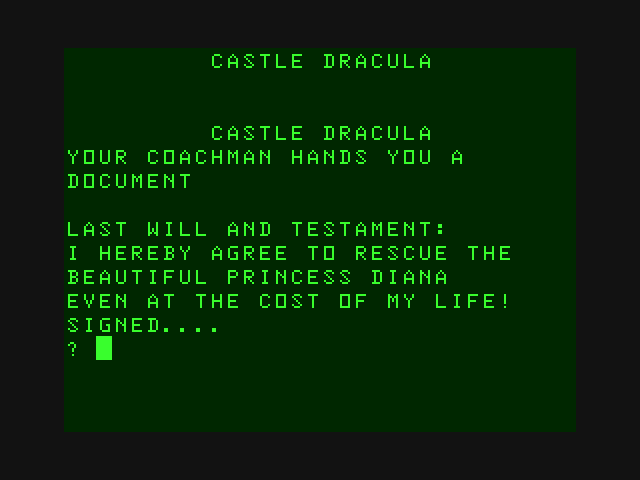


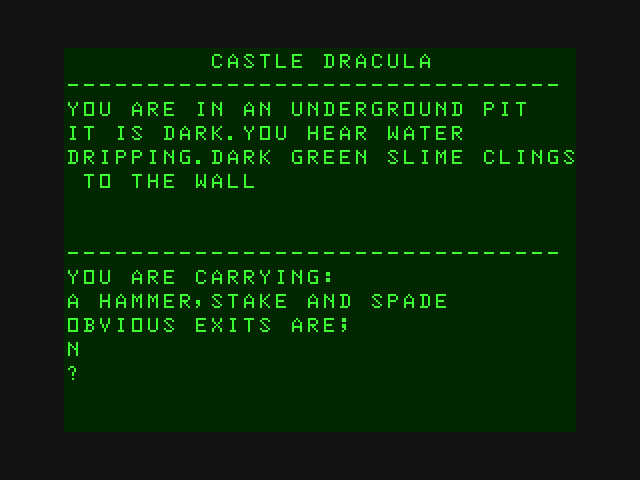


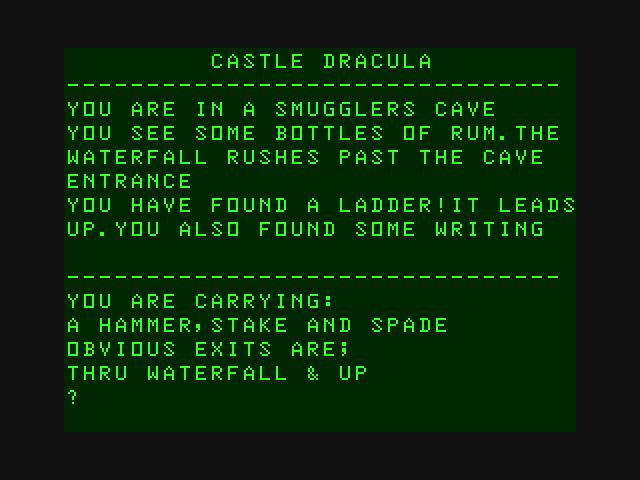

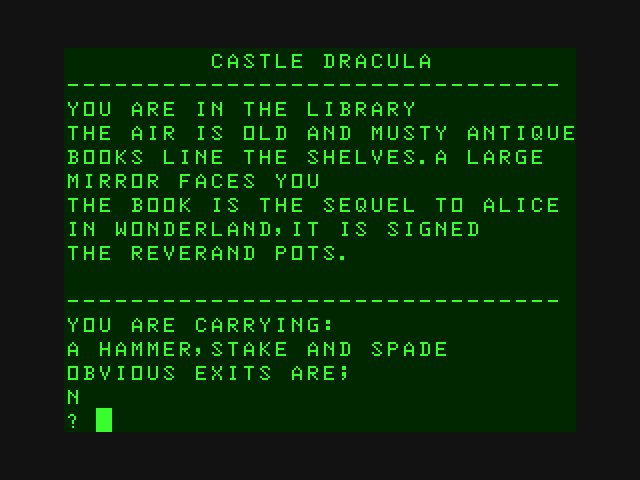


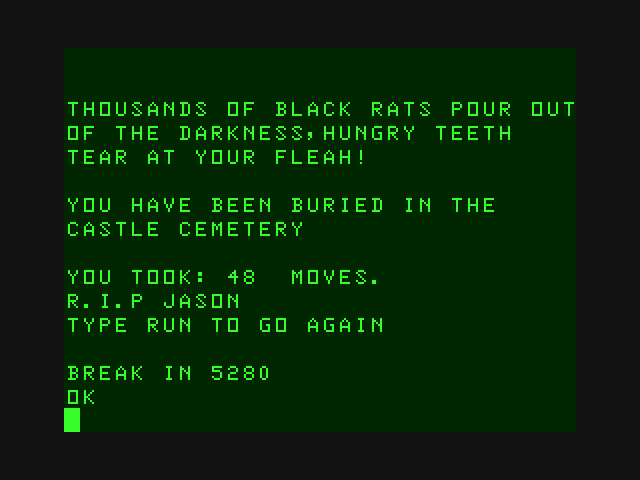


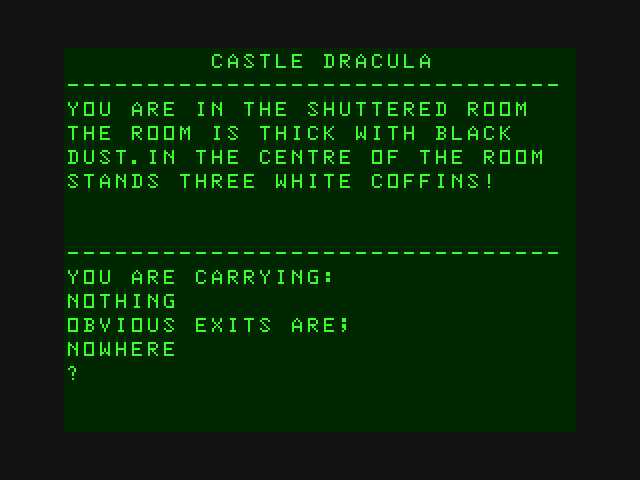
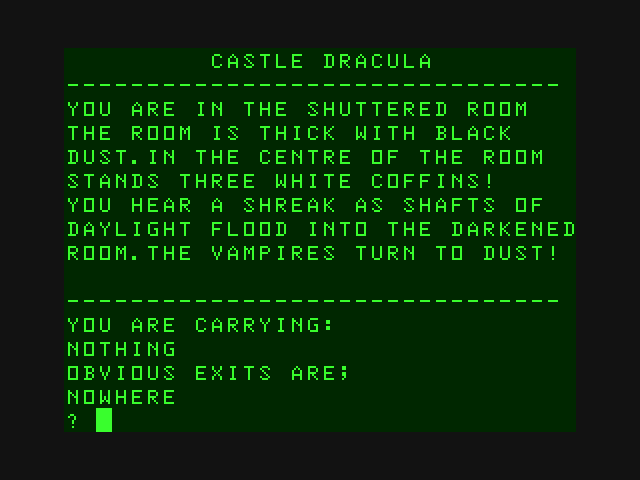

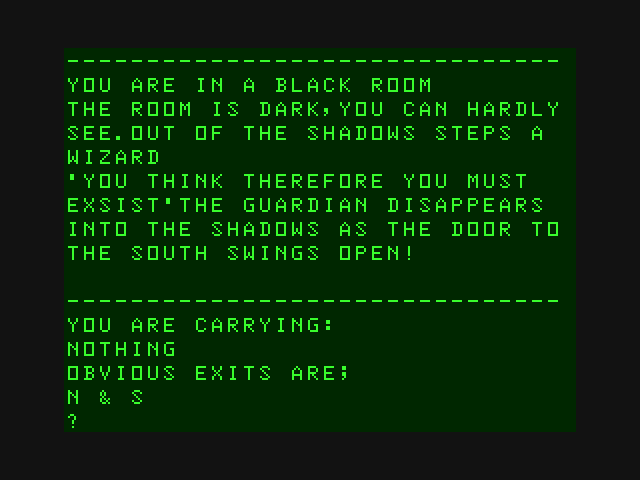

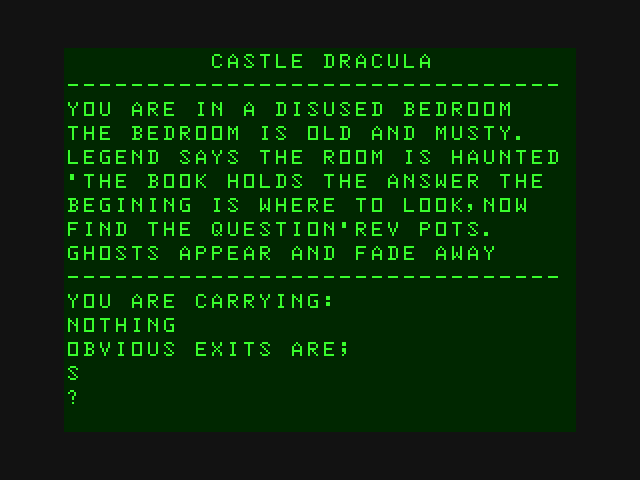


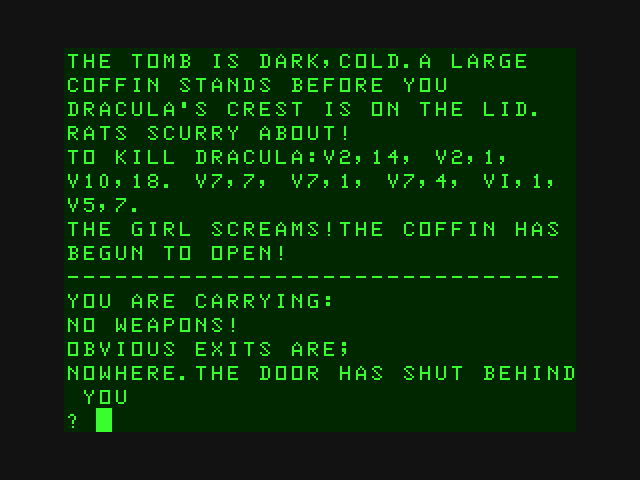
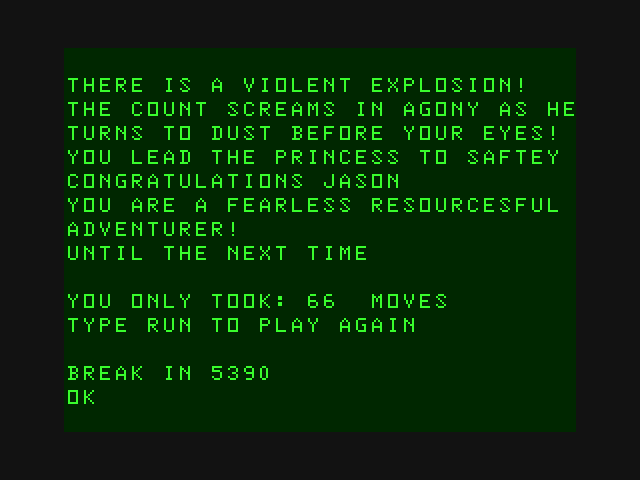


 Renga in Blue