So: you’re a budding author determined to produce the most difficult text adventure ever made. How do you proceed?
If you’re Rod Underwood, by horror vacui.
Horror vacui (“fear of empty space”) refers to the artistic practice of filling every nook and cranny on a page or painting, most famously exemplified by the Book of Kells above.
In the sense of this game, it’s filling every space possible with a puzzle. Nearly every location and object has some aspect that can either a.) kill you outright or b.) cause you to make the game unwinnable.
Like this item adjacent to the very first room:
>WAVE ROD
The star snaps out on a chain. The morningstar is a tricky weapon and you bash your brains out.
Your life is over.
Nearby, you find an elixir on a spider web. While you are predictably killed by the spiders …
>E
A horde of spiders swarms over you and eats you.
You are very dead.
… you are also killed by the elixir itself.
>DRINK ELIXIR
You drink the elixir. You start to shrink… you’re changing .. Hey, where did you go?
You’ve passed away.
So far, this feels like the Philosopher’s Quest strategy, but that map was sprawling compared to this one.

The right half of the map that I have so far. The left half has an arrangement of hexagons making a spider web, but most of the rooms aren’t useful.
I’ve found 13 locations of significance, and I count 11 open puzzles. Here are all of them:
1. There is a sword in a stone (the REJECT one I quoted in my last post). I can eat a sandwich to gain strength and pull out the sword, although it breaks off at the hilt (I have no idea if the breaking is a puzzle, but the hilt counts as a treasure). However, the sandwich causes nausea and death shortly afterwards.
2. There is a “fungi room” with a “rapidly growing vegetable being”. You can JUMP to avoid immediate death (“You leap over the creature’s limbs just before they close over your legs!”) but after a few turns the being grows too large and kills you.
3. I found (via use of magic word) a customs room.
You are at the customs. The only exit is a portal pulsing red-green to the north. There is a notice here: Any goods left here are stored and will be restored when you leave. Items needed for survival are allowed. Duty is charged.
A fanged customs official waits for you to declare your goods.
Saving your game is safe here. I presumed storing treasures might work as well, but if I try to “declare” one it just disappears. I don’t know what that business about things being “restored when you leave” is. Also, if you’re carrying a rucksack with items inside and you try to leave the room all the items in the rucksack disappear.
4. There’s a desert area where you quickly die of thirst. You have a flask which presumably contains water, but it just breaks and gets you wet if you try to open it.
5. There’s the previously mentioned spiders, which trigger when you try to leave the center of a large spider web.
6. There’s a dragon that outright fries you if you try to go by.
7. There’s a knight that “challenges” you and blocks your way. You can distract by handing him your morningstar (see the first excerpt in this post). If you go back to the same room he returns to his normal behavior, and you can’t get the morningstar back.
8. There’s a cave blocked by an illusion of fire. I was able to pass through and rescue a harp, but there’s also a mirror in there that I can’t take out (if I do, I spot an image of the fire in the mirror that causes the character to pause, and the fire becomes real).
9. There’s a bird in a forest that I don’t know what to do with; if I try to pick the bird up it dies immediately.
10. The forest itself is a maze, and I am unclear if there’s a way to navigate it or if you’re just supposed to stumble at random.
11. It’s unclear how to drink the elixir while surviving it, or if you’re even supposed to (I’m guessing either you get rid of the inside and just use the bottle it came in, or you give it to someone else to drink).
I won’t count it as a #12, but I may or may not have incorrectly gotten past a lock. I was able to BREAK LOCK with ease but knowing this game you need to keep the lock for something later. Strangely, the same room had a key, but no verb that resembled UNLOCK LOCK or PUT KEY or the like was even recognized. This game is so unnerving that even after solving a puzzle I wonder if I’ve really solved the puzzle.

Let’s take a break from light TRS-80 games and bring the pain instead.
Quondam is the third game written for the Phoenix mainframe at Cambridge University. If you’re a regular reader, you might recall the first was Acheton, which was somewhat intended as a more challenging version of the original Crowther and Woods Adventure.
Philosopher’s Quest followed and was even harder than Acheton. Philosopher’s Quest is one of the hardest games I’ve ever played.
Rod Underwood must have taken a look at both games, decided they just weren’t hard enough, and wrote Quondam.
The original mainframe version has been lost, but a port by Peter Killworth survives for the BBC Computer, so that’s the version I’m playing. To give you a sense of what I’m up against, here is my attempt to “save” at the start of the game:

This marks the first and possibly last time a save game feature ever killed me. (At least you get some cool shades to die with.)
Quondam is otherwise (so far) bog-standard fantasy, although it’s clear the tone is tending to the silly:

There’s treasure collection (again) but the manual is enigmatic about what to do with the treasures:
During the game you can display your score by typing SCORE and pressing RETURN. You can earn points by visiting risky areas, but most points are scored by depositing treasures in the ‘safe place’. This place is accessible at various times, but needs thought. Beware of puns!
Via an old eBay auction.
The obsession to find the first instance of something can occasionally make sense. We can trace patterns that stem all the way to the beginning. For example, the first Sierra game (Mystery House) established a penchant for instant-death that became nearly a Sierra trademark for a decade and a half, and the attitude was one that their competitor Lucasarts specifically was in opposition to.
As a rule, adventure games should be able to be played from beginning to end without “dying” or saving the game if the player is very careful and very observant. It is bad design to put puzzles and situations into a game that require a player to die in order to learn what not to do next time.
— Ron Gilbert, Why Adventure Games Suck And What We Can Do About It (1989)
Even in the case where the first instance of something was never followed as an example (due to obscurity of the work itself, the idea being too far ahead of its time, or random luck), it’s interesting to see as a proto-concept free from outside influence. A good example of this would be how Mystery Fun House manages participatory comedy even when the text is typical 1979-level sparseness.
Alternately, we can see early ideas that die as object lessons, getting a good notion of why nobody desired to copy a particular concept and if those conditions still hold now. The lack of compass directions in Empire of the Over-Mind come to mind; we can see the concept doesn’t mesh well with large-scale maps, and this also suggests that a map without much traversal (like some modern interactive fiction) would fare a lot better.
However, I don’t think it’s useful to think of being first as some sort of trophy, a historical totem to claim person Q’s biography is superior to person R’s, or to insinuate group X is better than group Y. First, this suggests history itself is some sort of competition. Also, convergent evolution can lead to entirely separate people coming up with the same thing (see how Wander did adventures before Adventure) and just because something made it to market in July rather than August doesn’t mean it is a superior. In fact, due to the factors of obscurity/luck the second or third to arrive at an idea can be much more influential than the first.
This is my rather long-winded way of introducing Atlantean Odyssey as likely the first full graphical adventure game, ahead of Mystery House.
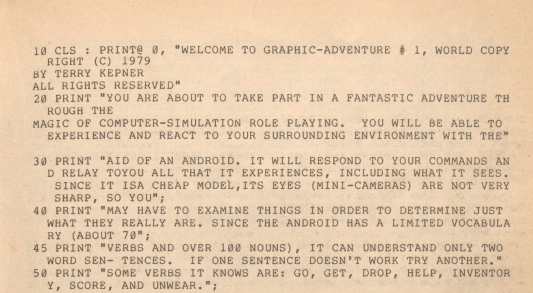
Some caveats:
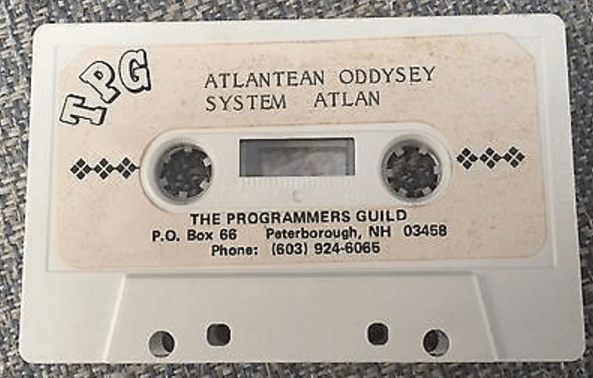
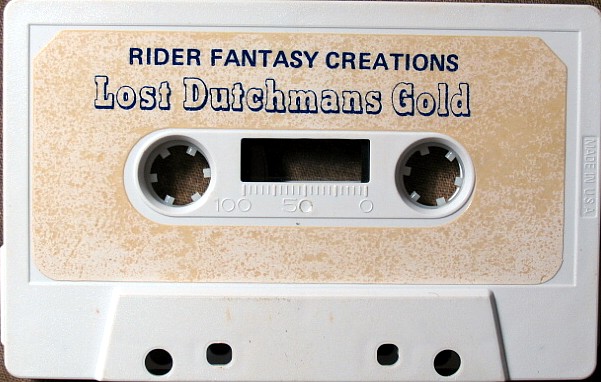
“Likely the first”: We have the source code above, solely credited to Teri Li (which includes lots of POKE statements to make the graphics, basically making assembly language in BASIC source) although I haven’t been able to find it published anywhere except The Captain 80 Book of Basic Adventures which came two years later. Based on the history of how Spider Mountain was written, there is strong reason to suspect this version had a 1979 release in stores. However, the only extent tape copy I have been able to find (see eBay picture above) is a machine language version released a year later which adds Mark Robinson to the credits. It’s still possible with a 1980 release it came first, but I haven’t been able to dig up any records.
“Full”: One could reasonably point out that earlier mainframe work like Zork and Stuga had the occasional ASCII art, which arguably counts as “graphics.” However, the use was intermittent; it’s not like every room had an illustration.

In any case, with the fussy details out of the way, how does Atlantean Odyssey play?
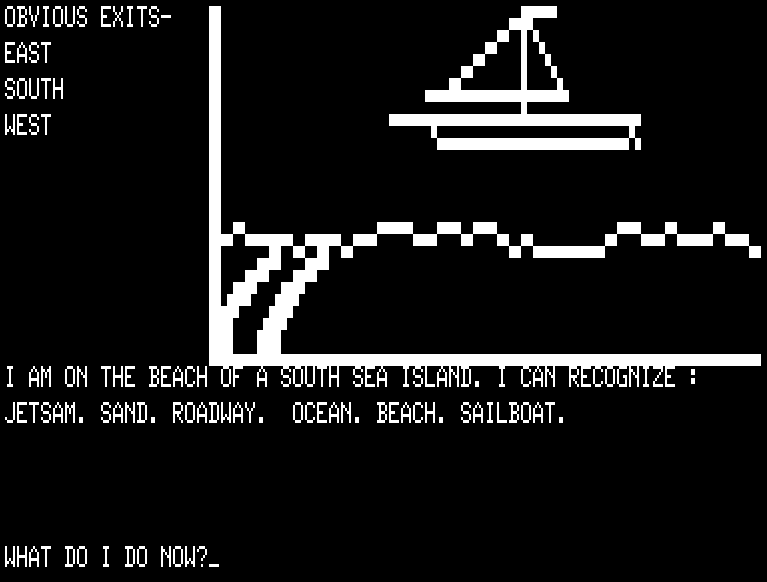
The goal, as usual, is to find all the treasures (6 of them).
The very first room has a sailboat you can board with a knapsack, a speargun, a flashlight, and scuba gear. All of these items are entirely unnecessary. The scuba gear does let you dive underwater, but the capacity runs out fast enough I believe it won’t last the whole game (there’s a magical solution the game gives you right away that lets you avoid the issue). The flashlight is rusted and broken. The speargun can be used on a nearby shark but the shark just kicks the player to “Davy Jones Locker” (aka death).
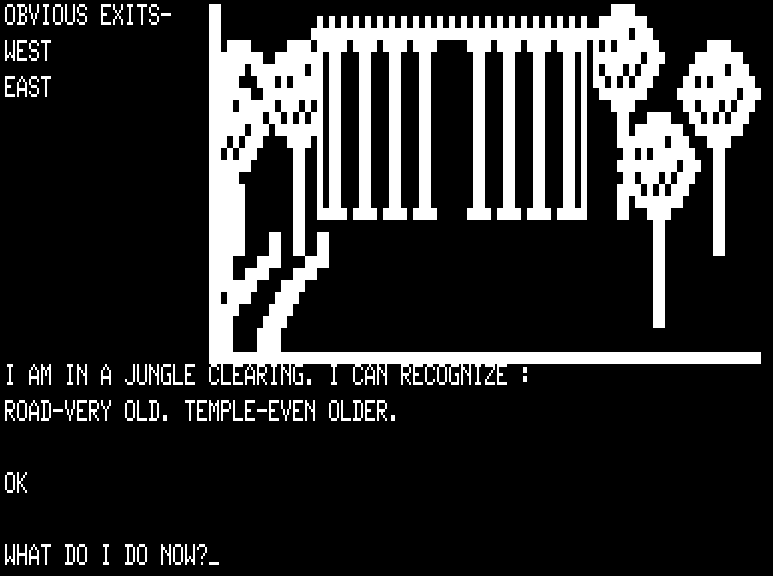
Nearby you find a medallion:
A FLAT HEXAGON WITH A RUBY-SAPPHIRE-BLUE DIAMOND AROUND A GREEN OPAL
and a hint on a temple wall:
I SEE A BAS-RELIEF SCULPTURE OF A MAN WEARING A MEDALLION. HE IS UNDERWATER, AND THE MEDALLIONS RUBY IS GLOWING!
By typing “PUSH RUBY” you are able to dive underwater, finding a second temple.

There’s another mural, which hints that “PUSH OPAL” will be useful; it takes you to another portion of the ocean where the game continues.
I’m not going to walk through every event that follows (it’s straightforward looking at everything in the environment, and further use of the medallion) but I did want to point out the main difference between this game and Mystery House: the game is entirely self-sustaining without the graphics (there’s even a later C64 version which doesn’t have graphics). Items are described in the text, rather than drawn in the room, so you don’t have the Mystery House situation of trying to guess what sort of object a squiggle is indicating. When there’s a door, the “open door” and “closed door” variations of the room look exactly the same.
Atlantean Odyssey’s method became the mainstream for text adventures; Infocom, Magnetic Scrolls, and Legend games generally had all the necessary content in the text, and even allowed for turning the graphics off if desired. (Zork Zero is the only exception from those companies I can think of, and that’s simply on particular puzzles like a peg-jumping one where graphics are needed.)
Mystery House’s method, on the other hand, led directly to the thread of interactivity directly dealing with with graphics instead of text, resulting in 1984’s King’s Quest I and all those games that followed.
My usual online-Javascript site doesn’t do well with this game, so if you’d like to try it out, you’ll need an emulator and a download. It’s a little less ambitious / revolutionary than Mystery House and consequently a little more playable.

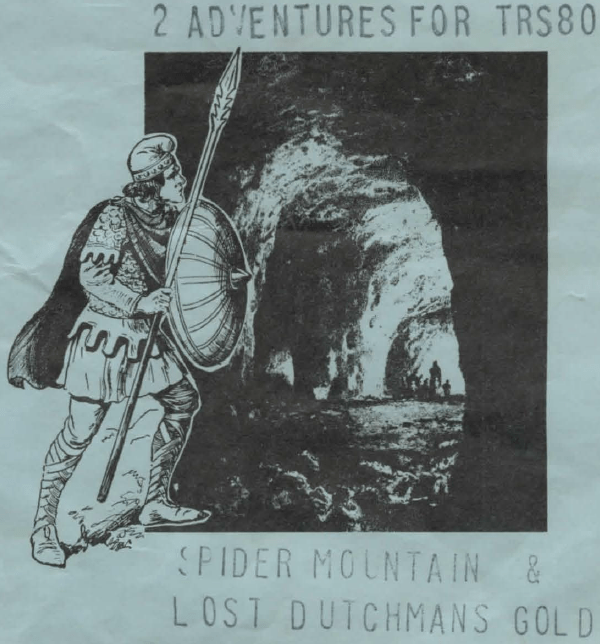
Teri Li wrote Spider Mountain and Lost Dutchman’s Gold almost back to back in the early days of commercial adventure. If one examines the two programs it is easy to see that the same structure was used in both. However, the map paths are profoundly different.
— From The Captain 80 Book of Basic Adventures
The above quote comes from Bob Liddil, who is also listed as a co-author (he states elsewhere that he “finished” the work). It is something of an understatement.
This is a fantasy reskinning of The Lost Dutchman’s Gold. The author essentially cut and paste the source code as the basis for a new game.
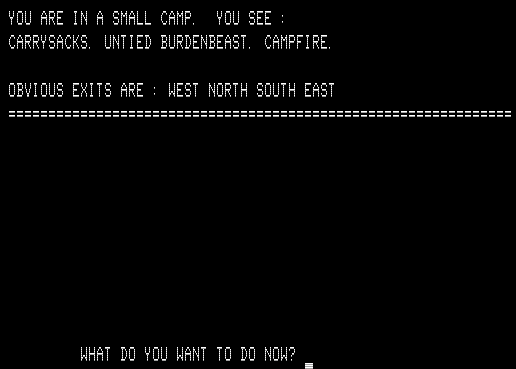
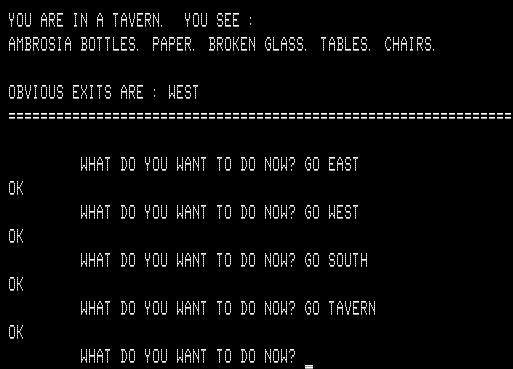
You start, as in the previous game, with a mule, er, “burdenbeast”. You get “beast snacks” and a “handweapon”. (Unlike the mule, you can ride this animal. Still a neat piece of atmosphere.) After heading west a bit there is a village to the south with a tavern that is nearly a clone of Lost Dutchman’s Gold.
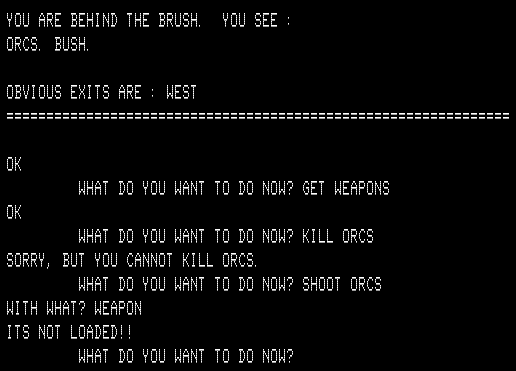
Perhaps most bizarrely, the scene with “Indians” is still present, but has been substituted with “Orcs”. The scene is just as useless in this game, and somehow even more uncomfortable knowing the substitution was made.
The “dungeon” area this time is hidden in the tavern instead of the mountain. The area below is quite simple and essentially danger-free — the only way I found to die was to forget to light my torch before exploring, where I was dramatically eaten by the spider Shelob.
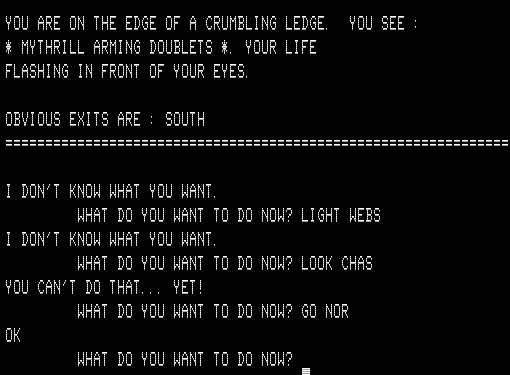
I did like how YOUR LIFE FLASHING IN FRONT OF YOUR EYES is an item, but there is no danger here.
There are essentially no puzzles (you have to dig in one place, but the game telegraphs this clearly) except for one room, where getting a treasure causes the door to close and seal you in.
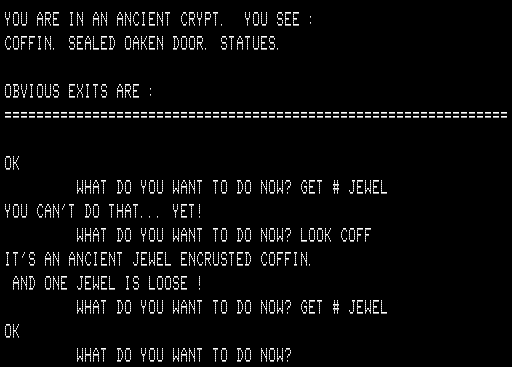
There is a hint from earlier: “THERE’S SOMETHING MAGIC ABOUT HOME.” If you SAY HOME while holding one of the other treasures (a gold ring) you are teleported back to the base camp and escape the trap.

I’m suspect (given the origin history) that Teri somehow planned to make a lot more changes, but gave up early. Then Bob Liddil offered to finish and publish the game, and the odd parts stayed in. I’ll call this an early blip in history, because Teri Li has one more adventure up his sleeve after this, and it’s a far more important one to the history of games.
ADD: Ok, the backstory is a little more interesting. From Terry Kepner himself:
The only thing I would add is that, typical Bob, when he returned from his first run at showing Lost Dutchman’s Gold with orders for three more titles, he told me we had a whole week to write the second game, as he had promised it to the store owners the next Friday! My conversation for the next hour was mostly four-letter words. But we did it.
That would explain the cut-and-paste!
Well, I suppose it was inevitable. I announce I’m done with 197X and almost immediately afterwards I discover a game that’s been misfiled. To be fair, most copies state “copyright 1980” (and seem to be derived off the source code published in Byte magazine, December 1980) but the TRS-80 version at least is clear:

This game (and the followup, Spider Mountain Adventure) was written by Teri Li (a pseudonym for Terry Kepner). The goal is simply to find the secret Lost Dutchman’s Mine and retrieve four treasures.
Really, based on the first couple screens, this game has amazing atmosphere: you get full saddlebags, a rifle *and* a gun, a map, and a mule that you can load the saddlebags on.

As seen in the title screen shot, the “computer voice” is actually a dead character (“the ghost of Backpack Sam”) inside the game world. Later, you even find a room with PILE OF BONES (MINE). The default messages keep this unique flavor:
>GET MULE
JUST WHO DO YOU THINK YOU ARE, PAUL BUNYON? YOU’RE NOT STRONG ENOUGH.
>DIG
OK
DAG NAB IT! THAR’S NOTHIN’ HERE!
You can feed the mule and lead it around, and it can carry your saddlebags around for you. Nice!
Unfortunately, after this opening phase, things break down pretty quickly. To get to the mine, you need to be holding the map, and then in one of the locations type >FOLLOW ROAD. Note that >GO ROAD is actually parsed and goes to an entirely different location!
The saddlebags have some lovely mimesis, but they end up being a pain. While they can hold quite a bit, the the number of items you can hold in your hands is a low number. This means at nearly every action I was doing inventory juggling; this is similar to the issue I had in Adventure 501 where a smarter container system actually made for worse gameplay. Historically, this sort of thing is cured once automatic item juggling becomes common (that is, if you need to use the map, having the game automatically put items and take them out for you).
When I found my first treasure, *SPANISH COINS*, I had no idea how to pick it up. After checking the source code, I realized that unlike every other game of this time, the “*” marks aren’t just decoration noting the item is a treasure – you have to use them in the parser. That is, >GET SPANISH is unrecognized, but >GET *SPANISH is.
The mines are simplistic. You go to three different rooms and DIG to find the treasures. The only real danger is from the fact there’s a maze with no exit whatsoever.

Then there’s this:
THAR’S NOISE UP AHEAD.
SOUNDS LIKE INJUNS.
>GO BUSHES
YER BEHIND A BUSH.
YA SEE: INDIANS. BUSH.
OBVIOUS EXITS: WEST
It’s hard to come across this scene without feeling uncomfortable. The entire genre of Westerns has always had trouble with Native Americans, in the same fashion that a story about colonialism has intrinsic issues that can’t be shuffled away. Throughout much of its history the genre stomped through them without much self-consciousness; I think perhaps the turning point was John Ford’s last western, Cheyenne Autumn (1964), which nearly comes off as an apology for his earlier work. In any case, by the 1970s the genre was still out there, and books could still refer to “injuns”, but there was definite awareness of a Problem.
Oddly, the case here is redeemed, perhaps accidentally, by: a.) the line being delivered by a dead character in the story as opposed to a “modern narrator” and b.) the fact that if you try to fight, you will get killed. There is no way to “win” against them. This marks the third game I’ve played so far (here’s the first, here’s the second) where you are given a weapon (here two weapons!) that serves no purpose at all.

From the published game cover.
Still: the first adventure game western! (Not the first electronic game — there’s Highnoon (1970) and The Oregon Trail (1971) for instance.) It must also be said that computer-narrator-as-in-universe character is pretty unique for the time, so even though this game is extremely rough, it’s got genuinely intriguing innovation going for it.

A winner is me. I switched later in play to the Apple II version, which is why this screenshot looks different from the others.
Despite the lure of the walkthrough, I managed to finish this one all on my own. Be warned: spoilers on absolutely everything.

Where last I left off, I was searching for a secret door of some sort. I ended up finding it in the study.

I had previously done LOOK PICTURE to get the helpful response:
ITS NICE BUT NOT EXACTLY MY CUP OF TEA.
THANX FOR THE LOOK THOUGH.
Since there’s no “SEARCH” command and LOOK by default seems to cover that verb, I thought the picture was adequately accounted for, but apparently I was supposed to GET PICTURE:
IT IS FASTENED TO THE WALL WITH FOUR BOLTS
Oho! While there is no screwdriver object, a butterknife was sufficient to reach a secret button:

This led to the basement, where I found a key and a body (poor Tom!) holding a daisy. Given Daisy was my last blonde-haired subject left, the killer’s identity was clear. (Not like there is actually any need at all to worry about names or the identity of the killer — more on that in a moment.)
While I couldn’t go back the way I came, I did manage to escape via a whole to a large tree with a telescope, which led me to discover a previously unseen trapdoor on the roof of the house. Dropping down from the tree led me to a “forest” which is, huzzah, a maze. (Sigh.) Navigating the maze led me back to the house where I was able to get back to the trapdoor and make The Final Confrontation:

SHE IS GOING TO KILL YOU
As you may be able to tell from the screenshot, it’s just her; there’s no need to worry about fingering the right person as the murderer. In any case, I tried defending myself with a handy dagger and sledgehammer but both of those options resulted in my being stabbed. Fortunately the game let me retreat and consider my options.
At this point I went back to peruse the instructions, and I noticed WATER ON as a possible command and made some sad growling noises. I had been trying quite a while to work any of the sinks in the game, since there’s a pitcher that seems like it ought to hold water but any possible permutation of ACTIVATE SINK failed me. WATER ON did indeed work, and now I had a full pitcher of water. Where should I use it?
Assuming Daisy was not the Wicked Witch of the West, I needed something a little stronger than water to take her on. I remembered the death-by-candle (I wrote about it in my last post) actually gave me a turn before dying, so I decided to try it out on the fire that got set on the rug. This resulted in a hole in the carpet, which coincidentally revealed a key.

This may be the dumbest luck in any videogame ever, and that includes Jinxster.
Remembering the locked chest upstairs, I tried the key and found a gun. Invoking another Colonel’s Bequest trope, I went back up the trapdoor and did away with Daisy once and for all.
At this point I could theoretically leave, but the game didn’t consider me done yet. I apparently needed to find some “jewels” hidden in the house. A note by Daisy mentioned they were in the basement. Returning there and messing with way too many unrecognized verbs, I finally hit about RUB ALGAE (not CLEAN even though it seems to be recognized!) which revealed a brick hiding the jewels. Grabbing the jewels and leaving the house, I finally registered victory!

Alas, not so satisfying. I don’t know if my posts have made this clear, but the game was very bad. It has:
- Easily the worst parser out of any game I have played. (Yes, I mean all of them, not just the ones I’ve written about on this blog.)
- Way too many circumstances where I was struggling to know what a particular item in the graphics was and what noun to use.
- A nonsensical plot where immediately upon leaving the initial room all the participants are murdered instantly, except for Joe (who I guess made it to freedom now, I don’t recall seeing his body).
- A maze even more pointless than normal; it only serves to make it slightly harder to make it back to the house. I forgot to mention that the way back to the house is UP — one of the rooms has a door leading to the house, but of course you would logically see that, except it’s the same forest graphic as all the other rooms. This is only mitigated by the fact I had found and mapped the maze beforehand.
I think perhaps the game is more known by the concept and historical value rather than any actual playability. I hope I’ve proven so far that it’s possible to have both. Still, I do like quite a few of the later Sierra games (infamous insta-deaths and all) so I can’t feel like I’ve wasted my time.

Arguably, reading a novel requires a greater act of imagination than watching a movie — even the most thorough of textual descriptions won’t fully convey what a person or scene looks like. However, one could counter-argue a movie simply requires different acts of imagination.
A common movie technique is to make an “establishing shot” of a scene, then show a close-up — we are meant to imagine the people are still inhabiting the scene, even if we can’t see it. An internal monologue which might be fully expressed on a page might be merely implied by an actor’s facial expression. Watching the movie is an imaginative act, even if we’re unaware of it.
Adding graphics to computer games was a way of filling the “imagination gap”. In the process, though, other gaps were added, either inadvertently or by design.
The design of Mystery House wants the pictures to be our window in the world, and the text to be only incidental. Items that you can pick up are only conveyed by the picture.

Just at a glance, would you think from this scene that you can pick up a towel?

When look at this scene, do you think the middle of the room just contains some boards (as I did) or does it contain a sledgehammer?
Clearly, the idea here is equivalent to not writing out the actor’s internal monologue, but having them just act instead. Visuals mean aspects of the text can drop away. (Unfortunately in this case, it also means a lot of guessing what cryptic background objects might be called.)
…
The similarities to The Colonel’s Bequest continue: the initial cast of this game was: Tom, Sam, Sally, Dr. Green, Joe, Bill, and Daisy. So far I have found four of them dead, leaving Tom, Joe and Daisy. One of the bodies (Sally) had a blonde hair on it, suggesting the culprit was either Tom or Daisy. This reminds me of the one-clue-per-body plants that ran throughout most of Colonel’s Bequest (that game had the difference that the clue might have been either where the murder happened or where the body was later deposited).
Also, (again like Colonel’s Bequest) there are lots of ways to die which don’t seem to be related to the murderer. Turning on the stove in the kitchen results in it exploding. If you try to walk out of the dining room while holding a lit candle, you accidentally set the carpet on fire.

The most amusing death is reserved for trying to escape the house out the attic window:
OW
YOU FALL TO EARTH. LUCKILY YOU HAVE ONLY MINOR INJURIES. UNFORTUNATELY THE AMBULANCE DRIVER SMASHS INTO A VOLKWAGEN. NO SURVIVORS. YOU ARE DEAD.
In any case, I’m horribly stuck – the only thing I have resembling a puzzle I haven’t solved is a chest upstairs that needs a key I don’t have. I assume there’s some sort of secret passage activated by some graphical item in the background that I can’t decipher. I haven’t resorted to hints yet, but the lure of the walkthrough is strong with this one.

Especially when the parser is this frustrating. Argh.

Ad from SoftSide, December 1980 issue.
I’m not the first one to make the connection, but the very first game produced by Roberta Williams — Mystery House — is something of a predecessor to the one I just played, The Colonel’s Bequest. It’s very up-front that the plot will consist of an inital cast being slowly murdered, one-by-one:

The extra twist here is that you can be one of the victims. (The main character of Laura Bow was not part of the will of The Colonel’s Bequest and hence was never a target; the methods of dying in that game involved more mundane things like falling into water or getting kicked by an angry horse.)
In any case, Mystery House also holds the distinction of being one of the two candidates for First Graphical Adventure Ever. (I’ll get to the second candidate after I wrap up this one.) This allows for a distinct quality not seen in previous games: the text does not contain all the information you need to understand what’s going on.
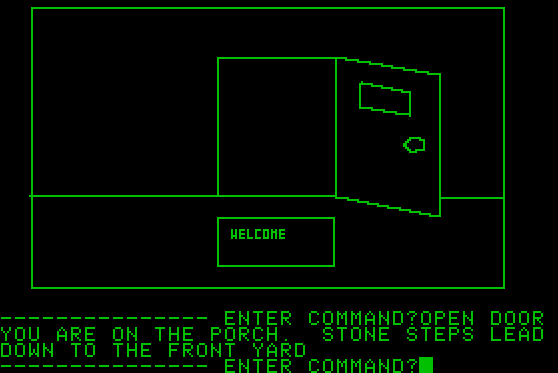
For example, in this early scene, the text implies but not explicitly state there is a closed door. The only feedback to >OPEN DOOR was graphical, with no textual change at all. Entering the door gets this message…
THE DOOR HAS BEEN CLOSED AND LOCKED
…locking the player in with this strangely-drawn rendition of the cast.

>LOOK PEOPLE incidentally gets the message “the people were explained at the beginning of the game”. In particular the instructions list the cast, and for some reason their hair color (?)

The first body is only a few rooms away. Sam, the mechanic, has been hit by a blunt object.

Given Sam was just alive two rooms over, it appears the mysterious teleporting murderer is back in action.
I’m guessing (hoping, I suppose) this is shorter than some of the other works of the time due to the necessity of storing lots of pictures. Just for fun, here is the same scene with Sam rendered in a Japanese version of Mystery House (via Hardcore Gaming 101):


From Captain 80 Basic Adventures.
First off, note that all my travails are archived at this link: All the Adventures.
I was browsing my old posts, and I dug up this one from way back in 2005:
However, most details I’ve seen (on those companies specifically and in general) tend to be on the companies themselves, rather than innovations in game mechanics. There’s a lack of material on the actual content of games, so a student looking for a particular element needs to start from scratch; there’s an intimidating number of works to plow through if someone is searching for a mechanic rather than a plot theme.
I find a real need for the sort of history work done with art and music history, with details about content that go past “in the old days, there were more mazes than there are now” so a future scholar can pick out that obscure game from 1980s that advances his or her point.
Even though I wrote this excerpt long enough ago I forgot it existed, it captures some of my motivation. If nothing else, looking at adventure history this early results in a lot of Firsts, and by playing everything I can say fairly definitively when things were actually first, like “this was the first time relative directions in an IF game were tried” (see: Mystery Mansion) or “this is the first experiment where navigation is done without a compass at all” (Empire of the Over-Mind).
Some other curious firsts:
– First defined player character: Aldebaran III
– First use of choice-based interaction in a parser game: Stuga
– First dynamic compass interface: Spelunker
– First dynamic puzzle generation: Mines
– First free-text conversation in an adventure context: Local Call for Death
– First adventure game comedy: Mystery Fun House
To another very real extent, though, the history is incidental. I just happen to love adventure games dearly. I want to get better and playing them, and I want to see and experience as much as I can.
My current (probably inaccurate) count of adventure games for 1980 is 63 items, more than I’ve written about so far (for the record, 47 games). I realize there is no chance I’ll ever finish every year; time keeps advancing and more adventure keep being written. Let’s see how far we can get, though!
As I mentioned in my last post, I technically “finished” already, but I felt like I had some “loose threads” to tie up. Most specifically, I wanted to find out where the bodies ended up.
More generally, I was hoping I’d learn some more information that would make the mystery not seem like one gaping plot hole. Alas, as I learned more, things got worse rather than better.
I’m about to unload a pile of grievances, so let me just say: what this game tried to do was unique for the time and even for now. When it works, the game feels like pure Story, like you are dropped into a Simulated Universe or Futuristic Holo-novel. Furthermore, while there’s nothing you can do to prevent the murders, there’s still a legitimate amount of interactivity; more recent attempts at this sort of thing (let’s say Tacoma) put the player at arm’s length from the story and are more of a guided tourist plan. I recommend any game designer interested in narrative try this at least once. However….
(WARNING: Past this point there are spoilers and a lot of ranting.)

… the game itself is often just awful to play. Take the quasi-time element, where time only advances upon finding notable events. First off, this isn’t always the case — in one place the clock advanced three times for no apparent reason, and at another juncture I found multiple bodies with absolutely no advance in time. Quite often I needed the clock to advance but couldn’t work out how. My only recourse was to go through every room in the game hoping something would trigger (sometimes twice because I missed something). Once I was stuck so long I thought I had “soft-locked” the game (that is, got it stuck with no possibility of advance) until I found out I could move the game along by knocking on the cook’s door (who doesn’t even let Laura in, it’s just a small piece of dialogue!)
Then there’s the promise of character interaction, which slowly got reduced to utter shreds. At the end of a long chain of puzzle-solving I found the dumping ground for all the mysterious disappearing bodies:

You think the Colonel might react a little, but >TELL COLONEL ABOUT BODIES just gives his usual default response.

After lengthly attempts to get characters to tell me something, anything, even to have a glimmer of a reaction, eventually mimesis was not only shattered but drop-kicked and melted down into a little puddle.
The mystery itself just didn’t work. I mentioned last time in the end scene you find Colonel and Rudy fighting upstairs; the correct action is to shoot Rudy. This is true even though the Colonel himself seems to be the one who ordered the bodies disposed of … except that doesn’t make sense in the case of his assistants Fifi and Jeeves, and when you start to track the character movements the plot makes less rather than more sense. Characters essentially have to “teleport” to cause the murders they supposedly do, and somehow multiple guests and the Colonel himself independently decide all the bodies need to go down the chute — why?
So while I’d recommend this one for game designers, I can’t in good conscience recommend it for a general audience. The Colonel’s Bequest attempted and failed to be the ultimate in immersion. I did finish the sequel The Dagger of Amon Ra (back when it was first released), and while the gameplay is much smoother it’s also a more traditional Sierra adventure game structure.
…
Soon to 1980, although I wanted to write a 1970s summary post first. Does anyone have any questions about the project as a whole? (Even plain queries like “which game was your favorite?” would be helpful.)



 Renga in Blue
