I’ve already written about the original mainframe version of Zork (by Tim Anderson, Marc Blank, Bruce Daniels and Dave Lebling). The common wisdom is that when Infocom was formed, the game was too large to fit onto a floppy, so it was split into three parts: Zork I, Zork II, and Zork III.
The reality is more that the majority of the game became Zork I, some of the spare locations and puzzles made it into Zork II, and Zork III has almost nothing in common except for some elements of the endgame.
The ramification for me is that I still have essentially all the notes necessary to complete the game! I’m going to map it fresh to still feel like I’m playing, but this is definitely going to be more like a replay than the epic multi-month struggle mainframe Zork turned out to be. I’ll still try to slow down and make design observations, and see if I can find any new secrets.
There were quite a few Zork releases; I have release 2 (the original TRS-80 release), release 88 (the most common version, and the one I believe you get if you buy this game from gog.com) and the Solid Gold release (which comes with in-game hints). I’m probably just going to do most of my playing in the newest version, because mucking about version 2, it doesn’t look that different from the last release! There just seem to be numerous bug-fixes, but others have already done an excellent job of tracking which bugs appear in all 14 known releases. (An even more extensive bug list is here.)
The earliest releases of Zork I (Versions 2 and 5) can become very confused if you nest objects too deeply in your inventory, such as putting the lunch in the sack, then the sack in the coffin. You may get very spurious output from the INVENTORY command like “Such language in a high-class establishment like this!” messages, with other random junk interspersed in it. This can also lead to the object hierarchy getting screwed up, in such a way that an INVENTORY might claim that you are carrying a bunch of rooms around!
Finding this game was like opening a secret door.
I first spotted it on The Big List of TRS-80 Software where it’s listed as “Adventure # 10- Marooned (124480)”.
Opening it up makes it look like an ordinary Scott Adams game, in fact, the last one I played, with the option to select an adventure all the way up to Ghost Town (#9).

If you take the leap and type in “10”, it still has a normal Scott Adams instruction screen …

… but then leads to something entirely different.

Kim Watt was prolific programmer and legend among the TRS-80 community for his utility software. This was clearly written between Scott Adams Adventure #9 (1980) and #10 (1981) although because this was an “unofficial” game, I don’t know if I can get more exact than that. Mr. Watt did start making significant money from his utility software starting at the end of 1980, so I’m going to guess this was a lark between mid-1980 and the end of 1980.
Unfortunately, the game also seems to be incomplete. I have below a complete transcript as far as I’ve gotten. It doesn’t look unreasonable, but that’s only because I have included just the commands that worked.
I’m in the passenger section of an airplane
Obvious exits: North, South.
I can also see: Empty seats
>GO NORTH
I’m in a cockpit
Obvious exits: South
I can also see: Control panel
>LOOK PANEL
I see
guages everywhere.
[Typo is in the game.]
>READ GUAGE
Plane is rapidly descending.
Steering mechanism is broken.
>S
>S
I’m in the tail section of an airplane
Obvious exits: North.
I can also see: Broken rudder cable – Tool box – Knapsack
>WEAR KNAPSACK
OK
[Note: This is a parachute. You cannot TAKE KNAPSACK.]
>OPEN BOX
OK
>LOOK BOX
There’s something there!
[Finds Wire cutters – Screwdriver – Wrench]
>GET CUTTERS
OK
[This is the only item out of the toolbox you can get]
>PULL CABLE
I found something!
[Hidden knob appears.]
>TURN KNOB
OK
Whooosh!
A secret door opens.
>OPEN DOOR
I can’t do that yet.
There’s an island you can get to according to the source code, but I haven’t been able to make it any farther past this point, and it’s so broken there’s a strong chance it’s impossible.
Alas, that means this is more of a historical curiosity than a game. Pyramid of Doom came out of a fan deconstructing the Scott Adams file format; it’s interesting to see someone even attempt roughly the same thing with the notion of making the next numbered game in the series.
I have sympathy for Scott Adams here.
Adventure games were just invented as a thing. He managed to be ahead of his time with plot and puzzle integration (The Count) and participatory comedy (Mystery Fun House). This is despite the fact it wasn’t at all clear what would work and what wouldn’t.
A lot of what he tried in Ghost Town didn’t work.
This was partly, as I mentioned earlier, due to the structure. There aren’t many geographic bottlenecks, and not a lot of ones having to do with items, either. Essentially, the whole game is open, and finding all the treasures is a matter of prodding at every location until the obscurities reveal themselves. This deflates the implicit plot tension which comes naturally to adventure games. Again, I can hardly assign blame here; the idea that the structure of gameplay itself is plot is still often overlooked by those studying narrative.
Also, the attempt at making a “hard game” ran into a system that was not robust enough to handle it. A good difficult puzzle often requires a responses to a large variety of different verbs and more textual feedback than the Scott Adams system could manage.
Finally, one of the puzzles was uniquely, breathtakingly bad. It was the last one I solved, so I’ll get to it last.
I. The Ghost Piano Player
I mentioned last time that in the saloon, there was a ghostly piano player that would ocasionally appears. Also, a voice would sometimes whisper “Vain…” I definitely tried to put the two things together, but I was thinking “vain” in terms of appearance; however, the word can apply to abilities as well.
>APPLAUD
Ghost stands, bows, vanishes!
The ghost leaves behind a map, which hints at the location of a gold nugget.
I’ll have to give props for this one – the hint ended up being reasonable, and the only two plausible synonyms (APPLAUD and CLAP) both work. I got stuck mainly because I got hung up on a particular definition of “vain”. (This is also another one of those scenarios where only the parser works for the puzzle.)
Having said all that, this puzzle turns out to be entirely optional for walkthrough purposes – the hint off the map you get can just be used outright without interacting with the piano player at all.
II. The Ghost Violin Player
The game has a day-night cycle; after SUNSET everything goes dark and you need a candle to see. If you sleep in a bed (which you can summon up at the hotel) you can wake up the next day, but then find that in the saloon a pair of “worn out violin strings” has appeared. This is a hint that there’s even more ghostly happenings at the saloon.
Particularly, if you walk in the saloon after dark, there’s something that gets scared and leaves. If you enter wandering in the dark, there’s no such message. You can >LISTEN and get the message
very pretty
which could possibly be a little more helpful? Especially because the right action to do is DANCE:
OK
very pretty
I won a prize!
which yields a silver cup, one of the thirteen treasures of the game.
This one is … marginal. I like the tie-in with the day-night cycle, and I like the general idea of a ghost that avoids the light and that you can never see at any point in the game, but the actual action required is fairly cryptic (ties in with “Vain” again I guess) and “very pretty” is just a little too minimalist to fully convey the scenario.
III. The Second Hidden Exit
I had felt clever, but in a somewhat meta way, for noticing that in this room …
I’m on a ridge above a narrow ravine I see mountains in the distance.
… you got a special message for GO RAVINE …
Sorry I can’t
its full of sage brush, tumbleweed & is impassable
… which indicated BURN RAVINE was possible, then allowing entry.
Except there’s *two* exits. I had indeed tried GO MOUNTAINS
How?
which is the game’s universal prompt for saying something like WITH HORSESHOE. I thought, perhaps, I could do some climbing with the horse? In any case, while I had the sense there was a second secret exit, the parser led me to believe it was via use of item. I had to look this one up: it’s simply JUMP RAVINE
I’m on a ridge above a ravine
Obvious exits: West
at which point, my approximate reaction, rendered in letters, is ARRGGRAGRARGHGARGAGHGRGRFGRHM. At this point I shouldn’t be surprised at an inconsistent parser message leading me down the wrong path, but this one broke all trust I had in the game.
This was additionally painful in that in the real-life analogue of the situation, or even nearly any videogame rendition, there would be no puzzle here — it’d be clear there’s another path and you just need to get over the ravine to get there.
IV. No Really, It Gets Worse
Early in the game I had found, in the “telegraph office” which contains a safe and a telegram machine, that the safe could be moved revealing “2 loose wires”.
I’m in a Telegraph office
Obvious exits: South
I can also see: Telegraph key – 2 loose wires – Large safe
These wires can then be taken, although I was never able to find a use for them.
Again, I ended up needing hints, at which point I found out by taking those wires, I had lost the game.
Mind you, there’s no “snap!” message or the like when taking the wires, or even indication they are attached to anything at all. It turns out if you SPLICE WIRES or CONNECT WIRES you get “spliced wires”. The game is still unclear as to what’s happening, and even after beating the game I still don’t know. What I do know — and this comes entirely from just checking the hints — is that if you drop the keg of gunpowder in the room, and then set off the telegraph from afar, it will set off the gunpowder and blow up the safe.
This is true even though the splicing happens before the keg of gunpowder is set. I guess somehow the wires set off sparks? Why would they be behind the safe? Why would taking them “sever” them so easily? Why are the wires there in the first place?
V. By This Point My Resistance to Hints Was Nearly Zero
I knew I was eventually destined to ride the horse in the stable. (I get the impression that the horse *isn’t* that of the main character, which raises the question of who was maintaining the health of the horse?) I already mentioned my confusion regarding the RIDE verb; when attempting RIDE HORSE the game responded that I “may need to say a magic word here”.
I assumed this would be a magic word taught elsewhere in the game. It is not. You’re just supposed to have watched a bunch of old Western movies and guessed:
>SAY GIDDYUP
OK
GIDDYUP
after a long ride
He bucks, I’m thrown
he rides off without me
I’m in a hidden canyon
Obvious exits: none.
I can also see: TeePee
I know the baseball maze in Zork II gets constant flack for being the epitome of culture-trivia-knowledge puzzles, but to be fair, that puzzle is perfectly solvable without understanding the baseball references at all (I’ll refrain on giving further detail until I make it to 1981 in my sequence). The “magic word” here, on the other hand, is almost literally a trivia question.
VI. I Was Not Exaggerating When I Used the Term “Breathtakingly Bad”
Presented without comment,
I’m in a teepee
Obvious exits: North.
I can also see: *SACRED TOM TOM* – *TURQUOISE NECKLACE*
>BEAT TOM
Boom!
Boom!
it worked!
I can also see: Indian ghost
>LOOK GHOST
OK
I see
nothing special
>SAY HOW
How?
Geronimo says: “Its easy! Happy Landings!”
… at which point you get teleported back to the stable and ….
I’m flat on my back in a manure pile

OK, maybe a little bit of comment. In old Western cartoons (and other media, I guess) it used to be a thing where the only word Native Americans would say is “How”. I have no idea why this was so common. My first association with Native American languages is the Code Talkers where language was used straight-up as a “code” during WWI and WWII because it was too complicated for the opposing armies to decipher; almost the exact opposite of the stereotype. Even though people were aware past Native American depictions were a touch problematic by the time this game was relased, the “How” trope didn’t seem to bother the general public well into the 1980s. I’m not blaming Scott Adams here — none of the contemporary reviews seem to have even a whiff of the issue; it was just applying the same trope everyone else did. Geronimo’s coherent response in English and the subsequent landing in the manure pile might even be considered lampshading / aversion. That doesn’t stop the puzzle from being very bad.

From The Book of Adventure Games by Kim Schuette.
I’ve had two major breaks from clearing up some misunderstandings related to the parser.
1. There’s a “Jail” that can’t initially be entered.
Sorry I can’t
Doors closed, windows barred!
I tried some commands like OPEN JAIL and UNLOCK JAIL only to get the response “I don’t understand your command.”
Later, essentially by accident, I tried OPEN DOOR.
with what?
Inside bolt is latched!
Even though entering the jail says “doors closed” I didn’t occur to me try referring to the door directly, since there’s another door leading to a barbershop in the very same location so OPEN DOOR is an ambiguous command.
In any case, I had found a magnetized horseshoe earlier (there’s a compass that points to it if you USE COMPASS while the horseshoe is nearby) so I thought it’d be worth a try following up the “with what?” question:
Tell me what to do ? with horseshoe
Magnet!
it worked!
I was then free to enter the jail:
I’m in a jail.
Obvious exits: NORTH.
I can also see: *GOLDEN DERRINGER* – Locked door
You might remember the gun from Pyramid of Doom being entirely useless. The derringer is not useless, but it is, of all things, a water gun.
OK
shoots stream of water
2. There’s a scene in a stable where you get on a horse called ‘Ole Paint.
I’m on back of ‘Ole Paint
Obvious exits: Down.
I can also see: *SILVER SPURS*
RIDE is a valid verb, and takes a direction
Tell me what to do ? ride
Give me a direction too.
You can RIDE DOWN and then keep using RIDE to move around the town. I initially assumed I somehow had the horse with me, but no: the game is just taking the path of least resistance in checking if your commands make sense, and you aren’t riding anything at all. (Really, I should have spotted this, but I went on a “test ride” only once and didn’t think about it after.) If you instead do RIDE HORSE, essentially ignoring the syntax suggestion the game itself made, you get a different message:
Tell me what to do ? ride horse
may need to say a magic word here
After a bit more fiddling, I decided to wearing the spurs and SPUR HORSE.
He bucks, I’m thrown
I’m flat on my back in a manure pile
This turns out to be helpful because the kicking horse broke open an entrance to a hidden room, where I found a keg of nails. You might remember last time I needed a container for some gunpowder, and the keg indeed works. I haven’t been able to use it yet without blowing myself up.

Scott Adams promoting the game. From 80 Micro, July 1980.
I’ve made progress, although it took a bit of meta-knowledge to do so. (Complete spoilers follow.)
The last map I made marked a particular room:
I’m on a ridge above a narrow ravine I see
mountains in the distance
Some obvious exits are: NORTH
I noticed >GO RAVINE told me
Sorry I can’t
its full of sage brush, tumbleweed & is impassable
After a bit of thought, I took some matches I had and applied them.

I should note this is similar to the point on Strange Odyssey where I got stuck because I could take an exit that was in the room description, rather than in the list of objects. This time, explicitly thinking of that moment, I didn’t have the same issue. I’m learning! (… to solve brutally difficult early 80s text adventures. I don’t think that can go on my resume.)
And look, a mine! Finally, some geographic suspense? (Alas pretty much not, you’ll see why in a moment.)
In any case, before going down into the mine, I found taking the “Sagebrush charcoal” and mixing it with “Powder” and “Crystals” I found earlier let me get gunpowder. Unfortunately, I don’t have anything to carry the gunpowder around with, although I can think of at least two places where it might apply.
Going down into the mine led to darkness.

Lighting a match led to a long message about the match being lit, then going out. At this point I was *very* suspicious of a bug.
You see, I had decided I had suffered enough with TRS-80 emulators, and tried playing on something called ScottFree which will allows running the Scott Adams data files directly in a modern operating system. With the match, there didn’t seem to be any reason for the pause unless something was being displayed on the screen, and my danger-instinct kicked in that my interpreter was, alas, failing me. Switching back to a TRS-80 emulator (as seen in the screenshots above) resolved the issue.
Still: the match went out just the same; I could see the bullet and another exit down, but that was it. Having done enough games where wandering in the dark was a valid strategy, I decided to risk going down and checking again with a match.

Huzzah, a light source! Unfortunately, the very next room of the mine seems to be a dead end, so I landed in the same place I started – with no obvious blank spots on the map to fill in.
I did find something else interesting with the candle.
First let me mention there’s a “saloon” early on that includes a mirror that is fixed into place. There’s a narrow time span (marked by a bell sounding) where a ghostly figure plays an equally ghostly piano. I am unable to interact with either, however.
Later, after enough time passes, sunset falls and the town goes dark. A candle is needed to see anything. If you stand outside the saloon you can hear music inside, but if you go in with the candle still lit, whatever it was gets scared and disappears. (If you don’t have the candle lit, you can’t see, so it still isn’t helpful.) I’m not sure if the piano player is back, or there’s some other ghostly activity going on.
To top those things off, randomly throughout the game (from the very first turn) there’s a ghostly voice that keeps whispering “Vain . . .” This suggests something to do with the mirror in the saloon, but no matter of dancing or preening or gazing intently seems to be of use.

Maybe the *ghost* is vain? I still have no way to interact with them, so I don’t know what the ramifications of that would be.
Is there anyone out there who has beaten this game without hints before? (I don’t want any yet, I’m just trying to gauge the general spiciness of the game.)
After the frenzy of six games Scott Adams released in 1979 (two essentially written by other people) he took a little time before releasing Ghost Town in mid-1980.
As you might have guessed, it is Western themed. You’re tasked with finding 13 treasures in a town that appears to be empty. (How you got there and how you plan to get out are unclear, although there’s a horse in a stable I’m assuming is supposed to be yours.) In addition the traditional 100 points from adventures, this game has 50 bonus points. The general feel is pretty mysterious, so this might not be a standard treasure hunt.
I haven’t gotten deep enough to make many conclusions, but I don’t feel the same pull from this game that I do from the others. I’m still theoretically fine with a plotless gather-the-treasures experience — I enjoyed both Strange Odyssey and Pyramid of Doom — but they both were presented in a way that made exploration appealing. Strange Odyssey has you landing on a planet and finding an alien device which clearly lets you go places, although it took enough experimentation to figure out how it works it makes travel feel like a reward. Pyramid of Doom starts at the bottom of a structure and works up in a way that made me interested in what was around the next corner.
Ghost Town starts with what appears to be a “complete map”, with no obvious missing places other than a “jail” that is locked up. I can’t wonder what’s behind X because I don’t even know what X is.

There’s a piano playing ghost that appears in a saloon; a rattlesnake at “Boot Hill”; a shovel I’ve been able to use to dig up two items; a hotel room with a bed that only appears when you ring a bell. There’s not a lot of traction to grab onto here.
I’m not sure if there’s a good word for this phenomenon. I don’t need my next quest labeled with an arrow, but there’s also no appealing blank spaces on the map to go for. Maybe call it a lack of geographic suspense?
In any case, I get the impression he was “writing for his fans” at this point, by which I mean “starting to make things extremely hard, since there were already enough easier games in the catalog”. This game (and the Savage Island games that follow) have definite Reputations.

After all the complications of Quarterstaff, it’s a relief to jump back into a simple 1980 TRS-80 game. In this case, one published on the “tape magazine” CLOAD. (They called themselves “the first magazine to be written for computers … If you are a TRS-80, you can read it.”) If you remember Spider Mountain Adventure, that made it on a 1979 edition of CLOAD.
This seems to be one of only two games by Hugh Lampert (the other one, Medieval Adventure, is also from 1980) and given the game was meant to fit on part of one side of a tape, I didn’t have high expectations.
I was pleasantly surprised. Not in a “this is an undiscovered masterpiece” way — I won’t even disagree with IFDB’s current score of one-and-a-half out of five stars — but playing with some general expectations built in, it’s better than the usual tape game.

I could go on a long theory tangent here. Let’s put it in a footnote.
The general expectations are:
1. You’ll need to fish for verbs. This is definitely the year for guess-a-verb, far more so than previous years (which had a lot of either mainframe games which had enough capacity to be flexible, Greg Hassett games that were simplistic enough to not need many verbs, or Scott Adams games that generally well behaved about synonyms with the rare exception). For instance, the game starts in front of a tall office building where >ENTER BUILDING is not understood (you have to GO BUILDING). I just consider figuring out the “verb frame” to be part of the game, and keep a running list of verbs that work to aid with puzzles.
2. Verisimilitude is very light. As the excerpt above indicates, you play a government agent looking for a stolen ruby. You might expect an evil villian complex to be crawling with minions, but other than a door man that throws you out of the building at the very start (you need to drop your CIA badge outside, and then it’s ok; no, really, that’s it) there’s a grand total of one guard to deal with. You break into the president’s office and even the center of a basement lair without a single alarm bell. Everyone is out on vacation, I imagine.
3. Like Scott Adams games (which this one emulates in layout) there aren’t really “room descriptions”, just room names where the items in the room are meant to convey the sense of atmosphere.

This is not a gather-the-treasures game. You know there’s a ruby, and even have a good idea early on where the ruby is – the previously mentioned single guard is next to a heavy door on the top floor of the building – so you just have to get to it. This makes the game feel like it has an arc, and I even formulated a couple plans on the way (not all of them worked; I tried to get all the items a janitor might have as a disguise, but the guard still threw me out).
The game hence passed the “feeling like a plot rather than solving an arbitrary sequence of puzzles” bar, which is something even modern games can struggle with.
The sequence of events, roughly: 1. break into the president’s room, and find out a secret word which 2. allows you to go into a secret basement, where you find some helpful items which 3. lead to you finding a videotape which gives an important code finishing at 4. being able to get by the guard, reclaim the ruby, and use a stolen device to escape to safety.
Despite the verb issues I managed to finish in a few hours without even bending towards a hint sheet. This online version emulates the TRS-80 if you want to give it a try.
One caveat is that there is no danger for most of the game until the endgame. There’s no save game feature so death in the endgame means restarting and playing all the way back through. You can think of it as the stakes being higher, I guess?
Footnote:
Parser games at this time were still grappling with the idea of “who are you typing these commands to?” Scott Adams games have an “I”, as in “I can’t go in that direction”. Oddly, though, there was still the feeling “you” were in the game, even when the character had other established context (like how The Count starts in media res and only implies what happens in the missing time). As a directional chart, it’s (you, giving command) -> (to computer “narrator” who establishes it as doable) -> (sending action to character inside story, who may or may not be “you”).
With CIA Adventure you’ve got a “partner” with you, essentially an unseen second character who by happenstance only understands two word commands. It’s a little unclear if you’re “talking in a headset” or literally walking along with them. I would lean to the headset idea, but the game constantly uses “we” as a pronoun, and there’s also one notebook and one video addressed to “you” by name (you enter your name at the start of the game for this purpose).
Certain non-English text adventures expose this problem by requiring a tense for verbs. I’ve seen first person, imperative, and third person all as defaults, depending on the language and era. Some of this might have been cultural expectations, and some might have just been historical inertia settling on the tense of whatever games kicked off the genre in that language.
I personally have always thought of the command prompt as a sort of dungeon master; the game stops while I communicate my intentions, with an implicit “I want to…” before the command (or if it’s a named character, “Frank wants to…” or whatnot). This doesn’t parse with something like >DON’T PANIC from Hitchhiker’s Guide to the Galaxy, but that game was pretty unique from both a parser and character perspective.
I was indeed, as predicted, very close to the end.

I decided to go with no preparation at all and used my newly-found tomb key to go through some obstacles, and ignore a demon, hellhound, and some side rooms along the way.
Fighting Setmoth was simply a matter of using KILL SETMOTH over and over again with all my party members; as you can tell from the image below, he can do some formidable damage numbers, but for some reason he spent the first five turns of combat somewhat confused and only started hitting back when he was almost dead.

After defeating Setmoth the game says you can just “quit” or keep exploring. I think I can safely say I’m done.
. . .
So what went wrong?
Really, as a paper description, this is *exactly* the sort of game I’m looking for. I like adventures. I like CRPGs. I like Beyond Zork (which is another Adventure/RPG hybrid). The promotional materials clearly indicate an aspiration to feeling like an in-person RPG session where situations feel custom-made to be dynamic and monsters are intelligent; I’ve never had an experience that quite matches that.
This game instead hit an “uncanny valley.” The term usually refers to the fact that robot-like-robots are fine, and perfectly-human-looking-robots are fine, but in between the two there’s a sort of revulsion at somewhat-human-but-not-there-yet robots. The halfway-ness of the uncanny valley is what I mean here. The overlapping of CRPG and Adventure elements managed to cover up some of the redeeming features of each.
For instance, in the final battle, I used four characters and the default inventory I had started the game with. They had “stats” represented their abilities in combat but they were essentially no different than when they started. The appeal of a CRPG is often in character growth, and getting to the point of being able to overcome obstacles that seemed impossible early on; here, while this ostensibly every trope up to an including experience points, none of them applied in a way that was meaningful.
While there was a fair amount of interesting gear, none of it was important enough to gather, and there often wasn’t enough information to even tell if a particular item was an upgrade. (It’s clear by convention a “mithral sword” is better than a sword, but what about a halberd versus a broadsword? Or a nasty mace versus a club?)
On the adventure end, a lot of the appeal is feeling like the world is an interconnected puzzle, and each part that gets solved reveals a new piece. There were puzzles that essentially did nothing; I spent ages getting to a “treasure vault” on the first level, for instance, and then subsequently working out how to get into a chest inside (just breaking it works) only to find some golden objects that were entirely unhelpful for the quest. I also mentioned a puzzle leading to a cure disease potion last time; I never at any point had a character afflicted by disease.
The presence of food, thirst, sleep, *and* light source timers also clashed pretty badly with the adventure aesthetic. There’s good reason why these are mostly dead in adventure games; they add a sense of urgency that discourages experimentation.
There’s likely a way to develop this type of game further so there’s less problems; just going light on all the timers, for instance, or finding a saner way to command multiple party members. Alas, this was a stub of sorts in computer game history; while games like Kerkerkruip do bear the torch slightly, an adventure game that feels like a tabletop RPG is still elusive.
I haven’t had many games so actively hostile to the act of playing them as Quarterstaff. After multiple concerted attempts I finally made enough progress to write about. (Two large puzzle spoilers are included below.)
1. My biggest discovery since last time is that “break X” actually works on a variety of things as long as you repeat it enough times.
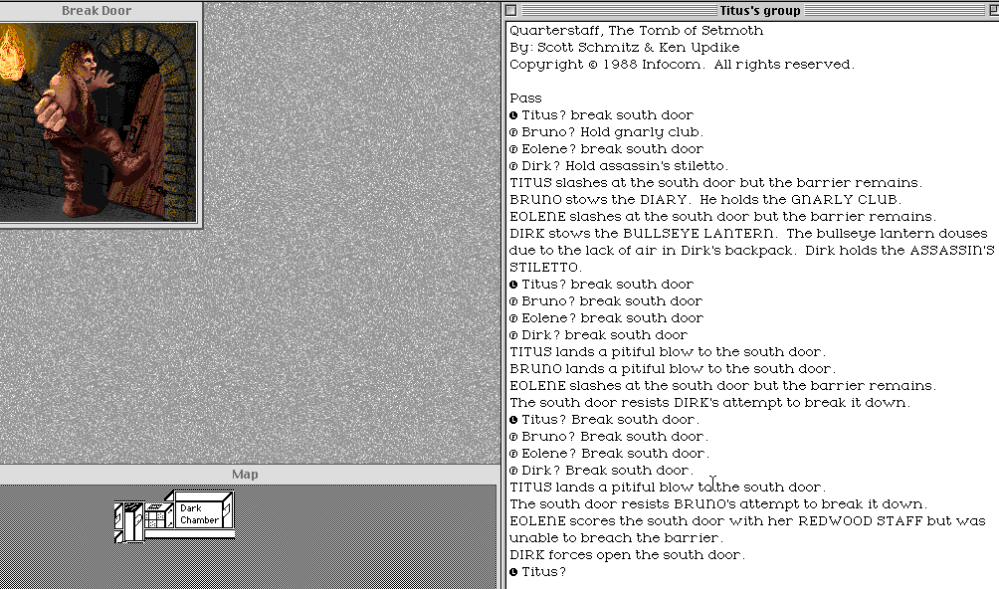
This issue came up with Adventure 500 where it took multiple tries to take down a dragon. With this game when I was testing out various ways of destroying a door, I made enough attempts with “this isn’t helpful” messages that I assumed you just couldn’t just club doors down (or at least assume they only needed clubbing in specific circumstances).
At the time I theorized this sort of thing was totally ok in an RPG, and here I am getting fouled up by the same behavior in an RPG. So I should add the condition that there should be some feedback that what you are doing might be useful, even if it will take more attempts. I might compare it to boss monsters in a bad 80s platformer that don’t give any feedback that you are doing any damage (flashing, health bar, or the like), and where you only find out 10 minutes later you were supposed to be shooting the monster in the feet and not the eyes.
2. Inventory capacity is a bear. Some sessions I’ve spent fully half my gameplay commands just trying to juggle objects so people could carry them.
Especially bad was my archer Eolene, after I used some arrows out of her quiver. Each arrow was a different object (with a different color name). I had to pick up and put each arrow back in her quiver individually. Except sometimes, she would mysteriously be able to carry less than when she started, so she wouldn’t actually be able to pick up all the arrows she just used, so I would have to drop some items, then pick up the arrows and store the arrows, then pick up the items again.
While all the inventory shuffling is going on the other part members keep insisting on commands. You can try to set them on GUARD or turn them off in various ways, but quite often there would be some complication to muck that up; plus a lot of the inventory juggling ended up being between characters.
3. Some things were entirely not worth the effort of figuring out.
Last time, I was stuck on a puzzle where one door had a “no man may pass” message and the one following had a “no woman may pass” message. This is where I finally broke down and used the hint system. and found out that I could bring a large container, stuff one of my smaller men in it, have a woman drag the container past the “no man” threshold, and then the man could hop out and go through the remaining door.
This is incidentally a case of magic not revealing enough mechanics to understand a puzzle. Apparently the “no X may pass” was done by “sight”, but there’s no indication of a “magical eye” or such; until I saw the hint I expected the “no X” simply just sensed gender. (The hints also mention getting a character who can change gender or one who is non-binary, but I don’t think either exists in this game.)
I’m not going to get into detail on the convoluted process of setting up the character-dragging (teleportation and two separate inventory juggles were needed) but suffice it to say it took me an hour to set things up, at which point I found … a cure disease potion, and a bag that let me teleport out.
4. There is an almost spectacularly evil puzzle that required parsing the instructions of a poem inside of an iron pentagram.
Star of frames.
Multi-headed breather of flames,
Make its blood like its breath.
You must seek your death.
Thrust quick to thy heart,
‘Tis dour doing but your part
Take the key from the trap,
‘Ware the plaque where it be.
Again, I needed a hint. This turned out to involve a.) finding some “hydra blood” from a room far back b.) setting the blood on fire (??) and then c.) killing yourself, not with ATTACK ME but with the special command SUICIDE (???)
If it was easy to experiment, this *might* have been a reasonable puzzle (in retrospect, all the pieces are there), but as I already pointed out the game has a brutal inventory limit, and heading back through a maze / traps / rooms that require two people to open / etc. to find more items can be an expedition in itself, so there’s no good way to do a lot of testing.
5. The apparent end goal (from some random backstory book I found, but also the subtitle of the game) is to get to the Tomb of Setmoth (who seems to be a demon) and destroy him. I now have a Tomb Key, and know where to go. Expect either “Finished!” or possibly “Deleted from my hard drive and then I took the hard drive out of my computer and buried it in the desert” next time.
One of the most eye-popping claims in the marketing for Quarterstaff is this excerpt from The Status Line, Fall 1988:
In Quarterstaff, monsters are not merely “deathbots,” whose only purpose in life is to maim and destroy, but ordinary living things whose actions are guided by real life drives such as hunger, anger, and the need for friendship.
Monsters even learn from their mistakes and accomplishments through an artificial-intelligence learning system. Some creatures will react negatively to your party, resorting to combat and force. Others, however, will try to help your party, or even join forces with you; and so, though you begin the adventure with only one character, you’re sure to quickly acquire a formidable band of adventurers.
One of the things I was most curious about with Quarterstaff was, does the above claim hold up?
…
Before getting into that: a status update.
Level 2 consisted mostly of an annoying series of traps. Every time the players got knocked over or fell in a pit the party would separate, so the interface trick I found last time of being able to “de-select” members of a party ended up being mostly useless. I sometimes killed off all my characters except one just so I could explore a little without feeling like I was being hit over the head by a brick repeatedly.
I can’t totally drop having other characters, because sometimes one character will hold a secret door open or otherwise help another character. In one frustrating instance, I tried having my character “on hold” use the GUARD command to wait around after holding open a secret door while my other two characters went in to eliminate enemies. However, I ended up stuck, because there doesn’t seem to be a way to end the GUARD command (it ends itself if there is an encounter, but none were forthcoming); so after 15 minutes of combat and fiddly inventory managment, I had to restore to a saved game and undo all my progress.
(Both the box and the Status Line promotion mention continuous play without the frustration of constant “saves and restores”. Ha ha. Ha. Hahahahaha. No.)

The traps in level 2 have no warning. Only this spot is polite enough to warn about danger, but there’s a locked door I haven’t gotten through so I have no idea if it’s really more dangerous than the other parts.
Incidentally, if you’ve been annoyed by hunger puzzles in adventure games, this game has hunger, thirst, *and* sleep. In the middle of a combat and one of your party member starts feeling thirsty? Better juggle a wine bottle over to them, otherwise they’re start suffering 3 damage per turn. Except the moves you wasted juggling the wine bottle also gave the monsters extra turns to hit you, so you’re probably dead anyway. Guess it’s time to restore again.
Level 3 starts out with what I’m sure everyone wanted, which was to turn off the handy auto-map feature and put the player in a straight-up old school maze. I had to get out Trizbort.

After the maze I found a puzzle with a large number of colored balls, with a hole, and the message I was supposed to insert the one that was different. The appropriate solution was oddly meta and one of those circumstances where I was reminded strongly this was a Computer Game and not just a World. More detail encrypted in rot13: Zber fcrpvsvpnyyl, lbh arrq gb xrrc na rlr ba gur “jrvtug” gung lbhe punenpgre vf pneelvat va bar bs gur zrahf. Vs lbh cvpx hc nal bs gur abezny onyyf, lbhe jrvtug tbrf hc ol 1. Vs lbh cvpx gur fcrpvny bar, lbhe jrvtug tbrf hc ol 2. Fb gur onyy jvgu gur jrvtug bs 2 vf gur bar lbh’er fhccbfrq gb vafreg.
After the maze I found two new characters (including “Sandra” the dwarf) and a throne which concealed a secret portion of the map.

Here I am stuck. I think the puzzle I’m supposed to be solving involves a room which says “no man can pass”. You can send a female character through, but that room has the message “no woman can pass”. So either I need some clever teleportation or a method of gender-swapping my characters.
…
In any case, back to the artificial intelligence. I did experiment quite a bit, and I’m not that impressed. For one thing, there seems to be a fairly strict delineation between hostile and friendly; I haven’t had a situation yet where I can just make friends with an enemy, although I suspect it’s possible in a few places.

In some cases, the monsters clearly aren’t here to make friends.
In general, I haven’t seen them do much past being “murderbots”. You attack an enemy, and keep attacking and they keep trying to hit you back. The very first fight had a scripted element (you are fighting a “chief torturer” who tries to lock one of your party members in manacles, and will try to run away if he gets hurt enough) but I haven’t seen any evidence of “hunger” or “anger” somehow being influences.
It’s quite possible if you had time to sit an observe a particular NPC they might stop to eat or show some other sign of life. However, every meeting so far has been either friendly or hostile so the game is unable to produce evidence of this number crunching. How much evidence of life can a monster give when they live for only a couple turns? While AI systems often have admirable goals, if what they do is indistinguishable from a little custom scripting, what’s the point?
On the other side of the coin, friend-making is a matter of using the SMILE verb repeatedly and possibly using BRIBE with whatever treasure you have around. (If they join your party, since you have control of them, you can just have them give any treasures back.) There’s no intermediary state descriptions of what the NPCs are thinking; you just wait some set number of turns and they join. Again, there might be some complicated machinery behind the characters, but with zero transparency, their behavior might as well be random.
(I write this with the back my head knowing the fact that three interactive fiction luminaries now work at Spirit AI, whose whole goal is to make more realistic AI characters. In fact, they’re all probably reading this. Hello there! I’m sure your AI system rocks!)





 Renga in Blue