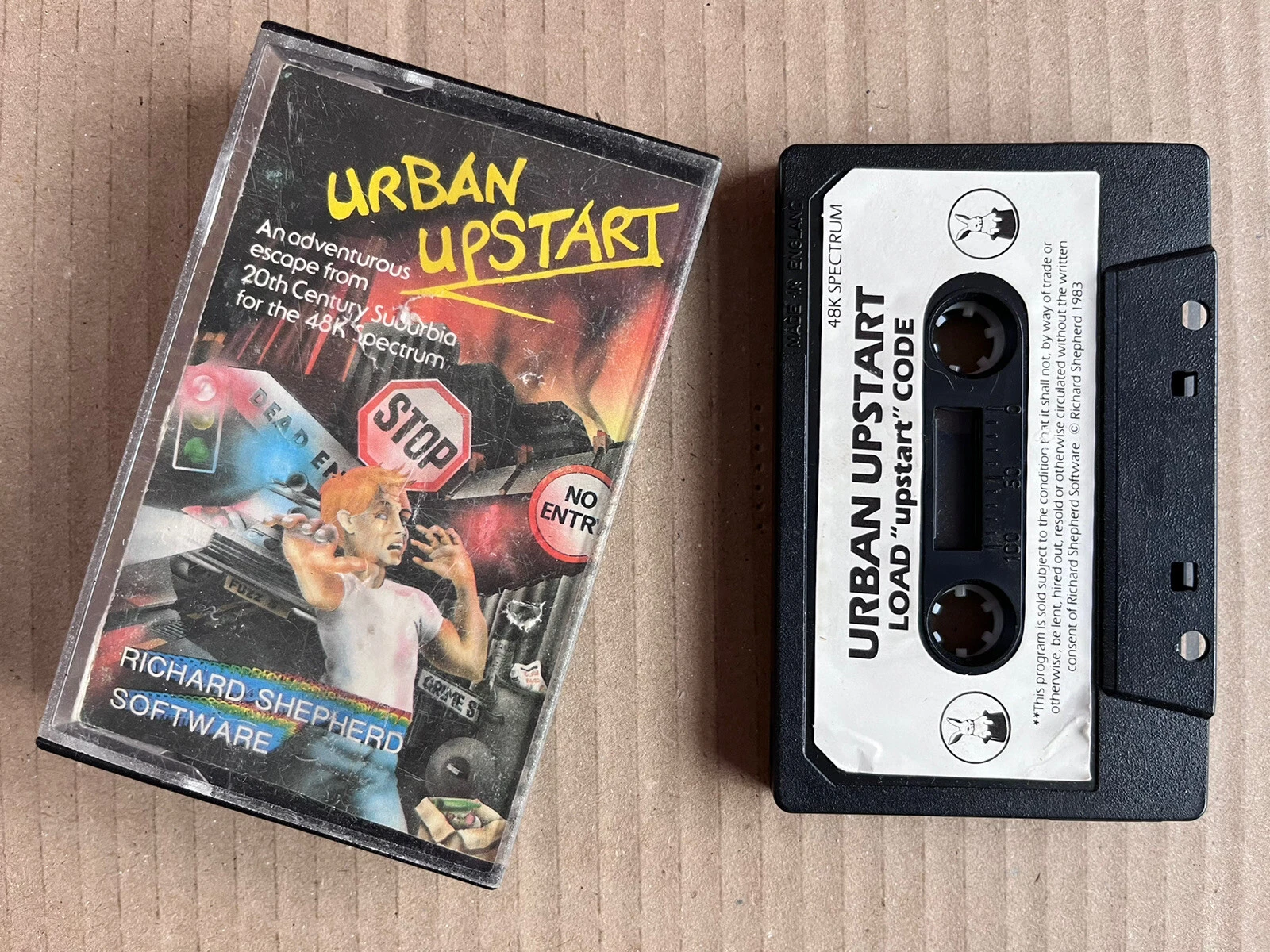
This post assumes some familiarity with the original Adventure; if you haven’t yet seen, my series on the Software Toolworks version (the only one that paid the authors Crowther and Woods) is a good place to start. Otherwise, onward–
Via Ronny Hansen, a setup for playing SVHA Adventure on ND-10 hardware.
Recently, two articles dropped on spillhistorie.no, both by Robert Robichaud (the same Rob that frequents the comments here). One was on the game Ringen, the Tolkien game in Norwegian that I’ve written about before. However, I had very little information to work with and was only able to play by going through a particular section preserved on VikingMUD, then making guesses about the game. The real Ringen (actually 1983, not 1979) has now been preserved and I am excited to play it. However, doing so requires playing in Norwegian so it will need some preparation time before I get there.
The other post was on a game written in English (later translated to Norwegian, but the translation is lost), so I can get to it right away. I’m going to summarize from the article and add some details, but you’re better off reading Rob’s article first and coming back here.
As a computer, the TX-0 was somewhat odd as it was built for a special purpose. It was, however, a truly programmable computer; it had a good directly driven CRT display, and – most important – its circuits were all transistorized. Moreover, it was available! I could sign up for time and then use it solely for my own purposes.
Yngvar Lundh, fresh from studies at MIT, went back to his home country of Norway to establish a computer presence there while working for the Norwegian Defence Research Establishment. He led the team on Norway’s first full-fledged computer, Lydia, a classified project used to analyze the sound of Russian submarines; this was followed with SAM (Simulation for Automatic Machinery) also intended for naval applications.
A group photo uploaded by Yngvar Lundh himself to Wikimedia, with members of the SAM team in 1962. Yngvar is on the far right. Note the similarities with the TX-0.
Per Bjørge (fifth from the left in the photo) went over for a year of study at MIT and returned in August 1966; after he returned, work on SAM-2 started, with Per Bjørge on the day team and Svein Strøm on the night team.
The computer was taken on “tour” to visit the institutes of Norway, and while on tour, Per Bjørge (another engineer who had spent a year at MIT), Rolf Skår (yet another) and Lars Monrad Krohn (who did a collaborative project with MIT) talked with a former-student-turned-entrepreneur who convinced them to form their own company. Hence: the start of Norsk Data, which not long after came out with the Nord-1, essentially a direct commercial conversion of the SAM technology.
They had early financial troubles, although development of their own time-sharing system helped and their Nord-10 minicomputer had good sales to universities. (Also helpful: they landed a contract at CERN. While the leaders of CERN first were more interested in getting a computer from the MIT-affiliated DEC, Norsk Data had DEC’s price sheets so were able to undercut them by 10%.)
From Wikimedia.
The important point in the story above is the cross-pollination from MIT. When ground zero for adventures happened there, it makes sense adventure would make their way over to Norway. Compare this with Italy where their first-known adventure came from an author who saw a variation of Crowther/Woods at a trade show rather than on some local mainframe.
With all that established, our story now turns to the Norwegian Institute of Technology. A group there calling themselves Studio-54 had a hobbyist/hacker culture and access to a ND-10 (via strong connections with Norsk Data; some members did work for them). One member of the group, Svein Hansen, discovered Crowther/Woods Adventure on a PDP minicomputer. While the minicomputer was intended for “serious” work at the school, he had access via Studio-54 to a ND-10, leading Svein to convert the source code in 1979. Once the port was made, there became the irresistible urge to add things to it, hence other members of the group (Nils-Morten Nilssen, Ragnar Z. Holm, Steinar Haug) piling in with new rooms, puzzles, and treasures. From the game’s own introduction:
This ADVENTURE is based on the ADVENTURE originally written by Don Woods and Willie Crowther, later expanded by Bob Supnik and Kent Blackett, and still later expanded by Nils-Morten Nilssen and Svein Hansen. In the present version some of the added features are taken from an article by Greg Hasset in Creative Computing, which added hitherto unknown parts of the cave. Many thanks to Greg!! This version is reprogrammed by Svein Hansen, and maintenance and extensions is presently handled by him. The program is written specially for NORD computers in NORD-FORTRAN 77. As Svein Hansen is responsible for this version, any inconsistencies and non-answers that might surface are best reported to him, either directly or through RSH, Norsk Data A/S, P.O. Box 25 Bogerud, OSLO 6, Norway. Personal message from Svein Hansen: Although I am responsible for this version, some of the added features are not my own. They are the lunatic and weird outcroppings from the minds of the Studio 54 Hobbies Group at the ND.10-54 community at NIT, Trondheim, Norway. Any nervous breakdowns, downbitten fingernails and suicides etc. resulting from these ideas ARE NOT MY RESPONSIBILITY !! Blame it on that sneaking, no good group that are ever trying to write more vile computer games.
This version of Adventure eventually made its way back to Norsk Data and was sold in a “games pack” compilation as SVHA Adventure.
Now, while the game has essentially been restored (after much suffering) with 70 new rooms and 20 new items/treasures, there’s a bug that means it is “impossible to escape” with two of the treasures (I don’t know yet what that means yet other than two can’t be deposited at the starting building). I’m just hoping the endgame is traditional and not something mind-blowing that we’re missing!
You are standing at the end of a road before a small brick building. Around you is a forest. A small stream flows out of the building and down a gully.
Time to first change? A single turn. But not a major one this time.
You are inside a building, a well house for a large spring.
There is a set of keys here.
There is a shiny brass lamp nearby.
There is food here.
No bottle! That’s just outside, though. I don’t know why.
You’re at end of road again.
s
You are in a valley in the forest beside a stream tumbling along a rocky
bed.
s
At your feet all the water of the stream splashes into a 2-inch slit in the rock. Downstream the streambed is bare rock.
There is a bottle of water here.
I’m almost wondering if it was a hacker-experimenter type change rather than one meant to affect gameplay; that is, if you’re mucking about changing the code of Adventure for the first time, one of the easiest things to do is to take an object and try to move its starting room and see if it works. So there might not be a “reason” for the change in a traditional sense.
Going on in, the first change otherwise I’ve found happens at the Hall of the Mountain King, where there is a barrel with a tap.
You are in the hall of the Mountain King, with passages of in all directions.
There is a barrel with a tap standing here.
A huge green fierce snake bars the way!
In the area with the clam I found a path leading up to a knapsack, but that was otherwise just a dead end. The most significant change I found was starting at the “crossover” near the mazes (all alike, all different) where heading north is normally a dead end.
HOO-HAW!!
You are at a crossover of a high N/S passage and a low E/W one.
…ok, HOO-HAW? I don’t know.
n
This seems to be the start of a finely hewn corridor, leading northwest. A narrow corridor goes to the south.
The finely hewn corridor is new, as is everything after.
nw
You are in a corridor with finely chiseled steps. The corridor goes up
and north, and down and south.
n
You are at the southern end of a brightly lit hall. Steps lead down to the floor, which is bare and obviously designed for dancing. To your right a balcony goes round the east side of the hall. The balcony entrance is northeast, the steps go north. To the south is an opening to a corridor. On the other side of the hall another staircase goes up. On the floor a merry band of elves are dancing, forming intricate patterns. They see you and beckon for you to come and join them. An orchestra with gleaming instruments is at the balcony, playing a lively tune.
n
You go down to the dance hall floor. The elves turn suddenly out to be orcs, all of them shouting and reveling at the way they fooled you. They grab their knives and hurl them at you. You stand a fair chance of landing a job as a pin cushion.
Grisly! Unfortunately, the game lacks a save game function, so it’s been slow going checking where changes might be. I can cut-and-paste walkthrough sections, but that technique only works if the RNG is consistent (otherwise I end up getting walloped by a dwarf axe somewhere in the process). It took Rob a month to get through everything, so this might turn out more difficult than your typical Adventure expansion.
I’m especially looking forward to finding the Greg Hassett section mentioned in the instructions (apparently they just lifted the “theoretical” game from an article and turned into a real one) — hopefully next time!
I had missed a couple things in the open, and then missed one (1) mostly absurd puzzle, then had to struggle a bit more with the parser to get to the end.
Back when I had found the letter and the rubbish bins, I had missed (because it was only implied in the text, and you had to LOOK again to see it) that a “cheque card” dropped along with it. (I still needed to interpolate what that meant; that term does not get used in the United States.) I had also missed the fact you could go “west” at the bank despite not being able to go in it.
I then hit a potentially serious headache by trying TYPE 1001, as told to me by the phone call.
ASIDE: Dialing 1001, as I tried to do after, is equivalent to dialing a random number, which is the reason for the other message, which apparently was meant to be the local time “at the third stroke it will be 3.23 and 30 seconds”. Repeating dialing 1001 alternates between another message (“4.31 and 30 seconds”) before returning back to the first one, so I think the implication is the system is broken and it isn’t giving a real time at all. In other words, that part was a “red herring” meant for “atmosphere”.
Returning back to the bank machine, the parser here did something monstrous: “TYPE 1001” gets the response that you’ve typed the wrong number!
I baffled for a few beats and it was only my experience with similar issues elsewhere that held out here: I tried the process of entering the card in and typing 1001 on a line by itself, no verb, and it worked. I guarantee some gnashing of teeth was felt in the 80s on this part.
After that, while scrounging about the map, I found I missed another room exit, going east at the rain section. This leads to an isolated room where there’s a small key that will be used later.
With the fiver and key in hand, I was still stuck on the rusty door at the house. In the meantime, Strident had made some comment about a milk commercial from the 80s…
…and I was truly baffled, as while I had tested drinking the milk, it simply said “you drink the milk” and the item went away. There’s no indication of any kind of effect. (In general, I’m always quite cautious with consumables on old school games; if there’s no immediate effect usually it either gets given to a character or applied, like the cheese, or is a complete red herring, like the food in this game.) However, I went through the map and tested nudging everything again to see if there was something new, and found magically I could now open the rusty door. (I assume you Hulk Out and manage to rip it off its hinges due to the raw power of milk, but it just says you open the door in the text so it is left to the player’s imagination.)
Definitely the worst puzzle in the game, although not nearly at the same level as the skull puzzle in Invincible Island. I imagine some players never even realized the puzzle existed (going to drink the milk first before even trying to get into the building).
In the basement of the building were some rats; fortunately I already had the rat trap with the cheese prepared.
Past the rats is a “cardboard box” where it isn’t clear it is a sealed box with something inside (rather than an empty open box) but I experimented enough to realize I could OPEN BOX WITH SCISSORS, yielding a pair of boots.
With the boots now worn (remember this switches outfits, so our player is no longer wearing a lab coat or dungarees, but just boots) I was able to get past the building site. At the far west were some pipes where EXAMINE PIPES yielded a flight suit.
After this comes the final part of the map: the airport.
While walking in the airport is straightforward, there is an officer inside the airport that tries to stop you if you go in any farther.
I was left (by this point) with the official papers, the fiver, the small key, the flight suit, the book, the old hat, and the food as unused items. The last two are red herrings; the other four get used here to win.
You can give the official papers to the officer and he’ll then say there’s a “pass fee”.
Is this a bribe? This feels like a bribe.
Handing the fiver over, you get waved in to find an airplane.
The panel indicates it needs a key for the ignition; this is where the small key gets used. You also need the flight suit worn and need to have read the book (which teaches flying) to do the final command, which isn’t FLY or many other variants I tried. I even started to check if there was an “invisible” item like a joystick or if the plane also needed gas. I eventually gave up and had to look at a walkthrough: TAKE OFF.
I agree with several people who said that Urban Upstart was by far their favourite adventure, and great fun to play. Its success on the Spectrum has now led to a Commodore 64 version just being released.
Urban Upstart was quite well regarded, and Pete Cooke has indicated it was by far his best selling game. While I’d mark it as “above average” it does fall short of “all time classic” given the janky parser and occasional awkward clueing. (I didn’t even discuss how the game is extremely slow to run; I had to crank the emulator to 900% before it became fluid.) I could just chalk that up to being an “old” game where people simply have greater standards now, but it does seem like there’s more going on than just that.
Another Scunthorpe picture from 1983.
Being in the “cultural mood” helps; I will return to a more detailed examination of politics and industry under Thatcherism in a later game (as Thatcher herself even makes an appearance). I think this is also a case where the medium is deeply appropriate for the message. That is, it just feels right to have a satirical, slightly-punk game on the ZX Spectrum in the first place. With a rich fantasy world, the limits to the art and parser can be jarring; here they seem appropriately on theme.
One comparable situation is with the modern lo-fi horror games. Many “indie” horror games now take an aesthetic last seen on the Playstation 1; having giant polygons and uncanny textures can add to the mood rather than feel like unrealism. Unnatural, low-resolution monsters that look broken because the hardware surpassed its polygon limit? Perfect!
Itch even has a compilation of new games called Haunted PS1 Demo Disc.
Similarly, when Urban Upstart does something frustrating, it feels quite akin to dealing with the frustrations of 1983 Britain that were being vented. Sure, you might get sent down a wrong alley for hours because you typed GIVE LAGER and got pounded for not typing GIVE LAGER TO FAN, not realizing you were doing the right thing but with the wrong words, but it just adds to the experience.
Coming up: a new variant of Adventure from 1979 that only made it on the Internet as of today.
…and the only two of note are LISTEN and CROSS, neither which would be obvious things to try in a limited parser. (Keep in mind that there is always the possibility of a rare verb that I don’t have listed, so this isn’t guaranteed to be everything.)
Regarding the football fan from last time: they are indeed, as I theorized while typing my last post, a fan of lager. GIVE LAGER TO FAN works. (GIVE LAGER results in you getting completely pounded, with no indication the parser simply didn’t know what you meant, but I had already been trained by Invincible Island to watch for this issue.) Handing the lager over gives enough time to pick up the rat trap nearby.
The game accepts PUT CHEESE IN TRAP but I have not managed to get any farther than that (I could try dropping the trap in every single room hoping for a hit, but I haven’t gotten that desperate yet).
In more ordinary Me Missing Things, I missed that the fish and chips shop is enterable (with plain ENTER, the game doesn’t understand SHOP). There’s nothing in there although there’s some sounds from the back, where the magic LISTEN verb works. RADIO isn’t an understood noun so I don’t know if this is supposed to be meaningful.
The shop also has a “red herring” which causes a herd of cats to appear following the player. I suspect this is a red herring in both the literal and figurative sense, because authors find this joke irresistible, but maybe this will finally be the game that bucks the trend.
The chip shop is helpfully centrally located (and remember the police are zealous and will nab you if you drop things on the road) so I’ve been using it as my base of operations.
New rooms are in yelllow.
Heading a bit southwest is the red scarf I mentioned quite briefly last time. What I neglected to get into is that there is the sound of heavy boots when you pick the scarf up, and after a certain amount of time you get stomped by someone who doesn’t appreciate the scarf. I assume this is a football hooligan reference. There’s enough time between picking up the scarf and getting sent to the hospital that I assume there’s a puzzle that involves unloading the scarf somehow.
Northwest from the shop is the building site (where I still end up sinking, even after dropping all items) and the small area of rain that requires the umbrella.
Just past the rain is a canal with a bridge; here CROSS is needed (and is the only way I can find to use the bridge, yay for the verb list). This leads to a building with a rusty door I have been unable to break into.
Just south is a car park with “some milk”, one of my only two new items. The other new item comes from back at the dustbins that couldn’t be OPENed because the game wants EXAMINE. Grr. (EXAMINE works on almost nothing in the game. Of takeable objects, the only one that it has worked on is the papers from the Town Hall, described as being written in Greek.)
Here is where things get cryptic and where I am happy to field explanations. I went over to the phone box and dialed the number and got as second number (1001) and when I dialed that number I got yet more numbers:
I’m not sure how to interpret this information or what it gets used on. Other than sinking at the building site and the rusty door I’m out of obstacles to whack at. Optionally it may be possible to deal with the police sergeant somehow upon being arrested but that may also simply be a dead end.
(You can try giving him items, but he just says no bribes.)
There’s always the possibility of “hidden puzzles”; a number of locations didn’t seem to have anything active going on (like the church and graveyard), or a random yellow wall in the middle of town but may reveal something with the right action. I still am not sure which way my character should even be aiming to escape; I’m imagining the big road block is not the route we are going to use, and nothing else suggests a pathway out.
We’ve now seen three games (Pythonesque, Mad Martha, On the Way to the Interview) that have a sort of “satirical urban magical realism” aspect to them, and they’ve all been British.
While we’ve had comparable satire from the United States, it hasn’t been couched in quite the same terms (battling old ladies in the streets, getting run over by a bus literally anywhere including inside houses, husbands being chased down by their wives with an axe). Some of the same flavor can be found in Asylum II but the setting is very much not urban. The closest comparison I can think of is the various “naughty games” like City Adventure and the first two Misadventure games, but they still don’t strike me as inherently focused on urban sleaze, just sleaze in general.
The other term I’ve used for the genre is “British degenerate” game and it fits here too.
I’m not keen on “cultural zeitgeist” theories why certain trends happen; they tend to lead to of-the-cuff speculation:– when Tolkien became popular with the counterculture of the United States there was the rumor Tolkien wrote the books while on drugs, and an article in the Ladies Home Journal claimed
No youngster is going to believe in a beautiful knight on a white charger whose strength is as the strength of 10 because his heart is pure. He knows too much history and/or sociology, alas, to find knighthood enchanting in its feudal backgrounds and to dream of Greek heroes and of gods who walked the earth. But give him hobbits and he can escape to a never-never world that satisfies his 20th century mind.
which seems comedically off the mark; Tolkien’s sources were also quite old.
Still, there was something particular to culture in the UK both in their humour and in their politics that led to these sorts of “urban satire” games; certainly, given the literal title of one of the games, Monty Python (and by extension, The Goon Show) deserves some credit; Not the Nine O’ Clock also could be an influence. I have a theory regarding the ZX Spectrum in particular but I’ll save that for when I’m done with the game.
Urban Upstart is explicitly an “escape from 20th century suburbia”.
We are literally trapped in the city and need to escape. Choice of time: 3 o’clock in the morning.
Incidentally, if you don’t put the dungarees on, after you get out of the starting house you get arrested for indecent exposure.
The opening house has some scissors and a lager in the fridge, as well as a large key for unlocking the front door (which is locked from both ways?) After some fiddling about with the parser trying to leave the house (just the word LEAVE alone or LEAVE HOUSE works, don’t try to ENTER DOOR, GO DOOR, etc.) we’re out on the town.
The bookstore is enterable (!) and has only one book, on How to Fly, suggesting our final exit may be via aeronautical vehicle.
There are “dustbins” in the back of the house but neither OPEN nor EMPTY work and I’m not sure if they’re there for anything else other than flavor (there’s a lot of dead ends and “urban debris” type rooms, so it might just be atmosphere). What you can find is an umbrella lying about a bus stop, and food and cheese in a park. Park cheese, delicious.
The park is adjacent to a church with a graveyard. The tombstone says John Smith.
Just past the bookshop is an alley near a Football Ground, and a grumpy football fan past that (hanging near a rat trap, for some reason).
I haven’t tried giving him the lager yet.
The fan pounds you if you try to pass (or don’t, even) and you end up landing in a hospital in a different part of the map. There are multiple ways to get sent to the hospital but let’s follow the path there next.
You land in an unsupervised hospital bed in a straightforward maze, but if you try to walk out of the hospital, a doctor escorts you back to the bed.
The maze includes a white coat, so the way to get out is to simply wear the white coat over your dungarees and sneak out the entrance.
To the west is a hill with some red tape on the top — that’ll be useful in a moment — and going back east passes by a sign (“Keep Britain Tidy”), a car abandoned in the road (can’t enter or drive), and a red scarf.
Incidentally, the police are quite serious about keeping Britain tidy, and if you drop an item while juggling inventory onto the street, you will immediately get arrested.
Looking at the north part of town…
…there’s more civic grime (on “Civic Street”), a phone box (with a working phone, I don’t know who to call), a very serious roadblock at the far north…
This is the kind of parser which insults the player. It does fit the theming.
…and a “wasteland” nearby which has an “old hat”.
At the end of Civic Street is a Town Hall which you normally can’t enter, but I thought to bring over the “red tape” and I got in. I get the perception this game may not be 100% looking for realism in puzzle solutions. In the Town Hall you can find “official documents” which I haven’t used yet.
The last obstacles are around a turn at “muck alley”. One involves an area that mysteriously rains; I’m sure nabbing the umbrella will help, but I haven’t gotten around to it yet (or rather, when I went to get the umbrella and needed to trade inventory, that’s when I discovered the town policy on litter so haven’t bothered to go back around yet). As a side path off of that is a “wet and muddy” building site which describes you sinking, and if you are there too long you get trapped in the mud and sent to the hospital.
Continuing the theme of not wanting to fiddle with inventory yet, I think getting through here may involve simply dumping my inventory elsewhere (the author’s last game, Invincible Island, had something similar). To summarize, I’ve found scissors, a lager, a key, dungarees, an umbrella, some food, some cheese, a red scarf, a white coat, some red tape, and some official papers. In terms of active obstacles I still need to take the umbrella through the rain, get through the building site, and get past the football fan; optionally there might be a way to get out of the police station. (If you just walk in the station you get trapped in, just like if you were arrested. LEAVE doesn’t work. This might even be a parser issue!) However, it is quite possible I’m simply missing some spots due to the parser being finicky.
Dutch paperback editions of Lord of the Rings, via Reddit.
The most comparable game I can think of on the last puzzle — and the other reference-puzzles — is the game Avon. That game was chock full of Shakespearean references and in some cases it helped to know the reference to solve a puzzle (like the Cassandra with her gift of prophecy; it is originally unclear she is trying to do prophecy if you don’t know who she is). However, there never was a case where it was absolutely required, and I speculated about a game leaning into references and not being shy about requiring book- or play- knowledge.
The fact we’re being subjected to a blizzard of Shakespeare references is given up front, and I had genuine fun learning about characters I didn’t know and scenes I didn’t remember. I think the idea of a game being intentionally past its bounds is not intrinsically terrible as long as the “educational” part is telegraphed.
Ring Quest absolutely requires book knowledge to win. It has an issue straight out the gate with failing the “is telegraphed” condition I mention above — despite the early Tom Bombadil puzzle, it was only about halfway did I realize the extent of outside knowledge the game was asking the player to use. There’s more issues, but let me explain that last puzzle first…
Orc with mithril, from the movie version of Return of the King.
…which was directly after passing through Shelob’s lair, at the tower of Cirith Ungol. The orcs fought over the mithril coat (the one obtained from Smaug) and killed each other in “the fight that follows”. However, we were unable to leave:
You’re stopped by what seems to be an invisible wall.
You’re in the tower of Cirith Ungol.
Orc corpses lie everywhere.
NE
You’re stopped by what seems to be an invisible wall.
Three-headed, vulture-faced statues seem to be staring at you.
SE
You’re stopped by what seems to be an invisible wall.
A new regiment of Orcs arrives and takes you prisoner.
You’re doomed to the torment of the Tower!
The “vulture-faced” description means we are dealing with the Watchers from the book. Here’s Tolkien’s description:
They were like great figures seated upon thrones. Each had three joined bodies, and three heads facing outward, and inward, and across the gateway. The heads had vulture-faces, and on their great knees were laid clawlike hands. They seemed to be carved out of huge blocks of stone, immovable, and yet they were aware: some dreadful spirit of evil vigilance abode in them. They knew an enemy. Visible or invisible none could pass unheeded. They would forbid his entry, or his escape.
Sam (as I was half-remembering last time) comes into play with the phial, which he brings out, and the Watchers are warded off: “slowly he felt their will waver and crumble into fear.” What I most definitely was not remembering is that the Watchers get dealt with a second time, as Sam and Frodo leave the tower. Quoting Tolkien again:
‘Gilthoniel, A Elbereth!’ Sam cried. For, why he did not know, his thought sprang back suddenly to the Elves in the Shire, and the song that drove away the Black Rider in the trees.
‘Aiya elenion ancalima!’ cried Frodo once again behind him.
The will of the Watchers was broken with a suddenness like the snapping of a cord, and Frodo and Sam stumbled forward.
This is an invocation of first Elbereth (invoking an angelic figure), and then Eärendil (heroic). These statements are in two invented languages (Quenya, Sindarin) and Bots did not have a wiki to refer to. The game wants you to INVOKE ELBERETH.
INVOKE ELBERETH
The will of the Watchers is broken with a suddenness
like the snapping of a cord.
You’ve now passed the Silent Watchers of Cirith Ungol.
A winged Nazgul dives down on you!
KILL
With a ghastly cry the ringwraith falls.
Among the now shapeless garments you discover a golden ring.
You then have a straight shot to the cracks of doom, with one more ringwraith along the way (I ended up with eight of the nine Man-rings). Before that, just for fun, if you diverge the wrong way:
Suddenly your gaze is held: wall upon wall, battlement upon battlement,
black, immeasurably strong, mountain of iron, gate of steel,
tower of adamant, you see it: Barad-dur, Fortress of Sauron.
There is an eye in the Dark Tower that does not sleep.
It has become aware of you!
There’s no real puzzle here; you don’t need to resist the urge to wear the One Ring or anything like that.
Frodo at the moment he decides not to destroy the ring, from the Rankin/Bass animated version of Return of the King.
(I’ve wondered how you might render the urge in game form. Possibly as a longer term “sanity management” system like Sunless Sea or Darkest Dungeon; maybe if you keep the Sense of Will under a certain number it allows resisting this moment?)
You’re standing on top of the Orodruin.
In front of you are the cracks of Doom.
INVENTORY
At present you’re carrying the following:
a bow and 14 arrows
3 Elven-rings
1 Dwarf-ring
8 Men-rings
the One Ring of Power
a long rope
the phial of Galadriel
a tiny key
the sword from the Barrow-downs
some dead wood
THROW RINGS
As the Rings of Power plummet into the Cracks of Doom,
your quest has come to an end.
The realm of Sauron is destroyed!
So far, this game has lasted 25 minutes and 50 seconds.
Out of a possible 1000 points, you scored 819.
You’ll notice I was lacking some rings, but the game is fine as long as you toss in the One Ring; you don’t need to destroy all the rings to win, just the One; the rest are for points. (Which, ok, fair.)
Focusing on the final puzzle: in Tolkien, Sam does not know Quenya; he was remembering something he heard prior in his journey, and the word Elbereth gets used as a “password” in the tower to identify it is Sam talking (with the logic no Orc would say that word). For the player of the game, from the content of the game they not only don’t have that to refer to, but they need to parse what was going on in the text into a valid statement in the parser. It honestly still took me a while and the reason I knew I was on the right track is that ELBERETH was an understood noun. (SUMMON TEXTGARBAGE gets a message about needing to be more specific, whereas SUMMON ELBERETH gets “You can’t do that.” which means the noun was understood.)
Eén Ring om allen te regeren, Eén Ring om hen te vinden,
Eén Ring die hen brengen zal en in duisternis binden,
In Mordor, waar de schimmen zijn.
Pieter Bots first read Tolkien when he was twelve. It seems likely he read it in Dutch; it was readily available translated, as the very first translation of Lord of the Rings from English was into Dutch, using the somewhat odd title “In de Ban van de Ring”; it literally translates to “Under the Spell of the Ring”. Tolkien himself approved the translation of placenames (The Letters of JRR Tolkien. Letter 190). I have prodded at various key moments but don’t see anything that would suggest some kind of different perception the author might have had due to the change in language, and of course even if he originally read the books in Dutch, by the time he wrote Ring Quest he could have read the books in English.
The most truly erratic thing, besides the book-knowledge and the giant number of sparse rooms (likely related to the 1975 HOBBIT heritage) is how the player is all the characters at once: Frodo the ring-bearer, Sam with the phial, Gandalf with moments like the staff, Bilbo with the dragon and Bard with the dragon simultaneously, even Pippin and Merry at Treebeard. (I never was able to invoke Treebeard, which I’m guessing would net me the last Man-ring, but I’m guessing it’s a reference like Elbereth rather than a “normal” adventuring action; same for obtaining the Dwarf-rings from — presumably — Moria.) The logic more or less worked; at the very least I don’t think the author “didn’t know the novel” or got confused. The biggest stretch was Galadriel and Elrond giving their rings when asked (they never gave them to any character), although I can see where the temptation to include every ring came from.
Overall this was fascinating in an “outsider art” sense in the same manner as Tiny Adventure; with Crowther/Woods being merged with a game that probably traces back to mainframe Star Trek, an unusual deviation in media history was bound to happen. Not like it was the greatest fun to play: I’ve stuck to the highlights, but the experience of trudging through had a great deal of
You’re following a north-south trail.
S
You’re following a north-south trail.
S
You’re following a north-south trail.
S
You’re following a north-south trail.
S
You’re following a north-south trail.
S
You’re following a north-south trail.
S
You’re following a north-south trail.
which gets across why the gigantic grid method wasn’t duplicated as much elsewhere.
I’m gone through essentially the whole map now, with two major chunks and two minor chunks remaining I can’t reach.
The red highlights are areas I explored, although I decided not to go through the tedium of filling in every single square to the southwest, as they’re all “wandering aimlessly” rooms. The rooms to the right are roughly the same (although they do connect with the Mirkwood maze). The two columns to the southeast are actually “wraparound” rooms; you’re going east and the game switches from saying you’re wandering to the southeast to saying you’re wandering to the southwest.
You’re wandering aimlessly through south-eastern Middle-Earth.
E
You’re wandering aimlessly through south-western Middle-Earth.
The missing parts are circled. For the missing minor chunks, one of them is a portion near the map of Mirkwood that the maze doesn’t quite get to, and might simply be all mountains. The second, more suspicious one, is a section at Moria which has no rooms:
The empty spaces are all adjacent to Thrain’s tomb, and since only one dwarf-ring has been located (out of seven) this suggests the rings might be in the area somehow
You’re standing in a dimly lit chamber.
In the center you see a stone tomb.
On top of it lies an old, dusty book.
READ BOOK
Among many sad tales is the story of Thrain, once Lord of Moria.
After hiding the seven Dwarf-rings, he departed to seek vengeance
upon the Dark Lord.
Nothing was heard of him ever since.
OPEN LID
You’ll have to be more specific.
OPEN TOMB
In it you discover the skeleton of a noble Dwarf.
Of the major gaps, one is past Saruman’s army. I have not been able to summon Treebeard’s army by any means to assist, as was promised.
The last major gap is at Mount Doom itself; I have gotten past Shelob (as I’ll show off shortly) but I am only one step in further; I haven’t gotten around to experimenting yet.
My major progress (based on a hint from Rob) was based on going absolutely gonzo with using book references to try to solve puzzles. The instructions say the “Elven-rings are kept by the elven-lords” and since they know of your question you can ask for them. That doesn’t mean they’ll visibly display in a location or anything, you just have to assume they’re there (based on it being logical based on the books).
You’re standing at the foot of a slender tower.
W
You’re in the Grey Havens.
ASK CIRDAN FOR RING
Cirdan knows of your quest and gives you Narya, the Ring of Fire.
Now we’re getting deep into the trivia. (And also the wildly specific phrasing; nothing else works except you can put LORD CIRDAN if you like.) Over at Rivendell, ASK ELROND FOR RING works equally well…
Elrond knows of your quest and gives you Vilya, the Ring of Air.
…and just north of where Galadriel’s Mirror gave a vision, Galadriel herself awaits (again you have to make the leap to assume that she’s there!)
ASK LADY GALADRIEL FOR RING
Galadriel knows of your quest and gives you Nenya, the Ring of Water.
That’s not all! Now that we’ve unlocked Go-Wild-With-Book-References mode, there was something else also that Galadriel gave over:
ASK LADY GALADRIEL FOR PHIAL
She might be so kind if you gave her something first.
GIVE JEWEL TO LADY GALADRIEL
Galadriel thanks you kindly .
In return she gives you a small crystal phial that radiates a bright light.
Oho! So that resolves the purpose of the jewel sitting on the road; as El Explorador de RPG points out in the comments, that means the jewel is likely the Elfstone, also known as the Stone of Eärendil, being used in a slightly different context here.
From “The Gift of Galadriel” (1991) by Greg Hildebrandt
I took the Phial all the way through Moria with no effect, but it certainly does work on Shelob.
You’ve reached the haunted city of Minas Morgul.
E
You’re groping through a dark tunnel.
Suddenly you hear a rustling sound behind you!
LIGHT PHIAL
The Lady’s glass sends forth a bright light.
KILL
The dazzling light makes the monstrous creature helpless.
Your blade inflicts a mortal wound.
Notice how this is so reliant on book-references it does not even bother to describe who Shelob is!
Shelob on a cover. From the UK HarperCollins version, 2020.
Immediately after, the mail stolen from Smaug comes into play:
SE
You’ve reached the tower of Cirith Ungol.
You are surprised by a patroling band of Orcs and taken prisoner.
However, when they discover your mithril coat, they start to quarrel over it.
In the fight that follows all Orcs get killed!
Trying to leave, the game says “You’re stopped by what seems to be an invisible wall.” Then the game says “Three-headed, vulture-faced statues seem to be staring at you” followed by the player being overtaken by orcs a turn later. I’m not remembering exactly what happens here in the book (I remember Sam was involved; we are all the characters simultaneously) but I’m guessing it’s still another match to the text somehow?
Just to recap, we are missing:
a.) some method of getting the Ent army to help with Saruman; the fact getting captured isn’t an immediate game over is suspicious, but I have not gotten anything to happen
b.) all the Dwarf-rings except one, which may or may not be connected to the empty space on the map attached to Moria
c.) and some method of getting by the orcs I just mentioned.
Any and all speculation are welcome, keeping in mind the game is reliant enough on book-knowledge to require you remember who Lord Cirdan is.
While I’ve made a fair amount of progress I’ve also hit two points that make me wonder if the game is too buggy to complete. Updates to the map are shown in red:
This doesn’t look like much compared to the overall map, but keep in mind the vast majority of the rooms are “filler” rooms like “you’re following a north-south trail” or “You’re wandering aimlessly through north-western Middle-Earth.” The southeast corner (starting to encroach onto Mordor territory) is denser than elsewhere.
Let’s start with Gollum and the riddle game. He gives the same riddles as in The Hobbit, but then kills the protagonist if a.) they don’t have the One Ring yet or b.) they try to get away. KILL GOLLUM was doable but this left me stuck in Moria. I was mostly getting thrown awry by the lack of a WEAR verb; in the spots where it is useful (and only in those spots) USE RING will work.
USE RING
You’re now wearing of One Ring of Power.
Gollum curses as he runs right past you.
Unknowingly he leads you to the eastern exit of the mines of Moria.
Towards the east you discover light, as in daylight!
Crouched in front of the exit sits Gollum, wting…
KILL GOLLUM
Gollum’s now dead.
(Bots incidentally said that any typos in the original have been left in the current version, so “wting” is authentic early 80s typing.)
I’d like to say this is the last of me dealing with Gollum, but there’s a part that made me think perhaps I was still doing this wrong. But for now, it’s possible to trek out to the Balrog, and (after some major verb-hunting) I came across HIT BRIDGE as the solution.
E
The Ring slips from your finger.
You’re standing on the bridge of Khazad-dum, facing the mountains.
A huge black shadow with a heart of fire materializes in front of you!
HIT BRIDGE
There’s a blinding flash of light.
A deep pit opens up in front of you.
With a stonesplitting cry the Balrog vanishes in the abyss.
E
You’re passing through the Dimril Dale.
It’d be nice if the ring summons ringwraiths so I could mop them up with the sword, but alas, it behaves more like the ring from The Hobbit. Keeping in mind what was seen at the Mirror of Galadriel, I next went over to Mirkwood and Dol Guldur.
While at the entrance, you can USE RING to sneak inside, and find a dead dwarf in the dungeon.
USE RING
You’re now wearing of One Ring of Power.
The guards do not see you.
ENTER
You find your way through a labyrinth of chambers and corridors.
Finally you reach the Tower’s deepest dungeon.
On the floor you see the remnants of what once was a noble Dwarf.
Among the dust and bones shimmers a golden ring.
GET RING
It’s yours now.
LEAVE
The guards do not see you.
One Dwarf-ring down, six to go. The fact at least one isn’t hidden in Moria makes me think they might be more spread out than I expected. Other than that ring, my inventory from this point has “a bow and 14 arrows”, “4 Men-rings”, “the One Ring of Power”, “the green jewel you found on the road”, “a tiny key”, “the mithril-coat from under the Mountain”, and “the sword from the Barrow-downs”. (The where-you-found feature is actually quite nice and I can’t think of other adventure games offhand that do that!)
With the Balrog taken care of it was time to explore more extensively past where I had met Treebeard. I incidentally discovered at the boat which has a long rope that you can just ignore the boat-ride aspect and take the rope (more on that later).
South of the Ent area is a corpse with a red arrow.
At your feet lies the beheaded corpse of a warrior.
The mutilated hand is still holding a red arrow.
Just southwest of the red arrow is the fortress of Rohan.
You’ve reached Dunharrow, fortress of Rohan.
The red arrow you carry is taken from you.
It’s the sign that Minas Tirith is in great danger!
The host of Rohan is prepared to follow you to the east.
(You actually want to wait on grabbing the red arrow and pass through the first time here, but we’ll come back to that.) This is another “you’ve gained a follower” type message although in this case you actually see the riders coming behind you as you go east.
You’re travelling through Anorien, north of the White Mountains.
The Rohirrim are riding with you.
E
You’ve reached Druadan forest.
S
You’re passing through the Druadan forest.
It’s inhabitants, the wild Woose, lead the host over secret paths
to Minas Tirith.
You’re on the field of Cormallen.
Here a great battle is fought.
The Riders of Rohan charge the enemy from the north.
For a moment the powers are balanced.
Then a black fleet appears on the Anduin. The Corsairs of Umbar are coming!
The Western forces are outnumbered many times.
Minas Tirith is destroyed.
Only you manage to escape the onslaught.
If you head southwest from here, you can have an unfortunate encounter with the Corsairs.
You’re at the Mouth of the Anduin.
The Black Fleet of the Corsairs has gathered here.
Fierce men suddenly jump from their hidingplace and grab you!
While the riders aren’t able to go down and take care of the Black Fleet, there is another group that can: the Oathbreakers. Now we get back to where I said it’s better to skip bringing the arrow to the fort the first time through; that’s because you can pass into a cave and find the ghosts of the Mountain-men who broke an oath to their king and were cursed. So now we’re Bilbo, Frodo, and Aragorn all at the same time!
You’re standing in front of a cave.
ENTER CAVE
After a seemingly endless journey through the whispering dark
you are out in the open again.
You’ve reached the Black Stone of Erech.
ASK HELP
From who?
SUMMON GHOSTS
A distant voice answers you:
We shall follow you until our oath is fulfilled.
As far as I can tell, the exact command SUMMON GHOSTS is the only way to make this work (possibly the most extreme moment of book knowledge needed yet — at least Tom Bombadil gives his name if you hit the scenes in the right order and think to use CALL HELP).
Movie version of the Oathbreakers.
Now it is safe to pass by the Corsairs…
You’re at the Mouth of the Anduin.
The Black Fleet of the Corsairs has gathered here.
The men flee in panic with death at their heels!
Having fulfilled their oath, the Dead vanish.
…but only once, because if you leave and come back (or even just use the LOOK command) there are people left over that grab you.
Fierce men suddenly jump from their hidingplace and grab you!
That would normally be fine (as you don’t need to hang around) but there’s no effect on the big battle with the Riders either.
Then a black fleet appears on the Anduin. The Corsairs of Umbar are coming!
This honestly feels like an outright bug? The death-message does change so maybe you need a second wave to mop up the Corsairs, but this entire section is confusing; and maybe the result of everyone dying was intended, and there’s no better result? That means there’s no point in summoning the Oathbreakers at all, then.
Official WETA figurine of Minas Morgal.
Once past the battle, you can visit the Ruins of Osgiliath and beyond; one of the ringwraiths is down at Minas Morgal…
You’ve reached the haunted city of Minas Morgul.
A tall black ringwraith materializes in front of you!
KILL
With a ghastly cry the ringwraith falls.
Among the now shapeless garments you discover a golden ring.
…and nearby is “Sheloop”. I was truly confused for a while by the spelling of Shelob.
You’re groping through a dark tunnel.
Suddenly you hear a rustling sound behind you!
KILL
In the dark there’s no escape from Sheloop.
To the north is the Black Gate; my attempts at sneaking in were rebuffed by Orcs.
You’re facing a large rampart of stone.
In it there’s a single gate of iron, and upon it’s battlement
sentinels pace unceasingly .
None can pass the Teeth of Mordor and not feel their bite,
unless they are summoned by Sauron, or know the secret passwords
that will open the Morannon, the black gate of his land.
You can head up north farther to swampland, and here is where I think perhaps I dealt with Gollum incorrectly.
You’re wandering through the Dead Marshes.
W
You’re following an east-west trail.
W
You’re lost in the gloomy hills of Emyn Muil.
The only creature that might have helped you out of here is dead.
You die from hunger and thirst.
Remembering that I could get the rope from the boat early, I rejiggered my sequence so that rather than killing Gollum at the exit I could TIE GOLLUM instead. It does get understood as a command earlier (it says he “dexterously” avoids you) but unfortunately it fails to work at all at the exit: the game says “He’s not here.” Given that KILL GOLLUM does work this strikes me as an outright bug, and makes me concerned this may have been the right action, just the game is broken.
There’s still a lot of elements to whack at so I can’t say I’m giving up yet; if nothing else I can go back and try to figure out how to communicate with those elves. Regarding the Palantir from last time, no amount of touching or gazing or rubbing has had any effect at all; I also haven’t been able to use the One Ring to avoid the patrols, nor call eagles or Ents after getting captured. However, this game does sometimes requires super-specific phrasing (see: SUMMON GHOSTS) so I can’t say anything is completely ruled out yet.
I have the One Ring to rule them all, that means the rest of this ought to be easy, right? My count otherwise is unchanged: 4 out of 9 Man-Rings, 0 out of 3 Elf-Rings, and 0 out of 7 Dwarf Rings.
The game gives some general help about the rings, noting that
a.) the Elven-rings are kept by the Elven-lords, and “will yield their treasure if you ask for it”
b.) the Dwarf-rings are hidden in Moria
c.) the Nazgul have the Man-rings (I’ve killed four, I just need to find the other five); the instructions say that they’re easy to find “by those who have read The Lord of the Rings thoroughly”
My map so far.
Before plowing ahead, I should also mention something about the specific port I’m playing: it does not, in a technical sense, have a save game feature. It has a log feature. That means it keeps track of what commands you’ve put, and you can have it store those in a log, and then recollect it to have what is functionally a save game; in practice, my gameplay has a lot of testing useless exits to find out they’re blocked so I feel strange making a log until I have “clean” progress. The end result is that “insta-testing” is a bit harder; I’ve found a Balrog, for example, but haven’t tried all the different possible ways of defeating him yet because I don’t have a log file there.
(Also — and this reflects a general characteristic of this game allowing some flexibility in pathing — I approached the Balrog from the east side of Moria. I’ll explain later.)
Remember, this game is mashing together scenes from The Hobbit and Lord of the Rings. One encounter early (near where the jewel and the glowing staff are) is a tableau of trolls, already pre-frozen:
Three large Trolls are standing motionless before you!
One of them seems to have something in his pocket.
I had enormous trouble getting the thing out of the pocket. SEARCH POCKET, LOOK POCKET, LOOK IN POCKET, EXAMINE POCKET, EMPTY POCKET, TAKE POCKET, TAKE SOMETHING, OPEN TROLL’S POCKET, and EXAMINE TROLL’S POCKET were all unproductive. I finally gave up and only hit on a later pass-through PICK POCKET, and that’s the only method that works.
In the Troll’s pocket you find a tiny key.
Subsequently I went ahead and made my verb list to help with further troubles.
It’s a four letter parser, so LISTEN is interpreted as LIST which lists the inventory.
Note that some of the verbs give different messages; MAKE (which was used in MAKE FIRE) says “you’ll have to be more specific” but LEAVE says “Please use directions to move.” The latter is deceptive as (for example) the cave that had the staff wants the player to LEAVE CAVE to get out. Thus I am treating this entire list “neutrally” even if the message seems to indicate the verb won’t get used; the game says “What?” when a verb is truly not understood, like QWKAVWEE.
With the tiny key in hand, let’s take a trip back to Smaug.
You’re facing a grey wall of rock.
In it you discover a small hole.
This is where going west gets our hero spotted and killed.
USE KEY
The lock clicks open.
OPEN DOOR
Which door?
LOOK
You’re facing a grey wall of rock.
In it you discover a small hole.
ENTER HOLE
A huge pile of gold shimmers at your feet!
On top of it lies a glowing Dragon, sound asleep.
SHOOT
Your arrow whizzes and dispatches the sleeping dragon.
Trying to get the gold indicates there’s too much to take along, but there’s a “precious coat of mail” made of mithril in the hoard you can nab. (No WEAR verb, which is kind of weird in a game about rings.)
Incidentally, you don’t have to actually pass through either the snow mountain or the underground to get to Lonely Mountain; you can backtrack to a gap in the mountains and go through a bunch of rooms described as
You’re wandering aimlessly through north-western Middle-Earth.
which the author clearly intended as an explicit shortcut, even though it short-circuits the scene where you burn wood for heat.
One last observation about that “wandering aimlessly” message before we start getting into more adventures; at a certain point going west to east the message switches from “north-western Middle-Earth” to “north-eastern Middle-Earth”. Similarly, there’s a change while going from north to south where “north-western” turns into “south-western”. This marks the exact middle of the map and it helped me make sure the color grid above follows the exact layout of the game; there’s some parts (especially “foreign shores”) that wrap around and otherwise go in tangled directions so I was uncertain until I confirmed it with these messages.
For more mischief, going from Smaug and backtracking slightly, you can find Mirkwood.
You’re lost among the dark trees of Mirkwood.
SE
You’re lost among the dark trees of Mirkwood.
SW
The trees are too dense here.
This is another maze that breaks the grid (and remember, no item dropping!) and I was unable to map it out precisely, but I did find what seems to be the reason for going in.
You’re lost among the dark trees of Mirkwood.
SW
You’ve reached the black fortress of Dol Guldur.
The entrance is strongly guarded.
ENTER FORTRESS
The guards leap up as they see you.
Backtracking even farther — right before the Caradhras pass — there’s a very long path going to the south leading to a new area, at the eastern side of Moria.
Sure, the Balrog doesn’t have any reason to hang out right at the entrance, but remember this is Alternate Reality Tolkien.
W
You’re standing on the bridge of Khazad-dum, facing the mountains.
A huge black shadow with a heart of fire materializes in front of you!
KILL
The Balrog lashes out with his whip of flame.
Its ends curl around your legs and drag you into the abyss.
BECOME WHITE WIZARD hmm, I guess that method didn’t work. Now, given how easily Smaug was felled, there might be just as simple a method here, but as I already indicated earlier, I haven’t wrangled the log system to land a “save” here yet.
Less fatal is the Mirror of Galadriel, but Galadriel herself is a no-show.
Upon a low pedestal carved like a branching tree stands
a basin of silver, wide and shallow, filled with water.
This is the Mirror of Galadriel.
LOOK MIRROR
At first, all you see is your own reflection.
Then the mirror clears.
You see a dark tower, surrounded by a forest of dark trees.
You seem to come closer, passing the guards, who fail to notice you.
The mirror darkens, revealing a deep dungeon.
As you try to make out what’s shimmering among the dust and
bones, the picture fades…
I’m guessing this changes to give hints on the current situation (and assuming some continuity with 1975 HOBBIT, matches the Oracle from that game); this indicates we need the One Ring to get inside Dol Guldur.
There’s also a small scene with a boat and I am not sure why it is there given you can just walk around the path the other direction to end up at the same place.
You’re standing in a small clearing.
There’s a boat here.
In it lies a long rope.
GET BOAT
You push the boat off the shore and jump in.
You’re travelling in a boat on the river Anduin.
Just a bit south further is a very short conversation with an Ent…
You’re wandering through Fangorn forest.
Here you meet Treebeard, Master of the forest.
The Ent promises to help you against Saruman, if necessary.
…and through the forest you can get captured and stuck. I don’t know if this is a “loss” here or not.
You’re crossing the fords of the Isen.
A company of Uruk-hai bearing the White Hand of Isengard overtakes you.
Saruman takes all the rings from you.
You’re set alone on the pinnacle of Orthanc.
Let’s rewind now back to right before entering the snowy route, skip by the Moria route (again) and just try to wrap around south. This turns out not to be a great idea as you get captured by Saruman again, although there’s a slight divergence where you can make it to the Tower of Orthanc without being taken prisoner.
Tolkien’s own illustration.
You’re standing at the foot of the Tower of Orthanc.
Suddenly something heavy passes close to your head!
It appears to be a dark crystal globe.
You can’t take the globe; I’m not sure what it is for. (I realize, writing this, I never tried my verb list against it; an assignment for next time.)
One more thing to mention before tackling Moria proper: early on there’s a room that calls itself Rivendell. I use that phrasing because it seems remarkably underwhelming and I have yet to get to communicate with any elves that might be about. I’m not taking any hints from people playing along for this right now, but if someone wants to speculate “blind” based just on the books I am happy to hear suggestions.
You’ve reached Rivendell.
GO IN
You can’t do that.
IN
You can’t do that.
ENTER
You can’t do that.
CALL ELVES
Don’t be ridiculous!
(Also attempted: FIND ELROND, where the game responds “That would be too easy!” Harumph.)
Finally, it’s time to SAY FRIEND and enter.
Towards the east you see stairs hewn out of rock.
E
You’re standing in front of the Gate of Moria.
Strange runes are engraved on the smooth surface.
SAY FRIEND
Slowly the gates swing open.
As you enter the mines, the gates are closed behind you with tremendous power!
You’re lost in the dark mines of Moria.
While the game is still on a grid, it drops having every direction work to turn it into a maze (without random jumping around).
The Tomb of the Lord of Moria first:
You’re standing in a dimly lit chamber.
In the center you see a stone tomb.
On top of it lies an old, dusty book.
READ BOOK
Among many sad tales is the story of Thrain, once Lord of Moria.
After hiding the seven Dwarf-rings, he departed to seek vengeance
upon the Dark Lord.
Nothing was heard of him ever since.
GET BOOK
The book crumples to dust when you touch it.
OPEN TOMB
In it you discover the skeleton of a noble Dwarf.
I have no idea how to find the rings. I assume they lurk in the maze; maybe we need more light? Or maybe we just need to shake the poor corpse open somehow because he swallowed them all in one swig (nothing I’ve worked tried)?
The One Ring is, perhaps appropriately, easier to find: wander into the right room and simply GET RING.
You’re lost in the dark mines of Moria.
Groping through the dark you suddenly touch a golden ring.
GET RING
It’s yours now.
Gollum lurks nearby, and he wants to play his riddle game with you in the exact same manner as The Hobbit (as opposed to this being Lord of the Rings Gollum).
Deep down here by the dark water lives the old Gollum, a small slimy creature.
Gollum seems afraid of you and proposes a riddle game:
if you know the answer to his three questions, he’ll lead you
out of the mountains. If you fail however, you’ll serve him for lunch.
Do you agree?
YES
This is his first riddle:
What has roots that nobody sees,
Is taller than trees,
Up, up it goes,
And yet never grows?
MOUNTAIN
You found the answer!
His second riddle is:
It cannot be seen, cannot be felt,
Cannot be heard, cannot be smelt,
It lies behind stars and under hills,
And empty holes it fills.
It comes first and follows after,
Ends life, kills laughter.
DARK
You found the answer!
Gollum has one more riddle for you:
This thing all things devours:
Birds, beasts, trees, flowers
Gnaws iron, bites steel;
Grinds hard stones to meal;
Slays king, ruins town,
And beats high mountain down.
TIME
You found the answer!
The light of Gollum’s eyes has become a green fire,
and it’s coming swiftly nearer.
NE
Your opponent does not let you pass.
In a flash Gollum grabs the One Ring from your pocket!
Suddenly Gollum vanishes from sight.
Next thing you feel are two strong, slimy hands around your neck!
He kills you even if you don’t have the ring; with the ring, you have time here to KILL GOLLUM but there isn’t any benefit from his corpse. I have some ideas on what to try; it is possible we might be able to skip Gollum altogether by entering Moria from the “wrong way” and figuring out the path.
The grey-rain curtain turned all to silver glass and was rolled back, and he beheld white shores and beyond them a far green country under a swift sunrise.
— Return of the King
So I haven’t made that much progress, relatively speaking, but I have played enough to get a sense of what I’m up against.
From the movie version of the Lord of the Rings map.
Last time I mentioned investigating the area west of the Shire for any places of interest. There is, at least, the tower where the Grey Havens are visible, but the area seems just to be a lot of rooms with nothing of importance to the quest.
You’re in the Grey Havens.
N
You’re standing on a foreign shore.
S
That way you’ll leave Middle-Earth.
SE
The hills here are too steep for you to climb.
E
You’re standing at the foot of a slender tower.
NW
You’re standing on a foreign shore.
N
You’re wandering aimlessly through north-western Middle-Earth.
Trying to map things out, the grid broke down; the game does not let you drop items (“That won’t help you.”) so I can’t do item-mapping to be exact about it, but I did enough to confirm the weird connectivity of one of the “foreign shore” rooms (look on the bottom):
I think the author’s intent is simply to avoid feeling like there’s a wall (when there isn’t on the real map) while subtly shoving them eastward towards adventure. The issue with this in practice is that adventures can have clues anywhere, and while I’m leaving this section for now as a map-making mess, I can’t know for sure there isn’t some odd hidden byway until I’ve beaten the game.
With that out of the way, the obstacles I had were the Willow, the Barrow-Wight, and one of the ringwraiths. I managed to get by the Willow via book knowledge:
You’re walking through the Old Forest.
Overcome by a sudden drowsiness, you rest against a huge willow-tree.
Slowly you sink away into a crack in its bark…
S
You’re stuck in the bark of Old Man Willow.
TOM BOMBADIL
As you cry out for help, a man (or so it seems) appears, singing merrily.
Indeed, it is Tom Bombadil. With his song, he makes the willow-tree let you go.
You may call upon him, if you should fall into danger while still near.
Reading this text after the fact, I found CRY HELP specifically works, but many other variants don’t so it was much faster to just go straight for the end result, so to speak. This also confirms this is definitely an outside-knowledge kind of game, but this seems completely in line with the intent of the author.
ASIDE: I don’t normally do a random call for comments, but I am morbidly curious what people think about Tom Bombadil. That section of the book always came off to me as walking into a different story, somehow (even though Bombadil helps with the next part which then gets the hobbits their weapons).
“The next part” is referring to the barrow-wight, where you can TOM BOMBADIL your way out again. I was slightly puzzled at first because Frodo technically cuts off the hand of the barrow-wight first before calling in the calvary, and trying to do that in the game just kills you.
You’re standing among misty barrowdowns.
A tall dark figure like a shadow against the stars leans over you.
You’re in the power of a Barrowwight!
You find yourself lying on a stone bed.
A sickening pale hand is holding a shining sword, ready to pierce you!
TOM BOMBADIL
With a loud crash the barrowdown bursts into rubble.
The Barrowwight wails as it vanishes in the mist.
At your feet you discover a shining sword.
GET SWORD
It’s yours now.
There are no other Hobbits; it’s just us, somehow starting with a bow and arrows (which I incidentally have yet to use — the ringwraiths laugh them off). In the events that are to follow it strikes me we’re more like Aragorn, except we start in Hobbiton? The author clearly wanted to include all the places in Lord of the Rings but wasn’t worried about playing loose with the capabilities of the characters.
You know what the ringwraiths don’t laugh off? The sword from the barrowdown.
You’re on the Weathertop.
A dark shadow is creeping up the hill!
KILL SHADOW
With a ghastly cry the ringwraith falls.
Among the now shapeless garments you discover a golden ring.
My first ring! And now with the sword you can go back and kill the riders on either side of the Brandywine bridge; rather than HIDE, type KILL.
A ghostly rider is galloping towards you!
KILL RDIER
With a ghastly cry the ringwraith falls.
Among the now shapeless garments you discover a golden ring.
All that running around and Frodo could have just stabbed them! What was he thinking!
With all that out of the way, I was able to find a jewel along the road, and a side cave with a glowing staff. A third rider guarding the path to the east fell easily to the blade.
Things still were “dense” enough in this section I thought the game would keep it up, but then the rest of my map (for my first trek farther) went like this:
While some directions were blocked, the map opens up from here to its full 36 by 36 glory (or something — the tangled exits on the foreign shores now makes me unsure). Again, the “zoomed-in” perspective now seems the wrong way to look at the game; from a practical perspective, I think trying to map the entire game in Trizbort may be a problem and I need to switch to filling in grid square colors instead.
You’re following an east-west trail.
E
You’re following a narrow trail through the hills.
E
The path splits up in two directions.
E
You’re at the fords of the river Loudwater.
E
You’re looking over the beautiful valley of Imladris.
Rivendell should be near.
E
You’re following an east-west trail.
E
The path splits up in two directions.
N
You’re following a north-south trail.
N
You’re wandering through a small forest.
There’s a lot of dead wood lying around.
The dead wood is an object that gets used just a bit later, going through the “High Pass of the Caradhras” where there is a blizzard.
You’re on the high pass of the Caradhras.
E
Snow is falling in big flakes.
E
You’re caught in a terrible blizzard.
If you don’t make fire soon, you’ll freeze!
MAKE FIRE
You burn all the wood you have.
E
Snow is falling in big flakes.
E
You’re on the high pass of the Caradhras.
This is the extreme version of the “fan fiction shortcut”, where the entire map of Middle Earth is considered more or less a given, and where the game becomes more vivid is for a player who knows the word “Caradhras” in the first place. (That’s the mountain where the Fellowship gets stalled by a blizzard, and Frodo (who gets the vote as Ring bearer) decides to take Gimli’s suggestion to pass through Moria instead.
Past the blizzard is the “old forest” where the player can have a run-in with a spider which is a lot easier to handle than the equivalent puzzle in the Melbourne House game The Hobbit:
Among the trees you discover huge cobwebs.
Suddenly you hear a rustling sound behind you!
KILL SPIDER
The hideous black spider is now dead.
Then lots of “path”, and more “path”, and even some “turn” in there…
…and the path I took ended at, somehow, Smaug.
Far to the north you can see the Lonely Mountain.
N
You’re passing through the ruins of Dale.
N
You’re following a north-south trail.
N
You’re facing a grey wall of rock.
In it you discover a small hole.
N
You bump into a wall of rock.
E
Your way is blocked by a wide river.
W
In front of you are the broken gates of the Lonely Mountain.
I’m afraid that Smaug has noticed your approach.
Wait, aren’t you supposed to be dead?
To be fair, we didn’t have the One Ring to start with, and Frodo (if that is even our main character) is able to take down ringwraiths with ease, so this is a “parallel universe” Lord of the Rings where Smaug is still around, and where all the rings need to be cast into Mount Doom, not just the One Ring.
I’m going to try using a color-grid next time and see how it goes, but I’m afraid this might be a scenario where I need to swap between big-scale view and small-scale view at a moment’s notice.
Three Rings for the Elven-kings under the sky,
Seven for the Dwarf-lords in their halls of stone,
Nine for Mortal Men doomed to die,
One for the Dark Lord on his dark throne
In the Land of Mordor where the Shadows lie.
In my last post I wrote about an original game HOBBIT (1975) coded in FORTRAN for Hewlett-Packard mainframes that ended up having a port for TRS-80; it was also the inspiration for the 1980 game The Wizard’s Castle which itself spawned many clones.
Water, Wind, and Sand, art by J. R. R. Tolkien, 1915.
To start today (and get to Ring Quest), I need to talk about another game called HOBBIT, from 1978 or so, which may or may not be related. I think the evidence is strong that the author Steve Richardson was thinking of the original HOBBIT, but I’m not sure. For the purposes of my discussion here, I’ll call the two versions CLASSIC-HOBBIT (for the original) and NEW-HOBBIT (for the new version), which was made on a PDP-11/70 at Dickinson College, Pennsylvania.
The “1978 or so” is because Richardson graduated out of high school in New Jersey in 1978, and the author of Ring Quest (Pieter Bots) first discovered the game during his 1980-1981 academic year, so the game had to be written between the two. (Incidentally, the game that Rob mentioned in the comments as being for DEC computers — that is, ported for the type of PDP that Dickinson college had — is from April 1978, so is likely CLASSIC-HOBBIT, since Richardson was still a high school senior in New Jersey at the time.)
We do not have NEW-HOBBIT. We do have a description from the author on his blog from 2007:
When I was in college at Dickinson in Carlisle, PA, I was a bit of a computer geek, and the school’s mainframe had a text-based adventure game called, oddly enough, ADVENT. It was fun, but frustrating; there was no SAVE command, so once you started, you had to keep going until you won or died. It wasn’t exactly Myst, but it was fun! As I was a programmer, I decided to write my own text-baased adventure game based on Lord of the Rings. Since program names on this system had to be no longer than six characters, I called the program HOBBIT. Characters moved about Middle Earth collecting the Rings of Power to throw into Mount Doom. I took huge liberties with the plot, but it was fun, and I learned a lot.
NEW-HOBBIT has six rings of power to collect (and one sword for killing Ringwraiths) which more or less matches the seven treasures of HOBBIT; more importantly, NEW-HOBBIT was oriented such that the entire game is on one outdoors grid representing a large-scale map. This is highly unusual and the only other adventure I’ve played for the Project (other than HOBBIT) that does something like this is Reality Ends. The latter point (combined with the name coincidence) especially makes me suspicious that Richardson had at least seen ORIGINAL-HOBBIT.
Pieter Bots had come from The Netherlands to study chemistry in the United States at Dickinson; while there he found the university’s PDP-11/70 and discovered it had games.
One of the games was HOBBIT, that is, NEW-HOBBIT, the Richardson game, and as a longtime Tolkien fan he was interested. However, as Bots writes, Richardson “had taken such liberties with the story of Frodo’s quest” that “I felt that a more faithful interpretation was desperately needed.” He wrote his own HOBBIT (NEW-NEW-HOBBIT, I suppose), although ran afoul of his full ambitions due to 16K memory limit for BASIC programs. Then:
Having the same name as the authorized game on the system, my HOBBIT drew the attention of the system administrator, Tom Burtnett, first to my computer account (from which the file was confiscated on suspicion of being a hacked copy), and subsequently to my person, which started a principal-student relation of which I still have fond memories.
The affair brought me in contact with the maker of the genuine HOBBIT and his friends (notably Betzi Hoff and Chris Russell, and soon also Chris Leyon and Bill Biancamano) who led me into the magical world of Dungeons & Dragons and became great friends throughout my year at Dickinson and after.
Bots still wanted to make an “ultimate” Lord of the Rings game and when he came back to The Netherlands to resume his studies at the University of Leiden, he wrote Ring Quest on his Sharp MZ-80B (64K of memory) in assembly language.
While at university it stayed as a “private game”, where his friends would “stay up until 3 A.M. to get to the end”. He then tossed the tape in a shoebox and unearthed it many years later (2007) and managed to rescue the audio. He then used that copy to make a Windows port.
No paring down to six rings for simplicity/size: our goal is to find all 20 rings (3 to the elves + 7 to the dwarves + 9 to the humans + the One) and toss them in Mount Doom. The map is still a grid, but 36 by 36, that is, there are over 1,000 rooms. Just for perspective, here’s what the empty grid looks like:
Some of the rooms are blocked off; this is similar to a “worm tunnel” design like On the Way to the Interview was, but with the added condition that you can go in diagonals (NE, NW, SW, SE).
You’re in Hobbiton.
S
You’re in the southern part of the Shire.
S
You’re wandering aimlessly through north-western Middle-Earth.
S
You’re standing on a foreign shore.
SE
The trees are too dense here.
NE
You’re wandering aimlessly through north-western Middle-Earth.
Even with 64K of memory I would not expect massive room descriptions; it’s almost as if the “reading lens” that usually gets used in text adventures is getting zoomed-back a bit to consider regions; however, individual rooms are still important, and in fact in my current state trying to go east direct from Hobbiton I am blocked by three entirely different death-rooms (which I’ll show off shortly).
The two “Road w/ rider” rooms both involve death unless you HIDE:
You’re following the Great Eastern Road.
Suddenly you hear a horse coming up the road.
HIDE
As long as you don’t move, you’re hidden from sight.
You see a darkmantled figure on a black horse appear on the road.
It passes by and dwindles into the distance.
Remember, diagonals are possible, but they would make the map too messy so I’m not including them. You can avoid the darkmantled figure with the opening steps NE, SE, NE, SE but that unfortunately doesn’t avoid any of the other three deaths I’m stuck on.
You’re in Hobbiton.
NE
You’re wandering aimlessly through north-western Middle-Earth.
SE
You’re crossing the Brandywine Bridge.
In the south-east you see the rim of the Old Forest.
NE
You’re wandering aimlessly through north-western Middle-Earth.
SE
Towards the south you can see the misty contours of low hills.
E
You’re on the Weathertop.
A dark shadow is creeping up the hill!
HIDE
There’s noplace to hide here.
The ringwraith pierces you with his freezing blade.
So you’re dead.
Death #2 involves the barrow-wight:
You’re standing among misty barrowdowns.
A tall dark figure like a shadow against the stars leans over you.
You’re in the power of a Barrowwight!
You find yourself lying on a stone bed.
A sickening pale hand is holding a shining sword, ready to pierce you!
S
Your opponent does not let you pass.
With a triumphant cry the sword is thrust forward.
From the Lidless Eye set of the Middle Earth Collectible Card Game.
Death #3 involves being swallowed up by Old Man Willow:
You’re walking through the Old Forest.
Overcome by a sudden drowsiness, you rest against a huge willow-tree.
Slowly you sink away into a crack in its bark…
S
You’re stuck in the bark of Old Man Willow.
(Not technically a death, but at least a softlock for the moment; still the most promising one to muscle through.)
Now, looking back at the map, you may notice some exits going west. You can take an entirely different route, and in fact, there’s enough rooms out there I don’t have it mapped out yet. An excerpt just to give an idea:
You’re in Hobbiton.
W
You’re standing at the foot of a slender tower.
CLIMB TOWER
From the tower you can see a great harbour towards the west.
GO DOWN
You’re standing at the foot of a slender tower.
W
You’re in the Grey Havens.
W
That way you’ll leave Middle-Earth.
Too bad the ships aren’t here, otherwise we could do The Lord of the Rings: The Heavily Abridged Version.


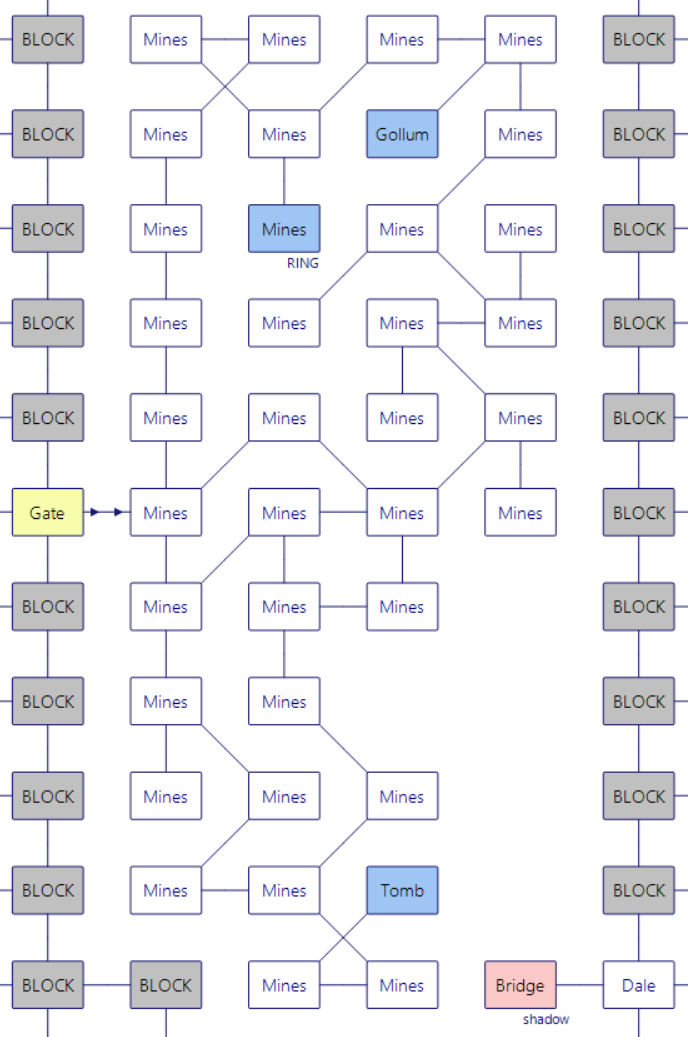


 Renga in Blue