Unfortunately, I have not found any more historical material since last time, so I generally just have to hope Richard E. Herrick Jr. is alive and tries to Google himself sometime (which has happened before with other authors!) Unlike the first game, this only has a BASIC source version, and while Escape slightly broke the 16k limit (18337 bytes) Land of Odysseys busts it entirely, at 25859 bytes. The game is still stylized around Scott Adams; Adams went with his particular style for technical reasons, but even with more memory space the author is choosing to stick with it. (This sort of “legacy started for technical reasons but held after even when those reasons went away” applies elsewhere in game design history, like pixel art, although 32K still isn’t that generous.)
Escape involved getting out of a house alive. This game clings back hard to the roots of Scott Adams and Adventureland, with the goal of collecting treasures and returning them to a starting location.
The temple has a mirror which hints at “Alice”, indicating it can be entered, Through-the-Looking-Glass style.
I AM IN A SECRET ROOM. VISIBLE ITEMS:
LARGE MIRROR. VIAL FILLED WITH A WEIRD POTION. *MAGIC WAND*
The vial is another Alice in Wonderland reference, which we’ll see payoff in a moment.
Going just outside the temple lands you in a “forest” with a “large rock”. Looking at the rock and then moving it reveals a DARK HOLE.
The dark hole has a *PEARL NECKLACE* (the second treasure, after the magic wand) and a piece of paper which reads “trolls are afraid of magic”.
Heading west of the forest leads to a tiny door with a DRINK ME sound, and you do the predictable thing:
Predictable, but still enjoyable enough. The game does get harder later.
Inside the door is a “small room” that has a troll, a book of magic words, and a golden medallion (treasure 3). Oddly, the troll’s fear of magic extends to the book that is in his lurking place, and trying to pick the book up is enough to scare it away.
The book mentions “hocus-pocus”, “open-sesame”, “abracadabra”, and “presto”, all which will show use in a little while. This is like getting the book of spells in Enchanter but you have to randomly guess what each one does. The game is tight enough it isn’t that frustrating but — let’s get to their use in context.
First off, you may notice the small room has no exits.
>SAY HOCUS
OK
HOCUS
******PUFF!******
This teleports the player out back to the path, where they can pick back up all their stuff like their magic wand which maintained normal size as they were shrunk down.
To the east of the temple/forest is a “swamp” with strange gas and a pool of oil; I haven’t used the oil for anything but the gas will come in handy later (you can GET GAS while holding the vial that used to have potion in it). From there you can exit north and south, both which represent magic word puzzles:
North is simply quicksand you can get out of by using the PRESTO word. There’s a *BAG OF RUBIES* there to add to the collection.
South is a log cabin guarded by snakes. For whatever reason — in practice, just experiment with all four magic words whenever there’s a puzzle — ABRACADABRA is effective against snakes.
The log cabin has a “piece of steel” and a “shovel”. The shovel can be used to dig up a random room (between the starting forest and the tiny door) which has “flintrock”; these can then be used to LIGHT the LAMP found in the starting room.
Speaking of the lamp, you can also — taking a cue from Adventureland — RUB it to get another treasure. Unlike Adventureland you can’t rub it twice to get a second treasure.
The room above incidentally has the first thing in the game I have not resolved yet: the winged horse. You can untie it from the tree, and sit on it, but none of the words I’ve tried or actions I’ve attempted have gotten the horse to take off. There are puzzles not resolved by just using magic words!
Or maybe I just haven’t found the right magic word yet.
East of everything is a mountain with a suspicious crack. OPEN SESAME reveals a cave (ever since King’s Quest V I’ve been paranoid that this leads to a timed puzzle where the cave will close behind me, but the cave seems to be permanent).
On to the cave, where I’ve got three open obstacles.
To the north is a sign that says “DRAGON SLEEP” which is a hint for dealing with the actual dragon to the south. Suspicious, I went back to the gas out in the swamp and did SNIFF GAS, which worked (!) and let me know it made me feel slightly sleepy. Since I had some gas in my vial, I could throw it:
Unfortunately, trying to walk by wakes the dragon up briefly and it inadvertently fries you. I’m not sure if the goal is to tiptoe softer or if there’s a method of doing away with the dragon for good.
Heading back to the cave entrance and going due east, there’s a chasm blocking the way, easily resolved by doing WAVE WAND (I’d been carting the wand around this whole time waiting for it to get applied somewhere).
Further east are some corpses and a shiny chalice. Taking the chalice does not go well.
I was hoping maybe I could get the dragon together with the zombies and have them cancel each other out, but no dice yet.
The third unresolved obstacle is a minotaur, in a “labyrinth” to the north.
In the rooms marked Labyrinth they include all exits N/S/E/W/U/D and any not on the map are just loops. It’s like one of the old Greg Hassett mazes.
The minotaur doesn’t kill the player right away but they can chase. I have yet to get anything good to come out of that but I also have yet to experiment; I felt it was a good time to come in and report.
The minotaur is guarding a Persian rug, but I have to deal with this problem first.
So to summarize, I have a winged horse, dragon, minotaur, and set of zombies to deal with. I need to re-check my magic words (I used them, but maybe I mis-spelled them or need to use a different timing) and then get more creative from there.
I will say I’m finding this more pleasant than Herrick Venture 1, despite that game being more strictly mechanical (not fantasy puzzles). The general implied narrative of Herrick Venture 2 has been more colorful and I’ve found it more interesting — at least from the author’s minimalist style — to get surrounded by zombies or chased down by a minotaur than run over by a car.
Bedrooms all over the country were becoming overwhelmed by battered boxes of early computer equipment, bought under the dubious auspices of “helping with our homework” before being turned over full-time to the more pressing task of completing 3D Monster Maze before morning registration.
Upon the release of the ZX80 and ZX81 computers, in addition to software, companies popped up to provide hardware. The two obvious gaps to fill were memory (1K in the original) and the keyboard (called “one of the worst keyboards ever”).
dk’tronics was started out of David Heeley’s bedroom “just prior to the launch of the ZX81” based on his “interest in electronics” with a 16k memory expansion; when the ZX81 came out he went full-time, still using his house as his base of operations through 1981:
The business was all mail-order then but I was getting a very good response. I had to do everything myself — manufacturing, packaging, selling and posting — and I was working in my bedroom, my garage, my shed.
He had four employees (and had moved out of his house) by the end of the year, with their keyboard being one of their best-known products.
They got into software as well at the same time (before eventually falling back entirely on hardware once the market started to get flooded), with some of their early work by none other than Jeff Minter, who eventually became famous enough to have a modern collection based on his company, Llamasoft. The dk’tronics work came before Llamasoft. As Minter notes in an interview:
The first machine I actually owned was the ZX80, and in fact I did a few pre-Llamasoft games for the ZX80/ZX81 for an outfit called dk’tronics in the U.K. However, they treated me spectacularly badly, and so the founding of Llamasoft coincided with my getting my hands on the VIC. Games were just something I did in my spare time before that.
It’s worth watching a little of his game Space Invaders, as it sets up a point of history I’m about to make.
The invaders look hi-res compared to regular ZX81 games. That’s because the game is using custom hardware: specifically, the dk’tronics graphics rom, which changes the character display to show game sprites as “text”. (In other words, the mechanism that might normally display the letter R is modified to show part of a spaceship.)
All that setup helps explain the existence of the company Kayde Electronics, another ZX81 hardware manufacturer. In addition to a keyboard and memory packs, Kayde also sold a graphics rom almost exactly identical to the one from dk’tronics. It only has one bank changed (modified to make Pac-man graphics). Both companies were even situated in the same city. It’s unclear if the graphics rom was under license or if they ripped dk’tronics off. (It’s not even an approximation, they’re exactly the same sprites. Given the documentation that came with the dk’tronics edition it would be easy to make a copy.)
…and it was essentially identical to the type-in (see El Explorador de RPG for more on this). Kayde eventually changed the game’s name to “The Swamp”, likely because of it being blatantly stolen.
All these shenanigans might be part of the reason why the company went into receivership in 1983 (a year after its founding) and disappeared entirely shortly after; during 1983 they put out a series of five text adventures (maybe six or seven) hence the company’s appearance here. Based on the inlay for one of the company’s other games, I think the order goes
1. Leopard Lord
2. Terror from the Deep
3. Ace in the H.O.L.E.
4. Horror Atoll
5. Arcane Quest
6. The Roundsby Incident
7. Picnic Adventure
where 6 may not exist (despite having cover art in ads) and 7 probably doesn’t exist (it was advertised with “temp” art). At the very least, all we have access to are games 1-5.
Leopard Lord is the first in a new range of adventure games from Kayde which all have been written by a science fiction writer.
The statement above is from the tape’s inlay, although no specific credit is given so it is unclear if “science fiction writer” refers to someone who published a short story once, or a teenager with a zine, or something more respectable. Based on the text of the introduction I think something from the first two categories is more likely, although from the company’s other behavior I can’t discount a.) a real author made an off-hand comment which was used as the author “writing the game” b.) the content was stolen from elsewhere and/or c.) the ad copy was simply lying.
The introduction drips “AD&D dungeon master” to me so I decided to drag the microphone out and do something I hadn’t done in a while: a dramatic reading!
You are Prollen the Mercenary.
The people of or Yarm have offered you 1000 gold coins if you will rid them of Fordel, the evil wizard.
Fordel is the leader of a vicious clan. He is known as the elite Leopard Lord. He is totally evil and will let nothing stand in the path of his ultimate ambition, to control the world, by bringing forth a demon from the nether pits.
At first you are reluctant to help.
The reward is raised to 1500 gold coins, a veritable king’s ransom, but still you hesitate.
Then you find that Fordel is holding your friend, Braneth, somewhere in the hall of the elite Leopard Lord.
Fordel will use Braneth’s heart torn from his living body to summon the demon.
The ceremony is to take place tonight.
With all this wind-up pointing to a hack job I had a bit of dread going in, but oddly, I enjoyed myself. This follows my general mantra that a simplistic parser works out as long as the actions demanded of the player also stay simple. It certainly helped I did my “verb list search”, so I didn’t have to struggle later:
SEARCH and EXAMINE in particular set off my warning bells. If you go north from the forest in the start you’re in, er, more forest, but there’s also a HEDGEROW. I did SEARCH and found a BLUE KEY…
…but before moving on, I restarted and went and tried EXAMINE instead, informing me that I see nothing special. That means SEARCH and EXAMINE are treated differently, which can be a very nasty trick with this kind of reduced parser (where, intuitively, it doesn’t seem like verbs should have any subtlety).
To the east of the hedgerow is a leopard and the game’s first combat. The game clearly has D&D in mind (later there’s a water weird, which is D&D-only) but there’s no obvious puzzle here, just the command KILL LEOPARD.
What seems to be going on behind the scenes is that the game is checking if you are holding a set of particular objects; if you are, you win the battle, otherwise you die. The game starts you with a SWORD, DAGGER, and TINDERBOX. If you drop the SWORD before the combat, you still win. If you drop the DAGGER, you still win. If you drop the SWORD and the DAGGER, you lose.
IT KILLS YOU
YOU HAVE FAILED. TRY AGAIN YOU ARE OUR ONLY CHANCE
In some cases the game is looking for a specific item, in others it seems to be simply looking for a combination. Because there’s no description when you win — every weapon is used “passively” — I didn’t stop to diagram out the possibilities, although it did give me trouble later.
North of the leopard is the entrance; you use the blue key to open the door, and you can also find a torch hidden in the thicket. (There’s no command for lighting or unlighting; I assume the game has a flag somewhere that checks if you have the torch and tinderbox; I never found where it was and ended up dropping the two items later as the inventory limit is tight.)
Right at the entrance is a book which encourages you to check out the next game, Terror from the Deep (I wonder if this will be like the Scott Morgan games where each game references the next one). Just north is a snake (the default sword & dagger still work) followed by a harpy guarding a box (ditto).
The box has a red key which gets used on a red door. It’s so helpful when the villains color-code everything.
There’s a “small room” with a sarcophagus where the passive check-your-weapons combat system comes into play. If you open the sarcophagus there’s a mummy, and trying to fight it kills you. The room also has writing that says
THIS COULD BE TRAGIC IF YOU DON’T USE MAGIC
which indicates the standard sword and dagger won’t work.
Two rooms away there’s a glowing axe :– holding it is sufficient to defeat the mummy. Defeating the mummy gets the player absolutely nothing. I think again we’ve got D&D influence creeping in, where a “side monster” is a perfectly good encounter to beef up to the next “level”, but because that infrastructure has been ripped out by being a Pure Adventure, the author wasn’t sure what to do so put the side encounter in anyway.
Around the same area there’s a trapdoor that leads down.
In this area, there’s a leopard guarding a pendant. (Again a wimp, funny for a game titled Leopard Lord that the leopards are the easy kills.) Along the same hall there’s a STATUE, where if you EXAMINE it (not SEARCH) you see a HOLE, and then can INSERT PENDANT to open a secret passage.
This would have been so much more irritating without the verb list. I already knew INSERT was going to apply somewhere.
The secret area has a TUNIC and MIRROR, both essential items for later.
Heading back up to the main floor, there’s a long hallway flanked on the south by a troll.
The troll is, like the mummy, completely optional. Even the GLOWING AXE doesn’t help here. I got a shield later and came back and managed to win.
Nearby there’s also a “room painted in red” where you can find a coin and rod in a cupboard (rod useless, coin helpful). Oddly, there’s a wall with a warning about not breaking it, but no puzzle: you’re simply supposed to obey the sign. There’s no way to survive breaking the wall and no secret obtained by doing so.
I guess this is meant as another D&D encounter-for-color, perhaps?
The north end of the hall has a chimney going up to the last part of the game.
North has a single guard, whereas south has two; you need to fight the guard to the north first and obtain the SHIELD there, then you can fight the guards to the south.
The cupboard has the green key needed for the green door that’s just right there. In a D&D campaign I could see it working to find the item to open the next door after a combat, but in adventure format it comes off as silly.
Past the guards to the south is “Fordel’s Private Quarters” where you can find a throwing axe. Heading north instead, there’s a pool with a water weird to one side (I never killed it, there may be no way) and a medusa on the other (strangely, the mirror is not needed at all).
Maybe the shield helped? I didn’t find it worth the time to check every single combat.
Further north is an “OLDMAN” who is peaceful. (KILL doesn’t even work to get yourself stabbed by the secret ancient kung-fu master or whatever.) Pulling out my verb list again…
…there’s no TALK command, and the only one that seems relevant then is GIVE. I went through my objects and decided COIN was the most likely gift.
The OLDMAN says: to win we need a MIRROR, AXE, and MIRROR. That is a typo and I eventually realized that ARMOUR (which we’ll pick up in a moment) is the real third item. The AXE here is not the glowing axe but the throwing axe back at Fordel’s bedroom.
Heading west, since we don’t have the armour yet, we just die:
We can instead go north past the OLDMAN, nearly get hit by an arrow…
I’d been assuming the TUNIC was helping in fights and keeping it in inventory. There’s no WEAR command and it may only be useful at this spot.
…and find the ARMOUR the OLDMAN didn’t speak of because the author didn’t bother to check for typos of essential information.
With the three items in hand, entering the ceremonial chamber is now safe, and we can THROW THROWING AXE to end the game in victory.
I realize, laid all out like that, this doesn’t sound like a good game at all. And to be honest, it isn’t! But I did find it weirdly playable and charming mainly because I didn’t get stuck that long; even the ARMOUR typo didn’t stop me for long because I logicked out that there’d be no reason to put the ARMOUR past a trap unless it got used somewhere. It felt like I had fallen into some teenager’s after-school D&D campaign and the minimalist setting didn’t bother me that much, because it was delivered with passion.
Mind you, no idea where the science-fiction writer mentioned in the ad copy comes into this. I half-suspected this may have been adopted off a real printed campaign, but I couldn’t find any good hits. There’s a Leopard Lord in the “Oriental Adventures” campaign Ochimo: The Spirit Warrior but that didn’t come out until 1987.
Part of the map of the 1987 campaign, from the Internet Archive.
However, I do have some D&D experts lurking the wings, so if someone has a suspicion they want to throw into the comments, feel free.
I’ve finished the game, and as I suspected, I was running into a single small issue (a problem with the parser, really). My previous posts are needed to make sense of this one.
Last time I had the issue of needing to replace two cables. I could replace one of them (with a wire scavenged from FRED) but not the second. I was most suspicious of the “orange wire” attached to the GG-1 needed to win the game, but seemingly removing the fuse and the wire then broke the device.
I was under the assumption that removing the fuse breaks it, for the good reason that the game wouldn’t let me put it back.
FC: Cryolink already established to Iris.
Internal map reference — Main Supply Room
I’m in the northernmost portion of a large, messy area where debris is scattered about as if something had shaken it loose from the walls. Sitting near the wall is a machine which has a little orange button on its face. Beside the button are two small sockets, one red and one yellow. A red IC sits in the red socket, and a yellow IC sits in the yellow socket. The front panel is open and a fourteen-inch cable of orange wire is exposed. A small glass fuse it sits in the panel. On the front panel is a series of eight circles. The orange button is flashing.
>get fuse
Taken.
>iris, put fuse in front panel
There’s no room.
>put fuse on front panel
There’s no room.
Hence my barking up a wrong tree for about an hour, but I finally thought to ask Whiz about the fuse, and got something helpful.
AP: This is a small glass fuse which should be removed before tampering with any exposed sections. After tampering with machine internals, the fuse should be put back into the machine.
I went with the exact wording “put back into machine” and tried it:
>iris, put fuse in machine
FC: Cryolink established to Iris.
IRIS: Done.
Oho! Now I did have one last surprise, as I realized the codewords are not consistent across games, and if you try to guess it will just scramble. (You could still save-restore and go through the 56 possibilities.) However, since I wasn’t being pushed for time, I sent a robot over to grab the camera and bring it to get plugged in.
>plug in tv1
I’ve plugged it in. I detect a vibration from it as it comes on.
IRIS INTERRUPT: Receiving transmissions.
>point tv1 at sign
The small sphere has been pointed at the recessed sign.
IRIS INTERRUPT: The little sign presents me with the access code the machine in the Main Supply Room needs to reset the Filtering Computers. It says CONKLA.
>REPLACE NINE-INCH CABLE WITH ORANGE CABLE
Okay. It’s done.
FC INTERRUPT: Approaching balance between all three units. Attempting internal stabilization. Reset codes may be entered now for planetside stabilization.
>IRIS, PUSH CON
FC: Cryolink established to Iris.
FC: First access code accepted. Enter second access code now.
>IRIS, PUSH KLA
FC: Cryolink already established to Iris.
FC: Second access code accepted.
FC INTERRUPT:
All systems returning to normal.
Weather systems slowly approaching balance.
Hydroponic systems working at full capacity.
Surface life in recovery mode.
Extrapolation based on current weather systems and food supplies:
Total recovery in 82 cycles.
Current surface casualties: 11,862,000
Projected casualties during recovery: 3,417,000
Original population: 30,172,000
Total possible survivors: 14,893,000
This score gives you the possibility of being considered for being burned in effigy. On a scale of 1 (the best) to 7 (the worst), your ranking was 7.
You successfully completed your task, bringing the Filtering Computers back into balance, in 347 cycles.
Now to do it all over again, but faster, and keeping track of the computer settings while I’m at it. The best robot to send over to twiddle with dials / levers / switches is Whiz, because while they were useful for figuring out the puzzles, they are not needed once all the information has been drained from the library. Also, they can see and manipulate all the controls, and just in terms of start position, Whiz is exactly the same distance from the skywalk as Waldo.
A speedy run means sacrificing robots to the acid, so no dealing with the humans, and fixing the system faster than they can arrive (or at least, on my walkthrough, I managed it right when they arrive). That means Auda would normally be best positioned to nab the camera (starting on the north side of the map) but while Auda can hear the CAR needed to go to the Biological area, Auda can’t see the camera so can’t pick it up.
Internal map reference — Biological Laboratory
I am in the Biological Laboratory.
>get all
AUDA: I don’t hear what you mean to get!
Additionally, Auda can’t get the cutter from the Small Supply Room (Auda starts in the room next to it). The only description there is “the air is very still”.
Stars marking the locations of the cutter and the camera.
So at least one more robot is going to need to be sent up to get those; I ended up trying Poet, but Poet is unable to see the wedge when dropped, so I ended up sending both Waldo and Poet and having them split up: so Poet goes to get the camera, while Waldo goes to get the cutter. Then the two meet back at the step, Poet makes a beeline over to Iris to nab the orange wire in the GG-1 (while the robots have been moving, I had Iris fix the machine, so Iris just passes it off to Poet) while Waldo goes over with Sensa to the Gamma Repair to get the wire from FRED.
The timing works such that Poet goes and makes a sacrifice first, swapping a wire and using the camera immediately prior to expiring.
Internal map reference — Secondary Channel
Connections are what make life worth living. In each direction we find our source of disorientation, our metaphysical essence. Linkups are possible, connecting our distant cousin with our essence, our very presence here. There’s a signpost overhead — the next stop…
>POET, REPLACE NINE-INCH CABLE WITH ORANGE CABLE
FC: Cryolink already established to Poet.
Okay. It’s done.
POET INTERRUPT: Warning: I detect the presence of the other worlds.
>POET, PLUG SENDER IN PLUG
FC: Cryolink already established to Poet.
I’ve plugged it in. We’re on location, all systems go.
IRIS INTERRUPT: Receiving transmissions.
>POET, POINT SENDER AT SIGN
FC: Cryolink already established to Poet.
The sender has been pointed at the signpost.
IRIS INTERRUPT: The little sign presents me with the access code the machine in the Main Supply Room needs to reset the Filtering Computers. It says FOOBLE.
Poet’s death of course being dramatic; Sensa I sent to die changing the other wire.
FC: Cryolink established to Iris.
FC INTERRUPT: ALERT! ALERT!
Intruders detected in Sterilization Chamber!
>IRIS, PRESS BLE
FC: Cryolink already established to Iris.
FC: Second access code accepted.
FC INTERRUPT:
All systems returning to normal.
Weather systems slowly approaching balance.
Hydroponic systems working at full capacity.
Surface life in recovery mode.
Extrapolation based on current weather systems and food supplies:
Total recovery in 4 cycles.
Current surface casualties: 23,000
Projected casualties during recovery: 0
Original population: 30,172,000
Total possible survivors: 30,149,000
This score gives you the possibility of being considered for a home in the country and an unlimited bank account. On a scale of 1 (the best) to 7 (the worst), your ranking was 1.
You successfully completed your task, bringing the Filtering Computers back into balance, in 100 cycles.
Of course, at the same time as all that I had to juggle Whiz fiddling with controls, but it didn’t turn out to be too terrible to deal with. As soon as possible Whiz needs to fix the dials to repair the weather (as mentioned last time, 54, 100, 54 the best ones I found). Right after, even before a second earthquake hits (messing with the transport and food) Whiz can move over to the transport room and flip all three of the switches; then I had him camp in the hydroponics room and wait. At the exact moment in my walkthrough that the earthquake hits (when Sensa was about to unlock the cabinet with FRED) I had Whiz fix the settings.
What happened here is that a setting and its level are supposed to be the same, but water dropped by 20, minerals dropped by 15, and lighting dropped by 20. So the way to fix it is to crank water up by 20, minerals up by 15, and lighting up by 20. Not exactly a strategy game moment, is it?
WHIZ, SET FIRST LEVER TO 90
WHIZ, SET SECOND LEVER TO 45
WHIZ, SET THIRD LEVER TO 70
More turn optimization is no doubt possible, but all that was good enough for a regular difficulty max-score win. What about ADVANCED difficulty though?
From left to right, Stu Galley, Marc Blank, Steve Meretzky and Michael Berlyn. Source.
FC: Request for advanced game acknowledged.
SENSA INTERRUPT: Secondary tremor detected by Filtering Computers. Intensity: 8.4. Projected damage: Automatic controls for surface transportation; Automatic controls for Hydroponics Area.
IRIS: In the Weather Monitors.
WALDO: In the Gamma Repair.
SENSA: In the Central Chamber.
AUDA: In the Entry Area.
POET: In the Central Chamber.
FC: Whiz is no longer in communication.
Starting places of the robots are the same, except Whiz is now removed entirely from play, and all three systems (transport, food, weather) are damaged all at the start.
The main point to make is that we are trying to prevent people from dying, not necessarily go as fast as possible. I went ahead and did all-hands-on-deck by sending Waldo, Sensa, and Poet all over to controls simultaneously, so they could be fixed as fast as possible. The fixes are absolutely identical to the regular game; there’s no “tertiary quake” that messes with the controls even more, so after they’re fixed, the rest of the game can proceed as normal — except — the delay means the humans will arrive. However, the acid seems to be more deadly anyway (I couldn’t run any robots through) so I also put Auda back into play, stealing the toolbag at the right moment.
FC INTERRUPT:
All systems returning to normal.
Weather systems slowly approaching balance.
Hydroponic systems working at full capacity.
Surface life in recovery mode.
Extrapolation based on current weather systems and food supplies:
Total recovery in 9 cycles.
Current surface casualties: 67,000
Projected casualties during recovery: 0
Original population: 30,172,000
Total possible survivors: 30,105,000
This score gives you the possibility of being considered for a home in the country and an unlimited bank account. On a scale of 1 (the best) to 5 (the worst), your ranking was 1.
You successfully completed your task, bringing the Filtering Computers back into balance, in 116 cycles.
I think more optimal might require simply knowing what switches/levers/dials should be done first to be effective faster.
WALDO, SET SECOND DIAL TO 100
WALDO, SET FIRST DIAL TO 54
WALDO, SET THIRD DIAL TO 54
POET, FLIP FIRST SWITCH
POET, FLIP SECOND SWITCH
POET, FLIP THIRD SWITCH
SENSA, SET FIRST LEVER TO 90
SENSA, SET SECOND LEVER TO 45
SENSA, SET THIRD LEVER TO 70
For instance, maybe it would be better for Poet to hit the switches in reverse order? That’s optimization past what the game is even tracking for the overall ranking. For even further exploration someone could muck about with the game’s CUSTOM which lets you decide where the robots are and which ones are alive; is it possible, for instance, to win the game with only one robot? (You might worry about FRED, but the BOTH ROBOT AND ROBOT syntax lets you use the same robot twice, so you can have BOTH WALDO AND WALDO move FRED. For Iris being dead and not seeing the code, you can do some brute-force save/reload with the relatively small number of combinations that need to be tested.)
However, I’m fine ending things there…
…except I ought to try IMPOSSIBLE, right?
>impossible
FC: Okay, you asked for it…
FC INTERRUPT: External sensors detect huge radiation abnormalities in the star which provides Contra with all light and heat.
WARNING! TIME CRITICAL!!
External sensors detect significant instability in the star.
…two turns later…
FC INTERRUPT: Oh oh. Abnormalities in star approaching critical level. NOVA IMMINENT!
So long from all the gang — Iris, Waldo, Sensa, Auda, Poet, Whiz, FRED, and last but not least, we three FCs.
…
After clearing myself of spoilers, I get the fun of reading everyone’s write-ups; in addition to Jimmy Maher, Drew Cook, and Aaron Reed I mentioned in my first post of the series, I also got to read The Adventure Gamer (Joe Pranevich, specifically) and The Data-Driven Gamer (part 1, part 2). Data-Driven experimented with the humans and different ways of messing with their pattern; you can, for example, steal the CAR so they can’t get the clones, at which point they’ll argue and then eventually decide to just disconnect the player directly. I also liked Drew Cook’s observation that the lore mentions “malcontents” to the whole lottery system that were “dealt with summarily by the Authority”; the ominous threats on the lottery report letter (involving confiscating children) give the impression that the word “utopia” at least needs an asterisk.
I did not find it that difficult, so that brings up for me the fascinating question: why? I can even compare with my much-younger self, which was utterly baffled.
I could vaguely gesture at the 20 years I’ve been blogging about interactive fiction and mumble something about experience, but I don’t think that’s a good explanation; my grim patience and experience applied with a game like Adventure Quest, but that’s a game that I recognize has high difficulty as I’m hitting it. With Suspended, nearly every object has explicit hints from Whiz; there are often three or more ways to realize the utility of an object. The fixes to the Filtering Computers are relatively straightforward. (When I played this long ago, my child imagination thought I’d need to be changing numbers every 10 turns or so, when you just need to do a single adjustment once for each control.)
Perceptually, I had very little trouble fitting together the multiple perspectives all happening at the same time. It was “normal” to me that Auda would not see an object at all and that information needed combining with another robot. I also never felt like I needed to resort to keeping track on the map of where the robots were; it’s not like they were wandering randomly; I always had particular missions in mind, and when I was in the phase of just trying to understand what was going, I usually focused on one robot at a time anyway.
The game’s longer-term legacy would be more complex. Its alienating premise and interface turned off players expecting the more traditional storytelling that was becoming the core of Infocom’s brand. It was also challenging, uncompromising, and required an obsessive attention to detail: “a game for frustrated would-be air traffic controllers,” one reviewer called it. The first Infocom game created by a writer, it had less plot and characterization than nearly any of their other titles. Today many consider it one of the company’s lesser works, more notable for its unusual packaging and bizarre premise than its often tedious gameplay.
— From Aaron Reed
Clearly, the “fractured reality” element has been too much conceptually for some people (including my younger self). I just find it so puzzling to read so many takes entirely counter to my experience: regarding the paragraph above, I was able to ignore a lot of details. In fact, that’s perhaps why I had the better experience, in that players who could only cope with the fire hose of information by swallowing down every drop ended up with reams of notes, whereas I was able to zero in on the important aspects, and simplify thinking of the game-winning gizmo as a GG-1 and not a complex array of sensory perceptions. I never stopped to examine Poet’s side comments, or figure out the exact rules if one object could see Thing X but not another. (One noteworthy thing I should mention, as it blows my mind at a technical level, is you can have a robot not see an item, but be with a robot that can see the item, and the non-seeing robot can then use it. This is meta-knowledge on a high level. Whiz originally is hesitant to look up anything involving FRED — the robot was removed from the library system — but once FRED is found, Whiz is more willing to engage and can give the hint that the robot can be scavenged from.)
I still find the game a magnificent experience and it is one of the few Infocom games I would change very little beyond a couple moments of parser polish. The most recent Interactive Fiction Top 50 of All Time pool puts Suspended at 21st out of 50, tied with Spellbreaker, Trinity, and Hitchhiker’s Guide to the Galaxy.
(Now Hitchhiker’s really is a difficult game. Absolutely nothing in Suspended compared to the complications of the Babel Fish, or the door where you needed to prove your intelligence, or the time travel. Suspended’s difficulty is in being so much unlike anything else; even with multi-character games like Guardians of Infinity: To Save Kennedy they didn’t have the perceptual issues of Suspended.)
Coming up: I’m going to spin the dial on random a few times, but we’re coming close to getting back to another Apple II graphical game. I know some of you have been waiting. It’s not “rare” but it is one I’ve never seen discussed before.
I’m likely extremely close to the end, but given I still need to tackle the “strategic” layer (and check the alternate difficulty levels) I’ll have enough content for a long final post next time even if I’m only a turn away from victory.
From Mobygames.
My big break — taking me almost all the way to the end — came from Whiz. I realized despite him complaining the moment you take him out of the “library” section where he plugs in…
Internal map reference — Index Peripheral
CLC identifier shows the object before me as the Index pedestal.
>n
Internal map reference — Outer Library Area
CLC identifier tagging detected directly to the south.
>n
Internal map reference — Hallway Junction
Request directions which would send me in a southerly direction as linkup seems imminent.
The W1 is positioned by the step.
There is a W1 here.
…it’s very useful to see things through Whiz’s eyes, as he sees things by their library computer (CLC) tag. (The wedge that allows passing over the step is W1.) This means they get identified quite precisely so they can be looked up in the machine. For example, the machine with the eight circles (FOO, MUM, BLE, BAR, KLA, CON, BOZ, TRA) is only spoken of vaguely by the other robots, but Whiz knows what it is.
CLC reports this area is abnormal in its arrangement. A GG-1 sits here, barely operating. A CX3 chip sits in the S1, and a CX4 chip sits in the S2.
I don’t know the “human” name, but it helps in this game to think like a robot anyway, and GG1 (without the hyphen) is enough to query the library.
>query gg-1
FC: I don’t know the word ‘gg-1’.
>query gg1
CLC: Hmm. That’s a tough one. Hold on a minute while I try to locate a reference …
CLC: Here it is! I was beginning to think I was going senile.
IP: Data available from the Technical Pedestal.
IP: Data available from the Advisory Pedestal.
IP: Data available from the Historical Pedestal.
The database indicates the GG-1 “holds the 8 circles used to reset the Filtering Computers” and that “If the Filtering Computers are operational and balanced, keying in the two codes will result in a system reset.” While I suspected already that using the machine was essentially the last step, this confirms that two of the three-letter codes are needed.
The catch here is the “operational and balanced” part which I don’t have yet.
TP: The three Filtering Computers are kept in balance by two series of four cables. Four cables run through the Primary Channel, while another four run through the Secondary Channel.
I showed the relevant room off already with Poet, but here’s Whiz:
Internal map reference — Secondary Channel
CLC tagged location indicates I am within a connecting tube. The connecting cables for the filtering computers line this floor, resting in their grooves. A small plug, PL-1, sits within the wall beneath the ACS.
Whiz cannot see there’s a sign here (and in the primary channel, which looks the same but has different cables). Whiz can look it up where the advisory panel mentions Iris ought to be able to see the sign somehow.
While I didn’t have a method at this moment in my gameplay, I kept exploring with Whiz and found the right item shortly after. Remember the mysterious force field?
CLC warns that the area to the east is dangerous.
Mobile CLC tagged object CAR is at the head of the tunnel.
I can detect nothing inside of it.
Looking up the CAR reveals it is, well, a “car”. This is a transport tunnel and you’re just supposed to enter the car (or “egg”) and the robot will get moved to the other side. (I admit to initially misreading and think the “egg” was out of reach.) Whiz’s library search leaves no ambiguity:
AP: Use this to get to the Biological Area and back.
TP: Operating this vehicle is as simple as entering it.
Voila, the last part of the map I hadn’t reached yet:
Straightforwardly, this is where the clones are stored (as well as an ominous switch out of robot reach — I haven’t tested Bad Ending yet but I assume the humans come in and use this if they hadn’t seen the acid leak). There’s also storage:
Internal map reference — Biological Laboratory
This area is identified as the Biological Lab. Equipment here is available for clone revivification.
CLC tagged device TV1 sits on the floor by a table.
Most robots puzzle a bit over the device (Sensa mentions an RF signal, and while Iris calls it a “television camera” she gives no hint how it is operated) but Whiz can look TV1 up directly:
TP: This is a complex television camera which links directly to Iris.
AP: It can be activated by plugging it in at the correct location.
That’s what the plugs at the wire grooves are for!
Internal map reference — Secondary Channel
CLC tagged location indicates I am within a connecting tube. The connecting cables for the filtering computers line this floor, resting in their grooves. A small plug, PL-1, sits within the wall beneath the ACS.
In the room with me is Poet.
>plug tv1
FC: What do you want to plug the tv1 in?
>pl-1
I’ve plugged it in. CLC indicates object now functioning.
IRIS INTERRUPT: Receiving transmissions.
>point tv1 at sign
The TV1 has been pointed at the ACS.
IRIS INTERRUPT: The little sign presents me with the access code the machine in the Main Supply Room needs to reset the Filtering Computers. It says CONBLE.
Thus, the two circles that need to be pressed to win the game are CON, followed by BLE. (This does not change even on reset, so — as far as I can tell — the bio-area does not need entering in the future.)
Again, though, I’m stuck on my catch: I need to replace the bad wires. There are specifically two of them, one for each of the “channels”.
In the primary channel (to the north) the cables are 4-inch, 6-inch, 10-inch, and 18-inch. One way to tell which is broken is to simply try taking them; the inert wire will be safe, whereas any of the live cables will fry and destroy the robot taking it. (This seems extreme, but given how many save/restores are going on with this game anyway, it seems a perfectly valid approach.) Alternatively, Poet (the diagnostic bot) can examine them.
>examine four-inch
The data transmissions within this cable are irregular. Immediate replacement recommended.
>examine six-inch
I perceive nothing special about the six-inch cable.
So the four-inch cable needs to go. In the secondary channel the options are 5, 9, 19, and 20. Again, the take-and-fry method works. Examining does not work; all the cables appear normal. However, Poet can also diagnose with touch, which apparently finds a different (but equally cable-wrecking) issue.
>touch five-inch
Sensory pads detect no abnormal flow.
>touch nine-inch
Data transmissions are highly irregular through this cable.
>touch nineteen-inch
Sensory pads detect no abnormal flow.
>touch twenty-inch
Sensory pads detect no abnormal flow.
Great! Now I just need replacement cables. One of them I had seen already at the ancient FRED robot; unfortunately, you can’t just take the wire, as it needs a cutting tool, the one that was on the north side of the map, a little too high to reach. There’s a solution that took me a few beats to find but was satisfyingly logical — logical enough that it occurred to me while off the computer, so I went back to test it.
Internal map reference — Small Supply Room
I can detect a small area, cluttered with things which extend from the walls. Doorways lead to the east and the west.
There is a high extending holder here.
Sitting on the high extending holder is…
A cutting tool
There is a square container here.
>drop wedge
Dropped.
>get on wedge
Okay. I’m standing on the solid wedge now.
>get tool
Taken.
This is the using the wedge that bridges the north and south sides of the complex; after passing over, a robot can pick it up, use it to grab the cutting tool, then put the wedge back where it was. This is leveraging the mental model that players sometimes have where an item is “checked off” without realizing re-use might be possible.
The result is a “twelve-inch cable” off of FRED which (I assume) is functional. The parentheses are there because I need a second cable, so I haven’t even confirmed if the one coming from FRED even works.
There are three visible candidates:
First, the blue cable sitting in storage that the memo already warned was non-functional. I also tested using it anyway as the second cable and it didn’t work.
There’s a “backup cable” in storage that you can find by moving the shelf (this is the same place Waldo’s microsurgery extension is held). Unfortunately the cable is crushed and non-functional.
There’s a functional cable (orange color) used in the GG-1 device. You can remove the device’s fuse and then take the cable, but then it becomes non-functional.
I haven’t had luck with any of them. That is, I go over to the primary channel, REPLACE the bad cable, go over to the secondary channel, REPLACE the bad cable, and try to have Iris press one of the buttons and the game says the computers are still broken.
One last wrinkle to all this is the repair conveyer belt which I mentioned not having figured out last time. I thought I needed to get it moving first, but instead, you can just put an object on the north side and the machine will activate automatically.
Internal map reference — Alpha Repair
Running, running, getting nowhere amid the hustle and bustle of life.
The glider is not in motion.
>put cable on glider
Done.
>look
Internal map reference — Alpha Repair
Running, running, getting nowhere amid the hustle and bustle of life.
The glider is in motion, moving a twelve-inch cable.
>s
Internal map reference — Beta Repair
We’re getting nowhere fast, glider, but at least we’re not getting there slowly.
The glider is in motion, moving a twelve-inch cable.
>s
Internal map reference — Gamma Repair
Oh, to reach the end of one’s previous existence, to travel the roadways of life when they are most needed, only to end up here, reborn.
The glider is in motion, moving a twelve-inch cable.
There is a FRED here.
There is a cage here.
>look
Internal map reference — Gamma Repair
Oh, to reach the end of one’s previous existence, to travel the roadways of life when they are most needed, only to end up here, reborn.
The glider is not in motion.
There is a twelve-inch cable here.
There is a FRED here.
There is a cage here.
The twelve-inch cable is the one from FRED. I’ve tried running the other cables through and nothing changes — they’re still busted. I’m fairly sure I’m missing one small step somewhere and I’ll make it to the end.
You might notice I didn’t discuss the controls / people dying in the millions part of the game. People have certainly been dying…
>score
There have been 7,557,000 casualties (original population: 30,172,000) in 242 cycles.
…but as far as I can find you can essentially ignore this after convincing the humans that there was a real accident and didn’t just cause another “Franklin incident”. According to arcanetrivia in the comments, eventually the game will end with enough death, but I haven’t hit that limit while doing lots of experimenting and having robots meander back and forth. There’s essentially no urgency until I have the last puzzle solved, and then I can worry about optimizing and dial settings to keep people from getting frozen and so forth.
(Continued from my previous post. The official WordPress reader has a bug with Soundcloud embeds, so if the last post seemed strangely short you might want to check it before moving on.)
Be prepared, this is going to be a long one. Rather than laying out the territory first and then tackling puzzles, I’m going to flip back and forth a little. Let me first give the general meta-layout:
The main important point of the structure is that there’s a “north side” (with the entrance/decontamination area, a “maintenance corridor”, a “library room” and a biological area) that is separate from the “south side” (central control, central core, repair, environmental override controls, and filtering computers). Between the two there is a “step” which robots can’t pass, so Auda starts trapped on the north side and the other robots start trapped on the south side.
>N
I can’t climb the step.
Let’s start focused on the “Central Chamber” area. This is the area that Iris (the only robot with visual sense) is restricted to, although Iris starts broken and unable to see.
Without Iris, Sensa and Poet are still both able to make a pass. I’m going to give the description each one makes because the two parts together help put together what’s going on.
Internal map reference — Central Chamber
POET: It hops and skips and leaves a bit, and can’t decide if it should quit. It tells the world what it should know, but doesn’t know when it’s been shown.
SENSA: Internal map reference — Central Chamber
All around me charges flow, shaped by the very nature of this room. The electrons are being channeled into an electrical column, central to this environment.
The starting place. Notice how Sensa describes a “column” that Poet doesn’t even mention; Poet is purely luxuriating in metaphor rather than describing anything.
POET: Internal map reference — Weather Monitors
They puff and billow and strain a bit, roar then ebb with time.
In the room with me is Iris.
SENSA: My receptors detect huge electrical flow through the walls and meters all around me.
In the room with me is Iris.
Neither has much helpful to say here; this room, and two other rooms off the Central Chamber (Hydroponics and Transit Monitors) are intended for Iris.
POET: Internal map reference — Main Supply Room
This is another fine mess you’ve got me into. Umm, umm umm! A processor sits on the floor, munching and spitting electrons. Button, button, who’s got the button while the socks ablaze with color. A brain tres sits in the primo socket, and a brain quart sits in the secondary socket.
SENSA: Internal map reference — Main Supply Room
A strange apparatus sits before me, processing electrons internally. This device seems active, though some internal mechanisms are exposed. There are two receptacles, designed to hold small circuitry, and a button beside them. A ruined device sits in the plus receptacle, and a seized device sits in the negative socket.
Flipping back and forth this essentially describes the same thing; while it seems like Sensa is being more exact, it turns out Poet’s “tres” and “quart” will be helpful in a moment. Going to the supply room just south…
Internal map reference — Middle Supply Room
POET: From junk we spring, to junk we go.
Contained spirits, like thoughts, fly from reach.
The basket of goodies for Grandma contains…
A brain plain
A brain quartet
A brain trio
A brain two
A brain zip
There is a sixteen-inch cable here.
It is something we can all grasp, something to embrace, whose presence I detect.
SENSA: I am in the Middle Supply Room.
I perceive a small container which holds several small devices.
The small container contains…
A scanning object
A buss object
A maximized object
A filtering object
A polarized object
There is a sixteen-inch cable here.
A small object emits a weak signal, specifically oriented toward Waldo.
…this is clearly the same set of objects, just described in different ways (except the cable, which is absolutely identical, but based on that mysterious only-on-some-versions memo, can be completely ignored). They do show up in the same order, so the “maximized object” is a “brain trio”.
While this all strongly suggests the “tres” needs to be replaced with a “brain trio” (or maximized object) and the “quart” needs to be replaced with a “brain quartet” (or buss object) trying to swap them in and press the button had no seeming effect. There’s another part later where the plain/quartet/trio notation ends up being very helpful, just not for this exact issue.
The contrasting descriptions of the last object are helpful side by side: “a weak signal, specifically oriented toward Waldo” merged with “something we can all grasp”. The two made me realize this is some sort of tool specifically for Waldo. The GET OBJECT trick also still works
FC: Which object do you mean, the scanning object, the buss object, the maximized object, the filtering object, the polarized object, or the micro extension?
and Whiz quite explicitly says when asked about it: “It looks like a simple waldo for Waldo, in a sense. It has small extensions on it which could probably be used for micro-surgery or something like that.” We’ll be bringing in Waldo a little bit later to try it out.
Internal map reference — Sub Supply Room
POET: It burns and wields tremendous light and makes our joints delight its might.
To rise and fall, and climb new heights, to descend the pit of robot despair. Everything cracks under pressure, sooner or later.
SENSA: Internal map reference — Sub Supply Room
The air here is still. No vibrational activity.
Nothing within this environment emits singular vibrations, but an object does send out a CLC identifier.
Sensa indicates an object; the CLC identifier indicates it is in the “central library computer”. This means you can switch over to controlling Whiz and look for it; the best place to go for this kind of speculative search is an “Index Pedestal” which lets you know if an item is in the database at all and where to get the info.
Internal map reference — Index Peripheral
CLC identifier shows the object before me as the Index pedestal.
>plug in
It’s great to be home. Plugged in to the Index Pedestal. Ready to process queries.
The problem is Sensa’s description is too vague, and while Poet’s description is technically accurate, it doesn’t quite help find the item in the index. However, it is possible to TAKE OBJECT to instruct a robot to grab whatever is in the room (or even TAKE ALL). Once held in inventory, Poet has a more helpful description:
My Zen Master says I am grasping…
A slanting wedge
You can then jump over to Whiz and ask about the wedge:
>query wedge
CLC: Hmm. That’s a tough one. Hold on a minute while I try to locate a reference …
CLC: Ah! Here’s the tagged object. Sorry about that delay, but it’s crowded in here.
IP: Data available from the Advisory Pedestal.
Going over to the relevant pedestal, Whiz then explains that the wedge “can be used as a step or small platform.” This is sufficient information to know: this is meant to bridge the north and south parts of the map!
Internal map reference — Hallway Junction
Life is filled with choice. Decisions always make my eyes moist.
>n
I can’t climb the step.
>put wedge on step
The slanting wedge has been positioned at the step.
>n
Internal map reference — Sloping Corridor
Oh, the travesty of descent, the joyousness of having one’s spirit lifted beyond measure to another glorious level.
The slanting wedge is positioned by the step.
Before going on to further exploration, let’s fix Iris. Fortunately, Whiz is helpful when asked.
AP: Iris can be best used to monitor the monitors surrounding the Central Chamber.
Waldo should remove the maintenance panel and replace all faulty chips.
Bringing Waldo (the grasping/touching bot with sonar), and then doing EXAMINE IRIS:
WALDO: Iris feels extremely delicate and is under a meter in height. My pressure extensions detect a maintenance panel which should be accessible to me.
Remember he had a micro tool in storage; if you pick up and “wear” it, you can then open the panel.
When I open the smooth metal panel I detect a smooth device, a bumpy device, and a rough device.
It’s easy to forget with all the strange messages, but Poet is intended as a diagnostic bot, and can TOUCH each of the boards inside to figure out which one is broken.
>examine iris
The door is open and behind it I detect a brain zero, a brain dos, and a brain uno.
>touch zero
Sensory pads detect no abnormal flow.
>touch dos
Sensory pads detect no abnormal flow.
>touch uno
Electrons can no longer find flow paths through this brain.
The “uno” corresponds to the “plain brain” with the maintenance supplies.
>replace uno with plain
Okay. It’s done.
IRIS INTERRUPT: OOOH! That felt good! Close my panel, big boy.
>waldo, close panel
FC: Cryolink established to Waldo.
WALDO: Closed.
IRIS INTERRUPT: You never looked so good.
We can now see what the room actually looks like!
FC: Cryolink established to Iris.
IRIS: Internal map reference — Central Chamber
I’m in a large room which looks like the inside of a globe. The walls seem sculptured with wiring, swirling around the room’s perimeter, leading into a tall column. The column itself has a door on its face. Doorways lead to the west, south, east and northeast.
In the room with me are Waldo, Sensa and Poet.
Waldo is carrying a microsurgery extension.
Poet is carrying a blue chip.
Since I’m guessing you’re curious:
>w
Internal map reference — Main Supply Room
I’m in the northernmost portion of a large, messy area where debris is scattered about as if something had shaken it loose from the walls. Sitting near the wall is a machine which has a little orange button on its face. Beside the button are two small sockets, one red and one yellow. A burned chip sits in the red socket, and a fried chip sits in the yellow socket.
>s
Internal map reference — Middle Supply Room
This is the middle of an L-shaped supply room. Scattered about on the floor are all kinds of debris. Nothing looks salvageable.
Among the rubble I can see a little basket, sitting on the floor.
The little wire basket contains…
A plaid IC
A green IC
A yellow IC
A red IC
There is a blue sixteen-inch cable here.
>e
Internal map reference — Sub Supply Room
I am in a sub-station of the supply rooms. The room is small, with debris littering the floor.
A broken shelf lies on the floor in a terrible state, beyond use.
With the colors, it is possible to fix the “burned chip” and “fried chip” properly; the red IC goes in the red socket and the yellow IC goes in the yellow socket.
>push button
Okay. I’ve pressed the button. The front panel popped open, exposing a series of eight little circles with letters written on them. The front panel bears further examination. A bunch of orange wire is exposed, and beside it, in the panel, rests a small glass fuse.
>examine front panel
On the panel are a series of eight circles. Each of these circles has a three letter code printed on it. The three letters correspond to half of the Filtering Computers’ reset code.
The circle codes are FOO, MUM, BLE, BAR, KLA, CON, BOZ, and TRA respectively. I don’t have anything matching with them yet.
Other than that puzzle, the main use of Iris is to check various monitors. The earthquake that started the game is already causing weather to go out of control; Hydroponics and Transit are at “optimal” to start (on default difficulty, at least), but there are secondary quakes later which mess with those too.
Internal map reference — Weather Monitors
All around me I see meters indicating the state of the weather conditions on all three planet-side continents.
The monitors for surface weather show:
I haven’t fully experimented yet with everything, but at least tried to fix the weather, by going to the “skywalk” branch on the south side of the complex:
The controls are switches (for transit), levers (for hydroponics) and dials (for weather), with the added complication that not every robot can see every control. Sensa can see all the controls normally. Waldo can see all of them with his sonar (although he sees the switches as “bumps”); Poet only can work with the levers and dials but the switches are invisible. Auda hears a roaring sound while on the skywalk but can’t refer to any of the controls.
Internal map reference — Skywalk Beta
I can hear the tremendous roar of wind in a tunnel to the north. An exact duplication of this sound can be detected from the east and west, though their intensities are somewhat less.
>n
Internal map reference — Hydroponics Control Area
I am in the Hydroponics Control Area.
All the dials are set at 55, but since the Tower’s pressure is at 20 it clearly is not working properly. I ended up getting the weather to simply “rain” by cranking the second dial up to 100, and had everything down to a “light drizzle” by moving the first and third dial down a step to 54.
One important point here is that you can technically reach the dials before you’ve fixed Iris, so you can take the information already gathered and send a robot to fix the weather right away. I’m not sure how I feel about that. The “quantum realities” that the game encourages (like Deadline) where you experiment and reset many times feels like it admits “knowing how the chip color puzzle works” but not so much fixing weather without seeing it. On the other hand, the attempts from the Cambridge authors like with Hezarin to “fix” this issue with randomness-during-the-game ended up breaking it utterly instead, so I’d rather authors avoid trying too hard to avoid pre-knowledge.
To recap, as far as puzzles solved, I’ve bridged the step between the north and south areas, fixed Iris, fixed a “reset code” device in storage, and prevented a snowstorm.
Staying with the south side for now, there’s a “repair area” (where Waldo starts at) with two unresolved mysteries. The first is a “walkway” that runs north to south. According to Whiz, putting something in at one side will run it through and have it fixed at the other ends, except the walkway isn’t running. From Sensa’s perspective:
Internal map reference — Alpha Repair
Strong electrical interference can be detected within this environment.
The conveying mechanism is not in motion.
>s
Internal map reference — Beta Repair
I detect slight vibrational activity from a conveying mechanism.
The conveying mechanism is not in motion.
>s
Internal map reference — Gamma Repair
Vibrational activity and electrical emanations detected from the north are stronger than those in the immediate vicinity.
The conveying mechanism is not in motion.
In the room with me is Waldo.
A large object emits strange flows, its surface a tracery of filament-like circuitry. The circuitry is concentrated near the center of one side.
While I haven’t been able to get the walkway running, I have managed to deal with the “large object” which is a locked cabinet. Most of the robots aren’t helpful here, but having Sensa examine the cage (spotting a “flowswitch”) followed by Poet touching it (who otherwise can’t sense it) is sufficient to give instructions on how to open the cabinet.
>touch cage
Data bits flow within the surface of the cage, concentrated in a circle.
>sensa, examine cage
FC: Cryolink established to Sensa.
SENSA: Concentrated on the front surface of the large object is a flowswitch.
>poet, touch flowswitch
FC: Cryolink established to Poet.
POET: Sensa has the ability to turn the plates and detect when they are properly aligned.
SENSA, TURN PLATES causes it to open, revealing a “broken device”. Sensa and Waldo don’t give more detail than that, but Poet refers to the device as FRED, which is enough to get Whiz on the case:
Technical: This robot is a dead and departed robot who is totally beyond repair.
Historical: This robot was an all-purpose, multi-function robot which proved inadequate for maintenance purposes.
Advisory: There may be some salvageable parts inside it.
While FRED is larger than any of the robots, you can specify BOTH robots move FRED. (This is the puzzle that made me grumpy last time, but again, I didn’t have the manual directions that indicated I could command two robots at once.)
>both waldo and poet, get fred
FC: Dual-Cryolink established to Waldo and Poet.
FC: The robots have moved it.
FC: Cryolink established to Waldo.
>look
Internal map reference — Gamma Repair
I have reached the south end of this area. The walkway ends here.
The walkway is not in motion.
In the room with me are Sensa and Poet.
There is a broken mechanism here.
I can feel a bunch of smooth wire coming out of the mechanism.
There is a hollow object here.
>poet, examine wire
FC: Cryolink established to Poet.
POET: I perceive nothing special about the twelve-inch cable.
I’m guessing this goes back to the override device; fixing it seems to be the central puzzle of the whole game. I haven’t taken this puzzle any farther at the moment (you may notice this post is already getting rather long, and I’m not done yet).
It’s time for some acid! Which FRED supposedly resists, so I may need to simply salvage some parts or even fix FRED entirely (my memory is gone past the BOTH robots part, it’s apparently the moments of frustration that stick in memory!) I also found a method of fixing the acid leak later (but it may not be optimal for turns). For now, though, let’s just send in some sacrifices. Going east to the Filtering Computers requires passing under acid, which Poet describes colorfully:
Internal map reference — Short Corridor
The great interpreter of all our daily occurences lies ahead, while a walk in the sky waits for me to the northeast.
Bathe in luxuriating, though scorching, solvents.
>e
Internal map reference — Cavernous Room
Twice the size of life, this area makes me feel like a dwarf.
Raindrops keep fallin’ on my head
And before you know it I’ll
wake up dead… a puddle of lead.
>e
Internal map reference — East End
Ah, Mama! Here I am, your sonny boy, returned after a lifetime of wandering!
>e
Internal map reference — Beta FC
Amid the nervous neurons, the synaptic links make jumps akin to imagination found only in Wonderland.
POET INTERRUPT: I fear I’m about to become one with the cosmos.
There’s a little time before a robot who gets acid-bathed dies, so I think it may be possible to do whatever needs doing via sacrifice rather than “solving a puzzle”. I have yet to experiment; taking Sensa through reveals a “plug” in two places (Primary Channel, Secondary Channel).
Internal map reference — Secondary Channel
Sensory mechanisms detect the disquieting flow of electricity within this tube. The flow is concentrated within the small cables which line a groove in the floor. There is a small hole in the wall of the tube awaiting a plug, while slightly higher up rests a sign.
(The sign isn’t portable, and Iris can’t reach this spot, so I don’t know what it says.)
Finally to the north side:
Auda starts in a long east-west hall where to the far west is “sterilization” followed by “decontamination”; this is for any humans entering the facility (ominous note). Along the way is a “small supply room” with a metal tool up high, which Waldo describes as a cutting tool (but can’t reach).
Internal map reference — Small Supply Room
I can detect a small area, cluttered with things which extend from the walls. Doorways lead to the east and the west.
There is a high extending holder here.
Sitting on the high extending holder is…
A cutting tool
There is a square container here.
Opening the container gives the message “Robots are restricted from opening this cabinet” which feels additionally ominous, in the way that the (television show) Westworld had things the robots just couldn’t see.
A branch heading south has a few specific points of interest:
A maintenance access room: Waldo describes a “strange combination of circular protuberances” with a “small spray going upward”. Sensa more specifically describes it as acid where “Approximately 99.87 percent of these acid droplets are
going up into the room above.”
A library core: This is meant to be the human-usable version of the same database that Whiz can access. If you send Whiz over he specifically says “This peripheral allows no interaction with robots.”
A force field: The end of the hallway turns east to a biological area I haven’t been able to access because of a force field.
Internal map reference — Hallway End
Sonar detects the end of the southern hallway. To the east is a long, narrow area which travels out of my receiving range.
Sonar also detects a large hollow container sitting at the head of the long tunnel.
I can detect nothing inside of it.
>e
CLC WARNING: Dangerous force fields prevent eastern movement.
Sensa has the most helpful description…
Sensory input indicates the end of the southern hallway here, with extremely violent force fields and electrical disturbances to the east.
Sensors detect an egg-shaped object, large enough for me to enter, sitting at the head of the long tunnel.
I can detect nothing inside of it.
…although I’m still not sure yet what’s going on here.
Almost done! Let’s talk about the arrival of the humans. This happens after some amount of turns (I haven’t counted) I assume because they’re trying to do the clone-replacement process, assuming you’ve gone haywire (you think they might notice the earthquakes, but this seems to be the matter of hundreds of years of peace means they have trouble figuring out what to do in a crisis). Switching to Auda, which starts in the north section anyway:
Internal map reference — Sterilization Chamber
A loud whirring noise can be detected from the west.
A small plaque makes tinging noises here.
>w
CLC WARNING!! Further westward movement prohibited to all robots.
(The plaque here is portable and I took it to Iris to read it, but let’s save that for last.)
After enough time passes:
AUDA INTERRUPT: Some talking mechanisms just entered the room.
>wait
FC: Time passes…
I can hear the sound of metal against metal, followed by the sound of a creaking door opening.
“I’ve got the toolbag. Everything in it seems intact.”
“Well, don’t lose it, man. We’re lost without it. We’ll never pull the switch on him if we lose it.”
“Don’t worry. I won’t let it out of my sight.”
“I’m getting sleepy. It was a long ride down here. What do you say we catch some sleep?”
“You really think we should? With all the devastation taking place?”
“I don’t have much choice. I’m not thinking clearly, and I really need to sleep. More casualties will occur if we don’t take care of ourselves.”
“Good point. Let’s go.”
The humans head to the “sleep chamber” to the far east and pause:
“Well, this is some sleep chamber. No frills.”
“Don’t complain. At least there’s bunks for us.”
“I suppose. I’m going to put the toolbag on the floor while I grab some shuteye.”
“What about the robot?”
“What, that ear thing? Gimme a break!”
AUDA: I hear the sound of metal being placed on the floor.
Trying to take the item (a toolbag) awakens the humans:
“Give me that, you little devil!”
“That robot’s a thief! Let’s get it!”
I’m not sure if it is possible to steal the tools entirely, but you can lead the humans over to the acid leak which seems useful:
“Hey — Look at that! The pipes going up to the Filtering Computers have burst.”
“Yeah. Maybe the person in the cylinder isn’t at fault….”
“Hmm. You could be right. Let’s fix this and then see if things return to normal.”
AUDA: I can hear the sound of metal, like a wheel turning, and the hissing stop.
“That should take care of that leak. Let’s go up to the Rec Area and wait for awhile.”
“Fine. Meanwhile, I’ll get our toolbag back.”
AUDA: I hear footsteps as the talking mechanisms walk away.
SENSA: I detect the flow within the pipes overhead stopping and the acid leak stopping, too.
The fun thing about this scene is I first only had Sensa here with the bag but forgot to bring Auda along, and Sensa can’t even sense the humans there, so the hissing mysteriously fixed on its own (although I could guess at what happened).
That’s an enormous amount of progress, I think! I still have the open problems of
Dealing with hydroponic and transport controls
The mysterious force field
What to do with FRED
Getting the repair device near FRED running
Getting the “cutting tool” that’s too high
The mysterious plugs past the acid drip
Using the reset device with the eight codes
Anything else involving the humans (either using them to help, or stealing their tools)
One last thing before I check out, since I promised: the message on the plaque, as read by Iris:
This Underground Complex was designed and built by the Frobozz Engineering Company, makers of such fine products as One-Way ™ Bus Tickets, Ozone Nozone, and “Best in the East”, soon to be a Smello-vision ™ release.
Chief Designer/Architect: Michael Berlyn.
Despite a lack of dark / grues, I suppose that means Suspended is part of the extended Zorkiverse?
A bicycle can get you from New York to LA, so will a jet plane. In one sense they are the exact same thing; in another they are nothing alike. In one sense we are working within traditional genres — mystery, fantasy, science fiction — and in another we are still teaching ourselves, laying out the groundwork for what these things could be. For the most part, we are working without pioneers. In our own way we are like Louis L’Amour or Agatha Christie or Dashiell Hammett.
The Boston Computer Society (founded by Johnathan Rotenberg) has briefly shown up here in regard to Tim Quinlan, and the company Mad Hatter Software which had published the game Sleuth right before disappearing. Rotenberg himself describes the early days of the group as “a fairly obscure computer group” even up to 1982, when their membership was north of 4,000. While famous amongst computer insiders, enough so that Jobs offered Rotenberg a job in 1981 (he declined, wanting to finish college) that didn’t mean recognition amongst the general public. 1982 was when that would change.
Their big event of the year was Applefest, the East Coast equivalent to Applefest in California.
Picture of 1982 Boston Applefest, From Facebook. The balloon was attached to the ground but people could ride up a couple feet and get an Apple balloon pin.
1982 had Jobs and Wozniak themselves as keynote speakers. The BCS publication Computer Update quoted one attendee that
I kind of expected them to come out in white robes.
indicating religious fervor. The audience was standing-room only.
Software had a strong reception, with games especially doing well on Saturday when many children were in attendance. Sir-Tech, which had debuted Wizardry in 1980, had come back with the just-completed sequel Knight of Diamonds in tow.
This time, a feature landed in the Wall Street Journal in October, featuring the “whiz kid” Jonathan Rotenberg, and suddenly Boston Applefest was mainstream.
Somehow, I hit the “tipping point” in October and was besieged by press from all over the world…including BusinessWeek, People, Time, Sports Illustrated, CBS News, numerous magazines and talk shows, and even the National Enquirer (which threatened to “stake me out” if I didn’t cooperate with them).
Just like California Applefest was a source of backroom deals (leading to Al Lowe starting with Sierra, for instance) this could happen on the East Coast as well; this is where Marc Blank of Infocom and Michael Berlyn first met. This was before Zork III came out, so Infocom was still fresh off the thunderbolt of Deadline. Marc enjoyed the technical challenge, but he did the story as well, as it was simply standard that the entire work be done by one person; however, as he stated in a later interview, he “always loved the idea that someone who’s more talented than I am in writing could take this and do something that’s really much better than I could do.”
So the idea for me was really just experimenting with another style of telling, of having the story evolve, a different interface just to see where it would go. And to me that was more important than the story.
While Michael Berlyn’s novels were not considered Pulitzer-worthy or Hugo-worthy, he was a “real author” who also had adventure experience with his works Oo-Topos and Cyborg. Berlyn’s weak spot was his hand-written BASIC source code, so the Infocom’s parser and overarching world system would let him create a next-level product. The pair struck a deal; originally Michael intended to stay in Colorado, but the difficulty of working with ZIL remotely meant he and his wife Muffy moved to Boston a month later.
The mention of Muffy is important in that she already helped with Oo-topos and Cyborg and apparently contributed “significantly” to Suspended. (Eventually, the fact she couldn’t be hired officially — there was a policy against family member hires at Infocom — led to Michael Berlyn leaving, but that’s a bit farther along in the story.)
The structure of Deadline was a good place to start from, as Blank had already done hard work in establishing a complex system of NPCs, really more complex than any other product on the market at the time (The Hobbit would be an exception, except it wasn’t out yet). Berlyn had already experimented in Cyborg with having the player merged with a character in the world. Expanding the idea from Cyborg led to a game where the player awakens from cryofreeze and can only see, hear, and interact with the world via multiple robots. The object-oriented nature of Infocom’s ZIL system meant the Deadline NPCs could be adapted easily to become PCs for the player to jump into instead.
…it was his story and I did some of the tools, the technology that he needed to get all the robots moving around like they were on tracks.
My own copy of the game, from Michael Berlyn’s garage. This version’s on 8-inch disk for the NEC APC. I got it back in 1998 as a prize in IFComp.
Just like Starcross, the packaging is (in)famous amongst collecting circles for being highly elaborate with a facemask and a fold-open map with figures representing the locations of six robots. The map is extremely important as the game is wildly unusual for Infocom, or really, adventures as a whole: there is no standard exploration. You are given the entire map at the start, but without details as far as what you can find where, just names of places. The overall feel is akin to one of the strategy games from the time that came with a board where the player was intended to move pieces around based on the computer’s instructions. Compare with, for example, Chris Crawford’s Tanktics, originally developed on a KIM-1 with a six-character display (just like Kim-Venture).
There’s even multiple difficulty levels to add to the strategy game feel, but I would still call Suspended a full adventure at heart. (Although I wouldn’t object if The Wargaming Scribe tried the game out just for fun!)
Starting positions of five of the six main robots.
I incidentally found moving the real pieces on a real board (see picture above) to be a pain — again similar to a wargame setup, it requires a flat surface to be handy near your computer, which I don’t have — so I made a Figma page to work with instead. I may re-scan the map image later but it works for now.
My normal next step would be to collect and read all the documents that come with the game, but I hit one other curious snag. There’s a “memo” that’s in my version of the game I wasn’t finding elsewhere.
It mentions specifically that cables need to be changed with the syntax REPLACE (cable in groove) WITH (cable a robot is holding), and that erratic behavior may manifest itself in a “crash”. Does it mean a literal game crash? This feels out of character for Infocom, who I think are more likely to fix a bug rather than go through the effort of printing an entire extra piece of documentation to cover over a problem. The reference to the sixteen-inch cable being broken also seems more like a hint than a bug aspect.
I crowdsourced this over to Bluesky and Mastodon. Chris Kohler found a “facemask” version of the game on eBay had the memo; I had confirmation from Andrew Plotkin their early copy did not have the memo. I’ll need to investigate this further, but I’m playing a later release first (Release 8 / Serial number 840521) and then will check earlier release for bugs. Unfortunately I do not have a 8-inch disk drive in order to extract the data file I have so I can’t tell exactly which release it is.
It is the far future: the planet Contra has been terraformed with settlers from Earth. They have conquered their world and live in a highly controlled environment: perfect weather, perfect growing of food.
Rather like the story The Ones Who Walk Away From Omelas, there is a dark side to this, in that the system running the planet needs a human in stasis. The human is “put under” for 500 years but some aspect of their brain is enough to support the systems for that long; if everything goes well, they are awoken after 500 years and the cycle is renewed, with a “recruit” gathered from a planetary lottery.
In Suspended, you have won the planetary lottery.
You should only awake in the case of an emergency, which the manual emphatically explains, won’t happen. This is despite a previous disaster involving “the Gregory Franklin incident”.
Gregory Franklin was awoken after 467 years, but there was no emergency, so he decided to create one:
Overriding the three Filtering Computers, he directed the transportation systems to kill whoever happened to be walking outside or riding on any of the glide ramps. Psychologists believe that he must have possessed a twisted sense of humor–to have people maimed, run over, chased by robot-taxis provided him with pleasure for the moment. However, he soon tired of this and decided to eliminate a larger section of the population in a far easier manner.
Ever since weather had been controlled, dwellings had not been designed to withstand snow and sleet. Franklin altered the pressure in the Weather Towers near the cities, setting off raging storms and creating freezing temperatures. Thousands perished from exposure; thousands more became popsicles.
The upshot is that anything that seems to go awry means that you might find yourself replaced with a “clone”.
FC ALERT! Planetside systems are deteriorating. FC imbalance detected. Emergency reviving systems completed. You are now in control of the complex.
SENSA INTERRUPT: Seismic aftershock detected ten meters north of Beta FC. Tremor intensity 9.7. Projected damage: connecting cables in Primary and Secondary Channels.
FC INTERRUPT: All Robots, report locations.
IRIS: In the Weather Monitors.
WALDO: In the Gamma Repair.
SENSA: In the Central Chamber.
AUDA: In the Entry Area.
POET: In the Central Chamber.
WHIZ: In the Advisory Peripheral.
This is from the game itself. The manual includes special commands…
REPORT LOCATION
ARR (all robots report)
ARL (all robots report locations)
QUERY ABOUT (used for)
ALL ROBOTS, (do something)
DRAG (robot) TO
BOTH (robot) and (robot), (do something)
…but for the most part, your command is in the format ROBOT, DO THING. If you are using a particular robot, you can skip the “ROBOT” preface.
Robots all have individual abilities. Iris, the “visual robot” who can see, starts out nonfunctional. I don’t know the exact boundaries but Iris cannot move about the whole facility.
>IRIS, GO WEST
FC: Cryolink already established to Iris.
Internal map reference — Main Supply Room
Visual function nonfunctional.
Auda is the robot that can hear, although it starts at the northern part of the map.
>w
Internal map reference — Decontamination Chamber
A small hissing can be detected overhead, as if a small port leaked a semi-liquid compound.
>w
Internal map reference — Sterilization Chamber
A loud whirring noise can be detected from the west.
A small plaque makes tinging noises here.
Notice that the plaque might say something, but since Auda can only hear we don’t know (yet) what it says.
Waldo is a “grasping robot” with six arms, sonar, and a well-developed sense of touch.
WALDO: Internal map reference — Gamma Repair
I have reached the south end of this area. The walkway ends here.
The walkway is not in motion.
A large object sits before me. Sonar indicates it is hollow, but not empty.
Whiz is a robot restricted to the “Central Core” that can make queries, and is sort of an encyclopedia. I haven’t tried searching through entries yet.
>whiz, look
FC: Cryolink established to Whiz.
WHIZ: Internal map reference — Advisory Peripheral
CLC tagged object indicates it is the Advisory pedestal before me.
>whiz, plug in
FC: Cryolink already established to Whiz.
It’s great to be home. Plugged in to the Advisory Pedestal. Ready to process queries.
Poet and Sensa start in the same place, the “Central Chamber” (right next to Aura). Poet is a “diagnostic robot” who can activate its sensor with the TOUCH command, but has a cryptic style of speaking.
>POET, WEST
FC: Cryolink established to Poet.
POET: Internal map reference — Weather Monitors
They puff and billow and strain a bit, roar then ebb with time.
In the room with me is Iris.
>TOUCH IRIS
Sensory pads detect no abnormal flow.
>EAST
Internal map reference — Central Chamber
It hops and skips and leaves a bit, and can’t decide if it should quit. It tells the world what it should know, but doesn’t know when it’s been shown.
In the room with me is Sensa.
Sensa has a mixture of operations and “can detect vibrational activity, photon emission sources and ionic discharges”; Sensa also has appendages like Waldo.
>SENSA, LOOK
FC: Cryolink established to Sensa.
SENSA: Internal map reference — Central Chamber
All around me charges flow, shaped by the very nature of this room. The electrons are being channeled into an electrical column, central to this environment.
In the room with me is Poet.
That’s six robots; there’s a seventh the manual mentions that was put out of service by Franklin (and will become important later).
I use the phrasing “and will” because: yes, I have played and beaten this game before. Like Zork III, it was quite a while ago, and I don’t remember much, but I do know where the seventh robot is and what I thought at the time was a highly unfair command to get to it. (Now that I have a full manual, I see it’s listed in the manual; I played the Lost Treasures of Infocom version which I’m pretty sure did not give this game’s “special commands”.) I remember that at some point humans arrive, presumably thinking another Franklin incident is happening; I also remember there’s an acid drip somewhere that’s a pain (that is, if you roll a robot through a particular room they’ll become disabled). Other than that I’m pretty memory-free, other than I enjoyed the game quite a lot.
I’ve been looking forward to this for a long time. I’ll give the layout of the complex (as far as I can figure) in my next update. In the meantime for anyone who wants to skip ahead, you can check Jimmy Maher, Drew Cook, and Aaron Reed, all who have their own takes on the game. Also, thanks to Jonathan Rotenberg for sharing some documentation about Applefest 1982.
Engine Failure is a type-in that first appeared in Personal Computer World (April 1983) and then in the spin-off Personal Computer Games, the same as Adventure in 1K.
Personal Computer World was very business-oriented, so it is understandable they might have needed to scrabble from prior material to have enough to launch a games magazine.
An ad from the same issue showing a typical example of content. Hilderbay made a previous appearance on this blog with the game Gold but otherwise was focused on business and utility software.
The author, Ian Watt, is yet another one of our teen-aged authors (born in 1967). He founded a ZX80/81 club out of Glasgow (“One of the club’s main aims is to encourage computer literacy”) that was a branch of Tim Hartnell’s extended group (see my writeup on The Citadel for more on how that got started). Of his five published games, one was only in magazines (this one), one is part of a book edited by Hartnell, and three are part of a book by Ian Watt with an introduction by Hartnell. Eyeballing dates, it looks like Engine Failure was the first to make print, which is why I’m starting here.
Engine Failure is “tiny” (two pages, along the lines of Arkenstone) but due to some cryptic object interactions took me a while to finish.
Our spaceship has had its engine fail near a planet, and the engine needs to be repaired before the spaceship is destroyed in the atmosphere.
Gameplay starts in a control room with cryptic buttons; pushing the red one right away causes the ship to blow up.
Even after finishing the game I’m unclear what the functions of the buttons are (that is, I know which ones to press to win, but I’m not sure what the user manual would say each one does in a real-world sense).
Just south of the starting control room is “living quarters” with “water” and a medical bay with a “pill”. The game lets you uneventfully drink the water and eat the pill although it isn’t clear what puzzles this solves, or if it even helps solve a puzzle (it does, I’ll mention it when it happens).
To the south are some “computer banks” with a floppy disk — I’ll deal with that later — and then heading eastward leads to a Cargo Hold (with pliers) and an empty Engine Servicing Room (where going any farther is death, due to a “pet origonk”).
The issue here conceptually is that the sparsity makes it unclear if this is just an adjoining room or something useful later; there’s no control panel or circuit board. Hence, for a while I kept trying to go west, but it turns out going west is impossible and always a death.
Heading back to the computer storage banks and west, there’s a shuttlebay, although entering the shuttle kills you with nerve gas.
It is unclear why the shuttle on your own ship would be filled with deadly gas. I assume there’s some unmentioned sabotage in the plot that happened on our last stop.
Going a bit farther west is a spacesuit; wearing it is the solution to the nerve gas.
Safe from the nerve gas, you can now find a screwdriver inside the shuttle.
The screwdriver can be used to UNSCREW a panel at a room marked “Left Engine” (Right Engine has the creature and is impossible to reach). The panel has a lever, and pulling it activates a blue light.
It’s time to head back to the control room, but while heading back we should grab a “jewel-socket”, a “zappergun”, and that previously mentioned floppy disk along the way.
There is a blue light in the control room now, and you’d think that’d mean you just press the blue button, but that kills you. You need to press the yellow button, which turns the light yellow, and while the yellow light is on you press the blue button, which reveals a “pcb” that is “somewhere in the ship”. (Somewhere turns out to be that empty “servicing room”, but we’ll head back there later.)
While we’re at it, we should also INSERT FLOPPY (no description that there’s a place to put the floppy, I just tried INSERT FLOPPY in every single room until it worked). This causes a red light to turn on, and now we can go straight to the put and PRESS RED.
This will activate a “TELEPORT TERMINAL” just to the south and west of here. I spent a long time trying to operate the machine before checking the source code; it’s just the word TELEPORT by itself.
You are safe using the teleport if a.) you’ve drunk the water b.) eaten the pill and c.) are carrying the zappergun. The first two prevent a disease from killing you, while the zappergun prevents guards from killing you. (It’s very weird and passive, since the zappergun doesn’t get shown being used! You might go through all this and not realize there is any opposition at all.)
While holding both the ASTRAGEM and the JEWEL-SOCKET from earlier you can INSERT ASTRAGEM. Then, back where the PCB got revealed (next to the killer pet) you can INSERT JEWEL (as long as you are holding PLIERS) and a red light will turn on. Then to finish the game you just need to run back to the control room (where it starts getting very hot, the time limit is tight) and press the red button again.
Why does red either blow up the ship, activate the teleporter, or activate some kind of gem? Why does the lever causing a blue light mean you should not press the blue button, but the yellow button instead? I know the author was essentially trying to create an “experiment” type puzzle, but it diverged into the sort of messy and unintuitive interaction I associate more with fantasy games.
Incidentally, while trying to solve the above issues, I looked at the room structure data, and it’s very unusual. Most games have data along the lines of Room Name, 4, 5, 1, 0, which indicates a room, and the rooms (by ID) that go north, south, and east respectively. This game instead has a whole data line like this:
0 -1 0 0 0 3 0 0 0 -3 0 0 -2 0 0
These are all the north exits, and furthermore, they give information in a relative sense. That is, if you’re in room 2 (living quarters) and go north, you subtract one from the room ID to find where it goes (room 1, the control room at the start). I’ve never seen anything like this before; almost always the absolute room ID of the destination is given. I’m unclear why the author would use this method of expressing exits. Perhaps his book has some clue, but we’ll save that for a later time.
Today’s post you could think of as a “bonus game”. It appears in the April 1983 edition of Personal Computer World, followed by the first issue of Personal Computer Games that summer (same publisher) and is directly next to the game I was going to be writing about next.
To explain in context, when the Sinclair ZX80 (and ZX81) came out, they had only 1K worth of memory by default, an absolutely miniscule amount to do much of anything with. Companies still put out tapes and books intended for that target memory size, the most significant from this blog being from Alfred Milgrom (of The Hobbit) and the duo behind Pimania, who started their game publishing with experimental 1K games. Adventure in Murkle was in the same spirit but in a much more generous 4k.
Adventure in 1K is the only game, article, or product of any kind I can find by Ian Stansfield which will “run on any micro you care to name”. Instead of being like the games above, well, let’s just give a transcript–
YOU ARE IN A CAVERN…
NORTH, SOUTH, EAST OR WEST?
E
YOU ARE IN A CAVERN…
NORTH, SOUTH, EAST OR WEST?
W
YOU ARE IN A CAVERN…
NORTH, SOUTH, EAST OR WEST?
S
YOU ARE IN A CAVERN…
NORTH, SOUTH, EAST OR WEST?
E
YOU ARE IN A CAVERN…
NORTH, SOUTH, EAST OR WEST?
E
YOU ARE IN A CAVERN…
NORTH, SOUTH, EAST OR WEST?
Q
YOU ARE IN A CAVERN…
NORTH, SOUTH, EAST OR WEST?
X
YOU ARE IN A CAVERN…
NORTH, SOUTH, EAST OR WEST?
You get the idea. It’s simply printing the text, taking an input, and then looping, without even bothering to read what the player entered. As a courtesy, both BASIC and C source code are provided. (This is the first time I’ve ever seen source for a type-in given in C!)
“Hours of fun and entertainment for all the family.” So yes, this is a joke game, not just on adventures but on the concept of selling 1K games, but it’s the sort of meta-textual joke came I had thought (before embarking on my journey) would not show up until much later, as a Usenet joke from the 90s or an entry into the TWIFcomp (which asked competitors to fit an interactive fiction game into a tweet, 140 characters). However, by this point I’m not surprised, because we’ve had…
Crystal Cave include a “realistic” cave where the treasures break if you touch them and a park ranger throws you out
Stuga drop into a choice-game section involving the Muppets
Acheton put in the classic grate-opened-with-keys to start, but where entering immediately kills the player
House of Thirty Gables skewering multiple adventure game conventions all at once, including a troll you aren’t supposed to kill
…such that meta-textual play with the whole concept of the adventure happened almost immediately. It’s with this sort of metatextual play that you eventually get the “escape room” concept (where the entire game plays out in a single room, like Suveh Nux) or the “single turn” concept (where the game resets after a turn, allowing many stories, like Aisle) or even the “one puzzle” game where there’s no limit to moves but the only obstacle is a single puzzle (my own game More fits in that category).
So this is worth marking down as a historical footnote, at least. (We incidentally will see not just one but two serious “single room game” efforts in 1983.)
COMING UP: The actual type-in I meant to do, followed by Suspended.
I’m sorry, I’m going to have to pitch this for now. If there’s a future version with save games (or at least where the frequency of knife attacks is greatly reduced!) and perhaps less bugs I can take another swing. (ICL’s Quest which I also bailed on has had recent progress, so it isn’t impossible even given the circumstances of being on an unusual platform written in NORD-FORTRAN where we don’t have the source!)
Full setup for playing SVHA Adventure on real hardware, via Ronny Hansen.
Regarding bugs, I ran across some erratic text messages, including one that made me unsure if I was even doing the right thing or not. The snake that got chased off by the bird makes a reappearance in SVHA Adventure, and by scooping the bird back up again I was able to get past where the snake was lurking:
You’re at bottom of long flight of steps.
(This is right after getting out of Witt’s End by going southwest and reaching a new area.)
S
You pass fissures and cracks in the wall along the stairs. There’s a large one on the east, but it’s too small for you to worm through. You are on top of long flight of steps going down and north. There is a strong oak door leading south, with no handle or key hole on this side of the door.
S
You can’t go through that oak door.
You’re at top of long flight of steps.
OPEN SESAME
S
You can’t go through that oak door.
Note that OPEN SESAME (prompted by the hints about Aladdin, as suggested by bananathoroughly in the comments) gives an absolutely blank prompt, as opposed to any kind of feedback if you’ve done something right or wrong. Other words don’t have the same sort of response…
ABACADARA
I don’t understand that!
SHAZAM
Good try, but that is an old worn-out magic word.
…which makes me quite worried a bug is interfering with the act working. And if not, well, I have absolutely no idea how to get through, and getting back to the particular location is a slog; you have to keep randomly going directions in Witt’s End many times, enough times that the game prompts multiple times if you want a hint at getting out!
Incidentally, trying to leave after arriving at the door is death:
N
You pass fissures and cracks in the wall along the stairs. There’s a large one on the east, but it’s too small for you to worm through. The snake suddenly strikes from the fissure!! You’re bitten and pummeled and strangeled thoroughly. That must have been an irrated snake!
It might be that the only way the enter is via the other side, and the only reason I know that is yet another bug:
There is a dangerous orc in the room with you!
You’re in hall of mists.
Rough stone steps lead up the dome.
GET AXE
key hole on the other side. There is, however, a key hole on this side.
There is a dangerous orc in the room with you!
The “key hole on the other side” line seems to be randomly printing from somewhere else in the text. I’m extremely patient with jank and frustration in games, but when it might be combined with a bug it becomes too much. It potentially turns getting unstuck not just “figure out what the author intended” but also “make sure to avoid memory corruption”.
And as mentioned before, there’s the extra condition of “avoid getting killed by a knife”. Original Adventure always had a dwarf appear first and throw an axe that missed; you can get unlucky and meet an orc first, meaning you will have no weapon at all. Or you can get super unlucky and die immediately upon sight of an orc, although it doesn’t matter; either way you are essentially dead.
There is a dangerous orc in the room with you!
One sharp nasty knife is thrown at you!
It gets you!
Oh dear, you seem to have gotten yourself killed. I might be able to help you out, but I’ve never really done this before. Do you want me to try to reincarnate you?
One other bit of business, though: I accidentally missed an exit.
This is back where you find the ring; you can turn west to enter a Crypt, with a “vault” to the west. I wasn’t able to get any farther, though.
You are in something that seems like a chapel or something. We’ll call this the sacred chamber. There are something like an altar on the south wall, and various things on the walls that suggest a religious place. To the north is an opening from the chamber, usually barred by a gate.
The gate is up.
There’s a ring of a curious shape on the altar. It looks magical.
GET RING
OK
N
You are in small room with dirt floor.
The gate is up.
W
You are in a crypt. A coffin is standing in the middle of the room.
There seems to be a vault to the west. A passage leads east.
The vault door is closed.
The coffin is closed.
OPEN COFFIN
You don’t have the necessary piece of metal for doing that.
This area turns out to be the section taken from a Greg Hassett article in Creative Computing, July 1980 on how to write an adventure. If you’re not familiar with Greg Hassett (who at this time was 14), you can try my writeup of World’s Edge; in the article he mentions his games before that are (in order), The House of Seven Gables, King Tut’s Tomb, Sorcerer’s Castle, Voyage to Atlantis, Enchanted Island, and a machine-language version of the same game called Enchanted Island Plus.
This is not from any of Hassett’s games, but rather an imaginary game written purely for the article. The Studio-54 group turned it into a real game! Except there is some variation because holding the ring does not allow for opening the coffin (as suggested in the article) and while there’s a limited number of items to test I’ve spent a week struggling so I’m done.
I did at least get to test throwing the ring in the volcano (just in case of a Tolkien reference) but alas, nothing happens.
I’m afraid I’ve left things too incomplete to make any large conclusions, but I do want to emphasize the code is currently held together with duct tape and being run on an emulator. It is easily possible that some of the difficulties I mention are due to bugs or emulator issues and so aren’t “authentic”; this is especially possible with random number generators which are enormously finicky across platforms. (A concrete example: for a long time the Pokémon Red/Blue speedrun community banned all emulators except for a very specific one called gambatte-speedrun; every single one had different RNG than a real Gameboy, despite many being completely authentic otherwise and even allowed with other games. Now, there’s exactly two emulators allowed, and all others are banned.) Given the endgame isn’t even reachable with the current game’s state I don’t feel that bad about setting it aside.
COMING UP: A type-in, followed by the glorious return of Infocom.
The thing I’ve found most fascinating studying the various incarnations of Adventure is the almost philosophical difference in approaches to where the expansions go.
With Woods’s own variation (Adventure 430) he essentially treated it as a “master quest” version of the game, adding secrets to the underground which otherwise could be seemingly unchanged at first glance (with the only major addition being changing the starting forest into a large maze). With Adventure 448 (mostly from Brown) the new sections felt “segregated” off so that the authors had a region they could call their own. Adventure 501 (and the follow-up Adventure 751) felt like it expanded outward more than inward.
SVHA Adventure (or Adventure 360, based on the maximum score) instead seems to add interconnectivity: taking various dead ends, digging through farther, and connecting up some of the tunnels that come out as a result. There is very little interference with the “main game” (although a few rooms have tweaks) but rather there’s a new extension, as if the fictional universe the same cave system lasted for another 100 years (with dwarves, orcs and elves claiming more spaces) before the player arrived.
The upshot is this is hard to represent as a single map. I can give my original Adventure map as currently annotated. Please keep in mind I do not have all the rooms yet.
Let me explain the new isolated aspects first (although they might not stay that way) and then get into the interconnected section (where four distinct places in the cave all now link together).
The Hall of the Mountain King, as I mentioned in my last post, has the first difference someone is likely to see (“There is a barrel with a tap standing here.”) I still haven’t used the barrel anywhere yet. Going southwest, the rooms have some slight changes, with the path which normally leads directly to the dragon now with a “moist room”…
You’re in a corridor leading southwest/northeast, and rising slowly in the southwesterly direction. The walls are very moist, the reason being that mist from the northeast are condensing on the walls here.
…and while the secret canyon is there, it has the word “SINBAD” which is new.
You are in a secret canyon which here runs E/W. It crosses over a very tight canyon 15 feet below. If you go down you may not be able to get back up. The word “SINBAD” is hewn into the wall.
This place is also near the big interconnected zone, but let’s save that for now. In addition to SINBAD there is a related writing in the Oriental room now.
This is the oriental room. Ancient oriental cave drawings cover the walls. A gently sloping passage leads upward to the north, another passage leads SE, and a hands and knees crawl leads west. Among the drawings is scribbled “ALIBABA”.
There is a delicate, precious, Ming vase here!
Close to there — heading west to the Large Low Room, then north — is another new section.
This is an entirely self-contained puzzle, at first there is a room with a gate that can’t be lifted…
You are in a small room with a dirt floor. A gate is set on the way
south, and a way lead west. There is a low crawl going north.
The gate is down.
open gate
I’m not strong enough to do that, you know.
…but the text implies you just need to be stronger. A few steps away is a pantry…
n
You’re in narrow crawl space.
w
You are in a dusty pantry. There are shelves and cupboards. Nothing of
what you would expect in a pantry is to be seen. A crawl getting tighter
lead to the east.
An envelope stands on one of the dusty shelves.
…and the envelope contains a “small pill” that makes you feel stronger if you eat it. Heading back to the gate, you can then open it and go inside.
open gate
That pill surely made me strong!
s
You are in something that seems like a chapel or something. We’ll call this the sacred chamber. There are something like an altar on the south wall, and various things on the walls that suggest a religious place. To the north is an opening from the chamber, usually barred by a gate.
The gate is up.
There’s a ring of a curious shape on the altar. It looks magical.
I am unsure if the ring has any particular effect.
Finishing off the isolated areas, I’ve already mentioned the “leather satchel” found by going up from the clam area; as far as extra items go there’s a “parchment” in the volcano area that crumbles when I try to pick it up.
You are in a small chamber filled with large boulders. The walls are very warm, causing the air in the room to be almost stifling. The only exit is a crawl heading west, through which is coming a low rumbling.
Near the entrance lies an old withered parchment.
There are rare spices here!
get parchment
At your touch the parchment withers into dust. Something was written on it.
There’s also a new zone that I found off Witt’s End, the “maze” that just loops you around (and where the original way to escape is to not go east).
You’re at Witt’s end.
There are a few recent issues of “Spelunker Today” magazine here.
sw
You are at bottom of a long flight of steps leading south and up. A corridor leads north, but obviously curves a lot further on. There is a waist-high column in the middle of the floor. On the pillar is placed a crystal(?) stone about two feet in diameter. There are tiny flickers of light in the ball, it looks like pictures of rooms. This is obviously the great palantir of Osgiliath, which was lost in the kin-strife in Gondor in Third Age 1635 !!!!!!!!!
s
You pass fissures and cracks in the wall along the stairs. There’s a large one on the east, but it’s too small for you to worm through. The snake suddenly strikes from the fissure!! You’re bitten and pummeled and strangeled thoroughly. That must have been an irrated snake!
Oh dear, you seem to have gotten yourself killed. I might be able to help you out, but I’ve never really done this before. Do you want me to try to reincarnate you?
…but let me mention three points on the snake first:
1.) Is that the same snake as the one that got driven off by the bird? Do I need to take the bird with me, perhaps?
2.) The problem with the bird again being helpful is that this is an instant death — there isn’t an obstacle that you then react to. Original Crowther/Woods was quite good about avoiding instant death; it would have a beat along the lines of a dwarf appearing or it being dark before you hit inevitable doom. The instant death is much less fair (especially given that this game has no save game facility).
2b.) In order to cope with the lack of save games I have been saying “yes” to the resurrection question. In nearly every other Adventure variant I would say no and just restore my save game, but the combination of no-saved-games plus instant death makes it the only practical way to handle things.
3.) Perhaps it is possible to reach this spot before facing the snake, and it will be clear? That would represent the kind of softlock I associate more with the Cambridge games like Hezarin.
Now, on to the palantir. It gave me some trouble operating it; I eventually realized it was fishing for “look direction”.
LOOK EAST
The stone starts searching in that sector.
A room underneath a grate. The stone shows
plain nothing.
A cobble crawl. The stone shows
plain nothing.
The stone found nothing in that sector.
The odd sequence here indicates it is doing some sort of “step by step” search where it somehow has the map subdivided into “zones”. This will be important later.
LOOK NORTH
The stone starts searching in that sector.
A ledge in a rock wall. The stone shows
A brass vessel stands in a corner.
In a pit with ice walls. The stone shows
A ruby sparkles in the middle of the room.
LOOK SOUTH
The stone starts searching in that sector.
The stone found nothing in that sector.
West gets the most information
LOOK WEST
The stone starts searching in that sector.
In a throne room. The stone shows
plain nothing.
A corridor with fairyland carvings. The stone shows
plain nothing.
A brightly lit dancing hall. The stone shows
plain nothing.
A corridor with grotesque statuary. The stone shows
plain nothing.
The stone found nothing in that sector.
I wasn’t able to get any other results. Note the similarity with Adventure 366 (which also has a palantir) but also the difference (this one can’t be used to teleport … I think).
Time for the big interconnected section:
I have a hard time capturing this as they are drawn on my map in very different places, but it interconnects with
a.) the “wide canyon” south of the Bedquilt area which previously was a dead end
b.) the “crossover” near the two mazes which normally led north to a dead end, but now passes through
c.) the vending machine in the “all different” maze
d.) the Giant Room with the eggs
Let’s start with the “wide place” canyon, which has a hole that goes down:
You are in a narrow corridor going southeast-northwest. There is an awful smell. There is a hole in the ceiling, but you cannot reach it.
SE is a room with an even more awful smell, and NW is a dungeon.
You are in someone’s dungeon. There are cells on both sides of the corridor. Most of the doors are rusted, but small windows give you the opportunity to check out there is nothing of interest inside. There is one door that may be unlocked, however, and inside this cell you can see a form huddled on the ground. The corridor goes southeast-northwest.
The celldoor is locked.
I have yet to bring keys over to this room, but it is an obvious next step in my gameplay (I kept getting hit by dwarves, and also orcs which work more or less like the dwarves).
Another entrance to the same complex is the vending machine. That’s been a popular place to muck around, since the vending machine gives entirely optional batteries for lamp extension (in other words, in a walkthrough there’s no reason to go in the all different maze!) This version of the game adds a hole where the player finds out after (by seeing it in in a mirror) they are very dirty:
As you look behind the machine, you see a small hole in the floor. It is just big enough for you to get through. From what you can see, there is no chance of coming up this way if you go down.
D
You are at the bottom of a narrow shaft. You cannot climb up the shaft. A corridor leads to the north.
N
In a niche in the corridor there is bolted a highly polished steel mirror on the wall. The corridor goes north/south here. As you pass the mirror, you see a black and ominious figure there. After checking behind you, you find you have seen yourself. That shaft must have been a chimney!
(I have yet to get here with water — again, no save games, plus getting hit by axes. It does appear “clean” is a verb but just going nearby to a waterfall doesn’t work, you have to be carrying the bottle.)
N
You are in a well lit room. The walls are hung with fantastic draperies, (to heavy to carry), and there are rich carpets on the floor, (also to heavy to carry). At the opposite end of the room there is what appears to be a decorated throne. Beside the throne is a table covered with velvet. On your side of the room is also a table covered in velvet. There is an opening to the south, the throne is to the north.
A five-armed chandelier made of gold, furnished with strips of other precious metals, is standing on the table.
On the throne sits a lovely elven princess, clad in some green garments. She eyes you warily.
If you approach, she leaves through a curtain to the east, but trying to follow lands you outside.
You are at the throne in the throne room. The throne is of such magnificent splendour that it is hard to take your eyes away from it. Added to this you have the table beside it, covered in a kind of velvet that gives out its own soft light. To the south is an opening in the wall. The draperies to the east and west might also cover doors or openings. A scepter, wrought from mithril, inlaid with gold, and encrusted with diamonds almost as clear as silmarils, lays on the table.
E
There must have been magic at work. As you walk through the draperies and the opening behind it, you find yourself in free air. Behind you is a blank mountain wall, in the middle distance you can see the building from which you started. The building is to the northeast.
Heading west rather than east leads to a “rune room” with Viking runes, and more branches. You can meet back up with the dungeon by going east and the southeast; going northeast instead leads to a torture chamber.
You are at the branching of the corridor. One path leads southeast, one leads west and steeply up, and one northeast.
A graphnel with a suspicious rope coiled at the end lies in a corner.
NE
You are in what has obviously been a torture chamber. Chains hang on the wall, different “implements of the trade” are spread across the floor and shelves. A reek of blood still lingers in the air, and there is an oppressive gloom in the room. An exit leads south, another east. Hovering slightly above the floor, a whitish apparition emerges before you. A low, rasping moan is heard, the sound sends a chill all through your bones. You can, somewhat undistinctly, hear words. It sounds like: “Give back, give back, oh give back my body to me. Nobody will pass whom won’t do so, nobody will pass on this way …”
(I haven’t gotten any farther past this section.)
Turning back to the rune room and going west instead leads to a ballroom and another instant death. You can reach the same ballroom approaching from the south (which enters via the “crossover” route) so I’ll show that version off:
You are at a crossover of a high N/S passage and a low E/W one.
N
This seems to be the start of a finely hewn corridor, leading northwest. A narrow corridor goes to the south.
NW
You are in a corridor with finely chiseled steps. The corridor goes up and north, and down and south.
N
You are at the southern end of a brightly lit hall. Steps lead down to the floor, which is bare and obviously designed for dancing. To your right a balcony goes round the east side of the hall. The balcony entrance is northeast, the steps go north. To the south is an opening to a corridor. On the other side of the hall another staircase goes up. On the floor a merry band of elves are dancing, forming intricate patterns. They see you and beckon for you to come and join them. An orchestra with gleaming instruments is at the balcony, playing a lively tune.
NE
You stand at the balcony behind the orchestra. There is some unrest among the musicians. Suddenly, it turns out that both the dancing elves and the musicians are orcs. Those in the orchestra are small and delicate, they throw away their instruments and scurry out of the room. The others stand at the floor and throw knives at you. Their aiming turns out to be exceedingly accurate.
I think the solution here may be (as we’ve seen in other Adventure versions) to get two types of enemy together. If the dwarves are chasing us, and we walk into the ballroom (or balcony) with the dwarves in tow, I suspect they will fight each other and we can get away. Or maybe the death will just be more colorful.
c.) locked door at the dungeon (which I just haven’t brought the keys to yet, but I’m sure the thing inside will kill me)
d.) what to do at the torture room
e.) reading the parchment without it “withering away”
f.) applying SINBAD and ALI BABA (no, rubbing the lamp doesn’t work)
g.) the elf in the throne room and the magic exit
Some of these I have strong leads for, just I need to grit my teeth and boot up another game from the beginning in order to do a test. I think the dwarves are rather deadlier than in the original (they hit more often) and the previous game didn’t have orcs; while orcs work much the same as dwarves, it means there’s even more enemies to cope with and potentially be killed by.
There is a dangerous orc in the room with you!
One sharp nasty knife is thrown at you!
It misses!
You’re in slab room.
This means even though it seems like a simple thing to bring object X to place Y I have had multiple attempts in a row foiled by a stray thrown knife.


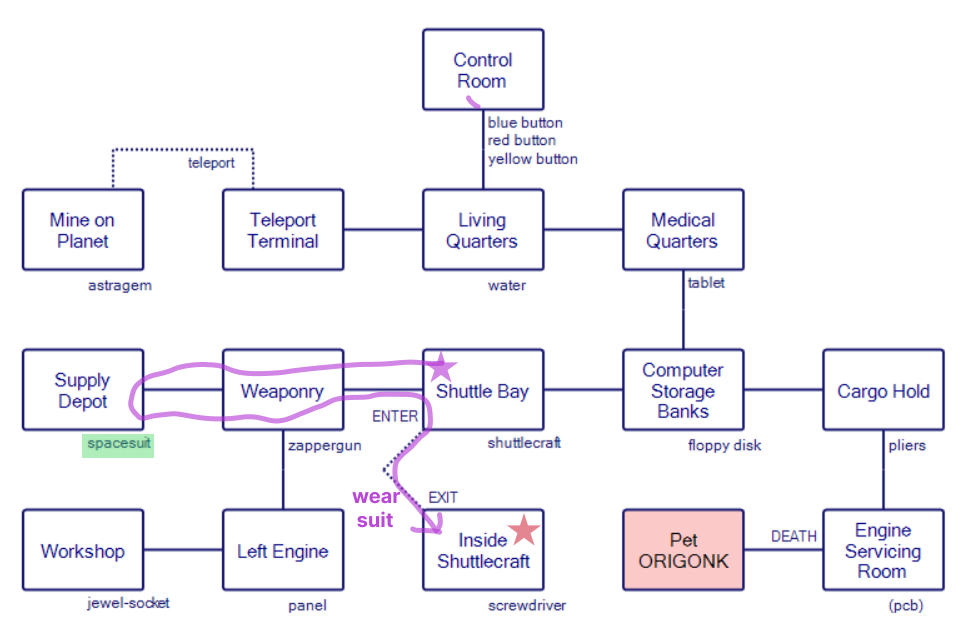


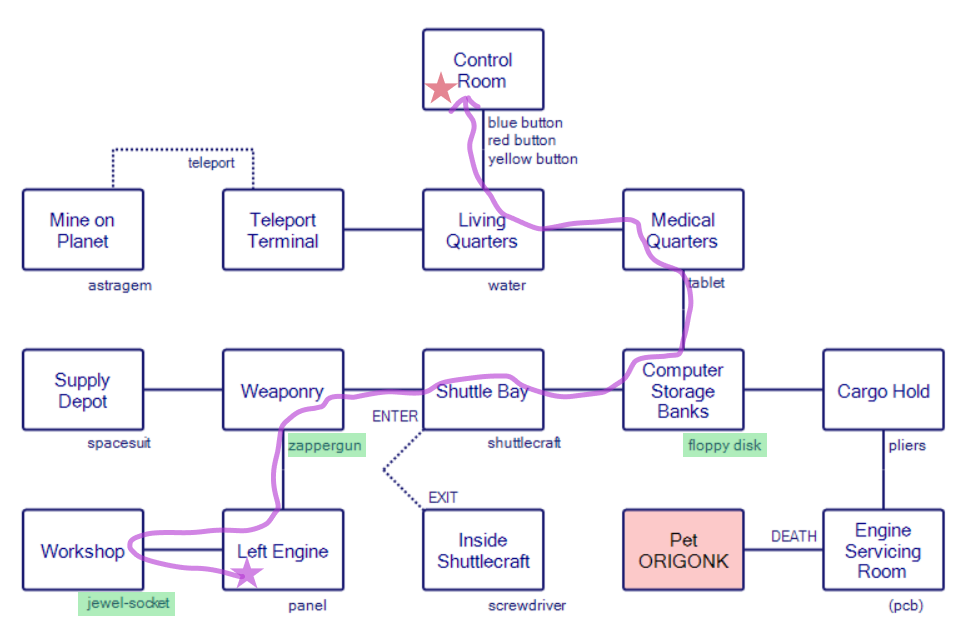


 Renga in Blue


