Archive for the ‘Video Games’ Category
Despite this being a direct plot continuation of Brian Howarth’s Arrow of Death Part 1 (which featured here last year) this marks a transition point in his work.

From Mobygames.
Specifically, his first three games in his Mysterious Adventures line were originally done for TRS-80 only. All further parts (picking up in 1982) were written using the Scott Adams database format, matched exactly enough that the same interpreter can be used to play Scott Adams and Mysterious Adventure games. Essentially, this meant removing “room descriptions” and relying on room names and items (and later, graphics) to create the environment. While it seems something of a loss the portability was part of what led Mysterious Adventures to be successful in the first place. The TRS-80 never lit the UK market on fire.
As far as how this happened: based on a note in this interview, Howarth had seen an article by Mike Woodroffe of Adventuresoft asking for programmers to port the Scott Adams games over to British computers.
Quoting the interview:
A non-programmer friend of mine was very keen to be part of creating adventures and had come across an editor that could compile/create and interpreter that could digest Scott Adams’ adventure data files. It became clear to us that if I could adapt my code to be able to interpret the Scott Adams data files, we would also be able to use the editor to allow non-programmers to write our own adventure data files, then package them up into my new engine and supply Molimerx with their voracious demand. My code was pretty compatible to the way the Scott’s code worked and only required some massaging to be compatible.
So the adventure series was now expanding nicely, but apart from the TRS80 platform, Molimerx only wanted me to port the code to IBM PC. He had no interest in any of the flood of new machines that were starting to saturate the market in the UK at the time. My new targets for porting the engine were machines such as Atari 400/800, Sinclair Spectrum, BBC Computer, Commodore 64, Oric Atmos (seemed like a new machine appeared in the UK each month). From this, I became so embroiled in porting that forward motion on creating new titles ground to a halt.
Something feels a little off to me here — supposedly Howarth’s attention on the Scott Adams format came from Woodroffe’s article, but the actual block quote seems to imply “a non-programmer friend of mine” had “come across an editor” (I would guess The Adventure System). My best reconciliation of the two stories is that Howarth learned about The Adventure System first, saw the Scott Adams format was well-documented, then saw the Woodroffe article, then used his memory of the documentation to be able to make Scott Adams ports.
Also, what does Howarth means about his code being adaptable? If he’s referring to the first three TRS-80 games in the old format, they are rather different and using the database required a complete ground-up rewrite of not just the game system itself but the games themselves. Scott Adams also said (without being specific) that “my recollection of a few of the items may be a bit different” so I suspect there might be some fudging of the sequence of events (perhaps unintentionally, we’re talking about events in 1982). Gareth Pitchford’s run-down of events comes with receipts but I’m still not confident on how things really happened.
Nevertheless, all we’re really worried about in the end is the game itself; to continue from Part 1 I’m going to stick with the ZX Spectrum.

A weirdly existential opening.
To recap, several games ago we found a golden baton, but in Arrow of Death Part 1 we found the baton to be corrupted by some sort of distant evil named Zerdon. In order to defeat Zerdon we needed to get the parts intended to form the Arrow of Death. We successfully found all the parts before the story cut off but had yet to make the arrow.

I wonder what the people who started with Wordier Part 1 thought when they got to this game.
You start out at the edge of the marsh things left off on last time, next to a plain and a chasm. The area appears to be empty for a shrub which is a “bundle of fluffy leaves”, and trying to DIG at the plain (unprovoked, I just had my tingly Adventurer Sense going) reveals a FLINTSTONE. There’s also a “narrow gorge” with “water at the bottom” yet I think this part may be meant just as scenery.

The chasm (see above) can be JUMPed into although it’s a one way trip. This suggests a linear structure but the game subverts that later; still, for a little while only one or two puzzles are presented at a time.

You land near a rope bridge; if you try to cross it a bird flies overhead and drops an iron helmet (which you can retrieve on a lower ledge). The lower ledge is also next to a crevice with a lamp.

Going past the rope bridge leads to a “straggly weed” you can pick up, and then an “iron grille” with “machinery”, which I have yet to be able to do anything useful.

My guess, based on my inventory (which includes a sword from the last game, as well as the pieces of the Arrow) was that I’m supposed to use the leaves and weed somehow to make a fire that connects with the grille? No verb I’ve thrown at the items gets recognized, neither MAKE FIRE nor MAKE SPARK work, so I may just be barking up the wrong tree.
(It took me later in my playthrough before I tried it, but I might as well spoil now what the weed is really useful for is eating; it increases your strength, rather like in Katakombs.)
Going back to the rope bridge, the room is described as having “ropes holding the bridge up”. You can cut the ropes and die. I originally thought perhaps this was a trap or gag, and if this was Acheton that’d be the case, but it doesn’t quite fit in with the Howarth style: once he switches from minimalist to ultra-minimalist, everything is important.

I didn’t find out until much later that if you’re not holding the fluffy shrub, this maneuver kills you; the shrub acts like a pillow.
It turns out this lands the player in a hub of sorts, although it isn’t obvious at first. Here’s the map as it looks on the first pass:

There is a locked door that blocks one route and a “heavy door” that blocks another. Otherwise, there’s a dead guard that can be searched for a uniform, a “wheel” that can be turned (next to a guard; you should disguise yourself with the uniform first)…

…and a “heavy kite” by a platform and the place where the dead guard with the uniform was.

If you wear the iron helmet from the bird you can safely JUMP while holding the kite and float down to the start of the game.

So that means the structure is (so far):
Area 1 -> Area 2 -> Area 3 -> Loop back to Area 1
It took me a little while to realize that the wheel turning is what makes the loop useful. By turning the wheel, you shut off a source of water in a gorge, leaving only mud that can be jumped into.

Searching the mud yields a lever that can be pulled, yielding a passage to a new area I haven’t fully reckoned with yet. There’s a dungeon with a prisoner locked behind a grating:

A “grotesque animal” at a “guard room”:

There’s no guard mentioned in the room, so it is strange the illustration shows a guard rather than the grotesque creature.
A “starving mule” at an “underground stable”:

Feeding the mule some of the strength weed doesn’t work.
And a “temple” with a “tapestry”:

There’s a button hiding behind the tapestry. Pressing it reveals an altar. Looking at the altar reveals a candle. Lighting the candle summons a “column of flame”. Once the column of flame is summoned you can PRAY, and the game claims “Something happened!”

What that something is, I don’t know; this is as far as I’ve gotten. I will say this has been more enjoyable that Part 1, not so much in the puzzles, but in the map. In addition to all the things found in the new area, there’s a bolted door. The bolted door leads back to the wheel/kite area!
Area 1 -> Area 2 -> Area 3 -> Loop back to Area 1 -> Area 4 with Area 3
To be clear with a map:

Red = 1, Orange = 2, Yellow = 3, Green = 4. Green connects back up with Yellow.
This kind of unexpected map interconnection I’ve found to be one of the most satisfying element of adventure games (or really, any games). It does make things slightly more complicated on the linearity front; when you know a particular obstacle will never again be seen, that restricts what objects might be helpful to that obstacle quite seriously, whereas if an obstacle can be returned to much later, it potentially opens up any object in the game. This is the type of tradeoff I’m willing to make for the feeling of a world with more depth than it has at first appearances.
The most curious thing is that the part that I had to skip while still baffled — the mysterious grille with machinery — is the only part I can’t return to. While you can go from Area 1 back to Area 2 by jumping down again, the bridge is destroyed so there’s no way to get across to where the grille is. The fortunate thing is that this isn’t Hezarin; the move count is low enough it won’t be hard to repeat everything, if that turns out to be necessary because of some clever trick missed earlier.
For once, I’m not “stuck”, just “stopped”, but historically I’ve hit a wall with Howarth before, so we’ll see how far this goes.

My verb list, for reference. Orange are verbs recognized by the game. It’s a fairly generous spread; the “cut rope while holding it” maneuver I figured out much more quickly from knowing that HOLD was a possible verb.

From the official Irn Bru Facebook page.
I should’ve known.
The pattern: I write about some halfway-dodgy program, abandon it, and assume I’m done.

The date here differs from the other one in the source of June 19th. I would guess the date here is when this particular room was made, as opposed to the code being started.
My readers take it up as a challenge and finish the thing anyway (Chou’s Alien Adventure being a prime example).
Here, I felt satisfied with what I had seen with Argonath Adventure, but Redhighlander had to go and make it to victory, so I was obliged to give it another try.

The full map, the room is orange being ones I didn’t visit before.
To be fair, I probably should have given it another spin. I often overlook USE as a verb (being so non-specific) and I only figured out how to pick up the Irn Bru at the end of my last session. The way is blocked by some spiderwebs, and while I’m unclear what contribution this particular beverage might provide (is there lore about it being a powerful acid?), here’s the result:

This leads down to a small area with two kitchens, a “monster” that is hungry, and a computer where you are supposed to INSERT a DISC (which I had already from elsewhere).
Of the two kitchens, one of them has a red lever that deposits you in a volcano.

The other has a blue lever that gives you food.

You can take biscuits from elsewhere and feed them to a monster at a jet engine. I’m unclear what purpose this serves, but the monster goes away once USE BISCUITS happens.

Moving over to the computer, you can INSERT DISC to get teleported to a room with a key.


The key then lets you go south from the “Neon Sign” room I gave a screenshot of earlier, and make it to the exit.


The final screen suggests a sort of second game concurrent with the first one, where you try to kill the various monsters for score before escaping. FIGHT alone works, you can’t type the name of the monster, but it doesn’t matter, because this mechanic really does seem to be broken: you just die, even if you fortify yourself first by sleeping and eating.

I admit to finding the “optional objective” here which is almost entirely separate from the main game intriguing, even if it is entirely broken. The closest comparison I can think of from pre-1982 games is Lugi, with a randomly generated map and had tasks like “gather money” which could lend points but didn’t affect the actual element of escape. With platformers and the like, the interface can usually convey that Collectible X is there for points and a shiny medal; with adventure games, it is never clear to the player when one element really is separate, as there just might be a clue or hidden item that requires the right amount of progress.
Is this really the first Scottish text adventure? Well, there’s still not absolute verification of Danny Browne’s identity (but who else would insert a casual Irn Bru reference?) and of course there’s plenty of games on the 1982 list I have yet to examine, but whatever the circumstances, this has a high likelihood of being in the first handful of text adventures from the country.
We’re going to try something a little different today and work through the complete works of Danny Browne. No, not the reggae music producer. I’m meaning a possibly-Scottish probably-teenager, notable if for nothing else we have yet to have a game hailing from Scotland.
I’m guessing, based on factors you’ll see in a moment, Danny was a student who tried his hand at writing adventure games starting in June 1982 and ending in November 1982. I have been unable to locate any ads or reprints of his games in magazines, and based on certain other aspects I highly suspect this is a set of “private games” (like The Smurf Adventure a few games ago), ones written by the author as personal projects but not intended for wide distribution.
Rather helpfully for doing an anthology post, Danny put months (and in two cases exact days) in which he wrote his games.
Acids (May)
Argonath Adventure (June 19th)
The Lazurite Factor (September 3rd)
Memory Alpha (November)
So without further ado:
Acids
The million-selling David Ahl book BASIC Computer Games (first printing: July 1973) included a game called Animal (original by Arthur Luehrmann at Dartmouth), where the player thinks of an animal and the computer tries to guess it with yes/no questions. There’s a stub of questions to start (DOES IT SWIM? IS IT A BIRD?) and then when the computer gets “stumped” the player is meant to give both the animal they were thinking and question that will work to narrow things down to that animal. It isn’t really a game as much as a proto-expert system, of the kind where a doctor can put in responses to a computer’s queries and have a diagnosis get narrowed down. It’s also close to GROW which was used to write an adventure game, except that GROW was not restricted to yes/no responses.
According to Kevin Bunch who interviewed Luehrmann recently, the original Dartmouth version of Animal included a swearing filter because college students are predictable.

Techholtz did the modified version of the game for DEC.
Acid is the same game but for acids.

This is not remotely an adventure game, but I mention it since our biographical material on Danny Browne is non-existent. It is dated as May 1982 which suggests he was a student who wrote this potentially thinking in terms of a chemistry class? (Based on the games that are to follow, probably not a teacher.)
The other important bit of context we can glean from Acid is that based on the source code, and despite the easy accessibility of Ahl’s re-print of the game, it seems to have been made from scratch (at least, it doesn’t match any of the versions I’ve looked at).
(As an aside, Arthur Luehrmann is one of the important oft-overlooked people in game history; he was a physics professor who was an early embracer of computer graphics and wrote the game POTSHOT which is one of the earliest “artillery games”; think Scorched Earth or GORILLAS.BAS.)
Argonath Adventure
The file on this game had some corruption, I think due to the presence of non-standard ASCII characters. It only munges up the title screen but the upshot is that instead of my regular emulator I used the online one at willus.com.

I wish I could give what the objective is, but I haven’t been able to finish and I’m not 100% sure the game is finishable. You’re on some sort of alien planet and there’s a spot where you “escape” but past that I am unclear.

Rather unusually, the player is dropped in their initial room at random; the “opening room” shown above is one of many. I’m not sure if this was intentional on an artifact of the game being a work in progress, because there is an apparent “opening room”.

However, unless you get the lucky random start, the only way to reach the room is through the command FART. Yes, FART has returned to us, for the fourth time. Here, it teleports between a handful of rooms (a different set than the starting one) including the surface of the planet. Once going in any direction, the player is locked in the complex.

The blocked exit at the far lower left asks for a key, and the room above it mentions a web blocking the passage.
There are wandering enemies at intervals. They appear randomly in any room. There’s some mention of combat mechanics in the source but they don’t seem to work, and while FIGHT is a verb the game doesn’t understand when I try to use it. They end up not mattering insofar as you can just leave a room as one appears and come back and they will be gone (or at least, there will be a new re-roll with possibly a different monster).

It’s not worth being harsh evaluating the monster system here as game writers in general didn’t know what to do with monsters. The Crowther/Woods dwarves present a “logistical puzzle” in having to carry around an axe, and the slight bit of randomness (in terms of missing axe throws) keeps things from being too monotonous, but it was hard to expand on that concept and keep within an “adventure framework” (no stats, no complicated RPG tactics). Zork’s thief simply scaled in terms of your overall point score (that is, as you gathered more treasure, you gathered more experience so the thief became easier to fight and you were more likely to win) but even as late an Infocom game as Arthur didn’t improve on that (there’s a knight with a similar mechanic).
The game has three objects: a disc, some biscuits, and a bottle of “Irn Bru”. (The last is a Scottish soft drink which at least strongly suggests the author was not American.)
A note regarding Scotland: Spectrum’s main factory (under license from Timex) was in Dundee, and according to David Cowen (of Grand Theft Auto fame), not much attention was paid to loss prevention, meaning “everyone worked there just kinda walked out with a bag full of Spectrums”, causing a large ecosystem of computer clubs. So we would in fact expect quite a few text adventures to come out of Scotland, but written for the ZX Spectrum, not the TRS-80.

I checked the source later, you have to type “TAKE IRN BRU” as a whole and not worry about restricting to two words.
It’s faintly possible the game is finishable but even with source-diving left me puzzled, and I’ve drained the majority of the content juice anyway. The winning message from the source code is
You are the first person ever to get out alive.
The Lazurite Factor
This one’s unfortunately completely unplayable; there’s strings of broken ASCII characters all throughout the text. It seems to be fairly similar to the previous game, so I just pulled up a few pieces of source code to talk about the changes.
The Lazurite factor
By Danny Browne
3rd Sept 1982
For Futura Industries Computer Division
Again, monsters appear at random, exactly the same set as last time, suggesting that there was cutting and pasting involved.
” An orc ” , ” A goblin ” , ” An esgaroth ” , ” A large furry creature ” , ” A troll ” , ” A biggish red eyed animal ” , ” A minotaur ” , ” A bogey man ”
There’s a good chunk of “auto-message” verbs; that is, the game “understands” the verb but also does not do anything with it, so for example, trying to break anything just says “it refuses to break.” Swearing possibilities are included.
6320 READ L4$ CVS “EAT” + GOSUB ” It’s inedible. ” : INPUT p
6325 READ L4$ CVS “BITE” + GOSUB ” You broke your tooth. ” : INPUT p
6330 READ L4$ CVS “LICK” + GOSUB ” Don’t be disgusting. ” : INPUT p
6335 READ L5$ CVS “BREAK” + GOSUB ” It refuses to break. ” : INPUT p
6345 READ L5$ CVS “SMASH” + GOSUB ” Nothing happens to it. ” : INPUT p
There are five items, including a ROM CARTRIDGE which looks to be the overall objective.
4000 READ ZZ CVS LE + GOSUB ” There is a bottle of lemonade in the middle of the room. ”
4010 READ ZZ CVS BL + GOSUB ” There is a blue disc lying in a folder. ”
4020 READ ZZ CVS RD MKD$ RD CVI + GOSUB ” There is a red disc lying against the wall. ”
4030 READ ZZ CVS WH + GOSUB ” There is a white disc lying on the floor. ”
4040 READ ZZ CVS RO + GOSUB ” An inconspicous ROM CARTRIDGE lies on the floor. “
The blue disc is used to open a bridge path, and the white disc is used to open a safe (with the rom cartridge).
3020 IFI$ CVS “BLUE DISC” MKD$ BL$ CVS I$ + GOSUB ” A bridge swung across the chasm. ” : BL$ CVS ” ” : CH CVS : INPUT [
3070 READ I$ CVS “WHITE DISC” ANDWH$ CVS I$ + GOSUB ” The safe opened. ” : RD CVS : WH$ CVS ” ” : INPUT USING
Regarding the ending, I’m wondering if I’ve missed some tech joke here, because the finale text suggests the cartridge is worth millions.
2220 VARPTR : GOSUB ” You have escaped with the valuable rom cartridge! You are RICH! ” : GOSUB ” By the way,will you lend me a few million? “
It is faintly possible the game is recoverable, since the textual errors seem to at least have consistent patterns, but for now let’s move on to the last game:
Memory Alpha
Memory Alpha had no garbled text, and I was able to run it with my regular emulator.

I played for a while, found it fairly broken still (including two crashes at random points) and did some searching around until I realized this was nearly the same game as Conquest of Memory Alpha, which I just wrote about. (To be clear: yes, I played Danny Browne’s version first.) It looks like Danny tried to modify the game to his own design but stopped halfway through. It may have been just to try to study the source code rather than make a game, or it could be the difficulty was such he wanted to hack it to see what the inside of Memory Alpha was like.

The arrows have been added in. If you try to blow the tank at the entrance up with a grenade the game crashes.
So, my apologies there wasn’t some delicious nugget of lost gaming history this time, just some experiments of a mysterious coder who will not appear again. In a sense, though, this gives a swath of what I can only imagine occurred with regularity: people in the early 80s who were interested in adventure games, but not quite capable of coding one all the way through, yet still fascinated enough to keep trying.
80 Microcomputing, the TRS-80 publication we’ve visited several times before, had an “Annual Games Issue” in August of 1982.

The general theme was type-ins of games, including today’s selection, Conquest of Memory Alpha by L. L. Myers, with biographical info at the end of his type-in being the only information about the individual we have:
L. L. Myers serves aboard a nuclear submarine in the US Navy.
The majority of the text, rather than being devoted to technical details (although they do get slipped in at the end), gives background for the story. The short version is that Buck Starton is kidnapped by aliens and forced to land a ship on Algar V to search for Memory Alpha which contains “the total collection of human knowledge”. For the long version, I have done a dramatic reading:
(Click here if the in-line player doesn’t work, and no, I’m not sure why I went through the work to do this. It does feel a little like honoring the effort of writing the story, even if I’m being somewhat extreme in the delivery. But also, I have trouble mentally “capturing” this large a chunk of game lore without reckoning with it directly somehow.)
Unfortunately, the game does not live up to the drama. This is only marginally-kind-of an adventure game, and definitely not an RPG even though it keeps track of XP. The closest comparison I can think of is Klondike Solitaire.
Mind you, depending on how you play Klondike the chance of winning can vary from 5% to something like … 30%? (mathematicians don’t really know) and the same thing applies here, but I had to do some source diving to come up with a strategy.

You start at the upper right corner of the map.

There’s one glitch where you can exit to the east side and reappear to the west side. Otherwise this is a straight grid structure.
In order to travel anywhere, you need to light a torch. Then, you start moving around the “outer ring” of the map, which has repetitive location names; every room in a 2 by 6 chunk at the top, for instance, is called “The Red Hills”. Along the bottom you get “The Blue Hills”; on the right you get a “Large Bleak Plain”.
Somewhere on the map, randomly, is a plastic card. You need that plastic card to get into Memory Alpha (the center red marked portion, of 4 by 4 rooms).

While you are looking for the card, you get followed by ROBOT GUARDS, BARBARIANS, and RATS, the first two who will try to hurt you. At one point you’ll need to kill and eat a rat, so that you can avoid dying of hunger halfway through the mission. This act incidentally comes with an entirely random chance of getting diseased, and if you get the disease and die, even though the game tries to “reincarnate” you there’s a bug which just sends it in a loop:

The guards and barbarians have relatively interesting behavior; the guards will actively try to follow you, and the barbarians will occasionally also move around, and both will attack at random. If you kill a barbarian (using SHOOT LASER, although you have a limited number of shots) they will give a war cry and summon another one that you will encounter in the next room. Something similar seems to happen with robot guards but I never noticed any increase in enemy amount.

Assuming you find the card at all — and you might not, since according to the BASIC source there is a 9/100 chance the card may appear inside Memory Alpha making it literally impossible to get — you need to make your way to the front door, and contend with the robot tank there. You have a grenade that has to be used (THROW GRENADE AT TANK) otherwise the tank will vaporize you trying to escape. However, the grenade only sometimes goes off. You get a second chance if you miss, but not a third chance. Missing is entirely at random.

Once inside (USE CARD, PULL LEVER), you can make your way to the northwest corner and pick up a DATA WAFER, but in all likelihood you’ve already burned too many moves searching for the cards and will run out of torch light before you can escape. If your torch is dead you simply can’t move; the game is softlocked (or at least, you can hang out until you starve to death).

This screen is before I discovered you could eat the rats.
So, to recap, getting through the game (the “regular” way) requires
a.) killing and eating a rat and hoping you don’t get diseased.
b.) randomly finding a plastic card, which may not even be available, and hoping you find it fast enough
c.) killing a tank with a grenade (and hoping it works, as you only have one grenade; you can try to skip this step but I found I took enough damage looking for the card this never worked out)
d.) grab the wafer and then make it all the way to the start without your torch light running out — hope you didn’t spend too long looking for the card!
I did manage to work out an alternative strategy. By poking at source I realized you can throw the grenade at the doors leading inside Memory Alpha instead of bothering with a card at all. That means you will get hit by the robot tank as you escape (since you can’t destroy it) but since you skip the pesky “hunt around for a card” portion of the game you will have enough health to, er, tank it.

So that means the procedure becomes
a.) kill and eat a rat still
b.) go straight for the doors and throw a grenade, hoping it goes off correctly (you still might die randomly here)
c.) grab the wafer and make it to the start

You still have a chance of dying at this moment. If a robot guard is in the location with you it has a chance of taking a last shot and killing you.
Keeping the backstory in mind, that we are working unwillingly for an alien menace, it looks like we just doomed the human race.
I confess this is slight enough of an adventure I would have been fully willing to discard it, but I do have an entry coming up where this exact game is relevant, so I needed to cover it first.
I will say at least the game was interesting in the sense of being different gameplay; as I said, it doesn’t really fall into either adventure or RPG categories. Even simulation is pushing it. But devising a strategy that optimizes the gauntlet of RNG was at least vaguely satisfying.
The author clearly had some ambitions in terms of trying to “simulate a story” as opposed to dropping a bunch of superfluous puzzles in the player’s path. I do find a game where on some playthroughs you are required to fail by mere random chance kind of intriguing, but only in a meta art-gallery sense; it’s more fun to talk about than to play.

From zx81stuff.
Lost Island is related to both Katakombs and Super Spy which both made recent appearances here, insofar as it was distributed by a British company that spawned up in 1981 only to go poof a few years later.
JRS Software started with a ZX-80 “Programmable Moving Display”, which describes itself in terms of extreme programming.
Great care has been taken so that the processing of your codes can always be interrupted to return to the display routine at the precise microsecond that is required to ensure that your T.V. picture remains completely rock-steady.

Synch Magazine, October 1981. Based on the flashing that happens on every single keystroke in Planet of Death, this is perhaps an impressive feat.
They’re located in yet another completely new spot on England, and so far throughout 1982 I feel like we’re throwing darts at random.

By ’82 in the United States you had the software market started to get centered around a few locations (especially in California) but the UK not only was behind a little in timing but also by my reckoning had a longer period of amateur publishing, especially given the prevalence of tape. So companies could still be nearly anywhere on the map. (But also, to be fair: smaller country.) To emphasize what I mean by amateur, in 1983 JRS Software published a gambling game originally by “E. Smith Software” entitled Roulette. Here is what the outer tape packaging looked like:

From ZXArt. I mean, maybe the hand-drawn marker was done later by the owner of the tape, but even without that this is very bespoke packaging. (ADD: According to Gareth in the comments, the website ZXArt which I was using likely linked JRS to E. Smith in error. This is still a sterling example of amateur publishing practice.)
Circling back to 1982, JRS produced a random grab-bag of utilities and games, but for our purposes we are interested in their single adventure published, Lost Island.

Sinclair User, May 1983.
Yes, only one, just like Golem with Katakombs! I was recently listening to the They Create Worlds podcast about Rogue, and learned that both Michael Toy and Glenn Wichman wrote text adventures (that no longer exist) before Rogue. I have the suspicion that a lot of programmers of the time wrote personal text adventures projects now consigned to oblivion. Given the prevalence of low-budget tape publishing in the UK some of these projects which normally might have ended in the bit bin could end up on tape instead. Here, the project is by a “M. Holman” who makes their only appearance in gaming history.

The premise is simply to escape the island you are shipwrecked on. Escape is the second most common plot in this era after Treasure Hunt. What’s curious is (as I’ll explain later) that approaching the game with a Treasure Hunt style mindset can actually hinder one’s progress!

I’m pretty sure the parser here is entirely of the author’s design because it has some oddities particular to this game. Verbs must be typed in full (so no INV instead of INVENTORY) but nouns can be shortened, so you GET COC in order to get a coconut.
Objects are not described in the room description unless you LOOK. At least it isn’t a Omotesando situation where the objects don’t even exist beforehand, but this still makes for an erratic and confusing UI experience and there’s no compelling reason to make the player type LOOK in every room.

Notice the room description repeat; this is where I typed the command LOOK in order to see the spear.
The spear above is interesting insofar as the game tries to stick with “on a real island” objects — that is, no magic wands — but also takes this a bit farther and includes objects that don’t get any use in the game. You can tote the spear above if you want but it serves no purpose, as does a musket you find later. Red herrings wouldn’t normally interfere too much with gameplay, but the inventory limit of 6 ends up popping up more than once so there’s some genuine consideration of “what do I really need?” This gives a different gameplay aura than inventory limits on most games of the time; discarding a gun as useless has a narrative sense of someone desperate for escape. When a game’s narrative instead involves dragging every item on the map into organized piles, it doesn’t come off as a narrative at all as much as the player pretending to be a pack mule.
In some cases, the game inadvertently lets you know what’s useful, because it will have an object described by LOOK that still can’t be referred to even it is there. I suppose this cuts down on the herrings while still allowing a secret cave with a telescope and a hat (you only need the telescope).

You only need one of these things. Neither “RUM” nor “CASK” is a word that is recognized by the game.
The main objective, although it isn’t clear at first, is to set a signal fire and then wait for a ship to arrive. I have it located on the map below at (END).

For the start of the sequence, you take a sword at (1) to some nettles at (2) and chop them away.

Here, the noun “nettles” is not a separate object but part of the room description that you have to assume is able to be targeted. There’s also a random palm tree you can climb (with a rope on top) with a similar issue nearby.
This reveals a cave (3) you can reach with rope that lets you get a telescope, and a cave at (4) that is blocked by rubble. It is possible to remove the rubble but more items are required.
Here I was stuck for while, although I hadn’t quite realized EXAMINE was a verb that occasionally worked yet. At a “large idol” (5) near a village with “skulls” (and yes, they eat you if you try to go in, sigh) I found a “LEDGE IN THE ROCK FACE DIRECTLY ABOVE THE IDOL” by using EXAMINE IDOL. This (via re-use of rope) let me get into a cave area with a tinderbox (6) and a snake (7).

You can KILL SNAKE as long as you have the sword with you. (If you are holding the spear the game just claims you can’t kill the snake with your bare hands.) This gives you access to a spade (8) which lets you take it back to the beach at (9) and dig up a chest, as shown in the earlier screenshot, with GUNPOWDER, GOLD, and a RUM CASK.
Remember, this isn’t a treasure hunt! The useful item is GUNPOWDER. (I mean, you can take the gold with you. It just makes the inventory more annoying to juggle.)
The gunpowder can be dropped off at the cave with rubble (the right verb is LEAVE, DROP isn’t even recognized!) and then lit using the tinderbox. (Not a torch that you can light with the tinderbox. The game may have realistic objects but it is wobbly about realistic alternate uses.)

With the cave blasted open you can find some lamp-oil (10). This lamp-oil can be poured on the signal fire (END) and the fire then lit with a tinderbox. Then you need to use the telescope to SEARCH SEA. This last bit would have likely caused me enormous trouble but I ran into it by accident earlier — I was standing at the signal fire testing out verbs and objects, and realized that if I tried the SEARCH there the game said “I CAN”T SEE FAR ENOUGH”, and that was the only location where that message happened. This made me realize it had to be the spot where the telescope was useful, so once I got the fire going I just started to use SEARCH on every noun.

With the ship’s arrival, you can then just take a couple more steps to victory. No treasure is required.

This game emphasized for me the varying-talents hodge-podge that authors at the time had. Some authors could pull off a relative sturdy parser but had questionable design choices; some had good idea but had trouble conveying them. This game falls into the latter, insofar as communicating was a consistent struggle (and remembering to always LOOK, and to check EXAMINE and SEARCH on nouns that might not even exist) but having a “realistic” series of obstacles and having treasures that should be ignored in favor of the overall goal was a refreshing idea.
If you’re interesting in testing the game out, it is playable online at zx81stuff.

Ok, this is mostly irrelevant, but I have to show this. Here’s the actual tape of Roulette, with everything hand-done in marker. I’m fairly sure this is a case where the author genuinely only published 30 tapes or so (dropped at a local computer outlet or taken to a show) and drew on all of them by hand.
How can I say it? I can’t say ‘I can remember the graphics,’ because there weren’t any graphics. But I remember what I imagined it being, because you entered all the commands yourself: ‘Go up elevator.’ ‘Move ashtray.’ There were no graphics on the screen, so you had to imagine everything yourself. The quote-unquote graphics that I imagined for the game I essentially created myself, because I had to imagine everything.
I got to thinking that it was very interesting that you had to visualize your own graphics. But what would a text adventure look like if it actually had graphics? I thought it would sell very well.
— quoted from Koichi Nakamura, executive producer for Spike Chunsoft, who worked on the first Dragon Warrior games, Shiren the Wanderer, and visual novels like Danganronpa and Zero Time Dilemma

Omotesando Street in Tokyo. [Source.]
This game is a nexus. While arguably, all games, even the most obscure ones, have threads leading to them and out of them, with Omotesando Adventure these threads are very bright. This is the first (as we currently know) Japanese adventure game, although it was written in English.
It showed up in ASCII Magazine, a hobbyist computer magazine that had been running successfully since 1977. They were the ones that translated and printed Ahl’s 101 Basic Computer Games in Japan, and printed quite a lot of source code in each issue. Sometimes the source code was given in specialized languages GAME (General Algorithmic Micro Expressions) and later PL/1; sometimes they were straightforward BASIC; sometimes they were raw machine code.

The code was displayed on TRS-80 or PET screens and then the editor, Susumu Furukawa, took pictures with a Polaroid camera and mashed them together.
Our selection today was in raw machine code, in the April 1982 issue; in particular, in a “parody insert” called Ah-SKI! (“An Annual Magazine for Tired & Histerical Computer Scientist”) tucked inside was Omotesando Adventure, a game named after the street ASCII’s headquarters were on.
This issue we are introducing the Adventure Game. It’s an entirely new genre, the like of which was never seen on a computer. We may even call it a “New Type” of computer games.

The goal, as an employee of a rival company, is to sneak into the ASCII offices and sabotage their next issue. Before I get into gameplay details, I want to discuss those bright threads. According to Susumu Furukawa the game was coded with Adven-80, a “general purpose” adventure writing code base published in Dr. Dobbs Journal, in an article by Peter D. Scargill. (Dr. Dobbs was one of the offshoots of the People’s Computer Company, and lasted long after the PCC was dead.)
The system is slightly less flexible than the Scott Adams one; that one allowed for arbitrary timers to allow complex timed object and location effects, like a tide that moves in or out. ADVEN-80 instead hardcodes in a lamp timer and seems to have variable storage but doesn’t seem to allow multiple timers (unless I’m missing some complex hack) so has a relatively static world.
What’s most fascinating about ADVEN-80 is it cites other prior systems as sources:
– Scott Adams games in general
– The GROW system (the node-based system which I’ve written about here)
– Ken Reed’s article for Practical Computing published in the UK from 1980 (that I’ve written about here)
– Blank and Galley describing the system of storage for Zork on home computer
– Greg Hassett’s article on How to Write Adventure games (which I’ve mentioned here)
So, to summarize, the first Japanese adventure game (that we know of) pulls a system from an US publication, which itself was influenced by both US and UK writing about how adventure systems work. This is essentially a synthesis of the early years of adventure history.
Sadly, that doesn’t mean Omotesando is well-coded; perhaps it is understandable as the first adventure from the country and also not being written in Japanese. As the instructions mention, Japanese is hard to parse (it doesn’t really lend itself to “VERB NOUN” style commands without feeling broken and awkward).
Adventure games were developed in America, and so at this point in time both the descriptions and the input are set in English. (Because of that our English has improved considerably. When we play adventure games here at the office, a Japanese-English-Japanese dictionary is an essential accessory).
Furthermore, while outputting text isn’t a problem, formatting a request for action in Japanese is difficult and so is analyzing the input. We think even home-grown adventure games are going to use English for a while.
This prophecy was a little true; the next two adventure games from Japan (both from 1982) use English commands but have text and responses in Japanese, and there were also 1983 games with the same arrangement.

The computer emulated here is a NEC PC-8001 from 1979, essentially exclusive to Japan. It did later make it to the US as the PC-8001A although it remains very obscure outside of its home country.
So, back to the game itself: it is set at ASCII’s own offices, where your goal is sabotage.

You start at the entrance of the ASCII building and eventually find keys to unlock the three floors it is housed on (which I have marked in three different colors on the map above).

I admit being highly stuck for a while at first due to a number of oddities in the system:
1.) You can only see room exits by using LOOK in a particular room. This is relatively normal. However, this also applies to objects, which is slightly odd, and the objects don’t even exist until you’ve done LOOK which is staggeringly odd. That means if you die (and you will die) and restart, it is quite easy to casually try to OPEN DOOR and have the game tell you it doesn’t see one, but that’s because you never materialized the door yet with a LOOK command. Phew.

One of the early GAME OVERs.
2.) You can both LOOK at items and SEARCH them. One, either, or both can reveal differing information, but even more importantly, they do nothing on an item being held. The first set of keys I found I was unable to look at, which is unfortunate because I would have seen they went to the fourth floor and to the security box. The security box helps disable the alarm, as shown above; you need to just UNLOCK SECURITY while holding the right key.

3.) The offices are full of extraneous desks and items that you can’t pick up, except the game is unclear in its parser messages so it took me a while to realize it was trying to give the modern “that’s just scenery”. That applies, for instance, to the computer above, playing the game that you are currently playing.

4.) Sometimes the parser is just regular finicky in all the traditional ways, like the guess-the-verb fest above. I had a spray gun that the game described as for cockroach removal (as long as it was on the floor) but it turns out the right command is KILL COCKROACHES.
The gameplay essentially travels through a series of keys before landing on a gold one. The gold one can be used to open a safe with a “magnetic monopole bomb”.

I placed the bomb at what the game described as the “central zone of ASCII”, ran outside, typed DONE like the game commanded me and:

Oof. That’s not good. Fortunately, a helpful Youtube video by くしかつ Kushikatsu goes through a complete walkthrough, whereupon I found I was missing two things.
First, an umbrella and a raincoat. I actually had grabbed the umbrella already but not the raincoat, because GET RAINCOAT didn’t work when I found it. You’re supposed to just WEAR RAINCOAT upon finding it. I’m not sure if this is really needed at all, but the outside is described as rainy, so I’m fine with the roleplaying.
Second, more importantly: Kushikatsu closed and locked the safe and all the doors. Very unusual! Leave no trace. The only other game with a comparable trick from the Project I’ve run into is Gargoyle Castle where you had to pick up all the trash.

So despite it being caught in a murky fog of dodgy parser choices, and despite the game not giving enough feedback for the reason of failure, Omotesando Adventure has a genuinely clever gameplay trick up its sleeve.
(There’s one more trick, supposedly, based on Jimmy Maher’s writeup. There is a way to save your game based on doing some in-game trick. I never did find it, and the walkthrough I mentioned doesn’t bother. Anyone who knows what’s going on feel free to drop a note in the comments.)

As is usual, you should read my prior posts about this game first.

From the Museum of Computer Adventure Games.
I realize this is a bad sign, but I want to start with discussing the term “moon logic”.
There are some terms which I think narrow and simplify overly much. One such term that used to be in common use is “guess the verb”, the phenomenon of tangling with difficult parsers; the word isn’t wrong, exactly, but it often got applied to guess-the-noun or guess-the-phrasing or interpret-the-deceptive-parser-message.
I’ve seen the term “moon logic” applied to nearly every adventure puzzle sin under the sun, as long as a puzzle causes some difficulty. I still think the term is useful, but I tend to narrow down to circumstances were cause and effect seem to be nearly at random; perhaps you understand from the animation why the bubble gum made the goat move, but the connection is one that could almost never have been predicted. There is a disjoint between action and result. Oddly, in text adventures, this shows up less than you might think, just because the requirement of a verb adds specificity to an action; you can’t just USE BUBBLEGUM ON GOAT and have the animation happen, but rather need to specify to (for sake of example) FEED BUBBLEGUM TO GOAT. The puzzle is still perhaps a bad one, but there’s at least a suspicion that something interesting might happen.
For getting by the dragon — which turned out to be the key puzzle that was stopping my progress — I kept trying a number of methods to help the dragon melt an ice wall. Killing the “docile creature” certainly seemed to be out. The correct item to use was off this list:
salt
lumps of sugar
venetian mirror
stick
dagger inlaid with precious stones
a piece of string
heavy, metal barrel with a stopper at the bottom
ruby
stick
The right item was the … lumps of sugar.

While it isn’t the kind of puzzle where the mechanics aren’t even understood after solving it, unless I missed some major mythos regarding dragons, I would say the disjoint clearly falls into moon logic range.
Past the dragon, I was able to get a trumpet; the trumpet let me bust open a glass wall. This was essentially the opposite of the previous puzzle, I knew exactly what the trumpet for the moment I picked it up.

The salt, on the other hand, was a little more fussy. Again, we’re entering moon logic territory, but apparently elephants like salt?

Everything else more or less smoothly fell out, with two exceptions, the first being of a funky parser use. A “heavy, metal barrel with a stopper at the bottom” was meant to be used with PUSH STOPPER.
the stopper disappears inside
and a smell liquid rushes out –
it’s parafin.
You manage to fill up your lamp.
(This is necessary to win: the candle doesn’t quite give you enough turns to do everything.)
The second involved (after the elephant) finding out what to do at a “sacred altar with an eerie statue of the animal-god Vik”. While I appreciated the atmosphere here, and I might have been able to solve the puzzle on my own, my trust had been whittled down by the dragon and the elephant, so I just looked it up. I wouldn’t call this absurd, and I likely would have eventually found it (by trying to sacrifice everything in my inventory) but still, I’ll let you decide the moon logic level:

(Somewhere in all this, the ability to SEE kicked in. I’m not sure where — I had drunk the potion on my saved game I was using and never went back to see if there was a treasure that’d otherwise be invisible had I not drunk the potion.)
The oval from the altar flips back again to the “immediately know what needs to be done” category.

I’m not sure what’s with the score, I supposedly have all the treasures. Because they count equally as points when held in inventory versus just being on the ground in the crypt, you don’t have to drop them.
This wasn’t a terrible game — when you get down to it, maybe only 10% had me truly frustrated — but that’s only because I gave up trying to solve puzzles at a judicious time. There’s a couple moments of interesting atmosphere, like the altar of Vik, but the setting really fails to attain critical mass of feeling like a real location (say, the underground of Zork I) or even just a theater of cruelty (Acheton).
Incidentally, the whole business with the Chamber of Horror seems to have been a red herring, as was the string and the stick. You can light the string and it burns like a fuse, but that does nothing. (And no, the stick doesn’t seem to secretly be a stick of dynamite.) I get the feeling maybe the author forgot something? I’ve never been fully against red herrings (in a game like Planetfall they increase the environmental feel) but here they just seem like lost coding bits more than careful choices.
The most comparable recent game I’ve played is Hamil, and I did enjoy that one quite a bit better. Hamil had an equally random map, but it had more clever puzzles overall (despite a frustrating moment or two) and every piece was important. I guess for a “narrative” game red herrings are fine, but for a “British cryptic” style they become more a distraction to the style; sort of like how things that work in the RPG genre don’t work in the Adventure genre and vice versa, this type of game is nearly a different genre than the more story-driven ones, meaning general advice for good adventure writing may differ.
We’re leaving both the US and UK for our next game, and in fact going to a country we haven’t visited yet, even though it is quite important in the history of videogames overall. Soon!

Zoom in on the cover art, which I think is meant to depict a specific location in the game. “You are among the ruins with hints of alien arches and weird spires. You can see a sharp sword.”
To continue directly from last time: I mentioned offhand this is one of the games where every exit of every room needs be tested because they aren’t mentioned. As you might guess, this is a recipe for everyone’s “favorite”, missing the existence of a room exit, in this case from the early outdoors section of the game:

Southwest of the camp is the missing connection.
This ended up being an important room: it had a rope. Not only that, a rope with multiple uses! Yes, it is going for what at least used to be the ultimate challenge in interactive fiction coding. For emphasis, allow me to quote Emily Short:
The Ultimate Rope: This is one of those things that has received so much attention that it almost seems pointless to recount the variety of the challenges associated therewith. First of all, a rope has two ends, so you have to remember the state of each (and disambiguate between the player’s references to them, of course.) Then there’s marking what the rope can be tied to; the possibility of cutting the rope in the middle, making multiple ropes of new lengths; the problem of using the rope as a fuse, of tying it to something in one room and then carrying the other end, of tying the ends together, etc., etc., etc. Ultimately I think the very trickiest part of all this is the disambiguation problem, ie, figuring out exactly what the player means when he says >TIE ROPE TO X (which end? Do we untie something that’s already tied, if both ends are in use?) But it’s all pretty grotesque, frankly.
To start with, the rope is used rather traditionally: you tie it to a tree and then can extricate a locked pirate treasure from a cave. Then you can move the same rope over at a well which has a platinum key (which unlocks the aforementioned treasure).

I also discovered while doing my rope shenanigans that the red berries I wasn’t sure about should be eaten. They give you strength, which has at least two side effects; one is to increase your inventory capacity by two, and the other is … we’ll, I’ll get to it, but it isn’t necessarily a useful effect.
Now, despite the berries bumping up inventory capacity, there is still now the problem of too many inventory items before jumping underground (which still seems to be a one-way trip). You need to cart
an old parafin lamp, a platinum key, some matches, a sharp sword, a white candle, one green bottle, some tasty food, a padlocked treasure chest, and a coil of rope
but if you count, that’s nine items, one over the max. You can’t just use the platinum key on the chest and then ditch it, because the key counts as a treasure. This ended up being highly logical but still hard to work out. If you want to take a beat to think about it, stare at the verb list from last time.
CLIMB, SWIM, READ, OPEN, DRINK, EAT, KILL, GIVE, FILL, LIGHT, TIE, UNTIE, POUR, PUSH, PULL, WEAR.

Here’s some educational cover art from Golem to fill space and keep you from seeing the answer right away.
The trick here is to WEAR the rope! This will take it out of your hands and lets you now tote 9 items. In a way, this feels odd and arbitrary — you clearly can’t really juggle what you’ve got even with 8, so it’s more a weight thing — but I still found it gratifying to see some extreme rope coding in use. (Too bad the coding in so much of the rest of the game is sloppy! The parser consists of the binary states of You’re Right and I Didn’t Quite Understand That with nothing in between.)

Having resolved that and jumping underground, I realized while I was tied to the rope, I might be able to put it to another use. There is a “blue room” with a lever where pulling the lever causes a wall to fall on the player’s head, but what if we used the rope instead?

What I like here is that the tie-a-rope-to-yourself trick gives a hint, in a way, for this maneuver. Also, the rope is now neatly disposed of, so I hope it doesn’t get yet another use elsewhere!
Past the fallen wall is the place where treasures of the game get stashed. Oddly, you don’t have a score change from stashing — that is, you get a score by picking a treasure up, and that same score is preserved as long is the treasure is dropped in the crypt — so the only real reason to do so is to clear inventory space for solving other puzzles (also, there are 9 treasures total, meaning it’d be impossible to hold all of them at once anyway).
You are in a dark Crypt
You can see a GOLEM (with a small dent in his forehead)
I am not yet certain what goes in the dent.
I did manage to resolve one other issue: the “beans” I found randomly I decided to try to PLANT, given the beanstalk seems to be the thing all adventure ripoffs must have. PLANT didn’t actually give any kind of prompt, but a null prompt is something different so I assumed it had to work. But how to get water? You might logically note the green bottle being toted around and the two rivers we’ve passed by, but no, FILL BOTTLE (or GET WATER, or any other variant) doesn’t work. The real answer is much stranger:

Water in hand, you can get the beanstalk going and find a hole with a silver axe. This may be the only thing that needs to be done, as if you try growing the beanstalk a bit larger, the result is fatal:

Of course it may be possible to hide from the giant, but I’d also consider it equally likely this scene is just a trap.
Overall, this makes the treasure count 5 (I think? I haven’t rigorously tested for score increases). So I’m more than halfway and will hopefully have a win scene by my next post.
One last scene before I sign out: the berries that make you stronger also let you kill a dragon. But I think that might be wrong:

Doing this makes you completely unable to access the ice wall the dragon was trying to burn down. I’ll test out Roger Durrant’s theory the salt might help and then fiddle with things from there.

From Acorn Electron World.
Due to a favorable contract between the company Acorn and the British government, the BBC Micro became the de facto choice for schools in the UK, kind of like the Apple II was in the United States; as one ad proclaimed, it made up 80% of purchases “under the current D.O.I. Primary School Scheme”. This is despite the BBC Micro being a more expensive choice out of various options — £300 for the lower-end initial models, as opposed to (for example) the ZX Spectrum being priced at £125. (The Electron was released after the BBC Micro as a home alternative, but was still priced higher than the ZX Spectrum at £199.)
The important thing is that the Micro had a built in “educational” audience, so some companies dived in on that end of the pool, like the obscure Golem Ltd, which hailed from Bracknell, just a bit west of London.

From “Games of Logic”, where the idea here is to change the order of the letters to be alphabetical by reversing the order of groups of letters (the groups can be any size but they always start from the leftmost letter). Link to play online, if you’re keen.
Nearly all their titles were educational, essentially cranked out in the same 82-84 period as Richard Shepherd Software (who we just saw with Super Spy).

Acorn User, October 1982.
In a Westminster Exhibition Catalog from December 1983 they describe themselves as “a small company of computer experts” where their educational software is “now used in hundreds of schools throughout the country”. They tossed out one adventure game in the mix, no doubt trying to cash in the same craze everyone else was.

I’ll admit at least the cover art is striking on this one. From the Complete BBC Micro Game Archive.
The game must have done relatively well because there are two versions, a “plain scrolling” black and white version from 1982 and one from a year later that adds a little bit of color. I don’t know if they tried to angle this one at the educational market too; this late 1983 ad lists it neutrally as a selection along with “Educational 1”, “Educational 2” (see tape image at the start of this post), and “Fun With Words”.

Newer on the left, older on the right.
As you can probably guess from the “high spirits and low cunning” nicked from Crowther/Woods, this is another treasure hunt, this time with 9 treasures.
It’s curious how many of the treasure hunt adventures I’ve played have the player character not actually make off with the loot, despite this being the norm from Dungeons and Dragons. The only adventure I can remember that did explicit currency conversion was Spelunker from 1979. Crowther/Woods has you store things in a building, but are you taking it away further, or is it meant to be a Cave Museum of sorts? O’Hare’s game The Great Pyramid has you take all the treasures of the pyramid to a room inside the pyramid. Hamil had the treasure collection as a proof-of-worth, and test of your royal blood. In some of the games that don’t make it explicit like Inca Curse I think it’s still clearly implied you’re taking the loot, but it weirdly is only the norm maybe half the time.
I bring this up because — at least according to the instructions on the tape for Katakombs — the treasures here get deposited in a crypt. That does not sound like you’re stealing them. Maybe it’s a bizarre prank?

This game has the very regular start of the Adventure clone with a forest and items strewn about; in this case you can snag “one green bottle”, “some matches”, an “old parafin lamp”, “a sharp sword”, “some tasty food”, “red berries”, and a “white candle”. That’s seven items, but you have an inventory limit of six, so you have to choose one to leave behind to go underground.
And I do mean leave behind, because the way to go underground is to fall in a trap door. I haven’t been able to make it back outdoors yet. I’m not even certain if there is a way.

The wicked Trdlo gets you if you try to wander without a light source.
Underground, lots of items and puzzles present themselves, but few answers. Grabbing the surface level items again (including ones from solving mazes, which I’m skimming over because they’re really plain this time):
salt
lumps of sugar
vial of revolting potion
venetian mirror
stick
dagger inlaid with precious stones
a piece of string
heavy, metal barrel with a stopper at the bottom
ruby
stick
beans
(The potion is interesting — if you drink it you faint, and when you wake up the game says “you find you can SEE”. I don’t know what this means. I haven’t spotted any extra secrets after doing so but I haven’t searched the entire map yet.)

If you’re wondering why I’m just dumping a big list, well, I haven’t gotten use out of nearly any of them (18 items + a 6 item inventory limit + needing to keep a lit candle for a light source eating one slot does not help matters at all). I did manage to get use of the “venetian mirror” (which I think doubles as a treasure) by attacking a medusa while holding it. I was stumped for quite a while with verbs like WAVE and SHOW and HOLD and so forth but none of them work; the mirror gets used automatically when you attack. I get the impression this is one of those games with a fair amount of implicit item use where puzzles don’t get solved with verbs but by making sure you’re carrying the right things, and the large object list and tight inventory limit are there to help enforce that. (If you could carry everything you see, for instance, the medusa would be almost outright a non-puzzle since you’d have the mirror held by default, rather than just a weak one.)

You incidentally know enough to open that ancient door in the screenshot, if you want to take a shot in the comments. Doing so doesn’t unlock much progress, sadly.
I’m not sure if the puzzles are intended to be highly cryptic or I’m just getting overwhelmed by the number of combinations. I will say the number of verbs is quite low; off of my standard verb list I only found
CLIMB, SWIM, READ, OPEN, DRINK, EAT, KILL, GIVE, FILL, LIGHT, TIE, UNTIE, POUR, PUSH, PULL, WEAR.
For puzzles, there’s that dragon from an earlier screenshot; a lever that pulls a wall on top of the poor player’s head; a dark tunnel blocked by a glass wall; an elephant digging in a room for something; a “granite wall” with “20 and 40 foot holes”.

My underground map so far, excluding mazes.
Oh, and then there’s the pleasure garden and chamber of horror, both very odd rooms. The pleasure garden you can just enter; if you do so, you pass out and find yourself in the chamber of horror, and then are forced to flee to a random location.

Room exits aren’t mentioned so have to be tested. I’m starting to detest this “feature” in old adventure games far more than mazes.
So, kind of a “standard” game, but there’s odd bits of humor poking out from beneath the debris that at least carry some interest. If nothing else, the emulator BeebEm is astonishingly good; every single feature I could possibly want it has, without weird fussy crashes and the like, so playing doesn’t feel as much a chore as it could. Some of these old-era games are truly saved by the existence of save states.
I’m going to guess this is a three-post game based on difficulty and size, but we’ll see. In the meantime you’re welcome to make suggestions in the comments about what all the items might be for.
I’m going to start with some history background which may seem like overkill for an anonymous public domain TRS-80 game, but I already wrote it a while back, so–

From the episode Smurf Me No Flowers. Papa Smurf on the left (who appears in today’s game), Brainy Smurf on the right (who does not, unless he is supposed to be the player character).
After the Nazis occupied France in May 1940, they wanted to keep the film industry going there with the German-controlled Continental Films, founded only six months after the occupation. The managing director, Alfred Greven, was appointed by his personal friend Goebbels.
At this time, the young Belgian Pierre Culliford, aka “Peyo”, was working as a projectionist in Brussels; while he had a love for Robin Hood and fantasy movies, he had to show mostly propaganda films.
It was in this environment we got Les visiteurs du soir (see picture above), a 1942 film by Marcel Carné, set in 1485, about two envoys sent to the mortal world to cause mischief and recruit for the Devil. The envoys (semi-accidentally) start doing some good works, and the Devil needs to visit in person to fix things. While the production design was heavily influenced by Les très riches heures du Duc de Berry, a rather famous manuscript from the 1400s, the story itself was steeped deeply in fantasy, and Peyo watched it repeatedly. (As critics have later pointed out, the movie also could be viewed as a thinly veiled allegory for the Nazis invading France; while the director insisted it was not intended as such, the important thing is that the film managed to escape the censors.)
When the occupation of both France and Belgium ended, Peyo went from projecting to a short stint at a company called Companie Belge d’Actualités, owned by a journalist (Nagant) who originally aspired to make newsreels. Because of the occupation they had switched to animation instead. Peyo saw the designs for a film called Le Cadeau à la fée (The gift of the fairy) which included elves wearing flowers (this will be important for the story later).
Peyo went on to work in newspaper comics, before eventually landing a job at the magazine Spirou. This is where he made the fantasy comic “Johan et Pirlouit”, keeping in mind his previous inspiration by cinema. It centers around Johan, a servant to a King in a castle, and Peewit, a dwarf hired as a court jester.
For The Smurfs (“Les Schtroumpfs”) they were introduced during a Johan et Pirlouit comic entitled La Flûte à Six Trous about a flute that causes people to dance uncontrollably. The flute is stolen and Johan and Peewit end up seeking the creators of the flute.
Now, the origin of the Smurfs was due to Peyo needing a creator for the flute, perhaps a witch or sorcerer? Keeping in mind the film he saw at the CBA, he settled on “little creatures” that live at night but we rarely see, aka elves or leprechauns. The blue came from his wife (Janine “Nine” Culliford), who was his colorist. They were constantly hiding in leaves so couldn’t be green, red was too visible, and yellow and brown … they were trying to avoid the Smurfs looking like unfortunate stereotypes. Hence, by process of elimination: blue.
As far as the name goes, according to Peyo himself, it came from a slip of the tongue while eating at vacation. He asked for salt (“le sel”)
Passe-moi le sel!
but accidentally asked for “le schtroumpf” instead
Passe-moi le schtroumpf!
(When later translated to Dutch this became “Smurf”, which was re-used in English and elsewhere.)
While Peyo originally thought it was a “momentary craze for secondary characters”, Les Schtroumpfs were quite popular and merited re-appearances and their own spin-off, followed by a series of TV shorts in the 1960s later assembled into a film (Les Aventures des Schtroumpfs). Hanna-Barbara came in fairly late, as the entrepreneur Stuart R. Ross spotted Les Schtroumpfs in 1976 when traveling in Belgium and secured the rights, leading to the launch on American TV in 1981. Peyo (and the former editor-in-chief of Spirou, Yvan Delporte) were involved with overseeing the scripts. (Johan and Peewit do still show up, but now as side characters.)
Contrary to the small, often evil characters in popular legends, such as gnomes and trolls, I wanted mine to be reassuring and kind. The Smurfs aren’t really heroes. They form a community in which it is nice to live. Each one works for his pleasure. They practice the principles of equality, liberty, and fraternity.

Gargamel and Azreal, forever trying to capture the Smurfs, from the episode The Last Smurfberry.
So. Back to the public domain TRS-80 game. It, rather unusually for this time, declares itself public domain in the source code:
1 ‘ 06:15 *** PUBLIC DOMAIN *** 21 DEC 82
4 CLEAR200
7 CLS:PRINTCHR$(23):PRINT@394,”THE SMURF ADVENTURE”:GOSUB346:GOTO10
This indicates this game probably is not reproduced from some magazine I haven’t found (although I did do a search) but rather is someone’s random project that just happened to get saved for posterity.
We’ve had a shortage of this kind of game; it really is interesting to see what differences there are (if any) if someone is writing a game just to write a game, not intended for commercial publication.
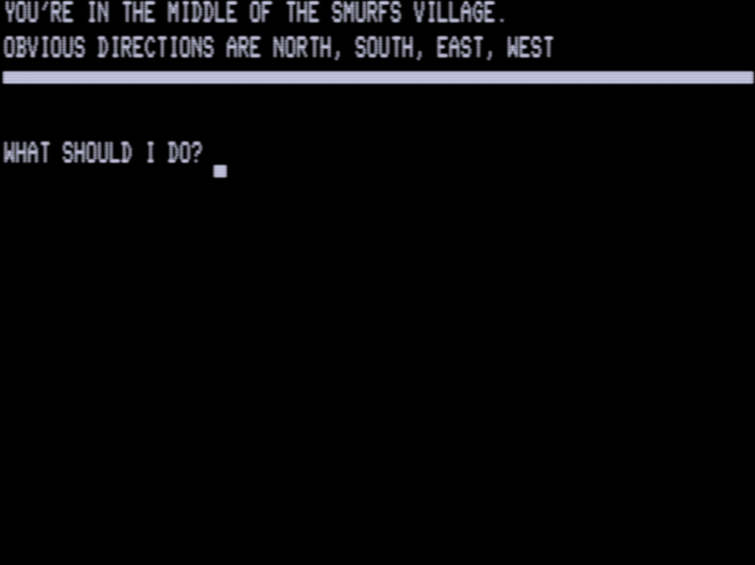
For one thing, it is short by 1982’s standards. Now, given we had Space Gorn and The Room both show on a disk magazine, that doesn’t disqualify it, but also, quite oddly, there are some places and characters that are present just for atmosphere. This is another circumstance where a game with the general plot structure wouldn’t feel out of place in a modern itch.io collection, but does come off as strange in 1982; I get the impression perhaps the author meant to continue (7278 bytes only, so there’d be room on a regular TRS-80) but just decided since the game was a personal whim to stop where they liked.
You start with no concept of what you’re meant to do, but heading north into Papa Smurf’s Hut reveals that Papa Smurf has been magically put to sleep.
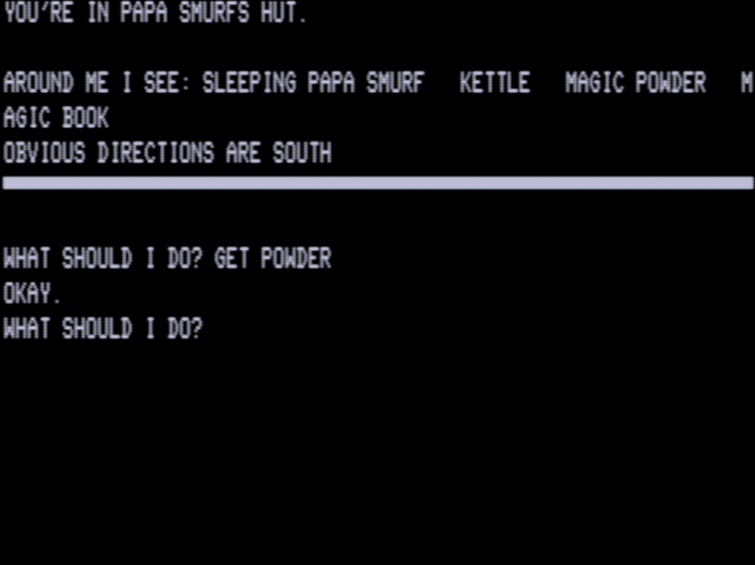
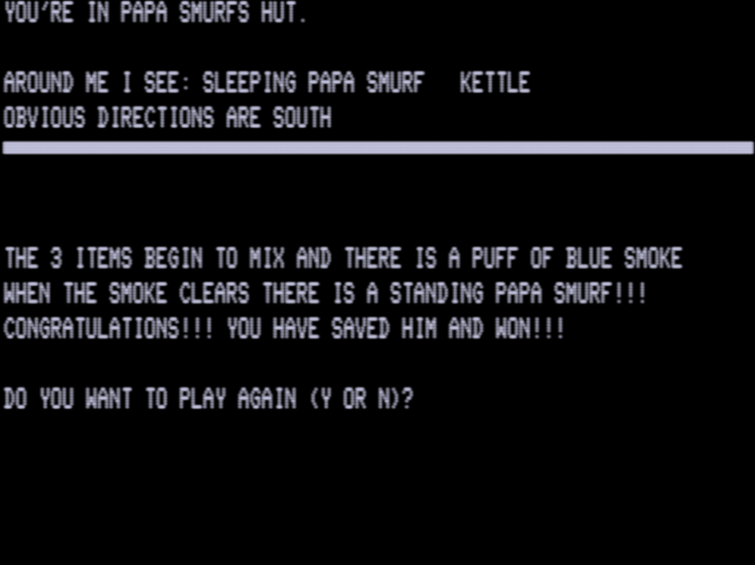
The book explains that “…YOU’LL NEED 3 THINGS. MAGIC POWDER, SMURFBERRY PLANTS, AND…. THE REST OF THE PAGE IS MISSING!”
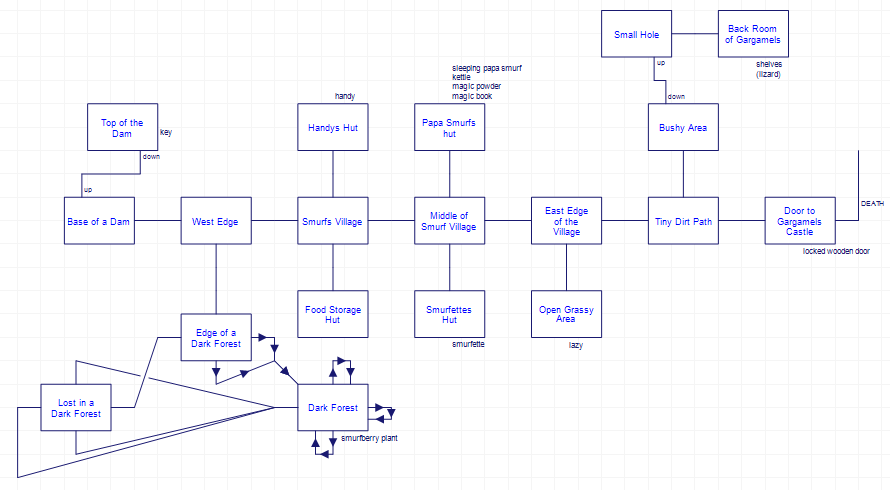
The powder is of course just sitting there in the room, so this is solely a quest for two ingredients. The smurfberry plants are out in the forest in a very tiny maze (see map a little earlier) and the unknown ingredient is a lizard toe that you can find at the back room of Gargamel’s Castle.
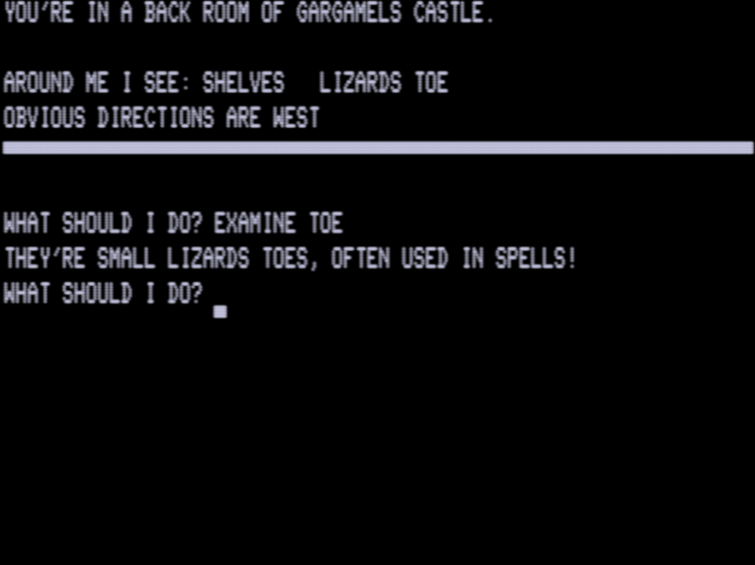
All you need to do is then drop all three ingredients at Papa Smurf (the game will assume you mean in the KETTLE that’s there) and you can win the game.
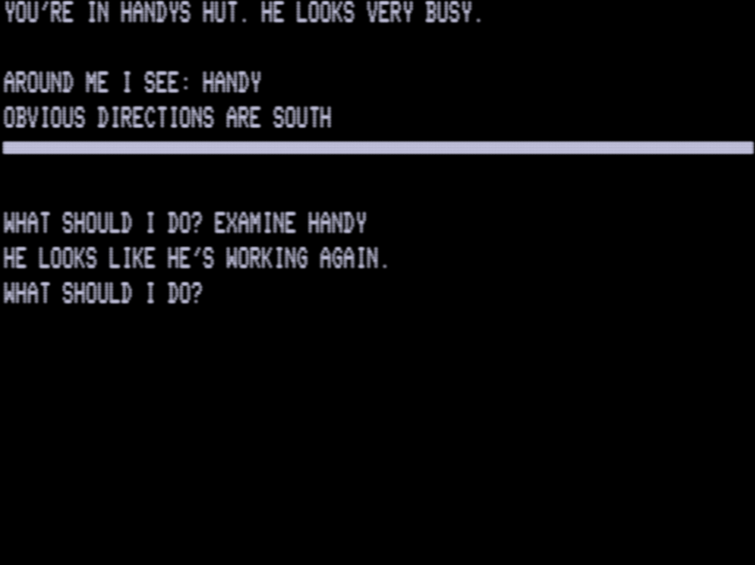
That’s not quite everything in the game; you can visit Handy and Lazy and Smurfette. There’s no particular reason to do so other than to perhaps feel the inherent Smurfiness of the environment.
Also, you can have an actual run-in with Gargamel. You can find a key elsewhere that will unlock the front door of his castle (which is only a few steps from Smurf Village, no wonder he goes berzerk) and find yourself Smurf-food upon entering.

To emphasize, you technically solve a puzzle (however small) in order to reach an instant death room that is purely there because it is there in the cartoon! The sheer oddity of this (and the fact you’re only hunting two ingredients that are almost literally in the open) really does make the gameplay insubstantial, but I’d still like to imagine this game being someone’s winter whim one day to re-create the world they saw on television to be able to enter it, even if only for a little while.

From some of the surviving footage of the 1965 version of the Smurfs.


 Renga in Blue

