Archive for the ‘Video Games’ Category

In the history of personal computers, the first significant home computer was the Altair 8800, which briefly made a cameo on this blog with the game Kadath. Quite soon after — designed originally as a terminal to use the Altair before it became its own project — was the Sol line, which appeared on the July 1976 cover of Popular Electronics and was sold in three ways: in kit form, without expansion slots (Sol-10) and with expansion slots (Sol-20). At the time it was called the first complete small computer; it is now sometimes called the first “modern computer” or first “all-in-one” computer.

It did reasonably well — 10,000 units — but in historical memory it is overshadowed by the Altair and Apple I, and shortly after it landed it got bowled over by the Trinity of 1977 (TRS-80, Apple II, Commodore PET).

At the Smithsonian, from DigiBarn. The Apple I and Altair are on the table above, carefully labeled, while the SOL-20 is hiding underneath on the floor with no label at all. I’m not sure if the curator meant this as a metaphor.
The machine eventually was discontinued in 1979; the designer, Lee Felsenstein, ended up going on to design the first successful portable computer (the Osborne 1) but that’s a story for a different time.
Even when a computer is “discontinued” it still can have fans, and the SOL-20 has its diehards and events, like a 30th anniversary party. One such fan, Ray White, wrote what was more or less a private collection of games, including an RPG called Deathmaze. Skull Cave, his only text adventure (and what appears to be the SOL-20’s only text adventure) he estimates to be from 1982.

The setup has an Infidel vibe (“disease, hunger, monsters and desertion” taking their “toll” on your “hirelings”) but the better comparison is Dungeons and Dragons, especially because the final obstacle feels like a scene from one of the very famous early campaigns.

But also: there’s random enemies seeded around for combat. From the opening room above, you can head south (into the “mouth”) to do combat with a skeleton, or head up (through the “eyes”) to do combat with a goblin.

The author here ran into the same problem many adventure writers were running into: how to make the combat interesting? Adventure and Zork both used it a limited amount, so the encounter with (say) the Troll was colorful and not repetitive. Deadly Dungeon tried to give you arrows for a second method of attack, and Eamon added dynamic movement to the monsters, spells, RPG stats, and the possibility of emergent behavior.
Unfortunately, Skull Cave is just taking its cue from Adventure/Zork. Combat isn’t nearly as interesting as Eamon: the only thing possible to do is to ATTACK when entering a room with a monster and hope you win. You can’t even run away and choose to engage later.
YOU CAN’T JUST LEAVE IN THE MIDDLE OF A FIGHT!!!
Sometimes this sort of game has a “experience path” where if you’ve killed weaker enemies you’ll have an easier time against stronger ones. Unfortunately things are too random for me to be sure if this is true, and I found the best strategy is to attack as minimally as possible, because there’s always a chance of random death. You can spend some points for one reincarnation, but after a second death the game is over.

The game is in two sections. The first spans from the skull cave entrance to a locked gate, with a “Guardian of the Gate” enemy. Other than the initial skeleton-or-goblin fight the next one you have to do for certain is the guardian, and you just need to hope you get lucky and restart if you don’t (the game has no saved game capability, either).

I marked the start room at the top and the gate room at the bottom.
In the middle you can choose to fight a troglodyte and get a jeweled wristband, swipe a number of treasures (silver bars, emerald, painting), smash a statue to take its jeweled “eyes”, swipe a glass bottle and a chain, and battle a dragon (which drops gold if you defeat it).
There’s also a room with a magic word (“PLTMP”) which teleports you there and seems to work every time, being the only escape from combat (too bad I found it last when I was mapping!) There’s also a completely unmappable maze, and I’m not exaggerating “hard and annoying”, I do mean unmappable:

If the author meant to copy the “all different” maze, then separate rooms need separate messages. The item-dropping method doesn’t work; any items just disappear instantly. I think the author may have messed things up from their intent.
Going back to the locked gate, if you defeat the Guardian (again, I just made a beeline and crossed my fingers, no tactics whatsoever) then you still have the locked-ness of the gate to deal with. I had found SEARCH worked from my various tests but mostly it shows nothing. However, if you happen to use it at the skeleton room at the very start, you can find a skeleton key.
This is not a guaranteed search either! Again, I feel like the author might have had D&D in mind, but given SEARCH works almost nowhere, having it also possibly fail the one place it does work is just cruelty.

(The funky error line is because I made a typo and tried to hit BACKSPACE, which doesn’t work on this emulator. I assume SOL-20 had a backspace but I’m not sure how to trigger it.)
The key leads down to a slightly more interesting area.

Yes, slightly more interesting, just the usual Adventure puzzle where the bottle from the north side is useful to pour water on a plant to turn into a beanstalk. There’s also a scene with a “beautiful girl” which gives you a scroll with the spell NIGNOG which seems to be used for defeating one (1) enemy of your choice:

There’s a tiger attached to a pedestal where you can choose to walk away, but once you fight, you’re committed. Defeating the tiger reveals a gem. (I tried NIGNOG here and got no luck, but I think it was because I wasn’t technically fighting the enemy yet.)

With the gem in hand you can go back to reveal a sword stuck in a stone, and use the gem to free it. (MOUNT is a verb I got from the binary code of the game. Unfortunately it is in machine language so I can’t determine a lot of things otherwise.)

Then, with the sword, you can get to the scene which I mentioned reminded me quite directly of D&D.

Specifically, the infamous “Tomb of Horrors”, which originally debuted in 1975 in tournament conditions, then got published in 1978 and has been used by Game Masters to gleefully torture players ever since. It has traps on traps on traps on traps, and a battle with a lich at the end assuming players even get that far (which is just a skull which floats and sucks out one soul per turn).

From a larger piece of art by Jason Thompson describing an actual play session.
I think there might be some more resources, but just NIGNOG (which stuns but doesn’t destroy) plus the sword were enough to destroy the skull. Just NIGNOG alone doesn’t cut it. I assume our player is the “monk” class since they’ve been going without a weapon most of the game taking down skeletons and so forth, but sometimes you need a little magic even when you’ve got fists of fury.

There’s a map up at CASA Solution Archive which includes a place with a “ring” I never got to visit — if you look at the plant room there’s a hook where it seems a chain could go, but I could never find the right verb to make it work — and I also skipped entirely a spider guarding a room with a shield. These tools only came after the majority of combat in the game; Skull Cave really could have used spreading out some of the combat resources in a way that picking them up in the right order could have slowly leveled combat up so the player wouldn’t have to just roll the dice on the guardian or the tiger.
Oh, and I’ve failed to mention the thief. Ugh, yes, there’s a thief.

The thief grabs any treasures you’ve gotten — which seem to be purely for points — and stores them, I presume, in the maze. The problem is the mazes are broken! (In addition to the “all different” maze there’s an “all alike” maze which is equally broken.) So while the source code indicates a “lair” where presumably you can retrieve things…
YOU ARE IN THE THIEF’S LAIR. COMFORTABLE, (BUT CHEAP), FURNITURE LINES THE WALLS. IN THE CENTER OF THIS ROOM YOU SEE A LARGE ROCK.
…there is no plausible way to get there. Perhaps the author has the exact maze steps and if someone really was determined to hack at the binary code they could find out a way too, but as is, the treasure is all a sideshow to the main task of retrieving the pearl anyway.
For now, Skull Cave mainly serves as a warning as to how difficult it is to make combat fun in an adventure game without making any extra systems. The large number of adventures from this era where violence is actually a red herring seems to be linked to the same trouble: there need to be statistics, extra moves, a wealth of items, enemy AI, and so forth, none of which had an easy-to-copy model at the time–

From the printed Tomb of Horrors module.
–excepting Eamon, but if people wanted an Eamon game they just wrote it in that system. And incidentally, for those Eamon fans out there, yes, I might loop back sometime and do more than 2 adventures, even though they really lean much harder on the RPG than the adventure side. The backlog is just so, so long. And speaking of backlog, what I’ll be getting to next is a game which is very large, whose existence is recorded almost nowhere, and has only been available to the public quite recently.

From the Centre for Computing History.
Fans of my previous posts may remember a mysterious individual, Mr. A. Knight, who wrote Galactic Hitchhiker, a surprisingly decent riff on Hitchhiker’s Guide to the Galaxy while using the vanishingly small 8K available on the UK101 computer (shown above).
By the end of 1981 he mentioned another game, Mad Monk, that he had ready for sale; at least one person ordered it in March 1982 and never received it, and for a while it was thought perhaps the game was vaporware, until it appeared recently, recovered by baldwint from a stash of UK101 tapes on the Stardot forum. It seems to have taken until mid-1982 before it actually came out. Quoting from the August 1982 catalog:
A graphics Adventure program, all in machine code. We’re sorry about the delay in finishing this one but when you see it you will understand why it has taken so long. It is now receiving its finishing touches and, honest injun, it’ll be ready for mid August….yes, 1982. If you already have this one on order, please be patient just a little longer, as it really is worth waiting for. Again, apologies for the delay.
The catalog is incidentally for “Merlin (Micro Systems) Ltd”; while Knight originally sold software as a personal venture with no company name at all, by 1982 he had branched into a selection from multiple authors with the aforementioned Merlin attached, and later switched names again to Knight Software.

Unlike his previous game, it is fully in the roguelike-adventure mode, like The 6 Keys of Tangrin, Lugi, Mines, and a few others games we’ve seen. Nearly all room placements and exits are randomly generated, and all objects and foes are also placed at random.
The adventure starts with you in the entrance hall of the Mad Monk’s Monastery and your missions is to find and rescue one Lord Magnil the Magnificient, who is being held ranson by the Mad Monk and his acolytes.
Not a princess! Good job, Merlin (Micro Systems) Ltd.

You always start in an Entrance Hall, as shown above, and just to the south of Entrance Hall there is an entrance to a maze, which switches the game to 3D mode (!).

The text adventure part of the game contains a “magic map” and a “compass”. Having the compass will have the game always display what direction you’re facing; having the map will let you press M to get an automap.

While it isn’t clear from the instructions or the game itself, the 3D maze is the exit should only be entered once Lord Magnil is rescued; if you successfully pass through when he hasn’t been rescued, the game asks WHERE’S MAGNIL THE MAGNIFICENT? and ends.
The 3D maze is generated in such a way the right-hand rule works, so it honestly isn’t too distressing to have it in the game (even if the compass and/or map turn out to be elusive); if it was in the middle of the game it would be much worse to go through the effort, as the text adventure portion is quite deadly.

The way enemies work is they start “agitated” when you enter a particular room, and the longer you stay there the more likely they are to get angry and start hitting; other than CEREBUS as shown above you have to deal with THE SANDMAN, POTTY PRINCE YUSUPOV, CRAZY COUNT PAVLOVICH, IGOR THE INSANE, GREENY THE ERRANT INVADER, and the MAD MONK himself. The anger level seems to be a fixed increase, so you strategically only have 5 turns or so with an enemy to either eliminate it or skedaddle. Enemies can block exits so sometimes they have to be killed, although it is possible for them to also show at dead ends (meaning in such cases they can be ignored).
Some of them you can just stab with a dagger, assuming you have one (that’s a big assumption).

Others I have no idea what to do with and I just die. Greeny is only killable with a “zapper” as the instructions indicate, but he’s hard to hit.

The instructions hint that there’s some sort of mini-game to train your zapper ability: there’s an ARCADE GAME and a COIN and assuming you have them together (see animation below) you can put in the coin to get a Greeny Zapping session in with special controls. You need to (at least) entirely beat a wave in order to get enough accuracy, a feat I have (as of this writing) yet to manage.

The room description engine isn’t dense but it works out; most rooms are just “Monastery”, and sometimes with an environmental effect that is either permanent (“THE WALLS ARE COVERED WITH MOSS HERE.”) or temporary (“SOMETHING SLITHERS AWAY IN THE SHADOWS.”). Some rooms have special names like “Alcove” or “Pantry”; in a few cases the special rooms have fixed items. The Bathroom, if it appears, will always have a rubber duck. The bell tower, if it appears, will always have a rope you can pull.
Notice I said “if it appears”; I’m unclear about this for certain, but I think the map generator is busted. Sometimes it works, but sometimes you get one generated like so:

It is faintly possible I’m missing some trick but in this case the only thing available to reach was an arcade machine (and no coin, so I couldn’t test out the minigame). A much better generated map is something like this one:

There’s a bottom floor and a top floor; the top floor is constrained within a 5 by 5 section, and I think that’s in general the game’s default. That would imply the bottom floor also does the same, and it may have done so correctly, but my mapping was cut short by CEREBERUS THE SALTY DOG, and if an enemy is presenting as an obstacle, you can’t just sneak by.
I was able to get a DAGGER and stab both IGOR and the SANDMAN, but the parser just gets confused you even think about stabbing the dog. There’s a message (that has appeared only on a few iterations) about the dog being an “old softie” so I tried things like dropping a bear and a rubber duckie and some sausage in the room, but no dice. The verb list is heavily constrained, so I might be typing the wrong words.

This leaves out BLOW, which works because of a whistle which summons a police officer. The police officer is no help against the dog either.
I’ve done quite a fair number of tries, but it look the game’s logic force-makes Cereberus into a necessary-to-win obstacle, so I have to get by to succeed.
The only other aspect I’ve figured out (partially?) is the mad monk. The monk plays by its own rules and can “teleport in” to a room you’ve previously been in, as opposed to staying in place. Unfortunately, the monk stays put after, so if he’s blocking you (likely) you might be entirely stuck. The only way by I’ve found is to right the bell tower; for some reason this summons the monk away and you no longer have to worry about him at that location.

Despite the frustrations I was rooting for the game to work — or at least get me enough luck somehow I could ignore the dog — but after a significant number of lives wasted trying to find any verb that might be helpful (with the occasional “impossible” map) I’ll need to throw in the towel for now. If anyone is keen and giving it a whirl themselves, head over to here for a copy and instructions.
Neat concept, generally, but the game just didn’t work out. Hanging over it all was the lack of a saved game feature, which made experimenting very frustrating; I had the situation like Lugi where I wanted to test a theory about an object combined with a particular enemy, but I had to wait multiple restarts until the next situation rolled around only to find out my idea didn’t work. Having fatal puzzles combined with making it hard to test theories drains all the energy out of an adventure game.
We’re technically not done with the UK101 yet; the Merlin catalog I quoted earlier also has two games by David Harrison, Dragon’s Lair and Lost in Space, both cited as adventure games. It’s hard to know if they’re “really” adventures (as opposed to action games with a light skin) but tapes for neither have surfaced, so we’re left for now wondering unless another tape cache turns up.

Paul Berker has done an interview for the podcast ANTIC where he discussed Phoenix Software and Queen of Phobos.
He mentioned that the packaging for the game had “High-res graphic adventure” on the box…

…which was enough for On-Line Systems (of their Hi-Res Adventure line) to sue in California court. Unfortunately Phoenix was a small company out of Illinois so they just simply destroyed any remaining stock they had left, and Berker estimates he only made “about $2000” from the game.
His collaborator Bill Crawford passed away in 1984 so there’s no similar interview for him; Paul Berker said he might have otherwise made more games based on Crawford’s ideas. Paul went back to writing software for businesses, which had much more reliable paychecks.
…
I have finished the game, and it was excellent enough that before going on, I want toss down a link:
Click here to play The Queen of Phobos online
Complete spoilers follow, and you’ll need to have read prior posts for this one to make sense.

From the Museum of Computer Adventure Games.
As implied by my calling the game “excellent enough”, yes, the randomness ended up working out. This was partly due to the rogue’s gallery being less aggressive than they could be, but in a ludic sense they still gave the desired effect.
I had left off last time understanding part of the sequence I wanted:
a.) Get the nuclear weapon and the cable, and use the cable to dispose of the weapon. This is probably optional if you’re fast enough doing everything else! There’s lots of optional elements going on.
b.) Get the shovel and the map from the planet surface. Neither of these have randomized positions so no hunting is required. Again, technically optional, but the maze is randomized. I have some times just moved randomly and found the center with no effort, and sometimes go terribly lost, but I figured for my goal I needed the map.
c.) Somehow get the key from the claw machine; I hadn’t solved this yet.
d.) Use the key to open the locker in the captain’s room, which surely has a helpful item.
e.) Make it over to where the lasers are and throw the map to set the lasers off and have them shoot each other.
f.) Defeat the zombie by ???
g.) Get the mask by ???
h.) ???
i.) Profit!
With a bit more playing around with the claw machine — and a helpful warning not to hit the machine if you LOOK at it — I tried KICK MACHINE after playing, and the token came out again. (I tried this once already, but before playing, hah! I was thinking maybe I could just get the key to fall out on its own.)

By using the token a second time, I was able to get the key. Unlocking the locker gave me a … salt cube?
Not expecting much, I loaded up on some extra items (like a vibroaxe and a surgical chain-saw) with the hope that something I carried would take care of the zombie. The zombie comes out on its own so there’s no opportunity to use a command like ATTACK ZOMBIE, which should have been a clue that this would happen:

Ah yes, the well known aversion of zombies to salt. Actually, there’s a hint to this in a COOKBOOK lurking in the kitchen. You have to TURN PAGE to flip through the cookbook (something I was clued in on because it gets used in a prior Phoenix game). Page 4 states:
THE ZOMBIE: THE ZOMBIE WILL EAT ANYTHING, BUT ‘NO SALT’!
Moving past the zombie is the room with the mask! The mask is wired for electricity, unfortunately. Going back and exploring, I found that I could use a wrench to turn the mysterious spigot in the machine room I was having trouble with, which started dispensing electrolytes to ruin electronics. I also found a crock pot that I could use to take the liquid with me. (Note: both items are randomly distributed; I don’t know how keen the thieves are on stealing them, but I believe the wrench got moved around at least once.)

With the trap disabled, I was able to grab the mask, then die shortly after of a mysterious illness. You need to WEAR MASK to be filled with vitality and escape. Then all that’s needed is to head down to a shuttle and leave.


Note that the thieves become much more dangerous on your way out and will try to kill you. It is possible to run away but given any leeway they will do a surprise attack. On my winning run I had:
a.) found an electric crossbow which killed Dr. Hunter — the person with the sunglasses
b.) failed to find beer; however, the lizard-man and the beetle both by coincidence ended up in the same room, so I threw a gas grenade and took down both of them at the same time
c.) completely ignored the tree-person, as I couldn’t find anything to kill them; one rogue turns out to be not so bad to evade
Incidentally, after wearing the mask and going back to the central room, I found the beer and some footprints going northeast. I’m not sure what the meaning of this was. One might suspect the rogue was nearby and dropped the beer, or maybe the footprints were supposed to show you the way back? I just wandered randomly and kept going south until I found the exit.

But really, the game worked. The fact that the rogues could be killed in at least two ways or ignored was fantastic; it gave a risk-reward feel and opened the possibility to a “pacifist run” where you avoid killing any of them. (If any of them follow you into the shuttle, you don’t have time to push the launch button before they shoot you.)
There weren’t that many obstacles in the end, but that turned out to be a feature; I don’t know if the game’s central idea would have worked well for a more prolonged stay.
This suggests strongly that one of the main principles of a good roguelike-adventure is to allow alternate solutions or even skipping puzzles when randomness is involved. Also — noting that the nuclear device and cable were always in the same place — if something involves critical timing, don’t toss it in the random generator mix.
The game doesn’t quite go all the way to the fantasy of the infinitely repayable adventure, as the fundamental frame is always the same, but it does lend at least more than is typical. The wisdom it holds is good to keep in mind as the next game on my list is fully adventure-roguelike, and was completely lost to the world until quite recently.

Softline, May, 1982.
I think I’m converging on a solution. The game can’t be too huge just on the basis of it only taking one disk side and some of the space occupied by animations. I already showed some of the zombie, here’s a selection of frames from when you jump off into space (and die):


Again, just a selection: it looks startlingly like a cutscene jumped into the game, 1990s-style. I think it’s easy to see the resemblance to, say, The Tartarian and discard the graphics as crude, but there’s some genuine craft and art design put into them.

They’re not museum-frameable, but there’s a ragged 50s-movie vibe to them. Sure, the creators were probably forced into it due to technical circumstance, but they made the most of it.
The frisbee-shaped ship has a game schema like this:

The corridor is the central travel area. To the “south” of each junction of the corridor are the main rooms (navigation, bridge, armory, etc.) To the “north” is a maze of state mazes leading to the center of the ship (and the aforementioned zombie). So unless I’m fundamentally misunderstanding something, the majority of the action plays out on the corridor. I’ve mapped it as a line, but note the two ends wrap around.

Green represents a section where you can teleport down to the planet the Phobos is orbiting. The corridor lets you go north into the “maze”-ish section but that’s where the circular aspect becomes hard to map. Fortunately mapping the maze seems to be unnecessary to winning.
Despite the ad materials mention of “randomly placed” weapons, some of the items seem to be consistent. For example, you’ll always find a SURGICAL-CHAINSAW in the surgery area. It’s possible for the thieves to filch items, but they also will sometimes drop them again; for example, Thomas S. Hunter picked up a bazooka from the planet (he hitched a ride with me through a teleporter) and dropped it off again randomly in the ship’s corridor. That’s a pity, because the bazooka doesn’t work and will blow up whoever tries to use it. Maybe I need to get him to swipe it and then provoke him so he tries to use it.

Thomas S. Hunter posing with Yuggoth.
As implied by the screenshot above, you can have two thieves in a room at once, although I’ve never seen three, which is kind of a pity, because the one item that seems to work on all the thieves — but only works once — is the gas grenade. (You need to be wearing a gasmask, but otherwise you can just throw it.) This means that it may be that all four thieves have a custom defeating-method but the grenade will work in a pinch if you can’t find a certain item or just happen to be stumped.
One of the items that defeats a thief is a case of beer. Normally it isn’t helpful…
THE LOOTER IS HIGHLY INSULTED AND KILLS YOU. THEY MUST NOT DRINK BEER WHERE HE COMES FROM.
…but the Beetle can’t resist the beer, which was apparently too much to handle.

I’m also not 100% sure you actually need to defeat all or even any of the thieves. While they sometimes follow you around they don’t attack (yet) unless you make a move first. There is some secondary havoc they must have caused behind the scenes, because there’s a thermonuclear device in an armory that is set to explode and needs disposing of. You can get a cable from near the engine of the ship, then find a gaping hole with some ship damage; attach the cable to yourself, walk out near to the hole, and toss the device.

If you don’t attach the cable before throwing the nuke, Newton kicks in and you fly into space and die.
In the department of other puzzles: there’s also a machine with a metal claw; you can put in a token, and the claw moves over and picks up a deck of cards. I suspect I need the key right next to it in the machine, but I don’t know how to fix things yet.

This is animated. It doesn’t seem to be a mini-game, but rather the cards get picked up automatically.
I’ve otherwise not got much left to fiddle with. A “spout” in a machine room needs a handle to turn; I’ve found a shovel which dug up a grave on the planet…

…which has a map that leads from the captain’s quarters to the center of the ship, which is why I indicated earlier figuring out the maze was unnecessary.
Each thief is a puzzle of sorts, and it’s fun just to see what kind of combinations can happen on a fresh game, so I’m not bored of things yet. As long as things resolve fairly soon this won’t have outworn its welcome.
I can’t guarantee yet that the random aspect is solid, but the alternate method of thief-killing and the fact they are willing to drop their loot both suggest it shouldn’t be possible to get into an unsolvable situation. I did want to mention one more novelty of this game, which happens if the disk thinks you’ve copied it (that is, this is an anti-piracy measure). As observed by 4am, Apple II preservationist extraordinaire:

The melting is just what happens if the nuclear bomb goes off, so whatever time limit the bomb has (200 moves?) gets set to 1.
This one’s got a terrific high concept.
Think about the Thief in Zork I. Imagine instead of one Thief there are four of them, moving about an ancient spaceship just like you are, all of different alien races with different personalities and methods of being defeated, as everyone vies to be the first to lay their hands on a powerful ancient artifact: the legendary mask of the long-extinct Martian race, Kuh-Thu-Lu.
…
Our previous visits with Phoenix Software were both in 1981 with Paul Berker, who wrote Birth of the Phoenix and Adventure in Time for the Apple II. Both were text-only games; Paul returns here with The Queen of Phobos as a programmer, with graphics and design by William R. Crawford. This is Mr. Crawford’s only credited game.

From Mobygames.
I did say “graphics”, although other than the title screen…

…they’re entirely in black and white. I am hence going to turn on the “black and white TV” mode; I know the weird purple sheen that comes from the unique way Apple graphics worked may give some nostalgia, but I honestly think the black and white Apple II games usually look better in actual black and white.

A zoomed-in look at the four thieves from the cover.
The starliner Scalus III — recently appeared after more than a thousand years lost — is rumored to be the famed long-lost ship “Queen of Phobos” with a passenger roster including the Pharaoh Rahnk III of Mars. The ship had the pharoah’s mask, supposedly not just a symbol of power but a real source of power. The loss of the pharoah and the mask brough Mars into a civil war and the Martians themselves into eventual extinction.
While Earth was give right of salvage of the vessel, four thieves have boarded. Your job is to board the vessel on behalf of Earth and get to the mask before the thieves do.

I have yet to assess how much randomness the game has, but I’m serious when I say the AI seems to be like the Thief in Zork — it can go anywhere at any time. For example, upon disembarking on the Queen of Phobos, I went “north” and then “west” (apparently directions are a bit fuzzy as “north” is always towards the center of the vessel) and found an axe in a corridor. On a different playthrough I found the axe filched and one of the four thieves showed up. I ran away because I had no items.

On yet another playthrough I found no item but some beer along the next corridor. The items seems to be randomly scattered at the start but since the thieves are grabbing things, probably it is the best to not be feeling like I need to “race” for a particular item.
The thieves do seem to play hardcore, as evidenced by what happened when I went back to visit the ship I landed with. (This seems to always happen no matter the circumstances, and it means you can’t leave the same way you came in. I’m reminded of the Thief in Zork closing the trapdoor behind you.)

The map is circular, with a long corridor “outer ring” and a web of “staterooms” on the next ring.

Despite the apparent chaos, there’s definite specific puzzles going on. For example, while toting along the case of beer, I found two lasers, and with no other resources, threw one of the beers out.


Immediately afterwards I found a zombie which mauled me in dramatic animated fashion. I guess that explains why The Queen of Phobos went missing.


This one’s going to be fun to play around in. Is it going to be fun to beat, though? It depends how frustrating the randomness gets (and if there’s alternate methods for defeating particular thieves if they swipe an item that you need). So far, though, this feels less like the author felt a need to create an Adventure Game and more “here’s a story where you’re part of it”.
This is a direct continuation of my recent post on Victory Software games, so you should read that post first before this one.
(And yes, I’m still doing Cain’s Jawbone, but this is a very short and simple game as opposed to an impossible hard one.)

From Launchbox.
I mentioned last time an Adventure Pack consisting of Computer Adventure, Big Bad Wolf, and Moon Base Alpha. My working theory is that when Big Bad Wolf got published by Commodore in a collection, the author Bruce Robinson did a switch. This is entirely a guess, and on Bruce Robinson’s own page where he discusses the company (“At its peak, Victory Software employed 8 people at the main office”) he doesn’t talk about this at all, other than to say Commodore “licensed” both Big Bad Wolf and the action game Treasures of the Bat Cave, and neither show in later ads for Victory. (It is, to be admitted, one of those minute things that only a tiny group of people care about, although Gareth Pitchford did some investigation.)
Putting all that aside, it should also be noted that there were at least two C64 versions. While the VIC-20 file no longer exists, checking the source code indicates the 1982 C64 version is almost certainly a direct copy of the BASIC from the VIC-20.

A 1983 C64 version beefs up the text.

There are a few other changes I’ll discuss later.
Honestly, there’s kind of a charm in not trying to add much more? At least with this game the puzzles were genuinely solvable even with vanishingly small space to work with. Just like Big Bad Wolf the game is restricted to five rooms.

The goal is to make and climb a beanstalk, then steal a egg-laying hen from a giant. The bean part is pretty straightforward; you go in the TOWN and there’s a SHOVEL and BEAN just sitting there to scoop up, you don’t even have to negotiate for low prices. You can then plant the bean in your yard and water it (using the pitcher from the house), getting the titular beanstalk, which can then be climbed directly into the giant’s castle.


Typing LOOK HEN finds some GOLDEN EGGS you can take (oddly, not the objective of the game) and LOOK GIANT yields a RIFLE. The giant fortunately is very tired through all this and only awakens if you try to grab then hen, which squawks, but even then the giant just boots you out of Castle-land and down to the surface before falling asleep again.

(In other words, merciful game design! It would have been easy to put a GAME OVER but it feels in character for the giant to not feel threatened enough to go that far.)
Back in the house there was a RUG. You can take that to reveal a trapdoor, but it is locked, and even though it’s your house, there’s no key.
You can look at the rifle to find bullets, and at the bullets to find gunpowder, and then stuff the gunpowder into the keyhole of the trapdoor.

This took a little effort to solve, but it’s mainly just a matter of making sure to LOOK at every item and keeping in mind the PUT verb works.
This reveals a basement with an AX. If you try to chop the beanstalk with it the game says
NOT YET, I DON’T HAVE THE HEN!
Before this I admit I was happy with the gold eggs I already stole and not sure why I needed the hen too, but hey, more money in the end I guess. Going back to the squawking hen, I put my thinking cap on and came up with what I confess is an admittedly clever solve. The rug that covered the trapdoor in Big Bad Wolf was solely there to cover the trapdoor; the same is true of rugs in other text adventures like Zork. Jack and the Beanstalk takes what normally is a throwaway item and makes it the solution to a puzzle all on its own:

By covering the hen with the rug, you can mute the sounds long enough to make an escape. The giant still follows, but with ax in hand you can have a happy ending:


Honestly decent! It’s about as good as can be done with the byte space available on the unexpanded VIC-20 (other text adventures tended to use expansions; Scott Adams games required 16K of memory).
The 1983 C64 version which uses more capacity adds around the edges of the basic game.

The rifle you don’t get from the giant, but rather have to purchase it in town. The hen isn’t right next to the giant and you have to travel through a top-down maze to get there.

Not much more to add; we’ve still got more Bruce Robinson games to go, but they’re kicked down a bit further down on my list. If nothing else, this well-illustrates the principle I’ve mentioned of unexpected re-purposing being a very strong puzzle type: taking what seems to be an informational sign and moving it, turning a location into an object that can be picked up when the player is strong enough, and for this game, taking what would normally be scene decoration whose only purpose is to hide one object and making it the essential element for solving the main puzzle in the game.
Bruce Robinson, our 1982 author for today, started off a little earlier in 1980 working on games for the Ohio Scientific Computer, published by Aardvark. Remember them, the ones with a parser that only understands the first two letters of each word? (Fair if you don’t, especially if you haven’t read that far back; try my writeup on Deathship for a brief intro.) Yes, they’re back, kind of, even though none of Robinson’s games for Ohio Scientific were adventures…
OSI GRAND $8.95
The original tasteless working name was “DEAD BABIES”. A hotel fire is burning out of control as people mill around the roof. Your job is to catch them in a net and bounce them into a waiting ambulance.
…it is clear Mr. Robinson had some influence from the Aardvark adventure line, so we’ll need to refer back to those games shortly.
Bruce Robinson was the proprietor and for the most part sole writer for Victory Software, which kicked off with a line of software for Commodore computers: the VIC-20 and C64. Later, they also converted their titles for the ill-fated Coleco Adam.
Not long ago I wrote about two fairly small games on the Softside Magazette, essentially too small to be published standalone. Another workaround to this problem circa 1982 was to sell multiple games together as a sort of “pack”, as was done with “Adventure Pack I” which contains all of today’s games.
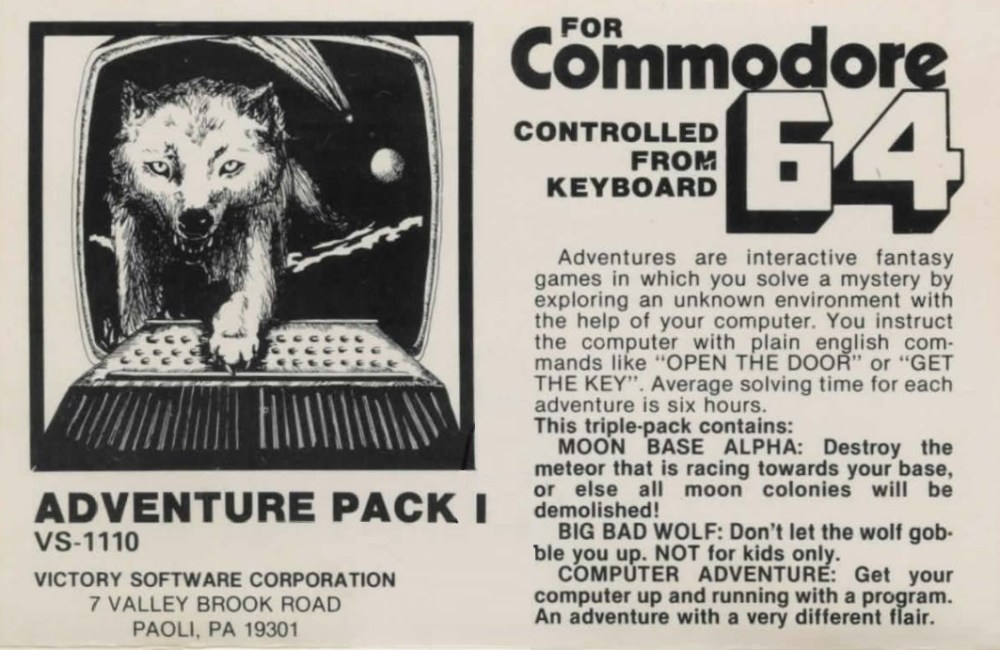
Via LaunchBox.
I’m listing the games separately because they were also repackaged; for example, Big Bad Wolf made its way into a collection sold by Commodore…
…and Victory Software itself did its own re-packaging, combining Moon Base Alpha and Computer Adventure with Jack and the Beanstalk and calling it Adventure Pack I, not to be confused with the other Adventure Pack I they released. (I’m not fully clear which came first. I’ll tackle Jack and the Beanstalk standalone on a different day.)
The games were clearly written first with VIC-20 in mind, a system we have yet to encounter here. Commodore was being managed by Jack Tramiel, forever going for the lower price, and the VIC-20 in particular had an astonishingly tiny 5 KB of memory (compare to a standard TRS-80 Scott Adams game at 16). Even the Aardvark games with 8 KB did not have to deal with such tiny spaces.

The games here were written in BASIC, which reduces the memory capacity even more to astronomically tight.
Consequentially, both the games themselves and the parser are quite minimal. The minimality to responses especially make the games near-unplayable, although Big Bad Wolf verges close to being a “good” game. They’re also quite necessarily tiny on room count, where Big Bad Wolf has a grand total of 5 rooms, Moon Base Alpha has 5, and Computer Adventure has 12. I’ll tackle them in reverse order.
…
Before I show my first screenshot, I should mention VIC-20 is known for its extra-wide text font (see the BASIC shot earlier) but for my play I used emulator tomfoolery in order to squish the aspect ratio into something normal-looking. These are hard enough to play without me adding illegible text to the mix. (I also think it might be possible on a 1982 period TV to use knobs to cause some horizontal squishing anyway, although I don’t have any hand to test this theory on.)

Computer Adventure’s premise is you need to go buy a computer, TV, and adventure game in order to play an adventure game.
Remember when you first started thinking about getting a computer? How you scraped up enough money to buy it, figured out how to hook it up, and then actually got a program running on it?
There are no compass directions; you GO LOCATION to go there, and even though the places supposedly have a connected geography, you can ignore the geography and GO to any location in the game at any time. Yes, this feels weirdly and accidentally modern. The C64 version “fixes” this feature so you can’t just do locations across the map. (Crowther/Woods Adventure let you go to locations by just typing their names, but only a limited set of them.)
The GO LOCATION “feature” is co-paired with a parser that, like Aardvark, only understands the first two letters of each word, will often just re-display a location rather than explaining why a command failed, and sticks to non-committal messages like NOT YET with no clear reason why something isn’t possible.

The SUGAR BOWL at the start contains money you can find by opening it. Then you can go shopping; as might be expected for a VIC-20 enthusiast, Atari ($800) Apple ($1200) and IBM ($2300) are all out of budget, but you have enough money for a VIC & recorder ($375). You don’t have enough money to buy a TV after the VIC. You can try to steal you one but that lands you in jail:
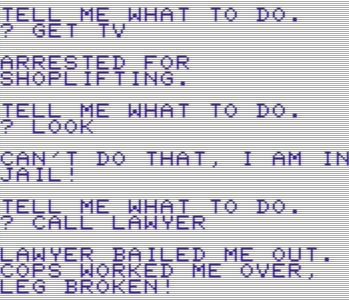
You have to CALL AMBULANCE after this in order to get your leg in a cast so you can move again. All this is entirely optional (!?).
The right thing to do instead is to go into a friend’s house, take their broken TV, and find out you are unable to REPAIR it. You can go home and CALL REPAIR which will inform you of a secret repair area, then spend $50 there to have a working TV set. (There is absolutely no indication any of these phone calls should work.) For the game, you can get a magazine with AN AD FOR VICTORY SOFTWARE; you can ORDER GAME which will then show up in your mailbox.
With the three parts in place, you can fiddle with commands in a way I’m unclear the order on (PLUG works somewhere, as does ATTACH, and if you don’t have the right order the game just says NOT YET) before finally finding the commands LOAD PROGRAM and RUN PROGRAM.
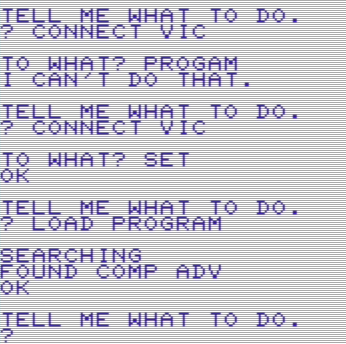
Doing this gets you the award of …
…getting into a loop, and playing the very game you just played! Bruce Robinson clearly had energy and ideas, but tried to implement them in an environment that didn’t support even half of what he wanted. While I haven’t tried the Adam version, even the C64 version isn’t much more elaborate, and mainly is helpful in giving a full list of possible verbs rather than making the player guess.

For the next game, Moon Base Alpha (complete map above) you need to stop a comet from hitting the eponymous moon base.

You get constantly reminded of how close the comet is. The first step is to head to the SILO with a CHISEL, DETONATOR, MISSILE, and GANTRY. The game then runs into the Aardvark visualization issue; I normally think of missiles as rather large, but you can just pick this one up and put it in the gantry (!?). Then you need to PUT DETONATOR on the MISSILE, and the only catch now is you need to push the button in order to launch it. The computer in the main control room (see screenshot) has a button but it is out of battery. There’s fortunately a battery in the basement, but unfortunately…

…the game informs you the battery is impossible to get. In Computer Adventure (and the early Aardvark games) you’d have to sit and wonder what the issue is, but here the game spares the space to let you know about CORROSIVE ACID if you look at the battery. So you need to get some medical gloves.

The gloves, unfortunately, have an issue of their own, as illustrated above: they’re contaminated from some sort of prior contact, and you quickly get sick and die if you pick them up. The key is to first take the CHISEL from back where the missile is, bust open the LOCK in the control room with it, grab some FORCEPS hiding behind the door, use the FORCEPS to pick up the gloves, then put the gloves in the autoclave for sterilization before trying to put them on.

A $50,000 autoclave from Fisher Scientific.
Then with the gloves you can get the battery over to the computer (which apparently works well enough even with the acid) and charge it up to be able to launch the missile.

This was certainly an improvement over Computer Adventure; dropping room count to super-tiny levels gave enough space to give actual feedback on what was going on and the game never asked for jumps of faith like CALL REPAIR. The game is even good enough to let you know the gloves are SCUMMY before picking them up rather than just letting you die and figure out the hard way there might be something wrong (…I figured out the hard way, but I pick up items like a hyperkinetic rabbit).
Before visiting Big Bad Wolf, I want to make a big lateral leap to an Infocom game, their only experiment in real-time parser gameplay.

From Mobygames.
This game is in three parts and the opening one is one of my all-time favorite adventure game puzzles.
Just here, a few miles from the border, night is falling, and the lights of the small villages flicker into existence. You’re drifting off into sleep when there is a knock on your compartment door, and a man, clutching his left arm, staggers inside. Drops of blood on his sleeve leave no doubt as to the cause.
“Don’t be frightened,” he begins, “I’m all right.” Before you can speak, he begins his story. He is, it seems, an American agent who has just learned of a sinister plot to assassinate a top-ranking American diplomat tomorrow morning in Ostnitz, the town your train is fast approaching. He hands you a document, which he says must be passed to his contact at the train station there. You look through it, but it’s all in Frobnian, and you know barely a handful of words – that’s why you always carry your combination tourist guide and phrase book with you on your trips here.
“You must deliver this. I do not know who the contact is – he was supposed to find me. I was to wear this white carnation.” He pulls out the rumpled flower and pins it onto your jacket. “He will bump into you and greet you with the words ‘Excuse me. I am sorry.’ to which you should reply ‘It is my fault.’ Then, hand him the document and earn our country’s thanks.”
The near-entirety of Part 1 of the game is figuring out how to make it to Ostnitz with the document. It is essentially one large puzzle, and while you are frantically looking for hiding places, compartments of the train start being checked one by one.
You watch as a man in a trench coat enters your car to the north. He opens the door to the first compartment, and begins to speak to the occupants, though you can’t make out a word.
This is a preparation puzzle. Rather than applying an object to overcome an obstacle, the obstacle is coming to you, and you need to have everything set up correctly in order to bring the document to safety.
Big Bad Wolf is the same sort of puzzle, but squished into the 3583 bytes of VIC-20 BASIC.

The wolf, akin to the comet, approaches a house wanting to gobble you up. (I’m unclear how you get move by move updates on the wolf’s distance, but it still works in context.) Again, the map is tiny, just five rooms.

You can also try to go in the WOODS but that kills you so I’m not counting it as a room.
You’ve got access to a gas stove, whiskey, and a candle in the kitchen; a chair in the den; an ax and shovel in the shed. The shovel can be used to dig up a lock in the yard, which can be used to lock the front door; this is one of the necessary steps to prevent the wolf from gobbling you.
The candle can be used to find a pot of oil in the cellar. Then you need to set up a trap in the DEN, which has a FIREPLACE. The ax can chop the CHAIR into kindling, and the kindling, candle, and hot oil go together into the fireplace.

With the door locked at the trap in place, the game then lets the wolf approach without any intervention on your part.
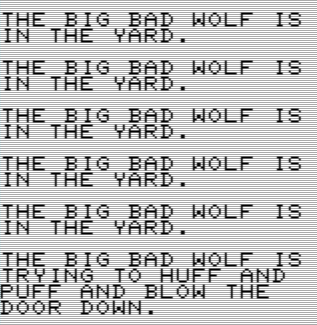
Finding it cannot huff and puff and blow the house down, it tries the front door, then climbs up to go down the fireplace instead.

I admit I was still genuinely puzzled on some visualizing — chopping up the chair in particular was non-obvious as it doesn’t have a description as wood — but the whole process felt oddly satisfying. I think Moon Base Alpha may have come last of the three (it is the only one that supports LOOK on most everything) but that game felt like a succession of individual puzzles, whereas this felt like one organic one, and I was impressed how much gameplay Bruce Robinson managed.
I think if he had been programming on a mainframe, he’d make a big, expansive Adventure clone just like everyone else, but a treasure hunt in 5 rooms really doesn’t make much sense, so it forced some innovation. It’s too bad the resulting parser is so dodgy, but at least I’m not dreading playing his other games (also for VIC-20) that will come later in my 1982 sequence.
That’s going to have to wait, because for the remainder of at least this week I’m going to try something very, very different, something that surely belongs in the annals of interactive fiction yet is much older than anything I’ve ever played.
I was planning on calling this post “The Hard Part” but it really wasn’t? I’m not exactly disappointed but I feel like I might have missed something, despite getting a hearty “congratulations” and the hand of a princess. (Also, be sure you’ve read my prior posts on this game for this one to make sense.)

Anthony Hope has an entertaining play-through video on Youtube here that lasts nearly 2-and-a-half hours.
First off: the amount of available torch light (that’s Brit-torch, so “flashlight”) was not at all a problem. A good chunk of the area is well-lit/outdoors and there’s even some leeway there. I’ll call the batteries the shop sells at the start to be essentially useless, I never needed to touch them, and you can even travel through darkness to an extent (just you can’t interact with objects in darkness, but you can still move around).
Second, the game really is forgiving in terms of transport-options. You get one magic word (GREZON) that gives you a one-shot teleport back to the treasure room, MINH works on two parts of the map, and if all else fails you can just walk (again, darkness is ok!)

I had nearly already solved all the puzzles last time. One that I missed was going up a bell tower to where a vampire bat resided, but there’s some garlic hanging around that lets you easily grab a treasure there.
I also missed going down a well to an oyster, where a “bivalve opening tool” served me well to pop it open and get a pearl. (I also, according to Anthony’s Hope walkthrough I checked after I finished, missed my only 5 points here by failing to eat the oyster. Not my first choice of gourmet, I’m fine leaving those points behind.)
I mentioned, offhand, defeating a cockroach with ITHURD; this does appear to be “correct”, or at least the way the walkthrough does it.
Where my playthrough different from the walkthrough is with the Troll. There are two ways through and there seems to be randomization here. One is to toss it the colorful postcards you can buy from the shop.
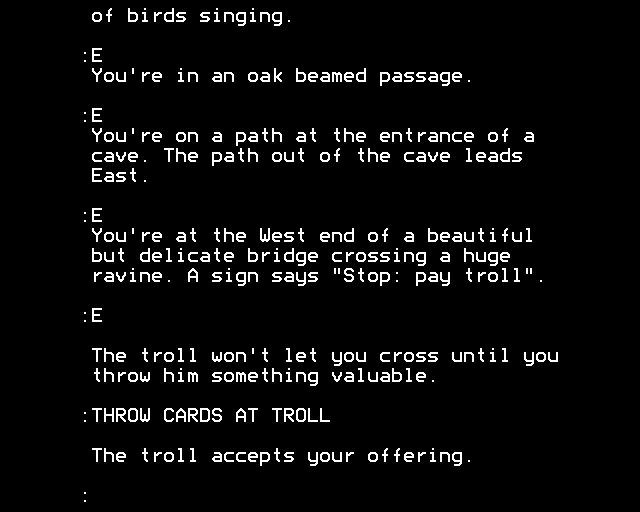
However, on my “final run” the troll wasn’t taking the cards and kept throwing the cards back, so I tried my lunch instead and it took that. (No hunger timer I could find, so it didn’t matter!)
The only other tricky part happened upon finding the last treasure. A voice announced the cave was closing and I needed to book it back to the shop at the start of the game. If you take too long you get squished.
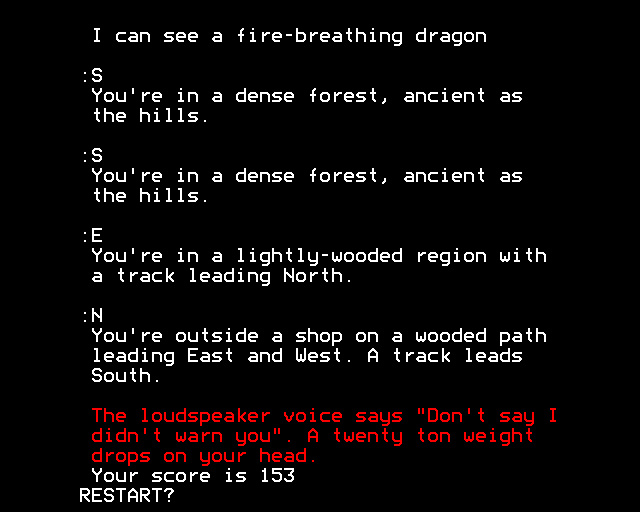
One other thing that helped is the only threat that mattered, the second dragon, I met out in the middle of the forest, so I was able to run away from it and ignore it entirely. I was otherwise utterly unable to kill it with my sword.
Assuming you are efficient (and you don’t need to be that efficient) you have time to teleport back to the pagoda, deposit all your treasures, and book it for the shop and your reward.
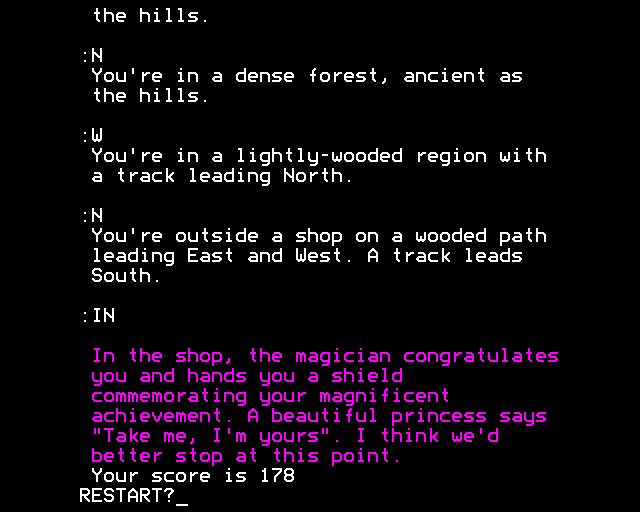
I really was expecting something off-the-wall hard akin to Atom Adventure since Anthony described this game as an expanded version of that one. I never had any of the same effects, where the torch and inventory issues were so pronounced they essentially produced a whole new set of puzzles that needed to be solved on top of the regular ones. I did have to think somewhat about my movements, but I never felt pressured enough I had to reload every time I went a wrong direction.
The funny thing is, of course, that isn’t really a bad thing! This is essentially the most playable of Paul Shave’s games. It mimics Adventure a little too much for me to call it top-tier, but I did enjoy seeing how randomization fiddled with gameplay possibilities, and I’m guessing there are some emergent stories that I’ve missed based on, say, possibly having a sword break at an inconvenient moment. (Weirdly, in my final run I didn’t meet any dwarves — I wonder if that has something to do with me trapping the dragon in the forest.) I’d say the adventure-roguelike aspect (which I’ve chronicled a number of failures of) actually works here; just the right elements are randomized in just the right amounts so the game at least felt a little dangerous, but not unmanageable.
So, my sincere apologies for all those hoping for five more posts of struggling and pain on my part. If you’re nostalgic you can always re-read my series on Madness and the Minotaur, which does have a sequel in 1982 that uses the same engine, so eventually the suffering will come.
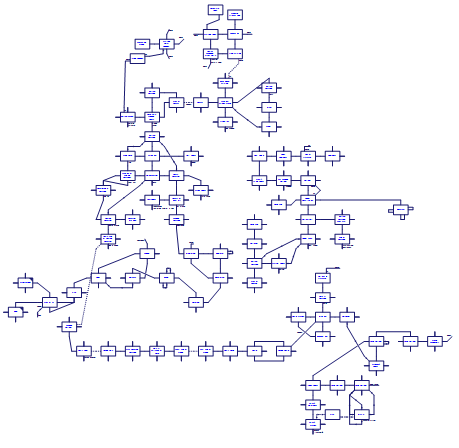
My map in progress; incomplete, but probably not terribly so.
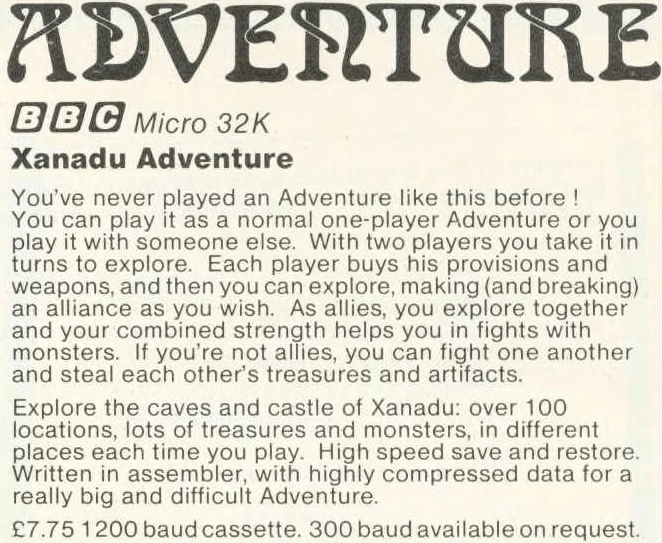
As I mentioned last time, difficulty for Xanadu likely points in a very different direction than Quondam. According to the ad copy for the game there are “over 100 rooms” and I have 95 or so of them mapped, so it feels like I might already have most of the layout of the game. There have been some puzzles along the way but they have all had a very cribbed-from Adventure feel that made them easy to solve. For example:
You’re at the South end of the vaulted chamber. There are no openings in the walls, but there is a six foot diameter hole in the ceiling through which the light shines.
It was not shocking to find a beanstalk was needed.
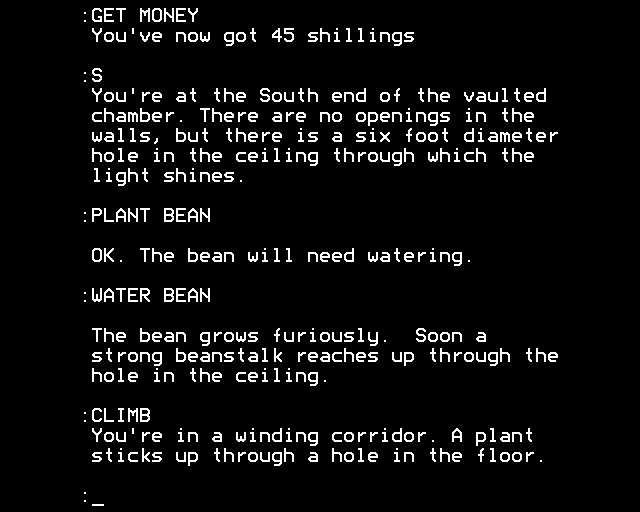
Backing up a little, one of the things I did in Madness in the Minotaur that I now believe was a mistake was to keep iterating on new random layouts for too long before settling on a “final map”. This time I saved my game immediately on my first attempt and kept going to that save, with all the objects already in their places (there’s still at least a little randomization done mid-game, which I’ll get to). This meant I could treat item locations as normal and immutable on making a map. I may still find something in the layout is impossible to reckon with later, but for now I feel like I’ve had a lucky draw, especially given the dragon from last time. Remember I died in two steps? This time I bought a sword and tried my luck, and managed to slay it.

MINH, when used in a nearby “Magic Room”, teleports treasures to the aboveground, and if no treasures are at hand, teleports yourself to the aboveground. It also works to teleport back again. It is, in other words, good for optimizing steps, although I haven’t got to that phase yet.
Nearby the dragon corpse was a small chasm, but help was nearby (at least in my iteration):
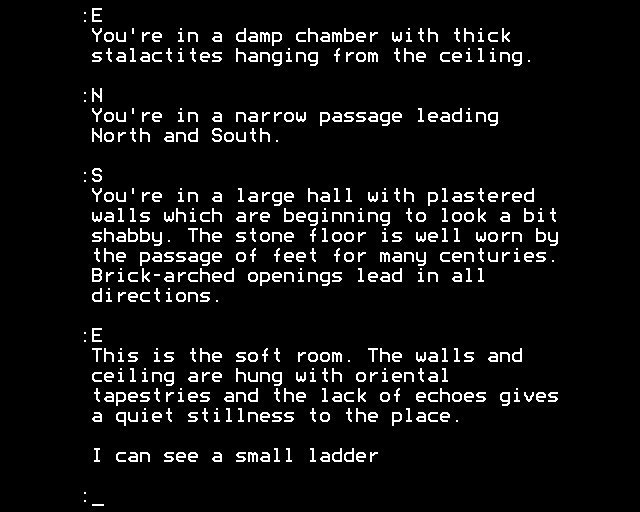
I think the ladder doesn’t have many places it can go, because you get stopped trying to take it down passages going the “wrong way” (it’s described as too big to carry), I assume with the intent to avoid breaking some puzzle later?
The chasm area incidentally had some keys which unlocked the grate I found at the start, so there’s yet another passage to the surface.

Shades of The Hermit’s Secret (except in that game nothing needed to be optimized).

There’s a shockingly tame maze; nothing much to say about it other than I found a “growbag” (needed for that beanstalk earlier) and a “dulcimer” (needed shortly for a different puzzle).
Just past the beanstalk, exactly like Crowther/Woods, there is a door that needs oil. Going even farther, there’s a troll demanding a treasure, although we finally have one deviation, since I haven’t found the FEE/FIE/FOE/FUM eggs and I’m not sure how to toss a treasure to the troll without losing it. I can still preview the rest of the map, though.
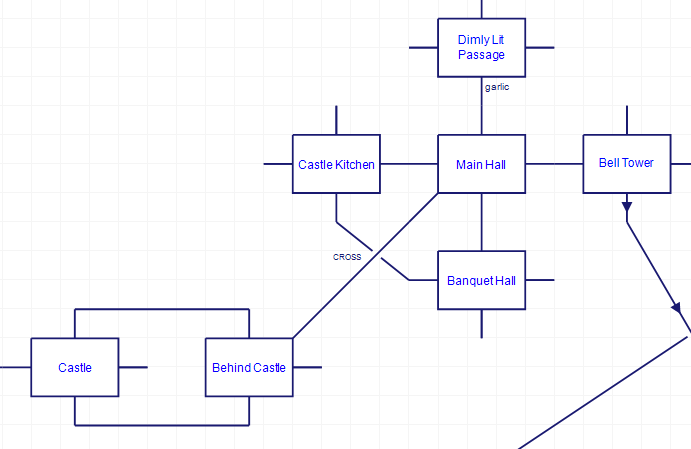
Past the bridge is a castle, with an interesting “trap room” with two phials were one of them says “poison” and the other one says “transporter”.

As far as I can tell, if you drink the poison or not is random, so if you get it wrong you just need to restore a save and try again.
There’s also a giant (…again similar to Adventure, although you never meet the giant in that game…) which can be lulled to sleep.
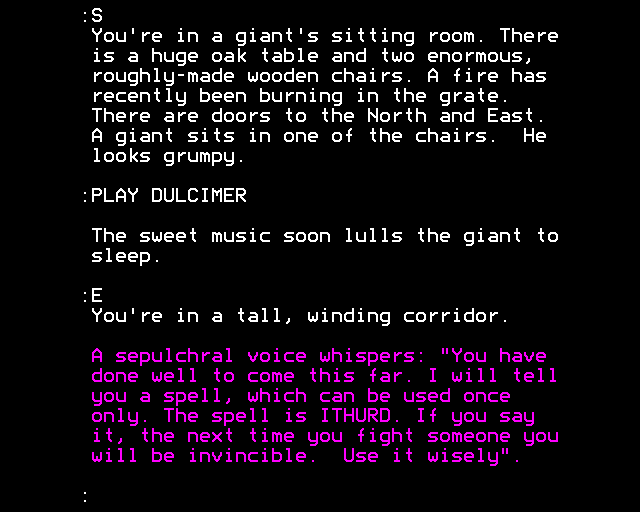
The magic word you get here can be one instead that teleports you back to safety aboveground. I have one puzzle I haven’t solved yet via “normal” means — a giant cockroach with skin too tough to break through — by using ITHURD instead. I don’t know if that’s “wrong” or just one possible approach.
So far, so standard. If I didn’t know better I think I’d wandered into the most standard Adventure clone we’ve seen yet, but unless various commenters of the past are playing a very long con, things are about to get very sticky as I try to liberate all the treasures I’ve seen. I suspect there’s a lot of under-the-surface difficulties that don’t manifest until I’ve started sending up cargo.
Let me give an example of what might come up. There’s a very short side room trip that’s needed to fill a bottle with water for beanstalk-watering.
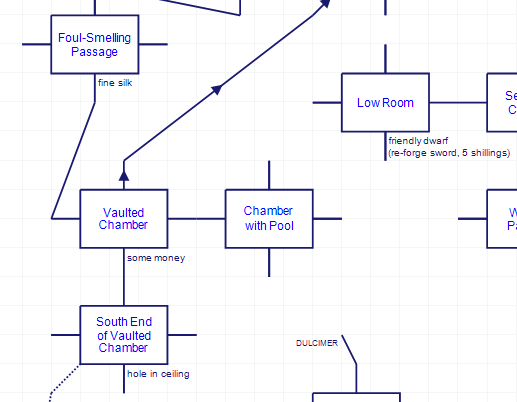
Oh yes, there’s a dwarf that fixes broken swords. I have yet to break a sword. The several times I encountered a second dragon (randomly, after the first one with the paper) I straight-up died, with no chance to break anything.
Technically, going in the Chamber With Pool and filling-up takes three precious turns of torch light. Original Adventure let you fill a bottle outdoors, but it’s not possible here because the stream is dried up. But what if there was a puzzle to refill the dry stream, not for any holistic benefit, but just to save the three moves it takes to get water underground? That’s the kind of evil contortion I’m keeping my eyes out for.
Paul Shave (see previously: Atom Adventure, Pirate Island) went for broke with his last adventure, moving from the Atom to the more capable BBC Micro. Back in 2014 he was contacted by Anthony Hope (one of our regular commenters); Paul helped Anthony beat Xanadu Adventure, and as Paul himself stated in this interview:
I’m pretty sure he [Anthony] was the first.
In other words, at the time of release, it was too difficult for anyone to beat. Will it dethrone Quondam as the most difficult adventure ever?

From Every Game Going.
Having built up that hype, I should add the caveat that “difficulty” is not really a linear spectrum and has lots of elements mashed inside. Judging by Atom Adventure (which Anthony Hope claims is sort of a mini-version of Xanadu) the difficult aspects go in a rather different direction.
Quondam involved paying attention to extreme object micro-interactions, and was tightly packed with nearly every action requiring some sort of puzzle to be solved.
Xanadu’s difficulty is in randomization and optimized timing. Regarding the latter, most games — even the evil Phoenix mainframe ones — gave a lamp with a relatively generous lifespan that doesn’t require watching every step. The Paul Shave games all have, on the other hand, given exactly the amount of light needed, and not a step more; this gets to the level of being cautious what entrance to take into a cave as one entrance uses up a precious extra move of light and will eventually cause failure.
The randomization I’ve seen places some objects at random, so despite the absolute optimization condition above, you still have to deal with improvising a path (and Atom Adventure, at least, occasionally gave a literally impossible layout).
Absolutely tight limits and randomization make for an incredibly high-pressure experience. The closest comparison I can think of is Madness and the Minotaur (which I played last year) but while Madness and the Minotaur arguably had even more randomization, it at least tried to provide ample opportunity to “refresh” decaying health and light sources, going as far as randomly spawning a new refresh after one gets used up. I don’t expect any such niceties here.
As is usual for authors still under the shadow of Crowther/Woods, the objective is to gather treasures. As is slightly unusual, the instructions state you need to DEPOSIT the treasures rather than DROP them to get points. The instructions don’t give how many treasures there are or even a maximum possible score.
Before embarking further, I should also note this odd portion from the instructions:
There are lots of dwarves and dragons about. To kill them, you need weapons (you can kill them without, but it’s very unlikely). A sword has a weapon count of 10, an axe’s count is 5. To kill a dragon outright, you need a weapon count of 20; for a dwarf it’s 15, but if you throw an axe at a dwarf you always kill it. Your chances of killing monsters are proportional to your weapon count.
It sounds like all the weapons being carried contribute to your weapon “count” (as opposed to just using your best one), so if you have a sword, an axe, and a ??? you can outright kill dragons, but only have a probability of doing it with a sword. This feels weird and uneasy and I suspect there’s a trick hidden here somewhere.

The “1 or 2 Adventurers” question is interesting, but I’m going to ignore that feature for the moment.
You start in an “adventurer shop”, and no, you can’t just buy two swords right away for some dragon hunting action; the shop runs out. I’m unclear what’s optimal here but I’m the “messing about” portion of my gameplay so far so I’m trying everything out, including the postcards.
Speaking of postcards, I did my usual process for ultra-hard games and created a verb list right away. MAIL is not on my usual-test list but I thought it might work on the postcards.
CLIMB, SWIM, READ, BREAK, OPEN, CLOSE, DRINK, EAT, KILL, FILL, LIGHT, THROW, HIT, UNLOCK, LOCK, POUR, PAY, FEED, PULL, SCARE, USE, INSERT, KICK, BUY, STAB, PLAY, FIGHT, SING, CROSS, MEND, MAIL, DEPOSIT
A few to keep in mind as I move forward: MEND is quite out-of-the-ordinary (only previously seen in Hezarin) as well as SCARE (which I’ve seen maybe twice?) I also wouldn’t immediately think to SING anywhere, and USE being in play means I’ll need to test it in lots of places. Some of the typical magic-item manipulations like WAVE and RUB are out of play, but there’s always magic words.
After shopping, you go out to find a locked grate, Adventure style, and no keys; your first treasure, a ruby ring; and an empty bottle.
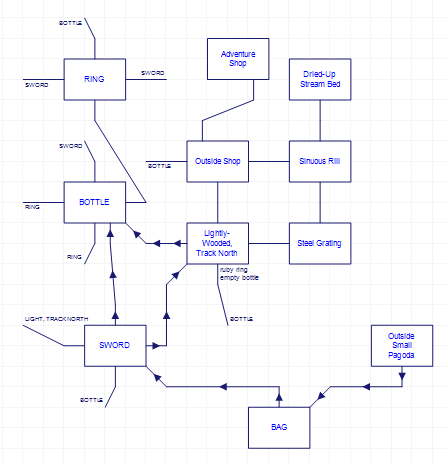
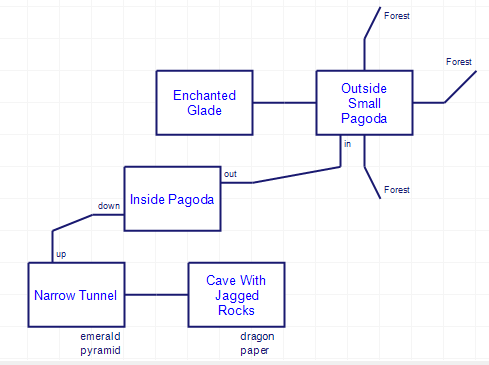
There’s a mostly unmappable forest (I tried, you can see my attempt above, but items started getting moved around and some exits shift at random); the only purpose of going in is to finding a pagoda.
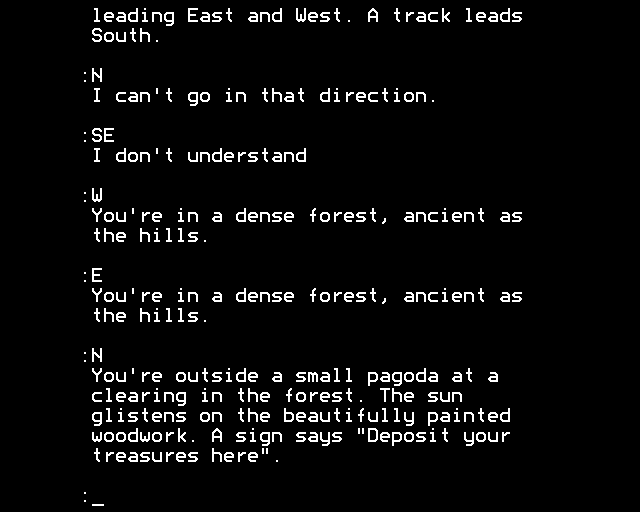
Thankfully for maze-mapping, the “diagonal” directions of NE/NW/SE/SW are not allowed.
In addition to the outside being a treasure deposit area, you can go IN and then DOWN into darkness for what I assume is a random experience. I only got two moves in before getting wrecked by a dragon.
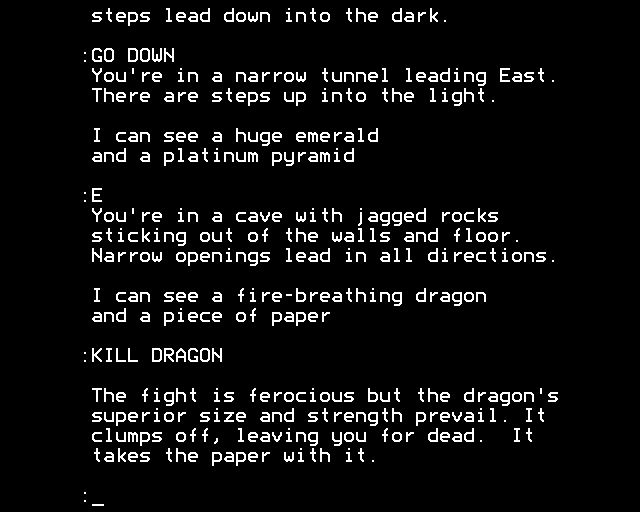
I’m assuming the dragon’s placement is random, and I’d get something less aggressive on a second playthrough. I’ll have to keep throwing dead bodies at the cave and return with a report.




 Renga in Blue