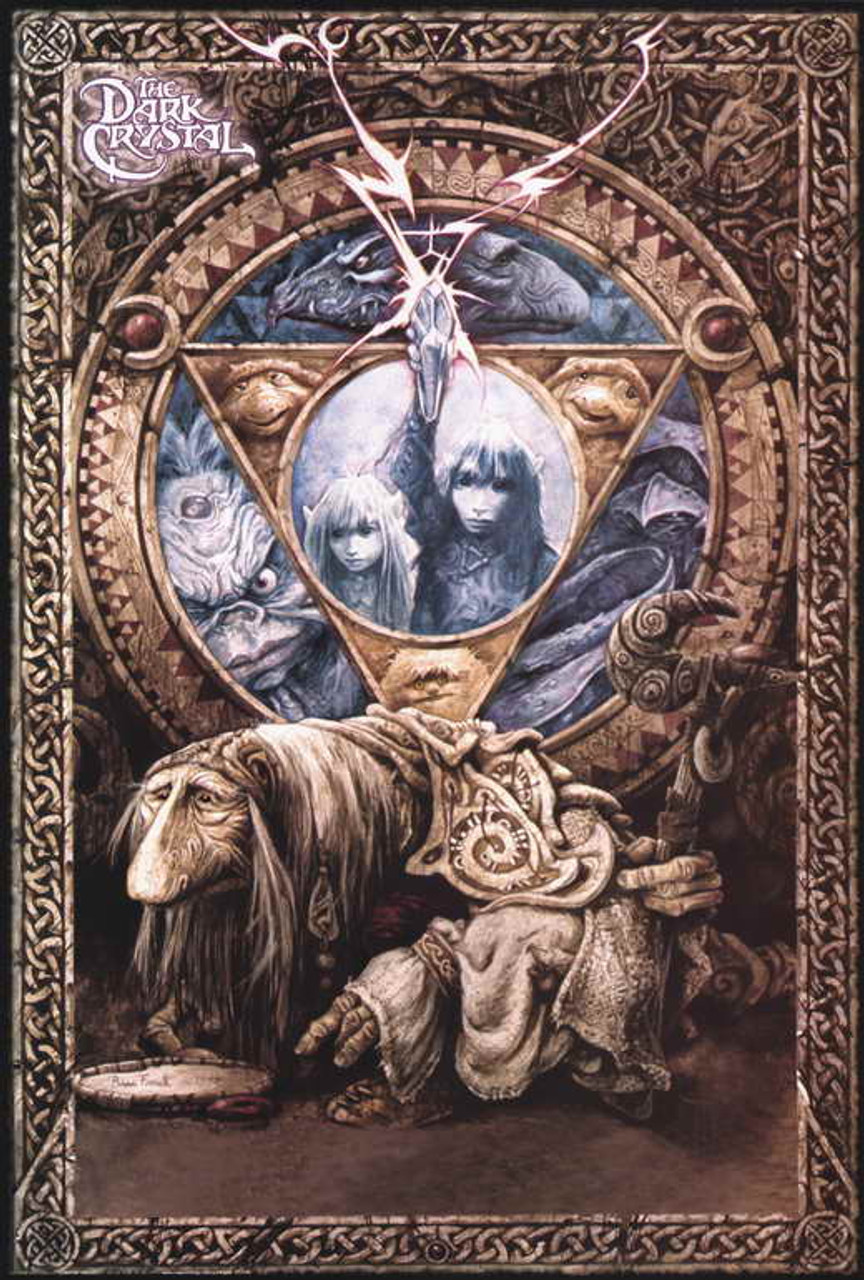
I have attracted a few readers who are interested in The Dark Crystal (the movie) and maybe don’t know about The Dark Crystal (the game) and are new to this blog. So to clarify for their benefit: I am doing a playthrough where I blog about every step; because this is an adventure game, sometimes I make a lot of progress, sometimes I make very little, but I still find documenting either is important in that it encompasses the real experience of playing adventure games circa 1983. This is still before Sierra had official hint books.
I did not make much progress, but I still have a lot of details to go through and theories.
The first thing I tried was simply to replay from the beginning to see if there were any details I missed. The stones that I ended my post with do have a description…
…and that description is meant to indicate the tree is something important.
I’d like to say I thought through in the same direction as Roberta Williams, but in the end I was simply using my regular adventurer reflexes built over time. While in the cave mucking about with the urSu scene again I tried DIG just in case there was some secret item left over, and the game responded:
USING THE SHALE, JEN DIGS IN THE GROUND FOR AWHILE, BUT FINDS NOTHING.
Huh. Sometimes “you dig around a bit and don’t find anything” is just the author’s way of putting off a common verb, but in this case specifically holding the shale enabled (for me, inadvertently) the act of digging, so that meant digging had to be relevant somewhere. I thus went about digging every single room I had accessible in the game, and as part of that I hit that tree.
The shadow graphics even kind of point at the digging spot.
The flute from the start of the movie! I had been wondering where that ran off to. I do want to emphasize I solved this purely by lawnmowering and only realized a clue was intended after the fact.
I think I’m otherwise finished with the starting area, but I can’t be 100% sure. However, for now I went to the area past and tried DIG and PLAY FLUTE in every single room, with no use at all. Still, I eventually unearthed some interesting spots on the map, which I have marked below.
Blue indicates points of interest. Green marks points of interest where I haven’t gotten anything to happen.
The southmost point is at the lily pad I was suspicious of: “VERY THICK STEMS” where “TRY AS HE MIGHT, JEN CANNOT TEAR ONE OF THE PADS LOOSE.” I realized not long after hitting “send” on my last post that the shale is described as sharp, so I ought to be able to apply it to cut the pad.
This landed a LILY PAD in my inventory that is described as having a “THICK, RUBBERY FEEL”. I thought briefly it might work as a raft on the flowing river but no verb I tried worked, even though FLOAT is an accepted verb.
While I’m at it, I should mention I did create my verb list. The game boots on the first side of the first disk (1A), the early area and the wilderness before the Pod Person town is on the back side of the first disk (1B). The disk swap then requires flipping to 2A (second disk, front side), and I assume 2B has the end parts of the game. I mention this because in Time Zone the verbs were not consistent between the disks, but here I think they might all be from the same set:
I tested every verb on the list; green means they were understood by the parser. The oddball I have marked in blue — UNTIE — seems to be a bug:
JEN SHOUTS, “HELP!” UNFORTUNATELY, HIS CALL IS NOT ANSWERED.
You can get the same result from HELP.
While some of the verbs are clearly “fake” (CRAWL, ENTER, JUMP, and LEAVE all ask what direction, but the game is just steering you to the fact it wants cardinal movement directions) this is still a quite substantial list. Working my way up to where the SLING is just lying on the ground, I went through all the possibilities to try to get the sling to work with the shale, but no dice.
IT LANDS HARMLESSLY SEVERAL YARDS FROM JEN’S FEET
I tried this on the flying eye in particular (which really seemed begging for a good sniping)…
…but I always got the same result. With a little noun-hunting (trying to GET items that aren’t there to see if the parser at least understands them) I found this game has the existence of a PEBBLE, but I have no idea where it is.
(And yes, Jen comes from the Valley of the Stones. No good-sized pebbles around? This is worse than the quest for a ladder in Time Zone; at least in that game, one gets a sense that you have to follow the unspoken “rules of the time machine” for it to operate properly which is why you can’t just swing by a store and pick one up.)
The Village of the Pod People, incidentally, gets a few interesting reactions:
You can TALK PEOPLE and get the information that the name they call themselves is APOPIAPOIPIDIAPPIDIDIAPIAPOH, which translates into “master gardeners who live in bulging plants”.
This is the only place I’ve found (so far) DANCE will work. (“WHY NOT? ALL WORK AND NO PLAY MAKE JEN A DULL GELFLING.”)
This is the only place I’ve found (so far) SING will work.
Maybe it’s just here for color. Would Roberta Williams do that? (Given the amount of empty space and red herrings in Time Zone, yes she would.)
To the west of the village is a mossy rock, where you can de-moss it (GET MOSS) while holding the sharp shale to reveal an interesting spiral.
Rather cryptically, looking at the spiral then just gets the response that Jen “GLANCES BRIEFLY” at the spiral but “LOOKS AWAY WHEN HE FAILS TO NOTICE ANYTHING SPECIAL ABOUT IT.” The boulder is too heavy to move and you can’t take the spiral with you. Maybe it’s a hint to a direction puzzle later.
Just south of the boulder are the ruins I was having frustration with before. The room seemed significant (including two flat stones) but I couldn’t get any verbs to work. I returned with my full list in green and tried every single one before hitting paydirt with RIDE STONE. Hah! (Yes, SIT STONE works, it just counts as a synonym, but I found RIDE first.)
Examining the hieroglyphics gives mention of a two-pronged flute, a crystal shard, a female Gelfling, a castle, and a triangle in a circle. I suspect the triangle/circle combo will somehow be used later (I am already trying PLAY FLUTE in every single room so if it’s a clue as to where it gets used, I’m going to sweep it up by default anyway).
I got curious if this had an equivalent in the movie, since this seemed like a weirdly specific room. I’m still avoiding spoilers, but I managed via Internet search to hit a page on the official Dark Crystal site that explained:
When the Skeksis began to take Gelfling, as well as Pod People, as slaves, the Gelfling were dismayed. For once they thought of the future. The Gelfling sought to know if the Crystal might be healed and if the Skeksis rule must continue. They lit the fires of prophecy and took counsel from the flames. Seven circles of seven Gelfling lay on the hilltops all night; their faces to the stars. Their dreams were made of stone; the Wall of Destiny still stands.
In a history of game-design sense, I’d like to point out despite this first seemingly the Big Empty Grid passed down from Time Zone, this is much more dense, and in fact I’m started to be reminded more of the layout of the King’s Quest games (which all the way up through I to V had the landscape divided into a grid). Again, we seem to be closing in on the standard point-and-click layout, partly enabled by the use of Henson’s artists allowing for somewhat richer landscapes.
In terms of me being stuck, well, hmmf. I’ve still got the Landstriders who don’t want to be ridden…
The sound at the end is a Garthim barging in. I’ve started to suspect the Garthim attacks are evadable in a real time sense, that is, if you go in a direction fast enough you get away, and if you wait, you won’t. Which is sadly again like King’s Quest 1.
…and the eye that stubbornly refuses to be sniped, and the river that doesn’t want to be crossed, and the chasm, and the spiral (maybe), and the village. I still feel like I’m missing a piece. Even if I summon up the missing PEBBLE, will what I get from shooting down the eye really help with the other puzzles? I need to comb through the rooms again to check if I’m missing a detail.
One of the great challenges of designing The Dark Crystal was to create a world that had never been seen and yet could be instantly accepted as a real place with a history and an ancient philosophy. I created a cosmology with meaningful symbols that could penetrate the very fabric of the costumes and the film’s architecture, every visual element important information of this particular world’s past, its ideas, and its destiny. It had always been our intention to create a tale with the weight of myth; a story that felt as though it had been told many times before to another land.
— Brian Froud from The World of The Dark Crystal, 2020 reprint
Jim Henson had his initial concept for the feature film The Dark Crystal start to form in 1975; through the rest of the 70s he did world creation and visualization with the artist Brian Froud, and made a initial script while waiting out a snowstorm. He made the feature film The Muppet Movie first, and was only able to get initial funding on The Dark Crystal by agreeing to make a Muppet film follow-up (The Great Muppet Caper). Work from co-director Frank Oz on The Empire Strikes Back also intervened.
A thousand years ago the Dark Crystal was damaged, starting an age of Chaos; during this time the world was ruled by lizards known as the Skeksis. Jen, an orphan from the oppressed race known as Gelfings, is sent on a quest for the missing shard in order to save the world. Poster source.
These delays meant shooting didn’t happen until 1981. It’s tempting to think, then, that the production was “tortured” — especially given the technical hurdles of a live-action movie made entirely from puppets — but it’s more accurate to say it was a slow burn due to financial priorities. Still, the final movie was and is polarizing, somehow being declared magnificent and terrible at the same time. I think the best explanation of what happened can be seen with an excerpt from the test-screening voice track to the movie. The video lasts two-and-a-half-minutes and while it’s usually just fine to breeze on by whenever I drop a video clip, in this case I highly recommend a watch before moving on.
The clip has the Skeksis — the villains of the movie — gathering around the dying Emperor. All the dialogue is hissing in the Skeksis language, with no subtitles. This was Jim Henson’s original vision, and it is the one that showed in the “first edit” that played to an audience in Washington, DC. Henson wrote in his journal:
First preview Dark Crystal in Washington DC – not great.
He had already been warned beforehand that trying to have the Skeksis only talk in their own language without subtitles (with people understanding it “like an opera“) was not going to go well, but the baffled audience of March 19th, 1982 reinforced this; the script underwent a round of edits to have English dialogue added to dub over the fantasy language, where the words had to be lip-synched the best the team could.
Annotations by Jim Henson (on top) and Frank Oz (on bottom).
Still, these changes happened after the scenes were filmed, meaning the essential action was already locked into place. Given that the goal was to have the scenes understandable without knowing the words, the scenes were already done in an “elemental” way, and the dub-over process could not help being awkward. Perhaps more importantly, it was well within Jim Henson’s vision to have parts of the movie understood only partially, where the mood and the world universe was more important than individual lines of dialogue. (If you want to try the original March 1982 experience, there’s a fan reconstruction online called The Darker Crystal.)
Even after these changes the studios involved still wanted modifications, and Jim Henson ended up buying the movie outright with his own money (obtained via Muppet merchandising) for $15 million so he could release it on his own terms. Still, just based on the limits of feature-film length, the deep backstory didn’t really make it to the film as intended; Froud notes what ended up on screen was only “a fragment of this other world.”
Jen the Gelfling, from the original movie.
At the same time as the original test screening, Sierra On-Line finally came out with Time Zone, a game intended for the prior holiday season. That was Roberta Williams’s attempt at a magnum opus, a game that would go on forever. (Concatenating my time spent, I beat it in 24 hours, but it was over a period of two months.) During this same time Sierra was trying to reach past their free-wheeling early years into something more “professional”.
The first few years of Sierra could be described as total anarchy. It is easy to survive (and, thrive!) when you have no competition and your customer base is experiencing explosive growth. And, to be fair, at the very beginning, most of Sierra’s employees were barely out of high school. The party atmosphere was probably appropriate to the time.
By 1982, it was obvious that the “free for all” craziness of Sierra was not going to work. We needed discipline.
— Ken Williams, Not All Fairy Tales Have Happy Endings
While the growth of the emerging market competitors was scaring Ken Williams, he was also spooked by a lawsuit with Atari. In 1981 Sierra had released the game Jawbreaker for Apple II, one of the many many Pac-man clones, and Atari went after clones with a giant legal hammer. Sierra won on the basis of differentiating themselves from the “look and feel” of Pac-Man; in order to justify this they brought a full-sized Pac-Man machine in court along with giant Pac-Man posters to compare with Jawbreaker’s branding.
To be fair, I think Sierra had a point. Pictures from Mobygames and eBay.
It’s been real expensive to fight Atari. I don’t know whether I would do it again. If they decide to come after me with appeals, at some point I might have to lie down and die.
which is a frankly odd admission to be making in public, but I think gets a good sense that Ken knew there was the potential for tangling with larger forces on the horizon.
In the spring came a call from Jackie Morby of Boston-based TA Associates offering a million dollars for a percentage of the company and a place on the board. Roberta Williams was hesitant at the possibility of losing some independence, but as Ken writes:
I, on the other hand, thought that it would be good for us. There was a side of me that knew that, for the company to realize whatever potential it had, it would need to stop just being “kids behind a print shop” and take steps to become a real company. Also, Ms. Morby was promising something I dearly needed; someone to talk to about business. I would be free to pick her brain and to speak with the heads of the other companies she invested in.
Ken also mentions, somewhat ominously: “Once we had accepted venture capital, it became like any other drug. No one stops after the first hit.” Even more ominously, quoting Jackie Morby from 1984: “There are investments that only double in value: they aren’t very exciting.”
Jawbreaker got an Atari 2600 version already by the end of 1982, but through a different publisher; Sierra started making their own cartridges in 1983. This ended up being right when the market crash started so while profit doubled the year before, the whole fiasco ended up almost sinking the company with unsold cartridges, but that’s a story for another time.
The elevated profile of Sierra On-Line also extended to film companies. For The Dark Crystal, the instigator of contact was Christopher Cerf, longtime songwriter for Sesame Street.
Trivia: Cerf got named in a lawsuit over the song above when the Beatles catalog was owned by Northern Song of Australia (desired payout: $5.5 million) but then Michael Jackson bought the company and the lawsuit was settled for $500.
Cerf was an Apple II superfan and by 1979 had already given the Apple II bug to Jon Stone (writer for Sesame Street) and Jerry Juhl (writer for The Muppet Show); both started using a word processor for their scripts.
It became a familiar sight to see Jon Stone on the set directing a “Sesame Street” episode with a rolled up copy of the latest script, hot off his Epson printer, in his back pocket.
Cerf had a professional connection to Sierra as the publicity firm he worked with also had Sierra as a client. He convinced the Henson group to connect with Sierra On-Line for the project, and flew to California with Mary Ann Horstmeyer (project manager for Henson) to meet Roberta Williams directly. Cerf called the resulting product “interactive fiction”.
Quoting from a 1982 TV interview with Ken and Roberta:
Roberta Williams: He [Jim Henson] has a new movie coming out called The Dark Crystal and it’s coming out in December and him and a few of his friends have played my adventure games in the past and really liked them a lot and they thought that they wanted an adventure game based on their movies. So they’ve been working with me on the design of this game. Their artists have been doing the pictures, and they’ve supplied me with all the information I could ever ever need, and it follows the storyline of the Dark Crystal really really close.
Three points from that last sentence worth isolating:
a.) Their artists have been doing the pictures
We no longer have Roberta Williams herself or a lone 19-year old producing a gigantic amount of art. Quoting Williams from a different interview:
This adventure isn’t like any we’ve done before. Jim Mahon, the art director at Henson Associates, sketches each page of the action and sends it to me. My people translate the sketches onto the Apple with graphics tablets.
Then the hi-res pages are sent to Jim Mahon for his approval and suggestions. Actually, everyone in New York helps out. Harriet [Yassky], Mary Ann [Horstmeyer], and Chris [Cerf] all review each screen and make suggestions
This is good to highlight because you will see a marked jump in quality compared to Sierra’s previous work.
b.) they’ve supplied me with all the information I could ever ever need
As I’ve already alluded to, Henson Associates created truckloads of backstory; and Sierra got their hands on it. Ken Williams was “shocked at the number of binders full of drawings that provided the minute details behind the movie.”
A Skeksis from the cover of The World of the Dark Crystal, a book by Brian Froud of conceptual art.
Ken also writes that:
Every character had a character sheet providing a full description of the character, their back story, illustrations of how they would look in various clothes and animations, and even samples of how they might speak.
The important thing to highlight (for our story) is that there was more to draw on than what made it to screen, which ties into…
c.) it follows the storyline of the Dark Crystal really really close.
In the same interview Roberta returns to the idea of “how close an adaptation is it”.
…it is primarily based on the movie. The storyline is there and you definitely get the feeling of the story and what’s happening just like in the movie, but a lot of the time there are puzzles that I added that weren’t in the movie but still have the same feeling of the story. There might be things that did happen in the movie but I changed them around a little bit so the same the basic stories there but but obviously we didn’t want them watching the movie and then just come home and play the game and solve it.
Christopher Cerf again:
You run into all the characters from the movie, and you can reply to them in different ways. But you can do things differently than the way they happen in the movie. Your game can end differently than in the movie. You can try out other possibilities. You can say, “What would happen if I tried this.”
While The Dark Crystal was not the first official movie-tie in game (both Raiders of the Lost Ark and E.T. for Atari 2600 came out in 1982, and you can extend an argument to Superman from 1979) it was the first one on a platform where it was possible to follow the plot of the movie in a step-by-step way; this turned out to be an overarching concern, either spoiling the movie plot by playing the game, or having the game follow the movie plot closely enough to be spoiled. Henson Associates were agreeable to the idea of modifications to the story, but given how early this is in videogame history, this isn’t an obvious standpoint to have. Two years later, this became a giant pain point with Disney as Sierra was working on their adaptation of The Black Cauldron.
A week later Al [Lowe] and Roberta received back their design, with major portions of it removed. Many of the removals were because they had included things that “didn’t happen in the movie.” For example, if there was a ladder in a room, and in the movie the central character never climbed the ladder, then Disney’s representatives didn’t understand why they should be able to do it in the game.
All this became relevant for my playthrough. Roberta Williams claimed it was fine to either watch the movie first or play the game first. My memory of the movie is from 25 years ago when I last saw it, so I don’t remember internal details; I remember being confused, or to paraphrase one review, it felt made up as it went along. Hence, I’ve sort of both watched and not-watched the movie at the same time. I refreshed my memory up to where the main character Jen gets his quest, but I’ve stopped there by the theory the game is supposed to be solvable without mimicking what was seen on screen. This may end up being a bad idea, but it’s the sort of thing I’m here to test.
…you will become Jen, hero of “The Dark Crystal.” You must find and restore a shard to its rightful place in the Crystal before the Great Conjunction of the Three Suns. Fail, and the world is doomed to live forever under the rule of the ruthless Skeksis. … The computer becomes your hands and feet, eyes and ears.
This game marks, importantly, the Sierra shift to a third-person perspective. Jen is visible in all scenes. All that’s needed is more direct character movement and a more zoomed-out perspective (akin to Castles of Darkness) in order to arrive at the King’s Quest 1 style perspective that would remain the paragon of standard point-and-click games ever after.
No flute, even though Jen has one at the start of the movie.
No matter what you type, the next scene is forced:
That’s all the directions you get. I originally thought we’d have a linear design from here (like Mission: Asteroid) but this is back to Roberta Williams doing a wide-open space, and it is quite easy to go the wrong way.
You start in a 3×3 area where as far as I can tell all of it is scenery…
It’s not obvious there’s an object here, but you can take some shale.
…but if you go farther north (and it isn’t marked this will happen) you end up taking a one-way trip (“JEN FALLS HEADS OVER HEELS DOWN A STEEP SLOPE”).
If you avoid seeing urSu long enough the game will end because he will not pass on the important knowledge about stopping the end of the world, but you’re already softlocked if you’re past the one-way arrows anyway. (His “counterpart” is skekSo the Emperor, the Skeksis who died in that no-English-or-subtitles scene I linked earlier. According to the official site, the lore goes that urSu “allowed himself to die” because this also would kill the Emperor.)
After enough alternate-Jen lives I mapped things out and found out I was supposed to be going due west (no hint, really!) to find the cave which also shows up in the movie.
You can LOOK BOWL to see an image of a crystal, but TALK URSU is needed to get an explanation. It’s in all-caps Apple II style, so I’ve made it a little more readable:
urSu sighs and says, “At the time of the Last Conjunction, or coming together, of our world’s three suns, the evil Skeksis gained control of the Great Crystal that rules our destiny. The Crystal cracked and darkened. And Dark it will remain until a piece that broke off — the Crystal Shard — is restored.
“There is a prophecy that the shard can be replaced only by Gelfling hand, and only at the time of the next Great Conjunction. If this prophecy is not fulfilled, the Skeksis will grow even more powerful, and their reign will last forever.
“Jen, to you has fallen the task of healing the crystal. And it is time for your quest to begin, for very soon the three suns will once again be joined in a Great Conjunction. You will find Aughra, Keeper of Secrets and Watcher of the Heavens. She may have the shard you seek.
We’re not done! Next screen:
“Gelfling, I leave you with a final puzzle: what do the Sun Brothers quarrel about?”
“Find the answer to this mystery and present it to Aughra. Only then can you gain entrance to her observatory.”
“And now Gelfling, our roads must curve apart. We may meet in another life … but not again in this one …”
With these words, urSu dies, and his lifeless body vanished from the sleepframe.
This doesn’t come off that bad written out on a normal screen, but on an Apple II — to my modern eyes — it looks like an info-dump. I’m unsure if there was a better way to handle the scene, though.
I haven’t found anything else in the starting area, but it’s easily possible I’m missing another object like the shale. However, moving on for now, the only way forward is past the one-way barrier on the map.
The purple markings indicate disk swaps. Not only are we in another open area, but rather arbitrarily the game instructs you to swap from disk 1, side B over to disk 2, side A, and while exploring this might mean flipping back and forth multiple times in quick succession.
When entering the Village of the Pod People, I wanted to immediately turn around and go south again, resulting in a disk swap back. I incidentally have found nothing yet I can do here. Maybe the movie would help but we are past the point (roughly 7.5 minutes in) I stopped watching.
There are two monsters that appear, in the style of Roberta’s beloved Crowther/Woods adventure. First is a Garthim, a creature that serves the Skeksis.
You can flee the first encounter safely, but not the second.
Second is a crystal bat with an “eye” that follows. You wander a bit and it goes away. I’m not sure if it has a particular effect in a particular room, or if you’re meant to leverage it to help with a puzzle.
The only item I’ve found (other than the shale) is a sling. You might think the sling would help with either encounter; I can SHOOT SHALE but either “IT LANDS HARMLESSLY SEVERAL YARDS FROM YEN’S FEET” (with the bat) or “TOO LATE!” (with the Garthim; I suspect you can only run).
It may be that both encounters are meant simply to be avoided. With things mapped out it isn’t necessary to hang out long, but I truly am stuck so I don’t want to discount anything. My only two potential points of progress are a chasm…
…and a GREAT RIVER with a SWIFT CURRENT that may not be traversable at all.
There are a couple more places where I am suspicious there is more to do, most primarily a hill with LANDSTRIDERS. You can type RIDE LANDSTRIDERS and the response is “THEY KEEP THEIR DISTANCE AND WON’T LET JEN APPROACH”.
This also shows the bat, which is following along.
There’s also some ruins with two flat stones that look like they ought to mean something but stubbornly refuse to be helpful.
You can try to CLIMB TREE in some places, and I’ve also found spots where TAKE FLOWER and TAKE LILY work, but none have been helpful either.
This is suspicious, at least.
I won’t discount a random seemingly-bland filler room containing a secret item (like with the SHALE) so I need to comb over everything again carefully. Despite the negative parts (bizarre opening where you can get lost and lose right away, rapid disk swaps from just moving around the landscape) the art is genuinely pleasant at times and I do get the vibe of Weird I got from the original Dark Crystal. Mind you, I could just keep the movie playing and it’d get all the way to the end without me understanding everything, and here that likely is not the case.
Hopefully over the chasm next time!
Still noticeably Sierra with the occasional jank, like the Pod People faces from earlier, but the professional artists help immensely.
This post is mainly to announce that after an immense amount of work, a group at Gaming Alexandria (mainly gschmidl, ftb1979, bsittler, and eientei) have managed to repair the damage to the NEC PC-6001 version of Mystery House II to the extent that the second part is now playable. I have a version (with emulator) here. Just drag and drop one of the three save states onto the executable to play either part 1, 2, or 3.
The starting screen of the second part.
I did play through parts 2 and 3 but first I need to get some inside baseball out of the way, abstruse enough it won’t make sense unless you’ve read all my previous posts on Mystery House II. So much effort was expended trying to work things out it is at least worth recording as reference, especially because some pieces are still missing (like the first volume of the MZ-2000 version of the game).
Just which versions are out there?
To start, we can put together the information from the I/O Magazine ad I’ve shown already…
The first version, written by Dr. Moritani (the dentist) seems to have been for MZ-80B. The system Sharp sold had cassettes by default with floppy disks an optional purchase. The ad clearly states the “FD” version was by Moritani so that’s likely the original platform, meaning this was written without any kind of volume-splitting. The cassette version was then made by Ohyachi (computer store owner, and collaborator on Mystery House I). This is where there are two volumes that get listed as separate purchases. This is all confirmed by the catalog as well.
The MZ-2000 is extremely close to the MZ-80B so there was likely minimal work done to create a port; we do know they were sold separate, though.
From Giant Bomb, uploaded by bowloflentils.
As shown in an image from one of my earlier posts, the cassettes ended up also packaged together in a later printing, while floppy disk had MZ-80B, MZ-2000, PC-8801, and FM-8 (Fujitsu Micro 8).
There’s also copies of the game for FM-7 (shown below, and the FM-7 came out after the FM-8)…
…PC-6001 (our recovered one, although technically for the Mark II), Epson QC-10 (QX-10 in the West), and MSX. My playing sequence:
1.) I started with the MSX version from ARROW SOFT, which is not only dumped but has a fan translation into English. It is significantly changed from the other versions and can be treated as a different game.
2.) I then moved on to start the PC-6001 version — broken into three parts rather than two, although the “volume 2” tape contains parts 2 and 3. This turned out to have a corrupted tape and some damage over part 2.
3.) Because I had a copy of MZ-200 Vol 2, I switched to that version, starting on the second floor of the house. Unlike the NEC version it ends after part 2 and there are puzzle differences (which I’ll explain a little later).
A chart, just to keep everything straight:
Both the tapes and the program parts are called “volumes” but I tweaked the terminology to keep things clear. I have no idea the differences between the versions I haven’t touched (other than I highly suspect MZ-80B and MZ-2000 are quite close). Did someone care enough about the obscure Epson QC-10 to make a custom port with its own puzzles?
What changes were made in the NEC PC 6001 version?
The map looks the same at the start, but if you turn right, while formerly there was a slightly surreal elevator, taking you to a “garden” and a dark area with the safe/key-to-exit…
…the NEC version has a bedroom.
Turning south there’s a part with a floor that looks fragile, and you can KICK FLOOR in order to open it up. This will get used later.
Additionally the bed is next to what the game calls a RACK, which can be searched to find some tobacco and a matchbook (that was in a fireplace in the other version of the game).
The layout otherwise starts out the same, with a memo in a frame in the same position as before.
Different content, though. MZ-2000 here talked about setting a clock to 1 o’clock. We already got a clock setting in part 1 (which said to use 3 o’clock) and this spot has a clue for the safe instead.
The fireplace which previously had matches now has a rope.
Climbing up to the third floor is mostly the same (except the HATCH is now a DOOR). The windows which oddly give numbers when opened (corresponding to the safe) are mostly gone, except for one that just doesn’t open (we already got the code from the memo in the picture).
Still a SCOOP. One of the windows in the MZ-2000 version was straight ahead.
ADJUST TIME to 3 rather than 1.
PUSH BUTTON instead of PLAY MZ2000.
The MEMO at the end gives steps for digging, just like the MZ-2000 port.
However, the way to the garden previously in order to dig was the elevator. There’s no elevator this time. That rope from earlier can be tied to the balcony (which was just scenery before) in order to climb down.
The DIG GROUND mechanics work the same (no Microcabin logo this time) yielding the treasure. In order to escape, you need to take the rope (previously tied to the balcony) now over to the bedroom and the hole, and tie it there. If you try to go down without matches the game will ask if you have any (this is the same “enforce the world-state” trick we saw in part 1). Assuming you have them, you can go down and enter part 3.
Part 3 is very short. You are in the room with a hole and the rope, and need to get down in the cellar to get a key. You can go DOWN, the LIGHT MATCH to see in the darkness. There are five matches and they last a random amount of real time.
You can go west now — one-way trip — to the spot underneath the hole you previously busted way back in part 1. You can move a ladder and climb up to get out, but you need to grab the key first, which you can find by turning to the right to see a safe.
Using the code from memo 3. I assume the game forces you to stay in part 2 if you haven’t gotten the memo yet.
You still have a 2-item limit and you’re holding the box/jewel from the garden, so you need to ditch the matches to take the key. Basically, you need to a.) wait for the match to go out b.) LIGHT MATCH c.) CAST MATCH d.) grab the key and book it to the ladder while you can still see. (In the MZ version, casting the match automatically made it go out.)
This basically says now you’re wealthy, so you should buy more Microcabin software.
Is Isao Harada anybody?
Yes. He also worked for a NEC port of Dream Land, which is Dr. Moritani’s third game (from 1983, so we’ll see it sooner rather than later). His Mobygames list of credits is here although I don’t know how complete it is.
I do think it quite possible he worked on the (disk-based) PC-8801 version first, then had the same split-program issue as other Micro Cabin people did in order to get it onto cassette, except because he fiddled with removing the elevator (too Willy Wonka, I guess?) and giving the game a different ending section the game landed in 3 parts rather than 2.
My first new official update comes next week, as we embark on 1983 once more!
First off, a brief correction: The PC-6001 version I’ve been playing (at least up to a certain point, for reasons I’ll get into) is on tape, not disk, but everything on one tape. The files, found if you CLOAD multiple times, are
AUTO 1
MYS1
AUTO 2
MYS2 2
MYS2 3
where the double-auto files (meant to load on boot) suggest to me that this is the same copy as the two-tape version I mentioned last time, just someone copied everything together.
As far as why there’s MYS2 2 and MYS2 3, that’s because there’s three volumes! Or rather, there’s two tapes (each called a volume) and three program parts (each also called a volume) at the same time. That is…
Volume 1: has volume 1 on it
Volume 2: has volume 2 on it
Volume 2: also has volume 3 on it
…and all this took a long time to detangle. (Implicit thanks everywhere to the Gaming Alexandria discord, which helped out enormously.) I regret to inform you it gets worse, but let’s see what happens in gameplay context.
Disk from the FM-7 version via Oh! FM-7. I do not have access to this version. The screenshots make it look like it’s based on the Sharp/NEC map. I don’t know how the multiple volumes are handled.
Last time I left off with a cryptic message from a stairway about finding the entrance to the basement. Someone with eagle eyes might have spotted what to do next here, but in this case it was Kazuma Satou from the comments realizing that there was a map/hint page on Mobygames.
The basement and third floor are not shown.
The room in the lower left of 1F — where I found the book hiding the memo — also has a CARPET.
That double black line along the wall.
Some noodling about led me to MOVE CARPET, revealing a locked trapdoor.
This still isn’t enough to finish! You also need to USE HAMMER to bust open the door. Then you completely ignore the door for now and can leave up the stairs.
Trying to go down kills you, and I spent a while trying to survive going down before checking the stairs again.
That’s the end of Volume 1! Volume 2 is an entirely different program on an entirely different tape and doesn’t even carry any variables over. The game requests you reset the computer to move on.
The sequence in volume 1 was intended to get you to bust open a trapdoor before moving on. The reason this is important is that in volume 3 you return to the same room from below and the game assumes you’ve already busted the trapdoor (in a different kind of game, this might have a softlock because you didn’t prepare the trapdoor beforehand).
I want to re-iterate how completely odd and bizarre this is. I’ve never seen a game work this way; the closest I can think of is Savage Island (Part 1, Part 2) where there was an item you might be holding at the end of Part 1, and if you are holding the item you get one password, and if you are not holding the item you get a different password. Since the item is required to make progress in Part 2 early you can get softlocked from the previous game.
Earlier I mentioned “it gets worse” as far as the multi-part situation goes. You see, that NEC PC-6001 file? … is also corrupted. While the 3rd part of the game loads (you have found the jewel and are back on the first floor, now escape), there are damaged lines in part 2. In other words, to keep playing I had to switch computer systems over to the Sharp MZ-2000, where I have the second tape but not the first one. You start with no inventory, so the game assumes you’ve used CAST on the hammer or any other objects from the first floor.
(The Volume 1/2/3 situation still has yet another twist but let’s save that for the end.)
At least this version is likely adapted directly from the MZ-80B original.
The controls now go with the original “type verb and noun separate” system. It’s not as bad as I experienced with Mystery House 1 because there’s no screen swapping, although I quickly found reading memos and taking inventory to be cryptic until I got some source code assistance.
15230 IF D$=”モチモノ”THEN12000
This line in the source code (which is protected from LIST and required shenanigans to break open) is the one that jumps to taking inventory. “モチモノ” is Japanese for, essentially “belongings”, and makes a decent synonym for “inventory”, but is the only command in the game delivered in Japanese rather than in English. There is, fortunately, a function key (F3) which will type the same thing.
This screen will show objects on top (except the player isn’t holding any right now) but also is the only screen you can read memos from. You have to hit F4, which types out READ MEMO (as a whole command, not split!) and then pick the number of the memo. F5 types “RETURN” which will exit from this screen.
Now, a map:
I’ll save the elevator for last. Rotating west, going forward, and entering the door to the south, you get to a room with a picture. The picture has a memo.
The memo says the clock needs to be set to 1 o’clock for the door to open. (Remember back in Volume 1 of the NEC version of the game it said 3 o’clock. More on all that later.)
Going back to the starting position and north leads to a room with a fireplace. Searching the fireplace yields a match.
In the same “room” (it’s another 2 by 1 setup where you see across the long room) there’s a “RACK” partly underneath a “HATCH”. You can MOVE RACK so it now is fully underneath the hatch, then OPEN HATCH to get access to the third floor.
The third floor has what the game calls a SCOOP lying on the ground (shovel) and also windows that mysteriously open to reveal a number.
Just to be clear with a map:
To the north of where the shovel is there’s a rectangle on the wall that looks like it should have a door, but it isn’t. After a bit of struggle I came up with PUSH WALL which opens the passage.
The next room has a clock. This is where the first memo (set to 1 o’clock) comes into play, as you can ADJUST CLOCK and then say you want it at 1. This opens yet another secret passage, this time through the tiny door in the clock.
The next room (and last room of floor 3) has a computer, specifically an MZ-2000 in this version of the game.
RUN MZ2000 will print a memo that you can then take.
マイクロキャビン マーク カラ W ニ 2:S ニ 1
This indicates you’re supposed to start at the Microcabin logo and go west by 2 and south by 1. We’ll need this shortly. Let’s go outside by heading to the elevator.
The mechanics here are weird. You need to press and hold W to leave, or press and hold E to approach the buttons. No other keys work; you aren’t typing on a parser prompt. Wild inconsistency is the most consistent thing about this game.
There’s 3 buttons; the second one kills you, the other two are helpful.
One of them takes you to a garden outside. You need to specify DIG GROUND, at which point the game will ask you for how many steps west and south; this is where the memo comes into play.
The inventory limit of 2 still applies, so you need to cast off one of your items after doing this in order to get the BOX, or TRUNK.
If you try to then saunter through the exit — and you can go down the stairs, you just can’t walk around the first floor otherwise — you’ll find it is locked. You also need a key, which is where the other button on the elevator comes into play.
This leads to darkness, which you can dispel with LIGHT MATCH. (According to the source code, the amount of time the match is lit is tracked in real time. This is very rare for a turn based game but we’ve seen it once in a while, like in how Devil’s Island you needed to wait in real time for a guard to show up.)
The safe lets you enter the 7474 from the window (rather, ADJUST / SAFE, 7, 4, 7, 4) revealing a key inside.
Again you might need to worry about your inventory limit. If you got the BOX first you’re in trouble because you can’t discard the match! The best order is to do the key first and then get the box.
With the key and box in and (with possibly some trouble as mentioned in the caption) you can now officially saunter outside to a win.
With scrolling text.
Now, you may be wondering — hey, Mr. Blog Author, didn’t you say something about needing to bash open a hatch with a hammer in volume 1, how did that come into play? And what about the hole with the rope? Yes indeed: it turns out the MZ version of the game only has two volumes and whatever happened in volume 1 must be different from the NEC version, despite it looking like the same game from the video. I could technically try starting in volume 3 of the NEC version and beating it from there, but I am honestly fine passing for now. (The good folks at Gaming Alexandria are still trying to work out how to rescue the data from the tape for NEC volume 2. I’ll keep everyone posted. My theory is a divergence at the very end allowing for the third volume.)
The start of Volume 3.
I think the multi-volume gameplay mess demonstrates a case of “flying too close to the sun” that many of our authors have suffered, where they need to follow-up their previous game with something more ambitious. (As touted in the ad, “the program size has now doubled, making the adventure even more exciting.”) Still, I found it interesting how reasonable the MZ (volume 2) version of the game was relative to everything else I’ve seen: the only hard part is realizing, for example, you’re looking at a HATCH on the screen and need to apply the parser accordingly. I also got stuck a while figuring out how to work the elevator given it doesn’t even use the parser! So our original author-dentist seems to have kept to reasonable ambitions (apart from the volume-splitting) but the later people who made ports started to get unreasonable, like with the carpet puzzle on NEC or the confusing design elements of the MSX version.
Mystery House II running on a Sharp MZ-80B2 (a slight variant of the MZ-80B, the original platform for the game). Via bowloflentils.
Yes, I arise from my slumber for at least a little while. This is the sequel to Japan’s first graphical adventure game, using the same first-person-with-directions view as the previous game. (If this isn’t ringing bells, you probably want to read my posts on the game first. The important thing to emphasize is that despite the name and opening graphic clearly coming via the Roberta Williams Mystery House, the Japanese game entitled Mystery House goes in an entirely different direction in both gameplay and content, and the sequel follows suit.)
I have already technically finished Mystery House II in one of its ports — the MSX version, which has an English translation patch — but I had enough disappointment that I mentioned I would return to tackle the NEC PC-6001 port, which I knew from testing was very different.
The situation turned out to be even more complicated than I expected.
“Mystery House is now 200% more powerful … The program size has now doubled, making the adventure even more exciting.” From I/O Magazine, May 1983.
Parsing the ad above, it mentions versions for cassette selling for 3800 yen and for disk selling for 9800 yen. The big catch is that cassette (due to size) was sold as volume 1 and volume 2. In other words, this game was split originally into two entirely separate parts. Volume 1 involves the ground floor (and possibly the basement below); Volume 2 involves the upper floors. You can’t get to the upper floors without finishing everything below, and the way this is enforced is extremely cryptic (I thought for a while I was running across a bug, for reasons you’ll discover).
The PC-6001 version that I did my playing has all the pieces on one tape, but I also have (with the help of the Gaming Alexandria discord and gschmidl) a copy of Volume 2 (and only Volume 2) for Sharp MZ-2000. The “volume 2” version of the game starts on the upper floor of the House; if you walk down to the ground floor, you can only see the room at the bottom of the stairs (identical to the first part of the game) but can’t walk anywhere.
We have seen a trick like this before, with Robert Arnstein’s Haunted House from way back in 1979, as published by Radio Shack. It was made when 16k wasn’t quite as common for TRS-80 so it was stuffed into 4k instead, meaning to get a little more content there’s a tape swap upon arriving upstairs (and the trip is one-way).
There was a cassette version of PC-6001 as well, except both volumes were sold together. Via eBay.
This is very different from the MSX version which had quite a bit of trekking up and down — made painful by an inventory limit of two. The inventory limit carries on here but there’s less space to travel around in. I’m still quite stuck, though, and this is without a walkthrough to consult this time.
The opening graphic is still essentially cribbed from Roberta Williams.
The NEC PC-6001 version is fortunately like the FM-7 version of Mystery House 1 in how it controls. You type commands in regular English VERB NOUN form; this is unlike the MZ versions which have you type each as a separate line. If you are facing a direction like EAST typing the same direction will move forward; if you aren’t facing that direction it will turn you that way. Chronologically Gaming managed to land a copy of the MZ version with volume 1 so you can watch some of the opening of that version here:
It has a major difference you can see by going NORTH, turning EAST, walking EAST, and then turning NORTH.
That’s a MEMO on the ground, not present in the MZ version. You can TAKE MEMO and then READ MEMO, at which point the game prompts you for a number (there are memos 1 and 2 at least, I think up to 4).
That is
メモをさがせ
ちかしつのいりぐちにきをつけろ !!
2Fへまわれ
Search for the memo.
Be careful of the entrance to the basement!!
Go to the second floor.
Just to reinforce the idea I’ve mentioned before that the “VERB NOUN” form is strange for Japanese, from left to right, the first line メモをさがせ can be parsed literally as メモ (memo) を (is the object of action) さがせ (action is search for, imperative form).
Heading in further…
…the first room is a kitchen. Of the items to the south, the only one I’ve been able to refer to is a REFRIGERATOR which has a CUP. To the north is a CABINET, although rather than OPEN CABINET you’re supposed to type SEARCH CABINET.
Both the CUP and CABINET are part of the later MSX game; the TOWEL was not part of it, but the KNIFE did get used for an identical purpose to this game.
Before going on, I should point out while the CUP was referenced in the Japanese text that went with the picture, the CABINET wasn’t, and of course translations can differ so even when at item gets named like the cup was it can be a pain to figure out the English word to type in the parser. Fortunately, the game has a HELP command that gives a fair amount of the needed words:
The game is written in BASIC so normally a list could also be obtained via the method of listing the source code, but the game has some sort of memory-protection preventing this. There’s an emulator (iP6+) that allows dumping the memory into a file, and I used this while the game was on to get a 100% complete list of understood words.
Moving on, to the west is a 2-section room of the type seen multiple times in the original Mystery House.
Trying to ADJUST CLOCK (like was possible with the MSX game) gets the message that the clock is broken.
Attempting OPEN WINDOW on the first window (the one to the east) just gets the response that it won’t open; the window after is subtly different:
“Because the window latch is so stiff, it’s difficult to open.”
USE KNIFE works here. I complained about this in the MSX version being arbitrary. The text is a strong clue; the text wasn’t quite so explicit in that version.
After this I dropped the knife because of the stringent inventory limit of only 2 items at a time. It goes back to the cabinet (by “magic”) if you need it again. The verb the game uses for dropping items is CAST.
The scene here doesn’t let you turn; you can only go SOUTH which will put you back in the house. The hammer is used in the MSX version to bust a hole in a wall and there’s also a SCOOP (shovel) later which can be used to dig.
Moving on, south of the two-space room with the clock, there’s a four-way door intersection with stairs.
The south is the front door (locked). Trying to go east leads to a hole going down…
…and trying to go down kills you. (I assume the ROPE mentioned in the object list is used later.) Just like the outside section with the hammer the scene here is “locked” and you can’t turn.
Heading west instead leads to a room with windows to the west and south (OPEN WINDOW just gets “NO!”) and some books to the north.
When trying to TAKE BOOK you are prompted with which book you mean; the game wants you to type a digit from 1 through 6.
Being prompted for a digit. My first time through here I had the CUP and HAMMER which was too many inventory objects, and I was confused why the game wasn’t letting me take a book.
Each book is identical except for one (chosen randomly at the start of the game, I’ve had it be book 2 or book 4), which includes an extra surprise.
Memo 2 says to enter a door at 3 o’clock (3時のとびらをくぐれ). I assume this matches the MSX puzzle of setting the clock, but as I indicated earlier, ADJUST CLOCK just says it is broken, so something is different in the sequencing.
Finally let’s get around to those stairs. Trying to go up them right away, the game asks if you’ve found the second memo. Trying to go up them after finding the second gets the message
ちかしつのいりぐ ちを、あつけましたか?
or something like “did you figure out how to get into the basement?” (Maybe? I could use a Japanese expert to confirm here.)
I mentioned earlier I thought maybe this was a bug; I had no idea why going up stairs would provoke these kinds of “hint” messages (first indicating to find a memo, then pointing to the basement). Once I realized this was a “split” game (unlike the MSX version) the logic clicked into place. It also clicked into place why the MSX version might have changed things around; I can say that the “view” still is far superior in this game as you can see what’s going on to the left or right. You can even see changes in the distance; going back to the two-square room, notice how while looking west you can see the window open to the far right, which is not a detail the MSX version had at all.
I’m technically not on the hook for finishing this version of this game; I’m satisfied enough knowing why the different versions came out the way they did. I’m still interested if anyone has any helpful suggestions for progress. I have a copy of the game here; boot the emulator, pick option 2 for BASIC 32k, say you want 2 pages, type CLOAD, right click and pick Tape->Insert followed by the Mystery House file, then type RUN.
There is, first off, what even “counts” as a personal computer; if we bypass all that argument to the minimum, the first personal computer was Simon, which could not be purchased in a store but where plans for making one were printed in the magazine Radio-Electronics starting in October 1950. It was the brainchild of Edmund Berkeley (co-founder of the ACM, Association for Computing Machinery) and cost north of several hundred dollars to make (in 2025 currency, at least $3500). It only had 32 bits of memory.
Based on the price, having the plans be meted out in a magazine, and having the entire thing require self-manufacture: it did not have much historical impact. It was, however, only Berkeley’s first attempt bringing something resembling computing to the home, as he had a much better price point with the Geniac (co-designed with Oliver Garfield) of $20 in 1950s money.
Eventually, this sort of “physical computer” was made even cheaper at $5 with the Digi-Comp I, a finite state machine powerful enough it also has been dubbed “the first personal computer”.
Certainly both devices could be programmed as if they were real computers; both devices included guides to programming Nim, an obligatory rite of passage for any 50s/60s computer.
These later devices had relatively widespread use — the Digi-Comp I had an estimated 100,000 in sales — unlike the Simon which remained a novelty. All these products were the logical outgrowth of Berkeley’s attempts to reach the masses with computing, which started even before Simon, in 1949, with his book Giant Brains, or Machines that Think.
These new machines are important. They do the work of hundreds of human beings for the wages of a dozen. They are powerful instruments for obtaining new knowledge. They apply in science, business, government, and other activities. They apply in reasoning and computing, and, the harder the problem, the more useful they are. Along with the release of atomic energy, they are one of the great achievements of the present century. No one can afford to be unaware of their significance.
This is all relevant for today’s story…
THREAD 2: Joseph Weisbecker
…as one of the people who read the book was Joseph Weisbecker, where (according to his daughter Joyce), “he saw for the first time what an electronic computer could do, but, more importantly, how it worked. Binary logic, flip-flops, switching circuits – very simple elements combined in subtle, clever ways resulted in surprisingly sophisticated behavior from a machine.”
Joseph Weisbecker was only a teenager when he read the book; by age 19 (in 1951) he had built his own Tic-Tac-Toe machine. During the 50s he joined RCA, not only working on chip and memory design projects but making lower-end educational toys (akin to the Digi-Comp) intended to bring computers to the masses. He had a special contract with RCA that let him sell his inventions to outside companies, like Think-a-Dot (sold by E.S.R, same company who made the Digi-Comp).
He was in the odd position of being involved with a vast number of the RCA computing initiatives all the way through the 1970s but also being ideologically opposite in a way; RCA cared mostly about large business where Weisbecker kept the flame alive for smaller computing. He put forward a proposal for mini-computers in 1960 (a level between giant mainframes and personal-computers) that was ignored (when this market emerged with the DEC PDP-8 in 1964, it became huge). Where this really became clear is when he went on to make his own personal computer system called FRED, developing it from his home in New Jersey.
Knowing RCA’s apathy to the idea, he didn’t even bother pitching FRED (which eventually became the basis of the 1802 chip) until after RCA had a collapse of their mainframe computer business in 1971; according to Joyce Weisbecker he’d already been working on it for two years on the side. Later in the 70s he bypassed RCA entirely and wrote a series for Popular Electronics in 1976 and 77 that laid out the design for a personal computer, the Cosmac Elf, with the full 1802 chip design. This computer was essentially the fully-developed version of the FRED.
It isn’t like the 1802 would have gone to waste without the personal computer connection; the chip was the first CMOS (Complementary metal–oxide–semiconductor) chip and consequently had low noise and low power consumption. Both are essential aspects in spacecraft and so an 1802 has found its way both in the Galileo probe launched in 1989 (giving a close-up view of Jupiter and its moons) as well as the famous Hubble space telescope launched a year later (see image at the top of this post).
Mosaic of Europa, from the Galileo probe.
The 1802 also found its way into the short-lived RCA Studio II console, off and on the market in a year. It is notable for having none other than Joyce Weisbecker (as quoted earlier) implement some games, making her one of the first female programmers in videogames.
For our purposes, the important thing to take away is that despite RCA being heavily corporatized, the Cosmac Elf was in a way “liberated” from it, as part of the movement to bring computing to the masses. Speaking of bringing computing to the masses…
THREAD 3: Tom Pittman
…we now need to move from New Jersey to California and the Homebrew Computing Club of Menlo Park.
Are you building your own computer? Terminal? T V Typewriter? I/O device? or some other digital black-magic box?
Or are you buying time on a time-sharing service?
If so, you might like to come to a gathering of people with likeminded interests. Exchange information, swap ideas, talk shop, help work on a project, whatever…
They were founded quite shortly after the launch of the Altair computer, another candidate for “first personal computer” (more properly here, first commercially successful personal computer). While plenty of hobbyists had already made their own systems through arcane means, here was a computer kit that seemed to break things open, 256 bytes of default memory and all–
If it was even possible to get a set. The makers, Micro Instrumentation and Telemetry Systems (MITS) out of New Mexico, had a story featured in the January 1975 issue of Popular Electronics; it was a Hail Mary by the founder, Ed Roberts, after they got their calculator business destroyed by Texas Instruments and friends (it cost more to make a ship a calculator than it did to buy it). They were not prepared for the influx of orders, some made to products mentioned that didn’t even exist yet.
Steve Levy’s book Hackers mentions how one person (Steve Dompier) drove all the way to Alberqueue and “had left the office only after Roberts had given him a plastic bag of parts he could begin working with, and over the next couple of months more parts would arrive by UPS, and finally Dompier had enough parts to put together an Altair with a serial number of four.”
This atmosphere of just touching the edge of the technological revolution was when the Homebrew Computing Club kicked off in the garage of Gordon French, co-founder of the group with Fred Moore. They both had links through the People’s Computing Company which for a brief time had one of the only working Altairs at the time (sent directly to the director, Bob Albrecht, who sang its praises in their newsletter) and that Altair landed in the garage for the first meeting.
We arrived from all over the Bay Area — Berkeley to Los Gatos. After a quick round of introductions, the questions, comments, reports, info on supply sources, etc., poured forth in a spontaneous spirit of sharing. Six in the group already had homebrew systems up and running. Some were designing theirs around the 8008 microprocessor chip; several had sent for the Altair 8800 kit.
Even with hardware there was the problem of software; coding in assembly was quite error-prone and slow, and the PCC already had good experience with using BASIC. Salvation seemed to come in the form of a version of BASIC made by Paul Allen and Bill Gates (with Monte Davidoff) which was sold by MITS…
…but it started selling at $397, and eventually landed on (after price reduction!) a price of $200, far more than what many of the computer enthusiasts were used to paying for software ($0).
A “Caravan” also known as the “MITS-Mobile” was travelling from town to town demonstrating the wonders of the Altair, and in June 1975 the Caravan arrived in Palo Alto, California.
The Homebrew Computer Club visited and there was an (early, buggy) version of Allen/Gates/Davidoff BASIC running on one of the computers, expanded to 4K. “Someone” swiped a paper tape which turned out to be a copy, which eventually landed in the hands of Steve Dompier, and from there this copy spread to the community.
All this led to this to the “Open Letter to Hobbyists” printed in the newsletter of the Homebrew Computing Club, February 1976, written by Bill Gates, outlining how it seemed nearly everyone had the pirated BASIC, and given the numbers of how with royalties paid, their time spent developing the product was “worth less than $2 an hour”.
Many hobbyists groused about this; a follow-up letter in a later issue opined that perhaps Gates was directing his ire at the wrong people, and that
I’m sure that if I were MITS, I’d be chuckling all the way to the bank over the deal I got from you.
Some of the Homebrew Computer Club decided the best response was to make their own BASIC. Tom Pittman, in particular, had been a member since the first meeting, and he was one of those who had made his own computer prior to the Altair — using the Intel 4004 chip, with only 4 bits as opposed to the 8-bit chips that came after (the 8008 which was used in the Canadian MCM/70 and the French Micral N, and the 8080 used in the Altair). He took up the challenge. While not the first to do so, Tom Pittman wanted to try charging for it, but a nominal fee only:
Gates was moaning about the ripoffs, and people were saying, ‘If you didn’t charge $150, we’d buy it.’ I decided to prove it.
Tiny BASIC was a variation of BASIC developed to be as simple as possible to fit in small-capacity computers; Pittman made his BASIC conform to the Tiny BASIC standard (and then added in some extra just because he could), and importantly, only charged $5. Rather than for the Altair this was for a different chip (the Motorola 6800) and he eventually sold the interpreter to a company for $3,500 (while retaining the rights to sell to $5 to hobbyists).
The 6800 wasn’t his passion, though, nor the MOS Technology 6502 he also wrote Tiny BASIC for (even though the 6502 showed up in everything from the Apple II to the BBC Micro to the Nintendo Entertainment System). The chip he truly loved was the 1802.
…the microprocessor is even more elegant than Joe Weisbecker intended. This microprocessor is so good that even RCA is not really aware how good it is. The 1802 is a complete and symmetrical microprocessor.
The Elf II was the commercial-kit version of the original Cosmac Elf design, sold a year later for $100. Source.
And now we finally get to why the threads all tie together, and why they are here on All the Adventures. Pittman’s book of Tiny BASIC programs includes Tiny Adventure, source for a full adventure game.
The instructions specifically mention Crowther/Woods Adventure “provided the inspiration”, but this game has significant differences. It feels very alien to play.
INTERLUDE
Some quick notes if anyone else wants to try this out in an “authentic” way. You need a Cosmac Elf emulator; I used Emma 02. Under File -> Configuration -> Load I picked Netronics Tiny Basic -> Serial I/O and then bumped the clock speed up slightly before starting the emulator (I used 6.5, any farther and BASIC has trouble loading).
I then took the source code for Tiny Adventure, copied the whole thing to clipboard, and pasted it to the emulator screen. This is very slow. I let it run in the background for 15 minutes before it was finished, and then played. There’s some “save” buttons on the emulator which I would assume makes the process faster thereafter but I was getting corruptions trying to get them to work, so I had to cut and paste every single time I was starting the emulator anew (which given this game took me multiple days to beat … well, let’s just say I feel like I was getting the authentic 70s/80s experience).
I tried finding another BASIC interpreter that would work, but even the one marked as TinyBASIC compatible gave me issues. I think there are some unique aspects to the Elf implementation of BASIC that haven’t been ported over. (Despite there being a “standard”, there are quite a few variants as discussed here.) I have no doubt there’s ways to clear up the issue but playing on a historical emulator gave the 1981 flavor, and so worked for my purposes.
THE GAME
Tiny Adventure is set in a fantasy world. There is no quest given. (“…unlike the original game, TA keeps no score; you play for the pleasure of exploring, or set your own goals.”) There isn’t even a specific treasure goal mentioned. We are just told to wander.
So far that’s unusual but not shockingly so, although if you study the instructions above carefully, they also specify you are only allowed to carry one item at a time in your hands. You can store items in your knapsack, but you have to juggle items and put them in and out again if you are trying to use something that’s stored.
Commands are not given in a regular parser fashion. Initial letters are used instead of words. (Usually. Often the game gets fussy if you go past one letter, sometimes it doesn’t.) There’s Take, Putdown, Keep (put in knapsack), Go, Look, Inventory, Help, Open, Close, Attack, Drink.
Look and go do not work like you normally expect. This game involves relative direction. Not only that, it involves relative direction where the paths you travel along don’t necessarily go straight back and forth. This is absolutely unprecedented so let me clarify.
In a game we played recently, The Maze, while it had relative direction, it also gave a first-person view of a maze so it wasn’t confusing. Still, it meant that rather than going north, south, east, or west, the directions were generally left, right, and forward (with “A” for “turn around”). The “tank controls” that happened in the late 90s for some games like Resident Evil were a similar concept.
There’s also been relative direction with text-only games but it has been much rarer. Mystery Mansion had the inside of the mansion start out with relative directions until you found a compass; you’d see in the room description what was to the left, forward, and right, and if you turned to the right and went forward, you would expect to return the way you came by turning around 180 degrees and moving forward again.
Map from Mystery Mansion, showing turning right and going forward, followed by turning around and going forward. The design on this part of the map is in a grid to make this a little easier to manage. It still was a hassle to play.
Tiny Adventure has relative direction, and one-way exits, and directions that turn. It took me a very long time to work out what was going on. An example from the very start of the game:
Essentially, what happened above is
a.) I went forward from the starting room. (G F = “go forward”, and the game requires you to use letters like that)
b.) I used LOOK to turn to the left twice. (L L = “look left”, which both turns the player and describes what is ahead of them, it took me a long while to even realize LOOK doubled as a turn command)
c.) I went forward again, landing me in an entirely different room (G F), except it doesn’t appear to be that way and the only way to realize this issue is to rotate around all four directions and spot something is different.
You might also expect the turning-passage to rotate the direction the player is facing, but no, if you’re facing “north” you’ll still stay facing north no matter what when you arrive at the next location. In the end this makes things easier to map but it was difficult for me to realize this was how the game was working. (You can imagine a player sashaying sideways as their head stays fixed in the same direction.)
To make a map, upon arriving at a new room I would “L R” (look right) four times to get a description of what was in each direction, notating all four on the map. To move around, in order to be careful, I always looked in the direction I wanted and did G F (“go forward”); while you can go back, left, etc. and essentially skip a step, I found it extremely easy to get disoriented if I did any shortcuts.
Perhaps the issue could be mitigated with dropping items? Alas no: there is, for example, a rock to the “west” of the start, where the same rock is in two rooms at once. I think the idea is the rock is equidistant “between” them so the rock could be taken at either place, but goodness the game is already confusing enough as it is. For extra inconsistency, there’s also items you can also see while looking in a particular direction.
I tried my best to map the outside but I honestly gave up trying to make it accurate and just made it accurate enough for me to get through. The really important object on the outside is the sword, which you can use to whack at the two enemies (dragon and troll).
The “fall” drops you in a dark place and I never got around to experimenting with the lantern there.
There’s a cottage with a locked door; the way to get inside is to open the window.
I gave up here on any kind of tracking of left/right. Only the connectivity is accurate. I was making full spins every time I stepped in a new room.
The starting room (bedroom) has a chest with keys, as shown in an earlier screenshot. You can also go in farther to find a flask of “dragon’s tears” and a “lantern”. (The dragon’s tears turn the player invisible. I never found a good place to use them, but since this game is a language tutorial with no set goal the author likely was just tossing in what he thought was neat.)
Down some stairs is a wine cellar with a locked door; using the keys from the bedroom on the door leads to a tunnel. (I’m making this all sound straightforward, but I didn’t find the keys right away because of the look-relative-position issue — I didn’t realize until very late it applied to a chest that could hold an object.)
At the far end of the tunnel is a dragon. If the dragon is sleeping it is easy to dispatch with a sword. According to the source code the dragon can be awake (and wander between rooms) but I never experienced that.
Part-way up the tunnel is another locked door leading to a “troll’s den”. There is a “maiden” in the den that you can rescue.
Another exit in the tunnel leads to a cave with an axe (presumably an alternate weapon — again weird for a regular game but not for a tutorial one), and then out to an island with a boat. When I reached the island the game crashed.
Again, the game gives no specific goal; I figured killing the troll and rescuing the maiden was good enough for me, but the book gives some interesting suggestions:
Can you rescue the maiden and her jewels without killing the troll (leave him locked in his den)? What is the least number of turns to do this?
There are two ways into the dragon’s lair, but you cannot get back out by one of them. Can you find it?
Can you discover what the “magic dragon tears” do for you? Can you undo it? Can you get more, after you use them up?
This is a hard one: If you get lost in the forest, can you get out? Hint: You need to head off in the direction of the ravine, but you must get your bearings before you get lost. Crashing through the underbrush of the forest tends to get you turned around, and you usually end up going around in circles.
Once you solve the forest problem, you might want to take the maiden on a moonlight boat ride around the island. Watch out for the riptide!
How many turns does it take you to visit every place? There are 17 places in all, counting both ends of the tunnel as one place. Usually you can tell you’re in a different place if the scenery is different, or if something you Putdown is no longer visible.
The troll will under certain circumstances, wander around on his own. Can you coax him into the bedroom? Harder yet, can you lock him in the bedroom without the maiden being there to look on?
The relative-movement system is so much like wading through sludge I’m not going to make an attempt at these, but others are welcome to try. That does leave one open question I am intrigued by…
How did this happen?
…by which I mean, why did what is essentially tutorial code in a book end up being designed like it was from an alternate universe? (Not just the movement style, but the lack of goals, and the inventory where you can only hold one item at a time and need to specifically say you want to stuff items in your backpack.) I think there’s some flavor of The Hobbit here (made by a quartet of computer scientists) where seeing how systems play out was considered more interesting than any kind of destination. Regarding relative movement, though, there’s a strong hint in the book:
One common complaint I’ve heard from several people who played this game is that it does not follow standard Euclidean geometry. That is not true. A map (on a flat piece of paper) was drawn of the area before a single line of code was written, and it is faithful to the map. What happens is that in crawling, climbing, or otherwise moving from one place to another, you got turned around, and the way out may not be behind you. Or, the divisions between places (such as rooms) may not fall on cartesian boundaries. This is true to life, and the game is consistent.
That is, the author was trying to create a modeled universe, again with an engineer/computer science bent, and if the player doesn’t have a compass, of course they would be confused and turned around sometimes! And of course you realistically wouldn’t be holding that much, just like a real person! This game was written with the realism-model approach without the consideration that because we are being conveyed the model via text, no matter what happens there is an element of unrealism anyway. Certainly my stumbling around a tunnel felt very different than any kind of being lost in real life I’ve ever experienced; this game is what would be like if you completely bypassed all thought of player convenience. As he states on his own webpage, he “doesn’t play games”; this was a true outsider work.
Which is interesting! I feel like I stumbled across a microcosm of innovation that started and ended where it landed. Pittman is still around and working in computers, but after one more game (Grand Slam Tennis for the Emerson Arcadia 2001) he went on to teach and write about compiler design, work on an automated Bible translation project, and finally (in the present day) teach programming to middle and high school students.
Coming up: I’m taking a break for the remainder of June! Sort of. I have a number of behind-the-scenes things to finish, including some posts that won’t show up until a future date (mystery!). I can say for now the game I have next on my list when I return is a graphical game for Apple II.
CREDITS NOTE: Very special thanks to Kevin Bunch, who is working on a book on RCA and graciously shared some of his research. If you’d especially like to hear him talk about the RCA Studio II at length, he did an interview with the Hagley Museum you can find here.
Dave Carlos is another one of our authors who transitioned from teaching to computers, like Peter Smith or the authors of Dragon’s Keep. Peter Smith went on to make educational software and Dragon’s Keep was educational software, so it isn’t a shocking transition; Dave Carlos, similarly, had a foot in educational software, culminating with a co-written book in 1985 titled Writing Educational Programs for the BBC & Electron.
This book is not meant to be for a child directly; the aim is to teach and encourage parents, teachers and other interested people to write worthwhile and appropriate educational programs. We hope the book will be appropriate to those involved in every sphere of educational enterprise, from nursery level to postgraduate, from special to public schools, and in all disciplines from arithmetic to zoology. This may seem a daunting task but we have made life a little easier by presenting a text which not only contains programs which are ready to run and may be used as they stand or adapted in any way you wish, but also contains the building blocks from which other such programs can be constructed.
Carlos first caught the computer bug in 1980, when a parent asked if he could teach his children about programming his new ZX computer; the article says ZX81, but that wasn’t out until 1981, so either the date is off or the computer is off. Either way, the result was that Carlos bought a ZX computer for himself followed by a BBC Micro, eventually taking a computer job over the weekends while still teaching at Micro Power (a company we’ve explored the history of before).
Meanwhile, he started writing articles for magazines (A&B and Home Computing Weekly), with general advice columns (“This month we consider the important – and difficult – decision of which disc drive to choose”, “How to format discs to work on 40 and 80 track disc drives”) and also printed source code, like Stupid Cupid printed in February 1984.
1984 was also the year he quit teaching altogether, being disillusioned with recent changes in education with the reforms of Margaret Thatcher.
I felt that I couldn’t be the kind of teacher I wanted to be, and I didn’t want to be the kind of teacher that turned up every day, took his pay, and went home with no further thought.
Not long after this he founded his own PR firm, Mediates Ltd, using his publishing connections to aid companies in networking; this company eventually turned into the mail-order company Special Reserve, selling games throughout the 1990s.
Dave Carlos on the left giving out an oversized novelty check as part of a contest for the company Domark.
For adventure game fans, the company is of special interest as they had the Official Secrets adventure game club, and one of the Magnetic Scrolls games was only released as a promotional to members of the club.
All this is much farther along than today’s game, which is marked on the source code as being “Version 10” and completed on “12th January 1983”; in other words, this was written when he was still a teacher, and had just started getting deeper into the computer industry.
Caveman Adventure was published by Micro Power / Program Power, the original company Carlos took a part-time job at. Similar to how the author of Eldorado Gold (Dave Elliot) neglected to include his weird early text adventure while discussing his work, Caveman Adventure doesn’t get mentioned in any of the histories including Dave Carlos; his work in publishing, PR, and advertising have been far too significant in comparison.
Via the Museum of Computer Adventure Game History. For fans of the history of weird box art, there’s a blog post by an artist (Chris Payne) who worked to try to make the Program Power art less Weird.
And … I’m going to be honest, I understand the omission. This is an erratic game. I was originally going to chalk elements up to him being a teacher and trying to write something for students, and maybe that was the goal, but: this is both too simple and too hard at the same time.
You are a caveman. You have been alone, but your goal is now to find your old tribe, while gathering treasures on the way. You can drop treasures in the starting cave or carry them with you.
As a caveman, the player’s commands are quite limited: TAKE, LEAVE (drop), DESCRIBE (examine), and USE. I’m being handwavy about whether the player is “roleplaying a caveman” or “controlling a puppet that is a caveman” because the game takes things both ways at once. You are prompted for the name of your caveman (I used “Bob”) and then start in your cave.
Notice: “this is the cave you have lived in for many months” followed by “What should Bob do now?” The closest comparable game I can think of that has been featured here so far is Mad Martha, which talks about “you, as Henry Littlefellow” and then asks what you (using your own name) want to do; it’s clearly a “role-play” situation in the text. That seems to be what the author was going for here but having both “you” and “Bob” emphasizes the disjoint between player and avatar even more.
To explain what’s going on with the game (and another aspect that’s highly unusual) I’m going to start with a “reduced” map which only shows what’s accessible without solving any puzzles.
Again, very reduced verb-set: walking, picking stuff up, looking at stuff, and using. The structure is such that some rooms will have death-exits, and it made me think possibly these were exits that could never be entered; that is, the game was going to be more of a labyrinth where you avoid certain exits rather than a heavy puzzle game. This isn’t actually the case.
To the west, there’s a room with a mouse and a roof that looks like it is about to collapse. If you go west, and then back east again, the roof does indeed collapse.
Heading west says “you need something sharp”. You would think the spear would work, but USE SPEAR gets no reaction. I’ll return to this puzzle later, but I do want to observe right now that this is a game where the obstacles are in the connections between rooms, rather than in the rooms themselves. We’ve seen this before with the game Seek … and that’s pretty much it. Seek was also published by Micro Power so almost certainly was an influence. (Seek additionally had the only-USE system for objects this game does.)
To the south is a bend where there are “flying creatures” blocking the path west; to the east there is a trickling sound of water followed by death.
Turning north from the starting cave, there’s a bearskin just coming out (just treasure, but every single item in this game counts as a “treasure”), followed by a plain with a “bone”.
Try to head north and the game says you’re too thirsty. (This is the problem with the Seek-style obstacle exits; why would Bob be thirsty specifically right there? Bob can wander about with no thirsty issues otherwise.) Going west gets Bob killed in a stampede.
Heading to the east from the plain, you pass by a deadly lion…
…and then going farther you can veer north to the top of a mountain and then die of starvation, as any exit from the mountain is death.
Veering south instead, there’s a waterfall (if you have sound on, there’s a water sound) with a “woman” there. I met the woman before I knew about the restricted verb set so tried TALK WOMAN and ended up taking her instead.
DESCRIBE WOMAN gets “She seems friendly and kind.” Using TAke on her is the right thing to do as she counts as a “treasure” and you can leave her at the cave for points.
There’s one more encounter going east, where you can land in a “raging river” and get a whole “cutscene” of described actions, but I think this might be either randomized or a bug because usually Bob would get “lost” and then inevitably die. (Getting “lost” as a method of death is also fairly unique but shows up in Seek.)
I’ll discuss this more later when it’s actually supposed to happen.
One last element early in the game is that there’s a thunderstorm, and about seven moves in the player’s items will get randomly scattered around. The most effective method of handling this I found is starting the game by wandering back and forth until the storm happens so you don’t lose any items at all.
This doesn’t move the player from the room they were in, although you have to LOOK to confirm this.
With that done, I fruitlessly tried to use the spear on various things — not realizing it was a complete red herring yet — and somehow neglected to DESCRIBE the BONE, which is
A very sharp bleached old bone.
That is, this is exactly what the first puzzle in the game needed. What, exactly, we are doing with the sharp object is unclear; I assume removing undergrowth somehow? (….with a bone?)
Hard work doing… something. This screenshot was taken during an iteration where I had items scattered from the storm.
Moving on…
…there’s simply a sequence of items to scoop up: log, vine, stick, dog, and net, while avoiding the one exit that makes the player/Bob “lost”.
This opens the previous obstacles, although some brute force use of USE may still be required (I still kept trying to use the spear until near the end of the game). Via lawnmowing, while adjacent to the lion, you can USE NET:
This shares Seek’s problem of uncomfortable treatment of space. There is no lion described in the room, yet you can catch one because it is in the next room over.
With the lion caught, you can do the mighty caveman thing and TAKE LION. He’s now your buddy! You can carry the lion and the woman and the log and the burning stick all at the same time. (I know infinite inventory has long been a thing, but not in this era.)
Going back over to where you would normally get stampeded, you can pre-emptively create a stampede, Lion King style, and clear out what turn out to be buffalo.
You don’t find out they’re buffalo until this very moment.
A map update:
While also doing USE STICK to scare off some vultures, you can scoop up a carcass, a tusk, and a coconut; note that if you re-enter the buffalo area from the west you have to scare them off again with the lion.
The coconut is sufficient to quench thirst in order to head north from the plain (still a mystery while taking that route is when it triggers, and you somehow pre-emptively know about the thirst). This enables a side route up the mountain picking up a “skin”, although you still need to deal with getting hungry at top of the mountain.
Uncooked vulture-tested carcass, yum! This admittedly felt caveman-ish. The whole point of getting here is to pick up the flint.
With all that done, we can get back to that raging river. I still am not sure how I got in early (random or bug?) but you’re supposed to USE LOG while at the waterfall that the woman was at (who at this point I had stored at the cave because I needed to inventory space, along with the lion). The river is a series of messages narrating the trip, with no interactivity.
At the end you can arrive at “shallows” where you can USE VINE to get to dry land. I am unclear how this works (are you lassoing something?) but USE can work with the power of brute force.
A dense jungle after requires cutting with the flint. (What were we doing with the bone, then?)
Finally you can reach an “open area of scrub” and get speared and die.
I mean, USE TUSK, which turns into a gift to guards that you can’t see without being killed by them.
I appreciate how the game tried to do something different with Seek’s “exit obstacles”. (It even repeats Seek’s issue where you need to repeat an action every time you go through an exit, but having buffalo and vultures and lions return to their original spots didn’t feel quite as weird as murdering a whole crew of dwarves over and over.)
The one contemporary review I’ve found (Micro Adventurer, November 1983) noted a bug I didn’t spot — the item-dropping from the storm does not reset your inventory counter, so you can end up being unable to carry anything after it happens. (“CAVEMAN Adventure is intended as an introduction to adventuring, and is therefore not too arduous a trial. But it is very well presented, and pleasant enough to play.”) Otherwise the review was fairly positive and mainly gets annoyed at the number of sudden deaths.
and I am inclined to agree the whole thing felt narratively stilted and awkward, although I appreciate the attempt to do something different with the tone, setting, and somehow writing in second and third person simultaneously.
A crucial aspect of living and its enjoyment is the ability to use the senses that we find at our disposal. The ability of a computer to involve a human being in an interactive way depends upon those senses also. This tends to mean the full involvement of sight and sound in the programs we like and use.
Educational programs have a place for such considerations. We sometimes glibly say that a computer is a wonderful motivator for children, especially those who have experienced failure using traditional methods of learning and teaching. What we mean is that a computer can be a motivator if the programs being used are carefully written and involve the child totally in the experience of using the machine. Poor programs can have the opposite effect upon the child, making them as reluctant to use the computer as they may be to use other learning methods. There is nothing inherently motivational about a computer at all; in fact you could argue that a ‘QWERTY’ keyboard is a huge disincentive to use one. If we want to have a positive effect on a child, it is up to the software writers to take this into consideration at the time they plan their programs.
— From Writing Educational Programs For The BBC & Electron by Dave Carlos and Tim Harrison
While we’ve had games with excess verbs that don’t do anything in the game, this didn’t seem like the sort of game to do that. I might normally say such verbs “put space to waste”, but it isn’t necessarily a waste; Countdown to Doom at least accepted EAT and SWIM to let the player know they weren’t going to be doing this on an alien planet, and sometimes in a modern Inform game it comes off as restrictive and awkward not to be able to THROW something even if it turns out throwing isn’t useful.
Speaking of throwing, that is one verb (other than wait) that hasn’t been used yet! I had already found the axe worked last time and went through all the other objects in the game and found none of them wanted to be thrown: “I can’t throw (insert item here)”.
The message in the forest about TREES ARE RESERVED FOR COFFINS seems to be here to explain why CHOP only works on the thicket but not here.
So what could we throw an axe at? The locked door had resisted my attempts at violence with CHOP DOOR — which you think would be the right way to bust in (especially given the lack of being able to HIT / SMASH / etc. even though the player has a mallet) — but I hadn’t tried THROW AXE.
Not “moon logic” exactly but the game should have accepted some alternate hitting methods. Limited space on a 8K VIC-20, though!
The inside has a sharp stick and a spade.
We now have and mallet and a wooden cross in addition to a sharp stick, but it doesn’t seem like there’s any “stake a vampire” verb in the set; what’s going on here? You’ll see in a moment. To recap, we also have the magic word unused (OVYEZ) as well as the lamp and the gold coins.
The spade, as I suspected, goes over to the sunny field.
I was storing my items here because of the “Crusifix”.
DIG is a little hard to operate; you can’t DIG CRUSIFIX but rather need to DIG HOLE, at which point a pit will appear you can go in.
Going out requires the ladder, but be careful because the ladder follows similar rules to the rope and will collapse if you have too much in your inventory.
The tunnel leads to a “subterranean cavern” and a seeming dead-end…
…but the THROW AXE is useful again (at least this time throwing seems the most natural thing!) This opens up a cave and nearly the last part of the game.
I had the lamp lit by this point; I don’t know the exact threshold it is needed.
Nosferatu! If I hadn’t spent my time investigating my verb list beforehand, I would have spent a while here uselessly trying to stake the vampire; he’s active rather than fully asleep and if you don’t have the wooden cross, he “rises from the altar, and bites my neck!”
The stick and mallet are complete red herrings. (The presence of a red kipper earlier at least hinted at the possibility.) The right thing to do here is to use magic.
According to the author’s web page, this doesn’t kill Nosferatu, it just gets him out of the way.
We can then grab the Bloodstone and retreat (being careful to drop most everything but the Bloodstone to climb up the ladder without it breaking).
This still isn’t quite the end of the game. The gold coins come in handy, as well as the very last unused verb: wait. You can go over to the bus stop and wait for a bus, and then pay for a ride in gold (!!). I guess he didn’t need exact change.
The author seemed somewhat down on this game…
If all of this leaves you with the impression that I don’t think much of the game, I suppose that’s true. But I still regard it with affection because, well, I was fourteen. Cut me some slack.
…and yes, there were a fair number of irregularities I already pointed out. I enjoyed myself more than some of our other games marked “haunted house” just because it did feel incredibly earnest; also, the fact we were not here to defeat the big bad racked up a few points on my imaginary scoreboard. I will say I could see a player getting incredibly frustrated by the ending and the useless mallet and stake. Although it makes perfect sense to me in a narrative sense why they wouldn’t work, it still would be better a design to acknowledge attempts at using them (along with textual hints suggesting that they’ll never work). This would have made a better overarching theme — sometimes the goal shouldn’t be destruction — that would go along with what happened to the witch (who we didn’t have to beware at all).
Some questions to the author, since he’s been in the comments:
1. What was the logic behind the fake-out with the stick and mallet?
2. Which puzzles were from Myles Kelvin, in the previous co-written game? (Also, was it such that you feel like you should both be on the credits?) What elements carried over and what changed?
3. What happened to the “HIDDEN GROVE” from your original working map?
…we [Myles Kelvin and Mike Taylor] went together to a conference in Manchester organised by Terminal Software. That made us feel very grown up at the age of fourteen or fifteen! Ah, the thrill of being allowed to drink beer!
This will be the last we’ll see of Taylor for 1983. He did have another game (The Final Challenge, aka Cornucopia) but it is lost:
Unlike the other games in this series, it required a VIC-20 with not 8k but 16k expansion – and since I didn’t own a 16k board, I had to borrow one from a school-friend, Richard Monk, in order to write it. Seems strange in these days when 4M of memory is considered woefully inadequate. [Meta-note: I wrote that last sentence in 1997 or ’98. As I write now, in 2001, 4M is truly laughable – most people now consider 64M unusable. No doubt by the time you read this, people will look sniffily on any computer whose memory is so tiny as to be measured in something as piddly as megabytes. Plus ca change.]
Of all my games that have been lost to posterity, this is the one that I would most like a chance to play again. I remember it somehow being invested with a strong sense of atmosphere, and having more-interesting-than-average puzzles. I have often tried to recapture elements of the plot to Cornucopia, as it rather bizzarrely ended up being called, but I have never succeeded to my own satisfaction. I particularly remember a tricky initial portion, necessary to get into the caves where the game took place, and a huge underground cavern with trees growing in it.
He’ll return in 1985 with the ambitious multi-player adventure Causes of Chaos.
Terminal Software was started, in a sense, by accident.
RW Stevens, aka Reg Stevens, was working at ICL in Manchester (the business computer company, home of Quest). He had started writing games for the VIC-20 over Christmas 1981:
…I wrote my first game, which was a computer version of [the tabletop game] Connect 4. I wrote it in BASIC and I made it look at the board and work out every possible combination and choose the best move from the criteria I’d coded in… which meant it could take five minutes to make a single move! Any player would get fed up waiting so I did the algorithm which worked out the computer’s next move in machine code. That made it as immediate as a human opponent.
He took it to show a colleague of his at work, Andy Hieke. Hieke thought the game was good and that Stevens should sell it, but Stevens replied he couldn’t be bothered; Hieke offered to do it instead. This would become what was published as “Line-up 4”, and it had only very modest success, Stevens at first getting a check for 20 pounds. However, Hieke got interviewed for a piece that landed in The Times and as part of the interview he mentioned an upcoming version of Scramble for the VIC-20.
There was no upcoming version of Scramble for the VIC-20, or at least not yet. Hieke called Stevens and said he needed to write one. This is the first he’d heard of the game’s existence (Stevens was 40 of the time and did not frequent arcades).
I did have my little computer, though, and was finding it fun to program, so I suppose I saw it as an intellectual challenge and rose to the bait. I said I’d have a go, so I took the kids to Blackpool one day to do some research and see what the arcade game looked like.
The game was successful enough to be well-remembered after; the author wrote that
Skramble! was probably my finest moment, although Super Gridder on C64 was probably at least as addictive. The amazing thing about that VIC20 Skramble! was that it was entirely hand assembled.
I wrote it in machine language, but had no assembler or machine language monitor- so I converted the instruction codes into numbers (using the data book for a 6502 CPU) and ‘poked’ them into memory from Basic!
The game got licensed by MicroDigital out of Webster, NY…
…although I’m not seeing the company at New York’s corporation registration site and I don’t have any information how that licensing agreement worked. Stevens did write a text adventure later for Terminal (Rescue from Castle Dread) so we’ll see him again, but today’s game involves a different author, Mike Taylor, who we previously saw here with Magic Mirror.
Nosferatu was written a different process; Taylor had based it on an “unnamed and unpublished game” he’d written with a friend (Myles Kelvin) the year before. Nosferatu was written from scratch with some of the same puzzles as the previous game, and was originally, like Magic Mirror, a “private” game. Once Magic Mirror was published he offered it Terminal and it became his second published game.
He was familiar with (but had not yet played) The Count by Scott Adams, and had not heard of any of the other vampire games we’ve seen here already. The goal is much different than the usual “kill Dracula” goal, as the printed instructions just say we need to “get home from Nosferatu’s castle with the precious bloodstone.”
I made my usual verb list, and none of them suggest we are killing the vampire, although I may be missing some special case.
Kill, stab, stake, and hammer are not included. (Note, no violence at all! Although there’s an axe you can THROW.) As my ambiguity above suggests, I’m not done with the game yet, although as a VIC-20 game (using the 8k expansion) it surely can’t be too much larger than what I’ve seen?
It starts with a mysterious in medias res moment:
How did end up here? Did we somehow get smuggled into Nosferatu’s castle this way? Did we get attacked and deposited here? I thought briefly (before checking the manual’s objective) that we were playing as the vampire, but that doesn’t seem to be the case.
The opening areas yield up a “bottle of whisky”, a “rope”, and a “7-pound mallet”. In the same room as the rope there is a locked door. A bit farther is a Graveyard with a “newly dug grave” and a warning about needing to BEWARE THE WITCH…
I’m unclear why it turns from a grave to a cave.
…followed by a … bus stop? Hey, there was one in Haunt. Turning south, there’s a sarcophagus that is too heavy to open, although drinking the whisky will give a boost of strength and allows the player to open it.
Inside is a corpse that turns to dust if you touch it (no idea if the dust is helpful) and a wooden cross (which I haven’t used yet).
Heading east from there is a library, with an Atlas, book of Magic, and book of Games.
The book of Magic has a word that seems like it’d be helpful (see above) but I’ve tried it in every accessible room so far to no effect. The atlas mentions a cesspit near a oak forest (which you find anyway even without the atlas) and the book of Games just says:
Bored with this game already, huh?
I mean, it could have booted up Skramble? On an 16K VIC-20?
Moving on, heading north there is a rail at a balcony, and you can tie the rope to go down, finding a brass key and a red kipper. The author is sheepish that a similar puzzle shows up in The Count, and indeed two other vampire games also have this moment, but it almost doesn’t seem like a puzzle as much as a natural action; at least I didn’t feel like there was anything stale going on.
If you carry too much down the rope it snaps and you die.
With the brass key you can unlock the door back up north and open a large new area.
Up first are a “sharp axe” and a “ladder”; this is followed by a pond with a shark and I have no idea if you can do anything with the shark. I’m not even sure how to die from the shark.
What I am sure you can die from is a little farther where there is a “flimsy bridge” and it will collapse if you have too many items. Past the bridge is a hut that is locked and the brass key doesn’t work; I have yet to get in the hut.
I guess it’s implied the shark gets us?
Past that is a “sunny field” with a “crucifix” on the ground (spelled wrong) and I suspect the DIG command goes here but I don’t have any digging tool yet (which might be in the hut! which I haven’t gotten in yet!) What I can do is go around to a “cesspit” which has some gold coins, and use the ladder from earlier to climb out.
An easy softlock. This doesn’t have a save game feature.
There’s a “cliff” with a backwards sign….
…which indicates you’re supposed to use the axe to chop the thicket.
Past this are two rooms at the edge of a chasm, a “safety match”, and a “fountain of youth”. You can use the bottle from earlier (with the strength boost) to scoop up the water from the fountain of youth and take it back to the witch, trading it for a lamp.
(I kind of like how I was expecting some sort of battle confrontation but this was just a trade puzzle!) The match works to light the lamp but I haven’t found anything dark enough for it to have an effect. To recap:
a.) I’ve got a hut I can’t get in
b.) I don’t have a way of digging
c.) I don’t have a way past the chasm (if that’s even supposed to be a thing)
I’ve already visited both sides of the brick wall so I’m not sure if it’s really meant to be a puzzle.
I get the intuition this is going to be the sort of game where I just have to resolve one puzzle and then the rest will be a straightforward progression. But I have to find that one puzzle first!
I have won the game, by some relativistic value of “won” — I needed to check the walkthrough a few times due to communication issues, but also one wildly unfair spot.
I will try my best to convey first what any future potential players might need to have a better chance before getting deep into spoilers. Before any of that, a little more detail on how the game was discovered:
Specifically, this happened on the Sinclair ZX World forums. A user named “willinliv” posted about a set of his father’s collection of “about 30” ZX81 tapes, some of them commercial and some of them hand-made.
One of the tapes from the collection, “GMSave”.
Our tape of particular interest was marked “Jeux 16k” (Games 16k).
I have been trying to get a better capture of the tape ‘Jeux 16k’, which seems to be a collection of software that my Dad traded with a ‘pen pal’ from France. Some of these are pirated copies of mainstream releases but some I kind find any info about or copies online. Unfortunately there are audio drop-outs recorded into the tape, particularly on Side B, and also my expertise is minimal.
Nightmare House was on the side B and did suffer damage. As XavSnap writes…
The wav file is broken and i had to rebuild the Basic file in binary (Bits rotations, bad basic length…).
…also pointing out the source code was explicitly based on the Trevor Toms code.
All objects, conditions and moves are located in the VARs memory segment, but this part don’t match in the P file [that’s the file used by the emulator]
After some significant work after the code was reconstructed. This is important in that it is faintly possible one of the odd behaviors you are about to see was related to the reconstruction, but after thorough enough testing I don’t think so: the game is really meant to be very linear with lots of death options.
If you plan on playing the game yourself, note that:
a.) On the two occasions where there are multiple things — the buttons on the recorder and the three trains — you’re supposed to refer to them by digit. So PUSH 1 or PUSH 2 or ENTER 1 and so forth.
b.) INSERT is used for both putting a thing in another thing as well as for typing.
c.) The way to wait is NOTHING. This might seem rather cryptic from the Apple version which just says “Command?” but the original more explicitly asks “what do you do?” As a conversational response, NOTHING (RIEN) makes sense, but I’ve almost never seen this before in an adventure game, where quite typically there’s an implicit “I WANT TO…” placed before the command; this gets fiddled with on rare occasion (DON’T PANIC from Hitchhiker’s Guide, for instance). The “almost” never is because this command also shows up in Folibus, which I think makes it pretty clear the author was deriving their code directly from Brégeon’s magazine article rather than from the Trevor Toms book.
With that out of the way, here’s the entire map.
Not large, yet somehow it manages many many ways to die. From where I left off last time, I had trouble with an acid bottle (just ignore it) and some trains. As I hinted at earlier, you’re supposed to ENTER one of them; trains 1 and 3 kill you (either by explosion or electrocution). This is hinted at in the previous room, which had an unplugged speaker; if you PLUG SOCKET (not the speaker, and no, the socket isn’t in the room description, even in the French version) you’ll get a hint about “always taking the second”.
With ENTER 2 you enter into darkness and where I got stuck again:
The train here has stopped in darkness. You can’t go any of the cardinal directions, and going down kills you (falling down). This is the moment where you need to do NOTHING.
The train moves along farther and ejects you into the room seen above. There is a beam going from north to south (the little squares in a column), an “electronic eye” next to a door to the west, a “black box”, and exits otherwise to the north and south. Trying to exit either way — at least my first time through — disintegrated me. I checked the verb list and there was nothing along the lines of sliding under the beam or jumping over it (like I did recently in the German game Geheimagent XP-05).
This was the part that I wasn’t stuck on due to the parser, but just being generally unfair. At the very start, there were some tools and a laser gun; you’re not supposed to pick up the gun.
That’s the only difference! You can’t even drop the gun once you’ve arrived at the beam room, you have to have left it behind. There is no indication that the weapon is the issue.
From here, you can go north into a room that looks fairly tantalizing, which has a “hole with a riveted ladder”, and a “window overlooking the sea with a lever”.
You’re supposed to ignore both those things (unless you want to die) and instead pick up the bottle (GOURDE) and cassette (CASSETTE). The bottle can be drunk but there’s a fun death later if you don’t drink it so let’s save that, and take the cassette back to the player at the intersection.
Putting the cassette in the player and using PUSH 2 (again I had to look up the interaction mode here) causes the previously-closed door to the west to open.
Inside is a lamp and a door with a keypad.
There’s also UNE MACHINE QUI RONRONNE, where “ronronne” can be either purring or a hum. I think purring is funnier.
You can’t open the door yet, but you can grab the lamp, turn it on, and jump back on the 2nd train. You will see a code for the keypad in the darkness.
It doesn’t give an explicit number, it just says there is one.
Circling back to the intersection you can then INSERT CODE (or rather, INTRODUIRE CODE) and reach the final room of the game.
There’s a mummy, a lever, a button, and a screen; there’s also a “controller” (or as the Apple game says, “stick”) to the west. The lever, button, and screen are all tantalizing, but again, death maze: push the button and the mummy wakes up and murders you.
If you haven’t drunk the bottle before entering:
You catch the plague. You die.
If you are holding the black box from the room with the beam.
The bomb explodes. You too.
You should ignore everything except for the stick, and pull it:
x
This gives the message
UNE TRAPPE S’OURVRE
VOUS VOUS RETROUVEZ DEHORS. VOUS AVEZ GAGNE.
which translates to
A TRAPDOOR OPENS
YOU FIND YOURSELF OUTSIDE. YOU HAVE WON.
I do want to emphasize that this exact style is fairly specific; we’ve had plenty of games with multiple options to die, but the sheer overwhelming preponderance of death-options here is high enough to form its own mood, akin to a Choose Your Own Adventure where more than half the options lead to a BAD END.
Be an Interplanetary Spy: The Red Rocket, from 1985. Source.
Eventually in 1983 we’ll reach The Manor of Dr. Genius for the Oric, by a known company (Loriciels) but with the same general flavor as Folibus.


 Renga in Blue