Archive for the ‘Puzzles’ Category
I am unfortunately still not able to declare victory in any kind of holistic organizing, but there are two mysteries worked out, one minor worked out by myself, one major worked out by Voltgloss in the last comment section.

The original printing’s introduction, from James Ryan’s feed. Note that it is quite clear the six months happen in a “recent year”, which isn’t the same wording as in my recent paperback; I briefly had a theory about the years being spread out which is squashed by this comment.
The minor mystery involved my staring at page 28, which has a paradox in the text that was puzzling me. I’ll quote it in its entirety:
I found myself by that one of the windows which overlooked the stone broach spire—a rarity in Kent—of Pluckley church, and the light would strike my book from over my right shoulder. I drew a volume from my pocket; blind-tooled on the green in a double circle was a single star above what was perhaps a sea. I have had very little experience of it myself up to the present. I have only been married once. That was in consequence of a misunderstanding between myself and a young person, and I wondered if such a reason for marriage would ever have occurred to me. I had never married, and scarcely felt like beginning now. It was the tenth edition, of 1917. No, Sir; it is not a very interesting subject. I never think of it myself. Not a woman had entered as yet. I was in for a ticklish business, and I knew it. Forging ahead, I supposed they would call it, since the woman was not yet dead. You might not hear of her again.
The person was married yet never married? I thought, briefly, that perhaps this was a conversation between two people with the quote marks removed, but notice the first section refers to getting out a book. “I drew a volume from my pocket; blind-tooled on the green in a double circle was a single star above what was perhaps a sea.” To remove any suspense, here’s the book:

This is from a 1910 printing, but the play has a 1917 10th edition which I think we can safely assume is the same, because immediately after the book reference, the play gets quoted. Let me put boldface around the quotes:
I found myself by that one of the windows which overlooked the stone broach spire—a rarity in Kent—of Pluckley church, and the light would strike my book from over my right shoulder. I drew a volume from my pocket; blind-tooled on the green in a double circle was a single star above what was perhaps a sea. I have had very little experience of it myself up to the present. I have only been married once. That was in consequence of a misunderstanding between myself and a young person, and I wondered if such a reason for marriage would ever have occurred to me. I had never married, and scarcely felt like beginning now. It was the tenth edition, of 1917. No, Sir; it is not a very interesting subject. I never think of it myself. Not a woman had entered as yet. I was in for a ticklish business, and I knew it. Forging ahead, I supposed they would call it, since the woman was not yet dead. You might not hear of her again.
Now the parsing makes sense: he’s quote a character in the book talking about being married, before switching to musing about never being married. This isn’t even the only page with the same play; Peter de Wachter noted that on page 9 (which I quoted in a previous page) it included the quote directly in the middle. My guess is, as far as the author’s logical framing goes, the earlier reference was intended as a secondary hint to keep an eye out for the play’s occurrence later, and by knowing it shows up, it becomes possible to make sense of the actual narrative. In other words, just like a cryptic clue in a crossword, there seems to be double reference to make it more possible to understand what’s going on!
This double reference also shows up in the discovery Voltgloss made, regarding page 82:
Bartholomew pawed my ankles even, but I am not superstitious, to ladder danger, desiring sweet biscuits. They were so bad for him. He was the third dog I had had in London. I was afraid, I realised, that I did not notice him enough. It was the first dog I noticed, and at the very beginning. You might have thought it strange for me to say these things, but you never knew Henry.
I was assuming all the occurrences of Henry was of a person, but this clip makes it clear on second glance that at at least one of the “Henry”s is a dog. (Probably not all of them.) This suddenly makes the earlier scene with Henry’s casual treatment of corpses make sense:
They said that it made the heart grow fonder. What had I actually seen? I had seen Henry—surely I had heard him called so—bending innocently over an innocent corpse of his own making.
Speaking of secondary references, there’s another reference elsewhere to Thomas Hardy’s poem Ah, Are You Digging on my Grave? which is narrated by a dog:
O it is I, my mistress dear,
Your little dog, who still lives near,
And much I hope my movements here
Have not disturbed your rest?
Thomas Hardy is explicitly mentioned as an author elsewhere in the text, I’m assuming again because it would be otherwise difficult in the 1930s to realize the poem connects to the author. Page 12:
What, I wondered, would he have said about an abstracted will? He might answer to the same name as the man who sang: “Ah, are you digging on my grave?” But a softer fellow I had rarely seen. On velvet, yes, on velvet I would have trusted him ; but not on cinders, by no means on cinders. Yet the keen eyes bent like small topaz searchlights over the writing. I would get, I felt, what I wanted from this man.
This incidentally is also a name clue, as it is hinting … Thomas? … for whoever “he” is right here. I still need to finish managing all the “name clues” which I’ll get to next time. (I promised at least four posts, and the next post will be #4. I’m guessing now at least five?)
I’ve done a run through all the text, and before I get into some insights, I want to set some ground rules in case anyone wants to join in. You are absolutely welcome to. If for some reason you’ve made significant progress on an aspect before coming here — that is, you know “spoilers” and are not just playing along — I would prefer any comments be held off.
I have a copy of the text here with comment permission. I’m holding off on a spreadsheet until I have a better idea of what the layout should be (more on that in a moment).
To reckon with Henry! That was never easy. Just beyond the laurels, I turned sharply and there he was, bending over the body of his latest victim. There was blood all about. I called to him sharply and he seemed dazed.
— Page 21
I also want to caution is I’m about to make a guess here that might be gigantic spoiler — it deals with a fundamental aspect of the story. If you want to take your own shot at reading and theorizing first without being tainted you might want to veer away until later.
For my readthrough I decided to go backwards, 100 to 1, for no particular reason. This led to a rather intense start, which feels like it might be a genuine ending:
I dimly guess why the old dead so wanted this. I had worked for him, Henry had worked for him. If I could get up, as, believe me, I cannot, I would have a thing to say to her. She lolls over at me gloating, her mouth blood-tinted on the puma freckle of her beauty. Why should I think of Henry at this particular juncture? I have it. Scotland Yard, of course. And little ‘twill matter to one. A sorry thing to be last noticed : the buttonhole has escaped from the buttonholer. He, the reckless old cock, slips down past Woolworth’s and she continues full-sail toward the Kursal, as flush—oh, you wicked woman—as May. The girl is smiling at me. That’s not so good. Here I shake off the bur o’ the world, man’s congregation shun. O beastly woman. You know not how ill’s all here, about my heart ; but I know. Henry, I feel it, is for the first and last time getting out of hand. Good-bye, Henry. He drops awa. . . . .
In terms of surface understanding, “I” the narrator here is “working for” someone and “Henry”, who shows up a great deal in the story (more than any other character, I think) also “works for” the same person. This is followed by some stream-of-consciousness which may or may not be wordplay, and then … some kind of death? “He drops away” being cut off sounds akin to a murder happening, but of who? “Goodbye, Henry” makes it sound like Henry itself, but their earlier “Why should I think of Henry” seems to disabuse that notion.
What really popped out was an immense number of references to Henry — searching yields 56 mentions — including this one, page 91, that I found baffling.
In my youth I had been worried that I bore the same name as Newbolt’s admiral and Shakespeare’s sergeant, and it had irked me when, in my student days, I had been known as the Smiler with the Knife. Afterwards I found it better in practice to capitalise my third letter. The Blue Rocket was still going down next day ; in fact, I knew too much to let it go up. It even seemed to be succeeding. The snowy-banded, dilettante, delicate-handed? At least I was the last. I would not say at last I was the least. I tried to interest him in my little Black Museum, and indeed elicited a frisson with the preserved eyeball of the well-known and respected Cadaver Charlie. The eye in which, just before its fellow was shot out by the Chicago sleuth, he had asked that suave detective if he, the detective, could see any green. It looked, though, as if Henry had been playing about with this exhibit. I would have to take steps.
First off, “Newbolt’s admiral and Shakespeare’s sergeant” are both references to Henry. So on this page, the narrator here seems to be admitting their name is Henry. But what is with capitalizing “my third letter”? This feels like it has to be wordplay, but I’m not sure what it indicates. Even more mysteriously, Henry then is referred to later as someone other than the narrator “It looked, though, as if Henry had been playing about with this exhibit.”
I also quoted another excerpt last time about the narrator being called “Hal”, and there’s this bit from page 94 which seems to hint at another name: “Naturally I looked up. And I tell you I found it awe-inspiring enough to actually see my own name through the window, printed there in great letters for the gaze of all and sundry. With a blush I concentrated again on Henry, and asked myself if his recent activities did or did not constitute the darbs.” And yes, there’s Henry again.
Holistically, I really got the sense of different people with different attitudes. Some people were stern and upper-class; some were not. 60 seemed to outline the pieces of a murder, and are very explicit about calling Henry “my peerless investigator” — like Henry is working for the narrator.
I had sufficient knowledge to realise that I had succeeded. I ordered Charles to spare no expense in confecting that Sundae known as Lover’s Delight for my companion. I believed in letting a man have a bit in. A couple of hours later the parson in the pulpit had, with his collaborator, done the trick. I looked down on what I had accomplished. Death closes all : but something ere the end, some work of noble note, may yet be done. That figurehead beard would plough the pseudo-scientific seas no more, at least. There had been other murders, of course, to-day, and with greater consequence. Francis Ferdinand’s, for instance. But never one that had left a man more dead. I gave the huddle farewell, and forbade Henry, my peerless investigator, to pursue the matter further. I climbed down from the short flight of folding steps upon which I had secured my inevitable heliographic record of success. No more by thee my steps shall be for ever and for ever.
So, here’s my grand theory: there is not only just one narrator. There are, perhaps, six narrators, one for each murder; since the pages all continuously use “I”, it gets disguised who is talking on a particular page. So the first task would be to figure out who the six people are, and sort the pages appropriately. (In fact, perhaps, the narrator is the murderer in all the cases?)
I still have yet to think much of the chronology. You might notice in the last excerpt a reference to Francis Ferdinand’s death (kickstarting WW1), which happened on June 28, 1914. I don’t think this implies the story is happening in 1914 — although it’d add an extra wrinkle if it was — but rather the specific day of June 28 matches with the page. Then, perhaps, each month of the six months of the story neatly encapsulates a narrator and a murder.
(There is, at least mercifully, a few pages where the connection is obvious. There are pairs of pages that all involve poems and breaks mid-poem, but the beginnings and ending of the poems are mixed up. The actual list is: 12->50, 23->87, 49->13, 86->24, 92->42, 41->93. So we have at least six pairs linked up.)
I probably next need to give the whole thing another read, with the notion of mind of separating pages into narrator-characters. This supposition may be entirely false. Certainly the multitude of Henrys is disturbing. The page where the character says he is Henry but also talks about one: maybe there’s more than one Henry, just with different last names? (I could of course also be solving the puzzle wrong.) Is Henry sometimes used not even for a person but an object? There are too many occurrences for him to just be illusory.
It is unknown who actually was the first to put words crossing in a grid, but the earliest example we have is from a piece of 2nd century wall found at a Roman house in Cirencester.

The same words are spelled across as down.
ROTAS

OPERA

TENET

AREPO

SATOR
Word squares became a popular pastime in 19th century England, and eventually, clues started to be made in order to generate them. For example, these clues from Guess Me (1872) make a 5 by 5 square:
1. To watch over

2. Below there

3. A fair lady's name

4. A memorial of the feast

5. A severe lawgiver
Other shapes, like a diamond or a triangle started to be used, but it wasn’t until Arthur Wynn’s Word-Cross for 1913 did “across” and “down” get turned into separate clues, with arbitrary shapes. This eventually kicked off a crossword craze that lasted all the way through the 1920s on both sides of the Atlantic.
Our protagonist for today’s story, Edward Powys Mathers, was on the British side. He originally distinguished himself as a translator and poet, but also was a prolific writer of puzzles under the pen name Torquemada (he of the Spanish Inquisition). There was, for example, the 1925 volume Cross-Words in Rhyme for Those of Riper Years.

We’ll try a sample from here in a moment.
As the title indicates, all clues are in rhyme, and already are much more elaborate than the “American” style crossword.
In 1926 started publishing crosswords with The Observer, and importantly, continued developing what is essentially his invention, that which is sometimes in the United States called the “cryptic crossword”. Unlike regular crosswords, the clues in a cryptic involve a double-indicator, one which is a “straightforward definition”, one which is generally wordplay, and the two are merged together in such a way it can be difficult to discern which is which.
I say “essentially” because it’s important to note that the puzzle type was being developed before “fairness rules” were established; Torquemada was followed by Ximenes (aka Derrick Somerset Macnutt) who quite clearly articulated that there should be a definition, a secondary wordplay, and absolutely no extra words, but that was not the case with all of Torquemada’s puzzles.
For example, try this clue, 3 letters:
The sluggard’s pet abomination
Got all mixed up when dealing with this one
Don’t try too hard; I honestly don’t understand the answer even after reading it. Still, let’s give a period postcard for some spoiler space.
The “got all mixed up” seems to be an anagram signal, but as opposed to the letters being there, you have to figure out what the pet is first:
NTA, Anagram of ant, of whom the sluggard must be heartily sick.
What does NTA stand for? I’ll assume that’s something that made sense in the 1920s, but given how mysterious some of the other clues are, maybe not?
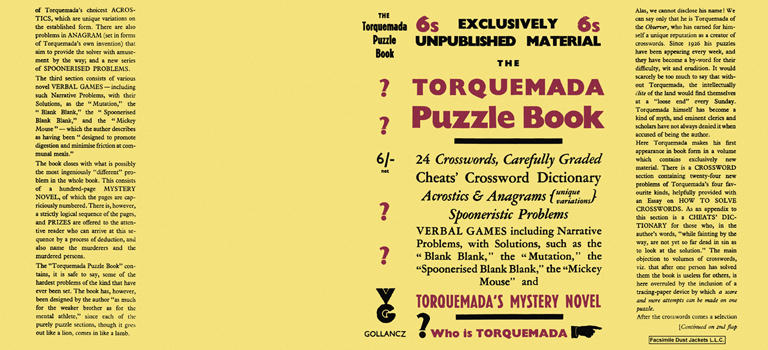
All this is important for the work in question today, that of the Torquemada Puzzle Book published in 1934.
By this point, Torquemada was a well-established puzzle writer, and embedded in the volume of EXCLUSIVELY UNPUBLISHED MATERIAL there was a 100-page mystery novel by the name of Cain’s Jawbone. It is a story over the span of six months where there are six murderers and six victims. There is the slight catch that a.) the identities of the victims are unknown b.) the identities of the murderers are unknown and c.) all 100 pages are out of order. The goal of the puzzle is to reconstruct all three.
A 2019 republication of Cain’s Jawbone as a standalone novel — with an accompanying contest which is still active until the end of 2022 — recently went viral; well, recent-ish, by Internet time. (I can say I was cool enough to know about the book before it went famous. I did not predict it would be the source of Youtube videos with nearly half a million views.)
My skill at cryptic crosswords is only middling-to-fair, so I’ve up to now resisted an urge to take a crack at the puzzle, but I took a gander through the text recently and it’s pretty good even just read as experimental literature. Edward Powys Mathers had genuine literature chops.
The sound of the bell, as of a boding gnat, just came to me. The finger causing it was, I knew, the index of a most skilful hand, one I had commanded, one that would pluck me from embarrassment, and yet one I vaguely distrusted. Really, if the lower orders don’t set us a good example, what on earth is the use of them? They seem, as a class, to have absolutely no sense of responsibility…. One had to be in the key for such things.
The impression is a tactile mix of a well-characterized narrator, social commentary, and what likely are some gnarly puzzles mixed in. A good cryptic crossword clue often has surface meaning indistinguishable from normal text. This clearly isn’t … normal text … but yet somehow fits directly into what I’d expect from experimental modernists in the 1930s.
No doubt — especially given the book cover indicates such — there is hidden wordplay that is part of the puzzle. But there’s also still a story here, and a narrative logic, and if I’m going to take a crack at solving Cain’s Jawbone the first thing I want to try to do is sequence by raw intuition.
I’ll be tackling more specifics next time, but I do want to linger a bit more on the narrator character. The narrator himself (herself?) may be one of the murderers.
In one way, of course, I was glad they were married. I had always been rather a stickler for purity in family life. That scandalous rumour of a Maltese landing on our island and seducing an ancestress of mine—or was it an ancestor?—from the path of duty, I never had and never would believe. If I had had a real education, instead of just listening to him, I could have told—it was bad that day—how I detested being called Hal. It was she that did it. But he was pleased in a way, and said to her, out of a book, the original ground of the transaction appears to have been sentimental : “He was my friend,” says the murderous doctor ; “he was dear to me.” Some Tom, not the one I killed in the matter of Jasmine, had done that, I gathered. He was enthusiastic and provided a chop for me, and said it was good he had visited England to-day for the first time.
Is “the one I killed in the matter of Jasmine” referring to “the murderous doctor” or is it referring to the narrator?
From what I’ve sampled so far, I also get the sense that chronology does not flow exactly (the setup material for book even indicates that the narrator’s mind will sometimes flit about “in the modern way”) and it’s certainly possible not everything said is reliable, not even accounting for some text probably being there for literal wordplay rather than indicating real events in the world universe.
I don’t expect to get a solution — nobody seems to be, except for one person — but I would like to get some insight on the puzzle design in general, and especially just what the frame is. Is there a specific way each name gets encoded? Is there a strong indicator across every page that allows checking the page sequence? I was going to commit to writing four posts, and like my writeup on Alkemstone, I’m hoping to at least get a fair notion of the central puzzle, even if I don’t know enough 1930s British references to make much headway. If nothing else, John Finnemore (the solver I just linked to) said “it’s a well-designed puzzle so when you start to make some headway, you know it” meaning despite the obtuseness, it’s probably at the very least a tighter design than Alkemstone.




 Renga in Blue