Archive for the ‘Interactive Fiction’ Category
One of the best aspects of doing a deep dive into early adventure game history is seeing the breaks from current norms. Modern adventure games tend not to have
(a.) randomized maps
or
(b.) a structure where there is not necessarily an “ultimate ending” and the “goal” is somewhat up to the player.
Aspect (a.) is just rare in general; we saw it in Mines, and we will see it again in 1984 with Chimaera. I can’t think of other adventure games offhand that have complete map randomization. RPGs had the “roguelike” strand of games which made randomization acceptable, but the Adventure genre never picked up a sub-genre which preserved the idea.
(b.) has been lurking in the shadows with most of the 1970s; original Adventure, while having an “endgame”, really goes out of its way to make a full 350-point run hard to get, and we’ve even had games like Mystery Mansion (1978) where deciding on a “goal” is difficult and the player can choose to escape the mansion while far short of the maximum 999 points. This sort of idea pops up again once in a while — see Ryan Veeder’s Captain Verdeterre’s Plunder from 2013 or Hanon Ondricek’s Transparent from 2014 — but again, it never latched onto any kind of Adventure sub-genre so mostly died as a concept.
…
Lugi was written at Stanford using their Low Overhead Timesharing System (LOTS) on a DECsystem-2060 by Jay Wilson and Paul Kienitz. The latter mentions Lugi on his webpage and has a partial Java port, but I’m playing the original Pascal version compiled by Peter De Wachter for Windows. (He reports GNU Pascal compiles it “almost out of the box”, if you are on a different platform.)

Text banner from the game’s source code.
You are a CIA agent charged with exploring the Lugonian embassy. Odd things have occured there, including the possibility that the Lugimen (who are from Arcturus IV and resemble trolls) have eaten several people, including (we believe) some of the agents we’ve sent into the building. Your mission, should you choose to accept it, is to go in, explore as much of the building as you can, and escape alive, bringing any alien-looking objects you find out with you. The only known opening is a balcony high above the street.
The last agent to get out swears that the Lugimen use teleportation like we use telephones. He was constantly vanishing in one place and appearing in another, as were many of the objects he found. Also, the Lugimen rearrange the floor plan of the building unbelieveably often, though the number of rooms in the building remains constant at 35.
The last line indicates the main gimmick: the map is connected entirely at random. I don’t know yet if the set of 35 rooms is always drawn from the same 35 or if it is drawn from a larger set (so a room may appear in one game but not another).
Here is the start of one game:
You’re in a sunny alcove under a bright skylight.
Open exits: N S
There’s a half-eaten sandwich here.
There is a gleep in this place.
Here is the start of another:
You’re in a round, bare room with a flat black metal floor. A brilliant
point of light, brighter than the sun, dazzles your eyes from high above,
illuminating the empty area.
Open exits: S W J C
There is a gleep in this place.
(The “gleep” seems to be some kind of money — I think it may just be points? “J” and “C” stand for “jump” and “climb”.)
The map is so random that a particular exit in a particular room may lead to a different destination on a second trip. There are also objects scattered (again, at random) like a “stick of gum”, “can of acetone”, and a “flask”. It seems like I’m going to have to track this more like a strategy game than an adventure, where I’m looking for a particular set of items and rooms rather than navigating with a set route.
There’s a small, unhealthy-looking Lugiman here, a real runt, holding a cudgel! He screams at you in Lugonian: something about “filthy Earth vermin” and “stinking Earth germs …us allergic people can’t take it any more!” He raises his cudgel, holding his nose, and prepares to bash your skull in…
I’m still trying to feel out if there’s anything resembling an “ultimate objective”; the intro states to just explore as much as possible and bring alien-looking objects. However, there is one scene that suggests to me there might be a way to “defeat” the Lugimen. There is a control room I’ve found several times, and pushing a button always brings the player to a “cylindrical metal cage” on “Arcturus IV, the home planet of the Lugimen” with “none other than Grugza Emperor Ra-Lugi himself, the absolute ruler of the planet”. In all three times I visted there was a “doglike ugly alien beast” and a “small statuette” that was perhaps “religious in nature”. No other room has had this kind of item consistency. Is this just a trap, or is there some way to defeat and/or make peace with the emperor?
I played Death Ship recently and experienced one of the worst parsers I’ve ever seen, so it may seem strange I’m coming so soon back to the same source (Rodger Olsen, Aardvark Software) but I wanted to see if there was any improvement since last time, and while I easily remember plot and puzzle details from games I played many years ago, exact parser responses fade fast (so I had to get back to this sooner rather than later).
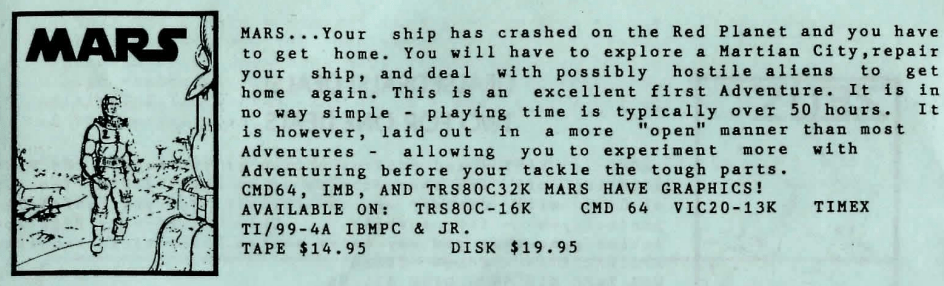
From a 1984 Aardvark software catalog.
At least >LOOK lets you look at the room now. Alas, I still have to reckon with a parser that only understands the first two letters of each word and actions that do something but have no response (I’ve trained myself to *always* LOOK after every action that doesn’t get an outright “HUH??” but it still leads to a disconcerting play experience.)
I didn’t have as much frustration as I did with Death Ship, but my smoother experience came more from knowing about the Aardvark system’s quirks rather than actual improvement. For example, here are the game’s verbs:
REad, BReak, OPen, LIght, HIt, UNload, LOok, PLay, INventory, PUsh, SMash, TAke, GEt, TIe.
I found “UN” while testing a list of common verbs including UNlock, I didn’t figure out what it actually meant until later. Specifically, I found out the main charcter has pockets (pockets!) and you can OPEN POCKET and LOOK POCKET to find a lighter and a harmonica; for the life of me I couldn’t figure out how to get the items out (just GET HARMONICA or EMPTY POCKET didn’t work). I eventually resorted to testing each of my two-letter verbs, already having assumed UN meant UNLOCK, but after typing UN I found the pocket items had been moved to my inventory. When things are this meta the parser itself can be a puzzle.
…
Escape From Mars, as the title implies, strands you on Mars with a crashed spaceship.
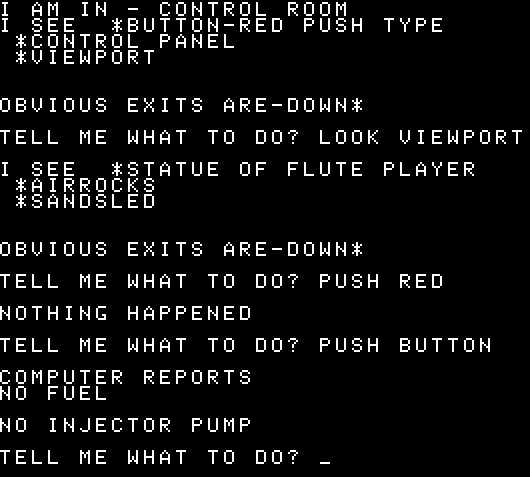
You need to replace an “injector” as well as make some fuel. To make fuel, you need
WATER, POT, TUBING, FIRE, GRAIN
This style of the minimalist game relies a bit on outside imagery — i.e. you know what a dragon ought to look like, so THERE IS A DRAGON HERE conveys something without further details — but I admit I was a little fuzzy as to what conception of Mars this was.
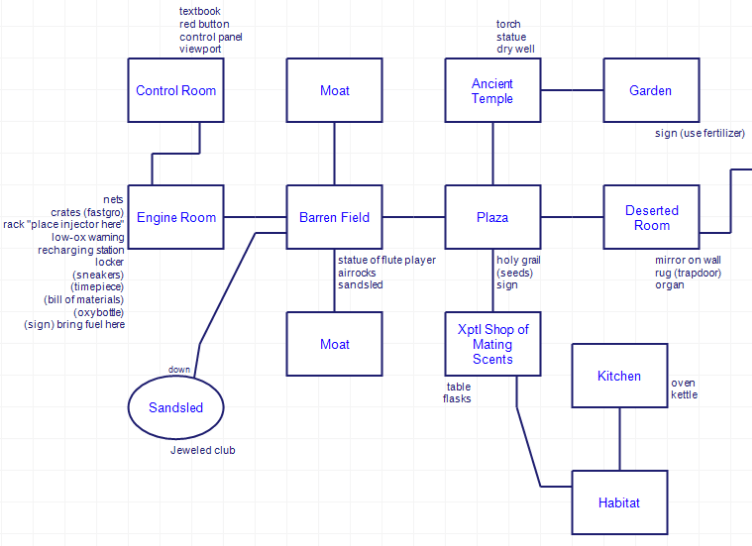
Most of the map, excluding connections off the “Deserted Room”; I’ll talk about that in a moment.
Immediately upon setting foot outside the spaceship I stepped on a “barren plain” to find a “sandsled”, a “statue of flute player” and “airrocks”. What are airrocks? Is the flute player supposed to look human-ish or like a crazy tentacle monster? At least I guessed correctly the sandsled was a large vehicle rather than a small toy. (If you GO SANDSLED you find a jeweled club which is useful for breaking things.)
Directly north and south of the plain are moats with water — moats to what? Are there buildings? How does one transition directly from a barren plain to a pool of water?
A short distance away is “Xptl’s Shop of Mating Scents”. What does this shop look like? Do I want to know? How do you pronounce “Xptl” anyway?
I wouldn’t say the rooms are mashed together randomly, just it came off as if there was a background setting in mind only known to the author. To make an analogy, imagine coming across a scene with a minimally-described dragon without knowing what a dragon is.
This had real gameplay implications: there is a rustling sound you occasionally hear, and with a little effort you can get a martian to come into the room.
TELL ME WHAT TO DO? PLAY HARMONICA
RUSTING IS GETTING LOUDER
TELL ME WHAT TO DO? PLAY HARMONICA
RUSTING IS GETTING LOUDER
TELL ME WHAT TO DO? PLAY HARMONICA
RUSTING IS GETTING LOUDER
A MARTIAN JUST WALKED INTO THE ROOM!!!
Again, I had no idea what to visualize, because there are enormous variations on what “Martian” can mean. I ended up settling on Marvin the Martian from Looney Tunes.

The actual NASA Mars Spirit Rover mission patch.
This was partly to make me feel better about what came next: the appropriate action is to GET MARTIAN (and then specify you want to use a NET). Actually arriving at the idea that getting the Martian in a “net” was even feasible required visualizing the scene at least somewhat like the author; at first I imagined the alien as being little less, ah, portable.
Once “netified” you can then take the Martian’s helmet which is useful for … carrying water. Yep.
…
This ended up being a “hub” game design where the goal was simply to gather the ingredients. After collecting the WATER, POT, TUBING, and GRAIN, the right action was LIGHT FIRE, and no, I did not come up with that on my own; the action requires referring to a noun which does not yet exist, which is a high-risk endeavor even for games with a decent parser.
There’s one more major bit of interest: from the “Deserted Room” on the east side of the map above, there are two hidden exits: you can either TAKE RUG revealing a trapdoor, or BREAK MIRROR revealing a passage up with a rope. You can then either use the rope on an empty well to climb down or use the trapdoor (you need sneakers for the latter to avoid sliding and falling). Either action leads you to the same place, an area where you can get a replacement injector and the tubing for making fuel. While we’ve seen a fair number of alternate routes in games (prominently Zork) those instances had sprawling maps; this is a tight (8K) sized one where the author nevertheless put enough thought into the geography to have the same area reachable in two ways.
IT IS YOUR MISSION TO RESCUE THE MAD SCIENTIST’S BEAUTIFUL DAUGHTER FROM HIS HAUNTED MANSION. THERE ARE MANY HIDDEN PASSAGEWAYS (OF COURSE!) WHICH MAY BE FOUND ALL OVER THE HOUSE. ALSO HIDDEN SOMEWHERE IN THE HOUSE IS A WEAPON, WHICH MAY PROVE USEFUL IF YOU RUN INTO ONE OF THE RESIDENT MONSTERS, THOUGH THEY MAY BE SUCCESSFULLY DEALT WITH IN OTHER WAYS. ‘SCORE’ TELLS YOU THE MOVES YOU’VE GONE– THE REMAINING COMMANDS YOU MUST DISCOVER FOR YOURSELF!

From Softside Selections #44, 1983.
Mad Scientist was a type-in by Thomas Hamlin III printed in the November 1980 issue of Softside (dated April 26, giving an idea how much lag between writing and publication there could be). It was later reprinted in 1983 and just to share what kind of pain these sort of things were, here is the source code from the 1983 edition:
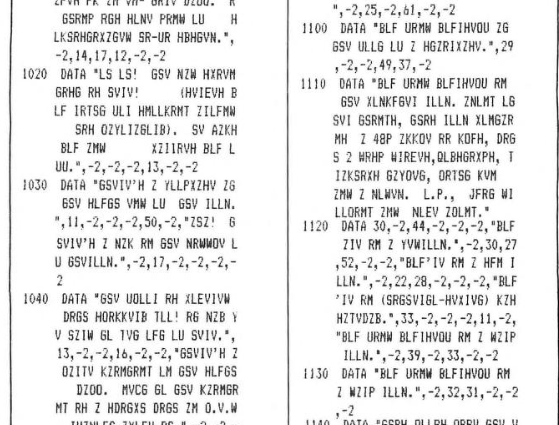
By 1983, Softside printed their adventures with an encryption algorithm so that people couldn’t spoil the events of a game for themselves by typing it in. While this might be faintly positive, it meant typing pages of gibberish.
THE DAUGHTER CAN’T BE REACHED TIL A CERTAIN ROOM’S BEEN ENTERED; KEEP THIS IN MIND DURING YOUR EXPLORATIONS. YOU ARE GIVEN THE OBVIOUS DIRECTIONS YOU CAN GO IN THE LOWER CORNERS OF THE SCREEN. SHUT DOORS AND SECRET PASSAGEWAYS ARE NOT SHOWN, SO USE YOUR INTUITION IF YOU THINK EITHER MIGHT BE NEARBY.
This game falls in my theoretical puzzle-sparse-exploration-heavy genre (see: Death Dreadnaught, Haunted Mansion) where the vast majority of the game is exploration. The only “puzzles” here really are finding secret doors by applying MOVE to things.
HAVE A NICE TRIP, BEWARE OF THE GHOSTS, WATCH OUT FOR THE MAD SCIENTIST, AND, ABOVE ALL, DO RESCUE THE BEAUTIFUL DAUGHTER!
I feel like the plot must be eliding something: why do we know there is a beautiful daughter to be rescued? Does she know we’re coming to rescue her? How creepy is the whole situation given the “beautiful” moniker? I choose to believe the genre is “PG-rated 1980s teen horror-comedy” and the totally bogus dad pulled our best friend from school and we knew she was in danger, and the PG rating keeps it from getting too creepy. (This also fits the tone of the game, so I’m not reaching too much.)
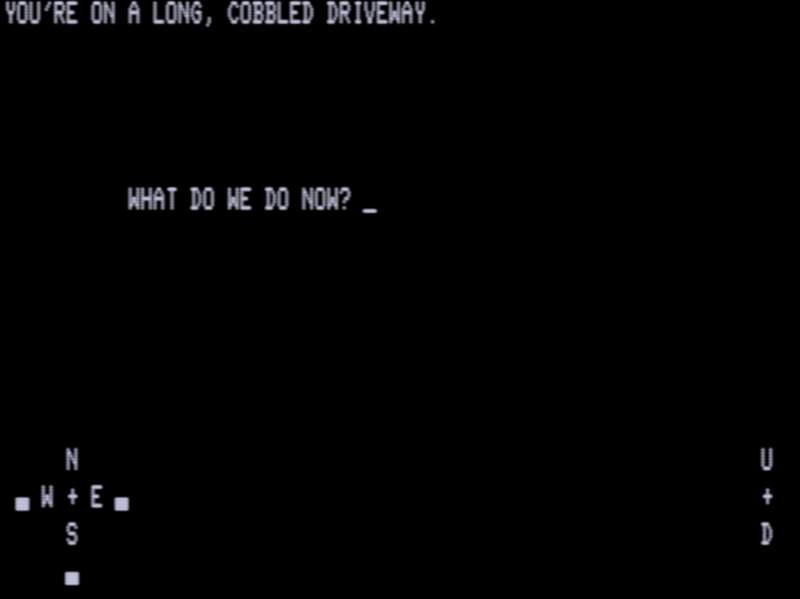
Anyhow, as the all-caps intro implies, there’s “obvious directions” given on the screen, in compass rose fashion. Here’s the 1980 TRS-80 version:
Here’s the later Apple II port:

I ended up playing the Apple II version because it runs faster (the TRS-80 version even includes intentional delays on top of being sluggish) although I did test out the TRS-80 enough to note this nifty skeleton graphic that the Apple version lacks:

By having the compass rose built into the interface, the author was free to have room descriptions that don’t bother to describe exits. This can result in elegant prose, as in this room description from Beyond Zork:
Home of the most famous of all Enchanters’ Guilds, Accardi is usually crowded with autograph seekers and hopeful young apprentices. But the crooked streets are oddly quiet today.
The effect with Mad Scientist … is a little less elegant, and sometimes the author describes events rather than places, so the map is a confusing mishmash.

Even given the weird inconsentency of room descriptions that don’t describe the room, I find something refreshing in the minimalism here that I don’t get from the standard Scott Adams minimalism. (That is, this is a sentence someone would voluntarily write, as opposed to being forced to have due to a lack of space.)
You embark on your journey through a gate which slams behind you; an electric fence activates. (This is already a little confusing, since the security system seems intended to keep people out, but it let you in; again, I’ll assume some part of the story is elided, with wacky horror-comedy shenanigans.)

After a little farther in, you run into a door, more or less literally, because the door isn’t mentioned in the room description. The game just says you’re at the entrance, and the compass rose has no exit to the south, so you have to try to go south anyway and get the response THE DOOR IS SHUT.
After opening the door and going in, the door closes shut and locks behind you. This is a relatively elegant way to set-up that the escape (after finding the daughter) is in two layers: first, get back to the area with the driveway and front lawn; second, get past the electrified fence.
After that, the map opens up quite a bit:
Really, most of the game is mapping and the occasional MOVE to an object in view to open some sort of secret. The command list is extremely limited; other than directions, I found just OPEN, TAKE, SHOOT, MOVE, TURN, and CLIMB. These days the limited-command parser is well regarded (see: Midnight. Swordfight. or The Wand) but the problem here is the game pretends to have a parser and objects, but really doesn’t. Mad Scientist should have just announced its limited verb set straightforwardly (like how Eamon lists its verb set if you use an unrecognized verb).

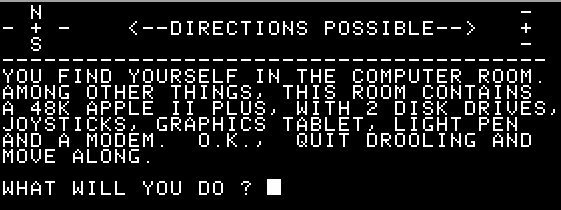
Rooms like this one and the supply room tempt the player into trying to use and/or take stuff, but it’s all scenery.
Early on, I found a ghost; I had one turn to react, but it was apparently the wrong reaction, because the ghost killed me. On a replay I found a LASER GUN and that took care of any ghosts (and skeletons) that randomly popped up as I explored. The game instructions hint there’s some method of handling the monsters that doesn’t involve shooting them, and the laser gun does have a limited number of shots, but I never reached that limit so I never had to reckon with whatever other response the game was looking for.
Next to the room with the laser gun I ran across the mad scientist himself.
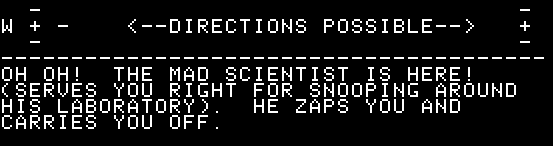
He trapped me in a room with a table and surrounded by green burning flames, although didn’t bother to stick around in person. MOVE TABLE revealed a secret passage going down and I was able to escape. (If you go back to the same place you got captured you get captured again, and brought to the same place again; the scientist must be one of those loopy absent-minded ones.)
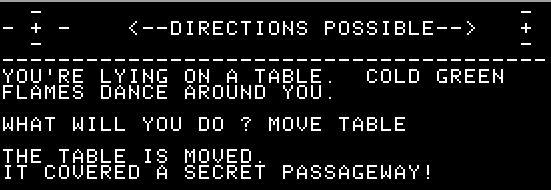
Nearby where the escape happens, there is a “moon room”, and a helpful sign indicating the daughter is nearby.

If you head north you find the daughter’s bedroom and can >TAKE DAUGHTER with you and try for an escape. Note that this is only open after you’ve done the escape from the lair; I had actually found the moon room early and was futilely poking around looking for secret levers and the like.
Getting out then involved
a.) finding the secret room with a switch that deactivated the electric fence
and
b.) finding a secret passage under a rug that led me next to the gate (remember the front door locked itself so I needed an alternate route to get back to the fence)
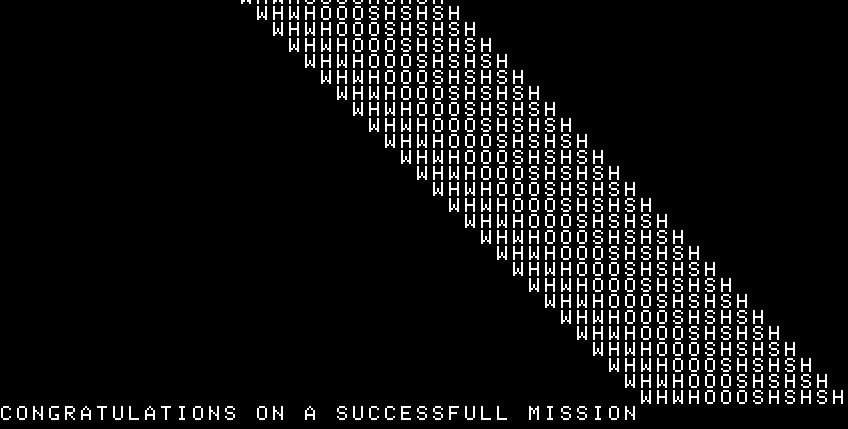
Then, victory!

Oops, wrong screenshot. (This happens if you try to QUIT early.) You’ll have to play the game yourself if you want to see the last screen.
Before closing out, I want to point out the blog Gaming After 40 played this back in 2015. It states that when this was written, the “best practices” for writing adventure games had not yet been established. This is expanded upon with a comment by Roger M. Wilcox, who mentions a “How to Write Adventures” article of Greg Hassett:
… split the input into verb and noun, look up both on a game-wide table of all known verbs and nouns and turn both into a number, then have separate code for handling each verb which you branch to via a large ON-GOTO statement. Rooms and objects were likewise numbered; room descriptions were held in the array P$(), object names were held in the array OB$(), and the room number that each object was in was held in the array OB().
Compare with a line from the 1980 source code of Mad Scientist:
330 IFWH$=”GET LASER”ANDLF=0THENPRINT@594,”YOU’VE ALREADY GOT IT, STUPID!”;:TIME=15:GOTO610
“GET” and the noun it goes with are not treated separately! No wonder there’s almost no objects in this game. Most actions are bespoke. Consider also the code for “SHOOT” that goes with the laser:
335 IFSH>0ANDLEN(WH$)>5ANDLEFT$(WH$,5)=”SHOOT”ANDLF=0THENPRINT@603,”ZZZZZZATTT!”
The game checks if the leftmost 5 letters of the player’s input is SHOOT and if the length of the string is long enough for the player to have typed some kind of noun. However, the game never bothers to check what the noun actually is. It’s easy to take for granted the idea parser commands in a text adventure will be checked against some kind of world model, but in this era, it was possible to fake it.
I don’t have that far to go in 1980 (relatively speaking), so I thought I’d give an update on my game list. My original list was compiled from The Interactive Fiction Database, CASA Solution Archive, and Mobygames. I tossed some games off the list for various reasons so I’ll talk about those too.
HAVE ALREADY PLAYED
Just check the All the Adventures list.
STILL TO BE PLAYED
(ADD: As of 24 October 2019 I have crossed out games played since I wrote this document.)
Two Programmer’s Guild games:
Dragon-Quest Adventure by Charles Forsythe
TimeQuest by William Demas (NOTE: Not played yet but now moved to 1981.)
The two that remain from Joel Mick’s trilogy:
Treasure Island, Journey Through Time by James Taranto and Joel Mick
Four “private games” that Roger M. Wilcox published many years after 1980, I’ll likely lump them all in one post:
Space Traveller, India Palace, Poseidon Adventure and Vial of Doom by Roger M. Wilcox
The very last of the Greg Hassett games:
Curse of the Sasquatch, Devil’s Palace by Greg Hassett
The last Gary Bedrosian game, written in 1980 but only published in 1982:
G.F.S. Sorceress by Gary Bedrosian
Some random Commodore PET and TRS-80 games:
Will o’ the Wisp by Mark Capella
House of Thirty Gables by Instant Software
Mad Scientist by Thomas M. Hamlin III
Kidnapped by Peter Kirsch
Two very interesting and unusual Apple II games:
Oldorf’s Revenge by Highland Computer Services
The Prisoner by David Mullich
The publisher of Deathship and Trek Adventure had 4 more games from 1980:
Escape From Mars, Nuclear Submarine Adventure, Pyramid, Vampire Castle
Two by the coiner of the phrase “interactive fiction” which use a “conversational” parser:
Six Micro Stories by Robert LaFore
His Majesty’s Ship “Impetuous” by Robert LaFore
A fascinating mainframe game with a lot of randomization, but old Pascal source code is a bear to compile:
Lugi by Jay Wilson and Paul Kienitz
The follow-up to Deathmaze 5000:
Labyrinth by Frank Corr, Jr.
A game I will still get back to, likely at the very end of 1980:
Warp by Rob Lucke and Bill Frolik
I tried this a little and think it may get booted for being not-an-adventure, it feels more like a strategy game, but I haven’t played enough to be official:
Survival by Dr. Charles Kingston
There’s also one game (possibly two games) in a non-English language, but I’ll wait on listing them until I start writing about them.
I can’t know for certain until I start playing them, but I believe the only “long” games I have left are Lugi, Oldorf’s Revenge, G.F.S. Sorceress, Labyrinth, and Warp.
MOVED TO ANOTHER YEAR
Medieval Adventure by Hugh Lambert
Published by CLOAD in 1981, I see 1980 in multiple places but I don’t know the source. I’m willing to go by year of writing rather than publishing but I can’t find that date in any source code.
Haunted House by Darren Deloach and Tim Koonce
Released “late 1982 or early 1983”.
The Demon’s Eye by John Dueck
A type-in published in 1991 (!).
Pharaoh’s Curse by Tim Koonce
From 1981 (probably).
REMOVED FROM THE LIST
FisK by John Sobotik and Richard Beigel
Definitely an adventure game (for mainframe), but I still don’t have a copy, and one of the authors requested (for understandable reasons which I won’t go into here) to leave it alone for now.
Manticore: An MS 8k BASIC Adventure by Anonymous and Jon Bradbury, also given as Explore by Jim Butterfield
I played this one and even made a complete map, but it turns out to be entirely an RPG.
Dungeon of Htam by Howard W. Sams & Co
This is an edutainment game where you solve math problems.
Dungeons and Dragons by Peter Trefonas
An RPG which the The CRPG Addict played here.
Eamon games like The Cave of the Mind, The Zyphur Riverventure, etc.
There’s quite a few of these but I’ve tried enough to say they’re essentially RPGs. I might be willing to loop back at some future point since these haven’t got the attention they deserve.
Time Traveller by Krell Software
Interesting, but more of an educational strategy game than an adventure.
After finishing Mystery House (Hi-Res Adventure #1) and Wizard and the Princess (Hi-Res Adventure #2) Ken and Roberta Williams decided to write a “beginner’s” game, Mission: Asteroid (Hi-Res Adventure #0).
It is easy, sure, but absolutely not what I would ever give a beginner, especially given the unintentional surprise ending.
At the start of Mission: Asteroid, your watch goes off and (after PUSH SWITCH) lets you know you must report for a mission:

Inside the building is a secretary who stops you and asks for a password. None of these work:
>SAY STARSTRUCK
>STARSTRUCK
>TALK SECRETARY
>ASK SECRETARY
>SAY PASSWORD
>GIVE PASSWORD
>GIVE STARSTRUCK
(With the last, for instance, the game responds “I don’t know how to give something”.)
I finally hit upon TELL STARSTRUCK. I can understand slightly messy syntax in two-word parsers when there’s no other way to write something, but there are perfectly grammatical alternatives here!
Upon entring the complex, there’s a general you are told to >SALUTE:
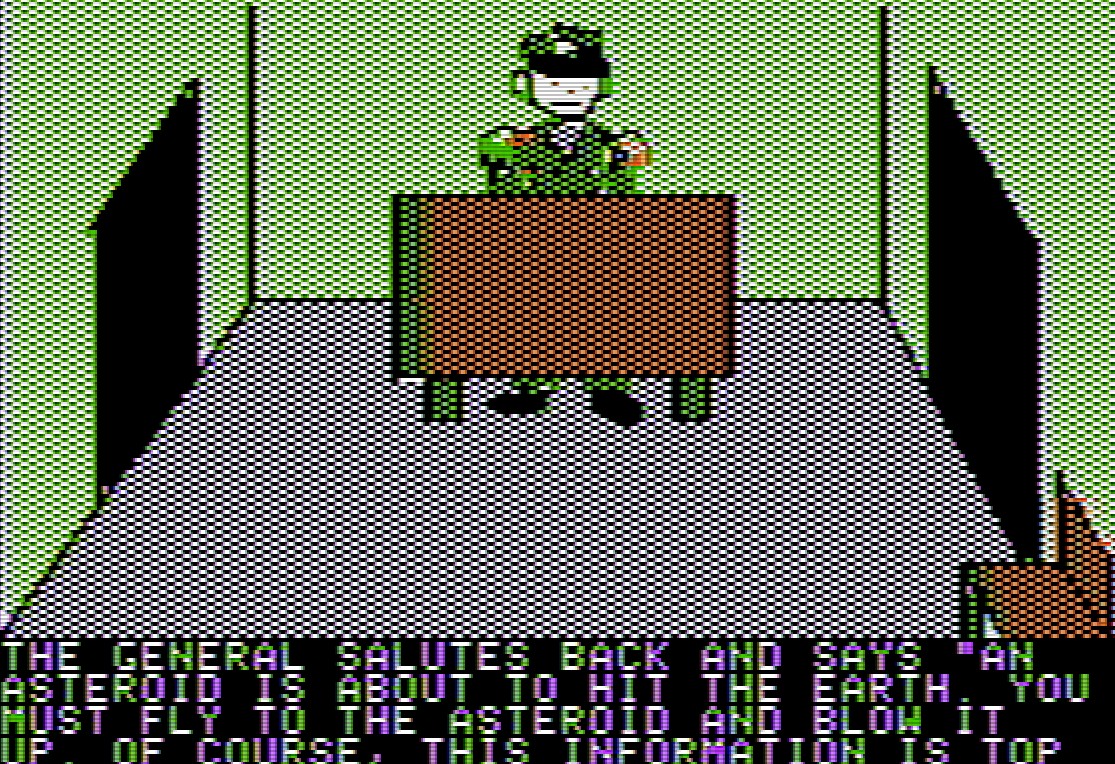
The general also says the information is “TOP SECRET”. There is a room of reporters next door and an amusing way to lose the game.
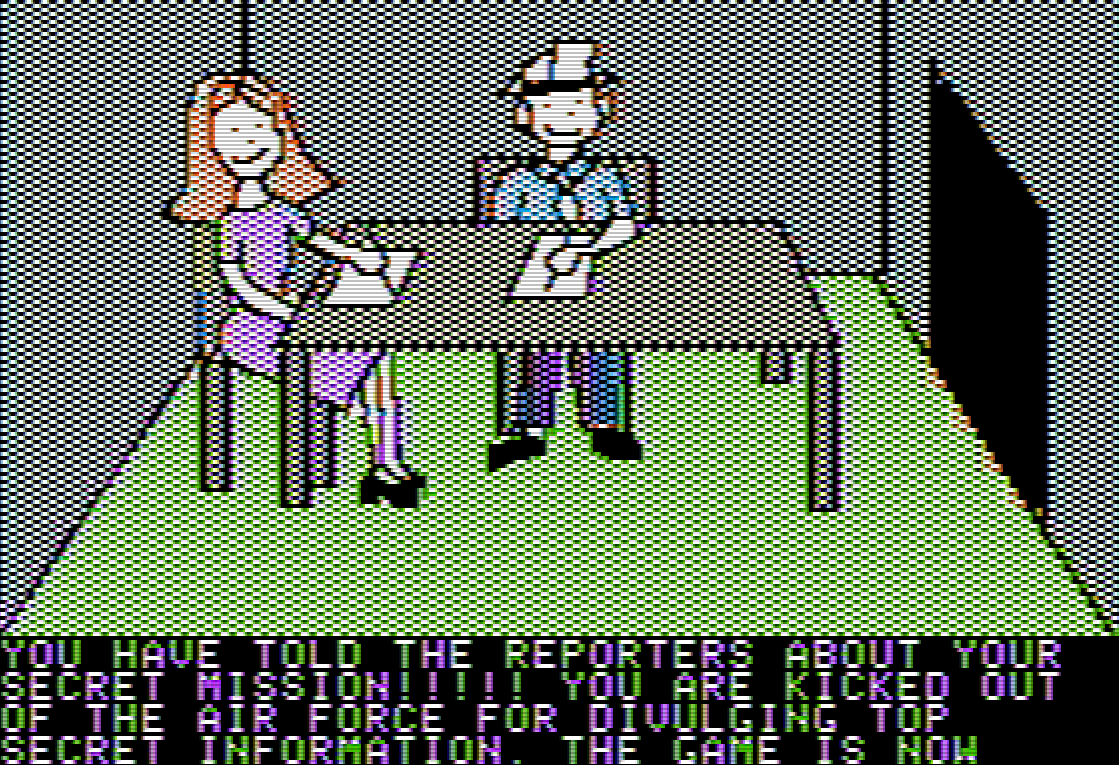
(This happens if you >TALK REPORTERS. I think it may be the first “you can hang yourself by your own rope” style death in a Roberta Williams game.)
Assuming you want to actually keep playing, the next stop is a computer, which gives you a set of directions for flying from Earth to the asteroid.
right for 10 minutes
up for 5 minutes
left for 15 minutes
down for 5 minutes
left for 5 minutes
up for 10 minutes
Just past the computer are some explosives; you’re never told they’re officially part of the mission, but you need them to succeed.
Next stop: the rocket, where a doctor does a checkup. He tells you that you are out of shape and smell bad and can’t go on the mission yet. You need to go to the nearby gym and EXERCISE and then TAKE SHOWER for the doctor to let you by.
Once past the doctor, you can enter the rocket. It has a throttle to launch and land, and four colored buttons: white for “left”, black for “right” , orange for “up” and blue for “down”.
I admit some confusion to enacting the “right for 10 minutes, up for 5 minutes, …” flight plan. I first tried just pushing black once, then waiting 9 turns (there was no “wait” command so I just moved randomly) then pushing white and waiting 14 turns, etc. This was wrong for two reasons. 1.) you’re supposed to keep hitting the relevant button the entire time and 2.) more interestingly, I didn’t notice until later that time was moving in 5-minute increments. So you have to start by hitting the black button two times (10 minutes) then the orange button one time (5 minutes) then the white buton three times (15 minutes) and so on. I don’t think I’ve ever had difficulty on a puzzle due to not understanding the flow of time in relation to commands.
After a successful flight, you find and land on the asteroid. You’re using a spacesuit with a very tight limit to the amount of oxygen, so it’s very easy to die here by getting lost. (It’s technically a maze, although I didn’t bother to map it; I just worked out the right steps to take and reloaded.)

I found a cave with a pit. I then had to SET TIMER (the game lets you choose how many minutes it will take) then DROP EXPLOSIVES followed by IN PIT.
Then, retracing my steps and flying the ship back to Earth… I blew myself up with the explosives. Whoops! I somehow had mistyped IN PIT I guess so my character was still holding the explosives.
Retry: set timer, drop explosives, return to ship. Flying back involves the same directions as getting to the asteroid but backwards (down for 10, right for 5, up for 5, etc.) I landed on the Earth and then …
…actually, let’s wait on the ending. I’m going to make a digression for a moment.
…
Even though it has roughly the same plot outline, I’d recommend the last game I played (World’s Edge) to beginners, while this one I would not.
I’m not even referring to the parser-level issues; just, as a game, this wasn’t very fun. In both cases there was a lot of “being told exactly what to do” and at a surface level, the plot interaction is fine in both cases. However, Mission: Asteroid makes a passing attempt at taking itself seriously, while World’s Edge is silly out the gate. Having to EXERCISE and TAKE SHOWER right before the mission just highlighted the ludicrousness of the scenario, whereas World’s Edge “jump in a silo and go, and the rocket disappears when you get off” setup pushes far enough there’s not even a veneer of verisimilitude, so that when we summon sporks with horns and find a hint given by a spork baby the effect is more comedic than cringeworthy.
Additionally, Mission: Asteroid adds timers. There’s a timer for the asteroid hitting the Earth, and a timer for the amount of oxygen in the spacesuit; it’s fairly certain a first-time player will need to reload their game on occasion, but having to do so because time ran out adds something more like annoyance than difficulty.
World’s Edge had no timers whatsoever, and while you could die via using the jetpak in the wrong place, or dropping the explosive plastic, those deaths came off as both necessary and amusing; the limited oxygen given in the spacesuit of Mission: Asteroid just seems intended to annoy.
…
So, assuming you plant the explosives correctly, have left the asteroid, and didn’t set the timer so far out the asteroid strikes before the explosives go off, you eventually get a victory message:

However, the game doesn’t exit you out, so you can keep going. (This isn’t that uncommon for this era — great, you found all the treasures! … eh, end whenever you feel like it.)
Whoever did the programming on this — Ken, or Roberta, or both — forgot to stop the timer that’s set to destroy the planet. So a short time after the victory message, this happens:
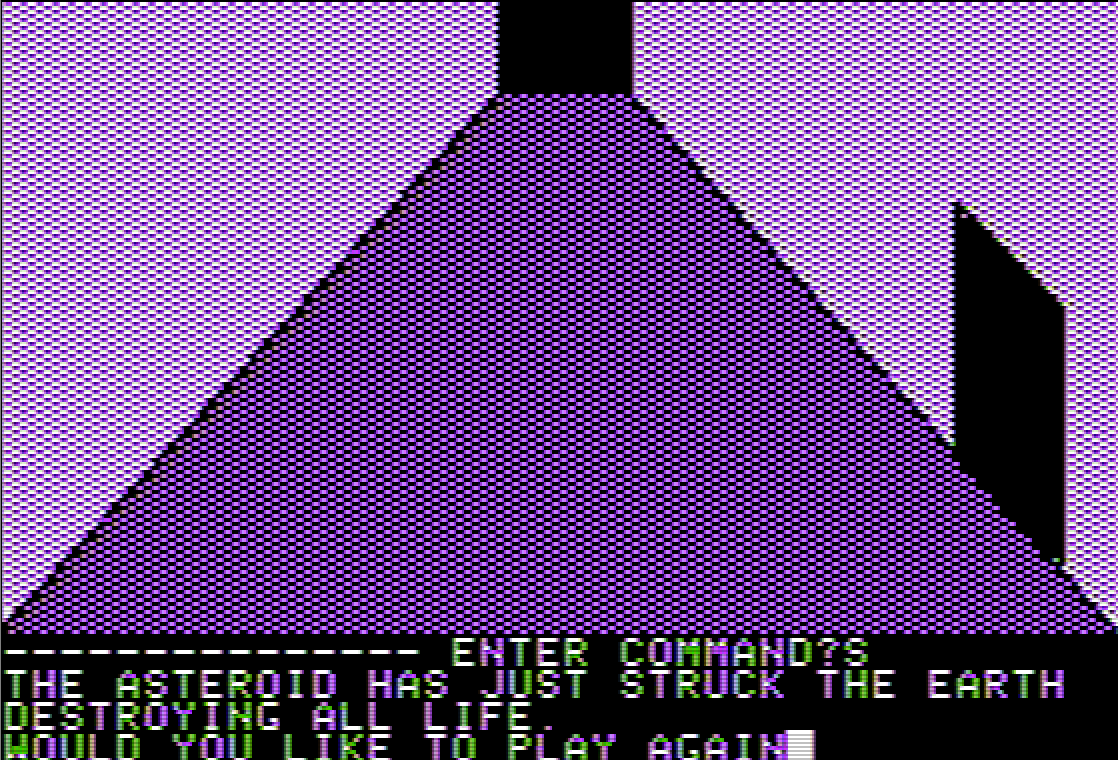
Yes, this really is what happens, this wasn’t due to a hack or anything; back in 2007 Carl Muckenhoupt ran into the same issue and managed to get both saving the Earth and destroying it on the same screenshot.
In my last post, I mentioned how much better the parser is in this game than the average two-word parser, so of course, I ran into a parser issue … sort of.
It’s the fault of the three-letter limit. Most games from this era (in order to save space) only stored the first three letters of any verb or noun, so there is no way to distinguish between a LADDER and a LADLE or a TANK and a TANGERINE.
I mentioned finding a jetpak. It came with instructions.
TO START THE JETPAK, SAY “START”.
I was thinking of the game-logic we’ve seen elsewhere where START is a verb. Indeed, I later tested it and found you can >START JETPAK (although I maybe should have thought a little harder about the fact you can’t do this while holding the device).
I also had found a knife and noticed >STAB worked as a verb.
I hope you see the problem now, because it took me an embarrassingly long time to realize it. Not only does “STA” map to “STAB”, but the game says “I HAVE NO KNIFE!!!” if you try to use the verb while not holding the knife. I must have not tested out the jetpak until after I had the knife.
>START JETPAK
DOESN’T WORK.
This led me to think I needed fuel for the jetpak first. In actuality it starts with some fuel.
I guess “stabbing that isn’t possible” would be the best response, but this was mostly my fault. The right command was “SAY START” (which is the exact wording on the paper!) If you do this outside the cave with the amoeba (the room description mentions a cliff visible above):
>SAY START
I AM ON THE EDGE OF A CLIFF. I WOULDN’T WANT TO JUMP…
I CAN GO EAST
At least I called the amoeba puzzle correctly. There’s a hole above the space amoeba room, and if you drop the exploding plastic and go in the hole afterward, you find the amoeba has been replaced by a pool of water.

The rest of the game is straightforward (it took me about 10 minutes to beat) and I was weirdly reminded of my recent experience with Lost Ship Adventure where getting past a “stuck” part led to a rush through the rest of the game. However, I wasn’t disappointed in the same way, and it’s a comparable enough situation it’s interesting to pinpoint the difference. Let me briefly run through the remainder of the events of World’s Edge first:
Once you get the glowstone from the amoeba, you can use it to find a “space-troll” in an adjacent room.

Getting by the troll has an element of the dragon fake-out in Adventure; rather than doing any puzzle solving, just start a fight:
>KICK TROLL
WOW! I BEAT UP THE TROLL! NOW *THERE’S* SOMETHING I’M GONNA TELL MY GRANDCHILDREN…
Also nearby is a room with “spork tracks”. There’s a “spork horn” elsewhere, and if you use it here, a spork appears.

You can stab the spork with your knife, which is just as silly as it sounds.
ITS LAST WORDS ARE: “PLEASE… PLEASE DON’T CRACK MY EGG…”
IT KICKS THE BUCKET AND VANISHES.
As intrepid sociopath adventurers, the next action is CRACK EGG:
A BABY SPORK COMES OUT, SAYS “GO BACK TO THE CAVE ENTRANCE” AND RUNS OFF.
Following the baby spork’s advice, you find a note at the cave entrance.
DROP THE POWDER HERE, GO BACK TO THE HOLOFAME, AND YOU’LL FIND A CREDIT DISC.
The disc gives you the hint as to what to use as jetpak fuel.

The water from the former space amoeba works; this lets you use it one more time and get to a city.

I’m not narrating the rest blow-by-blow, but here’s the general sequence:
- Bribe a guard with one of the holofame cards
- Find a “Starhawk Fighter” at “Honest Quoron’s Used Spacecraft’ and give it fuel by filling up a flower point
- Fill a pistol with an energy capsule and blast open a safe with APC-80 crystals
- Steal the Starhawk Fighter and fly to victory

Even though these actions aren’t hard to suss out, they were fundamentally more fun than Lost Ship Adventure. Example: In that game, there was a chest that was locked. You had a key. You unlocked the chest with the key. Great! Problem solved. (Yawn.) Here, you had a laser pistol and a safe. You blast the safe with the pistol, and the safe vaporizes. As an action, the first is pedestrian, the second is colorful and a bit amusing. The quality of puzzles was not so much about the difficulty but about the actual action being taken as a piece of narrative.
It’s tempting, when evaluating adventures both old and modern, to separate the crossword from the narrative (so to speak). Evaluating if an easy puzzle is any fun or not makes a good case that sometimes, they have to be considered both at the same time.
I mean, we used water from a space amoeba we blew up as jetpak fuel. Even though the game is quite explicit about what to do (we’re informed by none other than James T. Kirk of the starship Enterprise), the act of doing it isn’t just a rote exercise.
If you consider the Really Well Renowned Puzzles from adventure game history, you get things like the time travel puzzle from Sorcerer or That One (You Know the One) from Spider and Web where the entire span of both deciding what to do an enacting the action are interesting at a narrative level. Compare to, say, finding a paper with the digits that lead to a safe combination; with enough atmosphere and context this can hold narrative heft, but too many adventure games consider the mere existence of a puzzle to be enough.
…
Next time, we’re staying with the “fly a rocket ship elsewhere to save the Earth” theme and visiting Sierra (aka On-Line Systems) in their last 1980 game. I’ve beaten the two Sierra games we’ve seen so far without any hints; will the trend continue?
After the last game’s frustrating trip with one of the worst parsers ever, I thought it prudent to return to an author that seems to have his act together on two-word parser control: Greg Hassett.
It really is a relief to have a variety of messages that are explicit about when the game doesn’t know what to do, ex:
>STAB GRASS
I DON’T SEE THAT AROUND ME
>EAT KNIFE
YECH! WOULDN’T DARE!
>KICK
I NEED A DIRECT OBJECT AS WELL.
>KICK STONE
HAR HAR HAR. FIGHTING SOMETHING THAT ISN’T ALIVE. LOOK, I’VE HAD A HARD DAY…
>WAVE SWORD
WHAT IS “SWORD”?
These types of messages are essential to a good flow. When the parser breaks down, text games need to explain what happened as transparently as possible.
…
You start the game outside with some hooting owls, and find a barn with a letter from NASA:

Yes, the big future world threat is … smog.
Also, to solve our eco-crisis, we are stealing (?) something (2.2 kg of APC-80) sacred to the natives of another planet. This reads as if a pair of authors, one politically left-leaning and one right-leaning, decided to get together to write a book but they just mixed their paragraphs in alternating order without editing.
Near the barn is a silo; once you break in, the silo turns out to be a rocket ship, and you can pull the lever to find yourself on an alien planet.

Upon arrival, you find a very minor swamp maze, the kind common to Greg Hassett which lacks the east-one-way-goes-south-the-other type connection, and just includes a few loops:

As an aside, one of these days I want to come up with a numerical metric that specifies how difficult an adventure-game maze is. Ratio of normal-connections to crazy-connections, maybe.
I haven’t got much farther than that. There’s a “holofame” where I can try out a “credit disc” …

… and a “space amoeba” guarding a “glowstone”.

I heard secondhand the amoeba was the hardest puzzle. I’m not sure if I should be solving a different puzzle first.
I have: a sickle (which I already used to cut some grass), a needle (used to pick a lock), a jetpack (not used yet, but I don’t have fuel), a pointy knife, and a piece of plastic (that blows me up when I try to drop it). I suspect if I can get to the other side of the vent (mentioned in the “tall chamber” room description) I could drop the explosives down there and destroy the amoeba safely, but that would likely require using the jetpak.
As is usual, feel free to speculate in the comments, and if you know the game already, use ROT13.
Voltgloss (a regular to this blog) was very determined to see this one through (and gave me enough hints to finish as well), although getting to the end required plowing through four (four!) entirely different parser issues.
Last time, I was stuck in the ship’s hold, unable to reach the engine room which contained a ticking time bomb.
I AM IN THE HOLD
I SEE *HEAVY HINGED LOCKED DOOR
*A FAINT TICKING NOISE
*SIGN-ENGINE ROOM AFT
*OPEN DOOR
I had a “crate” I had already used as a step-stool to reach a high mast, but I had been unable to open the crate. I had an axe and had tried various permutations of
>HIT CRATE:
WITH WHAT?
?WITH AXE
NOTHING HAPPENED
The “WITH” has been pretty standard phrasing in two-word parsers up to this point when we’ve needed to provide a follow-up command; it turns out I needed to use just “AXE”. The interesting part, and parser issue #1, was that I had tested that exact thing, but on a second playthrough where I apparently wasn’t holding the axe. Rather than “YOU AREN’T HOLDING THE AXE” the game has “NOTHING HAPPENS” for every single response that doesn’t work. The entry box is entirely free so you could technically try to hit things with a >GOLF CLUB or >20TH CENTURY POSTMODERNISM and get the same response.
Upon opening the crate I found screwdrivers. Since the locked door is described as “hinged” I figured I needed to unscrew it, but I ran into parser issue #2: there is a flashlight that turns on with LIGHT and turns off with UNLIGHT. Because the parser only accepts the first two letters, UNSCREW couldn’t be added as a new verb. Voltgloss found the right technique was GET DOOR, which is one of those marginally-plausible phrasings that’s still unlikely anyone playing naturally would find.
Having tore the door down, I finally reached the bomb.
I AM IN ENGINE ROOM
I SEE *BOMB WIRED TO A POST
The ending puzzle is surprising elaborate and would be even a little fun were it not for parser issues #3 and #4. Parser issue #3, in particular, was that I realized a bucket full of water might be a good method of bomb defusing. There was a swimming pool with water on the top deck, but upon filing the bucket “IT’S LEAKING!!!” started appearing. There was still time to take the bucket down to the engine room and DROP WATER (hopefully on the bomb) but this was followed by another IT’S LEAKING message which suggested to me that I was going down entirely the wrong path.
Except … I wasn’t, and the game didn’t bother to make a special message along the lines of SORRY THE BUCKET IS OUT OF WATER. (Again, I needed Voltgloss’s hints to even realize this.)
In the meantime I had found a CUTTER by removing the nails holding down a radio. (Commenter Lisa logically asks what kind of radio would be held down by nails, to which I say: I have no idea. I also don’t know why the radio would be hiding a cutter.) I went to CUT BOMB and found a “wire” appeared in the description, but otherwise no change. Parser issue #4: the bomb is still “wired to a post” yet the bomb is no longer that well wired, because you can pick it up and carry it with you.
The bomb is too bulky to come all the way up the stairs to the water (you’re carrying too much, the game says) but by moving the bomb, I was able to bring it close enough that I could get another bucket of water and reach the bomb fast enough that there was still water left. After DROP WATER another turn passed, and then:

The end puzzle was a neat idea — you couldn’t bring one thing all the way from A to B, or one thing all the way from B to A, but you could meet the two things in the middle halfway. That’s far more sophisticated design than I expected, and it gives me hope that the next Aardvark game (Mars, finished between this one and Trek Adventure) keeps the interesting puzzle ideas and structure but has an improved parser.
ADD: In the comments, scaryreasoner mentions this game was later sold in a “learn how to make an adventure” pamphlet form. I think Mr. Olsen may have been slightly sheepish about selling it as a standalone game.

(For the Victor Gijsbers Interactive Fiction Top 50 shindig.)
Wherein I start by hedging the fact that this probably isn’t really my top 20, but I produced a list as fast as I could and some of the games/texts might even arguably have (gasp) objective flaws but they all still mean something to me.
Also, there are people I am enormous fans of that did not make the list, so a lack of presence does not mean a lack of endorsement.
I have included links to play online wherever I can.
In random order:
Creatures Such As We by Lynnea Glasser (2014) (Game)
A choice-based game where the protaganist gives tours on the moon and contemplates stories, and games, and love, and friendship.
The lights dim before turning off (so as not to be frighteningly sudden) and then it’s there. Nothing but the uninterrupted universe. No sun, no lights, no atmosphere, no reflection from Earth. Just the unending, beautiful eternity. There are audible sighs and gasps. You’re certain you hear someone sniffling back a few tears, but you give them the benefit of not checking whose audio trace it was.
Arthur by Bob Bates (1989) (Game, Manual)
King Arthur’s finest showing in game form.
The local chieftan, King Lot, has declared a curfew, and you know that even a boy such as yourself would be thrown in prison should you be caught by his soldiers. Yet you have come anyway, irresistably drawn by this sword of mystery.
Astronomy Without a Telescope by George Jenner (1995) (Game)
…remember that in the course of psychoanalysing Connie you are asking her to tell you the story.
Uncle Buddy’s Phantom Funhouse by John McDaid (1993) (Game)
Rather than crazy Uncle Buddy leaving behind a house full of puzzles, he has left you a set of HyperCard files and a very mysterious tarot deck.
We are instructed to inform you that you have, at some time, known Mr. Newkirk. Probably as a family acquaintance referred to as “Uncle Buddy.” While you may not remember this, we are instructed to inform you that there may be reasons for this involving “lapses of memory” or other “divergences” of an unspecified nature.
Counterfeit Monkey by Emily Short (2012) (Game)
What if manipulating objects via manipulating their words were possible? — what ramifications would this have for culture, and technology, and history? An astonishing tour de force.
Local Call for Death by Robert Lafore (1979) (Game, type RUN “STORY” at the prompt)
Investigate a mystery with a full sentence conversational parser.
It is winter, a few years after the Great War. You are … an American visitor to England and the guest of the famous English detective Sir Colin Drollery. On this particular evening you are dining with him at the exclusive Belladonna Club in London.
Horse Master by Tom McHenry (2013) (Game)
From the author’s website: “Horse Master: The Game of Horse Mastery challenges players to grow, train, and nurture their own horse from birth in the hopes of earning the most coveted tenured position in the world: Horse Master.”
Bad Machine by Dan Shiovitz (1998) (Game)
You are a factory robot who is broken. I’ve never seen anything quite like the writing here, which mixes prose and computer code.
Unit compliance at dangerous level; non-structured actions may result
Internal Dam//mage repair NOT PossIBLE!!!1
Unit shououuuuld report to Fixer immediately for re-training
Un^t Sta&us: B@$ xxxxxxxxxxxxxxxM39_I*~
Re-try: BAk M3_eIN~
Re-try: BAp MAxHIN~
Re-try: BAD MACHINE
Tin Star by Allen Gies (2013) (Game)
An almost ludicrously ambitious Western tale. “Confront outlaws, find romance, challenge Indians, defy the elements and craft an enduring legend as you uncover a conspiracy whose deadly web stretches from San Francisco to New York City.”
T-Zero by Dennis Cunningham (1991) (Game)
What exactly induced this bout of walking? Well, two nights ago, Count Zero handed you your walking papers … However, you were onto something. Exactly what is unclear since the pieces of the puzzle seem to disconnect with sleep. You resolve not to sleep until you’ve recollected and reconnected their jagged edges. You can be just as calculating as the Count. You can even reach beyond the Zero …
Laid Off from the Synesthesia Factory by Katherine Morayati (2015) (Game)
A story about a worker laid off from a factory that generates artificial senses, with some stunning prose.
Beyond Zork by Brian Moriarty (1987) (Game, Manual)
Lovely, solid design from a master.
The horizon is lost in the glare of morning upon the Great Sea. You shield your eyes to sweep the shore below, where a village lies nestled beside a quiet cove. A stunted oak tree shades the inland road.
Photopia by Adam Cadre (1998) (Game)
Still an undisputed classic.
Read you a story? What fun would that be? I’ve got a better idea: let’s tell a story together.
Wonderland by Magnetic Scrolls (1990) (Game)
This is my favorite from Magnetic Scrolls.
You are on the southern bank of a river whose waters flow lazily by with a trickle and a ripple so soothing you could almost go right off to sleep. To the southwest you can just see the beginnings of a winding country lane, whilst eastwards is a pear grove. Emily, your sister, is sitting here reading a book.
Spider and Web by Andrew Plotkin (1998) (Game)
You are a spy being interrogated. You tell the story of how you infiltrated the compound you are in. Things are not what they appear.
“Don’t be absurd,” he says. “You’re no more a sightseer than the Old Tree in Capitol Square; and if you’d had enough sense to walk away from that door, you wouldn’t be here. You don’t and you didn’t and are; we caught you. And you’re going to start by telling me how you got through that door. Do you understand me?”
A Mind Forever Voyaging by Steve Meretzky (1985) (Game, Manual)
You are an AI tasked with deciding via a simulated world if a plan to reform the United States is worth enacting.
Perry Mason: The Case of the Mandarin Murder by Telarium (1985) (Game, Manual)
The People vs. Laura Kapp: did she really kill her husband? Can you convince a jury of her innocence? Can you find the real killer? Includes a full-sentence system designed for making court arguments and objections.
Something about her story interested you. Maybe it was her husband, Victor Kapp, the famous LA restaurateur. Maybe it was the desperate look in her eyes. The handsome cash retainer she handed you couldn’t hurt either.
The Ice-Bound Concordance by Aaron A. Reed and Jacob Garbe (2016) (Game)
“Kristopher Holmquist died an unknown, struggling to write stories in an unheated New York apartment. But years later, his work was discovered, gradually becoming incredibly popular. With millions of fans wondering how his final, unfinished novel would have ended, a clever publisher commissions an artificial intelligence ‘simulacrum’ of Holmquist, called KRIS, to find out.” You interact via webcam by showing pages of a book.
Shades of Grey by Mark Baker, Steve Bauman, Belisana, Mike Laskey, Judith Pintar, Cindy Yans, and Hercules (1992) (Game)
An adventure across a wide variety of environments where, in a roundabout way, you decide the future of Haiti.
Sub Rosa by Joey Jones and Melvin Rangasamy (2015) (Game)
An almost unbelievably original setting involving a world where secrets are currency.
To name a secret is to destroy it and Confessor Destine is a man made of secrets. It has taken seventeen careful years but soon he will be undone.
Or, including the subtitle, DEATHSHIP, AN ADVENTURE TYPE GAME.

“It’s a cruise ship — but it ain’t the Love Boat and survival is far from certain.” COMPUTE! magazine, November/December 1980. The ad has a space between “Death” and “ship” here but this wasn’t an era for title consistency.
When learning techniques of a creative art, the typical method is to look a works generally agreed to be good (“masterpieces”, perhaps) and work out what techniques made them high quality in the first place.
An alternate, less common method is to look at bad things — awful even — and extract negative lessons. Antitechniques, if you will.
…
Deathship by Rodger Olsen is the first of six games from 1980 published by Aardvark, originally for the Ohio Scientific Computer. We’ve already seen one of the games, Trek Adventure.
The Ohio Scientific had a standard loadout of 8K of memory at a time most computers were working with 16K. This is important in that any programs had to be twice as stringent about tight code. (For reference, most home computer games for All the Adventures have used at least 16K. The tiny ADV.CAVES was 8K. The smallest we’ve seen has been Haunted House which used a two-sided tape with 4K on each side.)
With Trek Adventure, this had visible effects (including a parser that only took the first two letters of each word), but the game managed to cover for any tech issues well enough I only noticed the 8K issue halfway through the game.
This is not the case with Deathship; the parser is so pared down it’s one of the most infuriating I’ve ever experienced.

Here’s the main problem: when a parser command is successful, there is no prompt stating so, nor any other indication as to what the game did. When I typed GET MESSAGE the game did, in fact, pick up the message, but the blank response led me to think GET didn’t work so I tried TAKE instead.
This carries on to any action that causes change in the world. Open a cabinet, and there might be something inside, but the game isn’t going to tell you! In these cases I couldn’t even find a way to get the room description again; I had to leave the room and come back.
I AM IN A LIFE BOAT
I SEE
*EMERGENCY LOCKER
OBVIOUS EXITS ARE
NORTH
TELL ME WHAT TO DO
? OPEN LOCKER
TELL ME WHAT TO DO
? GO NORTH
I AM IN AFT DECK
I SEE
*LIFEBOAT *SWIMMING POOL
OBVIOUS EXITS ARE
NORTH
UP
TELL ME WHAT TO DO
? GO LIFEBOAT
I AM IN A LIFE BOAT
I SEE
*FLASHLIGHT *OPEN LOCKER
OBVIOUS EXITS ARE
NORTH
This is already a colossal headache, but most actions that don’t work give a blank prompt as well. Unrecognized verb? Blank prompt. Tried to take an item that wasn’t in the room? Blank prompt.
…
Okay. Breathe. Let’s summarize the plot. After GET MESSAGE / READ MESSAGE done in the proper order at the start:
ABANDONING SHIP-NO CHANCE OF FINDING BOMB BY 9:00
This is essentially a repeat of the Trek Adventure plot; you’re left on an abandoned ship headed for disaster and have to fix the problem. If you want to make sense of it, imagine you were taking a nap somewhere and didn’t notice the entire crew going off-board, and the action starts right when you’ve wandered into the radio room trying to work out what’s going on.

First, you can go north to the bow and climb down the anchor chain; this lets you slip in a porthole to the bilge and hold. In the hold is a crate that you can take back to the bow and use to get high enough to reach the mast, and a rope.
You can then tie the rope to the midship deck railing to climb to the captain’s cabin, and get a key which unlocks the brig and reveals an axe.
The structure makes this all feel dynamic; on the map, the “hallway” gets passed through multiple times through this process. The first time involves just finding two locked doors, although you can peek in the north door to find out what’s there. The second time, the player enters from the south (which lets you leave the previously-locked door open). On the third pass, the player enters from the north (leaving that door open as well).

The finale is then at the hold with a heavy locked and hinged door. And … I wish I could describe the rest, but here I’m very stuck, and the parser isn’t doing itself any favors, and there’s always the strong possibility of a bug. I know from browsing the source code that the bomb is in the engine room just past the heavy door, but the style of BASIC is very hard to read.
I’m happy to invoke my “give every game a strong effort” rule and skip the ending. If someone wants to take a crack (and I’m very understanding if you don’t) there is a C64 version online. Otherwise, I’m moving on to safer territory.
Also, let me take a moment to beg to all authors on all games anywhere for the love of all that is holy please make your interface feedback transparent. If the user succeeds in doing something, make it clear the result; if they failed, make it clear why they failed. (I could follow this up by threatening to visit them personally and make them play Deathship should they violate this rule, but nobody deserves that.)




 Renga in Blue