Well. I never thought I’d say this about what is in some senses a bare-bones Adventure spin-off where the only real verbs are LOCK, UNLOCK, DROP, TAKE, DIG, and THROW, but the ending sequence of this is completely badass.
In fact, I’ve got a soundtrack to play while reading once we hit the appropriate moment.
Let’s tackle the pyramid first. Part of my issue was a misunderstanding of the game’s (admittedly sparse) feedback system. I got the impression the “you are thirsty” messages in the desert started a little later if you had water with you, so the water was being drunk automatically. This is not the case.
I’ll tell you right now this is enough to get up to and inside the pyramid, but you’ll die on the way out unless you take a quick trip to a “dry water hole” that’s also near. The spade comes in handy:
With some extra refreshment for the walk back, we can plunge into the pyramid itself.
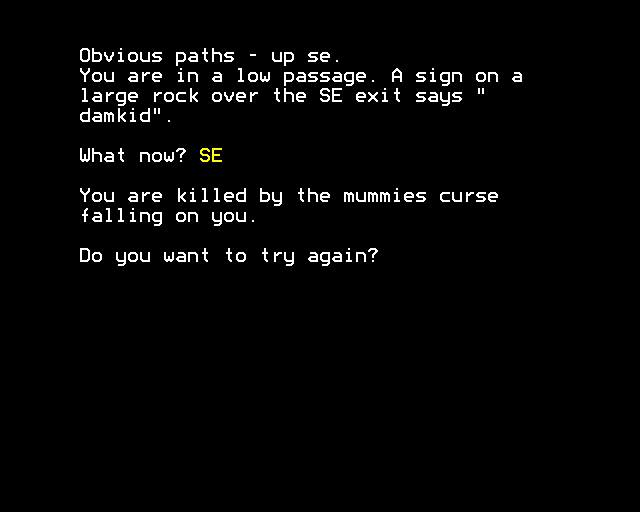
No trick here, just don’t go southeast.
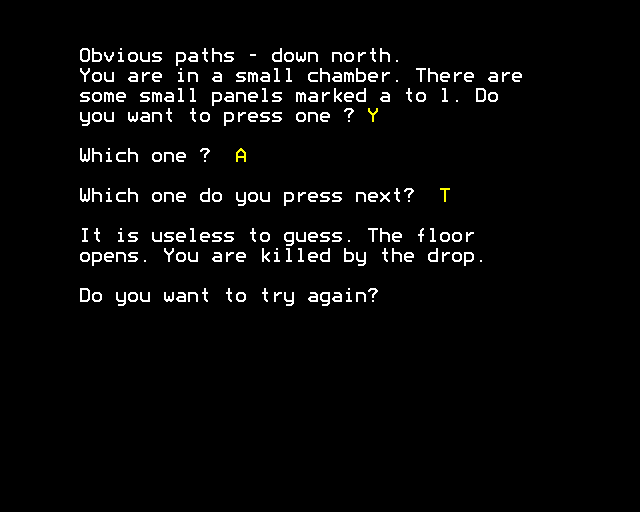
After two straightforward levels clearly meaning to match the geography of the pyramid, you get into a room with panels you need to push.
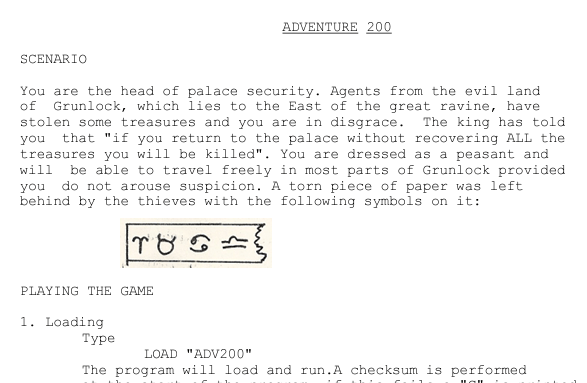
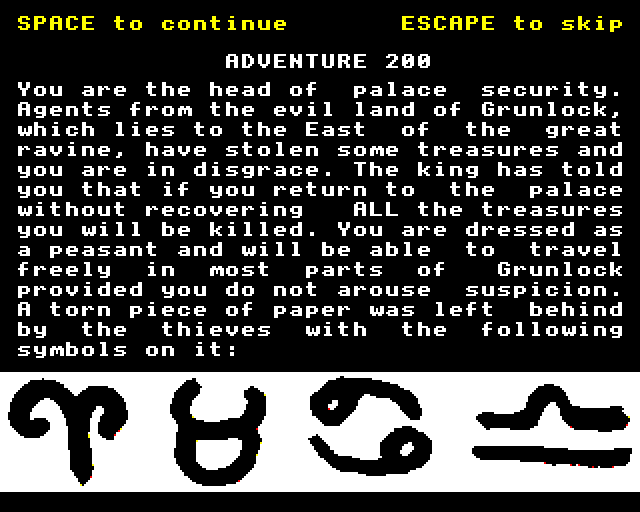
Remember those symbols from the torn paper? This is where they come into play.
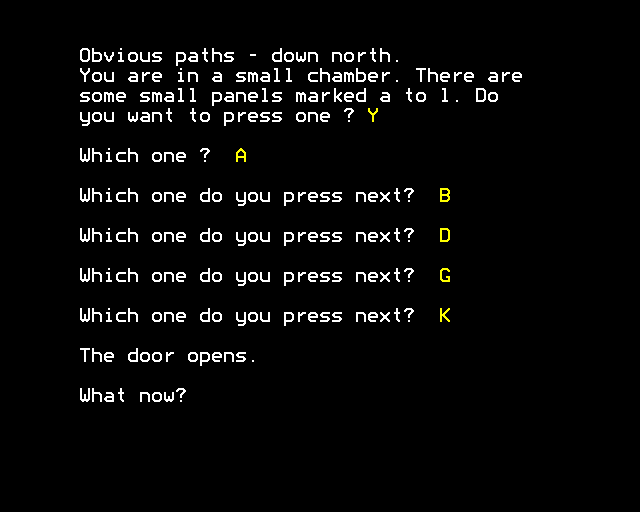
I confess I solved the puzzle, and then back-solved the clue’s relation. The game needs a five letter sequence. I got lucky and picked A as my first letter, then quickly found by just doing brute force that B needed to be the second letter and D the third. Giving it some thought I assumed sequence going on (1, 2, 4, 7, 11, etc.) with +1, +2, +3, +4 and so forth so I put G and then K as the letters and got through.
What happened is that the symbols are Zodiac signs, and they correspond to the first, second, fourth, and seventh months of the typical sequence (in letters, A, B, D, G). You’re still supposed to spot the sequence for the 5th letter so I guess I didn’t bypass the intended solution by too much.
The rest of the pyramid is a maze, and then a seal by a sleeping guard. I assume there is some thing that will cause the guard to wake up and kill you (the bird?) but I just grabbed the seal safely and left. The big trick is the water on the way back, and like the diamonds, this time you don’t get a chase from stealing the treasure.
Having resolved the pyramid I was able to deal with the dogs (as from my last post) using the side-route in the forest to evade them.
Then came the mace, which despite my glib dismissal last time, turned out — for purposes of escape — to be the most interesting treasure of all.
Now is when to cue the music.
So you can safely go into the mace-maze and grab the mace without trouble. However, as soon as you step out of the maze, the guard you stole from is awake.
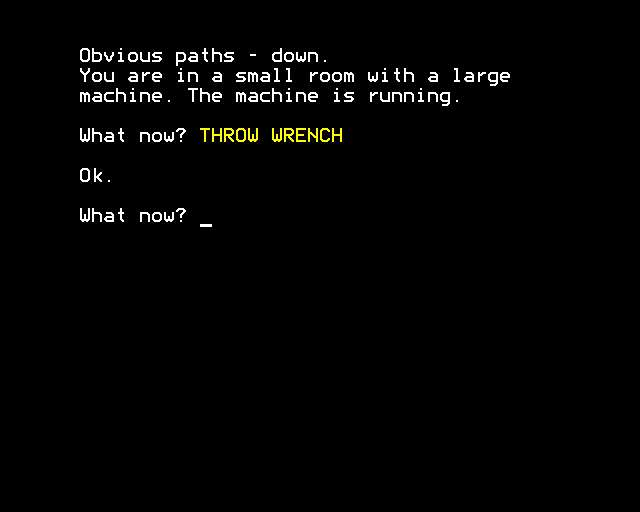
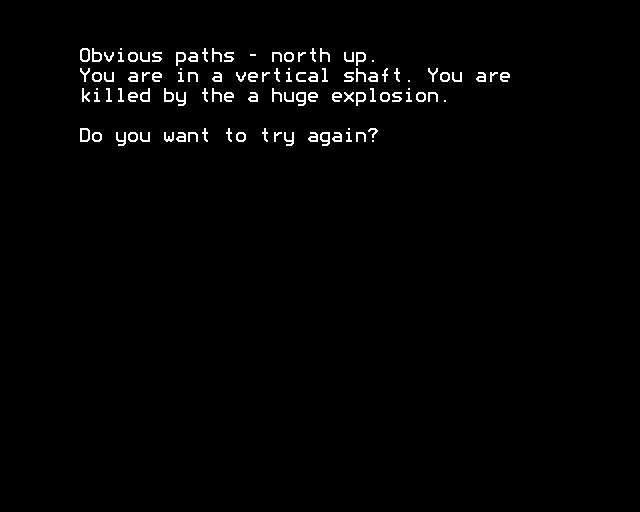
If you try to make a run for it you won’t make it. The guard gets you at the exit to the coal mine. However, keep in mind we had deactivated the dangerous-gas-cleaning mechanism by removing a wrench. There’s nothing stopping us from throwing the wrench back in.
Now, when we leave the mine, the whole thing blows up, including the guard chasing us, and we snatch our sunglasses mid-air and walk slowly away.
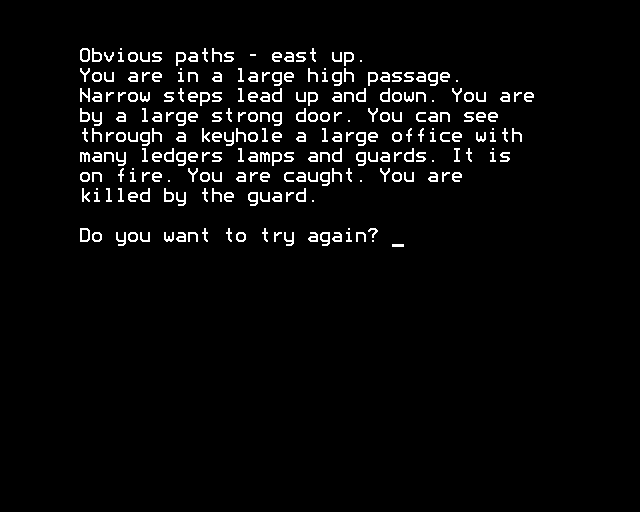
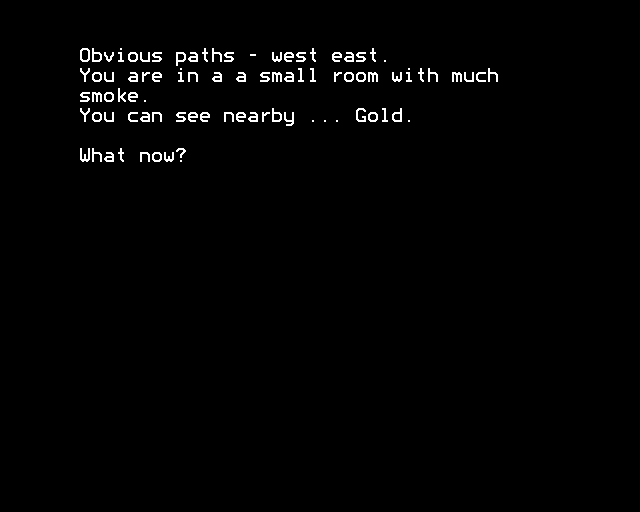
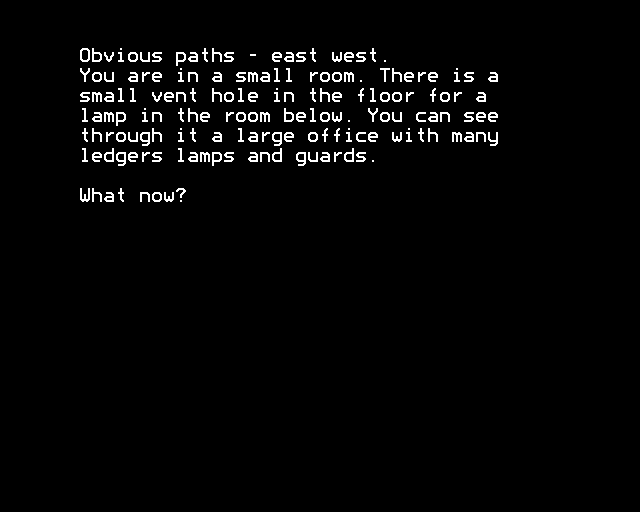
We still have the room of many guards to deal with, but our pyromaniac journey has not ended. Our jug is now empty of drinking water and we can go fill up with brandy, then return to the vent above the room. The room is described as having many lamps, and, well:
This results in absolute chaos and a lot of ways to die.
The main thing to observe here — which you can see from the screenshot above — is that the main office has keyholes, on both sides. Before you even start the fire going you lock the west side. Then you still have time to go into the east side and grab a treasure from there.
But if you just try to run away then, the guards catch you, so you also lock that door upon leaving too, leaving the guards completely trapped and crispy.
This gives you all the treasures: gold, diamonds, ring, seal, and mace. The mace is oversized (I think the rest can be hidden in our clothes, but not the mace), so that guard in the tower I was worried about spots it.
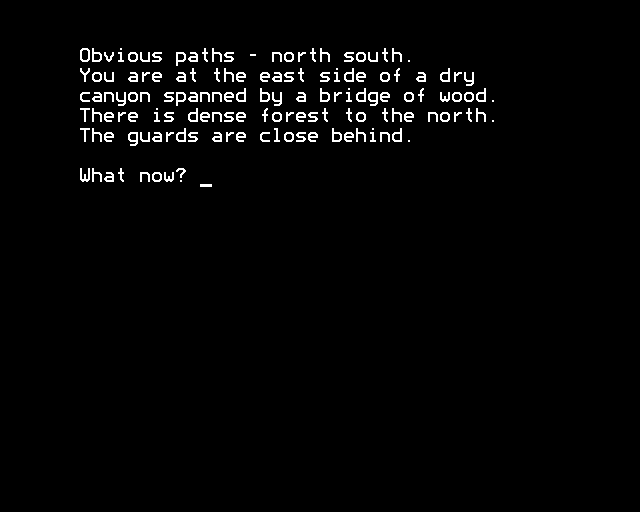
Now we’re on the run (if you hang out at the tower, the guard straight kills you). So you make a beeline to the west, but as you reach the wooden bridge there are guards right behind you.
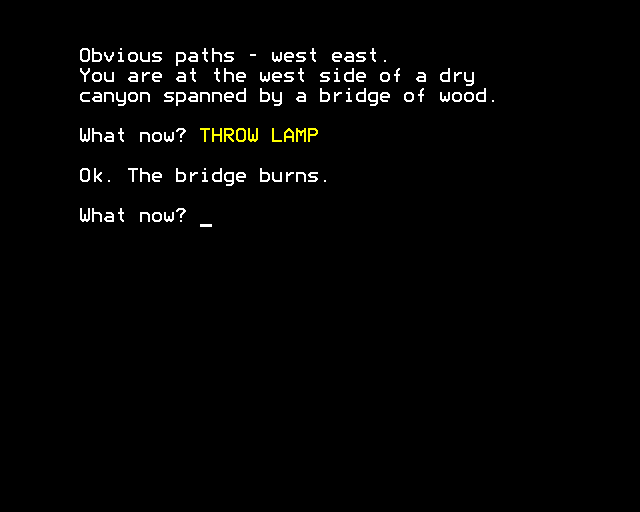
The … wooden bridge … can you guess what’s going to happen next?
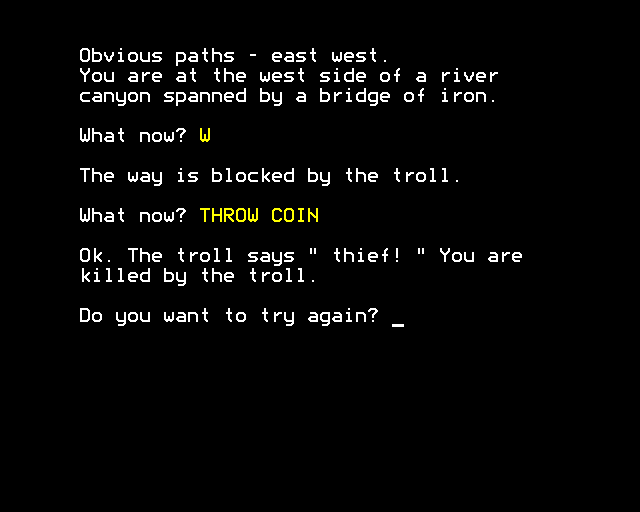
Fortunately this doesn’t destroy the lamp and we can pick it up again and still use it as a life source. Still making a run for it, there’s no troll visible on the east side of the bridge so we go across to the west side and die.
Oops! This turned out to be pretty hard and I had to check for hints. The problem here is that the troll spots your mace if you have it, and decides to just kill you and take it rather than deal with asking for a paltry offering. So you cannot take the mace across the bridge. What to do?
Back near the very beginning, we found the jug at a “narrow dry canyon” that was blocked by rubble. It turns out on the east side of the canyon you can find the matching room that goes with above the same room!
Now after crossing the bridge we can just retrieve the mace from the other side. But the troll still wants a treasure.
That jug we’ve been carrying around smashes if we try to drop it. Now we want to drop it, because it makes crystals that the troll likes (fortunately for my momentum in the game, I had figured this out before this moment, the troll killing us because of the mace was the hard part).
With all five treasures we can finally arrive back home in victory.
OK you can stop the music if you want.
Yeah. Phew. That was some elaborate sequencing. The author really took the idea of “easy to get in, tough to get out” and managed to run with it. I find this game violated most of my general rules for complex puzzles. Namely, that without timer daemons or player status effects, they tend to require either hard-to-find verbs or things hidden in obscure ways. This game had neither, but rather had complex location effects.
That is, consider the moment where the guards are chasing at the wooden bridge. There’s technically no timer running. When you try to move on, the game checks if you’ve burned the bridge, and if not, it kills you. This almost plays a little bit like “drama time” (a game like Colonel’s Bequest where some events wait for you to be physically present before they happen) because the verb list is so short there isn’t strong motivation to hang around in a particular location, so it feels natural to have time move forward along with movement.
In the desert, where you’re thirsty, you can do as many commands within an individual room as you like without getting thirstier; it is only moving to another desert room that increases the thirst. (Other than the digging, it isn’t like the time is proportional. If you think about it, a lot of text adventures that have effect X trigger in five turns can be a little nonsensical, as running down a long hall is considered the same amount of time as examining five things.)
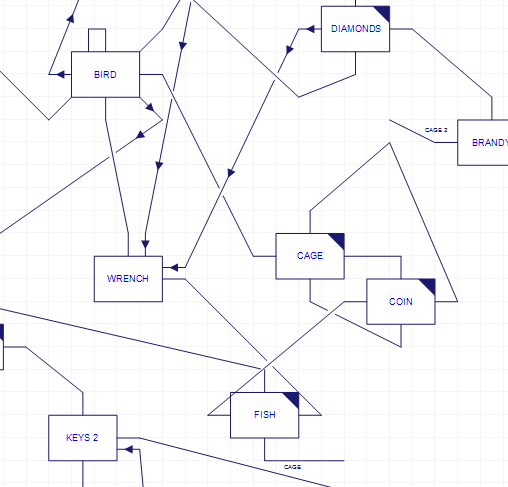
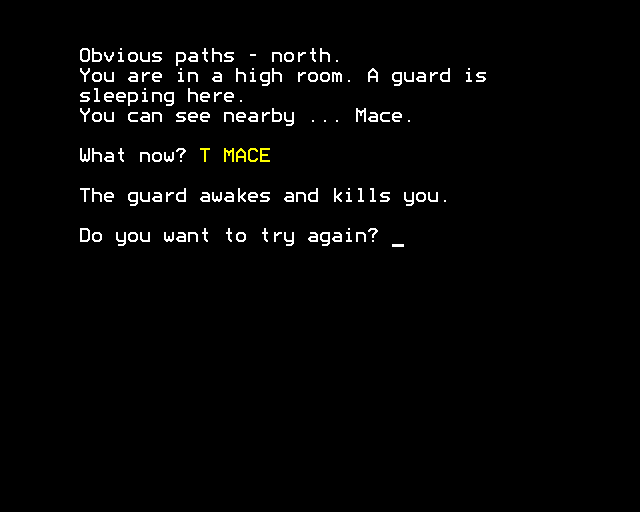
One other game design wrinkle is the use of a technique which is not recommended at all for a modern game, but nonetheless gets a unique effect. (See: the text version of Cranston Manor compared with the graphical one, where the maze-like town opening led to a much greater sense of place, but it was still an awful maze.) Here, there’s some “hidden effects” where the game is willing to silently check if you have a particular item. For example, the guard at the diamonds wakes up if you have the bird. The game doesn’t even tell you why the guard woke up, so it leads to a strong paranoia where you are thinking not only about what items you should be carrying but what items you should not be carrying. This adds a second combinatorial level of puzzle complexity, but — well, it really is also genuinely unfair.
The mace/troll puzzle at the end particularly hit this hard. The behavior of the troll changing was non-obvious enough I was concerned I had hit a genuine bug. On the other hand, it is a.) logical the troll would change behavior if they see you with the massive treasure and b.) logical they would just spring up on you unawares. Working this out the “normal” way requires a lateral leap that isn’t really achievable any other way. Yet, I would personally never include the puzzle as-is in a modern game design. (It also isn’t 100% clear from the geography that the canyon edge you throw the mace at is the same canyon on the other side, it would have been a better puzzle had the geography been rigorous enough — that is, where distances are clear and exact — to allow seeing this naturally.)
Despite all that (and the endless mazes) this ended up being one of my highlights of 1982, if nothing else for the technical high-wire act. The author C.J. Coombs was clearly running up against the edge of what was possible (with only enough space, for example, to casually describe a room of guards being set on fire in a few words) so I had extra anticipation seeing just how complex he could take things with such simple foundations.
Coming up next: Il est un peu plus de 21 heures, la nuit est noire … BONNE CHANCE!
I’m as puzzled as you are and any speculations on what the picture is meant to depict are welcome.
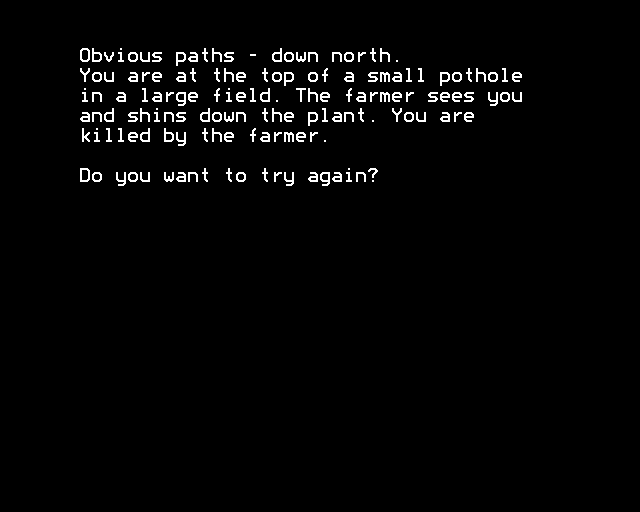
One of the puzzles I left off on last time involved a farmer very, very, upset at our theft of a spade.
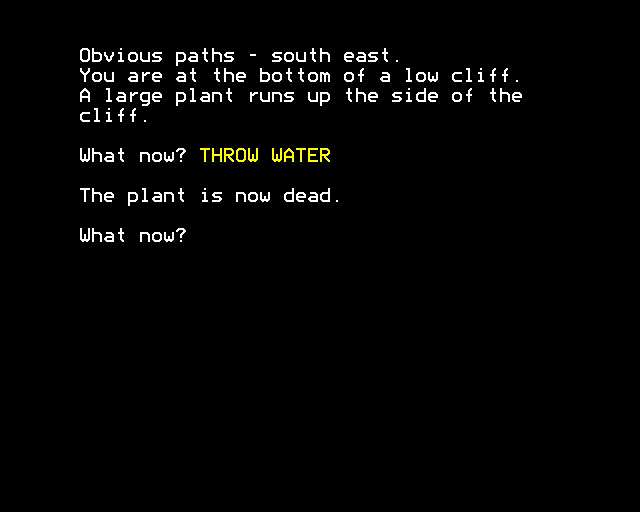
K speculated about chopping down the plant, which didn’t work. However, nearby there’s a “beach section” which has some brandy, and I tried refilling the jug with that and tossing to no effect. It was rather later that I realized that the beach also has access to a completely different kind of water which might be hurtful rather than helpful.
I like how the saltwater is still “water” but it has an opposite effect.
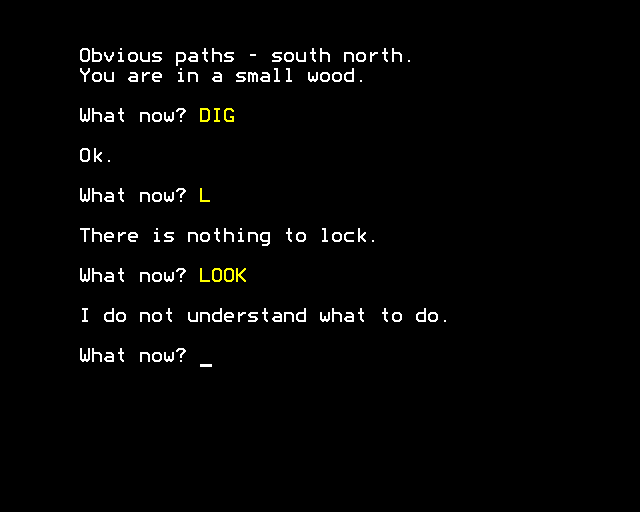
After killing the plant it was safe to tote the spade away. I fortunately zeroed in fairly quickly on a good place to take it, as there was a “flower” in a “small wood” which seemed like it could have other plants.
The game’s weird lack of feedback here is hiding the fact I dug up some garlic.
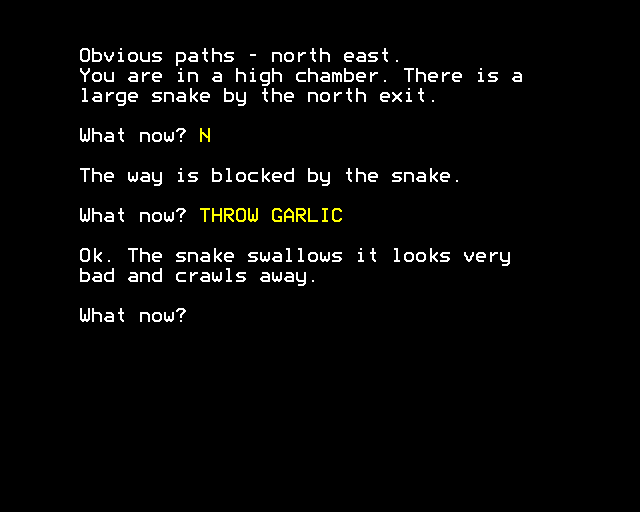
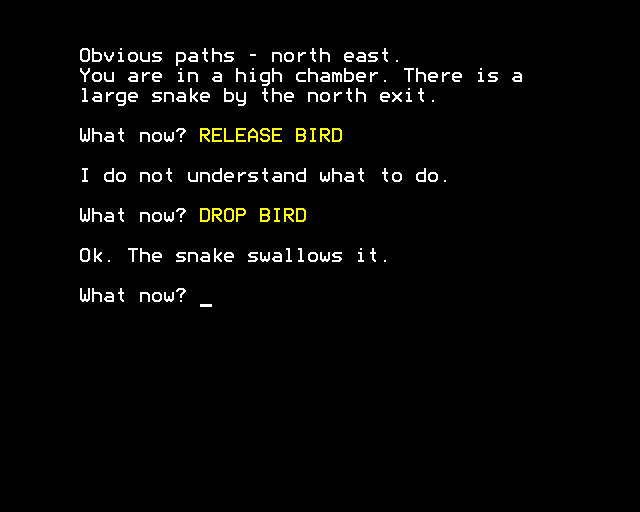
One of the other things I had been experimenting with is the snake; since I knew it ate the bird, I tried poisoning various things and essentially chucking my entire inventory to see what would happen. Behold:
This leads to a “maze” which is just a single room that goes nowhere. Hmmm.
I rewound a bit and kept the garlic in case that was a softlock. Fortunately, there’s a bit later garlic is quite obviously helpful, so I guess it was. (One of the common themes in the game is having bits of the map change in their nature, so I can’t say the snake is entirely useless to deal with. Maybe, even, on the final escape from the kingdom, the snake will be moved as guard duty, and we’ll have needed to take it out earlier, and the room behind it is unneeded.)
Both Voltgloss and K also sharply observed how the dust covered bird is like the “canary in the coal mine”, and I should try taking it back with me to the maze to see what happened. I tried to do so and … nothing happened. By nothing I mean no explosions. I briefly thought perhaps the bird was preventing them somehow (??). A brief show of what going boom looks like:
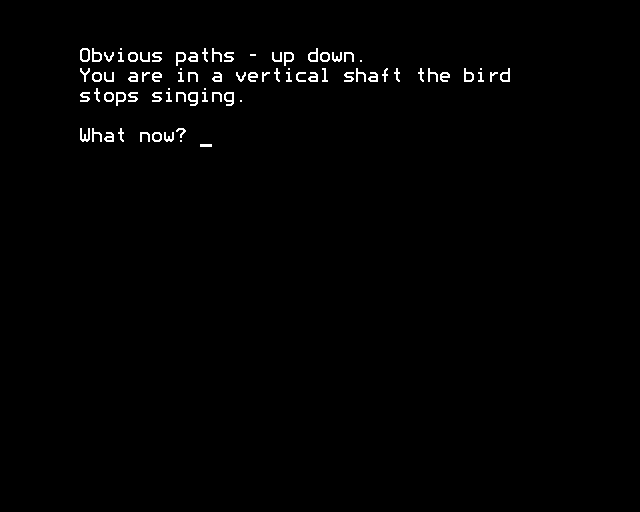
On a later run (I was experimenting with a few things) I tried to go in again with the bird and found this time an entirely different reaction. Sometimes it would sing, and sometimes it would stop singing.
In the “stop singing” rooms, those are the places where most or all of the exits are deadly. After some more puzzling, I realized the only thing significant that changed between the runs is in one I had nabbed the wrench from the broken machine, and in the other I didn’t. Going back in the broken machine room after taking the wrench along served to clarify: the machine (I assume pumping out the dangerous gases) starts working again once you take the wrench.
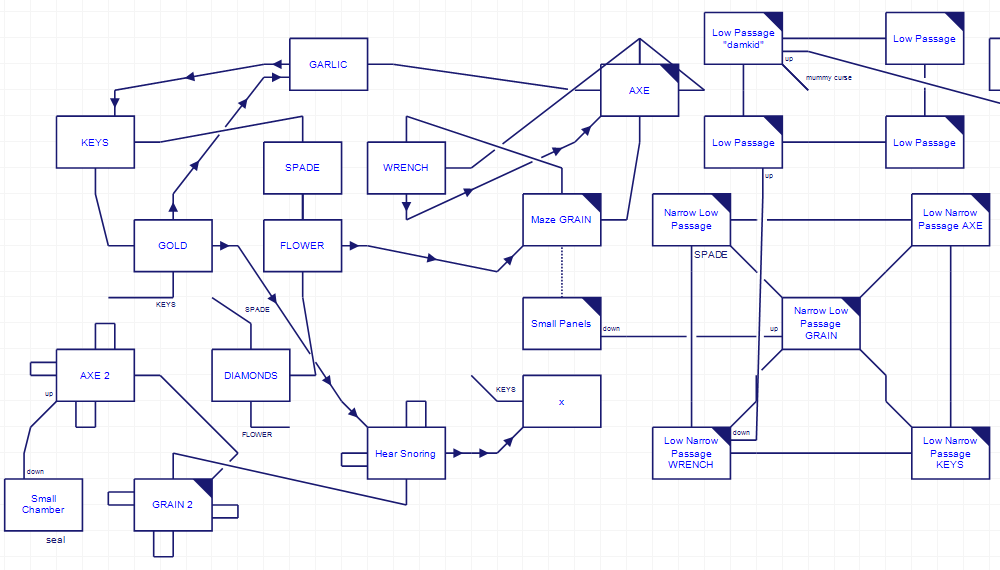
With that cleared up, I went back over all the rooms that killed me before to look for exits, and I found an entirely new area, in fact multiple new areas. Here’s a meta-map:
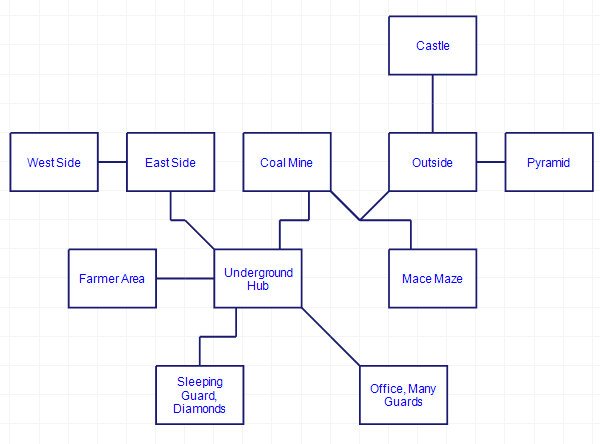
To be clear, this is meant to show the interconnectivity of the various regions, and isn’t exact about directions. Once getting by the coal maze you get into a “mace maze”, a small outdoors section, a castle, and a pyramid. (Well, theoretically a pyramid. I haven’t solved that part yet, but I have dealt with the others.)
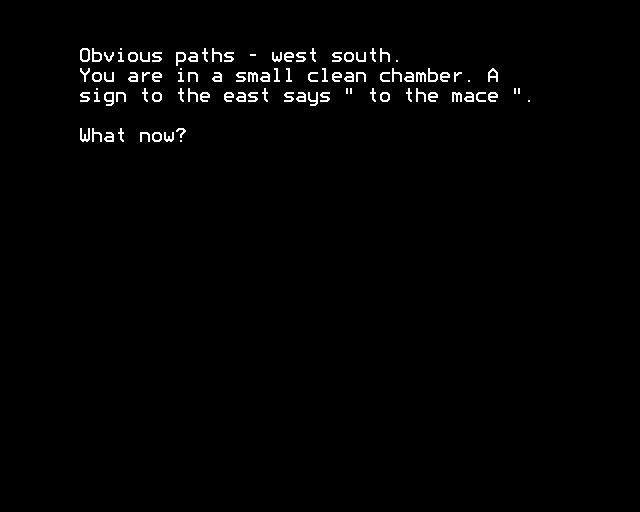
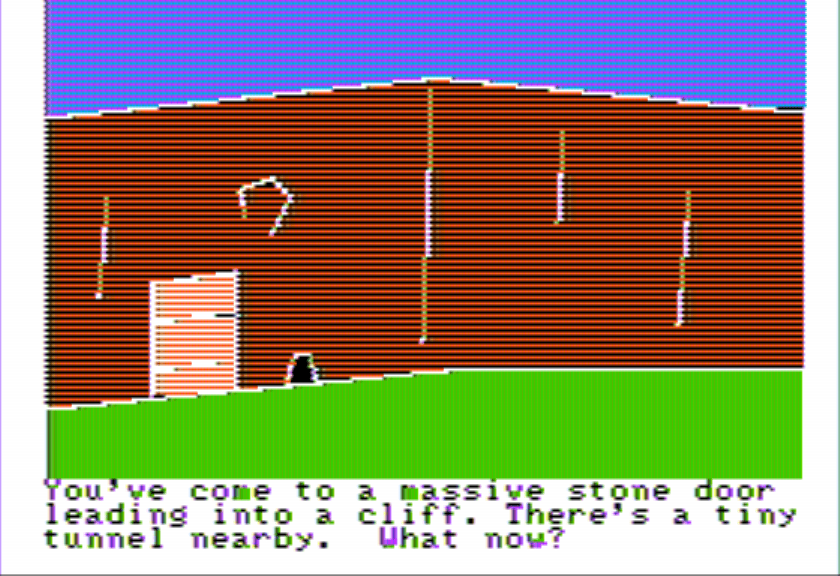
The mace maze is prefaced by a room with a simple sign.
The maze itself is a nightmare. Remember what I said about maybe the author not being interested in mazes? They’re interested, they just saved the pain for this section.
I confess, after realizing there was zero gimmick and I just needed to not only drop objects in rooms but tote them along to places farther in the maze (because I didn’t have enough objects for every single place) that I just looked up the route. I’ll suffer for your entertainment if it seems necessary but there just was no new point being made here.
I’m not entirely sure what causes the guard of the mace to wake up, but a second visit with a minimal inventory allowed me to grab the mace safely.
For the pyramid, well, it’s in a desert, and I die of thirst. That’s even having water being toted along in a jug. I’m wondering if I can somehow scrounge a second container.
As far as I’ve gotten. One more step kills.
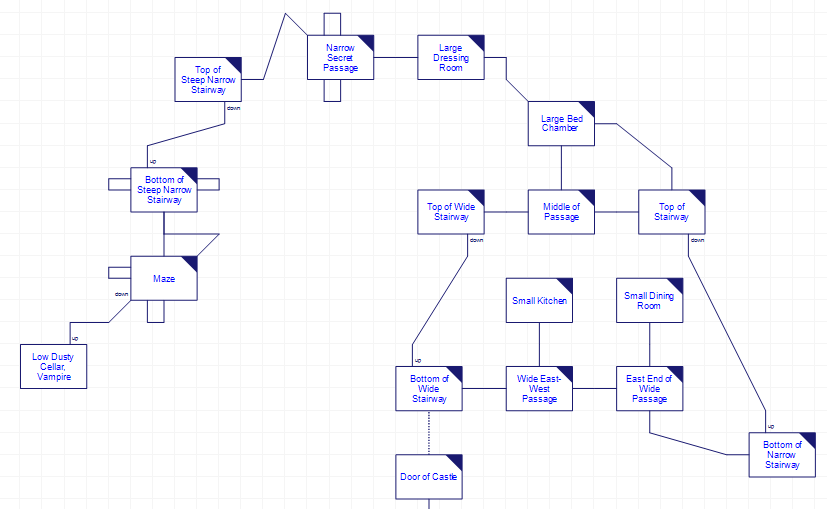
The castle I’ve been able to both tackle and (probably) finish.
That’s because the castle seems to be almost entirely abandoned.
There’s at least a semi-logical reason, because if you follow the path all the way through, you reach a vampire.
If you’re holding a garlic (I told you it was obvious) you can enter safely, and retrieve a ring, I presume one of the treasures we’re trying to rescue. However, now the game’s theme kicks in. We aren’t in the clear yet.
Ominous! But this isn’t a timed thing, rather there are two locations where the dogs can show up. One is if you try to head east to the Pyramid.
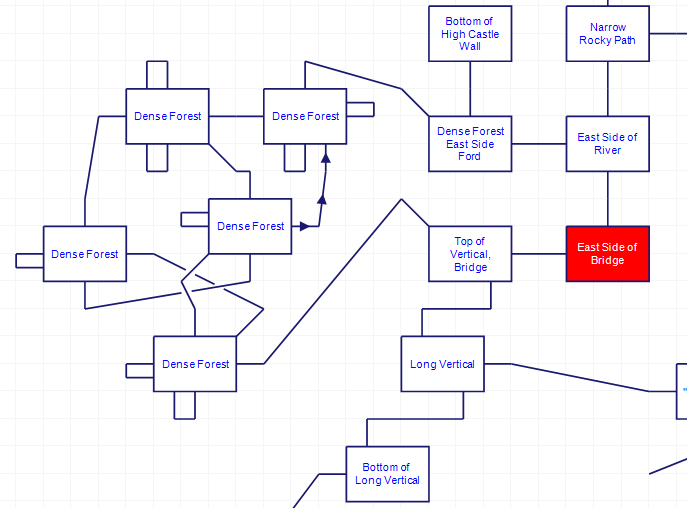
The other is if you try to head south to the bridge and get back to the mine. Fortunately, you can use another semi-maze section and pass through a forest the long way to evade the dogs.
(The red spot is death, but the Dense Forest lets you take the long way around.)
The bad thing is that having the ring means the pyramid is now closed off. So that’s another softlock. At least in this case the treasures need to be gathered in a particular sequence.
I do suspect (just based on my room count) I’m starting to close in on the ending. I need to work out how to make it in the pyramid, drive off the people in the room under heavy guard, and then somehow make it out safely with all the treasures. I have a suspicion the last task will be the most difficult.
So, despite this game doing heavy borrowing from Crowther/Woods Adventure (troll at bridge, plant you water to make big, giant snake) it manages to pull a very interesting high concept. It gets somewhat hinted at in the manual:
It is best to explore well before attempting to take anything back as this often raises the alarm and causes you no end of trouble as various people chase you. THERE ARE NO RANDOM FACTORS – if you are killed you did something to cause it – there will be a sensible explanation and a solution.
Remember, the premise is that we are entering an “enemy kingdom” in disguise to retrieve the treasures. This means there are parts of the game that are easy to get in, but hard to get out. In other words, this is as if rather than just being in the classic adventure genre, this is a heist.
I’ll give some examples along the way. Let’s tour the evil land of Grunlock:
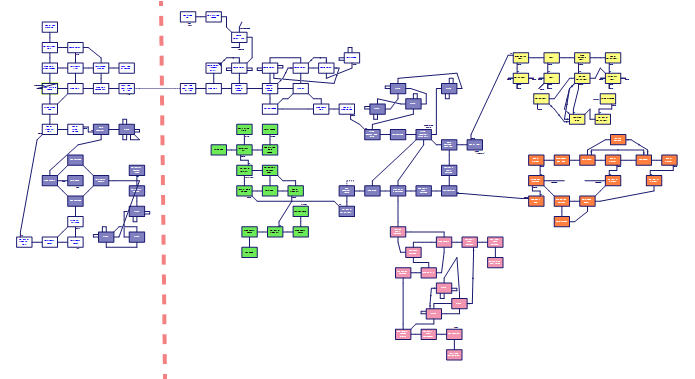
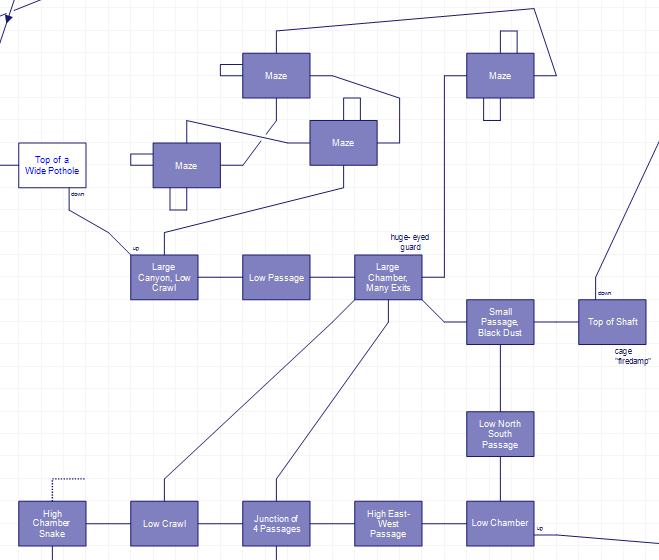
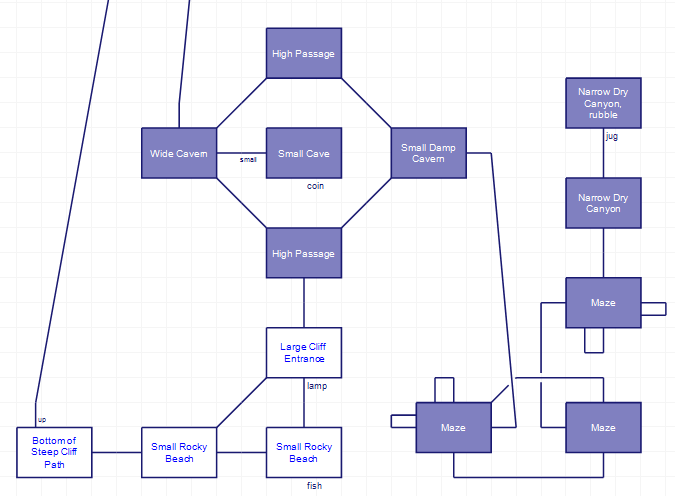
My map so far. Based on room count I’ve only seen half of them. The boundary between the kingdoms is marked with a red dotted line.
I count six areas in the eastern section (this is kind of arbitrary, but it makes sense somewhat). First off is the above-ground portion, the first part reached:
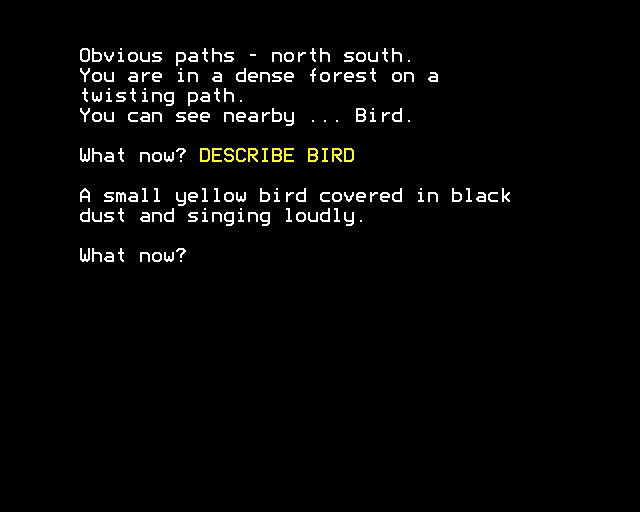
Most of this area is “dense forest”, although there’s a canyon crossed by a wooden bridge that seems ominous (it isn’t an obstacle, but I could easily see something causing it to burn/collapse if our adventures go awry). There’s also a classic Adventure bird:
DESCRIBE is the game’s version of EXAMINE. This is the first game since Journey I think we’ve had where DESCRIBE stands in for EXAMINE. It can be shortened to DE.
There’s also a small building, although it is not the Adventure Special.
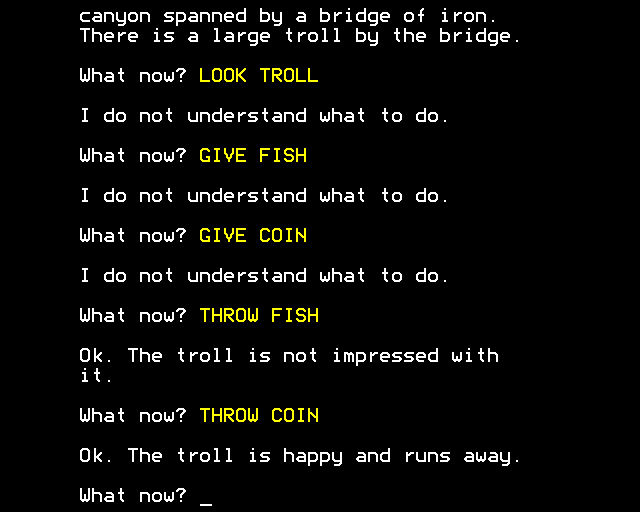
This is where the troll lives. That’s the same coin that we tossed him before crossing the bridge, and if we try to go back, and use the coin for a toll, he kills us.
This is very similar to how you can throw the eggs and reclaim them via magic in original Adventure — the troll will be mad we frustrated the toll. I’m wondering if this moment is how the author got the conceptual theming I was talking about earlier.
(The upshot is I don’t think I’ve softlocked the game by tossing the coin earlier in the game to the troll, but there needs to be some trickery in order to get back over the river. Still, maybe there’s a sneaky way to get from the west to the east side in a one-way fashion, and the coin gets used on the way back? Since we found the coin on the west side, not in the evil kingdom, I don’t think it counts as one of the stolen treasures.)
Other than that there’s a flower (“A small white flower with a strong smell”) and a “pothole” to go down deeper.
These are mostly straightforward junctions and passages, except for the “huge eyed guard” which you have to go by to go in or out. The guard does not react … yet.
This will mostly definitely be a problem later.
There’s also a classic “snake blocking a door” that looks like the one from Adventure.
I should also point out there’s another one of the odd “maze” sections the game has been putting in. Rather than the game putting one big tough maze to map, there’s just been little ones.
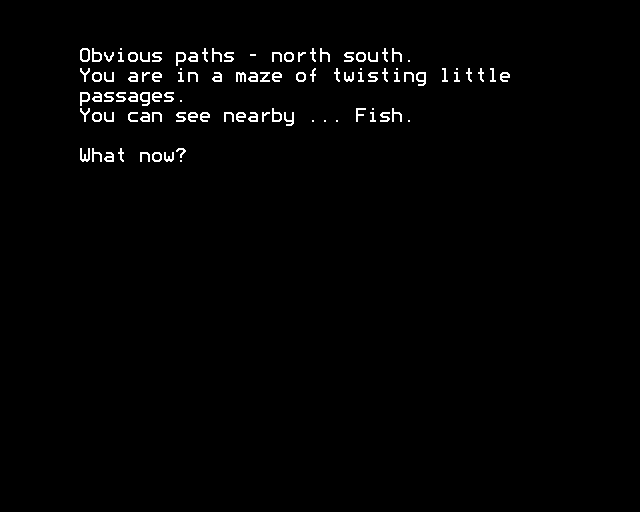
Using a Fish to map things out. Incidentally, if you take the fish from its original spot it gets described as a “dead fish”, which suggests another way I may have already softlocked the game.
Moving on to an area with a spring where I have solved a genuine puzzle:
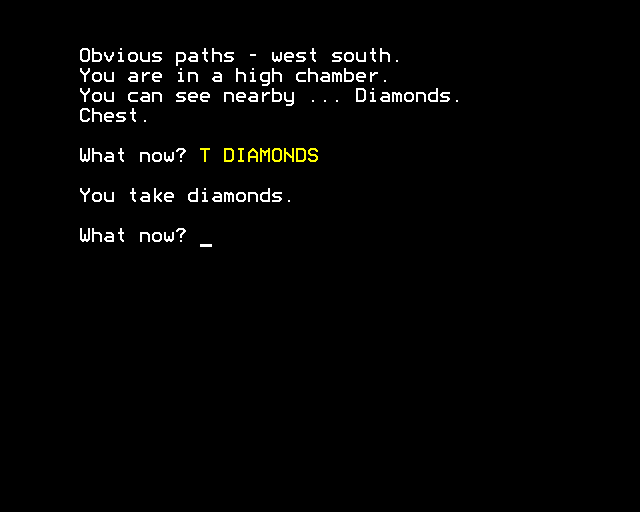
Other than the spring (where you can load up on water, although that’s true a couple places) the useful part is past a sleeping guard, where there’s a chest.
I am proud to say I nailed this puzzle first time.
Specifically, I locked the chest back again, then ran to the south where there’s a room that’s otherwise empty and not useful. Then, after the guard had left, I was able to scarf away with the diamonds, this time without making any noise.
Heist complete! The diamonds don’t attract the attention of the “huge eyed guard” incidentally, so it isn’t just holding a treasure that activates them.
Off to the northeast, there’s a small genuine maze.
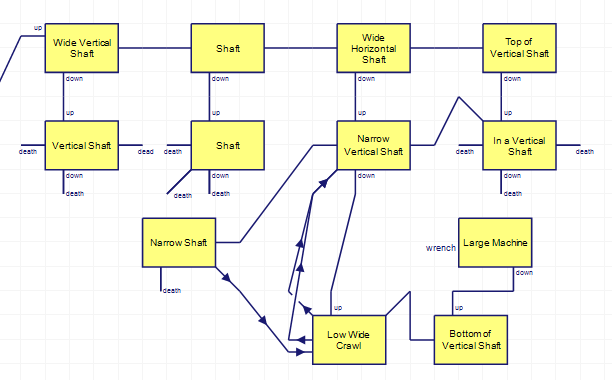
Specifically, you’re in an area with “shafts” where some of the exits explode and kill you. This seems to be consistent and just a matter of mapping things out.
You get a wrench at the end (by a non-functional machine which the game doesn’t let you noodle with), so maybe that’s it.
Going to the southeast, there’s a “kitchen” a “dining room”, and a room with a lot of guards.
You can make your way around and above the room itself. I have a feeling I’m supposed to drop something in on them that will cause them either to run away or pass out.
The last section I’ll call the “farmer area”.
There’s the classic plant you need to water to get higher, where you can find a grainery (where you can safely grab the grain) and a small building (which is locked, and has a spade). If you try to get away with the spade, though, you get stopped at the “Top of Small Pothole” room.
The spade enables the verb DIG which I’m sure will be necessary somewhere, but isn’t helpful anywhere in the farmer area.
With the grain absconded with you can go back and feed the bird way back in the dense forest area and capture it in a cage.
Then you can take it to the snake, where you might expect it to chase the snake away.
Sorry, it isn’t going to be that easy!
I have some theories to test and things to prod at, but I’m fairly confident I’ve got this set of areas thoroughly mapped. Other than the snake I need to deal with the guard room and the farmer, so it doesn’t seem like a lot of hanging obstacles; there may also be obstacles (the wooden bridge, the guard in the tower) I just haven’t activated yet.
One last thing to mention: I did go through my standard verb list looking to see what the game understands.
This is an extremely small list. In may in fact be a record for a game that has a parser and no USE command. Just DIG, DRINK, LIGHT, THROW, LOCK, UNLOCK. I guess in some sense that’s all you need? For watering a plant, that’s throw. I assume you attack with the axe with throw as well. No need for OPEN when anything that needs opening is locked. It’s fascinating that there’s some very complicated depths upcoming using such simple communication (not even USE covering for the lack of verbs!)
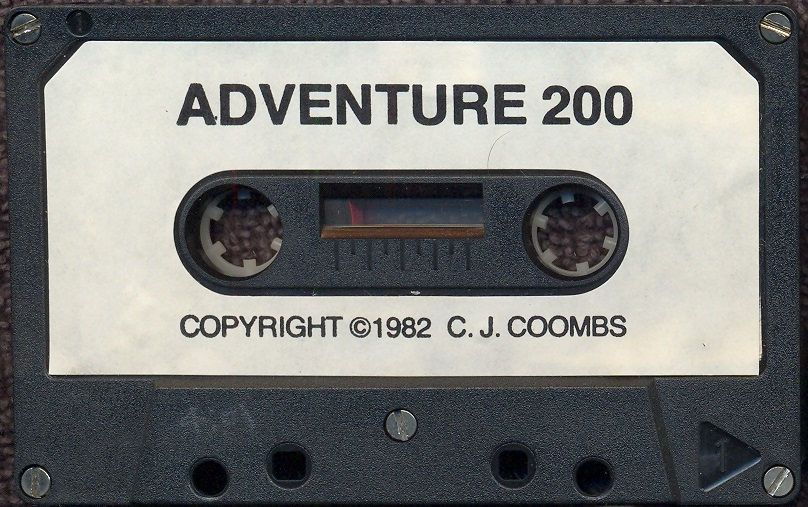
Normally on this blog when we’ve seen the word “adventure” followed by a number, it is meant to designate one of the many modifications of Crowther/Woods Adventure, like Adventure 448. That’s not the case here. The author wanted to brag about the number of rooms. They might even be right to brag.
Yate, near Bristol, where today’s company comes from.
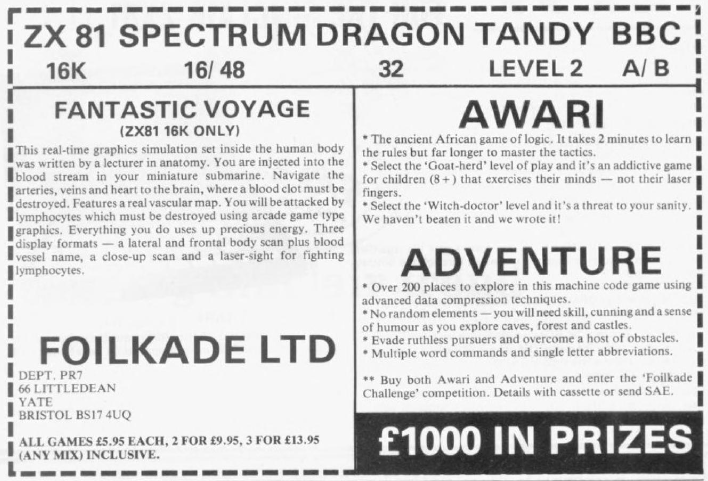
But to back up: this involves yet another one of those flash-in-the-pan UK companies founded around 1982, in this case a company named Foilkade Ltd., which seems to be by all evidence run solely by one person, C.J. Coombs. Starting in the December 1982 issue of Sinclair User, they advertised three games, Fantastic Voyage, Awari and Adventure 200, with a tack-on to the contest craze: an award for the first person who gives a correct solution to both Awari and Adventure.
I don’t know what a correct solution to the board game Awari would be like (maybe the game is completely non-random, so a procedure that beats the highest difficulty would work every time? isn’t that a game flaw?) Adventure is mentioned as having “over 200 places to explore in this machine code game using advanced data compression technique” and honestly, it really is impressive: we’re talking 16K of capacity, the same amount of space Scott Adams had to work with. (Also, the actual number according to the BBC Micro intro is 230 rooms.)
It wasn’t that silly to point to number of rooms as a metric in 1982, as while Level 9 managed dense worlds as well, it was hard technically for authors to provide the mainframe experience of a “world to get lost in” on the smaller machines.
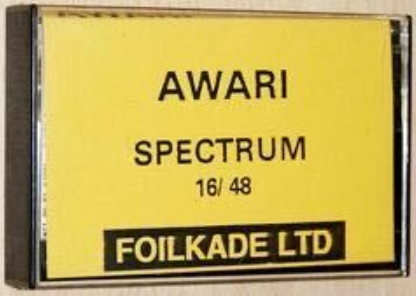
I never found a picture of the Adventure 200 case, but I think this Awari case is pretty indicative of the look. Via Pricecharting.
Despite some heavy advertising throughout 1983 (and decently positive mentions, like here in the book Sinclair QL Adventures) they poofed from history after that point. At least we can enjoy this one shot into the sands of history by Coombs.
At the very least, this one is allegedly long and complicated; Exemptus from CASA calls it “surprisingly vast and difficult” and there’s even a letter from a 1984 issue of Micro Adventurer which states roughly the same, as “Irene Feeney, of Basildon in Essex” gives an open offer for help for anyone sending a self-addressed envelope.
I’m playing on BBC Micro which has enough capacity to stuff the intro material without needing an extra instruction sheet. The premise is that all the treasures of your kingdom have been stolen and you are tasked with finding them while incognito. The only clue left behind is set of four symbols shown. I don’t know if this is meant to be Crowther/Woods style with gathering treasures from multiple rooms and this is just a creative way to kick things off, or if the treasures are realistically stored in a thieves’ hideout we need to infiltrate (like how Dragon Adventure only had treasure in the dragon’s lair). The “ALL the treasures” warning suggests the former to me.
You start just outside the palace, and going west kills you if you don’t have the treasures. I don’t think we’re using a trophy case room this time.
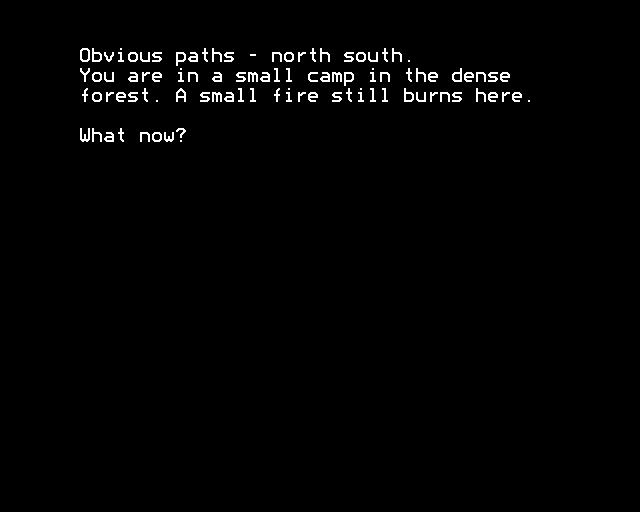
The thing that threw me most early off was the way exits are displayed. I’ve never seen this behavior before. Each room will always list a maximum of two exits as “obvious”. However, this is a perfectly regular map where rooms can most definitely have more than two exits. The campfire screenshot above only has exits north and south listed, but you can also go east and west. I only discovered this by arriving from the west, thinking it was odd for an open forest to have a one-way route, and tested going back even though it wasn’t listed as an exit.
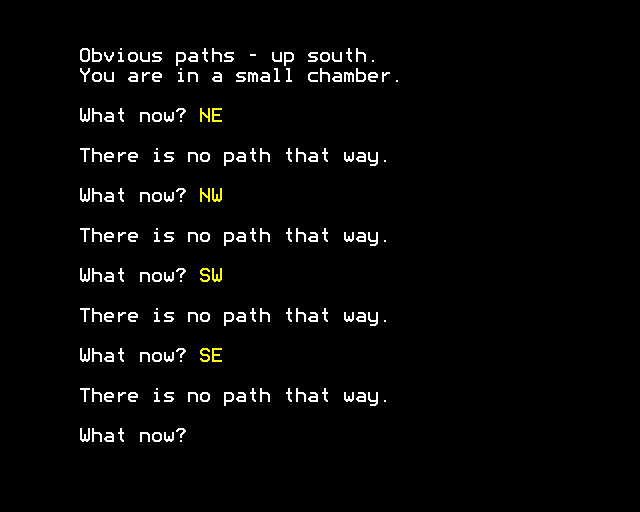
The upshot is, when making the map (first part above) I have to test every single exit in every single room. I’ve certainly had games like this before, but it is quite odd on a game that has a mechanism for listing exits. I’m not “working from scratch” at least, and in rooms which really do only have two exits, it makes things much faster since I can just plow through typing NW / N / NE etc. getting “There is no path that way” messages. Where path-searching is slow is when you find an exit, and then have to add it in, and go back to the original room and keep looking — but which exits did you already test? are you sure? better check all of them over again.
There’s one room in the early area that gives a “landscape view”. This is surprisingly common in early text adventures and I probably should give this sort of room an official moniker. Island Adventure had a tree you could climb to see there was a cave past a river. This kind of room gives a preview of what the journey of the game will be like.
I also wonder if the symbols given at the start just represent the “biome journey” we need to take through the game.
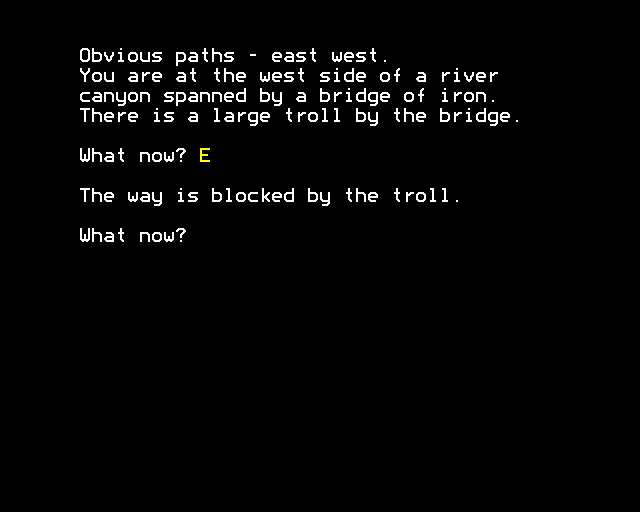
The only real item outside you find early is an axe and the only real obstacle is a straightforward troll. No talking or anything, all business.
To satisfy the troll, you need an item from underground. Underground isn’t a large area, or at least not yet.
You need the lamp (conveniently at the mouth of the cave) to provide light to explore, but it requires a light source. Fortunately, that campfire I gave a screenshot of earlier works. (It is important to note this moment, as it means the game isn’t purely about doing actions on objects listed as separate from the “main text”, so I need to pay attention to room descriptions.)
The mazes are particularly curious. It almost felt like the even the author didn’t like mapping mazes but only included some rooms out of obligation.
One exit is described as too small for you to squeeze through, so you need to drop your items except your lamp (this technically counts as a puzzle, I guess) to find a coin within.
Other than that, there’s a fish and a jug lying around, and the jug breaks if you drop it. Not too exciting yet.
With the troll satisfied, this leads to a large landscape, one I haven’t fully mapped out yet, so I’ll save it for next time. I will say if this is truly in the “nightmarishly hard” category of works like Acheton the author clearly is trying for the slow-burn approach, and building with easier puzzles until giving harder ones. (Like, y’know, a normal modern game designer.) Of course maybe I already softlocked the game giving away the coin (could it be one of the treasures?) and I’ve already fallen into the author’s trap. We’ll see!
One of the places I found searching in the lands beyond the troll.
I’ve finished and it was a near thing; I was on the verge of ragequitting for reasons you’ll see in a moment.
Zoomed-in view of the cover.
So, last time I left off I implied I was in for a grind, insofar as the way the middle part of the game works is
a.) find a palace [or turn around at the one you were just at and land again]
b.) find three clues that open secret doors and lead to a the “final room” that lets you charge your ornithopter up using the spell ENCHANT
c.) get any items along the way and USE MAGIC DETECT on them to find the ones that are spells, giving them to the wizards in your party
I’m not going to give all the spell effects, but I will give the names: invisibility, extinguish, reflector, sleep, freeze, ball of fire, jump, flame sword, shrink, spider climb, penetration, part waters, teleport, levitation, rope trick. That’s fifteen spells you need, and if you explore thoroughly enough I think you find six of them on a given run? However, they are a completely randomly chosen six, so if you’re trying to get a full set of spells (as the manual implies you’ll need in the final section of Atlantis) you have the experience akin to open Pokemon deck after Pokemon deck trying to find a shiny Growlithe and failing.
I played through, I am not kidding, 30 times. It started to get very repetitive. It didn’t help at the beginning that I was missing one of my search tools: a command that works, in addition to LOOK ITEM and MOVE ITEM, is LOOK UNDER. Not LOOK UNDER (ITEM), just the phrase LOOK UNDER. I missed it somehow perusing the manual but sometimes that’s how something you need is hidden.
This is just from LOOK, but MOVE and LOOK UNDER are equally likely to find something. The cage is totally useless.
I started to get a pretty good sense of the generation plan the game uses. The game starts with Entrance-Library-Ballroom-Reception, with a clue 1 in one of the rooms, which opens a secret from there. The new section has a clue 2 somewhere in the first couple rooms.
Once entering the last new secret area, there’s a clue 3 again in the first few rooms, and that clue will go to a “Grand Hall”, “Pillared Hall”, or “Windowed Hall”, all which are connected together in some way.
The riddles are all pretty straightforward as long as familiar with a little Western mythology, like “MONSTER WITH ONE EYE” (CYCLOPS) and “A WOODEN HORSE ENDED IT” (TROJAN, referring to the war, not TROY). The rotated-alphabet translated just served to add an extra level of annoyance after about the 4th iteration of the map.
In the midst of all this, you can have people fall in pits or under rubble (use rope or a shovel) some “trogs” which you have to keep shooting (if you turned your “reflex” score up at the start of the game, although I it set to 0 so I could actually ignore them) and enemy warlocks, which were the most annoying of all:
Just like the first part of the game, you can OFFER SPELLNAME to make them happy, but if they refuse your offer, you’ll get in a wizard duel. Then you choose a wizard and a spell to cast, and there’s whole table the game refers to:
I think the intent was to create maybe a rock-paper-scissors sort of game; if you choose EXTINGUISH and they choose to cast a fireball, the attack is canceled. But unless the warlock gets bored (random, sometimes they’ll just let off) that just leads to another round, and there doesn’t really seem to be any real strategy involved, just RNG. I ended up just using save states a lot and restoring if I had an unfriendly wizard so I didn’t have to deal with the duels. I think the one-shot nature of the duels is the main problem; there’s no real accumulation of action that happens that leads to interesting strategic choices.
None of that compares to the fact that I just. could not. get. the last. spells.
Over and over and over and over and over and over and over and over … look, grinding in an RPG I can sometimes find sort of soothing, but this isn’t like that. It is like I had to type the same walkthrough 30 times in a row, except some mild elements were jumbled so I couldn’t even do it on autopilot and also I had to keep saving my game just in case one my wizards got killed and I lost a bunch of my precious spells I was accumulating.
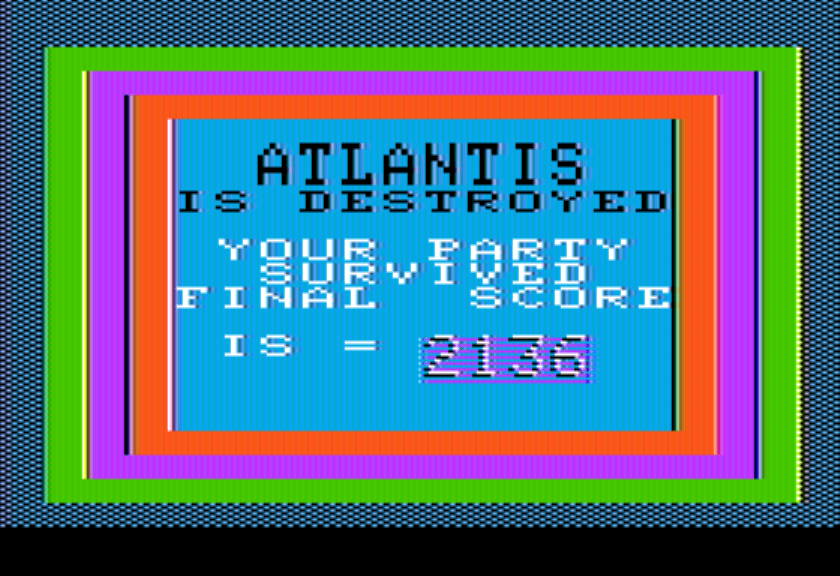
I never did find the spell Shrink. I took the gamble that maybe — due to the random nature of the game — I didn’t really need all the spells, and fortunately I was right. I took off, flew northeast long enough, and eventually found Atlantis.
Now the game enters yet another completely different mode. This is a maze where the walls are invisible, and you have to keep using GO DIRECTION in order to search around.
At various spots in the maze you are blocked by obstacles. These obstacles are randomly chosen and placed. The only obstacle that repeats is sometimes you see guards, where you need to use an attack spell (like SLEEP).
Each scene is a sort of puzzle where you have to pick which spell off your collected list works. It is not a highly intense puzzle in that a.) except for the guards which will kill wizards, you can keep going through your spell list until you find the right spell and b.) in some cases it isn’t intuitive anyway which one works so it doesn’t feel encouraged to try to “solve perfectly”.
Why this and not SPIDER CLIMB?
Still, the overall effect was decently novel and fun, with my only problem being the nagging worry that a lack of SHRINK would undo me. It did, once:
I was curious about the randomization anyway so gave the map a re-roll and had different encounters. I don’t know in reality how much leeway I had.
Probably the most interesting puzzle. You need PANIC HORN here.
I finally wound my way through the maze to a Well of the Worlds, leading to a choice of three exits, only one which let me make progress (left, in my case).
After some more searching and crossing my fingers I didn’t hit a SHRINK point, I came across a Crack of Doom.
You need to DROP ORB (not USE ORB, that undoes the whole process to the start of landing at the island) and an explosion will start. You then need to book it off the island. A tunnel nearby leads you to near the exit, and then you need to tangle with the maze a little bit longer to make it back to your ride.
So despite appearances, there was almost no RPG in this game. The adventure aspect was very odd (the single puzzle in part 1, the search-and-solve-riddles in part 2, and use-the-right-spell in part 3) but I’d say it qualifies most squarely in that bracket. I try not to speculate too heavy on what-is-an-RPG or what-is-an-adventure because in the end it is kind of arbitrary but there does seem to be a genuine difference between, say, choosing to use flame because it has a 30′ range and attacks 3 monsters at once, versus using TELEPORT to get past a wall. The spells here are essentially treated as puzzle tools as opposed to strategic options.
This is not the last Clardy we’ll see in 1982. He went on to collaborate on an Atari 8-bit game (dropping the RPG part entirely) which has some similar concepts to this one, except it is science fiction. I’m still going to save that for an entry far into the future in case that one abuses me with the RNG as well.
When we talk about “gameplay genres”, how arbitrary are we being? Are all gameplay genres purely cultural occlusion, where people just mimic what came before, and the possible landscape of combinations of elements is far vaster than we give credit for? One of the things I find fascinating about early games are cases when they pushed into territory nearly unrecognizable by modern categories.
Robert Clardy (picture above) got his start in programming at Rice University in 1970, mashing together classes from electrical engineering and mathematics (as Computer Science didn’t exist as a major yet). As he writes in his autobiography:
There were no classes in computer graphics, animation, computer-aided instruction, or anything to do with entertainment. At that time, those professions did not exist, and there was nothing there to study.
This was the age of punch cards, which Clardy describes as torture (“the CIA was particularly interested in the process, but later switched to waterboarding”) but things improved when Rice got a IBM System/360 (with teletype!) in his junior year. “Video terminals” were added his senior year and as a senior project he made an animated computer movie.
He then went to work for Boeing, while keeping one eye on the personal computer revolution. The Apple 1 was not available near him, the TRS-80 (the first PC he saw) didn’t fully strike his interest, the Apple II’s first release with only 4K memory was too weak, but in 1978 he took the plunge:
16k of RAM, now you’re talking! I bought one with 16k RAM, an RF modulator to enable it to use a TV set as the display device, and a cassette tape drive for storage. And, it only cost $2000. What a deal!
He then took the further step of forming his own company, Synergistic Software, and putting out Dungeon Campaign, inspired by Bob Bishop’s Dragon Maze.
Bob Bishop was a very early adopter of the Apple II (serial number 0013). Dragon Maze came straight out of the Apple II reference manual, along with Rod’s Color Pattern, Pong, Color Sketch, Mastermind, and Biorhythm.
(Dragon Maze incidentally also inspired Beneath Apple Manor, which is sometimes called the first roguelike. Given Dungeon Campaign also generates mazes it likely should be given co-credit?)
This was followed by Wilderness Campaign (1979) and Odyssey: The Compleat Apventure (1980). All of these early games fall into the paradigm of: you’re not controlling a single character, or even a “party” with named characters, but an army. The number of people alive in the army are roughly equivalent to “hit points”. Apventure to Atlantis holds to this same paradigm and is a direct sequel to the prior games.
From the manual, via the Asimov archive.
A group known as the Atlanteans created flying machines and embarked on a campaign of world conquest. A wizard known as a High One (“you” in the prior games) ended up conquering an island taking it as a safe refuge (The Sargalo), creating magical barriers against the marauders. When Apventure picks up, the previous High One has died, and you now play their successor. The original magical barriers are now falling, and you need to address the Atlantean threat.
The opening scene has some animations. The volcano eventually erupts.
The author has taken some leaps since the slow-as-molasses feel of Dungeon Campaign and the animated opening gives the feeling of mid-1980s rather than late-1970s Apple II. (I’m not sure how to describe it, exactly; once Apple II programmers were capable enough, the games eventually all settled on the same sort of feel and aesthetic that I associate with Choplifter and The Oregon Trail.)
The game has you roll statistics for Wisdom, Intelligence, Strength, and Charisma. Wisdom affects spell success, Intelligence affects puzzles, Strength affects combat with monsters, and Charisma affects the ability to attract wizard followers. This is classic D&D first edition style where you just hit a button and hope you get lucky with a number from 8 to 18. For my first attempt (which will fail for reasons I’ll get into) I ended up with 10 Wisdom, 15 Intelligence, 14 Strength and 18 Charisma. The manual goes through some great lengths (including tables) to convince the players these all have great importance, but you don’t have that much control over dice rolls in the end. Here’s the Charisma table, for instance:
I wasn’t above save-state cheating the various rolls that this game does (I am neither the wargaming nor CRPG addict) but in truth the game is fairly generous about the random elements so it doesn’t hurt as much as you might think to fail certain rolls. For example, the way combat works is you gather troops at the throne room you start at (S for Summon, not magic, just the royal guard gives you resources) and then if you lose all your troops you get warped back where you can summon more without any apparent penalty. After leaving the island (to hunt down the Atlanteans) you can’t do any more summoning, but combat isn’t important in that phase of the game as much as magic.
You might be wondering where the adventuring comes in. It will come up organically. The credentials are still not heavy but it does fit I think better than Super Spy did.
Despite the vector graphics being old-style Sierra, I think the lower-case test goes a long way in making it feel like the game is from a later era.
although you only enter the first letter of each one. You can TAKE NOTE from the table and read it to find your quest…
…although there’s an oracle to the north that explains more or less the same thing.
The other two objects in the throne room are an ORB, which lets you reverse time to undo mistakes, and a BOOK which has some spells: detect aura, magic detect, divination, enchant, panic horn. Detect aura looks at alignment of stats of wizards before you recruit them, magic detect finds the magical nature of objects, divination reveals secrets, enchant “restores levitation plates”, and panic horn infects nearby monsters with “rage and fear”.
Leaving the castle results in a top down view. You can still GO EAST / WEST / etc. although for the most part (with one exception) the physical map isn’t important, because encounters are random.
You can see my little figure having left the castle and two “steps” west.
On the map there are random encounters with monsters. This uses your Strength stat but there’s not much you can do otherwise, and if you lose all your guard you get sent back to the castle for more.
More importantly you can run into wizards. It took me a while to realize (even though we are supposedly a wizard of our own) that what we’re supposed to do is OFFER the spells from our spellbook to the wizards and then they may (based on a Charisma roll) join our party. The problem with all this is it doesn’t always seem to work.
You see, the wisdom is important insofar another wizard won’t join you if their wisdom is higher than yours. I thought the point of underlings is to get them to do the things you can’t?
After enough play (and wizard rejections) this was prevalent enough I clearly needed to do a reboot with a higher wisdom. A couple attempts later I landed on:
Wisdom: 16
Intelligence: 14
Strength: 17
Charisma: 15
So I essentially did stat-scumming. I’m not sure how I feel about that; the era both on tabletop and on computer tried to encourage going forth with whatever poor stats might come about. Fighting Fantasy claimed in their first book (Warlock of Firetop Mountain) that it was possible to beat the book using any stats; this was true for that book (and compensating for a stat being low was somewhat fun!), but most of the subsequent ones a player with substandard stats was clearly going to get trashed. Here, as mentioned earlier, I’m not sure how much low stats really matter — I could just be more patient recruiting and eventually get enough low-wisdom Wizards to join up — but it also doesn’t reflect good gameplay here, since it just forces repetition and not very interesting choices.
With a higher wisdom, I was able in fairly short order recruit five wizards, each with a different spell (detect aura, magic detect, divination, enchant, panic horn). Then there was the matter of: how to get off the island? This was directly an action-graphical puzzle along the lines of something from later Sierra or even Lucasarts games, where you have to time some action to go along with what’s going on.
The Monkey Island II spitting contest, from the Monkey Island Wiki. Part of the puzzle involves simply timing your spit with the wind. It isn’t reflex-based, but it is acknowledging the action in the physical space can differ based on what is going on in visuals of the game’s world.
In Apventure there is an ornithopter that keeps landing and dropping off more monsters. You need to wait for the right moment — and it will tell you it isn’t a good moment if you do it early — and hit U for USE. Then you USE the spell PANIC HORN. This causes the monsters being dropped off to rage and the Atlanteans to get killed, leaving an empty vehicle that you are now able to board.
I do want to emphasize how fascinating a moment this was. I can’t call it the first real time puzzle (we’ve had a stream of action-adventures by now) but this is the first I can think of chronologically that is Sierra-Lucasarts style; where you’re keeping an eye on events and timing an action to solve a puzzle, but you aren’t otherwise involving action-game-physical movement.
This is followed by a more straightforwardly action-game section, so it isn’t like Clardy was trying to discriminate, it was more innovation by accident.
This is the “journey” section of the game. You move your craft around, pick weapons (keys 1 through 5, 3 through 5 are spells) and shoot with the space bar.
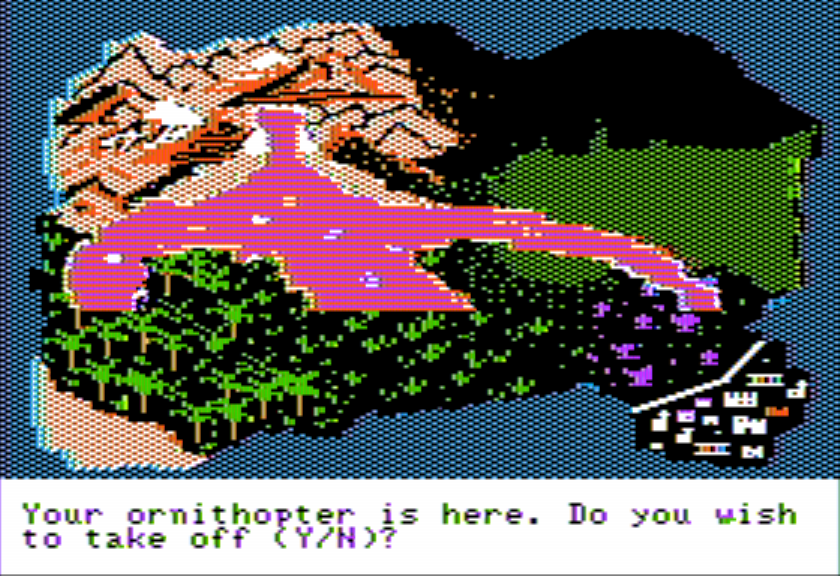
The landscape appears to be randomly generated. The main objective at this phase is to look for “palaces” you can land at.
Then the game enters back into “adventure mode”, kind of. The maps of the palaces seem to be generated more or less at random, and you can take off, land, and get a new map if you like.
The same basic rooms (bedroom, library, ballroom, etc.) get mashed together with different sequences and different door placements. I haven’t worked out yet if the map is fully generative or if there’s a fixed set of random maps being drawn from, but I suspect the former.
Your character that’s on the bottom is aiming a weapon, and you can use the joystick to point and shoot at particular enemies.
We just shot a “trog” that seems to be on top of the bookcase.
You might have pit traps appear. If you’ve found rope you can rescue the person who has fallen in, otherwise they are reduced from your fighter forces.
That’s “rubbish” in the corner although it took me a while to find the right word. You can also LOOK WALL or LOOK CORNER to get names of things if you see something that’s ambiguous.
And you might — and here’s where it is actually useful — find items.
Once you have an item, you can LOOK at it to get it “in focus”, then cast MAGIC DETECT in order to find if it has a hidden spell inside. Assuming it does, you can then teach it to one of your wizards (it prompts which wizard you want, so I hope you didn’t forget the names you taught them).
You find through exploring a series of NOTEs. The pattern seems to be the first has “plaintext” while the other two are “encrypted”.
The encryption is just some manner of Caesar cipher (the manual is very explicit about this) and it isn’t terribly interesting to solve, but it does count as kind of a generative puzzle tossed into the mix. The hints all give riddles about words that need to be said in particular places. So the place of rugs is PERSIA and that opens one door. Past that door is a note 2, with a clue about carrying the world (ATLAS) which then opens an area with a note 3 about stones in a circle (STONEHENGE). When I used the last note I ended up in a “mirror area” that required solving a fourth riddle, which just meant I had to type STONEHENGE backwards.
In that dark area I was also able to use the spell ENCHANT, which will cause the ship’s plate levitation to magically start working again.
Once taking off you can turn around and land directly at the same palace to get a newly generated map. I will need to be doing this multiple times in order to find all the spells (ones like “spider climb” and “shrink”), which then get apparently used (in some kind of puzzle sequence) for the grand finale where we find Atlantis. I’ll save that for a second and likely final post after I’m done grinding.
One of my warriors vaporized by a wizard. You’re supposed to send a wizard vs. a wizard in a wizard duel, but that gets complicated so I’ll also save it for next time.
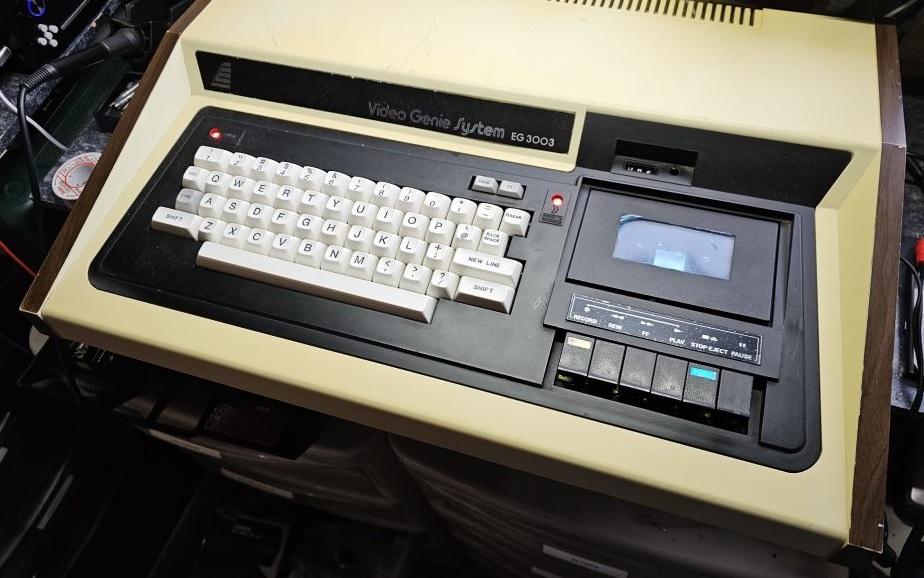
It turns out my major issue was technical: I was playing in TRS-80 Model 3 mode. The Model 3 was out when this game was — it was first released in 1980 — but for whatever strange reason the game was refusing to interpret a particular parser command while I was in Model 3 mode versus Model 1. It is faintly possible the development platform was a Video Genie — which was popular in the UK — and there is some obscure technical incompatibility (the Video Genie is the same clone from Hong Kong as the Dick Smith Model 80).
Anyway, it is only sort of the game’s fault I got stuck; I tried the parser command I needed quite early in my solving process, just it wasn’t understood. The parser is still finicky but Part 2 of the game (in Egypt) is strong and nearly all the puzzles were satisfying to solve.
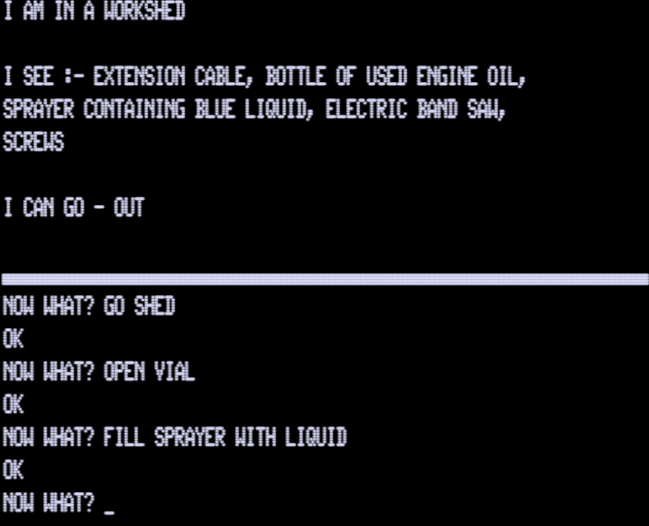
To recap, I realized I needed to put the “Alice oil” in the sprayer to get it to work, but no amount of whacking helped. One thing I knew (from the instructions) is that the game did understand prepositions and indirect nouns, so I thought maybe this was a case where rather than making a separate prompt for indirect noun, the game switched parser modes and required having the command typed as a whole phrase. Just FILL SPRAYER doesn’t work, you have to FILL SPRAYER WITH LIQUID. Trying this on Model 3 gets
BAD COMMAND FORMAT
LanHawk in my comments had in the meantime tried the game and found the command worked. He was in Model 1 mode, although we didn’t realize yet that was the issue until I did some experimentation.
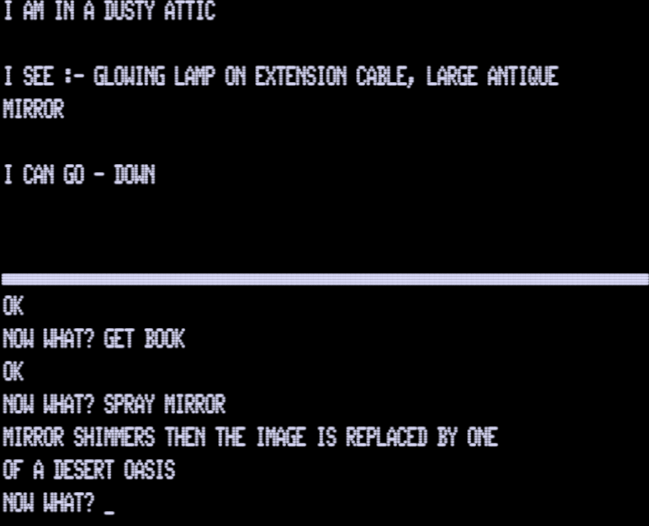
Voila, what I was expecting to happen. Before stepping through, I want to mention two other things I sleuthed out in part 1 of the game.
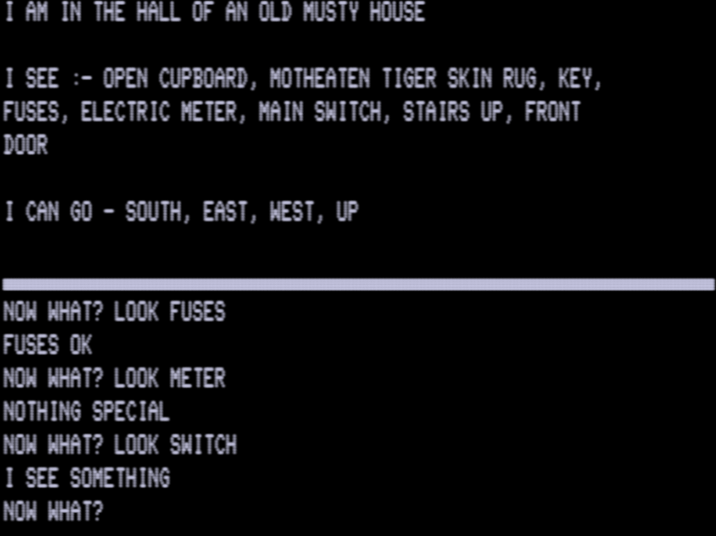
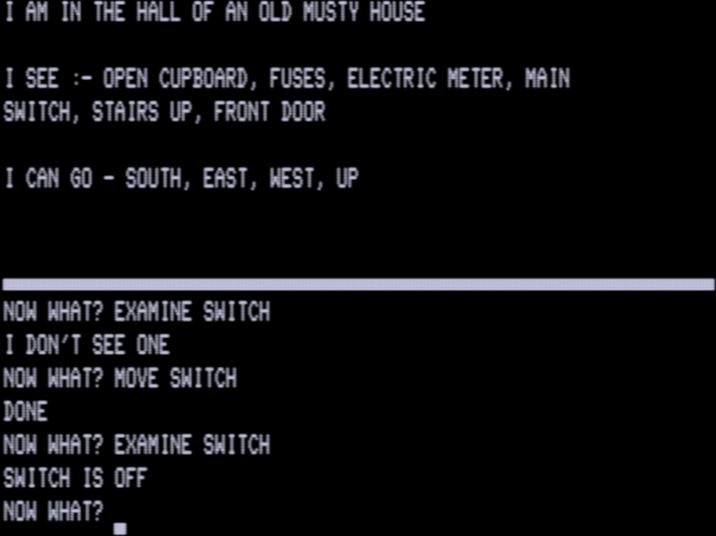
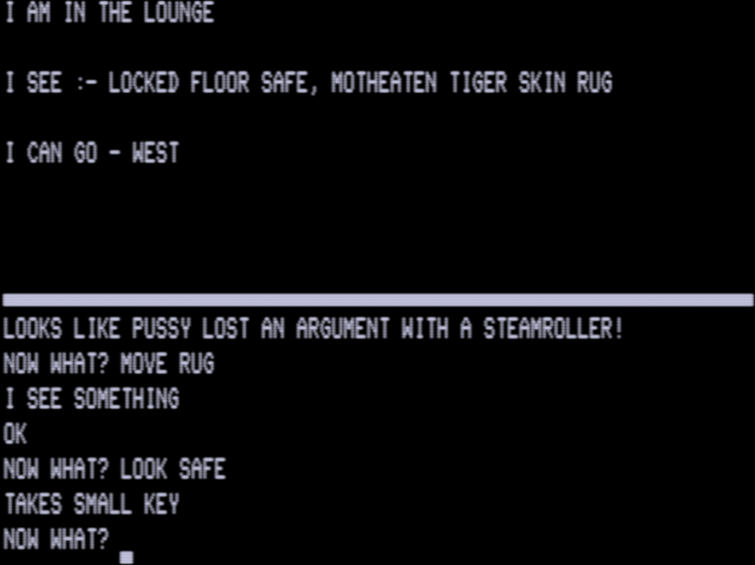
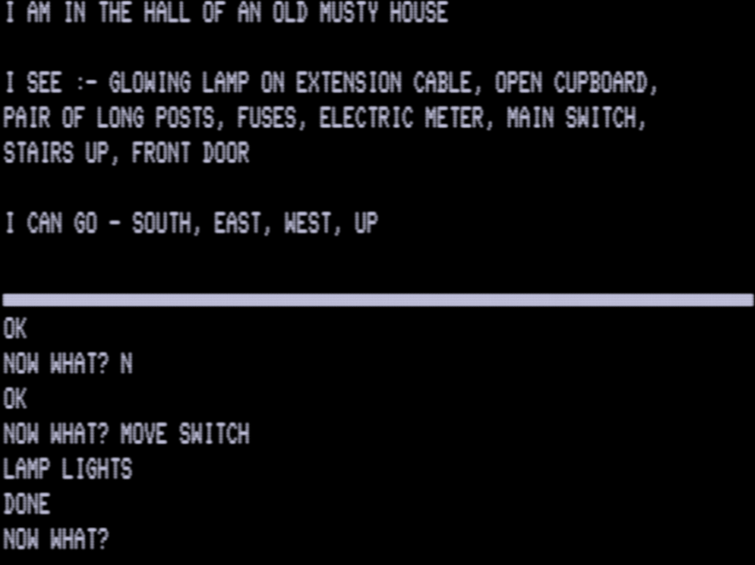
First, I was able to recreate picking up the key at the start. I still think this is a bug. One version of the sequence goes: EAST, GET RUG (this reveals the safe), WEST, OPEN CUPBOARD, DROP RUG, MOVE SWITCH, LOOK SWITCH. There is a hidden key now with that sequence.
I still think this is a bug. Without dropping the rug, if you LOOK SWITCH before moving it, the game says SWITCH IS OFF. After you move it, the game says I DON’T SEE ONE upon doing LOOK SWITCH (but you can move the switch back to off!) The I DON’T SEE ONE gets overridden if and only if you’ve dropped the rug in the room. That’s in the territory of Koble’s Chinese Puzzle in terms of not making sense. I assume something in the game’s object table got jumbled up.
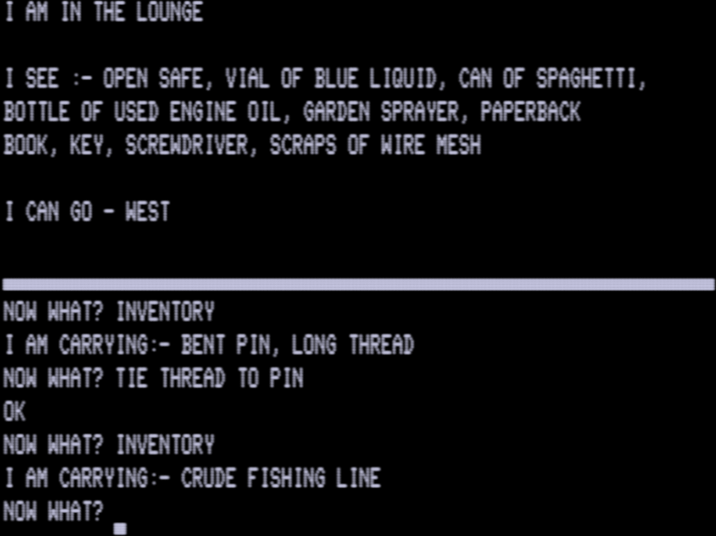
Somewhat more sensical (but still frustrating) I managed to pull off making a fishing line. I had a PIN and a THREAD; before you can tie the thread to the pin you need to BEND PIN. Then the tying works. You can also then BAIT the PIN with some spaghetti.
All remaining screenshots, passing through the mirror into Egypt, will be in Model 1 mode.
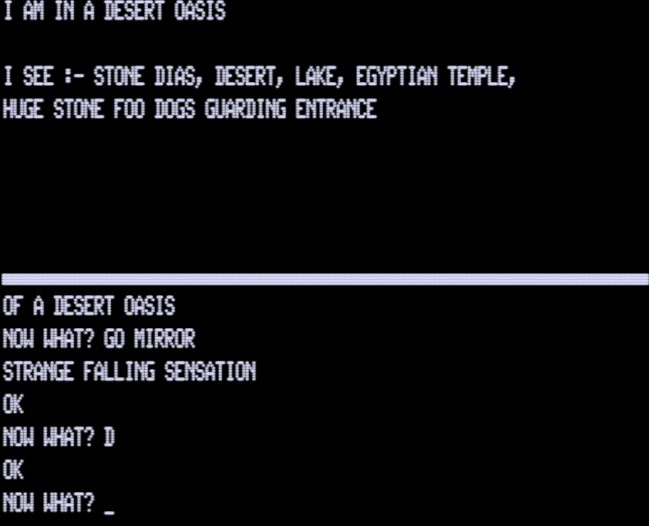
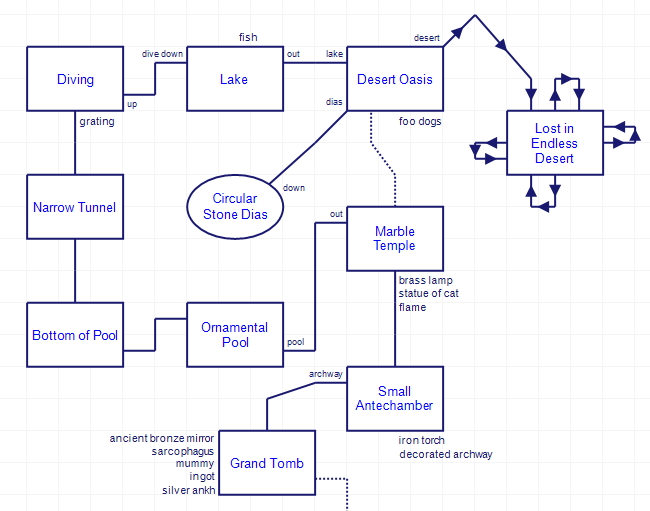
You land on the other side of the mirror at a dais, right next to a temple. The temple is guarded by “foo dogs” who give “kamic vibrations” if you try to enter the temple.
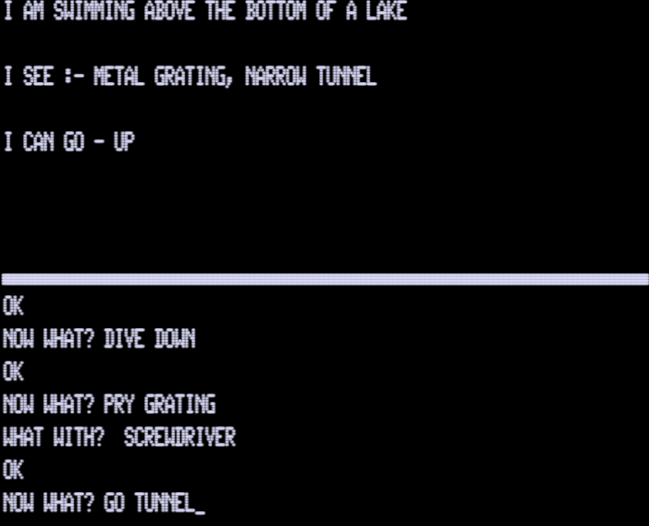
You can FISH LAKE in this location and get a fish which will be useful later. It’s also helpful to visit the bottom of the lake (just DIVE LAKE or, if you’re holding too much, you’ll sink down by going into the lake anyway). You can then use the SCREWDRIVER from way back at the house to PRY the grating open.
The water tunnel then takes you up into the temple.
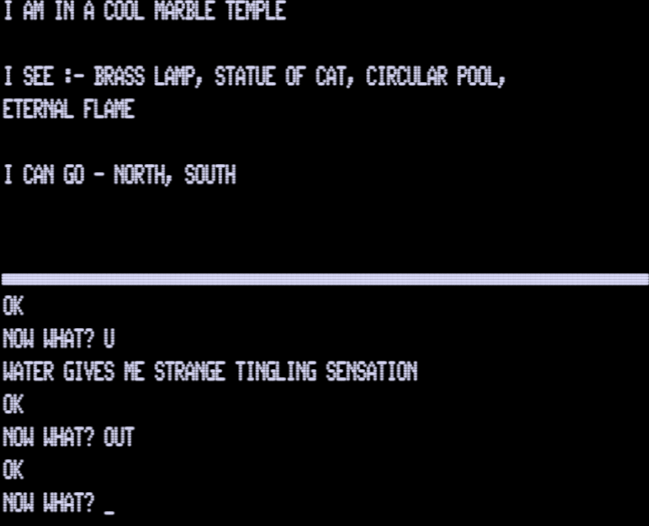
The “tingling sensation” at the pool is important and will come back shortly. This whole section is a very tight puzzle, akin to the opening area, but without having to fuss about combining objects together. This section is more about magic, but there’s at least enough logic that I never felt like I needed to wave things randomly everywhere, and the tight space itself limits the things you can do with magical objects besides.
Going north is blocked by the same dogs as before, but you can go south.
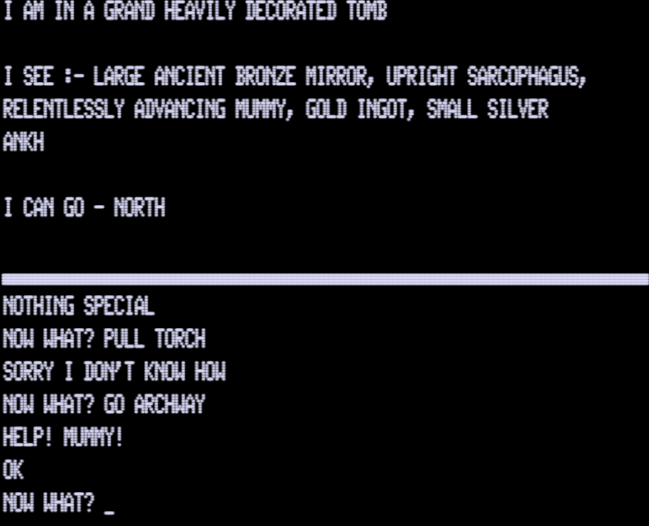
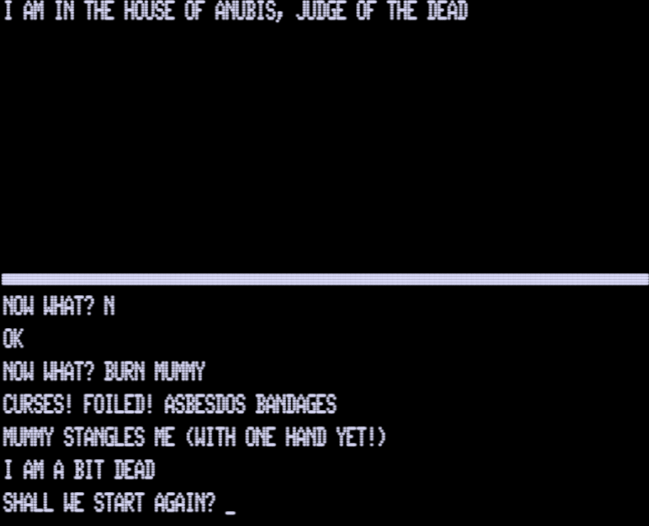
The message is quite serious and you need to read it literally. You must be invited in. If you go in without the invitation you will die. The clever bit is the death isn’t immediate; you start getting chased by a mummy and can try some futile fighting back (for example, using fire against it; a message later indicates the mummy is flameproof).
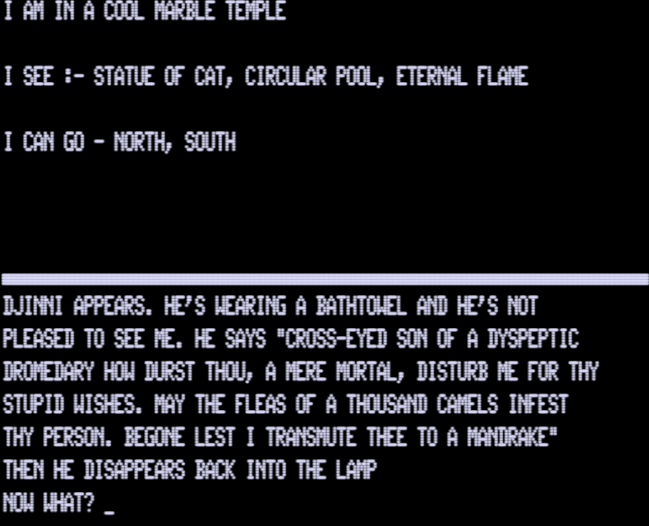
Mucking about with options, I realized I could RUB the LAMP in the main temple. Rubbing once gets a dire warning, so of course I had to rub it again.
This is not a game over! You need to get turned into a rat. As you are not a (wo)man but a rat, you can now go into the tomb. You can then grab a “silver ankh” (it is small enough) but not do anything else.
The presence of the mirror is a classy bit of game design here. It clearly is set up to go back home using Alice-spray, but its location here also serves to emphasize the rat-ness of the player at this moment.
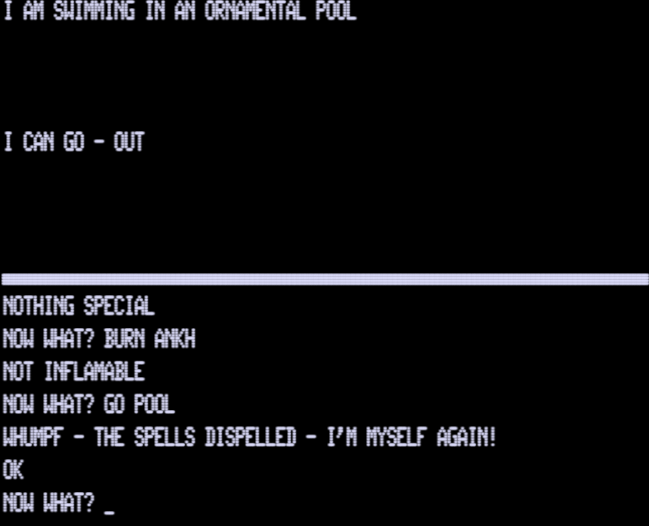
Fortunately, the pool with strange tingling also works for spell removal so you can turn back into a person. If you’re carrying the ankh, it will drop to the bottom of the pool, but you can DIVE to retrieve it again.
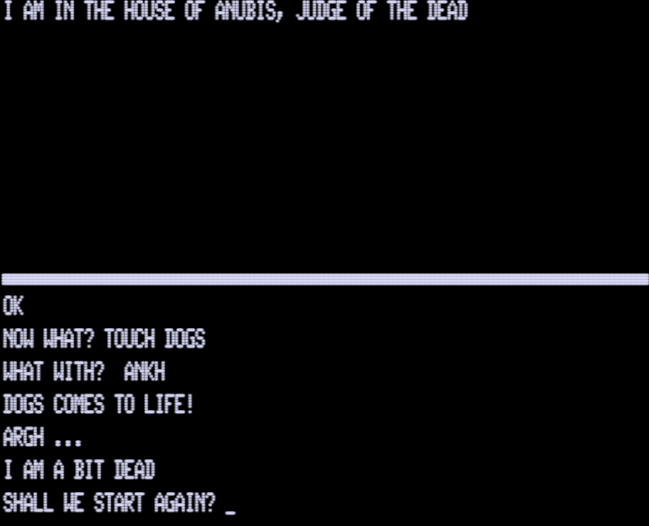
Now, what to do with the silver ankh? I prodded around a bit thinking about how it represents “life”, and tried touching the cat statue.
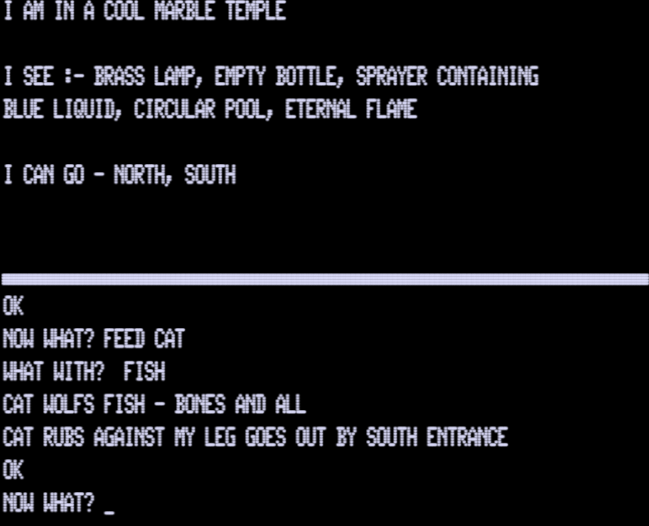
This is of course the Temple of Bast, the cat god, so the cat is able to invite us in the tomb.
You are then safe from the mummy. Unfortunately, while you are free to safely get the gold, you can’t get it out again (remember the weight pulls you down in water!) You have to get out via the front, but the foo dogs are still stopping you.
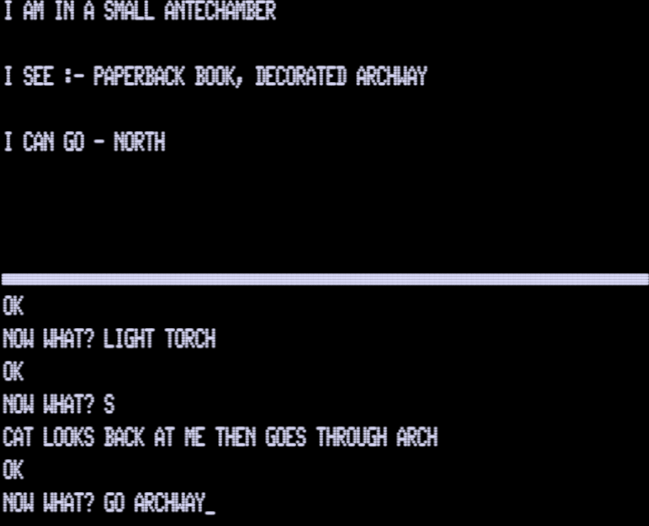
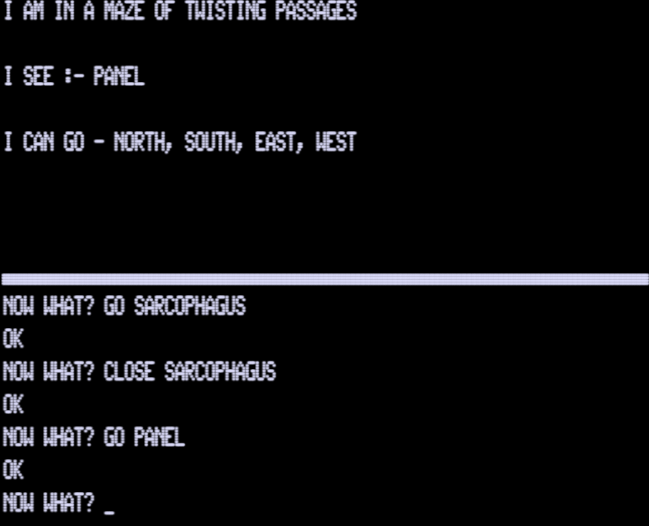
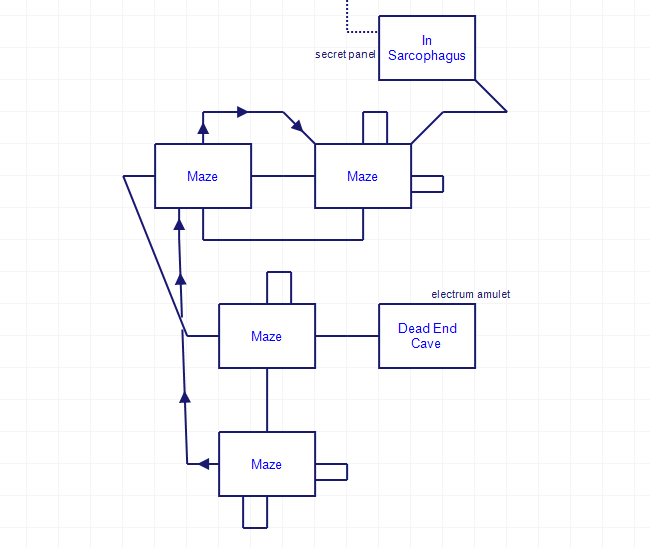
There’s another secret object farther in. First, you need to get the torch by the archway lit (SOAK TORCH WITH OIL, and yes, that took a while to find, followed by LIGHT TORCH at the eternal flame) and the you can go in the sarcophagus and close it. After closing it (and only after closing) do you see a “secret panel” you can enter.
I was originally confused thinking it was something you were supposed to SLIDE.
The maze is mercifully tiny; small enough that it mainly serves to cause a little drama as the torch light is limited.
At the end there’s an electrum amulet, which will let you get by the dogs. You can grab mirror, gold, amulet, and spray and take them all outside back to the starting point.
You can attempt to revive the foo dogs along the way.
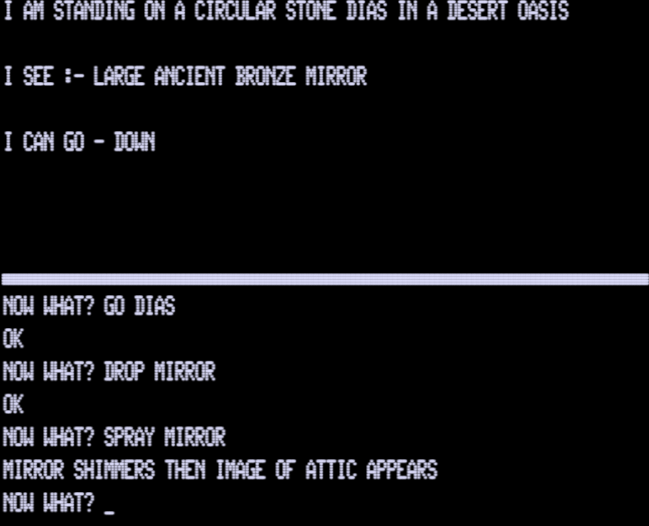
Once there you can drop the mirror off and spray it with the Alice oil.
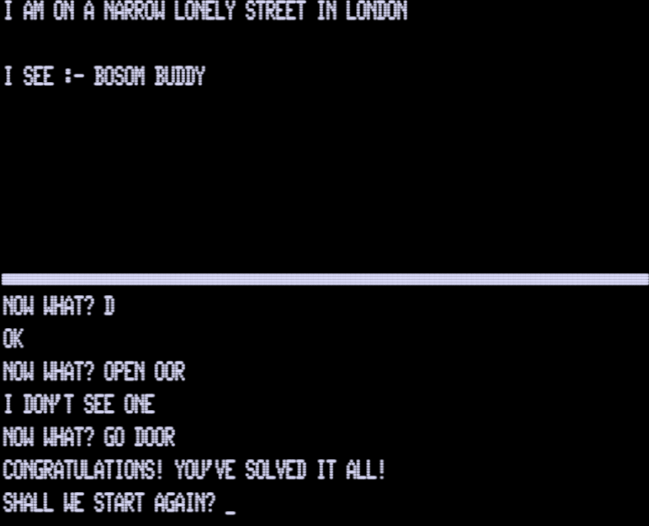
So you’re back in London: now what? There’s not even a SCORE command, nor some special trophy case you take the gold to where the game says “you’ve won!” However, there’s a mobster lurking outside.
He is now your friend.
This ended up being much better than I expected. I ran into parser oddities early so didn’t have high confidence. However, the intricate use of object ended up being fairly logical in the end, and despite solving-for-unprompted-magic-items being one of my major grumpy points, the use of magic was sparse and clear enough I didn’t run into the issue of having to mark up a large map and test every single magic word in every single room or wave completely random objects hoping they had something to them, etc.
The main fall-down overall was technical. This is a case where I wish the author had a modern copy of Inform because they could have done a bang-up job. I especially liked how the steal-the-treasure concept ended up getting both played straight (you are, indeed, just going in a sacred place and grabbing gold) averted (you are invited in) and subverted again (the whole goal was to pay off a mobster) all in the same plot.
Let’s get back to graphics, shall we? Up next on the docket is a Apple II hybrid RPG-strategy-puzzle-adventure game by an innovative author whom some of you may recognize.
The Weighing of the Heart. Anubis reads the scales. Osiris presides to the right. From The Met.
So far I have still only opened up one more room (an attic) since last time. The object puzzles are elaborate enough that (in a way) the objects themselves make up the exploration space, not the rooms.
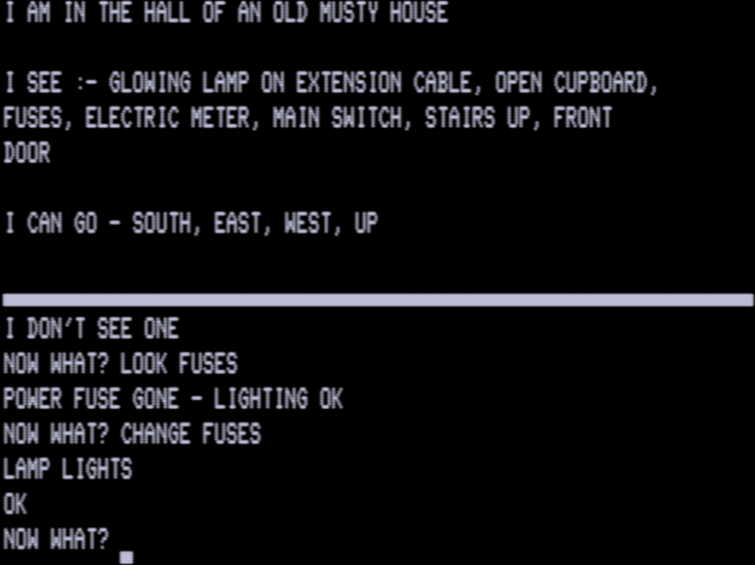
Also as was prophesized, due to this, the game really fell down hard on its parser. This is true even of the very first puzzle I solved immediately after my last post: dealing with the fuses. Specifically, I had a broken fuse, I had some wire from disassembling a hen run, and I could FIX FUSES. I’m don’t 100% visualize what was wrong on the bad fuse but at least the shenanigans are slightly believable.
Where things then fall down hard is putting the fuses back in. INSERT FUSES doesn’t work (SORRY I DON’T KNOW HOW) and PUT FUSES is even worse; the game says OK as if it was successful, and you have to carefully look at the room description to realize the game just parsed PUT as a synonym for DROP.
No, the right action is REPLACE FUSES. Then you can MOVE SWITCH (if you haven’t already) to kick the power on. This allows the saw in the back to work properly. (What happened before, if you don’t remember, is you could swap fuses and still run the saw, but it would cause both fuses to bust. So the game explicitly added a fixing route that was wrong.)
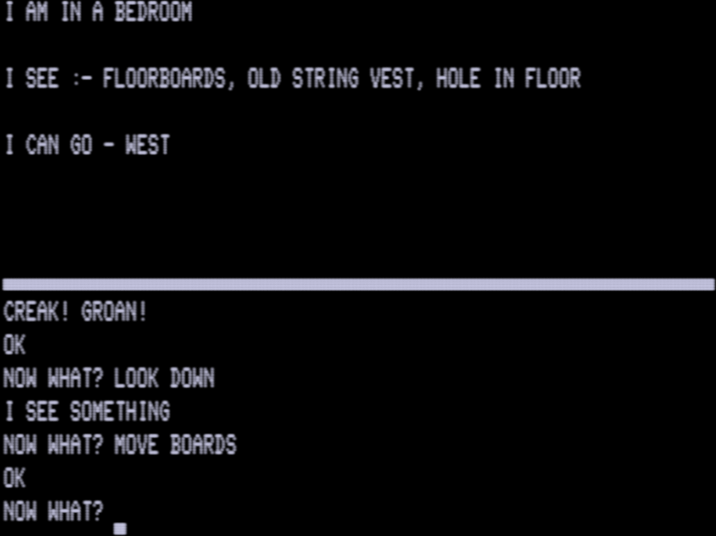
The saw can be used to cut up a pair of post into pieces, but that’s also wrong. You need to get some BOARDS from upstairs (they were LOOSE FLOORBOARDS hiding a PIN)…
Nice repurposing here — the boards would normally just be the thing hiding the “useful object” but they become useful in themselves.
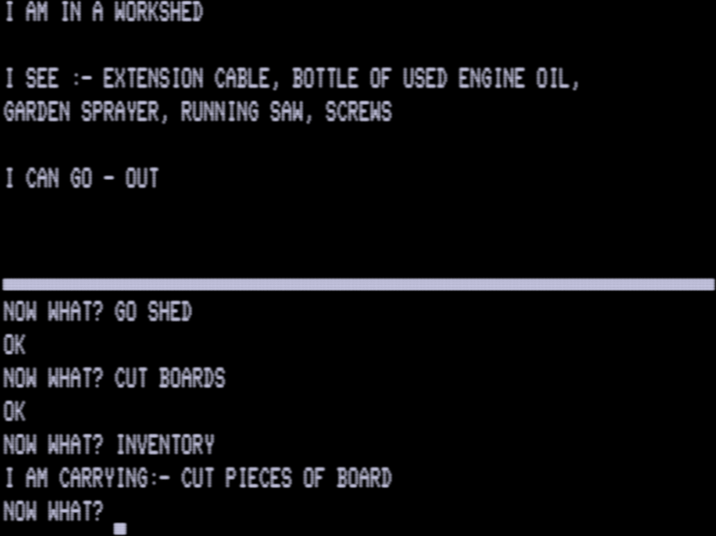
…and cut those instead.
Then you can take the posts and boards together with some screws to make a ladder.
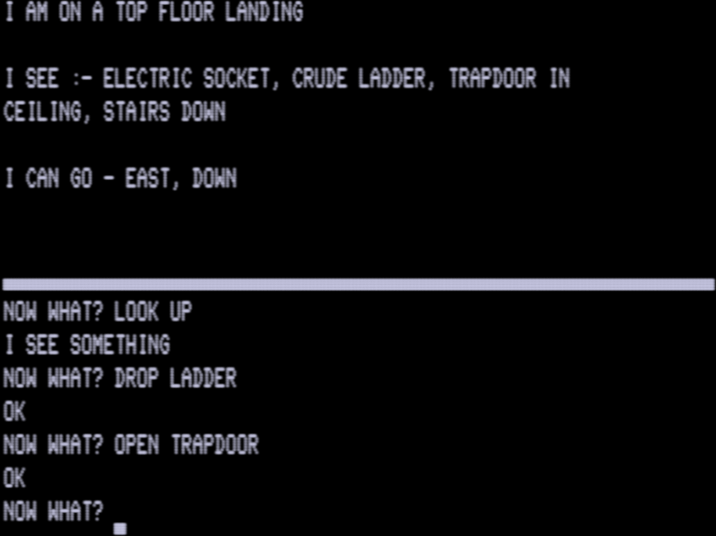
I tried the ladder in every room and always got NOWHERE TO CLIMB TO. It then struck me there might be a secret exit up, and I’m finally trained enough by the school of hard knocks (Nuclear Sub from 1980 plus my recently-played Doomsday Mission) to try LOOK UP.
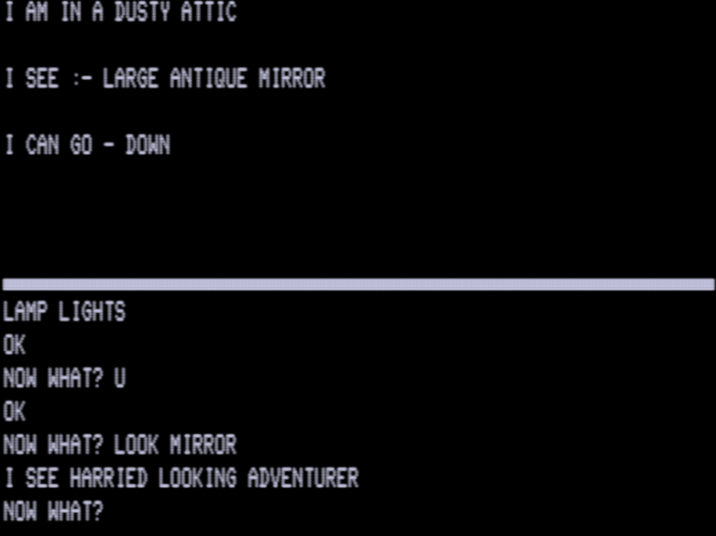
Upstairs is dark, but you can grab the extension cable from the shed and the lamp from the study to provide some light.
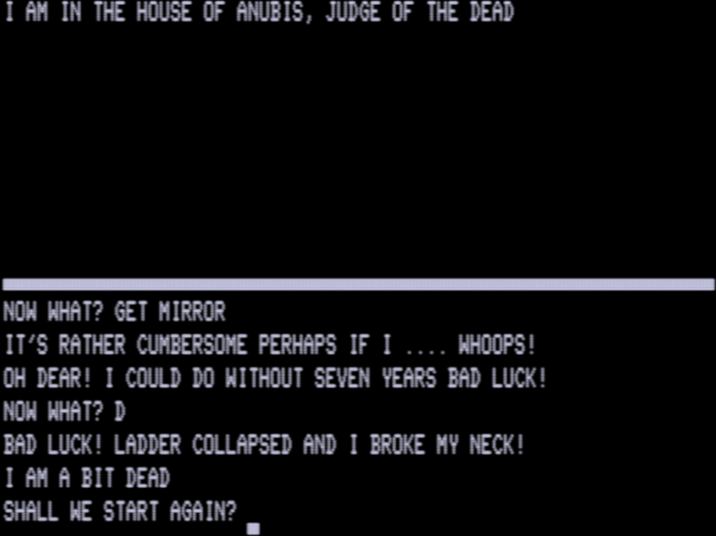
Getting the mirror ends up unfortunate:
IT’S RATHER CUMBERSOME PERHAPS IF I … WHOOPS!
OH DEAR! I COULD DO WITHOUT SEVEN YEARS BAD LUCK!
While there are PIECES OF BROKEN MIRROR, they aren’t super useful and going down the ladder kills you.
If our heart is judged worthy is not mentioned.
This is mostly where I’m now stuck. redhighlander in the comments mentioned the ladder but also a fishing rod, which I haven’t been able to make and I assume is useful later. I did somehow manage to get a key and I think it was a bug. I was able to get a key by … looking at the main switch?
Somehow my screenshot didn’t save, but I looked at the switch and I was told I saw something, and suddenly I had the key. The key I could then use to open the safe to the east.
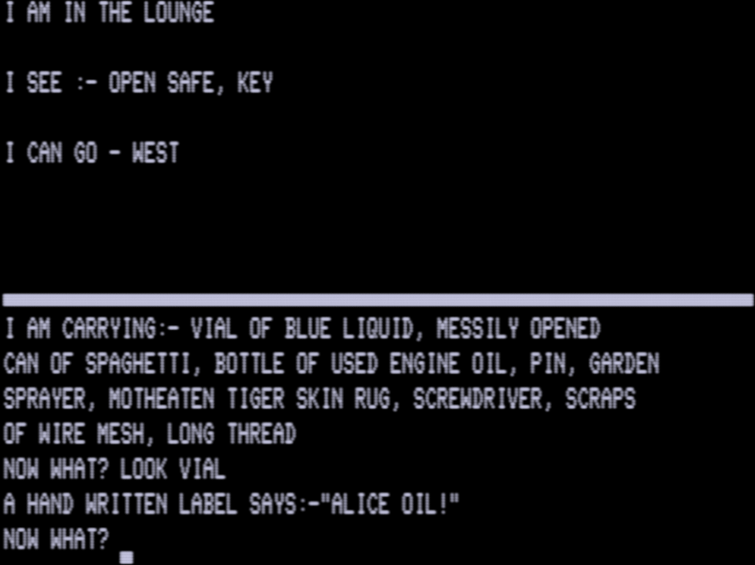
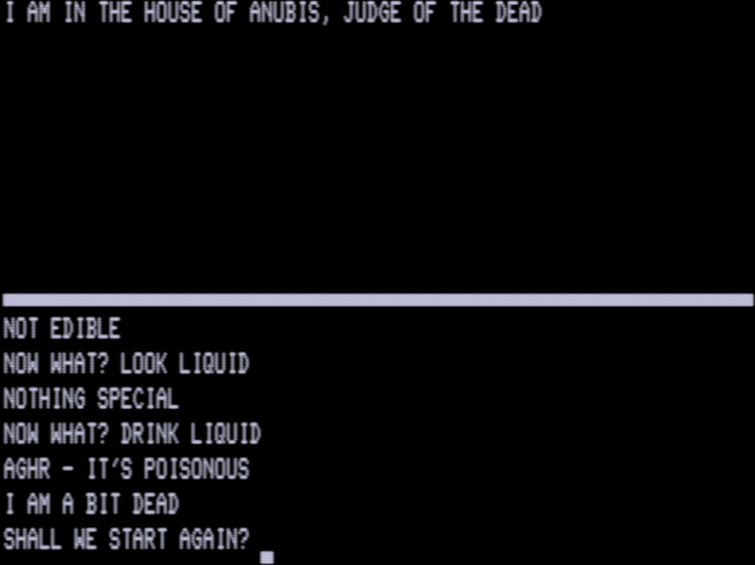
The blue liquid is poison. Drinking it kills you. I assume it is topical (on either yourself or an appropriate item) but I haven’t been able to rub it.
While I have a saved game past the key-finding bit, so it doesn’t really matter I can’t replicate the behavior (probably, unless I soft-locked in some other way) I’m very stuck parser-wise now. I peeked at the machine code and you can take the SPRAYER in the shed and have the LIQUID inside of it, so I guess then you can spray … the mirror probably? However, all attempts at POUR LIQUID or FILL SPRAYER or the like fail.
I’m 85% certain I’m just stalled on a parser issue but knowing what the issue was doesn’t necessarily help solve it. I also don’t have anything approaching a fishing rod and I could see it possible I softlocked myself out of one.
Any and all help at this point is appreciated. I’ll keep going a while longer but it is faintly possible my journey will end here. The weird appearance of the key makes me especially nervous about more lurking bugs.
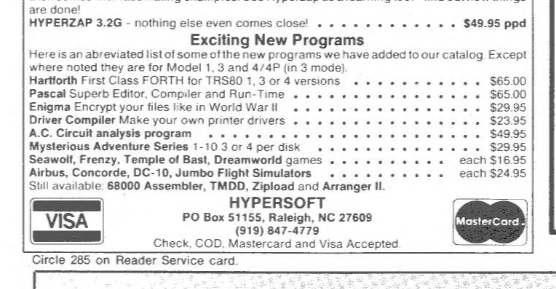
Temple of Bast eventually had some sales in the US via Hypersoft. From 80 Micro, April 1986.
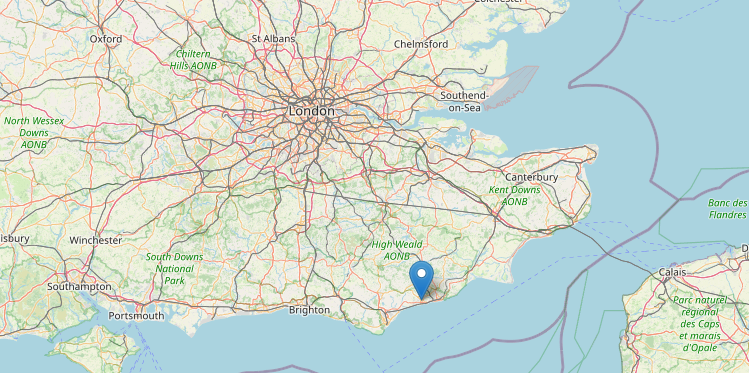
Molimerx is a company we’ve only brushed by briefly (see: The Golden Baton); they were a specialist in the TRS-80 based in the UK, specifically, Bexhill in Sussex.
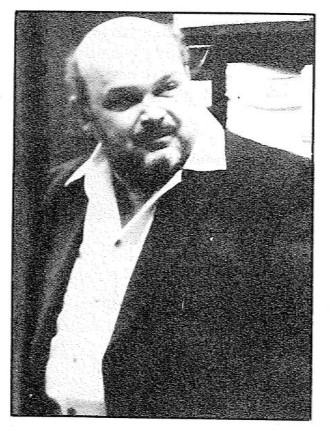
They really were one of the earliest and more prominent companies of that time, and lasted from 1978 all the way up to 1987 before petering out. A. John Harding founded it in 1978 with his wife Marion. Quoting Harding’s holiday 1986 message:
I started Molimerx in August of 1978 so this is the eighth time that I have had the pleasure of wishing our customers a Merry Christmas. I do so this year with no less enthusiasm but, I suspect, considerably more weariness. Most of you will remember the gusto with which we all got involved in the microcomputer revolution in those days. The joy of actually finding out what information was held at which address — and the miserliness with which we held onto that information! Now its all business and nowhere near as much fun. The first microcomputer I owned, boasted — and I mean really boasted lK of memory, which one had to program with toggle switches for each bit. Now 256K is considered small.
John Harding, from the magazine 80-U.S., February 1983.
This 1985 catalog lists 400+ items which is a good run for any company of that era. Other than them being the initial publisher of Mysterious Adventures they’re mostly known for the 1980 lawsuit Molimerx vs. Kansas City.
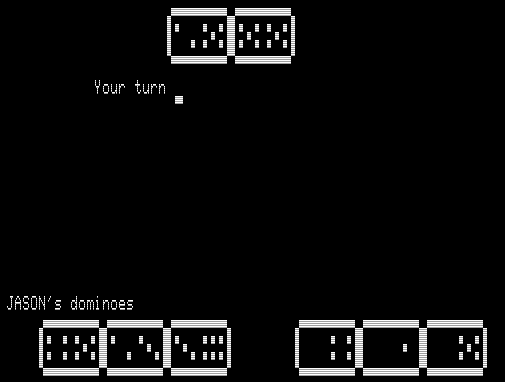
There were a couple companies caught up in this (Kansas City Systems was selling both Microsoft and Scott Adams products on the sly) but on Molimerx’s end the actual instigation of the lawsuit had to do with dominoes. Specifically, J. W. B. Dunn had written a Dominoes program (copyright 1979) intended to be distributed exclusively by Molimerx. The author Dunn had come across the Kansas City version — a friend had bought it via mail order — and wanted to compare it. He found it to be identical, and further investigation led to the lawsuit, which ended up establishing the legal certitude of software copyright in the UK. (See: the book Programming for Software Sharing and also an article here from 1981.)
(There’s also some allegation from Marion that Molimerx almost had a deal with IBM to get LDOS rather than MS-DOS as the IBM system default but John threw the deal. This makes no sense as LDOS was developed by Logical Systems in Wisconsin as explained by one of the developers here. Molimerx was LDOS’s distributor in England but they would not have been the ones dealing with IBM. The actual near-miss-for-IBM-default company was Digital Research with the CP/M system. Marion then claims that LDOS was then sold for the BBC Micro, which never had LDOS. I think something happened because the narrative is quite dramatic but multiple stories got jumbled together.)
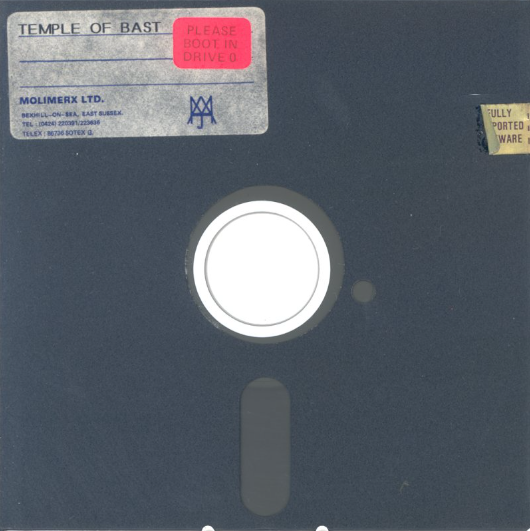
However, despite or perhaps because of their pioneer status, Molimerx was prominent in the way Instant Software from the US was — they were mail-order kings when that was relevant, but now a lot of their catalog is lost, including the “children’s adventures” Dreamland and Wonderland. We do have a copy of Temple of Bast but no packaging. It is Malcolm McMahon’s only game.
Via Ira Goldklang.
Our job is to … rescue? unearth? “liberate” for the British Museum? a gold nugget from Egypt.
This feels like it ought to have the same start as Pirate Adventure from Scott Adams; that is, you start in a London flat, and then magic your way over to Egypt-land, grab treasure, and take it back. That might be genuinely the case here, but there’s justification beyond straight averice, as you can’t step outside:
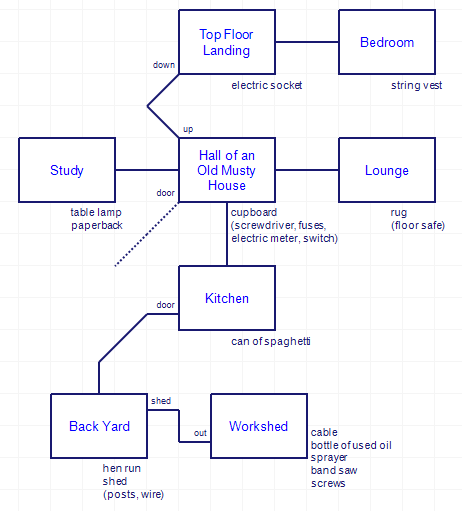
This means the opening has you confined to a relatively tight area:
Importantly, it is a tight area with a lot of gizmos to play with. This feels like the kind of game where you need to mash things together and build things, which is risk with this kind of parser. What I’ve thrown at it has worked so far, but since I’m stuck (as you’ll see in a moment) I can’t guarantee things stay that way!
For the things in the opening room (SCREWDRIVER, FUSES, ELECTRIC METER, MAIN SWITCH), the fuses are the most immediately helpful, as you are told there’s one lighting fuse that works and one main fuse which is dead. You can MOVE FUSES to swap them, then plug in a nearby LAMP in a electric socket upstairs to test it. You can also, in a different room, get an EXTENSION CABLE that lets you tote the lamp for one extra room in any direction, but I’m not sure what the purpose of that is.
Next to the opening room in different directions are a paperback guide to reading Egyptian, a can of spaghetti (!?), and a floor safe that requires a key to open. I suspect maybe the key is in the can because the can is hard to open.
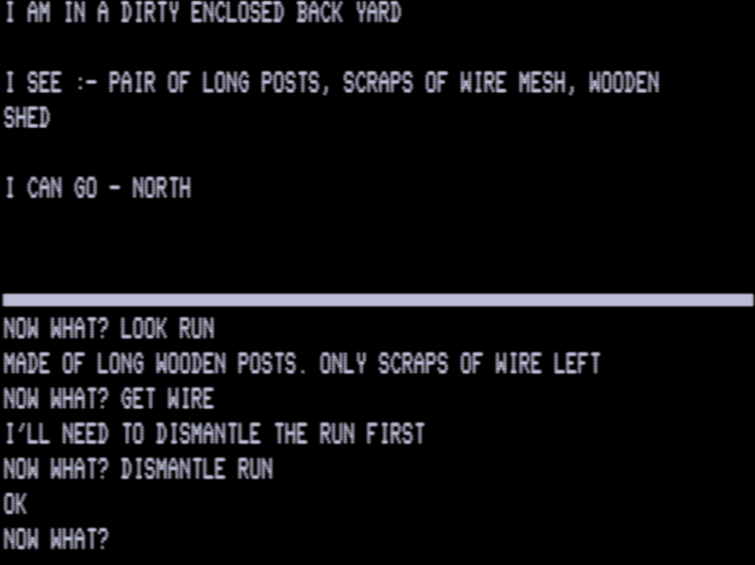
Out back there’s a “hen run” you can DISMANTLE with a screwdriver (fortunately the game gives the exact verb here) to get some wire and some posts.
The shed has the previously mentioned extension cable, as well as ENGINE OIL, an empty SPRAYER, SCREWS, and an ELECTRIC BAND SAW.
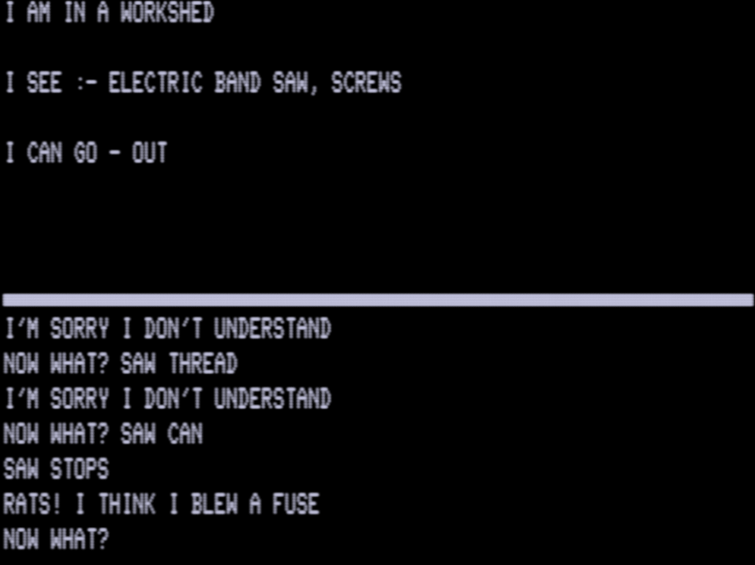
If you’ve fixed the fuses you can use the band saw to try cutting open the can, but it busts mid-saw.
I don’t have much else to play with; upstairs I was able to find a pin hiding under some floorboards and turn an unraveling vest into a THREAD. The game asks WHERE? if I want to TIE THREAD but I haven’t found anything that this helps with (yes, I was doing the equivalent of clicking on every item in a scene in a point-and-click game).
Still interesting to have a heavily MacGyver style opening with realistic technology in what originally was advertised as an Egyptian treasure hunt. So far no magic has entered in. Maybe we’re not going to teleport after all? (Eh, who am I kidding, we’re probably going to teleport.)
I’m happy to take guesses from y’all as to what to do next. (Or you can can even just play to test things out, here’s a link to play online.) There’s no guide or walkthrough to consult so we’re on our own.
The MAIN SWITCH works via MOVE SWITCH so you can shut everything off/on. I’m not sure the use of this, but I wonder if the whole point of having an extension cable for the lamp is to be able to test power things and it otherwise isn’t necessary.
Well, I wasn’t trying to be topical. This happens to be the next in the series of the Softside Adventure of the Month, once again in a game by Peter Kirsch (at least according to the TRS-80 version stored at Ira Goldklang’s site).
Softside, May 1982.
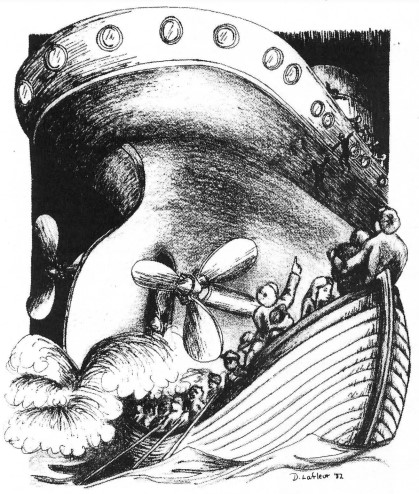
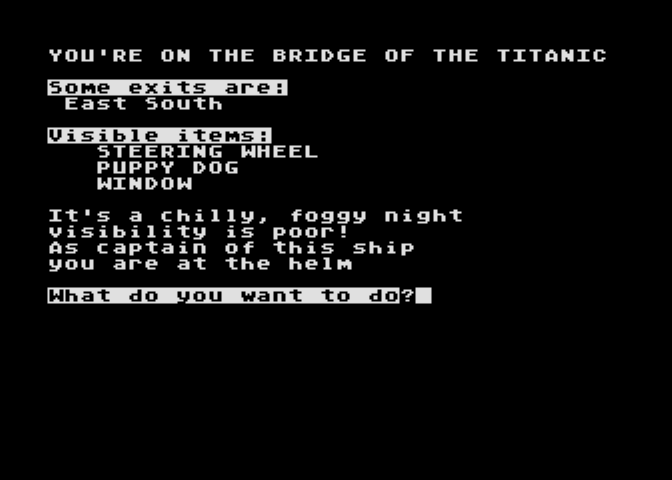
You are the Captain of the Titanic on her maiden voyage. Suddenly a large white object comes into view through the window. Can you avoid the historic collision? If not, can you save the lives of your passengers and crew?
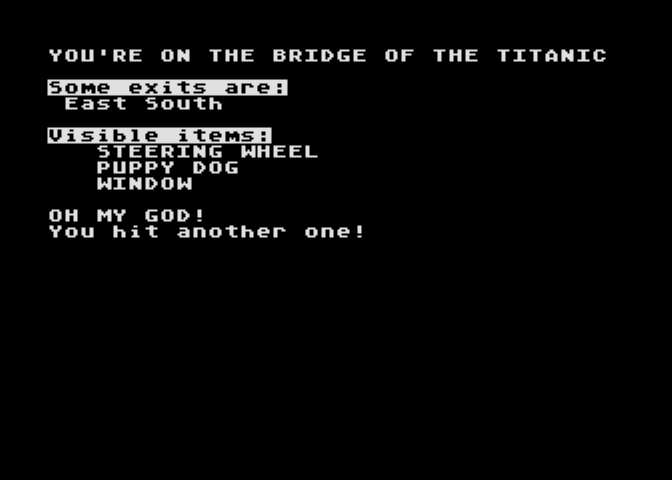
We’re the captain, and the only one running the vessel. We’re at the wheel and LOOK WINDOW reveals a looming iceberg. Fortunately we can TURN WHEEL:
So, that was a good game, let’s move on to…. oh wait:
(Apparently in Time Zone you can save Caesar from getting stabbed by Brutus and he just slips and dies instead. Oops.)
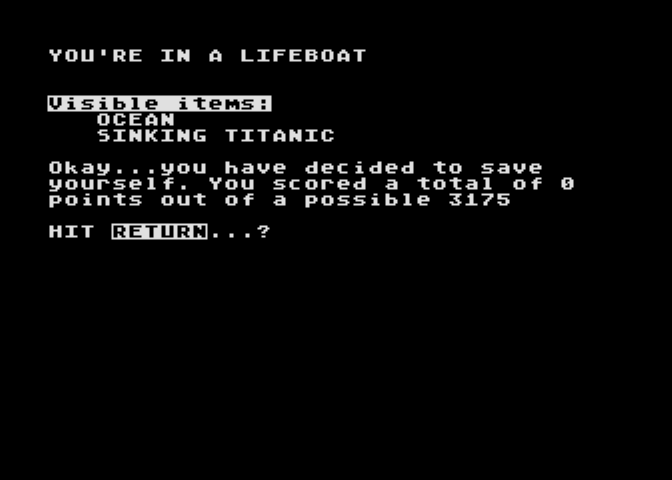
So, the game now explains you need to try to save as many people as you can and potentially grab some treasures along the way. I made a beeline for a lifeboat and did GO LIFEBOAT:
Great, now that the game is over, we can …
Oh, wait, I should rescue some people? I suppose. I did appreciate the clever schtick here in leaving open the possibility of just running for it. In practical circumstances I expect most players will want to rescue everyone although I could see someone leaving behind one of the more ornery passengers (and there are some!) intentionally.
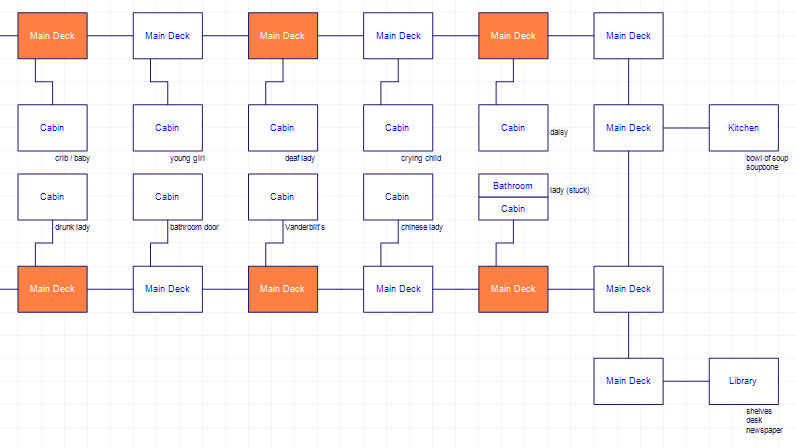
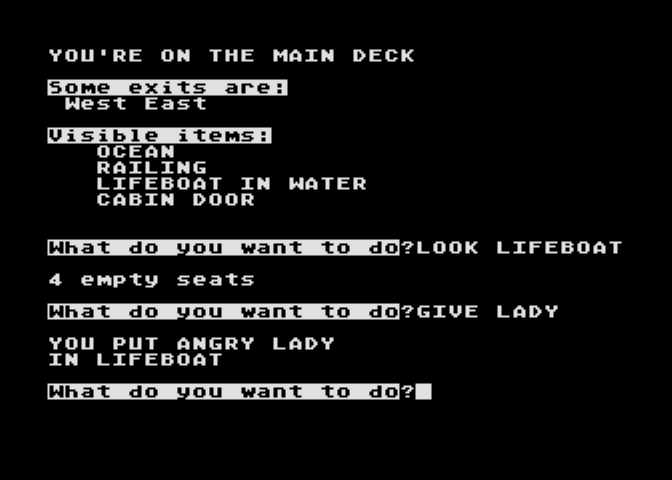
Incidentally, nobody gets on the lifeboat on their own: on this version of the lifeboat, with a very, very, reduced crew complement and number of passengers, for every single rescue you GET PASSENGER (or whomever) and then GIVE PASSENGER at a lifeboat. There are six lifeboats, and you need to be careful a particular one isn’t full, otherwise it will sink when you add one more.
Orange locations have lifeboats.
I was initially worried about optimization, but this game weirdly has no timer. In fact, you need to wait, as there’s hot soup in one location you need to eat, and in the bottom there’s a key, and the key lets you in a cabin to rescue one of the passengers.
Most of the game involves finding keys in unusual spots and/or getting passengers to move.
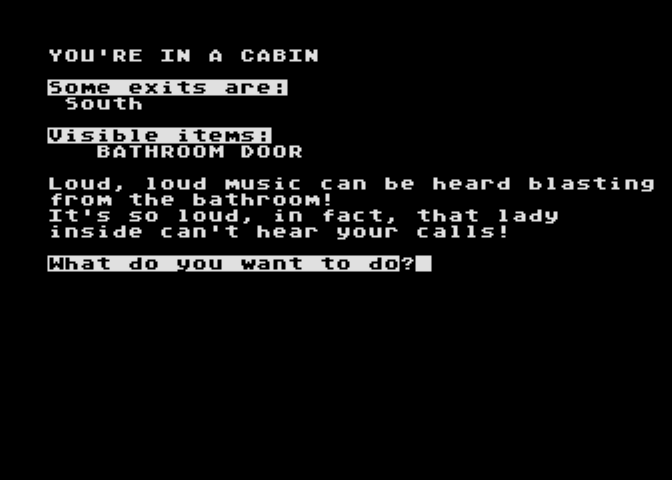
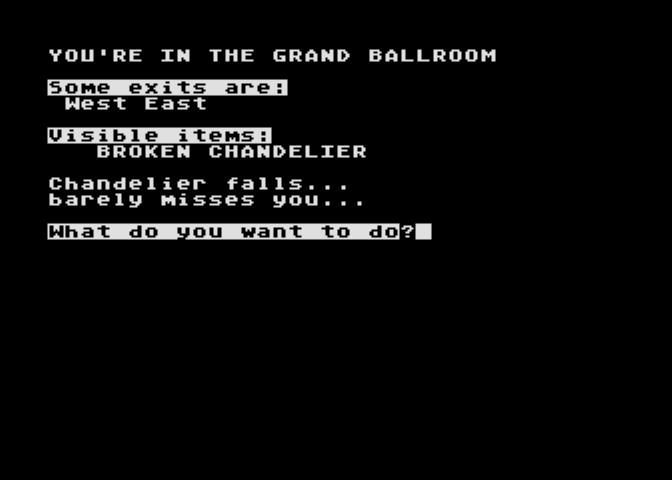
For one lady, they are playing music too loud. You need to go downstairs, have a chandelier nearly hit you…
…grab a broken bulb from the chandelier, and use it to cut a wire on a fuse box. This causes the music to get cut off so you can rescue the lady.
If there are no empty seats the response will be “you see nothing special” when you LOOK LIFEBOAT.
One passenger is Chinese and you have to find a Chinese-English dictionary in order to be able to rescue her:
There’s a librarian here you need to rescue too.
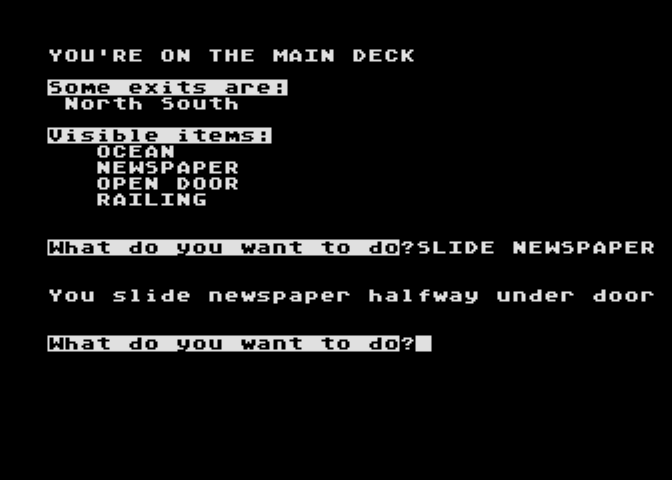
The steward is sleeping in his cabin. You need to do the newspaper-under-the-door, poke the keyhole trick to get the key and unlock it. The actual process is PUT NEWSPAPER, SLIDE NEWSPAPER, POKE KEYHOLE, and it took me about eight tries to get the sequence down. Kirsch may have branched into interesting ideas but his parser can still be jank:
One passenger is described as a “naked lady” and has her toe stuck in a drain hole in the tub. You need some margarine from the kitchen to free her.
One woman is too drunk to grab so you need to ask a waiter for COFFEE (the waiter is clearly asking an open-ended question that lets you get any item you want) but surely there’s lots of requests that work for drunkenness? As well as coffee, at least?
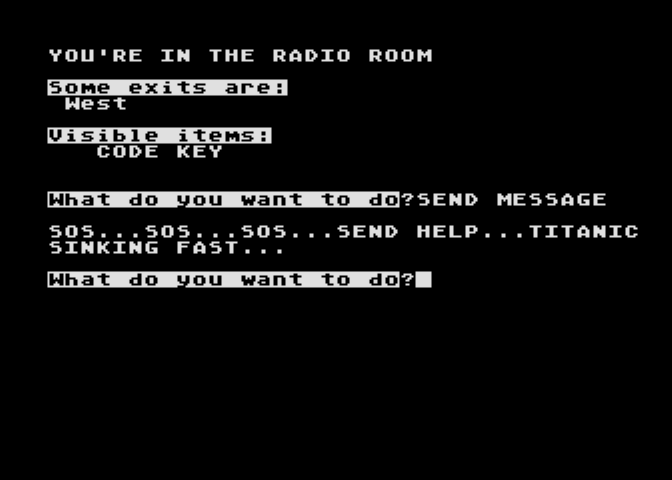
The last interesting bit is that there are two possible endings. One you’ve seen already (when you just ditch everyone) but that ending also applies even if you do a complete rescue. You need to send for help to get the alternate ending.
Then once you finally step on a lifeboat after getting everyone else on there will be rescue at the end.
I appreciated that Kirsch was experienced enough to completely mix up his standard operating procedure; here there are a whole bunch of puzzles that can be solved more or less in any order. I didn’t even mention the two treasures, which are purely optional. You can find a diamond ring in a vacuum machine; also, there’s the captain’s own safe at the start where you don’t remember the combination and have to MOVE the safe to find the combination. Not common to have a combo-lock which is your own character’s safe!
I also never quite expected the Titanic to be the setting of more or less a comic romp, like Airplane! on a boat. It’s curious because there are obviously serious moments (you rescue a baby from a crib) but they are flatly given in the same tone as incidents like Mrs. Vanderbilt hiding under a table (“oops, excuse me madame, hiding under the table won’t help”) and bodily picking up the waiter (after he’s dispensed coffee) to toss him into a lifeboat, too.






















































 Renga in Blue