I have finished. While this took three entries just like Temple of Bast, this wasn’t nearly in the same class in terms of complexity and difficulty. I was stumped early by lacking a verb (I was using MAKE rather than BUILD) and here it was even simpler.
Last time I left off a chest I was unable to unlock.
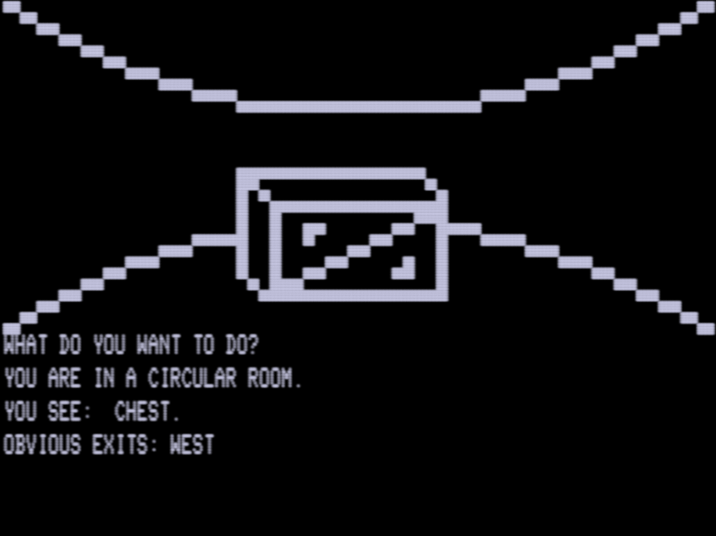
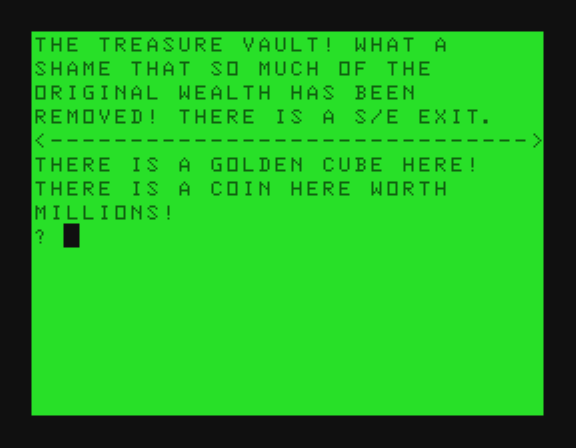
I had discovered a clue I missed before. The coin (normally just treasure) also had writing on it.
I hence took a long sidetrack trying to get the chest on fire (even though there weren’t any “burn” verbs that worked) with no luck. There’s a piece of wood from elsewhere (with the potential for a portable fire) but it seems to have no method for setting it ablaze.
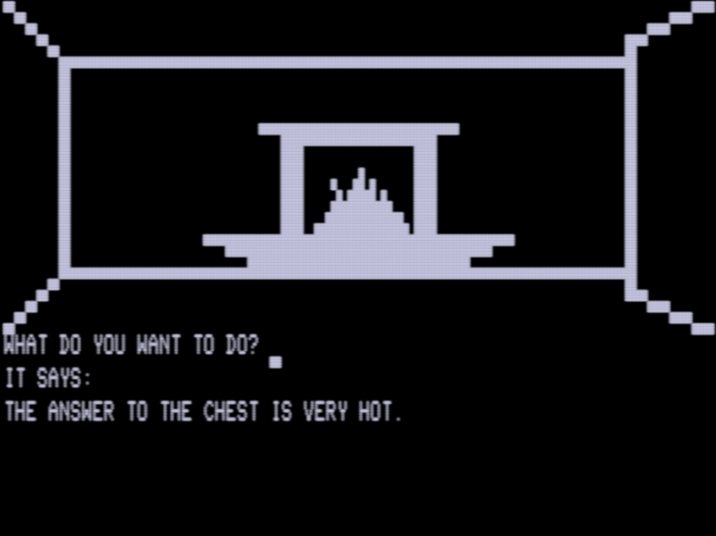
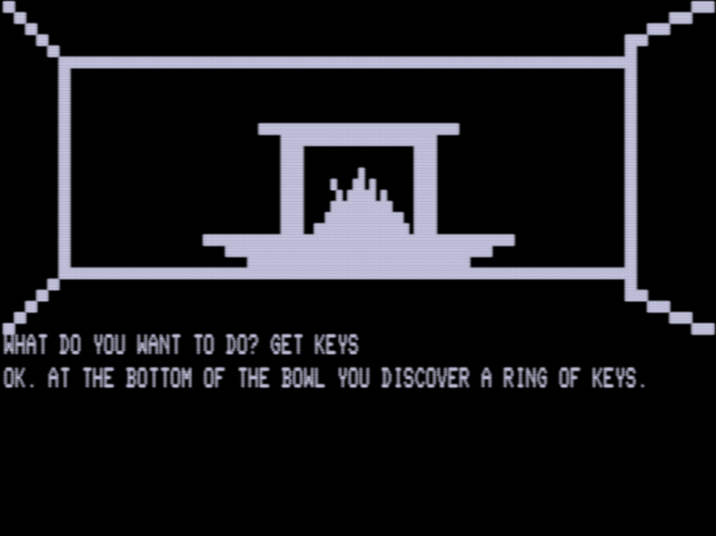
It turns out the solution was much, much, simpler than I was thinking. The hint is meant to refer to the bowl of fruit on the top of the hearth, and you are supposed to EAT it.
To be fair, I was a little hesitant on chowing down on things after the bottle of acid from the start of the game. I do think I’m a little hesitant about random consumption in general; I’m used to the food from an adventure being fed to someone else, which happens 85% of the time (including in Original Adventure). That 15% of the time still exists where you are intended to just try eating something with no provocation other than to see what happens. (See also: the strength-giving berries in Katakombs where it took me abnormally long to just try them out.)
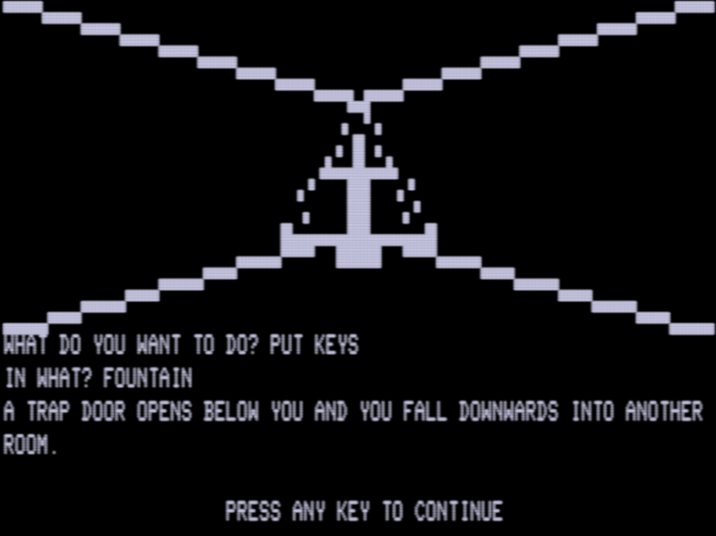
The keys unlock the chest giving a *piece of paper* (money, it’s just a treasure) but also work on the keyhole in the fountain.
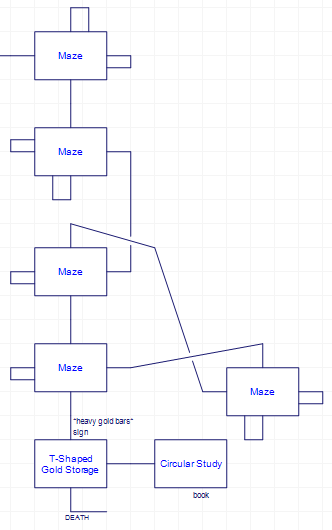
This unlocked the last section of the game. There’s a maze, a small section with a bridge, and another maze.
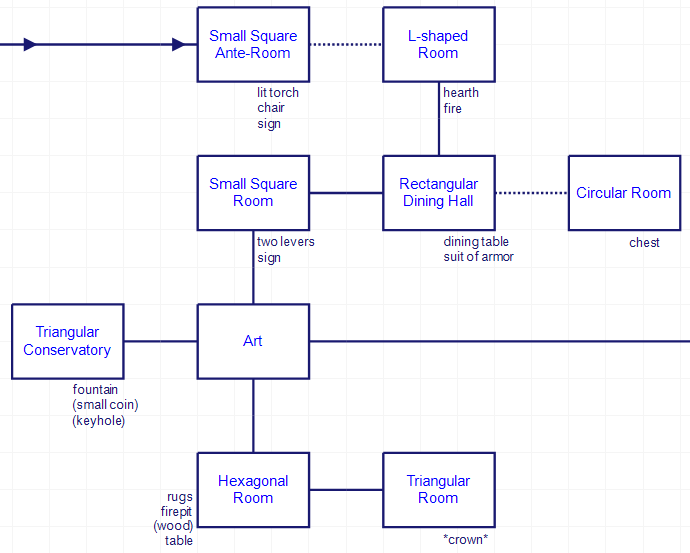
The location you land from the trapdoor is marked in green.
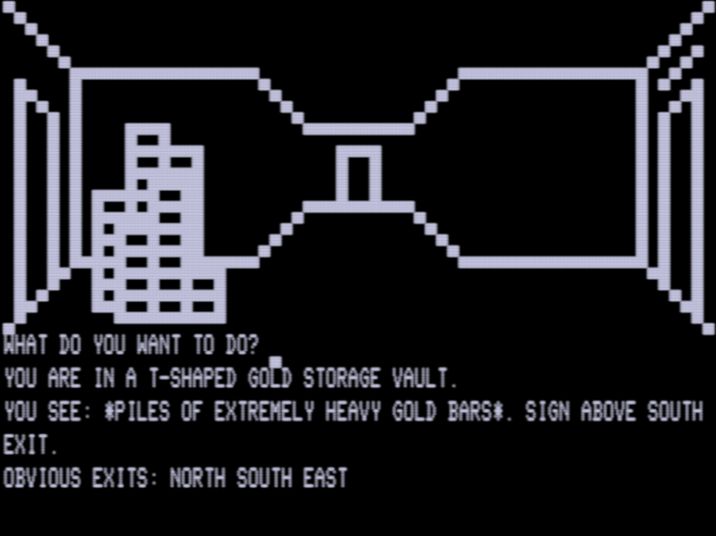
Before the first maze, there’s a treasure which is also a trap.
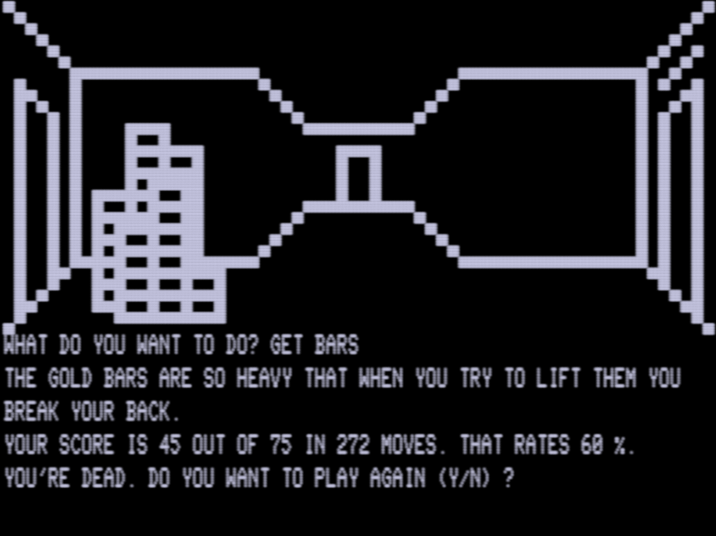
The sign indicates to beware going south, which drops you down a bottomless pit (I imagine most players would know by now to take warnings seriously, but again this seems to be about narrative flavor more than anything tricky). The gold on the other hand had me stumped for a while because the standard for such treasure-gathering games is that asterisks always means a treasure must be taken with you.
The gold is entirely a red herring, even with the asterisks. You get a full score without it, and you cannot take the gold without dying.
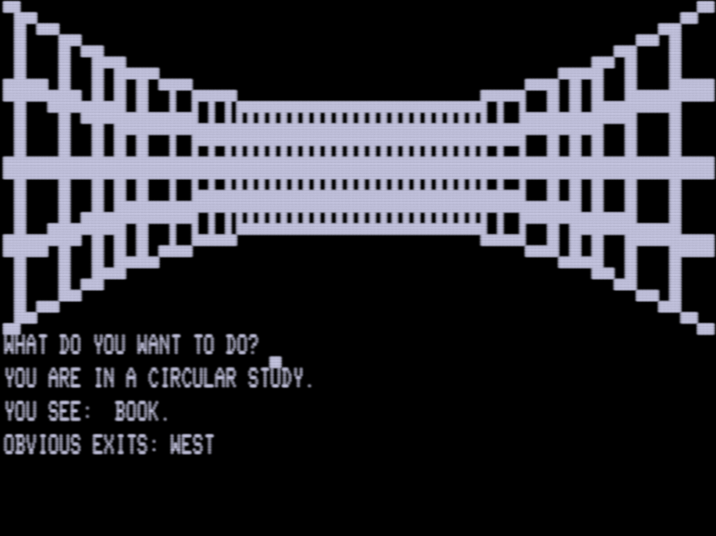
To the east there’s a circular study with a book containing half of a clue.
IT SAYS: THE ANSWER TO THE SECOND LEVEL IS…
After the maze…
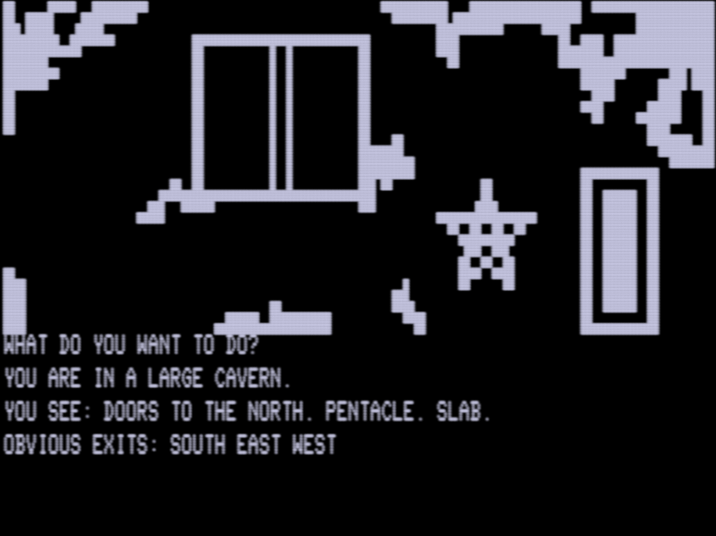
…comes a “large cavern” with a pentacle, a slab, and double doors to the north.
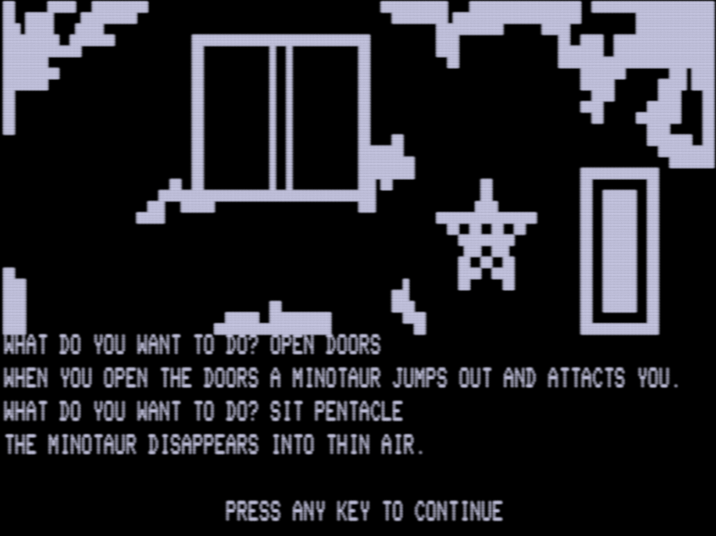
The slab has writing you can’t read, and a crack with a gold medallion hidden in it. The pentacle has writing to tell you to sit inside for protection, which is useful for opening the doors.
From where the minotaur came you can get another treasure (a gold candelabra).
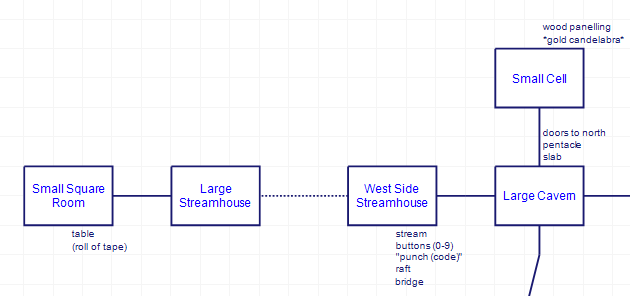
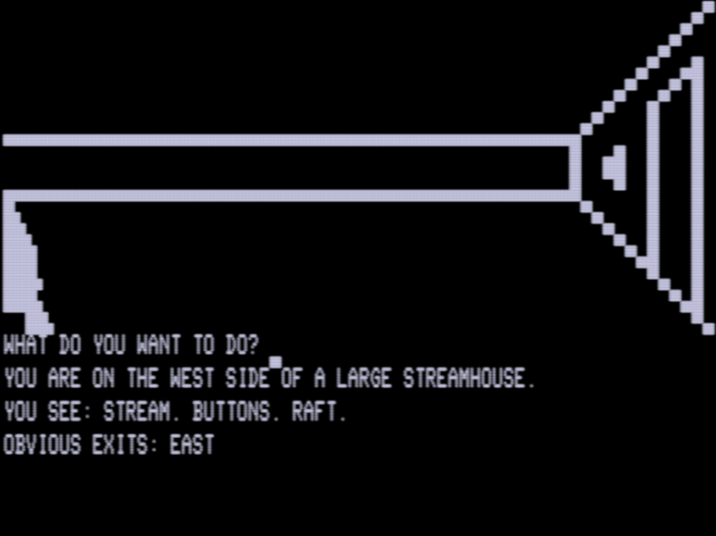
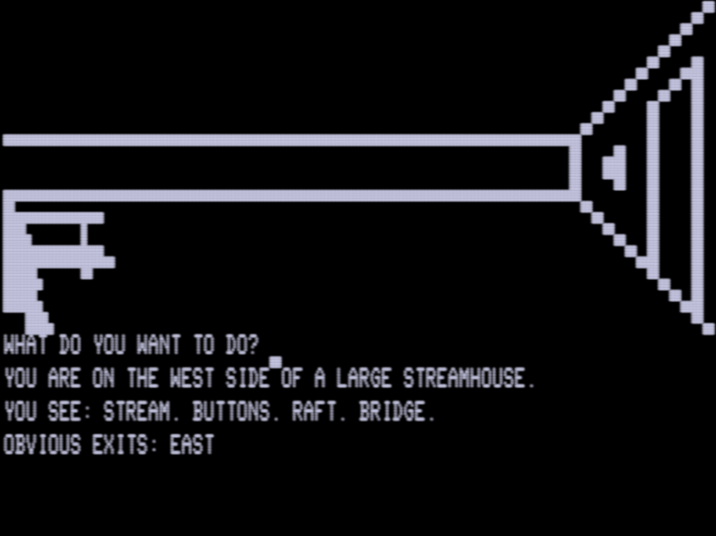
Just past that to the west is an area with a stream and a bridge…
…and there’s a keypad with numbers, where the game says you can PUNCH (number) to input something. There’s a also a raft at a stream that is blocked by some ropes.
Making further progress requires turning south, to the other maze.
At least the authors here have the excuse they could re-use the art from the maze rooms. Everything else has unique drawings.
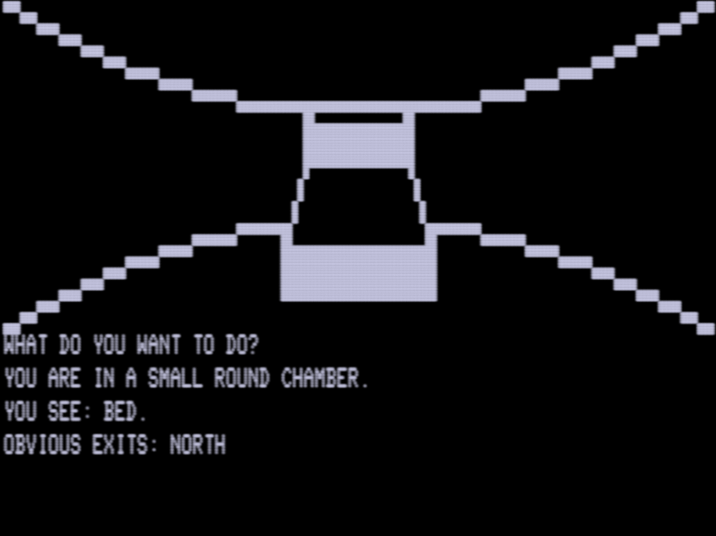
There’s a pistol with an ivory handle at a bed (another treasure)…
…but also the second half of that clue from the book, written on a random sign in the maze.
IT SAYS: … VERY GROSS.
Putting it all together
THE ANSWER TO THE SECOND LEVEL IS VERY GROSS.
This all lines up to indicate that the keypad needs the number 144 (a gross, that is, a dozen dozen).
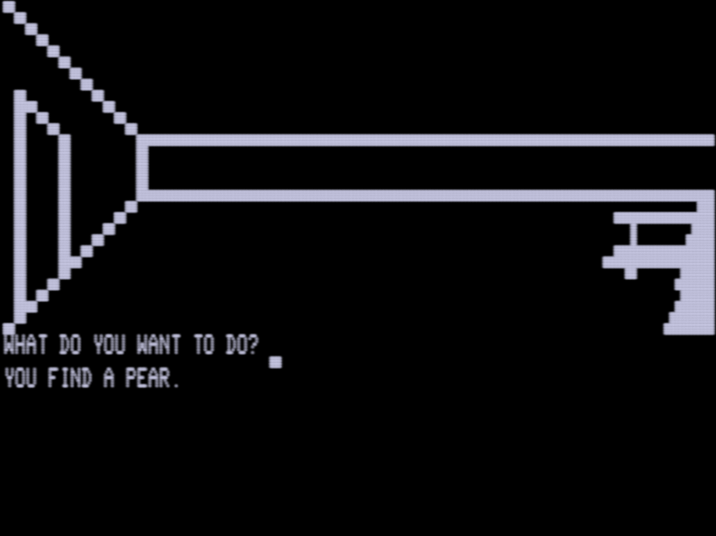
The bridge appears once the keypad number has been entered. On the other side, there’s a PEAR (which when examined, is actually a PAIR of scissors) and a roll of tape.
This was the last thing I found while playing, but it’s just LOOK BRIDGE while on the opposite side.
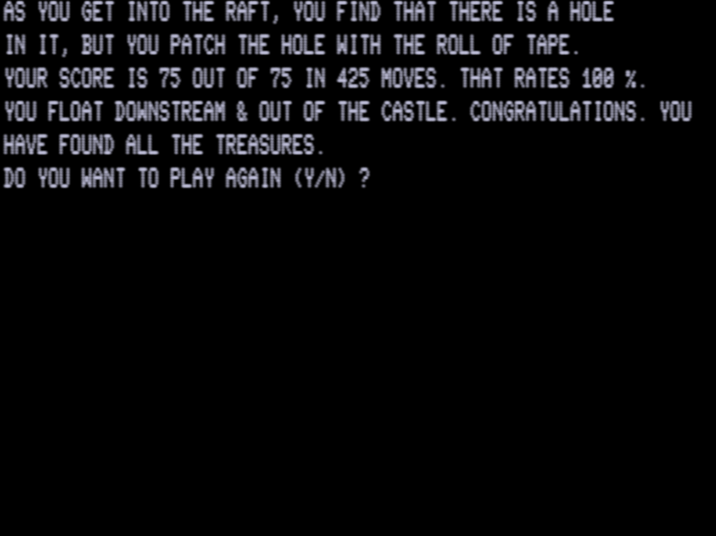
The scissors can free the raft from the ropes, and the tape is needed to be at hand in order to patch a hole.
There’s one more death that can happen here, if you’ve been keeping the BAG OF SAND the whole game, which so far, never was useful (and in fact, only serves as a trap).
THE ENORMOUS WEIGHT OF THE BAG OF SAND CAUSES THE LIGHT-WEIGHT RAFT TO SINK TO THE BOTTOM OF THE STREAM. YOU DROWN.
I avoided this during my game just because, weirdly, I had been experimenting with the other trap (the gold you can’t pick up) and had already dumped my inventory (thinking maybe you just needed to be holding nothing and the gold was carryable). I never bothered to pick the sand back up, so I got saved from one trap by another trap.
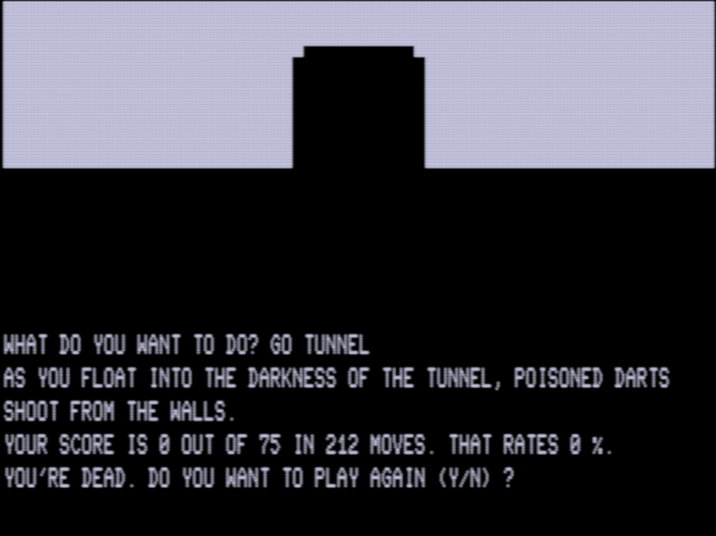
In the end, this was pretty straightforward and pleasant. I think the difficulty spike at the beginning was a little rude, even though you could resolve the fork issue by typing LOOK FORK; at the very least, there’s a callout of Subterranean Adventure in a Family Computing article circa 1983 that complains quite specifically about that puzzle. The deathtraps, despite showing with some regularity, were all “polite” in that they had some kind of signal. With that tunnel with the poison darts, for instance…
…if you LOOK TUNNEL before going in, the game tells you about the trap.
YOU DISCOVER THAT THERE ARE POISONED DARTS HIDDEN IN THE WALLS.
There are some games where this would just indicate a puzzle to be solved; some of getting in the “flow” was realizing what kind of game this was.
(Design-philosophical aside: for gamebooks especially I tend to mentally sort them into how much they reward thoughtful choice-making. That is, a book may have a left and a right lever to pull, and there is no clue at all which to pull, and you just have to guess — see my compaint on Forest of Doom. Or, it may be, as here, there will always be a signal for what the right choice is, so you can role-play to an extent someone who can’t fall back on a saved game and try to do the right choice the first time. This is a little more pleasant. There can be use to the effect of a “blind choice” but I do find if a game starts using blind choices I make later choices much more at random, even if the author sometimes provides hints for what’s the best option; I’ve lost my feeling of trust that my time won’t be wasted.)
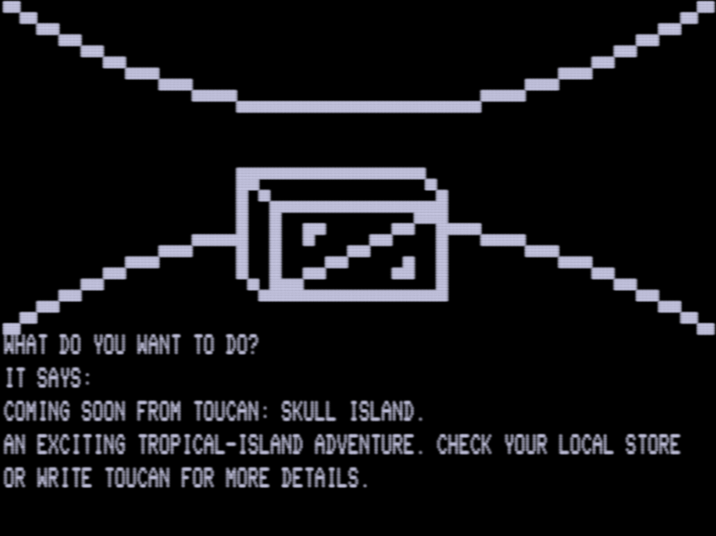
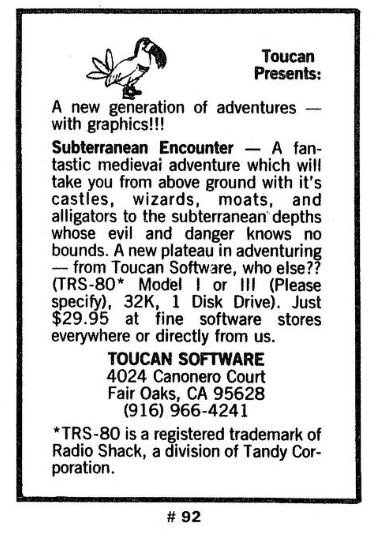
I wish the authors had a further chance to establish an identity and work on more games, and at least they planned it. On the piece of wood (the one that doesn’t set on fire) the whole point of it is to serve as an ad. It has writing and you can READ WOOD:
The follow-up game never surfaced.
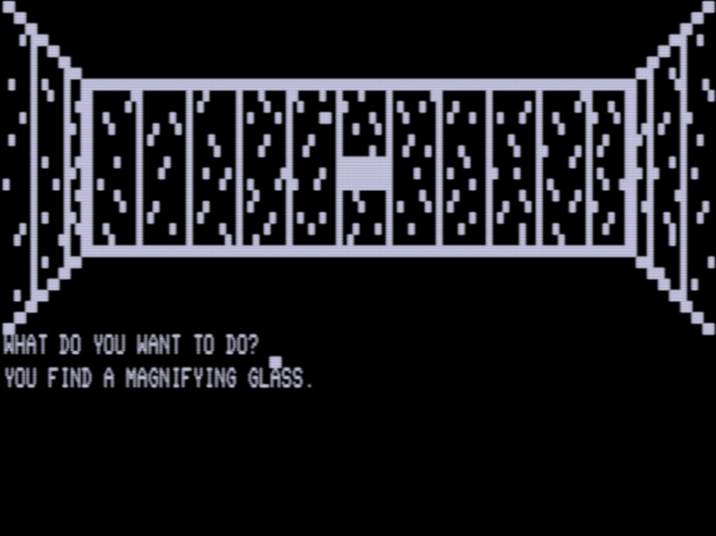
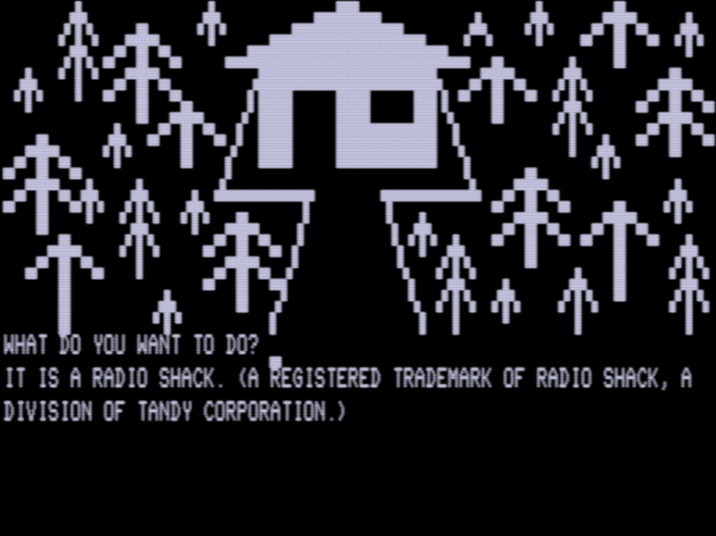
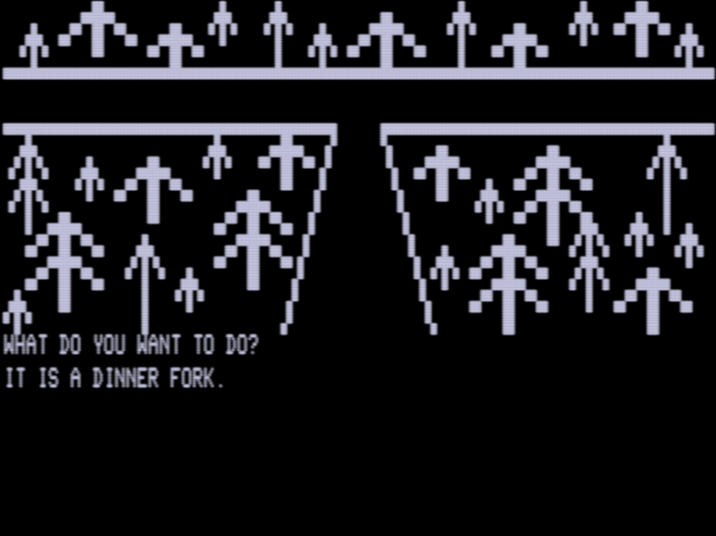
One last comments on the graphics: I’m not sure how much fresh analysis I really can do (since you’ve been seeing them along with me) but they’ve been genuinely pleasant. Compare with Asylum, which was entirely graphical, yes, but always felt like some “programmer art”; that is, it was made functional, enough to give a visual sense of the world, but never had the sort of pixel art one might take seriously as a real style. Here, on the other hand, there was clear effort at style and texture. The perspectives and directions don’t always make sense, but the authors threw themselves into thinking what the TRS-80 was really capable of (like the stylized trees from the start of the game or the wood panel texture shown below).
I’ve had progress on both the informational front and the game front.
Information-wise, I had help from AtariSpot on a Discord server who sleuthed out two stories in the Sacramento Bee. Our intrepid duo of authors were indeed teenagers at the time at Bella Vista High, and a July 18, 1984 story goes into more detail on the founding of the company.
Steve Forrette had his mother design the logo, and (by the news story) had managed to sell 70 copies of the game (perhaps the 500 from the book is an over-estimate for rounding purposes). He got meagre profit due to costs:
I got more than I bargained for in selling it myself. I had to pay for postage, the phone, envelopes, baggies for the disc. But I learned a lot about how businesses work. I didn’t want to just sit back and let a big company sell it.
The company may have also had some sort of afterlife, as Strident tracked down Pelican the company in the comments, although I’m still unclear if the connection with the early-90s company (which was located in Connecticut and created educational “book making” software for classrooms) is accurate or not.
On the game front, I needed to whack at the game’s verbs. I first went through my “standard list”; fortunately the game is quite clear about if a command isn’t understood because of something being out-of-vocabulary or not.
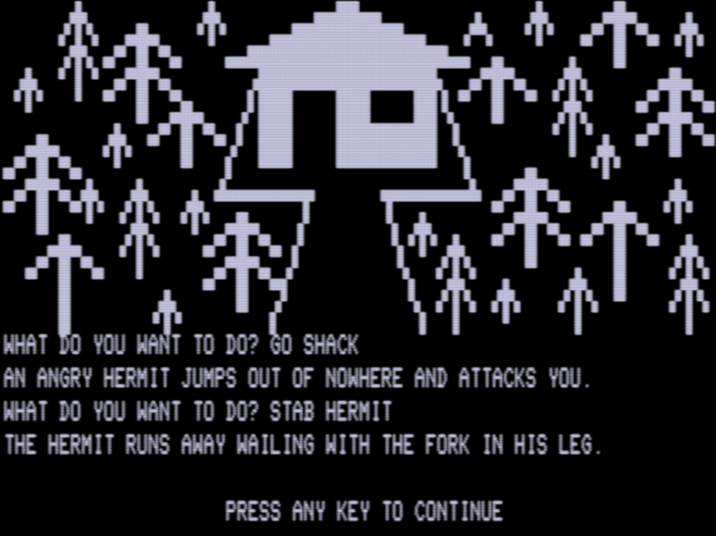
One verb in particular, STAB, ended up being just the thing to take down the hermit, as long as I was holding the fork:
The inside of the shack has a rope. I took it over to the logs, and tried various commands, including MAKE BRIDGE and MAKE RAFT, with no luck. I was worried there was some pun I was missing (like the fork).
I eventually did a small peek at the BASIC source just to extract the verb list, and came up with BUILD. Argh! Notice I have been testing MAKE for a long time as a verb but not BUILD.
This quickly led me to BUILD RAFT, followed by GO RAFT.
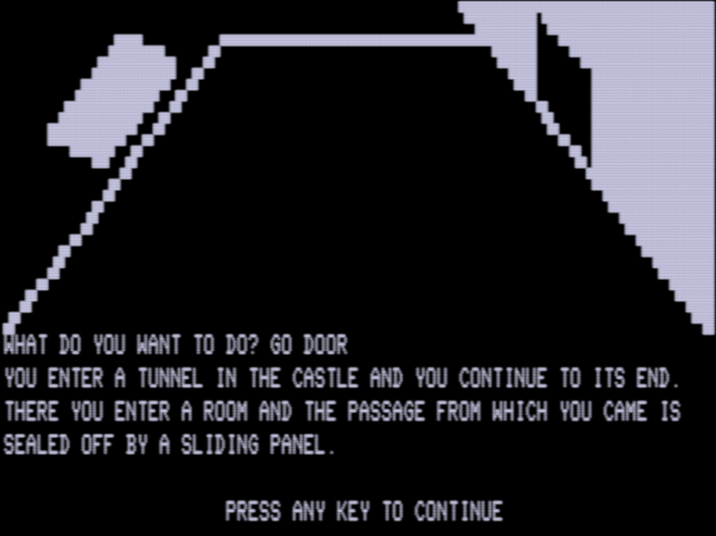
I avoided it the first time around, but I’ll just give the tunnel effect now:
The game has by now established one of its Patterns. Some paths will be deathtraps, and not every deathtrap is a puzzle to solve. Some deathtraps are simply meant to be avoided, and that’s the only “puzzle” in them. (I will say, since I get stuck later, I’m not 100% definitive there’s no safe route through the tunnel, but there are so many circumstances where the player is simply meant to avoid something, I think it really is a red herring.)
In a theoretical sense, this is the most elemental type of puzzle you can have: here are three buttons, pushing the right one leads to victory, which one do you push? However, the fact it is easy to back out with a save game file means it isn’t a puzzle so much as a special effect. Quoting a comment I made on Pyramid of Doom:
I know traditionally the “diegetic plot” of an adventure is the one that goes through without deaths, but I’ve come to think this paints an incomplete picture. This particular death is amusing enough that it’s hard to imagine it won’t be “in the head” of the player, making the environment seem more dangerous. On the surface, the player is walking through a door. Underneath, the player is avoiding a death-trap. Without both branches simultaneously, part of the story is missing.
Skipping the tunnel, you can make your way around the moat to the north side of the castle, where there’s a dock, and a door you can go in.
Then there’s another deathtrap, although an announced one.
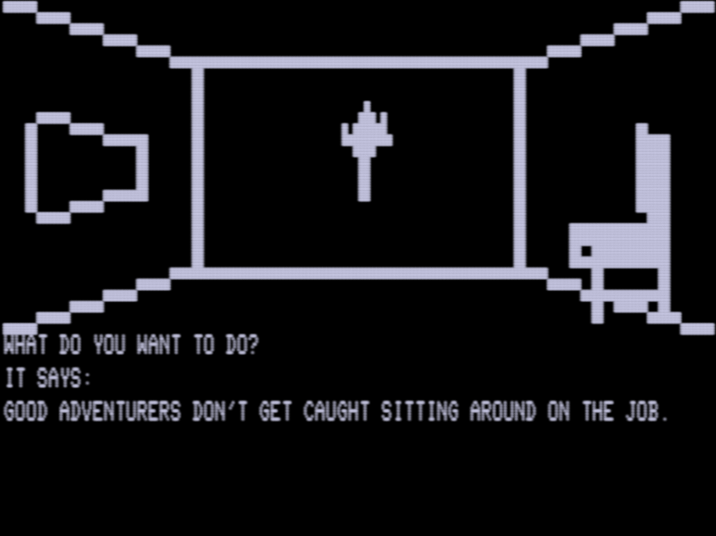
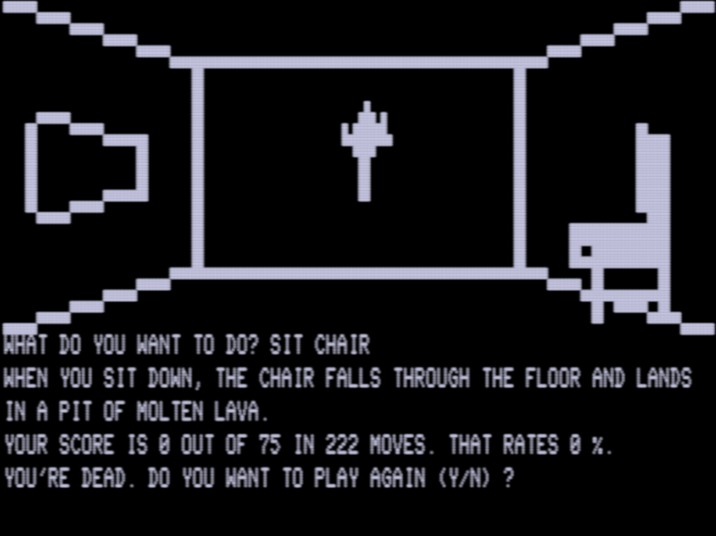
The sign hints adventurers shouldn’t be “sitting around on the job”, so if you SIT CHAIR, it will kill you.
This was more “experimenting for amusement” rather than being tricked. The later deathtraps are also well-signaled.
You’re supposed to ignore the chair entirely and pull the torch instead, opening a door into a new area.
There’s a suit of armor that will chop with you an axe if you try to pass by (again, this was an obvious trap, but I set it off anyway for amusement).
Acid will work to destroy it; past there is a locked chest I have yet to be able to open.
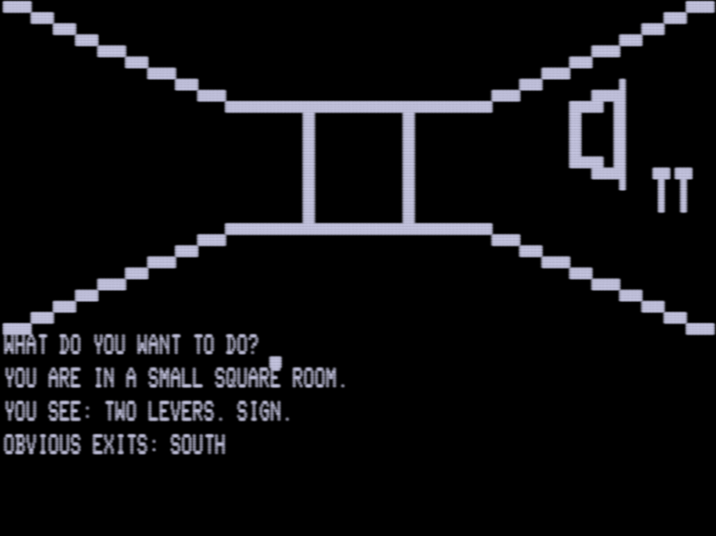
Heading a different direction leads to two levers, and yet another “signaled deathtrap” circumstance.
The sign tells you DON’T PICK THE WRONG ONE! You are instead supposed to pick the RIGHT one, that is, PULL RIGHT (or PULL LEVER, then say RIGHT when prompted). PULL LEFT fills the room with water and kills you.
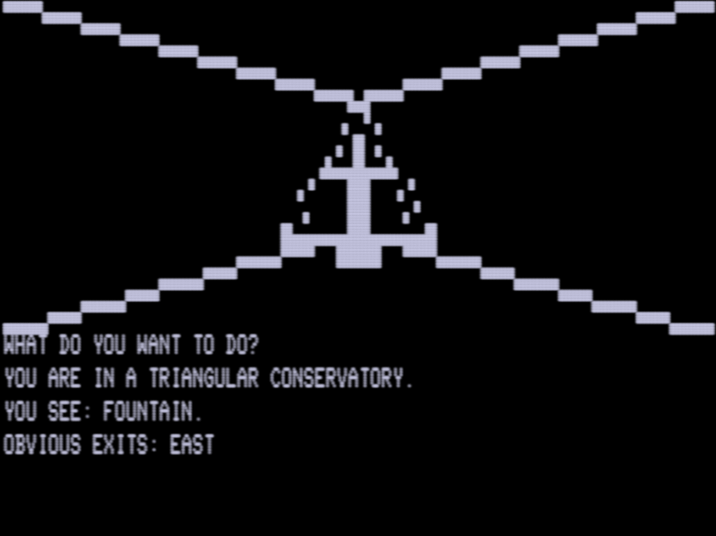
Past that there’s an art gallery with a couple branches; one has a fountain with a *silver coin* and a keyhole, and this was the moment I was sure this was a treasure hunt, even if the game’s ad was coy about the fact we’re here to collect treasure.
Another branch had a *crown* in a side room, some wood in a firepit, and a table full of wizard items (hat, wand, crystal ball, manual). Some writing on a rug warned to “touch only what you can read”. Consequently, most of the items involve death when touched.
Reading the manual gives the clue “the answer may lie to the west, but may also be death”, and I admit I haven’t worked out where to apply this yet.
Finally, there’s a very small side maze:
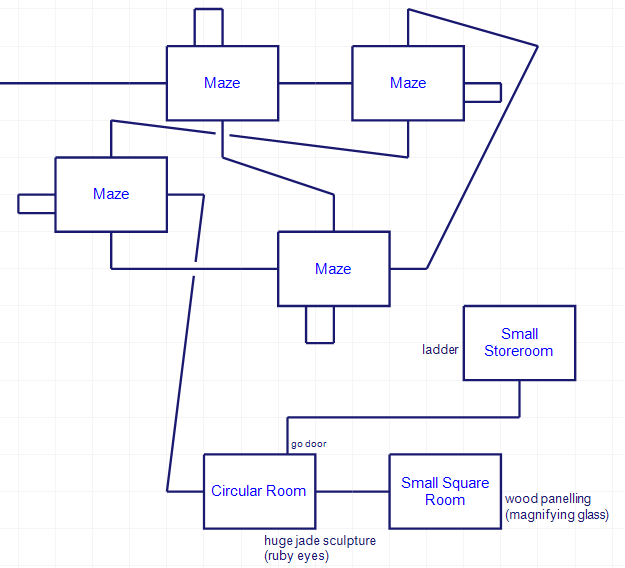
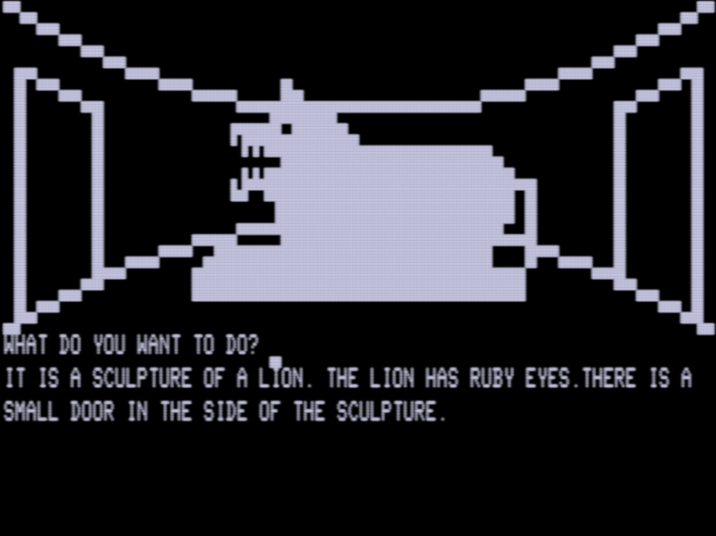
This all leads to a huge jade sculpture.
Shockingly, the rubies are not a trap and can be taken straight out. There’s also a ladder and a magnifying glass nearby.
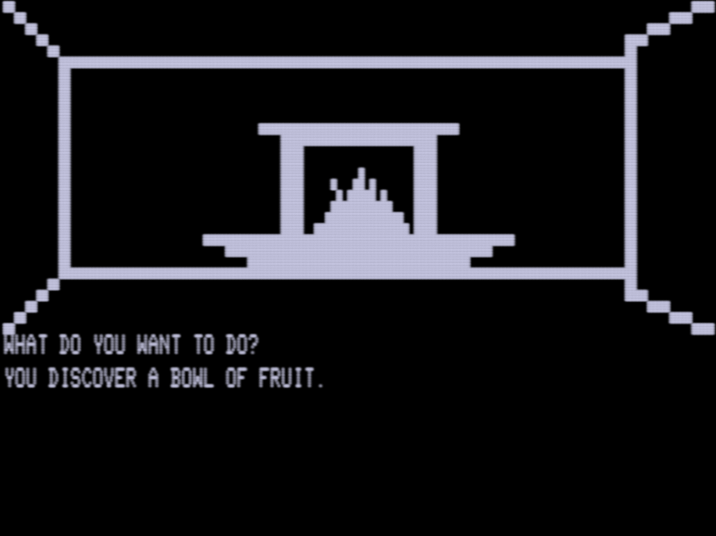
The ladder at least I put to good use, back in a room with a fire and a hearth where the top was too high to see. Applying CLIMB LADDER I was able to find a bowl of fruit.
From here I am stumped, and stumped in the kind of way I don’t even have active puzzles for the most part. I’ve got a locked chest and a keyhole in a fountain but in both cases I’d expect a key that I don’t yet have, so there’s nothing active to deal with there. This indicates I’m probably missing a secret, perhaps using the “answer lies to the west” clue.
IN THIS ADVENTURE, SUBTERRANEAN ENCOUNTER, YOUR GOAL IS TO ATTAIN THE HIGHEST SCORE POSSIBLE IN THE FEWEST NUMBER OF MOVES.
Via 80-U.S., November 1982.
According to the 1985 book Microcomputer Market Place, Toucan Software was owned by Scott Mckenna and Steve Forrette. They only published one game which sold 500 copies. They are about as obscure a company can get; they never filed any official incorporation papers. (There’s another Toucan Software that emerges in the 1990s, but there seems to be no relation.)
Today’s game is a team effort between the aforementioned pair, and I’ve not been able to find either. The closest I got was a reference to a Scott McKenna who went to Bella Vista High School in that time span (in Fair Oaks, 1981-1985), so I’m going to guess the company was another one of the teenaged-entrepreneur larks, but I can’t confirm that with certainty. It does make sense that under such circumstances the authors would only sell 500 copies of one game and disappear after into history.
But it’s an interesting game! We’ve had TRS-80 games with graphics before, but none seem to have been influenced by the growing market for graphic adventures on the Apple II; they formed their own ecosystem with little relation.
I get the sense McKenna and Forrette at least saw a graphical Apple II game.
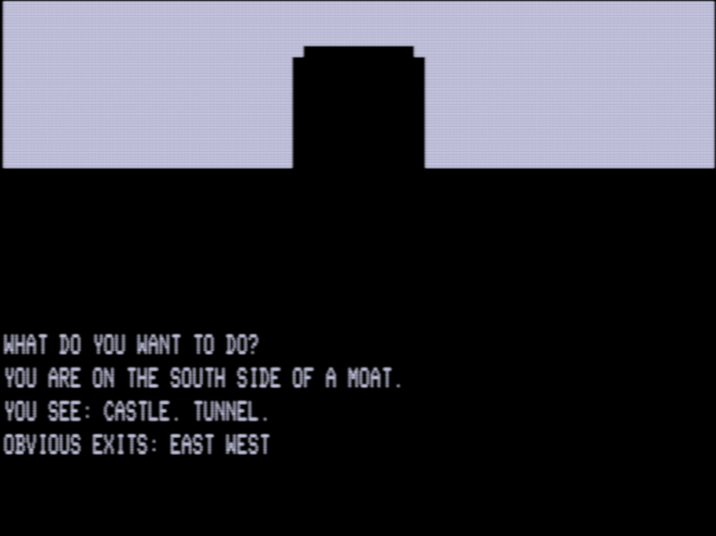
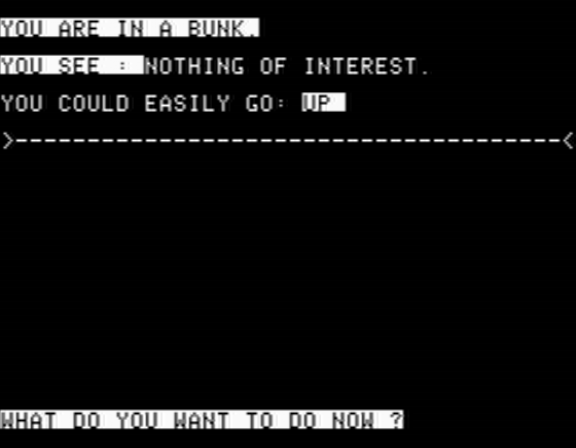
This games keeps the Scott-Adams style “YOU SEE” and “OBVIOUS EXITS”, but also fills more than half of the top of the screen with an image. We haven’t seen that before with the TRS-80, and the two other graphical TRS-80 games I know of coming up in 1982 don’t follow this pattern.
If the authors got the two-thirds-top-of-screen graphics look from, say, one of the [Sierra] On-Line games, they may also be enamored with the amount of random death. That bottle from the initial shot is acid (don’t drink it! you can POUR BOTTLE and it asks on what, but I have found nothing that works).
Heading east and then north from the starting room arrives at a “shack”.
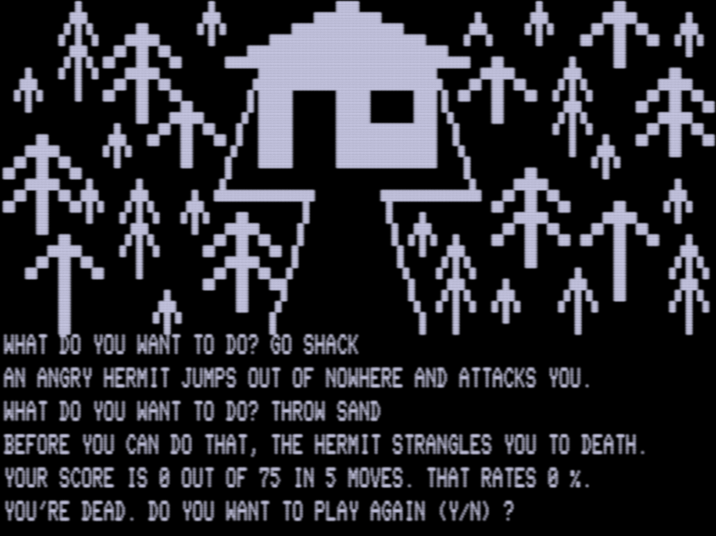
Trying to enter kills you. You have one line where command can technically be typed, but the game seems to be coded to send every reaction to death.
How about a low move count with a low score as the game’s objective?
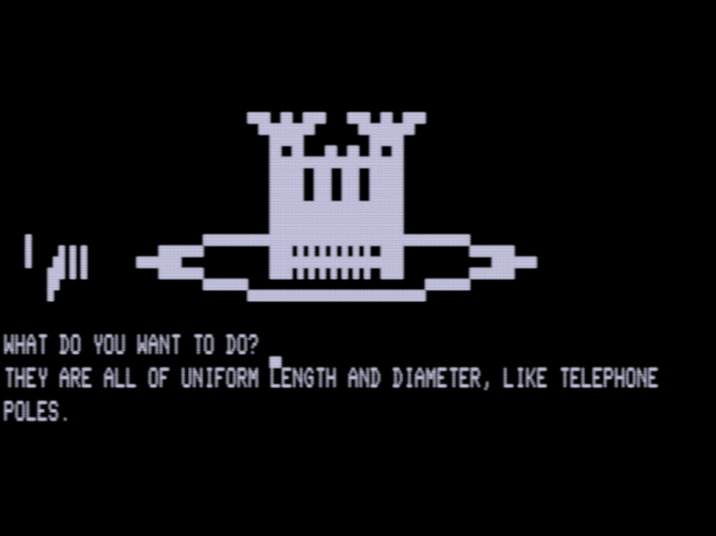
Heading south rather than north leads you to a castle.
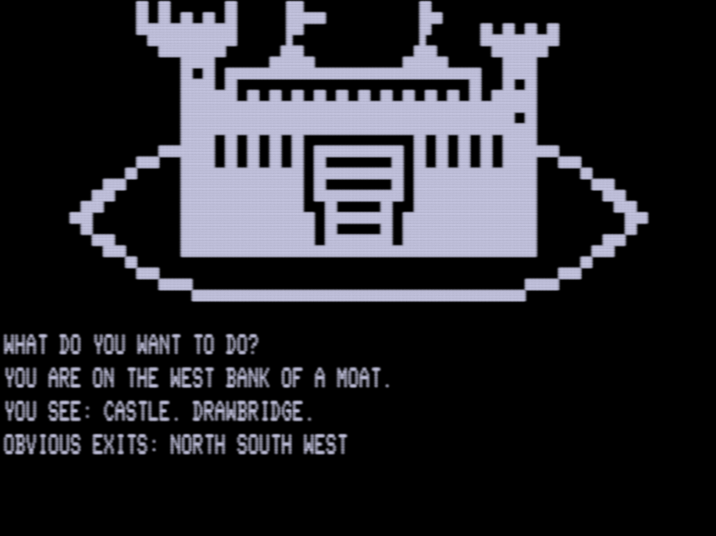
There’s some logs on the south side (that are too heavy to move), while the east side has an open drawbridge.
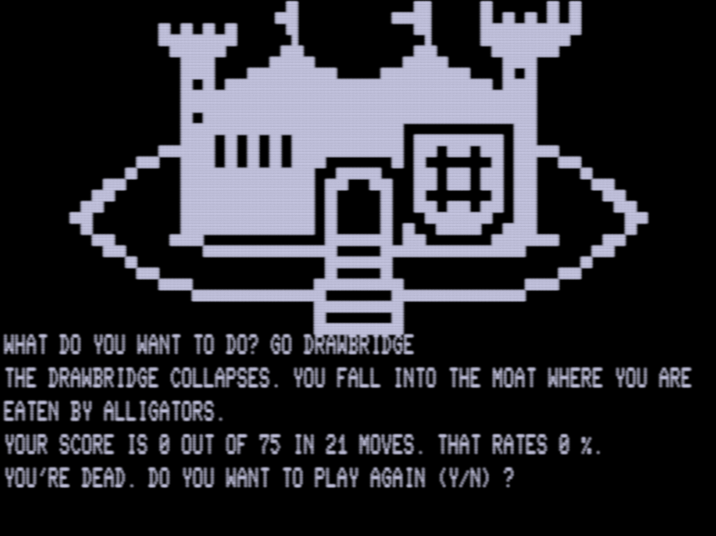
I’m sure what happens next will shock you.
That’s almost everything I’ve managed so far, but go back at look at where the path splits. The game says there are “two forks in the path” which you could kind of read as a north fork and a south fork, but the way to actually read it is there is a fork and also a fork.
LOOK FORK reveals one of the forks to be a dinner fork, so this isn’t quite the same as Mad Venture where fork referred to both the literal location and the object. This is a joke rather than a mind-bending warp of reality.
I poked around some contemporary material that indicated the game was short (41 rooms) but given what happened last time, that doesn’t mean it will be easy. (At least it’s written in BASIC!) If you’d like to poke around yourself you can find a couple version of the game here, and AUTORUN (under the DISK EMU column) seems to work for the first version.
Back when we were first exploring early British games in 1981 we came across Trevor Toms who made a “Create Your Own” adventure system and wrote a game to go with it, City of Alzan. Both were published by Phipps Associates.
In 1982, Phipps published a tape that had just Trevor Toms system games written by Mike Farley:
From zx81stuff.
Greedy Gulch, the first on the list, involves entering a ghost town, finding a nearby mine, and getting a nugget of gold within. I originally had the thought to play all three games on the tape and cover them in one entry, but for reasons I’ll get into Greedy Gulch was a serious pain. It seems particularly to have been designed to troll the player like one of those Super Expert levels for Mario Maker.
I made a decision which may have been bad in retrospect. I switched from playing the ZX81 version to the ZX Spectrum version.
I had decent reason: while the opening room is more or less the same between the two…
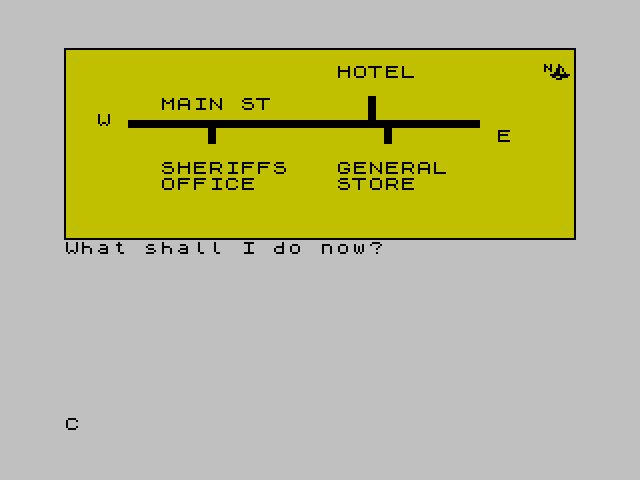
Yes, it’s a top-down map. The game does this in the streets of the ghost town you start the game in.
…once the room descriptions started the ZX version had more room for text and managed to describe things more vividly.
In particular, there’s an emphasis on sound. A fair number of authors of this time appealed mostly to visual senses.
There are more pictures in the ZX Spectrum version but that seemed like just extra flavor.
I felt confidence, after mapping out what turned out to be a small opening town, that I would be over with the game quickly.
Some places, like the general store, require typing ENTER STORE, while other places just are connected (inconsistently) via compass directions.
The town felt like it mostly was meant to serve up a bunch of objects: a hat, a plank, a lamp, some matches, a leather bottle, an axe. A little more fussing about revealed a tin of oil in a cabinet, although the ZX version made it harder to find.
The ZX81 version just says “THE WALLS INSIDE THE CAFE ARE LINED WITH CUPBOARDS.”
The issue here is that it is sometimes hard for a player to know when something that’s part of the “regular paragraph” text of the game is important, as opposed to the “separated text”. There’s a longstanding tradition for objects that can be picked-up/manipulated to be mentioned separately, so the player does not waste time poking a bunch of unrecognized nouns. Trying to do something with the tables, for instance, is entirely unhelpful. In the ZX81 version of the game this mixing of important objects in the main text doesn’t matter because it is so short in order to draw attention; with the ZX version it isn’t as clear that the cupboards should be zeroed in on. So while the extra text is more vivid it also causes play issues with the way the game’s nouns are handled.
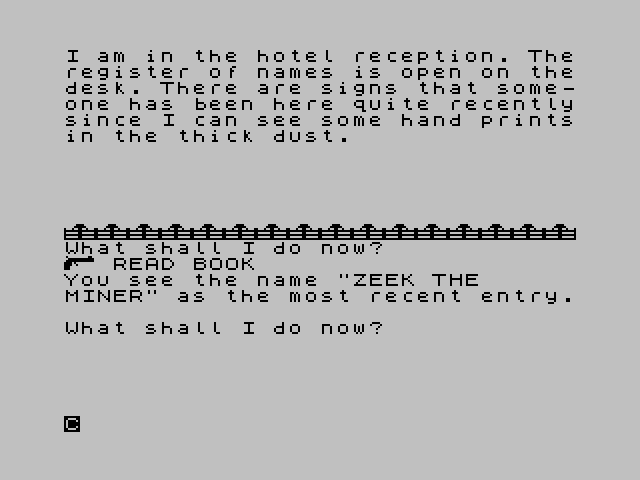
One last item I managed to pull out was a map. A nearby hotel mentioned a ZEEK THE MINER entry…
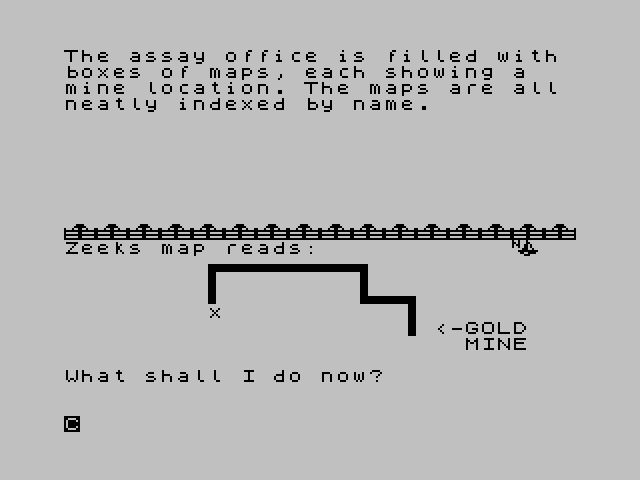
…and in a nearby assay office (with maps sorted by name) I was able to get Zeek’s map by typing GET ZEEK.
Having gathered everything I could manage, I tried going east to a ravine, and typing JUMP RAVINE leading to a desert.
I was just experimenting, because I hadn’t been able to do something else crucial that I figured would be important: fill the bottle with water. If you try to follow the path of Zeek on the map you die of thirst. There’s a “pump” just before the ravine that seemed like it’d work, but all my attempts (FILL BOTTLE, GET WATER, etc.) failed to yield results.
My best was typing USE PUMP which got the water to gurgle. I had to look up what to do here: you just need to USE PUMP twice in a row, which causes the gurgle to flow enough to get the water.
So, water in hand, I went back to the desert, and with a little false start (I thought it the path started North-East-East-East-South, but I had one too many Easts) I was able to trek through. However, I should emphasize something.
The ZX graphics drawing routine in this game is very slow. Ludicrously slow. Even cranking the system to 300% each step took a while. This will be important later.
Anyway: the result of my trek was a “plateau” where I could refill water.
Eyeballing the map, I figured I then needed to go east to head to the mine, but that landed me back in the desert, where I then could not get out and died of thirst. Whoops!
My last save was at the start of the desert, so I trudged back through the slooooooooooooooooooow loading graphics screens again, saved at the plateau, and then went in the correct direction (west). I was able to successfully light a lamp at the mine.
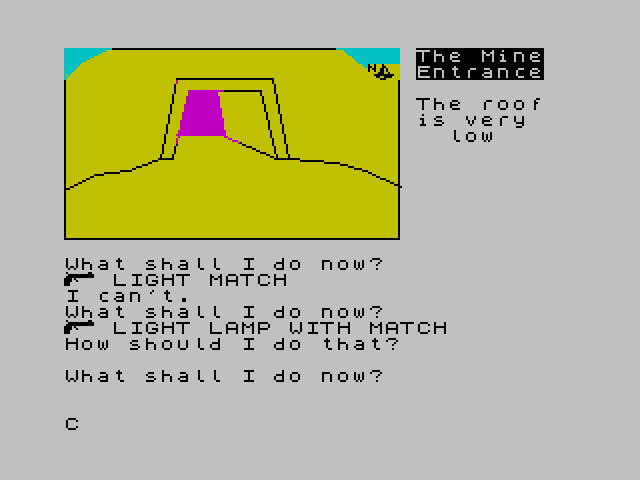
Well, not without the parser difficulties that dog the entire game. Here you need to STRIKE MATCH (?!), which automatically also lights the lamp (?).
Then immediately afterwards I got bit by a snake:
To be fair, this was intentional. I was testing, and with axe in hand, I … was not able to use it against the snake.
It turns out, the proper weapon again a snake is a gun. Yes, apparently it is easier to shoot a snake with a gun than it is to simply chop it with an axe. Learning!
I had seen a gun, back in town, but I originally thought it was possibly just scenery: the sheriff’s office had a locked gun cabinet, but I never managed a key. Testing back a saved game step or two, I finally after much heartache found USE AXE (trying to SWING AXE or BREAK CABINET or any other logical command didn’t work).
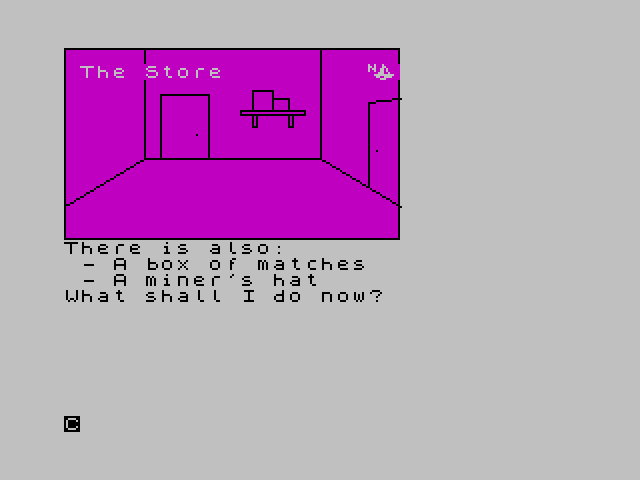
However, the gun was unloaded, and I was completely and truly stuck. I consulted a map, which indicated two places I hadn’t found. First was a backroom to The Store.
After some failed movement, I came across OPEN DOOR. Apparently that rectangle to the right is a door. Argh!
The ZX81 version, straightforwardly, says
THROUGH THE GLOOM YOU SEE A DOOR AT THE BACK
There’s a crate with some ammo in it, so you can load the gun.
(At this point, I was having some serious inventory-juggling problems; I hit my limit and needed to drop items to carry more. You can’t take everything with you on the desert trek, it seemed like, although I didn’t work out the true horror of what this implied until later.)
Going back to the map, I went to the other place of mystery, the barber, which I knew had a cellar beneath it.
Again, I ran through many, many verbs; this time, I struck out entirely and had to check a walkthrough, which advised me to LIFT BOARD.
!!!?!???!??
Look, it isn’t even 100% clear we’ve got a floor made up of boards. They don’t show up as a noun anywhere in the description, only potentially (potentially!) implied by the sound description. And on top of that, the verb that has to go with the board is relatively unusual, and plenty of my other actions I tried prior should have had the same effect.
I can’t even say the ZX81 fixes this problem.
Oh well. You need a light source in the cellar, which burns out the oil in your lamp, but fortunately, there’s that tin from the cafe that works. The cellars has some poles. I wasn’t immediately sure what they were for, but I knew I was now deeply in trouble as far as inventory juggling went.
The items that seem to go to the mine are
leather bottle (for the water), map (for the route, and you can’t just leave it behind, I tried), loaded gun, poles, plank, hat, matches, lamp, axe.
That’s three items too many. I thought maybe the axe was done, having smashed a cabinet. I didn’t record exactly what my other discards were, but I did get far enough to shoot the snake, then die immediately after:
It took me a couple iterations of slow (so slow) desert travel to realize, but you need every single item taken over to the mine. That means you need to cart some items to the plateau, drop them, then go back for a second load. This would not be a problem if you could just retrace your steps by the map but … you can’t! Trying to retrace leads you nowhere. Even though the game gave a clever method for avoiding maze-mapping on the way to your destination, now you’re in a maze that you need to map. So it’s like the game gave an easy route to a puzzle only to yank it away, haHA! you thought that bit with the arrows was the exit, but no, that’s just another spot that kills Mario.
It took me a couple tries to handle the logistics correctly and the desert wasn’t loading any faster, until finally I made it to the mine with all items in hand. (You can drop the map and bottle at the water spot, and after lighting the lamp you can drop the matches.)
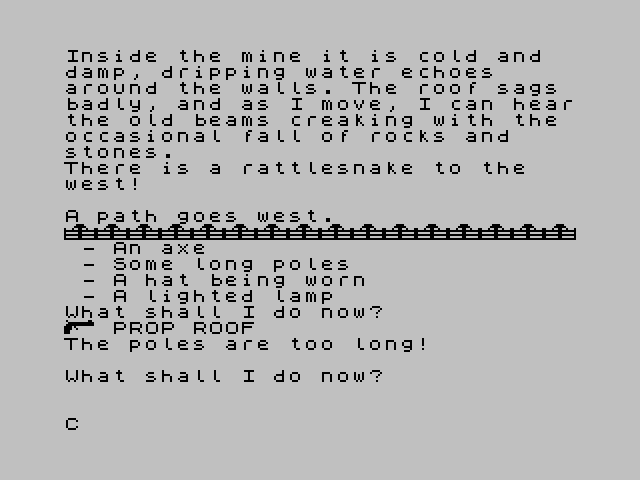
I still had to work out the mine collapsing, and it required again a very novel and very specific verb, not in any game I’ve played before. PROP. You need to PROP ROOF.
To get by the “pole too long” problem you need to chop them down with your axe, but that only works if you remembered back in town to apply the command SHARPEN AXE at the blacksmith. Otherwise it’s back to a whole sequence of desert runs for you!
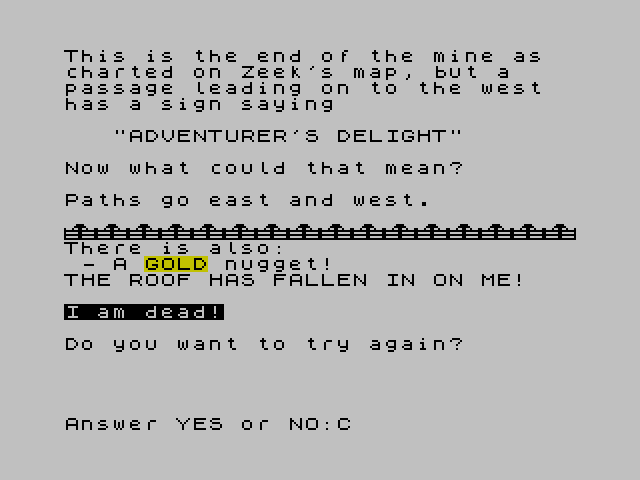
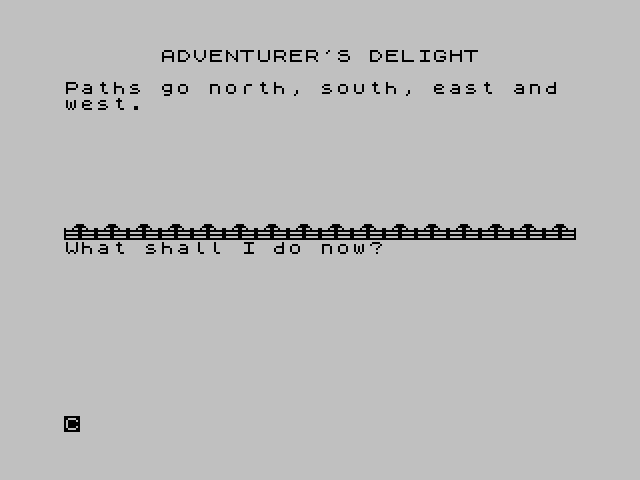
Then you can finally safely get the gold. To the west is an Adventurer’s Delight. What is an Adventurer’s Delight, you may ask? A maze that is completely useless and serves only to waste your time.
At least I was expecting troll behavior by now so I didn’t spend too long.
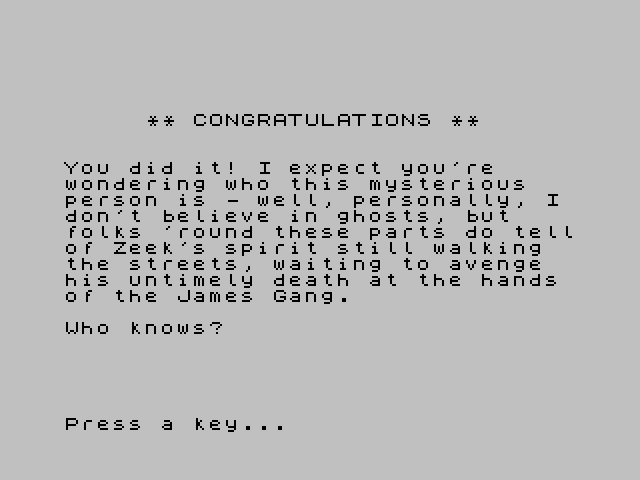
Gold in hand I went back to the starting place to reach victory.
It felt hollow.
I’m probably being unfair on Mike Farley’s game, but I’m going to take a psychic break on other things before trying to tackle his other two from this tape. Some aspects were truly just bad luck, but the structure really does seem intended to wind the player up before providing failure. Simply having the desert travel not be a pain would fix 95% of the issue; I wouldn’t even have minded SHARPEN AXE had it been a small matter to travel back.
This is all more the pity because the ZX descriptions really are decent! If I evaluated the game purely on room description writing (the later ZX version, not the original) it would be in the upper tier compared to other games from the era.
By the way, it may have been a bug, but as far as I can tell the water at the pump only fills once. So you might think to just make another full trip to fix something you’ve forgotten, but no: if you try to do another extra loop past the one the game intends, you’ve softlocked the game.
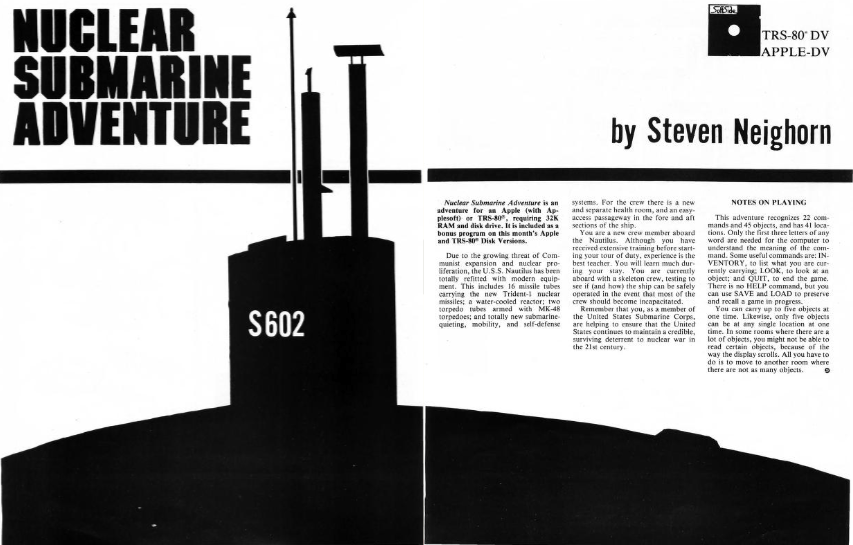
Due to the growing threat of Communist expansion and nuclear proliferation, the U.S.S. Nautilus has been totally refitted with modern equipment. This includes 16 missile tubes carrying the new Trident-1 nuclear missiles; a water-cooled reactor; two torpedo tubes armed with MK-48 torpedoes; and totally new submarine-quieting, mobility, and self-defense systems. For the crew there is a new and separate health room, and an easy access passageway in the fore and aft sections of the ship.
You are a new crew member aboard the Nautilus. Although you have received extensive training before starting your tour of duty, experience is the best teacher. You will learn much during your stay. You are currently aboard with a skeleton crew, testing to see if (and how) the ship can be safely operated in the event that most of the crew should become incapacitated.
Remember that you, as a member of the United States Submarine Corps, are helping to ensure that the United States continues to maintain a credible, surviving deterrent to nuclear war in the 21st century.
Steven Neighorn has graced this blog once before, with the game Crime Adventure. Specifically, at the age of 15, he made some kind of deal with Neil Bradley (aged 12) to get a game of Neil’s into Softside magazine; it made the October Game of the Month.
I have a little more information about that now. I found the previously missing Apple II source code, and that has Neighorn’s name (and only his name) in the comments. From the very last line:
2220 REM STEVEN C. NEIGHORN, A270, 8/3/81
So the sequence seems to be:
1. Neil Bradley wrote the game.
2. Steven Neighorn added his name to the credits (and probably did some editing…? I’d love his perspective) and sent it to Softside.
3. Peter Kirsch made TRS-80 and Atari ports, both which scrubbed the mention of Neighorn.
Neighorn did write other adventure games, including today’s, and I do think this one is almost certainly his (unless Neighorn somehow found an entirely different 12-year-old writing Apple II adventure games to take credit from). We are talking about a young teenager so I don’t think the debacle above is worth fussing over. Also, despite a couple awkward moments, this ended up being a much smoother game than Crime Adventure.
While this is a Softside game, this isn’t a type-in nor was it an Adventure of the Month. It had only TRS-80 and Apple II ports (no Atari).
This was a disk-version-only game. Softside came with a disk version for those who didn’t want to do all that typing, and sometimes they included extra games on the disk not printed in the paper.
I tried both but I was getting better vibes with the Apple, and based on Crime Adventure leaving credit on the Apple II version I’m guessing the original platform was Apple anyway.
(Assuming you are reading with something that sees YouTube embeds, I dropped a video link above for another “soundtrack to listen to while reading”, although it is more dramatic than this game needs.)
Things start relatively peaceful. The sub is at depth 0. A couple turns in (or right away, on TRS-80), disaster strikes.
You face several crisises:
a.) the electrical backup generator is damaged and will eventually shut down
b.) the nuclear power will eventually go critical
c.) the crew is all unconscious
d.) your ship is in the depths and needs to surface
e.) you’re hungry and short on food
The last one feels like silly adventure-dom, the other four come off as decent in a plot-integration sense even though they’re applying multiple timers. This game manages to mostly feel like objects are placed where objects ought to logically be placed, even though this is clearly a simplified little-to-no-research layout of a nuclear submarine.
Still, a submarine makes for a compact adventure map where it is completely realistic to have movement constrained. (See Nuclear Sub from 1980.)
I have this drawn as if the sub is facing the “east side” of the map, so right is “fore”, left is “aft”, down is “starboard”, up is “port”.
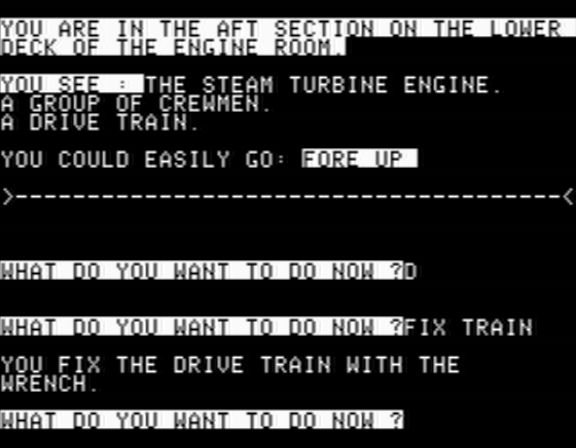
Exploring, the aft portion of the ship has an engine room with a broken drive train, next to a room with a generator.
There’s otherwise a hatch that just refuses to open for no specific reason, a bulkhead you’re not strong enough to open, and another bulkhead with a clear warning label sign that specifies how you will die if you try to open the thing and walk in:
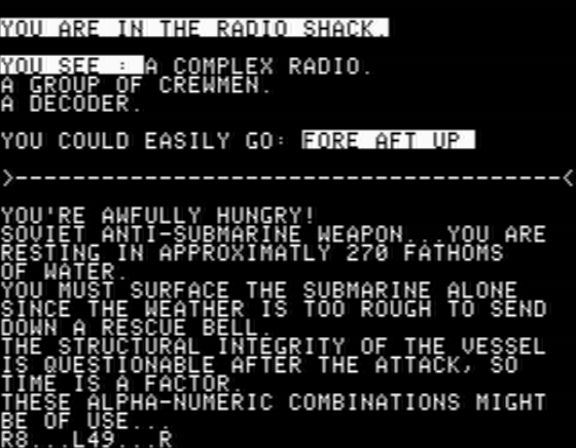
The middle part of the ship has controls: a “missile compartment”, a periscope room, a “main control room”, a “radio shack”, and an “access hatch” that requires the ship to be surfaced to be able to open. The radio shack has a broken radio, although it takes some effort to fix. The control room is the important part for the very start of the game:
This stops the meltdown.
The front part of the ship has a weight-training area…
This lets you open the bulkhead where you need to be strong back at the aft end of the ship. To save time, I’ll mention that bulkhead has a radio repair manual.
…some lockers that need keys (white and blue), a safe, a wrench (which you’ll need shortly), a stuck bulkhead, a bunk with a “decoder”, and some unconscious crew.
For the unconscious crew, there’s fortunately some smelling salts nearby that will get them active and following you. Then you’ll have what is presumably a large group of people following you through the rest of the game.
Once you have the crew woken up, you can open the bulkhead at the front of the ship and get a radio repair kit. This, combined with the repair manual, lets you fix the radio. Then as long as you PUT DECODER / RADIO you’ll get a message:
This is sending you code for a safe. Also this is before I worked out how to deal with hunger and I died a few turns later.
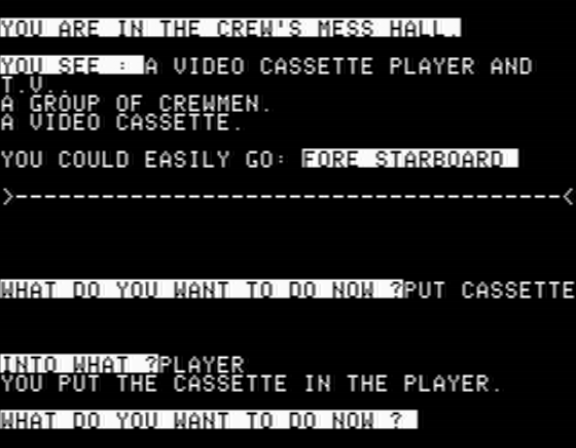
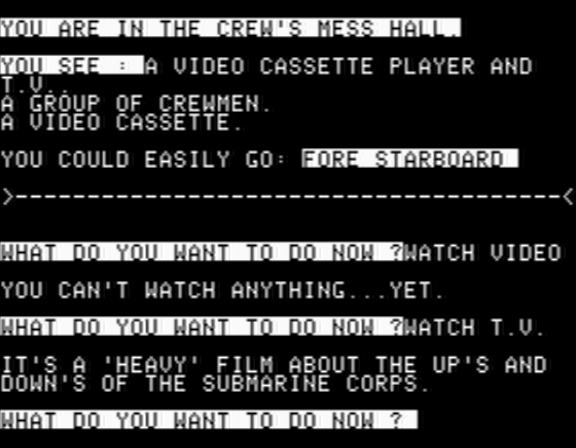
The safe has a tape recorder, and there’s a video player nearby that I had a _very_ hard time operating.
I tried lots of combinations of PUSH PLAY or START PLAYER or WATCH TV with no luck, and made a big list in the meantime to make sure I didn’t miss a verb. Instead I missed the game wanted the period marks with the television.
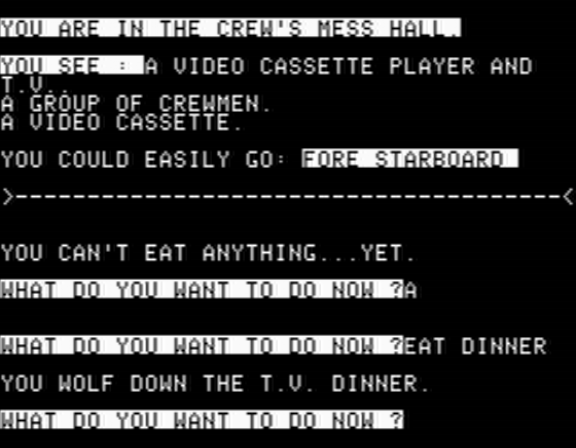
The room with the video player also is related to another difficulty: the hunger. There’s a “stores room” with a “frozen tv dinner” that you can cook in a stove; I got that far. But the game kept saying I couldn’t EAT it. That’s because eating it only works in the mess hall, even if you’re starving.
My next issue I resolved was power. This was just a matter of carting the wrench back to the broken drive train and saying FIX train. I was also able to use the wrench on the hatch (where the game didn’t give you any reason why the hatch was stuck) and find a white key.
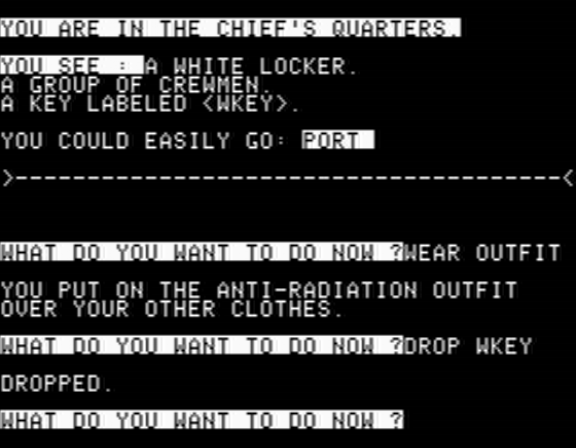
White key in hand, I found the corresponding white locker and got a radiation suit.
This let me plunge into the radioactive area (fortunately the crew does not follow) where … I found a blue key.
Yes, that could be more dramatic. The blue key let me get at a captain’s outfit, and then I was stuck.
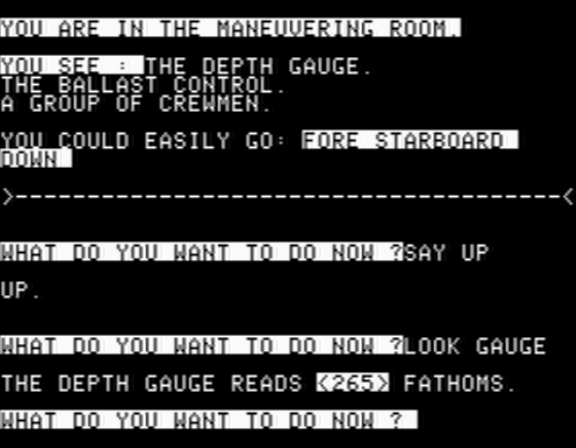
I had all the problems solved except for surfacing the sub. I had messed with “ballast control” in order to swap from “dive” to “surface”, and I had a “remote microphone” to give commands, and I (it turns out correctly) had a guess I needed to captain’s uniform on to give the command and have it be accepted.
All attempts at saying “UP” or “SURFACE” failed. I could try “FIRE” and the game asked me what I wanted to fire (there’s missiles and torpedoes) but it told me I couldn’t use them yet.
I finally checked a walkthrough to realize I had to be standing in the right place to give the command, even though the microphone is described as giving commands remotely.
This lets you open one last rescue hatch and find rescue boats coming to find you.
What happened to the Soviets? I was expecting a dramatic firefight in the climax. Maybe the author planned one but couldn’t pull it off.
So I suppose that sounded underwhelming as described, but the meltdown and power issues hung over most of the game for me, so there was an implicit drama in each step — trying to rush to find the solution in time — that was provided even by something as mundane as discovering a TV dinner. And while I realize our author was likely the just the editor of Crime Adventure, this game satisfyingly didn’t have anything as weird as a secret golf course in the back yard of someone who got kidnapped, where you need to hit a ball in the hole in order to discover the secret room where they’re held.
More improvement could still be used. The nuclear reactor scene ended being potentially the least dramatic ever across all media, and while having weapons that don’t get used is theoretically fine, I was expecting a missile malfunction where it was threatening to launch and destroy the eastern seaboard or some deft-maneuvering scene where I had to outrun a Soviet convoy. Or a shootout with a spy aboard where Sean Connery tells me “be careful what you shoot at in here”.
I wouldn’t have been disappointed to get the game tossed on my January 1982 subscription disk, though.
In the 1970s and 1980s, with each new computer system that arrived — the ones that because semi-popular, anyway — there came a blizzard of new books. Because computers were closer to the metal, a lot of these were lists of programs (typically in BASIC) although there were also programming tutorials in BASIC as well.
A sub-genre of the BASIC programming book was the one specifically for programming adventures.
From 1984, 1984, and 1985.
While there’s a little discussion of making your own game in the Captain 80 Book of Basic Adventures, that book still served mostly as a vehicle to print existing adventures. Writing BASIC Adventure Programs for the TRS-80 by Frank DaCosta is the earliest book I’ve found to be solely devoted to learning how to program adventure games.
Frank DaCosta’s first book was How to Build Your Own Robot Pet from 1979, and it honestly has an impressive goal, as the book includes: “full details on building a navigation system (Soniscan), a hearing method (Excom), a way of talking (Audigen), and an understandable language and grammar (Fredian).” You can see at this blog someone’s attempt to make the robot described from the book, which took 3 years while mostly using authentic 1979 parts.
From Ezra’s Robots, which contains much more detail about the process.
The same book has an autobiographical blurb:
A Trinity Divinity School graduate, he lives in Hollywood, FL. with wife Cheryl.
The blurb from the adventure book just describes DaCosta as a “computer hobbyist” so it seems that he was working as a pastor and doing robots and computers on the side. He still is a pastor in Texas and you can see some pictures at his blog where he writes about training pastors in Rwanda.
What I’m unsure the author is even aware of (although I have sent a message) is that the book, while only being a minor influence in the United States where it was originally published, was a major influence in a different country, nearly the starting point for all text adventure games in a particular language.
I’ll return to that story later. For now, let’s discuss the book itself. It contains two games, Basements and Beasties and Mazies and Crazies. The latter is a top down ASCII action-adventure, sort of like Kingdom of Kroz or The Thor Trilogy. Hence I will not be playing it here, but here’s a video in case you’re curious:
Basements and Beasties is instead a traditional text adventure, and the way the book is structured is to give the code piece-by-piece in a way that makes “beta versions” of the game playable as it works up to a full listing.
For example, the book starts with the map, and a “table of directions” that most adventure game designs used…
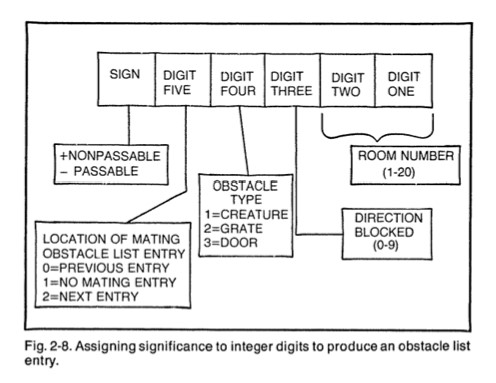
…and a relatively elaborate system for placing “obstacles”.
This section also claims “An adventure program is hardly complete without a maze.” Well, it was the 80s. (Honestly it is a little bewildering. One of my old projects from ’87 or so I didn’t keep — I was very, very, young — I included something like five or six mazes. It was just the thing to do!)
The first chunk gets summarized at the end of chapter 2:
1. A scenario is made up of rooms.
– You need a room list of short room names.
– You need a long description for each room.
– You need a room status array to indicate if a room is unvisited.
– You need a scenario map of room interrelations.
– You need a travel table defining entrances and exits.
2. A scenario is made complex by obstacles.
– You need living obstacles such as creatures.
– You need inanimate obstacles such as locked doors.
– You need an obstacle list defining the obstructions.
3. A scenario is occupied by objects.
– You need treasures, tools, and creatures.
– You need an object list of short object names.
– You need a long description of each object.
– You need an object status array to locate the objects.
With all the basic concepts defined, the book then starts writing actual code down.
Commands are added pieces by piece (motion, doors/items, combat, metacommands like SAVE) until a full source listing in chapter 9.
If you download the game from a site, like the version I have here at Github, it will be a reproduction of chapter 9. No typos I can find! This doesn’t sound bad, but–
The author isn’t done yet. He’s trying to follow the whole process of software production, and there’s still chapter 10, “improving the program”, full of optimization that do not make it into that source code. As is, doing one move takes about 11 seconds at authentic speeds (by comparison, Arctic Adventure from the Captain 80 book takes about 1.5 seconds).
For example (as pointed out in chapter 10), when entering input, the game checks every word entered against every word listed in the word table, which is extremely slow, meaning if you feel inclined to swear at the game (perhaps inspired by French Colditz) you have to wait an agonizingly long time before the game tells you it doesn’t understand. As an alternative, the book provides actual machine code.
That … might be overkill? To compare to Arctic Adventure again, that game is solely in BASIC yet runs about 10 times as fast. The problem with Beasties seems to be that the game is not loading all its data into memory at once. That is, it makes a series of DATA lines containing verb names, object names, and so forth, and dynamically has the game pick which line of DATA to read (making convoluted use of the POKE and PEEK, commands long gone after the fall of 80s BASIC) as opposed to just having all the data get front-loaded into an array right at the start of the game. Look at one of the early lines of Arctic:
40 O = 41 : FOR A = 1 TO O : READ O$(A,1), O$(A,2), O$(A,3) : NEXT
This goes through lines written later in this format
1190 DATA Cave, 4, , Down, , , Ice brick, 0, , Trading post, 10, , Eskimo home, 10, , Eskimo, 12, , Cabinets full of supplies, 12, , Sign, 12, “The sign reads: We trade treasures for supplies.”, Polar bear, 11, , Flare gun, 11,
storing three aspects: the location, the object name, and potentially the object description. Every single object is read once and only once, then stored in the array O$ and only accessed in O$ from there on. Beasties, rather than storing all the information in an array, repeats reading DATA every time it gets used. DaCosta’s method is in a way much more clever but it has negative impact on the gameplay. On TRS-80 even on a max speed emulator a delay is noticeable enough to be painful.
I still gave it a serious try. Here’s a preview of what’s going to happen a lot during the game.
I ended up switching over to the port by Jim Gerrie for TRS MC-10 instead.
Fine, other than the command speed, how does the game play?
Well, it’s a little bit of the “slot machine” style. There’s not really any puzzles, unless you count finding a key and unlocking a door.
The point is simply to collect treasures and drop them in the starting room while also killing various monsters that appear. The problem is that the way combat works is:
a.) sometimes when you enter a room with a monster, you get killed outright
b.) if you don’t get killed outright, you use KILL MONSTER and may or may not hit
c.) if you miss, then the monster has a chance to kill you
On top of all that, there’s a wandering orc that can kill you in any room at any time, and he doesn’t seem to stay dead after you kill him.
I was not able to kill the spider with my axe but had to use a nearby “enchanted grenade” instead.
Once dying you have all your items drop where you died and you get sent back to the start (so you can rescue your items like an old school RPG). If you’ve unlocked any doors or deposited any treasures they stay, so getting to the end of the game is a matter of persistence and grumbling every time an orc appears and arbitrarily kills you again.
I don’t think we’ve had a Coke cameo since Crystal Cave.
There’s also no “ending screen”, you can just check your score and watch it go up, and there’s no acknowledgement if it is at maximum or not.
It’s not worth fussing that much over the gameplay, because this is a tutorial-programming game, like Planet Pincus; the simplicity is the point. While I haven’t seen evidence the book had influence in the US (it looks like nobody bothered to upgrade the parser and there were other sources by 1982 of text adventure templates to use) it apparently hit big in Hungary.
There were three Hungarian-language text adventures in 1985, but where the penchant for writing adventures really started in Hungary (according to the Rosetta Interactive Fiction blog) was 1986 with the publication of F. Dacosta’s book A kalandprogram írásának rejtelmei. (What “F.” stood for was a source of speculation for Hungarians.)
I am still unclear how the book ended up making it over the Iron Curtain, but (according to the aforementioned blog) its appearance coincided with a “népmozgalommá” (people’s movement) in creating adventure games.
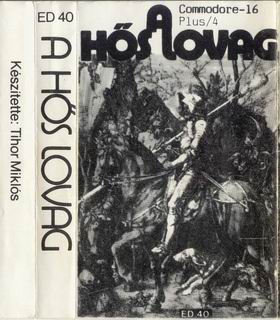
Some early Hungarian games directly used English sentence structure, which comes off as completely wrong in Hungarian. From the instructions for A hős lovag, one of Hungary’s first commercial games, it explains the player should type not EAT THE BREAD but (the Hungarian equivalent of) HE EAT BREAD. This is a format only used for people learning the language; the computer should be treated as if it, too, was a language learner. The instructions opine that perhaps in time the computer will recognize suffixes and learn to speak correct Hungarian.
So, returning to the moment of busting open a padlock, which crashed the game last time, I somehow didn’t notice there was also a passage to the east that opened.
However, I ignored that in favor of being able to take the lamp, which I wasn’t able to get last time. If you turn on the lamp and walk by the large gate at the exit with the guard, the guard spots you in the night.
So you want to wait until passing the guard safely into a corridor, where previously nothing was visible, but if you turn on the lamp, you see a previously missed door.
“Trap door” suggests this goes up, but once you cut the chains (the cutting pliers from the truck work) the exit that opens up is north.
Heading north, you can then find a small paper with a combination on it. This is the combination that works back on the safe (the one that previously sounded an alarm). Opening the safe yields a master key.
The entire map. Light blue are the rooms I hadn’t seen last time.
This was the end of the road for the moment. It turns out I needed to do one more thing and I could technically escape, but I hadn’t fulfilled the quest yet anyway, which was still to find the prisoner who had the code to blow up the rockets.
Now it was time to go in the new eastern route, the one unlocked by breaking the padlock…
…and die by falling in the dark on a staircase, oops! (“You had a deadly fall on the dark staircase.”) The lamp needed to be on, allowing visiting the final section of the game, an area of 5 rooms.
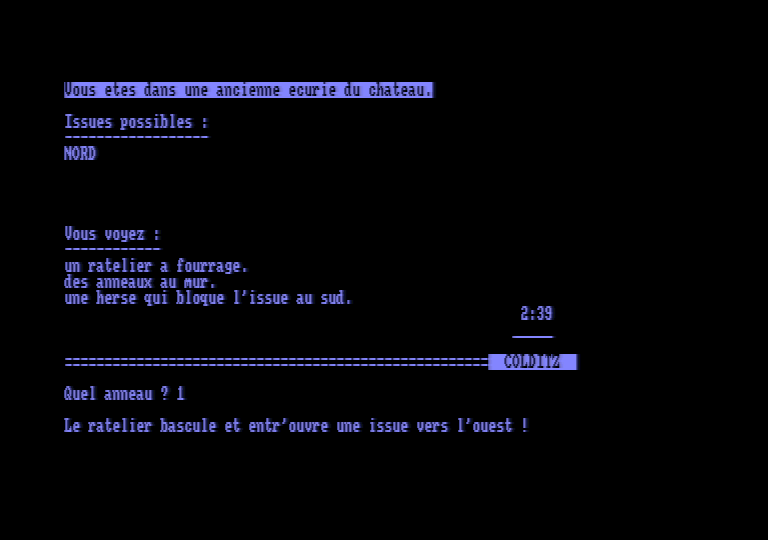
Stables just north of the staircase. There’s some rings attached to the wall, a portcullis blocking on our way back south, and a …trough, I think?
The small area has a room with some wood (not useful) a church with a candle and a rope (really not useful, especially the rope which rings a bell alerting guards), an office (useful, there’s a message about RING 1)…
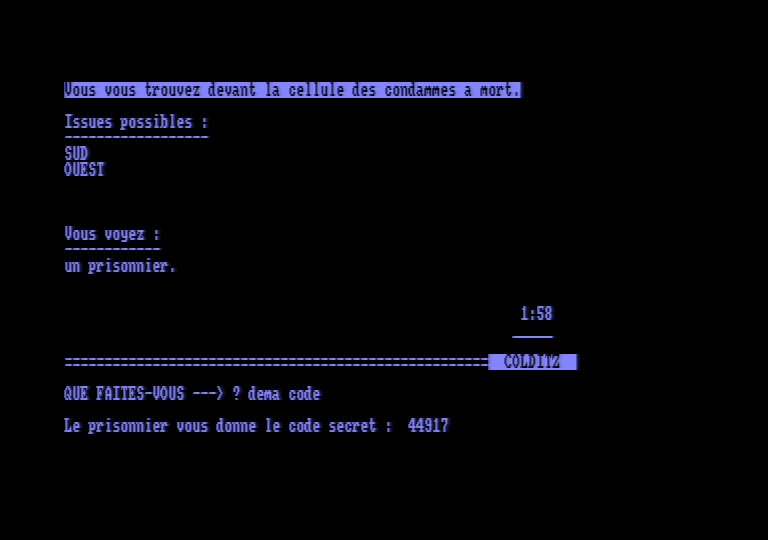
…and the prisoner. The prisoner is thirsty. You can use the can from the start area and fill it with water in the fountain to take care of the thirst. (You’re not softlocked if you haven’t done this before entering the trapped area, since you can get out via means I’ll show in a moment.)
The prisoner — O’Donnel from the intro — says he knows “le code secret”. I had demander as a verb, so the next step was:
Blithely blowing past thinking about which article I should use in the French.
Now we just need to get out! The hint about the ring gets applied back in the stable, where you can turn the correct ring. (I think this is randomly generated, by the way, on each new game.) This opens a secret passage back to the Inner Courtyard.
Escape now requires getting past the guard at the gate. Frustratingly, the “bonk with an iron bar” trick doesn’t work again. The game is unclear why one guard differs from the other in this respect.
I got very stuck and had to check the walkthrough. It turns out I missed, back where there was a “bureau metallique”, the proper way to open it. It isn’t done by referring to the object, but by referring to a drawer. While I’ve seen this before even in English for me this is kind of tough, you’re referring to a noun that is essentially implied by the text.
This reveals a dagger that can be used to murder the front gate guard. (If you “kill” the earlier guard, the game talks about you being silly and nonsense; if you “knock out” the other guard, the game also talks about you being silly and nonsense. The parser needed some lighter messages for turning down actions.)
With the guard dead you can bust your way out of the gate (using the master key) to freedom.
You have done proud service to the Allies obtaining the secret code of the Luftwaffe. You will be decorated upon return to London. Congratulations!
With the exception of the drawer issue and the guard inconsistency, this was genuinely a straightforward game, one that I’d more or less put at par at the Scott/Alexis Adams game Pirate Adventure in terms of difficulty. It’s dark, turn on a lamp. The guard spots you with the lamp on, turn it off. A safe combination goes to a safe a few rooms away; a secret passage opens following a message in the same area. I’m genuinely curious about the reaction of the people the author tested the game on. I think, really, it’s a matter of this being the only French text adventure at the time other than Bilingual Adventure. There just wasn’t enough example set for how to present this sort of thing, and the sheer conceptual load of needing to cut, take, turn on, turn off, read, etc. has always needed a bit of nurturing.
The parser is impressive but wobbly. It’s fine to not understand something the player types, but it needs to be transparent to them what happened; it is easy to get thrown for a loop by doing something that seems normal (opening a desk, as opposed to referring to the drawer) and then get blown off by the parser with a response like “Vous trouvez ca drole?” (“do you think this is funny?”)
Still, the parser managed quite well given there wasn’t really precedent in the language, but unfortunately the audience reaction caused the author to stop writing adventure games. This is his only one.
From CPC Magazine.
One more note, just to maybe brighten (?) things up. For some reason French games allow swearing as a very standard mechanic. Colditz starts this grand tradition early.
A bunch of things have hit all at once, so I’ll just toss some items here:
Parsercomp 2023 is live! This is a competition intended for “traditional parser” games, where you type GET LAMP and all that. There’s a Classic category (11 games) and a Freestyle (5 games) where I believe the latter is intended to stretch the definition of “parser”. As of this writing there’s 8 days left to put ratings. If you just want to read about the games, Carl Muckenhoupt has been writing reviews at his blog, starting here.
Stuart Lloyd has a new gamebook here titled The Ravages of Hate, a “fan game” spin-off of The Coils of Hate. From the intro:
I remember the time I was first introduced to The Coils of Hate – one of my friends at primary school gave it to me thinking I would like it. He was right. It is a gamebook after all. I also remember the character I played – I picked Swordplay, Spells, Charms and Cunning, wanting to be both a warrior and a wizard in one. I wanted it all. However, the book took me ages to crack, but eventually I did. After a while, I forgot about it and went on to read other gamebooks.
However, 20 years on, when people started writing about gamebooks on the internet, I found out and rediscovered a great deal about The Coils of Hate. People wrote scathing reviews of it, citing its illogical choices, its numerous sudden deaths and its errors. This may have been true, but upon rereading it, I found a great deal of depth not found in almost all other gamebooks. First of all, there is a message of tolerance. The plight of the Judain was far too subtle a parallel for real life persecution to a 10 year old me, but I quickly found out about it and I realised that Mark Smith was trying to accomplish a lot in what at first glance is a book about killing a giant monster.
How far would you go to make a billionaire’s dreams come true? Find the unfindable and do the impossible? It’s all in a day’s work for an employee of Platinum Concierge.
Elite Status: Platinum Concierge is a 500,000-word interactive contemporary drama by Emily Short, with additional content by Hannah Powell-Smith, where your choices control the story. It’s entirely text-based—without graphics or sound effects—and fueled by the vast, unstoppable power of your imagination.
Charter a helicopter on fifteen minutes’ notice to bypass LA rush-hour traffic? Transport a priceless emerald-and-diamond necklace across three continents? Arrange a candlelit dinner in a cave with waiters rappelling down the walls? No problem at all. You have your pulse on every brand, trend, and connection of the still-new 21st century.
And she led the team but I still think it counts as an Emily Short game: Mask of the Rose, a Fallen London dating sin spinoff, launched on Steam.
Aaron Reed has a new article, for those who couldn’t get enough of the 50 Years of Text Games series, this time on the ultra-obscure “book game” The Antagonists from 1985.
A missing submersible, a group of rich adventurers who vanished on the way to the wreck of the RMS Lusitania and, on top of it all, the Interim CEO of OceanThrill (owner and operator of the missing Kepler 1 sub) murdered at his own private beachfront … you follow in the footsteps of a weary yet witty detective and his adorably mouthy female partner as they uncover a deep web of lies, intrigue and subversion.
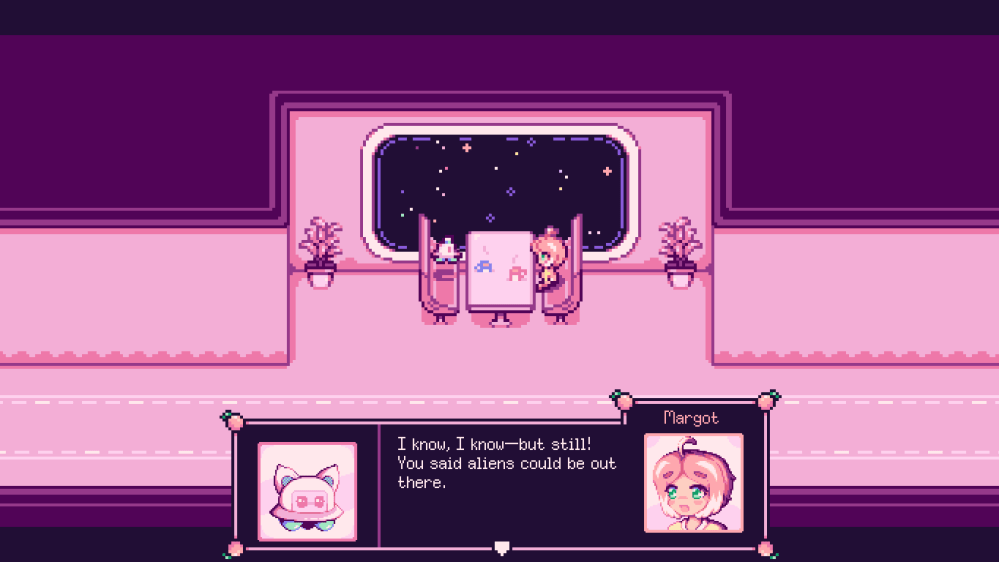
And finally, if you just want to relax a bit with a slice of life, just yesterday the author Clover just released the game Peaches Interplanetary, where you can name your own price.
Margot’s dream is to roam the stars, providing peaches to all. For, even on the harshest of moons, everyone deserves a fresh peach! But, is she ready? And more importantly: are the peaches?
(Also, I have a working version of Colditz now. New post likely tomorrow.)
This game was printed as a type-in, twice. The Amstrad version was in CPC Magazine, starting from page 53.
As we’ve seen before with type-ins (I think most significantly from Spelunker out of Byte magazine) the actual version that gets passed on to various archives had to be typed in by someone first, and that means there might be a typo that carries on, especially if the person doing the typing never really played through the game in question.
I don’t think the person who typed in Colditz on the Amstrad played the game.
Via CPC Magazine, number 7.
(Also, before proceeding on further, special thanks to everyone who helped me through French difficulties. Unfortunately working through the language still doesn’t help with coding difficulties!)
Last time I left off on a sentry with some keys that I need to abscord with. I had already tried to “kill” the sentry with no luck, and “coup” (which in some circumstances be “hit”) didn’t work, but I hadn’t tried to mystery verb ASSO.
The entire list tended to the infinitive tense, so having sit which would normally be s’asseoir seemed to violate the rule but I couldn’t come up with a better verb than that. Still, I considered the verb to still be in the mystery zone, so I went ahead and tried it on the sentry and it worked.
ASSO turns out to be ASSOMMER (knock out). After you say you want to knock out the sentry it asks you what with, and you specify the “barre” (or “barre de fer” if you want the full “bar of iron”).
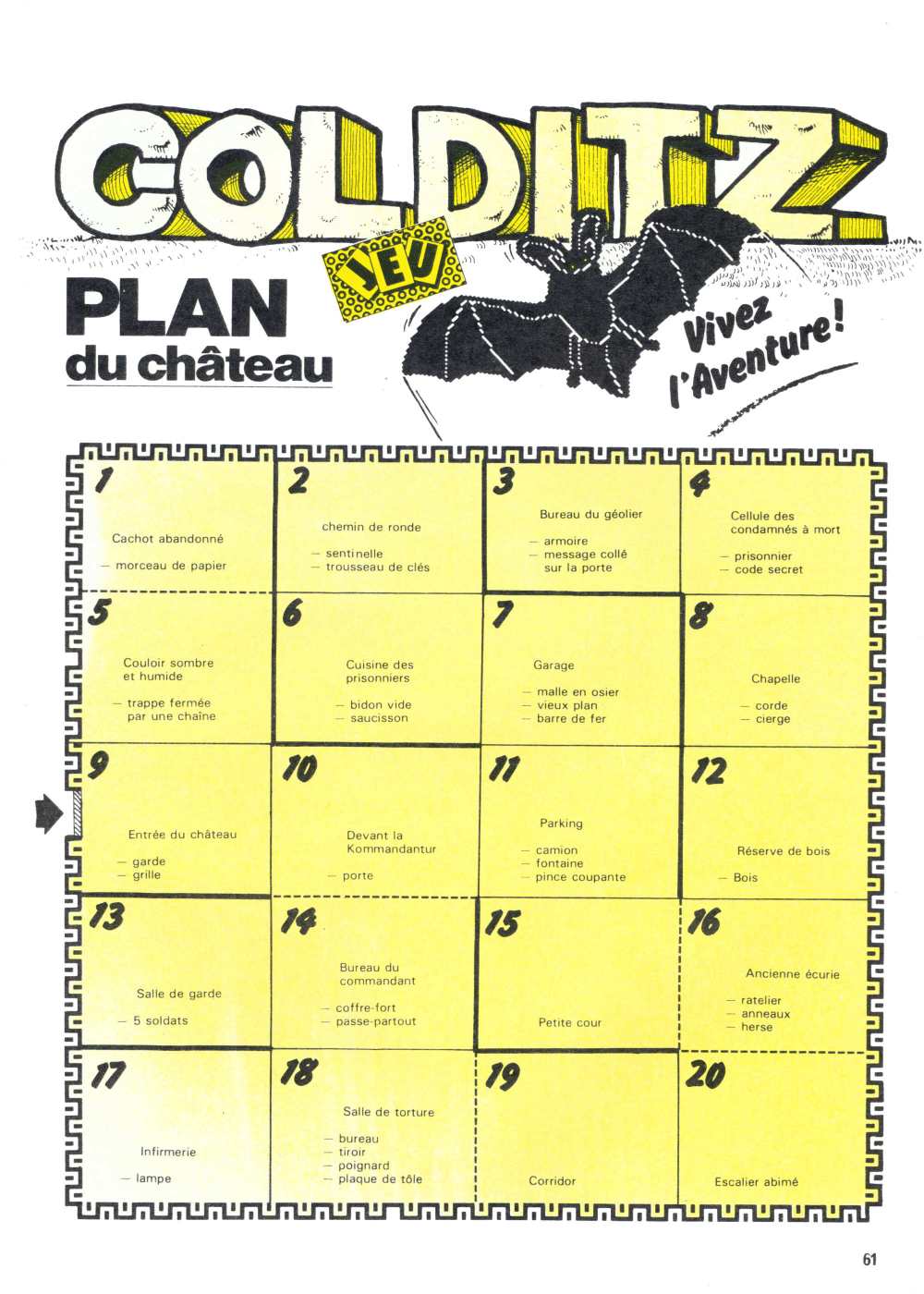
I was then able to nab the keys and run over to the locked door. This opened an area with four new rooms.
The first room has a safe, which asks for a combination if you try to open it. If you fail at the opening an alarm sounds. I don’t know the combination yet.
To the west there’s some guards who capture you. Probably this room should just be avoided.
To the south there’s a torture room, with a desk and a metal plate locked with a padlock. Here is where things went wrong, because I tried to break (casser) the padlock, and the game asked me with what, and I gave the iron bar again, and then:
I had to dig out the source code.
A quote mark symbol was supposed to be a parentheses (see above), so I was able to fix it. It could be a file corruption rather than a typo, but spotting one made me nervous about more. As it turns out, rightfully so, because the next room — an infirmary — had a broken lamp. Broken as in the game’s code, not the item itself.
No matter what I did, I could not refer to the lamp. Normally, I’d just pick it up, but the game claimed I couldn’t, and I was baffled enough I decided to peek at the walkthrough. Fortunately I didn’t spoil myself on anything, other than realize that if you try to follow the steps of the walkthrough, you are completely unable to pick up the lamp.
There must be another typo! Possibly more. I’m not sure if I really want to keep trucking with the Amstrad version, but I have been unable to download the Oric one (the site has some sort of security thing that doesn’t let me? or broken Javascript or something?) I may end up just having to blow any secrets and check the code line by line, but this admittedly follows the authentic type-in experience, where any players circa 1985 had to spoil themselves on the adventure by typing it in.
After World War II ended, Germany was split into four “occupation zones”, with Russia in the northeast, the UK in the northwest, France in the southwest, and the US in the southeast. The US, British, and French sections made up West Germany; the Russian section was East Germany.
This arrangement meant French military forces were stationed in Germany, which is important for our story.
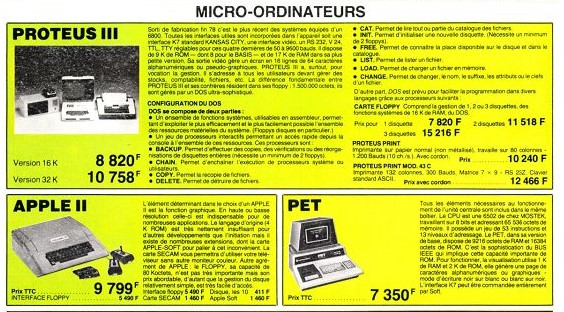
From Micro Systèmes Number 5, May/June 1979. Other than these three computers the TRS-80 was the main personal computer in France circa 1979. The Proteus III is a wildly obscure local system that was text-only and ran on a Motorola 6800.
(Before going on, I’ll preface that most of what follows comes from Hugo Labrande, who has extensive research on early French text adventures as well as interviews here, here and here.)
The author of today’s game, Marcel Le Jeune, got his start with electronics with a Texas Instruments calculator in the early 70s; his first computer was a PDP-8 he encountered while at French military school. He then went on as an electronic warfare specialist, being stationed in Germany from 1977 to 1982.
He had access there to American military bases and their duty-free shops, and thus was able to be a very early owner of a TRS-80 as well as get exposure to US magazines and software. He most particularly remembers the adventure game Pyramid of Doom, although it wasn’t necessarily officially obtained, as he had a Parisian friend who kept him supplied in tape copies sent by mail.
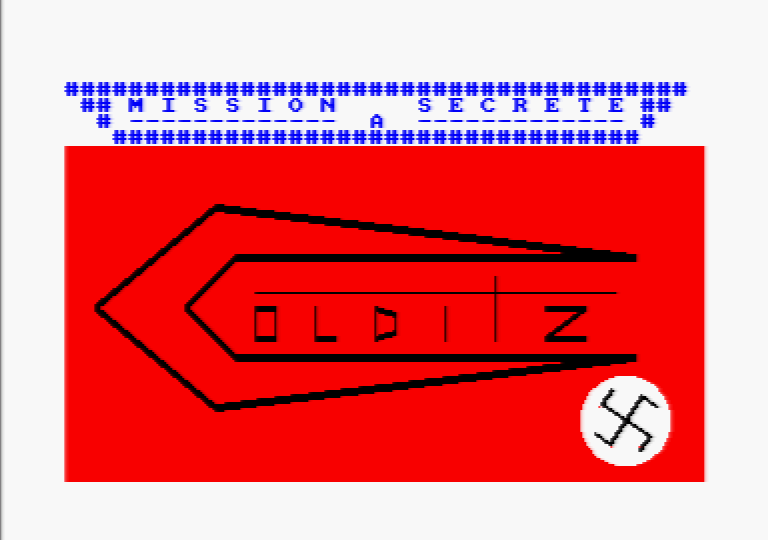
His early exposure to adventure games is likely what led him to be one of the first people from France to create an adventure game; in fact, since Bilingual Adventure was just a modified port of Crowther/Woods, we can say Mission secrète à Colditz is the first original adventure game in French. (That we know of. Making a statement like this invites being outdated in six months when something new comes up.)
While he wrote it in the 1979-1980 period (according to his memory) it wasn’t published, but rather sent to friends and demonstrated to both friends and family. Viewers were amazed at the flexibility of the parser (it’s a bit of a sneak, more on that in a moment) but Marcel was generally frustrated at the reception as people were stumped, and when he tried to help, the response was
Je n’aurais jamais pensé à faire ça!
that is, “I would never have thought of doing that!”
Much later — after returning to France — he became editor of the magazine CPC, dedicated to the Amstrad, and had Stéphane Cloirec port the source code directly from the TRS-80. There was also a version published in the pages of an Oric magazine. The TRS-80 source is lost so I went with the Amstrad version to play.
Now, since my French is terrible, I gave myself a little more advantage than I usually do straight from the beginning: I extracted the verb list. All of the verbs only have the first four letters, so I made my best guess as to what verbs match.
(I works for Inventory and there’s also direction abbreviations. Feel free to point out any alternatives or outright mistakes, I’ve already made some edits based on comments.)
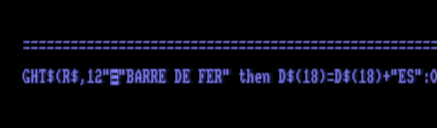
I mentioned some subterfuge in the parser. The game only looks at the first four characters for the verb and the end portion for the noun. That means there can be sentences and phrasings in the middle which are entirely ignored. Hugo Labrande also points out a finesse to account for the fact that in French, writing an adjective after the noun is normal: the game hand-checks nouns and possible noun-adjective pairs together in order to parse things correctly.
IF RIGHT$(R$,5)=”PINCE”OR RIGHT$(R$,14)=”PINCE COUPANTE”
Still unsure on the parser, I checked the first line (and only the first line) of a walkthrough, and it said
Ouvrir la porte du camion
that is, open the door of the truck, but OUVR CAMION works just as well. The practical upshot is the parser can ignore articles someone would normally use (parsing “prendre la lampe” ignores “la”). From what I gather (although I would appreciate a native speaker’s perspective) leaving out the “la” in “la lampe” feels much odder than leaving out “THE” when typing GET LAMP. So this keeps the coding simplicity of what is more-or-less a two word parser while accommodating the change in language.
However, notice the sample includes “la porte” (the door) which is totally unnecessary. I’m wondering if part of the issue with sampling the game for friends was that the author was “showing off” too much; having too many ways to communicate can make it difficult to teach how to play a regular text adventure.
The upshot of all this is I can just type VERB NOUN for commands and ignore everything else.
The game’s premise:
In 1943, we have been summoned to London about a secret mission; one of “our best agents”, Captain Jim O’Donnel, had been on a parachute mission to obtain secret codes allowing V2 rockets to be destroyed in-flight. While he was able to get the code he wasn’t able to send it, and has been locked away at the fortress of Colditz.
We are sent on a secret mission to Colditz to get this code. We’ve snuck into the castle by hiding in a truck, and
Il est un peu plus de 21 heures, la nuit est noir …
B O N N E C H A N C E !
(We arrive just after 21:00, the night is dark, good luck!)
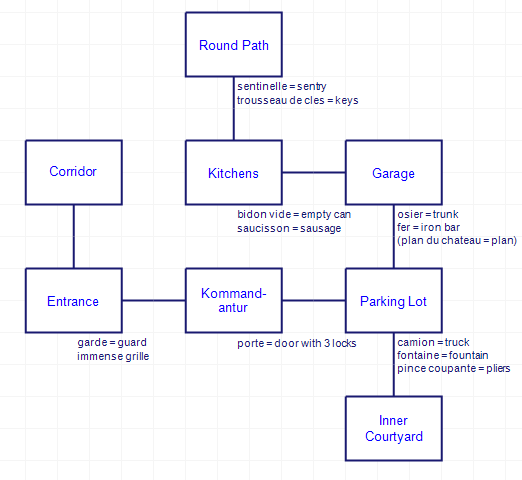
I’ve prodded enough to at least make an initial map:
The “plan” that’s in the trunk just to the north of the starting room is unfortunately “old and all moldy” so doesn’t have any useful information. (That’s “building plan” as in map, not “plan” as in list of steps.)
The two spots with guards (Entrance, Round Path) haven’t raised any alerts yet, but I also haven’t tried to antagonize the guards, or try to poison sausage and feed it to them, or something like that.
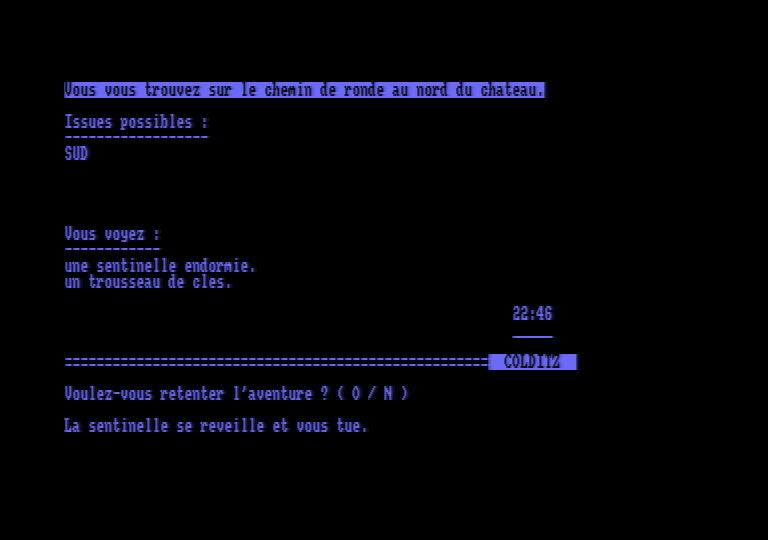
Except for this. I tried to take the keys and the sentry woke up and killed me.
This might be a game I might normally take care of in one chunk in English but I’m willing to split into two or three parts here to give it the time it needs. I’m going to try to solve it as honestly as possible, but if all else fails I do have a full walkthrough so I can at least write about what’s supposed to happen even if my reaction is “Je n’aurais jamais pensé à faire ça!”














































 Renga in Blue
