The puzzle I was stuck on last time was, weirdly enough, fair. Maybe it needed some design finesse but…
…just as a reminder, I had found a vending machine with a coin underneath. Doing SHAKE MACHINE led to a rattling sound and the “all right” message made me think the rattling was referring to the coin. But no, SHAKE still gets the sound, and as mentioned last time, inserting a coin gets it stuck.
However, it dislodged whatever happened to be stuck by a little nudge, so that SHAKE MACHINE again gets it out.
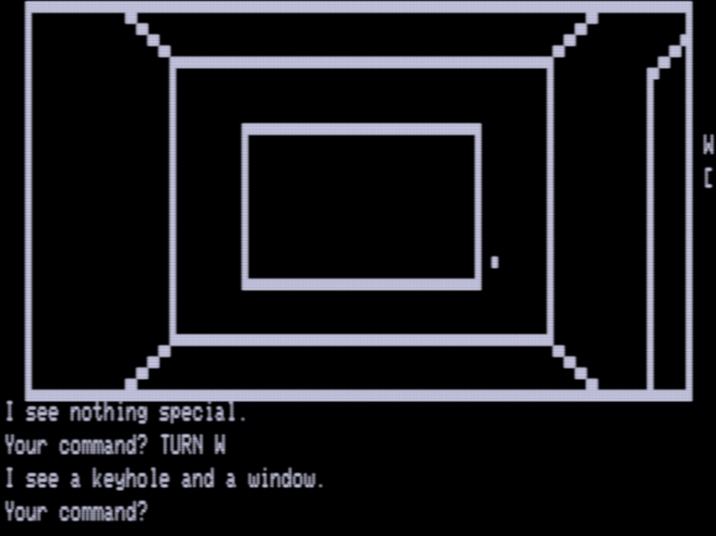
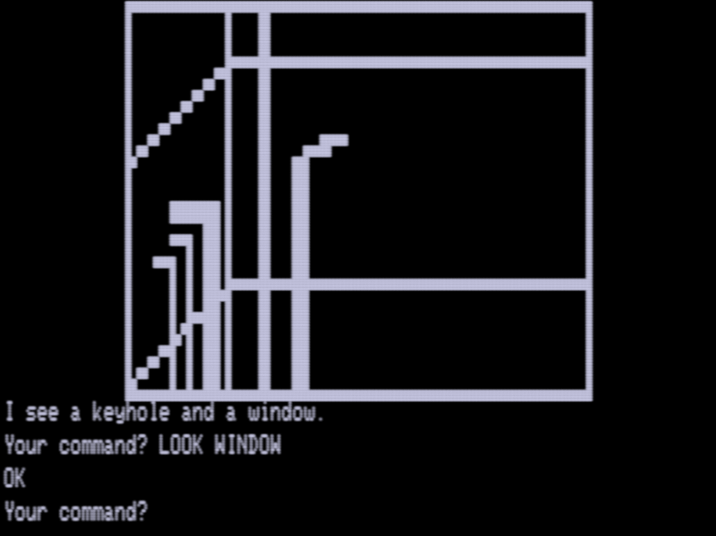
That’s a key. I then immediately tested it everywhere, find it fit in the keyhole next to the window, and turning the key leads to a click.
This unlocks the “control” room downstairs, but before going down there, I should mention while stumped I also managed to find a shovel. LOOK UNDER worked (without documentation or prompting); what about other prepositions?
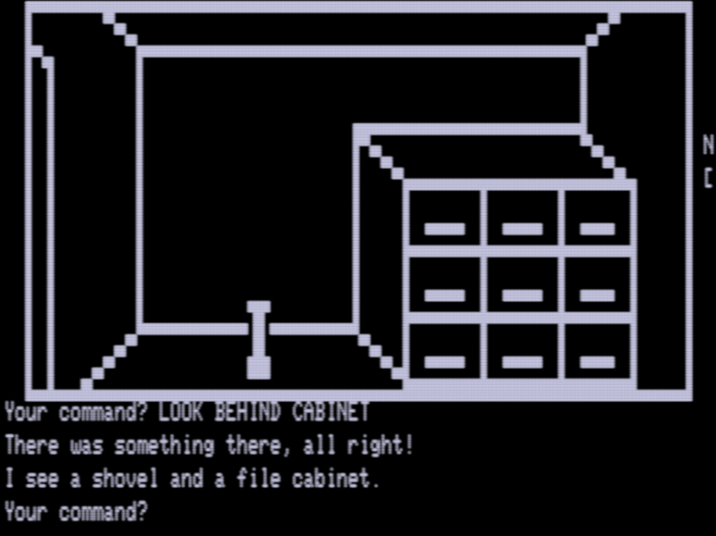
And no, SEARCH or any other verb does not find the shovel. It has to be LOOK BEHIND.
There isn’t anything intrinsically unfair about including prepositions in searches, but it has to be documented in some way they’re going to occur, especially because they were almost unused in text adventures at this time. I admit my mental logic probably ran along the way the author wanted — I thought that file cabinet is big, I wonder if anything is behind there — but I can still recognize the game is asking for a command without teaching it exists. Text adventures have the unique attribute of “technically anything in English works” but in practice as commands get rarer and rarer they need to be treated uniquely, like you have a platformer where the Z key does something essential but the game doesn’t bother to mention it and you’re just supposed to hit every key on the keyboard trying.
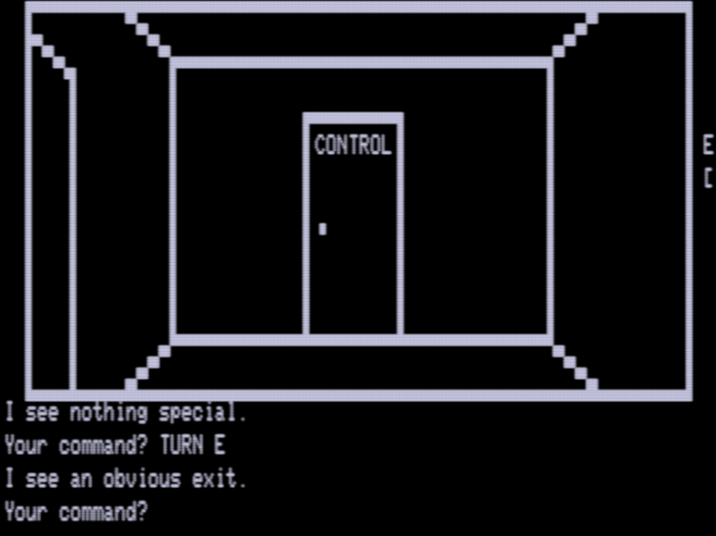
Moving on, with shovel in hand (and the control room unlocked) I headed downstairs, and found the control room was just a message with a single button.
The button unlocks a second door marked “TRANSPORT”.
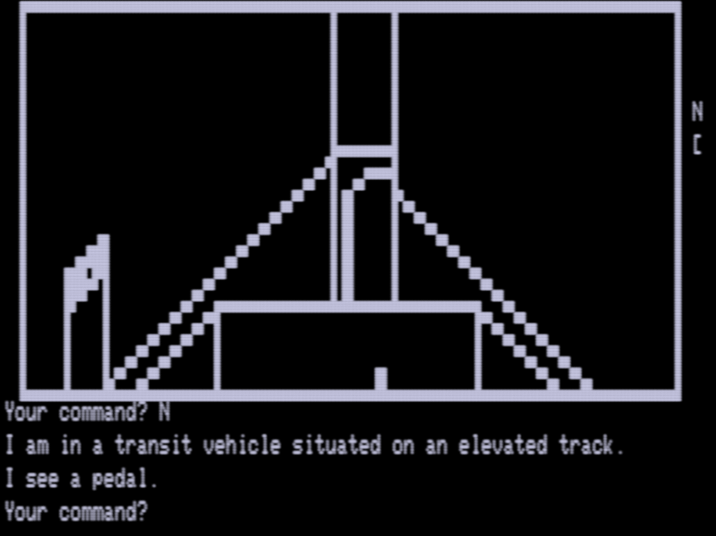
Just to the left is a button you can push to activate the cart; then pushing the pedal will lead you deeper in the mine, where you start to have trouble breathing.
Curiously enough, the “trouble breathing” isn’t really a timer as you might expect — it means if you try to go too far deep then you die from lack of oxygen, but otherwise the “trouble breathing” state simply hovers around without consequence. Usually for one of these games when something that indicates the player’s medical condition is getting worse triggers, that’s automatically a timer that needs to be beaten.
Further in there is a purple button that can’t be reached. This will be important shortly.
You can then go in the mine, where the lantern (which I assume has been providing light through the whole transport section) is too faint to see in the darkness. You can still DIG (with that shovel from behind the file cabinet) and get an item that your player takes, then leave safely.
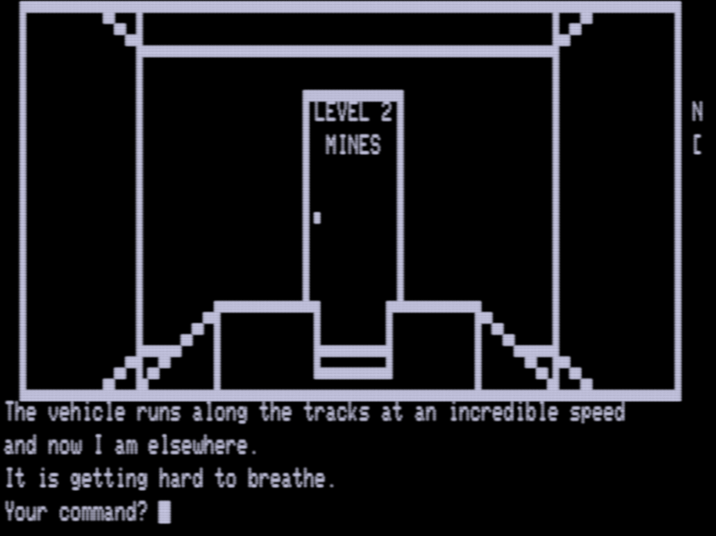
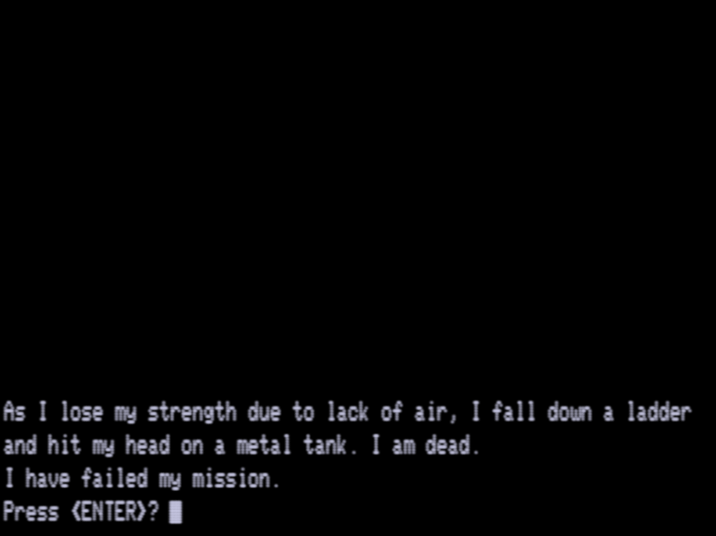
If you try to go deeper into the mine, that’s when the lack of oxygen kicks in:
The hammer is described as lightweight which I assume is intended as a hint it can’t be used to break things (like the Office door upstairs which is still unlocked, and is a red herring at the end).
I was horribly stuck enough here that I decided I had enough and needed to poke at a walkthrough, and here we hit the puzzle of the title.
Allow me a brief side mention of a much more recent game, +=3, by Carl de Marcken and David Baggett. Going by the ifdb description:
This one-puzzle game was Dave Baggett’s response to a discussion (flame war?) in rec.arts.int-fiction and specifically to Russ Bryan’s claim that there could be no puzzles which are logical yet unsolvable.
I remember some discussions from rec.arts.int-fiction (the Usenet group) being indistinguishable from flame wars back in the day, so maybe it was both. Here’s the opening (and only) room.
On the Three Troll Bridge
You are standing on a rickety wooden bridge. A burly Three Troll blocks your passage north, across the bridge.
Something is ticking.
In any case, +=3 was essentially a thought experiment: how could you make a logical unsolvable puzzle? Now, as a one-puzzle game, you may want to skip down a bit farther to avoid my spoiling it (I’ll drop a picture of a floppy disk to mark when it is safe to come back), as I’m about to cut and paste in the walkthrough.
Ready?
This “game” is meant to illustrate the fact that “logical” and “simple” puzzles can be made arbitrarily difficult to solve. In this particular case, the puzzle exploits an assumption that experienced text adventure players will make — that things that aren’t listed in one’s inventory aren’t actually manipulable game objects.
>give shirt to troll
>give shoes to troll
>give socks to troll
>n
The solution is perfectly logical and simple. If you were standing on a bridge with a troll who clearly wanted you to give him something, and you had nothing to give him, what would you do? You’d give him the shirt off your back, of course.
Note that if you say “examine me”, you’ll see that you are in fact a clothed human. (If you’d have been naked, the game certainly would have pointed this out, right?)
Everything explicitly mentioned in this game except the troll is a red herring.
I don’t think the game really illustrates anything about logic and simplicity as much as that it is far too much to expect the player to refer to objects that aren’t listed as there (and why can’t our player have boots, instead of shoes)?
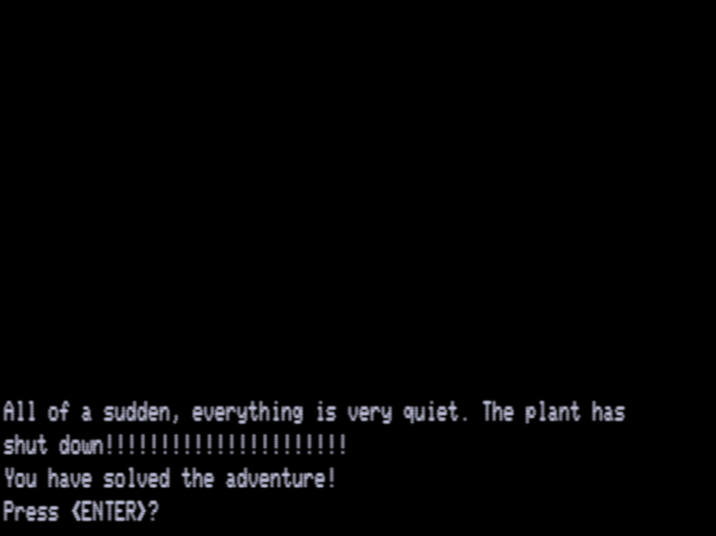
All that preface was technically a hint for the puzzle: how do you press the purple button? All the information needed is in my prior posts (or at least all the information needed according to the game itself).
From the Museum of Computer Adventure Games.
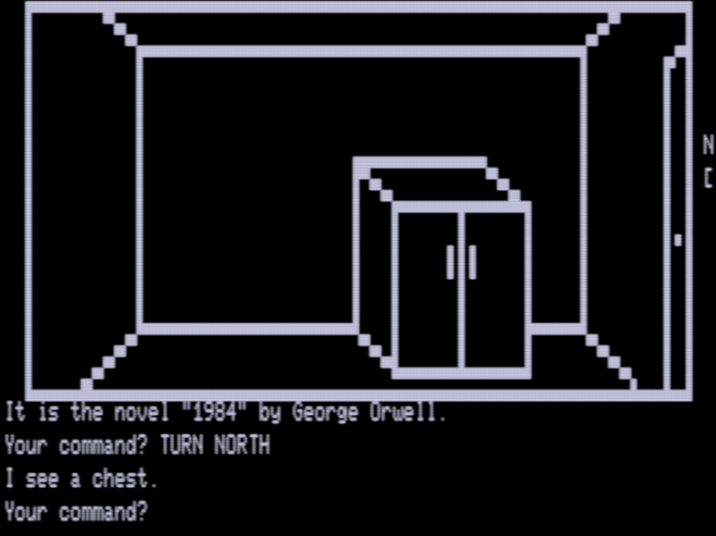
So way back at the chest next to the starting room…
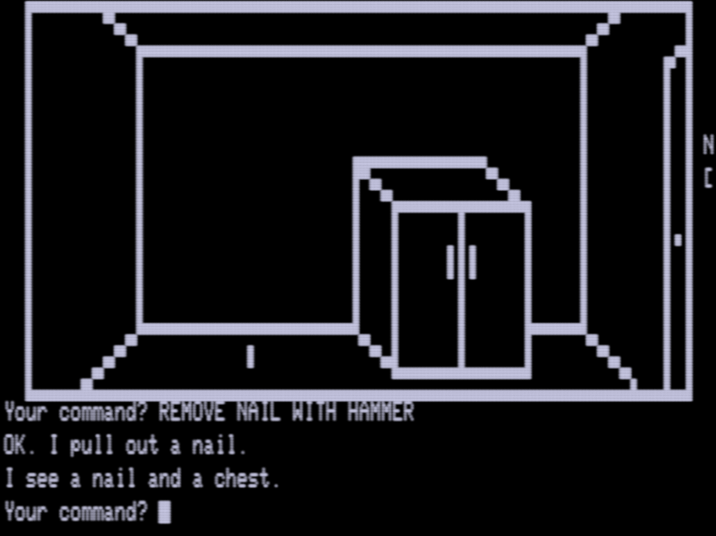
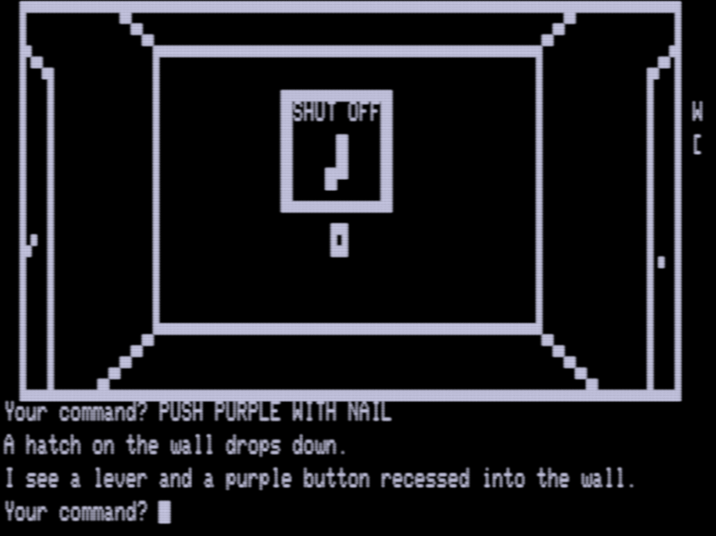
…we can REMOVE NAIL WITH HAMMER.
There is no nail in the description, and even being given a “wooden” chest, there is no reason to assume it uses nails rather than, say, screws. The only feasible way to solve the puzzle seems to be to focus entirely on the hammer and what it might be used for, and given that nothing is breakable, come up with the use of pulling nails instead, and try to guess where a nail might be and take the leap of faith.
Weirdly enough, the game was well coded and there was clearly some creativity poured into this, especially given the lack of historical precedent; it’s just the game design effect was a miss. The author likely saw the Med Systems games like Deathmaze but definitely hadn’t seen the Japanese Mystery House, so this concept of a tight 3D environment was all his, and I appreciated the novel ways of stretching what turned out to be a tiny map. I’m especially curious if the graphical elements are what led the author down the road of including preposition-searches; looking at the file cabinet as a graphic did give me the primal urge to peek behind it in a way I’m fairly certain I would not have experienced with text.
Maybe the other game in the two-pack (Spook House) will go better now that I know the author’s tendencies, but I’m going to take a breather before trying it, and instead go to a game series I know very well: the Phoenix mainframe series, and the ultra-hard British game Avon.
Since last time I got unstuck by figuring out I was missing something on the interface, only to get stuck again quite soon afterwards. Voltgloss helped in the comments and I was able to make a micro-piece more of progress. Just plunging through that hint sheet is starting to look tempting, but maybe pausing to write will help break things through.
So it had always occurred to me that it might be possible to look in alternate directions, but I checked the manual carefully and this is all it had to say about movement. N/S/E/W as well as F/B/L/R work as I describe — you only can move with them, and if you run into a wall or a closed door the game just says you can’t go that way.
However, if you TURN NORTH or TURN SOUTH you actually change your facing. This is not in the documentation. (It turns out the arrow keys, which the manual indicates are equivalent to F/B/L/R, do allow for turning, if being used while holding the shift key.)
The storage room has a book you can see facing south which contains a “credit card” where one side says “Mine 1A”. The north side has a chest (as shown) with a lantern.
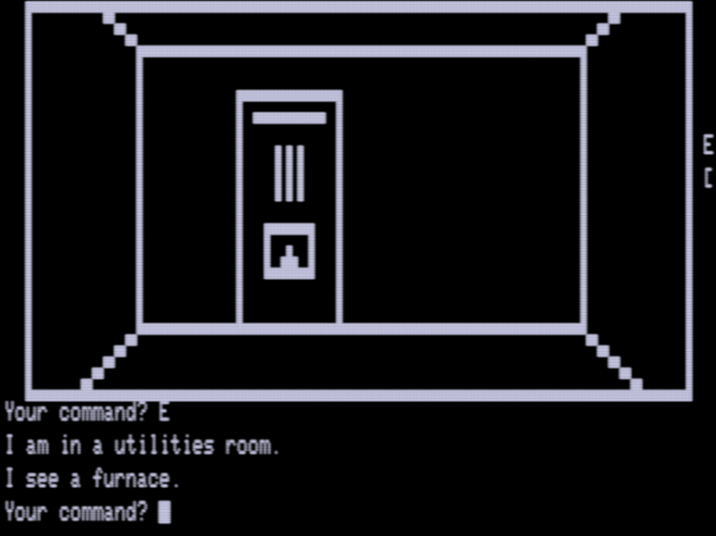
The furnace room has a message on the north side…
…and if you face the door leading back to the hall to the west, you can see a button. I do not do what the button does.
I should add it isn’t 100% obvious you should check the door facing the hall — that is, looking back the way you came — but the view of the message on the wall shows the button to the left. This let me know I was supposed to turn more. This differs from Mystery House II (MSX version) where all views were narrowly only of the environment directly in front.
Having done all that, I was still stuck.
I had to plunge all the way down the hints Voltgloss gave to find the command SHOW CARD. I don’t think that square is supposed to be a camera, I think it is supposed to be the cardboard with the message, and the camera is just hidden (this is because there’s another spot later where the card works, and no square).
I still don’t have access to much, but I also don’t think (due to the graphics and needing to have graphics for multiple views) this is a large game.
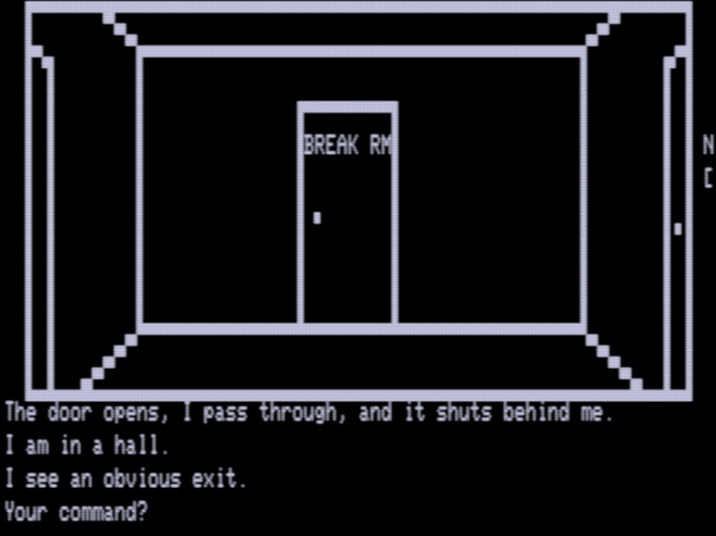
I haven’t gotten into the “Offices” yet but the doors are marked with what is inside.
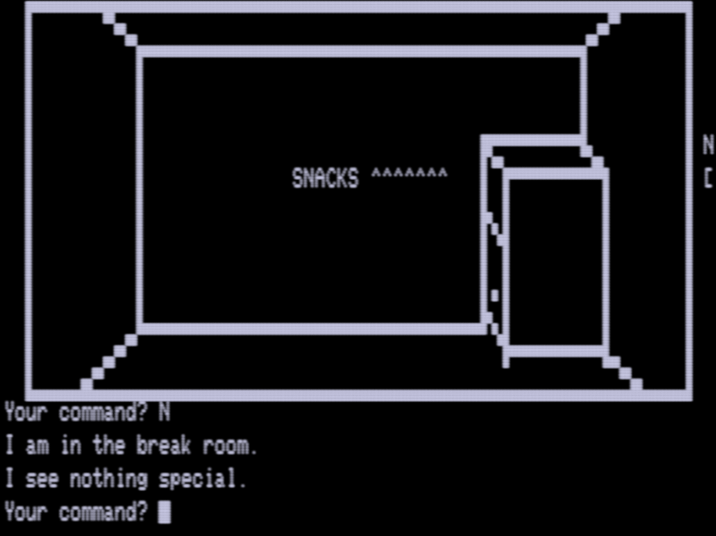
To the north there’s a snack machine and another distinctly unfair moment.
First off, if there’s any way to push one of the particular three green buttons (as opposed to just PUSH GREEN) then I don’t know if I’m doing it right or not. Both PUSH GREEN 1 and PUSH GREEN BUTTON 1 give a click sound, but the game also accepts commands like READ BOOK 1 indicating it is just ignoring the later stuff in a command.
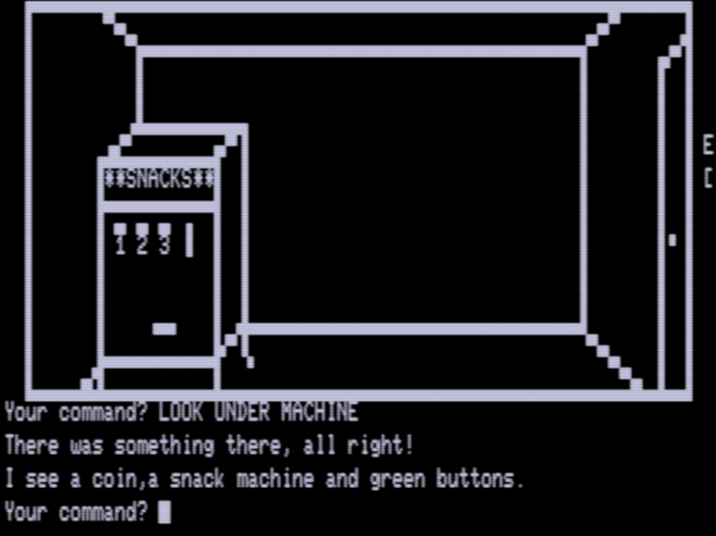
Shaking the machine reveals a sound, but I was heavily stumped until, via instinct, the game’s picture, and experience in Graham Nelson games, I tried LOOK UNDER MACHINE, revealing a hidden coin.
I checked later, and SEARCH doesn’t work — it has to be LOOK UNDER. The manual once mentions LOOK INSIDE but no clue that LOOK UNDER works, and I can assure you this is a very rare command to cause a unique effect in this era.
You can insert the coin in the machine but none of the green buttons do anything. I still strongly suspect this might be where I’m stuck on forward progress, as I’m pretty much empty on things to do elsewhere.
For example, there’s a locked file cabinet to the east. There doesn’t seem to be any potential shenanigans possible without a key. There’s also a guard post with a window next to a keyhole, but again no key.
You can also step out to a platform to the west, turn around, and SHOW CARD while facing the door, which causes it to work like an elevator.
The lower floor just consists of two locked rooms, and the SHOW CARD trick doesn’t work on either.
I would guess this is where the shutoff lever is hiding.
It is faintly possible the author is being too clever with the parser. The manual gives “CAREFULLY EXAMINE THE BOMB” as a possible command and LOOK UNDER is parsed as its own command. Maybe there’s some sensible syntax to press a green button but it only works ordered as a very particular sentence; most games of this era would let you PRESS 2 or the like.
I’m still happy to take ROT13 hints on anything at the moment.
As far as the “classic” Scott Adams goes, they’re taking a break throughout 1982; the first six of the Adams games were converted to graphical format, but I’m not replaying games just because they add graphics.
However, Adventure International was still selling at a brisk rate through the year, including some products by high school student Roger Jonathan Schrag. One of them, Arex, is a Qix variant of sorts that looks genuinely well-programmed.
Maybe his adventures are the same way, but I could only get a little bit of the way into Toxic Dumpsite before being stumped. It, along with the game Spook House, were sold as a “double feature” in a single game package; both feature TRS-80 graphics.
As the manual states:
Something’s gone very wrong at the Toxic Dumpsite where life-threatening nuclear wastes are treated and buried. The entire plant will explode like the Fourth of July in less than 30 minutes unless you can avoid the many traps and protection systems, find the right controls and shut the plant down in time.
The 30 minutes is counted in real time. If you step away from the keyboard and come back 30 minutes later the explosion will have happened.
(This is, in a way, very bad and not bad at all. Very bad in that real time and typing don’t always mix, not bad at all in that when I play games on a modern emulator with save states I can usually beat any time limits handily.)
You start with a note in your hands — it seems like you’d be briefed about this information beforehand?
Other than that, you start in a series of three rooms: the entrance, a storage room, and a room with a furnace.
Trying to head north or south from the entrance leads to locked doors (I assume one of the locked doors was simply the way we came in). I’ve tried many verbs and actions on the doors and the furnace with no luck. So I’m stuck on the game right away.
I’ve tried every verb on this list on the furnace.
There is a hint sheet for the game but I know if I check it this early I’ll have very little resistance for checking hints later. If someone would like to deliver a hint in ROT13 in comments, though, I’ll take it that way.
Having an extremely hard opening puzzle doesn’t mean the game will be dire — Subterranean Encounter started the same way — but it certainly doesn’t give a good first impression.
I was indeed close. I just had one puzzle remaining.
Before I get to that…
…I wanted to share a discovery made by eientei on Discord. Vince Apps wrote other books in addition to the ones I mentioned last time, porting essentially the same programs over; one for Electron, one for Amstrad, and one for MSX. The MSX book was translated into Finnish.
This translation includes Forbidden City, or rather Kielletty Kaupunki, and yes, all the text is in Finnish.
This represents the first Finnish translation we’ve hit on this blog, meaning we just need some Danish and Icelandic to complete our Team Nordic trading cards (Ringen was originally in Norwegian, and Stuga was in Swedish).
So the puzzle I was missing was simply applying the “go twice to succeed” hint from the notebook. Absolutely everything else (the amulet, the helmet, the locked door, etc.) can be ignored. I hadn’t checked hints yet but I did look at a map (in case I did my usual facepalm of missing a room), and I found something curious:
The “Energy Field” represents me getting teleported back to the maze. Since other exits also similarly lead back to previous places I thought that was that, but the map at CASA Solution Archive was telling me there was a room there.
This suggested perhaps the west exit is what needed to be done twice. So I took the exit, wandered back from the maze all the way back over to the same exit, and then took it again:
No special message or anything, now just going west leads to a short corridor. Moving forward is then victory:
There wasn’t any good reason for the behavior. I commented last time on alien cities working fairly well for the early text adventure medium, but this game tried hard to abuse the latitude: lots of items that are meaningless, a map with some truly random twists and turns that suggest the author wasn’t creating geography as much as making a stream of consciousness, and an ending puzzle where neither the arrival of the hint itself (via notebook summoned by pulling a lever) nor the actual action really made sense even in a future-universe with inexplicable alien things.
Still, someone cared about the game enough to translate it!
Next: I’ve got one more short game coming up which is likely also death-trap reliant (but very different in character to Forbidden City) followed by a return to the mathematicians of Cambridge and the game Avon.
In a deserted city on a far away planet, there is legend of a hidden treasure guarded by force fields, hallucinatory gases and alien life forms. Do you have the courage to set forth and seek the treasure?
The city lies at the edge of a vast primeval forest, near shimmering lakes, and will offer the unsuspecting visitor choices of silver spoons, blue liquids, metal discs and possible death. You will see however, that if the going gets tough, you can always stop for a Coke!!
We’ve played so far one game by Vince Apps, Devil’s Island as published by his company Apex Trading. It was mostly memorable for the opening puzzle requiring waiting in a cell in real-time (!) for a guard to show up; past that point was an extremely open map (with very little walled off) but a lot of instant-death, enough that I felt it proper to color code some rooms in red.
Forbidden City doesn’t have a real-time puzzle, and it is much more linear than Devil’s Island (so far) but the instant-death is still in. This time our goal, rather than escape, is to Discover the Aliens hidden treasure.
From the Museum of Computer Adventure Games.
The game was originally from Dragon 32, just like Devil’s Island, with a TI-99 version and Spectrum versions appearing as well, and I haven’t been able to find any of those versions. Rather, I played the C64 version, which showed up as a type in via The Commodore 64 Program Book. (It is through this book we even know the name Vince Apps, otherwise everything would have to be credited to Apex Trading.)
He also has the Texas Program Book (as in Texas Instruments computers), the Oric 1 Program Book, and a 40 Educational Games for the Commodore 64. The last gives some more biographical info:
Vince Apps is a regular contributor to journals such as Popular Computing Weekly and Home Computing Weekly. He is a graduate of Sussex University in Computer Science and has his own successful software company.
We still have three more games to go from the author so there’s still time to dig up a little more; for now let’s get into the game itself and enter an alien city.
Alien cities have generally fared pretty well here. The enforced text-adventure minimalism works better with exploring techno-halls than with nature, authors can go freeform with button-pressing effects (and they’re a lot less tempted to be arbitrary like they are with fantasy games), and language barriers mean NPCs don’t have to be conversational.
To make a more concrete comparison, the modern-realistic Crime Stopper which was just featured here fell short due to character interaction being extremely limited and some massive simplifications in terms of city layout. With an alien city, it is more reasonable to have a slightly esoteric subway/train/monorail system, as the other Forbidden City (William Demas) does.
I got stuck fairly quickly, because one of the commands is unconventional.
Specifically, there’s nothing to do here if you OPEN GATE or UNLOCK GATE or SCREAM or a variety of other things. The usual I and INVENTORY got me nothing. Finally I went to HELP (assuming maybe it was like Fortress at Times-End where it was necessary and not just a last-resort) and was told TAKE INVENTORY was a command.
So you start with a key but can only refer to the thing that does the unlocking, the key, not the thing being unlocked, the gate.
The game, as already mentioned is fairly linear; the red rooms are deathtraps, with a deep pit, crushing walls, and a laser testing chamber.
You can find a device with a button in a dark room to turn off a force field. Then there’s a “silver spoon” (which I haven’t used yet, might be a red herring) and a “small metal disk” in a cupboard…
…and you can take the disk over to a nearby device, drop it in, and get a rusty metal rod. Then you can go to a “flat wall” with a hole, insert the rod, and reveal a doorway.
This is followed by everyone’s favorite, a maze.
In the middle there’s a room with four levers, and one of them kills you, and of course you just need to test them out in order to find out which lever does which.
The maze only has cardinal directions, and it is the kind with a “path” where the wrong direction consistently drops the player back in the first few rooms.
Moving past the maze…
…the vast majority of the “obstacles” are still instant death traps. There’s two lever rooms (four levers each) where some of the levers do useful things and some eject you into space, and again, then only way to find out which is which is to test.
Two of the levers spawn a notebook (the same notebook). That’s just a code where you shift the letters forward by one to get “go twice to succeed”. I haven’t found anywhere to use it yet.
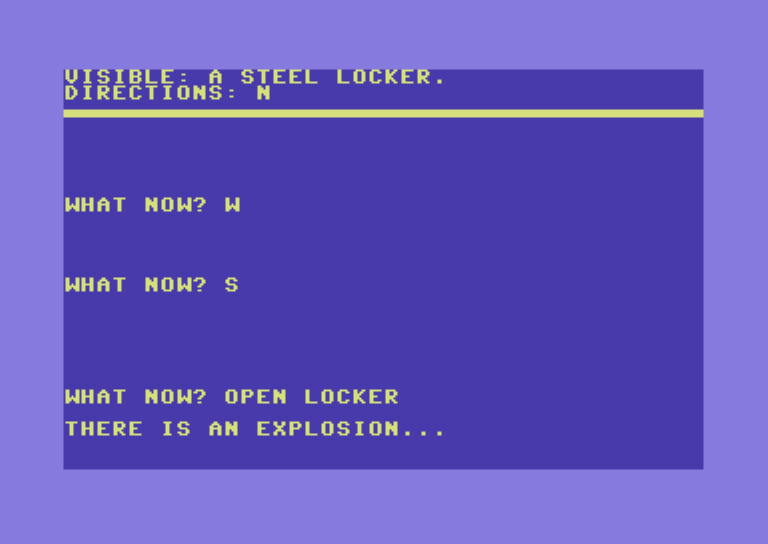
One of the levers randomly takes you to a “lab” area with a tin (see above, I haven’t worked out the number’s meaning yet), another deathtrap room, a potion that kills you if you drink it, and a steel locker that explodes if you open it.
Another lever goes to a forest area with a “pod” containing an “amulet”. The amulet has no description if you look at it and you can’t WEAR it.
Finally the only thing I seem to be “stuck” on is a locked door. I can’t refer to it in any way and the KEY I had at the start of the game doesn’t work.
This is one of those games where there aren’t really “puzzles” to struggle on as much as trying anything to get the game to recognize an interaction. For the record, I’ve got
a plastic cube (with a cryptogram that turns into “rubik got here too”)
a helmet (with several small lights)
an amulet
a flash of luminous blue liquid (that makes you heavy and kills you)
a key (from the start of the game)
a silver spoon
a tin (with the number hint)
a notebook (with the “go twice” hint)
a black metal rod (that was used to open the hidden doorway)
I trust either the next steps will be very simple or impossible; either way, based on the length of the author’s other game, I expect my finale here to be in my next post.
I probably should have checked help sooner. Unusually for Kim Schuette’s Book of Adventure Games, it discusses possible bugs in the hints themselves and even mentions a late action only working on two of the six playthroughs. I wasn’t able to get the ending to happen so while I came close, I can’t show the grand finale.
Via eBay, with someone’s hand-labeled disk and hand-made map.
First off, I had something close to the right actions last time.
I had missed the fact in the room with the receipt at the hotel, the phone rings. I did have the sound on, but you need to pause in what appears to be real time; if you’re typing commands too fast it doesn’t turn up, and even after I knew about the phone potentially ringing, I wasn’t able to get anything to happen until a second attempt.
“It’s all set, Beau. She shoves off tomorrow.” They hang up.
Now, you’re supposed to follow the receipt to the red herrings, just as I did. When I did so I had nothing happen and left, but if you wait — by just WAIT or LOOK — eventually someone will spring a trap on you and trap you in a locker.
The locker has a ticket stub (needed for the cinema) so you need to get in here. To escape is the only real item based puzzle: the cigarette and lighter from the desk are needed. You stand on the desk and set off the smoke alarm.
To the game’s credit, I figured out the parser commands here fairly quickly. With ticket stub in hand we could visit the cinema, and there Beau (the fiancée) arrives (I think probably this would not have happened had we not caught the phone call).
However, when we go in, we find the man… dead!
We can take the invitation if we like; whatever happens, it seems to be scripted that if we arrive at the platform where our office is we’ll get a message that tells us to wait at a phone.
We can then follow that phone message over to the (previously not-useful) museum, and have an encounter which results in another dead body.
Now we get into serious bug territory. According to Kim Schuette, the body has a key (according to the source code) but no way to access it in the game. The key then works on a locker in the stadium which opens a duffle bag with barbells, but there seems to be no purpose in this anyway (since neither he in the past nor myself now were able to see any of this in-game).
This encounter is the last you can have before picking up the ransom money, as you were informed about way back at the penthouse; you were supposed to pick it up at 7 PM, then drop it off at the lockers at the bus station at 9 PM. This part of the game is a matter of typing WAIT a lot or just I since that’s a quicker command.
I dutifully rode the clunky subway system back to the bus station, did the drop off, waited nearby for the pickup (as Mr. Schuette explains in his book) … and had nothing happen. The person that is supposed to do the pickup is Livwell (that we learned about via bribery in my last post) but he never shows.
West & 21st St.: Wait and watch for Crowded Corridor. If no one comes by 10 PM (the courier is Livwell), he won’t come due to a bug in the program. (On six near-identically played games, he appeared only twice. Perhaps a flag wasn’t set by doing something which seemed to have no bearing on the game, like not getting the Hanky or going to the “wrong” bank.)
The ending at least sounds dramatic. You’re supposed to follow the man (Livwell) with the suitcase all the way back to the Sizemore building (??) and then sneak in the elevator and shoot him. Then, arriving at the roof for the drop off, you encounter J.J. (the basketball star) and Cartier (the allegedly kidnapped person), shoot the man, and “pull lever” (which I assume stops Cartier, who was in on the scheme all along).
Ugh. I won’t recount my time valiantly trying to play the game for real and getting nowhere. I think the authors had some interesting scenes mapped out, but didn’t have a good way of putting them together that made both narrative and ludic sense at the same time. There wasn’t any learning that happened from the man at the museum, nor with the death at the theater, and no sense of a gradually untangling mystery that requires thoughtful deduction. Simply a sequence of events happened which eventually led to what would be a conclusion (if the game wasn’t broken).
You’ll be glad to hear I am already part-way through my next post, so I hope it won’t be nearly as long a gap before you hear from me next time.
Nothing terrible earth-shaking this time: I visited all the subway stops and mapped everything out.
The key in the top is now fixed, with W and E going the appropriate directions.
We’ve seen the starting office, the penthouse, a museum, and an ATM, but a brief tour of the rest:
Sports Complex:
Mainly seems to be there for a locker, which I assume we get a key for at some point.
The NOISE MAKER seems tempting for some puzzle where we have to distract bad guys, but I haven’t come close to any related scenario yet.
Unfriendly:
There might be a scene later, but this was the most bare-bones of the destinations I could find. It just is described as an unfriendly part of town, with no buildings to enter.
Broken Arms Hotel:
We can see from the registrar where Beau McBride is staying (that’s the new fiancée of our kidnappee), and visit to see a shipping notice.
I did find the crate, which I’ll show off in a moment.
“Executive Row”:
Where broken-down executives go to self-medicate.
There’s a person who indicates they know something that you can bribe. I am quite unclear what it has to do with the case — I feel like I’m seeing something out of sequence. All I can clean is someone named Oliver Livwell exists and was acting suspiciously.
Bus Station
Rather like the Sports Complex, this seems to exist for the purpose of providing a mysterious locker that we can unlock. Again, we seem to be out of sequence:
Warehouse
There’s a steel door that we can’t get through (and where I assume more drama occurs) but also the crate I promised would come up again. It is full of red herrings.
Cinema
There’s a cinema that is currently playing a movie, and it doesn’t let you buy a ticket; however, if you have a stub, you can see a movie in progress. So this is just a matter of waiting for the right item.
Apartment
You can visit your own apartment, which is very messy. There’s a picture of your mother with a safe behind it.
The combination hidden in the office (from a few posts ago) works, although it took me a while to get the syntax. You need to TURN DIAL LEFT or TURN DIAL RIGHT, and then a real-time interface happens where a number rapidly increases and you have to push a button when it hits the right spot — almost a mini-game.
The statue contains a statue which appears to be a reference to The Maltese Falcon.
It’s a statue of a bird of some sort. This is a family heirloom, handed down to you from your great grand-dad. On the bottom of the base it reads, “Made in Malta.”
If the statue shows up in the plot, I haven’t seen it yet; at the moment it appears to be just a reference.
Bank
Nothing exciting about this. I assume this is simply another location the bankcard works at, but maybe a future event happens here.
Summary
This seems to be the sort of game where I’m supposed to find clues in a specific sequence, and various people and events will show up at the right intersections once I learn about them; alternately, I’ll get a key for one place, which then has a key for the next one. In a ludic sense, I don’t really feel like I’m investigating anything, but let me save any design conclusions for the end of the game.
The locations end up not being large so I suspect once the progression really gets going unless there’s some difficult puzzles along the way, I might blaze through what remains of the plot. So hoping for a win next time?
Other than my life-delay, there were a couple aspects going for Crime Stopper making it hard to get moving on progress:
1.) The variant-versions fiasco I already wrote about; anything where I have to switch emulators or disk versions or the like can take away my momentum.
2.) The ALL CAPS block text, which hasn’t been a pain in other Apple II games but is here. There’s a fair amount of reading giant chunks.
I’ll give the non-blocky version of this shortly.
3.) The way travel on the map works, which I have only touched on briefly.
Each of the circles shown is a subway station. You go into the subway, buy a token, then wait on the platform for subway cars to come by. If you’re trying to go a particular direction, you have to wait for that particular car. The directions (as partially indicated by the compass) are Uptown (right), Downtown (left), East (down) and West (up). (And yes, if you check against the map, east and west are reversed for some reason compared to the compass guide.) I found it very easy to go the wrong way, and every time you use the subway you have to buy a token (hope you didn’t max out your inventory, otherwise you need to figure out what item you want to drop), wait for the right car (which takes a while), enter, and wait while in the car (which also takes a while).
You start at 2nd and 90th and the telegram asks you to go to 2nd and 50th (one stop uptown). Even figuring out this fact took a while of parsing the subway system.
If you go downtown instead of uptown, you end up at this museum which is at the far upper left of the subway map.
So from here (unless I run into a specific problem) I’m going to pretend I’m fluently flying around the subway system, although I’m also running into inventory capacity problems and having to dump things on the subway platform hoping that I won’t need them four stops away and have to do tedious backtracking. I will say in a theoretical sense it is interesting how simulationist the authors went here in their world-modeling, but in a practical sense I was pining for a fast-travel.
Rewinding a bit now, just because it’s been a while you may have forgotten the plot–
A newscaster appears on the set. “There is still no word on the demands of the kidnappers of construction heiress Cartier-Blanche Sizemore. Miss Sizemore disappeared today from the plush 2nd Ave penthouse she shares with her mother, Millicent-Hyacinth Sizemore. Mrs. Sizemore herself made headlines last October when she announced her divorce from her husband, the internationally known gambler Henri Louis Chevron. So far the police have issued no official statements except to confirm the kidnaping. We will have more information for you as it develops.”
That’s from your office you start at, where you can turn on the television and CHANGE CHANNEL. You get an urgent phone call at 7 AM with a “trembling female voice” saying “they are coming to get me” with loud noises, and there is already a telegram from Sizemore’s mother asking you to come to the 2nd Ave penthouse regarding a strictly confidential matter.
Putting my mystery hat on, there’s already something very bizarre here: the kidnapping is supposed to have already happened. What is with the phone call seeming to be the event occurring on the spot? While you can’t read the telegram first, it is already sitting at your desk when the phone call happens. Is the telegram about some different thing that then changes because by the time we arrive the kidnapping has happened, or is there some kind of setup? The television program clip also can be seen immediately after the phone call, which doesn’t make much sense with the timing.
Going outdoors, we can buy a newspaper (I already showed a screenshot of part of it, but here’s the whole story converted to more readable text, for both your benefit and mine).
Cartier-Blanche Sizemore, daughter of construction magnate, Millicent-Hyacinth Sizemore, was abducted from her 50th floor penthouse apartment at 10 AM this morning. Two masked gunmen forced their way into the Sizemore building, captured Miss Sizemore, and escaped in a black limousine. The police are puzzled by the gunmen’s apparent familiarity with the Sizemore building’s layout, as hell as their unconventional getaway vehicle. “there are no firm suspects at this time,” said Detective Frank Sanderson, who is in charge of the investigation, “but it is still early.” Over the years, the Sizemore family has received a certain amount of notoriety for their frequently turbulent personal lives. Miss Sizemore made news several months ago when she spurned her fiancée of two years, megabucks basketball superstar J.J. Johnson, in favor of Beau McBride, a Bristol’s department store clerk. Mrs. Sizemore and her husband at the time, Henri Louis Chevron, were stunned by her decision and threatened to disinherit her.
Several weeks later, the social circuit shaken by Mrs. Sizemore’s stormy divorce from Chevron, an internationally-known gambler, Chevron was reported to have filed for bankruptcy following his removal as acting head of the corp.
Although Detective Sanderson has made it clear that there are no real suspects as of yet, Mr Chevron could not be reached for comment. Mr McBribe also could not be reached at his room in the Broken Arms Hotel.
Yes, the fiancee’s name is written McBride, and then McBribe. This might be an intentional typo.
(…skip by subway transport shenanigans. grr this is annoying…)
Arriving at the Sizemore building, there’s a letter from the mother explaining there had been “treats two weeks prior” and that “now it is too late”. You get a account number (10-28-81) and a bankcard in order to make withdraws, and are informed that there is ransom money being prepared that we can pick up by six o’clock.
According to the map we can head “Downtown” back to where we started, or “East” in order to go down on the map. Going “East” we get to a bank and can use the bankcard we just acquired.
That is, as long as you make sure you use the syntax correctly. Typing 102881 or ENTER 102881 or ENTER 10-28-81 all fail; you have to type exactly 10-28-81 for the withdraw to work.
And even if you get through that, the transaction might just fail anyway! This happens if you exceed $100 in-hand, and I was holding $10 of my character’s personal money, and I tried to get $90 which seemed to be possible. Argh!
I’ve gotten a little farther than this, but I think this gives enough of an idea what I’m struggling against for now. Update on all the map locations next time, and then maybe we’ll see a dead body.
In my 2023 recap post, I mentioned being sad about not being able to finish Secret Kingdom for the MZ-700. It didn’t have anything completely remarkable (plot recap: find treasures, win) but I only attained eight out of ten treasures, giving me the feel of a gnawing gap.
LanHawk took this up as a challenge and first managed to extract the BASIC source code; it turns out he had trouble getting anything out of it (baltasarq from my comments also called it “weird and unreadable”) so Lance decided to just play the game using the posts I had so far as reference. He managed to find the last two treasures and send hints.
From the Museum of Computer Adventure Games.
First and most simply, I’d been carting around a SWORD the entire game, but apparently had never bothered to LOOK at it.
Since you need the sword to handle the random wolves, it needs to be held pretty much the entire game.
If you look at the sword the game says you’ve found something, and a *GOLD STUD* appears.
The second find is a bit messier and I can understand why I missed it. Look again at the tower room above. There’s a PARCHMENT which LOOKS WORTHLESS and I tried in vain to make it show a treasure map or the like.
GET PARCHMENT and TAKE PARCHMENT led to TRY ANOTHER COMMAND, so I thought I reached some sort of parser barrier, but that was in fact a hint. This was partially a problem with visualization; you are supposed to imagine the parchment is put against the wall, somehow. The right command is REMOVE.
Now with the window revealed you can go outside to get a medallion.
This means the long snow section which I assumed had to have something is in fact entirely a red herring. It seems like a lot of work for the author to have bothered. I half-suspect G. Clark had some ambitions but simply run out of room so had to stop.
I’m afraid there’s no deep insight here — I was hoping there would be some sort of grand step in the final puzzle which would change everything, but alas, I had already racked up the interesting treasures.
At least the loose thread doesn’t have to bother me any more!
Apologies for the radio silence — I had some major work things to get to pushing up to the end of the year, and my brain just hasn’t gotten back in gear yet. The Project will continue next year, but a few snapshots of moments from 2023:
We finally finished the murderously hard Ferret, a bit behind schedule — regular posts through January, then with action continued in the comments through February, before we finally pushed through at the end of the month, with a brilliant moment at the end by commentor Sha1tan who realized the last step.
I don’t know if we’ll ever experience anything again quite the same, but how many games take 40 years to write?
I still think the train puzzle near the end is one of the best I’ve ever experienced.
I never did quite figure out how to push Breckenridge Caper to the end. It was fun to see an adventure game written from the angle of a classroom historical simulation, which gathered a much different flavor than anything else from this blog.
I had far more enjoyment of Zork III than I thought I would. I think I had to use hints too many times back when I first played it so it didn’t make as good an impression.
Asylum II also surprised me; the author experimented with the format and came up with something tighter and more playable than the previous iterations, with the jaw-dropping plastic surgery puzzle (which felt creepy every. single. time.)
Secret Kingdom gnaws at me. Lots of games where the final hurdle is missed I feel apathetic about, but I really want to know how to take this one to the end. I’m not sure why. I guess because the somewhat novel handling of “error messages” (which hint as to the correct action) makes it seem “fair” despite the presence of 1982-era softlocks.
On the other end of the spectrum, I am incredibly happy I finished Doomsday Mission, which tried hard to push back and where zero hints or maps existed on the Internet.
The weirdest moment of the whole year (ERASE BRIDGE) courtesy of Kabul Spy.
Just in terms of sheer puzzle joy I think Murdac was my favorite of 2023. You have to take the old-school aspects on their own terms (like the very early softlock with the wall, and the maze) but if you’re willing to cope with those this feels like the work of someone who has actually learned how to design a puzzle, rather than still building an apprenticeship.
I appreciate the raw uniqueness of Apventure to Atlantis. Much more fun to read about than play.
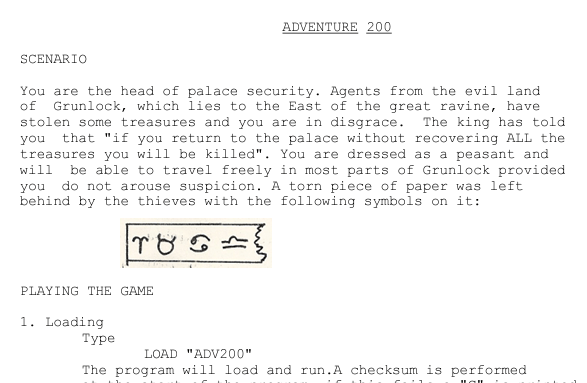
Adventure 200 was the biggest surprise of the year; I expected a generic Adventure clone, but because of one clearly executed idea spread throughout the game it became something much better.
Rick Incrocci, who did the art for Masquerade, was operating on a different plane from everyone else.
Let’s finish with the sheer strangeness of Africa Diamond, which had a “shadow room” map under the regular map which took a wild approach to solve a technical problem.
That’s not everything, or even everything good, but that will do.
Still lots more to come in 2024 past finishing Crime Stopper, like:
an adventure game for the Bally Astrocade
two 1982 games written by people who comment on this blog
Brøderbund’s entry into the adventure market
more graphics for TRS-80, somehow
a strange combination adventure/shooter game
a rare Sierra On-Line oddity most people don’t remember



















 Renga in Blue