I’ve finished the game. This continues directly from my previous post.
Fortunately, I was just having some bleed-over trauma from The Sands of Egypt, and the rest of the game went smoothly. (Well, except for a moment at the very end.) To continue directly, I had been misinterpreting this scroll:
:read scroll
It says,
“PHLURF” is the key to this adventure.
:say phlurf
Oops! Your magic is not too accurate.
You will have to find the key for yourself!
I read this as “the magic word didn’t work, you need to revise what you said, or find some item to enhance your capabilities”. Instead, the way to read this is “yes, you cast the spell, but it didn’t turn out accurately, and it made a key somewhere which you need to find”. That is, a key appears in a different place and you just need to find it, so solving the puzzle just involves via walking back to the crocodile moat:
You are on a grassy knoll south of a huge castle. Between you and the castle is a moat full of crocodiles. A tree now spans the moat creating a bridge. A path goes east.
There is a gold key here.
I admit I did not solve the puzzle, but just was wandering in case I missed something, and had to puzzle a bit why the gold key was sitting there.
The gold key goes to the chest I’d been toting around, so another puzzle solved right there:
:unlock chest
A wizard’s staff falls out onto the floor!
Suddenly a voice says,
“This can free anything from the tightest of situations.”
This immediately suggested the stuck ruby.
You are in the Priest’s chamber. There are many sacred objects and prayer books here. There is a curtain to the south.
Imbedded in a quartz slab is a sparkling ruby!
:wave staff
The quartz disappears and the ruby falls to the ground.
Which of course immediately suggested the statue with the missing ruby.
:insert ruby
You feel the floor give way beneath your feet as you fall down into a dark and gloomy dungeon. The ruby bounces off your head and lands on the floor beside you.
You are in a dark and gloomy dungeon. A horrifying skeleton is chained to the wall and is looking down at you with haunting eyes. There is a hole in the ceiling to the north and some kind of equipment to the west.
There is a ruby here.
This leads to a new small area.
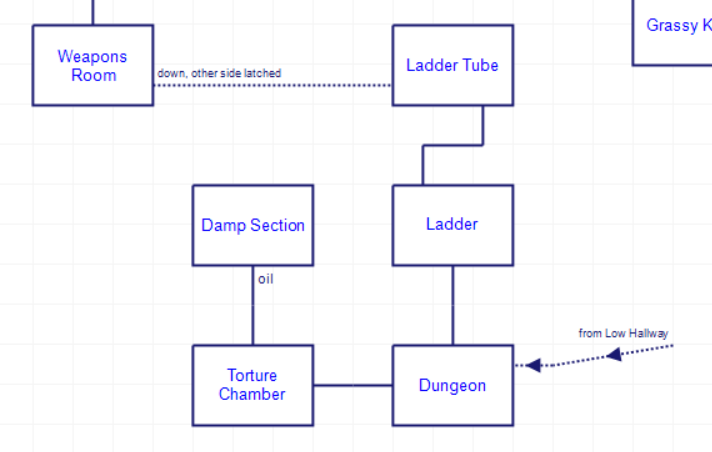
The only purpose down there, other than the authors describing a grim torture room (very teenager vibes) is to find a pool of oil, where you can FILL FLASK to get a flask of oil. To get out, you climb a latter, and unlatch the hatch that leads to the weapons room from the other side.
The oil goes to the rusted door, leading to some royal chambers:
This room is the holding place for the Royal Crown Jewels. The plentiful supply of gold, silver and precious jewels must be worth millions! There are rooms to the west and south and an open gate to the east.
There is a royal crown here.
:w
You have entered the King’s chambers. His closet contains only the most elegant of clothes. His beautiful brass bed is covered with white silk sheets. You can see the setting sun through the huge bay window. The room exits to the east.
All you need is the royal crown. The game doesn’t let you take the treasure or even touch it, really. You’re not here for treasure, you’re just exploring and passing through. (I love how explicitly and vividly the treasure is mentioned in the room description only to have it be utterly unimportant.)
The crown goes back to the cathedral with the gold ring. This is the only slightly unintuitive puzzle but given the gold ring is what immediately occurred to me, that’s only slightly.
:drop crown
The crown glows white hot as the altar suddenly begins to rise towards the hole in the ceiling. When the platform completes its ascent, you find yourself in a room high above the cathedral.
You are in a room resembling an attic. You are still standing on the altar, but your surroundings have changed greatly. Dust is everywhere, and the room has a smell of mildew. Light is coming in from the east.
Just to the east of here is a room with a window overlooking a village, and a rug that seems to be moving.
You are looking out of a large French window. You can see a small village in the distance. Under your feet is an Oriental rug that seems to be vibrating. The room goes in to the west.
And here I was stuck for the second time for a long period. Clearly I was meant to use the rug as a flying carpet, but my failure to SIT RUG and MOVE RUG and TAKE RUG and so forth led me to be confused.
:examine rug
I don’t understand.
:use rug
I don’t understand.
:fly rug
I don’t understand.
The problem is, again, this is a Sands of Egypt-style parser — almost every failure to do something is mapped to “I don’t understand”, and not to any clarity why something didn’t work. A good parser is about handling and re-directing failure easily and transparently; if the player types something “wrong” but their situation is clarified it can stall them for five seconds, if they type something “wrong” with no feedback they might be struggling for 10 minutes.
The winning solution was to just type FLY on its own.
:fly
You almost lose your balance as the rug takes off and glides through the window. The rug takes you over an immense field to the town, where the people eye you very suspiciously.
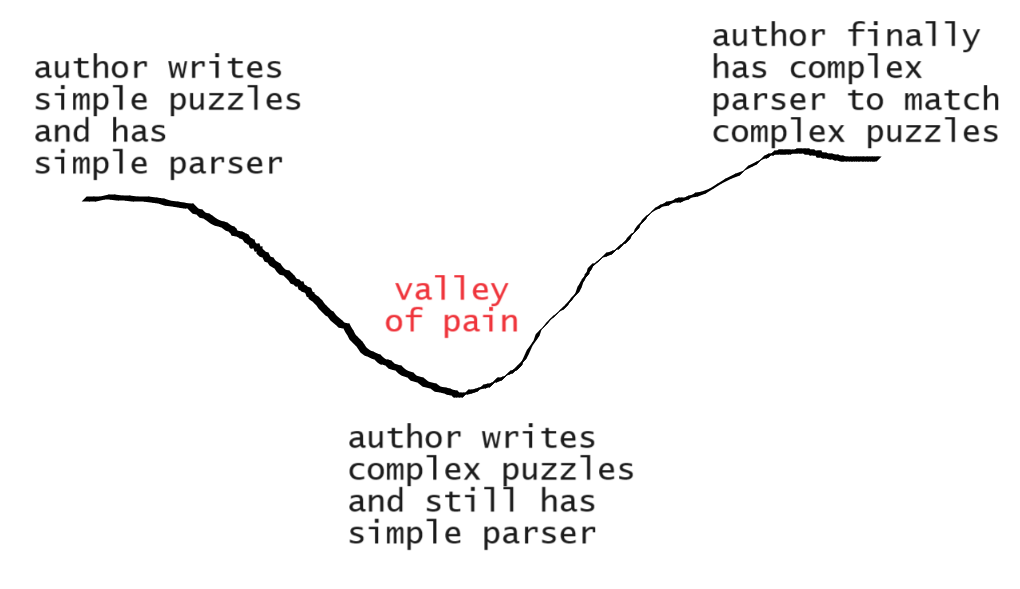
And that’s it! This game really emphasized the points I made recently about how a less robust parser can still work as long as the game sticks with very simple puzzles. The only problem is it is still possible to get stuck on a simple puzzle (in this game, one which involves walking into the right room) and then the player is free to type all sorts of absurdities in an attempt to get forward and then the parser is back to being miserable again. Still, I think all the games from Crandell and Peterson have fallen on the safe side of the valley. That is, in the development of ambitious adventure authors, a valley metaphor is appropriate:
(Yes, I could have made this look nice in Figma, but Microsoft Paint was calling to me.)
Mind you, some authors have played enough adventures that they start directly in the deep hurting section, and Infocom pretty much had their parser mastered straight out of the gate. What I’d really like to see is an author progressing all the way from the left side to the right side, but we’re just not deep enough into adventure history for that to happen yet.
Medieval Castle marks the last of a trilogy by De Crandell and Joe Peterson, who wrote an “Explore” system for the TRS-80 as a system for their games. They were private rather than distributed, and only placed on the Internet much later. (See: Enchanted Cave, Lost Mine.)
“Medieval Castle” was the final in the “trilogy” of our late-nite teenage adventure creativity. This one forced us to add even more features to the language, and I believe it really became “sophisticated” with this one. Castle is perhaps the most colorful of the adventures, but not as mystical somehow as Enchanted Cave. De and I didn’t make any more games after this one.
This is not the last of the Explore system games — there’s one more based on a raunchy 80s comedy movie — but we’ll get to that game a different time.
Continuing the pattern of “teenaged prodigies who wrote adventures and went on to fame”, this is Joe Peterson from a group shot at the Southwest Research Institute, where he was manager of mission operations, and was in charge of the New Horizons spacecraft that went to Pluto.
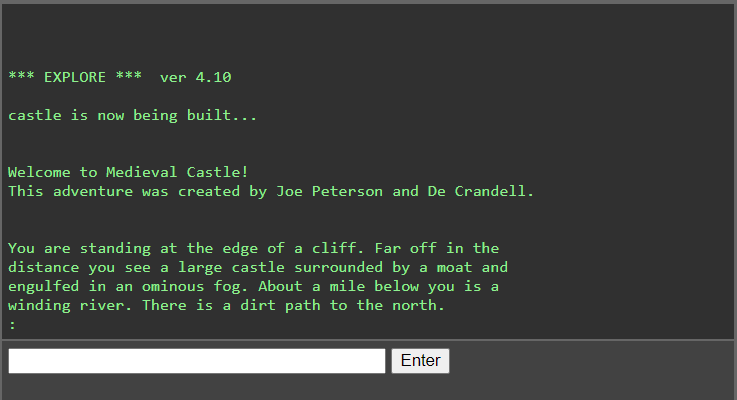
Rather than screenshots I’m going to do text clips, but just a reminder what the system looks like, first:
I’m still paranoid the web page this comes from will disappear some day, although there is technically an Android port so the game is preserved. We have the source code of the Explore system proper but not the script for any of the actual games.
Just like the other two games, there’s no given plot. Here you encounter an Enchanted Castle, and are supposed to pass through all the way until you get to the finish. There’s no particular reason we’d go into the castle in the first place, so the plot is just “have an adventure”.
You are standing at the edge of a cliff. Far off in the distance you see a large castle surrounded by a moat and engulfed in an ominous fog. About a mile below you is a winding river. There is a dirt path to the north.
:n
You are at the base of a tree. There seems to be something caught in the top. A dirt path goes south.
:u
You are standing on a branch near the top of the tree.
There is a hang glider here.
Unlike the other two games this was not a one-shot deal. I am in fact stuck early in a way that is uncomfortably reminiscent of the game I just played, The Sands of Egypt. I am concerned becoming “sophisticated” is code for “tried to do some complex puzzles in a parser that doesn’t support it.”
At least the start is simple enough. You can grab the glider mentioned and take it back to the edge of the cliff, and JUMP, landing at a grassy knoll.
You are on a grassy knoll south of a huge castle. Between you and the castle is a moat full of crocodiles. There is a tree at the edge of the moat. A path goes east.
The east a short way leads to a woodcutter’s cabin, which has an axe, and you can take it back to the knoll and CHOP TREE in order to form a path across the crocodile moat.
:chop tree
The tree falls and forms a bridge across the moat.
:n
You are directly outside the castle. There is a large archway to the north, which serves as the main entrance. To the south is the bridge and the moat.
There is a scroll here.
The scroll is the first cryptic part of the game.
:read scroll
It says,
“PHLURF” is the key to this adventure.
:say phlurf
Oops! Your magic is not too accurate.
You will have to find the key for yourself!
Does that mean I’m “pronouncing the word” wrong? Does it only make sense in the right place? Is the thing written on the scroll really a cryptogram that changes to something else? (At the very least, I tried rot1, rot2, rot3, etc. up to rot25 with no joy.) Using it anywhere else after the first time just gets the message that nothing happens.
This opens the map a bit more, but I’m not finding much luck anywhere I prod.
You are in the main hall of the castle. You are greeted by a majestic red carpet, which extends through a low archway to the north. Sunlight reflected off the waters of the moat can be seen through a large archway to the south. You can see an immense room to the east. A spiral staircase twists up out of sight.
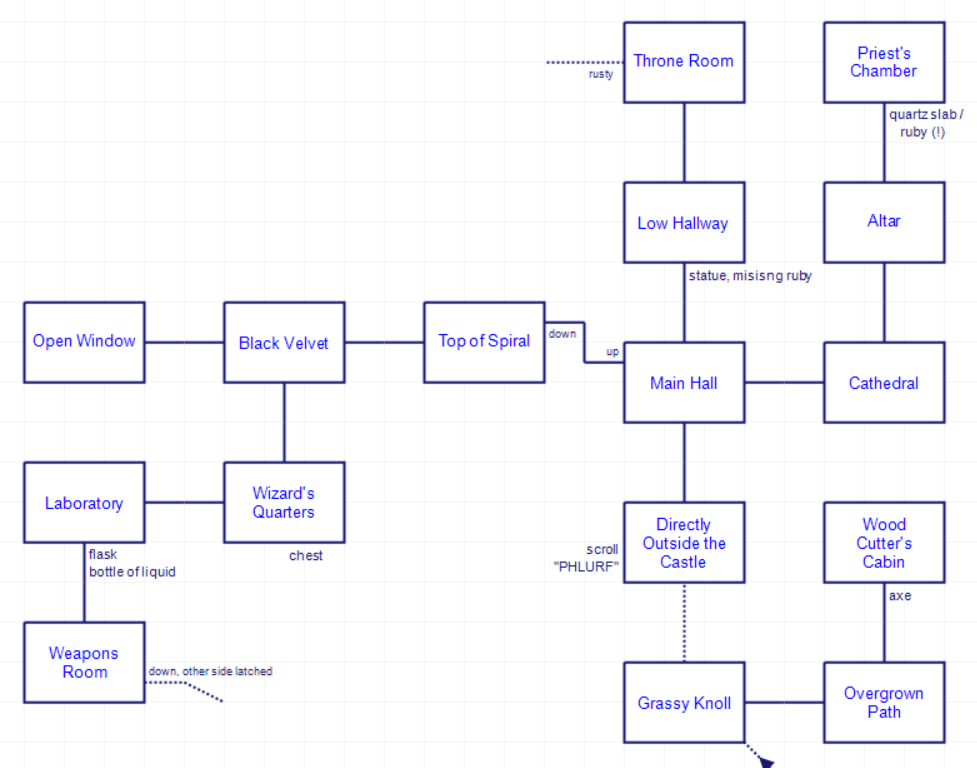
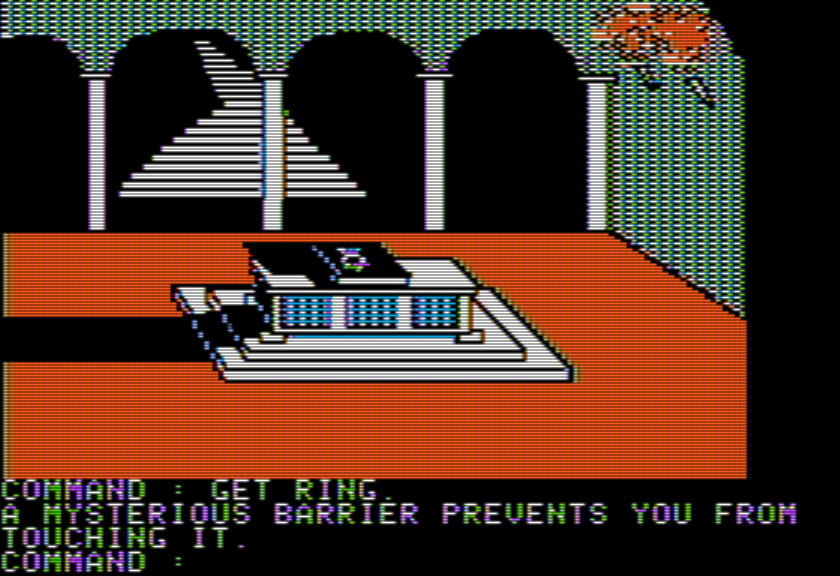
First off, on a branch to the east is a cathedral, with a platform having an “imbedded gold ring about the size of a crown” and a hole high on the ceiling that will no doubt later be important. To the north of that is an altar with a ruby I can’t get at.
You are in the Priest’s chamber. There are many sacred objects and prayer books here. There is a curtain to the south.
Imbedded in a quartz slab is a sparkling ruby!
:get ruby
I see no way to pick up the ruby.
:chop ruby
I don’t understand.
:chop slab
I don’t understand.
:rub slab
I don’t understand.
:push slab
I don’t understand.
Going back to the castle entrance and heading north instead, you pass by a statue with a missing ruby eye (clear where the ruby is going after you get it, at least) and then a rusty door I have seen borrowed from many games already.
:n
You are in a low north/south hallway between two arches. There is a small statue resting on a pedestal on the right side of the hall. The statue is missing one of its ruby eyes!
:n
This is a magnificent room with a ceiling twenty feet high. At one end sits a beautiful throne made of solid gold. The red carpet ends at the foot of the throne. There is a doorway to the west. To the south is a low archway.
The steel bar door to the west is so rusty it won’t budge.
However, unlike those games, I haven’t been able to beat the rust. Upstairs there is a “wizard’s laboratory” with a “flask” and a “bottle of liquid” but neither is helpful based on any command I’ve tried (OIL DOOR, POUR LIQUID, THROW FLASK, etc.) I know the bottle is toxic because it kills you if you drink it but past that I’m baffled.
Showing off a little bit of upstairs, but there isn’t much to do yet:
You are in the wizard’s quarters. There is a strange looking pointed hat on a night stand beside an unmade bed. There is a curtain to the west, and the room exits to the north.
There is a chest here.
:s
This must be the wizard’s laboratory, for there are many bottles filled with strange colored liquids and powders.
There is a small tunnel to the south and a curtain to the east.
:w
You are in the weapons room. There are all kinds of swords, daggers, shields, and crossbows resting against the walls.
There is a grate in the floor, but the latch is on the other side. A tunnel goes north.
I’d normally think the latch is a puzzle clearly solvable later once we actually reach the other side, but I’m stumped on all other avenues so maybe you’re supposed to reach the latch somehow. If there’s a way to express this in the parser I haven’t figure it out.
I’d say someone is welcome to peek at a walkthrough if I’m not missing an obvious verb, but this has no walkthroughs on the Internet. So anyone who wants to help will need to play this for themselves, which you can do online by using the link here. I’m hoping this is a momentary hiccup and the gameplay will return to normal after (meaning I’ll finish by my next post) but it may be the authors decided they needed to crank up the difficulty for their finale, or at least crank up the level of obscurity of commands required to interact with the game.
ADD: Managed to figure out the issue (in the comments if you don’t want to wait). Crisis averted, however.
To continue directly from last time, I drained a pool (grabbing the scepter I used as a hook along the way) and went down.
Going west there’s a boat, which mentions a place you can tie a rope. Having tied the rope I got from braiding fronds, I wasn’t able to do much with it other than FLOAT BOAT.
(FLOAT is another one of those “magical riddle words” the game’s looking for, but I previously had created my “standard verb list check” and it was on there. PUSH BOAT or any other kind of movement command aren’t understood.)
I was able to GO BOAT…
…but here I was horribly stuck. Pretty animation, though.
If you hang out in the boat, it’ll keep floating to the east, underneath the hole you came in, and the eventually plunge over some falls. If you skip the boat and go west, the ledge collapses.
I kept trying to manipulate the rope and failing. It occurred to me to try to have the boat move to the west but no command I tried seemed to be recognized, including PADDLE.
You can’t do that now.
I should have been more alert here. My brain was interpreting this as being on the wrong track still, but the message in the CoCo version for “I don’t get that verb” is
I don’t understand.
and the different message subtly indicates that PADDLE does make sense to the game, just it doesn’t want to do it. Of course, the game never says something like “you don’t have anything to appropriately paddle with”, because life is suffering. I did happen to grab quite a few of the items just in the random hope one would later be helpful (like the axe) but the one time I tried PADDLE I wasn’t holding the actual helpful item letting you paddle, which is the SHOVEL.
You can then tie the boat to the pole and GO ARCHWAY to leave the boat (LEAVE BOAT or the like of course don’t work).
Yet again, the game is fishing for the right word here. Our character is established as an esteemed gentlemen archaeologists, of course he can read hieroglyphics. But for some reason, you need to use the verb TRANSLATE instead to actually read them.
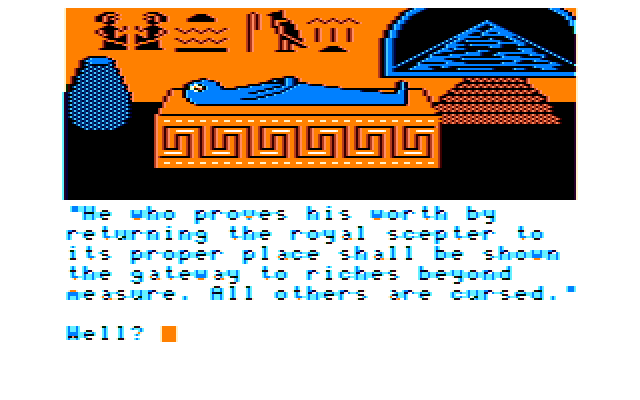
PUT SCEPTER (which normally just drops it in the room) works here special, and you can specify IN MUMMY. The room shakes and opens a crack.
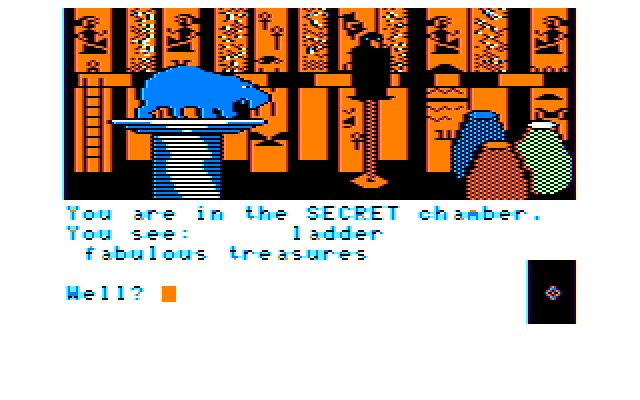
You are told multiple people are needed to take the treasures; the ladder is what you need. You can now backtrack, hopping on the boat, and CLIMB LADDER when the boat passes under the hole in order to get back up top. The physics of this are weird and I was expecting to leave the boat first before somehow getting a ladder inside a hole but I’ve learned to stop asking questions of this game.
Then it seems like nothing has been accomplished, as you just looped back to the pool, but you can give the camel another ride and this time it goes somewhere different.
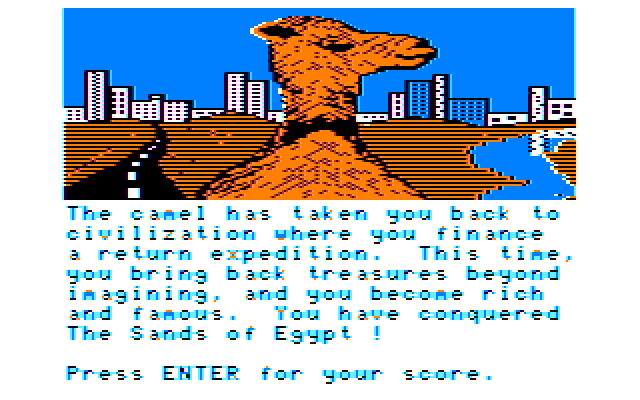
Honestly a little galling if you think about it — our selfish main character annoyed his workers but managed to find a treasure hoard and then claim it for the Crown, the British way. I’m a little more appreciative now of how the Infocom ending went instead. (If you don’t know what I’m talking about, you can read Jimmy Maher writing about Infidel, although the ending really is best experienced organically if you plan on playing it.)
I guess both The Sands of Egypt and Infidel have one similarity, in that the authors were unhappy with the result. Berlyn mentioned in an online conference he “hate[s] the game” (that is, Infidel; I enjoyed it but it’ll have to wait until 1983) and in that same interview where Bjork talked about infusing an arcade sensibility into adventures, he said:
My final comment on “The Sands of Egypt” is it could have been a little better.
No expansion. Did he mean the parser, or the plot actions? Both feel a little undercooked — we go underground, we find a treasure, we leave, and the actions are elaborate more because of the opening maze and riddle-verb parser rather than any kind of complex puzzle-solving you might expect in an Egypt-themed game. Compare with Temple of Bast which had an ancient curse that had to be outwitted in two different ways.
I will say the animation is solid. To compare briefly back with the Apple II, I do think it is clear the art was intended for the CoCo and its unique palette. Something about the Apple translation makes it muddier.
The orange along the sides feels “sharper” somehow.
The Apple version isn’t bad, exactly, but it doesn’t seem to be leveraging the strengths of the hardware. The CoCo is being used to make interesting custom “textures” (sometimes animated) which get blurred up a bit even when clearly the same assets are being used.
From Transylvania. Not that different in color scheme, but made more specifically for Apple II.
If you want to compare with Atari, too, Dave Dobson has a playthrough here.
Technically Datasoft has another adventure coming up — one based on the TV show Dallas, from 1984 — but that’s long enough away we can kick the can a bit and think about our immediate lineup. I’ve got a handful of small solo-author games, a C64 game which is a ripoff of an Apple game (as in stolen code that a company pretended was theirs), and then a most curious exploration of what happens when you hybridize an adventure game with a shoot-em-up.
By the title up top, I’m not meaning games with wordplay-based mechanics. Basically this comes down to a suspicion of mine that got confirmed in this game–
In the very early days, 1977-1979, parsers were not as terrible to manipulate as now generally thought. Crowther/Woods Adventure itself had a decent vocabulary and its puzzles did not demand complex combinations of objects that are hard to communicate. The immediate clones went the same route, Scott Adams games had mostly reasonable parsing, the early Greg Hassett games all demanded only simple actions for the player so never diverged into messy-verb territory.
When authors got more ambitious — 1980 — is when the trouble began. Scott Adams starts Savage Island Part II with what may remain the most absurd verb of all time. Authors tried hard to have “difficult” puzzles reliant on things other than magic words and mazes and inventory juggling that required communicating difficult things.
Parser communication started to be such a problem I wondered if there was anyone who thought that guess-the-verb was in fact an essential feature. That the adventure was at least partly a sort of word game, like a real crossword rather than a metaphorical one, and you might intentionally pick a tricky verb over a simple one — never even thinking of synonyms — as part of the game’s challenges, rather than as part of the game’s failures to deliver a transparent UI.
Let’s return to that thought shortly.
So I left off on not being able to drink, having tried DRINK WATER, DRINK CANTEEN, DRINK POOL, and every other combination I could think of. It turns out you just need to DRINK.
Interestingly enough, I still would have been foiled on first finding the pool as the game explains a gentlemen drinks out of a canteen if you try to DRINK. Just cupping your hands is too undignified, I suppose. This is the weird sort of condition that actually works — I love it when the character of the avatar intrudes on the game — and also actually explains why the action doesn’t work, unlike most “wrong actions” in this game.
Having said that, I wasn’t quite done with the canteen puzzle, but I’ll keep to the sequence I discovered things as I was playing. Moving on, I also realized while fiddling I could GO TREE to get closer to one.
The game only lets you climb up with one object in hand.
Keeping in mind the message about the old rope, I tried to get the fronds but was rebuffed. To be fair I didn’t have anything that resembled a tool for that. But I could get the dates and go back down, and try FEED CAMEL with the dates.
The moment where it redirects “GO CAMEL” to another word is unusual but not rare; usually it indicates an author whose code structure makes it hard to have synonyms so they just add a special text message instead. Doing MOUNT CAMEL as requested, I was then able to RIDE CAMEL. However, I couldn’t get off.
I went with HELP, as this does have a contextual help command, and the game asked me
-The opposite of MOUNT is?
The game could have done the same sort of command interception, and then turns the help for finding the right command into a riddle. It appears, as I suspected might be able to happen, the authors considered finding the right word to be an essential part of the gameplay, and not in a word-puzzle game way like Ad Verbum.
This explains how miserable the game is to communicate with otherwise, including the hellish bit in the pool. We’re getting there. Using DISMOUNT on the camel we make it to a pyramid with a carving. Examining the carving reveals a pharoah holding a scepter, that we can refer to separately.
It seems like we ought to be able to take the scepter, and if we try to the game asks HOW? but the game wasn’t understanding what I meant. However, I started to suspect it was “stuck” and what I needed to do was to get the snake oil way back at the north part of the desert over to the pyramid, so I could OIL SCEPTER.
This was trickier to enact than I expected because I realized I had my map wrong: when you get into the pool area, that’s a one way trip. The map doesn’t let you go back. So you have to do everything in the desert before getting to the pool: that’s get the shovel, get the canteen, fill it with the snake oil, nab the torch, nab the magnifier.
You cannot drink the snake oil, so you’re getting thirsty all this time. (When I played before, I took the canteen on a beeline to the pool, figuring I’d go back and dig and get oil as needed later.)
Fortunately, making the entire loop isn’t that tight — I just had to suffer being told I was extra extra extremely thirsty for a few turns — so I was able to move on, and try OIL SCEPTER, then return to the pool to fill my canteen. (Every time you use the canteen, you drop it, so a number of times I rode the camel but forgot to bring back the canteen.)
With the scepter and axe in hand, I took a visit to the top of the palm tree, did CHOP FRONDS to get some, and then tried to make a rope and found … the game was being quite picky again. I had to go check a screenshot to see that the OLD ROPE was specifically made by using BRAIDed fronds. Back to the word-game, this time cued by the game proper rather than the HELP feature. (You could sort of think of it as the correct instructions being encoded in the word, kind of? It feels less gauche than DISMOUNT, at least.)
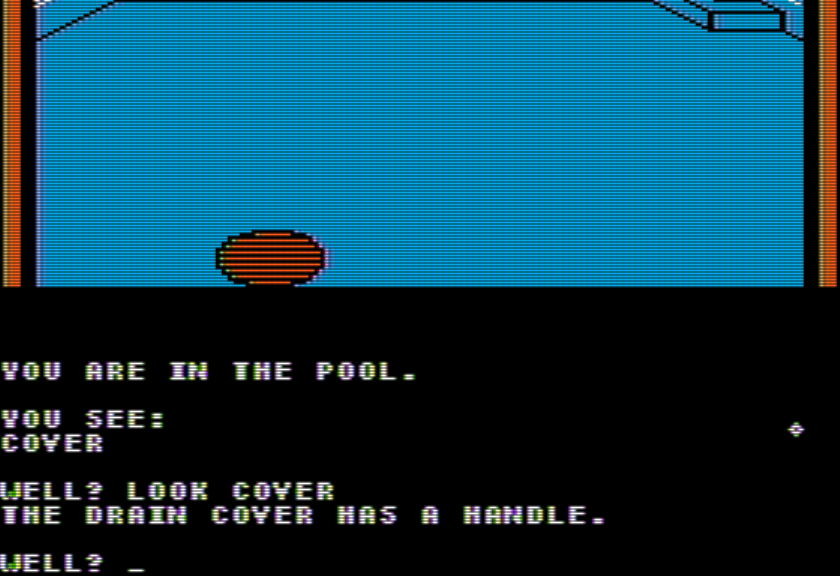
Now, we get to the horrible terrible part. You can GO POOL, and to get out, CLIMB STEPS (as mentioned by 4am). The handle of the cover that we can use to drain the pool is described as a “hook”, and the scepter is also described as a “hook”. Quite obviously the two go together. But how? Switching to Apple just for 4am (and also I switched to Apple now when I got stuck so this is the actual screen I saw):
Wonderful. (Please note the sarcasm you can hear through the screen. OK, you can actually HOOK SCEPTER, but that’s still wild, because you’re really hooking the handle, and that doesn’t work, and yes, I tried HOOK HANDLE first and went wildly in a different direction after for a while.)
You can light the torch with the magnifier, then go in to find a sewer. I’ve made it a smidge farther with yet another outrageous verb but I think I’m close to the end of the game so I’ll save it for next time.
If I went by raw voting (including the people who messaged me outside of the comments) I have had slightly more people ask for Tandy CoCo than Apple II. What ended up happening is
(a.) I went with CoCo, struggled, and got to a point where I was impossibly stuck
(b.) I switched to Apple II to see if anything was different, found only one difference, was still impossibly stuck
Part (b.), other than splitting the baby as Ahab suggested in the comments, is a general strategy I use when stuck on anything (not just solving adventure game puzzles) where I re-attempt the same task with different context to see if anything new pops out. In the case of adventures, there might be different text, but in the absence of that, I might just type commands in a different sequence or happen to find I made a mapping mistake. Potentially, my brain has a new insight just from the slight change in context.
I don’t think my issue is a mapping mistake even though the entire game so far has been a maze. It’s more the parser is putting up a unique struggle, where something in nearly every game so far, even the bad-parser ones, I’d have gotten a response. Just to avoid hiding the lede:
There’s a pool with … water. You don’t think that, given you’ve been repeating emphatically that the player is thirsty, that they might try to drink it? Or if they have a canteen they fill with water from the pool in case there’s some weird quirk there, that they might to drink out of that?
This adventure has an extensive vocabulary. It may take some experimentation to discover the correct command to use in certain situations.
Thanks, manual. Anyway, to rewind:
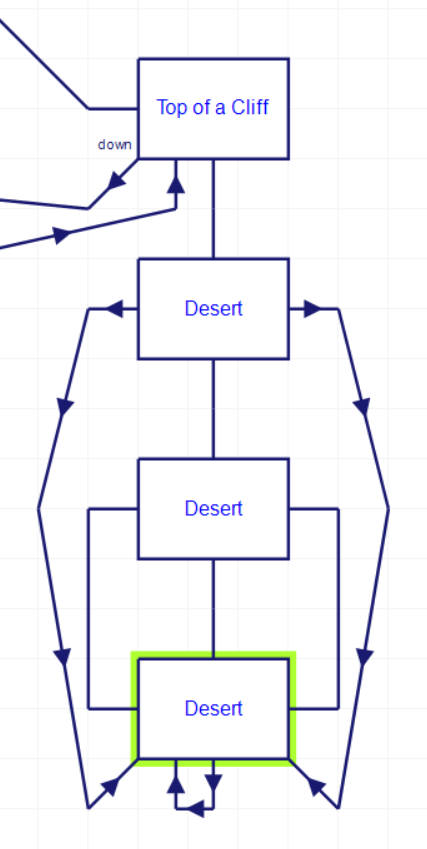
We start in what looks like an open desert. It is not an open desert. It is a fairly finicky maze. This was non-trivial to get over — I’m used to desert mazes always having some open-grid sense to them even if they get maze-like on the edges (like the trackless desert in Adventure Quest).
You don’t have any items to start — there’s one just north that you can dig up but you don’t start with a shovel — and the map is oriented so that many of the exits return you to the start room. I got through by testing out “let’s try going repeatedly E, reset, go repeatedly S, reset, etc.” and found there was a new room by going north three times.
I tried constructing a map from there, realizing that I was likely in a single column, and answering the question “how many steps north to reach the new room?” would tell me where I was at any moment.
(You might remember in my Apple II animated shot I had a shovel. I got that randomly when trying to get a good GIF file and couldn’t re-create my steps. At least it let me know the solution was purely wander-based. This is another manifestation of the “play in a different context to break something” method.)
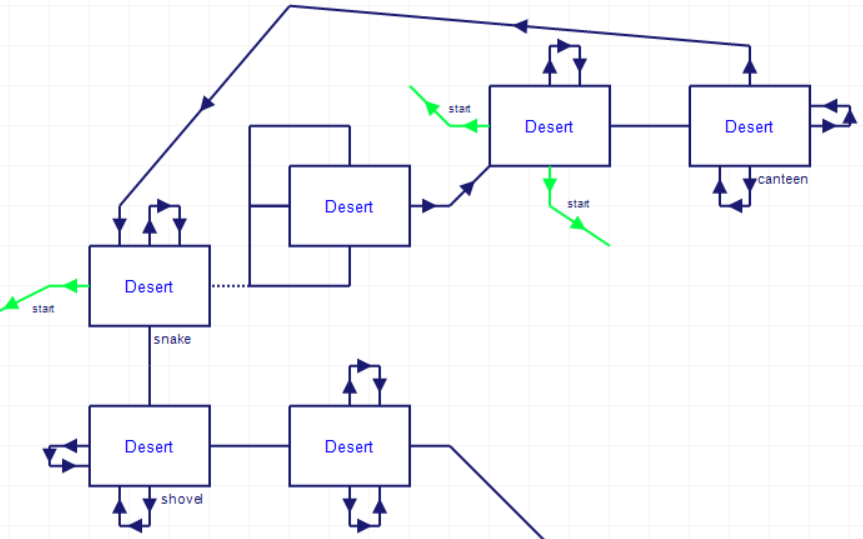
The “down” and “west” exits lead to two different branches of desert. I started with the down branch in my gameplay but the west branch is the more useful one sequentially, so let’s go that way first.
The green exits go back to the starting room.
This specifically leads to the previously seen shovel, which means you can start using to help map out rooms. And of course, digging — digging everywhere. An Egypt-archaeology-desert is the one case I don’t feel weird about that, and even marking every room as I make sure to type DIG in it to find a new item. Ludic gameplay matching the story environment. For example, just north of the starting room there is a torch, but since I’m not in any dark places yet, I can’t use it (although it can help with the mapping).
The one non-visual difference between the Apple and CoCo versions I mentioned is that “you are thirsty” messages start triggering earlier on the CoCo.
North of the shovel is a snake. You can HIT SNAKE / WITH SHOVEL and it turns into snake oil. A bit east you can find a canteen, and fill it with the snake oil, but I haven’t found a use for it.
Taking the other branch in the desert:
At the “base of a cliff” area you can dig up a “magnifier” (50-50 on if it gets used to set fires or used to study tiny hieroglyphs) and find an “old rope”, but taking the rope causes it to fall apart.
Finally you can loop round to the accursed pool, which I’ll show off again, this time in Apple II format.
Leaving aside the impossibility of drinking the water, you can dive in to find a cover, described as having a handle.
Yes, more parser trouble. I’m almost willing to accept the cover needs a tool hence the parser not being helpful and saying “it’s stuck beyond your ability to move with your own strength” but who would code a game with a thirst daemon and not expect the player to drink the first water they see? Argh!
One thing I haven’t done yet is make my verb table, but I was trying to approach this game like a “normal player” first, since it isn’t like most people are going to have a list of words accumulated over 10+ years in order to play. I can’t imagine people in 1982 were too pleased about the situation.
(Oh, did I mention I still don’t know what command to use to get out of the pool? “Some experimentation” to communicate. Right.)
The year is 1893 and you are the aristocratic British explorer, Sir Percy. Life as a great explorer has its excitement of recovering precious gems and gold trinkets, but currently you are hopelessly lost in the middle of nothing but sand. You will need to avoid dangerous snakes and cliffs, and find water before dying of thirst.
Before embarking on today’s game, a more general question: how does historical context help us decide why certain games are designed the way they are?
The most obvious and common thing to look at is influences. Games with authors looking at Crowther/Woods Adventure copied specific elements, especially if that was the only game they had as a model. PLATO Adventure was an amalgam of both Adventure and Zork. The authors of Warp specifically wanted to outdo Zork and came up with a unique macro system. Some of the early home computer authors had exposure to Scott Adams but not Crowther/Woods, and the look of their games was influenced accordingly. Escape From Rungistan was written with Wizard and the Princess and Indiana Jones in mind. Japanese authors had Omotesando and Mystery House to look at, leading to Diamond Adventure being a combination of both.
Another element to consider is the technical conditions: what limitations did platforms, tools, and their own coding skills put on authors? The mainframe platform and modular programming made it easy to expand Crowther/Woods Adventure, or even make a brand new game treating the base code as an “engine”. Some early authors have games solely with or almost solely with exploration because they didn’t have the technical capability to be more complex. Bruce Robinson’s even-more-minimalist-than-minimalism style came from working with the unexpanded VIC-20 memory.
More subtly, we can look at motivations. Roberta Williams talked about the fascination of entering a world, wanting one that went on endlessly, which explains the size of Time Zone. Robert Lafore mentioned an interest in “using computers for literature” so had his free-typing system which encouraged the player to use punctuation like they were adding to a story. Roger Schrag cared about the intellectual challenge of coding so devised an elaborate first-person graphical view.
Alternately, we can look at environmental circumstances, or relatedly, financing. The college games (like Battlestar or Haunt) were designed while the students were around for an entire school year, using school resources, so they could afford to be large and sprawling and also include sexuality in a way commercial games couldn’t. The author to Transylvania had a game already done and was given nearly an entire year to work on art. The Mask of the Sun was made in a business with a professional framework where there wasn’t just an artist, but a team backing the artist.
The first three (influences, technical conditions, motivations) are nearly guaranteed to have some sort of effect; the last one (environment) is a little more up in the air. Imagine a 1982 UK coder who is writing an adventure from their house vs. the same coder in a parallel universe at the back of a computer store producing an adventure they know is for money. Will the game necessarily come out different? In this era it’s not like “beta testing” or checking for typos is guaranteed.
All this brings us to the unusual conditions behind Datasoft, 1980-1989, which mostly cranked out arcade games in the early 1980s, and where there’s a moderate chance their initial funding was via crime. Do either or both of these things affect the adventure game they produced in 1982?
Via the CoCopedia.
Let’s start with the crime, tracing specifically to the late 70s when companies were wanting computer chips with ever-increasing demand, and companies could not produce enough of them. Hence: an underground market.
In one business letter discovered at Space Age Metals, a Republic vice president told a Space Age official that he was amazed at the quantity and price of this product that was being offered, given their scarcity in the marketplace, but that he wanted to close the deal and was not stupid enough to ask any dumb questions.
Specifically, this regards the 32-bit Eprom (“erasable programmable”), the Intel model 2732. Demand was enormous, and Siemens in West Germany, despite being a valuable customer, could only obtain 1000 of the chips a month.
Enter Jack Jackson, previously involved in less high-profile crime like bad checks and burglary, now in Silicon Valley circa 1979 working in “remarketed” devices. Most of the chip theft (90% according to Jackson) was done in the shipping process, but one particular job involved stealing directly from Intel’s manufacturing facility.
Jackson arranged with an inside man to have Intel make 10,000 extra of the chips, and have them erased from the records. The next step was to steal the new chips outright. There was 24-hour security, an alarm system, and closed-circuit television to deal with, so Jackson had a security guard, Albert Williams, nab the chips away using garbage bags and the liner of his leather jacket. These were then sold to Siemens for enormous profit. Jackson admits to getting cardboard boxes with $350,000 or $400,000 or more (but hard to say exactly, as no records were kept).
There couldn’t be a direct route from the theft to Siemens, so there was laundering:
Via Computerworld, 7 Sep 1981.
The chips first went through Jackson’s own distribution company, Dyno Electronics, over to a metal reclaimer named Space Age Metals. From there they went to two separate companies, Mormac Technology and Republic Electronics, before finally going to a distributor in West Germany and finally Siemens.
The way the whole arrangement was got, incidentally, was glorious. Siemens, not paying attention to what was legit and what was from the “grey market”, had complained to Intel about faulty chips; Intel soon realized after what had happened.
One of the people in the chain, of the consulting form Mormac Technology, was Pat Ketchum, founder of Data Soft.
He faced serious indictments himself, but the don’t-ask-questions method was sufficient for cover and prosecutors weren’t able to bring a case. Jackson tried to finger in particular a colleague of Ketchum’s, Terry Koosed, as having Mafia involvement, and having an operation on a 150-foot yacht to put counterfeit marks on the chips, but investigators turned up no evidence of such a ship existing and Jackson’s credibility was not high. Ketchum himself was accused by Jackson of selling some of the chips to middlemen who then traded on to the Soviet Union; again, keep some skepticism as this is based solely on Jackson, who already had racked up a fraud conviction even before going into the stolen chips market.
Actually, I was involved with a very successful distribution company called Unidata Investments. In 1980 Terry Koosed, Bill Morgan, and I tried to buy a software company, but Hayden Publishing ended up with it. We got so excited about what we learned, however, that we knew we wanted to be in this business. We were already into computer hardware with California Computer Systems. We were already into retailing and mail order with H.W. Computers. And we were already into integrated circuits. So at Unidata we had all the ingredients to diversify, and it was my task to organize the new software company DataSoft. We incorporated on June 12, 1980.
Terry Koosed, remember, was the second person indicted at Ketchum’s link in the chain. This feels a little like dirty money funding a more legit spin-off, or maybe ask-no-questions money. Either way, they focused mainly on arcade games, with a mixture of Tandy CoCo, Atari 400/800, and TRS-80 games. Two high sellers were Popcorn! in 1981 for the Tandy CoCo and Zaxxon in 1983 for the same machine, both written by Steve Bjork.
Bjork, one of the authors on Sands of Egypt, claimed that it was “the most costly” project Datasoft had done up to then, and took five months of work, between himself (direction) Ralph Burris (special effects) and James Garon (story). The interview neglects the mention of Frank Cohen, who is credited on the box as “Screen Play” — that is, he did the writing.
Arcade games also sell better because of impulse buying, the graphics, clever sounds and eye-catching title screens. “The Sands of Egypt” is a mixture of the graphics of an arcade game and the challenge of an Adventure.
So, returning to that question of if the environment this game was made in was relevant to the design, I would say at least the “arcade” identification is important: this was described by Bjork himself as infusing the arcade look into an adventure game.
The Tandy CoCo version of the game came first, followed by a Atari port (also in 1982) and finally an Apple version (in 1983). I tried all three of them. Here’s some of the animation from each.
The scrolling (with a background layer moving independently) is a standard arcade effect but not one we’ve seen yet with adventure graphics. The scrolling doesn’t entirely make sense. East and west causing the scroll to go right and left, sure, but north and south also have the same type of scroll, so it appears that south and west are going the same direction even when they aren’t.
The Apple II version does not have animated clouds, but rather puts an animated sandstorm front and center with the sky holding still. The port was by an entirely different person (Brian Mountford) who either decided the sandstorm was more realistic, or that the scrolling was hard to pull off with Apple II graphics.
At the very top of this post I referenced the plot: we’re a “gentlemen archaeologist” from the late 19th century who was trying to lead a dig in Egypt but was abandoned alone. If that sounds to you a bit like Infocom’s later game Infidel, yes it does, and it even keeps having a letter in the packaging which makes clear the main character is a bit of a jerk.
Being the author of nineteen critically acclaimed etiquette books, I was diligent in trying to teach the others proper digging methods and the proper way to keep their khakis starched.
Will it have the same type of Infocom ending? We’ll find out this week, I suppose. But first I need to decide: which version should I play? I won’t open this up to a formal vote, but you’re welcome to try to persuade me in the comments. The game is supposedly short enough I can probably do a replay on a different platform after winning anyway (akin to Rungistan).
A number of advertisements appeared in 1984 for the company Bug-Free, including in Popular Computing Weekly and Micro Adventurer magazine.
The four games being advertised (In Search of the Quill, Gunpowder Plot, Dr. Watt and the Darlics, Hells Bells) were all adventure games written by the person mentioned in the ad (J. Wright) so represented yet another one of our bedroom coders who self-published in the UK. The difference with J. Wright and our other bedroom coders is that J. stands for Jacqueline. This is the first author we’ve had of this sort that’s a woman.
Ms. Wright also continued her entrepreneurship as she shows up later in the 80s all the way through 1992 with a series of ads for a call-in hint line with eventual separate hint lines for separate games, and not just adventure games. 0891 445 926 was for First Samurai. As mentioned in The Adventure & Strategy Club publication, she was one of a whole group of people doing their own hintlines (Sue Roseblade, Joan Pancott, Sylvia Parry, Debbie Lawford, Mike Barton).
Now, the reason we are playing one of her games in 1982 is that the BASIC source code has a 1982 date and lists the company Jaxsoft. Neither I nor anyone else has been able to locate sales under the Jaxsoft label, but the ’82 UK games environment was such that tapes could have just been jammed in at the local computer store (or grocery store, or golfing store, or music instrument store, …) so I won’t necessarily call it unpublished. On the other hand, sometimes people would make up a “company name” for their own personal work. It isn’t certain either way.
The setting is colorful, although this is in the end another Treasure Hunt.
Travel through hell, purgatory, limbo, etc… Meet (among others) the undead, demons and the Angel of Death. Try to escape with B. Elzebub’s hoard and your sanity!
This has the simplistic minimalism of an early Hassett game, with a quite limited verb set: CUT, DIG, DRINK, KILL, UNLOCK, WAVE, JUMP. One thing it does have going for it (that I’ve yet to see in any game) is that the Spectrum character set attributes are used to make tiny graphics for the different objects.
Before things kick off, the game feels obliged to mention if you try to kill a monster, it will ask you with what weapon, and you can try to use your bare hands by just pressing ENTER. This will be important later.
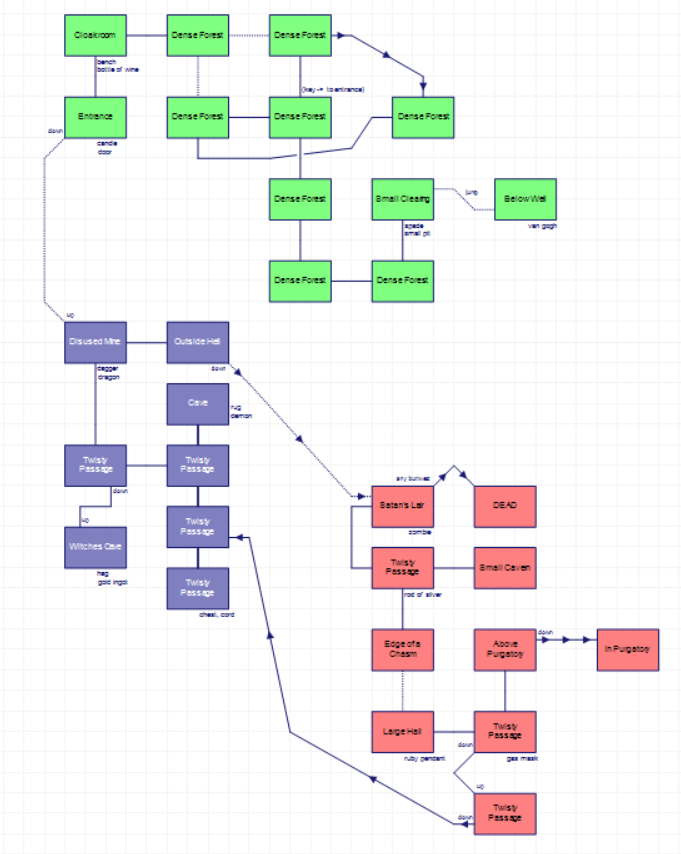
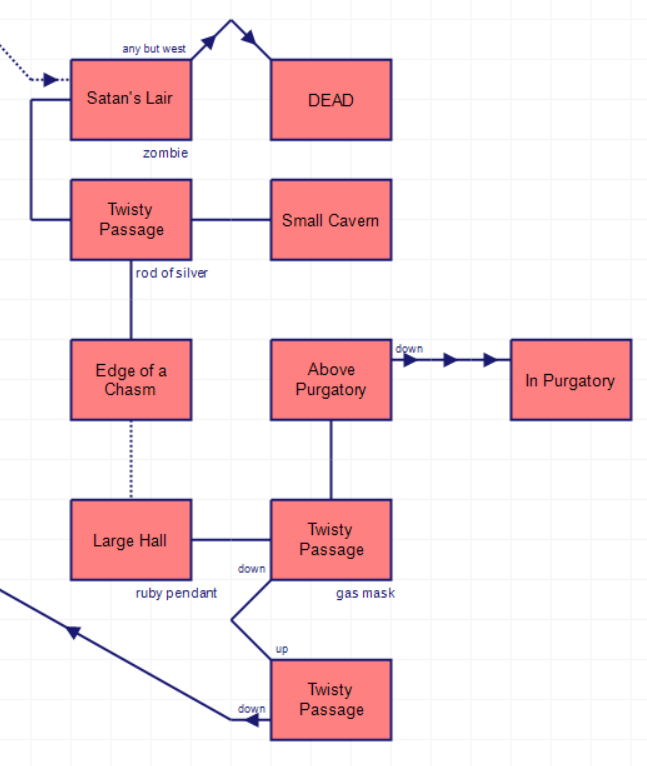
The map is laid out in three sections, essentially aboveground, underground, and deep.
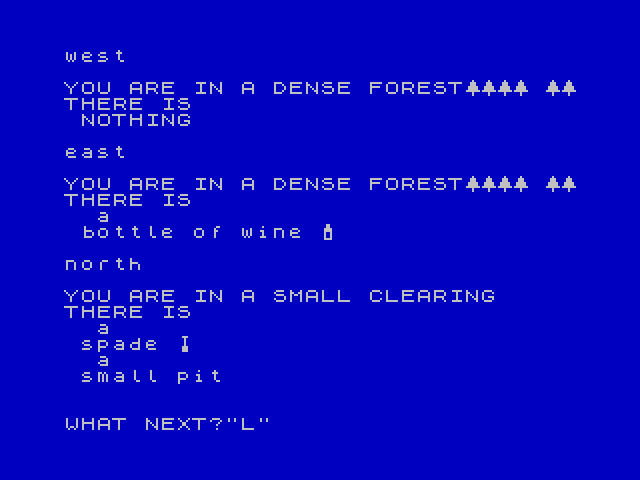
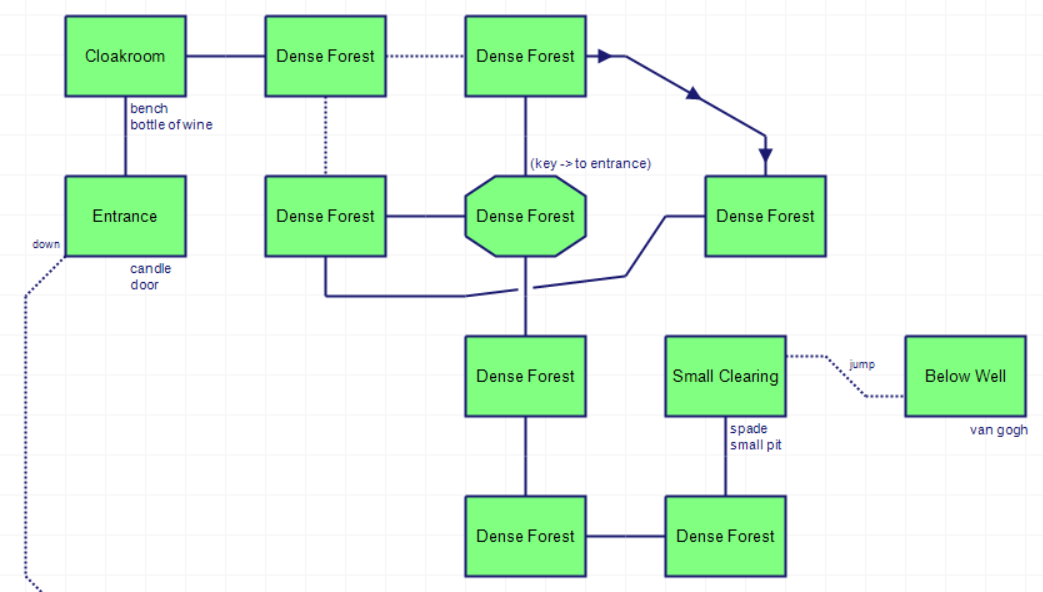
The first phase, aboveground, you need find a key for the locked door to go belowground. This involves taking the candle (you can’t go anywhere otherwise, I suppose this is deepest night) and stumble around the forest until you get to a room with a pit and a spade.
I was using the bottle of wine — the only other item I had other than the candle — to map rooms out. This game turns out not to have any “loops” but only an early one-way exit that makes things confusing. However, it isn’t like I’d know the game lacked loops until I had finished making the map show that in the first place!
Jumping in the pit is possible, but death. It needs to be returned to later.
This is also the sort of the game with no exits listed so you have to test every direction.
With the spade you can then test DIG in every room in the forest, eventually come across one where the game says
YOU FIND
SOMETHING.IT VANISHES
I have marked the “dig room” with an octagon. It is the only place digging is useful, but again, I didn’t know that, so for the rest of the game I tried DIG in every single room.
Having “something changed” in a narrative sense is interesting in that it makes for a slightly unexpected event: I was fully expecting to have an item in hand, but instead I was left fumbling through the forest again just in case the item showed up somewhere, and used DIG yet again on every room (in case the buried item re-buried itself somewhere). All that really happens is the key moved itself to the entrance room.
There’s an untakable “bench” to the north that I wasted time with thinking it might hide something, as it is the only item in the game that does nothing.
With the key you can unlock to the underground.
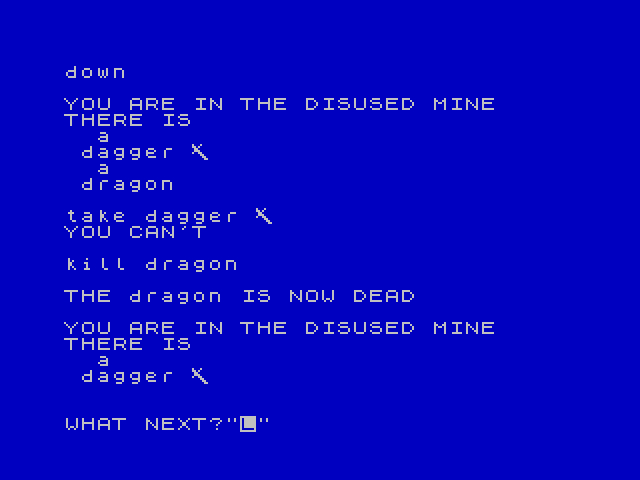
The very first room has a dagger and a dragon. The game informs you that YOU CAN’T if you try to take the dagger (you’re supposed to infer the dragon is stopping you — that’s true for messages in general in this game, like how you can’t go into the forest without the candle implies it is too dark but the game doesn’t say “too dark” or the like).
Since there’s no weapon otherwise aboveground, your only choice is to follow the curious directions at the start and try to KILL DRAGON and just press ENTER when the game asks you with what. This is invoking yet again the “kill the dragon with your bare hands” moment in Crowther/Woods Adventure.
A demon guarding a rug (a treasure) does not allow similar treatment: you need to use the dagger.
There’s elsewhere a “cord” around a chest where you need to CUT it (possibly a struggle for a player normally, but I had already made my verb list). Doing so yields a golden passkey, which lets you go down yet another level.
Giving a map of the lowest floor…
Purgatory is just a trap room. The game softlocks if you enter.
…the zombie is quite serious that the wrong way is death, although there is no logical method to figuring out the “right way” — you just have to die in other directions via an ANGEL OF DEATH until you find out west is correct.
Not interesting in a gameplay sense, but good for atmopshere. There’s not much otherwise that really gets across the “you’re in hell” message the game is supposed to have.
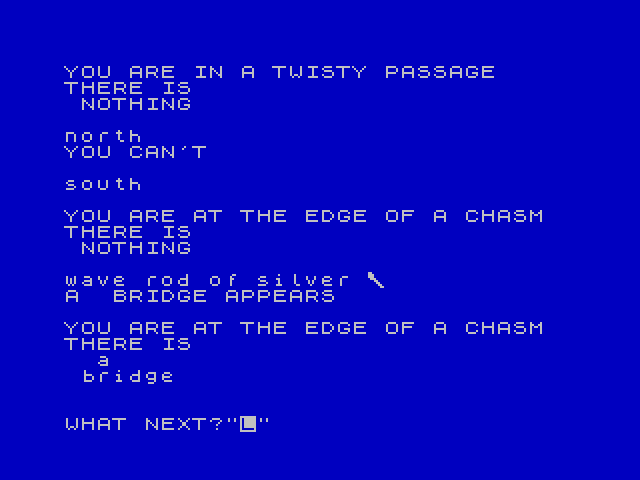
This is followed by a rod of silver, and then a chasm where you can immediately wave the rod of silver you just found to make a bridge.
This is a puzzle for people who wouldn’t think to WAVE, I think — that is, this would make more sense for being someone’s first adventure game.
Other than that you can find a gas mask and ruby pendant and leave, going down which will end up somehow bringing you back to the underground floor. You are passing through twisty passages without much distinguishing them once the items are gone so I had the fun case of mapping out rooms without realizing I was just re-creating the map I had already made.
The gas mask goes back to the pit above ground, where you can jump in and find a Van Gogh.
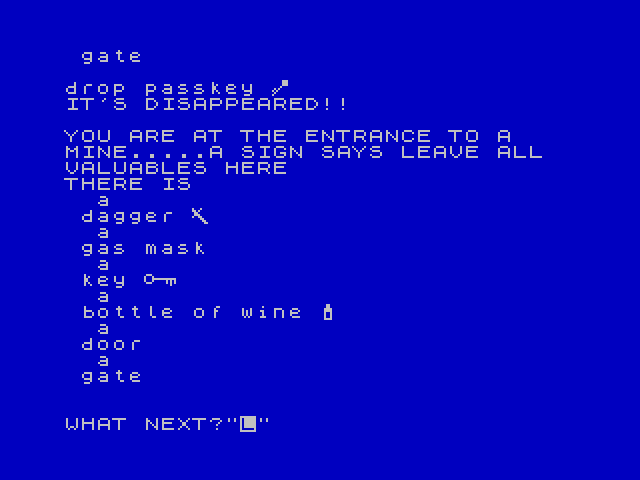
Other than that, the rest of gameplay is about gathering the treasures you’ve run across and dropping them off at the start, where they will disappear if they count as points. The golden passkey is described as just a passkey after you first find it so it is the least likely to be remembered; I just went ahead and tried all my objects just in case and discovered it worked by accident.
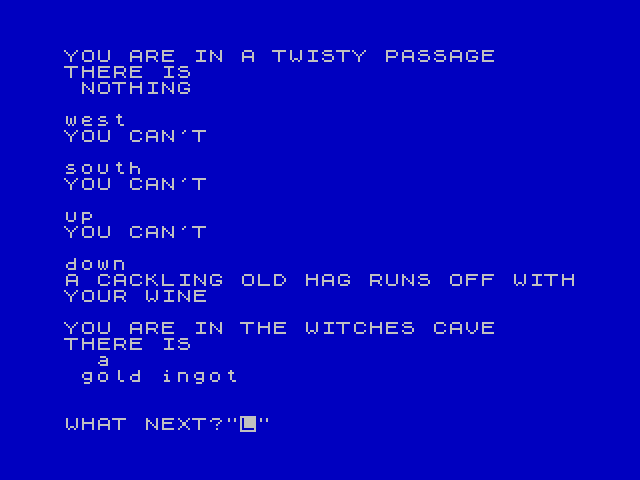
I was still stuck after so I was seemingly missing a treasure, meaning I had to go back and DIG everywhere yet again just in case I missed a secret. What I had overlooked is that UP and DOWN are directions that can be used arbitrarily, and in one of the twisty passages you can go DOWN to find a hag.
Not really a puzzle; the wine bottle works to stave off the hag as long as you have it in inventory. Someone who previously drank the wine (softlocking their game) would get stuck.
This has a “author’s first game” feel to it: the Treasure Hunt setup, random combination of monsters, straight-up copy of Crowther/Woods puzzles (even if the dragon is delivered in yet another novel way), the softlock room, the sudden-death exit room. However, the game was still solvable; the author didn’t try for anything overly ambitious requiring convoluted parser input, or go for a stretch like saying HI to a ghost. I had genuine fun which is all I’m really wanting from a bedroom coder’s first game. The others from J. Wright do not have a similar dating scheme so they will await us once we arrive at 1984.
For now, let’s visit a game with graphics that, like Rungistan, has animation, but uses it in an entirely different way.
For those anticipating the second Impact Softwear game, my apologies. It turned out The Quest was quite solidly RPG rather than adventure. I added a note to my last post with some screenshots.
But that leaves us room for an entirely different oddball game! Allow me to first discuss the French computer industry.
The early 80s were chaos; no particular manufacturer was dominant, and the French had their own standards that gave difficulty to importers. Instead of video signals in NTSC (US, Japan) and PAL (most of Europe), France had SECAM. An adapter was required, and it caused (for example) the VIC-20 to only work in black and white. Also, all keyboards in France (as had been standard for a long time) used AZERTY standard instead of QWERTY.
Amidst this chaos, the publication Hebdogiciel was founded by Gérard Ceccaldi in late 1983. It was a weekly that printed software listings for the entire menagerie of French computers. In the 6 January 1984 issue it printed the top 15 computers by number of listings sent in. Leading the pack were Texas Instruments with the TI-99/4A, Oric with the Oric-1, and Sinclair with the ZX81. (If you’re wondering why not the ZX Spectrum, the ZX81 came in France early, but the ZX Spectrum came out late. By the time it arrived the Oric had eaten up a chunk of the same market.)
Noteworthy for today is that 4 of the systems in the top 15 — added together, 15% of listings sent in — were pocket computers. Specifically: the Hewlett-Packard HP-41, Casio FX-702P, Sharp PC-1500, and Sharp PC-1211. These are essentially beefed-up programmable calculators. Sharp had one out in 1977 that used assembly language, and by 1980 companies were coming out with programmable calculators that used BASIC.
The Sharp 1211, first out in 1980, was also released by Tandy as the TRS-80 Pocket Computer. I’ve seen many US and UK source code publications now, some of them system-agnostic, and the level of pocket computer coverage was not nearly as high as it was in France.
Here’s a video cued up to where someone plays a Lunar Lander game on a TRS-80 Pocket Computer:
This is all meant to lead to the fact it wasn’t odd for Charles Feydy’s game Des Cavernes dans le poquette (“The Caverns in My Pocket”) to appear as a type-in an a French computer magazine. Specifically, the code was for TRS-80 Pocket Computer, and appeared in the Tandy-focused magazine Trace in their April 1982 issue.
What is unusual is that it manages to squeeze an entire adventure game (kind of) in 4K.
I wanted badly to run the original.
There is such a thing as pocket computer emulation (see: PockEmul) and I tested it out a bit, but I found I really needed the original model for compatibility (either the Tandy PC-1 or the Sharp 1211) and it isn’t supported. I did find an old beta copy of PockEmul that has the 1211 but it gets listed as “experimental” and it broke in my attempts to use it.
I was able to run the PC-2 (that’s the next Tandy machine, also just a Sharp PC-1500) but was running into cryptic issues involving slight changes in the BASIC syntax and the system itself. For example, in the PC-1 version you can write F=4F meaning “the variable F is 4 times F”; that is, 4F with no symbol between the 4 and F assumes a multiplication. This no longer works in the PC-2 version. You need to write 4*F instead. The character limit is tight enough that if you try to add a multiplication sign there, you’ll bust the limit of memory, so you need to remove characters elsewhere to compensate.
The biggest issue is that the original game uses arrays in a way where memory-bleed is nearly a feature. Essentially, before the game starts, you’re supposed to set A$(22) all the way up to A$(65) to a series of text lines, like A$(22)=”E PORTE”. This uses a different part of memory to squeeze even more out of the PC-1. However, on the PC-2 the array memory gets reset on starting a new program, so any reference to A$(22) will be an out-of-array bug rather than the text it is supposed to have.
This error means “Array specified without first DIMensioning it.”
Fortunately, there’s a way to play without the calculator, because Jim Gerrie has ported the game to TRS-80 MC-10. In the process he translated it to English.
The text of the magazine talks about exploring dark and dangerous caves. There are apparently 10 “keys” that can be applied to monsters and get points, but it is unclear the author even intended for it to be possible to get 10 keys. I have gotten, out of all the maps I have tested, 0 of them.
Unfortunately, the game is very broken in terms of generating a level that can be beaten, even moreso than Orb. Jim Gerrie is still worried there might be a bug in his code, but the original is so hard to run I haven’t been able to compare.
You start by picking a “number” which is a random seed, followed by a “difficulty level” (no idea what that does, I didn’t see any difference) and then you’re off to the races:
In this room, you can go all four directions; the PATH, TUNNEL, and LARGE are all just for color. If there’s a monster they will be blocking at least one exit.
In this randomly generated level, there are exits to the north and the south, and one TROLL blocking the north and south. Since there is nowhere to go, the only command that works here is RESTART.
Sometimes it felt like I could actually explore a bit, and get the vibe of an environment:
However, this invariably always got shut down a few turns later when I get stuck again.
Seriously, where are the keys? Would this game have been printed in a magazine if it was so impossible or is it just leveraging some obscure aspects of the PC-1 hardware that would make the experience quite different than it is now?
So this post is maybe just a placeholder for if some expert on pocket computers can come along and tell us what’s really going on. The thread here is where the game was first unearthed and it includes a text file of the source code.
(Shoutout to Strident and Jim Gerrie who helped me get the files for this all this way back in this thread.)
Scotland finally confirmed! As well as, and I am not exaggerating, the weirdest game mechanic this blog has ever encountered.
For context, the only time Scotland has entered the All the Adventures project so far is with Danny Browne, and never with any commercial software. Impact Software — which existed from 1982 to 1984 — has an address listed in Edinburgh. Residential zoning, so likely another bedroom coder, in this case, Ian Richards. Only one other person seems to be associated with the company, Peter Lovett, who wrote their version of Star Trek.
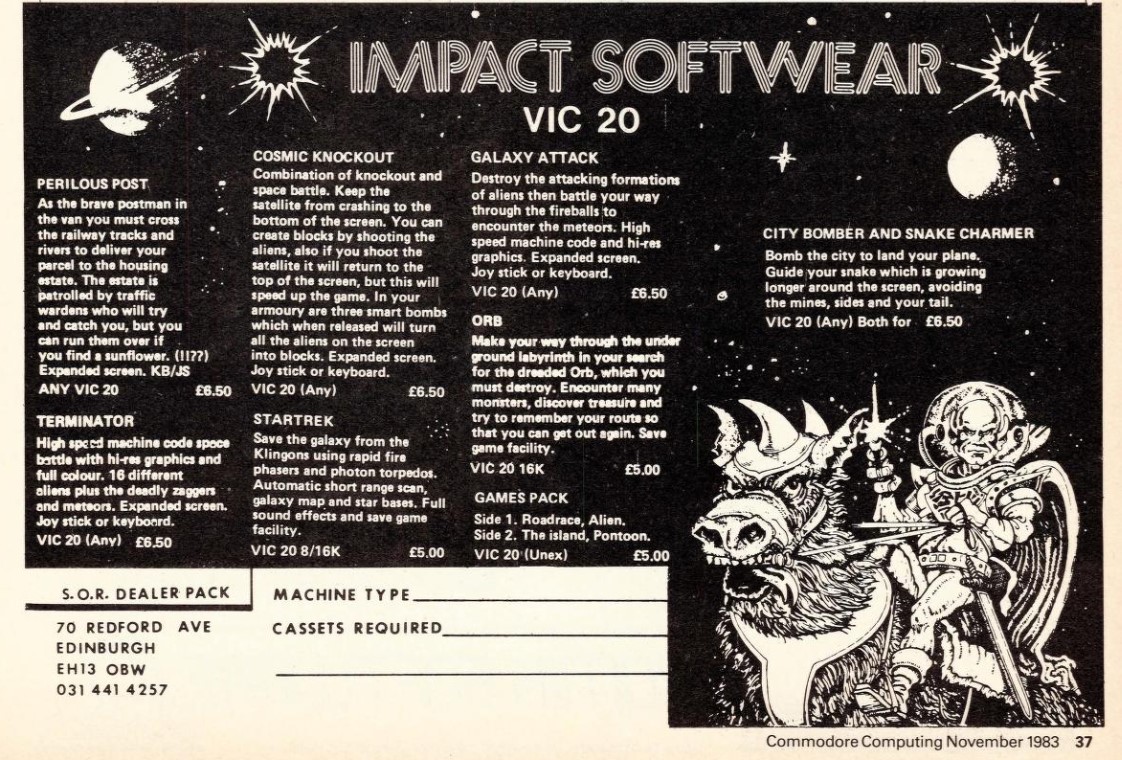
Mind you, despite that status, the company racked up what feels like an impressive list of stockers.
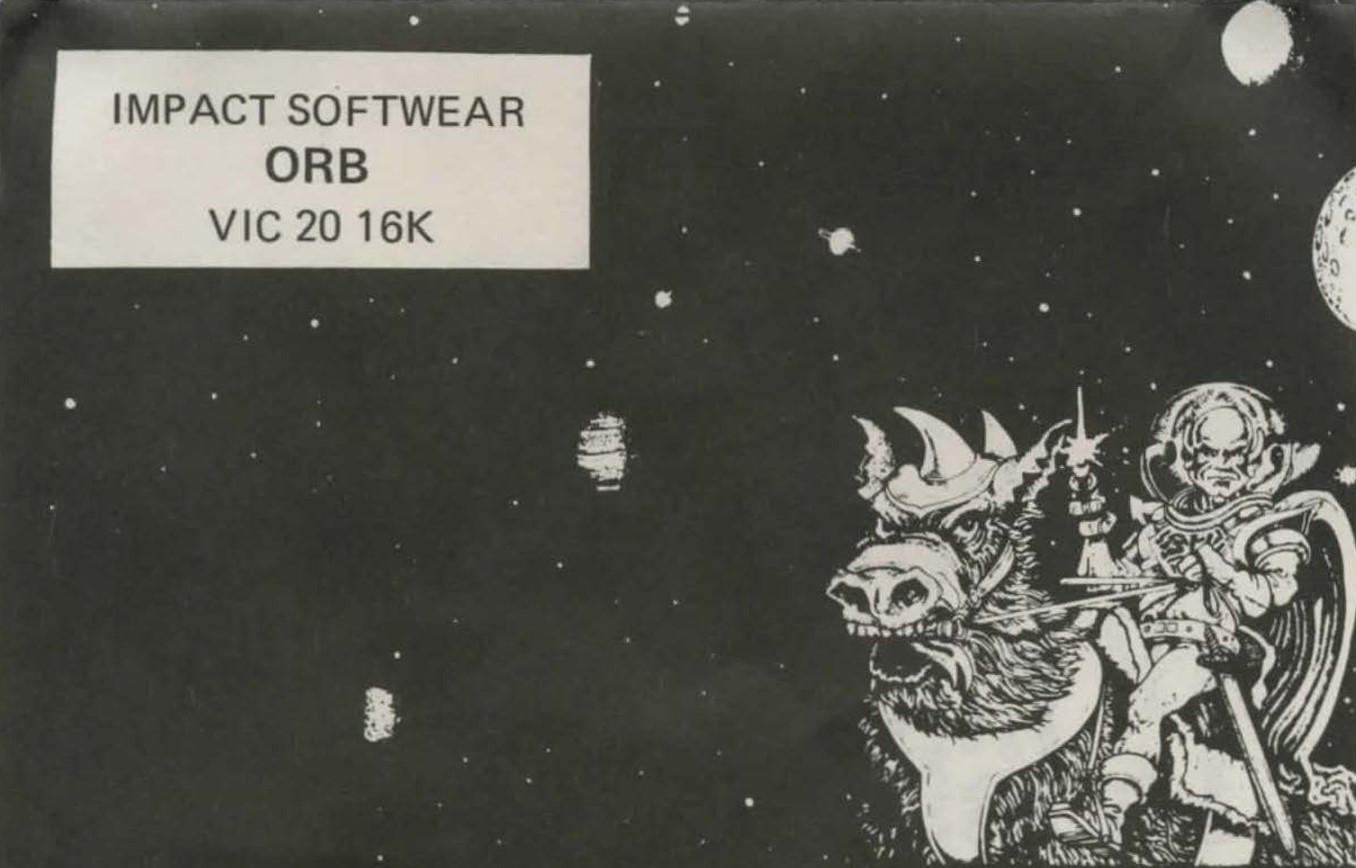
Does this indicate professionalism? It does make the covers of their games puzzling. You see, they all have the same design with the company name as IMPACT SOFTWEAR.
From the Museum of Computer Adventure Games.
A a full cover includes the address with “ware”, but this quite earnest ad from November 1983 does include the “WEAR” spelling. I’m guessing it’s an in-joke, and maybe an intentional discussion point, like how mistakes get more people to engage with Tiktok videos?
Ian Richards incidentally did keep in games afterwards through the 80s, but let’s focus on today’s selection, Orb.
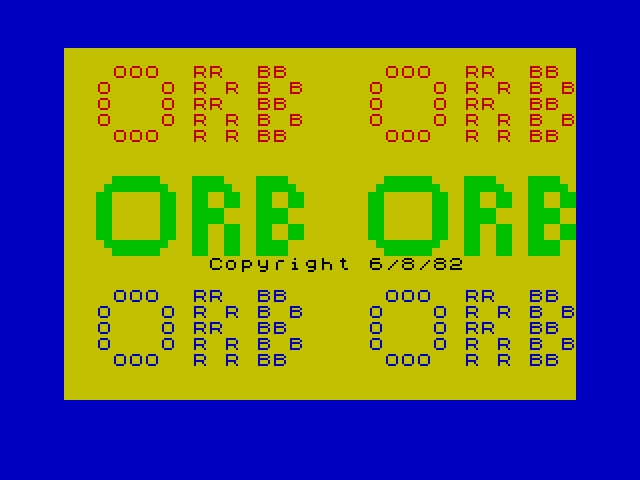
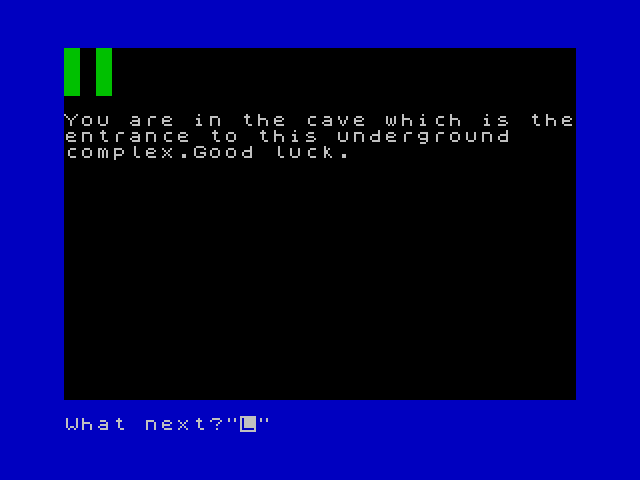
Make your way through the under ground labyrinth in your search for the dreaded Orb, which you must destroy. Encounter many monsters, discover treasure and try to remember your route so you can get out again. Save game facility.
The game includes a mini-map similar to Wolstencroft’s game Quest. I began the game wondering if there was some influence. After playing the game, I am 99.999% sure there was influence. I’m guessing the author encountered Wolstencroft’s game on MZ-80A before deciding to roll his own VIC-20 (and later Spectrum ZX) version.
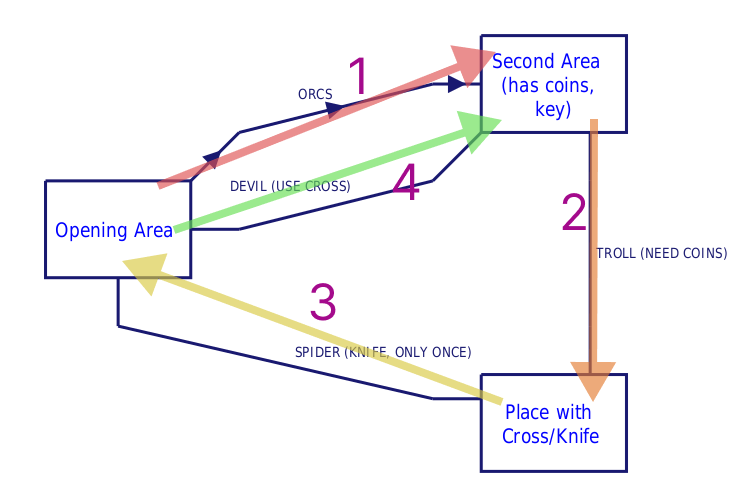
The original Quest game was essentially a big logic maze where you had to work out the right sequence of moves to pass through safely. For example, with the meta-map above, your goal is to start at the opening area, go and get a key, return to the opening area to open a chest with the key, then escape back out.
To start, you can travel by some orcs (which you can only do once). Once in the “second area” you can grab the key and some coins. You then use the coins to travel to a third area with a cross and a knife, then loop back to the start, using up the knife in the process, but leaving the cross in your inventory. You’d then normally be trapped (because the orc route only works once, and you’ve also used up the spider route) but since you have the cross now, you can take the devil route out to escape.
Orb imagines the same concept but with all the objects randomly placed, and truly random; not placed in a way where there is any guarantee you’ll have the right tool for the right room. Some deadly rooms (which you’ll need to pass through!) have no tool to get by at all and will just kill you outright.
The mini-map in the upper left is also the same as the MZ-80A game.
Here’s the initial portion of Orb’s map to help illustrate:
In one of my playthroughs, the only item that was generated in the initial area was a cross. The cross is used to get by a vampire (not devil this time). However, we are hemmed in by a werewolf (needing a sword) and a pit (needing a ladder). Sometimes when going into a werewolf room the creature will be out the first time through, so you can pass through safely, but it turned out not to be the case here. We have a situation where it is impossible not to die.
If you have a sword, this is what happens to the were-wolf. The were-wolf stays dead, so you technically don’t need a sword for a second pass-through. There are rooms with snakes where you need a sword every single time, though.
Here’s a more central part of the map:
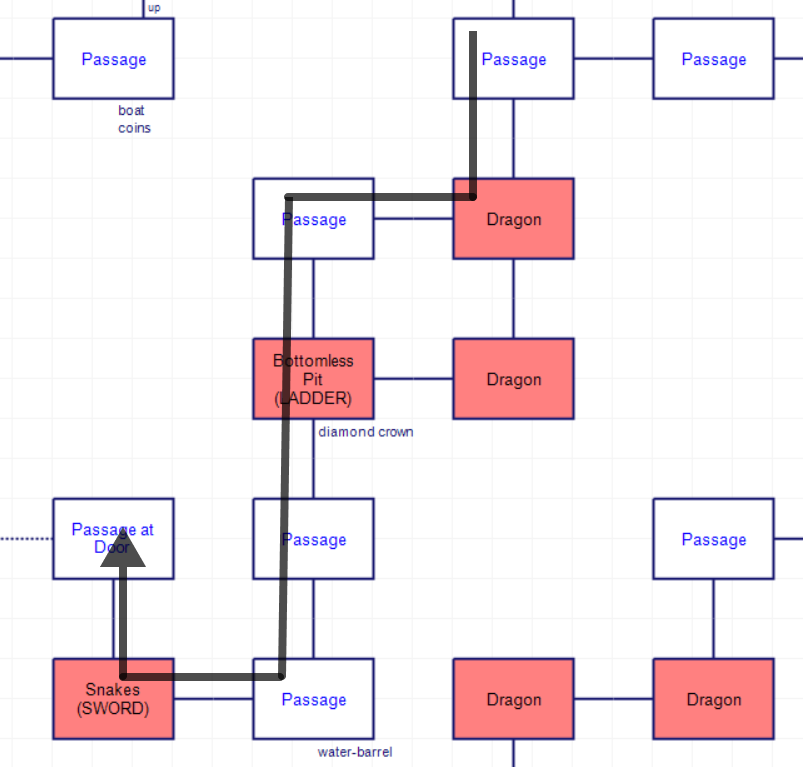
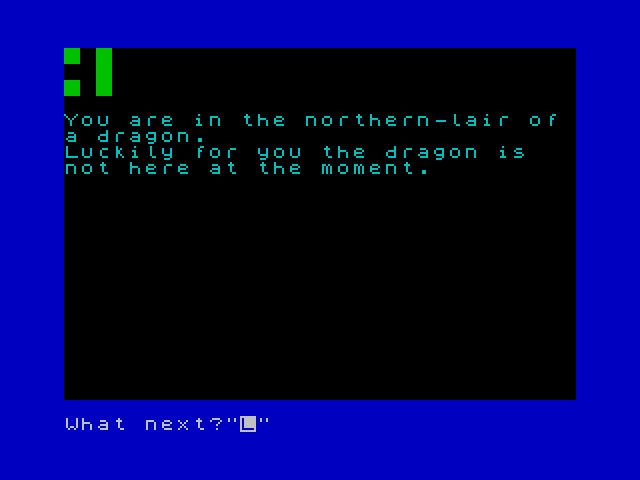
This is an actual path I took during my “““winning””” run. I did not die passing through the dragon; some enemies have two-square lairs, and the general idea is that if the monster is in one side of the lair it will leave the other side empty. (There was no way to “predict” I’d be safe — it’s just a coin flip.) I also had the ladder and sword so I was safe moving past both the snakes and the pit. However, when trying to backtrack later, there was no way to avoid the dragon on a repeat pass-through. In many cases the 2-square lairs are positioned such that you are required to pass through both squares anyway, so it doesn’t really matter if you meet a monster in the first square or not: you’ll have to die anyway. And there’s the bonus chance you might meet the monster in both squares, dying twice. Fun!
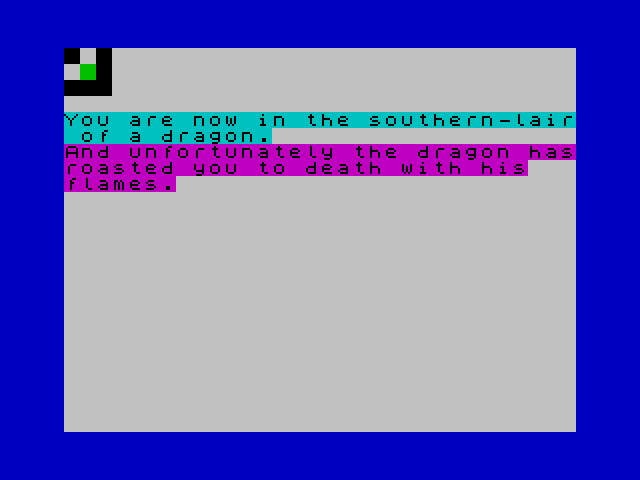
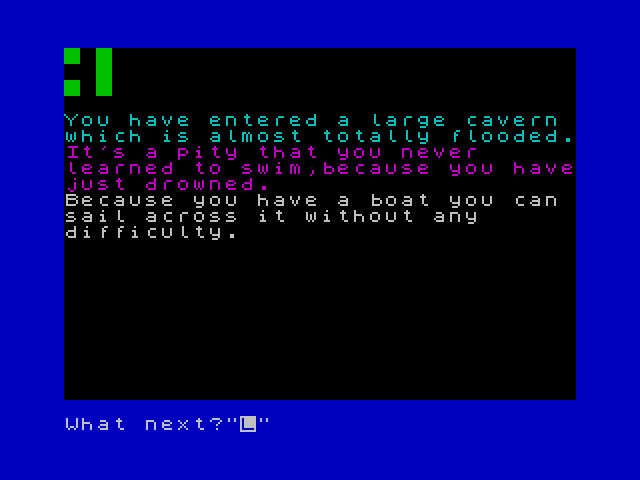
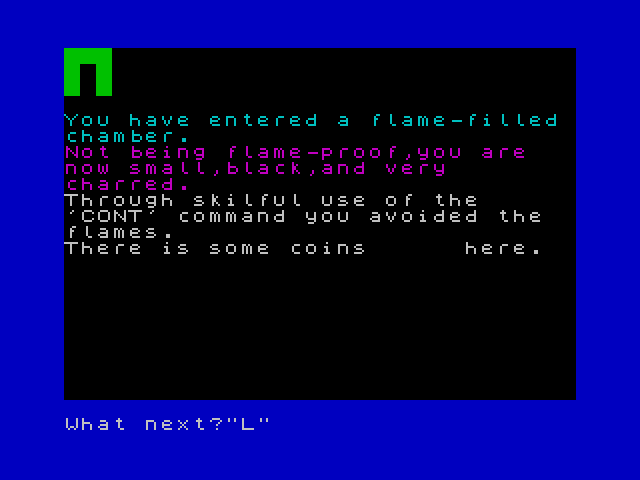
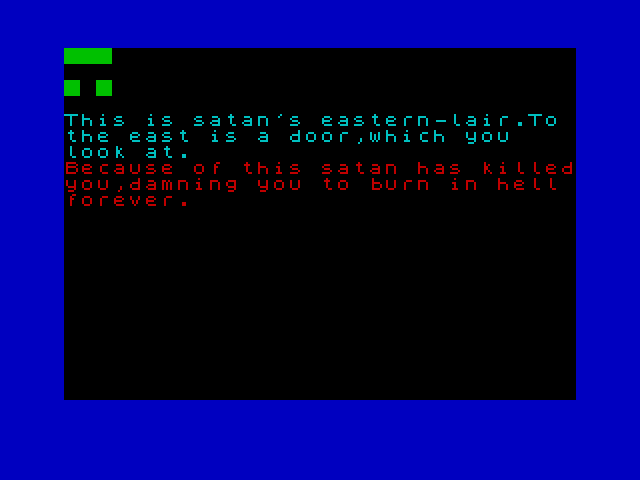
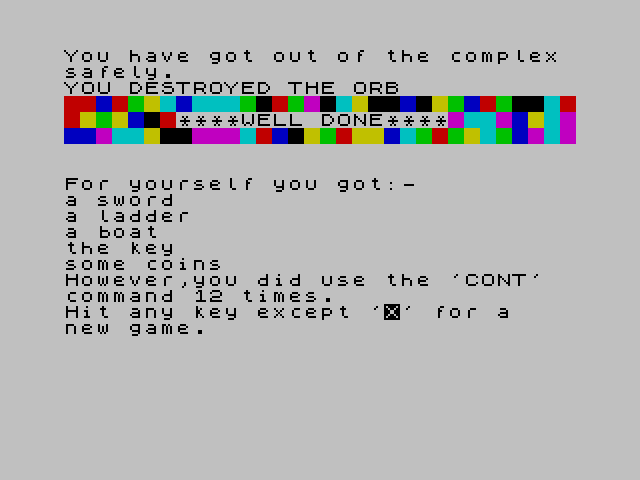
So does the game just generate a bunch of impossible maps? Well, no: the game lets you cheat, as a feature. When you die, the game kicks you out of the BASIC source code. Then you can type CONT or CONTINUE (VIC-20 or Spectrum ZX) and then game will resume in the next line, and act as if you caused a reality shift where you survived the obstacle anyway. If you die at a pit, you magically have a ladder (even if you really don’t, and it isn’t in your inventory after). If you are in a flooded room, you happen to have a boat.
The game literally quits and stops executing upon death, and then uses what is essentially the operating system’s debugging command as a central mechanic. The game goes on directly and keeps track of how many continues you used, as sort of a “high score”.
This sounds so outrageous it might loop around to being a good game mechanic, but there is no way to predict where all the objects go, or even if an object spawns at all (on my “winning” game a cross never appeared). Additionally, there are plenty of obstacles like dragons or Satan who have no counter; you have to die to pass through.
Even accepting the game is stomping all over the concept of narrative verisimilitude, and imagining we have the Reality Stone from the Marvel movies, this just doesn’t work; the main appeal of the logic maze is completely destroyed.
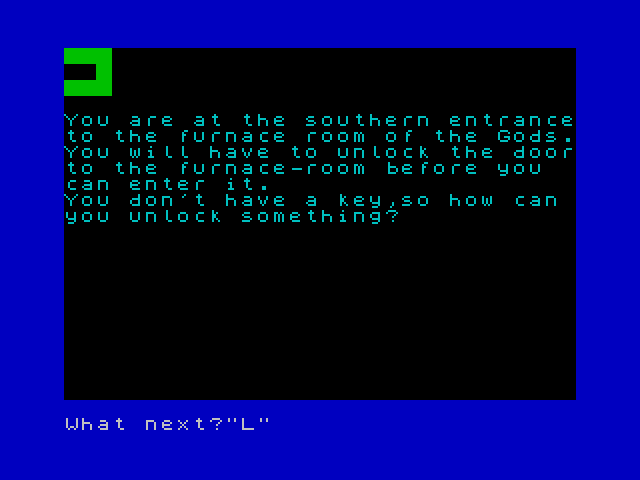
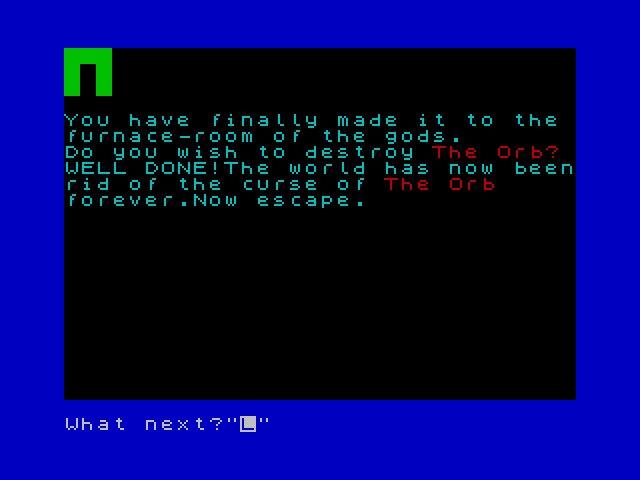
There aren’t any puzzles, really; there’s a rusty door you can apply an oil can to, and to get the Orb to the furnace to destroy it you need an extra key along the way.
I mostly played the ZX Spectrum version and I had some hanging crashes, like when trying to pick up some coins. A diamond crown (which needs to be traded for the key) needs to be picked up with TAKE DIAMOND, since TAKE CROWN hangs the game. I tried the Dutch edition of the VIC-20 version (can’t find the English one anywhere), but it doesn’t seem to be any better-coded; I managed to walk into a wall and crash the game.
Blue is the start, yellow is the furnace where the orb is destroyed.
I recommend the solution by Exemptus if you’d like to read more details; in the end this was just a disaster. If the random generation had somehow been done carefully (akin to Mines from 1979) and the overall map was laid out properly, the concept would work. This could have been a proto-version of Tower of the Sorcerer-style games (*), except the author didn’t have the chops to pull one off.
…or maybe they did? Ian Richards released another adventure later the same year, called, quite creatively, The Quest. That’s where I’ll be going next time.EDIT: The Quest is an RPG. More details below; it isn’t worth making an entry for, so I’ll be moving on to a different author.
Yes, game, because you blocked the key in with Satan, so there is no way to win without the cheat.
(*) If you’re unfamiliar with Tower of the Sorceror, this reddit thread should help. It’s a game laid out like an RPG but everything is carefully controlled so it is in reality a resource management game. DROD RPG is a good later iteration for Western audiences, and there’s roughly a gajillion of the games written in Chinese.
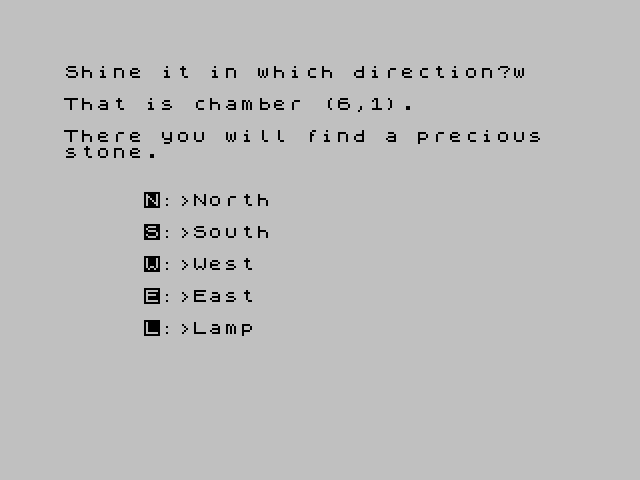
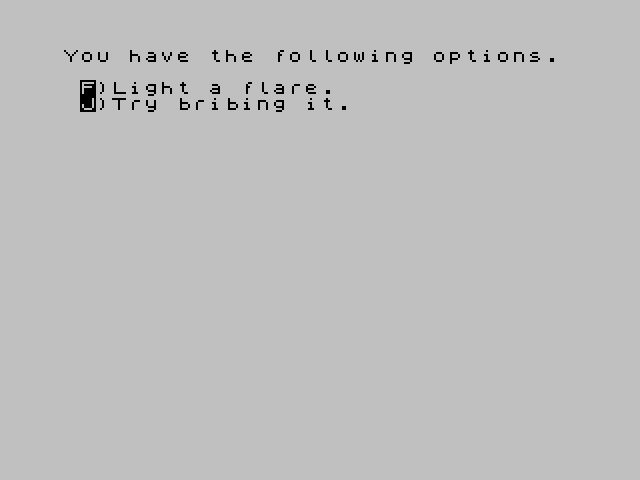
ADD: After trying The Quest I can safely say it is an RPG. It’s basically Wizard’s Castle but the floors aren’t completely open and can have dead ends. You start with a lamp and you can shine it in various directions. I fought a minotaur, ran out of arrows, and then found myself stuck on the option to use a flare (which shows information about the minotaur) or to use bribery (which didn’t work) so I had to reboot the game. I found a gemstone in one room, left, came back, and then found a completely different gemstone in the same room. This seems to be just as broken as Orb and I apologize to the RPG chronobloggers for finding this.
Where I softlocked after running out of arrows. The game doesn’t give you the option for sword/armor shopping at the start like regular Wizard’s Castle does.
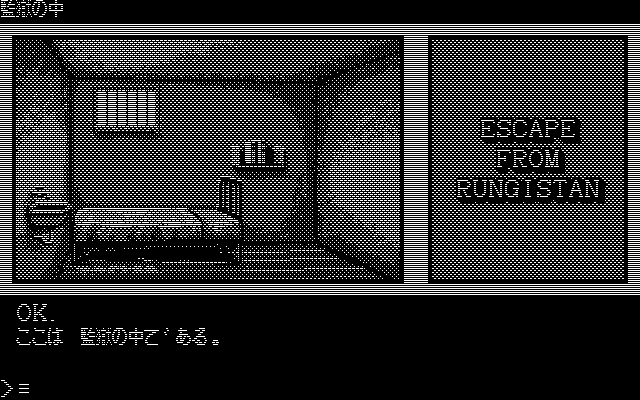
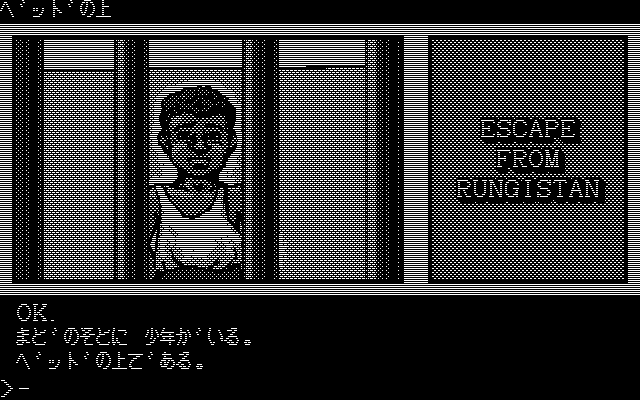
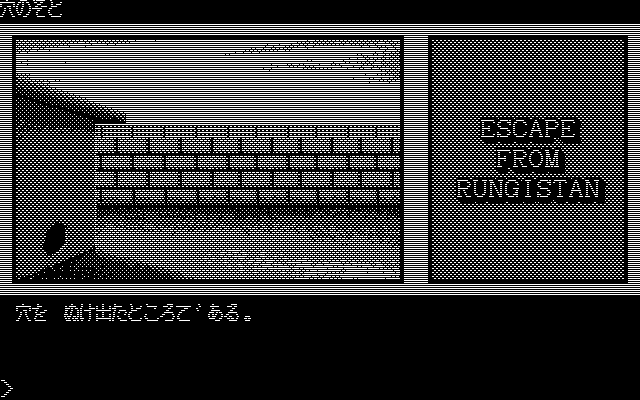
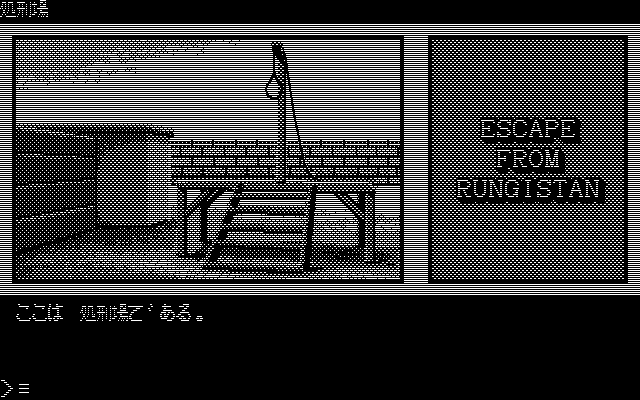
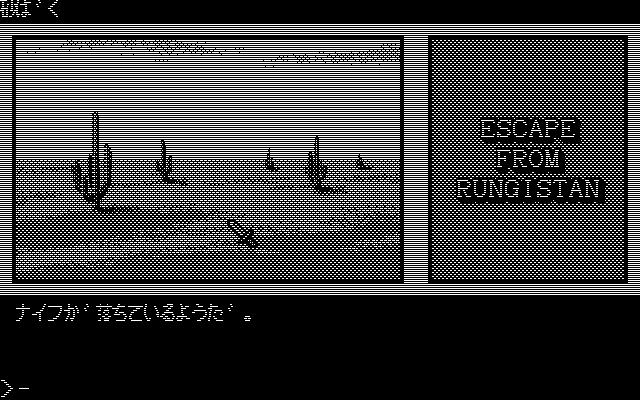
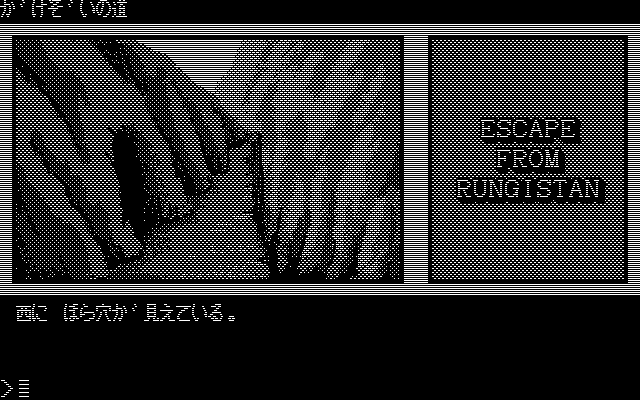
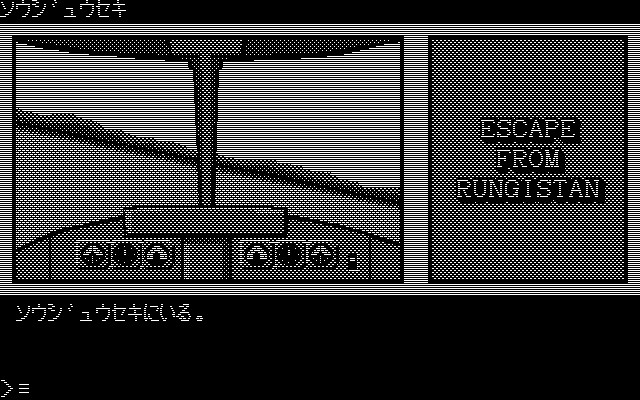
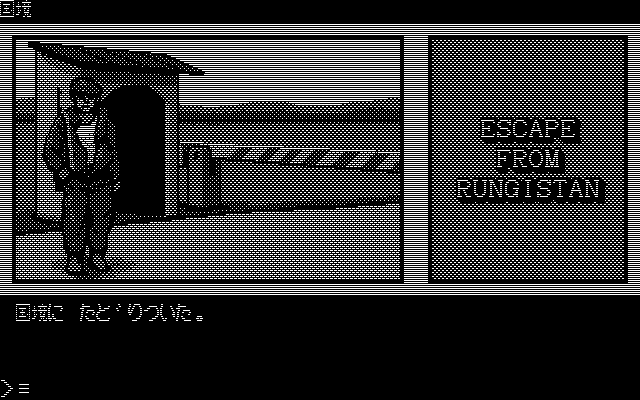
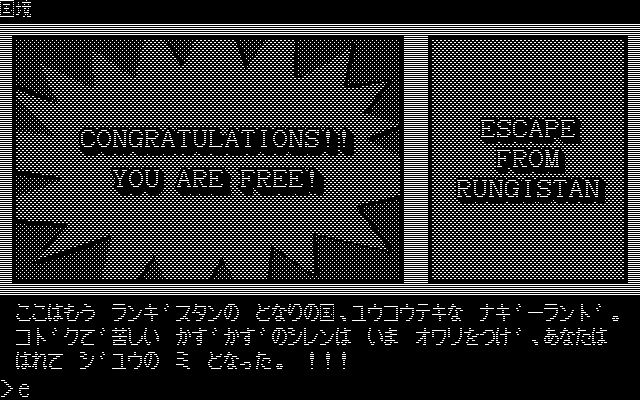
I felt compelled, after last time, to try playing the PC-88 version of the game all the way through. I come bearing screenshots and also curious differences between the two games.
The compellation came because of a conversation I had with Leigh Alexander, who made a video on Rungistan as part of her Lo-Fi Let’s Play series. She wrote the author, Bob Blauschild, and he wrote her back.
Bob wrote that he was wondering “why computer games were so expensive” so tried out Wizard and the Princess, and ended up going through all the graphic adventure games at the time. He ran out of options so wanted to make his own, so with Raiders of the Lost Ark in mind, he came up with using “action sequences and moments of possible panic”.
He also sheepishly explains the graphics were based on technical limitations at the time. The fascinating thing about the Japanese versions (all made in 1986) is that they do not have the same limitations, but they went with black and white anyway as a style. I realized I wanted to see what it looked like all the way through. This is the remake Bob never asked for but got anyway.
The parser commands are roughly the same as the Apple II game, but the distance between exactly and roughly can cause massive headaches. Right at the start, you still need to call the guard asking for food. In the original I could go
CALL GUARD
SAY FOOD
and it worked just fine. In this version, you need to type
CALL GUARD
WANT FOOD
which was enough to throw me off for a long time. The encounter with the child is still the same…
…but to dig a hole, rather than DIG WALL / WITH SHOVEL you simply can just DIG WALL.
The layout is slightly different here. Rather than spotting the snake before doing the jump over the ridge, you do the RUN and JUMP first, and there’s no “approaching ridge” timing puzzle where you have to type JUMP before the oncoming line gets too close. I can see why the bitmap style doesn’t make the moment work any more.
The snake then can appear anywhere in the desert, including at the knife. Rather than a “slither” motion the snake sprite just slides right to left.
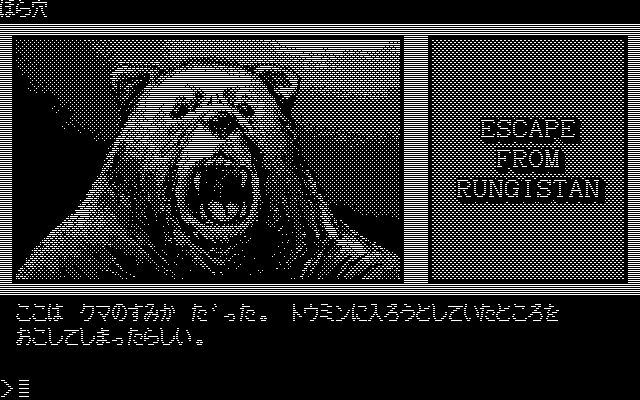
The bear is functionally identical, although it certainly looks rather different.
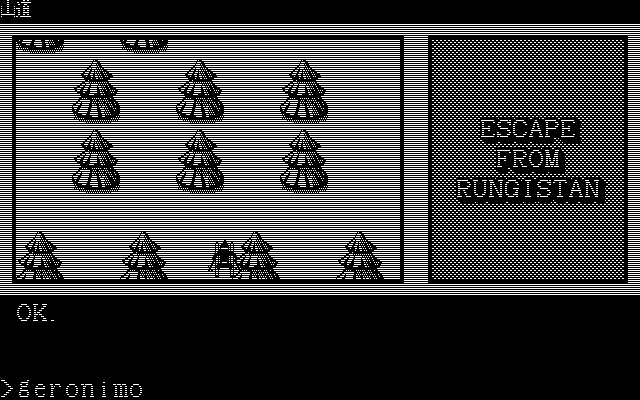
The skiing segment is in, but rather than a “oncoming 3d” look, you are controlling your skier+ from above. It is notably easier here than it is in the Apple II version. (On the M88 emulator, for anyone trying it, control is with the number pad rather than regular arrow keys.)
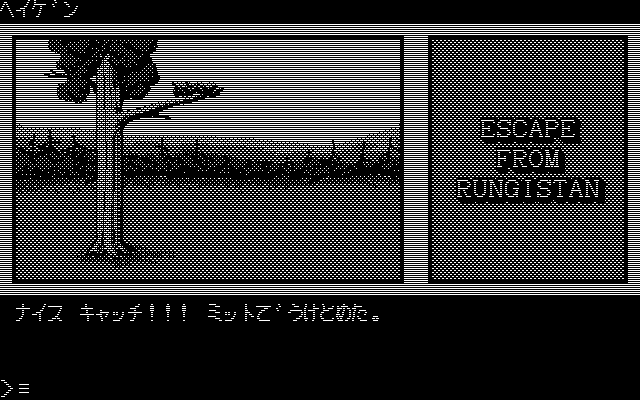
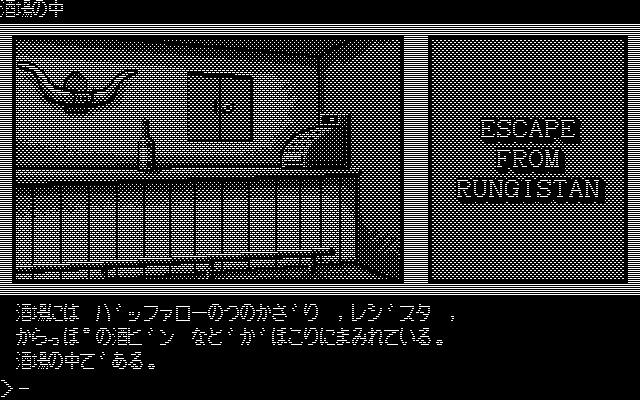
This is followed with more or less the same area with the saloon as before, including trees you have to look at closely. The dynamite event doesn’t have the visible fuse moving, but you still need to pour water; rather than the egg dropping from above dropped by a flying bird, you catch it from a tree.
The code with the fragments used to open the lock is done exactly the same, including the parser syntax.
The raft puzzle took me a little while. You’re supposed to GET DOOR from outside the saloon first (not DOORS, DOOR) and then MAKE RAFT and finally RIDE RAFT while at the river (you can’t make the raft early, and USE doesn’t work like it does in the Apple II version).
The farmer puzzle is the same, the planes still fly overhead (as sprites now), and the cat still has a magnifying glass.
The almanac’s description, instead of randomly mentions it includes eclipses, specifically states there will be a solar eclipse today. Unfortunately I had trouble figuring out a syntax; PREDICT ECLIPSE no longer works. TEACH ECLIPSE does, though.
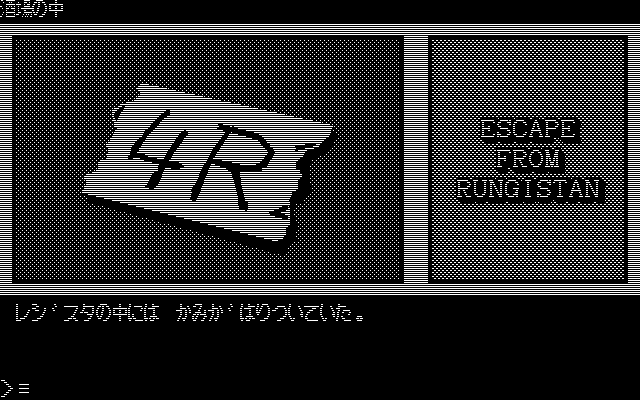
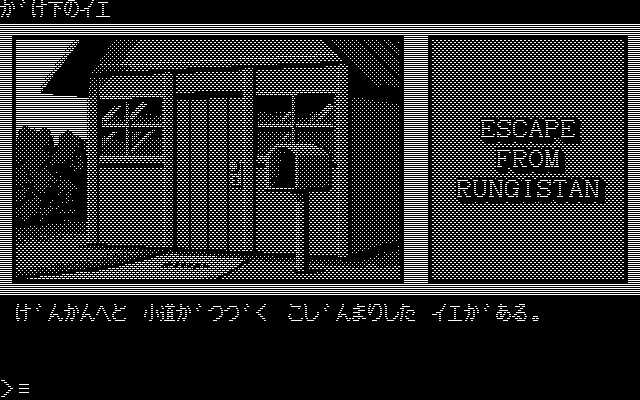
The gas station and house with the mailbox are the same. It’s a little easier to tell the writing is writing.
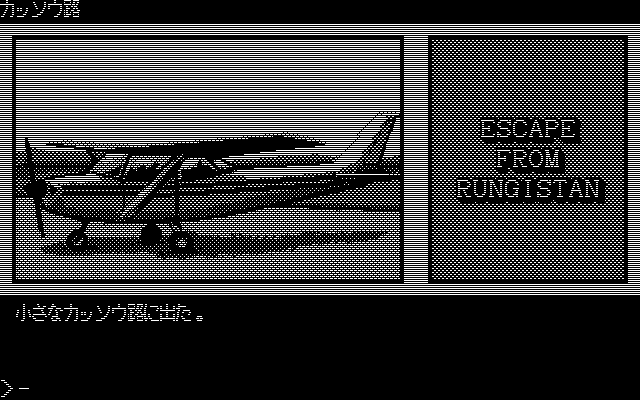
The plane puzzle works the same, except you need to FILL TANK while outside the airplane first as opposed to inside the plane (fair).
The dynamite puzzle is in; the sign that tries to misdirect you the wrong direction is not. The booze you hand over as normal, to reach victory.
While the graphics are certainly slicker-looking the loss of animation does seem to be a bit much. In retrospect, I’m not sure if all the animations would replicate in any other style; the fuse “snaking back” on the dynamite really is only effective with an absolutely clear wavy line erasing dot by dot. The snake, additionally, needs to be both simple and easy to predict to get across its full original effect.
I still salute the effort put into this, and if you (the one reading this) are really stuck on the skiing portion of the original game, maybe you should try this version instead. Just remember to GET SKI, not GET SKIS while in the cabin even though you’re picking up a pair. (?? I assume this is because of something in Japanese, can anyone explain?)
(The skiing you can see in the video above animated up to a crash; the video stops there with a loud beep.)
































 Renga in Blue
.jpg)