I don’t consider it that unusual to have an author for All the Adventures so mysterious it’s unclear where they even lived; we’ve had plenty of one-shots, including from people who were teenagers and likely never went into a field resembling games. Where it starts to get a little more unusual is when an author is not only mysterious but published multiple games with five different companies, not including distribution by a sixth company in the public domain. I don’t even know with certainty what country Michael D. Wile is from; likely the United States given the choice of publishers, but Canada is still possible.
Wile’s catalog includes
Intercept (originally 1981 likely for TRS-80, later 1987 for a DOS release)
Mutant Invasion (originally 1982 likely for TRS-80, later 1987 for a DOS release)
Merlin’s Treasure (1982 for TRS-80, Adventure International)
Miller’s Cove (1983, Windcrest Software, both TRS-80 and Timex Sinclair 1000, apparently published later by Tab Books and republished yet again by Pyramid Electronics)
Medieval Quest (1983, Instant Software)
with the last game being for the exceedingly rare Panasonic JR-200. I can’t make a claim of certain comprehensiveness given I just learned about Miller’s Cove this week and it isn’t indexed on any of the usual sites, and I wouldn’t count having an entry on Amazon as usual. Only the first three are listed on CASA as of this writing, with the JR-200 not even existing as a possible computer platform to choose from.
Intercept, while given a 1981 copyright in the game, shows up to us now in a DOS format instead from later in the 80s; specifically, it was on PC-SIG Disk #911 in a compilation of four programs (“Mix It Up”). Intercept and Mutant Invasion are both included, as are PRO LOTTO and POKER by entirely different authors. You can check the entire disk on an emulator here.
Same page as NETHACK: An Adventure Game.
PC-SIG (PC Software Interest Group) were one of the groups that sold access to a “library” of “public domain” software (the terminology “public domain” being fuzzy in the normal 80s fashion). They started quite early, in 1983 by Richard Peterson, one of the first to actually think of transitioning public domain from internal distribution “user clubs” to paid copies, $6 per disk. As Nelson Ford (from one of the later competing groups) pointed out, “BBS denizens thought this was the equivalent of charging for free air”.
One slight difference with other similar catalogs is that donationware is explicitly encouraged as a possibility (“The donation in most cases enables the author to provide software support for the product”); on Mix It Up, while there’s no fee for either of the Wile games, $2.00 is suggested for POKER and $10.00 is suggested for PRO LOTTO. I do not know how much money actually arrived in such circumstances.
Welcome to INTERCEPT. I am agent 68, and I will be your guide through the adventure. You will give me two-word commands to get me through the various rooms. Make sure you have me look at all the objects in the different rooms. Sometimes an object may appear in the room which was not there the first time the room was entered.
Your mission is to recover the stolen pages containing a top secret rocket formula to Mission Headquarters.
Despite the DOS version having some personal flavor to the layout, the game is fairly Scott-Adams-like; “you are in ROOM”, “list of objects separated by periods”, “obvious exits”. In inventory you start with a watch (“346” on the back) and an ID card with your picture on it.
The game gets confused with the “car” and “id card” both in the same room.
The phone booth includes a “strange suit” with a “S” symbol in front, and if you put it on, leave, and try to get in the car, the police arrest you and lock you in a padded cell. I guess we aren’t in a Krotts game any more.
The 346 suggests you’re supposed to dial it in the phone booth, but games from this era insist on making combinations / codes / etc. as inconsistent as possible. Call 346, dial 346, type 346 don’t work; neither do the same commands with individual digits. You are instead supposed to spell out three, four, and six as words.
COMMAND—> look watch
346 is engraved on the back.
COMMAND—> dial 3
I can’t.
COMMAND—> dial three
OK
COMMAND—> dial four
OK
COMMAND—> dial six
I feel a sudden jolt!
This lands in an elevator and even more trouble with the parser (not LEAVE ELEVATOR, EXIT, etc. etc…. only GET OUT works). This leads to a desk with a security guard, and I got SHOW ID CARD in one try.
Inside is the Chief at a Desk; a little further is an Equipment Room with a pen and a hammer. The desk has a decanter with wine and the Chief, predictably, resists mightily being talked to. You can open the decanter (which lands a “glass stopper” in your inventory) but the Chief merely serves to take the decanter back if you walk about it. Uh, nothing about a briefing or whatever?
Heading back outside to the car, the glove compartment has a flashlight, and the shift is in park and stubbornly refused to move. Not actually physically, no: just it took me a long time (yet again) to work out the right combination: PUT SHIFT / IN DRIVE. (Even after getting this right, later in the game I often forgot the exact command and tried SET SHIFT, MOVE SHIFT, etc. a few times before remembering.) You then need to DRIVE DIRECTION although with no guidance where; there’s no “exterior view” so it isn’t even clear DRIVE is working. Also, be sure to put the car back in park before getting out!
Car runs over me!
So far there’s been five major “stop points” (putting in the number, dealing with getting out of the elevator, realizing the Chief will never talk and no command will work, changing the shift-stick, getting the car moving to the right place) and the plot hasn’t even really started yet! (Essentially, “false” puzzles where if someone was in the physical location they wouldn’t have a problem. I’m not even counting applying the watch number to the phone, there’s only one number around and one place for it to go.) How will things go when we have to deal with something intended as an obstacle?
There are four driving locations, including the start.
Starting at the theater, there’s a revolving door leading to a lobby, and a “girl” selling tickets.
Our player has no money (yet) so “buy tickets” doesn’t work, but you can “go stairway” (where a “soft drink bottle” can be found amongst the seats). Trying to “go entryway” leads to a “crowded theater” where an usher is getting tickets, and will throw you out without a ticket. You can see the stage and a “padlocked door” but that’s it for now.
The cottage (south of the theater, west of the starting place) has a “puddle” and a “closed door” that is locked.
Heading north leads to nothing but a window, and trying to “look window” results in death as an “agent inside” spots you and shoots you. So the correct starting place is apparently the “eerie house”.
Last up is the “eerie-looking” house. There’s no indication of if we’re even supposed to be here, other than it is a location in an adventure game. Ringing the bell activates a trap door and you fall into a “cellar”.
I am in a cellar. From here I can see:
Chute. Winding Steps. Large crate. Shovel.
The shovel can simply be taken (and I’ve tried “dig” everywhere after with no luck yet); the crate is described as locked but after chewing on what “large” meant I tried “climb crate” and got something useful.
Top breaks from the weight!
I am in a crate. From here I can see:
Oilcan.
Going up the stairs instead leads to a locked door at the top. The door has some hinges; you can apply the oilcan to the hinges, then pull out some pins inside in order to bust through the door. (The parser didn’t give me much trouble here, but this is “bread and butter” type manipulation for basic parsers. My basic principle has been that a not-so-fancy parser can work as long as the actions demanded of the player are relatively simple.)
Through the doorway, you can choose to go east or north. Taking east first…
There’s a “niche” with a “statue”; looking at the statue closer reveals a key (I assume it goes to that cottage from earlier, but I haven’t gotten back to it yet). Going upstairs it is dark and the flashlight (from the glove compartment) needs to be turned on.
The desk contains a paper that is marked “1 of 3” so I assume this is part of the plans we are supposed to be finding (where our “briefing” came before the game started and the Chief just got fussy about taking his wine away). Unfortunately, if you try to take the page, you get killed by the bats.
Going back to the branch and heading north instead…
…the mechanical spider here is guarding the arch. I tried poking at the bones but the spider pounced and ended the game.
To summarize, I am blocked by a.) a mechanical spider b.) some bats guarding a paper c.) a locked door at a cottage and/or an agent inside and d.) a ticket-taker who wants some money. It’s pretty clear there’s more to do at the eerie house but after my last (spider-related) death I figured it was a good time for at least an update. I’m hoping the author has gotten the tricky parser shenanigans out of their system and will stick with straightforward commands from here, but I know my chances aren’t good.
THIS TIME, THE SYNTONIC ROVING SPOTLIGHT HAS LANDED ON, -ICK- BOB KROTTS! THIS VERMIN CHARACTER IS THE -GASP- VICE PRESENT OF OUR CLUB! BOB IS A RESIDENT OF KETTERING, OHIO AND HE IS AN AVID MARVELITE … HE HAS ABOUT UH 300 TO MAYBE 700 COMIC BOOKS … ANYWAY KIDS, HE HAS BOASTED THAT SOMEDAY HE’D GET HIS NAME & LETTER PRINTED IN MARVEL AND HE’S FINALLY DONE IT…
Continued from my previous posts about the “Misadventures” series. (1, 2, and 3; 5 alone)
“Published by some fans in Ohio. Todd Freeman, Bob Krotts and Steve Flock with contributions by Tony Isabella, Mark Evanier and Dwight Decker. Once again some 15 year old kid from the Bronx, NY, who signed his artwork, GEM, provided artwork and some stories.”
While there was a superhero-themed action-adventure in videogame history quite early (Superman from 1979) this wasn’t a genre that struck text adventures with the same verve as fantasy. Scott Adams would eventually launch Questprobe Featuring the Hulk as official software in 1984, but as far as I can find, Misadventure 6: Super Hero Adventure is the first superhero-themed text adventure. This kind of statement is always dangerous to make but I really have been playing all the adventures, and my loop-around list doesn’t include any, so…?
From Basic Computing, July 1983. The other product advertised is a Frogger clone (Leaper) and the copy this time gives no hint of the “naughty” aspect to the series.
Our hero has 10 abilities. These abilities are activated by typing an appropriate number.
This is essentially a “tool-based” game where the player brings their abilities and/or inventory in and choosing the right one to apply is the “puzzle” at any given moment. We’ve only seen this format twice before I can remember:
a.) Haunted House, the DEC BASIC version. The player is given a large list of items to start: TOILET PAPER, CROWBAR, RADAR JAMMER, DICTIONARY, etc. and while the game uses regular parser commands, they involve applying the starting inventory. Their display is hard-coded:
10270 PRINT “You have with you…..”
10271 PRINT ” TOILET PAPER, a CROWBAR, a LANTERN, a FLASHLIGHT,”
10272 PRINT ” a RADAR JAMMER, a MACHETE, A CAN OF GHOST REPELLANT,”
10273 PRINT ” some MATCHES, A DICTIONARY, and a FLY-SWATTER.”
10280 PRINT “You have collected…..”
10285 FOR N8=1 TO 30
b.) Kaves of Karkhan. There’s a list of people that will come on your expedition with various tools. Some of the tools help with particular obstacles, and in some cases the character abilities will help instead.
Thus Misadventure 6 enters rare company, although it has the same issue the other games did: trying to match the right thing already held to an obstacle doesn’t feel very adventure-like. More on that in a moment.
I visualized the main character as sort of a budget Superman (although Spidey Sense and levitation, skills 5 and 6 respectively, are from different heroes). You start at the DAILY GALAXY and get a message that Lois Laid is missing.
Head west and you can pop into an elevator (PUSH BUTTON), complete with a small animation of the door opening and closing…
…and then after hit the town.
Despite the town being full of malfeasance, there are no real obstacles. You can travel over everything without stopping, and see almost the entire map (including the second part I’ll show later) without solving a single puzzle.
Some example encounters:
If you do want to engage, you just need to pick which of the ten powers (strength, vision, hearing, breath, Spidey-sense, levitation, speed, martial combat, climbing, sexyness) you want to engage. If you pick wrong (“THAT POWER WILL NOT HELP YOU HERE!”) you get a message about you are vulnerable now and need to leave, but there’s no other negative effect other than time lost. This means — especially for the more esoteric encounters — you might as well just lawnmow your way from 1 to 10 until getting the right effect that you want.
In some cases it’s pretty easy to predict, like the battle against the Hulk-like creature involves invoking “strength”. It’s a little less obvious you are supposed to apply your climbing acumen to the dinosaur.
Imagine doing Insult Swordfighting in Monkey Island except that the jokes are only sort of half-formed so you have to test all the punchlines.
The skull, which I assumed to be a mystic floating ghost-thing, just needs regular combat skills applied. Just to the west where there are some “oriental” fighters you instead don’t fight at all but rather use bad breath.
You would think this encounter would involve climbing, but instead you want to levitate your enemy instead.
As I already mentioned, nothing is blocked/hidden, with two exceptions. One is at an “abandoned building” you can find earlier where using super vision spots a hole. You can GO HOLE to get to a new small sewer area.
This lets you find a bomb you can disarm and a worm you can stomp.
One is a safe near the beginning where your super vision can’t penetrate the lead lining.
Despite the “rapid falling”, you can do many things and come back here later.
The safe turns out to be essential, as this is where Laid is stashed. Your ultimate goal is to use STRENGTH to bust the hydrant, which will shoot some water and slow down the safe and cause it to come to the ground. The problem is if you try to use strength right away the game claims it won’t be useful here, and the game fails to mention a particularly nasty flag it is checking.
17000 IFSC>14THENGOTO17020ELSEGOTO13999
If you try to use strength in this room, it first checks the variable “SC”, which is the “BONUS POINTS” that have been referenced in various screenshots. Essentially, you’re supposed to do 15 heroic deeds, which is enough to come back here and win the game. It isn’t at all clear this is a special area or you are failing a score check! I couldn’t even find a way to check your score in the game, I thought for a while it might be simply mentioned in the text for humor.
The regular part of town isn’t nearly enough to get the right score, so you have to head into the sewers.
Encounters include ants, a tank, Madame Rosa (referencing the first game), Moleman, Dr. Doom, the author (as “Dirty Bob”), E.T.’s parents, and “An advertisement salesman from 80 MICRO”.
It wasn’t clear until this point super vision included eye lasers, because it gets used earlier just to see more clearly.
The tank succumbs, for some reason, to bad breath. Not everything can be “defeated” (I tried all 10 actions with Dirty Bob but no luck, you’d think he’d respond to sex appeal).
Upon scrounging enough heroic points, strength on the hydrant at the safe will now mysteriously work.
There’s one last nasty surprise if you’ve taken too many turns to beat the game:
She suffocated…you took too long!
which “fixes” the lawnmower aspect but gives no sense the player is on a timer to begin with.
While I found the graphics to be amusing, and some of the takedown actions were good, the game was more inscrutable than satisfying. Every one of the Misadventures has been bespoke-coded and with the lack of much in the way of a world state or inventory. The games are thus reliant on atmosphere to get by, which worked for Krotts early (1 and 2), not so much with the superhero game (even though one does not expect Superman to bother with much in the way of an inventory!) There’s still one more Misadventure to go (MADAM ROSA meets E-Z), but it’s dated 1983 so I’ll save it for later. E.T.s sister was kidnapped by Madame Rosa and the player needs to rescue and return the poor alien home before kinky stuff ensues. Maybe Krotts will return to giving the people what they really want, which is unbridled raunchiness.
This is a continuation of the story of Bob Krotts, which I wrote about here, so you should read that post before you read this one. Krotts ran a “Softcore Software Company” which published seven TRS-80 games, six of them landing in 1982, and I had played the first three.
I still can’t play Misadventure 4, Casino of Pleasure, but I can link to the Launchbox entry which includes a tape picture as well as cover art.
The blurb reads:
Your first problem will be finding the hidden casino! This is accomplished by using traditional adventure-type methods.
If (and when) you make it to the casino with the money, you must increase it so that you have enough money needed to pay-off the gangsters who await you at the casino exits! Beware the pit boss! Don’t have too many free drinks brought to you by sexy young drink girls! Above all, enjoy the many gambling devices…
This suggests a dual-gameplay, starting with “traditional” adventure and turning into a straight gambling game after. Perhaps the game will show up someday, but for now let’s get to that sexy, sexy, existential dread of Naked Nightmare.
From the Museum of Computer Adventure Game History.
I’m not kidding with the existential dread, not just in the weird image on the cover (Krotts ran a photo studio so I’m sure this was intentional) but the blurb on the back.
In Naked Nightmare you awake with no memory and no clothes! It will take all of your cunning to successfully complete this Misadventure! Beware the helicopter of death! Avoid the lethal laser beams! Try to find out why the naked lady laughs at your groin!
WARNING before moving on: early on there is a slur for a little person. No need for a not-safe-for-certain-work-environments notice this time, though.
The opening drops you in what is essentially a random-message maze; locations are fixed, some places have fixed descriptions, but lots of places pull a message from a random pool.
At the start, you have the choice between going north or east, but east kills you with hidden laser beams.
AUTOMATIC LASER BEAMS SLICE YOU
INTO A USELESS MASS OF FLASH!!!
Going north leads to the first random description room.
Other possibilities include:
YOU SEE NOTHING IMPORTANT AT THE MOMENT.
YOU SEE A RAT LAZILY CRAWL AWAY FROM YOU!
YOU SEE A BAT FLYING DOWN THE LONG HALL.
YOU SEE AN INSANE WOMAN RUN PAST!
As all the exits are north/south/east/west, I decided to try a grid style map rather than a node style map. However, since there are “jumps” (because otherwise rooms would land on top of each other) I’ve marked each room with a dot (for “random” rooms) or words (for things fixed in place). I first saw this trick with an article by Richard Ramella so let’s call it a Ramella-style map.
The spirals indicate to me this might be what the author had in mind in the first place.
The “sign & kicked” is just two steps away from the start, where a VIBRATING SIGN claims that PATIENCE IS A VIRTUE – SOMETIMES!
The sign is a clue that sometimes, actually quite rarely, you’ll have an encounter in this room (just leave and come back repeatedly). I only came across it via luck on a reset, as I had tested this theory with 20 no-shows in a row.
Following the path past all the “random” rooms…
…eventually leads to a button.
Pressing the button causes a sound in the distance. I wandered a bit trying to figure out what that was; this included going all the way back to the start and testing the laser defense. The dead end immediately adjacent to the first button now shows a second button.
After pressing the second button, I went searching again; the spiral up to the north passes by a “sign” which says BEWARE CIRCLEVISION and a red telephone. The reverse 7-4-1 clue suggests DIAL 147 but that gets no answer. Where the 147 goes to instead is at the end of the hall, where a portrait on the wall has moved aside.
DIAL 147 gets a third button, and again you are left to search all over the map to hunt down an effect. Nothing seems visible now, because it turns out the laser grid to the east of the start room (marked with a ! on my map) is finally down.
No indication otherwise this would happen. This reminds me of Asylum where you find a key and have to hunt over previously-searched territory.
Continuing with a new map…
…going south results in an ALARM where YOU ARE CAUGHT! (No more detail than that. Stormtroopers? Ninjas? Old ladies with deadly purses?) Going all the way to the end to the east results in another laser beam barrier.
Most of the side rooms are deadly, too; three of them have ropes where if you PULL ROPE you either have the ceiling drop on you or the rope turns out to be a snake and you die.
One room has a ladder, but it, too, is death. (This is feeling a lot like the office-building maze from Misadventure 2 with lots of trial and error.)
The exit is at a room with a dresser, where you can climb it and then pull a rope to reveal an attic. Before that I should mention you can MOVE DRESSER to find some pants, then WEAR PANTS. There’s no inventory tracking other than if you have pants or not.
Getting into that aforementioned attic, it is described as completely dark. Taking a cue from Sewers of Moscow (Misadventure 3), just FEEL is enough to make progress.
The door can be bashed open with just KICK DOOR, leading to a roof.
Things get a bit dicey here; I found a cord on the flagpole from examining it, tried PULL CORD, and found that it sent my pants up to the top.
YOUR PANTS ARE NOW AT THE TOP OF THE FLAGPOLE!
UH OH… A HELICOPTER IS APPROACHING!
IT DROPS A BOMB – YOU DIE!
(Suddenly it feels like I’m playing Lost Pig.) Somehow, it works to examine your pants (which describe a belt loop with no belt) and CLIP LOOP; then when you pull the cord you go up the flagpole with the pants. But how did they go up when you were just pulling the loop? It’s almost like there was an implicit action there of hanging the pants if you don’t do the beltloop trick.
Now you need to get the attention of the helicopter, but if you just WAVE (my first impulse) you fall off and die. I had some visualization trouble here, because I assumed the player is clinging to the pole here, but following the steps above, you are being held solely by your pants. You need to HOLD FLAGPOLE (I got this from the source code) and only then WAVE. The helicopter will lower a ladder; you can unclip the loop, then CLIMB LADDER to victory. It is unclear why they were bombing us in the other reality, other than the lack of pants.
Sewers (Misadventure 3) was mostly “clean” but still had one scene; here I have no idea why this game falls into the series other than the “naked” part. I wonder if anyone bought the game and was disappointed purely for that reason (not that it’s mostly a random maze of death where you have to push buttons and pull ropes in the right order, except for the final puzzle with some guess-the-verb tossed in). I think the final 1982 installment ramps the action back up, so to speak, so coming up: Misadventure 6, where you are a super hero with unusual powers.
…I thought “well this could mean, shall we say, a mass market piece of hardware. Shops were springing up, not that many but they were springing up, retail computer shops, and they were selling software and hardware and I thought “well this is an opportunity”. So I thought “well why don’t we try it?” I put together a number of games, packages to sell, did all the artwork, bags, you know we’d copy those, we’d staple the bags together at night, and I’d take one or two days off during the week and run around to the few computer retail outlets that were here in Victoria and direct sell. And I sold a lot. I sold a hell of a lot.
Since I pulled the verbs from the walkthrough, I spent a while trying to keep from checking hints the rest of the way, and that was a mistake.
Last time I had, after immense struggle and finally giving up, realized the game shifted the verb SHOOT to the verb BLAST, and immediately after a long tape load you needed to BLAST TROOPER on the very next turn. (Even if I had the patience to apply my verb list to a game where the verbs swap every few rooms, it wouldn’t have helped here.)
The elevator, as already mentioned, is a trap: you’ll end up skipping the next (required to win) section, although there’s an aspect that makes this obvious before the next screen appears: the tape load time is given as a whopping 128 seconds, because the tape has to move farther.
Avoiding this trap-exit and heading north…
…is another Jillyan, although this one is peaceful. (I am glad the author didn’t go the route of allowing another BLAST — the weapon is out of juice — because I could see reflexively killing the Jillyan and softlocking as another “puzzle”.) This might have been harder to work out except with the verb list available (BLAST, GET, LOOK, DROP, TALK, SAY, GO, PRAY) there was no other way of being aggressive, so the right word is TALK. The trooper asks
DO I KNOW YOU?
and the right response is the word PAX that was learned by rubbing the prism.
While I came across this immediately (again, nothing much to do with the verb list) I was very frustrated by it, because there really is no reason a prism in a sealed case would give us a codeword to pass on to a spy. There’s a tendency among adventure games I’ve taken to terming Codekey Anywhere Syndrome, where a clue for unlocking something across the map is given in a place where it makes no logical sense. With a physical key there’s no problem having it land just about anywhere on a map, but authors tend to treat “information” keys the same way even when the logic doesn’t make nearly as much sense. This isn’t just a cranky nitpick, as sometimes the nonsense nature of the connection can make the puzzle hard to solve; rather than a puzzle solved by thinking about the plot, this is a puzzle solved by ignoring the plot. Epic Hero 1 had a moment where numbers you saw through a telescope somehow matched a safe underwater, but at least in that circumstance one can imagine a person seeing the numbers first and setting their combination accordingly (…still admittedly dodgy, though).
Moving on, the spy gave us a ring and told us about an idol. The idol isn’t hard to find. Just to the east:
This reveals a BALL which turns out to be an explosive.
Going through all this also reveals a secret exit to the east and allows exit to the next (correct) tape load.
Smoothly going through the prior section, I was confident the verbs would pull me through this time (LOOK, CLIMB, INSERT, OPEN, TURN, THROW, READ, CRAWL, JUMP) but the game found another way to make the parser painful. The goal here is to get to the east side of the corridor and turn the wheel (which is only distantly visible on the west side). Your way is blocked by invisible lasers.
The CRAWL and JUMP immediately came to mind as helpful, but neither verb was understood! I tried CRAWL EAST and JUMP EAST with similar bad luck, so I assumed I needed to set something else up first, and struggled for far too long for a minimalist VIC-20 game. (The RING and BALL are still being held and the ring can activate the ball as an explosive, so I was noodling with that, but it’s only supposed to be used later.) I finally had to check the walkthrough again and I found I needed to
CRAWL BEAM
that is, even though there’s no way to know about the beam except by dying, you’re supposed to apply it as a noun in your parser command! I can’t think of another instance where this has happened. (Even including Ferret, the king of pre-knowledge games!)
As the text says, this is just the first beam. You can CRAWL BEAM to repeat for a second beam, but if you do it again for beam number 3 you’ll get fried. The trick is to switch to JUMP BEAM, and then CRAWL BEAM again for a fourth (and final beam). This is another circumstance where the verb list made the process much easier.
At the end of the hall you can TURN WHEEL (which opens the reactor) and then repeat the same beam steps but backwards: CRAWL, JUMP, CRAWL, CRAWL.
Now at the reactor, you get even more issues, as you need to INSERT RING in the BALL, then TURN RING to start the ball ticking.
Then you can throw the ball in, and now it’s time to escape! Next tape load.
This is meant to parallel the scene with Luke and Leia at the chasm in the Death Star, so I get to share this bit from the Empire of Dreams documentary which explains how it was done without stunt doubles:
Back to the battle against the Jillyans, I spent a little while looking for a grappling hook before I realized I could just JUMP. Not if you’re holding the power cell, though.
And here there is yet another infuriating parser moment! It immediately occurred to me to try to THROW things so I tried THROW RING (which I still had) and the game just said SORRY, which made me put it out of my mind. The ring isn’t actually too heavy, so you can still be carrying it; THROW CELL on the other hand sends it to the other side properly.
Once on the other side, you can find a SPACE SUIT in a cubicle, and I tried dropping my ring in order to pick it up and the game wouldn’t let me.
There’s an inventory limit of two items (which I always knew) but it turns out, more evilly, there is a room limit. If you have the cell and the ring and you are looking at the suit, you have softlocked the game, because you are unable to drop anything (too many items in the room!) You can’t THROW the cell back now either. The right approach is to drop the ring first before jumping over the ledge, even though there’s no logical reason you couldn’t dump the ring after finding the suit.
Once the suit is on the door is open and you can escape.
Last tape load! At least this section is straightforward.
Although this appears to repeat the content of earlier, going west or east now has the game respond SORRY TROOPERS ARE EVERYWHERE.
With the suit on and the fuel cell held you can push the button on the panel and go in a lifeboat; then you can put the fuel cell in a slot, and pull a lever to escape.
There’s one last issue to all this I don’t fully understand. Referring back to Garry’s walkthrough, there are two bug fixes. One is for the INSERT command crashing the game; the other is for something that didn’t happen to me.
As each part runs another part, it needs to maintain state between parts and it does this by POKEing values before running the next part and PEEKing these values during initialisation when the next part runs. When the bomb is activated, part 3 POKEs a value to indicate this, but part 4 fails to PEEK this value. As a consequence, it is impossible to finish the game without 6.6 billion people being killed by the Death Star. To fix this, add the following lines to the file ‘death star 4’:
204 IFPEEK(822)=6THENO=1
205 RETURN
I am unclear why I didn’t have this issue; maybe there are different dumps to the game? But at least on Garry’s copy, even when he did everything right the Death Star killed Terra.
Darryl’s later games are well regarded, so I’m not going to judge too much based on this early effort which tried to push the VIC-20 far harder than was reasonable. We’ve only had one other VIC-20 game try to use the tape loading trick to break things up (Grave Robbers) but that was only in two sections; I think the reason this ended up so ambitious was the attempt to downgrade from TRS-80 to VIC-20. This is possibly due to the greater prevalence of the cheaper VIC-20 for the Australian market; the reason Darryl even had a TRS-80 is he had bought one for his previous business making playground equipment. Just like we’ve seen elsewhere, the business purchase ended up shifting to an entertainment one.
Coming up: Some actual TRS-80 games, and then a return to the Apple II for a game you’re likely not expecting.
We’ve had semi-famous adventure game writer Brian J. Betts featured here already with The Secret of Flagstone Manor, but today we feature the other semi-famous bedroom coder from Australia, Darryll D. Reynolds.
Just like Brian, Darryl started with the TRS-80 before switching to Commodore 64, although he went through Tandy Color Computer and Vic-20 on the way. He started with self-publishing and later worked through agents, first under the name Gameworx and later under the name SoftGold (meaning an example credit might be “from Gameworx, published by Computer Classics”). Commenting in a thread about his work from 2012:
Thanks for all the comments (good or otherwise) and it pleases me to see there is still an interest in this style of game. Back then when I saw an opportunity to write my own games I was playing with a Tandy TRS 80 until the Commodore Vic 20 appeared – what a lot of fun, hardly any memory, rudimentary graphics, tape storage. At the time, use of keyboard graphics for an adventure game was a real novelty but it added more to a plain text adventure. When the c64 appeared it was paradise !
For TRS-80 (and CoCo) he had three games advertised. We don’t have any of them in either format.
“AFRICAN ODD” is the most obscure of the set. It might be a mis-spelled attempt to write “African Odyssey” but with an abbreviation applied. It may be the same game as King Solomon’s Mines (not to be confused with the Betts game King Solomon’s Mines; the double-naming ended up creating a copyright dispute between Reynolds and Betts). Castle Tollenkar and Death Star both got versions for VIC-20; unfortunately, while we have the box art, we currently don’t have a copy of Castle Tollenkar in VIC-20 format either.
From the Museum of Computer Adventure Game History.
Castle Tollenkar incidentally shares a made-up-fantasy-proper-name with a 1980 TTRPG campaign from the United States: Tollenkar’s Lair published by Metagaming, design by none other than Steve Jackson (of later GURPS and Munchkin fame). While Tollenkar’s Lair involves a labyrinth underneath a forest there is a faint chance the naming is not coincidence based on the bizarre plot description of Castle:
You stand on a windswept crag overlooking an eerie castle. Below you is the Black Forest, dark and menacing. You must gain entry to the castle, find any items needed and recover Castle Tollenkar’s treasure, but watch out for the occupants – any traps set by them.
Can you find the treasure?
Better still, can you find the castle?
We are overlooking a castle and a forest at the same time, and the castle is hard to find? A Commodore newsletter’s attempt at a review just says
We couldn’t even get into the castle in this one, very frustrating! Even with a cheater’s peek at the listing we were still stumped, any ideas?
This suggests something more like the hidden labyrinth of the Steve Jackson campaign, but it really may just be a coincidence. If/when a copy of the game is rescued we’ll have to test this theory further.
Tollenkar himself from the front cover of the “Adventure Supplement”, with a system far more obscure than D&D (Fantasy Trip) and far less likely to make it over the globe from Texas. Still, it’s possible.
Hence I’m going to start with Death Star (even though it seems to be one of the later VIC-20 conversions, based on the ad, it technically was written first); it has the added bonus attribute that it didn’t get remade later in the familiar C64 format most people remember (along with other platforms like Plus/4) so VIC-20 is the only way we can experience it now.
The Rim War of 2685 has reached its final stage. The Jillyan super weapon “DEATH STAR” approaches Terra on the final mission of destruction. You have been secretly teleported aboard with instructions to destroy it at all costs. Your escape is of secondary importance. Can you set your demolition charges and escape before the deadline is reached? Good luck. You are Terra’s last chance!
It was written for a regular TRS-80 (16K of memory) but runs for VIC-20 on an unexpanded VIC, that is, about a quarter of the same amount. There’s some precedent for this, as Brian Howarth cut down his TRS-80 version of The Golden Baton into 8K for a VIC-20-with-slight-expansion port, but that’s still not the same amount of reduction! This game manages the reduction via splitting the game into six parts and as you transition from one to the other you wait for the next tape load to happen.
From the original 1977 Star Wars.
Tape load number one is just the introduction, including music.
We are to be teleported into the enemy base, so it isn’t exactly like Star Wars.
Having this done in a “slide sequence” rather than one text sequence is another go at trying to make the VIC-20 “cinematic” like Secret Mission.
The first loading screen (there already was one tape load to get here).
You land at a SMALL CABIN where, conveniently, a locker has a LASER and a CHARGE, as long as you remember to do LOOK not once but twice. I’m used to it but I’m really starting to get grumpy at this convention (examine a container multiple times to unearth more things).
The VIC-20 only has 3.5 KB of space for BASIC programs, so here’s the entire chunk that starts the game:
Despite the simplicity — you can just walk to the “exit” with the next tape load — this area turned out to be a bear, mainly because of verb issues. In fact, the very start you need an “isolate verb”, a verb I have never seen before in an adventure game and quite possibly never will see again. With the LASER and the CHARGE, you are supposed to ARM LASER to put the two together. Trying to INSERT CHARGE crashes the game.
UNDEF’D STATEMENT
ERROR IN 58
Trying to LIST 58 gets a blank response; the game is using tricks to keep the source code from being easily visible, which only works well when you don’t have a crash bug to worry about.
It doesn’t prevent LIST altogether, but it causes lines to get drawn on top of each other and line numbers to be jumbled.
To the south of the start there’s a CASE.
I AM IN A STORE DEPOT
I SEE CASE.
Typing OPEN CASE gets the response
I CAN’T TRANSLATE
which is the game’s “I don’t understand” message. I really had no idea what to visualize here; the game neglected to mention this is a “locked” container (or at least sealed) so we are supposed to SHOOT it. (Please remember the verb SHOOT, it will come up again momentarily.)
Shooting the case reveals a prism; LOOK PRISM indicates it is green and glows. That’s all the direction you get, and like a fantasy game, you’re supposed to RUB it.
While the prism will roll over in inventory to the next tape load, RUB will not work on it anymore; you’ll get the I CAN’T TRANSLATE response instead. Every time the tape loads the verb set of the game changes. This gets very nasty soon, but first, let’s show off going east from the start.
If you press the button right now, you’ll get ejected into space and die. Also, if you go east…
…and go east again, you’ll get caught by a stormtroopers Jillyan marines and die.
The only way forward is up the ladder, which is the next tape load (63 seconds!)
Now we get to the astonishing part:
The verb SHOOT no longer works. If you SHOOT TROOPER you will die. Furthermore, it isn’t clear that this is a wrong-verb issue; the game just says “THE TROOPER CHARGES” if you try to shoot. Despite SHOOT being the verb used already, now the game wants BLAST, and by this point I had reached for a walkthrough by Garry Francis.
I also read the walkthrough’s general advice, and some excerpts:
If you GO ELEVATOR in part 2, that bypasses a part. As you can’t return to a previous part, this makes the game unwinnable, so don’t GO ELEVATOR. If you get killed, you are given the opportunity to restart, but it only restarts that part. In most cases, this won’t help, so you’ll have to restart from scratch.
Each part has its own vocabulary with just a handful of verbs and they aren’t the same verbs in each part. For example, GET and DROP don’t work in part 3.
All verbs are identified by the first two letters, so there is no distinction between PUSH and PULL for example. Despite this, the parser assumes a verb length when parsing the noun, so LO LOCKER will not work, but LOOK LOCKER, LOCK LOCKER, LOVE LOCKER and LOZZ LOCKER will all assume you want to look at the locker.
The walkthrough includes a list of verbs for all the parts, but the whole sequence above already exhausted me enough so I’m going to pause for the moment and hope the verb list gets me to the end next time.
Complexity in ZENO is reserved for the computer system it embodies. Your survival is totally dependent on your ability to program your way out of trouble.
— from the instructions for the game
I’ve “finished” the game. It feels like a “first stab” at content from the author who intended more versions (as quite explicitly mentioned in the game itself). It’s quite possible Mitchell was distracted by his new job within IBM, as he wrote Zeno in January and February of 1983, and he started work the same year on the official launch of the IBM Personal Computer in Europe; the launch gets press mention in a March 1983 issue of Practical Computing. I might follow that and say “so he was done with Zeno” except: he did do a sequel of sorts. More on that at the end!
To make one thing clear right away for visualization purposes: this is the USS Zeno, that is, we’re on a crippled starship, not a base.
Last time I had explored the area…
…and was attempting to a.) program the robot and b.) deal with the alien invasion. (In the middle you can have a power shutdown, which turns off the air pump.)
The game mentions “robots” plural and “aliens” plural at points but there’s only one alien (I’m guessing the plural part was aspirational). So you can think of this as a short story where we are on a remote outpost and get attacked by aliens (one at a time), and need to handle it by sending the robot. The alien always invades in the hangar, so you don’t have to have some kind of rotating complex setup in the code. There’s a second crisis after the alien which I’ll talk about when I get there.
The robot is on the second floor; it needs to go to the fourth floor where the action is.
The alert program on. It turns out you don’t really want the shields on — the alien can bust through anyway, and it just drains energy.
It’s easier to stay on floor 1 at first as the computer is fully capable of editing; while terminals can run programs, they can’t edit them (at least by default; the game implies there is a way to enable terminal editing, but I never figured out how). So we need, in sequence
a.) the elevator to go to floor 2
b.) the elevator door to open
c.) the robot to enter the elevator
d.) the elevator door to close
e.) the elevator to go to floor 4
f.) the elevator door to open
g.) the robot to leave the elevator
Entering the hatch seems to be optional, as the aliens will seem to arrive just inside the hatch rather than outside.
This is, straightforwardly:
LIFT_DOOR = CLOSE
LIFT_FLOOR = 2
LIFT_DOOR = OPEN
ROBOT = DOOR
LIFT_DOOR = CLOSE
LIFT_FLOOR = 4
ROBOT = WAIT
ROBOT = WAIT
LIFT_DOOR = OPEN
ROBOT = DOOR
I also made a separate program to send the lift back to the first floor so I could get back on.
LIFT_DOOR = CLOSE
LIFT_FLOOR = 1
LIFT_DOOR = OPEN
Turn 24 is when the alien(s) arrive (“MSG at 24 from Rigel IV: aliens in your sector”). There are other messages which seem to not necessarily be consistent; I’ve seen
from Beta Crucis III: USS Enterprise lost to aliens
and
from Fomalhaut IX: destroy USS Enterprise on sight
and
from USS Enterprise: surrender or die!
but not always, and I’m not sure if there’s some system to it. When the aliens appeared I applied a program where ROBOT = LASER was executed multiple times (I think only once is needed, but I wanted to be safe).
Regarding the “power surge” message, every once in a while the air pump turns off. I’ve been turning it back on manually, because I’ve done everything from the computer room, but you could implement code that automatically checks if the pump is off and turn it on again if so.
I was prepared to stop there and had a post ready last week, but I tested out waiting for more turns and found one more wrinkle to the plot which forced me to play for longer.
At 200 turns exactly a photon storm hits and kills you if you are on the ship. So the only way to survive is to … be off the ship! One way to do this is to simply fling yourself through the hangar door while wearing a space suit.
The full list of descriptions:
A klick or so away is the huge, crippled bulk of USS Zeno. While far off to your right can be seen the strange geometry of an alien battle cruiser.
You are falling slowly towards the moon. High above you is the USS ZENO.
You are falling rapidly towards the moon. It looks as though you will impact somewhere west of the Alps.
You are about to hit the lunar surface, near the crater Aristoteles.
You are standing in the centre of a small crater.
On the crater you have nothing to do now but wait for your suit to run out of oxygen. Unless you’ve planned beforehand!
Remember this game has a matter transmitter. I hadn’t noodled with it yet, but found rather than using the “desk terminal” (which you can do by setting MT_MODE = MANUAL) I had an easier time just writing programs.
MT_MODE = AUTO
MT_BEAM = 565-23 84-212
This will teleport the robot at the start of the game from the second floor to the first floor.
The numbers can come from the robot itself, with the simple program
probe = ON
say location now POSITION
although while I state that with authority now, the actual gameplay puzzling out everything above took over an hour.
Due to confusing wording in the instructions, I hit this a few times. You need to apply a number to WAIT, it does not default to 1.
I was able to get the robot to jump out of the ship but unfortunately the probe was not giving me correct locations! There seems to be an outright bug here as the robot is visible in all the “in space” locations even though based on my time it should have only been visible at the crater.
This means I had no method of figuring out the coordinates for saving myself, and I’m not sure if the game provided one (because, again, the robot seems buggy, which indicates what happened to me is unintentional). I resorted to checking the source code. Fortunately, REXX code really is easy to read.
84-212 is the start room (I knew this from the robot probe). The later numbers are the ones in space. Unfortunately I couldn’t just activate the transmitter straight away when I needed to escape because you must be wearing the space suit, and you can’t type while wearing a space suit (fair). So my escape program came out like this:
This gives just enough time to step away from the terminal and put on the space suit before being yanked away. Then after a set time (when the storm has ended) it reverses the teleport back to the start.
Given I can then wait an unlimited number of turns from here, I call that victory.
As I already mentioned, Mitchell clearly had other plans but got yanked away by job obligations given the timing of the IBM PC launch in the UK. Fortunately, he was able to return to ZENO several years later with a book and accompanying DOS program.
Courtesy Gunther Schmidl.
I’m not going to give details right now, other than the game still has a robot to command, but you now also can use normal adventure-movement commands (it wants a verb and a noun, shock!) and there’s a full plot and so forth. So ZENO mainframe could even be considered the template for the book version of the game.
You wake.
You seem to be encased in a misty whiteness that presses in on you. For a moment you panic, then you remember Dr. Flyte telling you that this is how it would be. “Just push” he said. It seems a long time ago.
You are sitting in a hibernation pod. It’s closed. The control knob for the pod is turned off.
The book-game is also short (by necessity of it being from a book) but we’ll save looking at it in the future (copyright on the game is 1986).
Programming is very much a craft, and this original book is aimed at all those who are looking for something to broaden their programming horizons. The author uses the implementation of adventure or fantasy games as a medium for introducing the tasks of designing, programming and testing. Adventure games offer an amazingly rich vein for this purpose; there’s scarcely a corner of computer science they don’t or can’t touch. They offer a considerable challenge, even to the most skilful programmer, and provide stimulating intellectual puzzles, humour and real enjoyment.
Returning to the mainframe version of ZENO, I do think having a programming game embedded in an adventure was a marvelous idea. I did spend more than half my time struggling with non-adventure things, some of which was not the fault of the game (emulator crashes, etc.) and some which definitely was (ambiguous instructions). With the editor, I finally found that if I typed Input by itself, the game would make a big set of blank lines, and then I could mouse-click on the first line and paste from my computer’s notebook. (I’ve never used something so torturous before, and yes, I’ve used vi, and can even tell you the difference between exiting with :x and exiting with :q.) I otherwise found code-editing to be an enormous hassle and it was very easy to try to insert a line and have it in the right place, or push the wrong direction key and have the game refusing to acknowledge any input until you restore the balance (or accidentally hit a function key that’s not one of the designated one, which crashes the whole game). Still, the learning is what I call a “perfect embedding” which is rare for educational software; within the fiction of the universe created it makes sense to use the programming in its native format. Compare with the allegedly educational Microworld (1981) which required deciphering puns rather than concrete engagement with the internals of the computer.
Back when I wrote about my favorite games of Tlön — essentially, imagining games from an imaginary universe where the usual rules may or may not apply — one of the ideas I tried to play with was the usual definition of a game. (Fun exercise for game designers: take a set of definitions of a game, and make a counterexample-game for each one, as Wittgenstein cackles in the background.)
Such definitions try hard to exclude, say, spreadsheets. So how could a spreadsheet (not something made in one, but the actual application itself) be a game? Theoretically, by making the operation of the software itself a puzzle to figure out; have unconventional UI tricks, and maybe convey everything in an invented language, and to even do your quarterly report you’d need to “solve” how the program works. Perhaps it could be inspired with elements from bad UI competitions.
I preface with this because operating ZENO is a little like my theoretical spreadsheet; puzzling out the editor especially (as in a text editor, for changing source code) has required dealing with cryptic documentation, and some of the documentation is tore off and located in other places on our space station/base.
(Or maybe spaceship; I think we’re “static”, like in geostationary orbit, but there’s enough weirdness going on I might be wrong.)
Consider the lift. I knew there was a “lift” program that you could run on the computer (by just typing “lift”) but I knew it only went to one other floor and back. The instructions are suggestive that there’s more floors.
Screenshot from last time.
After a bit of back-and-forth I realized I could type “edit lift” at the prompt and see all the code.
Here’s the first part of instructions for the editor:
line commands:
nnA adds nn blank lines (default nn is 1)
nnD deletes nn lines (including this one – default nn is 1)
nn” copies this line nn times (default is 1)
/ makes this the current line
I have no idea how to enact any of these. I had to just ignore them and move on to a second page, which has more instructions with different ways of doing the same operations. For example, I can type :5 to jump to line 5, then type DEL to delete it. The important thing I had to pick up on is that pressing TAB switches between what part of the screen your cursor is on, so you can hop directly to particular lines and edit them (as opposed to retype something, using the command INPUT INSERT_TEXT_HERE). For example, I can hit TAB until reaching line 7, and right-arrow over a bit…
…and then change the 2 to a larger number. What this does is check the floor number, and if the lift is out of floors, it will jump to the part of the routine where it switches the floor back to 1. By making the number bigger, you can now have access to floors 3 and 4. (While you’re at it, you need to change the next line to LIFT_FLOOR = LIFT_FLOOR + 1 which will roll through the possibilities rather than just setting the floor outright to 2.)
Of course, realizing that you can do this in the first place is a puzzle, but the editor itself ended up being one too! While some of what it is doing resembles editors like EMACS, some aspects (like forcing the whole word INPUT before typing in text) are unique to the world of ZENO, so genuinely make a spreadsheet-game of sorts.
It doesn’t help that the game always seems on the verge of crashing. If you open up the help but go to a page that doesn’t exist, the game crashes and you need to restart; I don’t think this is an emulator bug.
With the lift fixed, I was free to explore what turned out to be four floors. (Trying to get to 5+ just has the door stay closed, and before anyone asks, the same thing happens if you try for a “floor 0”. Now that I think of it, I haven’t tried every floor, so it’s still possible there’s a secret floor 32 or some such. There’s also another potential trick later that I’ll explain with the LIFT_DOOR variable.)
My map, so far:
More sections are predicated on secret things I’m missing, or the ability to use the matter transporter, which I haven’t been able to use yet. But let’s tour the floors in order:
FLOOR 1: Where everything starts, and the location of the main computer. (First order of business: log on to the computer and type “air” to get the air pump working, otherwise you will suffocate and die.) The main “User Guide” is here and there are references to a “System Guide”, “Editor Guide”, “Programming Manual”, “Robot Programming Guide”, and “Matter Transmitter Operator’s Guide”. The Guide has some pages ripped out: 13, 15, 17, 18, and 19, and the last page warns that
A full list is included as an appendix in the COMPUZZ System Guide. Please read this carefully. Since COMPUZZ computers are typically used to control powerful and potentially dangerous devices such as lifts, burglar alarms, lasers etc, failure to observe the recommended procedures can be fatal.
FLOOR 2: Observatory, with a COMPUZZ ROBOT. The only robot I’ve found so far (parts of the text imply there are others). Trying to touch the robot gets you killed by a laser.
I was actually intending to look more closely at the robot; this is one of the problems with an object-only interface.
The book is the Programming Manual. While there’s an index that indicates a complete book…
…most of the pages are gone. The only ones present are 2, 8, and 20, although there’s a bit of a joke on 16 and 17
The next page is intentionally left blank. This page is blank apart from this message.
(I’m pretty sure this is a joke on IBM manuals, which I remember being infamous for lots of INTENTIONALLY LEFT BLANK pages.)
I still haven’t tried playing around with the robot yet, although there is a sample program in the computer with two command lines:
robot = go to the door
robot = come into room please
(I think I accidentally ran this while in the room, which is why the robot ran into the elevator; if I waited another turn it would come back.)
There’s also a terminal in the observatory, but trying to use it gets the response that the terminal is disabled. There’s a program to enable it, but it doesn’t seem to work; it asks if you want the terminal enabled or disabled, and you type “enabled”, and the game responds that the terminal is disabled. I assume there’s an intentional bug here (“puzzle”) and I haven’t dug further.
FLOOR 3: You leave out to a storeroom…
You are in the storeroom. There is a staircase spiraling down.
There is a bulky space suit here, just your size.
There is an open door in the wall, leading to a cramped lift.
…and picking up the space suit wears it automatically. Note that this uses up air and if you run out of air you die, so unlike the notebook typing SUIT again will drop the suit. (The simplification makes sense, but the inconsistency still makes me grumble.)
Going DOWN the staircase you find a metal bottle on the stairs (this will swap with whatever air is on the suit), and two torn papers. The two papers are from the robot programming guide, with some highlights being: a.) they all have good vision and position sensors b.) they do not follow anything like Asimov’s laws c.) using speech with a ROBOT_VOICE command takes 1 turn and d.) you can overlap multiple commands all at the same time but it can lead to unpredictable effects.
Every other page of the robot manual is missing.
Heading down the stairs further is a matter transmitter desk.
You are at the foot of the stairs, which lead up from here.
Partly hidden by a pillar there is a large desk. An illuminated sign over the desk says. “COMPUZZ MATTER TRANSMITTER: OFF”
The prompt looks like this:
Pressing “help” here opens a matter transmitter guide, which has a page of technobabble, two extra pages of details, and mostly missing pages in between. I’ll give every single page this time:
I have not got things working yet. Even testing a small thing can take a while because it generally has to be implemented in the form of a program.
FLOOR 4: This has a hatch with a warning not to go through without a spacesuit. The hatch leads to an airlock.
You are in the hangar – an enormous cavern of a room.
To your left is the hatch of the airlock.
At the far end, the remains of the vast hangar door hang open, probably blasted by a hadronic beam.
There is a shuttle, large enough for two, parked here.
A sign on the side reads “Cardboard Mockup – DO NOT TOUCH” .
A small leaflet is posted on the wall.
There is a terminal here
Through the door you can see a corner of the Mare Imbrium, at its edge, hanging 200 klicks away.
You are wearing the space suit
The leaflet explains that the space shuttle is a “coming soon” feature and the intent is for ZENO to eventually let you travel through space and land on the moon. (This never happens, although Mitchell revisits ZENO in a printed book form — more on that when I eventually wrap up on the mainframe version.) The leaflet also implies that this version of the game is “deterministic”, that is, this isn’t a strategy game; there are particular things that will consistently happen.
The leaflet also gives a list of objectives, which is good because I believe there is no set “ending”. I’m not putting myself on the hook for any objective in particular, other than fighting off aliens.
determine the coordinates of all the places the robot can get to
write a program to detect and recover from power surges automatically
write a program to restart programs that fail
allow editing at terminals
kill off all aliens as soon as they get aboard
fill up all the disks
If you’re tempted to mess with the shuttle (despite it being cardboard) it kills you.
Next time I’ll discuss the robot control, the alien invasion, and hopefully use the former to fight off the latter. This might be not too far from the end, or (due to the programming taking so long to wade through, and the potential vistas the matter transmitter might open up) I might still need another two weeks to chew through everything.
The objective is to survive as long as possible against an increasingly hostile environment
IBM as a company has only come up here so far in passing, as a competitor to other companies like ICL or General Electric. Today’s game deals with IBM quite directly in a way that requires going back in time–
1963 photo of an IBM 1401, from George Dunbar in Toronto with more pictures here.
1954, MIT: in a discussion about a future where more people could use computers (that were at the time room-sized and used for one thing at a time) the legends Grace Hopper and John Backus (later famous for COBOL and FORTRAN respectively, amongst other things) brought up two opposing views. Hopper endorsed the idea of computers in parallel, many small computers linked together, while Backus instead promoted the concept of “a big computer” used as “several smaller ones”. John McCarthy, one of the time-sharing pioneers, already was thinking of the idea in 1955 and he made his first proposal in 1957, eventually using the current hardware available at MIT to implement what he called a lesser version of the idea:
This demonstration was called time-stealing, and was regarded as a mere prelude to proper time-sharing. It involved a fixed program in the bottom of memory that collected characters from the Flexowriter in a buffer while an ordinary batch job was running. It was only after each job was run that a job that would deal with the characters typed in would be read in from the drum. This job would do what it could until more input was wanted and would then let the operating system go back to the batch stream. This worked for the demonstration, because at certain hours, the M.I.T. Computation Center operated at certain hours a batch stream with a time limit of one minute on any job.
This was in 1959; the same year, Christopher Strachey (who created one of the candidates for “world’s first videogame”, see picture above) published a patent for his own time-sharing concept.
When I wrote the paper in 1959 I, in common with everyone else, had no idea of the difficulties which would arise in writing the software to control either the time-sharing or multi-programming. If I had I should not have have been so enthusiastic about them.
Hence, the idea was in the air: the technology just needed to catch up. The first actual working system was started in 1961 (based on McCarthy’s work) using an IBM mainframe. So while Dartmouth (with GE) was at the vanguard of computer time-sharing (1964), it is hardly surprising that IBM reached commercial time-sharing at essentially the same time, with the IBM System/360.
The original System/360 had a “Virtual Machine Monitor”; this was the overarching master system that made contact with the “metal” of the mainframe. Within this was built a CMS (Conversational Monitor System) which essentially appeared to the user like a “personal computer”; this was a way to do timesharing in a way that was essentially seamless. The user could treat the device in front of them as their own.
A young Stuart Madnick started work on the CMS at the IBM Cambridge Scientific Center in June of 1966 while still a student at MIT. He started with developing the file system, basing it on MIT and Dartmouth’s time-sharing work, then (part-time during the school year) developed the EXEC system (originally called COMMAND). EXEC was a scripting system meant to manage computer commands in sequence; a program to run other programs.
You can create simple EXEC procedures that execute several frequently used commands or you can devise complex EXEC procedures that test several logical conditions before deciding whether or not to execute a command. The logical capabilities in the EXEC processor are controlled with statements similar to the IF/THEN, GOTO, DO, and LOOP statements familiar to high-level language users.
For example, this sample from IBM compiles and runs COBOL code:
* RUNCOB2 EXEC *
&CONTROL OFF NOMSG
&IF &INDEX LT 1 &GOTO -ERR1
COBOL2 &1
&IF &RETCODE NE 0 &EXIT
GLOBAL TXTLIB VSC2LTXT CMSLIB
&IF &RETCODE NE 0 &EXIT
LOAD &1 (START
&IF &RETCODE NE 0 &EXIT
&TYPE RUNCOB2 EXEC FINISHED
&EXIT
-ERR1
&TYPE PROGRAM NAME NOT GIVEN
&EXIT
This was followed in the 70s by EXEC 2, which had more flexibility and user-defined functions; essentially, it took EXEC’s more practical approach and tried to make an all-purpose scripting language. However, it was still designed with the assumption that most lines were intended to run other programs (like COBOL compilers) and while it was possible to apply if-then logic and the like the notation in such cases was relatively cryptic.
Hence, another follow-up: the language Rex (later renamed Rexx), work started in 1979. To compare the change, here’s some EXEC 2 code…
‘COPYFILE’ fname ftype fmode ‘= BACKUP =’
if rc>0 then say ‘Copy failed with return code’ rc
The second “if” statement is more natural. Rex(x) prioritizes readability and is considered one of the predecessors to the ultra-popular Python language.
My first implementation of Rexx was made freely available over IBM’s world-wide internal network in late 1979 and rapidly became popular. The network made it easy for people to exchange ideas and make suggestions for improvements. Also, because the language was limited to one (large) organization, it was possible to make some rather large changes in response to these suggestions. For example, one change, in which the ARG instruction replaced an earlier ARGS instruction, required updating hundreds of thousands of Rexx programs.
As a result of this direct feedback, the language quickly evolved to meet the needs of its users through a number of releases over the next few years. By 1982 it had become essentially the language known in OS/2 2.1 today; its name gained an “X” to avoid any confusion with other products. Rexx was included in the third release of IBM’s VM/System Product, shipped in 1983.
Cover of a 1990 edition of the Rexx user guide written by Cowlishaw.
(The three languages — EXEC, EXEC 2, Rexx — are still maintained to work with modern IBM systems. Corporate mainframe code can have legacy code dating back to the 70s in active use; this is why COBOL programmers are still in demand.)
All this is relevant today because not only is today’s game ZENO written in Rexx (back when the language was still internal to IBM), ZENO is a “programming game”; you are at a central computer controlling robots with programming. Regarding programming games in general, I briefly touched upon the game OMEGA in my writeup of Pillage Village; I also recommend Data-Driven Gamer’s series on the classic (and extremely difficult) Robot Odyssey. We’ve never had any that are also adventure games. (There’s some linkage to Suspended, but ZENO ends up being very different.) I’ll give the details on how ZENO works in a moment, but let me jump back to the 60s again and follow our author, hopping geographically over the Atlantic.
Dave Mitchell first went academically down a very different path than he ended up in; he got a BA in Theoretical Physics at Oxford in 1963 before doing postgraduate work in Psychology. He joined IBM in 1968, only two years after EXEC started development, although his original work was in the language PL/I. (See my writeup on Ferret for more on the PL/I language.) He spent the 1970s mostly working on “programmer training”.
Like many mainframe programmers in the 1970s, he came across Zork, becoming very interested in how “tools” were used in the game; also note that original mainframe Zork includes a section where you give commands to a robot.
As a programming teacher, he decided to riff off Zork but use it to create a programming language for robots. You are in a central base and your job is to protect it; while you can’t leave the base, you can interact with the outside world with a variety of robots.
This game generally speaking hasn’t been available for ages; it was designed to work on an IBM mainframe which was only running a short time, and it only re-appeared on the internet 5 years ago when the author (Mitchell) got the game up and running with Hercules (an emulator for running old IBM virtual machines). The part of his website that held the download is now defunct but it was rescued by Robert Robichaud (Rob in our comments); getting it running was also a Herculean feat but Gunther Schmidl managed to create a package you can download here. (As a word of warning, your virus detector may not like the setup as it runs an open port; I had to turn it off to play the game.)
Before moving on, I should emphasize that ZENO and Suspended landed on roughly the same concept from roughly the same source. Infocom’s ideas around commendable NPCs first appeared in the Zork robot, and they advanced their system with Deadline that was then re-used for Suspended. Mitchell was working independently, landing on a more esoteric outcome in being a full programming game.
ZENO is an experimental REX exec (currently in version 1, the initial prototype). It was written (in the author’s own time) in 1983:
(i) to provide an interactive environment to stimulate the learning of problem-solving skills (debugging etc)
(ii) to demonstrate the expressive power of REX (though the prototype should NOT be taken as illustrating good programming style)
(iii) to show that an interpreted language CAN provide adequate performance, even for a large complex application
(iv) to prototype a number of “Personal Computer” characteristics (e.g. a VDU scroller, command language, full-screen editor etc)
(v) to experiment with the computer control of a variety of complex devices (lifts, robots etc)
(vi) for entertainment (outside business hours)
The language being used in the game is not a “real” language but one made for the game he calls SIMPL/E (as a parody of PL/I).
While the game technically accepts parser commands, it does so with a major simplification: it really cares about single objects, like a textual version of a point-and-click game. That is, while you can start the game with “go lift”, you really just need to type “lift” to enter it. (Or “computer” to use the computer, or “book” to use the book.)
The button in the lift is broken (pressing it causes nothing to happen). Typing “notebook” will automatically pick it up and use it (your avatar will subsequently keep it on hand for taking notes). Because of the parser simplification, typing “drop notebook” will just open it again; there’s no way to drop the notebook once you have it.
Early on messages start like “the air here is a bit stuffy”. Like Suspended (and Starcross) there are environmental problems going on, and the first thing to do is to start the air pump (this is mentioned explicitly in the directions).
My first time through I struggled for a while to figure out the air pump as the “book” that’s in-world is rather long and esoteric, but I’m pretty sure you’re intended to use the guide the game comes with for starter commands; it’s hard to figure out how to even get going with the robots otherwise. The relevant page from the book, for reference:
The lift needs to be turned on with the computer just like the air pump; once on, the button inside works to take you to an observatory.
If you try to go to the computer and type a command, you get pulled out as
You are distracted from the keyboard because:
The robot enters the lift
The book on this floor, ominously, has many pages ripped out, but keeps information on how to handle errors from source code:
This gets extremely complicated fast, so I’ll explain the various computer features and what can be done with robots next time. In the meantime, here’s the result of typing “window”:
After you touched the window it shattered, and you are sucked into the vacuum of empty space.
I’ve finished the game, and as predicted, there was not much left to go.
I was left before with a crystal rod and a related curious hint.
I have no idea what this hint means. What I instead was eyeballing was the “hole in wall” in the description. I was mentally equating that with the DOWN exit; there have been many games where a listed “background item” simply corresponds to a direction, but given I was horribly stuck, it was worth checking if that was really the case.
Anyone with an idea what the deal with the message was? I also was thinking in a structural-solving sense, insofar as the harpoon and rope make for one of the more elaborate puzzles in the game, yet the end result seemed to just be a relatively weak hint (like how the bottle from the ocean also just had a hint, one I didn’t even need because I had already solved the relevant puzzle!
Going inside the new passage, there is a vault, and now is when that number on the island gets applied:
(Of course, there is absolutely no reason whatsoever a sunken ship would have its combination clued by numbers written on a nearby island.. This is one of those adventure-things that gets handwaved off generally, but it really is so much more absurd than “the color on the windowsill matches the combination five rooms away” here; the game is clearly detached from reality in a “gonzo” sense where anything can happen.)
Sorry, not much update even with the analysis there! That’s the risk with adventure game blogging; you sometimes end up stopping right at the end. I do have one historical update, though:
From a Molimerx ad for the Epic Hero series, Computing Today January 1983.
I found the ad above in a January 1983 magazine (which was on newsstands, so it really was up in December ’82); that means I can drop the 1982/1983 business and stick this and the other two Epic Hero games in the Year 1982.
This game did not seem much like we were being heroic or epic, though? I could see calling a series that and diverging later into less epic material, but with this as the first in the series, it’s a curious naming convention. Perhaps Epic Hero games 2 and 3 will live up to the picture.
But for now, coming up: a wildly unusual mainframe game recently rescued and unlike anything featured on this blog before.
First off, some corrections to statements in my last post: two of the Colour Genie games (from the “Colour Quest” series published by Gumboot) are by Dave Doohan, not Leduc. Leduc is listed on game 4 (Camelot) as a co-author (I’m guessing as authoring the “engine”), and while I don’t have a copy of game 5 (Shipwreck) to test and check credits, I now know what the box art of a republished version looks like, and I’m using the word “republished” very loosely.
Game 6 (Fishing Quest) goes back to Leduc but seems to be a remake of Ocean Hunt. So in total he has 6 games, not counting one remake and at least one (probably two) co-authorship credits.
West goes to the garden and north goes to the shop.
I otherwise haven’t seen any differences up to the point where the boat ends up in the ocean.
As promised last time, I whipped out the verb list and tested everything out. Fortunately, the game was pretty good about giving feedback if a word is not in its vocabulary (it explicitly says ‘”WORD” is not in my vocabulary’).
It’s a four letter parser, so the difference between SCREW and SCREAM was unclear, but otherwise the list was unambiguous. I found with TALK on the merchant that he says to drop all treasures at the shop (there’s only two we’re looking for, remember). While noodling around with START I realized it worked on the boat while holding the keys (even if you’re not standing on the boat! I guess there’s a remote keyfob, from, er, 1982).
It turns out you don’t have to worry about the boat floating away, you just need to specify you want to move it somewhere. Unfortunately, that always seems to be hell in adventure games, and here is no different. I finally checked the walkthrough to realize that HEAD DIRECTION works, and later got (what I think is a more reasonable) STEER DIRECTION. The thing that makes this even more bizarre is that it does NOT work in the directions north or south.
“I am not quite sure what you mean” is the same message it gives for a complete whiff of a command that is not understood, but all that’s really going on is you can’t steer north or south! The general layout is:
island – ocean – wharf
So if you want to buy the reel after the boat floats away (since getting the money causes the event to happen), just start the boat and steer east. You can then BUY REEL without getting killed by the shopkeeper, and take it back out to the ocean to THROW REEL.
The MESSAGE has “a drawing of a man entering blue flames”, and I only found it after I got through the relevant section of the game, so buying the reel is technically optional! (I think. I’m not quite done yet with the game.)
Regarding jumping in the ocean with the sharks, and drowning if I tried to SWIM DOWN: I had missed an item on the boat. Back inside where there’s a bed, I had found I could GO BED and find items on shelves, but confusingly, you can LOOK BED twice to find two more items (that you don’t see actually going on the bed, because early 80s adventure logic).
The purple pill makes you feel GASSY and allows you to swim underwater (the pill does eventually run out, but it takes a while). The flashlight is the standard LIGHT/UNLIGHT kind and I’m guessing it also eventually runs out (but again, pretty generous on the timing).
from here you can swim along some “ocean floor” rooms and it took me a while to understand I was in a maze; I’m used to underwater ocean rooms being more of a grid like The Palms, although to be fair that game had some confusing exits as well). You can map it with the standard “drop items” technique that dates all the way back to Crowther Adventure.
Just like The Palms, there’s a crashed boat, but in this case something about it doesn’t make sense (and I had to use the walkthrough again).
The inside has a harpoon gun and a telescope. LOOK TELESCOPE just says you see your eye; I tried taking the gun over to the sharks and shooting them but the game didn’t understand what I wanted.
Trying to GO STAIRS kills you in a hilarious and confusing way.
What I was not understanding is that the inside of the liner is not underwater. You can’t swim to the hole, you have to actually tie the rope to the harpoon, and then fire it in the hole and climb the rope. I simply followed the walkthrough steps in bafflement, and then had to stare at what happened for a while before I realized what the game was meaning. (I haven’t needed the walkthrough on anything else, but I also haven’t finished the game yet.) I suppose the weird stairs message might have been a clue but generally this game is styled around a tenuous grasp of reality anyway (which is fine story-genre-wise, but it makes puzzles harder to solve!)
We will get back to “crystal does’nt cause explosions” later.
The fact there is only a message suggests the harpoon thing might have been optional anyway; I don’t know. But let’s move on to the island! STEER WEST while out in the ocean:
Note the 4737 you can see with the telescope. I think this use was being hinted at by the note at the shopkeeper, when it referred to looking at an island closely. I have not applied the 4737 clue yet.
Everyone loves the self-insert. If you LOOK LEDUC:
He’s writing the next Epic just for you!
The woman is a little more trouble. She blocks the way in the cave, and “looks hungry”.
There are two food options. One — the more obvious one — I’m fairly sure is wrong. You can GIVE SALT and she’ll say “Fish and Chips!” and disappear.
Alternatively, you can give the candy bar. She “turns green and dies in agony.”
Considering you could eat the same bar and it was delicious, I assume she’s meant to be some sort of demon. Except maybe a British demon because of the Fish and Chips reference? This feels like some sort of inside-Nottingham joke I’m missing (remember all three Epic games were made in 1982 before being published in 1983, so likely were treated more like a “private” games by the author, just like with Campbell’s Fairytale).
I think the candy bar is right because you need the salt shaker later.
Going inside the cave, there is a “mouth”, which looks like it ought to be just a geographic feature…
…but is just an actual mouth. I don’t know if this is simply a gag like the quid/squid or something that gets used later.
Going north instead, there’s a room with a green, red, and blue stone; the stones can’t be taken. There’s an arch, and if you go in the arch, the room “feels wrong” although you can take the metal rod there seemingly without hurting anything.
TOUCHing the stones is the answer (thank you verb list!) as they’ll glow either green or red as you touch them, suggesting a combination lock. I eventually got into a “sacrifice and altar room”.
The next bit is hard to find, but the two solutions with the woman suggested (in a structural-solving sense) either the chocolate bar or the salt were still important. The salt turns out to be needed:
You can then GO FLAME; hinted at by the bottle in the ocean, although I want to re-emphasize I did this prior to getting the hint. The “sacrifice” thing seemed suggestive to me!
The diamonds are a regular treasure that you can deposit at the store right away; the crystal rod is not. I have no idea what to do with it. The message underground said something about it not being explosive but I haven’t been able to translate that into action.
Just to recap my items: fishing reel, shark repellent, crystal rod, telescope, metal rod (from the “bad” arch exit), keys, flowers, blanket, harpoon gun, squid, and some various messages. I suspect I just need to do the right thing with the crystal rod but I haven’t chanced upon it yet. We may get a win in a single puzzle, or it might still be a couple. Either way, I don’t think there’s too much farther to go.
One of the more amusing tape covers from Gumboot. That’s “Jet Set Billy”, not “Jet Set Willy”. Legally distinct! From the Centre for Computing History.
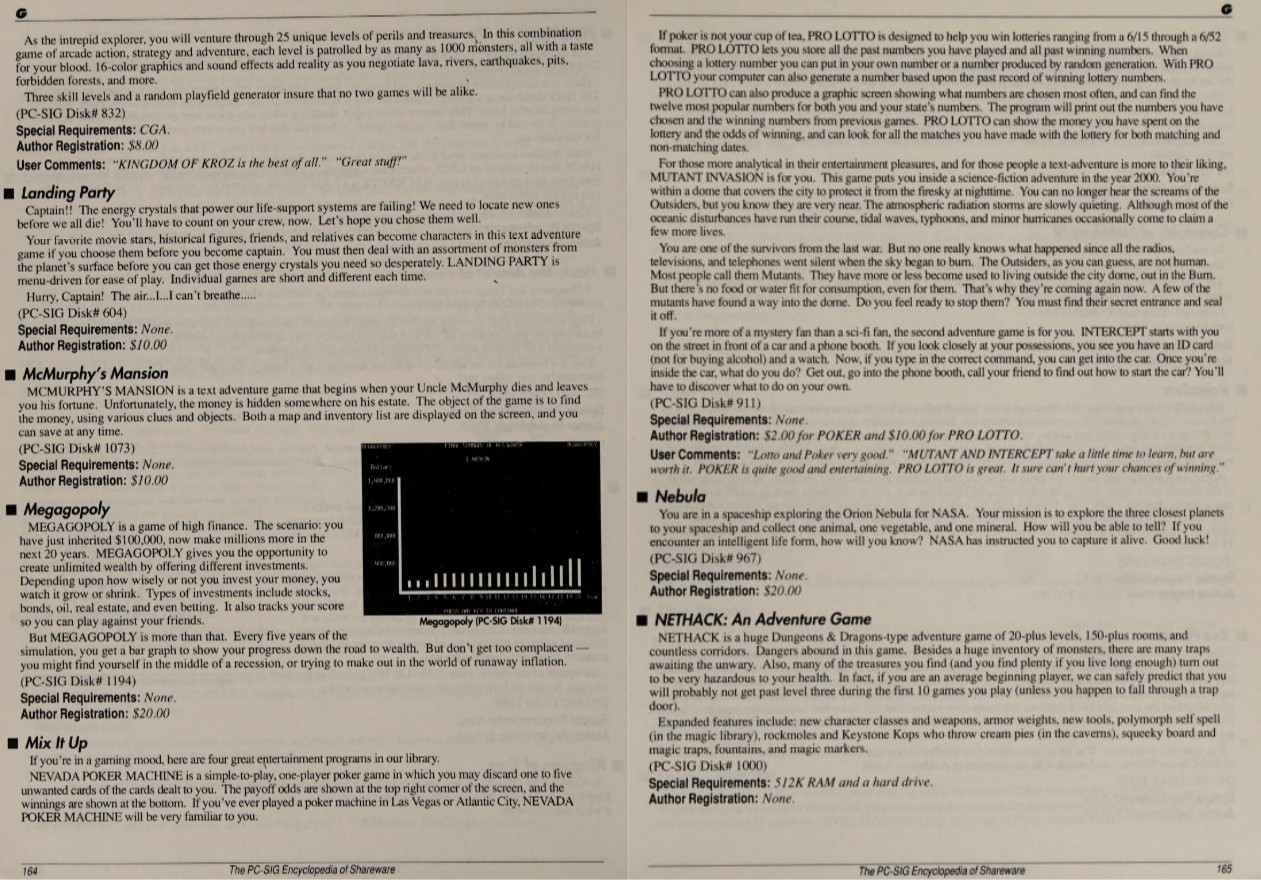
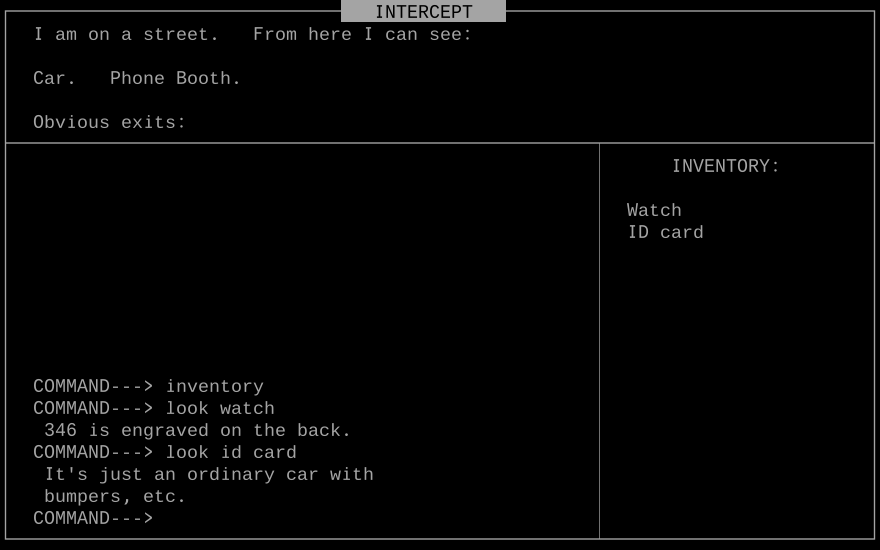
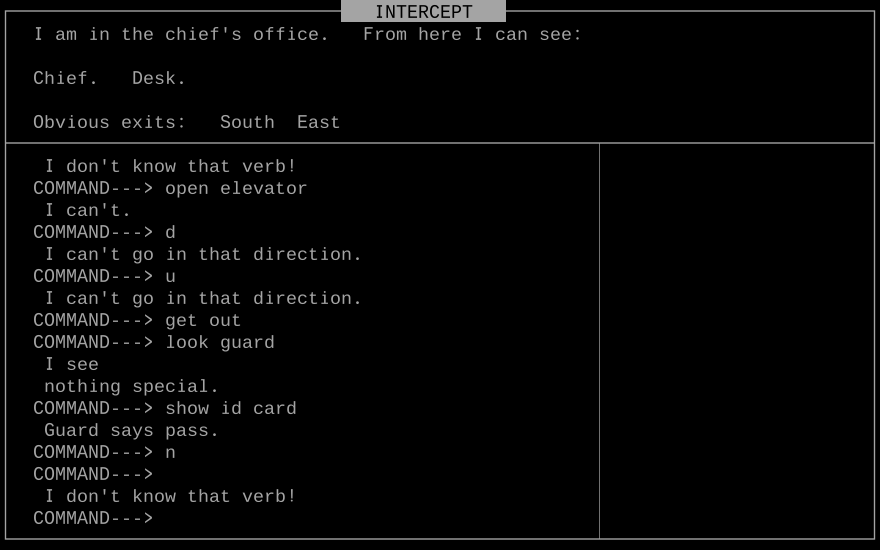
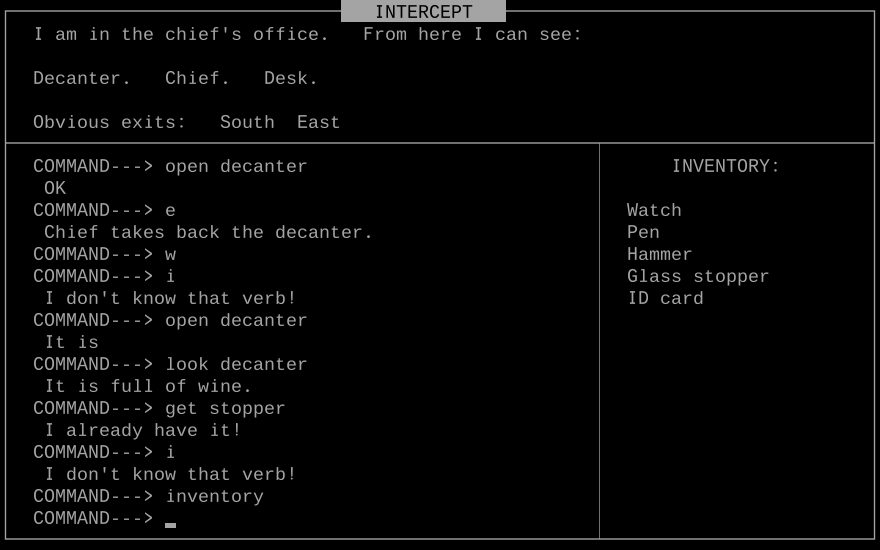
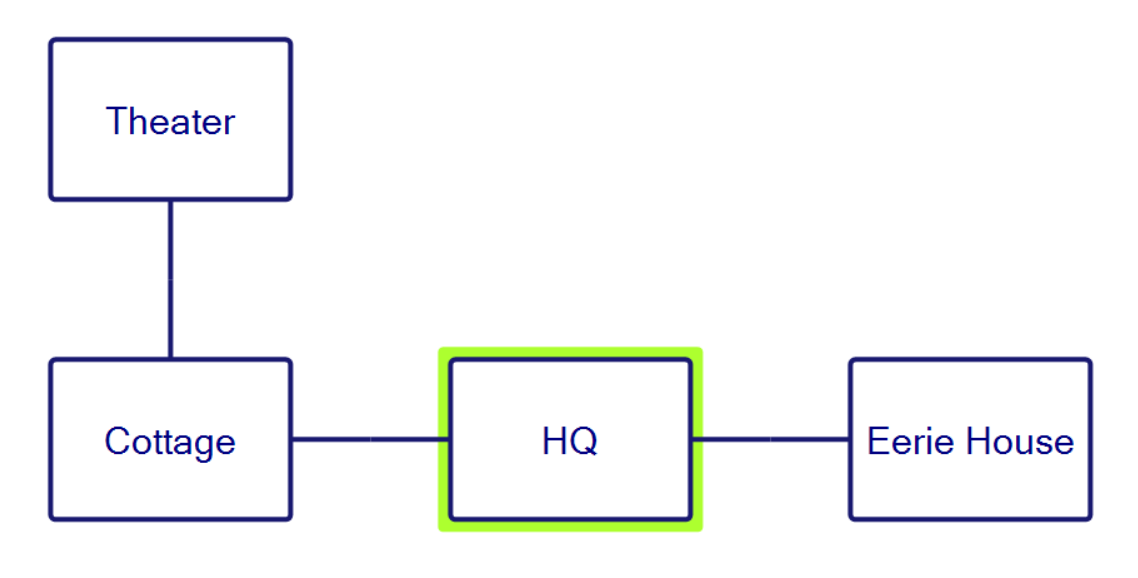
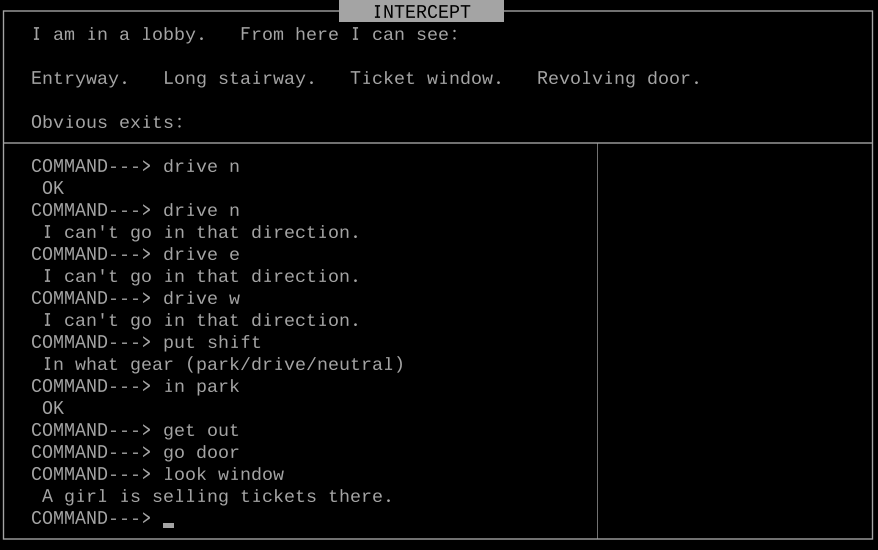
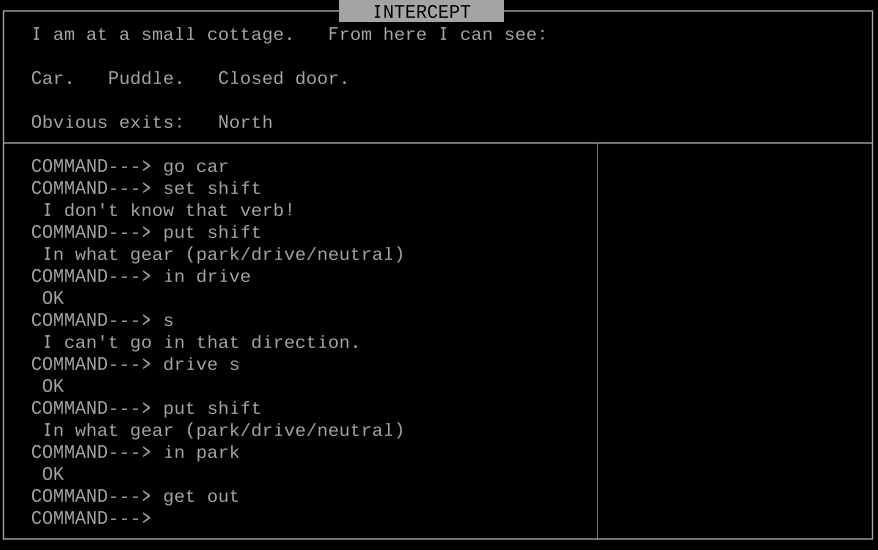
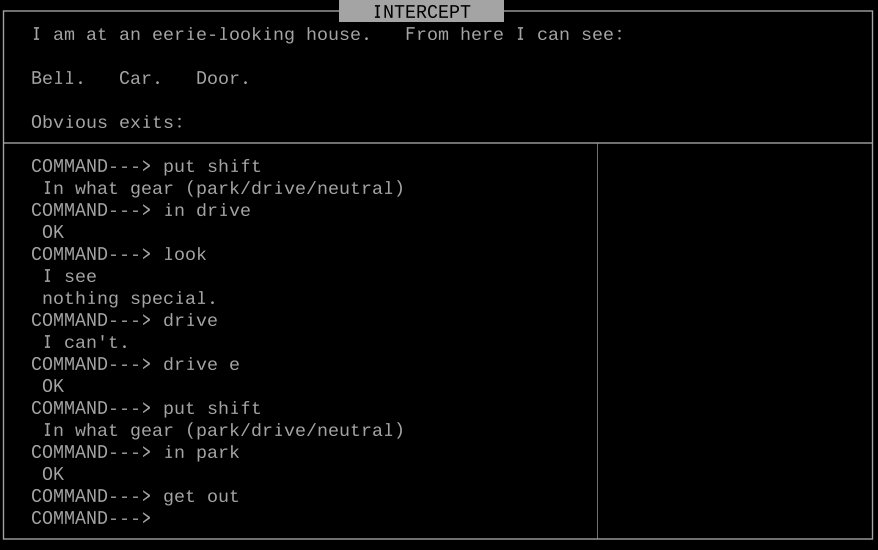
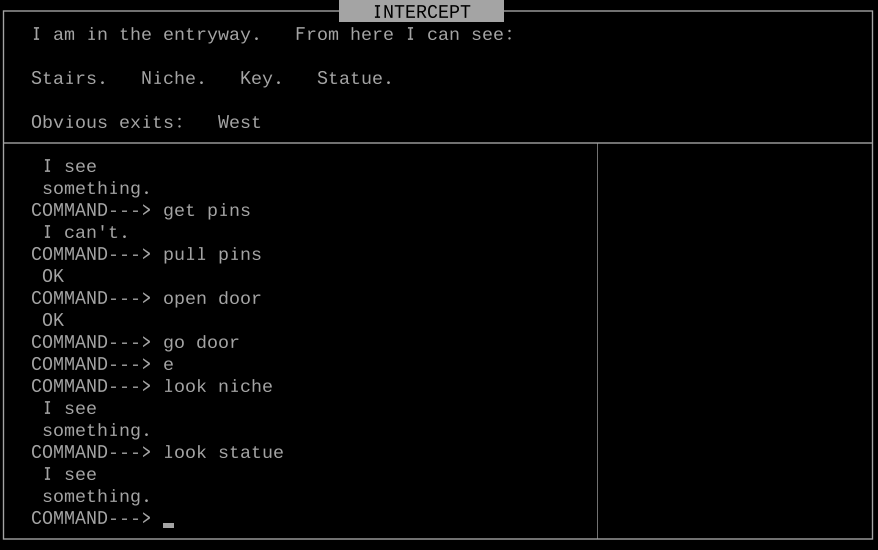
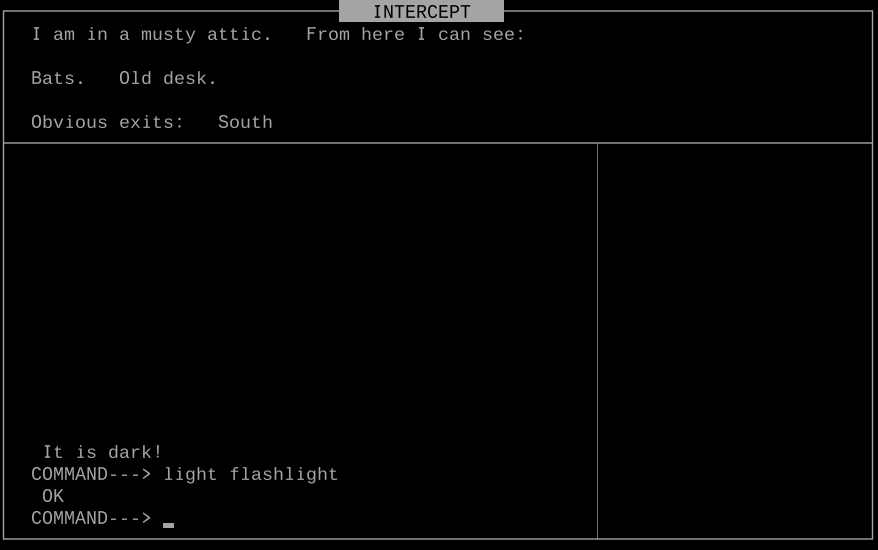
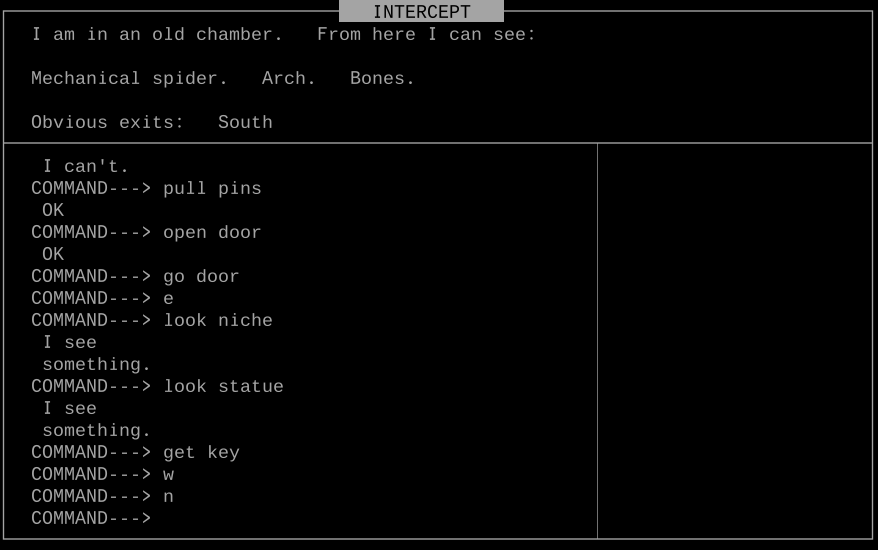
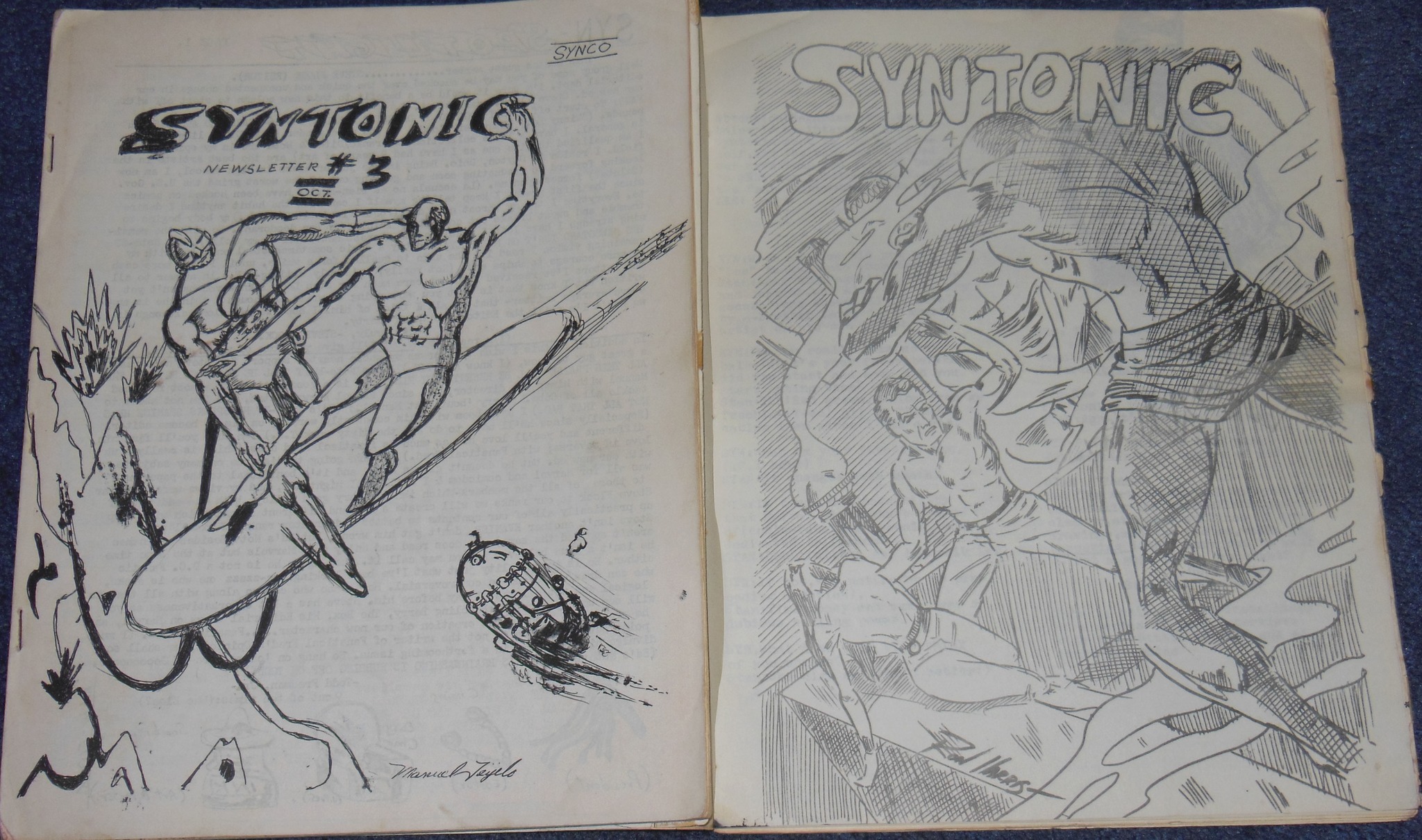
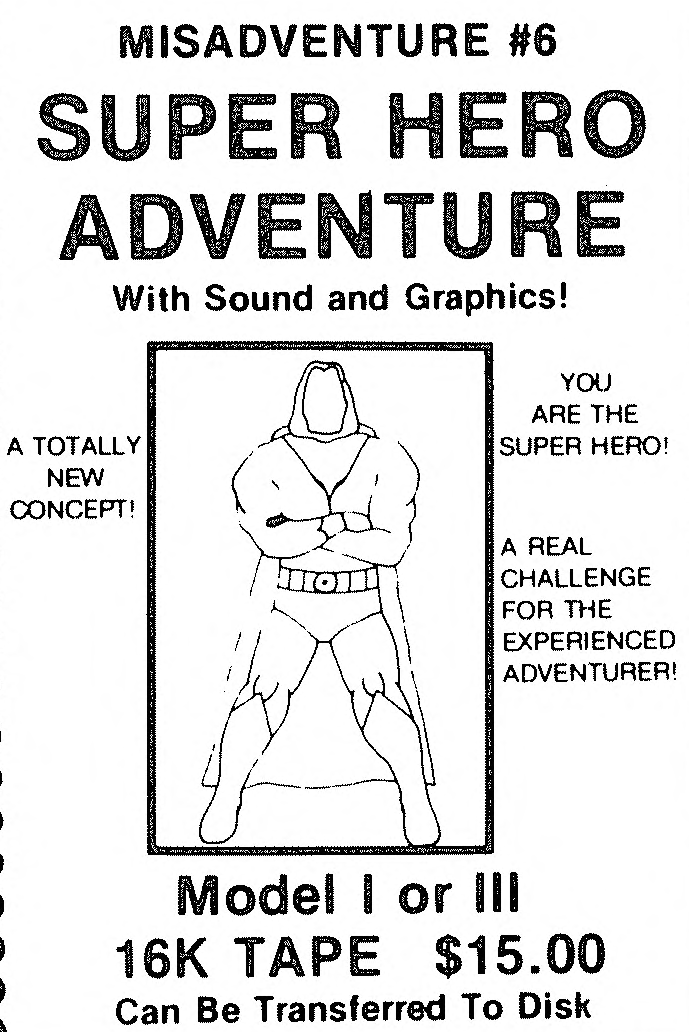
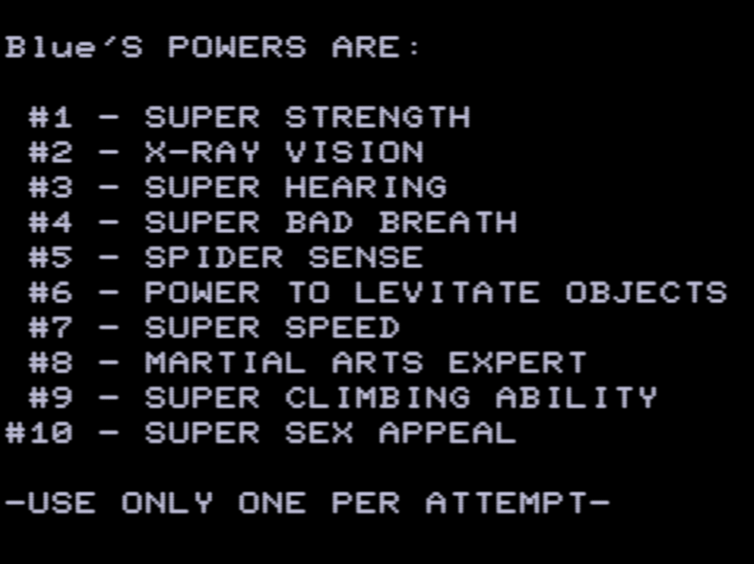
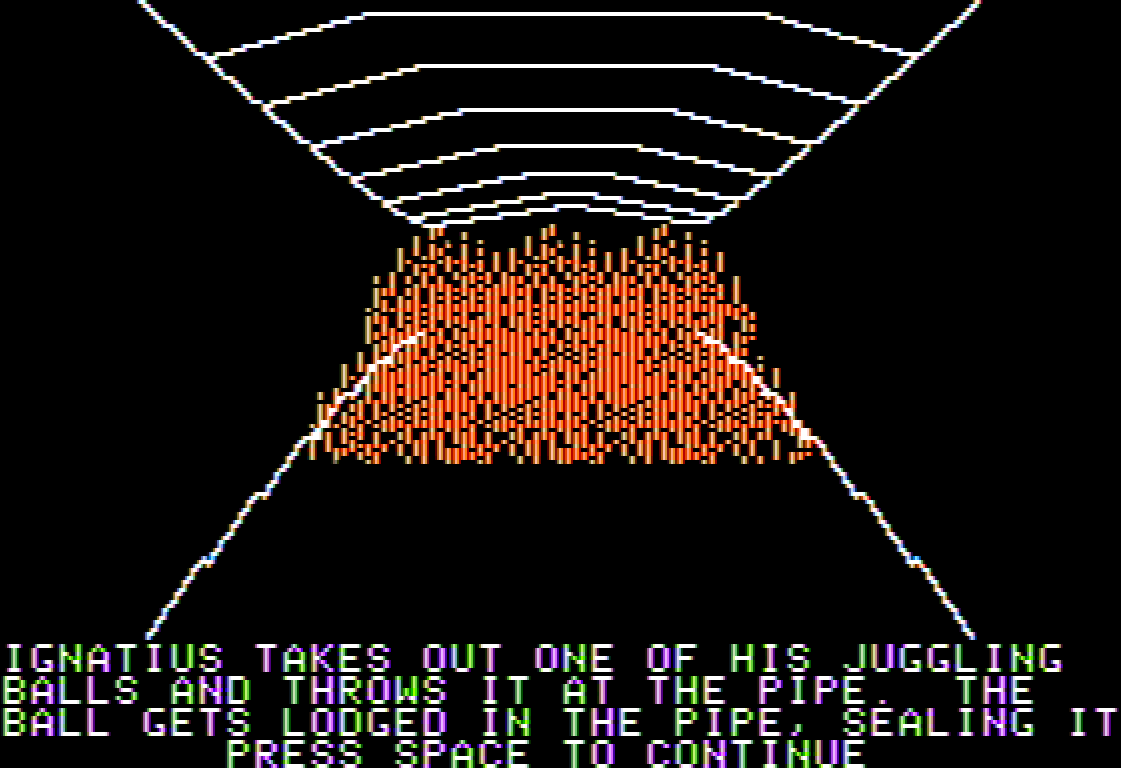
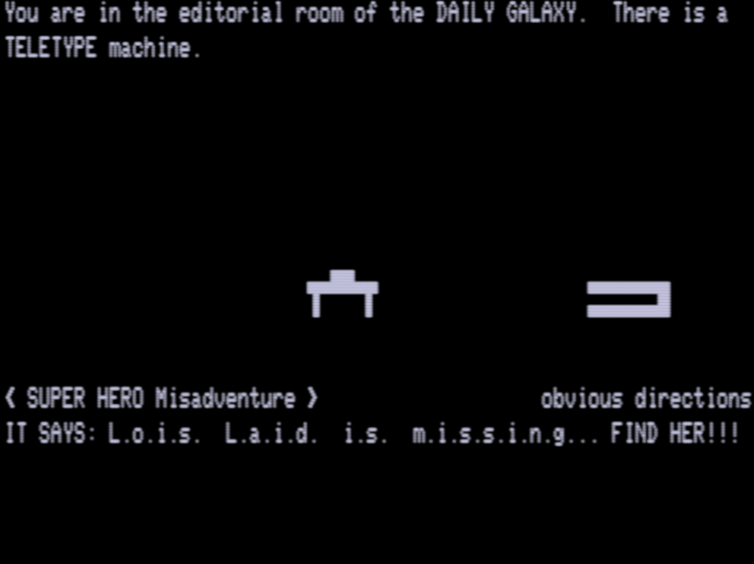
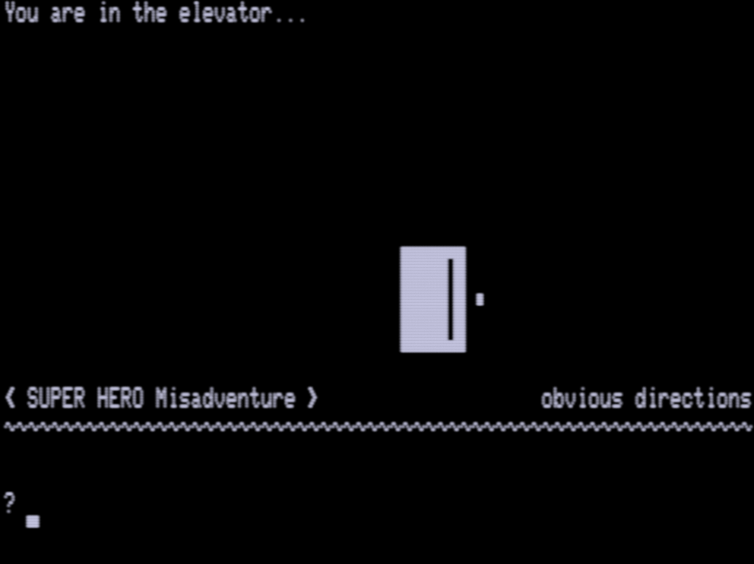
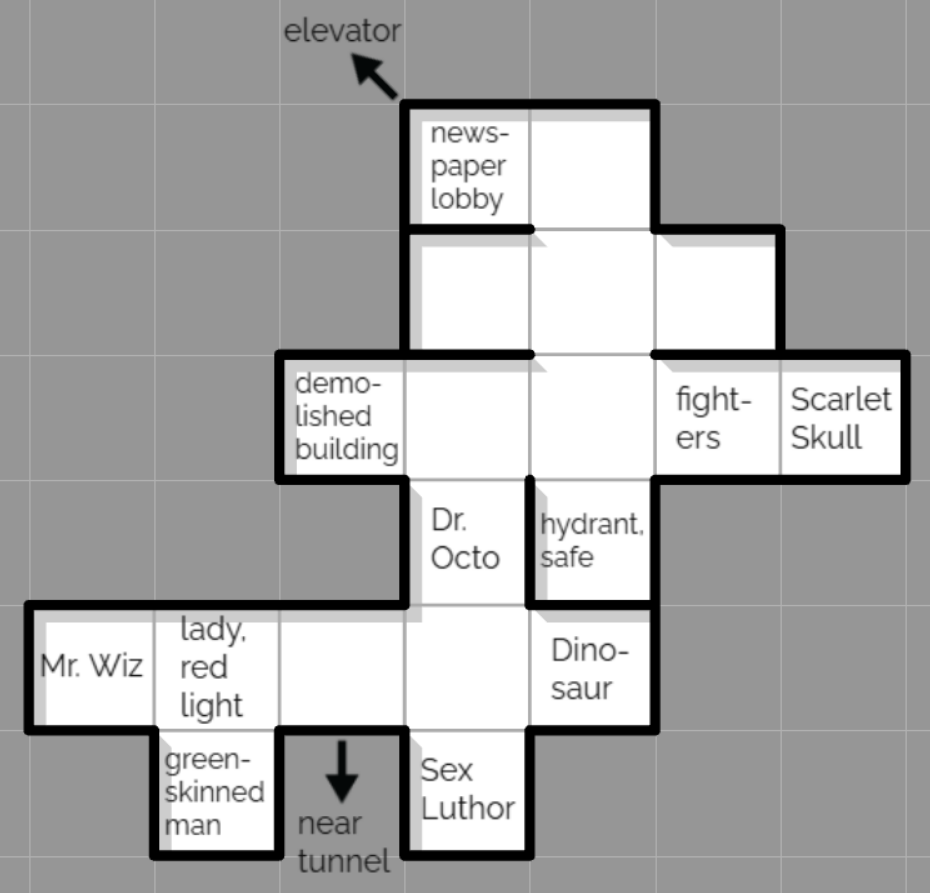
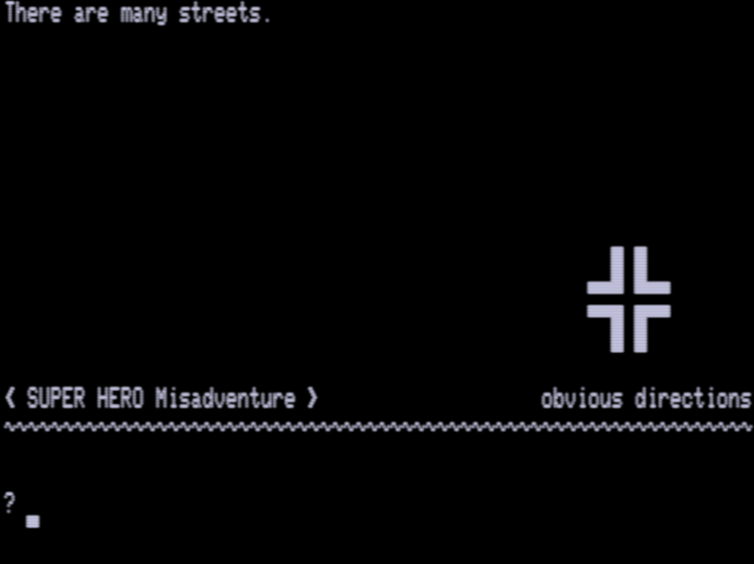
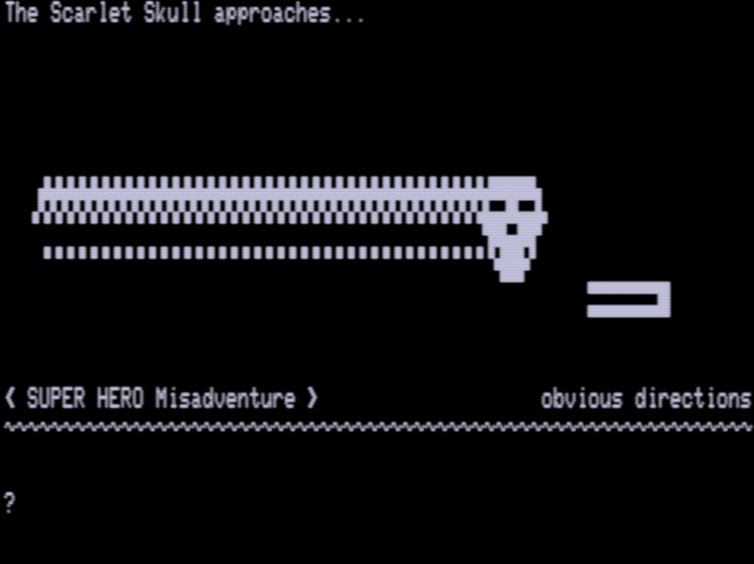
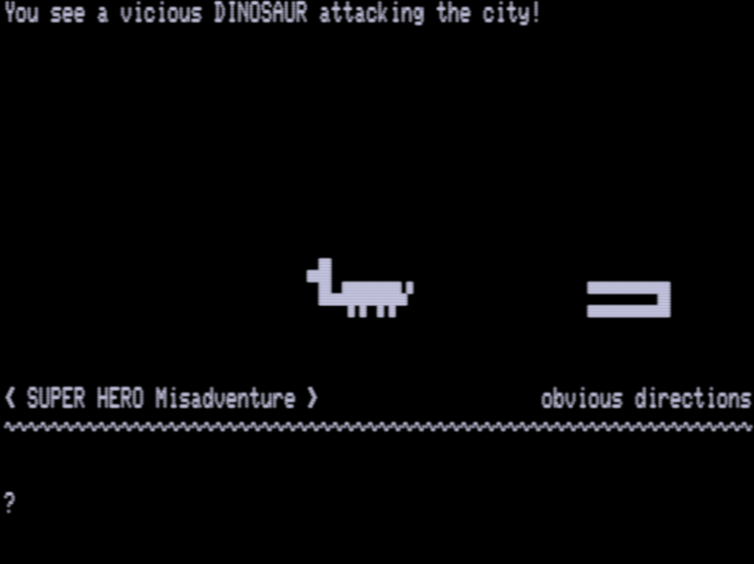
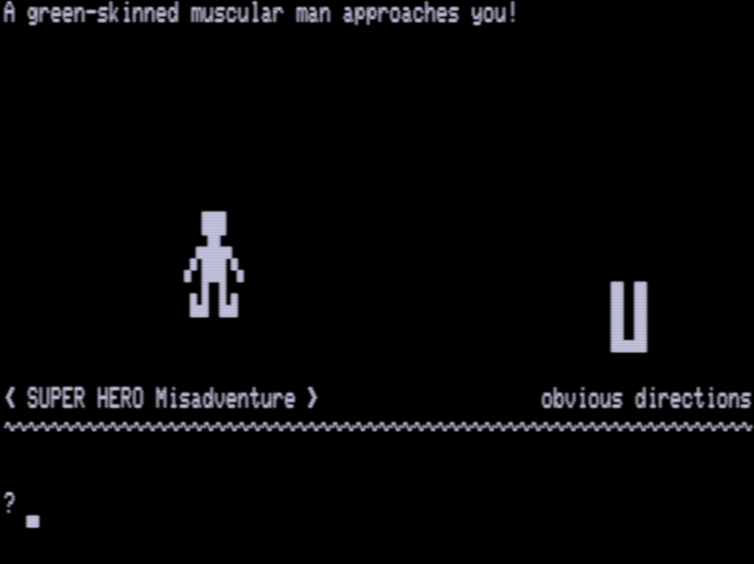
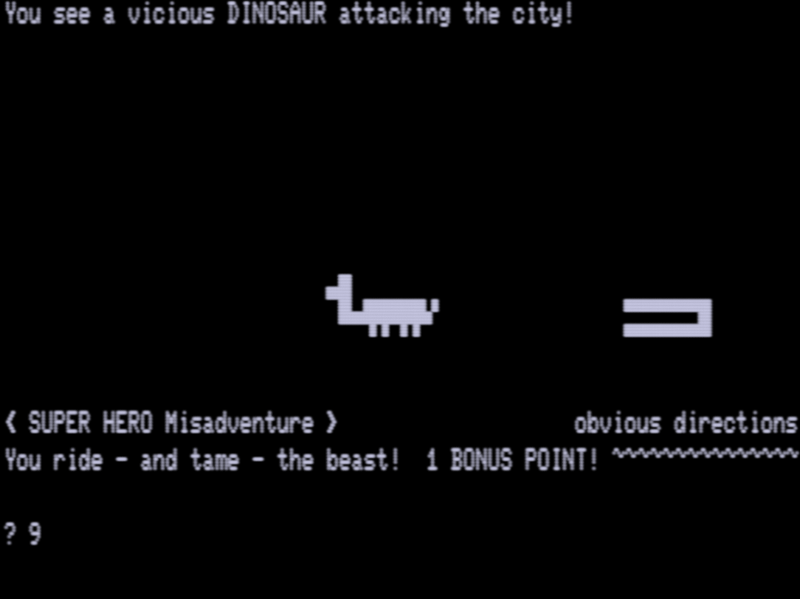
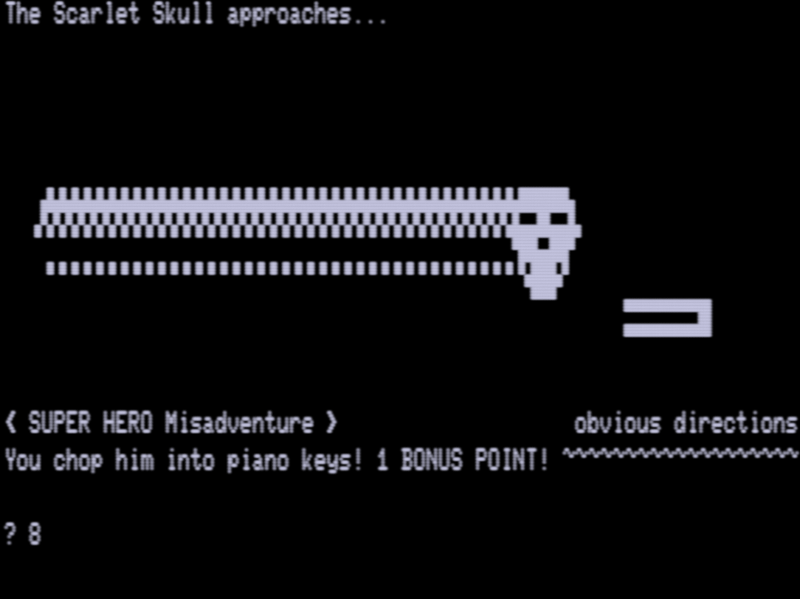
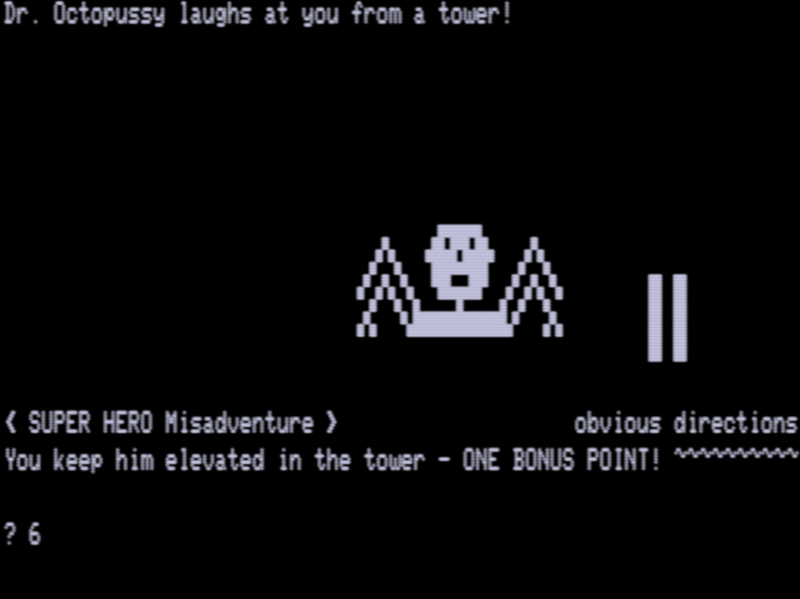
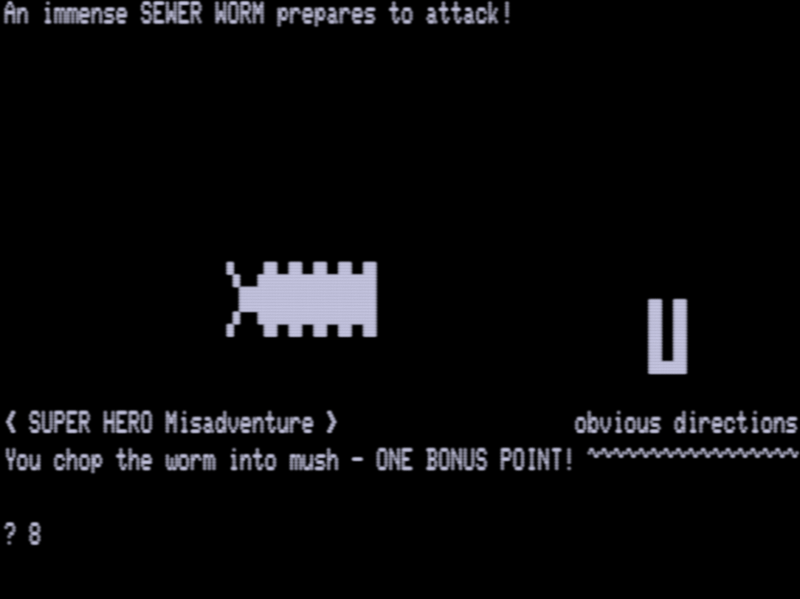
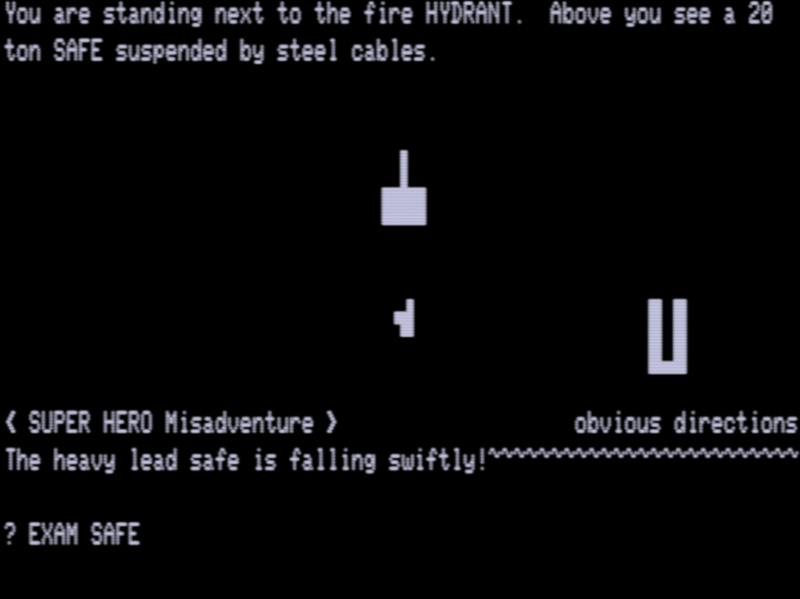
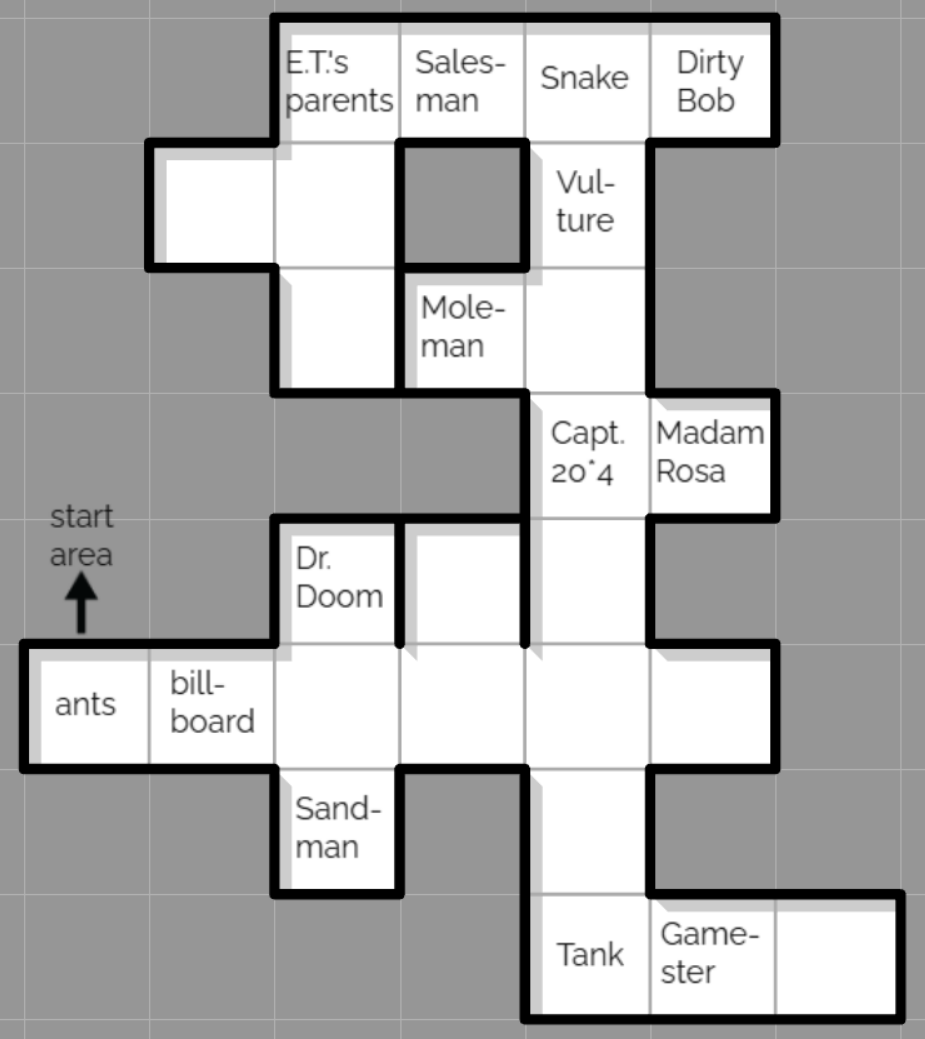
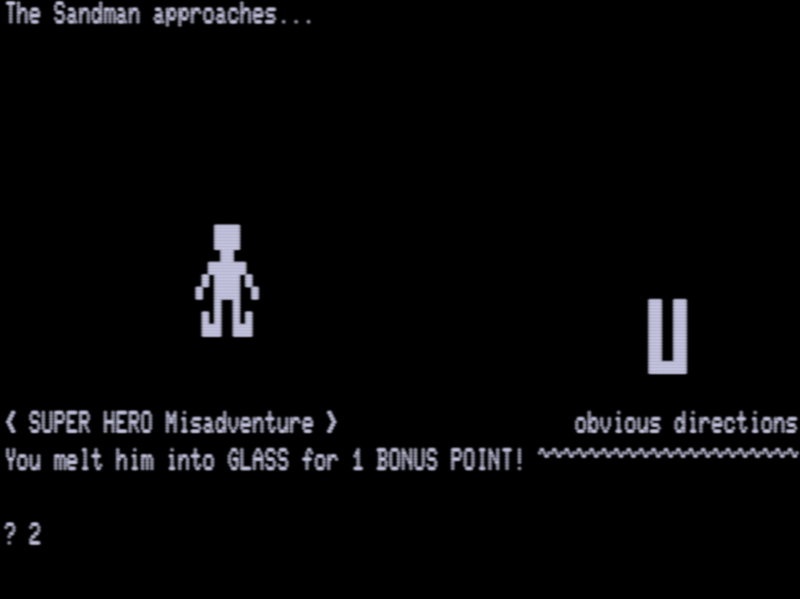
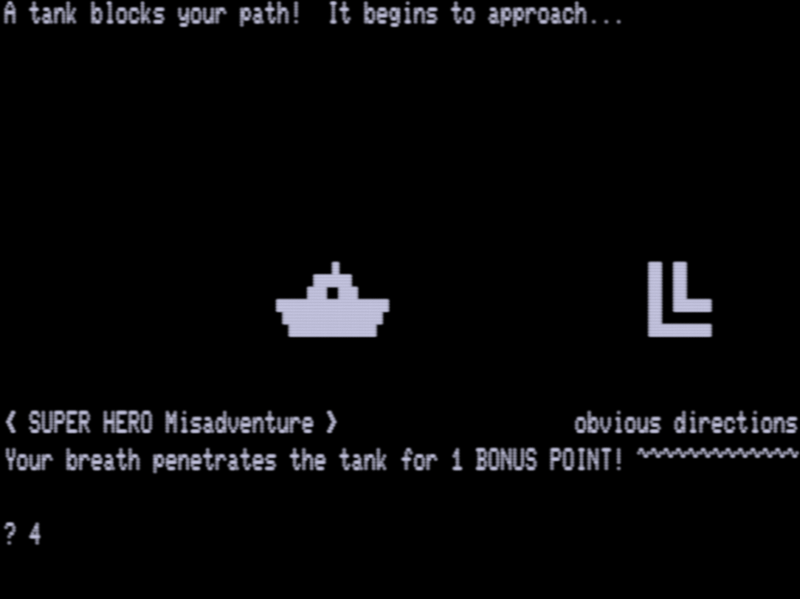
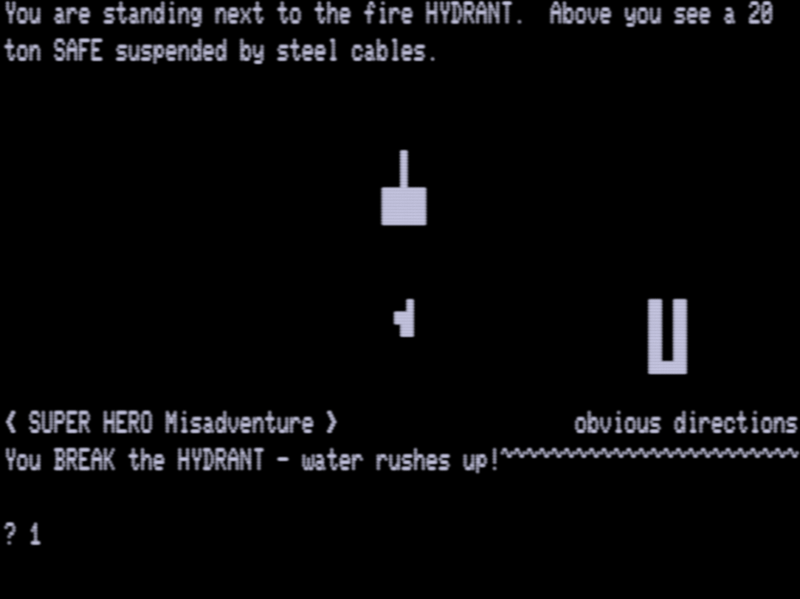
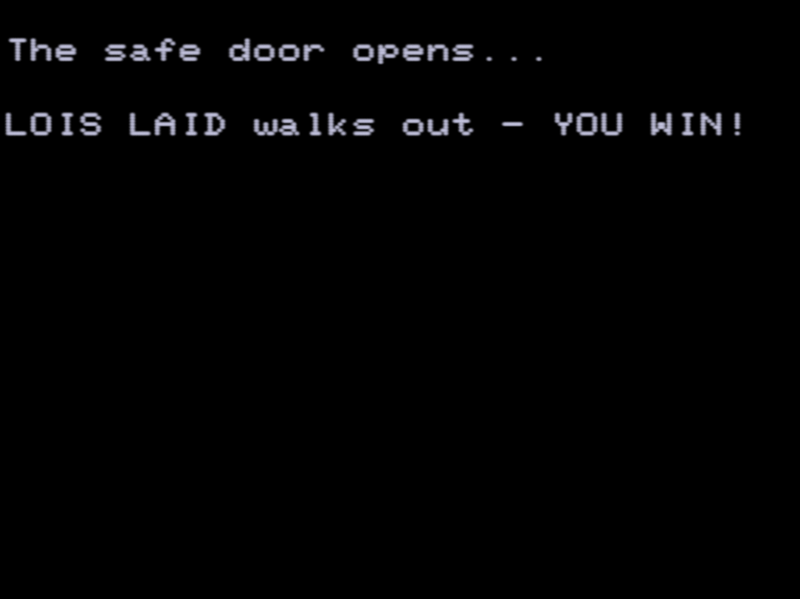
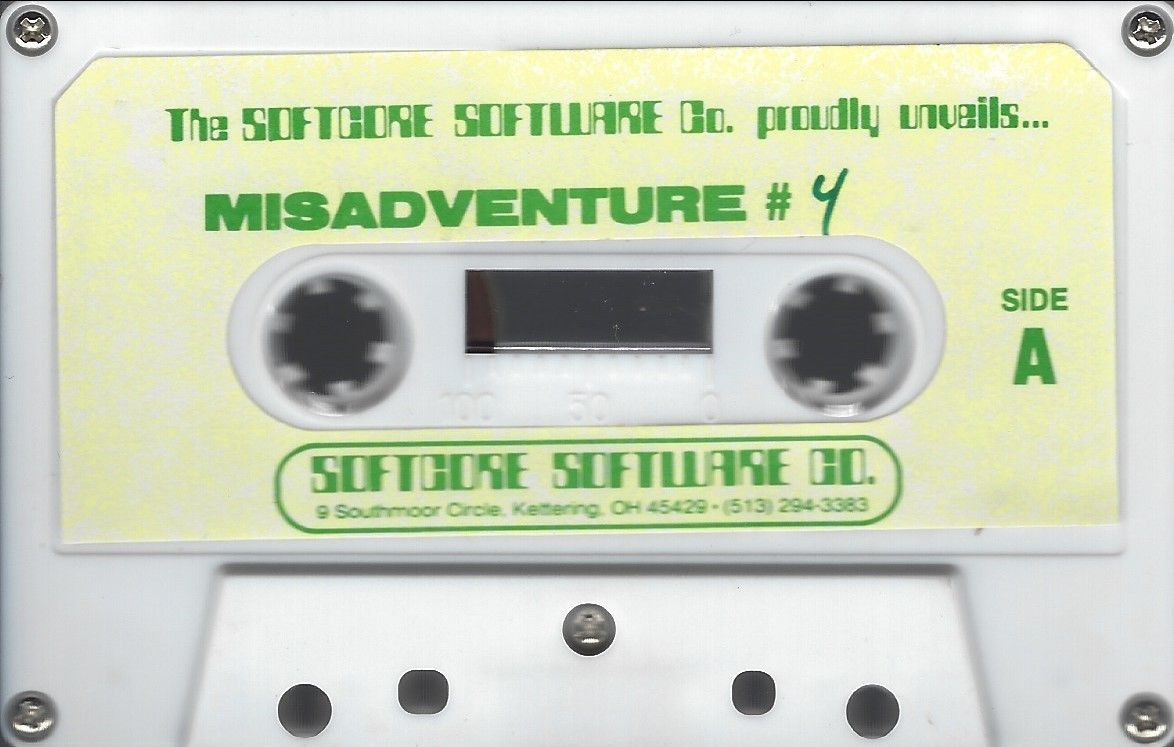
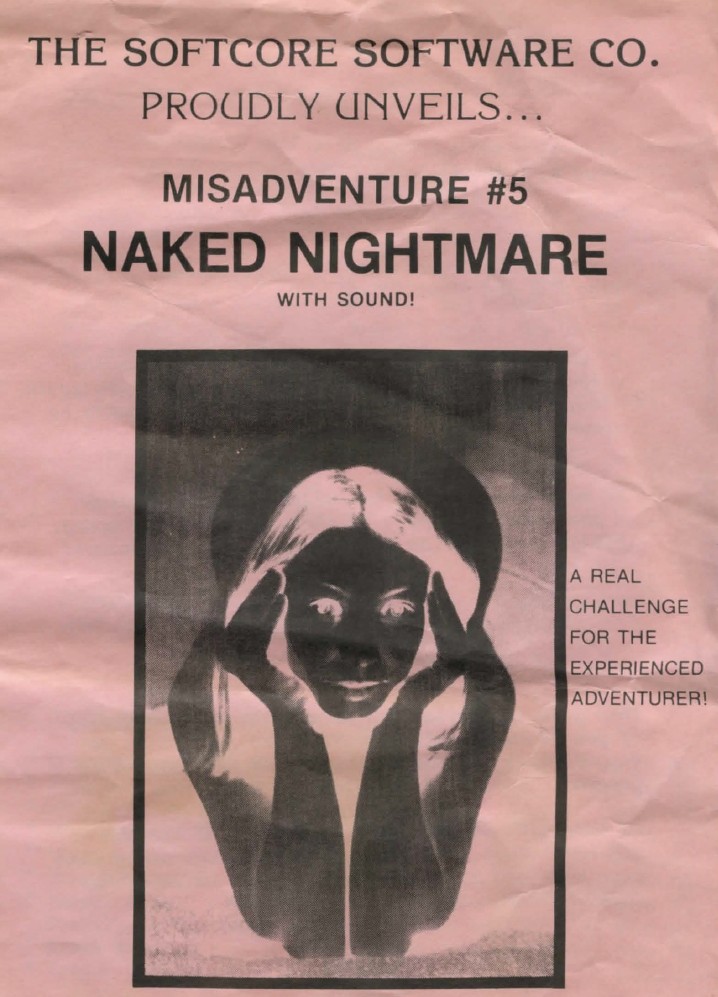
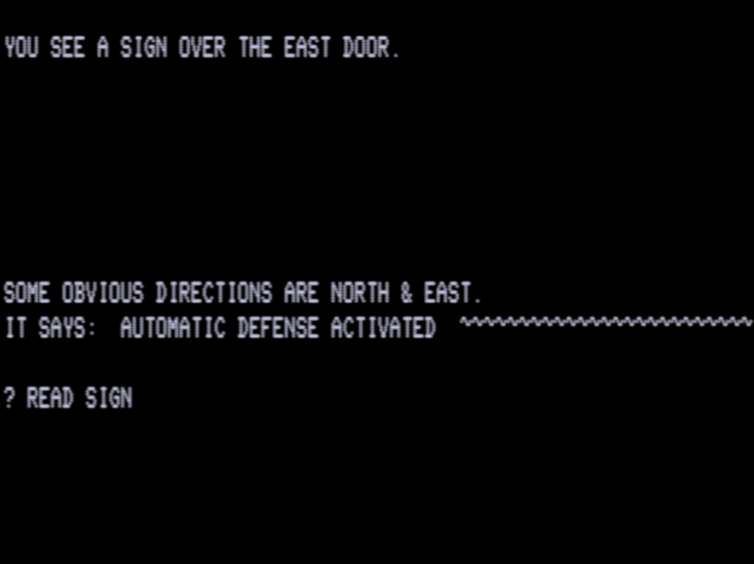
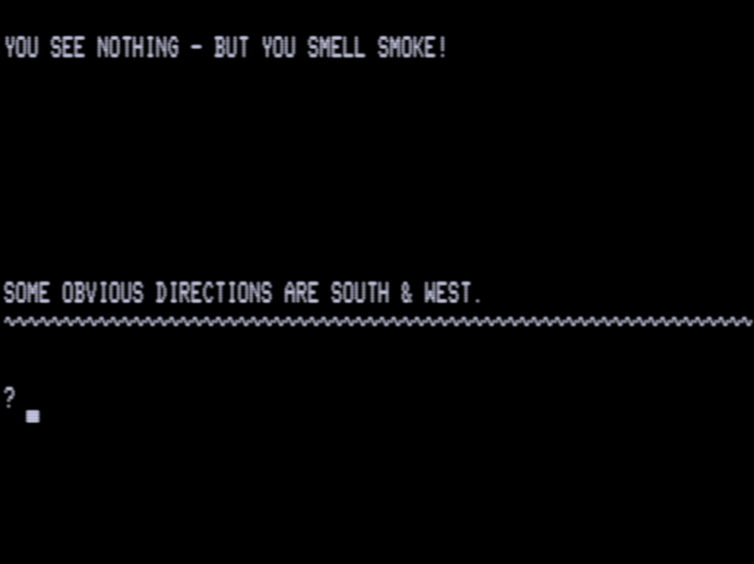
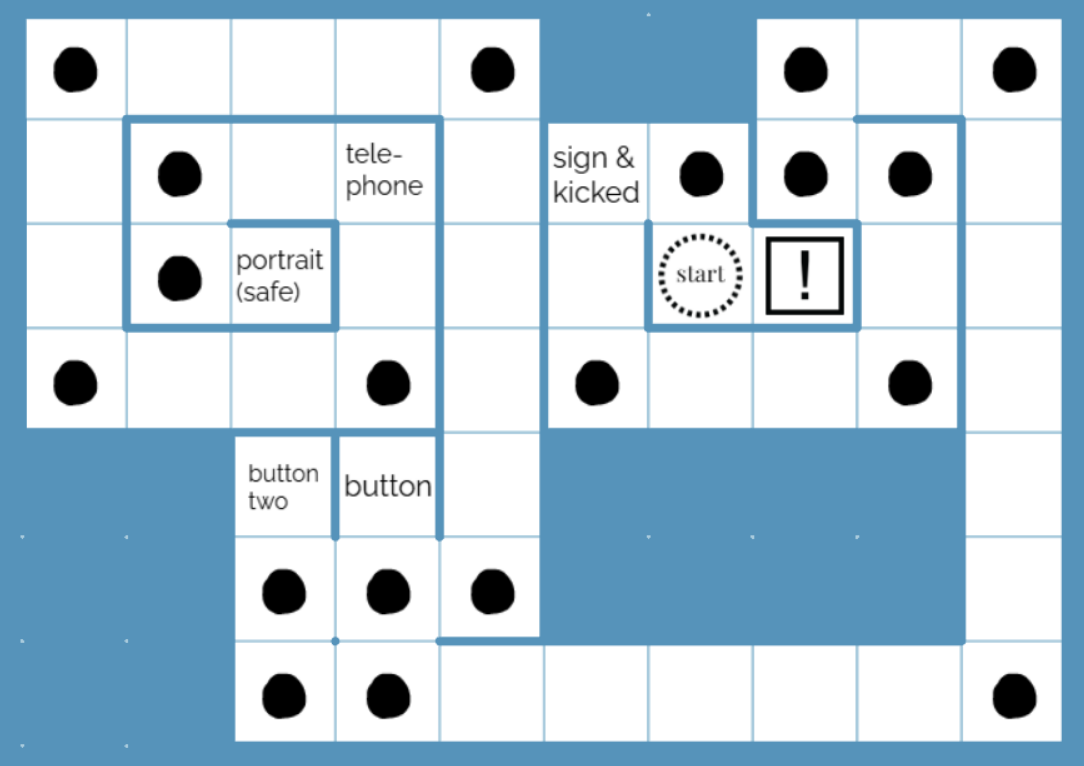
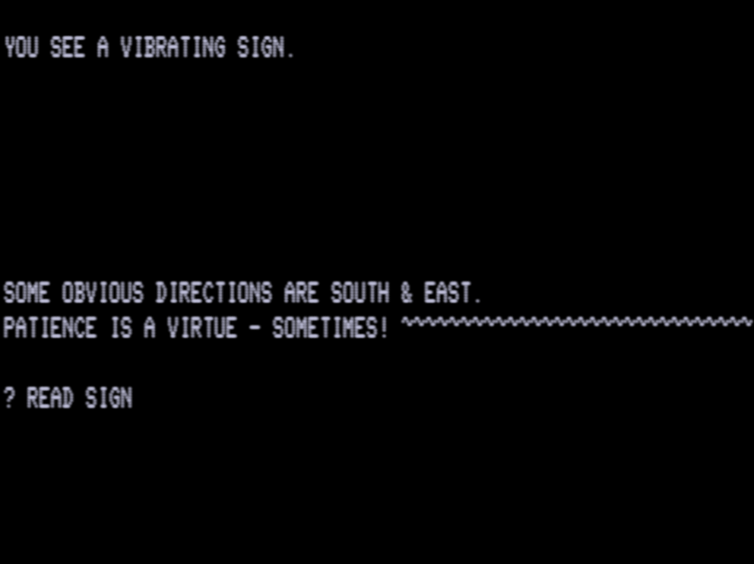
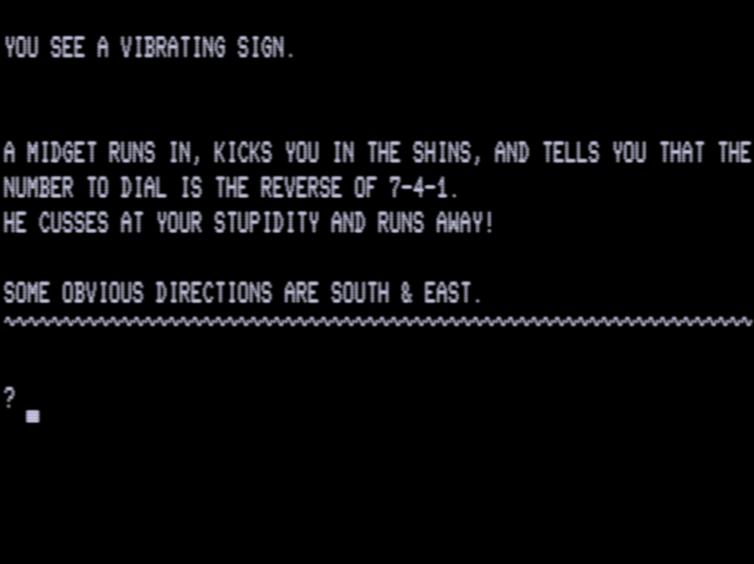
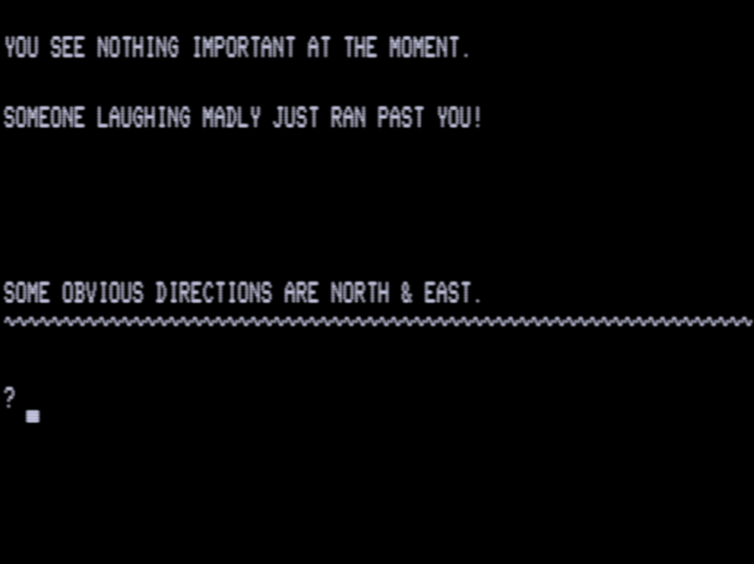
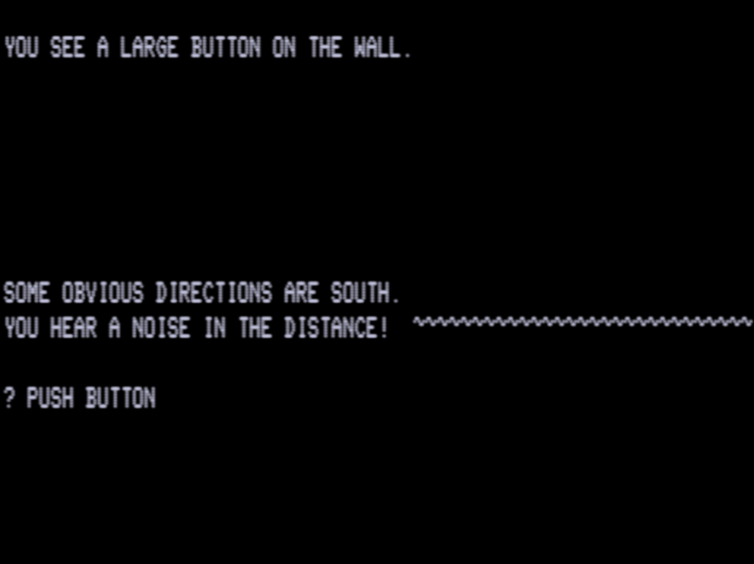
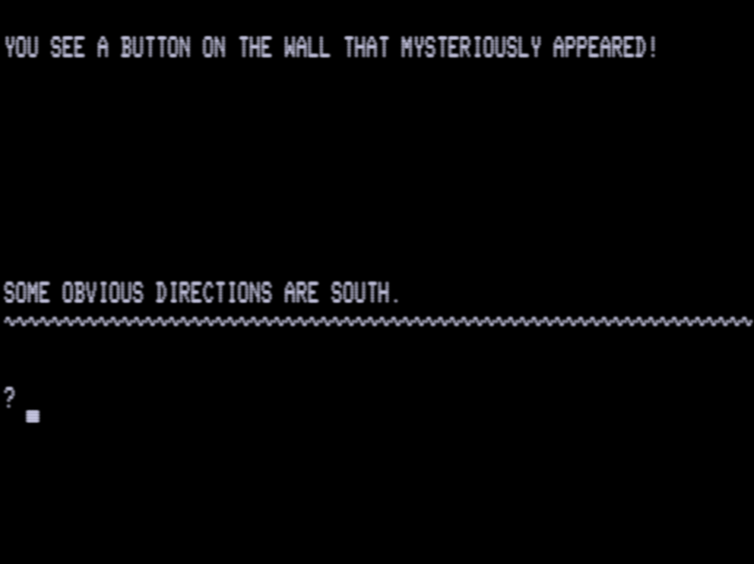
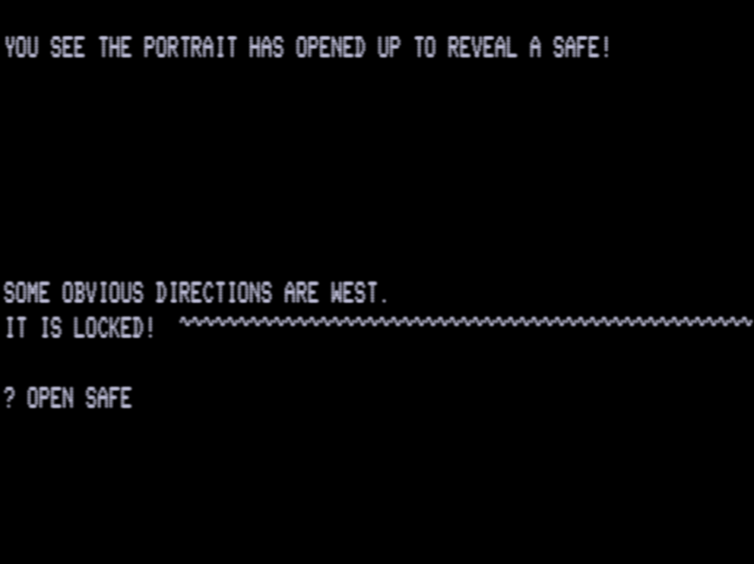
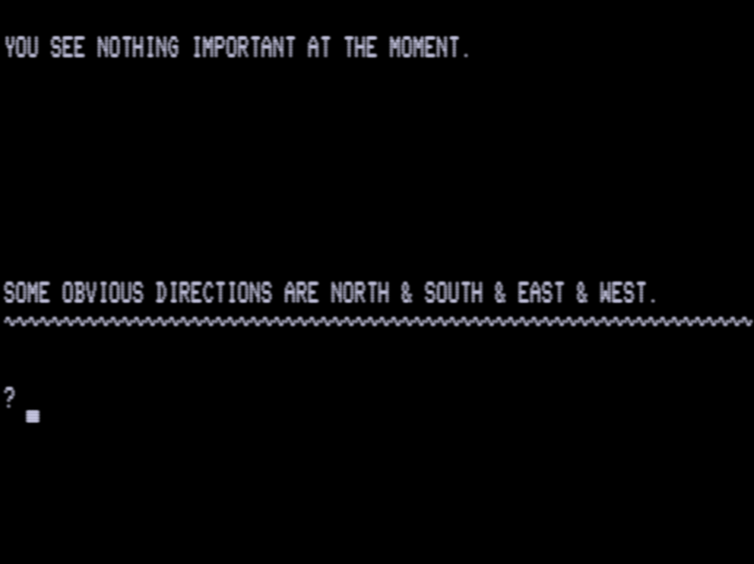
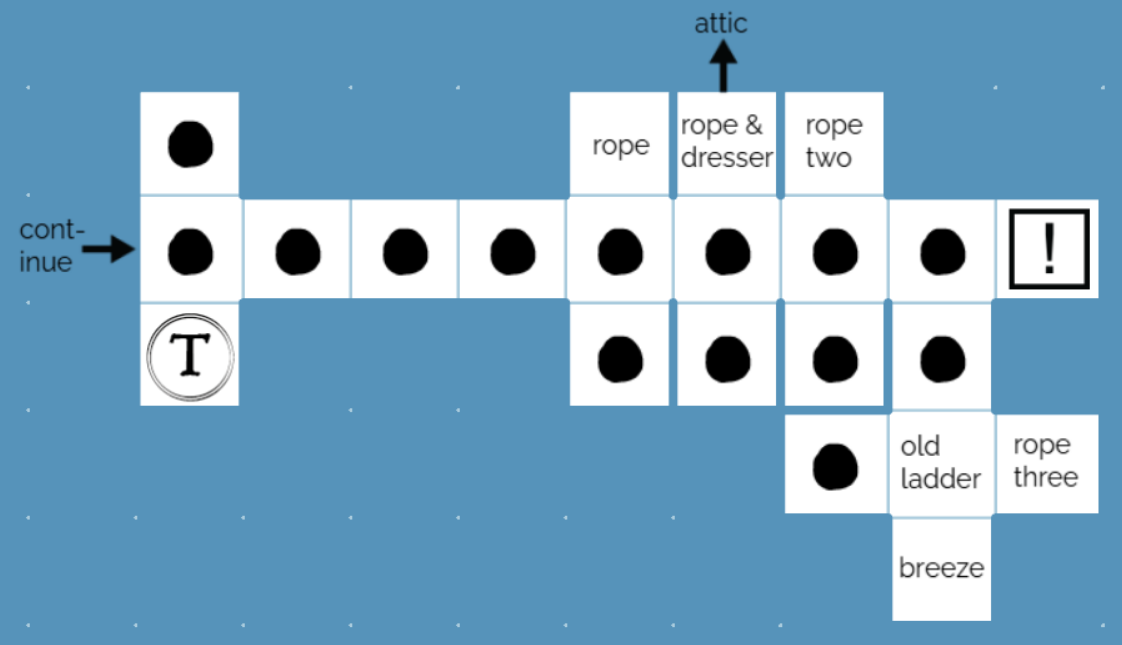
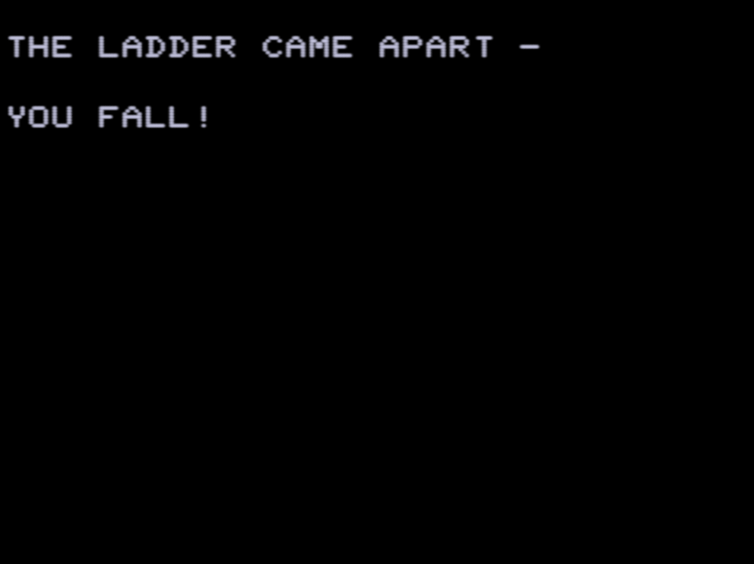
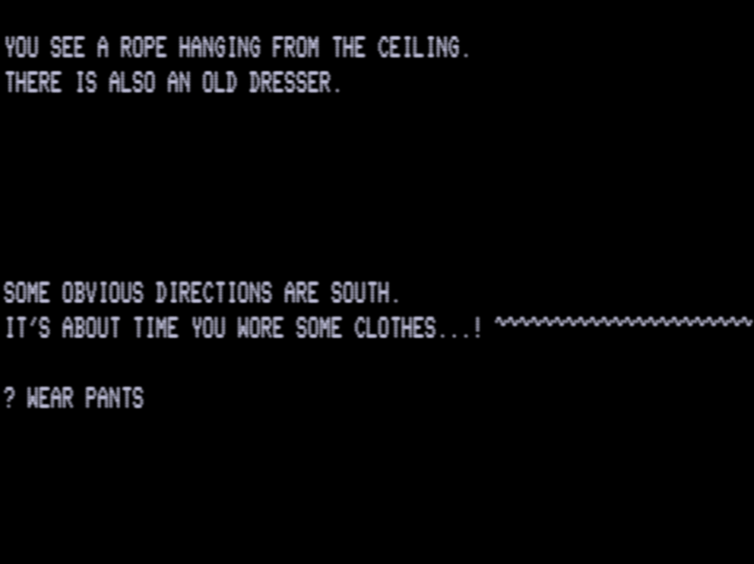
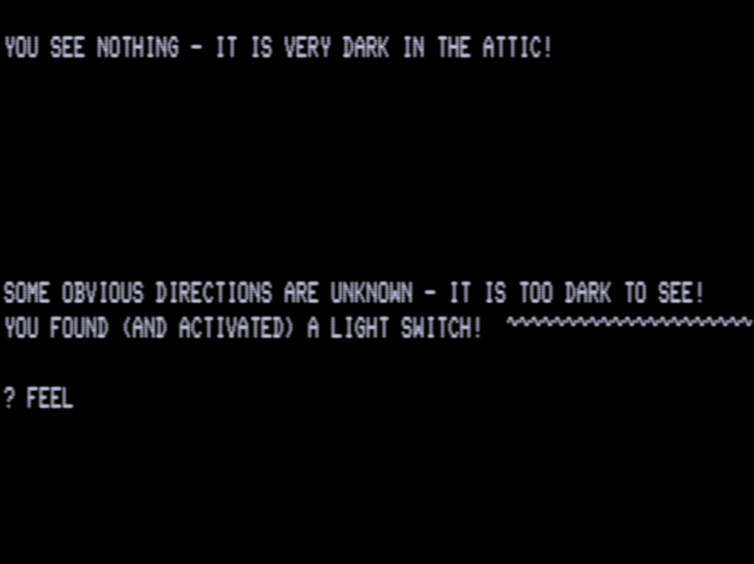
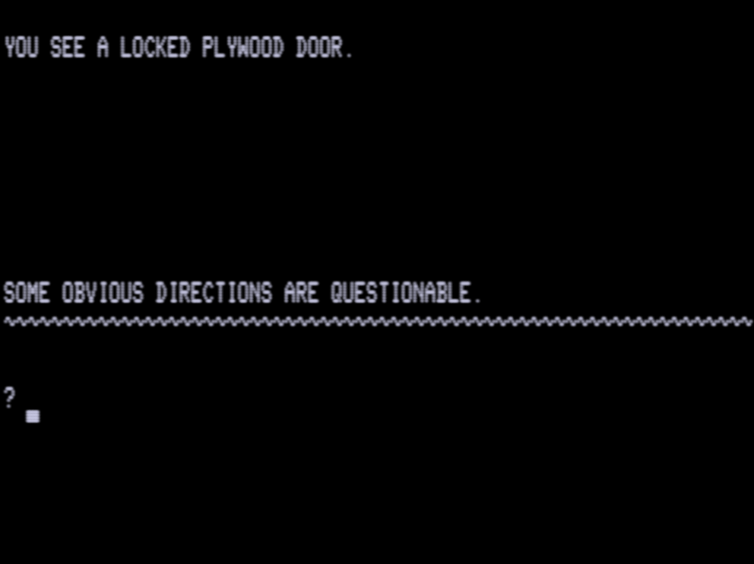
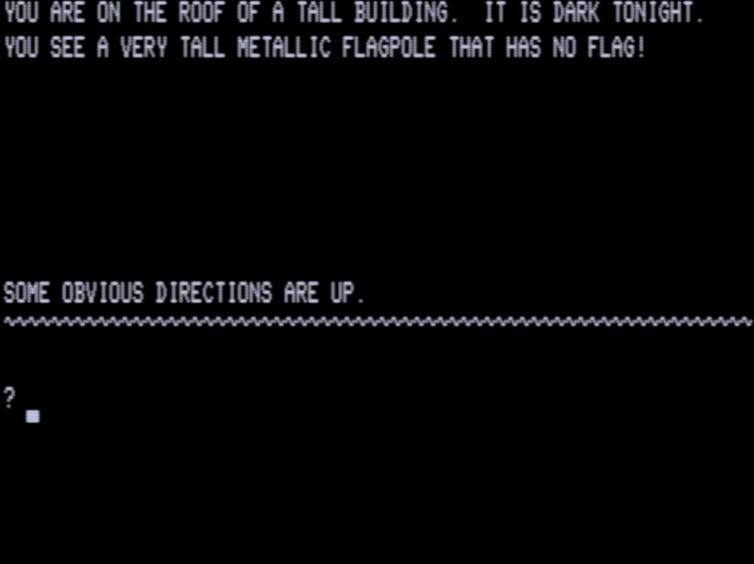
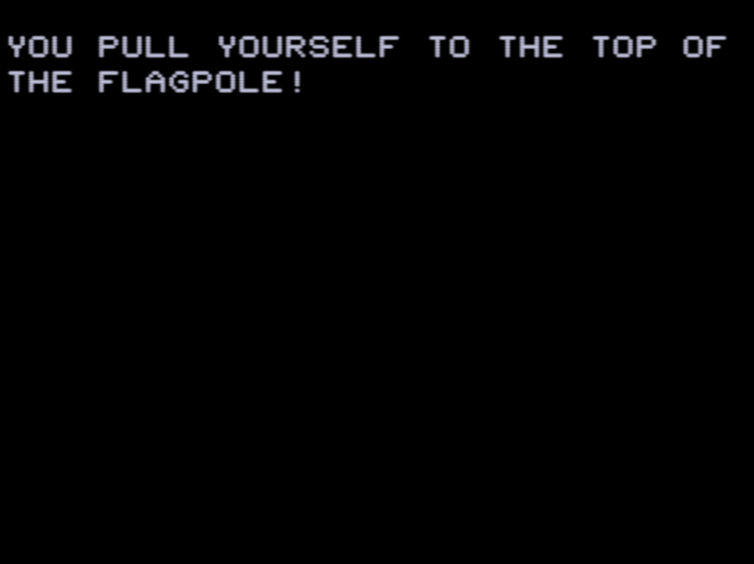
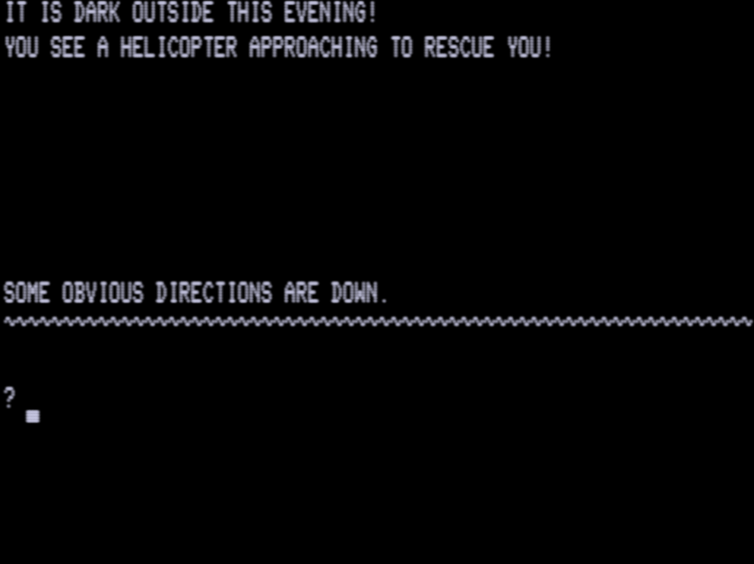
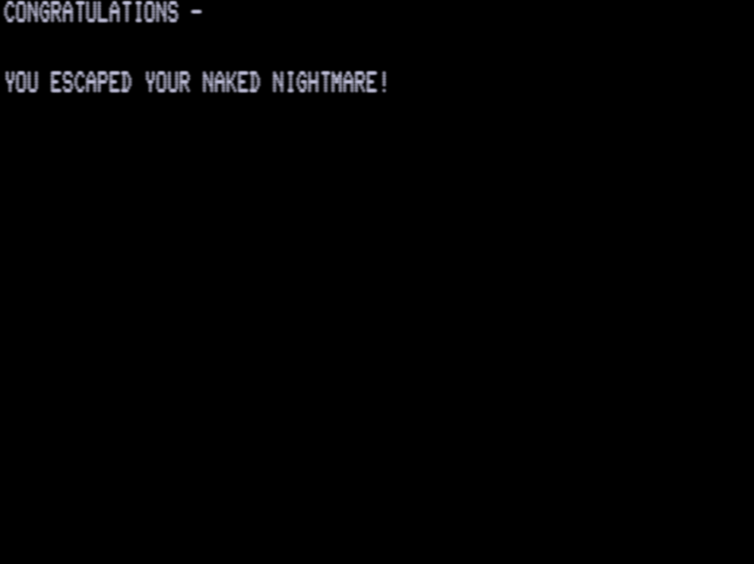
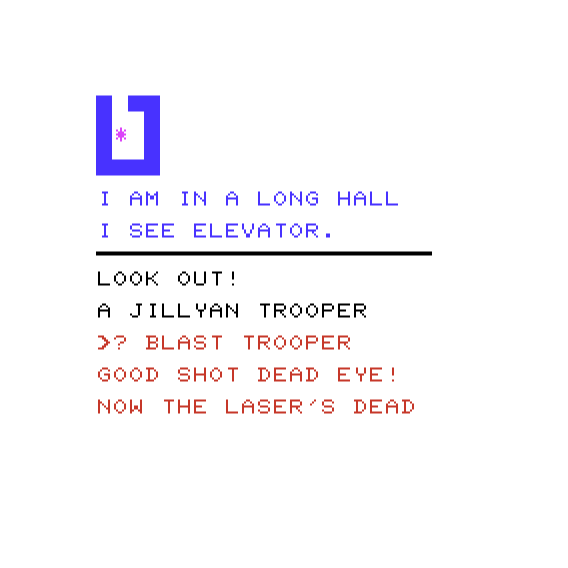
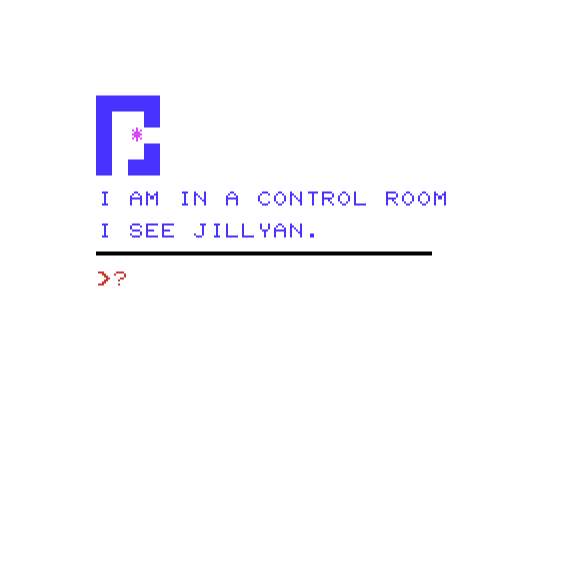
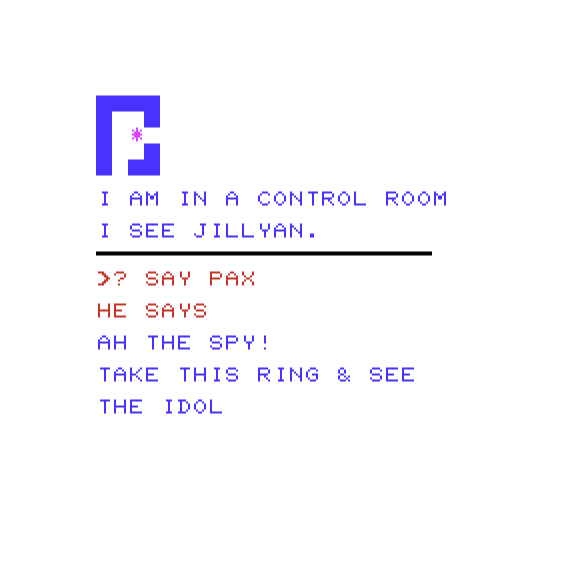
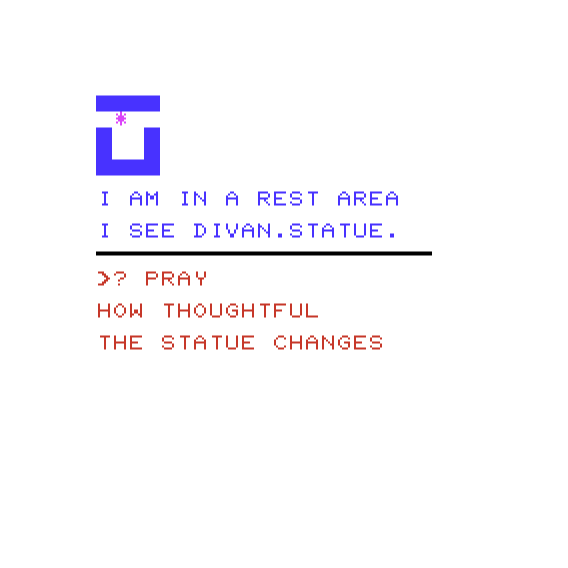
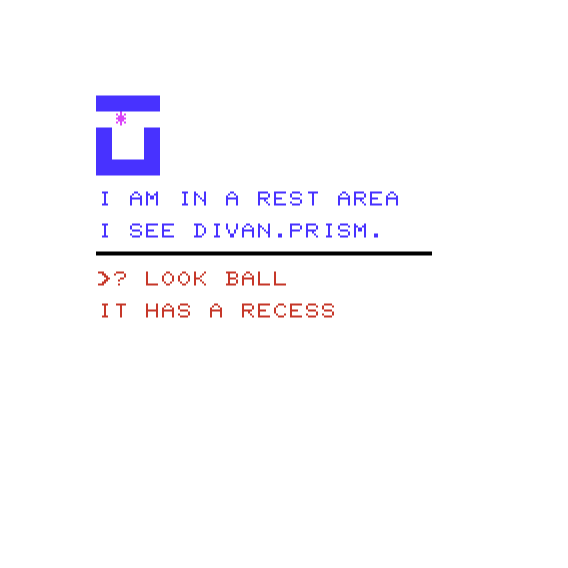
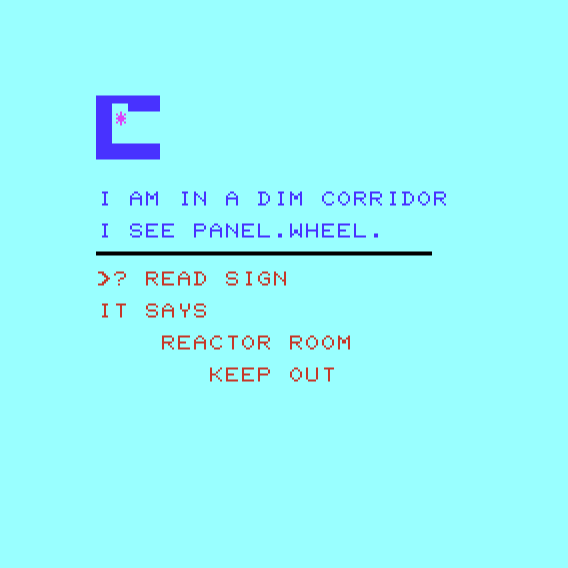
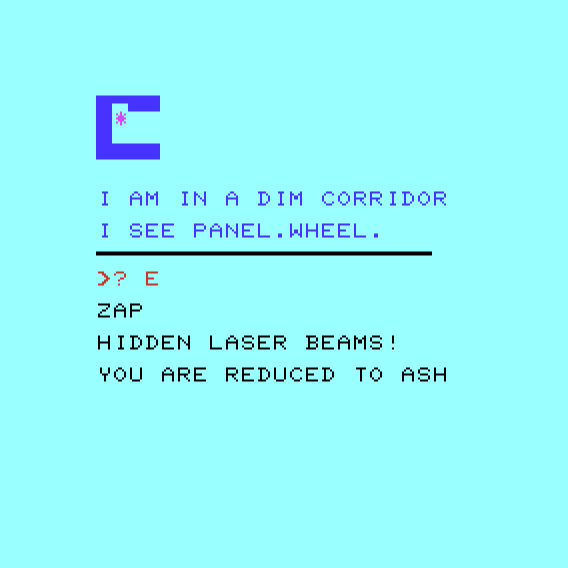
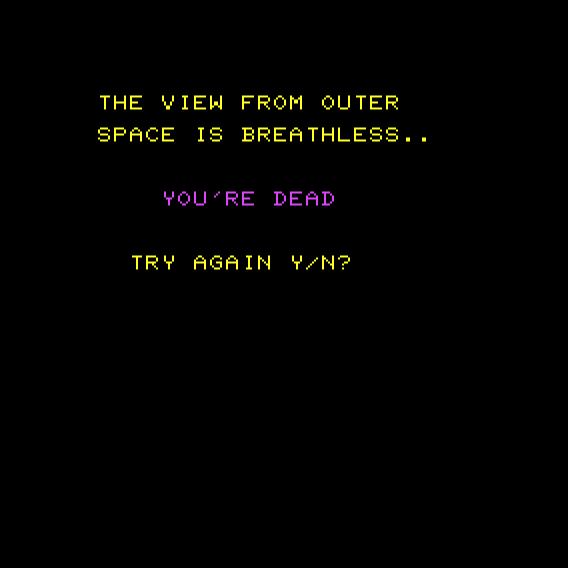
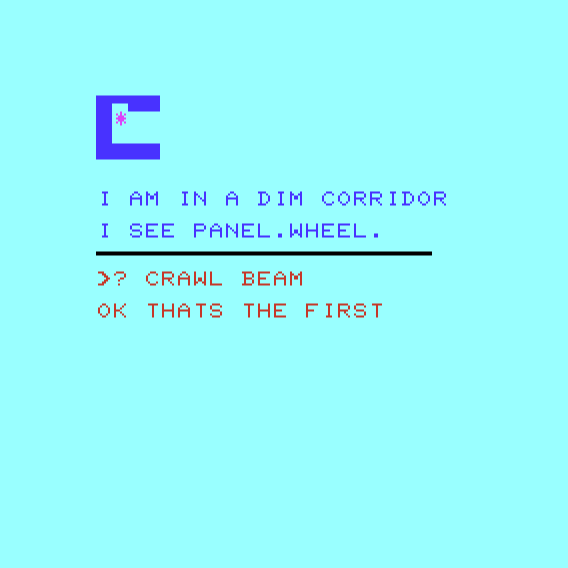
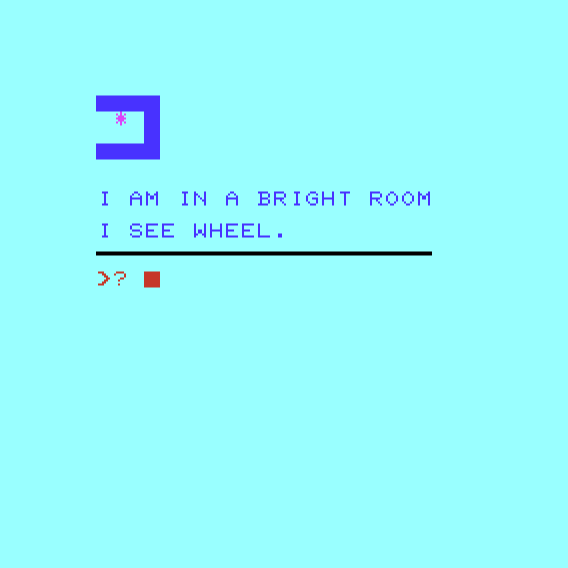
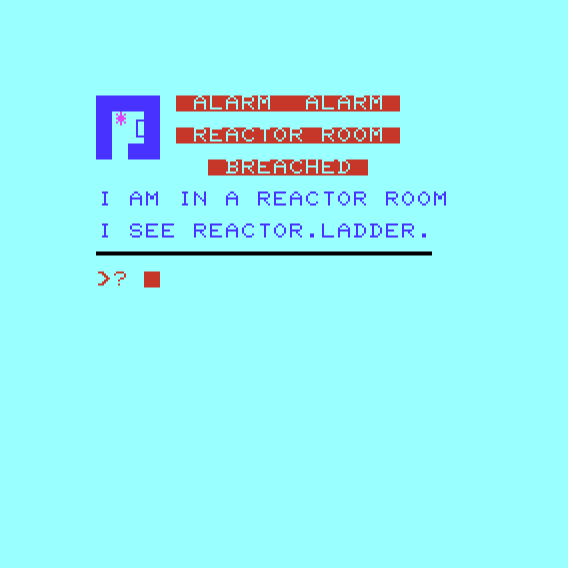
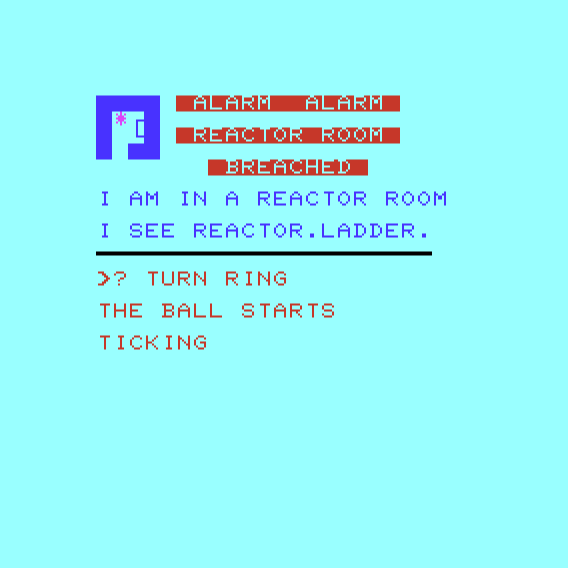
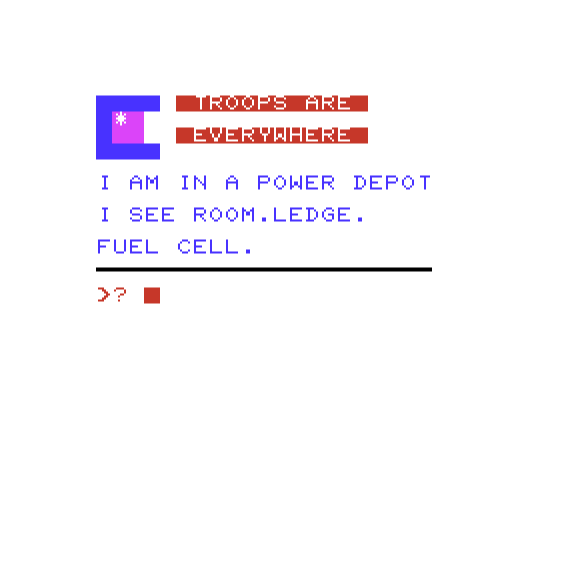
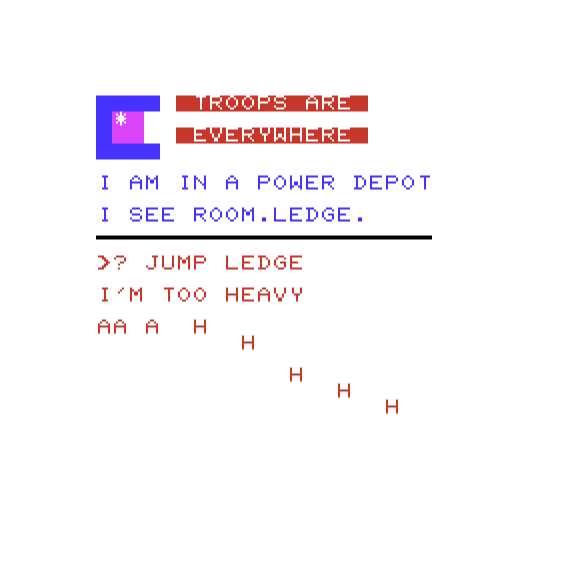
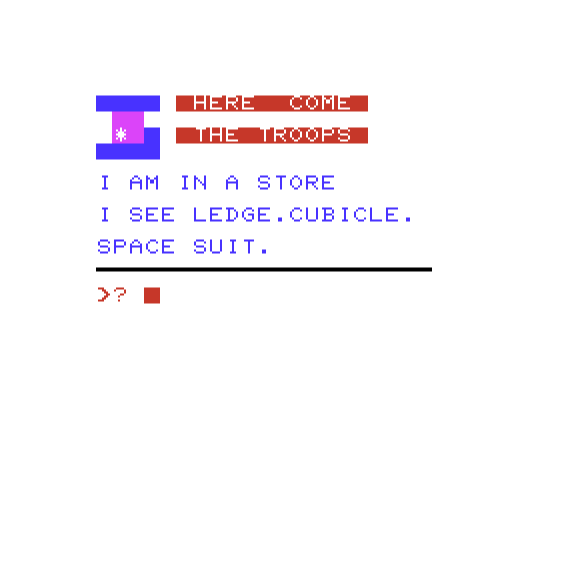
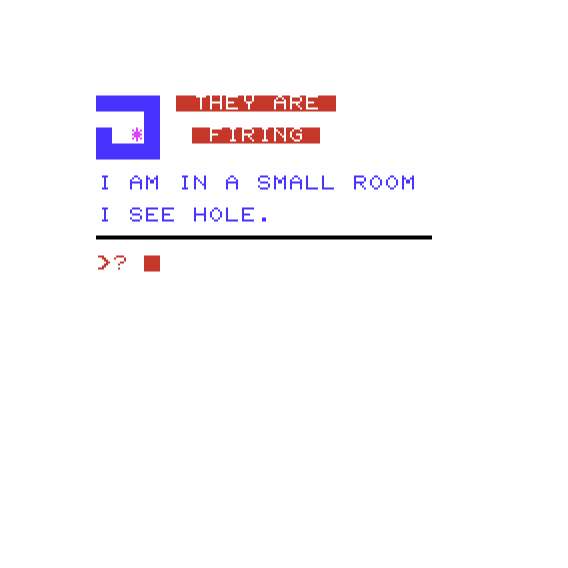
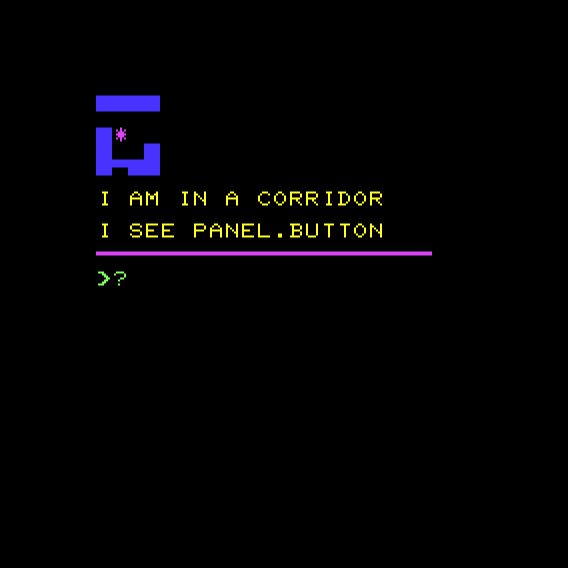
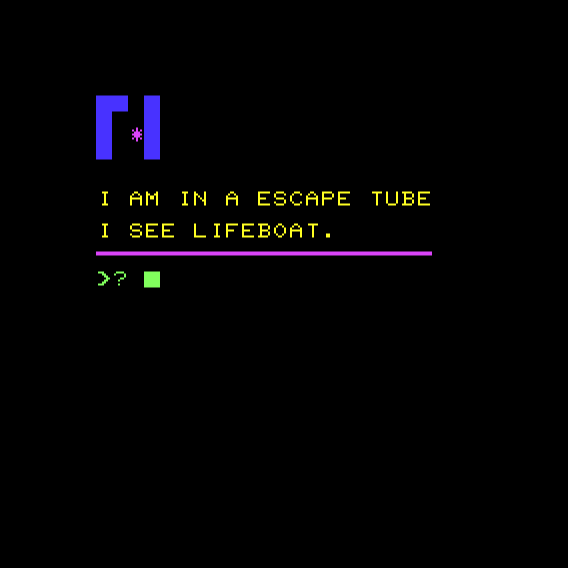
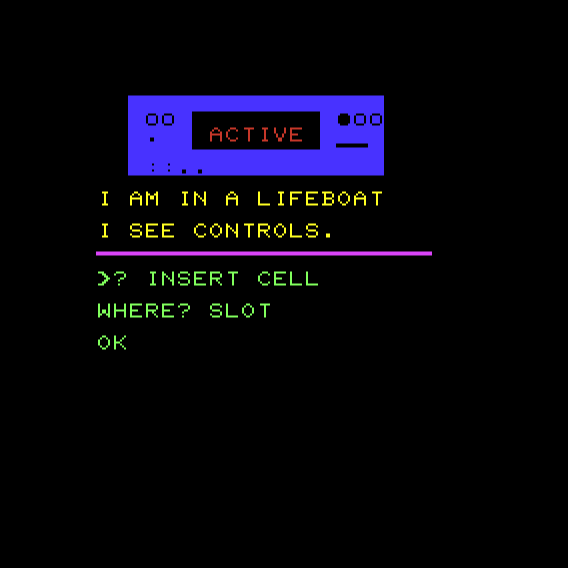
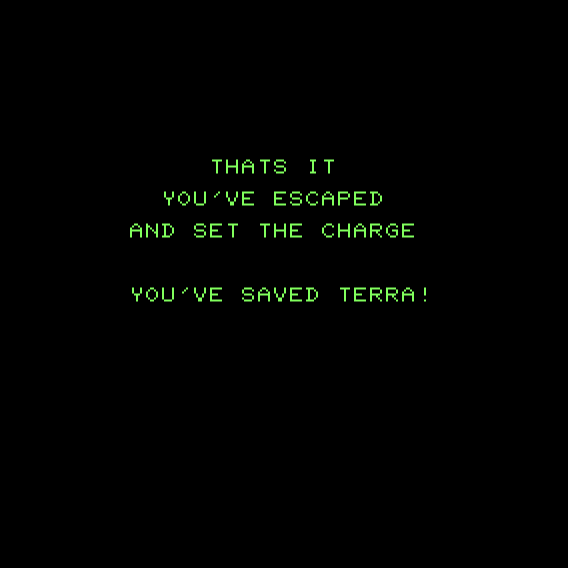
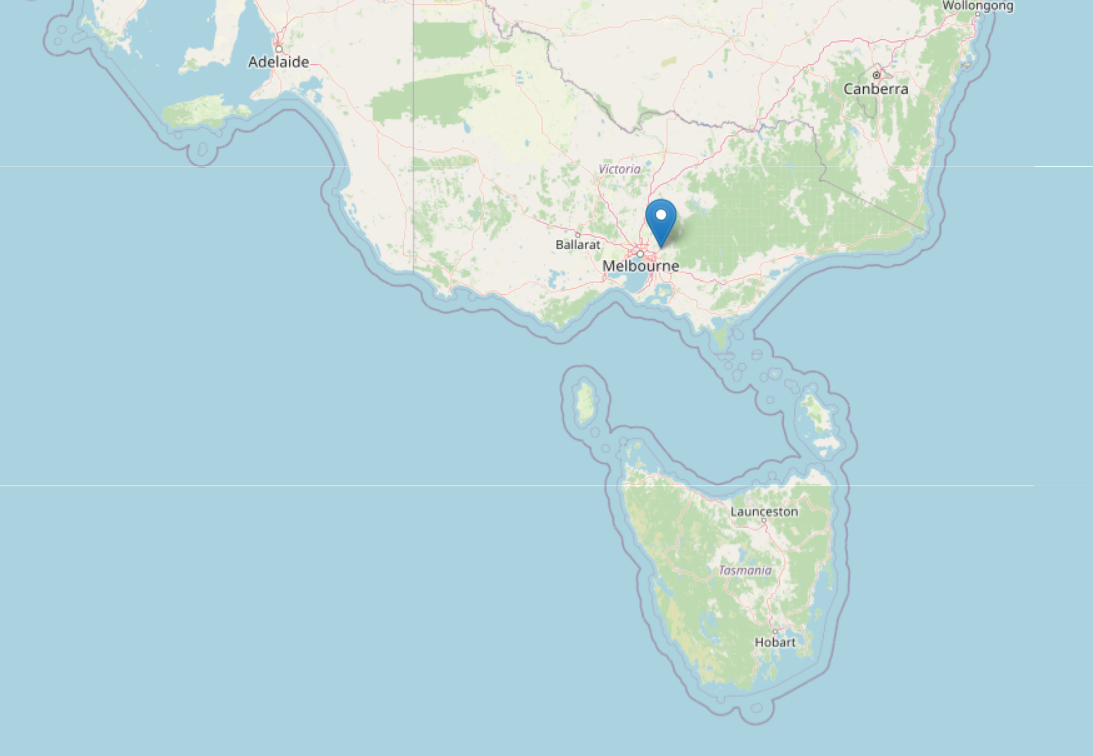
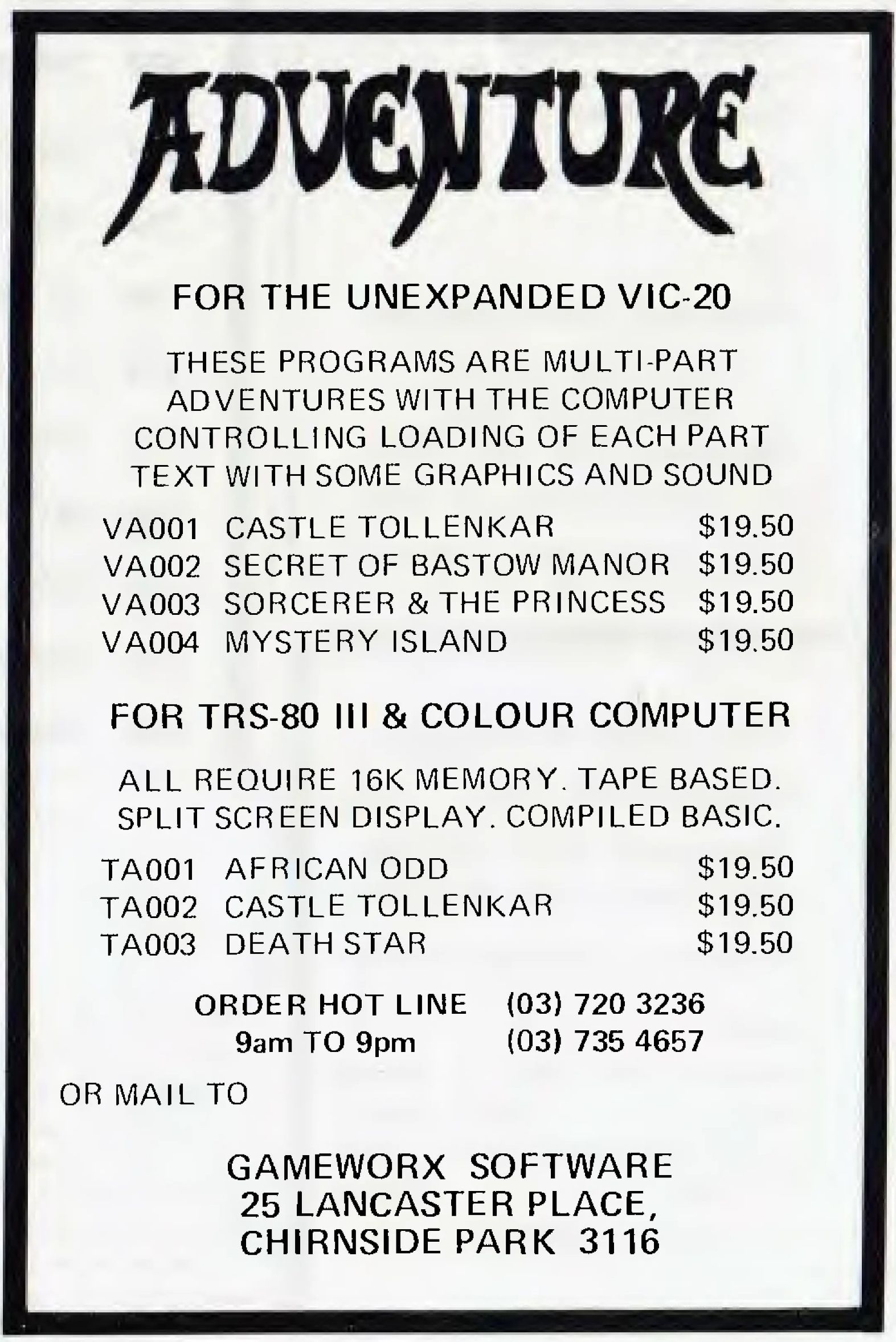
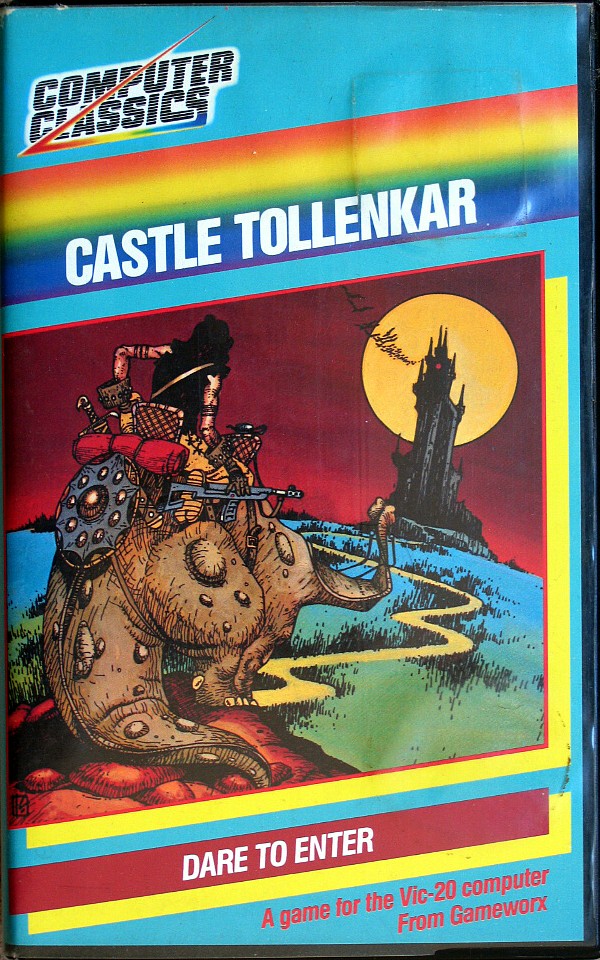


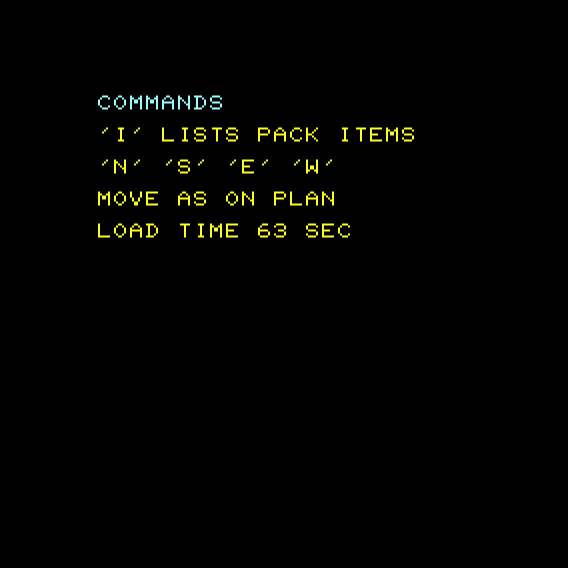
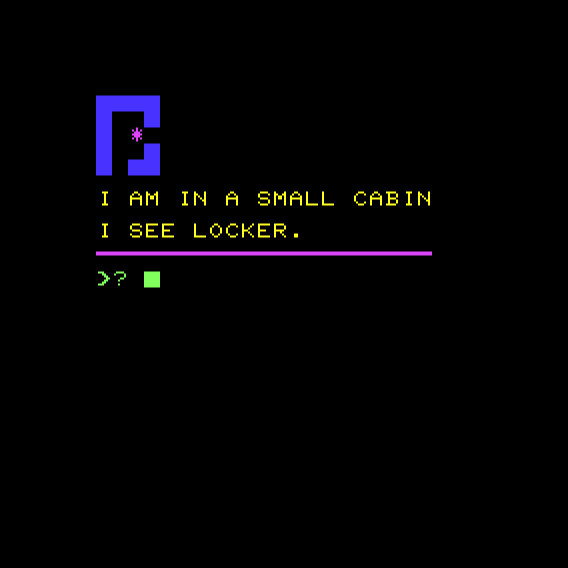
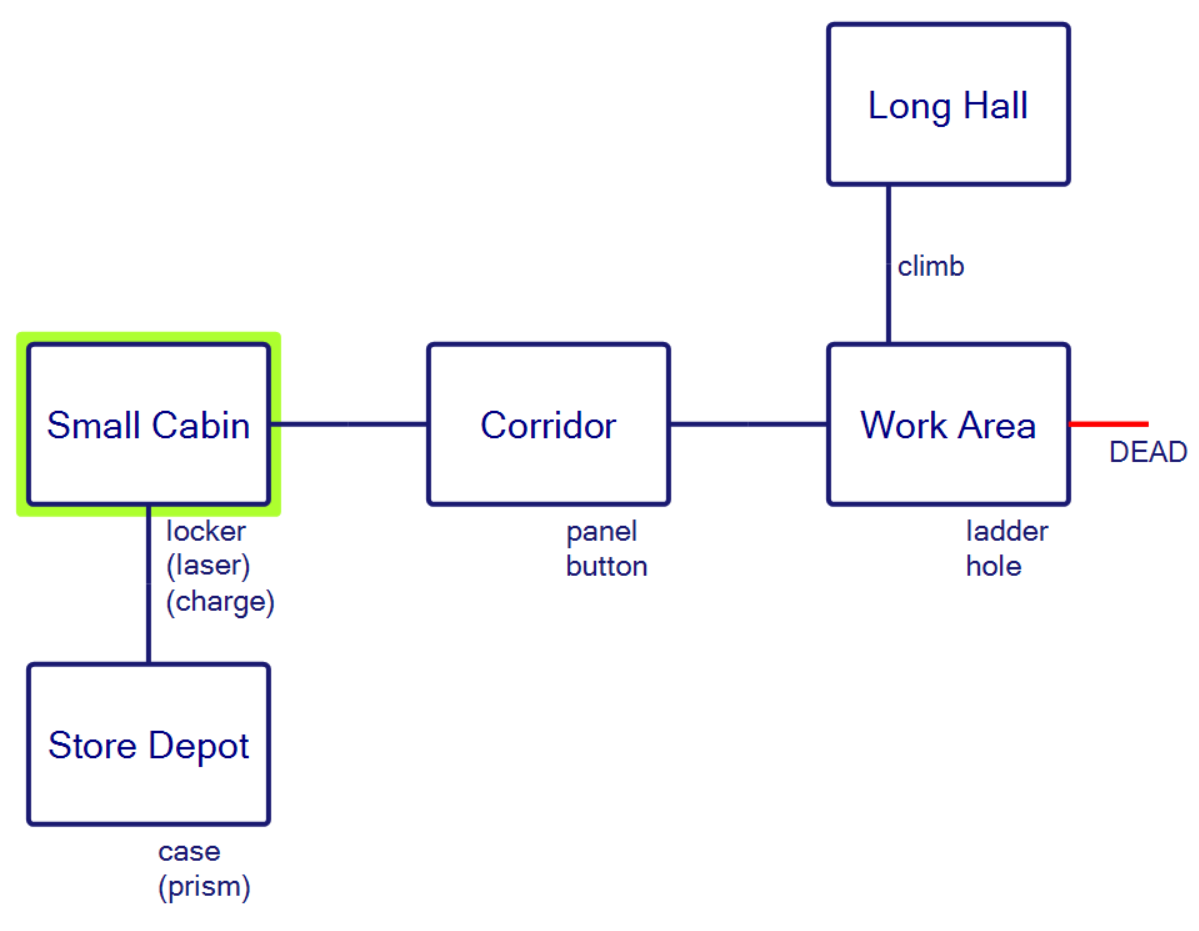
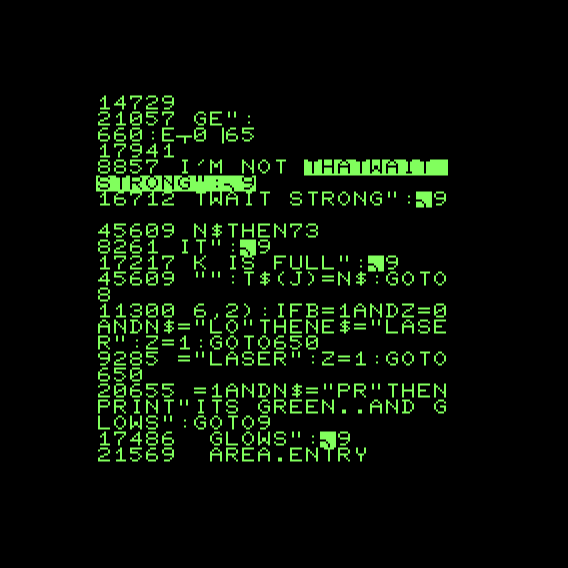
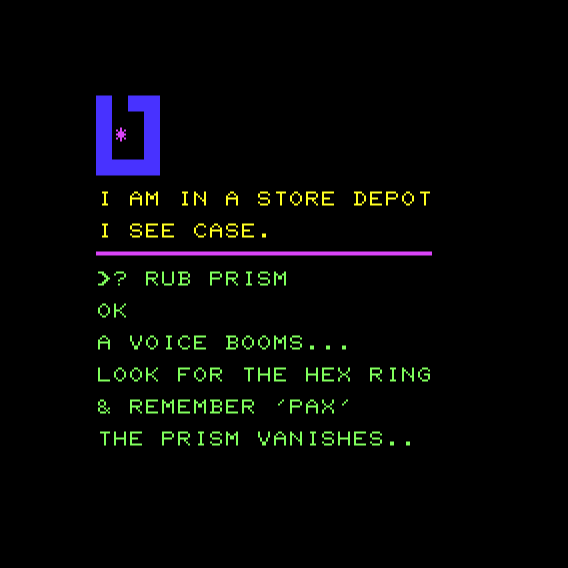
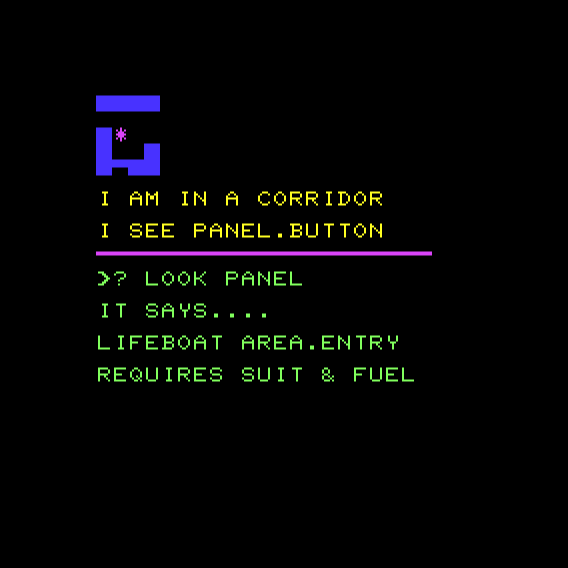
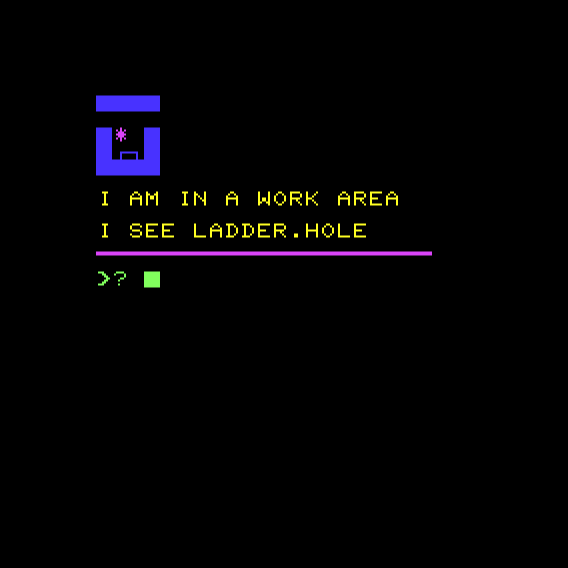
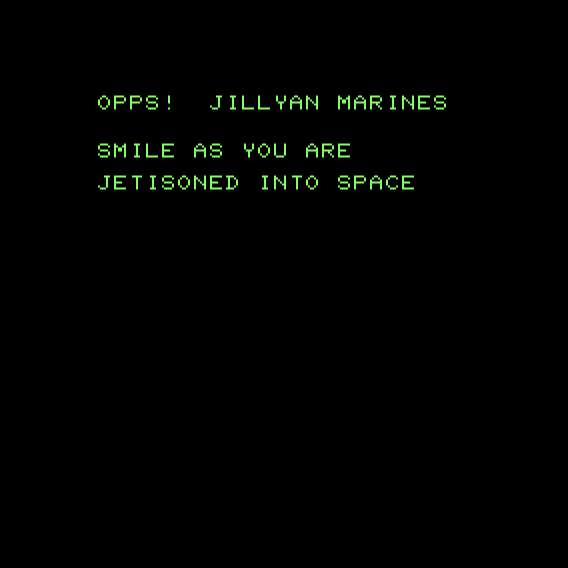
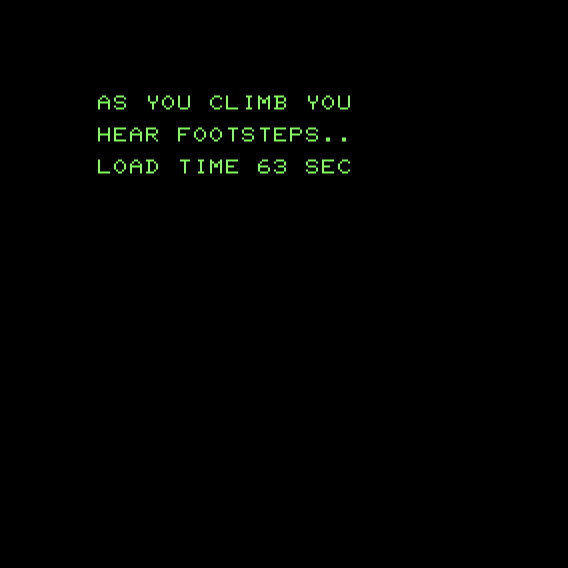
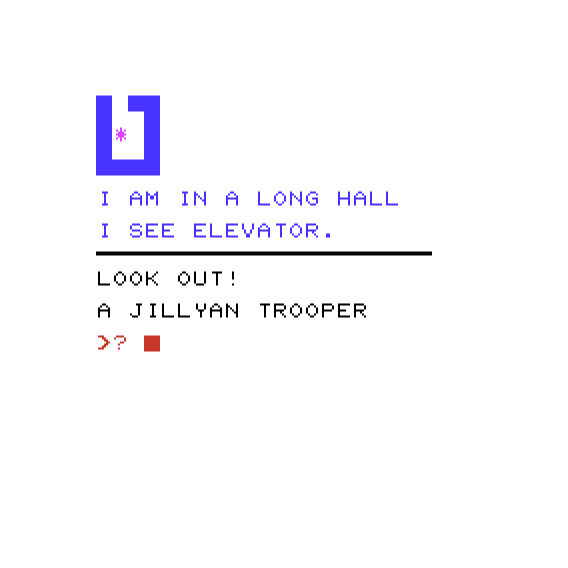

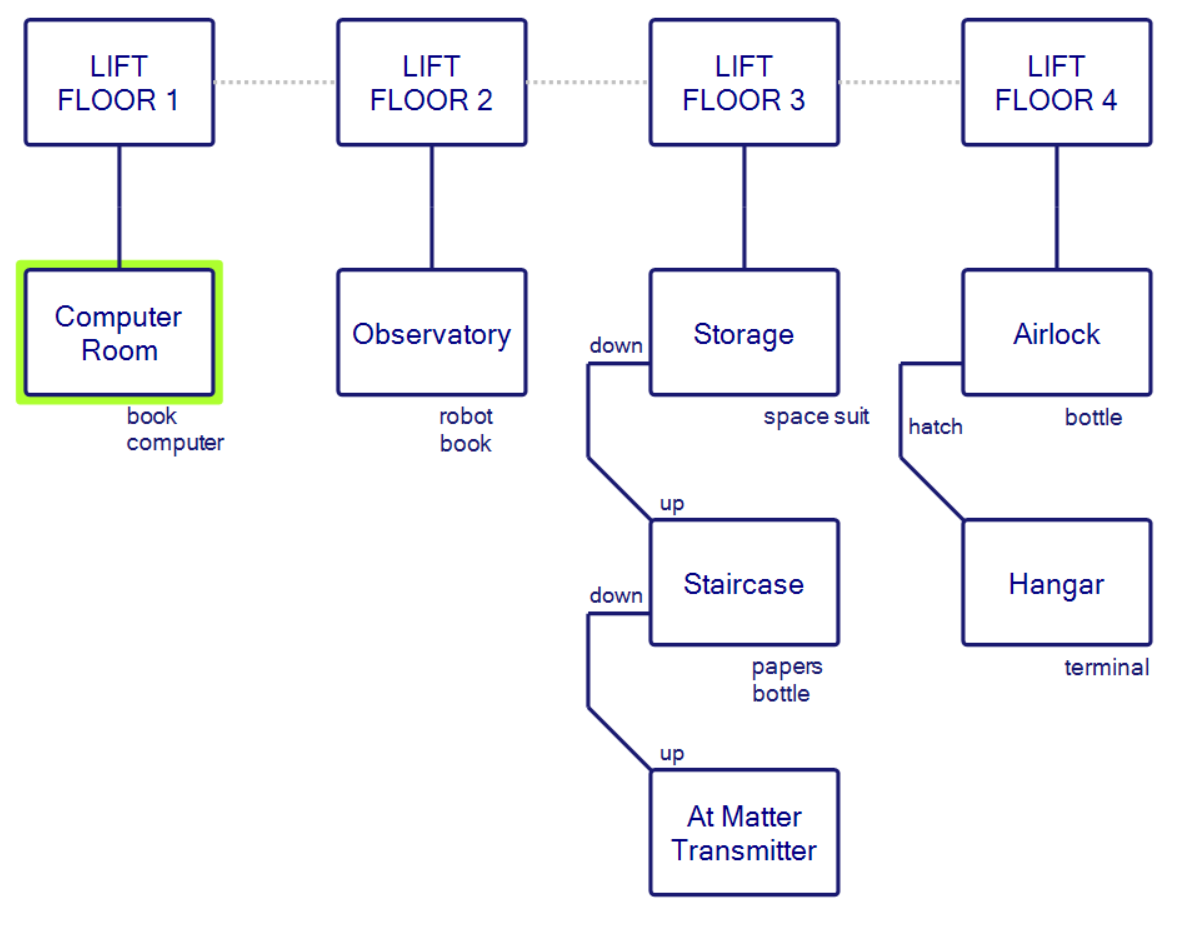
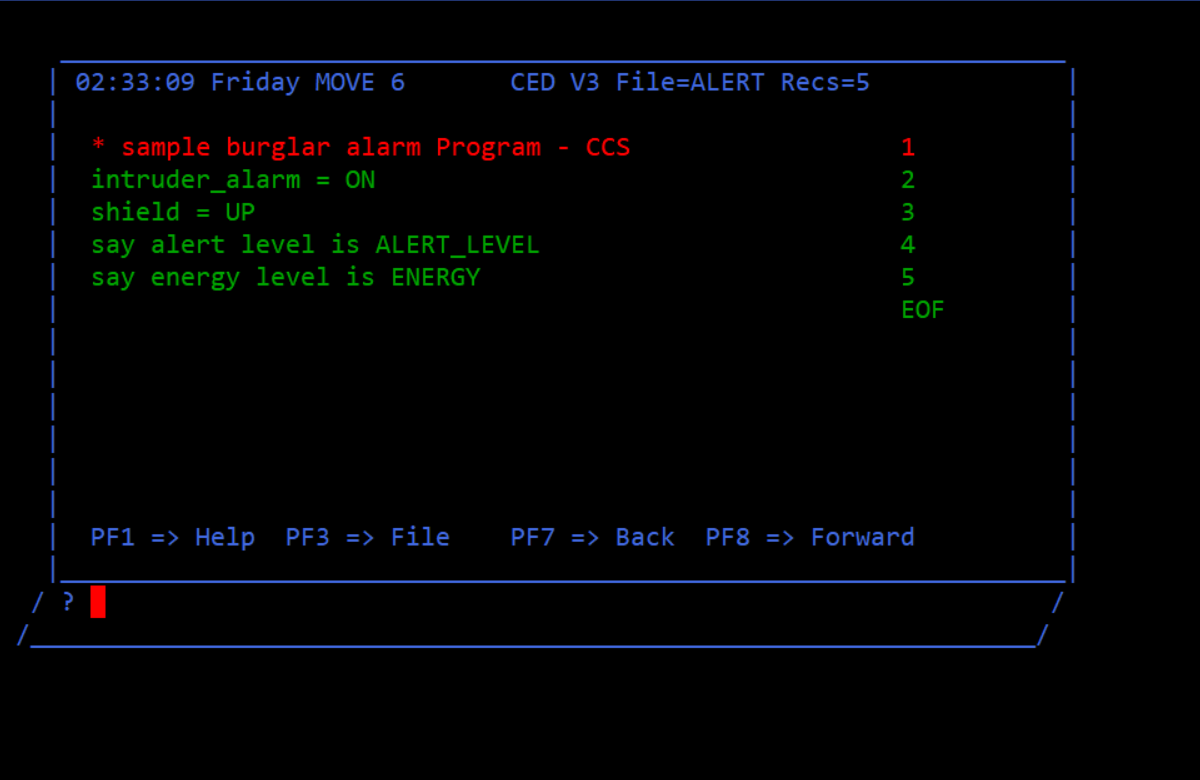
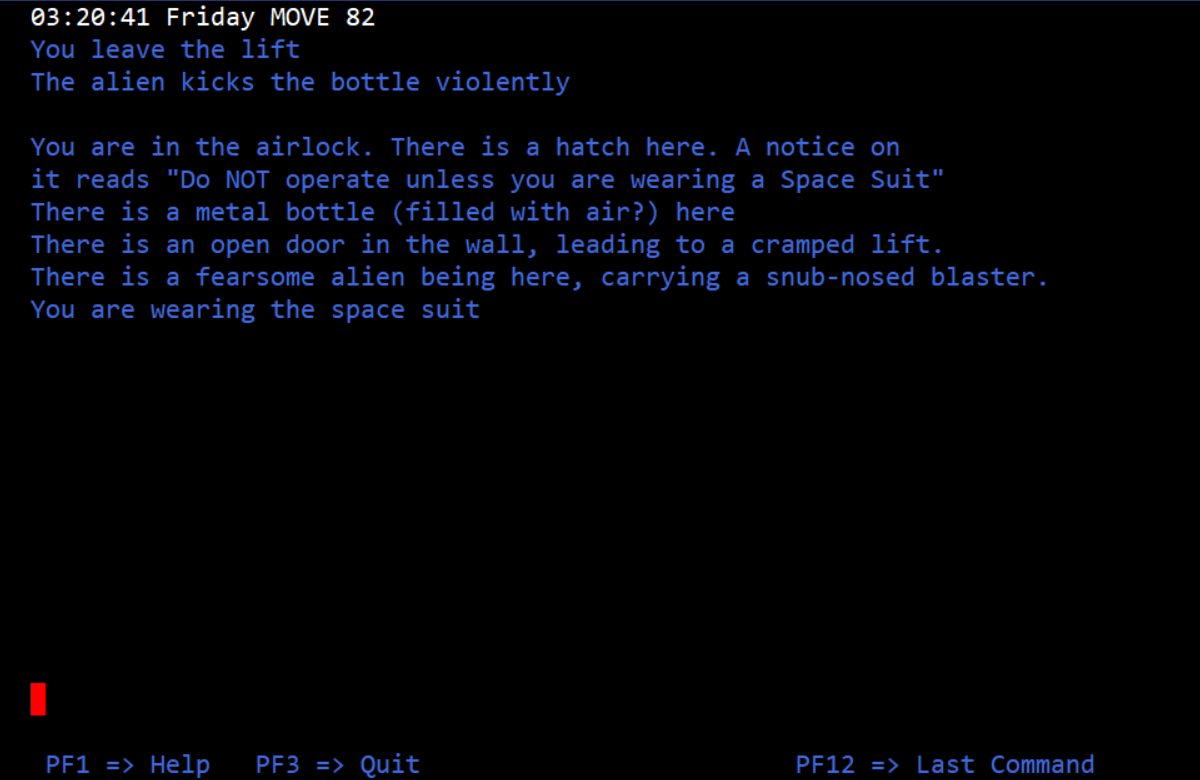
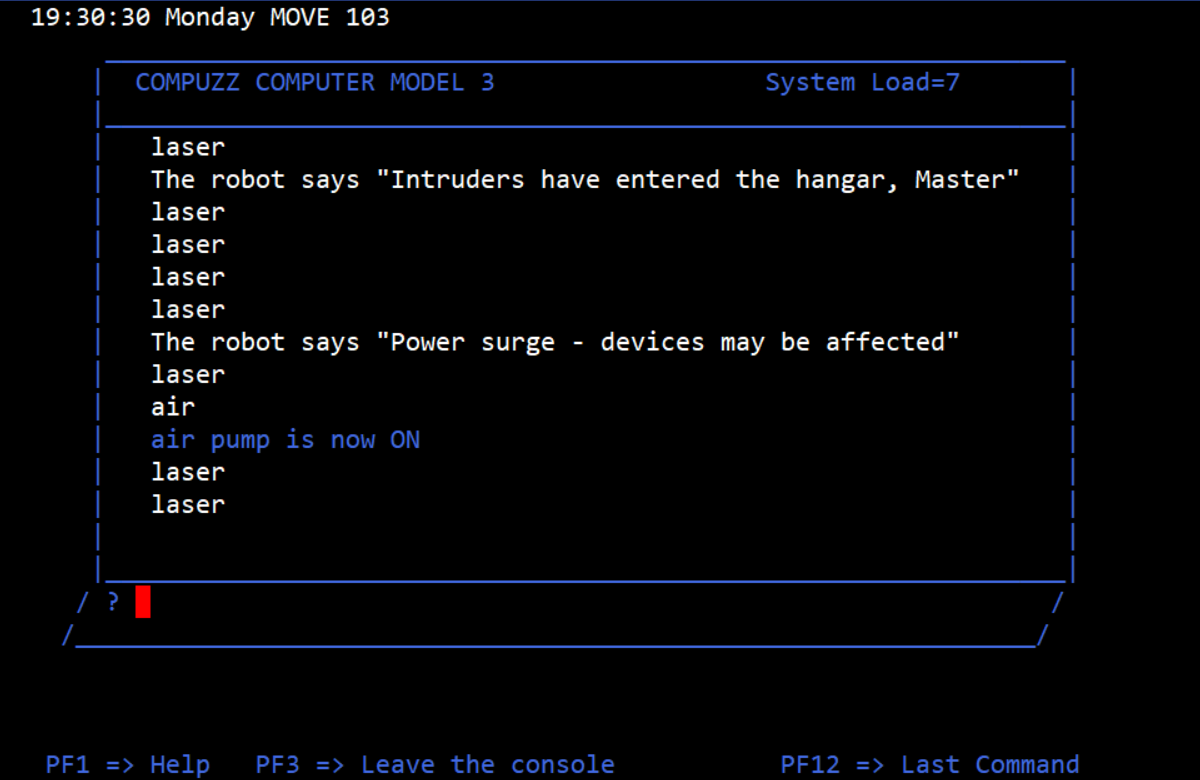
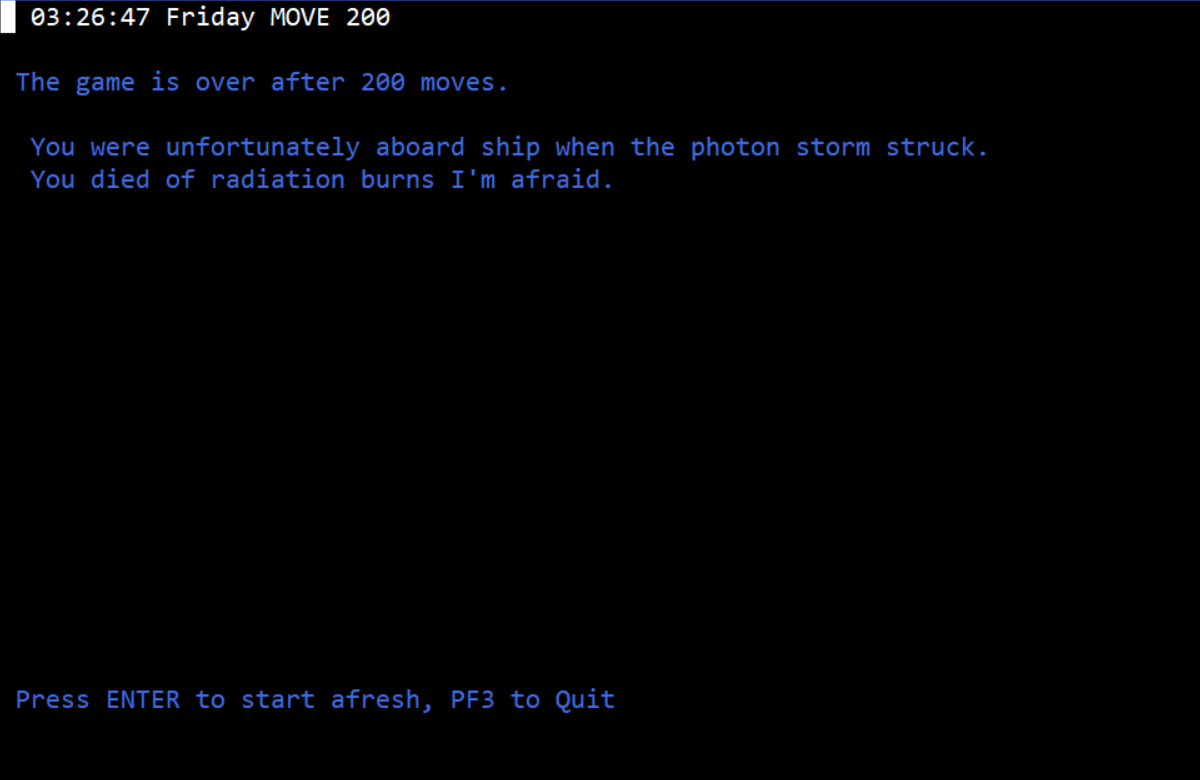
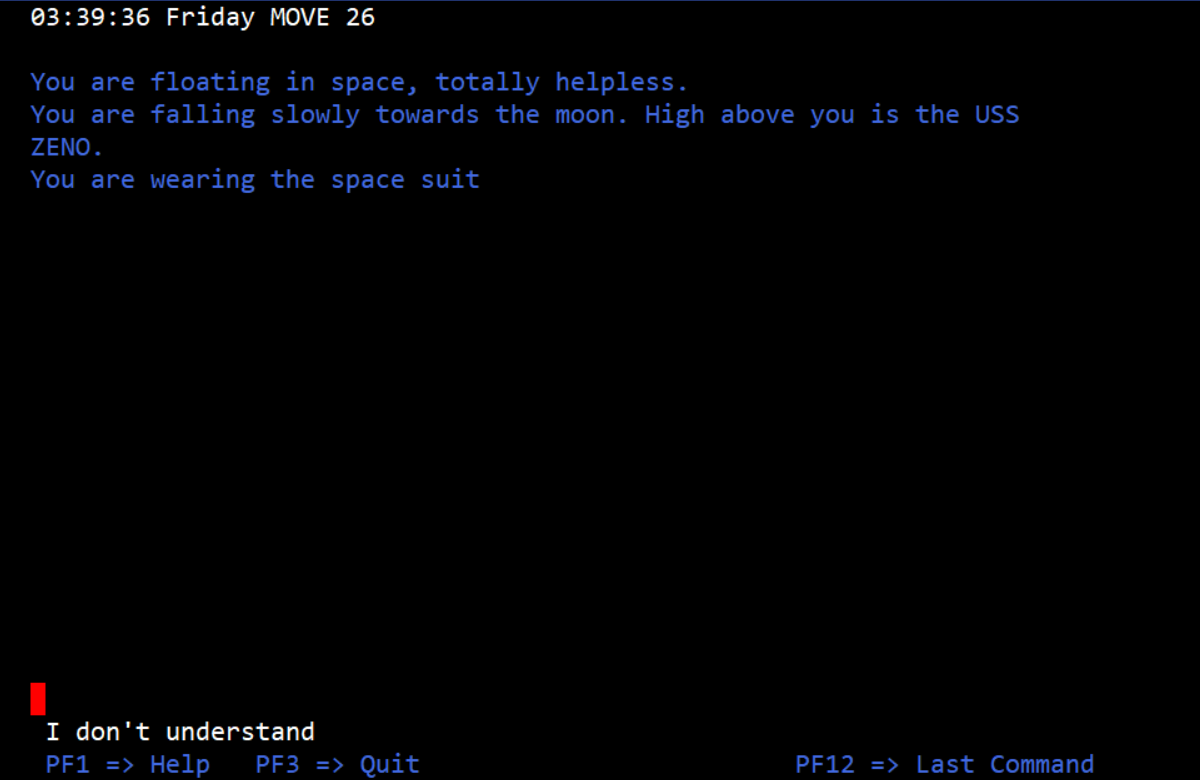
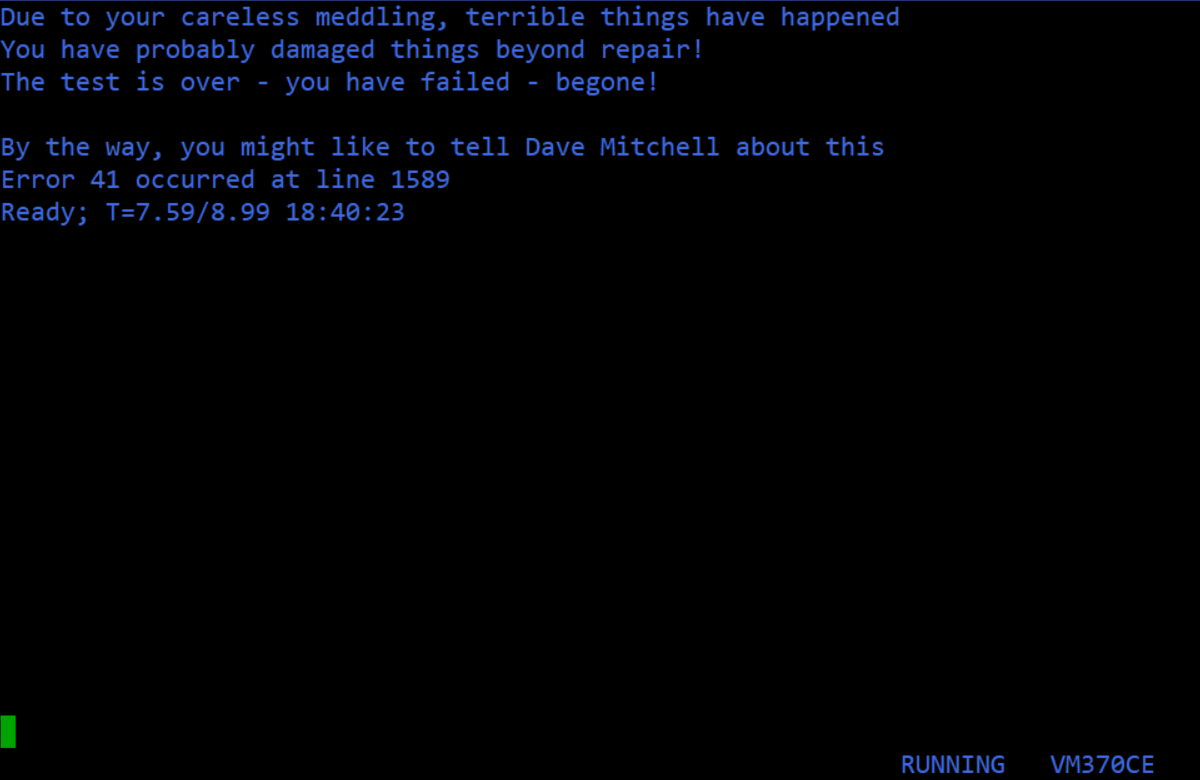
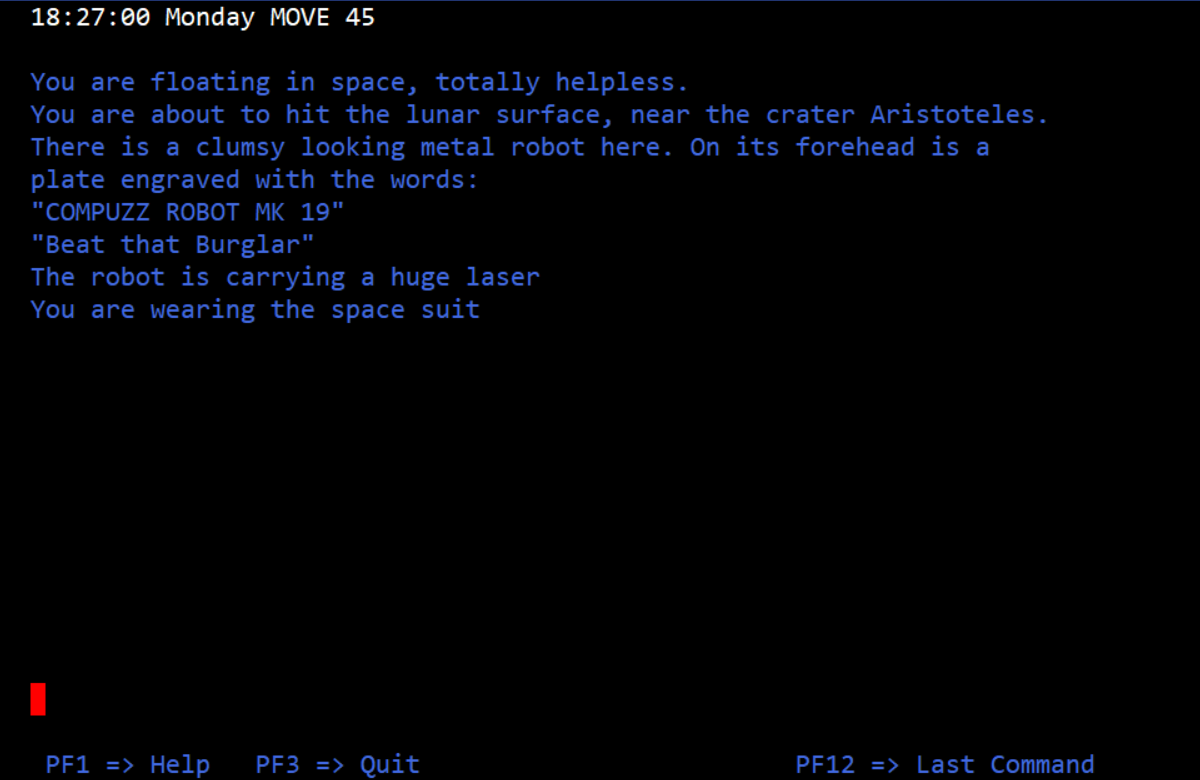
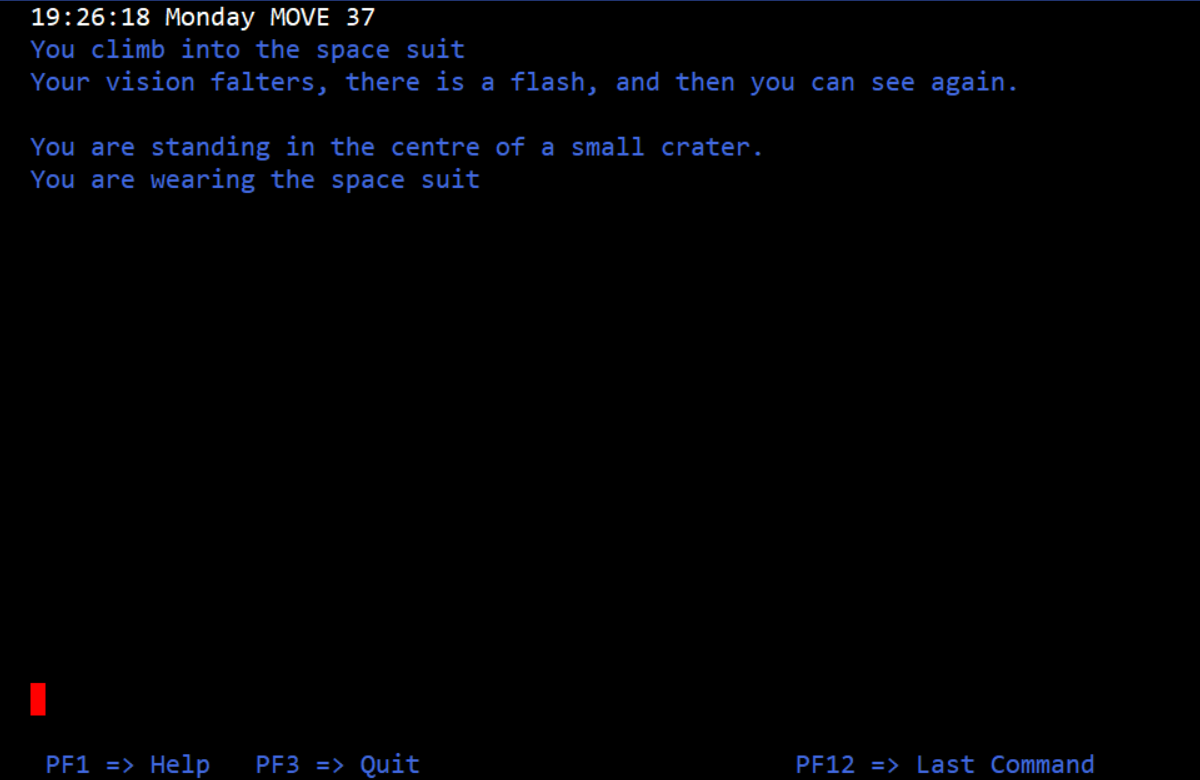
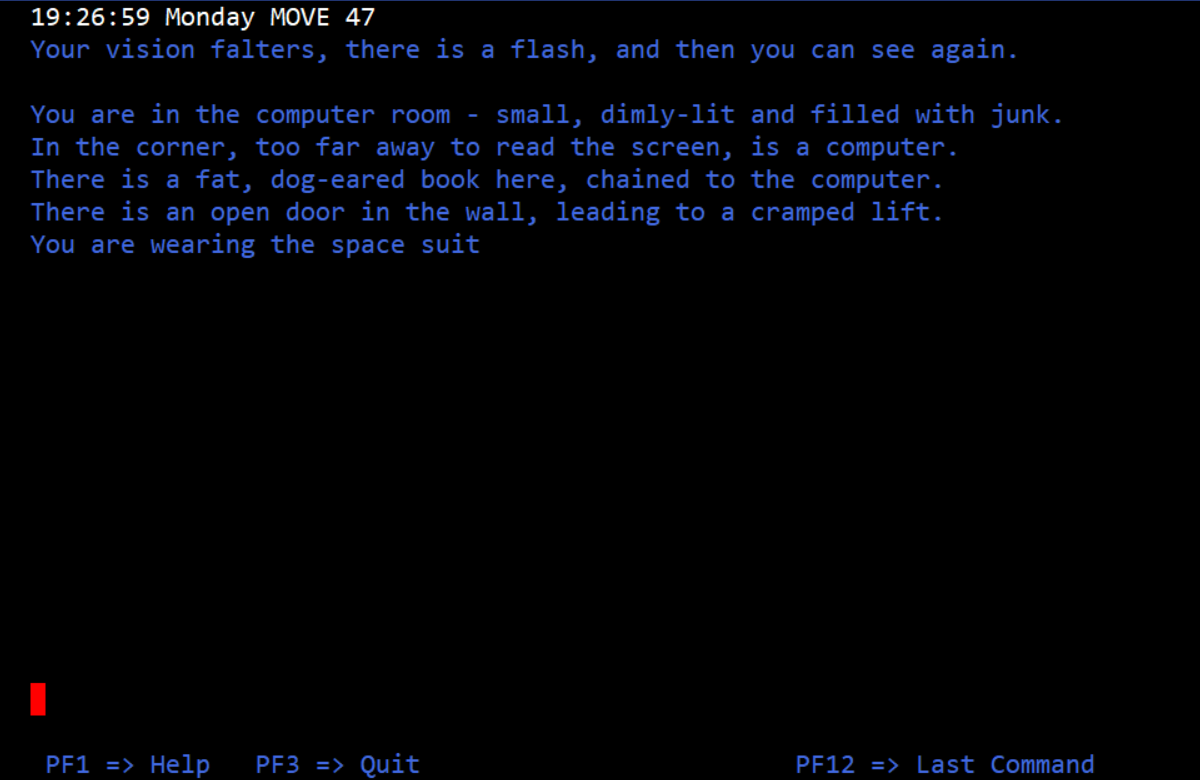
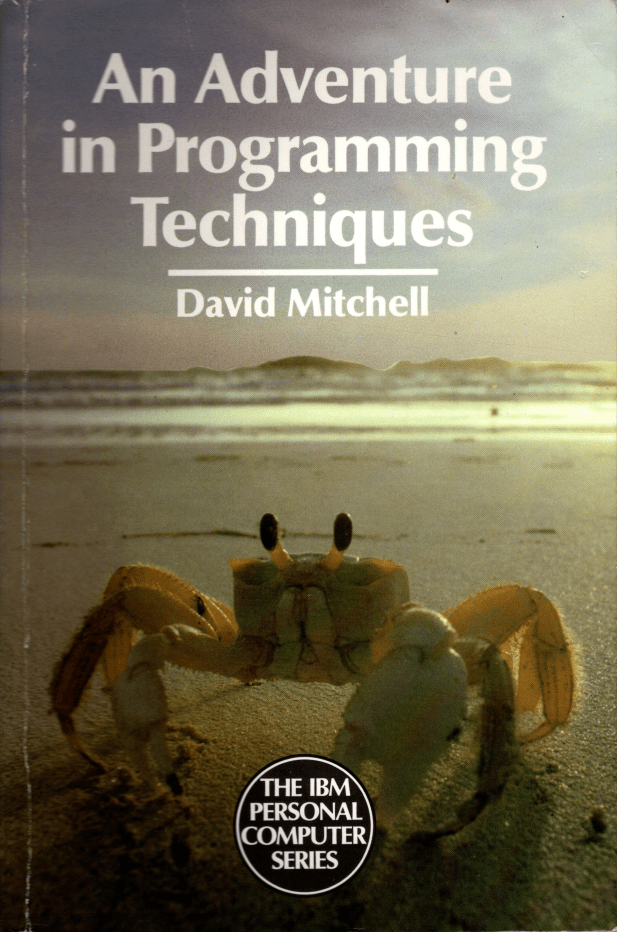

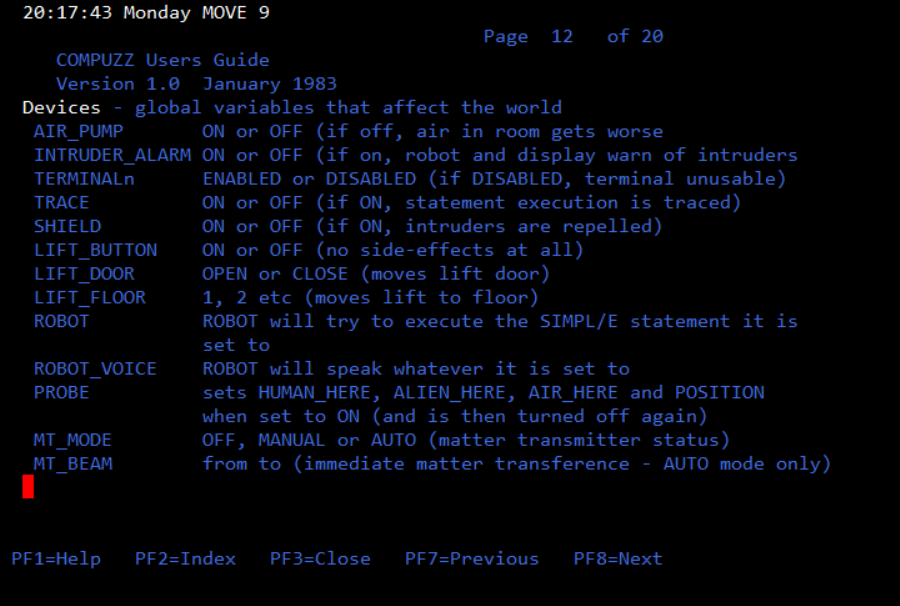
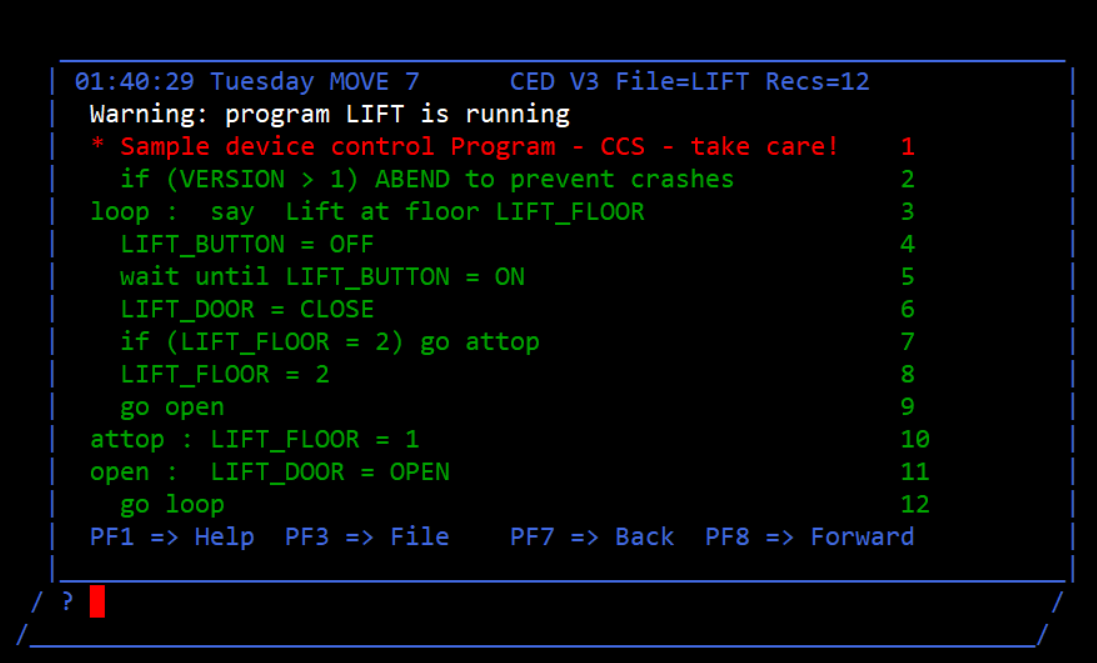
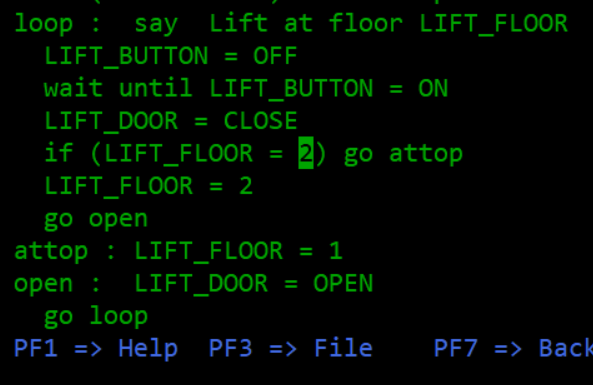
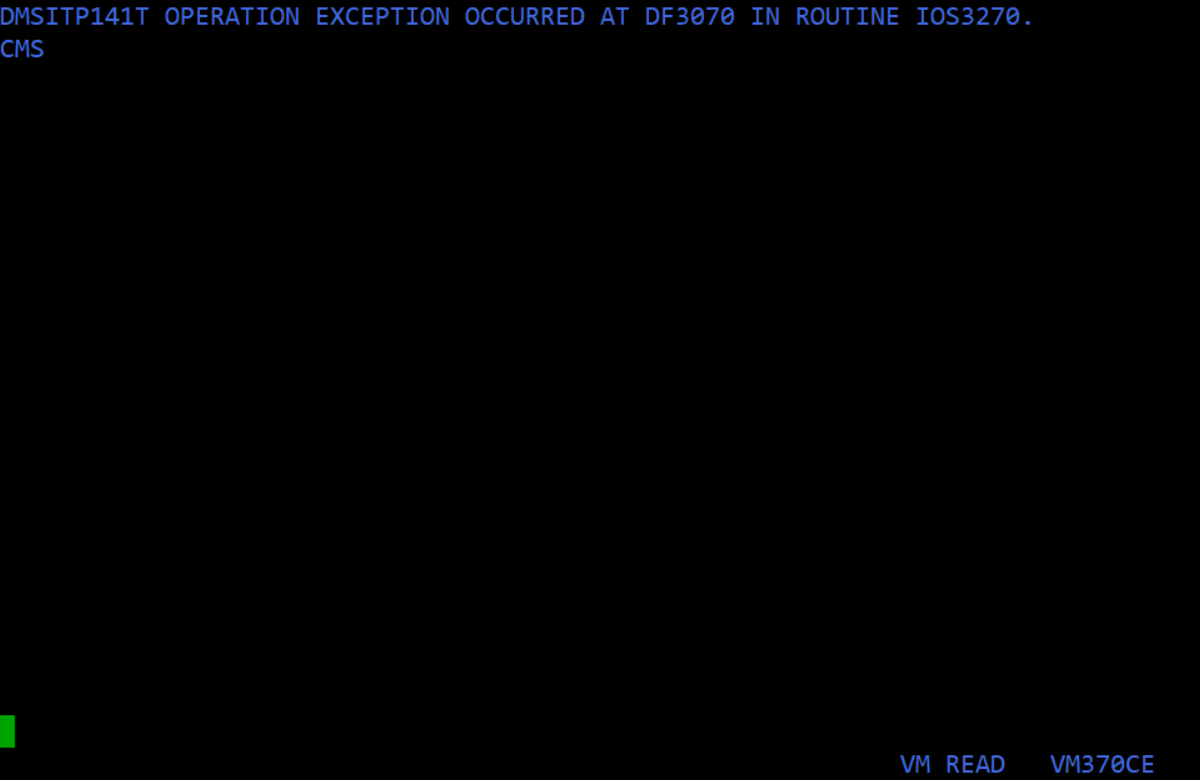
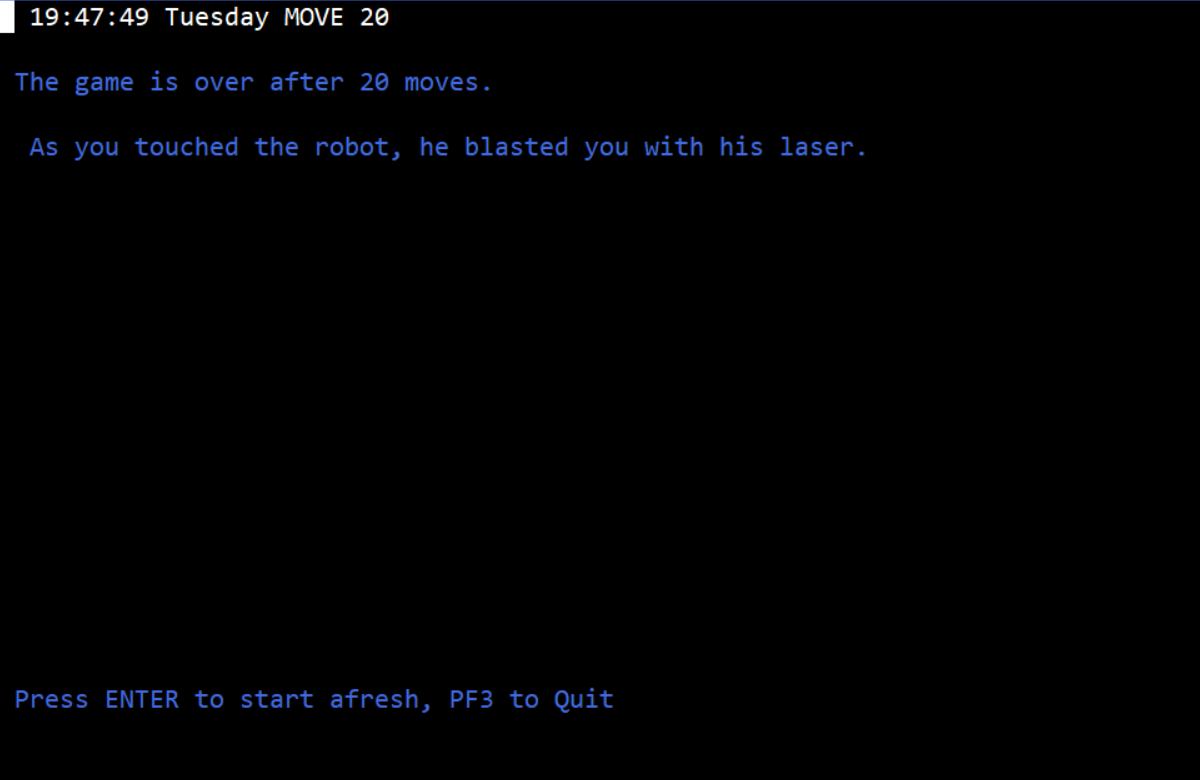
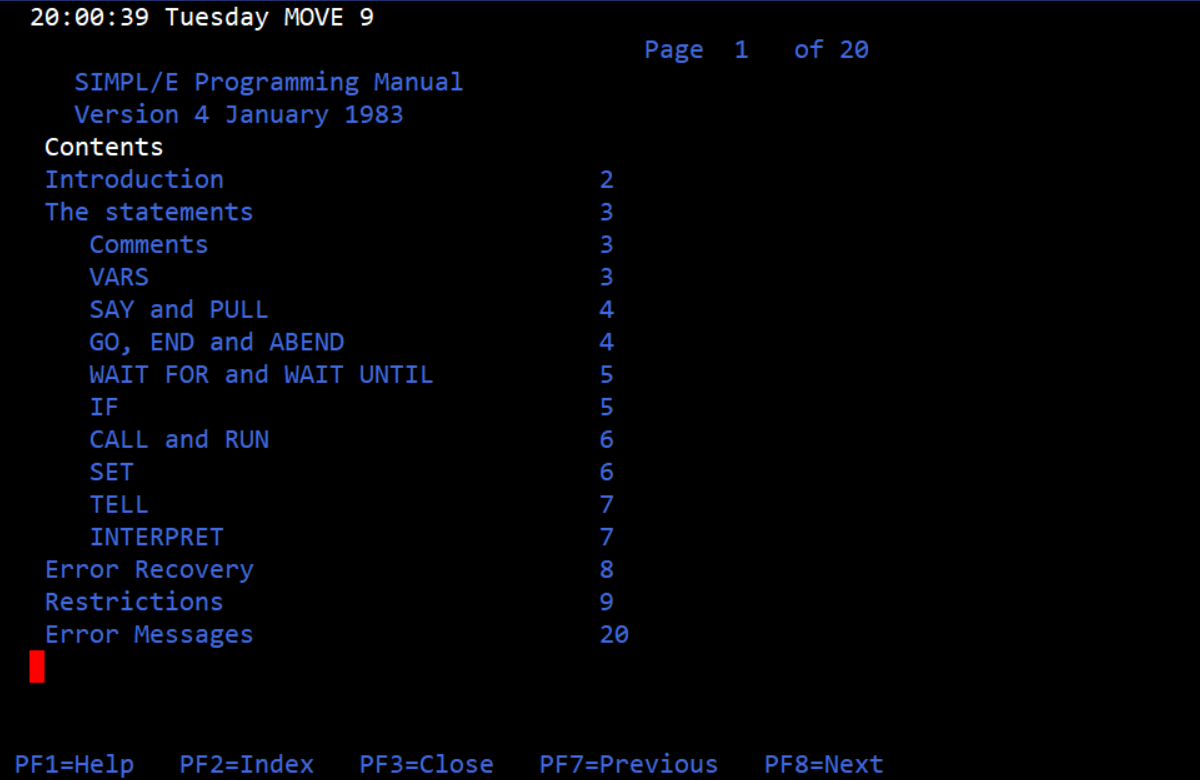
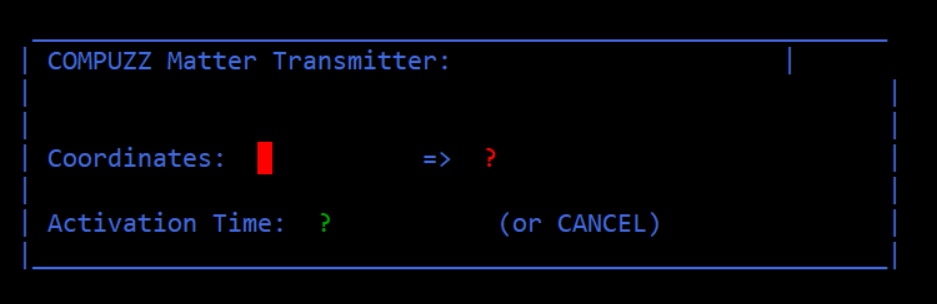
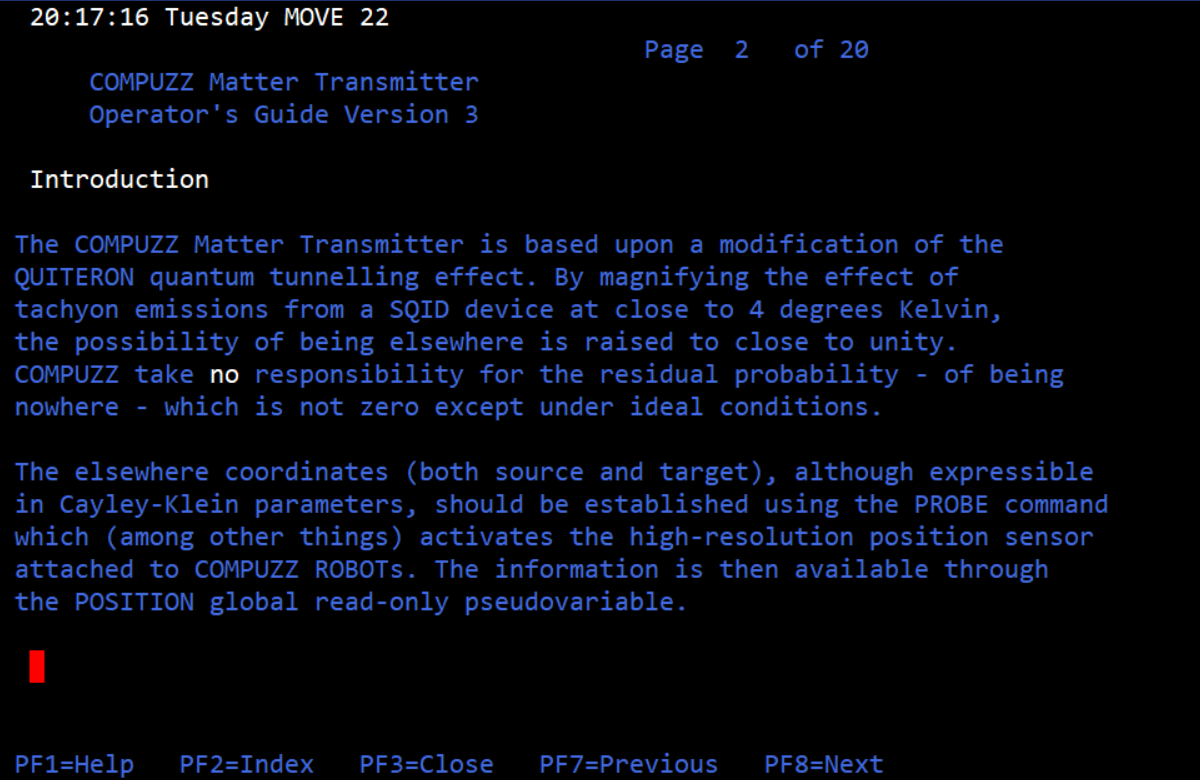
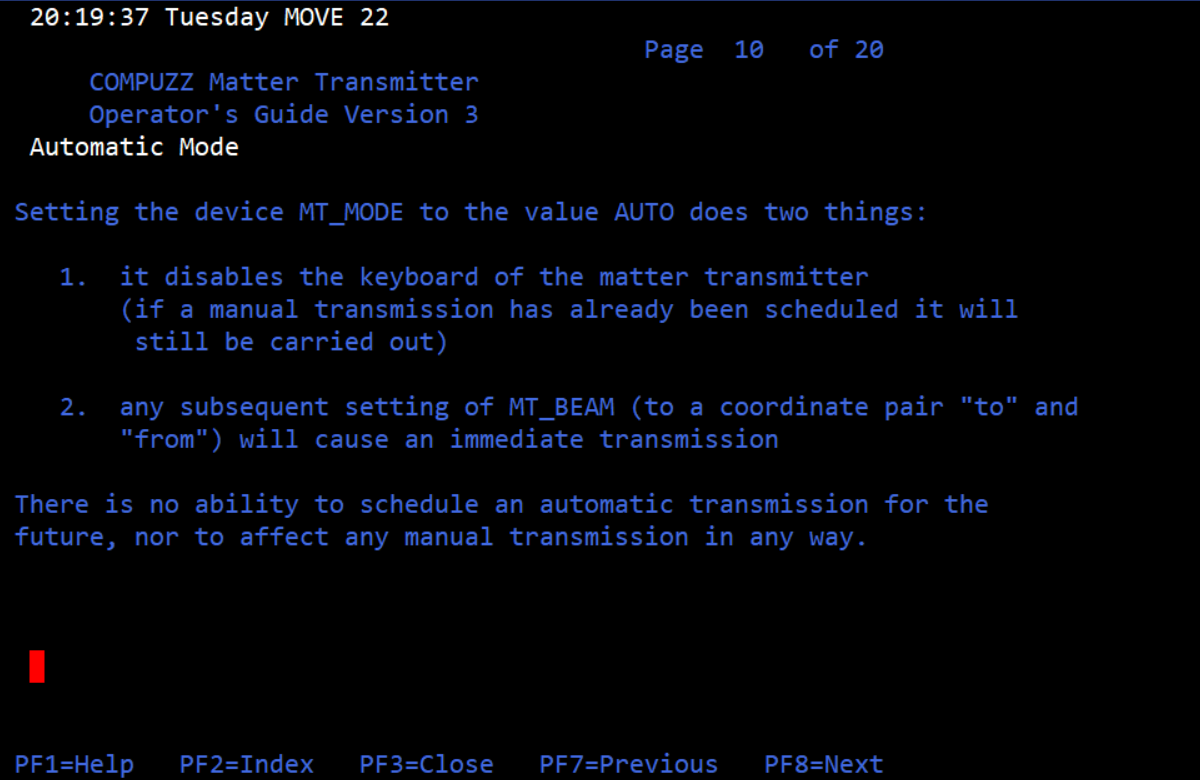
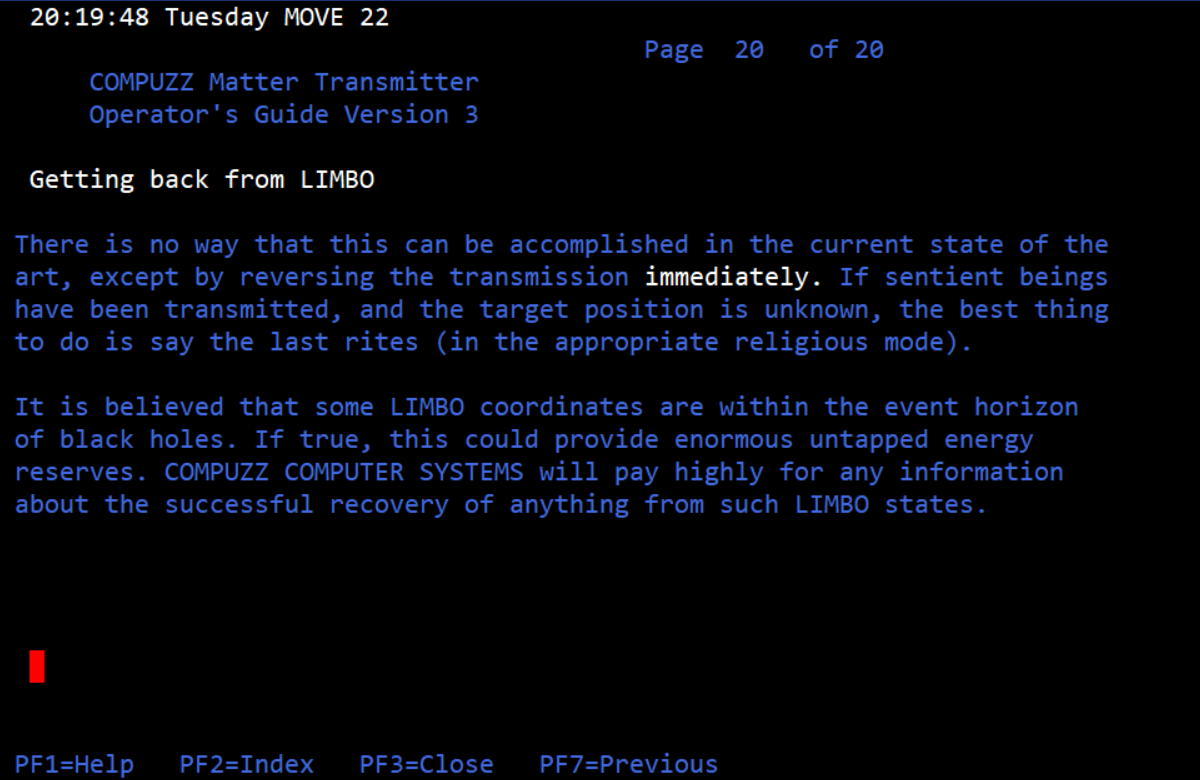
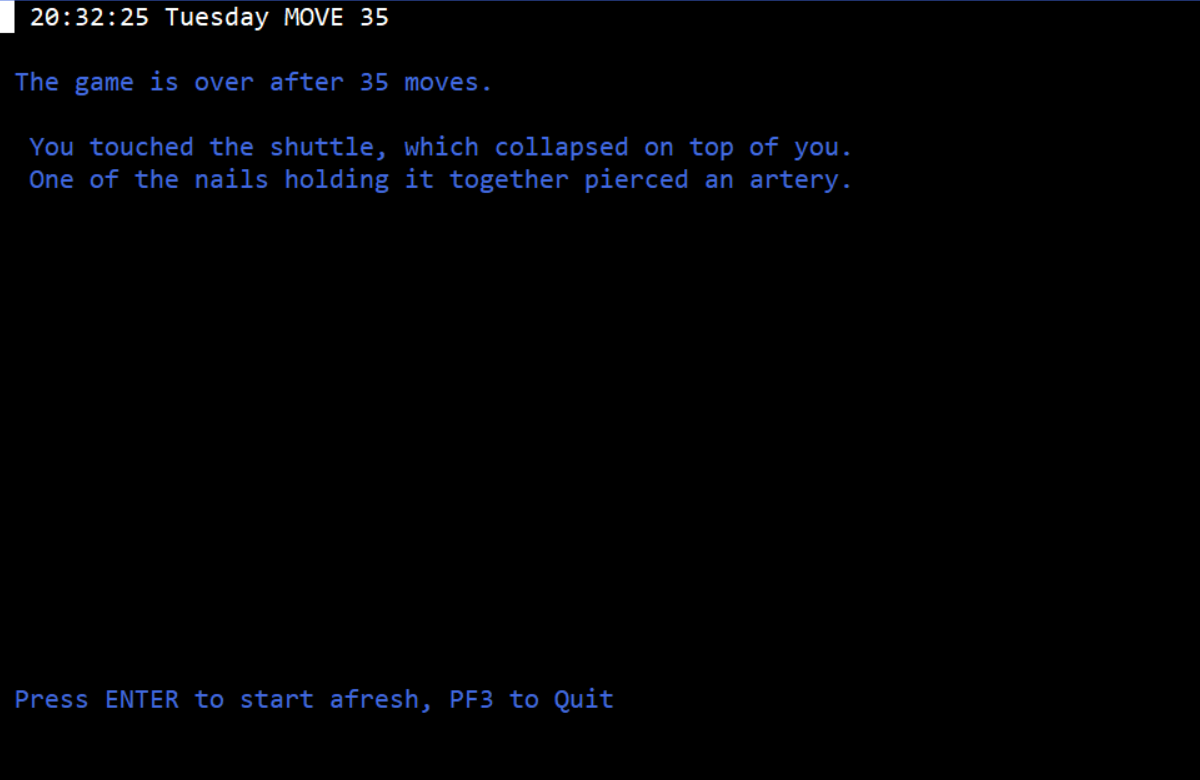
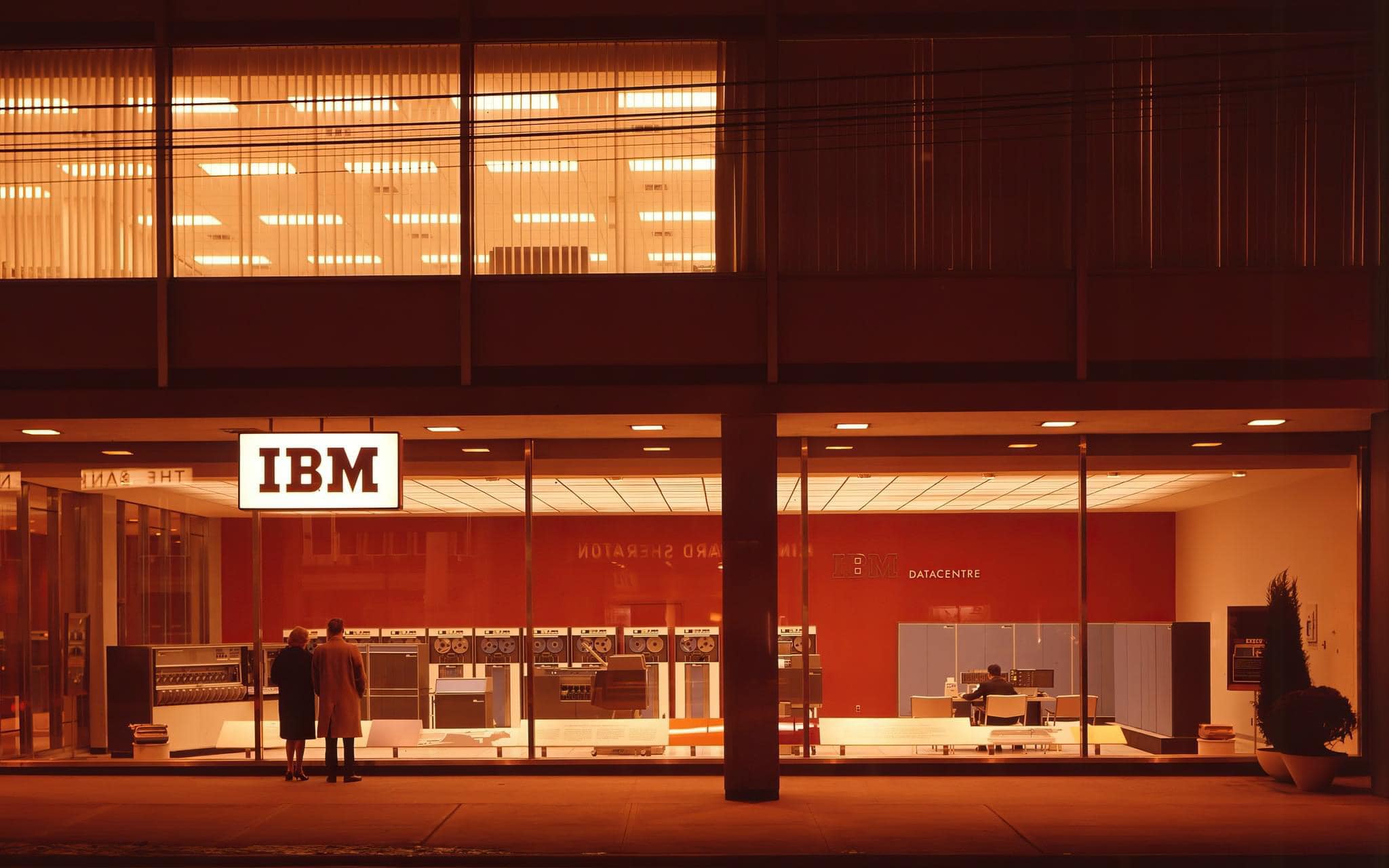
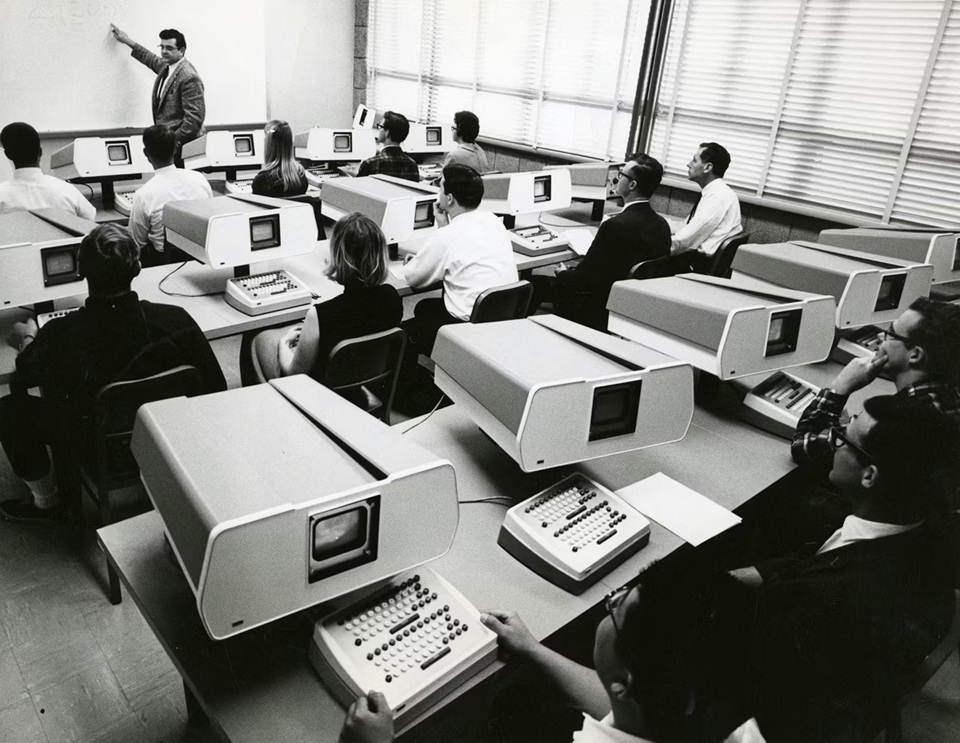
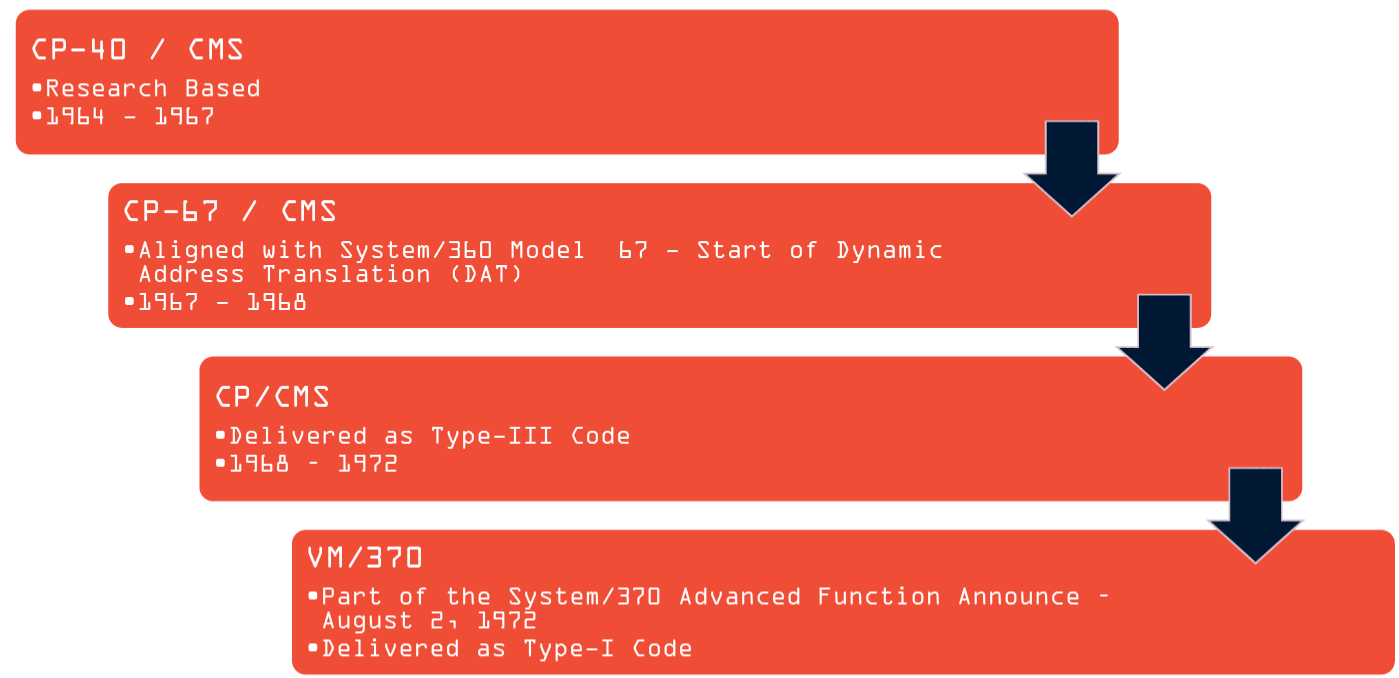
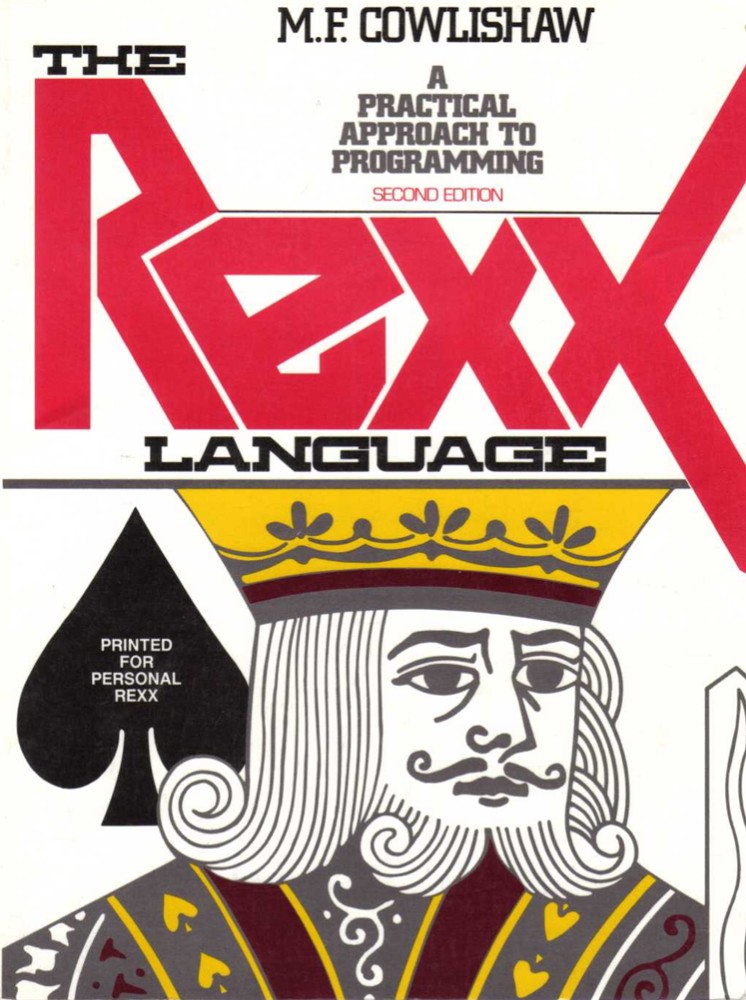
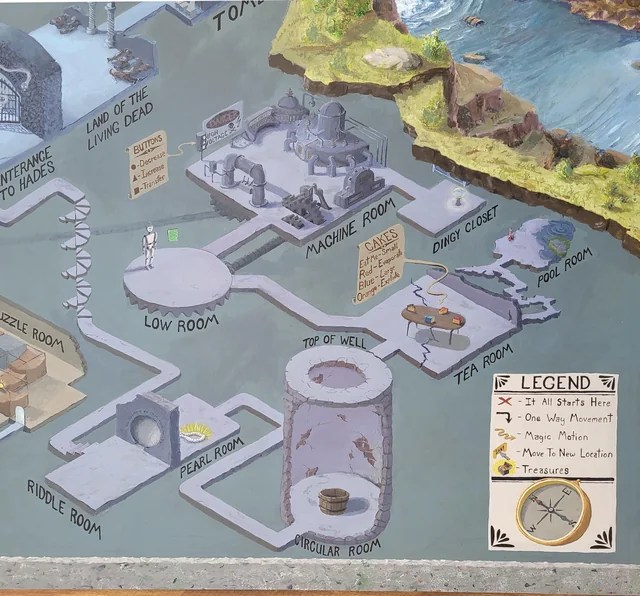
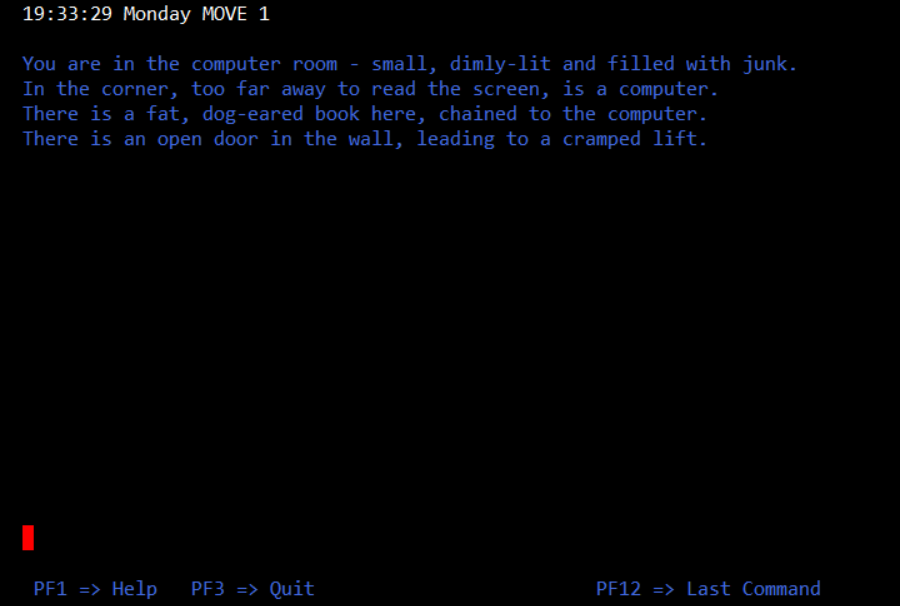
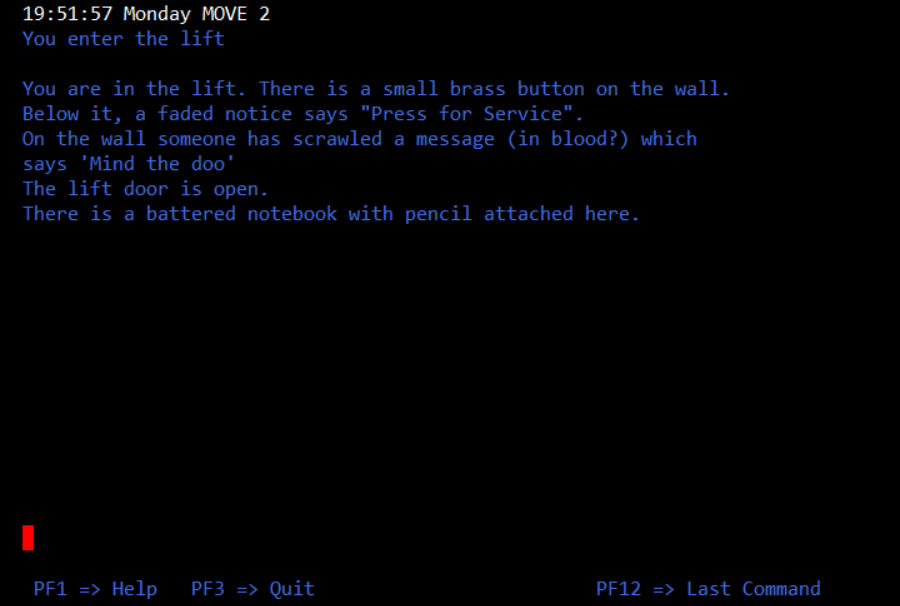
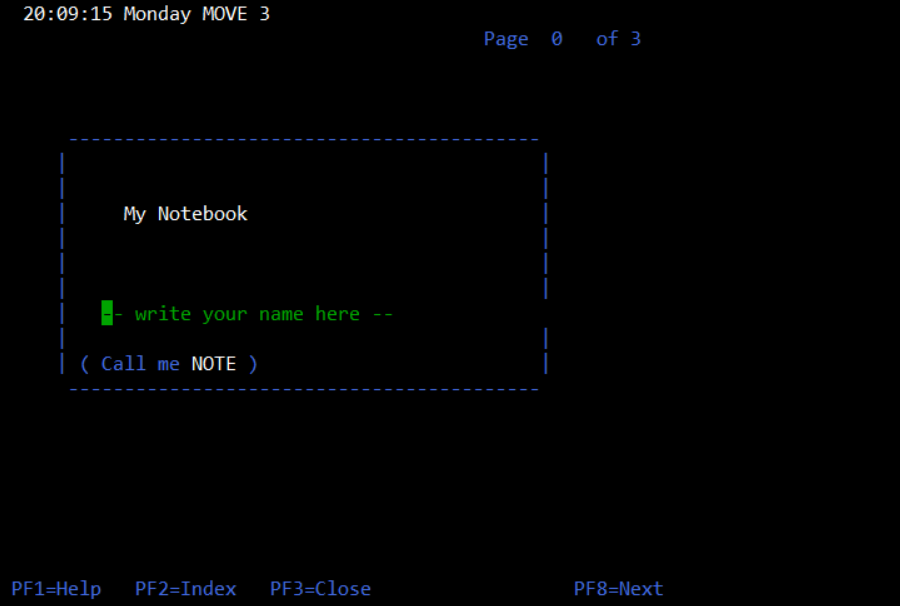
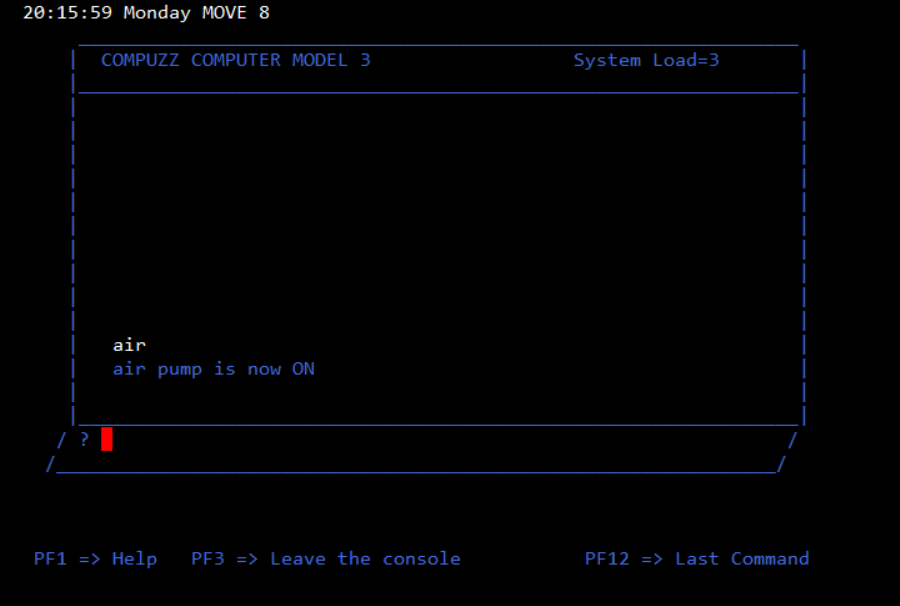
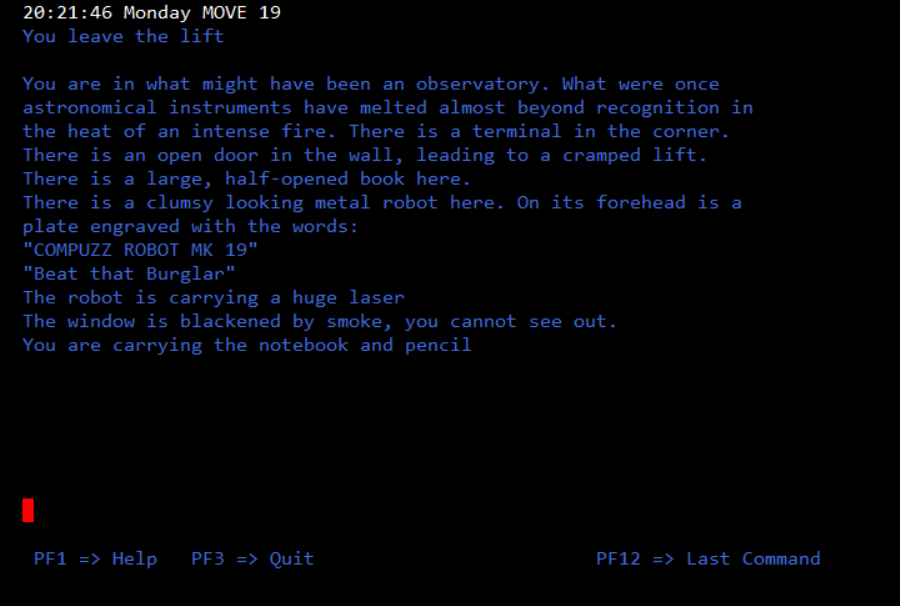
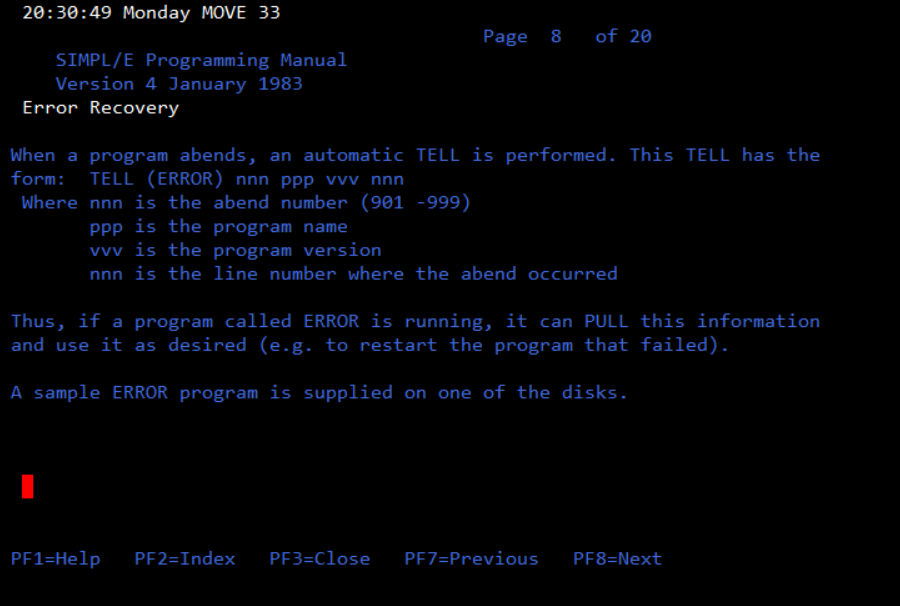
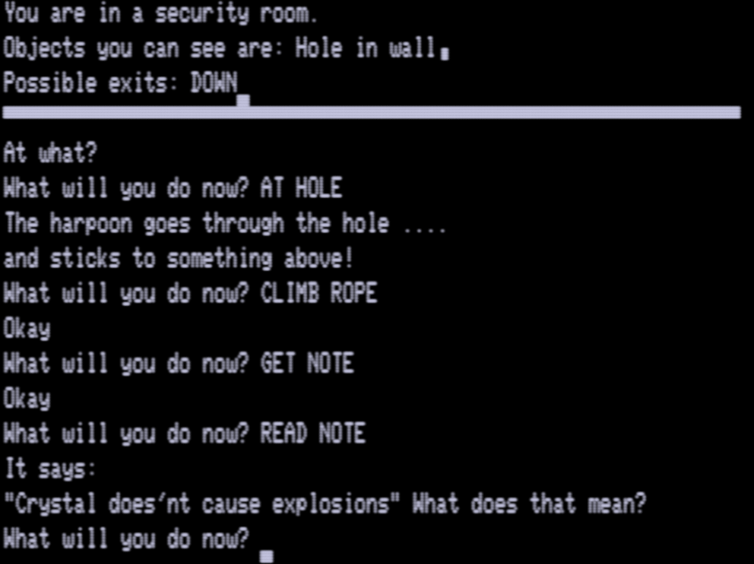
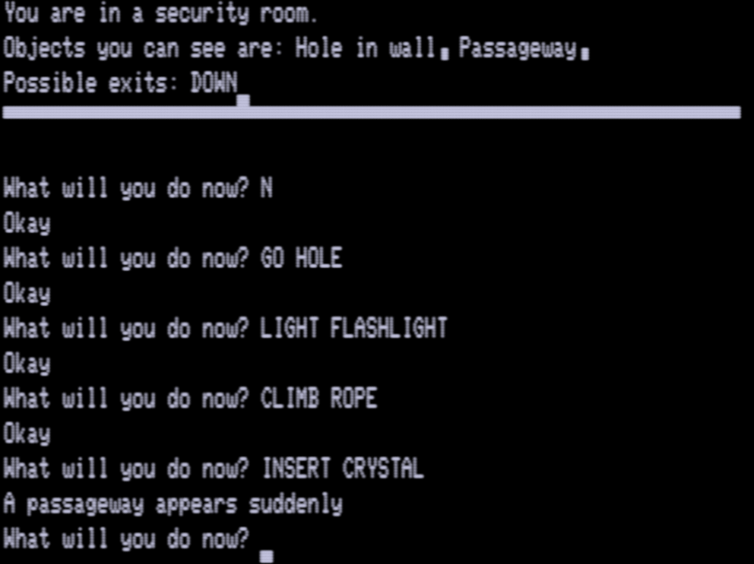
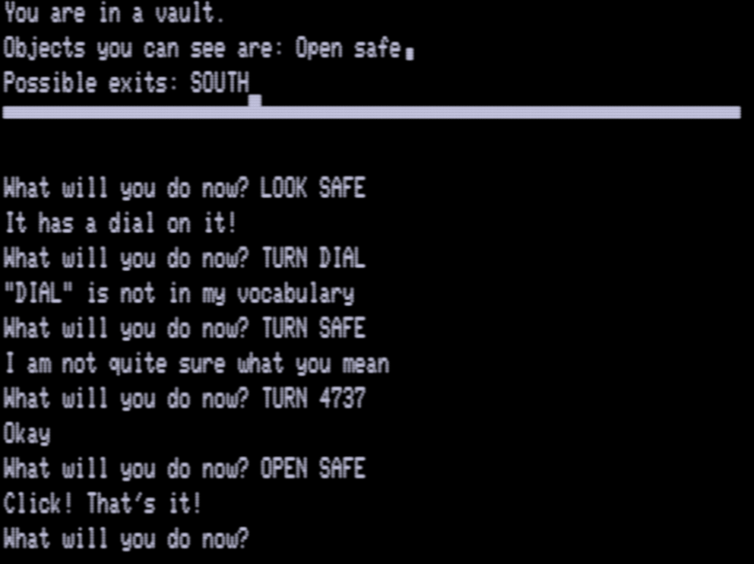
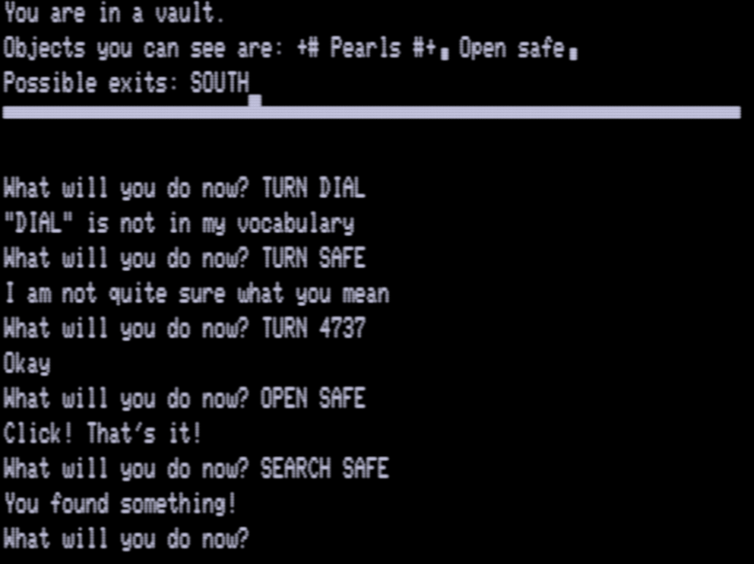
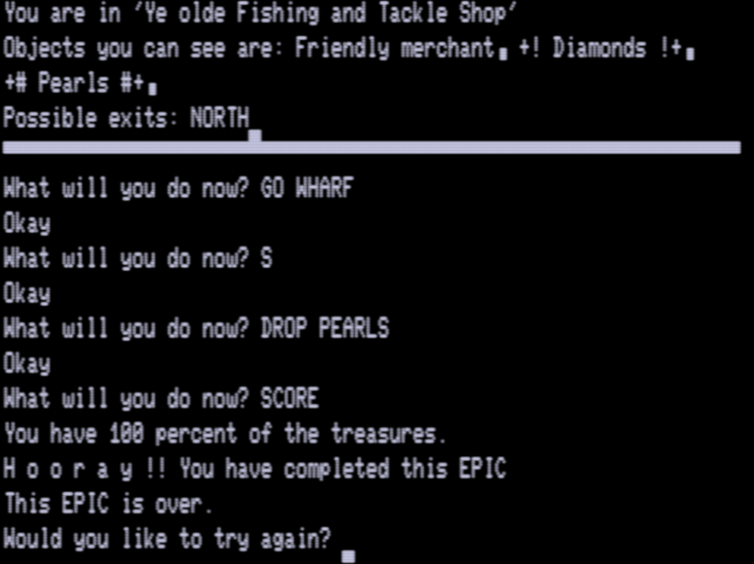

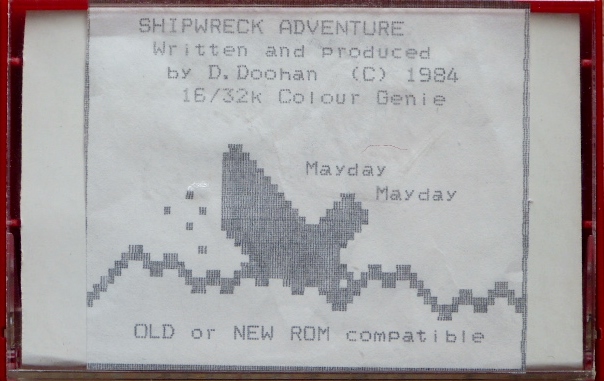
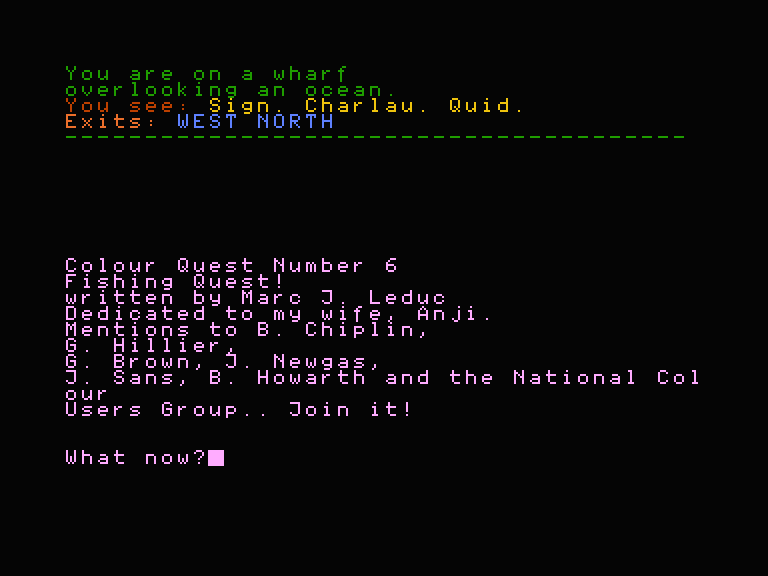
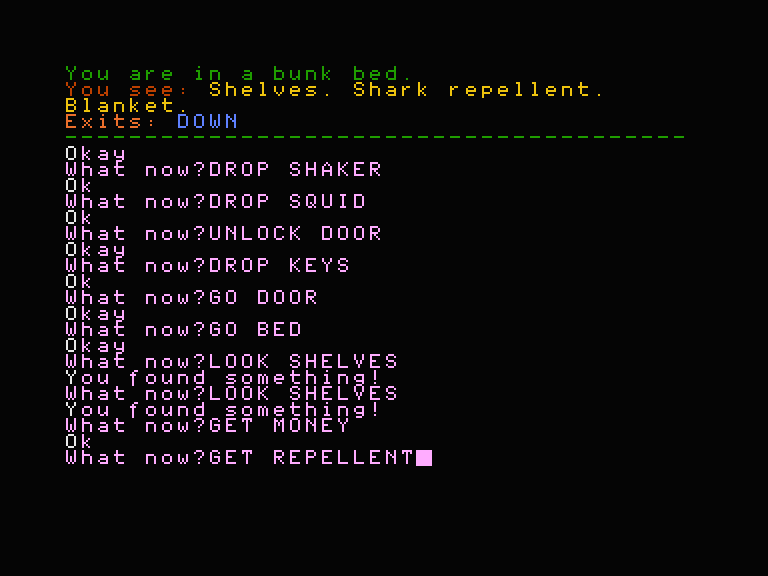
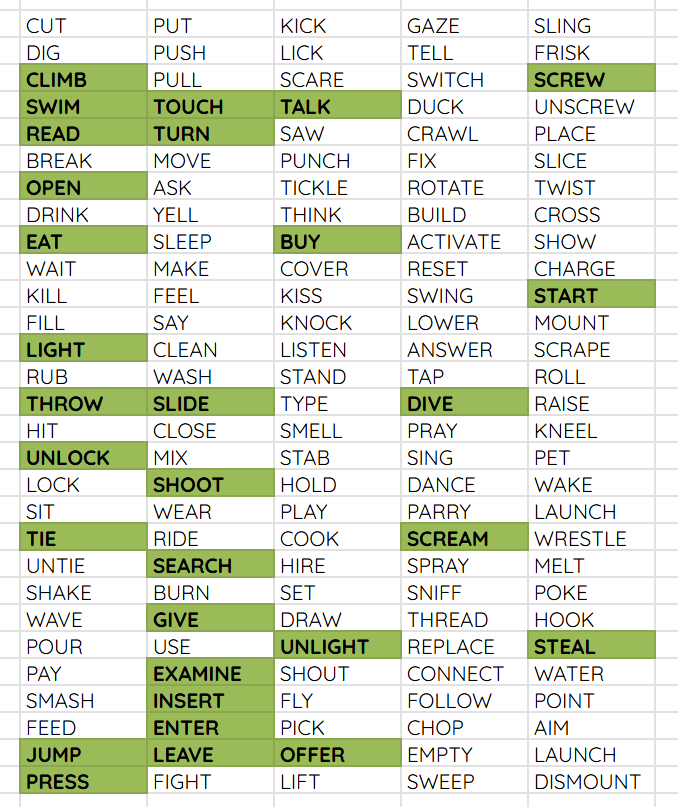
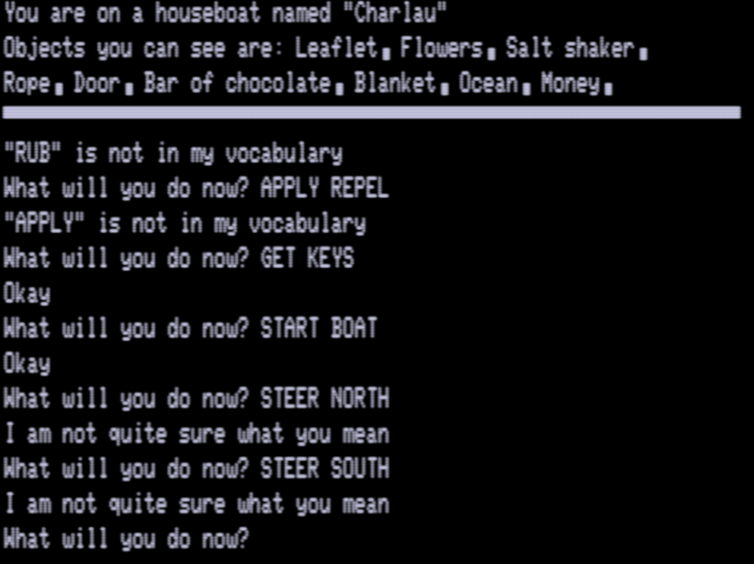
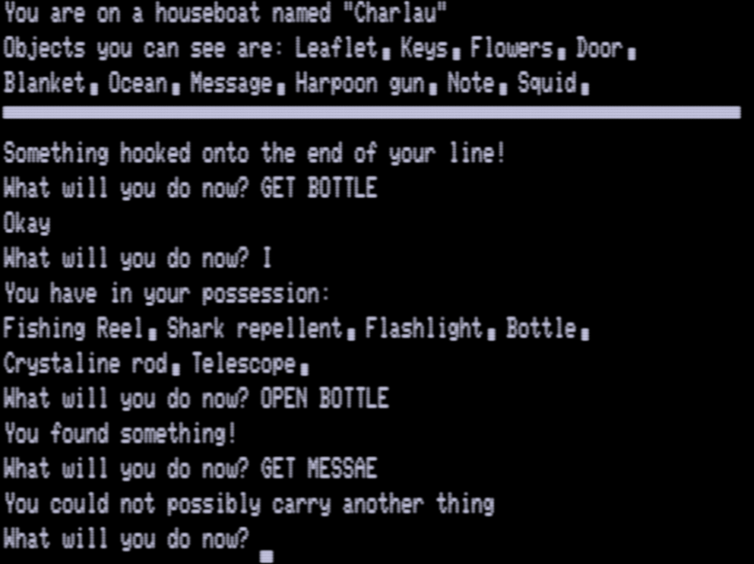
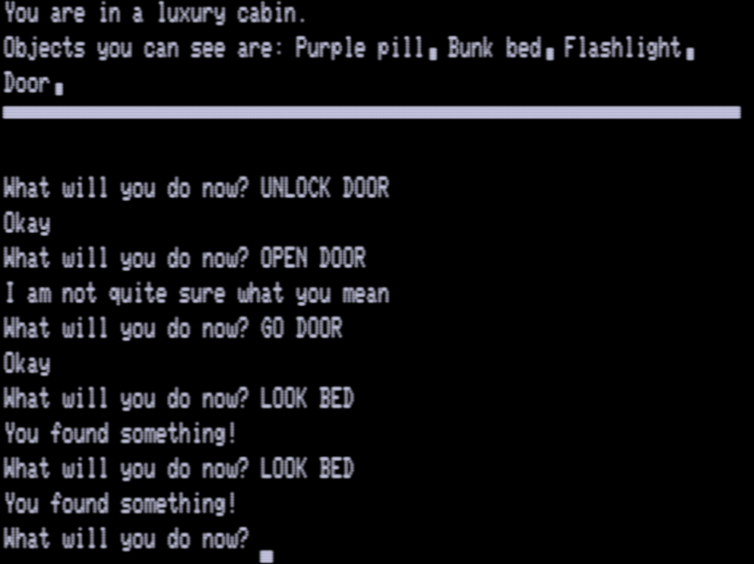
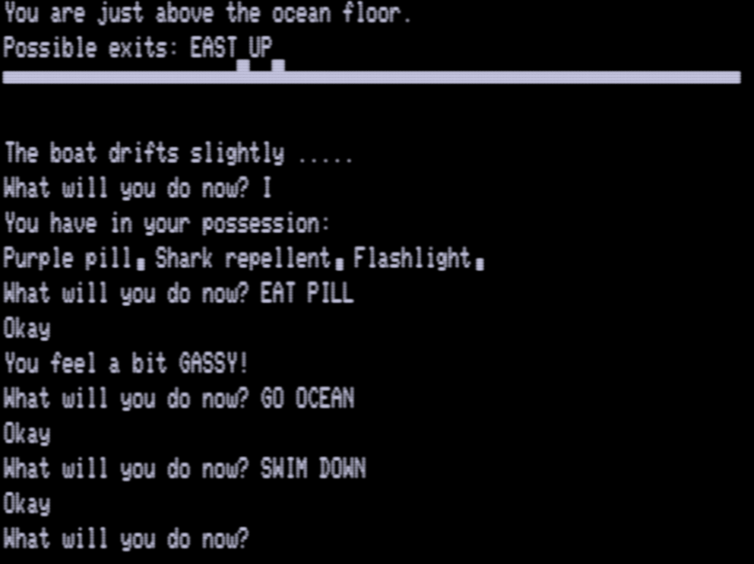
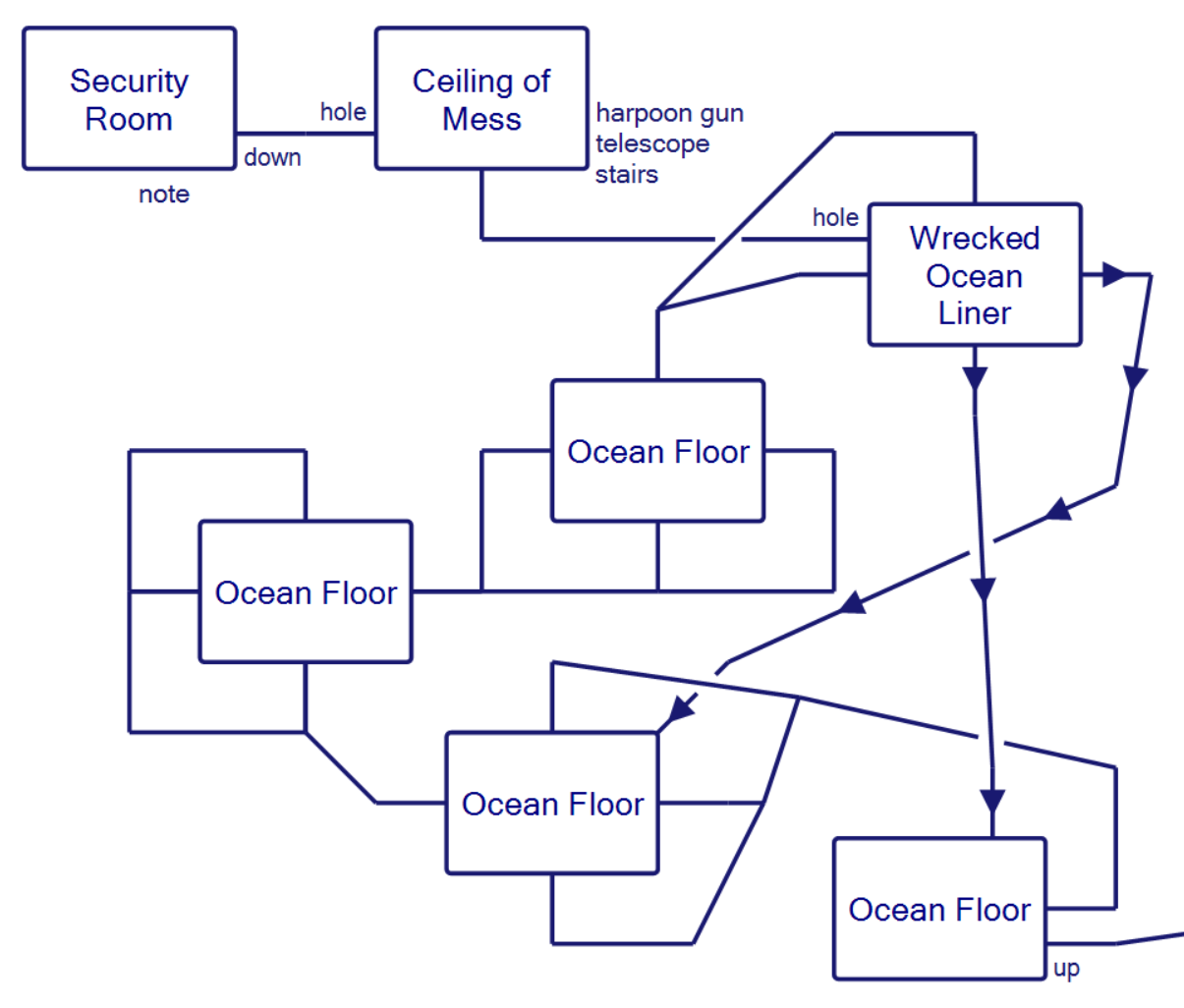
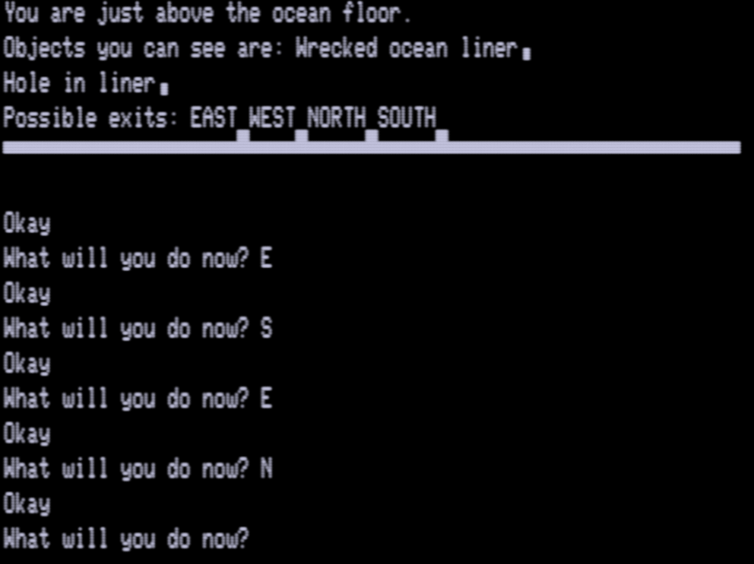
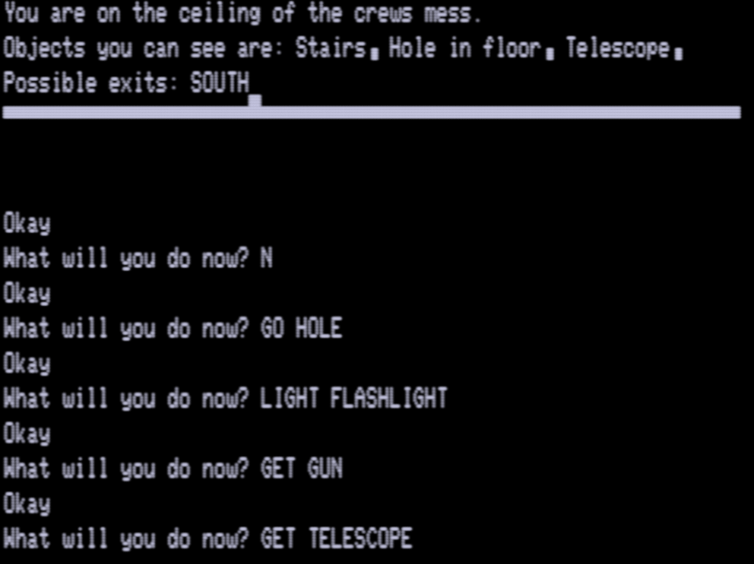
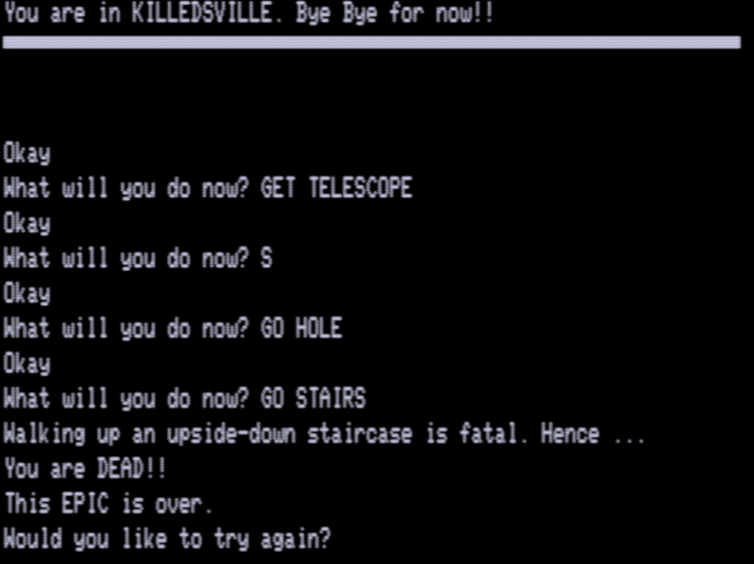
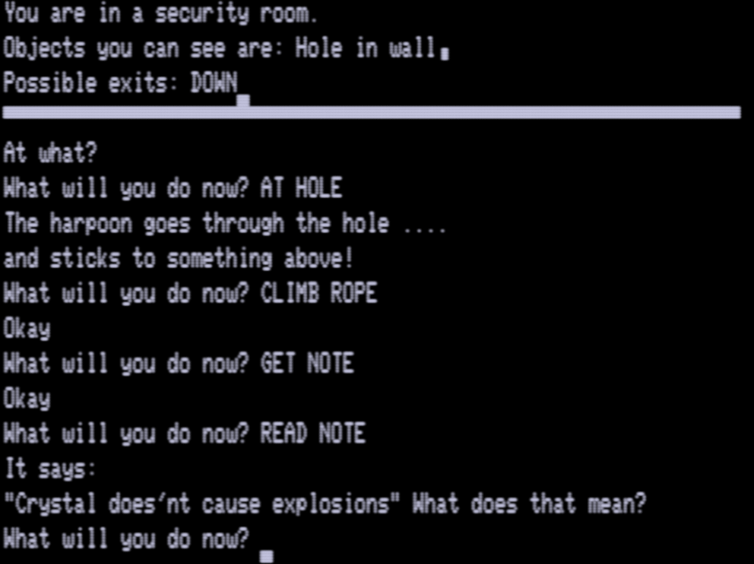
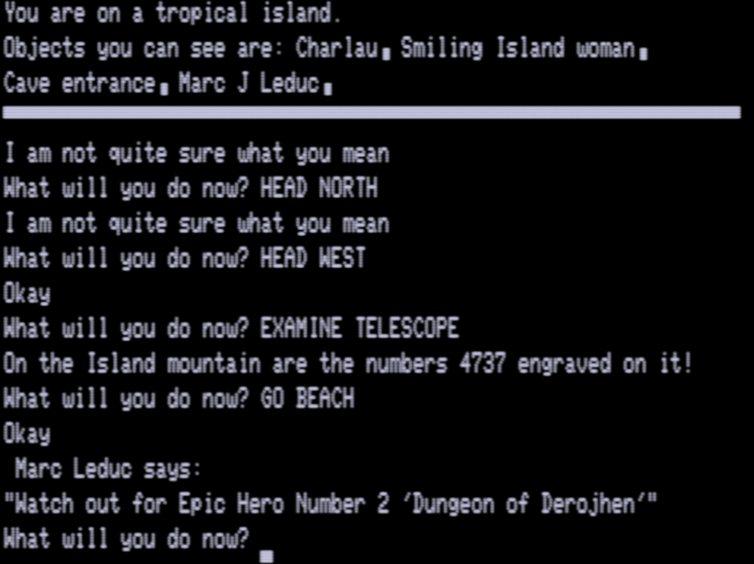
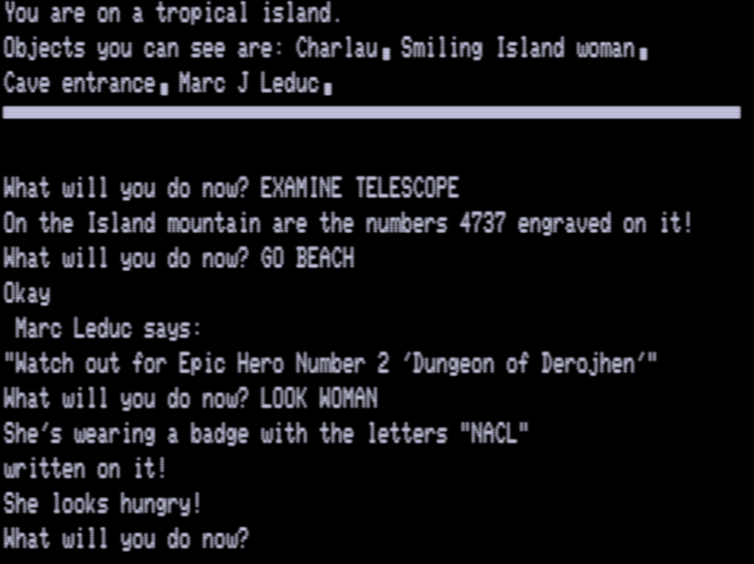
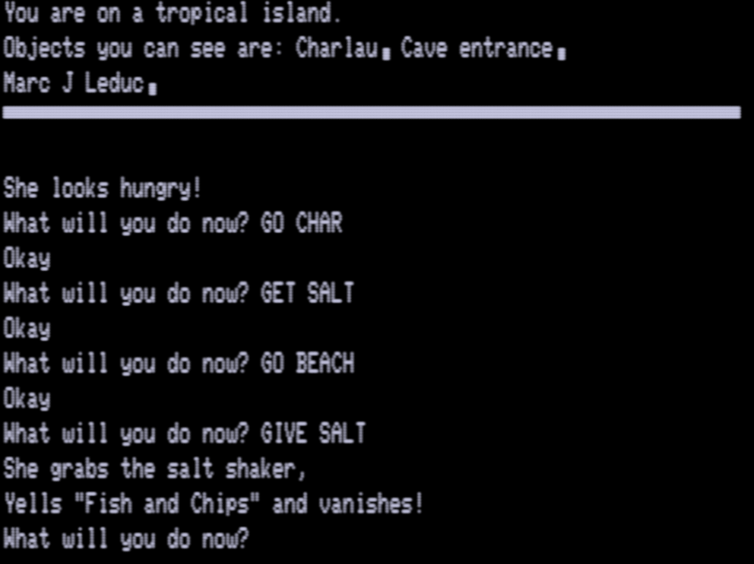
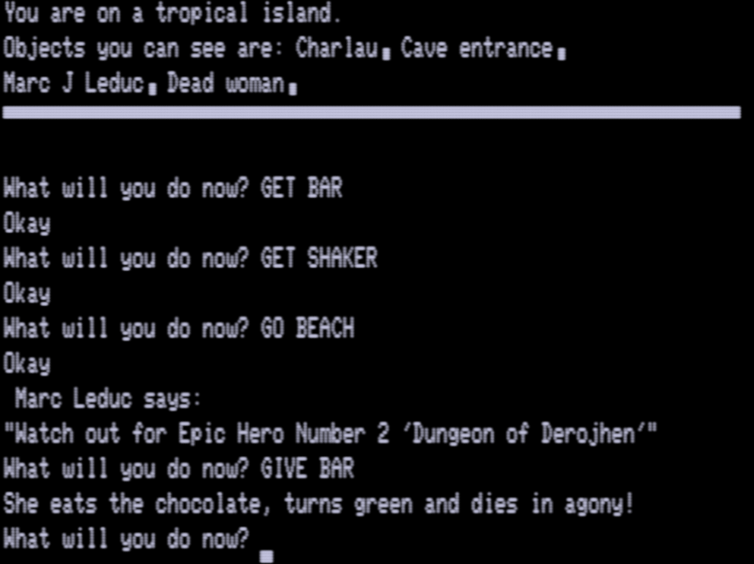
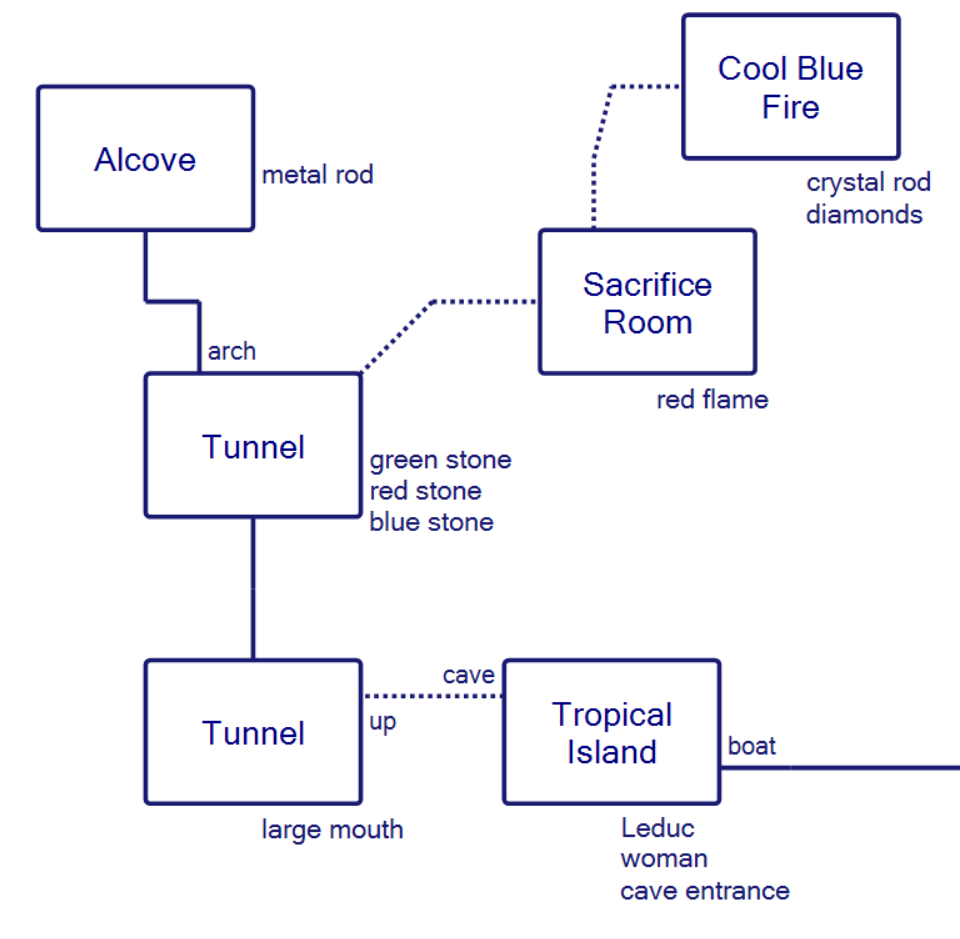
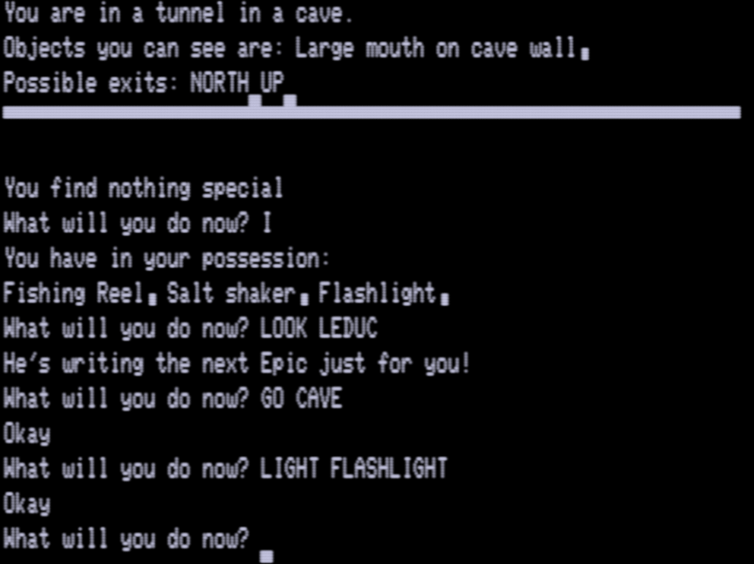
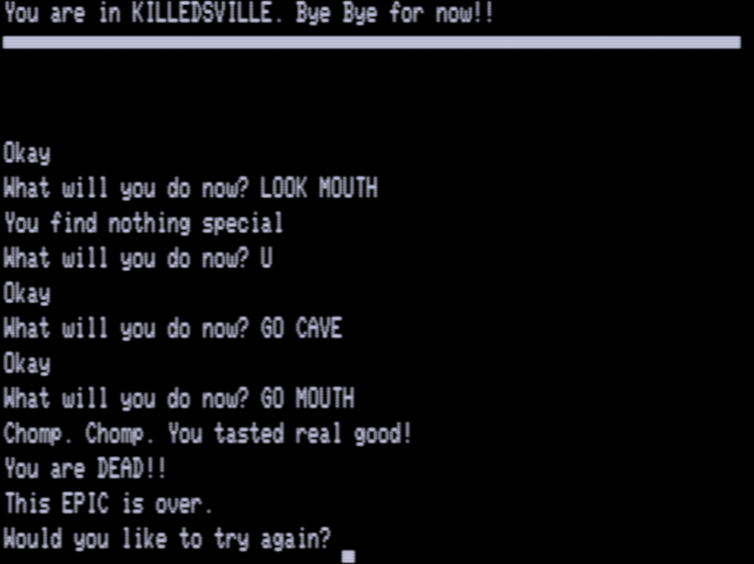
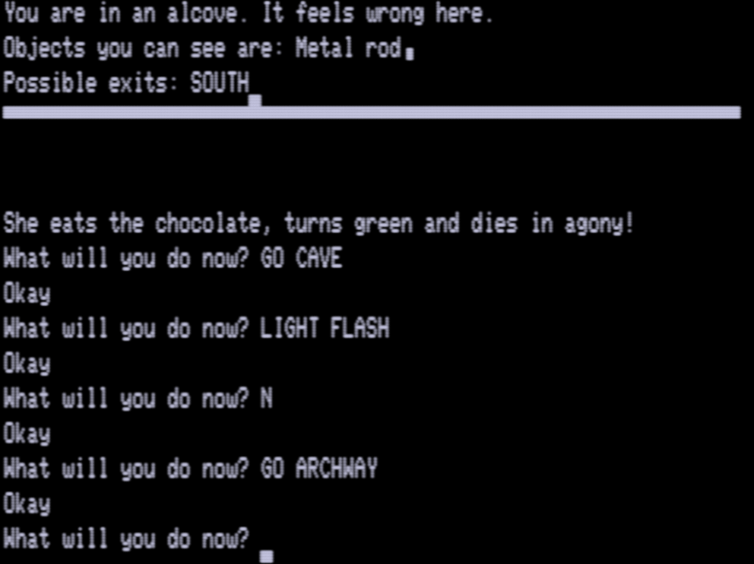
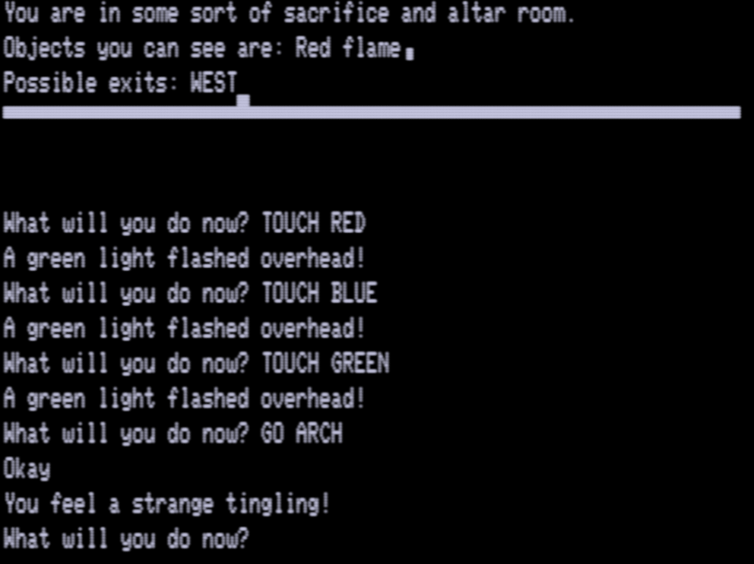
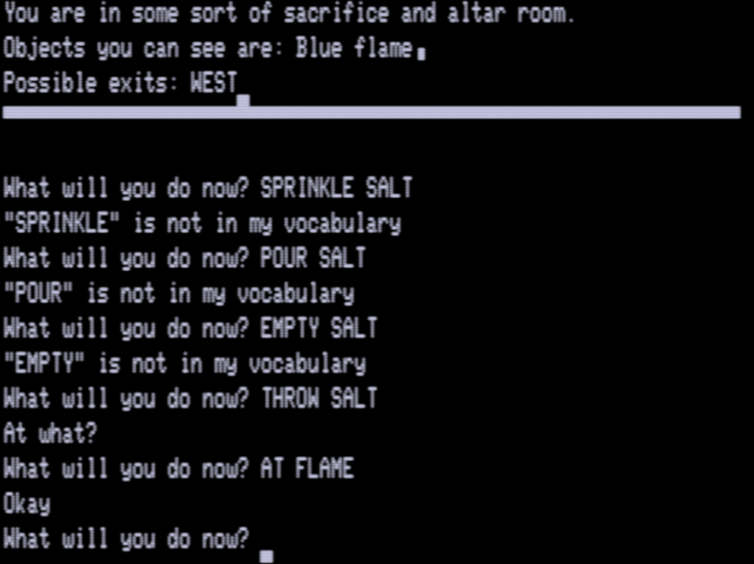
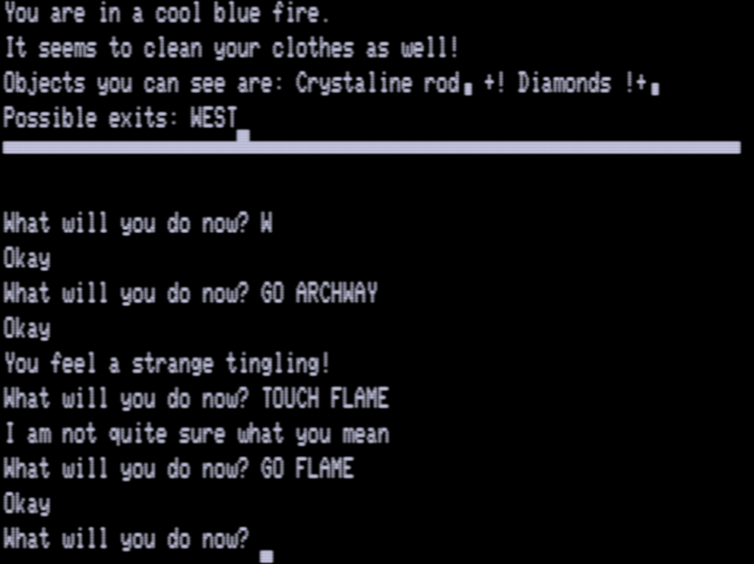


 Renga in Blue