Last time, I was stuck not being able to mark a map. While I knew the EXAMINE command worked, for some reason I had neglected to EXAMINE FEATHER which yielded “it’s a pen!” and the object changed.
Once I had the pen, I was able to >MARK MAP; then I could >SET SAIL to an island visible from the Crow’s Nest. (It’s unclear why you *had* to mark the map in order to move the ship.)
Upon arriving, a manatee climbed on board. I went down to the water and — using the fishing net from the cargo hold — I was able to catch some fish. I gave the fish to the manatee, who dropped a gold key.
Walking to the island, I found a jungle maze (GO NORTH, GO EAST, GO NORTH gets you through if you’re playing). Past the jungle was a cave with a dead pirate and a chest. The chest opened with the gold key and I found some gems.
I carted the gold key, chest of gems, and the two treasures from last time (jeweled dagger and bag of gold) back to the original beach. I was then able to STORE each one in turn (I don’t know why it worked now but not before, I’m guessing it was just a bug).
There was no announcement I was done finding treasures. SCORE just gives the number. I just had to guess I was done, at which point I found out upon QUITting that I found all four of them.
…
A promising start was essentially utterly wasted. It’s been a while since I’ve been outright disappointed in a game.
I realize this is maybe just in contrast with the extreme difficulty of Deathmaze 5000, but I even found Nellan is Thirsty to be a better experience than Lost Ship Adventure, and that one was written explicitly for children. This was marketed like a regular game!
In a theoretical sense, the most interesting part was how long I was stuck. I devoted quite a lot of time to re-copying the opening map, checking verbs, pondering the item list, etc. I had simply missed to >EXAMINE FEATHER when I had examined nearly everything else. I’m not sure the feather was even intended as a “puzzle”; perhaps it intended more as a piece of theatricality.
This is an experience that can happen even in “good” games, where you miss clicking on one particular door or miss an item interaction for no particular reason and get stuck for hours on useless actions. On a moderate-to-difficult game, it can make later puzzles simpler (having objects and their interactions memorized) but in this case after finding the pen I wrapped the entire thing up in less than 10 minutes.
Those reading this: do you have any stories of a similar experience?
…
POSTSCRIPT: I realized a day after posting this there was an aspect to the game I hadn’t seen before. Note how while the room description pops up all at once, the objects “scroll in” on the display.
The scrolling text effect can happen on old machines and especially when playing a game on a printer (like Zork on a mainframe sometimes was done) but this is the first time I’ve seen an adventure with the delay intentionally added.
I normally associate this effect now with visual novels, but it’s interesting the author went through the not-insignificant effort of putting it here.
He was excited about adventure, but like all youngsters, was unable to buy the programs he needed to satisfy his new interest. So he began writing them.
This sounds familiar. When I was very young if I wanted a new adventure I had to write it. The first adventure game I remember playing was a type-in from a library book.
…
I’ve been relatively glib whenever we’ve hit a treasure hunt (gather all the treasures, put them in central location X) but I decided to chart all the games I’ve played so far for All the Adventures to track the evolution of plot styles:
“Rescue” has a primary motivator of someone or something being extracted, “Investigation” is about figuring things out and putting pieces together, “Escape” is motivated by getting the player out of danger, and “Enemy” is a plot about an opposing force that must be defeated.
These categories are quite rough and some games I just had to make a ballpark decision, but you can at least get a fair idea of how well-copied the treasure hunt concept from Crowther and Woods Adventure was in this era. In 1978 it made up essentially every game, but by 1980 (assuming the ratio continues when I play the rest of the year) only about half of the adventure games were treasure hunts.
WHILE DIVING FOR TREASURE IN THE CARRIBEAN, YOU COME ACROSS A LONG LOST PIRATE SHIP, ADRIFT FOR YEARS.
For this game, the idea of lost ship salvage is one of the most appropriate uses of a treasure hunt, since it matches the experience of real-life salvage (if not the lawyer fees).
Noteworthy: the steak is rotten so does *not* work on the dog, who has apparently been resourceful enough to live alone on an abandoned ship for several years.
This game opens badly, with a serious parser issue:
>CUT CORAL
DON’T BE SO DESTRUCTIVE!
>BREAK CORAL
WITH WHAT, I.E. “WITH FEATHER”
>WITH DAGGER
YOU’VE UNCOVERED SOMETHING
I’ve got enough grizzled experience I can neatly plow through this kind of problem (“hmm, I better test a couple verbs, even though the first one implies not to do the action, because that’s a default message”) but I can see someone booting up the game and stopping right there.
Besides the section above I haven’t been able to make much early progress. I have access to
The main deck as shown above, where I can’t reach the black flag. I can attempt to SET SAIL but the game says I haven’t set a course.
The crow’s nest, where there are some gull eggs (and I get knocked into the sea if I try to get them).
The map room of the ship, where SET COURSE is recognized but the game says I have nothing to mark the map with. (Trying to STAB MAP to be all pirate-style just gets the “DON’T BE SO DESTRUCTIVE!” message.)
A nearby beach where a sign says I can STORE treasures there. I have stored 0 treasures so far.
A cargo hold with a rusty machine, some decaying bags, a working fishing net (although no fish around) and a bag of gold. I tried to take the bag of gold to the beach to STORE it but the game says I don’t know what’s inside (??). I suspect a genuine bug at work.
Despite the early stuckness, I’ve got some goodwill left because I like the environment. The main character wears a diving suit and can walk around underwater. The abandoned ship feels mysterious but not mystical (yet), and while I don’t think the layout is “authentic” the author also didn’t feel obliged to pack in an unrealistic amount of space. I can read a simple description like
THE WINDOWS LOOK OUT ONTO AN ENDLESS OCEAN. THE SEA BREEZE COMES THROUGH THEM.
and take a few breaths of another world; sometimes, that’s all I’m needing out of an adventure game.
Every item in the game has been in a box. I assume this is to make them feasible to draw in the 3D environment.
Even if you drop an item that you’ve been holding, a box suddenly forms around it.
For the first part of the game, I would >OPEN BOX and >TAKE WHATEVER each time I wanted an object (even if I knew what it was) but once I realized the game let you skip the box part and jump straight to taking the item, I started thinking of the boxes more as abstractions than as real things.
Later, when absent-minded, I wanted to >TAKE RING, but conflated the two old commands and typed >TAKE BOX instead. Which led to a box in my inventory.
Interesting! I wondered if there was anywhere I could use that trick. I had been valiantly trying to find a way to take a flute from the fourth floor back up to the second floor, because there was a snake there, and in adventure games circa 1976-198X flutes are effective in charming snakes. However, the ability to TAKE BOX meant I could do things the other way around and take the snake down to the flute.
I was able to drop the box in the upper right corner of floor 4 (at the bottom of a pit), play the flute causing the snake to rise, climb the snake, and grab a sword that was just past.
The inversion of turning a dangerous trap into a tool reminds me of the part in Mystery Fun House where you solve a puzzle with an informational item. Call it unexpected re-purposing, if you like.
…
Immediately after, I was entirely stuck, and knew I *had* to work out the calculator. Once again, I set a timer for an hour to prevent myself from hitting hints too early, but I honestly would have been fine just diving in; it was a parser issue. The “.2” bit that had been bothering me the whole time was just a hint to press the “two” button.
>PRESS TWO
Given I had been valiantly attempting to find any verb at all that would work the calculator, I don’t think even an extra three hours would have helped.
…
Activating the calculator teleports the player to level five, where the torch is knocked out by some wind, and a monster approaches.
Not the same monster as before: this time you’re attacked by the monster’s mother.
Doing >RAISE on the RING that has so far been useless brings forth a magical light. I had >RAISE on my verb list this time, but only because I had tried it on the magic staff (I was visualizing the usual “lift and shoot lightning bolts” type maneuver). (It’s a good thing that the staff was of indirect use, because in game terms the magic staff is utterly useless. That long segment I went through trying to get by two attack dogs? Totally unnecessary. I’m normally relaxed about games with a few red herrings, but grrrr.)
…
The magical light chases away the monster’s mother, but only temporarily.
The fifth-floor maze was a giant lead-up to getting a golden key. All the time, the mother started getting more confident, until she attacked…
… and I defeated her on my first try via >BLOW HORN making a roar that sounded like another monster, then applying the sword. I guess the puzzles don’t all have to be hard and unfair; in a way this was just the culminating reward for solving the snake puzzle.
…
Upon attaining the golden key comes the final challenge. There is a row of five locks on the rightmost wall.
Each one kills you in a different and creative way.
You unlock the door…
and three men in white coats take you away!
You unlock the door…
and the walls falls on you!
You unlock the door…
and a 20,000 volt shock kills you!
However, the second from the top is particularly theatrical: you don’t die right away, but the screen starts flashing and TICK TICK appears on the top. If you wait a bit longer, the entire maze blows up.
The ticking lock still turns out to be the correct one. After activating the bomb, you can find a previously hidden “sixth lock” to the south of the row of five. It leads to an elevator where you fall into a bed of spikes and die.
Oops!
I admit to grumpiness and frustration and decided to go for a hint right away. I needed to take the crystal ball from the first floor of the game and >THROW BALL. This caused the elevator to “disappear” and a passage to show up leading to the outside. I have no idea why this worked. I imagine if I was patient enough to run through all the various red herring objects I could have solved this on my own, but I doubt I would have got any satisfaction.
…
The game then throws one more curveball: before you’re allowed to win, the game asks what the name of the monster was.
The game might better have asked: what famous monster also had a mother who attacked after he died?
>GRENDEL
This hints at the “madness” theme Med Systems would hit starting in 1981 with the game Asylum.
If you’re not familiar with Beowulf: a kingdom ruled by King Hrothgar is being attacked by the monster Grendel. The legendary Beowulf slays Grendel in Hrothgar’s mead hall. And then an “avenger” appears:
Grendles módor (Grendel’s mother,)
ides áglaécwíf (lady troll-wife,)
yrmþe gemunde (remembered misery)
sé þe wæteregesan (she who the dreadful water)
wunian scolde (had to inhabit)
— From Benjamin Slade’s translation, lines 1258-1260
Grendel’s mother, who lives underwater, wants revenge. (Spoiler: she doesn’t get it.)
I admit, given the last part of the game is clearly not underwater, I was a touch confused. Re-visualizing the last level as, say, ankle-deep makes it suitably close. There’s an intrinsic danger to citing something of greater artistry and power than your own work, but I suppose it’s excusable for the very end of this silly (but innovative) game.
Merciful: cannot get stuck
Polite: can get stuck or die, but it’s immediately obvious that you’re stuck or dead
Tough: can get stuck, but it’s immediately obvious that you’re about to do something irrevocable
Nasty: can get stuck, but when you do something irrevocable, it’s clear
Cruel: can get stuck by doing something which isn’t obviously irrevocable (even after the act)
However, “cruel” design can sometimes accomplish narratively unique goals. Quondam has an instance of where a lot of time passes; if the player plants a “sapling” beforehand, it will have grown into a full-sized tree when they return. This is clearly a one-way trip; there’s no “reverse” mechanism (this isn’t time travel, just time passing) so having it be possible the player gets stuck is a necessity.
Both cases in gameplay terms require loading a save game to a past state, but the flavors of “cruel” feel very different. The system might need a “transparency” axis. There was essentially no way to know something went wrong with the ningy, whereas with the tree in Quondam it’s possible to “retroactively solve” and realize both what you need to do and what the result will be even before testing the action out.
Defeating the monster in Deathmaze 5000 hit a note between the two extremes. I don’t have the theoretical framework to describe exactly where. Let me at least narrate the best I can.
…
Before getting into the monster, here are two things that will become relevant:
1.) There’s a spot on the wall on the third floor marked “A Perfect Square”.
It turns out you can just walk right through.
This led me to another torch, more food, and a ball of wool.
2.) If you recall from a previous post, on the second floor of the maze there were two attack dogs. One dog was in a “fixed” position and only attacked upon entering the player entering a certain square, and the second dog was based on a timer. Either dog can be removed by throwing the sneaker, but you only have one sneaker. I had to choose between:
a.) defeating the “fixed position” dog, getting a magic staff, but skipping picking up a torch and jar.
b.) defeating the “timed” dog, getting all the items on the second floor except the magic staff.
After some experimentation, I realized KILL DOG also works as long as you have a dagger. The dagger gets used up on the process. This neatly bypassed the issue above and I was able to get past both dogs (one by sneaker, one by dagger).
…
A monster follows you the entire game. It’s possible to get a fair way in without realizing it.
The first reference I saw was when I tried throwing a frisbee, as I mentioned in an earlier post:
The frisbee magically flies around a convenient corner…
The monster grabs the frisbee, throws it back, and it saws your head off!
(Note the grammar says “the monster” as if you’ve known there was a monster there the whole time.)
On the second floor, the sneaker-dog sequence involves the monster:
A vicious dog attacks you!
>THROW SNEAKER
The Sneaker magically flies around a convenient corner and is eaten by the monster!!!
The dog chases the sneaker! and is eaten by the monster!!!
I later discovered if you let your torch run out, the monster comes to devour you.
The ground beneath your feet begins to shake!
A disgusting odor permeates the hallway!
The monster attacks you and you are his next meal!
However, the monster is still generally just a nuisance until you try to spend enough time on the fourth floor to gather all the items. (I think it’s just based on a timer and not linked to anything else.) The monster eventually decides, regardless of if you have a strong light or not, to come eat you.
You are another victim of the maze!
Do you want to play another game (Y or N)?
That means surviving any farther requires defeating the monster. The ball of wool turned out helpful:
The Wool magically flies around a convenient corner
and the monster grabs it, gets tangled, and falls over!
However, while you get time for a command as the monster untangles itself, it kills you the next turn. Nothing I tried worked.
It then occurred to me that the dagger should work just as well on a monster as a dog (as long as the monster was tangled). But I no longer had a dagger! I had to go back to reconsider my two-dog situation.
Staring at the map, I realized that all I really needed to do was get to the staff (marked “2”), and if I could move over the pit somehow, that would work as an alternative to fighting the “fixed position” dog.
Somehow … flying … through the air …
Wait. No. Oh No. Would they? Yes, they would.
Farting to victory!
To sum up:
1.) I was able to gather all items on the second floor by defeating one attack dog by throwing a sneaker, and just skipping the second attack dog entirely but still reaching the magic staff.
2.) This let me keep my dagger, so I was able to bring it down to the monster.
>THROW WOOL
The Wool magically flies around a convenient corner
and the monster grabs it, gets tangled, and falls over!
>KILL MONSTER
The monster is dead and much blood is spilt!
(Note the “throw wool” maneuver does not work until the monster starts charging, so even though you find the wool on the third floor, you can’t have this scene until after some exploration of the fourth floor. Also, if you are holding the jar and FILL JAR right after killing the monster, you get a jar full of monster blood. I haven’t been able to apply it anywhere useful.)
…
So, where do I go from here? I’m not sure. There’s no obvious next exit. There’s a pit in the upper right of floor 4 that might be climbable to a new area, but I haven’t had any luck so far.
I’ve got one theory which might be utterly wrong, but let me fire it off anyway. That “perfect square” thing: what if it was referring not the square on the wall but the actual room immediately past it (that is being “framed” like a picture)?
What’s special about that square? Well, if you build a grid as shown below, and go by the system floor-column-row …
… then you get the perfect square 324 (18 times 18 = 324). Thus the purpose of the marking might be to indicate how the coordinates of a teleportation system works (maybe by the calculator).
Far-fetched, but this game has already gone some crazy places.
I ran a little experiment; the text below I wrote *before* starting my next play session in earnest, and then I follow with the conclusion.
…
I’m still hacking at the calculator room puzzle. On my last post, Carl Muckenhoupt wrote what’s in the title of this post, adding “I will be very, very surprised if you get it without hints.”
Now, if you aren’t familiar with Carl, keep in mind:
a.) He is the only person I know who has finished Wizardry 4 without any hints, aka One of the Hardest RPGs Ever Written. This was done back when the game was released, so he didn’t even use any save states.
b.) He used to curate “Baf’s Guide to the Interactive Fiction Archive” which attempted to catalogue absolutely everything in the IF Archive at the time. He’s played as many if not more adventure games than I have.
So when Carl says a puzzle is inscrutable, the wise thing would be to give up and check the solution. But I’m going to be foolish and work at this a bit longer anyway, albeit with a rule: I must work on the puzzle for at least one hour before checking the official hint sheet. (“At least” means I can take longer, but the goal here is to stop the temptation to give up early.)
…
Spoiler: Carl was right.
First, I tried to write down all the detail I knew: when entering the position on the map with the calculator, the hall is sealed off. The wall shows the message “To everything there is a season.” The message changes as you hit keys to turn:
Steps 1-5 show: “To everything there is a season.”
Steps 6-14 show: nothing
Steps 15-20 show: “To everything there is a season.”
Steps 21-25 include TURN, TURN, TURN added to the original message
Steps 26 and further: no message
The calculator initially displays 317 but CLEAN CALCULATOR reveals it actually showing 317.2.
My first impulse was that the game wanted the left/right arrow keys pressed in the right series in some sort of code. I tried, for example 3 left, 1 right, 7 left, 2 right; 3 left, 1 turn-around, 7 right, 2 turn-around; 3 right, 1 left, 7 right, 2 left; and so on for many, many more attempts.
Even if the “3172” digits were correct, any complexity past just using the digits in order would have required just sheer luck to come across. There are far too many possibilities and arrangements. (As the previous sentence implies, the 3172 digits were not correct, but let’s get back to that in a moment.)
I then went for some “outside the game” type solves. First, the inverted calculator idea, which I illustrated in my last post:
Again, without any extra clues, proceeding from here involved testing a bunch of variants: LIE, 2LIE, ZLIE, LIE LIE, REST LIE, and so forth. This was made worse by “SAY” being a verb so the game might have accepted the right command as a “magic word” or it might have required me to “SAY” it; so I had to test twice every word I listed.
Past that point and even more desperate, I tried looking up Ecclesiastes 3, the original source of the song lyrics, which includes a verse 3:17.
I said in mine heart, God shall judge the righteous and the wicked: for there is a time there for every purpose and for every work.
I tried every single word here like “heart” and “judge” and crossed them out as I went.
I checked if this could be a “phone code” using the letters on a phone, but realized while “2” has “ABC” there are no letters on the 1.
I considered if latitude or longitude was involved (there is the “.2” part which doesn’t show up at random) but on Earth those metrics max out at 180, so I’d need to be referring to somewhere in outer space. I tried words like MARS and VENUS just to feel like I was doing something.
I tried checking if the digits reversed (that is, 317.2 being 2.713) were somehow mathematical. Euler’s number starts out 2.718, and just in case the authors made a typo I tried out EULER and various possible mispellings. (This might seem to be reaching into absurd territory, but there is a well-known game in a very well known series where a certain name is spelled wrong, and the game only accepts the wrong spelling.)
While I didn’t know it, I was getting further and further away from the answer. When I buckled (after about an hour and 20 minutes), I found out my very first guess about a left/right code was absolutely correct. The way out of the room was to
1.) turn left five times
2.) turn right four times
3.) turn left three times
Where does the 5-4-3 sequence come from? I finally puzzled it out, and it takes a combination of the insights above:
1.) flip the letters calculator-style to get LIE
2.) find LIE on a telephone; the letters are on the buttons 5-4-3 in order.
I have no idea what the “.2” part was about. If you draw a “Z” shape from the bottom you get left-right-left … but there’s no reason why you can’t draw from the top either, and that connection seems way too stretched to be correct.
…
To explain what went wrong with this puzzle, I’m going to hop briefly over to cryptic crosswords.
A cryptic crossword is one where each word is clued twice, once explicitly and once with wordplay; however, the break between wordplay and second definition isn’t always obvious.
Cod nutrition changed the starting point (12)
is a clue for introduction. “Cod nutrition” is an anagram of “introduction”; “changed” is the word indicating an anagram is being used. “Starting point” is the definition of “introduction”.
There’s essentially one “transformation step” before we’ve reached a point we can verify a solution is correct (by matching our result with the definition).
It is possible but considered bad form to have require multiple transformations to the same word.
Listening, elf moved a boat messily using white powder (5)
“Messily” indicates another anagram, but on the “Elf moved a boat” section. However, before the anagram starts, the definition of “row” needs to be substituted for “moves a boat” so the thing we are anagramming is “elf row”. This anagrams into “flower”. Then we apply “listening” to indicate that “flower” is a homonym for “flour”, which is the “white powder”.
While it’s *possible* to go through the logical steps, having to leap from one to the next without reinforcement really makes for an uncomfortable solving experience. It exposes puzzlers to too many combinatoric possibilities.
With the calculator puzzle, the solver had to make a chain of actions similar to the bad cryptic clue: flipping the calculator to make the word LIE, taking that result and putting it on a phone pad, then taking that result and applying it in a left-right-left code order. Only at the very end of this improbable chain is there any indication the player is on the right track. While it’s fine to have a little bit of exploration on the player’s part where a clue is abstracted into an action, once multiple “layers” are added there are thousands of possibilities to search.
I skipped mentioning the motivation and plot last time, so let’s remedy that first. From the manual:
Your only goal is to leave Deathmaze. Alive.
Ayep. Deep. So let’s segue into
FARTING
There’s a FART command and it gets mentioned on the opening screen.
I don’t know what the “scientific marvel” mentioned on this screen is yet.
The effect is to propel the player forward until they hit a wall.
Unfortunately, it doesn’t seem to save in-game time. I say this is unfortunate because a.) there’s a hunger timer; I’ve found food in two places but it’s definitely possible to starve b.) there’s a timer on torch health, and if it becomes dark you get eaten by a monster.
For the maps that follow, I need to keep in mind some route optimization. Turning counts as a “step”, so when a path is “wiggly”, it can take more travel time than a straight corridor covering the same number of spaces.
An example: The corridor on the left takes twice as long to pass through as the corridor on the right.
LEAVING LEVEL ONE
I still haven’t solved the calculator problem from last time, although I should mention LOOK CALCULATOR reveals there’s a smudge, and CLEAN CALCULATOR shows the actual number on the screen is 317.2.
The number combined with being on a calculator combined with the “TURN, TURN, TURN” hint suggests this might be a word on an inverted calculator.
Matt in the comments suggest “Z.LIE” and I’ve tried a bunch of permutations like “LIELIE” and “TWO LIE” but no luck.
It’s possible I need an item of some sort, because you can move on to the lower levels without solving the puzzle. One of the items just lying about (a HAT) gives you explicit instructions if you LOOK HAT:
Wear this hat. CHARGE a wall near where you found it.
Specifically, if you face north and CHARGE, you bust through the wall and fall down a pit to level two.
LEVEL TWO
Here’s where the Deathmaze really started living up to its name. One of the item boxes has a snake that kills you if you open it (I haven’t decided if this is a red herring or a puzzle that needs solving)
There’s an “elevator” which just crushes you by the walls coming in sideways.
There are two attack dogs, one which occurs after a certain number of steps, and one which happens in a specific spot. I have only found the sneaker useful in fending him off, although it causes the sneaker to disappear:
A vicious dog attacks you!
>THROW SNEAKER
The Sneaker magically flies around a convenient corner and is eaten by the monster!!!
The dog chases the sneaker! and is eaten by the monster!!!
The dog that is in a fixed spot is blocking a box that has a magic staff. Also, while this level has both food and a torch, the torch is far enough away (notice how it’s at the end of a “wiggly” corridor) that it gives time for the “timed dog” to attack. This means I can choose from either a.) fighting the fixed dog and taking the magic staff or b.) fighting the timed dog and getting an extra torch, although that means I skip the magic staff.
Of course, c.) find an extra way to defeat a dog and do both is possible, but I haven’t wrangled it yet.
LEVEL THREE
There’s not as much content here, but the “L” shape does indicate there’s probably more to this level. I don’t know if it’s possible to enter in the upper right area on this level (indicating a secret door or some related shenanigans) or if it’s a “closed area” that can only be entered from below.
LEVEL FOUR
This is where my journey so far has bottomed out. Apart from running out of torch time or dying of hunger, again things aren’t too dangerous. It may be the next direction is “up” — the bottom of the pit doesn’t correspond to any existing pits, so it must go up to the “missing” section on level 3. I suspect a method of scaling pits will be the next step in the journey, but given farts are a method of propulsion, I won’t be surprised if things go sideways.
Part of where I’m stumped is a short verb list. This is the entire list I’ve found so far.
CLIMB, BREAK, OPEN, EAT, FILL, LIGHT, RUB, THROW, UNLOCK, PUT (same as DROP), YELL, SAY, RUB (same as CLEAN), BURN, WEAR, FART, CHARGE, ROLL, BLOW (for the horn), PLAY (for the flute)
None of these are the usual WAVE that gets used to activate a magic staff in many a game, or GAZE to use the crystal ball from the first level. CLIMB wants a noun and the bottom of pits (where it seems like climbing might work) I haven’t been able to get the game to recognize any particular use.
This represents what could have been an entirely different evolutionary branch for adventures. The three-dimensional maze is oriented on a grid, and you move about square by square using the arrow keys. This style — akin to the CRPG “blobber” genre — pretty much started and ended with Med Systems (their last game in this style was Asylum II in 1982). First-person adventures eventually came back in season, thanks to Myst, but are now either free-roaming or node based.
I’m not surprised, really — RPGs are squarely enough in the dungeon-genre camp that spending an entire game in rectilinear format doesn’t feel all that odd, while adventures more naturally lend themselves to a variety of environments.
The interface is smoother than you might expect for a 1980 TRS-80 game. In addition to moving about with the arrow keys, you enter commands (two words at most) just by starting to type. The maze has a typical set of adventure game inventory items stored in “boxes” accessible via OPEN BOX.
The player here is about to die: a monster throws the frisbee back and chops their head off.
In addition to the frisbee incident above, there is a square in the game that kills you just by stepping in it
but for the most part the first level (that I’ve been able to reach so far) is peaceful.
Where I’m stuck is the tile marked “X”. I’m guessing it’s the way to the “next level”. When I enter, the wall has the message “To everything there is a season” and if I turn enough times, it gets followed by the message “TURN, TURN, TURN”. There’s also a calculator in a box which displays the number 317. Putting these things together, my first guess was that I turn left 3 times, then right 1 time, then left 7 times.
No luck, though, even with other combinations of turns. The manual promises
Deathmaze is gigantic. There are over 500 locations. Be patient. You will not solve Deathmaze during the first week. Or the first month.
This game has the triple whammy of an unknown author, unknown year, and what is more or less an unknown title.
I’m titling ADV.CAVES by its filename. I found it on the mysterious Apple II Compilation #007. The compilation comes with multiple games of old vintage. Here are the ones I’ve been able to identify:
Lost Dutchman’s Gold (1979, the Apple II version came out in 1980)
Dukedom (1976, the 1980 Apple II port is on the disk)
Imhotep (1980)
Journey to the Center of the World (1978, called “Adventure Within the Earth” in this version)
It is thus a good guess ADV.CAVES is also from 1980. It’s possible it was a type-in but I haven’t been able to identify the source magazine. It’s also possible this was a private project that escaped to the wild, because this is very short and feels more like someone’s programming exercise (akin to Roger Wilcox’s work) rather than an attempt at publishing a game. (As an example of the roughness: there is no “inventory” command.)
I’m sure you won’t be surprised that a game with a “caves” moniker asks you to collect treasures and drop them in a central location (the starting room of the game). There is no “end game” message; the goal seems to be to accumulate as many points as you like and then quit. While not spelled out exactly, 100 points is the maximum. You get points not only from depositing treasures and for each new location you visit (this will become important in a little while).
Close to the starting room is a room with a kitten:
YOU ARE AT A PILE OF RUBBLE AT THE N END OF A LOW
PASSAGE
A SIGN SAYS ‘MAGIC MAY WORK HERE’
A CUTE KITTEN SCAMPERS ABOUT UNDER FOOT.
After going through the requisite Crowther/Woods Adventure words (XYZZY, PLUGH, etc.) and generic magic words (SESAME, ABACADABRA, and so forth) I hit upon the word MAGIC itself as a magic word. It teleports you straight to a dragon. If you drop the kitten where the dragon is:
AMAZINGLY THE DRAGON IS TERRIFIED OF KITTENS
HE HAS FLOWN OFF ELSEWHERE IN THE CAVE
After the dragon vs. kitten face-off, something highly unusual happens. The dragon doesn’t just go poof: it just moves elsewhere. That means any of the other rooms of the game may have A LARGE DRAGON BLOCKS YOUR PATH; to be safe you need to take the kitten with you to do any further necessary dragon-scaring. I can’t think of any other adventure games I’ve played where this happens, that is, where an enemy is defeated by solving a puzzle, but may need to be redefeated later in the same manner. This in contrast to CRPG-style violence or some other non-puzzle method of driving enemies away; when a puzzle is solved there seems to be the unspoken rule it should be solved only once.
You can get most of the points (96 of them) through normal gameplay, but I did say earlier the max score is 100. For a full 100 point ending, you need to plunge into a chasm.
YOU STAND AT THE N EDGE OF A 3 METER DEEP CHASM ABOUT 2 METERS WIDE. THE HALL GOES ON BEYOND.
COMMAND=D
LYING BRUISED AND BLEEDING AT THE FOOT OF A 3 METER HIGH SHEAR WALL, YOU STARE UP AT THE DISTANT ARCHED ROOF AND PONDER YOUR FATE.
You could have quit at 96 points, but those last 4 were your downfall. Rest in peace, Adventurer.
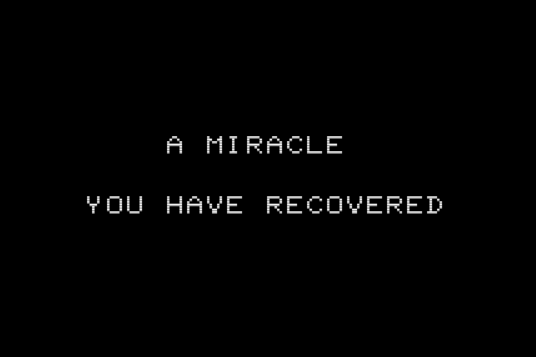
But wait, a miracle occurs!
CLIMB works, you just have to do it a bunch of times. Never mind. I guess we made it out alive … this time.
In all seriousness, I had thought for a while the scene trapped in the cave forever was the real “ending” but decided to go back and try CLIMB a bunch more times just to be sure. The first Russian art house cinema style ending for an adventure game will have to wait a little longer.
Content warning: 19th-century colonialism, pop culture as history, headhunting, meta-interface tricks, and existential body horror.
Cover of Softside magazine, September 1980.
In Search Of… Dr. Livingston appeared in the September 1980 issue of Softside magazine as a type-in for the TRS-80, pages 26 to 29, credited as by
Carl Russell
Karen Russell
Ralph Fullerton
Becky Fullerton
(Aside: This is the first adventure game in our chronological series with two women in the credits.)
I haven’t previously emphasized this, but the double whammy of a hardware capacity of 16K plus the need to have code that can be printed in a magazine really makes for a harsh limit. There’s not a lot of space for niceties like “verb synonyms” or “sensible responses to wrong puzzle solving attempts”. With some careful design choices (and a willingness to toss in some synonyms) it’s possible to alleviate these problems, but really, the reputation of Very Old Parser Games to be almost pathologically unable to understand player input has more to do with necessity than the designers just falling down on the job.
The complete source code, as originally printed.
At a talk at Narrascope 2019, Jess Haskins brought up the fallacy of generalizing from fictional evidence, where “you weigh evidence from something you saw or heard in a work of fiction just as strongly as something you actually experienced firsthand.”
A corollary of this might be: there is a strong tendency to create games based on pop-culture notions of places and times. This saves work on both the writer side (who can at least try to get away with less research) and the reader side (who can be assumed familiar enough with, say, King Arthur, that some aspects of the character are already built).
Pick an adventure game set in “Egypt” and you’ll probably get pyramids and tombs, and possibly see Cleopatra. This isn’t necessarily inaccurate: there are pyramids in Egypt, but a focus on old Egypt leaves out roughly 2000 years of other stuff that happened. None of those years made the pop-culture hit parade.
If an adventure game is set in Africa outside of Egypt … well, there isn’t even much pop culture to choose from, except a certain 19th-century meeting between Dr. David Livingstone and Sir Henry M. Stanley.
…
July, 1871: Dr. David Livingstone, British explorer and missionary, was rumored dead; he had last been heard from via a letter dated May 30th, 1869, and while he sent many more letters over the prior 6 years, they never arrived at their destination. Although not dead, he was verging close. While in Congo he witnessed a massacre of (at least) 400 Africans by Arab slavers and had to flee to the trading town of Ujiji in Tanzania. He had supplies stored there, but when he arrived he found they had been stolen.
Meanwhile, the American journalist Henry Morton Stanley was on the wrong continent. He had been sent by the New York Herald to the grand opening of the Suez Canal, and from there did a tour of the Middle East, writing a travel guide, and going as far as India. He had heard rumors of Livingstone during these travels, and decided (on his own volition) to steer to Africa (as he later explained to his employer, he was “too far from a telegraph” to notify them of the new expenses he was taking on).
After a trek of over 1000 kilometers (and around 100 porters, many either deserted or dead from tropical diseases) Stanley found Livingstone in November, and shook his hand.
Stanley: “Dr. Livingstone, I presume?”
Livingstone: “Yes. I feel thankful that I am here to welcome you.”
There is, of course, a lot more to the event (including the fact Stanley ripped out his diary pages corresponding to this meeting and may have made the dialogue up) and if you want to fall down the rabbit hole I’d recommend Clare Pettitt’s 2007 book about the event (and the many memes that followed). For my purposes, it’s helpful just to note
a.) The meeting was, as Pettitt asserts, “one of the first international ‘celebrity’ moments in history.”
b.) Livingstone is remembered as a hero (anti-slavery crusader) and Stanley as a villain (later claimed the Congo in the name of Belgium, reportedly responsible for cruel abuses).
c.) The environment where the meeting happened was a Muslim trading town.
To start off the game proper, let me just quote a long excerpt:
YOU ARE IN A BEDROOM, WEARING PJ’S. A NIGHTSTAND SITS BETWEEN THE CLOSET AND THE BED. THE BEDCOVERS ARE TURNED DOWN.
YOU CAN SEE A TIMEWORN BOOK.
? OPEN CLOSET
YOU CAN SEE A TIMEWORK BOOK, A FADED RED KNAPSACK, A PAIR OF HIKING BOOTS.
? GET KNAPSACK
‘TIS DONE.
? GET BOOTS
YOUR FEET ARE NOW SNUG IN A PAIR OF HIKING BOOTS.
? GET BOOK
‘TIS DONE.
? GO BED
YOU ARE LYING IN A WARM SOFT BED.
? READ BOOK
AFRICA – LAND OF THE UNKNOWN BY R. U. REDDE
? OPEN BOOK
THE BOOK FALLS OPEN TO AN UNDERLINED PASSAGE.
? READ PASSAGE
… PLORER NODDED OFF TO SLEEP, HIS THOUGHTS BEGAN TO DRIFT T …
? DRIFT
YOU ARE DRIFTING IN A ROWBOAT ON A LAKE.
THERE IS A BEACH ON THE EASTERN SHORELINE.
YOU CAN SEE A TINY GREY MOUSE.
Some points to make: 1.) things start feeling like a “story within a story” and that you are entering a dream; however, if you don’t put on the hiking boots before using “DRIFT” to go to Africa you die. 2.) the whole “OPEN BOOK” ⟶ “READ PASSAGE” ⟶ “DRIFT” sequence I was able to get fairly quickly from experience, but I could easily see someone getting stuck here. It’s as if the authors had a choreographed set of moves in mind, but such sequences are very dangerous in modern games with an abundance of text and synonyms to work with; here the minimality is so stringent it’d be easy for the game to fall off the rails.
…
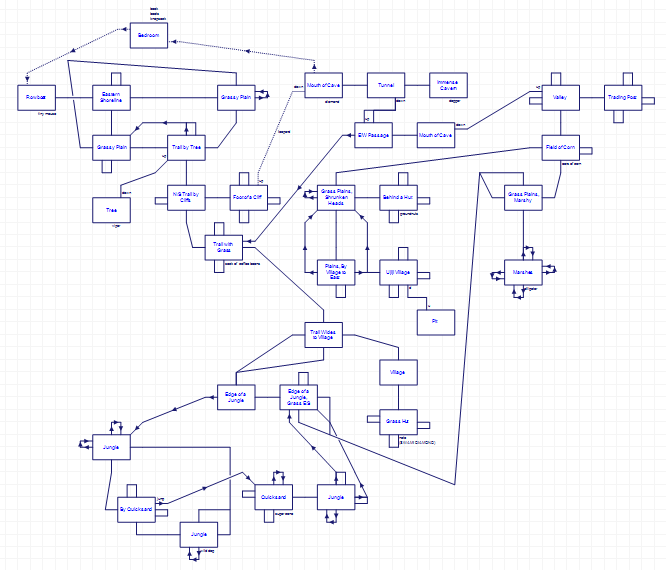
Upon arriving in Africa, there’s a fairly wide-open map, and it’s a really, really bad one.
Click for a larger version of the map.
Again, there is the old-IF tendency to have exits that go EAST one way go NORTH the other. Not great, not worse than elsewhere.
However, this game applies a trick that so far I had only seen in Adventure variants: sometimes a particular direction has more than one possible destination, and that destination will be picked at random. Even worse, sometimes a direction that states you can’t go that direction will actually, sometimes, let you go that direction. This is an actual gameplay transcript:
? N
YOU WON’T GET ANYWHERE GOING THAT DIRECTION.
? N
YOU CAN’T GO THAT WAY.
? N
YOU CAN’T GO THAT WAY.
? N
THAT DIRECTION IS SEALED OFF.
? N
YOU CAN’T GO THAT WAY.
? N
YOU CAN’T GO THAT WAY.
? N
YOU WON’T GET ANYWHERE GOING THAT DIRECTION.
? N
YOU WON’T GET ANYWHERE GOING THAT DIRECTION.
? N
YOU CAN’T GO THAT WAY.
? N
THAT DIRECTION IS SEALED OFF.
? N
YOU CAN’T GO THAT WAY.
? N
YOU WON’T GET ANYWHERE GOING THAT DIRECTION.
? N
THAT DIRECTION IS SEALED OFF.
? N
YOU ARE AT THE EDGE OF A JUNGLE.
GRASSLANDS EXTEND TO THE EAST AND SOUTH.
Because of this issue, part of mapping the game involved testing each invalid exit many, many times just in case the random number generator was acting up.
…
Early on someone throws a spear at you.
A NATIVE THROWS A SPEAR AT YOU.
HE MISSES AND RUNS OFF.
The spear is useful for killing an alligator later (except you don’t really need to enter the room with the alligator, nor is there any need to kill it). The spear is in reality more of an obstacle, because if you carry it one of the two villages in the game, this happens:
YOU ARE IN A NATIVE VILLAGE.
THERE ARE SEVERAL CAMPFIRES ABOUT.
YOU CAN SEE NOTHING UNUSUAL.
SUDDENLY, A VOLLEY OF SPEARS FLIES OVER YOUR HEAD; AN OBVIOUS WARNING!
YOU HAD BETTER LEAVE, FAST.
This marks the fourth adventure game we’ve seen where a weapon is mostly useless and can get you into trouble. (Other instances: Burial Ground Adventure, Pyramid of Doom, Lost Dutchman’s Gold.) I think this is enough to say we have a genuine pattern here; the idea of using your brains, wits, and navigation skills as opposed to just applying force perhaps was an intentional attempt to distance the genre from CRPGs and other games of a more violent nature. (In this specific case, perhaps the authors were trying to say something about colonialism.)
If you enter the village without a spear, you get someone wanting to trade instead.
YOU ARE IN A NATIVE VILLAGE.
THERE ARE SEVERAL CAMPFIRES ABOUT.
YOU CAN SEE NOTHING UNUSUAL.
A FRIENDLY NATIVE APPROACHES WITH SOME TRINKETS.
IT APPEARS HE WANTS TO MAKE A TRADE.
…
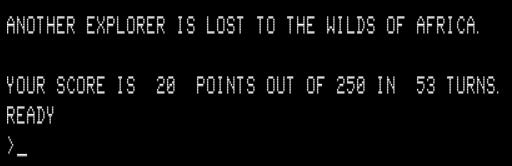
If you’re too reckless with threatening the natives, or dawdling around an alligator, you die, and apparently get booted out of the game:
But wait! After a short pause:
You get resurrected back at the rowboat. This only works once, so if you die again, the death screen is no longer a fake-out.
…
There’s a jungle with quicksand, which used to be everywhere in the 80s.
? JUMP QUICKSAND
DO YOU REALLY EXPECT TO JUMP OVER 30 FEET?
If you’ve played Adventure before and know the rhetorical question trick, this is a funny moment, since the game decides to slip into animated graphics mode. (If not, I imagine this is just frustrating.)
? YES
…
The initial prompt for the game was just to find Dr. Livingstone, so I was a little confused for a while: there were treasures like a SAPPHIRE strewn about in typical-adventurer fashion. After an hour of gameplay it dawned on me there’s the usual gather-the-treasures plot on top of everything else (it is also admittedly setting appropriate to have someone swoop into 19th century Africa and take all their stuff). Once I realized treasures were a Thing I was still puzzled as to where to deposit the loot.
YOU ARE IN AN IMMENSE CAVERN. THE WALLS
ARE COVERED WITH AN IRIDESCENT GLOW.
YOU CAN SEE NOTHING UNUSUAL.
A VOICE ECHOES FROM THE MOUTH OF THE CAVE . . . S W A M I
I found one room (the cave entrance two rooms west of the description above) where SWAMI worked to teleport me back to the bedroom. *That* was where the treasures went. I had still been thinking we were in the story-within-a-story frame but apparently, we were just accidentally using magic? (I suppose it’s supposed to be like SAY YOHO in Pirate Adventure where you teleport to and from London?)
…
The biggest research fail comes here:
YOU ARE ON THE GRASS PLAINS.
TWO SHRUNKEN HEADS DECORATE A SIGN.
YOU CAN SEE NOTHING UNUSUAL.
? READ SIGN
UJIJI COUNTRY – KEEP OUT
NO HEED ‘EM, WE EAT ‘EM.
… to recap, Ujiji was just a Muslim trading town. Also, while headhunters were a thing in central and western Africa, they were never in Tanzania. (Fun bonus fact: some countries in Europe, including Croatia, had headhunting up to the 20th century.)
Also, re: the “we eat ’em” reference: again, doesn’t seem to be a thing in Tanzania, although one of the more extravagant rumors of Dr. Livingstone’s demise was that he was eaten by cannibals.
Just like the other village, the natives are friendly if you don’t have a spear.
YOU ARE IN THE UJIJI VILLAGE. A NATIVE
STANDS NEAR HOLDING A SPEAR. HE LOOKS EXCITED.
YOU CAN SEE NOTHING UNUSUAL.
SEVERAL NATIVES WAVE HELLO!
And sometimes (although he can randomly be in a couple other places) Dr. Livingstone will be “down” from this location, in a pit.
YOU ARE IN A PIT. LIGHT STREAMS IN FROM ABOVE.
…
Now we get to the existential body horror.
When you find Livingstone, he’s considered an object. You have to give his catchphrase to successfully take him along with you.
YOU CAN SEE DR. LIVINGSTON.
? GET LIVINGSTON
DR. LIVINGSTON?
? I PRESUME
‘TIS DONE.
If you take him back to the same location that SWAMI worked on earlier and try to teleport, you get the message
HELP
Livingstone then disappears from your inventory. You can teleport back to Africa and find him (I think positioned randomly?) but it’s clear that the original method of teleporting won’t work.
The original DRIFT word turns out to be the solution; in the rowboat way back at the beginning of the game DRIFT sends you back to the bedroom with Livingstone. I have no idea why this method works to transport Livingstone and not the other way.
If the original “HELP” message didn’t weird you out enough, consider we are entering what appears to be a world in a book, taking treasures from it, including a live person, and then depositing them at “home” outside the world of the book/story/dream.
…
OK, that game pushed even my patience. By way of apology, here’s an actual good game set in Africa from a dev team in Cameroon. (Aurion: Legacy of the Kori-Odan; it’s on Steam.)
I can’t really write “Finished” because this is yet another Adventure clone that doesn’t want to trigger the endgame, but it’s safe to say I’ve seen nearly everything.
If you’ll allow me a lateral analogy:
In Pac-Man 256 you are being chased by “the glitch” from level 256 of the original arcade Pac-Man. Weird numbers and broken shapes follow Pac-Man as he tries valiantly to escape the universe being consumed.
With Bilingual Adventure, distressing bugs kept creeping up. I found more “void rooms”. (Fortunately, I found out that the magic word Y2 works everywhere, even in those rooms.) The lamp started running out of power even though I had the lamp off (the game seems to be “cheating” and just keeps a timer once the lamp is turned on, and never bothers to check if it’s off or even in the player’s possession). Halfway through the game, trying to THROW AXE at a dwarf just led to the dwarf mysteriously disappearing and a blank prompt. My inventory capacity started reducing for no apparent reason until I could only hold 3 items at a time.
Dropping from the stalactite puts you in the room marked with the purple arrow (it’s different than in Original Adventure). The two rooms marked red are void.
Last time I was stumped by a sword in a stone, when Draconis mentioned that the HELP message should really be in the description of the item.
?? help
I guess you need some help getting the sword out. Well this might help. There is an inscription on the blade which says – “ONLY MY NAME WILL WIN YOU FAME”.
Ah, this must be one of those “magic word based on pop culture” deals.
?? excalibur
The sword begins to quiver and suddenly springs into your hand.
Now, I need to do a big mea culpa: the dragon *is* in the game. However, you aren’t allowed in the right area until you’re holding Excalibur. So this whole process seems to have been meant to “fix” the absurdity of the original scene.
You are in a secret canyon which exits to the north and east.
A fire breathing green dragon as big as a Winabago bars the way. He is standing on a priceless Persian rug.
There is a rare Persian rug lying here
?? kill dragon
With one mighty stroke of the sword you have offed the beast. His once mighty body is being consumed in its own fires. There is nothing left now but a little green ash on the carpet.
One other change:
You are in the giant room. The ceiling here is too high up for your lamp to show it. Cavernous passages lead east, north and south. On the west wall is scrawled the inscription, “FEE FIE FOE FOO sic”.
There is a nest of golden eggs here
In the original, saying FEE, FIE, FOE, and FOO in order would summon the eggs back to this spot if they’re gone. The words don’t work here; the game makes jokes instead.
?? fee
There is no fee – this is a free game.
?? fie
You seem to have a slight accent liebchen?.
Instead, the final word of FUM from the original fairy tale is what summons the eggs. (This may have been intended to be another cheap way to avoid keeping track of state — that is, the game expects people to say the four words and then FUM at the end, but only bothered to record the FUM.)
The joke is different in French.
Sur le mur de ‘louest on voit un graffiti: “BA BE BI BO etc.”
?? ba
BABA au rhum? – Interdiction absolue d’avoir de a’lcool ici.
?? be
BEBE ou? J’espere pas, c’est la nourriture favorite des sorcieres.
This is a good moment to segue out to my last point: Bilingual Adventure really seems to be the only parser text adventure with mid-game language switching in existence. I’m not meaning “the first since 1979” I’m meaning “the first and only since 1979.” (Language switching is common in lots of other games, but parser does raise the difficulty a bit.) I’m happy to be proven wrong here, but even if there’s another example or two I’m missing, I’ve got to give the crew of Manning and friends some props for blazing a trail that (almost?) nobody else followed.




 Renga in Blue