Author Archive
The Ohio Scientific computer has been one of our more oddball and forgotten platforms, but due to the efforts of Aardvark there nevertheless was a set of original text adventures for the platform (including the first Star Trek adventure game).
The CompuKit UK101 was a clone of Ohio Scientific’s Superboard II (one of their earlier computers) from across the pond.
The machine is notable for both being released early enough in the UK (1979) and having enough memory (8K, just like Ohio Scientific) that it ends up being the platform of the current winner in our long-running Search for Earliest Britventure.
(Technically, there’s a port of Adventure for the PET that came even earlier from Games Workshop, 16K of memory required, but from the descriptions it seems to be a direct port of Crowther/Woods.)
Our honor (ignoring the parenthetical above) goes to Mr. A. Knight of Cleveland, UK, for his UK101 game Galactic Hitchhiker. Gareth Pitchford has collected a set of ads for the game and found the earliest was at October 1980.

A later ad, from Practical Electronics, September 1981.
As you might suspect from the title, it is loosely (loosely!) based on Hitchhiker’s Guide to the Galaxy. Unlike Hitch Hiker’s Guide to the Galaxy from a year later (which we’ll be playing next), it was not the target of a lawsuit, but again note the “loosely” — mainly it just copies the attitude, although there is a certain catchphrase that will feature very prominently.

Notice how it attempts an in-world explanation why the parser is going to be limited. You’re “helping” Maurice Marina with commands, Spike is sort of an “intermediary” between you and the avatar but mainly just makes the occasional comment on what is going on.
As Spike explains, Maurice Marina is stuck on a planet that is being evacuated, and your job is to get him home.

Weirdly enough, our avatar has a conversation with our computer guide.
It is squeezed into a tiny amount of space (the same as It Takes a Thief) and allows only a tiny verb-set:
CUT, OPEN, WAVE, FEED, PUSH, PULL, SHOOT, GO
(Even INVENTORY doesn’t work; you get a rucksack in your first move, and then OPEN RUCKSACK to find what you are carrying.) There’s also a fair number of spots you can die and no save-game feature, a good chunk is really just a “walking simulator”, exits are most not described so you can only map by testing every direction (GO NORTH, GO SOUTH, GO EAST, GO WEST, GO UP, GO DOWN) and if you successfully do a command, while it fails to give an error command, it isn’t clear what happened until you check the room (and LOOK alone doesn’t work, the only way I was able to re-examine a room was to leave and come back).
Still, this game is far better than it ought to be. I’d very tentatively recommend it (instructions are in this post although before you play you first need to do a “Cold start”, type “8192” when it ask memory size, and 46 when it asks terminal width, then double click RESET to restart the system — then you can pick up the instructions from there) although a port to something easier to work with would bump it up to … well, still only tentatively recommended. It has problems. But there are parts (likely partly spawned by often not worrying about describing exits) where the writing approaches something Good.
So for anyone brave enough to try it, veer away now, but for the rest of you, I’ve played it so you don’t have to:
Our hapless hero awakens without a ticket, although there is a rucksack nearby. All subsequent items are held in the rucksack.
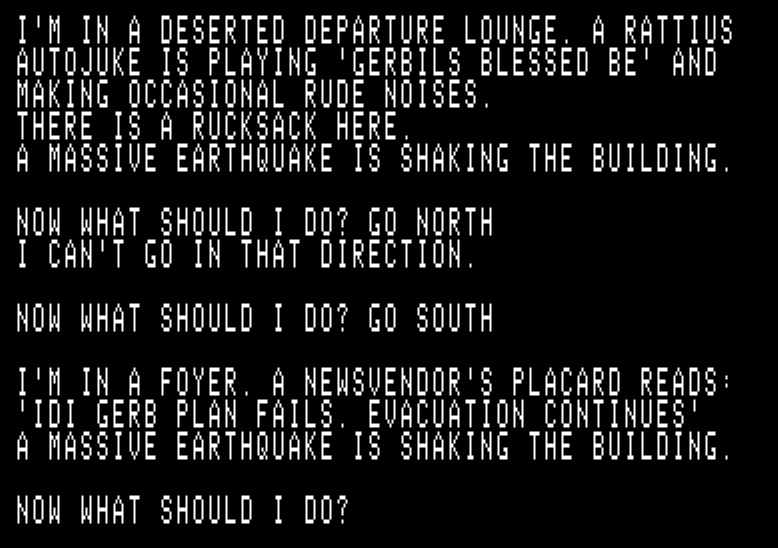
This was me mapping things out; again, the room exits are generally left out, so there’s no way to know GO NORTH won’t work without testing it.
There’s not much to see on the starting planet, and it takes only few steps to go outside.
I’M IN A RAGING BLIZZARD OUTSIDE THE SPACE TERMINUS BUILDINGS. THE WIND IS HOWLING ROUND THE FIRE ESCAPE
AND THERE ARE FOOTPRINTS LEADING OFF TOWARD THE LAUNCH-PAD.
Most of the action involves wandering around and mapping. There’s even a maze, but it’s a “normal-connected” maze where going one direction and going back the opposite direction will return you to where you came from.
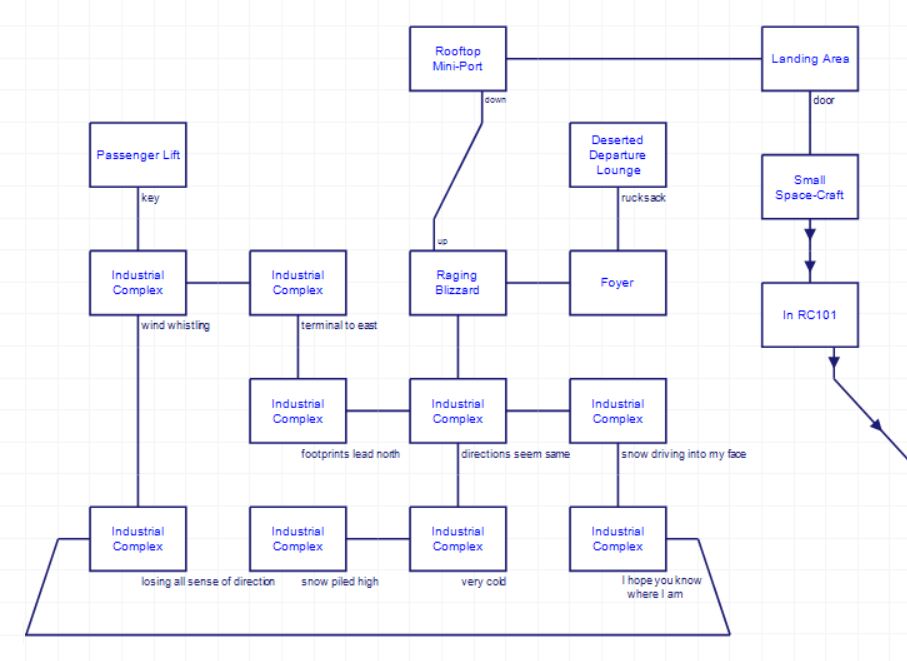
Eventually you’ll run into a “PASSENGER LIFT AT THE LAUNCH-PAD” where you find the escape vehicle has already left, and there’s a key left behind. The key lets you go in a small space-craft in another section which shortly after crash-lands on a new planet, Grecian 2000.

There’s a bit of ordinary-countryside wandering (a field blocked off by barbed wire, a chopping-axe, a ravine by a forest, a mountain, a lake with a “pit-prop” that’s a complete red herring) and managed to end my game for the first time in a glorious manner. I found “A LITTLE SHACK” with “A STILL” and “JUG”:
NOW WHAT SHOULD I DO? GET JUG
Spike here: He’s getting drunk!
Restart! This would go faster except the keyboard responsiveness of an antique 1 Mhz computer isn’t great, go figure. Anyway: get rucksack, find key, escape planet, crash on Grecian 2000, and keep wandering in circles for a while with no help, other than a message that states that Spike — our extra-narrative computer escort who yet somehow is mentioned in the world itself — already gave the password. (I figured out quickly what this meant, but let me save it for when it actually gets used in the plot.)
I had to poke at hints and realize that the forest being nonchalantly next to the ravine implies that CHOP TREE is possible, despite the noun “TREE” not being explicitly in the text.

Past the vaguely described people is a GERBICOP that, grimly enough, you need to CHOP GERBICOP to get by … in order to get a scarf.
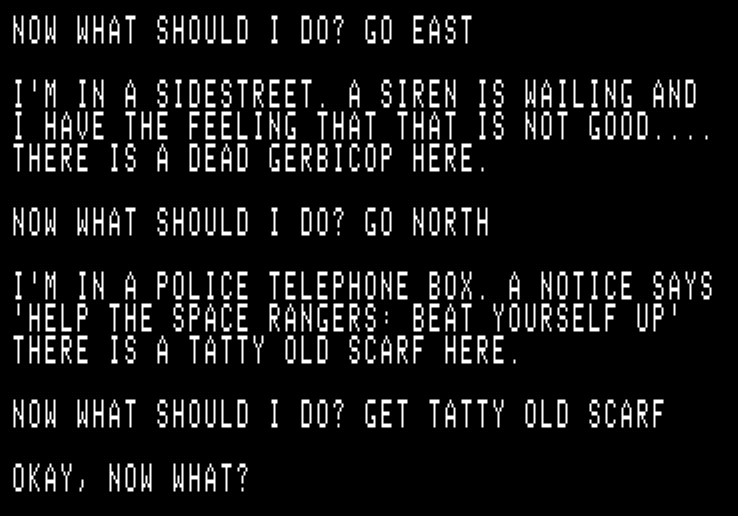
Pretty sure we have a random Dr. Who reference too.
In a different parts of the city you can find meat, a wire-cutter, and a loading bay with a “WIRE-MESH FENCE” accompanied by a “HUMMING NOISE”. Trying to apply the wire-cutter to the fence is fatal:
Spike here: He’s been electrocuted!
The wire-cutter is instead useful back in the countryside, where I mentioned a field blocked by barbed wire. CUTting the wire there is the correct route, letting you arrive at a “SPACETRAN” you can board, but it’s another doomed vehicle.
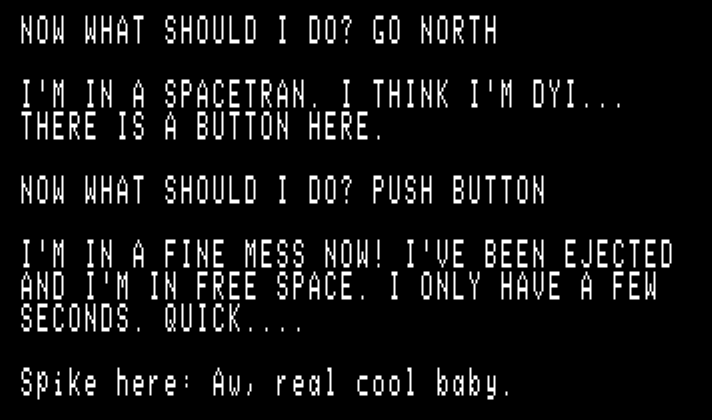
The button ejects you into space, where the only recourse is to WAVE TATTY OLD SCARF (you have to type all that out), which is apparently enough to attract attention:
I’M IN A LABORATORY. I DON’T BELIEVE THIS! I’VE BEEN RESCUED BY A GUY IN A WHITE COAT. HE SAYS WE’RE ON GOMERIAL AND TO
WATCH OUT FOR GHOULIBRUTES…
Gomerial, the third planet, mostly consists of a plaza blocked by a “SPACE RANGER” (I knew enough to stay back and not find out what kind of death I’d suffer) and a desert. The desert again is a very simple not-really-a-maze, with a “ghoulibrute” at the end who fortunately is persuaded to not eat you by an offering of meat off of Grecian 2000.
Next to the ghoulibrute is a shed which has a BLASTER. I took a guess and toted the blaster back to the SPACE RANGER:
NOW WHAT SHOULD I DO? SHOOT RANGER
OKAY, NOW WHAT?
Not even described! But there’s a DEAD SPACE RANGER here now. This opens a route to a the offices of TEMPORAL TRAVEL CORP and a PLUSH OFFICE where you’re asked for a password. This is where the earlier message about Spike is useful: at the beginning of the game, he gave the advice DON’T PANIC.
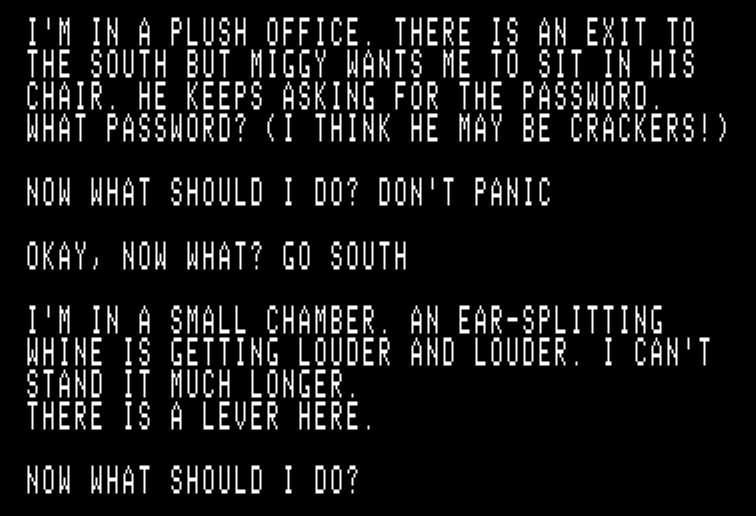
Pulling the lever takes you back in time to just before the start of the game, where there’s a ticket laying around that you can just take. Yes, this is a time-travel game: our hero dropped his ticket and couldn’t get it because someone else picked it up, but that someone else was just the hero from the future. The rucksack the person stealing the ticket had is the same one we’ve carted throughout the whole game.
The same planet map from the start of the game applies, except this time the escape ship hasn’t left yet, and you can win.

Really, with some extra polish (and presumably, a more powerful system) this game could’ve gone near to something modern. Allow me jump back to a particular moment, right after being rescued from space via waving the scarf.
I’M IN A LABORATORY FULL OF MYSTIFYING GADGETRY. NONE OF THIS MAKES ANY SENSE.
Spike here: You got LUCKY, man.
This is written from the avatar’s perspective in a concise way that nonetheless avoids the weirdly distorted minimalism of Scott Adams and related games; they’re sentences a person would actually write normally. The subjective confusion of the protagonist is really the thrust of the narrative, and Spike’s interjection, while cliché, still drips an injection of character. In other words, the game has description that matches the ludic action/plot and interplay between two personalities, not counting that of the player themselves. Not what I expected at all from a system with 8K of memory and 1Mhz of speed.
Burglar’s Adventure is the other sample “full adventure” that came with Bruce Hansen’s Adventure System, which was just the database system developed by Scott Adams with an independently developed editor.

From trs-80.com. According to the Australian magazine MICRO-80 the newsletter shown was put into copies of The Adventure System, with the notion of people subscribing quarterly and having adventures contributed by users, much like the Softside Adventure of the Month Club. As far as I can find there was only issue #1, so the whole project was likely another piece of early 80s vaporware.
Burglar’s Adventure was also quite a bit more enjoyable than Miner’s Adventure. The latter suffered from difficulty with guessing verbs and nouns; there are two bits in this game which are similar but it isn’t nearly as egregious.
The setup casts you as a thief, logically allowing for (once again) having a treasure hunt, this time searching for five treasures in a museum.

Most of the map, excluding the “home base”.
You start at a street by a car. I assumed for most of the game this was “your car” but it is not; you’ve apparently hiked it over here some other way, and can’t go back the same way you came in.

You can LOOK MUSEUM to notice that “It’s an ivy covered building” and CLIMB IVY to get up to an open window. I admit I was stuck here briefly but the need to use a second-order noun wasn’t too terrible just because there isn’t much to do yet!
Once inside, you find a sleeping guard.

If you LOOK GUARD, though, there is an important note that mentions that the “vault” will open at 9 am. Looking causes the guard to wake. You can HIT GUARD to knock him unconscious first. Alternately, you can use the power of magically knowing what the note has due to a previous run-through and leave the guard in peace. Hence, you can do the entire heist without messing with the guard at all. (This includes, at one point, running a chainsaw. Sound sleeper.)
The note also warns you that the red corridor has an alarm set, and indeed, if you try to go in, alarm bells go off. Interestingly enough, this is not an insta-loss. You can explore the “red area” a little bit — all the alarm does is set off a timer that eventually triggers. While I didn’t experiment, it is possible you might be able to get a “non-optimal” win where you grab one treasure while triggering the alarm and leave before getting caught. Sort of an alternate solution?
Even without that, the allowance for some exploration after triggering the alarm ended up being a smooth piece of game design, because it allowed seeing what obstacles were ahead and what items might be needed. One of the issues with adventure game design is having 10 items where items #5-#10 are all used for later obstacles, but because the player has no way of knowing that they spend a lot of wasted time trying to apply items #5-#10 on earlier puzzles. Here there’s a way to make those connections early, even if in the “diegetic universe” of the “final playthrough” the same sequence of items #5-#10 only being used later still applies.

One of the rooms past the alarm corridor. There’s an “ice block” that you can break with a tomahawk — suggesting the intended use of the tomahawk early — before solving the puzzle of how to avoid tripping the alarm.
Before dealing with the red corridor, let’s consider the other available places: there’s a “south of the border” area with beans and dough, a “wild west” area with some sticks, a “cowboy” holding a “LARRIET” and an “Indian” holding a “TOMAHAWK” and a “BOW AND ARROW”; there’s a lumberjack room with a chainsaw and some trees; a restroom with a mirror you can take, and finally a manager door that’s locked.
The sticks at the Wild West area can be rubbed to make a fire, which you can then use to cook the beans and dough and form burritos. I admit this is one of first puzzles I solved; I had run through my “standard verb list” and found that COOK worked so still had it in the back of my head when I saw the food and the fire. The game just says YUMMY so I was quite mystified what the effect was, but I kept playing (and found out the use later).
I tried to fiddle with the chainsaw and it told me it was out of fuel. I recalled in the last game extreme shenanigans with forming gunpowder and the like, so I expected I would distill home-made fuel somehow. What I wasn’t expecting was the solution to suddenly appear:
I don’t feel very good. I think I have GAS.
Yes, that’s from the burritos. Once you “have GAS” you can “START CHAINSAW”, and use it to break into the Manager’s Office.

The manager’s office contains a vault. Remember that the note said it opens at 9, and having done this kind of puzzle before, I went back to the central area which had a CLOCK and did TURN HAND to the right time. This let me nab a HOPE DIAMOND and a RUBY. (I guess that means we’re raiding the Smithsonian. Also, the Hope Diamond is now worth over $200 million, making this the biggest payday of any of our player characters so far, except I’m not sure where you would fence such an object.)
For the red corridor, I nearly got it solved on my own, but I had a smidgen of parser issues. I realized I could TIE LARRIET to a coat rack in the central area by the red corridor, and I was able to get the parser to TIE LARRIET to the BOW AND ARROW correctly, but somehow the setup didn’t work. More noun nonsense: the game lets you refer to the BOW and to the ARROW part separately. So while I assumed TIE LARRIET / TO BOW meant implied to the whole bow-and-arrow system, the game just had it tie to the shooting part, not the arrow part. You need to TIE LARRIET / TO ARROW instead.

With the rope so extended (and the guard still sleeping peacefully) I was able to climb over to the second area of the game without any alarm triggers. I’ve already showed off getting ivory tusks off a mastadon (at least we didn’t kill this one ourselves). There’s also a bit where you need to redirect some light with a mirror to get a Picasso and get into a CASE by referring to the GLASS.

This is the second-worst parser moment of the game, but the set piece does have a nifty aspect. You can BREAK GLASS instead to get in the case. The problem is that this sets off the alarm, again. But just like the alarm-setting-off before, it lets you “see ahead” in the plot and get a better run later. The CUT GLASS only works if you’re holding the Hope Diamond, and I cringe thinking of scraping that even if it is theoretically should be strong enough.
From the glass case you can nab a tiara; with the tiara, tusks, Picasso, diamond, and ruby you can then clamber your way back to the car, and drop your treasures off, and…

…realize that this wasn’t the protagonist’s car. I guess it makes sense if we are performing a high-profile robbery we wouldn’t be bringing our own vehicle, but I was still stuck because the only thing I could attempt was START CAR where I was told I didn’t have keys. I poked at a walkthrough and found out that (despite having no tools) the verb HOTWIRE works.


Given our payoff, I hope we’re upgrading our shack.
So, yes: despite some bumps like needing to induce you can refer to the GLASS alone of the “glass case” and it is considered a different thing, this was more fun to tromp through than Miner’s Adventure. I was particularly impressed by the alarm system allowing for “looking ahead” — it was never a true alternate solution if you actually wanted to “win” with all the treasures, but knowing what came ahead helped narrow down my puzzle solving options and know what to focus on. It also made the game less claustrophobic and linear overall.
I’ve mentioned the 1984 games explicitly saying they used The Adventure System. It is hard to know which others might have, given there is no “label” marked in the Scott Adams database if such a thing happens. There are some more random anonymous games that may have used the system for editing, or the authors may have just independently hacked the file on their own to figure things out. So I can’t say The Adventure System made a huge mark on history, but it at least gets some interest for being available so early in text adventure history.
Also, having a chainsaw powered by farts surely deserves at least a footnote in the grand annals.
While Scott Adams wrote his first two games in BASIC (Adventureland and Pirate Adventure) he quickly switched to machine language and in both cases used a “database” file that could be plugged into the same framework every time to run a different adventure.
There was theoretically nothing stopping a person from using the database and requiring the Scott Adams executable file be provided separately to create an entirely new game. Alvin Files and William Demas both independently wrote their own games published by Scott Adams himself, although unofficial games were also quite possible; Kim Watt did this with the unfinished and broken game Marooned. In 1980 Allan Moluf then wrote an early version of The Adventure System he called ADVLIST “for his own use” in BASIC as an editor to make games; this was picked up by Bruce Hansen who rewrote the slower parts (“some ADVLIST commands could take close to three minutes to complete”) in assembly language and redubbed ADVEDIT.
The catch in “providing the executable file separately” is that Scott Adams started protecting the disks to prevent copying. Despite this, Kim Watt (back to him, again) wrote ADVCOPY as a way of getting the executable file anyway, and Bruce Hansen later wrote his own Scott Adams Executor Program to get around any copyright issues.
The new ADVEDIT was eventually launched as a commercial product starting late in 1981.

Manual cover, from the Museum of Computer Adventure Games. Despite the title seeming to be “ADVENTURE the system” here it is given as “The Adventure System” in the manual text proper. The Alternate Source was incidentally a TRS-80 programmer’s journal; this seems to be their only game-related product although they had an offer to publish games made with The Adventure System written into the manual.
The system allowed publishing commercial games using the system. (Jimmy Maher claims there was a $200 fee for that on top of the $40 price of the game, but I can’t find the extra fee listed in either version of the manual I have.) This feels slightly cheeky, given a good initial setup was cadged wholesale from Scott Adams without permission. The only games I know of that took the developer up that offer are the Mega Venture series by Jim Veneskey, published by Big Orc Software in 1984. (At least according to various sites, I haven’t seen a magazine ad or a picture of a box.)
The package came with one “tutorial game” and two “full games”: Mini-Venture, Miner’s Adventure and Burglar’s Adventure. I’ll cover the first two now and save the last for my next post.
…
The tutorial game (or Mini-Venture, or Mugger’s Adventure) is pretty easy to dispose of.
You get out of your car, light a match to see (this a “timed event” so you see the lit room long enough to know where the exit is, then the room goes back to dark), go in your apartment, go up an elevator, unlock you door, and go inside.

Also, to test out the *TREASURES* system, you need to drop your wallet at the end.
It’s solely there to demonstrate how writing an adventure works and the entire sample adventure is printed in the manual.

The most elaborate portion is in the “ACTIONS” section.

The manual both lists the code and explains the meaning of each line after.
AUTO represents triggers that happen every turn. A fair amount of text games from this era lack much in the way of persistent effects, or “daemons”, but they’ve always been a large part of the Scott Adams games (for good or evil). For example, in the original Adventureland there are bees that when caught in a bottle have a percent chance of dying every turn while contained — not good design admittedly. In the follow-up Pirate Adventure there is a surf that goes in and out, and a location that changes based on the tide — this is much better design which not only open puzzle possibilities but makes the environment feel dynamic. Without any dynamic elements it is easy for text adventures to feel like a series of set-pieces waiting for the right phrase or item to continue.
For example, in the start of the source above, if the player is outside their car for 4 moves they are mugged and die, an outcome that happens 100% of the time when such conditions are met (AUTO 100) The “-IN 2” means “in any room other than room 2 (that’s outside).
The lines 5 through 7 are designed to handle if room 2 is lit or not. Light normally happens in any room other than 2 (the -IN 2 again). The command LIGH MATC (“light match”) from line 7 will trigger being able to see in that room temporarily (it will actually show the room description, then pause in real time, then revert to darkness).
Bruce Hansen seemed to have a technical handle on the system so I was looking forward to the sample games being well-coded, but at least for Miner’s Adventure that is sadly not the case.
…
The premise of Miner’s Adventure is to go into a mine, get treasures, and return them to the main office.

Yet another treasure hunt, but they’ve worked out fine before. This one has trouble right away. If you LOOK DESK you can see a DRAWER which you then can OPEN with the message “Strange, the drawer was hard to open.” This cues the player to LOOK DRAWER and find an envelope taped underneath. Good so far (and I like the use of tactile sense as a hint). However, I then spent the next 15 minutes searching for a way to get at the envelope (GET ENVELOPE: “I don’t see it here”. GET TAPE: “I don’t know what TAPE is.”) I finally just checked a walkthrough and found I needed to UNTANGLE ENVELOPE, which is the worst guess-the-verb I’ve seen in a long time.
The envelope has a key and a paper stating “Cross over into another world”. The key let me unlock a nearby shed with a fuse, empty dynamite box, and shovel. Outside the shed I was stopped at the Mine Entrance by a guard (and no verbs worked on the guard) and the only other thing I had access to was a “Mining Office”.

The way the room is set, the only available item (other than the SIGN which you can just look at) is the DESK. This time I had about 30 minutes of frustration, since I wasn’t sure if I was really supposed to do something here now (or maybe have treasures checked later or something along those lines). Again I finally resorted to a walkthrough, which told me I needed to GET JOB.
OK, you’re hired
This is the most infuriating sort of parser abuse and I pretty much lost all faith in the game past this point.
Inside the mine, there’s some coal lying out in the open, and “freshly dug earth” you can use the shovel on.

The next awful bit is shown above. Even though the game seems to be coded for ROCK being the noun (as you can LOOK ROCK) GET ROCK gets “I don’t see it here.” No, you need to TIE TWINE / TO KEY. It isn’t clear at all the “keystone” can even be referred to as a separate object, and it can of course be confused with the actual key item from earlier.
After pulling there’s an OBSIDIAN BOWL which is a treasure, and a “stone” with a “sharp edge”. The pile of rocks is still there but GET ROCKS says “I don’t see it here”. The next action is to use the rocks which you can’t see and can see simultaneously and also can’t refer to in any other way in order to MAKE BRIDGE.

As a general rule, the author doesn’t seem to care that an item that is getting used can be referred to in any other sense; only a lateral command (where it isn’t explicit what is happening, and I had to just guess afterwards) works as a method of reference. When this sort of thing happens too often the game ceases to have a “world model” with objects that can be each thought of as entities that can be manipulated and instead asks the player to find the Special Words to make progress.
Next comes a “tropical valley”.

The water from the pond can be taken back to the lava area to pour it and get some “sulpher” (this can mix with coal to make gunpowder, you have to summon up the command MIX GUNPOWDER from the void). You can also dive in the pond (pulling away a piece of metal which turns out to be a speargun) to find some crystals.

The speargun can be used to kill and the sharp stone can skin an alligator for its hide (it’s a treasure). (It’s also good for confusing the parser where you type GUN and it doesn’t know if you mean gunpowder or the speargun, argh.)
You can then swing a vine to a cave, load a cannon with a gunpowder/fuse/bamboo combo (there is no prompting that the word CANNON is even in the vocabulary of the game, but that’s what you have to make)…

…use the cannon to kill a SLEEPING MASTODON (not even being threatening), follow it to take its ivory…

…escape out a stream and using a pole with the word VAULT, because let’s just keep piling it on for hard-to-find verbs, and finally tote the treasures, including the ivory from killing a rare animal, to victory.

This did not feel like victory.
I’m hoping Burglar’s Adventure is a touch better? The author here was good at designing colorful events, not so good at making sure all the pieces were lined up so the players could find the right knobs to push to make those events happen. (I have trouble believing anyone came up with making a “cannon” unprompted — where you had to type that exact noun — without reading the source code.)
(Click here to read my entire Institute series in order.)

One of the manual covers, from The Museum of Computer Adventure Games.
I have finished. The remaining three dreams turned out to be short, so the structure remaining was more like bouncing between environments as opposed to solving mini-adventures.
I’ve written before about how in this period when authors wanted to make a game difficult, and they didn’t have much in the way of conditional states (like environmental factors that change, or certain timing that needs to happen) they tended to resort to either lots of instant death, hard to find verbs, or hiding things. Given dying is almost a benefit, the game has to resort to the latter two, especially hiding things.
One extra side effect of puzzles being mostly reliant on hidden items is that past a certain juncture, puzzle solutions can come in a flood, where when finding one item it becomes totally obvious where it goes, and the problem is getting the item in the first place. Then, using that item to solve the puzzle in question yields another item, which again has an obvious place it goes, etc., especially given a map that has been combed over many times.

You start at the “Giant Statue Area”. The next dream is an impressionistic version of the Titanic, followed by a temple, followed by a dream with a saber-toothed tiger, going back to the giant statue. To finish the game I had to travel the loop quite a few times. The cover above tries to depict all four.
Fairly quickly after I left off last time, I found an UMBRELLA (I hadn’t done a “LOOK” at the natives just past the large green man). This let me at least get started on the next dream, which starts ambiguously in some smoke, but if you an open an umbrella you float upward out of a smokestack…

…and land on the deck of a ship.

The life preserver reads “TITANIC”. There’s not much to do other than go inside where there’s some furnishings and a picture; the picture is held in by screws. On the outside you can go to the stern of the ship and watch some icebergs incoming which eventually sink the ship. Using the life preserver you can, oddly enough, peek underwater after going overboard, and find a crowbar on the ocean floor. This doesn’t make sense for a deep ocean, but this honestly works fine as dream logic; one of the things I’d expect is expansion and reduction of space. The ship is known as very large but in gameplay is quite small; the ocean is quite deep but in gameplay terms is quite shallow.
There’s nothing else to do after obtaining the crowbar but eventually drown, but fortunately that makes for an exit from the dream. The dream that follows, outside a temple, I was able to get started by noticing a plant poking through the door, and applying the WATER to it.

Inside I found a blood-stained altar and a door with a lizard. I picked up quickly and realized I could try SACRIFICE as a verb, but the game asked me of what, and I was at a loss. I decided the item I needed was probably elsewhere.

You have to die to get out of this dream, which you can do by trying to open the door (a trap slices you) or trying to CLIMB when outside (you fall and die). Either way, you can visit a pre-historic area:

Again, very small: it only turns out to have 3 rooms. If you approach the chest you see at the start the tiger eats you. There’s also an area with rocks and a stream to the south where the water is poisoned and you can drink it to boot yourself out of the dream.
In actual gameplay terms, from here I died, and moved on exploring each dream carefully starting from the Giant Statue one, but to save time in narration, I should mention that if you go south and check the rocks carefully you can find a lizard. You can likely guess where it goes:

This is followed by a men-with-reptile-head room…

… and climbing up some stairs and dying due to toxic gas. The solution to the gas turns out to be straightforward but due to the rotating nature of the dreams I decided to move on and come back.
I poked through the loop a few times trying to search for things I had missed. A “shrub” had popped up at the color-changing water in the Statue area, which I was able to dig up with the shovel. I tried planting the shrub in various places with no luck, and decided to peek at hints again, although I wasn’t fully determined to read them; the questions themselves can be hints of sorts. However, even though the clues were encrypted by rotating the alphabet, I immediately was able to decipher the answer to the key problem anyway.

Specifically, on #8 above, figuring out what to do inside the statue was one of the dilemmas I hadn’t resolved last time.

I thought perhaps I needed special spectacles or the like and moved on, even though I had missed doing an action I already used elsewhere: JMMI SN, which I realized had to mean LOOK UP.

The ladder you spot by doing so lets you get up to a locked room which takes a keycode. (It is incidentally fortunate I happened to be holding the SHRUB — this is where it is useful, as otherwise there is a lack of oxygen.) Fortunately, I had a keycode lying around from last time (with the billboard) that I hadn’t used yet. I led me into another octagonal room with a metal plate on the ground I was able to remove with the crowbar (from the ocean in the Titanic dream). Below that was a bolt, and I knew I probably needed a tool I hadn’t found yet.
Still, that wasn’t quite enough to set off a chain reaction, but passing through the lizard-sacrifice dream again, I tried on a whim HOLD BREATH (the shrub didn’t do anything, but maybe…?)

The hole was frustratingly non-responsive to commands, but enough plodding led me to insert the mirror in it and get light to bounce inside. A rumbling started, and I tried to WAIT to see what would happen but then the whole sequence just aborted! I figured the parser wasn’t worth tangling with here and went straight for a walkthrough which revealed I needed to LISTEN, which is really the same thing as WAIT, but… well, let’s just move on with the result: some meat and a comic book. The meat I figured could go for the hungry tiger who kept tearing me apart in the pre-historic area:

(This is where everything speeds up.)
I was able to throw the meat and the tiger ran off after it, letting me open the chest. The chest had a screwdriver (dream logic, fine) which I immediately toted over to the Titanic (after going through the death cycle again twice) and used to get the painting off the wall.

This yielded up a small key, which I then took immediately over to the locked toolbox I remembered being stuck on and got a wrench.
The wrench I then took back to the bolt in the statue, which after I turned it caused the statue to fall over; you get “thrown free” and land on top of a gold key.
I wasn’t sure where else to go, but I decided “gold key” felt fairly final (and the counselor suggested the father — who the statue is of — being the “key to your insanity”) so I went back to the original Institute area and wandered a little, finding the Counselor was out.

There was a locked door now, which the gold key worked on, and victory.

…
Creators of art in a new medium don’t have much to go on; they can peer sideways at other works and peer forward at blackness and try to spill light in the right directions, but to make art that really says something in a deep and enduring sense requires some luck.
The Institute did start off promising; the hints of hidden background, the drug-induced mechanism for dreams, the dystopian atmosphere, the Counselor who was there to “help” but you also had to keep attacking, and later get to shoot themselves while in dream form.
The very premise gave lots of leeway for adventure-game oddness while opening a gap for profundities and revelations. Neither was reached. I wouldn’t say this is just from the ending — which essentially gave up the steam of narrative, surprisingly so given the prior Pearson games — but random puzzle after random puzzle just didn’t add to anything. I was expecting maybe the live father to show up and have a conversation, so we could find out what all the references were about, and maybe some of the items would have secondary meetings, but no, sometimes a scalpel is just a scalpel and a statue is just a statue.
As the screenshot hints, yes, there’s more Pearson to come. Lucifer’s Realm involves going into Hell to stop Adolf Hitler from raising an army to organize a coup over Lucifer. Some stores apparently refused to carry it? So that’s promising, but we’ll have to wait until 1982 to see it — which is getting very close, about 7 games to go before I wrap up 1981.
(Continued from my previous post)

I had roughly the right ideas last time, but the Pearson parser remains ever-finicky.
I’m still puzzling over how many of the odd tendencies are things One Could Get Used To, and how many are truly bad design. To compare with a later game, Graham Nelson’s Jigsaw (from 1995) requires you in at least one spot to LOOK UNDER an object. Early on (before the moment where the command is required), there’s a rolling piano seat, and you can find something underneath if you MOVE or ROLL it. This gives an early hint that needing to LOOK UNDER things is required, but since it’s not a requirement, there’s still a little bit of ambiguity and the later moment can easily be missed. At the time it was written, LOOK UNDER was kind-of-standard but not really? I remember complaints at the time. Note that SEARCH, EXAMINE, and LOOK UNDER all gave different messages:
Vestry
The vestry once held surplices. Today, it holds a surplus. Debris, broken furniture, blown-in leaves, panes of dusty glass and mildewed cloth, all unwanted.
There’s even an old Victorian piano stool, but no sign of a piano.
>search stool
You can’t see inside, since it is closed.
>look under stool
There’s a charcoal pencil underneath the stool.
>examine stool
An old wheeled piano stool, wide and tall, with a hinged and padded seat.
The Pearson standard list of verbs has LOOK UNDER. I had tried it early (LOOK UNDER BED) but hadn’t seen anything and forgot about it — the message was IT DOESN’T SEEM TO WORK. Later, I tried it again, but just typing it as LOOK UNDER — the parser usually takes verbs only, and that especially feels natural when the parser is mostly a two-word one. (There’s even a bit later where you are forced to break a command into two parts, like Scott Adams, rather than type all four words as one phrase.) Yet, it turns out at the bed at the very start, if you wait until after the dwarf leaves, you can LOOK UNDER BED to find a mug.
What elements of me being caught by this are “my fault”, so to speak? I was cued in already to the possibility of LOOK UNDER, but that was only because it showed up somewhere in a previous Pearson game (I’m not even remembering where, exactly); there’s no “training moment” like in Jigsaw. I did make a full LOOK UNDER BED but apparently it was too early. Later, it changed — is it really fair that it changed? Certainly “IT DOESN’T SEEM TO WORK” feels like it is being in reference to the action itself, not that there was nothing useful to see. Jigsaw also had the virtue of being a full-sentence parser where it feels normal to type three words, whereas the Pearson parser breaks open 3+ words only in special cases, and really doesn’t seem to “understand” such sentences.
…that was a bit long for just one moment. In any case, I found a mug, which I took over to the padded room from last time (the one I got to by using ATTACK on the counselor) because I had meanwhile found another secret via a Pearson tendency.

Even though there isn’t any particular reason to, LISTEN will reveal a dripping sound. You can then LOOK DRIPPING to find there is water. I previously didn’t have a way to get the water, but DROP MUG lets the mug start filling with water, and you can wait to get thrown out of the room and the mug stays behind (the staff is very on top of some things and very apathetic about others). Then, you can go back and attack the counselor again which gets you tossed in the same padded cell excepted this time the mug is full of water.
From here you (and I) can go on to finally quaff the red powder from last time, but before I do that I’m going to mention another action in the padded cell — I found this rather later in my gameplay but I’d rather get this out of the way. I had theorized last time, remember, of taking a sharp object in the cell. I found a SCALPEL by doing LOOK SHELVES a second time at the place I found the bottle at before (yet another Pearson tendency, repeat those commands until they run dry, and then repeat them a little more just in case) and tried to CUT WALL and CUT PAD and STAB WALL and the like but got nowhere. I eventually found out from a walkthrough I could CUT PADDING (even though the actual word “padding” doesn’t show up in that form in the game, it simply mentions a “padded cell”) and get a rope that was useful later.
Enough noodling around, it’s dreaming time. Grabbing the bottle with the red powder and holding the water from the mug, I could finally EAT RED POWDER.

Just as a heads up, this gets very dense; this is a dream where anything can happen and while there is continuity of landscape, characters can block your progress without anything resembling motivation.
To the east there’s a cliff, which you can climb using the rope and find a telescope. Then you can LOOK TELESCOPE to find it out of focus, and see the Earth.

In yet another Pearson tendency (a good or bad one?) you can keep LOOKing at deeper and deeper levels, LOOK EARTH lets you see continents, LOOK CONTINENTS lets you see a metropolis, LOOK METROPOLIS lets you see a tall building, LOOK BUILDING reveals a billboard on the roof, and LOOK BILLBOARD finally gets a code (which I haven’t used yet).

Heading back the other way to the starting room, you find a corpse that wasn’t there before:

I haven’t been able to do anything with him yet.
Going through my standard rigamarole, I was able to LISTEN to hear a willow whispering, and talk to it where it asks where I am from. SAY INSTITUTE causes it to reveal a stair going down.

There’s the Counselor from the “real” world, who, as part of his speech, repeats the line
SOCIETY MUST BE PROTECTED FROM YOU..AND WE MUST PROTECT YOU FROM YOURSELF
Since he does what you ask, you can ask him to SHOOT the gun he’s holding and he’ll disappear
THE GUN FIRES..
HE DISAPPEARS IN A FLASH
After this encounter comes a stream with an owl.

The plaque referred to here is in the “real” world with the inmates, which says PEACE = DEATH. It will be useful in a moment.
By drinking the water, your skin changes color:
WOW!! YOUR SKIN TURNED BLUE..
South of the river is a statue (LOOK BASE reveals a tube of glue) where if I say the magic word I learned from the inmates last time (SHAFLA) a door is revealed. I didn’t make any progress otherwise so I assumed a key was somewhere.

Then there’s an encounter with the fellow above, who the game describes as — slur warning — as a “midget”. To be fair, this isn’t like the Earthquake San Francisco 1906 situation; it is quite possible circa 1981 not to know; here’s Roger Ebert in 2005 being informed for the first time the word is derogatory in regards to a review of Death to Smoochy.
In any case, he demands to know what death means, which you must respond with PEACE. This inspires him to the try to start kicking and punching, and you just need to attack back to dispatch of him. Dream logic, yeesh.

The next encounter is a log where CLIMB for some reason is the right verb (but I was used to it from, you guessed it, other Pearson games) except you slip, as shown above. You can take the glue before and either PUT GLUE followed by ON SHOES or simply use GLUE SHOES. (The full phrase PUT GLUE ON SHOES doesn’t work. Also note that shoes never actually show up as an inventory item.)
I finally became horribly stuck on a green man.

He kills you if you try to enter. In dream land this causes you to exit the dream, which isn’t necessarily bad! — and I’m guessing there’s other parts where you want to die. However, I still kept with the current dream and tried various contortions to get through, before I finally resorted to checking hints again.
Remember the river that changes your body’s color? If you keep drinking (remember, in Pearson-world, keep repeating things!) your body turns red, then back to blue, back again to red, back yet again to blue (you’d think you could stop here, but no), green, blue, red, blue, red, bright green. Green is useful, but bright green is really the useful one, as the bright glowing lights up rooms to helps solve a second puzzle later.
Being green is sufficient for the green guard to let you by. While I was hitting the hints, I also found out that after I had crossed the log, I could GO LOG (!) and find a SHOVEL and COPPER KEY hidden away. The key was enough to get inside the locked door from earlier…
…but I couldn’t find anything there (the room was all one color and hard to see) so I moved on to the area past the green man.
The village have other green men, and a hut with someone who calls himself RUDY BEGA…

I assume this is a specific reference, but I’m too exhausted at the moment to figure out what it is.
…and a dark shack where you can find a toolbox as long as you’re glowing.

Locked, can’t open it yet.
Finally there’s wall with a “dark hole” containing an “oracle”.

Using the right item (from my last post, I’ll let you work it out) broke open a crack I could enter and then wake up and exit the dream without dying.

I don’t know if there’s something superior to this method of exit than just dying.
To recap the open threads, because that only vaguely resembled a narrative, I still have to investigate:
– the corpse, who might just be there for plot reasons
– the room inside the statue that’s all one color and hard to see in
– if there’s something useful to do with Rudy Bega
– some way of opening the tooolbox
I suspect that I’ll need to visit other dreams and loop back. Just to be clear, all items carry over, so these aren’t entirely self-contained areas. I additionally yet have to use the code I found from the telescope.
Once I got out of the dream I went back to the red powder to try eating it again. I found three more dreams this way before looping back to the original one, but I haven’t explored yet. Some screenshots to close things out, though:


The duo of Jyym Pearson and Robyn Pearson finish off 1981 (finally!) with The Institute. Will Moczarski calls it a near-masterpiece so we’re likely in for a ride.
Rather than Adventure International, this game was originally published by Med Systems as text-only (for both TRS-80 and Atari computers), and after Med Systems switched to being Intelligent Statements, Inc. (trademark filed July 13, 1982) they published a Commodore 64 version of the game sometime that year (probably text-only, see image above). The next year they published graphical versions for Apple, Commodore 64, and Atari using the name Screenplay. (Screenplay is listed as a trademark owned by Intelligent Statements, even though the trademark on Intelligent Statements itself was listed as abandoned in 1984, so I’m not totally sure what’s going on other than possibly bad handling of paperwork.)

I’m playing with the Apple II version.
It hasn’t been that long since I tackled a Pearson game (see Saigon) but there’s a general style and rhythm where once you get used to it the Pearson games are easier to solve. For example, using LISTEN in all locations, applying LOOK not just generally but to what seem like “location objects” that otherwise can’t be referred to, and being prepared to use movement verbs like CLIMB when otherwise not prompted to.
The premise, from a 1983 version of the manual:
Trapped in a mysterious “Institute”, you know that you are not mad, and yet many of your fellow inmates are. The Freudian solution to your entrapment becomes a series of vivid dreams, induced by a strange powder. Each of the dreams takes place in a different location, making the adventure actually five adventures in one. Each location contains objects and information that you must use in other places in order to escape. You may actually have to let yourself be killed in order to escape one dream and proceed to another.
Promising! The prior Pearson games had issues where the heavily linear structure led to some obnoxious softlocks (Escape from Traam in particular) and we’ve seen with other games from this era that splitting into smaller areas has often made for stronger games.
The credits are incidentally slightly different on this one (not surprising given the change in company)
Written and Produced by Jyym and Robyn Pearson
Programmed by Norm Sailer and Jyym Pearson
All graphics created with the aid of: THE COMPLETE GRAPHICS SYSTEM by PENGUIN SOFTWARE
Illustrated by Rick Incrocci
The graphics have a new illustrator, which starts to be obvious when you see people.
You start awakening in a bed unable to move, and a dwarf enters that you can TALK to.

After the conversation, you can GET UP and walk around.

You can break off a piece of the mirror, descibed as SHINY. I haven’t used it yet.
There’s not much accessible at first. There’s a room with a bottle of mysterious red powder, but if you try to walk away with it you get stopped by a guard and tossed back in your room. You can duck into a closet and try to eat the powder but it “sticks in your mouth”.

There’s a room full of inmates — and this is where the improved art starts to be more obvious —

and you can TALK here multiple times to get clues like the one above. I haven’t gotten anywhere with SAY SHAFLA, but I assume that gets tucked away for later. The most useful message otherwise seems to be:
A MANIAC STARES AT YOU AND YELLS, “YOUR DREAMS HOLD THE KEY.. ATTACK HE WHO WOULD HELP YOU”
Well, I can try to oblige that request at least. The third thing easily accessible is the “Counselor”.

Also, SOCIETY MUST BE PROTECTED FROM YOU..AND WE MUST PROTECT YOU FROM YOURSELF
Trying to ATTACK does get a reaction: you get tossed in a padded cell. I haven’t found anything useful here. Maybe smuggle in something sharp at tear at the walls? I have gone through the requisite LOOK and LISTEN regiment but it is hard to miss things anyway.

From Atarimania.
This is the last of the APX titles, and just like Sultan’s Palace, it is by Dennis Koble.

After Sprint 2, Dennis Koble worked on Dominoes, one of the family of Snake-like games. The first such game was the RCA game Mines in 1975, but it was only run as a location test. The first fully released arcade game with the concept was Gremlin’s Blockade, released November 1976. The first clone (Bigfoot Bonkers) was exactly a month later, and Atari’s clone came a month after that. The early arcade industry was thick with ripoffs.
Mr. Koble mentions in an interview that he felt his text adventure games were “inappropriate for the public” but APX needed titles so he let them have the games to “help them build their initial base of available software.”
My game and the Chinese Puzzle Adventure (published via APX), and possibly the other ones too, were based on an “Adventure” system someone wrote in order to create a modular text-based adventure system. Basically it allowed anyone to create a text set and a logical road map as it were to make their own adventure. We were all very familiar at that point with Zork and so a number of us used that system to create our own fun adventures. I don’t think any of us ever actually thought of using it for a commercial game or anything but we had fun creating them.
The Chinese puzzle game I designed was never actually intended to be “fun”, believe it or not. My goal when I created it was to create the most difficult text-based adventure game ever. It was never intended to be marketed, either.
The internals of this game are entirely an abstract puzzle with no pretense of plot whatsoever, which is oddly prescient, since that makes it the sort of thing that would be entered into IFComp* circa 1995 but definitely doesn’t have good comparisons circa 1981. (A more recent comparable set of games might be the Hard Puzzle Trilogy.)
You have been drugged by a Chinese madman to find yourself locked in a suite of rooms.
That’s it. The whole plot. There’s intended reference to Chinese puzzle boxes and the ultimate riddle of the game. It is “slightly dodgy” on the Asian-stereotype-meter but nothing in the content indicates the game has Issues; whoever did the ad copy for Atari, though, went all-in:
You’ll need patience, endurance, and an understanding of the clever Oriental mind to win your freedom.
Ugh. We can wave the Atari catalog away as non-canon and just consider the game itself, which is super-minimal in nearly every way.

This is the entirety of the map, with most of the rooms just being a color.
BLUE ROOM
This room is blue.
You start in a “3-Room”; going down is blocked and is the exit. To get to the exit you need to say three words in three particular places (this is not clear until you succeed).
Out in the open there’s a “crystal”

and a “Chinese ideogram”

but no other items to start, and there’s only one more to find.
There’s no indicator or reasoning behind what color room does what, you pretty much have to experiment everywhere, although the game at least gives you a smallish number of verbs to pick from upon typing HELP:
DROP, READ, OPEN, LIFT, SAY, TURNOVER
The general intent — if there really is one past this being a programming exercise that escaped into the wild, more or less — seems to be to treat the parser interface itself as a puzzle. You need to test out the items in various rooms and use error messages as clues. For example, DROP CRYSTAL in most rooms gets the message DROPPED followed by THERE IS NO EFFECT HERE. There isn’t a game-translated-into-real-life reason for the “no effect” feedback, but the intent is to clue in that the room the item is being dropped in is checked, and if dropped in the correct place, there will be an effect. Namely, at the “black room”:

Again, there doesn’t seem like something remarkable happening, but the knowledge that a special-coded message occurred means that something did happen, so the next thing to do is recheck the map for changes. Not far away, back in the white room, a box has appeared.

If you redo the process and drop the crystal in the black room again at any time, the box teleports back here.
Trying to READ BOX and TURNOVER BOX gets the message YOU HAVEN’T DONE SOMETHING ELSE YET, a clue that there’s some sort of game flag that needs to be set. In past APX games we’ve looked at this ambiguity was sometimes fuzzy as to what, exactly, the obstacle was (a locked door? a magnetic field?) but here it leans into the ambiguity as something intentional: you are never told what the flag is, you just have to keep experimenting in each room until you get something useful to happen. Incidentally, READ and TURNOVER in anywhere other than the White Room just gets THAT HAS NO EFFECT HERE.
With box in hand, you can go back to the Yellow Room (for no particular reason) and drop the IDEOGRAM and READ it.

This is the first of the “code words” that needs to be said to win. Going to the Red Room and typing SAY CHINA gets
YOU HAVEN’T DONE SOMETHING ELSE YET
If you go back, pick up, and drop the IDEOGRAM (without reading it) you can head back to the White Room and now do TURNOVER BOX

After getting the Russia keyword, for some reason now the China one works! You can go back to the Red Room to use it:
Ah yes. One of the big 3.
This might be enough to figure out what the third mystery word is (it is in fact possible to bypass the “puzzle” that reveals it — you need to get the game in the state where you can OPEN BOX rather than TURNOVER BOX). I think I’ve made my general point about how nonsense the gameplay flow gets, so I’m just going to quote the complete walkthrough from Dale Dobson, who resorted to studying the source code.
1. DROP IDEOGRAM in the Yellow Room (sets flag 4:1)
2. TURNOVER BOX in the White Room (requires 4:1, sets 4:2)
3. SAY CHINA in the Red Room (requires 4:2, sets 3:1 which is never required)
4. TAKE IDEOGRAM and DROP IDEOGRAM in the Yellow Room again (resets to 4:1)
5. OPEN BOX in the White Room (requires 4:1, sets 4:4)
6. READ IDEOGRAM in the Yellow Room (requires box in hand, sets 4:3)
7. SAY RUSSIA in the Blue Room (requires 4:3, sets 4:6)
8. SAY U.S.A. in the Green Room (requires 4:6, sets 2:1)
After this gloriously sensible sequence, the exit below the starting room is unblocked and you can reach victory.

I’ll call this game “accidentally innovative”. If you asked someone in 1981 to sit down and write an adventure to be published, I don’t see any universe where anything in the ballpark of this game would emerge. The author was just playing around and the game got published anyway. I’d be like if you went back in time, recorded Mozart banging variants of a C-major chord 10 times in a row as a joke, and published it, proving that Mozart invented minimalism 200 years early.
(*) As of this writing, IFComp 21 has started. You can sort by “choice”, “parser”, and “other” this time if you fancy only a particular kind of game, and voting is open to anyone.

From Atarimania.
That rainbow cover can only mean one thing: we’re back to the Atari Product eXchange (APX) series from Atari, and one of the text adventures made using their slightly dodgy in-house engine and where the games were more or less written as private flights of fancy and then dropped on the APX catalog in order to fill in space. (More background about this is at my writeup on Wizard’s Revenge, the only one of the text adventures to be written by an outside party.)
This is one of the two APX games by Dennis Koble, whose Atari credits go back all the way to 1976 with Sprint 2.

From Flyerfever. Kee Games was Atari. Atari made their own competitor. Quoting Nolan Bushnell: “I wanted world domination, and it turns out that there are two coin-op [game] distributors in every city. One would have Gottlieb pinballs, one Williams. We had chosen the best distributors, but the [distributors] who didn’t have the Atari brand were doing everything they could to spawn a competitor. So I thought, let’s make that happen.” The jig was up after 1974 but they still kept making games under their own name for a while.
This also has the distinction of being the only game from Atari reviewed in The Dirty Book, volume 2, number 1 alongside other titles like Zesty Zodiacs, Dirty Old Man, and Softporn Adventure (the latter being a game we still need to get to). Yes, this one was advertised as being Slightly Naughty.
The notorious Sultan Abdul has abducted the sheik’s daughter, Princess Fatima, and is holding her captive while he arranges for the wedding. Gallantly, you accept the distraught father’s plea to rescue the princess from Abdul’s pleasure palace … This is an R-rated Adventure. The verbs are the usual ones, but how they combine with certain objects makes the result quite provocative. This version also has many humorous comments.

As typical for APX games, this has a very limited verb set; including the usually TAKE (no GET) and DROP, you can WAVE, RUB, OPEN, LISTEN, GIVE, ASK, and SAY. (The imaginary verbs TURNON and TURNOFF that are particular for the Atari games are here, but there’s no items they go to.)
Also as typical, some of the room descriptions stylized in quite a particular way —
ENTRANCE HALL
You have entered the Palace and many doors await you.
You have but to choose.
— by what I mean, is they have an odd informality that doesn’t always bother describing exactly but instead try to get across a mood. This is bad in an interface sense (you have to test every room exit, they are almost never described in this game) but allows for some moments of narrative atypical in a 1981 game:

Room exits do have a way of making it difficult to be poetic.
Now, alas, all this is buried in what was surely just an Atari internal whim of a game.

Most of the game’s map, excluding a small mirror maze and underground area.
The protagonist inventory start off empty, except for a pair of pants. I started making a map and scooping up a bunch of items out in the open: a golden lamp, …

… a jar, a pillow, some peacock eyes …

You have to use PEACOCK EYES in full to refer to the noun here.
… a carpet, a “wizened head”…

… and a jeweled dagger. I a ran across a “Fountain Garden” with a closed copper door, a “Concubine’s Quarters” with Salome (who you can take along with you, and doesn’t demand your head on a platter, but more on that in a second), a Harem Room where you get dragged down by “sex starved lovelies” and have to eat peacock eyes to get the strength to escape, and a “Sultan’s Bedchamber” where I knew one of the exits was blocked off because when I tested going WEST the game told me — in the ambiguous way of the APX library — SOMETHING IS IN YOUR WAY.
A bit more wandering and I realized DROP PANTS had an odd effect:
DROPPED
THAT HAS NO EFFECT HERE
Ah-ha! Given the promised content of the game, this ought to have an effect somewhere. Indeed it does, in the Palace Guards Brothel, where for some reason a woman does “unmentionable acts” while saying the word SHAZAM.
This word is for the copper door, but it isn’t quite useful yet — the game says you need to have something else for it to work — the something else turns out to be the princess you’re rescuing. A bit more searching and I found that Salome, who I was still toting around along with the dagger, jar, etc, says the word SESAME if you ASK SALOME while in the Sultan’s Bedchamber. One OPEN SESAME later:

Waving the jeweled dagger somehow works here (ATTACK, THROW, and the like aren’t even verbs).
The Hydra recognizes the jeweled dagger as belonging to its master and in its confusion moves out of your way.
This leads to an underground corridor with a more or less straightforward walk to the princess, with a boulder blocking the way.

The “you must do something gain her trust” is pretty interesting — one of the items I’ve described already works (LAMP, SALOME, CARPET, JAR, HEAD, DAGGER, PANTS, PILLOW, SCIMITAR) — can you guess which one?
?GIVE HEAD
The Princess now likes you and will go with you.
So, to break this down, this is simultaneously
a.) impressing a woman with a head picked off from a “Chamber of Horrors” with “objects of ghouldom”
b.) a reference to the story of Salome, who (at the coaxing of her mother) requested the head of John the Baptist from King Herod
c.) the sex pun
d.) a weird out-of-body experience, given Salome can still be in the protagonist’s inventory when giving over the head, and then they can carry both Salome and the Princess at the same time.
With the princess rescued, the word SHAZAM works to leave to victory.

The Orientalizing was uncomfortable, the sexual references were just odd. I’m not sure to whether to be impressed or horrified. The Dirty Book was not impressed: “very mild inspite of the enticing advertising and promotion”.
At the least, this was a window into what the computer industry was like when they didn’t bother screening content or doing any bug-testing whatsoever. We’ve only got one APX game left to go (Chinese Puzzle) by the same author, so we should enjoy (“enjoy” ?) the slightly askew products while we can.
(Thanks to Kate Willaert who pointed out the existence of The Dirty Book, and writes things at A Critical Hit!)
(Reading my prior posts on this game is necessary for this one to make sense.)
I didn’t have much left to go before finishing. Really, with the exception of the rather strange last puzzle, everything was a matter of figuring out the parser.
First off, only 5 minutes after I made my last post, I realized that while holding the log I could GO FLUME and the ride would begin. I assumed you sat down the log and got on it, which seems reasonable, but I guess not. This leads shortly to a beach with a cliff, which you can climb to find a mighty eagle.

With the sighting of Feathers I realized this was the second “ingredient” in my Arrow of Death; I had the arrowhead already, and with feathers I just needed the shaft. However, I was completely and totally unable to interact with either the eagle or the feathers other than — rather unhelpfully — I could kill the eagle with my sword, causing it to disappear.
Frustrated, I went back to the other part I had verb trouble with — the chained slave — and once again found immediate success. I tried FREE SLAVE which instructed me to CUT his CHAINS, so I suppose it’s a really firm sword I’ve been toting around.
Once you free the slave he will follow you. Heading up to the boulder that had me stumped, trying to MOVE BOULDER told me that I received some help, and it opened up a cave.

That’s all that was in the cave. Nothing magic or even new information — I already knew I needed feathers! I spent a long time trying to SEARCH CAVE and the like but even the noun CAVE wasn’t recognized.
Bouncing around futily trying to examine things for the nth time, I went back to the eagle and tried another crack at extract feathers. Here I was saved by my “verb list” procedure I had gone through earlier…

…and I realized, off of my “rare” verbs in the far right column, that PLUCK worked. (I first added it back when playing Vial of Doom and later used it in Ulysses and the Golden Fleece. It has shown up in no other games so far.) PLUCK FEATHERS not only put feathers in my inventory but got the Eagle to fly me to a new area.

And then … I’d like to describe some fabulous adventures here, but it seems like the author ran out of space, or gave up? There’s a brook you pass by…

…there’s a hut with a dead dwarf that has a silver medallion…

…a lot of random grassy locations with nothing…

…and a Cellar with a MASTER FLETCHER. I assumed that after collecting the shaft for the arrow I would be returning here.

Finally, past a marsh, I encountered a willow, and immense parser frustration.

The Guardians of the Willow are the final obstacle for the game, but I have no idea what they even look like! They prevent the action CUT WILLOW without any details. All I know is I was able to take the silver medallion I just got a few minutes before, and throw it; they chased the medallion, distracted.
Guardians
Chase Medallion!
Then I was able to CUT WILLOW and get the last piece of the Arrow, and the game ended, informing me to continue the story in Part 2. Not even a scene returning to the Fletcher and assembling the arrow, booooo.
CONGRATULATIONS!!
You can now make the Arrow
See ARROW OF DEATH (Pt.2)
I think the one thing this game emphasized for me is just how solid the original Scott Adams games are. Now, I had legions of complaints, of course, but I never felt like I was in a scenario where an item was in the room description that couldn’t be referred to, or where I circled for an hour finding the right verb rather than using any kind of logical reasoning. (They had their own, unique problems, mind you, but just not in implementation.) I do strongly get this was possibly Brian Howarth doing the ports from his original TRS-80 games in haste, really wanting to get back to writing new games.
At least the slightly askew ZX Spectrum graphics grew on me. They’re not traditionally pretty, but they’re trying their best. As an aside, I tried out the Z-machine z6 conversion using Frotz, and it lets you see the room description and room graphic on the same page as you play; it made the static nature of the graphics seem a touch more sensible, as I never had a situation where I would read text and then switch to graphics to see a scene that did not resemble the text much; having them both delivered at the same time made the issue feel less irritating.

An example. There’s supposed to be a chained slave here, but I’m honestly not sure what I’m looking at.
I confess this just wasn’t as strong as The Time Machine, and at least Golden Baton had a memorable ending. I’ll just save overall judgment until part 2, I suppose, but that will have to wait until sometime in 1982; I’ll keep with the ZX Spectrum for when I get back to the worlds of Howarth, and his first game that was written solely for the Scott Adams database system.
(Continued directly from my last post.)

The VIC-20 Digital Leisure version of Arrow of Death Part 1, which was cut by the author into 8K, half the size of the original. Howarth was “persuaded somewhat against his will” into doing the arrangement and “felt he was cheating the people who were buying the games”. (Source.) Source from Gareth Pitchford, picture via @AgentReyes2 on Twitter.
A bit of progress over last time. I carefully re-re-re-checked each room and found that in the opening courtyard in the game if I did LOOK COURTYARD I would find a rope. This happened in the Kitchen as well (with a hook) but rather frustratingly, the actual syntax doesn’t even work elsewhere: LOOK THRONE in the Throne Room gives an error-type message, the same as LOOK VAULT in the Vault. It came off as a pointless bit of bad UI — someone could easily have “trained” themselves that the syntax didn’t work at all before finding any items — moreso than a well-hidden secret.
I was able to use the rope with the hook and attach them together, put the hook in at the top of the ledge, climb down to the armor, tie the armor up, and then drag it up by pulling the rope back at the top of the ledge.

This let me go into the dark cave (shown above, even before it gets revealed in the game) with armor on, and able to survive walking into darkness. After some thought, I retrieved the orb that showed the cave and rubbed it again while inside the darkness, and it lit up showing a serpent. Multiple whacks of my sword were sufficient to take the serpent down, and I was able to retrieve an arrowhead after the fight. I assume this is a piece of the titular Arrow.

Nearby the cave location in the TRS-80 version is this precipice. It doesn’t serve any puzzle-solving purpose so I can understand why it was cut from the more minimal remake, but I still liked the cinema of it.
I thought I’d have opened up more areas by solving what I did, but I was at a dead end. Another combing through all the rooms, and this time, while in the forest and frustrated…

…I decided to try out the hint that the beggar had earlier (“when all seems lost, WAIT”). I assumed previously this clue meant WAIT was intended to be tried out in some location that felt like a dead-end (like the Cave which had the serpent) but apparently it was really intended for the forest. Using WAIT teleported me to a new location, where there was a riverbank and a barge with a ferryman. The Ferryman held his hand out — and the amulet I found off the Messenger had a picture of a barge — so I GAVE AMULET which was sufficient to get passage.

This led me to a new area with a ruined forest, a chained slave in a clearing (who can’t talk to or interactive with via any verbs I’ve tested, an apparent dead end at a rock wall, some toadstools, a large boulder (I’m not strong enough to carry it), a “cookhouse” for some giants, and a giant building.

If you try to enter the giant building you “trip” and give yourself away to giants living within.

The “cookhouse” has a cauldron with broth. You can take the toadstools and POISON CAULDRON (not any verb referring the toadstools themselves, which would be the usual thing) leave, and then somehow in the interim between leaving the cookhouse and going to the main giant building the giants have quaffed the poison so you can safely walk in.
This leads to an upper level with a log and a log flume. Any attempts to drop the log on the flume and ride it or otherwise get it moving have been denied by the parser.

So to summarize, I’m stuck on:
a.) the log/flume part, which may just need the right verb to get the two to do anything together
b.) the chained slave part, which may just need the right verb to interact (I don’t otherwise have a key or something helpful in breaking a chain)
c.) a heavy boulder, which I might assume I need to enlist a giant for except I knocked them out already (was that a mistake?)
d.) and a dead-end rock wall which I again have found no luck with
At least progress is progress, but it is frustrating knowing what might be stopping is getting the right phrasing (POISON as a verb took me a while, for sure).


 Renga in Blue