On June 17, 2020, an important milestone in the history of Time Zone was achieved:
So the game is beatable given I have 38 years of time to work on it.
Given how gnarly it is supposed to be, I figured it wise to spend time with the manual first, in case there were any deft hints or fun facts. Here’s the first one (well, middle one, but I’m not doing them in page-order):
On our adventure we need to visit a variety of time areas (using the time machine from the screenshot earlier that appeared next to our house in 1982) in order to collect a variety of items to defeat Evil-Bad-Guy Ramadu in 4081 AD. The game helpfully lists not only what the time zones are but on what disks they appear in. (Wildly, in a meta-sense, this is so if one of your disks goes bad and you need to send for a new one, you can keep playing the game by exploring other zones. This is an open world game where the physical media you are exploring on at a given moment is important, which sounds like it should be an element of some bizarre art installation.)
Based on another manual hint…
…I knew that the timezones were essentially going to be “in order”. Perhaps some hopping around continents once reaching a particular time “level”, but since no items can go back farther, the only possibility for reverse-hopping would be from seeing, say, a secret area in a later time period that is buried in an earlier one, but can be unburied if you know where to dig. So the order should be
400,000,000 BC
10,000 BC
50 BC
1000 AD
1400 AD
1700 AD
2082 AD
4082 AD
where the two earliest periods and the last period only have one “location” to go to.
The “knowledge of technology” hint suggests to me we’re going to make gunpowder somewhere, because it’s always gunpowder.
Nothing too serious here, except the glaring emphasis on food suggests we’ll being doing that kind of puzzle more than once.
The second paragraph is quite notable. In the interview I linked in my last post Roberta Williams suggests the game being used in schools to teach history, but this paragraph definitely suggests something different, more of a Mystery-Science-Theater-3000-style romp (“If you’re wondering how he eats and breathes / And other science facts / Then repeat to yourself ‘It’s just a show, / I should really just relax.'”)
Now, even if you haven’t read my occasional random drops like the time I invoked late 1960s minimalist art or my discussion of US inflation in the 1970s you might suspect from the very nature of the All the Adventures project I am something of a history nerd, and you’d be right; however, I do tend to be a little more chill than my fellow nerdlings about inaccuracy and anachronism in media. As long as something recognizes it is a little gonzo I can roll with it, and this mention in the manual works for me. Maybe Ms. Williams (or by proxy, Mr. Williams) was just hoping to sell more copies to the educational market?
Also, this isn’t making excuses from a late printing. This is printed early enough that the manual advises players not to bother to send for hints until May 1982 (the game came out in March) “due to the large amount of information our support staff will need to absorb”.
It additionally helps the game starts with dinosaurs, and I’m always a sucker for dinosaurs–
After the dream of becoming savior of the universe you find a time machine in your back yard. Inside is a gas mask; be sure to remove it before going back in time, otherwise it will disappear (remember the manual!… and also welcome to 1982, where a softlock in a giant adventure game can happen right at the start).
There’s dials to set time and continent. For 400MILBC there’s no need to set a location.
My first experience was to get quickly chomped by a dinosaur.
You get a turn before this happens, so I assume there’s something you can do to stop it (that is, this isn’t just a trap).
Look: I know these things are unmerciful. You just have to approach with the attitude that you’re collecting deaths, like Pokemon. (I have seen an adventure game streamer once accidentally pick the correct option off a list and go back to try the bad one to not miss out on the death scene.)
Like this death, where you get swept up by a “pteridactyl” and the game gives up for you on the next move:
Well, I don’t see any way out of this mess. You are enventually going to be dinner for the pteridactyl, so I will spare you and end the game right now.
Oh, there’s a swamp too.
The only bright spots have been the only object I’ve gotten (a sharp stick) and a friendly brontosaurus.
So, rough start? I might think to DIG but that verb isn’t recognized (it might be recognized on other disks; the manual indicates that verb vocabulary can be inconsistent across time zones). So while I haven’t eaten up much time as of yet, I thought here would be a good moment to write the opening, because I suspect the next hour will involve a lot of banging my head against a wall, or at least a dinosaur.
There are some games that have loomed as dark, brooding hulks, games I have known about for a long time but have never touched.
I’ve been afraid of Time Zone ever since roughly I knew the All the Adventures project would be a thing, back in March of 2011.
“Audacious” is the right word. After Roberta Williams polished up her trilogy from 1980 (Mystery House, Wizard and the Princess, Mission: Asteroid) she wanted to make a game that kept going and going and going. From a Computer Gaming World interview, not long after release:
It’s not an easy game. And it’s not for beginners. It takes a really long time to get through TIME ZONE; even for someone who knows the answers. If I sit down to test TIME ZONE, it takes me a good week to go through it one time while testing it and I know the answers! Make sure you have GOOD maps. Use your imagination. Don’t give up. It’s going to take a LONG time.
I might get into details on the creation of Time Zone while amidst my playthrough, although Jimmy Maher already essentially has it covered. What I’m more interested in is the story of Roe Adams III, reviewer for Softalk, who (according to Steve Levy’s book Hackers) “went virtually without sleep for a week” to beat the game before declaring it “one of the greatest gaming feats in history.”
Just how plausible is this? Unfortunately, Hackers is a book that must be taken with several grains of salt (and as far I’ve been able to reckon, all later tellings of the story derive from it) but it does seem plausible to finish the game in the 150-odd hours that a week-with-very-little-sleep and no hints whatsoever would have entailed.
I’d like to test the theory, a little. Unlike most of my playthroughs, I’m going to keep a timer. Usually I don’t do this because
a.) I often play “off-and-on” and may dip in a game for five minutes to test a theory before leaving to do something else
b.) Sometimes an insight can occur “off the computer” so there is some element of “playing” even when the game is not at hand
c.) I don’t like time pressure in general
but I really am curious what the actual modern time to beat would be while avoiding hints as much as possible. Now, keep in mind I am using an emulator so I don’t have to worry about load times, but I also won’t have quite the “immersion experience” that Roe Adams III did, so maybe they’ll cancel each other out? One thing I do have going is that Roberta’s last substantial game, Wizard and the Princess, I managed to complete entirely without hints and found it basically fair, despite other accounts finding it much less fair. So possibly, I’m on the right wavelength for this.
The credits have a few more people involved other than just these, but apparently Terry Pierce did the lion’s share of the art.
I am still somewhat a sucker for the “pastoral opening” to an adventure game.
Let’s just go on a walk! And find out quite immediately after that we experienced a vivid dream.
Why we are uniquely able to defeat the evil ruler of the Planet Neburon I am unclear on, but I assume some technology like the TARDIS is afoot, where the time machine always goes where it needs to be.
Texas Instruments started development of their first computer at the same time the Trinity was out (TRS-80, Apple II, Commodore PET) and — due to their prowess with scientific calculators — was projected to make a strong splash.
The TI-99/4 released in 1979 instead made a sort of dull thud, despite being the very first 16-bit home computer. It had a strange “calculator key” keyboard and only shipped around 20,000 units before being replaced by the TI-99/4A which did much better, debuting March 1981 at a price of $525 and having what resembled a real keyboard.
Business-wise, what Texas Instruments is most remembered for is then getting in a price war with Commodore and its VIC-20, which was disasterous given the VIC-20’s lower specs; eventually the price was dropped ludicrously below cost to make ($99) and TI hoped to make its money back in software. It didn’t work out and manufacture stopped in 1984, but not before shipping around 3 million units.
That 3 million is in fact fairly strong, so it is a bit unfair to think of the machine as a failure at least in 1982; from the perspective of an owner, it was just one of the many machines available. One of the fans of the system was apparently Scott Morgan, who throughout 1982 cranked out a grand total of six text adventure games before dropping from sight. (It is possible he even used the less-loved original /4 model, as the games were advertised as working for both systems and were written in BASIC.)
Haunted House
Aqua Base
Stone Age
The Four Vedas
Fun House
Miner ’49 ER
I’m not sure what the order should be here. I started with 007: Aqua Base since CASA Solution Archive listed it as first. After finishing it the game implores you to try Haunted House, which might logically come after, except CASA lists it as game number 3.
I am fine considering Aqua Base to be game number 1 also in that it is marked as “beginner” difficulty and feels like an author’s first attempt.
As implied from the cover art I already posted, your mission, should you choose to accept it, is to stop a Generic Evil Person from DESTROYING THE WORLD by sneaking into their underwater base. I don’t quite follow what the play of the villain is here, given they can’t really cash out from an apocalypse. (Moonraker’s villain wanted to kill everyone but had a replacement “ark” of humans.)
The table at the start has an ID card, a remote control also lurks nearby, and the only way to progress otherwise is to hop into a CAR. Handily enough, the car has a button that turns it into a submarine.
Using the submarine, you can find a “coral reef”. Typing PUSH REMOTE causes the reef to open to a secret passage, and the submarine can go inside. This leads to a request for ID, which you can follow through with assuming you checked the table at the start of the game.
This leads to a very series of corridors and more doors needing you to show id cards. One of them doesn’t work, but there’s fortunately (?) a dead janitor you can swipe an upgraded one from. The villain’s only minion is dead?
The DERADIOACTIVATOR supposedly has a red button but doing LOOK DERADIOACTIVATOR didn’t reveal it. I inferred its presence from a mention in the manual plus a check at the source code.
Past a few more camera doors (picking up a pocket mirror) along the way leads to the master villain’s lair, where they’re sleeping on the job.
You can swipe a top-level ID card from the Operator and also type LASER DOWN to move the laser (this was this biggest pain to figure out, but I’ll go back and talk about all the various annoyances of this game in a moment). Very close is the laser room, and as long as you’ve lowered the laser, you can BACKFIRE LASER / WITH MIRROR to cause it to malfunction (BACKFIRE is mentioned in the manual, otherwise I don’t see how anyone would get it).
It is only a few steps more to get to a hatch exit with a suit; make sure you press the red button on the DERADIOACTIVATOR here because otherwise the suit kills you from radiation. Donning the suit you can swim out the hatch to victory.
So, all those actions make the game sound like it ought to be beginner level, and it was certainly short and straightforward in action (…and really showcasing the world’s weakest supervillain) but the game was still a huge pain to get to completion because of the parser.
It was incredibly fiddly about everything. GO CAR works but ENTER CAR doesn’t; PUSH REMOTE activates it even though there’s no description that’s how the operation works, yet the de-radiation gizmo requires pushing a red button which I was never able to get the game to admit was there.
In Death Satellite and Zodiac I complained about the simplicity of error messages, and that there was no information other than I CAN’T when something didn’t work. This game is worse. It has actively deceptive messages. If you PUSH AWERASEF the game says
NOTHING HAPPENS.
It is, in other words, fake-parsing, so when you’re looking at mention in the manual about a red button, so you try PUSH RED BUTTON and see NOTHING HAPPENS, it is hard to be certain whether the command really didn’t make sense or that you are in fact holding an item with a red button.
The only part that had any difficulty in a puzzle sense was dealing with the laser. If you try to use the mirror on it before moving it, the message is that you can’t reach. I initially thought perhaps I needed to stand on something, so went back to a “ladder” and tried to take it. The game told me I couldn’t take it; I assume it was locked in place for moving down from a ledge, but it was still unclear from the description and I tried quite a bit of noodling there before thinking about ways to get the laser pointed differently.
For pointing the laser differently, I tried TYPE on the keyboard at the lair, but the game told me not to use the verb TYPE. So…. what then? I finally realized that “any command that isn’t a movement one can be assumed to be typed on the keyboard” so came up with LASER DOWN, making the whole endeavor only 5% solving and 95% communication struggle.
Not a fun game, but at least it is only the author’s first, and we’ve seen big improvements with other authors. The game wasn’t quite the palate cleanser I was hoping for, but nonetheless, I am plowing ahead to the first big monolith of 1982: the Apple II game Time Zone by Roberta Williams, her attempt at making a game that lasts forever, retailing for $99 at launch, which according to an inflation calculator would make it $288 dollars in 2021 money.
I was deeply already in research on the TI-99/4A computer, thinking I had left Zodiac behind for now, but of course, one of my hardy commenters (Voltgloss) decided to take up the gauntlet I left behind and figure out the rest. As usual for my victory posts, the rest of them are needed for context.
Pretty sure this is actually a tape for “Adventure I”, Death Satellite (as opposed to “Adventure II”), but given it is torn off right at the number it is hard to know for sure. Via Every Game Going.
So the most helpful hint Voltgloss gave was his giving the item list for entering the final section of the game (drinking the potion and entering the ice palace) which included the ring. I had indeed brought the ring (since it is worn it doesn’t take up inventory) but was still trying to rub it and had no luck, but for some reason it hadn’t occurred to me to take it off and try to GIVE it, even though I tried to GIVE all my other items.
Oho! Here I’m guessing most players found out that the door behind the guard is locked, and the key they most likely left behind was in fact still useful, so another reset it is. (I was forewarned — again, I had the item list — so I had the key already.)
A brief aside on the restarts: I think it is safe to say there was strong assumption at the time the final run at the game would be more a choreographed set of moves, rather than a coherent single-run story. This isn’t as alien as you might think; a lot of the time-loop games of current-vogue run on this principle, and from what I’ve heard, the “final run” on Outer Wilds requires a pretty exact run of this sort. The difference is that Outer Wilds has lots of modern conveniences and things to explore and unlock, and Zodiac is on an Atom with miniscule memory space. If it had some of those time-loop affordances it would be better regarded by modern players (not even a regular save game, but one that let you get very specific about where you wanted to jump on a whole timeline, or maybe the major feature of Hadean Lands that I don’t want to spoil for anyone who hasn’t played it).
…ok, we’re back from our theoretical didn’t-know-about-the-key restart.
I like “TREASURE LITTERS THE FLOORS” as a complete room description. “LITTERS” as in so prolific it is akin to trash, and “FLOORS” plural, giving a subtle sense of scale. Minimalism can feel like elegant poetry sometimes and not just awkward.
The gold let me bribe Sagittarius, who then let me take his bow. I’ll just spoil right now, although I didn’t work it out the first time, you can WEAR the bow, which is essential for inventory wrangling.
Then I had the not-bottomless-pit to deal with, and for whatever reason I came across a solution swiftly (I think, again, knowing my item restrictions was the answer; I knew there wasn’t a new spell from the spellbook I had to extract somehow, or weirdness involving plunging the axe into a wall and hanging off of it, or any other manner of strange object interactions.) I had typed HELP earlier and got
THERE IS NO ONE TO HELP YOU HERE
which would suggest, in most games, this is a command to let you know there are no built-in hints. But it suggested to me, especially in the mindset of this game, that there was, in fact, someone who could help elsewhere. Typing HELP while falling into the pit led to a giant hand scooping me up and dropping me into the next room, with a polar bear.
The final section of the game.
The polar bear was easy to fell with the bow, and then it was on to the final zodiac room, Capricorn.
I quickly realized — especially holding onto, still, the box filled with earth — that this meant the four classical elements. A crystal ball from the ice palace could count for air, and the torch I still clung to counted for fire, but what about water? The only item I had never used was a useless empty urn I’d been toting around most of the game which broke whenever I tried to DROP it. Where could I get water?
(This is the kind of brilliant part. You may want to read back over my previous posts before I go on and try to work it out.)
Way back, way way back, near the start, where I melted ice to get at a ring! This had the only water in the game. Unfortunately, DROPping the urn there was still impossible, and my attempt to soften the area via dropping some earth (akin to the pillow in Crowther/Woods Adventure) was no use. Fortunately, Voltgloss had also posted a walkthrough, so I poked inside to find out…
…that LEAVE URN somehow parses to SET URN DOWN GENTLY. Argh! Now, I remember back when first encountering the breakable vase in Crowther/Woods Adventure “if only could convey a way to set the urn down carefully” but blithely went on from there. LEAVE I guess means … you know, I have no idea how it would imply a different kind of drop. Is this some UK terminology thing I’m missing?
With all four elements in hand, I was able to finally stride past the final obstacle into victory.
One of the contemporary reviews of this gives it higher marks than Death Satellite, in the sense that nothing is wasted. I can see the perspective here. If you’re treating the adventure game as a puzzle box, this feels like a complete package, like a crossword without ungainly symmetries. It certainly fails more as a narrative, but that certainly wasn’t the point, and I gather for a fair amount of the UK market, having been weaned on the British form of the crossword and the like, they were more accepting of this sort of structure.
I will add this game has made me nervous about covering any games more “in brief”. At first appearances this game struck me as unremarkable, and here I am on my third post and (combined) roughly at 3000 words. Surely I’ll get some absolutely mundane games in my future though, yes? My next game, as hinted at earlier, will be my first foray into the world of Texas Instruments (and a solo author who cranked a total of six games out in one year) which is marked “beginner”. I intentionally wanted an easy game because the game I have earmarked for the place after is (in addition to being hotly anticipated by my readers) legendary for being both difficult and very, very, very, very, very, long.
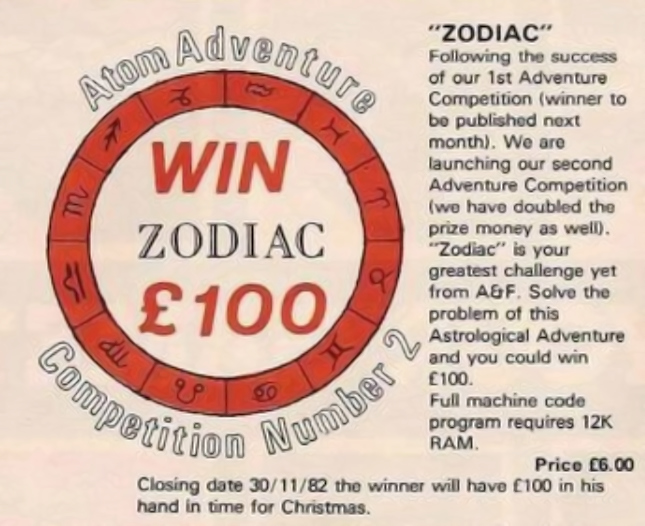
Due to a hint in the advertising copy (?!) I was able to trudge up to seeing 11 out of 12 Zodiac rooms. I’m fairly thoroughly stuck past, but at least I’ll give everything I know if anyone wants to take a shot at finishing this. Having read my prior post is essentially for understanding this one.
You’re on a frozen glacier. The Ice giant attacks you. You survive. A giant dragon confronts your path. The knife will kill it. Can you find it? What’s inside the Houses of the Zodiac – Aries and Virgo are but two. Can you find the magic potion, will you ever reach the House of Immortality – the only safe place, or is it?
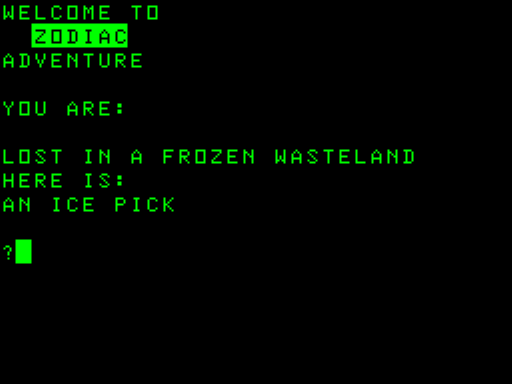
Maybe they had too many questions about the dragon? Nevertheless, that’s where I was stuck last time, and I had in fact tried at one point KILL DRAGON / WITH KNIFE (that second one is after prompting “what with?”), found it not to be understood, and decided to move on. The right syntax was to use type KNIFE alone (without the word “WITH”, as done in Scott Adams and other two-word parsers).
As this was a marginally improbable solve, I wandered by the right thing to do without knowing I was close. That combined with the fact the dragon eventually wakes up (causing you to have to start over — no save game feature) is what made me stuck. Knowing it had to be the dagger led me to think about the syntax a little more.
The axe which I had retrieved from a maze last time I then used to swiftly dispatch an ice giant.
The body here disappearing game me a hint, as the dragon’s body did not disappear. That led me to suspect I was able to do something else with the dragon, so I went back to the dragon room and tried CUT DRAGON:
Past this I reached a “hungry lion”, and given I just came up with dragon steaks, I knew what to do.
The geography still being slightly ice-themed but also random, past the lion there was a ramshackle hut with a “floor covered in snow”; I was able to DIG down to get a room covered in “loose earth”. Adjacent there was a “silver box” which let me go back and TAKE EARTH.
Notice the earth is not given as an item. I knew to do this from my eyeballing the text dump of the game’s file. This is special-case coded and I haven’t found anywhere else in the game where an item is “hidden in the description” as opposed to being on its own line.
Immediately after the earth came the most ignominious death in the game.
The magic ring I had got from melting ice here finally came in handy; I was able to RUB RING right before entering the walrus room, which turned me invisible long enough to get by. The dragon, no need for a ring, you just stab it; the walrus, be afraid. Bilbo clearly had his priorities wrong.
The map has the obstacles — and the zodiac rooms — laid out in a quite linear way structurally, even though the directions twist and turn. Also, you only have two turns to escape the walrus, so the first time through while invisible I died because I tried “north” and then “east”, neither direction which worked. Remember, room exits are generally not described!
The next room, Libra, appropriately had some scales, which I was able to BALANCE to unlock a secret door. (Again, I can’t take solving credit, the command was in front of me in the text dump of the game’s file.) Then I used the key that I got back at the Gemini twins to acquire a spellbook to go with a wand. I waved the wand and it opened another secret door, to a room with a potion.
The potion teleports you to an “ice fortress” with a CRYSTAL BALL.
This is where I’m stuck. There’s a guard blocking one direction, the zodiac room in the screenshot above, and a “bottomless pit” which isn’t actually bottomless.
Might just be a trap.
KILL doesn’t work on either the guard or the centaur, nothing I’ve tried to GIVE has helped, and I can’t operate the crystal ball with everything I’ve tried (wand waving, rubbing, etc.). The only other item I’ve got no use out of is an EMPTY URN which breaks if you try to drop it anywhere. What makes this really hard to test is not only the lack of a save feature but the potion-transport moment of the game: it goes one-way. So any objects not being carried are left behind, and there’s a four-slot inventory limit (really three-slot since the torch must be carried in one slot; a ring can be worn, but that’s the only leeway). Testing any new theory requires restarting from the beginning and entering all the commands of the game so far.
An option might be using save states, but Atomulator doesn’t have them, and I haven’t got MAME Acorn to work. However, if you’re really keen on taking a shot, the Atom Software Archive is here (for Atomulator, unzip the file into the MMC directory, then hit shift-F12 on booting to get to a select-a-game menu).
I gave the historical background for this one already in my last post on Death Satellite. Keep in mind that game was first advertised in Your Computer in June, and this game was first advertised in September. While several months is not absurd for writing a 1982-era adventure game, the fast turnaround does mean this one might be more a cash-grab than the last.
Your goal is to “solve the problem of the Astrological Adventure” which is terribly vague, but I have a guess it just means you have to make it to whatever room is designated as The End. (CASA Adventure Archive claims something about six treasures, but I think that’s about an entirely different game also called Zodiac.)
The start, as shown above, made me think it was an Arctic Adventure lost-in-the-wild type situation, but in addition to ice-related antics the theme falls into having a sequence of rooms (with ones in between) named after the Zodiac. This leads nearly to abstraction-as-environment, with places like
THE HOUSE OF GEMINI
THE TWINS ARE HIDING SOMETHING
which I suppose you get to visualize any way you like. In a way, this is simply embracing the purity of the crossword in the crossword-vs-narrative battle. Adventure game entirely as challenge.
And wurf, it is unfortunate it has challenge, because there is no walkthrough, hint sheet, etc. I made a decent stab, as you’ll see, but I eventually got stuck. One thing that helped a bit to start was being able to find a chink in the parser. When the game says
I DON’T UNDERSTAND
it means the words being used aren’t in the game’s vocabulary (both verb and noun). If either verb or noun is recognized, the game says
YOU CAN’T
unless the action goes through. This fouled up my usual verb-testing strategy at first, where I’d go through each potential verb, like PUSH, PULL, etc. and apply them to a random object in the game. Here, if you type PULL TORCH, the game gives a YOU CAN’T even though PULL isn’t even a recognized word. The right way to test verbs is to simply type them with no object at all.
As shown, software-artifact-as-puzzlebox as opposed to any kind of narrative.
Things were smooth up to what is the first puzzle (*), at Taurus. I had gathered an ICE PICK, a RED FISH, a KNIFE, a TORCH, and an URN (which I left behind because of a four-item inventory limit and the fact the urn smashes if you drop it).
At least I had company; a 1983 review published in Home Computing Weekly #24 writes:
One of the most difficult is how to get past the bull in the House of Taurus – a problem which I wrestled with for a long time, along with a friend who has the same program.
I should have looked at the text here more carefully, this had a hint! I was heavily stuck here and thought, perhaps, I’d have to just throw in the towel already and make a post, but I decided to pop the program open in a text editor to see if I could glean anything (machine code, not BASIC, so not 100% readable unfortunately).
There wasn’t much plaintext (I guess they did some encryption for contest purposes) but I found more verbs:
GIVE, MELT, WRESTLE, LEAVE
I’m slightly sheepish I didn’t have GIVE on my list on verbs to check, but come to think of it, that’s not been a common word for the two-word parser (lots of DROP standing in for GIVE).
Seeing WRESTLE made me remember when I had to wrestle an octopus in Haunt. (The reviewer wrestled with the problem a long time, ha.)
Unfortunately there wasn’t too much more to go past that. I found a magic ring stuck in ice where MELT ICE worked, as per the newly-found verbs, and I met the Gemini twins I tagged earlier and gave them a fish; they traded me a key.
More a matter of “try all the verbs” than “thinking”.
There was a slightly classical maze hiding an axe…
The start room is a “trap” of sorts that gathers two of the one-way exits from the maze room right before the axe, trying to deny hitting the solution randomly. This is quite typical; what’s unusual is making the exit room also a “trap” (on the bottom, three of the exits leave the maze) so it is easier to accidentally bypass the axe and leave. The priority for many of these mazes was to avoid solves just by meandering in random directions. Even Don Woods with Adventure made a test diagram to make sure “simple repetitive actions” would not allow getting through his maze too early.
…but other than that all I had left to fiddle with was a sleeping dragon.
I may end up having to call the game quits here, unfortunately; I’ll still give it a few more swings given I’m already past the “break open the actual code to look for clues” point.
I will say I can RUB the magic ring I found in the ice (the game tells me NOTHING HAPPENS in all circumstances) and any verb/object combo I’ve thrown at the dragon has been met with I CAN’T. I also haven’t been able to get anywhere with DIG in any room. Surely there’s a break somewhere?
(*) Almost the first puzzle. Entering the House of Aries requires going up the glacier, and I didn’t know until about my 5th iteration that the ice pick was required; otherwise I was holding it so it got used automatically without the game telling me. Solving a puzzle by default, essentially. This has the interesting side effect that since the maze has an exit that loops you to the start of the game, if you’ve dropped the ice pick in the interim (say, using it to map a room in the maze) your game gets softlocked since you can’t go back up the glacier to return to the maze.
To kick off 1982, I decided to go with literal-random-number-generator and came up with a game near the rear of the alphabetical list, Zodiac. However, I realized it was the second in a pair, so I decided to try the prior game first.
…
The notion of adventure-as-contest we’ve seen before with games like Alkemstone (1981) and Goblins (1981) but the concept really held on to the UK market, likely due to the popularity of Kit Williams book (and accompanying real-life-treasure-hunt) Masquerade.
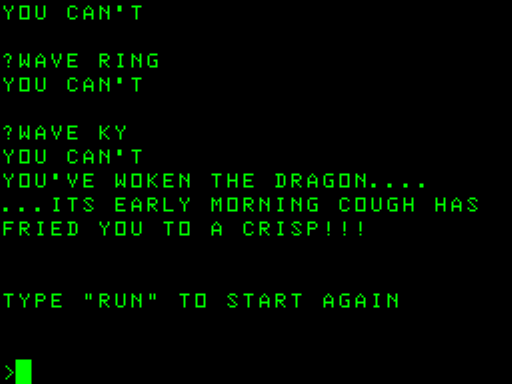
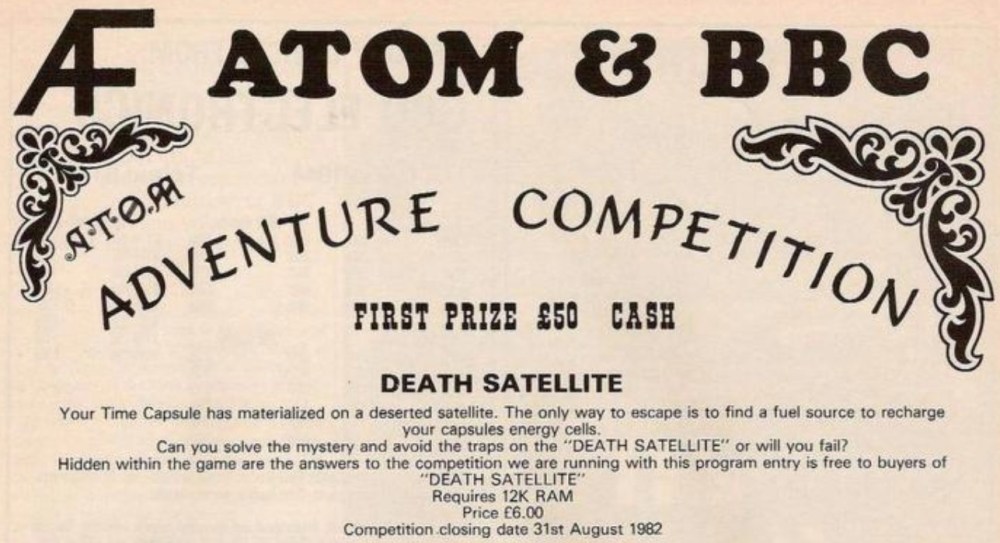
It won’t be terribly long until we get to the most famous of the computer-based contests, Pimania, which involved a real-life “Golden Sundial” and is arguably not even really an adventure game, but for now let’s consider one that definitely is, A & F Software’s Death Satellite.
A & F is best remembered now as the publishers of Chuckie Egg, one of the many UK platformers; quoting Kieren Hawken, “Perhaps only Manic Miner and Jet Set Willy are higher regarded.” Data Driven Gamer played it recently (he wasn’t a fan), and you can try the game online here.
I’m afraid I don’t know much about Chuckie Egg 2. The directors of A&F Software decided to do a follow-up to Chuckie Egg; however, they wanted it done to a very keen deadline, so I kept well clear of the whole thing. To my mind, if you want to create something, you first have to have an idea, then work out how long it’s going to take you to bring that idea to fruition. But they were businessmen, so they decided, “We are going to release CE2 in x weeks. Now let’s think of a game.” Bonkers! They went bust soon after it was released. I don’t even think I’ve ever played it.
That’s the author of Chuckie Egg, Nigel Alderton, in this interview. I’m not sure if the characterization is fair, but there’s not a lot of description out there otherwise of A&F’s inner workings. They were founded by Douglas Anderson and Michael Fitzgerald (as mentioned here) and in a different interview Nigel talks about how they had a shop selling computers and games with “two or three programmers” in the back.
The Chuckie Egg 2 quote did give me the pre-impression that Death Satellite was going to be a mere cash-in on the 1982 run of text adventures (this is when the British market really started to get revving) but despite some very sloppy technical aspects there was clearly some thought put into this. (Zodiac was cranked only only a few months later so the description of being a business cash-in may end up being more accurate; we’ll see.) To be fair, this seems to be in a “hardscrabble” phase for the company, evidenced by the only cover I’ve found for the tape:
From Every Game Going. Notice “Death Satellite” written in pencil in the corner, presumably by a user; otherwise the only indication of the contents are the weirdly-printed “Adventure I” along the side.
Acorn User in April 1982 incidentally claimed of the contest-adventures (both Death Satellite and Zodiac) that there were “hundreds” of submissions but only a “few” correct entries, which perhaps suggests how difficult these games are but also, historically, how many people finished this one in the early 80s. What I am unclear on is what, exactly, was sent in for the contest; I’ve got the text from the inside cover of the tape which only gives instructions (including the useful fact LOOK doesn’t work but DESCRIBE does instead), so maybe there was an extra insert? Gold, a contest-adventure from last year, asked for the maximum number of points possible, so I’m not sure what the equivalent would be here. The instructions also state that you can send a self-addressed envelope for help, which is also confusing given the contest, but I suppose the idea is the winner would need to be fast enough they wouldn’t have time to do back-and-forth lag waiting for a hint.
In this adventure game your “Time Capsule” has run out of fuel and made an emergency landing on a Satellite. To complete the adventure you must find fuel and escape.
I don’t think the game has any direct references to Dr. Who, but appearing on a space station in a time capsule rather than a spaceship (and where there is no time travel within the story) suggest cultural osmosis. There at least is a plant creature. Maybe the author was remembering the green bubble wrap from The Ark in Space.
There isn’t any resemblance otherwise, especially in the use of KILL as a verb multiple times.
As implied by the screenshot above, this is Yet Another Game Without Room Exits Listed. I really should make a comprehensive list. The times Crowther/Woods Adventure indulged in such behavior it was in fairly “general travel” rooms without restrictions to directions:
You are in a valley in the forest beside a stream tumbling along a rocky bed.
Mad Scientist from 1980 was good enough to include a compass rose with directions and had room descriptions like:
A black cat walks sedately across your path.
I certainly see the appeal in not having to fit “you can go north and south” or some variation into every piece of prose, and I still mark some of the room descriptions in Beyond Zork (which had an automap so didn’t often bother with mentioning exits) as the best of all time:
The horizon is lost in the glare of morning upon the Great Sea. You shield your eyes to sweep the shore below, where a village lies nestled beside a quiet cove.
A stunted oak tree shades the inland road.
However, when there’s no guide at all, the actual gameplay implication is to force the player to test every. single. exit. in every. single room. We’re not talking something simple and intuitive, either:
On the positive side (unlike Goblins, the worst offender of this type of gameplay) there’s no NE/NW/SE/SW to worry about, just compass directions. Once I finally had things worked out, the structure comes off as kind of interesting. There’s a central area including the Time Capsule, a Radioactive Waste area which will eventually kill the player (there’s radiation pills that can help, but there’s a better way to just sidestep the issue), a dark area with a spacesuit, an engineering area with two methods of entrance (one descending by rope, one by a one-way door that can be rigged to be two-way) and a “main control” area with a teleporter and an airlock.
This scene is entirely unnecessary for beating the game.
A lot of the battle in solving this game was just against the parser. For example, the starting torch (this is a Britgame so that’s “flashlight”) doesn’t allow USE TORCH, PUSH TORCH, ACTIVATE TORCH, LIGHT TORCH, or nearly anything else you might think of. It is only my past experience with wonky parsers which led me to try
ON TORCH
which, well, grumble grumble. Also, this follows the same nebulous standard other games derived from the 1980 Ken Reed code with I CAN’T for anything that doesn’t work with no other feedback. (I’m not clear if the code is genuinely from that article — it wouldn’t surprise me, but it would need to be adapted for the Acorn Atom — or if it’s just following a standardization of method.)
Back to the game: having a lit torch allows getting a space suit which is sufficient protection against radiation. All that’s in the radiation area is a mutant rat and an empty can, so the entire narrative purpose of braving high radiation (there’s even an optional Geiger counter where you can hear the clicks) is to get a can you can fill stuff in. Would it kill these adventure game protagonists to bring at least one rope and one container on their travels? Maybe their own light source?
Oh, and the mutant rat stops you from taking the can. I had to look up how to get by. There’s an ambiguous “silver canister” elsewhere that says YOU CAN’T if you try to do anything useful, and if you try to THROW CANISTER it does the same, but if you try to KILL RAT while holding the canister the protagonist throws the canister.
This puzzle was far harder than it needed to be. Indirect object use (that is, where neither verb nor noun of the command directly target the essential item used) can work in some contexts, but because the parser is so nebulous otherwise it just served to send me off entirely the wrong track.
The can lets you scoop up some mysterious green liquid back in the dark area and kill the green bubble wrap plant creature. This opens up an “airlock” with a roll of tape.
I was mystified by the tape and had to look it up again — remember I mentioned there’s a one-way door that can be turned into a two-way door? Here it is:
AT JUNCTION ON MAIN PASSAGEWAY
TO THE WEST IS A DOOR OPERATED BY A PHOTO-ELECTRIC BEAM
The tape is sufficient to confuse the “eye” of the beam and have it keep the door open permanently. Now that I’m visualizing what’s going (just detecting if a beam gets interrupted) it’s a good puzzle! Just it could use a little more description in context.
The whole reason for the one-way door being fixed is to get into an area with a robot (that you can smash with a heavy weight, indirect action again) and scrounge some oil from a valve. Getting the oil requires that empty can the rat was guarding.
You could try going through this without fixing the door, but the oil will spill trying to climb up the other exit (the rope). Clever! This allows access to the area (and the robot puzzle) early, and reminded me of Burglar’s Adventure letting you break into a section without turning an alarm off first just to see what was coming up ahead.
A simplified meta-map. The dark area also has a door that uses a key to enter or it can be entered from above, but if you use the down/up entrance you can’t go back up while holding any items. The key for the locked door is out in the open so it’s not quite as strong a design finesse as the one-way door.
The oil lets you clear rust off a door, and some keys hidden in a desk let you get into a computer lab; putting in a disc next to the keys:
The code then serves to pop into a teleporter elsewhere over to a “fuel depot”. The fuel you can take back to the time capsule and win the game.
Decent setting, even given the minimalist descriptions, and interesting interconnectness. Pretty dodgy parser. It reminded me of the Aardvark games, in that way, which had clever enough structure to be called “inspired”; it didn’t quite have as bad a parser, but saying YOU CAN’T for absolutely every not-accepted action — even ones like THROW CANISTER which the player is clearly allowed to do — was a serious drag.
If the descriptions and parser problems were cleared up a bit this would be quite a playable game but also not terribly hard, which somewhat removes the point of having a contest that only a few out of several hundreds manage to do correctly.
This makes me somewhat afraid for the follow-up, Zodiac, the game the random number generator told me to play, which I will be attempting next. If nothing else, it helps that I now know the company’s style with indirect objects (that is, I should feel free to try KILL ENEMY while holding objects I think may be useful, rather than trying to apply the object directly).
(I do also still have some unfinished business in 1981 and prior years, and I will be getting to those — just I wanted to get 1982 going. It feels psychologically liberating.)
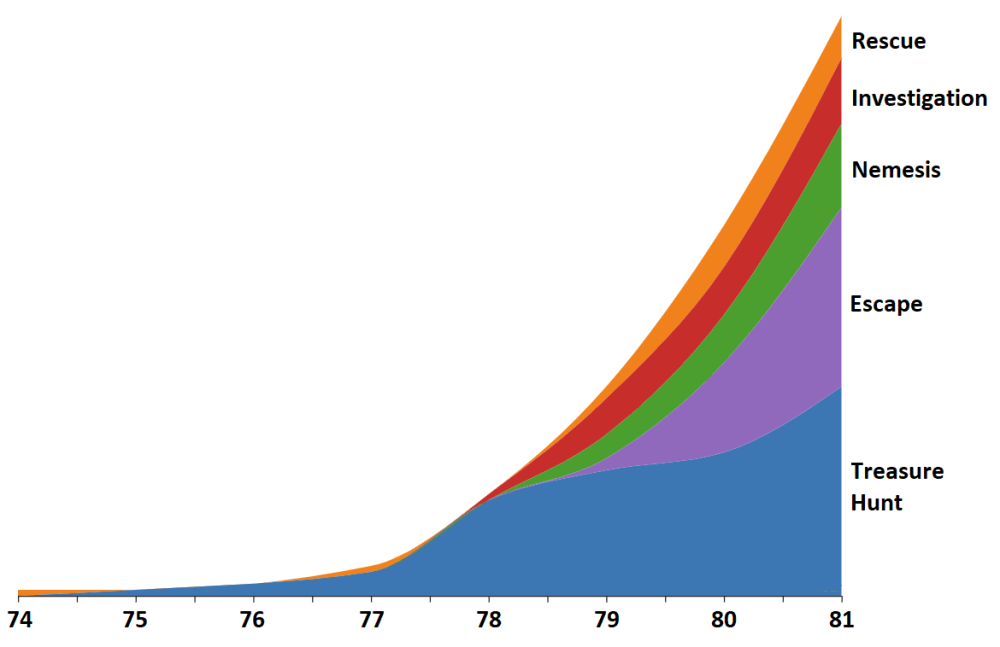
Here are the plot types of all the adventure games I’ve been able to play up to 1981 (which would be “nearly all” of them except for a couple stragglers):
Note that some of the categorizations are approximate and impressionistic; for instance, I called Cyborg which I just played an Investigation since that came off as the main plot thread, even though it is also technically a Rescue as well. However, it isn’t vague hand-waving either, as I did genuinely play and write about all the games listed.
The main intent is to show the evolution of the Treasure Hunt category, games following in the footsteps of Crowther/Woods Adventure where X treasures must be located and placed in a central location. It can certainly feel like Oh No Yet Another One whilst playing through, and the graph gives a little perspective: there are lots more Treasure Hunts in absolute number terms, but as percent of all adventure games, the number is decreasing.
Also — and I didn’t notice this until I made the chart — the Escape-style plot has been slowly increasing to now be about equal in proportion to that of Treasure Hunts. They tend to be very simple (Deathmaze 5000 just says “Your only goal is to leave Deathmaze. Alive.”) so I’m not surprised, and the only thing I would have perhaps expected to be bigger is the Nemesis category, since “find Foozle X and defeat them” also has a certain simplicity to it, although it perhaps is a bit genre-restricting.
I contemplating splitting the categories since the five I chose don’t represent every plot, but they do still grab a good sense of what was going on in adventure games in this time and further splits would just make the data hazier.
My last update I updated my list of “curious firsts”:
– First use of relative direction: Mystery Mansion
– First use of landmark navigation with no compass: Empire of the Over-Mind
– First defined player character: Aldebaran III
– First use of choice-based interaction in a parser game: Stuga
– First dynamic compass interface: Spelunker
– First dynamic puzzle generation: Mines
– First free-text conversation in an adventure context: Local Call for Death
– First adventure game comedy: Mystery Fun House
– First adventure to use graphics in every room: Atlantean Odyssey by Teri Li
– First Tolkein adventure conversion: Ringen by Hansen, Pål-Kristian Engstad, and Per Arne Engstad
– First Lovecraft game of any type: Kadath by Gary Musgrave
– First graphic adventure with some action solely in the graphics: Mystery House by Roberta Williams
– First adventure written specifically for children: Nellan is Thirsty by Furman H. Smith
– First “stateless” CYOA game written for computer: Mount St. Helens by Victor Albino
– First 3D graphic adventure: Deathmaze 5000 by Frank Corr, Jr.
One of them from last time is now uncertain due to a newly found 1980 game!
– First adventure game that involves traveling back through time:
Technically, every game has some kind of first (as long you are descriptive and specific enough in what the game is first of) so I could make the list much longer with 1981 games, but I only have two I think are worth noting:
– First adventure game with outside third-person character movement: Castles of Darkness by Michael Cashen
– First adventure game with conversation menus and an action mini-game: Cyborg by Michael Berlyn
That’s not to say there wasn’t innovation, but games are starting to build off other games enough it is hard to be clear-cut as to the “first” moniker. For example, Hezarin had a fair number of “set pieces” where action and puzzle solving went over multiple turns in a way that seemed unlike other games, but even technically Crowther/Woods Adventure could be said to have such things (if you’re running away from dwarves, say). The apex of the Treasure Hunt concept (by 1981, at least) is arguably Zork II with the demon and its wish but that’s an innovation of progression more than being “first” (saying “first freeform wish being made to a character in the world” is starting to get far too specific). Sometimes the solid development of an idea is much more interesting and important than its initial iteration (just compare, say, Street Fighter 1 to Street Fighter 2).
I’ll be honest here, there’s lots of funny quirks you have to cope with for games of this era. On the other hand, I’ll fully endorse so more games for list #2:
The two new additions here are mainly because of difficulty. And yes, I really did end up enjoying them both, even if they were self-flagellation to play:
As I always disclaim with these kind of lists, I always feel bad the moment I make them, as there are still worthy contenders left out, and I still feel a fondness for the bad games and the evil games and the games with erratic spelling (even that game from a high school sophomore, and if the author ever shows up in person, I’m sorry).
…
So, what’s ahead for 1982? Well, a whole bucketful of games. CASA Solution Archive lists 233 games, and I already know of some missing. (I also know of some I wouldn’t count as adventures, or I’ve already played under a different year, but the overall balance has always been to increase slightly.) I am tentatively planning a change of format for some of the less notable games where I combine entries; if I don’t have as much to say about Treasure Hunt #452 I will try to condense things down. I’m still not sure how well this will go, but we’ll see?
You have some things to look forward to, though:
– The finale of the Zork trilogy
– Andrew Plotkin’s first game (!)
– Three new Acornsoft games
– The first adventure games in Japanese (at least 4 of them)
– The start of Level 9 (which we should have seen in 1981 but their game Fantasy is still lost, sadness)
– Giant mice that smash Chicago
– An adaptation of a game seen within a BBC game show
A winner is me. Or perhaps, us. Or the whole human race, now living in harmony with hyperintelligent lizards. As usual, this won’t make much sense without having read my prior posts on Cyborg first.
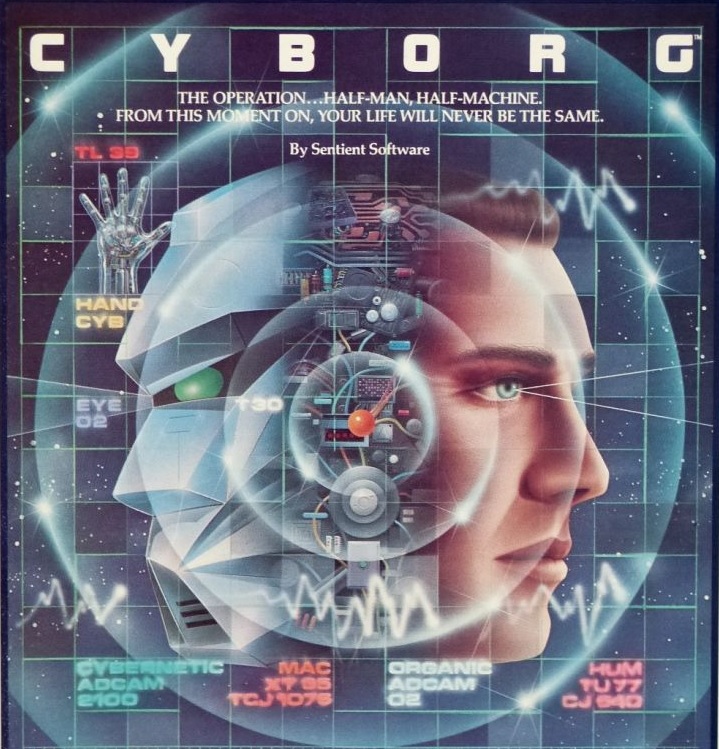
A portion of the cover of the Macintosh version of the game. From Mobygames.
I was definitely close. I was still underusing the “SMASH” verb.
The cleaner robot that I had destroyed wasn’t just an obstacle — it held something very, very, useful:
The set included some “tools” and a “permanent power cell” which meant the “CYBORG LEVEL” that had been constantly depleting was no longer a concern. The “tools” went back to the locker I had been unable to open and get some SOLDER.
I toted everything I had gathered up to the broken dial (for the record, the important items are a CPU, wires, solder, a power crystal, the tools, and the repair manual) and after some major fiddling (the tools and manual should be held, the other items should not be held) I managed to FIX DIAL.
After this you can TURN DIAL to wake all the sleepers. Unfortunately, you can’t go visit them, because, as the game informs you, there is risk of contamination. With the ship repaired, it felt like all I had to do was go back to the main bridge and hit the switch, and, hmm: nothing happened. No feedback as to what went wrong, either.
I baffled about this for a bit. I did know I missed one thing — back in the crashed alien ship there was someone who was wanting to talk but I had some parser struggles until I realized this was a REPTILE this time rather than a LIZARD. I was able to ASK 1 through 4 again to make conversation and find I was talking to the captain of the crashed vessel:
(I incidentally found the bread back near where the locker was, but I was never able to give it over — a reptile kept stealing it and running off I tried to drop it for the captain. It ended up not being necessary, though.)
In addition to the reassuring friendship the captain explained that any dangerous alien animals needed to be done away with before the landing procedure would work. It mentioned a “snake” which I had run into at the very start of the game — I just had happened to skip killing it in my current run because it didn’t seem useful to do so. So that was easy to mop up, but the captain also mentioned a “smada”. I thought the smada was the robot somehow but no: it’s a different creature. I had to look up where to find it: back at a “grill” (where the barbeque joke was made) you can SMASH it.
With the two enemies smashed, I was able to throw the final switch in the center of the bridge.
…
In terms of technical handling, the game is pretty sloppy; it seems like what Michael Berlyn needed was to join forces with a company with a better parser and play-testers and a faster system that could handle his ambitious ideas; unlike most times where I have lamented this about a particular author, he got to follow through with this by joining up with Infocom soon after.
But focused on just the ideas: he had a plot that unveiled slowly based on conversation with characters (in menus!) with some insights being optional, but everything needing to fit together in the end to complete the game. (That is, you needed to resolve all the ship issues before landing, and it wasn’t clear what those issues were without grasping the plot.)
The parser-frame is integrated with the game concept itself as it uses “we” perspective in a sincere way. Even past a game design sense, in a science-fictional sense the conceit is intriguing, and gives a perspective on what hell it might be to be cyborg-merged with imperfect technology.
The design had a strong semblance of structure (much stronger than Oo-topos, at least) where the geography itself was used as part of the plot and it was quite easily to “mentally package” the various locations and zip around the ship trying to resolve the obstacles near the end.
The overall meta-structure. Even though the start is “wide open” there’s some “gating” through sections before reaching the “starship” sections where the plot is revealed.
In short, I’m fairly happy this was the game to end my 1981 sequence so I could go out on a positive note.
“End” in quote marks because I’m always discovering new games or just finding out their dates are wrong, and I even know of a few already that are going to probably land there; I’m using my discretion of keeping my fixed list from a few months ago so I don’t go batty worrying about missing work. Up next comes my 1981 summary, and then a few pieces of unfinished business before moving gloriously on to 1982.
After a couple stumbling blocks mainly having to do with the game not adequately conveying what was going on (and one admittedly good puzzle) I managed to break into a wide-open area and get quite a lot done. Fairly sure I’m close to the finale.
Last time I left off I had acquired sneakers (with strings made into shoelaces), some matches, an “ultrafiche” with words too tiny to read, and a black plastic cube. I also had found a stepladder which was currently underneath a ramp but since I needed it to get up to the ramp I wasn’t able to pick it back up again.
I wasn’t sure what to tackle yet. I had a number of narrow slots I still couldn’t make work, and two points where I was scanned and rejected from entering. Just on a whim, I tried one of them, not expecting to make it through.
This was a new area. Still confused, I stepped back, took off the sneakers, and tried again — the sneakers were what let me enter! Very strange (although there’s something decently clever I was missing at the time).
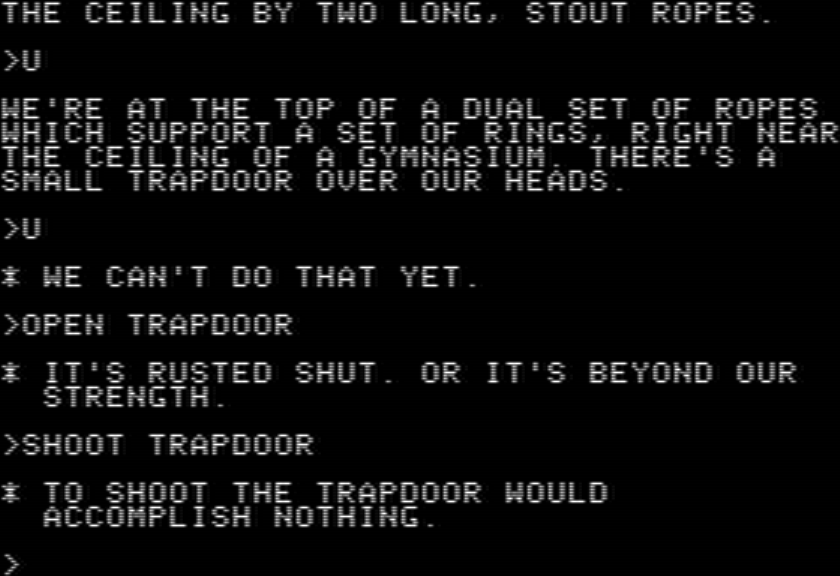
The gymnasium I had entered was small, and in addition to the cabinet I was unable to interact with there was a trapdoor I found on the ceiling.
Given both KICK and HIT also did not work (“OW! THAT HURT!”), so you would normally assume brute force doesn’t work here, right? I found out (straight from a walkthrough) that SMASH is parsed as an entirely different verb. (I already ranted about a similar situation in Asylum so I’ll just link to there.) This led up to a room where a female lizard was hiding (of the same kind that started the game) but was “quaking with fear”. Some failed attempts and frustration led me to just check the walkthrough again while I had it open and find out that you can PET LIZARD.
I … what? I admit they are described as “tiny lizards” so I guess it makes some sense, but given they are sentient and talking, I would not have thought to treat them like cats. Going through this gives the same conversation choices as before:
The only other advice is to “stay away from Smada” who turns out to be a berserk cleaning robot.
I think this whole exchange is optional and is just for more plot color. After a bit more thrashing in frustration I found out back at the cabinet of steam that I could climb it. (I visualized it as something smaller — it says MASSIVE cabinet so I guess that’s my fault, been even exceedingly large cabinets I’ve come across in real life don’t seem to be the sorts of things you can climb.)
This led me to a mini-droid and some lenses. The lenses allowed seeing in the dark (no more concern about matches for a light source, although they get used for fire later) and the mini-droid becomes our protaganist’s buddy, nestling itself on a “shoulder harness” and making comments as you go through rooms. I’m reminded quite a bit of Floyd from Planetfall.
I was still left with some places I couldn’t get into. The mysterious black cube I had been carrying along I had tried to OPEN at one point and I should have known (since it didn’t give a generic failure message) I should think about it more carefully; the game said it didn’t have any obvious way of opening it. The trick is to CUT CUBE (with the laser) and then an id card falls out. The somewhat canny thing here is that I’m fairly sure we had been using it all along to get into the gymnasium, but since we’re just scanned, it didn’t matter we didn’t know it was in the cube! What the ID card does now allow is operating the various “narrow slots” I had been having to skip.
One in particular linked the top of the ramp to the area where I got the stepladder, so I was able to retrieve the stepladder. (Even if I didn’t know the stepladder was going to be needed again, the “structural solving” of having the mechanism to return made it essentially guaranteed the ladder was going to be necessary.)
I also then was able to get into the “detox” area mentioned in my previous screenshot, which break opens the game to a somewhat vast section.
A “zoomed out” view of the new areas.
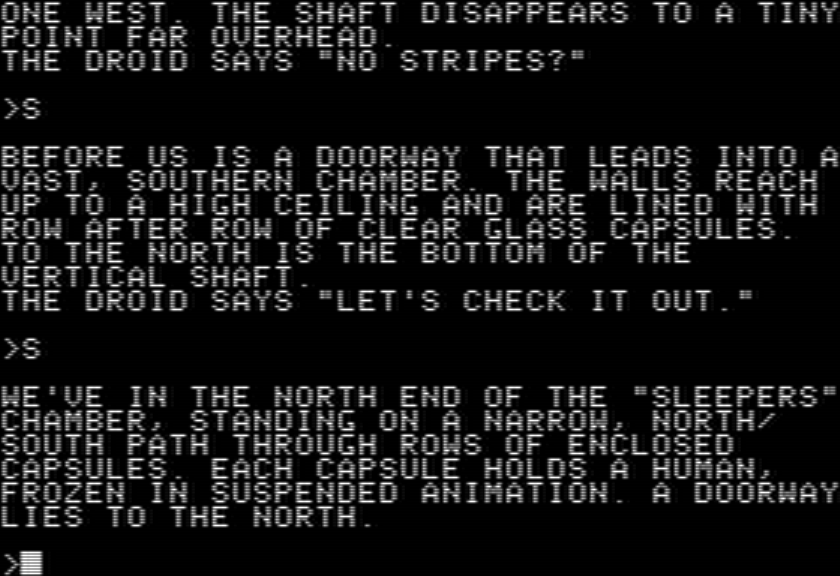
You end up in a shaft that you can climb down to multiple levels. One level just has a dead end (not quite sure if it is meaningful or just a read herring). The second level links to a medical area, an airlock, and a bridge; the third level goes to some dorms, an engineering bay with “sleepers”, and a crashed alien ship in rubble. I gave away a little bit of the secrets just from that description, so let me just jump straight to the
ULTRAFICHE READER
which is near the bridge. I put the ultrafiche I had been toting around and the ID card in, and got what was more or less a complete explanation as to what happened.
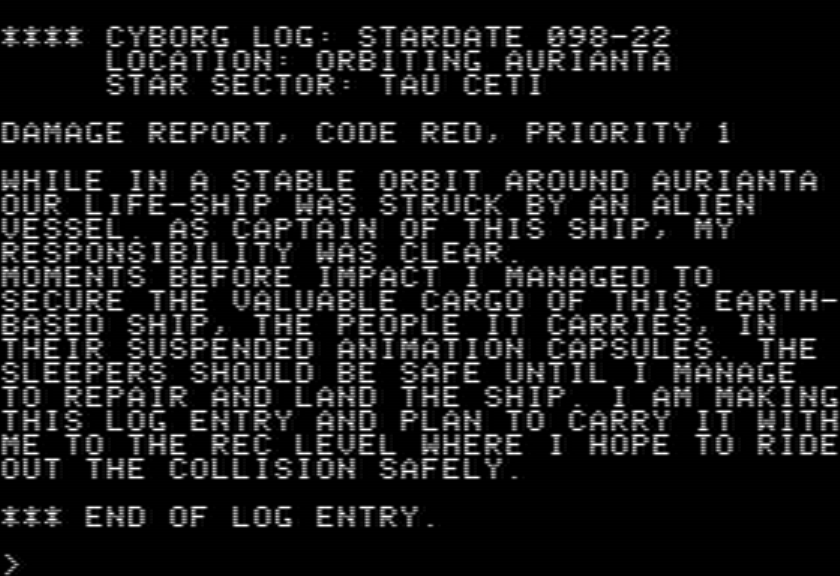
So our semi-amnesiac protagonist has been — using their cyborg skills — captaining a space vessel. They were orbiting a planet when their vessel ran into an alien ship (the one with the lizards). Our objective (??) is to fix and land the ship.
I did say the bridge was nearby, so let’s visit there next, using the ladder toted from all the way across the map.
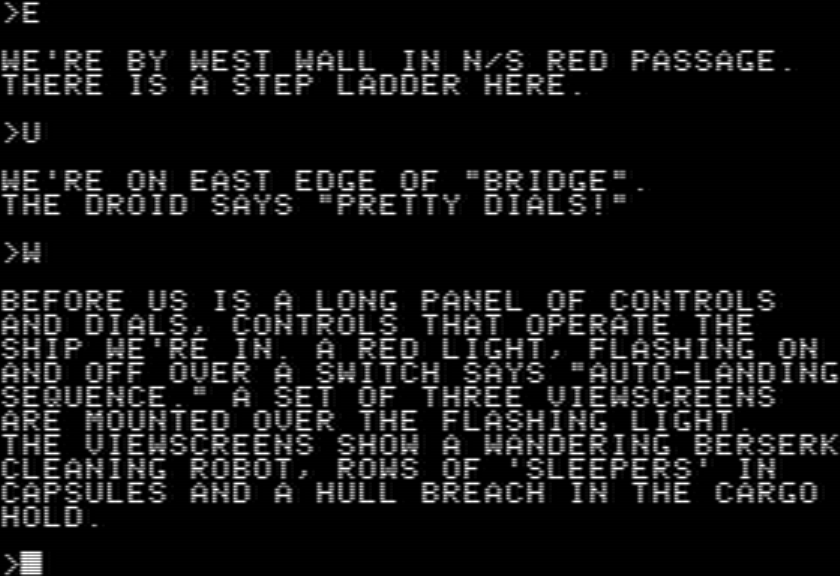
THE BRIDGE
There’s lots of dials and viewscreens.
I assume the cleaning robot and hole in the ship need to be resolved before winning (I’ve done both, I’ll get to them in a moment). There’s also a dial that says something about waking the sleepers that is broken and is currently my nemesis (I’ll get that last).
To resolve the hole in the ship requires going to
THE AIRLOCK
I fortunately discovered this section after the bridge, otherwise I would be mightily confused. I’m still a bit confused.
Nearby the airlock.
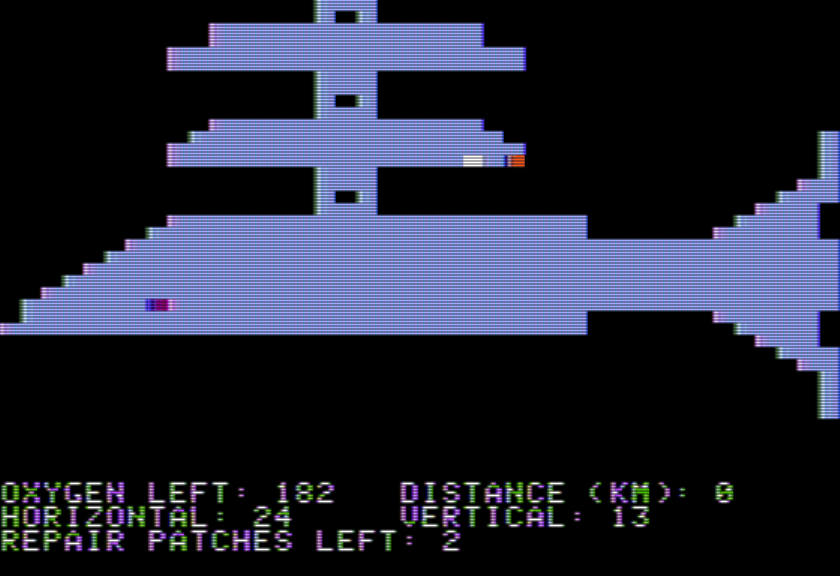
After having our droid friend get a space suit for us, we can go to the airlock and push a button to go outside and play an action sequence. It isn’t the first one ever in an adventure game (that’d be Battlestar) but I believe it is the first in a game intended for home computers.
I get the feeling it isn’t meant to be hyper-action-y as much as “decipher what’s going on”, like The Prisoner. You’re given commands as shown in the screenshot. What took me a while to realize is that your display (when not on this overall map screen) is the entire screen filled with some color, either black (if you’re looking at space) white (if you’re looking at hull or purple (if you’re looking at what turns out to be the damaged spot).
This means what is actually moving in the game is the numbers on the bottom, since for the most part the screen stays the same color as you’re spacewalking along the outside of the ship. It feels a little bit like playing the old Lunar Lander game in that way. On the computer model I was emulating the numbers moved rather fast (even at “realistic speed”) so it took a couple tries before I hit placing the patch at the right moment (as the spacesuit passes by the “purple” spot). Still, the main problem was deciphering what all this meant, so I guess it sort of counts as a puzzle, in a meta way, more than a twitch-fingers sequence.
I was still quite glad to get the sequence over with. You’re then informed the ship has been safely patched and the image on the bridge changes. I don’t know what the consequence of not patching is (was there a hidden timer? will the ship get torn apart trying to land?)
With that done, I turned my attention to
THE ENGINEERING BAY
The droid has a unique piece of chatter for each room.
This is where the killer robot, which I had been hearing long about (both lizards mention it) and I had seen on the bridge monitors. I was looking forward to some sort of tricky puzzle confrontation … and I was able to blast it immediately with my micro-laser. I have no idea what the big deal was, except for the fact I’m guessing I may have softlocked the game here (maybe bait the cleaning robot into following me somewhere that it ends up cleaning accidentally…?) The iguana just past was honestly a bit trickier.
It was playing with something but bored. Using cat-logic, you take the strings off the sneakers (you don’t need them any more, I hope) and hand them over as a toy, letting you take the item it was playing with a (a sleeper dial auto-repair manual). I like the puzzle finesse here in that the string does not feel like the sort of item that should be re-used, as it was combined with another object. This led to a GIVE ITEM TO NPC puzzle being actually clever.
The last bit of major progress I made was with
THE CRASHED ALIEN SHIP
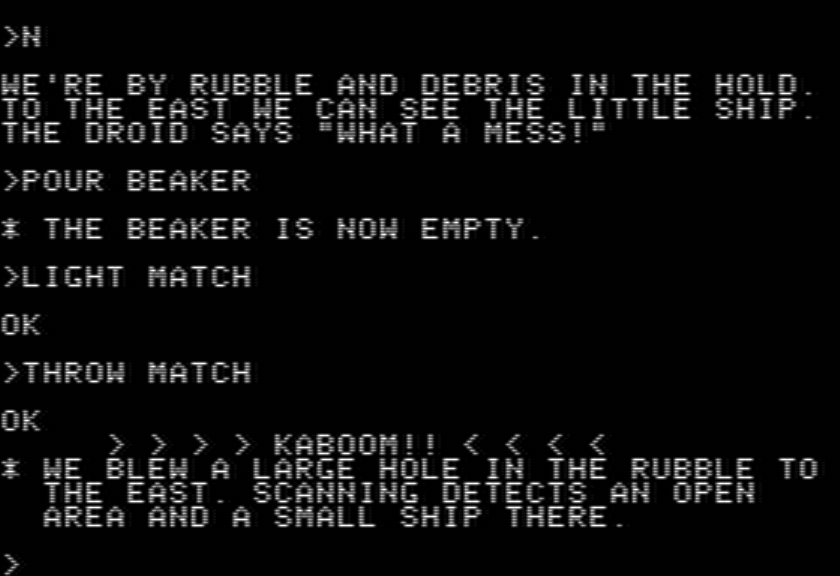
This is relatively straightforward: there’s some rubble you can’t pass and a crashed alien ship (the one mentioned in the microfiche message). Back in the medical area you can fill a beaker with liquid oxygen, then pour the oxygen, light a match, and BOOM.
The clever finesse is letting you play — and kill yourself — with the liquid oxygen earlier. There’s a “grill” where the droid asks about “barbeque?” so I took the oxygen over to the grill and (without setting the oxygen down first) tried LIGHT MATCH to reach an ignominious death. But the death was helpful! This made it easy to realize I needed to make an explosion when it was needed.
Fortunately, the ship is unscathed, and I was able to pick up a small CPU.
Other than that, I’m fairly stuck — I’ve been collecting items that feel like they fix something (some wire in the open, a “power crystal”, the manual the iguana had) but I don’t have an obvious hole or outlet to put things in. READ MANUAL just says I can’t. Trying to FIX DIAL back on the bridge while holding the items says I can’t. (Am I missing items, or am I doing the procedure wrong?)
There’s also a locker I haven’t been able to open and a “cylinder” in the medical area with a lever that doesn’t work (it is supposed to heal people who are inside). I suspect I’m semi-stuck on just parser issues, but there’s likely a few tricky puzzles to sew things up. The end of 1981 approaches!
















 Renga in Blue