We’re essentially at a turning point for the Softside Adventure of the Month series: they numbered up to 20, and we’re at number 10.
From Softside, March 1982.
They were, to recap, a monthly series for Atari, Apple II, and TRS-80 connected with Softside magazine; mysteriously, only the Atari versions survive on many of the games. (Well, not that mysteriously on Apple II, since distributions seems mainly to have been on tape. Not a single disk has surfaced from the series on any platform that I know of, and Apple II tape preservation is terrible. I don’t think it is from modern norms either, I think it is due to it being in the top price category, allowing for disks, so people moved on from tapes much faster than with other platforms.)
Peter Kirsch is the one most associated with the series and seems to be the one who arranged the ports for when submissions came in. He also wrote three of the games so far, Arabian Adventure, Jack the Ripper, and Around the World in Eighty Days. His general operating procedure has been to focus his games around “cinematic scenes”, as opposed to open structures. This is genuinely not a common thing for this time; Crowther/Woods Adventure set the standard (gather 15 treasures, wander anywhere) and adventure games so far have generally followed this idea. Even the generally linear games like Arrow of Death haven’t generally been centered around reactive scenes, where there is a crisis (being attacked by enemy X) that is averted, immediately throwing the player into another crisis.
James Bond stories are very much series-of-cinematic-scenes fodder; 007 must defy death in some situation, and after doing so must face another situation, followed by another, etc. Every once in a while he stops to drink or gamble or seduce. So I wasn’t surprised at all when James Brand Adventure came up next on my queue that this was another Peter Kirsch jam.
As the ad I put earlier explains:
The President’s life is in danger. As James Brand, you must save his life and destroy the evil Dr. Death. Your life is constantly on the line; each move you make could be your last.
You start in a minimalist “headquarters”, without a chance to talk to Q or M.
You do have a Q-like gizmo, although it is a little hard to figure out at first.
Specifically, the parser stubbornly refuses to allow you to refer to the “SMALL SUITCASE” in inventory. It can only be referred to as a CASE. Once you do so you can open it to find a car key, but also LOOK at it to find that there are red and yellow buttons. The red button blows a smokescreen, and the yellow button shoots a knife.
Entering the car and starting it leads immediately to a danger and the scene shown: it is being remotely out of your control. I’m pretty sure this happened in a real one of the movies and Bond did something cool like hit an ejection seat button. In this game, you just turn the key to shut off the ignition.
Immediately after you end on a road where you attacked by a jousting motorcyclist wearing a suit of armor, and no, I’m not making this up.
You have about five moves to react; the best action, fortunately not hard to suss out, is to activate the smokescreen. This causes the attacker to fall off his or her bike so you can steal it.
The next part of the game lands you in a small urban environment with two scenes, buth with people trying to kill you. One involves a house with a bomb.
This isn’t too terrible a scene; all you need to do is walk out rather than read the note in order to survive, and the effect when the explosion happens (the second screen, where the text animates by inverting) is clever. Unfortunately, the whole point for going through that scene is to go back in after the explosion and find a quarter.
The author has caught the high-stakes right-action-to-survive feel of Bond, but it still does Adventure Game things, and it is about to get worse. To get to the next part of the plot, you find on another street you get slipped a node from “Madame XXX” which asks you to meet her at the Kit Kat Klub. If you go to do so:
Going back to your inventory, you’ve been toting around two cyanide pills. You can PUT PILL before sitting down to try to sneak it into Madame’s wine, but she notices and swaps the drinks.
After a large amount of parser struggle I hit upon SWITCH GLASSES. This switch-back is sufficiently stealthy somehow to work, despite Madame noticing the initial sleight-of-hand, and the poison kills her.
However, there seems to be no point to the scene: you get no information or items, not even a quarter. The scene is necessary because, nearby, there’s a HOT DOG STAND that doesn’t open until the Madame scene happens, and you need a hot dog.
I’m leaving in some of my struggle to purchase a 25 cent dog.
Before moving on: yes, as stated, “the reason to go through a scene to kill someone is to buy a hot dog” sounds absolutely absurd, but clearly what the author had in mind is a scripted series of events. Yes, as coded, one thing follows another, but my guess is that’s because whatever movie was going through Kirsch’s head ran in that sequence and he never even thought of it as cause and effect.
Back to the hot dog. So now I bought one; what was the purpose? Well, to feed a clam that was under a lake, which gives up a key that can be used to launch a speedboat.
It is my understanding this sort of thing happened all the time in the Reagan era.
The speedboat lets you get DEATH ISLAND. There’s a bit with a blade-boomerang aimed at your head…
…and then, for some reason, at the tree in the same room you can get on it and find a silencer for your gun.
The silencer is necessary to kill a guard up ahead without alerting other guards. Then you can sneak into Dr. Death’s palace only to fall immediately into a trap.
Looking at the backglass reveals a tilt light; the right command here is TILT MACHINE which causes the “ball to go out of play”. Then you can wander around the pinball machine, climb into a hole, foil some gas coming out of a vent using the trick-knife from your briefcase…
…and eventually end up in the lair of Dr. Death, who challenges you to pool.
There’s no way to get an actual pool scene here; PLAY POOL or the like doesn’t work. If you look at the table it mentions the 8 ball looks different; it is really an explosive and you can pick it up and throw it, killing the guards. Then Dr. Death takes a hostage:
Oh, you thought events so far have been goofy? Get ready for the best/worst puzzle in the game.
That bit about being sleepy: that’s supposed to be a cue to YAWN. (No, I didn’t figure this out on my own; I used Dale Dobson’s walkthrough at Gaming After 40. He didn’t figure it out either, he just checked the source code.)
After this glorious scene you can make your escape by grabbing some tacks, and as guards with swords are chasing you, drop the tacks.
But we’re not done yet! The whole issue, remember, is the assassination of the President of the United States. We can escape the island now, getting by a hungry crocodile via using a stick we found back in the palace…
…and find ourselves at, by wild coincidence, a golf course that the President happens to be playing at. There’s a nearby sewer you can dive into and find that at the hole of the course, there is a bomb wired up.
Fortunately, there’s an exposed red wire, and if you go back to the CLUBHOUSE on the golf course you can grab a “razor”. Then razor can be used to CUT WIRE and save the day.
Yes, this was bad in all sorts of ways. I was genuinely looking forward to James Brand given that Kirsch’s prior game Around the World in Eighty Days was one of the strongest of the whole Adventure of the Month series. James Brand was one of the weakest.
While Eighty Days still had a sensibility of a fast-driving plot driven by scenes, it still spends enough time to create geography at each location that it leans into the adventure format just enough to work. James Brand treats its locations with minimalist detachment and really just focuses on immediate danger-scenes. Brand also has aspirations for interesting character actions like swapping poisoned glasses that aren’t supported very well by the parser, whereas Eighty Days mostly stayed within the author’s technical chops.
In other words, it was an experiment in a different genre that just didn’t work given what a parser in BASIC is capable of.
I’ve got one more one-shot upcoming — a very curious one with a completely different setting than anything else we’ve seen — and then we’re going to make it to a substantial landmark, something that might even be, dare I say it, an actual good game. (After the sequence of Jungle Island -> Inferno -> James Brand, I can only hope.)
Oh, and I might as well give a light Ferret update. If you haven’t been following along, we are past all the spaceship part and onto the very very last puzzle, which hinges on deciphering a 16-number code. I have a feasible decipherment which might indicate we just need to SAY something to win, but the thing to say is in … Welsh? Check the thread if you want to know more. Please: if you have any thoughts, add them, because my brain is utterly melted.
To recap from our last visit to what appears to be the only game from the Software Emporium of Tulsa, Oklahoma:
We were tossed into The Inferno, a place where a legendary warrior had been spirited to years before, with the goal to escape. The basic problem was quite a lot of death, some of it random, like Yog-Sogoth’s Chamber where the titular creature may or may not be in, and I found the chances of dying to be more than 50%.
From the Museum of Computer Adventure Games.
I combed quite a few times over the map with no luck other than:
a.) looking at a shelf twice; the first time got me some rusty armor, but the second got me a sundial (with markings from 1 to 12)
b.) blowing a horn that I had found at an idol, opening a new passageway.
Blowing the horn at the wrong place summons a moose:
I was stuck enough I was suspecting some sort of technical error in the game itself; while I’ve gotten a little farther I haven’t ruled that out. To investigate further I decided to dive more into the actual bytes of the disk, but my usual tool (CiderPress) fails to recognize any kind of regular disk formatting. Using a different tool (Apple II Disk Browser) revealed sectors that were frankly all over the place.
I originally thought I saw the telltale signs of BASIC code, but without a good way to extract the code I couldn’t read it; now I’ve tangled with enough sectors of the data I’m not so sure. Things aren’t necessarily stored in sequence; I found the verb list of the game, but in two parts stored non-adjacently, as if the disk has some sort of baroque copy-protect system.
Incidentally, the verb list is (excluding the usual words):
It looked like nearly all the game text was still stored as plaintext so I could painstakingly read everything, but I really do prefer to solve my adventure games the normal way (by thinking and experimenting in the game itself), rather than via reverse engineering.
So I took one more gallant whack at the game and tried, yet again, tackling the collapsing bridge. This was a bridge right to the east of the starting point that I could never get across; the review I referenced last time seemed to hint at something random…
…I had already tried roughly 20 times to cross without luck before finally concluding I needed to do something puzzle related. But as I was fully stumped, I decided to go for it another 10 times. On try number 30:
A miracle! Nothing happened! But why? I was carrying the “hooves” and “horn” from the idol but otherwise hadn’t done much to modify the parameters. I had switched the game system from Apple IIe to II+, but had died on II+ mode nearly has many times as on IIe. I still don’t know what’s going on here: maybe the programmers genuinely and legitimately wanted to put a game section that you only had a 3% chance of entering without dying?
The other side of the bridge is, strangely enough, not so deadly, and mostly contains interesting items: a basket you can latch, a rock, soot, some firewood, a workbench with a mold for a sword, a basin with some water, some books in the Library of Cthulhu I can’t read, and a cabinet with bottles.
Not sure if the parser is being broken or if this is a “research puzzle” where you need to specify a particular book.
At least one of them outright kills you. I’m not sure what the use of the bottles is but I’d like to take one with me to fill with water; however, they get smashed when you drink them, and the game doesn’t want me to just empty one out.
Despite one successful pass over the bridge, it is still possible to get killed by the bridge going the other way. Also, the orc still randomly whomps me.
I’ve certainly played games (both old and new) that locked some content behind RNG in such a way that it is possible to get unlucky repeatedly (see: Adventure 500) but I’ve never had such an egregious abuse happen before. I’m still suspecting maybe there’s a setting off in the emulator causing bizarro randomization settings.
I might pull through with a win on this using save states, but please don’t be shocked if I just move on to the next game.
Every once in a while rather than playing a game I try to dig up a lost or unknown game. Recently I decided to take a shot and the wildly obscure 1979 adventure game Jungle Island, as published by Aladdin Automation, Inc (“a division of Aladdin Computer Corp”).
I first found out about Jungle Island scouring through old issues of Creative Computing; it is mentioned in an ad in the November 1979 edition, and I also found the same ad in an October 1979 issue of Byte. The game has an entry in MobyGames, presumably by someone (who goes by “vedder”) reading the same ad.
The game list is not that impressive: Math-Ter-Mind, Lunar Lander, Craps, Mastermind, Tic-Tac-Toe, Jungle Island, Stix, Super Pro Football. Nearly all of them had public domain versions already (here’s a 1976 port of Mastermind done by David G. Struble, printed in Creative Computing!) but that didn’t stop the folk(s) at Aladdin from writing hyperbolic prose for the ad copy.
Aladdin’s Stix™ can be played with 2 to 5 piles of sticks and between 1 and 19 sticks in each pile. The object: to be the one to pick up the last stick. Sounds simple? Yes, but you’re playing against the computer. Take heart, though, because you can control the degree of difficulty in this update of the ancient game of Nim. Stix™. Another first release from the Aladdin Old Favorites™ Series.
Nim had so many computer variants by this point. The 1939 New York’s World Fair even had an electro-mechanical version which you can argue (with some semantic hand-waving) was the first video game.
(Picture from Popular Science Monthly, 1940.)
Jungle Island was described in the ad thusly so, hoping the game would be the first in a series:
Now, I managed to find the game mentioned in Vanlove’s 1981 Apple II/III directory …
… which was sufficient to know it was a tape game. I also suspected, based on finding a 1980 directory, and the exact address and suite of the company, that they were out of the location by that year.
Unfortunately, Apple II tape preservation is not in a good state. The folks most interested in Apple II tapes are Antoine Vignau and Olivier Zardini at Brutal Deluxe Software, and they do have an Aladdin section. These are the two games they have:
STIX
8K version. By James J. Justin.
TIC TAC TOE
8K version. By Mike McDonald.
(I’ve inquired if they have pictures or other information from the cassettes themselves, but haven’t heard word back yet.)
These companies tended to have one person (the founder) write all their software, so seeing two names was a bit of a surprise. I had no luck hunting for James J. Justin, but a Mike McDonald does show up in a couple places from that era as an author for articles in Practical Computing. But Practical Computing is a British magazine; what would Mike McDonald be doing contributing Apple II software to an obscure California company? (While Apple II products made it to Japan, it was not really a thing in the UK.)
Initial Filing Date	08/28/1978

Status	Forfeited - FTB

Standing - SOS	Good

Standing - FTB	Not Good

Standing - Agent	Not Good

Standing - VCFCF	Good

Inactive Date	06/01/1981

Formed In	DELAWARE

Foreign Name	ALADDIN COMPUTER CORPORATION

Entity Type	Stock Corporation - Out of State - Stock

Principal Address	N/A

Mailing Address	1300 MARKET ST

WILMINGTON, DE 19801
So not a California mailing address but Delaware! And also defunct quite quickly, as suspected. The initial filing does present the possibility Jungle Island came in 1978 (which would be super significant, in the same company as Adventureland). But also oddly, the 1980 North American Register of Business puts an entirely different business at 1300 Market St:
I normally would say I’ve hit a dead end otherwise, but there was one other angle possible: were these products only for Apple II? If the McDonald of Tic-Tac-Toe who was ripped off from I’m sure was well-paid is the one from the UK, then the game really needed to originate on a different platform. More curiously, the Math-Ter-Mind part of the ad mentions a song feature that is only present in the Apple II version of the game, suggesting other platforms.
And can you believe … I’m pretty sure I found it? Voila, the TRS-80:
1. The name, while elongated in this version (and a “MYSTERY ISLAND” on top), still matches (no other TRS-80 game that mentions Jungle does).
2. The game is less than 8K, that is, it fits on an 8K tape just like the other Aladdin games we have physical copies; the book also specifies 8K.
3. There’s a lack of Aladdin branding, but nearly the entirety of the catalog seems likely to be repurposed work anyway.
4. It fits the description given in the book of having three routes to go on starting the game followed by “which will you choose???” also suggests a sort of “choose your own adventure” feel as opposed to a discrete adventure-space, which also matches the gameplay. (There are technically only two starting directions, east and west, but it looks like from the opening screen there ought to be three.)
5. While the ad copy doesn’t mention hunting for treasure, the ultimate goal of the game is escape (you escape by helicopter). You can in fact completely skip the gold, it doesn’t matter at all.
So while the South American setting does not quite match the ad picture which suggests an African setting, I’m fairly confident this is the same game. (Also, this game has leopards, which are only an African thing, so clearly zero research was done anyway.)
Regarding the “choose your own adventure” feel, typing E gets you eaten by a shark. You can’t type W to go back.
The connectivity is pretty random, as I’ll illustrate with two more screens:
For some reason, one of the branches asks you to figure out a “word” made up by direction letters.
The game wants SNEW.
Eventually, YOU SEE A HELICOPTER LAND IN THE JUNGLE AHEAD. I tried typing ENTER HELICOPTER and the game crashed. Checking the source code, you need to type anything other than a direction (more on this in a moment) followed by GET IN or CLIMB IN.
This one’s coded extremely sloppy. It is sloppy enough I might be tempted to believe it was a 1978 product, maybe it did beat Adventureland? I’ll only bestow it that if I can find some more concrete evidence, so I’m leaving it in 1979 for now.
270 PRINT “YOU ARE STANDING ON THE EDGE OF A DEEP CANYON”
271 INPUT N$
272 IF N$”JUMP”GOTO 170
273 CLS
275 CLS
276 PRINT”THAT WASN’T TOO SMART!!…YOU’VE JUST JUMPED OFF A 300 METRE CLIFF….AND YOU’RE NOT TOO WELL RIGHT NOW!…… TRY AGAIN..PRESS ‘ENTER'”
In this scene, the game asks you to make some input; if you type JUMP, the game kills you, otherwise it moves you to 170:
170 PRINT”YOU ARE AT THE WALL OF THE VILLAGE….A TOUGH ”
171 PRINT “VINE HANGS FROM THE TOP”
Here, the game accepts, N, S, E, W, and CLIMB VINE. The directions all lead to the same place, “YOU HEAR THE CHANTING OF 100 WARRIORS.” CLIMB VINE leads you to
400 PRINT”THE VINE BREAKS!! YOU HEAR WARRIORS APPROACHING!”
401 INPUT V$
410 IF V$”RUN” GOTO 220
420 PRINT”YOU’RE RUNNING AS FAST AS YOU CAN!”
430 INPUT T$
440 IF T$”N”,”S”,”E”,”W” GOTO 310
450 PRINT”IT IS NOT ADVISABLE TO RUN THROUGH THE JUNGLE”
460 INPUT Q$
470 IF Q$”HELP” GOTO 280
480 PRINT”YOU FALL INTO A MANTRAP FULL OF HUNGRY LEOPARDS.”
490 PRINT”YOU’RE FINISHED……TOO BAD……IF YOU WOULD ”
500 PRINT”LIKE TO BE REINCARNATED, PRESS ‘ENTER’……”
Here, you are prompted for a string; if you type anything other than RUN, the game says
YOU’VE FALLEN INTO A MANTRAP INFESTED WITH
DEADLY SNAKES!! … YOU’RE FINISHED..
PRESS ‘ENTER’ TO TRY AGAIN………..
If you do type RUN, you are told you are running as fast as you can and must make another input. If you do a normal direction now, you go to “THE WARRIORS CHASE YOU THROUGH THE JUNGLE!!!!” If you instead type anything else, anything else at all, even nothing to do with running, the game warns you about running through the jungle (!?). Typing HELP right then will send you to the scene with finding the helicopter, otherwise, you end up in the mantrap of leopards.
Even Edward Packer at his wackiest never had logic like this.
If you really want to try a chance at the bespoke coding frenzy, the game is playable online here. I did not show you the scene with getting the gold, so there’s still something left to discover.
Despite the game being exactly as dodgy as I expected, I think it is fascinating how many companies felt obliged in this 1979-1980 era to try publishing one adventure. Clearly whoever was coding this was out of their depth but they still plowed ahead with the promise of using the computer to enter another world for a while, or at least attempting to cash in on the prospect.
Let’s loop back just slightly to a game I missed from 1981. It is rather obscure; it wasn’t listed on any of my regular sources until after I had already locked my 1981 list into place. (An eternity ago, 2019.) This is perhaps understandable, as The Software Emporium hails from Tulsa, Oklahoma and this is their only game.
From the Museum of Computer Adventure Games.
I don’t have author names or biographical information otherwise. The manual thanks Rainbow Computing, Inc. (an Apple II publisher out of California), Crowther and Woods (there’s a fair chance the authors only saw Adventure before writing this) and “our wives for their help and patience”. There’s also a phone number but I haven’t been brave enough to test out if a 42-year old phone number still works.
This is animated, with the little dragon walking by.
After the graphical intro, there’s a long scroll full of lore. If you want to watch it in real-time, I’ve embedded a video below.
In times of old, there was a “divergence” between swordsmasters and wizards, such that those who used one method of power could not use the other.
The greatest wizard at the School of Magic in the East, Cossa, became interested in the dark arts. A great warrior came to prominence at the same time, and due to the wizard’s cruel deeds, the two ended up in a showdown; the warrior came to the wizard’s palace, slaying foul creatures as he went.
The warrior and wizard went to blows, the warrior using an elven sword passed down from his ancestors that could defend against spells. The warrior approached for a final blow, but the wizard cast a last-minute spell while dying, opening the ground beneath the warrior and sending him into the Inferno.
You are not playing the warrior, but someone else who has been tossed into the Inferno.
Maybe he’ll be corrupted into a Dark Knight for a final boss battle.
The game, after various bits of instructions, tells you that YOU HAVE BEEN GRANTED 500 LIFE POINTS FOR THIS TRIP TO THE INFERNO.
The life points serve as the “lamp timer” for the game; they continuously go down as you walk around the environs. (This is, at least, somewhat fair in a verisimilitude sense, even if old-school game design.) Your life points can decrease by getting hurt for other reasons; most obnoxiously, there’s an orc that wanders about and serves and sort of the game’s dwarf/pirate. If the orc wanders in you have a chance to fight or run. I have yet to win a fight, but based on the screen messages (and a comment in this review) I know it is possible to win, but with your life points still having sustained damage.
Death results in another animation:
Other rooms can be deadly as well. For example, one room is Yog-Sothoth’s Chamber; there is a random chance the creature in question will be in.
While the game has a line that describes explicit exits, the game has quite a few “secret exits”, so you have to test all eight cardinal directions plus up and down in every single room. This is not fun combined with the random chance of orc-death. Red connections in the map below are secret:
Points of interest include:
– A bridge that collapses and kills you.
– A mirror that kills you if you break it.
– A “hexagonal cell” with a basilisk that kills you.
– A “ballroom” that asks you to join the dance. The dance, strangely, does not kill you, but says YOU FEEL VERY STRANGE! and reduces your precious life points by a whopping 150.
– Astaroth, who doesn’t kill you, just blocks your way.
– A creature being cooked in a vat that wants us to put the fire out.
I don’t have much to work with; there’s an IDOL that falls to pieces when I look at it, leaving DUST, HOOVES, and a HORN; there’s some rusty ARMOR on a shelf that I have been unable to de-rustify. That is everything.
So far the game has felt slightly gamebook-like, where each room has a special “encounter” to deal with, and the authors avoided the mega-expansive feel of their much-admired Adventure. Based on the review I mentioned earlier, the game also lacks in mazes, and only includes one “trick maze” not meant to be mapped. I hence expect further developments to be interesting, even if completely and totally unfair.
(Also, since the game is hard to search for, here’s a link to a playable version online. I’d recommend downloading it and trying on an emulator with speed cranked to high, but not to highest; if you crank it too far the death messages zip by too fast to read.)
No progress, alas. We have failed to reach the endgame.
Sorry, Link.
I thought of maybe likening this post to the ending of Blakes 7 (which has a super-high body count and the evil Federation wins) but maybe The Little House on the Prarie is more appropriate. After 8 regular seasons and a 9th “New Beginnings” Season there were some TV movies, including A Last Farewell, where an evil tycoon buys up Walnut Grove. The response of the townspeople is to blow everything up.
Having the sets blown up meant that it was of course the last piece of Little House of Prairie TV made, but oddly enough, it was not the last TV movie. Despite shooting earlier, the special Bless All the Dear Children showed after the explosive finale.
Such as it is here: we’ve been playing Ferret since the start of October, all the way to the end of January, setting a new record (Warp, even given the fact I broke it in two parts, took three months to finish). The patience of my dear readers desperately hoping for an Apple II game with a soothing phosphor beam or maybe some janky ZX Spectrum art has been pushed long enough, and I need to write about new games. But we really are one room away from the endgame (we know this, not just guessing) and we have some folks determined to see things to the end, so action will continue in the comments here.
How do we know we’re one room away? Well, in an earlier version the authors made an error which let us jump into phase 17 early. I’m going to wait until the last post proper to share too much, but you land in the escape ship we’ve been trying to get to, and end up in a disorienting place similar to Adventure 550. Then something slightly unhinged happens and maybe even transcendental which seems to be some sort of grand meta-puzzle. So it is worth waiting for, and I’m hoping to write up The End, on, say, February 28. (No promises, though. Maybe it’ll even happen sooner.)
Anyway, on progress: we kind of devolved. The game was updated today to 10.30, and we found that the trick of putting radioactive pellets in a leather wallet no longer worked to protect us. (I mean, fair, that wouldn’t work in real life: but the game has had a few bits of science fantasy so it didn’t feel too absurd either.) So that means we are back at square one as far as what to do with the broken warehouse.
Shadow of a Warehouse
A large open area exhibiting the ground shadow of an immense warehouse. The remainder of the warehouse is to the south. To the north is a fenced lane. To the west is a set of railway tracks, to the east is the rear end of a train locomotive which appears to be sinking very slowly into the ground.
Exits: NS-W ——– —
There are some shards of timber here
Score increment of 10 points.
-> s
Warehouse
A large open area in the remains of an immense warehouse. There is another
large open area to the north.
Exits: N— ——– —
There is a thallium receptacle here
-> open receptacle
Opening the thallium receptacle reveals:
some radiant pellets
Maybe the pellets are a red herring and we really want some broken wood? Maybe there’s some alternate way to carry the radioactive material with us? (If the latter is true, we could just use a prior version to make it through.)
Incidentally, the update did fix the map, so we can reach all the rooms whilst in space that we are supposed to. As predicted, the Escape from Hot ITV room is the missing one, although now you can see the location via asymmetry:
I don’t have too many other insights to share. I’ve tried naming locations to teleport to in every way I can think of, and typing in the same manner. I’ve tried stuffing various random items into slots rather than just identity cards and those don’t work either. I’ve tried eating the ooze.
Not such a good idea. Your stomach starts to implode. You are being positively gut-wrenched. As you start to suffer from severe convulsions you realise that maybe it wasn’t such a good idea to eat something that might be poisonous.
It’s time to meet the big Ferret in the sky.
I’ve tried various actions with the space suit, but there’s no pockets in the suit and you can’t wear the teleport bracelet at the same time as the suit.
Finally, I tried various whacks at the mysterious Blake sarcophagus message. Let me just give all that text again, in case any puzzle solving maven has some idea even if they’ve not been playing Ferret at all.
Clue #1
The sarcophagus glisters and sparkles in a most tremendous way. You are bedazzled and, not to a small degree, hypnotised by the beauty of the object. Strange that such wonder should be associated with the morbidity of death. Any road up, you may be interested in the inscription on the side of the gaudy object which reads:
The Most Exulted
The Highmost
The Leader of Freed Men
The Champion of the Underdog
The Most Betrayed of All
Put to Death this Day
ABCDXY0123789
By Federation Termination Order
May his Magnificence Rest in Peace
Clue #2
Mong the Magnificent, King of Throb, Ruler of the Vibrations, Artisan of the Pulsating Wobblers was universally revered for his insights into the art of personal pleasure, usually of an exotic nature. It is assumed that he had discovered some incredibly good blow before coining this wonderful quip, full of deep thought and liberating enthusiasm:
“It could be that 0123789 is a number pure and simple, representing, say, the number of days since a given start point, possibly denoted by some other equation. Alternatively, it could be symbolic, with, for example, 9 and 0 denoting some simple code, one that often stares people in the face.”
Or, just maybe, Mong has sustained such physical and mental abuse in pursuit of hedonistic pleasure that he had gone completely barking.
Clue #3
Yo, ya kno’ that Graham geezer and his massive number. Well, like, X is the spot an’ it’s the last free digits, dig it?
Clue #4
Blap, blap. This is fierce. Y, oh Y, does the posse go mental when I jive some symbols at ’em? All I said was “pi and mash”.
Clue #5
It appears that a builder from some distant time in the past (the language appears to be ancient estuarine) has left his calculations inscribed for posterity on the wall.
Wifdf = AX
Hiftf = BY
Lemff = 9782C310
Clue #6 (possibly irrelevant, but here just in case)
I need to explain this before I expire. My life’s research has led me here. Sadly, I think my mind has been failing over the most recent years, things not having the clarity they used to possess. For what it is worth, and I hope it is worth something, otherwise my life has been for nought, my findings are as follows. Please pass on to Prof. Anderson of the Anthropology Department of Springfield University if you can.
“Every story of lore had three protagonists, they say. Let’s call them A, B and C. These lovely three were not related but they were from the same family, which means they are related, if you see what I mean. The first degree of freedom is the order of significance, which, in this case only, is reverse alphabetic order with a small, but significant, amount of moistness. Now, each of A, B and C can represent an individual digit, number, equation or some combination of some or all of the parts. Suffice to say the permutations are nearly endless, but in this case, think of some bears with a propensity to sugary conserves. The second degree of freedom is magnitude, for which an analogy with the late 20th century telephone will suffice coupled with the standard innuendo. The third degree of freedom is position within the arithmetic equation (or it is not how big it is, but what you do with it, to use televisual allegory). In this case we need to look to X and Y. If X is larger than Y then B is below the line, whereas if you are playing bridge it would be definitely above the line, if not straddling it. If Y is larger or equal in magnitude to Y then all are above the line with a straightforward multiplier effect. Not forgetting, of course, the geographical offset.”
One more Data General Eclipse ad for good measure. Computerworld, Nov. 15, 1976.
Okay, based on what I know of Phase 17, we aren’t going to beat that superfast. But we’ve made enough progress we might get there by tomorrow, and that would be highly satisfying since, as earlier mentioned, I’m making my second-to-last post on Ferret tomorrow, and I will save any follow-up for when (if?) “Won!” happens.
But first: the worst puzzle in the game. And I am not exaggerating.
So: broom closet attached to a Mastermind puzzle. Hours of various efforts thrown at it by myself and others (thanks to everyone who joined it!) and the authors needed to explicitly give the solution anyway: you need to input the answer to the Mastermind puzzle but not hit the rainbow button. (The one that gives black-black-black-black.)
-> west
Broom Cupboard
A very small room with an aluminium door set in the east wall.
There is a book here
Score increment of 20 points.
-> close aluminium door
Closed.
As the door closes the floor descends taking you and the room with it.
Base of Shaft
A very small room.
Exits: –E- ——– —
-> east
Pipeline of Despair
Corridor running east west.
They explained that the general process behind the game was to slowly optimize a play-through, dropping things unneeded, until the perfect run is arrived at. But why would we expect the Mastermind mechanism to work without pushing the button? There is no clue to this behavior whatsoever. What’s more, the point increases at the Broom Closet when the game has been softlocked, which violates one of the central tenets of the game: that you can rely on point increases as a signal that you’re on the right track. It certainly has been possible to skip things, but unlike, say, getting points for a later phase (where it is obvious a skip is happening) this was a subtle and non-obvious softlock. Also remember this was 100% a secret exit, and unlike the pier which had no items at all, the book may have been considered important enough to warrant 20 points.
To explain things in a more theoretical way, dropping an elevator controlled via Mastermind puzzle is an intentional non-realistic abstraction of a puzzle into a universe (commonly known as a “soup cans” puzzle). I’ve defended such puzzles before, with the notion that movie musicals don’t wring their hands every time they stop and break out in song, and as long as a game is clearly in a particular style, having a random 15 puzzle or crypto-crossword spelled out in room tiles fits in with the story. However, such a conceit needs to recognize that the abstraction is happening and not hinge something critical on thinking of it as a realistic mechanism. As there is no realistic basis for Mastermind opening an elevator, there is equally no realistic basis for putting a “color input” in a different way operating differently! At the very least, there needs to be a solid mechanic feedback, which is lacking here: the only thing presented is the abstraction.
Let’s not linger any longer:
Vessel of Dreams
End of corridor.
Exits: NS-W ——– —
-> south
Prince of Wales
A large gloomy room. In the centre of the floor is a carved pillar, atop which is a beige ball. The ball is emitting regular light pulses which cast an eerie glow over the room.
Exits: NS– ——– —
-> south
Couloir
A long room.
Exits: NS– ——– —
-> south
Amaurotic Ambulatory
A short room.
Exits: N— ——– —
There is an identity card here
-> take identity card
Taken.
-> look at card
Not only did we get the long-sought-after identification, but on the other branch we found the questions to go with the answer key that we found a while back. That is:
1,1 First named building.
1,2 Should be repressed according to the open diary.
1,3 Age when she left.
1,4 Near at the start of work.
1,5 Movement of lunch queues.
goes with:
The clues are all about the book 1984 (which is the reason that clue was there in the first place — in order to answer these questions).
VICTORY M(A)NSIONS
BIG (B)ROTHER
TEN OR E(L)EVEN
TEL(E)SCREEN
JER(K)ED
The letters rearrange to, as expected, BLAKE, and go with ROJ BLAKE. This means the long sequence of theater (with the enormously complicated puzzle which the authors self-admit is the trickiest in the game) leading to the island and the answer key was — by appearances now — solely in order to derive the Roj Blake reference. This is deeply odd because there are enough other Blakes 7 references to catch on; people started noticing as soon as I produced map with character names, there’s the bit with the intercepted message in the headphones…
This is Civil Administration ship London. We are in transit from Earth to Cygnus Alpha, transporting prisoners to the penal colony. We have Federation clearance for direct flight, authority number K-Seven-Zero-One.”
…and there’s a paper near the same headphones that gives explicit detail:
Phases are an important part of the game as it was designed and released in batches of rooms called Phases – originally a limitation of 16-bit technology, the authors leveraged it to allow the game to continue development in an incremental fashion. 40 years (yes, 40) after inception a final release was posted with an end game – which, as far as we can ascertain, has never been cracked. The final conceit has heavy overtones of a TV series popular at the time of the games’ original release – an innovative (for British TV) series called Blake’s 7 (this was in the early Star Trek era). Players have noted that the Phase is called Liberation (Blake’s ship is called Liberator), that there are 51 rooms (with curious names) on the ship, yet 52 episodes in the TV series. Many theories have been expounded but most seem to revolve around the notion of finding Room 52 – there is a Teleport that understands the room names of the ship so that might be the way in.
We’re about to get to the boldface part in a moment.
So, with identity card in hand, we can head back to phase 16 and the lift up into space. (Which originally didn’t work, because I was carrying too much stuff — your inventory needs to be light enough.)
Bottom of Lift
You are in a small aluminium-lined room. To the south is a steel door. Next to the door is a red button, under which is a chrome plate.
Exits: -S– ——– —
Score increment of 10 points.
-> close door
Closed.
-> push button
Click.
The lift ascends.
Top of Lift
You are in a small aluminium-lined room. To the south is a steel door. Next to the door is a red button.
-> open door
As the door opens you are sucked with extreme prejudice across a room only to discover a hard surface (commonly known as a wall) to arrest your progress.
You’ve croaked like a frog (widdip).
Of course, in typical Ferret fashion, the game then causes immediate death. You need to wait a few turns for the airlock to cycle properly.
-> s
Airlock
You are in a featureless airlock. There is a steel door to the north.
Exits: NS– ——– —
Score increment of 10 points.
-> s
Airlock
You are in a featureless airlock. There is a door to the south.
Exits: N— ——– —
-> open door
Opened.
-> s
God Washed Font
Airlock. South. Small. Bare. Door. Ooze.
Exits: NS– ——– —
Score increment of 5 points.
-> s
Not Dun Cow
Antechamber. North. East. West. Ooze.
Exits: N-EW ——– —
Now things get very odd and terse, almost like a TRS-80 game. All room descriptions (except for one I’ll get to) are done in a short, single word style. All the rooms include “Ooze”.
There’s plenty of rooms with items you can’t refer to (like a medical bay) and the above is the first one that seems to have a gizmo you can work: you can put things in the slot and type in the keyboard. Does that mean you insert the id card and type a code on the keyboard? Perhaps.
There’s also a room with a space suit (“Nut Boy” above, and I’ll talk about the funny room names shortly). The space suit operates like the diving suit did, where you can’t walk around while wearing it. One might expect wearing it and popping open an airlock, and there’s an escape hatch on one of the ship that might fit the bill, but the game does not let the player refer to it in the parser, so I’m guessing that’s a bust.
The third location of major interest is the teleport room.
Thatch-Wade
Teleport. East. West. Up. Bench. Control Panel. Slot. Ooze.
Exits: –EW ——– U-
Score increment of 20 points.
The slot is the only thing you can refer to. If you’re wondering where the Ooze is coming from, Up from this location gives the answer.
Senator
You are on the flight deck of a high-gain constant acceleration max-thrust Interstellar Transport Vehicle. Around the flight deck are many instruments including illuminated orange, amber, green, white, yellow and pink buttons, a slim lever, a chromed lever and a round knob. In the centre of the room is an array of flight-control positions consisting of high-backed gravity-lock seats each with their own set of controls, monitors and gauges. There are specific and dedicated seats for the astro-navigator, pilot and ship’s master. The pilot is provided with additional controls that look like counterpoise lampstands. There is a stairway leading down from the flight deck opposite of which is a deep cavity set into the hull of the ship. Above the cavity is a television screen. To one side of the screen is a vertically mounted section of a dome, the highest point of the dome pointing directly into the room. Various random light patterns play on the inside of the dome. On the other side of the screen is an area of racking containing strange devices that appear to be hand-held haircare products. Seeping through the joins of the structure of the flight deck is a most disgusting ooze; it appears to be alive as it pulsates and gradually expands across the surfaces of the ship.
The ship is throbbing gently.
Hovering in mid-air, in the middle of the flight deck, is a most awe-inspiring, pulsating plasma ball. The atmosphere around the ball is highly charged, as if with some form of electricity, creating the impression of overwhelming power and imminent danger. You feel incredibly strange as if experiencing a dream-state, is this reality, a hallucination maybe, or has something deeply alien taken control of your senses.
Exits: —- ——– -D
-> d
The plasma ball appears to consist of matter and forces hereto before unknown to your puny species. Its role in a strange life is to protect and it expedites this function with considerable flare. A flare of ectoplasm in fact, which is ejected with utmost force towards your snivelling form. You are reduced to items of matter smaller than quarks.
Quark, quark, dead duck.
If you eyeball the description carefully you’ll notice lots of buttons and some levers, but none of them can be referred to by the parser, so I’ve got relatively high certainty (let’s say 70%) that this room is a trap and should not be visited.
The problem is the ooze is also causing you to slowly die, so whatever is being done needs to be done quickly. I would assume the instructions earlier about finding the room to teleport to is the ticket. Every room available on the ship past the airlock is an anagram of the name of an episode of Blakes 7.
In Pert Mode -> Redemption
He Cared To Fly To Get With Ed -> City at the Edge of the World
Drown Bake -> Breakdown
Fakir Shares Hot Vote -> The Harvest of Kairos
Caro -> Orac
Trail -> Trial
Glod -> Gold
Lude -> Duel
South Of A Murder -> Rumours of Death
Etc. Some rooms we couldn’t get to (because of what seems like a bug, one room has an exit that loops) but managed to do anagrams of anyway by using the GOTO command and the room name and seeing if the room exists. One anagram was really stumping us, though: Voice from the Past.
Being a longer text than the others, it has many, many, possible anagrams and was resisting solution until Voltgloss noticed that the funny paper with five sort-of-cryptic clues from a few posts ago…
1. Hector can feel the pressure (8, 2).
2. Right in tout in large stream (5, 5).
3. Get away, morf back, too much heat on Independent Television (6, 4, 3, 3).
4. Top footballer, winning trophies (6, 4).
5. Bristling with fame, loves anchovies, participates (1, 6).
…had, if you take number 3 as a charade clue with no secondary definition, ESCAPE FROM HOT ITV. This is an anagram for Voice from the Past! The extra bit of effort nearly guarantees that this is the secret room we are supposed to teleport to. However, to get there, we need the teleport to work!
The most logical action, wearing the teleport bracelet (from way back in Phase 9), putting the id card in the slot, and saying the destination doesn’t work. This also matches roughly what goes on in the show, although there may be some details from said show that will help work out what we’re missing (so Blakes 7 experts still welcome!) Damian Murphy suggests in the comments to use the navigation computer first to go to a particular location, then teleporting from there.
There’s still a decent chance the text at Blake’s sarcophagus is relevant, but rather than dropping all the text again I’ll leave the link there; that has the inscription with the odd message “ABCDXY0123789” on it.
Whatever’s going on, we’ve got 24 hours to figure it out.
(Sort of. Again, I’m happy to continue in comments, but I really would like to crack into the Guru phase by January 31, it seems like it’d make a sort of capstone.)
No progress at all! But time is tight (see above) so let me update anyway.
After a number of increasingly absurd attempts at setting the system date, and looking into creating a giant batch file script that would check every possible system date from 1984 to 1988, we received another missive from the author hivemind:
The Broom Cupboard. The answer is not related to the date and you don’t need to change the settings of your computer.
Phew. Saved by the bell. But also:
There is something anomalous about the Foyer and Broom Cupboard.
There is a very subtle clue in the first sentence/page of the book, but that wasn’t designed to be the way to solve the problem, it just happens to be there.
Hmm. Curious. Here’s the two descriptions again:
Foyer
In a derelict warehouse. Large open area. Lit through semi-transparent skylights. Main warehouse to the north. To the west an aluminium door.
Exits: NS– ——– —
-> open door
Opened.
-> w
Broom Cupboard
A very small room with an aluminium door set in the east wall.
Exits: –E- ——– —
There is a book here
I certainly fiddled more in the cupboard than in the Foyer, so spent some time looking for oddities there. On the face of it, the big difference is that one is large and the other is very small, but I already knew that. (I had suspected that perhaps this indicated the room was really an elevator, but this suspicion led to no specific action.)
The Foyer lacks a “skylight” object even though the description of skylights is identical to other rooms in the warehouse, but that seems like a glitch more than a clue.
Fine, maybe the book will be revealing? The clue was unclear if what was meant was the first sentence upon reading the book’s description, or the first page of the real book 1984, so let’s consider both.
The book is very old and appears to have been damaged by immersion in water.
I never thought much of the water here — it makes for a good way to have identify-the-book be a naturalistic puzzle rather than a forced one — but maybe there’s something more to this comment. Specifically, maybe the book was left in the broom closet intact, and was only damaged by water later? In that case, where did the water come from? Leaks in the room? The ability to slide down and get submerged? This thought led me (and others in the comments) to prod heavily and the ceiling and floor, at least more heavily than before, but nothing came out that wasn’t a default message.
We tried bringing actual water in the room (akin to the well in Zork) with no result. I even tried ritually dropping the book into the water, theoretically giving it even more damage, but nothing changed (I don’t think the physics modeling of Ferret even is handling it properly).
Fine, what about the actual Orwell book? What counts as the first page depends on what font things get printed in, so let’s just give the first three paragraphs:
It was a bright cold day in April, and the clocks were striking thirteen. Winston Smith, his chin nuzzled into his breast in an effort to escape the vile wind, slipped quickly through the glass doors of Victory Mansions, though not quickly enough to prevent a swirl of gritty dust from entering along with him.
The hallway smelt of boiled cabbage and old rag mats. At one end of it a coloured poster, too large for indoor display, had been tacked to the wall. It depicted simply an enormous face, more than a metre wide: the face of a man of about forty-five, with a heavy black moustache and ruggedly handsome features. Winston made for the stairs. It was no use trying the lift. Even at the best of times it was seldom working, and at present the electric current was cut off during daylight hours. It was part of the economy drive in preparation for Hate Week. The flat was seven flights up, and Winston, who was thirty-nine and had a varicose ulcer above his right ankle, went slowly, resting several times on the way. On each landing, opposite the lift-shaft, the poster with the enormous face gazed from the wall. It was one of those pictures which are so contrived that the eyes follow you about when you move. BIG BROTHER IS WATCHING YOU, the caption beneath it ran.
Inside the flat a fruity voice was reading out a list of figures which had something to do with the production of pig-iron. The voice came from an oblong metal plaque like a dulled mirror which formed part of the surface of the right-hand wall. Winston turned a switch and the voice sank somewhat, though the words were still distinguishable. The instrument (the telescreen, it was called) could be dimmed, but there was no way of shutting it off completely. He moved over to the window: a smallish, frail figure, the meagreness of his body merely emphasized by the blue overalls which were the uniform of the party. His hair was very fair, his face naturally sanguine, his skin roughened by coarse soap and blunt razor blades and the cold of the winter that had just ended.
As Voltgloss observed, the bit about the lift being shut down during daylight hours might be kind of like a hint, and it does align with the room being an elevator. I then tried various ways of convincing the game the room was dark, but no joy, including absurd commands I knew just weren’t going to work, just in case there was a helpful error message.
-> cover skylight with linen
I can’t see anything like that around here.
Other efforts include getting the game to hardlock by using the cyborg. I was slightly incorrect last time about the cyborg; she does have a random chance of making it all the way up to the Foyer (I think the reason WAIT FOR wasn’t working is that she is more likely to get stuck at the Waterfall.) I tried going south and typing WAIT FOR CYBORG and the game completely locked up and I had to hit control-C to quit out. Voltgloss had something similar when he trapped the cyborg in the broom closet by closing the door. I suspect this means the cyborg still isn’t our candidate for solution, but at least crashing was a result other than futility.
I’m completely stumped from here. Usually in this scenario the issue requires something outside the puzzle, like messing with power elsewhere, but my minor attempts at doing alternate button presses at the lake yielded no results. Is there some other method to convince the warehouse that “the rave is open” so to speak and it is fine to open any kind of secret night-time passage or elevator? I can’t think of any.
ADD: We had a breakthrough due to a much more explicit hint from the authors — details in the comments. Updated save at the start of Phase 16 here for anyone playing along (note that nothing is done yet in Phase 16 in the save, including releasing the handbrake or putting in the tickets).
But it was all right, everything was all right, the struggle was finished. He had won the victory over himself. He loved Big Brother.
Before getting to the Jean-Paul Sartre simulator single puzzle of doom, I should mention we do have progress! But on the “backsolve” part of the game: how to make a projector.
Namely, Mustelid observed that the various “staffrooms” that have appeared in a few phases all have a tilted ceiling that resembles that type used with some projectors.
Staffroom
This room appears to have been used by the station staff during their rest periods. There are some basic facilities including a worktop with an opening for a sink and a broken tap. Under the opening for the sink is a cupboard. Above the worktop the ceiling is angled at 45 degrees as if the room is built under a sloping roof. There is a wooden door to the west.
Some playing around with the lit orb yielded far more results than we ever had before.
-> turn knob
Clunk.
The orb starts to emit a bright light.
-> put orb in sink
Done.
A rectangular area of the angled ceiling is brightly lit.
The fruit bowl I mentioned last time worked as a lens; if you put in one of the transparencies we’ve been toting around, symbols result:
-> put orb in sink
Done.
A rectangular area of the angled ceiling is brightly lit.
-> put bowl in sink
Done.
The rectangular area of the angled ceiling is diffusely lit. There appear to be
some symbols projected on to the ceiling.
You need to lay down both transparencies at the same time in order to get a full picture:
The map we already have, via brute force: it is the dark maze that had the leather wallet and the life vest.
It also, curiously enough, has one of the transparencies. The intended game flow (assuming you don’t sequence break like we did) is to use the bottom half of the map to obtain a second transparency, then do the combined transparencies to get the top half of the map.
The “key” (read top to bottom) is allegedly the clue we need to get at the plum ticket. We should likely say something like “state of enlightenment” at the Archive of Angst, but I wasn’t able to get it to work. I didn’t experiment that hard, though.
Archive of Angst
Cramped, poorly lit, smelly hovel. This room appears to have been partitioned from a previously larger room as, incongruously, there is a brass plate set off-centre in one wall. The plate features a grille under which is an engraved instruction. Sprayed across one wall is a graffito that reads: “Nostalgia ain’t what it used to be”.
Exits: N— ——– —
-> read instruction
The engraving mandates: “State your destination”.
I didn’t experiment that hard because I’ve been focused on the puzzle of doom. Namely, trying to find the identity card in order to get into the last part of Phase 16. That is, where is this room?
Amaurotic Ambulatory
A short room.
Exits: N— ——– —
There is an identity card here
The Authors, in their mercy, have dropped notice that the Broom Closet is in fact the important place for finding a secret, and the 20 points acquired are not just from finding the book inside. (The book, a copy of George Orwell’s 1984 with a mangled cover, may even be a red herring.) So efforts need to be focused there. But there just isn’t much to say:
Foyer
In a derelict warehouse. Large open area. Lit through semi-transparent skylights. Main warehouse to the north. To the west an aluminium door.
Exits: NS– ——– —
-> open door
Opened.
-> w
Broom Cupboard
A very small room with an aluminium door set in the east wall.
Exits: –E- ——– —
There is a book here
Score increment of 20 points.
Our vision of the future showed the secret room with an entrance from the north, so assuming this doesn’t lead to something more complex, there is some way to open the south wall here.
The way to unlock the visible door was to win a game of Mastermind. So possibility one is that there’s something additional to be done at the game. It consists of a giant, 20 by 4 block of rooms.
Broom closet marked in blue.
For each row, the westmost room has a “rainbow button” that will let us register a guess, and there are “rotary switches” that allow picking colors in any of the four rooms in a row:
Theodore’s Spike
In a derelict warehouse. Partitioned area. Lit through semi-transparent skylights. On one wall a set of disco lights, rainbow button and rotary switch.
No way west.
-> turn switch
The room is suffused by a glow of Red
-> turn switch
The room is suffused by a glow of Orange
-> turn switch
The room is suffused by a glow of Yellow
-> turn switch
The room is suffused by a glow of Green
-> turn switch
The room is suffused by a glow of Blue
-> turn switch
The room is suffused by a glow of Indigo
-> turn switch
The room is suffused by a glow of Violet
I found out, via prior experimentation, that the right sequence from west to east is Violet, Yellow, Orange, Yellow. This results, when the rainbow button is pushed, an “all black” light configuration (just like the black pegs of the real game). This sequence can be delivered in any of the rows. One possibility might have been that there is really a second combination the layout switches to after the first “all black” that needs to be solved for, but no: it’s still always Violet-Yellow-Orange-Yellow. I even tried setting every single one of the rows to all-black to no effect.
This doesn’t completely discard the possibility the Mastermind is relevant, but I can say I haven’t eked out any extra clues.
Another possibility might be that the wandering cyborg (the one we killed to get an orb to solve that projector puzzle I just mentioned) could come into play, maybe having her wander into the broom closet can have some effect? But the “chunky bracelet” which influenced the movements of the automaton in phase 9 (I think? … still unclear there) does not do anything with the cyborg, and if you just sit at the broom clause at WAIT FOR CYBORG the game just says “Looks like a no-show.” If you head to the room just south (Terminus) and do the same thing: “The cyborg has just slinked into the room.” It is clear the limit of the cyborg’s range cuts off right before the broom closet.
That leaves shenanigans in the broom closet itself, literal pounding on the wall in an empty room. I’ve tried saying various words important to the book 1984 (FREEDOM IS SLAVERY), poking and prodding at each of the wall directions (you can refer to SOUTH WALL, NORTH WALL, etc.), doing DANCE and SING, and probably most absurdly yet more promisingly, changing the system clock. And yes, I mean the date/time feature on the computer I am using to play the game.
To back up a bit, there was a puzzle I solved more or less by pure luck way back in Phase 2 where a particular device only worked at a particular time of day. I only realized this because when I first played through the section I was playing during the correct time span, but when I tested the same actions later they didn’t work. Here, the suspicion is we may or may not be setting a time, but the important thing is the system date.
The reason for this suspicion is the flier I mentioned last post out in the Mastermind puzzle is in a room called Timeshift Passage:
MC Emsee and the Enormous Possie
present
A Rave to Remember
featuring
* DJ Spong
* Fardy Snapwit
* The New House Bandeleroos
* Aching Vomit and the Wretches
12th December, Late till Later
Warehouse on Conduit Road
Zonndo Promotions init
Max schtumm to avoid babylon
The 1984 book also contains a second date reference (a copyright of 1987, but based on the edition the ASCII seems to be based on that’s technically correct) and of the voucher and placard I also mentioned last time one makes a 1984 reference (kind of) and one makes a specific date reference:
A Jenny Talls’ Promotion
The Fashion Event of the year featuring:
Heady Grobuttucks
Noni Nonutts
Hugh Ampleforth
This voucher admits one only.
Non-transferable. Not for sale.
Validation Number: 55378008
Jenny Taylor’ Promotions
In association with the Rigid Digit Troupe
are delighted to announce a new collection
Juicy Lucy and the Suppurating Slits
with Hardlong Pipe and the Plumbers will play
The Come and Get It Adlib Concert
for one night only
Do not miss this once in a lifetime show
31st October 1985
An aural orgasm – The Voice of the Streets
Promoting Agents: Throbbing Vain Acts
So, I’ve changed my system clock to 31-OCT-1985, 12-DEC-1985, as well as 84, 86, and 87 permutations of the same. None seem to have any effect. I did not know what to set the timer to — none of the clues seem to be specific about that — so I tried 10 pm as a good “late till later” approximation. I also mucked about with 1 pm, in reference to the clocks ringing thirteen in the first sentence of 1984.
It was a bright cold day in April, and the clocks were striking thirteen.
Of course, this sentence suggests April but… when? I’ve come up with all sorts of weird combinatorial possibilities but none of them seem justified past the obvious dates I’ve tried. I’m starting to think this is again the wrong path, especially because there are computers where changing the date that far back is not something accomplished with ease. (Also, did you know browsers will think your computer is hacked if you change your system date to the 1980s?)
From Major Activities in the Atomic Energy Programs, January – December 1960.
We have since last time managed to wrangle through the crossword, which I’ll give the solution of first.
(As observed by a couple people, “Live back against the ten commandments” should probably be “Lived back”, so that reversing “lived” gets “devil”, otherwise “evil” would be the better answer.)
The missing clue, 7 across, is just SEVEN. It is unclear (like so many things) if this puzzle is meant to go anywhere; we’ve already had ample warning about BLAKE’S (or BLAKES) SEVEN being important, but maybe it is meant to just be a little extra. There is incidentally a signal nearby which relates; I mentioned there was an “audio guide” that activated upon wearing some headphones. At a random time while walking around there is a special message having nothing to do with the location you’re in:
There is a sharp click followed by a blast of white noise. Then silence. After a few seconds, initially faintly, then more strongly, you hear: “This is Civil Administration ship London. We are in transit from Earth to Cygnus Alpha, transporting prisoners to the penal colony. We have Federation clearance for direct flight, authority number K-Seven-Zero-One.”
The radio broadcast finishes and the original presentation starts afresh.
This is in direct references to Blakes 7; this is the prison ship that transports Blake in the opening episodes.
A moment from the first episode where they discuss lack of identification.
This all suggests “K701” will be used somewhere, but we haven’t reached it yet.
One of the other unsolved sections in Phase 16 was a “blast control” area.
Hooter must be sounded no more than minute(s) before blasting.
Wind plunger turn(s) to prime blaster rotor.
Depress plunger to initiate blast sequence.
Blasting is forbidden between the hours of and .
In event of problems call Central Mining Control Centre.
Operations out of normal parameters contact neighbourhood liaison on red.
Last safety check completed:
A nickel key (from the water maze in Phase 15) was required; after some fiddling I realized “winding the plunger” meant turning the aforementioned key, so getting the explosion to happen was a matter of guessing how many turns were required.
-> put nickel in keyhole
Done.
-> press toggle
A siren wails, echoing around the mine workings.
-> turn nickel;turn nickel;turn nickel
Clunk.
Clunk.
Clunk.
-> lift plunger
Done.
-> push down plunger
Done. After a fractional pause there is an enormous explosion in the bowels of the mine workings.
LIFT and PUSH DOWN would both be absurdly hard to find but I just used TEST PLUNGER twice causing the game to magically come across the right verbs for me.
My dilemma now was, having caused the explosion, what use it had. Nothing seemed to move or change. It took some hints from Voltgloss to move things around, and most specifically the observation that if you go down to the first branch the “boring” one which just leads to a dead and at a warehouse, you can briefly observe a railway track whilst heading to the dead end.
Lane
On a fenced lane running east west parallel to a railway track. The lane slopes down from west to east.
This track is extremely important: what it indicates is the track we’ve been riding the train on for a very long time now keeps going! Normally, if you try to drive the train past Phase 16, it just gets stuck:
You are in the cab of a locomotive which is currently resting very firmly against the buffers at the end of a siding.
I assumed that was that, but the game is being deceptive in the description here: if it were not for some blockage it could keep going farther north. In particular, by a nearby earthquake, like from a large explosion like you can cause at the blast area! However, this still seems unhelpful, since entering phase 16 is a one-way trip; however, if you think to RELEASE HANDBRAKE at the train before starting the explosion, the train will keep rolling along of its own volition.
End of Lane
On a fenced lane running north south. The southern end of the lane exhibits a ground shadow synonymous with the previous existence of an immense warehouse.
Exits: NS– ——– —
-> s
Shadow of a Warehouse
A large open area exhibiting the ground shadow of an immense warehouse. The remainder of the warehouse is to the south. To the north is a fenced lane. To the west is a set of railway tracks, to the east is the rear end of a train locomotive which appears to be sinking very slowly into the ground.
Exits: NS-W ——– —
There are some shards of timber here
I’ve gone on the record already as “preparation puzzles” being highly satisfying; this was no different, and I really do like the very subtle clue of the recurrence of railway tracks. I would be a little more pleased if the text upon trying to move the train too far was a little less deceptive.
Inside the warehouse, as our “reward” we can die again.
-> s
Warehouse
A large open area in the remains of an immense warehouse. There is another
large open area to the north.
Exits: N— ——– —
There is a thallium receptacle here
-> open receptacle
Opening the thallium receptacle reveals:
some radiant pellets
-> get pellets
Taken.
Alternately, we can take the whole receptacle along. Either way, the messages come:
You are starting to feel unwell.
You are feeling well bad.
You are feeling well dead.
Phase 16 (Liberation)
Mode: Master
You have scored 1515 (out of 1670) points in 3940 moves.
Rooms visited: 887. Rank achieved: Supremo.
Oops! Radiation safety, everyone! Which I discovered (including another insight from Voltgloss) in carrying in a leather wallet and putting the pellets inside; closing the wallet keeps them from causing damage, so we can now safely stick them as fuel somewhere.
Assuming the headphones section is a one-way “quantum echo” (and it certainly feels that way) the only thing left to deal with in Phase 16 is the lift with the mysterious NAPIVS warning.
I inquired directly about this from the authors and received a mysterious hint:
Amaurotic Ambulatory
A short room.
Exits: N— ——– —
There is an identity card here
Some further prodding revealed that if there’s a room you’re trying to find, typing GOTO ROOM will give an error if the room doesn’t exist (that is, you’re in the wrong phase) while typing GOTO ROOM in the correct phase will have the game try to pathfind a route there:
-> goto Amaurotic Ambulatory
Plotting a course…
No way, jose.
Using this trick we realized the identity card we needed was back in Phase 12, with the cyborg, waterfall, and Mastermind game. Solving the Mastermind game had unlocked a room with a book that I managed to decipher as being a particular edition of George Orwell’s novel 1984.
Broom Cupboard
A very small room with an aluminium door set in the east wall.
Exits: –E- ——– —
There is a book here
Arriving at this room gives the player some points. It is possible the points are there simply because the information about the existence of the book is simply later, but it was suspicious: could there be something more here? Unfortunately, all my attempts at prying open a secret door or the like have been for naught. I went back to the various Mastermind rooms and tried prodding at combinations to see if there was any other result to be found — maybe after solving Mastermind once it would be a totally different combo? This didn’t seem to be the case though. The sequence always remained Violet-Yellow-Orange-Yellow.
Stones and Soot
In a derelict warehouse. Partitioned area. Lit through semi-transparent skylights. On one wall a set of disco lights, rainbow button and rotary switch.
No way west.
Exits: NSE- ——– —
-> turn switch
The room is suffused by a glow of Orange
-> push button
Click.
The lights are showing: White Unlit Unlit Unlit
(That’s: one color correct but in wrong position, all other colors incorrect.)
I then resorted to going back to the broom closet and trying a bunch of words and phrases from Orwell, like IGNORANCE IS STRENGTH, but no dice. The game has been decently good about cuing when there is a voice signal (although we got tripped up in the pyramid on a series of riddle rooms where the last one had no clue) and I went through nearly every strongly-associated word/phrase so I think the trick must be something else.
There’s one more possibility, and that’s the fact that the warehouse includes, randomly in one spot, a flier.
MC Emsee and the Enormous Possie
present
A Rave to Remember
featuring
* DJ Spong
* Fardy Snapwit
* The New House Bandeleroos
* Aching Vomit and the Wretches
12th December, Late till Later
Warehouse on Conduit Road
Zonndo Promotions init
Max schtumm to avoid babylon
There’s both a voucher and a placard from back in Phase 9 which seem related:
Jenny Taylor’ Promotions
In association with the Rigid Digit Troupe
are delighted to announce a new collection
Juicy Lucy and the Suppurating Slits
with Hardlong Pipe and the Plumbers will play
The Come and Get It Adlib Concert
for one night only
Do not miss this once in a lifetime show
31st October 1985
An aural orgasm – The Voice of the Streets
Promoting Agents: Throbbing Vain Acts
A Jenny Talls’ Promotion
The Fashion Event of the year featuring:
Heady Grobuttucks
Noni Nonutts
Hugh Ampleforth
This voucher admits one only.
Non-transferable. Not for sale.
Validation Number: 55378008
How does this relate to the problem? Do we wave the voucher in a particular room to get in the secret disco club underneath the disco club? “Ampleforth” is incidentally a character in 1984, someone who rewrites poetry for the Ministry of Truth, but it is hard to turn that knowledge into a tangible action in the game.
‘These things happen,’ he began vaguely. ‘I have been able to recall one instance — a possible instance. It was an indiscretion, undoubtedly. We were producing a definitive edition of the poems of Kipling. I allowed the word “God” to remain at the end of a line. I could not help it!’ he added almost indignantly, raising his face to look at Winston. ‘It was impossible to change the line. The rhyme was “rod”. Do you realize that there are only twelve rhymes to “rod” in the entire language? For days I had racked my brains. There was no other rhyme.’
My last order of business here is to bestow a medal upon Mustelid for inquiring about bringing the remote generator and the orb together.
This marathon medal seems appropriate.
Some explanation: we’ve been still trying to make a projector, to back-solve the business with the plum ticket, with the clue that an “opaque orb” is important. There is an ultra-heavy remote generator from Phase 9 that an automaton follows around once you activate it. If you try to take the generator onto the train, and turn the knob to move the train, it appears maybe the generator is too heavy:
-> release handbrake
Done.
-> turn knob
Clunk.
The catch is the parser: it is getting caught by the fact that the remote generator also has a knob. The knob in the train is a “knurled knob” and you need to “turn knurled” in order to move the train rather than “turn knob” once the generator is onboard.
The upshot of all this is if you manage to bring the generator and orb together, turning the generator will cause the orb to glow! So we have a light source; now we just need to make a projector out of it. We can toss the orb in a “fruit bowl” which might serve as a lens, but otherwise the game is frustratingly unresponsive to any kind of command that involve combining objects (I might want to cover the bowl with linen and poke a hole, but neither is understood). Still, the projector seems tantalizingly close.
Here’s another “brief update” post on Ferret (the almost-nearly done text adventure that has gone for 30+ posts to write) mainly intended to entice the cryptic crossword fans out there.
One of the rooms from last time, a Vestry in the zombie/cell area, had a secret passage. This passage is one-way, meaning you aren’t supposed to go in on the “main route”, but as has been typical for Ferret, the information might be useful anyway.
Vestry
A small dimly lit area with various coathooks and clothes racks. There is a bead curtained exit to the south. The east wall is panelled in dark wood, above which is a beautiful icon depicting a heavenly female figure. Set in the halo surrounding the figure in a spectacular jewel.
Exits: -S– ——– —
There are some wireless headphones here
-> press jewel
Part of the wood panelling springs back to reveal an opening.
-> e
The wood panel springs closed behind you as you squeeze through the opening.
Priest Hole
A very small dark room only large enough for a person to crouch. The west wall consists of badly made wood panels that allow a little light to enter.
There are some interesting objects here:
a newspaper cutting
a blank sheet of paper
a piece of notepaper
The blank sheet of paper is very meta and I’ll get to it in a moment. Here’s the “piece of notepaper” first:
Must remember to reach out to Jeff with these ideas for clues for his wonky crossword for the Parish Magazine.
1. Hector can feel the pressure (8, 2).
2. Right in tout in large stream (5, 5).
3. Get away, morf back, too much heat on Independent Television (6, 4, 3, 3).
4. Top footballer, winning trophies (6, 4).
5. Bristling with fame, loves anchovies, participates (1, 6).
Followed by the newspaper cutting, which requires an image:
If you are having trouble reading that, I’ve filled in some squares:
Note that the middle word (7 across) seems to not have an associated clue, suggesting the word is important for the main game (unless this is a red herring in general).
Now, the blank paper which I’ve been saving:
-> read blank paper
There is nothing written on the paper although it has a strange feel with a lustre that gives it the appearance of very faint highlights and shadows.
There’s a piece of charcoal from back in phase 15 that can be carted over here to find both an extreme meta-reference and a clue.
InFiRe The Retroview November 2056
Just 2 games for this issue, a classic and a wannabe.
Zork
—-
A game-changer written in the seventies (yes, 1970’s) that broke the mould of Adventure and Cave and created a new genre of full sentence parser games. It features all the classic tropes of mazes, dark tunnels and superficial puzzles, some requiring divine inspiration. Everybody should play this game if only to understand the development of games before the move towards more friendly devices. The game was significant enough to inspire a number of sequels and lookylikies. On the downside it appears that the original game is just a collection of ideas thrown into a big pot with no gesture towards an over-arching narrative or plot. This might be due to its origins in MIT where the science of the design challenge possibly offered more interest to the game builders than the need to tell a story. Despite that minor short-coming we awarded it 4.5 stars for its trail-blazing and parsing.
Ferret
——
This game admits to being inspired by Zork, or do the authors mean it’s a bit of a rip-off? Possibly not, due to the sheer size of the thing with a narrative going from end to end, featuring a B. O. Darkins being resuscitated in a land now foreign (after the [unspecified] apocalypse event – naturally). Said Darkins is then on a mission to find survivors and the game claims to contain all the information necessary to solve the puzzles – we beg to differ, it seems to assume access to a good search engine to find some of the more obscure references. Early parts of the game echo Zork with the standard puzzles of the time but once it gets into its stride it becomes more inventive with some elements straddling multiple phases of the game. Phases are an important part of the game as it was designed and released in batches of rooms called Phases – originally a limitation of 16-bit technology, the authors leveraged it to allow the game to continue development in an incremental fashion. 40 years (yes, 40) after inception a final release was posted with an end game – which, as far as we can ascertain, has never been cracked. The final conceit has heavy overtones of a TV series popular at the time of the games’ original release – an innovative (for British TV) series called Blake’s 7 (this was in the early Star Trek era). Players have noted that the Phase is called Liberation (Blake’s ship is called Liberator), that there are 51 rooms (with curious names) on the ship, yet 52 episodes in the TV series. Many theories have been expounded but most seem to revolve around the notion of finding Room 52 – there is a Teleport that understands the room names of the ship so that might be the way in. The Authors – a bunch of plucky Brits (this is definitely a British game) have stayed anonymous but are still accessible through their website. There are innovative features in the game, e.g., a Test feature that runs every action verb on an object – this may have been included due to the usual ‘guess the verb’ problem, and this game uses a lot of verbs. We have awarded this game 4 stars for sheer scope, but it does seem old-fashioned by modern standards.
As always, games reviewed here can be found on ifdb.
Interactive Fiction Review Draft Page 20
For those who don’t want to stare at that block of text trying to find the clue, the part about “Players have noted that the Phase is called Liberation (Blake’s ship is called Liberator), that there are 51 rooms (with curious names) on the ship, yet 52 episodes in the TV series. Many theories have been expounded but most seem to revolve around the notion of finding Room 52 – there is a Teleport that understands the room names of the ship so that might be the way in.” is quite suggestive of something useful for later.
Just as a reminder, I’ve set the game-finish deadline as the 31st, so 9 days remain. Again, I’m willing to have a bit more work happen in the comments if we’re not quite but almost there, and I’m willing to make one more “finished” post if we hit the actual end of the game past deadline, but I’m otherwise switching gears from Ferret to elsewhere.


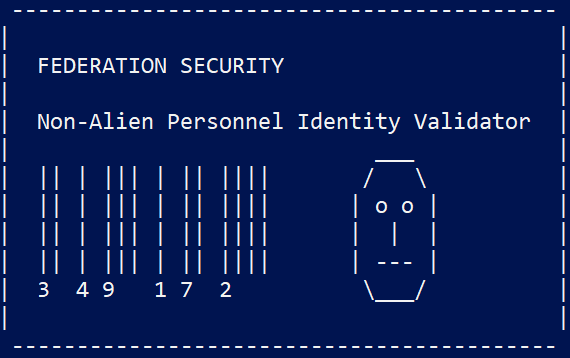


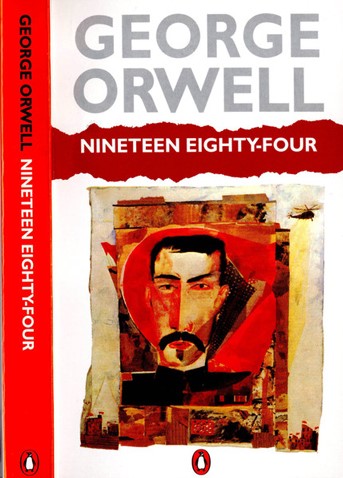


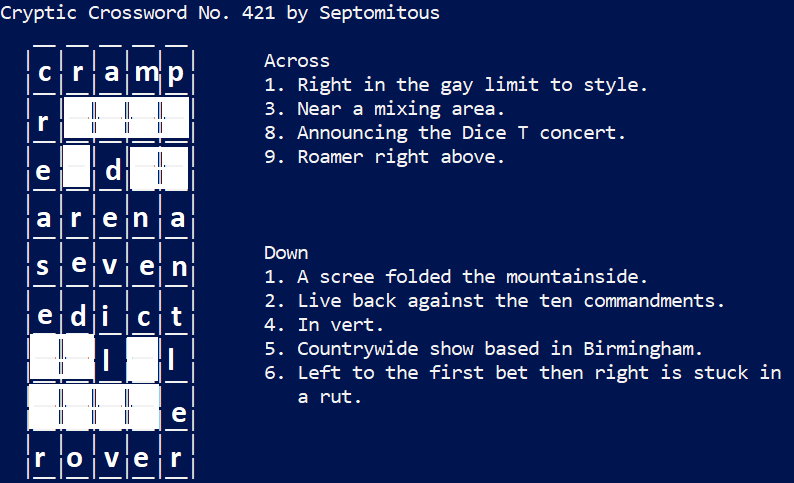
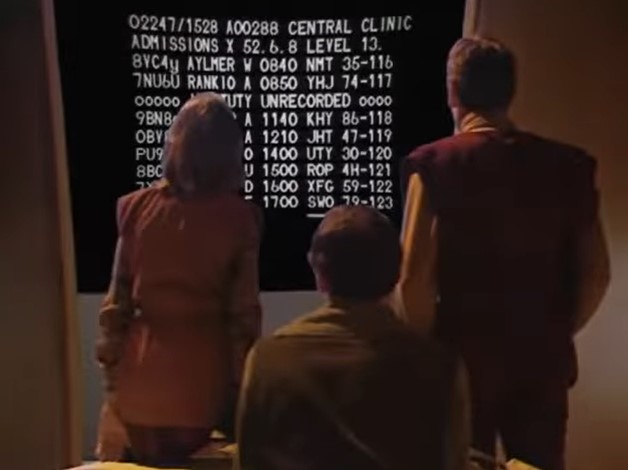


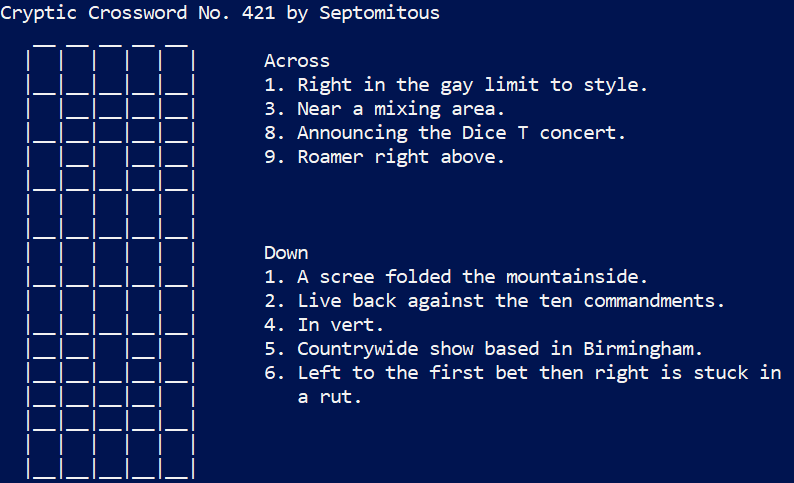


 Renga in Blue