Well: I found a secret in the cellar. Then I got trapped.
Fortunately, the cellar isn’t terribly big, so my technique of using HAMMER&CHISEL everywhere worked. I also discovered my character’s WISDOM and INTUITION were both large enough to spot secret doors, although I can’t guarantee I’ll find all of them with that. The game has gaping enough bugs that it may simply be a feature that never got implemented correctly, and Sibyl doesn’t have any particular advantage. (For example, sometimes when using the chisel the game locks into a “checking your baggage” message; you can USE HAMMER&CHISEL again and it will break out of that and work correctly.) It is hard to say without both knowing what is really going on and some serious testing.
For example: going north from the Catacombs gets the situation on the top of the post. But wisdom also indicates a secret passage to the south, and one from the Lab also going to the south. I haven’t been able to open either one as the chisel doesn’t work in either.
The secret passage that I was able to open leads to a wine cellar. Good enough, except that while a secret passage is detected on the way back to the south, there seems to be no way to open it.
We can move on to another room, more catacombs, and some stairs. Trying to CLIMB STAIRS just warns the player YOU CANNOT CLIMB THE STAIRS HERE! I don’t know if the game is literally broken (not unlikely) or if there’s some undisclosed reason for getting stopped (also not unlikely).
I honestly thought perhaps this would break me into the endgame and I’d be done, but no. I puzzled for a while longer and decided to tackle the dark area upstairs. I still had no luck with MATCHES or a CANDLE, but the game specifically mentions a TORCH so I assume that’s the only thing that will really work. Despite many, many, duplicates of other items, I have not found any torches scouring the available levels. It is possible the torches are through the darkness; that is, the game has intended for you to wander in the dark for a bit.
This is unusual for an adventure game. People copying Crowther/Woods Adventure often did something akin to a pit you’d eventually fall into (Zork started with pits, but then the Attic was upstairs and also dark, hence the grue was born). Otherwise, the games of this era at least generally prohibit certain actions in the dark, like picking up items (our recent game Murdac was really loose and only disallowed reading, but it also had an unlimited light source found early).
As far as I can tell, the only thing wandering in darkness does is make it so while screens will appear, they will only do so quite briefly before the room is plunged into black. I could theoretically record video and get screenshots that way, but I decided to roll with what the game was giving me.
At the very least, it really is an impairment not to see the visuals, because there are enough passages that loop back it is very easy to get a mangled map where portions clearly repeat but there isn’t enough information to know exactly where.
Still, I was able to find a SKELETON KEY and a MAGIC CLOAK, and by now I really seem to be immune from most enemies. (There’s also been MAGIC BALM I’ve been finding where using it gives your strength a considerable boost.)
I did also find one lit area, a kitchen complex. A few screens:
There were a series of food lockers, including two meat lockers, where, confusingly, typing OPEN MEAT LOCKER gave me an “ERCORP” in each one. I only found out later (through the heavily damaged and confused inventory screen, where some of the entries are invisible) what I was holding.
Yes, that’s two corpses I’ve been toting around. No detail on what kind of corpses they are.
I’ve never played a game before that felt so ruined and cursed. I don’t know if I’ll make it to the end; I don’t have confidence it is even possible. But I still have more dark parts of to map to get to, and I’m still holding out hope there’s a torch out there somewhere.
The much more sedate inside cover of the manual. The Atari title screen states U.F.O. is a subsidiary of Crystalware, so it isn’t really a different company.
I have mapped the ground floor and the floor beneath (“Level II” and “Level I”) fairly thoroughly; I’ve gotten through some of Level III.
My time since last has mostly been occupied by exploration, although I’ve also managed to become deadly. Let me explain the deadliness first.
I need to backtrack on one of my statements: none of the monsters are only text description. If you can’t see one, you need to turn around and you’ll get a picture like the one above. So far I’ve run into ghouls, skeletons, demons, and vampires.
All of them use the same basic mechanics of trying to hit you for X damage while you try to hit them back for Y damage. If you have armor — one of the random plate mail armors scattered about the castle — it might get shattered mid-combat (or even sometimes right at the start before the hitting starts). Otherwise, your weapons skill plus some modifiers including I think strength and dexterity make up however much you hit the monster for. If that isn’t a large enough number, the monster then hits you back.
In my experience, if you have no armor when the monster hits you back, you are dead.
Fortunately, the way the weapons number is determined allows for easy carnage: each weapon you pick up increases your weapons value. There doesn’t seem to be any inventory limit I can find, so you can swipe up spears, magic arrows, crossbows, etc. and all of them will contribute to your weapons value. Once my weapons value passed 250 or so I started to kill pretty much everything in one hit.
Before I was an absolute killing machine, but still pretty dangerous. Having magic arrows with no way to shoot them still increases weapon score.
Incidentally, the “Courage” value I have found to go up as I’ve killed more monsters. Fall of the House of Usher required a particular courage score to win; I don’t know if that is the case here. If it is, I won’t have too much trouble with my current character getting up to snuff. (If I wasn’t playing the former war hero it might have been more difficult. I still need to test if Frederick gets a weapons multiplier compared to the other characters.) The manual, while indicating the mystery should be solved, is somewhat evasive how that gets exhibited by the player.
In order to solve the mystery you must collect a series of clues and find the secret hidden chamber where a demon waits. To get the right answer you must read all of the background material and examine the three exhibited articles in this manual thoroughly. The answer is not a single word or phrase, but consists of piecing together all the clues and recounting the sequence of events that have brought about the curse upon the mansion and how that curse may be lifted.
Speaking of stats, I found out (by studying screenshots of the Atari version of the game) that you can USE WISDOM or USE INTUITION. This doesn’t work on any of the other stats. So far, I’ve always got the message
YOU HAVE NOTICED NOTHING SPECIAL
but keep in mind those are my character’s dump stats. I may just not be able to use them at all. I do have the suspicion they’d help find at least one secret passage. Referring back to the game’s manual:
On going through my dresser this evening, I found a portion of an old mason’s worksheet. Next to one of the rooms I could clearly see a 5 foot space which appeared to be some type of secret passage. It appeared to lead to a small room. With hammer and chisel in hand, which I got from the Sculptor’s Studio, I set off to find the entrance.
Although I have lived here all my life and as a child played many a game of hide-and-seek, I have always found that the Palace seems a different place at night. To conserve candles and Mary’s work load, there are areas where there are no torches and which I hadn’t explored in years. Using my map I managed to locate the room and begin to chisel on the morter between what appeared to be two loose stones. In no time at all I had freed one of the stones and from then on the work became considerably less difficult.
— Lord Edward Stuart’s Diary, Saturday, December 14
There is a Sculptor’s Studio, and there is indeed a hammer and chisel inside. What I don’t know is where they go to; I haven’t gotten to the point of USE HAMMER&CHISEL on every single wall. Part of my reticence is I’m not sure how broken the game really is.
For example: I have a CANDLE and some MATCHES now. On the second floor of the Palace, there are some dark areas:
However, my attempts at doing USE CANDLE or USE MATCHES or LIGHT CANDLE or LIGHT MATCHES all get the response NOTHING HAPPENS. (???) I’ve pretty thoroughly scoured the map otherwise and found no torches, although they are recognized as a noun in the game. I still am guessing at the moment the game intends torches to be the light source and they’re just hard to find, but I still have the lingering thought maybe the game is literally broken and light is impossible.
The game still has fairly deranged graphics in the hallways which don’t give me hope. Also not encouraging: the message YOU HAVE PICKED UP A EMPTY upon opening a cabinet with nothing in it.
Weirdly, the graphics in individual rooms aren’t too bad, and sometimes have been genuinely evocative. It feels as if there was a nice concept and core to start with, but the game was shipped out incomplete.
That second screenshot is from the cellar, which has been a smaller map than the other two.
Torture chambers and dungeon cells.
There’s a map feature I haven’t mentioned up to now which is plainly apparent above — sometimes you have multiple exits off the same direction. The way the game handles this is to have multiple doors side-by-side, and when you press D to enter a door, the game prompts which door (left, middle, right) you wish to use. It more or less works, but the game already has a lot of friction so I’d rather have done without this feature.
This will prompt 1.) left or 2.) right upon pressing D.
One last environmental feature which seems to be random but is honestly creepy: sometimes maggots or rats will appear. I tried fighting but had no luck; the best that I can do is run away. Sometimes it takes a couple of attempts, and the rats/maggots don’t leave a particular area after they’ve appeared.
I’ll grant this has the right amount of creepy, and the disjoint with the perspective graphics makes it even more cursed.
I’ve still been finding many “clue” messages but they’re for the most part repeats of ones I’ve already found. The most interesting has been a picture:
This tracks with the “meet me tonite” message, the fact Elizabeth was seen in town, and even the weird fact that the Butler wakes up later (I guess he’s out with Lady Elizabeth shenanigans). I don’t now how this translates to the mystery. If this is just repeating Fall of Usher then Elizabeth was killed by Lord Stuart’s ex-wife (who is still alive, and there already was the clue she didn’t have a death certificate), and that’s that, but that doesn’t quite mesh with the extra information so there might be a twist.
I don’t have a good sense how close I am to the end of the game. I’m going to guess halfway. What I’d really like to do next (assuming I don’t magically resolve my light problem) is find the subcellar. Not only does Lord Stuart’s diary imply the existence of such, but there’s a clue directly in the game:
However, given my character’s lack of visual insight I need to hope USE HAMMER&CHISEL on the right spot will work. (Maybe my MAP #1 or MAP #2 would help, but the game won’t let me read them. Nor will it let me read my SCROLL #1 or SCROLL #2, or read the BOOKW, or any of the various letters. Did I already say this game is janky? This game is janky.)
With a last triumphant whack of the hammer, a major portion of the wall gave way revealing the passageway I had seen on the map. I soon found myself in a musty spider infested passage and proceeded South. After walking just a few feet I found a door. The passage must have been the remnants of an old hallway sealed up long ago. On entering the room I first spotted a large old chest. Surely, this must be where Edgar had hidden his gold. Within a few moments my elation had turned to horror as I turned my gaze to the far corner of the room. There, crouched beneath the sign of a pentagram, was the most loathsome creature I have ever seen. Its yellow eyes gleamed dully in the light of my candle and its 7 foot tall body was covered with a sickly grey matted coat of fur. Around it were strewn various skull and human bones and next to was a stack of fetid rotting entrails. I dropped my candle and was plunged immediately into total darkness.
I flailed about and rushed blindly to escape. In my confusion, I rushed headlong into the thing and reached out to grasp its slimy fur. With a scream I reversed my direction and found the door. In a stumbling flight of terror I crunched into hard stone and banged my head on the low overhang. After what seemed like an eternity I lunged through the entrance to a moonlit room and rushed into the hall.
I now sit in my room. The rain still beats upon my window and the image of that horror is still etched forever on my feeble mind. I can feel myself tottering on the edge of sanity. There are footsteps coming down the hall. I can hear the sound of Virginia’s voice calling me … the knob is slowly turning and my door swings ajar … for a moment I can see nothing but a dark shadow in the door. There is a brilliant flash and poised in the doorway I can see it … as I scream I can feel my sanity leave me as thunder shakes the helpless house …
Curiously, this game gives no year. Based on other factors I’m guessing early 19th century, and it does give the date the body is first found: Wednesday, November 27. I will hence assume 1839 (where that date fell on a Wednesday) which also happen to be when Edgar Allan Poe was publishing.
In the morning, the butler Charles had found the a body charred in the furnace; Elizabeth had already (allegedly) left for Boston when all this occurred.
A search of the house reveals a mysterious “blue scarf” that is beneath Lord Stuart’s night clothes; the body is never identified. By December Lord Stuart starts to hear footsteps and scratching. The family cat, Herman, goes missing.
On December 13, Lord Stuart writes:
1:00 P.M. Today, in the old library, I made quite a find. In the old house plan there are quite a few rooms in the palace that were apparently sealed up when it went through reconstruction 60 years ago after the fire. I remember Edgar, my grandfather, was quite a miser. Perhaps, there is some of the old family wealth hidden in one of the old rooms. After the servants are asleep, I think I will do a little treasure hunting myself tonight.
There’s some other fragments of interest; he knows that his steward Michael has been skimming off his cash; Sybil (the steward’s wife and another playable character) never liked Elizabeth and seemed pleased when she left. The Lordship’s inheritence is going to Elizabeth and his butler (for his long servce); nothing is going to Michael or Sybil.
There’s literal fragments mentioned later in the manual, as “scraps of paper found in the trash bin by the furnace”.
… and my lord I mean to inquire about your maids daily purchase of 30 lbs of raw entrails. It is beyond my comprehension how you … the Butcher
… your Butler Charles has been seen boasting in the pubs that he has newly come into a great sum of money … paying in gold coins and raising quite a riot in the city …
… would like your help and cooperation in this matter. Seven of the townspeople have disappeared in the last month and were last seen in the vicinity …
… saw your wife Elizabeth just recently in the company of …
There’s a letter from Lord Stuart to Elizabeth, which seems to be written close to the start of the game; he mentions how most of the staff has left, how “at night the house seems alive”, that the family cat somehow still is crying at “the North Wing upstairs”, and that
When it is all over I shall send for you and we shall leave this evil house together to start a new life somewhere near London. I count the days until we shall be together again and the curse that seems to have fallen on this house is lifted.
There’s a schedule of the maid, Mary, showing when candles are lit, when breakfast is prepared, when things are cleaned, when candles are snuffed. Curiously, “Search for Herman” (the cat) is explicitly listed at 8 AM.
Courtesy of the head steward, there’s a complete (?) listing of rooms at Stuart Palace. There are a full 12 floors, all the way from a torture chamber at the bottom and “Guard Dining” at top. There’s also a listing of “objects” immediately after.
Based on the voting, Frederick the gardener narrowly won over the butler. People seemed to think the butler did the killing. Given the supernatural elements, it is faintly possible that the player could be unawares that they committed some horrible crime. If you’re actually thinking the butler is the full instigator, when he’s a playable character, that would be unique indeed. I’m not sure how that’d even work game-design wise, since every character starts the same way (outside the Palace, then you go in and start investigating, with no more info than what was given above) and with the same goal (solving the mystery).
In his youth, Frederick was distinguished as a war hero. His knowledge of weapons and arms is extraordinary. He is of moderate physical strength and intelligence. His [sic] of the Palace is fairly limited. He is 44 years old and is missing his left arm.
RICHES, ARMOR, and WEAPONS all start at zero. If the manual isn’t lying, then our character will have some skill multiplier when they get a weapon.
Dexterity is moderate, not terrible (maybe it would have been higher but, well, left arm; our hero is still clearly athletic). The wisdom and intuition are trash compared to Sybil’s (she gets 101 and 102). The manual hints at hidden passages and the like and I’m guessing we’ll just have to find them ourselves rather than have our character pipe up for us.
We start with a HAMMER. This works as a weapon (if we USE WEAPON it gets wielded, and you’ll see a combat a little bit later). The Lord of the House incidentally starts with a KEY, the Butler has some MATCHES, Michael starts with a BOOK, the Maid has a KNIFE and Sybil has … TUPPERWARE. (Given she has the power of divination, perhaps it’s the best start of all; you need to carry some holy water you find, maybe?)
Let’s concentrate on the first floor. Unfortunately the map is confusing enough I haven’t quite gone through everything yet.
This is designed sort of a hybrid between a typical 3D-map dungeon crawler game and a regular adventure game. Sometimes objects and rooms are repeated, but there are enough unique elements you have to map everything carefully. The only way to proceed is for each spot on the map to look all four directions; that is, press N L E L S L W L (turn and look) as sometimes things are only visible from certain angles. Additionally, you can’t fully trust the graphics you see. This is especially true of the passages and hallways; for whatever curious reason the game has many ways to render a “wall”.
I had to simply shut off the Wizardry portion of my brain which reflexively wanted to map using the distance to walls on-screen. It just isn’t dependable enough to figure out. Rooms are a little more consistent; here’s three views of a leather-working room (notice how all the views show different items).
Sometimes the objects are just scenery (like the table), sometimes they can be interacted with (like the chest).
Some rooms have a “clue”. In one case this was clearly a “note”; in other cases I’m not sure where the clue comes from at all. Hearing things in your head? The Palace whispering its secrets?
THE BUTLER SLEEPS UNTIL 9 AM
CHARLES WAS ONCE AN ACTOR
SOMEONE SAW ELIZABETH IN TOWN
NOTE TO CHARLES: MEET ME TONITE IN–
MAID SHOPPING LIST: ONE NEW UNIFORM
NO DEATH CERTIFICATE FOR VIRGINIA
Virginia is Lord Stuart’s first wife, who allegedly committed suicide 10 years ago. I’m wondering if we’re playing a higher-attenuated character if we’ll get more clues, or maybe some of the clues on different levels will be harder to hear without a higher intuition.
One last thing to mention, although I implied it last time: the game has combat.
The ghoul is text-only. I also ran into some maggots in a hall that did actually display, so it seems to vary based on the enemy.
It is possible to run away, but since I had the hammer with me, I decided to engage.
I managed to score a hit of 126 (I assume 201+ would mean I won) but was slain by a hit back.
Note the “did you learn enough” message here — just like many of the other Crystalware games, this one had a contest with it; $500 for the first to send a correct entry form:
Play the game and explore the mansion until he or she feels they have solved the mystery. It is not necessary to win the game to enter the contest.
The fact it mentions winning the game means there is a way to also win. This matches with Fall of the House of Usher, where you can get information to work out the resolution to the mystery. Incidentally, the House of Usher also has a Virginia and an Elizabeth. I don’t know if this is intended to be sort of a remake, but this does have more characters, so this might have a slightly more complicated plot.
In 2018, John Bell wrote a Facebook post for his group Crystalware Defense and Nanotechnology, giving an introduction to his forthcoming game Clonus 2049 A.D. as well as a six minute narrated introduction. He had just survived a heart attack and had renewed purpose:
Crystalware survives and I,some have said one of the grandfathers of the creation of the modern graphic adventure games and a pioneer in the future working on World of Twine – a quantum leap in Augmented and Virtual reality. Will I survive to finish.. I hope so. I am posting an audio we made for Clonus, a game I made and the mythos was revised after 9/11 and done by a Hollywood actress who wishes to remain anonymous. It is my vision of the future – which still haunts me and has since I worked at Lockheed in 1966 with Nuclear Missiles and the Navy. I cannot ever tell what I know but this is the effect that knowledge had on me.
John Bell – a dream in 1966.
Clonus 2049 A.D. had been in progress since the 1990s. Regarding World of Twine, John Bell posted in 2019 about a dream he had of looking at an expensive haunted house that he was able to purchase because the World of Twine Virtual Reality game and novel now made him rich.
I woke up, now inspired to get out my new book and maybe soon to marry the woman of my dreams who would be my last wife. My son, of course, would inherit, the mansion as would my young wife. We would do the concert for the Give Me Shelter Concert for the poor, and also set up Homeless United in Los Angeles, and leave a mark on cyber history as well as set up shelters for the homeless from coast to coast in America, with our new modular design. Yet WOT would be the most amazing computer simulation and massively multiplayer online role-playing game – MMORPG – of 2020.
He died in 2020, never able to fulfill this dream.
I bring this up not to disparage the efforts of the man, but demonstrate his fundamental ambitiousness, pushing many projects all at once, even 35+ years after the game we’ll be discussing today.
A 2019 post from the World of Twine page.
The difference between John Bell in the early 1980s and the John Bell before he died is that he managed to accomplish at least some of his goals, and with his company Crystal Computer (or Crystalware, or U.F.O.) he (and his wife Patty Bell) managed to put out over 20 games in the span between 1980-1982. This might not be that unusual for this time — Adventure International lists over 70 in that same time period — but Scott Adams only wrote a smattering of those, while John and Patty seem to have produced more than half of their catalog themselves. Additionally, all the games are “premium”; most cheeky might be Galactic Expedition, which had a “base game” which cost $39.95 and six expansions that cost $29.95 each. (This also doesn’t include all their other projects as mentioned in their newsletter, like three movies, a “videodisk fantasy” laserdisc, and a series of educational software using the Crystal Theory of Alternative Education.)
Byte Magazine, December 1980.
According to his newspaper profile clipped earlier (which might be exaggerated a bit, but let’s go along with it for now), John went from high school to the army in 1972, getting a medical degree from Fort Sam Houston and practicing at a base in Germany for two years before returning to the States and landing in software development.
I don’t feel like the head of a big corporation. I wrote a few programs then I ended up with a big distribution network. We (he and the other programmers) want to stay creative so we have other people to do the busy work.
The first Crystalware game, House of Usher, is a sort of top-down action adventure, kind of a proto-version of a survival horror game. It doesn’t not count as an adventure game for this blog as the stamina value changes dynamically and there’s heavy structural reliance on action combat.
A fair number of the Crystalware games follow this model, presumably using the same source code to an extent. The CRPG Addict played quite a few before bailing and discarding them as not-CRPGs. He started getting very tired of the games indeed.
Quest for Power is another insulting game from Crystalware, a company that was either knowingly scamming its customers or so clueless about what made a good game that they must have never played one.
Ow. I am here to tell you that The Haunted Palace is a very different game than all of the ones experienced by the Addict. I can’t guarantee it is a good game, but at least it breaks the pattern.
There has been a murder. It all started with the grisly discovery of a charred body in the furnace. The corpse was so badly burned that the mortician couldn’t even tell what sex it was. You can choose to become any of of the six characters in the game. Your role is to find out who is responsible for the murder.
This is a first-person perspective game with directional movement allowing turning. It’s something in feel between Asylum (with “dungeon crawler” style movement) and the Japanese version of Mystery House (also with directional movement but made up of 1 by 1 and 2 by 1-sized rooms).
The manual is fairly extensive, extensive enough that I’m going to save a thorough look for next time. However, the starting choice of character is essential. Unlike many games of this sort, you are not playing an “outside” character coming in — you’re part of the Stuart household, whomever you pick. It’s a bit like a LARP in that sense.
LORD STUART – An Oxford grad in his 50s with a heart condition. His first wife (Lady Alice) committed suicide and he fell in love with a Lady Elizabeth and has been living with her in the Palace for 10 years.
(You cannot play as the Lady — when the charred body is discoved she is away in Boston.)
CHARLES (THE BUTLER) – With the Stuarts for 40 years.
MARY (THE MAID) – Young, carries a knife, “knows a lot of the town gossip”.
MICHAEL (HEAD STEWARD) – Manages the Stuart fortune.
SYBIL (STEWARD’S WIFE) – Doesn’t like the Palace, has ESP ability.
FREDERICK (THE GARDENER) – Former war hero, doesn’t know much about inside the Palace, only has one arm.
Other characters, but non-playable: Herman, the Cat. Virginia, the first wife. Elizabeth, Edward’s current wife. Jonathan Stuart. The Guest.
The characters come pre-built with stats: strength, courage, wisdom, intuition, dexterity, luck, riches, armor, and weapon. So someone like Sybil will have higher intuition while someone like Frederick will have higher weapons ability. I don’t believe there is a way to “build stats” like an RPG (although I will keep an eye on this); this suggests a setup akin to Maniac Mansion where certain actions only can be done by certain characters.
The manual is unclear but you press “C” to enter “command mode” where you can enter a regular parser command. “L” will look. Otherwise, N/S/E/W turn in that particular direction, M moves forward, and D opens doors. There’s no “relative direction” turning, that is, no equivalent to the left or right arrow keys in a dungeon crawler.
You start locked to facing north. There’s a rock you can move to find a key and unlock the front door.
Upon entering, you flip the disk to side 2, and the “freeform” 3D portion of the game starts. Below I have all four views from the first location, north/east/south/west. (I can’t say “room” — again, seems to have large open portions, so the same room may contain multiple nodes.)
I haven’t explored much yet, but I can already tell from my minor wanderings it might be confusing to be able to tell when it is possible to advance forward and when you are “blocked” by the scenery.
I haven’t played much more partially because: I want you (the one reading this right now, and assuming you aren’t going through my backlog) to pick which character I should use. Feel free to make an argument which you think is better. I can’t guarantee I will stick with it for the whole game if something is wonky (some door that I can’t open without a strong character and there doesn’t seem to be any other way through) but I’m going to try my best. The manual includes pictures for all six so I’ve made a collage.
Lord of the Palace, Butler, Maid, Steward, Steward’s Wife, Gardener.
Microfex is another one of those mysterious early-80s computer companies that has fallen through the cracks, remembered for almost nothing. There is a Mobygames page, but as of this writing, it has only one game on it. Specifically, Ultimate Tank, so let’s start with that game.
Or is it different? The wizard iconography (which is repeated across publications) suggests Little Wizard is simply the manufacturing branch of Microfex.
This is emphasized by another ad which includes Ultimate Tank, and does not mention the name Microfex:
Commodore Power Play Issue 3, 1982.
This ad from Compute! Gazette, September 1983 includes both (it is tall on a page, so I placed two parts side by side):
You’ll notice from the ad some international distributors mentioned. One in particular turns out to be helpful: the Australian company OziSoft.
OziSoft started as a computer game distributor (see above) and eventually became Sega’s distributor to the whole Australasia region, being redubbed Sega OziSoft. As Sega’s distributor they are a well-documented company with some big history surrounding them, including directly setting off the entire Australian game classification system with Night Trap.
EUGENE PROVENZO: Well, it could be very exciting but what happens is that as the new systems come in, for example, the Sega CD-ROM systems, what happens is that the video game suddenly becomes increasingly interactive and videolike, filmlike, and so what happens is that we have something close to film rather than a traditional video game of space invaders or even the recent Nintendo games.
KERRY O’BRIEN: So that the violence becomes more real?
EUGENE PROVENZO: Much more real and you end up having the question of: is the video game now something close to film, video, or is it in point of fact a new type of interactive television?
However, we are dealing with the OziSoft of 1983, right when they were starting. Specifically, a small portion of the ad above and one of the companies it lists:
“MI” is just a code, but given it has Cosmic Crystals, Ultimate Tank, and other VIC-20 games listed on the other ads, it must be the same company (that is, Microfex / Little Wizard). The MI suggests it is using the Microfex name for the abbreviation.
Included on the list are Cribbage (MI 007) and Grandell Island (MI 008), both by Charles Sharp Jr., he of the Young Arthur game for VIC-20 we just saw. So while the version we have extant of Grandell Island has no publisher listed and is for C64 (and a 1982 date on the title screen), we can firmly say there was a VIC-20 Microfex version.
(That seemed like a lot of work for a minor detail, but remember this company which apparently distributed as far as Saudi Arabia has almost nothing out there about it!)
For the record, here’s what Cribbage plays like:
I strongly suspect Grandell Island came after Young Arthur’s Quest. Even though the C64 version I played had some tweaking (with a “commands” list added by someone named “Chuck”) it feels less broken.
It’s still pretty broken, though; it’s kind of like writing a text adventure where, while it does keep track of inventory, essentially every action is custom-created for a particular moment while nothing is consistent.
A good example is at the very start of the game. Knowing that Young Arthur used a lot of LEAVE and ENTER for directions, I did LEAVE BEDROOM instead of trying a direction. Good so far. This landed me in a foyer, but then when I tried to LEAVE FOYER things went awry:
Here, the command switches from LEAVE to ENTER DOOR. Of course, since there two doors, the game needs to have a custom prompt just for you to specify which one you mean, and this is the only place in the game this type of prompt appears.
The only purpose of that section was to show the main character waking up and going outside. It is kind of like one of the dodgy amateur movies like Manos: The Hands of Fate which has 5 minutes of car travel with nothing happening. That’s how long it took me to get outside.
Once outside, you can visit a lighthouse; you need to CLIMB STAIRS to go up but just use the direction DOWN to go down. There’s a tavern you can visit where the command QUESTION BARTENDER works (fortunately, there’s a command list, that’d be hard to find) followed by BRIBE. (Your inventory does not indicate you have money, but it works anyway.)
I’m pretty sure the above scene is technically unnecessary. All you really need to do for the first part of the game is raid the Commodore Grandell’s house, go upstairs, fail to break into a chest, go back down to find a maid cleaning, and BRIBE the maid with your invisible money.
This doesn’t quite unlock the chest right away; you have to go downstairs and unlock a drawer at a desk, and that desk has the right key to go unlock the chest. There’s a strong sense of narrative sequence yet a simultaneous issue with the sequence not being a terribly interesting one.
Now, the next step is to go by the docks and examine them where you will find a previously invisible shack and a sign you can read.
You can then rent a boat and hop in, trying to get to the promised Palm Island.
The map is slightly tricky; you have to imagine you’re starting the boat on the green portion of the first island, but not going all the way to the green portion of the second island (otherwise you crash). Even on a tiny mini-game the game is inconsistent about travel, argh!
I have circled the intended start and end square. So you have to start with 3-north, not 2-north, but end with 2-north, not 3-north.
The whole point of getting to the island is not to start digging for buried treasure, but to get a clue from a parrot where to dig.
So the next step is: travel back to the original island! There’s a room with a sundial which seems the obvious thing the riddle is referring to.
When the sun is at its peak is clearly referring to the “12 noon” position. Really the issue here is a parser one. You can’t DIG 12, and as far as I can figure out you can’t wait for the right time and DIG SHADOW. You have to DIG HOLE; the game then asks where, and you type 12.
This is an author who was clearly enthusiastic about adventure games; there’s a “script” of events that maybe seem reasonable on paper? The interaction design was just miserable to slog through; if the parser was easy to use (at least even relatively speaking) somewhat easy puzzles would be fine. However, most of my game was occupied by working out how to communicate, not what I wanted to do in the narrative universe.
I think this is a case the author might have benefited from one of the systems like The Quill that eventually came out, but this was just a little too early (and no such system surfaced on the VIC-20) so he had to resort to awkwardly-cobbled together BASIC code.
I do want to emphasize I am still grateful the game exists. I know for some of these “lesser” games it may seem like I am just spinning in place, but each new game gives me a little better idea what authors faced in this time period, and even though the wild inconsistency of the parser made for a poor experience, at least it was a unique one.
Starting from early 1983, one of the items printed in Commander Magazine (The Monthly Journal for Commodore Computer Users) was a catalog of all known suppliers of both hardware and software, “solely to promote the VIC-20 industry”. For example: the list from Issue 8, July 1983.
Some of these companies are still remembered (Broderbund) and some are more or less forgotten (Briley Software sold a menu planner called Dinner’s On) but today’s company in particular, ABI Software Inc., is not even listed. It is so obscure even a contemporary index in tiny print doesn’t recognize it!
It does have a Mobygames entry, with one game listed for 1983, Konkey Kong, a terrible port of Donkey Kong. I’ll drop a video if you don’t believe me:
They had at least one other game, Young Arthur’s Quest by Charles Sharp Jr.
From Retrocollector. It is faintly possible the letter is actually an “R” as you’ll see by a title screen later, but given the “A” is given by someone who has a real copy (with no photo of the back portion which usually gives a company name in plainer text) I suspect ABI is still correct.
Unfortunately I have zero information on them otherwise. I can say Charles Sharp Jr. is credited with two more games (one which we’ll be looking at next) but they were published by a different company (maybe out in Wisconsin, but it’s complicated). There were quite a few Commodore magazines at the time so I can’t claim a comprehensive search, so there might still be an ad lingering somewhere that can enlighten us. For now we can only turn to the game.
Here’s the screen where the first letter kind of looks like an “R”.
While the picture on the top of this post is for a VIC-20 version of the game, the one currently available is for C64.
From the screenshot above you can see that it must be essentially identical; the disk comes with a program that changes the number of columns of the C64 to be that of the VIC-20!
One common thing we’ve had with VIC-20 games is a sort of ultra-minimalism due to technical requirements of having low memory to work with. (The Bruce Robinson games, for instance, worked within the 3583 bytes available in an unexpanded VIC.) That’s not the technical case here; a 16K memory expansion is required and the game uses 12032 bytes (that is, Mr. Sharp had more than 3 times the amount of space to work with). Yet, this game still feels strangely very spare. I suspect maybe the author used a minimalist VIC-20 game as a codebase in order to make something with just a little more text?
Your goal in Young Arthur is to become King of Britian (no, not Britain). Our first task is to hop in the cave we were just warned about, with some flashing lights, and EXAMINE LIGHTS.
Then, repeat:
But not a third time:
Exploring outside, there’s a river (with a tree you can climb to see a castle on the opposite side), a ferry (which requires money to board), and a town with three shops: a baker, a florist, and a tailor.
The scene in the town presents two difficulties:
1.) It appears like the shops are “outdoor shops” as each one has an item you can try to take, but get caught, as above. In each case it turns out you can ENTER SHOP, which I only found out later.
2.) You can also READ SIGN even though there is no sign in the description. Each shop has a message about GET JOB…INSIDE.
So the plot is pre-set here where you pick on of the shopkeepers and GET JOB while inside. They will each give you a delivery assignment, and you can only pick one of the assignments at a time.
Once you have the delivery assignment you can go over to the ferry and ride it using the money you get from the shopkeeper. Then, to get anywhere at the castle, you have to realize (without prompting) the game wants you to SAY DELIVERY.
This lands you in one of three different destinations depending on which item you picked to deliver. If you start with the bread or flowers, you’ve softlocked the game.
The door here is locked and in the walkway you get stopped by guards.
The proper thing to pick (no reasoning, you just have to experiment and find out) is the tailor, where you deliver some cloth. This gives you access to The Kings Bedroom where there is a BOX and you can open it and GET KEY (following the vision from the cave).
With the key in hand, you can drop the cloth off as well for your delivery and leave back to the town.
Now you need to deliver some bread. This is the same procedure as before; just GET JOB while in the bakery, take the bread along, use the ferry, and say you’re delivering bread. With the key, that door that was locked before you can open.
This is essentially the end of the game. You just have to do the right thing here. Going back to the message in the cave (“Preach UNITY is power.”) the correct action is just to SAY UNITY.
The interesting thing structurally here is that there was nearly no puzzles at all. The “hard part” was picking the right delivery sequence. The “puzzles” were mostly parser issues, which I’ve skipped over to make the game seem smooth. There’s a contemporary review for Commander magazine which claims it is “recommended for younger players” but would they really have fun with a game where 70% of the difficulty is in communicating in the first place? (This is the same magazine that fails to mention the existence of ABI or RBI or whatever the name of the company is.)
I get the impression the author had some sort of script in his head that was more grandiose than what happened in the game. Otherwise, making two deliveries and sneaking up to get a sword would make for the most underwhelming of the Arthur stories in the canon.
So we spent about a week puzzling through the 12 puzzles of Krakit, with some answers more certain than others. I’ve already put a lot of solving detail in my prior posts, so go read those if you missed something.
Our contest entry is:
1: Scotland, Edinburgh, 7464
2: New York City, US, 1941
(We thought possibly 1882, but we had no real way to choose between the date of the Statue of Liberty and the date of the song.)
3: Chicago, US, 1942
(Would they repeat the US twice? The actual O’Hare aviation 9-vs-1 action happened at sea, so wasn’t really associated with a specific city. We also never fully parsed out what the Hyde Park “Byrd” thing meant.)
4: Budapest, Hungary, 7
(Very tentative. Roger Durrant also suggested Zurich with its 12 districts and 34 quarters.)
5: Ottawa, Canada, 282
6: Savignano, Italy, 49
(I will be flabbergasted if this one is right, but it’s possible.)
7: Salisbury, England, 70
(Feels pretty solid on location. Very uncertain on number.)
8: Chihuahua, Mexico, 10652
(A self-confirming puzzle, so I think this one is good.)
9: Verona, Italy, 2
(From the play. Easy? Too easy?)
10: Borodino, Russia, 1812
11: Ballaghaderreen, Ireland, 1916
12: Tromsø, Norway, 13
(A complete shot in the dark.)
So, how did we do? Cue the drumroll.
From zx81stuff. This is actually a “demo tape” version of Krakit which doesn’t even have the real clues, just the instructions. An included slip tells you to directly edit lines 225 and 226 of the BASIC source code from “Gladstone Electronics” to whatever your own establishment is called and send information to IPS in Ontario in order to get a customized version of Krakit with your own company listed as distributor.
We did … poorly. But not as poorly as I feared. There was a mixture of “argh, we were close” and “I have no idea”. All this comes from an issue of T-S Horizons, a magazine dedicated to Timex-Sinclair computers (as the US version of the game was run). A “Gary Gogel of Arizona City” somehow obtained a complete solution document that is a full 14 pages long, suggesting some answers requiring ludicrous work.
6 and 12 were clearly complete whiffs. No idea what’s going on there. Would love some future person to work it out (or if Gary Gogel is still alive, for his solution sheets to surface).
2 and 3 may be reverse-solvable. Is 1882 some particular date?
4 really was Zurich, sigh.
7 likely is a date again, but of what?
I guess 9 needed some more time, but there really is almost no information in that puzzle other than the Shakespeare quote. Whatever 413637 comes from strikes me as likely the opposite of a self-confirming puzzle.
For 10, are they just getting their history wrong?
Clue 11 was probably our most impressive solve, so a tip of the hat to redhighlander, but it was essentially a backsolve, skipping an intended chunk of the puzzle. What do the little numbers next to the provinces mean? What does “Find the 4th” have to do with the answer?
Whatever is going on strikes me as tougher than what happened with Masquerade; at least that contest suggested you could confirm your answer by digging up the golden rabbit, and it really was only one thing you are solving for. Here it is like 12 Masquerades, each one with potential for ambiguous answers, or even, possibly in the case of clue 10, the contest makers getting their facts wrong. And of course, no way to check if you’re right on a particular clue of the 12, other than getting all the answers right. This was not a good way to write a contest.
I suspect if the spate of contests overall had been stronger — with clear winners and answers — the idea might have lasted a little longer. The odd contest games happen off and on but are haunted by the same issues: ambiguity, backsolving and potential errors. To give a more recent example, Sirius Entertainment’s Treasure Quest was a 1996 game inspired by, what else, Masquerade, with a million-dollar prize for the first solver. The game had significant errors in the contest puzzles on release. One person (Paul Wigowsky) backsolved the answer anyway but was disqualified due to failing to put his registration number on his submission. While there was a “winner” (yet no publicity photos) skepticism about the winner even being real led to the whole debacle ending in a consumer fraud lawsuit.
As far as I can find, Krakit was wound down without a lawsuit, but I don’t think anyone got far enough to even know whether or not it was “rigged” in such a way to warrant one in the first place.
(By the way, if you still have a thirst for hidden treasure even after all that, we never did solve Alkemstone, which involves a real buried object that presumably is still in the same place it was in 1981.)
Title screen from the Amstrad version of the game.
Continued directly from last time, I was on an island with “cannibals” in the process of preparing fresh missionary.
There were three problems
a.) getting captured by the people
b.) finding a secret spot on the island with treasure (I didn’t know about this at the time)
c.) getting back from the island
For c.), while the ribbon works for parting the seas while done from the beach, it does not work for the way back. I tried various ways to “increase the power” of the ribbon or stall, even trying to pin it to a pigeon and have it walk around wearing the ribbon, having it wave in the breeze. I wasn’t having any luck so I figured I needed to be solving elsewhere first.
It was around this time the author of game, Dr. Partington, asked if I had solved the tombstone puzzle yet, hinting it was self-contained. This is a bit like if you were playing Robotron: 2084 and Eugene Jarvis starts giving you advice; you have to try, right?
I did have the tombstone on my list as a thing to check, because it is one of the items with random generation. It isn’t even generated on a fresh game; it gets generated on reading the tombstone! So you can save, READ, restore one step before reading, READ again, and find completely different text. After the text is read it stays fixed in state. Schrödinger’s tombstone.
I kept restarting a bunch of time and read the tombstone each time. The pattern is: first a name, either GURON, SCAPHIO, PHANTIS, GAMA, or ARAC. Then a “biography” from four choices:
“… PIONEER … SIGN LANGUAGE …”
“… SUSPECTED … WEREWOLF …”
“… FAMOUS BARITONE …”
“… NOISE ABATEMENT CAMPAIGNER …”
Some samples:
You are at an old, untended grave. The tombstone is worn but you can make out some of the writing on it. There are paths to the east and north.
> read
The stone is worn but you can just make out the name “GURON”
and the words “… PIONEER … SIGN LANGUAGE …”
or
The stone is worn but you can just make out the name “GURON”
and the words “… SUSPECTED … WEREWOLF …”
or
The stone is worn but you can just make out the name “SCAPHIO”
and the words “… SUSPECTED … WEREWOLF …”
The save game I was using for my main story had “GAMA” and “WEREWOLF”.
The fact the names and “professions” were mixed and matched meant they couldn’t be linked with some sort of tight wordplay. This is genuinely one of the hardest puzzles in the game, and I didn’t solve it myself; rather, the insightful Matt W. mentioned HOWL being an understood verb in the game, which is so wildly unusual it can’t be a coincidence. He had tried HOWL GAMA but to no effect. (SING and WHISPER and SIGN all also work as verbs for the other professions.)
The HOWL GAMA is right, but it needs to be done at the lake close by. I didn’t find this my random testing; rather, I was fully aware the number of places remaining that were “unused” was starting to get rather short, and the lake was close by to test.
O.K. “gama!”
The waters in the centre of the lake part and a hand and arm appear, grasping a gleaming sword (surprisingly, not at all rusty!) The Lady of the Lake, if that is who it is, flings the sword towards you so that it lands at your feet. The hand then disappears, and the waters regain their calm.
There is a gleaming sword here, whose mighty blade bears the proud name of Greydeath!
Sword in hand, I tried figuring out where to use it. You can’t use it to kill monsters. In fact, all the monsters are protected by guardian angels and so forth:
> kill centaur
A humanoid character with large white wings appears in the room, claiming to be the Guardian Angel of the centaur. Whether he is or not, he strikes you dead with a single blow.
(Another data point for my History of Nonviolence post. Puzzle gameplay just doesn’t lend itself to straight combat like CRPGs do.)
I still had the island open, so I tested it over there. Wandering the perimeter, I found a treasure:
Suddenly the sword Greydeath twitches violently in your hands.
You are at the western tip of Cannibal Island.
> dig
You dig in the sand and unearth a scorpion. Just as it is about to sting you, you slice it into pieces with Greydeath. The fragments vanish into thin air.
Digging further, you discover a large hoard of pieces of Eight!
You are at the western tip of Cannibal Island.
There is a hoard of pieces of Eight here!
Well, that solves a problem, just one that was hidden, not either of the two I knew I had. However, I was inspired to keep testing things out with the missionary in the cauldron, and figured maybe an item use doubled-up elsewhere. The beads worked to calm the lion, maybe they’ll have a good effect here?
> wave beads
The cannibals are so attracted by the beads that they leave off their culinary activities, take the beads from you, and begin to play with them. The missionary takes the opportunity to leap from the cauldron, and with a breathless “Thank you, my son!” thrusts a book into your hand, and runs off.
Examining his gift you see that it is in fact a Gutenburg bible!
This incidentally does mean if you solve this before the lion puzzle the game is now softlocked.
I tried a number of stunts to get back on land, but no dice. I was running short on puzzles to solve, but I went back to my issues: a magic word on the floor hidden under some millet (that didn’t work), a centaur guarding a tunnel, a pigeon that I could carry but didn’t seem to be helpful anywhere, and a goblin chained in a dungeon.
I worked out the centaur first, going by “let’s try double-use of an item again”. In this case, taking the shawm which had busted a wall and trying it on the centaur.
The north-south passage comes to what appears to be a sentry-post to your north.
There is a large centaur here on guard duty.
> blow shawm
WHAAAAAAHHHHEEE!!!
The hideous sound is too much for the sensitive ears of the centaur.
It runs (gallops?) away without further ado.
> n
You are at Centaur Point, a small area looking something like a cross between a stable and an office.
There is a flask of expensive French perfume here!
Is “sensitive ears on a centaur” from some sort of particular mythology, or just this game?
Now, the pigeon and the millet. You might be reading it wondering why I hadn’t put them together. Well, I had.
> drop pigeon
OK.
> drop millet
OK.
> look
You are in a north-south passage, with side passages to the southeast and west.
There is a pigeon waddling about here.
There is a pile of millet on the ground here.
> get millet
OK.
> feed pigeon
The pigeon doesn’t seem to want anything you’ve got.
No, this is something more like Phoenix-game logic but not real-life logic. It is a sort of logic and the result occurred to me before testing out the action.
You are in the Astrologer’s Sanctum – a well-made chamber whose walls are decorated with numerous cabalistic symbols. The only exit is by an archway to the north.
There is a pile of millet on the ground here.
> get millet
As you gather the millet together you uncover a word inscribed
on the floor.
> read
On the floor the word A K Y G G A N E G V R I S H W is inscribed.
Namely, the realization struck me that maybe picking up the millet softlocks the game. You can’t drop it to cover the letters again; maybe the fact the letters are separated and covered is a very important condition of having the pigeon do something important, even though the pigeon ignores the millet in all other circumstances.
> drop pigeon
The pigeon pecks at some of the millet, exposing a word on the floor. OK.
> read
The letters K N E V I S H are exposed where the millet has been pecked away.
> knevish
There is a sudden CRACK in the fabric of space-time as an object appears in the room from thin air.
There is a finely carved ivory statuette here!
Again: there is a sort of logic here. The pigeon serves not so much as a real pigeon but a magical vessel, so the inexplicable lack of attention to the food in other circumstances is just because it is not fulfilling the magic.
I enjoyed solving it and felt satisfied but I’ve also played every Phoenix game up to Murdac in chronological order. I can see why someone in normal circumstances would get very frustrated.
Mental standpoint might also help a little. I usually play adventure games as if I am a storyteller trying to arrange the right pieces together to cause things to happen, like the recent game Storyteller. I rarely feel like the avatar is “me”, as in an embodiment of my consciousness, nor do I have an immersive sense where I feel jarred because of having to restore a saved game for the umpteenth time. I am, at closest, like an actor playing a part. Who was the protagonist of Myst? I don’t know, but I never thought it was “me”.
Returning to the puzzles in progress, I still had a goblin to deal with, but I was also very low on items I hadn’t used yet. They included a wax dummy, and I had already discovered (via STAB being a verb on my list) that I could poke with a diamond pin (that had been in the lion’s paw). Since I was out of places to use it:
You are in the deepest and dankest dungeon. Steps lead up.
There is a nasty little goblin chained to the wall here.
> stab dummy
The goblin gives a yelp of pain. “Don’t torment me! I’ll tell you how to get back from the far west! The word is EXODUS.”
Again random: AARON is possible, but I haven’t run through all the choices.
> say exodus
O.K. “exodus!”
The waves part again, revealing a path back to the beach.
> e
You are on an east-west causeway, the waters towering high above you.
> e
You are in the cove at the head of the causeway.
> n
This was nearly the last piece I needed for victory. I was able to leave the island with the treasures (Piece of Eight, Bible) and gather all of them at once:
There is a pile of amethysts here!
There is an antique shawm here!
There is a gleaming sword here, whose mighty blade bears the proud name of Greydeath!
There is an ornately fashioned bowl of solid gold here!
There is a quantity of precious myrrh here!
There is a priceless (and almost certainly unique) stuffed dodo here!
There is a flask of expensive French perfume here!
There is a finely carved ivory statuette here!
There is a gleaming toadstone here!
There is an ingot of Erbium here!
There is a baboon here, made of solid silver!
There is a pile of sparkling peridots here!
There is a diamond tiepin here!
There is a hoard of pieces of Eight here!
There is a Gutenburg bible here!
Then I took them over in a few loads over to the Keeper of Murdac:
The passage widens into a vast chamber which is full of soldiers some armed with long bows, others with halberds, maces or swords. Their lord is a venerable man who is sitting in a very expensively upholstered armchair.
“Greetings!” says the old man. “I am the Keeper of Murdac. Leave your possessions here with me and they will be safe until you return in triumph. You may take the lamp if it is needed on your quest.”
You are in the keep.
> drop all
You dropped 7 objects.
Etc. repeat, until all treasures were deposited.
“Congratulations” says the Keeper. “You are now ready to join the companionship of Murdac. But there is still one thing you must now do.” He hesitates, then asks:
“What object will you take with you on your journey?”
This is the final puzzle. You pick one object and get teleported somewhere where you use it appropriately. Try it yourself, and use your intuition: out of all the objects in the game, which would be the best?
A picture to pause with while you think. Disk for Murdac, from Acorn Electron World. I find it interesting the copyright is 1983 (when Hamil got published) even though it didn’t go commercial until later.
I started with the lamp, thinking perhaps I’d get dropped into a dark maze of some sort. If anything, it was the old reliable.
You are on a tiny island, far to the west of Cannibal Island.
OK, maybe not a lamp. Perhaps the ribbon? (By the way, I found reading a walkthrough later — huzzah, I got to check a walkthrough after beating a Phoenix game — that the scroll and staff are both possible for parting the sea, it is just random based on the vision you see.)
You are on the banks of the river of Death. Invisible forces prevent you from leaving.
Hmm, random location drops. Interesting! Given that angle, I decided to think: “which item feels like it has the most heft, the most importance?” Surely the sword, which has a name? Rather than editing things down I’ll give the rest of the transcript after typing SWORD, including some flailing, even though I immediately suspected what was needed:
Darkness descends on the keep. There are sounds the like of which no other man could hear and still retain his sanity.
Suddenly light returns and you see that…
You are by the lake once more. Dense foliage blocks you in all other directions.
> wave sword
Nothing useful happens.
> look
You are by the lake once more. Dense foliage blocks you in all other directions.
> n
You can’t go in that direction!
> e
You can’t go in that direction!
> s
You can’t go in that direction!
> w
You can’t go in that direction!
> nw
You can’t go in that direction!
> inv
You are holding:
The sword Greydeath.
> look
You are by the lake once more. Dense foliage blocks you in all other directions.
> throw sword
You throw the sword back into the lake. The Lady of the Lake stretches her hand out of the deep and catches it once more.
A barge draws up, drawn by two white hippopotami. You enter, and are taken off in triumph to the land of Heroes of Murdac.
You have scored 250 points out of a maximum of 250. Well done!
I enjoyed this the most so far of the Phoenix games. The entire system “clicked” for me in a way where I never felt cheated. This is despite some heavy built-in softlock points; moreso than Hamil. However, the story was short enough I didn’t feel crushing weight from repeating a section. and it does keep you on your toes to keep in mind not only the objects in front of you as you are puzzle-solving, but objects that have already been used up in the past.
Jonathan R. Partington will return later during my 1982 sequence with Avon.
Murdac has been relatively brisk for a Phoenix game. I remember with Philosopher’s Quest sometimes taking a week to get one smidge of progress, but all the dominoes have been falling here.
From the manual, a “letter” version of the game’s blurb. We haven’t met the “cannibals” yet but we will in this post.
I left off entering the haunted house without death by furniture but otherwise still being killed by flying sofas.
> e
A large item of furniture flies across the room, hurled by a poltergeist. With the aid of the pillow you fend it off, slightly bruising your right arm.
You are in a large bedroom in the haunted house.
There are exits to the north, south, east and west.
Most directions of movement here will kill you.
My solution came not too long after, and I think the act of writing about the puzzle may have helped. I speculated about it being a “gimmick maze” and that there is no room to slow down and check an item without getting clobbered. This suggests that the text itself has a clue, and so I checked over my transcripts of randomly successful steps. It turns out that the line about “bruising your right arm” varies; it can bruise your left arm, or the item of furniture can “narrowly” miss “your face.”
I realized this is indicating the direction the poltergeist was at that moment, and that I needed to move away from it, accounting for relative direction of travel. That is, if you go east, and get hit on the left, then for your next step you need to go south. If you go south, and get hit in the face, then you need to u-turn and go north.
Illustrated: moving east, being attacked from the left (that is, from the north) requiring you to move south to stay alive.
Enough turns of this — eight, which I suppose is enough the author decided you weren’t just getting lucky but actually solved the puzzle — and you escape the house altogether:
> e
A large item of furniture flies across the room, hurled by a poltergeist. With the aid of the pillow you fend it off, slightly bruising your left arm.
You are in the living-room (!) of the haunted house.
There are exits to the north, south, east and west.
> s
A large item of furniture flies across the room, hurled by a poltergeist. With the aid of the pillow you fend it off, slightly bruising your left arm.
You are in a large bedroom in the haunted house.
There are exits to the north, south, east and west.
> w
You are on a deserted railway platform. The haunted house is to your south and the platform extends east and west. You can hear the sounds of passengers although you can see nobody.
There is a pile of sparkling peridots here!
You’ll get squished if you try to go back in the house, but with peridots in hand, you can walk to the north even though the game does not mention an exit.
> w
The platform seems to move with you, and you make no progress.
> e
The platform seems to move with you, and you make no progress.
> n
You step out into space, and find that you are on an invisible train which was waiting at the platform. This Ghost Train gives a piercing HOOT and then acclerates rapidly. As your eyes accustom themselves to your surroundings, you catch sight of various spectral commuters reading The Phantasmal Times and other ethereal papers. There is no sign of the ticket in-spectre. After a while the train halts and you dismount to discover that…
You are in an extremely long dark east-west tunnel. The ground is stony, almost as if it had been designed to carry railway tracks.
The “railway tunnel” is back on the main map, a tunnel that looks like a railway but prior to this moment didn’t take the designation literally.
Before pressing forward, I’d like to linger on the moment of solution a little longer, in a “theory of puzzles” way. I had the “trick maze” idea long in my head before putting it down, and had scanned the text for possible tells. I think I still wasn’t fully invested in scanning the text because I had in the back of my head related puzzles, like the ice one from Acheton which revolved around an item that pointed in the right direction, or the Hamil one where you follow a creature that you intentionally let go. While I also previously thought “you have an inability to do any actions other than move without dying” it didn’t quite click that the two facts together meant that the Acheton and Hamil puzzles I just mentioned are impossible. So the act of writing the two facts down together made me recognize the logic and made me more convinced I just needed to find a textual change, and then spotted the difference only about 5 minutes after I pressed the “Publish” button on WordPress.
…right, enough side-trek. Next I decided to finally break down and go through my “standard verb list”, checking which verbs are recognized by the game.
Not a long list, which can be awkward for game-play (sorry, you can’t PUT the iron rod on the wires, only THROW it) but good for puzzle-solving. I thought backwards from each verb, assuming they have a purpose (in 80s games, this is often true). I realized I hadn’t tried to WAVE anything so I went through my object list and decided the only item it made sense to do that was a string of beads. I then checked each of my remaining monsters (centaur, goblin, manticore, lion) to see if I could get a reaction, and hit gold (or rather, diamond) with the lion.
> WAVE BEADS
As you wave the beads at the lion, it seems to be mesmerised, and in fact quickly falls into a deep sleep.
Examining the sleeping animal, you see that it has a thorn in its paw.
> GET THORN
You extract the thorn from the lion’s paw with great care, to discover that it is in fact a diamond tiepin! The lion awakes, feeling much more amicable towards you.
> LOOK
You are in the lion’s den, a rectangular room with solid stone walls. The exit is to the southwest.
There is a lion here, purring docilely.
Incidentally, the diamond tiepin is not just a treasure. I was toting around a “small wax dummy” which suggested to me a voodoo-doll type scenario, and I noticed STAB was an unusual verb off the verb-list, so found I could STAB DUMMY while holding the diamond pin. The game just says “OK” with no apparent effect, so unfortunately, I don’t know where this is useful yet.
One other solve came from a tag-team between my readers: Lisa H. pointed out that a toadstone is from real folklore and has “protective or curative properties”, Matt suggested because of this to try it with the manticore that inflicts poison (I noodled with it but couldn’t find any effect), and finally K thought to ask if I had eaten it. EAT TOADSTONE? Maybe:
> inv
You are holding:
A string of beads.
A dull toadstone.
A lamp (which is off).
> look
You are in a disused mineshaft. Light enters from high above but the walls are unclimbable. A passage leads south.
There is a small ingot here which, as you can see at a glance, is composed of the rare metal Erbium!
> eat toadstone
You attempt to eat the toadstone and in fact manage to lick off its outer crust, which has the taste of a boiled sweet. You discover that there is a hard centre which, when you remove it from your mouth, is really a gleaming jewel of great value!
> s
As you enter the manticore’s lair the creature’s tail whips into action, stinging you across the face.
The medicinal effects of the toadstone counteract the venom and you soon recover.
I was thinking of cooking the toadstone in something and drinking an elixir, but sure, that’ll do. Not only does this let you grab the Erbium, but the toadstone starts “gleaming” and becomes a treasure itself.
Speaking of cooking with liquids: another stopping point I had was with the various bodies of water. I found the outdoor lake has a special effect for thrown items:
You are at the edge of a large, perfectly calm lake. No breeze ruffles its untroubled waters. There is a path back to the west.
> throw key
You throw the key into the water. It sinks like a stone.
I went through a list of my items and didn’t get extra message, but the author is not a red-herring type, so I suspect a future item may be useful. (A sword that gets tossed to a Lady in the Lake, perhaps?)
For the pool of sparkling water, I realized there was a special message for typing LOOK while in the room: a strange vision.
As you gaze into the pool you fancy that you see some strange vision, but unfortunately you are unable to discern any detail.
The passage ends in a pool of sparkling water, in which wondrously flickering patterns can be seen. The only way out is to the northeast.
How to clarify? I originally though lenses, but before I could (futilely) try to make a lens in earnest, I hopped back to the verb list which has FILL. I knew I hadn’t used FILL yet. What could fill work on? How about the golden bowl I found after dealing with the Monster of Murdac?
> examine bowl
You have already had that object fully described to you.
The object’s full description currently reads:
There is an ornately fashioned bowl of solid gold here!
> fill bowl
OK.
> look
As you look into the bowl the sparkling water begins to bubble and boil away into a cloud of steam. Before this disperses you catch sight of a strange vision. A man in flowing robes is standing by the side of a large expanse of water. As the vision fades, you see him wave a ribbon.
The passage ends in a pool of sparkling water, in which wondrously flickering patterns can be seen. The only way out is to the northeast.
I’ll grant this was total luck; I was going to noodle around with the bowl of water elsewhere. (You can’t drink it; there’s “strong salty taste” and you die from stomach pains. This applies to the lake as well.)
This gave the bad news that my current save file was softlocked, as I had already done the ribbon sequence.
Ah, the ribbon sequence. Let me return back to that, and eventually I’ll return to the vision.
So we had a wizard who gave us a staff and told us to find his daughter. I found the daughter past a troll who insisted only “only one visit” and gave the staff over, and she gave me a ribbon to prove where she was. I returned the ribbon to the wizard and he gave me a scroll, and then, well, perhaps my reading skills failed me:
The wizard appears once more. “That’s her ribbon!” he says. “You have found her.” You explain the nature of his daughter’s plight, and he takes the ribbon from you, handing you a scroll, saying “May this aid you on your quest.” He then vanishes again.
Or maybe not? The way I parse this is the end of the quest-line for the daughter; that is, now that he knows, he can rescue her himself. But no, the scroll is intended to aid you in the daughter-rescue which isn’t done yet. Oops.
So the idea is to take the scroll back to the daughter, but the troll is still doing the one-visit-only deal. So you take a “large blonde wig” from elsewhere and wear it (well, just holding it automatically wears it) and that’s enough to trick the troll.
You are in the ante-room to the dungeons.
A twenty-three stone troll is standing guard over the southern exit.
> s
“Funny!” says the troll. “Someone like you was here a while ago, only the hair was different. I suppose I’d better let you pass.”
You re-enter the cell bearing the scroll, which you hand to the wizard’s daughter. She reads the document and promptly disappears in a puff of mauve smoke. Perplexed and gratified, you wander back into the ante-room, to be met by an “Are you sure we haven’t met before somewhere?” from the troll.
You are in the ante-room to the dungeons.
(Back at the wizard, he leaves you amethysts as a parting gift.)
The scroll (which previously turned you into an egg, and I thought you needed to trick someone else into reading) turned out to be helpful for the daughter; either it was specially designed by the wizard or (honestly more likely) the protagonist is just lousy at magic.
Regarding being lousy with magic, I also figured out the room with monkeys:
In this room your eyes are naturally drawn to a painting of three monkeys, one with its eyes shielded, a second with its ears covered, and the third with its mouth gagged.
There is a flight of stairs upwards and a secret exit to the south, which you had originally overlooked.
> s
In this room there is the most hideously wicked-looking picture you ever saw. It portrays a chimera – a beast so unnatural that I refuse to describe its nine misshapen heads individually.
You can avoid this loathsome sight by going north.
With the lamp stowed away, the chimera room revealed a secret word, GNOEVAL. I tried it everywhere, including, I swear, the room itself, with no luck. On a repeat-play while testing something, I had this happen by impulse:
As you pass through the secret portal you hear the word GNOEVAL resonate from something in front of you.
It is pitch dark.
> say gnoeval
O.K. “gnoeval!”
You hear a metallic CLANG! as something falls on the ground by your feet.
This drops a treasure (a silver baboon). Maybe I made a typoed by accident when testing? Maybe under odd conditions the spell won’t work?
I’ve still got the funky GAMA message and AKYGGANEGVRISHW to use, both which I know the game at least interprets as magic words, even if they’re not correct ones. (If you SAY NONSENSE, the game just repeats: O.K. “nonsense!” If is one of those words, the game adds a “Nothing useful happens.”)
Phew, that was quite a bit of solving already, but I’m not quite done yet, because I promised to return to the vision. The vision implied that waving the pink ribbon from the wizard’s daughter + being next to water = profit. Even an incomplete version of the wizard sequence loses the ribbon, so I had to go back and redo some steps and when I had the ribbon in hand, I put the wizard quest temporarily on ice. It was time to go to the ocean.
You are at the south end of the beach, which ends in a small cove.
To the west there is a small offshore island.
> wave ribbon
There is a mighty roaring sound as the waters part, revealing a path across the causeway to the island.
> w
You are on an east-west causeway, the waters towering high above you.
> w
You are at the eastern tip of a small oval-shaped island. There are paths to the west, northwest and southwest.
A causeway leads back to the mainland.
> w
You are at the centre of Cannibal Island.
There are some cannibals here, who are boiling a missionary in a cauldron.
> say hello
O.K. “hello!”
The cannibals rush for you and overpower you. It looks as though you will be taking an early bath once they’ve finished with the poor old missionary!
I’m not going to comment on the 1980s-pop-culture-jungle-island vibe since I have yet to make any progress on the puzzle. With this much forward momentum, though, maybe victory for next time?
Eh. I suspect we’ll get a nasty endgame puzzle that stops me short.
So I’ve made good progress since last time, resolving three puzzles, via the shocking method of
a.) thinking about the situation and what I had accessible
b.) trying out what seemed logical and having it work.
Satisfying! Also, I got through a fourth puzzle via what was more or less a guess, but based on my prior experience with the author’s work.
Title screen from the Acorn Archimedes version of Murdac, via JASPP. This was a two-pack with Avon, and interestingly enough, Avon (set in Stratford) has a postcard screen for Jonathan, so both games are united in the same “universe”.
The most straightforward problem to resolve was the Old Man of the Sea.
You are at the edge of an estuary. The only way out is past some trees to your south.
There is a priceless (and almost certainly unique) stuffed dodo here!
> s
As you pass under one of the trees the Old Man of the Sea leaps out, landing on your back, and clutching your neck extremely tightly with his long skinny arms.
The old man of the sea is on your back, his grip on your neck gradually tightening.
You are at the north end of the beach.
The important thing here is the man doesn’t kill you instantly. You have time to walk around and attempt to do actions. The time span is long enough I realized the game intended to have me move to another location. I studied my map and tried to think of somewhere that would — due to either the natural conditions of the environment, or some monster hanging there — would take care of the problem.
The old man of the sea is on your back, his grip on your neck gradually tightening.
You are on a north-south path which widens at its northern end. There is a damp passageway leading down at this point from which you can hear the sound of running water.
> d
The old man of the sea is on your back, his grip on your neck gradually tightening.
You are in a deep hollow full of steam. A geyser here periodically shoots out boiling water in various directions. This then collects in a pool in the ground and soaks away. There is a damp passageway leading up and out.
> wait
OK.
Suddenly a jet of boiling water strikes you from the rear. The old geezer yelps like a scalded cat (literally!) and runs off on all fours. In curiosity you follow him out of the room but he has vanished.
You are on a north-south path by the damp passage.
I do like that, despite being just an “apply X thing to Y” type puzzle, the location-based nature and the need to intentionally wait a turn add just enough to keep it from feeling simplistic.
Moving on from there: Frankenstein’s monster The Monster of Murdac. I had previously ignored the corpse on the table and walked through some wires, frying myself. I poked through my inventory items (which I was now storing at the foot of the hill next to the wizard, because it was central and outside, meaning no loss of lamp power)…
There is a large iron key here.
There is a long plank here.
There is an antique shawm here!
There is a dull brass lamp here, which is off.
There is a long thin metal rod here.
There is a crust of bread here.
There is an ornately fashioned bowl of solid gold here!
There is a quantity of precious myrrh here!
There is a pile of millet on the ground here.
There is a priceless (and almost certainly unique) stuffed dodo here!
There is a small wax dummy here.
There is a string of shiny glass beads here.
There is a large blonde wig here.
There is a scroll here.
…and decided the most promising one was the “long thin metal rod”.
ASIDE: If you are just holding it, the inventory command just describes it as a “metal rod”. This game technically doesn’t have an EXAMINE command, but it does: it reprints the description of an item as if it was sitting on the ground. This, despite the author’s philosophy about not using EXAMINE as a command, ends up being fairly helpful for a case like this.
Taking the rod over to the wires, and throwing it:
> w
You are in the mad scientist’s laboratory, which is a large room with exits to the east and west. Most of the apparatus is safely stored where you can’t get at it, but there is a bed in the centre on which is lying a huge inanimate human body (or a mixture of several) with electrodes fastened to various parts of its anatomy. There seems to be no way of activating the corpse.
> w
You are in a high tunnel to the west of the laboratory. Further west the floor is covered with a complicated tangle of wires.
> throw rod
There is a loud crackling sound as the rod comes into contact with the live wires and completes an electrical circuit. At the same time you hear sounds from the laboratory as though something might be stirring.
In the gloom you collide with the corpse, which is now very much alive. This is more than I can say for you, since it wrenches your head off your shoulders.
Progress! One thing to recall is that the rod actually originally had a long plank sitting on top of it and covering it, so I knew they were the same length — maybe try the plank instead?
> throw plank
You throw the plank so as to lie across the wiring.
> w
You are standing on a wooden plank which is resting on some wires in an east-west tunnel.
This leads to a dead end at the tunnel but also a mysterious alcove going to the north with nothing in it. I was able to take the plank away from the west side, toss the wire, and then rather than the creature killing me it fried itself on the electrical. This left a pillow at the bed where the creature originally was.
There is a loud crackling sound as the rod comes into contact with the live wires and completes an electrical circuit. At the same time you hear sounds from the laboratory as though something might be stirring.
> wait
OK.
The corpse, now reanimated, charges onto the live wires, currently a potentially unwise thing to do. There is a flash and it staggers back and falls down, apparently dead once again.
However, I was extremely suspicious of the alcove, given the game seems to be the kind to not have much in the way of extra rooms. Since the plank does fit right on top of the rod, what if we toss the plank on and let the monster walk through, hiding in the alcove after?
You are in the east-west tunnel by the alcove, with the wiring to your east.
There is a plank lying across the wires.
> get plank
You succeed (with a certain amount of difficulty) in pulling the plank across and picking it up.
> throw rod
There is a loud crackling sound as the rod comes into contact with the live wires and completes an electrical circuit. At the same time you hear sounds from the laboratory as though something might be stirring.
> throw plank
You throw the plank so as to lie across the wiring.
The corpse, now reanimated, lurches out onto the plank a second or two later.
> n
You see the Monster of Murdac as it strides along the corridor past the alcove. You then hear a mighty crash as it walks straight through the western wall.
You are in a small alcove to the north of the high tunnel.
The busted-open wall reveals a secret area with a solid gold bowl (a treasure) and a toad (who gives you a “toadstone” which “will save you from many torments” if you agree to let it free when you try to take it; you could, theoretically, get a dead toad instead, so I’ll keep that in mind if any witches need a brew). The Monster of Murdac keeps busting through and goes all the way to the beach, so the western part of the map is now unified.
The connection on top at the “Sentry-Post” still leads nowhere, because I haven’t gotten past the centaur yet.
I enjoyed this puzzle greatly, as it hit both my complex-preparation (albeit this time in real time while events are moving) and unite-the-map patterns. The curious thing is that it is still by most modern standards quite Cruel. In particular, the method of corpse-disposal that only yields a pillow still seems like a “right answer”, and only the sense of empty space is what made me realize quite quickly there was more to the puzzle. Yet, I’m fairly sure I wouldn’t change it; even if we just make the corpse avoid the electric wires (so you can’t get tricked into thinking you are done with the puzzle yet) that damages one of the key central insights that made the puzzle so satisfying.
Just: sometimes you need Nintendo Hard, and any other design choice is a trade-off that results in a very different game. Typically a more modern game, but the upshot is there’s just some aspects that modern games can’t capture. Design choices are sometimes tradeoffs, not just Good or Bad.
With pillow in hand, I was able to make a start at one of the other puzzles: the haunted house.
You are in the entrance hall to what appears to be a haunted house. The air is filled with sounds of wailing, screeching and bumping. There are archways to the east and west.
> e
A large item of furniture flies across the room, hurled by a poltergeist. With the aid of the pillow you fend it off, and it narrowly misses your face.
You are in a large bedroom in the haunted house.
There are exits to the north, south, east and west.
The pillow always protects you on entering, but only sometimes protects you on moving around.
> n
You are struck with great force by a flying sofa, which sends you into oblivion.
I’ve been able to make a maximum of three steps without dying, and it seems to be both random chance and freshly-generated upon entering the house. You can’t save because that counts as a turn, and any stopped movement also results in death.
> save
Standing still, you are an easy target for a poltergeist. A large filing cabinet crushes you very effectively.
The rooms of the house also have randomly generated names; I’ve gone south and found a Scullery on one save and a Living-Room on another. This indicates to me this is a “gimmick maze” where there is some sort of indicator which way is the best to go. I don’t think this is the kind of puzzle involving a map from elsewhere because you can’t read anything upon entering (unless there are directions from elsewhere that lock the map in place once read).
Now, I did say I made one solve by luck. I was noodling around with the “monkey puzzle” room and had gone back and forth a few times, typed “look”, and found a secret passage.
In this room your eyes are naturally drawn to a painting of three monkeys, one with its eyes shielded, a second with its ears covered, and the third with its mouth gagged.
There is a flight of stairs upwards and a secret exit to the south, which you had originally overlooked.
I don’t know if this is a puzzle or just a delayed discovery. It is possible the LOOK command itself has pertinence. I thought maybe I should try the opposite of the monkey’s actions (see, hear, speak) but LISTEN in not even recognized as a verb, so I’m not sure what’s going on there. It may all be related to the secret exit, though:
> s
In this room there is the most hideously wicked-looking picture you ever saw. It portrays a chimera – a beast so unnatural that I refuse to describe its nine misshapen heads individually.
You can avoid this loathsome sight by going north.
One thing I had on my radar is the fact Phoenix games were inclined to have puzzles that require being in the dark. I’ve found that Murdac has no pit-deaths or grues — you can wander around the dark to your heart’s content, and even pick up items and solve puzzles (the only thing that I’ve been stopped with so far is trying to read in the dark, which, well, fair enough). Since the lamp lights automatically when held, I guessed I needed to leave the lamp behind at some juncture just to see a special thing, like the glow-in-the-dark fish room of Hamil. Given the emphasis on sight or lack thereof, I decided to try it here:
As you pass through the secret portal you hear the word GNOEVAL resonate from something in front of you.
It is pitch dark.
I don’t know where GNOEVAL is useful. I’m also holding onto “GAMA” + “… SUSPECTED … WEREWOLF…” from the outside tombstone (this text changes randomly each game) and this bit from the Astrologer’s Sanctum near the centaur:
On the floor the word A K Y G G A N E G V R I S H W is inscribed.
I certainly don’t feel like I’m stuck yet, but feel free to “play along” if you have a suggestion. (Unless you’ve won before or looked at a solution; not ready for that … yet? My faith the game is playing “fairly” for an off-center meaning of “fair” is still holding up.)
Just for the record, the puzzles still open are: the manticore (poisoned sting), the centaur (just won’t let me by), the lion (angry about something), the haunted house (deadly sofas) and a goblin in the deep dungeon that I have no way to free and is protected by either a fairy godmother or a Guarding Spirit, depending on what roll the RNG makes:
You are in the deepest and dankest dungeon. Steps lead up. There is a nasty little goblin chained to the wall here.
> kill goblin
A hideous form with no head materialises before you. It grunts that is the Guarding Spirit of the goblin, and promptly devours your soul.
Oh, and there’s water. Outside (before entering the underground) there’s a lake…
You are at the edge of a large, perfectly calm lake. No breeze ruffles its untroubled waters. There is a path back to the west.
…inside there’s a pool of sparkly water…
The passage ends in a pool of sparkling water, in which wondrously flickering patterns can be seen. The only way out is to the northeast.
…and there’s the ocean by the beach, with an island visible in the distance. In all cases swimming is death.
You are at the south end of the beach, which ends in a small cove. To the west there is a small offshore island.
> swim
You plunge into the water but find, to your surprise, that you have forgotten how to swim. This leaves you only one alternative: you drown.

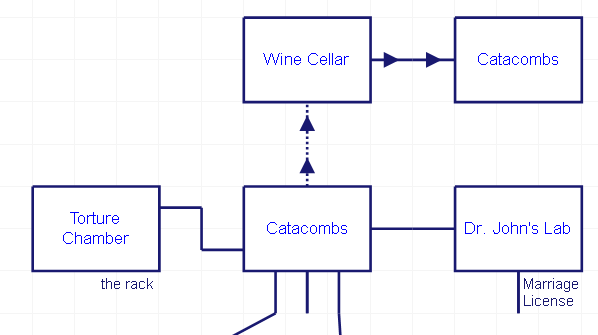
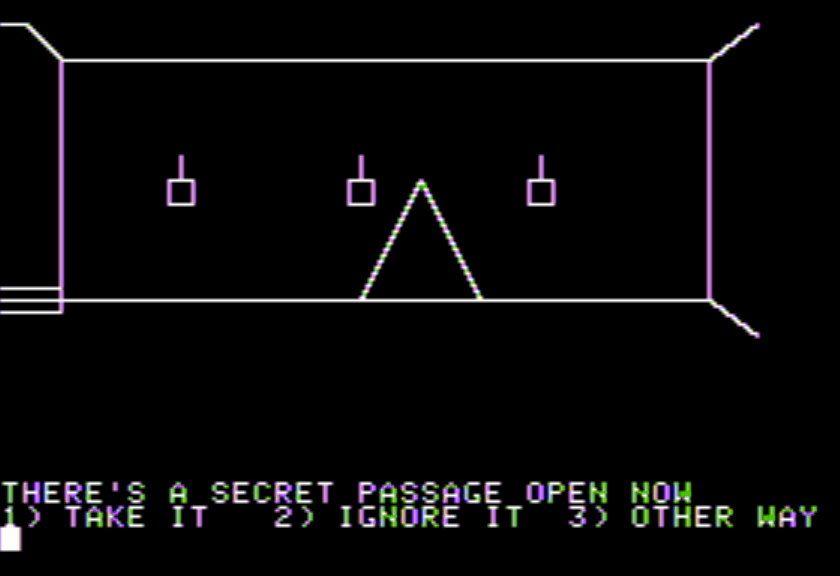



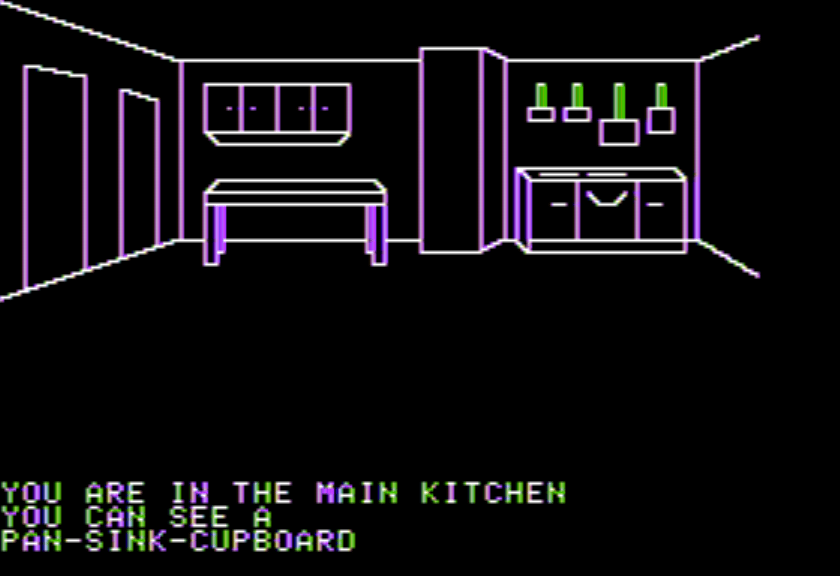


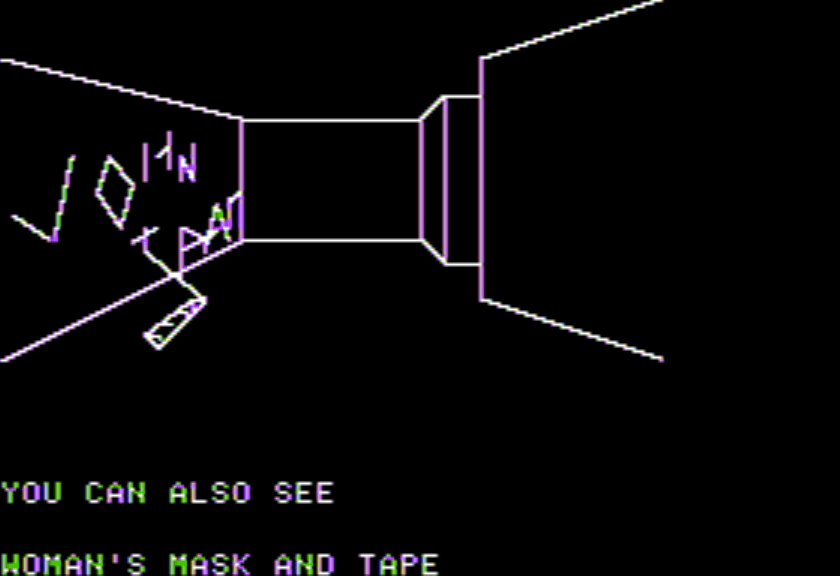

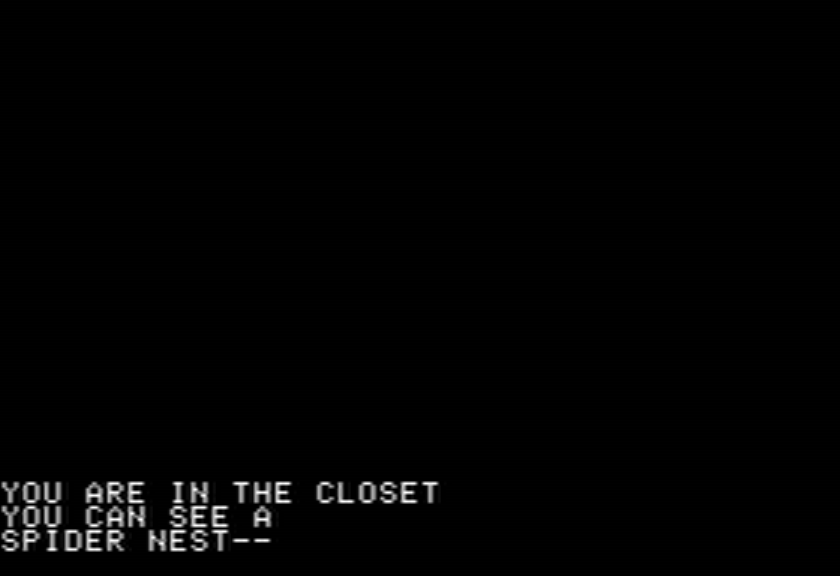


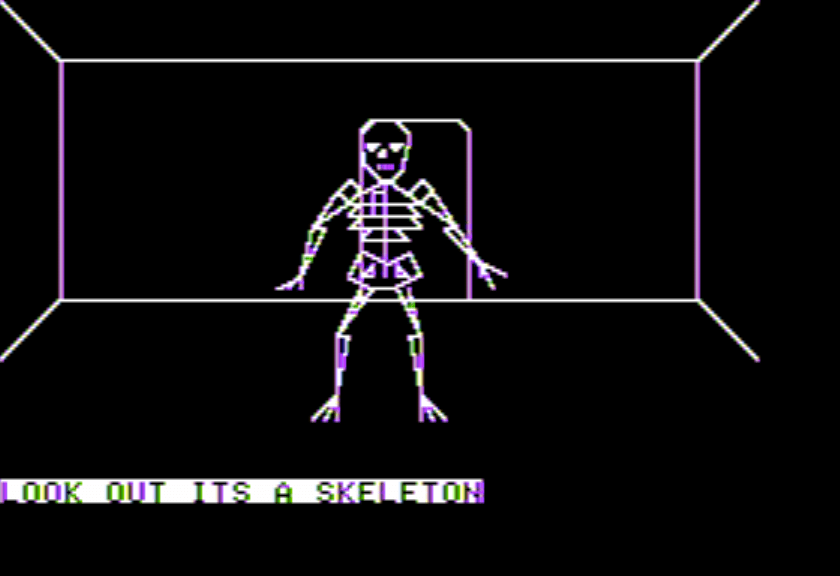
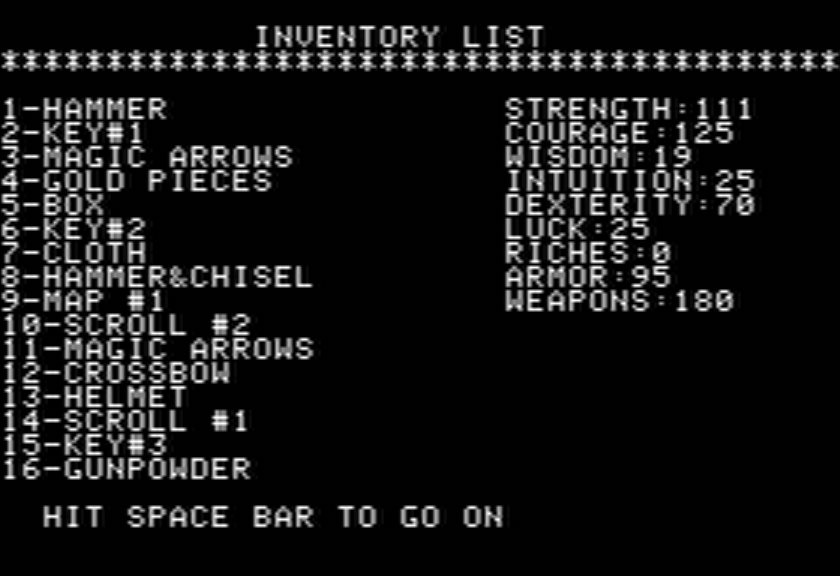
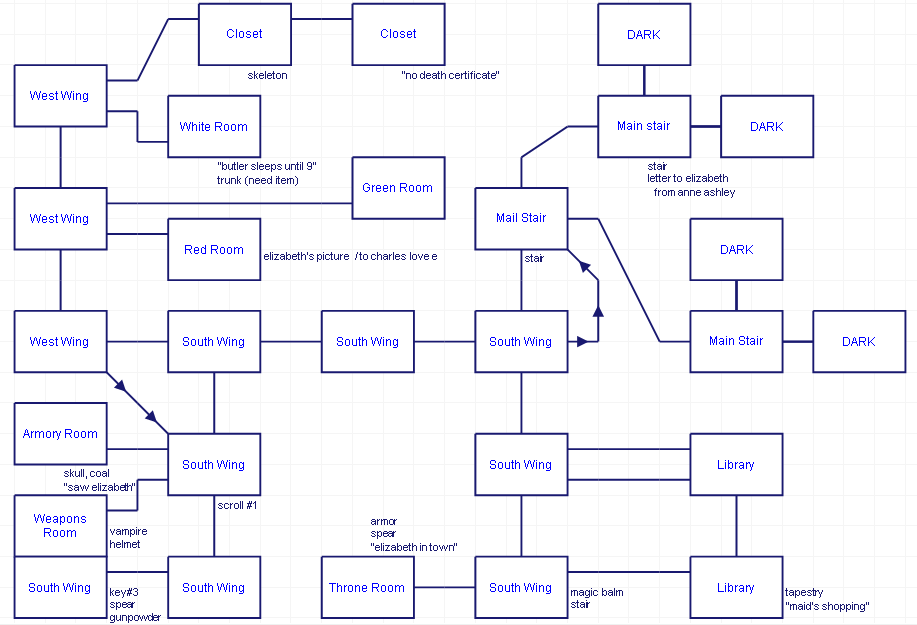

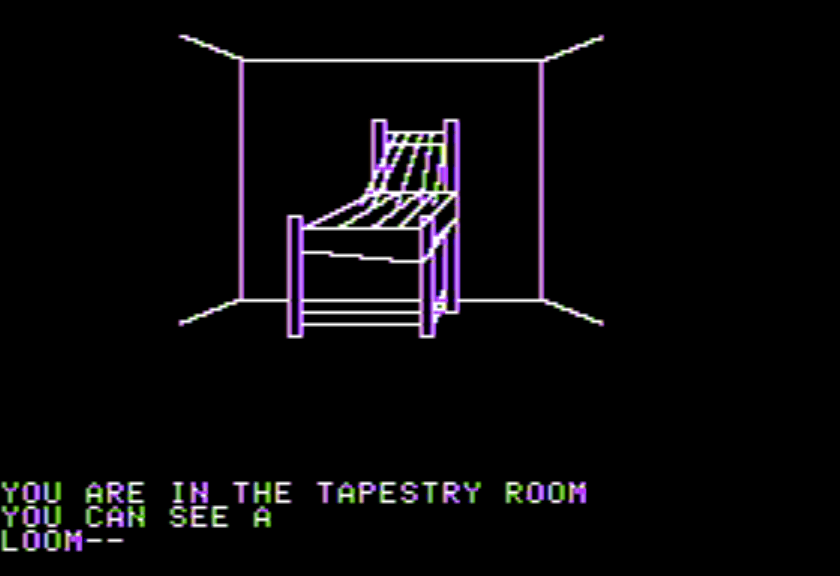
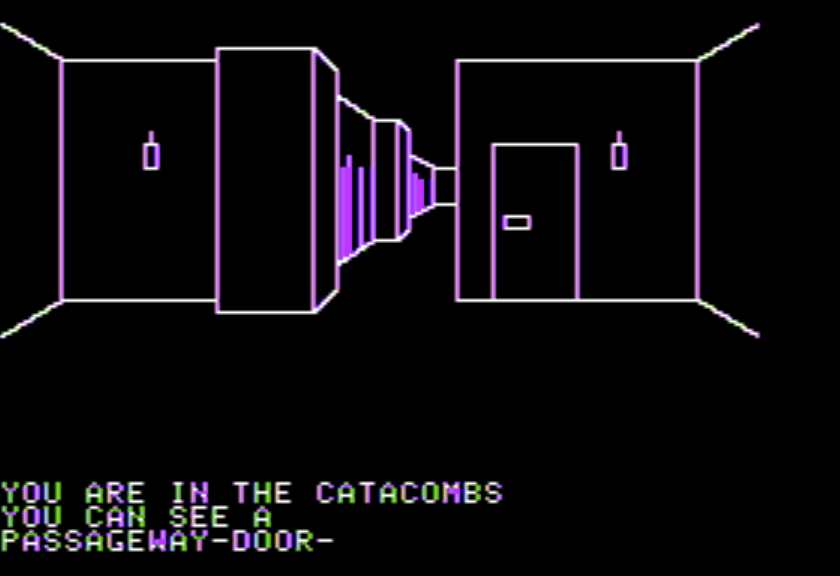


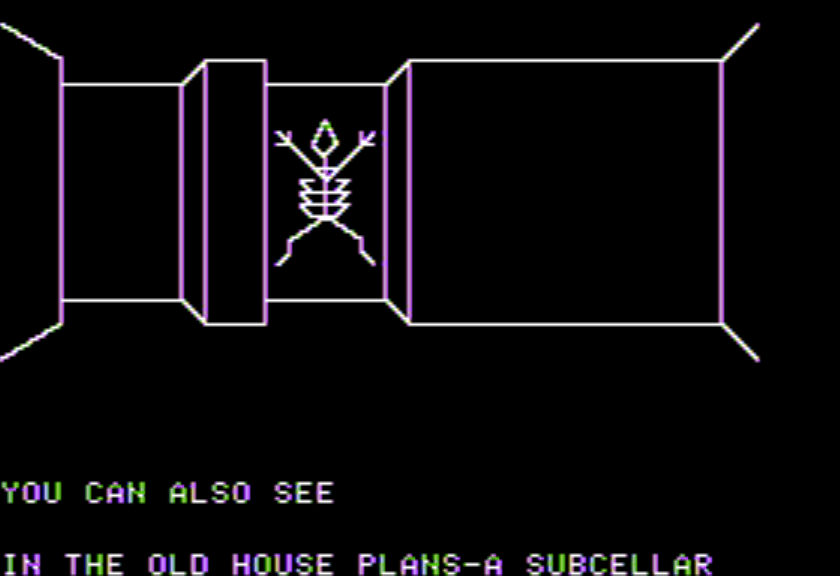
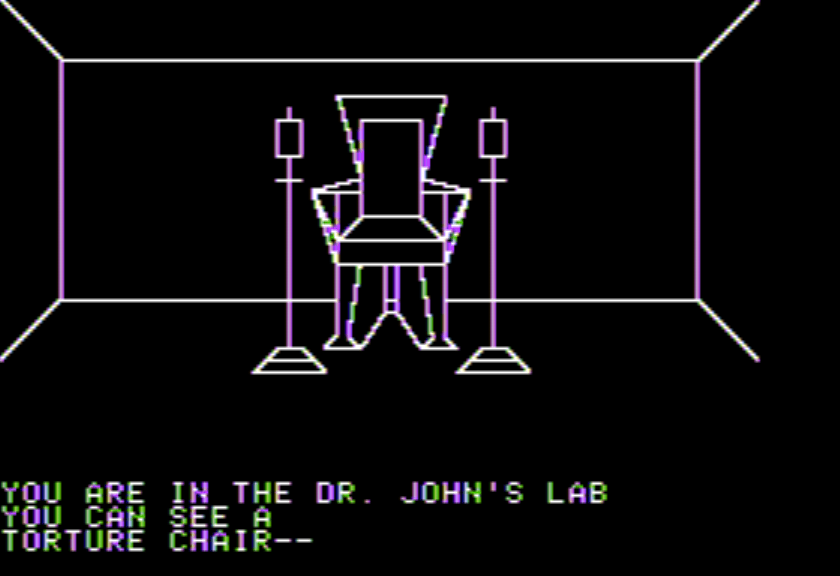
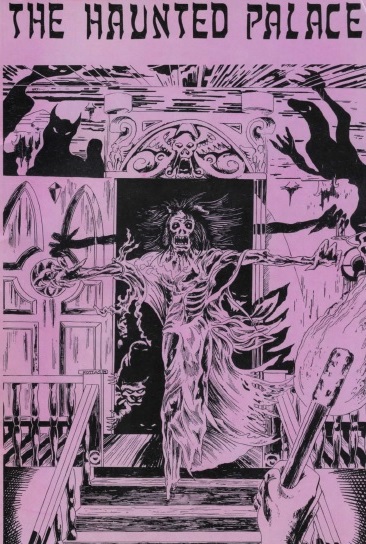


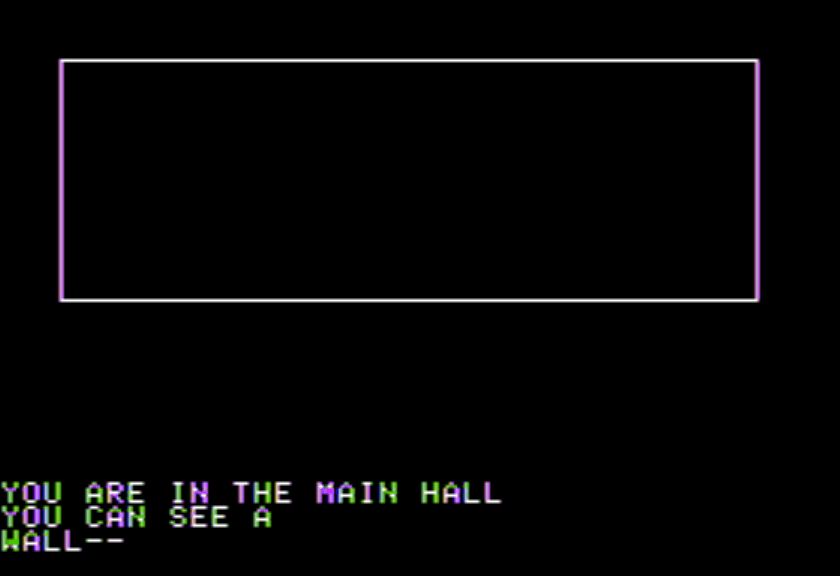

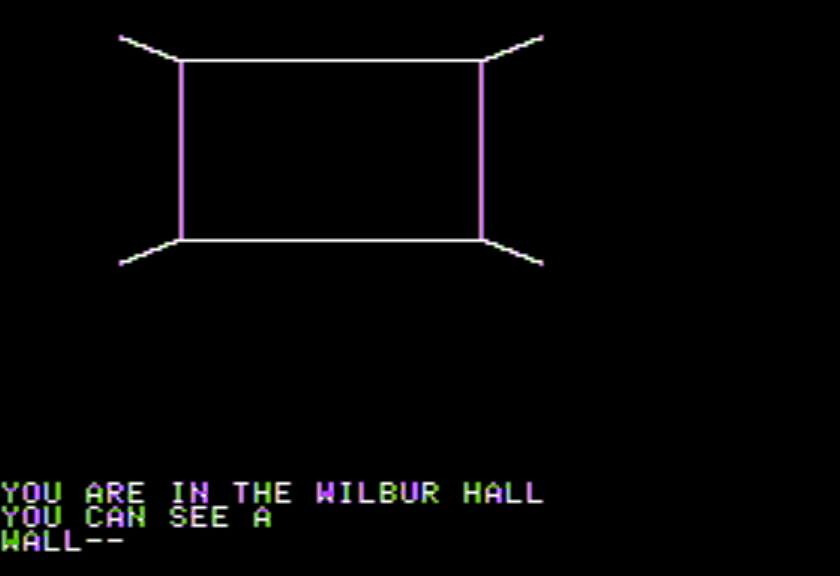

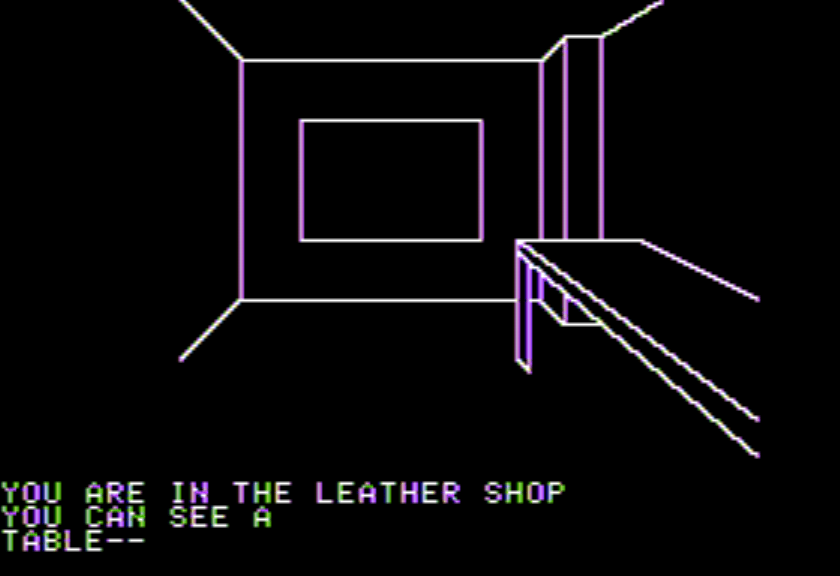

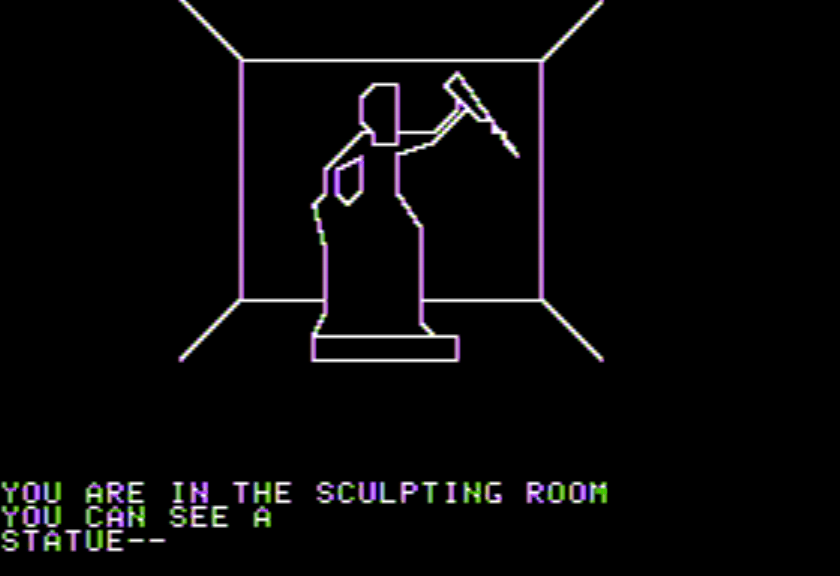

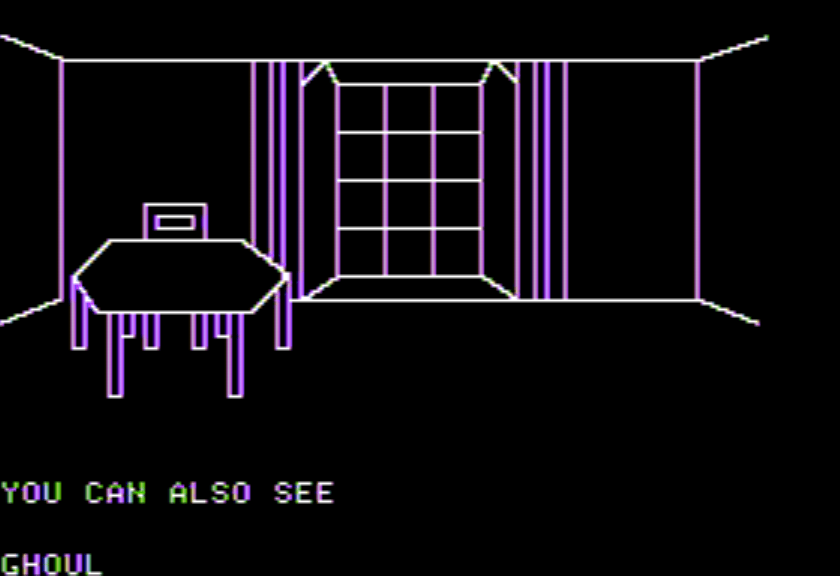




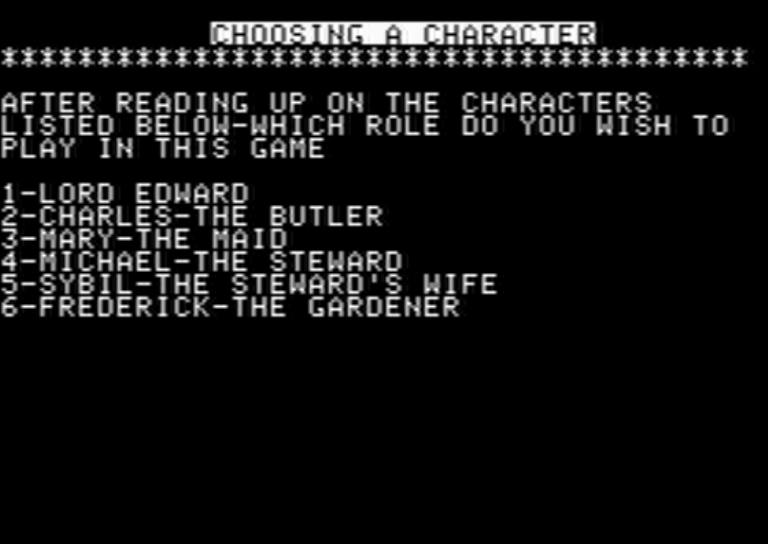
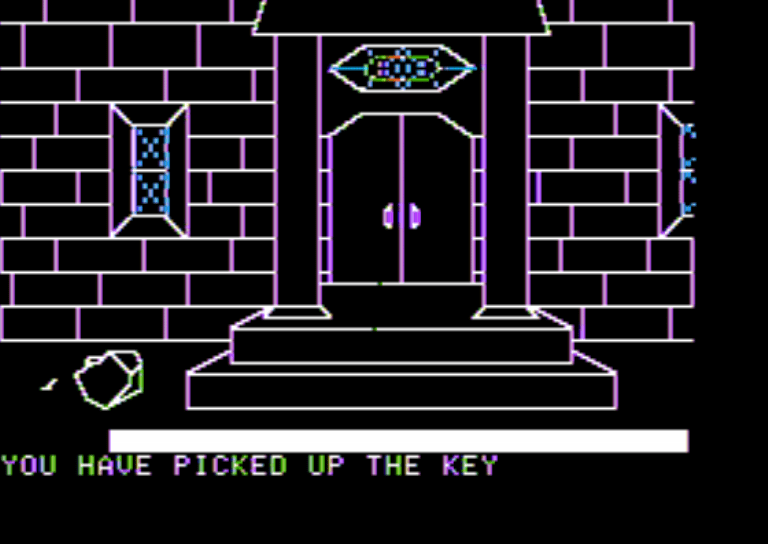


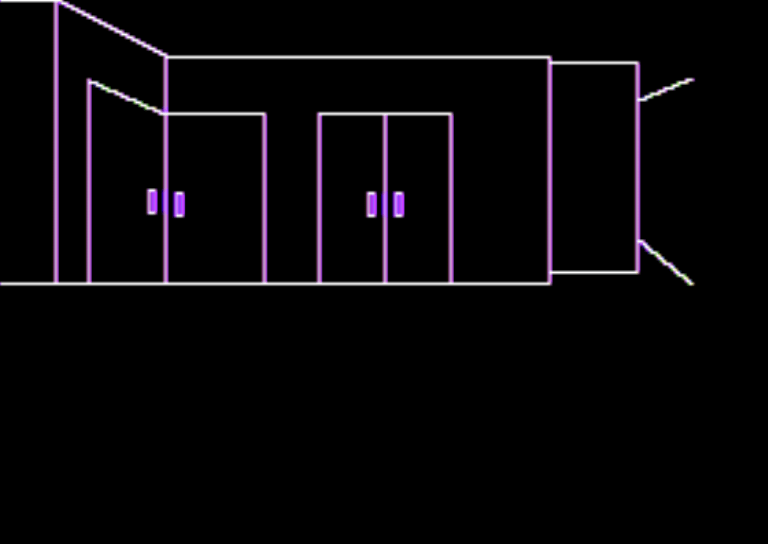
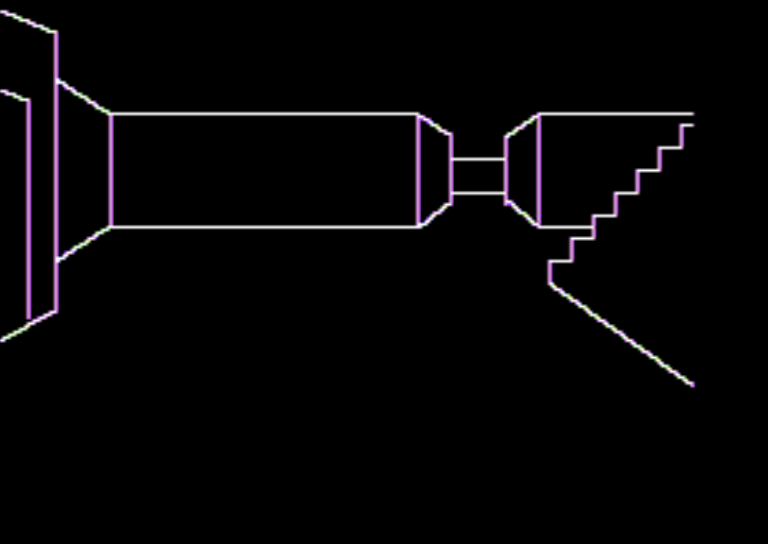


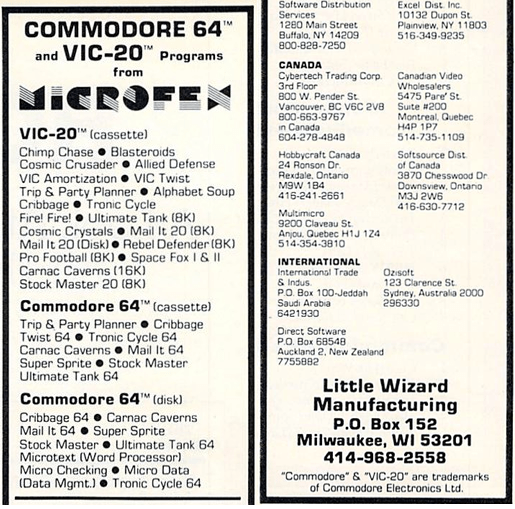


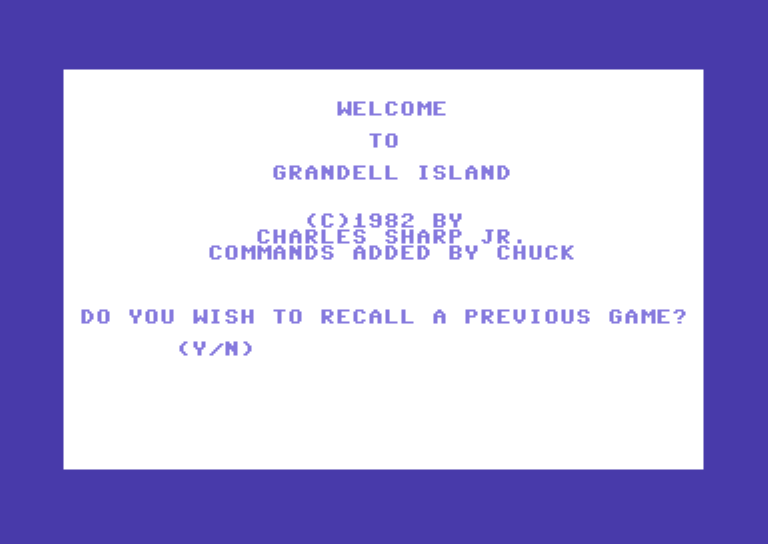
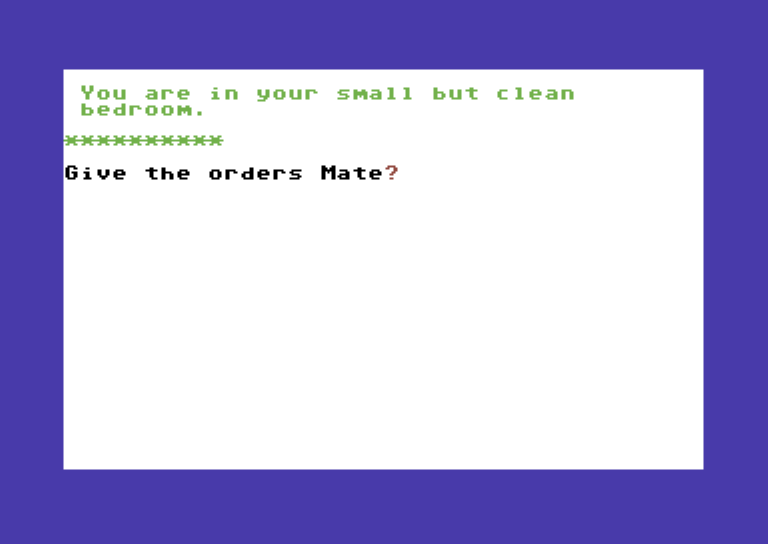

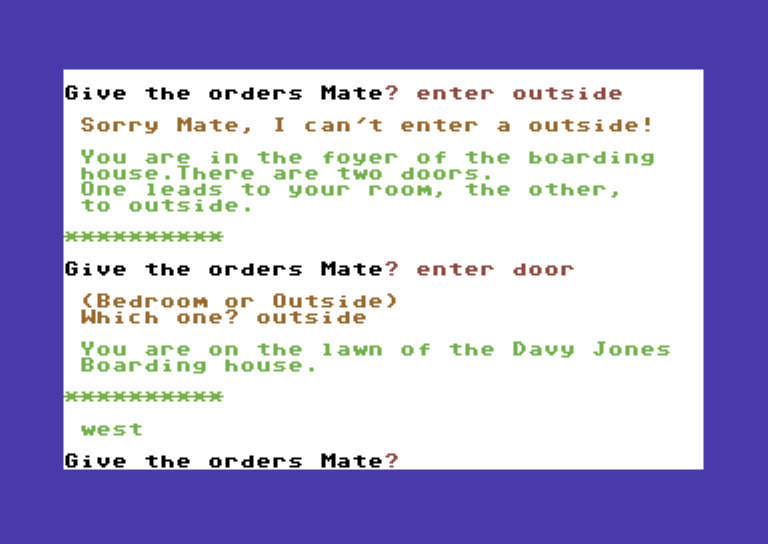


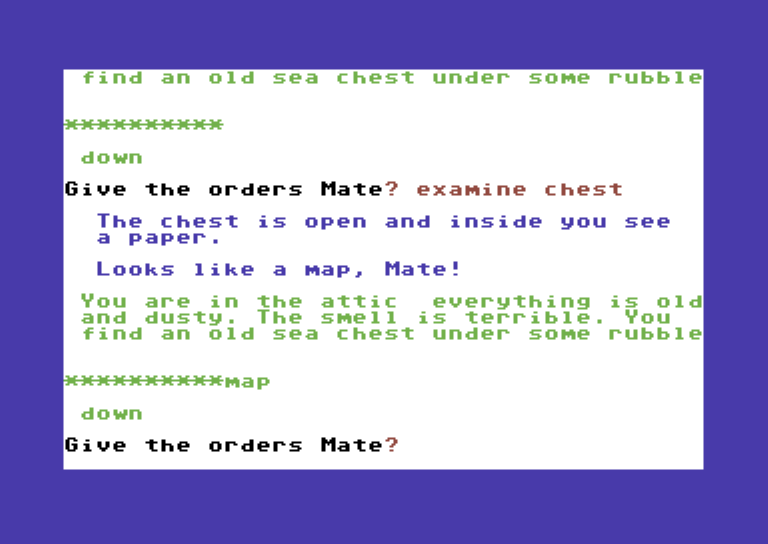

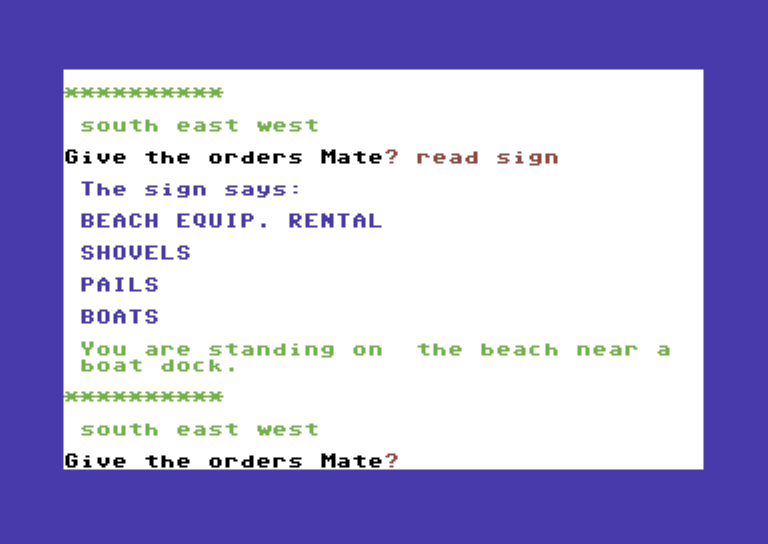


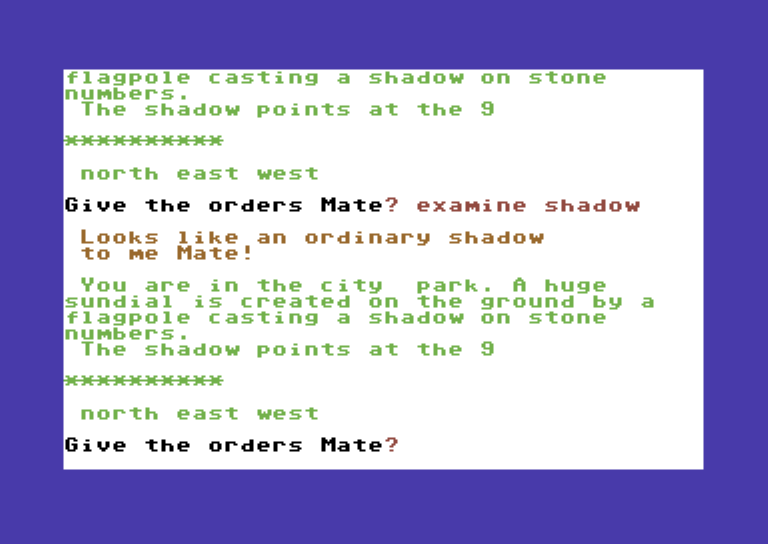

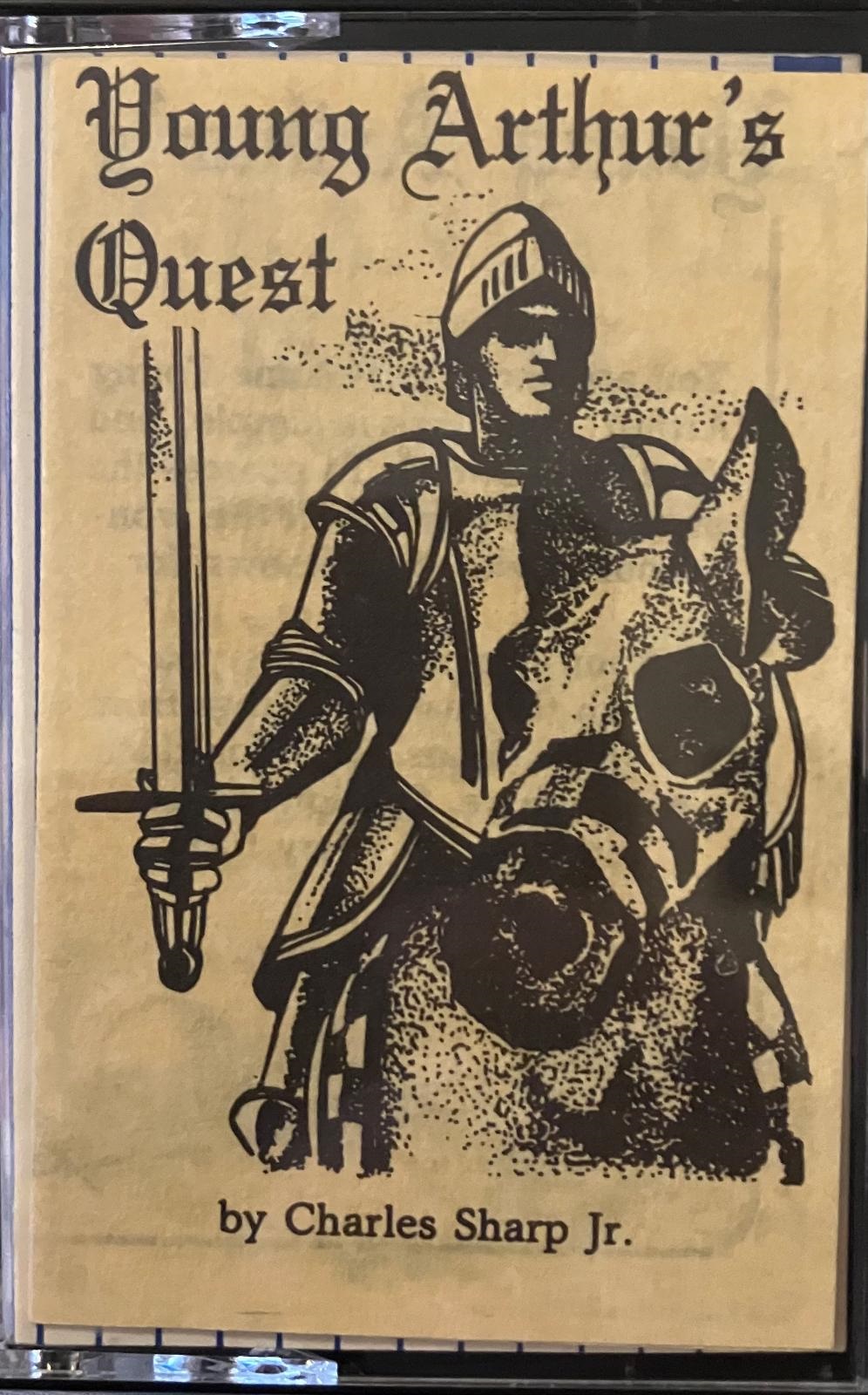
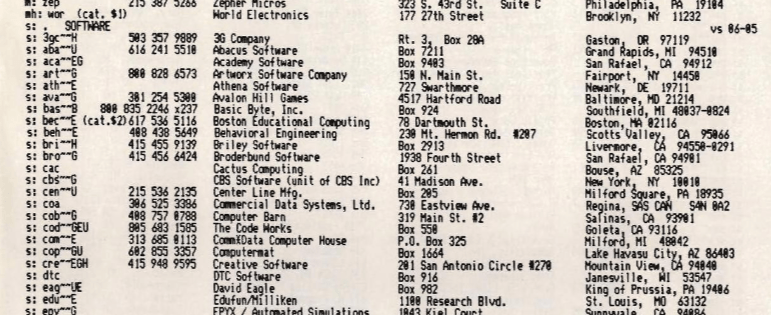


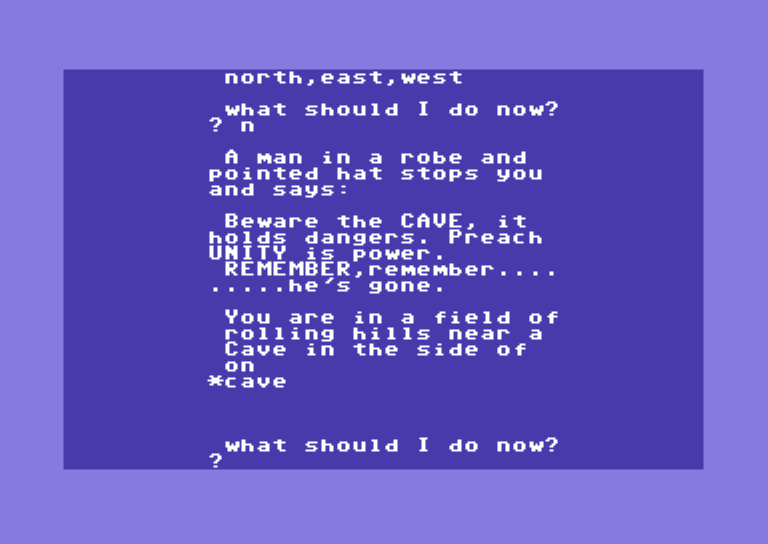

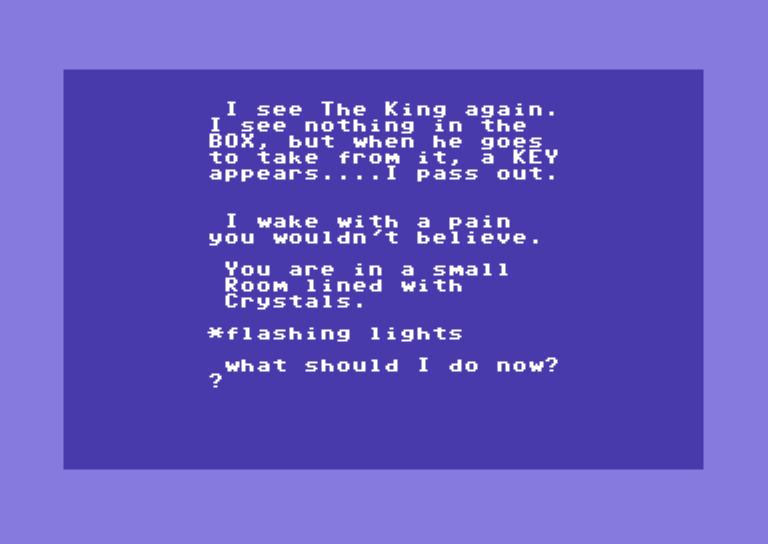


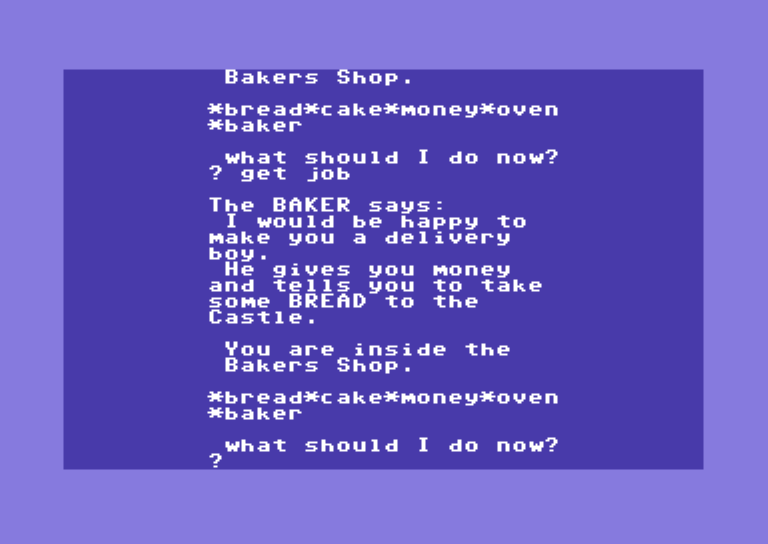
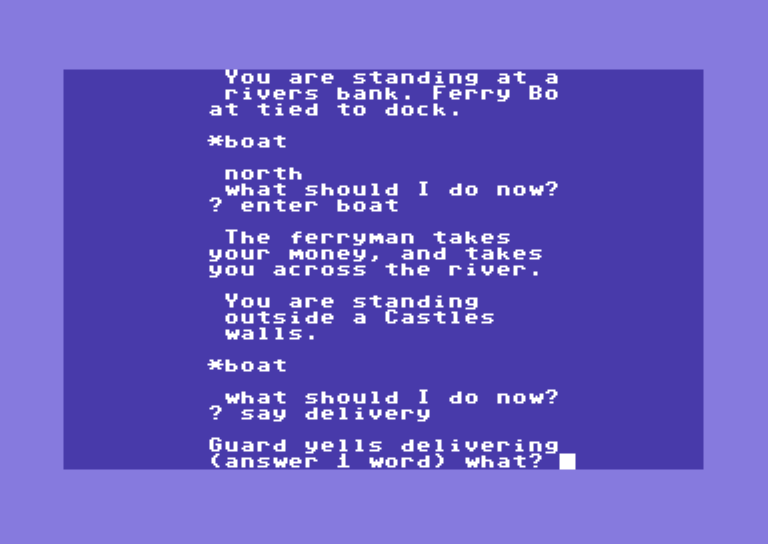


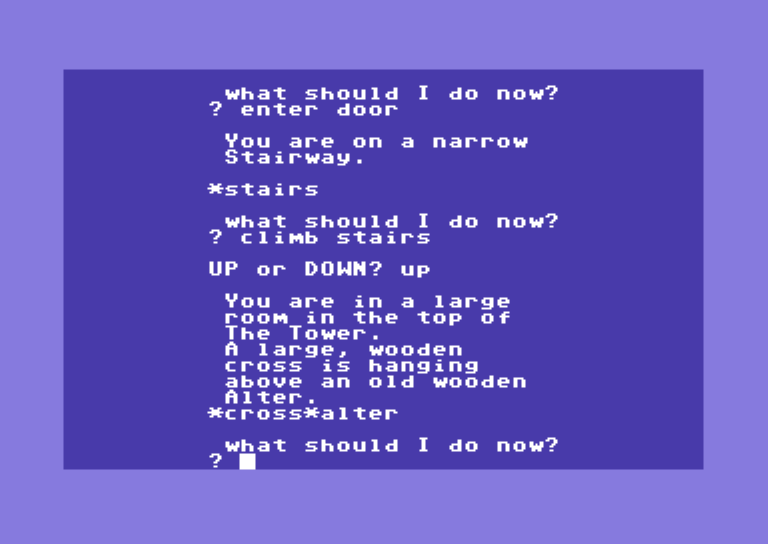
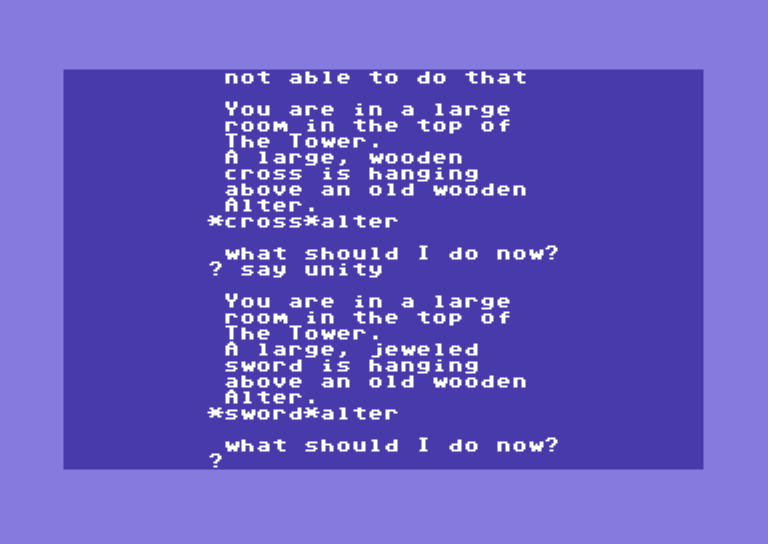



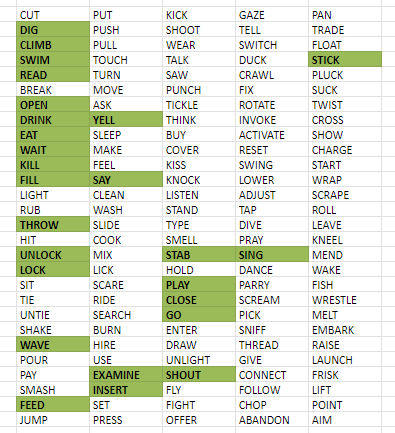

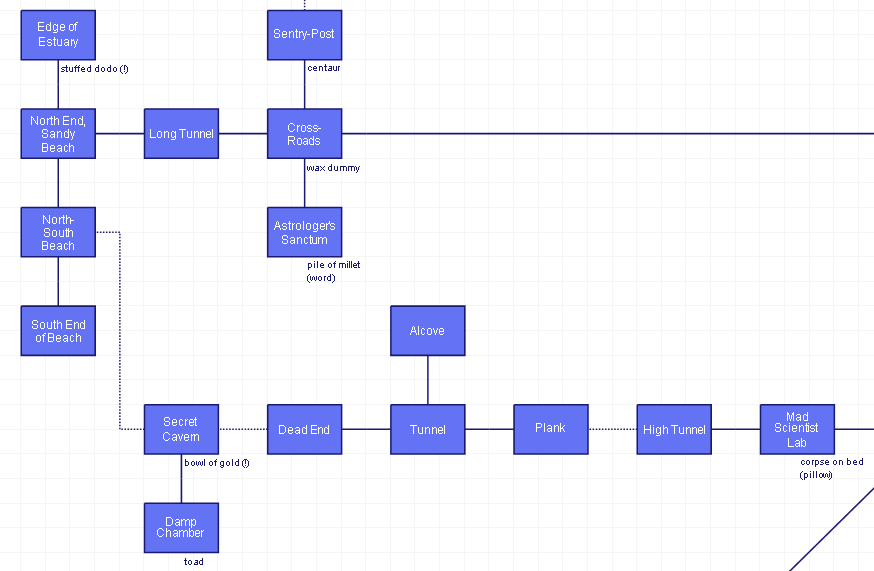


 Renga in Blue