(Previous posts on this game in chronological order here.)
Via eBay.
So despite a few more simple puzzles, this one’s been fighting back a bit. Part of the issue is logistical: the lamp timer is very, very, tight, so tight (given the conditions of where I need to go) that I have a feeling there has to be a way to revive the lamp’s battery. I can’t even find a way to turn the lamp off to conserve power when needed (the usual suspects EXTINGUISH, OFF, TURNOFF, and UNLIGHT don’t work).
Both CROSS and KNEEL immediately stand out as rare. I’ll get into them later.
The other issue — common for these games with lamp-light timers — is logistics. Some places are far away from each other, and my last lingering puzzles are fairly spread out in a way that it is hard to do an immediate test — it may be that item X across the map is needed for puzzle Y, but it takes a while to check the possibility and it may require re-routing my entire sequence (again, given the lamp light timer is tight).
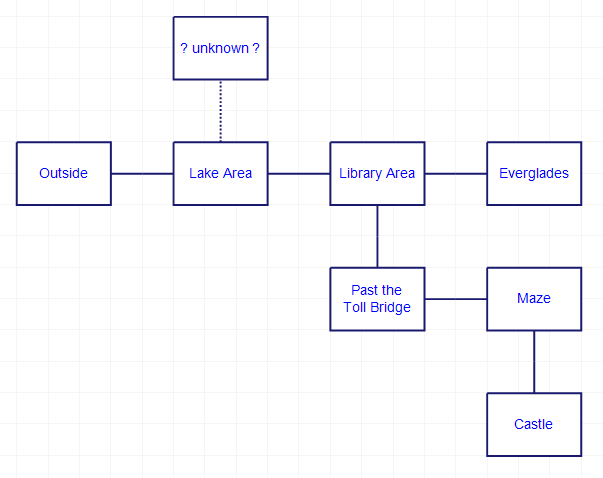
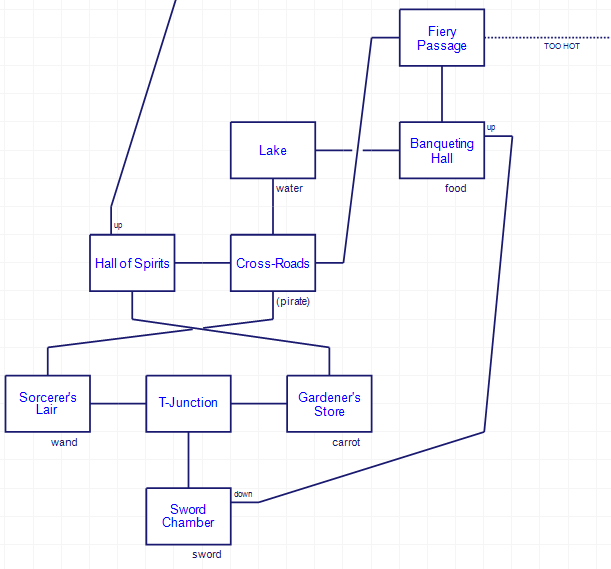
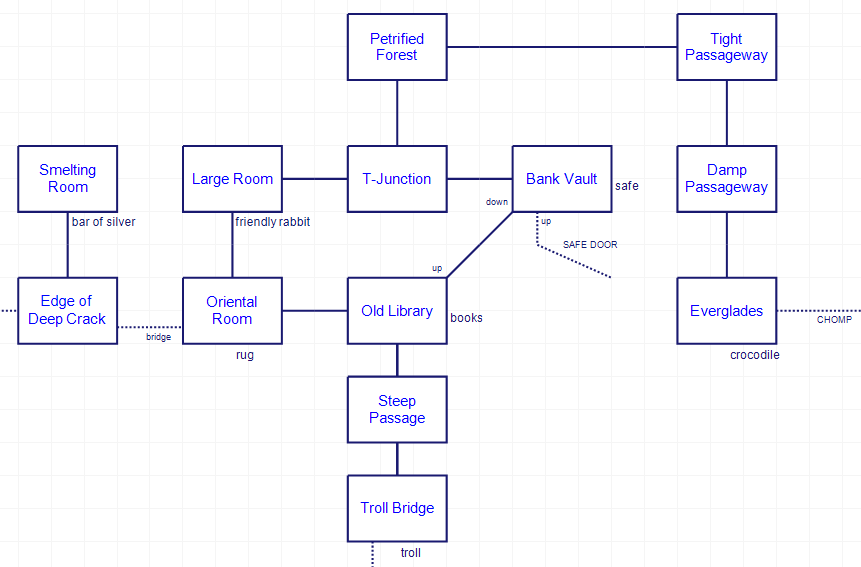
A meta-map showing connectivity, directions are not accurate. I found a method of travel across the lake but I get stuck right away so I don’t know where that goes; it requires an item from the Castle, so that’s at least one big back-and-forth.
If the inventory limit was absolutely unlimited — and it initially appeared that way — it still wouldn’t be much a problem, but there is a limit, and since one of the main gimmicks is that the treasure-destination (the Sphinx) is hard to find I’ve been having to tote all the treasures around. If it turns out, for example, the Sphinx is on the other side of the lake and it is a one-way trip, I need to be carrying every point-valuable object in the game while doing so, which is tricky because even some non-treasure-like items count for points (like the bottle).
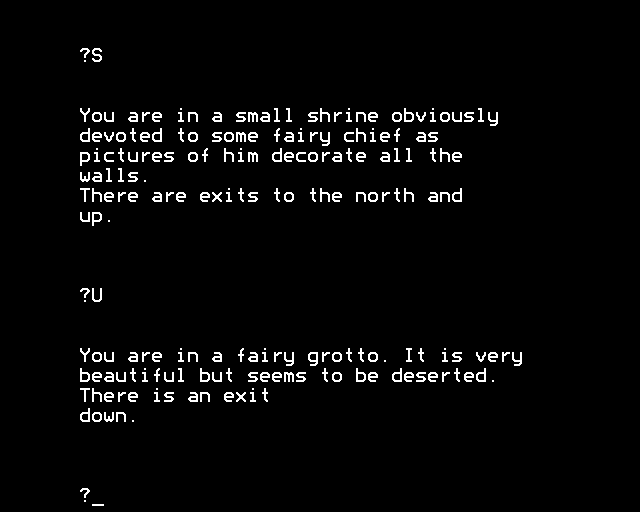
Continuing the action from last time, I had retrieved some items in an area past a crocodile. I had the fairy grotto which may or may not have just been atmosphere; KNEEL doesn’t give any special response other than “You are kneeling down.”
Going off in another direction is an area past the troll:
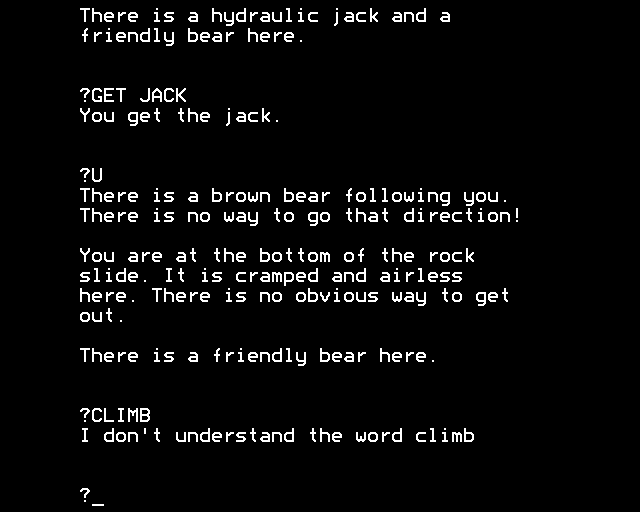
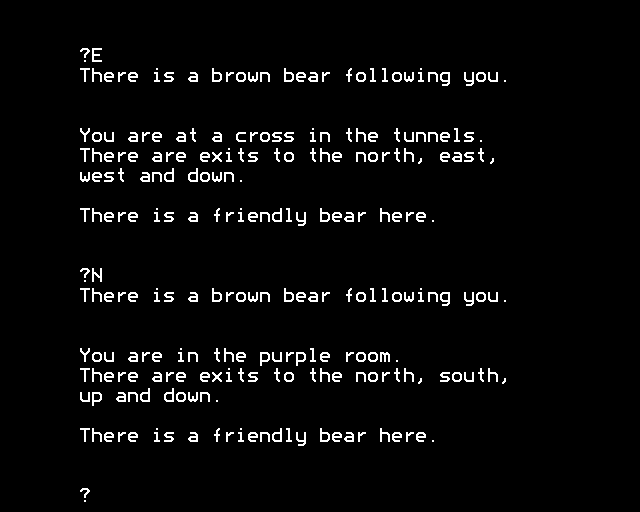
A bit to the west there’s a friendly bear that just starts following (unlike the one in Crowther/Woods, you don’t need to feed it). There’s also a puzzle that I’ve yet to solve, where you tumble down some rocks and get trapped. You need to do this because there’s a hydraulic jack I am 99.999% sure is used to open a clam later (again from Crowther/Woods, in that game you used a trident to open the clam).
To the east there’s an ogre you can take down with a sword, and still the weird interface which asks if you want to use your bare hands first.
This is followed by an orc the bear takes care of (the bear the disappears); as an aside there’s a glacier which the wand works on to make a bridge, but the bridge always collapses when you try to cross, even if you have no inventory items.
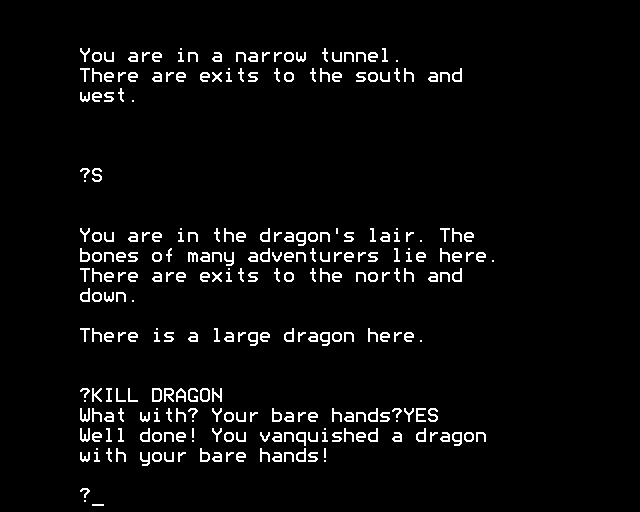
Then there’s a dragon where (unlike everyone else) you say YES when it comes to using your bare hands.
This leaves behind some dragon teeth.
It’s a curious “fix” to the puzzle; certainly there’s no need to mysteriously assume the game will understand YES, but on the other hand, but having it be part of a progression of monsters, it’s confusing that a dragon would be easier to beat in fisticuffs than an ogre.
Moving on further (ignoring the fact the jack is unobtained for now) there’s a maze. Despite it being “fair” (no connections are one-way, diagonals aren’t included, it is technically drawable on paper) it pulls off a mean trick.
Specifically, it appears at first — especially with some “color” rooms — that no special effort is needed to map, and just the names of the rooms are sufficient. However, right away the game gives a “red room” that looks close to what turns out to be a totally different “red room”.
If you look closely the exits are different, but I got myself befuddled by assuming after a sequence of four moves that I landed back in the same red room I started at, when I was in an entirely different red room.
Once I realized the trick I just started dropping items as normal to map the maze. Then it just becomes the usual tedium.
Have any of the direct-imitation-of-Adventure variants we’ve seen — that is, games where the author is only one step removed — dropped having a maze? I don’t recall any.
All this leads to a castle:
Not much of interest here, other than there’s a vampire that requires using a wooden stake found back at the Everglades, so that’s another bit of forced travel sequence (you can try to not open the casket, but upon returning to the courtyard the vampire has opened the casket themselves).
The castle also contains a mouse (runs away so I can’t take it, but I assume there’s a trick) and a wooden boat that you can carry along with everything else. (The item limit is 17, so the visual is kind of hilarious. But you need more than 17 items to keep everything!)
The wooden boat can get toted back to the lake. I was stuck for a while on verbs (just THROW BOAT, GO BOAT didn’t work) until I tried CROSS LAKE, referring to the lake noun rather than the boat itself.
…and here I am stuck. To summarize, I haven’t solved
a.) getting the hydraulic jack at the rocks
b.) getting the mouse at the castle
c.) doing something at the fairy grotto, maybe?
d.) doing something with a “friendly rabbit” that follows you around the safe area, you can feed it a carrot but that’s a treasure, and it otherwise seems useless
e.) getting out of the monster at the lake
All of these might have simple answers but even given a very generous item limit I’m now having to juggle, and even making a very direct beeline for all the items possible I start running out of lamp light around the castle. This still doesn’t feel the same as being stuck on Hezarin, but being unable to make progress looks roughly the same from one game to the other, so it doesn’t matter if the underlying system is much simpler (and by necessity, any puzzle solve will have to be straightforward).
In the past I’ve tried my best to point out how the various text games I’ve played (despite a very common set of elements) nevertheless have strong fingerprints which distinguish them. This game is no different, and I want to do some compare-and-contrast with two sections. This is useful from both a history-of-games standpoint and a theory-of-games standpoint.
Picking up the action from the obligatory troll’s toll bridge, I tried paying the troll and exploring a bit farther.
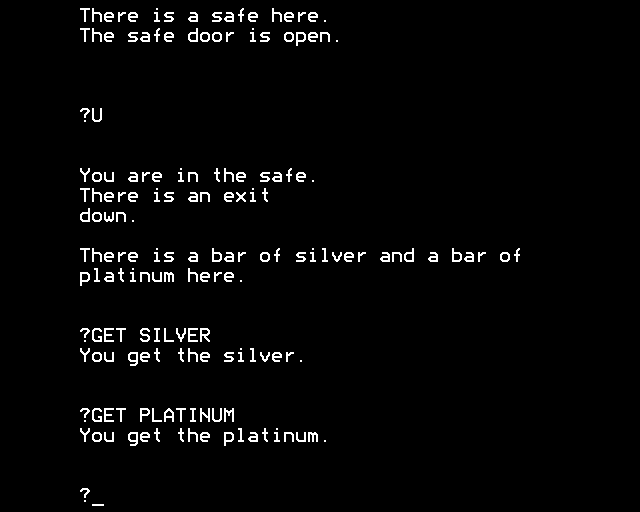
I was given the word “diaxos” in one of the rooms (it gets whispered like “Y2” does in Crowther/Woods). The word “diaxos” give a “very loud creaking sound” no matter where it is used, and the trick is to realize that this is the sound of the safe (back on the other side of the troll bridge, by the library) being opened.
By default there’s a bar of platinum but if you hand something over to the troll beforehand, it also ends up in the safe. So that problem’s resolved: you give up a treasure and you just get it back later.
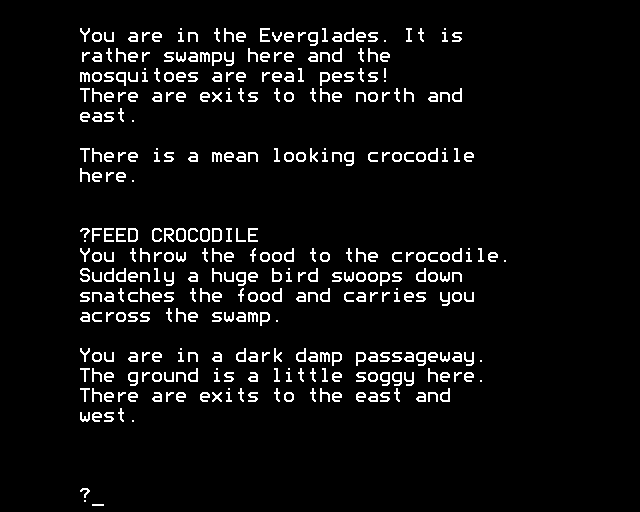
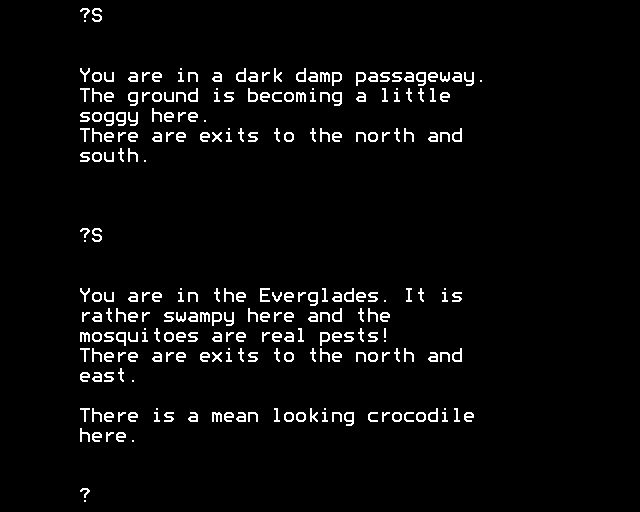
I also had encounters with an ogre, orc, and dragon in that order, but I want to save that for what will hopefully be a final or close to final post, and focus on the Everglades area. I was getting chomped by a crocodile who just needed some food (although the exact sequence of what happens is a bit unexpected).
The upshot of the sequence above is that the trip here is one-time-only. You can safely go back in the Everglades, but the still-hungry crocodile will still chomp you if you try to go by again. Fortunately, there’s no real need for a second trip, because the whole area has no puzzles: just locations with treasures lying around.
Treasure rooms marked with color.
In a sense, this means the game reverts to the type from some early games like Explore or Chaffee’s Quest: just movement and treasures. (Probably. There is one possible secret.) Furthermore, it has the random-placement style of those games; there’s a “yellow brick road” in one spot, some quicksand in another, a treasury, and a fairy grotto.
However, despite just being rooms, there’s some semblance of environmental narrative going on. The quicksand has a plank left by a previous adventurer.
Also, you can safely go “down”, but just end up at a dead-end: “Oh dear you seem to have struggled through that quicksand for nothing”.
Similarly, the yellow brick road was only previously yellow:
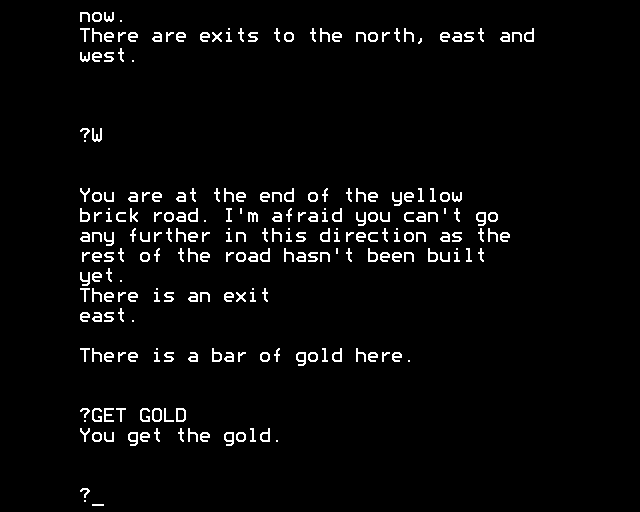
And it is possible to make it to the end of the line where the road stopped being built:
The effect is really light and vignette-based. I did mention one possible secret; the fairy grotto has no treasure and it is highly tempting to think a magic word or something like that goes here. On my “best progress save” I am saving nabbing all the treasures in this area because of the fairy grotto, although it could easily be more environmental storytelling.
One other subtlety I want to point out — and this is true of every area, not just this self-contained one — is how the structure of the text is part of the user interface. If we go back to original Adventure (the only reference for this game) there is one major standard established right away:
YOU ARE INSIDE A BUILDING, A WELL HOUSE FOR A LARGE SPRING.
THERE ARE SOME KEYS ON THE GROUND HERE.
THERE IS A SHINY BRASS LAMP NEARBY.
THERE IS FOOD HERE.
THERE IS A BOTTLE OF WATER HERE.
Namely, that objects that you can pick up are separated from the main text. There is, of course, an easy technical reason for this (it is a lot harder to modify the body text than it is to concatenate a bunch of object-in-room messages) but it also serves to make the player have an easier time. By contrast, consider the ICL game Quest:
You are in a small log cabin in the mountains. There is a door to the north and a trapdoor in the floor. Looking upwards into the cobwebbed gloom, you perceive an air-conditioning duct. Lying in one corner there is a short black rod with a gold star on one end. Hanging crookedly above the fireplace is a picture of Whistler’s mother, with the following inscription underneath: ‘If death strikes and all is lost – I shall put you straight’.
The short black rod which you can pick up is placed in the middle of the text, and furthermore doesn’t have the line-skip to separate it. Despite both cases dealing just with prose, the first example more easily highlights the things a player can interact with, and so the text structure itself provides a UI.
Now consider Sphinx Adventure:
The format is
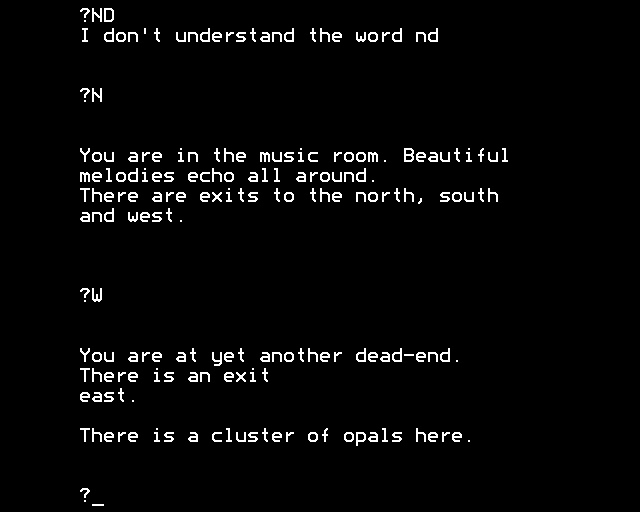
You are in a music room. [Statement of room name] Beautiful melodies echo all around. [Description of environment]
[Break to next line]
There are exits to the north, south, and west. [Listed description of exits.]
Notice how this easily gets across: the room as a short name (for ease of mapping), and the break between description and interactable parts (in this case the exits). When an object is included there is a further break.
You are at yet another dead end. [Room name, no description.]
[Break to next line]
There is another exit east. [Listed description of exits]
[Break to next line]
[Another line break, meaning the break here is different than the break between room name and exits.]
There is a cluster of opals here.
This conveys quite quickly the one direction you can go and what you can take, and the two kinds of breaks subtlety adds another bit of help in reading what the player needs.
This seems like a small and obvious thing (and it was at least started off in Adventure) but certainly not everyone followed the system so cleanly. (Having windows like the French Colditz game I played recently is another approach, but one with different issues.) One major gameplay consideration is if there’s any important objects sequestered in the “room description” portion. This game the answer seems to be no; you can’t refer to the plank at the quicksand, for example. Many a time I’ve been stuck has been when a game seems to establish this “sequestered room description” setup but then violates it. The biggest thing to remember in UI design is consistency, lest your UI gets mocked like like this chart of all the different ways to go left and right in Starfield. (I especially like how in one case it’s the letters Q and E and in another the letters Q and T and yet another the letters Z and C … why?)
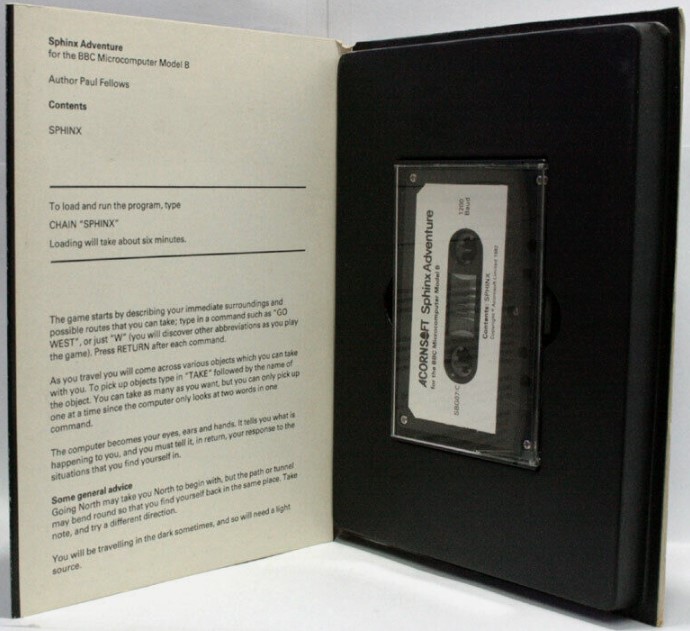
This is the only game of Paul Fellows, published by Acornsoft for the Electron and BBC Micro.
Closeup from the front cover, via Everygamegoing.
Paul was working on a graduate degree at Cambridge when he had a friend (Steve Barlow) who was working on building an Acorn Atom. This intrigued him enough to get the computer bug, and he managed to get a BBC Micro early and started writing software (while, according to this video interview, he “should have been studying for his degree, really”). His first set of publications through Acornsoft was a trio of chemistry software (Chemical Analysis, Chemical Simulations, Chemical Structures) which he followed up with Sphinx Adventure.
He had encountered Crowther/Woods Adventure secreted away at a mainframe at the radio observatory server at Cambridge and was blown away, finding that “the idea that the computer could understand English text and react appropriately just seemed awesome.” He wanted to write his own in an attempt to understand how parsing syntax worked.
Note this is slightly different to some of our other origin stories. Rather than falling for the idea of a world in the computer, our author here was particularly fascinated with the parser. When he later joined Acornsoft right out of college and his projects included the compiler S-Pascal, where supposedly he re-purposed the same parser code (presumably in a conceptual sense and not using the literal code).
There’s a cassette version from 1982 and a disk version from a year later but I couldn’t find any compelling reason not just to play the initial cassette release.
Being that Mr. Fellows went straight from Crowther/Woods Adventure to this game, it is unsurprisingly another treasure crawl: in this case we need to bring the treasures to the titular Sphinx. The main gimmick — Adventure kind of did this too, but not many ran with it — is that the game (according to the instructions) keeps careful track of score “penalties” for “errors”.
Original Adventure had point deductions for using hints and resurrection, so this seems to be the logical extension of the idea.
The building is an “old blacksmith’s forge” with a lamp and a set of keys. The bottle is instead just right to the south of the start location. No food or water for the bottle, but don’t worry Adventure superfans, you’ll see them soon enough.
The wilderness level has more or less than same conceptual geography as original Adventure also, as various directions lead to a Forest location which more or less serves to randomly loop back to the main map. I didn’t even put the Forest on my own map:
Rather than unlocking a grate to go inside the “cave environs” you just need to go down at the valley of doom.
You may have noticed so far no “diagonal” directions (ne/se/nw/sw). The game doesn’t understand any of those abbreviations so I do think (unusually for a heavily-inspired-by-Adventure game) they have been dropped entirely.
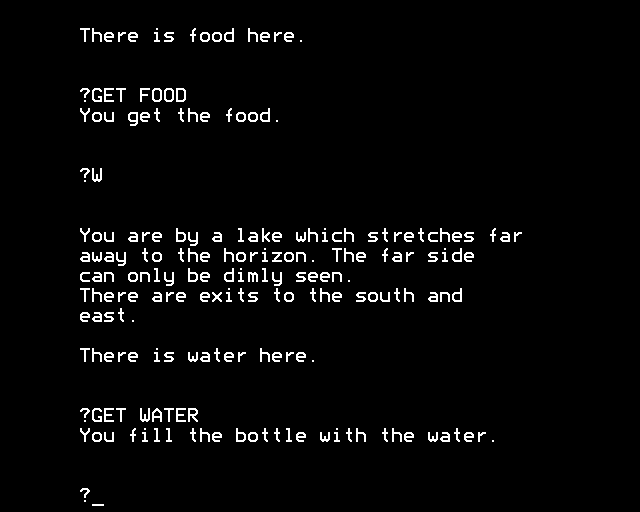
The small opening map mostly serves to dish out some items to the player: a carrot, a sword, a wand, some food, and a lake where the long-anticipated water can be found.
There’s a pirate hanging out at a “Cross-Roads” that will steal stuff as you walk by (just one item in particular, and not necessarily a treasure). You can instead attack, and the game does a strange riff on killing-a-dragon prompt from the original:
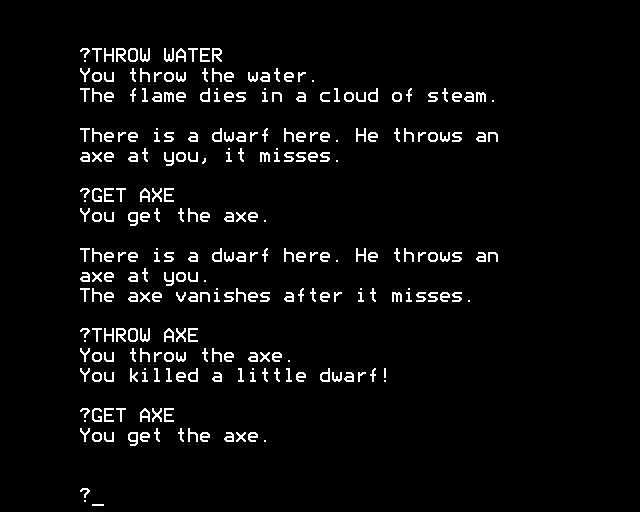
The dwarves are incidentally in; the first one throws an axe you can keep, and when they re-appear they still throw axes (just the axes now disappear). They do not seem to be restricted to any particular area and I even met one while wandering outside.
The very top of that screenshot also demonstrates me solving what is more or less the first puzzle of the game, in a “fiery passage” where you can’t go down one passage because it is too hot, but you can throw the water from the bottle in order to cool it down. This leads to another area which is slightly messier:
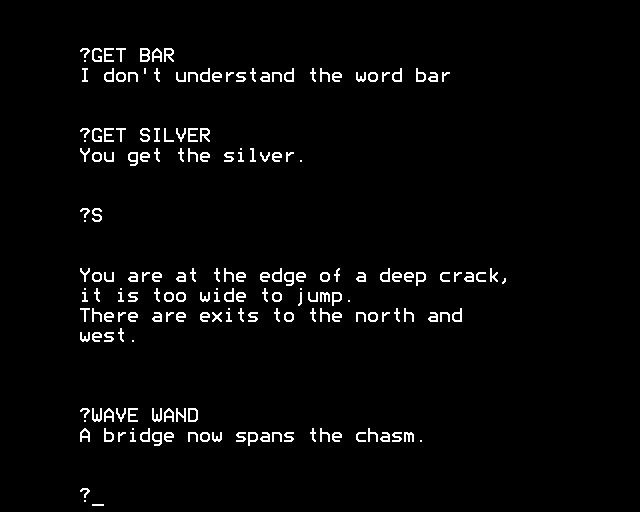
There’s our first treasure (a silver bar, no exclamation mark, you have to check if your score goes up) as well as a “deep crack” that is “too wide to jump” to start. Still keeping with cribbing off Adventure, you just need to wave the wand:
I might sound snarky at the re-use, I appreciate not having to do this everywhere. (I think. Maybe the wand has more uses.)
Then there’s an “oriental room” with a rug, a “straw room” with a friendly rabbit who will eat your carrot if you’re up for handing it over…
It will instead follow you if you don’t do this, so I suspect this is the wrong moment for using the carrot.
…a safe that has “no obvious handle”…
The books mentioned are from an “old library”; the hint suggests that the lake earlier (that we got the bottle water from) can be crossed.
…and a very typical troll with a toll bridge. Of course.
I’ve tried crossing by using the silver bar (which I’m sure is wrong) and there’s a friendly bear that follows the player around without even having to feed it, but I’ll save discussing the area past the troll bridge for next time.
Also, for some reason, there’s the Everglades.
This is unabashedly old-school and in the way that doesn’t bother to add realism to geography (on the other hand, only using cardinal directions makes things easier to map!) The author may have simply been going for ease of play: the inventory limit is also much more generous than normal (if there even is one?) This gives an overall atmosphere less aggressive than normal (despite deadly dwarves as usual) and tries to convey a light jaunt so far.
Mind you, maybe there’s a very tight lamp limit or some murderously-hard puzzles later. At the moment this feels out of place compared to other British games.
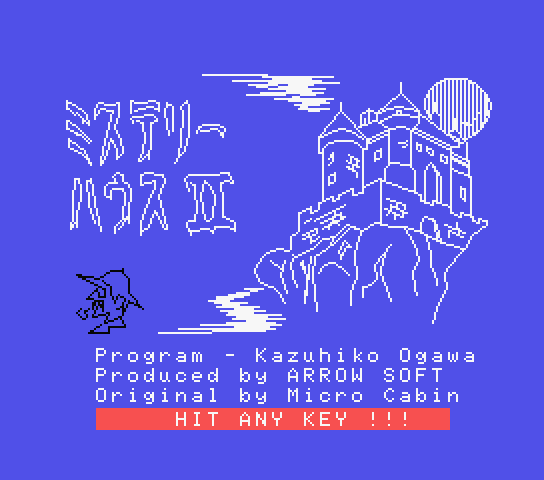
Sorry for the delay, everyone! Had a combination of life-things, work-things, and in the end, the actual game I was playing (the MSX version of Mystery House II). I will say it was definitely a slog and I completely understand the author I quoted last time being grouchy about Arrowsoft’s port. Since the earlier versions are much different than the MSX version, I’ll mention right now sometime in the future I will try the NEC PC version (there’s enough changed that it might be akin to The Prisoner versus The Prisoner 2).
I essentially enjoyed the first game, but despite some open aspect it felt fairly linear. Here, the game tries for a bit more non-linear and the fact the player is dealing with slightly ambiguous visual scenes really starts to be a problem. (And weirdly, the puzzles are in a way simpler but worse; I’ll get to that.) The “narrow window” view (where you can’t see anything to your left and right) is also similarly grating; there’s a lot of turning in directions that either having nothing or unimportant as you’re exploring the house.
Also, the two-item limit was not in the first game, and here it means you’re taking circuitous routes just to get the right item in the right place.
Cover of one of the earlier versions, via Giant Bomb.
For example, fairly early on there’s a window in a random room. It would never occur to me just looking that it would be the type of window I’d want to / be able to open, and it especially never occurred to me to get the dinner knife from the cabinet two rooms to the right and USE KNIFE.
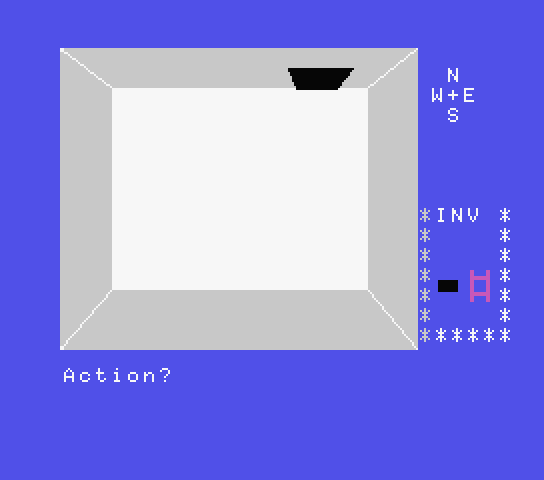
In one direction you can find a RACK with a LADDER. In another direction you can find a candle in a RACK (don’t take it, you can’t use it yet) and a secret door in a fireplace. The secret door leads to a safe with an MSX cartridge.
The GREENKEY is off a random table somewhere.
In the same room you can also find a chair if you face south which has the information “door opens at 3’oclock” which is useful later.
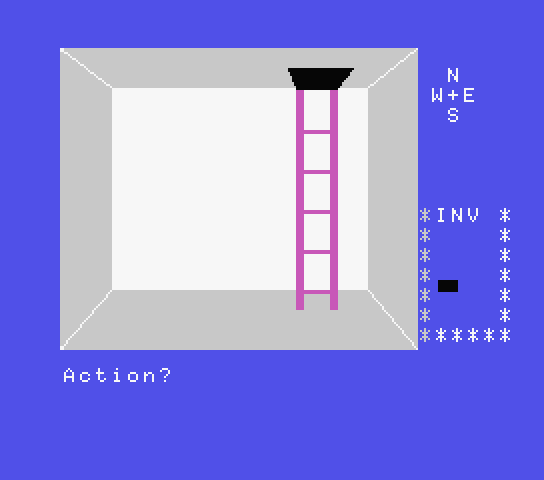
Going back to the ladder, it can be taken to a hole at the start of the game. This is another one of those “confusing visual” spots — it wasn’t clear to me I was dealing with a hole you could climb up through when I first saw it, so the ladder was not the immediate thing that occurred to me (I was originally thinking outside). After the fact, it made sense, but beforehand I wasn’t sure what noun even would apply to what I was looking at.
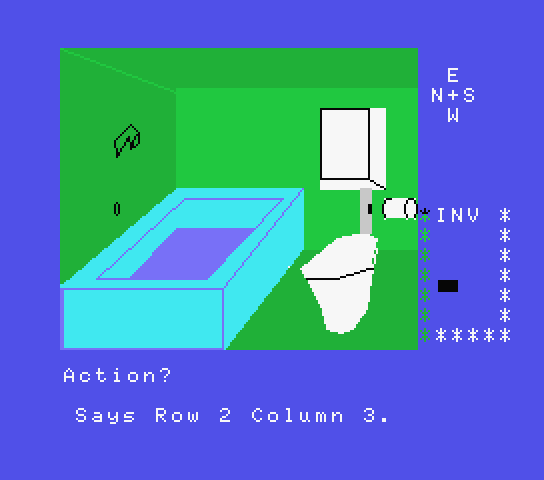
Upstairs there’s a bedroom and a bathroom. The bathroom has toilet paper with secret information. Would your immediately inclination be to TAKE PAPER in this scene?
The code there is for a bookcase.
This is for the safe in the basement.
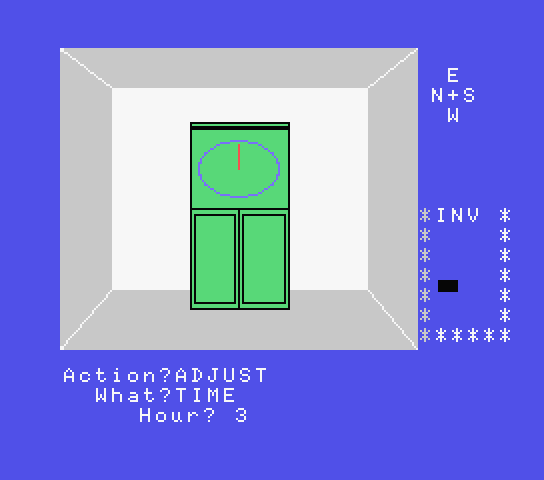
Also upstairs we can apply the “3 o’clock” hint from earlier…
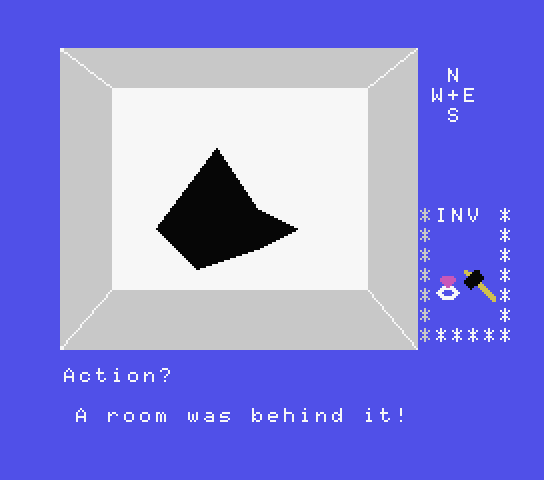
…and eventually find a secret MSX machine that can be used to run the cartridge. The only thing that happens is the message Break the north wall!
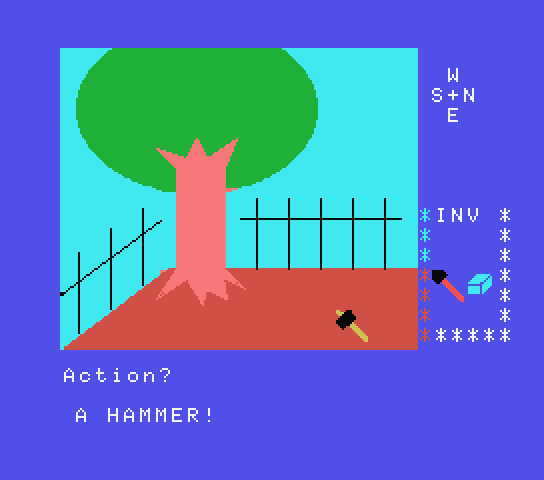
Easy-but-annoying: you get the hammer from outside to bust the wall in the same room. Of course I didn’t have the hammer so had to route all the way there and back.
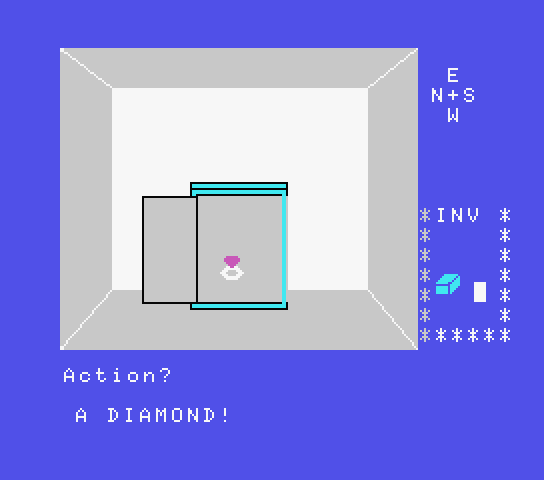
I found the diamond already in this run. I’ll talk about getting it in a second.
My notes are honestly a bit of a jumble from here (sorry, long play time!) Inside there’s a REDKEY that can be used to get at a secret door in a different fireplace to get a PINKKEY, which can then be used to get a WHITEKEY from yet another safe and then bust outside, but that still doesn’t help with the diamond. For the diamond, you go back to the bedroom and grab some matches, then get the candle I mentioned quite a while ago (your inventory is now maxed) and then grab a shovel from …. oh wait, your inventory is maxed. Ignore the candle, grab the shovel first, then go outside, then dig:
Then get that candle, head down to the basement to find a safe, and use that R-3 L-3 code from the bookcase.
Now with the WHITEKEY I mentioned earlier you can make your way to escape (somehow you can’t just leave the way you came in).
It’s curious how much drudgery this felt like compared to the original. It really does have mostly the same elements, like moving things and finding a whole sequence of keys. But: it lacks
a.) using oil on a cabinet to discover a secret stairway inside
b.) finding a ladder that kills you by bonking your head if you climb, so you need to move it and bust the wall behind
c.) getting a secret code by lighting a fireplace
d.) putting the code in reverse to open the final safe, where the game ends upon getting the treasure and doesn’t have a weird sequence of keys for an escape
These all seem like small moments, but they were collected together in a way that built geographic suspense: what will you find when you get higher? The gameplay in Mystery House II (MSX edition) involved bouncing around the map many, many times in order to juggle the inventory, and in the end all the clues and keys felt randomly scattered and boring.
Or maybe it’s the graphics making me grumpy. There was a thread in my last post discussing the virtue or lack thereof of graphics. Y’all have read me enough to know I like a very wide array of things and am just as happy to play with cutting edge graphics or without, just like I’m fine with both books and film. But graphics can serve as a UI impedance if used badly; the original Mystery House (Roberta Williams, I mean) had some items where I had to guess what they were to pick them up; here, while I didn’t have the same guesswork, I had a lot of trouble getting into the “frame world” of the game. The need to check all directions especially got tiresome.
I’ve still got some hope for redemption from the NEC PC version, but I’m going to take a rest before taking it on.
Either way, I’m happy to be past here for the moment to get into something more traditional. I’ve got something from the Tough Britgame library lined up next. Text only! And probably puns that must be taken literally to solve puzzles! Those wacky British.
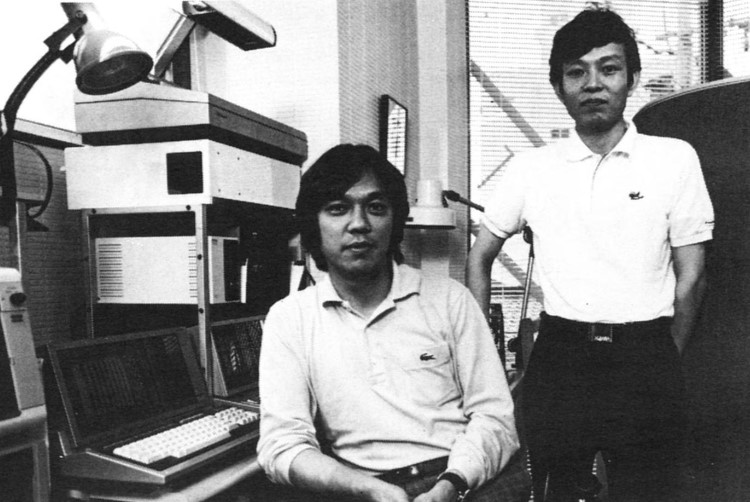
Ken and Roberta Williams released Mystery House in 1980, kicking off their Hi-Res Adventures line. These adventures made their way to Japan as imports, as players used dictionaries to help them through. Programmers in Japan started writing their own adventure games, starting with Omotesando Adventure, a text-only game that utilized the ADVEN-80 system published in an American magazine. Tsukasa Moritani, dentist and computer enthusiast, made his own game, Mystery House, very loosely based on the American Mystery House, and worked with computer store owner Naoto Oyachi to make a publishable product, kicking off Micro Cabin’s software line.
Mystery House came out at the start of the summer; by the end there was a sequel, also by Tsukasa Moritani. Based on the fast turnaround time it was roughly the same engine (on Sharp MZ-80B), but with a larger area (three floors) and the exact same quest (find a treasure in the house). Also, a higher price tag (9800 vs. 7800 yen). It eventually made it to a diverse set of systems like the NEC PC-6001, FM-7, and MSX.
From MSX Game World. Notice the price is 3800 yen, cheaper than 9800, but this was released in 1984 when the original was two years old.
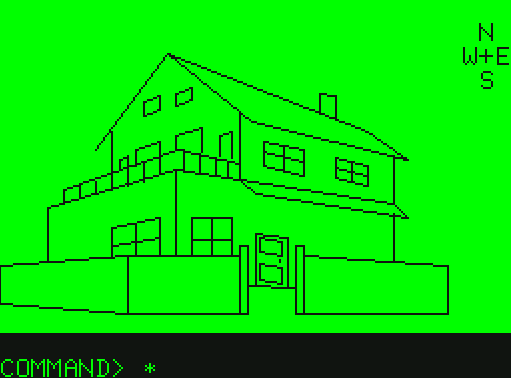
The two versions I have access to are NEC PC-6001 and MSX. I have tried both and there are significant difference in at least the opening. The PC-6001 version starts you outside…
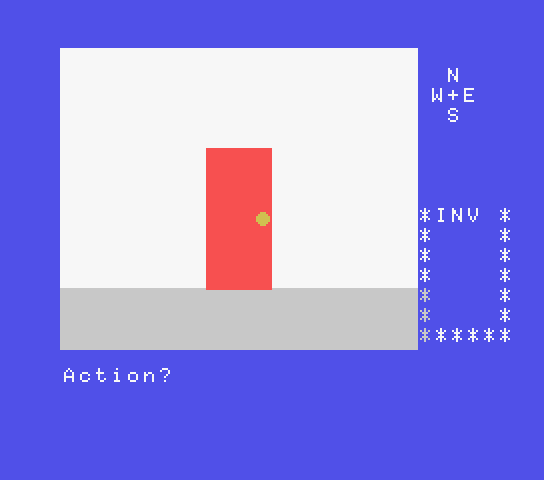
…and has the front door unable to open. You have to walk your way around to a side door.
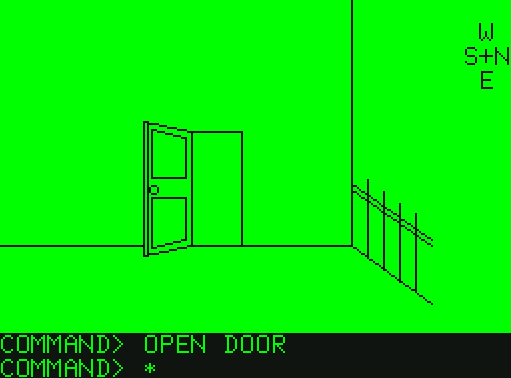
The MSX version, on the other hand, lets you open the front door right away.
The NEC PC-6001 one also lets you type verb and noun as one command, and works more or less like the FM-7 version of Mystery House we played. The MSX version has verb and noun as separate prompts, but importantly does not require also switching to a separate screen to type. Directional commands are given via the parser rather than relational direction keys. That makes playing the MSX version of Mystery House II much more tolerable than Mystery House I.
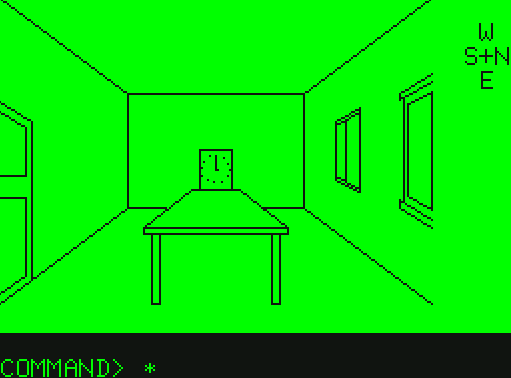
Another contrast is the handling of the 3D-view. The PC-6001 edition allows you to see “left” and “right” in addition to “forward”.
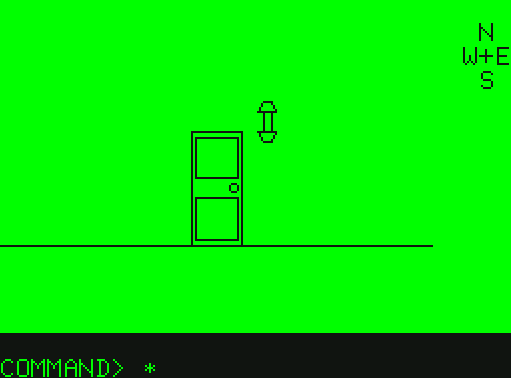
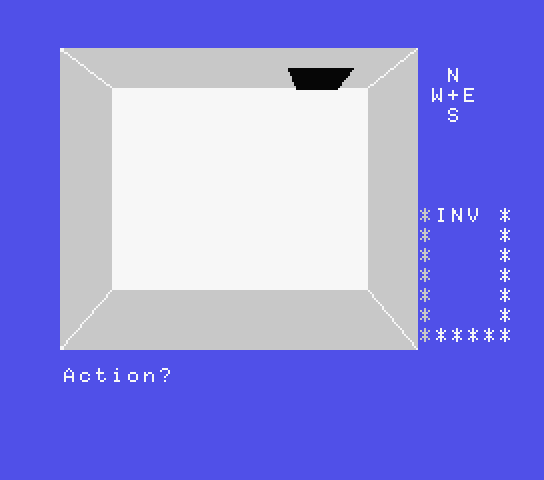
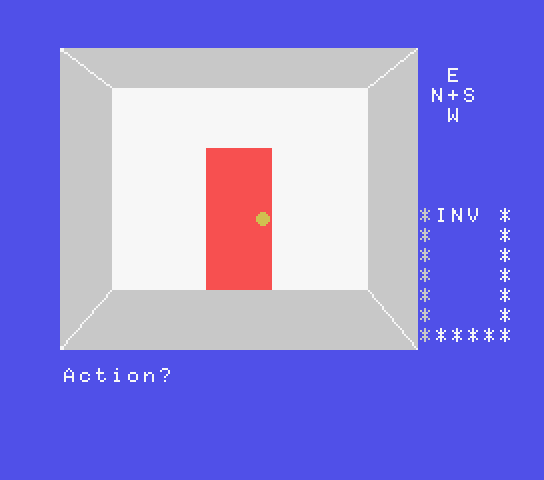
Whereas the MSX 3D view is tunnel vision, where you can only see in the direction you are facing. For example, upon entering the house this is your view:
However, in addition to the door behind you that you entered, there are doors to the east and west.
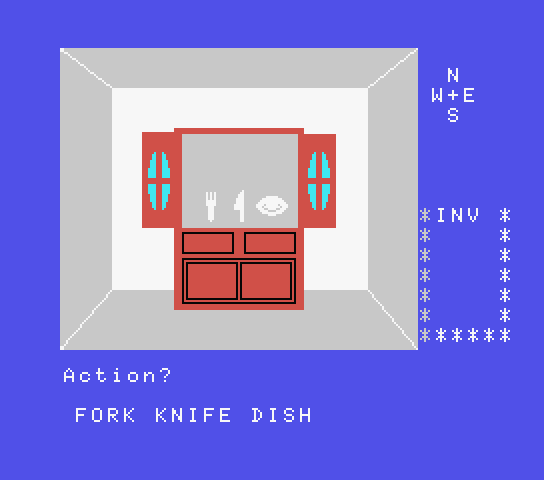
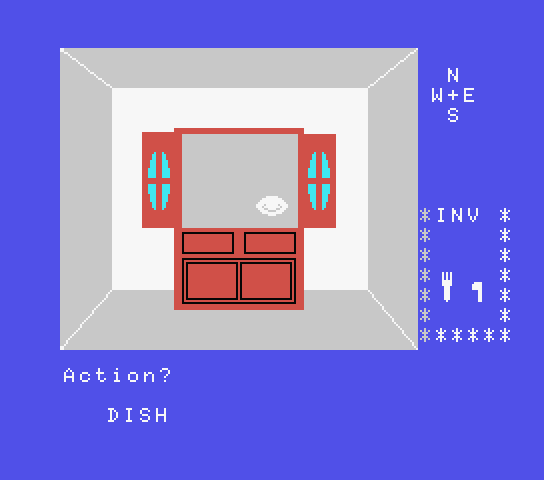
You are restricted to two items in your inventory at a time, and it looks like the inventory selection is far greater than before.
Immediately to the east of the start there’s a cabinet as shown above. You can take two of the items…
…but now if you also want to take the DISH you are stuck and have to drop something.
There are two other reasons to stick with the MSX version:
1.) As you likely already noticed, the screens are in English. That’s because the MSX version (and only the MSX version) has a translation patch.
2.) Even more importantly, there’s a walkthrough specifically for the MSX version.
However, I reserve the right to vacillate and change my mind back. At least according to this Japanese fan site by “furuiotoko” the MSX version is disappointing compared to the original and was “changed considerably” so I’m going to stay alert.
To finish off for now I want to quote another part of that fan site. Mystery House was — when the author was a child — their first adventure game, so the moment was magical:
From that moment on, I immersed myself in the world of this mystery house … It was a game that was completely new to me. In the virtual space on the computer that appears in front of you, doors open when you open them, items disappear when you take them, new discoveries suddenly unfold in front of you when you examine them … It’s probably because I personally loved this kind of secret exploration of the mansion, but I’m sure there are many other people who were equally impressed by this game.
The author invited two friends over to play, and they were trying to solve the ladder puzzle (the same one I was stuck on, where you can fall and die if you climb). One friend suggested moving the ladder, and another suggested busting open the wall behind. When this successfully made a hole, their excitement reached a “peak” of a kind that would never be duplicated again.
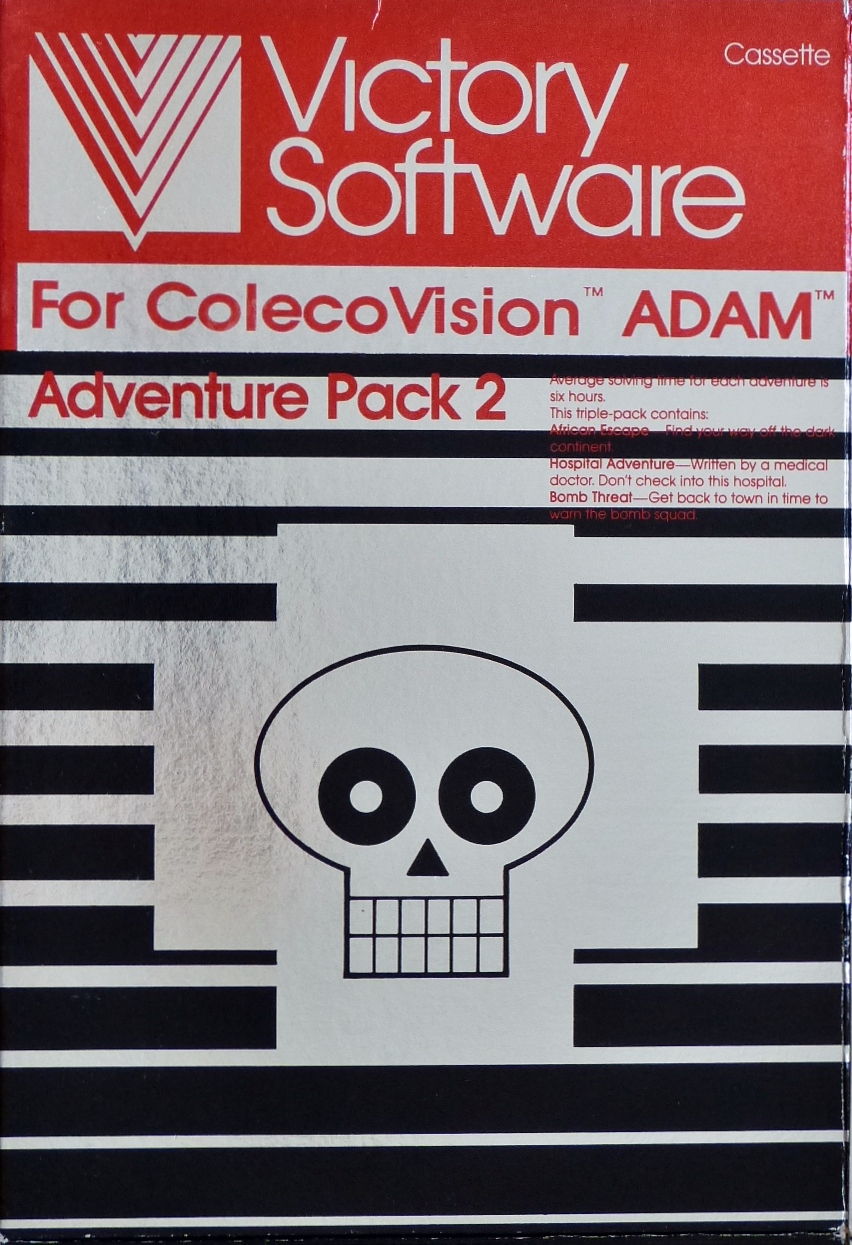
I promised, after making it through African Escape from the Adventure Pack 2 by Victory Software, I would return to the other games soon.
From the Museum for Computer Adventure games.
As a reminder, the games originally appeared on VIC-20 (super-tiny capacity), C64 (porting the same source code) and C64 again (with some slight enhancements like a verb list). I ended up for various emulator/file-juggling reasons playing Bomb Threat on C64 (non-enhanced) and Hospital on a regular VIC emulator. (As the cover above implies, there were also ColecoVision ADAM versions, but that is a system that will have to wait for another time. There are at least a few ADAM-only adventure games.)
I will say up front both games were considerably more enjoyable than African Escape. I’ve been trying to isolate why; Bomb Threat is extremely tiny and is essentially two puzzles, one simple one and one elaborate one, meaning it manages to handle the extreme VIC-20 constraints (even if the plot is minor). Hospital is wide-open and also centered around only a few puzzles (and has a colorful plot premise to boot).
For Bomb Threat, we need to stop a terrorist plot.
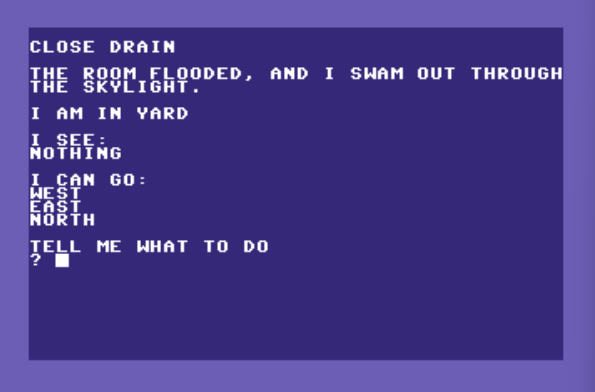
There are only five rooms. First we just need to escape the starting room, by closing a drain, filling a room with water, and getting out through a skylight.
Now all that remains is to get to town to warn people about the bomb. There’s a nearby garage with a car and jeep:
The car is working, and if you go inside there’s a key under mat; the only problem is out of gas. So you need to get the gas from the jeep over to the car.
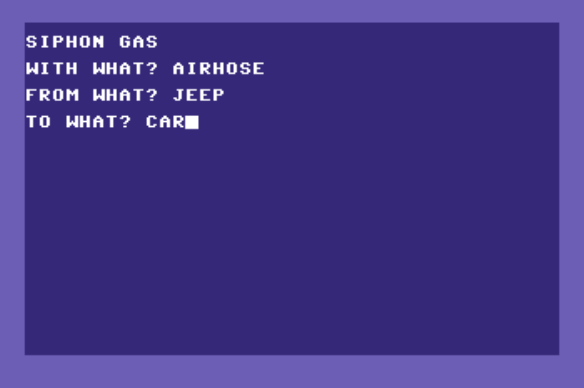
This requires getting a cord, hose, and pump from the nearby house. The cord can be used to plug the lift in and raise it so the jeep is up higher; then you can hook the hose up with SIPHON GAS, and with a triple prompt.
This is the first time I’ve ever seen this — having to type three separate objects after a verb-noun pair — in an adventure game.
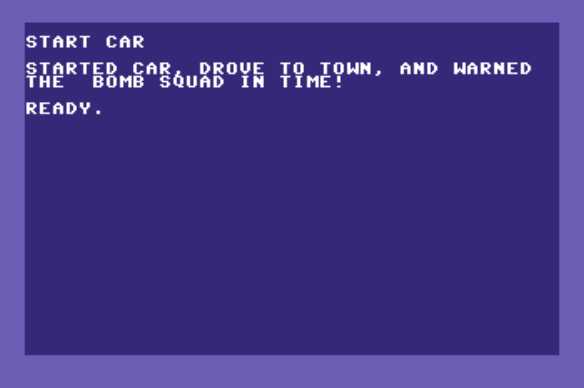
Once the gas is in you can drive the car away to victory.
Narratively speaking there wasn’t much to it — getting a car to run, the game — but at least I was able to figure things out on my own and there weren’t absurd leaps of geography and/or logic.
For Hospital Adventure, you are an assassin, sent to kill a dictator. You have no items with you, but I’m going to assume there were security checkpoints to get in.
We’ve played explicit thieves, but I don’t think we’ve ever actually played a straight murderer before. There’s a point of “check your morality at the door” which you’ll see in a moment.
The design is centered around the elevator as a “hub” which allows a fairly sensible open map. There are no compass directions. The dictator is on the top floor.
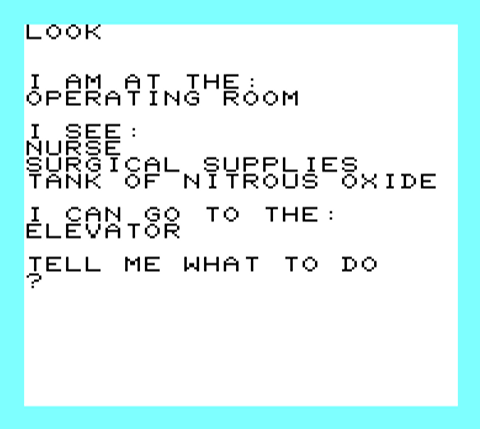
As the “16 armed guards” in the map implies, you can’t just make a beeline for the dictator and use a pillow. The first place to start is the fourth floor; there’s a nurse with some scalpels and a tank of nitrous oxide.
You can filch the scalpels but you really need the nitrous oxide, which the nurse won’t let you have. But the nurse is alone, and now you have a scalpel.
In any other adventure game from the time, something which prompts “you fiend” would then be stopped from happening or result in a game over. Here it is necessary for progress.
With the nurse dead you can nab the tank and go to the basement.
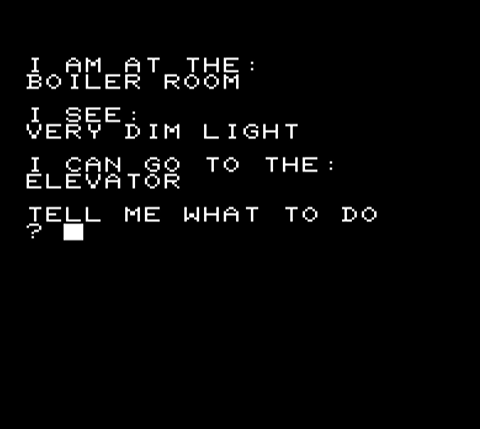
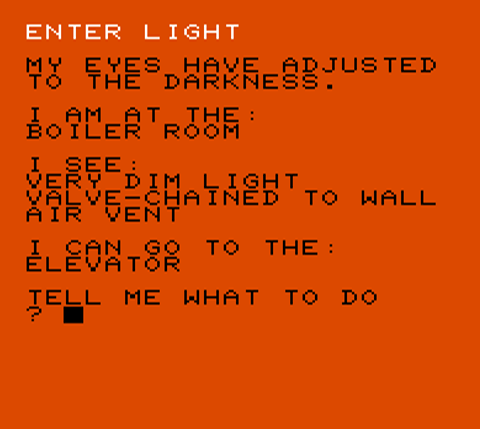
One of my pet peeves of adventure games with light is how it is always treated as can’t see-can see, when usually — unless there’s total darkness, like a cave — it is possible to see better by waiting for your eyes to adjust. I never quite expected a VIC-20 game to include this as a feature.
You just need to wait enough turns. (ENTER LIGHT, in normal circumstances, gets a response of HUH? — I was just experimenting.) I also love the color change here.
So with the valve and vent visible, you can hook up the valve to the tank (PUT VALVE / TANK) and then drop the tank in the vent and turn it on.
This connects to a kitchen upstairs on the first floor, and knocks all the workers there out.
Now you can take a white uniform as a disguise and some food, but that isn’t quite enough. You need the food to be poisoned. Fortunately there’s an experiment going on at the third floor.
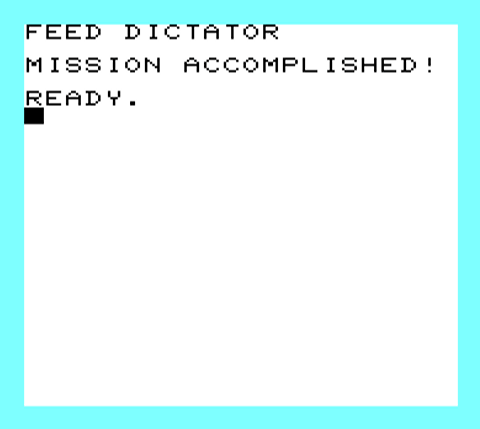
With the food suitably spiked, you can then deliver the food to the dictator; the result is undescribed, but I’m sure Mr. Robinson was running out of characters.
Hospital Adventure is almost at the threshold I’d recommend generally. The VIC-20 parser jank is minimized by the sheer simplicity; it does try anything more ambitious than GET, PUT, KILL, and FEED, so I didn’t have any particular moments of struggle. The killing of a random nurse still felt kind of shocking even in text form (although I visualized her rather like the cover) and I was able to survey all the area, realize a possible plan of action, and implement it more or less how I expected.
There’s still two more of these VIC-20 oddities to go, and one of them is even graphical! For now, we’re switching countries again, as one successful game gets a sequel.
One of the key skills in game design is being able to understand things from the mind of another person. They don’t know what you know; you have to imagine you are seeing information as they are. Beginners to designing puzzles especially will often include leaps that are clearly out of mental bounds of their players. The technical term (well, one technical term) is “cognitive empathy”.
I think the problem with The Scepter is the young author lacked a.) a sense of when puzzles are easy or difficult and relatedly, b.) cognitive empathy.
(Not weird for a first time author! And we’ll come back to Simon, so we’ll get to see if he’s made progress.)
From the Museum of Computer Adventure Games.
Here’s the item stash from last time:
wheel, crystal ball, sword, goblet, lamp, acorn, wire, diamond, axe, bag of dirt, old boot, key
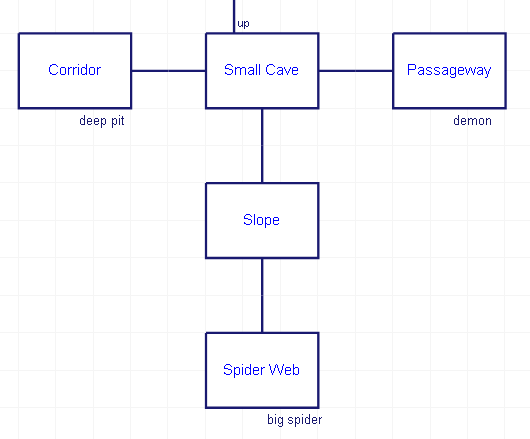
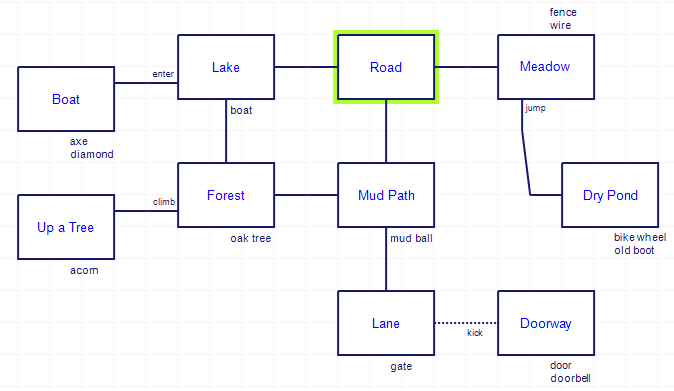
Here’s the map from last time:
One of the puzzles causing issue was a giant web with a spider. Any direct attack on the spider was ignored; the spider equally ignored the player in their efforts to kick, push, tickle, etc. in the hope of something, anything to happen.
I need to check with hints via rmartins; the puzzle is entirely unsolvable from the room itself, but rather you are supposed to look at the room adjacent, the Slope. From there, you can ROLL the WHEEL which will head downhill and smash the web.
This of course assumes the player knows the slope goes down, that the wheel is big and stable enough to roll free-standing on its own, that the web is placed such that it would make sense to get taken down by a wheel, and that the web is small enough for the same. Failure on any of these can lead to a very difficult-to-visualize puzzle; in particular I was thinking the web as being too large for such a thing.
Many of these could be fixed by a more responsive parser, so technical issues are partly to blame. It’s a pity because this is quite a clever puzzle in a way: a very indirect and creative approach to the solution. I’d probably (taking my game-designer red pencil) also allow DROP rather than ROLL as a solution; even though it is possible you might have the wheel roll down by accident that way, it is an unlikely dumping spot for the player. As an extra bonus you could have other items slide down the slope to emphasize the physicality of the space and give a hint as to what’s going on.
Past the web is a locked chest. If you have the WIRE in inventory you can PICK LOCK (note how LOCK is not even a described noun in the game, you just have to infer the command will work).
This gets a *SKULL* which is one of the three parts of the Scepter that we’re seeking.
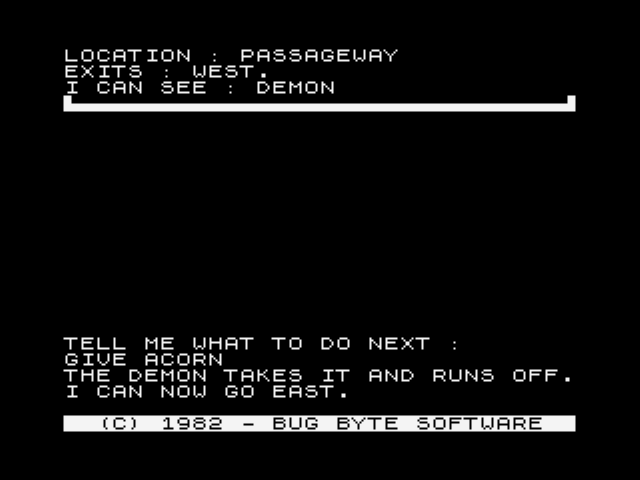
Moving on next is the demon. (Again, I needed an rmartins hint.) You’re supposed to give it …
… the acorn. Sure? Maybe it’s a demon-squirrel. LOOK doesn’t give any info so you just have to hit this randomly.
Past that is a *STAFF*, so that’s two parts out of three.
Over to the pit, you need to take the crystal ball — which already worked to gazing and seeing a goblet and a furnace — and rubbing it.
This again seems like a failure of cognitive empathy. Imagine the process from the player’s end: how will they solve it? The only real way seems to be testing RUB at random to see if it is magical, and then testing RUB in every location looking for an effect. I could see in the author’s mind thinking that — oh, the only way across is magic — and thinking there wasn’t a big leap in logic, but it isn’t even obvious that crossing the pit is desired (I tried for a while to survive the jump in, or use a rope from the demon’s direction as a way of climbing down).
The ghost puzzle is terrible but let’s zip by a moment for the easy puzzles. There’s that furnace where you can melt the goblet, getting a coin (not only was there a vision of the two together but the goblet said MELT ME, why so many hints on this and not the acorn-loving demon?)…
…next to a vending machine to use the coin.
The scroll allows teleportation back across the pit.
Then there’s a “fierce dog”, where the only tricky aspect is you’ve been trained by the spider and demon to look for a “weird” solution. No, you’re just supposed to kill it. With your sword.
A sad dragon is made happy again. I mean, I got it first try at least.
And then we reach a puzzle that would truly bit nifty if it weren’t for a verb issue.
Remember the bag of dirt I was making fun of from the start of the game? I realized quite quickly this was meant to be the Indiana Jones weight-swap. You have to SWAP, SWITCH doesn’t work, nor does PUT DIRT or many other variants.
Before leaving you need to deal with the ghost, and boy, you thought the acorn was unprompted:
This isn’t “moon logic” — SAY HELLO isn’t a 100% absurd thing to do, after the fact — but it has zero prompting and is it highly unlikely someone would just hit upon the act naturally. Even if someone gets close (“I want to talk to the ghost”) other words like HI don’t work. It has to be that exact command.
Using this advice, you can go back aboveground, BUILD SCEPTER to put together the staff, ruby, and skull, and then WAVE SCEPTER while at the chopped-down tree in order to teleport home. Why we could not walk back the way we came is undisclosed.
There’s a confusing meta-feeling playing one of these ultra-minimalist games (where all that gets conveyed to indicate a single place is a word, like “LOCATION: SLOPE”). In book form, this would be atrocious. Somehow, the act of gameplay boosts the significance, like receiving a writing prompt and filling in the blanks, but rather than “writing” the spaces are colored in with the mental effort of playing. This is true even when there’s a lot of flailing at nothing. But what gets colored in isn’t plot, exactly (I’m not imagining my avatar try to lick, kiss, poke, and kick every single thing) but just tension. Feelings. Unrealized ideas for puzzle solutions.
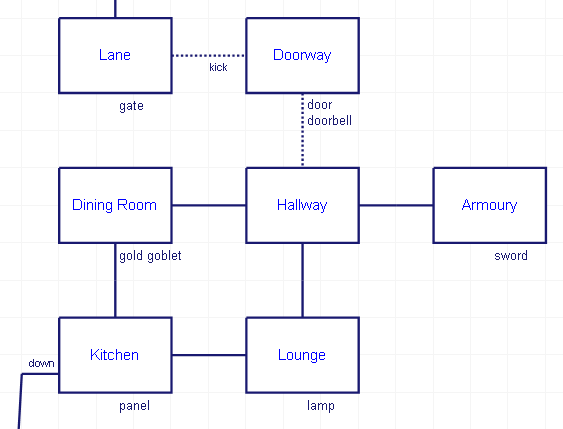
To pick up from last time, I had a door with a doorbell that caused electrocution. Poking through my inventory with LOOK doesn’t reveal anything, but I eyeballed the verb list (reproduced above) and occurred to me the OLD BOOT I had might respond well to SHAKE. It did, having a key fall out, so I was able to unlock the door and go in.
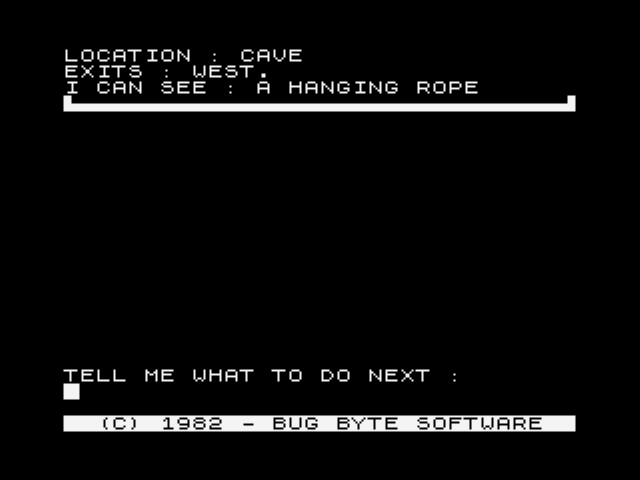
This led to another item dump; a golden goblet that says MELT ME (referring to the crystal ball vision, no doubt), a sword, and a lamp.
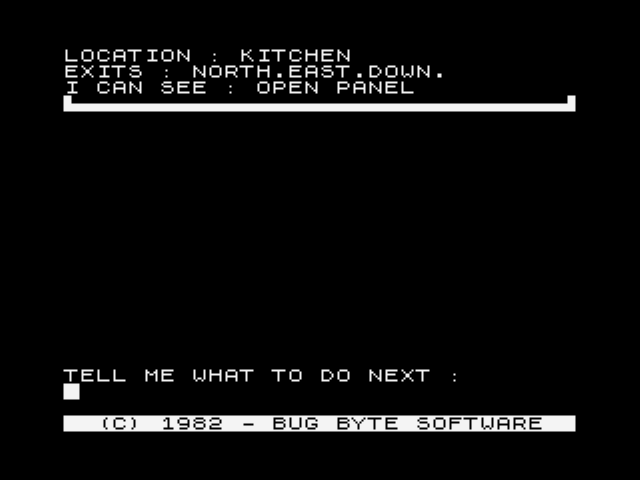
The kitchen had a PANEL and it took me a lot of struggle with verbs like PUSH, OPEN, SLIDE, and so forth before I hit upon LIFT, which I am fairly sure is the only verb that works. It didn’t feel like solving something as much as–
–okay, here’s an analogy. Sometimes the old Fighting Fantasy books, with numbered sections, had a bit that asked a riddle. Since you can’t “type in” a word you are supposed to convert it to a number, so if you get the one correct riddle answer, you can move on, but because you’re staring at a static book it isn’t going to react otherwise.
Solving “puzzles” like “what verb to open a panel with” is like fighting the right section to jump to in a Fighting Fantasy book; no responsiveness until you’ve done the task, and the whole process can feel arbitrary.
Back to the action: going down further led to a SPIDER, a DEMON, and a PIT.
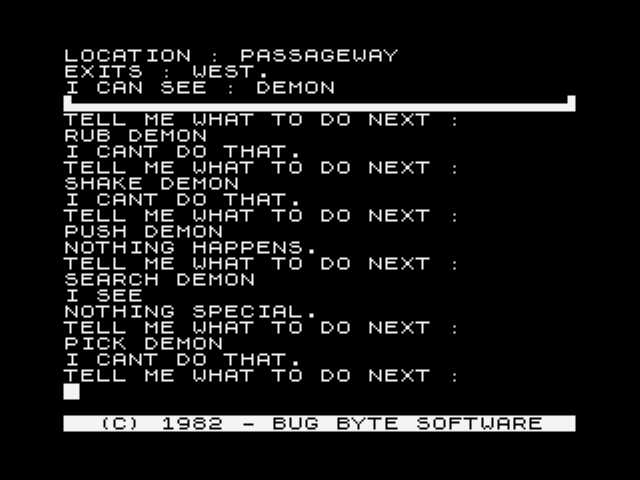
This sounds like it might be exciting! Engage the demon in combat, realize just the sword isn’t cutting, and enhance it by solving another puzzle before engaging again, or something like that. No, this is how the demon scene ran:
The spider was similarly pacifist:
No responsiveness to anything (including the obvious KILL and KICK), nor do they try to kill me back. At least you can jump down the pit and die, but that’s a little like “I hurt myself in order to feel alive”.
In normal circumstances I would have reached for hints already, but I want to re-iterate that this game was a massive pain to get emulated correctly. I have sunk investment.
However, at this point, I am totally happy to get hints from you, the readers, either in:
a.) speculation [again] what to do in normal text form
b.) hints telling me exactly what to do in ROT13 form, and feel free to plunder the BASIC code although there’s a walkthrough up at CASA so you might as well use that
One quick side note: the tree you can climb at the start to get a WALNUT you can also chop down. The chopping seems to serve no purpose.
I tried every single verb on my chart with no response. Maybe it is meant as a red herring.
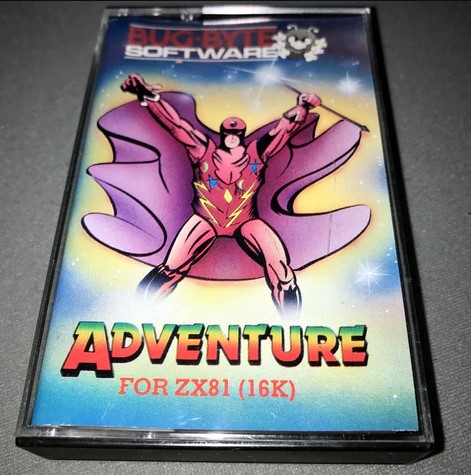
The publisher sold this one as “Adventure”, so I’ll hope you forgive me going with the alternate title on the intro screen, which the author (Simon Wadsworth) has stated was always the real name of the game anyway.
Bug-Byte was founded in 1980 by Tony Baden and Tony Milner while they were students and neighbors at Oxford. Tony had bought a ZX-80 and the duo — after playing around with the machine — realized that software selection was scant.
They formed their own company (using Tony Milner’s address from Coventry as the business mail, since a student residence didn’t seem professional) where “at first we pretended we were bigger than we were”, making a peak of 150 pounds in weekly sales by the end of the year.
They tried spending for a full page ad in March 1981 for ZX-80 software; that same month is when the ZX-81 launched.
We had doubled our advertising and halved our sales.
After graduating Oxford the duo went full time into business, finding an office in Liverpool and cranking out ZX-81 software (“I wrote eight in one day once”) eventually growing to the point of having sold 500,000 cassettes by August 1982.
They later became famous as the publisher of the adventure Twin Kingdom Valley, which we’ll hit in 1983, and the platformer Manic Miner, which we won’t be reaching at all (although Data Driven Gamer gave it a play-through you can read, or you can watch the video below).
For today’s game, we’re firmly still in the summer of 1982. The author, the 16-year old Simon Wadsworth, describes how “my school friends and I spent countless hours battling the creations of Scott Adams, Brian Howarth, Level 9 and Artic Computing” and decided to write his own, using ZX81 BASIC (with some machine code). Note how there’s been enough time for the early British games to be influential, it isn’t just original Adventure and Scott Adams.
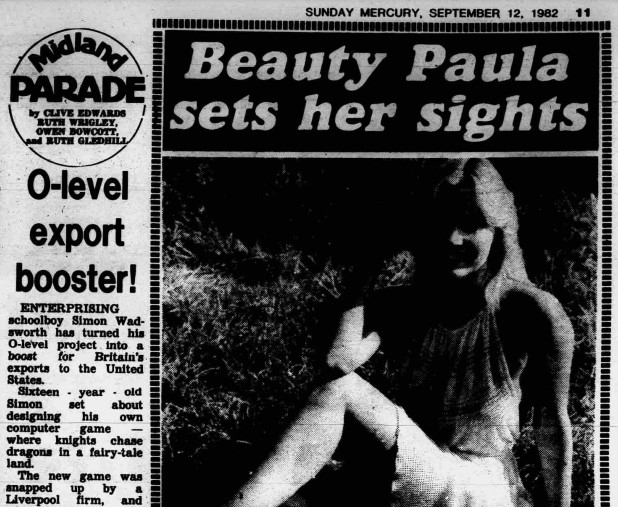
I have no idea what made me submit it to Bug-Byte for publication, but I’ve always been glad that I did. This was the first step in my career as a software developer. It was written while studying for my GCSE O-Levels. When the Head of Year got to hear about it she contacted the local newspaper; so I achieved my fifteen minutes of fame.
I wasn’t expecting much. When they accepted it, I could hardly believe it.
Simon sent in a second game to Bug Byte which never got published (for unclear reasons) followed by two for Artic, so we’ll be visiting him again, but for now, let’s check out his first effort.
This was incidentally a giant pain to emulate. EightyOne, the typical recommended emulator for ZX81, has been acting very slow for me (pushing a button for a menu taking 2 minutes+ to respond). JtyOne, the online emulator at zx81stuff, had input problems, I presume because of the ZX80 machine code (at least that site makes the BASIC source code easy to read). I went through some even more obscure emulators like no$zx and ZEsarUX which had the same input error, and finally had luck with reverting to an old version of EightyOne (version 0.52) which you can find here.
The “collect pieces of the magic gizmo scepter and assemble them” plot gives vibes of Howarth and the Arrow of Death (remember he was an inspiration!)
The opening just has a handful of generic-forest-adventure rooms (lake, meadow, forest, mud path, …) but a wildly unusual number of items just lying around. To get to the pond above I needed to JUMP over a fence, and the fence itself had a wire. There’s a boat you can enter that just has an axe and a diamond you can grab, there’s a “mud ball” that turns out to be a crystal ball if you just “clean” it (LOOK CRYSTAL: “I SEE A GOBLET AND A FURNACE”), and there’s an acorn up a tree.
Without doing much other than kick down a gate I had 8 items and I was stuck on a “doorway”.
You don’t pick up the bag of dirt: you start the game with it. I can just imagine some emperor sending you on your journey and reminding you “don’t forget your dirt!”
The “doorbell” is strange in the description since this is a “first three letters only” style parser, so it first seems like the game only lets you refer to the door, not the doorbell. The trick is to use the noun BELL, but alas, that doesn’t translate to progress:
PRESS BELL
BUZZ…
IM ELECTROCUTED
THE GAME IS OVER
So I find myself stuck, yet again, on some teenager’s simple BASIC game stuck on what seems like a very simple obstacle. I did go through my verb list…
…but despite the large item list to play with I’m out of ideas. Suggestions welcome! (Please no plumb-the-BASIC-source spoilers yet, though, at the moment I only want to hear if you haven’t looked anything up.)
The line between “tight, difficult puzzle box” and “impossible puzzles” is fine enough that making a good difficult adventure is one of the tightest of high-wire acts in all of game design. Every puzzle — in the standard formulation at least — is bespoke and potentially a disaster. Combine that with the general lack of beta-testing in the early ’80s and a gem that remains super difficult is rare indeed.
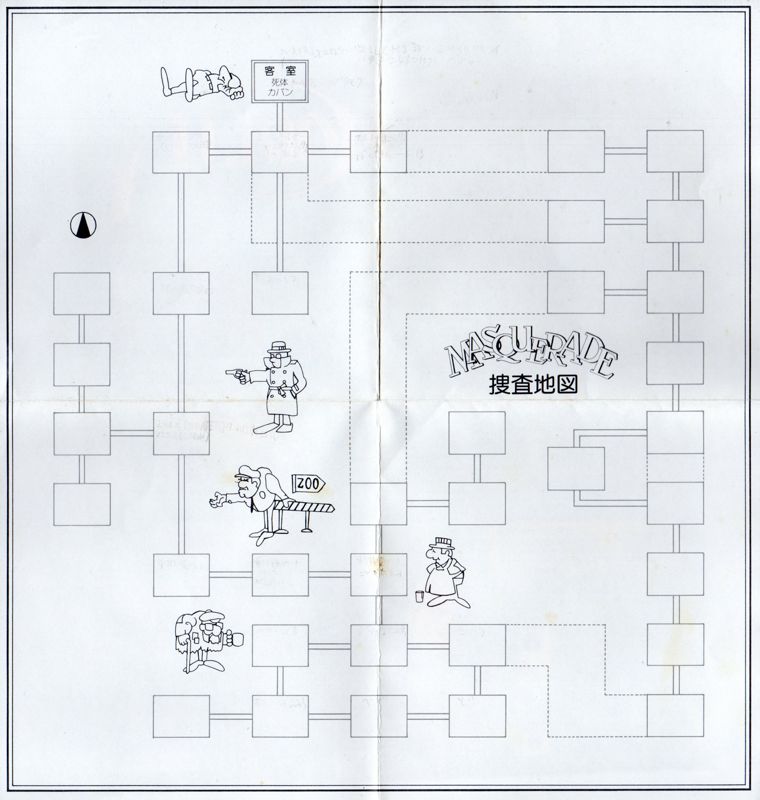
So when Masquerade fell down hard near the end, well, at least I had sympathy. There were still some clever moments, though–
Map from the FM-77 version, via Mobygames.
–so to kick off the pain right away, let’s return to the popcorn I received by spending a dollar, and fed to the bird.
From this point I had softlocked. Now, it wasn’t the mere existence of softlocks that was a problem — I had ample forewarning and it is an intentional style — but rather, the popcorn had something concealed in it, which you can find if you SEARCH POPCORN.
I had mostly given up on SEARCH as a verb, as it only worked on the body beforehand, but also wouldn’t the bird leave the badge behind? Or at least it would be very obvious something went horribly wrong upon eating the large piece of metal?
With the badge I could breathe a bit easier, as I could a.) go in and out of the zoo freely and b.) get into the office, where as predicted, I could turn off the switch to the electric fence.
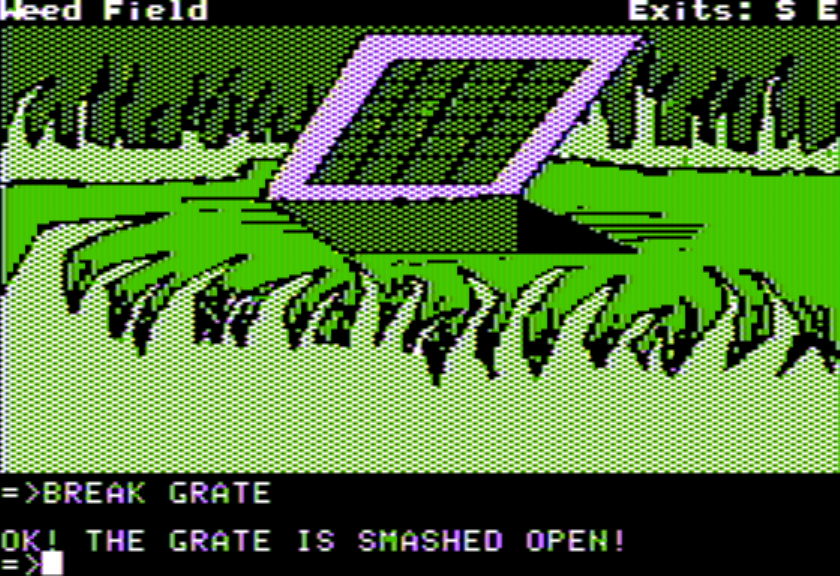
Inside the electric fence area I found a grate near some grass (more on that in a second)…
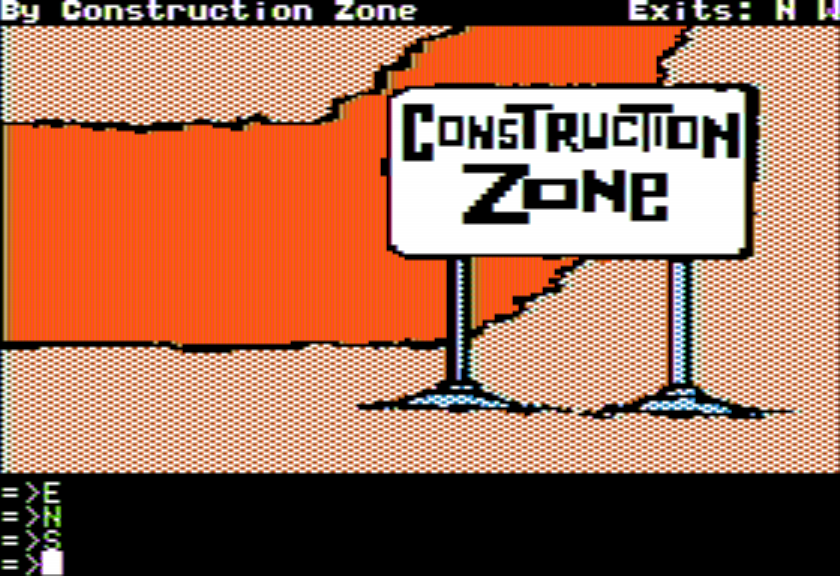
and a construction area.
There was a helmet back in the theater that served as protection (never mind it’s a safari helmet, not a construction one) and hence I was able to retrieve a hammer and some dynamite.
I also discovered by trying to juggle inventory in this area — and it will become important later — is that if you drop off some items, they will disappear as you see something furry run by.
The hammer does not pass through the electric fence, though (too big to carry) meaning it had more immediate use. Specifically, you can use it to smash open the grate.
(The magic button works too, but you need to keep one of the uses. Just as a reminder, it was used once to get in the trapdoor, but it hasn’t been used since; I used it to open a gorilla cage but that was speculative.)
This leads back down to the tunnels, which was interesting since I didn’t have anything in particular I needed to do down there.
The reason for a second visit (there’s going to be a third!) is to apply the hint from the note:
IF YOU’RE REALLY SHARP, YOU’LL TAKE A SHORT CUT AROUND THE BLOCK!
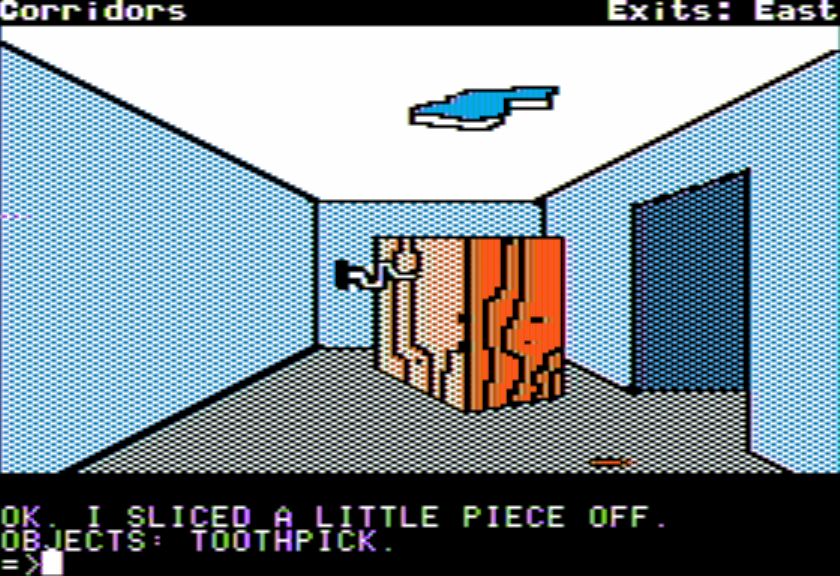
Specifically, now that the theater is open, the player has access to a RAZOR. And the razor can be taken back to the balsa block of wood in order to cut it.
I don’t think this is a terrible puzzle — the note is explicit about what to do — but it does mean from this point the elements of the game are best not thought of “realistically” (why would we get a note from the bad guys on how to defeat the bad guys)?
Moving on, what use does a toothpick have?
Picking a lock, with a wooden toothpick? Suuuuuuuure. (It’s easy after the fact to say “well just don’t think of it realistically, but coming up with the puzzle solution is required before doing it!)
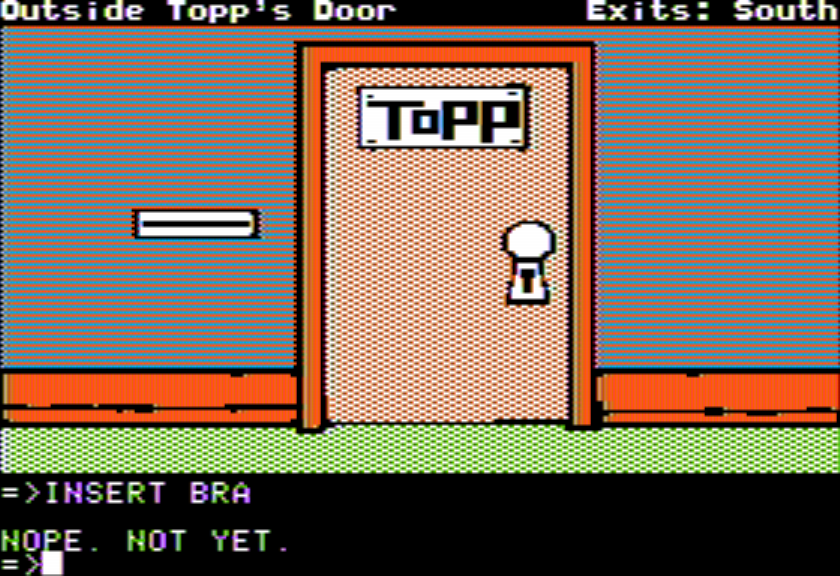
I still had the weird mystery of the cage to work out. I did find out a new way to kill the gorilla by accident. I was messing around with the slot at Mr. Topp’s (to look for other potential objects that might cause a reaction) when I found out the bra had a curious message:
Some more experimentation revealed the message didn’t have to do with the slot at all, but rather having the rock also being held. With both rock and bra in hand either INSERT ROCK or INSERT BRA forms a makeshift sling, so SLING GORILLA because an alternate method of doing away with the animal.
…yet, I still didn’t know why I was doing this? And here I was truly and completely stuck and needed to check hints.
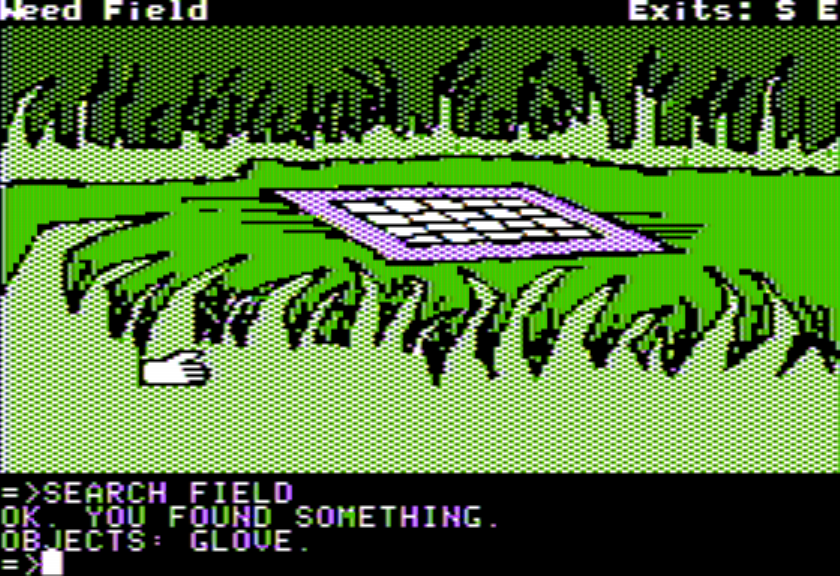
First off, I needed the bird for some other purpose other than scaring off; furthermore, I needed the snake for something so scaring it off was bad besides. What I had missed was SEARCH WEED or SEARCH GRASS or SEARCH FIELD north of the electric fence. No, that’s no explicitly a noun mentioned in the main text, unlike every other puzzle in the game, it’s a noun from the title of the room.
grrrrr
With the glove you can safely grab the rock and the snake.
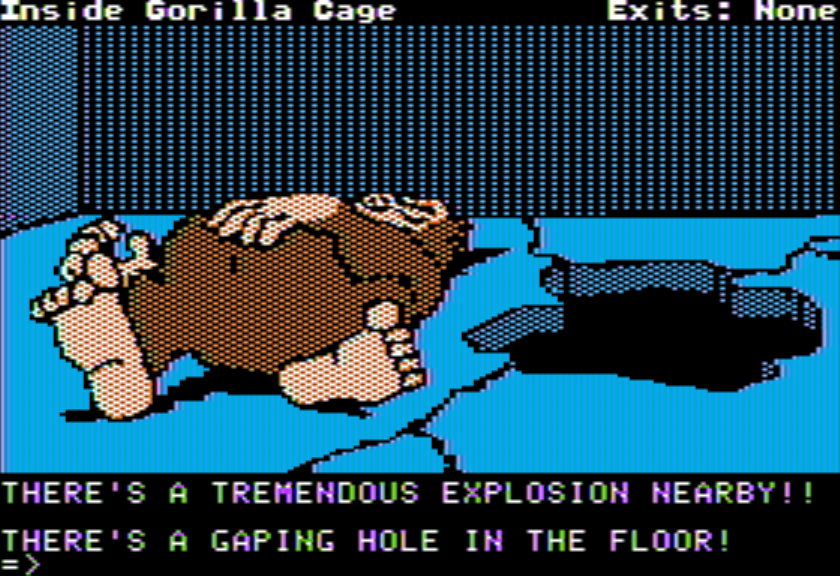
With the bird in hand, you can then: go in the cage and get trapped, drop the bird who will fly out, get a match, and come back…
…and then drop the dynamite and light it causing a hole to appear.
This could have yielded to a “structural solving” moment insofar as there is nothing to do in the cage, therefore there must be something to do, so might as well try seeing if the bird will do something special that happens nowhere else. Mostly I was just grouchy. The puzzle after is kind of interesting but pulls yet another absurdity:
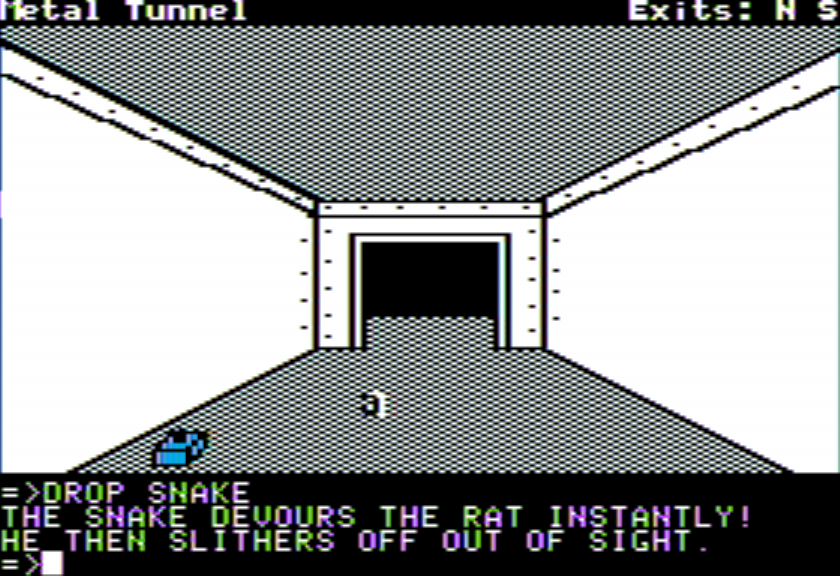
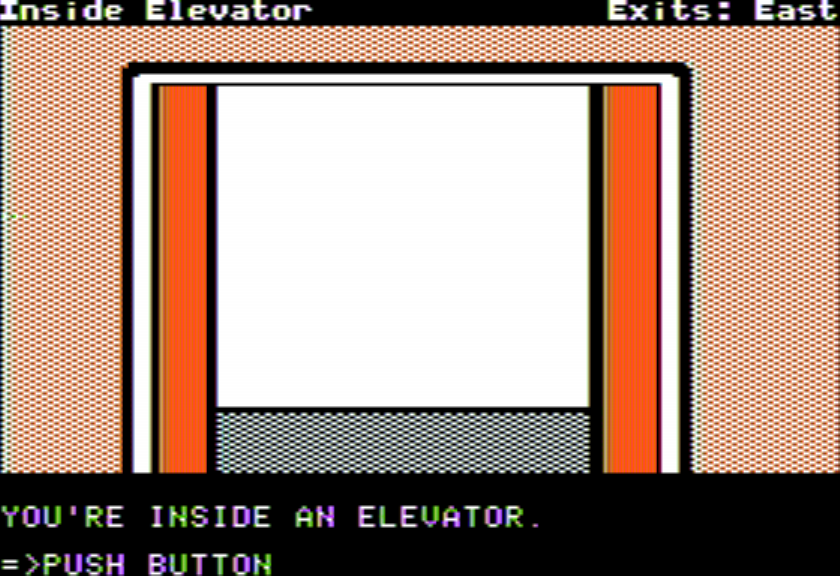
Specifically, there’s a rat with an earring, and an elevator just past. To deal with the rat, you drop off the snake…
…but the elevator is a little trickier. Assuming you picked the lock rather than used the magic button, there should be a magic button use left, but for some strange reason it “drains” if you walk by a generator. It is unclear that this is happening and I’ve never deciphered why.
The draining doesn’t even happen in this room, it is the room right after with the rat in it.
However, the upshot is that you are stuck if you’ve carried the button down here. Do you remember the furry stealing thing? That’s the rat. You’re supposed to drop the button off at the construction zone, and then somehow the rat can take it safely to the elevator without it being drained, and that means there will be a use left over that you can use on the elevator.
Believe it or not, we’re essentially at the end of the game. There are no new lingering threads. Everything from the zoo is taken care of, but what do we have that works on Mr. Topp? This is one of the puzzles I’m sure someone got by accident but I don’t know how you’d do it intentionally. You have to wear every wearable item in the game, all of them at once. This reaches your max inventory limit.
Then you go in to see Mr. Topp.
I’d definitely say the game vaulted over “difficult” into “just nonsense”. I always try to be careful using words like “moon logic”, which I think get over-used in the adventure community; it really is useful and helpful to distinguish between nonsense and just plain hard. I’m fine with something esoteric like the balsa wood toothpick, and at least there was a sort of halfway-sense to picking a lock with a toothpick. The endgame here was a case where the player is prompting to do something with no clues whatsoever. Just to be clear, with one item missing, all you see is the “imposter” message. There is no indication or comment on your clothing or the amount you’re wearing.
Before leaving here, some historical clarifications, thanks to A2Can:
Both the copies of the text game and the prototype-graphical game (which I have now) are from the founder of Phoenix Software himself, Ron Unrath. Despite my getting stuck on the text game (I still think there’s a way to get a key…) it might be “done”; the graphical version definitely is not. It isn’t “programmer art” then, it is sincerely intended as “temp art”.
Interestingly enough, the object art is in already, and seems to be identical to the final game. That means the pictures of objects are by Dale Johnson, not by Rick Incrocci!
If I had to rank the games so far, I’d put Palace in Thunderland on top, a genuinely solvable game that just happens to be enormously hard, followed by this game, with Mad Venture below. I certainly thought the atmosphere in Masquerade was fantastic, but having a couple nonsense puzzles was enough to ruin sticking the landing. While I’m describing things quickly, each moment of stuck-ness represents a long time of me struggling in the wrong direction.
We’ve got one Dale Johnson game left to go, although this one has him teamed up with yet another person, Dav Holle, and allegedly lightens up heavily on the difficulty. Sometimes an experienced author can produce their best work when they try to write something “easy” (at least, it baselines down to what a more modern game would be like, with less softlocking) so I’m definitely looking forward to that! But first we have another visit across the pond with a publisher we haven’t visited yet (which later published one of the most famous ZX Spectrum games ever made), followed by a return to Japan.















































 Renga in Blue

