“Just as Mark is almost entirely responsible for Deadline, Starcross is mostly mine,” Lebling smiles. “I have always been a science fiction fan and have wanted to do an adventure in the genre. That’s one of the things I really like about Infocom. We figure out what we really want to do, rather than design games by market demand. I’m in this to have fun. It would be nice also for Infocom to make lots of money and be very successful, but I couldn’t work if I wasn’t having fun doing it. I love writing these games — much more than I enjoy playing them.”
“Starcross was a real joy to write and should be a lot of fun for people to play. The puzzles are science fiction puzzles, not adventure puzzles. We did not want to do a ‘Zork in Space’ game. Starcross is intended as an entry level game for people who like science fiction but who haven’t played many adventure games before.”
After finishing work on Zork I and II, Marc Blank moved over to Deadline which came out early in 1982; he then switched to making new content for Zork III, while Dave Lebling polished the re-used Zork mainframe puzzles. At the same time, Lebling created Starcross.
From The Infocom Gallery. Notice: “intended as entry level” vs. “expert level”.
Lebling was a major science fiction fan, and for this game his main two references were Clarke and Niven. Clarke’s Rendezvous with Rama in particular is quite adventure-game-like, with a mysterious giant alien structure of unknown purpose being entered by explorers; Niven had multiple stories that served as inspiration, but his Ringworld was an alien structure in the same manner of Clarke’s. We’ve had one game for the Project already inspired by Ringworld.
Notably, both are hard science fiction authors — as in attempting to have some scientific basis for what’s going, unlike, say, philosophical science fiction — and Starcross similarly has an emphasis on puzzles involving science. I have played this before (back in ’92 or so) and I don’t remember much other than one of the ending puzzles invokes a principle of Newton.
Rather famously for collectors, the initial publishing run put the game in a “saucer shape” box. This was again the brainchild of ad agency Giardini/Russel. Inside was included a map (the only part that’s Lebling’s) which gets used for the initial puzzle and serves as copy protection. I’ll pull it out later in the post when it becomes relevant.
The year is 2186. Humanity has established colonies on the moon, Mars, and several of the larger asteroids. Earth’s sky is dotted with space habitats, and the spaceways are always busy. As usual, there is the urgent need for energy to power this advanced civilization, one of the primary sources of that energy is quantum black holes.
In STARCROSS, you are a miner of black holes, scouring the asteroid belt in your one-man survey ship. Finding and harnessing a single black hole can make a person’s fortune. It’s a lonely business, fraught with the known and unknown hazards of space. You’ve equipped your ship, the M.C.S. STARCROSS, with the best gear you could afford. You’ve put everything into this venture, and though you’ve tried before, you somehow sense that this time will be different.
We’re prospecting for black holes when we get woken up by our ship’s computer. We’ve found something big.
You are sound asleep in your bunk aboard the deep-space black hole prospecting ship “Starcross,” operating out of Ceres. Just as your sleep becomes deep and comfortable, an alarm bell begins ringing! It’s the mass detector! Instantly you awake. This hasn’t been a profitable trip so far, and you don’t even have the cash for repairs. This could be the break you’ve been waiting for.
Living Quarters
(You are in the bunk.)
This nook is your spartan living quarters, containing only a bunk and a bureau. The only exit is to starboard.
There is a tape library here. (outside the bunk)
>STAND UP
You are on your own feet again.
The alarm bell on the mass detector is ringing stridently.
The initial roll-out is a bit more lengthy than Zork 1, which started with no introduction whatsoever, just “You are standing in an open field west of a white house, with a boarded front door. There is a small mailbox here.” — the wide open space of possibilities that I’ve termed the “pastoral opening”. Lebling has explained with this game they needed some cushion for those used to fantasy, and also because the player is immediately confronted with a ship they need to control.
>E
Bridge
This is the control room of the Starcross. There are exits labelled (arbitrarily) “Port,” “Starboard,” and “Out.” The latter exit has a heavy bulkhead which is closed.
Your ship’s computer does the routine tasks of navigation and life support. A control couch is mounted before a control panel and a large viewport. The ship’s registration is affixed nearby.
Your mass detector, essential in the search for black holes, sits to one side. On the detector are a red button, a blue button, and a small screen on which something is displayed.
The alarm bell on the mass detector is ringing stridently.
>PUSH RED
The alarm goes silent.
>EXAMINE REGISTRATION
Mining Class Ship “Starcross”
Registered out of Ceres
Registration 47291AA-4X
Designed by David Lebling
Constructed in 2178, Luna City Docks
by Frobozzco Astronautics
and Infocom, Inc.
>READ SCREEN
The display reads: “mass UM91.”
The blue button prints information which looks roughly like the map that comes with the game.
UM91 was specific for my game; it can be any of the orange “previously uncharted mass” objects. A bit of math is required. As the right side of the map explains, you need to give commands like so:
COMPUTER, RANGE IS VALUE
COMPUTER, THETA IS VALUE
COMPUTER, PHI IS VALUE
and then COMPUTER, CONFIRM will cause the ship to move.
While range is fairly straightforward to read (50, assuming polar coordinates) as was Phi (121º, given directly on the object as mentioned by the side directions) giving Theta took me a little math. “Up” is given as 0º and “Right” is 90º, so I worked out by counting that the map is using 90/6 = 15 degree increments. So Theta here is 15º.
(Note there’s a “screen-reader friendly” version of the coordinates here, although that removes the slight bit of math puzzle. Maybe that isn’t a bad thing; one of the comments on Drew Cook’s writeup is from someone who could never figure out how the coordinates worked and was unable to play the game. I do wonder if there’s a screen-reader method of preserving the math puzzle rather than just skipping the puzzle with a list!)
>computer, phi is 121
“Phi set.” Lights blink furiously for a moment. The computer speaks: “Sequence for intercept of mass concentration is programmed and ready. Please confirm new navigational program. I’m waiting…”
>computer, confirm
“Thank you. New navigational program will initiate in fifteen seconds. There will be a course correction burn of 60 seconds duration. I advise you to fasten your seat belt.”
I admit I died the first time here because there’s a “safety line” in the adjacent room (along with a space suit) and I went to try to hold onto that. Instead there’s a buckle revealed if you sit down on the couch.
Time passes as you journey towards your destination.
Filling space before you is an enormous artifact, more than 5 km long and about a kilometer in diameter. Regularly spaced around its waist are bumps and other odd protrusions. You cannot see the aft end but the fore end sports a glass or crystal dome almost 100 meters across.
There is a brief burn as the ship matches course with the artifact. You are hanging in space about half a kilometer away from the waist of the object. The Starcross’s engines shut down. The computer speaks: “Program completed. We are being scanned by low level radiation. Awaiting instructions.”
The “awaiting instructions” threw me for a bit. What happens is that a “red dome” comes into view, with a metal “tentacle” that wraps around your ship’s hull.
You are smashed against the bulkhead as the tentacle accelerates the Starcross to the artifact’s speed of rotation. Inexorably, your ship is drawn toward the dome. When you are a few tens of meters away, three smaller tentacles issue forth and grapple the ship solidly to the surface of the artifact. The large tentacle retreats into its housing, which closes.
Unfortunately, the accelerations involved were tremendous, and being smashed into the walls didn’t help your condition either.
I spent a while trying to figure out a direction, any direction at all, that the computer might accept other than the initial ones. COMPUTER, LAND was at least acknowledged (the artifact is rotating too fast to land). However, I couldn’t scan, do some kind of communication ping, or anything else I thought might help prevent the artifact from thinking we were hostile.
I also found I could OPEN BULKHEAD and go outside with the space suit, as long as I first attached the line to the suit and a hook outside the airlock.
>attach line to suit
Attached to the space suit.
As the object rotates below, the features of a different area become visible through the viewport.
There is an area with a blue dome below. Near the dome is a spherical object which just might be a spaceship. It is held down by silvery ropes.
>attach line to hook
Attached to the hook.
>out
Outside Ship
You are floating outside the Starcross. The airlock door is open. One end of your safety line is attached to a hook next to the airlock. This is deep space, outside the plane of the ecliptic and far beyond the orbit of Earth. The sun seems small but still intolerably bright to look at directly.
There is an area with a blue dome below. Near the dome is a spherical object which just might be a spaceship. It is held down by silvery ropes.
I went down another confused direction as I tried to jet out an escape from the ship before it got destroyed.
Finally it occurred to me the intent may be simply to “dock” our vessel and it wasn’t trying to smash it up, so I went back and used the seat buckle at the couch, and it worked. You can in fact WAIT from the entire time your ship starts moving until its final “landing” on the artifact without moving at all, and it works.
As the object rotates below, the features of a different area become visible through the viewport.
Below is an area with a red dome which has no ship near it.
Suddenly an odd protrusion near the red dome splits open and a huge articulated metal tentacle issues from it at great speed. It approaches the ship and delicately wraps itself around the hull. You are slammed against your seat as the tentacle accelerates the Starcross to the artifact’s speed of rotation. Inexorably, your ship is drawn toward the dome. When you are a few tens of meters away, three smaller tentacles issue forth and grapple the ship solidly to the surface of the artifact. The large tentacle retreats into its housing, which closes.
You are disoriented: now that you are attached to the artifact, which is rotating, “up” and “down” have taken on new meanings. Your sense of balance tells you that your ship is clinging to the underside of some enormous object, and if you aren’t careful you will fall! “Up” now refers to the center of the object, “down” to the immensities of space.
Now is when you should go in the airlock. The whole safety line thing seems to not be important yet, though.
>OUT
You exit gingerly, climbing “up” to the surface of the artifact, where your magnetic boots hold you securely as you hang “upside-down.”
Red Dock
This is a docking port color-coded in red. All around are strange protrusions, one of which could be a hook for a safety line. The surface here is metallic, but gets stony further from the dock. On one side (“Down”) is your ship, tethered to the surface of the artifact by thick silvery ropes. On the other (“Up”) is a large dome with an airlock.
A round metal sculpture or relief covers part of the airlock door. It is made up of thousands of tiny hexagonal columns which extend various lengths from the surface, making a three-dimensional representation. You can examine it more closely to see the details.
>EXAMINE SCULPTURE
A closer examination reveals that there are exactly ten circular bumps or columns on the sculpture: the first is large and centrally located, the second through tenth are smaller and scattered at various distances and orientations. As you go outward from the large bump in the center there are four small bumps, two rather large ones, two medium-sized ones, and then a small one again.
After brief contemplation I had fair certainty this is meant to be the solar system (another sci/math puzzle!) Trying to “push” most of the bumps results in the message “All of the hexagons extend to full length, then retract into the surface, leaving the sculpture completely smooth.” It’s honestly kind of mean of the aliens not to specify
– are we indicating the star of our solar system? (first bump)
– are we indicating our planet of origin? (fourth bump)
– are we indicating the planet we are nearby? (fifth bump)
Planet of origin works:
>push fourth bump
A tiny column made up of only one hexagon appears at about the same distance from the center as the first large bump.
>push hexagon
The sculpture flattens out completely, except at the former location of the tiny bump, where a hexagonal rod of black crystal is extruded.
>get rod
When you take the black rod, the airlock door opens!
Suddenly things get wide open, so this still seems like a good place to stop until next time.
From the Zork User Group map cover, which does not match my visualization of the game at all.
Haunted House is much different than these three, and it is tempting to say it must be by a different author, but I’m still putting the probability at higher than 70% this is another work by Apps. Adventures were just one of the styles that Apps wrote in, since his books weren’t just adventure games, but a whole menagerie of genres. I’d call this one on the near-adventure / near-strategy end similar to Hunt the Wumpus and Treasure Hunt; the tape this game originally came on has Haunted House on one side and Wumpus on the other.
This game also falls in the roguelike-adventure bin I’ve been placing works that are heavy enough on randomization that, conceptually, the player ought to be playing a “new adventure” on each restart. This was sometimes quite explicitly the authorial goal, like with Madness and the Minotaur. We’ve had games on the edge, like The Queen of Phobos, which has items scattered in random places and four enemies which move at random, but that game still can have a traditional “walkthrough”; a true roguelike-adventure would have a hint guide that reads like with a strategy game, which gives general guidance but can’t anticipate fully what the player is seeing.
The map, the objects, the puzzle placement, and the puzzle solutions all potentially have randomness applied. With Mines by James L. Dean, puzzles had fixed solutions, but everything was otherwise mixed up. Madness and the Minotaur had a fixed map but had everything else (including some but not all puzzle solutions) get jumbled.
Haunted House has
a.) a fixed map
b.) with an object in every room, and random placement
c.) where some of the objects solve puzzles, and the correspondence between object and solution is fixed
d.) but where the puzzles themselves are placed randomly.
The only moves are N, S, E, W, T (take) and O (open). This isn’t that unusual for this style of game; Mines had similar restrictions as did 6 Keys of Tangrin (despite Haunted House not having the random map, 6 Keys feels the closest in gameplay to everything I’ve tried).
Every room has a “container” although containers can vary all the way from an outhouse to a desk. For some of the containers, the player needs to be holding a particular item to open them; the outhouse might be locked and need a key. However, these conditions are jumbled along with the objects, so an outhouse might be open in one run, locked needing a key in another, and stuck needing a hacksaw in yet another.
You have an inventory limit of 3. The goal is to escape with as much treasure as possible, so I suppose a “win” would find three treasure items of high value.
The coins and gold bar would count. Other items you might randomly find are a dead rat and some dust, which I reckon gives less points.
Moving from one room to another takes 2 minutes. The game starts at 11:30 PM and everything is “safe” until midnight. Once midnight hits, the player has a random chance of running into an enemy.
The player might escape (but have their items stolen) or they might just die.
My very first run I got two treasures (see the coins and gold bar earlier) but I had gone east from the start, which you’ll notice from the map is a one-way-path. The only way to get back and escape is from the west side of the house, so I died before making it there.
6 Keys had the same large number of containers and same level of inventory restriction, but in that game there was absolutely no reason to suspect key #2 would be more valuable than key #3; it was always simply a crapshoot. This game is a little better: the small map means you are more likely to run across a puzzle before its solution, and there’s some objects whose physical nature (like an old top) are clearly unlikely to be used in a puzzle. You can perhaps do a risk/reward balance between carrying just items-that-seem-like-they-solve things like a screwdriver, and items that seem like they have value for escape.
In other words, it is possible to try to devise a strategy on the fly. The big issue is that the turn limit is incredibly tight; at 2 minutes per turn starting at 30 minutes before midnight, you technically have 15 moves only that are “safe”. This is not enough to be thorough and after that point you just need to get lucky.
I made it out with a score of 3400 with a “safe route”. In each place I opened the container (this doesn’t use up time) but only picked up items that seemed useful, eventually making it to two treasures in my inventory and just guessing what I should be holding.
tomb: spider
outhouse: cup
chest: can of oil*
coffin: hacksaw*
filing cabinet: mouse
sideboard: hammer*
basket: glass eye
conservatory: gold bar (leave behind oil)
back of house: banknotes (leave behind hammer)
garden shed: key (leave behind hacksaw)
back of house
west of house: top
coach house: layer of dust
west of house
south of house
OUT
The can of oil, hacksaw, hammer, and key are all potentially tools. One of the game’s issues is if you do actually need a key or whatnot, while it will tell you when you don’t have the item, if you’re actually using it no message is given. It is possible one or more of the items I found in the route above required something I was holding, but I don’t know for sure. I also am unclear if there’s lower or upper limits to how often an object is used; I played a game where the key was used twice, but might it be that the key is used zero times on a particular generated map?
The route I used for a “hard exit at midnight” run. You need to go to the east side of the house first since the only way to end is via the west side of the house.
I did a slightly riskier run where I added a visit to the kitchen, but otherwise used the same route. (In the oven I found a mouldy loaf, which makes me wonder if some rooms are more liable to have certain random objects — that does change the calculus of all this, but I didn’t find the experience compelling enough to work out how this might change percentages.)
hammer*
top
banknotes*
can of oil*
gold bar* (leave can)
dead rat
cobweb
mouldy loaf
hacksaw* (leave hammer)
(step)
(step)
(step)
spider
glass eye
mouse
(step)
cup
need screwdriver
(step)
(step)
“Need screwdriver” was with the coach house. You could try, at this point, to adapt and see if you can make a run into the house to search for the screwdriver. If you do this, you should try to swap your items you are holding for the useless ones (that is, trade the mouse for a gold bar, and the banknotes for a spider) so that if the kind of supernatural enemy comes that only steals your items, you can get your treasures back while on the return route.
I tried to do a “flexible” run where I ran through every room if I was denied opening a container I would go back once I found the item to do the opening, but this ends up being too far past midnight: either I would have my tool stolen or I would die.
If you’re writing a strategy game, one of the best things to do in order to test it is to simply write a guide to your own game. If it involves interesting choices and dynamic responses to the environment, it’s better than one where the best approach is to simply follow a script. Based on my multiple attempts at Haunted House, I think the best approach is to follow a script.
After making it out with two treasures which is easily doable with the minimal script, the only level after is finding three (out of diamond necklace, banknotes, gold bar, coins); that seems to be heavily dependent on luck and the slight bit of strategy I just mentioned (keeping treasure from getting stolen) only serves to protect one’s current score. Since the only reason you’d be backtracking in the first place is you found the tool you need, you can’t really do anything to mitigate the effect of spirits stealing your stuff; either you are holding the tool on the way to a treasure location (and if it gets stolen, it is gone forever) or you are holding the treasure you obtained by using the tool.
From one of my runs. I tried to backtrack after getting the hammer but it was stolen.
So while this is essentially a strategy game rather than adventure (which is interesting in a conceptual sense, at least) the actual gameplay fails at the strategy level. The player’s restrictions are too tight and options too low to really have good choices vs. bad choices rather than lucky choices vs. unlucky ones.
Let’s get back to a real adventure next time, shall we? With a good parser, even! I have a whole week booked out and might be willing to extend to two if the game’s difficult enough.
Star Trek book from 1975, with stickers, via Collecting Trek.
In terms of responses to typed input, you can roughly divide the parsers from the 70s-80s era into roughly:
Tier 1: does not respond to anything other than “correct” input, single error message for all failures
Tier 2: will specify if an unknown verb or an unknown noun, but otherwise single error message for all failures
Tier 3: will acknowledge basic hinderances like using GET with too many items in inventory
Tier 4: will include custom reasons why things won’t work (“you can’t stab with anything in your inventory”; “his armor is too thick to stab”), the messages may give hints as to correct action (“stabbing won’t work, you need something blunt instead”)
This is quite rough and not always sequential. A game might even start with helpful messages but have them drop later because the author ran out of space. Tier 3 is the most common, but we’ve had Tier 4 all the way back to the earliest parser games, so it isn’t like any level is uniquely innovative. It’s just a matter of: does the author(s) have the technical chops and game-design insight to include them?
Game-design insight especially is more of an obstacle than you might think; I’ve noticed designers really have trouble having an intuition for how things might go wrong as it requires “being in the head” of a player who doesn’t have the knowledge that you do.
Star Trek Adventure hovers around Tier 2 (“CAN YOU REPEAT THAT” for nearly everything) with the bonus that one part where there’s a different message it becomes actively deceptive for the player! I’m referring to this:
I honestly thought this was a puzzle about speed somehow. Maybe you had a camera that saw ahead of you so you could pre-emptively aim at the Klingons? Or fire at them from a “different room”? Or maybe my joke about drug enhancement was real? (It’d be weird for Original Trek, but keep in mind lately this blog has seen a game where you have to shoot your own mule to get the shovel off their back, so anything’s possible.)
No, this is a spot with a “parser override”: when in danger from a Klingon, anything typed other than the “correct action” will tell the player they’re too slow. The thing is, shooting the Klingon is correct! It just was communicated with words the game didn’t like. You’re supposed to FIRE PHASER:
I want to emphasize FIRE PHASER is a reasonable thing to accept, but having a parser message which suggests that shooting happened but failed makes for one of the worst things a parser can do: an actively deceptive message. Of course, it likely never occurred to Mr. Hawkings that someone might communicate the exact sentiment of FIRE PHASERS and glean a different understanding. That is, he must have thought of the message as “you were too slow and dithered around instead of using weapons” without knowing it could be read as “you tried to use a weapon but were too slow”.
This opens several floors up a little more, but not the big set of Klingons in engineering (we’ll take care of them in a moment).
On the third floor (with a medical bay that has a hypo), you can find the Klingon guarding a library, which contains a TECHNICAL MANUAL. I was first quite confused because it initially talked about “NOTHING OF VALUE IN THIS SITUATION” which I interpreted in a holistic sense (we have Klingons who took over the ship, and the manual is useless in such circumstances). Instead the manual is supposed to be read in particular rooms, where you can get information about what you see.
On the fourth floor (with the supply warehouse, where you can GET ITEM-YOU-NAME and hope it is there) you can find a knocked-out Spock, then use a hypo from the medical bay to revive him. He will start following you around after. I discovered much later that when you type HELP with him around this is directed at Spock (not the invisible helper behind the parser) and this needs to be done at least once for some essential information.
Thanking McCoy is interesting. Even though he doesn’t appear, this implies he left the hypo behind in the sick bay before being captured with the hope it might get used; that is, he was able to scan the situation and prepare. Usually you’re supposed to just accept the helpful items will be left out for solving puzzles, without a reason given.
On the second floor (with the Captain’s Quarters and the Transporter Room) it opens up a Crew Quarters which have a tribble in them. Tribbles are from the episode the Trouble with Tribbles and are small furry balls with voracious hunger that multiply quite quickly. One of the most famous scenes from original Trek has Kirk buried in a pile of them which got into a space station’s food store.
Relevant to the game, tribbles also have a negative reaction to Klingons, enough so that they get used in the episode to unearth a spy. Heading back to Engineering, just outside where the mass of Klingons are:
It’s not clear from the phrasing, but that HELP line is given by Spock.
The trick here is to THROW TRIBBLE. I can’t swear there’s no hint anywhere (I haven’t bothered to de-rotate the encryption of the entire source code), but I think this is a rely-on-outside knowledge puzzle. These are general considered bad design, but I admit if you’re going to include such a puzzle, a Star Trek game is a reasonable place: you’d generally expect players to be fans. (Except some people in ’82 would have just typed the game in because it was there.)
The opens two rooms. One is a room for dilithium crystals where we find out the crystals are depleted. The other is auxilary control.
If you ask Spock for HELP at the commander, he’ll tell you the Klingon word for surrender, and you can SAY it to him and he will give you coordinates where your crew are on the planet. (At least in this version of the game, that’s all you need to “rescue them” — it gets assumed this happens off-screen. Remember what I said about not realizing the game was over?) You can instead shoot the commander, and Spock will comment that shooting an unarmed person was a poor choice. But the game lets you do it, so you get softlocked!
Oddly enough, I’m in favor of this scene. It reminds me of the baton taken up by Star Trek: 25th Anniversary (and later games like A Final Unity) where there are multiple approaches to dilemmas, and it is possible to be aggressive and get through but still be “less Federation-like”. Here, it’s clearly just one answer to the dilemma, but the fact Hawkins spent the work including this possibility (given how many times I saw CAN YOU REPEAT THAT) in this game means he was actively thinking about the peace-or-war dichotomy that arises naturally with Star Trek as a whole.
Put another way, you might argue that the format for Star Trek itself — being explorers and scientists who sometimes act as soldiers — is part of what spawned the gaming innovation in the first place.
Let’s get back to the other issue in the room, the broken Aux Control. The technical manual works here (and to the game’s credit, even I though I didn’t understand the manual’s purpose up to this moment, it immediately occurred to me as a solution).
Heading back to supplies, I tried GET SHUNT and it worked.
OK, I’m almost accepting of this room (with the wide-open GET WHATEVER format).
To be clear, this screen was before I realized the Spock HELP command so I hadn’t reckoned with the Commander yet.
The other thing the ship needs to move is dilithium crystals. I checked the “ship status” from the bridge and it mentions that there’s dilithium crystals on the surface of the planet we’re orbiting. Great, I just needed to beam down! Too bad it is so hard to communicate:
This is the moment I figured out HELP referred to Spock. He tells you that you need to SAY ENERGIZE. Unggh. At least I wasn’t alone here, as there was one player who experienced this in the 80s but couldn’t beat it, even with a walkthrough.
I was never able to beat it, because I couldn’t figure out how to operate the transporter. Years later I found a walkthrough I think on Compuserve, and it said to beam down to the planet, but not exactly what to type, so I remember trying USE TRANSPORTER, BEAM DOWN, ENERGIZE, ENERGIZE TRANSPORTER, etc., but I never figured it out. I guess I didn’t try SAY ENERGIZE. :(
An uneventful away mission follows. This is the last time you need your phaser.
With the crystals in hand you can replace them. This starts an immediate countdown as your ship’s orbit starts decaying. (It is possible to fix the crystals first and shunt second — this will cause the same result.) You need to rush to the bridge with engine control — no mistakes — and PRESS BUTTON (not PUSH! you monster).
We win! Yes, that’s the end of the game. What, you expected some sort of end message? I tried checking if maybe I could look for the crew on the planet but found that typing HELP made the game think I didn’t have a communicator (which was clearly in my inventory) and crash at the same time.
Worried, I ended up pulling up the walkthrough from the original magazine. This is quite unusual to print a walkthrough with the game, but the author wanted to show off the utility of the letter-munging aspect and so included one with the encryption, and a program to decrypt a walkthrough line by line (it says for you to BREAK when you’re done).
PROCEED NORTH FROM YOUR CABIN INTO THE HALLWAY. HEAD WEST UNTIL
YOU COME TO THE TURBOLIFT ENTRANCE. ENTER BY HEADING NORTH
AND GO UP. EXIT THE LIFT TO THE EAST AND EXPLORE THE BRIDGE.
FEEL FREE TO PRESS BUTTONS AND RECEIVE THE VARIOUS REPORTS.
GO BACK TO THE LIFT AND GO DOWN TWO LEVELS. EXIT THE TURBOLIFT
AND HEAD EAST UNTIL YOU COME TO THE SICK BAY. TAKE THE HYPO
AND RETURN TO THE TURBOLIFT. GO DOWN ONE MORE LEVEL AND TURN
WEST AFTER EXITING THE LIFT. GO NORTH & WEST UNTIL YOU FIND A
WAREHOUSE. YOU WILL NEED A PHASER AND COMMUNICATOR IMMEDIATELY
GO NORTH OUT OF THE WAREHOUSE AND THEN CONTINUE EAST. YOU WILL
ENCOUNTER A KLINGON GUARD BUT FIRING YOUR PHASER WILL DISPOSE
OF HIM. SPOCK’S TRICORDER INDICATES HE IS CLOSE BY AND ONE MORE
STEP EAST FINDS HIM UNCONSCIOUS IN THE BRIG. INJECT THE HYPO
AND HE WILL BE REVIVED AND HELP YOU. RETURN TO THE ENTRANCE
TO THE TURBOLIFT AND GO UP. EXIT ON DECK 3 AND HEAD EAST THEN
NORTH. PHASER THE KLINGON AND HEAD EAST AND GET THE MANUAL. GO
BACK TO THE LIFT — GO UP — AND HEAD EAST. TRANSPORT DOWN TO
THE SURFACE OF THE PLANET AND GET THE DILITHIUM CRYSTALS. RE-
TURN TO THE SHIP. GO WEST TO THE CREW’S QUARTERS AND TAKE THE
TRIBBLE. GO BACK TO THE TURBOLIFT AND GO DOWN TO THE BOTTOM
LEVEL — ENGINEERING DECK 5. FACE THE SQUADRON OF KLINGONS IN
ENGINEERING AND THROW THE TRIBBLE AT THEM. REMEMBER — KLINGONS
ARE EXTREMELY FRIGHTENED OF TRIBBLES. GO SOUTH AND REPLACE THE
DILITHIUM CRYSTALS. GO NORTH THEN EAST TO AUXILIARY CONTROL.
SPOCK WILL HELP YOU WITH THE KLINGON COMMANDER … THEN INSERT
THE SHUNT (IF YOU DON’T HAVE IT IT IS IN THE WAREHOUSE).
YOU ONLY HAVE A LIMITED AMOUNT OF TIME SO HURRY BACK TO THE
BRIDGE AND PRESS THE BUTTON TO FIRE THE ENGINES. WHEN STABLE
ORBIT IS ACHIEVED … YOU HAVE SUCCESSFULLY COMPLETED YOUR
S T A R T R E K A D V E N T U R E !
With this I was able to confirm I was done. If that seems odd to you, you’re in company, as Howard Batie (who did the Tandy CoCo port called Galaxy Trek Adventure) must have felt the same way. In that version, the game keeps going! Quoting Dave Dobson, who played the game on a portable Model 100 with its own unique bugs:
Now how do we beam everyone back aboard the Enterprise? The Tribble is still available, so maybe we can shoot one Klingon and scare the other to get into the Klingon camp. THROW TRIBBLE at the south edge of the camp on Tieras-80 works, but we get a syntax error in line 101, another semicolon/colon mixup (fortunately the Model 100’s EDIT command is pretty easy to work with.)
The tribble runs off again after scaring the Klingon guard away, but we can still FIRE PHASER to eliminate the sentry outside the camp. And now we can enter the camp and find the crew! YOU MUST LEAD THEM BACK TO WHERE YOU BEAMED DOWN, we learn, which is easy enough to do if we’ve drawn a map so we don’t wander into the surrounding dangers. We return to our landing point, SAY ENERGIZE one last time to beam back aboard with the crew, and victory is ours!
I recommend that version over the original. (The Jim Gerrie port is fine.) Not only does ending at a rescue feel more satisfying, but Batie thought to take out the “loops” in the corridors which don’t do anything other than make the ship feel bigger. I’m sure they’re there for “atmosphere”; they copy the technique that goes back to Crowther (which wanted his outside Forest to seem like it was outside) but the ship is clearly simplified even with the trick, so it’s better to just acknowledge the tiny map and move on.
Deck 4 as an example. Those “loops” in the corridor are gone in Galaxy Trek.
Coming up: a haunted house as we aren’t in any danger of running out of those, followed by Starcross, followed by two recently-unearthed games for the North Star Horizon.
This is the third time Star Trek has appeared on this blog. First came Trek Adventure (1980) by the oddball company Aardvark, with a parser meant for a system with a tight memory limit; the game itself was one of the best of the Aardvark games, with a clever map trick (where rooms are first accessible only by airduct, but eventually you attain a more natural way of reaching them) and some savvy atmosphere, despite the ship being abandoned and the protagonist being a random crew member who has been left behind.
The second time was the graphic adventure Star Trek: 25th Anniversary (1992), where I took down a fair chunk of the “episodes” but I got softlocked by a bug (I think). Dubious UI, but voice acting from the original stars still gave a wonderful Original Series vibe. I promise I’ll give it a replay sometime (maybe I’ll try to mop up those missing points). As an aside, I’ll plug the freeware game Super Star Trek meets 25th Anniversary which combines the bridge of the graphic adventure with the gameplay of the original 1971 Mike Mayfield game.
It would have been better had the graphical adventure copied this style for the battles, instead of the slightly janky Wing Commander clone we got.
This game, by Randy Hawkins of Corpus Christi, Texas, first appeared in the August 1982 edition of 80 Micro. It has an internal copyright date of 1981. It was later re-written for the magazine Hot CoCo by Howard Batie under the title Galaxy Trek Adventure, with the odd condition that while the article gave full credit to Hawkins, the source doesn’t, meaning when the source code resurfaced later (as a game for the portable Model 100, for instance) it lists as being by Batie instead of Hawkins.
The problem with making a Star Trek game with 1982 technology (or even, let’s be honest, 2024 technology) is that the ship is supposed to be teeming with people. Even if we limit crew interactions, we’d at least have the main trio in action (Kirk, McCoy, Spock) with support from everyone else (Sulu, Chekov, Uhura, Scotty). While Deadline managed a cast this large, most authors cannot, so rather like Trek Adventure, the game gives a reason to isolate the player, who is playing as Kirk himself. Time to warm up on your Shakespeare!
(In all seriousness, William Shatner’s Shakespeare is better than you might think. He was allegedly quite good in his Ontario Stratford Shakespeare Festival days. I have a theory that the type of acting that works with elevated language can seem overmuch when transferred to everyday dialogue; that is, some of his more “famous” acting moments in Star Trek would have worked had they been Shakespearian poetry instead.)
I had some serious issues getting the program working because the source code does a letter-shift-by-one in order to avoid giving the game away to people typing in the type-in. Randy Hawkings explains:
… I have typed several other Basic adventure games myself, but by the time I had read through the program and, laboriously, typed every line, I knew how to solve the adventure’s riddles before the first execution. Just reading the list of nouns, verbs and descriptions gives too much of the mystery away.
The source code does a POKE in memory to do the decipherment, but this can cause havoc with emulators. I recommend trs80gp in Model 1 mode, where you load BASIC manually, then load the program manually, then start by typing RUN.
The Enterprise has suffered a boarding party of Klingons; Kirk wakes up seemingly alone, and needs to heroically claim the ship.
I haven’t even come close to being heroic yet, but I can at least give the lay of the land ship. Star Trek is based around turbolift floors. Star Trek First Contact (1988, no relation to the later movie!) lets you visit every single one of the floors. Star Trek ’82 lets you visit five of them.
A zoomed out view of my incomplete map so far.
Let’s linger a moment in the starting room, the captain’s quarters of Floor 2:
Trek Adventure ’80 put multiple objects, with the Saurian Brandy giving a convincing impression of Kirk.
You ARE–
In a CABIN
You Can See-
Saurian BRANDY
PILLOW
MIRROR
VIEWPORT
VENTILATOR
Computer TERMINAL
This game … just puts a 3d chess set. This does not quite give the Captain Kirk aura. Also and more unfortunately, no verbs I could find work.
Mind you, since CAN YOU REPEAT THAT is the error command for every rejected command, no matter what, I can’t tell if it’s a verb misunderstanding, a noun misunderstanding, or the game truly means the chess set as scenery and I’m supposed to leave it alone. My list above assumes the noun is SET, but maybe the game is looking for CHESS, or 3D?
Moving on and staying on the same floor, there’s a transporter in one direction, but again I’m parser hell. Am I messing with the PANEL, the CHAMBER, what?
Rounding off the floor is a confrontation with a Klingon who captures you if you don’t have a phaser. (The game even explicitly says the game over is because you don’t have a phaser.) If you do have a phaser, you manage to — nope, never mind, you get captured anyway.
It’s not a real time thing. I turned the emulator down super slow to test while typing fast and I had the same result.
The Bridge (deck 1) is fortunately empty.
There are STAR CHARTS you can pick up (GET CHARTS, TAKE instead of GET otherwise you get the generic failure) and three stations available. Navigation has a button for impulse control but it doesn’t seem to be working.
PRESS, not PUSH. sigh
Status indicates the Enterprise is in decaying orbit and having the impulses engines broken is very bad. Communications indicates in addition to a humanoid on board (yourself) and many Klingons, there is one Vulcan.
Yes, I accidentally did PUSH first every single time. If the text wasn’t encrypted I’d hack the verb in just out of spite.
Deck 3 (medical) has a hypo antidote in a sick bay, and a Klingon guarding the rest (who I can’t get by). Deck 5 (engineering) has many Klingons in the engine room.
Nope, that’s not going to work. Instead of a hypo antidote Kirk needs a hypo stimulant.
Deck 4 has a corridor one way (with a Klingon hanging out at “Spock’s tricorder”) and a supply room the other way. The supply room is designed like Dog Star Adventure where you’re supposed to just name what you want.
In addition to the phaser (see above) I found a communicator by guessing. I haven’t lucked out with any more items, and I have not been able to find any verb that works with the communicator (I’d love to try contacting Spock, who apparently is still somewhere on the vessel).
I’d certainly be leaning on my verb list about now but a generic error response means I can’t tell if a verb is understood or not. Sometimes in such circumstances I can find a loophole so I’ll keep prodding but this is a game that simply does not want to be communicated with.
A North Star Horizon computer; the original was released 1977. They are notable for having early versions of CP/M and DOS, as well as being one of the first personal computers with an available hard drive. Via the blog Broadbandpig.
This is thanks to Gus Brasil who commented in my last post. I mentioned a 1979 North Star game (Middle Earth) which might be somehow related to Tolkien, although the situation was ambiguous as the game was lost media. I also mentioned Cranston Manor Adventure (North Star Horizon version) being a lost game as well. This was on the basis of my searching in 2022. However, it turns out that late in 2023, a large archive of North Star Horizon software got uploaded. By large, I mean at least 30 disks that haven’t seen daylight for a long time, including the North Star version of Cranston Manor.
Two adventures from the archive I have other copies of in another format (Windmere Estate, Zodiac Castle), but there were two more I had never heard of before: Uncle Harry’s Will (1981) and Whembly Castle (1982). Both are by R.L. Turner. I have added them to my list (and there’s something fascinating about Uncle Harry’s Will, but let’s wait on that until we get there).
Relevant to Cracks of Doom, the archive has the game Middle Earth. Let me quote, in its entirety, the entry from the Chronological list of Tolkien games:
Produced by: Dendron Amusements (?)
Distributor: Dendron Amusements
Year: 1979
System: North Star Horizon
Type: Possibly wargame
Distribution: Commercial
Availability: Out of print
Licensed: No
I am not sure if this is really based on Tolkien’s Middle Earth or if it is just another game that steals the title therefrom. The game was released as part of a series. Other titles in the series included Panzer, Blitzkrieg, Fall of the Third Reich, D-Day, Armorcar, Porkchop Hill, Africa Corps, Waterloo, The Battle of Monmouth, Starship Troopers, Invasion of the Mud People and The Boston Marathon.
Arnold Bogenschutz suggests that this may be somehow connected with a board game published by SPI with the same title. He seems to remember seeing the computer version, but has no further details.
I’m not seeing Dendron mentioned in the source anywhere, but the year and author are:
COPYRIGHT 1979 R A MAGAZZU
I don’t think there’s title stealing. I think the title is just incidentally connected.
The Middle Earth is referring more in a “journey to the center of the Earth” sense.
I did play just a little to confirm; while there are creatures, they are definitely not of Tolkien vintage.
I am not doing All the Wargames (that’d be a certain Scribe) so I am not the best person to parse this, other than to confirm that: as long as you discard The Lord of the Rings (TRS-80, 1981) as a weird trivia quiz, the first commercial Tolkien videogame adaptation we know of is Cracks of Doom.
I have finished the game; you should read part 1 here first.
Before plunging ahead and witnessing Frodo perform judo (really), I want to look a little more at the early history of Tolkien videogames. There are complications in asking “what’s the first Tolkien videogame” along with “what’s the first commercial Tolkien videogame”. It depends on what you think counts.
For any influence at all we might think about 1975 with Moria, one of the early CRPGs on the PLATO system, although that game is really just an adaptation of an earlier PLATO game (neither author was aware of the existence of the tabletop D&D nor had they read Lord of the Rings). Mines of Mordor (1979) similarly just does a namecheck, and seems to be an adaptation of the boardgame Citadel.
Hovering somewhere in the 70s is the game Nazgul, which is mentioned by Christopher Burke in a Quora thread as a “private” game he wrote for an ASR-33 where the player is trying to avoid a bunch of Ns on a grid. It is a re-skin of the game variously known as “Robots” or “Daleks” or “Chase”. I have trouble counting this as an actual Lord of the Rings adaptation.
+-----------+

|N     N    |  812

|           |  703

|           |  654

|    NN     |

|     *     |

|           |

|   N       |

|           |

|      N    |

|    N      |

|   N    N  |

+-----------+

Enter move (0-8):
Staying with 1979, the Tolkien Games chronology lists Ringen, The Shire, and Middle Earth. Ringen was an adventure in Norwegian only preserved by being made into an area on a MUD and you can read about my playthrough on this very blog. The Shire was potentially a mainframe game, maybe on PLATO? Middle Earth is allegedly a wargame for the now-super-obscure North Star system by Dendron Amusements. (Cranston Manor Adventure had a now-lost North Star version, as did the GROW software, but those are the only times the system has appeared here.) That last game was technically commercial but both its existence and its content are ambiguous.
Ringen is solidly enough “real Tolkien” I’d give it credit as first we know of that tries to be a real adaptation, although it doesn’t take the commercial mantle. For a candidate we might try source code dated February 1981, by “P. & M. Hutt” and published by Kansas City Systems.
From the Museum of Computer Adventure Games.
I’ve gone ahead and played it and the gameplay is hard to describe. It’s sort of a cross being the previously mentioned Robots/Chase game and a trivia quiz.
You’re Frodo exploring around Shelob’s lair, and it is divided into floors where you are stumbling in the dark. The floors are represented in ASCII.
As you move around, a “nasty” marked with an N tries to find you (it takes about five moves trying to get to you, and if it gets seriously blocked, it disappears entirely and a new nasty appears). If the nasty gets to you it might be a dwarf, or might be Shelob. If it is Shelob you need to answer the next letter in the “spell”, that is, answer the trivia question appropriately.
There’s various doors that lead up and down floors, and the game implies some sort of final conditions to exit, but I never got that far. The Lord of the Rings credentials are extraordinarily tenuous.
Honestly the best part is this opening screen.
Kansas City Systems incidentally has only previously appeared on this blog in context of illegally re-publishing games from other companies (the case against them ended up being what firmly established software in the UK as being under copyright); although I wouldn’t say the theming is just a cynical ploy to sell copies, I would say it is a game more in the category of Moria with “elements inspired by” Tolkien without really being an adaptation.
Here I prove — by typing in the first letter of the name within 5 seconds — that I know who the “bear-man” in Tolkien is. So Shelob goes away, taking 1 gold piece, rather than killing me.
All this is meant to lead to the fact that — especially since it appeared in a January 1982 issue of Computer and Video Games Magazine, meaning it was really published late 1981 — Cracks of Doom is arguably the first actual adaptation of Lord of the Rings for commercial sale. As already highlighted, caveats are needed. However, even with the odd “alternate reality” of the mission just being Frodo, having to toss 5 treasures into Doom rather than just the One Ring, etc., there’s still some recognizable elements, especially upon picking up the One Ring. The game felt like an attempt to put the player in the part of the story rather than just namecheck Shelob.
The cover of the de-Tolkien-ized edition, from the Museum of Computer Adventure Games. Saruman is now Solbone. Shelob is now Shogra.
Back into the action! Regarding the Palantir that I was unable to cart all the way back to the cracks without Frodo losing it mentally…
…I found you could just pick up the “wolf fur” that was covering the Palantir and you’d be fine. No need to rush. I had noted a lack of “wrap” or whatnot as a verb but I guess you are implicitly covering the Palantir up, matching the lore that it really is only dangerous if you can see into it (and Sauron can see you back).
There’s also something I did right without being clear I was doing something right. There was a “mighty falcon” where I gave it a feather and it broke a “binding spell”. The idea is that you can take the falcon away now; before it says it has a spell and is stuck in place. So the falcon is useful for a confrontation later.
Picking up the falcon suggests something else that Rob mentioned in the comments as an idea: the NPCs aren’t the sort that stay in place and you interact with them, but rather you can simply pick them up. This seemed like an absurd idea (Halfing arms!) but then I was able to just wholesale grab Gollum, giving Frodo a serious workout. Gollum does not stay put but he moves somewhere better for him to be later, anyway.
Gollum cackles Stupid Halfling! Did precious think it could hold Smeagol and runs off.
In fact, I briefly was carrying both Gollum and Saruman the White at the same time. Saruman doesn’t let you just powerlift him. I had missed another aspect to the game, with the third dwarf at the Cave of Crystal Presence. It also wants a crystal cup, just like the dwarf I got a hat from. However, if you give the Crystal Presence dwarf the cup first, he’ll give it back to you along with Gandalf’s staff. If you instead pick the other dwarf first, you’ve softlocked the game.
With the staff in hand, then Saruman is paralyzed, and you can take him. Not only take him, but cart him all the way over to the Cracks of Doom and hurl him down. Yes, he’s one of the 5 anti-treasures. (By the way, the iron fist? Is not useful for anything. It can go down too.)
Shelob tries to catch you again at the cracks, so you need to BRANDISH PHIAL before practicing your judo toss.
Having the discards made is sufficient to trigger that message about the One Ring; in addition, for some mysterious reason, you can defeat the Balrog now. I had previously theorized the green fire would work, and I was absolutely right, but I was doing it at the wrong time. (IF you type HELP at the Balrog room, in addition to the “walkthrough” you get by saying “yes” to Gandalf, you can just get a contextual hint by saying “no” to Gandalf; you’ll be informed to “fight fire with fire”. I was heavily stuck because dropping the green fire did nothing.)
Past the Balrog is some red fog, and then a tower containing Morgoth the Dark Enemy. Here’s a rendition of Morgoth as he is usually depicted:
Via Guillem Pongiluppi.
In Cracks of Doom, your falcon friend is sufficient to scare Morgoth away.
Given the falcon was freed via a magical artifact of the original Eagle Lord, this doesn’t feel too absurd to me.
The falcon flies away, which is unfortunate, because you can find a “gleam” in the tower which is high up and clearly one of the anti-treasures we want. Going down the opposite way you can find Gollum hanging in a cell.
I never got “speak Gandalf” to do anything.
We’ll need Gollum in a moment. To get at the gleam, we need the falcon back; the falcon has wandered all the way back to the room we started the game in. (No clue or anything, we’re just supposed to hope we’ll find him and check the entire map.) With the falcon in hand we can get it to retrieve whatever that gleam might be.
We are now on a strict time limit. This part was really well done; we start feeling “depressed”, and then eventually the baleful eye is cast upon us.
I felt genuinely tense and thought I was going to need to reload a save and optimize my route to avoid being crushed by Sauron.
We need to scoop Gollum along the way to the cracks (he’s a lot easier to get from the cell at the tower than his starting place, this is why I said it was helpful he ran away). Then dropping the ring leads to a canon-adjacent effect:
Despite it suffering an almost equal amount of jank, I enjoyed this a lot more than Hitch Hiker’s Guide. I think, curiously enough, the odd effects and messages add to a general feel of oppression, and that mood fits a lot better hanging out at Mount Doom than it does traversing the universe in the Heart of Gold.
I also really, really enjoyed hurling Saruman the White into Mount Doom, despite the improbability. Maybe it was all that lembas bread.
Greetings, Halfling. I an Gandalf the Grey, your guide. Your task is to find the 5 objects and cast then all (alive or otherwise) into the Cracks of Doom in order to destroy, once and for all, the terrible power of the Dark Lord.
This is not the first or even the second Supersoft game we’ve looked at using an outside franchise. Pythonesque wasn’t licensed (and is a loose enough adaptation of Monty Python it likely didn’t need to be) while The Hitch Hiker’s Guide to the Galaxy was (yet suffered a lawsuit anyway, ending in destruction of product). The Hitch Hiker business clearly would have left Supersoft skittish. Hence, this game is also known as Cracks of Fire, with the Tolkien references torn out. Given the Tolkien Collector Guide was unclear if the Cracks of Doom version even came out (see picture above), it clearly is the rarer of the two.
This is the second adventure game Bob Chappell wrote after The Hitch Hiker’s Guide to the Galaxy. (His first game generally was Nightmare Park.)
The “treasures” you are collecting this time are items “forged of Mordor” and your goal is to tote them over to the “cracks” nearby where you pitch them to their destruction. This is an alternate universe Lord of the Rings where Frodo starts from the center of Mount Doom and works his way out. The alternate reality aspect threw me for a loop; even if you try not to think about it too hard, there are some deeply odd moments, like a weirdly passive Saruman the White hanging out near both Shelob and Gollum. Look, it’s just easier to talk about the game in context–
You (Frodo) start out at the Mountains of Mordor. Two moves to the east lands you at “the very edge of the Cracks of Doom”, where the Evil Artifacts go. Found there are a small sphere where if you drop it you get a key (exactly like Valley of Cesis) and a manuscript.
Regarding “brandish it high”, the game helpfully comes with a verb list (if you just hit ENTER with no prompt) and the verb BRANDISH is on there. We’ll be using it soon.
Also outdoors you can find a “majestic falcon” near a “smooth blood-red pebble”. Just north of that is “the Red Book of Middlearth”.
I don’t know Gollum being bound only by the “.i.” means a three-letter word with an i in the middle, or just some general word with an i in the middle.
Going down a hole at a “swampy stretch”, reveals a sleeping orc captain near a locked portcullis, and a “rune tablet” in an adjacent room. The tablet says…
Read the rune tablet.
…which I suppose is meta? As I already mentioned I found a key, and it does fit the portcullis, but opening it awakens the guard. With the items seen so far, it doesn’t end well.
Fortunately, even without applying the key, there’s one more place to explore, a very tiny maze.
As usual, despite being small this took a while to get mapped out in a sensible way. Important items lying around are: a brown weed, some rotting orc meat (“looks like meat’s back on the menu, boys!”) and the Phial of Galadrial. Yes, it’s just sitting there. (The phial ends up being essential to carry everywhere.)
There’s also a gargoyle with a missing eye, but the red pebble occurred to me as a good replacement candidate.
Pushing the nose of the gargoyle then drops you to your death. You need to push the eye instead in order to open a passage to the east, but I didn’t discover that until later, so let’s save that bit of exploration for just a moment and head back to the orc captain. Remember the cryptic instructions about using “brandish”?
After this happens, orcs start rushing at you at random through the game. They serve the function of the dwarves of Adventure (or Vogons of Hitch Hiker’s) where you need to be paying attention and BRANDISH PHIAL at the right moments, lest you die. It is surprisingly hard to keep from messing up and sometimes immediately after killing an orc another one would come.
Don’t get excited: we aren’t recruiting an undead army. Rather, we are reading the tablet that said to read the tablet. I did figure this out quite quickly but only in a sense of not having many options. I don’t know how the clues connect.
There is a deep rumble and the east wall slides back.
A harsh voice croaks
The Dead Marshes….
Not much here. First, there’s a troll. Give it the meat to get by. (The screen below shows up simultaneously fending off Orcs.)
Past that you can find a iron fist (“forged in Mordor”) which is our first anti-treasure. I confirmed you can bring it to the Cracks and toss it in for 20 out of 100 points. I am saving it in case it is needed for a puzzle.
Moving on is an “elven crystal cup” (sure, why not) followed by the Balrog, wielding that most dire of weapons, the gosub error.
I don’t know why a weed would help with a Balrog, I was just trying everything I had.
Note also: the Balrog killing you on a give turn is random, and this randomness can trigger when you enter the room. Since you presumably need to enter the room to defeat it (I have not defeated it yet) that means the RNG can just decide to kill you.
With that charming enemy left on the back-burner, let’s proceed to the area past the gargoyle, Minas Morgal.
The sequence is whiplash-inducing. Starting at the far northeast, there’s a dwarf; as the room is titled Crystal Offerings, you’re supposed to GIVE CUP and you get a hat in exchange.
The hat incidentally has a feather that can be removed separately…
The Feather of Thorondor
…and taking the feather back to the falcon gives the message that the falcon picks up the feather and the binding spell breaks (this doesn’t happen with other items). Is this a good thing or does it softlock the game? In Tolkien, Thorondor is the king of the Eagles in the First Age, but I honestly don’t think it helps to dwell too much on the lore as it might be misleading.
From the Lord of the Rings collectable card game.
Moving on, there’s another dwarf with a pipe. Give him the brown weed and he’ll drop off a globe of green fire.
Past that is yet another dwarf hanging out at a Cave of Crystal Presence. I haven’t found anything useful there.
Once past the three dwarves we get into more hostile country, with a “rock-hewn chamber” and a wolf pelt. Taking the pelt reveals a Palantir.
This feels like it ought to go in the Cracks of Doom, but if you try to carry it around, it’ll eventually “affect your mind” and then “seriously damage your mind” up to where you can’t reach the Cracks in time: the Palantir kills you.
Past that is Shelob. Shelob you can defeat with the phial, but it has the same RNG as the Balrog and can kill you when you enter.
But still, she was there, who was there before Sauron, and before the first stone of Barad-dûr; and she served none but herself, drinking the blood of Elves and Men, bloated and grown fat with endless brooding on her feasts, weaving webs of shadow; for all living things were her food, and her vomit darkness.
(That’s from real Tolkien, not the game.)
Off by a lake you can find Gollum. I have not managed to get him to acknowledge any actions.
Just a little further, Saruman the White is just hanging. He also doesn’t acknowledge your presence.
There’s some “strange fruit” just past that was poisoned by Saruman, so he’s still evil. Finally, the most cryptic room at all in this section:
You can take the slates, but you can’t read them or “inspect” them. I am quite befuddled.
Since that was quite a few random elements, here’s the list of objects so far, excluding already-used items: 7 slates, strange fruit, wolf fur, Palantir, iron fist, globe of green fire, dwarf hat, feather.
Spots of confusion are: the Balrog, the falcon, the dwarf at the Crystal Presence cave, Gollum (with the “.i.” clue), and Saruman.
The inventory limit is four (the game logically says you are “only a Halfling and cannot bear more”) so I haven’t tried every item on every obstacle yet (like the green fire on the Balrog) but nothing strikes me as an immediate obvious combination. I did try the “phial” on Gollum to no effect.
One last element I should highlight is there is a built-in help feature and it works differently than any I’ve played for the Project. Usually such hints have been contextual (based on what room you are in); here, the game asks if you want help from Gandalf, and if you say yes, you get the next hint out of a pre-made list. So there’s X hints behind the scenes that get revealed one by one, and that probably make some kind of walkthrough (I haven’t checked in enough to spoil, but I did check enough to see if this was the kind of game where essential info was in the help command).
I have beaten the game. You can read my posts in order here.
From the Museum of Computer Adventure Games.
I broke through most of the rest of the game myself, but I did have to look up hints on two things.
Essentially the game consists of:
going through a number of “secret walls”; some of the walls have specific flags and conditions that are cryptic
evading deathtraps
gently applying the commands ACTIVATE, PUSH, OPEN, ENTER, and BLAST as needed
If you add TAKE, DROP, WEAR, and REMOVE, that’s essentially all the commands in the game. There are esoteric conditions and fussy spots with verbs that make this non-trivial to handle. For example, one room I was stumped on had a DOORLOCK I couldn’t get through, and after much suffering I finally came across PUSH LOCK (not DOORLOCK) which revealed a bulkhead. Opening the bulkhead is then a deathtrap and kills you, so all that time I spent on the lock was wasted. Good times.
A TRACTORBEAM GRABS YOU FROM INSIDE…. PULLING YOU IN!
THE BULKHEAD SLIDES SHUT.
YOU ARE IN
AN OBSERVATION STATION BELONG TO THE UNITED STARS ORGANIZATION. BUT IT IS OUT OF ORDER. THERE’S NO POSSIBILITY OF RETURN…..
To be fair, maybe not wasted — this sequence is what led me to really grokking what’s going on. PUSH, TOUCH, and OPEN all are mapping to the same action. Given how broken the parser was being overall I made the guess at the highly reduced verb list was all I really needed. (I found out later that the source code behind the scenes is checking the noun first, then the verb, so the verbs PUSH, TOUCH, and OPEN lead to the “I’m confused about everything” message if being applied to anything other than one of the “secret wall” type objects.)
It also led me to test out referring to the HOWALGONIUM-CLIPS just as CLIPS; it still didn’t work, but with a little more testing it worked as long as I tried to WEAR them directly and not pick them up.
That is, you ignore the “HOWALGONIUM” even though it is part of the same word, just like you ignore the DOOR of DOORLOCK.
I had been trying to take the INFO-CUBE everywhere and doing INSERT CUBE and various other “why is there no machine that reads this” maneuvers, but given my newfound zeal to stick with a reduced verb set, I found all I needed was ACTIVATE. (On the word INFO, though, not CUBE. God forbid the nouns be treated with any consistency.) The game then asks which INFO-MODULE I wanted (1 through 9). Each of the 9 represents a hint:
SPACE-SUIT……..1…..2……..DOOR
SUITS COMPLICATE IDENTIFICATION
NOTHING IS AS IT APPEARS TO BE!
ROBOTS DIMINISH CHANCES OF SURVIVAL!
THE INFO-CUBE IS A KEY
BLASTING IS HELPFUL AT TIMES!
CLIPS SECURE ENTRY
ONLY ANSON ARGYRIS MAY SURVIVE
AFTER 2 ACTIVATIONS, THE INFO-CUBE BLOWS-UP!
The last hint is true: you can only use the cube twice before it goes away, but fortunately there’s the magic of saved game states.
One thing you might notice from the list (ACTIVATE, PUSH, OPEN, ENTER, and BLAST) is that there’s no SHOOT on the list. That verb is not understood. So back where I was getting shot by the Laren, all I needed to type was BLAST LAREN (not SHOOT LAREN) and get a little animation of a crosshair moving from the enemy getting vaporized. (I could swear I had tried it, but I must have tried it on other things and not this moment.)
Even though the manual takes pains to say you have a blaster and a disintegrator and they’re different, there is no difference and no reason to do anything other than blast things.
Past the alien led to a new area, with the same one-way exits as before and the same instant death rooms as before:
I marked the room with the Laren in blue.
For example, just past the alien is a “SEEMINGLY UNIMPORTANT” room, with only one exit mentioned: to the north, which tosses you right into a deathtrap. There are “MARKS” indicating the east wall has been tampered with.
Using The Method ™ the right way to proceed is just PUSH WALL.
This leads to a “distribution corridor” where there is a spot where a crystal goes. Ignoring that for now (since we don’t have a crystal) yet you can take a loop around to the north, reaching a large “BIO-POSITRONICON”.
The machine stops you to quiz you who the founders of the Free Traders was (that’s the folks you’re the Robot Emperor of) which essentially counts as copy protection; the name is mentioned in the manual.
I don’t know if they were thinking piracy prevention or they just wanted to incorporate some of the lore.
Moving on you find an “INFORMATION CELL” with the missing crystal and an AMMUNITIONS CLOSET that frustrated me a long time (more on that in a second). If you keep going you get a dire message about everything being doomed, and then a step further kills you.
You’re already Dead Robot Walking when you see this message.
I flailed around here for a bit until I realized the AMMUNITION CLOSET cannot be referred to as a CLOSET (again, wonderful consistency) but instead as AMMUNITION. You’re supposed to BLAST AMMUNITION which reveals an invisible door, and then OPEN DOOR (not OPEN INVISIBILE). This lets you find a one-way door that leads you back to the transporter with the gap needing a crystal.
Before using the crystal, I should mention as an aside you can also find a room nearby with a BULKHEAD that opens to be a GATE. At the time I found it, none of the commands I tried worked, and it turns out I wasn’t supposed to open it yet.
Just remember this room later.
Returning the transporter/crystal combo, DROP CRYSTAL will activate the transporter, and then you can step inside and find yourself … sent to the west side of the map, with the frustrating wall that I could never open.
Even using the standard verbs got nothing this time. All the previous parser suffering had me decide it was time to reach for hints; I used Kim Schuette’s Book of Adventure Games II this time.
The offending room is near the bottom at “Hall Well Hidden Bulkhead”, marked 13.
The hint “THE INFO-CUBE IS A KEY” is supposed to apply here. I admit this occurred to me but I tried to ACTIVATE the cube while in the room with no help. For some reason, dropping the info-cube is the key. Once you’ve dropped it in the room, PUSH WALL then works to reveal a TRANSPORTMODULE.
This has smoke. Art-wise we’ve had nothing like this for the Project.
Moving on (in a one-way circle) is a transmitter station that had an “accident” (ew) a “gravity trap” that crushed some Laren (ouch) and a desert.
I don’t think I’ve seen anything like this and I prowl the “bizarre” tag on itch.io for fun.
The desert has a spacesuit and a key. The key is a trap that will kill you if you take it. You want the spacesuit (and you can only WEAR it, you can’t take it or the game gets confused). The transport doesn’t work, so it appears we’re trapped in a loop again, but I had a clue from the info-cube in mind:
SPACE-SUIT……..1…..2……..DOOR
That is, “when you find the space suit, take two steps, and then there’s a door. That means in the northwest (with the transporter malfunction) the command OPEN DOOR ought to do something, and indeed it does, opening another passage to a computer room, followed by a defense room.
The display shows Laren being killed by the automated defenses.
Past this is a transporter. Now: I had actually been in this section before. It is possible to arrive here from the start of the game, where you are in a dark room, as there is a ROBOT hanging out that normally just lets you pass by. If you pause and try to do some action, the ROBOT catches on and activates a transporter, sending you here. Then entering the transporter kills you. For some cryptic reason, entering the transporter while wearing the spacesuit instead sends you back to the east side of the map, near where you killed the Laren.
Here is the final challenge. Remember the GATE I mentioned? Now you can finally open it.
You have to drop the spacesuit, and drop the mask (or rather REMOVE each), and it works. You might wonder “well, you’re not wearing the spacesuit already, can you drop the mask right away and get into the gate early?” The answer to that is no: the game says
YOU’RE DOING SOMETHING WRONG!
like it has always been doing when conditions are off. I admit this part really doesn’t make sense to me since it is unclear what you would have triggered in that whole jaunt with the spacesuit to make the gate suddenly work! At least, unlike Chinese Puzzle (which this was starting to remind me of) there is technically a hint off the info-cube, namely, “SUITS COMPLICATE IDENTIFICATION”. I guess that means the door can’t identify us for leaving, but why wasn’t the door working before?
I assume setting up a sequel which never happened.
Regarding the art, there’s an assembly routine called FASTDRAW and each of the rooms has a TXT file with the information to draw it. There’s some kind of compression going on because the byte size can vary quite a bit. I still don’t think it’s any kind of vectors; rather, the screen is divided into multi-pixel columns and those chunks are being expressed in the draw data somehow. Whatever is going on has to be very clever because even at authentic speeds it goes fast for an Apple II routine.
I know “outsider art” doesn’t make sense as paradigm for adventure games this time, because nearly everyone was making outsider art. Every company was starting fresh; even the starting-to-be-commercialized Sierra On-Line was just getting out of their “summer camp” period. Still, this was far more outside the curve than normal, but I have a notion as to why: this isn’t an original setting at all. This is based on a book series from Europe.
In the original disk version, there’s a file called DATEN.TXT (that is, “data” in German), and the main basic file is marked:
Perry Rhodan is a space opera book series that’s been around in Germany since the early 60s, with two billion in sales. Some books have been translated but as far as I can tell this one never was — and of course the title is given in German and it was sold only in Europe — so I strongly suspect our pair of authors was from Germany or Austria, maybe with subscriptions to an overseas publication; they saw Wolf’s solicitations and decided to send the game in.
And yes, the Laren come from Perry Rhodan. You can read more about them on the Perrypedia, and you can read a summary of the original Caves of Olympia book here. The plot goes in a very different direction but this was clearly meant to be a sort of fan-fiction. The main character in the book is Sanssouq (a psychic with amnesia) but he meets the game’s protagonist Vario-500 (in one of his masks) as part of the story.
The Hordes of Garbesh, referenced at the end of the story and seemingly setting up a sequel, are from Perry Rhodan book #328.
Coming up: Tolkien, Star Trek, another haunted house, and the glorious return of Infocom.
ADDENDUM
I found the German version of the game. We’ve certainly had multiple languages on our games before due to translation after the fact (there are some ’82 dated translations in German of the old APX text adventures, for instance). This one is marked 19xx so never raised any eyebrows, but given the file names still have German in them, and the source material, what we likely have is the first adventure game written in German. What got published in the US must be a translation made afterwards.
From the Museum of Computer Adventure Games. Both the box art and disk use just “Caves” rather than “The Caves” but I’m giving the title screen priority.
First off, just to make it easier to visualize what I meant regarding the graphics (and how it completely ignores the vectors-with-fill paradigm everyone else was following), here is a portion of the game animated:
When I get closer to the end (or so frustrated at the game I don’t care about spoilers) I’ll poke at the source code, at least some of which is in BASIC, and see if I can decipher what’s going on behind the scenes. For now, let’s worry about the gameplay instead which still is drawing heavily off of paradigms I normally associate with gamebooks.
Single movement commands sometimes imply a long journey
Has paths that lead to random death
Starts the player with weapons and a shield device, includes a running energy counter
I’ll discuss all of these, in order.
First, consider the gamebook Fire on the Water (the second Lone Wolf book, where the player obtains the legendary and overpowered Sommerswerd which lasts for the remainder of the twenty books). Every place on the map marked is included in the story.
Given there are only 350 sections, the game cannot afford to have one “step” between sections represent ten seconds or twenty seconds (as might happen in a traditional adventure game). Sometimes the transition between sections involves travelling many miles. By doing this, the game is also (as is traditional) uni-directional. “240: After three uneventful days at sea, you find shipboard life rather dreary.”: the player wouldn’t have three days of travel, followed by backtracking to the previous section. In one memorable series of travel sections, we’re trying to identify a killer (before the player is required to pick out of the suspects and have a confrontation); it doesn’t make sense to repeat scenes.
Here’s a description from the game:
YOU ARE IN
A SORT OF ANTEROOM.
AHEAD OF YOU – TO THE SOUTH – YOU SEE A 5.23 KILOMETER LONG CORRIDOR. TO YOUR RIGHT THERE IS AN EXIT…
On the map below, the 5.23 km encompasses the “Anteroom” going south to an “Armory”.
I don’t think it’s implied that every exit is in >1 kilometer range, but certainly it means some other exits have to be, and while in most adventures going north-then-south would imply stepping back and forth between a door, here it might indicate an hour of travel. This makes the opening I was puzzled about — where we went straight from the outdoors to past the meteorological station into the caves in one move — make more sense. It also makes the one-way passages you see (like the 5.23 km one) feel a little more palatable at least in a story sense, although in a gameplay sense they still made me grumble.
Second, regarding paths leading to random deaths, all the ones marked in red seem to be instant death with no escape. One of them (the Stasis Field) I originally couldn’t enter because I got blasted by a combat-robot, but I managed (after using an item I’ll mention later) to get by, just hitting a second death! This is a tradition back to regular Choose Your Own Adventure, and is a low-mechanics way to make a narrative seem like it has “challenge”.
Three deaths smooshed into one screen.
Third, regarding the weapons and the shield, here are details from the manual:
As the solitary prototype of the Vario-500 line of robot, you are equipped with a Force Field Generator, a Disintegrator, and a Blaster. The generator will keep all attacking objects or dangerous energy discharges from you, unless it becomes overloaded. Normal physical activities will not be impeded by the presence of the force field. This is due to the intellitroller implanted within the generator housing. This device actively controls the force field and instantaneously adjusts for changes in body position and the number of possessions you are carrying.
Your disintegrator will disrupt the molecular-energy bonds of almost any target. This will cause whatever you are shooting at to be effectively converted to an expanding cloud of gas. The blaster will project a high intensity energy beam, melting most any object in its path. Both of these weapons are very effective. Depending on the result desired, one weapon may be more desirable under given circumstances than the other. Your knowledge and deduction will have to be your guide.
I can theoretically type BLAST (melting) vs. DISINTIGRATE (converting to gas) to get different actions, but I haven’t seen anything happen with either in practice. I might even be using the wrong verbs.
I have the force-field figured out, sort of. ACTIVATE FORCE-FIELD changes a message in your inventory to indicate it is on. I only say sort-of because the one place I’d like to use it I get blasted anyway.
The place I’d love to use it is where there’s a Laren (one of the alien bad guys). Trying to shoot him or move past him results in death in every combination I’ve tried, with the force field both on and off.
He’s quicker to the draw.
I’ve solved two puzzles, at least, one which I alluded to already. In the northwest corner of the map there is a “cocoon center”.
Wearing the mask, colorfully, informs us
YOU HAVE CHANGED BACK TO THE EMPEROR OF THE FREE TRADERS!
which is apparently enough to make robots grovel at our feet. Some lore from the manual to help explain:
Before the Laren invaded the star system, you (Vario 500) had hundreds of different cocoon-masks to enable you to take almost any form you desired. Most of the masks are now hidden all over Olympus, useless to anyone except yourself. The Anson Argyris mask was left in the caves after the Emperor had “officially” fled the planet, as it was necessary as an instrument to penetrate key chambers of the caves, should the robot have need to escape. It should be noted that you are only considered the Emperor (Anson Argyris) when you are wearing this mask.
In other words, we helped build the facility but forgot about the details, yet the robots there will remember us as long as we’re wearing the mask. Other than passing the robot (which allowed us to walk right into another death-trap) I haven’t got any useful result yet.
From the Armory I found a micro-bomb which I was able to use on a suspicious part of wall. This opened up a transmitter that I was able to hop in and go elsewhere, but unfortunately, elsewhere turned out to be that Laren death scene. So two puzzles solved leading directly to death!
I’m also facing a less-deadly foe of (probably) the parser. There’s another “wall” that looks suspicious and it seems like I ought to be pass through, but no verb I’ve attempted works, and I haven’t been able to blast it.
PUSH WALL even has a different message than normal: “YOU’RE DOING SOMETHING WRONG!”
Here’s another parser boss:
I don’t know what the clips are exactly, but based on poking through the manual for clues, they might help fix matter transporters, and one of the transporters (just south of the frustrating wall) is broken and kills you if you try to enter. Hence, I’d like to bring one to the other, but the game won’t let me. Yet another hint indicates wearing the mask ought to be sufficient to take the clips, but again, no dice (“THAT’S IMPOSSIBLE!”)
The Anson Argyris mask is necessary to perform certain tasks within the caverns to make escape possible. Some items may only be picked up if you are wearing the mask. For instance, the hairclips used in some identification procedures.
The general summary is I still don’t understand how to communicate with the game or what its norms are. I assume I already have everything I need to fight the Laren but I can’t. The same is true for getting through the wall or fixing the transmitter. Maybe everything will go smooth once I get the hang of it?
Howard W. Sams — previously employed for Goodyear and General Battery — eventually landed at the battery manufacturer P.R. Mallory during the 1930s (headquarters: Indianapolis, Indiana). While there his responsibilities included sales literature and he got involved with technical printing like with the Mallory Yaxley Radio Service Encyclopedia (1937).
He tried to coax his employer into diversifying into technical publishing in general; being rebuffed, he founded his own company in 1946, named after himself. Howard W. Sams and Co. became prolific in publishing “Photofact” guides and their technical manuals are still valued by people who work with old electronics.
The company Sams eventually became large enough to purchase Bobbs-Merrill Publishing (famous for The Joy of Cooking) and diversified into textbooks in general before selling the company to ITT Corporation in 1967 (while eventually being sold again in 1985 to Macmillan Publishing).
As a technical publisher, they got into computers early, like with the Computer Dictionary & Handbook (Sippl, 1966)…
You might assume they would immediately make a natural segue into programming languages when those books started to appear, but their books through the 70s tended to stay at their roots in electronics, aimed the “circuit design” layer. The first book of theirs I’ve been able to find with programming is the 1977 volume How to Program Microcomputers, followed by The Z-80 Microcomputer Handbook from 1979. Both stick solely to assembly language. In 1980 Sams finally broke into the mainstream source code market with the Mostly BASIC book series by Howard Berenbon (an automotive engineer in Michigan who worked on computers in his spare time).
Berenbon, from the second Mostly BASIC book, 1981.
I’ve referenced the first book before as it has an early CRPG, Dungeon of Danger. It is not impressive as a game, but it does represent Sams entering the software industry, in a sense. They soon after entered the software industry proper (with boxes on shelves). But why?
It could be brisk sales of the book (enough for a sequel) gave them favorable thoughts. However, my current best theory has to do with a competitor: in late 1980, the California company Programma was bought out by the Hayden Book Company. The timing is suspicious: in March 1981 Sams formed the spinoff division Advanced Operating Systems, and they hired a former Programma employee, Joe Alinsky, to be in charge of the division.
Unlike Hayden, Advanced Operating Systems planned to build their catalog from scratch. Palmer T. Wolf (previously at Instant Software) was hired as the “Software Acquisition Manager”. Wolf blitzed classified ads in the trades looking for submissions.
InfoWorld, Nov 23, 1981.
In the original 1982 printing of Caves of Olympus, he even included a letter in the manual identical to one from magazines. I haven’t been able to unearth anything about the authors (Thomas and Patrick Noone) and if they had any prior relationship with Sams, but it is possible they simply saw one of the ads and sent their game in. (Wolf claimed “50 submittals” in his first six weeks, so around one game a day.)
From the Museum of Computer Adventure Games.
The above is the cover from 1982. The survival of Advanced Operating Systems as a separate division from Sams was short-lived; they got wrapped back into the fold in 1983 (without Alinsky and Wolf), so a re-print in 1984 of this game is purely under the Sams label (I’ll show what that cover looks like in a later post).
This is the only adventure game published by Sams and the only game by Thomas and Patrick Noone. (The credits also list a documentation editor, Jim Rounds; shockingly, a company renowned since the 40s for providing documentation for technical devices cares about their documentation.)
On the devastated planet Olympus, beneath the ruined palace of the Emperor, lie the Caves of Olympus, the last fortress to withstand the onslaught of the evil Loren hordes.
You are Anson Argyrus, an advanced Vario-500 robot. Stranded and alone, you must make your way through the caves to safety and freedom. Cunning is your ally, reasoning is you1 weapon, as you battle against the destruction waiting at every turn-false chambers, one way doors, death traps.
But negotiate the caves successfully, and you’ll escape to join the rebel forces gathering to counter the Loren invaders.
We’re a robot! I think the last time we got close to that was Cranston Manor Adventure but that was pretending the “I am your puppet” perspective had a digital avatar in the world conveying information to us. Cyborg from Michael Berlyn united both the the player-avatar and the computer-narrator. Here, we are straight out playing a robot, no human attributes at all. Not only are we a robot, we’re a small robot “a little more than fifty centimeters tall” and who is centuries old. We are in fact old enough to have helped build the Caves of the story, but our “bio memory” has failed us so we don’t remember what’s inside.
Regarding the graphics, the display uses Jyym Pearson logic where you press enter to swap between text mode and graphics mode, and you pretty much have to keep swapping between the two as you’re walking around as you don’t get enough information conveyed while in graphics mode.
I should also highlight — and it will become more obvious soon — the actual graphical style is very different than anything we’ve seen before. Essentially all the 1980-1982 Apple II games have used some form of vector graphics, like Mystery House; some have looked better, and have incorporated wavy lines and fancy fill effects and the like, but still there’s a sort of basic continuity where it is easy to recognize Apple II graphics as falling within a certain family tree.
No vectors: Caves of Olympus relies heavily on pixels. This is very different from every other adventure game I’ve played in 1982.
Notice the random break-up of mountain ridges by pixels rather than smooth curves. It’s almost like the authors added “noise” as a stylistic feature. It looks as if at least part of the images are being stored as bitmaps.
I’m not sure what to do with the ID-STRIP. Trying to TAKE, EXAMINE, etc. just gets the message RESULT: NEGATIVE! and if you waste more than one turn before going inside the meteorological station, you die. So I’m going to assume the strip works automatically for someone travelling north to keep the Bad Guys out.
Going in, we arrive at a “vestibule”.
TAKE INFO-CUBE: “THE CUBE GLOWS IN A WARM LIGHT … WHAT INFORMATION MIGHT IT CONTAIN?”
The room description includes some “narrated action” which skips some steps. Rather than going from straight outdoors to the room we’re in, our robot hero goes from the outside to a meteorological station, and from there into the caves. The part in the middle is skipped over, more like a gamebook than a regular adventure game. Not all room descriptions are like this but there are some others which assume action rather than just description.
For example, heading north, there is a dark room with a combat-robot (fortunately you can just sneak on by)…
…and the room farther north is both described and depicted quite oddly.
This sort of room description tends to get avoided in modern text adventures, since it doesn’t hold up well to repeated viewings. For example, if you go back to the starting vestibule, you get the same dramatic description as if you just entered the room with the station exploding behind you.
Moving on further, you reach a hall with a dead creature.
Taking a turn west, there’s a combat robot, and trying to move on further is disasterous.
I’ve explored more rooms but I’m still getting a feel for the geography (and what interactions really work) so I’ll save more details for next time.
(And thanks to Allen Wyatt, who has been helpful with the history here, as he worked for Advanced Operating Systems starting in mid-1981. He moved to Michigan City to be closer to AOS in late 1982 but had to move again a few months later to Indianapolis when the operation got wrapped back into the main headquarters location.)




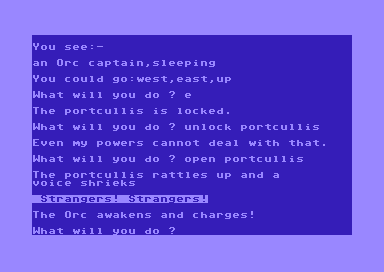


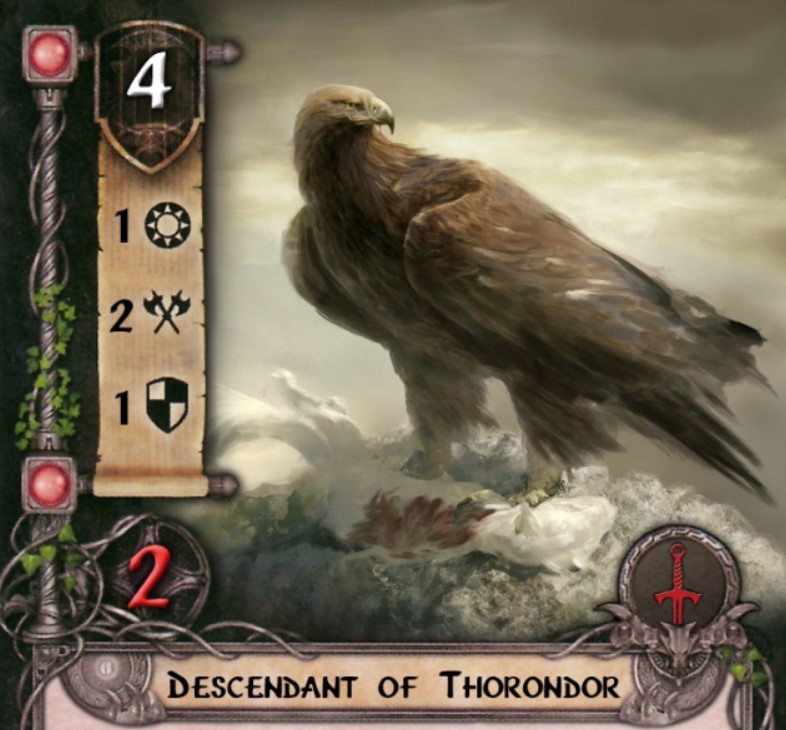




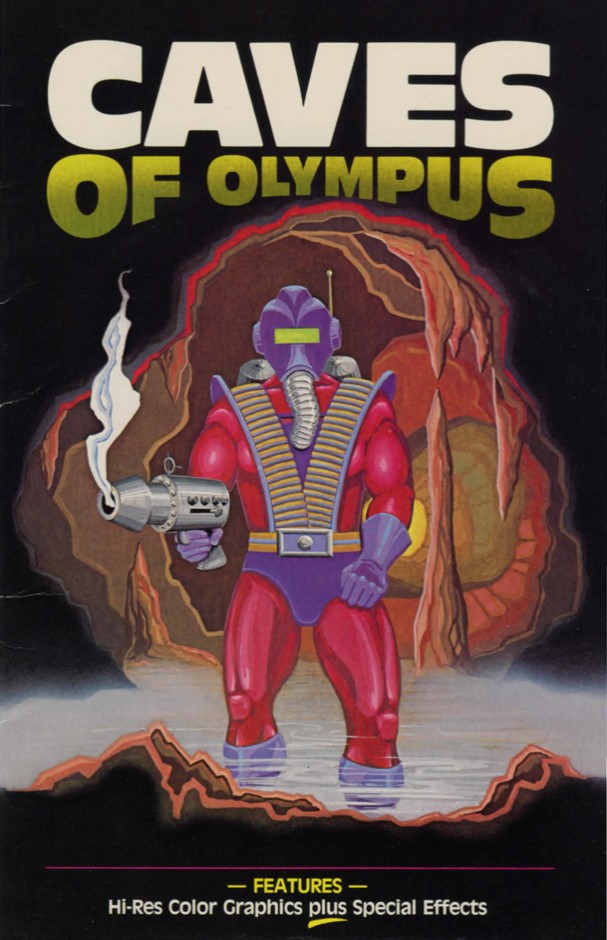
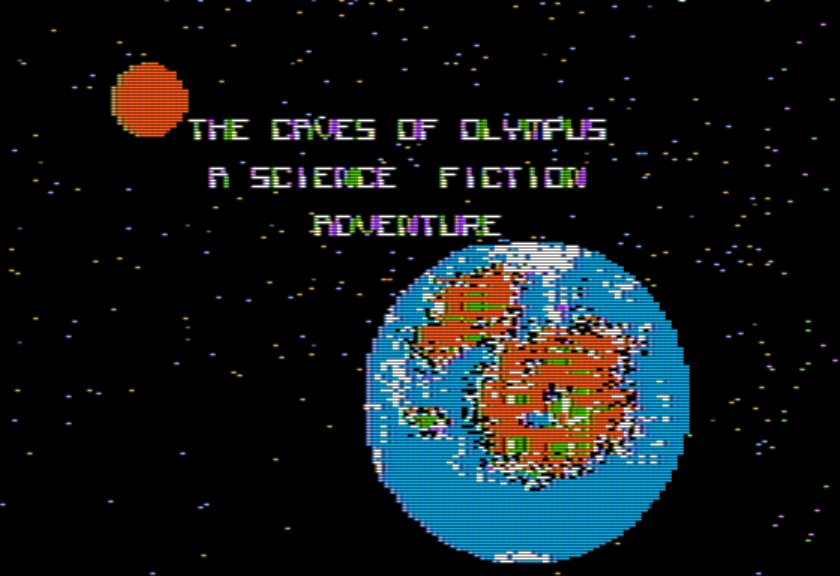
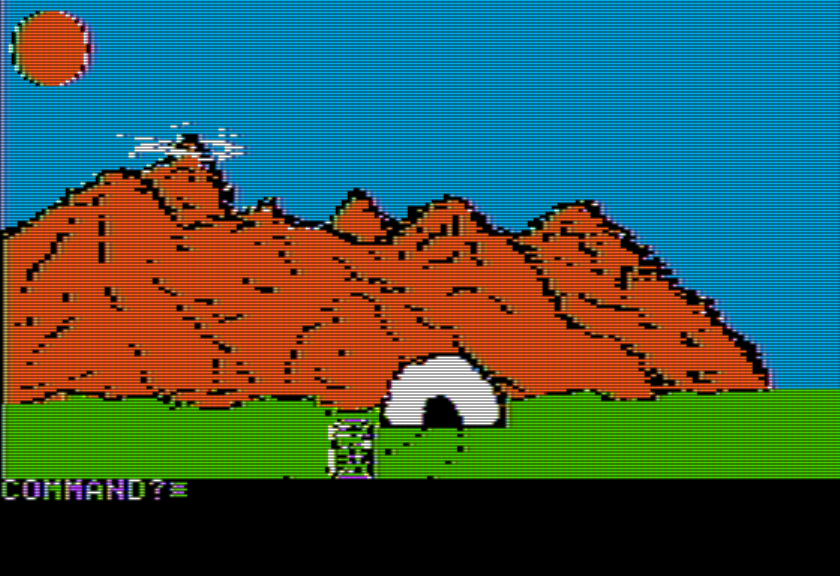
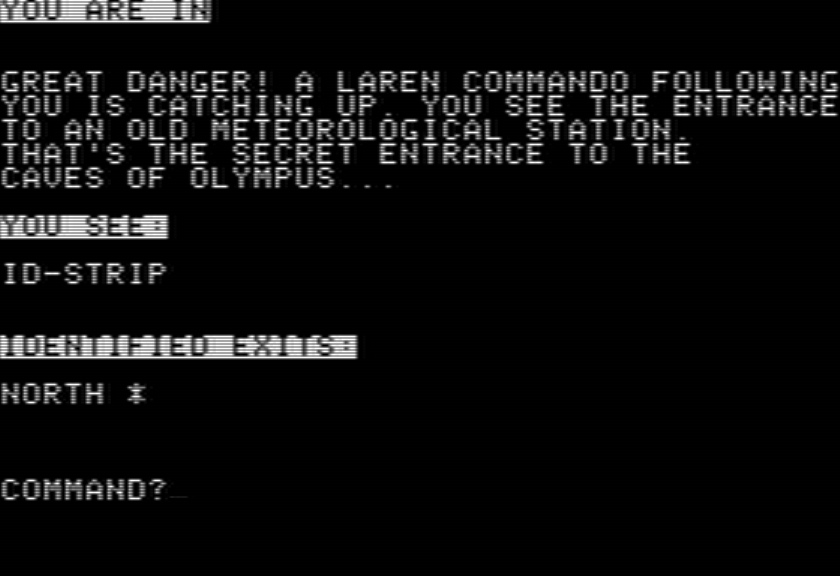
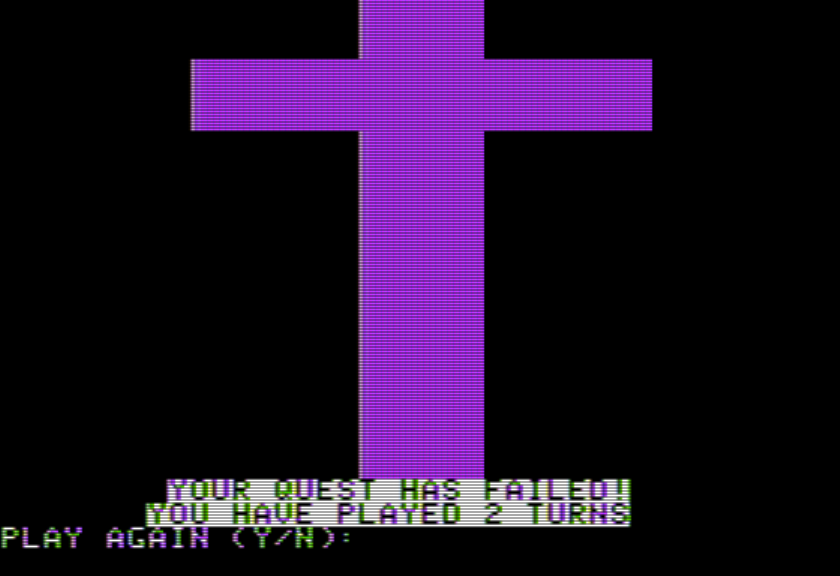
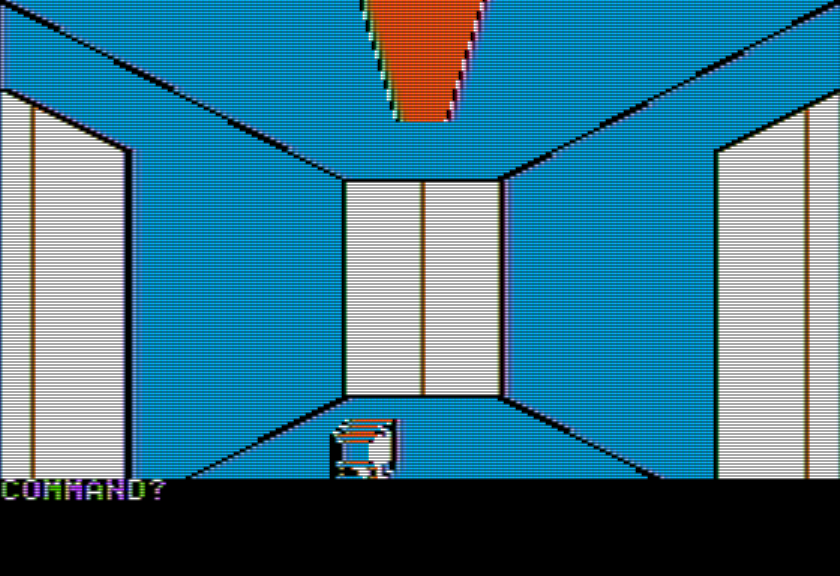
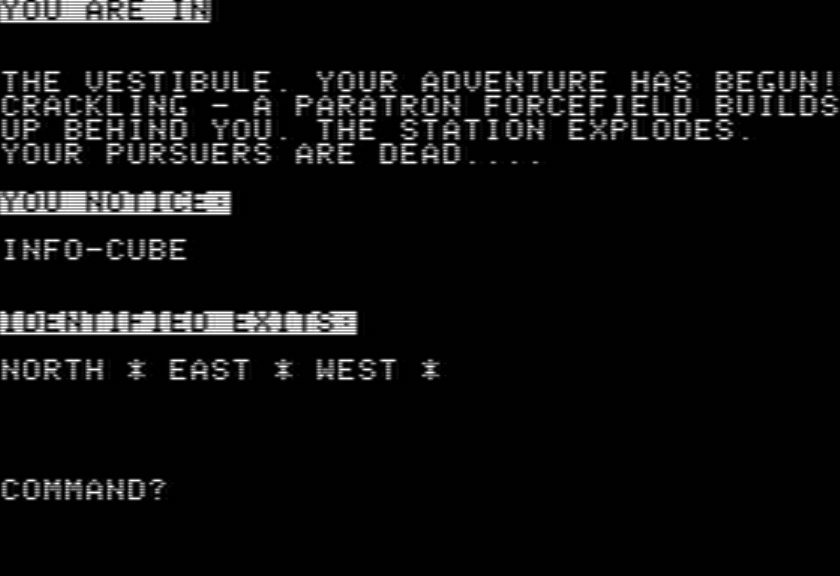
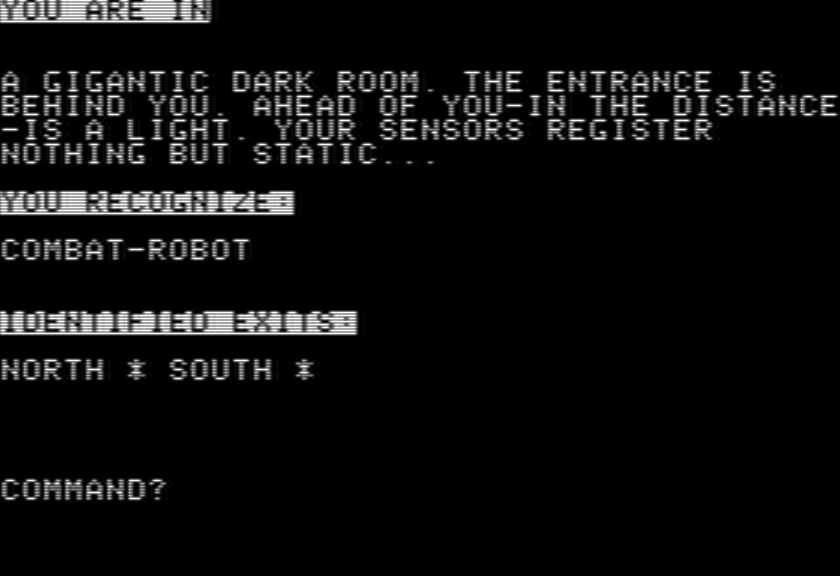
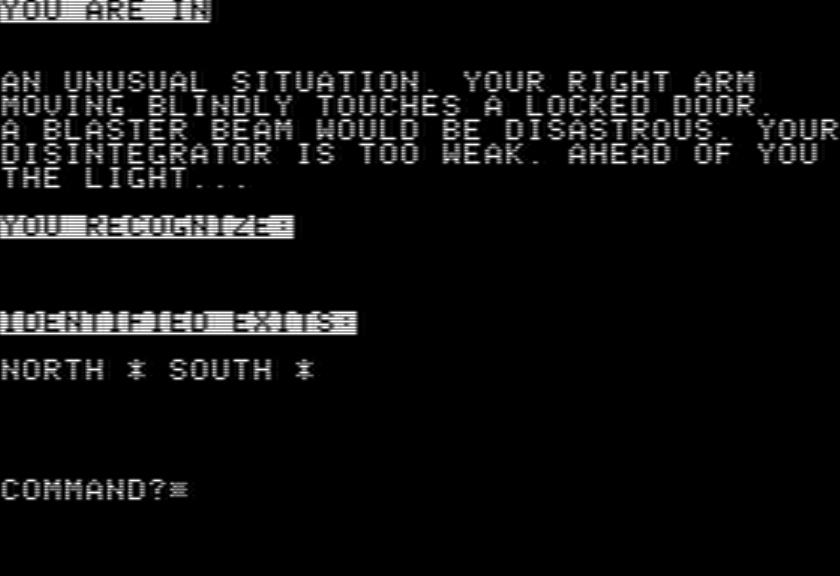
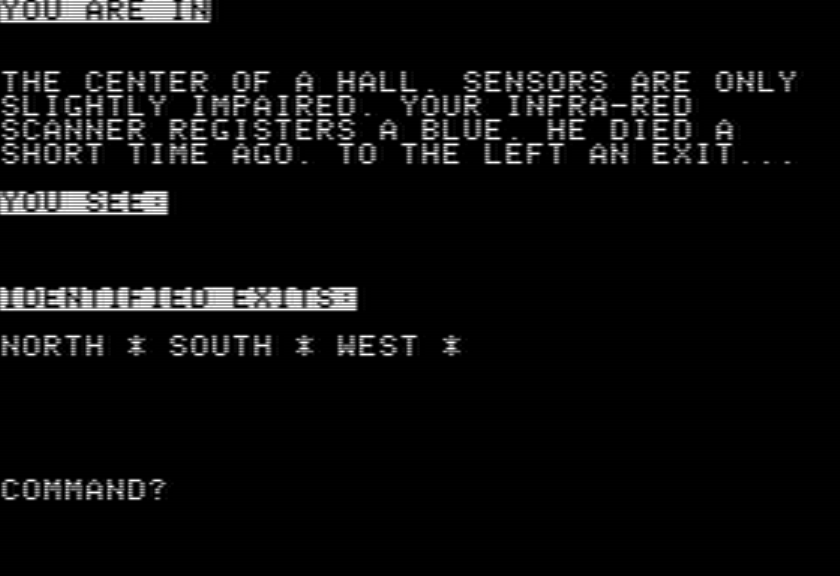
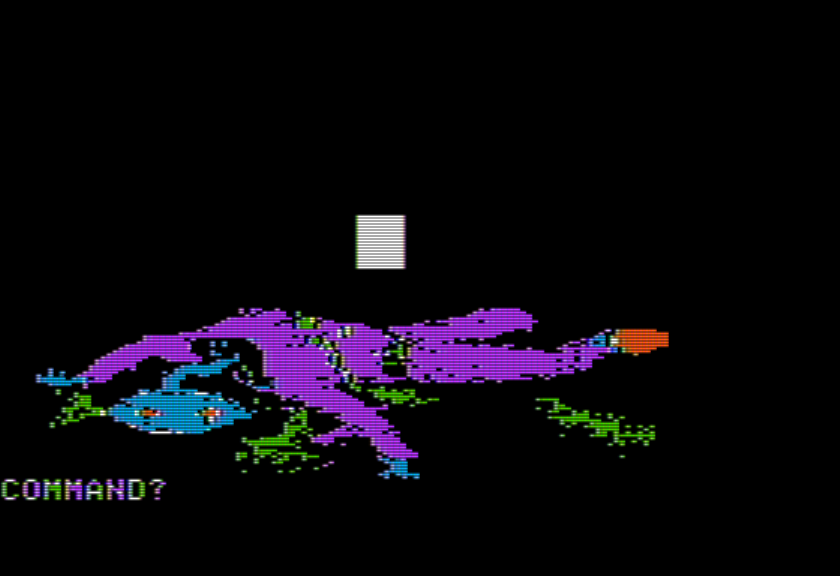
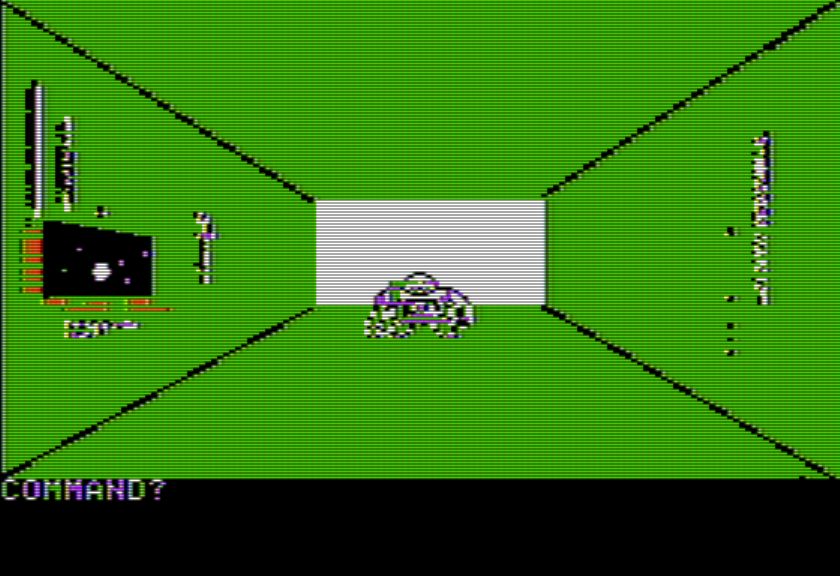
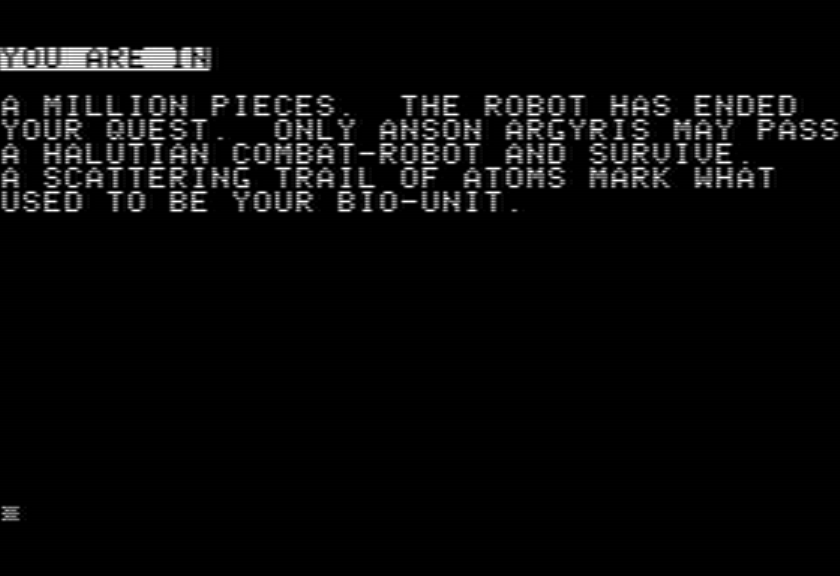


 Renga in Blue