It turns out — despite multi-line issues to an extent it’s still puzzling what happened — Gus Brasil had already busted through with the power of editing the BASIC lines directly, so was able to put a “fixed” version of the game. This fixed version still crashes at a critical point but it was enough for me to get through to the end of the game. (EVEN MORE EXTRA: Stay tuned to the end — there’s a specific reason all the issues happened.)
I’m still not entirely sure about two of the puzzles, but let’s continue from where I crashed last time…
…which was at the trunk shown, where the game just breaks with a syntax error. The fixed version goes past this, revealing that inside the trunk there is a small chest.
Unfortunately, trying to OPEN CHEST brings up the EXPLOSIONS which got us at the troll cave last time.
The chest-in-trunk is a trap, and one we’ll get back to, as I was able to (with the fix) use the ASK command. The reason the original broke is it set a variable marked ASK, which nameclashed a protected word in Color Computer BASIC (ASC). The exact circumstances here are important not only to fixing the problem (just change the variable name to something else) but also because it seems impossible this would happen with some kind of bad dump error. Yet, how was this game able to run then? There was a review in the Rainbow only two months after the game’s release which didn’t mention any fatal bugs, although the reviewer did have the same problem as I did in figuring out what the graphics were supposed to depict.
Yes. Nice green grass. Pretty green trees. Purple tree frogs. And, oh no. We’ve broken a rule and told you something about the adventure. Yes. that thing is a tree frog.
Well, we weren’t sure what it was. We tried a bunch of things and didn’t get it right. Finally, we went a-hunting in the list of variables (one reason I like Basic Adventures — when I get stuck I can cheat) and figured out it was a tree frog. And, while I still have not found out what to do with the tree frog, at least I know what it is.
The review does, importantly, indicate that the reviewer did not finish the game. Maybe they didn’t try using the ASK command at all?
Oh, by the way, the tree frog is used for nothing. I think. We’ll get back to that later.
With the ASK command working properly, I was able to ASK ORACLE — the wandering old man with the staff and ASK SHINVA, the tree dryad. In both cases they gave cryptic hints.
Speaking of cryptic hints, I’ll mention I knew RUB was a verb that worked (both from using my verb-testing list, but also plowing through the BASIC code later trying to diagnose crashes) and found it applies to the URN.
This technically gives four clues: TRANSLATION OF FIVE WILL GET YOU CASH, U REPLACES K, YKG / KYA (on the urn), and CIRCLE THRICE IF TRAPPED (as “said” by the urn). I have no idea what what the first three clues mean; I’ve finished the game and circling thrice is the only one I “used”.
I spent a long time trying to get literal translations of the word “five” (like “cinq”) to work out to something, but without luck; to be honest I was still leery about the possibility there might be some broken code, so I poked around until I found curious reference to a noun “BOT”. This was in the OPEN section, so I tried OPEN BOTTOM while holding the chest, and it worked, revealing gold coins.
Now, do the unused clues point to this directly somehow? Or maybe the clue about five points was meant to apply to something in one of the items that I never used in the game (to disclose right now I never used: hip boots, mushrooms, stump, lake, fishing net, tree frog) and from that item I would get a second clue suggesting I could have opened the chest from the bottom safely. Or maybe — and this is very very possible — the author(s) had some elements in mind but never bothered implementing them due to running out of space / time / mental willpower.
Fortunately, I had already done ASK TROLL (“MONEY FOR SAFE PASSAGE”) so I knew where the coins needed to go.
That is, while you can kill the troll with a sword, the cave is then trapped with an explosive and you die. All three items carried at the start (sword, food, rope) are red herrings.
This led to a new area…
…and a new background graphic. Finally not the same three trees over and over.
Just this graphic over and over instead.
An offshoot branch leads to a rock blocking the way which I was unable to move. You can try to JUMP ROCK but you hit your head on the ceiling and die.
What’s important to start is an axe to the far west of the cave. With the axe in hand, it is now possible to go back to the ogre and the princess and KILL OGRE (sword wasn’t able to get through the tough skin, I guess).
With the ogre dead you can now ASK PRINCESS and crash the game.
Using video capture I still wasn’t able to get right up to the crash so this is missing a word.
I think the message is about using the nymph’s “name” but after multiple repeats it kept zipping by so I’m not sure. Either way the word SHINVA isn’t useful, but I knew (again from needing to extract the verb list during debugging) that VAN was a verb, so maybe VANISH which is an anagram?
Yes! This let me get down to a small 2 by 2 area of caves with apparently nothing in them.
Going back through the clues I had not used yet (which was all of them at this point) I decided Circle Thrice could apply here so I tried going E, S, W, N repeatedly, doing a circle and seeing if something would happen. On the third time while going west there was mist described visually by giving the word “MIST”.
Then going north led to the key, which landed in my inventory without having to even pick it up.
Thus I was able to get back to the cage, OPEN CAGE, GET PRINCESS, and walk my way to victory (go back to the castle at the start and GO CASTLE).
To the best of our knowledge, the majority of the software companies you mention went out of business years ago and are no longer marketing software for the Color Computer.
I’ve found other Genesis Softwares, including one in Missouri founded in the 90s, but that’s a fairly popular company name so I don’t think they’re any relation; the trail goes cold for now.
Thanks to everyone in the last thread who helped with prying open this game’s secrets. I am still Secret Agent-ing in German so we’ll get back over to the normal TRS-80 next time.
EXTRA: Gunther has the extra issue worked out (one of the lines was too long) and has a download here. This version of the game works with no crashes.
In order to fix that issue, he modified the princess dialogue line to cut the apostrophe-S from the word “NYMPH”:
Also, all the spare clues have now been resolved. Gus Brasil found that if you LOOK CHEST you get an additional picture with helpful information:
These letters shifted (translated) by five will get the command OPEN BOTTOM as needed to open the chest safely.
Regarding the urn’s text, as noted by John N…
…applying the “U for K” clue gets ?U? U?? which is close enough to RUB URN that it seems like the game is meaning the player to jump the rest of the way (the similarity to OPEN BOTTOM helps). I had skipped needing this information as I had solved the puzzle by simply knowing RUB worked and it ought to be tried on things that looks magic.
EXTRA EXTRA: As BB Durall observes in the comments, ASC is not a protected word while loading from tape rather than disk. Gunther tried extracting the BASIC and using that to be in no-disk mode and was able to get the game to run without modifications. Download the BASIC here, then run with xroar -m coco -no-machine-cart -run ENCHANT.BAS which will load the file “off tape”.
Genesis Software — at least the version of the company we’re talking about here, not the business software company from Washington — started advertising in The Rainbow in October 1982.
The magazine was, essentially, the central information outlet for the TRS-80 Color Computer all the way up to 1993. Nearly everything for Color Computer went through its pages. The only evidence of Genesis Software’s existence outside of its games is from its ads in the Rainbow. They were based in Manchester, Missouri, and since they used a PO Box and no other identification in their source code that’s all I can say. In addition to Enchanted Forest which we’re playing today, they also published two more adventure games in 1983 (Bigfoot, Secret of the Crypt) but neither is currently available on any archive.
While we’ve had adventure games dating back to Mystery House that imply objects solely through their pictures, there’s still text scattered throughout. This game has the unique aspect of wanting to show all the action solely through pictures.
This might be completely fine with a high-end enough system (or even an Apple II with a skilled enough artist) but let me give an example of what I was dealing with in Enchanted Forest:
Is it a jellyfish? Tiny yoda? An alien blob? This is a TREE FROG. Fortunately the game gives an extra command (WHAT) to let you know what’s nearby, but the fact an extra step is required suggests the author genuinely hoped it’d be unnecessary.
So if the TREE FROG is there, where are the lake, stump, and mushrooms in the picture? This game also features directionality, akin to The Haunted Palace: you can LOOK NORTH, LOOK SOUTH, LOOK EAST, and LOOK WEST. Most directions just have the three trees; in the location above typing LOOK EAST shows a different scene.
If you walk a direction (north, south, east, west) you will automatically be facing that way when you enter a new location. In the place you start, where there is a castle in the distance, you start facing south; you only see the castle if you re-enter the same room going from south to north or LOOK NORTH while standing there.
Here’s the overall map I was able to reach:
My particular phrasing of “was able to reach” usually indicates this is going to be a part 1 of x post. Unfortunately, I was stopped because the game — at least the copy of it available — is very broken. There are numerous crashes at essential points and it is clear there’s something corrupted in the lines preventing progress. An picture to illustrate, where the game crashes in the middle of drawing a graphic of an open trunk:
This is followed by
SN ERROR IN 1255
which is just a long list of drawing commands.
I can at least give a general idea of the gameplay. You start with a rope, sword, and food; your inventory limit is 3 so you can’t pick anything up without dropping something off first.
The Enchanted Forest of the title is very open; available just from walking around are a lantern, old urn, fishing net, and hip boots. One room has Shinva the Wood Nymph (where I would love to ASK SHINVA but that command crashes the game)…
…and a troll guarding a cave (which is easy to KILL while holding the sword from the start of the game).
Unfortunately, entering the cave kills you with EXPLOSIONS.
The princess we’re looking for is out in the open, past a sign that says BEAST IS EAST.
Because of the directional views, if you approach this room from the south (and don’t LOOK EAST) you won’t see the sign.
The tree frog I mentioned earlier is a wandering creature, as is an ORACLE who can appear in any the normally empty rooms.
ASK seems especially pertinent here, but again, game crash.
I tested this with all the different CoCo versions and multiple emulators but no dice; the crashes feel “authentic” to me in that I think the emulator is reacting appropriately to the code that’s in the file. That is, something went wrong in the process of dumping the disk. It might even be possible to repair the damage but it isn’t just a single line causing the crashes, so this goes back on the technical issues pile for now.
I did want to document this game, because directionality-graphics are quite rare for this time and it seems like everyone who used them came up with idea on their own (the only game in the category that because famous was Asylum II; however, that was designed around an RPG-style maze so isn’t quite the same gimmick as Haunted Palace and this game). Rather than the graphics being like pages of a book giving a full view of a location, they resemble more the actual perspective of the avatar in the world.
Coming up: Geheimagent XP-05 — Abenteuer-Spiel in deutscher.
Dobbs was too much occupied with other thoughts to take any account of how he was sitting. Just then he was looking for a solution to that age-old problem which makes so many people forget all other thoughts and things. He worked his mind to answer the question: How can I get some money right now?
I like what this game was aiming for conceptually but the technology (that is, a late-70s or early-80s computer) didn’t hold up with the goal. The basic idea here was to use the MAKE command to build a number of things — far more than any prior game I’ve seen in this chronology — turning combinatorial object creation into a regular mechanic rather than a one-off novelty. The idea works in games like Return to Mysterious Island but that game has pictures of the objects and a UI that clarifies what’s going on. Let’s return to the issue in context and go back to a chunk of map I missed —
Right where I bribed the guard and got a FILE, I used it to nab a CHAIN, get a BAR out of a skylight, and escape. I did not think about the fact the DOOR is also now described as OPEN.
Implicitly I think I was imagining there’d just be guards back there; I was half-right but the half-wrong part was vital.
If you don’t GO WEST as shown above, you can nab some keys, then break into an office and two cells. The office has a map showing the town as well as a FULL CANTEEN (don’t drink it, it isn’t water).
One cell has a hanging body with a paper that has TRANSLUCENT PARTS. You can also use the file on the rope to get it (I did not figure this out straight away and had to loop back long after, but I’m saving time in the narrative). Across of the same cell, reflective of the general prison standards, there is a man who isn’t dead yet but drops over a turn after he gives you a message.
Searching the second man reveals some SPECTACLES. I’m going to condense my prolonged narrative and mention that USE SPECTACLES will cause them to light the paper on fire, revealing a message.
(I have never ever seen any spectacles with this effect, and this won’t be the last bit of dodgy science you’re going to see.ADD: OK, I checked and there are extreme enough reading glasses to make it work. Mea culpa.) This code ends up being useful at the bank — and I even knew immediately it must go to the bank — but I had to check a walkthrough (via Strident) to know how to phrase it. I’m guessing the Spectrum version (which he played) was more helpful about this?
Dark Star gave the syntax out when asking for HELP, but this game does not give any. As far as I can tell the only way to know this syntax is to imagine the same thing carries over between games, because the assertion doesn’t follow a verb-noun pattern.
This gives a SAFE DEPOSIT BOX. The box contains a passport but the passport is in need of a photo. I already had the bottle of developer, tray, photo sheet, and room that could be made dark, but the game let me know about a lack of CAMERA. It turns out — and I had to look this one up too — the safety deposit box and a SKEWER from a house can be used to MAKE CAMERA.
Could a skewer poke a hole in that? Is that even the right shape for a camera? Is a pinhole camera really enough to make a passport photo? (Indeed the author could have been visualizing the box “correctly” but just saying IT’S EMPTY upon examining it is not sufficient to avoid disjoint visualization.)
At least the game is very specific about the verb FIX here which is not being used in the “repair” sense like it normally is.
Before hitting the cavalcade where things getting even wilder, here’s the remaining object list: BLANKET, SOME WOOD, EMPTY CONTAINER, WIRE, METAL STRIP, IRON BAR, WHEELS, CANTEEN. There’s also a HORSE in a stable, petrol pump and an ENGINE that is too big to carry, the GOLD INGOTS equally too big to carry, and a JEEP that is stuck in QUICKSAND.
The container is used at the petrol pump to get some gas over to the jeep and fill it. I got that far, at least. I also got part of the way to figuring out the WINCH; there’s a pulley that can be mended as long as you’re holding the IRON BAR (shown above) and then MAKE WINCH while holding the chain. Except:
It turns out you can ENTER JEEP … except for the quicksand, which you can cross by USE BLANKET. Why THROW BLANKET does not work is beyond me (leaving the jeep, you don’t use the blanket again, so you ought to get stopped by the quicksand; best just not to think about it to much).
Here, you have to put together the fact the CANTEEN is in fact holding acid, the wire, and the metal strip to MAKE BATTERY. This does not sound safe or even like it would work.
However, you also need the ENGINE. Going back to the HORSE, the only unused items are the WOOD, the ROPE, and the WHEELS, which is sufficient — without nails, a hammer, or any supplies really — to MAKE CART.
MAKE is such a risky verb when any noun in the universe is technically possible, especially if the author is fishing for something specific. This was way too specific for me. I did not visualize the wood as being of the volume for this kind of thing, or the wheels as the kind of thing that would somehow attach without any extra bolts or assistance. Again, I get where the author was going, but with minimal descriptions or no descriptions at all this requires abductive reasoning of colossal size.
The cart allows picking up the ENGINE and delivering it to the JEEP. You can move the GOLD closer while you’re at it if you want. With that done you can START IGNITION, LEAVE JEEP, and MAKE WINCH, finally pulling the jeep out.
The gold fits into the jeep, and apparently we are just getting waved through because it’s the 80s.
Flashing so I couldn’t quite get the whole word “ANOTHER”.
In a narrative sense this had a theme of greed rarely seen in an adventure game from this time. That might seem like a bizarre statement given the number of Treasure Hunts we’ve experienced, but the emphasis has very rarely been on Getting Rich; the treasures are treated as a generalized mechanic for sending the player in all directions. (In some games, the treasures are being moved inside the dungeon/pyramid/complex rather than “liberated”.) Here, there’s no reason we have to take the risk to also get the gold; the passport would normally be enough for an escape, but the protagonist is suffering from That Age-Old Problem. Hence I got more interesting narrative out of this game than the same author’s Haunted House (which is pure treasure hunt) but the leaps of disjoint visualization required to MAKE the objects required left me feeling sour.
Via MZ Sharp Archive.
Still not a terrible game to end the Sharpsoft saga (for now) on. Five 1982 games to go!
Strident in the comments pointed out that a download for this game also exists in MZ-700 format, with color. I have tested the two versions and the major difference is that the first line is missing in the MZ-700 edition. It has two POKE commands followed by REM BY GEOFF CLARK JULY 82. I think it likely whatever shenanigans caused by POKE wasn’t needed and the removal of the author name was an unintended side effect — especially given the name stayed on Secret Kingdom — but swapping back and forth they’re essentially the same just with the addition of color.
From the Sharp MZ Archive.
To recap, I was in a cell with a blanket on a bed but otherwise no apparent resources. The guard was noted as bribable but I didn’t have anything to bribe with.
Now with color! Here I was trying to GET a BRICK. TAKE BRICK properly mentions a BRICK rather than a RICK. I assume the game trims the first five characters (“T”, “A”, “K”, “E”, “ ”) but the author forgot the synonym was shorter, causing the effect.
I had already tested verbs thoroughly, so maybe the problem was nouns. I thought I had tested those thoroughly too, trying LOOK FLOOR, LOOK WALL, LOOK CEILING, LOOK BAR, and LOOK CHAIN. The latter two give YOU CANNOT SEE IT HERE rather than the “doesn’t exist” kind of feedback which is important information, but doesn’t quite help set off the chain of events.
I had a problem of visualization. The skylight is BARRED AND AT GROUND LEVEL, but I assumed this was just to indicate it was a funny kind of skylight that wasn’t strictly aimed at the sky. What didn’t occur to me was that this also indicates GROUND is a recognized noun, and that I should be visualizing the cell as not having a FLOOR but rather just being GROUND.
FEEL at least was on my verb list although I think SEARCH should map to the same action (I would visualize someone searching a floor after seeing a glint as using their hands). The glint is a GOLD COIN. You can then SHOW COIN to the guard, followed by GIVE COIN.
GUARD TAKES IT AND DROPS SOMETHING
The something is a FILE. Since I already had the two nouns mentally stored, FILE CHAIN and FILE BAR came to me right after (both give a CHAIN and a BAR respectively), and I was further able to ENTER SKYLIGHT to escape.
Now the game puts up a hilarious contrast with the opening constrained section, as there’s a lot of rooms. I’m going to give the whole map at once (at least as I have it so far), then explain it in pieces.
To start with, there’s a giant 7 by 10 plain. There’s no thirst meter or concern about timing; you can map out at your leisure a series of rooms which are mostly all the same.
This reminds me of Dark Star having the giant 8 by 8 crater with random items tossed in. This is not typical for adventures of this period; even Time Zone wasn’t quite so blatant. This essentially encourages CRPG-like “lawnmowering” checking each square. This game has the fortunate interface addition of being able to move around with the arrow keys so this isn’t as bad as it sounds.
One thing I do find fascinating in a historical-analysis sense is that Dark Star was by the other Sharpsoft author. The authors essentially formed a miniature “school of design” with common patterns, just like artists from the same Renaissance workshop have the same affectations. We’ve also seen that with the multiple authors from Aardvark who tended to use interesting geography tricks — also the same bad parser, but the geography tricks are not something determined by a common codebase as much as overarching choices in design.
Returning to the game at hand…
…just a bit northwest from the start is a stuck jeep and a large rock. The jeep is described as having a PULLEY IN THE FRONT. There’s also an ENGINE nearby — which I presume goes in the jeep — but it is TOO HEAVY AND YOU NEED SOME TYPE OF TRANSPORT.
I’ll just skip ahead and mention there’s a town with a whole slew of items, including a SHOVEL. With the shovel I tested each and every room in the big plain using DIG before hitting literal paydirt.
We’ll visit the town in a moment; two more stops. To the north is a garage with a petrol pump, and the garage itself has SOME WHEELS. I assume these also go to the jeep.
Farther north still is the US-Mexico border where you need your papers to cross.
The overall quest seems to be thus: a.) put together the Jeep with various parts b.) pick up the gold with it c.) get a passport somehow d.) escape with profit assuming they don’t ask too many questions at the border. It’s sort of the plot of Three Kings without the war in the background. I assume we don’t get to shoot a bazooka either.
As far as “various parts” for the jeep go, let’s hit the town.
Most of the locations are empty of people and serve to deliver items. This includes a SKEWER, METAL STRIP, WIRE, SHOVEL (as already used), PLASTIC TRAY, EMPTY CONTAINER, SOME WOOD, a PHOTOGRAPHIC SHEET, and a BOTTLE with some developer fluid. The latter two are in the same building and there’s additionally some curtains that can be “DRAWN” to make the room dark.
I assume the plastic tray also gets used in this procedure. I do not have a CAMERA yet but the game recognizes it (there’s no I DO NOT THINK THERE IS A AMERA message upon trying to GET one).
Of special note is the stables which in addition to having the EMPTY CONTAINER also has a HORSE. You can GET HORSE like a regular object and I assume do something with it hauling the jeep out of the quicksand but I haven’t tested this far yet.
There’s also a bank (BANK’S ARE SMALL if you try to enter with a horse) and I’m not sure what I should be doing. I am unable to GET CASH or GET LOAN or anything like that but none of the shops have shopkeepers to take money anyway.
That’s everything so far! I’m definitely just stopping to report in rather than stuck, as I have to try to build something to pull a jeep. I accidentally hit MAKE WINDOW while in the cell and found the command was recognized (YOU DO NOT HAVE EVERYTHING YOU NEED) although my guess is the “WIN” in the three-letter parser is standing in for WINCH instead.
Here is the last of the Sharpsoft set of games from 1982, the series that included Secret Kingdom, Haunted House, and Dark Star.
I’ve got historical background here from writing about Secret Kingdom and here writing about Sharpsoft’s 1981 game Escape from Colditz. Like Secret Kingdom, this one didn’t have A.J. Josey involved, but was solely the work of Geoff Clark.
You have just come to from concussion, you have lost your memory. You find yourself in a Mexican prison, your aim is to escape from prison and return to Texas a rich man.
Often our protagonists start in jail for crimes they didn’t commit; this time I’m wondering if the player is jail for a crime they did commit. In a gameplay sense, we’ve seen approaches all over the map for opening prison escapes, it being something like a mini one-room game to start proceedings. They sometimes involve breaking out a window (Escape from Rungistan) or out the front (Devil’s Island, which memorably involved having to start by waiting 2 minutes in real time before killing a guard).
From doing LOOK BED you can find a BLANKET. LOOK DOOR reveals THERE IS A GUARD OUTSIDE and LOOK GUARD notes
GUARD LOOKS GREEDY
and I’m not sure what this means, but this is clearly signaling some kind of bribe to start (which I think is new!) BRIBE GUARD gets the response
SHOW IT TO HIM FIRST
but there’s the slight problem that you don’t start with anything valuable.
The SKYLIGHT is BARRED AND AT GROUND LEVEL but doesn’t seem to respond to commands otherwise.
And … that’s as far as I’ve gotten. This is another kick opening where it’s hard to do anything. I did manage to crash the game by typing GET without an object
but I have made no progress past this point. Here’s my verb list attempt:
STA gets NOT YET so I don’t know if that verb is STAND, STAB, or START.
The verbs at least have distinct failure messages. DRINK responds I THINK YOU HAD TOO MUCH TO DRINK ALREADY (not sure our memory issues are just from a concussion!), BURN chides the player with YOU ARSONIST!, DIG responds YOU DO NOT HAVE A SHOVEL, and CONNECT cryptically responds THINK.
I could of course prod open the source code (it’s BASIC) but I feel awkward doing so on the very first puzzle. Having a “kick opening” (start of the game with a tough puzzle) is extremely risky and makes it seem to the player like something might be broken; Wizard and the Princess starting putting cards in packages explaining how to solve the first puzzle. I’m wondering if Sharpsoft received any grumpy letters or anyone who bought this game just coped.
I’ll take speculation from anyone who hasn’t played, but if someone has managed to get farther on their own, I don’t want any “real” hints yet.
(For those who were anticipating the Misadventures rather than this game, there were technical issues severe enough I’m kicking the games to my loop-back list. This means once Mexican Adventure is done I’ll have five games left to go for 1982.)
From the North Star Catalog, January 1978, via Bitsavers. I tested the North Star version of this game some and the only major difference I found was that the oil for the lamp was placed one room over.
I was originally going to title this post “Outsmarting the Parser” but one puzzle near the end (the last treasure I couldn’t get) dropped me with a pile driver from the top rope.
Continuing from last time, I started prodding at various elements in the environment trying to get them to be recognized. I came across some luck with a suit of armor in the entry hall.
ARMOR MAKES SENSE–BUT TOUCH??
This is different than the usual message which would be TOUCH ARMOR??, so I ended up just jamming through the various possibilities on my verb list.
OPEN turned out to get a different reaction, meaning it was possible for OPEN ARMOR to do something useful, but what item was I missing? I had a piece of cheese still which didn’t seem right, but maybe the hammer?
I would not have gotten that without some of the parser juking there. The whole sequence gave me pause, though, because even in some circumstances with an item I knew was usable, (like the lamp I was holding) I wasn’t getting the “MAKES SENSE” message. I played around some more and realized not only was the parser cutting at five letters, to get the “MAKES SENSE” message on an noun that can be used it needs to be typed in at exactly five letters: no more, no less. That is, the command “TOUCH LAMP” gets
TOUCH LAMP???
but “TOUCH LAMP ” with the extra space at the end gets
LAMP MAKES SENSE-BUT TOUCH??
This turns out to be a vitally important fact which helped me break most of the rest of the game. Going back to the drawbridge puzzle from last time:
The screen above shows the state of the drawbridge room before having applied the oil to the gears. If you do any verb followed by GEARS, the game will recognize the noun GEARS. Even a non-real-verb works; after Z GEARS:
GEARS MAKES SENSE-BUT Z??
Getting this important message means that the gears is a recognized noun in the state of the room at this exact moment. After doing OIL GEARS, gears no longer is recognized, so Z GEARS gets the regular message of
Z GEARS???
and you’re instead supposed to refer to the TEETH, so that noun gets activated. Then, after PULL TEETH, the game reaches the horribly stuck condition I was in last time.
I had already rammed through a verb list (ROTATE, TURN, MOVE, LOWER, OPEN, OPERATE, USE, PUSH, PULL, SPIN) with the DRAWBRIDGE, MECHANISM, GEARS, and TEETH. Rather than futilely testing the whole set on every noun in the universe, I could now check to see what noun was actually recognized through the “MAKES SENSE” trick! I did Z on every plausible and non-plausible object that might be referred to in the room before finally hitting paydirt on … the noun BRIDGE. Not DRAWBRIDGE, but BRIDGE. Sigh.
Doing this unleashes some RATS. I was able to give the rats the cheese I had been hanging on to (turning them into FAT, LAZY RATS) and then I could take the rats whilst holding the sack. They’ll be useful later.
I was then able to use the MAKES SENSE trick to figure out the heraldry room. (I want to emphasize I would not have found the trick at all except the word ARMOR had exactly five letters in it. This feels a bit like when a speedrunner finds a glitch that allows skipping a level just because the exit was made 80 pixels high rather than 78 pixels high.)
Mind you, no noun in the entire room description succumbed to the trick: I did Z LARGE, Z COAT (with that crucial extra space after), Z ARMS (ditto), Z HOLE (ditto again), Z VOLUM, Z BOOKC, Z SHELV. This meant I could say with confidence that the solution was not “verb + some noun in the room”. This of course assumes that there is a solution, but the hole in the volume was screaming for something to happen.
Excluding the magic words (which I tried) this left “verb + some noun I was carrying”. I remembered (or rather, noticed from my map) that the SIGNET RING started in the room, so I took that item over and crawled through every verb on my standard verb list, hitting paydirt with INSERT.
Does this feel like “adventure gaming”? Not in the slightest. But at this point I’m satisfied with beating the computer.
The passage leads to the last area of the game, where things mostly went smoother.
The area is mostly dark which means the dragon is in play. I ended up having to get the bow/arrow setup just in case; just note that the dragon can come back any time after being shot, even the exact same turn it gets shot! A much better solution — which I found out when I was done with the game — is to carry the “friendly dog” around which scares the dragon, kind of like the kitten in ADV.CAVES. (The dog is needed anyway because it counts as a treasure.)
The “through happiness” hint applied soon after, as there’s a wine room with a wine bottle (treasure) in a rack.
With some intuition I tried Z RACKS and hit paydirt (that is, it gave the MAKES SENSE message so I knew the noun was recognized), so I just needed to roll through a (very long) verb list before finally reaching SLIDE RACKS.
Those treasures I could cart back “by hand” to the start if I wanted. Moving on, there’s a guard room with a key (useful in a second), a dungeon with bones (not useful at all) and a torture room which looked like it held a secret.
Again using the noun-reference trick, I found that the GRATE did not count as a noun as far as the parser was concerned so any method of opening it required referring to something else. Going through my very small inventory (barring the whole pile of treasures, none which seemed applicable) I came across dropping the rats.
The passage this opens leads through a “bottomless room” (door which needs a key) up to a “meditation room” with a chair. The chair again can’t be referred to, but I decided to try SIT with no noun.
The dragon remained annoying through all this.
Once I managed to coordinate sitting in the chair with no dragon, I tried various meditation-adjacent verbs until I hit THINK, which teleported me to a “round room”. Going in a random direction led to a THRONE ROOM with more treasure.
The round room otherwise teleports back into the castle somewhere random, so after a bit of dragon juggling (and some issues with randomness because I had to take a second loop; the round room’s destination is purely random, rather than always landing you in the throne room first) I was able to get out with nearly every treasure in the game. The dog and book with the spells also count as treasures and were non-obvious at first; however, even with those I was short some points.
I needed the walkthrough from this, via Alex, and I’m going to take a guess Alex looked at source code. I don’t know how anyone was supposed to solve this.
Back in the study — which to be fair was on my strong suspicion list — I had found via The Trick that no nouns were recognized. The picture of Merlin made me think of magic, so tried bringing over the various magic gizmos like the ring that had previously summoned a genie to see if I could get an effect: no dice. I finally — and fortunately — gave up, to find the right command is USE MAGIC.
…
…
…
Look, your guess is as good as mine. That’s one of the worst parser abuses I’ve ever seen, including the entire 40 years I’ve been playing adventure games.
Taking the pouch of rubies over (and the book which I hadn’t dropped yet) triggered an endgame, which is tricky as well but at least it’s a different kind of tricky.
There’s a SORCERER’S ROOM, a MAGIC ROOM and a STAR ROOM. Between the rooms there’s a sorcerer’s hat, a book of black magic, a rod, and a star. After some experimentation I realized you could not carry the book the same time as the hat; I started sensing the kind of logic used in Chinese Puzzle with an arbitrary set of object flags that need to be set. I was also suspicious that this was the sort of puzzle where the meta-command HINT was necessary to get anywhere.
MOST MAGIC IS MERELY ILLUSION, BUT YOU DO NEED THE RIGHT PROPS.
Needing the right props suggested to me I needed to make a thing; the only thing that seemed reasonable was putting together the star and rod to get a wand. Some parser struggle followed as MAKE WAND and PUT STAR don’t work at all. The right conditions are:
a.) you’re in the MAGIC ROOM
b.) you’re holding the STAR and ROD, and only those two items
c.) you type ATTACH STAR
Going back to the STAR ROOM and waving the wand, I was clearly on the right track.
After some fiddling I finally got HOKUS POKUS out again and got an ending, but not the right ending.
All the points, though! Maybe we can call this a real alternate ending because our protagonist deserved it.
I finally succumbed to the walkthrough … which told me to do exactly the same thing I was doing. It said
HOKUS POKUS (you must carry the hat or else the wand explodes).
and I was, in fact, carrying the hat. I finally got a success and I think it simply involves making sure the black magic book doesn’t get touched ever at all, but I’m still unclear on this. At least I got a win.
Windmere Estate, despite having the same parser system, was a much better game; it had mostly reasonable actions, it had better pacing, and it had a map that was memorably interconnected with multiple routes. This game’s emphasis on magic was its downfall for the same reason fantasy has had issues in other early text adventures: the lack of rules makes it tempting for authors to make arbitrary puzzles.
Mind you, it’s possible to make carefully crafted rules that elevate fantasy game puzzles to a high level, like Enchanter (1983) did, but we have to get there first. Lurching ever closer! Coming up: Misadventures 5 and 6. Mexican Adventure. (Change of plans, technical issues plus one of them looks to be a bad dump.)
Since last time I’ve prodded open the easily-accessible treasures, as well as one of the less-accessible treasures, but I’m stuck with major parser issues.
Let’s start with the dragon. As Rob observed in the comments last time, the appearances in dark rooms makes it akin to the vampire bat from Windmere, but making less sense. The Windmere bat can also be easily fended off with a cross, whereas here the dragon is more annoying as it can only be dealt with temporarily.
Specifically: if you have the arrow head and shaft, and you’re standing in the “carpenter’s shop”, you can MAKE ARROW.
You don’t need to bother with lighting the room up first either. The dragon is just as likely to appear with the room lit as with the room dark.
With the BOW back at the cottage from the start of the game, you can then shoot the dragon and reduce it to ashes.
YOU LOOSE YOUR ‘ARROW’ AND IT NEATLY PIERCES THE BEAST’S HEART. HE WRITHES ABOUT AND FINALLY DISAPPEARS LEAVING ONLY A SMALL PILE OF ASHES.
However, dragons continue to occur with roughly the same frequency, so this is only a temporary reprieve. I found it better to simply grab the object in each dragon-guarded room (if there is one) and leave. In the rare case where more than one action was required, I went elsewhere a while and came back to re-roll the dragon appearing. (It doesn’t seem to be “random” so much as “alternating” in appearances but I’m not certain about that.)
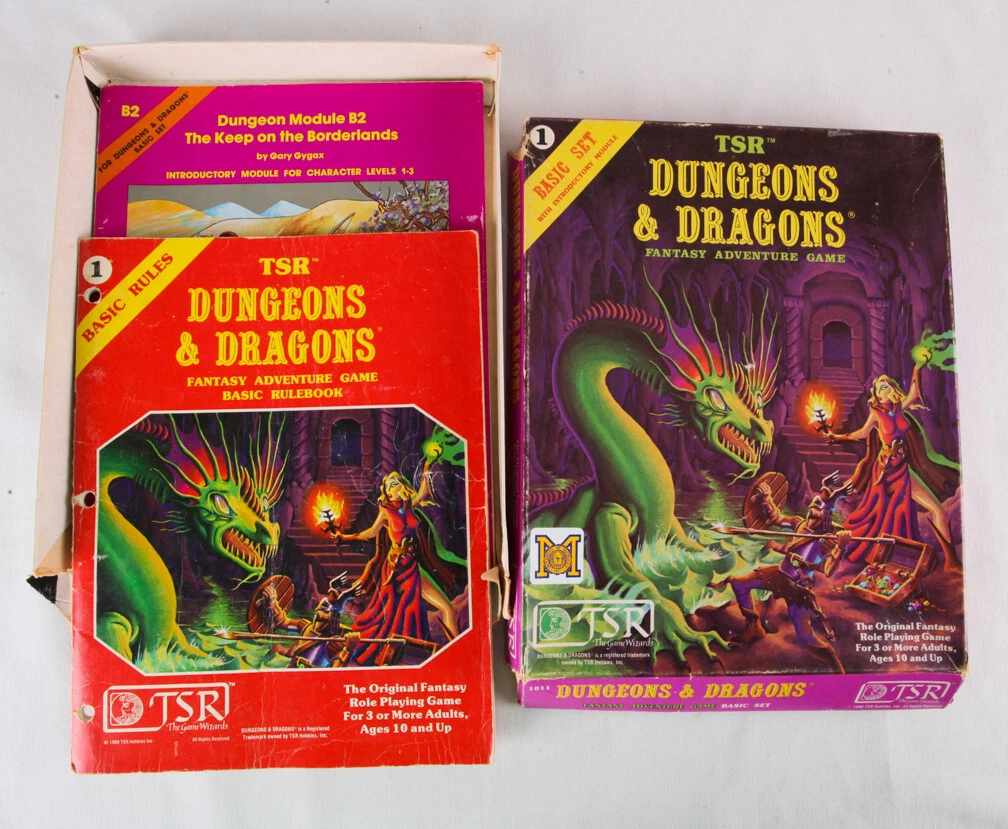
I tried to find an iconic “tiny dragon” from this time period, and the closest I could get to was the dragon on the 1981 printing of the Basic Rules for Dungeons & Dragons. It might fit in a bedroom? Via eBay.
Heading back to another issue, that of wondering if you can refer to anything that’s not a separate object: above the guard room is some busted machinery for the closed drawbridge. Remembering the lamp had regular OIL in it straight from a kitchen, I tried OIL GEARS and it made some progress.
Following this with PULL TEETH seemingly resolves the problem with the drawbridge for good.
THIS ROOM CONTAINS THE DRAWBRIDGE MECHANISM. THE GEARS ARE WELL OILED AND FREE AND THE DRAWBRIDGE IS RAISED.
However, no command I’ve tried has gotten farther than this. No LOWER DRAWBRIDGE, or TURN GEARS, or PULL (imaginary) LEVER. (The last one is obviously a stretch but I ran out of options, and this seems to be bespoke-coded anyway where it’s just fishing for a specific phrase rather than referring to a world-model.) The puzzle appears to be optional anyway, because it is possible to traverse the catacombs to return to the treasure-drop point. An even easier way is to use the magic words HOKUS POKUS from the book back at the library.
This either zaps everything in inventory (except the lamp) back to the the treasure room or takes everything from the treasure room and drops it at the player’s feet. This seems to be based on a.) if the player has a item to be teleported in the first place and b.) if the player has already just used HOKUS POKUS but I’m not 100% clear on the logic. I muddled through enough that I was able to use it to rack up close to 60% of the points, so it works sufficiently well.
(If SHAZAM or ABRA CADABRA work anywhere, it must be in a very specific scenario, because the game usually just says SHAZAM??? or ABRA CADABRA??? like my character has just spoken nonsense.)
Out of those points I’ve attained, a good chunk of them are the treasures from the second floor like a ruby ring, an emerald necklace, and a diamond brooch. A dragon would occasionally show up but the treasure can be nabbed in one turn so an arrow is not required.
One room has a dog, fortunately straightforwardly defused by the MEAT.
Thank goodness it didn’t need to be poisoned like in Bedlam.
On the ground floor there was an atrium with some dirt, and bean elsewhere that it was possible to PLANT. The game said the beans needed more, so I took the MANURE from the stables (needed the sack to get it in the first place) and dropped it, getting a little but not enough result.
I took the CHALICES over to where the water in the fountain to the north was and tried GET WATER, and the message I got indicated the keg of ale got filled instead (??). This is just the game being buggy again: it expects the keg and will claim to use it even when it is in an entirely different room. Getting the hint, I drunk the ale out, took the empty keg over, did GET WATER, and after some failed attempts (like DROP WATER, assuming the interaction would mirror that of the manure) found POUR WATER works.
This leads to a tower with a spinning wheel and some flax. In order to avoid dragon-trouble I nabbed each item away, and then tried SPIN FLAX only to get an error. Fortunately, I was persistent in testing things out and tried SPIN FLAX while still in the tower, and the command worked. This is another bug: the command is location based, not based on where the spinning wheel is!
This represents the only new room of the game I’ve found since last time.
Hence with only one exception I’m stabbing at “secrets” where I’m not sure if there’s a secret, and the parser’s difficulty makes the whole process painful (since I might be doing the right thing, just phrasing it in the wrong way). The one exception I just mentioned is the well to the south of the Castle out in the open:
I’ve got a pillow I tried tossing in — no dice, you can only drop it — and I’ve tried forming a rope out of various items like the silk and/or the thread, again without luck. This could of course be the sort of passage that can only be entered from below rather than above.
Potential secrets include:
1.) A study with a portrait of OLD MERLIN. The portrait seemingly cannot be referred to, but I don’t take anything for granted with this parser. The DESK might also yield something (but not with OPEN DESK or OPEN DRAWER).
2.) A heraldry room which originally held a signet ring. There’s a suspicious hole that is resistant to all my attempts to refer to it.
3.) The balcony I showed off in my last post. You can jump to your death, very exciting. But maybe you can climb somewhere?
4.) Any other room in the entire game.
Even a random nondescript catacomb-room might react to one of the magic words. I am thrilled about the possibility of testing the two unused words (SHAZAM and ABRA CADABRA) in every single one. This is my thrilled face.
WELCOME TO THE KINGDOM OF ZODIAC. IT IS A SMALL BUT VERY INTERESTING KINGDOM. THE LANDS ARE MOSTLY WOODED WITH LARGE OAK FORESTS. THE CASTLE ITSELF IS QUITE LARGE FOR THE SIZE OF THE KINGDOM BUT THE RULER ALWAYS HAS BELIEVED THAT HIS SUBJECTS SHOULD SUPPORT HIM WELL.
This is the last of the North Star adventure games we’ll be playing that was published by Dynacomp (see Uncle Harry’s Will for historical context; Whembly Castle and Windmere Estate were the other two games). Like Windmere Estate, this game is from the mysterious Dennis N. Strong.
This time you start in a glen near the castle and must find and accumulate treasures. The play is the same, but the treasures and circumstances are different.
Again, there are both North Star version and Apple II version again; this time the original Apple II version was broken but now has been fixed thanks to LanHawk. Apple II seems to be the optimal version now for both Strong games. My guess is it was written second in both cases and the author used the opportunity to make some bug fixes (and add a fatal bug in the case of Zodiac Castle, which now has been fixed).
THERE ARE MANY PLACES TO EXPLORE, RIDDLES TO SOLVE, AND TREASURES TO GATHER. THE ‘GUILDED COCK’ IS WHERE TREASURES ARE DROPPED TO SCORE.
Mind you, the game still isn’t bug-free, as you’ll see.
Action starts in a GLEN next to the usual forest-style area…
…with a DENSE FOREST room meant to catch anyone who goes the wrong direction. The game then (upon moving any direction from the dense forest) will either loop back to the same room are send the player to the glen. I am grateful there is no maze.
The tavern with the colorful name is where the treasures go. There’s a LAMP and ALE there that can be taken; the lamp uses oil, as an emphasis on while Windmere Estate was in a “realistic modern” area, this one’s set in a fantasy castle.
To the north is a cottage with a BOW (but no arrows). The sleeping loft above requires light (just the command ON to use the lamp). Upon entering I made a curious discovery:
Either the dragon is very small or the cottage is very large! In all seriousness, in various “dark rooms” across the map the dragon can appear in any of them so I assume does a fair amount of magical teleportation. It isn’t 100% aggressive, and if you grab the cheese and go you’ll be safe, but any hanging around or especially threatening the dragon will result in death.
Petting is considered a threat. In seriousness, this seems to intercept any verb connected to DRAGON to have this result, even a nonsense one. That is, every action is “blacklisted” here and there likely is only one or two “whitelisted” actions that will help defeat / scare away / make friends with the dragon.
The castle has its drawbridge up so can’t be entered directly; if you jump in to swim while holding the lamp, it will get ruined. The trick is to go to the south where there’s a visible ledge and THROW LAMP.
This dumps out the oil if done anywhere else, which is annoyingly inconsistent. If I were giving author advice I’d say to simply prevent THROW LAMP working elsewhere with some message about “that’s risky because the oil might come out, you should only do that where you really need it”.
With that done you can SWIM over (finding a SILVER GOBLET on the way) and then head southeast down a DARK SLOPING PASSAGE into some CATACOMBS. You might expect with that name and the predictability of being a Treasure Hunt that this is a maze, but only sort of.
In nearly every room, there is only one entrance and one exit. The “maze” is just a linear path. Mapping it still involved significant work because no directions are specified, so I had to keep testing all ten possibilities (N/S/E/W/NE/SE/SW/NW/U/D) in every room, and I had to keep testing even after finding the exit just in case there was some deviation from the pattern.
There was in fact such a deviation, where you can go north, south and east from the room in the middle; this is reminiscent of the Crowther/Woods all-alike maze having a “diagonal” exit hiding the pirate treasure, when every other exit was normal cardinal directions. That is, the intent is to trick the player into thinking there is a universal pattern when there is one slight deviation that holds a treasure.
Both the magic ring and jade idol you get from rubbing it count as treasures.
At the end of the catacombs my lamp burned out, so I ran through again with the lamp off and had a unique problem.
The game doesn’t stop you from walking through darkness with grues or inconvenient pits to tumble into. However, at intervals along the path there are rooms where the code is broken (“YOU ARE”) and if the player walks into one they are now in a “Void”. Just like the similar rooms in Bilingual Adventure the game is now broken and softlocked.
It turns out there’s no need to be conservative: having the lamp run out upon leaving the catacombs is a hard-coded event! So the author sacrificed simulationism for a dramatic moment of getting out of the darkness just in time. After, there’s some oil in a vat (seemingly unlimited) you can find and FILL LAMP, which gives exactly 100 turns. In other words, the game switches from a drama-time treatment of the light source to a simulationist treatment.
Just past the catacombs is a small castle worker area; guard station, stables, blacksmith, carpenter. All of these locations are dark (you need to get the oil from a vat in the castle itself and then come back) and all of them potentially have the dragon show up.
All together there’s a MUSLIN SACK, THIN WOODEN SHAFT, HAMMER, MANURE, and ARROW HEAD. The quote marks around SHAFT in the screenshot above means you’re supposed to refer to the THIN WOODEN SHAFT as just a “shaft” in the parser.
The game does understand MAKE ARROW but says I don’t have the right tools yet. I haven’t experimented with this sufficiently to know if this message is location-based or object-based or both.
Trekking into the castle proper next:
The game tries hard to add color to the room descriptions.
I’m having the issue — which happened in Windmere as well — of not knowing what I should be paying attention to. The objects are clearly separate and able to be picked up, but is anything else in a room description interactive? The main issue here is that — assuming the answer is yes — then most nouns in the room descriptions don’t work. So this is a scenario where playing requires dealing with a lot of error messages trying to see if there’s anything special.
For example, you can’t find if the chair might unlock some secret until you try actions like SIT CHAIR. (The game just says SIT CHAIR??? if you try it. GET CHAIR and the game claims “THERE ISN’T ANY CHAIR YOU CAN GET”.)
The book above incidentally indicates some spells, it “MUST HAVE BEEN MERLIN’S BOOK OF MAGIC” and mentions “SHAZAM”, “HOKUS POKUS” and “ABRA CADABRA” as possibilities. Only HOKUS POKUS is recognized although the result is mysterious.
THERE ARE STRANGE RUMBLINGS FROM SOMEWHERE UNDER THE GROUND!
YOU ARE IN A LIBRARY
THERE IS A SILVER ‘GOBLET’
The goblet was not there before; it was a treasure I had stored back in the Guilded Cock. My guess would be the word lets you warp treasures back and forth somehow so you don’t have to go in person to deliver all of them, but it feels broken, and might even be buggy enough that the effect is supposed to be something totally different (like opening a particular secret passage).
Elsewhere in the castle there’s a VAT OF OIL for refilling the lamp, some MEAT, CHALICES, a SIGNET RING, and some BEANS. The BEANS can go over to some DIRT at the Atrium but the game claims the beans must need “SOMETHING ELSE”.
On to upstairs now:
The upstairs room are almost purely treasure dispensers. In a row there’s a blue bedroom (DIAMOND BROOCH), a pink bedroom (SATIN PILLOW), red bedroom (RUBY RING), and green bedroom (EMERALD NECKLACE). The only wrinkle in just snatching and leaving is that the rooms are dark and so the dragon can visit.
There’s some SILK in a Maid Room, a CAMEO BROOCH and DIAMOND NECKLACE in a Sitting Room, and JEWELED DAGGER and ferocious dog in the Master Bedroom. OK, I suppose the dog isn’t a treasure. Meat would be the most obvious thing to try on the dog but I haven’t experimented yet.
Finally, just like Windmere Estate, there’s a balcony with a view.
The issue that made Windmere difficult was a plethora of secrets to open (and those secrets ended up having some sequences where the puzzles got tricky). My intuition is telling me this isn’t as hard a game, but Windmere didn’t seem that hard at first either.
One bit I skimmed over outside: there’s a well to the south of the castle with no rope.
I’m not really “stuck” in that there’s many things I haven’t tried yet, but I’ve reached the edge of the obvious map so I’ll have to start prodding for those secrets soon.
This unfortunately a case where the Bedlam’s ambitions described by the manual were technically correct but in practice nearly everything is a smokescreen. There are only three (3) endings, and one of those gets chosen at random. The game starts to approach a fascinating idea but the author doesn’t quite fully get there. I’ll get back to this thought after I’ve done showing off the game.
Before bringing up TRS-80 screens again, I want to pull one more thing out of the manual: it has a psychological questionnaire.
While this is in the external materials, I’ll still count it as part of the game, marking a first of sorts that gets picked up again by games like A Mind Forever Voyaging and Tender Loving Care. It’s in a format similar to the (in)famous Minnesota Multiphasic Personality Test which gets used as a diagnostic tool. Here are some samples from the real one:
I think I would enjoy the work of a librarian.
I am easily awakened by noise.
My father is a good man (or if your father is dead) my father was a good man.
I like to read newspaper articles on crime.
My hands and feet are usually warm enough.
The test sometimes has the feeling of being “stacked” against the one doing the test and there are questions involving actions supposedly “everyone” has done so they are used to determine if someone is lying. For Beldam’s version, every question has no correct answer, so you are already determined to be psychologically unfit by the end:
Question 2 — Thinking you are smarter than others
Answering Yes points to a “Superiority Complex,” which may be corrected with time and shock treatment. Score 5 points for a Yes Answer.
Answering No indicates a feeling of inferiority, which may or may not be true. Further study is needed, so score 5 points for a No answer.
Unsure shows a very wishy-washy individual. Go back and answer with a Yes or a No, or else give yourself 10 points for your uncertainty.
Question 20 asks about the word PLUGH and is one of the “hints” for the game. PLUGH is from Crowther/Woods but here it is also useful, because if you’ve had the “lobotomy” it will cure it. (I’m fairly sure the neither the doctor nor nurse are licensed professionals, especially for a reason you’ll see shortly.)
Moving on:
To the west of the starting area there is a maintenance room with a “hook” intended for opening windows (there are no windows in this game) a BLUE PILL, and a cabinet with a red key trapped inside.
I tested after some thought GET RED KEY WITH HOOK and it worked. (The only reason it took me a little time is the hook’s description tags it for a totally different purpose which it never gets used for.) With the red key in hand it is possible to open all three doors to the south that are originally locked.
Two of the rooms are padded cells; note that they make for one of the available places that patients can show up them (I’ll give the full list of possibilities after I’m done showing off the landscape). The third red door (the farthest to the east) leads to a new hallway with some more padded rooms (these not locked), a kitchen with a refrigerator and MEAT, and finally an exit blocked by a GUARD DOG.
Now, I had some suspicions already about a branch right here, as I tested EAT PILL on a couple runs, and found sometimes it gets a YECCH, TASTES AWFUL! and sometimes it tastes like nothing:
SEEMS RISKY, BUT O.K. GULP! HMMM. NO EFFECT?
There is indeed no effect … if you’re the one that eats it. If you take the no-taste-for-humans pill and PUT PILL IN MEAT, giving it to the dog will eliminate the dog. (I would have expected the “yecch” pill to be the deadly one. The fact the game parsers the command and doesn’t let you deviate too far otherwise suggested to me I had to just keep trying, but it took until my sixth reset that I got the right effect.
This is close to a victory, but if you try to leave, you get tossed in a locked STORAGE SHED. You need to green key that the “nurse” was guarding. There are two ways of doing this.
One, the “normal adventurer” way, is to use the hook again. You can just GET GREEN KEY WITH HOOK while standing in the adjacent room. It’s unclear the hook visualization lets you reach that far, or that the green key was placed in such a way that this would even be practical, but it’s the sort of thing that was worth a try since it worked on the red key.
Two, the “thing I found out from a walkthrough” way, is to use the lobotomy. Specifically, when it happens, you start wandering randomly, the “wander” phase happens before the “nurse applies electro-therapy” phase, so you can pick up the green key, and have the brain damage trigger, escaping her clutches (and then PLUGH works to get out).
With the green key via either method, when tossed in to the shed you can then escape. (If you didn’t get the green key beforehand, you are stuck there forever. Bummer.)
If the game picks the BLUE-PILL-EXIT then you get BluePillA. Otherwise you get BluePillB. Both pills can be dissolved in the hamburger meat and fed to the dog. But BluePillA is poison and will kill the dog.
Before getting into the other two exits, let me briefly describe the characters.
HOUDINI and MERLIN we have already met last time. HOUDINI you can untie and he will follow you around trying to undo a straitjacket, but he’ll never manage (and there’s no way you can help). MERLIN will mutter about you being a demon but also is no help whatseover.
You can also run into a DOCTOR. Or “doctor”. Or “‘doctor'”. It’s hard to tell with this game.
Given the number of unlicensed procedures I experienced while playing, I think the fellow here might be telling the truth. Or maybe he’s only telling the truth on certain world-variants. Either way, he is of no importance to escape.
Next comes PICASSO. He wanders around — doesn’t necessarily follow you, I never quite worked out the logic — and paints doors on the walls.
This represents one of the exits! If this particular ending is the one chosen, then one of Picasso’s painted doors is a real door and you can open it.
THE PAINTED DOOR OPENS TO REVEAL AN ESCAPE ROUTE! YOU HAVE ESCAPED!
Another character you can run across is X-RAY RAY. He is genuinely useful for reasons I’ll get to.
Finally there’s NAPOLEON, the “MIGHTIEST LEADER IN THE WORLD”, as he tells us.
Napoleon being “mighty” is important as there’s a third possible ending. If you don’t have the dog-ending or the painted-door-ending you’ve got a secret-door ending, and you need to wandering around trying either EXAMINE ROOM (I looked this up, it’s pretty unusual parser use) or get Ray to help look at rooms. One of the rooms will have a secret door, but the door is stuck and you aren’t strong enough to open it. Napoleon is, and you can command him with NAPOLEON OPEN DOOR:
NAPOLEON GRABS THE SECRET DOOR AND BUSTS IT OPEN! THE SECRET DOOR LEADS TO ESACPE! YOU’VE MADE IT!
The actual gameplay is fairly chaotic with all the various people and it being unclear what use, if any, do the various people have. In the end, according to random roll,
* there’s an ending which doesn’t involve patients at all
* there’s an ending which involves one particular patient (Picasso)
* there’s an ending which involves a different particular patient (Napoleon)
with X-Ray Ray potentially helping with not only the Napoleon ending, but the Picasso one, as he can see the painted-door exit before it gets drawn in!
Still I feel like this game involved missed opportunity, as for the most part, the interactions you have with the characters is meaningless. It doesn’t always feel that way in practice — I enjoyed prodding Merlin trying to get him to react to things — but without a payoff it was akin to Deadline but without the character interaction model working, or the ability to command characters at all really.
NAPOLEON, GO NORTH
THE OBSTINATE REPLY IS “I DON’T WANT TO.”
What I was really hoping for is something along the lines of Maniac Mansion, where each character has suggested skills and rather than picking characters at the start there are patients randomly assigned to be “helpful”. This would lead to a variety of routes through the game where the skill availability itself is what determines what endings are available.
In actual practice with Bedlam, based on the various testimonials I’ve heard, people often never got as far as an ending; this was a tool to play around and mess around with Merlin and Co., and the randomization added an extra spice which gave it a mysterious aura. That is, by not resolving just exactly what was going on, the game becomes something more in the imagination.
Compared to Xenos, this game is more clever conceptually, while that game works better as an overall experience.
I do want to emphasize this wasn’t end of Arnstein writing games; in 1983 he wrote three action games (Radio Ball, Androne, Reactoid). I’m not sure his full story after, although he eventually returned to his electrical engineering roots. In 1993 his name is associated with three new companies: Rhotech Labs, R & R Labs, and PM Labs. In 1994 Rhotech started advertising a “cartridge emulator” for computers in order to “make your own video game workstation”.
1970: the Association for Computing Machinery held a “Special Events” conference in New York City, which they dubbed THE UNCONVENTIONAL CONVENTION. It was essentially oriented towards presenting the still-relatively-new idea of computers to the public. As the co-chairmen Monty Newborn and Kenneth King wrote:
Five events are scheduled: Town Hall I and Town Hall II are open free to the public and are intended to provide the public an opportunity to question experts on computer related matters; the Cinema Computer will show a series of movies on computer related subjects, computer generated movies, and a movie and a talk on a sophisticated robot; the Computer Arts Festival is featuring the most recent work in computer art and computer music along with a one day forum involving leading figures in the art, music, and education fields; the First United States Computer Chess Championship is the first tournament of its kind.
I admit I’m very interested in the movie schedule (given on page 8 of the source I just linked). It kicks off with the Bell Labs film The Incredible Machine from 1968…
…and somehow passes through the COMPUTER COMPOSED BALLET AND SWORD FIGHT provided by the Central Office of Information in the UK, a group more known in 1970s for PSAs warning children not to play on thin ice and to stay away from electrical substations.
The relevant event for us today from the UNCONVENTIONAL CONVENTION is the chess championship, which (as advertised) was the first of its kind. As these games were played on giant mainframes located scattered about the country, play was done remotely, with moves being called in.
Chess Computer Loses Game in a King‐Size Blunder. New York Times, September 02, 1970. Source.
The first exception to this remote style of play happened during the 1977 running of the championship, as a microcomputer was entered in for the first time: 8080 Chess, designed by the electrical engineer Robert Arnstein of Dallas, Texas, using a S-100 bus.
While I don’t have any videos from that particular championship, I do have one from the World Championship that happened the same year in Toronto, so you can watch the style of play.
8080 Chess ended up 9th out of 12 entries; remember every other program was on a large mainframe. 8080 Chess was not necessarily the best microcomputer chess out there, especially given when it was entered into a microcomputer tournament a year later it scored fifth out of 11 (the famous program Sargon won); still, the moment is one that puts Robert Arnstein in the history books.
I mention this because he seems neglected otherwise. We have here the last game we’ll be playing from Robert Arnstein; we started 9 years ago with playing Haunted House (1979) and end our journey here (although Xenos came later chronologically, I’ve covered that game already).
Historically, the trail followed by Ken and Roberta Williams is well-remembered; other Apple II games like Transylvania reflected the same style. Infocom’s Zork sold so well it is perhaps the only pure text-adventure a random modern person could name. Assorted British games like Pimania at least have some recognition in Europe.
The last three Arnstein games — Raäka-Tū, Bedlam, Xenos — also have strong recognition, but for an entirely different group of people. That’s because these were first party Radio Shack games.
When I originally played the game back in 1984, it was at a friend’s house, and it was the first adventure type game I had ever played. I was immediately intrigued that you could tell the game what to do by typing in commands such as go north, go south, open door, etc. Up until that point, the only videogames I had played were the arcade types which were only based on how fast you could push the button to shoot the enemy.
While there was a book they sold which listed sources for “indie games”, there wasn’t the massive outflow of third-party boxed product like there was with the Apple II. The Arnstein games thus formed sort of a parallel history of early adventure games, where players who just had access to a TRS-80 had their strong childhood memories form around these games as opposed to The Hobbit or Mask of the Sun. I have no doubt there were people whose first exposure to Crowther/Woods was via Pyramid 2000.
To put it another way, in the major histories of text adventures in the 21st century (Twisty Little Passages, The Digital Antiquarian, 50 Years of Text Games) Arnstein’s name doesn’t appear at all. Now, there are bazillions of authors we have covered here who don’t, but many of those people aren’t well-known by anybody; for a particular subset of players in this particular cul-de-sac of time, these games were pillars in their imagination. I think maybe out of all the games Bedlam should be better remembered universally, because wow, it does something wildly ambitious.
From Figment Fly.
This has a “you’re in an asylum, get out” premise to its plot which suggests to me Arnstein was thinking of Deathmaze 5000 and Asylum, both which would have been well known to a TRS-80 author. From the manual:
There are no hidden treasures to find, no wealth to amass, no score to beat. There is only one goal–get out, if you can. Your success depends totally upon your resourcefulness and your ability to think clearly. There is always one way out, but be warned–the exit changes each time you load the game.
The fact the “exit changes each time you load the game” suggests Arnstein may have also been thinking of Madness and the Minotaur. This is a adventure-roguelike with a “light” amount of randomization: where the nature of the characters is randomized, and linked to that there are consequently multiple endings where only particular endings might be available on a particular playthrough.
To help you escape, you can try enlisting the aid of some of the people you meet. Just remember where you are. Can a man running around painting doors on walls and claiming to be Picasso really help? Can a man who says he is Houdini get you out? What about using “X-Ray” Johnson to burn a hole in the wall to gain freedom? Perhaps the guard dog just needs a little attention. Maybe the nurse or the doctor with the hypodermic needle (if he really is a doctor) can be persuaded to help you.
Their ability to help also changes each time you load the game. Depending on the active escape route, you will either be able to escape without help from anyone, or you will need help from one or more of the people you meet. Some of the inhabitants of Bedlam are neither friendly nor cooperative. They do not get along with other inmates and some will try to stop you from leaving.
Rather than starting in a cell that requires escape, the door is open and you are free to wander.
Except, you might run across a doctor who gets upset and gives you the needle:
After the lobotomy you start “wandering” at random. I did not type the WEST, NORTH, and WEST commands from the screenshot below, the game typed them for me.
While I have trouble saying for certain at this phase of my gameplay, I think the author designed this with a compact map in mind (compared to his other games) and with an emphasis on complex character interactions / random generation. My map so far:
Everything is laid out in a hallway where the north doors are green (unlocked) and the south doors are red (locked). To the far west is an office where the doctor lurks, although the doctor can wander at random; nearby the doctor is a “dispensary” with a locked cabinet (inside I could see a red key), a blue pill, and a hook meant for opening windows. (Please keep in mind some or all of this might be placed randomly, I’ll need to do more tests.)
To the far east is an electroshock therapy room with a women dressed in a roller derby uniform in a uniform that looks like she does roller derby. There’s a green key there but I can’t take it without getting a treatment (losing the green key in the process).
Of the green doors, two of them have patients (again, in my current save-file). “Houdini” is hanging in one:
I haven’t been able to FREE HOUDINI or otherwise help him.
“Merlin” is in another and he thinks I’m a demon he has summoned.
I’ll need to do some more experimentation to see how far down the rabbit hole this game really goes. I know, at the very least, the manual isn’t lying about the multiple endings.
(And for anyone who has played it, please no hints whatsoever, I’m in the “fun toybox” phase of the game despite the lobotomies. I have suffered four so far. I am now wondering if a lobotomy is required for one or more of the endings.)


 Renga in Blue