(Continued from my previous post.)
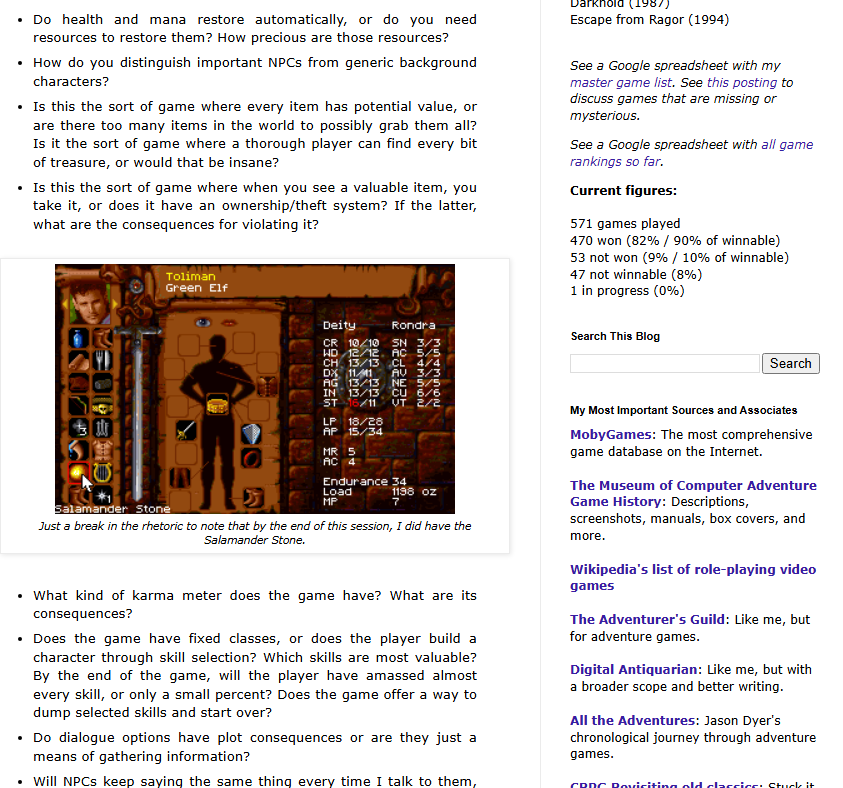
Related to Star Trail, the CRPG Addict recently produced a list of “conventions” that a CRPG game has that need to be worked out (“the part I enjoy least”) with issues like “What kind of karma meter does the game have? What are its consequences?”
A similar situation exists with text adventures, despite their apparent consistency. Issues like:
a.) can you refer to things that aren’t mentioned in the description? do you need to?
b.) can you refer to the player’s body parts and/or clothing, even if they aren’t mentioned?
c.) can you do things while in darkness, or is essentially all action shut down?
d.) is there always going to be an indication if there is a hidden object?
e.) are any seemingly essential items actually red herrings?
All five elements I’ve singled out above have the potential to increase difficulty; if you need to start pressing explicitly at floors or walls, for instance, that represents referring to a noun that might be implied in the game but is never directly referenced. Allowing action in darkness makes for puzzles like the lamp in the first dark room of Philosopher’s Quest; referring to clothing is so out-of-scope that one game used the idea to make an “impossible puzzle”.
In Intercept, all five elements go the hard way. I’ve finished the game, but I needed to check the walkthrough a large number of times. Brace yourself.
Before diving in, I should mention Rob’s observation that one of the Michael Wile games I haven’t gotten to yet (Merlin’s Treasure) gives enough clues to locate the man; he lived in Massachusetts and spent his career doing technical layouts for textbooks. I’ll give a little more detail next time we visit a Wile game, one that hopefully is a smidge more solvable.
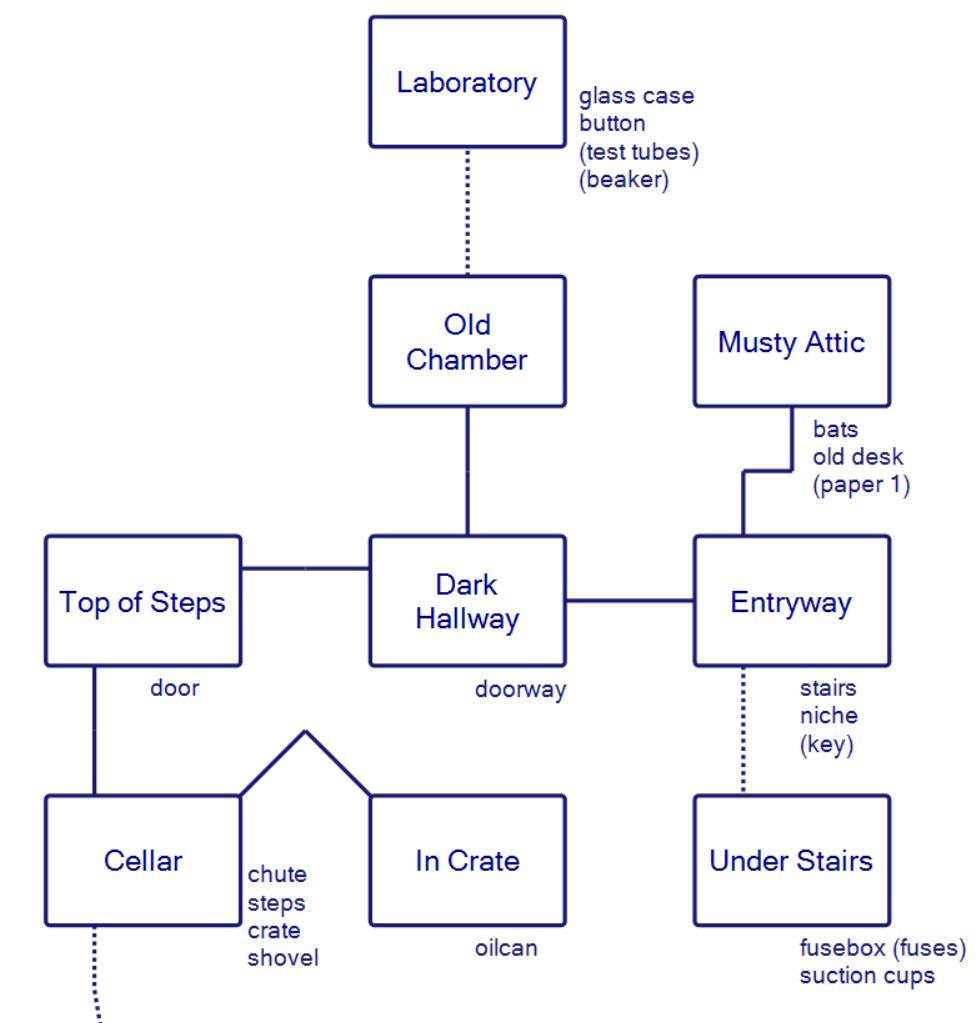
Last time I had a theater (where I was thrown out by an usher wanting a ticket), a cottage (with an enemy agent that kills me) and two obstacles in an “Eerie Mansion”: some bats guarding a paper and a spider guarding an arch.
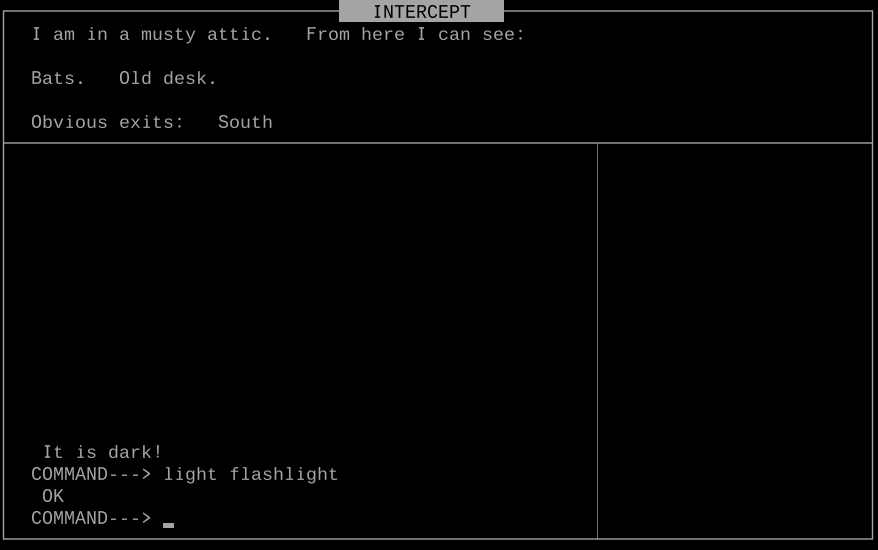
To handle the bats (who can see in darkness) you need to turn off the flashlight. This will plunge the room entirely back into darkness, but you can still refer to the page (even though it seems like you shouldn’t be able to!) and also go south to leave. The first time I tried this I messed up by going “down” from the attic rather than south and that led to death when I turned the flashlight back on.
I was still stuck with the spider; it turns out back at the statue (no clue at all you can do this, and the statue already hid a key … which turns out to be a red herring!) you can TURN STATUE to reveal a secret passage.
COMMAND—> look statue
I see
nothing special.
COMMAND—> turn statue
Stairs
raise
The new room has some suction cups and a fusebox. Doing LOOK FUSEBOX reveals fuses; if you try to TAKE FUSES the game queries if you want to pull them or replace them.
Taking them disables the spider. If you now LOOK SPIDER, you see a switch that wasn’t there before, and PUSH SWITCH will disable the spider (it isn’t clear this is the right verb, and pulling doesn’t work). You can then go back to the fuses and REPLACE FUSES to put them back on (you’ll need to in a moment).
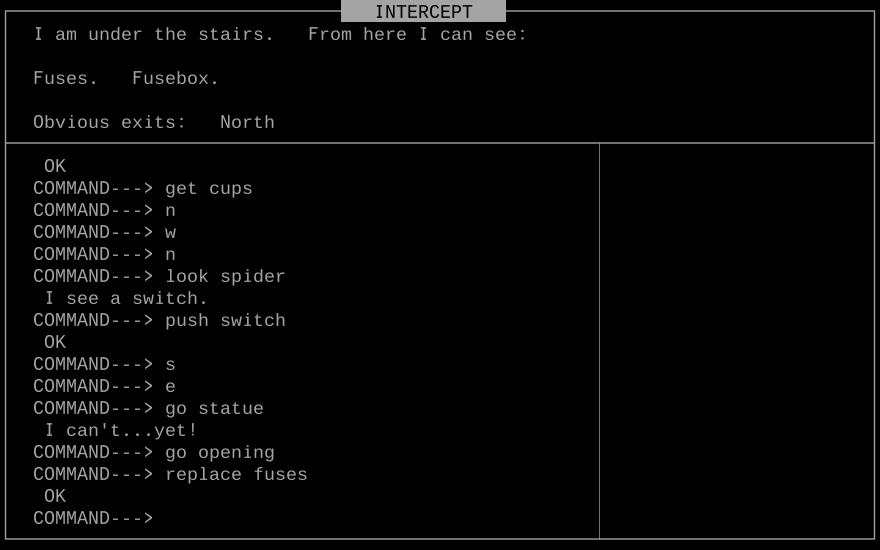
As an extra kick in the pants, if you tried to DROP FUSES or PUT FUSES, they’ll end up in the room, but they won’t be properly “replaced” so the game is now softlocked. You might think to PULL FUSES again but the game will just say you’ve already done that.
Back to the spider and arch, past that is a laboratory. There’s a red button that opens a case, which is why you needed to put the fuses back.
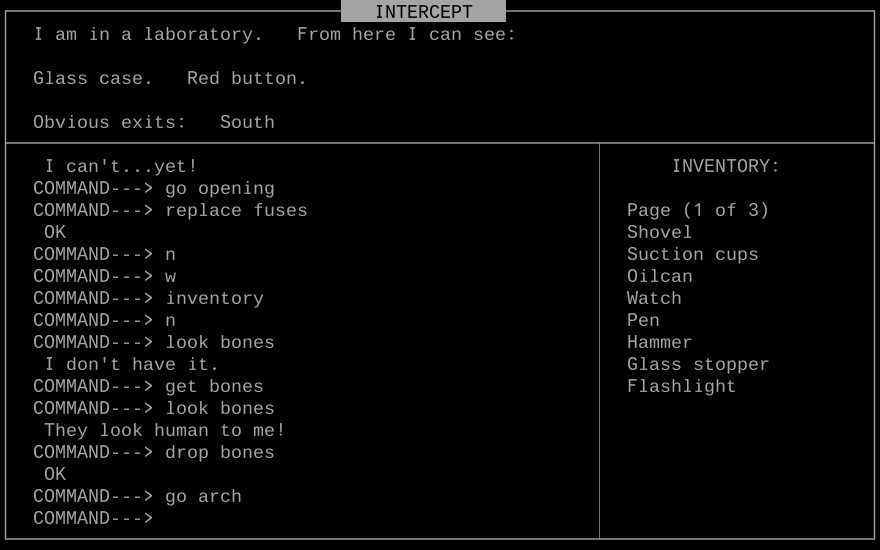
(In principle, the sequence is interesting: shut down power to a whole section, use the opportunity to shut off one thing individually, then turn power back on. The actual implementation which requires seeing a previously invisible switch, using the right verb with no feedback, and having the fuse-softlock issue makes it a drag.)
The case has some test tubes and a beaker. The test tubes have acid, and the challenge is getting them out. You can go back to the chute that sent you to this area and climb up with the suction cups, but if you are carrying the acid this will result in an unfortunate accident. The right action is COVER BEAKER (!!!) while holding the stopper stolen from the Chief’s wine (how did we know it was the right size? … and of course the verb choice is absurd).
The whole point of that sequence, other than getting the page, was getting some acid. Now we’re able to tackle the theater. Just as a reminder, we were stopped by a ticket-taking usher; we also found an empty soda bottle in upstairs seats.
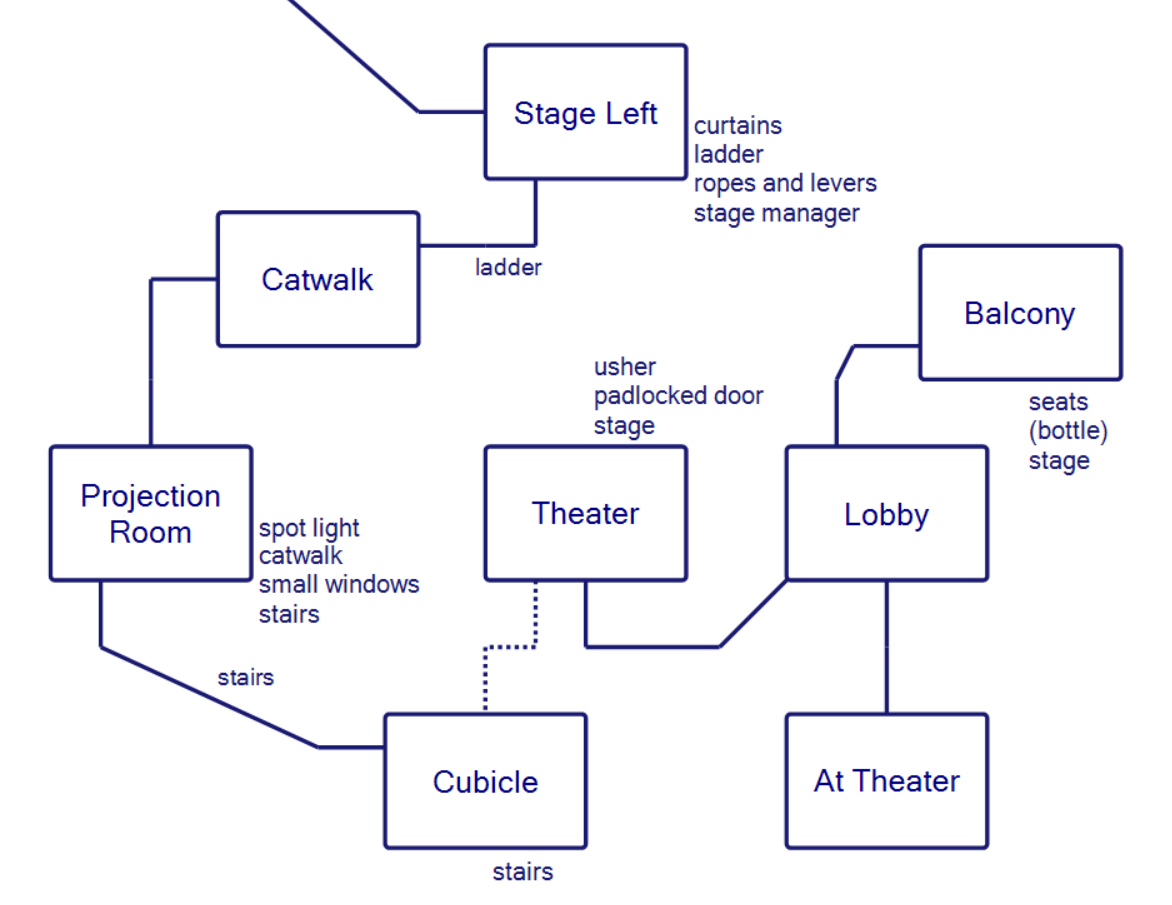
The usher asks for a ticket, and the way through is to show your id card.
??
I guess it indicates some kind of authority, but it isn’t described in the game! (As a general rule, the game has rooms and items where you are just supposed to guess things that are there.)
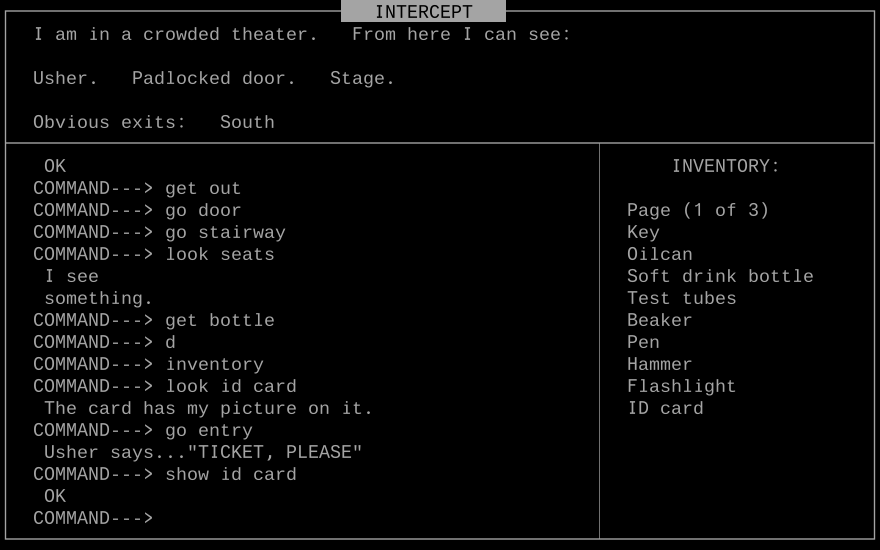
With that done, now we can apply the acid and melt the padlock (pour acid / on padlock), and the usher doesn’t mind.
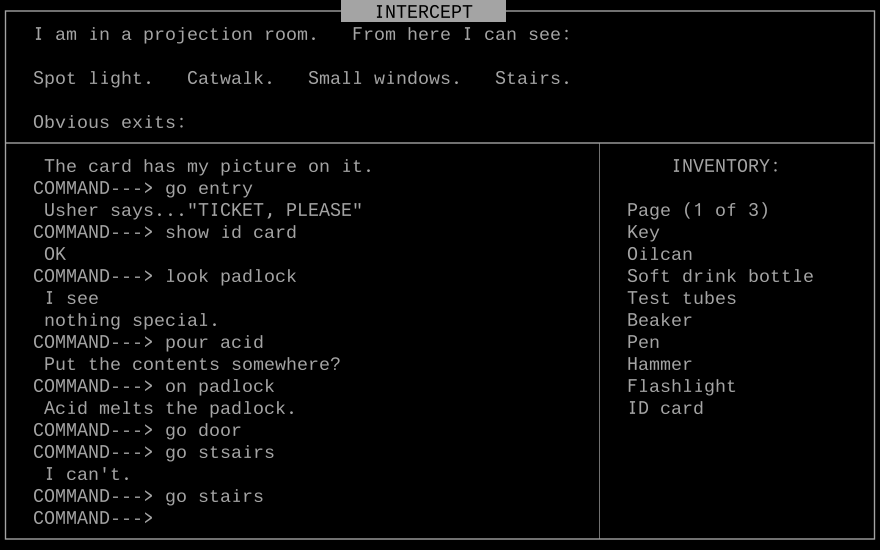
Eventually you can reach “stage left”.
Curtains. Ladder. Ropes and levers. Stage manager.
The “ropes and levers” does technically mean there are ropes, but combining the items suggest they stay as a unit; instead, you need to refer to the rope individually.
You need to BREAK BOTTLE (this only works if you’re holding the hammer, apparently) which is sharp enough to CUT ROPE. The whole reason to go through this sequence is to get a rope.
That’s the whole point of coming here: going backstage and stealing a rope by cutting it via a sharp bottle. Adventure game logic can lead to some bizarre object use, but this seems almost ludicrously absurd; we don’t have ropes back at headquarters? (Yes, Time Zone had you travel across millions of years just to get things like a ladder, but there’s a sense there of “the time machine knows where it is best to go” which isn’t present in this game.)
With the rope in hand, you can now:
a.) go back to the cottage where the agent was hiding
b.) set the car to neutral
c.) push the car, which reveals a manhole that the car was covering
We didn’t see the manhole driving in?!?
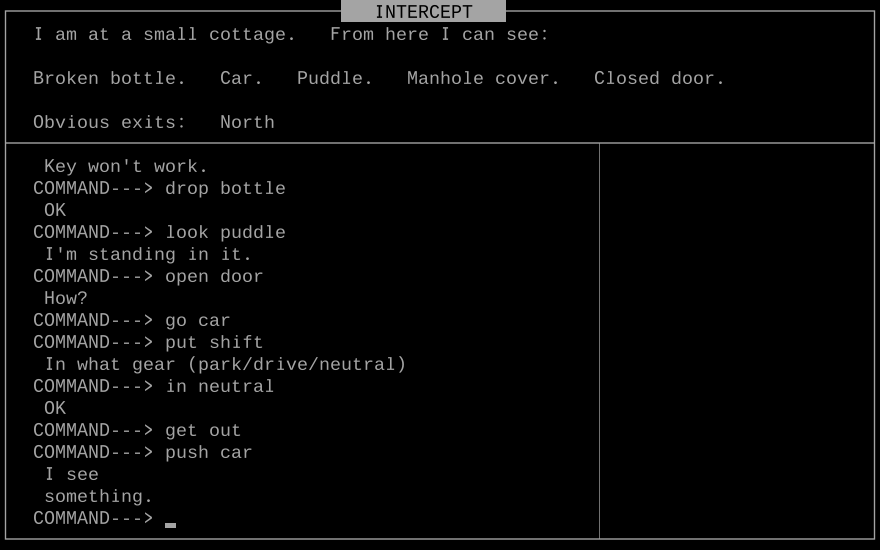
Then you can tie the rope to the bumper of the car (yes, you need to use the noun BUMPER, not CAR) and DROP ROPE which lets you go down the manhole. There you can find a lever, and pulling the lever opens the front door of the cottage.
Oh, and make sure you DROP SHOES before going in, because a squeaking sound will otherwise alert the enemy agent you are there and they’ll shoot you. The shoes are not mentioned anywhere in the game, you’re just supposed to guess from the description of squeaking that you are wearing some and they can be referred to.
Then, you can sneak up to the (still-awake) enemy agent and FRISK them (??) in order to get a wallet. The wallet has a card with the number 622 (which will be used shortly).
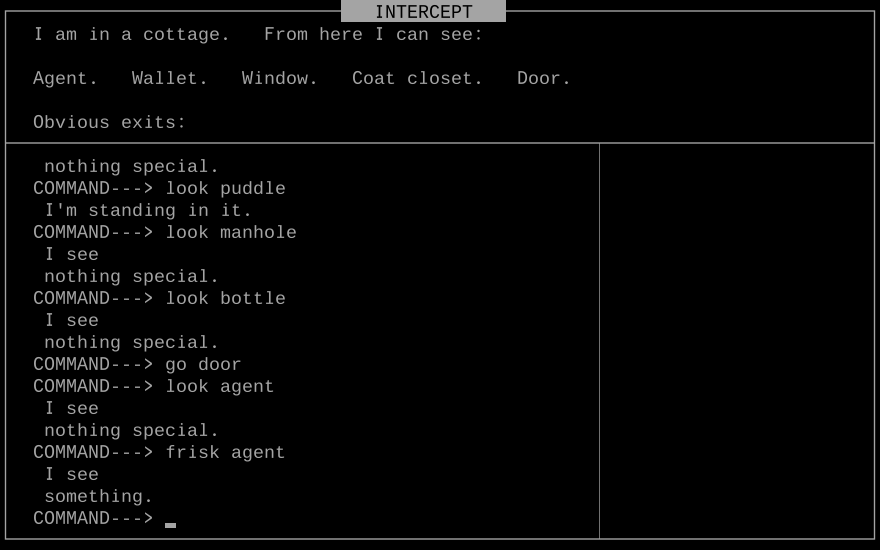
The wallet has a number. If you go to the coat closet, which has nothing in it but coats…
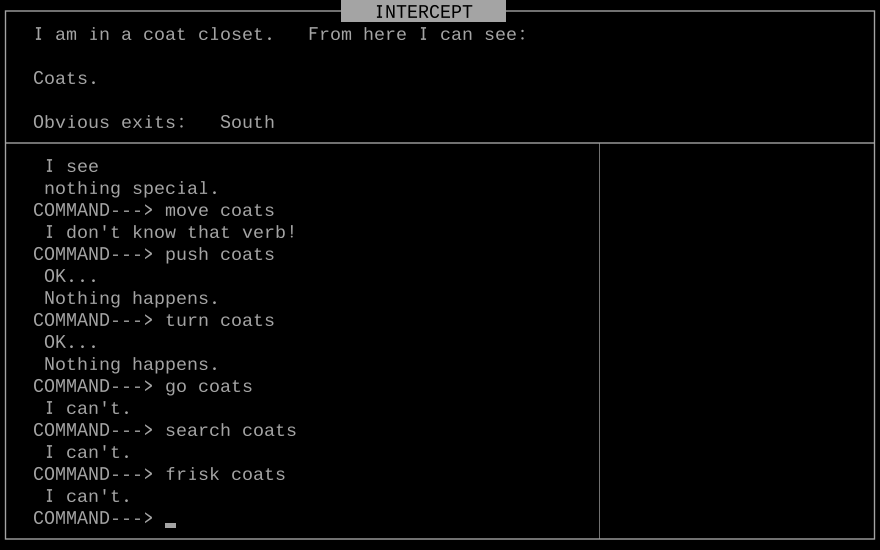
…it turns out you can PUSH WALL, despite no hint indicating this. A safe will be revealed, and then you have to struggle with the parser (again with the impossible codes) and type left six / right two / left two in order to open the safe. (You’ll need to also insert your id card in the slot. Why would an enemy agent safe respond to our ID?!?)
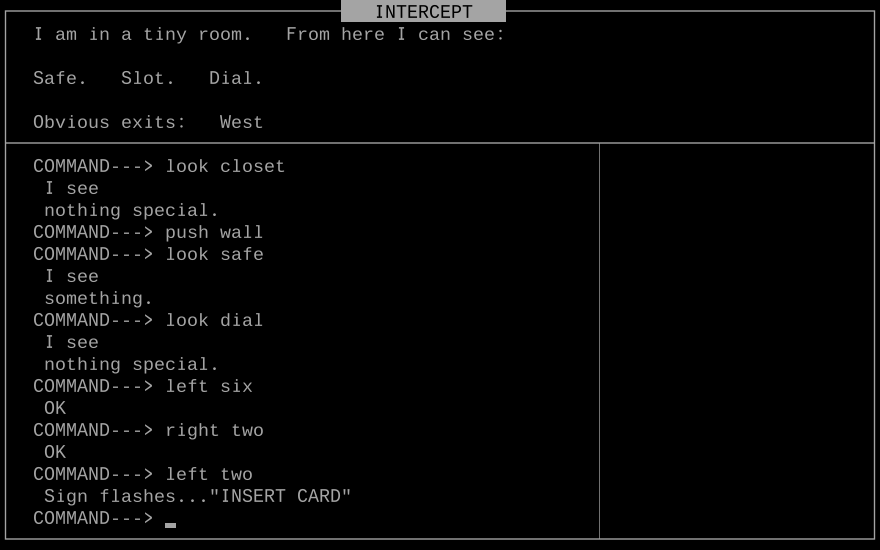
The safe has page number two. Almost done! To get page number three, it turns out after finding two pages, an Actor has magically appeared back at the Stage Left room.
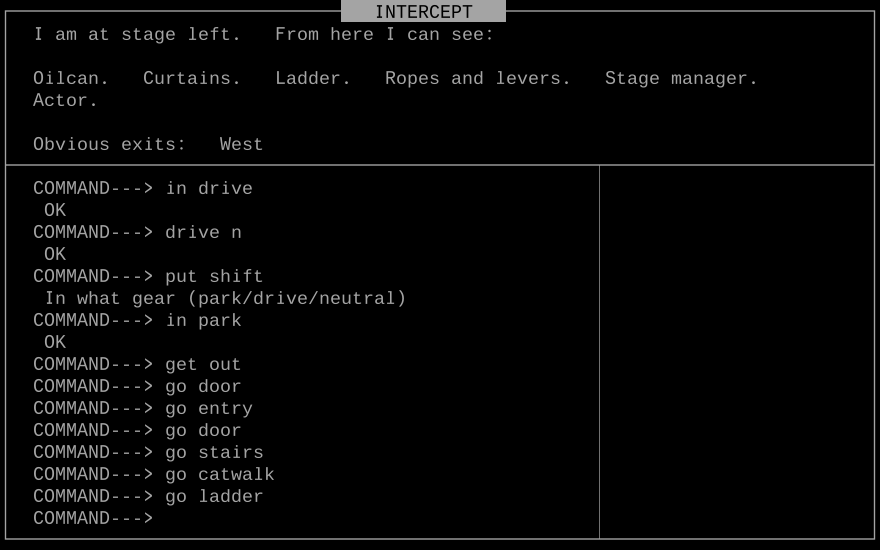
(Event-based drama clocks sometimes make sense. Here they do not.)
To take down the agent here, you need to use the pen from the headquarters near the start. The pen is described as being a tranquilizer dart shooter, so SHOOT ACTOR and then FRISK ACTOR (the stage manager doesn’t care). This yields the third page and now we have a “booklet”.
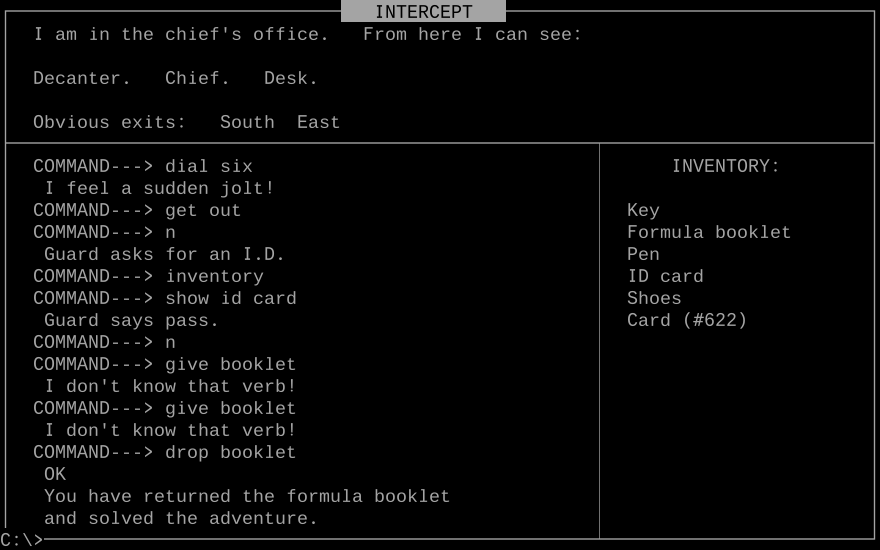
The thing I found consistently frustrating was that the author was working with some interesting ideas — it was just the implementation fell colossally short. Many of these issues could have been “patched” over (some better hint about the manhole under the car, some more workable synonyms, better descriptions of things being examined, some indicator you can mess with the wall in the coat closet). It feels like the author was going for maximum difficulty without considering what the gameplay would be like, and what aspects of difficulty are fun and unfun to grapple with.
I was going to plunge immediately into the author’s next game, but this is going to need a breather, so coming up: an Apple II game you might know, at least in a different form.

One of the PC-SIG disks. Source.


 Renga in Blue
Another thing to consider: How much, if any, do you need to refer to scenery? Most old games don’t implement lots of stuff that *is* mentioned in room descriptions so sometimes you might get stuck by just not realizing you could refer to something. Some games are far more explicit though: Warp (which I just finished) always prints “I can see the following” and then which interactable objects (even scenery) are there. For example:
Green Elevator.
You’re standing inside a large elevator with green walls. There is a small panel in here affixed to the wall, upon which you can see a white button, a red button, and a blue button.
I can see the following:
Red Button
Blue Button
White Button
Notice that it calls out the elevator buttons separately after the description even though they’re all described in the room message already. Compare to a similar scene in Zork (the dam maintenance room) where the buttons are only in the room description, but you can still push all of them.
(I would’ve take this time to complain about how one of the above-mentioned Warp buttons is fatal to push, but then I remembered that Zork also slowly floods the room if you press the wrong button at the dam. Ah well.)